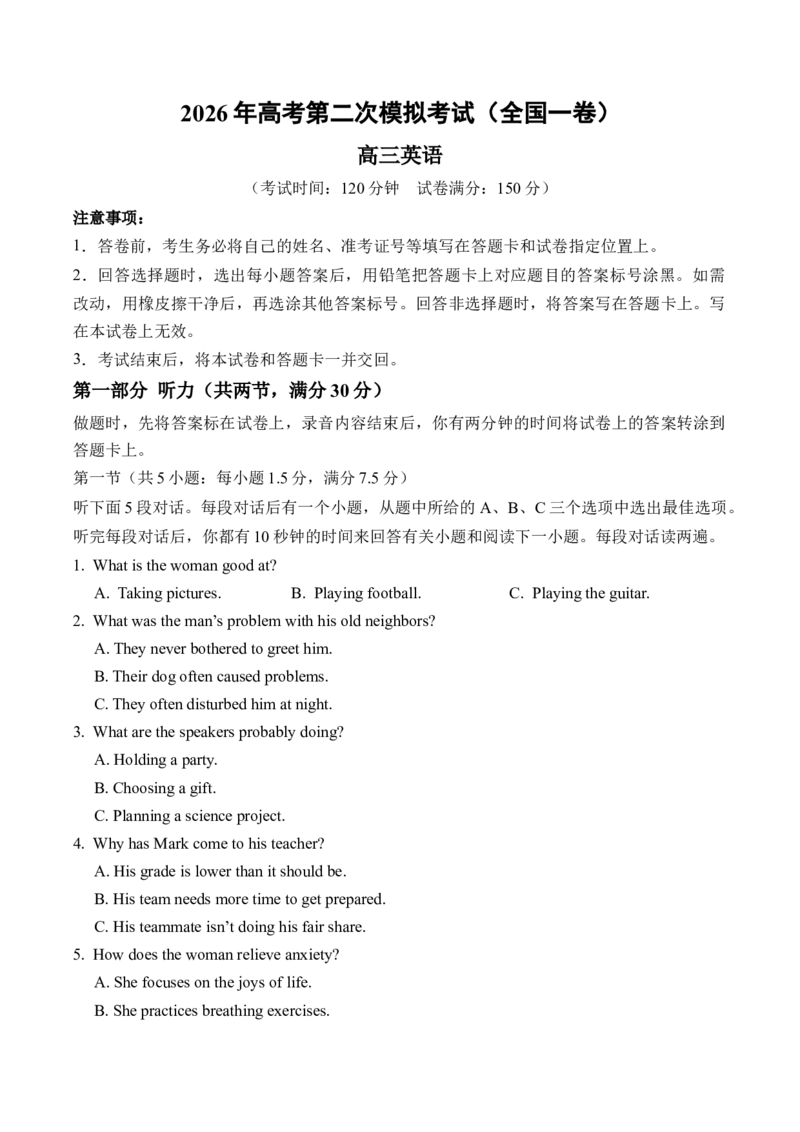
2026 年高考第二次模拟考试(全国一卷)
高三英语
(考试时间:120 分钟  试卷满分:150 分)
注意事项:
1.答卷前,考生务必将自己的姓名、准考证号等填写在答题卡和试卷指定位置上。
2.回答选择题时,选出每小题答案后,用铅笔把答题卡上对应题目的答案标号涂黑。如需
改动,用橡皮擦干净后,再选涂其他答案标号。回答非选择题时,将答案写在答题卡上。写
在本试卷上无效。
3.考试结束后,将本试卷和答题卡一并交回。
第一部分 听力(共两节,满分30 分)
做题时,先将答案标在试卷上,录音内容结束后,你有两分钟的时间将试卷上的答案转涂到
答题卡上。
第一节(共5 小题:每小题1.5 分,满分7.5 分)
听下面5 段对话。每段对话后有一个小题,从题中所给的A、B、C 三个选项中选出最佳选项。
听完每段对话后,你都有10 秒钟的时间来回答有关小题和阅读下一小题。每段对话读两遍。
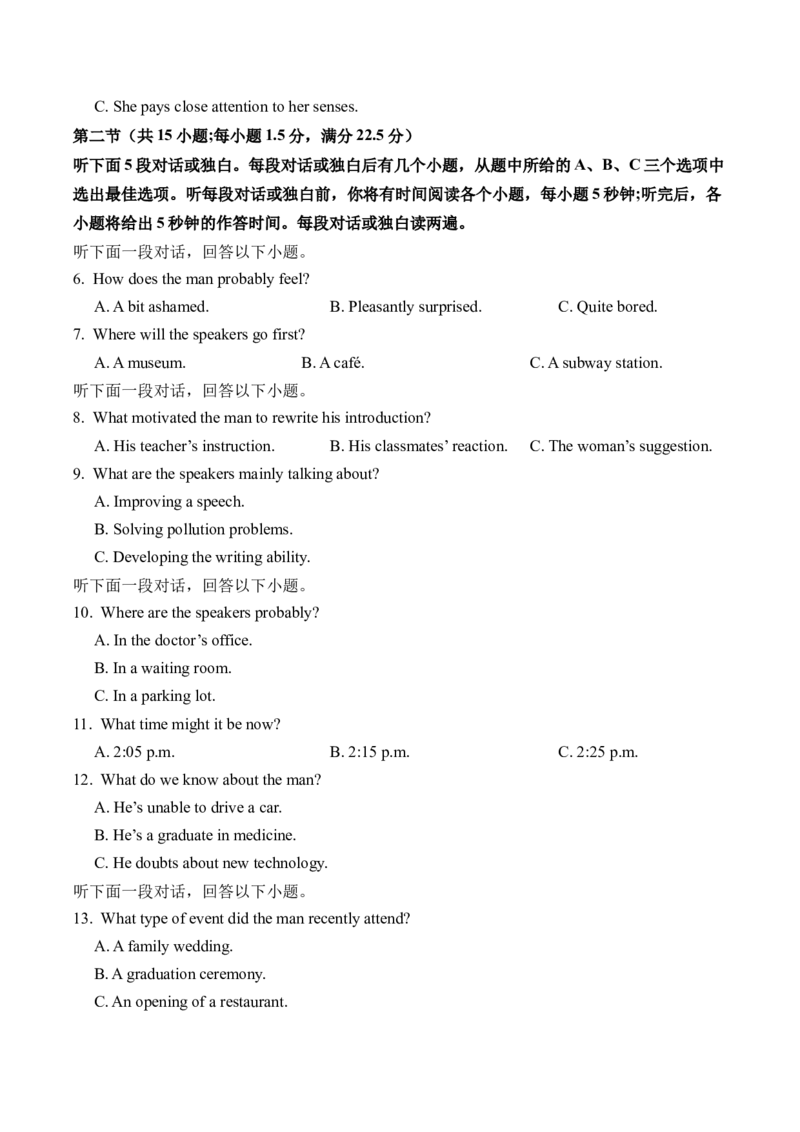
1. What is the woman good at?
A. Taking pictures.
B. Playing football.
C. Playing the guitar.
2. What was the man’s problem with his old neighbors?
A. They never bothered to greet him.
B. Their dog often caused problems.
C. They often disturbed him at night.
3. What are the speakers probably doing?
A. Holding a party.
B. Choosing a gift.
C. Planning a science project.
4. Why has Mark come to his teacher?
A. His grade is lower than it should be.
B. His team needs more time to get prepared.
C. His teammate isn’t doing his fair share.
5. How does the woman relieve anxiety?
A. She focuses on the joys of life.
B. She practices breathing exercises.
C. She pays close attention to her senses.
第二节(共15 小题;每小题1.5 分,满分22.5 分)
听下面5 段对话或独白。每段对话或独白后有几个小题,从题中所给的A、B、C 三个选项中
选出最佳选项。听每段对话或独白前,你将有时间阅读各个小题,每小题5 秒钟;听完后,各
小题将给出5 秒钟的作答时间。每段对话或独白读两遍。
听下面一段对话,回答以下小题。
6. How does the man probably feel?
A. A bit ashamed.
B. Pleasantly surprised.
C. Quite bored.
7. Where will the speakers go first?
A. A museum.
B. A café.
C. A subway station.
听下面一段对话,回答以下小题。
8. What motivated the man to rewrite his introduction?
A. His teacher’s instruction.
B. His classmates’ reaction.
C. The woman’s suggestion.
9. What are the speakers mainly talking about?
A. Improving a speech.
B. Solving pollution problems.
C. Developing the writing ability.
听下面一段对话,回答以下小题。
10. Where are the speakers probably?
A. In the doctor’s office.
B. In a waiting room.
C. In a parking lot.
11. What time might it be now?
A. 2:05 p.m.
B. 2:15 p.m.
C. 2:25 p.m.
12. What do we know about the man?
A. He’s unable to drive a car.
B. He’s a graduate in medicine.
C. He doubts about new technology.
听下面一段对话,回答以下小题。
13. What type of event did the man recently attend?
A. A family wedding.
B. A graduation ceremony.
C. An opening of a restaurant.
14. What is the relationship between the man and Sasha?
A. Mother and son.
B. Cousins.
C. Brother and sister.
15. Who mainly designed the menu?
A. Sasha and Will.
B. The hotel.
C. The man’s mother.
16. What is the man’s attitude toward the behaviour of his cousins?
A. Disapproving.
B. Indifferent.
C. Amused.
听下面一段独白,回答以下小题。
17. Which type of business was the speaker’s first company?
A. A fine art dealer.
B. A customer service provider.
C. An online shopping platform.
18. What was the speaker’s strength?
A. Motivating his team.
B. Picking good team members.
C. Handling customer complaints.
19. What did the speaker’s assistant probably ask the restaurant to do?
A. Cancel the reservation.
B. Increase the number of guests.
C. Change the reservation to a later time.
20. What did the speaker mainly learn from the experience?
A. Attention to detail is critical to success.
B. Good leaders recognize all contributions.
C. Small teams are more efficient than large ones.
第二部分  阅读(共两节, 满分50 分)
第一节(共15 小题;每小题2.5 分, 满分37.5 分)
阅读下列短文, 从每题所给的A、B、C 和D 四个选项中选出最佳选项。
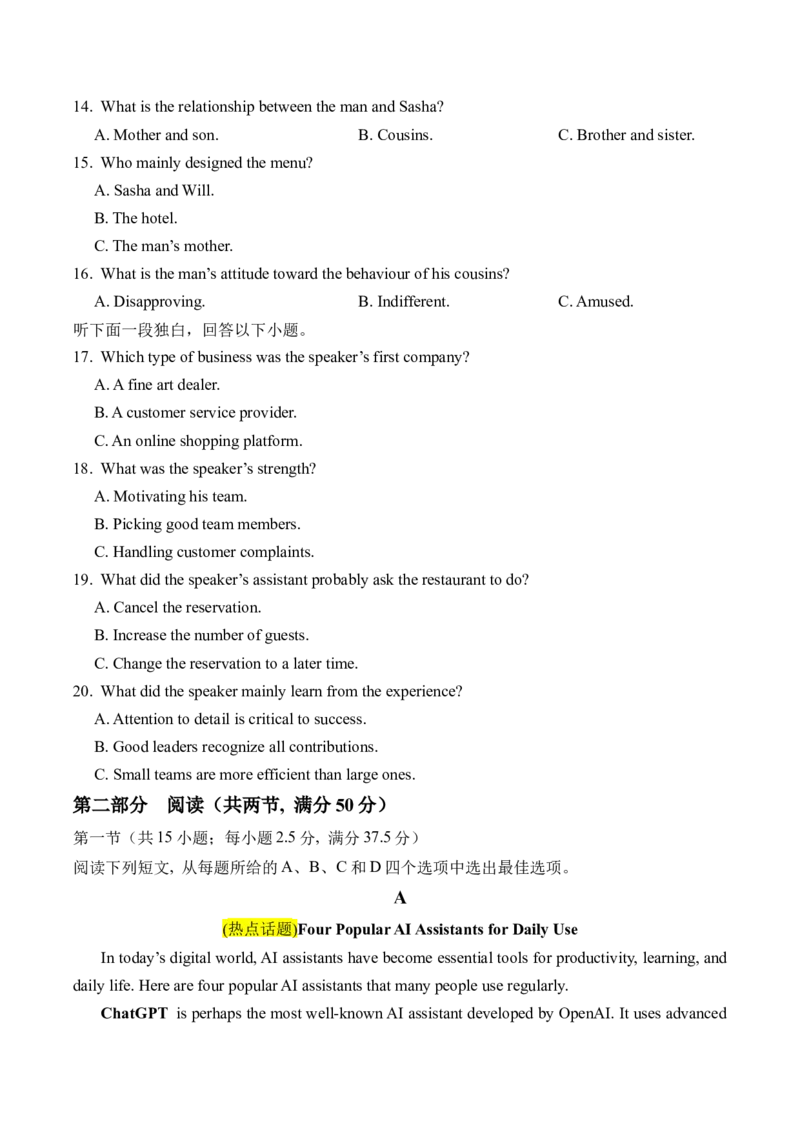
A
(热点话题)Four Popular AI Assistants for Daily Use
In today’s digital world, AI assistants have become essential tools for productivity, learning, and
daily life. Here are four popular AI assistants that many people use regularly.
ChatGPT is perhaps the most well-known AI assistant developed by OpenAI. It uses advanced
language processing to understand and respond to human queries. ChatGPT is excellent for writing
assistance, answering questions, and providing explanations on various topics. Students often use it
to help with homework, while professionals rely on it for drafting emails and reports.
Claude, created by Anthropic, stands out for its focus on safety and helpfulness. This AI
assistant is designed to be more cautious in its responses, making it suitable for sensitive topics.
Claude excels in tasks requiring detailed analysis and can handle longer documents, making it a
valuable tool for researchers and students working on complex projects.
Gemini, Google’s AI assistant, integrates smoothly with other Google products like Gmail,
Docs, and Drive. It offers real-time assistance and can help with tasks ranging from scheduling to
data analysis. Gemini’s strength lies in its ability to access and process information from the web,
providing up-to-date responses and assistance with current events.
Copilot, developed by Microsoft, is particularly useful for those working in tech and
programming environments. It provides code suggestions, helps debug programs, and offers
technical support. Copilot seamlessly integrates with Microsoft’s development tools, making it a
favorite among programmers and IT professionals.
Each AI assistant has its unique strengths, so the best choice depends on your specific needs.
Whether you’re a student, professional, or casual user, these AI tools can significantly enhance your
productivity and make daily tasks easier to accomplish.
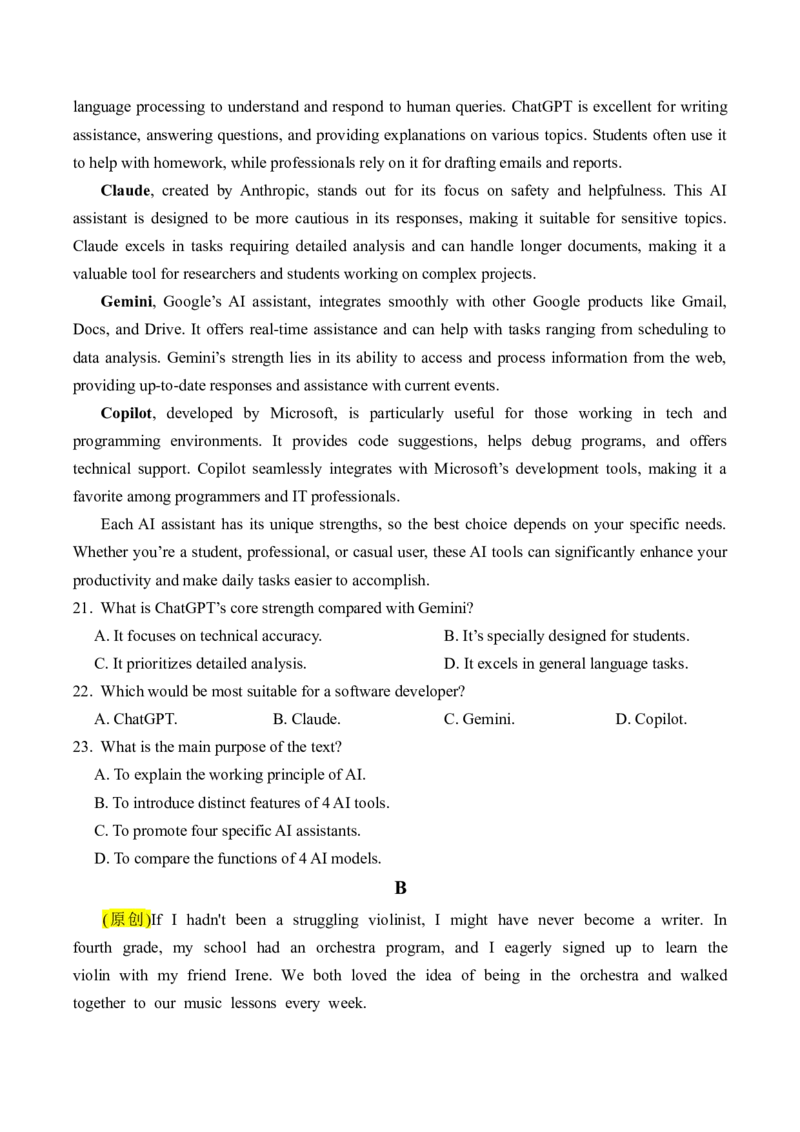
21. What is ChatGPT’s core strength compared with Gemini?
A. It focuses on technical accuracy.
B. It’s specially designed for students.
C. It prioritizes detailed analysis.
D. It excels in general language tasks.
22. Which would be most suitable for a software developer?
A. ChatGPT.
B. Claude.
C. Gemini.
D. Copilot.
23. What is the main purpose of the text?
A. To explain the working principle of AI.
B. To introduce distinct features of 4 AI tools.
C. To promote four specific AI assistants.
D. To compare the functions of 4 AI models.
B
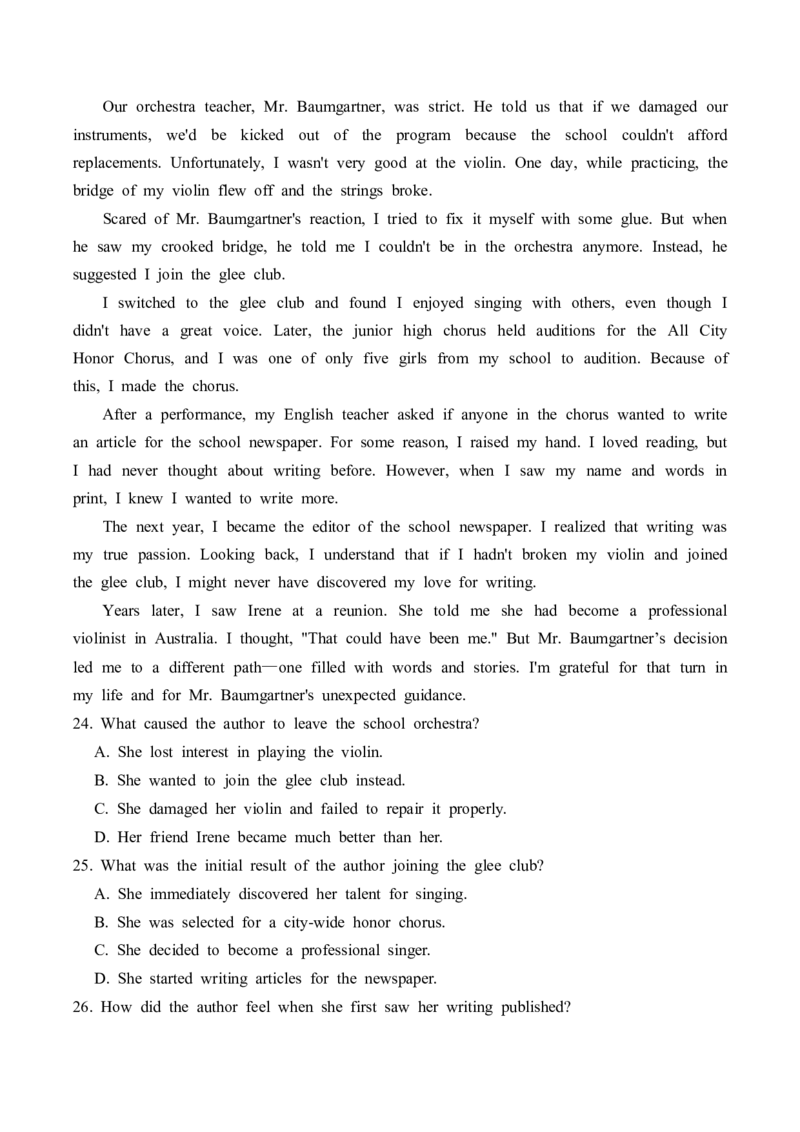
(原创)If I hadn't been a struggling violinist, I might have never become a writer. In
fourth grade, my school had an orchestra program, and I eagerly signed up to learn the
violin with my friend Irene. We both loved the idea of being in the orchestra and walked
together to our music lessons every week.
Our orchestra teacher, Mr. Baumgartner, was strict. He told us that if we damaged our
instruments, we'd be kicked out of the program because the school couldn't afford
replacements. Unfortunately, I wasn't very good at the violin. One day, while practicing, the
bridge of my violin flew off and the strings broke.
Scared of Mr. Baumgartner's reaction, I tried to fix it myself with some glue. But when
he saw my crooked bridge, he told me I couldn't be in the orchestra anymore. Instead, he
suggested I join the glee club.
I switched to the glee club and found I enjoyed singing with others, even though I
didn't have a great voice. Later, the junior high chorus held auditions for the All City
Honor Chorus, and I was one of only five girls from my school to audition. Because of
this, I made the chorus.
After a performance, my English teacher asked if anyone in the chorus wanted to write
an article for the school newspaper. For some reason, I raised my hand. I loved reading, but
I had never thought about writing before. However, when I saw my name and words in
print, I knew I wanted to write more.
The next year, I became the editor of the school newspaper. I realized that writing was
my true passion. Looking back, I understand that if I hadn't broken my violin and joined
the glee club, I might never have discovered my love for writing.
Years later, I saw Irene at a reunion. She told me she had become a professional
violinist in Australia. I thought, "That could have been me." But Mr. Baumgartner’s decision
led me to a different path—one filled with words and stories. I'm grateful for that turn in
my life and for Mr. Baumgartner's unexpected guidance.
24. What caused the author to leave the school orchestra?
A. She lost interest in playing the violin.
B. She wanted to join the glee club instead.
C. She damaged her violin and failed to repair it properly.
D. Her friend Irene became much better than her.
25. What was the initial result of the author joining the glee club?
A. She immediately discovered her talent for singing.
B. She was selected for a city-wide honor chorus.
C. She decided to become a professional singer.
D. She started writing articles for the newspaper.
26. How did the author feel when she first saw her writing published?
A. Surprised but indifferent.
B. Proud and determined to continue.
C. Regretful about her past choices.
D. Nervous about others’ opinions.
27. What is the main message the author wants to convey?
A. Failure in one area can lead to success in another.
B. Strict teachers are essential for student development.
C. Childhood friendships can shape our future careers.
D. Natural talent is more important than hard work.
C
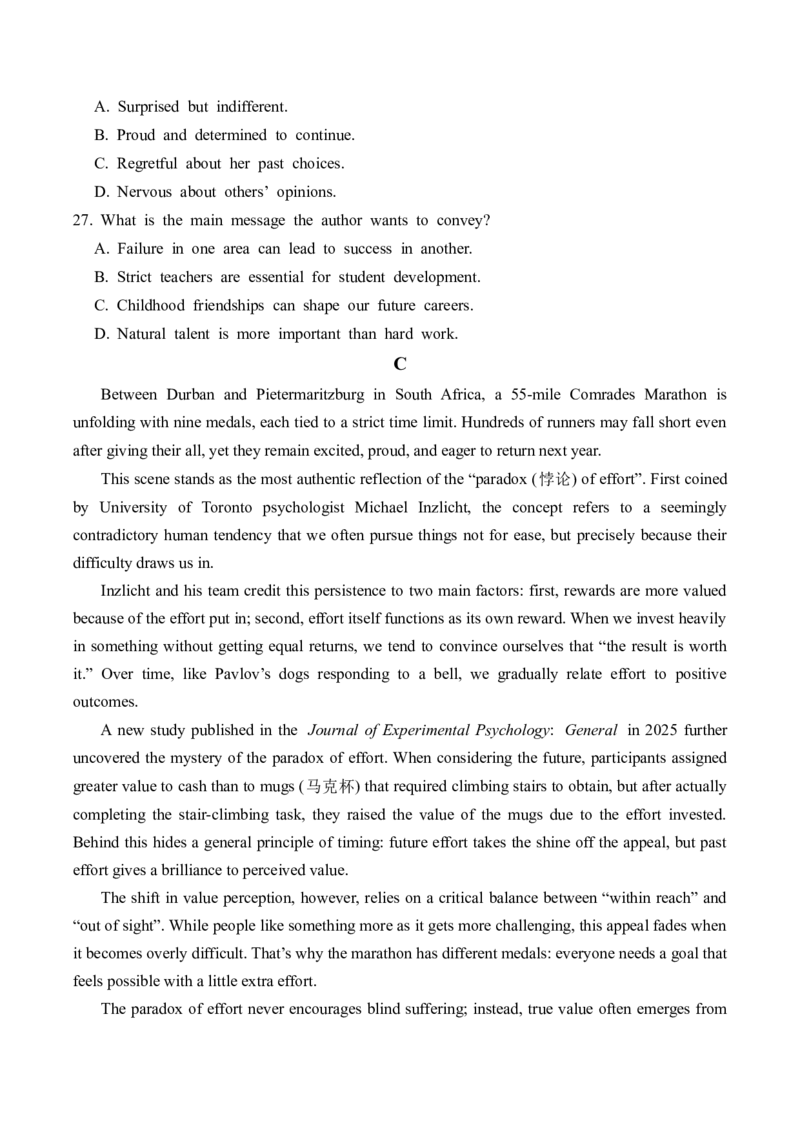
Between Durban and Pietermaritzburg in South Africa, a 55-mile Comrades Marathon is
unfolding with nine medals, each tied to a strict time limit. Hundreds of runners may fall short even
after giving their all, yet they remain excited, proud, and eager to return next year.
This scene stands as the most authentic reflection of the “paradox (悖论) of effort”. First coined
by University of Toronto psychologist Michael Inzlicht, the concept refers to a seemingly
contradictory human tendency that we often pursue things not for ease, but precisely because their
difficulty draws us in.
Inzlicht and his team credit this persistence to two main factors: first, rewards are more valued
because of the effort put in; second, effort itself functions as its own reward. When we invest heavily
in something without getting equal returns, we tend to convince ourselves that “the result is worth
it.” Over time, like Pavlov’s dogs responding to a bell, we gradually relate effort to positive
outcomes.
A new study published in the Journal of Experimental Psychology: General in 2025 further
uncovered the mystery of the paradox of effort. When considering the future, participants assigned
greater value to cash than to mugs (马克杯) that required climbing stairs to obtain, but after actually
completing the stair-climbing task, they raised the value of the mugs due to the effort invested.
Behind this hides a general principle of timing: future effort takes the shine off the appeal, but past
effort gives a brilliance to perceived value.
The shift in value perception, however, relies on a critical balance between “within reach” and
“out of sight”. While people like something more as it gets more challenging, this appeal fades when
it becomes overly difficult. That’s why the marathon has different medals: everyone needs a goal that
feels possible with a little extra effort.
The paradox of effort never encourages blind suffering; instead, true value often emerges from
those “optimal challenges”. Neither should you shy away from toil and trouble, nor should you chase
hardship for hardship’s sake. Just as Inzlicht said, “It’s the struggle within the right bounds that
fulfills your life and brings lasting happiness.”
28. What does the Comrades Marathon suggest?
A. Failure can be a source of pride.
B. Strict rules boost participants’ passion.
C. Difficulty can be a motivator.
D. Physical endurance ensures final success.
29. Which of the following best reflects the factors behind the “paradox of effort”?
A. A chef uses pre-made meals for instant profits.
B. A researcher abandons project despite potential gains.
C. A shopper values self-crafted items over finished ones.
D. A student jumps to quick conclusions without thinking.
30. What does the 2025 study show about the “paradox of effort”?
A. Future task elevates financial appeal.
B. Stair-climbing devalues invested effort.
C. Past effort reduces mug’s value.
D. Effort shifts perception of its value.
31. What does Inzlicht advise about effort?
A. Seek maximum difficulty.
B. Bear unnecessary hardship.
C. Embrace attainable challenge.
D. Pursue effortless happiness.
D
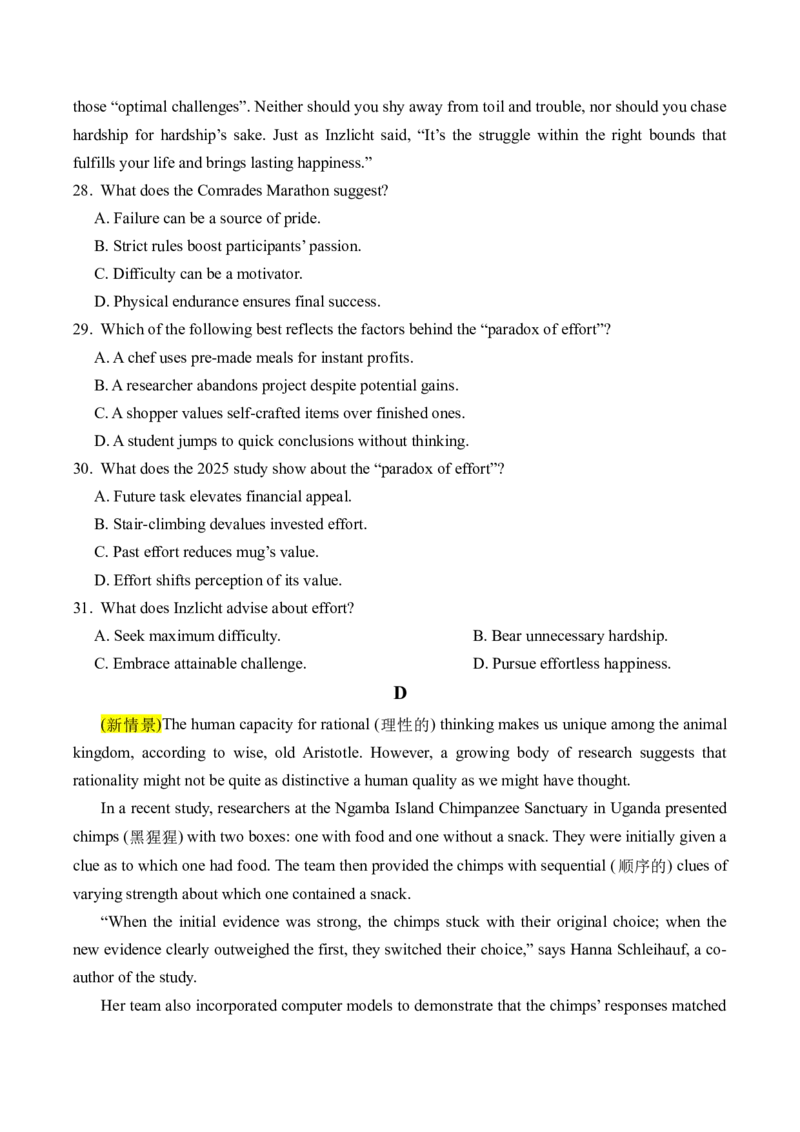
(新情景)The human capacity for rational (理性的) thinking makes us unique among the animal
kingdom, according to wise, old Aristotle. However, a growing body of research suggests that
rationality might not be quite as distinctive a human quality as we might have thought.
In a recent study, researchers at the Ngamba Island Chimpanzee Sanctuary in Uganda presented
chimps (黑猩猩) with two boxes: one with food and one without a snack. They were initially given a
clue as to which one had food. The team then provided the chimps with sequential (顺序的) clues of
varying strength about which one contained a snack.
“When the initial evidence was strong, the chimps stuck with their original choice; when the
new evidence clearly outweighed the first, they switched their choice,” says Hanna Schleihauf, a co-
author of the study.
Her team also incorporated computer models to demonstrate that the chimps’ responses matched
up with rational strategies of belief revision, ensuring they engaged in genuine reasoning rather than
merely favoring the most recent evidence. Researchers typically associate this sort of reasoning with
children around four years old.
“Most strikingly, the chimps also showed metacognitive sensitivity to evidence,” Schleihauf
continued. Metacognition is awareness and understanding about our thinking processes. “They not
only adjusted their choices, but did so in ways that suggest they tracked the evidential basis of their
beliefs; when earlier evidence was defeated, they revised their belief accordingly,” she explains.
These findings suggest that chimps’ reasoning is more similar to ours than previously believed.
“Demonstrating rational belief revision in chimps provides a powerful comparative baseline for
understanding the evolution of human reasoning,” said Schleihauf. By identifying which aspects of
rationality humans share with chimps and which are unique to us, researchers can better recognize
which develop early in children, which depend on culture, and which rely on uniquely human forms
of social learning. She adds that the study is important for animal conservation and welfare because
it further justifies the protection of great chimps, the increased moral standards in research and
conservation, and the creation of more cognitively ( 认知上) stimulating habitats in reserves and
zoos.
32. What can be inferred about the chimps’ behavior in the experiment?
A. They could ignore strong initial evidence.
B. They preferred whichever box looked larger.
C. They based decisions on weighing of evidence.
D. They chose randomly when clues were unclear.
33. Why did the researchers use computer models in the study?
A. To copy the chimps’ learning process.
B. To predict which box the chimps would choose.
C. To compare the chimps’ behavior with that of kids.
D. To confirm the chimps used rational belief revision.
34. What does Schleihauf think of the study findings?
A. They are less reliable than expected.
B. They show limited progress in this field.
C. They fail to explain the chimps’ behavior.
D. They reveal impressive abilities in chimps.
35. What does the last paragraph stress about the study?
A. Its practical implications.
B. Its historical context.
C. Its experimental approach.
D. Its potential limitations.
第二节(共5 小题;每小题2. 5 分, 满分12. 5 分)
阅读下面短文, 从短文后的选项中选出可以填入空白处的最佳选项。选项中有两项为多余选
项。
Economists have a name for what you must give up while you wait. We call this your
opportunity cost. For example, you are always queuing a long time for a concert ticket. ____36____
The advice you can find on the internet for beating the lines at the Sistine Chapel often involves
going early, perhaps before the museum opens, to secure a spot toward the front of the line.
____37____ If I arrive an hour before tickets go on sale to be first in line, but the wait would be only
forty minutes long if I arrived when the museum opened, I end up waiting longer, not less.
Whether arriving early shortens my wait depends on when others choose to arrive, and if all
tourists follow the same internet advice and arrive an hour early, the lines at opening may be the
longest of the day. It is hard to predict when the wait will actually be the shortest.
____38____ Rather than going when you think the lines might be the shortest, you can go when
your opportunity cost is the smallest-for example, when you have nothing (or little) better to do.
____39____ Sometimes, it increases the total amount of time you wait, though.
By arriving before opening, you get your waiting out of the way when other activities are not yet
open. Sure, you might give up an hour of sleep or the chance to have a leisurely breakfast. This is
worthwhile if the planned activities hold greater value for you. ____40____ If you’re first in line at
the museum, you can see the chapel and still enjoy a packed day visiting other sites in Rome.
A. Only then is queuing up early a good choice.
B. Sightseeing joy outweighs breakfast comfort easily.
C. But the economist in me is not sure about this advice.
D. This is why you are better off considering opportunity cost.
E. Opportunity cost awareness improves personal satisfaction later.
F. Thinking about opportunity cost can make arriving an hour early seem sensible.
G. Your opportunity cost is the enjoyment, work, or wages you give up by waiting.
第三部分 语言运用(共两节,满分30 分)
第一节(共15 小题,每小题1 分,满分15 分)
阅读下面短文, 从每题所给的A、B、C 和D 四个选项中选出可以填入空白处的最佳选项。
When I was fifty-three, the idea of willingly immersing ( 沉浸) myself in mud was
unimaginable. However, a ____41____ I joined in six months earlier changed my perspective.
The trainer at my gym ____42____ she was signing up for the Mud Girl Run, a 5k obstacle race
____43____ to women, with money going to breast cancer research. She asked if anyone wanted to
join her team. Seeing nobody ____44____, she singled me out, ____45____ asking if I was going
to sign up.
“I’ll check my calendar,” I said. She seemed to ____46____ me too well and replied, “You
don’t have anything on your calendar six months from now. And... Didn’t you just tell me you were
working on a book about ____47____ your comfort zone and saying ‘yes’ to new opportunities?”
Cornered by her ____48____, I agreed.
To mentally ____49____, I watched online videos of the event, learning the ____50____ of
seventeen mud-based obstacles, including mud pits, steep (陡峭的) hills, and sandbags to carry.
On the day of the race, despite my nerves, I couldn’t help but feel the ____51____ of being a
part of a group of women in pink shirt and crazy wigs ( 假发). People were so ____52____, and
there were many other costumes representing particular groups. Hearing the announcements from the
loudspeaker about start time, I ____53____ to conquer each obstacle.
As scheduled, I handled each ____54____, appearing completely caked in mud but smiling. I
had so much fun that I started looking for other ____55____ in my area.
41. A. club
B. discussion
C. conversation
D. run
42. A. explained
B. announced
C. confirmed
D. assumed
43. A. referred
B. related
C. dedicated
D. exposed
44. A. emerge
B. respond
C. freeze
D. sink
45. A. directly
B. angrily
C. desperately
D. appropriately
46. A. blame
B. approach
C. support
D. know
47. A. making up for
B. getting out of
C. putting up with
D. cutting down on
48. A. ambition
B. anxiety
C. favor
D. logic
49. A. prepare
B. slide
C. bend
D. battle
50. A. symbol
B. advantage
C. reality
D. significance
51. A. regret
B. embarrassment
C. horror
D. excitement
52. A. creative
B. optimistic
C. diligent
D. courageous
53. A. managed
B. agreed
C. resolved
D. offered
54. A. direction
B. challenge
C. process
D. regulation
55. A. resources
B. methods
C. events
D. platforms
第二节(共10 小题;每小题1.5 分 ,满分15 分)
阅读下面短文,在空白处填入1 个适当的单词或括号内单词的正确形式。
(新情景)Yufan can hardly believe that just six months ago, he was sitting in lecture halls writing
papers on animation. Now, he spends his days in a laboratory, learning to operate ____56____
electron microscope and analyze ultra-thin metal samples.
This fall, the 21-year-old entered Henan Chemical Technician College’s EM program, despite
already ____57____ (hold) a bachelor’s degree in animation production. “It’s my own decision,”
Yufan said. “I want to master a skill that will still matter in the future.”
His choice reflects a broader trend among Chinese youth. With ____58____ (uncertain) in the
cultural and creative industries and job prospects being reshaped by AI, many ____59____ (turn) to
practical, hands-on skills. Increasingly, university graduates are returning to vocational ( 职业的)
colleges ____60____ retraining.
Yufan’s EM program is among one of the most ____61____ (compete) programs nationwide.
Within two months, Yufan mastered hands-on techniques from sample preparation to equipment
operation.
Su Wei, one of his instructors, observes that students with higher education backgrounds are
increasingly common. “Even those from unrelated fields, though less technically ____62____
(prepare), bring unique strengths. “They are ____63____ (high) motivated and know exactly what
they want,” she said.
Learning a skill can bring quicker results than studying theory, ____64____ that shouldn’t be
the only reason. “_____65_____ matters most is knowing who you want to become and choosing the
right path,” as Yufan said.
第四部分 写作(共两节, 满分40 分)
第一节(满分15 分)
假定你是李华,你们班在校英文报组织的以 “传统节日的现代表达” 为主题的海报设
计大赛中获奖。请你给英国朋友 Chris 写一封邮件分享这次经历,内容包括:
(1)作品介绍;
(2)你的收获。
注意:
(1)写作词数应为80 左右;
(2)请按如下格式在答题卡的相应位置作答。
Dear Chris,
I can’t wait to share with you a piece of good news.
_________________________________________________________________________________
_________________________________________________________________________________
_________________________________________________________________________________
_________________________________________________________________________________
_________________________________________________________________________________
_________________________________________________________________________________
_________________________________________________________________________________
_______________________________________________________
Yours,
Li Hua
第二节(满分25 分)
阅读下面材料,根据其内容和所给段落开头语续写两段,使之构成一篇完整的短文。
“Ka-boom!” Thunder resounded after lightning flashed across the sky. The rain poured down. I
had to brave through the storm on the way home from school. I sighed. It just had to rain on the day I
forgot to bring my umbrella. Thankfully, there was a taxi stand right ahead, where I could seek some
shelter even for a brief moment. Before I could set off on the last part of my journey, I saw a familiar
face approaching me with an umbrella. It was my brother coming to my rescue!
Holding the umbrella, we walked home, talking and laughing. Arriving home, we took off our
shoes. Then I noticed my brother’s shoes were all wet, with water in them. These shoes were his
favorite. He loved playing football very much. These shoes were especially suitable for playing
football, so he wore them almost every day. Now they were worn out. I asked him, “Why don’t you
ask parents to buy a new pair for you?”
He said, “I don’t want to be a burden(负担), so I haven’t mentioned it to anyone. Although these
shoes are a bit old, I can put up with them. Please, my dear sister, don’t tell parents about it.” “You’re
so nice. I won’t tell them. Let me dry your shoes first. Later I’ll make you some cookies. You can go
to your room to do your homework.”
My heart ached for him. I knew how much he loved playing soccer and how important it was for
him to have proper shoes to run and kick the ball. I remembered the kindness he had always shown
me, and I knew I had to do something for him. As I promised, I didn’t mention it to my parents, but I
knew what I would do next.
注意:
1.续写词数应为150 个左右;
2.请按如下格式在答题卡的相应位置作答。
I secretly started to save up my pocket money.
_________________________________________________________________________________
_________________________________________________________________________________
_________________________________________________________________________________
_________________________________________________________________________________
_________________________________________________________________________________
____________________________________________
On the day of his birthday, I handed him a box decorated beautifully.
_________________________________________________________________________________
_________________________________________________________________________________
_________________________________________________________________________________
_________________________________________________________________________________
_________________________________________________________________________________
____________________________________________