绝密★启用前
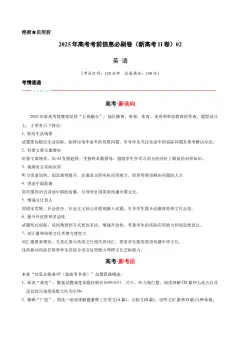
2025年高考考前信息必刷卷(江苏专用)02
英 语
(考试时间:120分钟 试卷满分:150分)
高考·新动向
为了保持稳定,我们完全有理由相信,2025新高考仍将延续2024的命题思路,但是会“稳中求变”。
怎么“求变”?笔者以为主要体现在以下三个“强化”:一是聚焦立德树人,强化高考育人功能;二是助
力人才选拔培养,强化思维品质考查;三是发挥正向引导作用,强化推动高中教学提质增效。(以上参看信
息卷01的说明)。除了以上三个“强化”以外,2025年是否会在“冷点”上做文章。比如:写作第一节的
命题会不会出现2022年全国乙卷的图表类写作,我们拭目以待。再比如:七选五的选材历年高考多青睐说
明文体裁,那么2025新高考是不是可能换成其他体裁(如:议论文)呢,我们有理由相信有这个可能。
高考·新考法
本套“考前信息必刷卷(江苏专用)”命题思路概述:
1. 体现“难度”:整套试题难度系数控制在0.6±0.01。其中,阅读理解D篇和七选五以及完形填空难度系
数大约为0.4;其中阅读理解C篇的“配得感(entitlement)”话题,考生可能不甚了解,无疑给考生读懂
文本带来了不小的挑战;
2. 兼顾“广度”:四选一阅读理解题兼顾了应用文(A篇)、记叙文(B篇)、议论文(C篇)和说明文(D篇)四
种体裁,且“细节理解题、推理判断题、主旨大意题及词义猜测题”均有所考查;
3. 关注“冷点”:七选五选择了议论文的体裁文本;第一节写作选择了“图表类”写作的题型。
命题·大预测
四选一阅读理解题C篇探讨了“配得感(entitlement)”这一人格特质,它以过分的应得感和优越感为
特征,以激发学生学习新知识的欲望。七选五旨在引领学生认识到培养批判性思维的重要性,逐步提升自
己的核心素养;语法填空引导学生关注传统文化、传承中国文化;写作第一节提醒学生密切关注“冷点题
型”,积累有关素材。
第一部分 听力(共两节,满分 30 分)
第一节(共5小题;每小题1.5分,满分7.5分)听下面5段对话,每段对话后有一个小题,从题中所给的A,B,C三个选项中选择最佳选项,并标在
试卷的相应位置。听完每段对话后,你都有10秒钟的时间来回答有关小题和阅读下一小题。每段对话仅读
一遍。
第二节(共15小题;每小题1.5分,满分22.5分)
听下面5段对话或独白。每段对话或独白后有几个小题,从题中所给的A,B,C三个选项中选择最佳
选项,并标在试卷的相应位置。听每段对话或独白前,你将有时间阅读每个小题,每小题 5秒钟,听完后,
各小题将给出5秒钟的作答时间。每段对话或独白读两遍。
1. How long does it take Bus 3 to get to Los Angeles?
A. Three hours. B. Four hours. C. Five hours.
2. Where did the man leave his wallet?
A. At the supermarket. B. In the bank. C. In the classroom.
3. When will the man see the doctor?
A. At 11: 00 a. m. B. At 10: 00 a. m. C. At 4: 00 p. m.
4. Why does the woman come to the man?
A. To check into a hotel. B. To apply for a job. C. To get a new bed.
5. What was the woman always worried about according to the man?
A. The view of the garden. B. The safety of the man. C. The fruit of the tree.
听下面一段对话,回答第6和第7两个小题。
6. What does the woman recommend?
A. Opening an account. B. Closing the account. C. Checking the account.
7. What is the woman going to do next?
A. Give the man some cash. B. Make a demonstration. C. Show another product.
听下面一段对话,回答第8至第10三个小题
8. Why did the woman go to New York?
A. To have meetings. B. To go sightseeing. C. To study a program.
9. What may help avoid jet lag?
A. Coffee. B. Alcohol. C. Exercise.
10. What did the woman say about most passengers?
A. They preferred alcohol.
B. They liked to do exercises.
C. They could hardly make a choice.听下面一段对话,回答第11至13三个小题
11. Where are the speakers?
A. At a clothing store. B. At their house. C. At a travel agency.
12. How long will the speakers be on the trip?
A. For two days. B. For five days. C. For seven days.
13. What does the woman suggest the man do?
A. Pack more clothes. B. Test the suitcase. C. Wear his jackets.
听下面一段对话,回答第14至17四个小题
14. How many showings are there at the weekend?
A. 4. B. 5. C. 6.
15. Why can’t the man buy tickets for the 11 pm showing tonight?
A. There aren’t enough tickets left.
B. A friend of his can’t make it.
C. He thinks it is too late.
16. What day is it?
A. Saturday. B. Friday. C. Sunday.
17. Which showing does the man end up buying tickets for?
A. The noon one today. B. The 8 pm one today. C. The midnight one tomorrow.
听下面一段独白,回答第18至20三个小题
18. What is the purpose of the gathering?
A. To introduce the staff band.
B. To celebrate the professor’s retirement.
C. To announce the cancellation of exams.
19. What will Mr. Hopkins do in his free time?
A. Become a gardener. B. Become a guitarist. C. Become a beekeeper.
20. What will the students do in the next semester?
A. Study with a new teacher. B. Study playing the guitar. C. Study
independently.
第二部分 阅读(共两节, 满分50分)
第一节(共15小题;每小题2.5分, 满分37.5分)
阅读下列短文,从每题所给的A、B、C、D四个选项中选出最佳选项。A
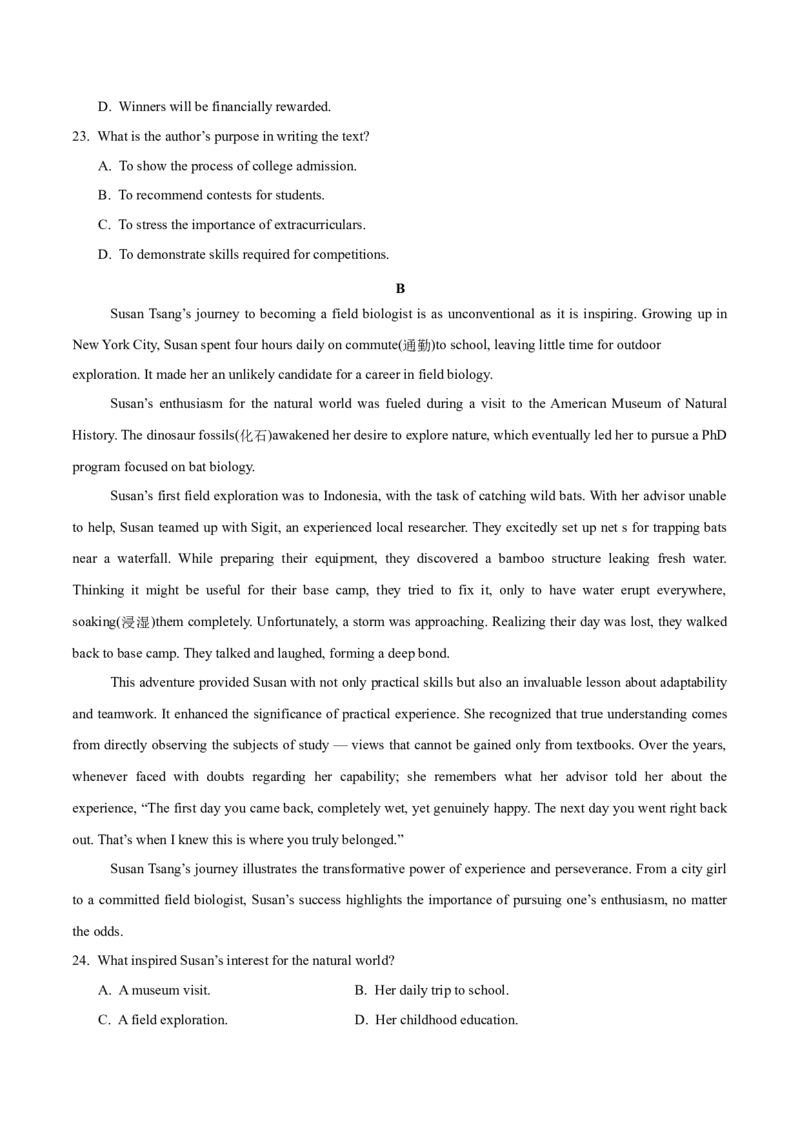
In the highly competitive college admissions landscape, extracurriculars are often the key differentiators(区
分因素). Academic competitions not only highlight your intellectual abilities but also help demonstrate teamwork
and problem-solving skills.
The Slingshot Challenge
The Slingshot Challenge is an initiative by the National Geographic Society that encourages young people
aged 13 to 18 to come up with innovative solutions to environmental issues. Participants can submit a one-minute
video outlining their ideas for a chance to win up to $10,000 in funding to implement their projects.
Chemical Educational Foundation’s The Challenge
Although it’s only open to middle school students in grades 5-8, the Chemical Education Foundation’s The
Challenge is an opportunity for budding scientists to explore their interests in STEM fields! Teams of 3-
4participants compete in exciting, time-based rounds of questions and responses. Additionally, teams get to create
original videos to “launch a start-up company” around community-based sustainability solutions.
John Locke Institute Competition
The John Locke Institute is a unique essay competition for high schoolers. The top prize is one of the most
exciting writing awards for high schoolers in the country. Participants can select one of three topics to address in a
2,000-word essay. The topics change from year to year but always relate to philosophy, politics, history, law,
theology, economics, or psychology.
National Young Composers Challenge
The National Young Composers Challenge is a wonderful competition for instrumental composers between
13 and 18 years old in the United States. Participants are asked to submit one original composition, either for
orchestra or for a small(2-6 instruments)ensemble. The compositions. must be under five minutes. The top three
composers in each category receive cash prizes, as well as professional performances and recordings of their
works!
21. Which requires participants to submit articles?
A. The Slingshot Challenge B. Chemical Educational Foundation’s The Challenge
C. John Locke Institute Competition D. National Young Composers Challenge
22. What do The Slingshot Challenge and National Young Composers Challenge have in common?
A. Participants are required to submit videos.
B. Participants focus on environmental problems.
C. Winners will obtain professional suggestions.D. Winners will be financially rewarded.
23. What is the author’s purpose in writing the text?
A. To show the process of college admission.
B. To recommend contests for students.
C. To stress the importance of extracurriculars.
D. To demonstrate skills required for competitions.
B
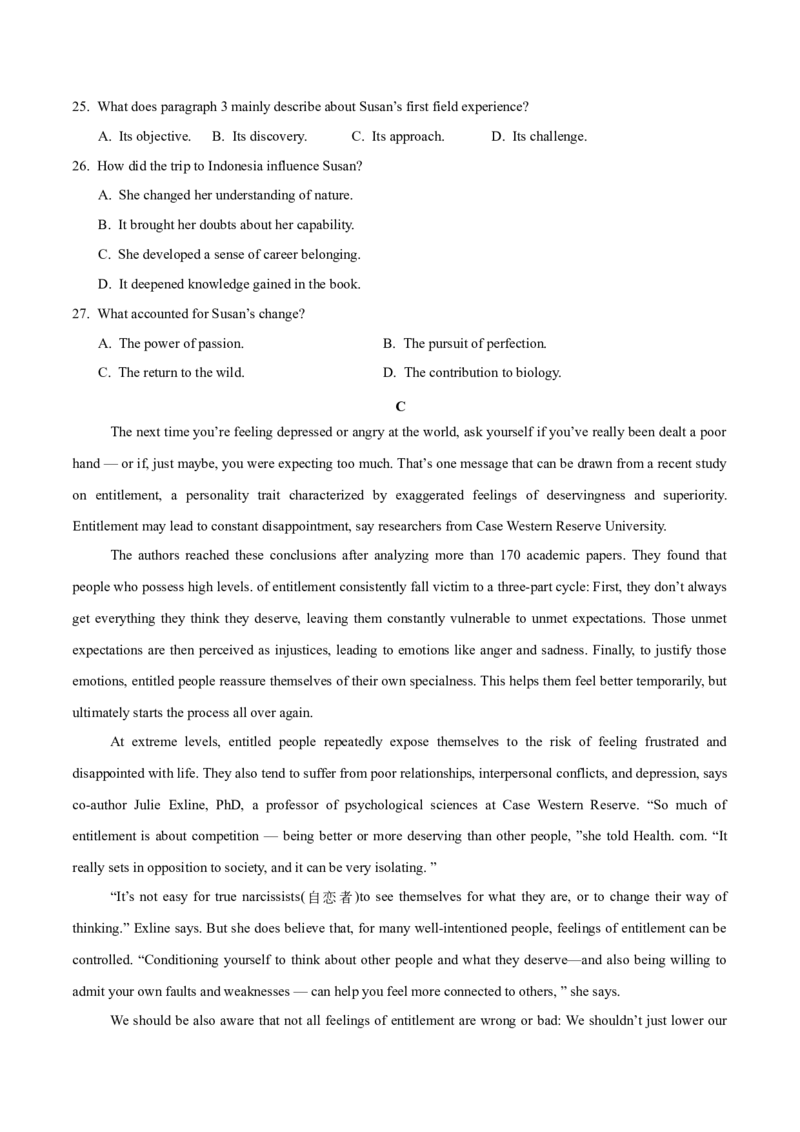
Susan Tsang’s journey to becoming a field biologist is as unconventional as it is inspiring. Growing up in
New York City, Susan spent four hours daily on commute(通勤)to school, leaving little time for outdoor
exploration. It made her an unlikely candidate for a career in field biology.
Susan’s enthusiasm for the natural world was fueled during a visit to the American Museum of Natural
History. The dinosaur fossils(化石)awakened her desire to explore nature, which eventually led her to pursue a PhD
program focused on bat biology.
Susan’s first field exploration was to Indonesia, with the task of catching wild bats. With her advisor unable
to help, Susan teamed up with Sigit, an experienced local researcher. They excitedly set up net s for trapping bats
near a waterfall. While preparing their equipment, they discovered a bamboo structure leaking fresh water.
Thinking it might be useful for their base camp, they tried to fix it, only to have water erupt everywhere,
soaking(浸湿)them completely. Unfortunately, a storm was approaching. Realizing their day was lost, they walked
back to base camp. They talked and laughed, forming a deep bond.
This adventure provided Susan with not only practical skills but also an invaluable lesson about adaptability
and teamwork. It enhanced the significance of practical experience. She recognized that true understanding comes
from directly observing the subjects of study — views that cannot be gained only from textbooks. Over the years,
whenever faced with doubts regarding her capability; she remembers what her advisor told her about the
experience, “The first day you came back, completely wet, yet genuinely happy. The next day you went right back
out. That’s when I knew this is where you truly belonged.”
Susan Tsang’s journey illustrates the transformative power of experience and perseverance. From a city girl
to a committed field biologist, Susan’s success highlights the importance of pursuing one’s enthusiasm, no matter
the odds.
24. What inspired Susan’s interest for the natural world?
A. A museum visit. B. Her daily trip to school.
C. A field exploration. D. Her childhood education.25. What does paragraph 3 mainly describe about Susan’s first field experience?
A. Its objective. B. Its discovery. C. Its approach. D. Its challenge.
26. How did the trip to Indonesia influence Susan?
A. She changed her understanding of nature.
B. It brought her doubts about her capability.
C. She developed a sense of career belonging.
D. It deepened knowledge gained in the book.
27. What accounted for Susan’s change?
A. The power of passion. B. The pursuit of perfection.
C. The return to the wild. D. The contribution to biology.
C
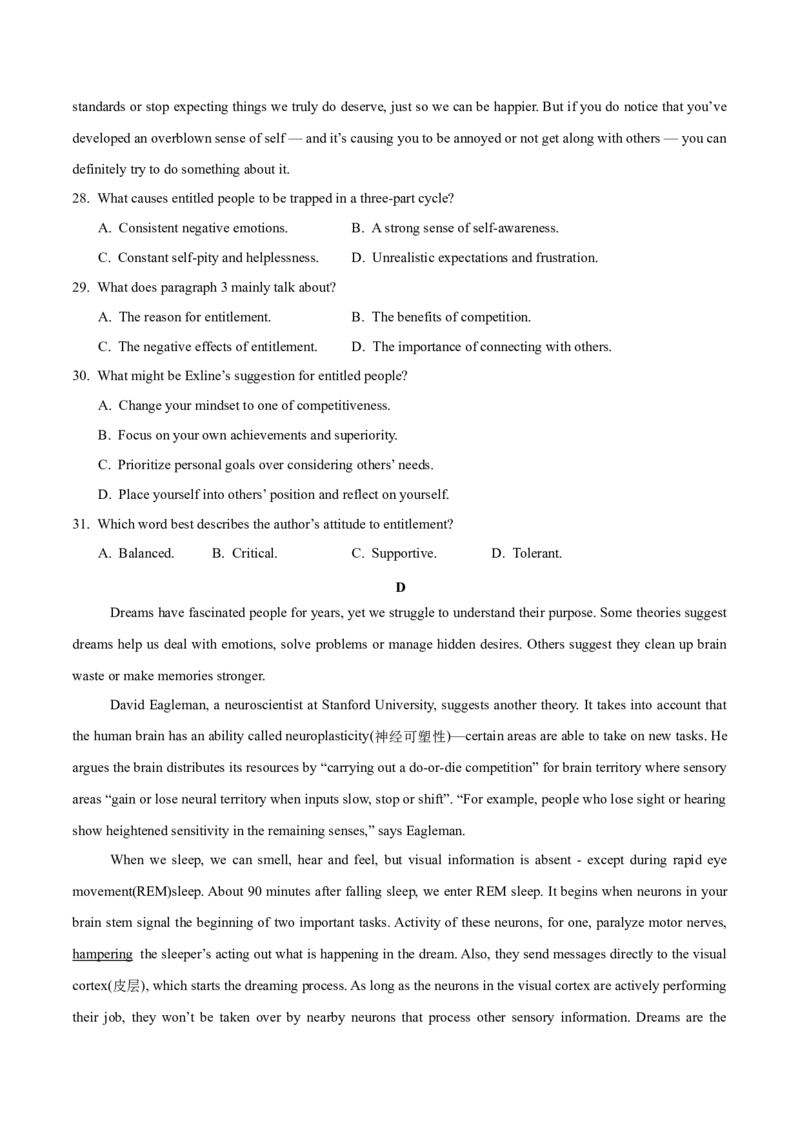
The next time you’re feeling depressed or angry at the world, ask yourself if you’ve really been dealt a poor
hand — or if, just maybe, you were expecting too much. That’s one message that can be drawn from a recent study
on entitlement, a personality trait characterized by exaggerated feelings of deservingness and superiority.
Entitlement may lead to constant disappointment, say researchers from Case Western Reserve University.
The authors reached these conclusions after analyzing more than 170 academic papers. They found that
people who possess high levels. of entitlement consistently fall victim to a three-part cycle: First, they don’t always
get everything they think they deserve, leaving them constantly vulnerable to unmet expectations. Those unmet
expectations are then perceived as injustices, leading to emotions like anger and sadness. Finally, to justify those
emotions, entitled people reassure themselves of their own specialness. This helps them feel better temporarily, but
ultimately starts the process all over again.
At extreme levels, entitled people repeatedly expose themselves to the risk of feeling frustrated and
disappointed with life. They also tend to suffer from poor relationships, interpersonal conflicts, and depression, says
co-author Julie Exline, PhD, a professor of psychological sciences at Case Western Reserve. “So much of
entitlement is about competition — being better or more deserving than other people, ”she told Health. com. “It
really sets in opposition to society, and it can be very isolating. ”
“It’s not easy for true narcissists(自恋者)to see themselves for what they are, or to change their way of
thinking.” Exline says. But she does believe that, for many well-intentioned people, feelings of entitlement can be
controlled. “Conditioning yourself to think about other people and what they deserve—and also being willing to
admit your own faults and weaknesses — can help you feel more connected to others, ” she says.
We should be also aware that not all feelings of entitlement are wrong or bad: We shouldn’t just lower ourstandards or stop expecting things we truly do deserve, just so we can be happier. But if you do notice that you’ve
developed an overblown sense of self — and it’s causing you to be annoyed or not get along with others — you can
definitely try to do something about it.
28. What causes entitled people to be trapped in a three-part cycle?
A. Consistent negative emotions. B. A strong sense of self-awareness.
C. Constant self-pity and helplessness. D. Unrealistic expectations and frustration.
29. What does paragraph 3 mainly talk about?
A. The reason for entitlement. B. The benefits of competition.
C. The negative effects of entitlement. D. The importance of connecting with others.
30. What might be Exline’s suggestion for entitled people?
A. Change your mindset to one of competitiveness.
B. Focus on your own achievements and superiority.
C. Prioritize personal goals over considering others’ needs.
D. Place yourself into others’ position and reflect on yourself.
31. Which word best describes the author’s attitude to entitlement?
A. Balanced. B. Critical. C. Supportive. D. Tolerant.
D
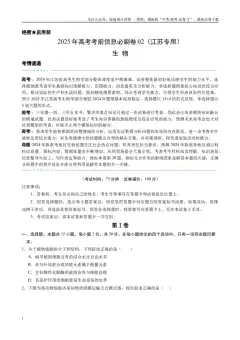
Dreams have fascinated people for years, yet we struggle to understand their purpose. Some theories suggest
dreams help us deal with emotions, solve problems or manage hidden desires. Others suggest they clean up brain
waste or make memories stronger.
David Eagleman, a neuroscientist at Stanford University, suggests another theory. It takes into account that
the human brain has an ability called neuroplasticity(神经可塑性)—certain areas are able to take on new tasks. He
argues the brain distributes its resources by “carrying out a do-or-die competition” for brain territory where sensory
areas “gain or lose neural territory when inputs slow, stop or shift”. “For example, people who lose sight or hearing
show heightened sensitivity in the remaining senses,” says Eagleman.
When we sleep, we can smell, hear and feel, but visual information is absent - except during rapid eye
movement(REM)sleep. About 90 minutes after falling sleep, we enter REM sleep. It begins when neurons in your
brain stem signal the beginning of two important tasks. Activity of these neurons, for one, paralyze motor nerves,
hampering the sleeper’s acting out what is happening in the dream. Also, they send messages directly to the visual
cortex(皮层), which starts the dreaming process. As long as the neurons in the visual cortex are actively performing
their job, they won’t be taken over by nearby neurons that process other sensory information. Dreams are thebrain’s way of fighting the takeover from other senses.
Eagleman argues that the more plastic the brain is, the more necessary REM sleep is for performing a
defense. For babies to develop properly, they must sleep a lot, spending almost 50 percent of their time in REM
sleep. But as people age, their brains become less flexible. At the same time, adults spend less time on REM sleep.
Deirdre Leigh Barrett, a psychologist at Harvard University, says, “Eagleman’s theory is very convincing.”
However, some dream researchers have different views. They think although the blind mole rat does not see, it still
experiences REM sleep. Yet some evolutionary adaptations are features that were useful in the past but have
become less significant as animals have evolved. So perhaps there was no pressure for blind mole rats to lose REM
activity as they evolved without vision.
32. Why does Eagleman mention the example in paragraph 2?
A. To show the brain is highly adaptive.
B. To prove the neurons can repair themselves.
C. To explain the significance of the five senses.
D. To illustrate the unevenness of the brain resource.
33 What does the underlined word “hampering” in paragraph 3 mean?
A. Conducting. B. Preventing. C. Spotting. D. Stimulating.
34. What can be inferred from Eagleman’s statements in paragraph 4?
A. Brain plasticity increases as people get older.
B. REM sleep and brain plasticity are interrelated.
C. Adults need more sleep to keep fit than babies.
D. People’s aging process has little effect on REM sleep.
35. What do some dream researchers think of Eagleman’s theory?
A. Its application is limited. B. Its theoretical basis is novel.
C. It lacks credibility. D. It agrees with evolutionary laws.
第二节(共5小题;每小题2. 5分, 满分12. 5分)
阅读下面短文,从短文后的选项中选出可以填入空白处的最佳选项。选项中有两项为多余选项。
In psychology, the word “prove” is used carefully, much like a painter applies each brushstroke(笔触)with
great care. Unlike the strong conclusions in physical sciences, psychological research builds a bigger picture
through many small studies. ___36___ His discovery was not a sudden breakthrough but the result of hard and
detailed work.
Similarly, Elizabeth Loftus’s research doubts how accurate witness reports are. Instead of calling it“unreliable,” researchers use terms like “potential unreliability.” ___37___ So, they use words like “demonstrate”
and “suggest” to show the uncertainty in their conclusions.
___38___ Instead, I teach my students to think critically about how to use it, much like a gardener who cares
for plants. When students first use the word, I encourage them to think about factors that could challenge their
conclusions. For example, I might ask them, “How do we know that not all participants had false memories?” Or,
for French students, “Why might these findings not apply to French culture?”
This approach helps students grasp the complexity of psychological research and develop critical thinking
skills. It encourages them to reflect and analyze, helping them communicate their findings with accuracy.
___39___ In psychology, “proving” something is like building a symphony. ___40___ In education, teaching
critical thinking and clear language use is essential for understanding the core of psychological research.
A. This indicates that findings might change.
B. In my classroom, I do not ban the word “prove.”
C. Each piece of evidence adds to a larger understanding.
D. Psychological theories are often revised as new evidence emerges.
E. As a teacher, I often remind my students to use this word appropriately.
F. This method also builds appreciation for the depth of psychological inquiry.
G. For example, Eric Kandel spent years studying sea animals to learn how memory works.
第三部分 语言运用(共两节,满分30分)
第一节(共15小题,每小题1分,满分15分)
阅读下面短文,从每题所给的A、B、C和D四个选项中选出可以填入空白处的最佳选项。
When Michael Armus set foot into the Bank of the West in Woodland, California, he felt the tension.
“Something’s not right.” None of the clerks greeted him as usual.
As Armus ___41___ the clerk windows, he noticed the three employees with similar ___42___ looks on
their faces and a man pulled his T-shirt up to hide his face. “This is a(n)___43___,” thought Armus. Minutes earlier,
the man gave the clerk a note to ask for cash, claiming to have a gun. Armus realized that he had seen this guy
before! He ___44___ the robber as someone on a street corner reading aloud from his Bible. Abruptly, instead of
being scared, Armus felt ___45___ for him, and a thought ___46___ his mind: “Maybe I can help.” He walked
over to the man, Eduardo Plasencia, and calmly asked, “What’s wrong?” Shocked and panicked, Plasencia looked
at Armus and ___47___, “There is nothing in this town for me. Nothing!”
“I heard something in his voice,” Armus said. “I imagined how ___48___ he was when throwing away his
___49___ like this. I’ve been down and out also. But I got another chance.” ___50___ everyone, he put his armaround Plasencia and said, “Let’ s go outside and talk about this.” Remarkably, Plasencia agreed and the two
walked out of the bank. On the outside, Armus gave the man a ___51___, and Plasencia began to sob in his
embrace. The two might have stood like that for hours ___52___ the police had not shown up.
It turned out that Plasencia, who was ___53___ charged with attempted robbery, never had a gun. But Armus
didn’t know that. The Woodland police spoke highly of Armus’ brave deed. However, he was far more ___54___,
simply saying, “The world needs more compassion, and love ___55___ all things.”
41. A. left B. approached C. broke D. cleaned
42. A. worried B. amazed C. indifferent D. curious
43. A. experiment B. accident C. theft D. robbery
44. A. appointed B. recognized C. mistook D. described
45. A. sympathy B. admiration C. anger D. gratitude
46. A. crossed B. fixed C. disturbed D. escaped
47. A. sighed B. whispered C. explained D. shouted
48. A. content B. desperate C. excited D. nervous
49. A. property B. dream C. waste D. life
50. A. Surprising B. Annoying C. Depressing D. Satisfying
51. A. kiss B. blow C. hug D. kick
52. A. when B. if C. unless D. once
53. A. casually B. unfortunately C. eventually D. suddenly
54. A. cautious B. gentle C. efficient D. modest
55. A. overcomes B. unites C. proves D. witnesses
第二节(共10小题;每小题1.5分 ,满分15分)
阅读下面短文,在空白处填入1个适当的单词或括号内单词的正确形式。
Filigree Mosaic(花丝镶嵌)art is a traditional Chinese handicraft that began during the Spring and Autumn
Period and flourished in the Ming and Qing dynasties. Four main crafts, ___56___(specific)including making fine
metal threads, adding jewels, carving designs, and shaping the base, are involved in the art, ___57___ a product
needs to go through about 100 procedures.
By the mid-20th century, this art had been nearly lost. In the 1950s, five Beijing companies joined to create a
factory, which had revived this traditional art from almost ___58___(extinct). Filigree Mosaic art ___59___
(recognize)as a national-level intangible cultural heritage in 2008.
Dong Ruijing, ___60___ Beijing native born in 1970, began learning the art at age 15. In 2006, he set up hisown team ___61___(continue)developing the art. For more than three decades, Dong and his apprentices(徒
弟)have been dedicated to the innovation of the art, ___62___(integrate)it with other crafts such as lacquer carving
and enamel art. In 2023, he launched a project on cultivating(培养)new-generation Filigree Mosaic ___63___
(professional)in Beijing, Tianjin, and Hebei. ___64___ the challenges, his passion for the traditional art drives him
to keep the tradition alive. He believes the future of Filigree Mosaic art lies in creating ___65___(innovate)designs
that suit modern tastes and everyday use.
第四部分 写作(共两节, 满分40分)
第一节(满分15分)
66. 学校英文报就高三学生体育锻炼情况开展调查。请你根据图表内容,以“Sports and Health”为题写一篇
短文。
内容包括:1. 调查结果;
2. 概述原因;
3. 你的看法。
每日体育运动时长调查结果
注意:1. 写作词数应为80个左右;
2. 请按如下格式在答题卡上的相应位置作答。
Sports and Health
________________________________________________________________________________________
____________________________________________________________________________________________
____________________________________________________________________________________________
____________________________________________________________________________________________
______________________________________________________________________________________
第二节(满分25分)
67. 阅读下面材料,根据其内容和所给段落开头语续写两段,使之构成一篇完整的短文。
In a quiet town located between rolling hills and vast forests lived a girl named Aria. She had grown up
surrounded by nature’s wonders — the sparkling(波光粼粼的)river that flowed through the town, the toweringtrees that whispered secrets in the wind, and the fields that burst into colors every spring. Aria’s favorite spot was a
towering oak tree at the edge of the forest, which her grandmother used to say had been standing there for over a
hundred years.
For as long as she could remember, Aria had found peace beneath its branches. It was her place where the
world felt right, and everything seemed eternal. But over the years, things started to change. The village with
towering trees had been replaced by a place with modern buildings and shopping centers, where plastic bags and
waste can be seen everywhere. The paths hidden in the town had been turned into broad roads. Winters grew
warmer, the river ran lower, and the once-lively fields seemed to lose their energy. Every season felt different, more
unpredictable than the last.
One day, as Aria sat beneath the oak tree, she noticed something that made her upset. The tree, which had
once been full of life, had begun to lose its leaves far earlier than usual. It wasn’t autumn, yet the leaves were dry
and brittle(脆弱的), falling one by one with wind. She pressed her hand against the trunk. It seemed weaker
somehow, as if the tree was trying to hold on. “Why are you losing your leaves?” Aria whispered to the oak.
Of course, the tree didn’t answer, but deep down, she knew the cause. For years, Aria had heard talks of
climate change—on the news, in her school, in conversations between her parents — but it always felt distant, like
something happening far away. Now, it was right here in front of her, affecting the place she loved most.
注意:1.续写词数应为150左右;
2.请按如下格式在答题卡的相应位置作答。
Paragraph 1:
Determined to find the exact answer, Aria set off to the library. ____________________________________
____________________________________________________________________________________________
____________________________________________________________________________________________
____________________________________________________________________________________________
____________________________________________________________________________________________
____________________________________________________
Paragraph 2:
The next day, Aria organized a meeting at the town hall, where she shared what she had learned with her
friends and family. ____________________________________________________________________________
____________________________________________________________________________________________
____________________________________________________________________________________________
________________________________________________________________________________________________________________________________________________________________________________________
____________________________________________________