文档文本内容
• 微博@新东方 彤彤 老师
• 考研英语、考博英语
主讲
• 新东方大学事业部优秀教师、绩优教师
• 西安外国语翻译学 优秀生源& 优秀毕业生
415 88
• 初试成绩 ;考研英一 分
• 曾任西安外国语大学中文系外聘教师
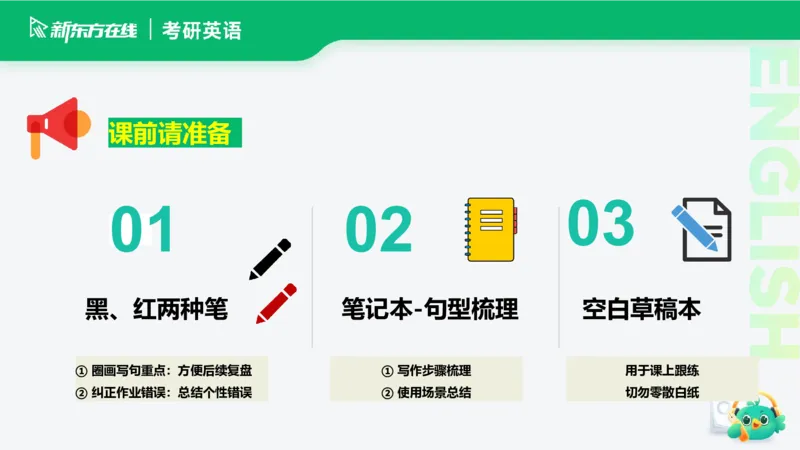
西京大学外语学院兼职英语教师课前请准备
03
01 02
黑、红两种笔 笔记本-句型梳理 空白草稿本
① 圈画写句重点:方便后续复盘 ① 写作步骤梳理 用于课上跟练
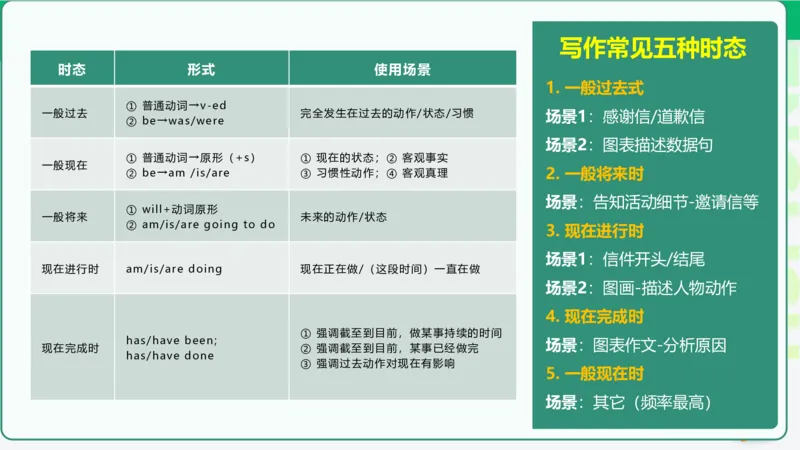
② 纠正作业错误:总结个性错误 ② 使用场景总结 切勿零散白纸写作常见五种时态
时态 形式 使用场景
1. 一般过去式
① 普通动词→v-ed
一般过去 完全发生在过去的动作/状态/习惯 场景1:感谢信/道歉信
② be→was/were
场景2:图表描述数据句
① 普通动词→原形(+s) ① 现在的状态;② 客观事实
一般现在
② be→am /is/are ③ 习惯性动作;④ 客观真理 2. 一般将来时
场景:告知活动细节-邀请信等
① will+动词原形
一般将来 未来的动作/状态
② am/is/are going to do
3. 现在进行时
场景1:信件开头/结尾
现在进行时 am/is/are doing 现在正在做/(这段时间)一直在做
场景2:图画-描述人物动作
4. 现在完成时
① 强调截至到目前,做某事持续的时间
has/have been; 场景:图表作文-分析原因
现在完成时 ② 强调截至到目前,某事已经做完
has/have done
③ 强调过去动作对现在有影响
5. 一般现在时
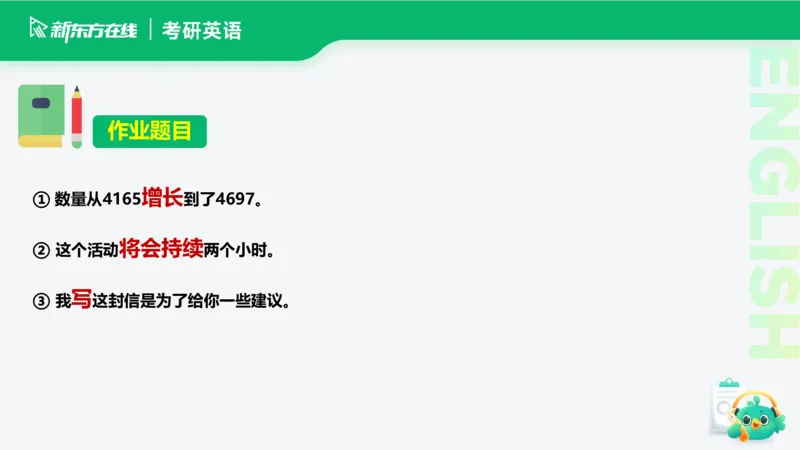
场景:其它(频率最高)作业题目
① 数量从4165 增长 到了4697。
② 这个活动 将会持续 两个小时。
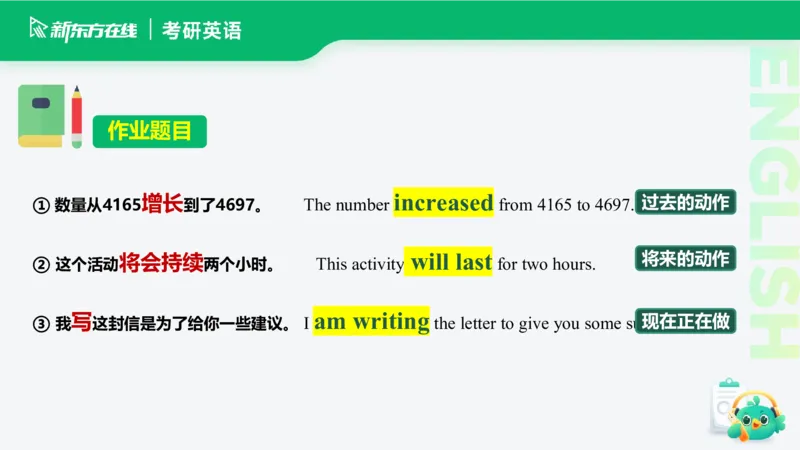
③ 我 写 这封信是为了给你一些建议。作业题目
① 数量从4165 增长 到了4697。 The number increased from 4165 to 4697. 过去的动作
② 这个活动 将会持续 两个小时。 This activity will last for two hours. 将来的动作
③ 我 写 这封信是为了给你一些建议。 I am writing the letter to give you some su现gg在est正ion在s.做作业题目
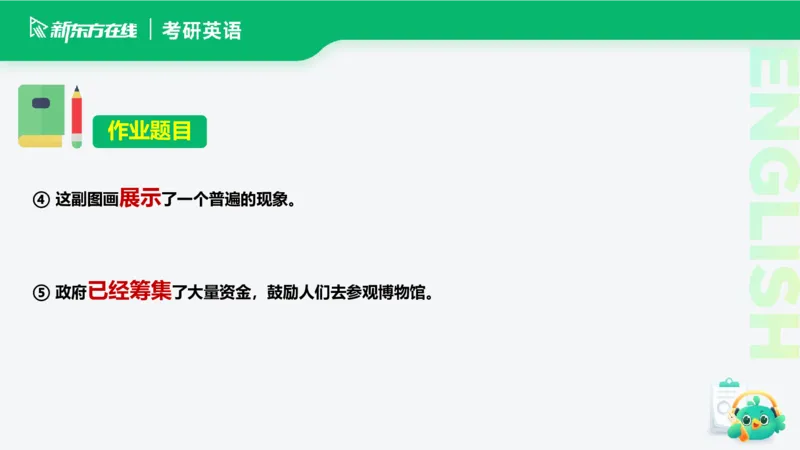
④ 这副图画 展示 了一个普遍的现象。
⑤ 政府 已经筹集 了大量资金,鼓励人们去参观博物馆。作业题目
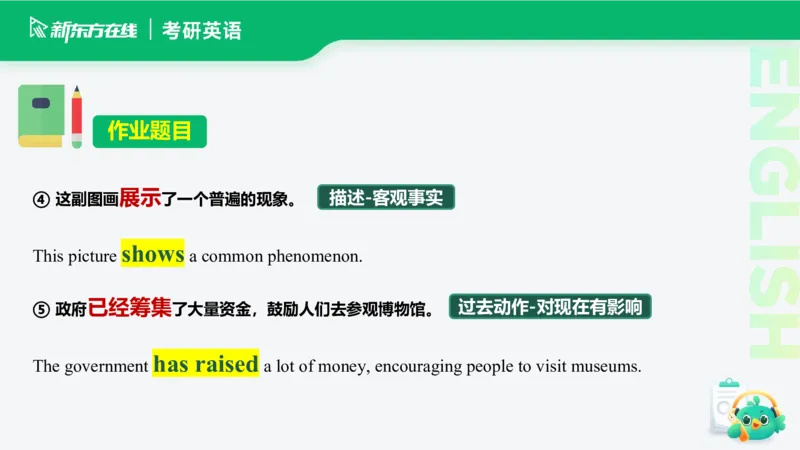
④ 这副图画 展示 了一个普遍的现象。 描述-客观事实
shows
This picture a common phenomenon.
⑤ 政府 已经筹集 了大量资金,鼓励人们去参观博物馆。 过去动作-对现在有影响
has raised
The government a lot of money, encouraging people to visit museums.考研写作预备
从零起步:打造高效写作技能
彤彤老师@新东方彤彤老师标
目
节
本
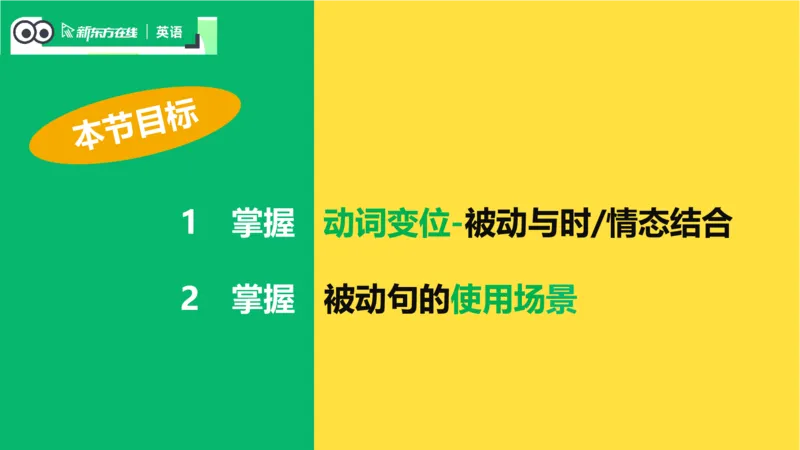
1 掌握 动词变位-被动与时/情态结合
2 掌握 被动句的使用场景学前思考
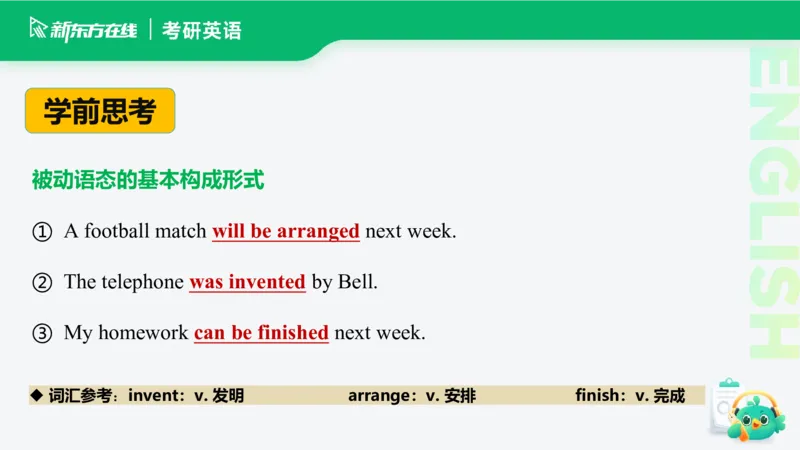
被动语态的基本构成形式
① A football match will be arranged next week.
② The telephone was invented by Bell.
③ My homework can be finished next week.
u 词汇参考:invent:v. 发明 arrange:v. 安排 finish:v. 完成学前思考
被动语态的基本构成形式
① A football match will be arranged next week.
② The telephone was invented by Bell.
③ My homework can be finished next week.
be done学前思考
被动语态的基本构成形式
① A football match will be arranged next week.
② The telephone was invented by Bell.
③ My homework can be finished next week.
be done
仅表示 被动动作本身
时态 情态 单复数1 被动与情态的结合
常见情态动词
可以/能够做某事 can/could do
将要/会/愿意做某事 will/would do
应该做某事 should do
可能做某事 may/might do
必须做某事 must do
需要做某事 need do1 被动与情态的结合
常见情态动词
情态动词+动词原形=谓语
可以/能够做某事 can/could do
情态动词不随主语变化
将要/会/愿意做某事 will/would do
应该做某事 should do 情态与被动的结合:
可能做某事 may/might do
情态动词+be done
必须做某事 must do
需要做某事 need do1
被动与情态的结合
❏基本形式:情态动词+be done
例:很多措施应该被采取。(take measures)
回顾彤彤枸句原则:去修饰定主干→先定谓语理主干(时态+情态+主被动)1
被动与情态的结合
❏基本形式:情态动词+be done
例:很多措施 应该被采取。(take measures)
(主语) (谓语)
回顾彤彤枸句原则:去修饰定主干→先定谓语理主干(时态+情态+主被动)1
被动与情态的结合
❏基本形式:情态动词+be done
例:很多措施 应该被采取。(take measures)
(主语) (谓语)
Many measures should be taken.
回顾彤彤枸句原则:去修饰定主干→先定谓语理主干(时态+情态+主被动)1
被动与情态的结合
❏基本形式:情态动词+be done
例:很多措施 应该被采取。(take measures)
(主语) (谓语)
Many measures should be taken.
使用场景1: 有 “被“Practice
1. 你的作业必须在明天之前完成(finish)。
2. 这个项目(project)可以在月底完成。
3. 周日将会举办(hold)一场辩论赛(debate competition)。Practice
作业必须 完成
1. 你的 在明天之前 (finish)。
项目 可以 完成
2. 这个 (project) 在月底 。
将会举办 一场辩论赛
3. 周日 (hold) (debate competition)。Practice
作业必须 完成
1. 你的 在明天之前 (finish)。
项目 可以 完成 使用场景2: 省 “被“
2. 这个 (project) 在月底 。
将会举办 一场辩论赛
3. 周日 (hold) (dabate competition)。Practice
1. 你的作业必须在明天之前完成(finish)。
Your homework _____________________ by tomorrow.
2. 这个项目(project)可以在月底完成。
The project _________________ by the end of this month.
3. 周日将会举办(hold)一场辩论赛(dabate)。
A debate competition ________________________ on Sunday.Practice
1. 你的作业必须在明天之前完成(finish)。
must be finished
Your homework _____________________ by tomorrow.
2. 这个项目(project)可以在月底完成。
The project _c_a_n__ _b_e_ _f_i_n_i_s_h_e__d by the end of this month.
3. 周日将会举办(hold)一场辩论赛(dabate)。
will be held
A debate competition________________________ on Sunday.学前思考
被动语态的基本构成形式
① A football match will be arranged next week.
② The telephone was invented by Bell.
③ My homework can be finished next week.
be done
仅表示 被动动作本身
时态 情态 单复数2
被动与时态的结合
主动 被动
was/were; v-ed
一般过去时
be done
am/is/are; v/v-s
一般现在时
will be;will do
一般将来时
现在进行时
am/is/are doing ❓
done
has/have been;
现在完成时
be变时态,done再后加
has/have done2
被动与时态的结合
主动 被动
was/were; v-ed was/were +done
一般过去时
am/is/are; v/v-s am/is/are + done
一般现在时
will be;will do will be done
一般将来时
am/is/are doing
现在进行时
has/have been
现在完成时
has/have been done
has/have donePractice
时态 被动
1. Knives ________(use) for cutting things.
一般过去时 was/were +done
2. A new shop __________(build) last year.
一般现在时 am/is/are + done
3. A new hospital ___________(build) in our city in 2025.
一般将来时 will be done
4. The room ________________ already.
现在完成时 has/have been donePractice
时态 被动
1. Knives a__re_ _u_s_e_d_(use) for cutting things.
一般过去时 was/were +done
一般现在时+主语复数
2. A new shop _w__a_s_ b__u_il_t_(build) last year.
一般现在时 am/is/are + done
一般过去时+主语单数
3. A new hospital _w_i_ll_ b_e_ _b_u_i_lt_(build) in our city in 2025.
一般将来时 will be done
一般将来时+主语单数
has been cleaned
4. The room ________________ already.
现在完成时 has/have been done
现在完成时+主语单数使用场景3: 主动→被动
例:他已经完成了(accomplish)这些任务(task)。
He has accomplished these tasks.
主语 谓语 宾语使用场景3: 主动→被动
例:他已经完成了(accomplish)这些任务(task)。
He has accomplished these tasks.
主语 谓语 宾语
These tasks have been accomplished.
主语 谓语使用场景3: 主动→被动
例:他已经完成了(accomplish)这些任务(task)。
He has accomplished these tasks.
主语 谓语 宾语
by
These tasks have been accomplished him.
主语 谓语 宾语使用场景3: 主动→被动
彤彤小口诀
原宾变为主
例:他已经完成了(accomplish)这些任务(task)。
原主by来补
He has accomplished these tasks. 谓语变be done
注意宾格单复数
主语 谓语 宾语
by
These tasks have been accomplished him.
主语 谓语 宾语主动 被动
一般过去时 was/were; v-ed was/were +done
一般现在时 am/is/are; v/v-s am/is/are + done
一般将来时 will be;will do will be done
现在进行时 am/is/are doing am/is/are being done
has/have been
现在完成时 has/have been done
has/have done
情态动词 can/should/may等+do can/should/may等+be done
写作应用
情态动词 被动形式
① 后+动词原形=谓语 be+done 使用场景1:有“被”
② 不随主语变化 ① be→时态 情态 单复数 使用场景2:省“被”
② done→动作本身 使用场景3:主动→被动Practice
① 一个普遍的现象被展示在图画中。
② 截至到现在,票已经卖完了。(sell out)
③ 他们要砍倒这些树。(chop down)谢谢!
微博@新东方彤彤老师 小红书
作业打卡不迷路~ 日常学习分享~