Unit 9 Can you come to my party?
综合能力演练
【巩固练习】
I. 单项选择。
1.Thanks for ______ me ______ your party.
    A.invite;to    B.inviting;to    C.invite;for    D.inviting;for
2.It’s raining heavily,so we ______ at home.
    A.must stay    B.have to stay    C.must be stay    D.have to staying
3.I’m glad ______ you at the party.
    A.meet    B.to meet    C.meeting    D.met
4.Oh,I have the flu,and I have to see the ______.
    A.teacher    B.farmer    C.doctor    D.worker
5.I have ______ housework to do this afternoon.So I can’t go shopping with you.
    A.too much    B.much too    C.too many    D.many too
6.Today is Monday,and the day after tomorrow is _______.
    A.Tuesday      B.Wednesday
    C.Saturday     D.Thursday
7.I'm looking forward to _______ my grandparents in summer.
   A.visit    B.visiting    C.visits    D.visited
8.He left angrily without _______ a word.
   A.say    B.to say     C.saying     D.says
9.—Can you _______ with us tomorrow?
    —Sure.
   A.play the tennis       B.play tennis
   C.playing the soccer    D.play piano
10.Joe often helps his friend ______ English.
    A.for    B.at    C.with    D.about
11.He heard ______ his pen friend just now,and now he is reading it.
    A.of    B.about    C.from    D.on
12.—What are the boys doing?
    —They are preparing ______ the football match.
    A.with    B.for    C.about    D.on
13.I don’t leave the classroom ______ Mr.Brown comes in.
    A.because    B.that    C.after    D.until
14.—Can you go to the concert this evening?
    —______.I have to help my parents.
    A.Yes.I'd love to    B.I’m afraid so    C.I’m afraid not    D.I’m not afraid
15.—Jack,please hang ______ with us tomorrow night.
    —OK.That’s great.
A./    B.out    C.from    D.for
[真题链接]
1. —        I know by what time you want the project to be done?
—By the day after tomorrow.         you finish it on time?
A. May; Can
B. Must; Need    C. Could; Must
D. Need; Would
2.  Mr. Black used to be busy. But now he’s retired and       , so he has plenty of time to exercise.
A. hard
B. calm
 C. free
D. nervous
3.—____ brave Zhang Hua is!
—Yes. He helped his neighbour, Mrs. Sun out of the fire.
A. What a           B. How           C. How a        D. What
II. 完形填空。
Hi Jerry,
   Thank you
  1
   inviting me to
  2
   your school next week. I am sorry I
  3
   come. I’m not
going to be
  4
   next week. On Monday, I have a piano lesson
  5
   8:00
  5
   10:00 in the
morning, and I have to study for the English test in the afternoon. On Tuesday, I am
  6
   a friend
from my hometown at the airport. On Wednesday, I am
  7
   tennis with my friends. I have to look
after my
  8
   grandpa on Thursday. On Friday, I’m helping one of my classmates
  9
   a speech
for the speech contest. I am busy
  10

   week.
1. A. with
B. to
C. for
D. in
2. A. visit
B. come over
C. look at
D. study
3. A. mustn’t
B. have to
C. can’t
D. couldn’t
4. A. very busy
B. free
C. happy
D. well
5. A. at…to
B. from…at
   C. at…and
D. from…to
6. A. meeting
B. phoning
C. making
D. going
7. A. playing the
B. joining
C. having
D. playing
8. A. ill
B. sadly
C. healthy
D. sick
9. A. talk
B. write
C. with writing
D. to make
10. A. whole the
B. the all
C. all the
D. whole
III. 阅读理解。
                                           A
阅读短文,回答下列问题
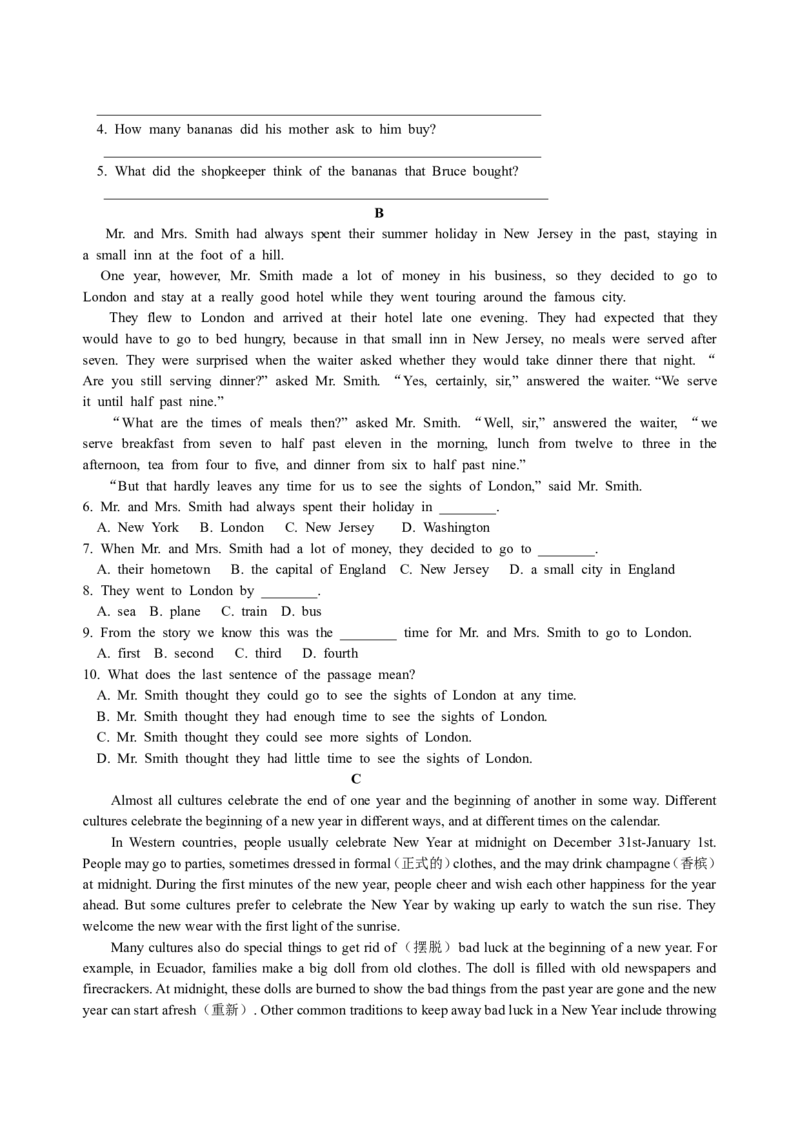
The telephone rang when Mrs Gates was cooking lunch. Her son Bruce went to answer the
telephone. His aunt said she was coming to see them with her daughter
that afternoon. Mrs Gates was happy because she hadn’t seen her sister for
several months. She knew the girl liked bananas very much, but she was
busy in the kitchen and couldn’t go to buy any for her. She gave some
money to Bruce and said, “ Go and buy two kilos of bananas in the
shop.”
Bruce liked bananas, too. He went out happily. Half an hour later he
came back with a bag in his hand. Mrs Gates weighed the bananas and found they were half a kilo
short. She took the bag to the shopkeeper and said, “I sent my little son for two kilos of bananas,
but you gave him only one and a half kilos.”
“Have you weighed your little son yet, madam?” asked the shopkeeper, “ My scales are all
right!”
1. Who went to answer the telephone when it rang?
______________________________________________________________
2. What did Mrs Gates ask her son to do?
_______________________________________________________________
3. Why did Bruce go to buy bananas happily?
_______________________________________________________________
4. How many bananas did his mother ask to him buy?
______________________________________________________________
5. What did the shopkeeper think of the bananas that Bruce bought?
_______________________________________________________________
B
   Mr. and Mrs. Smith had always spent their summer holiday in New Jersey in the past, staying in
a small inn at the foot of a hill.
  One year, however, Mr. Smith made a lot of money in his business, so they decided to go to
London and stay at a really good hotel while they went touring around the famous city.
   They flew to London and arrived at their hotel late one evening. They had expected that they
would have to go to bed hungry, because in that small inn in New Jersey, no meals were served after
seven. They were surprised when the waiter asked whether they would take dinner there that night. “
Are you still serving dinner?” asked Mr. Smith. “Yes, certainly, sir,” answered the waiter. “We serve
it until half past nine.”
   “What are the times of meals then?” asked Mr. Smith. “Well, sir,” answered the waiter, “we
serve breakfast from seven to half past eleven in the morning, lunch from twelve to three in the
afternoon, tea from four to five, and dinner from six to half past nine.”
   “But that hardly leaves any time for us to see the sights of London,” said Mr. Smith.
6. Mr. and Mrs. Smith had always spent their holiday in ________.
  A. New York   B. London   C. New Jersey    D. Washington
7. When Mr. and Mrs. Smith had a lot of money, they decided to go to ________.
  A. their hometown   B. the capital of England  C. New Jersey   D. a small city in England
8. They went to London by ________.
  A. sea  B. plane   C. train  D. bus
9. From the story we know this was the ________ time for Mr. and Mrs. Smith to go to London.
  A. first  B. second   C. third   D. fourth
10. What does the last sentence of the passage mean?
  A. Mr. Smith thought they could go to see the sights of London at any time.
  B. Mr. Smith thought they had enough time to see the sights of London.
  C. Mr. Smith thought they could see more sights of London.
  D. Mr. Smith thought they had little time to see the sights of London.
C
Almost all cultures celebrate the end of one year and the beginning of another in some way. Different
cultures celebrate the beginning of a new year in different ways, and at different times on the calendar.
In Western countries, people usually celebrate New Year at midnight on December 31st-January 1st.
People may go to parties, sometimes dressed in formal(正式的)clothes, and the may drink champagne(香槟)
at midnight. During the first minutes of the new year, people cheer and wish each other happiness for the year
ahead. But some cultures prefer to celebrate the New Year by waking up early to watch the sun rise. They
welcome the new wear with the first light of the sunrise.
Many cultures also do special things to get rid of(摆脱)bad luck at the beginning of a new year. For
example, in Ecuador, families make a big doll from old clothes. The doll is filled with old newspapers and
firecrackers. At midnight, these dolls are burned to show the bad things from the past year are gone and the new
year can start afresh(重新). Other common traditions to keep away bad luck in a New Year include throwing
things into rivers or the ocean, or saying special things on the first day of the New Year.
Other New Year traditions are followed to bring good luck in the New Year. One widespread Spanish
tradition for good luck is to eat grapes on New Year's Day. The more grapes a person eats the more good luck
the person will have in the tear. In France, people eat pancakes for good luck at New Year. In the United States,
some people eat black-eyed peas for good luck-but to get good luck for a whole year you have to eat 365 of
them!
11. The reading is mainly about_____.
A. the meaning of “Happy New Year!”  B. several different New Year traditions
C. what to eat on New Year’s Day
   D. why people dress up nicely on New Year's Day
12. It’s clear that_____.
A. some cultures celebrate New Year in the morning
B. the Western people celebrate New Year only on New Year’s Day
C. people in Ecuador go to parties on December 31st-January
D. no cultures do special things to celebrate New Year
13. In some cultures, people throw things into rivers or oceans to_____.
A. bring good luck
B. keep away bad luck
C. forget everything
D. plan for the next year
14. To have a happy new year, _____.
A. friends talk to each other in special ways
B. families make big dolls filled with old clothes
C. some people get up early to watch the sunrise
D. Europeans eat 365 grapes on New Year’s Day
15. When eating black-eyed peas on New Year's Day, people think_____.
A. one pea brings one day of luck
B. black-eyed peas are the best medicine
C. the peas are too black and taste bad
D. the peas are helpful to count numbers
IV. 书面表达。
    暑假就要到了,你想邀请你的加拿大朋友Danny 来中国度假, 他也是一位中学生。他希望了解你的
暑假打算。请你把你的想法写成短文,发E-mail 给他。词数要求不少于60 词,开头和结尾已经给出,不计
入词数。
暑假生活包括以下内容:
   (1)坚持锻炼身体;
   (2)根据个人兴趣和需要安排学习;
   (3)帮助家人做家务,学做一些简单的菜。
Dear Danny
_________________________________________________________________________________________
_________________________________________________________________________________________
_________________________________________________________________________________________
_________________________________________________________________________________________
_________________________________________________________________________________________
_________________________________________________________________________________________
【答案与解析】
I. 单项选择。
1.B。for 为介词。故其后跟动名词形式,排除A、C 两项;invite sb.to 后接地点,意为“邀请某人去某地”。
故选B。
2.B。由句意知,雨下得很大,是客观原因,故用have to,have to 后跟动词原形,故选B。
3.B。 be glad to do sth.意为“很高兴做某事”。
4.C。 因为前句中有have the flu“感冒了”,故后句应为“去看医生”。
5.A。 因为housework 是不可数名词,故排除C 项。too much 意为“太多”,修饰不可数名词;much too 意
为“太”,其后接形容词或副词,故选A。
6. B。由句意知“今天是星期一,后天就是星期三了”。
7. B。look forward to doing sth 表示“期待做某事”,这里的to 是介词,后接动词-ing 形式。
8. C。without 是介词,后接动词,要用动词-ing 形式。
9. B。由句中can 可知play 用动词原形,表示玩某种球类,不用冠词the,正确的表达为play tennis。
10.C。 help sb.with sth.意为“帮助某人做某事”。
11.C。 hear from 意为“收到某人的来信”;而hear of/about 意为“听说”。句意为“刚才他收到了他
笔友的来信,现在他正在读(信)”。
12.B。  prepare for 表示“为……做准各”,是固定短语。
13.D。not...until 意为“直到……才”,为固定结构。句意为“直到布朗先生进来我才离开教室”。
14.C。由答语中的“我不得不帮助我的父母”可知是否定回答;I’m afraid not.意为“恐怕不行”。
15.B。 hang out 意为“闲逛,常去某处”。
[真题链接]
1. A。句意:——我可以知道你想何时完成这个项目吗?——到后天。你能按时完成吗?本题考查情态动
词。may 可以;can 能够;must 必须;could 用于一般疑问句通常表示请求;need 需要。题干问句是请求,可
用may 或者could,排除B、D 两项;答句是询问能否按时完成任务,应选can。故选A 项。
2. C。句意:Black 先生过去很忙,但是现在他退休了,有了空闲时间,所以有很多的时间锻炼。本题考查形
容词词义辨析。hard 难的,艰苦的;calm 冷静的;free 自由的,空闲的;nervous 紧张的。根据题干中的
“used to be busy”和“he has plenty of time to exercise”可知,答案选C 项。
3.B。句意:——张华多么勇敢啊!——是的,他帮助他的邻居孙女士逃离了火灾。本题考查感叹句的用
法。本句结构符合感叹句“How+adj./adv.+主语+谓语!”的形式,故选B 项。相当于What a brave
man Zhang Hua is!
II. 完形填空。
1.
C。Thank you for doing sth.意为“因为……而感谢”。
2.
A。visit 意为“参观”。B 项come over 后缺少to。
3.
C。根据“I am sorry”可知是不能来。
4.
B。句意为“下周我没空”。
5.
D。从8 点到10 点,应该用from…to…
6.
A。meet sb.表示接某人。
7.
D。球类运动前不加冠词,打网球“play tennis”。
8.
D。表示“生病的”,作定语只能用sick。
9.
B。help sb. do sth.,根据句意可知是写演讲稿。
10. C。整个星期“the whole week 或all the week”。
III. 阅读理解。
A 篇
1.
Bruce.
2.
She asked her son to buy some bananas.
3.
Because he liked bananas.
4.
She asked to buy him two kilos of bananas.
5. The shopkeeper thought that Mrs Gates’ son had eaten some bananas.
B 篇
6. C。根据“Mr. and Mrs. Smith had always spent their summer holiday in New Jersey in the past”
可知答案。
7. B。根据“…so they decided to go to London…”可知答案。
8. B。根据“They flew to London…”可知答案。
9. A。根据全文内容,可知他们是第一次来伦敦。
10. D。根据句意“我们几乎没有什么时间在伦敦观光了”。可知答案。
C 篇
11. B。主旨题。根据题干我们可以对应到首段的中心句。由此看出选择答案为B。
12. A。细节理解题。第二段的倒数最后一句话表明,一些国家的人们在早晨庆祝新年。
13. B。细节题。题目中问人们向河里或者海洋扔东西是为了什么,可以对应文中
“Other common traditions to keep away bad luck in a new year include throwing things into rivers or the
ocean”与B 选项符合。
14. C。细节理解题。第二段的最后两句表明,一些人们以早起观看日出的方法来迎接新年。
15. A。推断题。根据原文,可以推断出一个pea 会带来一天的好运。所以答案为A。
IV. 书面表达。
参考范文:
Dear Danny
Summer holiday is coming. During the holiday, the thing is that I will do morning exercises
every day, as I did at school. And in the afternoon, if I am free, I will go fishing in the park. I
like reading, so I’d like to spend some time reading books. I will also try to study maths, for I am
not good at it. During the holidays, I’ll help my parents do housework as much as possible. I also
want to visit some of my friends and relatives.
    I’m sure I’ll have a pleasant time this summer,and I hope you can come as soon as possible.
Write soon.
                                    Yours,
                                     Sonia