Unit 3 I’m more outgoing than my sister.
词句精讲精练
词汇精讲
1. both
(1) 代词,意为“两者,双方,两人”。例如:
  Both of the flowers are very beautiful. = The flowers are both very beautiful.
  这两朵花都很漂亮。
(2) 形容词,意为“两者的,双方的”。例如:
  She wants both dictionaries. 这两本字典她都想要。
  Both the answers are wrong. 这两个答案都是错的。
(3) 副词,意为“两者,两者都是”,常用于行为动词之前,be 动词、助动词、情态动词之后。
例如:
They can both dance. 他们俩都会跳舞。
(4) both…and 意为“……和……都,既……又……”,用于连接两个并列成分,连接并列主
语时, 谓语动词应该用复数形式。例如:
  Both you and your sister like it very much. 你和你姐姐都非常喜欢它。
【拓展】
(1) 当both 用于否定句时,表示“并非两者都……”。例如:
 I don’t like both the sweaters. 这两件毛衣,我并不都喜欢。
(2) both…and…的否定形式为neither…nor…意为“既不……也不……”。例如:
  He can speak neither French nor English. 他既不会法语也不会英语。
2. outgoing 与quiet
outgoing 作形容词,意为“外向的,友好的;擅于交际的”,其比较级为more outgoing。其
反义词为quiet,意为“安静的,文静的”,可作定语或表语。例如:
They walked to a quiet place. 他们向一个安静的地方走去。
 You have a cold, so you must keep quiet at home. 你感冒了,所以必须在家静养。
 He is more outgoing than me. 他比我能说会道。
【拓展】
 calm,still,quiet 与silent:
 (1)calm 意为“镇静的;平静的”。指不受干扰时的宁静、平静;指人时表示沉着的、镇定的。
 (2)still 意为“不动的;静止的”。指物理上的安静状态。
 (3)quiet 意为“安静的;静止的”。指寂静的状态,没有吵闹、骚乱,指人表示娴静、文静。
 (4)silent 意为“沉默的;无言的”。主要指人,指不发出声音或不说话,强调无声的状态。
  例如:
 When we face danger, we should keep calm. 面对危险,我们应该保持沉着、冷静。
 The baby kept still when she was taking photos. 当给这个婴儿拍照时,她一动也不动。
 Be quiet, everyone. The teacher is coming. 同学们,安静!老师来了。
 We shouldn’t keep silent when the teacher asks us some questions.
 当老师问我们问题时,我们不应该保持沉默。
【注意】quiet 意为“安静的”,quite 意为“相当”。
3. win
win 作动词,意为“赢得;打败;战胜”,其现在分词要双写n,为winning;过去式和过去分
词均为won。例如:
 He won a prize last week. 他上周得奖了。
 They won the basketball match yesterday. 他们昨天赢得了那场篮球比赛。
  He knew this was his last hope of winning. 他知道这是他获胜的唯一希望了。
【拓展】
 win 与beat:
 (1) win 强调赢得“比赛、游戏、战争”,获得“名次、奖品”。例如:
     win a prize 得奖          win a game 赢得比赛
  win a honor 赢得荣誉     win a battle 赢得战斗
     win a match 赢得比赛     win a scholarship 赢得奖学金
(2) beat 强调“打败,战胜”,其后只能接比赛、竞争的对手,即beat 只能接表示人的词语作
宾语。例如:
     beat a team 战胜/打败一队(组)
beat a nation 战争/打败一个国家
     beat an opponent 战胜/打败一个对手
4. heavy 与thin
heavy 和thin 是一组意义相反的形容词,都可用来描述人的体型。heavy 意为“胖的,笨重
的”,比较级形式为heavier;thin 意为“瘦的”,其比较级形式为thinner。例如:
He is very heavy, but his brother is thin. 他很胖,可他的哥哥却瘦。
【拓展】
heavy 还可意为“重的;剧烈的;大的”等。例如:
heavy rain/snow/smoke 大雨/大雪/浓烟
heavy smoker/drinker/eater 烟瘾/酒瘾/食量大的人
have a heavy cold 患重感冒
heavy(busy) traffic 交通拥挤
5. care about
care about 意为“关心,在意”。例如:
She does not care about her husband at all. 她根本不关心她的丈夫。
Don't you care about this country’s future? 难道你不为国家前途担忧吗?
I don’t care about money. 我不看重钱。
【拓展】
 care for 意为“照顾,照料;想要;喜欢”。例如:
Would you care for some more tea? 想再喝点茶吗?
The mother cared for the sick child day and night. 母亲日夜照料着生病的孩子。
I don’t care for riding on a bike very much; I’d rather go on foot.
我不太喜欢骑自行车, 宁愿步行。
6. serious
serious 作形容词,意为“严肃的、认真的、严重的、危险的”。比较级为more serious。常用搭配
为:be serious about 意为“对……认真”。例如:
 How serious the matter is! 问题是多么严重啊!
 I stopped laughing when I realized he was serious about it.
当我意识到他不是开玩笑时,我就不再笑了。
7. touch
(1)touch 作动词,意为“感动;触摸”。例如:
Don’t touch the paint until it’s dry. 油漆未干,切勿触摸。
His sad story touched our hearts. 他的悲惨的故事深深打动了我们的心。
The peak seems to touch the sky. 山峰似乎已触及天空。
(2)touch 作名词,意为“接触;联系”。例如:
The blind have a keen sense of touch. 盲人有敏锐的触觉。
They keep close touch with me. 他们和我保持密切联系。
8. reach
(1)reach 作动词,意为“伸手;到达;抵达;取得联系”。例如:
He reached into his pocket to get his car keys. 他把手伸进口袋里拿车钥匙。
We reached the nearest railway station last night. 我们昨天晚上到达最近的火车站。
The garden reaches the lake. 花园一直延伸到湖边。
We tried to reach them by phone. 我们试着用电话跟他们联络。
(2)reach 作名词,意为“范围”。例如:
The book is out of my reach. 那本书我够不到。
词汇精练
I. 汉译英。
1. 相反的观点________________     2. 跑得快 ________________
3. 跳得高 ________________       4. 工作努力 ________________
5. 擅长 ________________        6. 赢得比赛 ________________
7. 使显现 _______________           8. 两者都________________
9. 玩得开心______________        10. 关心,在意__________________
II. 根据首字母填空。
1. He doesn’t do well in math, a___________ he is good at English and Chinese.
2. Most of them have strong i___________ in learning English well.
3. Jane isn’t very o___________. She likes to stay at home and do some reading.
4. Liu Ying talks more than Liu Li. Liu Li is q___________ than Liu Ying.
5. B___________ of the twins are funny.
III. 用所给单词的适当形式填空。
1. She is a little _________(heavy) than her sister.
2. This book is _________(interest) and I like it very much.
3. He is not funny, and he is always very _________(serious).
4. Is Jack talented in _________(play) soccer?
5. Lucy always _________(beat) me in swimming.
6. A true friend _________ (reach) for your hand and _________ (touch)your heart.
7. She is very funny and often makes me ________(laugh).
8. I enjoy________(sing). I want to be a singer when I grow up.
9. Here are ________(photo) of my brother.
10. There are some ________(different) between the twins.
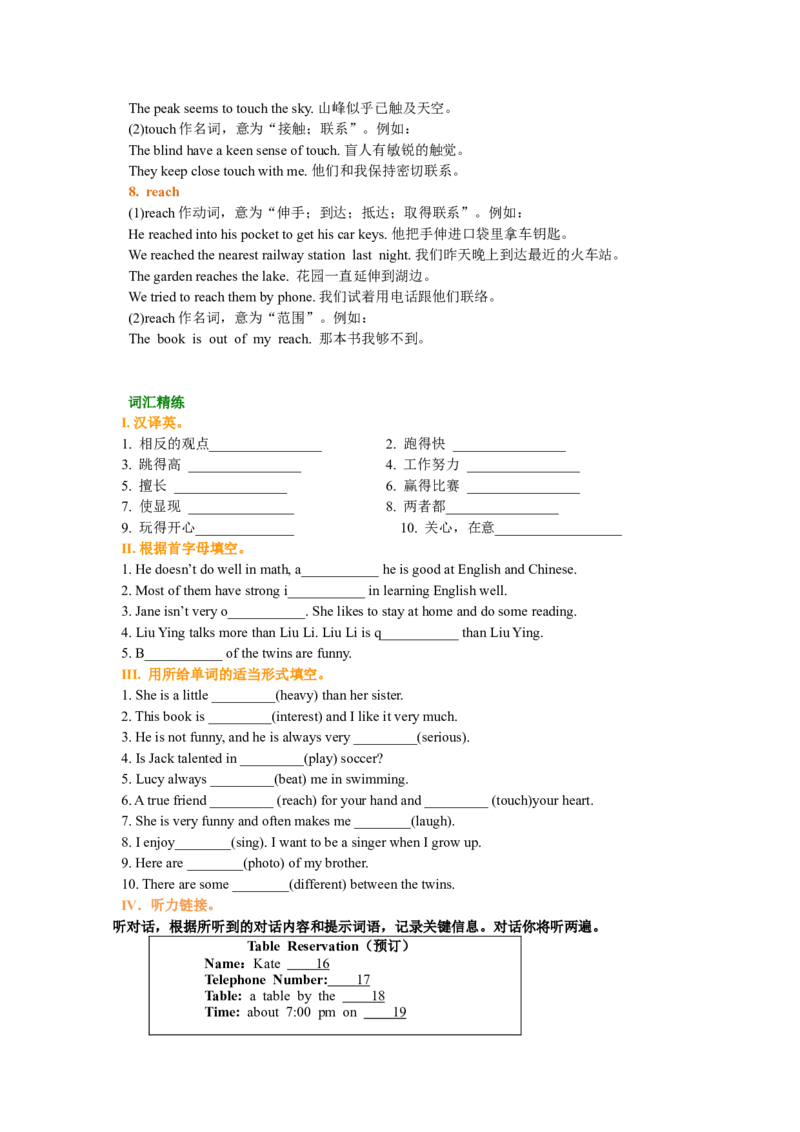
IV.听力链接。
听对话,根据所听到的对话内容和提示词语,记录关键信息。对话你将听两遍。
Table Reservation(预订)
Name:Kate

 16

Telephone Number:

 17

Table: a table by the

 18

Time: about 7:00 pm on

 19

Order: two bottles of

 20


  wine
【参考答案】
I. 汉译英。
1. opposite views/opinions  2. run fast  3. jump high  4. work hard
5. be good at/be talented in/do well in  6. win the match  7. bring out
8. both…and…  9. have fun/have a good time/enjoy oneself  10. care about
II. 根据首字母填空。
1. although  2. interest  3. outgoing  4. quieter  5. Both
III. 用所给单词的适当形式填空。
1. heavier  2. interesting  3. serious  4. playing  5. beats  6. reaches;touches
7. laugh  8. singing  9. photos  10. differences
IV.听力链接。
16. Smith    17. 5912067   18. window     19. Friday     20. red
听力原文:
M: Good afternoon. Hardson Restaurant. Can I help you?
W: Good afternoon. I’d like to book a table, please.
M: Certainly madam. Can I have your name, please?
W: Kate Smith. K-A-T-E, S-M-I-T-H.
M: And your phone number please, Mrs. Smith?
W: My number is 5912067.
M: And how many people will be with you?
W: There will be ten people in all.
M: OK, and would you like a table by the window?
W: Yes, please.
M: And would you like some wine with your meal?
W: Yes, let me see now. White wine is my favorite and I know most people like red
wine. Put me down for two bottles of red wine.
M: OK. And when would you like the table for?
W: Friday, please. About 7:00 pm.
M: OK, at 7:00 on Friday evening.
W: Yes. Thank you very much.
M: It is my pleasure. See you then.
句式精讲
1. That’s Tara, isn’t it?
 That’s Tara, isn’t it?是反意疑问句,表示对陈述句所说的事实提出相反的疑问,要求对方用
“yes”或“no”来进行回答。
反意疑问句由两部分组成:前一部分是陈述句,后一部分是疑问句,疑问句是由be,have,助
动词或情态动词后接主语构成。如果陈述句是肯定结构,反意疑问句须用否定结构;反之,陈
述句如果是否定结构,反意疑问句须用肯定结构。反意疑问句的两部分,必须保持人称和时
态的一致。例如
He is old, isn’t he?  他老了,不是吗?
He never went there, did he?  他从没有去过那里,是吗?
无论哪种形式的反意疑问句,回答时要遵循:“Yes,后接肯定式”或者“No,后接否定式”
—The girl is helping her mother with the housework, isn’t she?
那个女孩正在帮妈妈做家务,不是吗?
—Yes, she is. 是的,她在帮。
—No, she isn’t. 不,她没有帮。
2. That’s why …
why 引导的从句在此作is 的表语,是表语从句。引导表语从句的词除了why 外,还有that;
whether; as if; what; which; who; whose; when; where; how 等。表语从句与宾语从句一样,要
求用陈述语序。例如:
That is where I was born. 那就是我出生的地方。
The problem is whether he will come. 问题是他是否回来。
This is what we need. 这就是我们所需要的。
【注意】That’s why…可视以为一个固定句式,表示“这便是为什么……”、“这就是……的
原因”,why 的后面一般接句子。例如:
That’s why he was late this morning. 这就是他今天早上迟到的原因。
3. …you don’t need a lot of them as long as you’re good.
as long as 为固定搭配,意为“只要……”。此句中的long 为副词。例如:
We can talk about this as long as you want. 主要你想(谈),我们可以谈谈这件事。
As long as I live, I will help you. 只要我活着,我就会帮助你。
【拓展】
as...as…中间加形容词或副词原形,表示同级的比较,意为“和……一样”。
This film is as interesting as that one. 这部电影和那部电影一样有趣。
Your pen writes as smoothly as mine. 你的钢笔书写起来和我的一样流畅。
其否定式为not as/so… as…中间加形容词或副词原形,意为“和……不一样”。例如:
This dictionary is not as/so useful as you think. 这本字典不如你想象的那样有用。
4. I think a good friend makes me laugh.
make 在此处是使役动词,后接省略to 的动词不定式,make sb. do sth.意为“使/让某人做某
事”,类似的动词还有let,have 等。例如:
The boss made them work for long time. 老板让他们长时间工作。
They made us forget the past. 他们使我们忘记了过去。
【拓展】
make 作“使……”讲时,还可用make+ 宾语 + 形容词/名词(作宾补),即make sb. / sth.
+adj./n.。类似的词还有keep 等。例如:
What he said makes us happy. 他所说的话使我们很高兴。
Don’t keep the door open. 别把门开着。
We made John our monitor. 我们选约翰当班长。
5. My best friend Larry is quite different from me.
be different from 意为“与……不同”。different 的名词形式为difference,意为“不同;不同
之处”。例如:
Saying a thing is very different from doing it. 说一件事和做一件事很不相同。
Whether it rains or not makes no difference to me. 下不下雨对我来说都一样。
【拓展】
the same as 意为“和……一样/相同”,as 前后跟同类名词、代词或副词。例如:
I am in the same school as my younger sister. 我和我的妹妹在同一所学校。
句式精练
I. 根据汉语提示,完成句子,每空一词。
1. 我最好的朋友和我有很大的不同。
My ________ friend is quite ________ ________ me.
2. 好的朋友善于倾听。
 A good friend is a ________ ________ .
3. 这便是我喜欢看书的原因。
 That’s ________ ________ like ________ books.
4. 只要你高兴就好。
 It’s fine________ ________ ________ you’re happy.
5. 我并不十分在乎我的朋友跟我一样或与我不同。
I don’t really care ________ my friends are ________ ________ ________ me or different.
II. 句型转换,按要求完成下列句子。
1. Lucy likes to do the same things as me. (就划线部分提问)
  ________ ________ Lucy ________ to ________ as you?
2. They both like going for a walk after supper. (改为同义句)
  ________ ________ ________ ________ going for a walk after supper.
3. He didn’t feel well yesterday. He still went to school. (合并为一句)
  ________ he didn’t feel well yesterday, he still went to school.
4. Li Ping doesn’t run as far as Wang Lin. (改为同义句)
  Li Ping ________ ________ ________ Wang Lin.
5. The girl is talented in physics. (改为同义句)
  The girl________ ________ in physics.
6. My brother does well in English.(改为同义句)
  My brother _________ _________ _________ English.
7. He has got no sisters and no brothers. (改为同义句)
  He hasn’t got any sisters _________ brothers.
8. I am tall. My best friend is also tall. (合并为一句)
  My best friend and I _________ _________ _________.
9. Tom and Jack don’t look the same. (改为同义句)
 Tom looks _________ _________ Jack.
10. Both he and his friend like music. (改为反意疑问句)
  Both he and his friend like music, _________ _________ ?
III.根据题意从括号内选择适当的单词完成下列句子。
1. I am a little  __________ (short, shorter) than my brother.
2. Helen is the __________ (young, younger) of the two.
3. The __________ (soon, sooner) you come here, the __________ (good, better) it will be.
4. She studies __________ (well, better) than me.
5. Shanghai is bigger than __________ (any, any other) city in China.
IV. 完成对话   根据对话内容,在每个空缺处填入一个适当的词,使整段对话意思完整。请
把该空缺处的词填写在答题卡相应的位罝上。(每空限填一词)
A: Hello, are you Lin Ming?
B: Yes, I am.
A: You look the  1    as your twin brother, Lin Dong.
B: As you can see, in some ways, we look the same,  2    we also have some differences.
A: What’re they?
B: Though we  3    have yellow hair, my hair is shorter than his. I’m good at playing football
   and he does well in drawing.
A: And?
B: I’m  4    outgoing but he’s quieter. He likes to stay at home.
A:  5    is taller, you or Lin Dong?
B: I’m much taller than him because I do more exercise.
【参考答案】
I. 根据汉语提示,完成句子,每空一词。
1. best;different from  2. good listener  3. why I;reading  4. as long as
5. if/whether;the same as
II. 句型转换,按要求完成下列句子。
1. What does; like; do  2. Both of them like  3. Although/Though  4. runs nearer than
5. does well  6. is good at/is talented in  7. or  8. are both tall
9. different from  10. don’t they
III.根据题意从括号内选择适当的单词完成下列句子。
1. shorter  2. younger  3. sooner; better  4. better  5. any other
V. 补全对话。
1. same   2. but   3. both  4. more   5. Who