第01 讲Unit 1 Happy Holiday
(知识全梳理&考点精准练)
内容导航
01 预习航标→析目标·明方向:预习导航精准定向
02 教材全解→析教材·学新知:情境概念深度构
考点精讲:聚焦常考要点,讲清逻辑
例题精析:典型题目带路,学会解题思路
即练固基:趁热打铁练一练,巩固刚学内容
03 过关检测→练考点·强落实:过关检测分层提
关键词
学习目标导航
学习目标
1. 能识别并朗读与假期活动相关的词汇。
2. 能理解询问假期信息的核心句型:如How was your vacation? What did you see there?
3. 能在听力活动中准确捕捉关键信息(如人物、地点、活动),正确使用不定代词
和形容词。
4. 能根据提示设计“微信朋友圈”分享自己的假期经历,能通过采访家人或朋友,整理假
期故事并进行班级汇报。
学习重点
1. 掌握询问假期经历的核心句型及应答;
2. 正确使用不定代词(anyone, anything)和描述性形容词(relaxing, exciting, unforgettable)。
学习难点
1. 连贯描述假期经历,逻辑清晰地整合地点、人物、活动和感受;
2. 在语境中准确运用“不定代词+形容词”结构(如something special, anything interesting)。
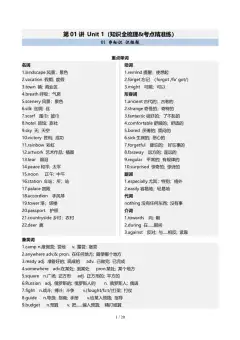
1、visited some ancient buildings/visited my grandparents 参观了一些古建筑/看望了我的祖父母
【详解】(1)作动词
①参观;游览:I visited the Great Wall last year.(我去年参观了长城。)
②拜访;看望:I often visit my grandparents on weekends.(我经常在周末看望我的祖父母。)
③访问;视察:The president will visit our country next month.(总统下个月将访问我们国家。)
(2)作名词
参观;游览;拜访:
I went on a visit to the museum yesterday.(我昨天去博物馆参观了。)
【常用搭配】pay a visit to 表示“拜访;参观”
I will pay a visit to my teacher tomorrow.(我明天将去拜访我的老师。)
【典例】My cousin ________ Shanghai with his parents last summer vacation.
A. visit
B. visits
C. visited
D. will visit
答案:C
详解:时间状语last summer vacation(去年暑假)为一般过去时标志;visit 此处为及物动词,意为“游
览、参观”,过去式visited,故选C。
【即练1】We decide to ________ our English teacher this Sunday afternoon.
A. pay a visit to
B. pay visit to
C. pay a visit
D. pay visits
【即练2】Tom went on a ________ to the mountain village with his classmates.
A. visiting
B. visit
C. visited
D. visits
2、The landscape there was amazing. 那里的风景令人惊叹。
【详解】amaze 是动词,意为“使惊奇;使惊愕”,常见用法如下:
【常用结构】
①“be amazed at/by sth.”,表示“对某事感到惊讶”。
I was amazed at the beautiful scenery.(我对这美丽的景色感到惊讶。)
②“be amazed to do sth.”表示“做某事感到惊讶”。
She was amazed to find her lost dog.(她惊讶地发现了她丢失的狗。)
【拓展】
①amazing 是现在分词转化来的形容词,意为“令人惊奇的”,常用来修饰物。
This is an amazing story.(这是一个令人惊奇的故事。)
②amazed 是过去分词转化来的形容词,意为“感到惊奇的”,常用来修饰人。
The children were amazed.(孩子们感到很惊奇。)
【典例】We are all ________ at the ________ news about the sports meeting.
A. amazed; amazing
B. amazing; amazed
C. amazed; amazed
D. amazing; amazing
答案:A
详解:amazed 修饰人,表示“人感到吃惊的”;amazing 修饰事物,表示“令人吃惊的”,第一空主语是人
用amazed,第二空修饰名词news 用amazing。
【即练1】All the students are amazed ________ the wonderful magic show.
A. to
B. at
C. for
D. with
【即练2】He was amazed ________ meet his old friend in a foreign city.
A. at
B. in
C. to
D. of
3、Did you do anything special ?你做了什么特别的事情吗?
【详解】“anything”都是不定代词,它们的用法如下:
①用于肯定句
something:表示“某事;某物”,一般用于肯定句。
I have something to tell you.(我有某事要告诉你。)
②用于否定句和疑问句
anything:通常用于否定句和疑问句,意为“任何事物;任何东西”。
Is there anything wrong with your bike?(你的自行车有什么毛病吗?)
He didn't say anything.(他什么也没说。)
③特殊用法
在表示请求、建议或希望得到肯定回答的疑问句中,用“something”而不用“anything”。
Would you like something to drink?(你想要喝点什么吗?)
④不定代词与形容词的位置关系
不定代词与形容词连用时,形容词都要后置。
something interesting(有趣的事),anything important(任何重要的事)。
【典例】—Is there ________ in today’s notice?
—No, nothing.
A. useful anything
B. anything useful
C. something useful
D. useful something
答案:B
详解:一般疑问句选用anything,形容词useful 放在不定代词后面,因此选B。
【即练1】There is ________ in the bag. It’s a birthday present.
A. nice something
B. something nice
C. anything nice
D. nice anything
【即练2】She looked around but found ________ in the dark room.
A. unusual nothing
B. everything unusual
C. nothing unusual
D. unusual everything
4、How great it was!那真是太棒了
【详解】感叹句是用以表达喜怒哀乐等强烈情感的句子。以下是感叹句的主要结构及用法:
①由what 引导的感叹句
结构:What + (a/an) + 形容词+ 名词+ 主语+ 谓语!
What a beautiful flower it is!(多么美丽的一朵花啊!)
interesting books they are!(多么有趣的书啊!)
②由how 引导的感叹句
结构:How + 形容词/副词+ 主语+ 谓语!
How beautiful the flower is!(这花多么美丽啊!)
How fast he runs!(他跑得多么快啊!)
【典例】________ nice dress it is!
A. How
B. What
C. What a
D. What an
答案:C
详解:中心词dress 是可数名词单数,nice 辅音开头,用What a,句型:What a+adj.+ 单数名词+ 主谓。
【即练1】________ carefully the students are listening!
A. What
B. What a
C. How
D. How a
【即练2】________ interesting stories they told us!
A. What
B. What an
C. How
D. How an
5、We stayed in the old town for a few days.我们在老城区待了几天。
【详解】“a few”“few”“a little”“little”的区别如下:
(1)所修饰的词
①a few 和few:修饰可数名词复数,“a few apples”(几个苹果),“few people”(很少人)。
②a little 和little:修饰不可数名词,“a little water”(一点水),“little milk”(几乎没有牛奶)。
(2)含义及语气
①a few 和a little:表示“有一些、有几个”,强调有一定数量,语气肯定。
I have a few friends here.(我在这儿有几个朋友。)
There is a little bread in the fridge.(冰箱里有一点面包。)
②few 和little:意思是“很少、几乎没有”,强调数量极少,语气否定。
Few students passed the exam.(很少有学生通过考试。)
He has little money left.(他几乎没剩下什么钱。)
【典例】There is ________ juice in the bottle. Let’s go and buy some.
A. a little
B. little
C. a few
D. few
答案:B
详解:juice 果汁为不可数名词,排除C、D(修饰可数名词);后文“去买一些” 说明几乎没果汁,little 表
否定“几乎没有”,a little 表肯定“有一点”,故选B。
【即练1】He has ________ good friends here, so he often feels lonely.
A.few
B. a few
C. little
D. a little
【即练2】I still have ________ eggs at home, so I don’t need to buy any.
A. little
B. a little
C. few
D. a few
7、It just took my breath away.它让我惊呆了
【解析】(1)take one’s breath away 这个短语的字面意思是“把呼吸带走”,实际含义是“使某人惊叹;
使某人陶醉”
(2)breath”是名词,常见用法如下:
表示“呼吸;气息”
Take a deep breath.(做一次深呼吸。)
Her breath smelled of mint.(她呼出的气息有薄荷味。)
【固定搭配】
①“out of breath”意为“上气不接下气;喘不过气来”。
He ran so fast that he was out of breath.(他跑得太快,以至于上气不接下气。)
②“hold one's breath”表示“屏住呼吸”。
We held our breath when the magician did the dangerous trick.(当魔术师表演危险的魔术时,我们都屏住了呼
吸。)
③“catch one's breath”有“喘口气;恢复正常呼吸”的意思。
After running for a long time, he stopped to catch his breath.(跑了很长时间后,他停下来喘口气。)
【典例】The amazing view of the mountain ________. All of us stood there quietly.
A. caught our breath
B. took our breath away
C. held our breath
D. out of breath
答案:B
详解:take one’s breath away 意为“令人惊叹”;catch one's breath 喘口气;hold one's breath 屏住呼吸;out of
breath 喘不上气(介词短语,不能作谓语)。美景让人惊叹,故选B。
【即练1】When the snake appeared suddenly, we ________ and dared not make any noise.
A. were out of breath
B. caught our breath
C. held our breath
D. took our breath away
【即练2】After climbing the high hill, Tom stopped to ________.
A. catch his breath
B. hold his breath
C. out of breath
D. take his breath away
8、I got you something as a gift.我给你买了一份礼物
【详解】as 含义及用法
①作为连词
表示"当... 时"(引导时间状语从句):As I was reading, my mom called me.(我正在读书时,妈妈叫我。)
表示"因为"(引导原因状语从句):As it's raining, we can't go out.(因为下雨,我们不能出去。)
表示"像... 一样"(引导比较状语从句):She sings as beautifully as a bird.(她唱得像鸟儿一样动听。)
②作为介词:表示"作为" He works as a teacher.(他担任教师工作。)
【典例】________ she got home, she began to cook dinner for her family.
A. As
B. For
C. Like
D. With
答案:A
详解:as 此处连词,意为“当…… 的时候”,引导时间状语从句;like、with 是介词不能引导从句;for 表
原因不置于句首。
【即练1】We all choose him ________ our group leader.
A. when
B. as
C. because
D. like
【即练2】We have to stay at home ________ the weather is bad.
A. as
B. so
C. but
D. than
9、It rained heavily when I arrived at the town, so I could do nothing but stay in the hotel.当我到达小镇时,雨下
得很大,我只能待在酒店里。
【详解】①rain heavily 表示"下大雨",副词heavily 修饰动词rain
同义表达:rain hard /a heavy rain(名词形式)
It rained heavily last night, so the streets were flooded.(昨晚雨下得很大,街道都被淹没了。)
②arrive at / arrive in
arrive at:后接小地点(如学校、车站)We arrived at the airport at 9 o'clock.(我们9 点到达机场。)
arrive in:后接大地点(如城市、国家)They arrived in Beijing yesterday.(他们昨天到达北京。)
【拓展】“get to”“reach”和“arrive in”都有“到达”的意思,但在用法上有一些区别:
get to:是较为口语化的表达,后接地点名词。I got to the station at 9 o'clock.(我9 点到达车站。)当接副
词时,如home、here、there 等,需省略to,get home(到家)。
reach:是及物动词,直接接地点名词或代词作宾语。They reached the top of the mountain at last.(他们最终
到达了山顶。)
arrive in:后接大地点,如城市、国家等。We arrived in Paris yesterday.(我们昨天到达巴黎。)若接小地点
则用“arrive at”,如:arrive at the airport(到达机场)。
【注意】get to 和arrive:是不及物动词,若要表达到达某地,必须借助介词。如果不明确到达的地点,可
用“arrive”单独使用。I don't know when he will arrive.(我不知道他什么时候到。)reach:是及物动词,后
面必须接宾语才能完整表达“到达”的意思,不能单独使用。
③nothing but 表示"只有;仅仅",后接名词或动词原形
He had nothing but a piece of bread for breakfast.(他早餐只有一片面包。)
拓展:nothing but + 动词原形(表示"只能做...")
I did nothing but wait for the bus.(我只能等公交车。)
They do nothing but relax, sleep or watch TV. (他们什么都没做,只是放松、睡觉或看电视。)
【典例】We will ________ Beijing by high-speed rail tomorrow.
A. arrive at
B. arrive in
C. get
D. reach to
答案:B
详解:Beijing 是城市(大地点),用arrive in;arrive at 接车站、村庄等小地点;get 后缺to;reach 是及
物动词,后面不加介词to。
【即练1】What time did you ________ home yesterday?
A. get to
B. arrive at
C. reach
D. arrive in
【即练2】They ________ the small town before dark.
A. arrived
B. got
C. reached
D. arrived in
10、Someone had left a book in my room, and that was exactly what I needed.有人在我房间里留下了一本书,这
正是我所需要的。
【详解】①leave sth + 地点表示"把某物留在某地"
She left her book in the classroom.(她把书落在教室了。)
【区别】forget(忘记)不接地点,如:I forgot my book.(我忘记带书了。)
【注意】有关leave 的词组
leave + 某地“离开某地方”
leave + 某地+ for + 某地“离开某地方前往某地方”
leave for +某地方
“去某地方”相当于go to +某地方
②exactly 副词,表示"确切地;正好"
That's exactly what I want to say.(那正是我想说的。)
同义替换:just(刚好),precisely(精确地)
【典例】I ________ my new watch on the playground just now.
A. forgot
B. left
C. lost
D. kept
答案:B
详解:后面有地点on the playground,“把某物落在某处” 用leave sth + 地点;forget 后面不能加地点,只
表忘记某物,故选B。
【即练1】His mother will ________ Beijing for Xi’an tomorrow morning.
A. leave
B. leave for
C. forget
D. go
【即练2】They will leave for Chengdu this Sunday. 画线短语同义句替换
A. leave Chengdu
B. go to Chengdu
C. forget Chengdu
D. fly from Chengdu
11、The bed was comfortable.床很舒服
【详解】“comfortable”是形容词,常见用法如下:
①作定语修饰名词
This is a comfortable chair.(这是一把舒适的椅子。)
②作表语;表示“感到舒适的;舒服的”,主语通常是人。
I feel comfortable in this room.(我在这个房间里感觉很舒适。)
③也可表示“(衣物、家具等)使人舒服的;舒适的”,主语通常是物。
This dress is very comfortable.(这条裙子很舒适。)
④用于“it is + comfortable + to do sth.”结构;表示“做某事是舒适的”。
It is comfortable to lie in bed.(躺在床上很舒服。)
【常用搭配】
①“be comfortable with”,表示“对……感到自在;适应……”。
She is comfortable with her new job.(她对新工作很适应。)
②“make oneself comfortable”,意为“使自己感到舒适;随便坐”。
Make yourself comfortable, and help yourself to some tea.(别客气,随便坐,喝点茶吧。)
【反义词】uncomfortable(不舒适的)
【派生词】comfort(名词,舒适);comfortably(副词,舒适地)
【典例】This sweater is very ________, so I can wear it ________ all day.
A. comfortable; comfortably
B. comfortably; comfortable
C. comfort; comfortable
D. uncomfortable; comfortably
答案:A
详解:第一空放在系动词is 后用形容词comfortable 作表语;第二空副词comfortably 修饰实义动词wear。
【即练1】The wooden bench is too hard, and it makes me feel ________.
A. comfortable
B. comfortably
C. uncomfortable
D. comfort
【即练2】She isn't ________ with the noisy environment in the office.
A. comfort
B. comfortable
C. comfortably
D. uncomfortable
12、Everyone was ready to find somewhere to go.大家都准备好去某个地方了。
【解析】ready 作形容词;准备好的;
常与“be”动词搭配,构成“be ready (for sth./to do sth.)”结构,表示“准备好(做)某事”。
I am ready for the exam.(我为考试做好了准备。)
He is ready to go to school.(他准备好去上学了。)
【同义短语】be prepared to do sth
【拓展】get ready for sth(为某事做准备)
【典例】My sister is ready ________ her piano lesson.
A. to
B. for
C. with
D. on
答案:B
详解:be ready for + 名词,lesson 是名词,意为“为钢琴课做好准备”;to 后面需要加动词原形。
【即练1】They are ready ________ visit their grandparents this weekend.
A. for
B. at
C. to
D. of
【即练2】We ________ the final exam and we won’t go out this weekend.
A. are ready to
B. get ready for
C. ready for
D. get ready to
13、I was so bored that I decided to find something to read. 我感到非常无聊,决定找点东西读。
【详解】(1)so…that…表示"如此... 以至于...",引导结果状语从句
结构:so + 形容词/ 副词+ that + 从句
She was so tired that she fell asleep at once.(她太累了,以至于立刻睡着了。)
【辨析】
①so... that...:“so”后接形容词或副词,“that”引导结果状语从句,意为“如此……以至于……”,强调
程度,引出结果。
He is so tired that he can't walk anymore.(他如此疲惫以至于再也走不动了。)
②so that:引导目的状语从句,意为“以便;为了”,表示目的。
He gets up early so that he can catch the first bus.(他早起以便能赶上第一班公交车。)
(2)decide 动词,表示"决定"
We decided to visit the museum this weekend.(我们决定这周末去参观博物馆。)
【名词形式】decision(决定)
【常用搭配】decide to do sth(决定做某事);make a decision(做决定)
【典例】The box is ________ heavy ________ I can’t carry it alone.
A. so; that
B. so; to
C. such; that
D. too; to
答案:A
详解:so + 形容词heavy+that 从句,so…that 表示“太重了以至于我一个人搬不动”;too…to 后接动词原
形,不能接从句。
【即练1】She studies hard ________ she can pass all the exams.
A. so that
B. so…that
C. such that
D. in order to
14、I stood up and walked towards the window.我站起来走向窗户。
【详解】towards 介词,表示"朝;向"(强调方向)
He walked towards the park.(他朝公园走去。)
【辨析】“towards”和“to”都有“向”“朝”的意思,但在用法上有一些区别:
①towards:更强调朝着某个方向移动或接近,不一定到达目的地,侧重动作的方向感。
He walked towards the park.(他朝着公园的方向走去。)
②to:强调到达目的地或目标,有明确的方向性和终点。
He went to the park.(他去了公园。)
【典例】The kid ran ________ the river, but his mother stopped him soon.
A. to
B. towards
C. at
D. for
答案:B
详解:后文妈妈拦住了孩子,没有跑到河边。towards 侧重朝着某个方向,未抵达;to 强调最终到达某地,
故选B。
【即练1】My parents will fly ________ Chengdu and stay there for five days.
A. towards
B. to
C. into
D. along
【即练2】He stood by the window and looked ________ the green hills.
A. to
B. towards
C. with
D. of
15、The Russian people built this museum to remember their fight against the Nazis during World War II.俄罗斯人
民建造了这座博物馆,以纪念他们在第二次世界大战中与纳粹的斗争。
【详解】(1)“fight”的用法如下:
①作动词;表示战斗、作战:常与介词“against”或“with”搭配,“against”表示与对手对抗,“with”
可表示与某人并肩作战。
The soldiers fought against the enemy bravely.(士兵们勇敢地与敌人作战。);
They fought with each other to defend their country.(他们并肩作战保卫自己的国家。)
表示打架、斗殴:Don't fight in the schoolyard.(不要在校园里打架。)
表示努力争取、奋斗:常与“for”搭配。They fought for freedom.(他们为自由而奋斗。)
②作名词
表示战斗、斗争:The fight between the two countries lasted for years.(两国之间的战斗持续了多年。)
表示打架、争吵:There was a fight in the street last night.(昨晚街上发生了一场打架事件。)
表示斗志、战斗力:The team showed great fight in the second half.(球队在下半场表现出很强的斗志。)
(2)during 介词:表示"在... 期间", 后接时间段或具体事件(如假期、会议等)
During the summer holiday, I visited Beijing.(暑假期间,我去了北京。)
【典例】All the people fought ________ their country's freedom in the war.
A. against
B. with
C. for
D. at
答案:C
详解:fight for 为…… 奋斗、争取;fight against 对抗……;fight with 和…… 并肩作战/ 打架。句意为:
人们为国家的自由而奋战,用for。
【即练1】We must fight ________ bad habits in our daily life.
A.for
B. against
C. with
D. to
【即练2】The two armies fought ________ each other and beat the common enemy together.
A. against
B. for
C. with
D. about
16、In one hall, I saw an artwork with thousands of glass “tears” falling down.在一个大厅里,我看到了一件艺术
作品,上面有成千上万的玻璃“眼泪”垂落下来。
【详解】①thousands of 数词短语:表示"成千上万的", 后接可数名词复数
Thousands of birds fly south in winter.(冬天有成千上万的鸟南飞。)
注意:前面有具体数字后不加s(two thousand people); 前面没有具体数字,thousand 变复数,再加of
(thousands of people)
②with 介词短语:表示"带有;伴随"
结构:with + 名词/形容词/ 介词短语/ 分词
⑴表状态:He came in with a smile.(他微笑着进来。)
⑵表携带:She went out with an umbrella.(她带伞出去了。)
⑶表原因:He shivered with cold.(他冷得发抖。)
位置:可放在句首或句末
③see…doing…看见某人正在做某事
【辨析】
*see sb do sth:强调看到动作的全过程或经常看到某人做某事。
I often see him play basketball on the playground.(我经常看到他在操场上打篮球,强调这是一个经常发生的、
完整的动作过程。)
*see sb doing sth:强调看到某人正在做某事,侧重动作在某个时间点正在进行。
I saw him playing basketball when I passed by the playground.(我路过操场时看到他正在打篮球,强调在路过
那个时刻,他打篮球的动作正在进行。)
【典例】There are about ________ students in our grade and ________ of them like playing basketball.
A. three thousand; thousand
B. three thousands; thousands
C. three thousand; thousands
D. three thousands; thousand
答案:C
详解:前面有具体数字three,thousand 不加s、不加of;无具体数字时用thousands of,意为成千上万的。
【即练1】The girl ________ long hair is my new deskmate.
A. has
B. have
C. with
D. in
【即练2】I saw him ________ books in the classroom when I went in.
A. read
B. reads
C. reading
D. to read
17、It reminds us that war is terrible and peace does not come easily.它提醒我们战争是可怕的,和平并不容易
获得。
【详解】remind 动词:表示"提醒;使想起"
常用搭配:①remind sb of sth(使某人想起某事)
The photo reminds me of my grandma.(这张照片让我想起奶奶。)
②remind sb to do sth(提醒某人做某事)
Please remind me to bring my homework.(请提醒我带作业。)
【典例】Remember to remind him ________ turn off the lights before leaving.
A.close
B. closing
C. to close
D. closes
答案:C
详解:remind sb to do sth 提醒某人去做某事,不定式作宾语补足语。
【即练1】This song reminds me ________ my happy childhood.
A. to
B. of
C. for
D. with
【即练2】My best friend often reminds me ________ the rules of our class.
A. of
B. to follow
C. following
D. of follow
18、I didn’t feel like eating because I felt sick.我感觉不舒服,所以没有胃口。
【详解】(1)feel like 动词短语:
①表示"想要"后接动名词(-ing 形式)(= want to do sth)
I feel like eating ice cream.(我想吃冰淇淋。)
②表示"感觉像"后接名词/ 代词
It feels like a dream.(这感觉像一场梦。)
(2)“sick”和“ill”都有“生病的”意思,但在用法上存在一些区别:
①sick:既可以作表语,也可以作定语。作定语时,常表示“生病的;恶心的;呕吐的”。
He is a sick man.(他是个病人。)I feel sick.(我觉得恶心。)
②ill:一般作表语,较少作定语。作定语时,常表示“坏的;有害的”等意思,而不是“生病的”。
He is ill.(他生病了。)ill news(坏消息)
【典例】I feel like ________ a walk after dinner.
A. take
B. to take
C. taking
D. takes
答案:C
详解:feel like 表示“想要” 时,固定搭配后接动名词doing,即feel like doing sth;want 后才接to do,
故选taking。
【即练1】We need to look after that ________ boy in hospital.
A.ill
B. sick
C. illness
D. sickness
【即练2】Her father was badly ________, so he stayed at home all day.
A. sick
B. illness
C. ill
D. sickness
19、We were so happy that we didn’t notice the time.我们太开心了,以至于没有注意到时间。
【详解】notice ①动词:"注意到", 搭配:notice sb do sth(注意到某人做了某事)notice sb doing sth(注意
到某人正在做某事)
I noticed him reading a book when I came in.(我进来时注意到他正在读书,强调进来那一刻他读书的动作正
在发生。)
I often notice her help the old man.(我经常注意到她帮助那位老人,强调这是一个经常发生的完整动作过程。)
②名词:"通知"(可数)
There's a notice on the wall.(墙上有一则通知。)
【典例】I noticed him ________ basketball on the playground when I passed by.
A. play
B. to play
C. playing
D. plays
答案:C
详解:when I passed by 路过时,强调瞬间动作正在进行,notice sb doing sth 注意到某人正在做某事。
【即练1】We often notice Lily ________ the classroom after school.
A. clean
B. cleaning
C. cleans
D. to clean
【即练2】There is a ________ on the blackboard about the school trip.
A. notice
B. notices
C. noticing
D. noticed
20、It was such a good experience. 那是一次很好的经历。
【详解】“so”和“such”都有“如此、这样”的意思,它们的辨析如下:
①so:是副词,用来修饰形容词或副词。
The book is so interesting.(这本书如此有趣,修饰形容词“interesting”。)
He runs so fast.(他跑得如此快,修饰副词“fast”。)
②such:是形容词,用来修饰名词。
It is such a beautiful day.(这是如此美好的一天,修饰名词“day”。)
They are such lovely flowers.(它们是如此可爱的花,修饰名词“flowers”。)
【典例】She is ________ a kind girl that everyone likes her.
A. so
B. such
C. very
D. too
答案:B
详解:such + a/an + 形容词+ 单数名词;so 后面直接加形容词,不能接a kind girl。
【即练1】The movie is ________ moving that many people cry.
A. such
B. so
C. such an
D. so an
【即练2】________ nice flowers! We bought them this morning.
A. So
B. Such
C. What a
D. How
21、Don’t spend too much time on holiday shopping, or you might easily go over budget.不要在假期购物上花费太
多时间,否则很容易超出预算。
【详解】(1)“spend”“cost”“pay”和“take”都有表示“花费”的意思,但它们在用法上有一些区别:
①spend:主语通常是人。Sb+spend +时间/钱+ on sth /(in) doing sth .
I spent two hours reading the book.(我花了两个小时读这本书。)
②cost:主语是物或某种活动。Sth + cost +sb + 钱。
The book cost me 20 yuan.(这本书花了我20 元。)
③pay:主语是人。Sb + pay +钱+ for + sth .
He paid 100 dollars for the shoes.(他为这双鞋付了100 美元。)
④take:常用于“It takes/took sb + 时间+ to do sth”结构中,it 作形式主语,真正的主语是后面的动词不定
式。It took me half an hour to get to school.(我花了半个小时到学校。)
(2)or 表示"否则", 用法:用于"祈使句+ or + 结果句",表示"否则会..."
Hurry up, or you'll be late.(快点,否则会迟到。)
Study hard, or you won't pass the exam.(努力学习,否则考试不及格。)
【典例】I ________ two hours ________ my homework last night.
A. spent; doing
B. cost; to do
C. paid; for
D. took; do
答案:A
详解:主语I 是人,spend + 时间+(in) doing sth;cost 主语为物;pay 后接金钱+ for sth;take 固定句型
是It takes sb...to do,故选A。
【即练1】It ________ him an hour to walk to the park every Sunday.
A. spends
B. costs
C. pays
D. takes
【即练2】Put on your coat, ________ you will catch a cold.
A. and
B. or
C. but
D. so
22、I’m getting a little forgetful these days.我最近有点健忘。
【详解】forgetful 形容词:"健忘的", 搭配:be forgetful of(忘记...)
My grandpa is forgetful of his keys.(爷爷总是忘记带钥匙。)
【词根】forgetful(形容词,健忘的)→forget(动词,忘记)
【辨析】“forget to do”和“forget doing”的区别如下:
①forget to do sth:表示忘记去做某事,动作尚未发生。
I forgot to post the letter.(我忘记去寄信了,信还没有寄。)
②forget doing:表示忘记做过某事,动作已经完成。
He forgot locking the door.(他忘记自己已经锁了门,门已经锁上了。)
【典例】Don’t forget ________ your umbrella. It’s raining outside.
A. take
B. to take
C. taking
D. takes
答案:B
详解:forget to do sth 忘记要去做某事(动作没做),提醒别忘了带伞,还没拿,用to take。
【即练1】He forgot ________ the window, but in fact he closed it yesterday.
A. close
B. to close
C. closing
D. closed
【即练2】The old man is ________ of small things easily.
A. forget
B. forgetful
C. forgot
D. forgetting
一、单项选择
1.My mother always ________ me to take my keys with me before going to school, or I will forget them easily.
A.reminds
B.remembers
C.protects
D.touches
2.Be quiet! I have ________ to tell you.
A.something important
B.anything important
C.important something
D.important anything
3.________ tourists visited the science museum last month.
A.Thousand
B.Three thousands
C.Thousands
D.Thousands of
4.Do not wait for good things to happen. You need to walk ________ happiness.
A.towards
B.from
C.behind
D.around
5.—Did you visit the Palace Museum ________ your stay in Beijing last summer?
—Yes! I learned a lot about history.
A.during
B.over
C.through
D.without
6.Don’t be afraid of problems. Remember: kites rise highest ________ the wind, not with it.
A.along
B.above
C.across
D.against
二、根据汉语填空
1.The beauty of nature _______ ______ _______ _______when I went to the park. (令我惊叹)
2._________ visitors come to Dehong to taste the delicious food. (成千上万的)
3.They are ________ ________ (寻找) a guide in the town.
4.Let’s ________ ________ (相聚) this weekend.
5.I can see ________ ________ (只有) water in the bottle.
6.She ________ ________ (转过身) and saw a rainbow.
三、用所给词的适当形式填空
1.In China,red is a popular colour, ________ (especial) during some festivals.
2.In the evening, we ________ (easy) walked two kilometers and didn’t feel tired at all.
3.The food in Yunnan is ______ delicious. (especial)
4.She is so ________ that she often leaves keys at home. (forget)
5.It’s ________ (comfort) to sit on the sofa and read books after a long day at school.
四、完形填空
Last summer, I went on vacation with my parents to a small town in Yunnan. It was so
1
that I
will never forget.
On the first day, we got up early to
2
the sunrise. The view was more beautiful
3
any I
had seen in my hometown. I took lots of photos with my camera. Later, we visited some ancient buildings and
learned more about local culture. I even
4
a summer camp for two days and made some new friends
there.
One afternoon, it rained
5
, so we had to stay in the hotel. I didn’t feel sick, but I felt like reading. I
looked for
6
interesting to read. I found nothing but an old magazine.
On the last day, I was in a hurry to leave. My mom
7
me to take my bag, or I would have left it in
the hotel. I
8
to share all my stories with my classmates as soon as I got back to school.
This trip helped me
9
nature and also taught me to be careful with my things.
10
it
made me more independent (独立), it was a great experience.
1.A.easy
B.boring
C.terrible
D.amazing
2.A.see
B.saw
C.seeing
D.sees
3.A.to
B.as
C.than
D.for
4.A.took away
B.took part in
C.took out
D.took photos
5.A.softly
B.lightly
C.heavily
D.clearly
6.A.anything
B.something
C.everything
D.nothing
7.A.promised
B.allowed
C.reminded
D.encouraged
8.A.decided
B.forgot
C.refused
D.remembered
9.A.look for
B.fight against
C.depend on
D.learn from
10.A.Because
B.So
C.Unless
D.Though
五、阅读理解
As we know, people often ride shared bikes (共享单车) for short trips. But four students rode shared bikes
from Beijing to Tianjin on April 4, 2024. Many people felt shocked at it. They couldn’t believe it. The cycling trip
was 125 kilometers, and the four students rode for 10 hours and 28 minutes.
The four students are from Malaysia. They are now studying in Beijing. Their names are Li Sijing, Peng
Yongzhi, Chen Yuhang and Qiu Yuxiang. They are roommates, and three of them are about to graduate (毕业) from
the school. They wanted to do something special to remember their school life, so they started the trip.
Li Sijing started cycling to keep healthy at first. After losing 60 kg, he loved this sport. Later, he asked his
roommates to join in cycling activities together. The trip to Tianjin was one of the activities.
Tianjin is a city with a long history and rich culture. A trip of over 100 kilometers is also good for cycling.
Cycling is wonderful. It lets the four students enjoy the beauty (美景) of China.
The four students rode shared bikes to Tianjin because there was the name of their school on the bikes. They
wanted to do something special with the bikes and took photos. After getting to Tianjin, they were so tired, so they
took the high-speed train back to Beijing.
1.What does the underlined word “shocked” in Paragraph 1 mean in Chinese?
A.担心的
B.惊讶的
C.著名的
D.兴奋的
2.What is Paragraph 2 mainly about?
A.The change of the four students.
B.The living habits of the four students.
C.The school life of the four students.
D.An introduction to the four students.
3.Why did Li Sijing start cycling at first?
A.To keep healthy.
B.To join in cycling activities.
C.To visit Tianjin in a cheap way.
D.To learn about the history of China.
4.Why did the students ride shared bikes to Tianjin?
A.Because it was a traditional way of travelling.
B.Because the bikes carried the name of their school.
C.Because it let people enjoy the beauty of China.
D.Because it was cheap to travel in this way.
5.Which could be the best title of the text?
A.A Beautiful City in China
B.A Special Photo of Tianjin
C.A Special Shared Bike Trip
D.A Famous School in Beijing