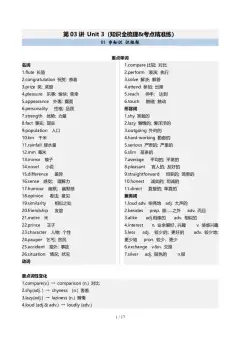
第03 讲Unit 3 Same or Different
(知识全梳理&考点精准练)
内容导航
01 预习航标→析目标·明方向:预习导航精准定向
02 教材全解→析教材·学新知:情境概念深度构
考点精讲:聚焦常考要点,讲清逻辑
例题精析:典型题目带路,学会解题思路
即练固基:趁热打铁练一练,巩固刚学内容
03 过关检测→练考点·强落实:过关检测分层提
关键词
学习目标导航
学习目标
1.能认读、拼写并运用与人物外貌、性格、爱好、能力对比相关的重点词汇与短语,熟练朗
读单元对话和短文。
2.能掌握本单元核心交际句型,熟练运用句型谈论自己与他人的相同点与不同点,描述人物
特征与能力差异。
3.能听懂围绕人物异同对比展开的对话,精准抓取听力中的人物特征、能力、爱好及对比关
系等关键信息。
4.能读懂介绍人物异同、朋友特质对比的简短语篇,理解文章主旨与细节内容,梳理人物之
间的差异与共性。
5.能运用所学词汇和句型,口头、书面描述自己与同学、朋友的相同之处与不同之处,完成
情景对话、人物对比短文写作等任务。
学习重点
1.掌握谈论人物外貌、性格、爱好、能力异同的核心对比句型,并能灵活进行问答、对比描
述与转述。
2.熟记单元重点词汇、短语,掌握形容词、副词比较级以及同级比较(as...as)的含义与基
本用法。
3.掌握形容词、副词原级、比较级在人物特征、能力对比语境中的句式结构与运用规则。
学习难点
1.准确区分形容词、副词原级与比较级的语义差别,掌握比较级的规则变化与不规则变化,
结合语境正确选用比较句式。
2.结合生活场景,连贯、完整地用英语对比描述自己与他人的特质、爱好和能力,做到语句
通顺、对比逻辑清晰。
3.在口语和写作中,综合运用词汇、对比句型与比较级语法,自然、精准地表达人物的相同
点与不同点,规避比较对象不一致等语法错误。
1、How are we different from each other?我们有什么不同?
【详解】be different from(与…… 不同);反义词组:the same ……as(与…… 相同)
My schoolbag is different from yours.(我的书包和你的不同。)
=My schoolbag isn’t the same as yours.
【拓展】different 的名词difference(不同点)
【典例】This new pen ________ the old one. They have different colours.
A.is the same as
B.is different from
C.same as
D.different from
【答案】B
【详解】句意:这支新钢笔和旧的那支不一样。它们颜色不同。
固定短语the same as、be different from 必须搭配be 动词才可作谓语;A 选项含义为“与…… 相同”,和
后文“颜色不同” 逻辑冲突;C、D 两项缺少be 动词,句子结构残缺,故选B。
【即练1】My bike isn’t the same as Tom’s. It means my bike ________ Tom’s.
A.is same as
B.different from
C.is different from
D.are different from
【即练2】Can you tell me one ________ between the two cats?
A.different
B.differences
C.difference
D.differently
2、Compare people and things.比较人和事物。
【解析】compare
v.
比较;对比
【短语词组】
①compare to 与……比较
②compare... with... 把……与……相比
My room is bigger compared to yours.
我的房间和你的相比更大
Compare your answer with the model.
把你的答案和范文对比
【词汇拓展】
comparison
n. 比较
comparable
adj. 可比较的;比得上的
【典例】Please ________ your answers ________ the model answers before handing in your paper.
A.compare; to B.compare; with C.comparing; with D.compared; to
【答案】B
【详解】句意:交卷前请把你的答案和参考答案对照一下。
本句为祈使句,句首用动词原形,排除C、D;compare...with... 表示“把…… 与…… 对比”,侧重仔细比
对差异;compare to 多表示把某物比作另一物,此处是对照答案,用compare...with...,故选B。
【即练1】In ________, the new library is much brighter than the old one.
A.compare
B.comparable
C.comparison
D.compared
【即练2】These two paintings are ________ in style, so many people mix them up.
A.compare
B.comparison
C.comparable
D.comparing
3、Chen Jie is afraid of performing alone.
【详解】(1)“afraid”是形容词,常见用法如下:
①be afraid of (doing) sth.表示“害怕(做)某事”,强调对某事物或某种情况的恐惧。
She is afraid of snakes.(她害怕蛇。)
I'm afraid of making mistakes.(我害怕犯错。)
②be afraid to do sth.意为“不敢做某事”,侧重因害怕而不敢去做某事。
He is afraid to go out alone at night.(他不敢在晚上独自出门。)
③be afraid that...表示“担心……,恐怕……”,后接宾语从句。
I'm afraid that I can't come to the party.(我恐怕不能来参加派对了。)
④I'm afraid so/not 这是一种常用的口语表达。“I'm afraid so.”表示“恐怕是这样”;“I'm afraid not.”表
示“恐怕不是这样”“恐怕不行”。
“Is it going to rain tomorrow?”“I'm afraid so.”(“明天会下雨吗?”“恐怕会。”)
“Can you help me with this problem?”“I'm afraid not.”(“你能帮我解决这个问题吗?”“恐怕不行。”)
【典例】The little girl is afraid ______ the dark, so she is afraid ______ out alone at night.
A.of; going
B.to; to go
C.of; to go
D.to; going
【答案】C
【详解】句意:这个小女孩害怕黑暗,所以她不敢晚上独自外出。
be afraid of sth. 害怕某物;be afraid to do sth. 不敢做某事。第一空后是名词the dark,用of;第二空后是动
作,需用不定式to go,故选C。
【即练1】—Can you go shopping with me this afternoon?
—______. I have to finish my homework first.
A.I'm afraid so
B.I'm afraid not
C.I afraid not
D.I'm afraid
【即练2】I'm afraid ______ I can't attend your birthday party this Saturday.
A.of
B.to
C.that
D.what
(2)alone(独自的/ 地)
形容词:表示“独自一人”(无情感色彩)。lonely 孤独的,有感情色彩。
【拓展】“alone”和“lonely”辨析
①alone:强调客观上的“独自,单独”,没有其他人或事物陪伴。
He likes to stay alone in his room.(他喜欢独自待在房间里。)
②lonely:侧重于主观上的“孤独,寂寞”,强调内心的感受,通常表示因缺乏陪伴而感到悲伤或凄凉。
The old man feels lonely because his children are far away.(这位老人因为孩子们离得远而感到孤独。)
【注意】lonely:是形容词,常作定语或表语。作定语时,意为“荒凉的,偏僻的”。
a lonely village(一个偏僻的村庄)。
【典例】Though he lives ______, he never feels ______.
A.lonely; alone
B.alone; lonely
C.alone; alone
D.lonely; lonely
【答案】B
【详解】句意:虽然他独自居住,但他从不感到孤独。
alone 侧重客观上独自一人;lonely 侧重主观内心孤独。live alone 表示独自居住;feel lonely 表示感到孤单,
故选B。
【即练1】We passed a ______ mountain village on our way. Few people live there.
A.alone
B.lonely
C.quietly
D.singly
【即练2】The little boy stayed ______ in the house, but he wasn’t ______.
A.lonely; alone
B.alone; lonely
C.alone; alone
D.lonely; lonely
4、I’m not as outgoing as you.
【详解】①结构与用法
肯定形式:A
+ as + 形容词/ 副词原级+ as + B
(A 和B 一样.......)
Your bag is as heavy as mine.(你的包和我的一样重。)
否定形式:A + not as/so + 形容词/ 副词原级+ as + B
(A 不如B)
This problem is not as difficult as I thought.(这个问题没有我想象的难。)
He doesn't run so fast as his friend.(他跑得不如朋友快。)
②原级与比较级互换
A + not as/so + 形容词/ 副词原级+ as + B
=A+形容词反义词的比较级+ than + B
=B + 形容词的比较级+ than + A
He isn’t as tall as me.他没有我高.=He is shorter than me.=I am taller than him .
【典例】This book isn’t ________ useful ________ that magazine.
A.as; so
B.so; as
C.so; so
D.more; than
【答案】B
【详解】句意:这本书不如那本杂志有用。
否定形式的原级比较可用not as/so + 形容词原级+ as;so...as 多用于否定句,构成固定搭配not so...as。A、
C 搭配不符合语法,D 选项为比较级搭配,不能和题干结构匹配,故选B。
【即练1】Bob isn’t as strong as Mike. Which of the following has the same meaning?
A.Bob is stronger than Mike.
B.Mike is weaker than Bob.
C.Mike is stronger than Bob.
D.Bob is as strong as Mike.
【即练2】Lily draws ________ carefully ________ her deskmate. They get good grades.
A.as; as
B.so; as
C.as; so
D.more; as
5、They solve the problem by playing together.
【详解】(1)solve(解决),及物动词,后接问题、困难等(如problem, difficulty),相当于work out。
Can you help me solve this problem ?(你能帮我解决这个难题吗?)
=Can you help me work out this problem ?
【拓展】solve 的名词solution(解决方案)
(2)by doing(通过做……)用法:表示方式或方法,后接动名词。
You can learn English by watching videos.(你可以通过看视频学英语。)
【注意】对by doing sth 划线提问,疑问词用how。
【典例】No one can ________ the difficult math problem in our class.
A.solution
B.solve
C.solving
D.solved
【答案】B
【详解】句意:我们班上没人能解出这道数学难题。
情态动词can 后需要使用动词原形;solution 是名词,意为“解决方案”;solving 是动名词/ 现在分词;
solved 是动词过去式/ 过去分词,均不能放在can 后,故选B。
【即练1】We should ________ the problem before the meeting starts.
A.work out
B.work for
C.work with
D.work on
【即练2】Who can come up with a useful ________ to the difficulty?
A.solve
B.solving
C.solution
D.solved
6、They won the first prize in the school music festival.
【详解】win(赢),win + 比赛/ 奖项(如game, competition, prize);
Our team won the basketball match.(我们队赢了篮球比赛。)
【拓展】win,beat 和lose 区别
①win:表示获胜、赢得,其宾语通常是比赛、奖品、荣誉等,如“win a game”(赢得一场比赛),“win a prize”
(获得一个奖项)。
②beat:意为打败、战胜,其宾语通常是竞争对手,如“beat the opponent”(打败对手),“beat the team”(战
胜这个团队)。
③lose:表示输掉、失败,与“win”相反,其宾语可以是比赛、战斗等,如“lose a match”(输掉一场比赛),
“lose the battle”(输掉战斗)。
【典例】We ________ their swimming team in the final last Sunday.
A.won
B.beat
C.lost
D.got
【答案】B
【详解】句意:上周日的决赛中我们打败了他们的游泳队。
win 后接比赛、奖项;beat 后接人、队伍等对手;lost 意为输掉,got 意为得到。空格后宾语是their swimming
team(对手队伍),需用beat,故选B。
【即练1】My cousin ________ a big prize in the painting competition.
A.beat
B.won
C.lost
D.missed
【即练2】They practiced every day, but they ________ the basketball game yesterday.
A.won
B.beat
C.lost
D.caught
7、I took part in the school music festival.
【详解】take part in(参加),后接活动、比赛等(如competition, activity)。
I took part in the painting competition last week.(我上周参加了绘画比赛。)
【拓展】take part in 与join 的区别
①“take part in”后面接活动等名词作宾语,不能接人。
She took part in the singing competition.(她参加了歌唱比赛。)
②“join”是及物动词,后面接组织、团体的名词,也可以接人,表示加入某人或与某人一起做某事。
He joined the Party last year.(他去年入党了。)
Will you join us for dinner?(你愿意和我们一起吃晚饭吗?)
【典例】Many students will ________ the school sports meeting next Friday.
A.join
B.take part in
C.join in
D.take part
【答案】B
【详解】句意:下周五许多学生将要参加学校运动会。
join 后接团体、组织或者人;take part in 后接大型活动、比赛;take part 缺少介词in,结构不完整;join in
多用于小型临时活动。the school sports meeting 是学校大型活动,用take part in,故选B。
【即练1】Would you like to ________ us to climb the mountain this weekend?
A.take part in
B.join
C.join in
D.take part
【即练2】My brother wants to ________ the basketball club after school.
A.join
B.take part in
C.take part
D.joined
8、Congratulations on winning the prize at the school music festival!
【详解】congratulate 动词,祝贺;结构:congratulate sb. on sth.(祝贺某人某事)
We all congratulated him on winning the competition. (我们都祝贺他赢得比赛。)
I want to congratulate you on your graduation. (我想祝贺你毕业。)
常用复数形式:Congratulations! (单独使用表示祝贺)
Congratulations on your birthday! (祝你生日快乐!)
【典例】— I passed the important exam yesterday!
— ________!
A.Congratulation
B.Congratulates
C.Congratulations
D.Congratulate
【答案】C
【详解】句意:—— 我昨天通过那场重要考试了!—— 祝贺你!
单独表达祝贺要用复数形式Congratulations;Congratulation 为单数形式,不能单独使用;Congratulates 是
动词第三人称单数;Congratulate 是动词原形,均无法单独用于答语表达祝贺,故选C。
【即练1】We congratulate her ________ getting the first prize.
A.in
B.on
C.for
D.at
【即练2】I’d like to congratulate you ________ your new job.
A.on
B.to
C.with
D.about
9、You attended the festival last year and this year.
【详解】attend 动词,参加/ 出席
My father will attend the parents' meeting tomorrow.(我爸爸明天要参加家长会。)
【拓展】take part in, join 和attend 区别
①take part in:侧重于参与某个活动,并在其中发挥一定的作用,强调参与活动的过程,常指参加群众性活
动、会议、比赛等。
She took part in the school play.(她参加了学校的戏剧演出。)
②attend:通常用于指参加会议、婚礼、葬礼、讲座、课程等,更强调出席这一动作,不一定强调在活动中
发挥作用。He will attend a lecture on history tomorrow.(他明天将参加一个关于历史的讲座。)
③join:强调加入某个组织、团体或人群,成为其中的一员。也可用于表示加入某人做某事。
He joined the club last year.(他去年加入了俱乐部。)
Will you join us for a walk?(你愿意和我们一起去散步吗?)
【典例】All parents are asked to ________ the parents' meeting this Friday afternoon.
A.join
B.take part in
C.attend
D.join in
【答案】C
【详解】句意:所有家长被要求本周五下午出席家长会。
attend 侧重出席会议、讲座等,只强调到场;join 后接团体或人;take part in 侧重亲身参与并发挥作用的
活动;join in 多指小型活动。the parents' meeting 是会议,用attend,故选C。
【即练1】I want to ________ the running race and try my best to win.
A.attend
B.join
C.take part in
D.join to
【即练2】Tom decided to ________ the music group and practice singing every day.
A.attend
B.join
C.take part in
D.attend in
10、Besides singing, how do you both spend your spare time?
【详解】(1)besides 除...之外(还有)(包括在内)
Besides math, I also like physics. (除了数学,我还喜欢物理。)
【拓展】besides 与except 区别
①besides:表示“除……之外(还有)”,即包括在整体之内,强调除此之外还有其他的。
Besides English, he also studies French.(除了英语,他还学习法语。)说明他既学英语也学法语。
②except:表示“除……之外(不包括)”,即从整体中排除出去。
Everyone is here except Tom.(除了汤姆,大家都在这儿。)意味着汤姆不在这儿。
(2)spare 空闲的/ 抽出
①作形容词,表示“空闲的;多余的”。
I have no spare time this week.(我这周没有空闲时间。)
②作动词,有“抽出;匀出”的意思,常与时间、金钱等搭配。
Can you spare me a few minutes?(你能为我抽出几分钟时间吗?)
【拓展】常见搭配:spare time 空闲时间;in one's spare time 在某人空闲时
【典例】________ English, she learns two other foreign languages.
A.Except
B.Besides
C.Without
D.Outside
【答案】B
【详解】句意:除了英语之外,她还学习另外两门外语。
besides 意为“除…… 之外(还有)”,包含后面提到的事物;except 表示“除…… 之外”,不包含该事物;
without(没有)、outside(在外面)不符合语境。句中说明英语是她学习的语种之一,还有其他语言,用Besides,
故选B。
【即练1】All the students went hiking ________ Jack. He was ill at home.
A.besides
B.except
C.with
D.for
【即练2】—What subjects do you study?
—I study Chinese, math and history. ________ them, I also learn chemistry.
A.Except
B.Beside
C.Besides
D.Expect
11、Our pleasure!
【详解】pleasure 名词,愉快/荣幸/令人愉快的事。
She read the book with pleasure.(她愉快地读着这本书。)
It's a pleasure to meet you.(见到你很高兴。)
【固定搭配】常见的有“with pleasure”(乐意地,愉快地),“my pleasure”(不客气,这是我的荣幸)
等。“Could you help me?”“With pleasure.”(“你能帮我一下吗?”“乐意效劳。”)
【拓展】
①动词please 意为“使高兴,使满意”。
It pleases me to see you looking happy.(看到你一副快乐的样子我很高兴。)
②“pleasure”的形容词形式有“pleasant”和“pleased”。
pleasant:表示“令人愉快的;宜人的;有趣的”,常用来形容事物或人给人的感觉。
We had a pleasant trip.(我们有一次愉快的旅行。)
pleased:意为“高兴的;满意的”,通常用来描述人的感受。
I'm very pleased with my new job.(我对我的新工作很满意。)
【典例】—Thank you for helping me carry the box!
—________.
A.With pleasure
B.My pleasure
C.Pleased
D.Pleasant
【答案】B
【详解】句意:—— 谢谢你帮我搬箱子!—— 不客气。
With pleasure 用于回应别人的请求,表示乐意效劳;My pleasure 用于回应感谢,表示不客气;Pleased(感
到开心的)、Pleasant(令人愉悦的)均无法单独作答语回应感谢,故选B。
【即练1】—Could you pass me that notebook?
—________.
A.My pleasure
B.With pleasure
C.Pleasure
D.Pleased
【即练2】We spent a ________ afternoon walking along the lake.
A.pleased
B.please
C.pleasant
D.pleasure
12、Are you more serious than your cousin?
【详解】(1)比较级句型(A 比B 更...)
结构:A + be 动词/ 实义动词+ 形容词/ 副词比较级+ than + B
形容词比较级:
This book is more interesting than that one.(这本书比那本有趣。)
My sister is taller than me.(我姐姐比我高。)
副词比较级:
She runs faster than her brother.(她跑得比弟弟快。)
Tom studies more carefully than before.(汤姆学习比以前更认真。)
(2)serious”是形容词,表示“严肃的;认真的”“重要的;需认真对待的”
He is a serious man.(他是个严肃的人。)
【短语搭配】“be serious about”表示“对……认真;严肃对待”。
He is serious about his work.(他对工作很认真。)
【典例】This story is ________ than that one.
A.interesting
B.more interesting
C.most interesting
D.the most interesting
【答案】B
【详解】句意:这个故事比那个故事更有趣。
句中出现比较级标志词than,需要使用形容词比较级;interesting 是多音节形容词,比较级形式为more
interesting。A 是原级,C、D 是最高级,不符合此处句型要求,故选B。
【即练1】Linda sings ________ loudly ________ her deskmate.
A.more; than
B.much; then
C.more; then
D.most; than
【即练2】My father drives ________ carefully ________ my mother.
A.more; than
B.much; than
C.more; then
D.most; than
13、The population of Chicago was larger than that of Guangzhou in 2022.
【详解】(1)population 意为“人口,人口数量”,
①作主语时,谓语动词用单数。
The population of China is 1.4 billion .(中国人口有14 亿)
②形容人口的多少用large/big 和small。
The population of China is larger than that of America.(中国人口比美国人口要多。)
③询问某国、某地有多少人口的句型:What is the population of…?,不能用how many /how much
What’s the population of Hubei? (湖北人口有多少?)
④表示“某地有多少人口”用“…has a population of…”或“The population of…is…”。
China has a population of 1.4 billion .(中国人口有14 亿)
(2)比较级中that 的用法
用法: 在比较级中代替前文提到的单数名词;如果代替前文的复数名词,则使用those.
原句:The weather in Wuhan is hotter than the weather in Beijing.
简化:The weather in Wuhan is hotter than that in Beijing.(武汉的天气比北京热。)
The apples in this basket are bigger than those in that basket.
(这个篮子里的苹果比那个篮子里的大。)
【典例】—________ the population of this city?
—It’s about five million.
A.How much is
B.How many are
C.What is
D.What are
【答案】C
【详解】句意:—— 这座城市的人口是多少?—— 大约五百万。
询问某地人口数量要用固定句型“What is the population of...?”;how much/how many 不能用于提问
population;population 作主语谓语用单数is,故选C。
【即练1】The population of India is ________ than that of Australia.
A.many
B.much
C.larger
D.smaller
【即练2】This town ________ a population of thirty thousand.
A.have
B.has
C.is
D.are
14、Some people think that friends should be alike.
【详解】alike 形容词;意为“相似的,相像的”,常作表语,不能用于名词前作定语。
The two sisters look very much alike.(这两姐妹长得很像。)
【常见搭配】
①“be alike in”表示“在……方面相似”。The two cars are alike in color.(这两辆车颜色相似。)
②“look alike”意为“看起来相像”。They look alike, but they have different personalities.(他们看起来相像,但
性格不同。)
【典例】The twin brothers ________. It’s hard to tell them apart.
A.are alike look
B.look alike
C.alike look
D.look alike brothers
【答案】B
【详解】句意:这对双胞胎兄弟长得很像,很难区分他们。
alike 作形容词只能作表语,固定搭配look alike 表示“看起来相像”。A、C 语序错误;D 中alike 不能前
置修饰名词brothers,故选B。
【即练1】These two houses ________ size and shape.
A.are alike in
B.alike are in
C.are in alike
D.in are alike
【即练2】Which sentence is correct?
A.They are alike students.
B.Alike children like this game.
C.The two robots are alike.
D.Alike they are.
15、Because of that, I try harder when I practice, and now I’m getting better at badminton.
【详解】(1)because of 含义:因为;由于。
【辨析】because 与because of
because of 后面接名词、代词或动名词短语,表示原因。because 后面接句子。
We didn't go to school because of the heavy rain.(因为大雨,我们没去上学。)=We didn’t go to school because
it rained heavily.
(2)hard 作形容词时,意为“困难的;硬的;努力的”;作副词时,意为“努力地;猛烈地”。
This math problem is very hard.(这道数学题很难。)
The bed is too hard.(这床太硬了。)
He works hard every day.(他每天努力工作。)
It is raining hard outside.(外面雨下得很大。
【典例】He stayed at home ________ his bad cold.
A.because
B.because of
C.so
D.but
【答案】B
【详解】句意:因为重感冒,他待在了家里。
because 后接完整句子;because of 后接名词、代词或动名词短语。his bad cold 是名词短语,需用because
of;so(因此)、but(但是)逻辑不符,故选B。
【即练1】She failed the exam ________ she didn’t study hard.
A.because of
B.because
C.for
D.with
【即练2】The sports meeting was put off ________ raining all day.
A.because
B.as
C.because of
D.since
16、Thanks to her, I am becoming more outgoing.
【详解】thanks to 多亏;由于。表示原因,通常用于表达积极的结果。
Thanks to your help, I passed the exam.(多亏了你的帮助,我通过了考试。)
【辨析】thanks to 与thanks for 区别
①thanks to:表示“多亏;由于”,
Thanks to your help, we finished the work on time.(多亏了你的帮助,我们按时完成了工作。)
②thanks for:意为“因……而感谢”,用于表达对某人所做某事的感激之情。
Thanks for inviting me to the party.(谢谢你邀请我参加聚会。)
【典例】________ your advice, I found my lost key quickly.
A.Thanks for
B.Thanks to
C.Thank you
D.Thank to
【答案】B
【详解】句意:多亏你的建议,我很快找到了丢失的钥匙。
thanks to 意为“多亏,由于”,后接名词/ 代词引出带来好结果的原因;thanks for 表示“因…… 感谢”;
Thank you 后不能直接接名词;Thank to 为错误搭配。本句强调建议带来了好结果,用Thanks to,故选B。
【即练1】________ helping me with my English these days!
A.Thanks to
B.Thank to
C.Thanks for
D.Thank for
【即练2】—________ the warm coat, I didn’t feel cold outside.
—________ lending it to me!
A.Thanks for; Thanks to
B.Thanks to; Thanks for
C.Thank to; Thank for
D.Thanks for; Thanks for
17、Now I think meeting new people is really fun.
【详解】(1)“I think + 句子”是一个常见的主从复合句结构,其中“I think”是主句,后面的句子是宾
语从句,用来表达说话者的观点、想法或看法。
①否定句,通常将否定词转移到主句的“think”上,即“否定前移”。
I don't think it will rain tomorrow.(我认为明天不会下雨。)
②一般疑问句,将“think”的助动词提前到句首。
Do you think she will come to the party?(你认为她会来参加派对吗?)
(2)meeting new people 是动名词作主语,谓语动词用第三人称单数。
Drinking milk every day is good for our health. (每天喝牛奶对我们健康有益。)
【典例】I ________ he ________ finish his homework on time.
A.think; won’t
B.don’t think; will
C.don’t think; won’t
D.not think; will
【答案】B
【详解】句意:我认为他不能按时完成他的作业。
主句主语为I,谓语动词为think 时,要遵循否定前移规则,否定词放在主句,从句用肯定形式。A 未进
行否定前移;C 双重否定逻辑错误;D 缺少助动词do,结构错误,故选B。
【即练1】—________ you ________ Lily can join us?
—Yes, I believe she will.
A.Do; think
B.Are; think
C.Does; think
D.Did; thinks
【即练2】Which sentence is correct?
A.I think he isn’t right.
B.I don’t think he is right.
C.I not think he is right.
D.I don’t think he isn’t right.
18、What really matters in a friendship?
【详解】(1)matter 作名词
①表示“事情;问题”,用于句型“What's the matter?”,用来询问“怎么了?出什么事了?”
②意为“物质”,是不可数名词。
Matter exists in three states: solid, liquid and gas.(物质以三种状态存在:固态、液态和气态。)
③表示“重要性”,用于短语“no matter”,可单独使用,也可引导让步状语从句。
No matter, we can go there another day.(没关系,我们可以改天去那儿。)
No matter what you say, I won't believe you.(无论你说什么,我都不会相信你。)
(2)matter 作动词, 意为“要紧;有关系”,通常用于否定句和疑问句。
It doesn't matter if you are late.(你迟到没关系。)
Does it matter what I wear?(我穿什么要紧吗?)
【典例】—________? You look upset.
—I lost my new pen.
A.What matter
B.What’s the matter
C.How matter
D.How’s the matter
【答案】B
【详解】句意:—— 怎么了?你看起来闷闷不乐。—— 我弄丢了我的新钢笔。
固定句型What’s the matter? 用于询问对方出了什么状况。A、C 缺少be 动词且搭配错误;D 不存在此表
达,故选B。
【即练1】________ you choose, I will support you.
A.No matter what
B.No matter how
C.What no matter
D.How no matter
【即练2】—Sorry for breaking your cup.
—________.
A.It matters
B.It doesn’t matter
C.That matter
D.That doesn’t matters
一、单项选择
1.—The boy didn’t come to school ________ the bad weather, right?
—No, ________ he was ill.
A.because, because of
B.because of, because
C.because, because
D.because of, because of
2.—Hi, Lucy. What’s the ________ between the two computers?
—The black one is more beautiful and faster than the white one.
A.difference
B.surprise
C.problem
D.danger
3.—I don’t think my brother is ________ me. He often forgets things.
—That’s true. He needs to be more attentive.
A.less careful than B.so careless as
C.as careful as
D.more careless than
4.—What a terrible rain! We can’t go camping today, Mum.
—In this ________, we can do nothing but stay at home.
A.opinion
B.budget
C.situation
D.connection
5.Parents always ________ their children so much that they can do anything for them.
A.know about
B.care about
C.talk about
D.ask about
6.The population of our hometown is ________ than ________ of yours.
A.more; this
B.more; that
C.larger; this
D.larger; that
7.—I thought Mary was shy, but she’s actually very talkative.
—Yeah, you can’t judge a person’s ________ by his or her appearance.
A.personality
B.hobby
C.skill
D.performance
8.When I cleaned my room, I found my lost watch ________.
A.by accident
B.by mistake
C.by myself
D.by the way
9.—Can you ________ the apples on the tree?
—Oh, sorry. I’m a little short.
A.reach for
B.look for
C.pay for
D.prepare for
10.Parents shouldn’t ________ their kids with others. Everyone is special in the world.
A.compare
B.fill
C.enjoy
D.help
二、根据汉语填写短语
1.____ ____ Mr Lee, I became more confident. (归功于)
2.Jimmy likes watching films ________ ________ (例如) action movies and scary movies.
3.I met my old friend on the street _________ _________ (偶然,巧合).
4.Don’t argue with your parents. They truly ________ ________ (关心) you.
5.Don’t be afraid to ________ ________ ________ (犯错误) in learning.
6.Some dinosaurs were _________ _________ _________ chickens. (和……一样小)
三、用所给词的适当形式填空
1.The wind’s ________ (strong) was so powerful that it blew down many trees.
2.There are many ________ (different) between my brother and me.
3.I can see a ________ (similar) between your idea and his.
4.Kunming has a ________ temperature all year round. (pleasure)
5.I followed every ________ (direct) step by step, from cutting wood to fixing boards.
6.—Could you please open the windows?
—With ________ (please).
7.We should value the ________ (friend) between us.
四、完形填空
Fiona was a popular girl at school. She tried to be
1
to everyone and often gave presents to her
classmates.
However,
2
changed on International Day of Friendship. That day, the teacher asked everyone to
make three hand-made presents and give
3
to their three best friends. Fiona spent an hour
4
colorful cards for her chosen classmates, feeling
5
about the day.
When the present-giving started, Fiona gave her cards to her friends and sat
6
when others gave
out their gifts. But she soon found she was the
7
one who didn’t get anything! She hadn’t expected this
at all and felt so
8
that she ran to the playground and cried. Later, many classmates came to cheer her up,
but each stayed only a few
9
—just as she had done to others before, never staying long to listen or help.
Fiona walked home with a heavy heart. That night, she told her mother about what
10
. Her mother
hugged her and said, “My dear, you can’t
11
true friends with a quick smile or a small gift.
12
you want someone to care about you, you must first spend time caring about them. A true friend is someone you
can
13
in both happy and hard times.”
Hearing this, Fiona decided to
14
her ways to finally have some true friends. As she lay in bed
that night, she thought about her
15
who was always there for her, encouraged her and loved her deeply.
That was what made a true friend! Fiona smiled happily, realizing she already had the best friend anyone could ever
hope for.
1.A.kind
B.strange
C.important
D.honest
2.A.nothing
B.everything
C.nobody
D.somebody
3.A.it
B.him
C.her
D.them
4.A.buying
B.breaking
C.making
D.covering
5.A.excited
B.nervous
C.mad
D.careful
6.A.angrily
B.seriously
C.comfortably
D.hopefully
7.A.second
B.only
C.last
D.next
8.A.confident
B.happy
C.sad
D.bored
9.A.minutes
B.hours
C.months
D.years
10.A.imagined
B.disappeared
C.happened
D.mentioned
11.A.lose
B.get
C.describe
D.protect
12.A.When
B.As
C.If
D.After
13.A.focus on
B.argue with
C.fight with
D.depend on
14.A.change
B.keep
C.share
D.separate
15.A.partner
B.mother
C.teacher
D.friend
五、阅读理解
Lily and Emma are best friends in Grade Eight. They are both 14 years old, but they have many differences.
Let’s learn about them!
First, let’s look at their looks. Lily is 1.6 meters tall, and Emma is 1.55 meters tall. So Lily is taller than
Emma. Emma has longer hair than Lily—Emma’s hair reaches her shoulders (肩膀), but Lily’s hair is only to her
chin (下巴). Lily wears glasses, but Emma doesn’t. Some classmates say Emma’s eyes are bigger and brighter than
Lily’s.
Then, their personalities are different too. Lily is quieter than Emma. She likes reading in the library and
enjoys being alone sometimes. Emma is more outgoing. She loves talking to people and always joins school
activities. At parties, Emma is usually the most active one, while Lily sits and chats with a few close friends.
Their hobbies also show big differences. Lily is better at writing than Emma. She won the school writing
competition last year. Emma is more athletic. She runs faster than most girls in her grade and plays volleyball very
well. Her volleyball team got the first prize in the city match.
Even though they are different, they help each other. Lily helps Emma with her writing, and Emma teaches
Lily to play volleyball. They think their friendship is the most precious thing in their school life.
1.How is Emma’s hair different from Lily’s?
A.Emma’s hair is shorter than Lily’s.
B.Emma’s hair is longer than Lily’s.
C.Emma’s hair is as long as Lily’s.
D.Emma’s hair is the longest in the class.
2.Who is more outgoing according to the passage?
A.Lily.
B.Both Lily and Emma.
C.Emma.
D.Neither of them.
3.Which of the following is TRUE about their hobbies?
A.Lily runs faster than Emma.
B.Emma is better at writing than Lily.
C.Lily won a writing competition.
D.Emma’s volleyball team got second place.
4.What does the underlined word “precious” probably mean?
A.Valuable (珍贵的).
B.Common.
C.Cheap.
D.Easy.
5.How do Lily and Emma help each other?
A.Lily teaches Emma to read, and Emma helps Lily with sports.
B.Lily helps Emma with writing, and Emma teaches Lily volleyball.
C.Lily helps Emma with volleyball, and Emma teaches Lily writing.
D.Lily teaches Emma to write, and Emma helps Lily with reading.
六、短文填空
阅读下面短文,在空白处填入一个适当的词,或填入括号中所给单词的正确形式。
Friends are very important in everyone’s life because friends are always there when we need them. It’s great
1
(have) many friends, and I can’t think about my life without my friends.
My best friend is Lisa. When I first
2
(meet) her, I was five. She is one year older than me.
3
now she is in the same class
4
me, in the 8th grade. She is taller and
5
(thin) than most girls
in our class. She has long curly blond hair and blue eyes. I am not so beautiful. Sometimes I wish I could be as
6
(beautiful) as she is.
My name’s Molly. I am tall enough but
7
little fatter than Lisa. Lisa and I like doing a lot of
things together and
8
(talk) about different things. She always
9
(help) me with my maths
and I sometimes help her with her English and history. Lisa is the
10
(friend) in our class and everybody
loves her. She is also smart and she can deal with everything. I am happy to have a friend like her.