1 / 20
学科网(北京)股份有限公司
第02 讲Unit 2(知识全梳理&考点精准练)
01 串知识识框架
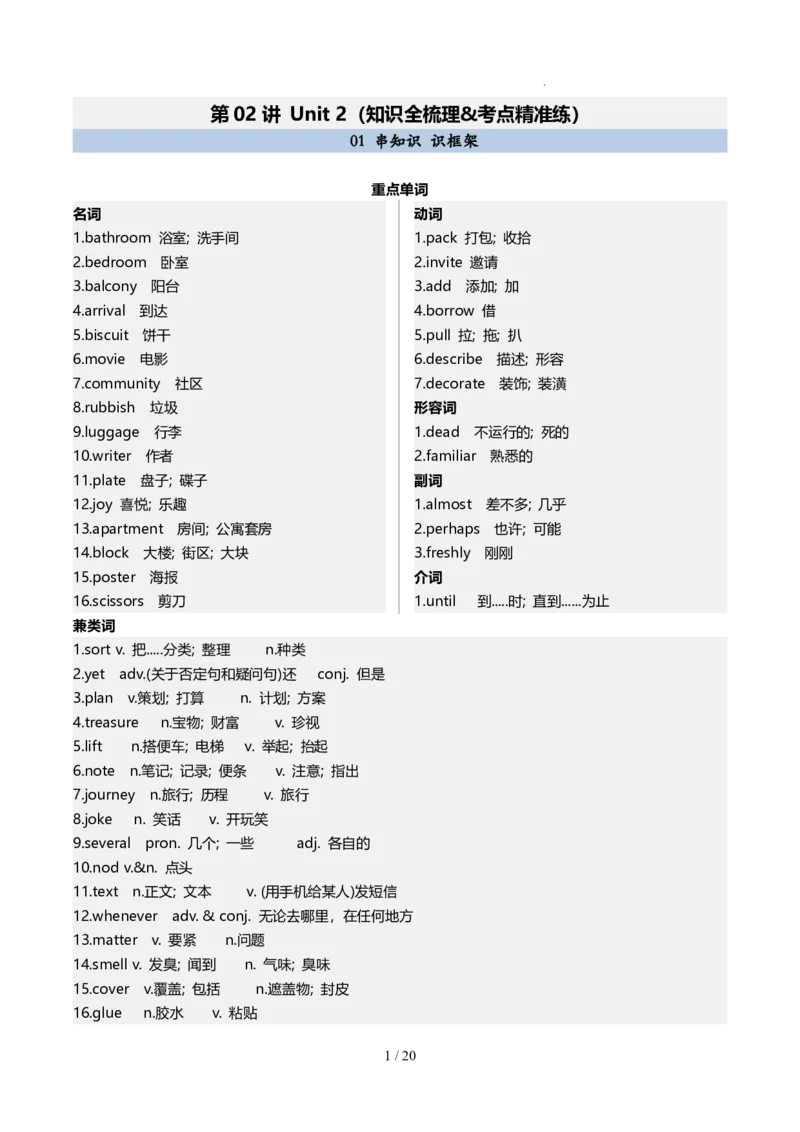
重点单词
名词
1.bathroom 浴室; 洗手间
2.bedroom
卧室
3.balcony
阳台
4.arrival
到达
5.biscuit
饼干
6.movie
电影
7.community
社区
8.rubbish
垃圾
9.luggage
行李
10.writer
作者
11.plate
盘子; 碟子
12.joy 喜悦; 乐趣
13.apartment
房间; 公寓套房
14.block
大楼; 街区; 大块
15.poster
海报
16.scissors
剪刀
动词
1.pack 打包; 收拾
2.invite 邀请
3.add
添加; 加
4.borrow 借
5.pull 拉; 拖; 扒
6.describe
描述; 形容
7.decorate
装饰; 装潢
形容词
1.dead
不运行的; 死的
2.familiar
熟悉的
副词
1.almost
差不多; 几乎
2.perhaps
也许; 可能
3.freshly
刚刚
介词
1.until
到.....时; 直到......为止
兼类词
1.sort v. 把.....分类; 整理
n.种类
2.yet
adv.(关于否定句和疑问句)还
conj. 但是
3.plan
v.策划; 打算
n. 计划; 方案
4.treasure
n.宝物; 财富
v. 珍视
5.lift
n.搭便车; 电梯
v. 举起; 抬起
6.note
n.笔记; 记录; 便条
v. 注意; 指出
7.journey
n.旅行; 历程
v. 旅行
8.joke
n. 笑话
v. 开玩笑
9.several
pron. 几个; 一些
adj. 各自的
10.nod v.&n. 点头
11.text
n.正文; 文本
v. (用手机给某人)发短信
12.whenever
adv. & conj. 无论去哪里,在任何地方
13.matter
v. 要紧
n.问题
14.smell v. 发臭; 闻到
n. 气味; 臭味
15.cover
v.覆盖; 包括
n.遮盖物; 封皮
16.glue
n.胶水
v. 粘贴
2 / 20
学科网(北京)股份有限公司
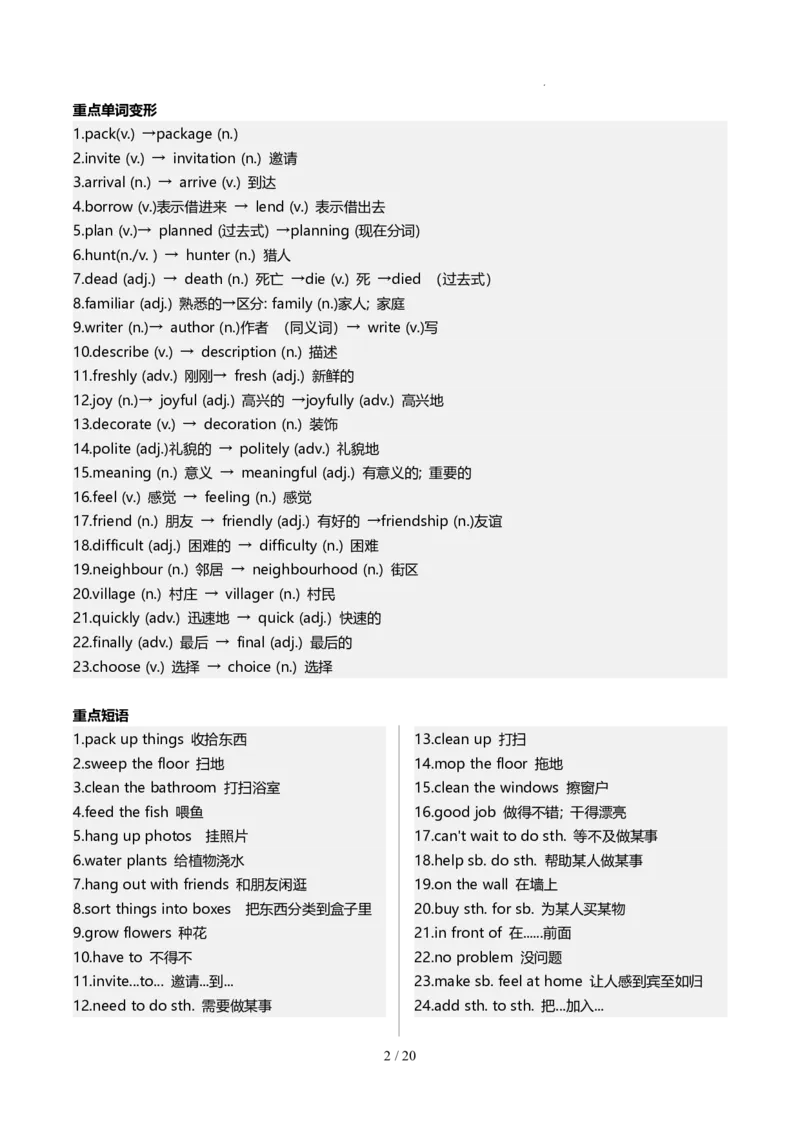
重点单词变形
1.pack(v.) →package (n.)
2.invite (v.) →invitation (n.) 邀请
3.arrival (n.) →arrive (v.) 到达
4.borrow (v.)表示借进来→lend (v.) 表示借出去
5.plan (v.)→planned (过去式) →planning (现在分词)
6.hunt(n./v. ) →hunter (n.) 猎人
7.dead (adj.) →death (n.) 死亡→die (v.) 死→died (过去式)
8.familiar (adj.) 熟悉的→区分: family (n.)家人; 家庭
9.writer (n.)→author (n.)作者(同义词)→write (v.)写
10.describe (v.) →description (n.) 描述
11.freshly (adv.) 刚刚→fresh (adj.) 新鲜的
12.joy (n.)→joyful (adj.) 高兴的→joyfully (adv.) 高兴地
13.decorate (v.) →decoration (n.) 装饰
14.polite (adj.)礼貌的→politely (adv.) 礼貌地
15.meaning (n.) 意义→meaningful (adj.) 有意义的; 重要的
16.feel (v.) 感觉→feeling (n.) 感觉
17.friend (n.) 朋友→friendly (adj.) 有好的→friendship (n.)友谊
18.difficult (adj.) 困难的→difficulty (n.) 困难
19.neighbour (n.) 邻居→neighbourhood (n.) 街区
20.village (n.) 村庄→villager (n.) 村民
21.quickly (adv.) 迅速地→quick (adj.) 快速的
22.finally (adv.) 最后→final (adj.) 最后的
23.choose (v.) 选择→choice (n.) 选择
重点短语
1.pack up things 收拾东西
2.sweep the floor 扫地
3.clean the bathroom 打扫浴室
4.feed the fish 喂鱼
5.hang up photos
挂照片
6.water plants 给植物浇水
7.hang out with friends 和朋友闲逛
8.sort things into boxes
把东西分类到盒子里
9.grow flowers 种花
10.have to 不得不
11.invite...to... 邀请...到...
12.need to do sth. 需要做某事
13.clean up 打扫
14.mop the floor 拖地
15.clean the windows 擦窗户
16.good job 做得不错; 干得漂亮
17.can't wait to do sth. 等不及做某事
18.help sb. do sth. 帮助某人做某事
19.on the wall 在墙上
20.buy sth. for sb. 为某人买某物
21.in front of 在......前面
22.no problem 没问题
23.make sb. feel at home 让人感到宾至如归
24.add sth. to sth. 把...加入...
3 / 20
学科网(北京)股份有限公司
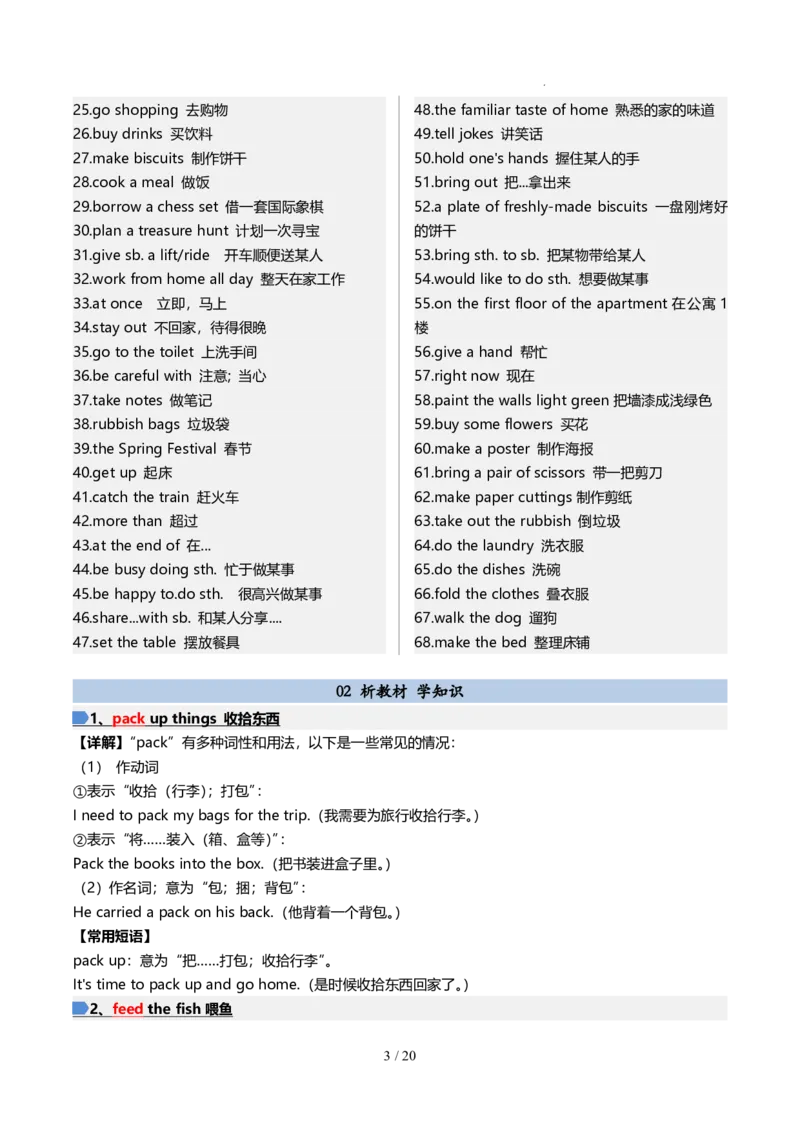
25.go shopping 去购物
26.buy drinks 买饮料
27.make biscuits 制作饼干
28.cook a meal 做饭
29.borrow a chess set 借一套国际象棋
30.plan a treasure hunt 计划一次寻宝
31.give sb. a lift/ride
开车顺便送某人
32.work from home all day 整天在家工作
33.at once
立即,马上
34.stay out 不回家,待得很晚
35.go to the toilet 上洗手间
36.be careful with 注意; 当心
37.take notes 做笔记
38.rubbish bags 垃圾袋
39.the Spring Festival 春节
40.get up 起床
41.catch the train 赶火车
42.more than 超过
43.at the end of 在...
44.be busy doing sth. 忙于做某事
45.be happy to.do sth.
很高兴做某事
46.share...with sb. 和某人分享....
47.set the table 摆放餐具
48.the familiar taste of home 熟悉的家的味道
49.tell jokes 讲笑话
50.hold one's hands 握住某人的手
51.bring out 把...拿出来
52.a plate of freshly-made biscuits 一盘刚烤好
的饼干
53.bring sth. to sb. 把某物带给某人
54.would like to do sth. 想要做某事
55.on the first floor of the apartment 在公寓1
楼
56.give a hand 帮忙
57.right now 现在
58.paint the walls light green 把墙漆成浅绿色
59.buy some flowers 买花
60.make a poster 制作海报
61.bring a pair of scissors 带一把剪刀
62.make paper cuttings 制作剪纸
63.take out the rubbish 倒垃圾
64.do the laundry 洗衣服
65.do the dishes 洗碗
66.fold the clothes 叠衣服
67.walk the dog 遛狗
68.make the bed 整理床铺
02 析教材学知识
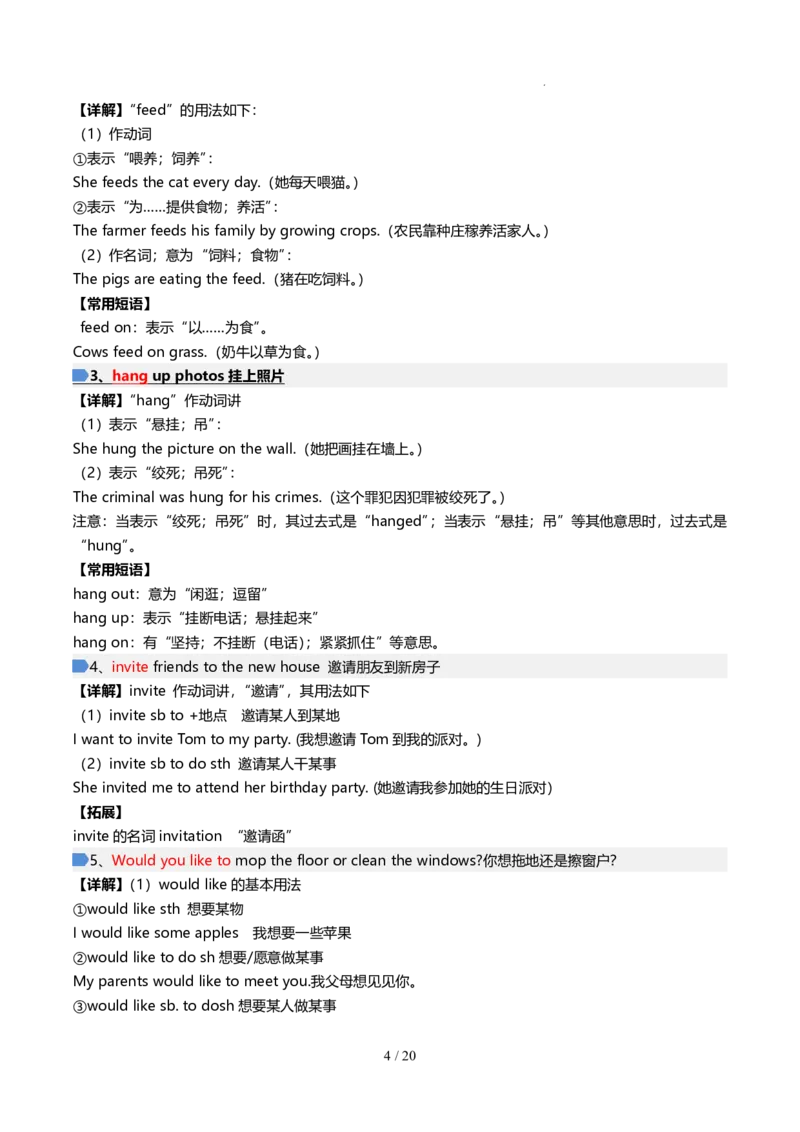
1、pack up things 收拾东西
【详解】“pack”有多种词性和用法,以下是一些常见的情况:
(1)作动词
①表示“收拾(行李);打包”:
I need to pack my bags for the trip.(我需要为旅行收拾行李。)
②表示“将……装入(箱、盒等)”:
Pack the books into the box.(把书装进盒子里。)
(2)作名词;意为“包;捆;背包”:
He carried a pack on his back.(他背着一个背包。)
【常用短语】
pack up:意为“把……打包;收拾行李”。
It's time to pack up and go home.(是时候收拾东西回家了。)
2、feed the fish 喂鱼
4 / 20
学科网(北京)股份有限公司
【详解】“feed”的用法如下:
(1)作动词
①表示“喂养;饲养”:
She feeds the cat every day.(她每天喂猫。)
②表示“为……提供食物;养活”:
The farmer feeds his family by growing crops.(农民靠种庄稼养活家人。)
(2)作名词;意为“饲料;食物”:
The pigs are eating the feed.(猪在吃饲料。)
【常用短语】
feed on:表示“以……为食”。
Cows feed on grass.(奶牛以草为食。)
3、hang up photos 挂上照片
【详解】“hang”作动词讲
(1)表示“悬挂;吊”:
She hung the picture on the wall.(她把画挂在墙上。)
(2)表示“绞死;吊死”:
The criminal was hung for his crimes.(这个罪犯因犯罪被绞死了。)
注意:当表示“绞死;吊死”时,其过去式是“hanged”;当表示“悬挂;吊”等其他意思时,过去式是
“hung”。
【常用短语】
hang out:意为“闲逛;逗留”
hang up:表示“挂断电话;悬挂起来”
hang on:有“坚持;不挂断(电话);紧紧抓住”等意思。
4、invite friends to the new house 邀请朋友到新房子
【详解】invite 作动词讲,“邀请”,其用法如下
(1)invite sb to +地点
邀请某人到某地
I want to invite Tom to my party. (我想邀请Tom 到我的派对。)
(2)invite sb to do sth 邀请某人干某事
She invited me to attend her birthday party. (她邀请我参加她的生日派对)
【拓展】
invite 的名词invitation “邀请函”
5、Would you like to mop the floor or clean the windows?你想拖地还是擦窗户?
【详解】(1)would like 的基本用法
①would like sth 想要某物
I would like some apples
我想要一些苹果
②would like to do sh 想要/愿意做某事
My parents would like to meet you.我父母想见见你。
③would like sb. to dosh 想要某人做某事
5 / 20
学科网(北京)股份有限公司
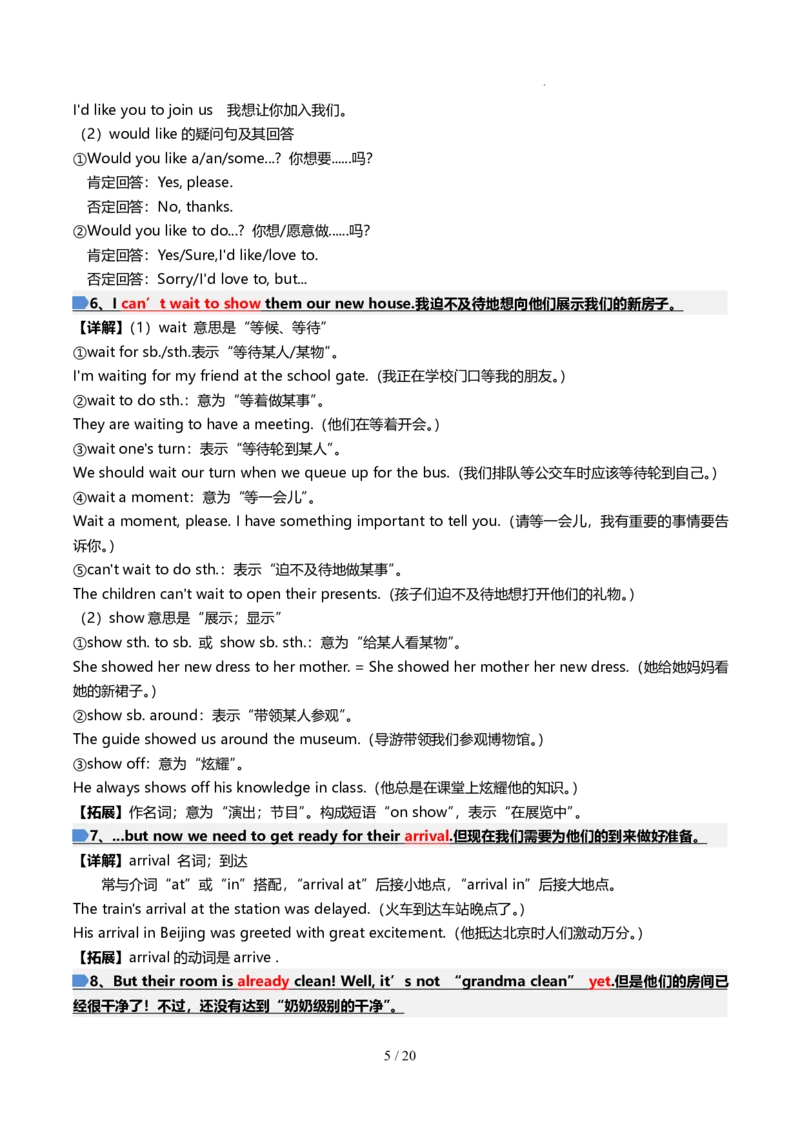
I'd like you to join us
我想让你加入我们。
(2)would like 的疑问句及其回答
①Would you like a/an/some...? 你想要......吗?
肯定回答:Yes, please.
否定回答:No, thanks.
②Would you like to do...? 你想/愿意做......吗?
肯定回答:Yes/Sure,I'd like/love to.
否定回答:Sorry/I'd love to, but...
6、I can’t wait to show them our new house.我迫不及待地想向他们展示我们的新房子。
【详解】(1)wait 意思是“等候、等待”
①wait for sb./sth.表示“等待某人/某物”。
I'm waiting for my friend at the school gate.(我正在学校门口等我的朋友。)
②wait to do sth.:意为“等着做某事”。
They are waiting to have a meeting.(他们在等着开会。)
③wait one's turn:表示“等待轮到某人”。
We should wait our turn when we queue up for the bus.(我们排队等公交车时应该等待轮到自己。)
④wait a moment:意为“等一会儿”。
Wait a moment, please. I have something important to tell you.(请等一会儿,我有重要的事情要告
诉你。)
⑤can't wait to do sth.:表示“迫不及待地做某事”。
The children can't wait to open their presents.(孩子们迫不及待地想打开他们的礼物。)
(2)show 意思是“展示;显示”
①show sth. to sb. 或show sb. sth.:意为“给某人看某物”。
She showed her new dress to her mother. = She showed her mother her new dress.(她给她妈妈看
她的新裙子。)
②show sb. around:表示“带领某人参观”。
The guide showed us around the museum.(导游带领我们参观博物馆。)
③show off:意为“炫耀”。
He always shows off his knowledge in class.(他总是在课堂上炫耀他的知识。)
【拓展】作名词;意为“演出;节目”。构成短语“on show”,表示“在展览中”。
7、...but now we need to get ready for their arrival.但现在我们需要为他们的到来做好准备。
【详解】arrival 名词;到达
常与介词“at”或“in”搭配,“arrival at”后接小地点,“arrival in”后接大地点。
The train's arrival at the station was delayed.(火车到达车站晚点了。)
His arrival in Beijing was greeted with great excitement.(他抵达北京时人们激动万分。)
【拓展】arrival 的动词是arrive .
8、But their room is already clean! Well, it’s not “grandma clean” yet.但是他们的房间已
经很干净了!不过,还没有达到“奶奶级别的干净”。
6 / 20
学科网(北京)股份有限公司
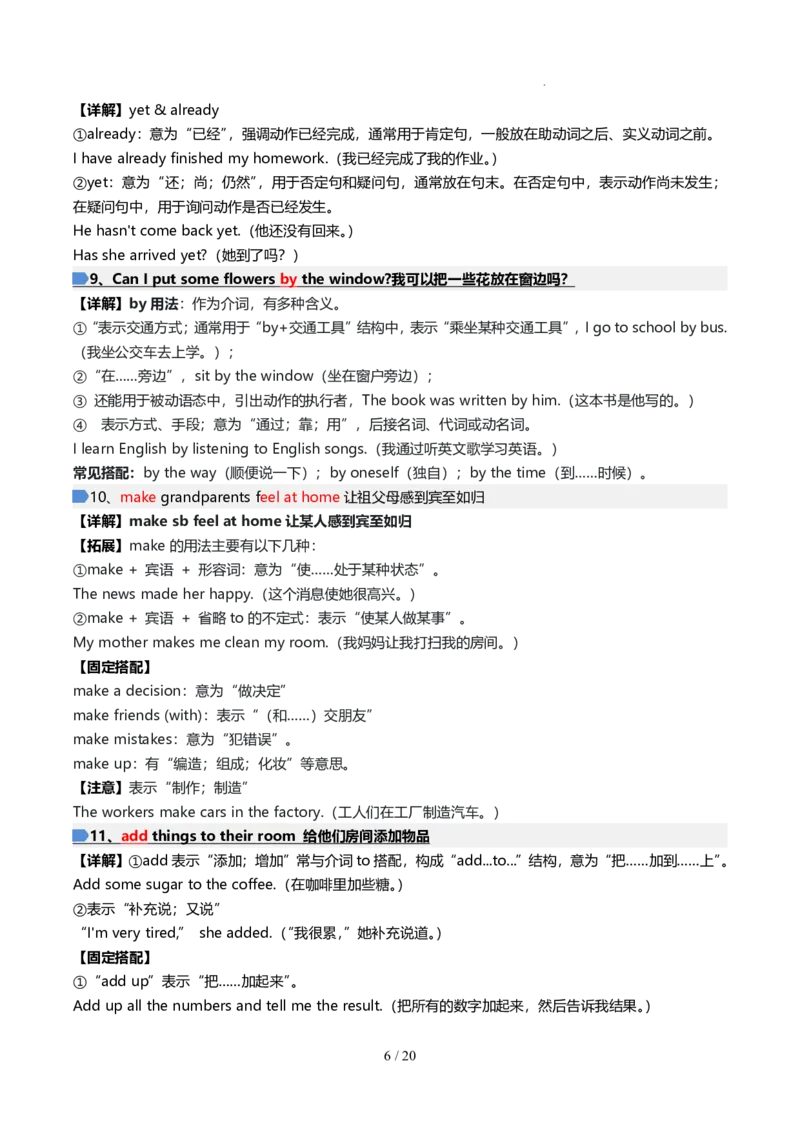
【详解】yet & already
①already:意为“已经”,强调动作已经完成,通常用于肯定句,一般放在助动词之后、实义动词之前。
I have already finished my homework.(我已经完成了我的作业。)
②yet:意为“还;尚;仍然”,用于否定句和疑问句,通常放在句末。在否定句中,表示动作尚未发生;
在疑问句中,用于询问动作是否已经发生。
He hasn't come back yet.(他还没有回来。)
Has she arrived yet?(她到了吗?)
9、Can I put some flowers by the window?我可以把一些花放在窗边吗?
【详解】by 用法:作为介词,有多种含义。
①“表示交通方式;通常用于“by+交通工具”结构中,表示“乘坐某种交通工具”,I go to school by bus.
(我坐公交车去上学。);
②“在……旁边”,sit by the window(坐在窗户旁边);
③还能用于被动语态中,引出动作的执行者,The book was written by him.(这本书是他写的。)
④
表示方式、手段;意为“通过;靠;用”,后接名词、代词或动名词。
I learn English by listening to English songs.(我通过听英文歌学习英语。)
常见搭配:by the way(顺便说一下);by oneself(独自);by the time(到……时候)。
10、make grandparents feel at home 让祖父母感到宾至如归
【详解】make sb feel at home 让某人感到宾至如归
【拓展】make 的用法主要有以下几种:
①make + 宾语+ 形容词:意为“使……处于某种状态”。
The news made her happy.(这个消息使她很高兴。)
②make + 宾语+ 省略to 的不定式:表示“使某人做某事”。
My mother makes me clean my room.(我妈妈让我打扫我的房间。)
【固定搭配】
make a decision:意为“做决定”
make friends (with):表示“(和……)交朋友”
make mistakes:意为“犯错误”。
make up:有“编造;组成;化妆”等意思。
【注意】表示“制作;制造”
The workers make cars in the factory.(工人们在工厂制造汽车。)
11、add things to their room 给他们房间添加物品
【详解】①add 表示“添加;增加”常与介词to 搭配,构成“add...to...”结构,意为“把……加到……上”。
Add some sugar to the coffee.(在咖啡里加些糖。)
②表示“补充说;又说”
“I'm very tired,” she added.(“我很累,”她补充说道。)
【固定搭配】
①“add up”表示“把……加起来”。
Add up all the numbers and tell me the result.(把所有的数字加起来,然后告诉我结果。)
7 / 20
学科网(北京)股份有限公司
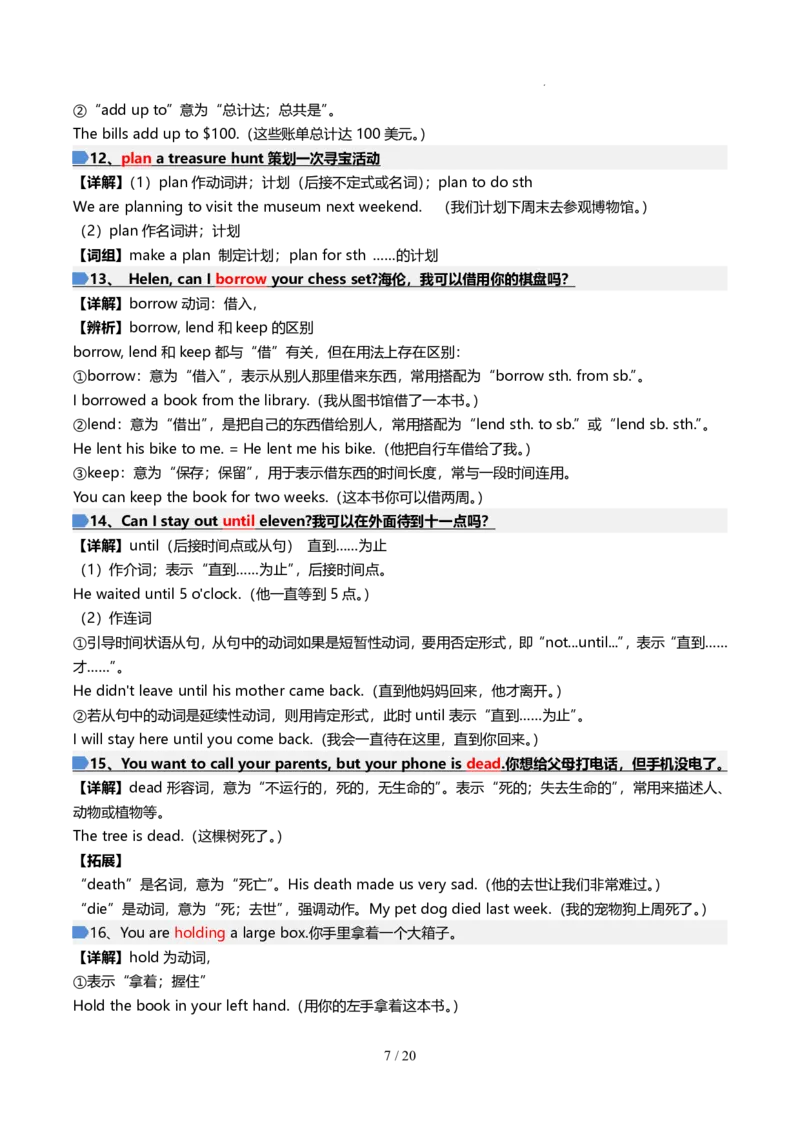
②“add up to”意为“总计达;总共是”。
The bills add up to $100.(这些账单总计达100 美元。)
12、plan a treasure hunt 策划一次寻宝活动
【详解】(1)plan 作动词讲;计划(后接不定式或名词);plan to do sth
We are planning to visit the museum next weekend.
(我们计划下周末去参观博物馆。)
(2)plan 作名词讲;计划
【词组】make a plan 制定计划;plan for sth ……的计划
13、Helen, can I borrow your chess set?海伦,我可以借用你的棋盘吗?
【详解】borrow 动词:借入,
【辨析】borrow, lend 和keep 的区别
borrow, lend 和keep 都与“借”有关,但在用法上存在区别:
①borrow:意为“借入”,表示从别人那里借来东西,常用搭配为“borrow sth. from sb.”。
I borrowed a book from the library.(我从图书馆借了一本书。)
②lend:意为“借出”,是把自己的东西借给别人,常用搭配为“lend sth. to sb.”或“lend sb. sth.”。
He lent his bike to me. = He lent me his bike.(他把自行车借给了我。)
③keep:意为“保存;保留”,用于表示借东西的时间长度,常与一段时间连用。
You can keep the book for two weeks.(这本书你可以借两周。)
14、Can I stay out until eleven?我可以在外面待到十一点吗?
【详解】until(后接时间点或从句)直到……为止
(1)作介词;表示“直到……为止”,后接时间点。
He waited until 5 o'clock.(他一直等到5 点。)
(2)作连词
①引导时间状语从句,从句中的动词如果是短暂性动词,要用否定形式,即“not...until...”,表示“直到……
才……”。
He didn't leave until his mother came back.(直到他妈妈回来,他才离开。)
②若从句中的动词是延续性动词,则用肯定形式,此时until 表示“直到……为止”。
I will stay here until you come back.(我会一直待在这里,直到你回来。)
15、You want to call your parents, but your phone is dead.你想给父母打电话,但手机没电了。
【详解】dead 形容词,意为“不运行的,死的,无生命的”。表示“死的;失去生命的”,常用来描述人、
动物或植物等。
The tree is dead.(这棵树死了。)
【拓展】
“death”是名词,意为“死亡”。His death made us very sad.(他的去世让我们非常难过。)
“die”是动词,意为“死;去世”,强调动作。My pet dog died last week.(我的宠物狗上周死了。)
16、You are holding a large box.你手里拿着一个大箱子。
【详解】hold 为动词,
①表示“拿着;握住”
Hold the book in your left hand.(用你的左手拿着这本书。)
8 / 20
学科网(北京)股份有限公司
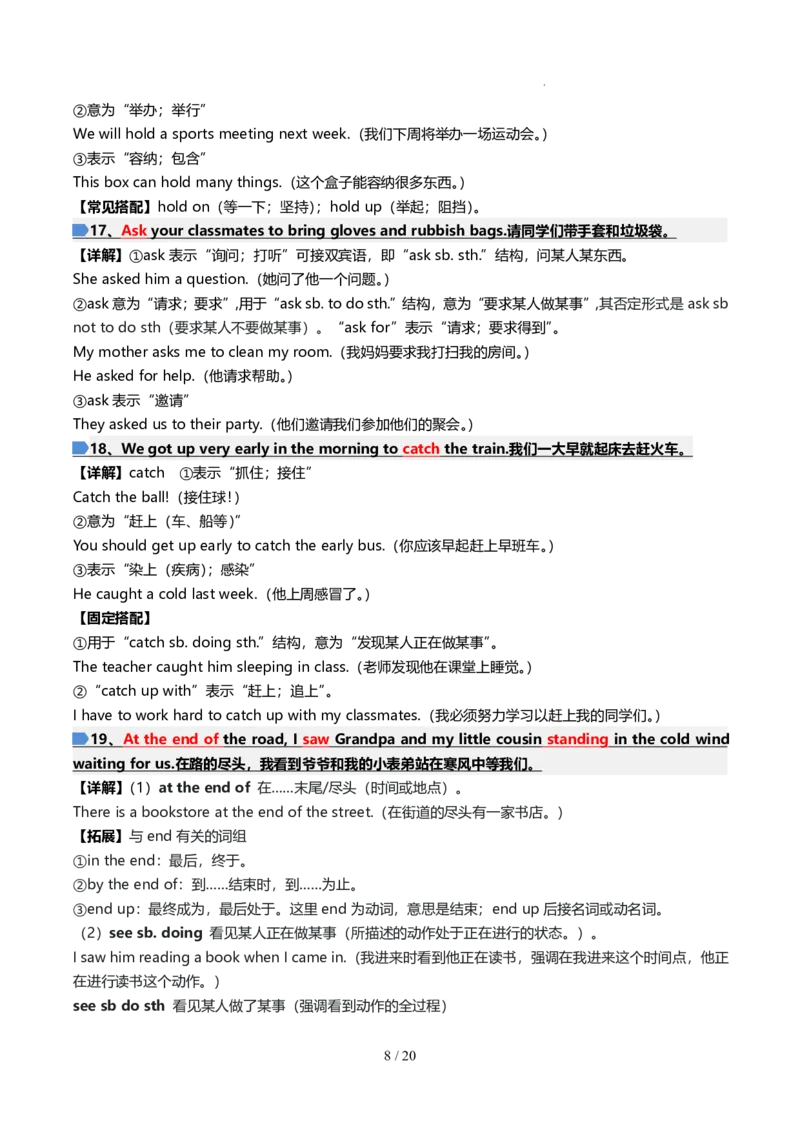
②意为“举办;举行”
We will hold a sports meeting next week.(我们下周将举办一场运动会。)
③表示“容纳;包含”
This box can hold many things.(这个盒子能容纳很多东西。)
【常见搭配】hold on(等一下;坚持);hold up(举起;阻挡)。
17、Ask your classmates to bring gloves and rubbish bags.请同学们带手套和垃圾袋。
【详解】①ask 表示“询问;打听”可接双宾语,即“ask sb. sth.”结构,问某人某东西。
She asked him a question.(她问了他一个问题。)
②ask 意为“请求;要求”,用于“ask sb. to do sth.”结构,意为“要求某人做某事”,其否定形式是ask sb
not to do sth(要求某人不要做某事)。“ask for”表示“请求;要求得到”。
My mother asks me to clean my room.(我妈妈要求我打扫我的房间。)
He asked for help.(他请求帮助。)
③ask 表示“邀请”
They asked us to their party.(他们邀请我们参加他们的聚会。)
18、We got up very early in the morning to catch the train.我们一大早就起床去赶火车。
【详解】catch
①表示“抓住;接住”
Catch the ball!(接住球!)
②意为“赶上(车、船等)”
You should get up early to catch the early bus.(你应该早起赶上早班车。)
③表示“染上(疾病);感染”
He caught a cold last week.(他上周感冒了。)
【固定搭配】
①用于“catch sb. doing sth.”结构,意为“发现某人正在做某事”。
The teacher caught him sleeping in class.(老师发现他在课堂上睡觉。)
②“catch up with”表示“赶上;追上”。
I have to work hard to catch up with my classmates.(我必须努力学习以赶上我的同学们。)
19、At the end of the road, I saw Grandpa and my little cousin standing in the cold wind
waiting for us.在路的尽头,我看到爷爷和我的小表弟站在寒风中等我们。
【详解】(1)at the end of 在……末尾/尽头(时间或地点)。
There is a bookstore at the end of the street.(在街道的尽头有一家书店。)
【拓展】与end 有关的词组
①in the end:最后,终于。
②by the end of:到……结束时,到……为止。
③end up:最终成为,最后处于。这里end 为动词,意思是结束;end up 后接名词或动名词。
(2)see sb. doing 看见某人正在做某事(所描述的动作处于正在进行的状态。)。
I saw him reading a book when I came in.(我进来时看到他正在读书,强调在我进来这个时间点,他正
在进行读书这个动作。)
see sb do sth 看见某人做了某事(强调看到动作的全过程)
9 / 20
学科网(北京)股份有限公司
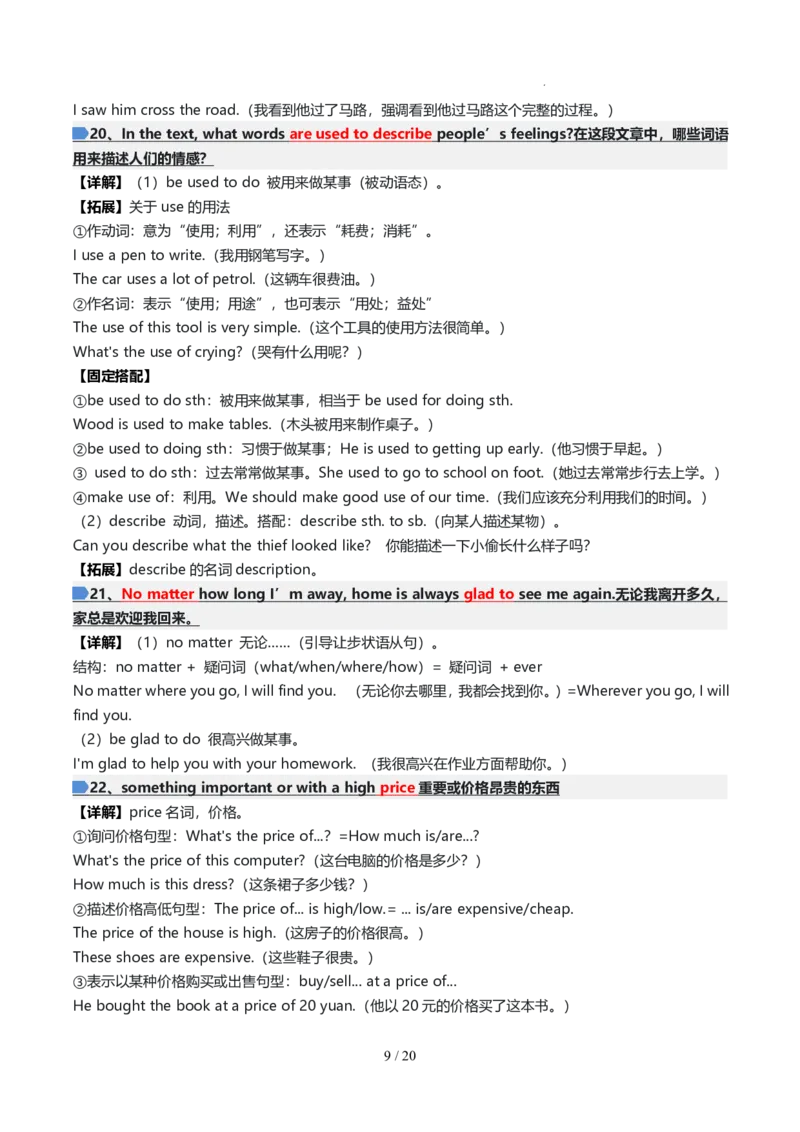
I saw him cross the road.(我看到他过了马路,强调看到他过马路这个完整的过程。)
20、In the text, what words are used to describe people’s feelings?在这段文章中,哪些词语
用来描述人们的情感?
【详解】(1)be used to do 被用来做某事(被动语态)。
【拓展】关于use 的用法
①作动词:意为“使用;利用”,还表示“耗费;消耗”。
I use a pen to write.(我用钢笔写字。)
The car uses a lot of petrol.(这辆车很费油。)
②作名词:表示“使用;用途”,也可表示“用处;益处”
The use of this tool is very simple.(这个工具的使用方法很简单。)
What's the use of crying?(哭有什么用呢?)
【固定搭配】
①be used to do sth:被用来做某事,相当于be used for doing sth.
Wood is used to make tables.(木头被用来制作桌子。)
②be used to doing sth:习惯于做某事;He is used to getting up early.(他习惯于早起。)
③used to do sth:过去常常做某事。She used to go to school on foot.(她过去常常步行去上学。)
④make use of:利用。We should make good use of our time.(我们应该充分利用我们的时间。)
(2)describe 动词,描述。搭配:describe sth. to sb.(向某人描述某物)。
Can you describe what the thief looked like?
你能描述一下小偷长什么样子吗?
【拓展】describe 的名词description。
21、No matter how long I’m away, home is always glad to see me again.无论我离开多久,
家总是欢迎我回来。
【详解】(1)no matter 无论……(引导让步状语从句)。
结构:no matter + 疑问词(what/when/where/how)= 疑问词+ ever
No matter where you go, I will find you.
(无论你去哪里,我都会找到你。)=Wherever you go, I will
find you.
(2)be glad to do 很高兴做某事。
I'm glad to help you with your homework. (我很高兴在作业方面帮助你。)
22、something important or with a high price 重要或价格昂贵的东西
【详解】price 名词,价格。
①询问价格句型:What's the price of...?=How much is/are...?
What's the price of this computer?(这台电脑的价格是多少?)
How much is this dress?(这条裙子多少钱?)
②描述价格高低句型:The price of... is high/low.= ... is/are expensive/cheap.
The price of the house is high.(这房子的价格很高。)
These shoes are expensive.(这些鞋子很贵。)
③表示以某种价格购买或出售句型:buy/sell... at a price of...
He bought the book at a price of 20 yuan.(他以20 元的价格买了这本书。)
10 / 20
学科网(北京)股份有限公司
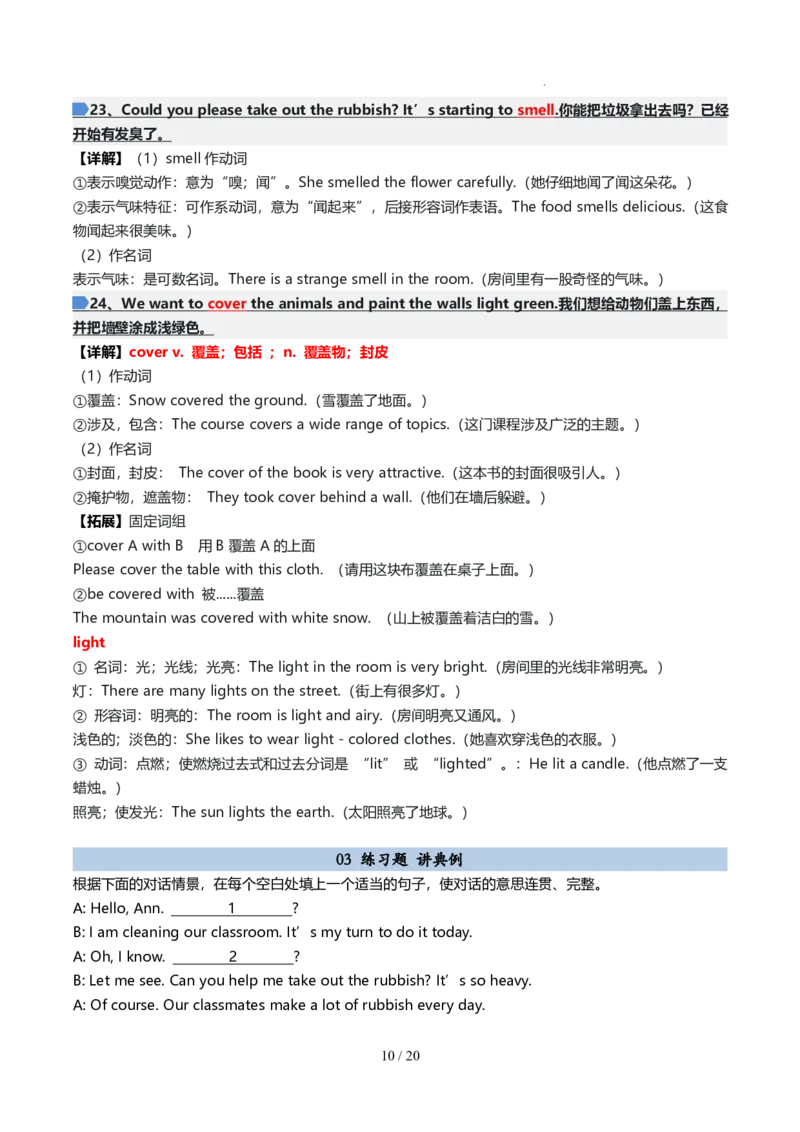
23、Could you please take out the rubbish? It’s starting to smell.你能把垃圾拿出去吗?已经
开始有发臭了。
【详解】(1)smell 作动词
①表示嗅觉动作:意为“嗅;闻”。She smelled the flower carefully.(她仔细地闻了闻这朵花。)
②表示气味特征:可作系动词,意为“闻起来”,后接形容词作表语。The food smells delicious.(这食
物闻起来很美味。)
(2)作名词
表示气味:是可数名词。There is a strange smell in the room.(房间里有一股奇怪的气味。)
24、We want to cover the animals and paint the walls light green.我们想给动物们盖上东西,
并把墙壁涂成浅绿色。
【详解】cover v. 覆盖;包括;n. 覆盖物;封皮
(1)作动词
①覆盖:Snow covered the ground.(雪覆盖了地面。)
②涉及,包含:The course covers a wide range of topics.(这门课程涉及广泛的主题。)
(2)作名词
①封面,封皮:The cover of the book is very attractive.(这本书的封面很吸引人。)
②掩护物,遮盖物:They took cover behind a wall.(他们在墙后躲避。)
【拓展】固定词组
①cover A with B
用B 覆盖A 的上面
Please cover the table with this cloth. (请用这块布覆盖在桌子上面。)
②be covered with 被......覆盖
The mountain was covered with white snow. (山上被覆盖着洁白的雪。)
light
①名词:光;光线;光亮:The light in the room is very bright.(房间里的光线非常明亮。)
灯:There are many lights on the street.(街上有很多灯。)
②形容词:明亮的:The room is light and airy.(房间明亮又通风。)
浅色的;淡色的:She likes to wear light - colored clothes.(她喜欢穿浅色的衣服。)
③动词:点燃;使燃烧过去式和过去分词是“lit” 或“lighted”。:He lit a candle.(他点燃了一支
蜡烛。)
照亮;使发光:The sun lights the earth.(太阳照亮了地球。)
03 练习题讲典例
根据下面的对话情景,在每个空白处填上一个适当的句子,使对话的意思连贯、完整。
A: Hello, Ann.
1
?
B: I am cleaning our classroom. It’s my turn to do it today.
A: Oh, I know.
2
?
B: Let me see. Can you help me take out the rubbish? It’s so heavy.
A: Of course. Our classmates make a lot of rubbish every day.
11 / 20
学科网(北京)股份有限公司
B: Yes. But most of them don’t throw the rubbish everywhere.
A: It’s a good manner.
3
?
B: No, I don’t. My parents never ask me to do housework. They think the most important task for
me is to study.
A: But I think sometimes doing housework may help us relax. If we are free, we can do that.
B:
4
. Oh, can you help me move the desk? I can’t move it.
A: Yes, I’m coming.
B:
5
.
【答案】
1、What are you doing now
2.Is there anything I can help
3.Do you often help your parents do housework
4.I agree/Yes, I agree
5.Thank you
【解析】本文是一则对话,对话中A 帮助B 打扫教室,两个人谈论了做家务的事。
1.根据“I am cleaning our classroom.”可知,上句是询问对方正在做什么。故填What are you doing
now。
2.根据“Can you help me take out the rubbish? It’s so heavy.”以及“Of course. Our classmates
make a lot of rubbish every day.”可知,A 询问B 有什么自己可以帮忙做的事。故填Is there anything
I can help。
3.根据“No, I don’t. My parents never ask me to do housework.”可知,上句是询问对方是否经常
帮父母做家务。故填Do you often help your parents do housework。
4.根据“But I think sometimes doing housework may help us relax. If we are free, we can do that.”
可知,A 认为有时做家务可以帮助我们放松。如果我们有时间,我们可以帮忙做家务。空处应该对这一观
点做出评价。故填I agree/Yes, I agree。
5.根据“Oh, can you help me move the desk? I can’t move it.”以及“Yes, I’m coming.”可知,
此处应该对对方的帮助表示感谢。故填Thank you。
04 练考点强知识
考点1
invite 的用法
My friend invited me ________ the art club, and I agreed with it happily.
A.join
B.to join
C.joined
D.joining
【答案】B
【详解】句意:朋友邀请我加入美术俱乐部,我愉快地答应了。
考查非谓语动词。根据短语invite sb. to do sth.“邀请某人做某事”可知,空处应选动词不定式to join。
故选B。
考点2
can’t wait to do sth 的用法
The chicken smells good. I can't wait ______ it.
12 / 20
学科网(北京)股份有限公司
A.have
B.has
C.eat
D.to eat
【答案】D
【详解】句意:鸡肉闻起来很香。我等不及要吃了。
考查非谓语动词。have 吃,喝;has 是have 的第三人称单数形式;eat 吃,动词原形;to eat 动词不定
式。句中使用了句型can’t wait to do sth.“等不及去做某事”,故选D。
考点3
borrow,lend 和keep 辨析
1.—Could I ________ your pen?
—Sorry. I just ________ it to Marry.
A.borrow; lend B.lend; borrow
C.borrowed; lent
D.borrow; lent
【答案】D
【详解】句意:——我能借你的笔吗?——对不起。我刚把它借给Marry 了。
考查动词。borrow 借(进来);lend 借(出)。第一空:说话人请求“借入”钢笔,could 后接动词原形,
应填borrow;第二空:回答者表示“借出”给玛丽了,且动作发生在过去,需用过去式lent。故选D。
2.She ________ the book to me, so I could ________ it for a week.
A.lent; keep
B.borrowed; lend
C.kept; borrow
D.lent; borrow
【答案】A
【详解】句意:她把书借给了我,所以我可以保留它一周。
考查动词辨析。lend 借给(过去式是lent,短暂性动词);borrow 借入(过去式是borrowed,短暂性动
词);keep 保留(过去式是kept,延续性动词)。根据“She...the book to me”可知,她把书借给了“我”,
所以第一空应用lent;“for+一段时间”要与延续性动词连用,所以第二空应用keep。故选A。
考点4
add...to...的用法
I like to drink latte (拿铁). Don’t forget ________ some milk ________ the coffee.
A.to add; to
B.to add; into
C.adding; to
D.adding; into
【答案】A
【详解】句意:我喜欢喝拿铁咖啡。别忘了在咖啡里加一些牛奶。
考查动词。to add 加,不定式;adding 动名词;to 到;into 进入。此处表示别忘了在咖啡里加一些牛奶,
此需要搭配forget to do“忘记去做某事”;add sth. to“把……加到……”。故选A。
考点5
dead 的词性
Jimmy has been ________ for a year. His ________ has made his wife give up hope of life.
A.died, death
B.dead, death
C.died, dead
D.dead, die
【答案】B
【详解】句意:Jimmy 已经去世一年了。他的死亡让妻子对生活失去了希望。
考查动词、形容词、名词辨析。died 死亡,动词过去式;dead 死亡的,形容词;death 死亡,名词。根
据“has been...”可知,第一空填形容词dead,表示“已死亡的”;died 为短暂性动词,不与for 连用;
形容词性物主代词his 后修饰名词,故第二个空填death。故选B。
考点6
see sb. doing 和see sb. do 辨析
1. I saw the boys ________ on the playground when I passed by yesterday afternoon.
A.to play
B.plays
C.playing
D.play
13 / 20
学科网(北京)股份有限公司
【答案】C
【详解】句意:昨天下午我路过时,看见男孩们正在操场上玩。
考查非谓语动词。see sb. do sth.表示“看见某人做了某事”(强调整个动作的全过程);see sb. doing sth.
表示“看见某人正在做某事”(强调动作正在进行)。根据when I passed by”可知,当我路过时,男孩
们在操场上正在玩,因此用see sb. doing sth. 结构。故选C。
2.I saw her ________ into the library just now.
A.go
B.to go
C.going
D.goes
【答案】A
【详解】句意:我刚才看见她进了图书馆。
考查非谓语。see 是感官动词,see sb. do sth.表示看到某人做了某事(强调看到动作的全过程),see sb.
doing sth.表示看到某人正在做某事(强调看到动作正在进行)。这里说刚才看到她进图书馆,强调动作的
全过程,所以用省略to 的不定式,故选A。
考点7
no matter + 疑问词的用法
1. No matter what happens, it’s best to remember the good things.
A.Wherever
B.Whenever
C.Whatever
D.Whoever
【答案】C
【详解】句意:无论发生什么,最好记住美好的事情。
考查词义辨析。Wherever 无论什么地方;Whenever 无论何时;Whatever 无论什么;Whoever 无论谁。
No matter what“无论发生什么”,与C 项同义。故选C。
2.I think you have to be patient enough no matter ________ difficulties you meet.
A.what
B.when
C.why
D.how
【答案】A
【详解】句意:我认为无论遇到什么困难,你都必须足够有耐心。
考查让步状语从句的引导词。what 什么;when 什么时候;why 为什么;how 如何。根据“no matter…
difficulties you meet”可知,在这里“no matter what”引导让步状语从句,表示“无论什么”,修饰后
面的“difficulties”,强调无论遇到的是何种困难。故选A。
考点8
smell 的用法
The dish smells very ________. Can I taste it?
A.good
B.well
C.better
D.badly
【答案】A
【详解】句意:这道菜闻起来不错。我能尝尝吗?考查形容词作表语。
good 好的,形容词;well 好,副词;better 更好,比较级;badly 糟糕地,副词。根据“The dish smells
very... Can I taste it?”可知,这道菜闻起来很好,所以想尝一下。smell 为感官系动词,后加形容词作表
语,且不含比较,故选A。
考点9
cover 的用法
1.The father was asleep; the child found a coat and covered him ________ it.
A.through
B.across
C.with
D.past
【答案】C
14 / 20
学科网(北京)股份有限公司
【详解】句意:父亲睡着了;孩子找到一件外套,把它盖在他身上。
考查介词词义辨析。through 通过;across 穿过;with 用;past 超过。cover…with…“用……覆盖……”,
是固定词组。故选C。
2.The park is so beautiful after the snowy day, all the things ________ with white snow.
A.covered
B.is covered
C.covers
D.are covered
【答案】D
【详解】句意:雪后公园如此美丽,所有的东西都被白雪覆盖着。
考查时态和语态。covered 过去时;is covered 一般现在时,被动语态;covers 一般现在时;are covered
一般现在时,主语为复数的被动语态。根据“The park is so beautiful after the snowy day, all the things…
with white snow.”句子主语all the things 是复数,且表达的是所有东西被白雪覆盖的被动关系,可知用
be covered with,be 动词选用are。故选D。
考点10
Could you please ...? 和Could I ...?的用法
1. —Dad, ______ I invite my friend Bob to our home on Sunday?
—Of course, you ______. Hope you will have a good time.
A.must; can’t B.can; could
C.could; could
D.could; can
【答案】D
【详解】句意:——爸爸,周日我可以邀请我的朋友鲍勃来我们家吗?——当然可以。希望你们玩得开心。
考查情态动词。must 必须;can’t 不能;could 能,用于委婉语气;can 能。第一空表示请求许可,用“could”
表达委婉礼貌的语气;根据“Of course”可知,第二空需用“can”直接肯定。故选D。
2.—________ you please sweep the floor now?
—Sorry, I ________. I have to do my homework.
A.Should; can’t
B.Could; can
C.Could; can’t D.Should; can
【答案】C
【详解】句意:——你现在能扫地吗?——对不起,我不能。我得做作业。
考查情景交际。Should 的意思是“应该、将会、可能”,Could 的意思是“能够、打算”,根据“...you please
sweep the floor now?”可知第一空是讯问对方现在能否扫地,因此用Could;根据“I have to do my
homework.”可知,第二空应作否定回答,因此用否定形式can’t。故选C。
05 过关测稳提升
一、选择题
1. Could you please ______ the clothes and put them in the wardrobe?
A. pack up
B. hang up
C. clean up
D. take out
【答案】B.
【解析】pack up 打包;hang up 挂起;clean up 打扫;take out 取出;根据句意“请把衣服挂好,放
进衣柜里好吗?”故选B。
2. I need to ______ my toys into different boxes before the move.
A. sort
B. borrow
C. invite
D. forget
【答案】A.
15 / 20
学科网(北京)股份有限公司
【解析】sort 分类;borrow 借用;invite 邀请;forget 忘记;根据句意“搬家前,我需要把我的玩具分
类到不同的盒子里。”故选A。
3. Grandma is coming! Let’s ______ the living room to make it tidy.
A. decorate
B. sweep
C. clean up
D. hang out
【答案】C.
【解析】decorate 装饰;sweep 打扫;clean up 打扫;hang out 闲逛;根据句意“奶奶要来了!让我们
把客厅打扫干净,让它变得整洁。”故选C。
4. Can I ______ your bike to go to the store? Mine is broken.
A. lend
B. borrow
C. give
D. pack
【答案】B.
【解析】lend 借出;borrow 借进;give 交给;pack 打包;根据句意“我能借你的自行车去商店吗?我
的坏了。”故选B。
5. The ______ of my grandparents made the whole family excited.
A. journey
B. arrival
C. budget
D. treasure
【答案】B.
【解析】journey 旅行;arrival 到达;budget 预算;treasure 财宝。根据句意“祖父母的到来使全家人
兴奋不已。”故选B。
6. She ______ the photos on the wall to make the room more beautiful.
A. hung up
B. took out
C. cleaned up
D. sorted out
【答案】A.
【解析】hung up 悬挂;took out 取出;cleaned up 打扫;sorted out 整理完毕。根据句意“她把照片
挂到墙上,使房间更漂亮。”故选A。
7. Could you ______ the rubbish when you go out? It’s getting smelly.
A. take out
B. hang up
C. pack up
D. clean up
【答案】A.
【解析】take out 拿出;hang up 挂起;pack up 打包;clean up 打扫干净;根据句意“你出门时能顺便
把垃圾带走吗?它已经开始有异味了。”故选A。
8. I want to ______ my friends to my new house for a party this weekend.
A. invite
B. describe
C. forget
D. borrow
【答案】A.
【解析】invite 邀请;describe 描述;forget 忘记;borrow 借。根据句意“这个周末我想邀请我的朋友
们来我家参加聚会。”故选A。
9. The ______ in the bathroom needs to be cleaned twice a week.
A. bedroom
B. balcony
C. living room
D. toilet
【答案】D.
【解析】bedroom 卧室;balcony 阳台;living room 客厅;toilet 厕所。根据句意“浴室的厕所需要每
周清洁两次。”故选D。
10. Mum asked me to ______ the flowers in the garden every morning.
16 / 20
学科网(北京)股份有限公司
A. water
B. feed
C. sweep
D. cook
【答案】A.
【解析】water 浇水;feed 喂养;喂;sweep 打扫;cook 做饭。根据句意“妈妈让我每天早上给花园里
的花浇水。”故选A。
11.They decided to ________ a New Year’s Eve celebration at their house, inviting all their friends
and family.
A.play B.hold C.make
D.wear
【答案】B
【解析】句意:他们决定在自家举行除夕庆祝活动,邀请所有亲朋好友参加。
考查动词辨析。play 玩耍;hold 举办;make 制作;wear 穿戴。根据“a New Year’s Eve celebration”
可知,此处应指举办庆祝活动,hold“举办”符合语境。故选B。
12.—Is the drama The Knockour《狂飙》the best one you have ________ watched?
—Yes, I have ________ watched a better one before.
A.ever; never
B.yet; ever C.already; yet
D.ever; yet
【答案】A
【解析】句意:——你看过的最好的电视剧是《狂飙》吗?——是的,我从来没有看过比这更好的。
考查副词辨析。ever 曾经;never 从不/从没有,表否定;yet 仍然,还,用于否定句和完成时,放在句尾;
already 已经,用于现在完成时。根据句意结构和语境可知,第一句表示“曾经看过”,应用ever,第二句
表示“以前从未”,应用never,故选A。
13.Don’t forget ________ the little boy ________ some salt to the noodles.
A.to let, add
B.let, add
C.to let, to add D.let, to add
【答案】A
【解析】句意:别忘了让小男孩在面条里加点盐。
考查非谓语。forget to do sth“忘记做某事”,是固定搭配,第一空填to let,let sb do sth“让某人做某
事”,是固定搭配,第二空填动词原形add“添加”,故选A。
14.
I plan
the Summer Palace next Friday.
A.visit
B.visiting
C.to visit
D.Visits
【答案】C
【解析】句意:我计划下周五参观颐和园。
考查动词不定式。根据“plan to do”可知,此处使用不定式to visit,表示“计划做某事”。故选C。
二、用所给词的适当形式填空。
1. Please ______ (hang) up the wet clothes on the line.
【答案】hang
【解析】根据句意此句为祈使句,祈使句的结构是动词原形开头。故填hang。
2. The ______ (arrive) of the new furniture made the room look nicer.
【答案】arrival
【解析】根据句意及句子成分,空白处需要填名词,arrive 的名词是arrival。故填arrival。
3. Could you please help me ______ (clean) the bathroom?
17 / 20
学科网(北京)股份有限公司
【答案】clean/to clean
【解析】根据help 的用法,help sb do /to do sth 帮助某人干某事。故填clean/to clean。
4. I need
______ (pack) my suitcase for the trip tomorrow.
【答案】to pack
【解析】根据need 的用法,need to do sth 需要干某事。故填to pack。
5. The ______ (live) room is the best place to relax with family.
【答案】living
【解析】根据句意客厅是与家人放松的最佳场所,客厅短语用living room。故填living。
6. Don’t forget
______ (take) out the rubbish when you leave.
【答案】to take
【解析】根据forget 的用法,forget to do sth 忘记干某事。故填to take。
7. Can you ______ (describe) your ideal home to me?
【答案】describe
【解析】主要考查情态动词的用法,情态动词后接动词原形。故填describe。
8、I can’t wait _______(open)it when my mother send me a gift .
【答案】to open
【解析】根据can’t wait 的用法,can’t wait to do sth 迫不及待干某事。故填to open。
9、Would you like _____________(mop)the floor for me ,Lilei?
【答案】to mop
【解析】根据would like 的用法,would like to do sth
愿意干某事。故填to mop。
10、—Where’s Mr. Zhang, do you know?
—Well, it’s hard to say. But I saw him ________ a football game just now.
A.watching
B.watched
C.was watching
D.has watched
【答案】A
【详解】句意:——张老师在哪里,你知道吗?——很难说,但是我刚才看见他在看足球比
三、根据首字母填空
1、He p___________ a lunch for his daughter every morning.
【答案】packs
【解析】根据句意“他每天早上为女儿装午餐。”pack 打包,收拾,此处动词用第三人单数。故填packs。
2、Is there a b_____________ in this restaurant?
【答案】bathroom
【解析】根据句意“这家餐厅有洗手间吗?”故填bathroom。
3、They i__________ us to their countryside house for the weekend.
【答案】invited
【解析】根据句意“他们邀请我们去乡下的房子过周末。” 时态要用一般过去时,故填invited。
4、The a__________of spring brings warmer weather.
【答案】arrival
【解析】根据句意“春天的到来带来了更温暖的天气。” 再根据句子成分这里填名词,故填arrival。
18 / 20
学科网(北京)股份有限公司
5、A__________ some salt to the soup, please.
【答案】Add
【解析】根据句意“请在汤里加些盐。”add 添加;加,此句为祈使句,故填Add。
6、Can you d_____________ the thief's appearance to the police?
【答案】describe
【解析】根据句意“你能向警察描述小偷的外貌吗?” 描述describe,情态动词后面接动词原形,故填
describe。
7、She n______________ her head in agreement with the plan just now.
【答案】nodded
【解析】根据句意“她刚才点头同意这个计划。” 点头nod,just now 刚才,与一般过去时连用,故填
nodded。
8、Please c____________ the table with a clean cloth.
【答案】cover
【解析】根据句意“请用干净的桌布盖住桌子。” cover...with...用......覆盖在......上面,故填cover。
9、Where are the scissors? I need to cut the rope.
【答案】scissors
【解析】根据句意“剪刀在哪儿?我需要剪绳子。” scissor 总是以复数形式出现,故填scissors。
10、Could you take out the rubbish ? It’s starting to s______________.
【答案】smell
【解析】根据句意“你能倒一下垃圾吗?它开始发臭了。” smell 发臭;气味,start to do sth 开始干某事,
故填smell。
四、完成句子
1.他收拾行李时,让我们等了很长时间。
He kept us
a long time when he packed his luggage.
【答案】waiting
for
【解析】根据所给汉语意思可知,应该填的是“等”,wait for 意为“等候”,keep sb doing sth 意为“让
某人一直做某事”可知,空缺处应该用现在分词作宾补,wait 的现在分词是waiting,故填waiting;for。
2.养成垃圾分类的好习惯并不难。
Waste sorting is a good
, and it is not
for us to have it.
【答案】habit
difficult
【解析】“习惯”habit,a 后用其单数形式;“难”difficult,形容词作表语。故填habit;difficult。
3.我们不得不在五点前到达那里。
We
arrive there by 5: 00.
【答案】have
to
【解析】根据中英文对照可知,此处应用have to“不得不”。故填have;to。
4.下课后去购物怎么样?
shopping after class?
【答案】What/How
about
going
19 / 20
学科网(北京)股份有限公司
【解析】……怎么样?:What about doing sth?= How about doing sth?购物:go shopping,此处
用going。故填What/How;about;going。
5.我们可以从校图书馆借书。
We can
books
the school library.
【答案】borrow
from
【解析】borrow...from...“从……借……”,情态动词can 后用动词原形,故填borrow;from。
6.直到他告诉我,我才知道这件事。
I don’t know about it
he told me.
【答案】until
【解析】直到……才:not...until,引导时间状语从句。故填until。
7.昨天我们的老师让我们描述一下我们在班上的朋友。
Our teacher asked us
our friends in class yesterday.
【答案】to
describe
【解析】describe“描述”,动词;ask sb. to do sth.“让/叫某人做某事”,不定式作宾补。故填to;describe。
8. 在我国,春节有很多庆祝活动。
In our country, there are many __________ for the Spring Festival.
【答案】celebrations
【解析】celebration 庆祝活动,名词;many 的后面接名词复数。故填celebrations。
9. 春节时,人们和家人、亲戚聚集在一起,度过欢乐的时光。
During the Spring Festival, people ________ with their families and relatives to spend a joyful time.
【答案】gather
【解析】gather 聚集;集会,动词;根据汉语意思看,时态用一般现在时,people 做主语,谓语动词用
动词原形。故填gather。
10. 在春节前,人们挂红灯笼,贴红对联。
Before the Spring Festival, people hang red lanterns and ____ _____ _____ ______.
【答案】put up red couplets
【解析】根据汉语意思,贴红对联put up red couplets,and 连接并列对等成分,故填put up red couplets。
11. 春节时,每家都会贴窗花来表达最美好的祝福。
During the Spring Festival, every family will stick window decorations to ______ ______ _____.
【答案】express best wishes
【解析】根据汉语意思,表达最美好的祝福express best wishes,并且作目的状语,to 后接动词原形。故
填express best wishes。
12. 在我父亲小时候,春节期间他和兄弟们放烟花。
When my father was a child, he _____ ______ ________ with his brothers during the Spring Festival.
【答案】set off fireworks
【解析】根据汉语意思,放烟花set off fireworks,时态用一般过去时,set 过去式是set。故填set off
fireworks。
13. 看! 观众在倒计时,直到2024 年的最后一天。
20 / 20
学科网(北京)股份有限公司
Look! ______ are ______ ______ until the last day of 2024.
【答案】Crowds; counting down
【解析】根据汉语意思,观众Crowds;倒计时count down,时态用现在进行时。故填Crowds; counting
down。