第02 讲Unit 1 You and Me
(知识全梳理&考点精准练)
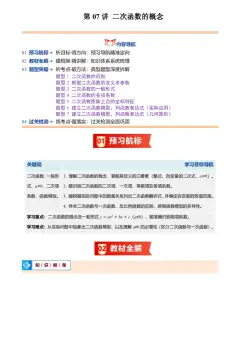
内容导航
01 预习航标→析目标·明方向:预习导航精准定向
02 教材全解→析教材·学新知:情境概念深度构
考点精讲:聚焦常考要点,讲清逻辑
例题精析:典型题目带路,学会解题思路
即练固基:趁热打铁练一练,巩固刚学内容
03 过关检测→练考点·强落实:过关检测分层提
关键词
学习目标导航
学习目标
1. 能识别并朗读与个人信息相关的重点单词,包括姓名、年龄、国籍、班级、班主任、爱
好、最喜欢的食物/运动等。
2. 能理解并运用核心句型询问和介绍个人信息:如What class are you in?, Who’s your class
teacher?, Where are you from?, How old are you?, What’s your favourite sport? 等。
3. 能在听力活动中准确捕捉关键信息(如人物姓名、年龄、国籍、班级、班主任等)。
4. 能根据提示制作个人档案(personal profile),并能用英语介绍自己和朋友。
学习重点
1. 掌握be 动词(am, is, are)在不同主语下的肯定句、否定句、一般疑问句和特殊疑问句。
2. 掌握询问和介绍个人信息的核心句型:What class are you in?, Who’s your class teacher?,
Where are you from?, How old are you?, What’s your favourite...? 等。
3. 掌握国家和国籍的表达方式(China, the US, the UK, Singapore 等)。
4. 掌握人称代词主格(I, you, he, she, it, we, they)和形容词性物主代词(my, your, his, her,
our, their)的用法。
学习难点
1. 区分What class are you in? 和What grade are you in? 的区别;区分What’s your name?
和May I have your name? 的礼貌程度。
2. 在语境中准确使用be 动词(am, is, are)与不同主语的搭配,特别是在一般疑问句和否
定句中。
3. 区分last name / first name 的中英文姓名顺序差异。
4. 掌握favourite 的用法及句型:What’s your favourite...? — My favourite... is...
1. How do we make new friends? 我们如何交新朋友?
Get to know more classmates. 认识更多的同学。
Getting to know each other is the first step in making new friends. 互相认识是交朋友的第一步。
【详解】make friends 意为“交朋友”,后面加with sb 表示“和某人交朋友”。get to know 意为“认识;了解”,
强调一个逐渐了解的过程。
【重点单词】
make /meɪk/ v. 做;制造
friend /frend/ n. 朋友
get /ɡet/ v. 得到;获得
know /nəʊ/ v. 知道;认识
step /step/ n. 步骤;脚步
【重点短语】
make friends 交朋友
make friends with sb 和某人交朋友
get to know 认识;了解
get to know each other 互相认识
the first step 第一步
【常用结构】
短语
结构
例句
make friends
make friends with sb
I want to make friends with you.
get to know
get to know sb
I got to know him in middle school.
【拓展】
friend 的形容词是friendly(友好的)
make friends 中的friend 必须用复数
get to know 与know 的区别:get to know 强调“逐渐认识”的过程,know 强调“认识”的状态
【典例】
It’s easy to ______ friends in a new class.
A. do  B. make  C. get  D. have
【答案】B
【详解】句意:在新班级里交朋友很容易。“交朋友”是make friends。故选B。
【即练1】
I want to make friends ______ you.
A. with  B. to  C. for  D. at
【即练2】
We need time to ______ each other better.
A. get to know  B. get to seeing  C. getting to know  D. gets to know
2.Peter’s full name is Peter Brown. 彼得的全名是彼得·布朗。
What’s your last name? 你姓什么?
Ella’s last name is Miller. 埃拉的姓是米勒。
Hui is her first name. 慧是她的名。
【详解】英语姓名与中文姓名的顺序不同:
语言
顺序
举例
中文
姓+ 名
高慧(高= last name,慧= first name)
英文
名+ 姓
Peter Brown(Peter = first name,Brown = last name)
【重点单词】
full /fʊl/ adj. 完整的;满的
last /lɑːst/ adj. 最后的;上一个的
first /fɜːst/ adj. 第一的;首要的
name /neɪm/ n. 名字
【重点短语】
full name 全名
last name / family name 姓
first name / given name 名
【常用结构】
问句
中文
What’s your full name?
你的全名是什么?
What’s your last name?
你姓什么?
What’s your first name?
你叫什么名字?
【拓展】
last name = family name(姓)
first name = given name(名)
在英语国家,称呼别人通常用first name(熟人之间)或Mr/Ms + last name(正式场合)
【典例】
In English names, the given name comes ______.
A. first  B. last  C. middle  D. after
【答案】A
【详解】句意:在英文名字中,名在前。英文名顺序是first name + last name。故选A。
【即练1】
My name is Li Hua. Li is my ______ name.
A. first  B. last  C. given  D. full
【即练2】
Her name is Mary Brown. Mary is her ______ name.
3.What class are you in? 你在哪个班?
I’m in Class 1, Grade 7. 我在七年级一班。
Meimei is in Class 1, Grade 7. 梅梅在七年级一班。
【详解】
单词
含义
用法
class
班级
Class 1(一班)
grade
年级
Grade 7(七年级)
顺序:先说班级(Class),再说年级(Grade),首字母都要大写。
【重点单词】
grade /ɡreɪd/ n. 年级;等级
class /klɑːs/ n. 班级;课
【重点短语】
What class are you in? 你在哪个班?
I’m in Class 1, Grade 7. 我在七年级一班。
【典例】
— What class are you in?
— I’m in ______.
A. Class 1  B. class 1  C. Grade 1  D. grade 1
【答案】A
【详解】句意:——你在哪个班?——我在一班。回答班级用Class + 数字,首字母大写。故选A。
【即练1】
I’m in Class 2, ______ 7.
A. class  B. Class  C. grade  D. Grade
【即练2】
— What class ______ you in?
— I’m in Class 1.
4.This is my new classmate. 这是我的新同学。
We’re in the same class. 我们在同一个班。
Tom and I are both in the school band. 汤姆和我都在学校乐队。
【详解】classmate 是由class(班级)+ mate(伙伴)构成的合成词。same 前面必须加the。both 表示“两者
都”,放在be 动词之后、实义动词之前。
【重点单词】
classmate /ˈklɑːsmeɪt/ n. 同班同学
same /seɪm/ adj. 相同的
both /bəʊθ/ adj. & pron. 两个;两个都
【重点短语】
the same class 同一个班
both in the school band 都在学校乐队
【常用结构】
单词
用法
例句
classmate
可数名词
He is my classmate.
same
the same + 名词
We are in the same class.
both
both + 复数名词/ both of + 复数代词
Both of us like music.
【拓展】
same 的反义词是different(不同的)
both 表示“两者都”,all 表示“三者或以上都”
与both 对应的词是neither(两者都不)
【典例】
We are in ______ same school.
A. a  B. an  C. the  D. /
【答案】C
【详解】句意:我们在同一所学校。same 前面必须加the。the same 是固定搭配。故选C。
【即练1】
Tom and I are ______ in the school band.
A. both  B. all  C. each  D. every
【即练2】
She is my ______. We are in the same class.
5.This is my new friend, Peter. 这是我的新朋友,彼得。
Peter, this is our English teacher, Mr Smith. 彼得,这是我们的英语老师,史密斯先生。
【详解】This is... 是介绍他人的常用句型。our 是形容词性物主代词,意为“我们的”。介绍他人时,被介绍
的人名放在句末,用逗号隔开。
【重点单词】
this /ðɪs/ pron. 这个
new /njuː/ adj. 新的
friend /frend/ n. 朋友
our /aʊə(r)/ pron. 我们的
【重点短语】
this is... 这是……
my new friend 我的新朋友
our English teacher 我们的英语老师
【常用结构】
介绍单个人
介绍多个人
This is + 人名.
These are + 人名.
That is + 人名.
Those are + 人名.
【拓展】
形容词性物主代词一览表:
人称代词
形容词性物主代词
I
my
you
your
he
his
she
her
it
its
we
our
they
their
【典例】
— Who is she?
— ______ my sister, Mary.
A. He’s  B. She’s  C. This is  D. Her is
【答案】C
【详解】句意:——她是谁?——这是我的妹妹,玛丽。介绍别人用This is...。故选C。
【即练1】
This is ______ new friend, Tom.
A. I  B. my  C. me  D. mine
【即练2】
This is my sister. ______ name is Mary.
6.He’s from the US. 他来自美国。
She’s from Sydney, Australia. 她来自澳大利亚的悉尼。
Where are you from? 你来自哪里?
【详解】be from 表示“来自”,用来询问或说明国籍、家乡。where 用来询问地点。
【重点单词】
from /frɒm/ prep. 来自
country /ˈkʌntri/ n. 国家
【重点短语】
be from 来自
the US 美国
the UK 英国
【常用结构】
问句
回答
Where are you from?
I’m from + 国家/城市.
Where is he from?
He’s from + 国家/城市.
【拓展】
国家
英文
注意
中国
China
不加冠词
美国
the US / the USA
必须加the
英国
the UK
必须加the
澳大利亚
Australia
不加冠词
新加坡
Singapore
不加冠词
be from 与come from 可以互换:
I’m from China. = I come from China.
【典例】
— Where is Mr Smith from?
— He’s from ______.
A. the US  B. US  C. the uk  D. uk
【答案】A
【详解】句意:——史密斯先生来自哪里?——他来自美国。美国英文是the US,the 不能省略。故选A。
【即练1】
— Where ______ your father from?
— He is from the UK.
A. am  B. is  C. are  D. be
【即练2】
She’s from ______.(英国)
7.Oh, sorry! My mistake. 哦,对不起!我的错。
【详解】mistake 是可数名词,意为“错误”。My mistake 是口语中常用的表达,相当于“I’m sorry. It’s my fault.”
【重点单词】
mistake /mɪˈsteɪk/ n. 错误;失误
sorry /ˈsɒri/ adj. 抱歉的;难过的
【重点短语】
My mistake. 我的错。
make a mistake 犯错误
by mistake 错误地
【常用结构】
短语
例句
make a mistake
Everyone makes mistakes.
by mistake
I took your bag by mistake.
【拓展】
mistake 还可以作动词,意为“弄错”,过去式是mistook
fault /fɔːlt/ n. 过错(与mistake 近义)
【典例】
It’s okay to ______ a mistake. We can learn from it.
A. do  B. make  C. take  D. have
【答案】B
【详解】句意:犯错误没关系,我们可以从中学习。“犯错误”是make a mistake。故选B。
【即练1】
— I took your pen ______ mistake. I’m sorry.
— It’s OK.
A. by  B. on  C. in  D. at
【即练2】
Everyone ______ mistakes. It’s part of learning.
8.What class are you in? 你在哪个班?
I’m in Class 1. 我在一班。
【详解】what class 是特殊疑问短语,用来询问班级。回答时Class 首字母大写,数字用基数词。
【重点单词】
what /wɒt/ pron. 什么
class /klɑːs/ n. 班级
【重点短语】
What class are you in? 你在哪个班?
I’m in Class 1. 我在一班。
【常用结构】
问句
回答
What class are you in?
I’m in Class + 数字.
What class is he in?
He’s in Class + 数字.
【拓展】
What grade are you in? 你在哪个年级?
回答:I’m in Grade 7.
【典例】
— What class are you in?
— I’m in ______.
A. Class 1  B. class 1  C. Grade 1  D. grade 1
【答案】A
【详解】句意:——你在哪个班?——我在一班。回答班级用Class + 数字,首字母大写。故选A。
【即练1】
— What class ______ you in?
— I’m in Class 1.
A. am  B. is  C. are  D. be
【即练2】
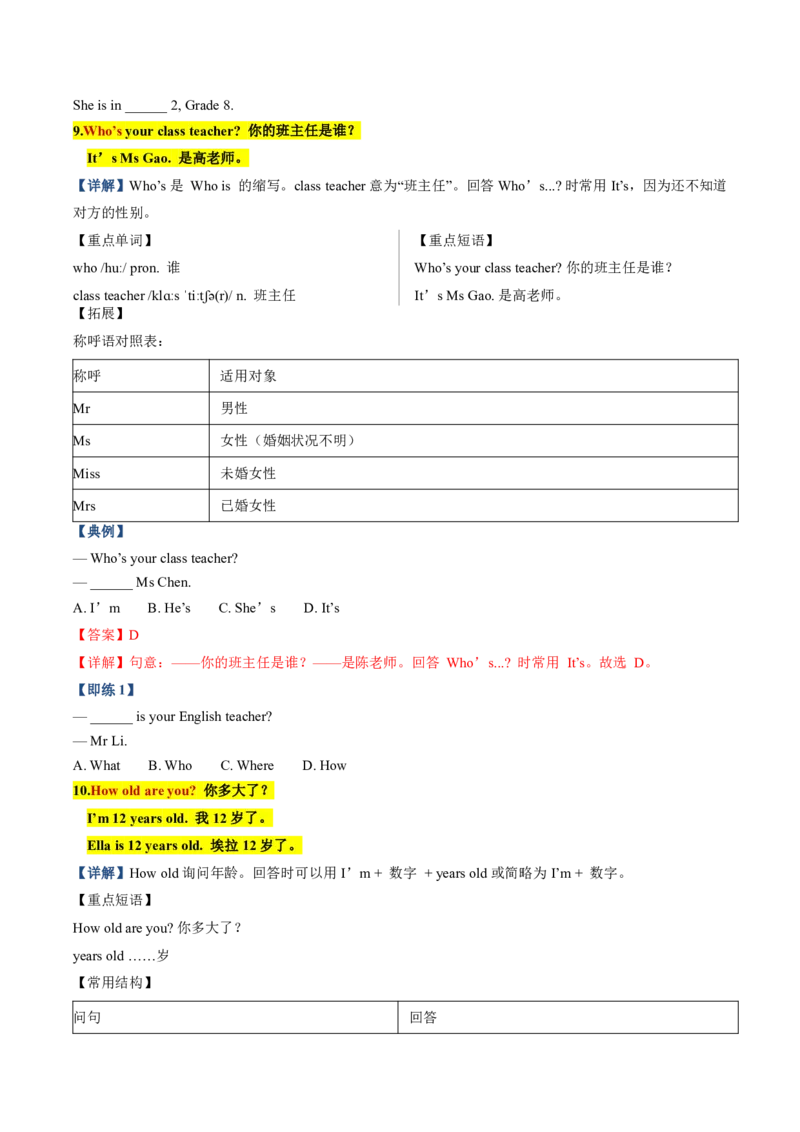
She is in ______ 2, Grade 8.
9.Who’s your class teacher? 你的班主任是谁?
It’s Ms Gao. 是高老师。
【详解】Who’s 是Who is 的缩写。class teacher 意为“班主任”。回答Who’s...? 时常用It’s,因为还不知道
对方的性别。
【重点单词】
who /huː/ pron. 谁
class teacher /klɑːs ˈtiːtʃə(r)/ n. 班主任
【重点短语】
Who’s your class teacher? 你的班主任是谁?
It’s Ms Gao. 是高老师。
【拓展】
称呼语对照表:
称呼
适用对象
Mr
男性
Ms
女性(婚姻状况不明)
Miss
未婚女性
Mrs
已婚女性
【典例】
— Who’s your class teacher?
— ______ Ms Chen.
A. I’m  B. He’s  C. She’s  D. It’s
【答案】D
【详解】句意:——你的班主任是谁?——是陈老师。回答Who’s...? 时常用It’s。故选D。
【即练1】
— ______ is your English teacher?
— Mr Li.
A. What  B. Who  C. Where  D. How
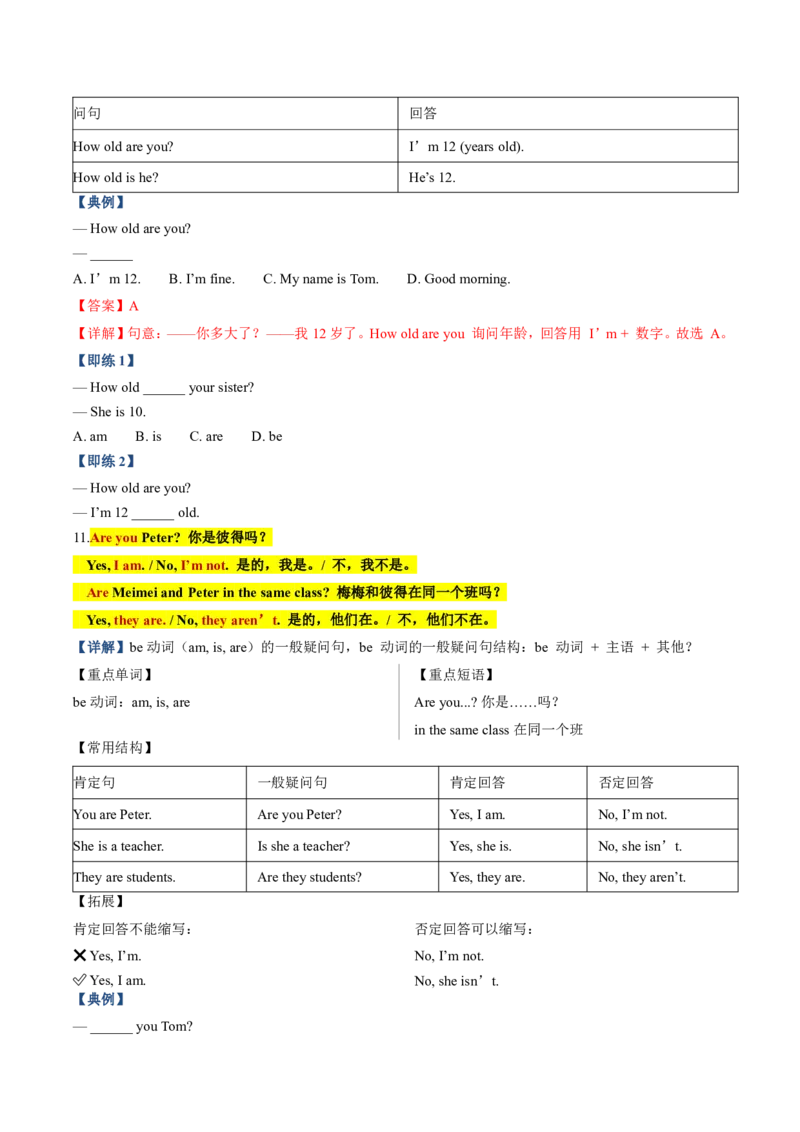
10.How old are you? 你多大了?
I’m 12 years old. 我12 岁了。
Ella is 12 years old. 埃拉12 岁了。
【详解】How old 询问年龄。回答时可以用I’m + 数字+ years old 或简略为I’m + 数字。
【重点短语】
How old are you? 你多大了?
years old ……岁
【常用结构】
问句
回答
问句
回答
How old are you?
I’m 12 (years old).
How old is he?
He’s 12.
【典例】
— How old are you?
— ______
A. I’m 12.  B. I’m fine.  C. My name is Tom.  D. Good morning.
【答案】A
【详解】句意:——你多大了?——我12 岁了。How old are you 询问年龄,回答用I’m + 数字。故选A。
【即练1】
— How old ______ your sister?
— She is 10.
A. am  B. is  C. are  D. be
【即练2】
— How old are you?
— I’m 12 ______ old.
11.Are you Peter? 你是彼得吗?
Yes, I am. / No, I’m not. 是的,我是。/ 不,我不是。
Are Meimei and Peter in the same class? 梅梅和彼得在同一个班吗?
Yes, they are. / No, they aren’t. 是的,他们在。/ 不,他们不在。
【详解】be 动词(am, is, are)的一般疑问句,be 动词的一般疑问句结构:be 动词+ 主语+ 其他?
【重点单词】
be 动词:am, is, are
【重点短语】
Are you...? 你是……吗?
in the same class 在同一个班
【常用结构】
肯定句
一般疑问句
肯定回答
否定回答
You are Peter.
Are you Peter?
Yes, I am.
No, I’m not.
She is a teacher.
Is she a teacher?
Yes, she is.
No, she isn’t.
They are students.
Are they students?
Yes, they are.
No, they aren’t.
【拓展】
肯定回答不能缩写:
❌Yes, I’m.
✅Yes, I am.
否定回答可以缩写:
No, I’m not.
No, she isn’t.
【典例】
— ______ you Tom?
— Yes, I ______.
A. Are; am  B. Is; am  C. Are; is  D. Is; are
【答案】A
【详解】句意:——你是汤姆吗?——是的,我是。主语you 与are 搭配;肯定回答用I am。故选A。
【即练1】
— ______ she your sister?
— No, she ______.
A. Is; is  B. Is; isn’t  C. Are; isn’t  D. Are; are
【即练2】
— Are you a student?
— Yes, I ______.
12.Where is Mr Smith from? 史密斯先生来自哪里?
What class are you in? 你在哪个班?
Who’s your class teacher? 你的班主任是谁?
How old are you? 你多大了?
【详解】be 动词(am, is, are)的特殊疑问句
特殊疑问句由“疑问词+ 一般疑问句”构成,不能用Yes 或No 回答。
【重点单词】
where /weə/ adv. 在哪里
what /wɒt/ pron. 什么
who /huː/ pron. 谁
how /haʊ/ adv. 怎样
【重点短语】
Where is... from? ……来自哪里?
What class...? ……在哪个班?
Who’s...? ……是谁?
How old...? ……多大?
【常用结构】
疑问词
功能
问句
回答
Where
地点
Where are you from?
I’m from China.
What class
班级
What class are you in?
I’m in Class 1.
Who
人物
Who’s your class teacher?
It’s Ms Gao.
How old
年龄
How old are you?
I’m 12.
When
时间
When do you go to school?
I go to school at 7:30.
【典例】
— ______ is your English teacher?
— Mr Li.
A. What  B. Who  C. Where  D. How
【答案】B
【详解】句意:——你的英语老师是谁?——李老师。询问人物用Who。故选B。
【即练1】
— ______ is Mr Smith from?
— He’s from the US.
A. What  B. Who  C. Where  D. How
【即练2】
— ______ is your birthday?
— It’s on May 5th.
13.What’s your favourite sport? 你最喜欢的运动是什么?
My favourite food is beef noodles. 我最喜欢的食物是牛肉面。
My favourite colour is blue. 我最喜欢的颜色是蓝色。
【详解】favourite 是形容词,放在名词前面。
【重点单词】
favourite /ˈfeɪvərɪt/ adj. 最喜欢的
sport /spɔːt/ n. 运动
food /fuːd/ n. 食物
colour /ˈkʌlə/ n. 颜色
【重点短语】
What’s your favourite...? 你最喜欢的……是什么?
My favourite... is... 我最喜欢的……是……
【常用结构】
问句
回答
What’s your favourite colour?
My favourite colour is red.
What’s your favourite sport?
My favourite sport is basketball.
What’s your favourite food?
My favourite food is beef noodles.
【典例】
My favourite ______ is basketball.
A. food  B. colour  C. sport  D. animal
【答案】C
【详解】句意:我最喜欢的运动是篮球。basketball 是运动,用sport。故选C。
【即练1】
— What’s your favourite ______?
— My favourite food is beef noodles.
A. food  B. colour  C. sport  D. animal
【即练2】
My favourite ______ is the panda.
14.What are your hobbies? 你的爱好是什么?
【详解】hobby 是可数名词,复数形式是hobbies(变y 为i 加es)。回答爱好时常用I like + 动词ing。
【重点单词】
hobby /ˈhɒbi/ n. 业余爱好
hobbies /ˈhɒbiz/ n. 爱好(复数)
【重点短语】
What are your hobbies? 你的爱好是什么?
I like + 动词ing 我喜欢……
【常用结构】
问句
回答
What are your hobbies?
I like reading and swimming.
What’s your hobby?
My hobby is playing basketball.
【拓展】
like 的用法:
like + 名词:I like music.
like + 动词ing:I like singing.
hobby 的同义词:interest(兴趣)
【典例】
— What are your hobbies?
— I like ______.
A. read  B. reads  C. reading  D. to reading
【答案】C
【详解】句意:——你的爱好是什么?——我喜欢阅读。like doing sth. 意为“喜欢做某事”。故选C。
【即练1】
What are your ______?
A. hobby  B. hobbies  C. name  D. age
【即练2】
I like ______ (swim).
15.She likes Chinese food a lot. 她非常喜欢中国食物。
【详解】a lot 作副词,修饰动词,表示程度“非常”。a lot of 作形容词,修饰名词,表示数量“许多”。
【重点短语】
a lot 很;非常
a lot of 许多(后接可数/不可数名词)
thanks a lot 非常感谢
【常用结构】
短语
用法
例句
a lot
修饰动词
I like it a lot.
a lot of
修饰名词
I have a lot of books.
【典例】
Thanks ______ for your help.
A. a lot  B. a lot of  C. lots of  D. lot
【答案】A
【详解】句意:非常感谢你的帮助。Thanks a lot 是固定搭配。故选A。
【即练1】
She likes reading ______.
A. a lot  B. a lot of  C. lots of  D. lot
【即练2】
There are ______ books on the desk.
16.Would you like to join our music club? 你愿意加入我们的音乐俱乐部吗?
【详解】would like 是礼貌的表达方式,相当于want,但更客气。would like to do sth 意为“想要做某事”。
【重点单词】
would /wʊd/ modal v. 想;将会
join /dʒɔɪn/ v. 参加;加入
【重点短语】
would like to do sth 想要做某事
Would you like...? 你想要……吗?(礼貌邀请)
【常用结构】
句型
例句
would like + 名词
I would like a cup of tea.
would like to + 动词原形
I would like to go to the park.
Would you like...?
Would you like some coffee?
【典例】
I would like ______ to the movies.
A. go  B. goes  C. going  D. to go
【答案】D
【详解】句意:我想去看电影。would like to do sth 意为“想要做某事”。故选D。
【即练1】
— Would you like ______ tea?
— Yes, please.
A. any  B. some  C. many  D. much
【答案】B
【即练2】
I would like ______ (be) a teacher.
17.Read the two students’ posts. Complete the table with the information from the posts. 阅读两个学生的
帖子。用帖子中的信息完成表格。
【详解】information 是不可数名词,不能加s,也不能用a/an 直接修饰。表示“一条信息”要说a piece of
information。
【重点短语】
a piece of information 一条信息
get information 获取信息
【常用结构】
短语
例句
a piece of information
Can you give me a piece of information?
get information
We can get information from the Internet.
【典例】
Can you give me ______?
A. an information  B. a information  C. a piece of information  D. some informations
【答案】C
【详解】句意:你能给我一条信息吗?information 是不可数名词,表示“一条信息”用a piece of information。
故选C。
【即练1】
We can get a lot of ______ from the Internet.
A. informations  B. information  C. an information  D. a information
【即练2】
This is a useful piece of ______.
18.My name is Andre Kalu. I’m 13 years old. I’m from South Africa, but now I live in China. 我叫安德
烈·卡卢。我13 岁了。我来自南非,但现在我住在中国。
【详解】live 是动词,意为“居住”。live in + 地点表示“住在某地”。live with + 人表示“和某人一起住”。
【重点单词】
live /lɪv/ v. 居住
profile /ˈprəʊfaɪl/ n. 简介;档案
【重点短语】
live in 住在
live with 和……一起住
personal profile 个人档案
【常用结构】
个人档案的写作结构:
顺序
内容
句型
1
名字
My name is...
顺序
内容
句型
2
年龄
I’m... years old.
3
国籍/居住地
I’m from... / I live in...
4
家庭成员
I live with...
5
宠物
I have a pet...
6
最喜欢的食物
My favourite food is...
7
最喜欢的运动
My favourite sport is...
【典例】
I ______ in Beijing with my parents.
A. live  B. lives  C. living  D. to live
【答案】A
【详解】句意:我和父母住在北京。主语I 用动词原形live。故选A。
【即练1】
I play football ______ my classmates.
A. and  B. with  C. to  D. for
【即练2】
I ______ in Shanghai with my family.
一、单项选择
1.—How much do you need?
—Twenty dollars ________ enough.
A.has
B.have
C.is
D.are
2.—I ________ a student. ________ you a teacher?
—Yes, I am.
A.am; Is
B.is; Are
C.am; Are
D.are; Is
3.Good morning! I ________ Roy. What’s ________ name?
A.am; your
B.is; your
C.are; you
D.am; you
4.—________ your brother a member of the basketball team?
—No, he ________ like playing basketball.
A.Does; is
B.Do; doesn’t
C.Is; doesn’t
D.Is; isn’t
5.—Zhang Guimei is a great woman. ________ helps poor girls go to school.
—Oh, we should learn from ________.
A.She; she
B.He; she
C.She; her
D.Her; her
6.I learn a lot of ________ about ________ in biology class.
A.informations; insect
B.information; insect
C.information; insects
D.informations; insects
7.— Sara, what is your ________ colour?
— Orange. Half of my dresses are orange.
A.like
B.favourite
C.most
D.one
8.—Can you ________ English?
—Yes, but only a little.
A.tell
B.speak
C.say
D.talk
9.—What’s your ________, Jackie?
—Writing. I often write stories.
A.problem
B.dream
C.hobby
D.energy
10.— What ________ this?
— It ________ a ruler.
A.is; are
B.are; is
C.is; is
D.are; are
11.—________ are you?
—I’m 13 years old.
A.What
B.How old
C.Where
D.Who
12.— What’s your ________, Emma?
— Playing tennis.
A.name
B.hobby
C.class
D.grade
13.— Can I ________ friends with you?
— Sure.
A.get
B.take
C.have
D.make
14.— ________ is she from?
— Canada.
A.How
B.When
C.Where
D.What
15.Pauline and I are ________ students in the school.
A.both
B.all
C.another
D.other
二、单词拼写
16.My brothers like playing basketball. And ________ (he) often play basketball with ________ (his) friends.
17.There ________ (be) some milk and bread on the table.
18.My parents ________ at home now, but they ________ in the park a moment ago. (be)
19.My parents ________ (be) going to Beijing tomorrow.
20.It’s normal (正常的) to make ________ (mistake).
21.I have lots of ________ (hobby), like swimming, reading and singing.
22.My name is Jim Green. Jim is my ________ (one) name.
23.Linda and I b________ like drinking milk.
三、完成句子
24.——你来自哪里?
——我来自北京。
—________ ________ you from?
—I ________ ________ Beijing.
25.他的全名是Tony Smith。他12 岁。
His ________ ________ is Tony Smith. He is 12 ________ ________.
26.我很愿意再次见到你并且更多地了解你。
I’d really like to see you again and ________ ________ ________ you better.
27.They are from New York. (改为同义句)
They ________ ________ New York.
28.My mother is an English teacher. (改为否定句)
My mother ________ an English teacher.
29.I am in Meimei’s class. (改为一般疑问句)
________ ________ in Meimei’s class?
30.What is that?(把句子改为复数形式)
What ________ ________?
31.It is a pencil. (改为复数句)
________ ________ ________.
32.I’m Chen Jie. (改为一般疑问句,并作否定回答)
—________ ________ Chen Jie?
—________, ________ ________.