文档文本内容
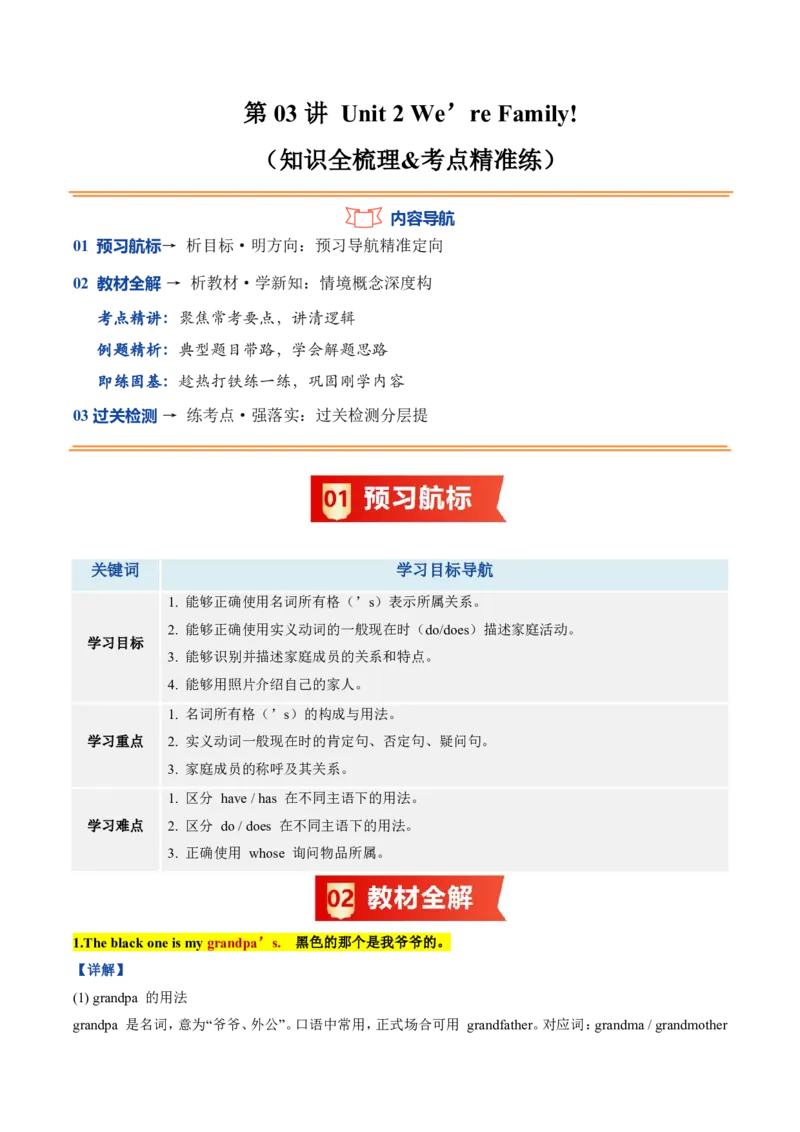
第03 讲Unit 2 We’re Family!
(知识全梳理&考点精准练)
内容导航
01 预习航标→析目标·明方向:预习导航精准定向
02 教材全解→析教材·学新知:情境概念深度构
考点精讲:聚焦常考要点,讲清逻辑
例题精析:典型题目带路,学会解题思路
即练固基:趁热打铁练一练,巩固刚学内容
03 过关检测→练考点·强落实:过关检测分层提
关键词
学习目标导航
学习目标
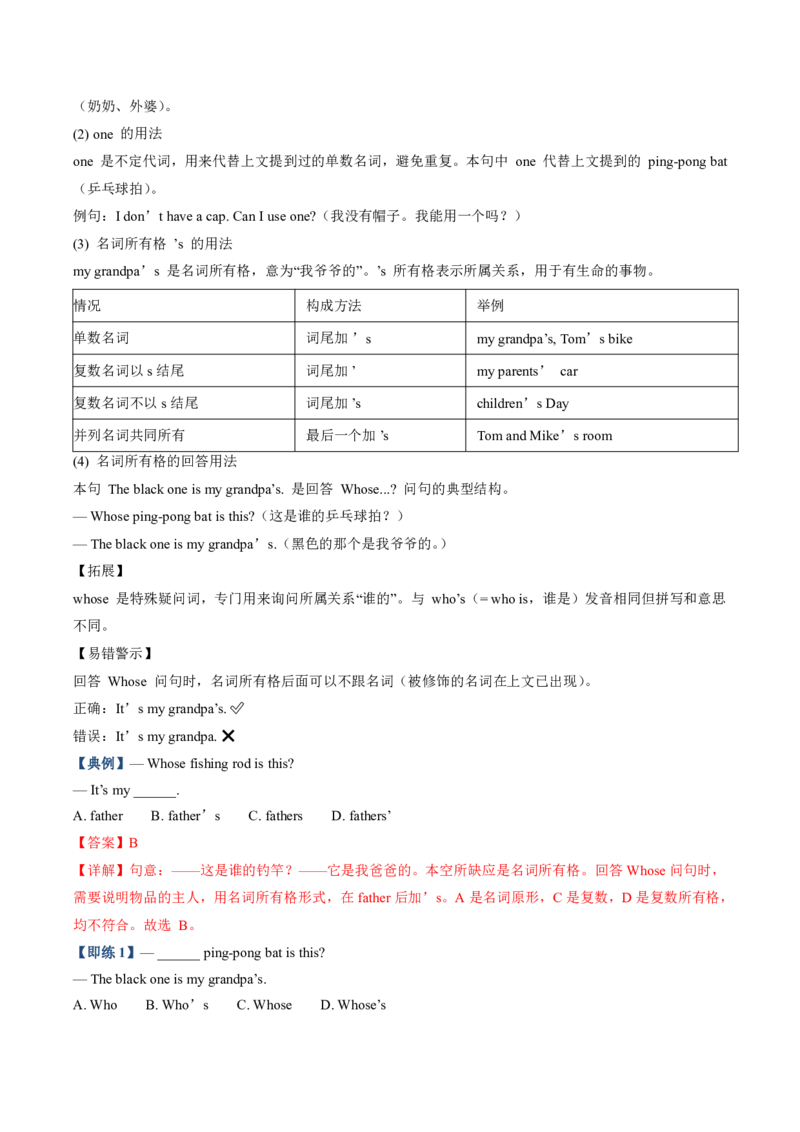
1. 能够正确使用名词所有格(’s)表示所属关系。
2. 能够正确使用实义动词的一般现在时(do/does)描述家庭活动。
3. 能够识别并描述家庭成员的关系和特点。
4. 能够用照片介绍自己的家人。
学习重点
1. 名词所有格(’s)的构成与用法。
2. 实义动词一般现在时的肯定句、否定句、疑问句。
3. 家庭成员的称呼及其关系。
学习难点
1. 区分have / has 在不同主语下的用法。
2. 区分do / does 在不同主语下的用法。
3. 正确使用whose 询问物品所属。
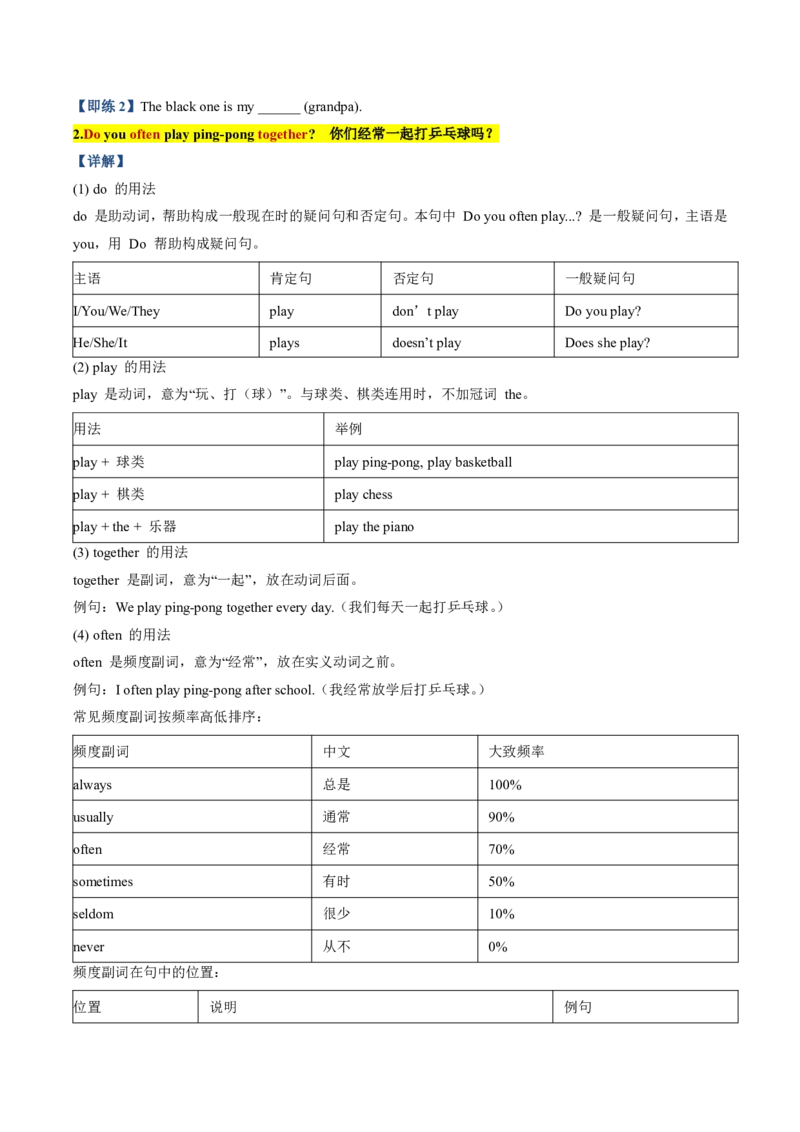
1.The black one is my grandpa’s.
黑色的那个是我爷爷的。
【详解】
(1) grandpa 的用法
grandpa 是名词,意为“爷爷、外公”。口语中常用,正式场合可用grandfather。对应词:grandma / grandmother
(奶奶、外婆)。
(2) one 的用法
one 是不定代词,用来代替上文提到过的单数名词,避免重复。本句中one 代替上文提到的ping-pong bat
(乒乓球拍)。
例句:I don’t have a cap. Can I use one?(我没有帽子。我能用一个吗?)
(3) 名词所有格’s 的用法
my grandpa’s 是名词所有格,意为“我爷爷的”。’s 所有格表示所属关系,用于有生命的事物。
情况
构成方法
举例
单数名词
词尾加’s
my grandpa’s, Tom’s bike
复数名词以s 结尾
词尾加’
my parents’ car
复数名词不以s 结尾
词尾加’s
children’s Day
并列名词共同所有
最后一个加’s
Tom and Mike’s room
(4) 名词所有格的回答用法
本句The black one is my grandpa’s. 是回答Whose...? 问句的典型结构。
— Whose ping-pong bat is this?(这是谁的乒乓球拍?)
— The black one is my grandpa’s.(黑色的那个是我爷爷的。)
【拓展】
whose 是特殊疑问词,专门用来询问所属关系“谁的”。与who’s(= who is,谁是)发音相同但拼写和意思
不同。
【易错警示】
回答Whose 问句时,名词所有格后面可以不跟名词(被修饰的名词在上文已出现)。
正确:It’s my grandpa’s. ✅
错误:It’s my grandpa. ❌
【典例】— Whose fishing rod is this?
— It’s my ______.
A. father  B. father’s  C. fathers  D. fathers’
【答案】B
【详解】句意:——这是谁的钓竿?——它是我爸爸的。本空所缺应是名词所有格。回答Whose 问句时,
需要说明物品的主人,用名词所有格形式,在father 后加’s。A 是名词原形,C 是复数,D 是复数所有格,
均不符合。故选B。
【即练1】— ______ ping-pong bat is this?
— The black one is my grandpa’s.
A. Who  B. Who’s  C. Whose  D. Whose’s
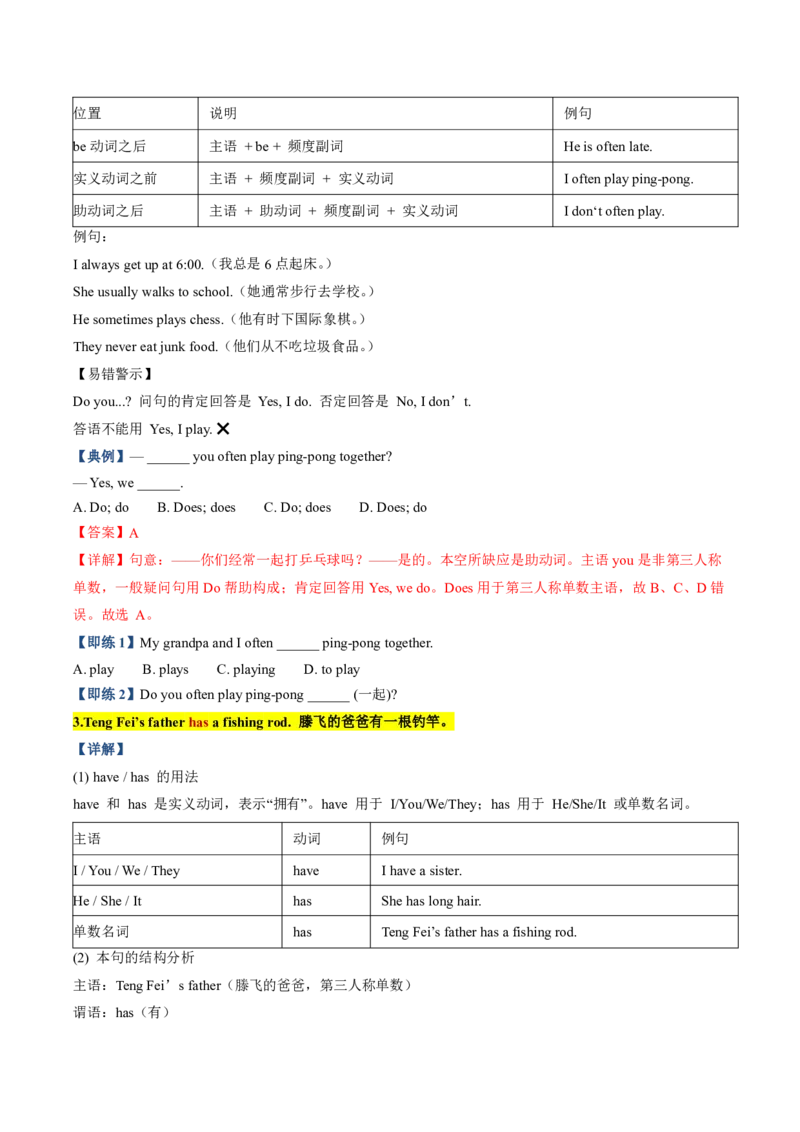
【即练2】The black one is my ______ (grandpa).
2.Do you often play ping-pong together?
你们经常一起打乒乓球吗?
【详解】
(1) do 的用法
do 是助动词,帮助构成一般现在时的疑问句和否定句。本句中Do you often play...? 是一般疑问句,主语是
you,用Do 帮助构成疑问句。
主语
肯定句
否定句
一般疑问句
I/You/We/They
play
don’t play
Do you play?
He/She/It
plays
doesn’t play
Does she play?
(2) play 的用法
play 是动词,意为“玩、打(球)”。与球类、棋类连用时,不加冠词the。
用法
举例
play + 球类
play ping-pong, play basketball
play + 棋类
play chess
play + the + 乐器
play the piano
(3) together 的用法
together 是副词,意为“一起”,放在动词后面。
例句:We play ping-pong together every day.(我们每天一起打乒乓球。)
(4) often 的用法
often 是频度副词,意为“经常”,放在实义动词之前。
例句:I often play ping-pong after school.(我经常放学后打乒乓球。)
常见频度副词按频率高低排序:
频度副词
中文
大致频率
always
总是
100%
usually
通常
90%
often
经常
70%
sometimes
有时
50%
seldom
很少
10%
never
从不
0%
频度副词在句中的位置:
位置
说明
例句
位置
说明
例句
be 动词之后
主语+ be + 频度副词
He is often late.
实义动词之前
主语+ 频度副词+ 实义动词
I often play ping-pong.
助动词之后
主语+ 助动词+ 频度副词+ 实义动词
I don‘t often play.
例句:
I always get up at 6:00.(我总是6 点起床。)
She usually walks to school.(她通常步行去学校。)
He sometimes plays chess.(他有时下国际象棋。)
They never eat junk food.(他们从不吃垃圾食品。)
【易错警示】
Do you...? 问句的肯定回答是Yes, I do. 否定回答是No, I don’t.
答语不能用Yes, I play. ❌
【典例】— ______ you often play ping-pong together?
— Yes, we ______.
A. Do; do  B. Does; does  C. Do; does  D. Does; do
【答案】A
【详解】句意:——你们经常一起打乒乓球吗?——是的。本空所缺应是助动词。主语you 是非第三人称
单数,一般疑问句用Do 帮助构成;肯定回答用Yes, we do。Does 用于第三人称单数主语,故B、C、D 错
误。故选A。
【即练1】My grandpa and I often ______ ping-pong together.
A. play  B. plays  C. playing  D. to play
【即练2】Do you often play ping-pong ______ (一起)?
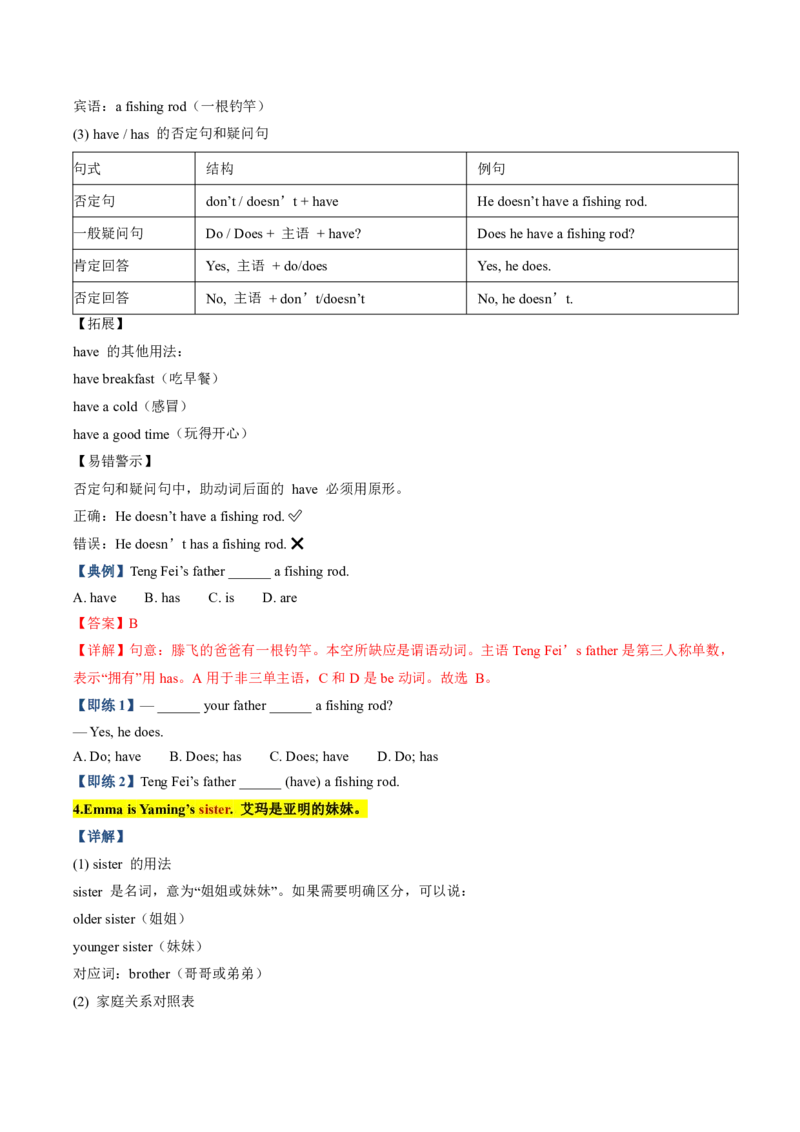
3.Teng Fei’s father has a fishing rod. 滕飞的爸爸有一根钓竿。
【详解】
(1) have / has 的用法
have 和has 是实义动词,表示“拥有”。have 用于I/You/We/They;has 用于He/She/It 或单数名词。
主语
动词
例句
I / You / We / They
have
I have a sister.
He / She / It
has
She has long hair.
单数名词
has
Teng Fei’s father has a fishing rod.
(2) 本句的结构分析
主语:Teng Fei’s father(滕飞的爸爸,第三人称单数)
谓语:has(有)
宾语:a fishing rod(一根钓竿)
(3) have / has 的否定句和疑问句
句式
结构
例句
否定句
don’t / doesn’t + have
He doesn’t have a fishing rod.
一般疑问句
Do / Does + 主语+ have?
Does he have a fishing rod?
肯定回答
Yes, 主语+ do/does
Yes, he does.
否定回答
No, 主语+ don’t/doesn’t
No, he doesn’t.
【拓展】
have 的其他用法:
have breakfast(吃早餐)
have a cold(感冒)
have a good time(玩得开心)
【易错警示】
否定句和疑问句中,助动词后面的have 必须用原形。
正确:He doesn’t have a fishing rod. ✅
错误:He doesn’t has a fishing rod. ❌
【典例】Teng Fei’s father ______ a fishing rod.
A. have  B. has  C. is  D. are
【答案】B
【详解】句意:滕飞的爸爸有一根钓竿。本空所缺应是谓语动词。主语Teng Fei’s father 是第三人称单数,
表示“拥有”用has。A 用于非三单主语,C 和D 是be 动词。故选B。
【即练1】— ______ your father ______ a fishing rod?
— Yes, he does.
A. Do; have  B. Does; has  C. Does; have  D. Do; has
【即练2】Teng Fei’s father ______ (have) a fishing rod.
4.Emma is Yaming’s sister. 艾玛是亚明的妹妹。
【详解】
(1) sister 的用法
sister 是名词,意为“姐姐或妹妹”。如果需要明确区分,可以说:
older sister(姐姐)
younger sister(妹妹)
对应词:brother(哥哥或弟弟)
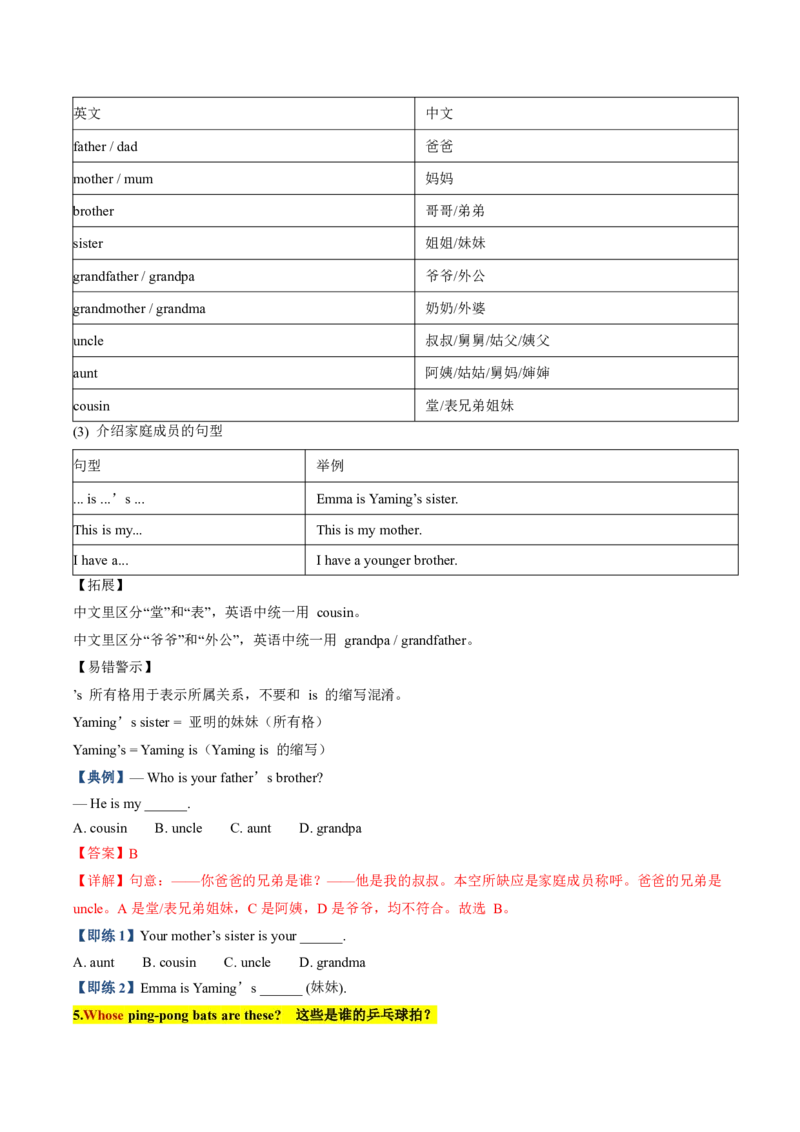
(2) 家庭关系对照表
英文
中文
father / dad
爸爸
mother / mum
妈妈
brother
哥哥/弟弟
sister
姐姐/妹妹
grandfather / grandpa
爷爷/外公
grandmother / grandma
奶奶/外婆
uncle
叔叔/舅舅/姑父/姨父
aunt
阿姨/姑姑/舅妈/婶婶
cousin
堂/表兄弟姐妹
(3) 介绍家庭成员的句型
句型
举例
... is ...’s ...
Emma is Yaming’s sister.
This is my...
This is my mother.
I have a...
I have a younger brother.
【拓展】
中文里区分“堂”和“表”,英语中统一用cousin。
中文里区分“爷爷”和“外公”,英语中统一用grandpa / grandfather。
【易错警示】
’s 所有格用于表示所属关系,不要和is 的缩写混淆。
Yaming’s sister = 亚明的妹妹(所有格)
Yaming’s = Yaming is(Yaming is 的缩写)
【典例】— Who is your father’s brother?
— He is my ______.
A. cousin  B. uncle  C. aunt  D. grandpa
【答案】B
【详解】句意:——你爸爸的兄弟是谁?——他是我的叔叔。本空所缺应是家庭成员称呼。爸爸的兄弟是
uncle。A 是堂/表兄弟姐妹,C 是阿姨,D 是爷爷,均不符合。故选B。
【即练1】Your mother’s sister is your ______.
A. aunt  B. cousin  C. uncle  D. grandma
【即练2】Emma is Yaming’s ______ (妹妹).
5.Whose ping-pong bats are these?
这些是谁的乒乓球拍?
【详解】
(1) whose 的用法
whose 是疑问代词,专门用来询问所属关系“谁的”。
句型
例句
Whose + 单数名词+ is this?
Whose cap is this?(这是谁的帽子?)
Whose + 复数名词+ are these?
Whose ping-pong bats are these?(这些是谁的乒乓球拍?)
(2) who’s 的用法
who’s 是who is 的缩写,意为“谁是”,用于询问身份。
句型
例句
Who’s + 名词?
Who’s that man?(那个男人是谁?)
Who’s + 形容词?
Who’s your class teacher?(你的班主任是谁?)
(3) whose 与who’s 的对比
单词
意思
例句
whose
谁的(询问所属)
Whose bag is this?
who’s
谁是(询问身份)
Who’s that boy?
【典例】— ______ ping-pong bats are these?
— They’re my grandpa’s.
A. Who  B. Who’s  C. Whose  D. Whose’s
【答案】C
【详解】句意:——这些是谁的乒乓球拍?——它们是我爷爷的。本空所缺应是疑问代词。询问所属关系
用Whose。Who 问“谁”,Who’s 是“谁是”,Whose’s 形式错误。故选C。
【即练1】— ______ is that woman?
— She is my aunt.
A. Whose  B. Who’s  C. Whose’s  D. Who
【即练2】______ ping-pong bats are these?
6.He’s very handsome. 他非常英俊。
【详解】
(1) he’s 的用法
he’s 是he is 的缩写,意为“他是”。he 是第三人称单数代词,指代男性。
例句:He’s my brother.(他是我的哥哥。)
(2) handsome 的用法
handsome 是形容词,意为“英俊的”,通常用于描述男性外貌。
形容词
中文
使用对象
handsome
英俊的
男性
beautiful
美丽的
女性
pretty
漂亮的
女性或小孩
cute
可爱的
小孩或小动物
(3) 本句的结构分析
主语:He(他)
谓语:is(是)
表语:very handsome(非常英俊)
very 是副词,修饰形容词handsome,表示程度“非常”。
例句:She is very beautiful.(她非常美丽。)
(4) 描述照片中人物的句型
本句可以用来描述照片中男性家人的外貌。
This is my father. He’s very handsome.(这是我爸爸。他非常英俊。)
This is my brother. He’s tall and handsome.(这是我哥哥。他又高又英俊。)
【拓展】
描述人物时,be 动词后面可以跟多个形容词,用and 连接。
He’s handsome and kind.(他英俊又善良。)
【典例】— What is your father like?
— He’s very ______.
A. beautiful  B. handsome  C. pretty  D. cute
【答案】B
【详解】句意:——你爸爸是什么样的人?——他非常英俊。本空所缺应是形容词。handsome 意为“英俊的”,
用于描述男性。A 和C 用于女性,D 用于小孩或小动物。故选B。
【即练1】This is my brother. ______ very handsome.
A. He’s  B. She’s  C. It’s  D. They’re
【即练2】He’s very ______ (英俊的).
7.He spends a lot of time fishing. 他花很多时间钓鱼。
【重点短语】
spend time fishing 花时间钓鱼
a lot of time 很多时间
【详解】
(1) spend 的用法
spend 是动词,意为“花(时间、钱)”。本句中spends 是第三人称单数形式,主语He 是第三人称单数。
主语
动词形式
I / You / We / They
spend
He / She / It
spends
(2) spend 的常用结构
结构
含义
例句
spend time (in) doing sth
花时间做某事
He spends time fishing.
spend money on sth
花钱在某物上
She spends 50 yuan on books.
(3 )a lot of 的用法
a lot of 意为“很多”,后面可以接可数名词复数或不可数名词。
用法
例句
a lot of + 可数名词复数
a lot of books(很多书)
a lot of + 不可数名词
a lot of time(很多时间)
(4) fishing 的用法
fishing 是动词fish 的-ing 形式,在句中作宾语补足语。类似的表达还有:
go fishing(去钓鱼)
spend time fishing(花时间钓鱼)
【拓展】
常见的-ing 形式活动表达:
go shopping(去购物)
go swimming(去游泳)
go hiking(去远足)
【易错警示】
spend 的主语必须是人,不能是物。
正确:He spends a lot of time fishing. ✅
错误:The book spends a lot of time. ❌
【典例】My grandpa ______ a lot of time fishing.
A. spend  B. spends  C. spent  D. spending
【答案】B
【详解】句意:我爷爷花很多时间钓鱼。本空所缺应是谓语动词。主语My grandpa 是第三人称单数,spend
要用第三人称单数形式spends。A 是原形用于非三单主语,C 是过去式,D 是现在分词。故选B。
【即练1】He ______ a lot of time playing chess.
A. spend  B. spends  C. spent  D. spending
【即练2】He spends a lot of time ______ (fish).
一、单项选择
1.—Lily, you have a sister, right?
—Yes, she always ________ her time with me when I need her.
A.saves
B.takes
C.uses
D.spends
2.She ________ two English books and a dictionary in her schoolbag.
A.have
B.has
C.is having
D.had
3.—Where is Mr. Zhang?
—He is doing sports on the playground. He often ________ sports with us.
A.playing
B.is playing
C.play
D.plays
4.—Does Bob ________ a ping-pong bat?
—No, but he ________ a ping-pong ball.
A.have; has
B.has; has
C.have; have
D.has; have
5.Lisa’s father is my mother’s brother. Lisa is my ________.
A.cousin
B.aunt
C.sister
D.grandmother
6.—Eric, are ________ your ________?
—No. They are my sister’s.
A.that; photo
B.that; photos
C.those; photo
D.those; photos
7.Gina ________ a tennis ball, but her mother ________ one.
A.have; doesn’t have
B.has; doesn’t have
C.have; don’t have
D.has; don’t have
8.Adam has his father’s good looks, so he is _________.
A.funny
B.clever
C.friendly
D.handsome
9.This is _________ bedroom. It is very warm and clean.
A.Amy’s and Penny’s
B.Amy’s and Penny
C.Amy and Penny D.Amy and Penny’s
10.Mike spends _______ time ______ sports, so he is healthy.
A.a lot; playing
B.a lot of; playing
C.lots of; play
D.a lot; on
11.—They raise the flag in the large sports field.
—That ________ fun.
A.sound
B.is sound
C.sounds
D.does sound
二、单词拼写
12.He and his brother ________ (not have) a football.
13.It ________ a blue jacket. (用be 动词的适当形式填空)
14.She ______ (spend) all her free time playing the piano.
15.________ (who) fishing rod is it?
16.My best friend Tony often ________ (help) me with my maths.
17.________ (do) they like to play basketball?
18.—Whose Chinese book is it?
—It is ________ (Kate). Don’t you see her name on it?
19.These are my ________ (grandparents) shoes.
20.Jenny ________ (play) the piano for half an hour after she has dinner every day.
三、完成句子
21.他非常英俊。
He’s very ________.
22.是我爸爸的。他花很多时间钓鱼。
They’re my father’s. He spends a ________ ________ /________ ________ time fishing.
23.他们有一些漂亮的乒乓球拍。
They ________ some nice ping-pong ________.
24.你们经常一起打乒乓球吗?
Do you often ________ ________ together?
25.弗雷德是杰克和萨拉的儿子。
Fred is Jack and Sarah’s ________.
26.He has small eyes. (改为否定句)
He ________ ________ small eyes.
27.He spends a lot of time fishing on the weekend. (改为一般疑问句)
________ he ________ a lot of time fishing on the weekend?
28.Are those your brothers? (改为单数句)
________ ________ your ________?