1 / 14
学科网(北京)股份有限公司
第01 讲Unit 1(知识全梳理&考点精准练)
01 串知识识框架
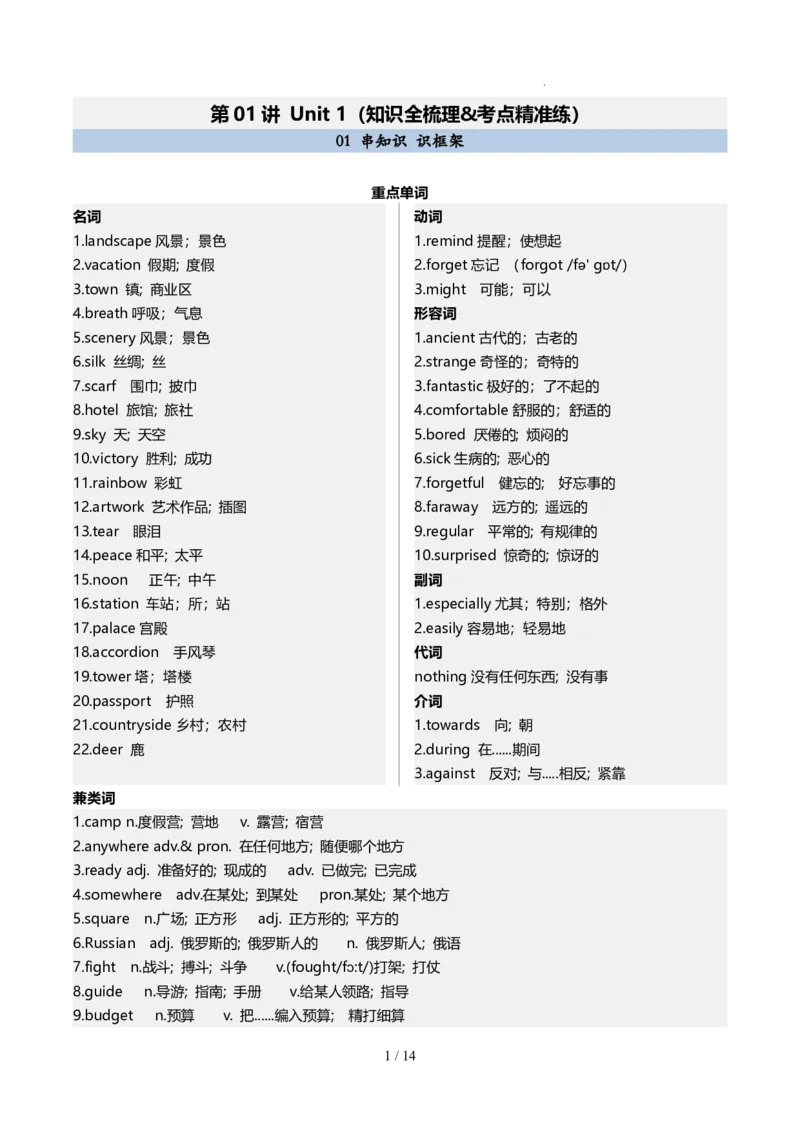
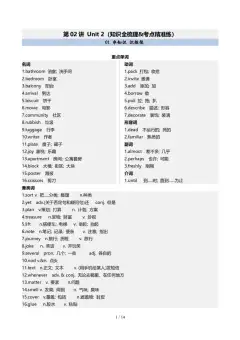
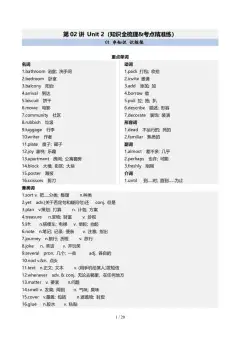
重点单词
名词
1.landscape 风景;景色
2.vacation 假期; 度假
3.town 镇; 商业区
4.breath 呼吸;气息
5.scenery 风景;景色
6.silk 丝绸; 丝
7.scarf
围巾; 披巾
8.hotel 旅馆; 旅社
9.sky 天; 天空
10.victory 胜利; 成功
11.rainbow 彩虹
12.artwork 艺术作品; 插图
13.tear
眼泪
14.peace 和平; 太平
15.noon
正午; 中午
16.station 车站;所;站
17.palace 宫殿
18.accordion
手风琴
19.tower 塔;塔楼
20.passport
护照
21.countryside 乡村;农村
22.deer 鹿
动词
1.remind 提醒;使想起
2.forget 忘记(forgot /fə' gɒt/)
3.might
可能;可以
形容词
1.ancient 古代的;古老的
2.strange 奇怪的;奇特的
3.fantastic 极好的;了不起的
4.comfortable 舒服的;舒适的
5.bored 厌倦的; 烦闷的
6.sick 生病的; 恶心的
7.forgetful
健忘的;
好忘事的
8.faraway
远方的; 遥远的
9.regular
平常的; 有规律的
10.surprised 惊奇的; 惊讶的
副词
1.especially 尤其;特别;格外
2.easily 容易地;轻易地
代词
nothing 没有任何东西; 没有事
介词
1.towards
向; 朝
2.during 在......期间
3.against
反对; 与.....相反; 紧靠
兼类词
1.camp n.度假营; 营地
v. 露营; 宿营
2.anywhere adv.& pron. 在任何地方; 随便哪个地方
3.ready adj. 准备好的; 现成的
adv. 已做完; 已完成
4.somewhere
adv.在某处; 到某处
pron.某处; 某个地方
5.square
n.广场; 正方形
adj. 正方形的; 平方的
6.Russian
adj. 俄罗斯的; 俄罗斯人的
n. 俄罗斯人; 俄语
7.fight
n.战斗; 搏斗; 斗争
v.(fought/fɔ:t/)打架; 打仗
8.guide
n.导游; 指南; 手册
v.给某人领路; 指导
9.budget
n.预算
v. 把......编入预算;
精打细算
2 / 14
学科网(北京)股份有限公司
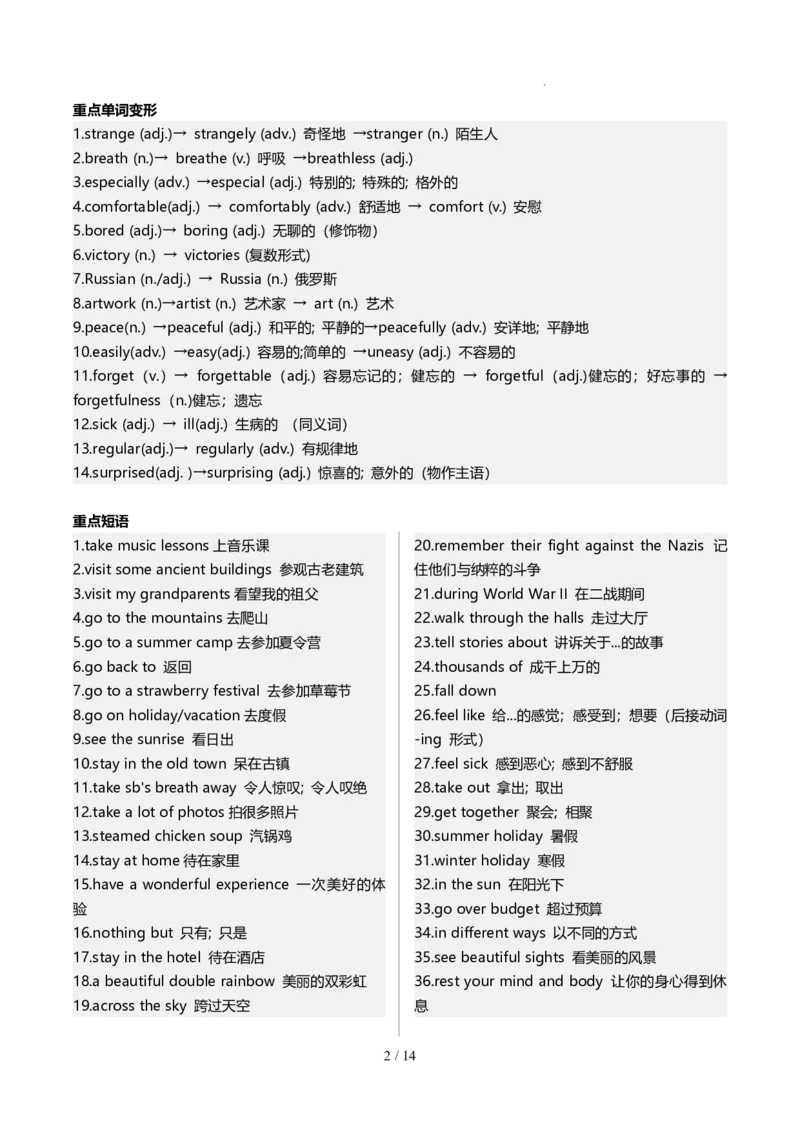
重点单词变形
1.strange (adj.)→strangely (adv.) 奇怪地→stranger (n.) 陌生人
2.breath (n.)→breathe (v.) 呼吸→breathless (adj.)
3.especially (adv.) →especial (adj.) 特别的; 特殊的; 格外的
4.comfortable(adj.) →comfortably (adv.) 舒适地→comfort (v.) 安慰
5.bored (adj.)→boring (adj.) 无聊的(修饰物)
6.victory (n.) →victories (复数形式)
7.Russian (n./adj.) →Russia (n.) 俄罗斯
8.artwork (n.)→artist (n.) 艺术家→art (n.) 艺术
9.peace(n.) →peaceful (adj.) 和平的; 平静的→peacefully (adv.) 安详地; 平静地
10.easily(adv.) →easy(adj.) 容易的;简单的→uneasy (adj.) 不容易的
11.forget(v.)→forgettable(adj.) 容易忘记的;健忘的→forgetful(adj.)健忘的;好忘事的→
forgetfulness(n.)健忘;遗忘
12.sick (adj.) →ill(adj.) 生病的(同义词)
13.regular(adj.)→regularly (adv.) 有规律地
14.surprised(adj. )→surprising (adj.) 惊喜的; 意外的(物作主语)
重点短语
1.take music lessons 上音乐课
2.visit some ancient buildings 参观古老建筑
3.visit my grandparents 看望我的祖父
4.go to the mountains 去爬山
5.go to a summer camp 去参加夏令营
6.go back to 返回
7.go to a strawberry festival 去参加草莓节
8.go on holiday/vacation 去度假
9.see the sunrise 看日出
10.stay in the old town 呆在古镇
11.take sb's breath away 令人惊叹; 令人叹绝
12.take a lot of photos 拍很多照片
13.steamed chicken soup 汽锅鸡
14.stay at home 待在家里
15.have a wonderful experience 一次美好的体
验
16.nothing but 只有; 只是
17.stay in the hotel 待在酒店
18.a beautiful double rainbow 美丽的双彩虹
19.across the sky 跨过天空
20.remember their fight against the Nazis 记
住他们与纳粹的斗争
21.during World War II 在二战期间
22.walk through the halls 走过大厅
23.tell stories about 讲诉关于...的故事
24.thousands of 成千上万的
25.fall down
26.feel like 给...的感觉;感受到;想要(后接动词
-ing 形式)
27.feel sick 感到恶心; 感到不舒服
28.take out 拿出; 取出
29.get together 聚会; 相聚
30.summer holiday 暑假
31.winter holiday 寒假
32.in the sun 在阳光下
33.go over budget 超过预算
34.in different ways 以不同的方式
35.see beautiful sights 看美丽的风景
36.rest your mind and body 让你的身心得到休
息
3 / 14
学科网(北京)股份有限公司
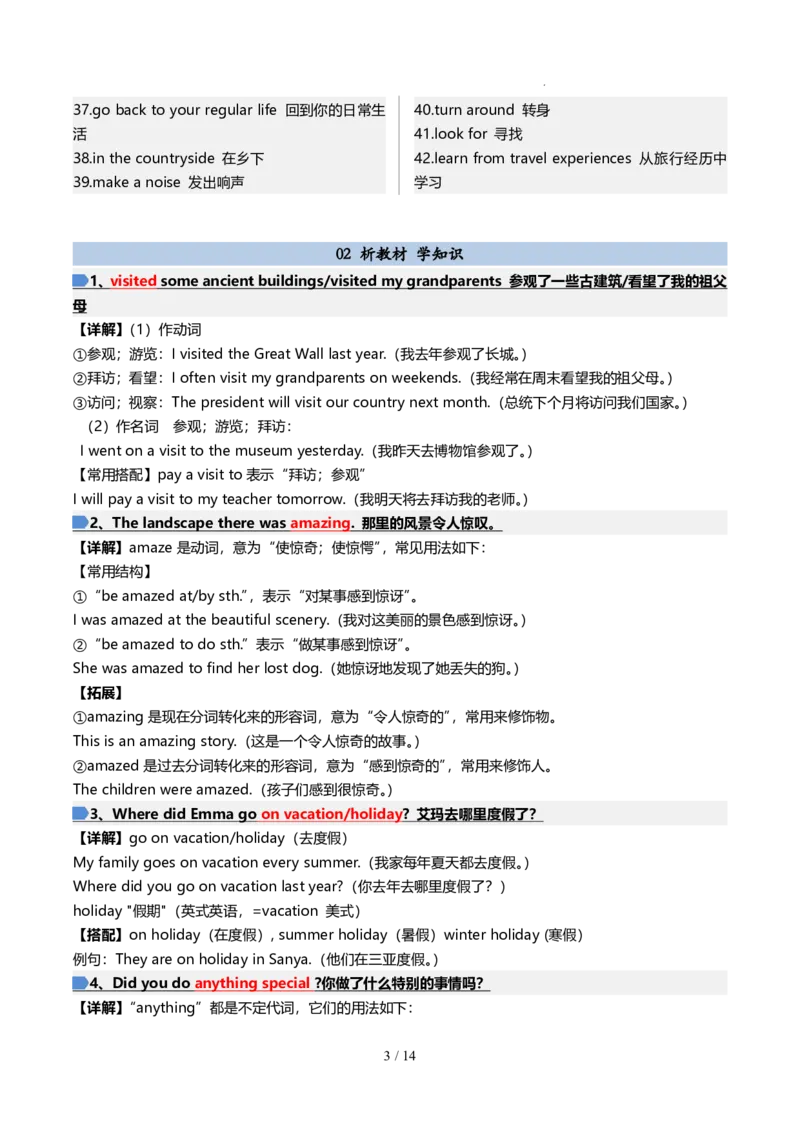
37.go back to your regular life 回到你的日常生
活
38.in the countryside 在乡下
39.make a noise 发出响声
40.turn around 转身
41.look for 寻找
42.learn from travel experiences 从旅行经历中
学习
02 析教材学知识
1、visited some ancient buildings/visited my grandparents 参观了一些古建筑/看望了我的祖父
母
【详解】(1)作动词
①参观;游览:I visited the Great Wall last year.(我去年参观了长城。)
②拜访;看望:I often visit my grandparents on weekends.(我经常在周末看望我的祖父母。)
③访问;视察:The president will visit our country next month.(总统下个月将访问我们国家。)
(2)作名词
参观;游览;拜访:
I went on a visit to the museum yesterday.(我昨天去博物馆参观了。)
【常用搭配】pay a visit to 表示“拜访;参观”
I will pay a visit to my teacher tomorrow.(我明天将去拜访我的老师。)
2、The landscape there was amazing. 那里的风景令人惊叹。
【详解】amaze 是动词,意为“使惊奇;使惊愕”,常见用法如下:
【常用结构】
①“be amazed at/by sth.”,表示“对某事感到惊讶”。
I was amazed at the beautiful scenery.(我对这美丽的景色感到惊讶。)
②“be amazed to do sth.”表示“做某事感到惊讶”。
She was amazed to find her lost dog.(她惊讶地发现了她丢失的狗。)
【拓展】
①amazing 是现在分词转化来的形容词,意为“令人惊奇的”,常用来修饰物。
This is an amazing story.(这是一个令人惊奇的故事。)
②amazed 是过去分词转化来的形容词,意为“感到惊奇的”,常用来修饰人。
The children were amazed.(孩子们感到很惊奇。)
3、Where did Emma go on vacation/holiday? 艾玛去哪里度假了?
【详解】go on vacation/holiday(去度假)
My family goes on vacation every summer.(我家每年夏天都去度假。)
Where did you go on vacation last year?(你去年去哪里度假了?)
holiday "假期"(英式英语,=vacation 美式)
【搭配】on holiday(在度假), summer holiday(暑假)winter holiday (寒假)
例句:They are on holiday in Sanya.(他们在三亚度假。)
4、Did you do anything special ?你做了什么特别的事情吗?
【详解】“anything”都是不定代词,它们的用法如下:
4 / 14
学科网(北京)股份有限公司
①用于肯定句
something:表示“某事;某物”,一般用于肯定句。
I have something to tell you.(我有某事要告诉你。)
②用于否定句和疑问句
anything:通常用于否定句和疑问句,意为“任何事物;任何东西”。
Is there anything wrong with your bike?(你的自行车有什么毛病吗?)
He didn't say anything.(他什么也没说。)
③特殊用法
在表示请求、建议或希望得到肯定回答的疑问句中,用“something”而不用“anything”。
Would you like something to drink?(你想要喝点什么吗?)
④不定代词与形容词的位置关系
不定代词与形容词连用时,形容词都要后置。
something interesting(有趣的事),anything important(任何重要的事)。
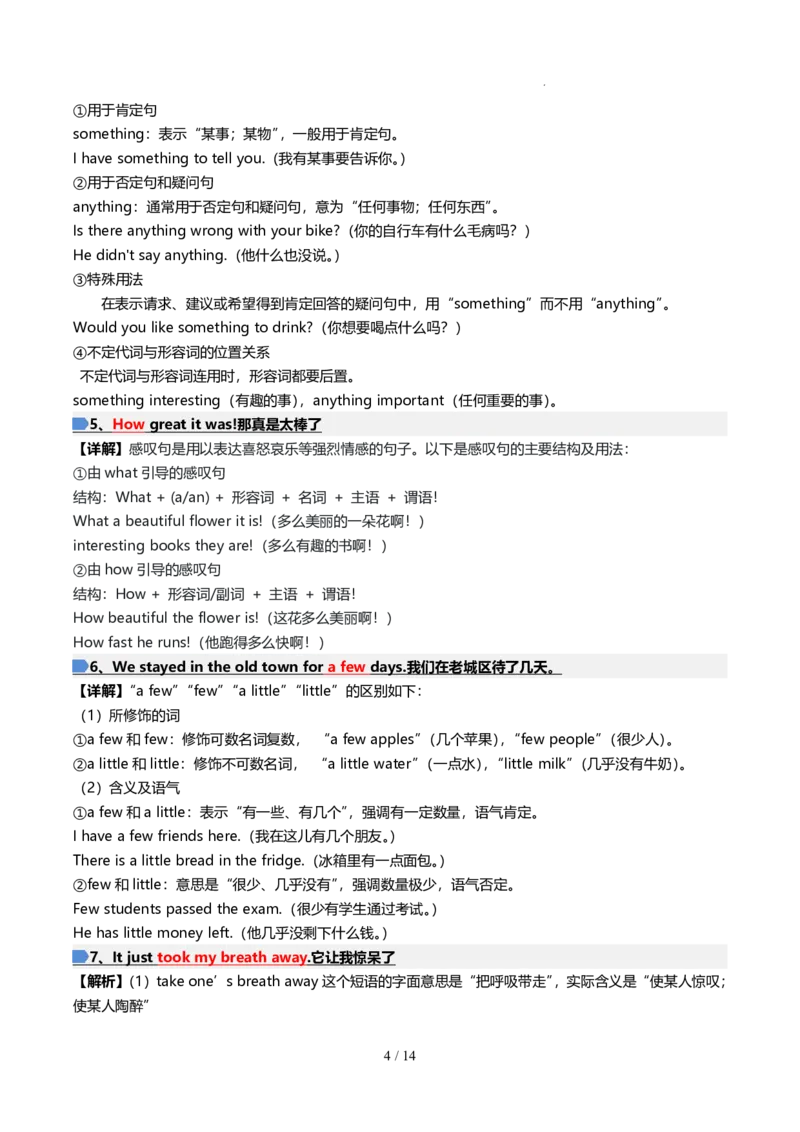
5、How great it was!那真是太棒了
【详解】感叹句是用以表达喜怒哀乐等强烈情感的句子。以下是感叹句的主要结构及用法:
①由what 引导的感叹句
结构:What + (a/an) + 形容词+ 名词+ 主语+ 谓语!
What a beautiful flower it is!(多么美丽的一朵花啊!)
interesting books they are!(多么有趣的书啊!)
②由how 引导的感叹句
结构:How + 形容词/副词+ 主语+ 谓语!
How beautiful the flower is!(这花多么美丽啊!)
How fast he runs!(他跑得多么快啊!)
6、We stayed in the old town for a few days.我们在老城区待了几天。
【详解】“a few”“few”“a little”“little”的区别如下:
(1)所修饰的词
①a few 和few:修饰可数名词复数,“a few apples”(几个苹果),“few people”(很少人)。
②a little 和little:修饰不可数名词,“a little water”(一点水),“little milk”(几乎没有牛奶)。
(2)含义及语气
①a few 和a little:表示“有一些、有几个”,强调有一定数量,语气肯定。
I have a few friends here.(我在这儿有几个朋友。)
There is a little bread in the fridge.(冰箱里有一点面包。)
②few 和little:意思是“很少、几乎没有”,强调数量极少,语气否定。
Few students passed the exam.(很少有学生通过考试。)
He has little money left.(他几乎没剩下什么钱。)
7、It just took my breath away.它让我惊呆了
【解析】(1)take one’s breath away 这个短语的字面意思是“把呼吸带走”,实际含义是“使某人惊叹;
使某人陶醉”
5 / 14
学科网(北京)股份有限公司
(2)breath”是名词,常见用法如下:
表示“呼吸;气息”
Take a deep breath.(做一次深呼吸。)
Her breath smelled of mint.(她呼出的气息有薄荷味。)
【固定搭配】
①“out of breath”意为“上气不接下气;喘不过气来”。
He ran so fast that he was out of breath.(他跑得太快,以至于上气不接下气。)
②“hold one's breath”表示“屏住呼吸”。
We held our breath when the magician did the dangerous trick.(当魔术师表演危险的魔术时,我们
都屏住了呼吸。)
③“catch one's breath”有“喘口气;恢复正常呼吸”的意思。
After running for a long time, he stopped to catch his breath.(跑了很长时间后,他停下来喘口气。)
8、Everything tasted great, especially the steamed chicken soup.一切都很好吃,尤其是蒸鸡汤。
【详解】especially 用法:“especially”是副词,意为“尤其;特别”,用来强调在众多事物中某一事物更
为突出或特别.
①用于句中;通常位于所修饰的词或短语之前。
I like all kinds of fruits, especially apples.(我喜欢各种水果,尤其是苹果。)
②用于句首;后接逗号,引出强调的内容。
Especially in summer, the weather is very hot here.(尤其是在夏天,这里的天气非常炎热。)
③用于句末;对前面提到的内容进行补充强调。
He is good at all subjects, English especially.(他各科都很好,尤其是英语。)
9、I just stayed at home to read, play games and relax.我只待在家里看书、玩游戏和放松。
【详解】relax 用法:“relax”是动词,意为“放松;休息;使放松”。
You should relax after a long day of work.(经过漫长的一天工作后,你应该放松一下。)
它既可以作不及物动词,如:I like to relax by listening to music.(我喜欢通过听音乐来放松。)
也可以作及物动词,如:The massage relaxed my muscles.(按摩使我的肌肉放松了。)
【拓展】
①“relaxing”是形容词,意为“令人放松的”,常用来描述事物,
This is a relaxing movie.(这是一部令人放松的电影。)
②“relaxed”也是形容词,意为“放松的;自在的”,常用来描述人,
He looks relaxed.(他看起来很放松。)
10、We had a wonderful experience.我们经历了一段美好的时光。
【详解】experience ①作名词:表示"经历;经验"
经历(可数):I have many interesting experiences in summer camp.(我在夏令营有许多有趣的经历。)
经验(不可数):She has rich teaching experience.(她有丰富的教学经验。)
②作动词:表示"经历;体验"
We experienced a heavy rain yesterday.(我们昨天经历了一场大雨。)
11、I got you something as a gift.我给你买了一份礼物
【详解】as 含义及用法
6 / 14
学科网(北京)股份有限公司
①作为连词
表示"当... 时"(引导时间状语从句):As I was reading, my mom called me.(我正在读书时,妈妈叫我。)
表示"因为"(引导原因状语从句):As it's raining, we can't go out.(因为下雨,我们不能出去。)
表示"像... 一样"(引导比较状语从句):She sings as beautifully as a bird.(她唱得像鸟儿一样动听。)
②作为介词:表示"作为" He works as a teacher.(他担任教师工作。)
12、It rained heavily when I arrived at the town, so I could do nothing but stay in the hotel.
当我到达小镇时,雨下得很大,我只能待在酒店里。
【详解】①rain heavily 表示"下大雨",副词heavily 修饰动词rain
同义表达:rain hard /a heavy rain(名词形式)
It rained heavily last night, so the streets were flooded.(昨晚雨下得很大,街道都被淹没了。)
②arrive at / arrive in
arrive at:后接小地点(如学校、车站)We arrived at the airport at 9 o'clock.(我们9 点到达机场。)
arrive in:后接大地点(如城市、国家)They arrived in Beijing yesterday.(他们昨天到达北京。)
【拓展】“get to”“reach”和“arrive in”都有“到达”的意思,但在用法上有一些区别:
get to:是较为口语化的表达,后接地点名词。I got to the station at 9 o'clock.(我9 点到达车站。)当
接副词时,如home、here、there 等,需省略to,get home(到家)。
reach:是及物动词,直接接地点名词或代词作宾语。They reached the top of the mountain at last.(他
们最终到达了山顶。)
arrive in:后接大地点,如城市、国家等。We arrived in Paris yesterday.(我们昨天到达巴黎。)若接小
地点则用“arrive at”,如:arrive at the airport(到达机场)。
【注意】get to 和arrive:是不及物动词,若要表达到达某地,必须借助介词。如果不明确到达的地点,
可用“arrive”单独使用。I don't know when he will arrive.(我不知道他什么时候到。)reach:是及物
动词,后面必须接宾语才能完整表达“到达”的意思,不能单独使用。
③nothing but 表示"只有;仅仅",后接名词或动词原形
He had nothing but a piece of bread for breakfast.(他早餐只有一片面包。)
【拓展】:nothing but + 动词原形(表示"只能做...")
I did nothing but wait for the bus.(我只能等公交车。)
They do nothing but relax, sleep or watch TV. (他们什么都没做,只是放松、睡觉或看电视。)
13、Someone had left a book in my room, and that was exactly what I needed.有人在我房间
里留下了一本书,这正是我所需要的。
【详解】①leave sth + 地点表示"把某物留在某地"
She left her book in the classroom.(她把书落在教室了。)
【区别】forget(忘记)不接地点,如:I forgot my book.(我忘记带书了。)
【注意】有关leave 的词组
leave + 某地“离开某地方”
leave + 某地+ for + 某地“离开某地方前往某地方”
leave for +某地方
“去某地方”相当于go to +某地方
②exactly 副词,表示"确切地;正好"
7 / 14
学科网(北京)股份有限公司
That's exactly what I want to say.(那正是我想说的。)
同义替换:just(刚好),precisely(精确地)
14、The bed was comfortable.床很舒服
【详解】“comfortable”是形容词,常见用法如下:
①作定语修饰名词
This is a comfortable chair.(这是一把舒适的椅子。)
②作表语;表示“感到舒适的;舒服的”,主语通常是人。
I feel comfortable in this room.(我在这个房间里感觉很舒适。)
③也可表示“(衣物、家具等)使人舒服的;舒适的”,主语通常是物。
This dress is very comfortable.(这条裙子很舒适。)
④用于“it is + comfortable + to do sth.”结构;表示“做某事是舒适的”。
It is comfortable to lie in bed.(躺在床上很舒服。)
【常用搭配】
①“be comfortable with”,表示“对……感到自在;适应……”。
She is comfortable with her new job.(她对新工作很适应。)
②“make oneself comfortable”,意为“使自己感到舒适;随便坐”。
Make yourself comfortable, and help yourself to some tea.(别客气,随便坐,喝点茶吧。)
【反义词】uncomfortable(不舒适的)
【派生词】comfort(名词,舒适);comfortably(副词,舒适地)
15、Everyone was ready to find somewhere to go.大家都准备好去某个地方了。
【解析】ready 作形容词;准备好的;
常与“be”动词搭配,构成“be ready (for sth./to do sth.)”结构,表示“准备好(做)某事”。
I am ready for the exam.(我为考试做好了准备。)
He is ready to go to school.(他准备好去上学了。)
【同义短语】be prepared to do sth
【拓展】get ready for sth(为某事做准备)
16、I was so bored that I decided to find something to read. 我感到非常无聊,决定找点东西
读。
【详解】(1)so…that…表示"如此... 以至于...",引导结果状语从句
结构:so + 形容词/ 副词+ that + 从句
She was so tired that she fell asleep at once.(她太累了,以至于立刻睡着了。)
【辨析】
①so... that...:“so”后接形容词或副词,“that”引导结果状语从句,意为“如此……以至于……”,强调程
度,引出结果。
He is so tired that he can't walk anymore.(他如此疲惫以至于再也走不动了。)
②so that:引导目的状语从句,意为“以便;为了”,表示目的。
He gets up early so that he can catch the first bus.(他早起以便能赶上第一班公交车。)
(2)decide 动词,表示"决定"
8 / 14
学科网(北京)股份有限公司
We decided to visit the museum this weekend.(我们决定这周末去参观博物馆。)
【名词形式】decision(决定)
【常用搭配】decide to do sth(决定做某事);make a decision(做决定)
17、I stood up and walked towards the window.我站起来走向窗户。
【详解】towards 介词,表示"朝;向"(强调方向)
He walked towards the park.(他朝公园走去。)
【辨析】“towards”和“to”都有“向”“朝”的意思,但在用法上有一些区别:
①towards:更强调朝着某个方向移动或接近,不一定到达目的地,侧重动作的方向感。
He walked towards the park.(他朝着公园的方向走去。)
②to:强调到达目的地或目标,有明确的方向性和终点。
He went to the park.(他去了公园。)
18、I decided to visit a town close to my city.我决定去访问一个离我城市很近的小镇。
【详解】“close”有多种词性和用法,以下是一些常见的情况:
①作动词;表示关闭:
Close the door, please.(请关上门。)
②作形容词;表示近的、接近的:常与“to”搭配
My house is close to the school.(我家离学校很近。)
③表示亲密的、密切的:
They are close friends.(他们是亲密的朋友。)
【拓展】“close”还有一些常见的短语搭配,如“close down”(关闭、停业),“close up”(关闭、愈合)
等。
19、The Russian people built this museum to remember their fight against the Nazis during
World War II.俄罗斯人民建造了这座博物馆,以纪念他们在第二次世界大战中与纳粹的斗争。
【详解】(1)“fight”的用法如下:
①作动词;表示战斗、作战:常与介词“against”或“with”搭配,“against”表示与对手对抗,“with”
可表示与某人并肩作战。
The soldiers fought against the enemy bravely.(士兵们勇敢地与敌人作战。);
They fought with each other to defend their country.(他们并肩作战保卫自己的国家。)
表示打架、斗殴:Don't fight in the schoolyard.(不要在校园里打架。)
表示努力争取、奋斗:常与“for”搭配。They fought for freedom.(他们为自由而奋斗。)
②作名词
表示战斗、斗争:The fight between the two countries lasted for years.(两国之间的战斗持续了多年。)
表示打架、争吵:There was a fight in the street last night.(昨晚街上发生了一场打架事件。)
表示斗志、战斗力:The team showed great fight in the second half.(球队在下半场表现出很强的斗志。)
(2)during 介词:表示"在... 期间", 后接时间段或具体事件(如假期、会议等)
During the summer holiday, I visited Beijing.(暑假期间,我去了北京。)
20、In one hall, I saw an artwork with thousands of glass “tears” falling down.在一个大
厅里,我看到了一件艺术作品,上面有成千上万的玻璃“眼泪”垂落下来。
9 / 14
学科网(北京)股份有限公司
【详解】①thousands of 数词短语:表示"成千上万的", 后接可数名词复数
Thousands of birds fly south in winter.(冬天有成千上万的鸟南飞。)
注意:前面有具体数字后不加s(two thousand people); 前面没有具体数字,thousand 变复数,再加
of(thousands of people)
②with 介词短语:表示"带有;伴随"
结构:with + 名词/形容词/ 介词短语/ 分词
⑴表状态:He came in with a smile.(他微笑着进来。)
⑵表携带:She went out with an umbrella.(她带伞出去了。)
⑶表原因:He shivered with cold.(他冷得发抖。)
位置:可放在句首或句末
③see…doing…看见某人正在做某事
【辨析】
*see sb do sth:强调看到动作的全过程或经常看到某人做某事。
I often see him play basketball on the playground.(我经常看到他在操场上打篮球,强调这是一个经
常发生的、完整的动作过程。)
*see sb doing sth:强调看到某人正在做某事,侧重动作在某个时间点正在进行。
I saw him playing basketball when I passed by the playground.(我路过操场时看到他正在打篮球,强
调在路过那个时刻,他打篮球的动作正在进行。)
21、It reminds us that war is terrible and peace does not come easily.它提醒我们战争是可怕
的,和平并不容易获得。
【详解】remind 动词:表示"提醒;使想起"
常用搭配:①remind sb of sth(使某人想起某事)
The photo reminds me of my grandma.(这张照片让我想起奶奶。)
②remind sb to do sth(提醒某人做某事)
Please remind me to bring my homework.(请提醒我带作业。)
22、I didn’t feel like eating because I felt sick.我感觉不舒服,所以没有胃口。
【详解】(1)feel like 动词短语:
①表示"想要"后接动名词(-ing 形式)(= want to do sth)
I feel like eating ice cream.(我想吃冰淇淋。)
②表示"感觉像"后接名词/ 代词
It feels like a dream.(这感觉像一场梦。)
(2)“sick”和“ill”都有“生病的”意思,但在用法上存在一些区别:
①sick:既可以作表语,也可以作定语。作定语时,常表示“生病的;恶心的;呕吐的”。
He is a sick man.(他是个病人。)I feel sick.(我觉得恶心。)
②ill:一般作表语,较少作定语。作定语时,常表示“坏的;有害的”等意思,而不是“生病的”。
He is ill.(他生病了。)ill news(坏消息)
23、We were so happy that we didn’t notice the time.我们太开心了,以至于没有注意到时间。
【详解】notice ①动词:"注意到", 搭配:notice sb do sth(注意到某人做了某事)notice sb doing sth
10 / 14
学科网(北京)股份有限公司
(注意到某人正在做某事)
I noticed him reading a book when I came in.(我进来时注意到他正在读书,强调进来那一刻他读书的
动作正在发生。)
I often notice her help the old man.(我经常注意到她帮助那位老人,强调这是一个经常发生的完整动
作过程。)②名词:"通知"(可数)
There's a notice on the wall.(墙上有一则通知。)
24、It was such a good experience. 那是一次很好的经历。
【详解】“so”和“such”都有“如此、这样”的意思,它们的辨析如下:
①so:是副词,用来修饰形容词或副词。
The book is so interesting.(这本书如此有趣,修饰形容词“interesting”。)
He runs so fast.(他跑得如此快,修饰副词“fast”。)
②such:是形容词,用来修饰名词。
It is such a beautiful day.(这是如此美好的一天,修饰名词“day”。)
They are such lovely flowers.(它们是如此可爱的花,修饰名词“flowers”。)
25、Don’t spend too much time on holiday shopping, or you might easily go over budget.
不要在假期购物上花费太多时间,否则很容易超出预算。
【详解】(1)“spend”“cost”“pay”和“take”都有表示“花费”的意思,但它们在用法上有一些区别:
①spend:主语通常是人。Sb+spend +时间/钱+ on sth /(in) doing sth .
I spent two hours reading the book.(我花了两个小时读这本书。)
②cost:主语是物或某种活动。Sth + cost +sb + 钱。
The book cost me 20 yuan.(这本书花了我20 元。)
③pay:主语是人。Sb + pay +钱+ for + sth .
He paid 100 dollars for the shoes.(他为这双鞋付了100 美元。)
④take:常用于“It takes/took sb + 时间+ to do sth”结构中,it 作形式主语,真正的主语是后面的动
词不定式。It took me half an hour to get to school.(我花了半个小时到学校。)
(2)or 表示"否则", 用法:用于"祈使句+ or + 结果句",表示"否则会..."
Hurry up, or you'll be late.(快点,否则会迟到。)
Study hard, or you won't pass the exam.(努力学习,否则考试不及格。)
26、I’m getting a little forgetful these days.我最近有点健忘。
【详解】forgetful 形容词:"健忘的", 搭配:be forgetful of(忘记...)
My grandpa is forgetful of his keys.(爷爷总是忘记带钥匙。)
【词根】forgetful(形容词,健忘的)→forget(动词,忘记)
【辨析】“forget to do”和“forget doing”的区别如下:
①forget to do sth:表示忘记去做某事,动作尚未发生。
I forgot to post the letter.(我忘记去寄信了,信还没有寄。)
②forget doing:表示忘记做过某事,动作已经完成。
He forgot locking the door.(他忘记自己已经锁了门,门已经锁上了。)
11 / 14
学科网(北京)股份有限公司
03 练习题讲典例
根据下面的对话情景,在每个空白处填上一个适当的句子,使对话的意思连贯、完整。
A: Hi, Scott! Long time no see.
1
?
B: Not bad. I heard you went on vacation, right?
2
?
A: Yeah, I went to Kaifeng.
B: How did you get there?
A:
3
.
B: Did you go with your family?
A: Yes, I did. And we had great fun.
B:
4
?
A: We went to many fantastic places, such as the Millennium City Park (清明上河园) and the Lord
Bao Memorial Temple (包公祠). And we took lots of photos.
B:
5
?
A: For a week. What about you?
B: I go to the gym every day. I like sports, you know. Oh, it’s time to do sports now. Bye-bye.
A: Bye.
04 练考点强知识
考点1 感叹句
1.— ________ honest boy you are !
—Thank you!
A.What an
B.What a
C.How
D.How an
2.—________ beautiful Lijiang Ancient Town is!
—So it is! Many people visit it every day.
A.What a
B.What
C.How
D.How a
考点2 形容词与不定代词的位置关系
—Is your sister ill?
—Don’t worry. It’s _______, only a little cold.
A.serious anything
B.nothing serious
C.serious nothing
D.anything
serious
考点3
a few/ few / a little /little
We have ________ time left before the meeting, so sit down and have a rest.
A.a few
B.few
C.a little
D.little
考查代词辨析。a few 一些,少许,修饰可数名词复数;few 很少,不多,修饰可数名词复数;a little 有
一点,修饰不可数名词;little 几乎没有,修饰不可数名词。根据“so sit down and have a rest”可知,
还有一点时间可以休息,time 是不可数名词。故选C。
考点4
nothing but
—What can I do?
12 / 14
学科网(北京)股份有限公司
—You can do nothing but ________.
A.wait
B.to wait
C.waited
D.waiting
考点5
be ready to do sth
He is always ready ______ others.
A.help
B.to help
C.helping
D.helped
考点6
so...that ...的用法
This morning, I went to school by bus. The bus was ________ slow ________ I arrived late for school.
A.so; that
B.such; that
C.too; to
D.enough; to
考点7
thousands of 的用法
1.Two ________ teachers and ________ students took part in a meeting last week.
A.hundreds; thousand of
B.hundred; thousand
C.hundreds of; thousands of
D.hundred; thousands of
2.There are five hundred books in our library. But only ________ them are new.
A.two hundred B.two hundred of
C.two thousand
D.two thousand of
考点8
remind 的用法
Dale, please remind me ________ the windows after school. I’m so forgetful now.
A.to closing
B.closing
C.close
D.to close
考点9
feel like 的用法
When it’s raining, I don’t feel like ________ outside.
A.go
B.going
C.to go
D.to going
考点10
notice 的用法
When I arrived home, I noticed my sister ________ with her toys.
A.plays
B.played
C.to play
D.playing
05 过关测稳提升
一、单项选择
1.There are ________ mistakes in Alice’s homework, so her teacher is pleased with her.
A.little
B.few
C.a little
D.a few
2.There isn’t ________ in today’s newspaper. I want to watch TV instead.
A.anything new B.new anything
C.something new
D.new something
3.—My parents were ________ at my ________ grades.
—Really? You did very well.
A.amazed; amazed
B.amazing; amazing
C.amazed; amazing
D.amazing; amazed
4.________ interesting park the Heilongtan Park is!
A.How
B.What a
C.What
D.What an
5.I like the ________ in the restaurant, ________ the beef noodles.
13 / 14
学科网(北京)股份有限公司
A.special; specially
B.specials; especially
C.specials; specially
D.special; especially
6.My mother is a traveller with _________, and she has some amazing _________.
A.experience; experiences
B.experience; experience
C.experiences;
experience
D.experiences; experiences
7.Two years ago, she __________a nurse in this hospital.
A.works for
B.works as
C.worked in
D.worked as
8.—Would you come to the party tomorrow?
—I’d love to, but I’ll have to prepare for my exam.
A.pay for
B.look for
C.get ready for
D.stay up
9.He walks ________ the bridge and goes ________ the police station.
A.cross; past
B.across; towards
C.through; to
D.over; through
10.To my surprise, ________ a little boy can draw ________ many beautiful pictures.
A.so; so
B.so; such
C.such; so
D.such; such
11.—It ________ me 15 minutes to listen to English every morning.
—That’s good. It’s necessary for you to ________ some time improving your English.
A.cost; take
B.spends; take
C.takes; spend
D.take; spend
12.The koalas sleep ________ the day, but ________ night they get up and eat leaves.
A.during; at
B.at; during
C.in; at
D.at; in
二、填写单词
1. A beautiful b______ (彩虹) often appears in the sky after heavy rain.
2. I want to visit Shanghai for v______ (度假) because I want to visit the Oriental Pearl Tower.
3. Every year, thousands of tourists come to visit the Lijiang A______ (古老的) Town.
4. — What did Tom do last week? — He went c______ (野营) with his friends.
5. In winter, most people like to wear s______ (围巾) to keep warm when they go out.
6.He wanted to be a g
(导游) so he could travel around.
7. For the Spring Festival , I' ll make a b
(预算) for our family.
8. Tom is tall and strong but he never f
(打架) with others.
9. Our school's basketball team has won several v
(胜利) in the recent competitions.
10. We visited Tian’ anmen S
(广场) and then walked to the P
(宫殿) Museum.
Both places were really cool!
三、用所给词的适当形式填空
1. This pair of gloves was so small that I felt ______ (comfortable).
2. Last evening, my grandfather did nothing but ______ (repair) the bicycle.
3. Cloth shoes became popular during the Qing Dynasty, ______ (especially) in Jiangsu Province.
4. I found the book ______, but my classmate didn’t seem ______ at all. (bore)
5. We don’t know the man under the tree. He is a ______. Look! He’s doing something ______. His
behaviour is really ______. Can you guess what he wants to do? (strange)
14 / 14
学科网(北京)股份有限公司
6.He wondered how she could finish the task quickly and
(easy).
7. Some
(Russia) students are coming to our school to study Chinese.
8. If you
(probable) know, I'm going to change my job soon.
9. We were quite
when we heard the
news.(surprise)
10. My father is over 90 years old. He always
things. But he doesn't think he's
(forget)
四、完成句子
1.那时候,晚上除了看电视没事可做。
There was nothing
but
TV in the evening at that time.
2.在暑假期间,我们经常划船穿过宁静的湖面。
During our summer vacation, we often
across the peaceful lake.
3.塔斯马尼亚位于澳大利亚南端。它以自然风景而闻名。
In the south end of Australia is Tasmania. It
its natural scenery.
4.数以千计的星星在天空闪烁。
stars shine in the sky.
5.我的家人相聚在一起并且吃一顿丰盛的大餐。
My family will
and have a big dinner.
6. 当我们终于找到它时, 这座寺庙的建筑令我们惊叹不已。
When we finally found it, the buildings of the temple ____ _____ _____ _____.
7. 晚上的寺庙尤其安静, 这让我们感到很舒服。
The temple at night was _______ quiet and made us feel _______.
8.这次旅行真的是极好的, 我们玩得很开心。
This trip was really _______ and we enjoyed ourselves.