文档文本内容
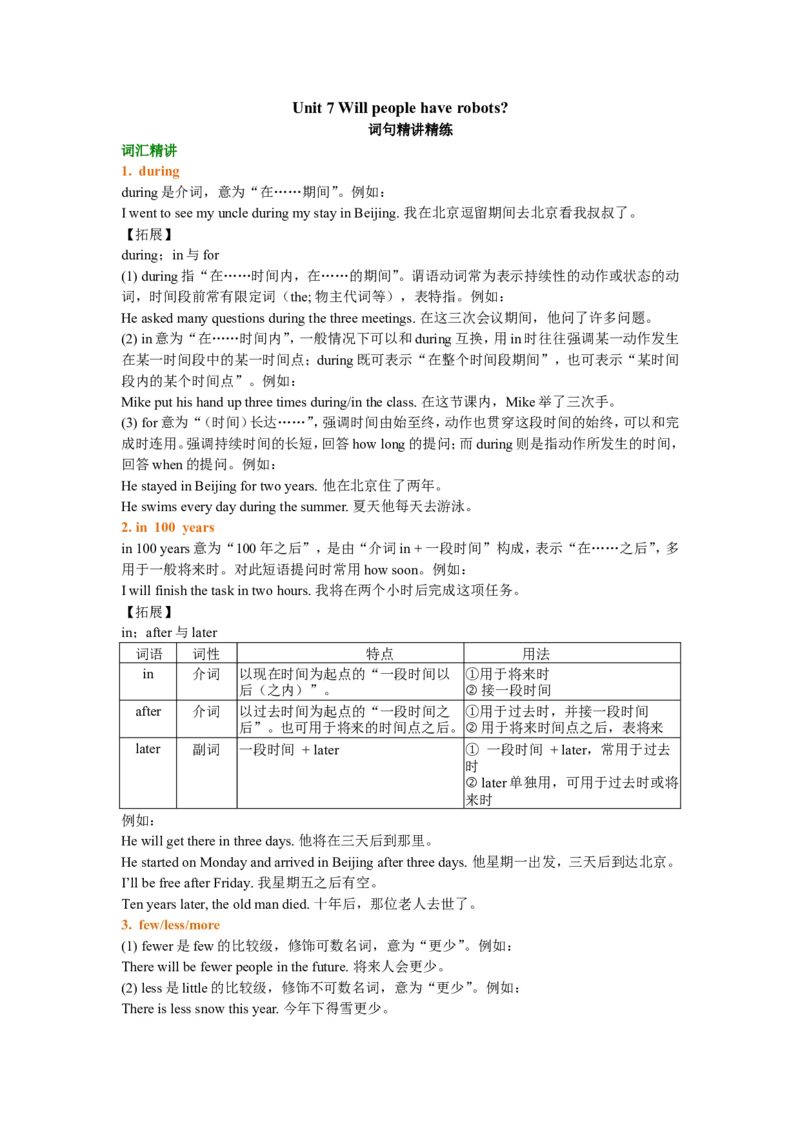
Unit 7 Will people have robots?
词句精讲精练
词汇精讲
1. during
during 是介词,意为“在……期间”。例如:
I went to see my uncle during my stay in Beijing. 我在北京逗留期间去北京看我叔叔了。
【拓展】
during;in 与for
(1) during 指“在……时间内,在……的期间”。谓语动词常为表示持续性的动作或状态的动
词,时间段前常有限定词(the; 物主代词等),表特指。例如:
He asked many questions during the three meetings. 在这三次会议期间,他问了许多问题。
(2) in 意为“在……时间内”,一般情况下可以和during 互换,用in 时往往强调某一动作发生
在某一时间段中的某一时间点;during 既可表示“在整个时间段期间”,也可表示“某时间
段内的某个时间点”。例如:
Mike put his hand up three times during/in the class. 在这节课内,Mike 举了三次手。
(3) for 意为“(时间)长达……”,强调时间由始至终,动作也贯穿这段时间的始终,可以和完
成时连用。强调持续时间的长短,回答how long 的提问;而during 则是指动作所发生的时间,
回答when 的提问。例如:
He stayed in Beijing for two years. 他在北京住了两年。
He swims every day during the summer. 夏天他每天去游泳。
2. in 100 years
in 100 years 意为“100 年之后”,是由“介词in + 一段时间”构成,表示“在……之后”,多
用于一般将来时。对此短语提问时常用how soon。例如:
I will finish the task in two hours. 我将在两个小时后完成这项任务。
【拓展】
in;after 与later
 词语
 词性
         特点
    用法
  in
 介词
以现在时间为起点的“一段时间以
后(之内)”。
①用于将来时
②接一段时间
 after
 介词
以过去时间为起点的“一段时间之
后”。也可用于将来的时间点之后。
①用于过去时,并接一段时间
②用于将来时间点之后,表将来
 later
 副词
一段时间 + later
① 一段时间 + later,常用于过去
时
② later 单独用,可用于过去时或将
来时
例如:
He will get there in three days. 他将在三天后到那里。
He started on Monday and arrived in Beijing after three days. 他星期一出发,三天后到达北京。
I’ll be free after Friday. 我星期五之后有空。
Ten years later, the old man died. 十年后,那位老人去世了。
3. few/less/more
(1) fewer 是few 的比较级,修饰可数名词,意为“更少”。例如:
There will be fewer people in the future. 将来人会更少。
(2) less 是little 的比较级,修饰不可数名词,意为“更少”。例如:
There is less snow this year. 今年下得雪更少。
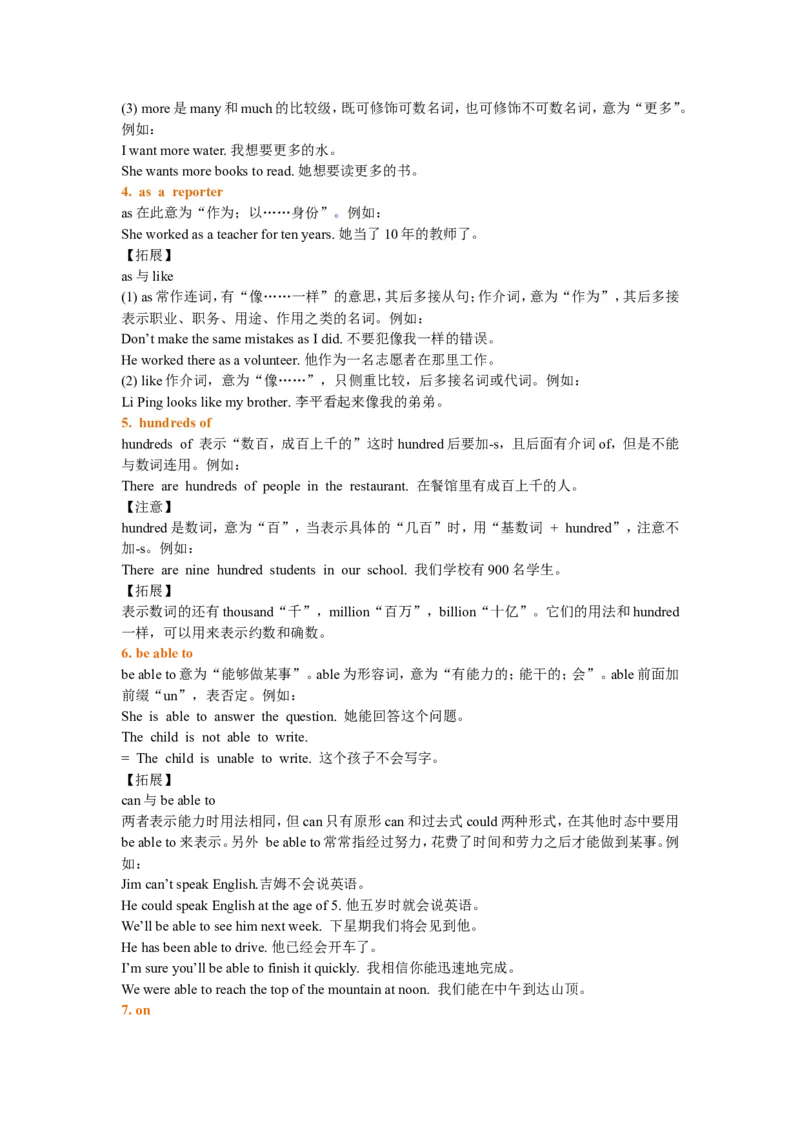
(3) more 是many 和much 的比较级,既可修饰可数名词,也可修饰不可数名词,意为“更多”。
例如:
I want more water. 我想要更多的水。
She wants more books to read. 她想要读更多的书。
4. as a reporter
as 在此意为“作为;以……身份”。例如:
She worked as a teacher for ten years. 她当了10 年的教师了。
【拓展】
as 与like
(1) as 常作连词,有“像……一样”的意思,其后多接从句;作介词,意为“作为”,其后多接
表示职业、职务、用途、作用之类的名词。例如:
Don’t make the same mistakes as I did. 不要犯像我一样的错误。
He worked there as a volunteer. 他作为一名志愿者在那里工作。
(2) like 作介词,意为“像……”,只侧重比较,后多接名词或代词。例如:
Li Ping looks like my brother. 李平看起来像我的弟弟。
5. hundreds of
hundreds of 表示“数百,成百上千的”这时hundred 后要加-s,且后面有介词of,但是不能
与数词连用。例如:
There are hundreds of people in the restaurant. 在餐馆里有成百上千的人。
【注意】
hundred 是数词,意为“百”,当表示具体的“几百”时,用“基数词 + hundred”,注意不
加-s。例如:
There are nine hundred students in our school. 我们学校有900 名学生。
【拓展】
表示数词的还有thousand“千”,million“百万”,billion“十亿”。它们的用法和hundred
一样,可以用来表示约数和确数。
6. be able to
be able to 意为“能够做某事”。able 为形容词,意为“有能力的;能干的;会”。able 前面加
前缀“un”,表否定。例如:
She is able to answer the question. 她能回答这个问题。
The child is not able to write.
= The child is unable to write. 这个孩子不会写字。
【拓展】
can 与be able to
两者表示能力时用法相同,但can 只有原形can 和过去式could 两种形式,在其他时态中要用
be able to 来表示。另外 be able to 常常指经过努力,花费了时间和劳力之后才能做到某事。例
如:
Jim can’t speak English.吉姆不会说英语。
He could speak English at the age of 5. 他五岁时就会说英语。
We’ll be able to see him next week. 下星期我们将会见到他。
He has been able to drive. 他已经会开车了。
I’m sure you’ll be able to finish it quickly. 我相信你能迅速地完成。
We were able to reach the top of the mountain at noon. 我们能在中午到达山顶。
7. on
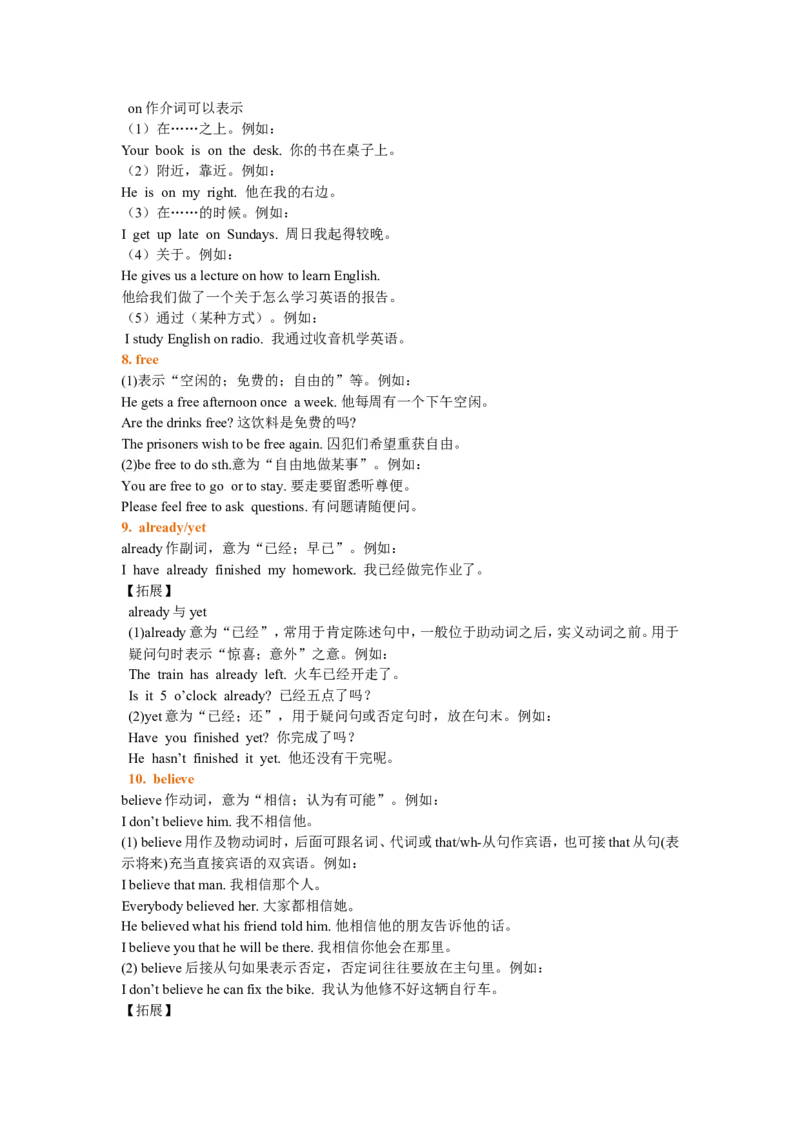
on 作介词可以表示
(1)在……之上。例如:
Your book is on the desk. 你的书在桌子上。
(2)附近,靠近。例如:
He is on my right. 他在我的右边。
(3)在……的时候。例如:
I get up late on Sundays. 周日我起得较晚。
(4)关于。例如:
He gives us a lecture on how to learn English.
他给我们做了一个关于怎么学习英语的报告。
(5)通过(某种方式)。例如:
 I study English on radio. 我通过收音机学英语。
8. free
(1)表示“空闲的;免费的;自由的”等。例如:
He gets a free afternoon once a week. 他每周有一个下午空闲。
Are the drinks free? 这饮料是免费的吗?
The prisoners wish to be free again. 囚犯们希望重获自由。
(2)be free to do sth.意为“自由地做某事”。例如:
You are free to go or to stay. 要走要留悉听尊便。
Please feel free to ask questions. 有问题请随便问。
9. already/yet
already 作副词,意为“已经;早已”。例如:
I have already finished my homework. 我已经做完作业了。
【拓展】
 already 与yet
(1)already 意为“已经”,常用于肯定陈述句中,一般位于助动词之后,实义动词之前。用于
疑问句时表示“惊喜;意外”之意。例如:
 The train has already left. 火车已经开走了。
Is it 5 o’clock already? 已经五点了吗?
 (2)yet 意为“已经;还”,用于疑问句或否定句时,放在句末。例如:
 Have you finished yet? 你完成了吗?
 He hasn’t finished it yet. 他还没有干完呢。
 10. believe
believe 作动词,意为“相信;认为有可能”。例如:
I don’t believe him. 我不相信他。
(1) believe 用作及物动词时,后面可跟名词、代词或that/wh-从句作宾语,也可接that 从句(表
示将来)充当直接宾语的双宾语。例如:
I believe that man. 我相信那个人。
Everybody believed her. 大家都相信她。
He believed what his friend told him. 他相信他的朋友告诉他的话。
I believe you that he will be there. 我相信你他会在那里。
(2) believe 后接从句如果表示否定,否定词往往要放在主句里。例如:
I don’t believe he can fix the bike. 我认为他修不好这辆自行车。
【拓展】
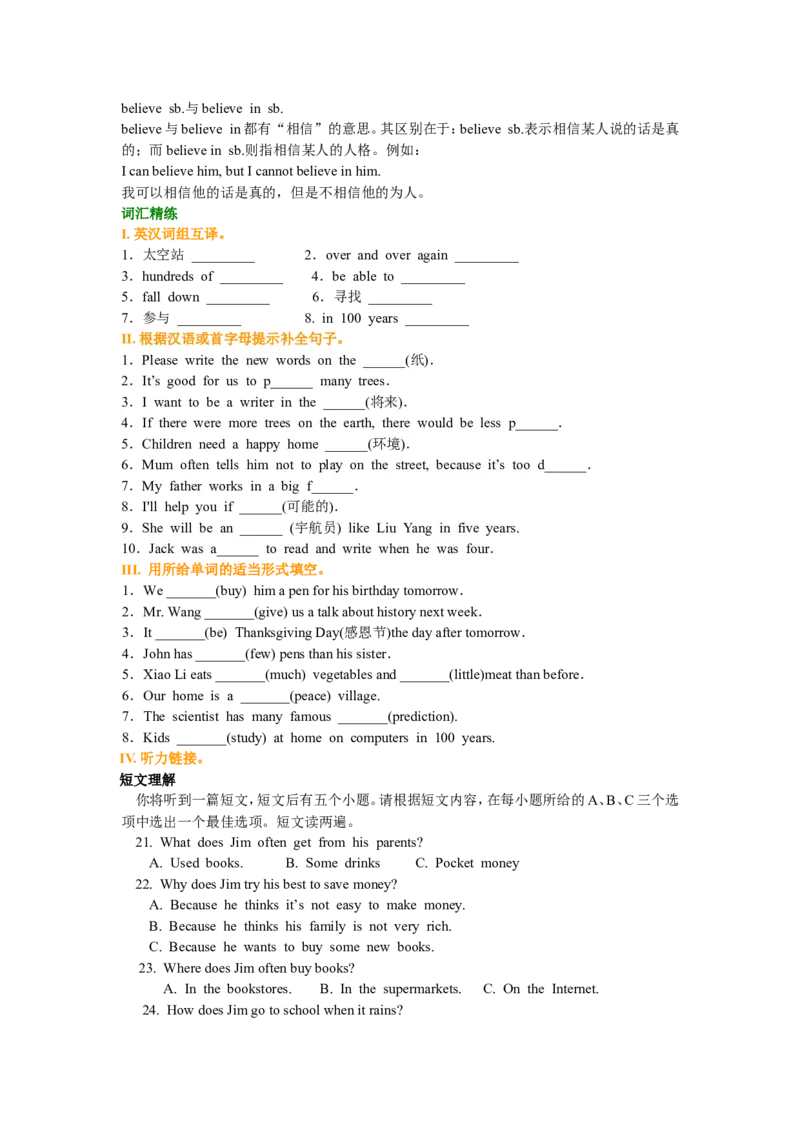
believe sb.与believe in sb.
believe 与believe in 都有“相信”的意思。其区别在于:believe sb.表示相信某人说的话是真
的;而believe in sb.则指相信某人的人格。例如:
I can believe him, but I cannot believe in him.
我可以相信他的话是真的,但是不相信他的为人。
词汇精练
I. 英汉词组互译。
1.太空站 _________       2.over and over again _________
3.hundreds of _________    4.be able to _________
5.fall down _________      6.寻找 _________
7.参与 _________         8. in 100 years _________
II. 根据汉语或首字母提示补全句子。
1.Please write the new words on the ______(纸).
2.It’s good for us to p______ many trees.
3.I want to be a writer in the ______(将来).
4.If there were more trees on the earth, there would be less p______.
5.Children need a happy home ______(环境).
6.Mum often tells him not to play on the street, because it’s too d______.
7.My father works in a big f______.
8.I'll help you if ______(可能的).
9.She will be an ______ (宇航员) like Liu Yang in five years.
10.Jack was a______ to read and write when he was four.
III. 用所给单词的适当形式填空。
1.We _______(buy) him a pen for his birthday tomorrow.
2.Mr. Wang _______(give) us a talk about history next week.
3.It _______(be) Thanksgiving Day(感恩节)the day after tomorrow.
4.John has _______(few) pens than his sister.
5.Xiao Li eats _______(much) vegetables and _______(little)meat than before.
6.Our home is a _______(peace) village.
7.The scientist has many famous _______(prediction).
8.Kids _______(study) at home on computers in 100 years.
IV. 听力链接。
短文理解
  你将听到一篇短文,短文后有五个小题。请根据短文内容,在每小题所给的A、B、C 三个选
项中选出一个最佳选项。短文读两遍。
21. What does Jim often get from his parents?
A. Used books.      B. Some drinks     C. Pocket money
22. Why does Jim try his best to save money?
    A. Because he thinks it’s not easy to make money.
    B. Because he thinks his family is not very rich.
    C. Because he wants to buy some new books.
 23. Where does Jim often buy books?
    A. In the bookstores.    B. In the supermarkets.   C. On the Internet.
24. How does Jim go to school when it rains?
   A. On foot.      B. By bus.      C. By bike.
25. What does the speaker think of Jim?
   A. Poor.         B. Good.       C. Silly.

【参考答案】
I. 英汉词组互译。
1.space station    2.多次;反复地            3.许多;大量
4.能够做某事    5.倒下;跌倒;倒塌        6.look for
7.play a part     8. 一百年以后
II. 根据句意及首字母填空。
1.paper  2.plant  3.future  4.pollution  5.environment
6.dangerous  7.factory  8.possible  9.astronaut  10.able
III. 用所给单词的适当形式填空。
1.will buy   2.will give    3.will be    4.fewer    5.more;less
6.peaceful   7.predictions  8.will study
IV. 听力链接。
21. C   22. A   23. C  24. A   25. B
短文理解
  你将听到一篇短文,短文后有五个小题。请根据短文内容,在每小题所给的A、B、C 三个选
项中选出一个最佳选项。短文读两遍。
   Jim’s parents work very hard and his family has become very rich. As the only child
in his family, he often gets some pocket money from his parents, but he tries his best to
save money because he thinks it’s not easy for his parents to make money.
   Jim likes reading. He often buys some used books on the Internet because they’re
cheaper. And when he has free time, he often goes to libraries to do some reading.
   Jim usually goes to school by bike. When it rains, he walks. And this also helps to
keep him healthy.
   Jim always brings a bottle of water to school. When other students drink juice, he
enjoys his water. He thinks water is the cheapest but best drink.
   Some students think Jim is poor. But I think he is a good boy. What do you think of
him?
句式精讲
1. Do you think…?
Do you think…? 意为“你认为……?”通常用来征求对方的意见或看法。后面常接宾语从
句,从句用陈述语序。简略回答应根据从句内容。例如:
— Do you think he will come here?你认为他会来这里吗?
— Yes, he will. 是的,他会的。
【拓展】
do you think 还可用作插入语,在特殊疑问句中放在特殊疑问词之后,疑问句其他部分用陈
述句语序。例如:
What do you think the robot will do? 你认为这个机器人将会做什么?
Where do you think he will be? 你认为他会在哪里?
2. There will be…
There will be 是there be 句型的将来时形式,也可用there is/are going to be…来表将来时。
例如:
There will / are going to be a lot of personal cars in our town.
在我们小镇上将有许多私家车。
There will/is going to be a football match in our school tomorrow.
明天我们学校将有一场足球比赛。
【注意】
there 与be 动词连用表示“有”,不能与have 连用出现在同一句话中。
3. However, some scientists believe that although we can make robots move like people…
此句中make 作使役动词,make sb. do sth.意为“使/让某人做某事”,后接省略to 的动词不
定式,类似的动词还有let,have 等。例如:
The boss made them work for long time. 老板让他们长时间工作。
They made us forget the past. 他们使我们忘记了过去。
【注意】
make 在被动用法中,动词前必须要加上to。例如:
She is made to repeat the whole story.
她被要求重述一遍整个故事。
4. Scientists are now trying to make robots look like humans…
try 意为“努力、试图、尽力做某事”。可作及物动词或不及物动词。作及物动词时,可构成以
下结构:
         sth. 尝试某事
   try    to do sth. 尽力做某事
         doing sth. 尝试做某事
例如:
I’ve tried the new machine. 我已经试过了这台新机器。
We’ll try to answer all the questions. 我们将尽量回答所有的问题。
We tried growing our own vegetables. 我们尝试自己种菜。
【拓展】
try 的相关短语:
try one’s best to do sth. 相当于do one’s best to do sth.意为“尽某人最大努力……”。
try on 试穿
try out 试用,试验
have a try 试一试
5. Some will look like humans, and others might look like animals.
look like 意为“看起来像……” 应用范围最广,除了描述人、物之外,也能抽象表达事件或
现象。例如:
He looks like a famous movie star. 他看起来像一个电影明星。
That bicycle looks just like the one I used to have. 那个自行车看起来像我曾经拥有的那
个。
It looks like it's going to rain soon. 天看起来要下雨。
【拓展】
(1) take after 意为“像……,与……相似”。最常见的是用在有血缘关系的亲子之间,外貌
用的最多,也能够用在性格脾气这些内在特质上。例如:
She took after her mother almost in everything.  她几乎与她母亲一模一样。
Adam is my grandfather and I take after him. 亚当是我的祖父,我和他很相像
(2)be similar to 意为“与……相似”,一般用在相近似的物品和情境的对比上。例如:
His problem is similar to yours. 他的问题和你的相似。
句式精练
I. 根据汉语提示,完成句子,每空一词。
1.机器人将来会帮我们做家务。
  The robots _______ _______ us _______ housework in the future.
2.没有人知道将来会发生什么事。
  No one knows what _______ _______ in the future.
3.孩子们将不用上学了,他们在家里用电脑学习。
  Children _______ go to school.They _______ _______ at home on computers.
4.100 年之后人们还使用钱吗?
  _______ people _______ money _______ 100 years?
5.明天的天气如何?
  What _______ the weather _______ _______ tomorrow?
6.我和我最好的朋友住在一所公寓里。
  I ______ in ______ ______ with my best friend.
7.今年我将要去香港度假。
  I’ll ______ a ______ in Hong Kong this year.
8.机器人能够反复地做一些简单的工作。
   Robots can do ______ jobs ______ ______ _____ _______.
9.对孩子们来说醒来并知道他们在哪里是容易的。
   It’s easy for children ______ ______ ______ and know where they are.
10.蛇形机器人能够帮助寻找压在建筑物下面的人。
  Snake robots are ______ ______ help ______ ______ people under the buildings.
II. 句型转换,按要求完成下列句子。
1.There were some trees near the river.(用next year 改写句子)
  There _______ _______ some trees near the river next year.
2.Will they stay at home on Sunday?(作否定回答)
  _______,_______ _______
3.Will the flowers come out soon?(作肯定回答)
  _______,_______ _______
4.We'll go out for a walk with you.(改为否定句)
  We _______ _______ out for a walk with you.
5.Jinan will have a fine day.(改为一般疑问句)
   _______ Jinan _______ a fine day?
III.用more, less, fewer 完成句子。
1. There will be ________________(更多的建筑)in 50 years.
2. Students will have ________________(更少的家庭作业)to do.
3. There will be ________________ (更少的污染)here.
4. Kids will have ________________(更少的计算机)in their classrooms.
5. There will be ________________(更多的图书馆)in this city.
6. There will be ________________(更少的树)in the park.
IV. 补全对话。
从下列选项中选择适当的选项补全对话。
A: Mona, what are your predictions about future?
B: The future? Well, I suppose we needn’t work outside. Even there’s no work for us to do.
A: No work?   1
B: Robots will do all the work instead of us. Don’t you think so?
A:    2    Won’t there be any teachers?
B: No teachers. We will study on computer at home.
A: No work, no teachers. What will we do?
B: We can relax and play sports to keep healthy.
A:    3
B: Adults will take long vacations to enjoy their lives.
A: Vacations?   4
B: Somewhere quiet and beautiful, or to the sea, or to the moon!
A:    5
B: There will be too many people on the earth. We even have no place to live in.
A: I think that’s interesting, but unbelievable.

【参考答案】
I. 根据汉语提示,完成句子,每空一词。
1.will help;with/do
2.will happen
3.won’t;will study
4.Will;use;in
5.will;be like
6.1ive;an apartment
7.take;holiday
8.simple;over and over again
9.to wake up
10.able to;look for
II. 句型转换,按要求完成下列句子。
1.will be  2.No;they won’t
3.Yes;they will  4.won’t go  5.Will;have
III.用more, less, fewer 完成句子。
1. more buildings  2. less homework  3. less pollution
4. fewer computers  5. more libraries  6. fewer trees
IV. 补全对话。
1. D     2. E     3. A   4. C    5. B
A. What will adults do then?
B. Why don’t we take vacations on the earth?
C. Where will everyone go?
D. Who will do the work?
E. How about teachers?