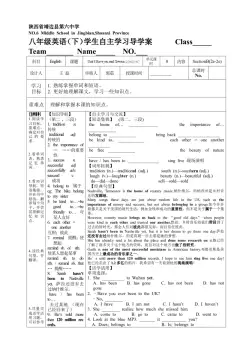
八年级上册英语语法、短语和知识点总结
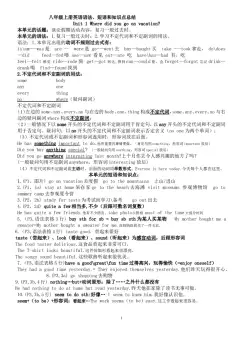
                       Unit 1 Where did you go on vacation?
本单元的话题:谈论假期活动内容,复习一般过去时。
本单元的语法:1.复习一般过去时;2.学习不定代词和不定副词的用法。
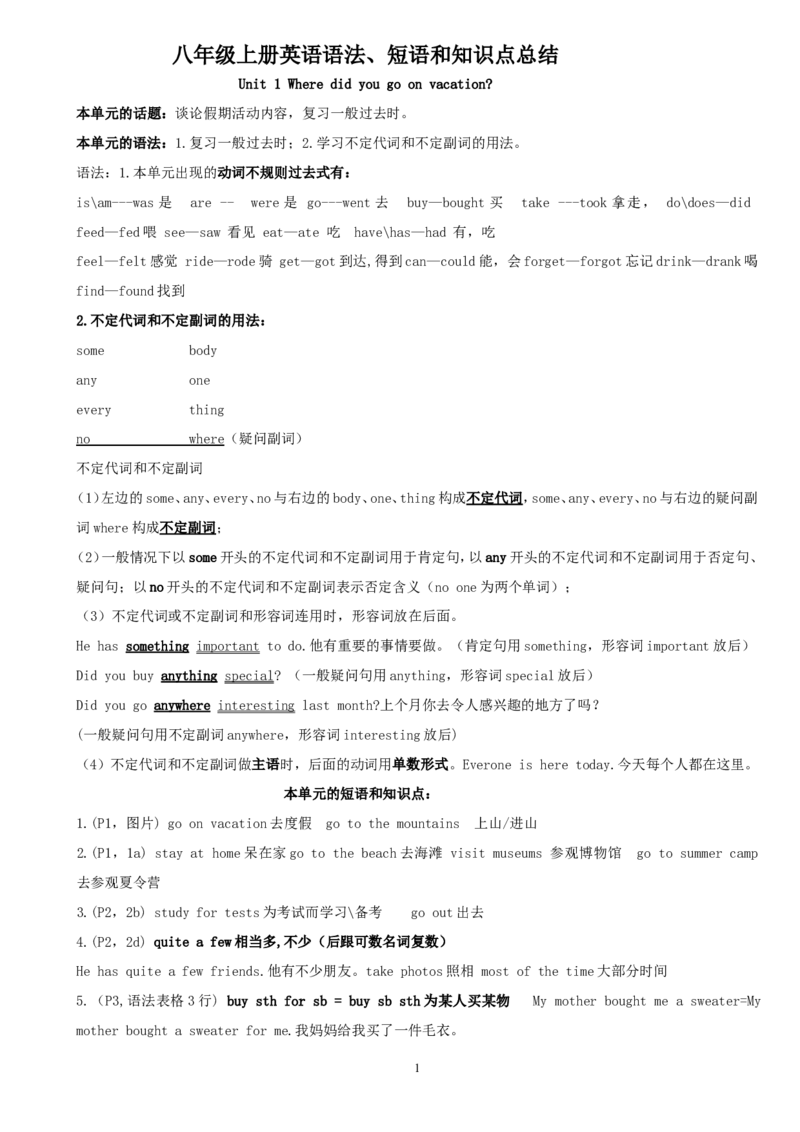
语法:1.本单元出现的动词不规则过去式有:
is\am---was 是  are --  were 是 go---went 去  buy—bought 买  take ---took 拿走, do\does—did
feed—fed 喂 see—saw 看见 eat—ate 吃  have\has—had 有,吃
feel—felt 感觉 ride—rode 骑 get—got 到达,得到can—could 能,会forget—forgot 忘记drink—drank 喝
find—found 找到
2.不定代词和不定副词的用法:
some            body
any             one
every           thing
no


 where

 (疑问副词)
不定代词和不定副词
(1)左边的some、any、every、no 与右边的body、one、thing 构成不定代词,some、any、every、no 与右边的疑问副
词where 构成不定副词;
(2)一般情况下以some 开头的不定代词和不定副词用于肯定句,以any 开头的不定代词和不定副词用于否定句、
疑问句;以no 开头的不定代词和不定副词表示否定含义(no one 为两个单词);
(3)不定代词或不定副词和形容词连用时,形容词放在后面。
He has something important to do.他有重要的事情要做。(肯定句用something,形容词important 放后)
Did you buy anything special? (一般疑问句用anything,形容词special 放后)
Did you go anywhere interesting last month?上个月你去令人感兴趣的地方了吗?
(一般疑问句用不定副词anywhere,形容词interesting 放后)
(4)不定代词和不定副词做主语时,后面的动词用单数形式。Everone is here today.今天每个人都在这里。
本单元的短语和知识点:
1.(P1,图片) go on vacation 去度假  go to the mountains  上山/进山
2.(P1,1a) stay at home 呆在家go to the beach 去海滩 visit museums 参观博物馆  go to summer camp
去参观夏令营
3.(P2,2b) study for tests 为考试而学习\备考    go out 出去
4.(P2,2d) quite a few 相当多,不少(后跟可数名词复数)
He has quite a few friends.他有不少朋友。take photos 照相 most of the time 大部分时间
5.(P3,语法表格3 行) buy sth for sb = buy sb sth 为某人买某物   My mother bought me a sweater=My
mother bought a sweater for me.我妈妈给我买了一件毛衣。
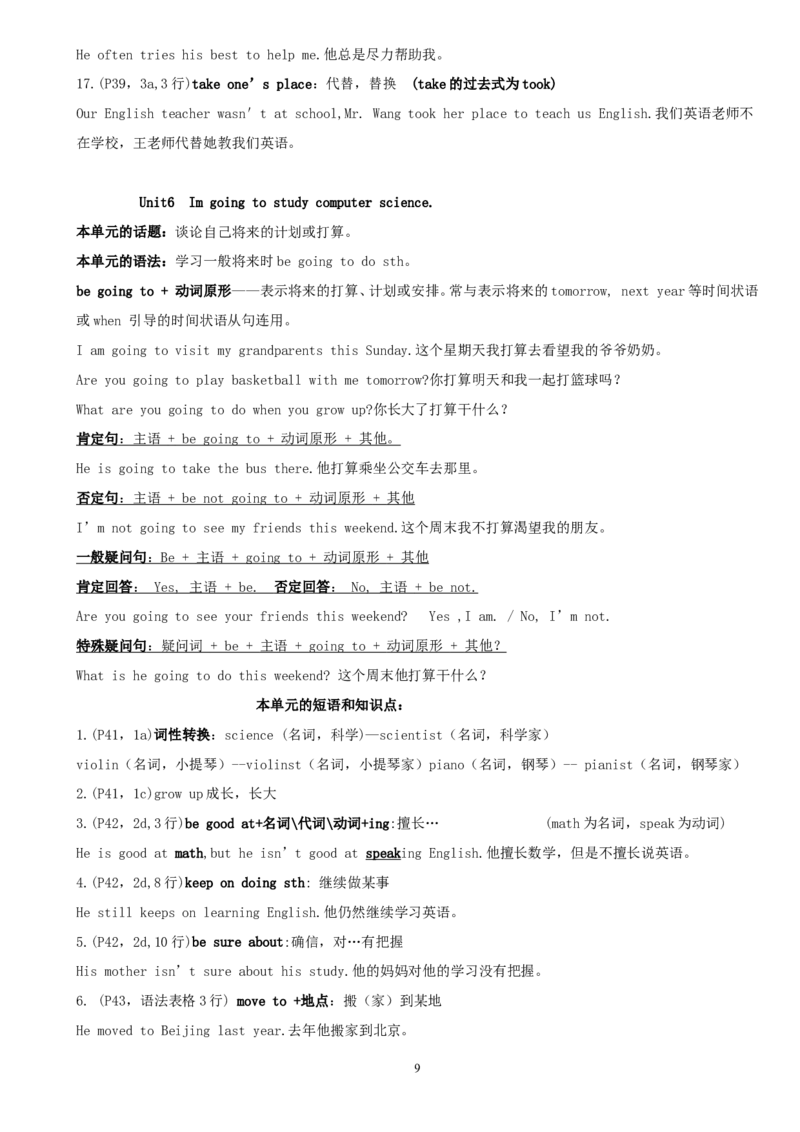
1
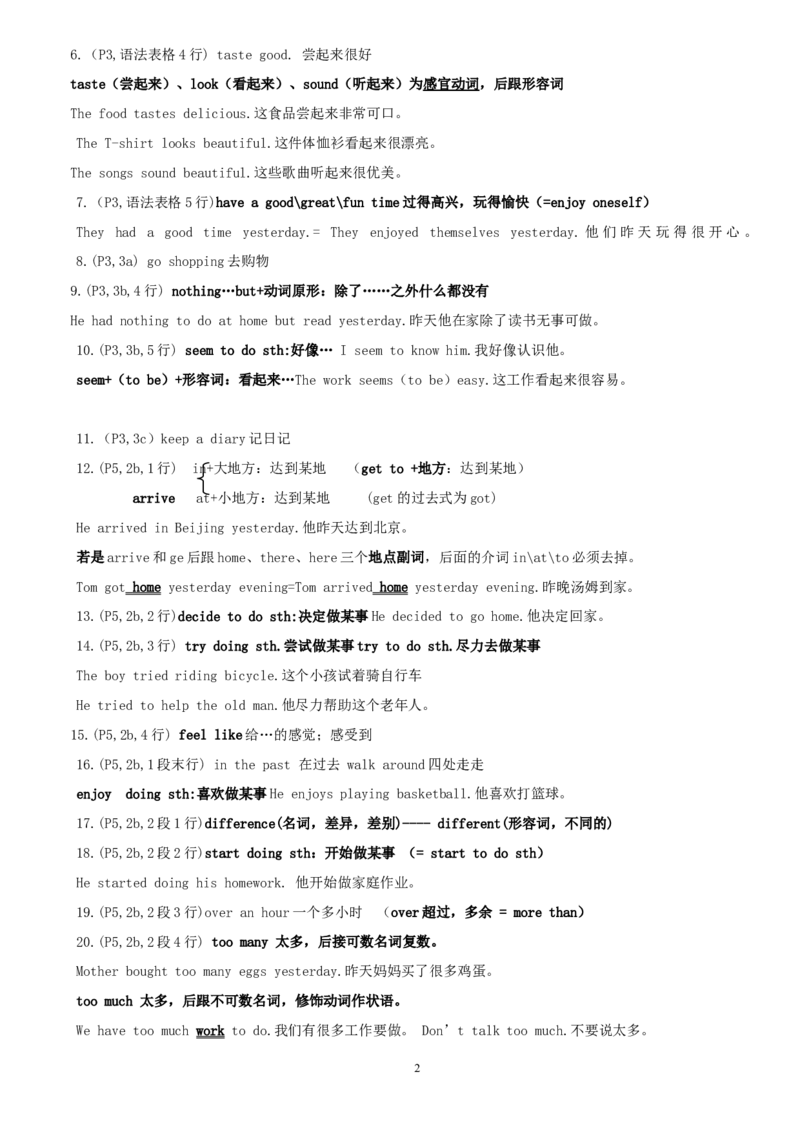
6.(P3,语法表格4 行) taste good. 尝起来很好
taste(尝起来)、look(看起来)、sound(听起来)为感官动词,后跟形容词
The food tastes delicious.这食品尝起来非常可口。
The T-shirt looks beautiful.这件体恤衫看起来很漂亮。
The songs sound beautiful.这些歌曲听起来很优美。
7.(P3,语法表格5 行)have a good\great\fun time 过得高兴,玩得愉快(=enjoy oneself)
They had a good time yesterday.= They enjoyed themselves yesterday. 他们昨天玩得很开心。
8.(P3,3a) go shopping 去购物
9.(P3,3b,4 行) nothing…but+动词原形:除了……之外什么都没有
He had nothing to do at home but read yesterday.昨天他在家除了读书无事可做。
10.(P3,3b,5 行) seem to do sth:好像… I seem to know him.我好像认识他。
seem+(to be)+形容词:看起来…The work seems(to be)easy.这工作看起来很容易。

11.(P3,3c)keep a diary 记日记
12.(P5,2b,1 行)  in+大地方:达到某地   (get to +地方:达到某地)
        arrive   at+小地方:达到某地     (get 的过去式为got)
He arrived in Beijing yesterday.他昨天达到北京。
若是arrive 和ge 后跟home、there、here 三个地点副词,后面的介词in\at\to 必须去掉。
Tom got home

  yesterday evening=Tom arrived home

  yesterday evening.昨晚汤姆到家。
13.(P5,2b,2 行)decide to do sth:决定做某事He decided to go home.他决定回家。
14.(P5,2b,3 行) try doing sth.尝试做某事try to do sth.尽力去做某事
The boy tried riding bicycle.这个小孩试着骑自行车
He tried to help the old man.他尽力帮助这个老年人。
15.(P5,2b,4 行) feel like 给…的感觉;感受到
16.(P5,2b,1 段末行) in the past 在过去 walk around 四处走走
enjoy  doing sth:喜欢做某事He enjoys playing basketball.他喜欢打篮球。
17.(P5,2b,2 段1 行)difference(名词,差异,差别)---- different(形容词,不同的)
18.(P5,2b,2 段2 行)start doing sth:开始做某事 (= start to do sth)
He started doing his homework. 他开始做家庭作业。
19.(P5,2b,2 段3 行)over an hour 一个多小时  (over 超过,多余 = more than)
20.(P5,2b,2 段4 行) too many 太多,后接可数名词复数。
Mother bought too many eggs yesterday.昨天妈妈买了很多鸡蛋。
too much 太多,后跟不可数名词,修饰动词作状语。
We have too much work to do.我们有很多工作要做。 Don’t talk too much.不要说太多。
2
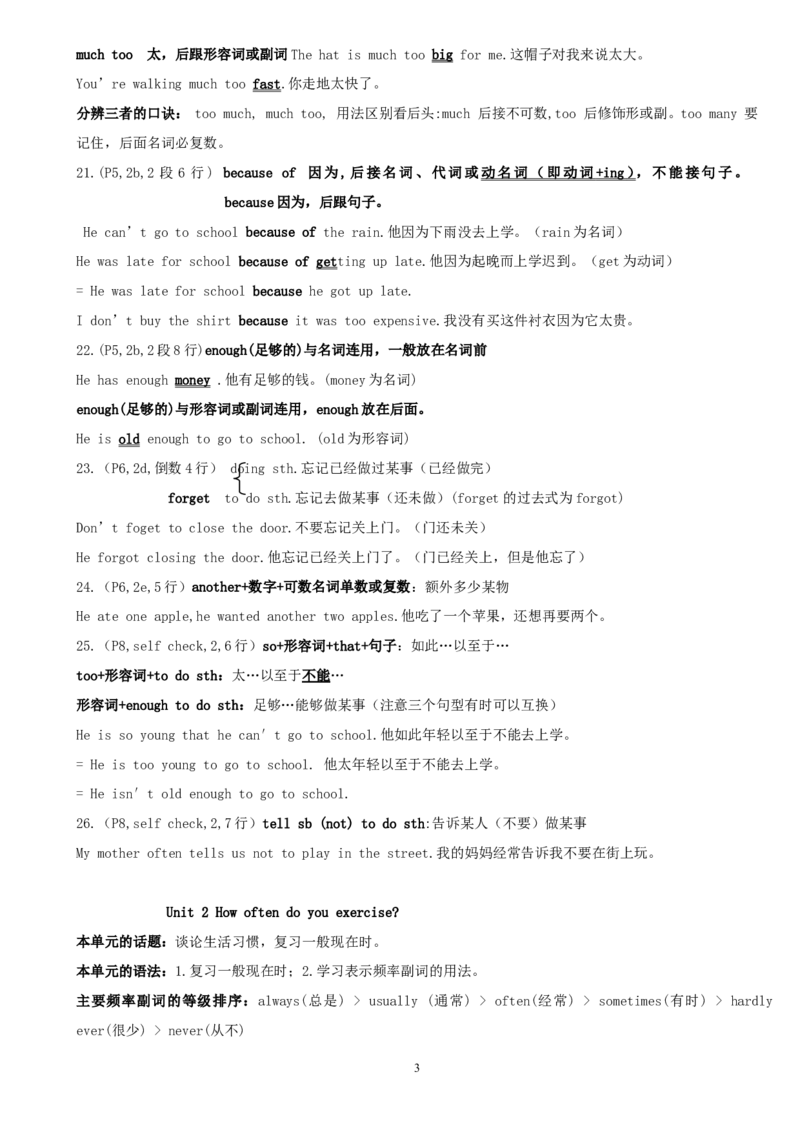
much too  太,后跟形容词或副词The hat is much too big for me.这帽子对我来说太大。
You’re walking much too fast.你走地太快了。
分辨三者的口诀: too much, much too, 用法区别看后头:much 后接不可数,too 后修饰形或副。too many 要
记住,后面名词必复数。
21.(P5,2b,2 段6 行) because of 因为, 后接名词、代词或动名词

 (即动词

 +ing

 )
  ,不能接句子。
because 因为,后跟句子。
 He can’t go to school because of the rain.他因为下雨没去上学。(rain 为名词)
He was late for school because of getting up late.他因为起晚而上学迟到。(get 为动词)
= He was late for school because he got up late.
I don’t buy the shirt because it was too expensive.我没有买这件衬衣因为它太贵。
22.(P5,2b,2 段8 行)enough(足够的)与名词连用,一般放在名词前
He has enough money .他有足够的钱。(money 为名词)
enough(足够的)与形容词或副词连用,enough 放在后面。
He is old enough to go to school. (old 为形容词)
23.(P6,2d,倒数4 行) doing sth.忘记已经做过某事(已经做完)
forget  to do sth.忘记去做某事(还未做)(forget 的过去式为forgot)
Don’t foget to close the door.不要忘记关上门。(门还未关)
He forgot closing the door.他忘记已经关上门了。(门已经关上,但是他忘了)
24.(P6,2e,5 行)another+数字+可数名词单数或复数:额外多少某物
He ate one apple,he wanted another two apples.他吃了一个苹果,还想再要两个。
25.(P8,self check,2,6 行)so+形容词+that+句子:如此…以至于…
too+形容词+to do sth:太…以至于不能…
形容词+enough to do sth:足够…能够做某事(注意三个句型有时可以互换)
He is so young that he can′t go to school.他如此年轻以至于不能去上学。
= He is too young to go to school. 他太年轻以至于不能去上学。
= He isn′t old enough to go to school.
26.(P8,self check,2,7 行)tell sb (not) to do sth:告诉某人(不要)做某事
My mother often tells us not to play in the street.我的妈妈经常告诉我不要在街上玩。
Unit 2 How often do you exercise?
本单元的话题:谈论生活习惯,复习一般现在时。
本单元的语法:1.复习一般现在时;2.学习表示频率副词的用法。
主要频率副词的等级排序:always(总是) > usually (通常) > often(经常) > sometimes(有时) > hardly
ever(很少) > never(从不)
3
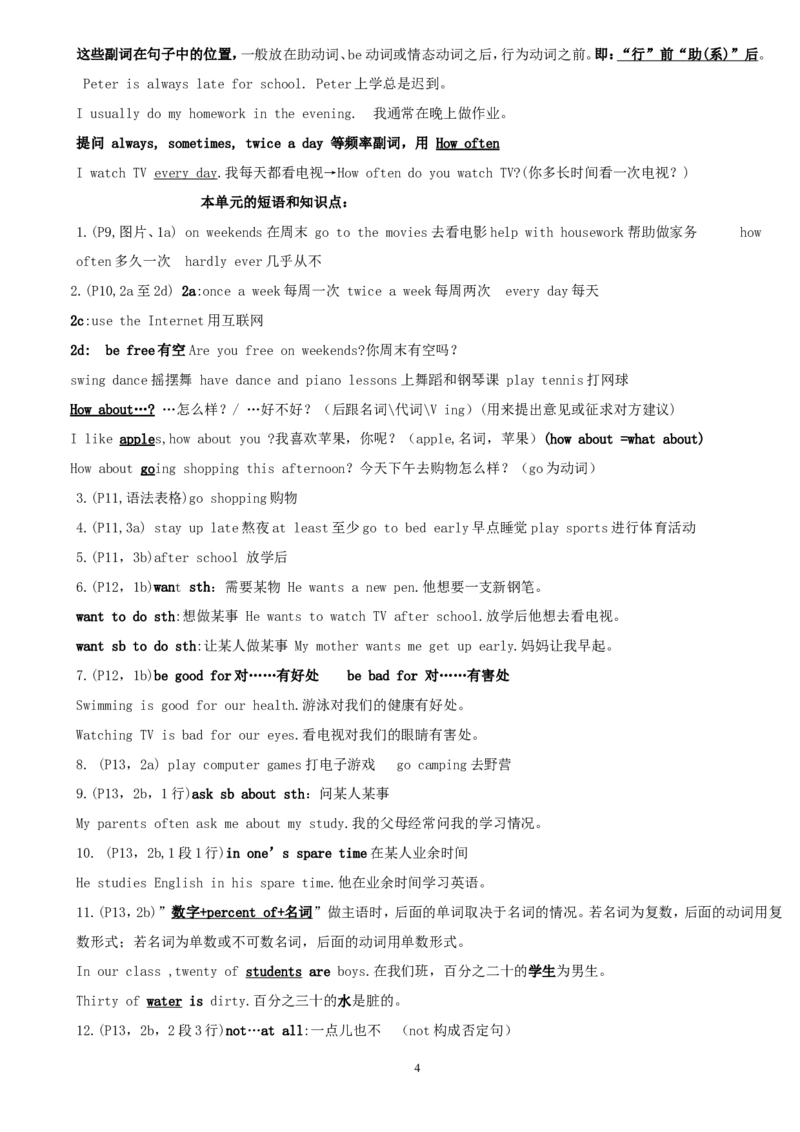
这些副词在句子中的位置,一般放在助动词、be 动词或情态动词之后,行为动词之前。即:“行”前“助

 ( 系
  )”
  后
  。
 Peter is always late for school. Peter 上学总是迟到。
I usually do my homework in the evening.  我通常在晚上做作业。
提问 always, sometimes, twice a day 等频率副词,用 How
   often


I watch TV every

  day
  .我每天都看电视→How often do you watch TV?(你多长时间看一次电视?)
本单元的短语和知识点:
1.(P9,图片、1a) on weekends 在周末 go to the movies 去看电影help with housework 帮助做家务      how
often 多久一次  hardly ever 几乎从不
2.(P10,2a 至2d) 2a:once a week 每周一次 twice a week 每周两次  every day 每天
2c:use the Internet 用互联网
2d:  be free 有空Are you free on weekends?你周末有空吗?
swing dance 摇摆舞 have dance and piano lessons 上舞蹈和钢琴课 play tennis 打网球
How
   about

 …
  ?  …怎么样?/ …好不好?(后跟名词\代词\V ing)(用来提出意见或征求对方建议)
I like apples,how about you ?我喜欢苹果,你呢?(apple,名词,苹果)(how about =what about)
How about going shopping this afternoon?今天下午去购物怎么样?(go 为动词)
3.(P11,语法表格)go shopping 购物
4.(P11,3a) stay up late 熬夜at least 至少go to bed early 早点睡觉play sports 进行体育活动
5.(P11,3b)after school 放学后
6.(P12,1b)want sth:需要某物 He wants a new pen.他想要一支新钢笔。
want to do sth:想做某事 He wants to watch TV after school.放学后他想去看电视。
want sb to do sth:让某人做某事 My mother wants me get up early.妈妈让我早起。
7.(P12,1b)be good for 对……有好处    be bad for 对……有害处
Swimming is good for our health.游泳对我们的健康有好处。
Watching TV is bad for our eyes.看电视对我们的眼睛有害处。
8. (P13,2a) play computer games 打电子游戏   go camping 去野营
9.(P13,2b,1 行)ask sb about sth:问某人某事
My parents often ask me about my study.我的父母经常问我的学习情况。
10. (P13,2b,1 段1 行)in one’s spare time 在某人业余时间
He studies English in his spare time.他在业余时间学习英语。
11.(P13,2b)”数字

 +percent

  of+
  名词

 ”做主语时,后面的单词取决于名词的情况。若名词为复数,后面的动词用复
数形式;若名词为单数或不可数名词,后面的动词用单数形式。
In our class ,twenty of students are boys.在我们班,百分之二十的学生为男生。
Thirty of water is dirty.百分之三十的水是脏的。
12.(P13,2b,2 段3 行)not…at all:一点儿也不  (not 构成否定句)
4
I don’t  like the movie at all.我一点也不喜欢这部电影。
13.(P13,2b,3 段)go online 上网
14.(P13,2b,3 段)the answer to+名词:…的答案  the answer to the question 这个问题的答案
15.(P13,2b,4 段) the most popular 最受欢迎的
although(虽然)不能与but 连用,但可以与yet ,still 连用。
Although it is dark ,they are still working.虽然天黑了,但他们仍在工作。
Although he is old ,he is quite strong.他虽然年龄大了,但身体很健壮。
16.(P13,2b,5 段1 行)the (best) way to do sth: 做某事的(最好)方式
The best way to learn English is speaking English.学习英语的最好方法是说英语.
17.(P13,2b,5 段2 行) such as 比如 (后跟名词或名词短语)for example 例如(后跟句子)
He likes fruits,such as apples,bananas and so on.他喜欢水果,例如苹果、香蕉等。
He has some good ways to study English,for example ,he often listens to tapes.他有许多好的方法学习英
语,例如,他经常听磁带。
18.(P13,2b,5 段4 行) old habits die hard 积习难改。
19.(P15,3a)more than (=over)超过,多余         go to the dentist 去看牙医
Unit 3 I'm more outgoing than my sister.
本单元的话题:谈论事物对比,学习形容词比较级。
本单元的语法:学习形容词比较级。(语法:见课本第113 页至115 页)
本单元出现的形容词和副词的比较级有:
long—longer(长的),tall--taller(高的)fast—faster(更快),funny—funnier(更有趣) friendly—
friendlier(更友好),early—earlier(更早),lazy—lazier(更懒惰), high—higher(更高), hard—
harder(更努力) ,quiet—quieter(更安静,更内向),
smart—smarter(更聪明)loud —louder(更响亮),good\well--better (更好) many\much—more (更
多),popular—more popular(更受欢迎)loudly—more loudly(更响亮) outgoing--more outgoing(更外向/更
开朗), hard-working—more hard-working(更努力)clearly—more clearly(更清楚)serious—more
serious(更严肃)

形容词和副词的比较级讲解:
1.比较级表示两个人或物的比较。所用的句型为“比较级

 +than

 ”
 (比

 …
  更
  …
  )
 ,若than 前后所使用的的动词相同
时,通常用助动词代替后面的动词,后面的动词或助动词可以省略。注意比较的对象必须性质相同。I am taller
than my brother.我比我的弟弟高。
He is more outgoing than me.他比我外向。
2.比较级前,可以用much(更…,多得多…),a lot(更…,多得多…),even(更…,多得多…),a little(稍微)来
表示程度。I am a little thinner than my sister.我比我的妹妹稍微瘦。
5
She is much more

  beautiful

  than her sister.她比她的妹妹更漂亮。
本单元的短语和知识点:
1.(P17,图片)play+the +乐器   play the drums 打鼓
比较play +球类       play basketball 打篮球
both…and…两者都(后面的动词用复数形式)Both Tom and Jim are students. 汤姆和吉姆都是学生。
2.(P18,2d) the singing competition  歌咏比赛  the most important 最重要的
3.(P20,1a)be good at+名词\代词\V ing:擅长,在某方面做得好
He is good at math

 .他擅长数学(math 为名词)I am good at playing basketball.我擅长打篮球。(play 为动
词)
4.(P20,1a)make sb do sth:让某人做某事He makes me help him.他让我帮助他。
5.(P20,1b)the same as 与…相同His book is the same as my book.他的书与我的书一样。
6. (P20,1b)be talented in sth:在某方面有天赋He is talented in music.他在音乐方面有天赋。
7.(P21,2b,1 段2 行)be like:像… The books are like friends.书像朋友。
8.(P21,2b,1 段)make friends (with sb):(和某人)交朋友
He often makes friends with children.他经常和孩子们交朋友.
enjoy doing sth:喜欢做某事 Tom enjoys reading.汤姆喜欢读书。
9.(P21,2b,2 段)be different from 与…不同My brother is different from me.我弟弟与我不一样。
10.(P21,2b,2 段)help sb to (do) sth:帮助某人做某事
常与help

  sb
   with

  sth(

 在某方面帮助某人

 ) 互换   He often helps me (to) learn English.他经常帮助我
学习英语。= He often helps me with my English.他经常在英语方面帮助我。
help (to) do sth:帮助做某事He often helps( to)cook at home.他经常在家帮助做饭。
11.(P21,2b,3 段)care about 关心
My parents often care about my study.我的父母亲经常关心我的学习.
12.(P22,2d)比较级表示最高级常用:
比较级 +than  +the other+可数名词复数
=比较级+than +any other+可数名词单数(用于一范围内一个与余下进行比较) 例如:
He is the tallest student in our class .(最高级)在我们班他是最高的学生。
= He is taller than any other student in our class.
= He is taller than the other students in our class.在我们班,他比其他的学生高。
(在我们班,他与他之外的其他的同学进行比较)
shanghai is the biggest city in china.上海是中国最大的城市。
=
=
13.(P24,4)be good with sb:与某人相处很好
6
The teacher is good with students.这位老师与学生相处很好。
14.(P24,4)information (n.消息,信息)不可数名词
Unit 4 What's the best movie theater?
本单元的话题:谈论事物对比, 学习形容词和副词的最高级。
本单元的语法:学习形容词和副词的最高级。
1.形容词和副词的最高级常用于表示三者或三者以上进行比较,后面可用of 或in 短语表示比较的范围。He is
the tallest in
   his
   class

 .在他那个班,他是最高的。
Tom studies (the) best of
   the
   three

  students

 .在这三个学生中汤姆学习最好
2.形容词和副词的最高级前常常有the(副词的最高级前的the 可以省略),例如:
He is the tallest student in our class.在我们班他是最高的学生。(tall 为形容词,the 不能省)
汤姆在他那个学校跑得最快。(fast 为副词修饰动词run,the 可以省略)
Tom runs (the) fastest in his school.
3.比较级也可以表示最高级的含义,见Unit3,12 讲解。
本单元出现的形容词和副词的最高级有:
good(好)—best,bad\badly(坏的)—worst,frest(新鲜的)—frestest, big(大)—biggest fast(快的)--
fastest  new(新的)—newest cheap(便宜的)—cheapest funny(有趣的)- funniest
close(

 近的

 ) —
  closest


  short(

 矮的

 ) —
  shortest


  quiet

 (安静的,内向的)

 —
  quietest


expensive(昂贵的)—most expensive,popular(受欢迎的)—most popular,quikcly(快地)—most quikcly
beautiful(美丽的)—most beautiful,       comefortable(舒服的)—most comefortable
cheaply(便宜地)—most cheaply          carefully(仔细地,细心地)—most carefully
boring(无聊的)—most boring                    exciting(令人兴奋的)—most exciting
interesting(令人感兴趣的)—most interesting    serious(严肃的,认真的)—most serious
creative(有创造力的)—most creative,        talented(有天赋的)—most talented
本单元的短语和知识点:
1.(P26,2d,2 行)welcome to+地点:欢迎来到某地 Welcome to our school.欢迎来我校。
2.(P27 语法表)What do you think of sth?=How dou you like sth?你认为...怎么样?
What do you think of the book?你认为这本书怎么样? It is boring.很无聊。
3.(P29,2b,1 段2 行)watch sb do sth:看见某人做了某事(= see sb do sth )
I watched him play basketball yesterday.昨天我看见他打篮球了。
4.(P29,2b,1 段3 行)比较级别 +and+比较级:越来越…
(若比较级为more+形容词原级,则为:more and more 形容词原级)
The buildings are taller

  and
   taller

 .楼房越来越高。
Our school is getting more

  and
   more

  beautiful

 .我们的学校正在变得越来越漂亮。
7
5.(P29,2b,1 段末行)around the world 全世界=all over the world,such as 例如
Unit 5 Do you want to watch a game show?
本单元的话题:谈论自己对天使节目或电影的喜好,学会表达自己的感受。
本单元的语法:复习一般现在时。
本单元的短语和知识点:
1.(P33,图片) What do you think of sth?=How dou you like sth?你认为…怎么样?
What do you think of the movie?你认为这部电影怎么样? It is boring.很无聊。
2.(P33,图片)(补充)mind doing sth:介意做某事
Would you mind opening the door?你介意打开门吗?Of course not.当然不介意。
3.(P33,1a)  news  (不可数名词,消息,信息) a piece of good news 一条好消息
4.(P34,2b,2 行)learn (sth) from sb:向某人学习(某物)
We is learning English from the teacher.我们正在向这位老师学习英语。
5.(P34,2c,1 行)plan to do sth:计划做某事(plan 的过去式planned,现在分词planning)
He is planning to visit Beijing.他正在计划访问北京。
6.(P34,2c,4 行)hope to do sth:希望做某事
 He hopes to meet the famous singer.他希望与这位著名歌手的见面。
7.(P34,2d,2 行)have a discussion (about sth):讨论(某物)
They had a discussion about the movie yesterday 昨天他们讨论了这部电影。
8.(P34,2d,倒数5 行)favorite (形容词,最喜爱的)= like…best
My favorite shows are talk shows.我最喜欢的节目是谈话节目。=I like talk shows best.
9.(P34,2d,倒数2 行)expect to do sth:期待做某事
The girl alaways expects to meet her favorite actor.这个女孩总是期待与他最喜欢的演员见面。
10.(P37,2b,1 段2 行)think of 认为,想起He often thinks of his teachers.他经常想起他的老师。
11.(P37,2b,1 段倒数2 行)in the 1930s:在二十世纪三十年代(1930 年至1939 年)
in the 2010s:在二十一世纪10 年代(2010 年至2019 年)
12.(P37,2b,2 段2 行)one of +可数名词复数:…之一(该短语放在句首做主语时,后面的动词用单数形式)One
of the students has an English dictionary.这些学生中一个人有英语字典。
13.(P37,2b,2 段3 行)try to do sth:尽力做某事He tried to help the old man.他尽力帮助这老人。
try doing sth:试着做某事The boy tried riding a bicycle.这个孩子试着骑自行车。
14.(P37,2b,2 段3 行)luck(名词,幸运,运气)—lucky(形容词,幸运的)--unlucky (形容词,不幸的)
15.(P37,2b,2 段5 行)be ready to do sth 乐意做某事
He is always ready to help others.他总是乐于助人。
16.(P37,2b,2 段5 行)try one's best (to do sth):尽力(做某事)
8
He often tries his best to help me.他总是尽力帮助我。
17.(P39,3a,3 行)take one’s place:代替,替换  (take 的过去式为took)
Our English teacher wasn't at school,Mr. Wang took her place to teach us English.我们英语老师不
在学校,王老师代替她教我们英语。
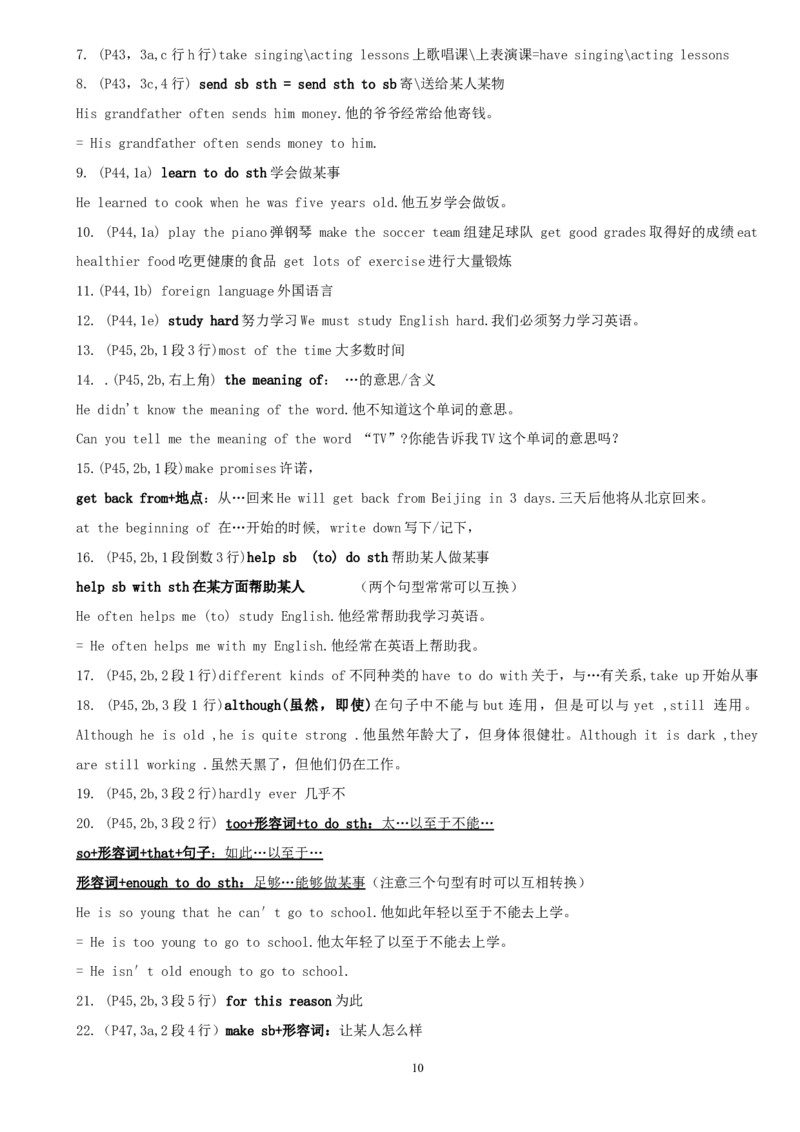
Unit6  Im going to study computer science.
本单元的话题:谈论自己将来的计划或打算。
本单元的语法:学习一般将来时be going to do sth。
be going to + 动词原形——表示将来的打算、计划或安排。常与表示将来的tomorrow, next year 等时间状语
或when 引导的时间状语从句连用。
I am going to visit my grandparents this Sunday.这个星期天我打算去看望我的爷爷奶奶。
Are you going to play basketball with me tomorrow?你打算明天和我一起打篮球吗?
What are you going to do when you grow up?你长大了打算干什么?
肯定句

 :主语

 +  be going to +

 动词原形

 +
  其他。


He is going to take the bus there.他打算乘坐公交车去那里。
否定句

 :主语

 + be not going to +

 动词原形

 +
  其他


I’m not going to see my friends this weekend.这个周末我不打算渴望我的朋友。
一般疑问句

 :
  Be +

 主语

 + going to +

 动词原形

 +
  其他


肯定回答

 :
  Yes,

 主语

 + be.

 否定回答

 :
  No,

 主语

 + be not.


Are you going to see your friends this weekend?   Yes ,I am. / No, I’m not.
特殊疑问句

 :疑问词

 + be +

 主语

 + going to +

 动词原形

 +
  其他?


What is he going to do this weekend? 这个周末他打算干什么?
本单元的短语和知识点:
1.(P41,1a)词性转换:science (名词,科学)—scientist(名词,科学家)
violin(名词,小提琴)--violinst(名词,小提琴家)piano(名词,钢琴)-- pianist(名词,钢琴家)
2.(P41,1c)grow up 成长,长大
3.(P42,2d,3 行)be good at+名词\代词\动词+ing:擅长…               (math 为名词,speak 为动词)
He is good at math,but he isn’t good at speaking English.他擅长数学,但是不擅长说英语。
4.(P42,2d,8 行)keep on doing sth: 继续做某事
He still keeps on learning English.他仍然继续学习英语。
5.(P42,2d,10 行)be sure about:确信,对…有把握
His mother isn’t sure about his study.他的妈妈对他的学习没有把握。
6. (P43,语法表格3 行) move to +地点:搬(家)到某地
He moved to Beijing last year.去年他搬家到北京。
9
7. (P43,3a,c 行h 行)take singing\acting lessons 上歌唱课\上表演课=have singing\acting lessons
8. (P43,3c,4 行) send sb sth = send sth to sb 寄\送给某人某物
His grandfather often sends him money.他的爷爷经常给他寄钱。
= His grandfather often sends money to him.
9. (P44,1a) learn to do sth 学会做某事
He learned to cook when he was five years old.他五岁学会做饭。
10. (P44,1a) play the piano 弹钢琴 make the soccer team 组建足球队 get good grades 取得好的成绩eat
healthier food 吃更健康的食品 get lots of exercise 进行大量锻炼
11.(P44,1b) foreign language 外国语言
12. (P44,1e) study hard 努力学习We must study English hard.我们必须努力学习英语。
13. (P45,2b,1 段3 行)most of the time 大多数时间
14. .(P45,2b,右上角) the meaning of: …的意思/含义
He didn't know the meaning of the word.他不知道这个单词的意思。
Can you tell me the meaning of the word “TV”?你能告诉我TV 这个单词的意思吗?
15.(P45,2b,1 段)make promises 许诺,
get back from+地点:从…回来He will get back from Beijing in 3 days.三天后他将从北京回来。
at the beginning of 在…开始的时候, write down 写下/记下,
16. (P45,2b,1 段倒数3 行)help sb  (to) do sth 帮助某人做某事
help sb with sth 在某方面帮助某人       (两个句型常常可以互换)
He often helps me (to) study English.他经常帮助我学习英语。
= He often helps me with my English.他经常在英语上帮助我。
17. (P45,2b,2 段1 行)different kinds of 不同种类的have to do with 关于,与…有关系,take up 开始从事
18. (P45,2b,3 段1 行)although(虽然,即使)在句子中不能与but 连用,但是可以与yet ,still 连用。
Although he is old ,he is quite strong .他虽然年龄大了,但身体很健壮。Although it is dark ,they
are still working .虽然天黑了,但他们仍在工作。
19. (P45,2b,3 段2 行)hardly ever 几乎不
20. (P45,2b,3 段2 行) too+

 形容词

 +to
   do
   sth
  :
  太
  …
  以至于不能

 …

so+
  形容词

 +that+

 句子

 :如此

 …
  以至于

 …

形容词

 +enough

  to
   do
   sth
  :
  足够

 …
  能够做某事

 (注意三个句型有时可以互相转换)
He is so young that he can′t go to school.他如此年轻以至于不能去上学。
= He is too young to go to school.他太年轻了以至于不能去上学。
= He isn′t old enough to go to school.
21. (P45,2b,3 段5 行) for this reason 为此
22.(P47,3a,2 段4 行)make sb+形容词:让某人怎么样
10
The good news made us happy.这个好消息让我们非常高兴。(注意:news 为不可数名词)
23.(P47,33,3 段)how to do better at school 为“疑问词

 + 不定式”即“疑问词

 +to
   do
   sth
  ”

He didn’t know when to start.他不知道什么时候开始。
24.(P48,self check,2)go to university 去上大学
Unit 7 Will people have robots?
本单元的话题:谈论对未来的语言,学习一般将来时will do sth。
本单元的语法:学习一般将来时will do sth。
一般将来时由“助动词will / shall +

 动词原型

 ”构成,表示将来某个时间要发生的动作或存在的状态,常与
表示将来的时间状语如tomorrow、next week,in 2 days(2 天之后)等连用。(Shall

  用于第一人称,

 will

  可以用


于各种人称。)           (will not= won’t)
 例如:We will visit the old man next week.下周我们将要看望这位老人。
She will finish the work in 2 weeks.她将在两周后完成这项工作。
一般疑问句:把肯定句中的will 提到句首即可。以上两句的一般疑问句为:
Will you visit the old man next week? Yes,we will.\No, we won’t .
Will she finish the work in 2 weeks? Yes,she will.\No, she won’t .
否定句:把肯定句中的will 变为won’t 即可。以上两句的否定句为:
We won’t visit the old man next week. She won’t finish the work in 2 weeks.
本单元的短语和知识点:
1.(P49,图片)There be 结构:There be(is/are/was/were)+某物/某人+某地/某时
“There be 结构”的一般现在时:There is/are+某物/某人+某地/某时
There are 600 students in our school.在我们学校有600 个学生。
一般过去时:There was/were+某物/某人+某地/某时
There was a school ten years ago. 10 年前这里有所学校。
一般将来时:There will be+某物/某人+某地/某时.= There is going to be+某物/某人+某地/某时.   There
will be a sport meeting next week.
=There is going to be a sport meeting next weeek.下周将有场运动会。
2.(P49,1a)on computers 在电脑上, on paper 在纸上
3.(P50,2a)a few +可数名词复数:有一些、有几个
a little +不可数名词:有一些
            few +可数名词复数:几乎没有(表示否定)      little+不可数名词:几乎没有(表示否定)
  many+可数名词复数:很多,许多   f ew
   的比较级是

  fewer

  ,little

 的比较级是

  less


 much+不可数名词:很多,许多     many\much

  的比较级都是

 more


 There will be less polution in the future.在未来将会有更少的污染。(polution 为不可数名词)
We should plant more trees.我们应该种更多的树。(tree 为可数名词)
11
There will be fewer cars in the future.在未来将会有更少的汽车。(car 为可数名词)
4.(P50,2d)in(great)danger 在(极度)危险中on the earth 在地球上save the earth 拯救地球
5.(P50,2d)play a part (in doing sth):参与(做某事)
We should play a part in planting trees every year.每年我们应该参与植树。
6.(P51,语法表格2 行)in+一段时间:在…之后(多用于一般将来时)
He will come back in 2 day

 s.
  两天之后他将回来。→How soon will he come back?多久他将回来?
7.(P53,2b,1 段2 行)help with sth 在某方面帮忙
He often helps with housework at home.他经常在家帮助做家务。
8.(P53,2b,2 段1 行)Today there are already robots working in factories.现在有许多机器人正在工厂里
工作。
句型 There

  is\are

  sb
   doing

  sth.

 有某人正在做某事

 。 There is a cat eating fish.有只猫正在吃鱼。
9.(P53,2b,3 段1 行)make sb do sth:让某人做某事
My mother often makes me clean my room.我的妈妈经常让我打扫我的房间。
10.(P53,2b,4 段2 行)hundreds of+名词:成百上千的…,许多…(表示模糊数字)
数字+ hundred +名词:几百…(表示具体数字)
He has hundreds of book.他有很多书。He bought two hundred books.他买了二百本书。
11.(P53,2b,4 段7 行)seem to do sth:好像做某事I seem to know him.我好像认识他。
seem (to be)+形容词:好像怎么样 He seems (to be) angry.他好像生气了。
12.(P54,2d,4 行)at some point: 在某些方面
13.(P55,3a,4 行)free time 空闲时间  in one’s free time 在某人空闲时间
He often studies English in his free time.他经常在空闲时间学习英语。
Unit 8 How do you make a banana milk shake?
本单元的话题:描述做事情的顺序和过程。(First 首先,Next 下面,Then 然后,Finally 最后)
本单元的语法:复习一般现在时。
本单元的短语和知识点:
1(P57,1a)  turn on 打开            turn up 调大
           turn off 关上           turn down 调小
Please turn on the lights.请打开灯。
My father is sleeping,please turn down the radio.爸爸正在睡觉,请把收音机声音调小。
2. (P58,2a)   How many+可数名词复数:多少…
             How much+不可数名词:多少…
He has eight books.他有八本书。→How many books does he have?他有多少本书?
12
How much water does he need?他需要多少水?
3. (P58,2a) 量词的用法:不可数名词常用“数字+量词+不可数名词”来表示。如:
a piece of bread 一片面包  比较:two piece

 s  of bread 两片面包(bread 为不可数名词)
a glass of orange 一玻璃杯橘子汁   one spoon of butter 一勺黄油
4.(P58,2d)说明做某事的顺序为:
First…首先,Next…下面,Then…然后,Finally…最后
5.(P58,2d 末行)one more thing = another one thing
基数词 + more + 名词 = another + 基数词 + 名词:又多少某物
He ate an apple,he wanted to eat two more apples.他吃了一个苹果,还想再吃两个。
6.(P59,3c)Do you know how to plant trees?你知道如何种树吗?
how to do sth.怎样做某事  (疑问词后跟动词须加to,即“疑问词

 to
   do
   sth
  ”)
He doesn’t know how to turn on the computer.他不知道如何打开电脑。
7.(P61,2b,4 行)It’s time

  (for sb)  to do sth

  是某人该做某事的时间了。
It’s time for us to have lunch.是我们该吃午饭的时候了。
It’s time

  for sth

  是该做某事的时间了。It’s time for the class.是该上课的时候了。
8.(P61,2b,1 段倒数3 行)by doing sth:通过…方式
He learned English by listening to the radio.它通过听收音机学习英语。
9.(P61,2b,2 段)fill…with… 用…装满, cover…with… 用…盖住
10.(P63,3a,3 行)need to do sth:需要做某事He needs to buy a new pen.他需要买一枝新钢笔。
Unit 9 Can you come to my party?
本单元的话题:学会发出、接受或拒绝邀请。  本单元的语法:复习情态动词。
本单元的短语和知识点:
1.(P65,图片)on Saturday afternoon 在星期六下午,在具体哪一天的是上午、下午或晚上用on,例如:on
Sunday evening 在星期天的晚上
2.(P65,图片)have to 必须(后跟动词原形)He has to get up early.他必须早起。→(一般疑问句)Does he
get up early? Yes,he does.\No,he doesn’t.
(否定句)He doesn

 ’
  t
  have


  to
    get up early.他没有必要早起。
3.(P65,图片)How about +名词\代词\V•ing: …怎么样?(用来征询意见或提出建议)
How about=What about  I like apples,how about you?我喜欢苹果,你呢?(you 为代词)
How about going shopping this afternoon?今天下午去购物怎么样?(go 为动词)
4. (P65,图片)sth=want sth 想要某物Jim would like a new pen .吉姆香要一支钢笔。
   Would like to do sth=want to do sth 想做某事He’d like to watch TV.
W ould

  you
   like

  to
   do
   sth
   ?    你愿意做

 ...
  ?(用来提出建议或征求对方意见)
13
------would you like to go shopping with me ? 你想和我一起去买东西吗?
------Yes,

 I’
  d  love

  to
   ,
  but
   I’m doing my homework.我想去,但是我现在正在做家庭作业。
(=Sorry, I’m doing my homework.非常抱歉,我正在做家庭作业。)
5.(P65,1a)prepare for sth 为…做准备
They are preparing for the work.他们正在为这项工作做准备。
6.(P65,1a)go to the doctor 去看病have the flu 患流感help my parents 给父母帮忙
7.(P66,2c)too much+不可数名词:许多,很多He has too much homework to do.他有很多家庭作业要做。
too many+可数名词复数:许多,很多They bought too many books yesterday.昨天他买了很多书。
much too+形容词\副词:太…,非常… His father is much too busy.他爸爸非常忙。
8.(P66,2d,8 行)have an exam 考试
9.(P66,2d,倒数3 行)until 的用法:<1>若动词为延续性动词则用肯定句式
He studied until 21:00pm.他一直学习到晚上九点。
<2>若动词为非延续性动词,则用not….until….(直到。。。。才。。。。)
He didn’t go to bed until his father came back.他一直到他爸爸回来才上床睡觉。
10.(P67,语法表格)study for a math test 为数学考试做准备go to the party 参加聚会
11.(P68,1c)What’s today?今天几号?Its Monday,the 14th.今天星期一,十四号。
补充:what day is it today?今天星期几?    it’s Monday 今天星期一。
    What’s the date today?今天几月几日?It’s October 20th .今天10 月20 日。
12.(P68,1d)go to the doctor 去看病 have a piano lesson 上钢琴课
13.(P68,1d)look after 照看,照料  =  take care of
She is old to look after his brother 她足够大了能够照看她的弟弟。
take good care of =look after…well 好好照顾,好好照料
We should take good care of the children.
= We should look after the children well.我们应该好好照料儿童。
14.(P69,2d)accept an invitation 接受邀请 make an invitation 发出邀请
 turn down an invitation 拒绝邀请
15.(P69,2d,1 段1 行)感叹句的类型:
⑴ What  a∕an+adj+可数名词单数 (+主语+谓语)!
 What +adj+可数名词复数∕不可数名词 (+主语+谓语)!
What  a  fine day (it is) !多么好的天啊! (day 为可数名词单数)
What  an  interesting book it is !多么有趣的一本书啊!(book 为可数名词单数)
What beautiful flowers

  they are !多么漂亮的花啊! (flowers 为可数名词复数)
What  bad  weather it is!多么糟糕的天气啊!(weather 为不可数名词)
⑵ How +adj +主语+(谓语中的)系动词!
14
  How +adv +主语+(谓语中的)实义动词!
How happy I am!我多麽高兴啊! (happy 为adj,am 为系动词)
How hard they are working !他们工作多么努力啊!(hard 为adv,work 为实义动词)
点拨:陈述句改为感叹句,可以采用“一判、二定、三移”。
一判:是判断出陈述句谓语动词后的中心词的词性(adj∕adv∕n);
二定:是根据判断出来的结果来确定引导词(中心词为名词用What;中心词为形容词或副词用How;)
三移:就是把主语和谓语移到后面。
注意:在感叹句中,不得出现so,very,very much 等表示程度的单词。
 例如:①Our school is beautiful .
一判:beautiful 为形容词;二定:beautiful 为形容词,用How 来引导;三移:把Our school is 移到How
beautiful 后面,即为感叹句How beautiful our school is!
②He is a clever boy.
一判:boy 为名词;二定:boy 为名词,用What 来引导;三移:把He is 移到What a clever boy 后面,即为感叹句
What a clever boy he is!
③He studies English well.
一判:well 为副词;二定:well 为副词,用How 来引导;三移:把He studies 移到How well 后面,即为感叹句How
well he studies!
练习:将下列句子变为感叹句。①The room is very bright.
 ② We live a happy life today.                ③It is a nice present.
 ④This is difficult problem.              ⑤She played the piano wonderfully.
答案:①How bright the room is!  ②What a happy life we live today.  ③What a nice present it
is!④What a difficult problem this is!   ⑤How wonderfully she played the piano !
16.(P69,2d,1 段2 行)the (best) way to do sth:做某事的(最好)方法
The best way to learn English 学习英语的最好方法
17.(P69,2d,2 段1 行)thanks for+名词\V•ing:为什么而感谢
Thanks for your invitation.谢谢你的邀请。(invitation 为名词)
Thanks for helping me.谢谢你帮助我。(help 为动词)
18.(P69,2d,2 段2 行)take a trip 参加郊游,at the end of this month 在本月底
19.(P69,2d,3 段2 行)go back to+地点:回到某地
He will go back to Beijing in 2 days.两天后他将回北京。
20.(P69,2d,3 段3 行)have a surprise party for sb 为某人举办一个惊喜的晚会
21.(P69,2d,3 段倒数3 行)without+名词\代词\ V•ing:没有…
He can’t finish the work without our help.没有我们的帮助,他不能够完成这项工作。(help 为名词)
15
He went to school without having breakfast.他没有吃早饭就去上学。(have 为动词)
23.(P69,2d,3 段倒数2 行)so that 作“为了”时,引导目的状语从句,从句常出现情态动词。如:She got up
early so that she could

  catch the bus.为了能赶上车,她起得很早。
24.(P69,2d,末段倒数2 行)look forward to +名词\代词\V.ing:期待,盼望
I’m looking forward to buying a new car.我盼望着买辆新车。(buy 为动词)
The students are looking forward to an English party.学生们正盼望着一个英语晚会。
25.(P69,2d,末段倒数2 行)hear from sb.收到某人的来信 = receive a letter from sb.
He often hears from his brother 他经常收到他弟弟的来信。
26.(P70,2d 末行)make it 在约定的时间内到达,能够来 =  arrive in time;
 I’m glad you could make it.我非常高兴你能够按时来。
27.(P71,3a,1 行)the opening of… :开幕/开业
28.(P71,3a,2 行)在具体哪一天的上午、下午、晚上用on,比较:
in the morning 在早晨  on Sunday morning 在星期天的早晨
29.(P71,3a,5 行)invite sb to +地点:邀请某人去某地(invite -- invitation )
We invited a scientist to our school last week.上周我们邀请一位科学家到我们学校。
invite sb to do sth 邀请某人做某事I invited him to sing.我邀请去唱歌。
30.(P71,3a,6 行)reply in writing 写回信
31.(P71,3a,5)reply to sth / sb:回答某事/回答某人
32.(P72,4)go shopping 购物,do homework 做家庭作业
33.(P72,self check)go to the concert 参加音乐会
Unit 10 If you go to the party, you’ll have a great time!
本单元的话题:谈论事情可能的结果。      。
本单元的语法:在条件状语从句中,用一般现在时表示将来——即主将从现。
If you go to the party,   we will have a great time
从句(一般现在时)   (主句一般将来时)
解释:在条件状语从句,时间状语从句中,若主句用一般将来时,从句则用一般现在时表示将来-------简称主将
从现
If it is fine tomorrow,I’ll visit shanghai
 区分:宾语从句若主句为一般现在时,从句可以根据需要用任何时态
I think  I”ll finish the work in 2

  days

 . 我认为我在两天内将完成这项工作。
主句(一般现在时) 宾语从句
填空:I think she     (come)here tomorrow. If he


  (come )here,I


 (call)you.
本单元的短语和知识点:
16
1.(P73,图片)have a great /good time 玩的开心
2.(P73,1a)stay at home 呆在家里take the bus 乘公交车,go to the party 参加晚会
3.(P73,1c)tomorrow night 明天晚上
4.(P74,2a)talk about sth 谈论某事have a class party 开班级晚会have a class meeting 开班会
5.(P74,2a)疑问词+to do sth     He didn’t know where to go.他不知道去哪里。
(常用的疑问词有:who,what,where,when,why,how—简单记忆为:5 w 1 h)
6.(P74,2a)plan to do sth 计划做某They are planning to go shopping.他们正在计划购物。   7.(P74,2b)
half the class 全班一半人,make some food 做食物
8.(P74,2d,1 行)ask sb. to do sth

 请某人做某事


My parents often ask me to study hard.我的父母亲经常要我努力学习。
ask sb.

 not
   to do sth

 请某人

 不要

 做某事


My techer often asks us not to be late.我的老师要我们不要迟到。
9.(P74,2d,3 行,4 行)order food 预定食物  potato chips 薯条
10.(P74,2d,5 行)too+

 形容词

 +to
   do
   sth
  :
  太
  …
  以至于不能

 …

so+
  形容词

 +that+

 句子

 :如此

 …
  以至于

 …

形容词

 +enough

  to
   do
   sth
  :
  足够

 …
  能够做某事

 (注意三个句型常常可以互换转换)
He is so young that he can′t go to school.他如此年轻以至于不能去上学。
= He is too young to go to school.他太年轻了以至于不能去上学。
= He isn′t old enough to go to school.
11.(P75,3a,4 行)tell sb. to do sth 高速某人做某事
My parents often tell me to get up early.我的父母亲经常告诉我早起。
tell sb. not to do sth 告诉某人不要做某事
My techer often tells us not to play computer games.我的老师经常告诉我们不要玩电子游戏。
12.(P75,3a,末行)give sb some advice 给某人建议/劝告 (adivce 为不可数名词)
13.(P76,1a)travel around the world 周游世界, go to college 上大学,
make(a lot of)money 挣钱, get an education 接受教育 ,
14.(P76,1c)work hard 努力工作,a soccer player 一个足球运动员
15.(P77,2b)talk to sb.与某人谈话,keep…to oneself 把…留给自己/独处
16.(P77,2b,1 段2 行)have problems with sth:在某方面有困难
have problems (in)doing sth:做方面有困难         (2 个句型常常可以互换)
She has problems with English.她在学习英语方面有困难。
= She has problems (in) learning English.她学习英语有困难。
17.(P77,2b,1 段8 行)unless=if…not 如果…不
Unless it is sunny tomorrow,I won’t go shopping.如果明天不是晴天,我将不去购物。
17
=If it isn’t sunny tomorrow,I won’t go shopping.
18.(P77,2b,2 段1 行)be afraid to do sth:不敢做某事
He is afraid to talk in public.他不敢当众讲话。
be afraid of sth:害怕某物The boy is afraid of dogs.这个男孩害怕狗。
19.(P77,2b,2 段1 行)tell sb about sth:告诉某人某事
My mother often tells me about my grandfather.我妈妈经常告诉我爷爷的事。
20.(P77,2b,2 段3 行)keep doing sth:一直做某事He is keeping writing letters.他一直在写信。
21.(P77,2b,2 段4 行)be angry with sb 生某人的气He is angry with his son.他在生他儿子的气。
be angry about\at sth 因某事而生气He is angry about\at his work.他因为工作生气。
22.(P77,2b,2 段5 行)make mistakes 犯错误
23.(P77,2b,2 段6 行)remember to do sth 记着去做某事(事情还未做)
remember doing sth 记着已经做过某事(事情做完,但是还记着)
Please remember to close the door when you leave.当你离开的时候记着关上门。(门还未关).
He remembered closing the door.他记着已经关上门了。(门已经关上)
24.(P77,2b,3 段1 行)advise sb to do sth 劝说某人做某事
My mother often advices me to study hard.我的妈妈经常劝说我努力学习。
25.(P77,2b,3 段2 行)It’s best (not)to do sth. 最好(不要)做某事
It’s best not to play computer games.最好别玩电子游戏。
26.(P77,2b,3 段2 行)run away from 逃避Don’t run away from your problems.不要逃避你的问题。
27.(P77,2b,3 段3 行)try to do sth 试着去做某事
28.(P77,2b,3 段6 行)in half 成半
29.(P77,2b,3 段7 行)solve a problem 解决难题
30.(P78,2d,8 行)agree with sb:同意某人(的看法、意见、观点等)
Do you agree with me?你同意我的观点吗?
31.(P80,2b,4)old people’s home 敬老院,school clean-up 学校大扫除
32.(P80,self check,1,3)worry about :担心
My parents often worry about my study.我的父母亲经常担心我的学习。
这是2013 年版八年级上册英语课本主要知识、主要考点:单词、词组、习惯搭配和重要句型,只要熟练掌握、
灵活运用,一般考试是没有问题。
建议同学们经常听课本录音并跟读(利用mp3 等用具):每天至少听读三遍已学课本内容,预习两遍要新学内容。
1、注意发音、升降调、轻重读、连读、失去爆破等等,并模仿语音语调;2 练习语感、学会用英语思维。这些全靠自
己熟读课本,形成英语语感而得到。你们有了很强的英语语感加上英语思维习惯,你们把题目念完就会知道答案。
我们学习外语要遵循语言学习规律:听说领先,读写跟上;由从听说促进读写,读写促进理解(循序渐进要一个过
程),有了一定学习基础,精读学生课本,泛读社会。以致(广泛阅读达到)融会贯通。以不变的基础应对万变的题
18
型,这才是把学习变简单、变轻松的有效方法。否则,你的学习方法就需要改变。
19