北京卷
2023 RELEASED EXAMS
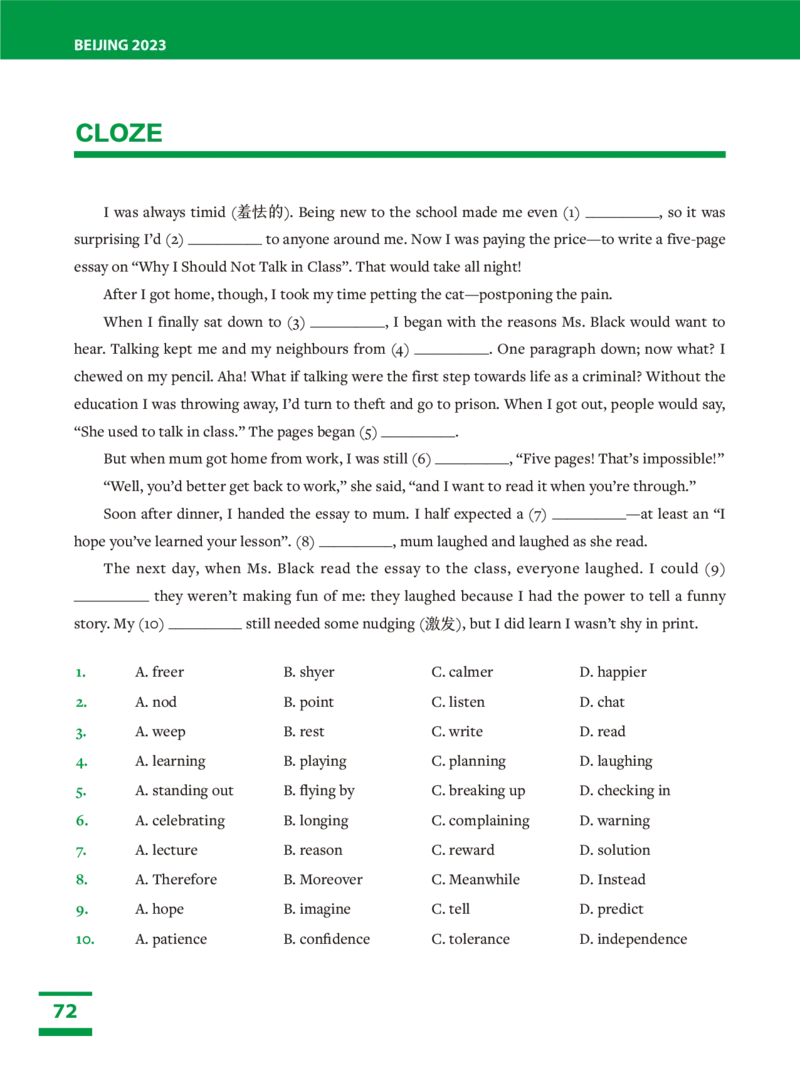
CLOZE
I was always timid (羞怯的). Being new to the school made me even (1) __________, so it was
surprising I’d (2) __________ to anyone around me. Now I was paying the price—to write a five-page
essay on “Why I Should Not Talk in Class”. That would take all night!
After I got home, though, I took my time petting the cat—postponing the pain.
When I finally sat down to (3) __________, I began with the reasons Ms. Black would want to
hear. Talking kept me and my neighbours from (4) __________. One paragraph down; now what? I
chewed on my pencil. Aha! What if talking were the first step towards life as a criminal? Without the
education I was throwing away, I’d turn to theft and go to prison. When I got out, people would say,
“She used to talk in class.” The pages began (5) __________.
But when mum got home from work, I was still (6) __________, “Five pages! That’s impossible!”
“Well, you’d better get back to work,” she said, “and I want to read it when you’re through.”
Soon after dinner, I handed the essay to mum. I half expected a (7) __________—at least an “I
hope you’ve learned your lesson”. (8) __________, mum laughed and laughed as she read.
The next day, when Ms. Black read the essay to the class, everyone laughed. I could (9)
__________ they weren’t making fun of me: they laughed because I had the power to tell a funny
story. My (10) __________ still needed some nudging (激发), but I did learn I wasn’t shy in print.
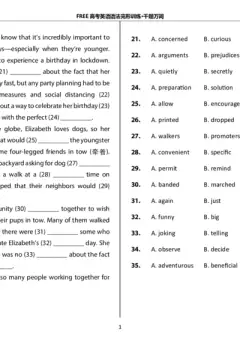
1.
A. freer
B. shyer
C. calmer
D. happier
2.
A. nod
B. point
C. listen
D. chat
3.
A. weep
B. rest
C. write
D. read
4.
A. learning
B. playing
C. planning
D. laughing
5.
A. standing out
B. flying by
C. breaking up
D. checking in
6.
A. celebrating
B. longing
C. complaining
D. warning
7.
A. lecture
B. reason
C. reward
D. solution
8.
A. Therefore
B. Moreover
C. Meanwhile
D. Instead
9.
A. hope
B. imagine
C. tell
D. predict
10.
A. patience
B. confidence
C. tolerance
D. independence
72
BEIJING 2023
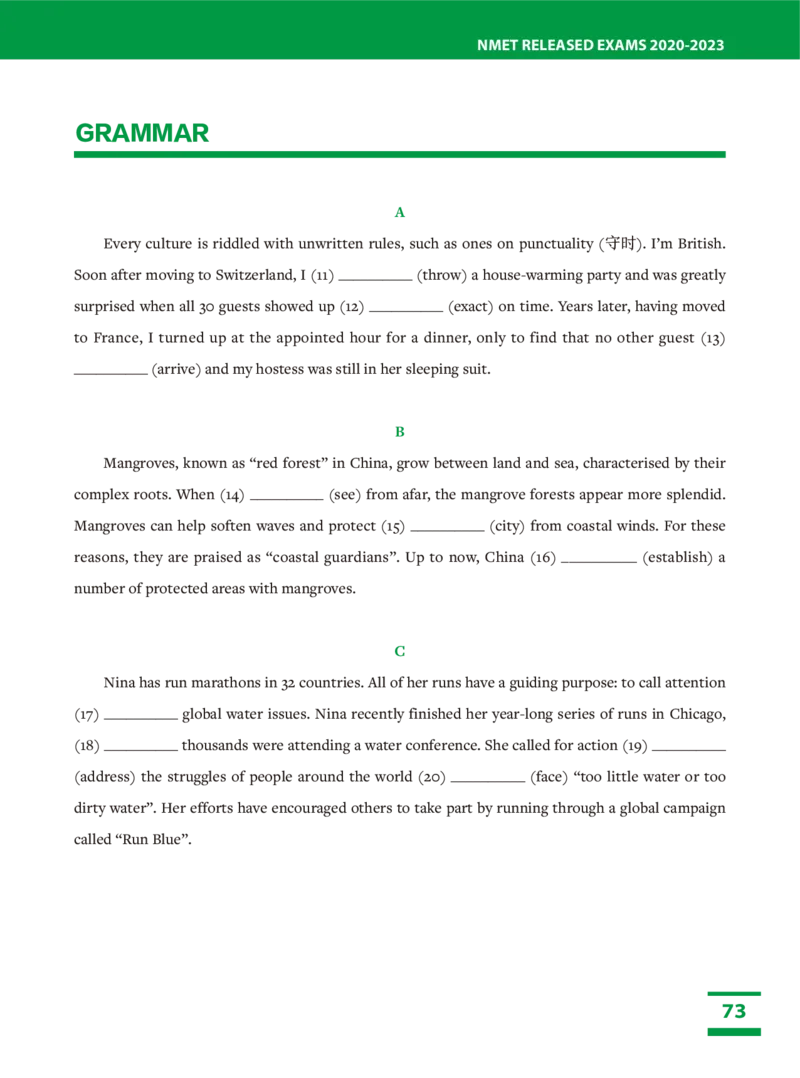
A
Every culture is riddled with unwritten rules, such as ones on punctuality (守时). I’m British.
Soon after moving to Switzerland, I (11) __________ (throw) a house-warming party and was greatly
surprised when all 30 guests showed up (12) __________ (exact) on time. Years later, having moved
to France, I turned up at the appointed hour for a dinner, only to find that no other guest (13)
__________ (arrive) and my hostess was still in her sleeping suit.
B
Mangroves, known as “red forest” in China, grow between land and sea, characterised by their
complex roots. When (14) __________ (see) from afar, the mangrove forests appear more splendid.
Mangroves can help soften waves and protect (15) __________ (city) from coastal winds. For these
reasons, they are praised as “coastal guardians”. Up to now, China (16) __________ (establish) a
number of protected areas with mangroves.
C
Nina has run marathons in 32 countries. All of her runs have a guiding purpose: to call attention
(17) __________ global water issues. Nina recently finished her year-long series of runs in Chicago,
(18) __________ thousands were attending a water conference. She called for action (19) __________
(address) the struggles of people around the world (20) __________ (face) “too little water or too
dirty water”. Her efforts have encouraged others to take part by running through a global campaign
called “Run Blue”.
GRAMMAR
73
NMET RELEASED EXAMS 2020-2023
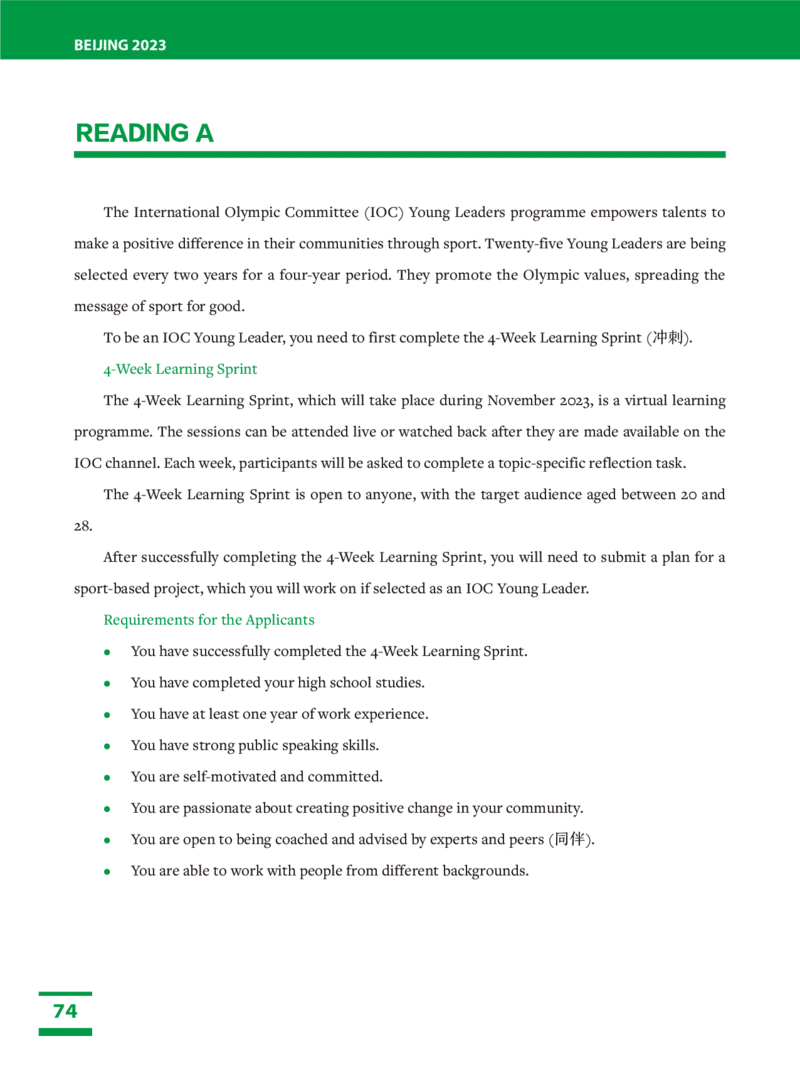
The International Olympic Committee (IOC) Young Leaders programme empowers talents to
make a positive difference in their communities through sport. Twenty-five Young Leaders are being
selected every two years for a four-year period. They promote the Olympic values, spreading the
message of sport for good.
To be an IOC Young Leader, you need to first complete the 4-Week Learning Sprint (冲刺).
4-Week Learning Sprint
The 4-Week Learning Sprint, which will take place during November 2023, is a virtual learning
programme. The sessions can be attended live or watched back after they are made available on the
IOC channel. Each week, participants will be asked to complete a topic-specific reflection task.
The 4-Week Learning Sprint is open to anyone, with the target audience aged between 20 and
28.
After successfully completing the 4-Week Learning Sprint, you will need to submit a plan for a
sport-based project, which you will work on if selected as an IOC Young Leader.
Requirements for the Applicants
•
 You have successfully completed the 4-Week Learning Sprint.
•
 You have completed your high school studies.
•
 You have at least one year of work experience.
•
 You have strong public speaking skills.
•
 You are self-motivated and committed.
•
 You are passionate about creating positive change in your community.
•
 You are open to being coached and advised by experts and peers (同伴).
•
 You are able to work with people from different backgrounds.
READING A
74
BEIJING 2023
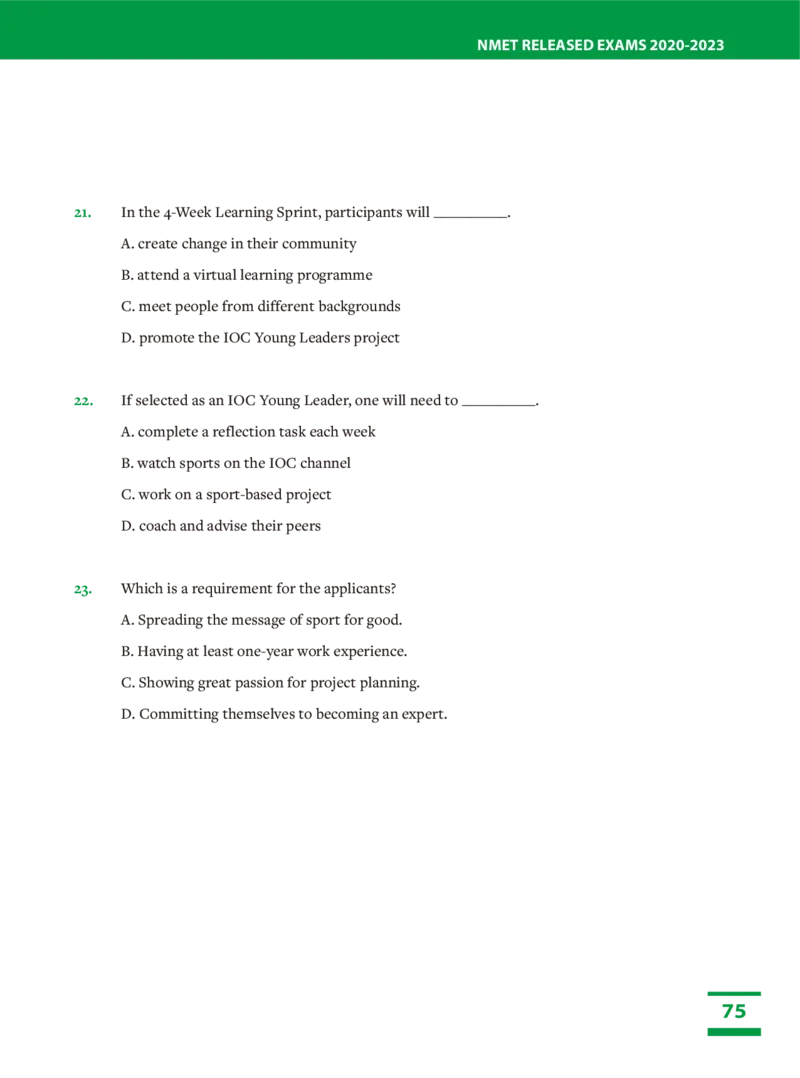
21.
In the 4-Week Learning Sprint, participants will __________.

A. create change in their community

B. attend a virtual learning programme

C. meet people from different backgrounds

D. promote the IOC Young Leaders project
22.
If selected as an IOC Young Leader, one will need to __________.

A. complete a reflection task each week

B. watch sports on the IOC channel

C. work on a sport-based project

D. coach and advise their peers
23.
Which is a requirement for the applicants?

A. Spreading the message of sport for good.

B. Having at least one-year work experience.

C. Showing great passion for project planning.

D. Committing themselves to becoming an expert.
75
NMET RELEASED EXAMS 2020-2023
READING B
Sitting in the garden for my friend’s birthday, I felt a buzz (振动) in my pocket. My heart raced
when I saw the email sender’s name. The email started off: “Dear Mr. Green, thank you for your
interest” and “the review process took longer than expected.” It ended with “We are sorry to inform
you ...” and my vision blurred (模糊). The position—measuring soil quality in the Sahara Desert as
part of an undergraduate research programme—had felt like the answer I had spent years looking
for. I had put so much time and emotional energy into applying, and I thought the rejection meant
the end of the road for my science career.
So I was shocked when, not long after the email, Professor Mary Devon, who was running the
programme, invited me to observe the work being done in her lab. I jumped at the chance, and
a few weeks later I was equally shocked—and overjoyed—when she invited me to talk with her
about potential projects I could pursue in her lab. What she proposed didn’t seem as exciting as the
original project I had applied to, but I was going to give it my all.
I found myself working with a robotics professor on techniques for collecting data from the
desert remotely. That project, which I could complete from my sofa instead of in the burning heat of
the desert, not only survived the lockdown but worked where traditional methods didn’t. In the end,
I had a new scientific interest to pursue.
When I applied to graduate school, I found three programmes promising to allow me to follow
my desired research direction. And I applied with the same anxious excitement as before. When I
was rejected from one that had seemed like a perfect fit, it was undoubtedly difficult. But this time
I had the perspective (视角) to keep it from sending me into panic. It helped that in the end I was
accepted into one of the other programmes I was also excited about.
Rather than setting plans in stone, I’ve learned that sometimes I need to take the opportunities
that are offered, even if they don’t sound perfect at the time, and make the most of them.
76
BEIJING 2023
24.
How did the author feel upon seeing the email sender’s name?

A. Anxious.

B. Angry.

C. Surprised.

D. Settled.
25.
After talking with Professor Devon, the author decided to __________.

A. criticise the review process

B. stay longer in the Sahara Desert

C. apply to the original project again

D. put his heart and soul into the lab work
26.
According to the author, the project with the robotics professor was __________.

A. demanding

B. inspiring

C. misleading

D. amusing
27.
What can we learn from this passage?

A. An invitation is a reputation.

B. An innovation is a resolution.

C. A rejection can be a redirection.

D. A reflection can be a restriction.
77
NMET RELEASED EXAMS 2020-2023
READING C
In recent years, researchers from diverse fields have agreed that short-termism is now a
significant problem in industrialised societies. The inability to engage with longer-term causes and
consequences leads to some of the world’s most serious problems: climate change, biodiversity
collapse, and more. The historian Francis Cole argues that the West has entered a period where “only
the present exists, a present characterised at once by the cruelty of the instant and by the boredom
of an unending now”.
It has been proved that people have a bias (偏向) towards the present, focusing on loud
attractions in the moment at the expense of the health, well-being and financial stability of their
future selves or community. In business, this bias surfaces as short-sighted decisions. And on slow-
burning problems like climate change, it translates into the unwillingness to make small sacrifices
(牺牲) today that could make a major difference tomorrow. Instead, all that matters is next quarter’s
profit, or satisfying some other near-term desires.
These biased perspectives cannot be blamed on one single cause. It is fair to say, though, that
our psychological biases play a major role. People’s hesitancy to delay satisfaction is the most
obvious example, but there are others. One of them is about how the most accessible information in
the present affects decisions about the future. For instance, you might hear someone say: “It’s cold
this winter, so I needn’t worry about global warming.” Another is that loud and urgent matters are
given too much importance, making people ignore longer-term trends that arguably matter more.
This is when a pop star draws far more attention than, say, gradual biodiversity decline.
As a psychologist once joked, if aliens (外星人) wanted to weaken humanity, they wouldn’t send
ships; they would invent climate change. Indeed, when it comes to environmental transformations,
we can develop a form of collective “poor memory”, and each new generation can believe the state of
affairs they encounter is nothing out of the ordinary. Older people today, for example, can remember
a time with insect-covered car windscreens after long drives. Children, on the other hand, have no
idea that insect population has dropped dramatically.
78
BEIJING 2023
28.
The author quotes Francis Cole mainly to __________.

A. draw a comparison


B. introduce a topic

C. evaluate a statement


D. highlight a problem
29.
What can be inferred from the last paragraph?

A. Climate change has been forgotten.

B. Lessons of history are highly valued.

C. The human mind is bad at noting slow change.

D. Humans are unwilling to admit their shortcomings.
30.
What does the author intend to tell us?

A. Far-sighted thinking matters to humans.

B. Humans tend to make long-term sacrifices.

C. Current policies facilitate future decision-making.

D. Bias towards the present helps reduce near-term desires.
79
NMET RELEASED EXAMS 2020-2023
READING D
What is life? Like most great questions, this one is easy to ask but difficult to answer. The
reason is simple: we know of just one type of life and it’s challenging to do science with a sample size
of one. The field of artificial life—called ALife for short—is the systematic attempt to spell out life’s
fundamental principles. Many of these practitioners, so-called ALifers, think that somehow making
life is the surest way to really understand what life is.
So far no one has convincingly made artificial life. This track record makes ALife a ripe target
for criticism, such as declarations of the field’s doubtful scientific value. Alan Smith, a complexity
scientist, is tired of such complaints. Asking about “the point” of ALife might be, well, missing the
point entirely, he says. “The existence of a living system is not about the use of anything,” Alan says.
“Some people ask me, ‘So what’s the worth of artificial life?’ Do you ever think, ‘What is the worth of
your grandmother?’”
As much as many ALifers hate emphasising their research’s applications, the attempts to create
artificial life could have practical payoffs. Artificial intelligence may be considered ALife’s cousin
in that researchers in both fields are enamoured by a concept called open-ended evolution (演化).
This is the capacity for a system to create essentially endless complexity, to be a sort of “novelty
generator”. The only system known to exhibit this is Earth’s biosphere. If the field of ALife manages
to reproduce life’s endless “creativity” in some virtual model, those same principles could give rise
to truly inventive machines.
Compared with the developments of AI, advances in ALife are harder to recognise. One reason
is that ALife is a field in which the central concept—life itself—is undefined. The lack of agreement
among ALifers doesn’t help either. The result is a diverse line of projects that each advance along
their unique paths. For better or worse, ALife mirrors the very subject it studies. Its muddled (混乱
的) progression is a striking parallel (平行线) to the evolutionary struggles that have shaped Earth’s
biosphere.
80
BEIJING 2023
Undefined and uncontrolled, ALife drives its followers to repurpose old ideas and generate
novelty. It may be, of course, that these characteristics aren’t in any way surprising or singular. They
may apply universally to all acts of evolution. Ultimately ALife may be nothing special. But even this
dismissal suggests something: perhaps, just like life itself throughout the universe, the rise of ALife
will prove unavoidable.
31.
Regarding Alan Smith’s defence of ALife, the author is __________.

A. supportive


B. puzzled

C. unconcerned


D. doubtful
32.
What does the word “enamoured” underlined in Paragraph 3 most probably mean?

A. Shocked.


B. Protected.

C. Attracted.


D. Challenged.
33.
What can we learn from this passage?

A. ALife holds the key to human future.
B. ALife and AI share a common feature.

C. AI mirrors the developments of ALife.
D. AI speeds up the process of human evolution.
34.
Which would be the best title for the passage?

A. Life Is Undefined. Can AI Be a Way Out?

B. Life Evolves. Can AI Help ALife Evolve, Too?

C. Life Is Undefined. Can ALife Be Defined One Day?

D. Life Evolves. Can Attempts to Create ALife Evolve, Too?
81
NMET RELEASED EXAMS 2020-2023
COMPLETION
It’s a joyful and stressful time of year in the United States for students and their families as they
make decisions about where to attend college. Families often turn to rankings systems to help make
a decision. (35) __________
When I talk to families as a scholar of higher education, they’re often surprised that teaching
excellence is not counted in rankings. (36) __________
Emerging research suggests that courses in lower-ranked universities, on average, scored
higher on teaching than courses in higher-ranked universities. (37) __________ The absence of teaching
excellence from the rankings is surprising given the link between high-quality teaching and student
success. Quality teaching is one of the most important predictors of a wide range of college
outcomes.
Rankings, however, are only one reason why a low value is placed on teaching in higher education.
Administrators often don’t view teaching excellence as a way to increase enrolment (注册) or funding.
(38) __________ Research shows that the more time instructors spend on teaching, the lower their
salary. What is the result? Many instructors continue to teach using traditional lectures, which lead
to lower success rates.
(39) __________ Nevertheless, not much will change until schools with high-quality teaching
are rewarded with more resources, higher rankings and increased enrolments. In the long term,
universities, organisations that rank schools, and others should work to make teaching a valued, core
part of the mission.
What should students and their families do? They should give strong consideration to
universities where high-quality teaching is valued, even though the schools may be ranked lower.
82
BEIJING 2023
A.
Higher education has achieved its true potential.
B.
Therefore, it’s not highly valued in hiring or promotion.
C.
Quality teaching has been an important reputation-building factor.
D.
However, the rankings ignore a critical factor: the quality of teaching.
E.
Efforts to improve teaching at the university level have recently emerged.
F.
They’re even more surprised at how teaching is undervalued by universities.
G.
In fact, universities often shift emphasis from teaching to other ranking factors.


83
NMET RELEASED EXAMS 2020-2023
TASK-BASED READING
Habit formation is the process by which behaviours become automatic. People develop
countless habits as they explore the world, whether they are aware of them or not. Understanding
how habits take shape may be helpful in changing bad habits.
Habits are built through learning and repetition. A person is thought to develop a habit in the
course of pursuing goals by beginning to associate certain cues (刺激) with behavioural responses
that help meet the goal. Over time, thoughts of the behaviour and ultimately the behaviour itself are
likely to be triggered (触发) by these cues.
A “habit loop (环)” is a way of describing several related elements that produce habits. These
elements are called the cue, the routine, and the reward. For example, stress could serve as a cue
that one responds to by eating, which produces the reward—the reduction of stress. While a routine
involves repeated behaviour, it’s not necessarily performed in response to a deep-rooted urge, as a
habit is.
Old habits can be difficult to shake, and healthy habits are often harder to develop. But through
repetition, it’s possible to form new habits. The amount of time needed to build a habit will depend
on multiple factors, including the individual and the intended behaviour. While you are able to pick
up a new habit in a few weeks, it takes many months to build a healthy habit.
Take some time to think about what leads to bad habits and re-evaluate what you get out of
them (or don’t). Consider and keep in mind why you want to make a change, including how the
change reflects your values.
84
BEIJING 2023
40.
How are habits built?

__________________________________________________________________________________
41.        In what way is a routine different from a habit?

__________________________________________________________________________________

__________________________________________________________________________________
42.       Please decide which part is false in the following statement, then underline it and explain
             why.

             Picking up a new habit takes a few weeks, while building a healthy habit takes a shorter time.

__________________________________________________________________________________

__________________________________________________________________________________
43.        What benefit(s) have you got from one of your good habits? (In about 40 words)

__________________________________________________________________________________

__________________________________________________________________________________

__________________________________________________________________________________

__________________________________________________________________________________
85
NMET RELEASED EXAMS 2020-2023
WRITING
假设你是红星中学高三学生李华。你的英国好友Jim正在策划一次以“绿色北京”为主题的
社团活动,他发来邮件询问你的建议。请你用英文给他回复,内容包括:
1.	 活动形式;
2.	 活动内容。
SAMPLE WRITING
Dear Jim,
How’s everything?
Glad to hear about the upcoming “Green Beijing” event at your club.
I think it’d be quite nice to have a photograph exhibition. You can display some pictures about
how Beijing has kept the city “green”, such as the use of solar power and recyclable materials. In
particular, I recommend “green transport” since electric vehicles and shared bikes are really popular
here. If you like, I’d be very happy to take some photos and email them to you.
If you need any other help, don’t hesitate to let me know.
Best wishes for this great event!
Yours,
Li Hua
86
BEIJING 2023
ANSWER KEY
CLOZE
1. B
2. D
3. C
4. A
5. B
6. C
7. A
8. D
9. C
10. B
GRAMMAR
11. threw
12. exactly
13. had arrived
14. seen
15. cities
16. has established
17. to
18. where
19. to address
20. facing
READING
A
21. B
22. C
23. B
B
24. A
25. D
26. B
27. C
C
28. D
29. C
30. A
D
31. A
32. C
33. B
34. D
COMPLETION
35. D
36. F
37. G
38. B
39. E
TASK-BASED READING
40
Habits are built through learning and repetition.
41
A routine is not necessarily performed in response to a deep-rooted urge.
42
Picking up a new habit takes a few weeks, while building a healthy habit takes a shorter
time.
It takes many months to build a healthy habit.
43
Omitted.
87
NMET RELEASED EXAMS 2020-2023