Test 1
PAPER 1
READING AND WRITING TEST
(1 hour 30 minutes)
Part 1
Questions 1-5
Look at the text in each question.
What does it say?
READING
Mark the correct letter A, B or C on your answer sheet.
Example:
0
1
12
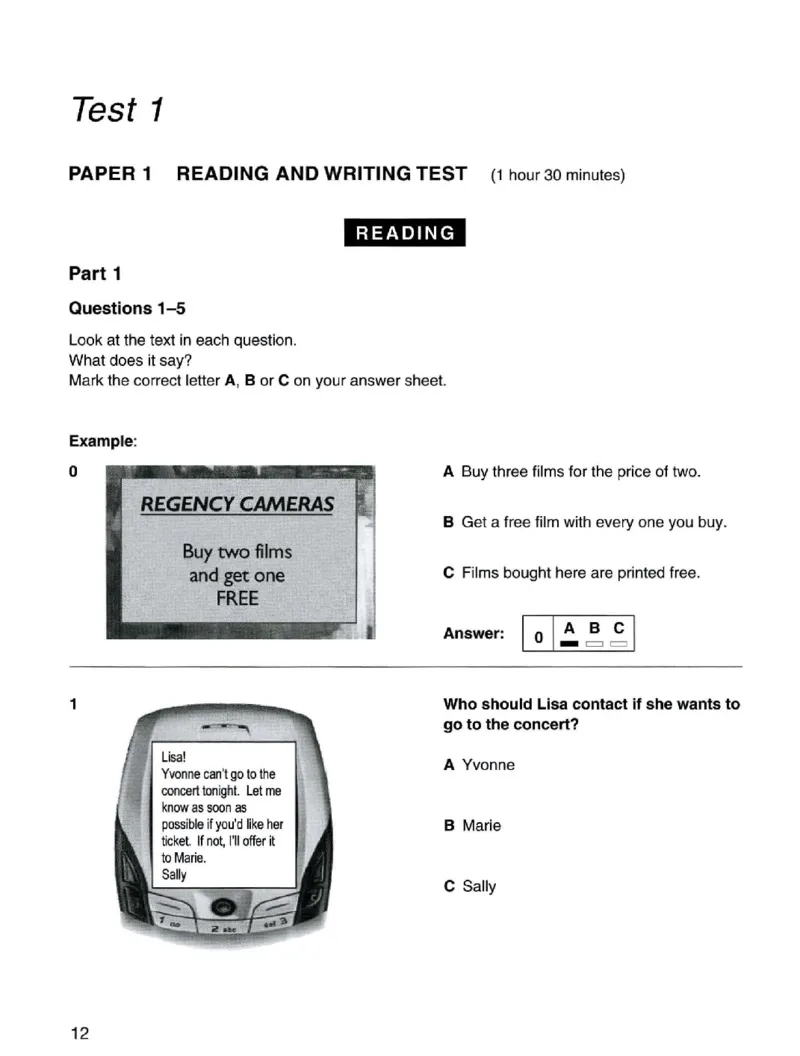
REGENCY CAMERAS
Buy two films
and get one
FREE
Lisa!
Yvonne can't go to the
concert tonight. Let me
know as soon as
possible if you'd like her
ticket. If not, I'll offer it
to Marie.
Sally
A Buy three films for the price of two.
B Get a free film with every one you buy.
C Films bought here are printed free.
Answer:
Who should Lisa contact if she wants to
go to the concert?
A Yvonne
B Marie
C Sally
2
3
4
5
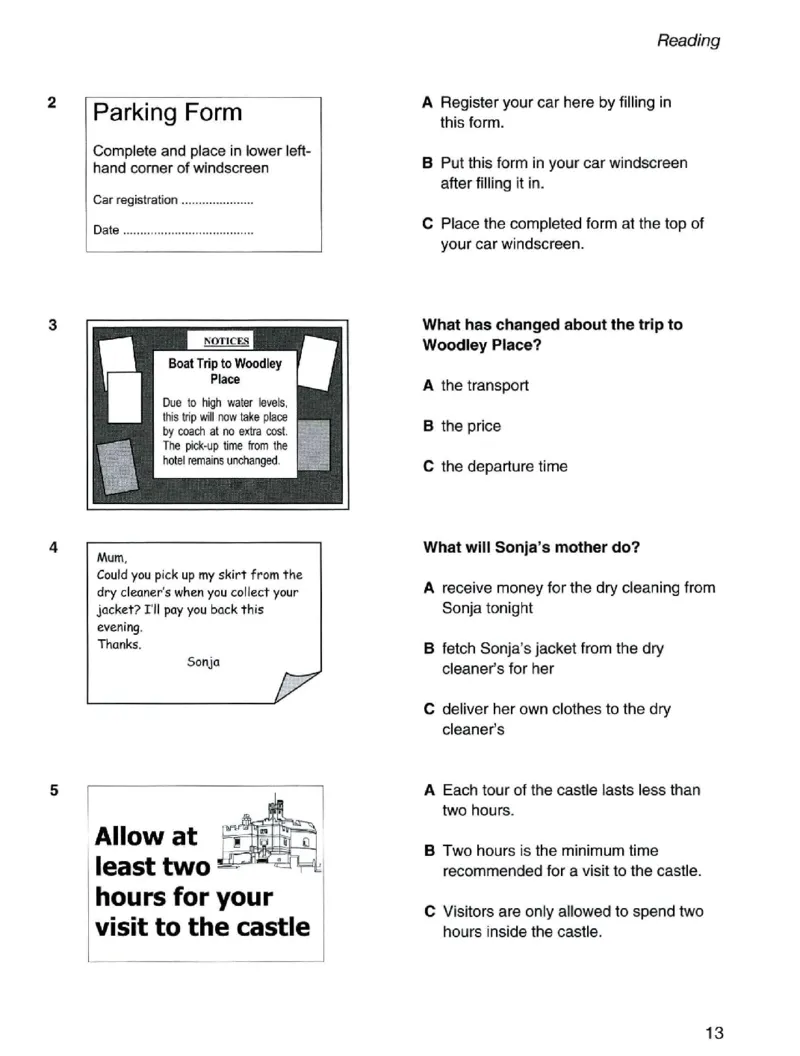
Parking Form
Complete and place in lower left-
hand corner of windscreen
Car registration .................... .
Date ..................................... .
Mum,
Due to high water levels,
this trip will now take place
by coach at no extra cost.
The pick-up time from the
hotel remains unchanged.
Could you pick up my skirt from the
dry cleaner's when you collect your
jacket? I'll pay you back this
evening.
Thanks.
Sonja
Allow at
least two ll!dh=L~
hours for your
visit to the castle
Reading
A Register your car here by filling in
this form.
B Put this form in your car windscreen
after filling it in.
C Place the completed form at the top of
your car windscreen.
What has changed about the trip to
Woodley Place?
A the transport
B the price
C the departure time
What will Sonja's mother do?
A receive money for the dry cleaning from
Sonja tonight
B fetch Sonja's jacket from the dry
cleaner's for her
C deliver her own clothes to the dry
cleaner's
A Each tour of the castle lasts less than
two hours.
B Two hours is the minimum time
recommended for a visit to the castle.
C Visitors are only allowed to spend two
hours inside the castle.
13
Test 1
Part 2
Questions 6-1 0
The people below live in London and are all interested in keeping fit.
On the opposite page there are descriptions of eight websites for people wanting to keep fit.
Decide which website would be the most suitable for the following people.
For questions 6-1 0, mark the correct letter (A-H) on your answer sheet.
6
7
8
9
10
14
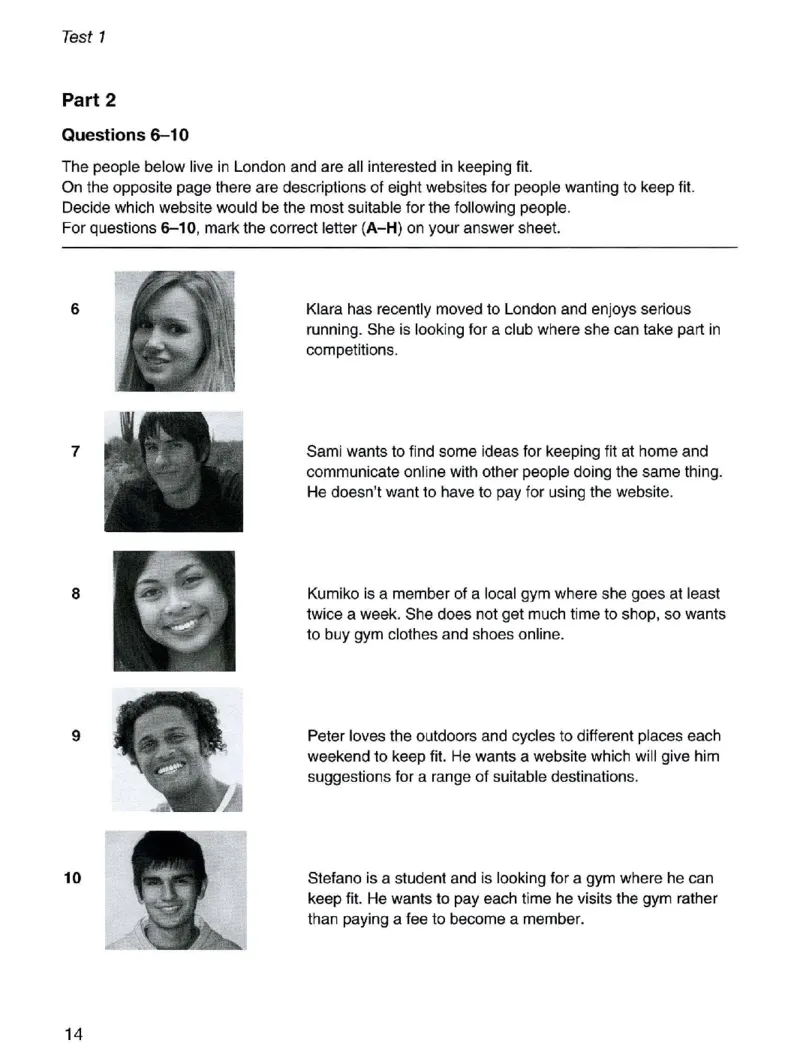
Klara has recently moved to London and enjoys serious
running. She is looking for a club where she can take part in
competitions.
Sami wants to find some ideas for keeping fit at home and
communicate online with other people doing the same thing.
He doesn't want to have to pay for using the website.
Kumiko is a member of a local gym where she goes at least
twice a week. She does not get much time to shop, so wants
to buy gym clothes and shoes online.
Peter loves the outdoors and cycles to different places each
weekend to keep fit. He wants a website which will give him
suggestions for a range of suitable destinations.
Stefano is a student and is looking for a gym where he can
keep fit. He wants to pay each time he visits the gym rather
than paying a fee to become a member.
Reading
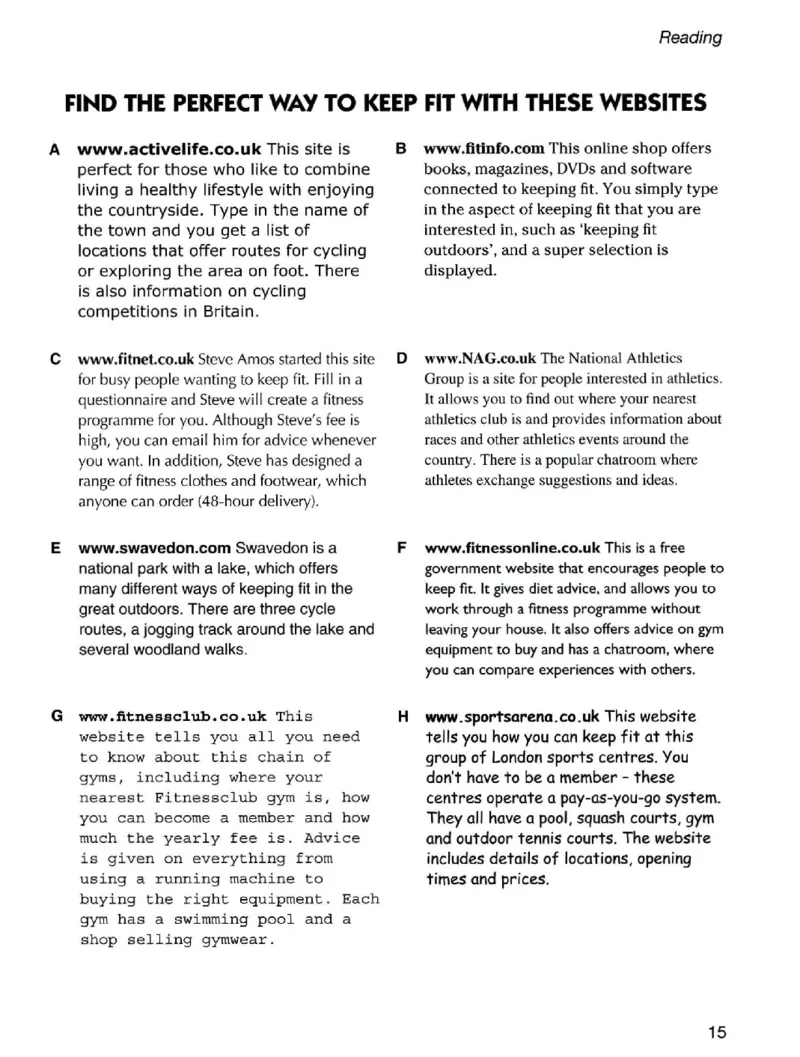
FIND THE PERFECT WAY TO KEEP FIT WITH THESE WEBSITES
A www.activelife.co.uk This site is
perfect for those who like to combine
living a healthy lifestyle with enjoying
the countryside. Type in the name of
the town and you get a list of
locations that offer routes for cycling
or exploring the area on foot. There
is also information on cycling
competitions in Britain.
C
www.fitnet.co.uk Steve Amos started this site
for busy people wanting to keep fit. Fill in a
questionnaire and Steve will create a fitness
programme for you. Although Steve's fee is
high, you can email him for advice whenever
you want. In addition, Steve has designed a
range of fitness clothes and footwear, which
anyone can order (48-hour delivery).
E
www.swavedon.com Swavedon is a
national park with a lake, which offers
many different ways of keeping fit in the
great outdoors. There are three cycle
routes, a jogging track around the lake and
several woodland walks.
G www.fitnessclub.co.uk This
website tells you all you need
to know about this chain of
gyms, including where your
nearest Fitnessclub gym is, how
you can become a member and how
much the yearl y fee is . Advice
is given on everything from
using a running machine to
buying the right equipment. Each
gym has a swimming pool and a
shop selling gymwear.
B www.fitinfo.com This online shop offers
books, magazines, DVDs and software
connected to keeping fit. You simply type
in the aspect of keeping fit that you are
interested in, such as 'keeping fit
outdoors', and a super selection is
displayed.
0
www.NAG.co.uk The National Athletics
Group is a site for people interested in athletics.
It allows you to find out where your nearest
athletics club is and provides information about
races and other athletics events around the
country. There is a popular chatroom where
athletes exchange suggestions and ideas.
F
www.fitnessonline.co.uk This is a free
government website that encourages people to
keep fit. It gives diet advice, and allows you to
work through a fitness programme without
leaving your house. It also offers advice on gym
equipment to buy and has a chatroom, where
you can compare experiences with others.
H www.sportsarena.co.uk This website
tells you how you can keep fit at this
group of London sports centres. You
don't have to be a member - these
centres operate a pay-as-you-go system.
They all have a pool, squash courts, gym
and outdoor tennis courts. The website
includes details of locations, opening
times and prices.
15
Test 1
Part 3
Questions 11-20
Look at the sentences below about a book club.
Read the text on the opposite page to decide if each sentence is correct or incorrect.
If it is correct, mark A on your answer sheet.
If it is not correct, mark Bon your answer sheet.
11
By ordering a book, you qualify to become a member of the International Book Club.
12
Every new member can request a watch from the book club.
13
You can buy a DVD more cheaply when you join.
14
All club books cost half the publisher's price.
15
Each club magazine gives you a choice of over 1,000 books.
16
You get a different choice of books if you order from the website.
17
One special book is recommended every month.
18
You may receive a book that the club has chosen for you.
19
You must pay the postage when sending your application to join the club.
20
You should pay as soon as you receive your books.
16
Reading
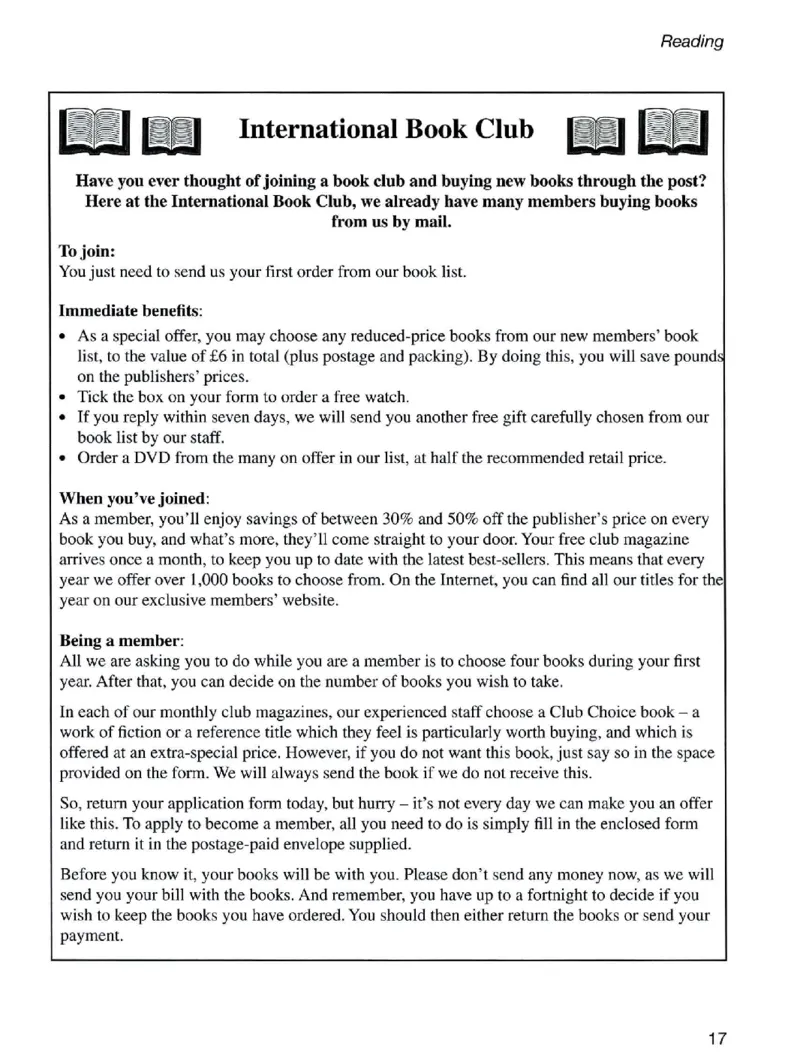
International Book Club
Have you ever thought of joining a book club and buying new books through the post?
Here at the International Book Club, we already have many members buying books
from us by mail.
To join:
You just need to send us your first order from our book list.
Immediate benefits:
• As a special offer, you may choose any reduced-price books from our new members' book
list, to the value of £6 in total (plus postage and packing). By doing this, you will save pound
on the publishers' prices.
• Tick the box on your form to order a free watch.
• If you reply within seven days, we will send you another free gift carefully chosen from our
book list by our staff.
• Order a DVD from the many on offer in our list, at half the recommended retail price.
When you've joined:
As a member, you'll enjoy savings of between 30% and 50% off the publisher's price on every
book you buy, and what's more, they'll come straight to your door. Your free club magazine
arrives once a month, to keep you up to date with the latest best-sellers. This means that every
year we offer over 1,000 books to choose from. On the Internet, you can find all our titles for the
year on our exclusive members' website.
Being a member:
All we are asking you to do while you are a member is to choose four books during your first
year. After that, you can decide on the number of books you wish to take.
In each of our monthly club magazines, our experienced staff choose a Club Choice book- a
work of fiction or a reference title which they feel is particularly wot1h buying, and which is
offered at an extra-special price. However, if you do not want this book, just say so in the space
provided on the form. We will always send the book if we do not receive this.
So, return your application form today, but hurry -it's not every day we can make you an offer
like this. To apply to become a member, all you need to do is simply fill in the enclosed form
and return it in the postage-paid envelope supplied.
Before you know it, your books will be with you. Please don't send any money now, as we will
send you your bill with the books. And remember, you have up to a fortnight to decide if you
wish to keep the books you have ordered. You should then either return the books or send your
payment.
17
Test 1
Part 4
Questions 21-25
Read the text and questions below.
For each question, mark the correct letter A, B, C or D on your answer sheet.
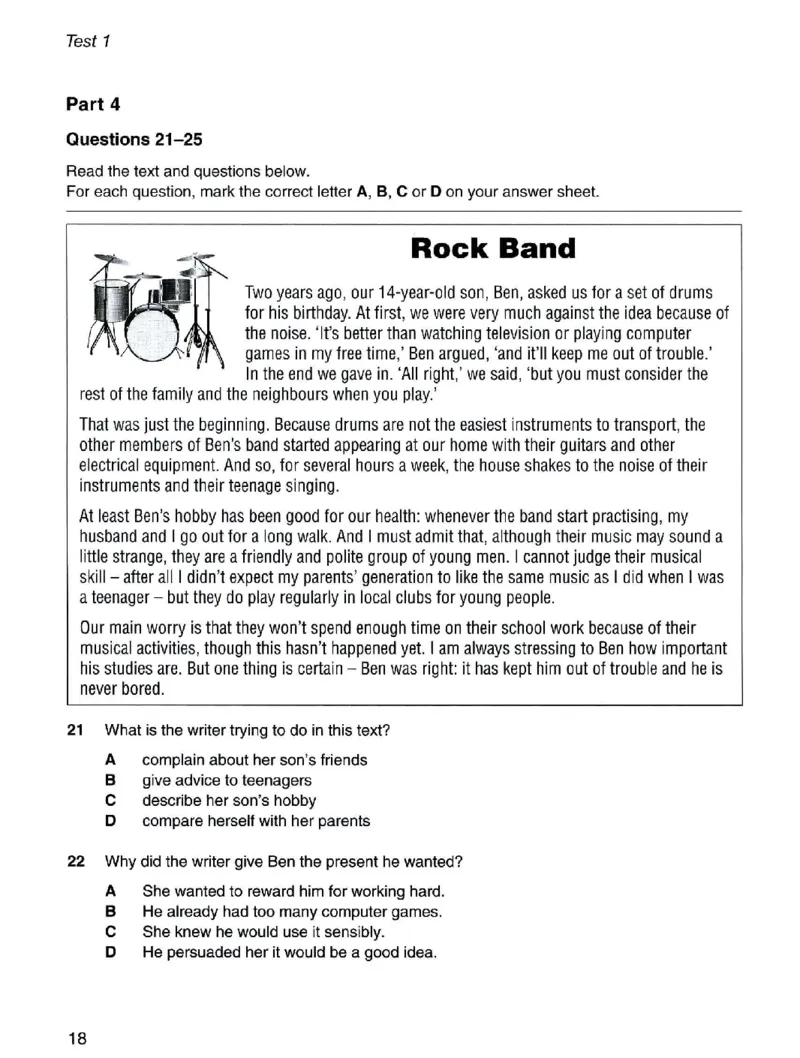
Rock Band
Two years ago, our 14-year-old son, Ben, asked us for a set of drums
for his birthday. At first, we were very much against the idea because of
the noise. 'It's better than watching television or playing computer
games in my free time,' Ben argued, 'and it'll keep me out of trouble.'
In the end we gave in. 'All right,' we said, 'but you must consider the
rest of the family and the neighbours when you play.'
That was just the beginning. Because drums are not the easiest instruments to transport, the
other members of Ben's band started appearing at our home with their guitars and other
electrical equipment. And so, for several hours a week, the house shakes to the noise of their
instruments and their teenage singing.
At least Ben's hobby has been good for our health: whenever the band start practising, my
husband and I go out for a long walk. And I must admit that, although their music may sound a
little strange, they are a friendly and polite group of young men. I cannot judge their musical
skill- after all I didn't expect my parents' generation to like the same music as I did when I was
a teenager- but they do play regularly in local clubs for young people.
Our main worry is that they won't spend enough time on their school work because of their
musical activities, though this hasn't happened yet. I am always stressing to Ben how important
his studies are. But one thing is certain - Ben was right: it has kept him out of trouble and he is
never bored.
21
What is the writer trying to do in this text?
A
complain about her son's friends
B
give advice to teenagers
C
describe her son's hobby
D
compare herself with her parents
22
Why did the writer give Ben the present he wanted?
A
She wanted to reward him for working hard.
B
He already had too many computer games.
C
She knew he would use it sensibly.
D
He persuaded her it would be a good idea.
18
23
Why do the band always practise at Ben's house?
A
It is difficult for Ben to move his drums.
B
The neighbours don't mind the noise.
C
Ben's parents enjoy listening to them.
0
They can leave their equipment there.
24
What does the writer say about the band members?
A
Their influence on her son worries her.
B
Their taste in music is different from hers.
C
They play their instruments well.
0
They avoid any contact with her.
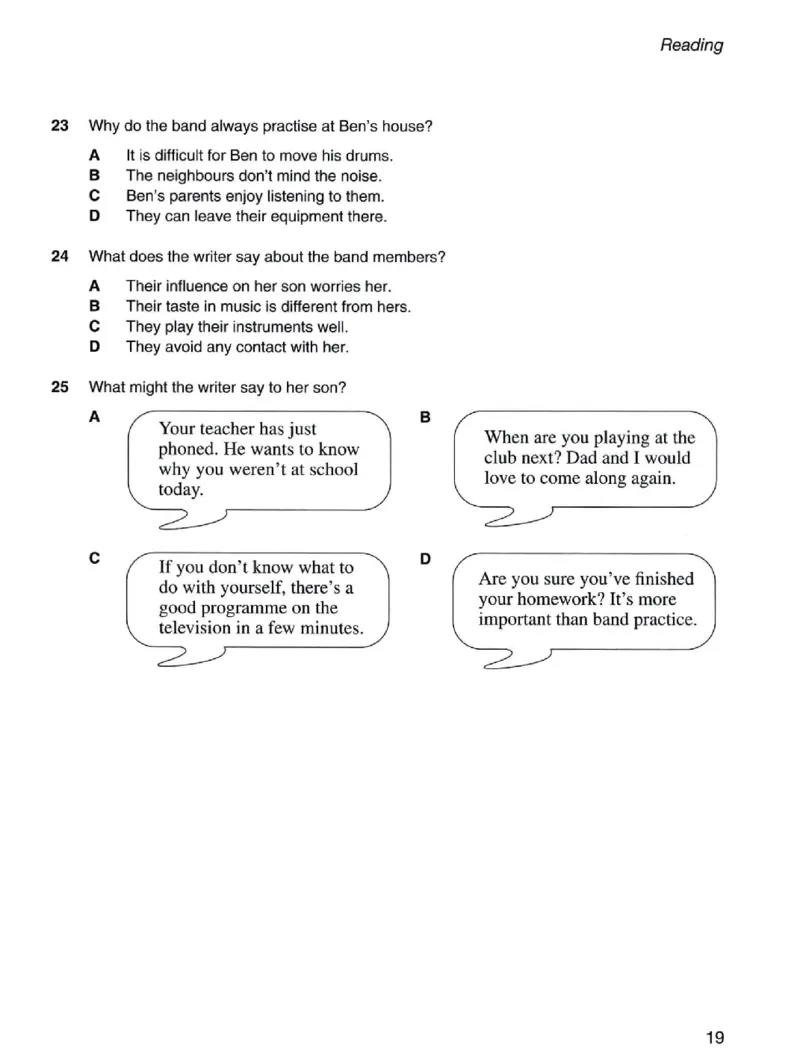
25
What might the writer say to her son?
A
c
Your teacher has just
phoned. He wants to know
why you weren't at school
today.
If you don't know what to
do with yourself, there's a
good programme on the
television in a few minutes.
B
D
Reading
When are you playing at the
club next? Dad and I would
love to come along again.
Are you sure you've finished
your homework? It's more
important than band practice.
19
Test 1
Part 5
Questions 26-35
Read the text below and choose the correct word for each space.
For each question, mark the correct letter A, B, C or D on your answer sheet.
Example:
0
A most
B more
C best
D better
Answer: I o I ! ! ~ ~ \
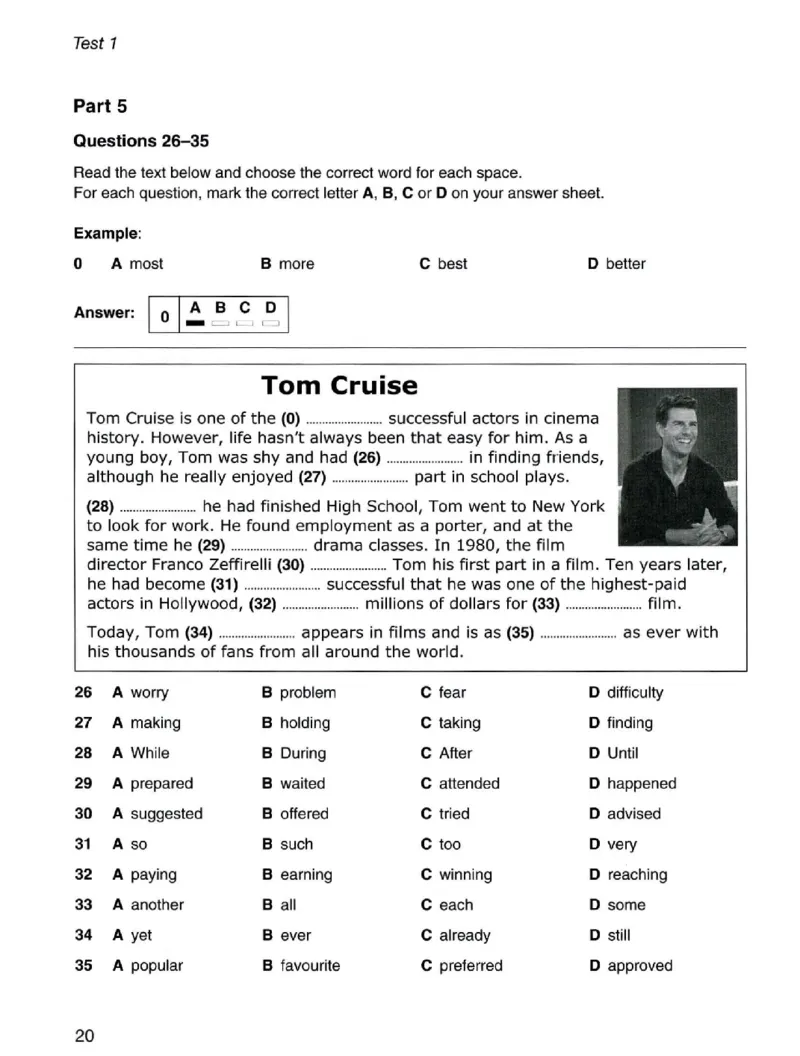
Tom Cruise
Tom Cruise is one of the (0) ........................ successful actors in cinema
history. However, life hasn't always been that easy for him. As a
young boy, Tom was shy and had (26) ........................ in finding friends,
although he really enjoyed (27) ........................ part in school plays.
(28) ........................ he had finished High School, Tom went to New York
to look for work. He found employment as a porter, and at the
same time he (29) ........................ drama classes. In 1980, the film
director Franco Zeffirelli (30) ........................ Tom his first part in a film. Ten years later,
he had become (31) ........................ successful that he was one of the highest-paid
actors in Hollywood, (32) ........................ millions of dollars for (33) ........................ film.
Today, Tom (34) ........................ appears in films and is as (35) ........................ as ever with
his thousands of fans from all around the world.
26
A worry
B problem
C fear
D difficulty
27
A making
B holding
C taking
D finding
28
A While
B During
C After
D Until
29
A prepared
B waited
C attended
D happened
30
A suggested
B offered
C tried
D advised
31
A so
B such
C too
D very
32
A paying
B earning
C winning
D reaching
33
A another
Ball
C each
D some
34
A yet
Bever
C already
D still
35
A popular
B favourite
C preferred
D approved
20
Writing
WRITING
Part 1
Questions 1-5
Here are some sentences about learning Italian.
For each question, complete the second sentence so that it means the same as the first.
Use no more than three words.
Write only the missing words on your answer sheet.
You may use this page for any rough work.
Example:
0
Daniel started Italian classes six months ago.
Daniel's had Italian classes ............................................................. six months.
Answer:
I 0 I
for
1
After seeing an advertisement for Italian lessons, Daniel decided to go.
Daniel ............................................................. an advertisement for Italian lessons and then
decided to go.
2
There are fifteen other students in his Italian class.
His Italian class ............................................................. fifteen other students in it.
3
Daniel thinks that speaking Italian is easier than writing it.
Daniel doesn't think that speaking is ............................................................. as writing Italian.
4
Daniel's teacher is Italian and her name's Chiara Paolozzi.
Daniel's teacher is Italian and she's ............................................................. Chiara Paolozzi.
5
The students are given two hours of homework each week.
Each week Chiara ............................................................. the students two hours of homework.
21
Test 1
Part 2
Question 6
You have spent the weekend staying with some English friends.
Write a card to them. In your card, you should
• thank your friends for the weekend
• say what you enjoyed most about the weekend
• invite them to stay with you.
Write 35-45 words on your answer sheet.
22
Part 3
Write an answer to one of the questions (7 or 8) in this part.
Write your answer in about 100 words on your answer sheet.
Mark the question number in the box at the top of your answer sheet.
Question 7
• This is part of a letter you receive from an English friend.
!__
I've just seen a brilliant programme about dolphins on
television. Which programmes have you enjoyed
\
recently? How much television do you watch?
\,__ ___ _
• Now write a letter, answering your penfriend's questions.
• Write your letter on your answer sheet.
Question 8
• Your English teacher has asked you to write a story.
• This is the title for your story:
Walking in the rain
• Write your story on your answer sheet.
Writing
23
Test 1
PAPER 2
LISTENING TEST
approx 35 minutes
(including 6 minutes transfer time)
Part 1
Questions 1-7
There are seven questions in this part.
For each question there are three pictures and a short recording.
Choose the correct picture and put a tick (.f) in the box below it.
Example: Where is the girl's hat?
~
~~
~
OQ~===---
so
1
Where will the friends meet?
* 1111111 *
2
What has the girl forgotten to bring?
24
cO
co
co
Listening
3
Which TV programme is on at 9 o'clock tonight?
BO
cO
4
How will the man book tickets for the show?
cO
5
What will the man do this winter?
BO
co
25
Test 1
6
How does the man want the woman to help him?
eO
co
7
Which house did the woman stay in?
eO
co
26
Part 2
Questions 8-13
You will hear a news reporter called Angela Bond, talking on the radio about her job.
For each question, put a tick (.f) in the correct box.
8
Where is Angela working at the moment?
AD Britain
B D the USA
CD Asia
Listening
9
Angela likes her job because she
A D loves being in dangerous situations.
B D never knows where she'll go next.
C D enjoys watching important events
happen.
10
What did Angela bring home from Hong Kong? A D pictures
B D carpets
C D furniture
11
What time does Angela's working day begin?
A D 8.30 am
B D 6.30pm
CD 10.00am
27
Test 1
12
Where did Angela meet her boyfriend?
13
What does Angela do to relax?
28
A 0 at her sister's house
B 0 at university
C 0 in Hong Kong
A 0 She cooks a meal.
B 0 She goes sailing.
C 0 She goes shopping.
Listening
Part 3
Questions 14-19
You will hear a radio programme about some historic places to visit.
For each question, fill in the missing information in the numbered space.
HISTORIC PLACES TO VISIT
Black Rock Caves
• Over 2 million years old
• For half a million years, people and animals, especially (14) ........................ ,
lived here
• Special evening tours during the month of (15) ....................... .
Salter House
• Built in the year (16) ....................... .
• Made famous by the television series called Aunt Dorothy
• All visitors want to see Dorothy's (17) ....................... .
The Old Port
• Have a ride on an old tram to the (18) ........................ village
• In the factory, find out how people used to make (19) ....................... .
29
Test 1
Part 4
Questions 2Q-25
Look at the six sentences for this part.
You will hear a conversation between a boy, Marcus, and a girl, Catherine, about their homework.
Decide if each sentence is correct or incorrect.
If it is correct, put a tick (.f) in the box under A for YES. If it is not correct, put a tick (.f) in the box
under B for NO.
20
Catherine finds it hard to understand why Marcus has so much
homework.
21
Marcus agrees that he could change his weekend
activities.
22
Catherine thinks visiting the museum was a good experience
for Marcus.
23
Catherine offers to show Marcus the maths homework she has
already done.
24
Marcus worries that his teacher might be angry if Catherine
helps him.
25
After talking to Catherine, Marcus feels more confident about his
homework.
30
A
B
YES
NO
D
D
D
D
D
D
D
D
D
D
D
D
Speaking
About the Speaking test
The Speaking test lasts about 10 to 12 minutes. You take the test with another candidate. There
are two examiners in the room. One examiner talks to you and the other examiner listens to you.
Both the examiners give you marks.
Part 1
The examiners introduce themselves and then one examiner asks you and your partner to say
your names and spell them. This examiner then asks you questions about yourself, your daily life,
interests, etc.
Part2
The examiner asks you to talk about something together and gives you a drawing to help you.
Part3
You each have a chance to talk by yourselves. The examiner gives you a colour photograph to
look at and asks you to talk about it. When you have finished talking, the examiner gives your
partner a different photograph to look at and to talk about.
Part4
The examiner asks you and your partner to say more about the subject of the photographs in
Part 3. You may be asked to give your opinion or to talk about something that has happened
to you.
31
Frames for the Speaking test
TEST 1
Part 1 (2-3 minutes)
Tasks
Identifying oneself; giving information about oneself; talking about interests.
Phase 1
Examiner
AlB
Good morning I afternoon I evening.
Can I have your mark sheets, please?
AlB
I'm ....... ..... and this is .......... .. .
He I she is just going to listen to us.
A
Now, what's your name?
Thank you.
B
And what's your name?
B
A
92
Thank you.
Candidate B, what's your surname?
How do you spell it?
Thank you.
And, Candidate A, what's your surname?
How do you spell it?
Thank you.
(Ask the following questions. Use
candidates' names throughout.
Ask Candidate A first.)
Where do you live I come from?
Adult students
Do you work or are you a student in . . . ?
What do you do I study?
School-age students
Do you study English at school?
Do you like it?
Thank you.
(Repeat for Candidate B.)
Back-up prompts
How do you write your family
I second name?
How do you write your family
I second name?
Do you live in ... ?
Have you got a job?
What job do you do? I What
subject(s) do you study?
Do you have English lessons?
Test 1
Phase 2
Examiner
(Select one or more questions from the list to ask each candidate. Ask Candidate B first.)
Do you enjoy studying English? Why (not)?
Do you think that English will be useful for you
in the future?
What did you do yesterday evening I last weekend?
What do you enjoy doing in your free time?
Thank you.
{Introduction to Part 2)
In the next part, you are going to talk to each other.
Back-up prompts
Do you like studying English?
Will you use English in the
future?
Did you do anything yesterday
evening I last weekend? What?
What do you like to do in your
free time?
Part 2 (2-3 minutes)
A RAINY DAY
Tasks
Examiner
Discussing alternatives; expressing opinions; making choices.
Say to both candidates:
I'm going to describe a situation to you.
A group of friends is planning to spend a day by the sea, but when they arrive
it's raining. Talk together about the different things they can do while it's raining,
and then decide which will be most interesting.
Here is a picture with some ideas to help you.
Ask both candidates to look at picture 1A on page I of the Student's Book and
repeat the frame.
I'll say that again.
A group of friends is planning to spend a day by the sea, but when they arrive
it's raining. Talk together about the different things they can do while it's raining,
and then decide which will be most interesting.
All right? Talk together.
Allow the candidates enough time to complete the task without intervention.
Prompt only if necessary.
93
Frames for the Speaking test
Part 3 (3 minutes)
TAKING A BREAK
Tasks
Examiner
Describing people and places; saying where people and things are and what
different people are doing.
Say to both candidates:
Now, I'd like each of you to talk on your own about something. I'm going to give
each of you a photograph of people taking a break.
Candidate A, here is your photograph. (Ask Candidate A to look at photo 1 Bon
page II of the Student's Book.) Please show it to Candidate B, but I'd like you to
talk about it. Candidate B, you just listen. I'll give you your photograph in a moment.
Candidate A, please tell us what you can see in your photograph.
(Candidate A) Approximately one minute
Examiner
If there is a need to inteNene, prompts rather than direct questions should be
used.
Ask Candidate A to close his/her book.
Now, Candidate B, here is your photograph. It also shows someone taking a
break. (Ask Candidate B to look at photo 1C on page IV of the Student's Book.)
Please show it to Candidate A and tell us what you can see in the photograph.
(Candidate B) Approximately one minute
Ask the candidates to close their books before moving to Part 4.
Part 4 (3 minutes)
Tasks
Examiner
94
Talking about one's likes and dislikes; expressing opinions: talking about habits.
Say to both candidates:
Your photographs showed people taking a break. Now, I'd like you to talk
together about when you take a break during the day, and where you like to go
during your break.
Allow the candidates enough time to complete the task without inteNention.
Prompt only if necessary.
Thank you. That's the end
of the test.
Back-up prompts
1. Talk about when you take a break.
2. Talk about where you like to go for your break.
3. Talk about what you do during your break.
4. Talk about why it's important to take a break.
Key
Test1
PAPER 1
READING AND WRITING
READING
Part 1
1 c
2 B
3 A
4 A
5 B
Part 2
6 D
7 F
8 c
9 A
10 H
Part3
11 A
12 A
13 A
19 B
Part4
21 c
Part 5
26 D
34 D
WRITING
Part 1
20 B
22 D
23 A
27 c
28 c
35 A
1 (first) saw/had seen
2 has/has got
3 as/so difficult/hard
4 called
5 gives
Part 2
Task-specific Mark Scheme
14 B
15 B
24 B
25 D
29 c
30 B
The content elements that need to be covered are:
i expression of thanks to candidate's friends
16 B
31 A
ii indication of what candidate enjoyed most about weekend
iii invitation for friends to stay with candidate
17 A
32 B
The following sample answers can be used as a guide when marking.
104
18 A
33 c
Test 1
SAMPLE A (Test 1, Question 6: Letter to friends)
Dear Tom and Kate
I'm writting to say thankyou for the weekend. It was realy nice
to go in Spain. I enjoyed most visit we did to arts museum. I
want that you come and stay with me in summer.
Examiner Comments
All the elements are covered and the message is successfully communicated on the whole.
Mark: 4
SAMPLE B (Test 1, Question 6: Letter to friends)
DWJ-" friencis
Tho..nks HO(A for nice weekenci o..t HO(ArS ~O(ASe. I ettioHeci
most going to bw.cl1 o..nci p~ vo~, o..nci will remember the
nice meo..L we eo..t in restrOJAnt on S~r~. Yo(,( will shAy
~ere soon.
Examiner Comments
The third element has not been successfully achieved, but the other two are sufficiently clear.
Mark: 3
105
Key
SAMPLE c (Test 1, Question 6: Letter to friends)
Hi guys!
I write to thank you for a brilliant time last weekend. The
computer game is the best - I am happy to be champion of
the weekend! Come to my house next time for a new
contest.
Philip
Examiner Comments
All the elements are covered and the message is clearly communicated.
Mark: 5
SAMPLE o (Test 1, Question 7: Letter to a friend)
Deo..r £rin,
How o..re yw? In ywr Letter yw toUi me yw ~oyecl o.- progro..mme ol>wt
dolphins on tetev~si.on, I d..on
1t reo..l4l ~oy a.nimo..L progro..mmes a.s mud1 . I
d..on,t wol.ch tetev~si.on very often, I o..m more Uke.Ly to wol.ch films. But
a.nyw<AY I ~oyecl ug4:i Betty the other ~' I thwgth it was reo..l4l ft.t.nny .
Ho.-ve you ever wol.checl ug41 Betty ? I o..Lso ~oy wol.ching the news
sometimes.
Probo..b4:i the progro..mme tho..t I most wo..tcl1 ~s MTV, d..o you Uke MTV?
think ~s greo..t but sometimes the music they d1oose ~s o.- bil. stra.nge.
How often d..o you wo..tcl1 teiev~swn?
Lots of love. ><>< Bociov
Examiner Comments
This is a very good attempt. It is confident and natural, e.g. 'Have you ever watched Ugly Betty?',
and 'How often do you watch television?'. There is a wide range of structures, e.g. 'I am more
likely to watch films', 'Probably the programme that I most watch . . .'. It is also well organised
with use of simple linking devices, e.g. 'but', 'but sometimes'. There are minor non-impeding
errors, e.g. 'I think is great', and 'thougth'. No effort is required from the reader.
Band:5
106
Test 1
SAMPLE E (Test 1, Question 7: Letter to a friend)
Dear Sir,
I am writeing the letter intuldes my self my name is Ali Alhebsi I am
writeing about Penfriend the television should be have because the
important I can watch anythik and I can watch the world and BBC and I
am enjoyed when I watch television and I've just seen a brilliant on
television I have enjoyed recently I watch television evryday two hours
For one dey but I watch lot of when I have weekends
I would appantion this accpeton this matter
your -Aathfully,
Seed
Examiner Comments
This is a rather poor attempt. It shows a severely restricted command of language, e.g. 'I am
writeing the letter intuldes my self . . .'. There is an inadequate range of structures and the
absence of punctuation leads to serious incoherence, e.g. 'Should be have because the important
I can watch anythik . . .'. Control is very poor at times and quite difficult to understand, e.g. 'I
would appantion this accpeton this matter'. Requires excessive effort by the reader.
Band:1
107
Key
SAMPLE F (Test 1, Question 7: Letter to a friend)
Dear John,
How are you? I am very poor in this few weeks because I broke my
leg when I wa-s playing volleybal1. I just stay a-t home and waixh a,
lot of TV programmes in this week.
I waixhed an exceLlent programme caLled Alan Sugar. It is a,
compet:iiion which is a, group of smart business men use different
idea-s to seLl their products and try to make grea-t profits in d .
The winner can get a, grea-tjob in Alan Sugar's Company. You can
see how dever they are. I know you are interested in Business
Study tha-t's why I strongly recommend to you . It is on every
Monday a-t 9:15pm in Channel 4 .
How ahout your dolphins progra.mme? It seems quite funny. Can you
teLl me more informaiion ahout this programme?
Loves,
Jan
Examiner Comments
This is a good attempt. There is a more than adequate range of structures and vocabulary and
fairly ambitious language, e.g. ' ... a group of smart business men use different ideas to sell their
products and try to make great profits .. .', 'You can see how clever they are'. Organised through
paragraphing and appropriate linking, e.g.' .. . because I broke my leg when I was playing .. .',
' . .. that's why I strongly recommend .. .'. There are some non-impeding errors, e.g. 'I am very
poor in this few weeks .. .','It is a competition which is a group .. .'. Requires only a little effort
from the reader.
Band:4
108
Test 1
SAMPLE G (Test 1 , Question 8: Story)
I think about manything while I'm walking in the rain.
To tell the true) I don't like rain. walking in the rain) too . But It
remind me what I did at pa-st. And it makes me to think about
furthur. The sound of rain heLp me to caLm down. I just like to
think about myseLf while walking in the rain. Sometimes it makes
me to be cLmuse by many sound . It is 01<) I eryoy it) too.
It gives me an exstra- time what I couldn't ha-ve enough it in
normal We.
I like walking in the rain) except to what my shoes cLre wet To tell
the true. The real rea-son why I don't like walking in the rain is
that I ha-ve to what my shoes cLre wet.
Examiner Comments
This is an adequate attempt on the whole. The language is ambitious but flawed, e.g. 'It gives me
an exsta time what I couldn't have enough it in normal life'. There is an adequate range but
marred by errors, e.g. 'And it makes me to think about futhur'. There is some attempt at
organisation, with some repetitive linking, e.g. 'to tell the true . . .', 'Sometimes .. .'.There are
numerous errors, some of which are potentially impeding, e.g. 'Sometimes it make me to be
amuse by many sound'. It requires some effort from the reader.
Band:3
109
Key
SAMPLE H (Test 1, Question 8: Story)
I'll tell you story when, I walked in the rain. It was in the spring. I was in
the park. It park has a lot of trees. When is weather is nice, and it
raining, and you can hear birds are singing. I love rain. And also I like
cickling? in the rain.
Examiner Comments
This is an inadequate attempt. The language is generally simplistic with a limited range of
structures and vocabulary, e.g. 'I walked in the rain', 'I love rain', 'I was in the park'. Where there
is more ambition this leads to inaccuracy, e.g. 'When is weather is nice ... birds are singing'.
There is some attempt at organisation with simple linking, e.g. 'and', 'when'. There are a number
of errors, one of which is impeding: 'cickling'. It requires some effort from the reader. At fifty-four
words this script can only obtain a maximum of 2.3. If this were full length, the script might
achieve a slightly higher mark.
Band:2
110
Test 1
SAMPLE 1 (Test 1, Question 8: Story)
Togetrler wolk:mg m t11e ro..i.n, Jo..ne o..ncl I smg cheerfut41 c:A-5 uswA.L. I turn my Lpocl on
o..ncl skip between tl1e trees.
S<Aclclenl.y, I fi,ncl myseLf surrwnclecl by some giAnt trees. I stop o..ncl 5c.<A.n c:Lrouncl. A
clrop of ro.i.n clrips onto my hec:L<i.
There she i.,s! A purple spot shmes m tl1e wkness.
'Jo..ne! Where were you? I WM so scarecl! Come here, I heLve o..n umbre.l.l..c:L. Come on.'
She cloesn't seem to heLve movecl o..n mch.
Now o..notl1er mo..n a.ppec:Lr5 next to her. He i.,s hol.d..ing c:L soak eel tenner whiLe my si.,ster
clrops tl1e bc:Lg of whlte powcler onto t11e wet, mud..d.y grouncl.
I stc:Lrt runnmg towc:Lrcls her but wrui - I c.<A.nnot move.
A ho..ncl M
hec:Lvy c:A-5 steel hc:A-5 o..Lrec:Lcly rec:Lchecl my shoul.cler.
She sWes c:Lt me m tl1e most horri,fi,&i w~ I heLve ever seen.
Examiner Comments
This is a very good attempt, above what is expected at PET level. The language is at times very
ambitious, e.g. 'He is holding a soaked tenner', 'A hand as heavy as steel ... '. There is a very
wide range of structures and vocabulary. The narrative is well organized and extremely accurate.
There is also good use of the narrative present tense and direct speech. No effort is required from
the reader.
Band:5
PAPER 2
LISTENING
Part 1
1 A
2 A
3 c
Part 2
8 A
9 c
10 c
Part3
14 T/tiger(s)
15
A/aug(ust) (evenings)
16
1765
17
K/kitchen(s)
18
(old) F/fishing
4 B
5 A
6 B
11 A
12 A
19
S/sweet(s)(es)(ies) C/candy(s)/C/candies
Part4
20 B
21 B
22 A
23 B
24 A
7A
13 B
25 B
111
Key
PART 1
112
Test 1 transcript
This is the Cambridge Preliminary English Test, Test 1.
There are four parts to the test. You will hear each part twice. For each part of the test there will
be time for you to look through the questions and time for you to check your answers.
Write your answers on the question paper. You will have six minutes at the end of the test to
copy your answers onto the answer sheet.
The recording will now be stopped.
Please ask any questions now, because you must not speak during the test.
[Pause]
Now open your question paper and look at Part 1.
There are seven questions in this part. For each question there are three pictures and a short
recording. Choose the correct picture and put a tick in the box below it.
Before we start, here is an example.
Where is the girl's hat?
Mum:
Where's your new hat, Sally? I hope you haven't left it on the school bus.
Sally:
Don't worry, Mum. I put it in my school bag because I was too hot.
Mum:
Are you sure? I can't see it there. You probably dropped it in the road somewhere.
Sally:
Oh, here it is- hanging in the hall. I forgot to take it this morning.
[Pause]
The first picture is correct so there is a tick in box A.
Look at the three pictures for Question 1 now.
[Pause]
Now we are ready to start. Listen carefully. You will hear each recording twice.
One. Where will the friends meet?
Girl:
Hi, it's Maria. Got your message. Yeah, I'd like to go to the movies. There's a film
called Lightworld Two, or a comedy- I don't mind which .. . Shall we meet outside the
cinema?
Boy:
Or, I know, at the coffee bar on the corner, we could have a snack before we go in. We
could meet at the bus stop.
Girl:
Mum's driving me into town this afternoon, to buy some trainers, so I won't have to get
the bus. But something to eat first is a good idea. Shall we say six o'clock?
Boy:
OK.
[Pause]
Now listen again.
[The recording is repeated]
[Pause]
Two. What has the girl forgotten to bring?
Boy:
Drink up your coffee- we'll be late for class. What are you looking for now? Don't tell
me you've left your essay at home. You said you were working on it till midnight.
Girl:
Don't worry, it was the first thing I put in my bag - look, here it is. I won't be a second
. . . just checking everything. Pen ... now where did I ... ? Oh dear, you'll be able to
lend me one, won't you? Keys? - oh, here they are, in my pocket as usual ...
[Pause]
Now listen again.
[The recording is repeated]
[Pause]
Three. Which TV programme is on at nine o'clock tonight?
Test 1
Woman: Because of the ski jumping finals we're late finishing, so there are some changes to
this evening's programmes. We won't now show the Nature Programme, about the
dolphins found near the Florida coast, at nine o'clock. Instead, Tim Wong's Chinese
Kitchen will be at this time, an hour later than advertised. You can see the Nature
Programme at its usual time next week.
[Pause]
Now listen again.
[The recording is repeated]
[Pause]
Four. How will the man book tickets for the show?
Woman: Shall we go to the Boat Show? It's on for three weeks- but you need to book if you
want to go on the first night because there's a party.
Man:
Really? Let's go. How do you book?
Woman: On the Internet or by phone ... or there's a form to fill in, in this week's TV magazine
with a discount on each ticket.
Man:
I like saving money, but the post's always so slow. I prefer to talk to someone when
I'm making a booking- just leave it to me.
[Pause]
Now listen again.
[The recording is repeated]
[Pause]
Five. What will the man do this winter?
Woman: Will you go on working as a gardener when winter comes, Jim? You'll get very cold
and wet working outside.
Man:
Well, last winter I took a job in a supermarket. They're advertising for staff again at the
moment, but I prefer being in the fresh air - even when the weather's bad. I'd really
like to get a job abroad in the sun, but all the ones I've seen need building skills, which
I haven't got. So I'll just stay in my present job for the time being.
[Pause]
Now listen again.
[The recording is repeated]
[Pause]
Six. How does the man want the woman to help him?
Man:
Sarah, could you do something for me?
Woman: Well, it depends what it is.
Man:
I want to clean the bedroom windows this afternoon, but I lent the ladder to John .. .
could you give me a lift to his house and then bring me back with the ladder?
Woman: Of course - no problem.
[Pause]
Now listen again.
[The recording is repeated]
113
Key
PART2
114
[Pause]
Seven. Which house did the woman stay in?
Woman 1:
I love these photos of your holiday. Is this the house you stayed in? I love the
balconies and all those plants growing up the walls. Oh, and there's a lovely big
swimming pool.
Woman 2:
Let me see. Oh, you're looking at the wrong photo -that was the house our
friends stayed in. Ours was exactly like that one, but we only had the sea to swim
in. Here, let me show you a photo of our house. It was just as nice.
[Pause]
Now listen again.
[The recording is repeated)
[Pause)
That is the end of Part 1.
[Pause]
Now turn to Part 2, questions 8-13.
You will hear a news reporter called Angela Bond, talking on the radio about her job.
For each question, put a tick in the correct box. You now have forty-five seconds to look at the
questions for Part 2.
[Pause]
Now we are ready to start. Listen carefully. You will hear the recording twice.
Interviewer:
And today in the studio we have a familiar face on television, Angela Bond, the
news reporter. Angela, your job has taken you all over the world, hasn't it?
Angela:
Yes. I've reported from a number of countries in Asia and I've just returned from
the United States. I must say, it's good to be able to unpack my suitcase now that
the job has brought me to Britain for at least six months.
Interviewer:
Is the travelling what you enjoy about the job?
Angela:
It's certainly interesting, but it can be annoying never knowing where I'm going to
be next week! For me, the really exciting thing is being somewhere when a big
news story is taking place and seeing it develop. Sometimes that can be quite
dangerous, but all jobs have their disadvantages! And travelling gives me the
chance to collect souvenirs.
Interviewer:
What kind of things?
Angela:
Mostly things for my flat. I'm mad about anything Chinese and so when I was in
Hong Kong, I got a really nice table and some chairs - and in Turkey I spend a lot
of money on carpets. Then I've got pictures and other bits of art from Thailand
and India. The flat's getting a bit crowded!
Interviewer:
It sounds colourful! Do you have a regular working day?
Angela:
Not really. At the moment I'm one of the team that reads the evening news, so
sometimes I'm on at six thirty, and sometimes at ten o'clock. But that's at the end
of the day. It all starts in the morning at eight thirty when I phone the office to see
what has happened and what they want me to go and report on.
Interviewer:
So you don't have much time for a social life?
Angela:
It's better now I'm in London and can see my boyfriend more often. My sister
introduced us. He came round for dinner when I was staying with her a year ago.
We have a lot in common. He's a lawyer and I studied law at university. Also
we've found that we lived in Hong Kong at the same time, although we never met.
PART3
Test 1
Interviewer:
What do you like to do in your free time?
Angela:
Well, cooking is something new I'm trying because I can't do it when I'm travelling.
But I'm not very good at it yet so I find it a bit stressful. One of the best things I've
bought recently was a boat and when I want to feel calm and peaceful I go for a
sail on the river. It never fails!
Interviewer:
Angela- thanks.
[Pause]
Now listen again.
[The recording is repeated]
[Pause]
That is the end of Part 2.
[Pause]
Now turn to Part 3, questions 14-19.
You will hear a radio programme about some historic places to visit.
For each question, fill in the missing information in the numbered space. You now have twenty
seconds to look at Part 3.
[Pause]
Now we are ready to start. Listen carefully. You will hear the recording twice.
Man: Are you interested in history? Well, I'd like to tell you about some of the historic places
open to visitors in this part of the country.
Let's start with the oldest first. Black Rock Caves have been here for over two million
years. And, for half a million years, they were home to people and various animals,
particularly tigers. You can explore these ancient homes and imagine what life was like for
the people who lived there. The caves are open daily from April to October. A special
attraction on evenings in August is a walk by candlelight. Don't take this tour if you are
afraid of the dark!
Next I recommend a visit to Salter House. This was built by Sir Joshua Salter and dates
back to seventeen sixty-five. The Salter family are still living there today. The house
became famous in nineteen eighty-two when the television series Aunt Dorothy was filmed
there. The furniture and paintings are well worth seeing, but the attraction nobody wants to
miss is the kitchen. This is where Aunt Dorothy cooked her enormous meals and gave
advice to anyone who passed through this part of the house.
And don't forget to visit The Old Port. You will need several hours to see everything there,
especially if you take a trip along the riverside in an old tram as far as the fishing village. The
guides there all wear traditional costume and you too get the chance to try on clothes from a
hundred years ago. You can buy gifts in the old village stores and eat delicious snacks in the
Tea Shop. If you visit the village factory, you can see how sweets were made a hundred
years ago, and taste them, too.
So, you see there's plenty of ...
[Pause]
Now listen again.
[The recording is repeated]
[Pause]
That is the end of Part 3.
[Pause]
Now turn to Part 4, questions 2Q-25.
115
Key
PART4
116
Look at the six sentences for this part. You will hear a conversation between a boy, Marcus, and
a girl, Catherine, about their homework.
Decide if each sentence is correct or incorrect. If it is correct, put a tick in the box under A for
YES. If it is not correct, put a tick in the box under B for NO. You now have twenty seconds to
look at the questions for Part 4.
[Pause]
Now we are ready to start. Listen carefully. You will hear the recording twice.
Marcus:
I feel awful. I've got two lots of homework to do today, and all I want to do after
school is relax. It's not fair.
Catherine: Of course you've got a lot. You didn't do any yesterday, did you?
Marcus:
No, I didn't. I had football practice, and after that I was just too tired for anything else.
Catherine: Well, maybe you could do more homework at the weekends, so you have time for
football and other things during the week.
Marcus:
But at the weekend I often go out with my family. On Sunday we went to the Science
Museum. It was great. I wouldn't want to miss doing things like that just because I've
got homework!
Catherine: Actually, you're quite lucky. I never do anything like that. Homework isn't everything
... I'm sure you learnt just as much there.
Marcus:
Yes, but I don't suppose the teachers will be interested in that .. . I've got today's
maths to do, and I expect it'll take me hours.
Catherine: I tell you what ... you can come round to my house this afternoon and we'll work on
it together.
Marcus:
I don't know . . . You're really good at maths. You'll just finish it quickly and I can't do
that.
Catherine: It's not a competition, is it? It's more important that we both finish it, and working
together'll be much more fun.
Marcus:
But if I don't do it by myself, I could be in trouble with the teacher.
Catherine: Well, we'll tell her you're finding it difficult and so I'm going to try and help you
understand it. I'm sure she won't mind that.
Marcus:
Alright then, thank you. Perhaps I'll feel better about maths if you help me. At the
moment, I still don't know where to begin.
Catherine: Don't worry, we'll get there.
[Pause]
Now listen again.
[The recording is repeated]
[Pause]
That is the end of Part 4.
[Pause]
You now have six minutes to check and copy your answers on to the answer sheet.
Note: Teacher, stop the recording here and time six minutes. Remind students when there is
one minute remaining.
That is the end of the test.
I• UN!VERSJTYo(CAMBRIDGE
:::
ESOL Examinations
. ---------------------------------------------------------------------·
Candidate Name
llnol;~lru;u1y o:intf'll wrltCfl;liO<'
in CAP! TAL$ n'ld ccmr!r::tto ~ht~
ca.ldd;ll"' No. ymt tu• p.-notl.
Candidate Signature
Examination Title
Centre
Supervisor:
·• , .. , "' '"''"'",,.ABSENT o• ·•n WITHDRNvVN ,, .. ,,..,, ,.,,., ""~
Centre No.
Candidate No.
Examination
Details
PET Paper 1 Reading and Writing Candidate Answtfr ·sheet 1
Instructions
Use a PENCIL (B or HB).
Rub out any answer you want to change with an eraser.
For Reading:
Mark ONE letter for each question.
__ A,
For example. rf you think A is the right answer to the
~- ·0·r···· YKC P-1
question, mark your answer sheet like this:
_
_
Part 1
1 A 8 c
2
A B c
~··
3 A B c
..........
4
A B c
=c
=
~
,A,§,S,j
~-
I Part 2
1 6 ABCDEFGH
I 7
I ~ B c D E F G H
I 8
,/>._, -~ E .. o .. ~ -~· -~ -~
! 9
A ~ c. D_ E F, 2, H.
i
Part 3
11 A B
12 A B
c-:--
13 A B
r:·:::~ ;:;:;::
14 A 8
15 A8
16 A B
17 A B
18 A B
'
~--
19 A B
20 A B
I Part 4
121 ~ B C D
22 !'! s: ,!?_,
123 .~ -~- .s. ~
i24 .~ B C !?,
i
ABC D
125 =-- ~~ -"
Part 5
I
26 A B c D'
~
27 A 8 c Dl
28 A B c O!
=---
: : ·~-:- c·:· --,
29 A B c Dl
J .=-
I
30 A B c D •
---; c::.
l-
~ ·--·- .
31 A 8 CD 1
=--=~ ~!
32 A B c 0 1
33 ABc D I
=
--·-·-.l=.lj
34 A B C 0 I
35 A 8 c D I
Continue on the other side of this sheet -+
. ---------------------------------------------------------------------.
PETRW1
DP491/389
-·
--------
-
I ------
- , -------: I ---
: I -----• • • • • • •
• I • -----
© UCLES 2010
l'h<H<JC<>pi.lblc
153
Sample answer sheet: Paper 1
----
-
For Writing (Parts 1 and 2):
-----
• • • • • ---
• -• -• -• -• -• -
II! • -
I! • ------
Write your answers clearly in the sraces provided.
Part 1: Write your answers below.
1
2
3
4
5
Part 2 (Question 6): Write your answer below.
Do not I
wnie here
1
1 ~I
I
1 2 0
1
3 .,0.., I
c:::_
1 • o I
0
1
5
0
---='-'
--
Put your answer to Writing Part 3 on Answer Sheet 2 -+
-
Do not write below <Exam•nerusoonly).
•
o 12
3
4
s
j
-
• ------------------------------------------------------------------·
© UCLES 201 o 1pMii!Yi!D6iDM
154
1· UNIVERSITYo(CAMBRIDGE
li V
ESOL Examinations
. ---------------------------------------------------------------------·
Candidate Name
II not alr,,mnv JO>Iil1t"lll wnt<.: ""'ltf'
111 CAPITALS ,Jo\d COI!lf"lNo•thu
Cu'\d:d;~! .. No yrod !HI rw•nc••i
Candidate Signature
EKamination Title
Centre
Supervisor:
· "<' '"·'·"' ''" .. ABSENT, ..... _, WITHDRAWN ... ,, .• ·,··: ''"''
Centre No.
Candidate No.
Examination
Details
.~ .. :' '-~··'i ·-~-1 1 •.. ~~
::!._ (:?.....;:.?~}1 7 .
s s,· s ' a
9 . ..!.,, 9
9
PET Paper 1 Reading and Writing Candidate Answer Sheet 2
Candidate Instructions:
Write your answer to Writing Part 3
on the other side of this sheet.
Use a PENCIL (B or HB).
This section for yse by FIRST Examiner only
Mark:
1.1
1.2
1.3
2.1
2.2
2.3
3.1
3.2
3.3
4.1
4.2
4.3
'
'
'
Examiner Number:
0
1, 2,3
_!,_~.u .. S. ,7
8
9 1
0
1~ 2 -3-4~:7 8
9 t
-
0
1 l 2 ) 3
.!_,,~,6 , 7
8 ,9
o, 1
2 LJ
4 s ,6 , 7 a, 9
. ---------------------------------------------------------------------
PETRW 2
DP492/390 •
-1
-----------------------: I --------------
• ----------
© UCLES 201 0 1pMU$1!§6i§M
155
-
• -
Part 3: Mark the number of the question you are answering here -+ ~
7 or 08
Write your answer below.
---,-----------------------------------------
• -------
© UCLES 2010
156
Do not write below this line
This section for use by SECOND Examiner only
Mark:
1.2
4.1
4.2
Examiner Number:
0
1' 2_ 3
4
5
6
7
8
9
0
1
2
3_ 4
~ _6 , J
8 c9. 1
2 .. 3, 4
5 _6
7
8
:.~ l
l'hotocop1,1 hlr
Sample answer sheet: Paper 2
~~ l
n
UNIVERSITYofCAMBRIDGE
9
ESOL Examinations
. ------------------------------------------------------------------------·
Candidate Name
If n->t x\rutly prlntutJ writf' ruum
in CAPifAlS :ln•1 U•l'llp!.~lt> ~~1~
C<tn•Ji.:h•t·l Nr. Qt:tl {1!1 rwn<:ll)
Candidate Signature
Examinat.ion Title
Centre
Supervisor:
·~ h~t c.Y(I'~<il·~ ,; ABSENT I)' i:..'!t; VVITHDRAVVN !-', lti<-· l'CI'{
Centre No.
Candidate No.
Examination
Details
PET Paper 2 Listening" _Candidate1AnswerSheet
L ___
~
~~r~-' 0
~
.1)c1. c.1 .. > c.1.,
.2, ,2, .2 .. ,2_
.3_,;, 3 '3
J
4,, 4 ,,4
4.
5, ,_5,. 5 ,,.5,
,.6WG jr_6,~,6:~
7
7
7 "7
a::: a_,! -~"rr.~-1
9 j!:9,j, 9.! ~9~
You must transfer all your answers from the Listening Question Paper to this answer sheet.
Instructions
Use a PENCIL (B or HB)
Rub out any answer you want to change with an eraser.
For Parts 1, 2 and 4:
Mark ONE letter for each question.
____ A,
For example. if you think A is the right answer to the
~'ol--'5/
.f(C--~
question, mark your answer st1cct like this:
L _
.
For Part 3:
Write your ans\vers clearly 1n thP. spaces next
to 1t1e numbers (14 to 19) like this:
Part 1 I Part 2 i
1
A 8 C ! 8 .A B C i
2
A .. B c I 9
,A'~ ~,I
3 A B c I 10 A B c I
4 /'', ,~ -~-I 11 /~, ~. ,f~ 1
5
A 8 c I 12 A B c I
6
~, ~"c! 13 ,A -~c.!
i 7 ,ABC:
1~·-··- ··---·-··-------"'
Part 3
114
15
16
17
18
19
·---·-·c·- ---
Do not
Part4
wnte here
1 14 0
20 A B
1 15 0
21 A B
-
-- ··•L·-:
1 1£ 0
22 A B
1 17 0
23 A B
r- : ~
~::)
• ·· -
1 h1 0
24 A B
1 19 0
25 A B
c
·---
;::· ;
~;:::1
. -------------------------------------------------------------------------.
PET L
DP493/391
-
---------I -·
-----------: , ---_, ------------• • • • • • • ---
© UCLES 201 o IQMI!!YIIQBIDM
157