FREE ⾼考英语⾼阶阅读训练-七选五25-48

1
PRACTICE 25
The Science of Recreational Fear
From peek-a-boo to Halloween haunted houses, research shows that
recreational fear can teach us to face scary situations. The “paradox of horror”
is that being scared, under the right circumstances, can be fun. (35)
__________
Having fun with fear is an “extremely important tool for learning,” said
Mathias Clasen, director of the Recreational Fear Lab at Aarhus University
in Denmark. “We learn something about the dangers of the world. We learn
something about our own responses: What does it feel like to be afraid? How
much fear can I take?”
Horror movies have gotten more popular. And in one survey of more
than 1,000 Americans, conducted by Clasen, 55% described themselves as
horror fans. (36) __________ Many people who would not consider
themselves fans of fear enjoy true-crime podcasts and novels featuring
violence and murder. Others may enjoy nature documentaries about top
predators (捕⻝性动物) such as sharks and bears.
Even babies like being a little spooked (惊吓的). Peek-a-boo is “an infant
jump scare,” Clasen said. (37) __________ “I don’t think I’ve yet come
across a person who did not enjoy some kind of recreational fear,” he said.
(38) __________ It is a combination of an adrenaline (肾上腺素) rush
and an opportunity to learn about dealing with scary situations in a safe
environment, researchers say. When we are afraid, our endocrine system
releases adrenaline, noradrenaline and cortisol to help prepare our body for
physical action. We know the “Halloween” movie Michael Myers is not real,
but our brain still responds as if he were a burning threat. One brain imaging
study found that watching horror movies activates threat-response brain
regions such as the amygdala (扁桃腺), prefrontal cortex and insula as if the

danger were real.
After this rush, many people experience an uplifted mood. One study
examined how 262 adults felt before and after they entered an extreme
haunted house. (39) __________ Brain recordings before and after showed
that those whose mood improved had a smaller neural response to
subsequent stressors, which is associated with the post-haunt high.

A.
So why do we like it?
B.
Fifty percent of people said they felt better after the visit.
C.
And recreational fear, as it is rightly named, could benefit us, too.
D.
Playing with fear helps us learn what our body does under pressure.
E.
Horror, though, is not the only genre of what people find scary fun, he
said.
F.
We define recreational fear broadly as a mixed emotional experience
of fear and enjoyment.
G.
Classic childhood games of tag and hide-and-seek are just like the
real scenes of predator vs. prey.


FREE ⾼考英语⾼阶阅读训练-七选五25-48

2
PRACTICE 26
The Positive Effects of a Positive Affect
Parents often have high hopes for how their children will turn out in
adulthood, such as wanting them to be healthy, to feel satisfied with their
career, and to have strong friendships. (35) __________
Recent research suggests that a teen’s affect—especially positive
affect—is one critical factor. What exactly is affect? Affect is the tendency to
express positive or negative emotions, which in turn influences how we
experience things and determine whether to judge a given situation as
positive or negative. (36) __________ Moreover, research suggests that a
person’s affect is relatively stable over time, especially by the time one
reaches adulthood.
Affect is typically described in terms of being either positive or negative,
and it seems that positive affect, in particular, is related to a number of
beneficial outcomes in adulthood.
In support of this crucial role that positive affect has in development, a
study by researchers at the University of Virginia followed teenagers and
young adults from ages 14 to 25, allowing them to understand the predictive
power of positive affect across the critical developmental period from
adolescence to young adulthood. (37) __________ For example, teens with
a higher positive affect reported had a stronger, healthier attachment to their
friends.
(38) __________ Positive affect also predicted increased self-worth and
job competence, suggesting that, overall, positive affect seems to be a key
predictor of young adult success across several important areas of

functioning.
But what about the effects of negative affect? The researchers also
examined whether negative affect would predict problems in young
adulthood. (39) __________ Thus, the important takeaway is that
adolescent positive affect may have powerful links to important life outcomes
in the domains of personal well-being, career, and social relationships up to
a decade later.

A.
Affective responses to events typically happen automatically.
B.
So how can parents help their children grasp the meaning of positive
affect?
C.
But what factors help produce these outcomes as teens move from
adolescence to adulthood?
D.
Interestingly, the results suggested that positive affect may go
beyond helping teens build positive relationships.
E.
The results uncovered that negative affect might account for many
life problems when a teenager became a young adult.
F.
Unlike positive affect, having greater negative affect did not have any
significant associations with any of the later life outcomes.
G.
This study found that positive affect was strongly predictive of life
outcomes in young adulthood, such as developing better friendships.


FREE ⾼考英语⾼阶阅读训练-七选五25-48

3
PRACTICE 27
Is fashion important to you? (35) __________ From those who wear
trendy ripped jeans and loose-fitting T-shirts to those who wear smart
tailored suits and expensive designer outfits, each individual can have their
own style.
(36) __________ And what impact can this have on their self-
expression?
Arguably, one factor that influences what people wear is the need to
impress others. People who dress well and keep up with the latest styles
seem to be more noticed than those who are not concerned about their
appearance. (37) __________ In this way they assume an identity which
makes them feel they impress. Yet, by copying general looks, people
actually can’t show their individuality.
At the same time, fashion is perceived by some as a tool for success
and one that represents wealth or respectable social position. For instance,
people intentionally try to raise their status by wearing famous brands or
expensive clothes which are admired by others. (38) __________ They are
just the means to promote a specific image of power and control. In this case,
fashion does not express personal individuality but could perhaps be said to
give a false impression of appearance for a specific purpose.
That being said, following fashion may not have anything to do with
copying current trends but with using them as an inspiration to create outfits
expressing individuality. (39) __________ Adding glam here and there,
rolling up a pair of trousers or even wearing two different shoes can be
considered a form of self-expression demonstrating originality.

Having considered all this, to my way of thinking, fashion can be used
as a means of communication and a way to communicate your self-image to
people around you. As a famous designer once said, “Fashion is instant
language.”

A.
Is it a trend we must follow?
B.
But why are people following fashion?
C.
For most people it is, at least to some extent.
D.
For this reason, people wear fashionable clothing.
E.
These clothes are not actually giving a personal statement of the
wearer.
F.
There are always fashion followers, even though fashion is constantly
changing.
G.
An example of this is reforming fashionable pieces and making small
personalized changes.


FREE ⾼考英语⾼阶阅读训练-七选五25-48

4
PRACTICE 28
An apology can achieve great things for both the givers and the
receivers although nobody likes to admit that they were wrong.
An apology is crucial to our physical health. When we acknowledge
that we are wrongdoers and express our guilt to others, we will free ourselves
from the uncomfortable state. This act feels like a weight on us has been
lifted. (35) __________ Research showed that heart rate, sweat levels and
facial tension decreased in victims of wrongs even when they simply
imagined receiving an apology.
Apologizing affects us not just physically, but also mentally. (36)
__________ When presented with an apology, the victims may view us as
imperfect human beings and find it easier to give forgiveness. In a powerful
piece in Psychology Today, writer Beverly Engel described how a simple “I’m
sorry” from her mother, after being estranged from each other for three years,
made her relieved emotionally. But let’s be real, apologizing can be difficult.
(37) __________ We should recognize our action did hurt someone
even if our intention may not have been so. Instead of making excuses for
what we did, try to bear responsibility and offer a promise to take action so
that we will not repeat the behavior in future. (38) __________
Of course, the most effective apologies often bring a cost to our dignity,
since we have to admit that we are wrong in front of others or many people.
(39) __________ As is known, it is one of the most positive actions we can
take when we do something wrong—for ourselves, the others, and the
relationship. So, go ahead, apologize a little more often for the things worth
apologizing for.


A.
There are agreed-upon ways to express our apology to others.
B.
It’s a way of showing the price we paid for the wronged action.
C.
A good apology affects the health of those on the receiving end, too.
D.
But this can often be minor compared to the benefits of a proper
apology.
E.
This means we should take the blame and not try to justify it or explain
it away.
F.
Apologize for what you did rather than what other people might have
thought about it.
G.
It has the ability to disarm others of their anger and to prevent further
misunderstandings.


FREE ⾼考英语⾼阶阅读训练-七选五25-48

5
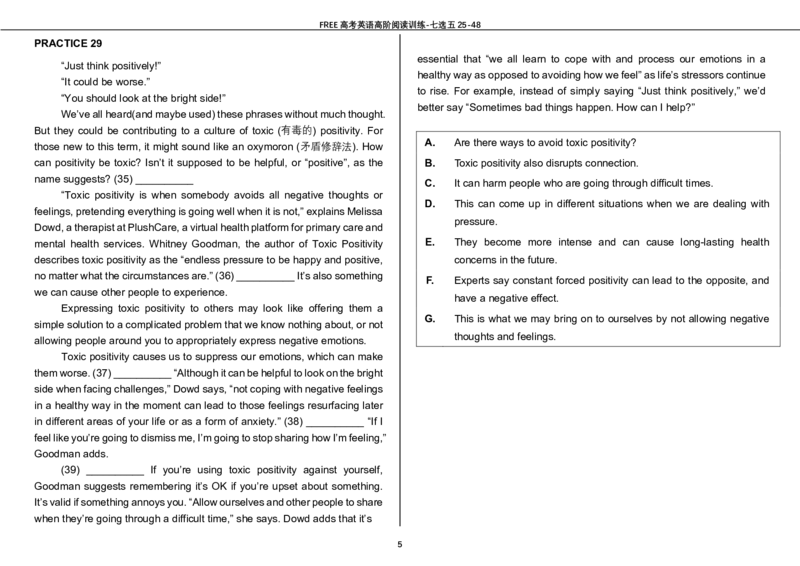
PRACTICE 29
“Just think positively!”
“It could be worse.”
“You should look at the bright side!”
We’ve all heard(and maybe used) these phrases without much thought.
But they could be contributing to a culture of toxic (有毒的) positivity. For
those new to this term, it might sound like an oxymoron (⽭盾修辞法). How
can positivity be toxic? Isn’t it supposed to be helpful, or “positive”, as the
name suggests? (35) __________
“Toxic positivity is when somebody avoids all negative thoughts or
feelings, pretending everything is going well when it is not,” explains Melissa
Dowd, a therapist at PlushCare, a virtual health platform for primary care and
mental health services. Whitney Goodman, the author of Toxic Positivity
describes toxic positivity as the “endless pressure to be happy and positive,
no matter what the circumstances are.” (36) __________ It’s also something
we can cause other people to experience.
Expressing toxic positivity to others may look like offering them a
simple solution to a complicated problem that we know nothing about, or not
allowing people around you to appropriately express negative emotions.
Toxic positivity causes us to suppress our emotions, which can make
them worse. (37) __________ “Although it can be helpful to look on the bright
side when facing challenges,” Dowd says, “not coping with negative feelings
in a healthy way in the moment can lead to those feelings resurfacing later
in different areas of your life or as a form of anxiety.” (38) __________ “If I
feel like you’re going to dismiss me, I’m going to stop sharing how I’m feeling,”
Goodman adds.
(39) __________ If you’re using toxic positivity against yourself,
Goodman suggests remembering it’s OK if you’re upset about something.
It’s valid if something annoys you. “Allow ourselves and other people to share
when they’re going through a difficult time,” she says. Dowd adds that it’s

essential that “we all learn to cope with and process our emotions in a
healthy way as opposed to avoiding how we feel” as life’s stressors continue
to rise. For example, instead of simply saying “Just think positively,” we’d
better say “Sometimes bad things happen. How can I help?”

A.
Are there ways to avoid toxic positivity?
B.
Toxic positivity also disrupts connection.
C.
It can harm people who are going through difficult times.
D.
This can come up in different situations when we are dealing with
pressure.
E.
They become more intense and can cause long-lasting health
concerns in the future.
F.
Experts say constant forced positivity can lead to the opposite, and
have a negative effect.
G.
This is what we may bring on to ourselves by not allowing negative
thoughts and feelings.


FREE ⾼考英语⾼阶阅读训练-七选五25-48

6
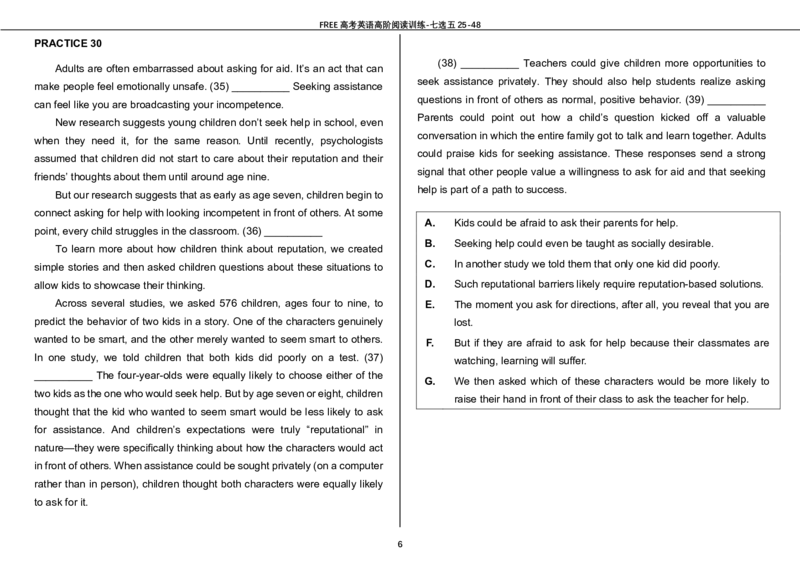
PRACTICE 30
Adults are often embarrassed about asking for aid. It’s an act that can
make people feel emotionally unsafe. (35) __________ Seeking assistance
can feel like you are broadcasting your incompetence.
New research suggests young children don’t seek help in school, even
when they need it, for the same reason. Until recently, psychologists
assumed that children did not start to care about their reputation and their
friends’ thoughts about them until around age nine.
But our research suggests that as early as age seven, children begin to
connect asking for help with looking incompetent in front of others. At some
point, every child struggles in the classroom. (36) __________
To learn more about how children think about reputation, we created
simple stories and then asked children questions about these situations to
allow kids to showcase their thinking.
Across several studies, we asked 576 children, ages four to nine, to
predict the behavior of two kids in a story. One of the characters genuinely
wanted to be smart, and the other merely wanted to seem smart to others.
In one study, we told children that both kids did poorly on a test. (37)
__________ The four-year-olds were equally likely to choose either of the
two kids as the one who would seek help. But by age seven or eight, children
thought that the kid who wanted to seem smart would be less likely to ask
for assistance. And children’s expectations were truly “reputational” in
nature—they were specifically thinking about how the characters would act
in front of others. When assistance could be sought privately (on a computer
rather than in person), children thought both characters were equally likely
to ask for it.


(38) __________ Teachers could give children more opportunities to
seek assistance privately. They should also help students realize asking
questions in front of others as normal, positive behavior. (39) __________
Parents could point out how a child’s question kicked off a valuable
conversation in which the entire family got to talk and learn together. Adults
could praise kids for seeking assistance. These responses send a strong
signal that other people value a willingness to ask for aid and that seeking
help is part of a path to success.

A.
Kids could be afraid to ask their parents for help.
B.
Seeking help could even be taught as socially desirable.
C.
In another study we told them that only one kid did poorly.
D.
Such reputational barriers likely require reputation-based solutions.
E.
The moment you ask for directions, after all, you reveal that you are
lost.
F.
But if they are afraid to ask for help because their classmates are
watching, learning will suffer.
G.
We then asked which of these characters would be more likely to
raise their hand in front of their class to ask the teacher for help.


FREE ⾼考英语⾼阶阅读训练-七选五25-48

7
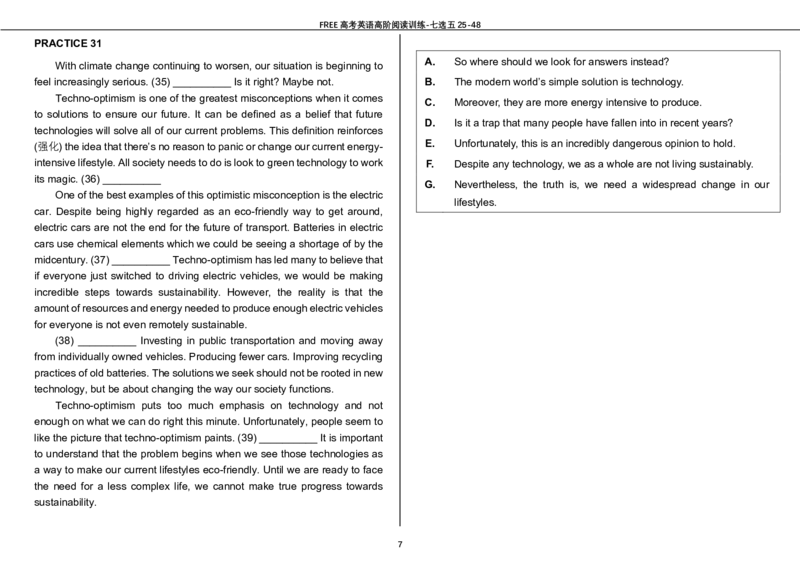
PRACTICE 31
With climate change continuing to worsen, our situation is beginning to
feel increasingly serious. (35) __________ Is it right? Maybe not.
Techno-optimism is one of the greatest misconceptions when it comes
to solutions to ensure our future. It can be defined as a belief that future
technologies will solve all of our current problems. This definition reinforces
(强化) the idea that there’s no reason to panic or change our current energy-
intensive lifestyle. All society needs to do is look to green technology to work
its magic. (36) __________
One of the best examples of this optimistic misconception is the electric
car. Despite being highly regarded as an eco-friendly way to get around,
electric cars are not the end for the future of transport. Batteries in electric
cars use chemical elements which we could be seeing a shortage of by the
midcentury. (37) __________ Techno-optimism has led many to believe that
if everyone just switched to driving electric vehicles, we would be making
incredible steps towards sustainability. However, the reality is that the
amount of resources and energy needed to produce enough electric vehicles
for everyone is not even remotely sustainable.
(38) __________ Investing in public transportation and moving away
from individually owned vehicles. Producing fewer cars. Improving recycling
practices of old batteries. The solutions we seek should not be rooted in new
technology, but be about changing the way our society functions.
Techno-optimism puts too much emphasis on technology and not
enough on what we can do right this minute. Unfortunately, people seem to
like the picture that techno-optimism paints. (39) __________ It is important
to understand that the problem begins when we see those technologies as
a way to make our current lifestyles eco-friendly. Until we are ready to face
the need for a less complex life, we cannot make true progress towards
sustainability.


A.
So where should we look for answers instead?
B.
The modern world’s simple solution is technology.
C.
Moreover, they are more energy intensive to produce.
D.
Is it a trap that many people have fallen into in recent years?
E.
Unfortunately, this is an incredibly dangerous opinion to hold.
F.
Despite any technology, we as a whole are not living sustainably.
G.
Nevertheless, the truth is, we need a widespread change in our
lifestyles.


FREE ⾼考英语⾼阶阅读训练-七选五25-48

8
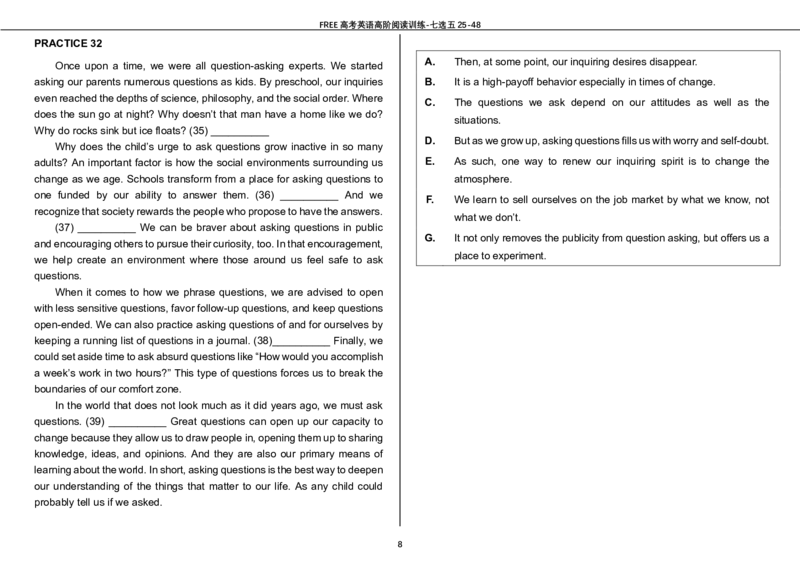
PRACTICE 32
Once upon a time, we were all question-asking experts. We started
asking our parents numerous questions as kids. By preschool, our inquiries
even reached the depths of science, philosophy, and the social order. Where
does the sun go at night? Why doesn’t that man have a home like we do?
Why do rocks sink but ice floats? (35) __________
Why does the child’s urge to ask questions grow inactive in so many
adults? An important factor is how the social environments surrounding us
change as we age. Schools transform from a place for asking questions to
one funded by our ability to answer them. (36) __________ And we
recognize that society rewards the people who propose to have the answers.
(37) __________ We can be braver about asking questions in public
and encouraging others to pursue their curiosity, too. In that encouragement,
we help create an environment where those around us feel safe to ask
questions.
When it comes to how we phrase questions, we are advised to open
with less sensitive questions, favor follow-up questions, and keep questions
open-ended. We can also practice asking questions of and for ourselves by
keeping a running list of questions in a journal. (38)__________ Finally, we
could set aside time to ask absurd questions like “How would you accomplish
a week’s work in two hours?” This type of questions forces us to break the
boundaries of our comfort zone.
In the world that does not look much as it did years ago, we must ask
questions. (39) __________ Great questions can open up our capacity to
change because they allow us to draw people in, opening them up to sharing
knowledge, ideas, and opinions. And they are also our primary means of
learning about the world. In short, asking questions is the best way to deepen
our understanding of the things that matter to our life. As any child could
probably tell us if we asked.


A.
Then, at some point, our inquiring desires disappear.
B.
It is a high-payoff behavior especially in times of change.
C.
The questions we ask depend on our attitudes as well as the
situations.
D.
But as we grow up, asking questions fills us with worry and self-doubt.
E.
As such, one way to renew our inquiring spirit is to change the
atmosphere.
F.
We learn to sell ourselves on the job market by what we know, not
what we don’t.
G.
It not only removes the publicity from question asking, but offers us a
place to experiment.


FREE ⾼考英语⾼阶阅读训练-七选五25-48

9
PRACTICE 33
Human have long tried to conquer water. We’ve straightened once-
winding rivers for shipping purposes. We’ve constructed levees (防洪堤)
along rivers and lakes to protect people from flooding. We’ve erected entire
cities on drained and filled-in wetlands. We’ve built dams on rivers to store
water for later use.
(35) __________ But it’s not, argues environmental journalist Erica Gies,
author of Water Always Wins. Levees, which narrow channels causing water
to flow higher and faster, nearly always break. Cities on former wetlands
flood regularly—often disastrously. Dams starve downstream areas of
sediment ( 沉积物) needed to protect coasts against rising seas.
Straightened streams move faster than winding ones, giving water less time
to flow downward. And they wash away riverbed ecosystems.
In addition to laying out this damage done by supposed water control,
Gies takes readers on a hopeful global tour of solutions to these problems.
Along the way, she introduces “water detectives”—scientists, engineers,
urban planners, and many others. (36) __________
These water detectives have found ways to give the slippery substance
the time and space it needs to flow slowly underground. Around Seattle’s
Thornton Creek, for instance, reclaimed land now allows for regular flooding,
which has renewed riverbed habitat and created an urban oasis. In
California’s Central Valley, scientists want to find ways to move unpolluted
storm water into subsurface valleys that make ideal aquifers (含⽔层). (37)
__________
While some people are exploring new ways to manage water, others
are leaning on ancient knowledge. Researchers in Peru are now studying
old-style methods of water storage, which don’t require dams, in hopes of

ensuring a steady flow of water to Lima—Peru’s populous capital that’s
periodically affected by water shortage. (38) __________ “Decision makers
come from a culture of concrete,” Gies writes, “in which dams, pipes and
desalination factories are standard.”
Understanding how to work with, not against, water will help humankind
weather this age of drought and flood that’s being worsened by climate
change. (39) __________ Instead, we must learn to live within our water
means because water will undoubtedly win.

A.
Controlling water, Gies convincingly argues, is a false belief.
B.
Instead of trying to control water, they ask: What does water want?
C.
It seems that water is cooperative and willing to flow where we direct
it.
D.
These old-style underwater concrete techniques pave the way for the
construction of dams.
E.
To further understand the whole ecosystem, they believe effective
water control requires effort.
F.
The study may help convince those who favor concrete-centric
solutions to try something new.
G.
Feeding groundwater supplies will in turn sustain rivers from below,
which helps to maintain water levels and ecosystems.


FREE ⾼考英语⾼阶阅读训练-七选五25-48

10
PRACTICE 34
As a doctor, I can give you a lot of useful advice about how to get
healthy and stay that way, but you don’t need me to tell you that exercise is
good for you. Staying active can benefit the heart, the waistline, even the
mind. (35) __________ More than 60% of American adults don’t exercise
regularly, and many say they don’t exercise at all. More than 72 million are
overweight, and almost all of them would like to lose the extra pounds. So, if
exercise is such a good idea, why don’t more people do it?
(36) __________ Even as I write this, I am watching my two-year-old
run around in circles. Kids seem to be born in constant motion, but along the
way that behavior changes.
The slowdown occurs for most at the beginning of college. Academic
pressure and lack of organized sports are certainly part of the problem. A
bigger part may be looking at life changes as an occasion to blow up old
rules and not create new ones in their place. (37) __________ The demands
of a new job usually mean less time at the gym. How about a new marriage?
How many times have we seen just-married couples looking a lot heavier in
first-anniversary photos than they did in the wedding pictures?
(38) __________ People who set general goals, like “I will exercise in
my free time,” did a far worse job of sticking to that plan than did people who
made a firm commitment, like “I will walk to my friend’s house and back every
Monday, Wednesday, and Friday.”
The good news is, there are solutions to all these. We can begin with
exercises as simple as remembering to sit straighter or drink enough water.
Specific workout plans can turn a general desire to exercise into a firm
commitment. (39) __________
We may never again have the energy of a two-year-old, but getting
back even a little of our early-life energy can make our later lives a whole lot
healthier.


A.
Being in college is certainly part of the problem.
B.
This is especially so when it comes to staying fit.
C.
Not having a clearly defined exercise plan can hurt.
D.
We often wish to go back to our two-year-old selves.
E.
For instance, you can schedule a weekly gym visit with friends.
F.
Still, there’s a real disconnect between what we know and what we
do.
G.
The most puzzling part of our inactive nature is that we don’t start out
that way.


FREE ⾼考英语⾼阶阅读训练-七选五25-48

11
PRACTICE 35
We have all been guilty of being overoptimistic when predicting how
long a task will take because of the planning fallacy. First identified in 1977,
the planning fallacy was defined as: “the tendency to underestimate the
amount of time needed to complete a future task, due in part to the reliance
on overly optimistic performance scenarios (预测).”
It is extremely common. (35) __________ For instance, a study
conducted with psychology students found that only 30% of them managed
to complete their senior papers in the amount of time they predicted.
What’s more, the planning fallacy is an incredibly stubborn problem. (36)
__________ While we are able to recognise past predictions where we have
been over-optimistic, we often keep on insisting that our current predictions
are realistic.
The planning fallacy is such a deep-rooted behavior. However, there are
a few systematic strategies you can use to start building the habit of double-
checking your time estimates. For instance, you can take the outside view.
(37) __________ Make sure to consult experts and people who have
attempted to complete similar projects in the past. If you’re a student, talk to
senior students; if you’re writing a book, join a network of writers.
(38) __________ You need to differentiate between tasks that are
urgent and important, important but not urgent, urgent but not important,
neither urgent nor important.
Once you have an objective estimate of the time it will take to complete
a project, you need to make sure you have the time and resources to carry
out your plan. (39) __________ Break down big tasks into smaller,
manageable chunks. Don’t wait until the last minute to let people know you
may need their help in the near future.


A.
Defining your priorities also helps.
B.
We don’t learn from our previous mistakes.
C.
Do not base your estimates on your own criteria.
D.
Focusing on fine details is the recommended practice.
E.
We can see many failed or late projects, which lead to time wasting.
F.
There have been lots of studies confirming the existence of the
planning fallacy.
G.
Block time in your calendar, and make sure the resources you need
are available.


FREE ⾼考英语⾼阶阅读训练-七选五25-48

12
PRACTICE 36
In our modern world, there are endless alternatives. Have you ever
found yourself wondering whether you should quit or stay in your job, accept
an offer or give it up for another? There is a simple and practical method that
solves this problem. (35) __________ When you understand the concept,
you have the power to measure every alternative with precision and make
the right decision.
In the field of economics, opportunity cost is the value that you have to
give up when you choose an option over another good option. (36)
__________ Every time you choose something, you give up other
alternatives together with their financial benefits. It is not all the other options,
but the most valued one that is defined as the opportunity cost.
(37) __________ Take the simple example of trying to decide whether
to take public transportation for 80 minutes or to drive for 40 minutes. You
might save on the cost of gas while riding the bus but double the trip length
and miss out on other things you could have done during that time. (38)
__________ This is how you create priorities in your daily life.
Though useful in decision making, the biggest drawback of opportunity
cost is that it’s often related to what’s hard to quantify. (39) __________ After
all, putting a number to your peaceful mind or happiness can be difficult.
Opportunity cost isn’t cut and dried. It varies from person to person. At
the end of the day, you are in charge of what you own and what you want to
gain.


A.
It is about finding out the opportunity cost.
B.
Weigh the losses and gains, and make your decision.
C.
Opportunity cost matters not only in economics but also in real life.
D.
This is especially true when the opportunity cost is of non-financial
benefit.
E.
The key principle underlying the idea is that there is no such thing as
free lunch.
F.
Most people overlook opportunity cost because the benefits are
usually hidden from view.
G.
It is the development of important skills that would help you move
forward in your daily life.


FREE ⾼考英语⾼阶阅读训练-七选五25-48

13
PRACTICE 37
We humans are comparison creatures. (35) __________ This quality
may have evolved as a means of helping us fit into the social hierarchy (等
级) of the cultures we inhabited. Regardless of the reasons, social
comparison plays a significant role in how we view and evaluate ourselves,
and how we interact with our world.
It used to be that our primary reference of comparison was our local
communities, primarily neighbors and co-workers. Because we tend to
gather around those similar to ourselves in terms of educational level, work
income, and shared interests, the range of differences when we compared
ourselves to others was fairly small. Unfortunately, with the emergence of
the Internet, we can now compare ourselves to literally anyone in the world.
(36) __________ What had in previous generations been a small gap in our
comparisons has now become so large and unattainable.
 (37) __________ When so many people that are easily discoverable
on the Internet seem to be so successful, famous, influential and beautiful,
given our preference to compare, it is difficult not to have it influence how we
view ourselves. Sadly, these comparisons usually result in our feeling
inadequate and “less than”.
These harmful comparisons also damage our emotional lives. When we
feel lacking, we experience a variety of unpleasant and unhealthy emotions.
We feel jealousy and envy for what others have and what we lack. (38)
__________
It’s one thing to realize that you compare yourself to others. It’s another
thing to recognize that social comparison is often corrosive (逐步侵蚀的) to
you in so many ways psychologically and emotionally. It’s an entirely other
thing to stop yourself from comparing yourself to others. (39) __________

A.
We are constantly measuring ourselves against other people.
B.
Yet it is possible, and it is worth the effort for your mental health.
C.
Thus, we are now exposed to groups that are quite different from us.
D.
We believe that there is something wrong with us compared to others.
E.
We can even feel bitterness and anger at others for the unfairness of
it all.
F.
Comparing ourselves to others has the potential to increase our life
experience.
G.
This new level of comparison has huge implications for our
psychological lives.


FREE ⾼考英语⾼阶阅读训练-七选五25-48

14
PRACTICE 38
When was the last time you looked at something or felt something and
said, “Wow”? Recent studies found that a lot of people are in emotional
distress. So how can you rediscover the joys in your day-to-day life and
recapture that sense of childhood wonder? Here’s how you can find them.
(35) __________ Throughout the day, stop what you are doing to listen
to music, play with a toy or doodle on a piece of paper. Stretching your brain
in different ways and daydreaming can stimulate your imagination.
Get creative. Whether it is playing a musical instrument, sketching,
painting, modeling with clay, dancing, or writing in a journal, creative pursuits
are a great place to find joy. (36) __________
Turn off your phone and enjoy the silence. Technology can be a good
thing and provide us with many opportunities, but it can also numb (使迟钝)
us to the wows around us and be an ongoing distraction. Turn your phone
off for one hour, a whole day or even an entire weekend. You could also try
turning off the television, music or radio for a few minutes to give yourself
some total silence. (37) __________
Listen. Really listen. When was the last time you remembered
everything someone said to you? (38) __________ Having a new-found
curiosity and consideration for the other person might lead you to some
surprising discoveries and take you outside of yourself.
Get out of your comfort zone. Finding opportunities where you can push
yourself out of your comfort zone will also give you a better chance of finding
a wow experience. (39) __________ Even attempting a 5k when you are not
quite ready for a marathon can really help.


A.
Take a play break.
B.
Change your routine.
C.
This doesn’t have to mean a big, life-changing activity.
D.
This can help take you back to a childlike state, in a world of wonder.
E.
When talking to other people, try to be present with whoever you are
with.
F.
Take a minute to notice and really pay attention to where you are,
what you’re doing and what’s going on around you.
G.
What’s more, when you find flow in a creative activity, you might find
inspiration for other areas of your life.


FREE ⾼考英语⾼阶阅读训练-七选五25-48

15
PRACTICE 39
The Science of Comfort Food
Certain foods always give us much pleasure. (35) __________ However,
much of the happiness we get from our favorite foods comes from the
memories they bring to us and the people we’re with while we enjoy them.
(36) __________ That’s why our brains reward us for eating anything at
all by releasing a chemical that enhances mood. But as anyone who’s ever
eaten apple pie knows, sweets can make us feel especially nice. One study
found that people who are especially sensitive to sweetness have stronger
brain-reward responses to sugary foods than less sweet-sensitive people do.
Some foods are especially emotionally satisfying for reasons that have
little to do with their taste or nutritional content, though. (37) __________
And many favorite American comfort foods—chili, say—are not particularly
sweet or high in carbohydrates (碳⽔化合物). Often we love food because
we have fond memories associated with it. One dish I cannot live without at
a New Year party is my mom’s Snowy Mashed Potatoes, which remind me
of holiday joy and past reunions with extended family.
(38) __________ Sometimes you might feel sad when you eat foods
that remind you of loved ones you miss. We may also avoid foods that we
associate with bad experiences. I haven’t eaten cottage cheese since I was
8 years old, because it was the last thing I ate before rolling off the bed with
a terrible stomachache.
In addition to past memories, the context in which we eat foods matters,
too. (39) __________ And our gustatory (味觉的) experiences can be
heightened by “a sense of community, a sense of warmth and enjoying it
together”. I appreciate my mum’s potatoes even more today when I eat them
with my husband and two children.


A.
Food is essential for our survival.
B.
These associations can go the other way, too.
C.
We desire comfort foods when we feel lonely.
D.
It shapes how much we enjoy them in the moment.
E.
Their taste and nutritional content affect how we feel.
F.
Our memory for smell can be long-lasting and precise.
G.
After all, different cultures have different comfort foods.


FREE ⾼考英语⾼阶阅读训练-七选五25-48

16
PRACTICE 40
When you go to concerts, you expect your favorite musician to perform
amazingly on stage. But you may have noticed something curious that most
musicians don’t just play with their fingers. They also involve body
movements that fit the song’s beat or dance following the music. (35)
__________ The facial expressions musicians show when playing may
seem strange or crazy to an outsider, but all that pulling faces might actually
serve a purpose.
Firstly, playing a musical instrument usually requires intense focus and
concentration. (36) __________ Their facial expressions can be a
demonstration of the intense emotions and physical effort that go hand-in-
hand with musical performance. They’re often subconscious-in fact, many of
us will pull strange faces when we’re deeply involved in an activity we care
about.
(37) __________ Musicians have a strong emotional connection with
the music they perform. They often use their facial expressions to express
the mood and interpretation of the music, which creates a more engaging
musical experience. While facial expressions may not directly make
someone a better musician, they might contribute to the overall artistry of the
music.
Performing live music is a rather stressful experience, so it could be that
the performer is expressing those nerves through their face—biting the
bottom lip, for example. Luckily, nerves will often go away soon after a
musician starts performing. (38) __________
The facial expressions obviously to some extent express the
performer’s inner world. Another interesting thing is that making facial
expressions can have a physiological impact on the musician’s performance.
Some research suggests that certain facial movements can activate specific
muscles and improve muscle harmonization. (39) __________ However, it’s
important to note that this relationship is still not well understood, and the
extent to which facial expressions directly impact musical competence is a
subject of ongoing investigation.


A.
When you’re really focused, you don’t care about the outside world.
B.
Among them the part of the body that best exhibits this is obviously
the face.
C.
They likely won’t be the main cause for those strange faces
throughout a performance.
D.
Such effects are particularly helpful in controlling muscles when
playing an instrument.
E.
Facial expressions can also help musicians communicate emotions
and artistic expression.
F.
Musicians are often overcome with emotion from the music itself or
the reaction of the crowd.
G.
Musicians often enter a state of “flow”, where they become
completely absorbed in the music they’re creating.


FREE ⾼考英语⾼阶阅读训练-七选五25-48

17
PRACTICE 41
When you get in a car, you expect it will have functioning brakes. When
you pick up medicine at the drugstore, you expect it won’t be polluted. But it
wasn’t always like this. The safety of these products was terrible when they
first came to market. It took much research and regulation to figure out how
users can enjoy the benefits of these products without getting harmed. (35)
__________
Social media risks are everywhere. The dangers that algorithms
designed to maximize attention represent to teens have become impossible
to ignore. Other product design elements, often called “dark patterns,”
designed to keep people using for longer, also appear to tip young users into
social media overuse. (36) __________ They say it’s their users’ fault for
engaging with harmful content in the first place, even if those users are
children or the content is financial trickery. They also claim to be defending
free speech.
(37) __________ Under the Digital Services Act, which came into effect
in Europe this year, platforms are required to take action to stop the spread
of illegal content and can be fined up to 6 percent of their global incomes if
they don’t do so. If this law is enforced, maintaining the safety of their
algorithms and networks will be the most financially sound decision for
platforms to make.
Despite these efforts, two things are clear. First, online safety problems
are leading to real, offline suffering. Second, social media companies can’t,
or won’t, solve these safety problems on their own. (38) __________ Even
safety issues like cyberbullying that we thought were solved can pop right
back up. As our society moves online to an ever-greater degree, the idea
that anyone, even teens, can just “stay off social media” becomes less and
less realistic. (39) __________


A.
And those problems aren’t going away.
B.
The current issues aren’t really about offline suffering.
C.
Platforms already have systems to remove violent or harmful content.
D.
Similarly, social media needs product safety standards to keep users
safe.
E.
It’s time we should require social media to take safety seriously, for
everyone’s sake.
F.
Internet platforms, however, have shifted blame on the consumers
whenever criticized.
G.
Some authorities are taking steps to hold social media platforms
accountable for the content.


FREE ⾼考英语⾼阶阅读训练-七选五25-48

18
PRACTICE 42
Most of us are actually terrible at giving gifts. About $70 billion worth of
presents are returned every year in the U.S. (35) __________ Here are three
ways to improve your gift-giving game around the holidays.
Stop trying to make your gifts so delightful. (36) __________ We want
something from giving: those looks of delight. Those exclamations. This is
why items like hyper-specific kitchen gadgets and fancy vintage clocks all
seem like fantastic gifts. But it turns out, recipients often want things that are
far more practical—things they can actually use.
(37) __________ Just give people what they ask for. A study looked at
Amazon wish lists to determine if people were more appreciative of gifts from
the list versus gifts that were total surprises. It turned out that people who
got gifts that weren’t on their list considered them as less thoughtful and less
personal. (38) __________
How can we create a gift-giving plan that is as emotional as we desire?
Humans love to feel connected. And one way we do that is by sharing
interests with others. So if you want to learn how to give better gifts, put
yourself in the recipient’s shoes and try to think of something you both share.
Maybe it’s the love for a sport, drinking wine, or some other hobby. (39)
__________ And because you picked something you share, they will feel
more connected to you and appreciate your gift more.


A.
So how do we get less terrible?
B.
Surprise is overrated—we’re happier to get what we ask for.
C.
So what’s the most practical gift you can give that people might
actually be grateful for?
D.
The long-term pleasure of the receiver may not be observed and
therefore is discounted.
E.
Once you’ve found a shared interest, go and find a useful gift related
to this interest.
F.
What recipients care about is how much value they’re going to get
from the gift over a longer time period.
G.
Research has shown that givers are consumed by the moment of
unwrapping a gift even more than the gift itself.


FREE ⾼考英语⾼阶阅读训练-七选五25-48

19
PRACTICE 43
Today, what we have is an always-in-your-pocket, 24/7 news cycle.
When you open a news app, you’ll notice a brief moment when the “old news”
is still there. In a flash, the ancient history of a few hours ago is swept away
for the next “breaking news”. (35) __________ It’s endless, but you had
better keep up.
Researchers introduce this world to the phrase, “noise bottleneck”. A
noise bottleneck is where we are overwhelmed with so much information or
noise that our cognitive (认知的) abilities can’t keep up. (36) __________
Thus, while our attention can watch hours of videos, our long-term learning
processes can’t.
(37) __________ We watch TV holding our phones, and we listen to
music while shopping. However, the human brain might have structural
limitation rooted in the cognitive architecture which causes the slowing down
that occurs when two tasks are performed at the same time.
In short, your brain is not as good as you think it is. You are a human
being who can only take in so much a day. Understanding the noise
bottleneck allows us to fix it. So, here are three tips to get you going:
Clear your content—set up a new account on social media and follow
only accounts or people that you think are really valuable.
Single-task—you don’t need to rid the phone but do rid the distractions.
(38) __________ Say, “I will only read this magazine after dinner.”
Multitasking is for show; single-tasking is for pros.
Accept your limits—you’ll never read all the news. Accept you can only
choose two or three and embrace that fact. (39) __________ You’re getting
more out of those few than that “super-productive” person on social media
who says they read five books a week. After all, it’s better to have a little
remembered than a lot forgotten.


A.
Give yourself a time limit or restriction if it helps.
B.
Don’t beat yourself up that you’re being unproductive.
C.
Every second, you are presented with new information.
D.
Breaking through the noise bottleneck is a legendary idea.
E.
The matter is made worse by our modern addiction to multitasking.
F.
Multitasking has dramatically changed the way we use information.
G.
Our brains have limited resources, spread across numerous
functions.


FREE ⾼考英语⾼阶阅读训练-七选五25-48

20
PRACTICE 44
In most adults, learning and thinking begin to decline as early as age 30.
People start to perform slightly worse in tests of cognitive abilities such as
the rate at which someone does a mental task. (35) __________
These changes are often considered normal aging. But they may
instead represent something more like the “summer slide” that some
schoolchildren experience in academic progress during summer break.
Recent research suggests that a pause of learning is indeed a problem
causing cognitive reduction. (36) __________
In a three-month intervention, the researchers provided an encouraging
learning environment for 24 older adults. They took at least three classes to
learn three new skills. They also discussed issues related to learning barriers
and motivation. Over the course these participants’ cognitive scores for
memory and flexibility significantly improved. In a follow-up study, the
researchers discovered amazingly that they had improved further: (37)
__________ In other words, giving these seniors a multicourse routine
seemed to bring up their abilities to levels similar to those of college students.
The researchers are still investigating why cognitive scores continued
to climb after the program’s end, but one possibility is that the experience
encouraged these older participants to continue learning and practicing new
skills. Older adults are often assumed to be on a downward slide with
unrecoverable loss. “Use it or lose it,” the saying goes. (38) __________
Decline, as we so often see it, may not be certain. That’s why we need to
create enriched learning environments for adults after their formal education
and job training end.
(39) __________ Educators know how to educate children and
adolescents, and we can adapt that knowledge to develop learning
opportunities for adults. Societies could also provide resources and paths
toward lifelong learning to ensure that everyone can benefit. Let’s shift the
conversation about adults from avoiding loss and decline to learning and
growing.


A.
But this decline can be addressed.
B.
The slide becomes sharper in their mid-60s.
C.
Interrupted learning may not only affect children.
D.
The question now is how society can maximize adult’s chances to
keep learning.
E.
Their cognitive abilities after one year were close to those of adults 50
years younger.
F.
Older adult research tends to emphasize skill learning only after daily
functions start to decline.
G.
However, the research suggests they can increase both skills and
cognitive abilities over a long term.


FREE ⾼考英语⾼阶阅读训练-七选五25-48

21
PRACTICE 45
Being sensitive means that you are observant, careful, and thoughtful.
It can also mean you sometimes overinterpret or overreact to perceived
criticism or judgment. If you tend to be a highly sensitive person, you are
more likely to misread signals from others, sense social threats, and struggle
to adapt to new circumstances. (35) __________
The power of insensitivity can be interpreted as “sluggish (迟钝的)
power”. (36) __________ For example, those working on complex research
projects with “sluggish power” persist with focus and determination in the
face of challenges such as tight deadlines and limited resources. Their
resilience facilitates effective problem-solving, ensuring the successful
completion of tasks despite obstacles.
(37) __________ That is one of the important reasons why insensitivity
allows a person to better survive and adapt in a competitive environment.
Knowing oneself is difficult, but knowing oneself correctly is undoubtedly an
excellent ability—a trait shared by many successful people, who all clearly
know where their strengths are, what they can do, what they want, and what
direction to go.
Practicing insensitivity involves several key strategies. Firstly, be
assertive. Express our needs and opinions positively and with confidence.
Secondly, adopt a forward-looking mindset. (38) __________ Additionally,
detach from external influences. Avoid excessive concern over others’
opinions and speculation on others’ thoughts. Lastly, manage relationships.
Recognize our personal responsibilities while respecting others’ boundaries.
Don’t interfere with other people’s subjects and don’t let others interfere with
ours either.
(39) __________ Once you become a bit “blunt” and slow down the
pace, you will feel more comfortable.


A.
Learn to view the problem as two parts.
B.
That’s where the need to be insensitive comes from.
C.
I hope everyone can obtain the ability to be insensitive.
D.
Behind insensitivity is a strong sense of self-awareness.
E.
Being a highly sensitive person can come with many challenges.
F.
It implies the ability to calmly face the setbacks and firmly move
forward.
G.
Focus on long-term goals rather than the ups and downs of life at the
moment.


FREE ⾼考英语⾼阶阅读训练-七选五25-48

22
PRACTICE 46
Want to write better? There’s a new book that says simple writing is best.
Do you check your text messages before sending? (35) __________ If
not, you might prefer getting things done fast, even if they’re not perfect.
This book argues that it’s important to write carefully, even for quick
messages. Todd Rogers and Jessica Lasky Fink, from Harvard, wrote
“Writing For Busy Readers”. It’s smartly named because everyone’s busy
today. People get lots of messages every day, from emails to texts. (36)
__________ Deciding what to read, skim, or ignore happens many times a
day for almost everyone.
The authors share good writing tips, like cutting unnecessary words and
using simple words everyone knows. They say it’s important to keep
sentences simple. They tested the idea that less is more. For example, they
sent an email to thousands of school-board members asking them to take a
survey. They made the email shorter, from 127 to 49 words, and got double
the responses (from 2.7% to 4.8%). (37) __________
The same is true for text messages. In another test, they sent a short
message asking parents to take a survey. It got more responses than a
longer, more sympathetic one. Sometimes, being short and clear works
better than being kind but ignored. It’s not just what you say, but how quickly
you say it that matters.
It’s not just about word count. (38) __________ Reducing the number
of options has the same effect. Short, active sentences with common words
are best.
From posts to online reviews, following these rules gets more likes and
shares. Serious writers should pay attention too. A study found that
companies using long sentences and complicated words were seen as less
moral and trustworthy.

(39) __________ It might be tempting to send messages quickly and
hope for the best. But taking time to write for your readers has benefits. If
you send a rushed message that readers ignore, it’s like you didn’t send it at
all.

A.
If everyone is a busy reader, everyone is a busy writer too.
B.
They can also get puzzled by social media platforms.
C.
If you do, you probably like making even the simplest messages
perfect.
D.
They found that longer messages make people think the task will take
longer.
E.
Keeping messages to one idea, or as few as possible, helps make
sure they’re read, remembered, and acted on.
F.
Your goal is to convey enough passion that your readers think the
issue in your message is worth caring about.
G.
Explaining the thinking behind your messages will allow readers to
see that you know what you’re talking about.


FREE ⾼考英语⾼阶阅读训练-七选五25-48

23
PRACTICE 47
Socrates, Galileo, Marie Curie, Einstein ... What did these great thinkers
have in common? They all practiced deliberate doubt and used it as a tool
to improve their thinking and generate creative ideas.
(35) __________ It is about suspending our certainty and letting go of
our preconceived (先⼊为主的) notions in order to explore new ideas and
perspectives. When we’re certain of something, we tend to stop looking for
alternative explanations or possibilities. (36) __________ Doubt can, of
course, be unsettling, but it can also result in a greater understanding of a
subject and inspire fresh thoughts and insights.
(37) __________ But it doesn’t mean we should use it all the time. While
deliberate doubt can be a valuable tool for generating creative ideas and
exploring complex problems, it can also be counterproductive if it is not
practiced in the right way.
It’s important to keep in mind that deliberate doubt is not constant doubt.
If we’re continuously doubting our own ideas, we’ll be less likely to pursue
them and see them through to completion. (38) __________ We spend so
much time doubting everything and end up not doing anything.
(39) __________ We can become self-critical and unsure of our abilities,
which can undermine our self-esteem. As a result, we may be too afraid to
try new things or take risks.
To avoid these traps, it’s important to strike a balance between doubt
and certainty, and to use doubt as a tool to stimulate creative thinking and
exploration, rather than as a means of undermining ourselves or others.


A.
Deliberate doubt can also lead to a lack of confidence.
B.
But when we doubt, we’re forced to consider other perspectives.
C.
In this case, deliberate doubt can prevent us from making decisions.
D.
When practiced all the time, deliberate doubt can lead to a different
belief.
E.
By turning doubt into a deliberate process, we open ourselves to new
possibilities.
F.
Deliberate doubt is the practice of actively questioning our beliefs and
assumptions.
G.
Deliberate doubt can help us to develop a more open-minded
approach to the world.


FREE ⾼考英语⾼阶阅读训练-七选五25-48

24
PRACTICE 48
Studies about sleep and employee behavior typically focus on various
activities that occur within the body during sleep, and their impact on daytime
cognition. New research adopts a different method. (35) __________
The researchers conducted three studies involving thousands of
dreams recalled by employees. The first study asked participants upon
awakening to rate the degree of awe (敬畏) and wonder brought by their
dreams and to write down their biggest work problem. (36) __________
Another one they answered was whether they envisioned anything good
arising from the difficult work situation—a measure of resilience, which
meant the ability to become strong and happy again after toughness. Those
who found positive meaning in dreams reported higher levels of awe. (37)
__________
In the second study, participants who recalled a dream likewise reported
its positive or negative meaning, and then wrote descriptions of the dream
and what they took to be its causes and meaning. After work they answered
questions about their resilience and progress on the day’s tasks. (38)
__________ The third study tracked similar measures among employees
who participated daily for two weeks, and it looked at how naturally curious
each person was. It found similar results about awe and showed that it raised
resilience and productivity far more in the naturally curious.
(39) __________ Awe can help people deal more effectively with
challenges and progress toward goals. “Our research reveals how awe can
be brought about at a time that has a critical impact on daily work outcomes,”
the researchers write. “Employees could use dream journals and simple
practices to ‘guide’ their nighttime visions, thus increasing their odds of
having meaningful, awe-inspiring dreams.”


A.
A positive dream brings a sense of sudden insight, giving rise to awe.
B.
The increased awe was also proved to be associated with greater
resilience.
C.
In fact, dreaming may help improve problem-solving skills in daily
routine.
D.
Here, too, good dreams boosted awe and resilience, fueling progress
on work goals.
E.
Researchers acknowledge that dreams may involve content related
to waking experiences.
F.
It finds that remembering a good dream can help people make
progress in the day’s tasks.
G.
They then answered the question about whether they thought the
dream was positive or negative.


FREE ⾼考英语⾼阶阅读训练-七选五25-48

25
PRACTICE 25-32
25
C
E
G
A
B
29
F
G
E
B
A
26
C
A
G
D
F
30
E
F
G
D
B
27
C
B
D
E
G
31
B
E
C
A
G
28
C
G
A
E
D
32
A
F
E
G
B

PRACTICE 33-40
33
C
B
G
F
A
37
A
C
G
E
B
34
F
G
B
C
E
38
A
G
F
E
C
35
F
B
C
A
G
39
E
A
G
B
D
36
A
E
C
B
D
40
B
G
E
C
D

PRACTICE 41-48
41
D
F
G
A
E
45
B
F
D
G
C
42
A
G
C
B
E
46
C
B
D
E
A
43
C
G
E
A
B
47
F
B
G
C
A
44
B
A
E
G
D
48
F
G
B
D
A