新高考一卷
2025 RELEASED EXAMS
READING A
The greening of planes, trains and automobiles
Moving goods and people around the world is responsible for a large part of global CO₂
emissions (排放). As the world races to decarbonize everything, it faces particular problems with
transportation—which accounts for about a quarter of our energy-related greenhouse gas emissions.
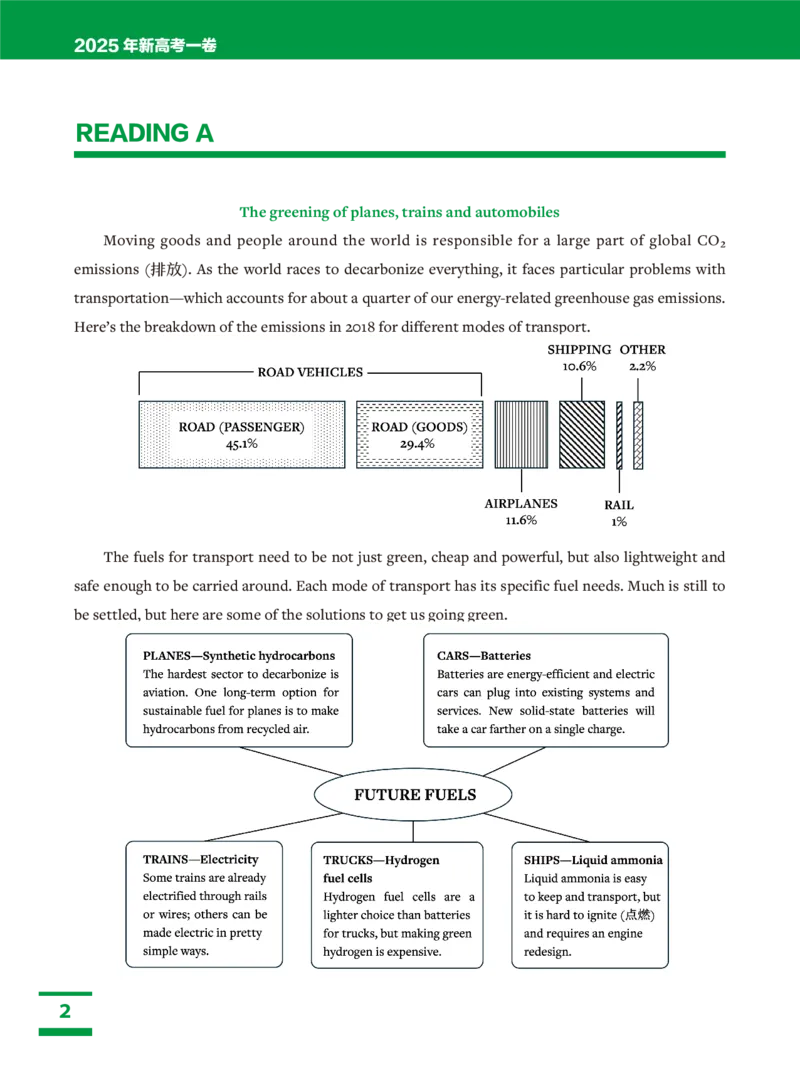
Here’s the breakdown of the emissions in 2018 for different modes of transport.
The fuels for transport need to be not just green, cheap and powerful, but also lightweight and
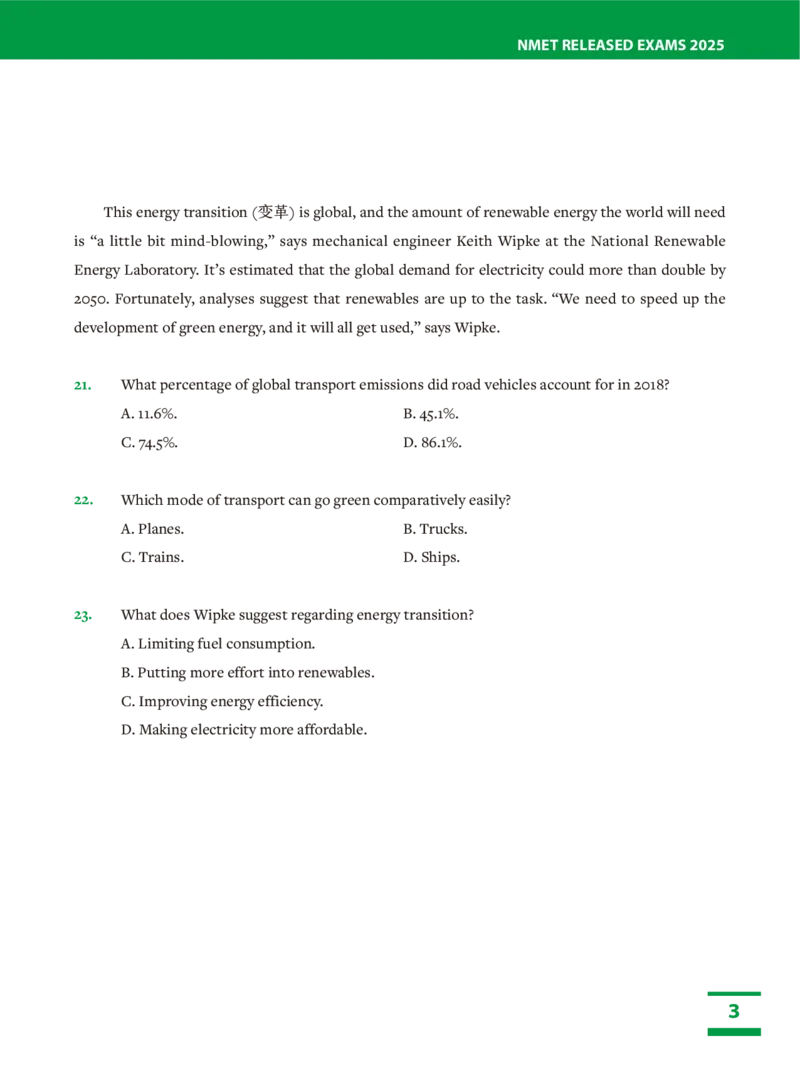
safe enough to be carried around. Each mode of transport has its specific fuel needs. Much is still to
be settled, but here are some of the solutions to get us going green.
2
2025 年新高考一卷
This energy transition (变革) is global, and the amount of renewable energy the world will need
is “a little bit mind-blowing,” says mechanical engineer Keith Wipke at the National Renewable
Energy Laboratory. It’s estimated that the global demand for electricity could more than double by
2050. Fortunately, analyses suggest that renewables are up to the task. “We need to speed up the
development of green energy, and it will all get used,” says Wipke.
21.
What percentage of global transport emissions did road vehicles account for in 2018?

A. 11.6%.


B. 45.1%.


C. 74.5%.


D. 86.1%.
22.
Which mode of transport can go green comparatively easily?

A. Planes.


B. Trucks.


C. Trains.


D. Ships.
23.
What does Wipke suggest regarding energy transition?

A. Limiting fuel consumption.


B. Putting more effort into renewables.

C. Improving energy efficiency.


D. Making electricity more affordable.
NMET RELEASED EXAMS 2025
3
READING B
In my ninth-grade writing class last year, I met a cowboy who saved his town, a strict father
who demanded his son earn straight A’s, and a modern-day Juliet who died of heartbreak after her
parents rejected the love of her young life. More than once, I found myself wondering just how my
students, who’d created these people, knew their subjects so well.
But things were different for their first essay, which was about the question: “Why is writing
important?” Most of the essays filled less than one page, and few contained a sentence that could be
interpreted as a thesis (论点) statement. I was shocked. Then I realized that the problem was the
question itself. They could have written pages on the necessity of computers, but writing, in and of
itself, simply didn’t strike them as important. This would have to change.
As a new unit started, I asked everyone to write a persuasive piece on a health-related topic of
their choice. This time they found the exercise much more interesting. For the next two assignments,
a personal-narrative unit followed by a creative-writing workshop, I only required that the piece
meet the specifications of its genre (体裁) and that it contain a thesis. The results were staggering.
The students took on diverse topics and turned in stories, 10 to 20 pages each, with characters that
broadened my view and touched my heart.
I walked into class believing that writing is important as a means of communication. However,
my students demonstrated something more important to me. When the final bell rang in June, I
walked away with a yearbook full of messages about writing’s most powerful significance—the ability
to connect people, to put us in another’s skin, to teach us what it means to be human.
4
2025 年新高考一卷
24.
Who are the people mentioned at the beginning of paragraph 1?

A. Ninth graders.


B. Students’ parents.

C. Modern writers.


D. Fictional characters.
25.
Why did the students perform poorly in writing their first essay?

A. They were not given enough time.

B. They had a very limited vocabulary.

C. They misunderstood the question.

D. They had little interest in the topic.
26.
What does the underlined word “staggering” in paragraph 3 mean?

A. Mixed.


B. Amazing.


C. Similar.


D. Disturbing.
27.
What does the author’s experience show?

A. Teaching is learning.

B. Still waters run deep.

C. Knowledge is power.

D. Practice makes perfect.
NMET RELEASED EXAMS 2025
5
READING C
While safety improvements might have been made to our streets in recent years, transport
studies also show declines in pedestrian (行人) mobility, especially among young children. Many
parents say there’s too much traffic on the roads for their children to walk safely to school, so they
pack them into the car instead.
Dutch authors Thalia Verkade and Marco te Brömmelstroet are bothered by facts like these.
In their new book Movement: How to Take Back Our Streets and Transform Our Lives, they call for a
rethink of our streets and the role they play in our lives.
Life on city streets started to change decades ago. Whole neighbourhoods were destroyed to
make way for new road networks and kids had to play elsewhere. Some communities fought back.
Most famously, a Canadian journalist who had moved her family to Manhattan in the early 1950s
led a campaign to stop the destruction of her local park. Describing her alarm at its proposed
replacement with an expressway, Jane Jacobs called on her mayor (市长) to champion “New York as
a decent place to live, and not just rush through.” Similar campaigns occurred in Australia in the late
1960s and 1970s as well.
Although these campaigns were widespread, the reality is that the majority of the western cities
were completely redesigned around the needs of the motor car. The number of cars on roads has
been increasing rapidly. In Australia we now have over twenty million cars for just over twenty-six
million people, among the highest rate of car ownership in the world.
We invest a lot in roads that help us rush through, but we fail to account for the true costs.
Do we really recognise what it costs us as a society when children can’t move safely around our
communities? The authors of Movement have it right: it’s time to think differently about that street
outside your front door.
6
2025 年新高考一卷
28.
What phenomenon does the author point out in paragraph 1?

A. Cars often get stuck on the road.

B. Traffic accidents occur frequently.

C. People walk less and drive more.

D. Pedestrians fail to follow the rules.
29.
What were the Canadian journalist and other campaigners trying to do?

A. Keep their cities livable.


B. Promote cultural diversity.

C. Help the needy families.


D. Make expressways accessible.
30.
What can be inferred about the campaigns in Australia in the 1960s and 1970s?

A. They boosted the sales of cars.

B. They turned out largely ineffective.

C. They won government support.

D. They advocated building new parks.
31.
What can be a suitable title for the text?

A. Why the Rush?


B. What’s Next?


C. Where to Stay?


D. Who to Blame?
NMET RELEASED EXAMS 2025
7
READING D
Microplastics have become a common source of pollution across the Earth—they have settled
in the deep sea and on the Himalayas, stuck inside volcanic rocks, filled the stomachs of seabirds and
even fallen in fresh Antarctic snow. They are even appearing inside humans.
Now, new research suggests that a simple, cheap measure may significantly reduce the level of
microplastics in water from your tap (水龙头): boiling and filtering (过滤) it. In a study published
Wednesday in Environmental Science & Technology Letters, researchers from China found that boiling
tap water for just five minutes—then filtering it after it cools—could remove at least 80 percent of
its microplastics.
Crucially, this process relies on the water containing enough calcium carbonate (碳酸钙) to
trap the plastics. In the study, boiling hard water containing 300 milligrams of calcium carbonate
led to an almost 90 percent drop in plastics. But in samples with less than 60 milligrams of calcium
carbonate, boiling reduced the level of plastics by just 25 percent. Additionally, the research
didn’t include all types of plastics. The team focused only on three common types—polystyrene,
polyethylene and polypropylene—and they didn’t study other chemicals previously found in water
such as vinyl chloride.
Still, the findings show a potential path forward for reducing microplastic exposure—a task
that’s becoming increasingly difficult. Even bottled water, scientists found earlier this year, contains
10 to 1,000 times more microplastics than originally thought.
Scientists are still trying to determine how harmful microplastics are—but what they do know
has raised concerns. The new study suggests boiling tap water could be a tool to limit intake. “The
way they demonstrated how microplastics were trapped through the boiling process was nice,”
Caroline Gauchotte-Lindsay, an environmental engineer at the University of Glasgow in Scotland
who was not involved in the research, tells New Scientist. “We should be looking into upgrading
drinking water treatment plants so they remove microplastics.”
8
2025 年新高考一卷
32.
How does the author present the issue in the first paragraph?

A. By quoting an expert.

B. By defining a concept.

C. By giving examples.

D. By providing statistics.
33.
What determines the effectiveness of trapping microplastics in water?

A. The hardness of water.

B. The length of cooling time.

C. The frequency of filtering.

D. The type of plastic in water.
34.
What does the author try to illustrate by mentioning bottled water in paragraph 4?

A. The importance of plastic recycling.

B. The severity of the microplastic problem.

C. The danger in overusing pure water.

D. The difficulty in treating polluted water.
35.
What is Gauchotte-Lindsay’s suggestion about?

A. Choice of new research methods.

B. Possible direction for further study.

C. Need to involve more researchers.

D. Potential application of the findings.
NMET RELEASED EXAMS 2025
9
COMPLETION
An Unsung Hero
Need a break between classes or just a quick pick-me-up in the morning? The College Cafe has
just that, and more. (36) __________
Catherine Murphy, a cafe worker in a green shirt and black hat, makes sure that each customer
gets exactly what they order. She goes back and forth between machines to make the drinks. (37)
__________ As the customer grabs the drink from her hand, she smiles and says, “Hello, how is
your day?” Even when the line is getting longer, she doesn’t let it get in the way of her genuine
conversations.
Murphy gets up at a quarter to five and drives thirty minutes every day to get to work on time.
(38) __________ “I do so because I like to make coffee for the students. I know they need it in the
morning,” Murphy said. Being a mother and wife has helped her become the woman she is. She
believes she is here to serve.
One thing Murphy may not know is that her smile is contagious (有感染力) and can be the
difference in a student having a much better day than they were having before seeing her. Joanna
Wright, a senior political science major, loves coffee and goes to the cafe at least six days a week.
(39) __________ “Catherine always has a huge smile on her face, which always puts me in a cheerful
mood,” Wright said.
“I enjoy working in the cafe,” Murphy said. (40) __________ She has every intention of staying
and continuing doing what she loves.
10
2025 年新高考一卷
A.
The cafe closes at 9 pm every day.
B.
She has two children aged eight and four.
C.
Sometimes she arrives early to serve the students early.
D.
After finishing an order, she calls out the name on the cup.
E.
Not only does this cafe serve up drinks, it also serves up smiles.
F.
Going to the cafe starts her day off good and gets her ready for class.
G.
She has served here for 17 years and can’t imagine working anywhere else.
NMET RELEASED EXAMS 2025
11
CLOZE
One August afternoon, I sat in my kitchen staring at a glass vase that hadn’t seen daylight since
my wedding.
My husband and I had just sold our house and we were busy (41) __________ the beloved
home our family had spent 23 years filling up. We had decided on key items for the (42) __________
we were moving to in town, donated what we could, and rented a place to (43) __________ our
supposedly important objects. That left a house still (44) __________ with things that, while not
particularly (45) __________, didn’t belong in a landfill (垃圾填埋场).
I took a picture of the vase and posted it online, for $10. A couple of messages came in, one
wanting additional (46) __________, another asking for a price cut. As our (47) __________ day drew
near, I settled on a new price ($0) and reposted it. The (48) __________: “I hate this vase. Maybe you
won’t.” In an instant, a woman raced into my house and left happily with the vase.
(49) __________, I posted more. My daily posts and the (50) __________ I received became a
precious ray of light in the chaos of my house. Each exchange provided a chance to (51) __________
the landfill and to please another person I might not otherwise have (52) __________.
I sit in my apartment today, loving each of the (53) __________ that share our small space. I take
(54) __________ in knowing that, somewhere nearby, someone is (55) __________ something that
couldn’t come with us.
12
2025 年新高考一卷
41.
A. painting over
B. looking around
C. emptying out
D. pulling down
42.
A. hotel
B. office
C. cottage
D. apartment
43.
A. store
B. display
C. sell
D. repair
44.
A. covered
B. decorated
C. stuffed
D. equipped
45.
A. conventional
B. valuable
C. complicated
D. tolerable
46.
A. fees
B. photos
C. receipts
D. models
47.
A. move
B. pay
C. market
D. work
48.
A. warning
B. request
C. description
D. reply
49.
A. Confused
B. Interested
C. Disappointed
D. Encouraged
50.
A. visits
B. reports
C. advice
D. money
51.
A. remove
B. spare
C. find
D. check
52.
A. investigated
B. recognized
C. encountered
D. recommended
53.
A. giveaways
B. posts
C. contributions
D. belongings
54.
A. joy
B. part
C. care
D. time
55.
A. anticipating
B. appreciating
C. delivering
D. withdrawing
NMET RELEASED EXAMS 2025
13
GRAMMAR
An exhibition at the Jiushi Art Museum in Shanghai is featuring artwork inspired by Go, or weigi
in Chinese, (56) __________ originated in China more than 4,000 years ago.
Go is one of (57) __________ earliest binary-based (基于二元的) games. The movements of the
black and white pieces reflect the basic ideas of Eastern philosophy, according to Tu Ningning, who
is in charge of the exhibition.
“The exhibition brings together Go culture, cutting-edge technology and contemporary art,”
says Tu. “We hope (58) __________ (present) the rather abstract Go game and AI in a visual context,
and initiate dialogues with minimalist art, conceptual art and expressionism.”
“In a Go game, each move should serve a long-term goal. You try to lead the opponent into your
trap and force them to follow your ‘(59) __________ (guide)’ till they lose,” explains Wang Wei, a Go
player among the visitors to the exhibition.
“The players’ personalities (60) __________ (reveal) during the game, and one’s weaknesses
are exposed to the opponent,” she adds. “A decent winner always (61) __________ (try) to beat the
opponent (62) __________ no more than one or two points as a gesture (姿态) of respect for the
other side.”
Tu says that the balance between the black and white pieces, the beauty in the (63) __________
(strategy) placement of the pieces, (64) __________ the energy flow following each move inspired
artists to create oil paintings, sculptures, (65) __________ (digital) generated pictures and silk-screen
prints for the exhibition.
14
2025 年新高考一卷
WRITING
假定你是李华,你班的英语报要增设一个栏目。外教 Jenny 提出“Fun at my school” 和 “Guess
who I am”两个选项供大家选择。请给 Jenny 写一封邮件,内容包括:
1. 你的选择;
2. 说明理由。
SAMPLE WRITING
Dear Jenny,
I really like the idea of adding a new column to our English newspaper. After thinking carefully
about both ideas, I would like to choose “Fun at my school” as the new column.
The reason why I prefer “Fun at my school” is that it allows students to share interesting stories
or events happening on campus. These could include funny moments in class, exciting activities
during breaks, and even unique traditions of our school. Such a column will not only make the
newspaper more lively and engaging, but also give students a chance to express their creativity and
show what makes our school special.
I believe this column will bring more joy and laughter to our newspaper while helping students
practice their English writing skills. I am really looking forward to seeing it come to life!
Yours,
Li Hua
NMET RELEASED EXAMS 2025
15
CONTINUATION
My wife and I wanted to share our new home with family and friends by hosting a small
gathering in the early summer. She had prepared lots of snacks, while my job was to have the
backyard in order.
There was plenty of space for the kids to run and play. There was just one thing I hadn’t counted
on: My brother chose to bring his dog Toby, a 50-pound ball of fire. Though friendly, he could easily
knock over my niece’s small boys and my six-month-old granddaughter. So, when my brother showed
up, I asked him to watch Toby and keep him outside.
My plan was working out just fine. Toby was using up his energy by running back and forth in
the backyard and giving the kids plenty of room. Unexpectedly, after supper, the weather changed. It
started to rain and everyone went indoors.
It was an awkward moment. I didn’t want Toby to be running around in the house, and my
brother wasn’t happy with driving home with a wet dog. Eventually, my brother decided to leave
rather than force the issue.
A few days passed, and I hadn’t heard anything from my brother. I texted him and expressed
wishes for him to come out again. His reply came as a surprise—a shock, actually: “Not a chance.”
Clearly, he was unhappy over the way we had parted. After all, I had left him little choice. Well, he’ll
get over it, I reasoned.
Two months passed. My wife suggested I get in touch with my brother, but I resisted, thinking
he should call first. However, my conscience (良心) kept bothering me. I tried to put myself in my
brother’s shoes. He was facing health issues and his wife of thirty-five years had passed away a few
months earlier. Toby was his constant companion, the one who kept him going.
16
2025 年新高考一卷
SAMPLE WRITING
I realized it was me who was at fault. I had been so focused on keeping everything in order
that day—trying to achieve a perfect gathering—that I overlooked something far more important—
my brother’s feelings. I hadn’t considered how much Toby meant to him, and had unintentionally
pushed him away at a time when he probably needed family the most. Besides, I was waiting for him
to make the first move, but actually the responsibility was mine—it was me who had caused the
distance. The more I thought about it, the more I felt I needed to make things right—not later, but
now. Therefore, I decided to make an apology in person.
With the biscuits my wife had made, I arrived at my brother’s door. I stood there for a moment,
gathering the courage to knock. When the door opened and I saw his familiar face, I managed a
nervous smile. “Peace offering,” I held up the biscuits. He hesitated, then opened the door wider and
stepped aside. “Come in,” he said quietly. Seeing Toby stayed beside him, I bent down and gave the
dog a friendly pat. “I’m Sorry,” I said to my brother. “I should have said this earlier, but … I’m sorry
… I should have handled things better …” “Apology accepted,” he nodded. This small incident served
as a big reminder to me that human connections matter more than backyard order.
NMET RELEASED EXAMS 2025
17
ANSWER KEY
READING
A
21. C
22. C
23. B
B
24. D
25. D
26. B
27. A
C
28. C
29. A
30. B
31. A
D
32. C
33. A
34. B
35. D
COMPLETION
36. E
37. D
38. C
39. F
40. G
CLOZE
41. C
42. D
43. A
44. C
45. B
46. B
47. A
48. C
49. D
50. A
51. B
52. C
53. D
54. A
55. B
GRAMMAR
56. which
57. the
58. to present
59. guidance
60. are revealed
61. tries
62. by
63. strategic
64. and
65. digitally
18
2025 年新高考一卷