@小红书:苏苏老师精品资料——原创制作
2026 秋新人教PEP 版六年级上册英语同步讲义
Unit 4 Managing money well 同步讲义
第一部分 知识清单
一、重点单词
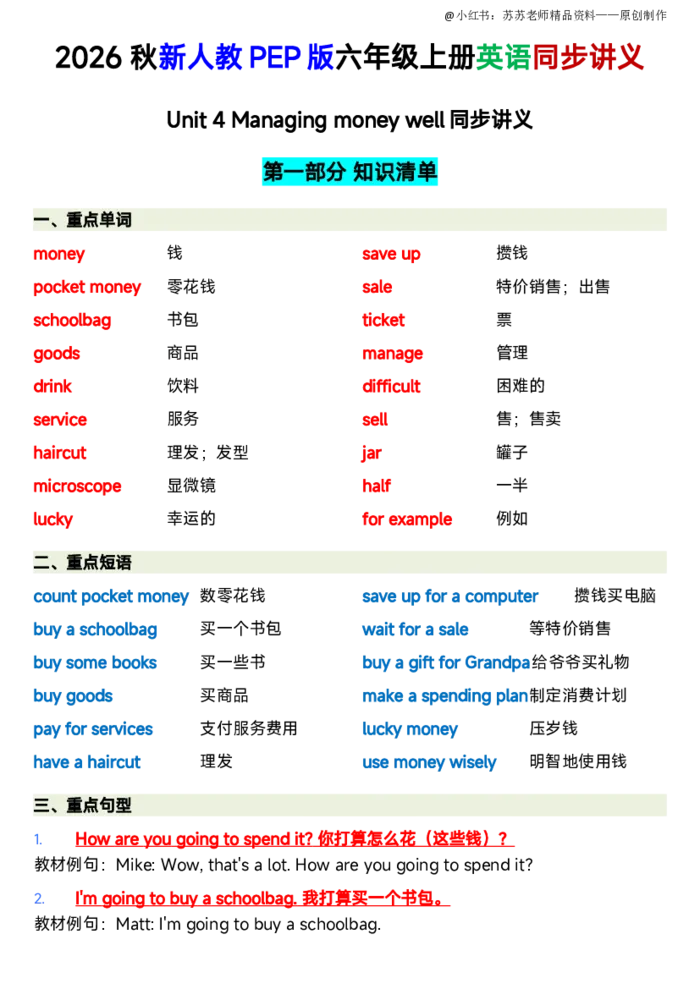
money
钱
pocket money
零花钱
schoolbag
书包
goods
商品
drink
饮料
service
服务
haircut
理发;发型
microscope
显微镜
lucky
幸运的
save up
攒钱
sale
特价销售;出售
ticket
票
manage
管理
difficult
困难的
sell
售;售卖
jar
罐子
half
一半
for example
例如
二、重点短语
count pocket money 数零花钱
buy a schoolbag
买一个书包
buy some books
买一些书
buy goods
买商品
pay for services
支付服务费用
have a haircut
理发
save up for a computer
攒钱买电脑
wait for a sale
等特价销售
buy a gift for Grandpa给爷爷买礼物
make a spending plan制定消费计划
lucky money
压岁钱
use money wisely
明智地使用钱
三、重点句型
1.
How
are
you
going
to
spend
it?
你打算怎么花(这些钱)?
教材例句:Mike: Wow, that's a lot. How are you going to spend it?
2.
I'm
going
to
buy
a schoolbag.
我打算买一个书包。
教材例句:Matt: I'm going to buy a schoolbag.
@小红书:苏苏老师精品资料——原创制作
3.
I also
want
to
buy
some
books.
我还想买一些书。
教材例句:Matt: I also want to buy some books.
4.
What
else
are
you
going
to
buy?
你还打算买什么?
教材例句:Mum: What else are you going to buy?
5.
I'm
going
to
buy
a pair
of
sunglasses
for
Grandpa.
我打算给爷爷买一副太阳镜。
教材例句:Sarah: But first I'm going to buy a pair of sunglasses for Grandpa.
6.
I need
to
save
more.
我需要攒更多钱。
教材例句:Sarah: I also have some lucky money from the Spring Festival, but I still
need to save more.
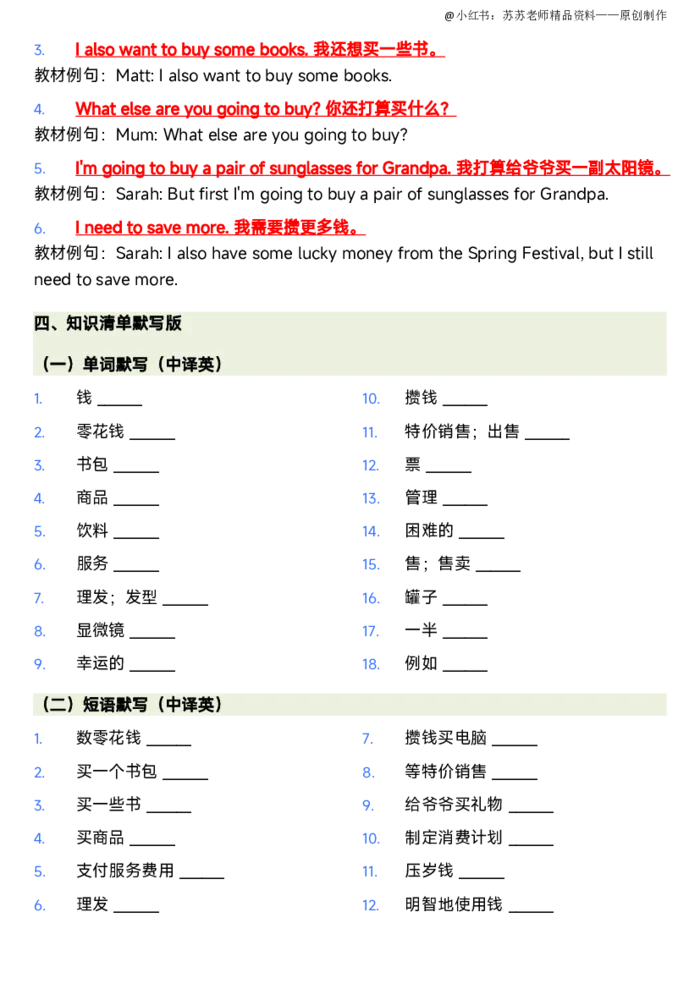
四、知识清单默写版
(一)单词默写(中译英)
1.
钱 ______
2.
零花钱 ______
3.
书包 ______
4.
商品 ______
5.
饮料 ______
6.
服务 ______
7.
理发;发型 ______
8.
显微镜 ______
9.
幸运的 ______
10.
攒钱 ______
11.
特价销售;出售 ______
12.
票 ______
13.
管理 ______
14.
困难的 ______
15.
售;售卖 ______
16.
罐子 ______
17.
一半 ______
18.
例如 ______
(二)短语默写(中译英)
1.
数零花钱 ______
2.
买一个书包 ______
3.
买一些书 ______
4.
买商品 ______
5.
支付服务费用 ______
6.
理发 ______
7.
攒钱买电脑 ______
8.
等特价销售 ______
9.
给爷爷买礼物 ______
10.
制定消费计划 ______
11.
压岁钱 ______
12.
明智地使用钱 ______
@小红书:苏苏老师精品资料——原创制作
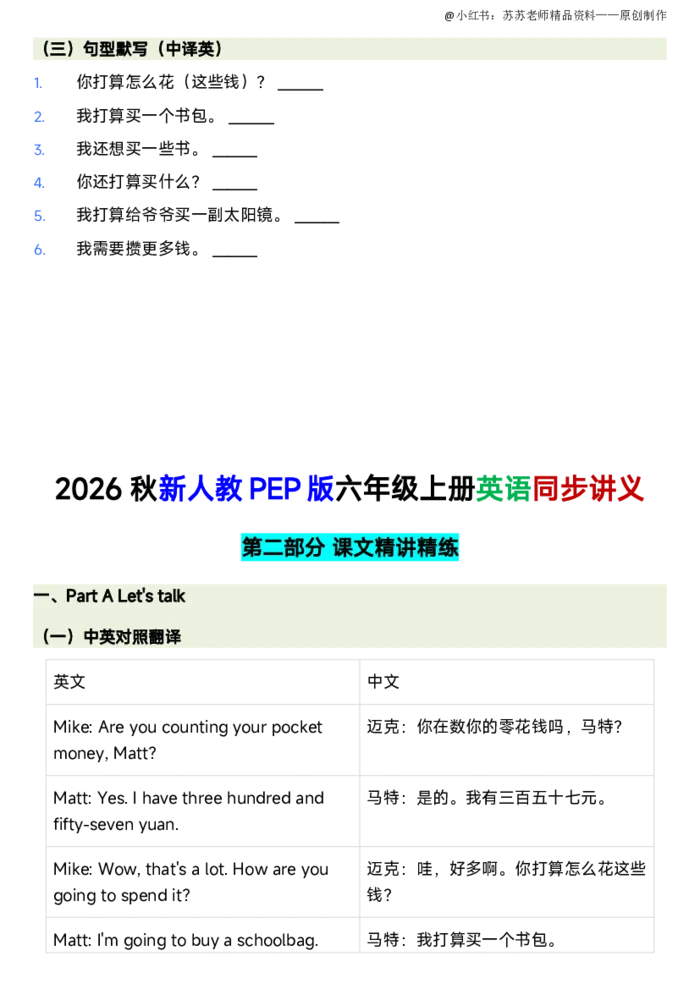
(三)句型默写(中译英)
1.
你打算怎么花(这些钱)? ______
2.
我打算买一个书包。 ______
3.
我还想买一些书。 ______
4.
你还打算买什么? ______
5.
我打算给爷爷买一副太阳镜。 ______
6.
我需要攒更多钱。 ______
2026 秋新人教PEP 版六年级上册英语同步讲义
第二部分 课文精讲精练
一、Part A Let's talk
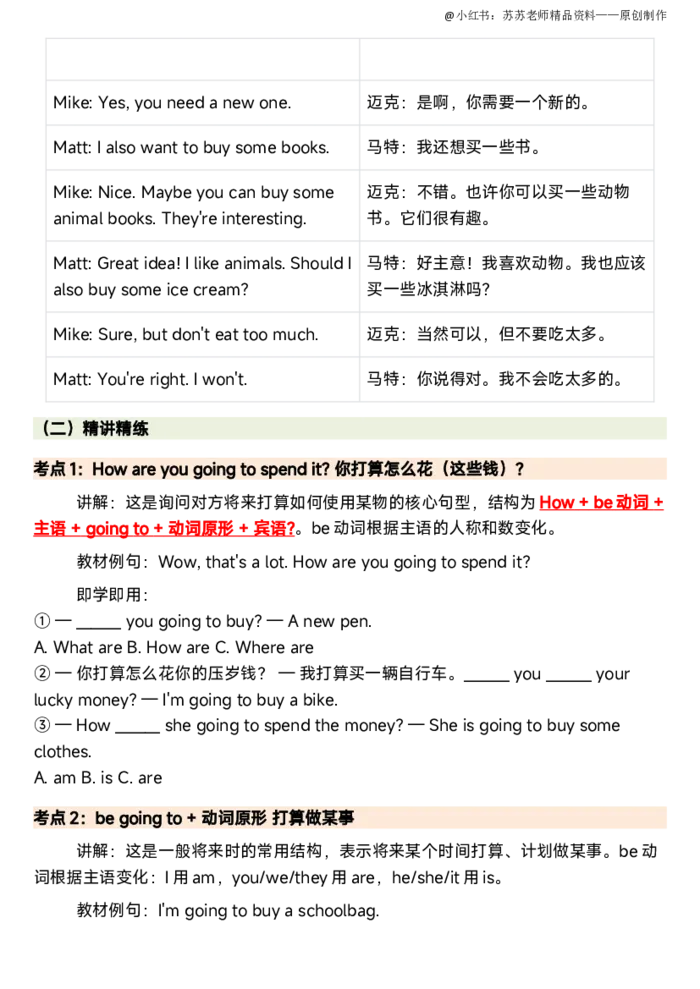
(一)中英对照翻译
英文
中文
Mike: Are you counting your pocket
money, Matt?
迈克:你在数你的零花钱吗,马特?
Matt: Yes. I have three hundred and
fifty-seven yuan.
马特:是的。我有三百五十七元。
Mike: Wow, that's a lot. How are you
going to spend it?
迈克:哇,好多啊。你打算怎么花这些
钱?
Matt: I'm going to buy a schoolbag.
马特:我打算买一个书包。
@小红书:苏苏老师精品资料——原创制作
Mike: Yes, you need a new one.
迈克:是啊,你需要一个新的。
Matt: I also want to buy some books.
马特:我还想买一些书。
Mike: Nice. Maybe you can buy some
animal books. They're interesting.
迈克:不错。也许你可以买一些动物
书。它们很有趣。
Matt: Great idea! I like animals. Should I
also buy some ice cream?
马特:好主意!我喜欢动物。我也应该
买一些冰淇淋吗?
Mike: Sure, but don't eat too much.
迈克:当然可以,但不要吃太多。
Matt: You're right. I won't.
马特:你说得对。我不会吃太多的。
(二)精讲精练
考点1:How are you going to spend it? 你打算怎么花(这些钱)?
•
讲解:这是询问对方将来打算如何使用某物的核心句型,结构为How
+ be
动词
+
主语
+ going
to
+ 动词原形
+ 宾语
? 。be 动词根据主语的人称和数变化。
•
教材例句:Wow, that's a lot. How are you going to spend it?
•
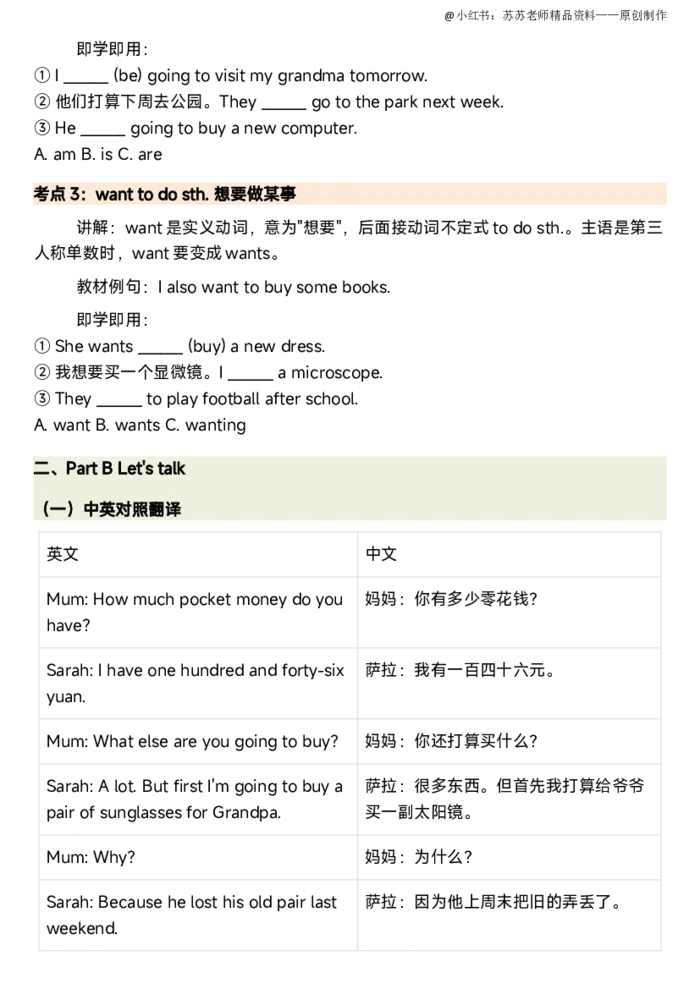
即学即用:
① — ______ you going to buy? — A new pen.
A. What are B. How are C. Where are
② — 你打算怎么花你的压岁钱? — 我打算买一辆自行车。______ you ______ your
lucky money? — I'm going to buy a bike.
③ — How ______ she going to spend the money? — She is going to buy some
clothes.
A. am B. is C. are
考点2:be going to + 动词原形 打算做某事
•
讲解:这是一般将来时的常用结构,表示将来某个时间打算、计划做某事。be 动
词根据主语变化:I 用am,you/we/they 用are,he/she/it 用is。
•
教材例句:I'm going to buy a schoolbag.
@小红书:苏苏老师精品资料——原创制作
•
即学即用:
① I ______ (be) going to visit my grandma tomorrow.
② 他们打算下周去公园。They ______ go to the park next week.
③ He ______ going to buy a new computer.
A. am B. is C. are
考点3:want to do sth. 想要做某事
•
讲解:want 是实义动词,意为"想要",后面接动词不定式to do sth.。主语是第三
人称单数时,want 要变成wants。
•
教材例句:I also want to buy some books.
•
即学即用:
① She wants ______ (buy) a new dress.
② 我想要买一个显微镜。I ______ a microscope.
③ They ______ to play football after school.
A. want B. wants C. wanting
二、Part B Let's talk
(一)中英对照翻译
英文
中文
Mum: How much pocket money do you
have?
妈妈:你有多少零花钱?
Sarah: I have one hundred and forty-six
yuan.
萨拉:我有一百四十六元。
Mum: What else are you going to buy?
妈妈:你还打算买什么?
Sarah: A lot. But first I'm going to buy a
pair of sunglasses for Grandpa.
萨拉:很多东西。但首先我打算给爷爷
买一副太阳镜。
Mum: Why?
妈妈:为什么?
Sarah: Because he lost his old pair last
weekend.
萨拉:因为他上周末把旧的弄丢了。
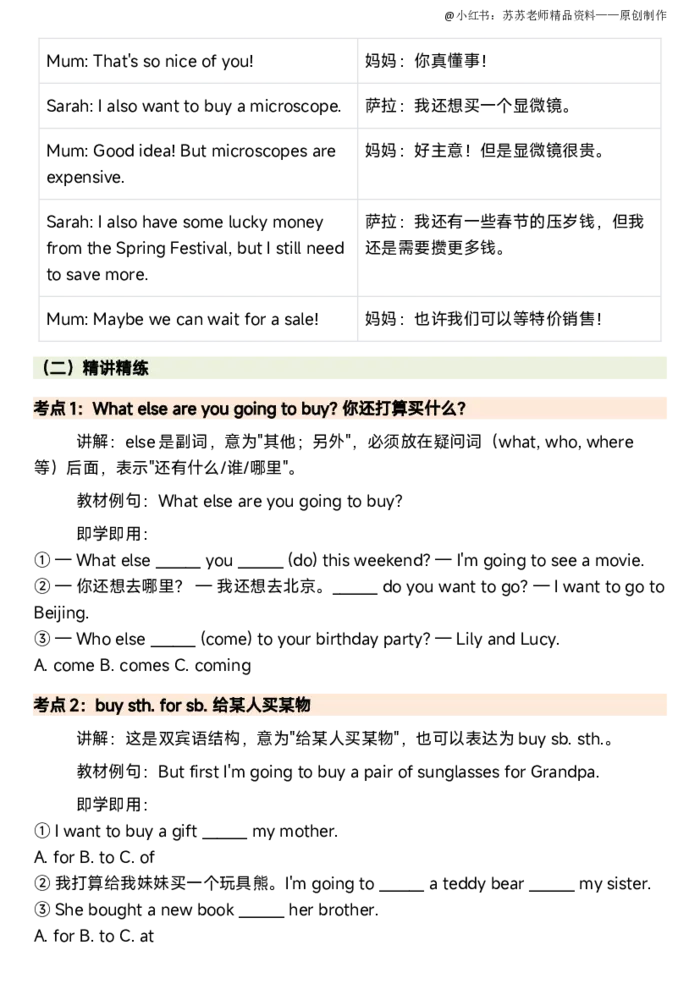
@小红书:苏苏老师精品资料——原创制作
Mum: That's so nice of you!
妈妈:你真懂事!
Sarah: I also want to buy a microscope.
萨拉:我还想买一个显微镜。
Mum: Good idea! But microscopes are
expensive.
妈妈:好主意!但是显微镜很贵。
Sarah: I also have some lucky money
from the Spring Festival, but I still need
to save more.
萨拉:我还有一些春节的压岁钱,但我
还是需要攒更多钱。
Mum: Maybe we can wait for a sale!
妈妈:也许我们可以等特价销售!
(二)精讲精练
考点1:What else are you going to buy? 你还打算买什么?
•
讲解:else 是副词,意为"其他;另外",必须放在疑问词(what, who, where
等)后面,表示"还有什么/谁/哪里"。
•
教材例句:What else are you going to buy?
•
即学即用:
① — What else ______ you ______ (do) this weekend? — I'm going to see a movie.
② — 你还想去哪里? — 我还想去北京。______ do you want to go? — I want to go to
Beijing.
③ — Who else ______ (come) to your birthday party? — Lily and Lucy.
A. come B. comes C. coming
考点2:buy sth. for sb. 给某人买某物
•
讲解:这是双宾语结构,意为"给某人买某物",也可以表达为buy sb. sth.。
•
教材例句:But first I'm going to buy a pair of sunglasses for Grandpa.
•
即学即用:
① I want to buy a gift ______ my mother.
A. for B. to C. of
② 我打算给我妹妹买一个玩具熊。I'm going to ______ a teddy bear ______ my sister.
③ She bought a new book ______ her brother.
A. for B. to C. at
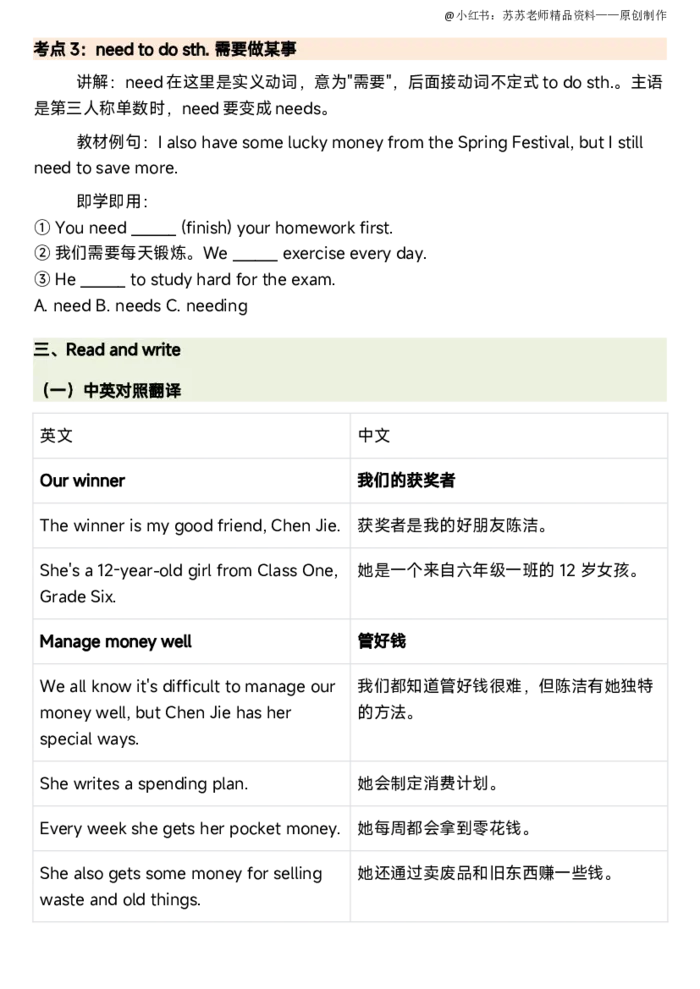
@小红书:苏苏老师精品资料——原创制作
考点3:need to do sth. 需要做某事
•
讲解:need 在这里是实义动词,意为"需要",后面接动词不定式to do sth.。主语
是第三人称单数时,need 要变成needs。
•
教材例句:I also have some lucky money from the Spring Festival, but I still
need to save more.
•
即学即用:
① You need ______ (finish) your homework first.
② 我们需要每天锻炼。We ______ exercise every day.
③ He ______ to study hard for the exam.
A. need B. needs C. needing
三、Read and write
(一)中英对照翻译
英文
中文
Our winner
我们的获奖者
The winner is my good friend, Chen Jie.
获奖者是我的好朋友陈洁。
She's a 12-year-old girl from Class One,
Grade Six.
她是一个来自六年级一班的 12 岁女孩。
Manage money well
管好钱
We all know it's difficult to manage our
money well, but Chen Jie has her
special ways.
我们都知道管好钱很难,但陈洁有她独特
的方法。
She writes a spending plan.
她会制定消费计划。
Every week she gets her pocket money.
她每周都会拿到零花钱。
She also gets some money for selling
waste and old things.
她还通过卖废品和旧东西赚一些钱。
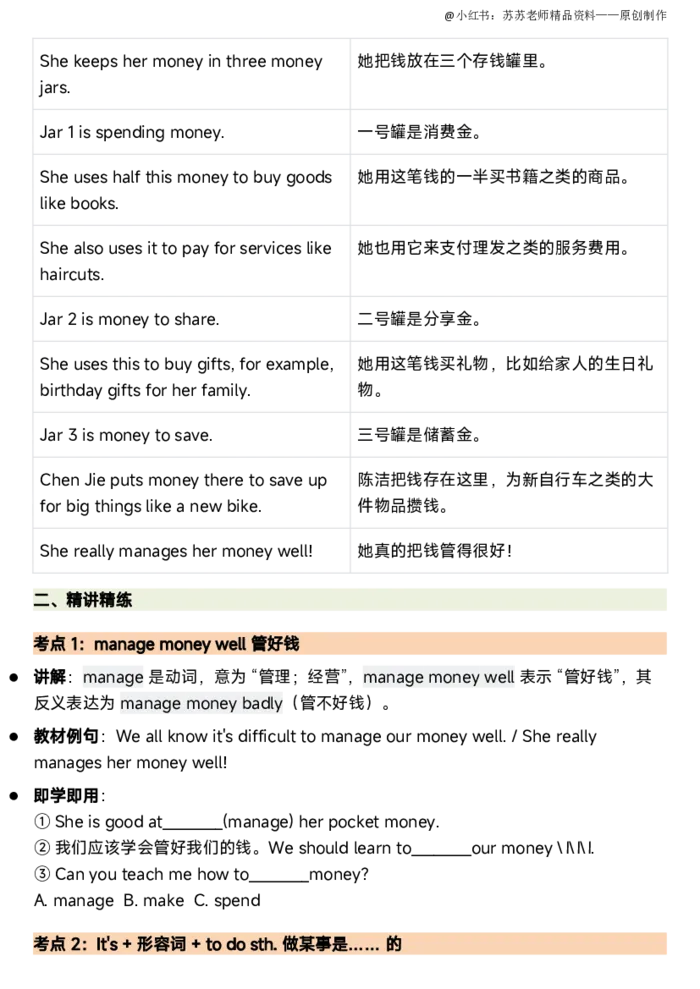
@小红书:苏苏老师精品资料——原创制作
She keeps her money in three money
jars.
她把钱放在三个存钱罐里。
Jar 1 is spending money.
一号罐是消费金。
She uses half this money to buy goods
like books.
她用这笔钱的一半买书籍之类的商品。
She also uses it to pay for services like
haircuts.
她也用它来支付理发之类的服务费用。
Jar 2 is money to share.
二号罐是分享金。
She uses this to buy gifts, for example,
birthday gifts for her family.
她用这笔钱买礼物,比如给家人的生日礼
物。
Jar 3 is money to save.
三号罐是储蓄金。
Chen Jie puts money there to save up
for big things like a new bike.
陈洁把钱存在这里,为新自行车之类的大
件物品攒钱。
She really manages her money well!
她真的把钱管得很好!
二、精讲精练
考点 1:manage money well 管好钱
讲解:manage 是动词,意为 “管理;经营”,manage money well 表示 “管好钱”,其
反义表达为 manage money badly(管不好钱)。
教材例句:We all know it's difficult to manage our money well. / She really
manages her money well!
即学即用:
① She is good at________(manage) her pocket money.
② 我们应该学会管好我们的钱。We should learn to________our money \\\\\\.
③ Can you teach me how to________money?
A. manage B. make C. spend
考点 2:It's + 形容词 + to do sth. 做某事是…… 的
@小红书:苏苏老师精品资料——原创制作
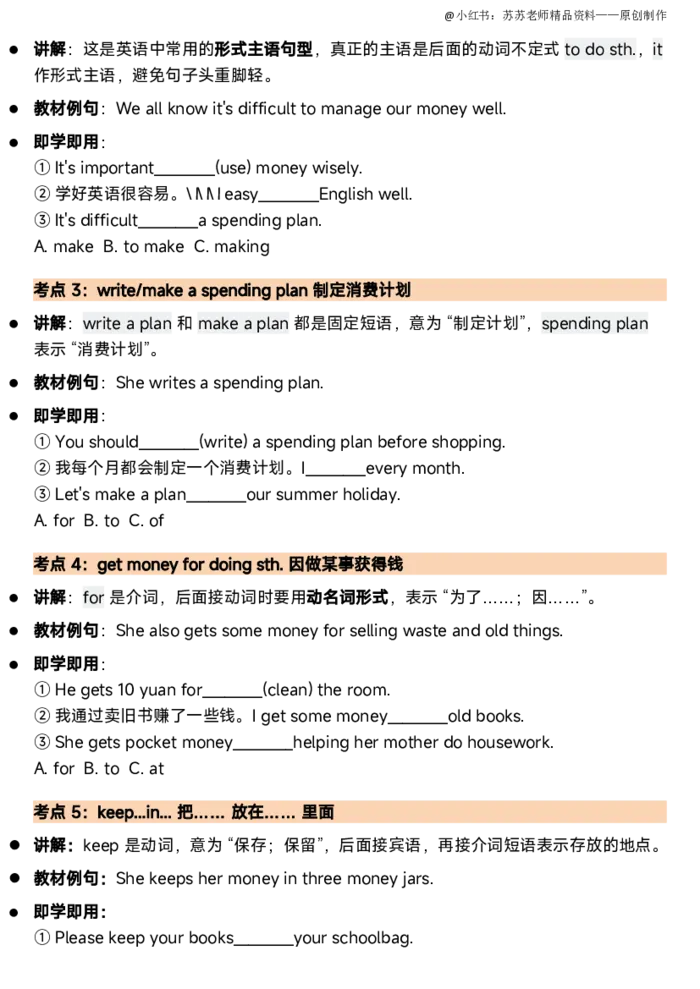
讲解:这是英语中常用的形式主语句型,真正的主语是后面的动词不定式 to do sth.,it
作形式主语,避免句子头重脚轻。
教材例句:We all know it's difficult to manage our money well.
即学即用:
① It's important________(use) money wisely.
② 学好英语很容易。\\\\\\ easy________English well.
③ It's difficult________a spending plan.
A. make B. to make C. making
考点 3:write/make a spending plan 制定消费计划
讲解:write a plan 和 make a plan 都是固定短语,意为 “制定计划”,spending plan
表示 “消费计划”。
教材例句:She writes a spending plan.
即学即用:
① You should________(write) a spending plan before shopping.
② 我每个月都会制定一个消费计划。I________every month.
③ Let's make a plan________our summer holiday.
A. for B. to C. of
考点 4:get money for doing sth. 因做某事获得钱
讲解:for 是介词,后面接动词时要用动名词形式,表示 “为了……;因……”。
教材例句:She also gets some money for selling waste and old things.
即学即用:
① He gets 10 yuan for________(clean) the room.
② 我通过卖旧书赚了一些钱。I get some money________old books.
③ She gets pocket money________helping her mother do housework.
A. for B. to C. at
考点 5:keep...in... 把…… 放在…… 里面
讲解:keep 是动词,意为 “保存;保留”,后面接宾语,再接介词短语表示存放的地点。
教材例句:She keeps her money in three money jars.
即学即用:
① Please keep your books________your schoolbag.
@小红书:苏苏老师精品资料——原创制作
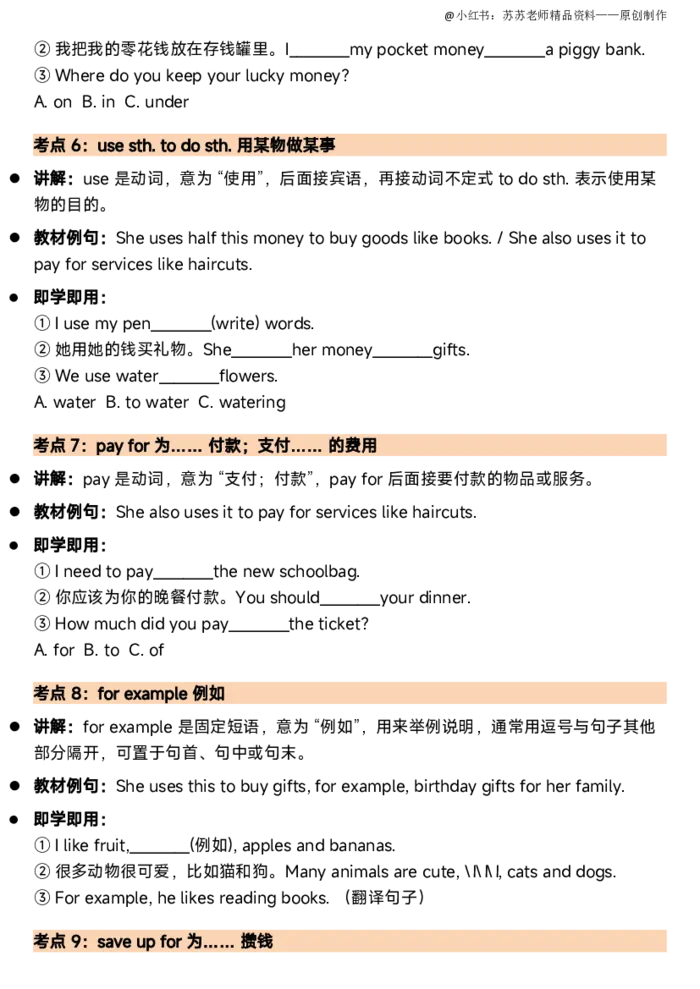
② 我把我的零花钱放在存钱罐里。I________my pocket money________a piggy bank.
③ Where do you keep your lucky money?
A. on B. in C. under
考点 6:use sth. to do sth. 用某物做某事
讲解:use 是动词,意为 “使用”,后面接宾语,再接动词不定式 to do sth. 表示使用某
物的目的。
教材例句:She uses half this money to buy goods like books. / She also uses it to
pay for services like haircuts.
即学即用:
① I use my pen________(write) words.
② 她用她的钱买礼物。She________her money________gifts.
③ We use water________flowers.
A. water B. to water C. watering
考点 7:pay for 为…… 付款;支付…… 的费用
讲解:pay 是动词,意为 “支付;付款”,pay for 后面接要付款的物品或服务。
教材例句:She also uses it to pay for services like haircuts.
即学即用:
① I need to pay________the new schoolbag.
② 你应该为你的晚餐付款。You should________your dinner.
③ How much did you pay________the ticket?
A. for B. to C. of
考点 8:for example 例如
讲解:for example 是固定短语,意为 “例如”,用来举例说明,通常用逗号与句子其他
部分隔开,可置于句首、句中或句末。
教材例句:She uses this to buy gifts, for example, birthday gifts for her family.
即学即用:
① I like fruit,________(例如), apples and bananas.
② 很多动物很可爱,比如猫和狗。Many animals are cute, \\\\\\, cats and dogs.
③ For example, he likes reading books. (翻译句子)
考点 9:save up for 为…… 攒钱
@小红书:苏苏老师精品资料——原创制作
讲解:save up 是固定短语,意为 “攒钱;积蓄”,后面接介词 for 表示目的,即 “为……
攒钱”。
教材例句:Chen Jie puts money there to save up for big things like a new bike.
即学即用:
① I'm saving up for a new________(显微镜).
② 我正在攒钱买一辆新自行车。I'm________a new bike.
③ If you wait for a sale, you can save a lot of \\\\\\.
A. time B. money C. food
2026 秋新人教PEP 版六年级上册英语同步讲义
第三部分 语法讲解
一、语法点1:一般将来时(be going to 结构)
(一)定义
be going to 结构表示将来某个时间打算、计划或准备做某事,也可以表示根据某种迹象
判断将要发生的事情。常与tomorrow(明天)、next week(下周)、this weekend
(这个周末)等表示将来的时间状语连用。
(二)基本结构
主语 + be 动词(am/is/are) + going to + 动词原形 + 其他.
•
be 动词根据主语的人称和数变化:I 用am,you/we/they 用are,he/she/it 用
is。
•
教材例句:I'm going to buy a schoolbag. / She is going to buy a pair of
sunglasses for Grandpa.
(三)句式变化
1.
肯定句:主语
+ am/is/are
+ going
to
+ 动词原形
+ 其他
.
○例句:They are going to have a picnic this Sunday.(他们这个星期天打算去野
餐。)
2.
否定句:主语
+ am/is/are
+ not
+ going
to
+ 动词原形
+ 其他
.
@小红书:苏苏老师精品资料——原创制作
○缩写:I'm not, isn't = is not, aren't = are not
○例句:He is not going to watch TV tonight.(他今晚不打算看电视。)
3.
一般疑问句:
Am/Is/Are
+ 主语
+ going
to
+ 动词原形
+ 其他
?
○肯定回答:Yes, 主语 + am/is/are.
○否定回答:No, 主语 + am/is/are + not.
○例句:— Are you going to the park tomorrow?(你明天打算去公园吗?)
— Yes, I am. / No, I'm not.
4.
特殊疑问句:疑问词
+ am/is/are
+ 主语
+ going
to
+ 动词原形
+ 其他
?
○例句:What are you going to do this weekend?(你这个周末打算做什么?)
Where is she going next month?(她下个月打算去哪里?)
(四)易错点辨析
1.
be
going
to
后面必须接动词原形,不能接名词或动名词
○错误:I am going to school tomorrow.(这里school 是名词,应该加动词go
to)
○正确:I am going to go to school tomorrow.(或者更常用:I am going to
school tomorrow. 这里go to school 是固定短语,可以省略going to)
2.
be
动词的人称变化错误
○错误:He are going to buy a book.
○正确:He is going to buy a book.
3.
否定句和疑问句中动词形式错误
○错误:She isn't going to buys a pen.
○正确:She isn't going to buy a pen.
二、语法点2:want to 和need to 的用法
(一)want to 的用法
1.
定义
:want to 表示"想要做某事",表达个人的愿望或想法。
2.
结构
:主语 + want(s) + to + 动词原形 + 其他.
○主语是第三人称单数时,want 要变成wants。
○教材例句:I also want to buy some books. / She wants to buy a microscope.
@小红书:苏苏老师精品资料——原创制作
3.
句式变化
○否定句:主语 + don't/doesn't + want + to + 动词原形 + 其他.
例句:I don't want to eat ice cream.(我不想吃冰淇淋。)
○一般疑问句:Do/Does + 主语 + want + to + 动词原形 + 其他?
例句:— Do you want to go shopping with me?(你想和我一起去购物吗?)
— Yes, I do. / No, I don't.
(二)need to 的用法
1.
定义
:need to 表示"需要做某事",表达客观上的必要性。
2.
结构
:主语 + need(s) + to + 动词原形 + 其他.
○主语是第三人称单数时,need 要变成needs。
○教材例句:I still need to save more. / You need to buy a new schoolbag.
3.
句式变化
○否定句:主语 + don't/doesn't + need + to + 动词原形 + 其他.
例句:You don't need to buy that toy.(你不需要买那个玩具。)
○一般疑问句:Do/Does + 主语 + need + to + 动词原形 + 其他?
例句:— Does he need to see a doctor?(他需要看医生吗?)
— Yes, he does. / No, he doesn't.
(三)want to 和need to 的区别
•
want to 表示主观上的"想要",是个人的愿望;
•
need to 表示客观上的"需要",是因为有必要才做某事。
•
例句:I want to buy a new toy.(我想要买一个新玩具。——主观愿望)
I need to buy a new schoolbag.(我需要买一个新书包。——客观必要)
三、单元语法专项练习
(一)单项选择(10 道)
1.
I ______ going to buy a new book tomorrow.
A. am B. is C. are
2.
She ______ going to visit her grandma next week.
A. am B. is C. are
@小红书:苏苏老师精品资料——原创制作
3.
What ______ you going to do this weekend?
A. am B. is C. are
4.
They ______ going to have a party this Saturday.
A. am B. is C. are
5.
I ______ to buy a microscope.
A. want B. wants C. wanting
6.
He ______ to save more money.
A. need B. needs C. needing
7.
______ you going to the supermarket this afternoon?
A. Am B. Is C. Are
8.
My mother ______ going to buy some food.
A. am B. is C. are
9.
We ______ to exercise every day to keep healthy.
A. want B. needs C. need
10.
______ she want to buy a new dress?
A. Do B. Does C. Is
(二)用所给单词的适当形式填空(5 道)
1.
I ______ (be) going to go to the park tomorrow.
2.
She ______ (want) to buy a new schoolbag.
3.
They ______ (be) going to have a picnic this Sunday.
4.
You ______ (need) to drink more water.
5.
He ______ (be) going to save up for a computer.
(三)根据中文提示写出英文(5 道)
1.
我打算明天去购物。I ______ tomorrow.
2.
她想要买一个玩具熊。She ______ a teddy bear.
3.
我们需要制定一个消费计划。We ______ a spending plan.
4.
他们打算下周去北京。They ______ Beijing next week.
5.
你还打算买什么?______ you ______ buy?
@小红书:苏苏老师精品资料——原创制作
(四)选词填空(5 道)
am, is, are, want, need
1.
I ______ going to buy some books.
2.
She ______ going to have a haircut.
3.
We ______ to save some money.
4.
You ______ to see a doctor.
5.
They ______ going to wait for a sale.
(五)完形填空(10 道)
Today is Saturday. I am going to go shopping with my mother. I have some pocket
money and I 1______ to buy some things.
First, I 2______ buy a new pencil box. My old one is broken. Then, I 3______ buy a
storybook. I like reading stories very much.
My mother says I 4 ______save some money too. She says I 5______ make a
spending plan. I think she is right.
We go to the supermarket first. I buy a pencil box. It is 6______ yuan. Then we go to
the bookstore. I buy a storybook. It is 15 yuan.
I have 20 yuan left. I decide to put it in my 7______ . I want to save up for a 8 ______.
I think I use my money 9 ______today. I will 10______ make a spending plan before I
go shopping next time.
1.
A. want B. wants C. wanting
2.
A. am going to B. is going to C. are going to
3.
A. want to B. wants to C. wanting to
4.
A. need B. needs C. needing
5.
A. should B. can C. may
6.
A. five B. fifth C. fifty
7.
A. schoolbag B. piggy bank C. box
8.
A. toy B. book C. microscope
9.
A. good B. well C. bad
10.
A. always B. never C. sometimes
@小红书:苏苏老师精品资料——原创制作
2026 秋新人教PEP 版六年级上册英语同步讲义
第四部分 作文讲义
一、单元主题作文介绍
本单元作文主题是写一篇关于你的零花钱消费计划的短文。这是小学英语写作中常见的
应用文类型,重点考查一般将来时(be going to 结构)和want to/need to 的用法,要
求内容具体、计划合理、条理清晰。
二、作文审题
•
主题
:介绍你的零花钱消费计划
•
人称
:第一人称(I)
•
时态
:主要使用一般将来时(描述计划),可适当使用一般现在时(表达愿望和
需要)
•
结构
:
a. 开头:点明你有多少零花钱
b. 中间:具体说明你打算买什么(区分需要的和想要的),以及为什么要买
c. 结尾:说明你打算如何攒钱,以及你对合理消费的看法
三、主题词汇句型积累
(一)常用单词
pocket 口袋, money 钱, spend 花费, buy 买, need 需要, want 想要, save 节省, plan 计
划, schoolbag 书包, book 书, gift 礼物, sale 特价销售, wise 明智的
(二)常用短语
pocket money 零花钱, make a spending plan 制定消费计划, buy sth. for sb. 给某人买
某物, save up for 为……攒钱, wait for a sale 等特价销售, use money wisely 明智地使
@小红书:苏苏老师精品资料——原创制作
用钱
(三)常用句型
I have... yuan pocket money. 我有……元零花钱。
I'm going to buy... 我打算买……
I need to buy... 我需要买……
I want to buy... 我想要买……
I'm going to save up for... 我打算为……攒钱。
I will use my money wisely. 我会明智地使用我的钱。
四、作文技巧全解析
1.
条理清晰
:用First, Second, Third 等词连接不同的消费项目,让文章条理清晰。
2.
区分需要和想要
:先写需要买的东西,再写想要买的东西,体现合理消费的观念。
3.
内容具体
:不要只说"我打算买一些东西",要写出具体买什么,以及为什么要买。
4.
结尾升华
:在结尾表达你对合理消费的看法,让文章更有意义。
(一)开头句型(带翻译)
1.
I have
200
yuan
pocket
money
this
month.
我这个月有
200
元零花钱。
2.
I want
to
make
a spending
plan
for
my
pocket
money.
我想为我的零花钱制定
一个消费计划。
3.
Today
I want
to
talk
about
how
I will
spend
my
pocket
money.
今天我想谈谈我
将如何花我的零花钱。
(二)中间句型(带翻译)
1.
First,
I'm
going
to
buy
a new
schoolbag.
I need
it because
my
old
one
is
broken.
首先,我打算买一个新书包。我需要它,因为我的旧书包坏了。
2.
Second,
I want
to
buy
some
storybooks.
I like
reading
very
much.
其次,我想
买一些故事书。我非常喜欢阅读。
3.
Third,
I'm
going
to
buy
a gift
for
my
mother.
Her
birthday
is coming.
第三,我
打算给我妈妈买一个礼物。她的生日快到了。
4.
I will
save
the
rest
of
the
money
for
a microscope.
我会把剩下的钱攒起来买一
个显微镜。
(三)结尾句型(带翻译)
@小红书:苏苏老师精品资料——原创制作
1.
I think
I will
use
my
money
wisely.
我认为我会明智地使用我的钱。
2.
Making
a spending
plan
is very
important.
制定消费计划非常重要。
3.
I hope
I can
learn
to
manage
my
money
well.
我希望我能学会管好我的钱。
(四)好句积累
1.
It's important to use money wisely. 明智地使用钱很重要。
2.
We should buy what we need first, then what we want. 我们应该先买我们需要
的,再买我们想要的。
3.
Saving money can help us when we need it. 攒钱可以在我们需要的时候帮助我
们。
五、优秀范文(带翻译与解析)
(一)范文
My spending plan
I have 150 yuan pocket money this month. I make a spending plan for it.
First, I'm going to buy a new pencil box. My old one is broken. It costs 20 yuan.
Second, I want to buy three storybooks. They are about animals. They cost 60
yuan. Third, I'm going to buy a card for my teacher. Teachers' Day is coming. It
costs 10 yuan.
I will save the rest 60 yuan for a microscope. I think I use my money well.
(二)翻译
我的消费计划
我这个月有150 元零花钱。我为它制定了一个消费计划。
首先,我打算买一个新铅笔盒。我的旧铅笔盒坏了。它花费20 元。其次,我想买三本
故事书。它们是关于动物的。它们花费60 元。第三,我打算给我的老师买一张卡片。
教师节快到了。它花费10 元。
我会把剩下的60 元攒起来买一个显微镜。我认为我很好地使用了我的钱。
(三)名师解析
•
结构
:文章按照"开头-中间-结尾"的结构写作,开头点明零花钱的数量和制定计划
的目的,中间用First, Second, Third 分点说明消费项目,结尾说明攒钱的计划和对自己
@小红书:苏苏老师精品资料——原创制作
消费计划的评价,逻辑清晰。
•
时态
:全文正确使用一般将来时描述消费计划,时态准确。
•
内容
:具体写了买铅笔盒、故事书和教师节卡片三个项目,区分了需要和想要,
还提到了攒钱的计划,内容充实,体现了合理消费的观念。
•
好词
:spending plan, broken, cost, rest, wisely
•
好句
:I make a spending plan for it.(我为它制定了一个消费计划。)/ I will
save the rest 60 yuan for a microscope.(我会把剩下的60 元攒起来买一个显微
镜。)
六、单元作文练习
(一)题目
请以"My pocket money plan"为题,写一篇60 词左右的短文,介绍你的零花钱消费计
划。要求:内容完整,语句通顺,时态正确。
@小红书:苏苏老师精品资料——原创制作
2026 秋新人教PEP 版六年级上册英语同步讲义
第五部分 单元综合练习
一、单项选择(10 道)
1.
I ______ going to buy a new schoolbag tomorrow.
A. am B. is C. are
2.
She ______ to buy a microscope.
A. want B. wants C. wanting
3.
What ______ you going to do this weekend?
A. am B. is C. are
4.
We ______ to make a spending plan.
A. need B. needs C. needing
5.
______ he going to wait for a sale?
A. Am B. Is C. Are
6.
I'm going to buy a gift ______ my grandpa.
A. for B. to C. of
7.
How ______ pocket money do you have?
A. many B. much C. long
8.
They ______ going to save up for a computer.
A. am B. is C. are
9.
You ______ buy what you need first.
A. should B. shouldn't C. can't
10.
______ you want to go shopping with me?
A. Do B. Does C. Are
二、根据首字母提示完成单词(5 道)
1.
I have some p______ money from my parents.
2.
I'm going to buy a new s______ for school.
@小红书:苏苏老师精品资料——原创制作
3.
We should use money w______.
4.
I want to s______ up for a new bike.
5.
The things are cheaper at a s______.
三、选出不同类的一项(5 道)
1.
A. money B. schoolbag C. book
2.
A. buy B. save C. gift
3.
A. want B. need C. lucky
4.
A. haircut B. service C. goods
5.
A. tomorrow B. yesterday C. next week
四、用所给单词的适当形式填空(5 道)
1.
She ______ (be) going to have a haircut this afternoon.
2.
I ______ (want) to buy some animal books.
3.
They ______ (be) going to make a spending plan.
4.
He ______ (need) to save more money.
5.
You should ______ (use) money wisely.
五、根据描述选单词(5 道)
A. pocket money B. spending plan C. sale D. piggy bank E. lucky money
1.
It is a plan for how you will spend your money. ______
2.
It is money that children get from their parents every week or month. ______
3.
It is money that children get during the Spring Festival. ______
4.
It is a time when things are sold at lower prices. ______
5.
It is a container where you save coins. ______
六、选词填空(5 道)
buy, save, make, wait, use
1.
We should ______ a spending plan before shopping.
2.
I'm going to ______ a new dictionary.
@小红书:苏苏老师精品资料——原创制作
3.
You should ______ some money for the future.
4.
We should ______ money wisely.
5.
Let's ______ for a sale to buy the shoes.
七、完形填空(10 道)
My name is Tom. I get 100 yuan pocket money every month. I want to learn to
1______ my money well.
First, I make a 2 ______every month. I write down what I need and what I want. I buy
the things I need 3______ .
Last month, I 4 ______a new pencil box. It was 15 yuan. Then I bought two
storybooks. They were 30 yuan. I 5 ______the rest 55 yuan in my piggy bank.
This month, I want to buy a 6 ______for my mother. Her birthday is next week. It will
cost 40 yuan. I will use the money from my piggy bank.
I think 7______ money is important. We shouldn't buy 8______ we don't need. We
should 9______ some money for the things we really want.
I hope I can 10______ a good job of managing my money.
1.
A. manage B. make C. spend
2.
A. plan B. spending plan C. list
3.
A. first B. second C. last
4.
A. buy B. bought C. am going to buy
5.
A. put B. took C. spent
6.
A. gift B. book C. toy
7.
A. saving B. spending C. using
8.
A. things B. something C. anything
9.
A. spend B. save C. waste
10.
A. do B. make C. have
八、补全对话(选择合适的句子补全对话)
A: Hi, Amy! 1. ______
B: I'm counting my pocket money. I have 200 yuan.
A: Wow! 2. ______
B: I'm going to buy a new schoolbag first. My old one is broken.
@小红书:苏苏老师精品资料——原创制作
A: 3. ______
B: Then I want to buy some books about space.
A: That's nice. 4. ______
B: Yes, I will save the rest of the money for a microscope.
A: 5. ______
B: Thank you.
A. What else are you going to buy?
B. What are you doing?
C. That's a good plan.
D. How are you going to spend it?
E. Are you going to save any money?
九、阅读理解
(一)阅读短文,选择正确答案
Many children get pocket money from their parents. But not all of them know how
to use it well. Here are three children's ideas about using pocket money.
Li Ming, 12 years old
I get 80 yuan pocket money every month. I buy school things first, like pencils and
notebooks. Then I buy some snacks. I save the rest of the money. I want to buy a
new basketball.
Wang Hong, 11 years old
I get 100 yuan pocket money every month. I always make a spending plan. I buy
books and gifts for my family. I also give 10 yuan to the poor children every month.
I think it's important to help others.
Zhang Wei, 13 years old
I get 150 yuan pocket money every month. I like playing computer games, so I
often buy game cards. But my parents say I spend too much money on games.
Now I am trying to save more money.
1.
How much pocket money does Li Ming get every month?
A. 80 yuan. B. 100 yuan. C. 150 yuan.
2.
What does Li Ming want to buy?
A. A new schoolbag. B. A new basketball. C. A microscope.
@小红书:苏苏老师精品资料——原创制作
3.
What does Wang Hong do with 10 yuan every month?
A. She buys snacks. B. She buys books. C. She gives it to the poor children.
4.
What does Zhang Wei often buy?
A. School things. B. Game cards. C. Gifts for his family.
5.
Which of the following is TRUE?
A. Li Ming never saves money.
B. Wang Hong helps poor children.
C. Zhang Wei uses his money very well.
(二)阅读短文,判断正(T)误(F)
It is important to use money wisely. Here are some tips for children.
First, make a spending plan. Write down what you need and what you want. Buy
the things you need first.
Second, wait for a sale. Sometimes things are much cheaper at a sale. You can
save a lot of money.
Third, save some money. You can put it in a piggy bank. When you need it, you can
use it.
Fourth, don't buy things you don't need. It's a waste of money.
If you follow these tips, you will learn to manage your money well.
1.
Making a spending plan is not necessary. ( )
2.
Things are always expensive at a sale. ( )
3.
You should save some money for the future. ( )
4.
You should buy everything you want. ( )
5.
These tips can help you use money well. ( )
十、书面表达
请以"How I spend my pocket money"为题,写一篇60 词左右的短文,介绍你是如何
使用零花钱的。要求:内容完整,语句通顺,时态正确。
@小红书:苏苏老师精品资料——原创制作,更多精品资料关注小红书