文档文本内容
Unit 10 I’ve had this bike for three years.
词句精讲精练
词汇精讲
1. for/since
 (1) for 与表示一段时间的词连用,表示“做某事多长时间了”,常用于现在完成时,表示从过去某时开始,
持续到现在的动作或状态。for 所在句子中的动词是延续性动词。例如:
   I’ve lived in China for two years. 我住在中国两年了。
   I’ve known him for more than twenty years. 我认识他20 多年了。
 (2) since 作连词,引导时间状语从句,从句用一般过去时,主句常用完成时。例如:
       I have studied English since I came here. 自从我来这里就学习英语。
       I have known her since I was five years old. 自从我五岁就认识她。
since 还可以作介词,连接一个过去的时间点或一段时间+ago。例如:
      She has been ill since last weekend. 她自从上周末就病了。
      She has been in Wuhan since four years ago. 自从四年前她就在武汉。
2. maker
  maker 是名词,意为“生产者;制造者”,是由“动词make + 后缀-r”构成的。英语中,表示职业或身
份的名词小结:
   (1) 以-ist 结尾的有:
        pianist 钢琴家  chemist 化学家  violinist 小提琴家
        physicist 物理学家  scientist 科学家
(2) 以-er,-r 或-or 结尾的有:
        teacher 教师  painter 画家  writer 作家  singer 歌唱家  visitor 参观者
        actor 演员  engineer 工程师  inventor 发明家  professor 教授  reporter 记者
   (3) 以-man 结尾的有:
        postman 邮递员  policeman 警察   businessman 商人   spaceman 宇航员
        fisherman 渔夫   dustman 清洁工
   (4) 以-ian 结尾的有:
        musician 音乐家  politician 政治家
3. certain
   certain 作形容词,意为“某种;某事;某人”。例如:
     He decided to sell his certain books. 他决定卖掉他的某些书籍。
【拓展】certain 作形容词,意为“确定的;无疑的”,相当于sure,对应的副词为certainly。certain 常用于以
下结构中:
be certain / sure of sth. 对某事有把握
be certain / sure to do sth. 肯定做某事
be certain / sure + that 从句  确信……   例如:
  They are certain / sure of success. 他们有把握成功。
  I’m certain / sure that he will come. 我确信他会成功的。
4. a 46-year-old husband and father
    46-year-old 是复合形容词,这种形容词有两个特点:一是词与词之间要用连字符连接;二是数词之
后的名词用单数形式。例如:
  a three-meter-long line 一条三米长的绳子
【拓展】
   岁数的表达方式小结:
(1) 基数词 + years old。例如:
    He is 8 years old. 他八岁了。
(2) 基础词-year-old。例如:
   Lucy is an eighteen-year-old girl. Lucy 是一位18 岁的女孩。
(3) 名词 + of + 基础词。例如:
    Tom is a boy of 18. Tom 是一位18 岁的男孩。
(4) at the age of + 基数词。例如:
    She is at the age of 18. 她18 岁了。
5. shame
   shame 是不可数名词,意为“羞耻;羞愧;惭愧”。可与不定冠词a 连用,表示“可耻的人或事;可惜
(遗憾)的事”。例如:
   He felt no shame for what he had done. 他对自己所做过的事不感到羞愧。
   It’s a shame that you can’t stay for dinner. 你不能留下吃晚饭,真遗憾。
【拓展】shame 常见的短语有:
   feel shame at…因……而感到羞愧    in shame 羞愧地    have no shame 无羞耻心
   with shame 羞愧地   to one’s shame 令某人感到羞愧的是    bring shame on 使丢脸
6. regard
   regard 作及物动词,意为“注视; 注意;认作”。常用短语regard…as…意为“将……视为……;
把……当作……”,as 为介词,其后可接名词或代词。例如:
   I regard you as my best friend. 我把你当作我最好的朋友。
   We regard him as our brother. 我们把他当成兄弟看待。
7. opposite
   (1) opposite 作介词,意为“在……对面”,相当于across from,常与名词一起构成介词短语,表方位。
例如:
They live opposite the bank. 他们住在银行对面。
   (2) opposite 作形容词,意为“另一边的;对面的;相反的”。例如:
     We live on the opposite side of the road. 我们住在马路对面。
   (3) opposite 作副词,意为“在对面”。例如:
     There’s an old man living opposite. 有一个老人住在对面。
   (4) opposite 作名词,意为“相反的人或物;对立面”,常与介词of 一起使用。例如:
      “Tall” is the opposite of “short”. “高”是“矮”的反义词。
8. consider
   consider 作动词,意为“考虑、认为”,它的后面跟名词、动名词或者从句作宾语。
Please consider my suggestion. 请考虑我的建议。
Why don’t you consider visiting Qing Dao?你为什么不考虑去青岛参观?
I consider that he is a selfish man. 我认为他是一个自私的人。
【拓展】
后接动名词作宾语的动词及短语可参考以下归纳:
完成,实践,值得,忙(finish, practice, be worth, be busy);
考虑,建议,不禁,想(consider, suggest, can’t help, feel like);
错过,习惯,(别)放弃(miss, be used to, give up);
继续,喜欢,(要)介意(keep on, enjoy, mind)。
词汇精练
I. 英汉互译。
1. 多久___________________
2. not …any more ___________________
3. grow up___________________
4. 起初___________________
5. as for ___________________
6. give up___________________
7. 至少___________________
8. 一年一两次___________________
9. according to ___________________
10. in order to___________________
II. 根据句意及汉语提示写出所缺单词。
1. All my life I have tried to be an ______________(诚实的) man.
2. He tied a ______________(围巾) around his neck.
3. Please ______________(检查) your answer again.
4. It’s very comfortable to step on the ______________(柔软的) ground in the spring.
5. During the 1830s, countries all over the world started to build ______________(铁路).
6. He is the tallest one ______________(在……当中) the boys.
7. In judging him you should ______________(仔细考虑) his youth.
8. I have many pleasant ______________(回忆) of our friendship.
9. My little son can ______________(数数) from one to ten.
10. Miss Li ______________(搜寻) on the Internet for the information she needed.
III. 用since 或for 填空。
1. Jill has been in Ireland ______________ Monday.
2. Jill has been in Ireland ______________ three days.
3. My aunt has lived in Australia ______________ 15 days.
4. Margaret is in her office. She has been there ______________ 7 o’clock.
5. India has been an independent country ______________ 1947.
6. The bus is late. We’ve been waiting ______________ 20 minutes.
7. Nobody lives in those houses. They have been empty ______________ many years.
8. Mike has been ill ______________ a long time. He has been in hospital ______________ October.
IV. 听力链接。
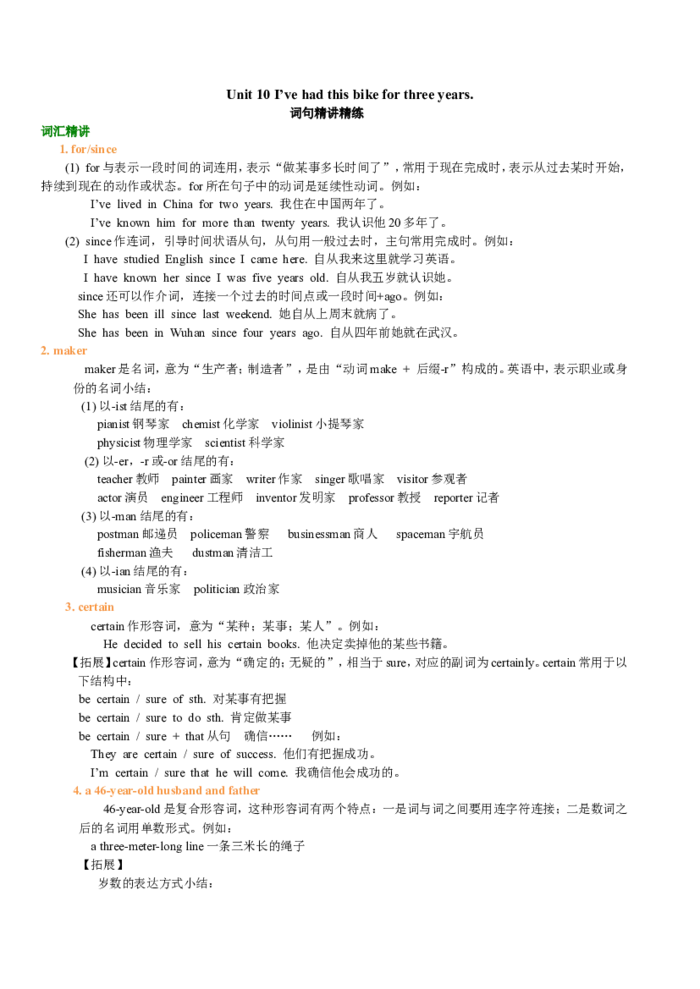
听对话,从下面各题所给的A、B、C 三幅图片中选择与对话内容相符的图片。每段对话你将听两遍。1.A.
B.
C.
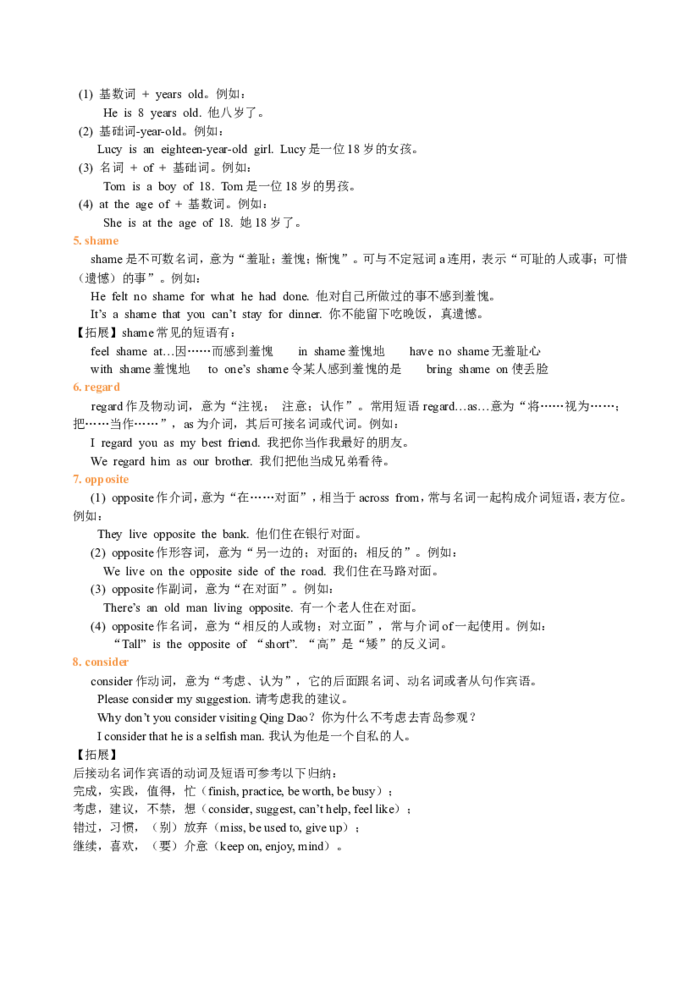
2.A.
B.
C.
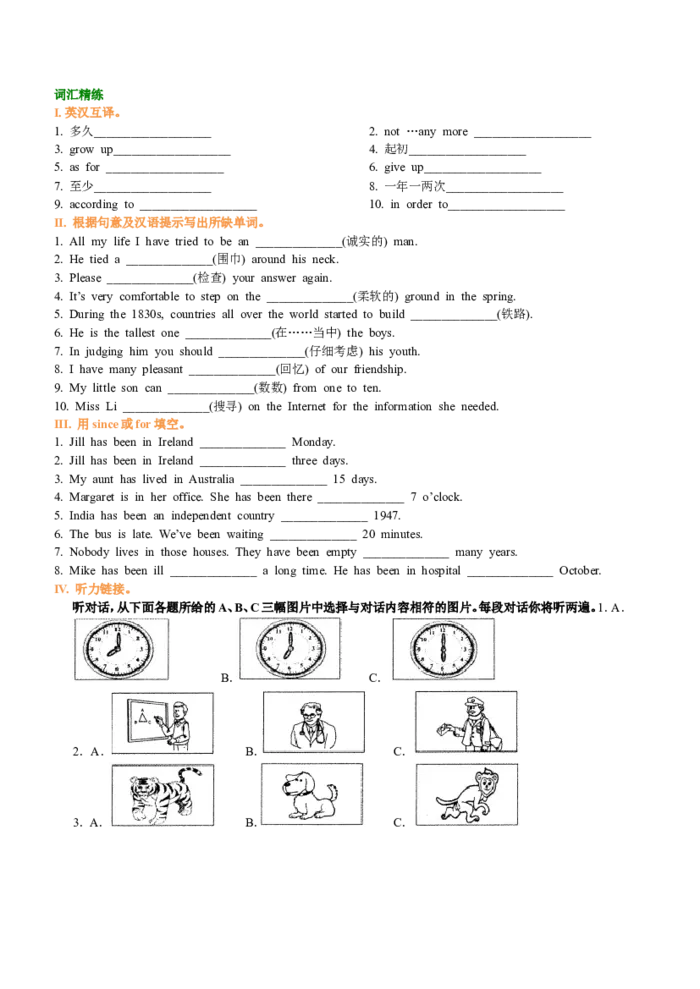
3.A.
B.
C.
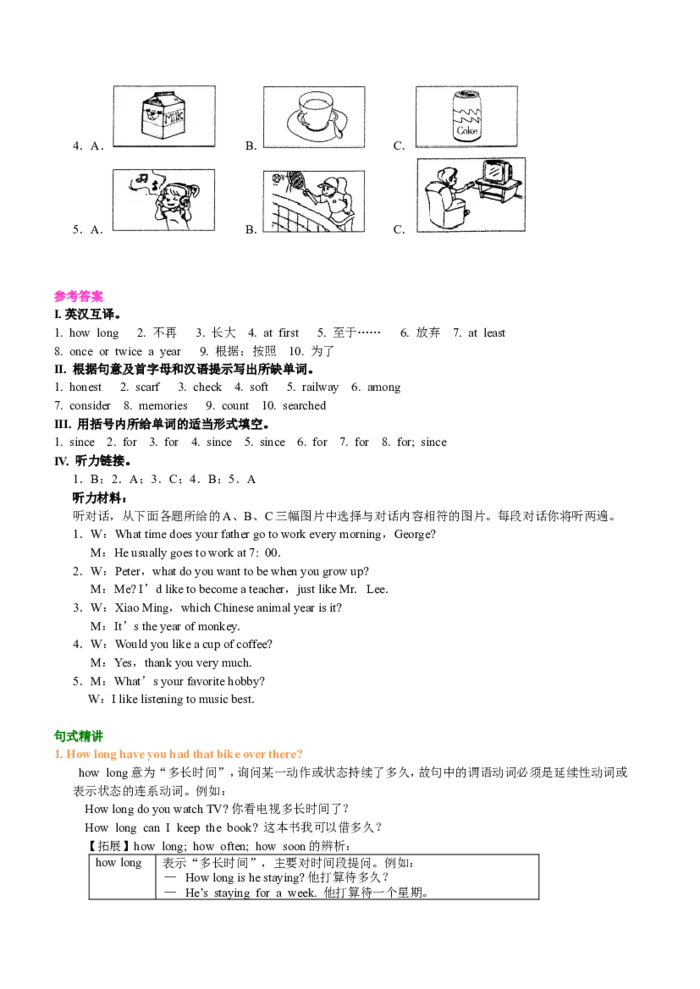
4.A.
B.
C.
5.A.
B.
    C.
参考答案
I. 英汉互译。
1. how long   2. 不再   3. 长大  4. at first   5. 至于……   6. 放弃  7. at least
8. once or twice a year   9. 根据;按照  10. 为了
II. 根据句意及首字母和汉语提示写出所缺单词。
1. honest   2. scarf   3. check  4. soft   5. railway  6. among
7. consider  8. memories   9. count  10. searched
III. 用括号内所给单词的适当形式填空。
1. since  2. for  3. for  4. since  5. since  6. for  7. for  8. for; since
IV. 听力链接。
1.B;2.A;3.C;4.B;5.A
听力材料:
听对话,从下面各题所给的A、B、C 三幅图片中选择与对话内容相符的图片。每段对话你将听两遍。
1.W:What time does your father go to work every morning,George?
M:He usually goes to work at 7: 00.
2.W:Peter,what do you want to be when you grow up?
M:Me? I’d like to become a teacher,just like Mr. Lee.
3.W:Xiao Ming,which Chinese animal year is it?
M:It’s the year of monkey.
4.W:Would you like a cup of coffee?
M:Yes,thank you very much.
5.M:What’s your favorite hobby?
   W:I like listening to music best.
句式精讲
1. How long have you had that bike over there?
 how long 意为“多长时间”,询问某一动作或状态持续了多久,故句中的谓语动词必须是延续性动词或
表示状态的连系动词。例如:
How long do you watch TV? 你看电视多长时间了?
How long can I keep the book? 这本书我可以借多久?
【拓展】how long; how often; how soon 的辨析:
how long
表示“多长时间”,主要对时间段提问。例如:
— How long is he staying? 他打算待多久?
— He’s staying for a week. 他打算待一个星期。
how often
表示“多久一次”,主要对频率进行提问。例如:
— How often do you watch TV?你多久看一次电视?
— Twice a week. 一周两次。
how soon
意为“还要多久”,多用在一般将来时中。例如:
— How soon will he be back? 他要多久才回来?
— In an hour. 一小时以后。
2. Because I don’t read it any more.
    not…any more 意为“不再”。not 常位于be 动词、情态动词或助动词之后,any more 常位于句末,相
当于no more。no more 常位于句中,放在be 动词之后,实义动词之前,两者经常可以互换。例如:
    He doesn’t live here any more. = He no more lives here. 他不再住在这里了。
【拓展】
   表示“不再”的词还有not…any longer 或no longer。二者的区别在于:
(1) not…any more = no more,表示数量或程度上的“不再”增加,通常修饰终止性动词。例如:
    The baby isn’t crying any more. = The baby is no more crying. 这个婴儿不再哭了。
(2) no longer = not…any longer 表示时间或距离上的“不再”延长,通常修饰延续性的动词。例如:
    I can’t stand it any longer. 我对此再也不能忍受下去了。
3. Amy thinks it’s hard to sell her old things.
  It is/was + adj. + to do sth. 意为“做某事是……的”,to do sth.为句子的真正的主语,而it 为形式
主语,形式主语不能用别的词来代替,句中可在形容词后加for sb.,意为“对于某人来说,做某事是……
的”。例如:
  It’s important for us to learn a foreign language. 对我们来说,学习一门外语是相当重要的。
  It’s necessary for us to eat more fruit and vegetables. 对我们来说,多吃蔬菜和水果是必要的。
【拓展】
   这个句型中的for sb.有时也可以用of sb. 二者意义有区别:
  (1) 在It’s + adj. + for sb. to do sth. 中,for sb.意为“对某人来说”,句中的形容词是用来说明to
do sth.的,形式主语只能用it。例如:
   It’s necessary for the students to do some housework. 对于学生们来说,做些家务是十分必要的。
  (2) 在It’s + adj. + of sb. to do sth. 中of sb. 意为“某人……”,句中形容词可与逻辑主语sb. 构
成系表结构,即形容词是用来说明或形容sb.(某人)的。例如:
   It’s very kind of you to help us. 你能帮助我们真是太好了。
4. Jim has been in Japan for three days.
  (1) been 是be 动词的过去分词形式。
(2) have been in 是be in 的现在完成时形式,一般与段时间状语连用。例如:
   He has been in hospital for two months. 他住院已经有两个月了。
【拓展】have been to; have been in 与have gone to 的辨析:
(1) “have/ has been to + 地点”表示“去过某地”,现在已经回来了。例如:
   I’ve been to Beijing twice. 我已去过北京两次。
(2) “have/has been in + 地点”表示“在某地待了一段时间”。例如:
   He’s been in this school for two years. 他在这所学校待了两年了。
(3)“ have/has gone to + 地点”表示“到某事去了”,现在还没有回来,可能在去的途中,也可能在那里或
返回的途中。例如:
  — Where’s Wei Hua? 魏华在哪里?
  — She has gone to the zoo. 她到动物园去了。
5. But he also thinks some things will never change, and his hometown is still the place that holds all his
childhood memories.
这是一个复合句,some things 至句末为宾语从句,作thinks 的宾语。在该宾语从句中包含由and 连接的
两个分句,在第二个分句中,“that holds all his childhood memories”是定语从句,修饰先行词place。关
系代词that 在定语从句中作主语。当定语从句的先行词指物时,关系代词可用that 或which,当关系代
词在定语从句中作宾语时,关系代词that 或which 也可省略。例如:
    I like clothes that/which are unusual. 我喜欢与众不同的衣服。
    Pass me the book(that/which) you bought for me yesterday. 把你昨天给我买的那本书递给我。
句式精练
I. 根据汉语提示完成英语句子(每空一词)。
1. 你拥有那边的那辆自行车多长时间了?
 _________ _________ _________ you _________ that bike over there?
2. 请查看一下这些玩具是否完好。
Please _________ _________ if these toys are all right.
3. 说实在的,我很喜欢美国乡村音乐。
_________ _________ _________, I like American country music very much.
4. 我在纽约住了几个星期。
I have lived in New York for _________ _________ _________ weeks.
5. 他不懈地学习着,直到不再讨厌数学为止。
He worked and worked until he _________ _________ hated mathematics.
6. 怀特先生的记忆力很差。
Mr. White has _________ _________ _________.
7. “空的”是“满的”的反义词。
“Empty” is _________ _________ _________ “full”.
8. 许多警察和官兵正在森林里搜寻从监狱里跑出来的犯人。
Many policemen and soldiers are _________ the forest _________ the prisoner escaping from prison.
II. 句型转化,每空一词。
1. He ran in the school for
    half

   an
    hour

 . (对划线部分提问)
  _________ _________ _________ he run in the school?
2. We started to skate two

   hours

   ago

 . (对划线部分提问)
  _________ _________ you start to skate?
3. They started to play the piano one or two hours ago. (改为同义句)
  They started to play the piano _________ _________ _________ two ago.
4. They have been away from here since two years ago. (改为同义句)
  _________ _________ two years _________ they left here.
5. The man began to work four hours ago. (改为同义句)
  The man has _________ _________ four hours.
6. I have already finished my homework. (改为否定句)
  I _________ _________ my homework _________.
7. She has cleaned the room. (改为一般疑问句)
  _________ she _________ the room?
8. Tina bought the car last year. (改为同义句)
  Tina _________ _________ the car _________ a year.
III. 补全对话。
通读下面的对话,然后根据上下文补全对话内容。
A: Hello, Bob. I called you yesterday afternoon, but there was no reply.
B: Sorry, I didn’t take my phone with me.
A: 1._____________________________________?
B: I was in a bookstore.
A: 2. _____________________________________?
B: I was choosing some books.
A: 3. _____________________________________?
B: Yes, I did. I bought some books about folk stories.
A: Folk stories? I like them very much. 4. _______________________________________?
B: Yes. You can borrow one or two from me. But why not buy some for yourself? I can go with you to the
bookstore.
A: Good idea. Thank you very much.
B: 5._____________________________________.
参考答案
I. 根据汉语提示,完成英语句子(每空一词)。
1. How long have; had   2. check out  3. To be honest  4. a couple of   5. no longer
6. a bad memory 7. the opposite of  8. searching; for
II. 句型转化,每空一词。
1. How long did   2. When did   3. one hour or   4. It is; since  5. worked for  6. haven’t
finished; yet
7. Has; cleaned  8. has had; for
III. 补全对话。
1.Where were you
2.What were you doing
3.Did you buy any books
4.Can/Could I borrow some from you/Can you lend some to me
5.You’re welcome