八年级英语下册知识点
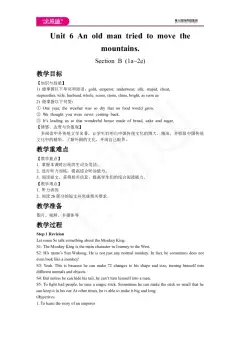
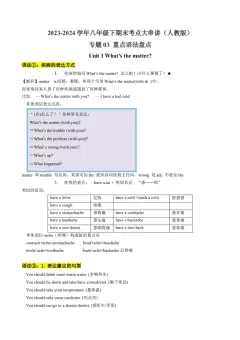
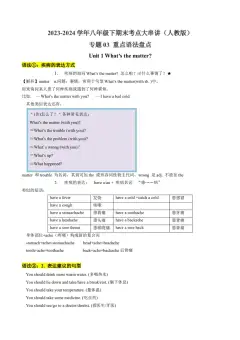
Unit 1. what’s the matter?
一.重点短语归纳
1. foot---feet 脚 <复> tooth---teeth 牙齿 <复>
2. have a cold 感冒 3. have a stomachache 胃疼 4. have a sore back 背疼 5. have a
toothache 牙疼
6. have a sore throat 喉咙疼 7. have a fever 发烧 8. hot tea with honey 加蜜的
热茶
9.drink lots of water 多喝水 10. That’s a good idea 好主意
11. lie down and (have a)rest 躺下休息 12. see a dentist 看牙医
have a rest 休息 see a doctor
看医生
13.lots of ,a lot of, a lot
a lot of=lots of,可以修饰可数名词复数和不可数名词,一般用在肯定句中。:
There are lots of ( a lot of) books in our library.
There is a lot of water on the ground
a lot,是一个副词词组,跟动词连用;表示十分,很等意思; Thanks a lot.
14. go to bed 去睡觉 go to bed early 早上床睡觉
15. feel well 感到好 feel ill 感到不舒服
I don’t feel well= I’m not feeling well 我感觉不舒服.
16. start doing/ to do sth 开始做某事
TO DO 是一件事情完成了,开始做另外一件事情
DOING 是原来的那件事情做到一半,现在又开始做了,是同一件事情。
17. two days ago 两天前 18. get some rest 多休息, 休息一会儿
19. I think so 我认为是这样 20. be thirsty 口渴 21. be hungry 饥饿 22. be stressed
out 紧张
23. listen to music 听音乐 24. healthy lifestyle 健康的生活方式
25. traditional Chinese doctors 传统中医
26. need to do sth 需要做某事
I have a toothache. I need to see a dentist. 我牙痛, 我需要去看牙医.
We need to keep our classroom clean. 我们需要保持教室的干净.
27. a balance of yin and yang 阴阳平衡 28. for example 例如 29. too much yin 太多的阴, 阴
气太盛
too much + 不可数名词 太多的…
much too +形/副 实在太… 极其,非常
too many + 可数名词复数 太多的…
30.be good for sth./ doing sth. 对什么有益 ,对什么有好处
be bad for sth./ doing sth. 对什么有害
be good to 对…好
be good at =do well in 在……方面好,擅长
be good(bad) for、be good at 的相关用法
1.be good for 对......有益
Doing morning exercises is good for your health.做早操对你们的建康有益。
2.be good at 擅长于......
Li Ping is good at basketball. 李平擅长于篮球。
= Li Ping is good at playing basketball. 李平擅长于打篮球。
be good at = do well in 如:
I'm good at math. = I do well in math. 我擅长于数学。
3.be good to 对......好
Parents are always good to their children.父母亲总是对他们的孩子好。
31.get good grades 取得好成绩
32.angry 用法
be angry with sb 生某人的气
I was angry with him for keeping me waiting.
我对他很生气,因为他让我
等了好久。
be angry at/ about sth 就某事生气
33.Chinese medicine 中药
34.be popular in + some place 在某地很流行
Chinese medicine is now popular in many western countries. 现在中药在许多西方国家受欢迎。
35.in western countries 在西方国家
36.It’s easy to do sth 做某事是容易的。 It’s important to do sth . 做某事很重要。
37.balanced diet 平衡饮食
38.get tired 感到疲倦 be/get tired
39.go out at night 在晚上出去
When you are tired, you shouldn’t go out at night. 疲倦时,晚上你不该外出
40.stay healthy 保持健康 =keep healthy=keep in good health
41.at the moment 此时,此刻= now
I’m not feeling very well at the moment
42.enjoy sth. =like sth. (名词)喜欢某物,
enjoy doing sth.喜欢做某事=like dong sth
enjoy oneself (myself, yourself,herself, himself, themselves, ourselves, itself
反身代词) 玩得高兴,过得愉快=have a good time = have a wonderful time =have fun
43. conversation practice 会话练习
44. host family 寄宿家庭
45. have a lot of headaches 经常疼痛
I’m tired and I have a lot of headaches. 我很疲劳,而且经常头痛。
46. a few + 可数名词复数 少许…
a little + 不可数名词/形/副 一点…
47.He shouldn’t eat anything
=He should eat nothing. 他不应当吃任何东西.
48.give sb some advice 给某人建议give advice 提出建议
advice 是不可数名词
a piece of advice 一则建议 take one’s advice 采纳或听从某人的建议
He gave me some good advice.
他向我提了一些很好的意见。
49.sleep 8 hours a night 每晚睡眠八小时
50.take medicine 吃药 服药
I have to take medicine three times a day for my cold.因为感冒,我不得不一天吃三次药。
二 固定结构
It’s +形 + for sb. + to do sth.做某事对某人来说是…的。
It’s important to do sth .做某事很重要。
It’s important for me to eat a balanced diet. 平衡饮食对我来说是很重要的.
It’s easy to do sth 做某事是容易的。
It’s easy for us to find out the answer. 找出答案对我们来说是容易的
三.重点句子
1.What’s the matter ? What’s the mater with you ? 你怎么啦?
=What’s the trouble with you?=What’s wrong with you?
I have a cold / have a sore back / have a stomachache
2.That’s too bad. You should / shouldn’t … 那太糟糕了. 你应该/不该…
You should lie down and rest / drink hot tea with honey / see a dentist / see a doctor .
He shouldn’t eat anything = He should eat nothing. 他不应当吃任何东西.
3.I’m not felling well . 这里well 表示身体状况,不能用good 代替
I don’t feel well= I’m not feeling well 我感觉不舒服.
4.When did it start ? About two days ago . 什么时候开始的?大约两天前
5.I hope you fell better soon . 我希望你很快好起来
这里better 是well 的比较级
6.Traditional Chinese doctors believe we need a balance of yin and yang to be healthy. 传统中医认为我
们需要阴阳调和以保持身体健康。
这里 to be healthy 是动词不定式短语,作目的状语
7.You should eat hot yang foods, like beef. 你应该吃一些像牛肉之类的阳性食物。
8.Eating Dangshen and Huangqi herbs is also good for this.
吃党参和黄芪等草本植物也对这有好处。
9.People who are too stressed out and angry may have too much yang.
太紧张易怒的人或许吃了太多的阳性食物。too much 后跟不可数名词,而too many 后跟可数
名词复数
10.It’s easy to have a healthy lifestyle ,and it’s important to eat a balanced diet . 有一个健康的生活方式
很容易,饮食平衡是很重要的。
→ It’s easy to do sth . 做某事容易 / It’s important to do sth . 做某事重要
11.You should rest for a few nights. 你应该休息几个晚上
12.I study late every night, sometimes until 2 am, but I don’t think I’m improving.
我每天晚上学到很晚,有时到凌晨2 点钟,但我认为我没有提高。
13believe in 信任某人,强调品质,believe sb.相信某人的话
I believe him, but I can’t believe in him.
他的话是真的,但是我不信任他这个人。
14 .I have a toothache . I need to see a dentist .
→ need 意思为 “需要” ,作实义动词时,后跟动词不定式,否定式为don’t /doesn’t / didn’t need
(to do sth.) ;作情态动词时,只能用于否定句或疑问句中,否定式为needn’t(do sth.) ,除有过去式
外,没有其它的形态变化
四.知识结构
1.情态动词should 的用法
should 是情态动词,它的基本用法是必须和其他动词一起构成谓语。情态动词没有人称和数的变
化,意为"应该......"。
should(应当,应该)用于所有人称,表示劝告或建议。
eg. You should wait a little more.
你应该再多等一会儿。
--- I have a very bad cold.我感冒很厉害。
--- You should lie down and have a rest.你应该躺下,多喝水。
2maybe 与may be
1.maybe 是副词,译为“也许、可能”,相当于“perhaps”。如:
Maybe he can answer the question. 也许他能回答那个问题。
He maybe is from the USA, too. 他可能也来自美国。
2.may be 中的may 为情态动词,译为“可能是......”。如:
He may be from the USA, too. 他可能也来自美国。
She may be our English teacher. 她可能是我们的英语老师
3too many,too much 与much too
1.too many 意为“太多”,用于修饰可数名词的复数。如:
There are too many students in our class. 我们班上有太多的学生。
2.too much 意为“太多”,用于修饰不可数名词。如:
We have too much work to do. 我们有太多的工作要做。
3.much too 表示“太”,用来修饰形容词或副词。如:
The box is much too heavy, so I can't carry it.
箱子太重了,所以我搬不动它。
4 few、a few、little、a little 的区别和联系:
1.few / a few 用来修饰可数名词,few 表示否定意义,没有,几乎没有;a few 表示有肯定意思,
有几个。 例如:
He has few friends here, he feels lonely. 他这里没朋友,他感觉寂寞。
There are a few eggs in the basket.篮子里有几个鸡蛋。
2.little / a little 用来修饰不可数名词,little 表示否定意思,没有,几乎没有。
a little 表示肯定意思,有一点儿。 例如:
There is little ink in my bottle, can you give me a little ink?
我的瓶子里没有墨水了,你能给我点儿墨水吗?
5 not…until 直到 …(否定句) 才,动词为短暂性或瞬间性动词
She didn’t leave until we came.
He went shopping after he got up.
=He didn’t go shopping until /before he got up.
……until/till 直到··· (肯定句)动词为延续性动词
We stayed here till/until 12 o’clock.
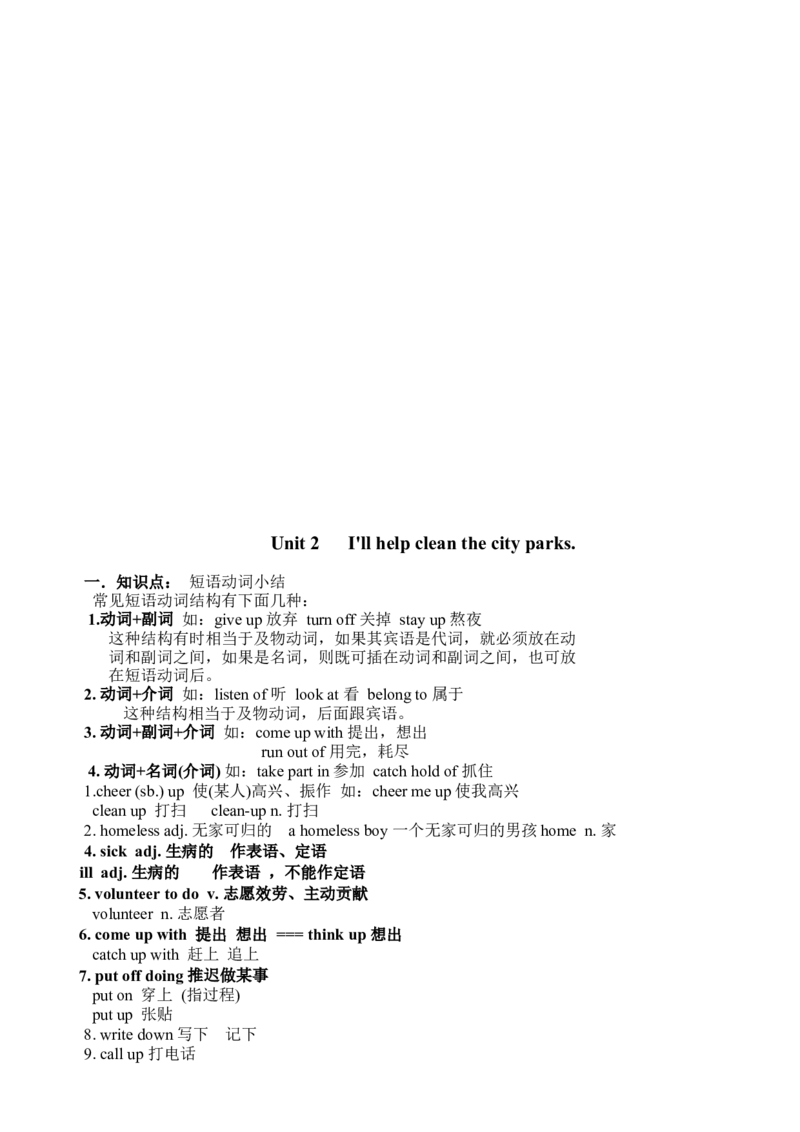
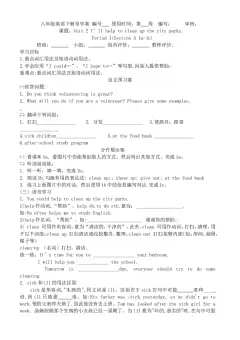
Unit 2 I'll help clean the city parks.
一.知识点: 短语动词小结
常见短语动词结构有下面几种:
1.动词+副词 如:give up 放弃 turn off 关掉 stay up 熬夜
这种结构有时相当于及物动词,如果其宾语是代词,就必须放在动
词和副词之间,如果是名词,则既可插在动词和副词之间,也可放
在短语动词后。
2. 动词+介词 如:listen of 听 look at 看 belong to 属于
这种结构相当于及物动词,后面跟宾语。
3. 动词+副词+介词 如:come up with 提出,想出
run out of 用完,耗尽
4. 动词+名词(介词) 如:take part in 参加 catch hold of 抓住
1.cheer (sb.) up 使(某人)高兴、振作 如:cheer me up 使我高兴
clean up 打扫 clean-up n. 打扫
2. homeless adj. 无家可归的 a homeless boy 一个无家可归的男孩home n. 家
4. sick adj. 生病的 作表语、定语
ill adj. 生病的 作表语 ,不能作定语
5. volunteer to do v. 志愿效劳、主动贡献
volunteer n. 志愿者
6. come up with 提出 想出 === think up 想出
catch up with 赶上 追上
7. put off doing 推迟做某事
put on 穿上 (指过程)
put up 张贴
8. write down 写下 记下
9. call up 打电话
make a telephone call 打电话
10. set up 成立 建立
The new hospital was set up in 2000. 这座医院是在2000 年成立的。
11. each 每个 各自的 强调第一个人或事物的个别情况 常与of 连用
every 每个 每一个的 一切的 则有“全体”的意思不能与of 连用
12. put …to use 把… 投入使用,利用
They put the new machine to use. 他们把新机器投入使用
13. help sb. (to) do 帮助某人做某事 help him (to) study
help sb. with sth. 帮助某人做某事 help him with English
help do 帮助做某事 help study
14. plan to do 计划做某事
plan + 从句
I plan to go to Beijing. === I plan (that) I will go to Beijing. 我计划去北京。
15. spend … doing 花费…做… I spent a day visiting Beijing.
我花了一天的时间去参观北京。
spend… on sth. 花费…在… I spent 3 years on English.
16.not only … but (also) … 不但… 而且… 用来连接两个并列的成分
(1)引导以 not only …but (also)… 开头的句子往往引起部分倒装。因此 ⑴Not only do I feel good
but (also)…. 是倒装句。也是说得要把前面的句子中的助动词或者是情态动词放在主语的前面。
如:
①Not only can I do it but (also) I can do best. 我不仅能做到而且做得最好。
⑵Not only…but (also)… 接两主语时,谓语动词随后面的主语人称和数的变化 也就是就近原则
如:
①Not only Lily but (also) you like cat. 不仅莉莉而且你也喜欢猫。
②Not only you but (also) Lily likes cat. 不仅你而且莉莉喜欢猫。
常见的就近原则的结构有:
①Neither… nor…即不…也不… (两者都不)Neither you nor I like him. 我和你都不喜欢他。
②Either… or… 不是…就是… (两者中的一个)Either Lily or you are a student.
③Not only …but (also)…
④There be
17. join 参加 (指参加团体、组织) 如:join the Party 入党
take part in 参加 (指参加活动) 如:
take part in sports meeting 参加运动会
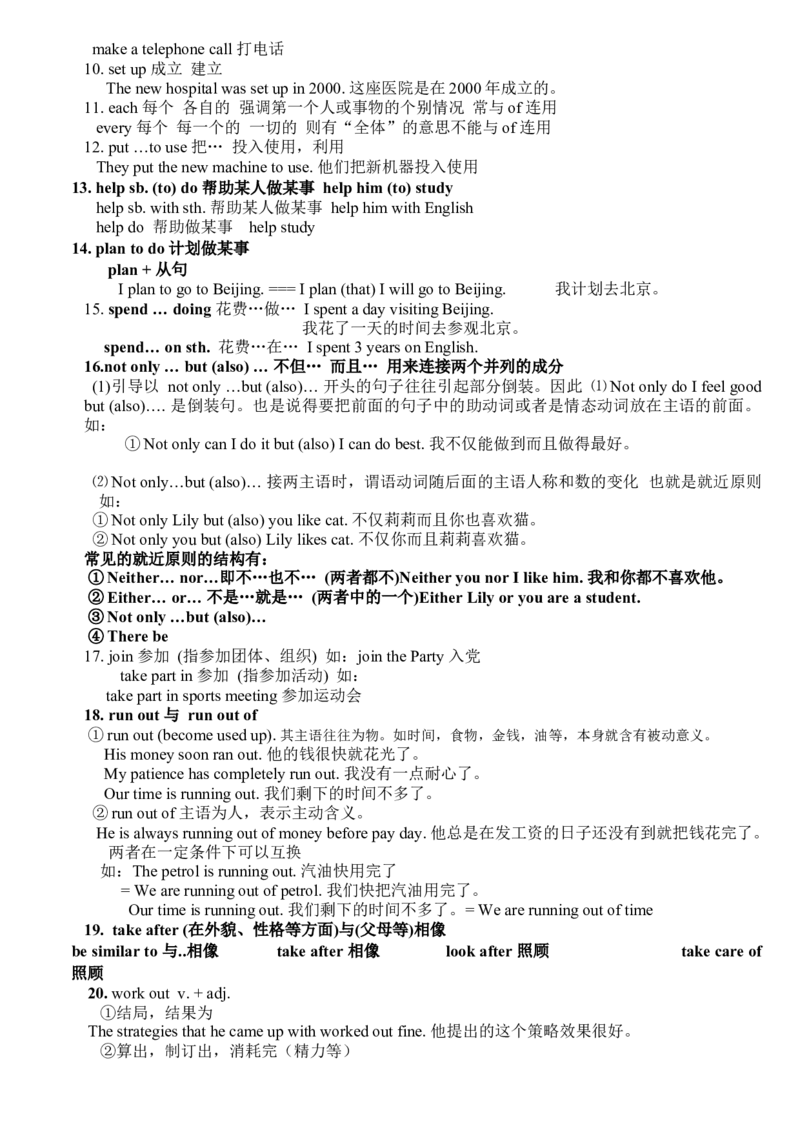
18. run out 与 run out of
①run out (become used up). 其主语往往为物。如时间,食物,金钱,油等,本身就含有被动意义。
His money soon ran out. 他的钱很快就花光了。
My patience has completely run out. 我没有一点耐心了。
Our time is running out. 我们剩下的时间不多了。
②run out of 主语为人,表示主动含义。
He is always running out of money before pay day. 他总是在发工资的日子还没有到就把钱花完了。
两者在一定条件下可以互换
如:The petrol is running out. 汽油快用完了
= We are running out of petrol. 我们快把汽油用完了。
Our time is running out. 我们剩下的时间不多了。= We are running out of time
19. take after (在外貌、性格等方面)与(父母等)相像
be similar to 与..相像 take after 相像 look after 照顾 take care of
照顾
20. work out v. + adj.
①结局,结果为
The strategies that he came up with worked out fine. 他提出的这个策略效果很好。
②算出,制订出,消耗完(精力等)
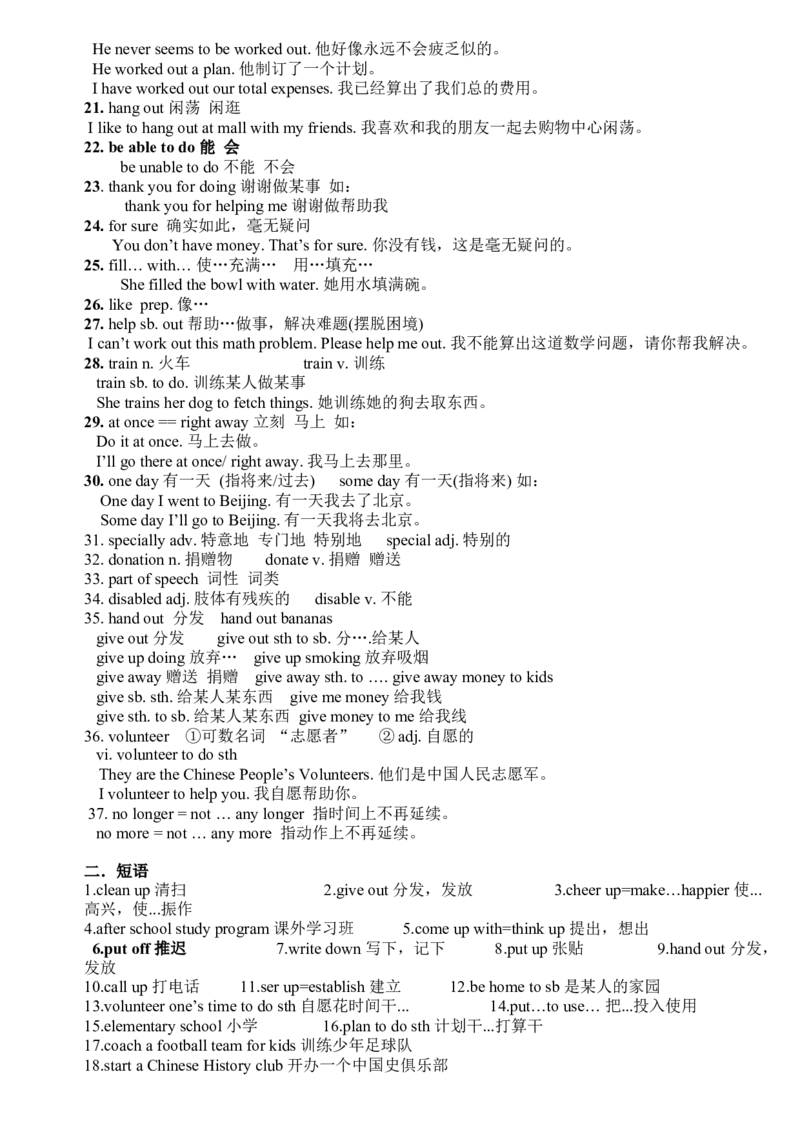
He never seems to be worked out. 他好像永远不会疲乏似的。
He worked out a plan. 他制订了一个计划。
I have worked out our total expenses. 我已经算出了我们总的费用。
21. hang out 闲荡 闲逛
I like to hang out at mall with my friends. 我喜欢和我的朋友一起去购物中心闲荡。
22. be able to do 能 会
be unable to do 不能 不会
23. thank you for doing 谢谢做某事 如:
thank you for helping me 谢谢做帮助我
24. for sure 确实如此,毫无疑问
You don’t have money. That’s for sure. 你没有钱,这是毫无疑问的。
25. fill… with… 使…充满… 用…填充…
She filled the bowl with water. 她用水填满碗。
26. like prep. 像…
27. help sb. out 帮助…做事,解决难题(摆脱困境)
I can’t work out this math problem. Please help me out. 我不能算出这道数学问题,请你帮我解决。
28. train n. 火车 train v. 训练
train sb. to do. 训练某人做某事
She trains her dog to fetch things. 她训练她的狗去取东西。
29. at once == right away 立刻 马上 如:
Do it at once. 马上去做。
I’ll go there at once/ right away. 我马上去那里。
30. one day 有一天 (指将来/过去) some day 有一天(指将来) 如:
One day I went to Beijing. 有一天我去了北京。
Some day I’ll go to Beijing. 有一天我将去北京。
31. specially adv. 特意地 专门地 特别地 special adj. 特别的
32. donation n. 捐赠物 donate v. 捐赠 赠送
33. part of speech 词性 词类
34. disabled adj. 肢体有残疾的 disable v. 不能
35. hand out 分发 hand out bananas
give out 分发 give out sth to sb. 分….给某人
give up doing 放弃… give up smoking 放弃吸烟
give away 赠送 捐赠 give away sth. to …. give away money to kids
give sb. sth. 给某人某东西 give me money 给我钱
give sth. to sb. 给某人某东西 give money to me 给我线
36. volunteer ①可数名词 “志愿者” ②adj. 自愿的
vi. volunteer to do sth
They are the Chinese People’s Volunteers. 他们是中国人民志愿军。
I volunteer to help you. 我自愿帮助你。
37. no longer = not … any longer 指时间上不再延续。
no more = not … any more 指动作上不再延续。
二.短语
1.clean up 清扫 2.give out 分发,发放 3.cheer up=make…happier 使...
高兴,使...振作
4.after school study program 课外学习班 5.come up with=think up 提出,想出
6.put off 推迟 7.write down 写下,记下 8.put up 张贴 9.hand out 分发,
发放
10.call up 打电话 11.ser up=establish 建立 12.be home to sb 是某人的家园
13.volunteer one’s time to do sth 自愿花时间干... 14.put…to use… 把...投入使用
15.elementary school 小学 16.plan to do sth 计划干...打算干
17.coach a football team for kids 训练少年足球队
18.start a Chinese History club 开办一个中国史俱乐部
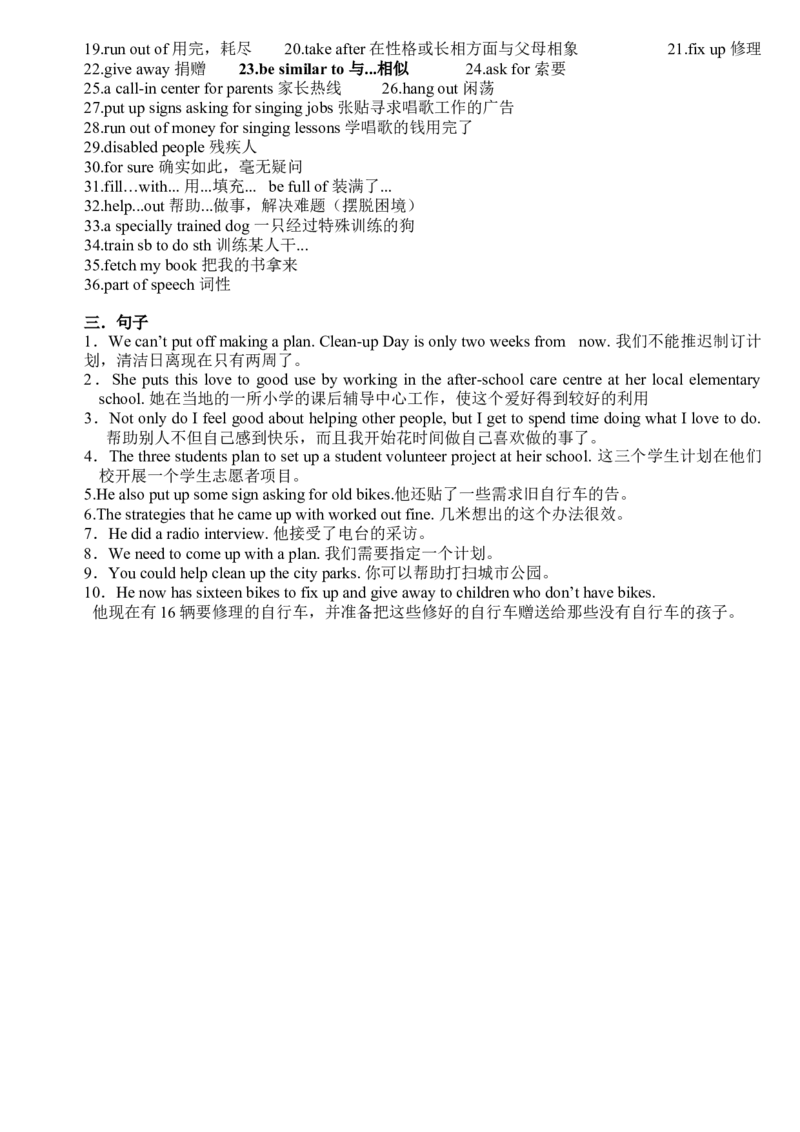
19.run out of 用完,耗尽 20.take after 在性格或长相方面与父母相象 21.fix up 修理
22.give away 捐赠 23.be similar to 与...相似 24.ask for 索要
25.a call-in center for parents 家长热线 26.hang out 闲荡
27.put up signs asking for singing jobs 张贴寻求唱歌工作的广告
28.run out of money for singing lessons 学唱歌的钱用完了
29.disabled people 残疾人
30.for sure 确实如此,毫无疑问
31.fill…with... 用...填充... be full of 装满了...
32.help...out 帮助...做事,解决难题(摆脱困境)
33.a specially trained dog 一只经过特殊训练的狗
34.train sb to do sth 训练某人干...
35.fetch my book 把我的书拿来
36.part of speech 词性
三.句子
1.We can’t put off making a plan. Clean-up Day is only two weeks from now. 我们不能推迟制订计
划,清洁日离现在只有两周了。
2.She puts this love to good use by working in the after-school care centre at her local elementary
school. 她在当地的一所小学的课后辅导中心工作,使这个爱好得到较好的利用
3.Not only do I feel good about helping other people, but I get to spend time doing what I love to do.
帮助别人不但自己感到快乐,而且我开始花时间做自己喜欢做的事了。
4.The three students plan to set up a student volunteer project at heir school. 这三个学生计划在他们
校开展一个学生志愿者项目。
5.He also put up some sign asking for old bikes.他还贴了一些需求旧自行车的告。
6.The strategies that he came up with worked out fine. 几米想出的这个办法很效。
7.He did a radio interview. 他接受了电台的采访。
8.We need to come up with a plan. 我们需要指定一个计划。
9.You could help clean up the city parks. 你可以帮助打扫城市公园。
10.He now has sixteen bikes to fix up and give away to children who don’t have bikes.
他现在有16 辆要修理的自行车,并准备把这些修好的自行车赠送给那些没有自行车的孩子。
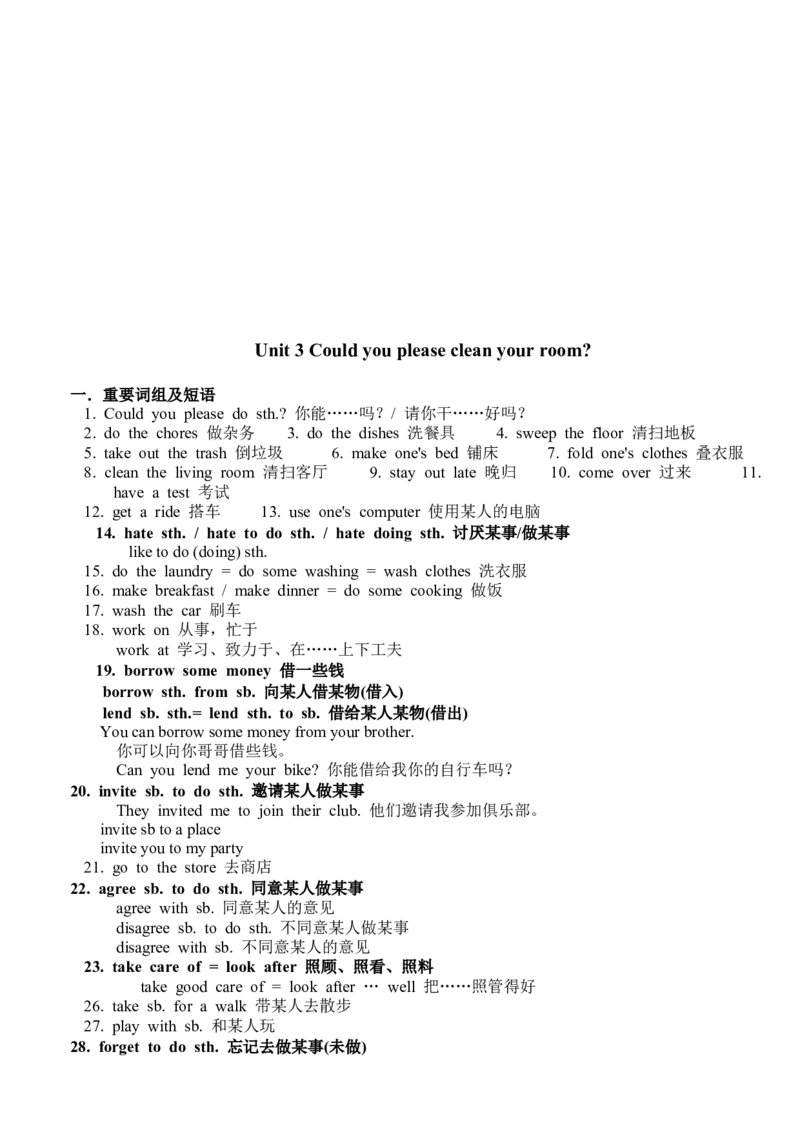
Unit 3 Could you please clean your room?
一.重要词组及短语
1. Could you please do sth.? 你能……吗?/ 请你干……好吗?
2. do the chores 做杂务 3. do the dishes 洗餐具 4. sweep the floor 清扫地板
5. take out the trash 倒垃圾 6. make one's bed 铺床 7. fold one's clothes 叠衣服
8. clean the living room 清扫客厅 9. stay out late 晚归 10. come over 过来 11.
have a test 考试
12. get a ride 搭车 13. use one's computer 使用某人的电脑
14. hate sth. / hate to do sth. / hate doing sth. 讨厌某事/做某事
like to do (doing) sth.
15. do the laundry = do some washing = wash clothes 洗衣服
16. make breakfast / make dinner = do some cooking 做饭
17. wash the car 刷车
18. work on 从事,忙于
work at 学习、致力于、在……上下工夫
19. borrow some money 借一些钱
borrow sth. from sb. 向某人借某物(借入)
lend sb. sth.= lend sth. to sb. 借给某人某物(借出)
You can borrow some money from your brother.
你可以向你哥哥借些钱。
Can you lend me your bike? 你能借给我你的自行车吗?
20. invite sb. to do sth. 邀请某人做某事
They invited me to join their club. 他们邀请我参加俱乐部。
invite sb to a place
invite you to my party
21. go to the store 去商店
22. agree sb. to do sth. 同意某人做某事
agree with sb. 同意某人的意见
disagree sb. to do sth. 不同意某人做某事
disagree with sb. 不同意某人的意见
23. take care of = look after 照顾、照看、照料
take good care of = look after … well 把……照管得好
26. take sb. for a walk 带某人去散步
27. play with sb. 和某人玩
28. forget to do sth. 忘记去做某事(未做)
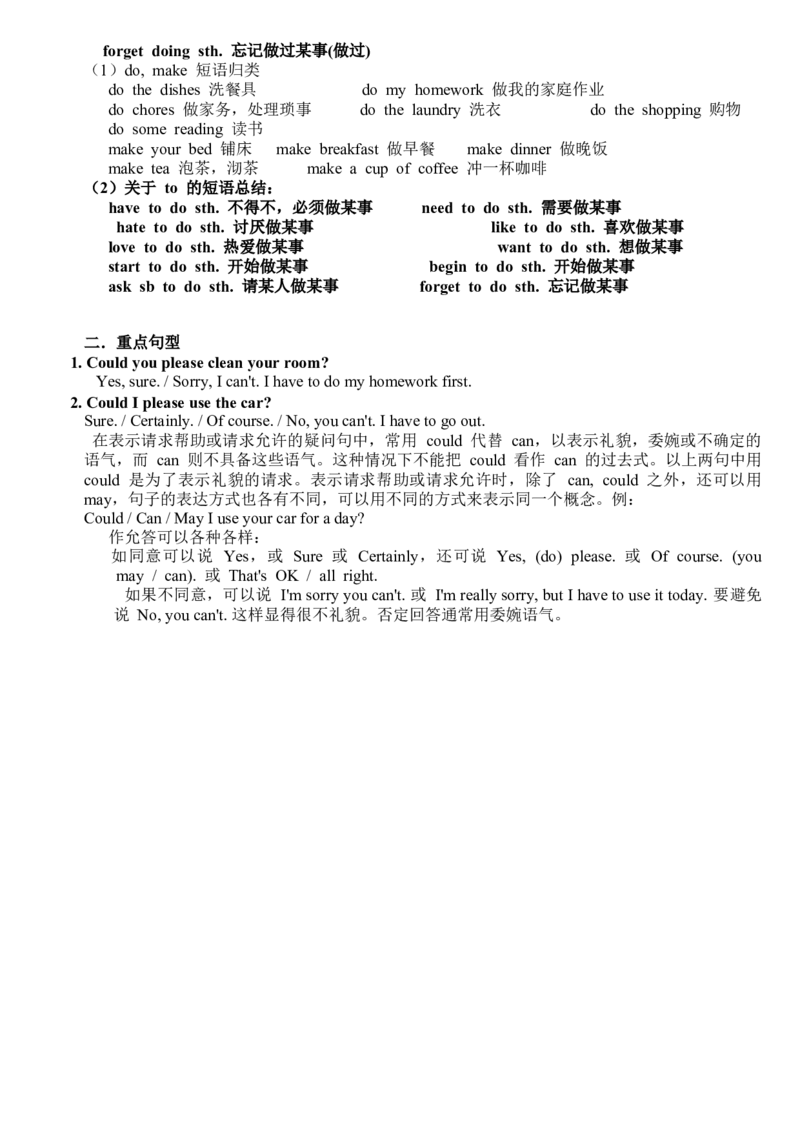
forget doing sth. 忘记做过某事(做过)
(1)do, make 短语归类
do the dishes 洗餐具 do my homework 做我的家庭作业
do chores 做家务,处理琐事 do the laundry 洗衣 do the shopping 购物
do some reading 读书
make your bed 铺床 make breakfast 做早餐 make dinner 做晚饭
make tea 泡茶,沏茶 make a cup of coffee 冲一杯咖啡
(2)关于 to 的短语总结:
have to do sth. 不得不,必须做某事 need to do sth. 需要做某事
hate to do sth. 讨厌做某事 like to do sth. 喜欢做某事
love to do sth. 热爱做某事 want to do sth. 想做某事
start to do sth. 开始做某事 begin to do sth. 开始做某事
ask sb to do sth. 请某人做某事 forget to do sth. 忘记做某事
二.重点句型
1. Could you please clean your room?
Yes, sure. / Sorry, I can't. I have to do my homework first.
2. Could I please use the car?
Sure. / Certainly. / Of course. / No, you can't. I have to go out.
在表示请求帮助或请求允许的疑问句中,常用 could 代替 can,以表示礼貌,委婉或不确定的
语气,而 can 则不具备这些语气。这种情况下不能把 could 看作 can 的过去式。以上两句中用
could 是为了表示礼貌的请求。表示请求帮助或请求允许时,除了 can, could 之外,还可以用
may,句子的表达方式也各有不同,可以用不同的方式来表示同一个概念。例:
Could / Can / May I use your car for a day?
作允答可以各种各样:
如同意可以说 Yes,或 Sure 或 Certainly,还可说 Yes, (do) please. 或 Of course. (you
may / can). 或 That's OK / all right.
如果不同意,可以说 I'm sorry you can't. 或 I'm really sorry, but I have to use it today. 要避免
说 No, you can't. 这样显得很不礼貌。否定回答通常用委婉语气。
Unit4 Why don’t you talk to your parents?
一. 重要词汇和句型
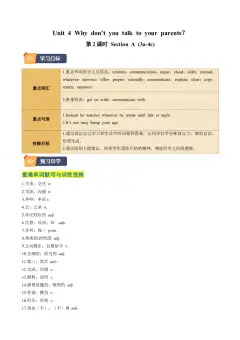
1. get ( 1 ) 买 get sth. for sb. == get sb. sth. 为某人买某物
Can you get some fruit for me when you go shopping ?
== Can you get me some fruit when you go shopping ?
( 2 ) 得到, 到达 Where did you get the book ?
When did you get the letter ? He got home late last night .
(3) 使, 让 get + 宾语 + 宾补 使某人\ 某物 怎么样
Please get you coat clean . Get your mouth closed .
get sb. to do sth. 使某人\ 某物做某事
I got him to call Jim yesterday .
(4) ( 逐渐) 变得…The weather gets warmer and days get longer .
Why did the teacher get angry ?
2. how about \ what about 后跟名词\ 代词\ 动词ing 形式。
( 1) 向对方提出建议或请求
How about going out for a walk ?How about something to eat ?
(2) 向对方征求意见或看法
How about the TV play ? How about buying the house now ?
( 3 ) 询问天气或身体情况
How about the weather in Hainan Island ?
How about your parents ? Are they living with you ?
( 4 ) 谈话中承接上下文
I’m forty years old . How about you ?
I’m from Beijing . How about you ?
3. receive 收到 The girl was happy to receive many gifts on her birthday .
receive a letter from == get a letter from == heard from 收到某人的信
I received a letter from my parents last Sunday .
== I got a letter from my parents last Sunday .
== I heard from my parents last Sunday .
accept 接受 He couldn’t accept our suggestions but our gifts .
She was very glad to receive the invitation .
He didn’t receive a good education at university .
I received an invitation to the party , but I refused to accept it .
4. a 6--year – old child 一个六岁的孩子
6--year – old 是由 “数词 +名词 + 形容词 ” 构成的复合形容词, 作前置定语,修饰后面的名词
child .
数词+名词+形容词 构成的复合形容词,中间的名词要用单数形式:
a five-year-old girl 一个五岁的女孩
a six-foot-deep hole 一个六英尺深的洞
a two-meter-long ruler 一把两米长的尺子 a 100-meter race 一场百米赛跑
a ten-story-high building 一栋十层高的楼房
a two-inch-thick dictionary 一本两英寸厚的词典
5. too … to… 太…… 而不能 ……
too 后跟形容词或副词原形, to 后跟动词原形, 构成不定式. 句子的主语与动词不定的主语不一时,
可以在动词不定式前加逻辑主语for sb.
He is too young to join the army ( 军队) .
The maths problem is too difficult for me to work out .
表示否定意义的never \ not 和too … to… 连用时表达肯定一样.
One is never too old to learn .
too … to… 可以与 enough to 和 so… that … 转换.
与enough to 转换 时, enough 前的形容词, 副词必须是too 后面形容词, 副词的反义词, 并使用其
否定句式.
She is too young to do the work .
== she isn’t old enough to do the work .
与 so… that … 转换时, that 后面的从句要用否定形式.
Tom is too tired to walk any farther .
== Tom is so tired that he can’t walk any farther .
6. cost 1) 动词 , 花费 \ 价值 (多少钱 )
How much did it cost ?
I didn’t buy it because it cost too much .
The meal cost us about 100 yuan .
(2 ) 名词 , 成本, 费用, 价钱. at all costs 不惜任何代价; at the cost of 以 …… 为代价.
Living costs are higher in cities than that in the country .
We must stop it at all costs .
After the earthquake , the soldiers tried to reach the area at the cost of their lives .
7. pay , spend , cost , take 的区别
pay 花费 ( 多少钱 ) , 主语是人. Sb. pay some money for sth.
I paid 5000 yuan for the computer last week .
Spend 花费 ( 多少钱或时间 ),主语是人. Sb. spend some money on sth.
Sb. spend some time ( in )
doing sth.
I spent 5000 yuan on the computer last week .
She spent 2 hours ( in ) doing her homework .
cost 花费 ( 多少钱 ) , 主语是物. Sth. cost sb. some money .
This jacket cost him 200 dollars .
take 花费 (时间 ),It takes sb. some time to do sth .花费某人多少时间做某事
How long does it take sb. to do sth ?花费某人多少时间做某事?
It took Liu Hong 2 hours to do her homework .
It takes me 10 minutes to walk to school from home .
It will take them 6 months to build the building .
How long does it take him to plant the trees ?
8. sleep , sleeping, sleepy , asleep , fall asleep , be asleep
sleep 动词, 睡觉, 强调动作. I am very tired . I want to sleep .
He slept for 12 hours yesterday .
sleeping , Sleep 的现在分词, 表示 “ 正在睡觉”
Don’t make so much noise . The baby is sleeping .
They woke up the sleeping girl and asked her where her parents were .
sleepy 想睡觉的, 困倦的. I am a little sleepy . I’d like to go to bed .
asleep 睡着了的.
The teacher found Tom asleep in class and kept him behind after school .
Would you mind turning down the TV ? The baby is asleep .
fall asleep 强调从没有睡着到睡着的过程, 不能接一段时间
I couldn’t fall asleep until it was very late last night .
He listened to music and fell asleep .
be asleep 表示睡着后的状态 , “ 睡着了”, 可以接一段时间 .
He was asleep for three hours .
9. choose 动词, “ 选择,挑选 ” , 过去式chose, 过去分词chosen
choose to do sth. 选择做某事
can’t Choose but 只得……
pick and choose 挑挑拣拣
There are many books to choose from .
We choose mike as our leader ( 领导 ).
Will you help me choose a dictionary ?
Everyone can’t choose but obey ( 服从 ) .
It’s her habit (习惯 ) to pick and choose while shopping .
10. present (1) 礼物, 礼品 == gift Why not give him a card as a present ?
what can I get him for a birthday present ?
( 2 ) 目前, 现在 I’m sorry he is out at present .
You have to forget the past and start living in the present .
11. open ( 1 ) 动词, 打开 , 开业, 开张, 展现
It’s not right to open other people’s letters .
Would you mind opening the window ?
The door opens to the south .
This factory opened in 1998.
( 2 ) 形容词, be open 开着的, 开放的
In his dream the flowers are all open .
Most shops are closed but several are still open .
On weekends the swimming pool is open to the public .
close 动词, 关闭, 关上 , 合上
Please close the door to keep the cold out .
closed 形容词, be closed 关着的, 关闭的
when we got to the shop it was closed .
12 . give away 赠送 , 分发 give away sth to sb
Aunt Wang gave away the candies (
糖果
) to the kids .
John gave away his notebook to me .
其它短语 give up 放弃 give back 归还 give off 放出, 发出(气味)
give sth to sb == give sb. sth . 把某物给某人
13. rather than 而不是 …… 后面跟名词, 代词, 从句
The color seems green rather than blue .
If you ran rather than walked , you would have arrived earlier .
We depend on you rather than on him .
You should help them rather than they should help you .
prefer to do sth rather than do sth . 宁愿…… , 也不 ……
She preferred to stay at home rather than go with us .
He preferred to listen to music rather than play games .
Would rather do sth than do sth . 宁愿…… , 也不 ……
He would rather play than work .
I would rather take the slowest train than go there by air .
14. instead (1) 位于句首, 表示 “ 反而, 相反”
I didn’t go to the cinema last night . instead, I watched a football match on TV.
The boy didn’t sing to the music . Instead , he sang his own way .
( 2 ) 位于句尾, 表示 “ 作为代替, 而是”
Mr smith was ill , so mr green was taking his class instead .
I don’t like this one , please give me that instead .
instead of 后跟名词, 代词, 动名词, 介词短语.表示 “ 代替, 而不是”
I have come instead of my brother . He is ill .
We walked down the stairs instead of taking the elevator ( 电梯 ) .
He studies in the evening instead of during the day .
15. enter
(1) 参加 == take part in \ join
More than one thousand sportsmen entered \ took part in the games .
My brother hopes to enter \ join the army next year .
( 2 ) 进入 ==come into \ go into
She entered\ came into the room with these words .
Did you see someone enter \ go into the house ?
16. encourage 动词, 鼓励, 激励 encourage sb. to do sth.鼓励某人做某事
Parents should encourage children to do things by themselves .
Our English teacher encourages us to keep a dairy in English .
17. progress 名词, “ 进步, 进展” make progress “取得进步, 取得进展”
My parents are pleased with my progress in lessons .
Tom is now making much \ great progress at school .
They made no progress in the heavy snow .
18. suggest 动词, 建议, 提议. 后跟名词, 代词, 动名词和从句
she suggested a way out of the difficulty .
he suggested going home .
who suggested you staying here ?
I suggested we ( should ) hold a meeting .
19. take an interest in ( doing ) sth. 对 ( 做 )某事感兴趣
否定表达是 take no interest in ( doing ) sth. 对 ( 做 )某事不感兴趣
Do you take an interest in English ?
Most children take an interest in playing computer games .
He takes no interest in playing basketball .
be \ become interested in ( doing ) sth 对 ( 做 )某事感兴趣
I’m deeply interested in swimming .
She became interested in singing when she was only 7 years old .
20. Three good ways of improving English are mentioned .
提到了三种提高英语的好方法.
of improving English 是介词短语作定语修饰ways . 它相当与 动词不定式.
Three good ways of improving English are mentioned .
=== Three good ways to improve English are mentioned .
Can you find a way to work out the problem ?
==Can you find a way of working out the problem ?
Fast is another way of saying quick .
== Fast is another way to say quick .
Mention (1) 动词, “ 提到, 提及, 说起 ”
as mentioned above 如上所述
He often mentioned his past to me .
Nobody mentioned anything to me about it .
Did she mention where she was going ?
You mentioned in your letter that you might be moving abroad .
As mentioned above , there are many good ways to learn English well .
( 2 ) 名词, “ 提及, 说起 ”
The newspaper made no mention of him .
21. make friends with sb. 和某人交朋友
Would you like to make friends with us ?
I find it difficult to make friends with Ben .
二. 形容词、 副词
一、形容词
(一)形容词的含义:表示人或事物的特征、性质、状态的词叫形容词。
(二)形容词的用法及位置:
1.作定语,放在名词之前,不定代词之后。
The nice girl is my sister .
I have something important to tell you .
2. 少数形容只能作表语不能作定语:alone , afraid , ill , asleep , awake , alive , well 。
3.作表语,放在系动词之后。 He looks happy .
4. 作宾语补足语,放在宾语之后,常与make , leave , keep 等动词连用。
You must keep your eyes closed .
Don’t make your hands dirty .
5. 某些形容词放在定冠词the 之后,表示一类人。常见的词有:good , bad , rich , poor ,
young , old , deaf , blind , black , white , living , dead 。
The young should be polite to the old .
Please don’t laugh at the poor .
6. 某些表示情感的表语形容词后可接动词不定式(to + 动词原形):
glad , happy , pleased
be
sorry , sad , sure , kind + to do sth .
ready , afraid , able
easy , difficult
(三) 形容词比较级和最高级的构成:
1.规则变化
(1)一般情况,直接在词尾加er \ est 。
(2) 以不发音的字母e 结尾时, 加 r \ st 。
(3)以“辅音字母 +y ”结尾时, 把y 变为 i ,再加er \ est 。
( 4) 部分形容词,先双写最后一个辅音字母,再加er \ est 。
big , hot, fat , thin , red ,
(5) 部分形容词, 在前面加 more \ most 。
beautiful , careful , important , delicious , difficult , dangerous
(6) 以ly 结尾的形容词,在前面加more \ most 。
friendly(友好的) , lonely(孤独的) , lovely(可爱的)
Likely(有希望的) , daily (日常的), lively (有生气的)
2. 不规则变化
good \ well --- better--- best many \ much --- more--- most
bad \ ill --- worse --- worst little --- less --- least
far ---farther (较远的) \ further (进一步的) ---farthest (最远的) \ furthest (最大程度的)
old ---older(年纪较大的) \ elder(年纪最大的)---oldest(较年长的)\ eldest (最年长的)
(四) 形容词原级的用法:
1.说明人或事物自身的性质、特征或状态时用形容词原形。
The flowers in the garden are beautiful .
2. 有表示程度的副词very , so , too, enough , quite 等修饰时,用形容词原形。
The boy is too young .
3.表示A 与B 在某方面程度相同或不同时,用形容词原形。
肯定句:A + 动词 + as + 形容词原形 + as + B 。
English is as interesting as Chinese .
Xiao Ming is as tall as Jim .
否定句:A + 动词 + not as \ so+ 形容词原形 + as + B 。
This book is not as \ so new as that one .
I am not so careful as Lucy .
否定句的结构相当于 A + 动词 + less + 形容词原形 + than + B 。
He thinks Chinese is less interesting than English .
4. 表示“A 是B 的几倍”: A +动词+ 倍数+ as + 形容词原形 + as + B 。
Our school is three times as big as theirs .
This table is twice as long as that one .
5.“A + 动词 +Half + as + 形容词原形 +as + B”表示“A 是B 的一半”
Her room is half as big as yours .
(五)、形容词比较级的用法:
1.表示两者进行比较时,用形容词比较级:A + 动词+ 形容词比较级 + than + B
Lily’s room is bigger than mine .
This mooncake is nice than that one .
2. 有表示程度的副词a little , a bit , a few , a lot , much , even , still ,
Far , rather , any 等修饰时,用形容词比较级。
I feel even worse now . It is much colder today than before .
3. 表示两者之间“哪一个更……”:which \ who is +形容词比较级, A or B ?
Who is taller , L i Ming or Wang Tao ?
Which sweater is more beautiful , the yellow one or the pink one ?
4. 表示“几倍于……”时, 用“A + 动词 + 倍数+比较级 + than + B ”
I am three years older than you .
5.表示“两者之间较……的一个”,常用 “the +比较级”结构 。
Mary is the taller of the twins .
6. 表示“越来越……”时,用比较级重叠结构,即“比较级 +and + 比较级 ”,多音节
词和部分双音节词用“more and more +形容词原形 ”
It’s getting warmer and warmer in spring .
Our hometown is becoming more and more beautiful .
7. 表示“越……就越……”时,用“the +比较级 , the +比较级 ”
The harder he works , the richer he is .
The more we get together , the happier we’ll be .
(六)、形容词最高级的用法:
1.三者或三者以上的人或物进行比较时,用形容词最高级。形容词最高级前必须加定冠词
the , 句末常跟一个in \ of 短语来表示范围。
He is the strongest of the three boys .
Shanghai is the biggest city in china .
2. 表示“三者或三者以上的人或物,哪一个最……?”用句型:
Which \ who is + the + 最高级 , A , B , or C ?
Which city is the most beautiful , Beijing , Shanghai or Fuzhou ?
3. 表示“最……的……之一” 时,用句型:
主语 + is + one of the +形容词最高级 +名词复数 。
Zhou Jielun is one of the most popular singers .
4. 形容词最高级前面可加序数词,表示“第几大 / 长 / 高 等”
Changjiang River is the first longest river in China .
5. 形容词最高级前面可以有物主代词、指示代词、名词所有格等修饰,此时不用the 。
This is our last lesson . Yesterday was his busiest day .
6. 形容词比较级结构可以表示最高级含义。
Li Lei is the tallest student in his class .
== Li Lei is taller than any other student in his class .
== Li Lei is taller than the other students in his class .
== Li Lei is taller than anyone else in his class .
==No one is as tall as Li Lei in his class .
==No one is taller than Li Lei in his class .
== Li Lei is taller than any of the other students in his class .
== Li Lei is taller than the rest of students in his class .
(七)、--ing 形容词与--ed 形容词:
--ing 形容词表示“令人……的”, 表示主动意义,多指事物对人的影响,一般修饰或说明事物。
如:surprising(令人惊讶的) , exciting (令人兴奋的), interesting(有趣的) 等。--ed 形容词
表示“感到、、、、、、的”,表示被动意义,多指人对事物的感受,主语一般是人:sb. + be
+--ed
形容词
+
介词短语
。
如:surprised(感到惊讶的) , excited(感到兴奋的) ,
Interested(感到有趣的) 等。
We are all excited about the exciting news .
(八)在同一范围内比较时,必须把主体排除在被比较的范围之外。
China is larger than any other country in Asia .( 在同一范围内)
China is larger than any country in Africa . (在不同范围内)
二、副词:用来说明时间、地点、程度、方式等概念,主要修饰动词、形容词、其它副词或整个
句子。
( 一).副词的分类:
1.时间副词:now , then , today , tomorrow , yesterday , before , ago , soon ,
Immediately , lately , early ,sometimes , often , always , usually , already ,
Yet , ever , never , seldom 。时间副词是确定句子时态的重要标志,需牢记。
2.地点副词:outside , inside , upstairs , here , there , home , near , away ,In , back , off , up ,
anywhere 。
3.方式副词:quickly , happily , loudly , suddenly , luckily , badly , easily , fast , again 。方式副
词大多由“形容词 +y ”构成。
4.程度副词:very , quite , rather , too , much , so .
5. 疑问副词:when , where , why , how long , how soon , how often ,
How far . 疑问副词常用来构成特殊疑问句。
6.关系副词:when , where , why , how 等。关系副词常用来引导从句。
(一)副词的用法:
1.作状语,用来修饰动词、形容词、其它副词或整个句子。
Please listen to me carefully . The boy is too young .
Luckily , he was not badly hurt .
2. 作表语,表示方位上的变化: My father will be back in a week .
3. 作宾语补足语。 Let him in , please .
(三) 副词的位置:
1.一般副词作状语时,放在谓语动词之后,如果谓语动词之后带有宾语,则放在宾语后。
We all study hard .
He is drawing a horse carefully .
2. 频度副词作状语时放在be 动词、助动词、情态动词之后,行为动词之前。
He is always late for school .
I often go to see my grandparents on Sunday .
3. 某些副词为了强调上下句的衔接,放在句子之前。
Suddenly he had a good idea .
4. enough 修饰形容词或副词时,要放在形容词或副词的后面。
The boy is old enough to go to school .
He got up early enough to catch the train .
(四) 副词比较级、最高级的用法:
1.副词比较级、最高级的构成方法和形容词比较级、最高级的构成方法基本相同。
2.表示“A 不如B”时,使用:A +
助动词
+ not +
动词原形
+ as \ so +
副词原形
+ as+ B
.
还可使用:A +
动词
+ less +
副词原形
+ than + B
Bill didn’t do his homework as carefully as Jim .
==Bill did his homework less carefully than Jim .
3. 副词最高级前一般不加定冠词the 。
Lin Tao did best in English of all .
(五)易混词辨析:
1. hard , hardly
hard 意为“努力地,辛苦地,剧烈地,猛烈地”,是程度副词。
hardly 意为“几乎不”,是否定副词。
As students , we should study hard .
I can hardly catch up with you , can you walk slowly ?
2. too , also , either
too 一般用于肯定句,常放在句尾;also 常放在be 动词或助动词之后,行为动词
之前;either 用于否定句,常放在句尾。
You are a student . I am a student , too.
They are also students . I don’t like the film , either .
5. too , enough , so
too 表示 “太,很”, too …to … 表示“太……而不能……”
enough 表示“足够”, “形容词 / 副词+ enough to…”表示“足够……能……”。
so 表示“如此”, “so … that …”表示“ 如此……以致……”
The man is too old to look after himself .
The boy runs fast enough to win the game .
The camera is so expensive that I can’t afford it .
6. already , yet
already 用于肯定句,yet 用于否定句和疑问句末尾。
I have already finished my homework .
== I have finished my homework already.
Have you finished your homework yet ?
I haven’t had lunch yet .
Unit5 . What were you doing when the rainstorm came?
一.重要短语和句型
1. arrive at 到达(小地方) arrive in 到达(大地方) reach 到达 get to 到达
I arrived in Beijing last night . === I reached Beijing last night .
== I got to Beijing last night .
如果宾语是副词here, there, home, 要把at \ in \ to 省略:
arrive here \ there \ home
get here \ there \ home
2. in front of… 在 …… 的前面 (某一范围外的前面)
in the front of … 在 …… 的前面(某一范围内的前面)
There are some big trees in front of the classroom building .
I like sitting in the front of the taxi .
3. take off (1)起飞 When did the plane take off yesterday ?
(2) 脱下(衣帽等) He took off his coat as soon as he went into the room .
(3) 取消 They will take off the 5 am train .
4. get out (of ) … 从……离开\出去\下来
He tried to get out of bed , but couldn’t .
A car stopped and a girl got out of it .
但从汽车\火车\船\飞机\马匹上下来, 用get off … .
5.follow (1) 跟随 I followed him up the hill . 我跟着他上了山.
(2) 沿着……前进 Follow
this road until you get to the post office . 顺着这条路一
直到邮局. (3) 听懂,理解 Could you speak more slowly ? I can’t follow you .
(4 )follow sb. to do sth. 跟着某人做某事
Please follow me to read the story .
6. amazing 形容词,修饰名词 令人惊奇的, 令人惊讶的 what an amazing book !
amaze 动词 使某人惊讶 Your letter amazed me .
be amazed at … 对…… 感到惊讶 Everyone was amazed at the bad news .
7. shout at 大声喊叫 多指因生气而非善意的大声叫喊
Don’t shout at the little boy . He is too young .
shout to 大声喊叫 多指因距离远而不得不大声叫喊
We should shout to him , or he can’t hear us .
8. happen 发生 具体事件偶然的没有预见的发生
(1 ) happen to do sth. 碰巧做某事
I happened to meet one of my old friends in the park yesterday .
(2 ) sth happens to sb. 某人发生了某事
An car accident
happened to him last month .上个月他发生了交通事故.
take place 发生 (1) 按计划进行或按计划发生
Great changes have taken place in China in recent years . 最近几年中国发生了巨大的变化.
(2 ) (运动\ 活动\会议等) 举行
The meeting will take place next Friday .
take the place of 代替, 取代
Plastics can sometimes take the place of wood and metal .塑料有时能代替木材和金属.
take one’s place 坐某人的位置, 代替某人的职务.
Come to take my place . my seat is near the window .
9. anywhere 任何地方 常用于否定句或疑问句中.
Did you go anywhere last night ? You can’t get it anywhere .
somewhere 某个地方 用于肯定句
come and see me . Then we’ll go out somewhere .
everywhere 处处, 到处 === here and there
I can’t find my pen though I looked for it everywhere\ here and there .
10. silence 名词, 寂静 \ 无声
There’s nothing but silence in the room . 屋内寂静无声 .
Keep in silence . 保持沉默. silent 形容词, 沉默的, 寂静的
The old house was quite silent . 这所老房子寂静无声.
The cat moved on silent feet . 那只猫无声地走动着.
11. hear 听到 Can you hear someone knocking at the door ?
(1) hear of 听说 , 后接表示人或物的词
I have never heard of him before . 我以前从来没有听说过他.
( 2 ) hear about 听说, 后接表示事件的名词
I’ve just heard about his illness .我刚刚听说他生病的事.
Have you heard about the accident ? 你听说了那场事故吗?
(3 ) hear from 收到某人的来信
I heard from my daughter in New York yesterday .我昨天收到在纽约的女儿的来信.
12. 主语 + be + one of the + 形容词最高级 + 复数名词 + in \ of 短语 .
…… 是……中最……的……之一.
This was one of the most important events in modern American history .
这是美国历史上最重要的事件之一.
Shanghai is one of the most beautiful cities in china .
13. experience (1)名词 经验, 不可数名词 ; 经历, 体验, 可数名词
Have you had any experience of fishing ? 你有钓鱼的经验吗?
Could you tell us about your experiences in Africa ?你能给我们谈谈你在非洲的经历吗?
(2) 动词 经历, 感觉
The children experienced many difficulties this time .这次孩子们经历了许多 困难.
experienced 形容词 有经验的
be experienced in \at doing sth. == have much experience in \ at doing sth.做某事很有经验.
She is an experienced teacher .他是一个经验丰富的教师.
He is very experienced in \at repairing cars . 他修车很有经验.
14. as … as … 和…… 一样… . 两个as 之间用形容词或副词的原形.
He works as carefully as she . 他和她一样工作认真.
She is as tall as her mother . 她和母亲一样高.
not as … as…. 不如某人…
he isn’t as \ so old as he looks . 他不像看起来那么老.
She doesn’t run as \ so fast as her brother .她不如她哥哥跑得那么快.
15. have fun == have a good\ great\ wonderful time ==enjoy oneself 玩得开心,过得愉快
Did you have fun at the party ?
== Did you have a good\ great \ wonderful time ?
== Did you enjoy yourself ?
have fun doing sth.开心做某事 I’m just having fun playing the guitar .
16. accident 事故, 意外遭遇 He was killed in an accident .他死于一起意外事故.
traffic accident 交通事故 Many people die in traffic accidents every year .
by accident 偶然, 意外地 We met at the airport by accident .
17. scared 恐惧的, 害怕的
afraid 恐惧的, 害怕的 I’m very scared \ afraid . 我很害怕.
be scared \ afraid of sth 害怕某物 Are you scared \ afraid of snakes ?
be scared \ afraid to do sth 害怕做某事
He is scared \ afraid to go out at night .
be scared \ afraid of doing sth 害怕做某事
He is scared \ afraid of going out at night .
18. think about 考虑 (某个计划 ) They are thinking about moving to Beijing .
think of 认为 What do you think of the movie ?
=== how do you like the movie ? 你认为这部电影怎么样?
think over 仔细思考 We need a few days to think over this matter .
二. 感叹句.
1. what 引导的感叹句
(1) What a beautiful girl (she is ) ! 多么美的姑娘呀 !
(2) What a clever boy ( he is ) ! 多么聪明的男孩呀 !
(3) What interesting pictures ( they are ) ! 多么美的图片呀 !
(4) What tall buildings ( they are ) ! 多么高的楼呀 !
(5) What delicious food ( it is ) ! 多么可口的食物呀 !
(6) What bad weather ( it is ) ! 多么坏的天气呀 !
规律: what + ( a\ an ) + 形容词 + 名词 ( + 主语 + 谓语) + !
名词为不可数名词或复数名词时, 形容词前面不能有a\ an .
2. how 引导的感叹句
(7) How heavy the box is ! 多么重的箱子呀!
How fast he runs ! 他跑得多快呀!
(8) How careful the girl is ! 多么细心的姑娘呀!
How well she plays the piano ! 她的钢琴弹得多好呀!
如果说明的是人或物, 两种感叹句可替换. ( 以上(1) 到(8) 句 )
三.过去进行时:
1.过去进行时的用法:
(1)过去某一时刻正在进行的动作。
What were you doing at 8:30 this morning ?
When I called him , he was having dinner .
(2) 过去某段时间正在进行的动作。
What were you doing from seven to nine yesterday ?
I was reading the whole morning yesterday .
(3) when \ while 引导的时间状语从句中,过去进行时的使用:
----- when \ while 当……的时候
While 引导的从句中, 动词用过去进行时或表示状态的延续性动词
when 引导的从句中, 动词用过去式
Mary was having dinner when I saw her .
While we were swimming , someone stole our clothes .
The weather was fine while we were in Beijing .
While were talking , the teacher came into the classroom .
--------while 然而, 可是
He likes reading while I like dancing . 他喜欢看书而我喜欢跳舞.
Tom is very confident while Mary is shy and quiet .Tom 很自信可是Mary 既腼腆又文静.
2.过去进行时的构成:
(1)肯定句:主语 + was \ were +动词ing 形式 + 时间状语。
(2)否定句:主语 + was \ were + not + 动词ing 形式 + 时间状语。
(3) 疑问句:was \ were + 主语 + 动词ing 形式 + 时间状语 ?
肯定回答:Yes , 主语 + was \ were . 否定回答:No, 主语 + was \ were + not .
3. 根据例子, 和词组提示,构成类似对话。
What were you doing last night ? I was working in the office .
Were you working in the office last night ?
Yes, I was . No , I wasn’t .
(1) Mr Zhang , make a model plane
(2) Wei Hua , play the piano , at 8:00 this morning
(3) the twins , play computer games , last night
(4) the smiths, watch TV , at noon yesterday
Unit 6 An old man tried to move the mountains.
一、重点短语
1. work on doing sth. 致力于做某事
2. as soon as ...... 一……就…....
3. once upon a time 从前
4. continue to do sth. 继续做某事如
此… …以至于…
5. make sth. happen 使某事发生
6.try to do sth. 试图做某事
7. the journey to sp. ......之旅
8. tell the/a story 讲故事
9. put on 穿上
10. a little b it 有点儿
11. keep doing sth. 坚持做某事
12. give up 放弃
13. instead of 代替反而
14. turn .. . into 变成
15. get married 结婚
16. the main character 主要人物;主人
公
17. at other times 在另外一些时候
18. be able to 能会
19. come out 书、电影等出版
20. become interested in. 对……感兴趣
21. walk to the other side 走到另一边
去
22. a fairy tale 一个神话故事
23. the rest of the story 故事的其余部
分
24. leave sb. to do sth. 让某人做某事
25. make a plan to do sth. 筹划/计划
做某事
26. go to sleep 去睡觉
27. lead sb. to sp. 把某人领到某地
28. get lost 迷路
29. change one’s plan 改变计划
30. tell sb. to do sth. 叫某人做某事
31. in the moonlight 在月光下
32. find one's way home 找到某人回家
的路
33. the next day 第二天
34. send sb. to sp. 派某人去某地
二、重点句型
1. W hat do you think about/of.. .
So what do you think about the story of Yu Gong?你觉得愚公的故事怎么样?
2. It doesn’t seem adj . to do sth ..
It does’ t seem very possible to move -a mountain.把一座山给移掉好像不太可能。
3. This is because...
This is because he can make 72 changes to his shape and size turning himself into
different
Animals and objects.这是因为他会根据他的形状和大小,做出72 种变化,可以将自己
变成不
同的动物或东西。
4.… so… that 从句
Sometimes he can make the stick so small that he can keep it in his ear.
有时候,他能够让他的金箍棒变得很小,以至于可以放在耳朵里。
5. It take sb. some time to do sth ..
Because they were so big that it took a long time to walk to the other side.
这些(山)太高了,他们要花好长时间才能翻越过去。
6 .… not.. .. until 十从句
Don’ t eat it until you get to the forest.你们到达森林之后才能吃。
三.重点短语及句型
instead 和 instead of
1 instead 是副词,意思:代替,顶替。通常位于句末。
王老师病了,我代替他上课。
Mr Wang is ill. I will take his class _________. “代替、而不是”后面可接名词,
代词,动名
2 instead of 是介词短语,意思:等。
The two boys will do their homework at home ______ ______ playing.这两个男孩将
在家做作业而
不是玩。
(1)as soon as 意为“一…就…,刚…就…”,引导的时间状语从句,主句用 一般
将来时,从句用一般现在时表示将来 I will tell him the news as soon as he
comes back. 主句用一般过去时,从句用一般过去时。 He took out his
English book as soon as he sat down.
(2)so…that 意为“如此…以至于…”引导结果状语从句,
so adj./adv. that 从句。
He was so angry that he couldn’t say a word.
(3)remind 意为“提醒,使想起”,及物动词
remind sb. that 从句/what 从句
remind sb. of/about sth.
remind sb. to do sth.
(4)a little bit 意为“有点儿”,后跟形容词
This is a little bit difficult for me.
1. Stop doing sth. 停止做某事。
别说了,孩子在睡觉。______ ______ the child is sleeping.
2. Can’t stop doing sth. “禁不住做……” 同意短语:can’t help doing
这对新人结婚的时候禁不住露出了笑容。
The new couple _____ _____ _____when they got married.
3. Stop to do sth. 停下来(正在做的)做(另一件事情)
I have finished my homework Mom. May I stop ______ have a rest
1. Sound 的用法: “听起来”后接形容词或 that 从句,类似的系动词 sound 感
官系动词,意思:还有:taste look smell feel 等。
常用结构:sound like “听起来像”
-What do you think of the song “You and Me” -It _____ great. I love singsing it.
A tastes B looks C smells D sounds.
2. who whom whose 三者都可指人,whose 还可指物, who 在定语从句中做主
语,宾语或表语;whom 在定语从句中只做动词或介词的宾语;whose 在定语从句
中只做定语,修饰后面的名词。
Nobody likes people _____ talk much but never do anything.
A who B whose C whom
This is Mr. Green_____ son is my best friend.
A who B whose C whom D that
(1)One year the weather was so dry that no food would grow.
一年,气候如此干燥,以至于没有食物能生长。
so…that… 如此……以致于…… 若从句是否定句时,可用 too…to…替换。
The girl is so young that she can’t go to school.
The girl is too young to go to school.这女孩年龄太小,不能上学。
1) 在 so…that…中,so 用于句首,句子要用倒装语序。
2) 在此短语中,若修饰的形容词后有名词时,要用 such 代替 so。
He was such a foolish man that nobody loved him.
He was so foolish a man that nobody loved him. 他是这么笨的人以致没有人喜欢他。
(2)as soon as 意为“一……就……”
该短语引导时间状语从句。在使用时,通常主句和从句的时态一样,但是,如果主句
使用一般(或过去)将来时时,从句一般要用一般现在(或过去)时。
They didn’t arrive as soon as they had hoped.他们到达的时间没有他们所预期的那么
早。
He started as soon as he received the news.他一收到消息就动身了。
As soon as you finish your job let me know. 你一做完工作就让我知道。
Unit 7 What’s the highest mountain in the word?
一、
重点短语
1.as big as 与……一样大
2.one of the oldest countries 最古老的国
家之一
3.feel free to do sth. 随意地做某事
4.as far as I know 据我所知
5.man-made objects 人造物体
6. part of ……的组成部分
7.the highest mountain 最高的山脉
8.in the world 在世界上
9.any other mountain 其他任何一座山
10.of all the salt lakes 在所有的咸水湖
中
11.run along 跨越
12.freezing weather 冰冻的天气
13.take in air 呼吸空气
14. the first people to do sth
第一个做某事的人
15.in the face of difficulties 面临危机
16.give up doing sth. 放弃做某事
17.acheieve one’s dream 实现某人的梦
想
18.the forces of nature 自然界的力量
19.reach the top 到达顶峰
20.even though 虽然;尽管
21.at birth 在出生的时候
22. be awake 醒着
23.run over with excitement 兴奋地跑
过去
24. walk into sb. 撞到某人
25.fall over 摔倒
26. take care of 照顾;照料
27.every two years 每两年
28. cut down the forests 砍伐林木
29.endangered animals 濒危动物
30.fewer and fewer pandas 大熊猫越
来越少
31.be in danger 处于危险之中
32. the importance of saving these
animals
拯救这些动物的重要性
二、
重点句型
1.It is adj (for sb.) to do sth.
It is also very hard to take in air as you get near the top.当你接近山顶时,连呼吸都
会困难。
2….is because…
One of the main reasons is because people want to challenge themselves in the face
of difficulties.
其中的一个主要的原因是人们想要在面临困难时挑战自己。
3…..show(s) that….
The spirit of these climbers shows us that we should never give up trying to achieve
our dreams.
这些登山者的精神向我们证明:我们永远都不应该放弃自己的梦想。
4.How high/deep/…is …?
How high is Qomolangma?珠穆朗玛峰有多高?
5.altough
Although Japan is older than Canada, it is much smaller.
虽然日本比加拿大更有悠久的历史,但是日本比加拿大小多了。
6. sb spend time/money doing sth.
Adult pandas spend more than 12 hours a day eating about 10 kilos of bamboo.
成年大熊猫一天要花12 个多小时的时间吃大约10 公斤的竹子。
三、知识点
1. 25 meters deep
在英语中,表示事物的长、宽、高、深等时,其结构是
基数词+单位名词+形容词(long,wide,tall,deep 等)
2. any other 其他任何一个,后接可数名词单数
指在同一范围内除了某人或事物以为的其他任何人或事物通常用于比较急,多用于同
一范围内相比较。
Lucy is more careful than any other student in her class.
= Lucy is more careful than the other students in her class.
= Lucy is the most careful student in her class.
3. a lot 很多,做副词短语,修饰动词,放在动词之后。相当于very much.
It usually rains a lot at this time of year.
a lot of =lots of+ 复数名词=many+复数名词=much+不可数名词
4. It has much longer history than the US. (中国)比美国的历史长得多。
much, a little 可用于比较级前
5. one of the world’s most dangerous sports is mountain climbing,…
登山时世界上最危险的运动之一。
one of the + adj 最高级 + 名词复数
Unit 8 Have you read Treasure Island yet?
一、重点短语
1. on page 25 在第25 页
2. the back of the book 书的背面
3. hurry up 赶快;匆忙
4. in two weeks 在两周之内
in + 时间段 常用在将来时态
He will be here in two days. 他两
天后会来这儿。
5. go out to sea 出海
6. an island fu ll of treasures 一个满是
宝藏的岛屿
7. w rite about 写作关于……的内容
8. finish doing sth. 做完某事
9. wait for another ship 等待另一艘
船到来
10. learn to do sth. 学会做某事
11. grow fruits and vegetables 种水
果和蔬菜
12. a few weeks ago 几个星期前
13. the marks of another man’ s feet
另一个人的脚印
14. not long after that 不久之后
15. run towards sp. 跑向某地
16. use... to do sth. 用……来做某事
17. signs left behind by someone 某人留
下的标记
18. read the newspaper 看报
19. science fiction 科幻小说
20. can’ t wait to do sth. 迫不及待地
做某事
21. a good way to wake up 醒来的一
个好办法
22. number of people 人数
23. used to do sth. (过去)常常做某事
24. study abroad 在国外学习
25. make sb. do sth. 使某人做某事
26. come to realize 开始意识到
27. ever since then 自从那时起
28. the southern states of America 美
国的南部地区
29. belong to 属于
30. be kind to each other 善待彼此
31. trust one another 互相信任
32. the beauty of nature 大自然的美
33. have been to sp. 去过某地
34. do some research on sth. 对……做
研究
35. hope to do sth. 希望做某事
36. see sb. do sth. 看到某人做过某事
see sb. doing sth. 看到某人正在
做某事儿
37. the first line in the song 歌曲的第
一行
38. enjoy success in 享受……的成功
enjoy sth./ doing sth.
39. at the end of the day 傍晚的时候
二、重点句型
1. Have you….. yet?
— Have you read Little Women yet?你读过《小妇人》吗?
— Yes,I have. /N o , I haven’ t.是的,我读过。/ 不,我没有。
2. Has... yet?
— Has Tina read Treasure Island yet?蒂娜读过《金银岛》这本书吗?
— Yes, she has. She thinks i t ’ s fantastic.是的,她读过。她觉得它很棒。
3. Would you like ... ?
Would you like something to drink?你要来点喝的吗?
4. I heard...
I heard you lost your key.我听说你丢钥匙了。
5. . . . came to realize how much...
She came to realize how much she actually missed all of them.
她开始意识到,事实上她是多么想念他们所有的人。
Unit 9 Have you ever been to a museum?
一、重点短语
1.at night 在夜晚
2.in a more natural environment 在一
个更加自然的环境中
3.all year round 一年到头;终年
4.be far from 离……远
5.in the dark 在黑暗中
6.in the past 在过去
7.have been to sp. 去过某地
8.science museum 科学博物馆
9.history museum 历史博物馆
10.amusement park 游乐园
11.go somewhere different 去不同的地
方
12.go skating 去滑冰
13.take the subway 坐地铁= by subway
14.a great way to spend a Saturday
afternoon 一个过周六下午的好方法
15.all the old movie cameras 所有的古老
的电影摄影机
16.learn about sth. 了解有关……的情况
17.on the weekend 在周末
18.camp in the mountains 在大山里露营
19.put up a tent 搭帐篷
20.in such a rapid way 以如此迅猛的方
式
21.different kinds of 各种各样的
22.development of toilets 厕所的发展
23.social groups 社会团体
24.the tea art performances 茶艺表演
25.make a perfect cup of tea with beautiful
tea sets 用漂亮的茶具沏一杯完美的
茶
26.a nice place to enjoy tea 一个品茶的好
地方
27.thousands of 数以千计的
28.International Museum of Toilets 国际
厕所博物馆
29.the Terracotta Army 兵马俑
30.Southeast Asia 东南亚
31.Night Safari 夜间动物园
32.three quarters 四分之三
33.an English-speaking country 一个讲
英语的国家
34.have problem doing sth. 做某事很困
难
35.during the daytime 在白天
36.a couple of times 好几次
37.right now 现在;目前
38.an amusement park with a special
theme
一个有特别的主题的游乐园
39.walk around the park 在公园里到处走
40.hear of 听说 41.take a
ride 兜风
42.another province 另一个省
43.the Bird’s Nest 鸟巢
44.encourage sb. to do sth. 鼓励某人
做某事
45.on the one hand... on the other hand.
一方面,另一方面
二、重点句型
1. Have you ever been to... ?
Have you ever been to a science museum? 你曾经去过科学博物馆吗?
2. Let sb. do sth.
Let’s go somewhere different today.我们今天去个不同的地方吧。
3. It’s~\~adj. +that...
It’ s unbelievable that technology has progressed in such a rapid way!
科技以如此迅猛的方式发展真是令人难以置信啊!
4. Whether... , you’ll ...
Whether you like Indian food ,Western food or Japanese food, you’ll find it all in
Singapore!
不管你喜欢印度食品、西方食品还是日本食品,在新加坡你都能找到!
5. One great thing. . is that. .
One great thing about Singapore is that the temperature is almost the same all year round.
新加坡一个很大的特征是它的气温几乎一年到头都是一样的。
6.It is best to do sth..
It is best to visit Singapore... 最好……游览新加坡。
Unit 10 I ’ve had this bike for three years.
一、重点短语
1. these days 目前;现在
2.regard with great interest 以极大的兴
趣关注着
3.in order to do sth. 为了
4.so far 迄今;到现在为止
5.in need 需要
6.not.. anymore 不再……
7.welcome to sp. 欢迎来到 … :
8.check out 察看;观察
9.board games 棋类游戏
10.one last thing 最后一样东西
11.junior high school 初级中学
12.clear out 清理
13.no longer 不再;不复
14.toy monkey 玩具猴
15.part with 与……分开
16.to be honest 说实在的
17. ride a bike 骑自行车
18.have a yard sale 进行庭院拍卖会
19.one’s old things 某人的旧东西
20.bring back sweet memories 勾起甜美
的回忆
21.give away 捐赠
22.play for a while 玩一会儿
23.do with... 处置;处理
24.search for work 找工作
25.for the last 13 years 在过去的13 年里
26.the mid-20th century 20 世纪中期
27.stay the same 保持原状
28.according to 依据;按照
29.in one’s opinion 依……看
30.in my time 在我那个年代
二、重点句型
1. How long have you... ?
How long have you had that bike over there?
那边的那辆自行车你买了多久了?
2. sb. has/have done sth. for...
Amy has had her favorite book for three years.
艾米拥有她最喜欢的书3 年了。
3. sb. has/have done sth. since...
He’s owned it since his fourth birthday.
自他4 岁生日起,他拥有这个东西了。
4. Some… Others...
Some people still live in their hometown. How-
ever, others may only see it once or twice a year.
有些人仍然住在家乡。然而,另一些人可能一年只能回家乡一两次。
5. As for me, I did not want to give up my football
shirts, but, to be honest,I have not played for a while now.
至于我,我不想放弃我的足球衣。但是,说实在
的,我现在巳经有一段时间没有踢(足球)了。
6. Have you ever thought about having a yard sale to sell your things?
你是否曾经想过要举办一个庭院拍卖会来出售东西?
7. What would you do with the money you raise?
你会怎么处理你所筹集到的钱?
几种时态的区分
时态
结构
意义
标志
一般现在时
am/is/are
do/does
现在的状态、动作,以及恒久不变的事物
一般过去时
was/were did
过去的动作状态
过去的时间,如
yesterday, last week,
three years before 等
一般将来时
will do / be
going to do
将要发生,打算做的事儿
将来的时间,如
in+时间段
现在完成时
has/have done
相对于现在已经完成的事,或者从过去某一
时间持续到现在的动作、状态
already, yet, even,
ever, for+时间
段,since+过去某
一时间点
一、一般现在时的用法
1) 经常性或习惯性的动作,常与表示频腮度的时间状语连用。
时间状语: every…, sometimes, at…, on Sunday
I leave home for school at 7 every morning.
2) 客观真理,客观存在,科学事实。
The earth moves around the sun.
Shanghai lies in the east of China.
3) 表示格言或警句中。
Pride goes before a fall. 骄者必败。
注意:此用法如果出现在宾语从句中,即使主句是过去时,从句谓语也要用一般现
在时。
例:Columbus proved that the earth is round..
4) 现在时刻的状态、能力、性格、个性。
I don't want so much.
Ann Wang writes good English but does not speak well.
比较:Now I put the sugar in the cup.
I am doing my homework now.
第一句用一般现在时,用于操作演示或指导说明的示范性动作,表示言行的瞬间
动作。再如:Now watch me, I switch on the current and stand back. 第二句中的
now 是进行时的标志,表示正在进行的动作的客观状况,所以后句用一般现在时。
二、一般过去时的用法
1)在确定的过去时间里所发生的动作或存在的状态。
时间状语有:yesterday, last week, an hour ago, the other day, in 1982 等。
Where did you go just now?
2)表示在过去一段时间内,经常性或习惯性的动作。
When I was a child, I often played football in the street.
Whenever the Browns went during their visit, they were given a warm welcome.
3)句型:
It is time for sb. to do sth "到……时间了" "该……了"
It is time sb. did sth. "时间已迟了" "早该……了"
It is time for you to go to bed. 你该睡觉了。
It is time you went to bed. 你早该睡觉了。
would (had) rather sb. did sth. 表示'宁愿某人做某事'
I'd rather you came tomorrow.
4) wish, wonder, think, hope 等用过去时,作试探性的询问、请求、建议等。
I thought you might have some. 我以为你想要一些。
比较:
一般过去时表示的动作或状态都已成为过去,现已不复存在。
Christine was an invalid all her life.
(含义:她已不在人间。)
Christine has been an invalid all her life.
(含义:她现在还活着)
Mrs. Darby lived in Kentucky for seven years.
(含义:达比太太已不再住在肯塔基州。)
Mrs. Darby has lived in Kentucky for seven years.
( 含义:现在还住在肯塔基州,有可能指刚离去)
注意: 用过去时表示现在,表示委婉语气。
1)动词want, hope, wonder, think, intend 等。
Did you want anything else?
I wondered if you could help me.
2)情态动词 could, would.
Could you lend me your bike?
三、现在完成时
现在完成时用来表示之前已发生或完成的动作或状 态,其结果的确和现在有
联系。动作或状态发生在过去 但它的影响现在还存在;也可表示持续到现在的动作
或 状态。其构成: have (has) +过去分词。
比较过去时与现在完成时
1)过去时表示过去某时发生的动作或单纯叙述过去的事情,强调动作;现在完
成时为过去发生的,强调过去的事情对现在的影响,强调的是影响。
2)过去时常与具体的时间状语连用,而现在完成时通常与模糊的时间状语连用,
或无时间状语。
一般过去时的时间状语:
yesterday, last week,…ago, in1980, in October, just now, 具体的时间状语
共同的时间状语:
this morning, tonight,this April, now, once,before, already, recently,lately
现在完成时的时间状语
for, since, so far, ever, never, just, yet, till / until, up to now, in past
years, always,
不确定的时间状语
3)现在完成时可表示持续到现在的动作或状态,动词一般是延续性的,如live,
teach, learn, work, study, know.
过去时常用的非持续性动词有come, go, leave, start, die, finish, become, get
married 等。
举例:
I saw this film yesterday.(强调看的动作发生过了。)
I have seen this film. (强调对现在的影响,电影的内容已经知道了。)
Why did you get up so early?(强调起床的动作已发生过了。)
Who hasn't handed in his paper? (强调有卷子,可能为不公平竞争。)
She has returned from Paris. 她已从巴黎回来了。
She returned yesterday. 她是昨天回来了。
He has been in the League for three years.(在团内的状态可延续)
He has been a League member for three years.(是团员的状态可持续)
He joined the League three years ago. ( 三年前入团,joined 为短暂行为。)
I have finished my homework now.
---Will somebody go and get Dr. White?
---He's already been sent for.
句子中如有过去时的时间副词(如 yesterday, last, week, in 1960)时,不能使用
现在完成时,要用过去时。
(错)Tom has written a letter to his parents last night.
(对)Tom wrote a letter to his parents last night.
一般现在时表将来
1)下列动词:come, go, arrive, leave, start, begin, return 的一般现在时表将来。
这主要用来表示在时间上已确定或安排好的事情。
The train leaves at six tomorrow morning.
When does the bus star? It stars in ten minutes.
2)倒装句,表示动作正在进行,如:
Here comes the bus. = The bus is coming.
There goes the bell. = The bell is ringing.
3)在时间或条件句中。
When Bill comes (不是will come), ask him to wait for me.
I'll write to you as soon as I arrive there.
4)在动词hope, take care that, make sure that 等后。
I hope they have a nice time next week.
Make sure that the windows are closed before you leave the room.
人教版八年级英语下册第1-10 单元书面表达汇总
第一单元书面表达
★你的朋友Jack 由于长时间玩电脑游戏,现在头痛、眼睛不舒服、腰背酸痛,并且睡
不好觉。写一篇短文介绍一下他的情况,并给出你对他的建议。
要求:(1)内容包含所提供的信息,可适当发挥;(2)书写认真,句子通顺;(3)
词数:60 词左右。
★Jack is my friend. He likes playing computer games very much. He often
sits in the same way for too long without moving. Now he has a headache,
sore eyes and a sore back. He doesn’t sleep well at night, so he feels tired
every day.
I think he should take breaks away from the computer. He shouldn’t
use the computer for a long time. He should do eye exercises to relax his
eyes and go to bed early at night.
I think if he has a good rest, he will feel well soon.
第二单元书面表达
★根据汉语提示及要求,以Lily’s Dream 为题写一篇短文.
提示: 1.lily 是一个中学生,她想成为一名职业演员.
2.她同时也是一名志愿者,经常参加一些志愿者服务活动,业余时间她还上表演课.
3.现在她遇到了一些麻烦,无钱上表演课.她想出了许多办法,如: 打电话给家长、主动辅
导孩子的美术、张贴启事寻找工作挣钱等。
4.问题解决了,她可以继续上课了,她的梦想回实现的。 要求:1、条理清晰,语句
通顺,语法正确,书写规范。 2、不少于80 个单词。
lily’s Dream
★Lily is a high school student. She wants to be a professional actress. As a
volunteer , she often volunteers her time to help other people . at the
same time she takes acting lessons. Now she has run out of money for
acting lessons. She needs to come up with ideas for making money. She
called up parents to offer children art lessons. She even put up signs for
asking for jobs. Now she’ll be able to continue her lessons, and she can
become a professional actress one day.
第三单元书面表达
★目前中学生学习任务重,压力大,而丰富多彩的业余生活,有利于开拓视野,调节
身心,提高学习效率。请以“My Spare Time”为题,写一篇作文谈谈你的业余生活,
如看书、看电视、玩电脑、做运动、做家务等。写作要求:
⑴包含提示所给要点,语言流畅,意思连贯,不必逐字逐句翻译,可以适当发挥拓展;
⑵词数80 词左右,开头已给出,不计入总词数。
---- My Spare Time
★I am a middle school student.Though I ’m busy with my lessons,my spare
time is still colorful. After school I usually play sports . Sports help me to
keep healthy and study better.I often do some reading in the evening.I
think books give us much knowledge.So reading books is the best way of
spending my spare time. Sometimes I watch TV or surf the internet. On
weekends, I often help my parents with the housework..I sweep the
floor,wash the clothes and learn to cook.I enjoy myself in my spare time.
第四单元书面表达
★请你给杂志社写一封信,来表述你对家长们把孩子送到各种各样的课外辅导班这件
事的看法。要求:1. 80 词左右。 2.可运用下列句式。
Dear …,
I don’t really agree with … because …
Although some parents are right about …, I think children should … Then, explain
why.
In my opinion, it is important for children / parents to …
I believe it is better if children / parents … so that …
Perhaps children / parents should / could …If children …, they will …
My opinion about sending kids to all kinds of after-school classes
★Dear Sir or Madam,
I don’t agree with the idea of sending kids to after-school classes.
Because all these activities can cause a lot of stress for children. It’s not
good for a child’s development.
In my opinion, kids should have time to relax and think for themselves,
too.
I think it’s better that parents shouldn’t compare their children with other
children. It’s crazy and not fair. Perhaps parents should let their kids be
kids. Although it’s normal to want successful children, it’s even more
important to have happy children
第五单元书面表达
★根据表格信息,描述昨天晚上停电时汤姆的一家人正在做的事情。要求80 词左右。
Tom’s brother
play the computer games
Tom’s father
wash the car
Tom’s mother
make dinner
Tom’s sister, Lily
play the piano
Tom
……
★When the light went out yesterday evening, Tom’s brother was playing
computer games Tom’s father was washing the car. He had to stop
washing the car and began to listen to the radio. Tom’s mother was
making dinner while Tom’s sister Lily was playing the piano.
Tom was doing his homework when the light went out yesterday evening.
第六单元书面表达
★为了进一步增强中学生的安全意识,提高自我保护能力,某校开展了以安全为主题
的英语演讲比赛。请你根据以下要点提示写一篇演讲稿。
注意:1)内容必须包括所给的要点,可适当发挥;2)语句通顺,意思连贯,表达清楚,
书写规范;3) 80 词左右, 开头已给出,不计入总词数;4)参考词汇:be careful, on
line, in danger, call...for, go bad
How to keep safe?
★As teenagers, we should always keep ourselves safe.. But how can we
keep safe? Here are some of my ideas. First, we should be careful when we
make friends, especially on line. Second, if we are in danger, we must call
the police for help in time so that we can keep ourselves safe. Also,we
should eat healthily and safely. Eating bad food will not good to our
health. Last, when we come to school or go home, we must obey the traffic
rules.Summer is coming, and we must remember it's dangerous to swim in
the river.
In one word, safety must be the first thing !Thank you!
第七单元书面表达
★我国是大熊猫生存的唯一之地, 然而他们正面临灭绝的危险。你认为我们该采取
哪些措施来保护他们。写一篇70 词左右的短文表达你的观点。
提示
提示词: fur 皮毛 reserve 保护区 hunt 猎杀
What can we do to protect The Pandas?
★The Pandas live only in China. However they are endangered animals.
One of reasons is people are cutting down many trees to build their
houses. And the bamboo is becoming less and less. another reason is
people have hunted a lot of pandas for their fur.
I think we should do something to protect The Pandas. for example.we
should we should set up Nature Reserve. We should not buy fur clothes
If we can do these ,I think The pandas will be more and more.
第八单元书面表达
★.请以主人的身份向外国朋友介绍一下北京和北京几个著名的景点。根据以下提示写
一篇短文:
1.北京是一个历史悠久的城市;
2.北京有许多名胜古迹;(.There are many places of interest in……)
3.紫禁城是最受来宾欢迎的景点之一;
处于困境
人们大量砍伐树木来建农田和盖房; 竹子越
来越少;人们为皮毛二捕杀大熊猫
采取措施
建立自然保护区; 不买皮毛制的衣服
最后结果
大熊猫会越来越多
4.故宫非常漂亮和著名;
5.长城也是非常美丽可去一看的地方;
6.天安门广场是一个好去处,可去漫步。
注意:(1)词数80 左右;
(2)请不要逐字翻译,可适当添加细节,使行文连贯、意思完整、符合逻辑;
(3)参考词汇:紫禁城 The Forbidden City,故宫 The Summer Palace,天安门广场
Tian’anmen Square
★Beijing is a city with a long history. There are many places of interest in
it. Now let me tell you some of them. The Forbidden City is one of the most
popular places for visitors. It is very big and you can learn much about the
history of China from it. The Summer Palace is beautiful and famous, too.
The Great Wall is also a wonderful place to go. And Tian’anmen Square is a
good place for people to take a walk. Tf you visit Beijing, you will enjoy
yourself.
第九单元书面表达
★写作要求:写一篇80 字的文章描述你的
家乡或者你去过的地方。
1. 词数80 左右;
2.文中不能出现作者本人的真实信息
3. 你可运用的句型:
Have you ever tried/seen/been…?
If you…, you will/can…
You should…
One great thing about …is…
I have been to Hainan Island
★I have ever been to Hainan Island .I went there last summer.Have you
ever been to Hainan Island? It is the second largest island in China. It’s a
beautiful place. If you go there, you should walk along the beaches. The
weather in Hainan is very hot, so people like doing many water sports,
such as scuba diving (潜水), fishing, swimming, surfing and boating. One
great thing about Hainan is that you can try many kinds of sweet fruit in
Hainan. If you go to Hainan, I’m sure you will enjoy yourself
第10 单元书面表达
★请根据下面提示,用英语写一篇短文。
提示:1.家乡风貌和人们生活的变化。
2.作为一名即将升入九年级的学生,应该做到遵守规章制度,努力学习,与同学友
好相处,参加体育活动。
要求:1.可自由发挥,词数70 左右。
2.短文开头已给出,不计入总词数。
提示词:change, new buildings, be proud of, should, obey, rules, be friendly to, do
sports
★ these years, our hometown and schools have changed a lot. Our lives
are getting better and better. There are more and more new buildings in
our hometown. We are proud of our country. What should we do to make
our country richer and stronger。 As students, I think we should obey the
school rules and study hard. And we should be friendly to each other. We
must do sports to keep healthy, such as playing basketball, playing
football, running and so on.
【典题示例】
下面是大明写给他的朋友Tom 的信, 信中描述了他的烦恼。请你以他的朋友Tom 的身
份, 给他写一封80 个词左右的回信, 在信中指出他的问题并给他提出建议。信的开头已
给出, 不计入总词数。
Dear Tom,
My classmate, Lucy, bought a new pen. I liked it very much, so I used it
without her permission. Unluckily, I broke it. Then I put it back secretly. Now she
finds out the truth and is very angry with me. I don’t know what to do. Can you
help me?
Yours,
Daming
Dear Daming,
I know your problem.
____________________________________________________
____________________________________________________
【思路点拨】
审题——抓准信息, 快速判断
1. 体裁: 应用文
2. 人称: 第一人称
3. 时态: 一般现在时
4. 谋篇:
【佳作鉴赏】
Dear Daming,
I know your problem. You’ve made two mistakes. First, you used your
classmate’s pen without her permission. Second, when you broke the pen, you
didn’t tell her the truth. Yes, you must tell her immediately. If you tell her the
truth, perhaps she’ll be angry with you, but at least you’ll prove you are honest.
Then I think you should offer to pay. You can use your pocket money to buy a new
pen for her. She will realize that you’re truly sorry.
I hope the advice can help you. I’m sure you will make up with her soon.
Yours,
Tom