2023-2024 学年八年级下期末考点大串讲(人教版)
专题 03 重点语法盘点
Unit 1 What’s the matter?
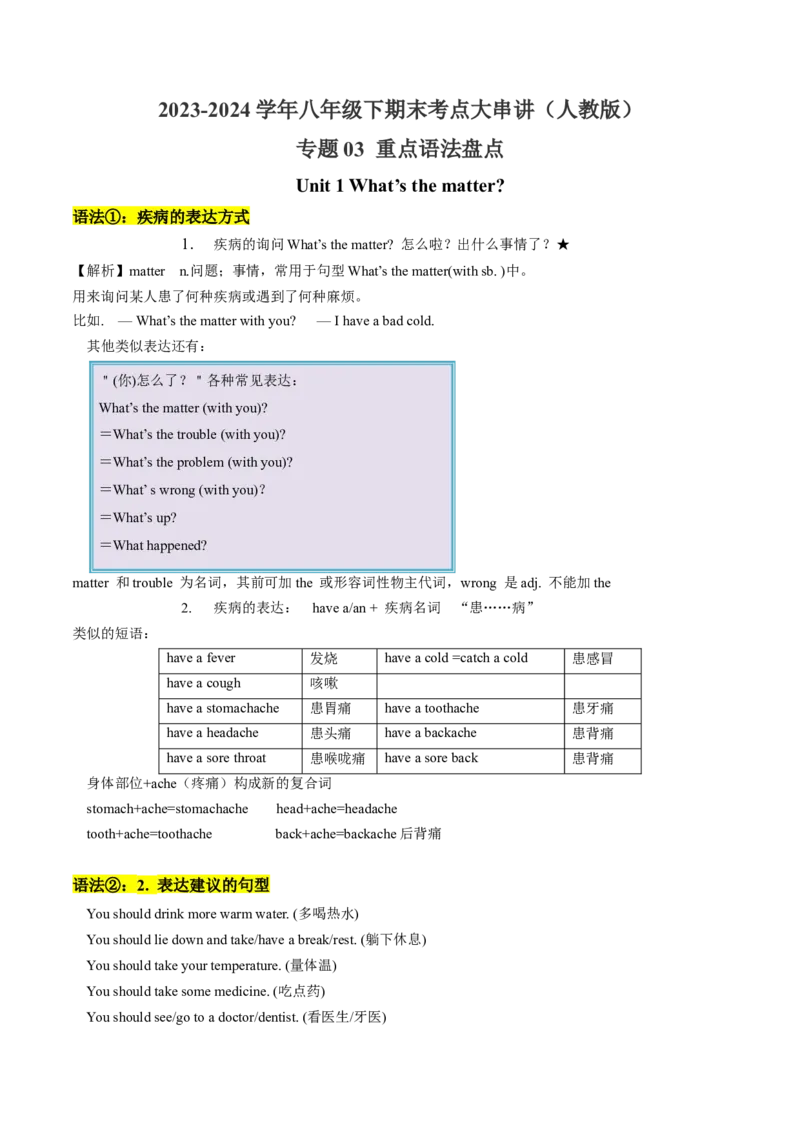
语法①:疾病的表达方式
1. 疾病的询问What’s the matter? 怎么啦?出什么事情了?★
【解析】matter n.问题;事情,常用于句型What’s the matter(with sb. )中。
用来询问某人患了何种疾病或遇到了何种麻烦。
比如. — What’s the matter with you? — I have a bad cold.
其他类似表达还有:
"(你)怎么了?"各种常见表达:
What’s the matter (with you)?
=What’s the trouble (with you)?
=What’s the problem (with you)?
=What’ s wrong (with you)?
=What’s up?
=What happened?
matter 和trouble 为名词,其前可加the 或形容词性物主代词,wrong 是adj. 不能加the
2. 疾病的表达: have a/an + 疾病名词 “患……病”
类似的短语:
have a fever 发烧 have a cold =catch a cold 患感冒
have a cough 咳嗽
have a stomachache 患胃痛 have a toothache 患牙痛
have a headache 患头痛 have a backache 患背痛
have a sore throat 患喉咙痛 have a sore back 患背痛
身体部位+ache(疼痛)构成新的复合词
stomach+ache=stomachache head+ache=headache
tooth+ache=toothache back+ache=backache后背痛
语法②:2. 表达建议的句型
You should drink more warm water. (多喝热水)
You should lie down and take/have a break/rest. (躺下休息)
You should take your temperature. (量体温)
You should take some medicine. (吃点药)
You should see/go to a doctor/dentist. (看医生/牙医)You should do…
You are supposed to do…
You’d better do…
What about / How about doing …
Why don’t you do…
Why not do…
It’s best for you to do …
It’s important for sb. to do sth.
If you...,you should...
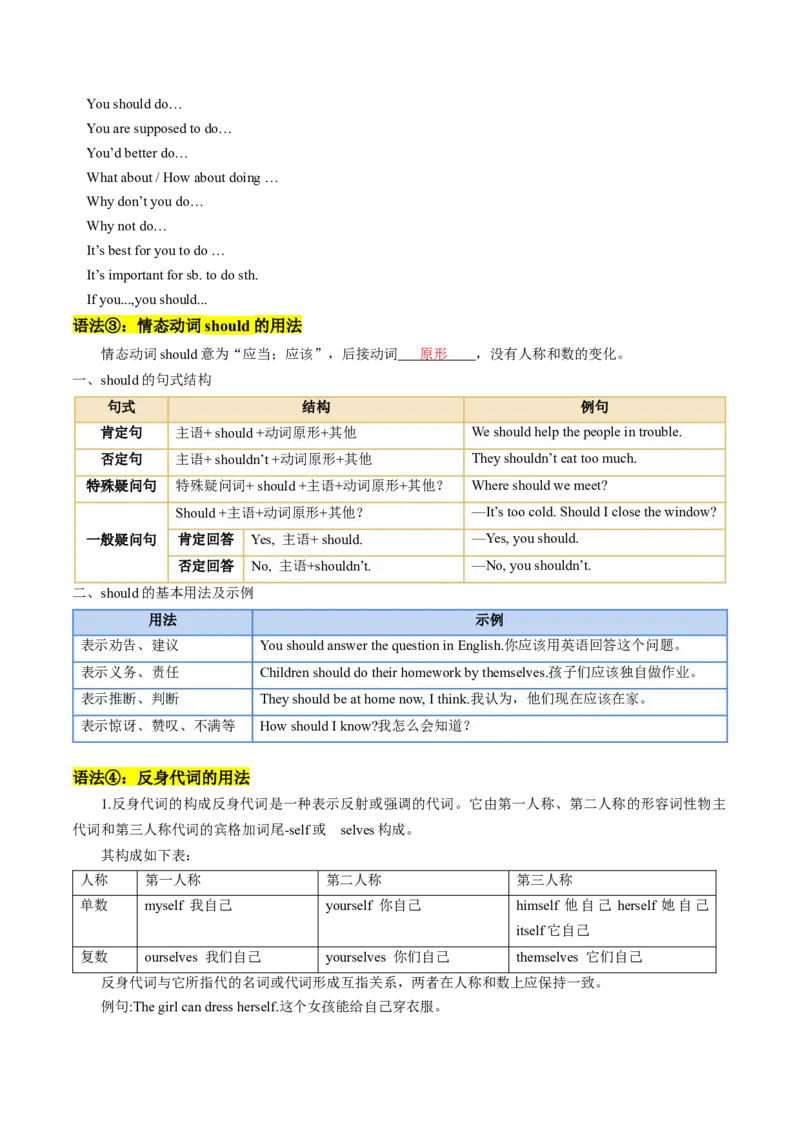
语法③:情态动词should的用法
情态动词should意为“应当;应该”,后接动词 原形 ,没有人称和数的变化。
一、should的句式结构
句式 结构 例句
肯定句 主语+ should +动词原形+其他 We should help the people in trouble.
否定句 主语+ shouldn’t +动词原形+其他 They shouldn’t eat too much.
特殊疑问句 特殊疑问词+ should +主语+动词原形+其他? Where should we meet?
Should +主语+动词原形+其他? —It’s too cold. Should I close the window?
一般疑问句 肯定回答 Yes, 主语+ should. —Yes, you should.
否定回答 No, 主语+shouldn’t. —No, you shouldn’t.
二、should的基本用法及示例
用法 示例
表示劝告、建议 You should answer the question in English.你应该用英语回答这个问题。
表示义务、责任 Children should do their homework by themselves.孩子们应该独自做作业。
表示推断、判断 They should be at home now, I think.我认为,他们现在应该在家。
表示惊讶、赞叹、不满等 How should I know?我怎么会知道?
语法④:反身代词的用法
1.反身代词的构成反身代词是一种表示反射或强调的代词。它由第一人称、第二人称的形容词性物主
代词和第三人称代词的宾格加词尾-self或selves构成。
其构成如下表:
人称 第一人称 第二人称 第三人称
单数 myself 我自己 yourself 你自己 himself 他自己 herself 她自己
itself它自己
复数 ourselves 我们自己 yourselves 你们自己 themselves 它们自己
反身代词与它所指代的名词或代词形成互指关系,两者在人称和数上应保持一致。
例句:The girl can dress herself.这个女孩能给自己穿衣服。I enjoyed myself at the party.在聚会上,我玩得很开心。
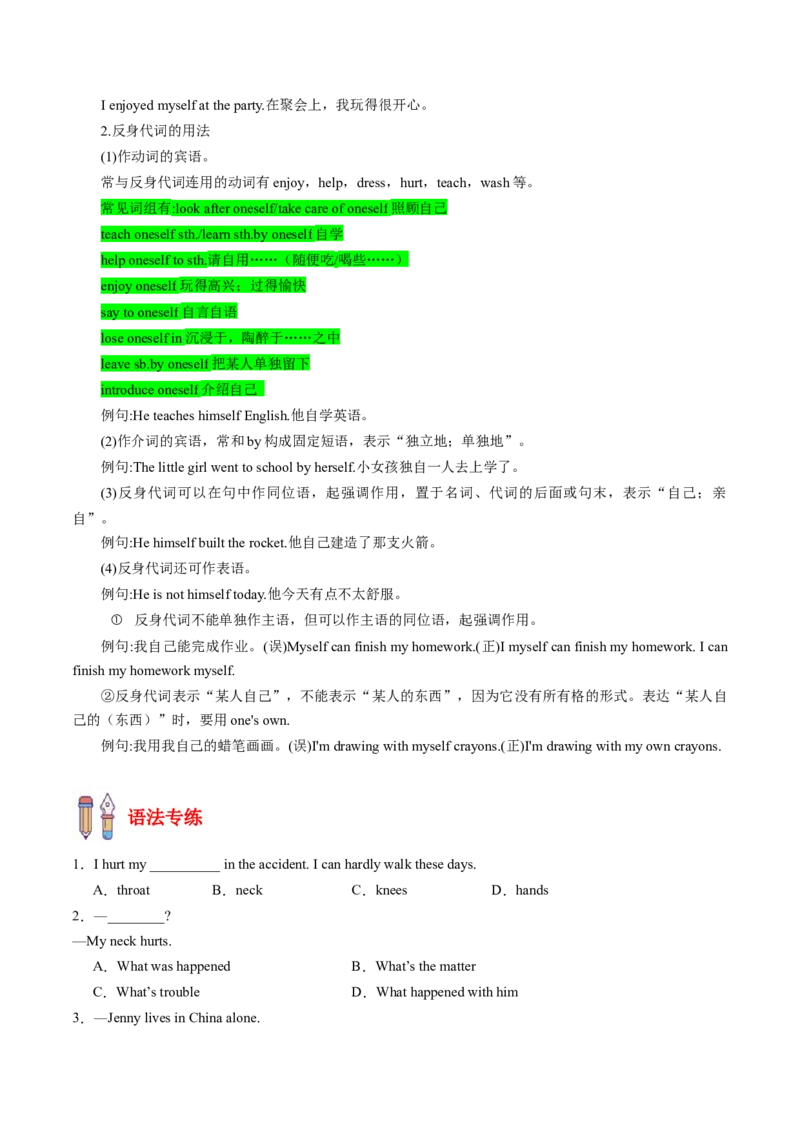
2.反身代词的用法
(1)作动词的宾语。
常与反身代词连用的动词有enjoy,help,dress,hurt,teach,wash等。
常见词组有:look after oneself/take care of oneself照顾自己
teach oneself sth./learn sth.by oneself自学
help oneself to sth.请自用……(随便吃/喝些……)
enjoy oneself玩得高兴;过得愉快
say to oneself自言自语
lose oneself in沉浸于,陶醉于……之中
leave sb.by oneself把某人单独留下
introduce oneself介绍自己
例句:He teaches himself English.他自学英语。
(2)作介词的宾语,常和by构成固定短语,表示“独立地;单独地”。
例句:The little girl went to school by herself.小女孩独自一人去上学了。
(3)反身代词可以在句中作同位语,起强调作用,置于名词、代词的后面或句末,表示“自己;亲
自”。
例句:He himself built the rocket.他自己建造了那支火箭。
(4)反身代词还可作表语。
例句:He is not himself today.他今天有点不太舒服。
① 反身代词不能单独作主语,但可以作主语的同位语,起强调作用。
例句:我自己能完成作业。(误)Myself can finish my homework.(正)I myself can finish my homework. I can
finish my homework myself.
②反身代词表示“某人自己”,不能表示“某人的东西”,因为它没有所有格的形式。表达“某人自
己的(东西)”时,要用one's own.
例句:我用我自己的蜡笔画画。(误)I'm drawing with myself crayons.(正)I'm drawing with my own crayons.
语法专练
1.I hurt my __________ in the accident. I can hardly walk these days.
A.throat B.neck C.knees D.hands
2.—________?
—My neck hurts.
A.What was happened B.What’s the matter
C.What’s trouble D.What happened with him
3.—Jenny lives in China alone.—Don’t be worried. The girl is old enough to look after ________.
A.herself B.myself C.himself
4.Let’s stop now. We can’t lose ________ in playing online games.
A.our B.us C.ourselves
5.Tom had too much ice cream just now. I think that’s why he has a ________.
A.cold B.stomachache C.fever D.nosebleed
6.—The candy is so sweet. Would you like to have one?
—Forget it. I have a ________.
A.toothache B.headache C.fever
7.We should be careful. Or we’ll cut ________.
A.herself B.myself C.ourselves
8.—I’ll have a tennis game tomorrow. I’m a little worried.
—Believe in ________.You are the best in our club.
A.herself B.myself C.yourself D.himself
9.Kate cut ________ when she learnt to cook. But nothing would stop ________ from learning.
A.her; her B.her; she C.herself; her D.herself; she
10.—What’s your ________, Julia?
—I have a bad cold. What should I do?
A.trouble B.hobby C.age
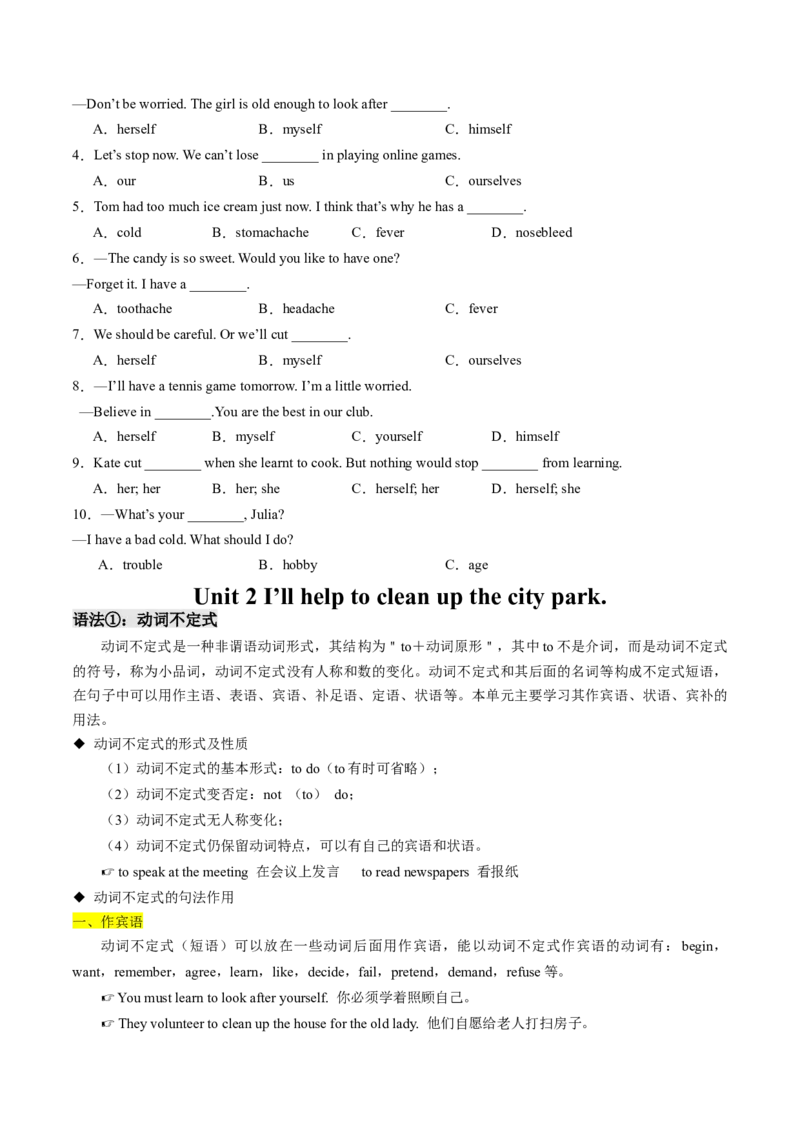
Unit 2 I’ll help to clean up the city park.
语法①:动词不定式
动词不定式是一种非谓语动词形式,其结构为"to+动词原形",其中to不是介词,而是动词不定式
的符号,称为小品词,动词不定式没有人称和数的变化。动词不定式和其后面的名词等构成不定式短语,
在句子中可以用作主语、表语、宾语、补足语、定语、状语等。本单元主要学习其作宾语、状语、宾补的
用法。
◆ 动词不定式的形式及性质
(1)动词不定式的基本形式:to do(to有时可省略);
(2)动词不定式变否定:not (to) do;
(3)动词不定式无人称变化;
(4)动词不定式仍保留动词特点,可以有自己的宾语和状语。
☞ to speak at the meeting 在会议上发言 to read newspapers 看报纸
◆ 动词不定式的句法作用
一、作宾语
动词不定式(短语)可以放在一些动词后面用作宾语,能以动词不定式作宾语的动词有:begin,
want,remember,agree,learn,like,decide,fail,pretend,demand,refuse等。
☞ You must learn to look after yourself. 你必须学着照顾自己。
☞ They volunteer to clean up the house for the old lady. 他们自愿给老人打扫房子。☞ They would like to come by bus. 他们想乘公共汽车来。
二、作宾语补足语。
☞ I tell him to arrive on Sunday. 我让他周日到达。
☞ Li Lei asked his deskmate to help him with English. 李磊请同桌帮他学英语。
☞ The teacher asked the students to read it again. 那个老师让学生们又把它读了一遍。
动词不定式作宾语补足语,表示宾语所做的动作,可以用动词不定式作宾语补足语的动词有:tell,
ask,want,like,invite,encourage,help等。但在see,watch,hear,feel,notice等感官动词或 let,
make,have等使役动词后面作宾语补足语的动词不定式一般要省略动词不定式符号"to",可以归纳为以
下三种句式:
1. 不可以省to的不定式作宾语补足语:tell /ask / want / would like / wish / suppose / invite / encourage /
teach / depend on等+ sb + to do sth
☞ The teacher told us to come earlier tomorrow. 老师告诉我们明天早点来。
☞ Her parents wish her to be a teacher. 她的父母希望她成为一名教师。
2. 省"to"的不定式作宾语补足语:
(1)Let / make / have + sb +do sth
☞ Let the boy go out now. 让那个男孩现在出去。
☞ They made the children play the piano 6 hours a day last month. 上个月他们让这些孩子每天弹6个小
时的钢琴。
(2)see / watch / hear / notice / feel + sb +do sth
☞ I heard them argue this morning. 今天早上我听到他们吵架了。(强调整个过程)
【注意】
①help带不带to均可以。
☞ I often help my mother (to) do housework. 我经常帮助妈妈做家务。
②此类动词后用不带to的不定式作宾补,当变被动时,必须还原to。
☞ William is often seen to play Chinese kung fu in the park. 人们常看到威廉在公园练中国功夫。
4. 否定形式:
(1)动词不定式的否定式是直接在to前加上not。
☞ Tell them not to play football in the street.
(2)省to的动词不定式的否定式是直接在动词前面加not。
☞ Let the boy not go. 不要让那个男孩走。
三、作状语
(1)作目的状语。
☞ He stopped to have a rest. 他停下来休息。
强调动词不定式所表示的目的时,动词不定式可用 in order to或so as to +动词原形,so as to不可用
于句首。☞ The bus stopped so as to pick up passengers. 公共汽车停下来以便接乘客。
(2)作结果状语。
☞ He woke up only to find everybody gone. 他醒来时才发现所有的人都走了。
☞ His grandma lived to see the liberation of China. 他奶奶活到了中国解放。
☞ He is old enough to go to school. 他年龄足够大了,可以去上学了。
(3)在某些表示喜、怒、哀、乐等的形容词后作原因状语。
☞ I’m proud to have taken part in the competitions. 很荣幸参加了这些竞赛。
☞ I’m happy to have found many things I can do. 很高兴找到了很多我能做的事。
◆ 动词不定式可以和what,which,how,where,when等特殊疑问词连用。
☞ The question is I don’t know when to start. 问题是我不知道什么时候开始。
☞ You do not know what to do and how to do it. 你不知道要去做什么或者怎么做。
语法②:动词短语
短语动词是一种固定词组,由动词加介词或副词等构成,其作用相当于一个动词。
◆ 构成:
常见的形式有:1. 动词+副词,如:put up
2. 动词+介词,如:look at
3. 动词+副词+介词,如:run out of
4. 动词+名词+介词,如:take care of
◆ 动词+副词
(1)常见的相当于及物动词的这类短语动词有:
cheer up(振奋起来),clean up(打扫干净),set up(建立),put up(搭建,张贴),cut up(切
碎),fix up(修理),work out(算出),give out(分发),give away(赠送),think over(仔细思考),
turn over(把……翻过来),hand in(上交)等。
【注意】此类短语相当于及物动词时,后面必须跟宾语,若名词作宾语,可以放在副词前面或后面,但代
词作宾语时,必须置于副词之前。
(2)常见的相当于不及物动词的这类短语动词有:
get up(起床),start off(动身),come back(回来),get down(下来),hold on(等一下;别挂
断),look out(当心,小心),get away(逃离)等。
◆ 动词+介词
这种结构的短语动词在句中作谓语时,后面必须接宾语。常见的有:
look for(寻找),stand for(代表),wait for(等待),pay for(付费),send for(派人去请),take
after(像),hear from(收到……的来信),hear of(听说),depend on(依靠)等。
◆ 动词+副词+介词
这种短语动词相当于及物动词,介词后面须跟宾语。常见的有:
add up to(总共是),catch up with(赶上),look down upon(瞧不起),run out of(耗尽,用光)◆ 动词+名词+介词
这种短语动词相当于及物动词,后面需接宾语,有时名词前可以加形容词修饰。常见的有:make fun
of(取笑),make use of(利用),pay attention to(注意),take care of(照顾)等。
【注意】这类短语动词后面的宾语无论是名词还是代词,都要放在介词之后。
☞ He is taking care of his little brother. 他在照顾他弟弟。
☞ We shouldn’t make fun of others. 我们不应该嘲笑他人。
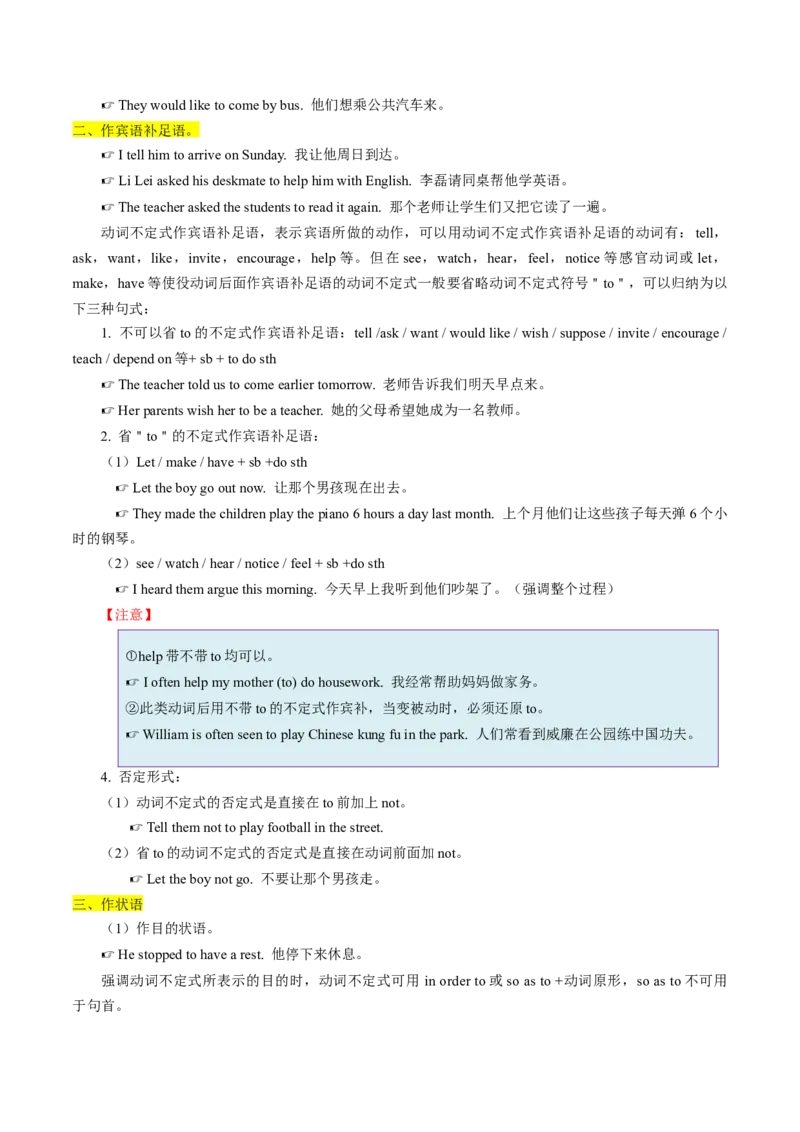
二、短语动词的分类
类型与说明 示例
look after ___照顾___ think of ___认为____ take after _与……相像_
动词+介词
come from ___来自_____ ask for ___请求_____ look at ____看_____
cheer up __ ( 使 ) 振奋 _ _ clean up __打扫干净_ put up _举起;张贴;搭建_
fix up ___修理____ give away ___赠送___ give out ___分发____
动词+副词
give up ___ 放弃 ____ get up ___起床____ put off ___推迟____
turn down _调低;拒绝_ set up ___建立____ take away ___拿走____
come up with 想出;提出_ run out of ___用完___ look forward to ___期望
动词+副词+介词
___
动词+名词 have a rest 休息一下_ take a walk ___散步___ make a decision __ 做决定 __
动词+名词+介词 have a look _看一看___ make a friend with 与 . .. 交朋友 take care of __照顾___
be late for ___迟到____ be busy with __忙于……_ be good at ___擅长……
be+形容词+介词 __
be good for _ _ 对……有好处 _ be similar to _与……相像__
语法专练
单项选择
11.—Would you like to travel to Chengdu with me this Labor Day?
—I’d like to. Let’s ________ the best way to go there.
A.cheer up B.decide on C.slow down
12.I’m not good at English, but my English teacher always encourages me ________ hard.
A.to study B.studying C.studied D.study
13.—Why do you get up so early?
—________ the first bus.
A.Catch B.To catch C.Catching
14.—Do you know ________ for help when we are in trouble?
—Of course. Our teachers and parents.
A.when to ask B.where to say C.how to say D.who to ask15.My parents don’t allow me ________ computer games on weekdays.
A.play B.playing C.played D.to play
16.I really don’t know ______ and ______.
A.what to do; how to do B.what to do it; how to do it
C.what to do it; how to do D.what to do; how to do it
17.The teacher asked us ________ in the library after school.
A.don’t talk B.not talk C.not to talk D.no talking
18.The new year is coming. We will work hard ________ our grades.
A.improve B.improving C.to improve D.improved
19.Ann refused ________ with her friends because she had to do her homework.
A.play B.to play C.playing
20.I’m so hungry. I need something _______.
A.eat B.to eat C.eating D.eaten
21.Mobile phones ________ most of students’ free time so that they have no time to talk with others face to face.
A.take up B.put away C.turn down D.give up
22.It’s time for the weather report. Could you please ________ the TV for me?
A.try on B.depend on C.get on D.turn on
23.This math problem is so hard that I can’t ________. Please give me some advice.
A.look through it B.work it out C.find it out D.put it on
24.—Word came that the sports meeting had been ________ because of the sudden rain.
—The students must be very disappointed then.
A.turned off B.kept off C.cut off D.shut off
25.—How are you feeling about the coming graduation?
—Nervous but excited. I’m sure I will ________ all and graduate with honors.
A.go through B.look through C.take out D.leave out
26.— Mom, could you please ________ the TV a little bit? I am studying for tomorrow’s exam.
— OK. Sorry, darling.
A.turn on B.turn off C.turn down D.turn up
27.Zong Qinghou, Chairman of Wahaha Group, ________ himself for giving away money to poor children.
A.came up with B.took pride in C.paid attention to
28.—The weather is so cold. Why don’t you ________ your coat?
—Well, thanks a lot. It doesn’t matter.
A.put off B.put on C.take on D.take off
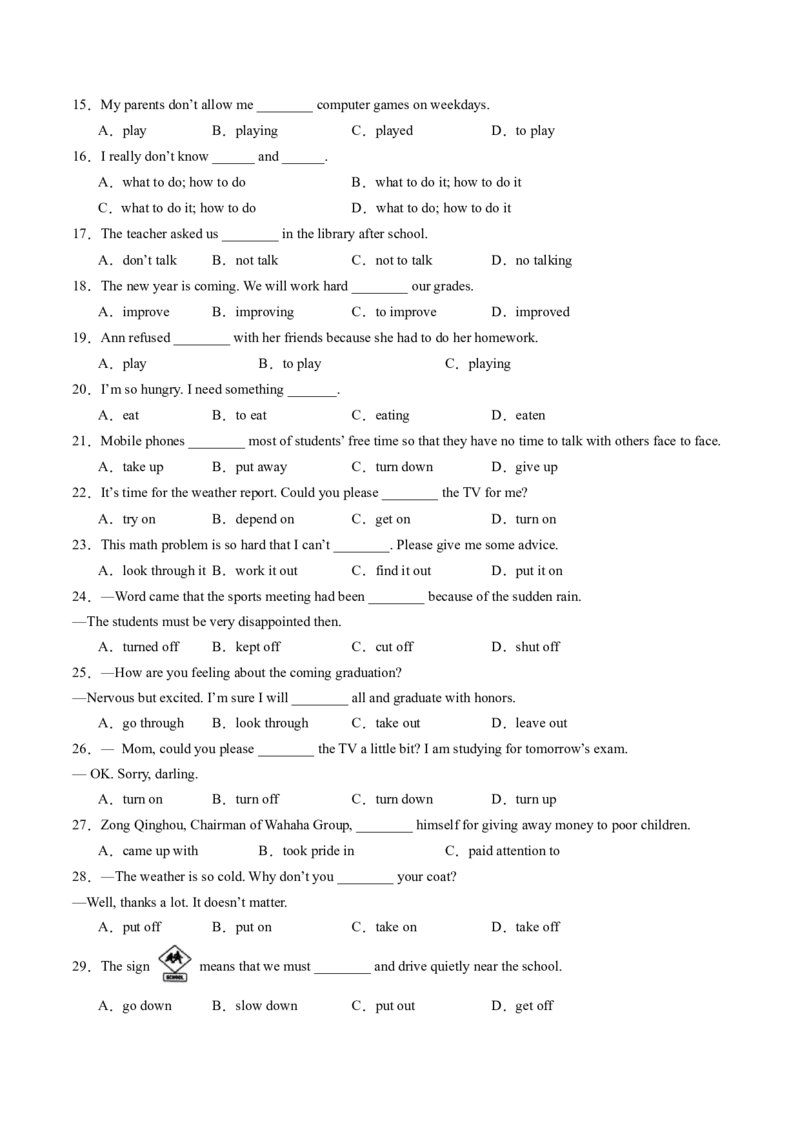
29.The sign means that we must ________ and drive quietly near the school.
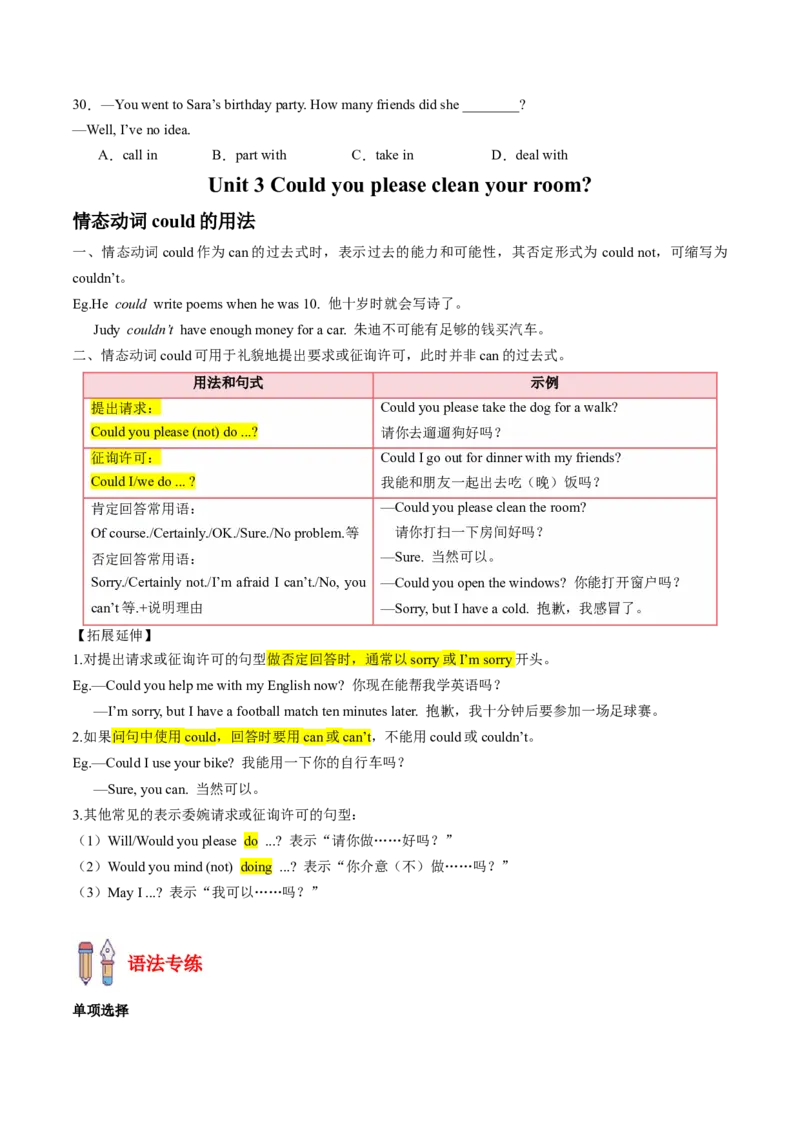
A.go down B.slow down C.put out D.get off30.—You went to Sara’s birthday party. How many friends did she ________?
—Well, I’ve no idea.
A.call in B.part with C.take in D.deal with
Unit 3 Could you please clean your room?
情态动词could的用法
一、情态动词could作为can的过去式时,表示过去的能力和可能性,其否定形式为 could not,可缩写为
couldn’t。
Eg.He could write poems when he was 10. 他十岁时就会写诗了。
Judy couldn’t have enough money for a car. 朱迪不可能有足够的钱买汽车。
二、情态动词could可用于礼貌地提出要求或征询许可,此时并非can的过去式。
用法和句式 示例
提出请求: Could you please take the dog for a walk?
Could you please (not) do ...? 请你去遛遛狗好吗?
征询许可: Could I go out for dinner with my friends?
Could I/we do ... ? 我能和朋友一起出去吃(晚)饭吗?
肯定回答常用语: —Could you please clean the room?
Of course./Certainly./OK./Sure./No problem.等 请你打扫一下房间好吗?
否定回答常用语: —Sure. 当然可以。
Sorry./Certainly not./I’m afraid I can’t./No, you —Could you open the windows? 你能打开窗户吗?
can’t等.+说明理由 —Sorry, but I have a cold. 抱歉,我感冒了。
【拓展延伸】
1.对提出请求或征询许可的句型做否定回答时,通常以sorry或I’m sorry开头。
Eg.—Could you help me with my English now? 你现在能帮我学英语吗?
—I’m sorry, but I have a football match ten minutes later. 抱歉,我十分钟后要参加一场足球赛。
2.如果问句中使用could,回答时要用can或can’t,不能用could或couldn’t。
Eg.—Could I use your bike? 我能用一下你的自行车吗?
—Sure, you can. 当然可以。
3.其他常见的表示委婉请求或征询许可的句型:
(1)Will/Would you please do ...? 表示“请你做……好吗?”
(2)Would you mind (not) doing ...? 表示“你介意(不)做……吗?”
(3)May I ...? 表示“我可以……吗?”
语法专练
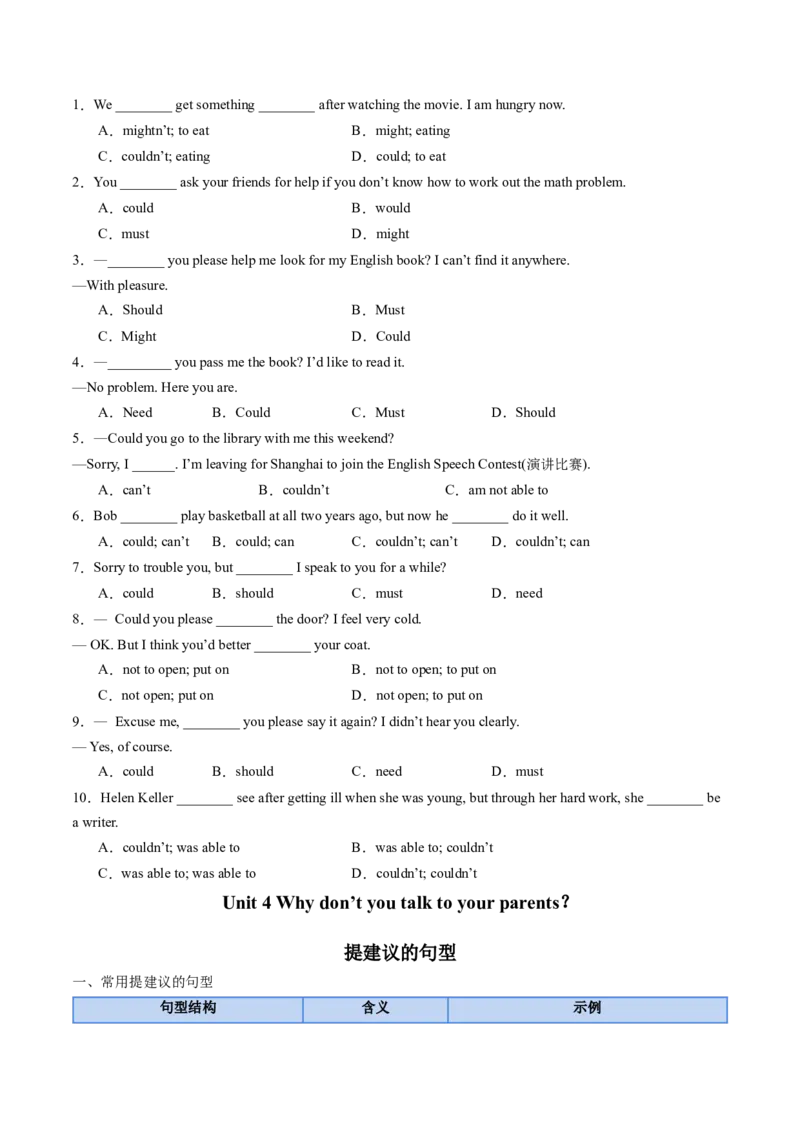
单项选择1.We ________ get something ________ after watching the movie. I am hungry now.
A.mightn’t; to eat B.might; eating
C.couldn’t; eating D.could; to eat
2.You ________ ask your friends for help if you don’t know how to work out the math problem.
A.could B.would
C.must D.might
3.—________ you please help me look for my English book? I can’t find it anywhere.
—With pleasure.
A.Should B.Must
C.Might D.Could
4.—_________ you pass me the book? I’d like to read it.
—No problem. Here you are.
A.Need B.Could C.Must D.Should
5.—Could you go to the library with me this weekend?
—Sorry, I ______. I’m leaving for Shanghai to join the English Speech Contest(演讲比赛).
A.can’t B.couldn’t C.am not able to
6.Bob ________ play basketball at all two years ago, but now he ________ do it well.
A.could; can’t B.could; can C.couldn’t; can’t D.couldn’t; can
7.Sorry to trouble you, but ________ I speak to you for a while?
A.could B.should C.must D.need
8.— Could you please ________ the door? I feel very cold.
— OK. But I think you’d better ________ your coat.
A.not to open; put on B.not to open; to put on
C.not open; put on D.not open; to put on
9.— Excuse me, ________ you please say it again? I didn’t hear you clearly.
— Yes, of course.
A.could B.should C.need D.must
10.Helen Keller ________ see after getting ill when she was young, but through her hard work, she ________ be
a writer.
A.couldn’t; was able to B.was able to; couldn’t
C.was able to; was able to D.couldn’t; couldn’t
Unit 4 Why don’t you talk to your parents?
提建议的句型
一、常用提建议的句型
句型结构 含义 示例Why don’t you + do ? 你 ( 们 ) 为 什 么 Why don’t we write to pen friend?
= Why not do sth.? 不……呢? Why not join an English club?
How/What about + doing ? ……怎么样? What/How about watching English movies?
Let’s + do . 让我们……吧. Let’s go swimming this afternoon.
我们/你(们)应
We/You should/could + do . We should get up earlier.
该/可以……
Would you mind + doing ? 你介意……吗? Would you mind speaking in a low voice?
Would/Could you please + do 请你……好吗? Would you please turn down the radio?
?
had better(not)do sth. 最好(不要)做某事 We’d better speak English as much as
possible.
Would you like + to do sth.? 你(们)想要…… Would you like to go out for a walk?
吗?
二、提建议句型的常用答语
肯定回答 否定回答
Good idea./That’s a good idea.好主意。 I’d love/like to, but...我愿意,但是……
OK./All right./Great.好/行/太好了。 Sorry, I can’t./Sorry, but...
No problem.没问题。 对不起,我不能/对不起,可是……
I agree with you.我同意你的看法。 I don’t think so.我不这样认为。
Sure./Of course./Certainly./I’d love to./I’d like I’m afraid not.恐怕不行。
you.当然可以/我愿意。
语法专练
单项选择
1.—I feel upset because I am too heavy.
—________ do more exercise to lose some weight?
A.Why don’t B.Why not
C.Why not to D.Why you
2.—________ invite Tom to go swimming with us this Sunday?
—Sounds great.
A.Why B.What about
C.Why not D.Should we
3.—Would you mind me ________ the door?
— ________. It’s much too cold outside.A.open; No, you can’t B.to open; Not at all
C.opening; Of course not D.opening; Better not
4.—I think we should try to make our environment better.
—________. Everyone should try their best to do it.
A.That’s all right B.I couldn’t agree more C.I don’t think so D.That sounds funny
5.—Why not tell the story Yu Gong Moves a Mountain to your classmates?
—________. Thank you, Mom.
A.Good idea B.I can’t stand it C.I’m not available D.You’re all right
6.—Would you mind my closing the door? It’s too cold outside.
—________ You can do it!
A.Certainly. B.You’d better not. C.Of course not. D.Please don’t
7.—Cooking helps us show love for family members.
—_________. Every time I make dishes for them, they are very happy.
A.I can’t believe it B.Take it easy
C.I couldn’t agree more D.That’s all right
8.—Why do you look so tired and unhappy?
—I studied late every night ________ I could study better.
A.so that B.such as C.so far D.because of
9.—Do you mind my borrowing this magazine?
—________ But you should return it to me in a week.
A.Of course not. B.Sure. C.You’d better not. D.I’m afraid not.
10.—Excuse me, Mr. Jones. Could I take a photo with you?
—Sure, ________.
A.go ahead B.look after C.go away
until、although与so that引导的状语从句
一、语法概述
在复合句中,用作状语的从句叫作状语从句。状语从句由从属连词引导,从属连词不充当句子成分,
只起连接作用。根据状语从句表达的意思可分为时间、原因、条件、目的、结果和让步等类型。本单元主
要学习until、although与so that引导的状语从句。
三、until引导的时间状语从句
肯定句中 表示“直到……为止” 主句谓语动词用延续性动词
主句谓语动词用非延续性动词
否定句中 表示“直到……才……”
Eg.I have to stay here until the rain stops. 我不得不待在这儿,直到雨停。Cathy didn’t go home until the rain stopped. 直到雨停了,凯茜才回家。
三、although引导的让步状语从句
although引导的让步状语从句一般翻译为“ 虽然;尽管 ”,一般情况下,although与though可以互
换,但两者都不能与 bu t 同时出现在一个句子中,但可以和yet/still同时出现。
Eg.Although she’s very weak, she works very hard. 她尽管身体很弱,但是工作很努力。
四、so that引导的目的状语从句
so that表示“ 以便;为了 ”,从句中的谓语动词常与情态动词can/could/may/might等连用。
Eg.He should talk to his friend so that he can say he’s sorry. 他应该跟他的朋友谈谈,以便能向其道歉。
【拓展延伸】so that +从句 = in order that +从句= in order to + do
语法专练
单项选择
1.________ he is busy, ________ he keeps learning a foreign language.
A.Though, but B.Though, / C.Because, so
2.Many children still like to eat junk food, ________ it is not good for their health.
A.although B.so C.because
3. ________ the project was difficult to finish, none of the students gave up.
A.Unless B.Although C.Because D.If
4.You’d better take the map with you ________ you won’t get lost.
A.so that B.as soon as C.now that D.as long as
5.Amy got up early ________ she could catch the school bus this morning.
A.so that B.as if
C.as long as D.as soon as
6.Everyone should play a part in saving the earth ________ we can have a better life.
A.even though B.as if C.as long as D.so that
7.I didn’t go to sleep ________ my mother came back home last night.
A.when B.since
C.until D.before
8.—Excuse me, could you tell me how to get to the nearest bank?
—Go down this road ______ you get to a school, and then turn left.
A.since B.while C.until D.after
9.—I’m afraid to dance in public and I don’t think I can make it.
—You never know _________ you try it.
A.if B.until C.because
10.—Shall we go now?
—No, let’s wait ________ the rain stops.A.until B.when C.though D.if
Unit 5 What were you doing when the rainstorm came?
过去进行时
一、语法概述
过去进行时表示过去某一时刻或某一阶段正在进行的动作,其基本结构为“was/were+动词-ing形
式”。
二、过去进行时的基本句式
句式 构成 例句
肯定句 主语+ was/were + doing +其他 The girl was shopping when I saw her.
主语+ wasn’t/weren’t + doing +其他 The girl wasn’t shopping when I saw
否定句
her.
__Was/were___ +主语+ ___doing____ +其他? —Was the girl shopping when I saw
肯定回答 Yes, 主语+ __was__/__were__. her?
一般疑问句
—Yes, she was.
否定回答 No, 主语+ __wasn’t__/__weren’t__.
No, she wasn’t.
特殊疑问词+ was/were +主语+动词-ing形式+其 What was the girl doing when I saw
特殊疑问句
他? her?
三、过去进行时的基本用法
用法 时间标志
表示过去某一段时间内 常用时间状语:this morning, the whole morning/night, all day yesterday, all night,
正在进行的动作 from 10:00 to 12:00 yesterday, in those days等
表示过去某一时刻正在 常用时间状语:at that time, at this time yesterday, at 3 o’clock yesterday afternoon
发生的动作 等
表示过去某个动作发生 与when引导的时间状语从句连用(主句用 过去进行 时,从句用 一般过去
时,另一个动作正在进 时)
行 与while引导的时间状语从句连用(主句用 一般过去 时,从句用 过去进行
时)
表示过去某两个延续性
多与while引导的时间状语从句连用
动作同时进行
Eg.I was watching TV the whole night. 整个晚上我都在看电视。
Miss Li was shopping at this time yesterday. 昨天这个时候李小姐正在购物。
The students were reading when the teacher came in. 老师进来时学生们正在读书。
While he was reading, the telephone rang. 他正在看书时电话铃响了。
I was cleaning my bedroom while my mother was cooking. 我打扫卧室的时候妈妈在做饭。
四、过去进行时的特殊用法
用法 示例与go, come, leave, start等瞬间动词连 She was leaving for Shanghai then. 那时候她就要动身去上海
用时,过去进行时表示过去即将发 了。
生的动作 He said the early bus was coming. 他说早班车就要来了。
与always, often等频度副词连用时, The baby was always crying. 那个婴儿总是哭。(表示抱怨)
表示对过去某件事的埋怨、讨厌、 Why were you always getting up late last week? 你上周怎么老
赞扬或喜爱,并不强调动作正在进 是起床很晚?(表示埋怨)
行
【易混辨析】
when和while的区别
(1)when意为"在……时;当……的时候",常指在某个时间点,可表示时间点或时间段,由
when引导的时间状语从句,主句用过去进行时,从句用一般过去时。从句中的谓语动词可以是
延续性动词,也可以是瞬间动词。
☞ I was just reading a book when she came into my room. 她走进我房间时,我正在看书。
(2)while意为"当……的时候",只表示时间段,常指某个时间段,由while引导的时间状语
从句,主句用一般过去时,从句用过去进行时。从句谓语动词必须用延续性动词,且多用于进行
时态。强调主句与从句的动作同时发生或主句的动作发生在从句的动作过程中。
☞ While Jim was mending his bike, Lin Tao came to see him. 吉姆正在修他的自行车时,林
涛来看他了。
语法专练
单项选择
1.I didn’t hear the telephone ring, because I __________ the 19th Asian games on TV.
A.watch B.watched C.was watching D.am watching
2.Cindy saw a traffic accident when she ________ along the road.
A.walks B.has walked C.is walking D.was walking
3.—Didn’t you hear the doorbell?
—Sorry. I ________ with my friend on the phone.
A.chat B.will chat C.have chatted D.was chatting
4.—Simon, what were you doing at this time yesterday afternoon?
—I ________ footballA.played B.am playing C.was playing
5.This student ________ his bike in front of the house from 2:30 to 3:30 yesterday.
A.was repairing B.repaired C.has repaired D.is repairing
76.—Where is your father? Is he cleaning the car?
—No, but he ________ it the whole morning.
A.cleaned B.was cleaning C.is cleaning D.cleans
7.—Did you watch the football match last night?
—No. I _______ for my math test at that time.
A.will study B.studied C.was studying
8.—Did you see a man in black pass by just now?
—No, sir. I ________ a newspaper.
A.read B.was reading C.am reading
9.—I called you but no one was there at 7 o’clock last night.
—Sorry, we ________ a movie at the theater at that time.
A.watch B.were watching C.watched D.are watching
10.—Tommy, did you hear what I said just now?
—Sorry, Lora. I ________ the World Cup with my brothers.
A.watch B.am watching C.will watch D.was watching
Unit 6 An old man tried to move the mountains.
语法①:状语从句
unless的用法
unless意为"除非,如果不",引导条件状语从句。unless引导的条件状语从句,若主句、从句的动作均未
发生,则主句用一般将来时、祈使句或含有情态动词的句子,从句用一般现在时代替一般将来时。
I shall go unless it rains. 如果不下雨我就去。
I won’t let you in unless you show me your pass. 如果你不出示通行证,我就不让你进来。
We’ll go to town unless it rains tomorrow. 假如明天不下雨,我们就去城里。[来源:学科网ZXXK]
注意:
(1)unless通常可以与if... not结构进行相互转换。
You will fail unless you study hard.=You will fail if you don’t study hard.除非你努力学习,否则你会失败。
(2)若unless引导的从句本身为否定句,则unless不能用if...not来替换。
as soon as的用法
as soon as一……就……,强调两个动作几乎是连在一起的,后接从句。当主句是一般将来时,as soon as引
导的状语从句应用一般现在时代替将来时。指紧接着发生的两个短动作,主句用一般过去时,从句也用一
般过去时。有时,为了特意表达刚刚完成某事就如何,需要用现在完成时。
The students became quiet as soon as the teacher came in. 老师一进来,学生们就安静下来了。
I will tell him the news as soon as he comes back. 他一回来,我就告诉他这个消息。I’ll return the book as soon as I have finished reading it. 我一读完就把书还回去。
He will come and see you as soon as he can. 他一有空就来看你。
The stars came out as soon as it was dark. 天一黑,星星就出来了。
注意:
as soon as 引导的时间状语从句在过去时态中主从句时态保持一致;若主句用一般将来时态,则从句用一般
现在时态。
so... that的用法
so... that意为"如此……以至于",引导表示结果的状语从句。so是副词,用以修饰其后的形容词或副词,
说明其程度的大小。so... that引导的结果状语从句有如下四种结构:
(1)so+形容词/副词+that从句
The village is so small that it cannot be shown in the map. 这村子太小,所以地图上没有。
The wind was so strong that we could hardly move forward. 风刮得那么大,我们简直寸步难行。
(2)so+形容词+a/an+单数名词+that从句
It was so hot a day that they all went swimming. 天是那么的热以至于他们都去游泳了。
He made so inspiring a speech that everybody got excited. 他发表了如此鼓舞人的演讲以至于大家都很激动。
(3)so+many/few+复数名词+that从句
I have had so many falls that I am black and blue all over. 我摔了许多跤,以至于浑身青一块,紫一块。
He has so few friends that he often feels lonely. 他朋友很少,所以经常感到孤独。
(4)so+much/little+不可数名词+that从句
I had so little money then that I couldn’t even afford a used car. 我当时囊中羞涩,甚至连一辆二手车都买不
起。
He drank so much wine last night that he felt terrible. 昨晚他喝了那么多的酒,他觉得很不舒服。
(1)当that从句是否定结构,that从句的主语与主句的主语相同时,可用 too...to...或"be not +形容词 +
enough to do sth."结构替换。需要注意的是,"be not + 形容词 + enough to do sth."中的形容词,应是
so...that结构中形容词的反义词。
His brother is so young that he can’t join the army.=His brother is too young to join the army.
=His brother is not old enough to join the army.
他弟弟太小了,不能参军。[来源:学+科+网Z+X+X+K]
(2)当that从句是否定结构,that从句的主语与主句的主语不相同时,可用too... for sb. to do sth.替换。
The suit was expensive that I could not buy it.=The suit was too expensive for me to buy.
这套衣服太贵了,我不能买。
(3)当that从句是肯定结构,that从句的主语与主句的主语相同时,可以用"be + 形容词 + enough to do
sth."把so... that复合句转化为简单句。
The young man is so strong that he can carry the big box.=The young man is strong enough to carry the big box.
那个年轻人很强壮,能扛动那只大箱子。
(4)当that从句是肯定结构,that从句的主语与主句的主语不相同时,可用"... enough for sb. to do sth."
替换。He ran so slowly that I could catch up with him.=He ran slowly enough for me to catch up with.
他跑得太慢了,我能赶上他。
(5)so... that结构中的"so + 形容词/副词"可以提至句首,以加强语气,但要注意用倒装语序。
So bright was the moon that flowers were bright as in the day. 在如此明亮的月光下,花儿像白天一样鲜艳。
语法专练
1.—Is Mr. Wang back home?
—Not yet. I’ll call you as soon as he ________ back home.
A.comes B.came C.will come
2.—Would you please give this new novel to Jack?
—Certainly, as soon as he ________ back.
A.will come B.came C.comes
3.—Please give the Chinese book to Linda.
—OK. ________ I see her, I will give it to her.
A.As soon as B.Unless C.Before D.Although
4.—Don’t forget to call me when you reach Mount Wuyi.
—Well, I will call you ________ I get there.
A.since B.so that C.as soon as
5.Betty called her parents excitedly _______ she got an offer of work.
A.so that B.as soon as C.though D.before
6.—The air pollution is harming our earth.
—It will be worse ______ stronger laws are made.
A.since B.if C.until D.unless
7.You’ll fall behind ______ you spend more time on your study.
A.since B.unless C.when D.because
8.—This book seems a bit boring.
—You won’t enjoy it ________ you put your heart into it.
A.unless B.if C.although
9.Yalong Bay Tropical Paradise Forest Park (亚龙湾热带天堂森林公园) is ________ far ________ we should
drive a car there.
A.so; that B.such; that C.too; to
10.The book is ________ interesting ________ I can’t put it down.
A.so; that B.such; that C.even; that
Unit 7 What’s the highest mountain in the world?形容词和副词的比较等级
英语中的形容词和副词常用三种形式来表达事物的等级差别,分别是原级、比较级和最高级。
一、形容词和副词的比较级、最高级的构成
1.规则变化
类别 构成 图解助记
一般在词尾加__-er___或__ -est _ _
以字母 e 结尾加__-r___或__-st
__
单音节词 以重读闭音节结尾,如末尾只有
和部分双 一个辅音字母(辅元辅),则__双
音节词 写末尾辅音字母再加__-er___或
__-est___
以“辅音字母+y”结尾的词,变
__y___为__i___再加__-er___或
__-est___
多音节词
所有多音节和部分双音节词,在
2.不规则变 和部分双 化 ( 补 全
词前加__more__或__most__
音节词
表格)
原级 比较级 最高级 原级 比较级 最高级
good/well better best far farther farthest
bad/badly/ill worse worst further furthest
many/much more most older oldest
old
little less least elder eldest
二、形容词和副词比较等级的用法
1.原级的用法和句式
两者的同级比较用“as+形容词和副词的原级+as”(否定用“not + as/so +形容词或副词的原级+ as”)
Eg.This ruler is as long as that one. 这把尺子和那把尺子一样长。
Jim is not as/so tall as Tom. 吉姆不如汤姆高。
2.比较级的句式和用法
句式和用法 示例
“A+谓语动词+比较级+ than +B”用于两者之 You are taller than your brother. 你比你弟弟高。
间的比较,表示其中一个比另一个更…… He jumped higher than you. 他比你跳得高。He is running faster and faster. 他跑得越来越快。
“比较级+ and +比较级”表示事物本身程度
The city is becoming more and more beautiful.
的逐渐变化,意为“ 越来越…… ”
这个城市变得越来越漂亮了。
“the +比较级...,the +比较级...”表示一方程度
The more you eat, the fatter you will be.
的变化随着另一方的变化而平行变化,意为
你吃得越多,就会越胖。
“ 越……,就越…… ”
“Which/Who +系动词+比较级,A or B?”表示 Which sweater is cheaper, the red one or the blue one?
两个人或事物中哪一个/谁更…… 哪件毛衣更便宜,红色的还是蓝色的?
“A+系动词+ the +比较级+ of the two(+复数 Mary is the taller of the two girls.
名词)”表示两者中比较……的 玛丽是两个女孩中较高的。
【拓展延伸】
(1)修饰形容词或副词的比较级可以用much, a lot, a little, a bit, even, far等,但不能用very, so, too等修
饰。
【记忆口诀】两多(much, a lot)两少(a little, a bit)一甚至(even),还有一个远(far)去了。
Eg.This story is much more interesting than that one. 这个故事比那个有趣得多。
(2)在比较结构中,被比较的事物应是同等成分,常用that或those代替前面的名词。
Eg.The workers in that factory are fewer than those in our factory.那个工厂的工人比我们工厂的工人少。
语法专练
1.—What do you think of the movie Volunteers: Xiongbing Attack ?
—Oh, I like it very much. I don’t think I will see ________ one.
A.the best B.a best C.a better
2.After some practices, John is much ________ than last year.
A.strong B.stronger C.strongest D.the strongest
3.It’s much ________ today. You needn’t have your coat on.
A.warm B.warmer C.warmest D.the warmest
4.—Why do you volunteer?
—Because ________ we do for others, ________ we feel.
A.the much; the happy B.the more; the happy
C.the more; the happier D.the much; the happy
5.It is reported that the Great Wall of China is ________ wall in the world.
A.long B.longer C.the longer D.the longest
6.—Have people gone through a terrible storm in your place?
—Yes, we have. It was ________ storm we’ve had in years.
A.better B.the best C.worse D.the worst
7._________ you help others, _________ good luck will come to you, and that’s good business.A.The less; the less B.The more; the less
C.The less; the more D.The more; the more
8.The __________ you eat, the __________ you will be.
A.more healthily; more healthily B.more healthily; healthier
C.healthier; more healthily D.healthier; healthier
9.We held a concert in the hall yesterday, Kate sang _______ among the singers.
A.good B.well C.better D.best
10.Which subject do you like ________, math, English or Chinese?
A.good B.well C.best D.better
Unit 8 Have you read Treasure Island yet?
语法①:现在完成时
1)定义:表示过去发生或已经完成的动作对现在造成的影响或结果。
例:—Have you had breakfast yet? 你吃过早饭了吗?
—Yes, I have. I’ve just had it.是的,我吃过了。我刚吃过。(现在我不饿了)
I’ve already read the book. 我已经读过这本书了。(了解了书的内容)
2)结构:助动词have/has+动词的过去分词
3)句型: ①肯定句:主语+have/has+过去分词+其他.例:I have found my pen.我找到我的钢笔了。
②否定句:主语+have/has+not+过去分词+其他。
例:I haven’t found my pen.我还没有找到我的钢笔。
③一般疑问句:Have/Has+主语+过去分词+其他?
例:—Have you found your pen?你找到你的钢笔了吗?
肯定回答:Yes, 主语+have/has. —Yes, I have.是的,我已经找到了。
否定回答:No, 主语+haven’t/hasn’t. —No, I haven’t.不,我还没有找到。
4)动词过去分词的变化规则
一般动词过去分词的构成与过去式的构成相同。不规则动词的过去分词136页特殊记忆。
5)常用标志词语:
already(已经),never(从未),ever(曾经),just(刚刚),
before(以前),so far(到目前为止),yet(还,已经)等。
现在完成时态的结构与标志性的时间状语口诀:
Have,has在前面,过去分词在后面。
以前(before)从来不(never)出现;
最近(recently)曾经(ever)一(once)两遍(twice);
自从(since)刚刚(just)时间段(for+时间段);
迄今(by now/so far)已经(already/yet)很明显。
①just常用于肯定句中,放在have / has后,He has just come .②never表示否定,放在have / has后, He has never visited the Great Wall.
③ever用于疑问句中,句型为: Have / Has+主语+ever +过去分词?“…曾经……过吗?”用于询问某人过去的经
历。 Have you ever been to the farm?
④before用于句末, The woman has never heard of that before.
⑤yet用于句末或not之后. Has the train arrived yet? No, not yet.
⑥already用于肯定句, have / has之后或句末.We have already finished it.
⑦so far用于句首或句末. So far, we have visited the moon.
6)already与yet的用法:
►already,yet与现在完成时
① already常用于肯定句中,一般用在句子中间或句末。 ② yet用于疑问句和否定句中,通常位于句末。
eg:—Have you had your lunch yet?你吃过午饭了吗?
—Yes,I've already had it. 是的,我已经吃过了。
7)since与for的用法(How long提问)
①since+过去一个时间点,如具体的年月、星期、小时。eg:1990、last night、half past six
例: I have been here since 1990. 我自1990年以来一直在这里
②since+一段时间+ago,表示“自···时间前开始至今”
例:He has been here since five years ago. 他在这儿已经有5年了
③since+一般过去时从句
例:Many things have changed since you left. 自从你走后许多事情发生了变化
④It is +时间段+since+一般过去时从句 例:It is ten years since he studied English.
⑤for+时间段 例:I have been in the new school for a week.
8)延续性动词和非延续性动词转换:
borrow/lend have(has) kept
buy have(has) had/owned
die have(has) been dead
begin/start have(has) been on
finish/end have(has) been over
open have(has) been open
close have(has) been closed
catch a cold have(has) had a cold
fall ill have(has) been ill
fall asleep have(has) been asleep
go to sleep have(has) been asleep
become have(has) been
leave have(has) been away (from)
get married/marry have(has) been married
join have(has) been a member of have(has) been insit down have(has) been seated
go to school have(has) been a student
catch a cold have(has) had a cold
put on have(has worn
get to know have(has) know
move/come/go to /reach//get to/arrive have(has) been in/at
return/go back/come back have(has) beenback
注意:how long, since,for与现在完成时连用时动词要用延续性动词
9)have been to和have gone to的区
have been to强调“曾经去过…”现已不在那里,已经回来了,后面可接表示“次数”的状语
have gone to主要强调的是“去了…”,可能在去的途中,或在去的目的地。
语法专练
1.—Would you like to see the movie Zootopia (《疯狂动物城》) with us?
—I’d love to! But I ________ it twice.
A.saw B.see C.will see D.have seen
2.The Chinese game Honor of Kings is popular around the world. Recently, a new 3D show about the game
________ people’s hearts as well.
A.wins B.has won C.will win D.had won
3.—Do you know about Zhang Guimei?
—Yes, she ________ many girls go to college in the past few years. Many people are moved by her story.
A.was helping B.is helping C.will help D.has helped
4.—You know new energy technologies in China ________ a progress rapidly in the past few years.
—Yes. They make our country more powerful in the world.
A.are making B.were made C.will make D.have made
5.Our new businesses ________ new markets in Europe and America over the past three months.
A.gave up B.pushed in C.have opened up D.have handed in
6.—Look! Mike’s schoolbag is still on his desk. Maybe he ________ school yet.
—I think so, let’s go and find him in the school.
A.hasn’t left B.hasn’t come to C.hasn’t been in
7.I am surprised at the new look of Hefei, for it ________ a lot over the years.
A.changed B.changes C.will change D.has changed
8.Steve ________ in this company for 20 years.
A.will work B.works C.has worked D.is working
Unit 9 Have you ever been to a museum?
语法①:现在完成时(二)►►►1.含been, ever, never的现在完成时
►►►2.have been to,have gone to,have been in 区别
►►►3.现在完成时和一般过去时的区别
语法专练语法专练
1.—________ Ann ever ________ online with you?
—No, she hasn’t.
A.Have; chated B.Has; chated C.Have; chatted D.Has; chatted
2.—Have you ________ spoken to a foreign visitor?
—No, not ________.
A.ever; never B.yet; ever C.ever; yet D.yet; yet
3.—____ she ever________ Tower Bridge?
—Yes. She________ it two years ago.
A.Did; visit; visited B.Has; visited; visited
C.Is; visiting; has visited D.Does; visit; visits
4.—________ you ever ________ the new library?
—No, I haven’t.
A.Do; visit B.Have; visited C.Did; visit D.Are; visiting
5.—Where is Tony?
—Oh, he ________ Paris. I ________ there twice before.
A.has gone to; have gone B.has been to; have gone
C.has gone to; have been D.has been to; have been
6.I ________ Shanghai twice. I ________ there last year and the year before.
A.have been to; have gone to B.have been to; will go C.have gone to; went D.have been to; went
7.Everyone in her family ________ abroad. And they’ll be back in two weeks.
A.has been to B.has gone to C.has been D.has gone
8.—Daisy, you ________ quite a lot of countries, which country do you like best?
—I like China best.
A.have been to B.have gone to C.have been in
Unit 10 I’ve had this bike for three years.
现在完成时(三)
一、现在完成时的“未完成用法”
现在完成时表示动作或状态从过去某时开始,一直延续至今,还可能继续下去。这种用法称为“未完
成用法”。此时常与for或since引导的时间状语(从句)连用。
表示“未完成”的句式 示例
现在完成时+ for +一段时间 We have known each other for twenty years. 我们认识有二十年
了。现在完成时+ since +表示过去的时间点 Mr. Smith has worked here since 1984. 自从1984年史密斯先生就
在这里工作。
现在完成时+ since +从句 I have lived here since I was born. 我从出生就住在这儿。
【拓展延伸】
1.在现在完成时中,for与since引导的时间状语可以进行相互转换,即“for +时间段= since +时间段+
ago”。
Eg.I have kept the book for a month. = I have kept the book since a month ago. 我已经借这本书一个月了。
2.在现在完成时中,当谓语动词是延续性动词时,可以用how long提问。
Eg.He has been a soldier for three years.他参军三年了。→ How long has he been a soldier?他参军多长时间
了?
二、延续性动词与非延续性动词
1.延续性动词表示经验、经历;非延续性动词表示行为的结果,不能与表示一段时间的状语连用。有些非
延续性动词可以用延续性动词替换并用在现在完成时中。
2.在现在完成时的句子中,若含有for或since引导的时间 状语,则句中谓语动词一定要用延续性动词。非
延续性动词转换为延续性动词的方法有:
(1)将非延续性动词转化为“be+形容词或副词”,这样才能和时间段连用:
begin/start → be on(开始) marry → be married (结婚)
coma back → be back(回来) come here → be here(来这里)
open → be open(开业) close → be closed(关门)
die → be dead (死) get/arrive/reach → be in/at(到达)
finish → be over(结束) fall ill → be ill(生病)
leave → be away (离开) join/become → be in/be a member of(参加;加入)
(2)有的非延续性动词可以转化为意思相同的延续性动词
borrow/lend → keep put on → wear/be on(穿)
(借)
become → be (成为) get to know → know(认识)
buy → have (买) catch a cold → have a cold(感冒)
receive → have(收到) go to sleep → sleep(睡觉)
Eg.【译】这家商店已经开业6小时了。
【误】The shop has opened for 6 hours.
【正】The shop has been open for 6 hours.
【注意】在完成时的否定句中,非延续性动词可以与表示一段时间的状语连用。
Eg.I haven’t caught a cold for two hours. 我已经2个月没感冒了。
语法专练
1.It’s nice to see you again. We ________ each other since 2014.A.don’t see B.haven’t seen C.didn’t see
2.The old couple ________ for a walk in the park every morning for the past five years.
A.goes B.went C.have gone D.has gone
3.—We have lived in this city ____________ 1980.
—So you have lived here ____________ over 30 years.
A.in; for B.for; since
C.in; since D.since; for
4.Mr Smith _________ Chinese for two years. He’s much better at it now.
A.learns B.will learn C.was learning D.has learnt
5.—When will The Wandering Earth II begin tonight?
—Oh, it ________ for 15 minutes.
A.has begun B.has been on C.will begin
6.—Hurry up! I don’t want to miss the excellent performance of the concert.
—My god! The concert ________ for almost one hour.
A.began B.was on C.has begun D.has been on
7.—What do you think of the novel, Journey to the West?
—It’s so exciting that I _________ it for three times.
A.read B.will read C.have read