文档文本内容
【同步 100 分背默】Unit8 Have you read Treasure Island yet? 知识
清单
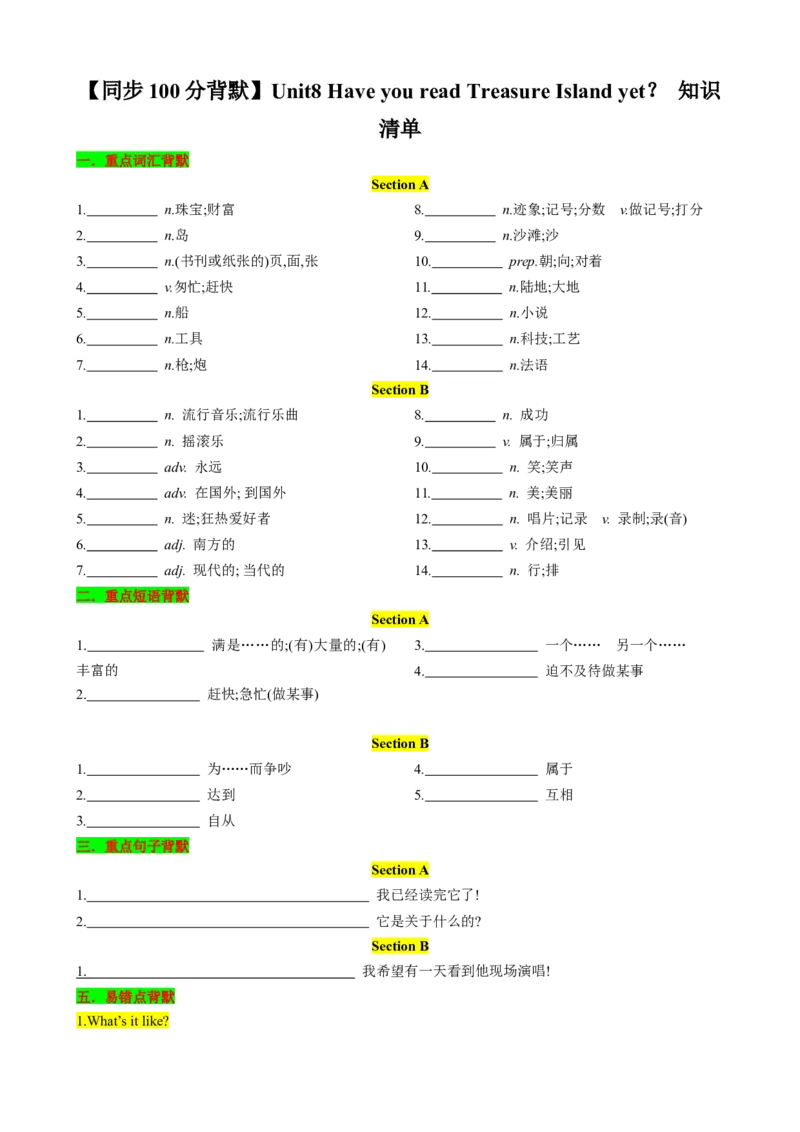
一.重点词汇背默
Section A
1. n.珠宝;财富 8. n.迹象;记号;分数 v.做记号;打分
2. n.岛 9. n.沙滩;沙
3. n.(书刊或纸张的)页,面,张 10. prep.朝;向;对着
4. v.匆忙;赶快 11. n.陆地;大地
5. n.船 12. n.小说
6. n.工具 13. n.科技;工艺
7. n.枪;炮 14. n.法语
Section B
1. n. 流行音乐;流行乐曲 8. n. 成功
2. n. 摇滚乐 9. v. 属于;归属
3. adv. 永远 10. n. 笑;笑声
4. adv. 在国外; 到国外 11. n. 美;美丽
5. n. 迷;狂热爱好者 12. n. 唱片;记录 v. 录制;录(音)
6. adj. 南方的 13. v. 介绍;引见
7. adj. 现代的; 当代的 14. n. 行;排
二.重点短语背默
Section A
1. 满是……的;(有)大量的;(有) 3. 一个…… 另一个……
丰富的 4. 迫不及待做某事
2. 赶快;急忙(做某事)
Section B
1. 为……而争吵 4. 属于
2. 达到 5. 互相
3. 自从
三.重点句子背默
Section A
1. 我已经读完它了!
2. 它是关于什么的?
Section B
1 . 我希望有一天看到他现场演唱!
五.易错点背默
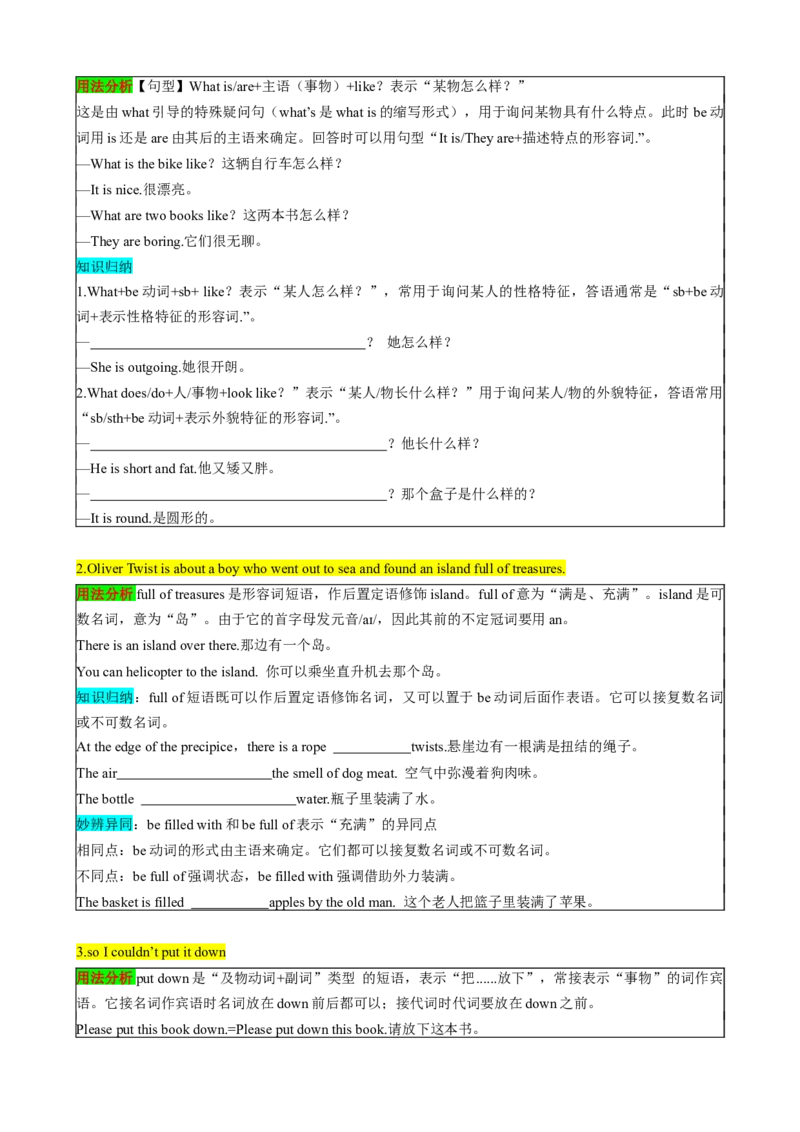
1.What’s it like?用法分析【句型】What is/are+主语(事物)+like?表示“某物怎么样?”
这是由what引导的特殊疑问句(what’s是what is的缩写形式),用于询问某物具有什么特点。此时be动
词用is还是are由其后的主语来确定。回答时可以用句型“It is/They are+描述特点的形容词.”。
—What is the bike like?这辆自行车怎么样?
—It is nice.很漂亮。
—What are two books like?这两本书怎么样?
—They are boring.它们很无聊。
知识归纳
1.What+be动词+sb+ like?表示“某人怎么样?”,常用于询问某人的性格特征,答语通常是“sb+be动
词+表示性格特征的形容词.”。
— ? 她怎么样?
—She is outgoing.她很开朗。
2.What does/do+人/事物+look like?”表示“某人/物长什么样?”用于询问某人/物的外貌特征,答语常用
“sb/sth+be动词+表示外貌特征的形容词.”。
— ?他长什么样?
—He is short and fat.他又矮又胖。
— ?那个盒子是什么样的?
—It is round.是圆形的。
2.Oliver Twist is about a boy who went out to sea and found an island full of treasures.
用法分析full of treasures是形容词短语,作后置定语修饰island。full of意为“满是、充满”。island是可
数名词,意为“岛”。由于它的首字母发元音/aɪ/,因此其前的不定冠词要用an。
There is an island over there.那边有一个岛。
You can helicopter to the island. 你可以乘坐直升机去那个岛。
知识归纳:full of短语既可以作后置定语修饰名词,又可以置于be动词后面作表语。它可以接复数名词
或不可数名词。
At the edge of the precipice,there is a rope twists.悬崖边有一根满是扭结的绳子。
The air the smell of dog meat. 空气中弥漫着狗肉味。
The bottle water.瓶子里装满了水。
妙辨异同:be filled with和be full of表示“充满”的异同点
相同点:be动词的形式由主语来确定。它们都可以接复数名词或不可数名词。
不同点:be full of强调状态,be filled with强调借助外力装满。
The basket is filled apples by the old man. 这个老人把篮子里装满了苹果。
3.so I couldn’t put it down
用法分析put down是“及物动词+副词”类型 的短语,表示“把......放下”,常接表示“事物”的词作宾
语。它接名词作宾语时名词放在down前后都可以;接代词时代词要放在down之前。
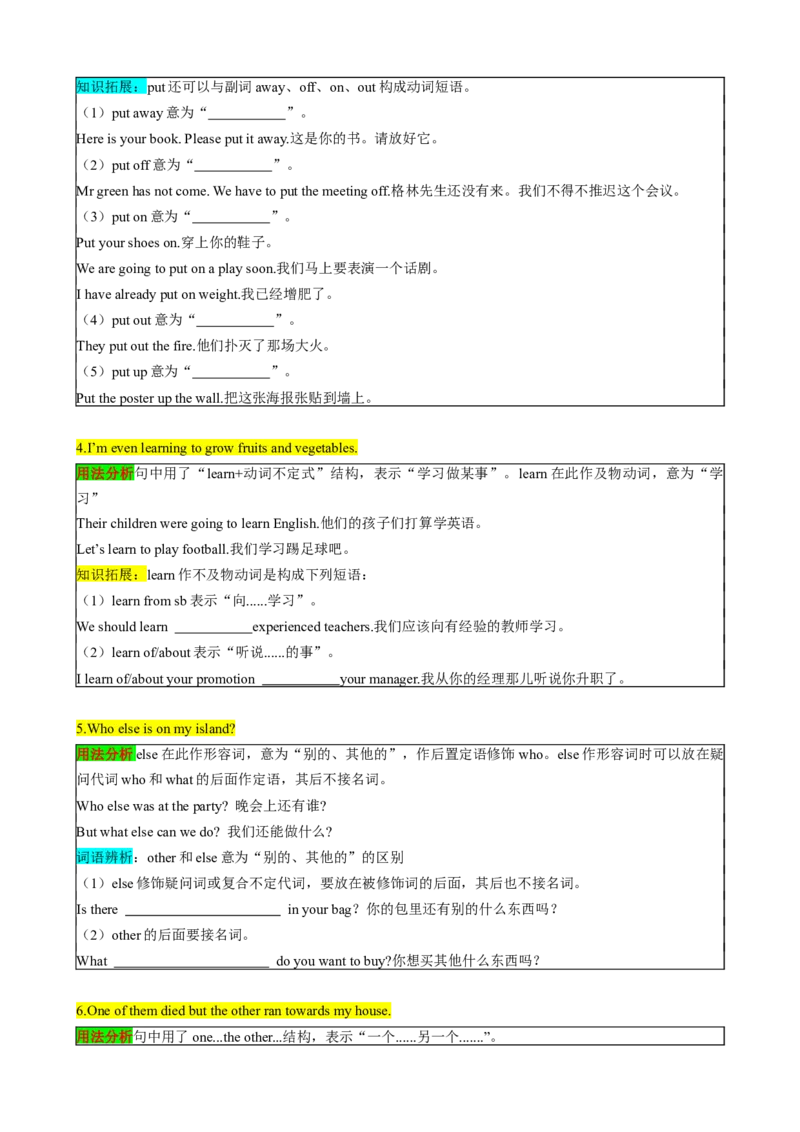
Please put this book down.=Please put down this book.请放下这本书。知识拓展:put还可以与副词away、off、on、out构成动词短语。
(1)put away意为“ ”。
Here is your book. Please put it away.这是你的书。请放好它。
(2)put off意为“ ”。
Mr green has not come. We have to put the meeting off.格林先生还没有来。我们不得不推迟这个会议。
(3)put on意为“ ”。
Put your shoes on.穿上你的鞋子。
We are going to put on a play soon.我们马上要表演一个话剧。
I have already put on weight.我已经增肥了。
(4)put out意为“ ”。
They put out the fire.他们扑灭了那场大火。
(5)put up意为“ ”。
Put the poster up the wall.把这张海报张贴到墙上。
4.I’m even learning to grow fruits and vegetables.
用法分析句中用了“learn+动词不定式”结构,表示“学习做某事”。learn在此作及物动词,意为“学
习”
Their children were going to learn English.他们的孩子们打算学英语。
Let’s learn to play football.我们学习踢足球吧。
知识拓展:learn作不及物动词是构成下列短语:
(1)learn from sb表示“向......学习”。
We should learn experienced teachers.我们应该向有经验的教师学习。
(2)learn of/about表示“听说......的事”。
I learn of/about your promotion your manager.我从你的经理那儿听说你升职了。
5.Who else is on my island?
用法分析else在此作形容词,意为“别的、其他的”,作后置定语修饰who。else作形容词时可以放在疑
问代词who和what的后面作定语,其后不接名词。
Who else was at the party? 晚会上还有谁?
But what else can we do? 我们还能做什么?
词语辨析:other和else意为“别的、其他的”的区别
(1)else修饰疑问词或复合不定代词,要放在被修饰词的后面,其后也不接名词。
Is there in your bag?你的包里还有别的什么东西吗?
(2)other的后面要接名词。
What do you want to buy?你想买其他什么东西吗?
6.One of them died but the other ran towards my house.
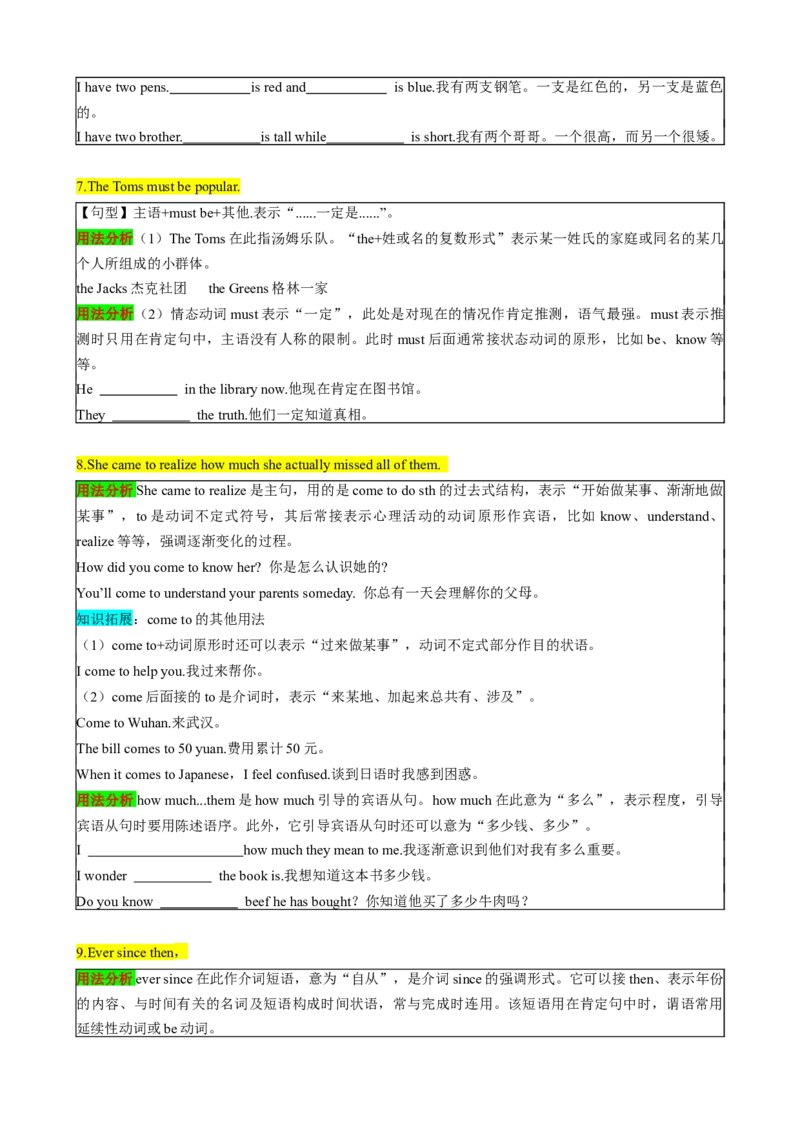
用法分析句中用了one...the other...结构,表示“一个......另一个.......”。I have two pens. is red and is blue.我有两支钢笔。一支是红色的,另一支是蓝色
的。
I have two brother. is tall while is short.我有两个哥哥。一个很高,而另一个很矮。
7.The Toms must be popular.
【句型】主语+must be+其他.表示“......一定是......”。
用法分析(1)The Toms在此指汤姆乐队。“the+姓或名的复数形式”表示某一姓氏的家庭或同名的某几
个人所组成的小群体。
the Jacks杰克社团 the Greens格林一家
用法分析(2)情态动词must表示“一定”,此处是对现在的情况作肯定推测,语气最强。must表示推
测时只用在肯定句中,主语没有人称的限制。此时must后面通常接状态动词的原形,比如be、know等
等。
He in the library now.他现在肯定在图书馆。
They the truth.他们一定知道真相。
8.She came to realize how much she actually missed all of them.
用法分析She came to realize是主句,用的是come to do sth的过去式结构,表示“开始做某事、渐渐地做
某事”,to是动词不定式符号,其后常接表示心理活动的动词原形作宾语,比如 know、understand、
realize等等,强调逐渐变化的过程。
How did you come to know her? 你是怎么认识她的?
You’ll come to understand your parents someday. 你总有一天会理解你的父母。
知识拓展:come to的其他用法
(1)come to+动词原形时还可以表示“过来做某事”,动词不定式部分作目的状语。
I come to help you.我过来帮你。
(2)come后面接的to是介词时,表示“来某地、加起来总共有、涉及”。
Come to Wuhan.来武汉。
The bill comes to 50 yuan.费用累计50元。
When it comes to Japanese,I feel confused.谈到日语时我感到困惑。
用法分析how much...them是how much引导的宾语从句。how much在此意为“多么”,表示程度,引导
宾语从句时要用陈述语序。此外,它引导宾语从句时还可以意为“多少钱、多少”。
I how much they mean to me.我逐渐意识到他们对我有多么重要。
I wonder the book is.我想知道这本书多少钱。
Do you know beef he has bought?你知道他买了多少牛肉吗?
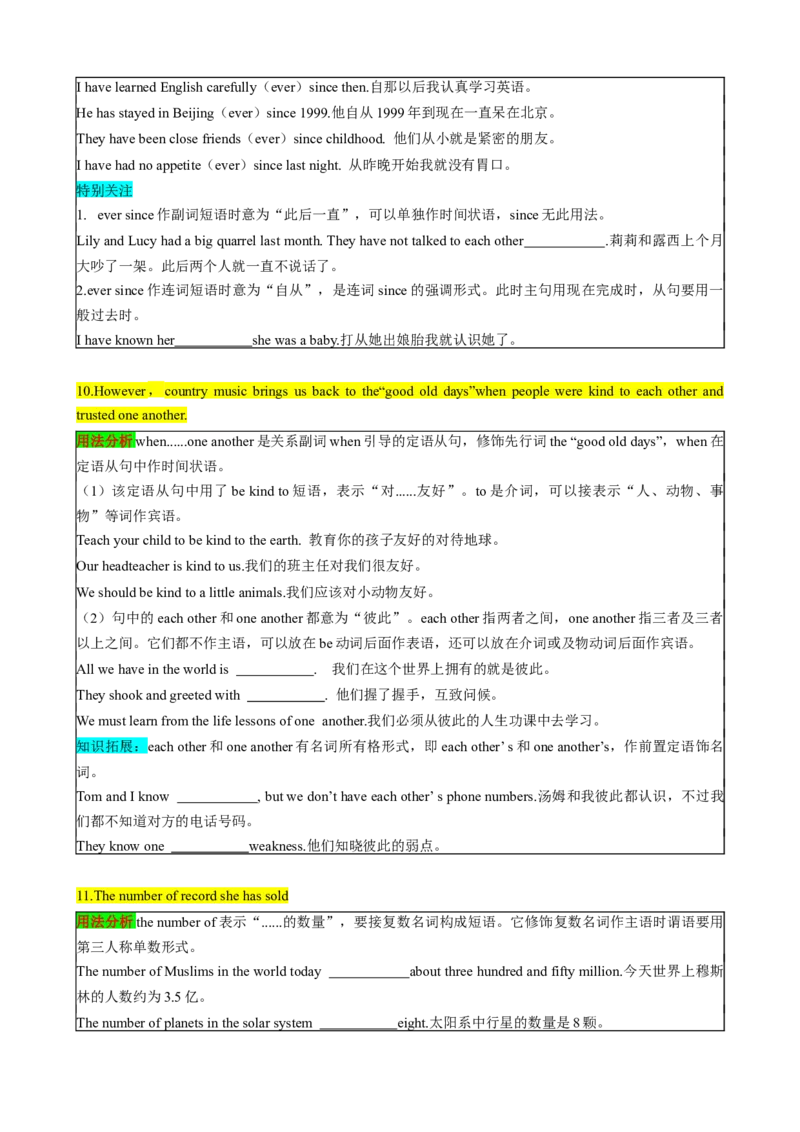
9.Ever since then,
用法分析ever since在此作介词短语,意为“自从”,是介词since的强调形式。它可以接then、表示年份
的内容、与时间有关的名词及短语构成时间状语,常与完成时连用。该短语用在肯定句中时,谓语常用
延续性动词或be动词。I have learned English carefully(ever)since then.自那以后我认真学习英语。
He has stayed in Beijing(ever)since 1999.他自从1999年到现在一直呆在北京。
They have been close friends(ever)since childhood. 他们从小就是紧密的朋友。
I have had no appetite(ever)since last night. 从昨晚开始我就没有胃口。
特别关注
1. ever since作副词短语时意为“此后一直”,可以单独作时间状语,since无此用法。
Lily and Lucy had a big quarrel last month. They have not talked to each other .莉莉和露西上个月
大吵了一架。此后两个人就一直不说话了。
2.ever since作连词短语时意为“自从”,是连词since的强调形式。此时主句用现在完成时,从句要用一
般过去时。
I have known her she was a baby.打从她出娘胎我就认识她了。
10.However,country music brings us back to the“good old days”when people were kind to each other and
trusted one another.
用法分析when......one another是关系副词when引导的定语从句,修饰先行词the “good old days”,when在
定语从句中作时间状语。
(1)该定语从句中用了be kind to短语,表示“对......友好”。to是介词,可以接表示“人、动物、事
物”等词作宾语。
Teach your child to be kind to the earth. 教育你的孩子友好的对待地球。
Our headteacher is kind to us.我们的班主任对我们很友好。
We should be kind to a little animals.我们应该对小动物友好。
(2)句中的each other和one another都意为“彼此”。each other指两者之间,one another指三者及三者
以上之间。它们都不作主语,可以放在be动词后面作表语,还可以放在介词或及物动词后面作宾语。
All we have in the world is . 我们在这个世界上拥有的就是彼此。
They shook and greeted with . 他们握了握手,互致问候。
We must learn from the life lessons of one another.我们必须从彼此的人生功课中去学习。
知识拓展:each other和one another有名词所有格形式,即each other’ s和one another’s,作前置定语饰名
词。
Tom and I know , but we don’t have each other’ s phone numbers.汤姆和我彼此都认识,不过我
们都不知道对方的电话号码。
They know one weakness.他们知晓彼此的弱点。
11.The number of record she has sold
用法分析the number of表示“......的数量”,要接复数名词构成短语。它修饰复数名词作主语时谓语要用
第三人称单数形式。
The number of Muslims in the world today about three hundred and fifty million.今天世界上穆斯
林的人数约为3.5亿。
The number of planets in the solar system eight.太阳系中行星的数量是8颗。知识拓展:a number of表示“大量的”,要修饰复数名词构成短语。它修饰复数名词作主语时谓语要用
复数形式。
A number of birds seen that day.那天看到了很多鸟。
12.Have you introduced this singer/writer to others?
用法分析本句是现在完成时的一般疑问句,用了 introduce sb/sth to sb 短语,表示“给某人介绍某
人/物”。
Let me Anna to you.让我给你介绍安娜吧。
I can Beijing to you.我可以给你们介绍下北京。
知识拓展:introduction是可数名词,意为“介绍”。它的首字母发元音/ɪ/,用不定冠词修饰时要用an。
Do you want me to write an to your lectures? 你要我写一篇文章介绍你的讲座文集?
六.语法点记忆
现在完成时(一)
现在完成时表示过去发生或已经完成的动作对现在造成的影响或结果,或表示从过去某一时间开始并
一直持续到现在的动作或状态,常与yet、 ever、 never、 already、 so far等连用。
一. 现在完成时的基本句型
句型 结构 例句
主语+have/has+动词的过去分词(+其
肯定句 The children have gone to Shanghai. 孩子们都去上海了。
他).
主语+have/has+not+动词的过去分词
否定句 We have not seen her for long. 我们很久没见到她了。
(+其他).
一般疑 Have/Has+主语+动词的过去分词(+其
—Has she arrived in Beijing? 她已经到北京了吗?
问句及 他)?
—Yes, she has. /No, she hasn’t. 是的,她已经到了。/不,她
其简略 肯定回答:Yes,主语+have/has.
还没到。
回答 否定回答:No,主语+haven’t/hasn’t.
特殊疑 特殊疑问词(组)+have/has+主语+动词
How long have you studied English?你学英语多长时间了?
问句 的过去分词(+其他)?
二. already与yet的用法
单词 用法 例句
意为"已经",常用于肯定句中,强调某事
He’s already read the newspaper.他已经读过报纸了。
已经发生或某种情况已经开始出现; 也可
already Have you finished all the work already?你已经完成了
用于疑问句中, 表示因某事的发生早于预
所有工作吗?
料而感到吃惊。单词 用法 例句
意为"尚未;仍未",用于否定句或疑问句末 —Have you spoken to Mr. Green yet? 你和格林先生
yet 尾,表示某事尚未发生或某情形尚未出现 说上话了吗?
或用于询问某事是否已经发生。 —No. He hasn’t come in yet. 没有。他还没有进来。
三. 现在完成时和一般过去时的区别
时态 区别 例句
表示过去某个时间发生的事情或存在的状
态,侧重陈述过去发生的事情或状态。标
一般过 My mother was a doctor five years ago.我妈妈五年前
志词: yesterday、 the day before
去时 是医生。
yesterday、 last week(night、 month、
year)、 in 2020、 two years ago等。
表示到说话时为止已经发生或完成(不一
定结束)的动作或状态,强调造成的结果或
现在 My mother has been a doctor for five years.我妈妈已经
对现在产生的影响。标志词: already、
完成时 当医生五年了。
yet、 just、 never、 recently、 so far、
for five days、 since last year等。
1. Millie in this factory since 1990.
A. works B. worked C. has worked D. have worked
2. The professor reached Nanjing last Wednesday. He there for 10 days.
A. has been B. has got C. has reached D. has arrived
3. —When will your sister go to England?
—She London since four months ago.
A. went to B. has gone to C. has been to D. has been in
4. —Is that Mr. Wang in the classroom?
—It can't be him. He the village to be a volunteer.
A. has been in B. has been to C. has gone to
5. —It seems that you have learnt a lot about Chengdu.
—Of course. I here for ten years.
A. have been in B. have been C. have come D. came to
6. —When will you give the novel back to me?
—Sorry,I it. How about Friday?
A. didn't finish B. won't finish C. haven't finished D. don't finish
7. Luckily, arrived home before it .
A. rains B. is raining C. rained D. will rain
8. Sarah many places of interest in Beijing already.
A. visited B. has visited C. will visit D. visits
9. He his grandparents in the countryside last week.A. visits B. visit C. visited
10. —Has your daughter come back from Australia?
—Yes. She there for three years.
A. has stayed B. stays C. stayed D. had stayed
11. —How was the volleyball game yesterday?
—Oh, it was fantastic! We so much fun.
A. have B. had C. are having D. will have
12. Wow! You dinner! Let's eat now.
A. cook B. are cooking C. will cook D. have cooked
13. In the past few years, many schools the ways of doing morning exercises.
A. change B. changes C. will change D. have changed
14. Sue wasn't happy because she the concert given by her favorite singer.
A. misses B. missed C. will miss D. is missing
15. Simon looks worried because he a writing competition and now he's waiting for the result.
A. enters B. entered C. will enter D. is entering
七.写作背默
写作要求
本单元以“健康与疾病”为话题,要求学生能够描述病情并给出建议。在具体的写作中,学生应做到以下几
点:
1.会用英语描述疾病或事故发生的时间、地点和感觉;
2.能够叙述处理问题的经过和结果;
3.能够使用should,had better等情态动词对怎样保持健康提供相关的建议。
词汇积累
matter 问题;事情 nurse 护士
trouble 问题;苦恼 have a cold 感冒
problem 问题 take one’s temperature 量体温
sore 疼痛的 take a break 休息
hurt 疼痛;受伤 get hurt 受伤
throat 喉咙 run out (of) 用完,耗尽
accident 事故 be in control of 控制
blood 血 thanks to 幸亏
doctor 医生 think twice 再三考虑
句型积累
1.What’s the matter with you?/What’s your trouble?/What’s wrong with you?你怎么啦?
2.I’m sorry to hear (that) you have a fever.听说你发烧了,我很难过。
3.You should have a good rest.你应该好好休息。
4.If you feel sick,you should see a doctor.如果你感觉生病了,你应该去看医生。
5.I hope (that) you will get well soon.我希望你早日康复。越来越多的人通过运动来保持健康,但是运动安全也不容小觑。请你给校报的英语栏目 English Corner投
稿,号召同学们重视运动安全。
要求:
1.80-120词
2.文中不能出现自己的姓名和所在学校的名称。
参考信息:
1. 运动安全的现状和重要性;
2. 运动安全的建议(着装、热身、规则……);
3. ……
参考词汇:热身运动 warming-up exercise