【同步 100 分背默】Module 8 Time off 知识清单
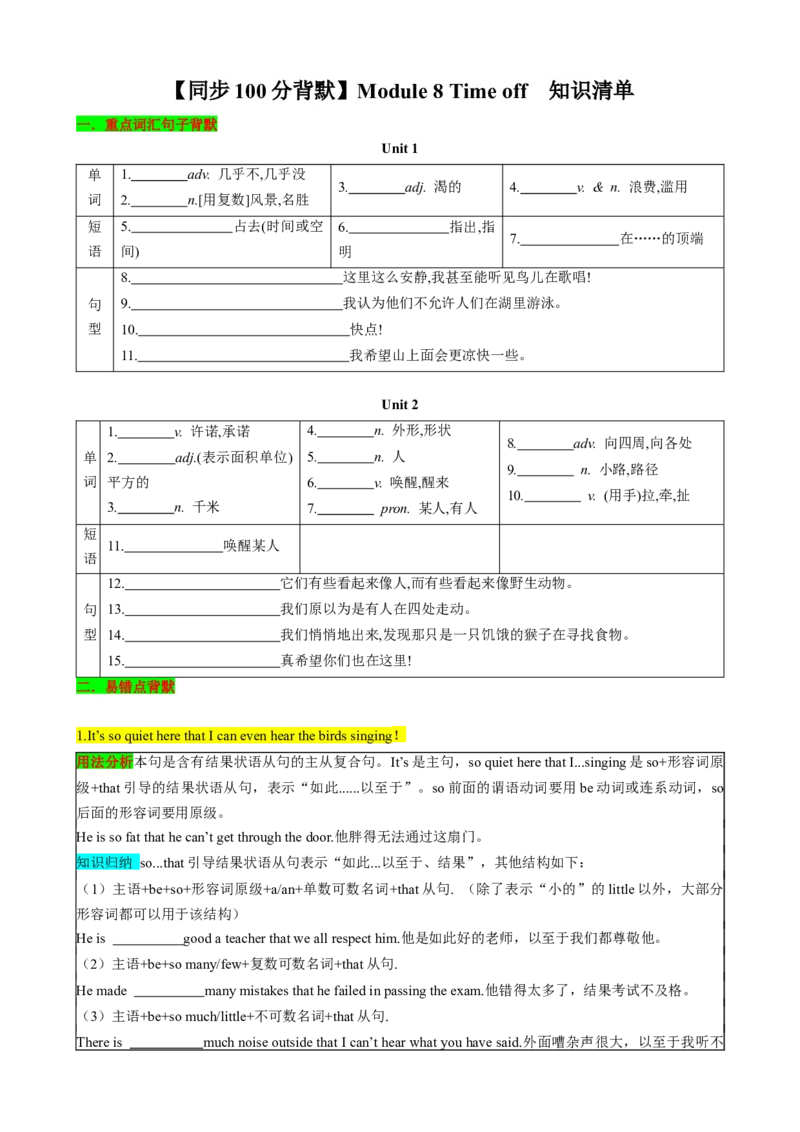
一.重点词汇句子背默
Unit 1
单 1. adv. 几乎不,几乎没
3. adj. 渴的 4. v. & n. 浪费,滥用
词 2. n.[用复数]风景,名胜
短 5. 占去(时间或空 6. 指出,指
7. 在……的顶端
语 间) 明
8. 这里这么安静,我甚至能听见鸟儿在歌唱!
句 9. 我认为他们不允许人们在湖里游泳。
型 10. 快点!
11. 我希望山上面会更凉快一些。
Unit 2
1. v. 许诺,承诺 4. n. 外形,形状
8. adv. 向四周,向各处
单 2. adj.(表示面积单位) 5. n. 人
9. n. 小路,路径
词 平方的 6. v. 唤醒,醒来
10. v. (用手)拉,牵,扯
3. n. 千米 7. pron. 某人,有人
短
11. 唤醒某人
语
12. 它们有些看起来像人,而有些看起来像野生动物。
句 13. 我们原以为是有人在四处走动。
型 14. 我们悄悄地出来,发现那只是一只饥饿的猴子在寻找食物。
15. 真希望你们也在这里!
二.易错点背默
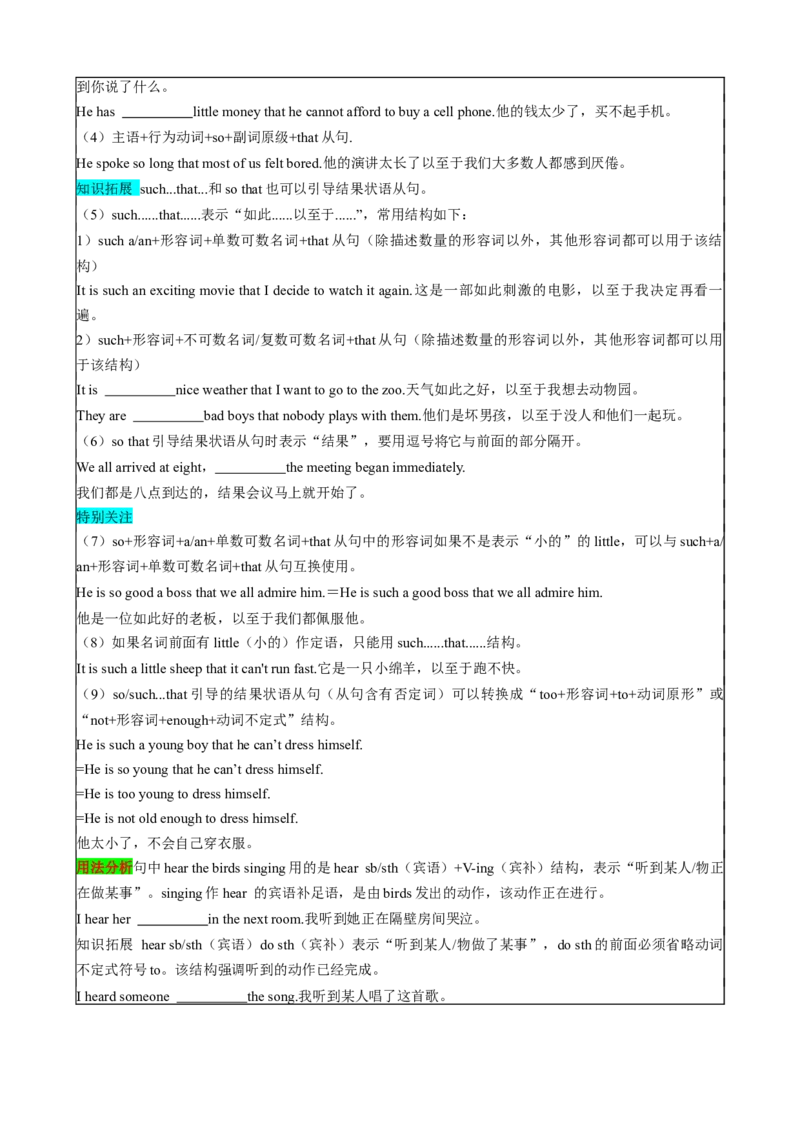
1.It’s so quiet here that I can even hear the birds singing!
用法分析本句是含有结果状语从句的主从复合句。It’s是主句,so quiet here that I...singing是so+形容词原
级+that引导的结果状语从句,表示“如此......以至于”。so前面的谓语动词要用be动词或连系动词,so
后面的形容词要用原级。
He is so fat that he can’t get through the door.他胖得无法通过这扇门。
知识归纳 so...that引导结果状语从句表示“如此...以至于、结果”,其他结构如下:
(1)主语+be+so+形容词原级+a/an+单数可数名词+that从句. (除了表示“小的”的little以外,大部分
形容词都可以用于该结构)
He is good a teacher that we all respect him.他是如此好的老师,以至于我们都尊敬他。
(2)主语+be+so many/few+复数可数名词+that从句.
He made many mistakes that he failed in passing the exam.他错得太多了,结果考试不及格。
(3)主语+be+so much/little+不可数名词+that从句.
There is much noise outside that I can’t hear what you have said.外面嘈杂声很大,以至于我听不到你说了什么。
He has little money that he cannot afford to buy a cell phone.他的钱太少了,买不起手机。
(4)主语+行为动词+so+副词原级+that从句.
He spoke so long that most of us felt bored.他的演讲太长了以至于我们大多数人都感到厌倦。
知识拓展 such...that...和so that也可以引导结果状语从句。
(5)such......that......表示“如此......以至于......”,常用结构如下:
1)such a/an+形容词+单数可数名词+that从句(除描述数量的形容词以外,其他形容词都可以用于该结
构)
It is such an exciting movie that I decide to watch it again.这是一部如此刺激的电影,以至于我决定再看一
遍。
2)such+形容词+不可数名词/复数可数名词+that从句(除描述数量的形容词以外,其他形容词都可以用
于该结构)
It is nice weather that I want to go to the zoo.天气如此之好,以至于我想去动物园。
They are bad boys that nobody plays with them.他们是坏男孩,以至于没人和他们一起玩。
(6)so that引导结果状语从句时表示“结果”,要用逗号将它与前面的部分隔开。
We all arrived at eight, the meeting began immediately.
我们都是八点到达的,结果会议马上就开始了。
特别关注
(7)so+形容词+a/an+单数可数名词+that从句中的形容词如果不是表示“小的”的little,可以与such+a/
an+形容词+单数可数名词+that从句互换使用。
He is so good a boss that we all admire him.=He is such a good boss that we all admire him.
他是一位如此好的老板,以至于我们都佩服他。
(8)如果名词前面有little(小的)作定语,只能用such......that......结构。
It is such a little sheep that it can't run fast.它是一只小绵羊,以至于跑不快。
(9)so/such...that引导的结果状语从句(从句含有否定词)可以转换成“too+形容词+to+动词原形”或
“not+形容词+enough+动词不定式”结构。
He is such a young boy that he can’t dress himself.
=He is so young that he can’t dress himself.
=He is too young to dress himself.
=He is not old enough to dress himself.
他太小了,不会自己穿衣服。
用法分析句中hear the birds singing用的是hear sb/sth(宾语)+V-ing(宾补)结构,表示“听到某人/物正
在做某事”。singing作hear 的宾语补足语,是由birds发出的动作,该动作正在进行。
I hear her in the next room.我听到她正在隔壁房间哭泣。
知识拓展 hear sb/sth(宾语)do sth(宾补)表示“听到某人/物做了某事”,do sth的前面必须省略动词
不定式符号to。该结构强调听到的动作已经完成。
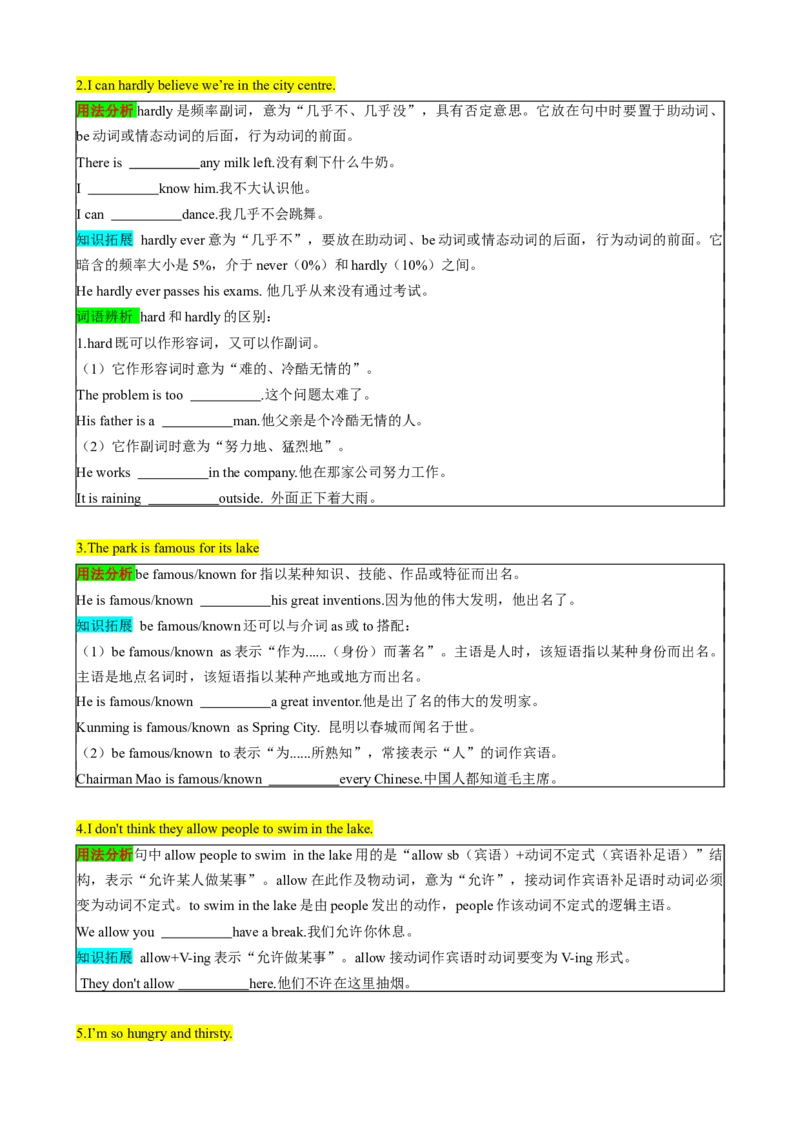
I heard someone the song.我听到某人唱了这首歌。2.I can hardly believe we’re in the city centre.
用法分析hardly是频率副词,意为“几乎不、几乎没”,具有否定意思。它放在句中时要置于助动词、
be动词或情态动词的后面,行为动词的前面。
There is any milk left.没有剩下什么牛奶。
I know him.我不大认识他。
I can dance.我几乎不会跳舞。
知识拓展 hardly ever意为“几乎不”,要放在助动词、be动词或情态动词的后面,行为动词的前面。它
暗含的频率大小是5%,介于never(0%)和hardly(10%)之间。
He hardly ever passes his exams. 他几乎从来没有通过考试。
词语辨析 hard和hardly的区别:
1.hard既可以作形容词,又可以作副词。
(1)它作形容词时意为“难的、冷酷无情的”。
The problem is too .这个问题太难了。
His father is a man.他父亲是个冷酷无情的人。
(2)它作副词时意为“努力地、猛烈地”。
He works in the company.他在那家公司努力工作。
It is raining outside. 外面正下着大雨。
3.The park is famous for its lake
用法分析be famous/known for指以某种知识、技能、作品或特征而出名。
He is famous/known his great inventions.因为他的伟大发明,他出名了。
知识拓展 be famous/known还可以与介词as或to搭配:
(1)be famous/known as表示“作为......(身份)而著名”。主语是人时,该短语指以某种身份而出名。
主语是地点名词时,该短语指以某种产地或地方而出名。
He is famous/known a great inventor.他是出了名的伟大的发明家。
Kunming is famous/known as Spring City. 昆明以春城而闻名于世。
(2)be famous/known to表示“为......所熟知”,常接表示“人”的词作宾语。
Chairman Mao is famous/known every Chinese.中国人都知道毛主席。
4.I don't think they allow people to swim in the lake.
用法分析句中allow people to swim in the lake用的是“allow sb(宾语)+动词不定式(宾语补足语)”结
构,表示“允许某人做某事”。allow在此作及物动词,意为“允许”,接动词作宾语补足语时动词必须
变为动词不定式。to swim in the lake是由people发出的动作,people作该动词不定式的逻辑主语。
We allow you have a break.我们允许你休息。
知识拓展 allow+V-ing表示“允许做某事”。allow接动词作宾语时动词要变为V-ing形式。
They don't allow here.他们不许在这里抽烟。
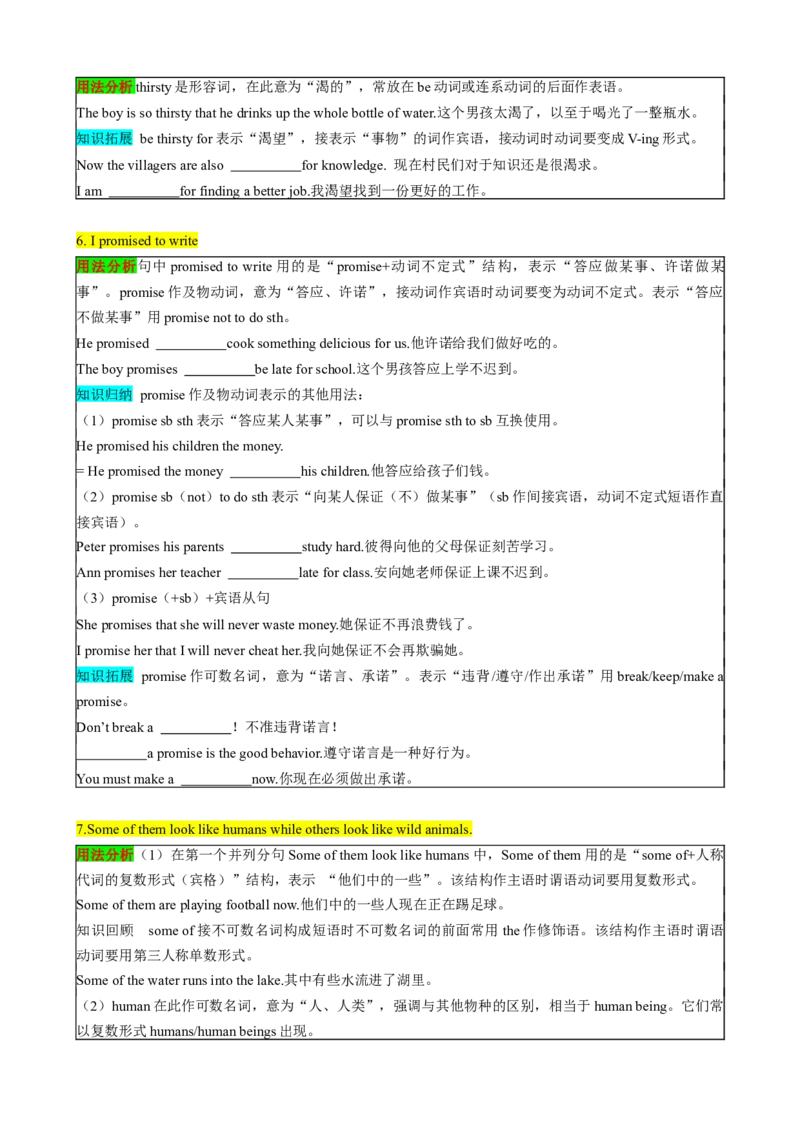
5.I’m so hungry and thirsty.用法分析thirsty是形容词,在此意为“渴的”,常放在be动词或连系动词的后面作表语。
The boy is so thirsty that he drinks up the whole bottle of water.这个男孩太渴了,以至于喝光了一整瓶水。
知识拓展 be thirsty for表示“渴望”,接表示“事物”的词作宾语,接动词时动词要变成V-ing形式。
Now the villagers are also for knowledge. 现在村民们对于知识还是很渴求。
I am for finding a better job.我渴望找到一份更好的工作。
6. I promised to write
用法分析句中promised to write用的是“promise+动词不定式”结构,表示“答应做某事、许诺做某
事”。promise作及物动词,意为“答应、许诺”,接动词作宾语时动词要变为动词不定式。表示“答应
不做某事”用promise not to do sth。
He promised cook something delicious for us.他许诺给我们做好吃的。
The boy promises be late for school.这个男孩答应上学不迟到。
知识归纳 promise作及物动词表示的其他用法:
(1)promise sb sth表示“答应某人某事”,可以与promise sth to sb互换使用。
He promised his children the money.
= He promised the money his children.他答应给孩子们钱。
(2)promise sb(not)to do sth表示“向某人保证(不)做某事”(sb作间接宾语,动词不定式短语作直
接宾语)。
Peter promises his parents study hard.彼得向他的父母保证刻苦学习。
Ann promises her teacher late for class.安向她老师保证上课不迟到。
(3)promise(+sb)+宾语从句
She promises that she will never waste money.她保证不再浪费钱了。
I promise her that I will never cheat her.我向她保证不会再欺骗她。
知识拓展 promise作可数名词,意为“诺言、承诺”。表示“违背/遵守/作出承诺”用break/keep/make a
promise。
Don’t break a !不准违背诺言!
a promise is the good behavior.遵守诺言是一种好行为。
You must make a now.你现在必须做出承诺。
7.Some of them look like humans while others look like wild animals.
用法分析(1)在第一个并列分句Some of them look like humans中,Some of them用的是“some of+人称
代词的复数形式(宾格)”结构,表示 “他们中的一些”。该结构作主语时谓语动词要用复数形式。
Some of them are playing football now.他们中的一些人现在正在踢足球。
知识回顾 some of接不可数名词构成短语时不可数名词的前面常用the作修饰语。该结构作主语时谓语
动词要用第三人称单数形式。
Some of the water runs into the lake.其中有些水流进了湖里。
(2)human在此作可数名词,意为“人、人类”,强调与其他物种的区别,相当于human being。它们常
以复数形式humans/human beings出现。Are we humans/human beings unique in the universe?我们人类在宇宙中是独一无二的吗?
知识拓展 human作形容词时意为“人类的、人为的”,常放在名词前面作定语。
The accident is caused by human error.这宗事故是人为过失造成的。
It is beyond the confines of human knowledge.这超出了人类的知识范围。
(3) others look like wild animals是while连接的并列分句。while作并列连词,意为“然
而”,用于强调前后两者的对比。
He is strong I am weak. 他长得很结实,而我却很瘦弱。
知识归纳 while的其他用法:
1)作连词时意为“虽然”,引导让步状语从句。
I understand what you say, I can’t agree with you. 虽然我理解你的意思,但我还是不同意你的看
法。
2)作可数名词时构成短语for a while,表示“一段时间”,作时间状语。
She worked in a bank for a before studying law.她学法律之前在银行工作过一段时间。
8.We came out without making any noise, and found it was a hungry monkey looking for food.
用法分析(1)句中without making any noise是“without+V-ing”结构作伴随状语,是伴随谓语came out发
生的次要动作。without是介词,可以接表示“事物”的词作伴随状语,接动词时动词要变成V-ing形式,
文中用的是make的V-ing形式making。
He goes out breakfast.他没吃早餐就出去了。
He walked past me without a word. 他从我身旁走过,什么也没说。
知识归纳 without的其他用法:
1)without接表示“人、事物”的词构成介词短语时还可以作表语或条件状语。
He is without bias. 他没有成见。(without bias作表语)
We can’t finish the task him.没有他我们无法完成这项任务。(without him作条件状语)
用法分析(2)it was a hungry monkey looking for food是省略that的宾语从句,作found的宾语。
looking for food是look for的V-ing结构作后置定语修饰a hungry monkey。该V-ing是由a hungry monkey
发出的动作,该动作在当时正在进行。look for是“不及物动词+介词”类型的短语,意为“寻找”,可
以接表示“人、事物、动物”等词作宾语,强调找的过程。
The boy playing football over there is my best friend Kent.在那边踢足球的男孩是我最好的朋友肯特。
Lily is looking for her cat.莉莉正在找她的猫。
9.But it was a pity that it was cloudy.
用法分析(1)it was a pity that it was cloudy用的是“It was/is a pity+that引导的主语从句.”句型,表示“遗
憾的是.......”。第一个it是形式主语,真正的主语是that引导的主语从句that it was cloudy。that引导主语
从句时没有词义,只起连接作用,在从句中不作成分。当that从句用了一般过去时,形式主语it的后面用
was或is都可以。that从句用了一般现在时,形式主语it的后面要用is。
It was a pity that they lost to the girls.遗憾的是他们输给了女生。
It is a pity that he can’t go shopping with us.遗憾的是他不能和我们一起去购物。It is a pity that he didn’t come. 很遗憾他没来。
特别关注 that引导主语从句置于句首时that不能省略。在“It is(was)+形容词/名词+that引导的主语从
句.”中,连词that可以省略,这种省略通常出现在口语中。
That he is still alive is a wonder. 他还活着,真是奇迹。
It is certain (that) our team will win. 我们队会获胜是肯定的。
用法分析(2)在that引导的主语从句that it was cloudy中,it是无人称代词,指代天气状况,可以不翻译
出来。此外,it作无人称代词时还可以指代时间、距离、温度等,此时it也可以不用翻译出来。
very cool today. 今天天气非常凉爽。
eight o’clock in the evening.现在是晚上8点整。
minus three degrees today.今天零下三度。
about five kilometers from here to the lake.从这里到湖边大约是五公里。
10.We could only see the mountain tops above the clouds.
用法分析above the clouds是方位介词短语作地点状语。above在此意为“在......上面”,强调两者不接
触,表示相对高度,不一定是在正上方,反义词是below。
The plane is flying above the clouds. 飞机正在云层上方飞行。
He went below the deck. 他到甲板下面去了。
词语辨析 above、on、over作介词表示“在......上面”的区别:
(1)over指“在......正上方”,强调两者不接触,表示垂直上方,反义词是under。
The bridge is the river.河上有一座桥。
Put a line this sentence.在这个句子下面划条线。
(2)on表示“在......上面”,与物体表面接触。
There is a map the wall.墙上有一幅地图。
知识归纳 above的其他用法:
(1)作介词时意为“在......之上”,接表示温度的词语。
The temperature is 20℃。温度在20℃以上。
(2)作介词时表示数量,意为“多于”,要放在基数词的前面。
It weighs ten tons. 这东西重10吨以上。
The population in this city is one million.这座城市的人口超过了100万。
(3)作地点副词时意为“在上面”。
A long scream sounded from somewhere .从上面某个地方传来一声长长的尖叫。
11.Wish you were here!
用法分析本句用的是“Wish+省略引导词that的宾语从句.”结构。wish是及物动词,意为“希望”,you
were here是省略引导词that的宾语从句。主句时态是一般现在时,从句用了虚拟语气,对现在的情况提
出相反的希望(事实上对方现在不可能在这里)。当wish后面的宾语从句对现在的情况作虚拟时,谓语
动词要用过去式。不管主语是何种人称,be动词都可以用were。
I wish I were a bird.我希望自己是一只鸟。I wish we had a car.我希望我们有一辆小汽车。
妙辨异同 hope和wish都可以作及物动词,意为“希望”,异同点如下:
相同点:hope和wish都可以接动词不定式作宾语、不接V-ing作宾语。
I hope to see him soon. 我希望不久之后能见到他。
Do you wish to eat by yourself? 你希望一个人吃饭吗?
不同点:
(1)hope不接动词不定式作宾语补足语。wish可以接动词不定式作宾语补足语,构成wish sb(宾语)to
do sth(宾补)结构,表示“希望某人做某事”。
I wish you to go home at once. 我希望你马上回家。
(2)hope接that引导的宾语从句时,指希望的事情能够实现,从句谓语动词没有限制,不用虚拟语气。
We hope that he passes the exam.我们希望他通过这次考试。
(3)wish接that引导的宾语从句时:
1)从句不用虚拟语气时,从句谓语动词通常由“would/could(+not)+动词原形”充当,表示对将来的期
望。
I wish that you would not smoke anymore.我希望你不要再抽烟了。
How I wish you could come back earlier!我多么希望你能早点回来呀!
2)从句用虚拟语气时,提出与过去事实相反的愿望,主句用过去时,从句用过去完成时(had+过去分
词)。提出与将来事实相反的愿望,主句用现在时,从句用could/would/might+动词原形(此时wish也可
以翻译成“但愿”)。
I wish I had never met him before.我希望我从没见过他。
I wish I would be free tomorrow.但愿我明天有空。
三.语法点记忆
that引导的宾语从句
宾语从句是名词性从句的一种,在主从复合句中充当宾语,通常位于及物动词、介词或形容词之后。
宾语从句大致可以分为三类:that引导的宾语从句,whether/if引导的宾语从句和疑问词引导的宾语从
句。在本模块中,我们学习that引导的宾语从句。
一. 连接词that
当谓语动词表示肯定的概念,如"希望""相信""知道"或"说"时,其后的宾语从句一般用that引导。that没有
任何词汇意义,只具有语法功能,目的是使读者清楚后面的句子是前面动词的宾语,多数情况下that可以省
略。
I hope (that) it will rain this afternoon. 我希望今天下午会下雨。
不可省略that的常见情况
(1)当一个句子有多个并列的宾语从句时,通常第一个宾语从句前的that可省略,但后面的that不可省略。
She wrote (that) she would come and see him sometimes, and that she would never forget what he had done for
her. 她写信说,她会不时来看他,而且永远不会忘记他为她做的(事情)。
(2)句中带有插入语时,宾语从句的引导词that不可省略。
Your father said, happily and proudly, that you had won the gold medal. 你父亲高兴又自豪地说,你赢得了金牌。
(3)带补语的宾语从句的引导词that通常不可省略。
He felt it necessary that he should give Liu Bin a call later. 他觉得有必要晚些时候给刘彬打个电话。
whether/if及疑问词引导的宾语从句
一. whether/if引导的宾语从句
当一般疑问句充当句子的宾语时,用连词whether或if引导,whether/if在从句中不充当任何句子成分,意
为"是否",不可省略。宾语从句要用陈述语序。
I don't know whether/if she will come this afternoon.我不知道她今天下午是否会来。
whether与if引导宾语从句时的区别
用法 例句
whether引导的宾语从句可置于句首,而if无此功 Whether it is true or not, I can't tell. 这是真的还是假的,
能。 我说不上来。
whether引导的宾语从句可直接用于介词之后,而 That depends on whether we work hard. 那取决于我们
if无此功能。 是否努力。
Let me know whether or not you can come.让我知道你
whether 可与or not直接连用,而if一般不能。
是否能来。
二. 疑问词引导的宾语从句
当特殊疑问句充当句子的宾语时,由原来的疑问词作为连接词,这些词在宾语从句中充当一定的句子成
分,都有各自的词义,不可省略。疑问词引导的宾语从句也要用陈述语序。
常见连接词的含义及功能如下:
连接词 含义 功能
who 谁(主格)
连 除在句中起连接作用外,
whom 谁(宾格)
接 还可在宾语从句中作主
whose 谁的
代 语、宾语、表语或定
what 什么
词 语。
which 哪个
连 when 什么时候
除在句中起连接作用外,
接 where 什么地方
还可在宾语从句中作状
副 how 怎样,如何
语。
词 why 为什么
He asked them what they did on the weekend.他问他们周末做了什么。(what在宾语从句中作宾语)
Do you know when he was born?你知道他何时出生的吗?(when在宾语从句中作时间状语)
连接代词who与whom都指人。who为主格,在从句中作主语;whom为宾格,在从句中作宾语。
I don't know who is playing the piano next door.我不知道谁正在隔壁弹钢琴。(who在宾语从句中作主语)
Could you tell me whom you spoke to just now?你能告诉我你刚才在和谁说话吗? (whom在宾语从句中作宾
语)1.—Did you notice in her office?
—Yes. She was going over our writing.
A.what was Miss Lin doing B.what Miss Lin was doing
C.what does Miss Lin do D.what Miss Lin does
2..—Dear friends, do you still remember three years ago?
—To realize our dreams!
A.why you came here B.why did you come here
C.how you came here D.how did you come here
3.—Alice, could you tell me London?
—Sure. Last Sunday.
A.when Mr. Smith left B.when Mr. Smith will leave
C.when did Mr. Smith leave D.when will Mr. Smith leave
4.—Hi, Ken. Did Mrs. Zhang tell us ?
—Yes. She said we should meet there at nine.
A.which was the way to the station
B.why we should meet at the station
C.when we should get to the station
D.who we should meet at the station
5.—Judy, could you tell me the schoolbag?
—Oh, yes. I bought it in a store on the Internet.
A.where did you buy B.where will you buy
C.where you bought D.where you will buy
六.写作背默
本模块的话题是"旅游与度假",要求学生能够介绍某景点的基本信息,进行旅游安排,谈论旅行见闻及感
受,会使用宾语从句和感叹句表达旅游感受。
假如你是李欣,你与Bob叔叔及其家人约定了一起去北京旅行。请你给Bob 叔叔写一封英文电子邮
件(语篇类型:电子邮件),告知你的旅行安排(话题:旅行安排 人称:以第一人称为主 时态:以一
般将来时为主)。
内容要点如下:
1.6月30日下午2:00机场见;
2.酒店已预订好,直接前往;
3.第二天观看升旗仪式,游长城,吃北京烤鸭;
4.补充一两点与旅行有关的信息或想法。
注意:
1.文中不得透露个人真实姓名和学校;
2.词数不少于80,开头和结尾已给出,不计入总词数。
参考词汇: book v.预订 directly adv.直接地 flag-raising ceremony 升旗仪式素材积累
词汇
a good impression 好的印象
book the room 预订房间
have a rest 休息一下
early in the morning 一大早
be worth visiting 值得参观
places of interest 名胜
enjoy oneself/have fun 玩得开心
taste delicious food 品尝美食
句子
1.As soon as we land in Beijing, we can go to the hotel
directly to have a rest. 我们一降落到北京,就可以直接去酒店休息。
2.We'll watch the flag-raising ceremony at Tian'anmen Square early in the morning. 一大早我们将去天安门广
场观看升旗仪式。
3.It's well worth visiting.它非常值得参观。
4.As for dinner, we'll taste the delicious local food, Beijing duck. 至于晚餐,我们将会品尝当地的美食——北
京烤鸭。
5.Remember to wear sunglasses and take an umbrella with you. 记得戴太阳镜并带上一把伞。
Dear Uncle Bob,
Look forward to meeting all of you in Beijing.Li Xin