【同步 100 分背默】 Unit4 Why don't you talk to your parents?知识
清单
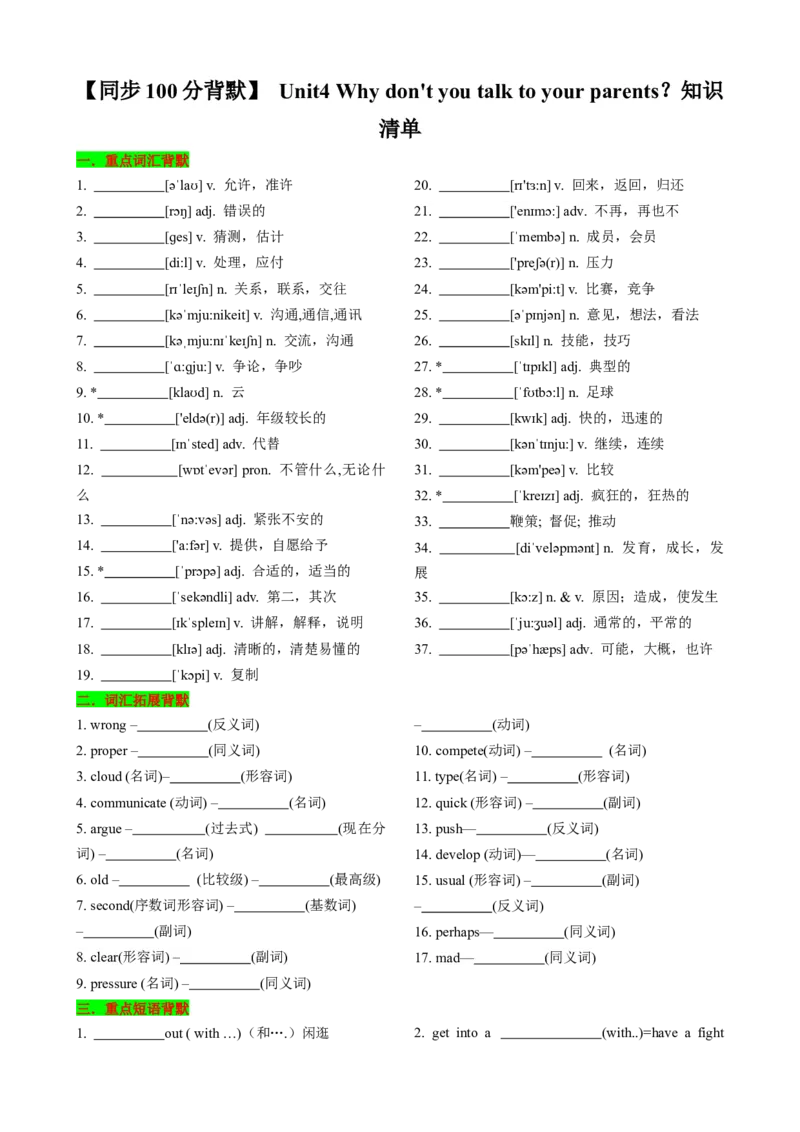
一.重点词汇背默
1. [əˈlaʊ] v. 允许,准许 20. [rɪ'tɜ:n] v. 回来,返回,归还
2. [rɔŋ] adj. 错误的 21. ['enɪmɔ:] adv. 不再,再也不
3. [ɡes] v. 猜测,估计 22. [ˈmembə] n. 成员,会员
4. [di:l] v. 处理,应付 23. ['preʃə(r)] n. 压力
5. [rɪˈleɪʃn] n. 关系,联系,交往 24. [kəm'pi:t] v. 比赛,竞争
6. [kəˈmju:nikeit] v. 沟通,通信,通讯 25. [əˈpɪnjən] n. 意见,想法,看法
7. [kəˌmju:nɪˈkeɪʃn] n. 交流,沟通 26. [skɪl] n. 技能,技巧
8. [ˈɑ:ɡju:] v. 争论,争吵 27. * [ˈtɪpɪkl] adj. 典型的
9. * [klaʊd] n. 云 28. * [ˈfʊtbɔ:l] n. 足球
10. * ['eldə(r)] adj. 年级较长的 29. [kwɪk] adj. 快的,迅速的
11. [ɪnˈsted] adv. 代替 30. [kənˈtɪnju:] v. 继续,连续
12. [wɒtˈevər] pron. 不管什么,无论什 31. [kəm'peə] v. 比较
么 32. * [ˈkreɪzɪ] adj. 疯狂的,狂热的
13. [ˈnə:vəs] adj. 紧张不安的 33. 鞭策; 督促; 推动
14. ['a:fər] v. 提供,自愿给予 34. [diˈveləpmənt] n. 发育,成长,发
15. * [ˈprɔpə] adj. 合适的,适当的 展
16. [ˈsekəndli] adv. 第二,其次 35. [kɔ:z] n. & v. 原因;造成,使发生
17. [ɪkˈspleɪn] v. 讲解,解释,说明 36. [ˈju:ʒuəl] adj. 通常的,平常的
18. [klɪə] adj. 清晰的,清楚易懂的 37. [pəˈhæps] adv. 可能,大概,也许
19. [ˈkɔpi] v. 复制
二.词汇拓展背默
1. wrong – (反义词) – (动词)
2. proper – (同义词) 10. compete(动词) – (名词)
3. cloud (名词)– (形容词) 11. type(名词) – (形容词)
4. communicate (动词) – (名词) 12. quick (形容词) – (副词)
5. argue – (过去式) (现在分 13. push— (反义词)
词) – (名词) 14. develop (动词)— (名词)
6. old – (比较级) – (最高级) 15. usual (形容词) – (副词)
7. second(序数词形容词) – (基数词) – (反义词)
– (副词) 16. perhaps— (同义词)
8. clear(形容词) – (副词) 17. mad— (同义词)
9. pressure (名词) – (同义词)
三.重点短语背默
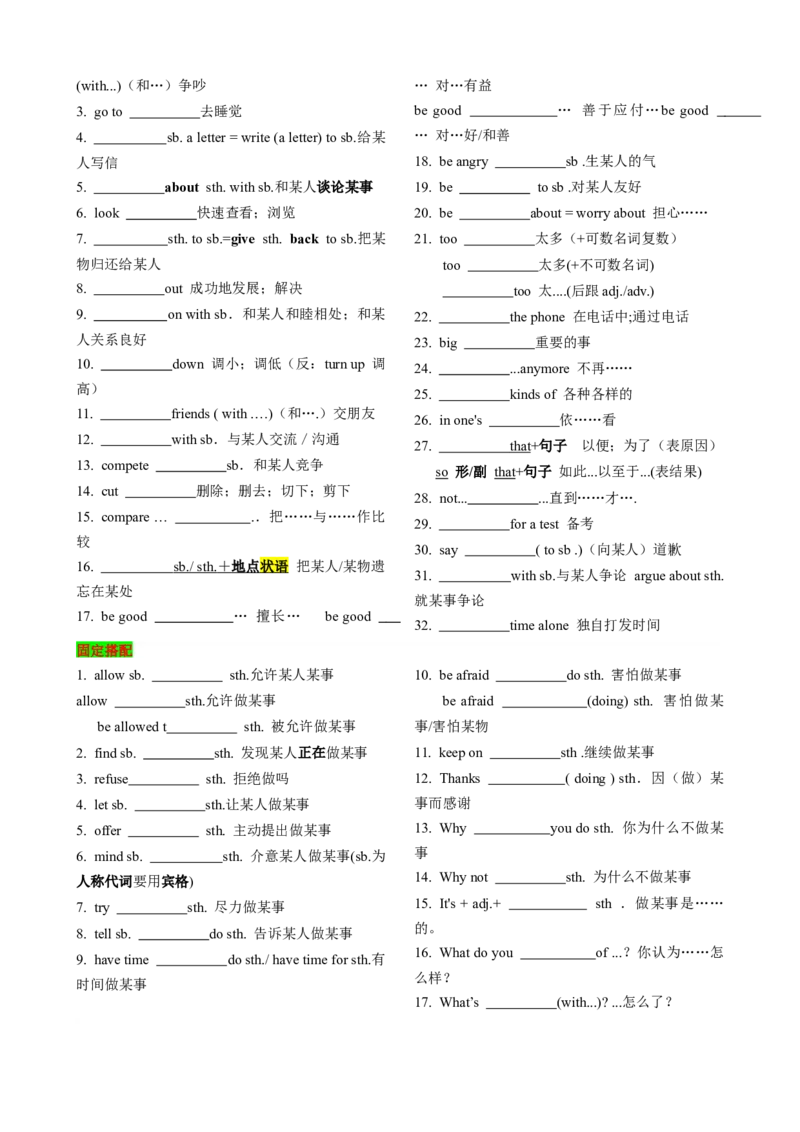
1. out ( with …)(和….)闲逛 2. get into a (with..)=have a fight(with...)(和…)争吵 … 对…有益
3. go to 去睡觉 be good … 善于应付…be good
4. sb. a letter = write (a letter) to sb.给某 … 对…好/和善
人写信 18. be angry sb .生某人的气
5. about sth. with sb.和某人谈论某事 19. be to sb .对某人友好
6. look 快速查看;浏览 20. be about = worry about 担心……
7. sth. to sb.=give sth. back to sb.把某 21. too 太多(+可数名词复数)
物归还给某人 too 太多(+不可数名词)
8. out 成功地发展;解决 too 太....(后跟adj./adv.)
9. on with sb.和某人和睦相处;和某 22. the phone 在电话中;通过电话
人关系良好 23. big 重要的事
10. down 调小;调低(反:turn up 调 24. ...anymore 不再……
高)
25. kinds of 各种各样的
11. friends ( with .…)(和….)交朋友
26. in one's 依……看
12. with sb.与某人交流/沟通
27. tha t+句子 以便;为了(表原因)
13. compete sb.和某人竞争
so 形/副 that+句子 如此...以至于...(表结果)
14. cut 删除;删去;切下;剪下
28. not... ...直到……才….
15. compare … ..把……与……作比
29. for a test 备考
较
30. say ( to sb .)(向某人)道歉
16. sb./ sth . + 地点 状语 把某人/某物遗
31. with sb.与某人争论 argue about sth.
忘在某处
就某事争论
17. be good … 擅长… be good
32. time alone 独自打发时间
固定搭配
1. allow sb. sth.允许某人某事 10. be afraid do sth. 害怕做某事
allow sth.允许做某事 be afraid (doing) sth. 害怕做某
be allowed t sth. 被允许做某事 事/害怕某物
2. find sb. sth. 发现某人正在做某事 11. keep on sth .继续做某事
3. refuse sth. 拒绝做吗 12. Thanks ( doing ) sth.因(做)某
4. let sb. sth.让某人做某事 事而感谢
5. offer sth. 主动提出做某事 13. Why you do sth. 你为什么不做某
6. mind sb. sth. 介意某人做某事(sb.为 事
人称代词要用宾格) 14. Why not sth. 为什么不做某事
7. try sth. 尽力做某事 15. It's + adj.+ sth .做某事是……
的。
8. tell sb. do sth. 告诉某人做某事
16. What do you of ...?你认为……怎
9. have time do sth./ have time for sth.有
么样?
时间做某事
17. What’s (with...)? ...怎么了?四.重点句子背默
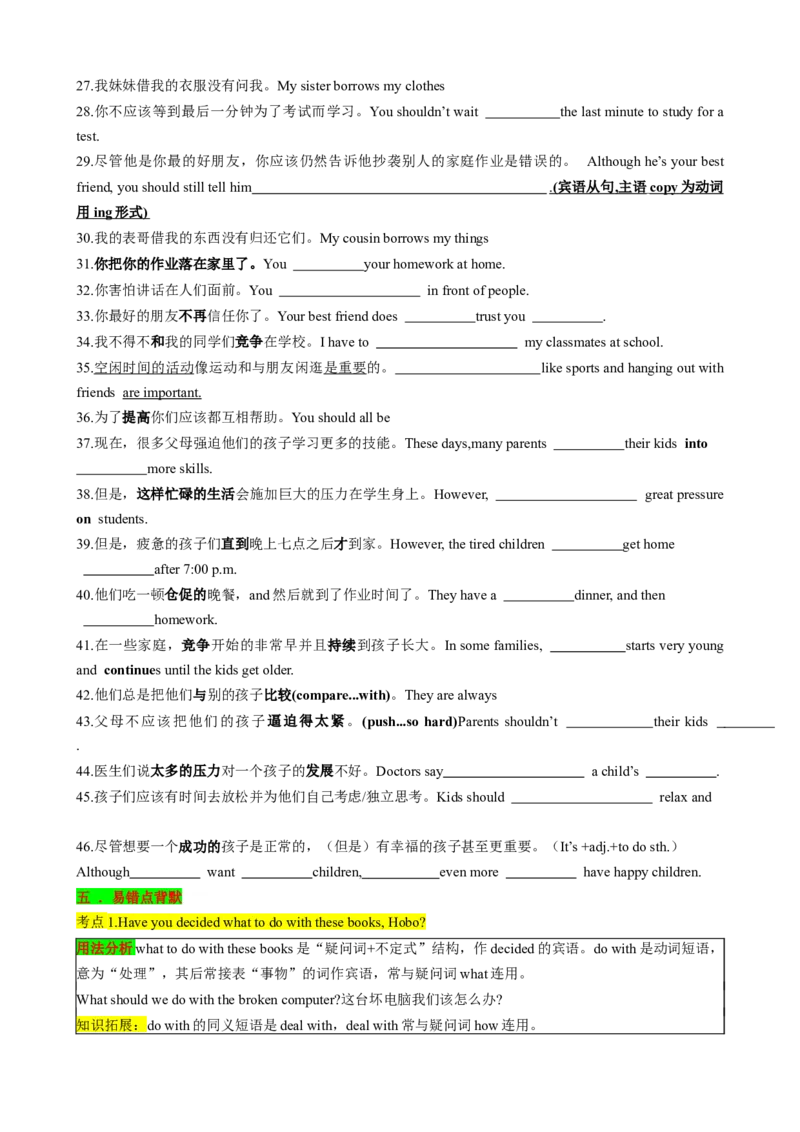
1.我有太多的家庭作业所以我没有任何空闲时间做我喜欢的事情。I have so I
don’t
any free to do things I like.
2.我父母不允许我和朋友闲逛。My parents don’t hang out with my friends.
3.我和我最好的朋友打/吵了一架。I best friend./I had a fight with my best friend.
4.你可以给他写一封信。You could ./ You could write a letter to him.
5.我不想在电话上谈论它。I don’t want to
6.昨天我发现我的妹妹正在浏览我的东西。I my sister looking my things yesterday.
7.她把它们还给你了吗? Did she give them to you?
8.我猜你可以告诉她说抱歉。I guess you could her to say sorry.
9.但是你为什么不忘了这件事呢为了/以便你们可以再成为朋友?But why don’t you forget about it
you can be friends again.
10.尽管她错了,这不是大事。 she is wrong, it’s not a big .
11.希望事情进展顺利(解决)。Hope things .
12.我的问题是我不能与我的家人和睦相处。
(that引导表语从句)My problem is .
13.我 父 母 之 间 的 关 系 已 经 变 得 很 糟 糕 。 between my parents
.
14.我不知道是否我应该对他们说点什么关于这事。I don’t know if I should them
about this.
15.当他们争吵时,就像一块大乌云笼罩在我家上方。When they argue, it’s like a big, black could
our home.
16.而且,我的哥哥对我不是很友好。Also, my elder brother not very me.
17.他总是拒绝让我看我最喜欢的电视节目。He always me watch my favorite TV
show
18.反而他观看任何他想看的直到晚上很晚。Instead he watches he wants until late at night.
19.我认为这是不公平的。 this is fair.
20.在家里我总是感到孤独和焦虑。At home I always feel and .
21.你为什么不和你的家人谈论这些感受呢?Why don’t you these feelings with your
family?
22.如果你的父母正有问题,你应该主动帮忙。If your friends are having problems, you should .
23.或许你可以在家里做更多的工作 为了他们有更多的时间进行合适的交流。
Maybe you could do more jobs around the house proper communication.
24.第二,你为什么不坐下来和你的哥哥交流呢?Secondly, why don’t you sit down and
your brother?
25.你应该解释你不介意他一直看电视。You should explain
26.你可以给我解释如何做这道数学题吗?Can you how to do this math problem?27.我妹妹借我的衣服没有问我。My sister borrows my clothes
28.你不应该等到最后一分钟为了考试而学习。You shouldn’t wait the last minute to study for a
test.
29.尽管他是你最的好朋友,你应该仍然告诉他抄袭别人的家庭作业是错误的。 Although he’s your best
friend, you should still tell him . ( 宾语从句 , 主语 copy 为动词
用 in g 形式 )
30.我的表哥借我的东西没有归还它们。My cousin borrows my things
31.你把你的作业落在家里了。You your homework at home.
32.你害怕讲话在人们面前。You in front of people.
33.你最好的朋友不再信任你了。Your best friend does trust you .
34.我不得不和我的同学们竞争在学校。I have to my classmates at school.
35. 空闲时间的活动 像运动和与朋友闲逛是重要的。 like sports and hanging out with
friends are important.
36.为了提高你们应该都互相帮助。You should all be
37.现在,很多父母强迫他们的孩子学习更多的技能。These days,many parents their kids into
more skills.
38.但是,这样忙碌的生活会施加巨大的压力在学生身上。However, great pressure
on students.
39.但是,疲惫的孩子们直到晚上七点之后才到家。However, the tired children get home
after 7:00 p.m.
40.他们吃一顿仓促的晚餐,and然后就到了作业时间了。They have a dinner, and then
homework.
41.在一些家庭,竞争开始的非常早并且持续到孩子长大。In some families, starts very young
and continues until the kids get older.
42.他们总是把他们与别的孩子比较(compare...with)。They are always
43.父母不应该把他们的孩子逼迫得太紧。(push...so hard)Parents shouldn’t their kids
.
44.医生们说太多的压力对一个孩子的发展不好。Doctors say a child’s .
45.孩子们应该有时间去放松并为他们自己考虑/独立思考。Kids should relax and
46.尽管想要一个成功的孩子是正常的,(但是)有幸福的孩子甚至更重要。(It’s +adj.+to do sth.)
Although want children, even more have happy children.
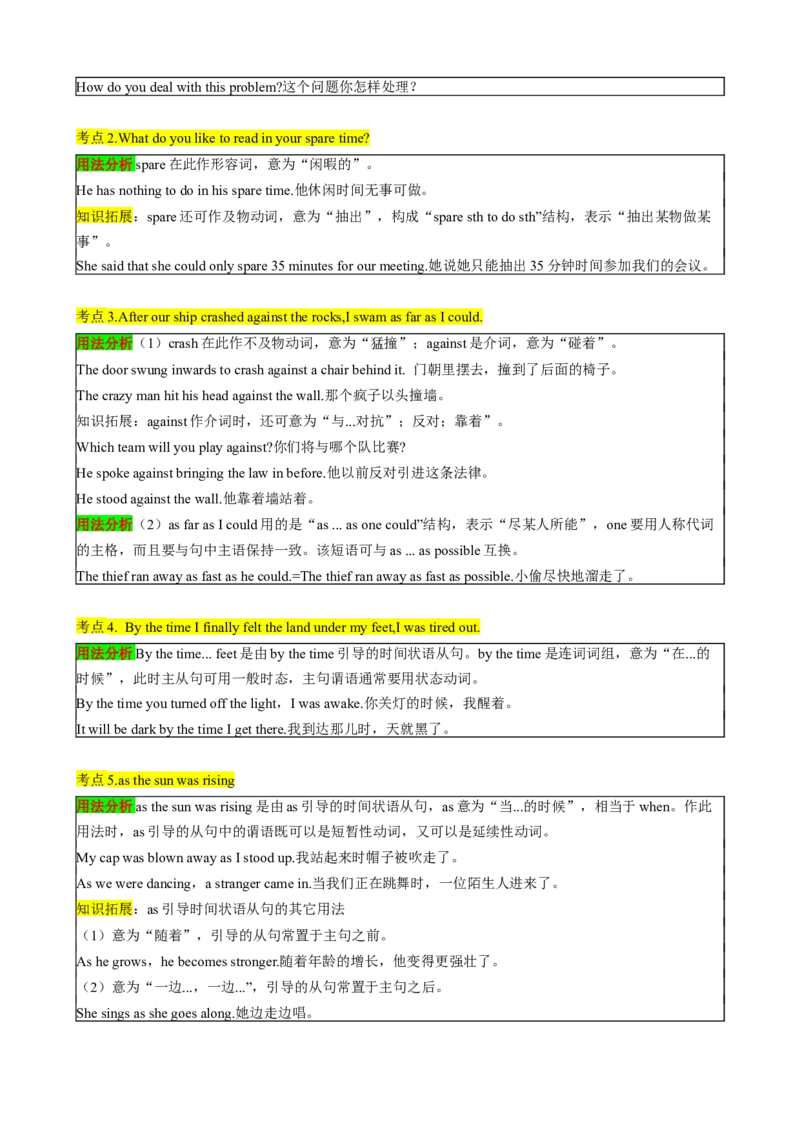
五 .易错点背默
考点1.Have you decided what to do with these books, Hobo?
用法分析what to do with these books是“疑问词+不定式”结构,作decided的宾语。do with是动词短语,
意为“处理”,其后常接表“事物”的词作宾语,常与疑问词what连用。
What should we do with the broken computer?这台坏电脑我们该怎么办?
知识拓展:do with的同义短语是deal with,deal with常与疑问词how连用。How do you deal with this problem?这个问题你怎样处理?
考点2.What do you like to read in your spare time?
用法分析spare在此作形容词,意为“闲暇的”。
He has nothing to do in his spare time.他休闲时间无事可做。
知识拓展:spare还可作及物动词,意为“抽出”,构成“spare sth to do sth”结构,表示“抽出某物做某
事”。
She said that she could only spare 35 minutes for our meeting.她说她只能抽出35分钟时间参加我们的会议。
考点3.After our ship crashed against the rocks,I swam as far as I could.
用法分析(1)crash在此作不及物动词,意为“猛撞”;against是介词,意为“碰着”。
The door swung inwards to crash against a chair behind it. 门朝里摆去,撞到了后面的椅子。
The crazy man hit his head against the wall.那个疯子以头撞墙。
知识拓展:against作介词时,还可意为“与...对抗”;反对;靠着”。
Which team will you play against?你们将与哪个队比赛?
He spoke against bringing the law in before.他以前反对引进这条法律。
He stood against the wall.他靠着墙站着。
用法分析(2)as far as I could用的是“as ... as one could”结构,表示“尽某人所能”,one要用人称代词
的主格,而且要与句中主语保持一致。该短语可与as ... as possible互换。
The thief ran away as fast as he could.=The thief ran away as fast as possible.小偷尽快地溜走了。
考点4. By the time I finally felt the land under my feet,I was tired out.
用法分析By the time... feet是由by the time引导的时间状语从句。by the time是连词词组,意为“在...的
时候”,此时主从句可用一般时态,主句谓语通常要用状态动词。
By the time you turned off the light,I was awake.你关灯的时候,我醒着。
It will be dark by the time I get there.我到达那儿时,天就黑了。
考点5.as the sun was rising
用法分析as the sun was rising是由as引导的时间状语从句,as意为“当...的时候”,相当于when。作此
用法时,as引导的从句中的谓语既可以是短暂性动词,又可以是延续性动词。
My cap was blown away as I stood up.我站起来时帽子被吹走了。
As we were dancing,a stranger came in.当我们正在跳舞时,一位陌生人进来了。
知识拓展:as引导时间状语从句的其它用法
(1)意为“随着”,引导的从句常置于主句之前。
As he grows,he becomes stronger.随着年龄的增长,他变得更强壮了。
(2)意为“一边...,一边...”,引导的从句常置于主句之后。
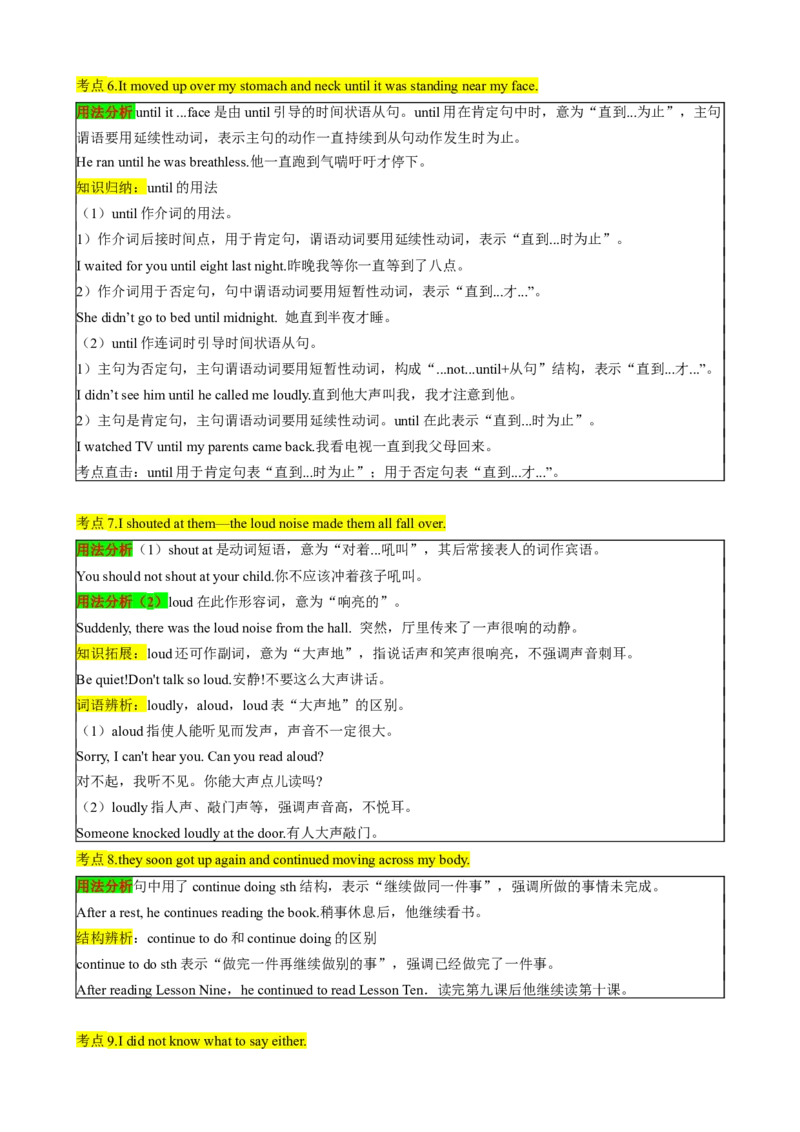
She sings as she goes along.她边走边唱。考点6.It moved up over my stomach and neck until it was standing near my face.
用法分析until it ...face是由until引导的时间状语从句。until用在肯定句中时,意为“直到...为止”,主句
谓语要用延续性动词,表示主句的动作一直持续到从句动作发生时为止。
He ran until he was breathless.他一直跑到气喘吁吁才停下。
知识归纳:until的用法
(1)until作介词的用法。
1)作介词后接时间点,用于肯定句,谓语动词要用延续性动词,表示“直到...时为止”。
I waited for you until eight last night.昨晚我等你一直等到了八点。
2)作介词用于否定句,句中谓语动词要用短暂性动词,表示“直到...才...”。
She didn’t go to bed until midnight. 她直到半夜才睡。
(2)until作连词时引导时间状语从句。
1)主句为否定句,主句谓语动词要用短暂性动词,构成“...not...until+从句”结构,表示“直到...才...”。
I didn’t see him until he called me loudly.直到他大声叫我,我才注意到他。
2)主句是肯定句,主句谓语动词要用延续性动词。until在此表示“直到...时为止”。
I watched TV until my parents came back.我看电视一直到我父母回来。
考点直击:until用于肯定句表“直到...时为止”;用于否定句表“直到...才...”。
考点7.I shouted at them—the loud noise made them all fall over.
用法分析(1)shout at是动词短语,意为“对着...吼叫”,其后常接表人的词作宾语。
You should not shout at your child.你不应该冲着孩子吼叫。
用法分析(2)loud在此作形容词,意为“响亮的”。
Suddenly, there was the loud noise from the hall. 突然,厅里传来了一声很响的动静。
知识拓展:loud还可作副词,意为“大声地”,指说话声和笑声很响亮,不强调声音刺耳。
Be quiet!Don't talk so loud.安静!不要这么大声讲话。
词语辨析:loudly,aloud,loud表“大声地”的区别。
(1)aloud指使人能听见而发声,声音不一定很大。
Sorry, I can't hear you. Can you read aloud?
对不起,我听不见。你能大声点儿读吗?
(2)loudly指人声、敲门声等,强调声音高,不悦耳。
Someone knocked loudly at the door.有人大声敲门。
考点8.they soon got up again and continued moving across my body.
用法分析句中用了continue doing sth结构,表示“继续做同一件事”,强调所做的事情未完成。
After a rest, he continues reading the book.稍事休息后,他继续看书。
结构辨析:continue to do和continue doing的区别
continue to do sth表示“做完一件再继续做别的事”,强调已经做完了一件事。
After reading Lesson Nine,he continued to read Lesson Ten.读完第九课后他继续读第十课。
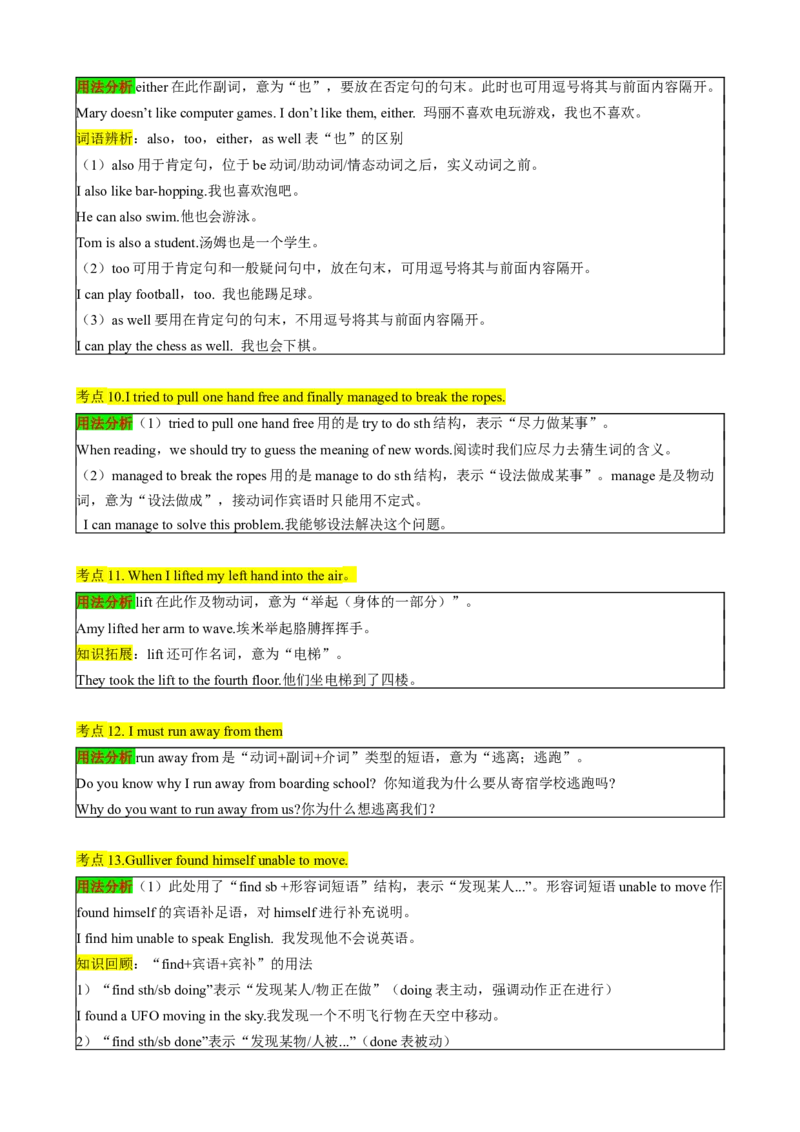
考点9.I did not know what to say either.用法分析either在此作副词,意为“也”,要放在否定句的句末。此时也可用逗号将其与前面内容隔开。
Mary doesn’t like computer games. I don’t like them, either. 玛丽不喜欢电玩游戏,我也不喜欢。
词语辨析:also,too,either,as well表“也”的区别
(1)also用于肯定句,位于be动词/助动词/情态动词之后,实义动词之前。
I also like bar-hopping.我也喜欢泡吧。
He can also swim.他也会游泳。
Tom is also a student.汤姆也是一个学生。
(2)too可用于肯定句和一般疑问句中,放在句末,可用逗号将其与前面内容隔开。
I can play football,too. 我也能踢足球。
(3)as well要用在肯定句的句末,不用逗号将其与前面内容隔开。
I can play the chess as well. 我也会下棋。
考点10.I tried to pull one hand free and finally managed to break the ropes.
用法分析(1)tried to pull one hand free用的是try to do sth结构,表示“尽力做某事”。
When reading,we should try to guess the meaning of new words.阅读时我们应尽力去猜生词的含义。
(2)managed to break the ropes用的是manage to do sth结构,表示“设法做成某事”。manage是及物动
词,意为“设法做成”,接动词作宾语时只能用不定式。
I can manage to solve this problem.我能够设法解决这个问题。
考点11. When I lifted my left hand into the air。
用法分析lift在此作及物动词,意为“举起(身体的一部分)”。
Amy lifted her arm to wave.埃米举起胳膊挥挥手。
知识拓展:lift还可作名词,意为“电梯”。
They took the lift to the fourth floor.他们坐电梯到了四楼。
考点12. I must run away from them
用法分析run away from是“动词+副词+介词”类型的短语,意为“逃离;逃跑”。
Do you know why I run away from boarding school? 你知道我为什么要从寄宿学校逃跑吗?
Why do you want to run away from us?你为什么想逃离我们?
考点13.Gulliver found himself unable to move.
用法分析(1)此处用了“find sb +形容词短语”结构,表示“发现某人...”。形容词短语unable to move作
found himself的宾语补足语,对himself进行补充说明。
I find him unable to speak English. 我发现他不会说英语。
知识回顾:“find+宾语+宾补”的用法
1)“find sth/sb doing”表示“发现某人/物正在做”(doing表主动,强调动作正在进行)
I found a UFO moving in the sky.我发现一个不明飞行物在天空中移动。
2)“find sth/sb done”表示“发现某物/人被...”(done表被动)He was shocked to find all the information in his computer deleted. 他惊讶地发现他电脑里所有的信息都被
删除了。
用法分析(2)unable是able的反义词,意为“不能的”,固定结构为be unable to do sth,表示“不会做
某事”。
I am unable to play the guitar.我不会弹吉他。
考点14.I told myself to calm down since I was still alive.
用法分析(1)since I was still alive是由since引导的原因状语从句。since意为“既然”,引导的从句表示
显然的或已知的理由。
Since you don’t like the car, you don’t have to buy it.
既然你不喜欢这辆车,那你就不必买它了。
词语辨析:because,since,as,for表“因为”的区别
1)because意为“因为”,语气最强,指事情发生的直接原因。
Because he was ill, he was late for school.他生病了,所以迟到了。
2)since的语气比because的语气弱,意为“既然”,表示显然的理由。
Since you don't like it, I' ll put it away.既然你不喜欢,我就把它放在一边。
3)as的语气比since弱,意为“由于;鉴于”, 引导原因状语从句时表示附带说明的“双方已知的原
因”。
As there was no answer, I wrote again.鉴于没回复,我又写了一封信。
4)for作并列连词,引导并列句,语气最弱。for表示“推断”的理由, 只能放于主句之后。
He could not have seen me, for I was not there. 他不可能见过我, 因为我不在那里。
知识回顾:because of是表“原因”的短语,其用法如下:
because of可接名词、代词、V-ing形式,引导的短语可放在句首和句中,常用于引导原因状语;当引导的
短语作表语时,句中主语通常是代词。
Because of his parents being there, I said nothing about it.因为他的父母在场,我便没提及此事。
He arrives late because of the storm.由于暴风雨,他迟到了。
It is all because of what you said. 那完全是因为你说的话。
用法分析(2)alive是形容词,在此作表语,意为“活着的”。
He is dead, but his dog is still alive.他死了,但他的狗仍然还活着。
词语辨析:alive,living,live都可意为“活着的”,它们的区别如下:
(1)living常作前置定语,可修饰人或物,侧重表示“活着的;有生命的”。
He is regarded as one of the best living writers at present.他被视为当今在世的最好作家之一。
English is a living language. 英语是一门鲜活的语言。
(2)alive可作表语,后置定语或补足语,不能作前置定语,可修饰人和物,侧重表示“活着的;有生命
的”。
Who is the greatest man alive? 谁是当今活着的最伟大的人?
The medicine can keep them alive.药物能让他们活着。
(3)live常作前置定语,只用于描述物,侧重表示“活生生的”。Have you seen a live whale? 你看见过活的鲸鱼吗?
考点15.Many birds live in Zhalong all year round, while some go there only for a short stay.
用法分析while some...stay是由while连接的并列句。while在此作并列连词,意为“而;却”,含有对比
关系。
He is strong while his brother is weak. 他长得很结实,而他弟弟却很瘦弱。
知识拓展:while的其它用法
(1)意为“当...的时候”,引导时间状语从句。此时从句谓语动词要用延续性动词或状态动词。
While we were talking, the teacher came in.
当我们正在谈话时,老师进来了。
While you are out,I will take care of him.你外出时,我会照顾他的。
(2)意为“尽管”,引导让步状语从句,多放在主句前,不与but连用。
While I am willing to help you,I don’t have much time available.
尽管我愿意帮你,但我没有多少时间。
(3)意为“只要”,引导条件状语从句。
While there is a will,there is a way.有志者事竟成。
考点16.Treasure Island tells the story of a young boy who sailed the sea to look for the hidden treasure.
用法分析who sailed ...treasure是由关系代词who引导的定语从句,修饰先行词a young boy。who在该定
语从句中作主语。to look for the hidden treasure是动词不定式短语作目的状语。
知识归纳:who引导定语从句的用法
who是关系代词,引导定语从句时要修饰表示人的先行词,在从句中可作主语或宾语。此时who可与that
互换。如果who在定语从句中作宾语,也可与它的宾格形式whom互换。
This is the teacher who teaches us English.这是教我们英语的老师。
She is the girl that/who/whom I met at the party.她是我在晚会上遇见的那个女孩。
考点17.His story gave me a lot of confidence.
用法分析confidence是不可数名词,意为“自信”。
We consider him worthy of confidence.我们认为他是值得信任的。
知识拓展:confidence的形容词是confident,意为“自信的”。其常用结构为be confident of,意为“对...
有信心”,其后可接名词、代词、V-ing作宾语。
I am very confident of my judgments.我对自己的判断很有信心。
He is still confident of winning.他仍然对胜利抱有信心。
考点18.I also want to travel and have exciting experiences in the future.
用法分析experience在此作可数名词时,意为“经历”,有单复数的变化,可用不定冠词修饰。
Please tell us about your experiences in Africa. 请跟我们谈谈你在非洲的经历。
This is an exciting experience.这是一次令人激动的经历。知识拓展:experience的其它用法
(1)作不可数名词,意为“经验”,常构成“experience of”结构。
Have you had any experience of teaching English? 你有过教英语的经验吗?
(2)作及物动词,意为“经受”,要接表“事物”的词作宾语。
Even the King and Queen experienced hardship during the war.连国王和王后在战时都经受了苦难。
考点19.My friends give me lots of advice on books.
用法分析advice是不可数名词,意为“建议”,没有复数形式,其前也不能用不定冠词,但可用some, a
lot/lots of修饰;如果表示“一条建议”,可用a piece of advice。
He has given me some advice.他给了我一些建议。
考点20.They also open up a whole new world to me.
用法分析open up是“动词+副词”类型的短语,在此意为“开启;打开”,所接宾语通常是表“事物”
的词;接名词时名词放在up前后都可以;接代词时代词要放在up之前。
This could open up prized sectors such as retail and airlines.这可能会打开零售业和航空业等重要行业的大
门。
What we have done may open it up.我们做的事情也许能开启它。
词义拓展:open up的其它含义
(1)意为“开拓”
His stories opened up new worlds of the imagination. 他的小说开拓了想象力新天地。
(2)意为“(使某物)开业,开张”
He never opens up the shop on Sundays.星期日他的商店从不营业。
(3)意为“拆开某物”
I will open up a package at once.我将马上打开包裹。
(4)意为“畅谈”
After a few drinks he began to open up a bit. 他喝了几杯酒话就多了起来。
六.语法点记忆
一.“疑问词+动词不定式”结构
“疑问句+不定式”结构相当于一个名词,在句中可作主语、宾语、表语等成分。注意疑问词中只有why
不能用于该结构。
How to go there is still a question.(how to do作主语)
该怎样去那里仍旧是一个问题。
I don’t know where to go.(where to go作宾语)
我不知道去哪里。
The question is who to do it.(who to do it作表语)
问题是谁能去做这件事。
When to start is not known.(不定式短语作主语)什么时候开始还不知道。
知识拓展:连词whether意为“是否”,可构成“whether+不定式”结构,if无此功能。
They do not know whether to negotiate with the terrorists.
他们不知道是否该和那些恐怖分子谈判。
句型拓展:句中谓语动词是ask , tell , show , teach等动词时,其后接有间接宾语(sb)和直接宾语(疑问
词引导的宾语从句)。如果该从句的主语和间接宾语一致,则它可转化成“疑问词+不定式”结构。
Could you tell me how I can get to the post office ?
=Could you tell me how to get to the post office ?
你可以告诉我如何到达邮局吗?(me是间接宾语;how...office从句作直接宾语)
考点直击:“疑问词+动词不定式”结构在句中作宾语的用法。
考点直击:whether表“是否”,可构成“whether+不定式”结构,if无此功能。
考点直击:“疑问词+动词不定式”结构在句中可作宾语,动词原形、分词不能用于该结构。
考点直击:tell接宾语从句作直接宾语时,如果从句中的主语和间接宾语一致,则从句可转换为“疑问词
+不定式”结构。
二.have to和must的用法区别
must和have to都含有“必须”之意,两者的异同点如下:
相同点:它们都要接动词原形构成谓语。
不同点:
(1)have to有人称和数的变化,可与现在时,过去时,将来时,完成时连用;must不与完成时和将来时
连用。
Either you or I will have to do the job.这活不是你就是我得去干。
He has had to do with the worst recession for half a century.
他不得不去应对半个世纪以来最糟糕的大萧条。
(2)把含有have to的肯定句变为否定句、疑问句时,要根据相应的时态选助动词;不管句中是现在时,
还是过去时,把含有must的肯定句变为否定句、疑问句时都要借助must本身。
Does he have to go home?他现在必须回家吗?
Must we go shopping now?我们现在必须去购物吗?
(3)have to的否定式为“助动词+not+ have to”,表示“不必”;must的否定式为mustn’t,表示“不
许”。
We don’t have to go to school on Teachers’ Day.
教师节那天,我们不用去上学。(don’t have to相当于needn’t)
You mustn’t be late for school.你们上学不得迟到。
(4)对含有have to的一般疑问句作答时,要借助疑问句句首的助动词;对含有must的一般疑问句作答
时,肯定回答用Yes,主语+must;否定回答用No,主语+needn’t/助动词+not+have to。
—Did he have to clean the bedroom?—他必须打扫卧室吗?
—No,he didn’t.—不,他不必。
—Must he stop smoking?—他必须戒烟吗?—Yes,he must.—是的。
—Must we go to school now?—我们现在必须去上学吗?
—No,you needn’t/don’t have to.—不,你们不必。
(5)have to强调“因客观情况不得不做某事”,must强调“主观上必须做某事”。
Since my parents are out,I have to look after myself.由于我父母外出了,我不得不照顾我自己。
I must study harder .我必须更加努力学习。
六.写作背默
写作专题——事理说明文
一、要点入门
事理说明文是用简洁明了的语言介绍事物、阐明事理,使人们获得某种知识的一种文体。写好这类
说明文要注意:
1.认真审题,确切把握说明对象,并注意层次性。
2.灵活运用语言,避免对译,对提示中出现的汉语表达,要转换为英语思维,并进行调整或补充。
3.正确使用人称和时态。
二、典型例题
生活就像一面镜子,你冲它笑,它也笑着回敬你。请根据下列表格中所列的要点,以 Learn to smile
为题,写一篇80词左右的短文。
学会对自己微笑 1.面对困难和烦恼时,要学会微笑;
2.会让你自信;
3.有益于身心健康。
学会对他人微笑 1.便于与他人之间的交流;
2.给别人带来快乐,自己也快乐。
微笑是一种语言 人人都能懂,传递爱心和友谊,缩短彼此之间的距离。
要求:
1.可适当发挥,使行文连贯;
2.短文开头已给出,不计入总词数。
参考词语:
smile at sb.对某人微笑
shorten the distance between…缩短……距离
【思路点拨】
承接短文的开头,接下来可分层次说明表格中所列的要点,即学会对自己微笑、学会对他人微笑、
微笑是一种语言。
【满分范文】
Learn to smile一
你将代表学校参加市中学生英语演讲比赛,演讲的题目是"Learning to get along with our parents"。
请你用英语写一篇演讲稿,内容要点如下。
现象 经常跟父母发火,甚至几天不讲话。
1. 父母过分关注分数;
原因
2. 我们……
1. 我们应该和父母沟通;
措施
2. 我们……
(不少于三点)
3. 我们……
要求:1. 表达清楚,语法正确,上下文连贯;
2. 必须包括所有相关信息,并作适当发挥;
3. 词数:80词左右(演讲稿的开头语结尾已给出,不计入总词数)。
Learning to get along with our parents
Ladies and gentlemen,
Good morning. Today my topic is "Learning to get along with our parents".
These days, most of us feel it is hard to get along with our parents.
___________________________________________________________________________________________
___________________________________________________________________________________________
___________________________________________________________________________________________
___________________________________________________________________________________________
___________________________________________________________________________________________
___________________________________________________________________________________________
___________________________________________________________________________________________
___________________________________________________________________________________________
___________________________________________________________________________________________
That’s all for my speech. Thank you!