【同步 100 分背默】Module 9 Friendship 知识清单
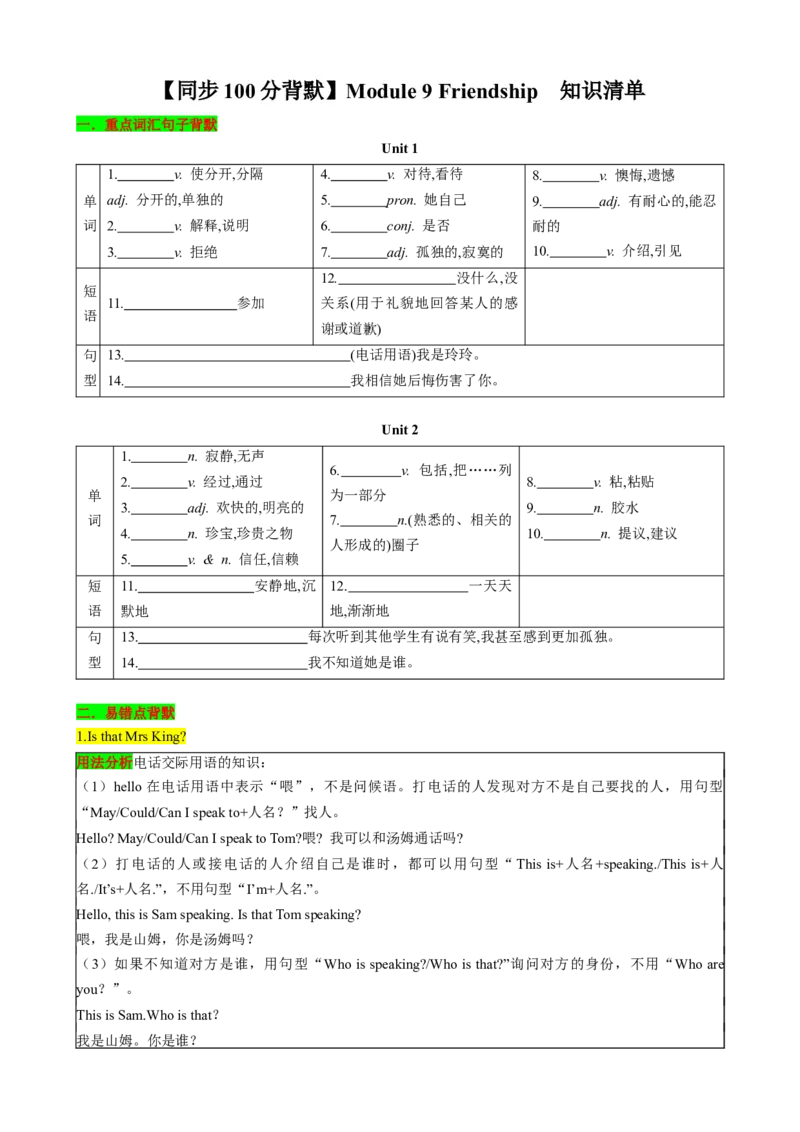
一.重点词汇句子背默
Unit 1
1. v. 使分开,分隔 4. v. 对待,看待 8. v. 懊悔,遗憾
单 adj. 分开的,单独的 5. pron. 她自己 9. adj. 有耐心的,能忍
词 2. v. 解释,说明 6. conj. 是否 耐的
3. v. 拒绝 7. adj. 孤独的,寂寞的 10. v. 介绍,引见
12. 没什么,没
短
11. 参加 关系(用于礼貌地回答某人的感
语
谢或道歉)
句 13. (电话用语)我是玲玲。
型 14. 我相信她后悔伤害了你。
Unit 2
1. n. 寂静,无声
6. v. 包括,把……列
2. v. 经过,通过 8. v. 粘,粘贴
单 为一部分
3. adj. 欢快的,明亮的 9. n. 胶水
词 7. n.(熟悉的、相关的
4. n. 珍宝,珍贵之物 10. n. 提议,建议
人形成的)圈子
5. v. & n. 信任,信赖
短 11. 安静地,沉 12. 一天天
语 默地 地,渐渐地
句 13. 每次听到其他学生有说有笑,我甚至感到更加孤独。
型 14. 我不知道她是谁。
二.易错点背默
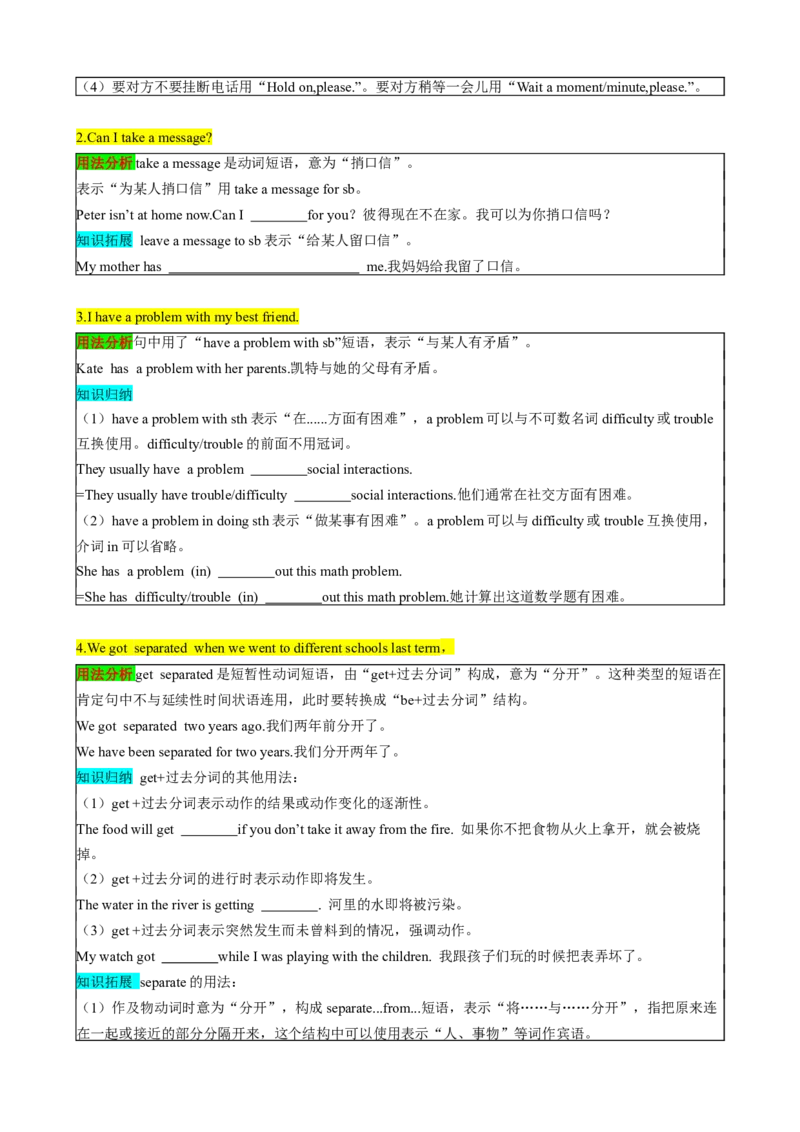
1.Is that Mrs King?
用法分析电话交际用语的知识:
(1)hello在电话用语中表示“喂”,不是问候语。打电话的人发现对方不是自己要找的人,用句型
“May/Could/Can I speak to+人名?”找人。
Hello? May/Could/Can I speak to Tom?喂? 我可以和汤姆通话吗?
(2)打电话的人或接电话的人介绍自己是谁时,都可以用句型“This is+人名+speaking./This is+人
名./It’s+人名.”,不用句型“I’m+人名.”。
Hello, this is Sam speaking. Is that Tom speaking?
喂,我是山姆,你是汤姆吗?
(3)如果不知道对方是谁,用句型“Who is speaking?/Who is that?”询问对方的身份,不用“Who are
you?”。
This is Sam.Who is that?
我是山姆。你是谁?(4)要对方不要挂断电话用“Hold on,please.”。要对方稍等一会儿用“Wait a moment/minute,please.”。
2.Can I take a message?
用法分析take a message是动词短语,意为“捎口信”。
表示“为某人捎口信”用take a message for sb。
Peter isn’t at home now.Can I for you?彼得现在不在家。我可以为你捎口信吗?
知识拓展 leave a message to sb表示“给某人留口信”。
My mother has me.我妈妈给我留了口信。
3.I have a problem with my best friend.
用法分析句中用了“have a problem with sb”短语,表示“与某人有矛盾”。
Kate has a problem with her parents.凯特与她的父母有矛盾。
知识归纳
(1)have a problem with sth表示“在......方面有困难”,a problem可以与不可数名词difficulty或trouble
互换使用。difficulty/trouble的前面不用冠词。
They usually have a problem social interactions.
=They usually have trouble/difficulty social interactions.他们通常在社交方面有困难。
(2)have a problem in doing sth表示“做某事有困难”。a problem可以与difficulty或trouble互换使用,
介词in可以省略。
She has a problem (in) out this math problem.
=She has difficulty/trouble (in) out this math problem.她计算出这道数学题有困难。
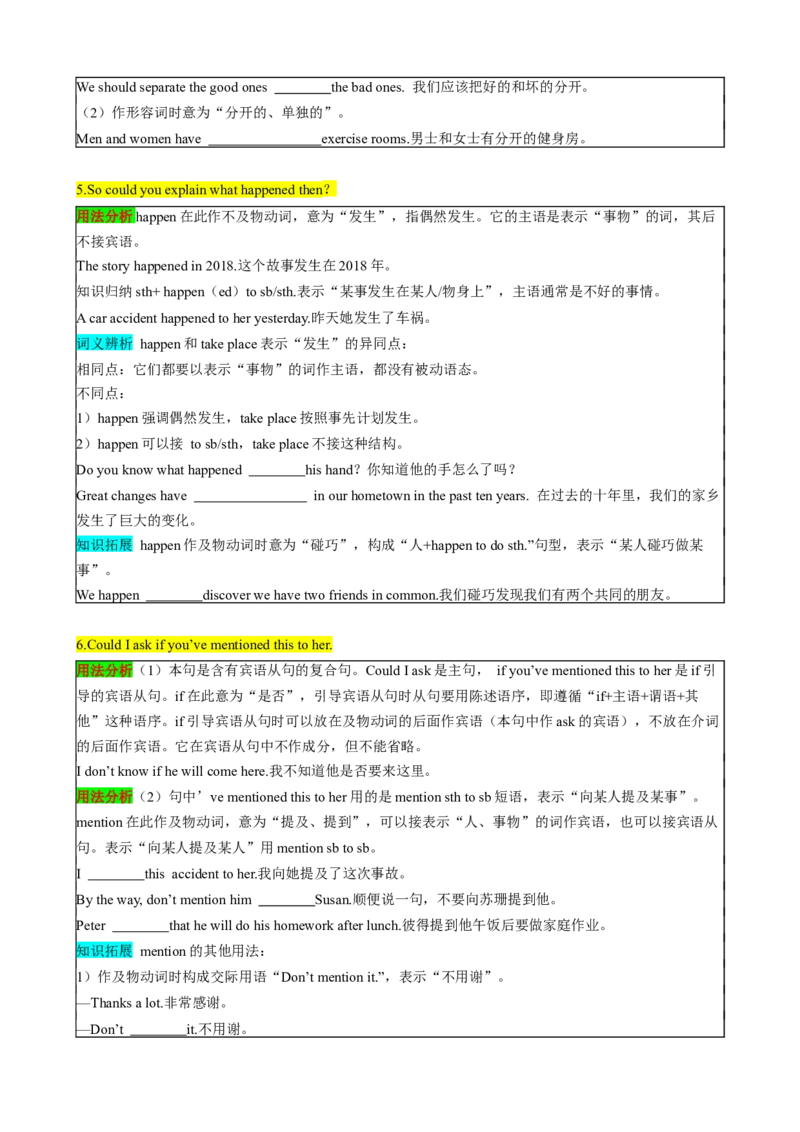
4.We got separated when we went to different schools last term,
用法分析get separated是短暂性动词短语,由“get+过去分词”构成,意为“分开”。这种类型的短语在
肯定句中不与延续性时间状语连用,此时要转换成“be+过去分词”结构。
We got separated two years ago.我们两年前分开了。
We have been separated for two years.我们分开两年了。
知识归纳 get+过去分词的其他用法:
(1)get +过去分词表示动作的结果或动作变化的逐渐性。
The food will get if you don’t take it away from the fire. 如果你不把食物从火上拿开,就会被烧
掉。
(2)get +过去分词的进行时表示动作即将发生。
The water in the river is getting . 河里的水即将被污染。
(3)get +过去分词表示突然发生而未曾料到的情况,强调动作。
My watch got while I was playing with the children. 我跟孩子们玩的时候把表弄坏了。
知识拓展 separate的用法:
(1)作及物动词时意为“分开”,构成separate...from...短语,表示“将……与……分开”,指把原来连
在一起或接近的部分分隔开来,这个结构中可以使用表示“人、事物”等词作宾语。We should separate the good ones the bad ones. 我们应该把好的和坏的分开。
(2)作形容词时意为“分开的、单独的”。
Men and women have exercise rooms.男士和女士有分开的健身房。
5.So could you explain what happened then?
用法分析happen在此作不及物动词,意为“发生”,指偶然发生。它的主语是表示“事物”的词,其后
不接宾语。
The story happened in 2018.这个故事发生在2018年。
知识归纳sth+ happen(ed)to sb/sth.表示“某事发生在某人/物身上”,主语通常是不好的事情。
A car accident happened to her yesterday.昨天她发生了车祸。
词义辨析 happen和take place表示“发生”的异同点:
相同点:它们都要以表示“事物”的词作主语,都没有被动语态。
不同点:
1)happen强调偶然发生,take place按照事先计划发生。
2)happen可以接 to sb/sth,take place不接这种结构。
Do you know what happened his hand?你知道他的手怎么了吗?
Great changes have in our hometown in the past ten years. 在过去的十年里,我们的家乡
发生了巨大的变化。
知识拓展 happen作及物动词时意为“碰巧”,构成“人+happen to do sth.”句型,表示“某人碰巧做某
事”。
We happen discover we have two friends in common.我们碰巧发现我们有两个共同的朋友。
6.Could I ask if you’ve mentioned this to her.
用法分析(1)本句是含有宾语从句的复合句。Could I ask是主句, if you’ve mentioned this to her是if引
导的宾语从句。if在此意为“是否”,引导宾语从句时从句要用陈述语序,即遵循“if+主语+谓语+其
他”这种语序。if引导宾语从句时可以放在及物动词的后面作宾语(本句中作ask的宾语),不放在介词
的后面作宾语。它在宾语从句中不作成分,但不能省略。
I don’t know if he will come here.我不知道他是否要来这里。
用法分析(2)句中’ve mentioned this to her用的是mention sth to sb短语,表示“向某人提及某事”。
mention在此作及物动词,意为“提及、提到”,可以接表示“人、事物”的词作宾语,也可以接宾语从
句。表示“向某人提及某人”用mention sb to sb。
I this accident to her.我向她提及了这次事故。
By the way, don’t mention him Susan.顺便说一句,不要向苏珊提到他。
Peter that he will do his homework after lunch.彼得提到他午饭后要做家庭作业。
知识拓展 mention的其他用法:
1)作及物动词时构成交际用语“Don’t mention it.”,表示“不用谢”。
—Thanks a lot.非常感谢。
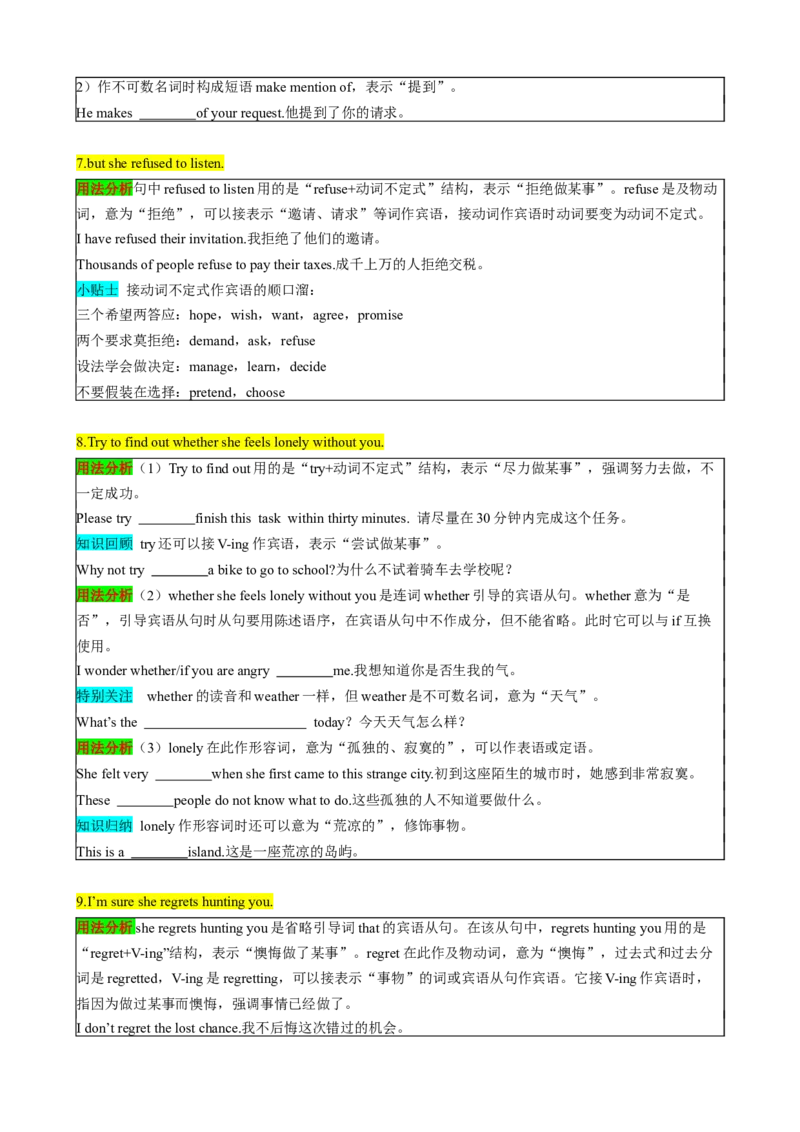
—Don’t it.不用谢。2)作不可数名词时构成短语make mention of,表示“提到”。
He makes of your request.他提到了你的请求。
7.but she refused to listen.
用法分析句中refused to listen用的是“refuse+动词不定式”结构,表示“拒绝做某事”。refuse是及物动
词,意为“拒绝”,可以接表示“邀请、请求”等词作宾语,接动词作宾语时动词要变为动词不定式。
I have refused their invitation.我拒绝了他们的邀请。
Thousands of people refuse to pay their taxes.成千上万的人拒绝交税。
小贴士 接动词不定式作宾语的顺口溜:
三个希望两答应:hope,wish,want,agree,promise
两个要求莫拒绝:demand,ask,refuse
设法学会做决定:manage,learn,decide
不要假装在选择:pretend,choose
8.Try to find out whether she feels lonely without you.
用法分析(1)Try to find out用的是“try+动词不定式”结构,表示“尽力做某事”,强调努力去做,不
一定成功。
Please try finish this task within thirty minutes. 请尽量在30分钟内完成这个任务。
知识回顾 try还可以接V-ing作宾语,表示“尝试做某事”。
Why not try a bike to go to school?为什么不试着骑车去学校呢?
用法分析(2)whether she feels lonely without you是连词whether引导的宾语从句。whether意为“是
否”,引导宾语从句时从句要用陈述语序,在宾语从句中不作成分,但不能省略。此时它可以与if互换
使用。
I wonder whether/if you are angry me.我想知道你是否生我的气。
特别关注 whether的读音和weather一样,但weather是不可数名词,意为“天气”。
What’s the today?今天天气怎么样?
用法分析(3)lonely在此作形容词,意为“孤独的、寂寞的”,可以作表语或定语。
She felt very when she first came to this strange city.初到这座陌生的城市时,她感到非常寂寞。
These people do not know what to do.这些孤独的人不知道要做什么。
知识归纳 lonely作形容词时还可以意为“荒凉的”,修饰事物。
This is a island.这是一座荒凉的岛屿。
9.I’m sure she regrets hunting you.
用法分析she regrets hunting you是省略引导词that的宾语从句。在该从句中,regrets hunting you用的是
“regret+V-ing”结构,表示“懊悔做了某事”。regret在此作及物动词,意为“懊悔”,过去式和过去分
词是regretted,V-ing是regretting,可以接表示“事物”的词或宾语从句作宾语。它接V-ing作宾语时,
指因为做过某事而懊悔,强调事情已经做了。
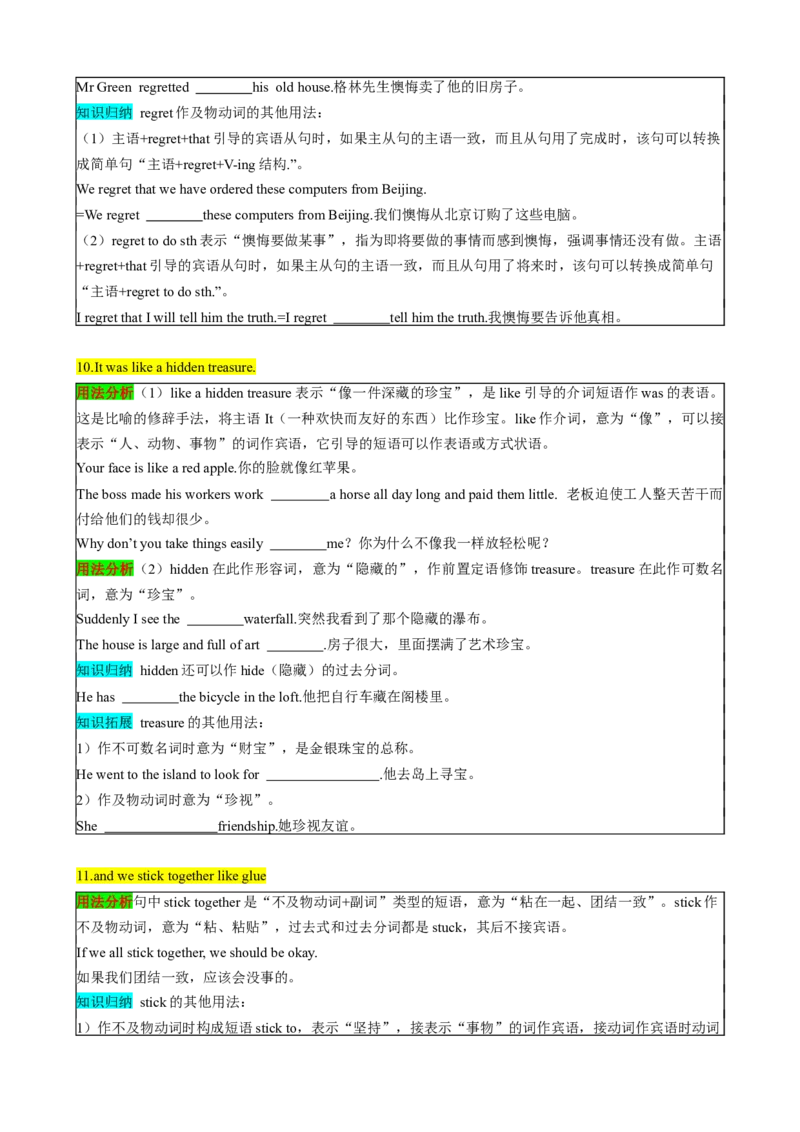
I don’t regret the lost chance.我不后悔这次错过的机会。Mr Green regretted his old house.格林先生懊悔卖了他的旧房子。
知识归纳 regret作及物动词的其他用法:
(1)主语+regret+that引导的宾语从句时,如果主从句的主语一致,而且从句用了完成时,该句可以转换
成简单句“主语+regret+V-ing结构.”。
We regret that we have ordered these computers from Beijing.
=We regret these computers from Beijing.我们懊悔从北京订购了这些电脑。
(2)regret to do sth表示“懊悔要做某事”,指为即将要做的事情而感到懊悔,强调事情还没有做。主语
+regret+that引导的宾语从句时,如果主从句的主语一致,而且从句用了将来时,该句可以转换成简单句
“主语+regret to do sth.”。
I regret that I will tell him the truth.=I regret tell him the truth.我懊悔要告诉他真相。
10.It was like a hidden treasure.
用法分析(1)like a hidden treasure表示“像一件深藏的珍宝”,是like引导的介词短语作was的表语。
这是比喻的修辞手法,将主语It(一种欢快而友好的东西)比作珍宝。like作介词,意为“像”,可以接
表示“人、动物、事物”的词作宾语,它引导的短语可以作表语或方式状语。
Your face is like a red apple.你的脸就像红苹果。
The boss made his workers work a horse all day long and paid them little. 老板迫使工人整天苦干而
付给他们的钱却很少。
Why don’t you take things easily me?你为什么不像我一样放轻松呢?
用法分析(2)hidden在此作形容词,意为“隐藏的”,作前置定语修饰treasure。treasure在此作可数名
词,意为“珍宝”。
Suddenly I see the waterfall.突然我看到了那个隐藏的瀑布。
The house is large and full of art .房子很大,里面摆满了艺术珍宝。
知识归纳 hidden还可以作hide(隐藏)的过去分词。
He has the bicycle in the loft.他把自行车藏在阁楼里。
知识拓展 treasure的其他用法:
1)作不可数名词时意为“财宝”,是金银珠宝的总称。
He went to the island to look for .他去岛上寻宝。
2)作及物动词时意为“珍视”。
She friendship.她珍视友谊。
11.and we stick together like glue
用法分析句中stick together是“不及物动词+副词”类型的短语,意为“粘在一起、团结一致”。stick作
不及物动词,意为“粘、粘贴”,过去式和过去分词都是stuck,其后不接宾语。
If we all stick together, we should be okay.
如果我们团结一致,应该会没事的。
知识归纳 stick的其他用法:
1)作不及物动词时构成短语stick to,表示“坚持”,接表示“事物”的词作宾语,接动词作宾语时动词要变为V-ing形式。
I stick my opinion.我坚持自己的观点。
Betty sticks to to English.贝蒂坚持听英语。
2)作及物动词时意为“粘贴、插”。
I have already stuck on all these letters.我已经把邮票粘在这些信上。
In China,you’re not supposed to your chopsticks into the food.在中国,你不应该把筷子插在食物
里。
3)作可数名词时意为“枝条、棍、棍棒物”。
He stuck a into the ground.他把一根棍子插进地里。
12.My suggestion is:
用法分析suggestion是可数名词,意为“建议”,指为了改进工作或解决问题而提出的建议。它的前面可
以用a修饰,复数形式是suggestions。表示“关于......的建议”用suggestion(s) on+名词/V-ing/疑问词+动
词不定式(on可以换成about)。
Anne offered a good .安妮提出了一个不错的建议。
I can give you some on/about learning English.我可以就学习英语给你一些建议。
用法辨析 advice和suggestion作名词表示“建议”的区别:
advice作此意时作不可数名词,不能用不定冠词修饰它,没有单复数的变化。它指具有较强实用性和可操
作性的建议。表示“一条建议”用a piece of advice。表示“几条建议”用a few pieces of advice。
I want a piece of from each of you.我想要你们每人提一个建议。
You can turn to your parents for some on how to look for a job.对于如何找工作, 你可以向父母请
教。
三.语法点记忆
什么是宾语从句?在一个复合句子中,宾语是一个句子,我们把这个句子叫宾语从句。
I know him. (简单句,know谓语动词, him 宾语)
I know who he is. (复合句,know 谓语动词, who he is 宾语从句)
“She is a good girl,” the teacher told us.
(1)当宾语从句是由陈述句转
→The teacher told us(that)she was a good girl.
化而来时,用that引导
老师告诉我们她是一个好女孩。
“Are you from Japan?” he asked me.
(2)当宾语从句是由一般疑问
引导词 =He asked me if/whether I was from Japan.
句转化而来时,宾语从句用
他问我是不是来自日本。
whether或if连接。
“Do you like watching TV?” he asked me.
有 or not 结尾只用 whethe r
=He asked me if/whether I liked watching TV.
介词后只用 whethe r
他问我是否喜欢看电视。(3)当宾语从句是由特殊疑问
When did he leave for Japan? Could you tell me?
句转化而来时,连接词就用原
=Could you tell me when he left for Japan?
来的特殊疑问词,但从句一定
你能告诉我他什么时候去的日本吗?
要注意用陈述句语序
I remember he gave me a book yesterday.
主句为一般现在时态时,从句 我记得他昨天给了我一本书。
的时态可根据实际情况而定 He says that he will leave for New York tomorrow.
他说明天他将动身去纽约。
He told me that he would take part in the high jump.
时 主句为一般过去时态时,从句
他告诉我他将会参加跳高比赛。
态 应用相应的过去时态 (一般过
注意:主句 could, would 表委婉,不是过去时态
去时、过去进行时、过去将
Could you please tell me where we show our tickets ?
来时、过去完成时)
你能告诉我,我们可以在哪兑票吗?
当从句内容为客观事实或真 He told me that the earth goes around the sun.(真理)
理时,从句要用一般现在时 他告诉我地球绕着太阳转。
宾语从句的语序要用陈述句
语序。把两个独立的句子连 What’s Kate’s e-mail address? Do you know?
语
成一个含有宾语从句的复合 →Do you know what Kate’s e-mail address is?
序
句时,要特别注意从句的语序, 你知道凯特的电子邮件地址吗?
即按照主语、谓语的顺序
【注意点:否定转移】
当主句的主语为第一人称,谓语动词是think, believe, suppose等时,要将宾语从句的否定词转移到主
句中,即主句的谓语动词用否定形式,而宾语从句的谓语动词用肯定形式。
I don’t think he will come with you.我认为他不会和你一起来。
【宾语从句解题口诀】
一是关键引导词,不同句子词相异。
陈述句子用that;一般疑问是否(if,whether)替;特殊问句更好办,引导还用疑问词。
二是时态常变化,主句不同从句异。
主句若为现在时,从句时态应看意;主句若为过去时,从句时态应变相应过; 从句若为真理时,永用一般现
在时。
三是语序要记清,从句永保陈述序。
一、句型转换。
1.Were you born in Beijing?I want to know that.(合并为一句)
I want to know_______ ________ _________born in Beijing.
2.Where can I buy the latest newspaper?Could you tell me?(合并为一句)
Could you tell me________ ________ ________buy the latest newspaper?
3.My deskmate asked me,“How will you go to school the next day?”(改为宾语从句)
My deskmate asked me________ ________ ________go to school the next day.4.The girl doesn’t know what she should do next.(简化宾语从句)
The girl doesn't know _______ ________ ________next.
5.I suppose the novel is interesting and meaningful.(改为否定句)
I________ ________the novel________ interesting and meaningful.
二、用宾语从句引导词填空。
Historians pointed out that hats had existed for a long time. But have you ever thought about 1.______the
hats appeared exactly? Do you know 2.______invented the hats? Maybe no one really knows but we
know3.________hats have played an important role throughout the development of civilization ( 文
明).Nowadays,people regard them as tools to prevent the sun and know 4._________to turn them into a
changing fashion accessories(配饰).
三、将下列句子合并成一句。 (注意时态,人称,语序)
1. “Where do they stop on the way?” I asked.
__________________________________________________
2. “What will you speak at the meeting?” Could you tell me?
__________________________________________________
3. “Do they like to make friends with me?” He asked.
__________________________________________________
4. “I am doing my homework.” He said.
__________________________________________________
5. “I will come back.” Tom said.
__________________________________________________
6. “Is Tony doing his homework?” Jim asked.
__________________________________________________
四.写作背默
本模块的话题是"友谊",属于人际交往,与学生息息相关。具体到写作上,学生需要做到能够描述朋
友的外貌及性格;能表达自己对友谊的观点;保持积极乐观的交友态度。
某班召开了主题为"What is friendship?"(话题:友谊)的班会,请你根据他们讨论出的观点写一篇英
语短文,并谈谈你自己的看法。
内容提示:
1.相互帮助,相互信任;
2.共同分担悲伤,分享喜悦;
3.……
要求:1.可适当增加细节,以使行文连贯;2.80词左右。素材积累
词汇
help each other相互帮助 trust each other相互信任 share happiness and joy分享幸福与喜悦
laugh at嘲笑 as well as也 treasure珍惜 in a word总之 in one's opinion在某人看来
句子
1.Everyone needs friendship. 人人都需要友谊。
2.I think friendship is ... in the world.我认为友谊是世界上……
3.True friends should...真正的朋友应该……
4.True friends share not only joy, but also sorrow.真正的朋友不仅仅分享快乐,还分担悲伤。
5.A true friend reaches for your hand and touches your heart.真正的朋友会为你伸出援助之手,并触动你的心
灵。
6.A person without a friend is like the world without sunshine.一个人没有朋友就像世界没有阳光。
7.It's important to communicate more with our friends.多和朋友沟通很重要。
8.I hope our friendship can last forever. 我希望我们的友谊可以长存。
9.A friend in need is a friend indeed. 患难见真情。