Unit 4 Why don’t you talk to your parents ?
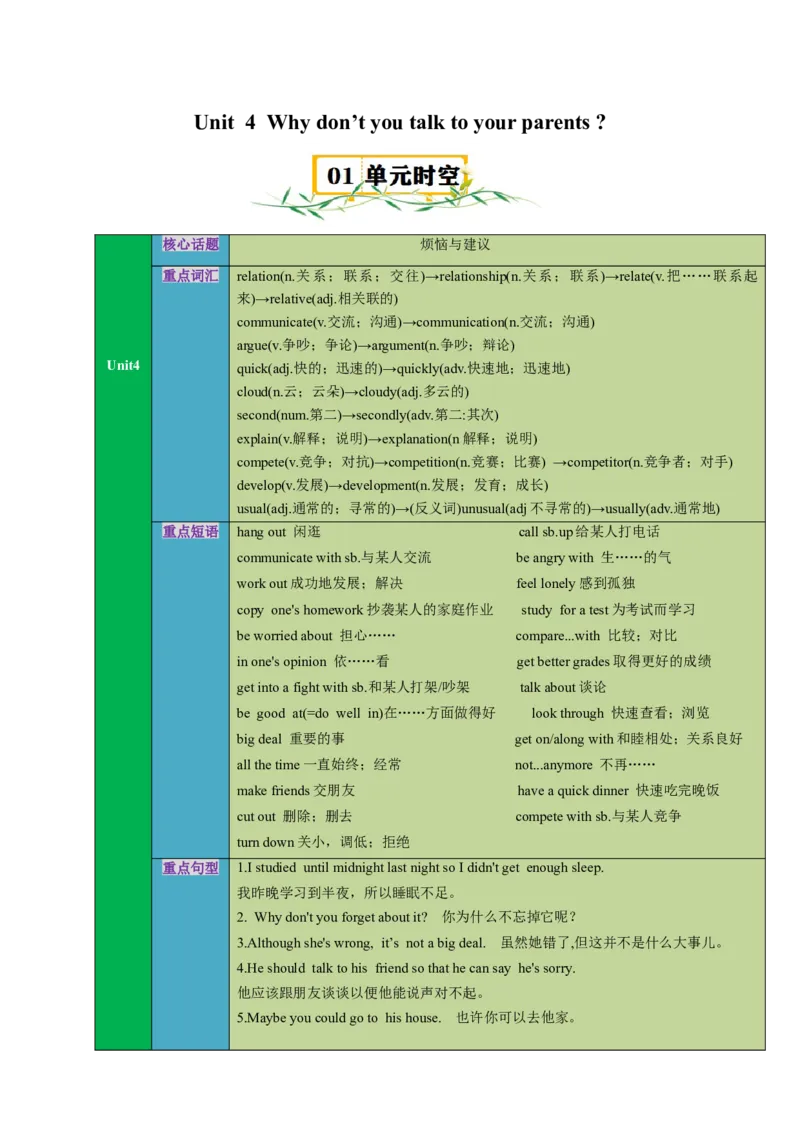
核心话题 烦恼与建议
重点词汇 relation(n.关系;联系;交往)→relationship(n.关系;联系)→relate(v.把……联系起
来)→relative(adj.相关联的)
communicate(v.交流;沟通)→communication(n.交流;沟通)
argue(v.争吵;争论)→argument(n.争吵;辩论)
Unit4 quick(adj.快的;迅速的)→quickly(adv.快速地;迅速地)
cloud(n.云;云朵)→cloudy(adj.多云的)
second(num.第二)→secondly(adv.第二:其次)
explain(v.解释;说明)→explanation(n解释;说明)
compete(v.竞争;对抗)→competition(n.竞赛;比赛) →competitor(n.竞争者;对手)
develop(v.发展)→development(n.发展;发育;成长)
usual(adj.通常的;寻常的)→(反义词)unusual(adj不寻常的)→usually(adv.通常地)
重点短语 hang out 闲逛 call sb.up给某人打电话
communicate with sb.与某人交流 be angry with 生……的气
work out成功地发展;解决 feel lonely感到孤独
copy one's homework抄袭某人的家庭作业 study for a test为考试而学习
be worried about 担心…… compare...with 比较;对比
in one's opinion 依……看 get better grades取得更好的成绩
get into a fight with sb.和某人打架/吵架 talk about谈论
be good at(=do well in)在……方面做得好 look through 快速查看;浏览
big deal 重要的事 get on/along with和睦相处;关系良好
all the time一直始终;经常 not...anymore 不再……
make friends交朋友 have a quick dinner 快速吃完晚饭
cut out 删除;删去 compete with sb.与某人竞争
turn down关小,调低;拒绝
重点句型 1.I studied until midnight last night so I didn't get enough sleep.
我昨晚学习到半夜,所以睡眠不足。
2. Why don't you forget about it? 你为什么不忘掉它呢?
3.Although she's wrong, it’s not a big deal. 虽然她错了,但这并不是什么大事儿。
4.He should talk to his friend so that he can say he's sorry.
他应该跟朋友谈谈以便他能说声对不起。
5.Maybe you could go to his house. 也许你可以去他家。6.I guess I could, but I don't want to surprise him.
我想我可以,但我不想让他感到惊讶。
语法 1.情态动词should与could的用法;
2. Why don’t you...? 等提建议的句型及其常用答语;
3. 连词until,so that,although引导的状语从句。
写作 阐明自己与他人的烦恼,并向他人征求意见
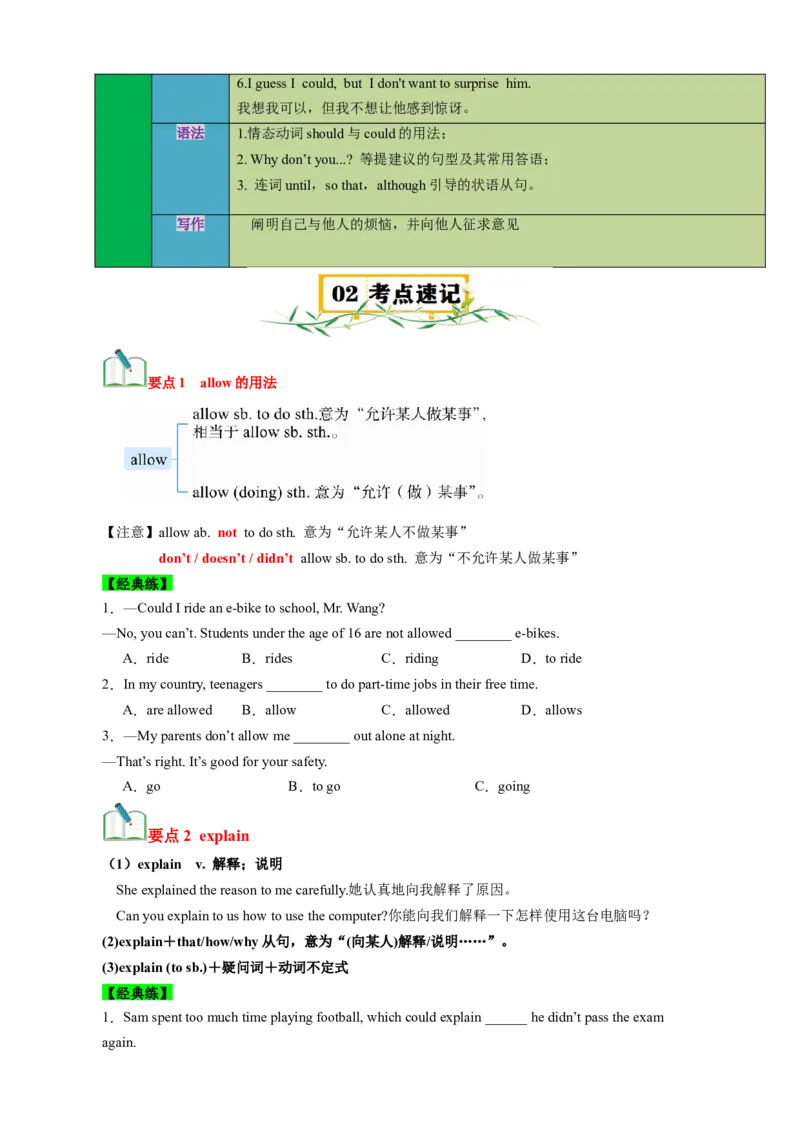
要点1 allow的用法
【注意】allow ab. not to do sth. 意为“允许某人不做某事”
don’t / doesn’t / didn’t allow sb. to do sth. 意为“不允许某人做某事”
【经典练】
1.—Could I ride an e-bike to school, Mr. Wang?
—No, you can’t. Students under the age of 16 are not allowed ________ e-bikes.
A.ride B.rides C.riding D.to ride
2.In my country, teenagers ________ to do part-time jobs in their free time.
A.are allowed B.allow C.allowed D.allows
3.—My parents don’t allow me ________ out alone at night.
—That’s right. It’s good for your safety.
A.go B.to go C.going
要点2 explain
(1)explain v. 解释;说明
She explained the reason to me carefully.她认真地向我解释了原因。
Can you explain to us how to use the computer?你能向我们解释一下怎样使用这台电脑吗?
(2)explain+that/how/why从句,意为“(向某人)解释/说明……”。
(3)explain (to sb.)+疑问词+动词不定式
【经典练】
1.Sam spent too much time playing football, which could explain ______ he didn’t pass the exam
again.A.when B.where C.what D.why
2.It’s no use ________. The customer has left.
A.explain B.explained C.to explain D.explaining
要点3 find的用法
Well, I found my sister looking through my things yesterday. 唉,昨天我发现我妹妹在翻看我
的东西。
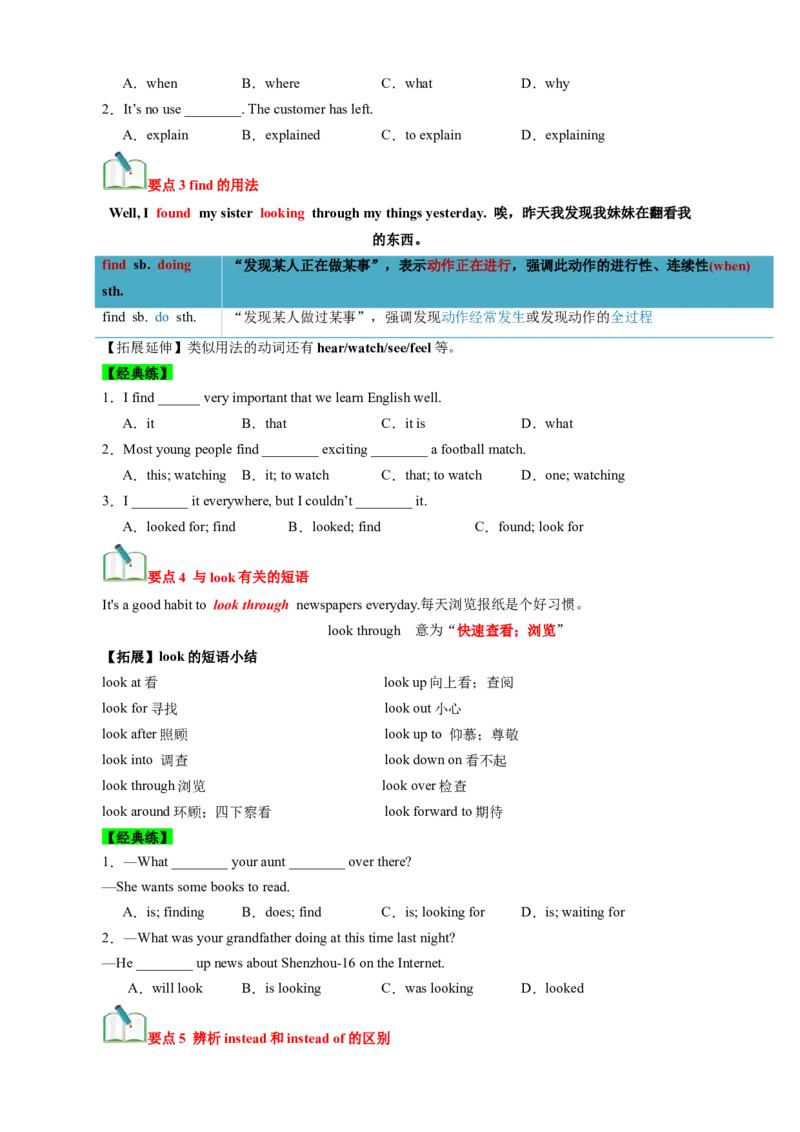
find sb. doing “发现某人正在做某事”,表示动作正在进行,强调此动作的进行性、连续性(when)
sth.
find sb. do sth. “发现某人做过某事”,强调发现动作经常发生或发现动作的全过程
【拓展延伸】类似用法的动词还有hear/watch/see/feel等。
【经典练】
1.I find ______ very important that we learn English well.
A.it B.that C.it is D.what
2.Most young people find ________ exciting ________ a football match.
A.this; watching B.it; to watch C.that; to watch D.one; watching
3.I ________ it everywhere, but I couldn’t ________ it.
A.looked for; find B.looked; find C.found; look for
要点4 与look有关的短语
It's a good habit to look through newspapers everyday.每天浏览报纸是个好习惯。
look through 意为“快速查看;浏览”
【拓展】look的短语小结
look at看 look up向上看;查阅
look for寻找 look out小心
look after照顾 look up to 仰慕;尊敬
look into 调查 look down on看不起
look through浏览 look over检查
look around环顾;四下察看 look forward to期待
【经典练】
1.—What ________ your aunt ________ over there?
—She wants some books to read.
A.is; finding B.does; find C.is; looking for D.is; waiting for
2.—What was your grandfather doing at this time last night?
—He ________ up news about Shenzhou-16 on the Internet.
A.will look B.is looking C.was looking D.looked
要点5 辨析instead和instead of的区别Instead he watches whatever he wants until late at night. 相反,他却可以看他想看的任何节目
一直到深夜。
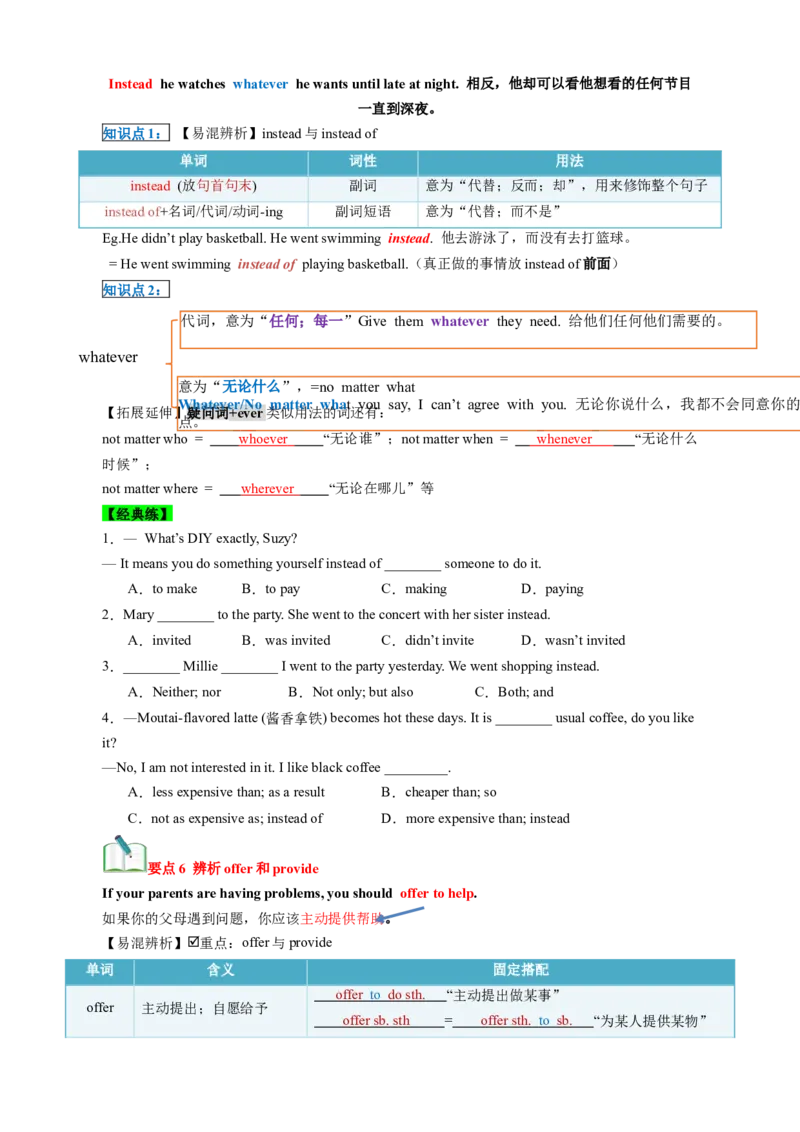
知识点1: 【易混辨析】instead与instead of
单词 词性 用法
instead (放句首句末) 副词 意为“代替;反而;却”,用来修饰整个句子
instead of+名词/代词/动词-ing 副词短语 意为“代替;而不是”
Eg.He didn’t play basketball. He went swimming instead. 他去游泳了,而没有去打篮球。
= He went swimming instead of playing basketball.(真正做的事情放instead of前面)
知识点2:
代词,意为“任何;每一”Give them whatever they need. 给他们任何他们需要的。
whatever
意为“无论什么”,=no matter what
Whatever/No matter what you say, I can’t agree with you. 无论你说什么,我都不会同意你的观
【拓展延伸】疑问词+ever类似用法的词还有:
点。
not matter who = whoever “无论谁”;not matter when = whenever “无论什么
时候”;
not matter where = wherever “无论在哪儿”等
【经典练】
1.— What’s DIY exactly, Suzy?
— It means you do something yourself instead of ________ someone to do it.
A.to make B.to pay C.making D.paying
2.Mary ________ to the party. She went to the concert with her sister instead.
A.invited B.was invited C.didn’t invite D.wasn’t invited
3.________ Millie ________ I went to the party yesterday. We went shopping instead.
A.Neither; nor B.Not only; but also C.Both; and
4.—Moutai-flavored latte (酱香拿铁) becomes hot these days. It is ________ usual coffee, do you like
it?
—No, I am not interested in it. I like black coffee _________.
A.less expensive than; as a result B.cheaper than; so
C.not as expensive as; instead of D.more expensive than; instead
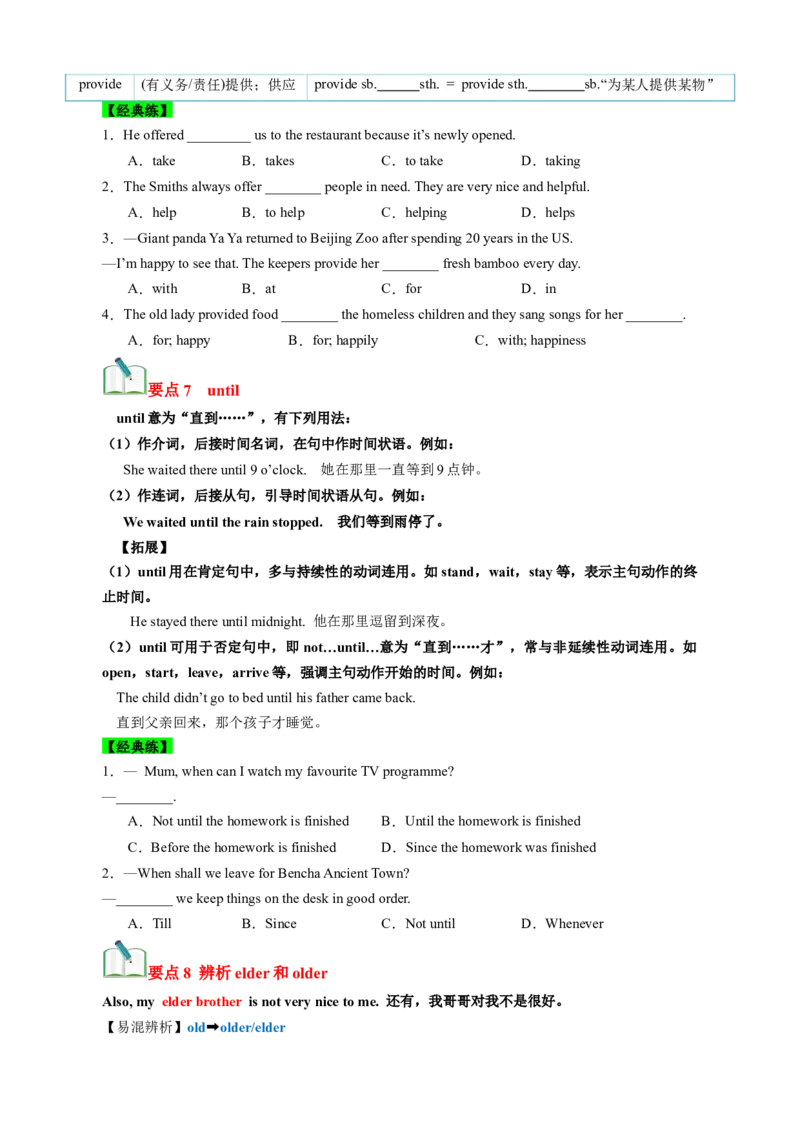
要点6 辨析offer和provide
If your parents are having problems, you should offer to help.
如果你的父母遇到问题,你应该主动提供帮助。
【易混辨析】重点:offer与provide
单词 含义 固定搭配
offer to do sth . “主动提出做某事”
offer 主动提出;自愿给予
offer sb. sth = offer sth. to sb. “为某人提供某物”provide (有义务/责任)提供;供应 provide sb. sth. = provide sth. sb.“为某人提供某物”
【经典练】
1.He offered _________ us to the restaurant because it’s newly opened.
A.take B.takes C.to take D.taking
2.The Smiths always offer ________ people in need. They are very nice and helpful.
A.help B.to help C.helping D.helps
3.—Giant panda Ya Ya returned to Beijing Zoo after spending 20 years in the US.
—I’m happy to see that. The keepers provide her ________ fresh bamboo every day.
A.with B.at C.for D.in
4.The old lady provided food ________ the homeless children and they sang songs for her ________.
A.for; happy B.for; happily C.with; happiness
要点7 until
until意为“直到……”,有下列用法:
(1)作介词,后接时间名词,在句中作时间状语。例如:
She waited there until 9 o’clock. 她在那里一直等到9点钟。
(2)作连词,后接从句,引导时间状语从句。例如:
We waited until the rain stopped. 我们等到雨停了。
【拓展】
(1)until用在肯定句中,多与持续性的动词连用。如stand,wait,stay等,表示主句动作的终
止时间。
He stayed there until midnight. 他在那里逗留到深夜。
(2)until可用于否定句中,即not…until…意为“直到……才”,常与非延续性动词连用。如
open,start,leave,arrive等,强调主句动作开始的时间。例如:
The child didn’t go to bed until his father came back.
直到父亲回来,那个孩子才睡觉。
【经典练】
1.— Mum, when can I watch my favourite TV programme?
—________.
A.Not until the homework is finished B.Until the homework is finished
C.Before the homework is finished D.Since the homework was finished
2.—When shall we leave for Bencha Ancient Town?
—________ we keep things on the desk in good order.
A.Till B.Since C.Not until D.Whenever
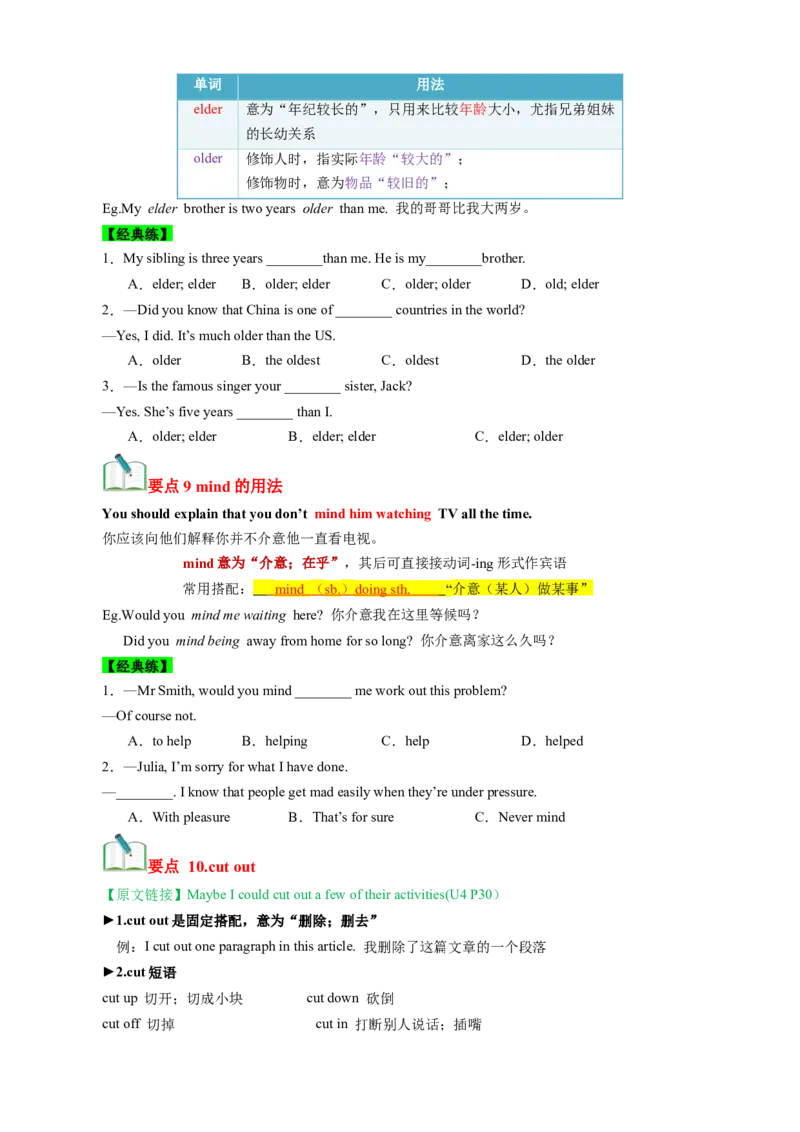
要点8 辨析elder和older
Also, my elder brother is not very nice to me. 还有,我哥哥对我不是很好。
【易混辨析】old➡older/elder单词 用法
elder 意为“年纪较长的”,只用来比较年龄大小,尤指兄弟姐妹
的长幼关系
older 修饰人时,指实际年龄“较大的”;
修饰物时,意为物品“较旧的”;
Eg.My elder brother is two years older than me. 我的哥哥比我大两岁。
【经典练】
1.My sibling is three years ________than me. He is my________brother.
A.elder; elder B.older; elder C.older; older D.old; elder
2.—Did you know that China is one of ________ countries in the world?
—Yes, I did. It’s much older than the US.
A.older B.the oldest C.oldest D.the older
3.—Is the famous singer your ________ sister, Jack?
—Yes. She’s five years ________ than I.
A.older; elder B.elder; elder C.elder; older
要点9 mind的用法
You should explain that you don’t mind him watching TV all the time.
你应该向他们解释你并不介意他一直看电视。
mind意为“介意;在乎”,其后可直接接动词-ing形式作宾语
常用搭配: mind ( sb . ) doing sth . “介意(某人)做某事”
Eg.Would you mind me waiting here? 你介意我在这里等候吗?
Did you mind being away from home for so long? 你介意离家这么久吗?
【经典练】
1.—Mr Smith, would you mind ________ me work out this problem?
—Of course not.
A.to help B.helping C.help D.helped
2.—Julia, I’m sorry for what I have done.
—________. I know that people get mad easily when they’re under pressure.
A.With pleasure B.That’s for sure C.Never mind
要点 10.cut out
【原文链接】Maybe I could cut out a few of their activities(U4 P30)
►1.cut out是固定搭配,意为“删除;删去”
例:I cut out one paragraph in this article. 我删除了这篇文章的一个段落
►2.cut短语
cut up 切开;切成小块 cut down 砍倒
cut off 切掉 cut in 打断别人说话;插嘴【经典练】
1.—My mother often sends me to all kinds of classes,so I feel very tired.
—I think she should ________ a few of your activities so that you can feel relaxed.
A.get out B.work out C.find out D.cut out
2.—What do you think of after-school activities?
— my opinion, we are too tired. We should some activities.
A.To, cut down B.In, cut out C.In, cut off
要点11.compete
【原文链接】Others are practicing sports so that they can compete and win. (U4 P30)
►1.compete是动词,意为“竞争;对抗”。compete with... 表示“和.....竞争”
例:We can compete with the best team. 我们能与最好的队竞争。
►2.compete同根词 competition n.比赛;竞争 competitive adj. 竞争的
【经典练】
1.The children from Beijing will ____ with the children from Shanghai in tomorrow’s soccer match.
A.disagree B.compete
C.discuss D.hit
2.—My mom always ________ me with my classmates. So I have to _______ with them.
—So does my mother.
A.compares, compete B.competes, compare C.communicates, compare
要点12. continue的用法
固定搭配 用法
continue doing sth. =go on doing sth. 继续做某事(前后做同一件事)
continue to do sth. go on to do sth. 继续做某事(前后不是同一件事)
Eg.Don’t stop! Continue reading, please. 别停下!请继续读。
He continued to do his work after lunch. 午饭后他继续工作。
【经典练】
1.The farmers were working on the farm when it rained suddenly, but they continued ________.
A.work B.working C.worked D.to working
2.After a break for lunch, they continued their discussions.
A.cut in B.went on C.started with D.disagree on
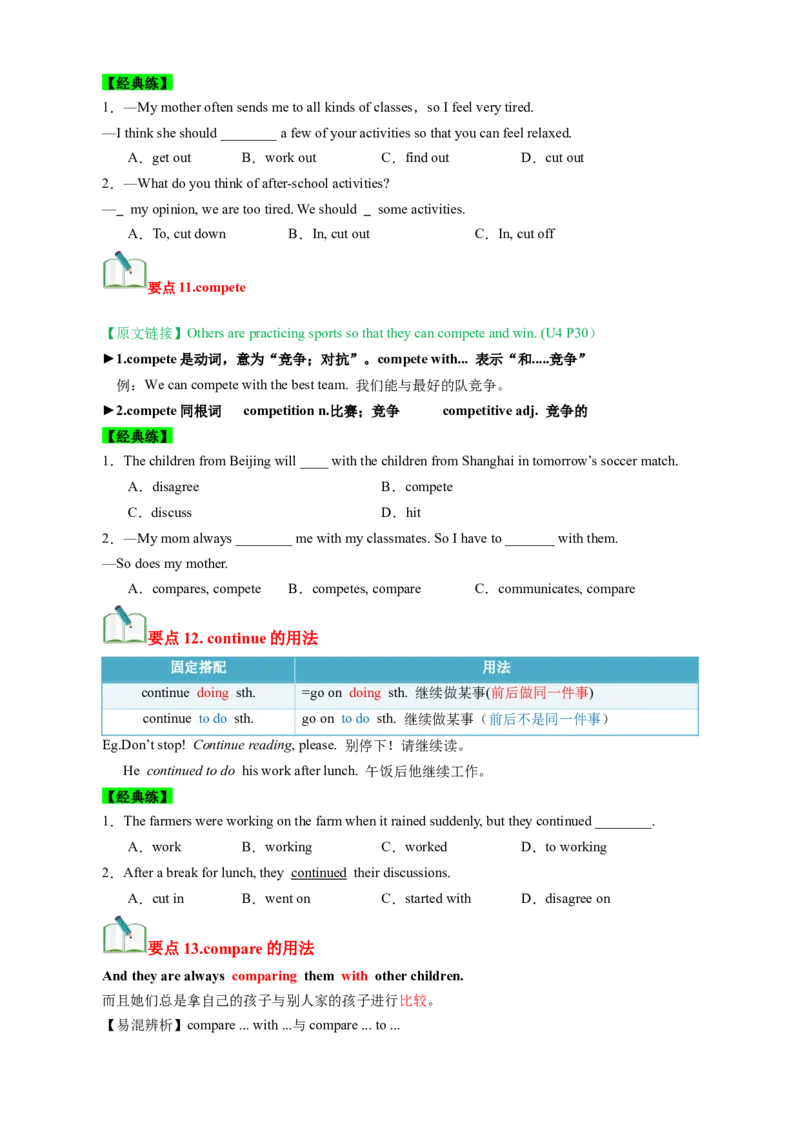
要点13.compare的用法
And they are always comparing them with other children.
而且她们总是拿自己的孩子与别人家的孩子进行比较。
【易混辨析】compare ... with ...与compare ... to ...固定搭配 用法
compare ... with ... 表示“把…与…比较”,常用于同类事物之间的比较
compare ... to ... 表示“把…比作…”,常用于不同类事物之间的比较或比喻
【经典练】
1.Compared ________ others, he was good at history.
A.about B.for C.to D.with
2.We often compare children ________ the rising sun.
A.to B.with C.in D.as
3.Please compare this book______that one.And find out the differences between them.
A.to B.with
C.on D.in
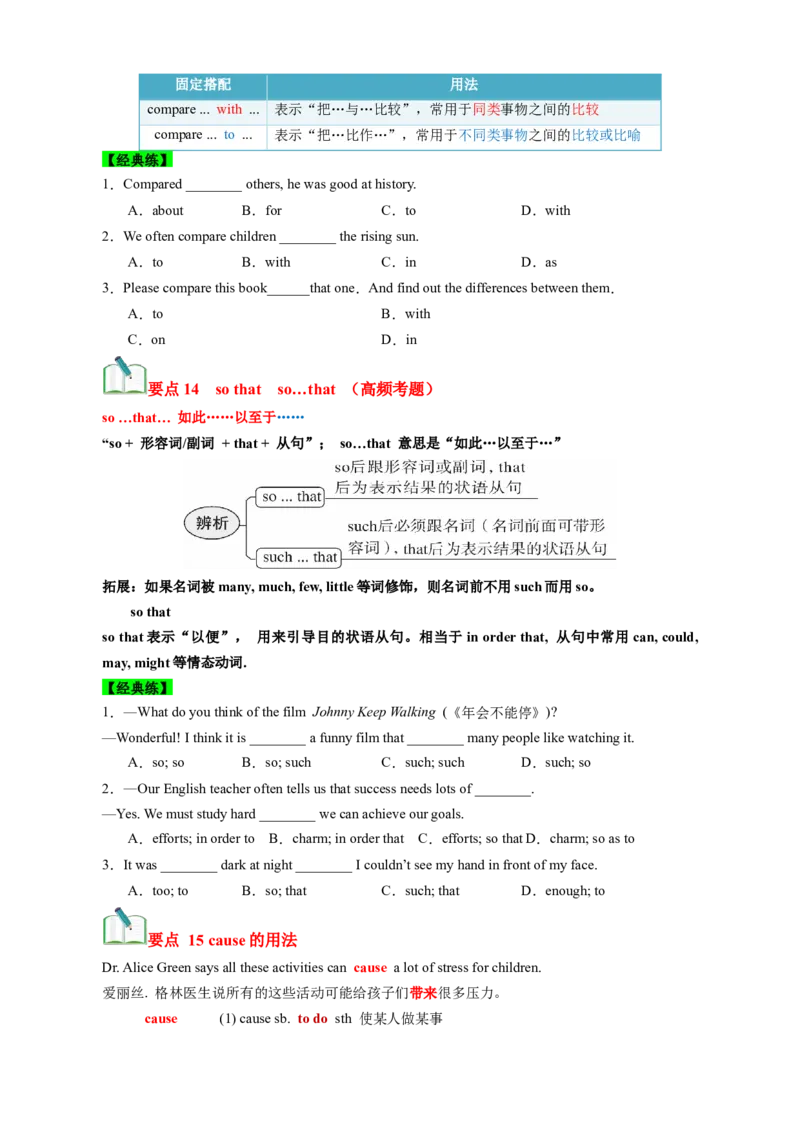
要点14 so that so…that (高频考题)
so …that… 如此……以至于……
“so + 形容词/副词 + that + 从句”; so…that 意思是“如此…以至于…”
拓展:如果名词被many, much, few, little等词修饰,则名词前不用such而用so。
so that
so that表示“以便”, 用来引导目的状语从句。相当于 in order that, 从句中常用can, could,
may, might等情态动词.
【经典练】
1.—What do you think of the film Johnny Keep Walking (《年会不能停》)?
—Wonderful! I think it is ________ a funny film that ________ many people like watching it.
A.so; so B.so; such C.such; such D.such; so
2.—Our English teacher often tells us that success needs lots of ________.
—Yes. We must study hard ________ we can achieve our goals.
A.efforts; in order to B.charm; in order that C.efforts; so thatD.charm; so as to
3.It was ________ dark at night ________ I couldn’t see my hand in front of my face.
A.too; to B.so; that C.such; that D.enough; to
要点 15 cause的用法
Dr. Alice Green says all these activities can cause a lot of stress for children.
爱丽丝. 格林医生说所有的这些活动可能给孩子们带来很多压力。
cause (1) cause sb. to do sth 使某人做某事v. 造成,使发生 (2) cause trouble for sb. 给某人添麻烦
【经典练】
1.— Why did you give up _________, Mr. Green?
— Because it may _________ lung cancer.
A.smoking; force B.smoke; cause C.smoking; cause
2.We use the transitional word (过渡词) “Since” in the sentence “Since you’ve finished what you
should do, you can do whatever you like.” to ___________.
A.show cause B.give an example
C.show time D.add more information
一.语法精讲
一、情态动词should与could的用法
1. should的用法
should为情态动词,表示劝告、建议,意为"应该",它和其他情态动词一样,没有人称和
数的变化,后接动词原形,其否定形式为shouldn’t。
Maybe she should say sorry to you. 也许她应该跟你说对不起。
2. could的用法
could既是can的过去式,表示过去的能力,又可以作情态动词表示谨慎、客气的建议,后接
动词原形,其否定形式为couldn’t。
You could go out and buy her some medicine. 你可以出去给她买些药。
二、 提建议的表达方式
1. 用Why not...?来提出建议,表示"何不……?",not后接动词原形。"Why not...?"实际上是
"Why don’t we/you...?"的简略形式。
Why not meet at the school gate at eight? 何不8点在校门口见面?
Why don’t we stay here another day? 我们为什么不在这儿再待一天呢?
2. 用"Would/Could you please...?"来提出建议或请求。此句式中的would/could并非是动词过去
式,而是表示说话者的语气较为委婉。
Could you please tell me how to get to the post office? 请你告诉我怎么才能到邮局好吗?
Would you please go hiking with me? 和我一起去远足好吗?
3. 可以用"Will you...?"表示委婉地提建议或请求。
Will you go to Jinan with us? 你和我们一起去济南好吗?
4. shall用于第一、第三人称疑问句,表示征求对方意见。
Shall we go swimming this afternoon? 今天下午我们去游泳好吗?
Shall I open the window and close the door? 我把窗户打开,把门关上好吗?5. 可以用"Let’s..."来提出建议或征求对方意见。
Let’s make it a little earlier, OK? 我们把时间定早一点好吗?
6. 用"What about/How about...?"来提出建议,about是介词,后面要接名词或动名词。
What about writing back to him about it? 要不要就这事给他回一封信?
7. 用"Would you like...?"来提出建议,意思是"你想要……吗?",would you like后可接名词或
动词不定式。
Would you like a cup of tea? 你想要杯茶吗?
8. 回答建议的表达方式
(1)同意对方的建议时,一般用:
Good idea. / That’s a good idea.
OK. / All right. / Yes, please. / Yes, I’d love to.
No problem. / I agree with you.
Sure. / Of course. / Certainly.
Yes, I think so.
(2)对对方的建议表示拒绝时,一般用:
I don’t think so. / Sorry, I can’t. / Sorry, but...
I’d love / like to, but... / I’m afraid...
三、until,so that,although的用法
1. until的用法
(1)作介词,表示"直到……为止"。
The meeting may last until Friday. 会议可能要延续到星期五。
Mark will be working until 5 o’clock. 马克将一直工作到五点钟。
【注意】由上面两个例句可知:until用于肯定句中表示动作一直持续到until短语所表示的时间
为止,即表示动作的终点,意为"直到……为止"。在这种用法中,句子的谓语动词必须是延续
性动词,如:live,wait,last,love,like,stay,work等。
(2)作连词,表示"直到……为止;在……以前;不到……(不)"。
①用于肯定句中
Please wait here until I come. 请在这里等到我来。
②用于否定句中
I won’t stop shouting until you let me go. 你不放开我,我就一直喊叫。
【注意】 until作连词用于否定句中,从句的动作先发生,主句的动作后发生,意为"直到……
才……"。
2. so that的用法
(1)so that引导目的状语从句,从句谓语动词常用情态动词may/might/can/could等。
We went early so that we could get good seats. 为了占到好座位,我们早早就去了。
(2)so that引导目的状语从句,当主句主语与从句主语一致时,可用"so as to(in order to)+动词
原形"转化为简单句。
He got up early so that he could catch the early bus.
=He got up early in order to/so as to catch the early bus.为了赶早班公交车他起床很早。
(3)so that还可以与in order that互换。
He worked day and night so that/in order that he could succeed. 他夜以继日地工作为的是成功。
【知识拓展】
so...that...表示"如此……以至于……",引导结果状语从句。
The boy is so young that he can’t go to school. 这个男孩太小还不能去上学。
3. although的用法
(1)although较正式,引导的从句放在主句的前后均可。
Henry often helps me with my math although he is quite busy. 尽管亨利很忙,但是他经常帮助我
学习数学。
(2)although不能与but连用,但可与yet,still连用。
虽然他老了,但是他工作努力。
Although he was old, but he worked hard.(×)
Although he was old, he worked hard.(√)
Although he was old, yet he worked hard.(√)
二、烦恼与建议
【话题探索】八下第四单元Why don't you talk to your parents?.本单元的教材写作情境为“描述自
己的问题并寻求建议”, 属于“人与社会”主题范畴中的“社会服务与人际沟通”这一主题群,
涉及子主题“良好的人际关系与人际交往”。
此类写作要求学生能够恰当运用“My problem is that.../I can't...”描述自己的问题,同时恰当运用
“Maybe you could.../Why don't you.../Why not.../What about.../How about...”给对方提出建议。通常
使用一般现在时。
Deal with pressure 短语积累
有太多的作业 have too much homework to do
允许某人去做某事 allow sb to do sth
和某人打架 have a fight with sb
对某人说对不起 say sorry to sb
给某人写信 write a letter to sb
带某人去球赛 take sb to the ball game
太多的课后辅导班 too many after-school classes
感觉孤独和焦虑 feel lonely and nervous
和你的家人谈谈你的感受 talk about your feelings with your family
抄作业 copy one's homework
害怕做某事 be afraid of doing sth= be afraid to do sth
把孩子们逼得太紧 push the kids so hard
对孩子的发展有好处 be good for child's development
和某人和睦相处 get on/along well with
和某人交流 talk with sb和某人好好交流 have a good communication with sb
对sth有好处 be good for
担心我的课业 worry about my schoolwork
做某事有困难 have difficulty/problem/trouble doing sth
在我看来 in my opinion
花费时间做某事 spend time doing sth
造成很多压力 cause too much stress
与某人竞争 compete with sb
备考 study for a test
督促某人做某事 push sb into doing sth
Deal with pressure
参考句子
问题和建议
表达建议的句型
Why don't you do sth?
why not do sth?
Would you mind doing sth ?
shall we do sth?
Let's do sth.
I think you should do sth.
I think you are supposed to do sth.
You'd better do sth.
It's a good idea to do sth.
The best way to solve your problem is to do sth.
What/How about doing sth?
It's necessary for you to do sth.
开头句
I can deeply feel your worries because I used to have the similar experience with you. I'd like to share
some advice with you.
I am sorry to hear that you have trouble to do sth.
Here is my advice./ I will give you some advice.
I know how you feel.
In my opinion, It's important for children/ parents to do sth.
It's not easy being your age, It's normal to have these feelings.
I think it's unfair for children to do sth.
It's normal to have pressure in our life.
结尾句
I hope things can work out soon.
I hope things will be better for you soon.Hope things work out.
You are sure to get better soon.
Life is full of ups and downs. You should find a way to cheer yourself up.
We need to deal with your pressure on ourselves.
No matter how many difficulties we have, I believe all of the problems will be solved in the end.
I hope my advice can be useful to you.
We should try our best to deal with it and keep our body and mind healthy.
Just try it. I'm sure you can deal with it properly.
In fact, communication is the best way to solve problems.
Hope everything goes well with you.
加分谚语
A good medicine tastes bitter. 良药苦口。
Well begun is half done.好的开端是成功的一半。
Practice makes perfect. 熟能生巧。
Happiness goes first. 快乐是最重要的。
All work and no play makes Jack a dull boy. 只工作,不玩耍,聪明小伙也变傻。
Every cloud has a silver lining. 每朵乌云背后都有阳光。
Look on the bright side of life.万事往好处看。
A positive attitude can make a big difference.积极的心态能产生巨大的影响。
Good mood will turn you around. 好心情让你峰回路转。
连词
first of all, second, third, Finally, as long as, so...that..., Although, though, because, so, all in all,
both...and..., both of, however, but, or, then, that's why/ one of the main reasons, too...to..., what's more,
in addition, in my opinion, as for me, in my eye, besides, last but not least
经典名题
在成长过程中,青少年面临越来越多的烦恼,主要体现在精神压力太大。请以此为话题写一
篇 80 词左右的短文。
要点提示:
1.导致青少年精神压力大的主要原因:(1)学业 ;(2)与他人相处
2.减少压力的措施:(1)积极参加课外活动;(2)多与他人交流沟通
3.简要谈谈你对压力利弊的看法。(至少一点)
注意:
1.文章开头已给出,不计入总词数。
2.文章必须包含所给要点提示,要求语句通顺,行文连贯。3.不可逐词翻译,应有独自的见解并适当发挥。
4.文章中不得出现真实的人名、校名和地名。
We teenagers have more and more pressure while growing up.
3.写作思维导图
体裁 说明文 话题 青少年的压力
审题
时态 一般现在时 人称 第一人称
our schoolwork is heavy
原因
getting on with other people
措施 taking part in after-school activities
段落 more communication
布局
try our best to deal with the stress and 看法
keep healthy in body and mind
参考词汇:
be stressed out 有压力的;get on with 和睦相处;take part in 参加
communicate with sb.与某人交流;be good for 对……有好处;deal with 处理
参考句子:
1. I'm worried about my schoolwork. 我担心我的学业。
2. I have too much homework to do every day. 我每天有太多的家庭作业要做。
3. It's hard for me to communicate with my parents. 对我来说,和父母交流很困难。
4. I hope I can get on well with others. 我希望我能和他人相处得好。
5. How to deal with the pressure? 如何应对压力呢?
4.高分例文
We teenagers have more and more pressure while growing up.
①Here are two main reasons. ② One is our schoolwork is heavy and the other is the problems of
getting on with other people. However, too much pressure is not good for teenagers’ development. ③So
how to deal with the pressure? ④Taking part in after- school activities is a very useful way. ⑤Besides,more communication often works.
⑥All in all, we should try our best to deal with the stress and keep healthy in body and mind.
例文分析:
本文按照"分析原因→解决措施→表达观点"的思路展开,条理清晰、语言简洁、过渡自然流
畅,是一篇不错的范文。
①句用倒装的形式,点明有两个主要原因;
②句运用 One... the other...结构说明两个原因是什么;
③句承上启下,引出解决措施;
④句动词-ing 短语作主语,点明第一个措施;
⑤句巧妙使用 work(奏效)一词点明第 二个措施;
⑥句使用 try one's best to do sth.结构,表达了自己的观点。
5.佳句集锦
1. The most basic and powerful way to communicate with others is to listen.
与他人沟通最基本、也最有效的方法是聆听。
2. Think like a wise man but communicate in the simple language.
像智者一样去思考,但要用朴实的语言去交流。
3. When people talk, listen carefully. 当人们发言时, 认真聆听。
4. Reading itself is already communication. Although silent, it is very pure.
阅读本身已经是沟通,虽然无声,却很纯粹。
Unit 4 Why don't you talk to your parents?知识清单
一、词汇变形小结:
1.communicate交流(v.) → _communication_ (n.)交流;沟通
2.pay 花费(v.) → ____paid______ (过去式)
3.cost 花费(v.) → ____cost______ (过去式)
4.take 花费(v.) → ____took______ (过去式)
5.spend花费(v.) → ____spent______ (过去式)
6.make 做;制作;使得(v.) → ____made______ (过去式)
7.invite 邀请(v.) → ____invitation____ (n.)邀请8.surprise 使吃惊(v.) → ___surprising___(adj.)令人吃惊的 → ___surprised____(adj.)对某事感到
吃惊的
9.angry 生气的(adj.) → ___angrily______(adv)生气地
10.argue 争吵(v.) → ____argument_____ (n.)争论
11.cloud 云(n.) → ____cloudy______ (adj.)多云的
12.proper 正确的(adj.) → ___properly_____ (adv.)正确地
13.second 第二的(adj.) → ___secondly_____ (adv.)第二
14.explain 解释;说明(v.) → __explanation____ (n.)解释;说明
15.clear 清楚的;晴朗的(adj.) → ____clearly_____ (adv.)清楚地;明白地
16.compete 竞争;对抗(v.) → ___competition___ (n.)比赛 → ___competitor___ (n.)竞争者
17.typical 典型的(adj.) → ___typically____ (adv.)通常
18.quick 快速的(adj.) → ___quickly______ (adv.)快速地
19.usual 通常的(adj.) → ___usually______ (adv.)通常
20.develop 发展(v) → ___development___ (n.)发展;发育;成长
二、重点词组、用法:
(一)1、relations between my parents 父母之间的关系
2、hang over笼罩
3、feel lonely and nervous感到孤独和紧张
4、sit down and communicate with your brother坐下来和你哥哥交流
5、have a pet养宠物
6、be oneself做自己
7、free time activities业余活动
8、give one’s opinion提出某人的观点
9、learn exam skills学习应试技巧
10、a typical American family 典型的美国家庭
11、 practice sports体育训练
12、 cause a lot of stress导致许多压力
13、think for sb为某人考虑
14、to be a successful person成为成功人士 {success n. 成功 ----adj. 成功的 successful}
15、be right about…在某方面正确
16、wait a few more days再等几天 wait for 等待
17、help each other相互帮助
18、stress out过度紧张/劳累
19、do activities I enjoy 进行我喜欢的活动
20、have a quick dinner快速吃晚饭
21、push their kids so hard 逼她们的孩子很紧
22、be under pressure在压力下
23、even more important甚至更重要24、像平常一样 as usual
25.第一个做某事的人 be the first (one ) to do sth.
26.太多的压力 too much pressure too many books太多的书 study too much学得过多
(二)1、①allow sb to do sth 允许某人做某事。
②allow doing sth 允许做某事。
③allow sth 允许某事。
2、get into a fight with sb.= have a fight with sb.=fight with sb. 与某人闹矛盾 fight a lot经常吵架/打
架
3、write about 写作关于……的内容 write sb. a lette=write to sb.给某人写信 hear of/about„听
说..hear from sb. 收到某人来信
4、compete with sb. 与某人竞争compete [kəm‘pi:t] V.竞争,比赛 --- n. competition [kɒmpə’tɪʃn]
5、not„until„直到„才„
Eg:疲劳的孩子们直到下午七点后才到家The tired children didn’t get home until after 7:00 p.m. .
6、①give sth back (to sb) = return sth (to sb) /return (sb) sth “把某物归还给某人”
②return to sp.= come/get back to sp. “回到某处” = go back to sp. “返回某处”
③give advice to sb=give sb advice给某人提建议
7、be nice/good to sb.对某人好
8、refuse to do sth.拒绝做某事
9、argue with sb 与某人争吵
10、instead “反而,代替”(用在句首后加逗号/句尾) instead of sb./sth./doing sth “代替,而不是..”
11、communicate with sb.与某人交流
12、①offer to do sth. 提出做某事
②offer sb sth /offer sth to sb 提供给某人某物 (=provide sth for sb或 provide sb with sth )clear
“adj” 清楚的,清晰的—“adj” clearly清楚地,清晰地
13、explain to sb. 向某人解释
14、①Don’t be nervous. 不要紧张
②feel/be/get nervous about„. 对„感到紧张
③be nervous to do sth. 做某事紧张
15、泰勒一家人、泰勒夫妇 the Taylors {某家人、某对夫妇(做主语是复数)the +姓氏复数继
续做(另一件事) }
16、do one’s part in (doing ) sth. 做某人分内的事
三、本单元重点句型:
1、用于提建议的句型有:
①What about doing sth?=How about doing sth? ….怎么样?
②Why don’t you do sth?= Why not do sth? 为什么不呢?
③Let’s do sth.让我们一起做某事吧。
④Shall we/I do sth?我们做…好吗?
⑤had better do/not do sth. 最好做/不做某事⑥Will/Would you please do sth? 请你做…好吗?
⑦Would you like to do sth? 你想去做某事吗?
⑧Would you mind doing sth? 你介意做某事吗?
2、同意对方的建议时,一般用:
①Good idea./ That’s good idea. 好主意
②OK/ All right./ Great 好/ 行/太好了
③Yes, please ./I’d love to 是的/ 我愿意
④I agree with you 我同意你的看法
⑤No problem 没问题
⑥Sure/ Of course/ Certainly 当然可以
⑦Yes, I think so 对,我也这样想
3、对方的帮助或要求表示委婉谢绝时,一 般用:
①I don’t think so 我认为不是这样
②Sorry, I can’t 对不起,我不能
③I’d love to, but…
④I’m afraid…我愿意,但恐怕……