Unit 5 What were you doing when the rainstorm came?
核心话题 谈论过去正在发生的事情
重点词汇 1.begin v. 开始--began--begun--n. beginning
2.strange adj,奇怪的;陌生的--stranger陌生人
3.light n光线;光亮;adj.轻的
4.match n.火柴;比赛
Unit4 5.asleep adj.睡着的--sleep n&v.睡觉
6.rise v.升起---rose--risen
7.fallen adj.倒下的;落下的--fall v.落下;倒塌
8.realize v.意识到
9.silence n.沉默--silent adj.沉默的;安静的
10.truth n.真想;事实--true adj.真实的
11.completely adv.完全 --complete adj完全的;全部的 v.完成
12.recently adv.最近
13.icy adj.覆盖着冰的;冰冷的--ice n.冰
14.shocked adj.惊愕的;受震惊的--shock n.& v. 震惊
15.date n.日期
重点短语 1.all of a sudden 突然地; 2.wait for 等待;等候
3.at the time of 在……的时候 4.look for 寻找
5.so...that...如此……以至于…… 6.wake up 醒来;唤醒
7.go off(闹钟)发出响声 8.take a shower 洗澡
9.miss the bus 错过公交车 10.pick up 接电话
11.feel like 感觉像…… 12.make sure 确保;务必
13.fall asleep 进入梦乡;睡着 14.die down 逐渐变弱;
15.in a mess 乱七八糟 16.clean up 打扫干净
17.because of 因为;由于 18.walk by 走路经过
19.in silence 沉默;无声 20 take down 拆除;往下拽;
21.tell the truth 说实话 22.point out 指出
23.go away 消失;离开 24.as well 也
25.call out 大声说出
重点句型 1. What was the girl doing at the time of the rainstorm?
暴风雨来的时候那个女孩在做什么?
2. I was so busy looking for the umbrella that I didn’t see a car coming.
我正忙于找雨伞以至我没有看见车来。3. I called at seven and you didn't pick up.我 7 点给你打电话,你没有接。
4. With no light outside, it felt like midnight.(由于)外面没有光亮,感觉就像半夜一
样。
5.The news on TV reported that a heavy rainstorm was in the area.
电视里报道有强烈的暴风雨已经到了这个地区。
6.He finally fell asleep when the wind was dying down at around 3: 00 a. m.
在大约凌晨3点风逐渐变弱时他终于睡着了。
7.When he woke up, the sun was rising.当他醒来时,太阳正冉冉升起。
8.How can we help each other in times of difficulty?在困难时期我们如何相互帮助?
9. I was so scared that I could hardly think clearly after that.
我是那么害怕以至于我几乎不能清 楚地想起那之后的事了。
10. I had trouble thinking clearly after that because I was very afraid. 在那以后,我难以清
晰地思 考,因为我很害怕。
语法 过去进行时
写作 "生活与学习",讲述自己在过去某一时刻或一段时间正在进行的动作
考点 1. go off
1. My alarm didn’t go off so I woke up late. 我的闹钟没有响,因此我醒晚了。
go off为不及物动词短语,在此意为"发出响声",可指闹钟或警报器等突然发出声响。
☞ You’d better get up as soon as the alarm clock goes off.最好闹钟一叫你就起床。
☞ A car alarm went off in the middle of the night. 半夜里一辆汽车的警报器响了。
☞Listen! The bell is going off. 听!铃响了。
【知识拓展】
(1) go off意为"(灯)熄灭;停止运转;离开"。
☞ The light went off as we entered the room. 我们进屋时灯灭了。
(2) go off还可以表示"变质,变坏"。
☞ Milk goes off quickly in hot weather. 牛奶在热天很容易变坏。
【经典练】
1.I’ll go to senior high school soon. I can’t believe how fast the time ________ !
A.went by B.went on C.went off
2.This bus doesn't go to the train station. I'm afraid you'll have to _____ at Liubei Stop and take BRT Line 1.
A.turn off B.cut off C.go off D.get off考点2. beat v. 敲打;锤砸
【用法】
过去式为beat,过去分词为beaten。
(1)作“击打”讲时,主语是人,宾语可以是人,也可以是物。
(2)作“拍打”讲时,主语多为风、雨、海浪等名词。“拍打在某地方”常用at, on, against等引起的介
词短语。
(3)beat有“打败;战胜”的意思,其后常接人或由人组成的队。
【例句】
The father beat his son because of his impoliteness. 爸爸因为儿子的不礼貌而打了他。
The waves beat against the rocks. 海浪拍打着岩石。
【经典练】
1.You didn’t ________ the game because the other team ________ you last time.
A.win; win B.beat; win C.win; beat D.beat; beat
2.—Do you know which class ________ the basketball match, Wendy?
—What a pity! The team of Class 1________ ours.
A.won; beat B.won; won C.beat; beat D.beat; won
3.Gu Ailing who is called “Frog Princess” ________ all the other players and ________ the skiing competition
at the Beijing Winter Olympics in 2022.
A.beat; won B.beat; beat C.won; beat
考点 3.wait
2. I was waiting for the bus when it began to rain heavily. 我正在等公共汽车,这时天开始下起了大雨。
(1)wait是不及物动词,须加上介词for再跟宾语。
☞ I’m waiting for a bus. 我正在等公共汽车。
(2)rain heavily下大雨,表示"下大雨/雪"用heavily修饰,相当于hard,修饰动词用副词。
☞ Though it was raining heavily/hard, they were still working hard. 虽然雨下得很大,他们还在努力地工作。
注意:形容风刮得 大时常用 strongl y 。
☞ The wind is blowing strongly with lots of sand. 风猛烈地刮着,带起了许多沙子。
【经典练】
1.—Why are you so late today?
—Three buses went by without stopping while I ________ at the bus stop.
A.was waiting B.waited C.wait D.am waiting2.—If you see the cartoon film, you will be made to laugh.
—Really? I can’t wait ________ it.
A.see B.to see C.seeing
考点 4.get
4. I got to the bus stop but I still missed the bus. 我到了车站但我仍然错过了公交车。
(1)get意为"到达"时,是不及物动词,后面直接跟地点名词时,要加介词to。
☞ How can I get to the nearest supermarket? 我怎样才能到最近的超市?
【知识拓展】
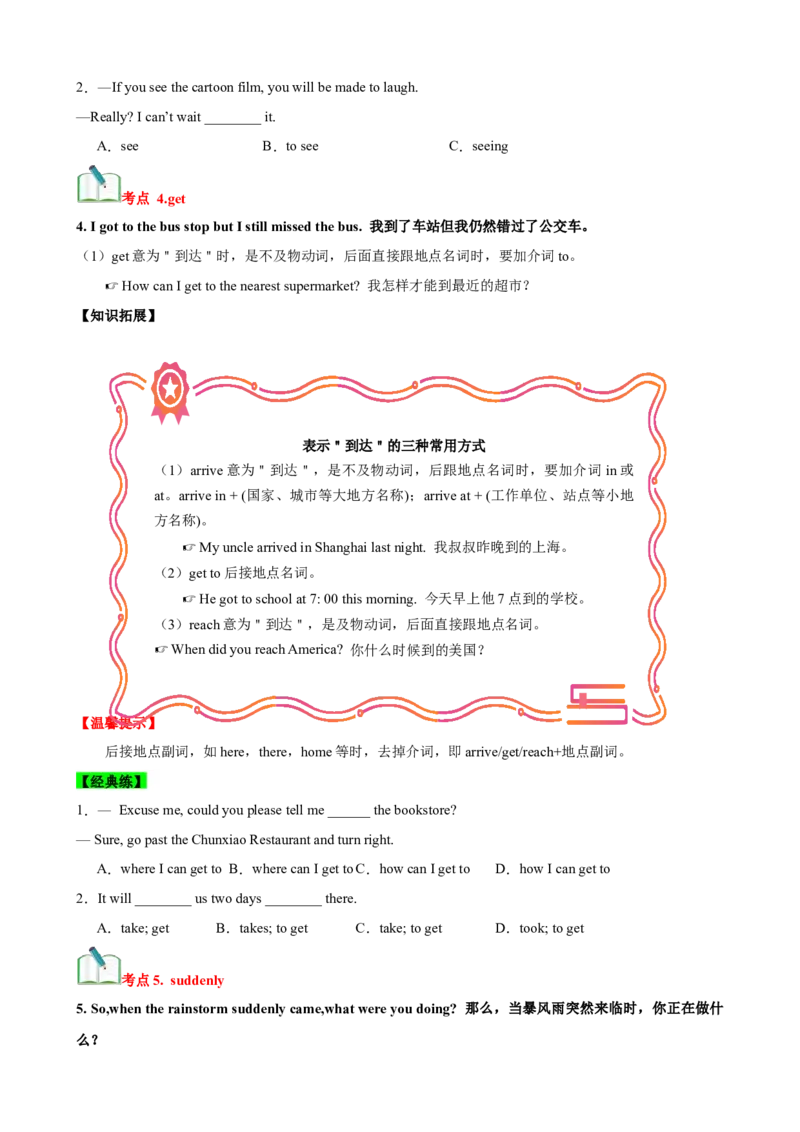
表示"到达"的三种常用方式
(1)arrive意为"到达",是不及物动词,后跟地点名词时,要加介词 in或
at。arrive in + (国家、城市等大地方名称);arrive at + (工作单位、站点等小地
方名称)。
☞ My uncle arrived in Shanghai last night. 我叔叔昨晚到的上海。
(2)get to后接地点名词。
☞ He got to school at 7: 00 this morning. 今天早上他7点到的学校。
(3)reach意为"到达",是及物动词,后面直接跟地点名词。
☞ When did you reach America? 你什么时候到的美国?[来源:学§科§网]
【温馨提示】
后接地点副词,如here,there,home等时,去掉介词,即arrive/get/reach+地点副词。
【经典练】
1.— Excuse me, could you please tell me ______ the bookstore?
— Sure, go past the Chunxiao Restaurant and turn right.
A.where I can get to B.where can I get toC.how can I get to D.how I can get to
2.It will ________ us two days ________ there.
A.take; get B.takes; to get C.take; to get D.took; to get
考点5. suddenly
5. So,when the rainstorm suddenly came,what were you doing? 那么,当暴风雨突然来临时,你正在做什
么?suddenly副词,意为“突然”,可在句首或句中作状语,但在句首时,通常要用逗号隔开。
☞ Suddenly, I have a good idea. 突然,我有了一个好主意。
【知识拓展】
(1)sudden adj.突然的
☞ His sudden death makes everybody sad. 他的突然去世使大家很悲伤。
(2)all of a sudden 意为“突然,猛地”,相当于suddenly
☞ All of a sudden,it began to rain.
=Suddenly,it began to rain.突然开始下雨了。
【经典练】
1.— Han Li has improved her English a lot since she joined the English club.
— How she chose to join it at first!
A.quickly B.suddenly C.simply D.wisely
2.I ____ remembered that I hadn’t locked the door.
A.sadly B.softly C.shortly D.suddenly
考点 6.pick up
6. I called at seven and you didn’t pick up. 我七点(给你)打电话, 但你没有接。
pick up意为"接电话",是动副结构。当宾语是代词时,放在pick up中间,当宾语是名词时,放在pick
up中间或后面。
☞ The phone is ringing. Could you please pick it up for me? 电话响了。请你帮我接一下好吗?
【知识拓展】
pick up的其他含义
(1)pick up还指“拾起来,捡起”,接名词作宾语时,放在副词前后都可以,当接代词it/them作宾语
时,
只能放在动词和副词之间。
☞ Your pen is lying on the floor; please pick it up.你的钢笔在地板上,请把它拾起来。
(2)pick up还可意为“(开车)接(某人)”。
☞ I will pick you up at six tomorrow morning.明天早上六点钟我去接你。
(3)学会;(偶然)得到
☞ Here’s a tip I picked up from my mother.告诉你一个窍门,是我从妈妈那里学来的。
【经典练】
1.When he saw a wallet on the ground, he ______ at once.A.picked it up B.gave it up C.picked up it D.gave up it
2.The boy saw a ruler on the floor and he ___ it___.
A.got…up B.turned…up C.picked…up D.walked…up
3.Many volunteers will help to ____ the city parks next Friday.
A.give up B.pick up C.clean up
考点7.either
7. I called again at eight and you didn’t answer then either. 我8点又给你打电话,你那时也没接。
either此处用作副词,意为“也(不)”,用于否定句句末。
☞If you do not go, I shall not go either. 你不去,我也不去。
【易混辨析】either,also, too与as well
either“也(不)”,用于否定句,一般放在句末
also“也”,一般用于肯定句,常放在句中
too“也”,一般用于肯定句或疑问句,常放在句末
as well“也”,用于肯定句或疑问句,位于句末
☞I didn’t come to school yesterday either. 我昨天也没来学校。
☞She speaks English and she also writes English. 她说英语,也写英语。
☞Are you going to work too? 你也要去上班吗?
☞I can swim as well. 我也会游泳。学@科网
【经典练】
1.—Either Lucy or her sisters ________ going to see a wonderful movie.
—Wow! The film must be very interesting.
A.are B.is C.am
2.If you don’t go to the meeting tomorrow, ________.
A.he will, too B.he won’t, either C.he doesn’t, too
考点8.strange
8. That’s strange. 那很奇怪。
strange形容词,意为"奇特的;奇怪的"。作表语或定语。其副词形式为strangely,意为"奇怪地"。
☞ It’s strange that he’s failed in the exam. 他考试不及格,真是想不到。
☞ It feels strange to be visiting the place again after all these years. 时隔这么多年,旧地重访使人感到很新奇。
【知识拓展】
strange还可意为"陌生的;不熟悉的",名词stranger意为"陌生人"。strange (陌生的)
+ (e)r (……的人) = stranger(陌生人)。☞ The place is strange to me. 我对这个地方很陌生。
☞ Children must not talk to strangers. 小孩子千万不要和陌生人说话。
【经典练】
1.When he ________ there, he saw ________.
A.arrived at; something strange B.got; anything strange
C.reached; something strange D.got; strange something
2.Every night we heard strange noises outside our window. My parents called the policemen, but they couldn’t
find ________.
A.something strange B.anything strangeC.strange something D.strange anything
考点 9.while
9. So while you were sleeping, I called Jenny and she helped me. 因此当你在睡觉时, 我给珍妮打了电话,
是她帮助了我。
while 为连词,表示"在……期间;当……的时候"。while引导的时间状语从句的谓语动词通常是延续
性动词。while用于表示一段较长的时间或一个过程,强调主句的动词和从句的动词表示的动作或状态是
同时发生的,常对同类的两个动作进行对比。
☞ I was writing a letter while Mom was watching TV. 妈妈在看电视的时候我在写信。
☞ Please write while I read. 我读的时候请写下来。
【知识拓展】
既可以表示时间点,也可以表示时间段,从句中谓语动词可以是延续性动词,也可以
when
是瞬间动词。
只表示某个时间段,从句谓语动词必须用延续性动词,且多用于进行时态。强调主句
while
与从句的动作同时发生或主句的动作发生在从句的动作过程中。
【经典练】
1.I met a good friend of mine while I _________ on the street.
A.walks B.walk C.was walking
2.—What were you doing at eight last night? I called you, but nobody answered.
—While you ________, I was taking a shower.
A.is calling B.were calling C.call
考点 10.light
10. With no light outside, it felt like midnight. 外面没有光亮,感觉就像半夜一样。(1)light n.光;光线;光亮。此时为不可数名词。
☞ The children are dancing in the bright moonlight. 孩子们在明亮的月光下跳着舞。
【知识拓展】
light adj. 轻的;light n. 灯,为可数名词;light v. 点燃
☞ It’s as light as a feather. 它像羽毛一样轻。
☞ Please turn on the light. 请开灯。
☞ Mother did not light the stove. 母亲没有生炉子。
【经典练】
1.We were dancing at the party when ________ the lights went off.
A.luckily B.suddenly C.probably D.successfully
2.Don’t ________ at a red light, children!
A.go B.went C.goes
3.I used to be afraid of the dark, so I always sleep with the light ________.
A.on B.off C.out
考点 11.finally
11. He finally fell asleep when the wind was dying down at around 3:00 a.m. 大约凌晨3点风逐渐变弱时他
终于睡着了。
(1)句中finally为副词,意为"最后"。表示为某事等了很长的时间。一般来说常用于对过去情况的描
述。☞ Finally, he thought up a good idea. 最后,他想出了一个好主意。
☞ Finally, let’s do some exercises. 最后,我们来做一些练习吧。学@科网
【知识拓展】
"最终"不同
(1)in the end指经过许多变化、困难和捉摸不定的情况之后,某事才发生,也可以用来谈论将来的事。
☞ The situation will be better in the end. 局势最终会好转的。
(2)at last在主观上有"等了许久才……"的含义。语气上比finally强得多。
☞ At last, do you know what happened? 最后,你知道发生什么事了吗?
【经典练】
1.—Eric and Mary ________ joined the English Speech Competition.
—I think Mary must be the winner ________.
A.all; finally B.all; last C.both; finally D.both; last
2.Good news! Our team ________ the ________ soccer game by3:1.
A.lost; finally B.failed; finally C.won; final D.beat; final考点 12.rise
12. When he woke up, the sun was rising. 当他醒来的时候,太阳正在升起。
rise为不及物动词,过去式为rose,过去分词为risen。不能用于被动语态。意为"上升" "升起"
"起身" "起立(此时主语是人)"、"上涨",以及"(日、月、星等)升起到地平线上"。
☞ The sun rises in the east and sets in the west. 太阳东升西落。
【易混辨析】 rise与raise的区别
为不及物动词,后面要带上介词后才能加宾语。指依次上升,如自然界的日、月、星、
雾、云的上升,人体从睡、跪、坐、躺等姿势站立起来等。
rise
☞ Prices rise every day in those countries. 在那些国家物价天天上涨。
是及物动词,表示"举起",后面要直接跟宾语。此外,raise有"饲养、供养"的意
思。
raise
☞ If you have any questions, raise your hands. 如果你有问题,请举手。
☞ Their family raised a big dog. 他们家养了一条大狗。
【经典练】
1.The sun is ________. It’s time to ________ the flag.
A.raising; rise B.rising; raise C.raising; raise
2.Although a great deal of money ________ at the charity show last month, the cost of living in the poor area
________ quickly, so we still need to do much work to help the poor people.
A.was raised; is rising B.was raised; were raised C.rose; were raisedD.rose; has risen
3.China ________ much awareness (意识) to protect the environment so that the PM2.5 will not ________ any
more.
A.rises; raise B.raises; rise C.raises; raise
考点 13.make one’s way
13. ...Kate was still making her way to school. ……凯特还在前往学校的路上。
make one’s way中的one’s在句中常换成与主语一致的物主代词。make one’s way to/towards + 地点意为
"前往某地,到某地方去"。
☞ Will you be able to make your way to the bus stop? 你能自己去汽车站吗?
☞ He was still making his way though it was raining heavily. 尽管雨下得很大,他仍然在前进。
【知识拓展】
(1)by the way 为固定短语,意为"顺便提一下"。
☞ By the way, what’s the time? 顺便问一下,几点了?
☞ By the way, where did you buy this dress? 顺便问一下,你在哪里买的这件连衣裙?
(2)on the / one’s way to +地点意为"在去……的路上"。当表示地点的词是副词时,则要省略to。
☞ I met my sister on my way to the station. 在去车站的路上,我遇到了我的姐姐。
(3)lose one’s way为固定短语,意为"迷路"。
☞ I almost lost my way yesterday. 昨天我差点迷了路。
【经典练】
1.—Don’t make the computer games ________ your study.
—Ok, I will.
A.get in the way of B.go out of one’s way to C.make one’s way to
考点 14.hear
14. People often remember what they were doing when they heard the news of important events in history.
人们常常记得当他们听到历史上的重大事件时他们在干什么。
hear动词,意为"听说"。常用结构为:
(1)hear sb do sth意为"听见某人做某事"。
(2)hear sb doing sth意为"听见某人正在做某事"。
(3)hear of /about sb / sth意为"听说某人或某事"。
(4)hear from sb 意为"收到某人的来信"。
(5)hear+that从句意为"听说……"。
【经典练】
1.Mr. Chen has a loud voice. His voice ________ clearly even in that big classroom.
A.can hear B.can be heard
C.heard D.was heard
2.Listen! Can you hear a boy ________ in the next room?
A.sing B.singing C.to sing
考点 15.over
15. Robert Allen is now over 50, but he was a school pupil at that time. 罗伯特﹒艾伦现在50多岁了,但那
时他还是一个小学生。
over相当于more than,表示"多于……,越过……,不止……,在……以上"。more than/over的反义词
是less than。
☞ There are over 800 students in our school. 我们学校有800多个学生。
【知识拓展】(1)over作介词时的用法:
① 意为"在……的上方",含有垂直在上的意思,其反义词是under。
☞ There is a bridge over the river. 河上有座桥。
② 意为"蒙在……上,悬挂在……上"。
☞ The workers all wear thick clothes and glasses over their eyes.
工人们都穿着厚实的衣服,并且戴着眼镜。
③ 意为"在……的各部分,遍及……的各部分"。
☞ We have friends all over the world. 我们的朋友遍天下。
(2)over 用作副词时,意为"结束,完了"。
☞ Classes are over at 4:30 in the afternoon. 下午四点半课就上完了。
【经典练】
1.Jimmy worked hard and finally ________ his fear (害怕) of Maths. He becomes good at it now.
A.got to B.got up C.got off D.got over
2.“How would they ________ that problem?” he wondered.
A.go over B.come over C.get over D.look over
考点16.rest
16. My parents did not talk after that, and we finished the rest of our dinner in silence. 在那之后,我的父
母没有说话,我们默默地吃完了剩下的晚餐。
(1)rest为名词,表示"剩余部分;其余"。常与the连用,既可指人,也可指物。常用结构为"the rest
of+名词"。"the rest of+复数名词"作主语时,谓语动词用复数;"the rest of + 不可数名词"作主语时,
谓语动词用单数。
☞ The rest of the apples are yours. 剩下的苹果是你的。
☞ The rest of the bread isn’t enough. 剩下的面包不够了。
(2)silence n. 沉默;缄默;无声
① silence是silent的名词形式,常用短语为in silence沉默,无声。
☞ Nobody knew what to say and they just sat there in silence.
没有人知道说什么,他们只是默默地坐在那儿。
☞ As night fell, everything was in silence. 当夜幕降临,一切都静悄悄的。
☞ He looked at the boy in silence for some minutes. 他默默地盯着那个男孩看了好一会儿。
② silent是silence的形容词形式,表示"不说话的;沉默的"。
☞ The street was silent. 大街上很安静。
【易混辨析】 silent与quietsilent着重指沉默无语或没有声音,但不一定指没有动作或活动。
☞ That is a silent movie. 那是一部无声电影。
☞ He is silent about what happened. 他对发生的事情保持沉默。
quiet表示安静的、寂静的、平静的。指物时,表示没有喧闹或没有骚动,处于一种静止的
状态或宁静的环境;指人时,表示不发出声音或不发表意见,也可指人的性格温和、文静、不易
激动等。
☞ He lives a quiet life in the country. 他在乡下过着悠闲的生活。
☞ Can’t you keep the children quiet? 你能不能让孩子们保持安静?
☞ Mary is a quiet girl. 玛丽是个文静的姑娘。
【经典练】
1.Yesterday evening Peter ate some of the pizza, and ________ was put in the fridge.
A.other B.another C.the other D.the rest
2.The doctor says: “You have a fever. ________ and take some medicine.”
A.Have a rest B.Drink water C.Eat fruit
3.Half-time is a ________ period for players ________.
A.ten-minute; to rest B.ten-minute; resting
C.ten minutes’; to rest D.ten minutes’; resting
考点 17.recently
17. More recently, most Americans remember what they were doing when the World Trade Center in New
York was taken down by terrorists. 更近一些的,大多数美国人都记得纽约世贸中心被恐怖分子摧毁时他
们在做什么。
(1)recently adv. 不久前;最近
☞ It happened recently. 它发生在最近。
recently=lately,意为"最近"。常指过去不久到现在的一段时间,和现在完成时连用。或指过去不久的
某一时刻,和一般过去时连用。
☞ I haven’t heard from her recently. 我最近没有收到她的来信。
("have/has+过去分词"构成现在完成时)
【知识拓展】
recently的形容词为recent,意为"最近的;近来的"。
in recent years 在最近几年
【经典练】
1.Take care when you are driving , _____ on foggy days.A.specially B.especially C.recently D.quickly
2.—Several earthquakes (地震) happened in China recently.
—Yeah. Last week the one in Taiwan was very serious.
A.all the time B.not long ago C.centuries ago
考点 18.at first
18. I didn’t believe him at first... 我最初不相信他……
at first意为"首先,最初",通常用于句首或句末,与后来发生的事情相对照,其反义短语为 at
last,意为"最后,最终"。
☞ At first I didn’t want to go, but I soon changed my mind. 起初我不想去,可是不久我改变了主意。
【易混辨析】
与at the beginning同义,表示"起
☞ At first I wasn’t sure if I could continue it.
at first 初(但后来……)",与后来发生的
起初我不确定能否继续经营下去。
事相对照。
与first同义,表示"首先;最重要
☞ First of all, open the window. 首先,打
first of all ",说明顺序,后面常接 next,
开窗户。
then等。
【经典练】
1.I think English is hard for me. ________, I don’t know the grammar(语法).
A.At first B.First of all C.Not at all D.The first
考点19.look out
19. I looked out of the window and realized that it was true. 我往窗外看,意识到那是真的。
(1)look out of the window 向窗外看
☞ If you look out of the window, you’ll see her car. 如果你朝窗外看的话,你就可以看到她的车。
【注意】
look out表示"当心,留神"。
☞ Look out! There is danger ahead. 当心!前面危险。
【易混辨析】
形容词,"真的",指客观上存在,并非想象和虚构的,它是与"假冒,无"相对
而言的。
real
[来源:Zxxk.Com]
☞ Let’s give him some real English food to eat. 让我们给他一些正宗的英国食品吃。指故事、说法、答案等与标准事实、实际情况相符合,意为"真的,真实的"。
true与"编造的,虚假的"相对,在句中作定语或表语。
true
☞ It is true that she married that doctor. 她嫁给了那个医生,这是真的。
是名词,指事情的真相或事实。
truth
☞ He cannot hide the truth. 他不能掩盖真相。
【经典练】
1.Look out! Here comes a bus.
A.Look for B.Watch out C.Take care of D.Be quiet
2.Look! The children are crossing the road. We must ________ them.
A.look around B.look up C.look out for
考点 20.have trouble doing sth
20. I had trouble thinking clearly after that because I was very afraid. 我难以清楚地想起那以后的事,因
为我很害怕。
have trouble doing sth表示"做某事有困难",相当于have problems/difficulty (in) doing sth,介词in
可以省略,problems/difficulty/trouble前面可以加修饰词some,a little,great,no,a lot of等。
☞ I have no difficulty in learning English well. 我在把英语学好上没有什么困难。
☞ I have some trouble in reading her handwriting. 我认她的笔迹有些困难。
☞ He has a lot of problems in buying a computer now. 他现在买电脑有好多困难。
【经典练】
1.—Do you have trouble ________ the meaning of this poem?
—No, I have learnt it already.
A.understand B.understood C.in understanding
2.— Eric, do you have trouble understanding your father?
— No. It’s because he often respects my ideas.
A.have interest in understanding B.have difficulty understanding C.worry about understanding
3.—Do you have trouble _______ this maths problem?
— Of course, we do. None of us is sure of the answer.
A.working out B.with working out C.work out D.to work out
考点 21.happen
21. When did it happen? 它是什么时候发生的?
happen作不及物动词,意为"发生"。☞ I hope nothing has happened to my friend. 我希望我的朋友没出事。
【知识拓展】
happen to sb /sth 表示"某人或某物发生了某事或出现某种情况",一般是不幸的事。
happen to do sth表示"碰巧发生某事"。
"It happens+that从句"表示"正巧、恰好……",此句型可换为"happen+不定式"结
构。
☞ What happened to him, by the way? 顺便问一句,他怎么了?
☞ I happened to meet my father on my way. 我正好在路上碰到了我爸爸。
☞ It happened that she was busy then.
=She happened to be busy then.
她碰巧当时正忙。
【易混辨析】
"发生",是一般用语,词义较广,一般指事情、事故的发生,强调事情发生
的偶然性或未能预见地发生,不用于被动语态。
happen
☞ A funny thing happened in the subway yesterday. 昨天地铁里发生了一件
有趣的事。
一般指有计划、事先安排的事件的"发生",没有偶然性,也表示一般的"发
生",此外还有"举行"的意思。
take place
☞ Great changes took place in my hometown last year. 去年我的家乡发生了巨大
的变化。
【经典练】
1.—Hi, Mary. You look tired. ________
—I missed the school bus so I had to run to school this morning.
A.What happened? B.What a pain! C.You’re joking. D.How about you?
2.In the past five years, great changes _________ in our hometown.
A.happened B.have happened C.took place D.have taken place
考点22.point out
22. ....I pointed it out to my friend, it went away. 我向朋友指出它时,它消失了。
point out意为"指出,指明,表明",修饰的宾语为代词时放在point与out之间。
☞ Mother pointed out my mistakes. 妈妈指出了我的错误。
【知识拓展】
point at的意思是"指向",相当于 point to,二者一般可互换。point to 指向较近之物。
point at指向较远之物,point 后可直接跟名词/代词作宾语,point...at...表示"将……指向……
"。☞ The teacher pointed to one of the pictures. 老师指着其中的一幅图片。
☞ She was pointing her finger at me. 她用手指指着我。
☞ He pointed his gun at the enemy. 他举枪对准了敌人。
【经典练】
1.It’s rude ________ a person with your chopsticks.
A.to point at B.to point out C.point at D.point out
2.Let’s climb up the hill. Then I can point __________ some sights to you.
A.at B.to C.for D.out
3.The teachers ____our mistakes and we must correct them at once.
A.send out B.point out C.put out
一.语法精讲
1.过去进行时的结构
主语+was/were + 现在分词
肯定句 In 2022,she was studying in a university.
2022年的时候她在上大学。
主语+was/were not +现在分词
否定句
This time yesterday Jack was not watching TV.He was repairing his bike.昨天这个
时候,杰克不是在看电视,而是在修理自行车。
结构
was/were + 主语+ 现在分词
肯定回答: Yes,主语+was / were.
否定回答:No,主语+wasn't / weren't.
一般疑问句
Were you playing basketball at four yesterday afternoon?
昨天下午四点你们在打篮球吗?
Yes,we were./No,we weren’t.是的,我们在打。/不,我们没打。疑问词+was / were+主语+动词-ing形式
What were you doing at this time yesterday?
特殊疑问句 昨天这个时候你在做什么?
What was he researching all day last Sunday?
上周日他一整天都在研究什么?
then,at that time,at ten yesterday,at this time yesterday,this morning,the
时间标志词
whole morning,all day,from nine to ten last evening,when,while等.
2.过去进行的具体用法
1)表示在过去某一时刻正在发生的动作或该动作与过去的另一动作同时发生,这一特定的过去时间通常有
时间状语(从句)或由上下文来表示。
The last time I saw Jane,she was picking cotton in the fields.
我最后一次见Jane,她正在地里摘棉花。
It was raining at 6 o'clock this morning.今早六点钟时正在下雨。
2)表示过去一段时间内正在进行的动作或存在的状态,但说话时不一定正在进行。
What was the girl doing at the time of the rainstorm?
暴风雨来临的时候,这个女孩在做什么?
We were watching TV from seven to nine last night.昨晚7点到9点我们在看电视。
3)表示为过去的将来计划或安排好的活动,即按计划、安排过去将要发生的事。这类用法在没有明确上下
文的情况下,通常会连用一个表示将来时间的状语。
用于come,go,leave,start,arrive, take off等短暂性的动词时,也可以用过去进行时表示过去将要发
生的动作,用于某些动词。
He said that his sister was getting married next December.他说他妹妹12月结婚。
4)与always,constantly,frequently,forever等表示动作屡次发生的副词连用,强调动作的不断重复
的,有一定的感情色彩。
They were always quarreling.他们老是吵架。
She was always thinking of others.她老是想到别人。
She was forever complaining.她老是抱怨。
【注意】
现在进行时也有类似用法,但过去进行时是表示过去不断重复的动作,而现在进行时是表示现在不断重
复的动作。
5)动词hope,wonder等的过去进行时常用来表示提出要求,虽然表示现在的内容,但语气比一般现在时或一般过去时要委婉、客气。
I was wondering if you could give me a lift.我不知你能否让我搭一下车。
I was wondering whether you could come to join us.
我想你能否过来跟我们一起活动?
二、八年级下Unit 5 话题作文
【话题探索】八下第五单元What were you doing when the rainstorm came?本单元教材写作情境为"讲述令
你难忘的一件事 An unforgettable experience",属于"人与自我"主题范畴中的"生活与学习"这一主题群,
涉及子主题"丰富、充实、积极向上的生活"。
此类写作要求学生能够恰当运用"was/were+v-ing"及引导时间状语从句的连词when/while,讲述自己在过去
某一时刻或一段时间正在进行的动作,通常以一般过去时和过去进行时为主。
An unforgettable experience
短语积累
众所周知 as we all know
忙于做某事 be busy with
开始去做某事 began to do sth
像平常一样 as usual
突然 all of a sudden=suddenly
试着做某事 try to do sth
让sb做某事 make sb do
做sth是重要的 It's important to do
教sb去做某事 each somebody to do
寻求sb的帮助 ask somebody for help
想要放弃 want to give up
能够做某事 be able to do
继续去做某事 continue to do something
首先 at first = first of all
靠某人自己 on my own = depend on oneself
练习做某事 practice doing something
下雨下的大 rain heavily
主动提供去做某事 offer to do sth
经历之后 through that experience俗话说得好 as an old saying goes
允许某人去做某事 allow sb to do sth
害怕做某事 be afraid of doing sth= be afraid to do sth
对sth有好处 be good for
做某事有困难 have difficulty/problem/trouble doing sth
在我看来 in my opinion
花费时间做某事 spend time doing sth
An unforgettable experience
参考句子
开头句
Life is full of unexpected. I still remember what happened last summer.
As time goes by, lots of things have disappeared from my mind, but there is one thing that is unforgettable.
In my life, I have experienced many things, but one thing is the most unforgettable for me.
Although there are many unforgettable things in my life. I will never forget the day when I...
An unforgettable thing I remember well happened on a rainy day.
As we all know, everyone has some special experiences, and so do I. Let me tell you one of them.
Life is full of unexpected. I still remember what happened last summer.
Everyone has his own unforgettable things. For me, there was one thing that I still remember well until now.
How time flies. During my life, there was one thing I will never forget.
There is one thing I will never forget in my memory. Let me tell you.
结尾句
This event is unforgettable for me because it makes me understand that it's important to...
Through that experience, I learn that we should continue to work hard no matter what happens.
Life is full of ups and downs. We should face the difficulties bravely.
I will never forget this experience because it makes me learn that...
No matter how many difficulties we have, I believe all of the problems will be solved in the end. Just try it and
never give up.
From that I knew I should never give up in the face of difficulty.
Through this experience, I learned that how to deal with problems in life properly and never give up.
加分谚语
The more we do, the more we can do. 做的越多,能力越大。
It's hard to beat someone who never gives up.坚持就是胜利。There is no rainbow without the rain.不经历风雨,怎能见彩虹。
Believe in yourself and you will be unstoppable. 自信者勇往直前。
Action is the key to all successes. 行动是成功的关键。
Keep on going and never give up/ Never say never.永不言弃。
Practice makes perfect. 熟能生巧。
Failure is the mother of success.失败乃成功之母。
Go big or go home. 全力以赴。
God helps those who help themselves.天道酬勤。
Where there is a will, there is a way.有志者,事竟成。
No pains, no gains. 没有付出,没有回报。
There is no royal road to learning. 书山有路勤为径,学海无涯苦作舟。
Nothing is difficult if you put your heart into it.世上无难事,只怕无难事。
No sweet without sweat. 苦尽甘来。
A journey of a thousand miles begins with a single step.千里之行,始于足下。
连词
first of all, second, third, Finally, as long as, so...that..., Although, though, because, so, all in all,
both...and..., both of, however, but, or, then, that's why/ one of the main reasons, too...to..., what's more, in
addition, in my opinion, as for me, in my eye, besides, last but not least
An unforgettable experience 范文赏析
1
An unforgettable thing 一件难忘的事---上学路上下大雨
An unforgettable thing I remember well happened on a rainy day. It was on my way home last Friday.
On that day, while I was making my way home as usual, all of a sudden, black clouds were making the
sky very dark. When it began to rain heavily, everyone on the road was busy getting out of the rain. I thought I
had an umbrella in my schoolbag, so I kept trying to look for it. However, I suddenly realized that my umbrella
was left in the classroom. So I had to wait for the rain to stop. Finally, I arrived at home one hour later. I took a
hot shower and ate some warm food. I felt so good to be home!
This event is unforgettable for me because it makes me understand that it's important to prepare in
advance and carry an umbrella with me.
2
An Unforgettable Experience 一个难忘的经历--学骑自行车Although there are many unforgettable things in my life. I will never forget the day when I learned to
ride a bike(学着骑自行车) for the first time.
On that day, my grandfather offered to teach me how to ride a bike. At first, he held on to the back of the
bike( 扶着后座 ) . After a few minutes, I thought I could ride on my own, so I asked him not to help me. However,
I fell off my bike (从自行车上摔下来) . At that moment, I felt so angry that I wanted to give up. But my
grandfather told me, " Never give up easily (不要轻易放弃) . Failure is the mother of success. I'm sure you
can do it." With his encouragement (有了他的鼓励) , I regained my confidence (重拾信心) . Finally,
with enough practice, I was able to ride a bike!
Through that experience, I learn that we should continue to work hard no matter what happens.
3
An unforgettable experience一次难忘的经历---学游泳
Everyone has his own unforgettable things. For me, there was one thing that I still remember well
until now.
It was a hot summer day and I wanted to learn how to swim. At first, I thought it wouldn't be difficult.
However, as my father asked me to try to swim in the pool I began to feel afraid( 开始害怕 ) . When I jumped
into the water, I could hardly breathe (几乎不能呼吸) ,so I quickly raised my head out of the water (把我
的头伸出水外). I didn't want to learn swimming any more. But my father encouraged me to try again (鼓励
我再尝试). With his encouragement and help, I overcame the fear (克服恐惧) and kept trying several
times. Finally, I did it successfully (成功做到) .
I will never forget the experience, because it makes me understand that it is important to keep trying
and we should never give up easily.
一、单词变形
1.begin. v.开始→began.v.过去式→beginning. n.开始;起初
2.heavily. adv.大量地;在很大程度上→heavy.adj.重的;大量的
3.suddenly. adv.突然;忽然→sudden. adj.突然的;忽然的
4.strange. adj.奇怪的;奇特的→strangely. adv.奇怪地→stranger. n. 陌生人
5.storm. n.暴风雨→stormy. adj.暴风雨的
6.wind. n.风→windy. adj.有风的7.report. n./v.报道;公布→reporter. n.记者
8.match. n.火柴→matches.复数→match. n. 比赛→match. v.(使)相配
9.asleep. adj.睡着的→sleep. n./v. 睡眠;睡觉→sleepy. adj. 困倦的;想睡觉的
10.fallen. adj.落下的;倒下的→fall. v.落下;掉下→fall. n.秋天
11.icy. adj.覆盖着冰的;冰冷的→ice. n.冰块
12.completely. adv.完全地;彻底地→complete. adj.完整的→complete. v.完成
13.shocked. adj.惊愕的;受震惊的→shock. n./v.震惊;震动→shocking. adj.令人震惊的
14.silence. n.沉默;缄默;无声→silent. adj.沉默的;安静的→silently. adv.沉默地;安静地
15.recently.adv.最近地→recent. adj.最近的
16.terrorist. n.恐怖主义者而;恐怖分子→terror. n.恐怖;惊骇→terrorism. n.恐怖主义
17.truth. n.实情;事实→true. adj.真实的→truly.adv.真正;确实→truthful.adj.真实的;诚实的
二、重点短语
1. go off 发出响声
2.rain heavily雨下得很大
3.miss the bus 错过公交车
4.pick up接电话
5.at that time 在那时
6.strong winds 强风
7. a heavy rainstorm一场暴风雨
8. in the neighborhood 在社区
9. put pieces of wood over the windows 把几块木头钉在窗上
10. make sure确信
11. beat heavily against the windows 重重击打着窗户
12.fall asleep入睡
13. die down 减弱;平息
14.fallen trees 倒下的树
15. break...apart 使······破碎
16. bring... closer together 把·····拉得更近了
17. in times of difficulty 在困难时期
18. in bad shape 不成样子的;变形的
19. by the side of the road在路边
20.walk by路过;走过
21. make one's way to 前往;费力前进22. in American history 在美国历史上
23. be killed 被杀害
24. a school pupil一个小学生
25. on the radio 通过收音机
26.the rest of······的剩余部分
27.in silence 默默地
28.take down 摧毁
29.have meaning to 对······具有意义
30.look out of the window 看窗外
31. tell the truth讲事实;说真话
32. have trouble doing sth.做某事有麻烦
33. point out 指出
34.go away走开
35. in the sixth grade 在六年级
三、用法总结
1.be busy doing sth.=be busy with sth.忙于做某事 2.see sb./sth. doing sth. 看见某人正在做某事;
3.begin/start to do sth.=begin/start doing sth see sb./sth. do sth.看见某人做过某事
开始做某事 5.try to do sth.尽力做某事
4.help sb. do sth.帮助某人做某事 6.You’re kidding!你在开玩笑吧!
7.wait for sb. to do sth. 等待某人做某事 8.be shocked at sth.对……感到震惊;
9.have meaning to sb.对某人来说有意义 10.remember doing sth.记得曾经做过某事(事情已做)
11.remember to do sth. 记得要做某事(事情未做) 12.have trouble/difficulty (in) doing sth.做某事有困难
13.stop doing sth.停止做某事
四、重点句子
1. -What were you doing at eight last night?昨天晚上8点钟你在干什么?
-I was taking a shower.我正在洗淋浴。
2.-What was she doing at the time of the rainstorm?暴风雨来临时她在干什么?
-She was doing her homework. 她正在做作业。
3.-What was he doing when the rainstorm came?暴风雨来临时他在干什么?
-He was reading in the library when the rainstorm came. 当暴风雨来时,他正在图书馆看书。
4.-What was Jenny doing while Linda was sleeping?琳达睡觉时珍妮在干什么?
-While Linda was sleeping, Jenny was helping Mary with her homework.
当琳达在睡觉的时候,珍妮在帮助玛丽做作业。5. With no light outside, it felt like midnight.
外面没有光亮,感觉像是半夜。
6. After dinner, they tried to play a card game, but it was hard to have fun with a serious storm happening outside.
晚饭后,他们试图打牌,但是伴随着外面猛烈的暴风雨,很难从中取乐。
7. They joined the neighbors to help clean up the neighborhood together.
他们加入邻居中一起帮忙清扫街区。
8. Although the storm broke many things apart, it brought families and neighbors closer together.
虽然这场暴风雨破坏了许多东西,但它使许多家庭和邻居们的关系更亲近了。
9. I was so scared that I could hardly think clearly after that.
我是那么害怕以至于之后我几乎不能清楚地思考。