Unit 9 Have you ever been to a museum?
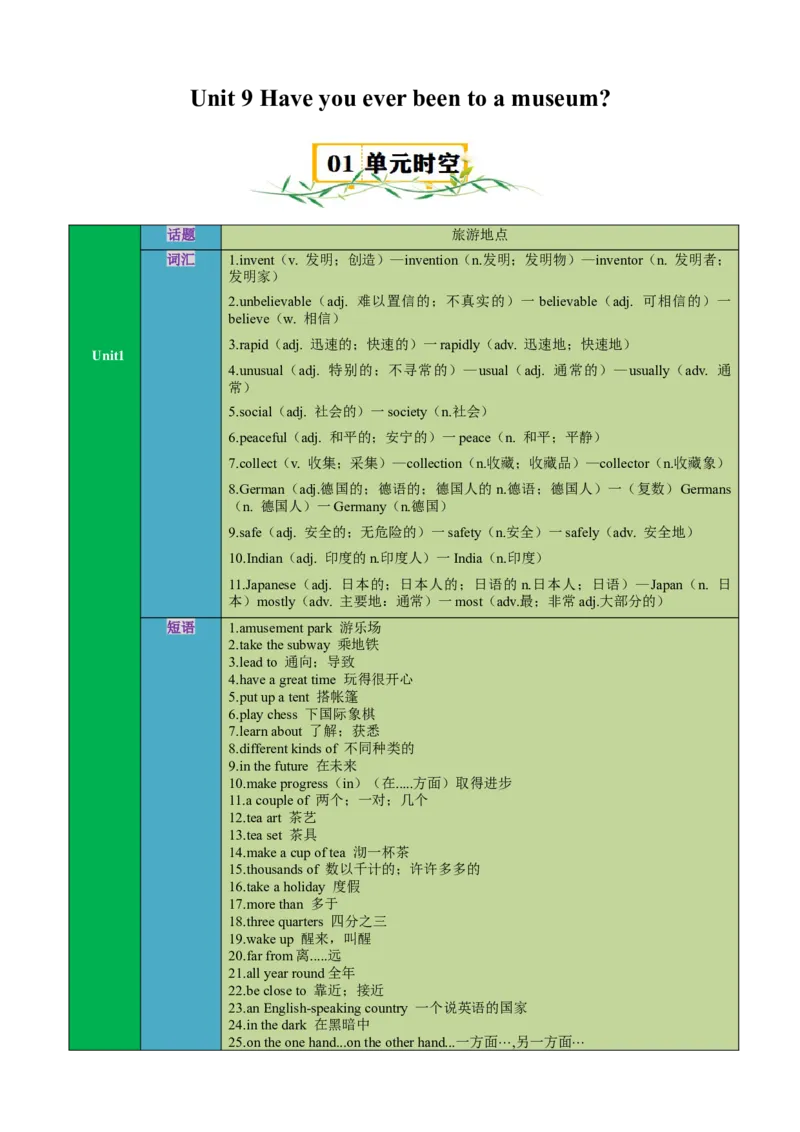
话题 旅游地点
词汇 1.invent(v. 发明;创造)—invention(n.发明;发明物)—inventor(n. 发明者;
发明家)
2.unbelievable(adj. 难以置信的;不真实的)一 believable(adj. 可相信的)一
believe(w. 相信)
3.rapid(adj. 迅速的;快速的)一rapidly(adv. 迅速地;快速地)
Unit1
4.unusual(adj. 特别的;不寻常的)—usual(adj. 通常的)—usually(adv. 通
常)
5.social(adj. 社会的)一society(n.社会)
6.peaceful(adj. 和平的;安宁的)一peace(n. 和平;平静)
7.collect(v. 收集;采集)—collection(n.收藏;收藏品)—collector(n.收藏象)
8.German(adj.德国的;德语的;德国人的n.德语;德国人)一(复数)Germans
(n. 德国人)一Germany(n.德国)
9.safe(adj. 安全的;无危险的)一safety(n.安全)一safely(adv. 安全地)
10.Indian(adj. 印度的n.印度人)一India(n.印度)
11.Japanese(adj. 日本的;日本人的;日语的n.日本人;日语)—Japan(n. 日
本)mostly(adv. 主要地:通常)一most(adv.最;非常adj.大部分的)
短语 1.amusement park 游乐场
2.take the subway 乘地铁
3.lead to 通向;导致
4.have a great time 玩得很开心
5.put up a tent 搭帐篷
6.play chess 下国际象棋
7.learn about 了解;获悉
8.different kinds of 不同种类的
9.in the future 在未来
10.make progress(in)(在.....方面)取得进步
11.a couple of 两个;一对;几个
12.tea art 茶艺
13.tea set 茶具
14.make a cup of tea 沏一杯茶
15.thousands of 数以千计的;许许多多的
16.take a holiday 度假
17.more than 多于
18.three quarters 四分之三
19.wake up 醒来,叫醒
20.far from离.....远
21.all year round全年
22.be close to 靠近;接近
23.an English-speaking country 一个说英语的国家
24.in the dark 在黑暗中
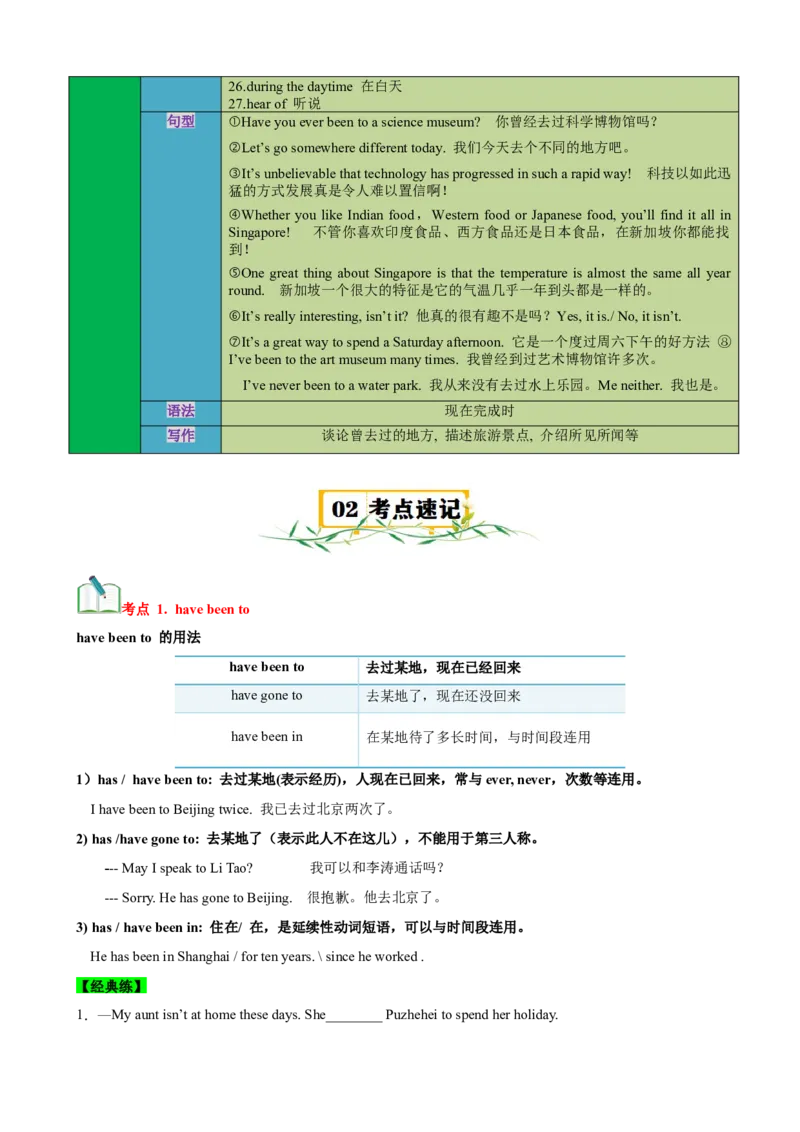
25.on the one hand...on the other hand...一方面⋯,另一方面⋯26.during the daytime 在白天
27.hear of 听说
句型 ①Have you ever been to a science museum? 你曾经去过科学博物馆吗?
②Let’s go somewhere different today. 我们今天去个不同的地方吧。
③It’s unbelievable that technology has progressed in such a rapid way! 科技以如此迅
猛的方式发展真是令人难以置信啊!
④Whether you like Indian food,Western food or Japanese food, you’ll find it all in
Singapore! 不管你喜欢印度食品、西方食品还是日本食品,在新加坡你都能找
到!
⑤One great thing about Singapore is that the temperature is almost the same all year
round. 新加坡一个很大的特征是它的气温几乎一年到头都是一样的。
⑥It’s really interesting, isn’t it? 他真的很有趣不是吗?Yes, it is./ No, it isn’t.
⑦It’s a great way to spend a Saturday afternoon. 它是一个度过周六下午的好方法 ⑧
I’ve been to the art museum many times. 我曾经到过艺术博物馆许多次。
I’ve never been to a water park. 我从来没有去过水上乐园。Me neither. 我也是。
语法 现在完成时
写作 谈论曾去过的地方, 描述旅游景点, 介绍所见所闻等
考点 1. have been to
have been to 的用法
have been to 去过某地,现在已经回来
have gone to 去某地了,现在还没回来
have been in 在某地待了多长时间,与时间段连用
1)has / have been to: 去过某地(表示经历),人现在已回来,常与ever, never,次数等连用。
I have been to Beijing twice. 我已去过北京两次了。
2) has /have gone to: 去某地了(表示此人不在这儿),不能用于第三人称。
--- May I speak to Li Tao? 我可以和李涛通话吗?
--- Sorry. He has gone to Beijing. 很抱歉。他去北京了。
3) has / have been in: 住在/ 在,是延续性动词短语,可以与时间段连用。
He has been in Shanghai / for ten years. \ since he worked .
【经典练】
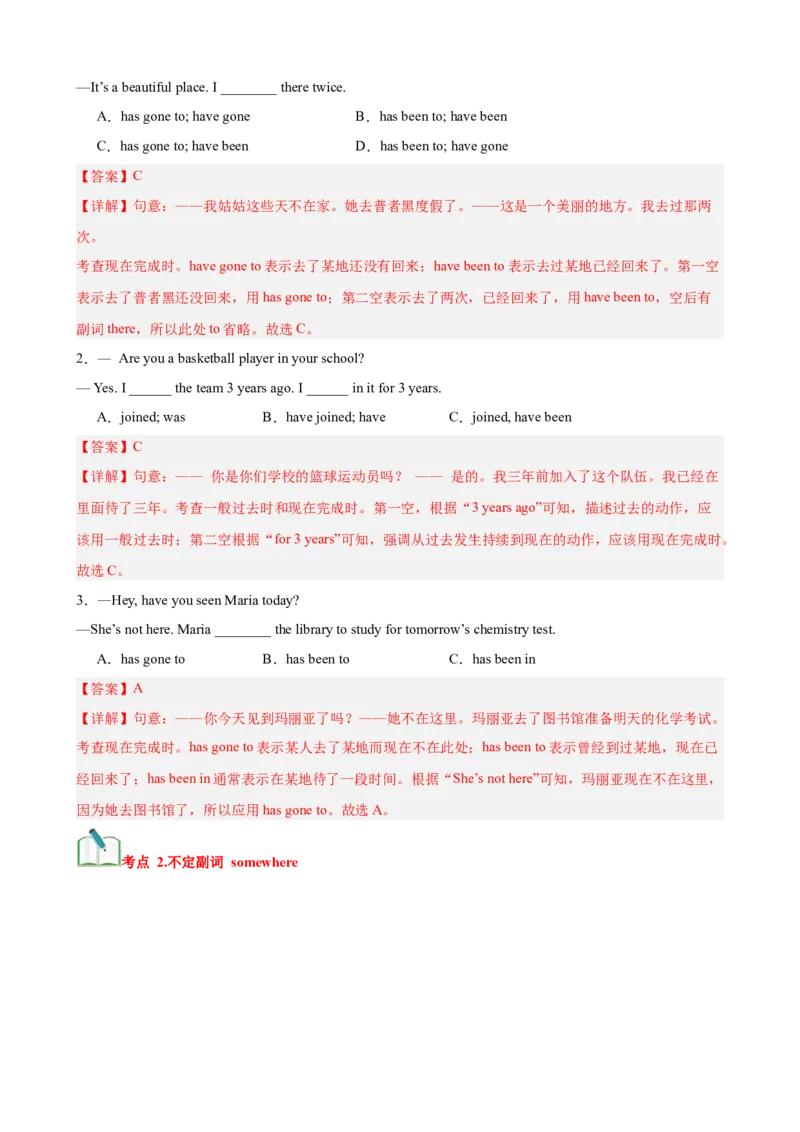
1.—My aunt isn’t at home these days. She________ Puzhehei to spend her holiday.—It’s a beautiful place. I ________ there twice.
A.has gone to; have gone B.has been to; have been
C.has gone to; have been D.has been to; have gone
【答案】C
【详解】句意:——我姑姑这些天不在家。她去普者黑度假了。——这是一个美丽的地方。我去过那两
次。
考查现在完成时。have gone to表示去了某地还没有回来;have been to表示去过某地已经回来了。第一空
表示去了普者黑还没回来,用has gone to;第二空表示去了两次,已经回来了,用have been to,空后有
副词there,所以此处to省略。故选C。
2.— Are you a basketball player in your school?
— Yes. I ______ the team 3 years ago. I ______ in it for 3 years.
A.joined; was B.have joined; have C.joined, have been
【答案】C
【详解】句意:—— 你是你们学校的篮球运动员吗? —— 是的。我三年前加入了这个队伍。我已经在
里面待了三年。考查一般过去时和现在完成时。第一空,根据“3 years ago”可知,描述过去的动作,应
该用一般过去时;第二空根据“for 3 years”可知,强调从过去发生持续到现在的动作,应该用现在完成时。
故选C。
3.—Hey, have you seen Maria today?
—She’s not here. Maria ________ the library to study for tomorrow’s chemistry test.
A.has gone to B.has been to C.has been in
【答案】A
【详解】句意:——你今天见到玛丽亚了吗?——她不在这里。玛丽亚去了图书馆准备明天的化学考试。
考查现在完成时。has gone to表示某人去了某地而现在不在此处;has been to表示曾经到过某地,现在已
经回来了;has been in通常表示在某地待了一段时间。根据“She’s not here”可知,玛丽亚现在不在这里,
因为她去图书馆了,所以应用has gone to。故选A。
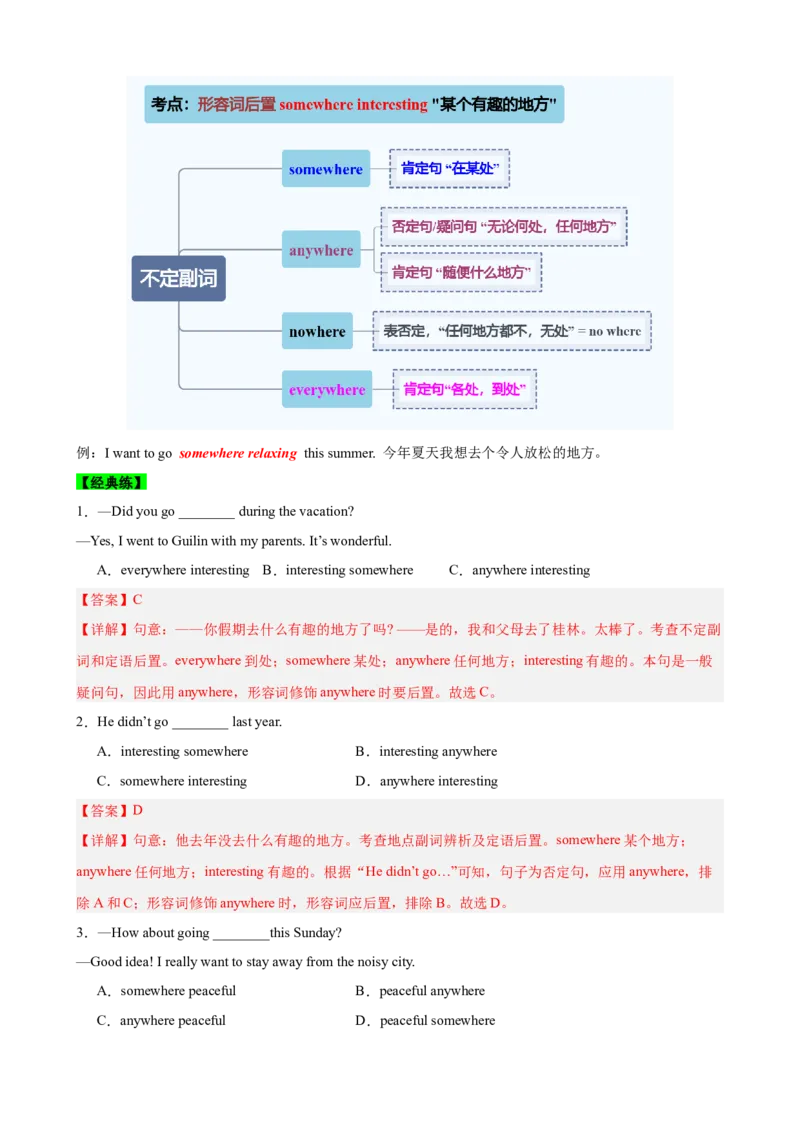
考点 2.不定副词 somewhere例:I want to go somewhere relaxing this summer. 今年夏天我想去个令人放松的地方。
【经典练】
1.—Did you go ________ during the vacation?
—Yes, I went to Guilin with my parents. It’s wonderful.
A.everywhere interesting B.interesting somewhere C.anywhere interesting
【答案】C
【详解】句意:——你假期去什么有趣的地方了吗? ——是的,我和父母去了桂林。太棒了。考查不定副
词和定语后置。everywhere到处;somewhere某处;anywhere任何地方;interesting有趣的。本句是一般
疑问句,因此用anywhere,形容词修饰anywhere时要后置。故选C。
2.He didn’t go ________ last year.
A.interesting somewhere B.interesting anywhere
C.somewhere interesting D.anywhere interesting
【答案】D
【详解】句意:他去年没去什么有趣的地方。考查地点副词辨析及定语后置。somewhere某个地方;
anywhere任何地方;interesting有趣的。根据“He didn’t go…”可知,句子为否定句,应用anywhere,排
除A和C;形容词修饰anywhere时,形容词应后置,排除B。故选D。
3.—How about going ________this Sunday?
—Good idea! I really want to stay away from the noisy city.
A.somewhere peaceful B.peaceful anywhere
C.anywhere peaceful D.peaceful somewhere【答案】A
【详解】句意:——这个星期天去个安静的地方怎么样?——好主意!我真的很想远离喧嚣的城市。考
查地点副词和形容词的用法。somewhere在某处,疑问副词; anywhere任何地方。当形容词修饰副词时,
形容词应该放在副词之后,somewhere peaceful意为“某个宁静的地方”。故选A。
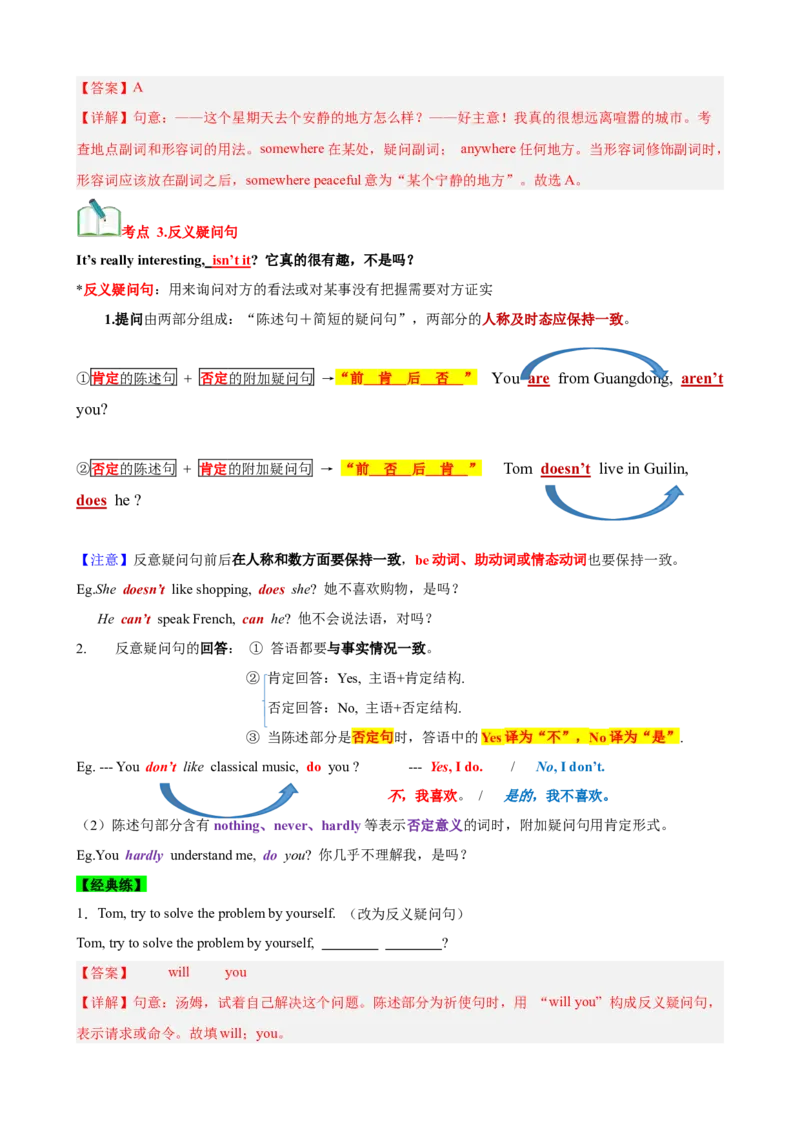
考点 3.反义疑问句
It’s really interesting, isn’t it ? 它真的很有趣,不是吗?
*反义疑问句:用来询问对方的看法或对某事没有把握需要对方证实
1.提问由两部分组成:“陈述句+简短的疑问句”,两部分的人称及时态应保持一致。
①肯定的陈述句 + 否定的附加疑问句 →“前 肯 后 否 ” You are from Guangdong, aren’t
you?
②否定的陈述句 + 肯定的附加疑问句 → “前 否 后 肯 ” Tom doesn’t live in Guilin,
does he ?
【注意】反意疑问句前后在人称和数方面要保持一致,be动词、助动词或情态动词也要保持一致。
Eg.She doesn’t like shopping, does she? 她不喜欢购物,是吗?
He can’t speak French, can he? 他不会说法语,对吗?
2. 反意疑问句的回答: ① 答语都要与事实情况一致。
② 肯定回答:Yes, 主语+肯定结构.
否定回答:No, 主语+否定结构.
③ 当陈述部分是否定句时,答语中的Yes译为“不”,No译为“是”.
Eg. --- You don’t like classical music, do you ? --- Yes, I do. / No, I don’t.
不,我喜欢。 / 是的,我不喜欢。
(2)陈述句部分含有nothing、never、hardly等表示否定意义的词时,附加疑问句用肯定形式。
Eg.You hardly understand me, do you? 你几乎不理解我,是吗?
【经典练】
1.Tom, try to solve the problem by yourself. (改为反义疑问句)
Tom, try to solve the problem by yourself, ?
【答案】 will you
【详解】句意:汤姆,试着自己解决这个问题。陈述部分为祈使句时,用 “will you” 构成反义疑问句,
表示请求或命令。故填will;you。2.Miss Guo used to be an assistant when she lived in the university.(改为反义疑问句)
Miss Guo used to be an assistant when she lived in the university, ?
【答案】 didn’t she
【详解】句意:郭小姐在大学时曾是一名助教。改为反意疑问句时,遵循前肯后否,前否后肯,此处陈
述部分是肯定,故疑问部分用否定,根据“used”可知疑问部分借助助动词didn’t,用代词she代指Miss
Gao。故填didn’t;she。
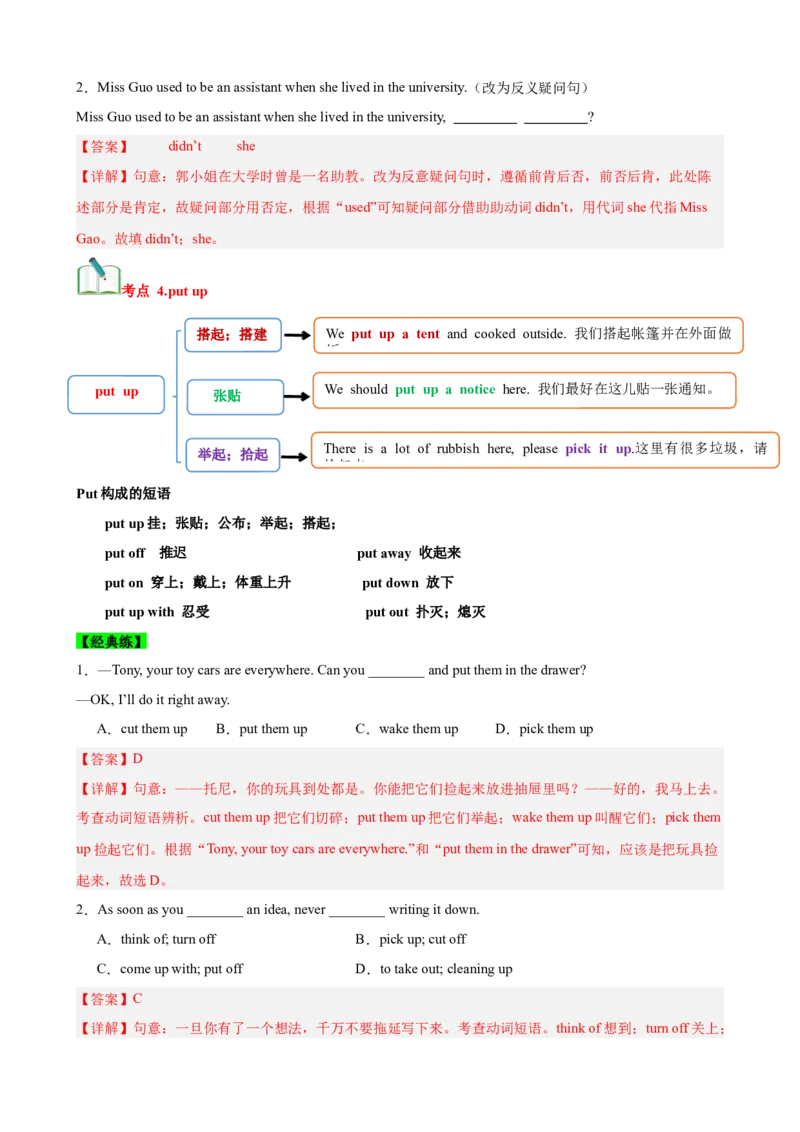
考点 4.put up
搭起;搭建 We put up a tent and cooked outside. 我们搭起帐篷并在外面做
饭。
put up 张贴 We should put up a notice here. 我们最好在这儿贴一张通知。
There is a lot of rubbish here, please pick it up.这里有很多垃圾,请
举起;拾起
捡起来。
Put构成的短语
put up挂;张贴;公布;举起;搭起;
put off 推迟 put away 收起来
put on 穿上;戴上;体重上升 put down 放下
put up with 忍受 put out 扑灭;熄灭
【经典练】
1.—Tony, your toy cars are everywhere. Can you ________ and put them in the drawer?
—OK, I’ll do it right away.
A.cut them up B.put them up C.wake them up D.pick them up
【答案】D
【详解】句意:——托尼,你的玩具到处都是。你能把它们捡起来放进抽屉里吗?——好的,我马上去。
考查动词短语辨析。cut them up把它们切碎;put them up把它们举起;wake them up叫醒它们;pick them
up捡起它们。根据“Tony, your toy cars are everywhere.”和“put them in the drawer”可知,应该是把玩具捡
起来,故选D。
2.As soon as you ________ an idea, never ________ writing it down.
A.think of; turn off B.pick up; cut off
C.come up with; put off D.to take out; cleaning up
【答案】C
【详解】句意:一旦你有了一个想法,千万不要拖延写下来。考查动词短语。think of想到;turn off关上;pick up捡起;cut off切断;come up with想出;put off推迟;take out拿出;clean up清理。根据“an idea”
可知,是想出主意;根据“writing it down”可知,千万不要推迟。故选C。
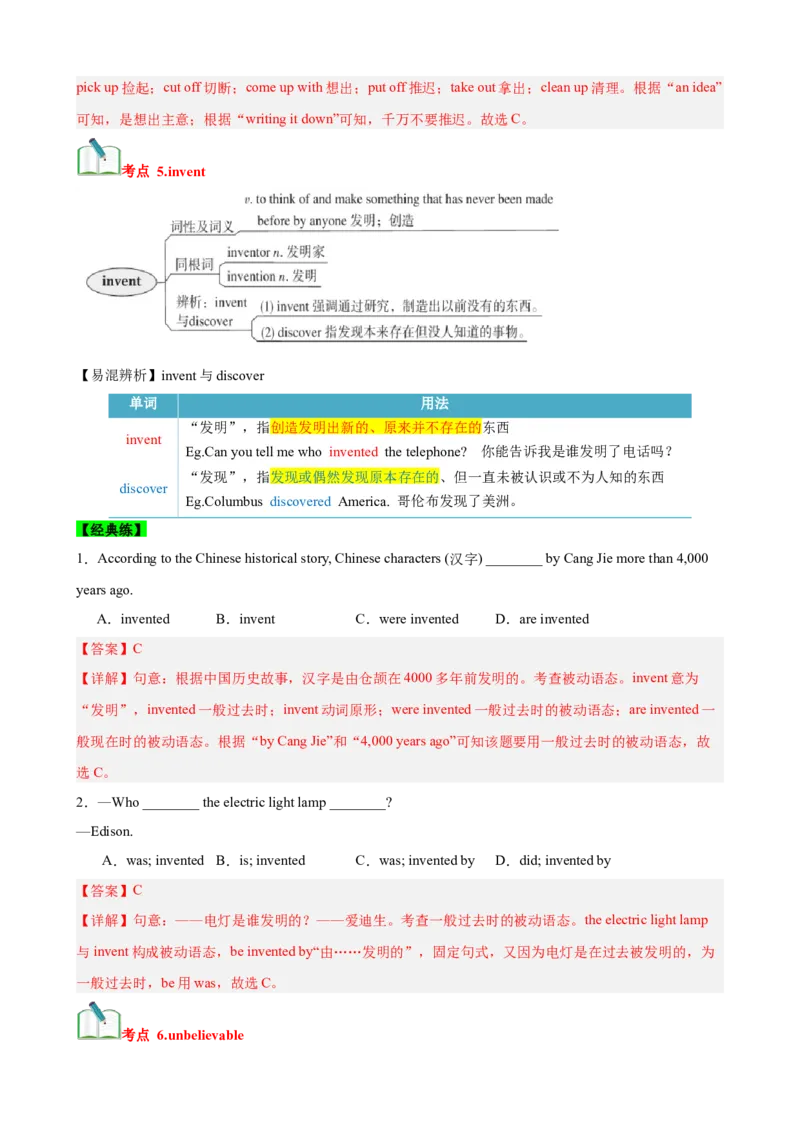
考点 5.invent
【易混辨析】invent与discover
单词 用法
“发明”,指创造发明出新的、原来并不存在的东西
invent
Eg.Can you tell me who invented the telephone? 你能告诉我是谁发明了电话吗?
“发现”,指发现或偶然发现原本存在的、但一直未被认识或不为人知的东西
discover
Eg.Columbus discovered America. 哥伦布发现了美洲。
【经典练】
1.According to the Chinese historical story, Chinese characters (汉字) ________ by Cang Jie more than 4,000
years ago.
A.invented B.invent C.were invented D.are invented
【答案】C
【详解】句意:根据中国历史故事,汉字是由仓颉在4000多年前发明的。考查被动语态。invent意为
“发明”,invented一般过去时;invent动词原形;were invented一般过去时的被动语态;are invented一
般现在时的被动语态。根据“by Cang Jie”和“4,000 years ago”可知该题要用一般过去时的被动语态,故
选C。
2.—Who ________ the electric light lamp ________?
—Edison.
A.was; invented B.is; invented C.was; invented by D.did; invented by
【答案】C
【详解】句意:——电灯是谁发明的?——爱迪生。考查一般过去时的被动语态。the electric light lamp
与invent构成被动语态,be invented by“由……发明的”,固定句式,又因为电灯是在过去被发明的,为
一般过去时,be用was,故选C。
考点 6.unbelievableunbelievable作形容词,意为“难以置信的;不真实的”,是由believable“可相信的;可信任的”加否
定前缀un-派生而来的。其动词形式为believe,意为“相信;以为”。例如:
It’s unbelievable that you are a writer. 我难相信你是一个作家。
【拓展】
un-是个前缀,意为“不”。例如:
happy“高兴的”— unhappy“不高兴的”;lucky“幸运的”— unlucky“不幸的”;
important“重要的”— unimportant;“不重要的”;
healthy“健康的”— unhealthy“不健康的”。
【经典练】
1.His words sound unbelievable. Everybody thinks he is good at telling lies.
A.true B.not true C.right D.not right
【答案】B
【详解】句意:他的话听起来难以置信。每个人都认为他擅长说谎。考查形容词辨析。true真实的;not
true不真实的;right正确的;not right不正确的。根据“His words sound unbelievable. Everybody thinks he
is good at telling lies.”可知,因为他说谎,他的话听起来不真实,因此划线单词的意思是“不真实的”。
故选B。
12.________ unbelievable achievement!
A.What an B.What C.How
【答案】A
【详解】句意:多么令人难以置信的成就啊!考查感叹句。what和how都能用于引导感叹句,what用于
修饰名词,how用于修饰形容词和副词。分析题干可知,空格处用于修饰achievement“成就”,
achievement在此句中作可数名词,所以应用what引导此感叹句,此句的结构是:What+a/an+形容词+可
数名词单数!空后的形容词unbelievable以元音音素开头,所以空格处应填What an。故选A。
考点 7. encourage
encourage 作动词,意为“鼓励”。encourage sb. to do sth.意为“鼓励某人做某事”。例如:
The teacher often encourages us to study hard.
老师经常鼓励我们要努力学习。
encouragement是encourage的名词形式,意为“鼓舞/鼓励”。例如:
The teacher’s words were a great encouragement to him.
老师的话对他是极大的鼓舞。
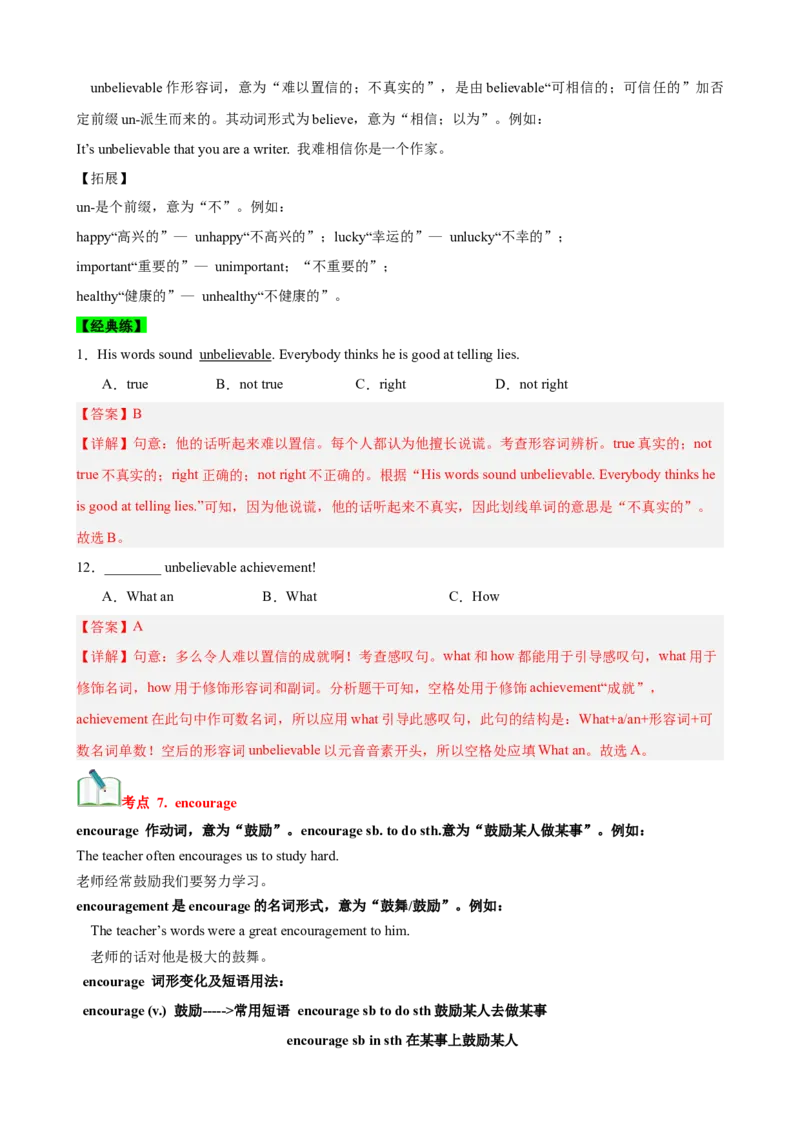
encourage 词形变化及短语用法:
encourage (v.) 鼓励----->常用短语 encourage sb to do sth鼓励某人去做某事
encourage sb in sth在某事上鼓励某人courage (n.) 勇气------>常用短语 have the courage to do sth 有勇气去做某事
【经典练】
1.The teacher encourages us ________ English every day.
A.speak B.to speak C.speaking D.spoke
【答案】B
【详解】句意:老师鼓励我们每天说英语。考查非谓语动词。encourage sb to do sth“鼓励某人做某事”,
此处使用动词不定式作宾语补足语。故选B。
2.Miss Wu always encourages us ________ great books in our free time.
A.read B.to read C.reading
【答案】B
【详解】句意:吴老师总是鼓励我们在空闲时间读好书。考查非谓语动词。考查“encourage sb. to do sth.”
表示“鼓励某人做某事”,所以此空应用不定式形式。故选B。
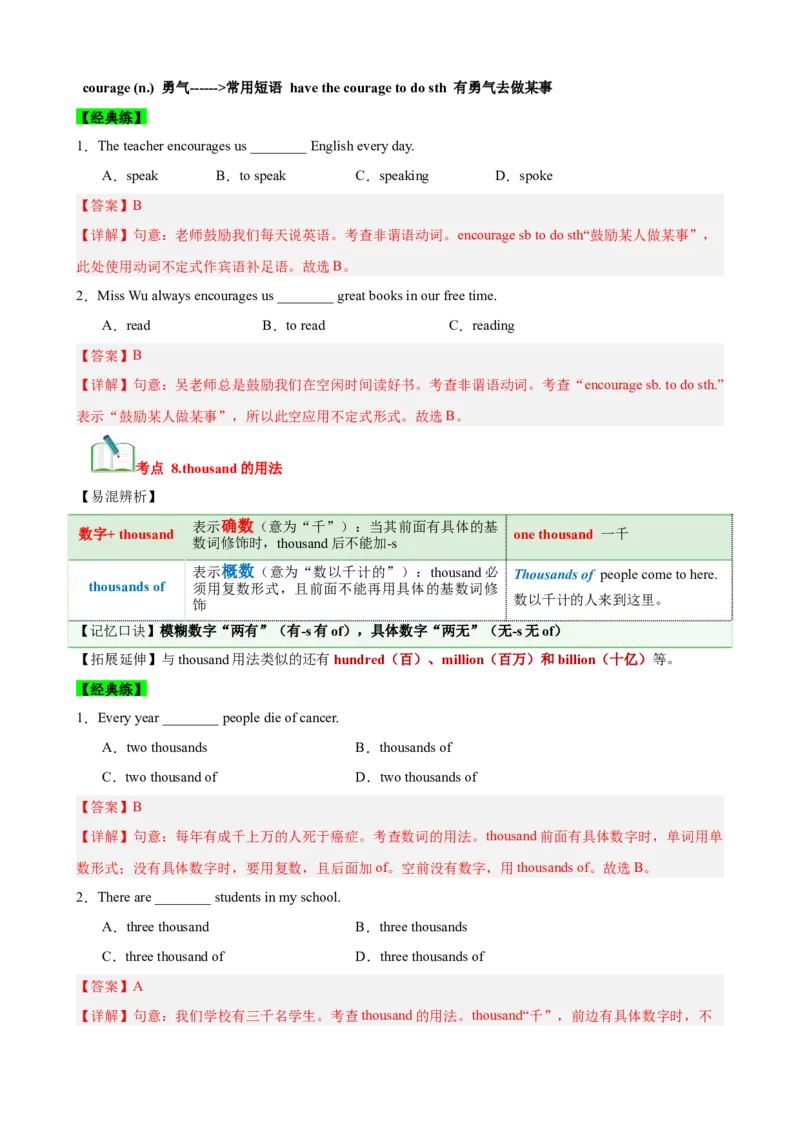
考点 8.thousand的用法
【易混辨析】
表示确数(意为“千”):当其前面有具体的基
数字+ thousand one thousand 一千
数词修饰时,thousand后不能加-s
表示概数(意为“数以千计的”):thousand必
Thousands of people come to here.
thousands of 须用复数形式,且前面不能再用具体的基数词修
数以千计的人来到这里。
饰
【记忆口诀】模糊数字“两有”(有-s有of),具体数字“两无”(无-s无of)
【拓展延伸】与thousand用法类似的还有hundred(百)、million(百万)和billion(十亿)等。
【经典练】
1.Every year ________ people die of cancer.
A.two thousands B.thousands of
C.two thousand of D.two thousands of
【答案】B
【详解】句意:每年有成千上万的人死于癌症。考查数词的用法。thousand前面有具体数字时,单词用单
数形式;没有具体数字时,要用复数,且后面加of。空前没有数字,用thousands of。故选B。
2.There are ________ students in my school.
A.three thousand B.three thousands
C.three thousand of D.three thousands of
【答案】A
【详解】句意:我们学校有三千名学生。考查thousand的用法。thousand“千”,前边有具体数字时,不加s,其后不跟of;当后面有of时,必须加s,thousands of表示“成千上万”。故选A。
考点 9.whether的用法
whether=if “是否”,引导宾语从句,在从句中不作成分,不可省略
whether…or… “是 ……还是 ……,不管 ……还是 ……”,引导让步状
语从句
【经典练】
1.—Will Joe come to our new club this weekend?
—I am not sure ________ he will come, but I believe ________ he will help us.
A.if; whether B.that; whether C.whether; if D.whether; that
【答案】D
【详解】句意:——Joe这个周末会来我们的新俱乐部吗?——我不确定他是否会来,但我相信他会帮助
我们的。考查宾语从句引导词。if如果、是否;whether是否;that引导宾语从句时,无实义。第一空应
表达“我不确定他是否要来”,用if/whether引导宾语从句; 第二句表达“但我相信他会帮助我们的”,
陈述句用that引导,在句中不作任何成分。故选D。
2.—Will you take ________ sweater? It fit s you so well.
—Well, I’m thinking ________ they’re really necessary or not.
A.a; if B.the; / C.a; that D.the; whether
【答案】D
【详解】句意:——你要买这件毛衣吗?它很适合你。——嗯,我在考虑它们是否真的有必要。考查冠
词和宾语从句引导词。a/an一个,修饰可数名词单数,表示泛指,an用于元音音素开头的单词前,a用于
辅音音素开头的单词前;the意为“这(些),那(些)”,表示特指;if是否;whether是否。第一空表
示特指说话双方都知道的那件毛衣,用定冠词“the”;第二空“thinking”后接宾语从句,根据“or not”可
知,应用“whether”引导,表示“是否”。故选D。
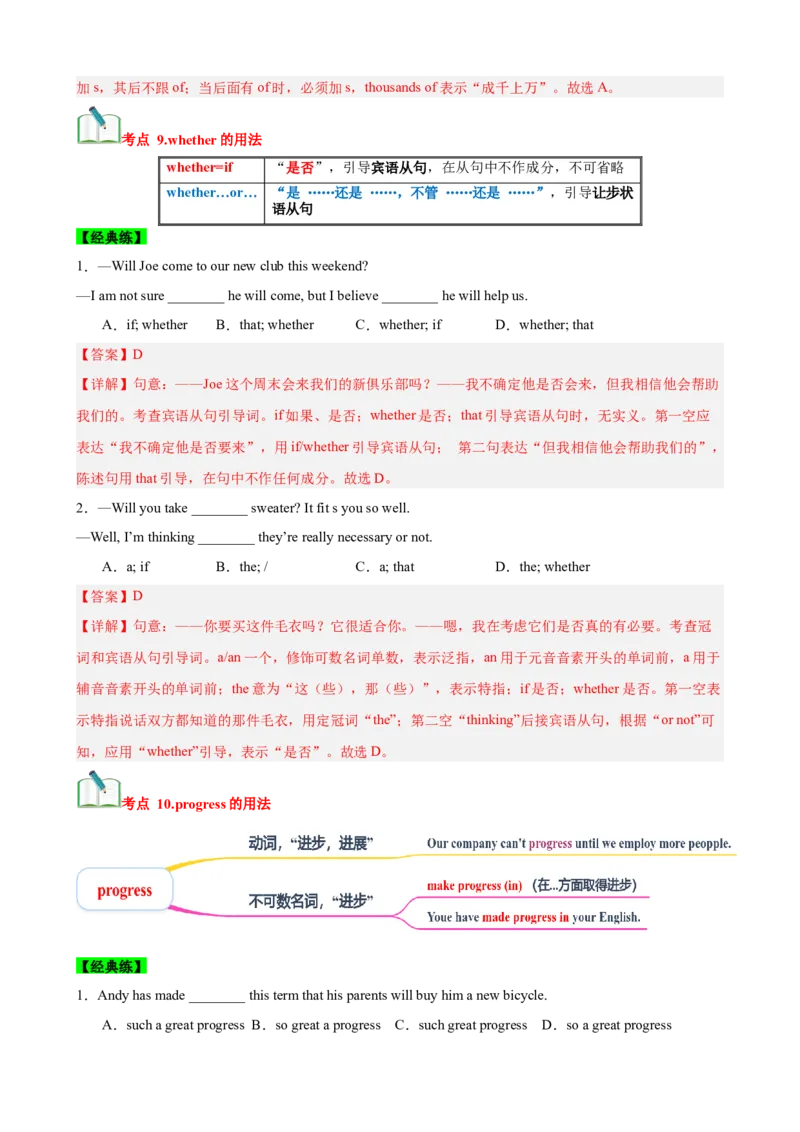
考点 10.progress的用法
【经典练】
1.Andy has made ________ this term that his parents will buy him a new bicycle.
A.such a great progress B.so great a progress C.such great progress D.so a great progress【答案】C
【详解】句意:安迪这学期进步很大,他的父母要给他买一辆新自行车。考查such … that引导结果状语
从句。such修饰名词(短语),通常用于结构“such+(a/an)+adj.+n.”;so修饰形容词,通常用于结构
“so+adj.+(a/an)+n.”。progress“进步”,不可数名词,不加冠词,所以“如此大的进步”为such great
progress或。故选C。
2.________ great progress Carrie has made in her maths!
A.What B.What a C.What an D.How
【答案】A
【详解】句意:凯莉在数学上取得了多大的进步啊!考查感叹句。根据句子结构可知,此处为感叹句,
感叹句常见结构为:What+(a/an)+形容词+名词+主语+谓语!How+形容词+主语+谓语!句中great为形容
词,progress为不可数名词,使用What引导感叹句,故选A。
考点11. neither
1.—Have you ever been to a history museum? 你曾经去过科学博物馆吗?
—No, I haven’t. 不,我没去过。
—Me neither. 我也没去过。
这里Me neither.是Neither have I.的口语化。“Neither+助动词/情态动词/be动词+主语.”表示主语的情况与
上述否定句中所说内容一样,是省略句型,Me neither.是Me, too.的否定形式。neither用于否定句表示“也
不”。
Me neither. 意为“ 我也不…… ” 表示后者的情况和前者所述的否定情况一
样。
Me too. 意为“ 我也一样 ” 表示后者的情况和前者所述的肯定情况一
【知识拓展】
(1)“So+助动词/be动词/情态动词+主语I.”相当于Me, too.。
☞They have been to England. So have I.(Me, too.) 他们去过英国。我也去过。☞He is from Beijing. So
am I.(Me, too.) 他来自北京。我也来自北京。
(2)neither也可用作形容词,意为“两者都不”,放在单数名词前。
☞Neither student is from Canada.两个学生都不是来自加拿大。
(3)neither也可用作代词,常与of连用,表示“两者都不”。也可单独用作宾语或主语。☞Neither
of them is very clever but both study hard.他们两个都不是很聪明,但学习都挺刻苦。
【经典练】1.—I’d love to go hiking with you, but I have much homework ________.
—If you don’t go, ________.
A.to do; neither do I B.to do; neither will I C.doing; so will I
【答案】B
【详解】句意:——我想和你一起徒步旅行,但我有很多家庭作业要做。——如果你不去,我也不去。
考查非谓语动词以及倒装句。第一空修饰名词homework,应填动词不定式作后置定语,排除C;
neither+助动词+I,表示前面的否定情况也同样适用于后者。if引导的条件状语从句,主句用一般将来时
结构。故选B。
2._________ Tom _________ his cousin have learnt the courses on music, but _________ of them shows
interest in pop music.
A.Not only; but also; all B.Neither; nor; both C.Both; and; neitherD.Both; and; all
【答案】C
【详解】句意:汤姆和他的表弟都学过音乐课程,但他们都对流行音乐不感兴趣。考查连词和代词。Not
only...but also...不仅……,而且……,谓语用就近原则;Neither...nor...既不……,也不……,谓语用就近
原则;Both...and...……和……两者都,谓语用复数形式;all三者或三者以上都;both两者都。此处谓语
have learnt是复数形式,因此both…and,连词but前后表示转折关系,but前表示他们两个都学过音乐课
程,but后表示他们两个都对流行音乐不感兴趣,因此用neither,故选C。
考点 12. since
since的用法
(1)作为介词,意为“自……以来”,后接时间点作时间状语,常用于现在完成时,可以和“for + 时
间段”互换。
I have known him since 10 years ago.自从10年前我就认识他了。
= I have known him for 10 years.我认识他已经有10年了。
(2)作为连词,意为“自……以来”,引导时间状语从句,主句常用现在完成时,从句常用一般过去时。
(3)作为连词,还可译为“由于;既然”,引导原因状语从句,表示很明显的原因。
1.The young man hasn’t done much exercise since he got a mobile phone.
年青人自从买手机以来,就不做大量运动了。
2. Since everybody is here, let’s begin the meeting.既然人都齐了,我们就开会吧。
【经典练】
1.It ________ five years since I came to the city after finishing high school.
A.was B.have been C.has been D.had been
【答案】C【详解】句意:高中毕业后来到这座城市已经五年了。考查现在完成时。根据“since I came...”可知,句
子的时态为现在完成时,其结构为have/has+过去分词,主语是it,助动词用has,be动词的过去分词为
been。故选C。
2.Jim ______ Beijing since last November.
A.have been B.has left C.has gone to D.has been in
【答案】D
【详解】句意:自去年11月以来,吉姆一直在北京。考查动词时态。have been已经;has left已经离开;
has gone to去了某地;have been in一直在某地。根据“since last November”表示一段时间,所以句子的谓
语动词必须是延续性动词,left是leave的过去式,意为“离开”,是短暂性动词,排除B;has gone to表
示“去了某地”,不能和表示一段时间的时间状语连用,排除D;has been in表示“一直在某地”,可以
和表示一段时间的时间状语连用,主语Jim是第三人称单数,助动词用has。故选D。
考点13 a couple of
a couple of意为“少数;几个”。例如:
He bought a couple of books for his daughter.
他为他的女儿买了几本书。
【拓展】
a couple of还可意为“一双;一对”。例如:
I found a couple of socks in the room but they did not make a pair.
我在房间里找到两只袜子,但他们不是一双。
【经典练】
1.I found a _____ of socks in the bedroom, but they didn't make a __________.
A.pair, couple B.pair, double C.couple, pair D.couple, twice
【答案】C
【详解】句意:我在卧室里发现了两只袜子,但是他们不是一对。pair一双,一对;couple对;double双
倍;twice两次,两倍。根据句意可知,第一个表示发现了“两只袜子”,但这两只不是一对,故第一个
空用couple,表示数量为两个;第二个空用pair表示成双成对。故应选C。
2.Susan’s parents ________ her, because she has been ill for ________ days.
A.worry; a couple of B.worry about; a couple of
C.worries about; a few D.worries; a lot of
【答案】B
【详解】句意:苏珊的父母担心她,因为她已经生病好几天了。考查词汇辨析和主谓一致。worry担心,
不及物动词,三单形式是worries;worry about担心,动词短语。a couple of几个;a few一些;a lot of很多。主语“her parents”是复数,动词用原形,空后是宾语her,所以用动词短语worry about。a couple of
days“几天”。故选B。
考点14. wonder
wonder v. 想知道;想弄明白
【例句】
I wonder if you can attend the meeting tonight. 我想知道你是否可以参加今晚的会议。
【拓展】
(1)wonderful adj. 精彩的
Welcome to the wonderful world of Disneyland! 欢迎来到精彩的迪士尼世界!
(2)wonderfully adv. 精彩地
Listen! How wonderfully the girls are singing! 听!女孩们唱得多么精彩啊!
(3)no wonder=It’s no wonder that 怪不得
No wonder he jumped out of the car.=It’s no wonder that he jumped out of the car. 怪不得他当时跳车了。
【经典练】
1.He has studied English for five years. ________ he can speak English very well.
A.No doubt B.No way C.No problem D.No wonder
【答案】D
【详解】句意:他学英语已经五年了。难怪他英语说得那么好。考查情景交际。No doubt毫无疑问;No
way不可能,绝不;No problem没问题;No wonder难怪。根据“He has studied English for five years”及常
识可知,学英语五年英语应该说得很好,此处应用“No doubt”来表达对某种情况的合理解释。故选D。
2.—I’m wondering ________ at a low price?
—You can book one through our official app.
A.when I can buy the air ticket B.when can I buy the air ticket
C.how I can buy the air ticket D.how can I buy the air ticket
【答案】C
【详解】句意:——我想知道怎样才能买到便宜的机票。——你可以通过这个官方应用程序预订。考查
宾语从句。根据“I’m wondering ...”可知,此处为宾语从句,应该用陈述语序,故排除B、D项。根据答
语“You can book one through this official app.”可知,上句是询问怎样才能买到便宜的机票,用how引导宾
语从句。故选C。
考点 15.特殊疑问词+ever 的用法So you can choose to go whenever you like 因此,你可以选择你喜欢的任何时间去
whenever=not matter when “无论何时;任何时
候”
【拓展】类似的由“特殊疑问词+-ever”构成的合成词还有:
无论谁 no matter who = ____ whoever _ ____ 无论什么 no matter wh at = ____ whatever _ ____
无论哪里 no matter wh ere = ___ wherever _ ____ 不管怎样 no matter how = ____ however _ ____
【经典练】
1.It is generally _________ to be wrong to give a child _________ he or she wants.
A.consider; with B.considering; what C.considered; whatever
【答案】C
【详解】句意:给孩子任何他想要的东西通常被认为是错误的。考查被动语态及宾语从句。consider认为,
动词原形;considering现在分词;considered过去分词;with和……一起;what什么;whatever无论什么。
根据句意可知,第一个空表示“被认为……”,应使用被动语态,故用过去分词;第二个空是whatever
引导的宾语从句。故选C。
2._________ help the poor, you can give away _________ you consider(认为)best.
A.In order that, whatever B.In order that, however
C.In order to, however D.In order to, whatever
【答案】D
【详解】句意:为了帮助穷人,你可以捐赠任何你认为最好的东西。考查短语及连接代词。in order to为
了,后接动词原形。in order that为了,后接从句。根据“help the poor”可知用“in order to do”的结构。
whatever不管什么;however不管怎样。动词“give away”后是宾语从句,根据“consider”可知从句缺宾语,
用连接代词whatever引导从句,表示“你认为最好的任何东西”。故选C。
一.语法精讲
现在完成时
1.现在完成时的构成
基本结构:主语+have/has+动词的过去分词
2.现在完成时的用法(1)表示过去发生的或已经完成的某一动作对现在造成的影响或结果。如:
—Have you had your lunch yet?你吃过午饭了吗?
—Yes,I have. I’ve just had it.是的,我刚吃过。(说明现在饱了)
I have lost my pen.我把我的钢笔弄丢了。(过去某个时间丢的,现在还没有找到)
I have already watched the TV play.我已经看过这部电视剧了。
—Have you found your lost pen yet?你找到你丢失的钢笔了吗?
—No. I haven’t found it yet.没,我还没有找到它。
注意:already,yet常和现在完成时连用,already用于肯定句,可放在助动词之后、过去分词之前,也可放在
句末。yet用在疑问句或否定句中,常放在句末。
(2)表示动作或状态在过去已经开始,持续到现在,也许还要持续下去,常和“for+时间段”或“since+时
间点”连用,动词多为延续性动词。如:
We have lived here since 2000.自从2000年我们一直住在这里。(说明一直住在这里,也许还会住下去)
3.现在完成时的几个标志词
(1)just 意为“刚刚”,表示动作刚刚结束,常放在助动词与过去分词之间。如:
He has just come back from Beijing.他刚从北京回来。
(2)ever意为“曾经”,放在助动词与过去分词之间。如:
Have you ever been to Shanghai?你曾去过上海吗?
(3)never意为“从来没有”,常与before 连用,多放在助动词与过去分词之间。如:
I have never traveled by plane before.我以前从来没有乘飞机旅行过。
(4)before 意为“以前”,指过去不确定的某个时间,总是放在句末,不受句型的限制。如:
I think we’ve met before.我觉得我们以前见过面。
(5)since+时间点,for+时间段。如:
I have been in Beijing for two years.我在北京两年了。
She has been a teacher since two years ago.她从两年前就当老师了。
4.延续性动词与非延续性动词的用法
(1)现在完成时表示动作从过去某个时候开始一直持续到现在,与一段时间连用时应注意肯定句中的谓
语动词应是延续性动词,非延续性动词不可和一段时间连用。如:
我离开这所学校已八年了。
误:I’ve left this school for eight years.
正:I’ve been away from this school for eight years.他借用我的词典已两天了。
误:He has borrowed my dictionary for two days.
正:He has kept my dictionary for two days.
不过,在否定句中非延续性动词可与一段时间连用。如:I haven’t gone to see him for several months.我已经好几个月没去看他了。
(2)非延续性动词与一段时间连用时可采用下列三种方法:
1)将非延续性动词转化为延续性动词
非延续性动词 延续性动词
buy have
borrow keep
open be open
close be closed
begin/start be on
come be here
go be there
finish be over
die be dead
catch a cold have a cold
put on wear
wake up be awake
fall asleep be asleep
lose not have
join be in
leave be away
arrive/reach be
2)将时间状语改为过去时间,并用一般过去时代替现在完成时。
3)用句型“It is+一段时间+since从句(从句中的谓语动词用非延续性动词的过去式)”表示。如:
It is two years since the old man died.这个老人死了两年了。
5.have been to, have gone to和have been in的区别
形式 意义及用法说明 例句
表示“曾去过某地”,说话时已从某地回来或已 Have you ever been to New York?你曾去过纽约
have been to
从某地去了其他地方,总之,现在已不在某地 吗?(人已回来)
have gone to则表示“已去了某地”,说话时不
Jim has gone to New York with his family.吉姆和
have gone to 在说话地点或在去某地的途中,或已到了某地,
他的家人去了纽约。(人还没回来)
总之,现在还未回来
The Greens have been in New York for three years.
格林一家在纽约(生活)已有3年了。
have been in 表示“已在某地(待了多久)”,若表 Mr.Li has been at this school for ten years.李先生
have been in 示“已在小地方多久”,in需用at 代替,但后面 在这个学校已有10年了。
跟副词时只用have been,不需用任何介词
The Greens are in Nanjing now.They have been
here for half a year.格林一家现在在南京。他们
在这儿已有半年了。
6.现在完成时和一般过去时的区别时态 意义及用法说明 例句
与现在有关的时态,属于现在时态 I have seen the film already.我已看过那部电影
现在完成时 范畴,它侧重于过去的动作对现在 了。(说明“看”这个动作发生在过去,我现在
侧重点
造成的影响或结果 对这部电影的内容有所了解)
不同
是一种过去时态,侧重于表示过去 I went to Nantong yesterday.昨天我去了南通。
一般过去时
的动作,与现在无关 (仅说明昨天去了南通这件事情,与现在无关)
与现在完成时连用的时间状语
Have you ever picked flowers or stepped on the
有 :already,yet,still,just,so far,in the
现在完成时 grass in a park?你曾经在公园里摘过花或踩过
连用的 last/past...,before,ever,never,since 引
草坪吗?
时间状 出的时间和for引出的时间等
语不同 一 般 过 去 时 则 常 与
Father bought this bike five years ago.父亲5年
一般过去时 ago,yesterday,last...,in 1990,just now
前买了这辆自行车。
等连用
二.单元写作
本单元的话题是“有趣的地方”,该话题主要涉及人们曾经游览过的旅游胜地、城市或国家等。写
作时多从它们的地理位置、人口、气候、景观和美食等方面入手。写作时,可以用have ever been to…描
述某人曾经去过的地方,可以用have ever done sth.描述曾经经历过某事,可以用一般将来时表达对将来
的期望。
写作指导
1. 描写某地的景色或景观时,一般要遵循的原则是:从总体到局部,从外到内。
2. 这类文章一般包括三段:开头是总体介绍,引出主题;中间是正文,具体介绍此地的特色,如著名的
建筑、风景名胜等;第三部分是结尾。
3. 描写某地的短文属于说明文体,要弄清时间的立足点是"过去"、"现在",还是"将来"。
4. 表达方式要有所变化,景物描写用词容易重复、单调,因此写作时应选用不同的句式和表达方式来描
述事物,使表达方式多样化。
二、常用句型
1)开头句
1. I’ve been to an amusement park in London.
2. The best place I have ever been to is Sanya.
2)中间句
1. I visited the places of interest in Beijing and learned about the traditional culture.
2. The scenery was so interesting that I lost myself in it.
3)结尾句
1. If you go there, I’m sure you will have a wonderful time.
2. What an exciting trip we had!
4)句子升格1. Xi’an has convenient transport.(升格为复合句) → One great thing about Xi’an is that it has convenient
transport.
2. Please visit it. I am sure you can have a wonderful time. (升格为复合句) → If you visit it, I’m sure you can
have a wonderful time.
◆谚语积累
1. All roads lead to Rome.
条条大路通罗马。/殊途同归。
2. Reading ten thousand books is like traveling ten thousand miles.
读万卷书,行万里路。
【写作指导】
一、写什么——细审题,列要点
1. 介绍公园的名称、地理位置和基本设施。
2. 描述公园的特色。
3. 邀请大家到此游玩。
二、怎么写——遣词句,重结构
第一部分:开门见山 (介绍公园的位置和基本设施。用一般现在时。)
第二部分:突出特色(描述具体的特色,以公园的常规活动为例时,动词用一般现在时。)
第三部分:邀请出游(提建议时可以选用各种提建议的句型。)
典例赏析:
(2023·湖北襄阳·统考中考真题)今年五一,襄阳凭借丰富的旅游资源和优质的服务,吸引了各地的游客前来“打卡”。在校园英语文化
周,你将代表班级做关于“旅行”的英语演讲。请根据以下要点提示,结合你的旅游或出行经历,写一
篇英语演讲稿。
1.要点提示:
(1)简要介绍你对旅行的态度或看法;
(2)详述你的一次旅游或出行经历;
(3)根据你的旅行感受,为襄阳的旅游发展提出一条合理的建议或希望。
2.注意事项:
(1)词数90左右,开头和结尾已经给出,不计入总词数;
(2)可以适当增加细节,以使行文连贯;
(3)作文中不能出现真实姓名和学校名称。
Dear schoolmates,
Good morning! I’m glad to make a speech here.
___________________________________________________________________________________________
___________________________________________________________________________________________
___________________________________________________________________________________________
___________________________________________________________________________________________
___________________________________________________________________________________________
___________________________________________________________________________________________
That’s all. Thank you!
【答案】例文
Dear schoolmates,
Good morning! I’m glad to make a speech here.
Now more and more people are interested in travelling. I think trip is an opportunity for us to experience life
and increase knowledge. At the same time, it can also broaden our horizon.
Last Wednesday, we went on a trip to Yixing. Yixing is a modern and tidy city, where there are many places
of interest. It was a fine warm day. In the morning, we climbed the hill in the Bamboo Park. On the way, we met
an Australian. He was kind and patient. We had fun practising speaking English. In the afternoon, we rowed boats
along the underground river in the Shanjuan Cave. It was a great day.
I think if we want to attract more tourists, we should provide better service for tourists.
That’s all. Thank you!
【详解】[总体分析]①题材:本文是一篇演讲稿;
②时态:时态为“一般现在时”和“一般过去时”;
③提示:根据内容提示,介绍自己的旅游经历和感受,不要遗漏要点,可适当发挥。
[写作步骤]
第一步,简要介绍你对旅行的态度或看法;
第二步,详述你的一次旅游或出行经历;
第三步,提出自己的建议。
[亮点词汇]
①be interested in对……感兴趣
②at the same time同时
③places of interest名胜古迹
[高分句型]
①Yixing is a modern and tidy city, where there are many places of interest.(非限制性定语从句)
②I think if we want to attract more tourists, we should provide better service for tourists.(宾语从句;if引导的
条件状语从句)
一、重点单词
单词camera n.照相机;摄影机;摄像机
unbelievable adj.难以置信的;不真实的
progress v.& n.进步;进展
rapid adj.迅速的;快速的
unusual adj.特别的;不寻常的
toilet n.坐便器;厕所
encourage v.鼓励
social adj.社会的
peaceful adj.和平的;安宁的
perfect adj.完美的;完全的
itself pron.它自己
collect v.收集;采集
German adj.德国的;德语的;德国人的n.德语;德国人
ride n.供乘骑的游乐设施;短途旅程province n.省份
amusement n.娱乐;游戏
somewhere adv.在某处;到某处
invention n.发明;发明物
invent v.发明;创造
performance n.表演;演出
theme n.主题
thousand num.一千
safe adj.安全的;无危险的
simply adv.仅仅;只;不过
fear v.& n.害怕;惧怕
whether conj.不管……(还是);或者……(或者);是否
Indian adj.印度的n.印度人
Japanese adj.日本的;日本人的;日语的n.日本人;日语
fox n.狐狸
whenever conj.在任何……的时候;无论何时
spring n.春天
mostly adv.主要地;通常
equator n.赤道
location n.地点;位置
二、重点短语
1. all year round 一年到头; 终年
2. at night 在夜晚
3. in a more natural environment 在一个更加自然的环境中
4. be far from 离…远
5. in the dark 在黑暗中
6. in the past 在过去
7. have been to sp. 去过某地
8. science museum 科学博物馆
9. history museum 历史博物馆
10. amusement park 游乐园
11. go somewhere different 去不同的地方
12. go skating 去滑冰13. take the subway 坐地铁
14. a great way to spend a Saturday afternoon 一个过周六下午的好方法
15. all the old movie cameras 所有古老的电影摄影机
16. learn about sth. 了解有关......的情况
17. on the weekend 在周末
18. camp in the mountains 在大山里露营
19. put up a tent 搭帐篷
20 .in such a rapid way 以如此迅猛的方式
21. different kinds of 各种各样的
22. development of toilets 厕所的发展
23. social groups 社会团体
24. the tea art performances 茶艺表演
25. make a perfect cup of tea with beautiful tea sets 用漂亮的茶具沏一杯完美的茶
26. a nice place to enjoy tea 一个品茶的好地方
27. thousands of 数以千计的
28. International Museum of Toilets 国际厕所博物馆
29. the Terracotta Army 兵马俑
30. Southeast Asia东南亚
31. Night Safari 夜间动物园
32. three quarters 四分之三
33. an English-speaking country 一个说英语的国家
34. have problem doing sth. 做某事很困难
35. during the daytime 在白天
36. a couple of times 好几次
37. right now 现在;目前
38. an amusement park with a special theme 一个有特别的主题的游乐园
38. walk around the park 在公园里到处走
40. hear of 听说
41. take a ride 兜风
42. another province 另一个省
43. the Bird’s Nest 鸟巢
44. encourage sb. to do sth. 鼓励某人做某事
45. on the one hand..., on the other hand 一方面,另一方面三、重点句型
1. -Have you ever been to a science museum? 你曾经去过科技馆吗?
-Yes, I've been to a science museum. /No, I've never been to a science muse-um. 是的,我去过科技馆。/不,
我从来没有去过科技馆。
2. -Have you ever visited the space museum?你曾经参观过太空博物馆吗?
-Yes, I have. I went there last year./No, I haven't. 是的,我去过。我去年去过那儿。/不.我没去过。
3. -I've been to the art museum many times. 我去过美术馆好多次了。
-Me, too. And I've also visited the nature museum. 我也是。我还参观了自然博物馆。
4.-I've never been to a water park.我从来没去过水上公园。
-Me neither./Neither have I.我也没有。
5. It's really interesting, isn't it? 它确实很有趣,不是吗?
6. It's unbelievable that technology has progressed in such a rapid way!
很难相信技术竟以这么快的速度发展!
7. This small island in Southeast Asia is a wonderful and safe place to take a holiday.
东南亚的这个小岛是度假的一个极好且安全的地方。
8. On the one hand, more than three quarters of the population are Chinese.
一方面,超过四分之三的人口是华人。
9.On the other hand, Singapore is an English-speaking country, so it's also a good place to practice your English!
另一方面,新加坡是一个说英语的国家,因此它也是你练习英语的好地方!
10. One great thing about Singapore is that the temperature is almost the same all year round.
新加坡的一个优点就是那里一年到头的气温几乎一样。
四、重难句
1. I learned about the inventions that led to color movies, too. 我还了解了一些发明,它们成就了彩色电影。
此处learn是“了解;获知;得知”的意思,由介词about或of引入所获知的具体内容。
例如: The children were all shocked to learn of the death of their headmaster. 得知校长去世,孩子们都十分震
惊。
2. I’ve never been camping. 我从未野营过。
此句为现在完成进行时(初屮阶段不要求掌握),这一时态的结构为“have been + 现在分词”,表示从
过去某一时刻一直延续至今的动作。在本句中,说话人使用这一时态来强调自己至今从未有过野营的经
历,欠缺这方面的经验。
如:He’s been watching TV all afternoon. 他一下午都在看电视。
We’ve been living like this ever since the birth of my little brother. 自打我弟弟出生,我们就这样一直过活。
3. I wonder how much more computers will be able to do in the future. 不知道将来电脑还能够做些什么事情呢。
l) Wonder 表示“(对某事)感到疑惑;想要知道;想弄明白;琢磨”,后面常接由what, how, who或if /
whether(是否)引导的宾语从句。
例如:I wonder how they’re getting on. 我想知逍他们现在过得怎样。
I just wonder if they’ve arrived safely. 我想知道他们是否安全抵达了。
五、用法总结
1.a great way to do sth. 一个做某事的好方法
2.It's unbelievable that... 很难相信....
3.see sb. doing sth. 看见某人正在做某事
4.encourage sb. to do sth. 鼓励某人做某事
5.as...as... 和.....一样.....
6.this is the best time to do sth. 这是做某事的最佳时间
7.have problems (in)doing sth. 做某事有困难
8.It seems +adj. + to do sth. 做某事似乎是.....的。
9.choose to do sth. 选择做某事