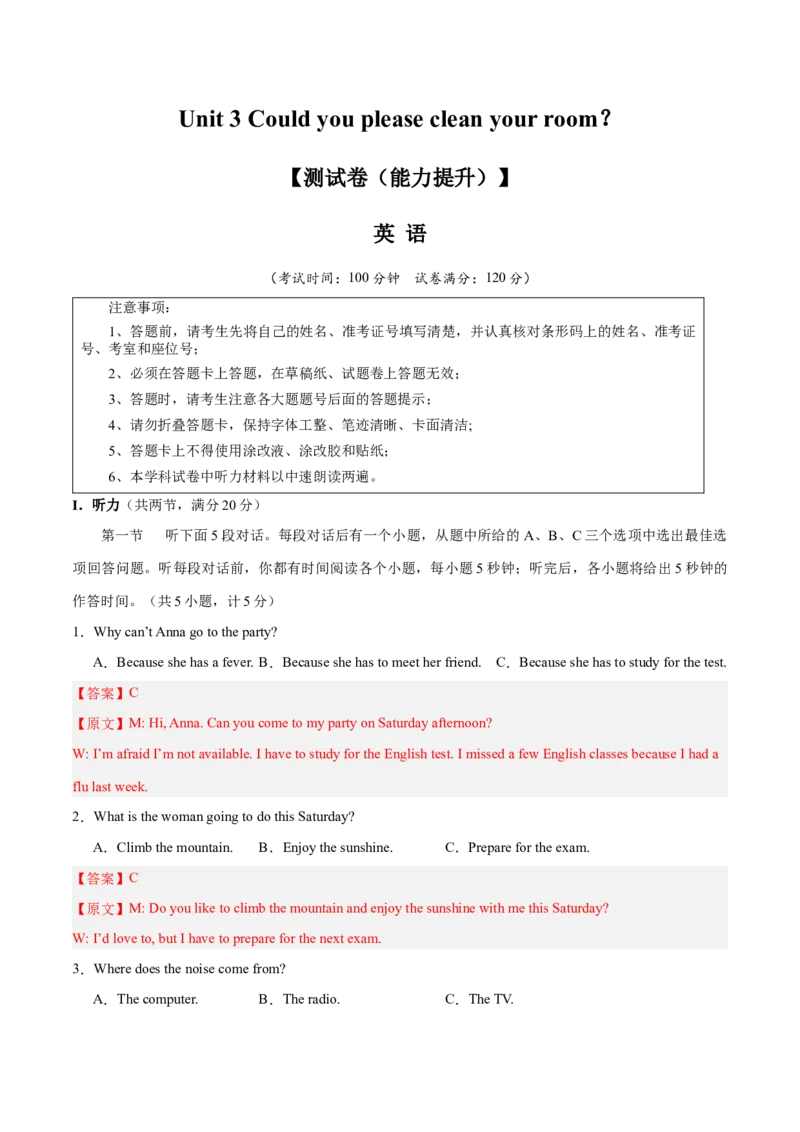
Unit 3 Could you please clean your room?
【测试卷(能力提升)】
英 语
(考试时间:100分钟 试卷满分:120分)
注意事项:
1、答题前,请考生先将自己的姓名、准考证号填写清楚,并认真核对条形码上的姓名、准考证
号、考室和座位号;
2、必须在答题卡上答题,在草稿纸、试题卷上答题无效;
3、答题时,请考生注意各大题题号后面的答题提示;
4、请勿折叠答题卡,保持字体工整、笔迹清晰、卡面清洁;
5、答题卡上不得使用涂改液、涂改胶和贴纸;
6、本学科试卷中听力材料以中速朗读两遍。
I.听力(共两节,满分20分)
第一节 听下面5段对话。每段对话后有一个小题,从题中所给的 A、B、C三个选项中选出最佳选
项回答问题。听每段对话前,你都有时间阅读各个小题,每小题5秒钟;听完后,各小题将给出5秒钟的
作答时间。(共5小题,计5分)
1.Why can’t Anna go to the party?
A.Because she has a fever. B.Because she has to meet her friend. C.Because she has to study for the test.
【答案】C
【原文】M: Hi, Anna. Can you come to my party on Saturday afternoon?
W: I’m afraid I’m not available. I have to study for the English test. I missed a few English classes because I had a
flu last week.
2.What is the woman going to do this Saturday?
A.Climb the mountain. B.Enjoy the sunshine. C.Prepare for the exam.
【答案】C
【原文】M: Do you like to climb the mountain and enjoy the sunshine with me this Saturday?
W: I’d love to, but I have to prepare for the next exam.
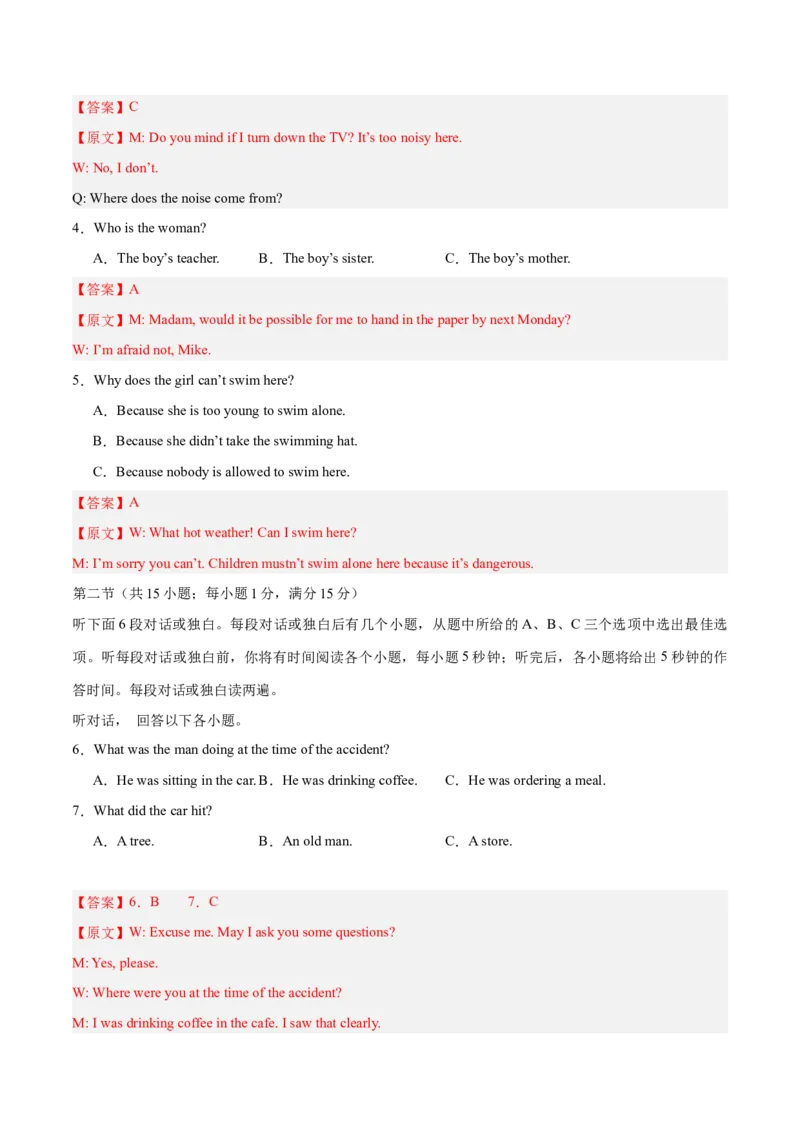
3.Where does the noise come from?
A.The computer. B.The radio. C.The TV.【答案】C
【原文】M: Do you mind if I turn down the TV? It’s too noisy here.
W: No, I don’t.
Q: Where does the noise come from?
4.Who is the woman?
A.The boy’s teacher. B.The boy’s sister. C.The boy’s mother.
【答案】A
【原文】M: Madam, would it be possible for me to hand in the paper by next Monday?
W: I’m afraid not, Mike.
5.Why does the girl can’t swim here?
A.Because she is too young to swim alone.
B.Because she didn’t take the swimming hat.
C.Because nobody is allowed to swim here.
【答案】A
【原文】W: What hot weather! Can I swim here?
M: I’m sorry you can’t. Children mustn’t swim alone here because it’s dangerous.
第二节(共15小题;每小题1分,满分15分)
听下面6段对话或独白。每段对话或独白后有几个小题,从题中所给的A、B、C三个选项中选出最佳选
项。听每段对话或独白前,你将有时间阅读各个小题,每小题5秒钟;听完后,各小题将给出5秒钟的作
答时间。每段对话或独白读两遍。
听对话, 回答以下各小题。
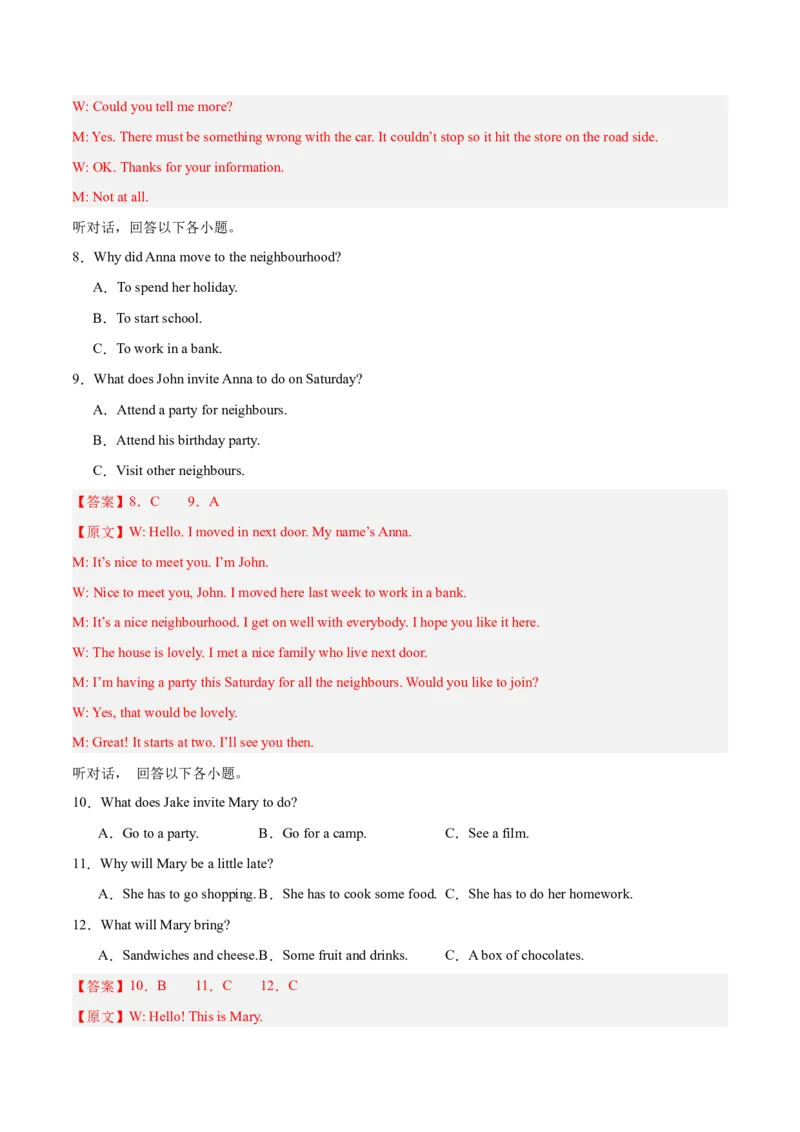
6.What was the man doing at the time of the accident?
A.He was sitting in the car.B.He was drinking coffee. C.He was ordering a meal.
7.What did the car hit?
A.A tree. B.An old man. C.A store.
【答案】6.B 7.C
【原文】W: Excuse me. May I ask you some questions?
M: Yes, please.
W: Where were you at the time of the accident?
M: I was drinking coffee in the cafe. I saw that clearly.W: Could you tell me more?
M: Yes. There must be something wrong with the car. It couldn’t stop so it hit the store on the road side.
W: OK. Thanks for your information.
M: Not at all.
听对话,回答以下各小题。
8.Why did Anna move to the neighbourhood?
A.To spend her holiday.
B.To start school.
C.To work in a bank.
9.What does John invite Anna to do on Saturday?
A.Attend a party for neighbours.
B.Attend his birthday party.
C.Visit other neighbours.
【答案】8.C 9.A
【原文】W: Hello. I moved in next door. My name’s Anna.
M: It’s nice to meet you. I’m John.
W: Nice to meet you, John. I moved here last week to work in a bank.
M: It’s a nice neighbourhood. I get on well with everybody. I hope you like it here.
W: The house is lovely. I met a nice family who live next door.
M: I’m having a party this Saturday for all the neighbours. Would you like to join?
W: Yes, that would be lovely.
M: Great! It starts at two. I’ll see you then.
听对话, 回答以下各小题。
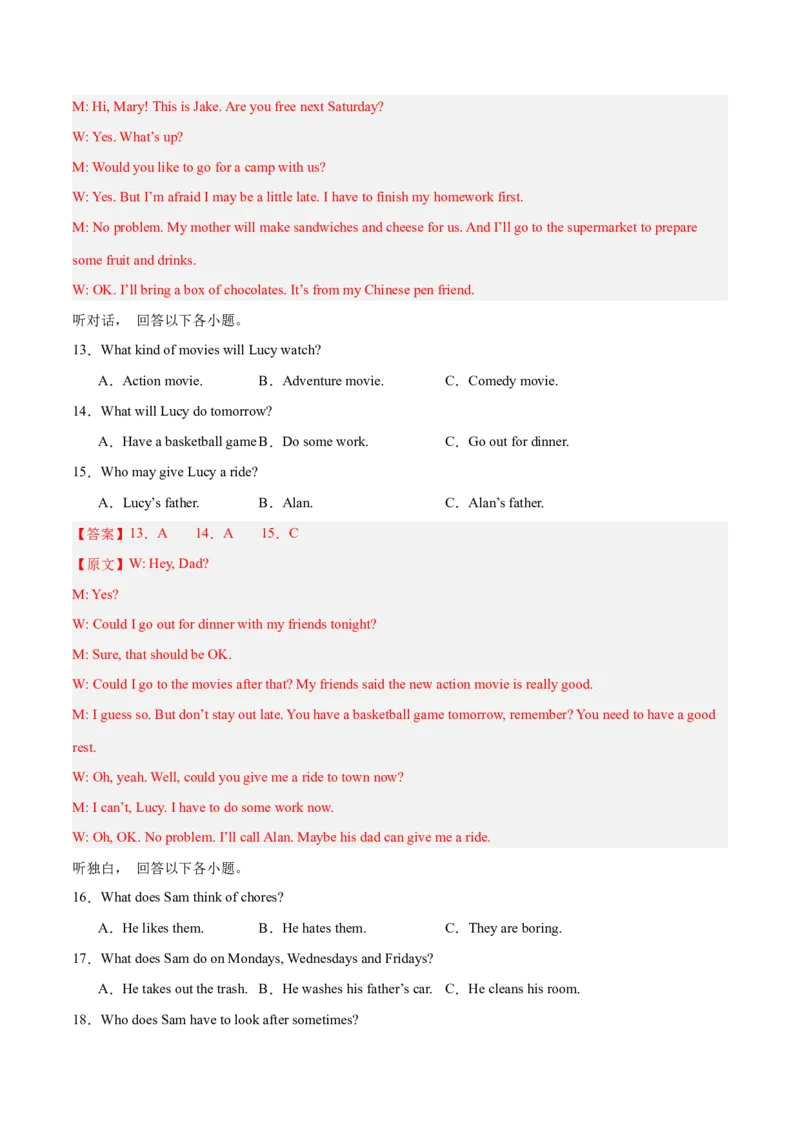
10.What does Jake invite Mary to do?
A.Go to a party. B.Go for a camp. C.See a film.
11.Why will Mary be a little late?
A.She has to go shopping.B.She has to cook some food. C.She has to do her homework.
12.What will Mary bring?
A.Sandwiches and cheese.B.Some fruit and drinks. C.A box of chocolates.
【答案】10.B 11.C 12.C
【原文】W: Hello! This is Mary.M: Hi, Mary! This is Jake. Are you free next Saturday?
W: Yes. What’s up?
M: Would you like to go for a camp with us?
W: Yes. But I’m afraid I may be a little late. I have to finish my homework first.
M: No problem. My mother will make sandwiches and cheese for us. And I’ll go to the supermarket to prepare
some fruit and drinks.
W: OK. I’ll bring a box of chocolates. It’s from my Chinese pen friend.
听对话, 回答以下各小题。
13.What kind of movies will Lucy watch?
A.Action movie. B.Adventure movie. C.Comedy movie.
14.What will Lucy do tomorrow?
A.Have a basketball gameB.Do some work. C.Go out for dinner.
15.Who may give Lucy a ride?
A.Lucy’s father. B.Alan. C.Alan’s father.
【答案】13.A 14.A 15.C
【原文】W: Hey, Dad?
M: Yes?
W: Could I go out for dinner with my friends tonight?
M: Sure, that should be OK.
W: Could I go to the movies after that? My friends said the new action movie is really good.
M: I guess so. But don’t stay out late. You have a basketball game tomorrow, remember? You need to have a good
rest.
W: Oh, yeah. Well, could you give me a ride to town now?
M: I can’t, Lucy. I have to do some work now.
W: Oh, OK. No problem. I’ll call Alan. Maybe his dad can give me a ride.
听独白, 回答以下各小题。
16.What does Sam think of chores?
A.He likes them. B.He hates them. C.They are boring.
17.What does Sam do on Mondays, Wednesdays and Fridays?
A.He takes out the trash. B.He washes his father’s car. C.He cleans his room.
18.Who does Sam have to look after sometimes?A.His brother. B.His sister. C.His little brother and sister.
19.Does Kumar do chores at home?
A.Yes, he does. B.No, he doesn’t. C.We don’t know.
20.Does Kumar feel lucky?
A.Yes, he does. B.No, he doesn’t. C.We don’t know.
【答案】16.B 17.A 18.C 19.B 20.A
【原文】 Sam hates doing chores. But he has to do lots of chores. For example, on Mondays, Wednesdays and
Fridays he takes out the trash. And on weekends he always washes his father’s car. He also cleans his own room
once a week. What a chore that is! Sometimes he even has to look after his little sister and brother. Sam has a
foreign friend at school. His name is Kumar. Doing chores in Kumar’s family is very different. In the house only
the girls do chores. His sisters make all the beds and clean all the rooms too, even his bedroom. His mother always
cooks the meals, and his sisters help her to go shopping, and prepare the food. They work hard at home, doing all
the chores with their mother. So when Kumar talks to his friend Sam about chores, he feels very lucky.
第二部分 阅读理解(共两节,满分40分)
第一节 阅读理解(共15小题,每小题2分,满分30分)
阅读下面短文,从每题所给的A、B、C、D四个选项中选出最佳选项。
A
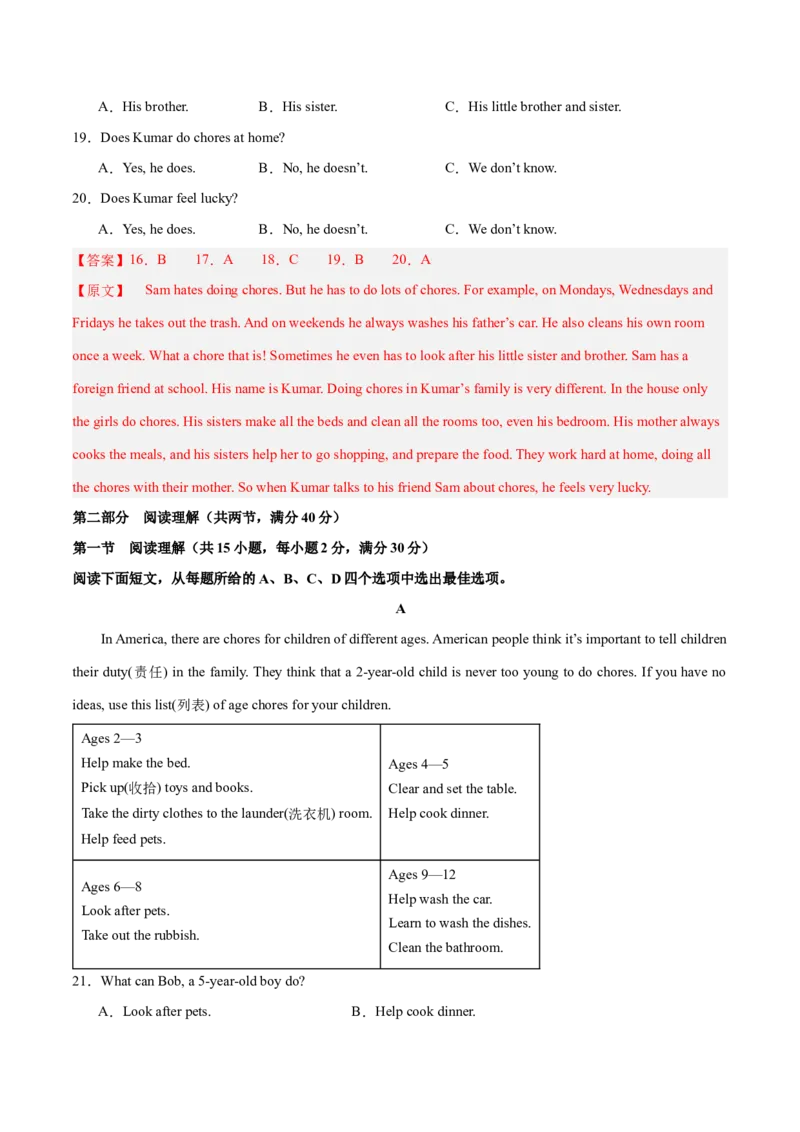
In America, there are chores for children of different ages. American people think it’s important to tell children
their duty(责任) in the family. They think that a 2-year-old child is never too young to do chores. If you have no
ideas, use this list(列表) of age chores for your children.
Ages 2—3
Help make the bed. Ages 4—5
Pick up(收拾) toys and books. Clear and set the table.
Take the dirty clothes to the launder(洗衣机) room. Help cook dinner.
Help feed pets.
Ages 9—12
Ages 6—8
Help wash the car.
Look after pets.
Learn to wash the dishes.
Take out the rubbish.
Clean the bathroom.
21.What can Bob, a 5-year-old boy do?
A.Look after pets. B.Help cook dinner.C.Take out the rubbish. D.Help wash the car.
22.Susan’s mother always asks her to help clean the bathroom, then how old may Susan be?
A.2 years old. B.4 years old.
C.7 years old. D.10 years old.
23.Why do American people think children should do chores in the family?
A.Because children have too much free time.
B.Because children should develop good habits.
C.Because it’s important to tell children their duty.
D.Because parents want their children to be good.
【答案】21.B 22.D 23.C
【导语】本文讲述了美国人认为孩子们应该做家务,并介绍了不同年龄段的孩子可以做的不同的家务。
21.细节理解题。根据“Ages 4—5 Clear and set the table. Help cook dinner.”可知,一个5岁的孩子可以帮忙
擦桌子,摆桌子,还可以帮忙做晚餐。故选B。
22.细节理解题。根据“Ages 9—12 Clean the bathroom.”可知, 9—12的孩子可以打扫浴室,所以Susan
可能10岁。故选D。
23.细节理解题。根据“American people think it’s important to tell children their duty(责任) in the family.”可
知,美国人认为告诉孩子他们在家庭中的责任是很重要的,所以他们认为孩子们应该做家务。故选C。
B
“Time to wake up!” I pull the pillow over my head. It isn’t time to wake up already, is it?
“Come on, get out of bed,” says Dad. “I need your sheets.” Oh, right. It’s Saturday. Laundry day. Dad has a new
idea. He doesn’t use the dryer anymore, at least in summer. Instead, I have to hang all the laundry on a clothesline in
the backyard. It seems like a lot of work. And it means I can’t sleep in on Saturday.
Dad gets the washing started early. That way all the clothes can dry by the end of the day. “Up,” says Dad as he
starts pulling the sheets off the bed. I drop off the bed onto the floor. “Go hang these!” Dad drops a wet sheet on me.
It’s so cold! What a way to wake up!
After I hang up the sheet, I come inside and find Dad in the kitchen. He’s made pancakes. Dad sits down across
from me. “Why so sad?” “Stupid laundry,” I said. “It takes forever!” “Well, you know we have to do laundry, right?”
“Yup.” “And you realize that I collect the laundry, wash it, take it off the line, fold it, and put it away?” I am starting to
feel guilty. “And you have to help out around here, right?” “I know, Dad. I also know that by hanging the laundry
instead of using the dryer, we can save more energy. And that means we spend less and pollute less.” Dad is gladthat I remember all that.
I’m quiet for a minute. I think I have to stop complaining(抱怨)about hanging the rest of the laundry.
24.Why does the father wake the writer up?
①He wants to wash the sheets. ②He needs the writer to wash the sheets.
③He needs the writer to hang the laundry. ④He wants the writer to help with cooking.
A.①② B.①③ C.②③ D.③④
25.The passage is written in the order of ________.
A.space B.time C.people D.opinions
26.What’s the Chinese meaning of the underlined word “guilty”?
A.愉悦的 B.饥饿的 C.内疚的 D.疲惫的
27.Which of the following questions is answered in the passage?
A.Why doesn’t the father use the dryer anymore?
B.What time does the writer wake up on Saturday?
C.What do the writer’s parents do on Saturday morning?
D.How does the father like the laundry day?
【答案】24.B 25.B 26.C 27.A
【导语】本文讲述了作者的父亲周六早晨把作者叫醒晾衣服的故事。
24.细节理解题。根据第二段中的“I need your sheets.”可知,父亲唤醒作者的原因之一是他想洗床单;根
据第三段中的“‘Go hang these!’ Dad drops a wet sheet on me.”可知,第二个原因是父亲想要作者晾床单,
故选B。
25.推理判断题。通读全文可知本文讲述了作者的父亲周六早晨把作者叫醒晾衣服的故事,而且是按照时
间顺序叙事的。故选B。
26.词义猜测题。根据前文“And you realize that I collect the laundry, wash it, take it off the line, fold it, and
put it away?”可知父亲承担了很多家务,所以作者听到父亲的话后会感到内疚,故选C。
27.推理判断题。根据第四段中的“I also know that by hanging the laundry instead of using the dryer, we can
save more energy. And that means we spend less and pollute less”可知,父亲曾告诉作者将衣物晾干,不使用烘
干机的原因是这样节约能源、保护环境,故选A。
C
When Justin Tong was a child, other kids felt sorry for him. His parents always had him doing lots of
housework such as carrying out the rubbish and sending newspapers. But when he grew up, he was better offthan his childhood friends and lived a happier and healthier life.
These are the finding of a 40﹣year study that followed the lives of 456 children in London. It showed that
the children who had worked hard in childhood had a richer and a happier future. "Children who worked in the
home or community gained competence(能力) and came to feel they were worthwhile members of society,"
said Daniel Brown, the psychologist(心理学家) who made the discovery. "And because they felt good about
themselves, others felt good about them."
Brown's study followed these children in great detail. Interviews were repeated at ages 25, 31 and 47.
Under Brown, the researchers compared the children's mental﹣health scores with their childhood﹣activity
scores. Points were awarded for part﹣time jobs, housework, effort in school, and ability to deal with
problems.
Working at any age is important. Childhood activities help a child develop responsibility, independence,
confidence and competence ﹣ the underpinnings (基础) of emotional health. They also help him understand
that people must cooperate and work toward common goals. The most competent adults are those who know how
to do this.Yet work isn't everything. As Tolstoy once said, "One can live magnificently in this world if one
knows how to work and how to love, to work for the person one loves and to love one's work."
28.What do we know about Justin Tong?
A.He enjoyed a happy life. B.He felt sorry for the other kids.
C.He always sold newspapers. D.He seldom collected rubbish.
29.Who will probably succeed in the future according to Paragraph 2?
A.Children who enjoy happier and richer lives.
B.Children who work in the home or community.
C.Children who take part in Daniel Brown's study.
D.Children who feel good about people around them.
30.How did Brown follow the children in his study?
A.By giving housework and praise. B.By interviewing and giving scores.
C.By setting goals and showing love. D.By solving problems and testing them.
31.What's the purpose of the passage?
A.To talk about an interesting study. B.To introduce Justin Tong's success.
C.To tell us about childhood activities. D.To encourage children to work hard.
【答案】28.A 29.B 30.B 31.D【分析】本篇文章难度适中,主要讲述从小做家务的孩子会有较强的责任感、独立、自信以及其他的能力,
这些人更能建立更好的人际关系、获得丰厚的收入以及解决问题的能力。告诉我们从小培养孩子的做事能
力,有能力的人知道如何与人合作,以及知道工作并不是一切,高情商是获得精彩人生的必需。
28.细节理解题。根据第一段But when he grew up, he was better off than his childhood friends and lived a
happier and healthier life“可是当他长大的时候,他比他儿时的玩伴好多了,过着幸福而又健康的生活”可
知,唐一鸣享受着幸福的生活。故选A。
29.推理判断题。根据第二段Children who worked in the home or community gained competence( 能 力 )
and came to feel they were worthwhile members of society“那些在家里或社区工作的男孩子们获得了能力,逐
渐感到他们是有价值的社会成员”;再根据It showed that the children who had worked hard in childhood had
a richer and a happier future“这表明在童年时期努力工作的孩子有更丰富的并且幸福的未来”可知,那些在
家里或社区工作的男孩子们很可能赢在未来。故选B。
30.细节理解题.根据第三段Interviews were repeated at ages 25, 31 and 47. Under Brown, the
researchers compared the children's mental﹣health scores with their childhood﹣activity scores“研究人员在25岁、
31岁和47岁时重复访谈。在布朗的研究中,研究人员将儿童的心理健康评分与儿童活动评分进行了比
较”可知,布朗通过面试和打分来跟踪研究那些孩子们。故选B。
31.主旨大意题。本文从一个叫唐一鸣的男孩的实例开始说起。再根据It showed that the children who had
worked hard in childhood had a richer and a happier future“这表明在童年时期努力工作的孩子有更丰富的并且
幸福的未来”可知,鼓励孩子们努力工作。故选D。
D
Many kids help their parents to do chores such as washing the dishes, cleaning the floors and taking out the
rubbish in the house. And some kids get money or other rewards from their parents, such as playing computer games
for 20 minutes.
But some people do not think that kids should get rewards for doing chores. One of them is Susie Walton, a
parenting educator. She believes that if kids get rewards, they will think that work isn’t worth (值得) doing unless
they can get something. For example, kids won’t sweep the floor if they see it is dirty. But they will clean the floor if
their parents reward them for it. Susie said, “A home is a living place for everyone in the family. It’s important for
kids to see that it’s all the family members’ job to keep their homes clean.”
Other people have different opinions (观点). They believe that money or other rewards can encourage (鼓励)
kids to do more chores. It also teaches them a real world lesson that we need to work to make money. Now, there arealso apps that encourage kids to do chores. The apps give kids points and gifts that can be used either online or in the
real world. With the ChoreMonster app, kids get points after doing chores. Kids can exchange (交换) their points for
real rewards, such as time to play video games or a trip to the mall.
What do you think? Should kids be rewarded for doing chores? Or should kids help out with their homes
without getting anything?
32.How does the writer start the passage?
A.By giving some facts. B.By giving some opinions.
C.By using a teacher’s words. D.By showing his own experiences.
33.Which of the following is Susie Walton’s opinion?
A.Don’t ask kids to do housework.
B.Don’t reward kids for doing anything.
C.Don’t give kids rewards for doing chores.
D.Don’t let kids play computer games.
34..What’s Paragraph 3 mainly about?
A.How to make money by doing chores.
B.The apps that encourage kids to do chores.
C.How to exchange the points for real rewards.
D.The good side of rewarding kids for doing chores.
35.What is the purpose (目的) of writing the text?
A.To call on readers to do more chores.
B.To tell readers of two different opinions.
C.To invite readers to express their opinions.
D.To show the writer’s views about doing chores.
【答案】32.A 33.C 34.D 35.C
【导语】本文主要针对孩子做家务是否应获得奖励,给出了两种截然不同的观点。
32.细节理解题。根据“Many kids help their parents to do chores such as washing the dishes, cleaning the
floors and taking out the rubbish in the house.”可知,作者陈述了孩子做家务的事实。故选A。
33.推理判断题。根据“Susie said, ‘A home is a living place for everyone in the family. It’s important for kids
to see that it’s all the family members’ job to keep their homes clean.’”可知,苏珊认为做家务是孩子的责任,不
应该给他们奖励。故选C。34.主旨大意题。根据“They believe that money or other rewards can encourage (鼓励) kids to do more
chores.”可知,第三段主要论述给孩子奖励的好处。故选D。
35.推理判断题。根据“What do you think? Should kids be rewarded for doing chores? Or should kids help out
with their homes without getting anything?”可知,本文的目的主要是让读者表达关于孩子做家务是否应该给
报酬的看法。故选C。
第二节 任务型阅读(共5小题,每小题2分,满分10分)
阅读下面材料,从方框中所给的A~F五个选项中选出正确选项(其中一项是多余选项),将其序号填入第1
~5小题,并回答第5小题。
Gongsun Long is a famous scholar (学者) who lived in the State of Zhao during the Warring States Period
(475BC—221BC). 36 He often said, “A wise man should welcome anyone with a special skill.”
37 “I have a special skill,” he said to Gongsun.
Gongsun asked, “What is it?”
“I have a loud voice and I’m good at shouting.”
Then Gongsun turned to his followers and asked, “Who is good at shouting?” But none of them answered “Yes”.
So the scholar took the man in.
38 They came to a wide river and found that the only boat was on the other side of the river. All of them
had no idea. Suddenly, Gongsun thought of the shouting person and turned to him, “Can you have a try?” 39
He shouted to the man in the boat as loud as he could, “Hey, the man of the boat, come here. We want to cross the
river.” As his voice ended, the man came to fetch them. 40
根据短文内容,从选项中选出能填入空白处的最佳选(其中有一项多余)。
A.Gongsun was very satisfied with the new follower.
B.One day, a man in dirty clothes came to see him.
C.The man realized it was the chance to show his skill.
D.There were many people who had skills around him.
E.Some days later, Gongsun and his followers went on a trip.
F.Gongsun was a clever man and he loved everyone.
【答案】36.D 37.B 38.E 39.C 40.A
【分析】本文是一篇记叙文。文章主要介绍了公孙龙和新追随者的故事。
36.根据空后的“He often said, “A wise man should welcome anyone with a special skill”可知,空缺处应该填
的是和公孙龙以及技能相关的内容,选项D“他(公孙龙)身边有很多有技能的人”最符合语境,故选D。37.根据空后的“I have a special skill,” he said to Gongsun”可知,空缺处应该填的是有人来找公孙龙,选项
B“一天,一个穿着脏衣服的人来见他”最符合语境,故选B。
38.根据空后的“They came to a wide river and found that the only boat was on the other side of the river”可知,
空缺处应该填的是和出门相关的内容,选项E“几天后,公孙和他的新的追随者们去旅行了”最符合语境,
故选E。
39.根据空前的“Can you have a try?”和空后的“He shouted to the man in the boat as loud as he could”可知,
空缺处应该填的是和这个男人展示技能有关的内容,选项C“这名男子意识到这是展示自己技能的机会”最
符合语境,故选C。
40.根据空前的“As his voice ended, the man came to fetch them”可知,空缺处应该填的是公孙龙对新追随
者的看法,选项A“公孙对新来的追随者很满意”最符合语境,故选A。
第三部分 语言运用(共三节,满分40分)
第一节 完形填空(共15小题,每小题1分,满分15分)
Recently I didn't get on well with my mother. She thought I was still a child! And she was very 41
with me. She told me I 42 be out after 8: 00 in the evening. She also said, "If 43 goes to climb a
mountain, will you do it, too?" I 44 those words, so I sometimes wanted to say, "If I can, I will get away 45
you." I knew this wasn't true, 46 I was so upset. My dad understood my 47 and agreed that I could
go cycling with my friends after dinner for half an hour. However, my mom didn't agree to let me ride. How should
I 48 the problem?
It's hard to say if it's unfair about 49 my mom has done, but it sounds like she's having some trouble.
She doesn't want to 50 that I'm getting older and I will become more independent. Usually, it's difficult for
some 51 to let go.
I plan to ask my father for help. He seems to understand me 52 . I will have a good talk with him and
tell him like this, "Dad, I feel upset when Mom sometimes 53 what I want. I love Mom and I don't want to
make her angry, 54 . I know she wants me to be better, but we need more communication. Can you help me
talk to her about this?" I hope this can be 55 to me.
41.A.upset B.strict C.pleased D.good
42.A.needn't B.need C.mustn't D.should
43.A.anyone B.everyone C.no one D.someone
44.A.enjoyed B.said C.wrote D.disliked45.A.about B.to C.from D.with
46.A.though B.but C.unless D.because
47.A.plan B.way C.joke D.feeling
48.A.give B.solve C.have D.cause
49.A.what B.how C.why D.when
50.A.decide B.accept C.choose D.agree
51.A.teachers B.friends C.classmates D.parents
52.A.better B.fewer C.less D.worse
53.A.remembers B.follows C.refuses D.advises
54.A.too B.also C.instead D.either
55.A.helpful B.lively C.friendly D.careful
【答案】
41.B 42.C 43.D 44.D 45.C 46.B 47.D 48.B 49.A 50.B
51.D 52.A 53.C 54.D 55.A
【分析】本文关注的是亲子关系,作者分享了和母亲的不和谐关系,表达了渴望和父母沟通和得到父母理
解的心情。
41.句意:她对我很严格。
upset沮丧的;strict严格的;pleased高兴的;good好的。根据后文“If I can, I will get away”可知母亲对
“我”很严格,be strict with对……要求严格;故选B。
42.句意:她告诉我晚上8点以后不能出去。
needn’t不必,指没有必要;need需要;mustn’t不能,表禁止;should应该。根据上文“she was very strict
with me”,可知应该是禁止外出,故选C。
43.句意:她还说:“如果有人去爬山,你也会去吗?”
someone某人,表不确定,用于肯定句和希望得到肯定回答的疑问句,anyone用在否定句和疑问句中代替
someone;everyone每个人;no one没有人。本句是条件状语从句的疑问句形式,根据题干“If someone
goes to climb a mountain, will you do it, too”,可知母亲希望“我”给出肯定回答,故选D。
44.句意:我不喜欢这些词,所以有时我想说:“如果可以的话,我愿意离开你。”
enjoyed喜欢;said说;wrote写;disliked不喜欢。根据下文“我”的想法“If I can, I will get away”,可知
不喜欢母亲的话,故选D。
45.句意:我不喜欢这些词,所以有时我想说:“如果可以的话,我愿意离开你。”about关于;to到/向;from从;with和。get away from摆脱/逃离,根据上文“I disliked those words”,可知
get away from符合语境,故选C。
46.句意:我知道这不是真的,但我很难过。
though尽管,表让步;but但是,表转折;unless除非,表条件,相当于if not;because因为,表原因。根
据题干“I knew this wasn't true…I was so upset”,可知前后是转折关系,故选B。
47.句意:爸爸理解我的感受,同意我晚饭后可以和朋友们去骑半个小时的自行车。
plan计划;way方式/方法;joke玩笑;feeling感觉/情感。根据下文“agreed that I could go cycling with my
friends after dinner for half an hour”,可知父亲很理解“我”;前面三项不合语境,故选D。
48.句意:我该如何解决这个问题?
give给;solve解决;have有;cause导致。how怎样,表方式,根据题干,可知作者想知道怎样解决问题,
故选B。
49.句意:很难说我妈妈的所作所为是否不公平,但听起来她好像遇到了麻烦。
what什么,表事情;how如何,表方式;why为什么,表因果;when何时,表时间。分析句子结构,可知
设空处作done的宾语,需用疑问代词;后面三项都是副词性质,故选A。
50.句意:她不愿意接受我正在变大,我将变得更加独立的事实。
decide决定;accept接受;choose选择;agree同意。根据下文“I’m getting older and I will become more
independent”,可知母亲不愿接受这个事实,故选B。
51.句意:通常,父母很难放手。
teacher教师;friend朋友;classmate同班同学;parent父母。根据上文是谈跟母亲的关系,可知前面三项
不合语境,故选D。
52.句意:他似乎更了解我。
better更好;fewer更少的,修饰复数名词;less更少的,修饰不可数名词;worse更坏的。根据前文“My
dad understood my feeling and agreed that I could go cycling with my friends after dinner for half an hour”,可知
父亲对“我”了解更多;better符合语境,故选A。
53.句意:爸爸,当妈妈有时拒绝我想要的东西时,我感到心烦。
remember记得;follow跟随;refuse拒绝;advise建议。根据上文“I feel upset”,可知是母亲拒绝“我”的
时候,故选C。
54.句意:我爱妈妈,我也不想惹她生气。
too也,用于肯定句句尾;also也,用于实义动词之前;instead相反;either也,用于否定句句尾。分析句
子结构,本句是否定句,设空处在句尾,可知either符合句子结构,故选D。55.句意:我希望这能对我有所帮助。
helpful有帮助的;lively精力充沛的;friendly友好的;careful细心的。根据上文的请求“Can you help me
talk to her about this”,可知想得到父亲的帮助,故选A。
第二节 词汇运用(共15小题,每小题1分,满分15分)
(一)将方框中所给词(词组)的适当形式填入短文中,每词仅用一次。(共5小题,每题1分,满分5
分)
be, do, help, call, cook
Should teenagers 56 their parents do chores? If you want 57 an independent (独立的)
person, or you don’t want your parents to be too tired, do chores at home.
I have a classmate 58 Li Ting. She is the only child in her family. Her parents love her so much that
they don’t let her do any chores. On weekdays she gets up, has breakfast, goes to school, has lessons, comes back
home, does her homework and goes to bed. On weekends, she only plays with her friends.
So she doesn’t know how 59 chores. One day, her father was ill in hospital. Her mother had to take
care of her father in the hospital and couldn’t cook meals for her for a week. Li Ting didn’t know how to cook
meals.She had a lot of trouble 60 meals and often felt hungry. She only had instant noodles for meals.
【答案】56.help 57.to be 58.called 59.to do 60.cooking
【分析】本文作者以同学李婷在父亲生病住院期间不知道如何做饭,只能吃一个星期方便面为例,说明青
少年应该帮助父母做家务的道理。
56.句意:青少年应该帮助父母做家务吗?本句缺谓语动词,根据下文“or you don’t want your parents to
be too tired, do chores at home”,可知应该帮助父母做家务;help sb. do sth.帮助某人做某事,固定短语;
should应该,后接原形动词,故填help。
57.句意:如果你想成为一个独立的人,或者你不想让你的父母太累,在家里做家务。want to be想要
做/想要成为……,固定结构;根据下文“an independent person”可知是想成为独立的人,故填to be。
58.句意:我有一个同学叫李婷。分析句子结构,classmate是动词call的受动者,这里需用过去分词作
classmate的后置定语,故填called。
59.句意:所以她不知道如何做家务。分析句子可知,本句“疑问词+动词不定式”作know的宾语,是固
定结构;do chores做家务,故填to do。
60.句意:她做饭有很多困难,经常感到饥饿。have trouble in doing sth.做某事有困难/做某事有麻烦,是
固定结构;根据上文“Li Ting didn’t know how to cook meals”可知不会做饭,故填cooking。(二)语法填空(共10小题,每小题1分,满分10分)
阅读下面短文,在空白处填入一个适当的词,或填入括号中所给单词的正确形式。
Most of us probably don’t like doing housework. And most of us think that 61 (clean) the bathroom
or cooking dinner for the family makes us tired. However, the fact is that someone has to 62 (do) it. Most of
the time, our parents have to do the housework. Is it 63 (real) fair(公平的)?
Doing housework is really not as 64 (bad) as it sounds. If we all do our part, it 65 (seem) less
annoying. Why should your mother have to wash your dirty clothes? You are able 66 (take) care of yourself.
Doing some housework will show that you are 67 (become) more and more independent.
Some of us may think that we are too busy to do housework. But most parents work all day and are then
expected 68 (keep) a clean house! Dividing housework among the whole family will make everyone’s job
much 69 (easy).
Please remember: Learning 70 (do) housework can provide you with valuable skills for the future.
【答案】
61.cleaning 62.do 63.really 64.bad 65.will seem 66.to take 67.becoming
68.to keep 69.easier 70.to do
【分析】本文是一篇说明文。本文主要介绍了关于做家务的现状。并倡议对于做家务,我们每个人都应该
尽自己的一份力量。
61.句意:我们大多数人认为打扫浴室或为家人做晚饭是很辛苦的。根据后面的“or cooking dinner”可知,
这里应用clean的动名词形式cleaning。故填cleaning。
62.句意:然而,事实是我们每个人都不得不做。have to后跟动词原形,表示“不得不”。故填do。
63.句意:这真的公平吗?fair公平的,是形容词,应用副词修饰形容词。故填really。
64.句意:做家务并不像听起来那么糟糕。not as…as中间加形容词或副词的原级,由is可知这里是系表
结构,应填形容词bad作表语。故填bad。
65.句意:如果我们每个人都尽自己的一份力,就不会那么烦人了。这里是if引导的条件状语从句,从句
用一般现在时,主句用一般将来时。故填will seem。
66.句意:你能够照顾你自己。be able to do sth意为“能够做某事”,固定用法。故填to take。
67.句意:做家务将表明你变得越来越独立。表示某种状态正在进行,用现在进行时,其结构是“is/am/
are+动词的现在分词”。become的现在分词是becoming。故填becoming。
68.句意:但是大多数父母整天工作,然后被期望保持一个干净的房子!be expected to do sth意为“被期
待做某事”,固定用法。故填to keep。69.句意:在整个家庭中分担家务会使每个人的工作都更容易。much修饰比较级,且make后接形容词作
宾补,因此填easy的比较级形式easier。故填easier。
70.句意:请记住:学习做家务能为你的未来提供有价值的技能。learn doing sth意为“学习做某事(已经
在学习了)”,learn to do sth意为“学着去做某事(打算去学)”。这里表示学习做家务,即打算去学。
故填to do。
第三节 阅读表达(共5小题,每小题2分,满分10分)
Should parents ask their children to do chores? Some don’t think that children should do chores, because
they think children are too young. But many people think that children should do chores.
In fact, children can get a sense of happiness when they do chores. Parents should help children learn to do
housework that they will have to do when they live on their own.
Most experts agree that children can learn a lot from doing chores. However, parents should ask the child
to do chores at the right time. Parents shouldn’t ask a schoolboy to cook when he is doing his homework. And
parents shouldn’t ask their children to do all chores. Children should do chores for half an hour every day.
The chores should suit (适合) the child. When a child does what his parents ask him to do happily, he will
probably have the feeling of growing up. Parents can teach children something useful by doing chores. And please
make sure that parents also do chores. Parents are children’s good models (榜样). If parents don’t keep the house
clean, children won’t find any reason to do chores.
71.Why don’t some parents think children should do chores?
72.What can children get when they do chores?
73.How long should children do chores every day?
74.How can parents teach children something useful?
75.Who are children’s good models, teachers or parents?
【答案】
71.Because some parents/they think children are too young.
72.Children/They can get a sense of happiness./A sense of happiness.
73.Children/They should do chores for half an hour every day./For half an hour.
74.Parents/They can teach children something useful by doing chores./By doing chores.
75.Parents are children’s good models./Parents.【导语】本文主要讲述了对于应不应该让孩子做家务这个问题,不同的人有不同的看法,但是大多数人和
专家都认为让孩子做家务是有好处的,但是应该注意一些问题。
71.根据第一段“Some don’t think that children should do chores, because they think children are too young.”可
知,有些人认为孩子不应该做家务,因为他们认为孩子太小了。故填Because some parents/they think
children are too young.
72.根据第二段“In fact, children can get a sense of happiness when they do chores.”可知,孩子在做家务的时
候可以获得一种幸福感。故填Children/They can get a sense of happiness./A sense of happiness.
73.根据第三段“Children should do chores for half an hour every day.”可知,孩子每天应该做半小时家务。
故填Children/They should do chores for half an hour every day./For half an hour.
74.根据最后一段“Parents can teach children something useful by doing chores.”可知,父母可以通过做家务
教给孩子一些有用的东西。故填Parents/They can teach children something useful by doing chores./By doing
chores.
75.根据最后一段“Parents are children’s good models (榜样).”可知,父母是孩子的好榜样。故填Parents are
children’s good models./Parents.
第四部分 书面表达(共1小题,满分20分)
作为一名中学生,帮助父母做家务是一件有趣而有意义的事。它可以丰富我们的生活,让我们学会
劳动、学会理解……但它也会花费时间……
你认为呢?请以“My Opinion on Doing Housework”为题,写一篇80词左右的短文。
参考词汇:take out the trash, do the dishes, waste time, develop independence
要求:1. 请明确表明自己的观点,并简要说明其理由;
2. 文中不能出现真实的地名、校名、人名。
____________________________________________________________________________________________
____________________________________________________________________________________________
___________________________________________________________________________________
【答案】例文
My Opinion on Doing Housework
Different students have different opinions about doing housework.
In my opinion, it is an interesting and meaningful thing for us to help our parents do some housework. We
can learn some skills by doing housework. On the other hand, doing housework can make our life more colorful
and help us understand our parents better. What’s more, it provides us with the opportunity to developindependence. Besides, it’s easy for us to do some housework. For example, we can take out the trash, do the dishes
and so on. I don’t think it wastes our time.
I believe doing housework is of great benefit to us middle school students.
【详解】[总体分析]
① 题材:本文是一篇话题作文;
② 时态:时态为“一般现在时”;
③ 提示:写作要点已给出,考生应注意不要遗漏提示的要点,适当添加细节,并突出写作重点。
[写作步骤]
第一步,开门见山。表示不同的人对于做家务有不同的观点,引出下文。
第二步,具体阐述。表明你对做家务的观点,并说明理由。
第三步,书写结语。总结观点,呼吁大家帮助父母做家务。
[亮点词汇]
① in one’s opinion 在某人看来
② on the other hand 另一方面
③ what’s more 此外
④ for example 例如
[高分句型]
① In my opinion, it is an interesting and meaningful thing for us to help our parents do some housework. (it作形式
主语)
② I believe doing housework is of great benefit to us middle school students. (省略that的宾语从句)