Unit 3 Could you please clean your room
单元话题阅读理解练习
基础语篇巩固练
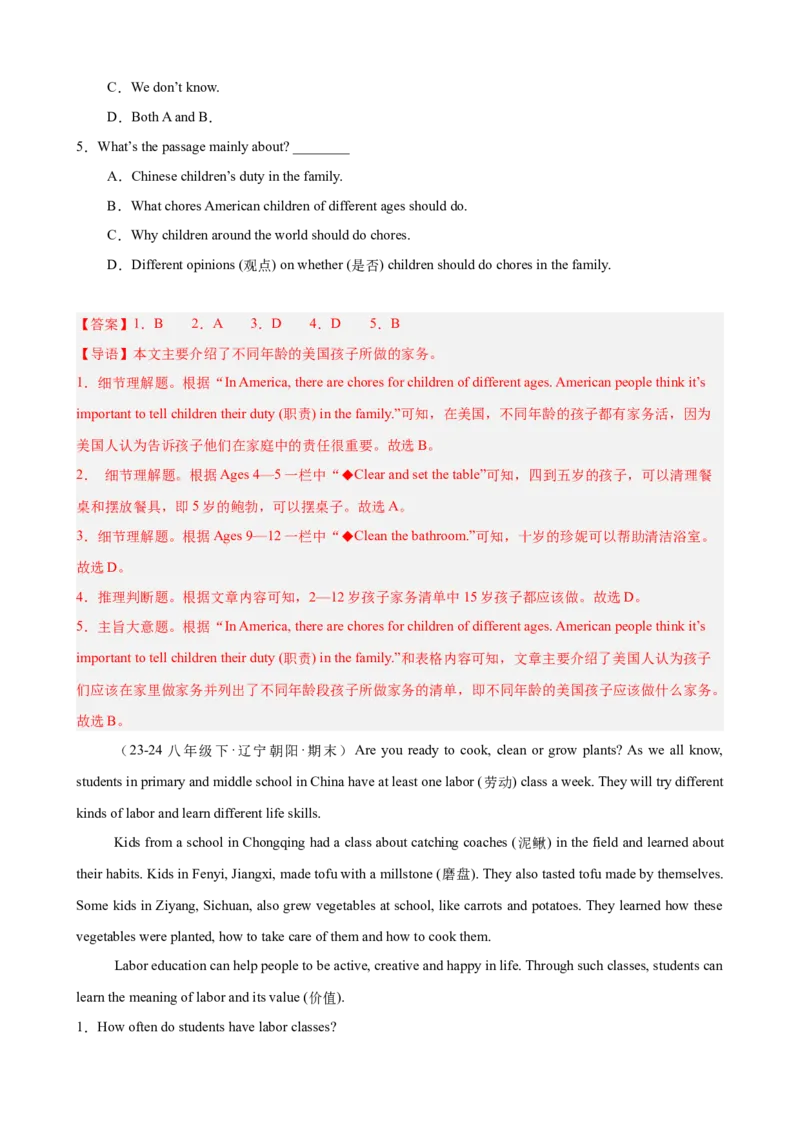
(23-24 八年级下·新疆克拉玛依·期末)In America, there are chores for children of different ages.
American people think it’s important to tell children their duty (职责) in the family. Use this list of age chores for
your children.
Ages 2—3
Ages 4—5
Help make the bed;
Clear and set the table;
Pick up toys and books;
◆
Help cook dinner;
◆
Take laundry (要洗的衣服) to the laundry room;
◆
Put away groceries (食品杂货).
◆
Help feed pets.
◆
◆
◆ Ages 9—12
Ages 6—8
Help wash the car;
Take care of pets;
Learn to wash the dishes;
◆
Take out the rubbish.
◆
Clean the bathroom.
◆
◆
1.American people think children should do chores in the family b◆ecause ________.
A.parents are lazy
B.it’s important to let children know their duty in the family
C.children should work hard
D.children have nothing to do except (除了) playing
2.If Bob is 5 years old, he can ________.
A.set the table B.help wash the car
C.wash the dishes D.take out the rubbish
3.Which of the following is true?
A.A five-year-old boy can help take care of pets.
B.Jack is three years old and he can help his mom cook dinner.
C.Children under 6 years old don’t have to do chores around the house.
D.Jenny is a ten-year-old girl and she can help clean the bathroom.
4.According to the passage, what chores should a 15-year-old teenager do in an American family?
A.Take laundry (要洗的衣服) to the laundry room.
B.Put away groceries (食品杂货).C.We don’t know.
D.Both A and B.
5.What’s the passage mainly about? ________
A.Chinese children’s duty in the family.
B.What chores American children of different ages should do.
C.Why children around the world should do chores.
D.Different opinions (观点) on whether (是否) children should do chores in the family.
【答案】1.B 2.A 3.D 4.D 5.B
【导语】本文主要介绍了不同年龄的美国孩子所做的家务。
1.细节理解题。根据“In America, there are chores for children of different ages. American people think it’s
important to tell children their duty (职责) in the family.”可知,在美国,不同年龄的孩子都有家务活,因为
美国人认为告诉孩子他们在家庭中的责任很重要。故选B。
2. 细节理解题。根据Ages 4—5一栏中“◆Clear and set the table”可知,四到五岁的孩子,可以清理餐
桌和摆放餐具,即5岁的鲍勃,可以摆桌子。故选A。
3.细节理解题。根据Ages 9—12一栏中“◆Clean the bathroom.”可知,十岁的珍妮可以帮助清洁浴室。
故选D。
4.推理判断题。根据文章内容可知,2—12岁孩子家务清单中15岁孩子都应该做。故选D。
5.主旨大意题。根据“In America, there are chores for children of different ages. American people think it’s
important to tell children their duty (职责) in the family.”和表格内容可知,文章主要介绍了美国人认为孩子
们应该在家里做家务并列出了不同年龄段孩子所做家务的清单,即不同年龄的美国孩子应该做什么家务。
故选B。
(23-24 八年级下·辽宁朝阳·期末)Are you ready to cook, clean or grow plants? As we all know,
students in primary and middle school in China have at least one labor (劳动) class a week. They will try different
kinds of labor and learn different life skills.
Kids from a school in Chongqing had a class about catching coaches (泥鳅) in the field and learned about
their habits. Kids in Fenyi, Jiangxi, made tofu with a millstone (磨盘). They also tasted tofu made by themselves.
Some kids in Ziyang, Sichuan, also grew vegetables at school, like carrots and potatoes. They learned how these
vegetables were planted, how to take care of them and how to cook them.
Labor education can help people to be active, creative and happy in life. Through such classes, students can
learn the meaning of labor and its value (价值).
1.How often do students have labor classes?A.At most twice a week. B.At least once a day.
C.At most twice a month. D.At least once a week.
2.What did kids in Fenyi do in their labor class?
A.Made tofu. B.Planted potatoes.
C.Caught loaches. D.Took care of carrots.
3.What would kids in Ziyang finally do with the vegetables they planted?
A.Sell the vegetables. B.Cook the vegetables.
C.Water the vegetables. D.Clean the vegetables.
4.What’s the meaning of labor education?
A.To teach students all the life skills.
B.To let students know the importance of study.
C.To give students a chance (机会) to try different kinds of labor.
D.To help students to be active, creative and happy in life.
【答案】1.D 2.A 3.B 4.D
【导语】本文主要讲述了劳动教育的重要性和意义。
1.细节理解题。根据第一段“As we all know, students in primary and middle school in China have at least
one labor (劳动) class a week.”可知,学生每周至少上一节劳动课。故选D。
2.细节理解题。根据第二段“Kids in Fenyi, Jiangxi, made tofu with a millstone (磨盘).”可知,分宜县的孩
子们在劳动课上学做豆腐。故选A。
3.细节理解题。根据第二段“Some kids in Ziyang, Sichuan, also grew vegetables at school, like carrots and
potatoes. They learned how these vegetables were planted, how to take care of them and how to cook them.”可知,
资阳的孩子们最后会烹饪自己种的蔬菜。故选B。
4.细节理解题。根据最后一段“Labor education can help people to be active, creative and happy in life.
Through such classes, students can learn the meaning of labor and its value (价值).”可知,劳动教育的意义在于
帮助学生在生活中变得积极、有创造力和快乐。故选D。
(23-24八年级下·山西晋中·期末)请阅读下面短文,从每小题所给的A、B、C三个选项中,选出一个最
佳选项,并在答题卡上将该项涂黑。
MAY 1, 2024 TEENS JUNIOR 2As a part of school education, labour (劳动) education plays an important role in our lives. Here are some
discussions about labour education in different countries.
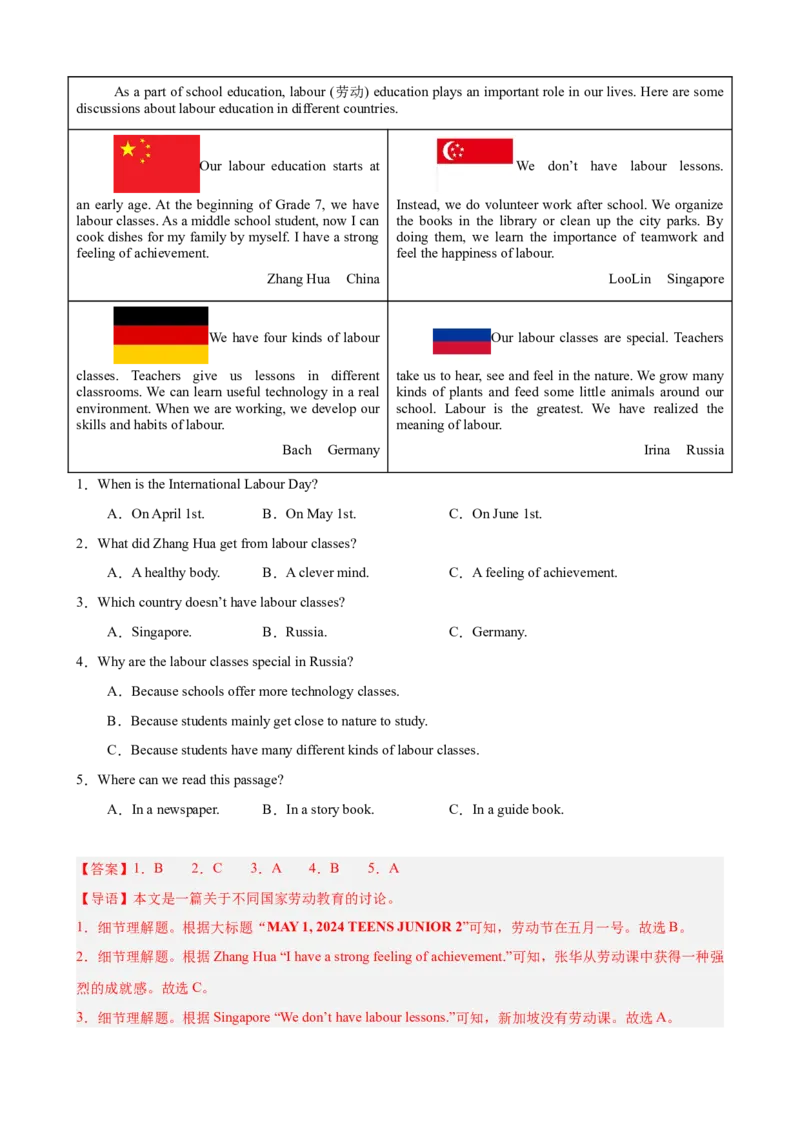
Our labour education starts at We don’t have labour lessons.
an early age. At the beginning of Grade 7, we have Instead, we do volunteer work after school. We organize
labour classes. As a middle school student, now I can the books in the library or clean up the city parks. By
cook dishes for my family by myself. I have a strong doing them, we learn the importance of teamwork and
feeling of achievement. feel the happiness of labour.
Zhang Hua China LooLin Singapore
We have four kinds of labour Our labour classes are special. Teachers
classes. Teachers give us lessons in different take us to hear, see and feel in the nature. We grow many
classrooms. We can learn useful technology in a real kinds of plants and feed some little animals around our
environment. When we are working, we develop our school. Labour is the greatest. We have realized the
skills and habits of labour. meaning of labour.
Bach Germany Irina Russia
1.When is the International Labour Day?
A.On April 1st. B.On May 1st. C.On June 1st.
2.What did Zhang Hua get from labour classes?
A.A healthy body. B.A clever mind. C.A feeling of achievement.
3.Which country doesn’t have labour classes?
A.Singapore. B.Russia. C.Germany.
4.Why are the labour classes special in Russia?
A.Because schools offer more technology classes.
B.Because students mainly get close to nature to study.
C.Because students have many different kinds of labour classes.
5.Where can we read this passage?
A.In a newspaper. B.In a story book. C.In a guide book.
【答案】1.B 2.C 3.A 4.B 5.A
【导语】本文是一篇关于不同国家劳动教育的讨论。
1.细节理解题。根据大标题“MAY 1, 2024 TEENS JUNIOR 2”可知,劳动节在五月一号。故选B。
2.细节理解题。根据Zhang Hua “I have a strong feeling of achievement.”可知,张华从劳动课中获得一种强
烈的成就感。故选C。
3.细节理解题。根据Singapore “We don’t have labour lessons.”可知,新加坡没有劳动课。故选A。4.细节理解题。根据“Our labour classes are special. Teachers take us to hear, see and feel in the nature.”可知,
我们的劳动课是特殊的,因为老师带我们去听、看、感受大自然。故选B。
5.推理判断题。本文是一篇关于不同国家劳动教育的讨论,应该在报纸上看到这篇文章。故选A。
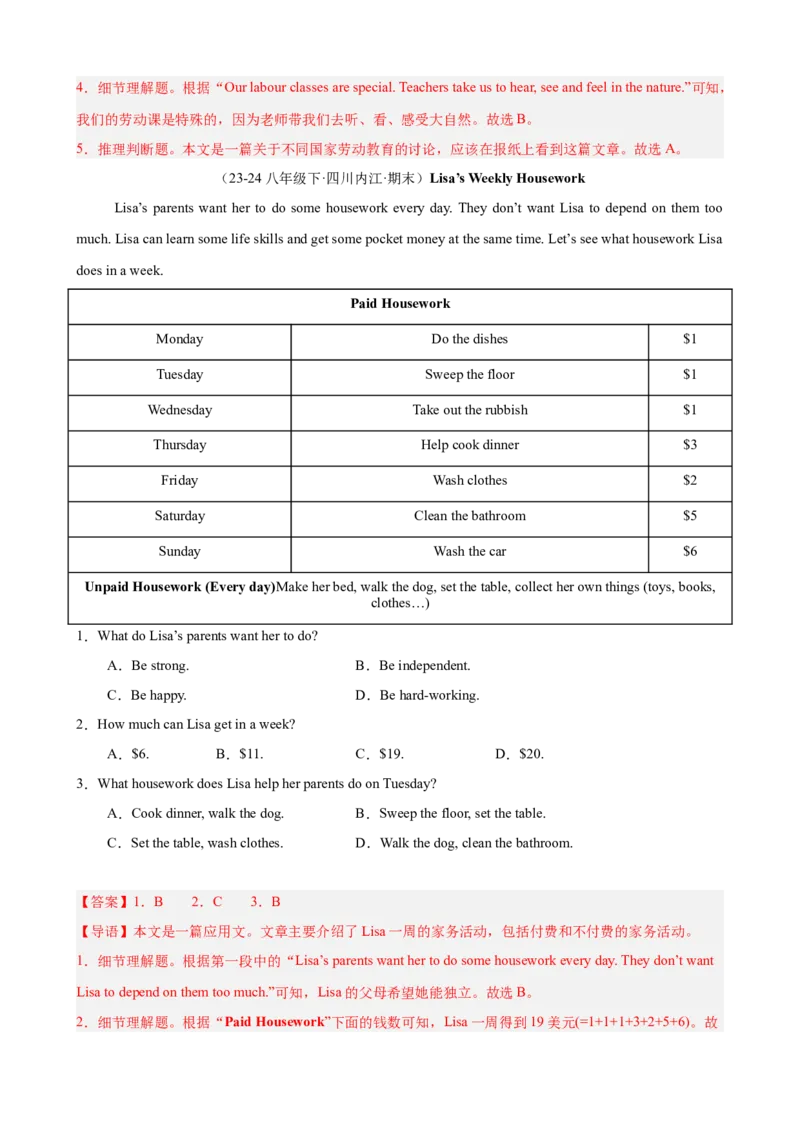
(23-24八年级下·四川内江·期末)Lisa’s Weekly Housework
Lisa’s parents want her to do some housework every day. They don’t want Lisa to depend on them too
much. Lisa can learn some life skills and get some pocket money at the same time. Let’s see what housework Lisa
does in a week.
Paid Housework
Monday Do the dishes $1
Tuesday Sweep the floor $1
Wednesday Take out the rubbish $1
Thursday Help cook dinner $3
Friday Wash clothes $2
Saturday Clean the bathroom $5
Sunday Wash the car $6
Unpaid Housework (Every day)Make her bed, walk the dog, set the table, collect her own things (toys, books,
clothes…)
1.What do Lisa’s parents want her to do?
A.Be strong. B.Be independent.
C.Be happy. D.Be hard-working.
2.How much can Lisa get in a week?
A.$6. B.$11. C.$19. D.$20.
3.What housework does Lisa help her parents do on Tuesday?
A.Cook dinner, walk the dog. B.Sweep the floor, set the table.
C.Set the table, wash clothes. D.Walk the dog, clean the bathroom.
【答案】1.B 2.C 3.B
【导语】本文是一篇应用文。文章主要介绍了Lisa一周的家务活动,包括付费和不付费的家务活动。
1.细节理解题。根据第一段中的“Lisa’s parents want her to do some housework every day. They don’t want
Lisa to depend on them too much.”可知,Lisa的父母希望她能独立。故选B。
2.细节理解题。根据“Paid Housework”下面的钱数可知,Lisa一周得到19美元(=1+1+1+3+2+5+6)。故选C。
3.细节理解题。根据“Tuesday Sweep the floor”以及“Unpaid Housework (Every day) Make her bed, walk
the dog, set the table, collect her own things (toys, books, clothes…)”可知,周二,Lisa帮助父母扫地和摆桌子。
故选B。
(23-24八年级下·山东临沂·期末)I grew up in the countryside. I didn’t understand what it brought to
me until I became an adult. It helped me learn more practical skills (实践技能) than those who grew up in cities.
The first skill I learned was cooking. Since my parents often came home late and a prepared meal would
help them have supper soon. I learned to make dough (面团) at around 10 years old. It sounds easy but very
difficult to do. However, it didn’t take too long for me to find the right way. A year after that, I learned to cook
different things like noodles and dumplings. I fell in love with cooking because it’s really relaxing. More
importantly, thanks to my cooking skill, I live better during the pandemic (疫情) because I cook every meal
instead of ordering online. It saves money and I don’t have to wait for drivers to feed me.
Besides cooking, I did a lot of farm work in my childhood. I got to know how to plant vegetables. Though
it was hard work, the experience did teach me things. For example, I learned that the fruits of peanut (花生) and
ginger (生姜) plants grow under the earth. Also, the truth of happiness sometimes comes from learning firsthand
(直接地). You’ll treasure everything on your plate.
The practical skills I learned not only improve my self-care ability but also provide me with a new way to
look at the world. So when I heard in China students in primary and middle school will have at least one class
every week to learn some skills like cooking and cleaning, I was much too happy. Trust me. The labor (劳动)
education will help you for the rest of your life.
1.According to the passage, the writer didn’t learn ________.
A.cooking skills B.cleaning skills C.planting skills
2.Which one is TRUE according to Paragraph Two?
A.It took the writer a long time to learn to make dough.
B.Since the writer was 10, he has been in love with cooking.
C.During the pandemic, the writer cooks by himself every day.
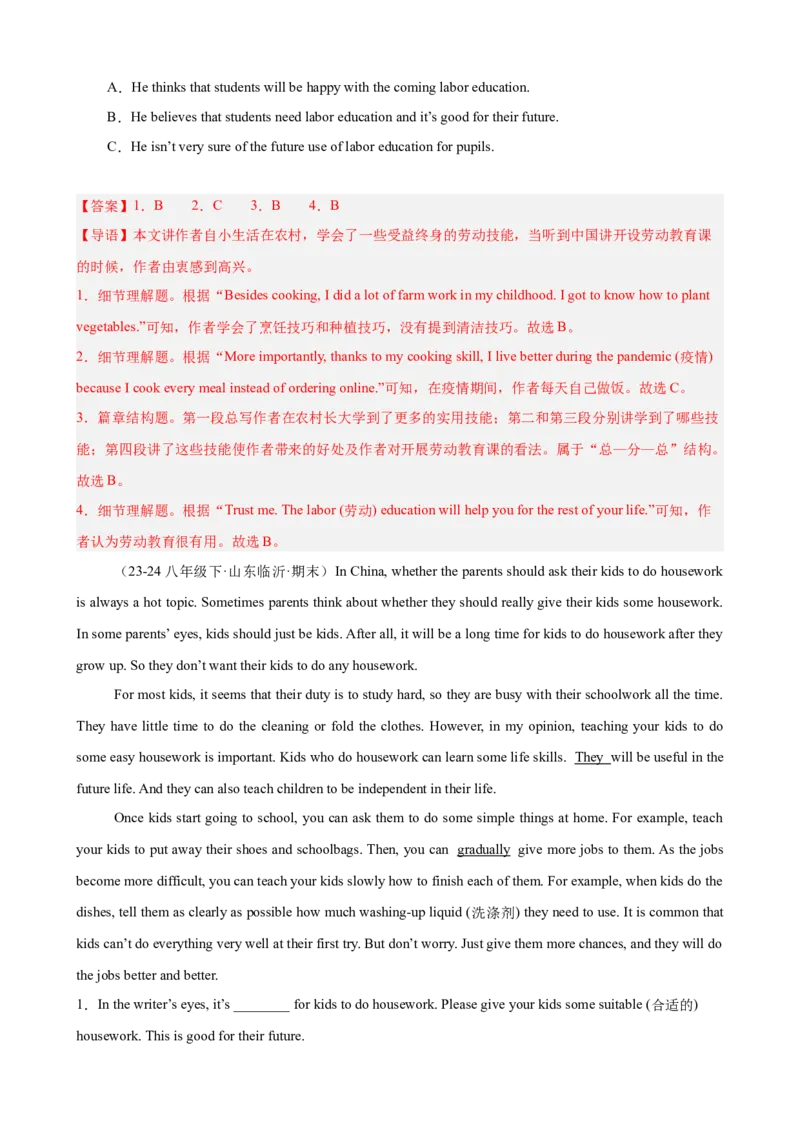
3.What is the structure (结构) of the passage?
A. B. C.
4.What does the writer think of labor education?A.He thinks that students will be happy with the coming labor education.
B.He believes that students need labor education and it’s good for their future.
C.He isn’t very sure of the future use of labor education for pupils.
【答案】1.B 2.C 3.B 4.B
【导语】本文讲作者自小生活在农村,学会了一些受益终身的劳动技能,当听到中国讲开设劳动教育课
的时候,作者由衷感到高兴。
1.细节理解题。根据“Besides cooking, I did a lot of farm work in my childhood. I got to know how to plant
vegetables.”可知,作者学会了烹饪技巧和种植技巧,没有提到清洁技巧。故选B。
2.细节理解题。根据“More importantly, thanks to my cooking skill, I live better during the pandemic (疫情)
because I cook every meal instead of ordering online.”可知,在疫情期间,作者每天自己做饭。故选C。
3.篇章结构题。第一段总写作者在农村长大学到了更多的实用技能;第二和第三段分别讲学到了哪些技
能;第四段讲了这些技能使作者带来的好处及作者对开展劳动教育课的看法。属于“总—分—总”结构。
故选B。
4.细节理解题。根据“Trust me. The labor (劳动) education will help you for the rest of your life.”可知,作
者认为劳动教育很有用。故选B。
(23-24八年级下·山东临沂·期末)In China, whether the parents should ask their kids to do housework
is always a hot topic. Sometimes parents think about whether they should really give their kids some housework.
In some parents’ eyes, kids should just be kids. After all, it will be a long time for kids to do housework after they
grow up. So they don’t want their kids to do any housework.
For most kids, it seems that their duty is to study hard, so they are busy with their schoolwork all the time.
They have little time to do the cleaning or fold the clothes. However, in my opinion, teaching your kids to do
some easy housework is important. Kids who do housework can learn some life skills. They will be useful in the
future life. And they can also teach children to be independent in their life.
Once kids start going to school, you can ask them to do some simple things at home. For example, teach
your kids to put away their shoes and schoolbags. Then, you can gradually give more jobs to them. As the jobs
become more difficult, you can teach your kids slowly how to finish each of them. For example, when kids do the
dishes, tell them as clearly as possible how much washing-up liquid (洗涤剂) they need to use. It is common that
kids can’t do everything very well at their first try. But don’t worry. Just give them more chances, and they will do
the jobs better and better.
1.In the writer’s eyes, it’s ________ for kids to do housework. Please give your kids some suitable (合适的)
housework. This is good for their future.A.boring B.enjoyable C.necessary
2.What does the underlined word “They” refer to (指的是)?
A.Parents. B.Life skills. C.Easy housework.
3.What does the underlined word “gradually” mean in Paragraph 3?
A.step by step B.clearly C.especially
4.What’s the main idea of the third paragraph?
A.Kids must do housework that they’re able to do.
B.Parents should teach kids how to do housework quickly.
C.Parents should make kids do housework from simple things.
5.What does the passage mainly talk about?
A.Parents should let kids do some housework.
B.Children should finish their homework first.
C.Parents should do housework with their kids.
【答案】1.C 2.B 3.A 4.C 5.A
【导语】本文主要介绍了为什么让孩子做家务以及怎样教孩子做家务。
1.推理判断题。根据“However, in my opinion, teaching your kids to do some easy housework is important.
Kids who do housework can learn some life skills. They will be useful in the future life.”可知,作者认为应该教
孩子做一些家务,孩子们能够从中学习一些生活技巧,对孩子将来有用处,所以可推知作者认为做家务
对孩子来说是有必要的。故选C。
2.词义猜测题。根据“Kids who do housework can learn some life skills. They will be useful in the future
life.”可知,孩子做家务能够学习一些生活技巧,这些技巧对他们将来有用,所以此处的“They”指的是生
活技巧,即“Life skills”。故选B。
3.词义猜测题。根据“Once kids start going to school, you can ask them to do some simple things at home.
For example, teach your kids to put away their shoes and schoolbags. Then, you can gradually give more jobs to
them.”可知,是一开始让孩子做一些简单的事情,然后再逐渐让他们做更多家务,此处gradually表示“逐
渐地”,与step by step意思相近。故选A。
4.主旨大意题。根据“Once kids start going to school, you can ask them to do some simple things at home…
Then, you can gradually give more jobs to them. As the jobs become more difficult, you can teach your kids
slowly how to finish each of them”可知,第三段主要讲的是让孩子从做简单的事开始做家务,然后再逐渐
增加难度。故选C。
5.主旨大意题。根据“For most kids, it seems that their duty is to study hard, so they are busy with theirschoolwork all the time. They have little time to do the cleaning or fold the clothes. However, in my opinion,
teaching your kids to do some easy housework is important”以及全文可知,本文主要讲述了让孩子们做家务
的问题以及怎样让孩子做家务。故选A。
(23-24八年级下·吉林长春·期末)Do teenagers in small villages do chores at home? How about the
teenagers in big cities? To know the answers, we made a survey (调查) last month. We asked 4,000 teenagers in
China. Half of them come from big cities like Beijing, Shanghai and Guangzhou. The others are from small
villages. We made a chart (图表) according to our survey. Let’s have a look at it.
We can find out that teenagers in small villages do more chores than those in big cities. Maybe it is because
they live a harder life. We will give our advice to parents in big cities. We think parents should give their children
some chores to do because it’s a good chance for teenagers to learn how to take care of themselves.
根据短文和图表内容,选择最佳答案。
1.They surveyed _________ teenagers from big cities.
A.1000 B.2000 C.3000 D.4000
2.1,000 teenagers from the cities ________.
A.take out the rubbish B.do the dishes
C.make the bed D.fold the clothes
3.The number of teenagers in big cities is bigger than that in small villages only in ________.
A.taking out the rubbish B.making the bed
C.sweeping the floor D.doing the dishes
4.They made the survey because________.
A.they wanted to know more about teenagers in China
B.they didn’t want teenagers in China to do chores at home
C.they wanted to know if (是否) teenagers in China do chores at homeD.they thought doing housework could help teenagers to take care of themselves
5.From the passage, we can know________.
A.more than 3000 teenagers take out the rubbish
B.fewer than 1000 teenagers in big cities make the bed
C.more than 1500 teenagers in Beijing fold the clothes
D.4000 teenagers from small villages take part in the survey
【答案】1.B 2.D 3.B 4.C 5.A
【导语】本文中作者主要讲述了在中国4000多名青少年中就是否做家务做的调查报告的结果。从结果中
可以看到农村的孩子比城市的孩子做的家务相对要多一些。
1.细节理解题。根据“We asked 4,000 teenagers in China”和“Half of them come from big cities like Beijing,
Shanghai and Guangzhou”可知,调查了4000名青少年,一半来自大城市,也就是2000人,故选B。
2.细节理解题。根据柱状图可知,1000名来自城市的青少年叠衣服。故选D。
3.细节理解题。根据柱状图可知,仅在铺床方面,大城市的青少年人数比农村的孩子多。故选B。
4.细节理解题。根据“Do teenagers in small villages do chores at home? How about the teenagers in big
cities? To know the answers,...”可知,他们做这项调查是因为他们想知道中国的青少年是否在家做家务。故
选C。
5.细节理解题。根据柱状图中的第一个可知,倒垃圾的青少年总数要超过3000,故选A。
(22-23八年级下·江西宜春·期末)Housework is a great disciplinary (纪律的) tool to use for raising
children. However, not all chores are suitable for every age. The following is advice on activities parents can use
to develop their children’s useful habits.
Two-year-olds can learn how to take out the rubbish. They can also help their parents carry light things and
hang up clothes. At this age children should learn how to put their toys away before going to bed.
At the age of three, children can learn how to water plants and feed pets carefully. They should learn how to
make their beds and put their dishes away. Children at this age can pick up the daily newspapers, and begin to
learn how to wash clothes.
Four-year-olds should be old enough to do what the two and three year olds can do and more. They can
make their beds, set the table, and clean up after dinner. They should also learn how to fold their clothes and put
them in the correct cabinets (柜子), as well as how to choose their clothes for the following day.
Children aged five should help clean the table and change their bed sheets. They can also prepare their
schoolbags, as well as anything else related to (与……有关) the next school day. At this age they should learn to
clean up their toys and lady up their rooms.Children grow through personal experiences. The more things they do, the faster they will develop. Others
help them only when it is necessary, it is important that they learn how to be independent and try to finish the
tasks by themselves.
1.Match the ages with suitable activities.
a. 2-year-olds b. 3-year-olds c. 4-year-olds d. 5 year-olds
①change bed sheets ②fold clothes ③hang up clothes ④wash clothes
A.a-④; b-③; c-①; d-② B.a-③; b -④; c-①; d-②
C.a-③; b-④; c-②; d-① D.a-④; b-②; c-③; d-①
2.What does the underlined word “They” in Paragraph 4 refer to?
A.Two-year-old children. B.Three-year-old children.
C.Four-year-old children. D.Five-year-old children.
3.What makes children grow according to the passage?
A.Personal experiences. B.Help from parents.
C.Relationship between friends. D.Schoolwork.
4.What’s the purpose (目的) of the passage?
A.To ask parents to do more chores at home.
B.To advise parents to let children do chores.
C.To explain the importance of raising children.
D.To show children how to do chores.
5.Which of the following best shows the structure of the passage?
A. B. C. D.
【答案】1.C 2.C 3.A 4.B 5.A
【导语】本文是一篇说明文。主要介绍了家务是教育孩子的好手段,但不同年龄段的孩子适合做的家务
不同。
1.细节理解题。根据第二段“Two-year-olds can learn how to take out the rubbish. They can also help their
parents carry light things and hang up clothes.”可知,两岁的孩子可以学习如何倒垃圾,他们还可以帮助父母
搬轻东西和挂衣服,即③;根据第三段“Children at this age can pick up the daily newspapers, and begin to
learn how to wash clothes.”可知,三岁的孩子可以拿起日报,开始学习如何洗衣服,即④;根据第四段“They should also learn how to fold their clothes”可知,四岁的孩子该学会如何折叠衣服,即②;根据第五
段“Children aged five should help clean the table and change their bed sheets.”可知,五岁的孩子应该帮助清
洁桌子和换床单,即①。由此可知可知,2岁-③;3岁-④;4岁-②;5岁-①。故选C。
2.词义猜测题。根据“Four-year-olds should be old enough to do what the two and three year olds can do and
more. They can make their beds, set the table, and clean up after dinner.”可知,四岁的孩子应该足够大,可以
做两三岁孩子能做的事,甚至更多。他们可以铺床、摆桌子、晚饭后打扫卫生。由此可知They指的是
“四岁的儿童”。故选C。
3.细节理解题。根据“Children grow through personal experiences.”可知,孩子们在个人经历中成长,即
个人经历让孩子们成长。故选A。
4.主旨大意题。根据第一段“Housework is a great disciplinary tool to use for raising children. However, not
all chores are suitable for every age. The following is advice on activities parents can use to develop their
children’s useful habits”以及全文可知,短文主要介绍了家务是教育孩子的好手段,但不同年龄段的孩子适
合做的家务不同。因此可以推断出这篇文章的目的是建议父母让孩子做家务。故选B。
5.篇章结构题。通读全文可知,①总起说明家务劳动是一种很好的管教孩子的手段;②③④⑤分别介绍
了不同年龄段的孩子适合做的家务;⑥总述孩子们在个人经历中成长,他们要学会如何独立,并努力自
己完成任务。因此这篇文章作者采用“总-分-总”的结构。故选A。
重难语篇拔高练
(22-23八年级下·江苏南京·期末)There is always a discussion about whether you should get your kids
to do chores at home or not. However, getting kids to do housework is really good for children in many ways. So I
find it hard to understand why you wouldn’t get them to do chores.
The most important reason is that getting children to do chores teaches them a lot of life skills. They need
to know how to clean, how to cook, how to shop, etc. It is, however, one of the things that schools don’t teach
completely, so it is one of the main parts of learning that parents should provide for children before they leave
home.
Children like to feel proud about their achievements. Making them help around the house can really help to
give them a sense of pride. Also, giving them praise for helping will make them want to do more. They will feel
happy to be able to help around the house.
Giving your children a job to do or an area in the house to look after will help them learn how to be
responsible in their future life. They will see the benefit (益处) of keeping things organized, clean and tidy—and
also be more thankful for what you do for them as they grow up.
Planning is a life skill that can be got from helping around the house. As children get older, you can start toteach them how to understand the needs of themselves and others and plan by themselves. For example, if they
help with the washing, let them make sure that they do it in time. They may start to plan ahead.
All these reasons for getting kids to help around the house mean that they’ll grow up with a great set of
skills that can be good for them throughout their lives. Why not get started today?
1.Who does the underlined word “they” in Paragraph 2 refer to?
A.Parents. B.Workers. C.Teachers. D.Children.
2.What can give children a sense of pride?
A.Helping around the house. B.Learning all by themselves at school.
C.Learning some life skills. D.Understanding the needs of themselves.
3.How can children learn to be responsible?
A.By planning ahead. B.By finishing homework in time.
C.By being given a job to do. D.By being thankful for what they get.
4.What does the writer think about letting kids do chores?
A.He is against it. B.He is surprised at it.
C.He agrees with it. D.He doesn’t care about it.
5.Which of the following best shows the structure of the passage?
A. B. C. D.
【答案】1.D 2.A 3.C 4.C 5.B
【导语】本文主要讲述了孩子做家务的好处及原因。
1.词句猜测题。根据“It is, however, one of the things that schools don’t teach completely, so it is one of the
main parts of learning that parents should provide for children before they leave home.”可知,做家务是父母应
该在孩子离开家之前为他们提供的学习的主要部分之一,they指代children。故选D。
2.细节理解题。根据“Making them help around the house can really help to give them a sense of pride.”可知,
让孩子在家里帮忙可以给他们一种自豪感。故选A。
3.细节理解题。根据“Giving your children a job to do or an area in the house to look after will help them
learn how to be responsible in their future life.”可知,给你的孩子一份工作去做,或者在家里有一个地方让
他们照看,这将帮助他们学会如何在未来的生活中负责任。故选C。
4.观点态度题。根据“However, getting kids to do housework is really good for children in many ways. So Ifind it hard to understand why you wouldn’t get them to do chores.”可知,作者赞同让孩子做家务。故选C。
5.篇章结构题。根据“However, getting kids to do housework is really good for children in many ways.”可知,
第一段介绍做家务对孩子有好处;根据“The most important reason is that getting children to do chores
teaches them a lot of life skills.”、“Children like to feel proud about their achievements.”、“Giving your
children a job to do or an area in the house to look after will help them learn how to be responsible in their future
life.”和“Planning is a life skill that can be got from helping around the house.”可知,第二、三、四、五段具
体介绍了做家务能给孩子带来什么好处;根据“All these reasons for getting kids to help around the house
mean that they’ll grow up with a great set of skills that can be good for them throughout their lives.”可知,最后
一段首尾呼应,再次强调做家务对孩子有好处,所以文章结构为“总——分——总”。故选B。