Unit 6 An old man tried to move the mountains.
单元话题满分范文必背
基础语篇巩固练
1.假定你是学生李辉,即将参加学校英语社团组织的以“古代中国智慧故事”为主题的征文活动。
请你根据以下提示写一篇英语文章参加比赛。
内容包括:
1. 司马光和小伙伴们玩耍;
2. 一个小伙伴掉进水缸(water tank)中;
3. 司马光砸破水缸救出小伙伴。
注意:
1. 词数80~100;
2. 可适当增加细节,以使行文连贯;
3. 文中不能出现真实姓名及学校名称。
Sima Guang broke the water tank
___________________________________________________________________________________________
___________________________________________________________________________________________
___________________________________________________________________________________________
___________________________________________________________________________________________
___________________________________________________________________________________________
___________________________________________________________________________________________
___________________________________________________________________________________________
___________________________________________________________________________________________
___________________________________________________________________________________________
___________________________________________________________________________________________
___________________________________________________________________________________________
_____________
【答案】例文
My name is Li Hui, and today want to share with you an ancient Chinese wisdom story about Sima
Guang.
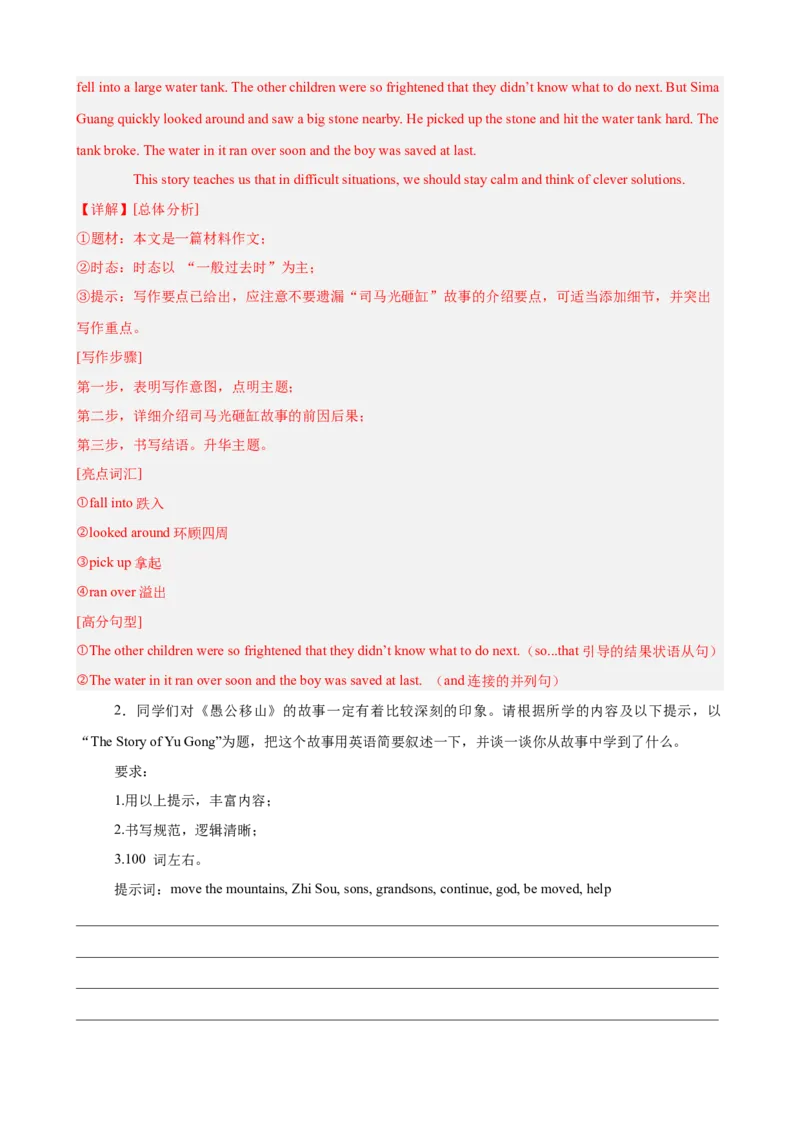
One day, Sima Guang and his friends were playing happily in a courtyard. Suddenly, one of his friendsfell into a large water tank. The other children were so frightened that they didn’t know what to do next. But Sima
Guang quickly looked around and saw a big stone nearby. He picked up the stone and hit the water tank hard. The
tank broke. The water in it ran over soon and the boy was saved at last.
This story teaches us that in difficult situations, we should stay calm and think of clever solutions.
【详解】[总体分析]
①题材:本文是一篇材料作文;
②时态:时态以 “一般过去时”为主;
③提示:写作要点已给出,应注意不要遗漏“司马光砸缸”故事的介绍要点,可适当添加细节,并突出
写作重点。
[写作步骤]
第一步,表明写作意图,点明主题;
第二步,详细介绍司马光砸缸故事的前因后果;
第三步,书写结语。升华主题。
[亮点词汇]
①fall into跌入
②looked around环顾四周
③pick up拿起
④ran over溢出
[高分句型]
①The other children were so frightened that they didn’t know what to do next.(so...that引导的结果状语从句)
②The water in it ran over soon and the boy was saved at last. (and连接的并列句)
2.同学们对《愚公移山》的故事一定有着比较深刻的印象。请根据所学的内容及以下提示,以
“The Story of Yu Gong”为题,把这个故事用英语简要叙述一下,并谈一谈你从故事中学到了什么。
要求:
1.用以上提示,丰富内容;
2.书写规范,逻辑清晰;
3.100 词左右。
提示词:move the mountains, Zhi Sou, sons, grandsons, continue, god, be moved, help
___________________________________________________________________________________________
___________________________________________________________________________________________
___________________________________________________________________________________________
______________________________________________________________________________________________________________________________________________________________________________________
___________________________________________________________________________________________
___________________________________________________________________________________________
___________________________________________________________________________________
【答案】例文
The Story of Yu Gong
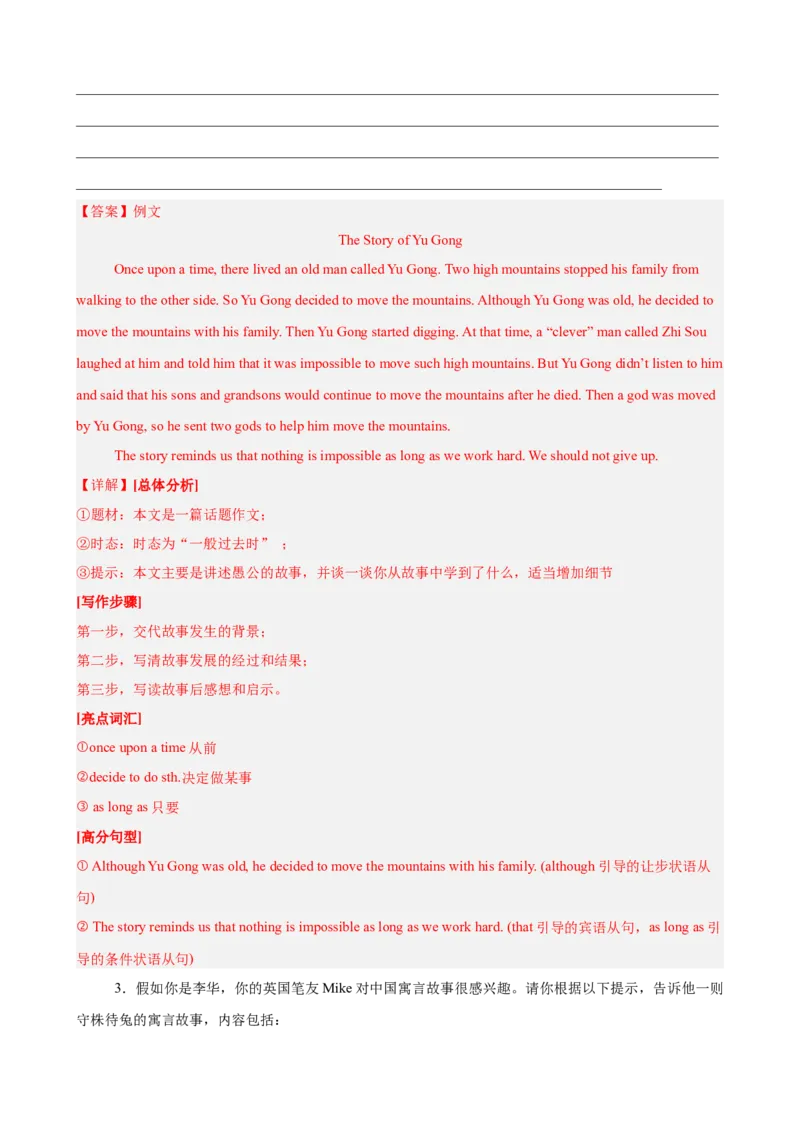
Once upon a time, there lived an old man called Yu Gong. Two high mountains stopped his family from
walking to the other side. So Yu Gong decided to move the mountains. Although Yu Gong was old, he decided to
move the mountains with his family. Then Yu Gong started digging. At that time, a “clever” man called Zhi Sou
laughed at him and told him that it was impossible to move such high mountains. But Yu Gong didn’t listen to him
and said that his sons and grandsons would continue to move the mountains after he died. Then a god was moved
by Yu Gong, so he sent two gods to help him move the mountains.
The story reminds us that nothing is impossible as long as we work hard. We should not give up.
【详解】[总体分析]
①题材:本文是一篇话题作文;
②时态:时态为“一般过去时” ;
③提示:本文主要是讲述愚公的故事,并谈一谈你从故事中学到了什么,适当增加细节
[写作步骤]
第一步,交代故事发生的背景;
第二步,写清故事发展的经过和结果;
第三步,写读故事后感想和启示。
[亮点词汇]
①once upon a time从前
②decide to do sth.决定做某事
③ as long as只要
[高分句型]
① Although Yu Gong was old, he decided to move the mountains with his family. (although引导的让步状语从
句)
② The story reminds us that nothing is impossible as long as we work hard. (that引导的宾语从句,as long as引
导的条件状语从句)
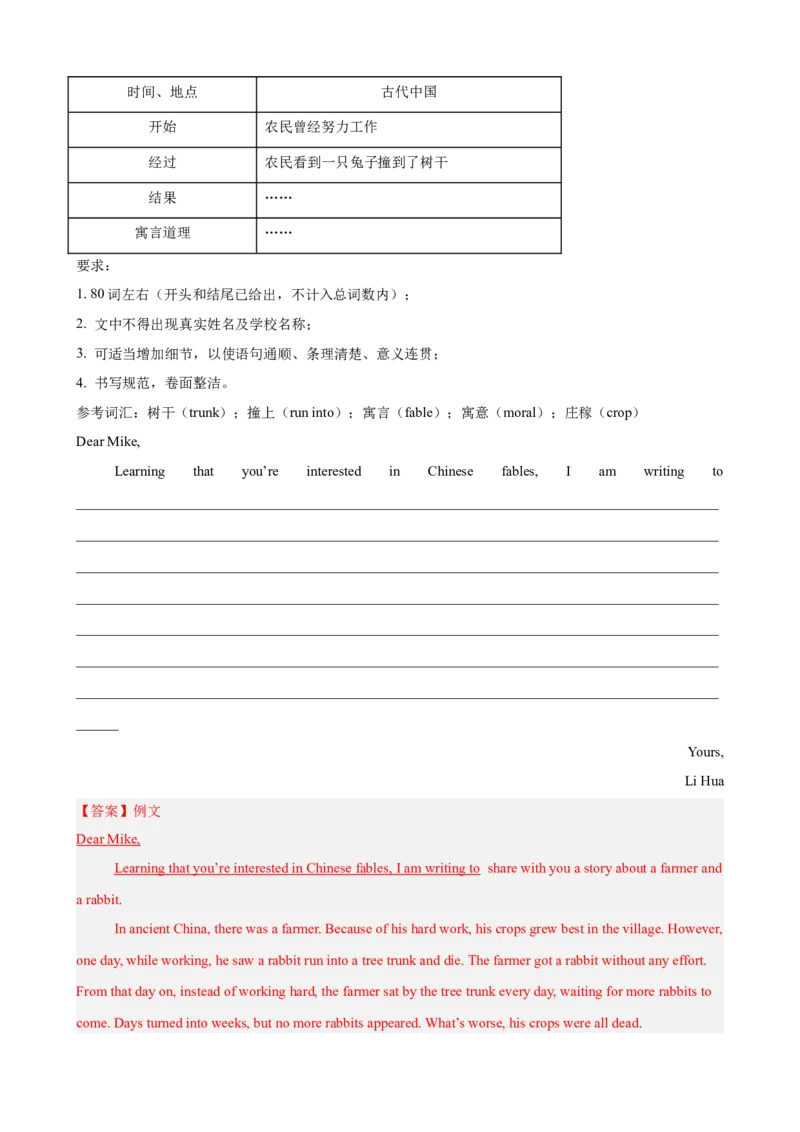
3.假如你是李华,你的英国笔友Mike对中国寓言故事很感兴趣。请你根据以下提示,告诉他一则
守株待兔的寓言故事,内容包括:时间、地点 古代中国
开始 农民曾经努力工作
经过 农民看到一只兔子撞到了树干
结果 ……
寓言道理 ……
要求:
1. 80词左右(开头和结尾已给出,不计入总词数内);
2. 文中不得出现真实姓名及学校名称;
3. 可适当增加细节,以使语句通顺、条理清楚、意义连贯;
4. 书写规范,卷面整洁。
参考词汇:树干(trunk);撞上(run into);寓言(fable);寓意(moral);庄稼(crop)
Dear Mike,
Learning that you’re interested in Chinese fables, I am writing to
___________________________________________________________________________________________
___________________________________________________________________________________________
___________________________________________________________________________________________
___________________________________________________________________________________________
___________________________________________________________________________________________
___________________________________________________________________________________________
___________________________________________________________________________________________
______
Yours,
Li Hua
【答案】例文
Dear Mike,
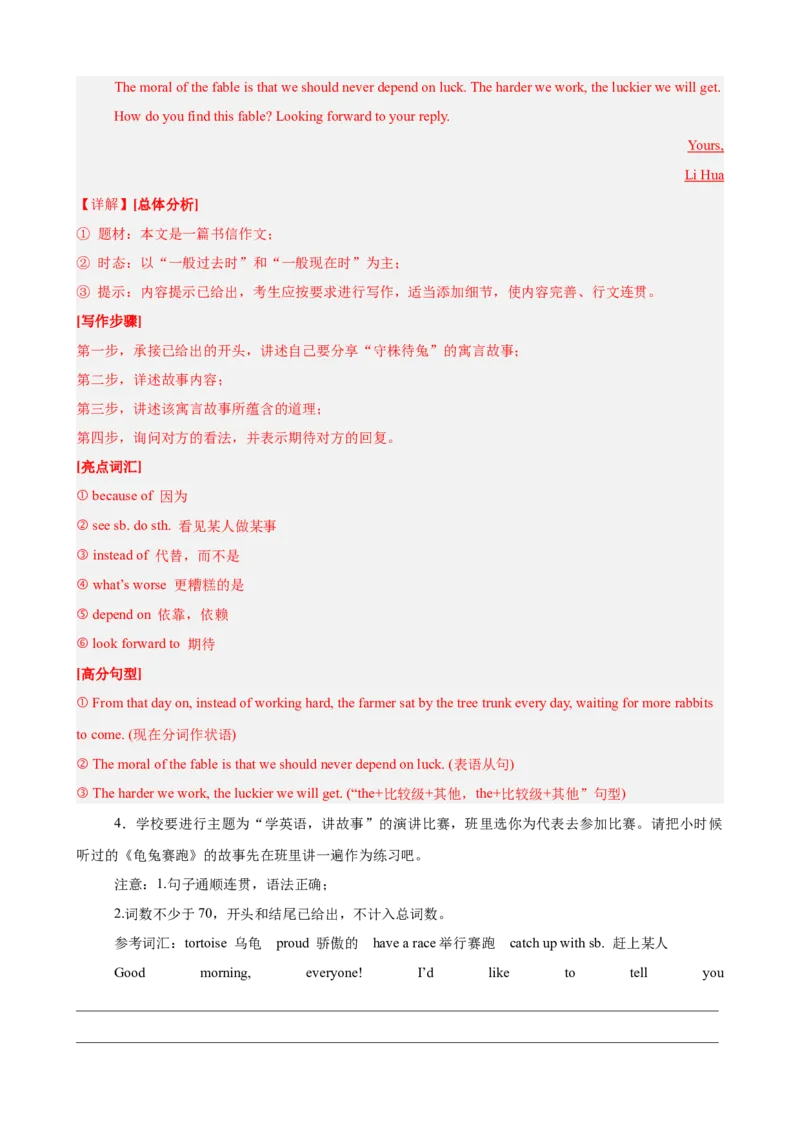
Learning that you’re interested in Chinese fables, I am writing to share with you a story about a farmer and
a rabbit.
In ancient China, there was a farmer. Because of his hard work, his crops grew best in the village. However,
one day, while working, he saw a rabbit run into a tree trunk and die. The farmer got a rabbit without any effort.
From that day on, instead of working hard, the farmer sat by the tree trunk every day, waiting for more rabbits to
come. Days turned into weeks, but no more rabbits appeared. What’s worse, his crops were all dead.The moral of the fable is that we should never depend on luck. The harder we work, the luckier we will get.
How do you find this fable? Looking forward to your reply.
Yours,
Li Hua
【详解】[总体分析]
① 题材:本文是一篇书信作文;
② 时态:以“一般过去时”和“一般现在时”为主;
③ 提示:内容提示已给出,考生应按要求进行写作,适当添加细节,使内容完善、行文连贯。
[写作步骤]
第一步,承接已给出的开头,讲述自己要分享“守株待兔”的寓言故事;
第二步,详述故事内容;
第三步,讲述该寓言故事所蕴含的道理;
第四步,询问对方的看法,并表示期待对方的回复。
[亮点词汇]
① because of 因为
② see sb. do sth. 看见某人做某事
③ instead of 代替,而不是
④ what’s worse 更糟糕的是
⑤ depend on 依靠,依赖
⑥ look forward to 期待
[高分句型]
① From that day on, instead of working hard, the farmer sat by the tree trunk every day, waiting for more rabbits
to come. (现在分词作状语)
② The moral of the fable is that we should never depend on luck. (表语从句)
③ The harder we work, the luckier we will get. (“the+比较级+其他,the+比较级+其他”句型)
4.学校要进行主题为“学英语,讲故事”的演讲比赛,班里选你为代表去参加比赛。请把小时候
听过的《龟兔赛跑》的故事先在班里讲一遍作为练习吧。
注意:1.句子通顺连贯,语法正确;
2.词数不少于70,开头和结尾已给出,不计入总词数。
参考词汇:tortoise 乌龟 proud 骄傲的 have a race举行赛跑 catch up with sb. 赶上某人
Good morning, everyone! I’d like to tell you
___________________________________________________________________________________________
______________________________________________________________________________________________________________________________________________________________________________________
___________________________________________________________________________________________
___________________________________________________________________________________________
___________________________________________________________________________________________
___________________________________________________________________________________________
___________________________________________________________________________________________
_________________
Thank you for your attention!
【答案】例文:
Good morning, everyone! I’d like to tell you an interesting and meaningful story.
There was a rabbit and a tortoise in the forest. One day, they decided to have a race. At first the rabbit ran
much faster than the tortoise and he thought the tortoise could never catch up with him. He was so proud that he
decided to have a rest under a tree. In the end, the tortoise arrived while the rabbit was sleeping.
So try your best to do everything. Nothing is impossible.
Thank you for your attention!
【详解】[总体分析]
① 题材:本文是一篇演讲稿,主要讲述《龟兔赛跑》的故事;
② 时态:时态主要为“一般过去时”;
③ 提示:根据所给提示完成写作,包括故事的主要角色、情节和故事的寓意。
[写作步骤]
第一步,介绍故事的主要角色——兔子和乌龟;
第二步,具体阐述故事的情节。先介绍兔子和乌龟的比赛,然后描绘兔子的自满和乌龟的坚持;
第三步,最后是总结故事的寓意和教训。
[亮点词汇]
① decide to do 决定做
② catch up with 追赶
③ in the end 最后
[高分句型]
① At first the rabbit ran much faster than the tortoise and he thought the tortoise could never catch up with him.
(and连接的并列句;thought后为省略了that的宾语从句)
② In the end, the tortoise arrived while the rabbit was sleeping.(while引导时间状语从句)
5.讲好中国故事,传播中国声音。China Daily网站中的 Culture版块正在进行“Tell a Chinesetraditional story”的征文活动。假如你是李华,请根据提示以“My favorite Chinese traditional story”为题写
一篇英语短文投稿。
提示:
1. 描述愚公移山的故事内容;
2. 故事给你的影响和启发。
要求:
词数:90左右。
My favorite Chinese traditional story
___________________________________________________________________________________________
___________________________________________________________________________________________
___________________________________________________________________________________________
___________________________________________________________________________________________
___________________________________________________________________________________________
___________________________________________________________________________________________
___________________________________________________________________________________________
___________________________________________________________________________________________
____________________________
【答案】例文
My favorite Chinese traditional story
There are many traditional stories in China. Among all of the stories, I like Yugong moves the mountains
best.
Once upon a time, there was an old man called Yugong. There were two high mountains near his home.
They were so high that it took him a long time to walk to the other side. So he decided to move the mountains.
Yugong and his family began to move the mountains. They kept moving them day after day, year after year.
Finally, a god was so moved that he took the mountains away.
The story reminds us that nothing is impossible as long as we work hard. We should not give up.
【详解】[总体分析]
①题材:本文是一篇材料作文;
②时态:时态为“一般过去时”;
③提示:根据题干,介绍自己最喜欢的中国故事;适当补充,使文章内容充实。
[写作步骤]
第一步,介绍自己最喜欢的故事是《愚公移山》;第二步,详细描述故事内容;
第三步,介绍故事带给自己的启发。
[亮点词汇]
①so…that 如此……以至于
②give up 放弃
[高分句型]
①There are many traditional stories in China.(there be句型)
②The story reminds us that nothing is impossible as long as we work hard.(that引导的宾语从句;as long as引
导的条件状语从句)
6.神话故事(fairy story)作为中国传统文化的一部分, 对于青少年了解民族文化及历史具有一定
意义。假设English Daily网站中的Culture版块请你以“A Story I Know”为题,介绍一则神话故事及故事
给你带来的影响和启发。
要求:
1, 条理清晰,内容完整,语句通顺,书写工整;
2. 文中请勿提及你的真实姓名和学校;
3. 不少于 80 词。
参考词汇:legend(n. 传说);national(adj. 民族的)
___________________________________________________________________________________________
___________________________________________________________________________________________
___________________________________________________________________________________________
___________________________________________________________________________________________
___________________________________________________________________________________________
___________________________________________________________________________________________
___________________________________________________________________________________________
___________________________________________________________________________________________
___________________________________________________________________________________________
___________________________________________________________________________________________
__________
【答案】例文
A Story I Know
There are many traditional stories in China. My favorite story is “Chang’e Flying to the Moon”. Long long
ago, Hou Yi got a special medicine from a goddess as a reward after he shot down nine suns. Peng Meng wantedto get it when Hou Yi was not home. To stop Peng Meng, Chang’e had to take it and she flew up to the moon. Hou
Yi missed her so much that he became really sad every night. One night, he found that the moon was so bright and
round that he saw his wife there. He quickly laid out her favorite fruits and desserts in the garden.
I really love this ancient mythology because it shows our strong desire for family reunion and love.
【详解】[总体分析]
①题材:本文是一篇话题作文;
②时态:时态为“一般现在时”,讲述故事用“一般过去时”;
③提示:写作要点已给出,考生应注意不要遗漏信息提示的内容,适当增加细节,并且突出写作的要点。
[写作步骤]
第一步,表明写作意图。直接说明要介绍什么故事;
第二步,具体阐述写作内容。重点介绍故事的内容;
第三步,书写结语。介绍故事给你带来的影响和启发。
[亮点词汇]
①special特别的
②reward报酬
③mythology神话
④family reunion家庭团聚
[高分句型]
①Long long ago, Hou Yi got a special medicine from a goddess as a reward after he shot down nine suns. (时间
状语从句)
②Hou Yi missed her so much that he became really sad every night. (结果状语从句)
重难语篇拔高练
7.同学们,你们一定了解“乌鸦喝水”这个寓言故事吧。请根据上图,以“The Crow and the
Pitcher”为题, 用英语写一篇100词左右的短文,在学校广播站“英语之声”栏目播出。要求:
1. 包含图片全部要点;
2. 你从中得到哪些启发,可适当发挥。
参考词汇:乌鸦crow;口渴的thirsty;鹅卵石pebble;罐子pitcher
The Crow and the Pitcher
___________________________________________________________________________________________
___________________________________________________________________________________________
___________________________________________________________________________________________
___________________________________________________________________________________________
___________________________________________________________________________________________
【答案】例文:
The Crow and the Pitcher
It was a hot day. A crow felt so thirsty that he looked for water everywhere. Finally, he found a pitcher. But
there wasn’t much water in it. His beak couldn’t reach it. He was very distressed.
When he wanted to give up, he came up with a good idea. He picked up a small pebble and dropped it into
the pitcher. Then he took another and dropped it in. Gradually, the water rose and he was able to drink the water.
How clever the crow was! We should learn from the crow. When we meet with difficulties, we should try to
solve them instead of giving up.
【详解】[总体分析]
①题材:本文是一篇看图作文;
②时态:时态主要为“一般过去时”;
③提示:写作要点已给出,考生注意不要遗漏“要点”中自己从中得到的启发,注意不要遗漏要点。
[写作步骤]
第一步,介绍乌鸦喝水这个寓言故事;
第二步,阐述自己从中得到了启发。
[亮点词汇]
①so...that...太……以至于……
②give up放弃
③come up with想出
④pick up捡起
⑤be able to能够
⑥instead of代替
[高分句型]①A crow felt so thirsty that he looked for water everywhere.(that引导结果状语从句)
②But there wasn’t much water in it.(there be句型)
③When he wanted to give up, he came up with a good idea. (when引导时间状语从句)
④How clever the crow was!(感叹句)
8.童话故事深受孩子们的喜爱,你一定读过《皇帝的新装》这个童话故事。请你根据下图提示,
以“The Emperor’s New Clothes”为题,用英语写一篇 80 词左右的短文,在学校广播站“英语之声”栏目
播出。
要求:1.语句通顺,没有语法错误;
2.包含图片全部要点;
3.从中你得到哪些启发,可适当发挥;
4.80词左右。(温馨提示:亲,交卷前仔细检查一遍!)
___________________________________________________________________________________________
___________________________________________________________________________________________
___________________________________________________________________________________________
___________________________________________________________________________________________
___________________________________________________________________________________________
___________________________________________________________________________________________
___________________________________________________________________________________________
___________________________________________________________________________________________
________________________________________________________________________
【答案】例文
The Emperor’s New Clothes
Once upon a time, there was an emperor who spent several hours changing clothes every morning. Two
cheaters came one day. They made a magical dress for the king and asked him for a lot of money. They told theemperor this dress could only be seen by wise people, not by foolish people. When the emperor put on the clothes,
all he could see was his underwear. But he didn’t want people to think he was stupid, so he said the clothes was
beautiful. And officials all said they could see this dress in order to cover up their “foolishness”. Finally, the
emperor wore this invisible “clothes” and went to the street. A child said, “He’s not wearing anything!”
This story tells us to be honest with everything. And then we can become a true gentleman.
【详解】[总体分析]
①题材:本文是一篇看图作文;
②时态:时态为“一般过去时”;
③提示:根据图片要点,介绍《皇帝的新装》,考生应注意不要遗漏,适当添加细节。
[写作步骤]
第一步,根据图片叙述故事《皇帝的新装》;
第二步,总结自己的启发。
[亮点词汇]
①once upon a time从前
②spend time doing sth.花费时间做某事
③ask sb...for sth.向某人要某物
④cover up掩盖
⑤in order to为了
[高分句型]
①Once upon a time, there was an emperor who spent several hours changing clothes every morning.(who引导
的定语从句)
②They told the emperor this dress could only be seen by wise people, not by foolish people.(省略引导词that的
宾语从句)
9.假如你收到来自英国好友Tom的一封邮件,得知他正准备在学校的International Day给同学们讲
述一个中国传统故事,希望得到你的帮助。请依据表格提示给他写一封回信,从以下三个中国古代故事
中选择一个推荐给他,根据要点简单介绍故事并写出一个推荐原因。
Mu Lan joins the army Cao Chong weighs an
Title Sai Weng and his lost horse
in place of her father elephantMain Characters Mu Lan, Cao Cao, Sai Weng,
(主要人物) Mu Lan’s father Cao Chong Sai Weng’s Son
be missing;come back fall
Main plot(主要情 join the army;dress find out the weight lead, …
off;hurt;stay away from;
节) up as;light;war; onto boats;rock;weigh
war
The Reason for
recommendation …… …… ……
(推荐原因)
注意:
1)词数:80词左右(回信的开头已经给出,不计入词数);
2)不得透漏学校、姓名等任何个人信息,否则不予评分。
Dear Tom,
I know you are always interested in Chinese culture and it’s my honor to give you a little help on telling a
traditional story.
________________________________________________________________________________________
________________________________________________________________________________________
________________________________________________________________________________________
________________________________________________________________________________________
________________________________________________________________________________________
________________________________________________________________________________________
________________________________________________________________________________________
________________________________________________________________________________________
_________________
Hope to hear from you soon.
Yours,
Li Hua
【答案】例文
Dear Tom,
I know you are always interested in Chinese culture and it’s my honor to give you a little help on telling a
traditional story. This story is called Cao Chong weighs an elephant.
One day, Sun Quan sent an elephant to Cao Cao. Cao Cao wondered how heavy the elephant was. Everyone
said that they couldn’t weigh the elephant unless they killed it. Soon Cao Cao’s son Cao Chong told people to lead
the elephant to a boat and mark the water level on the boat. Then they took away the elephant. Next, they keptputting stones into the boat until the water reached the marked level. Finally, Cao Chong said, “After we weigh
the stones, we will know how heavy the elephant is.”
I think this book teaches us the importance of doing things wisely. So I think it’s worth reading.
Hope to hear from you soon.
Yours,
Li Hua
【详解】[总体分析]
①题材:本文是一篇应用文;
②时态:时态为“一般现在时”和“一般过去时”;
③提示:写作要求已给出,学生不要遗漏题目中的要点,可适当添加细节,写作时保持主谓一致,注意
字数要求。
[写作步骤]
第一步,介绍这个中国传统故事的名称;
第二步,介绍故事的主要人物及故事情节;
第三步,谈谈自己推荐的原因。
[亮点词汇]
①take away带走
②keep doing sth继续做某事
③the importance of………的重要性
[高分句型]
①Cao Cao wondered how heavy the elephant was.(宾语从句)
②I think this book teaches us the importance of doing things wisely.(宾语从句)
10.假如你是李梅,你的美国笔友Tom在昨天的 e-mail中告诉你,最近他对中国文化产生了浓厚
的兴趣,希望你能给他介绍一些经典故事。请你根据下面所给图画,给 Tom回复一封e-mail,向他讲述
这一经典故事,并希望知道他对该故事及主人公的看法。
fall into, be frightened (惊恐的), cry, run for
play hide and seek (捉迷藏), full of water
helpthink over, pick up, throw at break, be saved
作文要求:
1. 文章需包括所有图画的内容,可以适当发挥,使全文连贯;
2. 词数70个左右;
3. 邮件的开头和结尾已经给出,不计入总词数。
Dear Tom,
I’m very happy that you are interested in traditional Chinese stories. Well, let me tell you a famous one with
the name Sima Guang Hit the Tank.
___________________________________________________________________________________________
___________________________________________________________________________________________
___________________________________________________________________________________________
___________________________________________________________________________________________
___________________________________________________________________________________________
_________________________________________________________
I’m looking forward to hearing from you.
Yours,
Li Mei
【答案】例文:
Dear Tom,
I’m very happy that you are interested in traditional Chinese stories. Well, let me tell you a famous one with
the name Sima Guang Hit the Tank.
Once Sima Guang was playing hide and seek with several children in the backyard. There was a large water
tank in the yard. It was full of water. When the kids were playing, one child suddenly fell into the tank. Other
children were so frightened that they cried and ran for help. However, Sima Guang thought it over. Then he picked
up a big stone and threw it at the tank. The tank broke and the water ran out. He saved the kid. What do you think
of Sima Guang?
I’m looking forward to hearing from you.
Yours,Li Mei
【详解】[总体分析]
①题材:本文是一篇应用文,为电子邮件;
②时态:时态为“一般过去时”;
③提示:图片内容已给出,考生应注意根据图片及所给提示词描述故事,适当添加细节,并突出写作重
点。
[写作步骤]
第一步,表明写作意图。借用导语部分来引出本邮件话题:给好朋友推荐中国经典故事;
第二步,具体描述图片内容。依次根据四幅图片内容进行故事的描述,图片中的提示词要写全;
第三步,书写结语。表达期待得到对方的回信。
[亮点词汇]
① be full of 充满
② fall into 掉入
③ run for help 跑去寻求帮助
④ think over 仔细考虑
⑤ pick up 捡起
[高分句型]
① When the kids were playing, one child suddenly fell into the tank. (when引导的时间状语从句)
② Other children were so frightened that they cried and ran for help. (so…that…引导的结果状语从句)