Unit 3 Could you please clean your room
单元话题语法填空练习
基础语篇巩固练
(24-25八年级上·福建三明·期中)阅读下面短文,根据语境或所给单词的提示,在每个空格内填入一个
恰当的词,要求所填的词意义准确、形式正确,使短文意思完整、行文连贯。
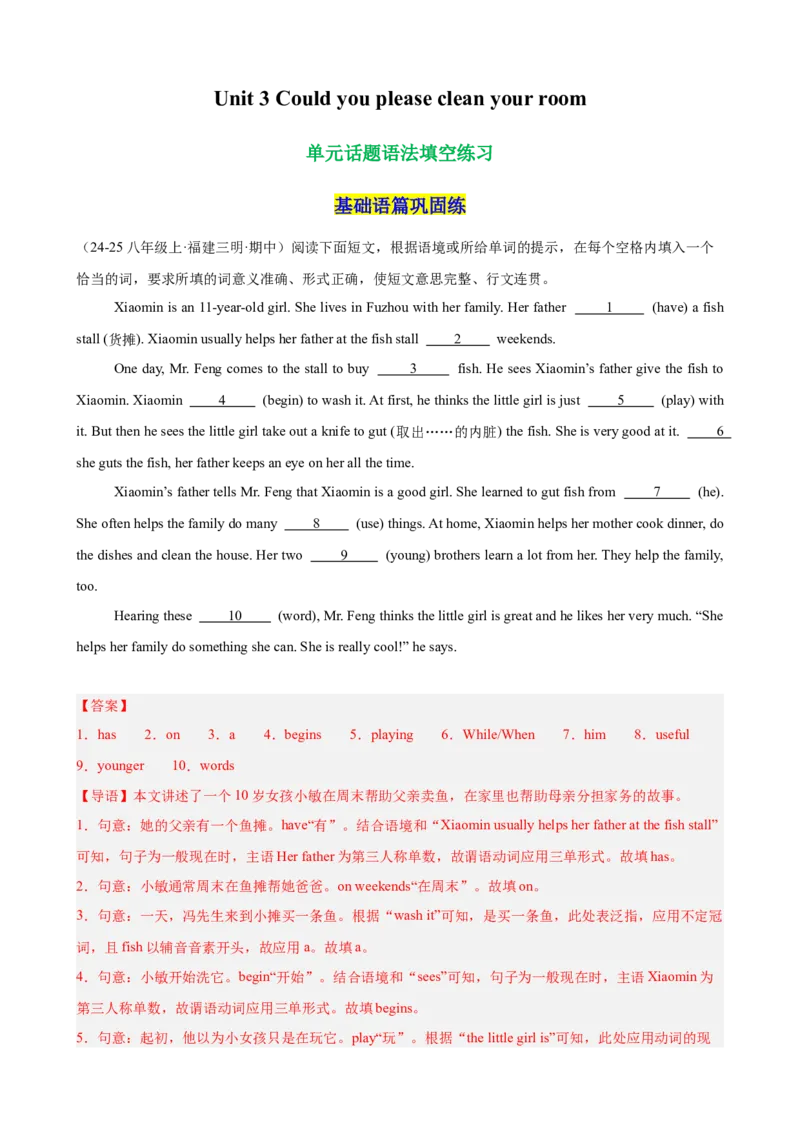
Xiaomin is an 11-year-old girl. She lives in Fuzhou with her family. Her father 1 (have) a fish
stall (货摊). Xiaomin usually helps her father at the fish stall 2 weekends.
One day, Mr. Feng comes to the stall to buy 3 fish. He sees Xiaomin’s father give the fish to
Xiaomin. Xiaomin 4 (begin) to wash it. At first, he thinks the little girl is just 5 (play) with
it. But then he sees the little girl take out a knife to gut (取出……的内脏) the fish. She is very good at it. 6
she guts the fish, her father keeps an eye on her all the time.
Xiaomin’s father tells Mr. Feng that Xiaomin is a good girl. She learned to gut fish from 7 (he).
She often helps the family do many 8 (use) things. At home, Xiaomin helps her mother cook dinner, do
the dishes and clean the house. Her two 9 (young) brothers learn a lot from her. They help the family,
too.
Hearing these 10 (word), Mr. Feng thinks the little girl is great and he likes her very much. “She
helps her family do something she can. She is really cool!” he says.
【答案】
1.has 2.on 3.a 4.begins 5.playing 6.While/When 7.him 8.useful
9.younger 10.words
【导语】本文讲述了一个10岁女孩小敏在周末帮助父亲卖鱼,在家里也帮助母亲分担家务的故事。
1.句意:她的父亲有一个鱼摊。have“有”。结合语境和“Xiaomin usually helps her father at the fish stall”
可知,句子为一般现在时,主语Her father为第三人称单数,故谓语动词应用三单形式。故填has。
2.句意:小敏通常周末在鱼摊帮她爸爸。on weekends“在周末”。故填on。
3.句意:一天,冯先生来到小摊买一条鱼。根据“wash it”可知,是买一条鱼,此处表泛指,应用不定冠
词,且fish以辅音音素开头,故应用a。故填a。
4.句意:小敏开始洗它。begin“开始”。结合语境和“sees”可知,句子为一般现在时,主语Xiaomin为
第三人称单数,故谓语动词应用三单形式。故填begins。
5.句意:起初,他以为小女孩只是在玩它。play“玩”。根据“the little girl is”可知,此处应用动词的现在分词形式,与is构成现在进行时。故填playing。
6.句意:当她给鱼开膛破肚时,她的父亲一直盯着她。根据“...she guts the fish, her father keeps an eye on
her all the time.”可知,当小敏给鱼开膛破肚时,她的父亲一直看着她,“当……时”while/when,引导时
间状语从句。故填While/When。
7.句意:她从他那里学会了取出鱼的内脏。he“他”。根据“She learned to gut fish from”可知,小敏从父
亲那里学会了取出鱼的内脏,空格处应用人称代词的宾格形式him。故填him。
8.句意:她经常帮助家人做许多有用的事情。use“使用”。根据“things”可知,此处应用形容词作定语
修饰名词,“有用的”useful符合语境。故填useful。
9.句意:她的两个弟弟从她身上学到了很多东西。young“年轻的”。根据“brothers learn a lot from her”
可知,应该是弟弟从她身上学到很多,younger brothers“弟弟”。故填younger。
10.句意:听到这些话,冯先生觉得这个小女孩很好,他很喜欢她。word“话”。根据“these”可知,其
后接名词复数。故填words。
(24-25八年级上·山东日照·阶段练习)语法填空
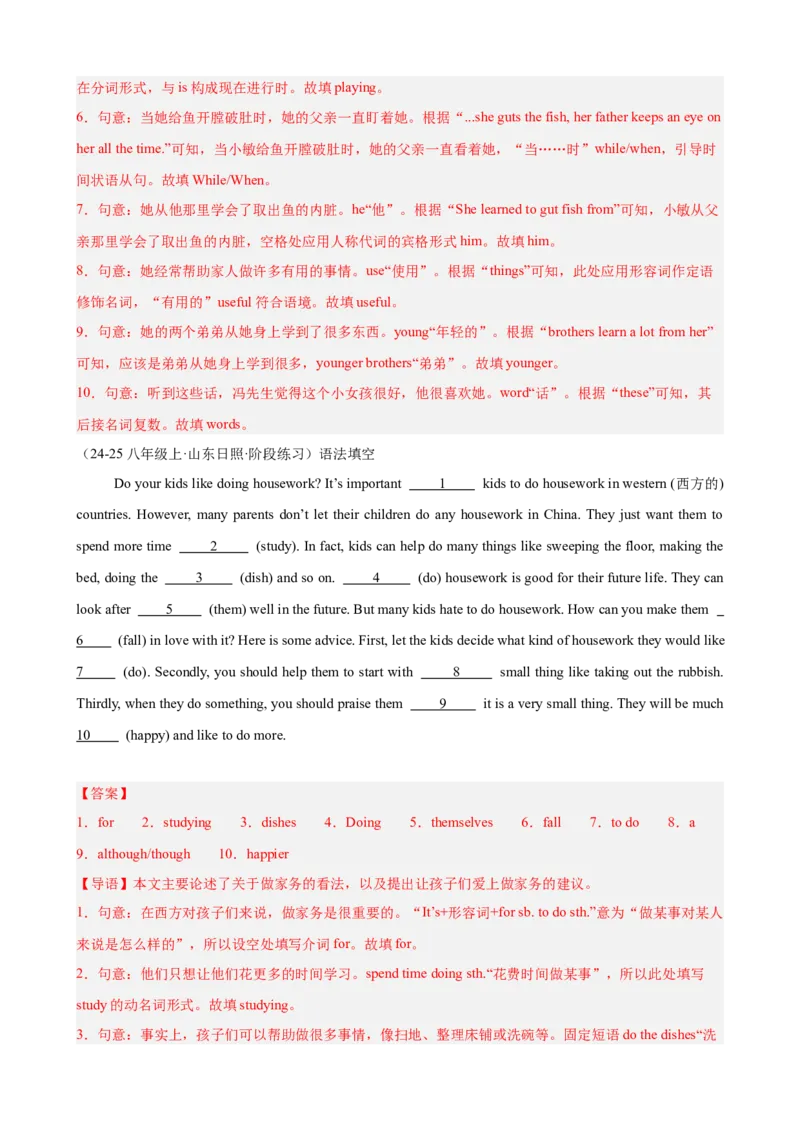
Do your kids like doing housework? It’s important 1 kids to do housework in western (西方的)
countries. However, many parents don’t let their children do any housework in China. They just want them to
spend more time 2 (study). In fact, kids can help do many things like sweeping the floor, making the
bed, doing the 3 (dish) and so on. 4 (do) housework is good for their future life. They can
look after 5 (them) well in the future. But many kids hate to do housework. How can you make them
6 (fall) in love with it? Here is some advice. First, let the kids decide what kind of housework they would like
7 (do). Secondly, you should help them to start with 8 small thing like taking out the rubbish.
Thirdly, when they do something, you should praise them 9 it is a very small thing. They will be much
10 (happy) and like to do more.
【答案】
1.for 2.studying 3.dishes 4.Doing 5.themselves 6.fall 7.to do 8.a
9.although/though 10.happier
【导语】本文主要论述了关于做家务的看法,以及提出让孩子们爱上做家务的建议。
1.句意:在西方对孩子们来说,做家务是很重要的。“It’s+形容词+for sb. to do sth.”意为“做某事对某人
来说是怎么样的”,所以设空处填写介词for。故填for。
2.句意:他们只想让他们花更多的时间学习。spend time doing sth.“花费时间做某事”,所以此处填写
study的动名词形式。故填studying。
3.句意:事实上,孩子们可以帮助做很多事情,像扫地、整理床铺或洗碗等。固定短语do the dishes“洗碗”。故填dishes。
4.句意:做家务对他们今后的生活是有益的。设空处在句中作主语,应填写do的动名词形式,句首首
字母大写。故填Doing。
5.句意:他们可以在未来很好地照顾自己。设空处与主语they指代一致,look after oneself“照顾某人自
己”,所以此处填写they的反身代词。故填themselves。
6.句意:你怎么样才能让他们爱上它?make sb. do sth.“让某人做某事”,所以此处填写省略to的不定式。
故填fall。
7.句意:第一,让孩子们决定他们想做什么样的家务。would like to do sth.“愿意做某事”。故填to do。
8.句意:第二,你应该帮助他们从小事做起,像扔垃圾。设空处位于单数可数名词前表泛指,且small
为辅音音素开头的单词,所以填写不定冠词a。故填a。
9.句意:第三,当他们做了一些事情,尽管是一件很小的事情,你也应该表扬他们。“it is a very small
thing”和“you should praise them”构成让步关系,although/though“尽管;虽然”引导让步状语从句。故填
although/though。
10.句意:他们会更快乐,喜欢做更多的事情。设空处在句中作表语,且其前有much修饰,所以此处填
写形容词happy的比较级。故填happier。
(22-23八年级下·河南周口·期末)阅读下面短文,在空白处填入一个适当的单词(有提示词的,填入所
给单词的正确形式)。
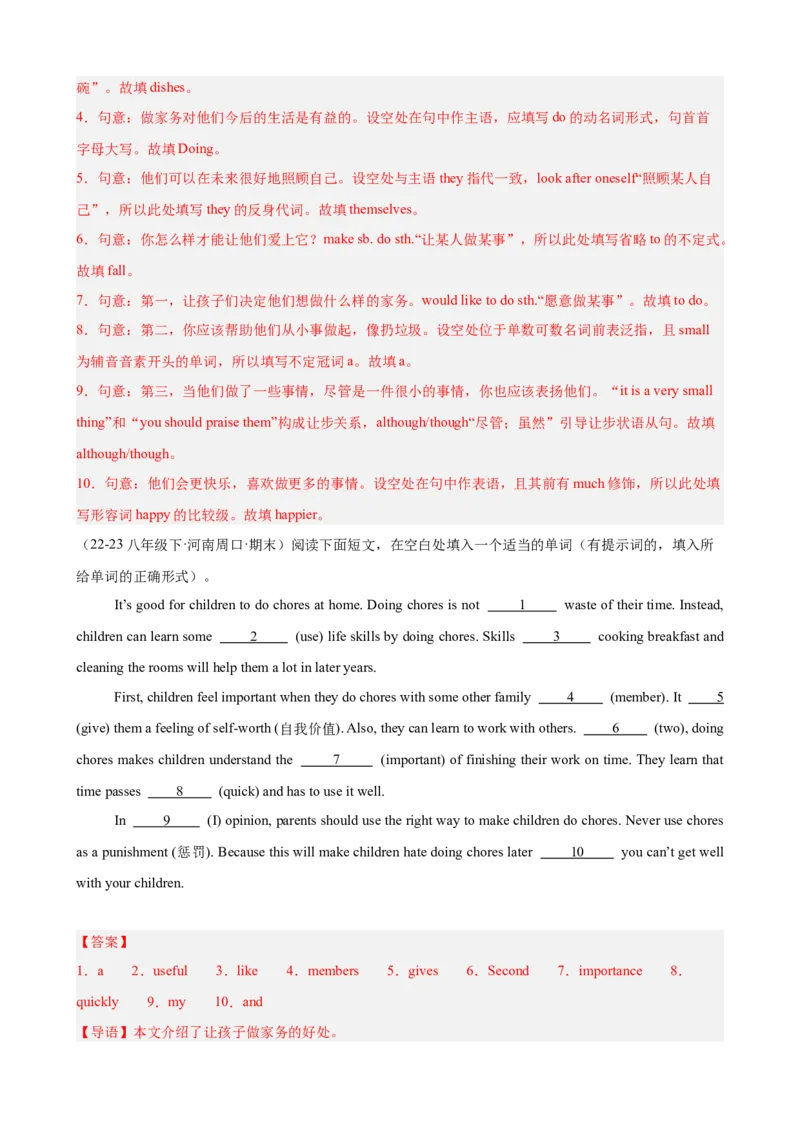
It’s good for children to do chores at home. Doing chores is not 1 waste of their time. Instead,
children can learn some 2 (use) life skills by doing chores. Skills 3 cooking breakfast and
cleaning the rooms will help them a lot in later years.
First, children feel important when they do chores with some other family 4 (member). It 5
(give) them a feeling of self-worth (自我价值). Also, they can learn to work with others. 6 (two), doing
chores makes children understand the 7 (important) of finishing their work on time. They learn that
time passes 8 (quick) and has to use it well.
In 9 (I) opinion, parents should use the right way to make children do chores. Never use chores
as a punishment (惩罚). Because this will make children hate doing chores later 10 you can’t get well
with your children.
【答案】
1.a 2.useful 3.like 4.members 5.gives 6.Second 7.importance 8.
quickly 9.my 10.and
【导语】本文介绍了让孩子做家务的好处。1.句意:做家务不是浪费他们的时间。a waste of time“浪费时间”,固定搭配,此处waste为名词,与冠
词a连用。故填a。
2.句意:相反,通过做家务,孩子们能够学到一些有用的生活技能。空处作定语修饰名词短语“life
skills”,用形容词useful。故填useful。
3.句意:像做早饭和打扫房间的技能会在以后的日子里帮到他们。根据“cooking breakfast and cleaning
the rooms”可知,此处在举例子,介词like“像,比如”符合。故填like。
4.句意:首先,当孩子与其他家庭成员一起做家务时,他们感到自己很重要。some other后接可数名词
复数,family members“家庭成员”。故填members。
5.句意:这给他们一种自我价值感。句子时态为一般现在时,主语是It,谓语give用三单形式。故填
gives。
6.句意:第二,做家务让孩子理解按时完成任务的重要性。根据前文“First”可知,此处在讲第二点,用
序数词。故填Second。
7.句意:第二,做家务让孩子理解按时完成任务的重要性。冠词the修饰名词,the importance of“……的
重要性”。故填importance。
8.句意:他们了解到,时间很快会过去,要利用好它。副词修饰动词passes。故填quickly。
9.句意:依我来看,父母应该使用正确的方式让孩子做家务。in one’s opinion“按照某人的观点”,空处
填形容词性物主代词。故填my。
10.句意:因为这会让孩子们以后讨厌做家务,你也不能和孩子相处得很好。句子表达把做家务作为惩
罚的坏处,两点是并列关系,用and连接。故填and。
(23-24八年级下·四川乐山·期末)阅读下面短文,在空白处填写1个适当的单词或括号内所给单词的正
确形式。
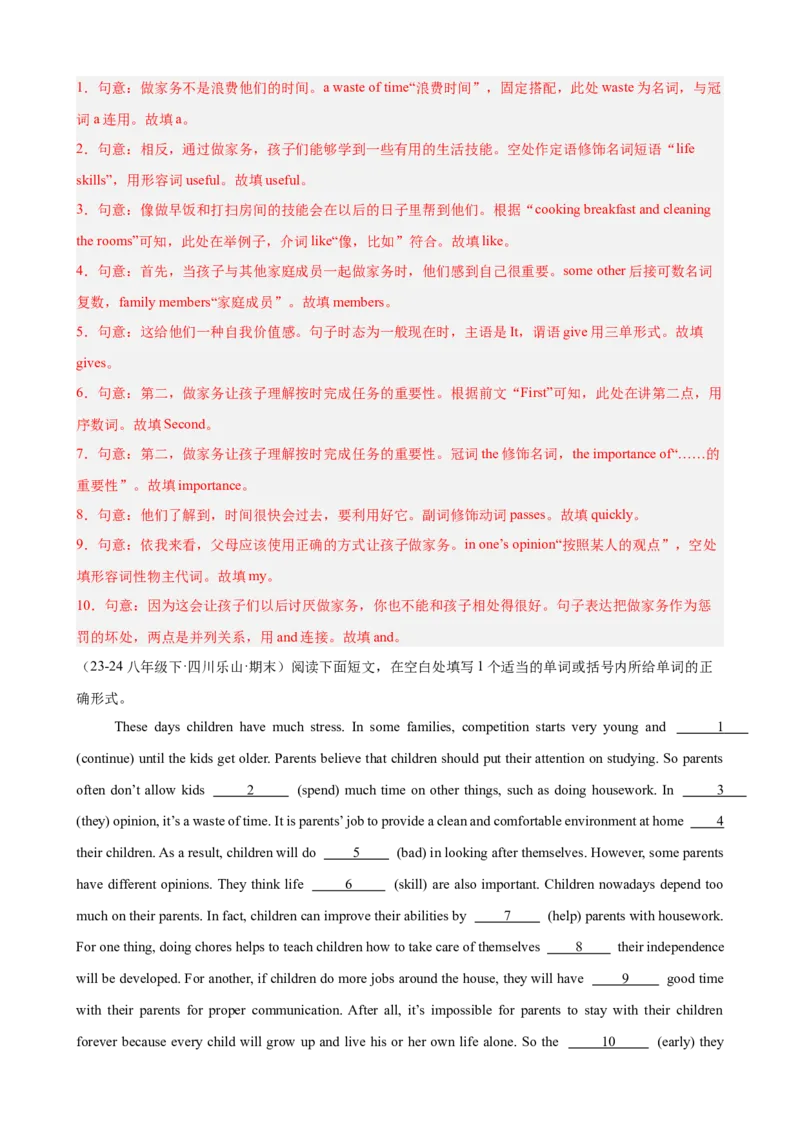
These days children have much stress. In some families, competition starts very young and 1
(continue) until the kids get older. Parents believe that children should put their attention on studying. So parents
often don’t allow kids 2 (spend) much time on other things, such as doing housework. In 3
(they) opinion, it’s a waste of time. It is parents’ job to provide a clean and comfortable environment at home 4
their children. As a result, children will do 5 (bad) in looking after themselves. However, some parents
have different opinions. They think life 6 (skill) are also important. Children nowadays depend too
much on their parents. In fact, children can improve their abilities by 7 (help) parents with housework.
For one thing, doing chores helps to teach children how to take care of themselves 8 their independence
will be developed. For another, if children do more jobs around the house, they will have 9 good time
with their parents for proper communication. After all, it’s impossible for parents to stay with their children
forever because every child will grow up and live his or her own life alone. So the 10 (early) theydevelop their independence, the better their life will be.
【答案】
1.continues 2.to spend 3.their 4.for 5.badly 6.skills 7.helping 8.and
9.a 10.earlier
【导语】本文主要介绍了家长对于学生们是否做家务这件事的看法,以及介绍了做家务的好处。
1.句意:在一些家庭中,竞争从很小的时候就开始了,一直持续到孩子长大。此空与starts构成并列关
系,此空应填动词三单,故填continues。
2.句意:所以父母通常不允许孩子花太多时间在其他事情上,比如做家务。allow sb. to do sth.“允许某人
做某事”,动词不定式作宾补,故填to spend。
3.句意:在他们看来,这是浪费时间。in one’s opinion“在某人看来”,此空应填形容词性物主代词,故
填their。
4.句意:在家里为孩子提供一个干净舒适的环境是父母的责任。provide sth. for sb.“为某人提供某物”,
固定搭配,故填for。
5.句意:结果,孩子们在照顾自己方面做得很差。此空修饰动词do,应填副词badly,故填badly。
6.句意:他们认为生活技能也很重要。根据are可知,此空应填复数形式,故填skills。
7.句意:事实上,孩子可以通过帮助父母做家务来提高他们的能力。by是介词,后接动名词,故填
helping。
8.句意:一方面,做家务有助于教会孩子如何照顾自己,他们的独立性将得到发展。空格前后是并列关
系,用and连接,故填and。
9.句意:另一方面,如果孩子们在家里做更多的工作,他们将有一个很好的时间和父母进行适当的沟通。
have a good time“玩得愉快”,固定搭配,故填a。
10.句意:所以越早培养他们的独立性,他们的生活就会越好。the+比较级,the+比较级,表示“越……,
就越……”,此空应填比较级,故填earlier。
(23-24八年级下·河北唐山·期末)阅读下面短文,在空白处填入一个适当的单词,有提示词的,填入所
给单词的正确形式。
When I was a kid, I never helped my parents do housework. I used to make 1 mess. One day,
when my mum went home after work, lots of rubbish 2 (find) in our house. She got so angry 3
me. “You must do some housework every day.” she said 4 (serious). I talked back, “It’s the 5
(parent) job to offer a clean home.”
Now I’m a 15-year-old middle school student. I have labor classes at school every week. The teacher 6
(teach) us how to cook food, tidy the room, grow some vegetables and so on. I understand that doing housework is7 (hard) than I used to imagine. I’m so sorry for 8 I have done before and begin to do housework.
My parents are 9 (pride) of my change. Housework helps me develop some good 10 (habit)
and learn many basic skills. Let’s do it!
【答案】
1.a 2.was found 3.with 4.seriously 5.parents’ 6.teaches 7.harder 8.
what 9.proud 10.habits
【导语】本文主要讲述了作者从刚开始觉得做家务是父母的责任,最后意识到做家务也是自己的责任的
过程。
1.句意:我过去经常把家里弄得一团糟。make a mess“弄得一团糟”,是固定短语。故填a。
2.句意:一天,当我妈妈下班回家后,她发现家里有很多垃圾。根据“when my mother went...”可知,是
一般过去时;主语rubbish“垃圾”与动词find“发现”之间是被动关系,因此横线处用一般过去时的被动语
态was/were done;主语rubbish是不可数名词,故填was found。
3.句意:她对我很生气。根据“She got so angry”可知,get angry with sb.“生某人的气”,是固定用法。
故填with。
4.句意:她严肃地对我说:“你必须每天做一些家务。”said为动词,副词修饰动词,用副词
seriously“严肃地”修饰。故填seriously。
5.句意:提供一个干净的家是父母的工作。parent指代父母两个人要变为复数paernts,且“parents”和
“job”构成所属关系,应加’构成名词所有格,故填parents’。
6.句意:老师教我们如何做饭、整理房间、种植蔬菜等。根据“I have labor classes at school every week.”
可知,此句为一般现在时;主语“The teacher”是第三人称单数,谓语动词teach也用第三人称单数形式。
故填teaches。
7.句意:我明白了做家务比我以前想象的要难。根据“than”可知,用比较级,hard的比较级是harder。
故填harder。
8.句意:我后悔我以前的所作所为,开始做家务。根据“I have done before”可知,此句是说后悔以前做
的事情,此处用what引导宾语从句。故填what。
9.句意:我的父母为我的改变感到骄傲。横线处位于are之后作表语,形容词作表语,pride的形容词是
proud“自豪的,骄傲的”,be proud of“为……感到骄傲”。故填proud。
10.句意:做家务帮助我养成了一些好习惯,学习了很多基本技能。habit“习惯”,可数名词,根据
“many”可知,此处用复数形式。故填habits。
(23-24八年级下·四川绵阳·期末)阅读下面短文,在空白处填入1个恰当的词或括号内单词的正确形式
(不超过3个单词)。What is my secret (诀窍) of teaching kids to do housework? Before you get 1 (excite) to learn
the secret, I need to tell you that there is no secret at all.
It all starts by picking a chore. For example, I want 2 (teach) Annie about cleaning the bathroom.
First, I take her with me while I’m doing the chore. I show and tell her how 3 (clean) the bathroom
clearly. I’ll do this for a few weeks.
4 she watches me for a few weeks, I let her try doing it on her own, with me there watching her.
For another 4—5 weeks, Annie learns how to do each part of the chore. At this point, I would let her do the chore
by 5 (she). But that doesn’t mean I will never think about it again. I always go back and check her
work. 6 the chore isn’t done well, Annie will have to do it again.
When it comes to teaching kids to do chores, I start with my 7 (old) child Annie. And I’m hoping
that if I teach her well, she will then teach other younger brothers. I have already asked Annie 8 (teach)
her little brother Andy to clean the bathroom. 9 (final), when Andy learns that, I’ll be able to teach
Annie to do 10 new job.
【答案】
1.excited 2.to teach 3.to clean 4.After 5.herself 6.If 7.oldest 8.to
teach 9.Finally 10.a
【导语】本文主要讲述了作者如何让她的孩子们做家务的秘诀。
1.句意:在你兴奋地了解这个秘诀之前,我需要告诉你,根本没有什么秘诀。get为系动词,后接形容
词作表语,主语为you,用excited表示人的心理活动。故填excited。
2.句意:举个例子,我想要教Annie打扫浴室。want to do sth“想要做某事”。故填to teach。
3.句意:我给她展示,告诉她如何仔细地打扫浴室。how to do sth“如何做某事”。故填to clean。
4.句意:她看着我几个星期后,我让她试着自己做,我在那里看着她。根据“I let her try doing it on her
own”可知,此处应用after引导时间状语从句,位于句首,首字母要大写。故填After。
5.句意:就在这时,我会让她自己做家务。by oneself“靠某人自己”,she的反身代词为herself。故填
herself。
6.句意:如果活儿干得不好,Annie就得再做一遍。根据“ the chore isn’t done well, Annie will have to
do it again.”可知,此处应用if引导条件状语从句,位于句首,首字母要大写。故填If。
7.句意:说到教孩子做家务,我从最大的孩子Annie入手。根据下文“And I’m hoping that if I teach her
well, she will then teach other younger brothers.”可知,Annie是家中最大的孩子,应用old的最高级oldest修
饰名词child。故填oldest。
8.句意:我已经让Annie去教她弟弟Andy打扫浴室。ask sb to do sth“叫某人去做某事”。故填toteach。
9.句意:最后,当Andy把那学会了的时候,我就可以教Annie做一份新的工作了。根据“when Andy
learns that”可知,此处指最后一步,用副词finally来表示“最后”,位于句首,首字母要大写。故填
Finally。
10.句意:最后,当Andy把那学会了的时候,我就可以教Annie做一份新的工作了。job为单数名词,
且new为辅音音素开头的单词,其前应用不定冠词a表泛指。故填a。
(2024八年级下·全国·专题练习)As students, we are always busy 1 (study). So we often
have supper as soon as we come home 2 school. Not all children like to do housework. They think
doing housework is their 3 (parent) job.
In fact, housework isn’t a bad thing. Firstly, it’s a good way 4 (relax). Many children like to
spend much time 5 (watch) TV when they are tired. 6 a result, they usually get more tired.
But doing housework is different. It is easy and it can let us relax. 7 , doing some housework can show
our care and love to our parents. We know our parents are usually very tired 8 a day’s work. They must
feel happy if we can help them clean the floor or cook supper. Thirdly, we can find it very 9 (interest) to
do housework. I’m sure you must be glad to see the dishes bright and the rooms clean. At the same time, 10
(learn) how to do housework is a great thing. So try your best to do housework from today!
【答案】
1.studying 2.from 3.parents’ 4.to relax 5.watching 6.As 7.Secondly
8.after 9.interesting 10.learning
【导语】本文主要讲述了学生做家务的好处。
1.句意:作为学生,我们总是忙于学习。study“学习”,be busy doing sth.“忙于做某事”。故填
studying。
2.句意:所以我们经常一放学回家就吃晚饭。根据“we come home ... school.”可知,是指从学校回到家,
介词from“从……”符合句意。故填from。
3.句意:他们认为做家务是他们父母的工作。此处是指父母的工作,应用复数名词的所有格形式。故填
parents’。
4.句意:首先,这是一个很好的放松方式。relax“放松”,此处用动词不定式作定语。故填to relax。
5.句意:许多孩子在累的时候喜欢花很多时间看电视。watch“观看”,spend time doing sth.“花时间做某
事”。故填watching。
6.句意:结果,他们通常更累了。as a result“结果”,固定短语,句首单词首字母大写。故填As。
7.句意:其次,做一些家务可以表达我们对父母的关心和爱。根据“Firstly”及“Thirdly”可知,此处是介绍第二点,用副词secondly“其次”,句首单词首字母大写。故填Secondly。
8.句意:我们知道我们的父母在工作一天后通常都很累。根据“our parents are usually very tired ... a day’s
work.”可知,父母在一天的工作后会很累,介词after“在……之后”符合语境。故填after。
9. 句意:第三,我们发现做家务很有趣。固定句型find it+形容词+to do sth“发现做某事是怎么样的”,
根据“it”可知,此处应用interest的形容词interesting“有趣的”。故填interesting。
10.句意:同时,学习如何做家务是一件伟大的事情。learn“学习”,此处是动名词短语作主语。故填
learning。
重难语篇拔高练
(23-24八年级下·湖南长沙·期末)阅读下面的材料,在空白处填入一个适当的词,或填入括号内所给单
词的正确形式(每空最多不超过三个单词)。
When I was in primary school, I seldom helped my parents at home. I thought I should spend my time 1
schoolwork to get good grades. My parents did all the 2 (chore). I used to make a mess and throw my
things everywhere.
One day, when my mother went home after work and 3 (find)a lot of rubbish in our house, she
got so mad at me. She said to me 4 (serious), “You must do some housework every day from now
on.” I talked back loudly, “It is the parents’ job 5 (provide)a clean and comfortable environment at
home.”
Now I’m 6 15-year-old middle school student. I have a labor(劳动)class at school every
week. The teacher 7 (teach)us how to make food, tidy the room, grow some vegetables and so on. I
understand that 8 (do)housework is more difficult than I used to imagine. Thinking back those old
days, I regret 9 I have done before. I begin to do more housework, so my parents can have a good rest
when they come back from work. They are also proud of my change.
In my opinion, we children should be independent and take care of 10 (we). Because it not
only helps us learn many basic skills, but also helps us develop good habits.
【答案】
1.on 2.chores 3.found 4.seriously 5.to provide 6.a 7.teaches 8.doing
9.what 10.ourselves
【导语】本文主要介绍了作者小时候很少帮父母做家务,长大了之后理解了做家务的重要性。
1.句意:我想我应该把时间花在功课上以取得好成绩。spend time on sth.“花费时间在某物上”。故填
on。2.句意:我父母做所有的家务。all后加名词复数chores“家务”。故填chores。
3.句意:有一天,我妈妈下班回家,发现我们家里有很多垃圾,她对我很生气。根据“went home...”可
知句子用一般过去时,动词用过去式found“发现”。故填found。
4.句意:她严肃地对我说。此处修饰动词said用副词seriously“严肃地”。故填seriously。
5.句意:在家里提供一个干净舒适的环境是父母的工作。provide“提供”,it is one’s job to do sth.“做某事
是某人的工作”。故填to provide。
6.句意:现在我是一名15岁的中学生。此处泛指“一名学生”,15以辅音音素开头,用不定冠词a。故
填a。
7.句意:老师教我们如何做饭、整理房间、种一些蔬菜等等。此处时态为一般现在时,主语是the
teacher,谓语动词用单三teaches“教”。故填teaches。
8.句意:我明白做家务比我以前想象的要困难。此处作主语用动名词。故填doing。
9.句意:回想过去,我后悔以前的所作所为。句子是宾语从句,从句缺少done的宾语,用what引导宾
语从句。故填what。
10.句意:在我看来,我们这些孩子应该独立,照顾好自己。根据“we children should be independent and
take care of”可知是我们应该学会照顾好我们自己,用反身代词ourselves。故填ourselves。
(23-24八年级下·山东济南·期末)阅读下面短文,在空白处填入1个适当的词或括号内单词的正确形式。
When I was in primary school, I seldom 1 (help) my parents at home. I thought I should spend
my time on schoolwork. My parents did all the chores. I used to make a mess and throw my things everywhere.
One day, when my mother went home after work and found a lot of rubbish in 2 (we) house, she
got so mad at me. She said to me seriously, “You must do some housework every day from now on.” I talked back
3 (loud), “It is parents’ job 4 (provide) a clean and comfortable environment at home.”
Now I’m 5 15-year-old middle school student. I have a labor class at school every week. The
teacher teaches us how to make food, tidy the room, grow some 6 (vegetable) and so on. I understand
that doing housework 7 (be) difficult. Thinking back those old days, I regret what I have done before. I
begin to do 8 (much) housework than before, so my parents can have a better rest when they come back
from work. They are also proud 9 my change.
In my opinion, we children should learn to be independent and take care of ourselves. Because it not only
helps us learn many basic skills, 10 also helps us develop good habits.
【答案】
1.helped 2.our 3.loudly 4.to provide 5.a 6.vegetables 7.is 8.more
9.of 10.but【导语】本文主要介绍了作者小时候很少帮父母做家务,长大了之后理解了做家务的重要性。
1.句意: 在小学时,我很少在家帮父母。根据“When I was in primary school”可知,句子时态是一般过
去时,动词help应用过去式helped。故填helped。
2.句意: 有一天,当我的母亲下班回家后,发现家里有很多垃圾 ,她对我非常生气。空后是名词
house,空处应用we的形容词性物主代词our“我们的”,修饰该名词。故填our。
3.句意:我大声顶嘴:“在家里提供一个干净舒适的环境是父母的工作。”此处修饰动词短语talked
back,用loud的副词形式loudly“大声地”。故填loudly。
4.句意:我大声顶嘴:“在家里提供一个干净舒适的环境是父母的工作。”根据“It is parents’ job...
(provide) a clean and comfortable environment at home.”可知,此处考查It is one’s job to do sth.“做某事是某
人的工作”,provide“提供”,空处应用动词不定式作真正的主语。故填to provide。
5.句意:现在我是一个15岁的中学生。此处泛指“一名学生”,15以辅音音素开头,用不定冠词a。故
填a。
6.句意:老师教我们如何做饭、整理房间、种一些蔬菜等等。some后接可数名词复数或不可数名词,
vegetable“蔬菜”,是可数名词,此处应用其复数形式。故填vegetables。
7.句意:我明白做家务很难。句子是一般现在时,doing housework是动名词作主语,be动词用is。故填
is。
8.句意:我开始做比以前更多的家务,这样我父母下班回来后可以休息得更好。根据“than before”可知,
此处应用比较级,much的比较级是more“更多的”。故填more。
9.句意:他们也为我的改变感到骄傲。be proud of“为……感到骄傲”,形容词短语。故填of。
10.句意:因为它不仅帮助我们学习许多基本技能,而且有助于我们养成良好的习惯。根据“But it not
only...also...”可知,此处考查not only...but also...“不仅……而且……”,固定搭配。故填but。