文档文本内容
话题:人与社会(名人)
体裁:记叙文
来源:Nasa, 20200224
词数:494
FK Grade Level: 7.4

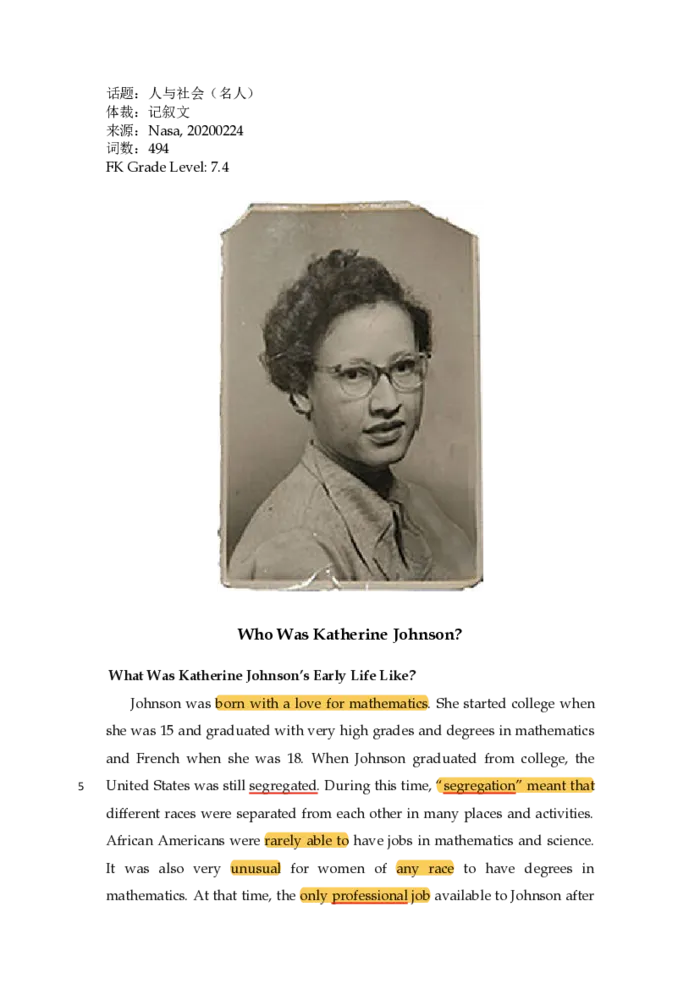
Who Was Katherine Johnson?
 What Was Katherine Johnson’s Early Life Like?
Johnson was born with a love for mathematics. She started college when
she was 15 and graduated with very high grades and degrees in mathematics
and French when she was 18. When Johnson graduated from college, the
United States was still segregated. During this time, “segregation” meant that
5
different races were separated from each other in many places and activities.
African Americans were rarely able to have jobs in mathematics and science.
It was also very unusual for women of any race to have degrees in
mathematics. At that time, the only professional job available to Johnson after
graduation was teaching. She taught school for a number of years but stopped
10
when she married and had children.

What Did She Do for NASA?
   Johnson began working for NACA in 1953, which later became NASA. As
Johnson worked on math problems with the other female computers, she
would ask questions. She didn’t want to just do the work—she wanted to
15
know the “hows” and the “whys,” and then the “why nots.” By asking
questions, Johnson began to stand out.
Women were not allowed to attend meetings with the male engineers and
scientists. Johnson wanted to go to these meetings to learn more about the
projects, so she went. She became known for her training in geometry and
20
began to work with teams made up of men. Eventually, she was recognized as
a leader, and the men increasingly relied on her to have the answers they
needed.
In 1958, NACA officially became NASA. Shortly thereafter, Johnson
became part of the space team. She began calculating the flight path for the
25
rocket to put the first American in space in 1961. The engineers knew when
and where they wanted Shepard’s space capsule to land, but the tricky part
was to calculate when and where the rocket would have to launch. Johnson
figured it out! And in February 1962, her calculations helped put the first
American into orbit around Earth.
30
In September 1962, President John F. Kennedy charged the country to
send a man to the Moon. The math calculations for sending a man to the
Moon were similar to those for putting a man into orbit. But this time,
a lot more calculations were involved. This mission would include a crew of
three astronauts launching from Earth to the Moon; two astronauts landing
35
on the Moon; and then all three returning successfully back to Earth.
Johnson worked with the NASA team to figure out where and when the
rocket needed to be launched to put it on the right path to land on the Moon.
Once again, Johnson’s calculations were instrumental in NASA’s success.
With the information she provided, astronauts walked on the Moon for the
40
first time on July 20, 1969.  They returned safely to Earth on July 24, 1969. All
of this happened, in part, because of Johnson and her love of mathematics.