第二期初中英语外刊阅读

精讲直播课


主题:科普技术


2020 年3
话题:人与自然(饮食)
体裁:说明文
来源:timeforkids.com
词数:350
FK Grade Level: 6.3

Future Food
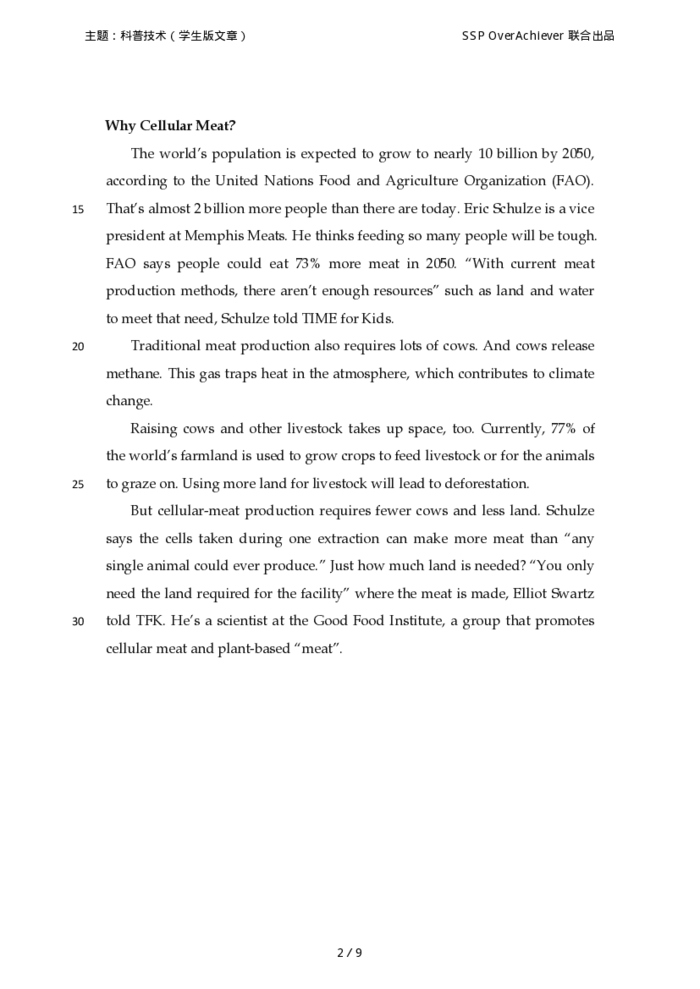
In March 2017, about 25 people were invited to a kitchen in San Francisco,
California, for a tasting event. On the menu? Fried chicken. “This is some of
the best fried chicken I’ve had,” one guest said.
The compliment was extra special considering the source of the meat. It
had been grown in a lab by scientists from Memphis Meats. The company
5
makes meat by safely extracting cells from animals such as chickens, ducks,
and cows. Then it feeds the cells nutrients. Those cells grow and multiply,
forming muscle, which is meat.
Memphis Meats is one of several companies in the United States and
around the world making cellular, or lab-grown, meat. Many people think it’s
10
better for the planet than raising animals for food. Others aren’t so sure.
主题:科普技术(学生版文章)
SSP OverAchiever 联合出品
1/9

Why Cellular Meat?
The world’s population is expected to grow to nearly 10 billion by 2050,
according to the United Nations Food and Agriculture Organization (FAO).
That’s almost 2 billion more people than there are today. Eric Schulze is a vice
15
president at Memphis Meats. He thinks feeding so many people will be tough.
FAO says people could eat 73% more meat in 2050. “With current meat
production methods, there aren’t enough resources” such as land and water
to meet that need, Schulze told TIME for Kids.
Traditional meat production also requires lots of cows. And cows release
20
methane. This gas traps heat in the atmosphere, which contributes to climate
change.
Raising cows and other livestock takes up space, too. Currently, 77% of
the world’s farmland is used to grow crops to feed livestock or for the animals
to graze on. Using more land for livestock will lead to deforestation.
25
But cellular-meat production requires fewer cows and less land. Schulze
says the cells taken during one extraction can make more meat than “any
single animal could ever produce.” Just how much land is needed? “You only
need the land required for the facility” where the meat is made, Elliot Swartz
told TFK. He’s a scientist at the Good Food Institute, a group that promotes
30
cellular meat and plant-based “meat”.
主题:科普技术(学生版文章)
SSP OverAchiever 联合出品
2/9
话题:人与自然(卫生与健康)
体裁:说明文
来源:Science News for Students
词数:468
FK Grade Level: 6.1

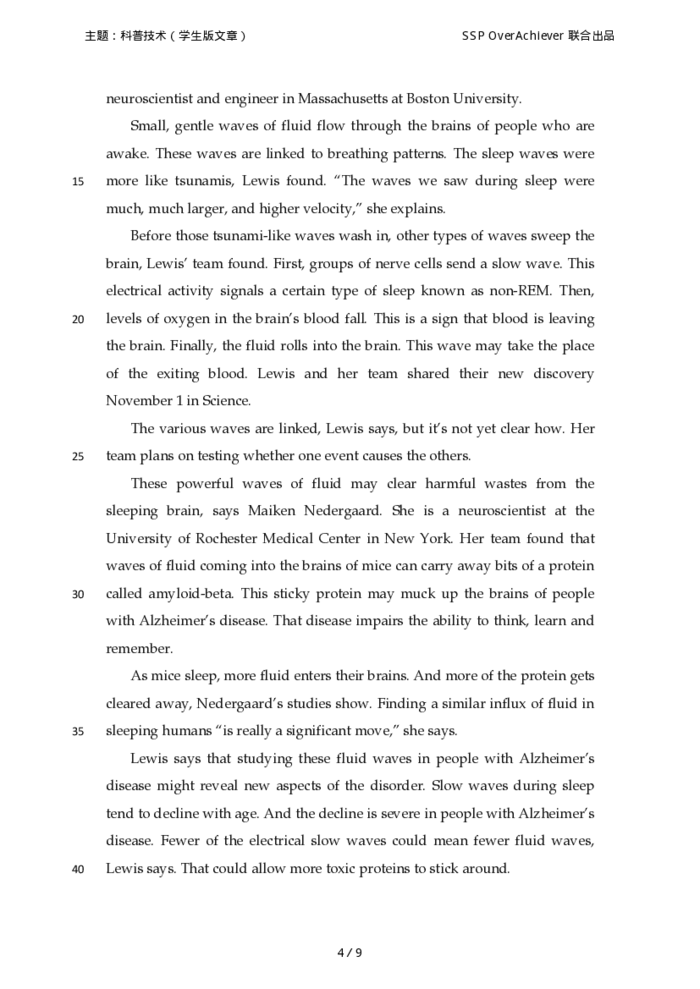
Sleep may jumpstart the brain’s power washing system
Waves of fluid could clear away harmful proteins
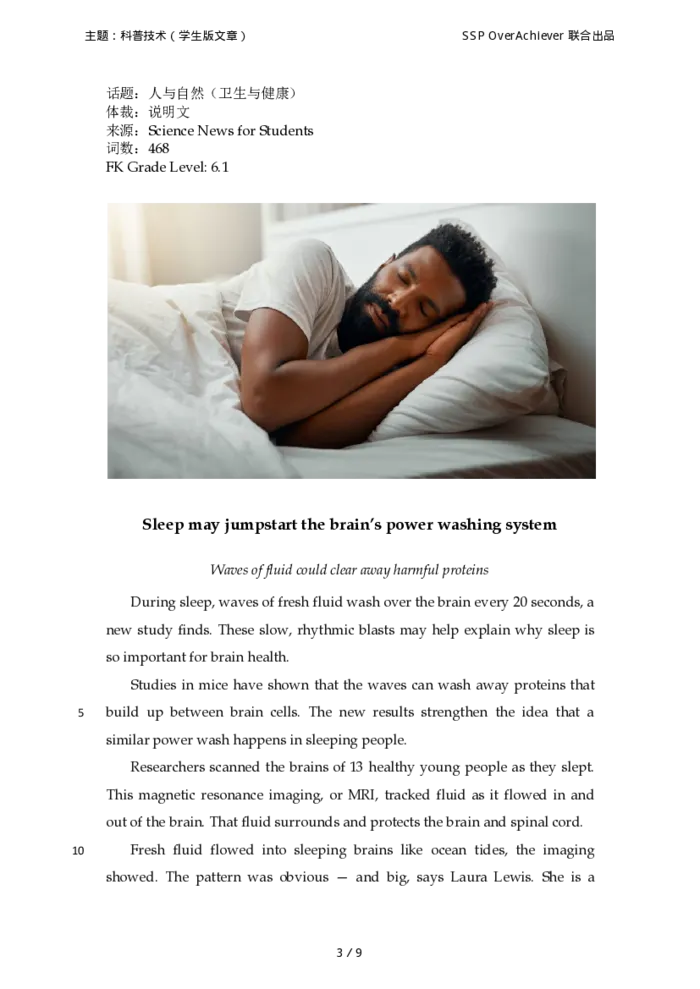
During sleep, waves of fresh fluid wash over the brain every 20 seconds, a
new study finds. These slow, rhythmic blasts may help explain why sleep is
so important for brain health.
Studies in mice have shown that the waves can wash away proteins that
build up between brain cells. The new results strengthen the idea that a
5
similar power wash happens in sleeping people.
Researchers scanned the brains of 13 healthy young people as they slept.
This magnetic resonance imaging, or MRI, tracked fluid as it flowed in and
out of the brain. That fluid surrounds and protects the brain and spinal cord.
Fresh fluid flowed into sleeping brains like ocean tides, the imaging
10
showed. The pattern was obvious — and big, says Laura Lewis. She is a
主题:科普技术(学生版文章)
SSP OverAchiever 联合出品
3/9
neuroscientist and engineer in Massachusetts at Boston University.
Small, gentle waves of fluid flow through the brains of people who are
awake. These waves are linked to breathing patterns. The sleep waves were
more like tsunamis, Lewis found. “The waves we saw during sleep were
15
much, much larger, and higher velocity,” she explains.
Before those tsunami-like waves wash in, other types of waves sweep the
brain, Lewis’ team found. First, groups of nerve cells send a slow wave. This
electrical activity signals a certain type of sleep known as non-REM. Then,
levels of oxygen in the brain’s blood fall. This is a sign that blood is leaving
20
the brain. Finally, the fluid rolls into the brain. This wave may take the place
of the exiting blood. Lewis and her team shared their new discovery
November 1 in Science.
The various waves are linked, Lewis says, but it’s not yet clear how. Her
team plans on testing whether one event causes the others.
25
These powerful waves of fluid may clear harmful wastes from the
sleeping brain, says Maiken Nedergaard. She is a neuroscientist at the
University of Rochester Medical Center in New York. Her team found that
waves of fluid coming into the brains of mice can carry away bits of a protein
called amyloid-beta. This sticky protein may muck up the brains of people
30
with Alzheimer’s disease. That disease impairs the ability to think, learn and
remember.
As mice sleep, more fluid enters their brains. And more of the protein gets
cleared away, Nedergaard’s studies show. Finding a similar influx of fluid in
sleeping humans “is really a significant move,” she says.
35
Lewis says that studying these fluid waves in people with Alzheimer’s
disease might reveal new aspects of the disorder. Slow waves during sleep
tend to decline with age. And the decline is severe in people with Alzheimer’s
disease. Fewer of the electrical slow waves could mean fewer fluid waves,
Lewis says. That could allow more toxic proteins to stick around.
40
主题:科普技术(学生版文章)
SSP OverAchiever 联合出品
4/9
话题:人与自然(卫生与健康)
体裁:说明文
来源:Business Insider
词数:438
FK Grade Level: 6.1

How far your sneeze can actually travel
Are you sick? Don’t you dare sneeze on me!
Do you know how far your germs can travel?
Normally, you hold about half a liter of fluid in your lungs. So when you
sneeze, you’re able to spray as much as a water bottle’s worth of mucus (黏液)
into the air around you.
5
It shoots out of your mouth in the form of moist, germ-infested sheets,
traveling at up to 35 meters per second. That’s fast enough to give you a
speeding ticket on a highway. Once that sheet hits the air, it expands,
breaking up into snotty strings, then a series of different-sized droplets all
trapped in a turbulent gas cloud.
10
One brave group at MIT discovered that the biggest droplets can travel up
to 2 meters– about the distance between your desk and two desks down.
But most other droplets? Those travel much farther — up to 8 meters.
主题:科普技术(学生版文章)
SSP OverAchiever 联合出品
5/9
That’s about 5 desk lengths!
Not only that: The germ-infested gas cloud is less dense than the air
15
around it. So, it rises upwards, right to where ventilation systems and other
people’s unsuspecting noses and mouths await. And even though these are
relatively smaller droplets, they’re probably still teeming with harmful
pathogens, like the flu virus. Even worse — depending on ventilation — they
can spread through a room in just a few seconds, and remain suspended for
20
up to 10 minutes!
Now, if you happen to notice someone around you sneeze or cough, you
can hold your breath as you move out of range. But during flu season, that
might not be enough, because there are danger zones everywhere–
specifically on surfaces like desks, door knobs, and especially steel handrails.
25
So, let’s say you show up to work sick with the flu one day, and you start
to sneeze. Now, according to one study, you’ll probably infect 1 to 2 other
people. You’re clearly showing symptoms of the flu. However, it takes a few
days for symptoms to show up in the other people you infect. So, those poor
souls unknowingly also come to work sick over the next few days and
30
potentially infect 1 or 2 more people. In an office of 100 desks, this could mean
10 or 15 sick people by the end of two weeks! That’s over 10% of the office.
And all of it started with just one sick person: You. All thanks to the
germ-laden cloud you so generously shared.
So, next time you’re not feeling great, and sneezing up a storm, think
35
about your poor coworkers and take a sick day for yourself. And them.
主题:科普技术(学生版文章)
SSP OverAchiever 联合出品
6/9
话题:人与自然(卫生与健康)
体裁:说明文
来源:BBC News
词数:490
FK Grade Level: 9.9

What are vaccines, how do they work and why are people
sceptical?
Vaccines have saved tens of millions of lives in the past century, yet in
many countries health experts have identified a trend towards “vaccine
hesitancy” – an increasing refusal to use vaccination.
The World Health Organization estimates that vaccines prevented at least
10 million deaths in just five years between 2010 and 2015. It says vaccines
5
have been one of the biggest success stories of modern medicine.
The World Health Organization (WHO) is so concerned that it has listed
this trend as one of the 10 threats to global health in 2019.

How was vaccination discovered?
Before vaccines existed, the world was a far more dangerous place, with
10
主题:科普技术(学生版文章)
SSP OverAchiever 联合出品
7/9
millions dying each year to now preventable illnesses.
The Chinese were the first to discover an early form of vaccination in the
10th Century.
Eight centuries later, British doctor Edward Jenner noticed how
milkmaids caught mild cowpox, but rarely went on to contract the deadly
15
smallpox.
In 1796 Jenner carried out an experiment on eight-year-old James Phipps.
The doctor inserted pus from a cowpox wound into the boy, who soon
developed symptoms.
Once Phipps had recovered, Jenner inserted smallpox into the boy but he
20
remained healthy. The cowpox had made him immune.
In 1798, the results were published and the word vaccine - from the Latin
‘vacca’ for cow - was coined.

What have been the successes?
Vaccines have helped drastically reduce the damage done by many
25
diseases in the past century.
About 2.6m people were dying from measles every year before the first
vaccination for the disease was introduced in the 1960s. Vaccination resulted
in an 80% drop in measles deaths between 2000 and 2017 worldwide,
according to the WHO.
30

What are the risks of avoiding vaccination?
When a high proportion of the population is vaccinated it helps prevent
the spread of disease which in turn provides protection for those who have
not developed immunity or who cannot be vaccinated.
This is called herd immunity and when it breaks down there is a risk to
35
the wider population.
Last year in an ultra-Orthodox Jewish community in Brooklyn, USA, fliers
were distributed wrongly claiming links between vaccines and autism.
主题:科普技术(学生版文章)
SSP OverAchiever 联合出品
8/9
That same community has been at the centre of one of the largest
outbreaks of measles in the US in decades.
40
The proportion of the world’s children who receive recommended
vaccines has remained unchanged at 85% for the past few years, according to
the World Health Organization.
The WHO says vaccines continue to prevent between two and three
million deaths worldwide every year.
45
The biggest challenges to vaccination, and the lowest rates of
immunisation, are in countries with a recent history of conflict and extremely
poor healthcare systems, including Afghanistan, Angola and the Democratic
Republic of Congo.
But the WHO has also identified complacency as a key issue in developed
50
countries; put simply people have forgotten the harm a disease can do.
主题:科普技术(学生版文章)
SSP OverAchiever 联合出品
9/9