义 义 务 教 育 教 科 书
务
教
育
教
英 语
科
书
八年级上册
英
语
八
年
级
上
册义 务 教 育 教 科 书
E n g l i s h
英 语
八年级上册致 同 学
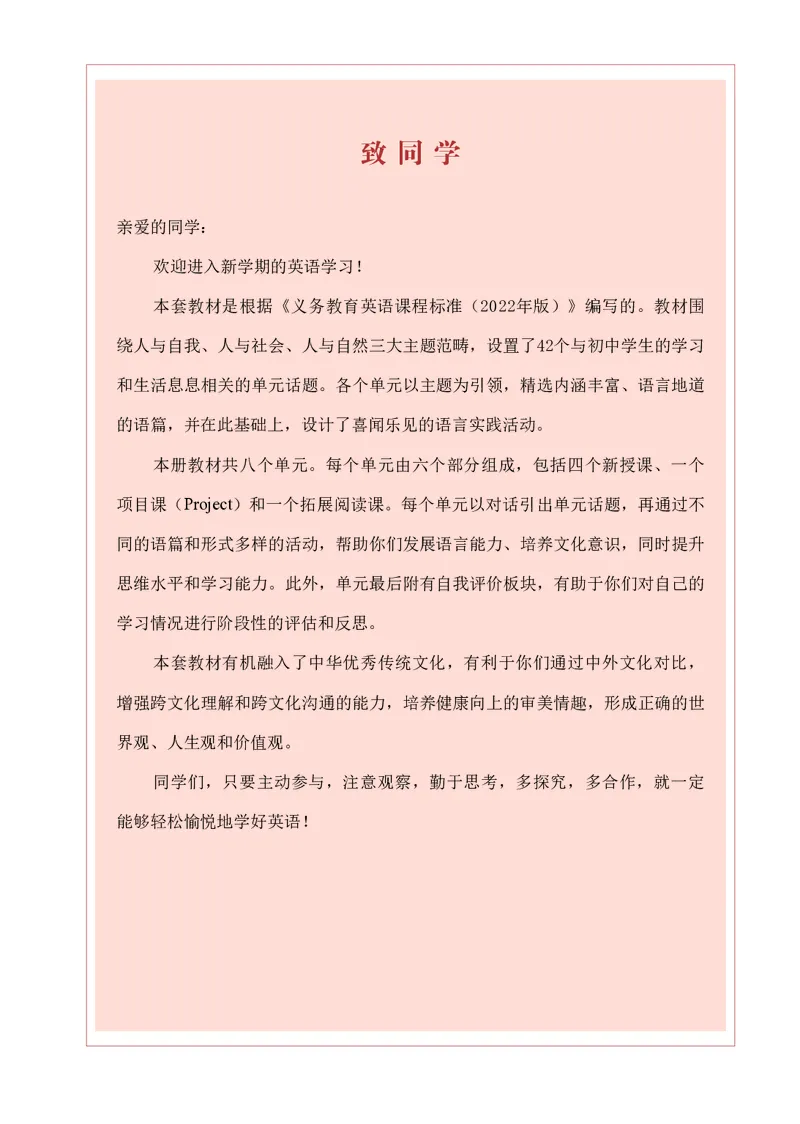
亲爱的同学:
欢迎进入新学期的英语学习!
本套教材是根据《义务教育英语课程标准(2022年版)》编写的。教材围
绕人与自我、人与社会、人与自然三大主题范畴,设置了42个与初中学生的学习
和生活息息相关的单元话题。各个单元以主题为引领,精选内涵丰富、语言地道
的语篇,并在此基础上,设计了喜闻乐见的语言实践活动。
本册教材共八个单元。每个单元由六个部分组成,包括四个新授课、一个
项目课(Project)和一个拓展阅读课。每个单元以对话引出单元话题,再通过不
同的语篇和形式多样的活动,帮助你们发展语言能力、培养文化意识,同时提升
思维水平和学习能力。此外,单元最后附有自我评价板块,有助于你们对自己的
学习情况进行阶段性的评估和反思。
本套教材有机融入了中华优秀传统文化,有利于你们通过中外文化对比,
增强跨文化理解和跨文化沟通的能力,培养健康向上的审美情趣,形成正确的世
界观、人生观和价值观。
同学们,只要主动参与,注意观察,勤于思考,多探究,多合作,就一定
能够轻松愉悦地学好英语!Contents
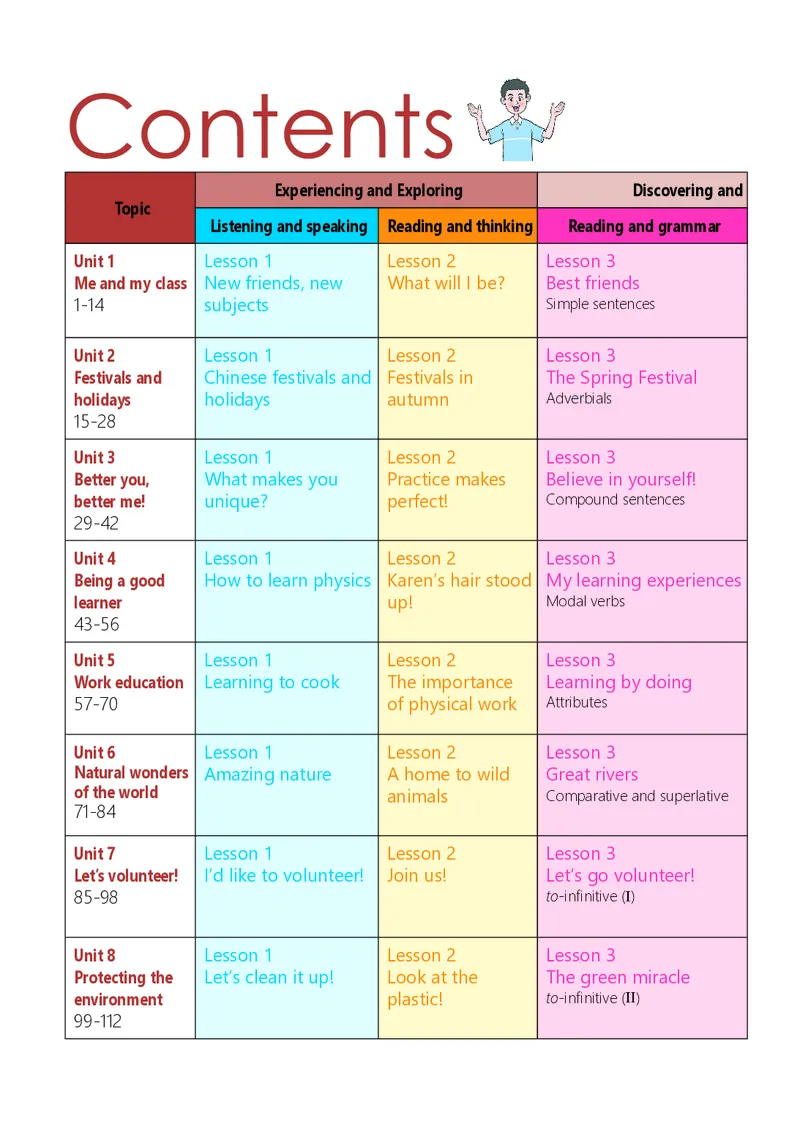
Experiencing and Exploring Discovering and
Topic
Listening and speaking Reading and thinking Reading and grammar
Unit 1 Lesson 1 Lesson 2 Lesson 3
Me and my class New friends, new What will I be? Best friends
1-14 subjects Simple sentences
Unit 2 Lesson 1 Lesson 2 Lesson 3
Festivals and Chinese festivals and Festivals in The Spring Festival
holidays holidays autumn Adverbials
15-28
Unit 3 Lesson 1 Lesson 2 Lesson 3
Better you, What makes you Practice makes Believe in yourself!
better me! unique? perfect! Compound sentences
29-42
Unit 4 Lesson 1 Lesson 2 Lesson 3
Being a good How to learn physics Karen’s hair stood My learning experiences
learner up! Modal verbs
43-56
Unit 5 Lesson 1 Lesson 2 Lesson 3
Work education Learning to cook The importance Learning by doing
57-70 of physical work Attributes
Unit 6 Lesson 1 Lesson 2 Lesson 3
Natural wonders Amazing nature A home to wild Great rivers
of the world animals Comparative and superlative
71-84
Unit 7 Lesson 1 Lesson 2 Lesson 3
Let’s volunteer! I’d like to volunteer! Join us! Let’s go volunteer!
85-98 to-infinitive (Ⅰ)
Unit 8 Lesson 1 Lesson 2 Lesson 3
Protecting the Let’s clean it up! Look at the The green miracle
environment plastic! to-infinitive (Ⅱ)
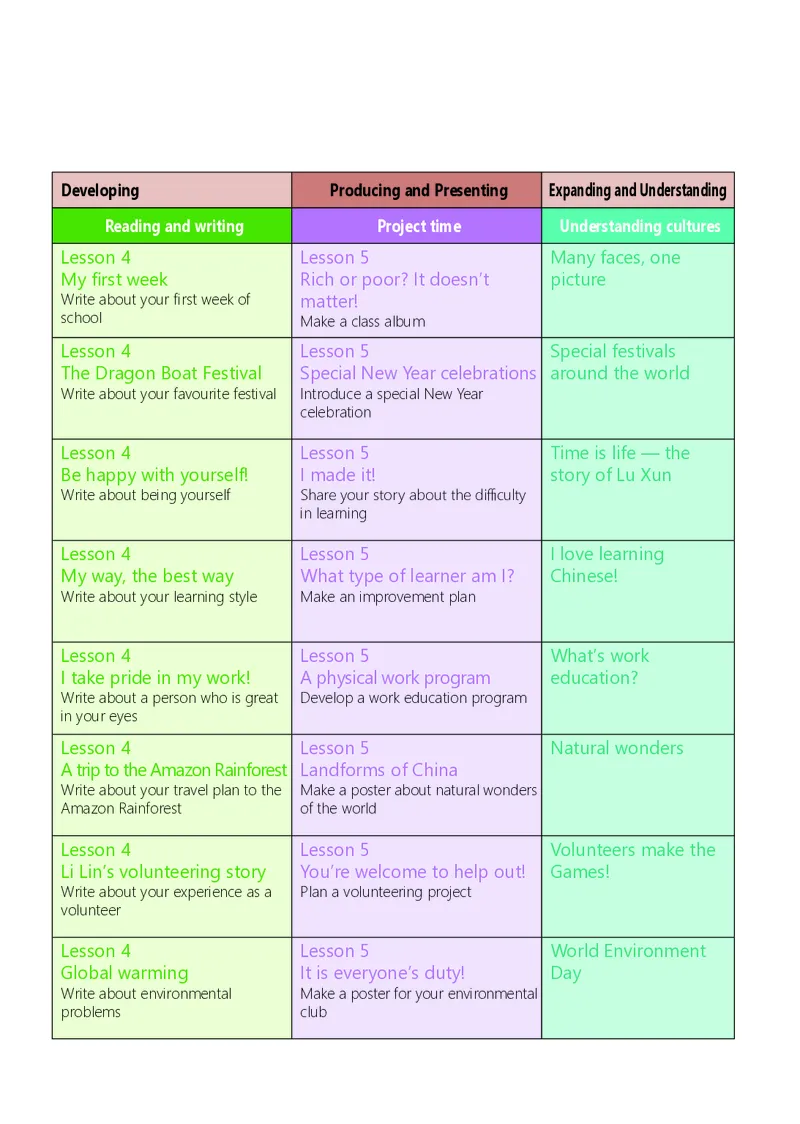
99-112Developing Producing and Presenting Expanding and Understanding
Reading and writing Project time Understanding cultures
Lesson 4 Lesson 5 Many faces, one
My first week Rich or poor? It doesn’t picture
Write about your first week of matter!
school Make a class album
Lesson 4 Lesson 5 Special festivals
The Dragon Boat Festival Special New Year celebrations around the world
Write about your favourite festival Introduce a special New Year
celebration
Lesson 4 Lesson 5 Time is life — the
Be happy with yourself! I made it! story of Lu Xun
Write about being yourself Share your story about the difficulty
in learning
Lesson 4 Lesson 5 I love learning
My way, the best way What type of learner am I? Chinese!
Write about your learning style Make an improvement plan
Lesson 4 Lesson 5 What’s work
I take pride in my work! A physical work program education?
Write about a person who is great Develop a work education program
in your eyes
Lesson 4 Lesson 5 Natural wonders
A trip to the Amazon Rainforest Landforms of China
Write about your travel plan to the Make a poster about natural wonders
Amazon Rainforest of the world
Lesson 4 Lesson 5 Volunteers make the
Li Lin’s volunteering story You’re welcome to help out! Games!
Write about your experience as a Plan a volunteering project
volunteer
Lesson 4 Lesson 5 World Environment
Global warming It is everyone’s duty! Day
Write about environmental Make a poster for your environmental
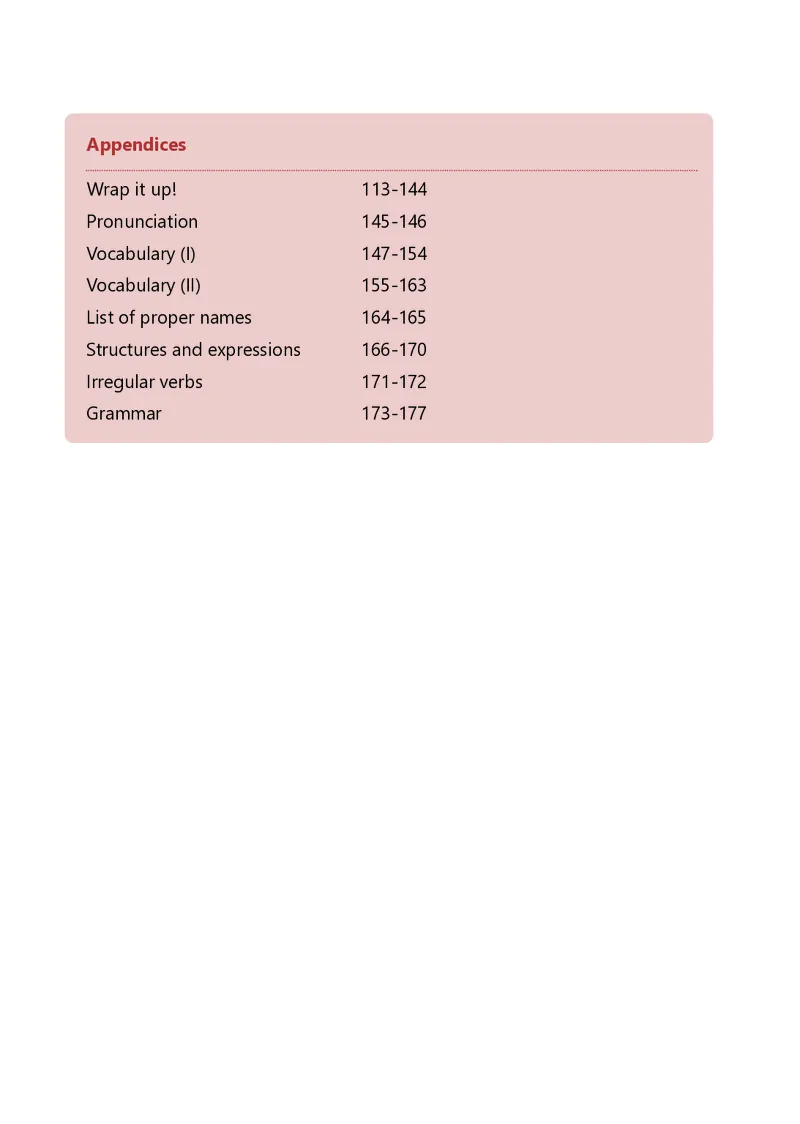
problems clubAppendices
Wrap it up! 113-144
Pronunciation 145-146
Vocabulary (I) 147-154
Vocabulary (II) 155-163
List of proper names 164-165
Structures and expressions 166-170
Irregular verbs 171-172
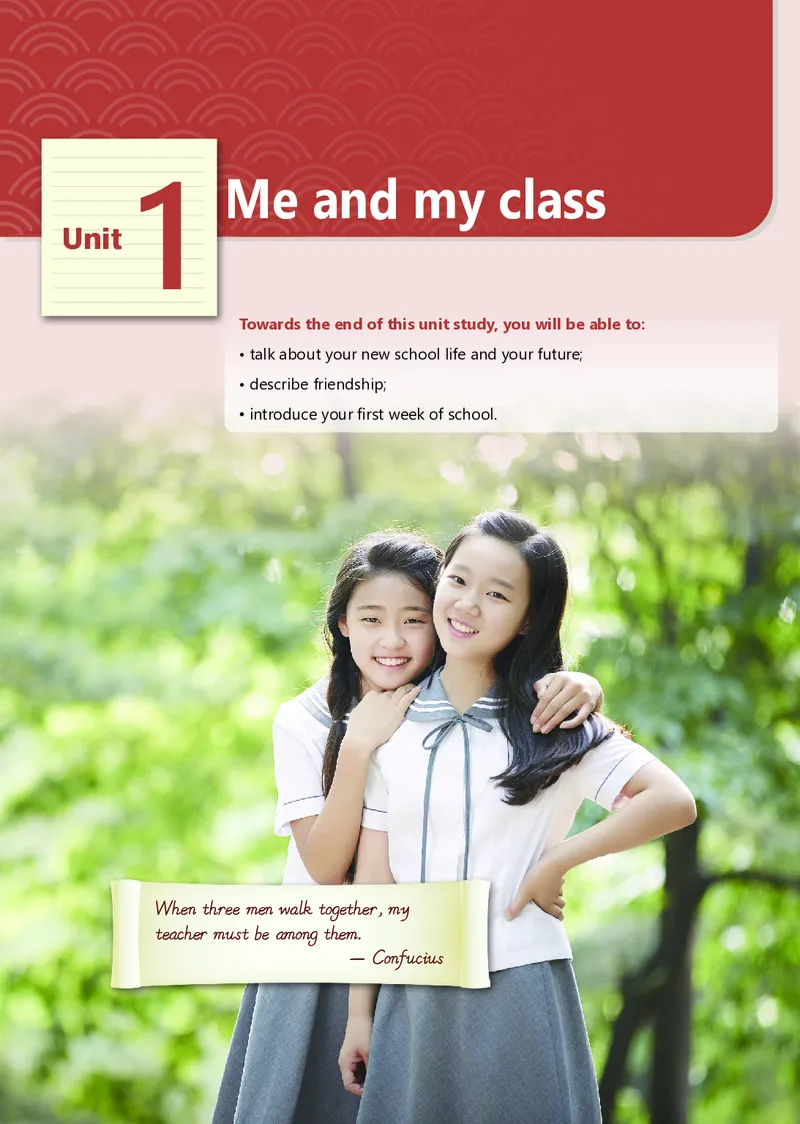
Grammar 173-177Me and my class
1
Unit
Towards the end of this unit study, you will be able to:
• talk about your new school life and your future;
• describe friendship;
• introduce your first week of school.
When three men walk together, my
teacher must be among them.
— Confucius1 New friends, new subjects
1 Read the questions and give your answers.
A What subjects are you interested in?
B Do you have any new subjects? What are they?
2 Listen to the conversation and answer the questions.
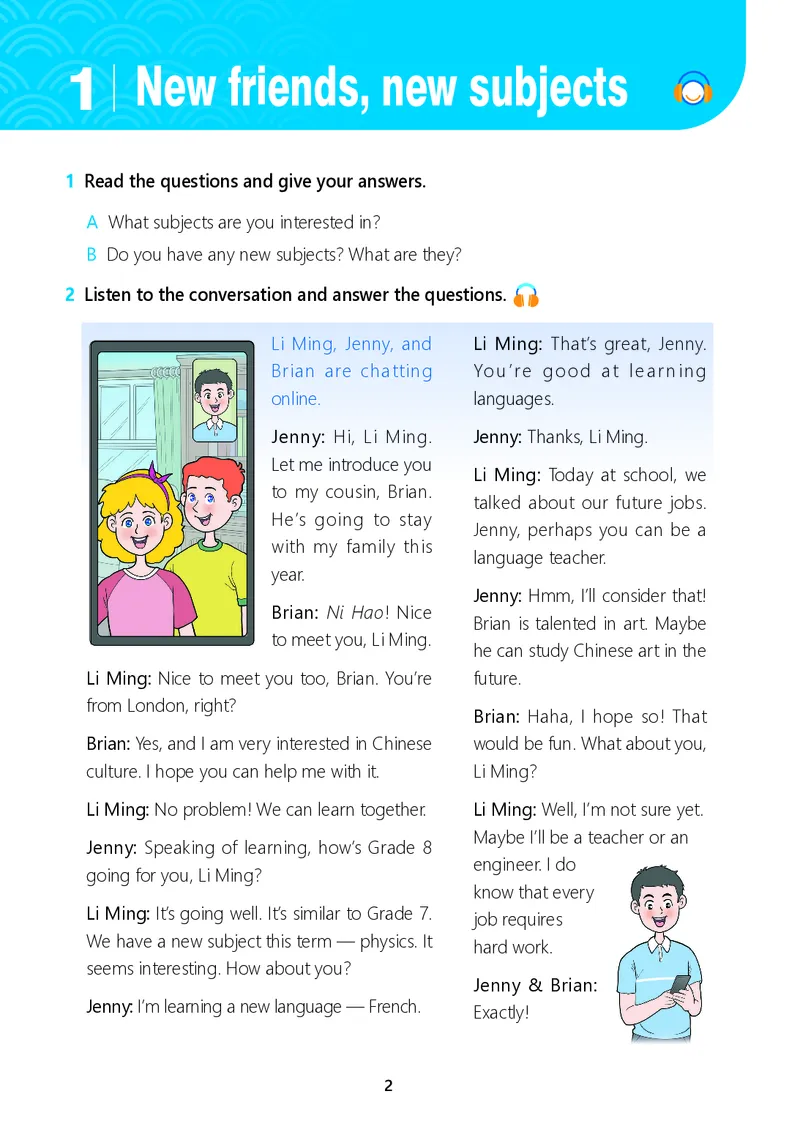
Li Ming, Jenny, and Li Ming: That’s great, Jenny.
Brian are chatting You’re good at learning
online. languages.
Jenny: Hi, Li Ming. Jenny: Thanks, Li Ming.
Let me introduce you
Li Ming: Today at school, we
to my cousin, Brian.
talked about our future jobs.
He’s going to stay
Jenny, perhaps you can be a
with my family this
language teacher.
year.
Jenny: Hmm, I’ll consider that!
Brian: Ni Hao! Nice
Brian is talented in art. Maybe
to meet you, Li Ming.
he can study Chinese art in the
Li Ming: Nice to meet you too, Brian. You’re future.
from London, right?
Brian: Haha, I hope so! That
Brian: Yes, and I am very interested in Chinese would be fun. What about you,
culture. I hope you can help me with it. Li Ming?
Li Ming: No problem! We can learn together. Li Ming: Well, I’m not sure yet.
Maybe I’ll be a teacher or an
Jenny: Speaking of learning, how’s Grade 8
engineer. I do
going for you, Li Ming?
know that every
Li Ming: It’s going well. It’s similar to Grade 7.
job requires
We have a new subject this term — physics. It
hard work.
seems interesting. How about you?
Jenny & Brian:
Jenny: I’m learning a new language — French.
Exactly!
2UNIT 1
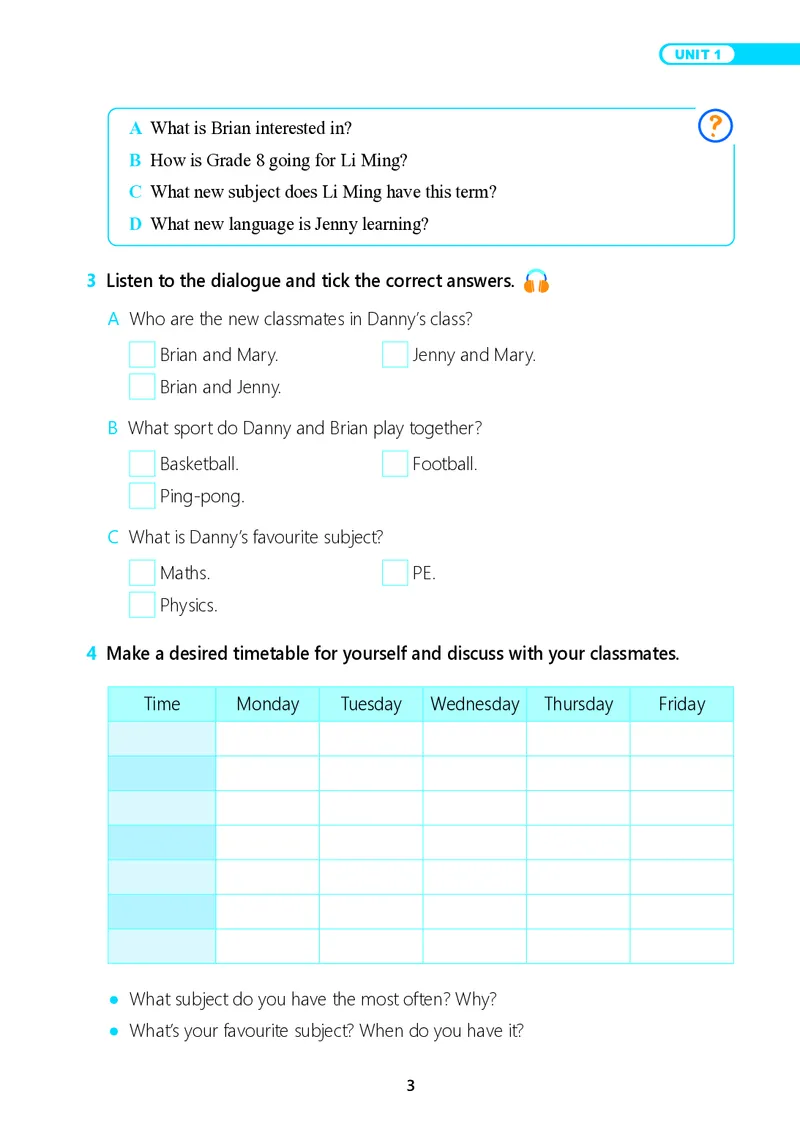
A What is Brian interested in?
B How is Grade 8 going for Li Ming?
C What new subject does Li Ming have this term?
D What new language is Jenny learning?
3 Listen to the dialogue and tick the correct answers.
A Who are the new classmates in Danny’s class?
Brian and Mary. Jenny and Mary.
Brian and Jenny.
B What sport do Danny and Brian play together?
Basketball. Football.
Ping-pong.
C What is Danny’s favourite subject?
Maths. PE.
Physics.
4 Make a desired timetable for yourself and discuss with your classmates.
Time Monday Tuesday Wednesday Thursday Friday
● What subject do you have the most often? Why?
● What’s your favourite subject? When do you have it?
32 What will I be?
1 What do you want to be in the future? Tick the jobs you might like and add
more to the list.
teacher doctor pilot engineer Other: ______________
2 Read the passage and answer the questions.
Hello, my name is Tiantian. I am in overcome my fear and try my best to
Grade 8. What will I be when I grow realise my dream.
up? That’s a big question. There are so
Or maybe I’ll be an engineer and make
many choices. I don’t know the exact
planes. I like making model planes. I
answer yet, but I do have a few ideas.
hope to design a new type of plane
Maybe I’ll be an airplane pilot. That is a someday. It will have larger wings, but
cool job because I will help people travel burn less fuel.
around for work, for fun, or for
family reunions. I am looking
forward to flying in the sky and
experiencing many interesting
things.
There is a problem, though. I
have a fear of heights. But that
won’t stop me from becoming
a pilot. I can take steps to
A Is Tiantian sure about her future?
B How will she deal with her fear of heights?
C What will Tiantian’s plane be like?
4UNIT 1
3 Read the passage again and complete the mind map.
help people travel around
a cool job
an airplane
pilot
one problem
Tiantian’s
future
4 Complete the passage with the phrases.
take steps grow up stop... from travel around
Hello, my name is Tiantian. I am in Grade 8. When I , I want to
be an airplane pilot. That will be a great
job. I can help people .
And I can experience many interesting
things. I have a fear of heights, but this
won’t me
becoming a pilot. I can
to overcome my fear. I will try hard to
make my dream come true.
5 Talk about your future with your partner.
53 Best friends
1 Read the questions and give your answers.
A Who is your best friend? Which of their qualities do you like best?
B Did you ever argue with your best friend? If so, why?
2 Read the passage and put the sentences in the correct order.
Patrick and Grant are classmates. They A few days later, there was a school
are also best friends. They go to school basketball game. Patrick went to the
together, have classes together, and play gym to watch it. Grant was there,
together. Their classmates call them two too. At the end of the game, the
peas in a pod. two friends looked at each other.
Grant immediately came over and
One day, the two boys stopped talking
held out his hand. He wanted to say
to each other. Why? Grant wanted to
something, but he felt embarrassed.
copy Patrick’s homework. That way,
Patrick smiled and said, “Good
Grant could spend more time playing
friends don’t have to say sorry. They
basketball. But to his surprise, Patrick
just know it. I still want you to be my
didn’t think it was a good idea.
best friend.”
“No way! I can’t do that,” said Patrick.
That day, the two boys made a deal.
“What a friend you are!” Grant said angrily.
They would do their own homework
first and play basketball after.
Patrick felt awful. He said, “I won’t lend
you my homework. That’s
cheating! Friends don’t ‘help’
each other out like that.”
That afternoon, they went their
own ways. In the following
days, they both felt bad.
6UNIT 1
A They had an argument and stopped talking to each other.
B The two boys saw each other at the school gym.
C Patrick and Grant were like two peas in a pod.
D They made a deal. They would do homework first and
play basketball after.
3 Read and analyse the sentences. Then write the type of simple sentences in brackets.
● I won’t lend you my homework. (SVOO)
(Subject+Verb+Indirect Object+Direct Object)
● Their classmates call them two peas in a pod. (SVOC)
(Subject+Verb+Object+Complement)
A Friendship makes our life colourful. ( ) In addition to the basic structures
B At first I found Chinese quite hard. ( ) of simple sentences such as
C Mary sent her mother some flowers. ( ) SV, SP, and SVO, there are two
D The teacher asked the students to close the additional structures: SVOO and
windows. ( ) SVOC.
4 Use the words to make sentences and complete the conversation.
Lin Nan: Song Hua, do you have any ideas about friendship? In other words,
(makes, best friends, us, what)?
Song Hua: Of course! (so much fun, have, we,
together) and always support each other.
Lin Nan: That’s true. But what if we have an argument?
Song Hua: Well, (calmly, talk it out, best friends) and
listen to each other’s feelings.
Lin Nan: And (best friends, to solve problems, always
find a way).
Song Hua: That’s why we’re best friends!
74 My first week
1 Read the questions and give your answers.
A How do you feel at the beginning of the new school term?
B Do you have a simple plan and any goals for yourself? What are they?
2 Read Li Ming’s diary and write true (T) or false (F).
Date: September 12
Weather: cloudy, windy, and cool
Dear Diary,
I’m back at school. After a long summer break, it was so nice to see my
classmates again!
On Monday, I got up early. I met all my classmates at school. We talked,
laughed, and shared stories about the fun things we did over the summer.
Li Lin told us about her trip to Dalian. She bought many postcards for us.
Wang Mei went to volunteer in a mountain village. Song Hua learned to
play the guitar and went to a concert. It was amazing to hear all about their
summer vacations.
During the gym class on Wednesday, we played football. My friend Jack and
I were on the same team, and it felt great working together again. The game
was super exciting. It was a tie game until the other team scored in the last
minute. I felt a little sad about losing, but playing our best was still lots of fun!
Friday was special because we had our first physics class. Physics is a new
subject for us, and our teacher showed us some cool experiments. I felt
excited to learn more about the wonders of science.
Well, it’s time for bed now. I’m looking forward to another fantastic week!
Li Ming
8UNIT 1
A It was raining on September 12. ( )
B Li Ming was glad to see his classmates again. ( )
C Li Ming’s team won the football match. ( )
D Li Ming is interested in learning physics. ( )
3 Read the diary again and complete the table.
Day of the week Activity
4 Work in pairs. Interview each other about the new school term and take notes.
The following questions may help you:
A How do you like Grade 8?
B How do you feel about seeing your classmates again?
C What is new this term?
D What activities does your school have during the first week?
E What are you looking forward to this term?
5 Write a diary entry about your first week of school.
Useful expressions
• I’m so excited to...
• It’s... to...
• I can’t wait to...
95 Rich or poor? It doesn’t matter!
1 Read the passage and complete the table.
her because she is always
a good organiser during
group projects. A manager
needs to be a good team
leader.
Alan, my best friend, dreams
of being a physics teacher.
He fell in love with physics
My name is Lucas. I hope to be a during his first physics experiment!
farmer when I grow up. Is my father a He believes that physics can help him
farmer? No. What about my mother? explore the secrets of nature. He wants
No again. Then why do I want to be to encourage more people to enjoy it.
a farmer? Well, in our life skills class a I’m sure he’ll be a great teacher.
few days ago, I experienced the joy
Will we be rich or poor in the future? It
of planting vegetables and flowers.
doesn’t matter. Our biggest goal is to
Farming is a really important job.
live a happy life. How can we make it?
Nobody can live without food. I want
Well, having a job that we like, a nice
to grow the best crops for people.
family, and good friends would make
Kelly said she might become a us very happy.
manager. I think it’s a good choice for
Name What’s his/her dream job? Why does he/she choose this job?
Lucas
Kelly
Alan
10UNIT 1
2 Work in pairs. Talk about your future and give some reasons.
A: What do you want to be in the future?
B: I hope/want to be a/an...
A: Why do you want to be a/an...?
B: Because...
A: How different will your life be?
B: ...
3 Interview your group members and complete the table.
What’s your Why do you What will you do to make
Name
dream job? choose this job? your dream come true?
4 Report your group’s interview result to the class.
5 Write and draw about you in the future on a page. Put all the pages together
and make a big class album.
Me in the future
11Many faces, one picture
1 Read the passage and answer the questions.
Our schoolmates come
from different backgrounds.
It’s like a picture with many
different faces — each face
tells a unique story. These
differences make our school
fun and exciting.
Think about our classmates.
Some love reading. Some
love singing. Others prefer sports or
The best part is that we can learn
art. Despite these differences, we help
so much from each other. When we
each other; we share a common journey
communicate with our classmates, we
of learning and growing. Take Li Junyi as
get to hear different ideas. This helps
an example. He is our walking library.
us understand the world better and
When we have doubts or questions,
makes our school life more rich and
he can always find ways to help us. We
colourful. Let’s celebrate and enjoy
all want to do well in school. We work
each other’s differences.
together to become better learners.
12UNIT 1
A Is it good that classmates come from different backgrounds? Why?
B What’s the common journey of different students?
C How do you understand the title “Many faces, one picture”?
2 Read the passage again and match the main idea to each paragraph.
Different ideas help open our minds.
Paragraph
1
Paragraph
Our classmates come from different backgrounds.
2
Paragraph
3 We share a common journey of learning and growing.
3 Interview your classmates. Complete the table and talk about it.
Name Hobby Strong point Dream job
● Are you all the same or different?
● Is having differences a good thing? Why?
4 What can you do to respect each other’s differences? Share your ideas or your
experiences in groups.
13Self-check
● I can talk about my new school life and my future:
• We have a new subject this term — physics.
• Maybe I’ll be an airplane pilot.
• I do know that every job requires hard work.
● I can describe friendship:
• Good friends don’t have to say sorry. They just know it.
● I can write about my first week of school:
• During the gym class on Wednesday, we played football.
• Friday was special because we had our first physics class.
● I can use basic sentence structures for my expression:
• I won’t lend you my homework.
• Their classmates call them two peas in a pod.
● Improvement needed:
Fun
Exploring the vast world with eyes wide open,
Time
Dreams
Seeking knowledge, soaking up lessons unspoken.
Dreams in our hearts, a future so bright, We dream of success, reaching for the stars,
As teens, we envision paths of delight. Unleashing our talents, discovering who we are.
With hopes and ambitions, we strive to find,
Each step forward brings us closer, it seems,
The road map that leads to our dreams aligned.
To painting our lives with fulfilling schemes.
Through trials and challenges, we’ll persevere,
Building the foundation for a future sincere.
14Festivals and holidays
2
Unit
Towards the end of this unit study, you will be able to:
• know more about festivals and holidays around the world;
• talk about traditional Chinese festivals;
• understand customs and celebrations in different cultures.
The greatness of a culture can be found
in its festivals.
— Siddharth Katragadda1 Chinese festivals and holidays
1 What festivals and holidays come to mind when you see the following pictures?
2 Listen to the conversation and tick the festivals and holidays mentioned.
Danny: Hi, Li Ming. I am working on
a project about festivals and holidays
around the world. I’m going to write
about Chinese festivals and holidays. I
think I know quite a few!
Li Ming: Really? What Chinese festivals
do you know?
Danny: I know about the Spring
Festival, the Lantern Festival, the
Dragon Boat Festival, the Mid-Autumn
during the Festival. Do you know other
Festival, and the Double Ninth Festival.
festivals or holidays?
Li Ming: Good for you. You really did
Danny: Hmm... I’m not sure.
your research! Those are traditional
Li Ming: Let me help you out. We have
Chinese festivals. Which festival do you
Labour Day, National Day... Oh, by the
like best?
way, next week is National Day. I will
Danny: I like the Spring Festival best.
have a seven-day holiday starting from
I love eating dumplings. And I like the
October 1. I plan to go to Tian’anmen
fireworks.
Square to watch the flag-raising
Li Ming: That’s a popular choice! I like ceremony.
to have fun with my family and friends
Danny: That sounds like a fantastic plan!
16UNIT 2
Spring Festival New Year’s Day Lantern Festival
Women’s Day Dragon Boat Festival Labour Day
Teachers’ Day Mid-Autumn Festival PLA Day
National Day Double Ninth Festival Children’s Day
Mother’s Day April Fool’s Day Father’s Day
Christmas Day Tomb-sweeping Day Thanksgiving
3 Listen to the conversation again and answer the questions.
A What project is Danny working on?
B What’s Danny’s favourite Chinese festival?
C In what month does this conversation take place?
D What is Li Ming’s plan for National Day?
4 Listen to the dialogue and write true (T) or false (F).
Wang Mei and Li Lin are talking about their homework.
A Wang Mei’s favourite festival is the Spring Festival. ( )
B Li Lin likes the Mid-Autumn Festival because it is a popular choice. ( )
C Li Lin’s lunar birthday falls on the Mid-Autumn Festival. ( )
5 Work in groups. Interview your classmates about their favourite festivals.
● What festival do you like best?
● Why do you like it?
Name Favourite festival The reason why he/she likes it
172 Festivals in autumn
1 What are the Chinese festivals or holidays in autumn? Talk with your partner.
2 Read the email and answer the questions.
Hello Jenny,
I love autumn! The Chinese Mid-Autumn Festival is coming. It
is on the 15th day of the eighth month in the Chinese lunar
calendar.
We also call it the Moon Festival. We believe that the moon is at its roundest
and brightest at this time of the year.
The Mid-Autumn Festival dates back more than two thousand years. It was
to celebrate the harvest of the year. Later, the festival gained more cultural
meanings. It is now a symbol of family reunion and gratitude. On this day, my
whole family always gets together, has a wonderful dinner, and watches the full
moon.
When I was a little boy, my grandma told me the story of Chang’e. I would look up
and try to find her on the moon while enjoying delicious mooncakes.
Many great poets in China wrote about the festival. I like this poem best:
The sea mirrors the rising moon bright tonight;
Far apart from each other, our hearts share the moment.
I think there are many festivals celebrating the harvest all over the world. Do
you know of any, Jenny?
Bye for now!
Li Ming
18UNIT 2
A Why was the Mid-Autumn Festival celebrated two thousand years ago?
B What are some of the cultural meanings related to the festival?
3 Read the email again and complete the conversation.
Li Ming: The Mid-Autumn Festival is Jack: Do you do any other activities?
coming up.
Li Ming: We share poems about the Mid-
Jack: That sounds great! I’m interested Autumn Festival.
in Chinese festivals. What will we do?
Jack: That will be fun.
Li Ming:
Li Ming: Here is a famous line from Su
Jack: What do you usually eat? Dongpo’s poem. “I only hope we may
have long long lives, may share the moon’s
Li Ming: Then we enjoy
beauty, though a thousand miles apart.”
the bright, round moon.
A. We eat roast duck, fish and mooncakes.
B. Would you like to celebrate with us?
C. I want to learn traditional Chinese poems.
D. My family will get together and have a big dinner.
4 Suppose you are telling Jenny the story of Chang’e. You can refer to the following
information.
Hou Yi Peng Meng Chang’e
• shoot down nine of the ten suns • try to steal • drink the magic
• get a magic drink as a present the magic drink
and let Chang’e keep it drink • fly to the moon
5 Do you know of any other festival that celebrates the harvest time around the
world? What is it? How do people celebrate it? You can search the internet for
more information.
193 The Spring Festival
1 Read the questions and give your answers.
A When is the Spring Festival this year?
B What do you want to do during the Spring Festival?
2 Read the passage and complete the mind map.
The Spring Festival, or Chinese New prepare delicious dishes with care
Year, falls on the first day of the first and love. In northern China, almost
lunar month. It is the most important every family makes dumplings. Many
traditional festival in China. people stay up late on the eve of
the Festival and set off firecrackers at
There is a legend about the Spring
midnight for good luck. Parents or
Festival. Nian, the monster, came
grandparents give lucky money to
out on the last night of every year to
children. People go to temple fairs
eat humans and animals. But people
and watch dragon and lion dances.
discovered a secret: Nian was afraid of
loud noises, bright lights, and the colour The Spring Festival is a wonderful
red. So people set off fireworks and opportunity for family members to
firecrackers, hung red lanterns, and put gather, enjoy a meal, and celebrate
Spring Festival couplets on the doors. the New Year together!
This way, they could drive away Nian
and bring good luck for
the coming year.
There are lots of customs
for the Spring Festival.
People always clean their
homes and buy new
clothes for a fresh start
to the new year. They
20UNIT 2
• Nian was afraid of:
legend • What people did to drive away Nian:
Spring Festival
clean homes,
customs
3 Pay attention to the parts in yellow and underline the adverbials in Activity 2.
● It is the most important traditional festival in China.
● Nian, the monster, came out on the last night of every year to eat humans and animals.
● This way, they could drive away Nian and bring good luck for the coming year.
Adverbials are words or phrases we use to give more information about
verbs, adjectives, adverbs or sentences. They often tell how, where, when,
or why something happens.
4 Read the sentences about the Spring Festival, and then put them in the correct
columns.
A Crowds of people watch dragon and D In southern China, almost every
lion dances on the street. family makes tangyuan or niangao.
B Before the Spring Festival, people E On the eve of the Spring Festival,
always go to the market and buy the whole family watches the Spring
delicious food. Festival Gala on CCTV.
C Chinese people all over the world F We decorate the house with red
celebrate the Spring Festival in the lanterns.
traditional way.
When B How Where
214 The Dragon Boat Festival
1 Look at the pictures and guess what the people are doing.
2 Read the passage and answer the questions.
The Dragon Boat Festival, also known like dragons. In each boat, the players
as the Duanwu Festival, is a traditional worked hard to the beat of the drum.
Chinese holiday. It’s on the fifth day of On the river bank, people cheered and
the fifth lunar month. People celebrate waved flags. Everyone was excited!
this festival in many ways. This year,
We also visited Zigui, the hometown
my family and I went on a wonderful
of Qu Yuan. I admire Qu Yuan very
trip.
much. He was a great poet. He had
My family made the traditional food a deep love for his people. I learned
zongzi together with the local people much about him from my grandma
in Yichang. We put pork in the zongzi. when I was young. I was happy to be
They turned out great! there to pay my respects to him in his
hometown.
We watched the dragon boat race.
These long and colourful boats look
22UNIT 2
A When is the Dragon Boat Festival?
B Where is Qu Yuan’s hometown?
3 Read the passage again and complete the table.
Place Activity
We with the local people. The pork zongzi
great.
We watched . Racers worked hard to
of the drum. People and flags.
We visited the of Qu Yuan. I him
very much. I was happy to pay to him.
4 Match the festivals with the activities.
Double Ninth Festival make dumplings, hang red lanterns, and watch
dragon and lion dances
Dragon Boat Festival
bring food and flowers to ancestors’ tombs
Mid-Autumn Festival
have dragon boat races and eat zongzi
Tomb-sweeping Day
watch the full moon and eat mooncakes
Spring Festival
show love to the elderly, climb mountains and fly kites
5 Write about your favourite festival.
The following questions may help you:
A When is this festival? D What are the activities during this
B What is the origin of this festival? festival?
C What traditional foods do people eat? E Why do you like this festival?
235 Special New Year celebrations
1 Read the passage and answer the questions.
Different people celebrate the New Year in different ways. Here are some
special and fun New Year traditions from around the world.
China
On Chinese New Year’s Day,
the whole family gets together
for a reunion dinner. The elders
give the children lucky money,
wishing them safety and health.
Thailand
Thai people call their new year Songkran. It is on the 13th of April. This is one
of the hottest months in Thailand! People celebrate the New Year with street
parties and even giant water fights.
Spain
When the clock strikes midnight
on New Year’s Eve, the Spanish
eat 12 grapes, one for each
month of the year. Eating all 12
grapes is believed to bring good
luck.
Ecuador
Some people walk around the block with an empty suitcase on New Year’s Eve.
This shows that the next year will be full of adventures.
24UNIT 2
A When is the New Year in Thailand? Does it fall on the same day as the
New Year in China?
B Can you find anything in common in these different celebrations?
2 Match each country with its New Year celebrations.
China walk around with an empty suitcase
Thailand get together for a reunion dinner
Spain have street parties and water fights
Ecuador eat 12 grapes with the strike of the clock
3 What do you know about other special and fun New Year celebrations? Search
the internet for more information and complete the table.
Place Date New Year celebrations
4 Work in groups. Introduce a special New Year celebration to the class.
● Choose one special New Year celebration for your group.
● Make a colourful card. Write the information on one side, including the place,
date, and activities. Draw a picture on the other side.
● Present the card to the class and introduce the celebration.
25Special festivals around the world
1 Read the passage and write the festivals under the pictures.
Chongyang Festival
The Chongyang Festival, or the Double Ninth Festival, is a special day to pay our
respects to and care for elderly people. People climb mountains, enjoy pretty
chrysanthemum flowers, and eat tasty Chongyang cakes. It’s a time to be with
family, have fun outside, and show love for the elderly.
Christmas
Christmas is a widely celebrated holiday in Western countries. People set up
Christmas trees, exchange presents, sing Christmas songs, have big meals, and
go to parties. It’s a special time when children get presents from family, friends,
and Santa Claus.
Holi
Holi is an important festival in India. It is celebrated in almost every part of the
country. On the day of Holi, people play with colourful paint and fabrics with their
friends and families. It is a day for people to forgive, forget past wrongdoings, and
start anew.
Tomatina
Tomatina is a famous festival in Spain. It is on a Wednesday at the end of August.
Thousands of people join a tomato fight. There is music, dancing, and fireworks.
It’s exciting. Everyone enjoys themselves.
26UNIT 2
2 Read the passage again and correct the statements.
A People enjoy pretty roses during the Chongyang Festival.
B Children get lucky money at Christmas.
C In Spain, Holi is an important festival.
D Tomatina is on a Friday at the end of August.
3 Search the internet for other special festivals around the world. Choose the one
you like and draw a mind map.
country date
name of the festival
activity
other special things
traditional food
4 Share your findings from Activity 3 with your group.
Useful expressions
• The festival is...
• During the festival, people...
27Self-check
● I know something about festivals and holidays around the world:
• Spring Festival, Lantern Festival, Tomb-sweeping Day,
Dragon Boat Festival, Mid-Autumn Festival, Double Ninth Festival,
Christmas, Holi, New Year’s Day
● I can talk about traditional Chinese festivals:
• The Spring Festival, or Chinese New Year, falls on the first day of
the first lunar month.
• My whole family always gets together, has a wonderful dinner,
and watches the full moon.
● I can understand customs and celebrations in different cultures:
• Different people celebrate the New Year in different ways.
• People celebrate the New Year with street parties and even giant
water fights.
● Improvement needed:
Fun
Dragon Boat Festival, boats in a race,
Time
Zongzi and dragon boats, a lively pace.
Mid-Autumn Festival, moon up high,
Chinese festivals Mooncakes and lanterns lighting up the sky.
Chinese festivals, full of delight, Chinese festivals, treasures to behold,
Colours and lights, shining so bright. Traditions and customs, stories untold.
Lunar New Year, a fresh new start, Celebrating with joy, year after year,
Fireworks and red envelopes, warming the heart. Bringing people together, spreading cheer.
28Better you, better me!
3
Unit
Towards the end of this unit study, you will be able to:
• understand that everyone is unique;
• talk about your strengths and know yourself better;
• write about ways to accept and develop yourself.
A human being is a single being.
Unique and unrepeatable.
— Eileen Caddy1 What makes you unique?
1 Read the questions and give your answers.
A What are you good at?
B Everyone is unique. What makes you unique?
2 Listen to the conversation and answer the questions.
Jenny: Hi, Li Ming. What are you doing Jenny: Suppose you are telling a
now? friend about yourself: What kind of
person are you? What are you good
Li Ming: Hi, Jenny. I’m working on my
at? What are you proud of about
English project.
yourself?
Jenny: What is it about?
Li Ming: Oh, I see. I’m a kind person
Li Ming: We are supposed to describe
and I like to help others. I’m good
ourselves in a report. What should I at playing the erhu, a traditional
write about myself? I’m finding it a bit
Chinese musical instrument. I’m
challenging.
proud of winning the ping-pong
championship in our last school
Jenny: Maybe I can help you come up
sports event.
with some ideas.
Jenny: Well done! Your report will be
Li Ming: Thanks. I really need your
great.
advice.
Jenny: First, think about yourself. What
do you like about yourself?
Li Ming: Hmm... Let me think. I’m a
good student. I also have many friends.
Jenny: That’s right! And what makes
you unique? You can write about your
personal strengths and special talents.
Li Ming: What do you mean?
30UNIT 3
A What is Li Ming’s English project about?
B How does Jenny help Li Ming?
C What makes Li Ming unique?
3 Listen to the dialogue and fill in the blanks.
Ms Liu: Some students say that it is Song Hua: I at home
hard to write about themselves. Do and at school. I like to .
you need any help?
Ms Liu: Great! Those are personal
Song Hua: Yes, please. I don’t know strengths! In your report, write about
what to say in my report. your special talents too. A talent is a
natural ability to do something well.
Ms Liu: First, think of your personal
strengths. Song Hua: I . I am
one of the best players in the school.
Song Hua: I can .
And I can . Are those
Is that a personal strength?
talents?
Ms Liu: No, a personal strength is
Ms Liu: Yes. Together, all these things
something inside you. It helps make
make you unique.
you a good person.
4 Work in groups. Interview your classmates about their personal strengths and
special talents.
A: What are your personal strengths?
B: I’m kind to others.
A: What are your special talents?
B: I’m a good dancer.
Name Personal strengths Special talents
Li Lin kind to others a good dancer
312 Practice makes perfect!
1 Do you have any experience becoming good at something through hard
work? Talk with your partner.
2 Read the passage and write true (T) or false (F).
advantages over other players. But
I was strict with myself. I practiced
shooting more than 100 times every
day to improve my abilities. Gradually,
I became the best shooter on the
team.
Once we played against a team from
another city. The game was almost
over, and the score was fifty-one
Hello everyone! I’m Gloria. I’m in to fifty-one. A player on my team
Grade 8. passed me the ball. I was too far from
the basket. Could I get the ball in the
What makes me unique? My family
net? I tried, and the ball went in! The
comes from Greece. I was born there.
final score was fifty-four to fifty-one.
Nobody else in my school comes
We won! We felt proud of ourselves.
from Greece! I am a basketball player
on the school team and the only My dream is to play basketball in the
player in my class. Olympics. I’d like to go to university
too. My parents want me to study
Playing basketball is my interest.
medicine, but I want to continue with
When I was in Grade 6, I played for
physical education. What sport would
the school basketball team. I was
I study? Basketball, of course!
the youngest player. I knew I was
not tall or strong enough. I had no
32UNIT 3
A Gloria is the only Greek person in her class. ( )
B Gloria played well on the basketball team because of her hard work. ( )
C The basketball game ended with a score of fifty-one to fifty-one. ( )
D Gloria wants to study medicine. ( )
3 Read the passage again and match the main idea to each part.
Paragraph 2
Paragraph 1 Paragraph 3
Practice makes
perfect!
Paragraph 5 Paragraph 4
A Gloria’s dream
B Gloria’s self-introduction
C An exciting game
D Gloria’s uniqueness
E Gloria becoming the best shooter
4 Read the passage again and complete the paragraph.
Gloria is unique in her school because she was in Greece.
else in her school comes from Greece! Playing basketball is her interest. She
practices every day and becomes the best shooter on the team.
Her dream is to play basketball in the . She wants to with
physical education in university.
5 Pick someone in the class. Tell your partner what makes that person unique.
333 Believe in yourself!
1 Listen to the passage and fill in the blanks.
A Li Yun liked to play when she was young.
B Li Yun liked to the birds.
C Li Yun’s dream is to be .
2 Read the passage and put the sentences in the correct order.
My name is Lin Lin, and I really The day of the talent show came.
enjoy singing Beijing opera. When I I waited and waited as other kids
was a little girl, I heard my grandpa performed. I felt my heart beating
sing it and I liked it a lot. He was quickly! Finally, it was my turn. I stood
happy to teach me, and we often on the central stage and saw my
sang together. From then on, I friends waving at me. They were there
started dreaming of becoming an with me! Slowly I relaxed. The music
opera singer. started and I began to sing.
Last year, our school organised a When I finished my performance,
talent show. I wanted to sing, but I everyone cheered. My friends said,
didn’t feel confident. I was nervous “We’re so proud of you. Well done, Lin
about singing in front of all my Lin!”
classmates. Would I be able to sing
without any mistakes? My grandpa
told me, “Practice makes perfect. And
always believe in yourself.” We made
a plan together. I practiced every
day, alone or in front of my family
and friends. They all encouraged me.
34UNIT 3
A Lin Lin overcame her stage fright and succeeded.
B Lin Lin dreamed of being an opera singer when she was a little girl.
C Lin Lin wanted to take part in the school talent show but wasn’t confident.
D Lin Lin practiced every day.
E Lin Lin’s grandpa encouraged her and they made a plan.
3 Read the sentences and pay attention to the words in yellow. Then fill in the blanks.
● My name is Lin Lin, and I really enjoy singing Beijing opera.
● I wanted to sing, but I didn’t feel confident.
A compound sentence consists of two or more independent clauses or
sentences. The conjunctions are usually and, but, or, or so.
A I liked Beijing opera a lot, my grandma began to teach me to sing it.
B Believe in yourself, you’ll miss many chances.
C I was so nervous, I began to relax seeing my friends there.
D She wanted to watch Beijing opera, I suggested going to the theatre.
E I’m confident now I will chase my dream.
4 Work in groups of three and play a game.
Student A writes a statement as the first part, Student B continues the statement as
the second part, and Student C links the two parts with a conjunction (and, but, or, so).
Example:
Student A: I have a dream.
Student B: I’ll try my best to make it come true.
Student C: I have a dream and I’ll try my best to make it come true.
354 Be happy with yourself!
1 Read the questions and give your answers.
A What are your strong points and weak points?
B Are you happy with yourself?
2 Read the emails and complete the table.
Dear Sue,
I’m a teenage student. There’s nothing special about me. I get average
grades in all my subjects except English. Although I’m a little better at English,
sometimes I make bad mistakes. My friend Lisa, however, is talented and smart.
She is good at everything. I want to be like her, but I know that’s impossible. I
feel bad about myself.
What can I do?
A sad girl from Washington
Dear Girl,
Nobody is perfect in this world. Not even your friend! We all have our strong
points and weak points. Think about your strong points. For example, you are
good at English, and I’m sure you are a kind and friendly girl. What do you like
about yourself? Make a list and read it every morning.
Don’t be too hard on yourself. We all make mistakes. The important thing is to
learn from them.
Be your own best friend, and be happy with yourself. Look at yourself in the mirror
and smile every day. You are a special person and unique in your own way!
Sue
36UNIT 3
Problem Advice
• There’s nothing about me. • Think about your strong .
• I get grades in all my • Don’t be too on yourself.
subjects except English. • Be your own best friends, and
• I make bad sometimes. yourself.
3 What keeps us from being happy? Think and tick.
feeling bad about our abilities trying to be a perfect person
following our own heart being honest with ourselves
believing in ourselves being socially anxious
4 Here are some tips on how to be yourself. Match each tip with its details.
A. Stop caring about what others think of you. B. Relax.
C. Find yourself. D. Learn to love yourself.
● . You can’t be yourself if you don’t know, understand, or believe in
yourself first.
● . “Do you think I’m funny? Do they like me?” It’s impossible to be
yourself if you are always worrying about these things. To be yourself, you have
to let go of these worries.
● . If something embarrassing happens to you, learn to laugh at yourself.
You may also turn it into a funny story and even share it with others someday.
● . Take care of your body and mind by eating healthy foods, sleeping
well, and exercising.
5 Play a writing game.
What keeps you from being happy with yourself? Write a letter to Sue. Shuffle your
letters and trade them with other groups. Everyone gets a letter. Now suppose you
are Sue and write a letter back.
375
I made it!
1 Read the story and answer the questions.
Peter left Miss Martin’s classroom,
feeling like a loser. Krista, his friend,
noticed him looking sad.
“What’s wrong, Peter?” asked Krista.
“I just failed my English exam,” replied
Peter. “I made too many spelling
mistakes.”
Peter was from Mexico. English was
not his first language.
“No worries! You need to make a his little sister. They both found it
little progress every day,” said Krista. interesting to learn English.
The next day, she gave Peter a book: On the last day of class, Miss Martin
The Top 500 Most Often Misspelled excitedly presented Peter with a very
Words. special award: the Most-Improved
Student Award.
“There are 125 days until the final
exam,” said Krista. “Every day you Peter felt so happy. After school, he
learn four of those words. Soon, you shared the good news with Krista.
will master them all.”
“I made it!” he said. “Thanks for your
Although Peter felt that was not easy help!”
for him, he accepted the challenge.
“Good for you, Peter! I am proud
Peter practiced every day, and he
of you. You put in the hard work
invented a word memory game with
yourself!” said Krista.
38UNIT 3
A How did Peter feel when he came out of the classroom?
B Why did Peter fail his English exam?
C How many days were there before the final exam?
D What award did Peter get on the last day of class?
2 Read the story again and put the words and phrases in the correct columns.
make it be proud make progress practice fail the exam
loser look sad make mistakes accept the challenge
Most-Improved Student Award invent a memory game
At the beginning Make a change In the end
loser accept the challenge make it
3 Retell Peter’s story with your partner. You can use the key words in Activity 2.
4 Work in groups. Share your own story about the difficulty in learning you
once faced.
● How did you feel?
● How did you make a change?
● How did you make it at last?
39Time is life — the story of Lu Xun
1 Read the passage and answer the questions.
Lu Xun (1881—1936) was a great writer, thinker, and revolutionary of the 20th
century. He published his works under the pen name Lu Xun. His real name
was Zhou Shuren. He is considered the father of modern Chinese literature.
Lu Xun always wanted to contribute more to the Chinese Revolution. He
taught during the day and wrote at night. He always sat at his desk and
worked without taking a break.
In his later years, he worked even harder. Shortly before his death, he
suffered from high body temperature and weighed less than 40 kilograms.
But he never dropped his weapon — his pen. He fought to the last day of his
life and never wasted one second of his time. He once said, “I am far from
talented. I just do my work when others are drinking coffee.”
Throughout his life, Lu Xun wrote lots of essays and stories. They have a
great impact on Chinese literature and society.
40UNIT 3
A What was Lu Xun’s real name?
B What’s the famous saying by Lu Xun in the passage?
C What can we learn from Lu Xun?
2 Read the passage again and tick the correct statements about Lu Xun.
Lu Xun made great contributions to modern Chinese literature.
Lu Xun highly valued his time.
Lu Xun believed that his success came from his talent.
3 Do you know the following people and how they live a full life? Read and match.
He is an excellent scientist in China’s space program.
From the first successful launch of China’s man-made
Li Baoguo
satellite to the success of the moon exploration project,
he has made great contributions for decades.
This Chinese scientist discovered qinghaosu and saved
many lives. She won the 2015 Nobel Prize in Medicine,
Sun Jiadong
becoming China’s first female scientist to get this big
international prize.
He spent his life doing three important things:
improving farming, fighting poverty, and protecting
Tu Youyou
forests. People call him the “Modern Yugong of
Taihang Mountains”.
4 Do you know of any ordinary people’s stories on how they live a full life?
Share one story with your class and talk about what you can learn from it.
41Self-check
● I understand that everyone is unique:
• You are a special person and unique in your own way.
• What makes you unique? You can write about your personal
strengths and special talents.
● I can talk about my strengths and know how to improve myself:
• We all have our strong points and weak points.
• I’m a kind person and I like to help others.
• Practice makes perfect.
● I can write about ways to accept and develop myself:
• Think about your strong points.
• Don’t be too hard on yourself.
• Look at yourself in the mirror and smile every day.
● I can describe myself using compound sentences:
• My name is Lin Lin, and I really enjoy singing Beijing opera.
• I wanted to sing, but I didn’t feel confident enough to do that.
● Improvement needed:
Becoming a better person
Fun
In the journey of life, we all can grow,
Time
Becoming better each day we sow.
With kindness and love, let’s mend what’s wrong,
And build a world where hope is strong.
Embrace empathy, let judgment dissolve,
With open hearts, let’s all evolve.
Each small step counts, no matter how slight,
Becoming better, shining our light.
42Being a good learner
4
Unit
Towards the end of this unit study, you will be able to:
• talk about learning challenges and find ways to solve them;
• analyse your learning style and make an improvement plan;
• use modal verbs to give advice on how to be a good learner.
Regarding knowledge, those who are devoted to it learn
better than those who are aware of it, and those who
enjoy it the most are the best students.
— Confucius1 How to learn physics
1 Which of the following are physics questions? Think and tick.
How many oceans are there in the world? Why do leaves fall?
Why can we stand on the ground? What is 5 plus 7?
2 Listen to the conversation and fill in the blanks.
Wang Mei: I didn’t see you last week, Li
Lin. What happened?
Li Lin: I had the flu and went to see the
doctor. I had to miss school.
Wang Mei: Oh, poor Li Lin. How are you
today?
Li Lin: I’m okay now. I’m happy to be
back at school and have my favourite
subject today.
Wang Mei: What’s your favourite
subject?
of the earth. You should remember
Li Lin: Physics. We are learning a lot.
the words “force”, “pull”, and “centre”.
We’re trying to answer some interesting
You can also compare related concepts
physics questions, such as why apples
to understand their similarities and
fall and how we’re able to stand on the
differences.
ground.
Wang Mei: That sounds reasonable.
Wang Mei: You are good at physics,
Can you help me study physics?
Li Lin. For me, it’s a challenge. It’s really
difficult to understand all the concepts. Li Lin: No problem. What about
Can you share some study tips with me? from 7:00 to 8:30 every Friday
evening?
Li Lin: Sure. You can focus on the key
words. For example, gravity is a force. Wang Mei: Okay. Thank you, Li Lin.
It pulls everything towards the centre See you then.
44UNIT 4
Li Lin is good at physics, but physics is a for Wang Mei. It is really
difficult for her to all the concepts. Wang Mei asks Li Lin to share
some study with her. Li Lin tells Wang Mei to learn physics by
focusing on the words. They also agree to learn together every
Friday evening.
3 Listen to the conversation again and tick the correct answers.
A Which is NOT an example Li Lin gives?
Why do apples fall?
Why can we stand on the ground?
Why does the earth go around the sun?
B What are the tips from Li Lin to learn physics?
Focus on the key words.
Do more experiments.
Compare related concepts.
C Choose the correct statement.
Li Lin is kind and ready to help others.
Wang Mei wants to give up physics.
Li Lin missed school because of her stomachache last week.
4 Work in pairs. Talk about what you can do to solve your learning challenges.
A: What is your favourite subject?
B: Maths.
A: Oh... Maths is a challenge for me. Can you share some learning methods with
me?
B: Sure...
452 Karen’s hair stood up!
1 Look at the pictures below. Predict what the diary is mainly about.
2 Read Sandra’s diary and complete the table.
Dear Diary,
Today at school, we talked to the class about our favourite
subjects.
My group talked about art. We each brought a painting
to class. Mine was a copy of Van Gogh’s Sunflowers. “As
the saying goes, interest is the best teacher. Take me as an
example. My love for art came from my deep interest in
Van Gogh’s works,” I told my class.
Jenny’s group talked about their favourite subject — social
studies. Bill showed us many photos of Beijing. “These
remind me of my holidays there,” Bill added. Jenny even
sang a Chinese song called Jasmine Flower! They know so
much about China. That amazed us. “The secret of learning
social studies well is to fully take part in the topic,” Jenny said.
Karen’s group showed us some physics. Tim put some very
small tea leaves on a desk. Then Karen combed her hair
ten times very quickly. She put the comb beside the tea
leaves. The leaves jumped to the comb! She also made
her hair stand up with the comb. Everyone was surprised.
Tim explained why. Later, Karen said, “Physics is like magic.
When you get deep into it, you will find it more interesting.”
Time for bed!
Sandra
46UNIT 4
Group Favourite subject Presentation Secret of learning
Sandra’s
show some paintings
group
fully take part in the
Jenny’s group social studies
topic
Karen’s group show some physics
3 Read Sandra’s diary again and complete the passage with the correct forms of
the phrases.
remind... of stand up take... as an example take part in
In today’s class, the students talked about their favourite subjects. Sandra and
her group have a deep love for art. She herself to show
“Interest is the best teacher”. Jenny and Bill love social studies. Bill’s photos
him his holidays in Beijing. Jenny sang a Chinese song,
Jasmine Flower. She thinks the secret of learning social studies well is to fully
it. Karen and Tim’s favourite subject is physics. Karen made
her hair with a comb.
4 Whose favourite subject is the same as yours? Discuss your ways of learning it
and write them down.
Useful expressions
• I like… because...
• I fell in love with this subject after an interesting experiment.
• I think learning by doing is a useful way. As for me, ... is the secret.
473 My learning experiences
1 Work in pairs. Talk about what you are doing well in English learning.
• I can pronounce English words well.
• I can sing many English songs.
2 Read and tick the main idea of the passage.
Good morning! My name is Li Heng. I work best for you? Try them and find
graduated from this school ten years out! As for me, I wrote about my daily
ago, and now I work as a translator. experiences and feelings in my diary. I
I am very happy to be here today to watched a lot of English cartoons and
share some of my English learning movies. All these worked.
experiences with you.
Last but not least, we must try our best
We should build confidence in our to explore ourselves. We can take part in
learning. When I began learning English, challenging language tasks. I was active
I found it so hard. I was afraid to speak in many online English forums. I tried to
in front of the class. But my teacher said, express my thoughts and ask questions
“You can start by making a study plan. in English. I took part in English contests.
Don’t worry about making mistakes.” English became my favourite subject
I followed her tips. I read the words and later. It’s all about hard work.
passages aloud every morning and
I tried to speak loudly in class. I began
to feel confident.
Actually, there are many ways to learn
English. We may read English stories,
newspapers, and magazines. We can
join an English club, listen to English
songs, or watch TV shows, ads, and
the news in English. Which ways
48UNIT 4
How to become a translator
How to learn from mistakes
How to develop good methods to learn English
3 Read the sentences, pay attention to the words in yellow and complete the
tips for learning.
● We should build confidence in our learning.
● You can start by making a study plan.
● We may read English stories, newspapers, and magazines.
● We must try our best to explore ourselves.
We use modal verbs (should, may, can, must, etc.) to show the possibility
of something, or talk about ability, give advice, and make requests.
A You should follow .
B You may read .
C You can .
D You must .
4 Put the sentences in the correct columns.
A You must be tired after all that
Making
practicing. requests
B I can solve maths problems quickly.
Talking about
C This book may not be easy for you.
ability
D You should take notes in class.
E We mustn’t cheat on tests. Showing the possibility
A
of something
F We can perform in the gym if you like.
G You should listen to the teachers
Giving
carefully in class. advice
494 My way, the best way
1 Do you usually study alone or in groups? Talk with your partner.
2 Read the passage and answer the questions.
Ms Liu: Hello, class! Today, we will work in pairs. We are going to discuss different
ways to learn. Each one of you will argue that your way is the best. Let’s start with
Li Ming and Wang Mei.
VVSS
I think self-study is better than other I believe group study is better!
ways of learning! Studying alone Studying with others makes it possible
helps us focus completely on the for us to work together and share our
material. When we do self-study, we understanding. Discussing the topic
pay all our attention to learning. can help us understand it better.
I respectfully disagree. Here’s I’m not sure I would agree with that.
why: Studying alone allows us to When we are alone, we may become
have full control over our learning lazy, or we may direct our attention
environment. Some students prefer to other things. A study group can
to study alone with soft music on. help us focus on our studies and
Besides, we can control when and motivate us.
where we study. When we study in
a group, we have to find a time that
works for everyone.
Ms Liu: Thank you, Wang Mei and Li Ming, for your great debate. Both of you
gave very good reasons for your favourite ways of learning. Everyone learns
differently. You just find the way that suits you best.
50UNIT 4
A What’s the topic of this debate?
B What’s your opinion on this topic?
3 Read the passage again and fill in the form.
Self-study Group study
• • work together and share our
understanding
• have full control over our
Advantages
learning environment •
• •
Disadvantages • •
4 Complete the passage about Danny’s learning style with the correct forms of
the phrases.
pay attention to have full control over agree with prefer to
I have a mixed learning style. Sometimes I study alone,
but sometimes I study in a group. I choose to study alone when I want to
the material. This allows me to focus and do deep reading. I
can also my learning environment. But when I want helpful or
different ideas on the material, I choose group study. Every member of this group
or challenges different opinions. This makes it possible for me to
come to a new understanding.
5 Think about your own learning style and write a paragraph about it.
The following questions may help you:
A What learning style do you prefer?
B What do you think are the advantages of this learning style?
C How does this learning style help you?
515 What type of learner am I?
1 Read the conversation and answer the questions.
Danny: Dad, I don’t think I am a good Mr Dino: Yes, I think so. You are
learner. physically active. This offers you
good opportunities in PE. A good
Mr Dino: What makes you say that?
learner always makes good use of
Danny: I’m having a hard time in physics
their strengths.
and I’m afraid of the maths exam.
Danny: What should I do to help
Mr Dino: You might not be the best in
myself better understand physics
physics and maths, but you communicate
and maths?
well with others and are great at basketball.
Mr Dino: Well, I guess you need
You are a good learner but of a different
more hands-on activities. You can
kind.
take notes while listening to your
Danny: What do you mean?
teacher. Help your teacher with
physics experiments. And study
Mr Dino: Well, no one is perfect, and no
together with other kids.
two persons are the same. People learn
in different ways. There are seven types of
Danny: I want to try it now! I feel I
learners.
can do it. Thank you, Dad!
Danny: Oh, what are they?
Mr Dino: The first type of learners prefers
to use pictures and images. The second
prefers to listen to people talking. The
third learns through writing and reading.
The fourth is good at using logic and
reasoning. The fifth likes to learn by
touching or doing using their hands
or bodies. The sixth prefers to learn in
groups. The last enjoys studying alone.
Danny: Wow! I can see that I belong to
the fifth type, right?
52UNIT 4
A Is Danny good at maths?
B How many types of learners did Mr Dino refer to?
C What advice did Mr Dino give Danny?
2 List the types of learners. Interview your group members and figure out what
type of learner each one is.
Different types of learners Name Type of learner Reason
prefer to use pictures and images
3 Discuss how to make good use of each type of learner’s strength. Write down
the suggestions.
Useful expressions
A: As for the second type of learner,
• type of learner • a quick learner
you can improve your English by
• be good at • do well
watching English movies.
• Who/What can help you?
B: ...
4 Make an improvement plan for yourself and then share it in the group.
53I love learning Chinese!
1 Read the passage and answer the questions.
I’m a student at the Confucius Institute.
Many learners think Chinese is the most
difficult language to learn because of its
tones and grammar. That may be true,
but I think it’s also interesting and fun.
Here are my tips for learning Chinese.
First, don’t be afraid to make mistakes.
In Chinese, a different tone can mean
a totally different word. When I began
to learn Chinese, it was so hard for Third, find out how you learn best. In
me. One day, I called a horse (mǎ) China, a primary school student can
mother (mā). That made my friends write about 3,000 Chinese characters.
laugh to tears. But that didn’t stop That’s amazing. How can they do it?
me from trying. I made fun of myself They listen to songs, play games, or
and repeated the words loudly. After recite rhymes and poems. They also
a lot of practice, I can say the tones read and write a little every day. I tried
correctly now. many ways. I learned simple Chinese
songs and poems. It was so much fun
Second, use your imagination in
to listen and practice.
learning Chinese. Chinese characters
are like drawings. They are amazing. As my Chinese teacher often says,
I take them as pictures when I am “Read more, write more, speak more,
writing the characters. There are many and listen more.” I believe I will reach a
interesting findings. For example, the better level if I practice more.
character, 鱼 (fish), looks like a fish. It
helps me a lot.
54UNIT 4
A What’s the difficult part of Chinese for foreign learners?
B What’s the author’s attitude towards learning Chinese? How do you know?
2 Read the passage again and complete the mind map.
Don’t be afraid to A different tone can mean
.
.
Use your Chinese characters are like
How to learn
.
Chinese .
Try different ways:
Find out
, read and
.
write a little every day.
3 Look at the following picture and discuss with your partner.
A Do you know the Confucius Institute?
What does it do?
B Search for more information about the
Confucius Institute and share it with
your classmates.
4 What suggestions can you give to those who are studying Chinese as a foreign
language? Talk with your partner.
Learning Some Chinese characters are made of two pieces. One piece gives you a
Tips
clue to the meaning of the character, and the other to the pronunciation.
55Self-check
● I can talk about learning challenges and find ways to solve them:
• It is really difficult to understand all the concepts.
• When you get deep into it, you will find it more interesting.
● I can analyse and write about my learning style:
• No one is perfect, and no two persons are the same.
• I think self-study is better than other ways of learning.
● I can use modal verbs to give advice on how to be a good learner:
• You can start by making a study plan.
• We may read English stories, newspapers, and magazines.
● I can develop my own learning strategies:
• Don’t worry about making mistakes.
• I watched a lot of English cartoons and movies.
● Improvement needed:
I listen keenly with open ears,
Fun
Absorbing facts that banish fears.
Time
I ask questions, never feeling shy,
To gain understanding, I always try.
Finding my way
In books and lessons, I find my way, With perseverance, I face each test,
As a good learner every single day. Knowing mistakes help me do my best.
Curiosity fuels my eager mind, With a passion for learning, I am free,
Seeking knowledge of every kind. Unlocking the doors to success you see.
56Work education
5
Unit
Towards the end of this unit study, you will be able to:
• talk about physical work and understand its importance;
• make a work education program;
• understand work education activities in other countries.
Every grain on the plate comes
from hard labour.
— Li Shen1 Learning to cook
1 Read the questions and give your answers.
A How do you help at home?
B Do you like cooking? What food can you make?
2 Listen to the conversation and answer the questions.
One day after school, Jenny, Danny, and
Bill are chatting online.
Bill: I have to leave now. My mum and I
are going to sweep the floor.
Jenny: Same here. I’m going to help my
parents prepare dinner. Talk to you later!
Danny: Really? I’m going to watch
cartoons. Bye!
After watching one of his favourite Mrs Dino: What makes you want to
cartoons for a few minutes, Danny goes cook with me today?
to the kitchen.
Danny: Bill and Jenny help their
Mrs Dino: Hi, Danny. What brings you parents with cleaning and cooking. I
here? want to help you too.
Danny: Well... Can I help you with Mrs Dino: Cooking and cleaning are
dinner? important life skills. The sooner you
start learning, the better! Would you
Mrs Dino: Wow, sure! I’d love some
like to come with me to the store
help. You can wash the corn, green
tomorrow?
beans, cucumbers and onions. Then
chop them. Danny: Yes! Maybe we can make
some porridge tomorrow morning,
Danny: Okay! That sounds easy!
and you can teach me how to cook it.
Mrs Dino: Just be careful with the knife.
Mrs Dino: That sounds good, Danny.
Danny: Of course, I will.
58UNIT 5
A What is Jenny going to do after her chat with Danny and Bill?
B Where does Danny go after watching the cartoon?
C What task does Mrs Dino give Danny in the kitchen?
D What skill does Danny want to learn?
3 Listen to the conversation again and tick the correct answers.
A What brings Danny to the kitchen?
Bill and Jenny set an example.
His mother asks him to help her.
He loves to do housework.
B What is the main idea of this conversation?
Doing housework is dangerous.
Life skills are important.
Cooking is important and interesting.
4 Listen to the dialogue and write true (T) or false (F).
Song Hua and his mum are talking at home.
A Song Hua cleaned his bedroom and the kitchen. ( )
B Song Hua felt grateful to his mum for her hard work. ( )
C Song Hua’s mum praised his efforts in doing housework. ( )
5 Work in groups. Interview your classmates about doing housework.
A: What chores do you do at home?
B: I sweep the floor and dust the shelves.
A: When do you usually do the housework?
B: On weekends.
...
592 The importance of physical work
1 What physical work do you often do? Tick and talk with your partner.
watering the plants feeding animals washing the dishes
cooking meals harvesting in the fields sweeping the floor
2 Read the passage and write true (T) or false (F).
Physical work plays an important role in and bodies become healthier as a result.
our physical and mental growth, in our
Third, physical work builds character.
health, and in our overall well-being.
It helps us develop self-confidence,
First, physical work teaches us some communication skills, and friendships.
important life skills. Through activities, We learn how to work with and
we learn the value of hard work and respect others.
develop a sense of responsibility. It is
Teenagers should often do some
not only beneficial to our daily life,
physical work, whether that means
but also to our development.
household chores, working on a farm,
Second, it helps us build strength. or finding a physical job. It builds up
By doing farm work, for example, our fitness, teaches us important life
we develop stronger muscles and skills, and improves our mental well-
hearts. Our hands and feet learn to being. It prepares us for our future.
cooperate with each other. Our brains
60UNIT 5
A Doing farm work can develop our muscles. ( )
B Doing household chores isn’t a kind of physical work. ( )
C Physical work helps us make friends and cooperate with others. ( )
3 Read the passage again and complete the mind map.
We learn the value of hard work.
We develop a sense of responsibility.
The
importance Our hands and feet learn to
to build strength
of physical cooperate with each other.
work
to build character
4 Read and complete the conversation.
A. It shapes our character. B. We should make it a regular part of our life.
C. It helps us build physical strength. D. It benefits us a lot.
Li Ming: Hey, Wang Mei. Do you think Li Ming: That’s true. What else?
physical work is important?
Wang Mei: We can
Wang Mei: Absolutely! become more confident.
Li Ming: How so? Li Ming: So, it is really beneficial.
Wang Mei: When we do farm Wang Mei: Exactly!
work, our muscles become stronger.
5 What benefits do you know about physical work? Discuss with your partner.
613 Learning by doing
1 Look at the pictures and answer the questions.
A What is the activity in each picture?
B Do you have any skills or knowledge
about these activities? Share with
your classmates.
2 Read the passage and choose a title for it.
I just experienced a new way of learning called an educational tour. It was an
out-of-school activity.
On September 22, I got up early. I was excited to take the educational tour.
September is the harvest season. My school organised the trip “Celebrating
the Harvest Festival” to a rice farm. We would learn how to harvest rice by
hand that day. We knew nothing about using a sickle before.
“Take your sickle, bend down, hold the rice stems, and cut them at 15−25
centimetres above ground level,” said the farmer. He was patient and nice. “Oh,
that’s easy,” I said to myself. But it wasn’t. It took me ten minutes to learn the
basic skills. We worked hard. Some of us did a good job, while others did not.
Tim even cut his finger. But we all tried our best.
When I got back home in the evening, I was tired and hungry. I took a shower
and had the most delicious dinner! The rice tasted much sweeter than before.
I learned a lot from this tour. I realised the rice in my bowl came a long way.
Educational tours combine learning with travel and physical training. They are
a great way of learning.
62UNIT 5
A The Harvest Festival
B Farming skills
C My one-day educational tour
3 Pay attention to the parts in yellow and circle the attributes in the sentences.
● I just experienced a new way of learning called an educational tour.
● It was an out-of-school activity.
● We knew nothing about using a sickle before.
We use an attribute to modify a noun. An attribute can be an adjective,
adverb, noun, numeral, possessive pronoun, prepositional phrase, or clause.
A Our school organised a trip to a rice farm.
B There was a long way to go from rice in the field to rice in my bowl.
C The educational tour tomorrow is very important.
D There is nothing difficult in the world.
4 Read about Jack’s educational tour again and fill in the blanks.
Jack took part in an out-of-school activity on September . The
trip was called “Celebrating the Festival”. At the rice farm, Jack
learned how to use a sickle. It was difficult to master the skills.
That evening, Jack had the dinner. From this tour, he realised the
rice in his bowl came . Jack enjoys this new way of learning — the
tour.
634 I take pride in my work!
1 Do you often see postal workers in daily life? Choose some words to describe them.
responsible careless busy rude
lazy friendly kind helpful
2 Read the passage and answer the questions.
Wang Shunyou was a postman in Muli For each trip, Shunyou first had to climb
County, Sichuan. He was born in 1965. a 5,000-metre-high mountain covered
At the age of 19, he took over his father’s with snow and ice for six months of the
job as a postman. He went on foot in year. There is no road. Then he had to
the mountains for years as a messenger. go down to a valley, 1,000 metres above
sea level. Its temperature is sometimes
Each year, he carried mail from Muli
as high as 40 degrees Celsius.
County to Luobo Town. A round trip
is 360 kilometres long. It takes him On average, Shunyou delivered more
14 days. Shunyou made two round than 8,400 newspapers, 330 magazines,
trips a month. He was on the road for 840 letters, and 600 packages every
about 330 days each year. In total, he year on time. He served as a bridge for
travelled 260,000 kilometres. villagers in the mountains. They all loved
him a lot.
Shunyou was happy and proud of his
work. “Yes, it is difficult. But when I think
of the expecting eyes of the villagers,
I am filled with strength. I take pride
in my work,” he said. His great service
helped the local people stay in touch
with the outside world.
64UNIT 5
A How old was Wang Shunyou when he started working as a postman?
B How far did he travel every year?
C What is the environment of the mountain and the valley?
3 Read the passage again and complete the information card about Wang
Shunyou.
• Name: Wang Shunyou
• Job:
• What he did:
He went on foot in the mountains as a
messenger.
He was for about 330 days each year.
He delivered more than 8,400 , 330 , 840
, and 600 packages every year.
He served as a for villagers in the mountains.
• What he said:
4 Write a paragraph about a person who is great in your eyes.
The following questions may help you:
A Who is this person?
B What is this person’s job?
C What makes this person great?
D What do you think of this person?
655
A physical work program
1 Read the passage and fill in the blanks.
Physical work program
Chinese culture traditionally prizes diligence as a virtue. We highly value labour.
Physical work is an important part of our education system. We are planning to
do a general cleaning of the school. Please join us!
Purpose
This activity aims to develop students’
love for physical work and their
labour skills.
Theme
Take action! Be a school cleaner!
Time
Saturday, October 27, 17:00−17:30
Details
1. Labour tools:
We will use cleaning products
and tools. We should store them
properly after each use.
2. Participants: Students and teachers
of Grades 7 and 8
Students will be divided into three
groups and will be responsible for
cleaning the classrooms, the hallways,
and the other areas of the school.
66UNIT 5
Elements of a program
• Time: when the task will and when it will
• : the goals this task is supposed to achieve
• : the main idea of this task
• : what we will do in this task including what tools we need
and who will
2 Do you enjoy work education programs? Discuss with your partner.
A What work education programs did your
school hold?
B What did you do in those programs?
C What did you learn from those programs?
Useful expressions
• patriotic education • keynote speech
• science and technology lecture • health education
3 Work in groups. Develop a work education program for your class.
Name of the program:
Time:
Purpose:
Details:
...
4 Present your group’s program. Vote for the program you like. Carry out the
work education program with the most votes.
67What’s work education?
1 Read the passage and underline the two parts of work education.
The goal of the work education program is to encourage students’ all-around
physical and mental development. In general, the program has two parts:
theory and practice.
The first part is about the value of labour. Working with their hands teaches
students to respect hard work and working people. This experience helps
students develop positive attitudes, relationships, and skills related to the
world of work. They will be better prepared for their futures.
The practice part is problem-solving. Students in China take part in many
activities outside the classroom. They practice planning and preparing meals,
taking care of homes, working in the fields or factories, and volunteering.
Students in Germany try cooking and managing an office. In a shop class, for
example, a teacher might bring a broken bicycle and teach students to repair
it. In Russia, work education focuses on the connection between education
and productive work. Students learn to work in factories and the service
industry.
What do you think of work education?
68UNIT 5
2 Read the passage again and complete the table.
Country Practice part of work education
Students take part in many activities the classroom. They
China practice planning and preparing , taking care of homes,
working in the fields or , and volunteering.
Students try cooking and an office. In a
Germany class, a teacher might bring a broken bicycle and teach students to
it.
Work education the connection between
Russia and productive work. Students learn to work in factories and the
industry.
3 Work in groups. Discuss the questions with your partner.
● What knowledge can you learn from practice?
● How does your knowledge influence your practice?
4 Work in pairs. Look at the pictures and discuss with your partner.
A What are they doing?
B Do you know these traditional Chinese skills?
C Are these skills important in our lives today? Why?
69Self-check
● I can talk about physical work:
• cooking meals, harvesting in the fields, sweeping the floor...
● I can understand the importance of physical work:
• By doing farm work, for example, we develop stronger muscles
and hearts.
• It builds up our fitness, teaches us important life skills, and
improves our mental well-being.
● I can develop a work education program:
• Students will be responsible for cleaning the classrooms, the
hallways, and the other areas of the school.
• We will use cleaning products and tools.
● I can understand work education activities in other countries:
• Students in Germany try cooking and managing an office.
• In Russia, work education focuses on the connection between
education and productive work.
● Improvement needed:
Fun
Time
Scrubbing the bathroom, making it shine,
Organising spaces, everything in line.
Doing chores
Chores are my mission, a daily routine,
Sweeping and mopping, I clean the floor,
Creating a home that’s tidy and serene.
Dusting the shelves, easing the chore.
Washing the dishes, a soapy delight,
Folding the laundry, neat and tight.
70Natural wonders of the world
6
Unit
Towards the end of this unit study, you will be able to:
• talk about different natural wonders in the world;
• describe typical geographical features;
• write about a trip plan to some natural wonders;
• use comparative and superlative adjectives and adverbs to describe
natural wonders.
The world is a book, and those who do
not travel read only a page.
— St. Augustine1 Amazing nature
1 Read the questions and give your answers.
A What natural wonders do you know?
B Where would you like to go on a trip?
2 Listen to the conversation and answer the questions.
Li Ming: Danny, look at these photos.
Danny: Wow! They are beautiful. Where did you take them?
Li Ming: I took these photos in Jiuzhaigou. It’s a famous natural landscape in
Sichuan Province, China. My family and I visited it during the summer vacation.
Danny: I’ve never seen anything so beautiful!
Li Ming: Yes, and this is just a small part of it… Imagine being there! Jiuzhaigou
has clear lakes, rich forests, and stunning waterfalls. You get to see many different
plants and animals. I really enjoyed my trip! Do you have any plans for your
vacation, Danny?
Danny: My family will go to the beach in Mexico.
Li Ming: I believe you will have a great time. There is a Chinese saying, “Read ten
thousand books and travel ten thousand li.” I also hope to see more places, just like
Xu Xiake.
Danny: Who is Xu Xiake?
Li Ming: He was a Chinese explorer in the Ming Dynasty. He loved exploring new
places in China and wrote about his journeys in a book, The Travels of Xu Xiake.
Danny: Wow! I think I’ll try reading this book. Let’s go on a trip together next year. I’d
love to travel around China with you and Jenny!
72UNIT 6
A Where did Li Ming take the photos?
B Where does Danny plan to go for his vacation?
C Who was Xu Xiake and what did he do?
D What does Danny suggest they do together?
3 Listen to the conversation again and fill in the blanks.
Li Ming shows Danny some photos of Jiuzhaigou. Li Ming and his family visited
it during the summer . Jiuzhaigou is a famous landscape
in Sichuan, China. It has lakes, rich forests, and stunning waterfalls. Li
Ming thinks travelling is a great way to learn. He mentions the famous
Xu Xiake and the book The Travels of Xu Xiake. Danny will try the
book and suggests planning a trip together next year.
4 Work in groups. Interview your classmates about travelling.
A: Why do you like to travel?
B: Travelling allows me to learn so much. I can
explore new places and experience different
cultures.
A: What place would you like to visit?
B: Zhangjiajie. It has tall mountains and amazing
views. I can’t find the words to describe its
beauty.
732 A home to wild animals
1 Look at the picture at the bottom of this page and predict what the passage is about.
2 Read the interview and write true (T) or false (F).
(Li Dan) Hello, everyone. This is Li Dan from QHBTV. I am reporting from Hoh
Xil, Qinghai.
Hoh Xil is a special place in the Qinghai-Tibet Plateau. Just like its meaning “beautiful
girl” in Mongolian, Hoh Xil is famous for its amazing natural beauty and its unique
ecological importance. It entered the World Natural Heritage List in 2017.
Now, I am standing near the major headwaters area of the Changjiang River.
Follow our camera and you can see the breathtaking plateau landscapes, beautiful
snow-capped mountains, deep blue lakes, and green wetlands.
How do people working here feel about this area? Let’s talk to Dorji. Hello, Dorji!
Can you tell us something about this beautiful place?
(Dorji) Hi, Li Dan. I work at the Hoh Xil Protection Station. I think Hoh Xil is truly
a heaven for wild animals. There are more than 230 different kinds of animals,
such as brown bears, wolves, and eagles. The most famous one is the Tibetan
antelope. Between May and August every year, thousands of these lovely
creatures travel through here. It is amazing. I really love this place.
74UNIT 6
(Li Dan) I hope I can see them today. Thanks, Dorji.
The surprising landscapes and diverse wildlife make Hoh Xil a wonderful place.
Let’s appreciate and protect this natural wonder. Thank you for joining us and
see you soon.
A Hoh Xil is in Qinghai Province. ( )
B Thousands of wild animals travel through Hoh Xil in winter every year.
( )
3 Read the interview again and answer the questions.
A What are the natural landscapes like in Hoh Xil?
B What does the interview tell us about the wildlife in Hoh Xil?
C What makes Hoh Xil a wonderful place?
4 Read and complete the passage.
I’m Tshegyal. I work at the Hoh Xil Protection
Station. We go around and
guard the highland over 10 times every year.
Hoh Xil is beautiful, but there
are many unexpected difficulties. Our cars
easily get stuck in the wetlands.
Along the Qinghai-Xizang Railway, we always see the Tibetan antelopes
playing and moving around. Our duty is to protect them. There are
many young people like me here in Hoh Xil. Everyone is a hero.
A. On the way, we can see snow-capped mountains, blue lakes, and green wetlands.
B. Hoh Xil is a heaven for wild animals.
C. I became one of the guards of the “beautiful girl” 16 years ago.
D. When I see these lovely creatures run freely, I feel it is all worth it.
753 Great rivers
1 Read the questions and give your answers.
A How many large rivers do you know in China? What are they?
B How many provinces does the Yellow River flow through?
2 Read the conversation and answer the questions.
Li Meng: I’m trying to locate the Yellow Li Ming: You’re quick with numbers,
River. Can you help me? Li Meng! The Yellow River and the
Changjiang River are very important in
Li Ming: Sure, Li Meng. The Yellow River
our cultural development.
has a unique shape like the Chinese
character “几”. Li Meng: They are great!
Li Meng: Oh, I see it now! Right here!
Li Ming: Would you like to know about
How long is it?
other great rivers around the world?
Li Ming: It’s 5,464 kilometres long. It is
Li Meng: Yes, please!
important to us as our “Mother River”.
Li Ming: Well, the Nile in Africa is the
Li Meng: It is so long! Is it the longest
longest river in the world. There’s also
river in China?
the Amazon River in South America,
Li Ming: No, it is the second longest. and the Congo River in Africa.
The Changjiang River is longer than it. These rivers were important for the
development of ancient civilizations
Li Meng: How long is the Changjiang
throughout history.
River?
Li Meng: That’s amazing! I would love
Li Ming: It is 6,300 kilometres long.
to explore these rivers someday.
Li Meng: Let me check. 6,300 minus 5,464…
It is 836 kilometres longer than the
Yellow River.
76UNIT 6
A What is unique about the shape of the Yellow River?
B How much longer is the Changjiang River than the Yellow River?
3 Read the sentences and pay attention to the words in yellow. Then fill in the blanks.
● The Changjiang River is longer than it.
● Is it the longest river in China?
To compare two or more things, we use comparative and superlative
adjectives or adverbs. We usually add -er and -est to words to make
comparatives and superlatives.
A Bill runs (fast) than any other boy in his class.
B This river is three metres (wide) than that one.
C Hainan Island is the second (large) island in China.
D The weather in Chongqing is (hot) than that in Beijing.
4 Read and complete the passage.
A. still lower B. the longest river C. the highest peak
D. the largest river E. the world’s tallest
Do you know more world records related to landscapes? The Amazon River is
in terms of water volume. On the other hand, the Nile is in
the world. Angel Falls in Venezuela holds the record for . It has a height
of 979 metres and a width of around 150 metres. When it comes to mountains,
Mount Qomolangma stands tall as in the world. It is 8,848.86 metres
above sea level. Other famous mountains such as K2 and Kanchenjunga come
close but are . There are many other remarkable natural features and
geographical wonders around the globe.
5 Do you want to know about more landscapes in the world? Find more
information and share it with your partner.
774 A trip to the Amazon Rainforest
1 Read the questions and give your answers.
A Have you been to any rainforests?
B How much do you know about rainforests?
2 Read the advertisement and answer the questions.
Join us on an exciting 5-day adventure to the Amazon Rainforest! It’s the
largest rainforest on the earth. Come and discover this amazing place with us!
During the adventure, we will have exciting activities. You will:
• Meet playful monkeys and colourful birds
• Explore the largest rainforest, home to many plants and animals
• Float on the Amazon River and look for animals that live nearby
• Discover the interesting local cultures
• Search for hidden treasures in the jungle
But wait, that’s not all! We will also explore the Galapagos Islands where you can:
• Take a boat trip
• Ride a bike through beautiful landscapes
• Shop at lively markets on the islands
If you join our tour, you’ll enjoy:
• Delicious daily breakfasts, lunches, and dinners
• Professional hotel service • Expert local guides for 5 days
• Transportation as listed • Activities as listed
This adventure is perfect for young people like
you. Don’t miss out on this exciting journey! Of
course, you can also create your own trip plan,
and we can provide services just for you.
78UNIT 6
A How many activities are included in the 5-day trip to the Amazon Rainforest?
B What destination will you visit besides the Amazon Rainforest?
C What services are provided if you join the tour?
3 Read the advertisement again and complete Danny’s email.
Hello Jenny,
Did you receive my postcard? I went on a 5-day trip in the Amazon Rainforest!
It is the world’s largest rainforest and is to many plants and animals.
In the first two days, we many monkeys and birds. We visited local
villages. On the third day, we on the Amazon River. For the last two
days, we flew to the Galapagos for a boat trip. I also at a
lively market. I can’t wait to share more with you!
Best,
Danny
4 Suppose you are going on a 5-day trip to a forest. Write about your travel plan.
MMyy 55--ddaayy ttrriipp iinn ________________________________________
First Day:
Second Day:
Third Day:
Fourth Day:
Fifth Day:
795 Landforms of China
1 Read Li Ming’s report and write true (T) or false (F).
Hello everyone! Today, I will introduce The Third Level:
some of China’s major landforms. China’s The eastern part is the lowest and
landforms can be divided into three levels flattest, with wide plains like the
from west to east, like a giant staircase. North China Plain and the Northeast
China Plain, as well as gentle
The First Level:
hills. This is where most of China’s
The western part of China is the highest,
farmland and big cities (like Shanghai
with the huge Qinghai-Tibet Plateau,
and Beijing) are located.
known as the “Roof of the World”. Among
the thousands of mountains in the China’s landforms are diverse and
Himalayas stands the highest mountain in beautiful. I am proud to live in such a
the world, Mount Qomolangma. wonderful country. I love China, my
motherland!
The Second Level:
Moving east, the land becomes lower.
This middle level includes large plateaus
like the Loess Plateau and the Yunnan-
Guizhou Plateau, as well as big basins
like the Sichuan Basin. The land here is
rugged but rich in resources.
A The landforms in China are high in the west and low in the east. ( )
B Mount Qomolangma is the highest mountain in the world. ( )
C You can find plains and gentle hills on the second level of China’s landforms.
( )
D There are plateaus and basins on the same level of landform. ( )
E The third level is good for farming. ( )
80UNIT 6
2 Do you know the wonders of China? Discuss with your partner and write them down.
A The lowest land
B The largest saltwater lake
C The largest waterfalls
D The largest desert
3 Search the internet and complete the table of wonders of the world.
Wonders of Largest
Highest plateau Largest island
the world rainforest
the Qinghai-Tibet
Name the Nile Greenland
Plateau
Area/ North South
Africa
Country America America
about 7.05
average elevation about 6,671
Details million square
over 4,000 metres kilometres
kilometres
4 Work in groups. Make a poster about natural wonders of the world.
● Choose one of the wonders of the world.
● Write down the description on one side.
● Attach a picture to the other side.
5 Show your poster to the class.
81Natural wonders
1 Read the passage and write the names below the pictures.
The world is a work of art. We can see different scenes in different places. They
excite the hearts of explorers.
The Sea of Clouds of Mount Huangshan is a famous spot in China. People call it
the “Sea of Clouds” because sometimes clouds surround and cover the mountain
peaks. The mist and clouds make it feel like walking through the sky. Mount
Huangshan is also famous for its unique rocks,
ancient pine trees, hot springs, and breathtaking
views.
Australia’s Great Barrier Reef is over 2,000
kilometres long along the coast. It is an underwater
paradise for diverse marine life. You can see it
even from space.
In Africa, Victoria Falls spans about 1.8 kilometres
and is one of the largest waterfalls in the world.
The thundering sound, the towering spray, and
the rainbow make it an unforgettable sight.
Lake Baikal in southern Siberia is the deepest
and oldest lake in the world with almost 20%
of the world’s freshwater. It is a unique place
that supports about 2,000 species of plants and
animals.
These amazing natural wonders are just a part of
the earth’s treasures. They inspire us and remind
us of the greatness of our planet.
82UNIT 6
2 Read the passage again and answer the questions.
A How does the “Sea of Clouds” get its name?
B Why can you see the Great Barrier Reef from space?
C What makes Victoria Falls special?
D What can we learn about Lake Baikal from the passage?
3 There are many other natural wonders in the world. Look at the following pictures
and find information about them. Then choose one to share in your group.
Guilin Landscape
Useful expressions
• It is in...
• It is great/special/wonderful
because...
• People call it... because...
• You can enjoy... there.
Niagara Falls Stone Forest
4 Which natural wonder have you visited? Try to introduce it to your classmates.
The following mind map may help you:
Where is it?
name of the natural wonder
What makes it special? What did you see there?
How did you feel about it?
83Self-check
● I can talk about different natural wonders in the world:
• The world is a work of art. We can see different scenes in
different places.
• China has many different types of landforms.
● I can describe typical geographical features:
• Jiuzhaigou has clear lakes, rich forests, and stunning waterfalls.
● I can write about a trip plan to the natural wonders:
• On the first day, I plan to...
• On the second day, I will...
● I can use comparative and superlative adjectives or adverbs to
describe natural wonders:
• The Changjiang River is longer than the Yellow River.
• Lake Baikal in southern Siberia is the deepest and oldest lake in
the world.
● Improvement needed:
Fun Sunset’s golden hues paint the sky,
Stars shining bright as the moon glides by.
Time
Nature’s beauty, oh, how it astounds,
Marvels of nature In every leaf, in every sound.
Marvels of nature, wonders untold, From sparkling lakes to oceans deep,
Lush forests green and mountains bold. Nature’s treasures, secrets to keep.
Rivers rushing with strength and might, Explore, dear student, with open eyes,
A symphony of colours, a breathtaking sight. And let these wonders fill you with surprise.
84Let’s volunteer!
7
Unit
Towards the end of this unit study, you will be able to:
• talk about different volunteering activities;
• understand the meaning of volunteering;
• write about your experience as a volunteer.
Not bent on praise for its bright colours,
but on leaving its fragrance to all.
— Wang Mian1 I’d like to volunteer!
1 Read the questions and give your answers.
A What does a volunteer do?
B Do you have any experience as a volunteer? What did you do?
2 Listen to the conversation and answer the questions.
Song Hua: Do you have any plans this Song Hua: Can I volunteer for
weekend? something, too?
Li Ming: Yes. I am going to volunteer at Li Ming: Of course! Maybe you
the library. can plant trees or collect rubbish
on the side of the road to protect
Song Hua: Oh? What are you going to
the environment. If you like animals,
do there?
you can help care for pets at an
Li Ming: I will read storybooks to kids. I
animal shelter. You could also visit
help out once a week.
the elderly at a nursing home.
Song Hua: How do you like it?
Song Hua: That sounds great! How
do you know all this?
Li Ming: It is a valuable experience.
When I volunteer, I feel happy and proud
Li Ming: I looked it up on the
of doing something kind for others. The
internet! I found something I wanted
main purpose of volunteering is to help
to do — reading stories to children
others and make our community a better
at the library — and applied online.
place.
Song Hua: Thank you so much!
I’ll check it out and try my hand
at some voluntary work. Helping
others sounds like a lot of fun!
86UNIT 7
A Where is Li Ming going to volunteer?
B How does Li Ming feel about volunteering there?
C What is the main purpose of volunteering according to Li Ming?
3 Listen to the conversation again and fill in the blanks.
What we can do as volunteers:
• plant or collect on the side of the road to protect
the environment
• help care for at an animal shelter
• visit the at a nursing home
Why we volunteer:
• It is a experience.
• We feel happy and of doing something for others.
• The main of volunteering is to help others and make our
community a better place.
How we can become volunteers:
• look up the information on the and apply online
4 Listen to the passage and write true (T) or false (F).
A Jenny volunteers at the zoo once a week. ( )
B Jenny’s teacher introduced her to this job. ( )
C Jenny believes volunteers contribute to society. ( )
5 Work in pairs. Make up a conversation about volunteering.
A: What do you know about volunteering?
B: I know there are some jobs such as planting trees and reading storybooks to kids.
A: Do you plan to volunteer?
B: Yes, I do. I would like to help children with their studies.
…
872 Join us!
1 How do you find information about volunteering? Tick and talk with your partner.
from newspapers from websites from school
Other: __________________
2 Read the webpage and choose the correct heading for each paragraph.
There are different volunteer jobs for all of you! We sincerely welcome you to
join us. Check out the following opportunities.
_____________________
Do you want to teach English online to students aged 7 to 18? Join our program
and make a difference in their lives. You only need to spend one or two hours a
week on lesson preparation, and another two hours teaching. You should have
strong grammar, vocabulary, and pronunciation skills in English. You can volunteer
from anywhere in the world. Visit our website and apply today!
_____________________
We need volunteers to greet and guide donors. You will be responsible for
answering questions and providing information for donors. Your special attention
will help create a favourable environment for them. Strong interpersonal and
communication skills are needed. Scan the QR code to join us!
_____________________
You will get very close to lovely pandas! As a volunteer, you will prepare food for
the pandas, clean their spaces, and give information
about pandas’ habits and characteristics to visitors.
You will also be part of panda research projects.
You need to love pandas and be responsible and
patient. Want to join in? Please email us!
88UNIT 7
A Caring for pandas
B Providing service to donors
C Teaching students English
3 Read the webpage again and complete the table.
Volunteer jobs Tasks Requirements How to apply
English tutor
Fundraising volunteer
Volunteer zookeeper
4 Complete the conversation with the correct forms of the phrases.
provide... for get close to join in care for
Li Ming: I’d like to be a volunteer on Staff: You prepare food for the pandas.
weekends.
Li Ming: Anything else?
Staff: What do you want to do?
Staff: We also need you to
Li Ming: Hmm... I have no idea. I love information visitors, such as
animals. I want to animals. pandas’ characteristics and their habits.
Would you like to ?
Staff: How about pandas?
Li Ming: Sure! Thank you so much.
Li Ming: Wow, that’s cool! What do I
need to do?
5 Work in groups. Discuss the following questions.
A What volunteering activity are you interested in?
B What do you do as a volunteer for that activity?
C What can you learn from the volunteering work?
893 Let’s go volunteer!
1 Look at the pictures and answer the questions.
A What are the volunteers doing?
B How important is their work for the city?
2 Read the conversation and tick the correct statements.
Many people like to go to the park, but Tom: Do volunteers need to bring
sometimes they leave garbage behind. anything?
Here is a conversation at a volunteer
Julia: No, they don’t. They just need
centre.
to wear comfortable clothing.
Tom: I just passed by that park and
noticed there is a lot of garbage.
Julia: Yes. It’s too bad.
Tom: Will it take a long time?
Julia: Yes, I think so. But we can finish
the job earlier with more volunteers.
Julia: Hi, there! May I help you?
Tom: Okay. I’ll help clean up the park.
Tom: Hi! My name is Tom. I heard you
Julia: Yay! Please write down your
need some volunteers, right?
information here.
Julia: Yes, we do. We want to clean
Tom: Here you are.
Greenwood Park in the centre of the
city. Would you like to join us? Julia: On Saturday, we’ll provide you
with water, gloves, and bags.
Tom: I’m thinking about it. Please tell
me more. Tom: Sounds great!
Julia: We are going to pick up garbage Julia: Thanks, Tom! See you this
at the park this Saturday morning. Saturday.
90UNIT 7
Julia is one of the volunteers to clean the park.
Tom helps write down the volunteers’ information.
Greenwood Park has lots of garbage.
The volunteers need to bring water, gloves, and bags.
3 Read the sentences and pay attention to the parts in yellow. Then fill in the
blanks.
● Many people like to go to the park.
● We want to clean Greenwood Park in the centre of the city.
We can use to-infinitive as the object of certain verbs, such as want, hope,
plan, need and like.
A — What do you want this evening?
— I want some housework. (do)
B Lily hopes at the library this Sunday. (volunteer)
C The students decided for a volunteer job. (apply)
D My elder brother is planning care for the pets. (help)
4 Read the conversation again and complete the passage with to-infinitive.
Tom was at the volunteer centre. He saw Julia there. Tom introduced himself
and asked a volunteer. Julia said they needed
Greenwood Park and invited him to join in. Tom wanted more
about it. Julia explained the things they would do on Saturday morning.
Volunteers just needed comfortable clothing. They could finish
the job earlier with more volunteers. Finally, Tom decided and
wrote down his information. They agreed on Saturday.
914 Li Lin’s volunteering story
1 Read the questions and give your answers.
A Do you think the elderly tend to feel lonely?
B What would you like to do for the elderly if you visit them in a nursing home?
2 Read the interview and answer the questions.
Host: Welcome to our radio show, Li Li Lin: Yes. Sometimes it was hard
Lin. I know you did volunteer work to communicate with some of the
during this summer holiday. Can you elderly people because of their health
briefly tell us about it? problems. The workers there taught
me how to best support them.
Li Lin: Sure. I volunteered at a local
nursing home. I started after the final Host: I can imagine. How did you feel
exams and I enjoyed it. about this work?
Host: What did you do there? Li Lin: It helped me become more
patient and understanding. The elderly
Li Lin: I helped the elderly with daily
liked to share their life experiences and
activities like walking, talking, or
wisdom with me. I learned a lot there
playing games. Sometimes, I read or
and I think my life is richer for it.
just chatted with them.
Host: That’s great! Thank you so much
Host: That sounds lovely. What was
for sharing your story with us.
your favourite part?
Li Lin: When I visited the seniors, they
were so happy. I felt happy too. They
enjoyed talking with me. Just spending
a little bit of time with them could
make their day.
Host: That’s very kind of you. Did you
face any challenges at the nursing
home?
92UNIT 7
A What’s the meaning of the underlined sentence?
B What were the challenges for Li Lin?
C What did Li Lin learn from this job?
3 Read the interview again and complete the paragraph with the correct forms
of the expressions.
face challenges communicate with
spend time with make one’s day
Li Lin volunteered at a nursing home. There she helped with daily activities. She
the elderly who enjoyed talking. Li Lin’s favourite part of
volunteering was seeing how happy the elderly were when she visited them — even
short visits could . She also . Some
of the elderly had health problems and it was difficult to
them. Li Lin learned a lot from volunteering at the nursing home.
4 Have you taken part in any volunteer work? Complete the table.
When did you do the volunteer work?
What did you do?
What was your favourite part?
What was the difficult part?
What did you learn from it?
5 Write a passage about your experience as a volunteer.
Useful expressions
• I volunteered at/in… • I think my favourite part was…
• It was difficult to… • I learned a lot about…
935 You’re welcome to help out!
1 Read the webpage and answer the question.
We Want You!
The lakes and rivers in the Whitemud
Creek area support a healthy population
of fish. Fishing was a traditional food
source in this area. Today people
fish here as a hobby.
REQUIRED DAYS: Every Saturday, public, answering questions, fielding
Sunday, and Monday from 1 p.m. to phone calls, and cleaning (including
5 p.m. centre restrooms). Volunteers will also
DATES: July 20th to September 30th help our staff lead tours and field
ACTIVITIES: Conservation Education, trips, care for live animals, operate the
Fish/Wildlife, General Assistance, gift shop, as well as plan and prepare
Tour Guide/Interpretation, Visitor special events, workshops, and other
Information programs.
DESCRIPTION REQUIREMENTS
Join the Canada Fish & Wildlife Service • Customer service skills
volunteer team! We are seeking • Leadership and teamwork
several two-person teams to help • Creativity and adaptability
our centre with activities from July to • Organisation and autonomy
September. Volunteers will help with • Experience with animals
our Senior Fishing and Special Needs
Knowledge of conservation and
fishing events.
experience in education are a plus.
Duties include meeting/greeting the
94UNIT 7
ADDRESS CONTACT
Whitemud Creek Fishing Centre Jennifer Smith
26 Mead Court jennifer smith@bcnf.com
Edmonton, AB, T6R 0T1 780-604-1516
Apply Now
● What do volunteers need to do?
2 What elements are included in the program? Tick your answers and give each
one a number from 0 to 5 (0=not important, 5=very important).
The dates An introduction to the project
The benefits that volunteers receive The required skills/experience
A slogan about volunteering The duties of volunteers
The number of volunteers needed
3 Discuss the following questions with your partner.
A What kind of volunteer activity do you want to organise?
B What do volunteers need to do in this activity?
C Why do you want to organise it?
4 Work in groups. Plan a volunteering project and list the important elements.
Time:
Location:
Activities:
Goals:
…
5 Present your plan to the class. Choose the most popular one and try to do it.
95Volunteers make the Games!
1 Read the passage and answer the questions.
It’s often said that it is the volunteers
who “make the Games”. The 2022
Beijing Winter Olympics would not
have been possible without volunteers.
All 18,000 of them helped make the
Winter Games a big success.
While most people focus on the
translation, acting as security, inspiring
athletes, medal count, and sports,
and welcoming athletes, and so much
they often overlook one key role that
more.
makes big events like the Olympics run
smoothly: volunteers. These people In 2022, 94% of the volunteers were
give up their free time to work at these under 35! For some, it was the chance of
events with little to no pay, and they a lifetime to be a part of the Olympic
all do it with warm smiles and warm Games. Volunteering at the Olympics
hearts. Volunteers at the Olympics play provided a wonderful experience for
a big role by helping people reach them to grow and show their culture
the places they need to go, providing to the world.
96UNIT 7
Volunteering is all about taking action new skills, meet new people, and gain
to make a positive difference. It’s a valuable life experiences. Whether it’s
way to give back to our society and through offering our time, skills, or
help those in need. Volunteering resources, volunteering allows us to
can also be personally rewarding as contribute towards a better society for
it provides the opportunity to learn everyone.
A What do volunteers do at the Olympics?
B How old were most of the volunteers at the 2022 Beijing Winter Olympics?
C Why is volunteering a rewarding job?
2 Complete the passage with the phrases.
make a difference bring warmth clean up
Volunteering is a meaningful way to give back to our communities and
beyond, whether it’s teaching children to draw at a community centre,
helping a neighbour’s yard, or helping at an animal
shelter. These acts seem small, but and joy for others.
When we work together this way, even small acts can and
create a happier, healthier world for everyone.
3 Do you want to be a volunteer in future Olympics? What could you do to
prepare for this job?
97Self-check
● I can talk about different volunteering activities:
• I volunteered at the library/nursing home...
• I helped the elderly with daily activities like...
● I can express the meaning of volunteering:
• It helped me become more patient and understanding.
• It’s a way to give back to our society and help those in need.
• Volunteering is all about taking action to make a positive
difference.
● I can write about my experience as a volunteer:
• I volunteered at/in...
• It was difficult to...
• I learned a lot about...
● Improvement needed:
Fun
Time
Volunteer work
Volunteer work, helping others with a smile,
Bringing joy to hearts and going the extra mile.
Lending a hand, making a positive change,
Touching lives, in ways both small and strange.
Planting seeds of kindness, growing compassion’s tree,
Spreading love and building a brighter community.
Volunteering together, making memories that’ll last,
A powerful force, unlocking a world so vast.
98Protecting the environment
8
Unit
Towards the end of this unit study, you will be able to:
• understand the importance of protecting the environment;
• talk about the causes of environmental pollution;
• write about environmental problems and ways to protect the
environment.
The Earth does not belong to us;
we belong to the Earth.
— Chief Seattle1 Let’s clean it up!
1 Read the questions and give your answers.
A How often do you clean your house?
B How does plastic pollution affect sea life?
2 Listen to the conversation and answer the questions.
Jenny, Danny, and Brian are on a Brian: How about cleaning up the
beach vacation with their families. beach?
They’re excited to go for a swim in Danny: Sounds good. But it would take
too long. There are only three of us!
the ocean.
Jenny: We can ask our family members
Jenny: Ouch! I stepped on something
to help.
and it hurts!
Brian: Good idea!
Danny: Is it a shark?
Jenny: You’re kidding me. It’s just
some plastic. Look, it’s a plastic bottle.
Danny: Plastic? It should be in the
bin, not in the sea.
Brian: I’ll go throw this bottle in the
recycling bin.
Danny: Look! That man over there
is leaving his garbage on the beach.
Such behaviour is harmful to the
They explain the plan to their family
ocean and its creatures.
members, and everyone agrees to help.
Jenny: Exactly! Last week, I read
They spend the rest of the afternoon
that a whale died with more than 20
picking up bottles, plastic bags, and all
plastic bags, a toy gun, and other
kinds of garbage on the beach. Before
rubbish, 10 kilos in all, in its stomach.
leaving, they take a final swim. They
Danny: That’s such a terrible story. If
feel proud that they made a difference
we do nothing, the situation will get
worse. at the beach.
100UNIT 8
A What did the whale die from?
B Why did Jenny suggest asking their family members to help?
C Why do they feel proud?
3 Listen to the conversation again and fill in the blanks.
Jenny, Danny, and Brian were on a beach vacation with their families. Jenny
stepped on a . Danny saw a man leaving his garbage on the
beach. They thought the situation would if people did not
take action to protect the beach. So they decided to the
beach. They asked their family members to help. They spent the afternoon
all kinds of garbage on the beach. They that
they made a difference in keeping the beach clean and protecting the ocean
and its creatures.
4 Listen to the dialogue and write true (T) or false (F).
Danny is talking with Jenny and Brian.
A It’s a beautiful day today. ( )
B They are studying geography in class this week. ( )
C They will ask their classmates to help. ( )
D They are going to pick up the garbage on the street. ( )
5 What can people do to protect the environment? Talk with your partner.
A: What do you usually do to protect the
environment?
B: When I see garbage on the street, I pick
it up and throw it in the garbage bin.
How about you?
A: I save water by taking shorter showers.
1012 Look at the plastic!
1 Think and talk about the questions with your partner.
A What plastic products do you see in your daily life?
B What can we do to avoid using too many plastic products?
2 Read the passage and write true (T) or false (F).
In today’s world, plastic pollution is Why can’t we just stop using plastic?
a global problem. Humans produce Think about drinking bottles and
millions of tons of plastic every year. plastic bags. They are indeed easy to
About half is for packaging goods. We carry and cheap to buy. But they are
use many plastic products only once not the only option! Bring your own
or twice before they become waste. shopping bag instead of using a plastic
one. Carry a reusable water bottle.
Plastic pollution affects the natural
Choose products with less packaging.
beauty of the environment. Even
Learn to recycle plastic properly.
worse, millions of animals are killed by
plastic every year. Plastic will stay in the Let’s be part of the solution. Small
ground for years and pollute the soil, changes in our daily habits will have a
water, and plants. If our environment big impact on reducing plastic waste.
suffers, humans will do too.
102UNIT 8
A Plastic waste can stay in the ground for years. ( )
B We can’t use fewer plastic products because they provide convenience. ( )
C This passage draws attention to plastic pollution. ( )
3 Read the passage again and complete the table.
Humans millions of tons of plastic every year.
About is for packaging goods.
Paragraph 1
global plastic pollution
Paragraph 2 Paragraph 4
Look at
harm of plastic pollution small changes, big impact
the plastic!
It animals Paragraph 3 Let’s be of
and the ways to reduce our use of the solution.
soil and water. If our plastic products
environment ,
humans will do too.
Bring your shopping bag. Carry a
water bottle. Choose with less packaging.
Learn to recycle properly.
4 Work in pairs. Discuss the following questions with your partner.
A How do you sort the waste?
• vegetable peels • fruit peels • waste paper • medicine
• plastic bottles • used batteries • paint pots
B Do you think it is important to sort waste? Why or why not?
C What can we do to reduce the amount of waste?
1033 The green miracle
1 Look at the pictures of the same place and answer the questions.
A What’s the difference between
the two pictures?
B What do you think led to the
difference?
Before Now
2 Read the passage and complete the timeline.
Saihanba, located in the far-northern part of Hebei Province, became a green
miracle.
Around the late 1950s, you could hardly see a tree or a flower anywhere in
Saihanba. In 1962, the government decided to change this dead land into a
forest. To carry out the task, a group of 369 foresters, mostly in their 20s, was
organised.
“At the very beginning, I did not realise that the working conditions would be so
harsh and the weather so bad,” said Zhao Zhenyu, one of the first-generation
foresters. But they never gave up. The foresters carried on, overcoming the
challenges of the land. They used science and technology to help trees to
survive harsh conditions. The Saihanba people worked hard with their hearts
and minds for more than half a century.
The Saihanba Spirit inspired the foresters to complete the difficult task.
Saihanba is now the largest human-made forest in the world. It plays an
important role in environmental protection. People can enjoy fresh air, birds
singing, and beautiful scenery there.
104UNIT 8
around the The government decided
late 1950s now
.
People could
Saihanba is
a tree or 1962
.
a flower anywhere.
3 Read the sentences and pay attention to the parts in yellow. Then write more
examples.
● To carry out the task, a group of 369
We use the to-infinitive to
foresters, mostly in their 20s, was organised.
express purpose. We also
● The Saihanba Spirit inspired the foresters
use the to-infinitive after
to complete the difficult task.
certain verbs. Some verbs are
followed by a direct object
and then the to-infinitive.
4 Read and complete the conversation.
A. to survive harsh conditions B. to visit it someday C. To change the situation
Jenny: Do you know about Saihanba? conditions were so harsh and the
Li Ming: Yes. It used to be a deserted weather was bad. But scientific and
land around the late 1950s. technological methods helped trees
.
Jenny: Really? That’s hard to imagine.
What happened next? Jenny: How brave the foresters were!
What is Saihanba like now?
Li Ming: , the government
organised many foresters and started Li Ming: Nowadays, Saihanba is not
planting trees. only the largest human-made forest
but also a popular tourist spot.
Jenny: Did they meet any difficulties?
Jenny: Wow, I want .
Li Ming: Of course. The working
1054 Global warming
1 Read the questions and give your answers.
A What problems do you think our environment is facing now?
B Do you think these problems are related to human activities?
2 Read the passage and write true (T) or false (F).
The earth is getting hotter. We call it global warming. What makes this happen?
People burn things like gas, oil, and coal. They cut down trees and create a lot
of waste. These are major reasons for global warming.
Global warming affects everything on the
planet. It’s like getting a fever. If we have a
few degrees’ increase in body temperature,
we feel sick. The same goes for our planet.
The effects of global warming are serious.
For example, the snow and ice in the North
Pole are starting to melt. This causes the
sea level to rise, which can lead to more
floods and storms.
Thankfully, we can help slow down global warming by taking some simple
actions. Instead of driving, we can choose to walk or bike. Turn off devices we
aren’t using like TVs and lights. Another great way to help is by planting trees
in our community and doing other “green” activities. Just by making some small
changes in our daily lives, we can play a role in addressing global warming.
A Global warming is mainly caused by nature. ( )
B Global warming affects everything on the planet. ( )
C Planting trees is a great way to slow down global warming. ( )
106UNIT 8
3 Read the passage again and complete the mind map.
• Burn things like .
major
• down trees.
reasons
• Create .
Global warming
effects solutions
• The snow and ice in the North • Choose to instead of driving.
Pole . • Turn off .
• The sea level is rising, which can • and do other “green”
lead to . activities.
4 Is there anything you can do to slow down global warming? Think and tick.
Use energy sources such as solar and wind power.
Let people around you know about the harm of global warming.
Take shorter showers to save water and energy used for heating the water.
Choose environmentally-friendly products with less packaging.
Use things again or recycle them for other purposes.
Attend environmental clubs to learn more about the environment.
Try to eat less meat and more vegetables.
5 There are many other environmental problems. Think and write about one of them.
A What is the problem?
B What do you think are the causes of this problem?
C What are its effects?
D What should we do to solve this problem?
1075 It is everyone’s duty!
1 Read the passage and choose the correct heading for each paragraph.
In Canada, many students join environmental clubs. In an environmental club,
students learn to reduce pollution and protect the environment. The following
is a list of their activities and advice.
How much garbage do you throw away
after lunch? Environmental clubs encourage
students and teachers to bring their lunches
in reusable bags and dishes. This way, people
will produce less garbage.
On World Car-Free Day, nobody comes
to school in a car — neither students nor
teachers! Cars pollute the air, so refuse the
car on the day and remember:
Walk, skip, bike or run.
Use your legs! It’s lots of fun!
Did you know that a leaky toilet can waste
20 to 40 litres of water an hour? In a year,
that would fill a large swimming pool!
In environmental clubs, students check
washrooms for leaky toilets or sinks and
remind their school to fix them.
108UNIT 8
A Save water
B World Car-Free Day
C No-garbage lunches
2 Think of more activities you can do
to protect the environment. Choose
bring your own shopping bags
•
one that interests your group.
•
•
3 Work in groups. Complete the environmental club slogans and give more ideas.
Making the earth healthy is our mission!
A Protecting our is the need of the hour!
B Plant trees, save nature, better!
C Think green, green, green!
D Let’s keep the earth and clean!
4 Suppose you are a member of an environmental club. Make a poster with your
group members.
Club name: ________________
Slogan:
Theme:
Date:
Place:
Activities:
5 Vote for the five most popular posters in the class. Create these clubs in the
school to make your school green.
109World Environment Day
1 Read the passage and answer the questions.
On June 5 each year, our class celebrates
a special event: World Environment Day
(WED). For over 50 years, the United
Nations has encouraged people from
all over the world to take care of the
environment. Each year, WED has a
different theme that focuses on some
“We can use colouring pencils instead
of the most serious environmental
of plastic highlighters and buy school
problems of our time.
things that come in cardboard boxes
The theme this year in our school was instead of plastic ones,” suggested
reducing plastic pollution. First, we Wang Mei.
went outside and collected garbage
“Those are both great ideas!” said the
left on the school grounds. Then, our
teacher. Then, she told us that World
teacher helped us brainstorm ways to
Environment Day is a great reminder
use less plastic in the classroom.
for everyone to take care of the world
“We could bring our own lunch boxes around us. It brings attention to the
instead of plastic bags,” said Li Ming. problems that are harming the planet!
110UNIT 8
“Protecting the planet is very important. Can one person protect the whole
Over 150 countries in the world take planet? No. But if everyone makes
part in World Environment Day, but the at least one small change each day,
earth needs help every day,” added the imagine how the world will be in a
teacher. year, five years, or twenty years!
A When is World Environment Day?
B What is World Environment Day for?
C What’s the theme in Li Ming’s school this year?
2 Read the passage again and write true (T) or false (F).
The theme of World Environment Day is the same each year.
Using less fresh water is the theme at our school.
Using colouring pencils instead of plastic highlighters is good for the
environment.
3 Each year, WED has a different theme. Search the internet and write the
themes of different years. Then choose one and discuss what you can do
about the theme in groups.
Year Theme
111Self-check
● I can understand the importance of protecting the environment:
• Plastic pollution affects the natural beauty of the environment.
• Plastic will stay in the ground for years and pollute the soil, water,
and plants.
● I can talk about the causes of environmental pollution:
• That man over there is leaving his garbage on the beach.
• People burn things like gas, oil, and coal. They cut down trees
and create a lot of waste.
● I can write about environmental problems:
• Global warming affects everything on the planet.
● I can take action to protect the environment:
• Bring your own shopping bag instead of using a plastic one.
• Turn off devices we aren’t using like TVs and lights.
● Improvement needed:
Fun
Hand in hand
Time In nature’s embrace, we find our home,
With forests green and oceans that foam.
Let’s join hands, together we’ll stand,
Protecting the earth, hand in hand.
Planting trees, creating a haven,
For birds to sing and skies to brighten.
Reduce, reuse, recycle our way,
Preserving nature for each new day.
112Wrap it up!
UNIT 1 Me and my class
Listening and speaking
1 Listen to the conversation and choose the correct answers.
1 What’s Bob’s attitude for the new term?
A. He is looking forward to the new term.
B. He has a fear of the new term.
C. He thinks he will be very busy in the new term.
2 What subject is Bob good at?
A. Maths. B. Science. C. Physics.
3 Why doesn’t Bob think being a pilot is the best fit for him?
A. He doesn’t like travelling.
B. He has a fear of heights.
C. He prefers to grow the best crops for people.
2 Complete the table and make a dialogue with your partner.
Me My partner
What subjects are
you good at?
What do you want
to be in the future?
Where will you
live?
What will your life
be like?
113Building your vocabulary
3 Complete the passage with the correct forms of the words.
I had an unforgettable experience when I (decide) to finally face
my fear of public (speak). Maybe it was the right time to spend my
energy (build) confidence rather than avoiding my fear. Making the
(choose) to overcome this fear meant taking risks and embracing the
unknown. I (take) successful speakers as an example, learning from
their techniques and advice. Although nervous at first, I enjoyed the excitement
of sharing my ideas.
4 Complete the sentences with the correct forms of the phrases.
to one’s surprise be talented in be similar to make a deal hold out
1 She music and she hopes to be a singer in the future.
2 Susan the notebooks and I took them.
3 My friend and I : I’ll help him with his maths, and he’ll teach
me how to play basketball.
4 , I got first prize for my performance.
5 My teaching style that of most other teachers.
Grammar in use
5 Write the type of simple sentence in brackets. Then write a similar one.
Example:
My name is Lucy. ( SP )
S P
It seems interesting.
1 That will be a great job. ( )
1142 I love physics. ( )
3 We will make our dream come true. ( )
4 I will teach kids a new language. ( )
5 They learn together. ( )
6 Complete the sentences with your own predictions.
1 This term, I .
2 In the future, I .
3 When I grow up, I .
4 In ten years, I .
5 I think my best friend .
Putting it all together
7 Read the passage and complete the following tasks.
Emma and Sarah are best friends. They both live in a small town. They are
inseparable, always supporting and encouraging each other through thick
and thin.
One day, Sarah felt very sad
because she failed her exams. Emma
noticed this and decided to help her.
She spent extra time studying with
Sarah, explaining difficult problems
and reviewing lessons together.
Emma’s patience and effort brought
out the best in Sarah.
115Later, Emma’s grandmother got sick and had to stay in the hospital. Emma
was worried, but Sarah was there for her. She visited the hospital often,
helped take care of Emma’s grandmother, and cheered Emma up.
Through these experiences, they learned what true friendship means: always
being there for each other, giving support, and sharing both happy and hard
times. Even now, they remain best friends, showing that real friendship lasts
forever.
1 Fill in the blanks.
Emma and Sarah are best friends in a small town. They always and
each other. One day, Sarah her exams so she was very sad.
Emma decided to help Sarah with her studies. She difficult problems
and reviewed with Sarah. Thanks to Emma’s and effort,
Sarah’s grades improved. Later, Emma’s grandmother was ill and had to stay
in the hospital. Sarah helped take care of Emma’s grandmother and
Emma . They knew that true friends are always there for each other,
and share both happy and hard . Real friendship
lasts forever.
2 What does the underlined word mean in Chinese?
3 What do you learn from this passage?
8 Suppose you are Liu Hua. You are good at Chinese and history at school. Write a
short passage about your future plan.
116UNIT 2 Festivals and holidays
Listening and speaking
1 Listen to the passage and write true (T) or false (F).
1 Spanish people believe eating 12 grapes can bring them good luck for the
whole year. ( )
2 In Brazil, people wear colourful clothes to celebrate the New Year. ( )
3 Australians make loud noises at home to scare away bad things. ( )
2 Listen to the passage again and fill in the table.
Country Custom Special meaning
• to
• have a big dinner
China • to bad things and
• fireworks
a lucky new year
• to bring good luck for each
Spain • eat 12 grapes at midnight
• wear clothes
Brazil • to bring good luck
• jump over waves
• make noises at midnight • to scare away bad things
3 Suppose you are from one of those countries. Tell your partner how you
celebrate the New Year.
A: Hi! Where are you from?
B: …
A: Do you celebrate the New Year in your country?
B: Yeah. We usually…
A: Sounds interesting. Why do you do that?
B: …
117Building your vocabulary
4 Complete the passage with the proper words.
enjoy come respect find local celebrate
In our small town, we the local traditions with deep pride.
We together to care for one another and find joy in simple
moments. We the sweet smell of freshly baked goods from the
bakery and the laughter of children playing in the streets. The
community has a strong bond, and we and support each other
through thick and thin. In this town, we can happiness in the little
things, appreciating the beauty of nature and the warmth of true friendship.
Grammar in use
5 Read the sentences and underline the adverbials.
1 New Year’s Day is an important festival celebrated all over the world.
2 Thousands of people pay respects to their elderly relatives on the Double
Ninth Festival.
3 Families and friends get together to climb mountains and enjoy the autumn
scenery.
4 People celebrate the festival in different ways, such as flying kites or going
hiking.
Putting it all together
6 Read the following statements and guess what the festivals are.
1 Families get together and have a big meal. They eat mooncakes on that day.
1182 This festival is in autumn. Canadians celebrate it on the second Monday of
October, while Americans celebrate it on the fourth Thursday of November.
3 It is the most important festival in China. Family members get together for a
reunion dinner. Children get lucky money from the elders.
4 Zongzi is a traditional food for this festival. People also like watching the
dragon boat races.
5 It is a traditional Chinese festival with activities like climbing mountains. It’s a
time to pray for good health and a long life.
6 Many Western countries celebrate this festival. People exchange presents.
Children think they get presents from Santa Claus.
7 Read the passage and complete the mind map.
The Lantern Festival is one of China’s most joyful traditional holidays. It falls
on the 15th day of the first lunar month. On this special night, streets come alive
with lanterns of all shapes and sizes — from cute animals to beautiful flowers.
The colourful lanterns light up the dark sky!
People enjoy many fun activities during the festival:
• Making lanterns with creative designs
• Solving riddles on lanterns
• Watching exciting lion and dragon dances
• Eating sweet, sticky yuanxiao (rice balls)
119The best part is spending time with family and friends. Everyone has big smiles
as they celebrate this wonderful tradition together. Wouldn’t you love to join in
the Lantern Festival fun?
time best part
Lantern Festival
fun activities
8 Your pen pal is from the UK. He/She wants to know something about Chinese
festivals and customs. Write him/her an email to introduce one of the traditional
Chinese festivals.
The following questions may help you:
1 What festival do you want to introduce?
2 When is the festival?
3 What are the traditional foods and the main activities?
120UNIT 3 Better you, better me!
Listening and speaking
1 Listen to two conversations and choose the correct answers.
Listen to conversation 1 and answer questions 1 and 2.
1 What’s the girl talented at?
A. Playing the piano. B. Playing ping-pong.
C. Singing and dancing.
2 Will the girl be a pianist when she grows up?
A. Yes, she will. B. No, she won’t.
C. She’s not sure.
Listen to conversation 2 and answer questions 3 to 5.
3 How was the basketball match yesterday?
A. It was terrible. B. It was unsurprising. C. It was exciting.
4 What was the score in the end?
A. 52 – 52. B. 55 – 52. C. 54 – 52.
5 What did Amy think of Paul?
A. She was proud of him. B. She felt sorry for Paul. C. She was surprised.
2 Pair work. Complete the table and make a dialogue with your partner.
Name Personal strengths Special talents
Li Ming honest and hard-working making model planes
Zhang Ling active and open-minded making paper-cuts
Example:
A: What do you think of Li Ming?
B: He is honest and hard-working. Everyone likes him.
121A: Does he have special talents?
B: Of course. He can make model planes by himself.
Building your vocabulary
3 Complete the passage with the correct forms of the words.
believe face compare person challenge advice else confident
When I was young, some people would me to others, giving
on how to improve. It was challenging, and I doubted myself along
the way. But gradually, I grew .
I remember my final challenge, feeling weak. But I believed in
myself and pushed through. The finish line seemed far away, but I didn’t
give up.
Now, I have become a stronger . I face each day with confidence
and embrace new . I advise others to in themselves too,
never comparing their journey to someone . Remember, what may
seem impossible today can become possible tomorrow.
4 Complete sentences with the correct forms of the phrases.
learn from dream of come up with be proud of
1 When I face a challenge, I always try to creative solutions.
2 We should our achievements, no matter how big or small
they are.
3 When I was a child, I travelling the world and experiencing
different cultures.
4 It’s okay to make mistakes as long as we them and keep
moving forward.
122Grammar in use
5 Fill in the blanks with the word and, or, so, or but.
1 I’m sorry I can’t stay any longer.
2 She wants to go to the beach, he prefers staying at home.
3 Miss another class you’ll fail.
4 Turn the heat down it’ll burn.
5 You can stay here, you can leave.
6 The lights are off David must be out.
Putting it all together
6 Read the passage and write true (T) or false (F).
At the 2020 Olympic Games in Tokyo, “post-2000s” athletes got 12 of China’s
38 gold medals. The athletes shone in the games with their strength and skills.
They also showed their true selves to the world. Let’s meet some of them.
Quan Hongchan won two gold medals for the Chinese diving team at the
Tokyo Olympics in 2021, becoming the pride of the entire nation. This talented
girl said she just “did her routines”. During training, she would dive more than
300 times every day. In her free time, she is just like any other girl. She likes to
play computer games.
Li Wenwen got the gold medal in the women’s weightlifting +87kg division.
She set three new Olympic records. She always trains hard. Li has knee pain,
but she didn’t let it get her down. Every time she went to the lift, she shouted
to cheer herself up. After winning, she shared her happiness with a “heart”
gesture. She is outgoing and lively. Her nickname is “Big Cute”.
Zhang Changhong, the gold medal winner of the men’s 50-metre rifle three-
positions, is cool, calm, and steady. He has not only a high level of training
but also good self-awareness. Zhang just smiled after winning the gold. This
123calmness makes him a good shooter. “I take the rifle as my lover. Every time I
shoot, I do it wholeheartedly,” Zhang said.
Chinese “post-2000s” athletes got 38 gold medals at the 2020 Olympic
Games.
Quan Hongchan’s success comes from her talent.
Li Wenwen has a strong will and she is an outgoing girl.
Zhang Changhong’s character helps make him a good shooter.
Quan Hongchan, Li Wenwen and Zhang Changhong are all “post-2000s”.
7 Read and complete the conversation.
A. Don’t worry about what others think B. Mistakes are a part of life
C. Well, being true to yourself D. Thank you for reminding me
A: You know, it’s important to just be yourself.
B: But what do I do if people don’t like me?
A: is more important than pleasing others.
B: I’m afraid of being judged or criticized.
A: . Embrace your uniqueness.
B: But what if I make mistakes?
A: . They help you learn and grow.
B: You’re right. I should embrace who I am and not worry about the opinions of others.
A: Exactly! Remember, being yourself is the key to happiness and fulfillment.
B: . I’m ready to embrace my individuality and live my best life.
8 Liu Hua is not confident enough. She thinks she can’t do many things well. Her
school will hold a talent show. Write a letter to encourage her to take part in it
and give her some advice.
124UNIT 4 Being a good learner
Listening and speaking
1 Listen to the conversation and choose the correct answers.
1 Why does Peter look unhappy?
A. Because he didn’t do well in maths.
B. Because he is having difficulties in Chinese.
C. Because he missed his Chinese lesson.
2 What can Peter improve by watching Chinese movies?
A. His speaking.
B. His vocabulary.
C. His listening.
3 What advice does Zhang Ling NOT give Peter?
A. Read Chinese books and use flashcards.
B. Sing Chinese songs.
C. Write simple sentences and build on them.
2 Listen to the passage and fill in the blanks.
Learning English is a slow and challenging journey. I experienced many
at the beginning, such as having with grammar. However,
I started talking about my difficulties in class. Now I raise my hand when I have
questions. My teachers help me out by providing many effective study .
I review my exam papers to keep from making small . But I believe the
most useful thing is to find a learning style that me. While some of
my classmates to study in groups, I studying alone because
it allows me to control my learning environment. I still face some challenges
in studying English, but I can deal with them. The important thing is to not be
of failure.
1253 Share your learning strategies with your partner.
A: What subject is a challenge for you?
B: Maths. You are good at it. Can you share some advice for learning maths?
A: Sure. You can learn by…
Building your vocabulary
4 Complete the sentences with the correct forms of the phrases.
because of make a mistake worry about remind… of share… with
1 It’s important to your ideas others.
2 Music can us specific memories and emotions.
3 The waiter in adding up the bill yesterday.
4 the heavy rain, we had to stay at the train station.
5 He’s always his health.
Grammar in use
5 Complete the conversation with can, may, should, or must.
Ann: Can you give me some tips on how to improve my study skills?
Bob: Sure! First of all, you create a study plan and stick to it.
Ann: I ask why having a study plan is important?
Bob: Of course! Having a study plan helps you manage your time effectively
and ensures you cover all your subjects.
Ann: That makes sense. What else I do to improve my learning?
Bob: You find a comfortable and quiet place to study.
Ann: Can you give me some advice on any specific learning skills?
Bob: You try to summarize the key points in your own words. It
helps with understanding.
Ann: Thanks for the suggestions! They be helpful in my studies.
126Putting it all together
6 Read the passage and choose the correct answers.
Knowing your learning style can make
your studying more effective. There are
different learning styles, including:
• Aural learners: They prefer using sound
and music to understand information. Aural
learners can benefit from using sound
recordings to help them remember what
they have learned.
• Verbal learners: They are good at using words, both in speech and writing.
Reading materials aloud and joining discussions can help verbal learners
remember information.
• Interpersonal learners: They are active in group settings and enjoy learning
with others. Reviewing others’ works and ideas can support their learning
process and help them achieve their goals.
• Intrapersonal learners: They prefer working alone and engaging in self-
study. Intrapersonal learners benefit from making their own study plans and
keeping a diary to organise and develop their ideas.
Remember, people can have mixed learning styles and may use different
skills at different times based on their likes and needs. It’s up to you to explore
and find the most effective learning styles for yourself.
1 Who likes to learn by using sound and music to understand information?
A. Aural learners.
B. Verbal learners.
C. Interpersonal learners.
D. Intrapersonal learners.
1272 What activities can help verbal learners remember information?
A. Reading materials aloud.
B. Making study plans and keeping a diary.
C. Engaging in group discussions.
D. Reviewing others’ works and ideas.
3 Which type of learning style thrives in group settings and enjoys learning
with others?
A. Aural learners.
B. Verbal learners.
C. Interpersonal learners.
D. Intrapersonal learners.
4 How can intrapersonal learners benefit from their preferred learning style?
A. By using sound recordings to remember information.
B. By reading materials aloud.
C. By engaging in self-study and making study plans.
D. By reviewing others’ works and ideas.
7 Everyone is unique and has different learning styles. Some learning styles help
you study better, while some methods may not suit you. Write a short passage to
share your learning style.
The following questions may help you:
1 What learning style do you prefer?
2 How does this learning style help you?
______________________________________________________________________________
______________________________________________________________________________
______________________________________________________________________________
______________________________________________________________________________
128UNIT 5 Work education
Listening and speaking
1 Listen to the conversation and choose the correct answers.
1 What are they talking about?
A. How to do chores at home.
B. What chores they can do at home.
C. The importance of doing chores.
2 Who does the girl often help with the housework?
A. Her sister. B. Her mum. C. Her father.
3 What do you think the boy will do after talking with the girl?
A. He will help with the housework.
B. He won’t do any chores at home.
C. He will move to a clean living space.
2 Listen to the conversation and write true (T) or false (F).
1 Teachers would like the students to learn outside the classroom. ( )
2 Teachers will take the students to a history museum. ( )
3 Students look forward to this trip. ( )
3 Work in groups of four. Talk about doing housework and what chores you often
do.
A: Do you do chores at home?
B: Of course. I often… on weekends.
C: I usually… after meals and I… every day.
D: I like doing chores. I think it’s…
129Building your vocabulary
4 Complete the sentences with the correct forms of the phrases.
take over try one’s best prepare for take pride in be covered with
1 He always in everything he does.
2 Tom his father’s business two year ago.
3 The doctor always her work.
4 Lucy is busy the coming show.
5 I found the walls pictures.
Grammar in use
5 Read the sentences and circle the attributes.
1 I’m going to help my parents prepare dinner.
2 Doing housework teaches me life skills.
3 When I think of the expecting eyes of the villagers, I feel strength.
4 It is a great way of learning.
5 Our food comes from hard work.
Putting it all together
6 Read the story and answer the questions.
Once upon a time, there lived a farmer and his two young sons in a village.
The farmer did all the work because his sons were lazy. They wasted all their
time, refusing to work in the fields.
Time passed. The farmer got old and weak, yet he would work alone without
any help from his sons. He was worried about their future.
One day, the old man was ill. He called his sons to his bedside and said,
130“There’s some hidden treasure in the fields. If you can find it, you won’t have
to work for the rest of your life.”
The two sons were happy to hear that. They dug in the fields in search of
the treasure, but failed. They went back to their father and said, “We dug each
and every corner of the fields, but found no treasure.”
The father didn’t talk about the treasure. Instead, he said, “I’m ill. I cannot go
to the fields anymore. Since you have dug the fields, why not go plant crops in
them?”
The brothers followed their father’s advice. They grew and took care of the
crops with their father’s instructions.
After the harvest, the brothers were happy to see the fruit of their labour.
Their father said, “I don’t have any treasure...” By now, his sons had realised
the importance of hard work. “Now we understand that hard work itself is the
treasure. Thank you, Father, for educating us,” said the brothers.
1 What did the old man tell his sons about the fields?
2 What did the sons do after they couldn’t find the treasure?
3 What was the treasure the father talked about? Did the two sons find it?
7 Read the passage and complete the following tasks.
Nowadays, many students seldom do chores at
home. Some parents think their kids don’t need to
do that at a young age. In fact, doing chores can
bring many benefits to people of all ages.
Firstly, doing chores helps develop responsibility.
When people take on tasks such as cleaning their
rooms, washing clothes, or doing the dishes,
they can learn how to survive and find a sense of
responsibility.
131Secondly, doing chores teaches valuable life skills. For example, when you
learn to prepare meals or go grocery shopping, you gain important practical
knowledge. Similarly, doing household repairs can improve problem-solving
abilities and develop a better understanding of how things work.
Thirdly, doing chores encourages teamwork and cooperation within families
or shared living spaces. When everyone participates in household tasks, it
fosters a sense of unity and shared responsibility.
Lastly, doing chores can lead to a sense of self-satisfaction. It can also build
confidence.
In short, doing chores helps students be responsible and independent. It’s
good for personal growth and well-being, both now and in the future.
1 Write true (T) or false (F).
A. All parents agree that their kids need to do chores at a young age.
( )
B. Doing chores teaches practical life skills. ( )
C. The writer wrote this passage to encourage students to do chores. ( )
D. We can learn about benefits of doing chores in this passage. ( )
2 Underline the topic sentence of this passage.
8 Your school has launched a sharing theme on the school website, allowing
everyone to share their experiences and feelings about doing household chores.
Write a short passage.
The following questions may help you:
1 What chores do you do at home?
2 When do you do housework?
3 Why do you help with housework?
4 What do you feel after doing household chores?
132UNIT 6 Natural wonders of the world
Listening and speaking
1 Listen to the conversation and write true (T) or false (F).
1 Both Brian and Danny have been to the Great Wall. ( )
2 The Great Wall and the Pyramids are the world wonders. ( )
3 Brian visited the Pyramids with his family. ( )
4 Brian and Danny wish they could explore the world wonders together. ( )
2 Talk in pairs. Look at the pictures and make up a conversation about each of
them.
A: Where is it? B: It’s in…
A: Did you visit it? B: …
A: How did you feel about it? B: It’s great/special/wonderful because…
Building your vocabulary
3 Complete the passage with the correct forms of the words.
Exploring a special and wild wetland is an (usual) experience. This
(nature) landscape is a treasure to protect. Many (visit)
enjoy the (beautiful) of the wetland and its unique wildlife. It is a
(wonder) adventure in nature’s embrace. In this wetland, you feel like
you’re in a (complete) different world. You can relax your body and
mind.
133Grammar in use
4 Complete the sentences with the comparative or superlative of adjectives and
adverbs.
1 Sorry, can you speak a bit (slowly), please?
2 Li Yu is growing quickly this year. He is much (tall).
3 Poyang Lake is (large) freshwater lake in China.
4 My years at high school were the (happy) time of my life.
5 As they climbed (high), the air became cooler.
6 He was ill last week. He feels (good) this week.
Putting it all together
5 Read the passage and complete the following tasks.
Do you love nature? Do you want to explore it? Zhangjiajie is a must-see for
your travel plans. Here are some reasons.
First, don’t just be impressed by the mountains in the videos and pictures.
Travel and experience real ones. They are only a day’s trip from you.
Second, see the most beautiful landscapes and relax your mind and body.
Finally, enjoy the green forests and the great waterfall in Zhangjiajie.
Let’s think about the best time to visit Zhangjiajie. You can visit it all year round,
but your experience may be different according to the seasons.
September to October is often considered the best time to visit because of the
warm weather with bright sunny days. However, it is also a very crowded season.
Do you mind wasting two hours in queues? The choice is yours.
Spring is a good time though it’s still a little chilly. The forests are green. There are
seas of clouds. It is more relaxing during this season, with fewer people around.
Winter is cold, but it also means that you can enjoy the snowy mountains and
better hotel prices. If you want to save money, this season is the best choice.
1341 Fill in the blanks.
Do you love nature? Do you want to it? Zhangjiajie is a
for your travel plans. Don’t just be impressed by the mountains in the
and pictures. Travel and real ones. They are only a day’s trip from you.
See the most beautiful landscapes and your mind and body. Enjoy
the green forests and the great waterfall in Zhangjiajie.
2 Complete the mind map.
September to October
Advantages Disadvantages
Time to visit
Spring
Zhangjiajie
Advantages Disadvantages
Winter
Advantages Disadvantages
6 Read the passage and answer the questions.
China is a country with many fantastic natural wonders. Let’s explore three of
them together!
The first wonder is the Yangtze River. It is the longest river in Asia and the
135third-longest in the world. It flows through southwestern China and provides
water for millions of people.
Next, there is Mount Huangshan in eastern China. It is famous for its unique
peaks and ancient pine trees. People come from all over the world to admire
its beauty and find inner peace among the amazing scenery.
Finally, the Stone Forest in Yunnan Province fascinates people with its
towering limestone formations. These remarkable structures look like trees
and create a magical atmosphere. Walking through the Stone Forest feels like
entering a fairy-tale world.
These three wonders of nature in China are not only geographically
important but also culturally significant. They attract people from all walks of
life, fostering appreciation for China’s breathtaking landscapes and connecting
individuals with the wonders of the natural world.
1 Why do people from all over the world visit Mount Huangshan?
2 What is special about the Stone Forest in Yunnan Province?
3 What do these natural wonders of China promote?
7 Many people go on trips during their holidays. Write a passage about one of
your trips. Share your experience with your classmates.
The following questions may help you:
1 Where did you go on holiday?
2 What did you do there?
3 How did you feel about your trip?
136UNIT 7 Let’s volunteer!
Listening and speaking
1 Listen to the conversation and write true (T) or false (F).
1 The girl volunteered at a shelter. ( )
2 The boy served food to people in need. ( )
3 Helping others made the boy feel happy. ( )
4 The girl gave the boy a chance to have a good job. ( )
5 The girl appreciated the boy’s actions. ( )
2 Listen to the conversation again and talk in pairs. Share your volunteer experience
with your partner.
A: What volunteering activities did you do?
B: I volunteered at/in...
A: I didn’t do that. But I volunteered to…
B: How did it make you feel?
A: I felt…
Building your vocabulary
3 Complete the dialogue with the correct forms of the words.
activity environment volunteer collect purpose
A: Hey, have you heard about the event this weekend?
B: Yes, I have. What’s its main ?
A: It’s to care for the and make it cleaner.
B: That’s great! What will we do?
A: We’ll rubbish and clean up the park.
B: I’m glad we can contribute to a cleaner environment through volunteering.
1374 Complete the sentences with the correct forms of the phrases.
pass by share... with provide... with look... up
take action check out
1 When you don’t know something, you can it
online or in a book.
2 As I was walking to work, I a beautiful flower shop.
3 The company me all the tools I needed for my
new job.
4 The local police didn’t think her story .
5 Let’s our ideas each other during the meeting.
6 It’s important to and make a change when we see something
wrong happen.
Grammar in use
5 Fill in the blanks with the correct forms of the verbs.
1 I want (go) on a vacation next month.
2 She decided (take) up painting as a new hobby.
3 They plan (have) a picnic in the park this weekend.
4 He hopes (travel) around the world one day.
5 They agreed (adopt) a pet from the animal shelter.
Putting it all together
6 Read the passage and answer the questions.
In a small town, there was a yearly Volunteer Day. People gathered to
participate in various activities. Some planted trees to make the town
greener; some read storybooks to children in need; the others cleaned up
138the city park to create a safe and
beautiful space for everyone.
One day, a young girl named Lily
joined the volunteering event for the
first time. Lily was amazed by how
much of a difference these simple acts
could make. As she planted trees, she
hoped they would grow taller. When
she read storybooks to children, she
was happy to see the children’s eyes
filled with joy. And as she helped clean
the park, she realised how important
it is to have a clean environment for
everyone to enjoy.
Lily learned that volunteering is necessary because it brings people together
and helps build a stronger community. Volunteering allows people to share
their skills, time, and resources, creating positive changes and making a lasting
impact.
Furthermore, volunteering teaches important values like kindness and
responsibility. It reminds us of the power each person holds to make a
difference, no matter how big or small. Through volunteering, people learn to
appreciate what they have and become kind to others.
Lily understood that without volunteering, these positive changes would not
be possible.
And so, from that day forward, Lily continued to volunteer, encouraging
others to join in and experience the joy of serving their community.
1391 There was a yearly Volunteer Day in the small town. What activities did
people do?
2 Did Lily join the volunteering event?
3 Why did Lily feel that volunteering is necessary?
4 What important values does volunteering teach us?
5 What did Lily do from then on?
7 Your class will have a Volunteer Day. You would like to join in. Make a plan for
volunteering.
The following questions may help you:
1 When is the Volunteer Day?
2 What volunteering activities will you do?
3 What is the main purpose of volunteering?
Hi, Class!
Our class will have a Volunteer Day on
.
140UNIT 8 Protecting the environment
Listening and speaking
1 Listen to the conversation and write true (T) or false (F).
1 The boy gives some ways to protect the environment. ( )
2 We can reduce water waste by taking shorter showers. ( )
3 We can use reusable water bottles to reduce waste. ( )
4 Planting trees is another way to protect the environment. ( )
2 Listen to the conversation again and answer the questions.
1 Why should we turn off the tap while brushing our teeth?
2 What event do the speakers want to organise?
3 Work with a partner. Talk about what we can do to protect the environment.
A: What do you usually do to protect the environment?
B: Well, when I see… on the street, I… How about you?
A: I save water by…
B: …
Building your vocabulary
4 Complete the sentences with the proper phrases.
instead of millions of on the beach go on a vacation take a shower
1 , people enjoy sunbathing and playing in the sand.
2 Millions of travellers every year to explore new destinations.
1413 going on a vacation abroad, some prefer to stay closer to
home and explore local attractions.
4 After a long day at the beach, it’s refreshing to and wash off
the saltwater.
5 stars twinkled in the night sky, creating a breathtaking view.
Grammar in use
5 Read the sentences below and pay attention to the underlined words. Fill in the
blanks with the correct forms of the verbs.
Example:
We can ask our family members to help us. (express purpose)
catch become improve buy stay
1 I study hard my grades.
2 She exercises daily fit and healthy.
3 They save money a new car.
4 the morning train, they get up very early.
5 He practices the guitar every day a skilled musician.
Putting it all together
6 Sort the waste into the correct dustbins.
A
142A. waste paper B. used batteries C. paper bags D. cans
E. glass bottles F. china cups G. fruit peels H. medicine
I. plastic bags J. toilet paper K. old clothes L. vegetable peels
7 Read the passage and complete the following tasks.
Sorting waste is an important task that helps protect our environment.
When we sort waste, we separate different types of materials like paper, plastic,
glass, and metal. By doing this, we can recycle them more easily and reduce
pollution.
To sort waste, start by setting up separate bins for each type of material.
Label them clearly so everyone knows where to put their waste. When you
have something to throw away, take a quick look at it and determine which
category it belongs to. For example, if it’s a plastic bottle, you should place it in
the bin labelled Recyclable.
Why is sorting waste so important? Well, when we recycle materials, they
can be turned into new products instead of being thrown away and taking
up space in landfills. Recycling also saves resources because we can reuse
materials that have already been processed before. It reduces the need for
producing new materials, which can be harmful to the environment.
Moreover, sorting waste properly helps prevent pollution. Some materials
cannot be recycled together. Mixing types of recycling can make the process
more challenging and lower the quality of the recycled products.
So, let’s all play our part in sorting waste. It’s a small but effective way to
build a cleaner and greener future. Remember to always sort your waste
correctly and encourage others to do the same. Together, we can have a
positive impact on our environment.
1431 Answer the questions.
A. Why do we separate different types of materials?
B. When we sort waste, how many steps are there?
2 Complete the mind map.
Sorting waste
What? How? Why?
• We separate • Set up separate • When we materials,
different types for they can be turned into new
of materials each type of products.
to help material. • Recycling can save .
our • them • Sorting waste properly
environment. clearly. helps pollution.
• It’s a small but effective way to
build a and
future.
8 Choose an environmental problem from the unit. Write a letter to your pen pal
describing the problem and what you did to solve it.
The following questions may help you:
1 What is the problem?
2 What do you think causes the problem?
3 What did you do to solve the problem?
Hi, Amy!
I’m writing to you to tell what we did to protect the environment. ___________
_____________________________________________________________________________
144Pronunciation
Liaison 连读
句子根据要表达的意思和内在的结构关系分为若干部分,每一部分称为一个意群。意群
可以是一个词、一个词组或短语,甚至是一个句子或从句。例如:
I / am looking forward to / flying / in the sky / and experiencing / many interesting things.
I / am happy / to write / about my first week / back at school.
He / believed / that physics could explore the secrets of nature.
Many people / stay up late / and set off firecrackers / at midnight / for good luck.
在连贯地说话或朗读时,同一个意群中有些相邻的两个词可以连起来读,这种现象叫做
连读,用符号“‿”表示。例如:
I will be a teacher‿or‿an‿engineer.
Li Lin told‿us‿about her trip to the beach.
Chinese people all‿over the world celebrate the Spring Festival.
I am proud‿of‿our history‿and culture.
连读一般分为以下三种情况。
1.辅音结尾的单词与元音开头的单词相连,这两个词可以拼读在一起。例如:
The moon‿is‿at‿its roundest‿and brightest.
What‿about‿ you?
We talked‿about‿our future jobs.
I am working on‿a project‿about festivals‿and holidays‿around the world.
注意:
单词“以辅音结尾”指的是单词中最后一个音是辅音,而不是指单词结尾的字母是辅音
字母。如:star就不是以辅音结尾的单词。
2.以r或re结尾的单词和元音开头的单词相连,r或re读作/r/,与后面元音拼读在一
起。例如:
Where‿are Sandra and Mary from?
That is a good picture‿of you.
I have a fear‿of heights.
There‿are so many choices.
3.以元音结尾的单词和以元音开头的单词相连,可以连读。例如:
Do you know‿any‿of them?
I‿am very‿interested in Chinese culture.
145They‿are also best friends.
He‿is always a good organiser during group projects.
How‿about you?
Stress 句子重音
在英语口语中,单词中有重读音节,句子中有重读单词,即句子重音。句子中重音的功
能一般有两种:第一种是为了强调说话人意在强调的内容,突出所要表达的重点;第二种是为
句子的节奏感和韵律感服务。句子重音一般遵循实词重读、虚词弱读的原则。实词包括名词、
动词、形容词、副词、指示代词、感叹词、疑问词、数词和多音节介词和连词等;虚词包括人
称代词、系动词、助动词、情态动词、单音节的介词和连词、冠词等。例如:
I 'wanted to 'talk to 'Sandra.
It’s 'almost the 'same as 'Grade 'Seven.
I am 'going to the 'supermarket.
'Li Ming and 'Jenny 'help their 'parents with 'shopping and 'cooking.
It 'helps us 'develop a 'healthy 'lifestyle.
Rhythm 节奏
英语是一种节奏感较强的语言,其节奏是由重音与轻音的组合与重复来体现的。英语的
节奏就是句子的重音在句子中有规律地出现。一个重音与其他轻音构成一个节奏群,每个节奏
群需用大致相同的时间来朗读。所以为了真正取得节奏效果,碰到轻音较少的节奏时,就可以
读慢些,非重读音较多的节奏群则必须念快一些。例如:以下句子都包含三个重音,所以它们
读出来所需要的时间应该大致相等。
'Horses 'eat 'grass.
The 'horses 'eat 'grass.
The 'horses will 'eat the 'grass.
The 'horses will be 'eating the 'grass.
朗读诗歌等时也要注意突出节奏感。例如:
Twinkle / twinkle / little / star,
How I / wonder / what you / are.
Up / above the / world / so high,
Like a / diamond in the / sky.
146Vocabulary ( Ⅰ )
【注】本词表中的黑体词为要求掌握的词汇。
147148149150151152153154Vocabulary ( ⅠⅠ )
【注】本词表中的黑体词为要求掌握的词汇。
155156157158159160161162163List of proper names
Unit 1 Spain 西班牙 (24)
New Year’s Eve 除夕 (24)
Brian 布莱恩 (2) Ecuador 厄瓜多尔 (24)
Patrick 帕特里克 (6) Santa Claus 圣诞老人 (26)
Grant 格兰特 (6) Holi 洒红节 (26)
Lucas 卢卡斯 (10) Tomatina 西红柿节 (26)
Kelly 凯莉 (10)
Alan 艾伦 (10) Unit 3
Unit 2 Eileen Caddy 艾琳·卡迪 (29)
Gloria 格洛丽亚 (32)
Siddharth Katragadda 西达尔特·卡特拉 Greece 希腊 (32)
加达 (15)
Sue 苏 (36)
the Lantern Festival 元宵节(农历正月 Krista 克丽丝塔 (38)
十五日) (16)
The Top 500 Most Often Misspelled Words
the Mid-Autumn Festival 中秋节(农历八 《最容易拼错的500个单词》 (38)
月十五日) (16)
the Double Ninth Festival 重阳节(农历九 Unit 4
月九日) (16)
PLA Day 建军节(8月1日) (17) Karen 卡伦 (46)
Mother’s Day 母亲节(5月的第二个星期 Sandra 桑德拉 (46)
日) (17) Van Gogh 凡·高(1853 – 1890,荷兰后
April Fool’s Day 愚人节(4月1日) (17)
印象派画家) (46)
Father’s Day 父亲节(6月的第三个星期 Sunflowers 《向日葵》(凡·高绘画作
日) (17)
品) (46)
Tomb-sweeping Day 清明节(4月4日 Bill 比尔 (46)
或5日) (17) Jasmine Flower 《茉莉花》(中国民歌)
Thanksgiving 感恩节 (17)
(46)
the Spring Festival Gala 春节联欢晚会 (21) Emma 埃玛 (49)
CCTV 中国中央电视台(China Central the Confucius Institute 孔子学院 (54)
Television) (21)
164List of proper names
Unit 5 the Sichuan Basin 四川盆地 (80)
the North China Plain 华北平原 (80)
Muli County 木里县 (64) the Northeast China Plain 东北平原 (80)
Luobo Town 倮波乡 (64) Greenland 格陵兰岛 (81)
Germany 德国 (68)
the Sea of Clouds of Mount Huangshan
黄山云海 (82)
Unit 6
Mount Huangshan 黄山 (82)
Great Barrier Reef 大堡礁 (82)
St. Augustine 圣奥古斯丁 (71)
Victoria Falls 维多利亚瀑布 (82)
Mexico 墨西哥 (72)
Lake Baikal 贝加尔湖 (82)
Hoh Xil 可可西里 (74)
Siberia 西伯利亚 (82)
the Qinghai-Tibet Plateau 青藏高原 (74)
Guilin Landscape 桂林山水 (83)
the World Natural Heritage List 世界自然
遗产名录 (74)
Unit 7
the Changjiang River 长江 (74)
Dorji 多杰 (74) QR code 二维码 (88)
the Hoh Xil Protection Station 可可西里保 Julia 朱莉娅 (90)
护站 (74)
Greenwood Park 格林伍德公园 (90)
Tibetan antelope 藏羚羊 (74) Jennifer 珍妮弗 (95)
Qinghai-Xizang Railway 青藏铁路 (75) 2022 Beijing Winter Olympics 2022年北京
the Yellow River 黄河 (76) 冬奥会 (96)
the Nile 尼罗河 (76)
the Congo River 刚果河 (76) Unit 8
Hainan Island 海南岛 (77)
Angel Falls 安赫尔瀑布 (77) Chief Seattle 西雅图酋长(1786 – 1866,
美国华盛顿州境内印第安人部落的首
Venezuela 委内瑞拉 (77)
Mount Qomolangma 珠穆朗玛峰 (77)
领) (99)
K2 乔戈里峰别称 (77) Saihanba Spirit 塞罕坝精神 (104)
Kanchenjunga 干城章嘉峰 (77) World Car-Free Day 世界无车日(9月22
the Amazon Rainforest 亚马逊雨林 (78)
日) (108)
Galapagos Islands 加拉帕戈斯群岛 (78) World Environment Day 世界环境日
the Loess Plateau 黄土高原 (80)
(WED)(6月5日) (110)
the Yunnan-Guizhou Plateau 云贵高原 (80) the United Nations 联合国 (110)
165Structures and expressions
Unit 1
introduce... to... 把……介绍(给) (2)
stay with 和……待在一起 (2)
interested in sth./sb. 感兴趣的 (2)
speak of 提及 (2)
be similar to 和……相似 (2)
be talented in 在……方面有才能 (2)
grow up 长大 (4)
a few 一些;几个 (4)
a fear of heights 恐高 (4)
stop... from... 阻止……做…… (4)
take steps 采取措施 (4)
try one’s best (to do...) 尽某人最大努力(做……) (4)
realise one’s dream 实现某人的梦想 (4)
type of sth. 类型;种类 (4)
two peas in a pod 一个豆荚的两颗豌豆(形容关系亲密) (6)
spend (time) doing... 花费时间做…… (6)
to one’s surprise 让某人吃惊的是 (6)
No way! 不可能! (6)
come over 过来 (6)
hold out 伸出手(或胳膊);递出东西 (6)
make a deal 达成协议 (6)
summer break 暑假 (8)
play the guitar 弹吉他 (8)
go to a concert 去听一场音乐会 (8)
Unit 2
quite a few 相当多;不少 (16)
by the way 顺便说一下 (16)
166Structures and expressions
sound like 听起来像是 (16)
date back 始于;追溯到 (18)
a symbol of ……的象征 (18)
look up 抬眼看;查找 (18)
set off 使(炸弹等)爆炸 (20)
drive away 驱赶 (20)
at midnight 在午夜 (20)
known as 被称为;以……而闻名 (22)
turn out 结果…… (22)
pay one’s respects (to sb.) (拜访或问候某人)表示敬意 (22)
Unit 3
be supposed to 应该 (30)
come up with 想出 (30)
be proud of 为……感到骄傲 (30)
Well done! 做得好! (30)
advantage over sb. 比某人有优势 (32)
be strict with 对……要求严格 (32)
go to university 上大学 (32)
from then on 自那时起 (34)
dream of doing sth. 梦想(或向往)做某事 (34)
feel confident to do sth. 有信心做某事 (34)
make mistakes 犯错误 (34)
be nervous about 对……感到紧张 (34)
Practice makes perfect. 熟能生巧。 (34)
believe in oneself 相信自己 (34)
it’s one’s turn 轮到某人 (34)
wave at sb. 向某人招手 (34)
make a list 列清单 (36)
be hard on sb./sth. 严厉对待,严格批评(某人或某事) (36)
in one’s own way 以某人的特有方式 (36)
167Unit 4
have (the) flu 患流感 (44)
miss school 缺课 (44)
such as 例如 (44)
share... with 和……分享 (44)
focus on 集中精力在…… (44)
as the saying goes 俗话说 (46)
take... as an example 拿……举例 (46)
remind... of... 使……想起…… (46)
get deep into 对……产生浓烈兴趣 (46)
graduate from 从……毕业 (48)
work as 担任 (48)
be afraid to do 害怕做…… (48)
follow one’s advice 听从某人的建议 (48)
last but not least 最后同样重要的是 (48)
be active in 积极参加 (48)
pay attention to 注意…… (50)
allow sb. to do sth. 允许某人做某事 (50)
have full control over 完全控制 (50)
prefer to 更喜欢 (50)
agree with 赞同 (50)
Unit 5
be careful with 小心…… (58)
the sooner..., the better 越早……越好 (58)
play an important role in 在……起重要作用 (60)
a sense of 一种……的感觉 (60)
not only... but also... 不仅……而且…… (60)
cooperate with 和……合作 (60)
as a result 结果 (60)
work with 与……共事 (60)
168build up 增进,加强 (60)
prepare sb. for sth. 为某人准备某事 (60)
by hand 用手 (62)
bend down 蹲下,弯腰 (62)
say to oneself 自言自语 (62)
take a shower 淋浴 (62)
combine... with... 把……和……结合 (62)
take pride in 以……为骄傲 (64)
be born in 出生在 (64)
at the age of 在……岁时 (64)
take over 接管,接手 (64)
in total 总计 (64)
(be) covered with 覆盖着 (64)
on average 平均来看,大体上 (64)
on time 准时 (64)
stay in touch with 和……保持联系 (64)
Unit 6
natural landscape 自然景观 (72)
have plans for 为……准备计划 (72)
thousands (of...) 数以千计的;成千上万的 (72)
float on 漂浮在 (78)
take a boat trip 乘船旅行 (78)
miss out (on sth.) 错失获益(或享乐等)的机会 (78)
provide... for... 为……提供…… (78)
Unit 7
on the side of... 在……的一侧 (86)
check out 调查;(经检查)得到证实 (86)
try one’s hand at 尝试 (86)
make a difference in 在……方面起作用 (88)
169be responsible for 对……负责任 (88)
be/get close to 接近 (88)
be part of 成为……的参与人员(或一员) (88)
leave... behind 留下,扔下 (90)
in the centre of 在……的中心 (90)
pass by 路过 (90)
clean up 清理干净 (90)
provide sb. with sth. 给某人提供某物 (90)
a little bit of 很少 (92)
make one’s day 让……开心 (92)
That’s very kind of you! 你真好! (92)
Unit 8
go for a swim 去游泳 (100)
You’re kidding me. 你在跟我开玩笑。 (100)
be harmful to 对……有害 (100)
get worse 变糟糕 (100)
agree to do 同意做…… (100)
the rest of 剩余的 (100)
millions (of...) 大量;无数 (102)
be easy to do 容易做 (102)
end up 结束 (102)
have a big impact on 对……有很大影响 (102)
change... into... 把……变成…… (104)
carry out 实施 (104)
carry on 继续 (104)
get a fever 发烧 (106)
lead to 导致 (106)
slow down 放慢;放缓 (106)
turn off 关闭 (106)
170Irregular verbs
awake awoke awoken fly flew flown
be was/were been forget forgot forgotten
bear bore born/borne freeze froze frozen
beat beat beaten get got got/gotten
become became become give gave given
begin began begun go went gone
bleed bled bled grow grew grown
blow blew blown hang hung hung
break broke broken have had had
bring brought brought hear heard heard
build built built hide hid hidden
burn burnt/burned burnt/burned hit hit hit
buy bought bought hold held held
can could — hurt hurt hurt
catch caught caught keep kept kept
choose chose chosen know knew known
come came come lay laid laid
cost cost cost lead led led
cut cut cut learn learnt/learned learnt/learned
deal dealt dealt leave left left
dig dug dug lend lent lent
do did done let let let
draw drew drawn lie lay lain
dream dreamt/dreamed dreamt/dreamed light lit/lighted lit/lighted
drink drank drunk lose lost lost
drive drove driven make made made
eat ate eaten may might —
fall fell fallen mean meant meant
feed fed fed meet met met
feel felt felt mistake mistook mistaken
fight fought fought must must —
find found found pay paid paid
171put put put speak spoke spoken
read read read speed sped/speeded sped/speeded
ride rode ridden spell spelt/spelled spelt/spelled
ring rang rung spend spent spent
rise rose risen spread spread spread
run ran run stand stood stood
say said said steal stole stolen
see saw seen stick stuck stuck
sell sold sold sweep swept swept
send sent sent swim swam swum
set set set take took taken
shake shook shaken teach taught taught
shall should — tell told told
shine shone shone think thought thought
shoot shot shot throw threw thrown
show showed shown understand understood understood
shut shut shut wake woke woken
sing sang sung wear wore worn
sit sat sat will would —
sleep slept slept win won won
smell smelt/smelled smelt/smelled write wrote written
172Grammar
简单句(Simple sentences)
简单句是指只包含一个主谓结构,主要成分均由词、短语构成的句子。简单句分为五种
基本句型。
1.主语+谓语
I got up early. We can learn together.
2.主语+谓语+宾语
He loves physics. Every job requires hard work.
3.主语+系动词+表语
My name is Lucas. The game was super exciting.
Patrick felt awful. He might become a manager.
4.主语+谓语+间接宾语+直接宾语
Our teacher showed us some cool experiments. = Our teacher showed some cool experiments to us.
I won’t lend you my homework. = I won’t lend my homework to you.
注意:
双宾语一个指人(即间接宾语),另一个指物(即直接宾语)。一般间接宾语位于直接
宾语的前面,有时它们也可以交换位置,这时需要在间接宾语的前面加上介词to或for。常见
的跟双宾语结构的动词有:give、show、bring、pass、lend、send、make、buy、get、sing等。
5.主语+谓语+宾语+补语
在有些及物动词之后,虽已有宾语,但意义还不完整,需要在其后增加一个成分以补充其意
义,这样的成分叫作宾语补足语,它可以是名词、形容词、副词、分词、不定式和名词短语等。
We call her Beibei.(名词) Good friends would make us very happy.(形容词)
I will not let you in.(副词) Krista, his friend, noticed him looking sad.(分词)
I still want you to be my best friend.(不定式)
Their classmates call them two peas in a pod.(名词短语)
状语(Adverbials)
状语(adverbial,缩写为adv.)可以用来修饰动词、形容词、副词或整个句子。状语的位
置比较灵活,一般放在句末,有时也可以放在句首或句中。
He runs fast.(fast修饰动词) She is very beautiful.(very修饰形容词)
I can read English quite well.(quite修饰副词well;well修饰动词read)
Sadly, we could not take part in the activity.(sadly修饰整个句子)
状语一般用来说明地点、时间、原因、目的、结果、条件、方向、程度、方式和伴随状
况等,由副词、分词(分词短语)、不定式、介词短语、名词等来充当。
1731.副词作状语,一般可以用来说明时间、地点、程度、方式等。例如:
He speaks English very well.
2.分词作状语,一般可以用来表示时间、原因、结果、方式、伴随等。例如:
Seeing its mother, the baby smiled. Moved by his speech, I was at a loss for what to say.
It rained heavily, causing severe flooding in that country.
He earns a living driving a truck. She sat at the desk reading a newspaper.
注意:
分词或分词短语作状语,其逻辑主语通常与句子的主语保持一致,并根据分词与所修饰
的主语在逻辑上的主被动关系来判断使用现在分词还是过去分词。
3.不定式作状语,用以表示目的的情况较多。例如:
I visit this city during the holidays to see you.
To get good grades, I study hard every day this term.
4.介词短语作状语,一般可以用来表示时间、地点、原因、目的、方式等。例如:
I go to school after breakfast. Two years ago, I began to study in this school.
The girl is famous for her intelligence. He ran for the gift.
You can do it by computer.
5.名词作状语,一般可以用来表示时间、方式、程度等。例如:
We must get together again some day. You are only one month younger than I.
Hold it that way.
并列句(Compound sentences)
并列句由两个或两个以上的简单句构成,中间由连词连接。连词(conjunction,缩写为conj.)是
一种虚词,不能独立作句子成分。我们已学过的and、but、or、so(so 也可作连接副词)等都
是并列连词,用于表示并列、转折、选择等关系。
1.两个或两个以上的简单句由并列连词连接起来构成并列句。并列句常见结构是:简单
句+并列连词+简单句。连词前一般用逗号(也可以不用)。例如:
My name is Lin Lin, and I really enjoy singing Beijing opera.
I wanted to sing, but I didn’t feel confident enough to do that.
She was tired, so she stopped to rest.
如果简单句间的关系不是很紧密,并列连词可单独引导一个句子。例如:
I was the youngest player. I knew I was not tall and strong enough. And I wanted to be better.
So I practiced more after training.
2.连接副词也可以用来连接并列句。例如:
I want to buy a new computer — however, I don’t have enough money.
My brother had his breakfast, then he went to school.
174情态动词(Modal verbs)
情态动词表示说话人对所说话语的观点和态度,可表示主观设想及其他情态意义,如
需要、猜测、意愿或怀疑等。常见的情态动词有:can、could、may、might、must、need、
shall、should、will、would 等。
情态动词的语法特征:
1.有实际意义,但在句中不能单独充当谓语。
2.后面跟动词原形。表示否定时,在其后面加 not;表示疑问时,将它提到句首。
3.无人称和数的变化。
should 应当,应该
(1)表义务,意思是“应该”。例如:
We should build confidence in learning English first.
You are on duty today, and you should clean the classroom.
He should help her, but he doesn’t want to.
(2)表示劝告、建议,用于主语为第二人称的句子。例如:
You should remember the words “force”, “pull”, and “centre”.
You should go home at once.
(3)表示征求同意或征询意见,用于主语为第一人称的疑问句。例如:
What should I do to better understand physics and maths?
What should we do to solve the problem of plastic pollution?
What should I write about myself?
must 必须,应该
(1)表示必须。例如:
We must do everything carefully.
(2)在否定句中表示禁止。例如:
Cars mustn’t be parked here. You mustn’t lend the book to others.
(3)表示推测,用在肯定句中,意为“一定”“准是”。例如:
You must be tired after the long walk.
注意:
回答带有must的一般疑问句时,否定回答常用need not,而不用must not。例如:
— Must the students be back by four o’clock? — Yes, they must. (No, they needn’t.)
定语(Attributes)
用来说明名词或代词的品质与特征的词或词组叫作“定语”。形容词、数词、代词、名
词、介词短语等都可以作定语。定语通常放在所修饰词的前面,被称为前置定语。例如:
a good student three groups
some flowers an English project
定语放在所修饰词的后面,被称为后置定语。
1751.复合不定代词的定语。例如:
somebody else something embarrassing
anywhere in the world everything on the earth
2.地点副词、时间副词和方向副词,作名词的定语。例如:
a girl here the way home
the subject today students abroad
3.介词短语作定语。例如:
classmates in Danny’s class the temple on the top of the mountain
4.定语从句作定语。例如:
Give suggestions to those who are studying Chinese as a foreign language.
It has a theme that reflects the most serious environmental problems of our time.
比较级和最高级
(Comparative and superlative)
形容词(Adjectives)
英语中的形容词有原级、比较级和最高级三种形式。表示“比……更……”的概念时,
用比较级;表示“最……”的概念时,用最高级。例如:
Danny is much taller this year. Victoria Falls is one of the largest waterfalls in the world.
形容词比较级和最高级的构成方法如下表:
构成方法 原级 比较级 最高级
单音节词一般在词尾加-er或-est fast faster fastest
以-e结尾的单音节词,以-ple结 large larger largest
尾的双音节词,只加-r或-st simple simpler simplest
以一个辅音字母结尾的重读闭音 big bigger biggest
节词,双写该字母后加-er或-est wet wetter wettest
以“辅音字母+y”结尾的词,变 lazy lazier laziest
y为i后,加-er或-est lucky luckier luckiest
以-er或-ow结尾的少数双音节词, clever cleverer cleverest
加-er或-est narrow narrower narrowest
其他双音节词或多音节词,在词 useful more useful most useful
前加more或most important more important most important
176注意:
下列形容词的比较级和最高级的特殊变化:
good—better—best bad—worse—worst little—less—least far—farther—farthest
old—older (elder)—oldest (eldest) many (much)—more—most
形容词比较级和最高级用法示例:
Take shorter showers to save water. My elder brother is learning to drive.
Our biggest goal is to be happy. I want to grow the best crops for people.
副词(Adverbs)
副词比较级和最高级的构成及用法与形容词基本相同,只是在副词最高级前的定冠词the
可以省略。其构成和用法举例如下:
1.在单音节词和少数双音节词词尾,比较级加-er,最高级加-est。例如:
hard—harder—hardest slow—slower—slowest early—earlier—earliest
In his later years, he worked even harder.
But we can finish the job earlier with more volunteers.
2.在两个及两个以上音节词的前面,比较级加more,最高级加most。例如:
carefully—more carefully—most carefully happily—more happily—most happily
We cleaned the classroom more quickly by working together.
She checked her answers most carefully before handing in the exam.
3.下列副词的比较级和最高级的变化不规则,需特殊记忆。例如:
well—better—best much—more—most little—less—least
badly—worse—worst far—farther—farthest
If we drive less, the air will be cleaner.
He lives farthest from school, so he wakes up earliest.
不定式(to-infinitive)
不定式是一种动词的非谓语形式,没有人称和数的变化,不能单独作谓语,其构成形式
为:“to +动词原形”,to为不定式的符号,本身无实义。
动词不定式的语法特征:具有动词、名词、形容词和副词的特点,可以在句子中作主
语、宾语、宾语补足语、状语、定语等。例如:
To use colouring pencils is a way to protect the earth.(分别作主语和目的状语)
You should try to eat less meat and more vegetables.(作宾语)
I want you to help me.(作宾语补足语)
To carry out the task, the government organised a group of 369 foresters.(作目的状语)
Another great way to help is by planting trees in our community.(作定语)
177后 记
本套教材凝聚了英语教育专家、教研人员以及一线教师的集体智慧,他们
的专业素养和辛勤努力,确保了教材内容符合《义务教育英语课程标准(2022年
版)》要求,并便于一线教学使用。在此特别感谢何让琴、李婧、叶海萍、曾
韬、屠毓露、任晓霞、魏勇军、杨秀敏、王骥腾、田洁、吕彦金等对本套教材的
编写工作所作出的贡献。
在本套教材编写过程中,我们通过多种渠道与教材选用作品(包括照片、
画作等)的作者进行联系,并得到了他们的大力支持。对此,我们表示衷心的
感谢!
我们诚挚地希望广大教师、学生及家长在使用本套教材过程中提出宝贵意
见和建议。让我们携起手来,为推动基础外语教育和人才培养作出积极贡献!
联系电话:0311-88643531
电子邮箱:learningenglish@hbep.com
河北教育出版社义 义 务 教 育 教 科 书
务
教
育
教
英 语
科
书
八年级上册
英
语
八
年
级
上
册