上海教育出版社
义义
YINGYU 义务教育教科书
务务
教教
育育
教教
科科
书书
英英语语
英
英英语语
EENNGGLLIISSHH
语
八八年年级级 上上册册
八
年
级
上
册
八八年年级级
上上册册
定价:00.00元
上海教育出版社
英英语语 八八年年级级上上册册 封封面面..iinndddd 11 22002255//55//77 1155::5500::4466上海教育出版社
义务教育教科书
英英语语
八年级
上册
主编 舒白梅
上海教育出版社上海教育出版社
主 编:舒白梅
副 主 编:程 林
编写人员:(以姓氏笔画为序)
叶方兴 向宗平 李 睿 何 琳
陈皓曦 秦文娟 倪 宏
责任编辑:姚玉莹 庄夏影 黄 艳
特约审读:林 妍
特约编辑:戴思泉 陈峤琦 朱 珏
美术编辑:朱博韡
封面设计:郑 艺 朱博韡
版式设计:严 冬
插图绘制:庞 坤
本册教材部分图片由图虫网图片库、壹图网图片库、视觉中国图片库、depositphotos图片库提供
义务教育教科书 英语 八年级 上册
出 版 上海教育出版社(上海市闵行区号景路 159 弄 C 座)
发 行 各地新华书店
印 刷 上海中华印刷有限公司
版 次 2025年7月第1版
印 次 2025年7月第1次印刷
开 本 787毫米×1092毫米 1/16
印 张 10.25
字 数 153千字
书 号 ISBN 978-7-5720-3518-0/G·3145
定 价 **.**元
辽宁省物价局价格审查批准文号:辽价发〔2018〕30号
版权所有·未经许可不得采用任何方式擅自复制或使用本产品任何部分·违者必究
如发现内容质量问题,请拨打 021-64319241;
如发现印、装问题,请拨打 021-64373213,我社负责调换。
声明 按照《中华人民共和国著作权法》第二十五条有关规定,我们已尽量寻找著作权人支付稿酬。著
作权人如有关于支付稿酬事宜可及时与出版社联系。
上海教育出版社上海教育出版社
致 同 学
亲爱的同学:
英语是当今世界广泛使用的语言,是各国之间交流的重要工具。学习英语能够让我们获
得跨文化交流能力,为自己成长为具有家国情怀、国际视野和跨文化沟通与交流能力的高素
质人才打下基础。
这套教材将陪伴大家度过初中阶段的英语学习。它是一套怎样的教材?
教材的每个单元都有一个主题,围绕主题呈现一个“关键问题”(Key question),以
激发同学们对主题的学习兴趣和初步认识。随着单元学习的推进,我们将基于这个关键问题,
一步步探究该单元的主题意义。在单元主题的统领下,单元内容分为四个以E开头的部分,
它们之间是循序渐进的关系。
第一个E是Experiencing and understanding language。这个部分将带领我们体验和
理解英语语言,其中的阅读和听力板块选用了题材广泛、体裁丰富的语篇。同学们能在学习
语言的同时体验生活,了解自我、自然和社会。
第二个E是Exploring and applying rules。语言意义的理解需要借助一定的语言规则。
同学们需要在不断习得和积累中归纳语言规则,并在语境中运用规则表达意义。
第三个E是Expressing and communicating ideas。语言是思维的载体和表达思想的
工具,这个部分说和写的活动为同学们提供了运用语言的机会。同学们可围绕单元主题,以
口头或书面形式表达观点,交流思想。
第四个E是Extending and developing competencies。这个部分提供了丰富的中外文
化和跨学科内容,通过听、说、读、看、写等活动,帮助同学们拓展和扩宽英语学习的边界
和视野,增加学习的深度和广度,进一步提升核心素养。
单元最后的项目(Project)是检测单元学习效果的综合实践活动。这些活动需要同学们
充分运用知识和智慧,开展合作学习,发挥想象力和创造力,以项目成果的形式呈现学习结果。
此外,教材中还有各种小栏目等着同学们去探索。同学们能在“初步思考”栏目(First
thoughts)中初步了解单元主题,在“阅读策略”栏目(Reading strategy)和“提示”栏
目(Tip)中学习阅读、视听等基本方法策略,在“词汇建构”栏目(Word building)中掌
握构词法和词汇的使用规律,在“归纳规则”栏目(Let’s sum up the rules!)中总结英语
语法规则,在“语法综合运用”栏目(Grammar in use)中灵活运用所学语法知识,在“迁
移创新”栏目(Your ideas)中充分交流自己的思想,在文化“注释”栏目(Notes)中了
解多元文化知识,在“自主探究”栏目(Exploring more)中开展自主探究学习,在“名言
警句”栏目(Wits corner)中感悟人生哲理……
希望这套教材为同学们提供珍贵的英语学习体验。通过学习这套教材,同学们能够探索
大千世界,品味不同文化的内涵,学有所思,学有所得,学有所成!
上海教育出版社上海教育出版社
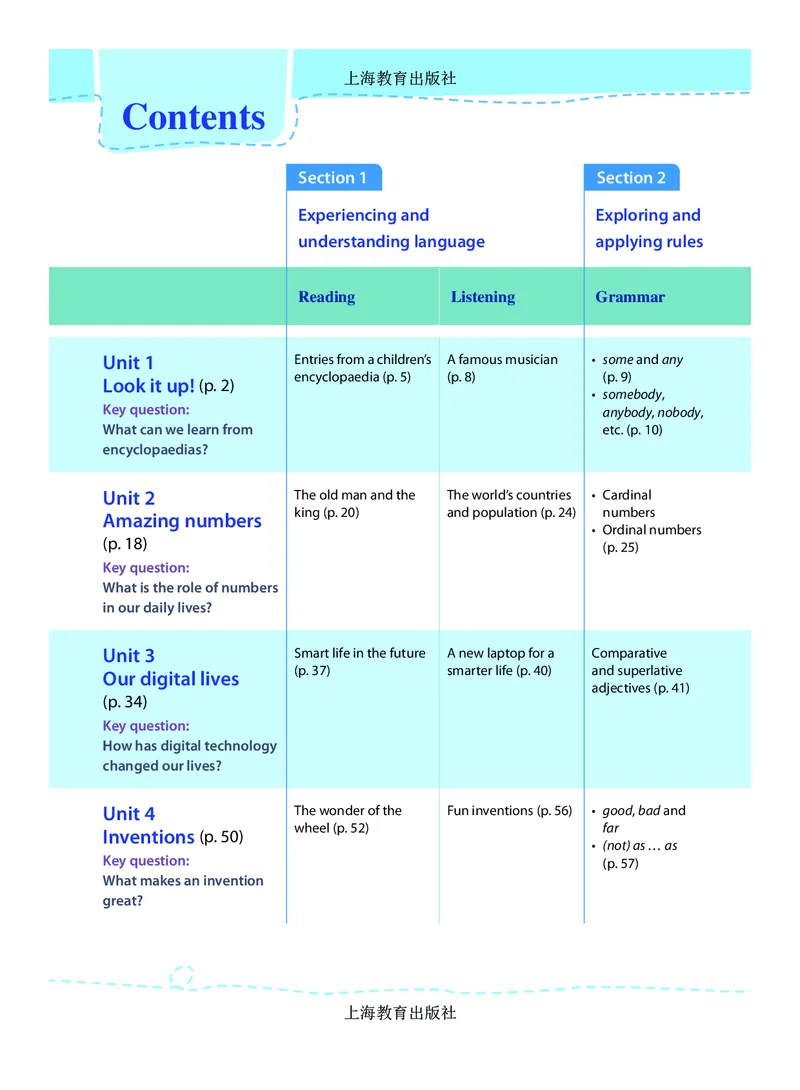
Contents
Section 1 Section 2 Section 3 Section 4 Checking
your
Experiencing and Exploring and Expressing and Extending and
progress
understanding language applying rules communicating ideas developing competencies
Focusing on *Cross-curricular
Reading Listening Grammar Speaking Writing *Project
culture connection
Unit 1 Entries from a children’s A famous musician • some and any • Talking about Writing an Encyclopaedias: an Online Acting out
encyclopaedia (p. 5) (p. 8) (p. 9) someone you encyclopaedia educational tool encyclopaedias a play of a
Look it up! (p. 2)
• somebody, admire entry (p. 12) with a long history (Information Chinese classic
Key question: anybody, nobody, • Sentence stress (p. 14) technology) book (p. 17)
What can we learn from etc. (p. 10) (p. 11) (p. 16)
encyclopaedias?
Unit 2 The old man and the The world’s countries • C ardinal • Using numbers Writing a report on The story of The amazing Making a
king (p. 20) and population (p. 24) numbers in daily life population change numbers (p. 30) Fibonacci booklet about
Amazing numbers
• O rdinal numbers • Strong and weak (p. 28) sequence numbers
(p. 18)
(p. 25) forms of numbers (p. 33)
Key question: (p. 27) (Mathematics)
(p. 32)
What is the role of numbers
in our daily lives?
Unit 3 Smart life in the future A new laptop for a Comparative • Talking about life Writing your The story of the Digital literacy Setting up
(p. 37) smarter life (p. 40) and superlative on the internet opinions about the computer (p. 46) (Information rules for using
Our digital lives
adjectives (p. 41) • Extra stress internet (p. 44) technology) digital devices
(p. 34)
(p. 43) (p. 48) (p. 49)
Key question:
How has digital technology
changed our lives?
Unit 4 The wonder of the Fun inventions (p. 56) • good, bad and • Talking about Writing an article Movable type: a The steam engine Designing my
wheel (p. 52) far an interesting about a new dream come true (Physical science) invention
Inventions (p. 50)
• (not) as … as invention invention (p. 60) (p. 62) (p. 64) (p. 65)
Key question: (p. 57) • Intonation (1):
What makes an invention Rising tone
great? (p. 59)
上海教育出版社上海教育出版社
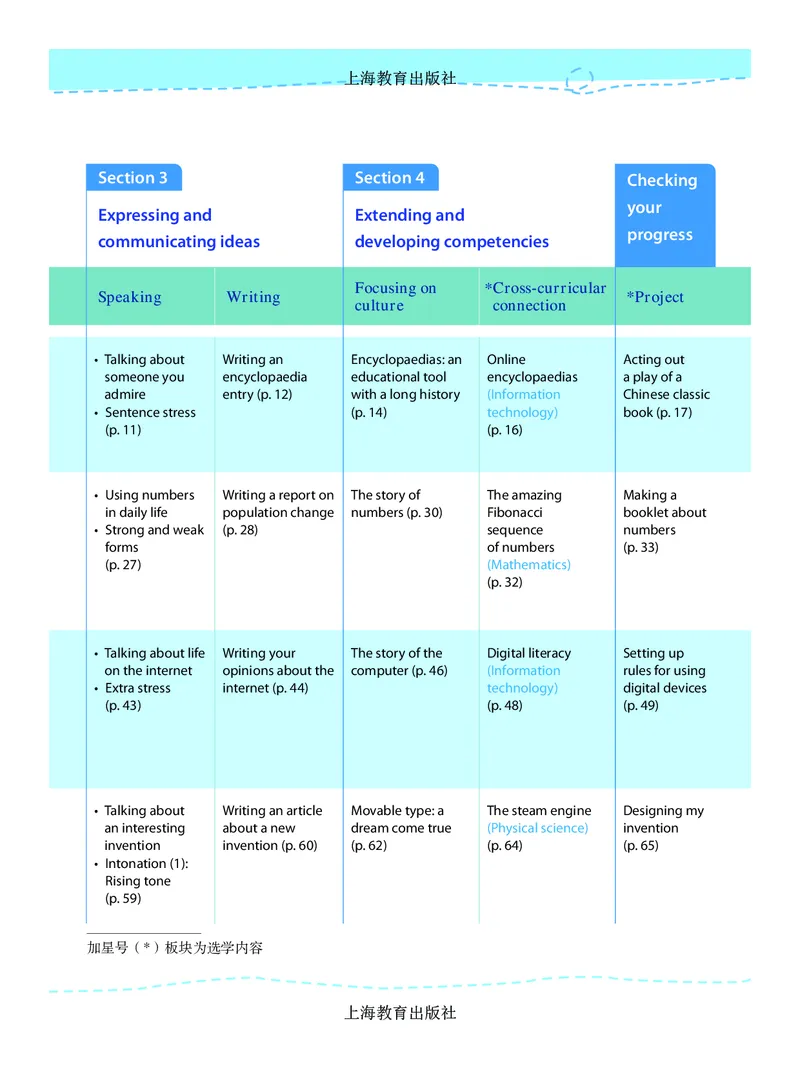
Section 1 Section 2 Section 3 Section 4 Checking
your
Experiencing and Exploring and Expressing and Extending and
progress
understanding language applying rules communicating ideas developing competencies
Focusing on *Cross-curricular
Reading Listening Grammar Speaking Writing *Project
culture connection
Unit 1 Entries from a children’s A famous musician • some and any • T alking about Writing an Encyclopaedias: an Online Acting out
encyclopaedia (p. 5) (p. 8) (p. 9) someone you encyclopaedia educational tool encyclopaedias a play of a
Look it up! (p. 2)
• somebody, admire entry (p. 12) with a long history (Information Chinese classic
Key question: anybody, nobody, • Sentence stress (p. 14) technology) book (p. 17)
What can we learn from etc. (p. 10) (p. 11) (p. 16)
encyclopaedias?
Unit 2 The old man and the The world’s countries • Cardinal • U sing numbers Writing a report on The story of The amazing Making a
king (p. 21) and population (p. 24) numbers in daily life population change numbers (p. 30) Fibonacci booklet about
Amazing numbers
• Ordinal numbers • Strong and weak (p. 28) sequence numbers
(p. 18)
(p. 25) forms of numbers (p. 33)
Key question: (p. 27) (Mathematics)
(p. 32)
What is the role of numbers
in our daily lives?
Unit 3 Smart life in the future A new laptop for a Comparative • T alking about life Writing your The story of the Digital literacy Setting up
(p. 37) smarter life (p. 40) and superlative on the internet opinions about the computer (p. 46) (Information rules for using
Our digital lives
adjectives (p. 41) • Extra stress internet (p. 44) technology) digital devices
(p. 34)
(p. 43) (p. 48) (p. 49)
Key question:
How has digital technology
changed our lives?
Unit 4 The wonder of the Fun inventions (p. 56) • good, bad and • T alking about Writing an article Movable type: a The steam engine Designing my
wheel (p. 53) far an interesting about a new dream come true (Physical science) invention
Inventions (p. 50)
• (not) as … as invention invention (p. 60) (p. 62) (p. 64) (p. 65)
Key question: (p. 57) • Intonation (1):
What makes an invention Rising tone
great? (p. 59)
加星号(*)板块为选学内容
上海教育出版社上海教育出版社
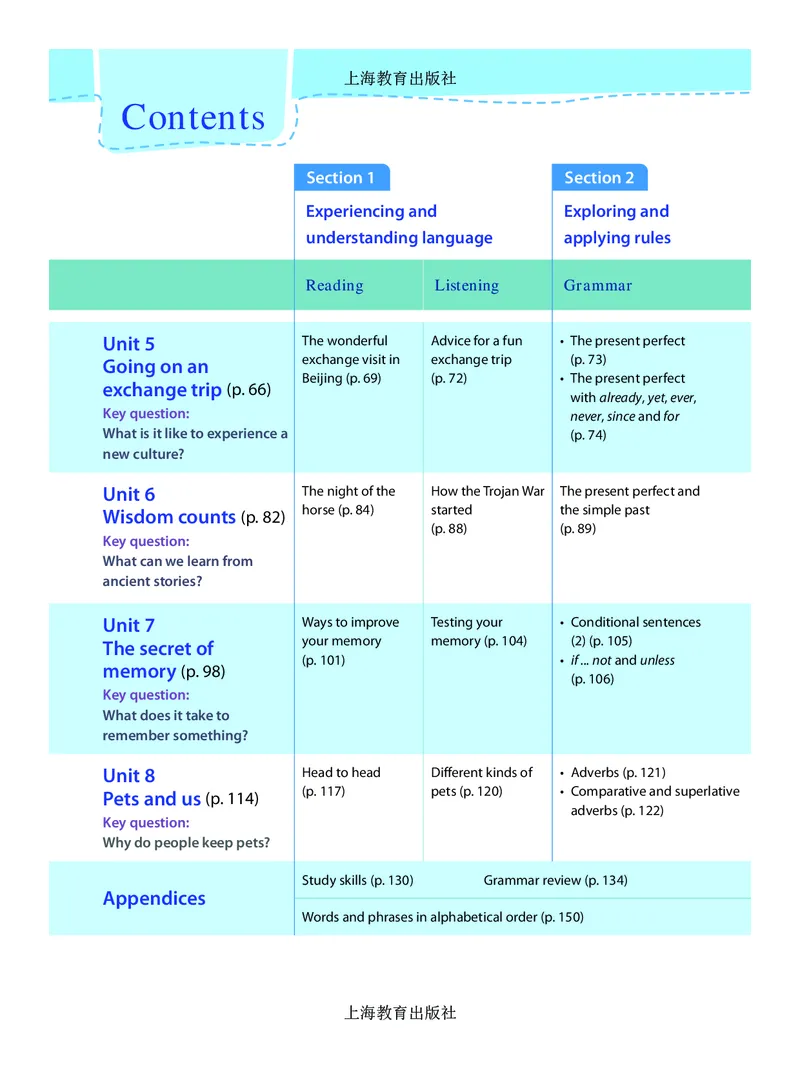
Contents
Section 1 Section 2 Section 3 Section 4 Checking
Experiencing and Exploring and Expressing and Extending and your
understanding language applying rules communicating ideas developing competencies progress
Focusing on *Cross-curricular
Reading Listening Grammar Speaking Writing *Project
culture connection
Unit 5 The wonderful Advice for a fun • The present perfect • Talking about the Writing a thank- Culture shock (p. 78) The benefits Making a
exchange visit in exchange trip (p. 73) benefits of an you email (p. 76) of speaking welcome
Going on an
Beijing (p. 69) (p. 72) • The present perfect exchange trip two languages brochure for
exchange trip (p. 66)
with already, yet, ever, • Intonation (2): (Languages) (p. 80) the exchange
Key question: never, since and for Falling tone students
What is it like to experience a (p. 74) (p. 75) (p. 81)
new culture?
Unit 6 The night of the How the Trojan War The present perfect and • Putting on a play Writing a short Arrows borrowed Exploring history: Acting out a
horse (p. 84) started the simple past about the Trojan story about wisdom from an enemy piecing the puzzle famous ancient
Wisdom counts (p. 82)
(p. 88) (p. 89) Horse (p. 92) (p. 94) together (History) story (p. 97)
Key question:
• Rhythm (strong (p. 96)
What can we learn from
and weak sounds)
ancient stories?
(p. 91)
Unit 7 Ways to improve Testing your • Conditional sentences • Remembering Writing tips for The memories of How much can you Testing the
your memory memory (p. 104) (2) (p. 105) English words remembering trees (p. 110) remember after 24 memory
The secret of
(p. 101) • if ... not and unless • Loss of plosion things (p. 108) hours? (Psychology) techniques
memory (p. 98)
(p. 106) (p. 107) (p. 112) (p. 113)
Key question:
What does it take to
remember something?
Unit 8 Head to head Different kinds of • Adverbs (p. 121) • Solving problems Writing an opinion The history of Teaching your Making a pet
(p. 117) pets (p. 120) • Comparative and superlative caused by pets article about the keeping pets parrot to talk booklet (p. 129)
Pets and us (p. 114)
adverbs (p. 122) • Word linking perfect pet (p.124) (p. 126) (Biological science)
Key question:
(p.123) (p. 128)
Why do people keep pets?
Study skills (p. 130) Grammar review (p. 134) Irregular verbs (p. 142) Phonetic symbols (p. 144) Words and phrases in each unit (p. 145)
Appendices
Words and phrases in alphabetical order (p. 150) Proper nouns (p. 155) Glossary (p. 157)
上海教育出版社上海教育出版社
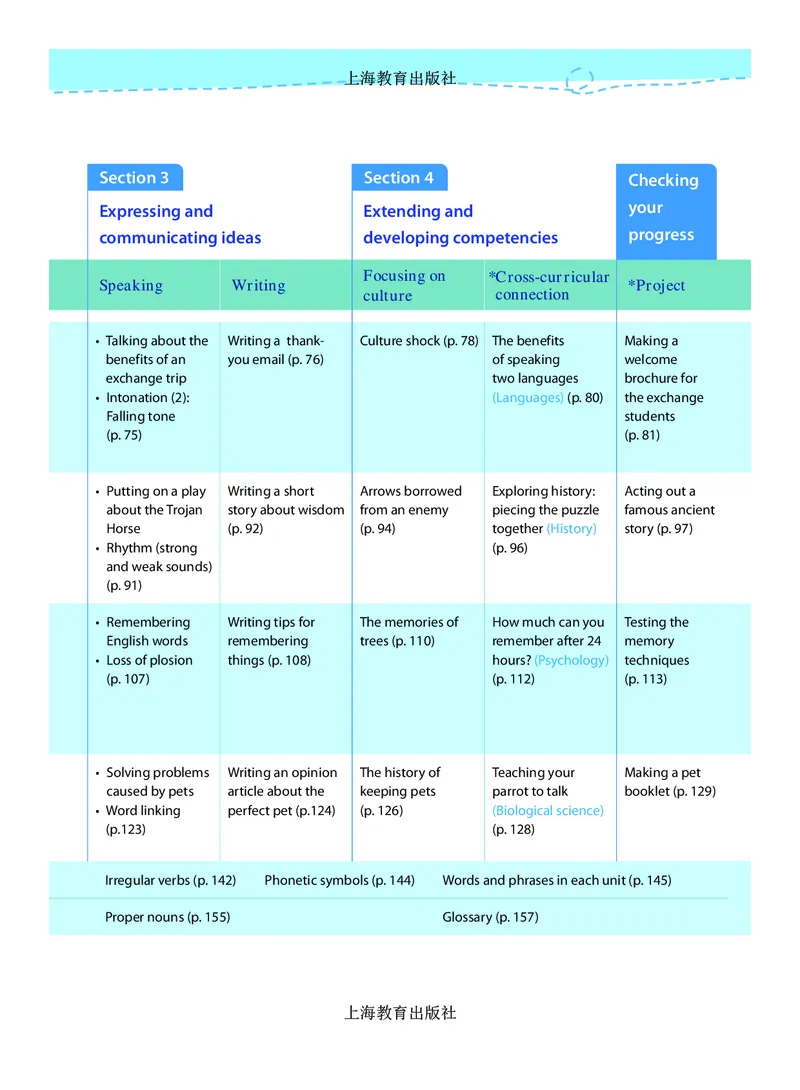
Section 1 Section 2 Section 3 Section 4 Checking
Experiencing and Exploring and Expressing and Extending and your
understanding language applying rules communicating ideas developing competencies progress
Focusing on *Cross-curricular
Reading Listening Grammar Speaking Writing *Project
culture connection
Unit 5 The wonderful Advice for a fun • T he present perfect • T alking about the Writing a thank- Culture shock (p. 78) The benefits Making a
exchange visit in exchange trip (p. 73) benefits of an you email (p. 76) of speaking welcome
Going on an
Beijing (p. 69) (p. 72) • T he present perfect exchange trip two languages brochure for
exchange trip (p. 66)
with already, yet, ever, • Intonation (2): (Languages) (p. 80) the exchange
Key question: never, since and for Falling tone students
What is it like to experience a (p. 74) (p. 75) (p. 81)
new culture?
Unit 6 The night of the How the Trojan War The present perfect and • Putting on a play Writing a short Arrows borrowed Exploring history: Acting out a
horse (p. 85) started the simple past about the Trojan story about wisdom from an enemy piecing the puzzle famous ancient
Wisdom counts (p. 82)
(p. 88) (p. 89) Horse (p. 92) (p. 94) together (History) story (p. 97)
Key question:
• Rhythm (strong (p. 96)
What can we learn from
and weak sounds)
ancient stories?
(p. 91)
Unit 7 Ways to improve Testing your • Conditional sentences • R emembering Writing tips for The memories of How much can you Testing the
your memory memory (p. 104) (2) (p. 105) English words remembering trees (p. 110) remember after 24 memory
The secret of
(p. 101) • if ... not and unless • Loss of plosion things (p. 108) hours? (Psychology) techniques
memory (p. 98)
(p. 106) (p. 107) (p. 112) (p. 113)
Key question:
What does it take to
remember something?
Unit 8 Head to head Different kinds of • Adverbs (p. 121) • S olving problems Writing an opinion The history of Teaching your Making a pet
(p. 117) pets (p. 120) • Comparative and superlative caused by pets article about the keeping pets parrot to talk booklet (p. 129)
Pets and us (p. 114)
adverbs (p. 122) • Word linking perfect pet (p.124) (p. 126) (Biological science)
Key question:
(p.123) (p. 128)
Why do people keep pets?
Study skills (p. 130) Grammar review (p. 134) Irregular verbs (p. 142) Phonetic symbols (p. 144) Words and phrases in each unit (p. 145)
Appendices
Words and phrases in alphabetical order (p. 150) Proper nouns (p. 155) Glossary (p. 157)
上海教育出版社上海教育出版社
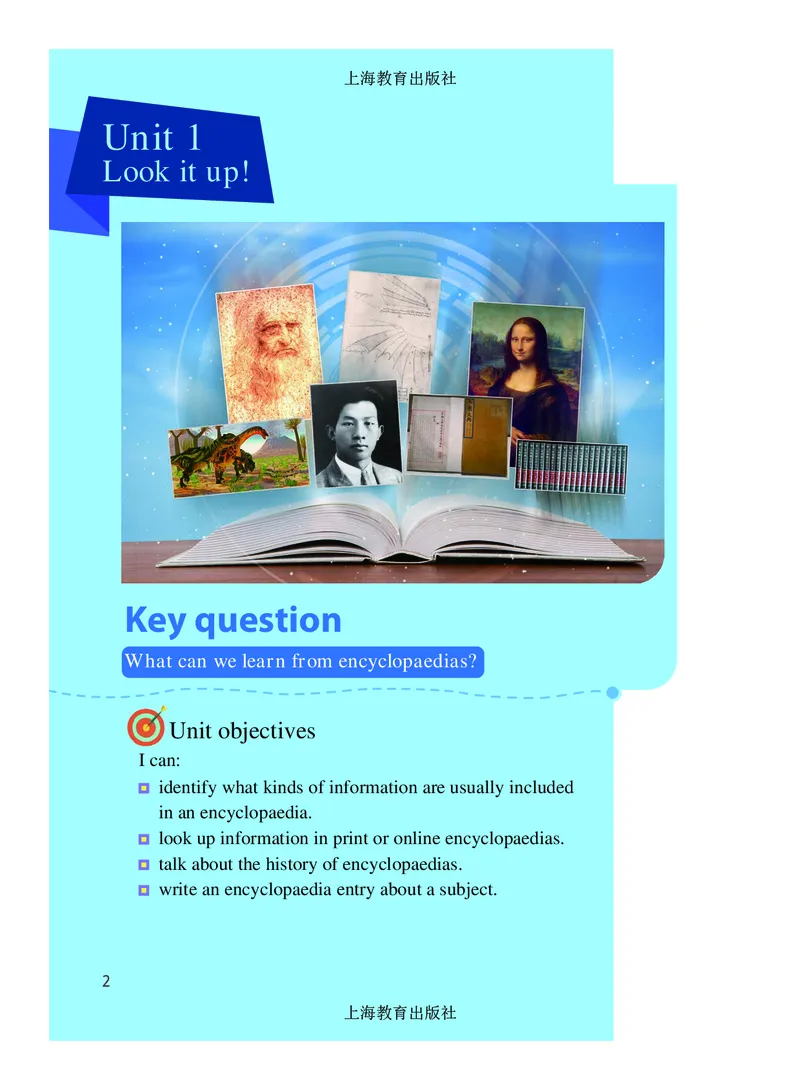
Unit 1
Look it up!
Key question
What can we learn from encyclopaedias?
UUnniitt oobbjjeeccttiivveess
I can:
identify what kinds of information are usually included
in an encyclopaedia.
look up information in print or online encyclopaedias.
talk about the history of encyclopaedias.
write an encyclopaedia entry about a subject.
2
上海教育出版社上海教育出版社
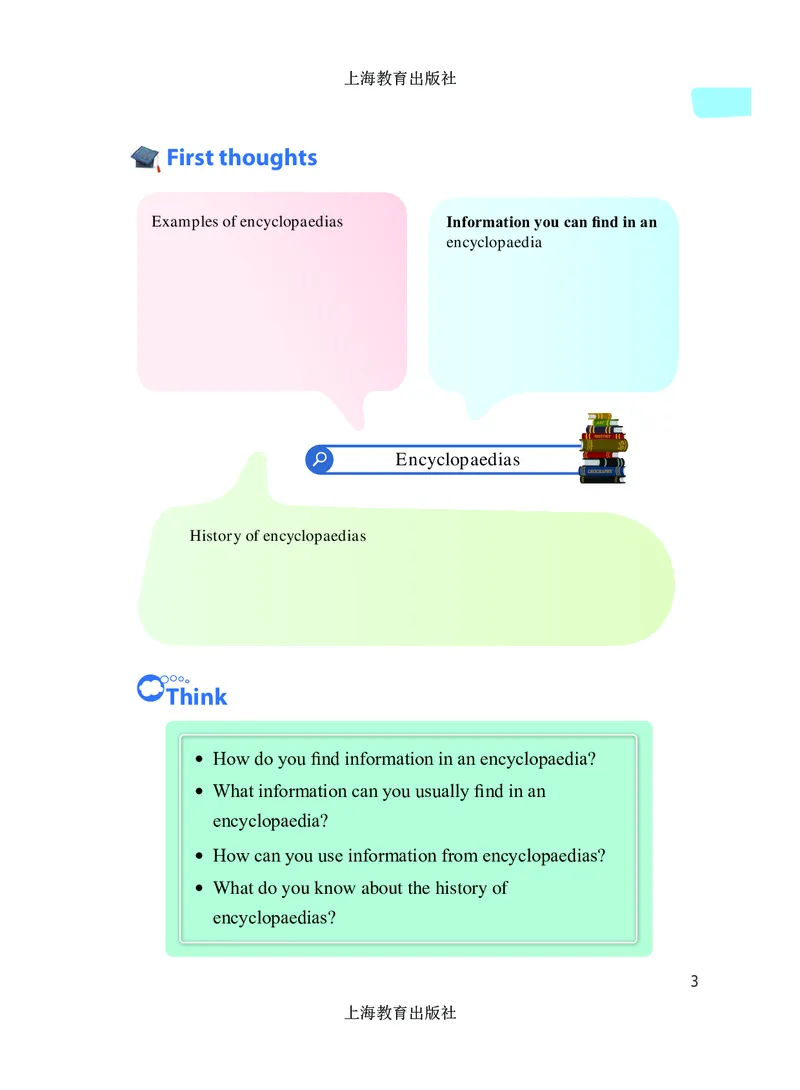
First thoughts
Examples of encyclopaedias Information you can fi nd in an
encyclopaedia
Encyclopaedias
History of encyclopaedias
Think
• How do you fi nd information in an encyclopaedia?
• What information can you usually fi nd in an
encyclopaedia?
• How can you use information from encyclopaedias?
• What do you know about the history of
encyclopaedias?
3
上海教育出版社上海教育出版社
1
SSSeeeccttiiioon Experiencing and understanding language
Reading
TTThhhiiinnnkkk
How do you find information in an encyclopaedia?
Before you read
Su Wen is looking through a children’s encyclopaedia. It has different subjects.
He finds an entry about Leonardo da Vinci under the subject of “Culture and
arts”, and an entry about dinosaurs under the subject of “The living world”.
What do you know about these two topics?
1 Complete a mini-quiz about Leonardo da Vinci.
What do you know about Leonardo da Vinci?
(1) Where was Leonardo da Vinci from?
a France b Italy c the UK
(2) Which of the following was Leonardo da Vinci not good at?
a music b engineering c sailing
(3) Which painting is Leonardo da Vinci famous for?
a Sunflowers b Mona Lisa c Impression, Sunrise
2 Look at the facts about dinosaurs and see if you can work out what number goes in
each of the blanks.
Numbers: 66 180 1,000
FFaaccttss aabboouutt ddiinnoossaauurrss
((11)) D Diinnoossaauurrss lliivveedd oonn tthhee EEaarrtthh ffoorr mmoorree tthhaann ________________
mmiilllliioonn yyeeaarrss..
((22)) DDiinnoossaauurrss ddiieedd oouutt aabboouutt ________________ mmiilllliioonn yyeeaarrss aaggoo..
((33)) T Thheerree aarree mmoorree tthhaann ________________ kknnoowwnn ssppeecciieess ooff
ddiinnoossaauurrss..
(You will fi nd most of the answers in an encyclopaedia.)
4
上海教育出版社Read the two entries from a children’s encyclopaedia to learn more about Leonardo da
Vinci and dinosaurs.
Culture
and
arts
Leonardo da Vinci
Leonardo da Vinci (1452–1519) was an Italian
painter, inventor, musician, engineer and scientist.
Da Vinci was extremely intelligent, and he was
unusually talented in many different fields. He was
5 a true genius①, and his paintings and inventions
changed the way we think about art and science.
Leonardo da Vinci was born in the countryside in Italy.
From an early age, he showed great intelligence and artistic talent. As he
grew older, he learnt to do many different things. His paintings are very
10 famous, and one, the Mona Lisa, is perhaps the most famous painting
in the world. He also had many inventions. For example, his notebooks
include some interesting drawings of flying machines and other vehicles.
Dinosaurs
Dinosaurs are a type of prehistoric animal. They are related to
crocodiles②, snakes and lizards③. They are also the ancestors④ of today’s
birds. Dinosaurs first appeared around 245 million years ago. The word
“dinosaur” comes from two Greek words, and it means “terrible lizard”.
Dinosaurs lived on land and walked on either two or four legs. Many
dinosaurs ate plants, but some ate meat. Dinosaurs came in different sizes.
Some were as small as chickens, and others were as big as ten elephants.
Dinosaurs ruled the Earth for more than 180 million years. About
66 million years ago, dinosaurs suddenly died out. Scientists are not
completely sure why. However, they are learning more and more about
dinosaurs by studying their fossils.
The
living
world
上海教育出版社
Section 1
15
20
Reading strategy
Scanning
When you need to find certain information in a text, you do not have to read every
word. Instead, you can move your eyes quickly over the text until you find the
information you need. This is called scanning.
Can you quickly find the information about when dinosaurs first appeared in the second
entry?
① genius /9dZi:niRs/ n. 天才人物 ② crocodile /9krBkRdaIl/ n. 鳄鱼
③ lizard /9lIzRd/ n. 蜥蜴 ④ ancestor /9CnsestR(r)/ n. (动物的)原始种型;祖先
5
上海教育出版社上海教育出版社
Unit 1 Look it up!
Reading comprehension
1 Complete the notes below with the information from the encyclopaedia entries on
page 5.
Leonardo da Vinci
Year of birth:
Year of death:
Country of birth:
Profession(s):
Most famous artwork:
Dinosaurs
Time period:
Size:
Diets:
Animals related to dinosaurs:
Things scientists are not sure about:
2 The two encyclopaedia entries are from different subjects of the same encyclopaedia.
Under which subjects should we put the following entries?
Claude Monet insects the giant panda
festivals Ludwig van Beethoven types of plants
Culture and arts: _____________________________________________________
The living world: _____________________________________________________
Your ideas
3 Discuss the questions below.
(1) When do you need to find information in an encyclopaedia?
(2) What is the difference between a dictionary and an encyclopaedia?
6
上海教育出版社上海教育出版社
Section 1
Vocabulary practice
1 The words in italics explain the meanings of four words and one phrase from the
encyclopaedia entries on page 5. Find them and complete the sentences.
(1) Some animals are highly __________ (line 3). They are so smart that they can
be trained to understand some human language.
(2) My brother is a very __________ (line 4) piano player. He has a natural ability
to play very well from a young age.
(3) Kate’s __________ (line 8) ability is amazing: she is very good at drawing.
(4) People say that __________ (line 12) without drivers will be quite normal in
the future. It will be very common to see a bus or car without a driver!
(5) The dodo, a large bird that couldn’t fly, __________ (line 21) hundreds of
years ago, so there aren’t any living dodos on Earth.
2 Here is more information from the encyclopaedia. Complete the passage with the
words and phrases below. Change the form if necessary.
a type of completely die out perhaps prehistoric
In the 1990s, researchers in China discovered something surprising about
dinosaurs: some of these (1)__________ animals had feathers. This discovery
helped explain the connection between birds and dinosaurs. According to
scientists, all the non-bird dinosaurs (2)__________, but dinosaurs survived as
birds. In fact, birds developed from (3)__________ two-legged, meat-eating
dinosaurs called theropods① . (4)__________ you’ve seen exciting movies about
dinosaurs like T-Rex② . Well, those huge dinosaurs come from the same family
as birds. Today’s ducks and chickens aren’t scary, but they are actually related to
T-Rex! In one way, the dinosaurs never disappeared (5)__________ —they just
became smaller.
3 Write about a talented person. Use the expressions below.
be born in ... be talented in ... change the way ...
from an early age learn to do show ... talent
Word building
Noun suffi xes: -ist, -ian
We can add -ist or -ian to the end of some words to make nouns, referring
to a person.
science→scientist music→musician
Can you give more examples?
① theropod /9PIRrRpBd/ n. 兽脚类恐龙 ② T-Rex /0ti: 9reks/ n. 霸王龙
7
上海教育出版社上海教育出版社
2
Unit 1 Look it up! Section Exploring and applying rules
Listening TTThhhiiinnnkkk
What information can you usually find
A famous musician in an encyclopaedia?
1 Look at the words and phrases below. What do you know about the musician Nie Er①?
Share your ideas with your classmates.
national anthem② talented
musician
march together
original name nickname③
2 Listen to the audio of an encyclopaedia entry and complete the notes.
Nie Er, a famous musician
• Original name: (1)_______________
Birthplace: (2)_______________
Year of birth: (3)_______________
• Why did he change his name?
Because he (4)_______________, and he could (5)_______________, so
people called him “Erduo”. He liked this nickname and changed his name.
• What was life like for Nie Er and others during the 1930s?
The 1930s were (6)_______________; there was great suffering and
people were (7)_______________.
• How many songs did he write during his short life?
(8)_____________________________________________
3 Listen again and answer the question.
Why was Nie Er called “the People’s Musician”?
Your ideas
4 What else do you know about Nie Er? Find more information about him and share
with your classmates.
① Nie Er 聂耳 ② national anthem /0nCSnRl 9CnPRm/ 国歌 ③ nickname /9nIkneIm/
n. 绰号
8
上海教育出版社上海教育出版社
2
SSSeeeccttiiioon Exploring and applying rules
Grammar
A some and any
We use some and any as determiners to talk about amounts. We also use them as
indefinite pronouns to refer to people or things.
Su Wen is interviewing Dr Xing, a dinosaur expert, for his project. Read the interview and
pay attention to the words in bold.
Su Wen: Hi, Dr Xing, can I ask you some questions about dinosaurs?
Dr Xing: Of course!
Su Wen: Why did dinosaurs die out?
Dr Xing: Many scientists think that dinosaurs died out because a huge
asteroid① hit the Earth. However, some scientists don’t accept this
theory.
Su Wen: What do scientists disagree about?
Dr Xing: Some scientists think the world became too cold for dinosaurs.
Some believe there was not enough
food for dinosaurs.
Su Wen: Do you have any theories yourself?
Dr Xing: I have my own theory, but there isn’t
any sound proof for it yet. We still
need to find more fossils …
Let’s sum up the rules!
• We use some and any before plural countable nouns and uncountable nouns.
• We usually use some in positive statements, and any in negative statements
and questions.
Look!
• We use some in questions when we expect the answer to be “yes”. It is also
a polite way to ask.
Would you like some tea? May I have some noodles?
• We can use any to talk about someone or something when we do not refer to
a specifi c person or thing.
You can take any book you’d like to read.
Which pen do you want? Any will do.
① asteroid /9CstRrOId/ n. 小行星
9
上海教育出版社上海教育出版社
3
Unit 1 Look it up! Section Expressing and communicating ideas
1 Complete the conversation between Su Wen and the librarian with some or any.
Librarian: Hello, how can I help you?
Su Wen: Hi, Miss. Do you have (1)__________ books about dinosaurs?
Librarian: Yes, we do. We have (2)__________ next to the encyclopaedias. What
type of dinosaurs are you interested in?
Su Wen: I don’t have (3)__________ idea. I just want to look up (4)__________
facts.
Librarian: No problem. Let me show you (5)__________ popular dinosaur books
for teenagers.
B somebody, anybody, nobody, etc.
Read the dialogue below and pay attention to the words in bold.
Dad: How is your project going? Did you find anything useful in the library?
Su Wen: The librarian showed me a few books, but I found nothing useful.
Dad: Maybe you can ask somebody else—perhaps your biology teacher
can help.
Su Wen: That’s a good idea! I think he can tell me something about the first
dinosaurs.
Let’s sum up the rules!
• Indefinite pronouns ending in -thing are used to refer to objects, ideas or
situations. Indefinite pronouns ending in -one and -body are used to refer to
people.
• N othing, nobody and no one are used in a positive statement, but they have a
negative meaning.
Grammar in use
2 Look at the picture of the school library below and then ask and answer questions in
pairs.
S1: Is there anything in the bookcase?
S2: Yes. There are lots of books in the
bookcase.
S1: Are there any plants in the library?
S2: Yes, there are some plants in the
library.
...
10
上海教育出版社上海教育出版社
3
SSSeeeccttiiioon Expressing and communicating ideas
Speaking TTThhhiiinnnkkk
How can you use information
Talking about someone you admire from encyclopaedias?
Find information about a person you admire in an encyclopaedia and tell your partner.
Tip You can fi nd the
following information
Different jobs
about the person you
artist, designer, inventor,
admire in an encyclopaedia:
mathematician, musician, painter,
• Life and works
physicist, scientist, writer, etc.
• Main achievements
• Infl uence
S1: Which person in history do you admire?
S2 : I admire Pablo Picasso. He was one of the
greatest painters of the 20th century.
S1: What did he do?
S2: He created many new styles of painting,
and his works influenced the development
of modern art.
S1: Can you give some examples?
...
Improving your pronunciation
Sentence stress
When we speak, we usually stress key words (e.g. nouns, verbs, adjectives,
adverbs and numbers) in a sentence.
Read the dialogue below and stress the underlined words. Then listen and repeat.
May: Happy birthday, Ben! This is for you.
Ben: An encyclopaedia? Thank you, May!
May: You’re welcome. I’m sure you’ll learn a lot from it.
Ben: Yes, I’m sure I will. It’s always useful to have an encyclopaedia
around the house.
11
上海教育出版社上海教育出版社
Unit 1 Look it up!
WWrriittiinngg
Writing an encyclopaedia entry
Online Encyclopaedia for Teens
We are calling for articles about famous people around the world. Write an
encyclopaedia entry and send it to us.
1 Wang Yao drew a mind map before she wrote an encyclopaedia entry about a scientist
she admires. Look at the mind map and label the parts of the entry.
Basic information
year of birth and death
Tip
...
Encyclopaedia
entries should
Yuan Longping
contain facts
instead of opinions.
Main achievements
Awards and titles
hybrid rice① research
Medal of the Republic
...
...
Yuan Longping
(1)________
Yuan Longping (1930–2021) was a Chinese
agricultural scientist. He was born in Beijing.
Yuan spent his whole life developing different
kinds of hybrid rice. These new types of
(2)________
plants can produce much more rice than
traditional ones. Yuan’s work has helped feed
people in China and many other parts of the
world. Farmers in a lot of countries now grow his hybrid rice.
(3)________ Yuan won many awards for his research. He received the Medal of
the Republic, one of China’s highest honours, in 2019. People call
him the “Father of Hybrid Rice”.
① hybrid rice /0haIbrId 9raIs/ 杂交水稻
12
上海教育出版社上海教育出版社
Section 3
2 Who do you admire? Find information about this person and write an encyclopaedia
entry.
Step 1 Plan Draw your own mind map.
Step 2 Write Write an encyclopaedia entry about the person you admire. Find
a photo of the person you are writing about and add it to the article.
photo
Step 3 Check and revise Tick (✓) the boxes to check your writing, and then
revise it.
I included important information about this person.
I used facts instead of opinions in the encyclopaedia entry.
I used the words and expressions I learnt in this unit.
I used correct spelling, grammar and punctuation.
13
上海教育出版社上海教育出版社
4
SSSeeeccttiiioon Extending and developing competencies
FFooccuussiinngg oonn ccuullttuurree TThhiinnkk
What do you know about the
Encyclopaedias provide all kinds of information.
history of encyclopaedias?
When were the first encyclopaedias made?
Let’s explore the history of encyclopaedias to learn more.
1 Read the article about encyclopaedias and find out how they developed in different
parts of the world.
Encyclopaedias: an educational tool with a long history
The word “encyclopaedia” comes from a Greek word that means “general
education”. We use encyclopaedias to find information about different
subjects. Nowadays, most people use encyclopaedias online, but some still
prefer to use paper encyclopaedias. They often come in several volumes①.
5 China has a long history of creating encyclopaedias. One of the first
encyclopaedias was the Huanglan② (i.e. the Imperial Anthology). It was
created around 220 CE. Another important encyclopaedia was the Yongle
Dadian③ (i.e. the Yongle Encyclopaedia). The
Yongle Dadian was completed in 1408 and had
10 over 11,000 volumes. It is probably the largest
encyclopaedia in history. Both the Huanglan
and YongleDadian included important pieces
of writing. These entries covered subjects like
history, art and science.
15 Encyclopaedias in other parts of the world also go back a long way in history.
The earliest known encyclopaedias in Europe were written by the Greeks
in the 4th century BCE. They were similar to early Chinese encyclopaedias
because they included works by different scholars④. Centuries later,
the editors of the first modern
20 encyclopaedias, like the Encyclopaedia
Britannica, organized the entries in
alphabetical order. People could use the
first letter of a word to find a subject
quickly and easily.
25 Encyclopaedias have played an important role through history in recording
and providing information. They are still a useful tool, and they help us learn
about the world that we live in.
① volume /9vBlju:m/ n. 一卷;一册 ② Huanglan 《皇览》
③ Yongle Dadian 《永乐大典》 ④ scholar /9skBlR(r)/ n. 学者
14
上海教育出版社上海教育出版社
Section 4
The Encyclopaedia Britannica is a world-famous encyclopaedia.
It is the oldest English-language encyclopaedia. The fi rst
Notes
edition was published in 1768, and since then there have been
15 editions.
2 Answer the questions below with the information from the article on page 14.
(1) How were early Greek encyclopaedias similar to early Chinese encyclopaedias?
(2) What changes did the editors of the first modern encyclopaedias make? What
do you think of this change?
3 Complete the sentences with the words below. Change the form if necessary.
editor order organize record
(1) Before you start writing, you need to __________ your ideas.
(2) Writers __________ important information about science, art and other subjects
in the Huanglan and Yongle Dadian.
(3) __________ need to check all facts very carefully.
(4) The words in a dictionary are usually in alphabetical _ _________.
Your ideas
4 Find out more information about the Yongle Dadian and share your findings with
your classmates.
Exploring more
Where can you see precious ancient books in China? The National Museum
of Classic Books is one such place. Find more information about it online.
15
上海教育出版社上海教育出版社
Unit 1 Look it up! Checking your progress
CCrroossss--ccuurrrriiccuullaarr ccoonnnneeccttiioonn Information technology*
In the time of the internet, more and more people use online encyclopaedias to
look up information, which is fast and convenient.
1 The entry below is from one of the world’s largest online encyclopaedias. Look at the
entry and answer the questions below.
Online encyclopaedias
Menu: Helps you quickly find Top Questions: A list of common questions
information on the website. about the topic.
Browse Search Dictionary Quizzes One Good Fact
Leonardo da Vinci Home > Visual Arts> Painting> Painters
Picture: Digital
Introduction & Top Questions Leonardo da Vinci
pictures that you
> Life and works Italian artist, engineer, and scientist
> Art and accomplishment open in a new
Print Cite Share Feedback ...
Fast Facts window.
By Ludwig Heinrich Heydenreich •Last updated: Aug23, 2022 • Edit history
2-Min Summary
Timeline Listen to article
Achievements
> Top Questions Top Questions
Facts & Related Content
What is Leonardo da Vinci best known for?
Quizzes
Quotes How many Leonardo da Vinci paintings are there?
Media What was Leonardo da Vinci’s personality like? Leonardo da Vinci: self-portrait
Videos See all media
Images
Summary
Born: April 15, 1452 •Italy
More Read a brief summary of this topic D Fr i a e n d c : e May 2, 1519 (aged 67) •
More Articles On This Topic Notable Works:“Battle
Additional Reading Leonardo da Vinci, (Italian:“Leonardo of Anghiari”•“Last
Supper”•“Leda”•“Mona Lisa” ...
Contributors from Vinci”) (born April 15, 1452, (Show more)
Article History Anchiano, near Vinci, Republic of Movement / Style:Early
Renaissance • Renaissance
Florence [Italy]—died May 2, 1519 Subjects Of Study: painting •
proportion • anatomy • mechanics
Table of Cloux [now Clos-Lucé], France), • architecture
Italian painter, draftsman, sculptor,
contents: Helps
Quick facts:
architect, and engineer whose skill and
you quickly find
intelligence, perhaps more than that Summary of
information on of any other fi gure, epitomized the important facts and
the page. Renaissance humanist ideal. ...
key words.
(1) Why are the parts in the blue boxes useful? What kind of information do they
give us?
(2) How is it different from a print encyclopaedia? Which do you prefer?
2 Do you know any other online encyclopaedias? Can you describe them to your
classmates?
16
上海教育出版社上海教育出版社
Checking your progress
Project*
Acting out a play of a Chinese classic book
Encyclopaedias like the Yongle Dadian are one type of Chinese classic books, but there
are many other classic collections of knowledge. In this project, you will work in groups to
explore a classic work and act out a play about it.
Step 1 Pick one of the works below, or choose another classic book you like.
Find more information about it.
Shijing① (The Book of Poetry)
Tiangong Kaiwu②
Bencao Gangmu③
The Art of War④
...
Step 2 Organize the information you collected.
Book title: Writer(s):
Topic: Time written:
Material written on: Importance:
Step 3 Adapt the information into a play script. Assign different roles in your
group. Roles in your play may include:
• the narrator: introduces the book (e.g. its title, writer(s), topic)
• the storyteller: reads poems / excerpts from the book
• actor(s): play(s) the role(s) of characters from the book or the author (e.g.
explaining how he / she wrote the book)
Step 4 Perform your play for the class and vote for the best performance.
WWiittss ccoorrnneerr
TThhee wwoorrlldd eennccyyccllooppaaeeddiiaa,, tthhee uunniivveerrssaall lliibbrraarryy,, eexxiissttss,, aanndd iitt iiss
tthhee wwoorrlldd iittsseellff..
— Alberto Manguel
① Shijing 《诗经》 ② Tiangong Kaiwu 《天工开物》 ③ Bencao Gangmu 《本草纲目》
④ The Art of War 《孙子兵法》
17
上海教育出版社上海教育出版社
Unit 2
Amazing numbers
壹 贰 叁
1 2 3
肆 伍 陆
4 5 6
柒 捌 玖
7 8 9
拾 零 佰
10 0 100
Key question
What is the role of numbers in our daily lives?
UUnniitt oobbjjeeccttiivveess
I can:
understand the importance of numbers in daily life.
record and present information with numbers in English.
use cardinal and ordinal numbers correctly.
understand how numbers developed and how they differ
between cultures.
18
上海教育出版社上海教育出版社
First thoughts
Types of numbers
Understanding
numbers
Numbers used in daily life
Numbers in different cultures
Think
• Why are numbers amazing?
• How do we use numbers to record and present
information?
• How do we use numbers in daily life?
• How did numbers develop?
19
上海教育出版社上海教育出版社
1
SSSeeeccttiiioon Experiencing and understanding language
Reading
TTThhhiiinnnkkk
Why are numbers amazing?
Before you read
Numbers are everywhere. Look at the pictures and discuss where you can see numbers in
your daily life.
fl ight schedule
clock face
Read the story and find out how a wise old man used numbers to outwit① the king.
TThhee oolldd mmaann aanndd tthhee kkiinngg
A long time ago, there was a king in India. The king’s favourite game
was chess.
One day, a wise old man came to the palace and the king challenged
him to a game. “You can have any prize if you win the game,” the
king promised the old man.
5
The old man thought for a moment and said slowly, “If I win the
game, I’d like one grain of
rice for the first square of
the chessboard, two for the
second, four for the third
10
... I’d like you to double
the amount for each of the
rest of the squares.”
The king was very
① outwit /0aWt9wIt/ v. (智力上)胜过
20
上海教育出版社上海教育出版社
Section 1
Where can you see numbers?
I can see numbers everywhere, such
as on a clock face, a calendar ...
charts and graphs
price tag
calendar
surprised. “Is that all?” he asked. “Wouldn’t you like gold or silver
15
instead?”
“No, just rice,” the old man replied without hesitation.
“How many grains of rice will this be?” the king wondered, “There
are 64 squares on the chessboard, so there will be one, two, four, eight,
sixteen, … Perhaps a bag of rice is enough.” After thinking about it
20
for a moment, the king agreed.
The king and the old man played the game for a long time. Finally,
the old man won, so the king ordered his men to collect a bag of rice.
The king’s men put one grain on the first square, two on the second,
and so on. After a few squares, the king realized the problem—even
25
with all the rice in the country, he would still not have enough rice to
put on the chessboard!
Reading strategy
Identifying the elements of a story
The key elements of a story include the characters, setting, plot, conflict and theme.
They help you understand the story better.
Can you identify these elements in the above story?
21
上海教育出版社上海教育出版社
Unit 2 Amazing numbers
Reading comprehension
1 Complete the table with the information from the story on pages 20–21.
Time (1) _____________________________________
Setting
Place (2) _____________________________________
Characters (3) _____________________________________
The king (4) _____________________________
Beginning _______________________________________
_______________________________________.
The king and the old man (5) _______________
Plot Middle
_______________________________________.
(6) _____________________________________
End _______________________________________
_______________________________________
2 Read the story again and find evidence to support the statements below.
(1) The king loved to play chess.
_______________________________________________________________________________
(2) The king thought the old man asked for too little.
_______________________________________________________________________________
(3) The king did not have enough rice for the old man.
_______________________________________________________________________________
Your ideas
3 Discuss the questions below.
(1) How many grains of rice should the king put on the last square?
(2) What do you think happened next? Continue the story and role-play it in your
group.
22
上海教育出版社上海教育出版社
Section 1
Vocabulary practice
1 The words in italics are from the story on pages 20–21. Match the sentence halves.
(1) When you wonder about a you are very sure you will do it.
something, b he / she wants to see if he / she can win.
(2) If you promise to do c if you come second in the race.
something, d you think about it with curiosity and want
(3) You may win a prize to know more about it.
(4) You will win the silver medal e if you do well in the race.
(5) If your friend challenges you
to a chess game,
2 Complete the story with the words below. Change the form if necessary.
hesitation prize promise reply wonder
A poor young man came fi rst in a running race and won some gold as a
(1)____________. He looked at the small piece of gold in his hand and
(2)____________ what to do with it. The young man decided to ask a wise old
man for advice. “I have a little gold now, but I want much more,” he said. “Can
you help me?”
The old man looked at him. “I can teach you how to make more money if you
(3)____________ to work hard,” he said.
The young man agreed without (4)____________. Then the old man pointed
out of the window. “Look outside. What can you see?” he asked. “I can see
nothing but an empty fi eld,” the young man (5)____________.
“Use your money to buy this fi eld,” said the old man, “and grow some cotton.
In a year, you can sell the cotton and make a profi t.”
The young man followed his advice and worked hard all year round, and in
time, he became very rich.
3 Summarize the story on pages 20–21. Use the words and phrases below.
promise surprise wonder
challenge ... to double the amount
realize the problem without hesitation
23
上海教育出版社上海教育出版社
2
Unit 2 Amazing numbers Section Exploring and applying rules
Listening
TThhiinnkk
How do we use numbers to
The world’s countries and
record and present information?
population
1 Discuss the questions below in pairs.
(1) What is the population of the world now?
(2) Can you name the three largest cities in the world by population?
2 Ellie and Ann are talking about countries and population around the world. Listen to
the conversation and choose the correct answers.
(1) What’s the world’s population
according to the conversation?
Tip We can express
a about 8 billion
numbers in different ways:
b about 10 billion
• 27%: twenty-seven per cent
c about 13 billion
1
• : one fifth
(2) How many people will there be 5
in the world in 2100? 2
• : two thirds
3
a more than 9 billion
b more than 10 billion
c more than 12 billion
(3) What per cent of the world’s population currently live in Asia?
a a bit over 30% b less than 50% c about 60%
(4) Which of the following cities is discussed in the conversation?
a Shanghai b Shenzhen c Beijing
3 Listen again and answer the question below.
What does Ann mean when she says “the number keeps changing”?
Your ideas
4 Imagine that you are working on a project about the population of different countries
around the world. What methods are you going to use to find the information? How
will you record and present the information you collect?
24
上海教育出版社上海教育出版社
2
SSSeeeccttiiioon Exploring and applying rules
Grammar
A Cardinal numbers
We use cardinal numbers to count things.
11 eleven 15 fifteen 20 twenty 82 eighty-two
12 twelve 18 eighteen 50 fifty 98 ninety-eight
100 one hundred 375 three hundred and seventy-five
1,000 one thousand 100,000 one hundred thousand
4,189 four thousand one hundred and eighty-nine
1,000,000 one million 1,000,000,000 one billion
2,000,000 two million 3,000,000,000 three billion
Let’s sum up the rules!
• When we read out numbers, we do not add -s to the words hundred,
thousand, million and billion.
• We put and between hundred and ten.
B Ordinal numbers
We use ordinal numbers to show the order of things.
1st first 4th fourth 9th ninth 13th thirteenth
2nd second 5th fifth 11th eleventh 20th twentieth
3rd third 8th eighth 12th twelfth 21st twenty-first
Let’s sum up the rules!
We form most ordinal numbers by adding -th to the cardinal numbers,
except fi rst, second and third. For numbers of 21 and above, the ordinal
number is formed based on the last digit (21st, 22nd, 23rd, etc.).
25
上海教育出版社上海教育出版社
3
Unit 2 Amazing numbers Section Expressing and communicating ideas
1 Look at the information about the three longest rivers in the world. Take turns asking
and answering questions about the rivers.
The Nile River The Amazon River The Yangtze River
Africa South America Asia
6,671 km 6,480 km 6,300 km
S1: Which is the first-longest river in the world? Where is it? How long is it?
S2: T he Nile River is the first-longest river. It’s in Africa. It’s about 6,671 km long.
Grammar in use
2 Look at the list of the highest mountains in Asia, North America and Africa. Describe
the mountains with cardinal and ordinal numbers.
Rank Name Height Continent
1 Mt. Qomolangma 8,848.86 m Asia
2 Mt. Qogir 8,611 m Asia
3 Mt. Kanchenjunga 8,586 m Asia
Rank Name Height Continent
1 Mt. Denali 6,190 m North America
2 Mt. Logan 5,959 m North America
3 Pico de Orizaba 5,610 m North America
Rank Name Height Continent
1 Mt. Kilimanjaro 5,895 m Africa
2 Mt. Kenya 5,199 m Africa
3 Mt. Stanley 5,109 m Africa
The tallest mountain in ... is ... It is ... metres high.
... is the second-highest mountain in ...
26
上海教育出版社上海教育出版社
3
SSSeeeccttiiioon Expressing and communicating ideas
Speaking TTThhhiiinnnkkk
How do we use numbers in daily life?
Using numbers in daily life
Numbers play an important role in our daily lives. Discuss how people use numbers with
your classmates.
S1: H ow do people use numbers in
daily life?
People use numbers to:
S2: People use numbers to do a lot of
• design buildings
things. Take planning a journey for
• develop new medicine
example. We need to decide the
• grow crops
dates. And then we need to check
• make a monthly budget
the train or flight schedule. Also,
• plan a journey
we need to make a budget.
...
S1: T hat’s true. People also use
numbers to ...
Improving your pronunciation
Strong and weak forms
Some words (e.g. do, the, of, and, can, for, to) have both a strong form and
a weak form. In most sentences, we use the weak forms of these words.
Sometimes we use the strong forms for emphasis.
a an for of to
Strong form /eI/ /Cn/ /fO:(r)/ /Bv/ /tu:/
Weak form /R/ /Rn/ /fR/ /Rv/ /tR, tu/
the and can have he do
Strong form /Qi:/ /Cnd/ /kCn/ /hCv/ /hi:/ /du:/
Weak form /Qi, QR/ /Rn(d), n/ /kRn/ /hRv, Rv/ /hi/ /dR, du/
Listen and repeat. Pay attention to the words in blue.
May: Do you know the number of students in your class?
Ben: Yes, I do. There are 35 students in my class—18 boys and 17
girls. I can remember all their birthdays!
27
上海教育出版社WWrriittiinngg
Writing a report on population change
Populations change in all areas over time. Do some research and
write a report on population change in a city or province based on
your findings.
1 Wang Yao is writing a report about the world population. Look at the line graph she
found and help her complete the report. Use the words and phrases below to help you.
World population: 1750–2050
1750 1800 1850 1900 1950 2000 2050
Year
Growing numbers: rise (sharply, quickly, slowly), grow, go up, double
Falling numbers: fall (sharply, quickly, slowly), drop, go down
No change: stay the same, remain the same
)noillib
(
noitalupoP
上海教育出版社
Unit 2 Amazing numbers
10
9
8
7
6
5
4
3
2
1
0
World population
The graph shows that the population in the world (1)__________________
before the year 1800. During the second half of the 1800s, the
population began (2)______________________. In 1850, there were about
(3)_____________________ people in the world. About one hundred years
later, the world population reached (4)______________________. Between
1950 and 2000, the population more than (5)______________________. In
2050, there will be more than (6)_______________________ people on our
planet.
28
上海教育出版社上海教育出版社
Section 3
2 How has the population in a particular city or province changed over the years? Find
information about it and write a report.
Step 1 Plan Choose a city or province you are interested in. Find information
about its population change over a period of time and make a line graph.
Step 2 Write Write a report about how the population changed over time.
Remember to use the words and phrases in Exercise 1.
Step 3 Check and revise Tick (✓) the boxes to check your writing, and then
revise it.
I used a line graph to record and present information, using correct
numbers.
I provided a detailed description of how the population of a city / province
changed over time.
I used the words and expressions I learnt in this unit.
I used correct spelling, grammar, and punctuation.
29
上海教育出版社上海教育出版社
4
SSSeeeccttiiioon Extending and developing competencies
FFooccuussiinngg oonn ccuullttuurree TThhiinnkk
How did numbers develop?
Numbers are everywhere today. How did people
in ancient times record numbers? Let’s explore the development of counting
methods.
1 Read an article from a science magazine and find out more about numbers.
The story of numbers
②
In ancient times, people developed different counting
methods. One of the earliest was called “tally sticks①”.
Each “stick” (or pebble②, or other counting tool) stands
for a thing we want to count, such as an animal or a bag of
rice. For each animal we want to count, we draw one stick.
5
This is called a “one-to-one correspondence③”. Tally sticks
are easy to understand, but it can take a long time to write
down large numbers. To write “1,000”, you have to draw a
thousand tally sticks!
Later, people created faster ways of writing numbers. One such system
10
developed in ancient India. Instead of using tally sticks, people began using
different abstract④ symbols to represent different numbers. Researchers do
not know exactly how this happened, but some believe that the sticks slowly
turned into symbols over the centuries. These Indian numerals became
popular, and people in the Arab world started using them too. Thanks to the
15
Arabs, this way of writing numbers spread to Europe and across the world.
Nowadays, they are known as Arabic numerals⑤.
The ancient Romans wrote numbers in a different way. They
used letters from their alphabet. For example, the number
12 is “XII” (10+1+1). The Roman numerals used to be the
20
most common way of writing numbers in Europe. Today we
still see them in many places, for example, on clock faces,
on buildings or in books. But Roman numerals are not as common as Arabic
numerals, maybe because they are too diffi cult to use!
① tally stick /9tCli stIk/ 计数棍 ② pebble /9pebl/ n. 鹅卵石;砾石
③ correspondence /0kBrR9spBndRns/ n. 对应 ④ abstract /9CbstrCkt/ adj. 抽象的
⑤ numeral /9nju:mRrRl/ n. 数字
30
上海教育出版社上海教育出版社
Section 4
People from different cultures use different numerals. Below are
three ways of writing the numbers one to five.
Chinese numerals:一、二、三、四、五 Notes
Roman numerals: I, II, III, IV, V
Arabic numerals: 1, 2, 3, 4, 5
2 Complete the summary below with the information from the article on page 30.
In ancient times, people developed a counting system called
(1)____________________. Later, people replaced this system with
abstract (2)____________________. These were more convenient
because they were quicker to write. The numbers we use today are called
(3)____________________. They were invented in (4)____________________.
Thanks to the (5)____________________, this system spread to other parts of the
world. Sometimes we also see numbers written with (6)____________________
on clock faces and buildings. These are called Roman numerals.
3 Complete the sentences with the words below. Change the form if necessary.
exactly represent symbol system
(1) The Roman symbol IV __________ the number 4 in Arabic numerals.
(2) This palace was a(n) __________ of the king’s wealth and power.
(3) The Roman alphabet is not the only writing _________ in the world—there are
many others.
(4) We don’t know __________ how many animal species there are on Earth.
Your ideas
4 What influences did the development of counting methods have on people’s daily lives?
Exploring more
People used counting rods in ancient China. What do you know about this way
of counting? Do some research and share your findings with your classmates.
31
上海教育出版社上海教育出版社
Unit 2 Amazing numbers Checking your progress
CCrroossss--ccuurrrriiccuullaarr ccoonnnneeccttiioonn Mathematics*
If you carefully observe the natural world around you, you may find interesting
mathematical patterns!
1 Read the article on Fibonacci numbers and find out more about Maths in nature.
The amazing Fibonacci sequence① of numbers
Fibonacci was a famous Italian mathematician born in the 12th century. He
created many maths problems. The most famous one was about rabbits.
Imagine that a pair of rabbits can have two babies every month. After two
months, the new rabbits can have babies too. What will happen if you have a
pair of newborn rabbits on your farm? How will the number of rabbits grow
over time? Let’s look at the answers this way:
This is the beginning of
Month Number of pairs
the Fibonacci sequence.
1 1
Look at the numbers.
Can you see any pattern? 2 1
That’s right—each
3 2
number is the sum of the
two previous ones. As we 4 3
can see, the numbers in
5 5
the Fibonacci sequence
grow very quickly. What 6 8
numbers come after 8 in
7 ?
the sequence?
Fibonacci numbers are very special because they show up everywhere. They
appear in artworks and famous buildings, and also in living things. In fact,
nature likes to follow the Fibonacci sequence. Flower petals② often come
in Fibonacci numbers. The same thing happens with the spirals③ of pine
cones④ and sunflower seeds. We do not know yet why these numbers are so
common, but Fibonacci’s discovery can help us understand the natural world.
2 Find a pine cone and count the spirals. How does the number of spirals illustrate the
Fibonacci sequence? Think about things around you in nature. Have you ever noticed
any interesting patterns?
① Fibonacci sequence /0fIbR'nA:tSi 9si:kwRns/ 斐波那契数列 ② petal /9petl/ n. 花瓣
③ spiral /9spaIrRl/ n. 螺旋形 ④ pine cone /9paIn kRWn/ n. 松果
32
上海教育出版社上海教育出版社
Checking your progress
PPrroojjeecctt*
Making a booklet about numbers
Our world is full of amazing numbers. How much do you know about them? In this
project, you will explore different types of numbers in groups and make a class booklet
about your findings.
Step 1 Brainstorm some number-related topics in your group. Use the following
spidergram to help you. Write down your own ideas in the spidergram.
Numbers in
different cultures
Numbers in
__________
People and
numbers
Numbers
Numbers
connected to
Numbers
__________
connected to
__________
Step 2 Decide on a topic and then research it.
Step 3 Write a short passage on your topic. Illustrate your passage with pictures,
graphs, etc.
Step 4 As a class, put all your passages together to make a booklet about
numbers.
WWiittss ccoorrnneerr
NNuummbbeerr rruulleess tthhee uunniivveerrssee..
— Pythagoras
33
上海教育出版社上海教育出版社
Unit 3
Our digital lives
Key question
How has digital technology changed our lives?
Unit objectives
I can:
talk about the history of computers.
understand how digital technology changes our lives.
improve my digital literacy.
analyse the positive and negative effects of the internet
on daily life.
34
上海教育出版社上海教育出版社
First thoughts
The internet and our digital lives
Life before the Things people do The positive effects of
internet with the internet the internet on daily
life
The negative effects
of the internet on
daily life
Think
• How will the internet change our lives in the future?
• How do you choose a digital device?
• What are the positive and negative effects of the internet?
• How has digital technology changed the world?
35
上海教育出版社上海教育出版社
1
Section Experiencing and understanding language
Reading TThhiinnkk
How will the internet change
Before you read our lives in the future?
Nowadays, people use smartphones, smartwatches and smart home devices. In
the future, even more things will be connected to the internet. The network of
interconnected smart devices is called the Internet of Things (IoT①).
Look at the picture below and discuss what a smart home is like.
door lock air conditioning Wi-Fi
flood sensor② lights multimedia
robot cleaner activity sensor thermometer③
What is a smart home like? In a smart home, a lot of devices
are connected to the internet. You
can control these devices
even when you are not at
home.
Can you give some examples?
...
① IoT /0aI RW 9ti:/ 物联网 ② sensor /9sensR(r)/ n. 传感器
③ thermometer /PR9mBmItR(r)/ n. 温度计
36
上海教育出版社上海教育出版社
Section 1
Read the transcript of a podcast interview to learn about how the internet will further
change our lives.
Smart life in the future
Host: Our guest today is Dr Li, a technology expert. Dr Li has studied how the
internet will further change our lives in the future.
Dr Li: That’s right. The internet has brought big changes to everyday life. For
example, e-learning and mobile payment have changed the way we study
5 and shop. In the future, even more things will be connected to the internet,
so life will continue to change.
Host: Can you give us some examples?
Dr Li: Take health for example. We’ll probably wear small devices all the time,
and they’ll check our health and warn us about health problems. With this
10 information, doctors can provide better treatment.
Host: Interesting! Will the internet help improve the environment?
Dr Li: Yes! As more things become connected to the internet, our cities will
become smart cities. Smart cities will be more eco-friendly than cities
today. One of the most important changes will come in energy use.
15 Different devices will communicate and share data with each other.
This will help them save energy. For example, smart rubbish bins will
automatically① tell the smart city network when they are full. This data will
allow the rubbish collection company to plan better collection routes②.
Host: Will smart cities improve our lives in other ways?
Dr Li: 20 I think the biggest change will be in transport. Our roads will be much
safer in the future, and traffic will flow more smoothly. There will be fewer
accidents because cars will drive themselves, and they will share data with
the smart city network. With this data, traffic lights can change the timing
according to the number of cars on the road.
Host: 25 That’s amazing. And will this really be possible?
Dr Li: Yes, it will. We’ve already started doing some of these things!
Reading strategy
Finding examples that support opinions
Writers often use examples to support their opinions and this helps the reader
understand the opinions better. For example, in line 14, Dr Li’s opinion is “one of the
most important changes will come in energy use”. The example he uses to support this
opinion is “smart rubbish bins will automatically tell the smart city network ... plan better
collection routes”.
Can you find more examples?
① automatically /0O:tR9mCtIkli/ adv. 自动地 ② route /ru:t/ n. 路线
37
上海教育出版社上海教育出版社
Unit 3 Our digital lives
Reading comprehension
1 Complete the table below with the information from the transcript of the podcast
interview on page 37.
The internet will … Examples
We will (1)______________________________
change the way we look
______________________________________
after our health.
______________________________________.
Smart rubbish bins will (2)__________________
change the way we use
energy.
______________________________________.
Cars will (3)_____________________________
change the way the transport
system works.
______________________________________.
2 Read the transcript of the podcast interview again and answer the questions below.
(1) Does Dr Li take a positive, negative or neutral① attitude towards the changes
brought by the internet?
_______________________________________________________________________________
(2) Can you find examples from the interview to support Dr Li’s opinion?
_______________________________________________________________________________
_______________________________________________________________________________
_______________________________________________________________________________
Your ideas
3 Discuss the questions below.
(1) What will life in a smart city be like?
(2) Do you think the internet has negative effects on our daily lives? What are
they? How can we deal with them?
① neutral /9nju:trRl/ adj. 中立的;无倾向性的
38
上海教育出版社上海教育出版社
Section 1
Vocabulary practice
1 Find the words in the transcript of the podcast interview on page 37 and match them
with their meanings.
(1) expert (line 1) a to tell someone that something bad may happen
(2) warn (line 9) b medical care given to patients
(3) treatment (line 10) c the vehicles moving on a road at a certain time
(4) traffic (line 21) d moving without difficulties
(5) smoothly (line 21) e a person with special knowledge and skill
2 Complete the passage with the words and the phrase below. Change the form if
necessary.
data take ... for example warn
smoothly treatment
Smart technology is changing the way we live. Nowadays, more devices are
connected to the internet. (1)____________ smartwatches ____________.
Athletes can use them to measure their speed and heart rate, and then send all
the (2)____________ to their trainer.
Smart devices will change our cities in the future and traffic will flow more
(3)____________ thanks to smart city technology. Our homes will be full of
smart devices too. For example, when we run out of eggs or milk, our fridge
will automatically order more.
One day, we may even take “smart pills”
to help check our health, and this will help
doctors provide the right (4)____________.
However, some experts (5)____________ that
smart technology can easily go wrong and
this could lead to serious problems.
3 Write about how you think the internet will change our lives in the future. Use the
words and expressions below.
check provide warn
bring changes to change the way we ... changes will come in ...
connected to take ... for example
39
上海教育出版社上海教育出版社
2
Unit 3 Our digital lives Section Exploring and applying rules
Listening
TThhiinnkk
How do you choose a digital device?
A new laptop for a smarter life
1 Li Na wants to buy a laptop online. Help her find out what she needs to consider.
Discuss with your classmates and make a list.
Size: How large is the screen? Tip Units we use
to describe a laptop:
Memory: How much memory does the
computer have? • size: inch
... • weight: kg
• memory: GB
• price: yuan (¥)
2 Li Na asks her friend Liu Wei for advice. Listen to the conversation and answer the
questions below.
(1) What does Li Na mainly use the laptop for?
(2) What kind of laptop does Liu Wei think Li Na needs?
(3) Which laptop will Li Na most probably choose?
3 Listen again and complete the table.
Model Size Weight Memory Price
Lightning X
Spec 15
A101
Your ideas
4 Discuss the questions below.
(1) What digital devices do you have at home?
(2) How do you use them to help with your study and daily life?
40
上海教育出版社上海教育出版社
2
Section Exploring and applying rules
Grammar
Comparative and superlative adjectives
When we compare two people or things, we can use the comparative form of
the adjective. When we compare more than two people or things, we can use the
superlative form of the adjective.
Read the dialogue between Su Mei and Su Wen. Pay attention to the words in bold.
Su Mei: Oh, what’s this?
Su Wen: I t’s a computer from the 1940s. You know what? The first
computers were bigger than cars. Nowadays, computers are much
smaller and better.
Su Mei: I see. Besides size, what else is different?
Su Wen: Computers today are much faster than before.
Su Mei: That must be true. Some computers are even smarter than human
beings.
Su Wen: No, I don’t think so. I think human beings are the smartest. After
all, we invented computers.
Adjective Comparative adjective Superlative adjective
big bigger biggest
smart smarter smartest
interesting more interesting most interesting
Let’s sum up the rules!
• T o form comparative adjectives, we often add -er to an adjective with one
or two syllables and use more with adjectives of three or more syllables.
• We often use than after comparative adjectives.
• T o form superlative adjectives, we often add -est to an adjective with one
or two syllables and use most with adjectives of three or more syllables.
• We usually use the before superlative adjectives.
41
上海教育出版社上海教育出版社
3
Unit 3 Our digital lives Section Expressing and communicating ideas
1 Complete the conversation with the comparative or the superlative form of the
adjectives in brackets.
Su Wen: Did you watch that science show on TV last night? It was about chess
computers.
Su Mei: No, I didn’t. Was it interesting?
Su Wen: Yes! Scientists designed (1)______________________ (early) chess
computers in the 1950s. At the time, the computers could not beat
human players. Even ordinary people were (2)______________________
(good) than these first chess computers. But in 1997, a computer named
Deep Blue won a chess match against the world champion. This was
(3)______________________ (famous) chess game against a computer
in history.
Su Mei: Wow, that’s a big victory for artificial intelligence (AI)!
Su Wen: Indeed! Back then, Deep Blue was (4)_____________________________
(powerful) chess computer in the world. But now, an ordinary computer
can beat (5)______________________ (good) human players.
Su Mei: Well, that may be true, but humans
invented AI. Also, computers cannot
think like we do. That means humans
are still (6)______________________
(smart) than computers!
Grammar in use
2 Interview your teachers and classmates about their attitudes towards digital
technology. Write questions with comparative and superlative adjectives before you
start.
• Which do you think is more convenient to read, e-books or print books?
• Does ... make your life easier or harder?
• Is it safer to make new friends online or offline?
...
3 Summarize the information you collected in Exercise 2 and share your findings with
the class. You may begin your summary with the following sentences.
Most of my classmates / teachers think that it is more convenient to ...
Some say it is safer / easier to ...
42
上海教育出版社上海教育出版社
3
Section Expressing and communicating ideas
Speaking TThhiinnkk
What are the positive and
Talking about life on the internet
negative effects of the internet?
How much time do teenagers spend on the internet every day? Work in groups and
conduct a survey of your classmates. Use the questions to help you. Then complete the
table and report your findings to the class.
• Do you use social media? How often do you check it per day?
• Do you usually send your friends messages, or do you talk more in person?
• How much time do you spend learning online?
...
Time spent on ... S1 S2 S3 S4 ...
checking social media
sending messages to friends
learning online
reading news online
...
We interviewed ... students. ... students said they ... They spend most time on ...
Improving your pronunciation
Extra stress
When we speak, we stress the most important word in the sentence. You,
the speaker, must decide what the most important word is.
Listen and repeat. Give extra stress to the words underlined twice.
Amy: W hat do you think of computers, Frank? Are they smarter than
human beings?
Frank: No, I don’t think so.
Amy: Why not? Computers can do a lot of things!
Frank: Maybe, but human beings created computers.
Amy: That’s true!
43
上海教育出版社上海教育出版社
Unit 3 Our digital lives
Writing
Writing your opinions about the internet
Teen Life Magazine
Nowadays teenagers spend a lot of time on the internet. What are the positive
and negative effects of the internet on their lives? Write a paragraph to
express your opinions.
1 Look at the lists below and add your own ideas. Support your opinions with examples.
Positive effects Examples
• The internet helps us develop I love reading science fiction
our interests. n ovels, and I post my book reviews
• It allows us to stay in touch
o nline. Every time I write a review,
with friends.
I get hundreds of comments.
• It allows us to learn online.
Negative effects Examples
• Some teenagers spend too
much time on social media.
•
44
上海教育出版社上海教育出版社
Section 3
2 Write your opinions on the topic.
Step 1 P lan Look at your lists of ideas on page 44 and choose one or two
important points.
Step 2 Write Write down your opinions and support them with examples.
Step 3 Check and revise Tick (3) the boxes to check your writing, and then
revise it.
I expressed my positive / negative opinions about the internet clearly in
my writing.
I supported my opinions with specific examples, such as ____________.
I used the words and expressions I learnt in this unit.
I used correct spelling, grammar and punctuation.
45
上海教育出版社上海教育出版社
4
Section Extending and developing competencies
Focusing on culture
TThhiinnkk
How has digital technology
Computer technology develops quickly and has
changed the world?
changed our world greatly. Let’s explore the history
of computers.
1 Read the text to find out how computers have developed over the years.
The story of the computer
A computer is any machine that can be programmed with a set of instructions.
1837 1936
1940s
In Britain, the first machine British scientist Alan Turing
Scientists
with a program was designed read Ada’s ideas and created
built early
by Charles Babbage and his the Turing machine, the basic
computers in
student Ada Lovelace. Charles design of a computer system.
England and
wanted a machine to add up The Turing machine could
Germany.
big numbers, but Ada realized do all kinds of calculations,
They were
that a computer program could and it could also run different
the size of a
do a lot more. She was the first programs. This is the basis
room!
computer programmer. for all modern computers.
1981 1971
A US company Ted Hoff was the main inventor
designed the first PC of the microprocessor, or
(personal computer) “microchip”. This was a major
for the general public. Experts didn’t breakthrough in the history of computers.
believe that anybody wanted a Thanks to the microchip, computers and
computer at home. But in two years other electronic devices got faster and
they sold thousands of them. smaller very quickly.
1990s–present The future
Smartphones—phones with computer Computer technology continues to
software—arrived! Today’s smartphones develop. Some computers will be
can connect to the internet and run all tiny—perhaps we will even have
kinds of different apps—in other words, computers in our clothes. Scientists
they are small computers. The arrival believe that quantum computers①
of smartphones has started a new era in will be the next big breakthrough.
digital technology. Expressions such as They will be many times faster than
“Wi-Fi”, “download” and “app” have today’s computers, and much more
become part of our daily lives. powerful.
① quantum computer /0kwBntRm kRm9pju:tR(r)/ 量子计算机
46
上海教育出版社上海教育出版社
Section 4
In May 2021, Chinese researchers built a powerful quantum
computer called Zuchongzhi. Quantum computers are a new
Notes
type of computer. They make calculations with the help of
quantum mechanics①.
2 Answer the questions below with the information from the text on page 46.
(1) What did Charles Babbage and Ada Lovelace do in 1837?
(2) Who was Alan Turing and what did he do?
(3) Who was Ted Hoff? What happened after his invention?
(4) What will be the next big breakthrough in computer technology?
3 Find the words and the phrase in the text and match them with their meanings.
(1) major a programs on a computer, phone, etc.
(2) the general public b a particular period in history
(3) era c people in society
(4) software d to get data, files, software, etc. from the internet
(5) download e greater or more important
Your ideas
4 How have smartphones changed our daily lives? How will they continue to change our
daily lives? Share your ideas with the class.
Exploring more
Who invented the World Wide Web? How has it changed the world? Go
online and learn more about the digital revolution.
① quantum mechanics /0kwBntRm mR9kCnIks/ 量子力学
47
上海教育出版社上海教育出版社
Unit 3 Our digital lives Checking your progress
Cross-curricular connection Information technology*
Literacy is the ability to read and write. Nowadays, we also talk about “digital literacy”.
In today’s world, this is a very important skill.
Read the article about digital literacy and tick (3) the correct statements about it.
Digital literacy
What is digital literacy? Here are a few important parts of digital literacy.
Finding and using digital content
It is easier to find information online than in print books. However, we need to be
careful when we look things up on the internet. Firstly, there is a lot of subjective
information online, so we cannot trust everything we read. Secondly, there is so
much content on the web, and this makes it difficult to evaluate① information, and
it is easy to form biased② opinions.
Creating digital content
Today, we also create new content online. Writing posts and comments is an
important way to communicate online. The things we publish on the internet
contain more than just text. We can also use emojis③, pictures and videos to express
ourselves. This makes our online messages more interesting to read.
Communicating and sharing content
When we write emails, posts and comments, we can communicate with a large
number of people. The internet is a very powerful tool, but we need to use this tool
in a good way. We should always be kind to others online, especially people we
do not know. If we communicate in the right way, we can have a positive effect on
people’s lives. On the other hand, we can hurt others with mean comments online.
Digital literacy means the ability:
to find and use reliable online information.
to read e-books.
to create online content, such as writing posts and blogs.
to chat online with family and friends.
to share ideas and communicate with others online.
to behave well online.
① evaluate /I9vCljueIt/ v. 评价;评估 ② biased /9baIRst/ adj. 有偏见的;片面的
③ emoji /I9mRWdZi/ n. 表情符号
48
上海教育出版社上海教育出版社
Checking your progress
Project*
Setting up rules for using digital devices
Digital devices have become an important part of daily life. However, we need to make
sure we use them in a sensible way. In this project, you are going to make a list of rules for
using digital devices at home.
Step 1 H ow do the members of your family use digital devices at home?
Complete the table below.
Family Digital Things they use Time spent Positive / Negative
member devices them for per day effects
Step 2 W ork in groups. Compare how you and your family members use digital
devices. Then make a list of rules for using digital devices at home.
• How much time may each family member spend on their digital devices
per day?
• What should / may they use their digital devices for?
• Should there be a “device-free” time every day? Why / why not?
• Who is responsible for checking that everyone follows the rules?
• What happens if someone breaks the rules?
Step 3 D iscuss the rules with your parents. Then revise them based on their
suggestions.
Step 4 I ntroduce the rules at home. Keep a journal for a week and note down
how well the rules work.
Family rules Who is responsible?
If someone doesn’t follow the rules, we will ... Date:
Checked by:
Step 5 D iscuss your results in groups. How well did the rules work? Did they
make any difference? Share your findings with the class.
Wits corner
We are all now connected by the internet, like neurons① in a
giant brain.
— Stephen Hawking
① neuron /9njWRrBn/ n. 神经元
49
上海教育出版社上海教育出版社
Unit 4
Inventions
Key question
What makes an invention great?
Unit objectives
I can:
identify important inventions in history.
talk about some interesting inventions in our daily lives.
describe my ideas for a new invention.
understand the features of great inventions.
50
上海教育出版社上海教育出版社
First thoughts
Great inventions Features of
in history great inventions
Great inventions
New ways of living because of inventions
Think
• How have different inventions changed the way we live?
• What kind of fun inventions have you seen?
• How do people come up with ideas for new inventions?
• What are some great inventions in history?
51
上海教育出版社上海教育出版社
1
Section Experiencing and understanding language
TThhiinnkk
Reading
How have different inventions changed the way we live?
Before you read
Complete the timeline of different forms of transport with the words and phrases on page
53.Discuss in pairs which invention is the most important and why.
steam
locomotive
1 2
3500 BCE 1783 1801
Read the article about the wheel and find out how this invention changed transport
around the world.
The wonder of the wheel
When the first humans decided to leave their homes over 100,000 years
ago in search of new places to live and better sources of food, they did it
on foot. Humans continued walking across the globe for the next 94,000
years, until about 6,000 years ago when a number of important changes
took place. For instance, in the Central Asian country of Kazakhstan,
5
people started to ride horses. Although this meant that people could travel
further and faster, transporting large amounts of goods was still a difficult
job. That all changed, however, a few hundred years later with the invention
of the wheel.
10 Who first invented the wheel? We will never know for sure, but the
inventors probably first used wheels to make pottery①. Later, they realized
that they could also use them to transport people and things. They soon
attached wheels to horse-pulled vehicles. Farmers were suddenly able
to transport their goods to markets far away. This invention increased
national and international trade.
15
The wheel changed the way villages, towns and even countries did business
with each other, but it wasn’t perfect. The roads were old walking paths.
① pottery /9pBtRri/ n. 陶器
52
上海教育出版社上海教育出版社
Section 1
car hot-air balloon plane safety bicycle wheel
crewed
spacecraft
3
and the first modern
5
4
1885 1903 1961
Which do you think is the most important invention? Why?
I think ... is the most important invention because ...
These old paths quickly became extremely difficult to use in wet weather.
As a result, the first roads made of stone appeared after the arrival of the
wheel. The Romans then invented new road-building techniques. The new
20
roads were very good, and we still use some of them today.
The wheel not only changed the way humans move, but it also allowed
us to build all types of amazing machines. Windmills①, clocks and other
machines all use wheels, and the Industrial Revolution depended on the
wheel. Even in our digitalized world, we still use wheels in devices such
25
as 3D printers. Without doubt, the wheel is one of the most important
inventions of all time.
Reading strategy
Annotating a text
Successful readers often take notes to remind themselves of important information in a
text. Here are some tips for annotating a text:
• Write key words next to each paragraph.
• M ark different types of information. For example, circle transitional words and
underline key information.
Can you try annotating the article above?
① windmill /9wIndmIl/ n. 风车
53
上海教育出版社上海教育出版社
Unit 4 Inventions
Reading comprehension
1 Match the headings to the paragraphs with the information from the article
on pages 52–53.
Paragraph 1 _______ a Wheels are everywhere
Paragraph 2 _______ b New roads and faster travel
Paragraph 3 _______ c Travelling was hard work
Paragraph 4 _______ d A world-changing invention
2 Read the article again and answer the questions below.
(1) How did people travel before the invention of the wheel?
(2) What changes did the invention of the wheel bring about?
(3) Why is the wheel an important invention?
Your ideas
3 Discuss the questions below.
(1) Why do you think people invented new ways of travelling?
(2) Look around you. Can you see any wheels? Where are they?
54
上海教育出版社上海教育出版社
Section 1
Vocabulary practice
1 Find the words and the phrase in the article on pages 52–53 and match them with
their meanings.
(1) attach (line 13) a a feeling of not being sure about something
(2) pull (line 13) b a way made by a lot of people walking on it
(3) path (line 17) c to need something in order for something else to happen
(4) depend on (line 24) d to join one thing to another
(5) doubt (line 26) e to move something in a certain direction
2 Complete the conversation with the words and the phrase from Exercise 1. Change the
form if necessary.
Interviewer: Hello Dr Li! You wrote a book about the history of the wheel. How
did the wheel change people’s lives?
Dr Li: Before the wheel, people (1)____________ animals to carry heavy
things, or they carried things themselves.
Interviewer: Did people continue to use animals to move things after the
invention of the wheel?
Dr Li: Yes. That’s how horse-pulled vehicles came about. They put things
in the vehicles, (2)____________ the horses and off they went! It
was so much easier for a horse to (3)____________ something than
carry it on its back.
Interviewer: How were the roads back then?
Dr Li: Terrible! The roads were really just (4)____________ from people
walking the same way for years.
Interviewer: Thank you for the information!
Dr Li: You’re welcome. There is no (5)____________ that the wheel is the
greatest invention of all time!
3 Write about an invention with the word and expressions below.
increase
after the arrival of ... changed with the invention of ... depend on
one of the most important inventions of all time
55
上海教育出版社上海教育出版社
2
Unit 4 Inventions Section Exploring and applying rules
TThhiinnkk
Listening
What kind of fun inventions have you seen?
Fun inventions
1 Look at the pictures below and discuss the questions in pairs.
(1) What is it invented for?
(2) Do you think it is a useful invention? Why or why not?
a b c
2 Listen to the radio advertisements. Match the inventions with adjectives that describe
their key features.
(1) Full-body Umbrella a funny
(2) Cleaner Cat Brushes b efficient
(3) LED Slippers① c convenient
(4) Two-way Glasses d easy to use
(5) Noodle Fan e safe
3 Listen again and choose the correct answers.
(1) What does the speaker mean by “it might look a little funny”?
a T he Full-body Umbrella won’t keep you dry.
b T he Full-body Umbrella looks really strange.
c The speaker personally likes the invention very much.
(2) When the speaker says “these slippers will light up your way”, he is
____________.
a making a prediction
b making a statement
c making fun of the invention
Your ideas
4 Which of these inventions do you think is the most useful? Why?
① slipper /9slIpR(r)/ n. 室内便鞋;拖鞋
56
上海教育出版社上海教育出版社
2
Section Exploring and applying rules
Grammar
A good, bad and far
Some comparative and superlative adjectives are irregular.
Read the passage and pay attention to the words in bold.
Many inventions make people’s lives better. For example, the
invention of the wheel allowed people to travel farther distances.
However, there are bad inventions too. A magazine once picked the
top ten worst inventions in human history, such as cigarettes and
plastic bags. Many people think these inventions make the world a
worse place to live in.
Adjective Comparative adjectives Superlative adjectives
good better best
bad worse worst
far farther / further farthest / furthest
B (not) as … as
We use (not) as … as to say that things or people are (not) equal in some way.
Read the sentences below and pay attention to the words in bold.
Early computers were as big as a room.
With electric lights, people can do as many things in the
evenings as they can in the daytime.
A candle does not produce as much light as a light bulb.
Let’s sum up the rules!
• W e use (not) as … as with the base form of adjectives to compare things
and people.
• W e use (not) as … as with many + the plural form of a countable noun or
much + an uncountable noun to compare amounts.
57
上海教育出版社上海教育出版社
3
Unit 4 Inventions Section Expressing and communicating ideas
1 Some historians have made a list of great inventions in the past 1,000 years. Look at
the list and complete the conversation below with the correct form of the words in
brackets.
Year Invention Year Invention
1041–1048 movable type 1885 car
1440–1450 printing press 1895 radio
1796 vaccine① 1903 airplane
1876 telephone 1925 television
1879 light bulb 1940s computer
Su Wen: I think movable type is the (1)______________________ (good)
invention in the past 1,000 years. Thanks to this, people could have
books to read.
Su Mei: W ell, it is an important invention. However, I think the light bulb is an
even (2)______________________ (good) invention. It was hard to read
and write at night before we had light bulbs. Which modern invention do
you think is the most important?
Su Wen: D efinitely the computer. It has been almost (3)______________________
(important, as ... as) the movable type.
Su Mei: T he things on the list are all great inventions. After all, life would be
much (4)______________________ (bad) without them!
Grammar in use
2 Look at the list of the great inventions in the past 1,000 years in Exercise 1. Then ask and
answer the questions in pairs.
(1) Which invention do you think is more important, the printing press or the light
bulb? Why?
(2) Which invention do you think is the most important? Why?
(3) What other inventions do you think are as useful as those on the list?
① vaccine /9vCksi:n/ n. 疫苗
58
上海教育出版社上海教育出版社
3
Section Expressing and communicating ideas
Speaking TThhiinnkk
How do people come up with ideas for new inventions?
Talking about an interesting invention
Find an interesting invention and then discuss it in pairs.
• What is the invention and who invented it?
• Why did he / she invent it?
• What does it look like?
• How does it work?
S1: W hat is that invention in the picture?
S2 : I t is a pedal-powered① washing machine.
S1: Who invented it?
S2 : A 14-year-old girl from India invented it.
S1: How does it work?
S2: When you ride the bicycle, it moves the clothes around
the washing machine.
...
Improving your pronunciation
Intonation (1): Rising tone
When we ask a Yes / No question, our tone rises ( ) at the end of the
question.
Do you understand? Can you repeat it? Is it correct?
Listen and repeat. Try to make sure your tone rises at the end of each question.
Wendy: I’m going to talk about an important invention. You can ask five
Yes / No questions. Can you guess what it is?
Tony: Do we have it in the classroom?
Wendy: Yes.
Tony: Do I have it in my school bag?
Wendy: Yes.
Tony: Is it a pen?
Wendy: Yes. You’re right.
① pedal-powered /0pedl 9paWRd/ adj. 踏板驱动的
59
上海教育出版社上海教育出版社
Unit 4 Inventions
Writing
Writing an article about a new invention
Teen Life Magazine
The School Science Festival will start next week. We are looking for students’
ideas for new inventions to put on the school website. Please write an article
about your idea for a new invention and send it to us.
1 Wang Yao drew a mind map before she wrote about her idea for a new invention—a
flying car. Look at the mind map and read her article to find out how she organized her
ideas.
Main features What it is
My invention—
What it looks like
A flying car
Benefits of my What it can do
invention
A flying car
My invention is a flying car. It is fast, convenient and green.
The flying car has four wheels and two wings. It can run on land
and fly in the air.
It has a top speed of 300 km/h. You can travel farther distances in
less time. The car can be controlled by voice. If you shout “Fly!”, the
car will turn into a plane in 30 seconds. Then you can fly in the air.
You will be as free as a bird. Instead of petrol, the car uses solar
power, so it will not pollute the air.
As there are more cars on the road, there are more traffic jams.
My invention will help people avoid traffic jams. It will make driving
a more exciting experience too. People can fly anywhere they like
and enjoy the view at the same time.
60
上海教育出版社上海教育出版社
Section 3
2 Now describe your own invention.
Step 1 P lan Draw a mind map for your own invention.
Step 2 Write Write about your invention. You can also draw a picture of it.
Step 3 Check and revise Tick (3) the boxes to check your writing, and
then revise it.
I wrote about the main features of my invention, such as ____________,
and what it looks like.
I described what it can do and how it is used.
I used the words and expressions I learnt in this unit.
I used correct spelling, grammar and punctuation.
61
上海教育出版社上海教育出版社
4
Section Extending and developing competencies
Focusing on culture TThhiinnkk
What are some great inventions in history?
The famous four great inventions of
ancient China have had a huge impact on the whole world. Let’s learn about one of
them.
1 Read the story about Jane’s encounter with a great inventor from ancient China.
Movable type: a dream come true
It was nearly ten o’clock at night. Jane was in bed. She was reading a book about the
history of printing when she fell asleep.
Suddenly, Jane found herself inside a big room. She could
see an open fire and a big desk with lots of strange tools.
There was a man by the desk, and he was working with
5
clay. He was so busy that he didn’t notice her.
“Excuse me, what are you doing?” asked Jane.
“I’m going to print a book, so I’m making type,” the man replied.
“Type? What is it? Could you tell me more about it?” asked Jane.
10 “Sure. First, I cut characters into pieces of clay. Then I bake them with fire to make
them hard. These ones are ready now—look, each character is a single piece of type. I
need to make thousands of these before I can print the book,” said the man.
“Could you show me how to print with them?” asked Jane.
“First, spread out a mixture of pine gum①, wax and paper ash② on a metal plate. Next,
put each piece of type on the plate and fix them with a frame③. After that, heat it up
15
so that the mixture will melt. Then press down on the clay characters with a board to
make sure the surface is even. Finally, brush the characters with ink④—now, it’s ready
to print,” he explained.
“Oh, you must be Bi Sheng⑤,” Jane said. “I learnt about you in the book! You invented
20 movable type. You know what, the German craftsman⑥ Gutenberg improved your
invention and introduced metal movable type to Europe about 400 years later.”
Bi Sheng smiled. At that moment Jane woke up. It was only a dream ...! She looked at
the book in her hands and smiled.
① pine gum /9paIn GVm/ 松脂 ② ash /CS/ n. 灰;灰烬 ③ frame /freIm/ n. (图画、门、
玻璃等的)框架 ④ ink /INk/ n. 油墨;墨水 ⑤ Bi Sheng 毕昇
⑥ craftsman /9krA:ftsmRn/ n. 工匠
62
上海教育出版社上海教育出版社
Section 4
Bi Sheng was a craftsman and engineer in the Song dynasty.
Sometime between 1039 and 1048, he invented movable-type Notes
printing technique. It is one of the four great inventions of
ancient China.
2 Describe the steps of printing a book with movable type with the information from the
story on page 62.
Step 1: Cut characters into pieces of clay. Step 5: (4)_________________
Step 2: (1)_________________ Step 6: (5)_________________
Step 3: (2)_________________ Step 7: (6)_________________
Step 4: (3)_________________
3 Complete the sentences with the words below. Change the form if necessary.
heat metal notice press type
(1) Bi Sheng was focusing on his work, so he didn’t ______________ the girl
standing there.
(2) When Jane saw Bi Sheng, he was making ______________ from clay.
(3) We can ______________ the clay down to make it flat.
(4) It’s quicker to ______________ up the food in the microwave.
(5) Gold, iron and silver are all different types of ______________.
Your ideas
4 Discuss the questions below.
(1) Why is the invention of printing important in history?
(2) What do you know about other great inventions of ancient China?
Exploring more
Xuan paper is another important invention of ancient China. What do you
know about it? Find more online.
63
上海教育出版社上海教育出版社
Unit 4 Inventions Checking your progress
Cross-curricular connection Physical science*
Inventions often go through several stages of development before they become
popular.
1 Read the article about the development of the steam engine.
The steam engine
Thomas Newcomen and the invention of the first
steam engine
This is the Newcomen’s engine, which was invented
piston
in 1712 by Thomas Newcomen. With its use of a
piston①, cylinder② and boiler③, it was the very first cylinder
steam engine. Newcomen invented it to help people
mine for metals and coal at greater depths.
Watt’s improvement of Newcomen’s design boiler
People often consider James Watt the inventor of the steam engine. Few people
know that he simply improved on Thomas Newcomen’s original design. Watt’s
improvement to Newcomen’s design increased the power of the engine.
This new steam engine could be used in many more ways. It could power trains
and ships, and it could also be used in factories.
The steam engine and the Industrial Revolution
Watt added wheels and cogs④ to his steam engine,
and this made it useful in train locomotives and
steamboats. His invention in turn played a huge role
in what is now known as the Industrial Revolution.
Interesting facts:
• James Watt invented the term “horsepower”. He recorded the weight a group
of ponies could lift. This became a single unit. He then compared this to the
weight his steam engine could lift. This made his machine’s power sound even
more impressive!
• The unit of power known as the “watt” is also named after James Watt.
2 Draw a timeline to describe the invention and improvement process of the steam
engine.
① piston /9pIstRn/ n. 活塞 ② cylinder /9sIlIndR(r)/ n. (发动机的)气缸
③ boiler /9bOIlR(r)/ n. 锅炉;汽锅 ④ cog /kBG/ n. 齿轮
64
上海教育出版社上海教育出版社
Checking your progress
Project*
Designing my invention
Imagine that you are an inventor. Think about what you are going to invent to make our
lives better.
Step 1 In groups, brainstorm problems you want to solve. Use the questions and
the example below to help you.
• What is the problem?
• Who needs help with this problem?
• What are the possible ways of solving this problem?
• A lot of people cycle to school and work. Bicycle helmets are not very
convenient to carry around.
• It is difficult for old people to climb stairs.
...
Step 2 Discuss what kind of inventions can solve the problems.
Step 3 Design your invention in groups. Use the example below to help you.
Folding helmet
by James, S a ra and Alex
INTRODUCTION
We are going to make a new kind of bicycle helmet. It will be a folding helmet.
PURPOSE
A lot of people don’t wear helmets because it is difficult to carry them around. Our
folding helmet will fit into a bag easily! With our invention, more people will wear
helmets. It will keep more people safe.
DESIGN
The helmet is going to be made of hard plastic. It will shine in the dark. It will fit
everybody.
Step 4 P resent your invention to the class. Then vote for the best invention in
your class.
Wits corner
I have no special talents. I am only passionately curious.
— Albert Einstein
65
上海教育出版社上海教育出版社
Unit 5
Going on an exchange trip
Key question
What is it like to experience a new culture?
UUnniitt oobbjjeeccttiivveess
I can:
describe things that students can do on an exchange trip.
talk about the experiences of other cultures.
express my opinions about the benefits of exchange trips.
understand and cope with culture shock.
66
上海教育出版社上海教育出版社
First thoughts
The country you would
like to go to and why
Preparations for the trip
Going on an
Plans for the trip eexxcchhaannggee ttrriipp
Things you
expect to learn
Think
• What can students learn from an exchange trip?
• What does an exchange trip involve?
• What are the benefi ts of an exchange trip?
• What is culture shock?
67
上海教育出版社上海教育出版社
1
SSSeeeccttiiioon Experiencing and understanding language
Reading
TTThhhiiinnnkkk
What can students learn from an exchange trip?
Before you read
A group of British students are coming to your school. What can you do to introduce
Chinese culture to them? Look at the picture below and make a to-do list for them. Then
explain your reasons.
Beijing opera Chinese painting tea culture
calligraphy① Confucius ...
To-do list:
I will introduce Chinese calligraphy to these exchange students
because it turns Chinese characters into an art form. Calligraphy has a
long history in China and is still widely practised.
① calligraphy /kR9lIGrRfi/ n. 书法
68
上海教育出版社上海教育出版社
Section 1
Read an online report about some British students’ exchange visit in Beijing.
The wonderful exchange visit in Beijing
A group of British students from Woodpark School in London are visiting
Yangguang Junior High School.
“I was very nervous at first,” says Sarah. “However, my host family are really
friendly. I’m really grateful that they let me stay in their home. I love Chinese
5 food and enjoy every meal I have with my host family. I’ve learnt to use
chopsticks, and I can speak a little Chinese!”
The students spend the weekdays studying with Chinese students. At the
weekend, they go on tours with their host families around Beijing and visit
places of interest, such as the Great Wall, the Summer Palace and the National
10 Museum.
“I’ve watched videos about the Great Wall before, but seeing it in person is
definitely an unforgettable experience!” says Lisa. “The wall snakes its way
through the mountains of north China for thousands of kilometres. The Great
Wall is no doubt one of the most amazing achievements in human history!”
15 The students also spend time learning about Chinese culture. They get to try
different things for themselves.
“It’s been a fantastic experience so far,” says Eric. “I’ve learnt a bit of tai chi, and
I really enjoy it. The teachers have introduced us to Chinese painting as well.
The way of painting is very interesting. It’s quite different from what I’ve learnt
20 in my art classes back home. We dip① the brush in black ink, and paint on a
special kind of paper, called Xuan paper. I haven’t had much success yet, but I’ll
keep trying.”
“I’ve made many new friends,” says Sarah. “I plan to keep in touch with them
when I return home. We’ll see one another soon because they’ll come over to
25 the UK for the second part of the exchange next month. I can’t wait!”
Reading strategy
Understanding quotes
Writers use quotes to support their ideas. Quotes are the exact words that people said or
wrote. Quotes should come from believable sources, such as experts or eyewitnesses②.
As you read, pay attention to the quotes in the text and think about the writer’s
intention.
① dip /dIp/ v. 蘸;浸 ② eyewitness /9aIwItnRs/ n. 目击者
69
上海教育出版社上海教育出版社
Unit 5 Going on an exchange trip
Reading comprehension
1 Complete the table below with the information from the online report on page 69.
Our exchange
Activities Impressions
visit in Beijing
Living stayed with Sarah was really (2)________
(1)_____________________ that she could stay there.
Tours visited (3)_______________, For Lisa, seeing the
such as the Great Wall, Great Wall in person was
(4)_____________________ (5)___________________
_____________________ ___________________.
Learning learnt about For Eric, it was
(6)_____________________ (7)___________________.
Social activities (8)______________________
2 Read the online report again and answer the questions below.
(1) Did the British students enjoy the trip to China? Find evidence in the online
report to support your idea.
_______________________________________________________________________________
_______________________________________________________________________________
(2) In the online report, the writer uses a lot of quotes from the exchange students
to describe their experiences and feelings. Why does the writer do so?
_______________________________________________________________________________
_______________________________________________________________________________
Your ideas
3 Imagine that a student from the UK will stay in your home during his / her exchange
trip. What preparations will you make? What weekend activities will you arrange?
70
上海教育出版社上海教育出版社
Section 1
Vocabulary practice
1 The words in italics explain the meanings of some words from the online report on
page 69. Find them and complete the sentences.
(1) Every year our school does a(n) ________ (title) with a school in London. Both
schools will send some students to visit each other.
(2) Steven always feels ________ (line 3) before an exam. He’s so worried that he
can’t sleep well.
(3) Sarah has got a pair of ________ (line 6) from a Chinese friend. She is still
learning to eat with a pair of these thin sticks.
(4) Today, we went on a guided ________ (line 8) of the city. We visited several
tourist sites.
(5) Lisa hasn’t called me ________ (line 21). She said she would call me today,
but so far, I haven’t heard from her.
2 Complete the diary entry with the words from Exercise 1. Change the form if necessary.
Friday, 8 July
Tomorrow I’m going on a(n) (1)_____________ trip to London!
I’m a bit (2)_____________ about the trip because I have never been
abroad before. However, the British students are the same age as me,
so I think we’ll get along well. There are lots of exciting activities on my
schedule. This weekend, we’ll take a(n) (3)_____________ of the city. Next
week, we’re going to take part in a cultural exchange evening. My group
is going to show British students how to use (4)_____________! I’m sure
it’ll be a lot of fun!
OK, I have to stop writing now. I haven’t finished packing my bags
(5)_____________, and I need to get up early tomorrow.
3 Imagine that you have just come back from an exchange trip. Describe the trip using
the words and expressions below.
definitely fantastic unforgettable
different from keep in touch no doubt
seeing ... in person spend time learning ...
Word building
Noun suffi x: -ness
We can add -ness to the end of some adjectives to make nouns. The suffi x -ness
means a quality or state of being.
nervous → nervousness friendly → friendliness
Can you give more examples?
71
上海教育出版社上海教育出版社
2
Unit 5 Going on an exchange trip Section Exploring and applying rules
TTThhhiiinnnkkk
Listening
What does an exchange trip
involve?
Advice for a fun exchange trip
Some students from Yangguang Junior High School will go to Woodpark School
with their teacher Mr Liu for the second part of the exchange.
1 Complete a mini-quiz about London and find out how much you know about the city.
A mini-quiz about London
(1) London has a history of more than ______ years. a 1,000 b 2,000
(2) The ______ runs through London. a River Thames b River Seine
(3) London has more than ______ museums. a 50 b 170
2 Listen to the conversation between Mr Liu and the students. Complete the notes
below.
My exchange trip
• Arrive at the airport before (1)___________ a.m.
• Stay with our host families for (2)______________.
• (3)_______________ have planned fun activities.
• (4)_______________ at Woodpark School on weekdays.
• (5)________________________________________.
• (6)________________________________________.
3 Listen again and answer the questions.
(1) What are the students curious to know?
_______________________________________________________________________________
(2) What are the students going to do after they come back?
_______________________________________________________________________________
Your ideas
4 Imagine that you are going on an exchange trip to London. How should you prepare for
the trip? What do you want to do during your visit?
72
上海教育出版社上海教育出版社
2
SSSeeeccttiiioon Exploring and applying rules
Grammar
A The present perfect
We use the present perfect to talk about past events with a connection to the
present.
Eric has been in Beijing for a week. He has written an email to tell his mother about his
exchange experience. Read the email and pay attention to the words in bold.
Mum
My exchange trip in Beijing
Dear Mum,
I have been in Beijing for a week now. I’m staying with my host family and
they are friendly. l have just learnt how to play Go. My host brother Wei
taught me the rules. He has also shown me the medals he won.
I have done lots of fun things so far! I have learnt some useful Chinese
phrases at a local school with my British classmates. I haven’t practised them
yet but I will soon! Our teacher has told us we will do some Chinese painting
and tai chi next week. I haven’t tried tai chi before, so I am excited!
By the way, Wei hasn’t been to the UK. I’d like to invite him to London during
summer holiday. What do you think?
Love,
Eric
Let’s sum up the rules!
We form the present perfect with have / has + thepast participle of the
main verb.
Look!
• I / You / We / They have = I’ve / You’ve / We’ve / They’ve
• He / She / It has = He’s / She’s / It’s
• have not = haven’t has not = hasn’t
• T hepast participle of a regular verb is usually the same as its past tense
form. You can fi nd thepast participles of some irregular verbs on pages
142–143.
73
上海教育出版社上海教育出版社
3
Unit 5 Going on an exchange trip Section Expressing and communicating ideas
B The present perfect with already, yet, ever, never,
since and for
We can use already, yet, ever, never, since and for with the present perfect.
Read the passage below and pay attention to the words in bold.
Sarah has been in Beijing for a week. She has stayed with her host family since
14 October. She has already tried a lot of local food in Beijing, but she hasn’t
visited many places of interest. For example, she has not seen the Great Wall
yet, and she has not been to the Summer Palace either. She hopes to go there
next week.
Let’s sum up the rules!
• We use since with a point in time. We use for with a period of time.
• We can use the adverbs already, ever and never after have / has and before
the main verb.
• We often use yet at the end of a question or a negative sentence.
1 Complete the passage with the correct form of the verbs in brackets and since or for.
Doris and Chris are good friends. They (1)______________ (know) each other
(2)______________ a long time. They first met each other in the Tennis Club.
Doris is now in London on an exchange trip. She (3)______________ (be) away
(4)______________ last Sunday. Chris went on holiday the week before. Therefore,
Doris (5)______________ (not see) Chris (6)______________ two weeks.
Grammar in use
2 Think about your travelling experiences. Ask and answer questions with your classmates.
• Have you ever been to Australia / Canada / Japan / India ...?
• Have you visited the Great Wall / ...?
• How long have you stayed / been in ...?
• Have you ever eaten ...?
...
74
上海教育出版社上海教育出版社
3
SSSeeeccttiiioon Expressing and communicating ideas
Speaking
TTThhhiiinnnkkk
What are the benefits of an
Talking about the benefits
exchange trip?
of an exchange trip
What can students learn from an exchange trip? How will it help them in the future?
Discuss the questions in pairs.
• How do exchange trips benefit
Useful expressions
students?
• What can students learn from • become more independent
exchange trips, and what interesting • improve communication skills
things can they experience? • learn about different ways of life
• practise another language
• understand different cultures
WWhhaatt aarree tthhee bbeenneeffiittss ooff
eexxcchhaannggee ttrriippss??
IInn mmyy ooppiinniioonn,, eexxcchhaannggee ttrriippss ccaann hheellpp ssttuuddeennttss ffrroomm ddiiffffeerreenntt
countries understand each other better. When they stay with
a host family and meet local people, they get to learn about
different ways of life.
IImmpprroovviinngg yyoouurr pprroonnuunncciiaattiioonn
Intonation (2): Falling tone
When we ask a Wh-question, we let the tone of our voice fall at the end of
the question. When we answer the question, we usually let the tone fall at
the end of the sentence too.
S: What should we remember to do during our exchange trip?
T: You should be polite and respect the local culture.
We also use a falling tone at the end of an imperative sentence.
Arrive at the airport on time, please.
Please bring a camera with you.
75
上海教育出版社上海教育出版社
Unit 5 Going on an exchange trip
WWrriittiinngg
WWWWrrrriiiittttiiiinnnngggg aaaa tttthhhhaaaannnnkkkk----yyyyoooouuuu eeeemmmmaaaaiiiillll
EErriicc hhaass rreettuurrnneedd ttoo LLoonnddoonn.. HHee ddeecciiddeess ttoo wwrriittee aa tthhaannkk--yyoouu
eemmaaiill ttoo hhiiss hhoosstt ffaammiillyy..
1 Eric’s teacher has suggested an outline and some useful expressions for a thank-you
email. Add more useful expressions if you can.
Content Useful expressions
Greetings and beginning of the I hope you are well. How are you?
email I’m writing to thank you for …
________________________
Your appreciation and gratitude① It was so kind of you to ...
• Things you are grateful for I am grateful that ...
• Things you enjoyed most about the It has been a fantastic experience to
trip learn …
• Things you learnt during your stay I felt like part of the family.
in Beijing (e.g. Chinese history, I still remember the day when …
Chinese culture) ________________________
Your life and feelings after the trip I have told my friends about …
• Things you have done since you The thing I miss most is …
returned to London I do hope that …
• Things you miss about Beijing ________________________
Ending and signing off Keep in touch!
• Best wishes to the host family Yours,
Best wishes,
________________________
① gratitude /9GrætItju:d/ n. 感激之情
76
上海教育出版社上海教育出版社
Section 3
2 Now help Eric complete his thank-you email.
Step 1 Plan Make an outline of the thank-you email.
Step 2 Write Write the email.
Mr Li; Mrs Li
Thank you
Dear Mr and Mrs Li,
I hope to hear from you soon.
Yours,
Eric
Step 3 Check and revise Tick (✓) the boxes to check your writing, and then
revise it.
I used appropriate expressions, such as ___________________________,
for greetings and signing off.
I used appropriate vocabulary, such as ___________________________,
to describe Eric’s experiences and feelings about the trip.
I used the words and expressions I learnt in this unit.
I used correct spelling, grammar and punctuation.
77
上海教育出版社上海教育出版社
4
SSSeeeccttiiioon Extending and developing competencies
FFooccuussiinngg oonn ccuullttuurree
TThhiinnkk
When you experience a new culture, you may feel What is culture shock?
confused, uncertain or even anxious. Let’s explore why
we have such feelings and how they change over time.
1 Read the article to find out what culture shock is and how to deal with it.
CCuullttuurree sshhoocckk
If you travel to a foreign country, you may feel confused, strange or
anxious. This feeling is called “culture shock”. People experience culture
shock for different reasons. They may not know the language or local
culture. They may also miss their families and friends at home.
5 Culture shock usually follows four phases, also known as “the model of
cultural adjustment①”.
1. The Honeymoon Phase
It is exciting to arrive in a foreign country. Everything is new and
unfamiliar, and it is fun to explore the new place and learn about the local
10 culture.
2. The Negotiation② Phase
After a while, you begin to feel unhappy about life in the new country.
Everything feels difficult, and you get angry or sad very easily. You find
it difficult to communicate with people around you. You may get really
15 homesick and lonely.
3. The Adjustment Phase
During this phase, you slowly start to deal with the difficulties. You know
what to expect in most situations and the host country no longer feels all
that new. You start to accept the local culture, and you also learn how to
20 deal with the things you do not like.
4. The Adaptation Phase
You finally begin to feel at home in the new culture, and the cultural
differences are not a big problem any more.
It can be hard to adjust when you return to your home country after you
25 have been away for a long time. Some people experience a new culture
shock when they come back home. This is called reverse③ culture shock.
① adjustment /R9dZVstmRnt/ n. 调节 ② negotiation /nI0GRWSi9eISn/ n. 协商
③ reverse /rI9vF:s/ adj. 相反的;反向的
78
上海教育出版社The model of culture shock was first proposed by Kalervo
Oberg, a Canadian anthropologist①, in 1954. He travelled the Notes
world and wrote about his experiences in different cultures.
2 Below is a line graph describing the changes of feeling when one experiences culture
shock. Can you explain it with the information from the article on page 78?
6
4
2
0
-2
-4
-6
1 2 3 4 5 6 7 8 9 10 11 12
3 Complete the sentences with the words and phrases below. Change the form if
necessary.
accept culture shock deal with expect lonely
(1) Kate felt ______________ when she started high school, but she soon made
lots of friends.
(2) Patrick experienced ______________ when he studied in Argentina. He felt
really homesick.
(3) It takes some time for people to ______________ a new idea.
(4) You will have to find a way to ______________ those difficult feelings.
(5) We can’t ______________ others to solve the problems for us.
Your ideas
4 Imagine that you read a post by Wang Mei, who is on an exchange trip in New
Zealand. She doesn’t feel good and misses her family. Write a message to cheer her up.
ssenippah
fo
leveL
上海教育出版社
Section 4
Culture shock curve
Honeymoon
Adaptation
Adjustment
Negotiation
Months in a foreign country
Exploring more
Do you think children around the world do the same things? Find more
information online and compare children’s lives in different countries.
① anthropologist /0CnPrR9pBlRdZIst/ n. 人类学家
79
上海教育出版社上海教育出版社
Unit 5 Going on an exchange trip Checking your progress
CCrroossss--ccuurrrriiccuullaarr ccoonnnneeccttiioonn Languages*
More and more people now travel and study in different parts of the world. As a
result, they speak more than one language.
1 Read the article and learn about the benefits of speaking two languages.
TThhee bbeenneeffiittss ooff ssppeeaakkiinngg
ttwwoo llaanngguuaaggeess
Why is it good to speak more than just one language? A growing
number of studies show that learning a second language has huge
benefits.
According to a group of scientists in Canada, using two languages
is good for the brain. The scientists studied people who grew up
speaking two languages. They discovered that these people were
better at understanding new information and adapting to change.
Just as we exercise our bodies to make them stronger, we may also
exercise our minds to make them work better. People who speak
more than one language do this brain exercise every day. They jump
from one language to another, depending on who they are talking to.
Therefore, they generally make better decisions and are able to solve
problems more easily.
They are also better at understanding
different cultures. When people grow up
speaking two languages, they learn to
see things from different points of view.
Because of this, they find it easier to get
along with all kinds of people whenever
they visit a new part of the world.
2 Imagine that your school principal plans to introduce an additional foreign language
(e.g. Russian, German, French) into the curriculum. Do you think it is a good idea?
Express your opinion and explain why.
80
上海教育出版社上海教育出版社
Checking your progress
Project*
Making a welcome brochure for the exchange students
Imagine that a group of exchange students from Australia are going to visit your school
for two weeks. Help your teacher make a welcome brochure for them.
Step 1 Discuss in groups and plan activities for the exchange students. Use the
questions to help you.
• Weekday plan: What would you like the exchange students to learn
about your school or Chinese culture? What activities are you going to
organize?
• Weekend plan: What would you like them to learn about your city?
What activities are you going to organize?
...
Step 2 Make a welcome brochure for the exchange students.
The brochure may include:
• some welcoming words Tip Remember
• a schedule of activities for their stay to use pictures and
different colours to
• transport information, famous places of
make the brochure
interest, local food, etc.
attractive and clear!
• a list of dos and don’ts
...
Step 3 Present your welcome brochure to your class and
vote for the best one.
Welcome to
Yangguang
Junior High
School!
WWiittss ccoorrnneerr
AA mmiinndd ccaannnnoott bbee iinnddeeppeennddeenntt ooff ccuullttuurree..
—— LLeevv VVyyggoottsskkyy
81
上海教育出版社上海教育出版社
Unit 6
Wisdom counts
Key question
What can we learn from ancient stories?
UUnniitt oobbjjeeccttiivveess
I can:
understand why wisdom counts.
describe characters in ancient stories.
explain what lessons we can learn from ancient stories.
tell an ancient story about wisdom.
82
上海教育出版社上海教育出版社
First thoughts
Ancient stories I know Main characters in these
ancient stories
Ancient stories
Common features of Things I can learn from
ancient stories ancient stories
Think
• What do you know about the Trojan War?
• How did the Trojan War start?
• How can we turn an ancient story into an interesting play?
• What common features do ancient stories have?
83
上海教育出版社上海教育出版社
1
SSSeeeccttiiioon Experiencing and understanding language
Reading
TThhiinnkk
What do you know about the Trojan War?
Before you read
1 Complete the quiz about the Trojan War to find out how much you know about it.
(1) When do historians think the Trojan War took place?
a around the 12th century BCE b around the 3rd century BCE
c around the 12th century CE
(2) Who were the two sides of the Trojan War?
a the Egyptians and the Greeks b the Trojans and the Greeks
c the Egyptians and the Trojans
2 Have you seen any films or read any stories about the Trojan War? What do you know
about it? Share your ideas with your classmates.
RReeaadd tthhee ssttoorryy aabboouutt tthhee TTrroojjaann HHoorrssee aanndd ffiinndd oouutt hhooww tthhee TTrroojjaann WWaarr eennddeedd..
The night of the horse
The soldier came down the stairs—two at a time. “Captain, they’ve
gone,” he cried. “The Greek soldiers have disappeared—all of them. I
can’t see …” But the captain was no longer listening. He was going up
the stairs—three at a time.
5 Seconds later, the captain stood on the high wall of the city of Troy. He
looked down at the empty Greek camp and, beyond it, at the empty
sea. “They’ve gone and we’ve won,” he said. “The Greek army has tried
for ten years to capture① our city. Now, they’ve sailed away and taken
everything with them.”
“Not everything, sir,” the soldier said. “They’ve left their horse.” Outside
10
the main gate of the city stood a huge wooden horse.
“Ah, yes,” the captain said, “that wooden horse. It’s so big that they
couldn’t take it with them. Well, it’s ours now. Get some help and pull it
into the city. That won’t be difficult. It’s on wheels.”
“But why is it on wheels?” asked the soldier. “I think that maybe the
15
Greeks want us to …”
① capture /9kCptSR(r)/ v. 攻取;攻占
84
上海教育出版社上海教育出版社
Section 1
QQ
uuiizz aabboouutt
TThhee TTrroojjaann WWaarr
(3) How long did the Trojan War last?
a about 3 years b about 5 years c about 10 years
(4) Which famous author wrote about the Trojan War?
a Homer b Socrates c Plato
(5) Where are the remains of Troy located?
a present-day Greece b present-day Italy c present-day Turkey
The captain stopped him and said, “You’re a soldier. It’s not your job to
think. Your job is to obey① orders, and I’m giving you one now. Move
that horse!” So the Trojans pulled the wooden horse into the city.
That night, all the Trojans celebrated their victory in the main square.
20
They sang and danced around the horse, and made jokes about the
stupid② Greeks. Then they made sure all the gates of the city were
locked, and went to bed.
By midnight, the main square was empty, except for the huge horse.
Some Greek soldiers were hiding inside. They waited for another hour,
25
to be sure. Then, very carefully, they opened the secret door on the
horse’s side and climbed out. No guards were around so they quietly
made their way to the main gate and let in the Greek soldiers waiting
outside. These soldiers secretly came back while the Trojans were
celebrating. Now the Greek army entered the city.
30
The Greeks spent ten years trying to take over the city of Troy. In the
end, they succeeded in capturing it in just one night with a clever
trick—and without any fighting.
Reading strategy
Visualizing
Visualizing means making pictures in your mind of what you are reading. For example,
you can try to think of a picture as you read the first paragraph of the story. Descriptive
words and figurative language can help you visualize things.
① obey /R9beI/ v. 服从;顺从 ② stupid /9stju:pId/ adj. 笨的;傻的
85
上海教育出版社上海教育出版社
Unit 6 Wisdom counts
Reading comprehension
1 Rearrange the events according to the story on pages 84–85.
a The Trojans celebrated their victory in the main square.
b T he Greek soldiers climbed out of the wooden horse and opened the main gate.
c The Greeks captured the city of Troy.
d T he captain ordered the soldiers to pull the horse into the city.
e The Trojans found that the Greeks had gone and left a huge wooden horse.
The correct order is: → → → →
2 Read the story again and answer the questions below.
(1) Who are the characters in the story?
_______________________________________________________________________________
(2) How did the Trojan soldier feel when he came down the stairs? Why?
_______________________________________________________________________________
(3) Why did the Greek army sail away?
_______________________________________________________________________________
(4) What was the soldier probably going to say when the captain stopped him?
_______________________________________________________________________________
_______________________________________________________________________________
(5) Why did the Greek soldiers inside the horse wait for another hour?
_______________________________________________________________________________
_______________________________________________________________________________
Your ideas
3 The phrase “Trojan Horse” means a clever trick or plan that pretends to be harmless but
aims to cause harm from the inside. Do you know any other similar tricks?
86
上海教育出版社上海教育出版社
Section 1
Vocabulary practice
1 The words in italics explain the meanings of some words from the story on pages
84–85. Find them and complete the sentences. Change the form if necessary.
(1) When the war started, he decided to join the army. He wanted to become a
________ (line 1) to protect his country.
(2) It was very late and the building was ________ (line 6). There was nobody
around.
(3) The Greeks won the war thanks to the Trojan Horse. After their ________
(line 20), the Greeks could finally sail home.
(4) We arrived at the hotel late at night. We got there after ________ (line 24).
(5) No one thought she would ________ (line 32), but she has finally achieved all
the things she wanted after five years of hard work.
2 Complete the passage with the words and the phrase below. Change the form if
necessary.
empty fi ght soldier succeed in victory
We have just read about how the brave Greek (1)____________ jumped out of
the Trojan Horse into the (2)____________ streets of Troy. The Greeks won the
war thanks to their clever trick. But did this Greek (3)____________ over the
Trojans really happen? In fact, we don’t even know if the Greeks and Trojans
(4)____________ each other in the Trojan War. Many historians thought that Troy
was just a myth①, but some archaeologists finally (5)____________ finding the
remains of the ancient city in 1870. The ruins of Troy are located in present-day
Turkey, and became a site of UNESCO World Heritage in 1998.
3 Summarize the story on pages 84–85. Use the expressions below.
capture ... with a clever trick celebrate their victory climb out
hide inside pull into sail away secretly come back
Word building
Adjective and verb suffi x: -en
We can add -en to the end of some nouns to make adjectives. We can also
add -en to the end of some adjectives to make verbs.
wood (n.) → wooden (adj.) weak (adj.) → weaken (v.)
Can you give more examples?
① myth /mIP/ n. 神话故事
87
上海教育出版社上海教育出版社
2
Unit 6 Wisdom counts Section Exploring and applying rules
Listening TTThhhiiinnnkkk
How did the Trojan War start?
How the Trojan War started
1 How much do you know about the Trojan War? Discuss the questions below.
(1) Why did the Trojan War start?
(2) Can you name some characters from the famous stories of the Trojan War?
2 Listen to the story about the cause of the Trojan War and put the pictures in the correct
order (1–6).
a b c
1
d e f
3 Listen again and answer the questions below.
(1) Who was Paris?
_______________________________________________________________________________
(2) What happened at the dinner?
_______________________________________________________________________________
(3) Why was the King of Sparta very angry?
_______________________________________________________________________________
(4) What did the King of Sparta do in the end?
_______________________________________________________________________________
Your ideas
4 Discuss the question below.
What do you think of the characters in the story?
88
上海教育出版社上海教育出版社
2
SSSeeeccttiiioon Exploring and applying rules
Grammar
The present perfect and the simple past
We can use both the present perfect and the simple past to talk about a past
experience.
Read the dialogue between the captain and the soldier from the story of the Trojan Horse.
Pay attention to the tenses of the verbs in bold.
Soldier: Captain! Captain! The Greeks have gone. They left last night.
Captain: Great! We have finally won! I have waited so long for this
moment.
Soldier: Look! Our men have found something unusual. The Greeks left
a huge wooden horse near the city. Can you see it outside the
main gate? The Greeks did not take it with them.
Captain: Let’s keep it then. Go and pull it into the city.
Let’s sum up the rules!
We use the present perfectto talk about past events with a connection to the
present. We use the simple past to talk about a completed action in the past.
1 Decide whether the sentences are correct ( ) or not ( ). If they are wrong, underline
the mistakes and correct them.
(1) The Trojan War has lasted for about ten years. ( )
_______________________________________________________________________________
(2) Who broke into the shop last night? ( )
_______________________________________________________________________________
(3) There have been many famous poets in the Tang dynasty. ( )
_______________________________________________________________________________
(4) I have had a history lesson yesterday. ( )
_______________________________________________________________________________
(5) The King of Sparta has started the war. ( )
_______________________________________________________________________________
(6) Ellie learnt a lot about Greek history since she joined the History Club. ( )
_______________________________________________________________________________
89
上海教育出版社上海教育出版社
3
Unit 6 Wisdom counts Section Expressing and communicating ideas
2 Complete the diary entry below with the correct form of the verbs in brackets.
Thursday, 10 November
Dear Diary,
A new bookshop (1)___________________ (open) the day before
yesterday near my school. I (2)___________________ (go) there with my
cousin this afternoon.
I (3)___________________ (buy) a travel book about Greece. I (4)_____
______________ (never be) to Greece, but my cousin (5)____________
_________ (visit) the country last year. I (6)___________________ (see)
some of her photos. Greece is such a beautiful country.
My cousin (7)___________________ (buy) a book about ancient Greece
at the bookshop. I (8)___________________ (read) a few pages of the
book with her. I think it’s very interesting.
Grammar in use
3 Discuss an ancient Chinese story about wisdom in pairs. Use the questions below to
help you.You may add your own questions.
Tian Ji in a horse race
(1) When did the story take place?
(2) What happened in the story? The Battle of Chibi
(3) What have you learnt from the story?
Empty fort strategy
...
Surround Wei to save Zhao
S1: What is the story?
S2: It is a famous story called ...
S1: When did the story take place?
S2: The story took place in ... period.
S1: What happened in the story?
...
90
上海教育出版社上海教育出版社
3
SSSeeeccttiiioon Expressing and communicating ideas
Speaking
TTThhhiiinnnkkk
How can we turn an ancient
Putting on a play about the
story into an interesting play?
Trojan Horse
Some students turned the story about the Trojan Horse into a play. Look at the first two
scenes and create two more scenes. Then perform them in groups.
Scene 1
Narrator: The captain of Troy is standing on the high wall of the city. He is
looking down at the empty sea.
Captain: We’ve finally won! The Greeks have gone. They’ve sailed away.
(A soldier enters.)
Soldier: Captain, Captain, look over there. We’ve found a huge wooden
horse.
Captain: A h, yes. The Greeks didn’t want to take it with them. Get some help
and pull it into the city. That won’t be difficult. It’s on wheels.
Soldier: Yes, sir!
(The soldier leaves.)
Scene 2
Narrator: All the Trojans celebrate in the main square, by the wooden horse.
Captain: We Trojans can’t be beaten! Let’s enjoy the night!
Soldiers: The Greeks are so stupid! Ha! Ha!
Scene 3
Narrator: T he party is over. The Trojans lock all the gates of the city
and go to sleep. Greek soldiers in the wooden horse talk.
...
Improving your pronunciation
Rhythm (strong and weak sounds)
In stressed syllables, the pronunciation of the vowels is clear and long. The
pronunciation of the vowels in unstressed syllables is unclear and short. This
adds rhythm to words and sentences when we speak.
Listen and repeat. Pay attention to the rhythm of each sentence. Make the
underlined vowels strong and the dotted vowels weak.
(1) There’s a huge wooden horse outside the city.
4 4 4 4 4
(2) At night, all the Trojans celebrated in the main square.
4 4 4 4 4 4 4 4
(3) For ten years, the Greeks could not capture the city by fighting.
4 4 4 4 4 4 4 4
91
上海教育出版社上海教育出版社
Unit 6 Wisdom counts
WWrriittiinngg
Writing a short story about wisdom
The school short story competition is calling all talented writers!
Please write a story and send it to us. Winning stories will be
included in this year’s storybook.
1 After the war, one of the Greek soldiers in the Trojan Horse wrote a story about his
experience. Read the story and see how he organized his ideas.
Part 1:Setting the
It was another hot and dry summer. After
scene
ten years of fighting, we were still trying to
time, place, weather,
capture the city of Troy. We were tired of war,
character(s)
and we missed home. What could we do?
(appearance, clothes,
One of us finally had a clever idea. That day,
feelings, etc.)
we built a huge wooden horse, and some
brave soldiers and I hid inside it. Then our
friends put the horse outside the main gate in
the middle of the night. The next morning, all
Part 2: Developing
the other Greek soldiers went on board their
the story
ships and pretended to sail away. Soon, we
What happened at
could hear the Trojans shouting outside: “The
the beginning, in the
Greeks have gone! We have won the war!”
middle, and at the
Then they pulled the horse into the city. We
end?
waited quietly for the right moment.
(Put the events in
time order.) That night, the Trojans drank and danced to
celebrate their victory. Then they all went to
sleep. At midnight, we climbed out of the
horse and opened the gate. Our soldiers
Part 3:Ending the entered Troy.
story
The Trojan captain cried when we captured
What did the
him, but all the Greeks were of course happy.
character(s) do at the
Now, we could finally go home!
end of the story, and
how did they feel?
92
上海教育出版社上海教育出版社
Section 3
2 Write a famous story about wisdom.
Step 1 Plan Plan your story based on the three parts in Exercise 1.
Step 2 Write Write the story. Make sure to include detailed descriptions of
the character’s actions, feelings and comments.
Step 3 Check and revise Tick ( ) the boxes to check your writing, and then
revise it.
I included the three parts, such as _______________, in my story.
I provided detailed descriptions of the character’s actions, feelings and
comments.
I used the words and expressions I learnt in this unit.
I used correct spelling, grammar and punctuation.
93
上海教育出版社上海教育出版社
4
SSSeeeccttiiioon Extending and developing competencies
FFooccuussiinngg oonn ccuullttuurree
TTThhhiiinnnkkk
What common features
Zhuge Liang① was a great strategist known for his
do ancient stories have?
wisdom. Do you know any stories about him?
1 Read a story from Romance of the Three Kingdoms and find out the wisdom behind
it.
Arrows② borrowed from an enemy
This is a story about two wise men—Zhuge Liang and Zhou Yu③. It is one
of the most famous stories from Romance of the Three Kingdoms.
Zhou Yu was jealous④ of Zhuge Liang and wanted him to fail. Therefore,
he asked Zhuge Liang to make 100,000 arrows within ten days. “No
5 problem,” Zhuge Liang said. “I’ll bring you 100,000 arrows in three
days.”
Zhou Yu couldn’t believe his ears—it was an impossible task. “Zhuge
Liang won’t be able to do this!” he thought.
Zhuge Liang did nothing on the first two days. In the early morning of
10 the third day, he asked his soldiers to fill 20 large boats with straw⑤ men.
The soldiers then sailed the boats towards the camps of Cao Cao⑥’s army
on the other side of the river. The soldiers shouted and beat their drums⑦
loudly.
When Cao Cao’s soldiers heard the sounds, they thought they were under
15 attack. However, they could not see through the thick fog on the river.
Cao Cao ordered his soldiers to shoot arrows towards the sounds of the
drums and the shouting. Zhuge Liang’s boats were soon full of arrows.
Zhuge Liang’s soldiers
then turned the boats
20 around and shouted,
“Thank you for your
arrows, Cao Cao.”
Zhuge Liang took all
these arrows to Zhou
25 Yu. There were more than 100,000 of them.
① Zhuge Liang 诸葛亮 ② arrow /9CrRW/ n. 箭 ③ Zhou Yu 周瑜
④ jealous /9dZelRs/ adj. 妒忌的 ⑤ straw /strO:/ n. 稻草 ⑥ Cao Cao 曹操
⑦ drum /drVm/ n. 鼓
94
上海教育出版社上海教育出版社
Section 4
Romance of the Three Kingdoms is a classical novel written
by Luo Guanzhong①. The novel starts at the end of the Han
Notes
dynasty, and it tells the story of the wars between the kingdoms
of Cao Wei, Shu Han and Sun Wu.
2 One of Cao Cao’s soldiers told the story to his family. Complete his story below with the
information from the story on page 94.
In the early morning that day, most of us were sleeping in our camps.
Suddenly we heard some loud noises from the river. We quickly got up
and went to look. ...
3 Find the words in the story and match them with their meanings.
(1) enemy (title) a thick clouds at ground level
(2) fail (line 3) b for that reason
(3) therefore (line 3) c a person or army someone is fighting against
(4) attack (line 15) d to not succeed in achieving something
(5) fog (line 15) e an act of trying to hurt or kill somebody
Your ideas
4 Discuss the questions below.
(1) Do you know any other stories from Romance of the Three Kingdoms? Select
one and retell it to your classmates.
(2) Which character from Romance of the Three Kingdoms do you like best? Why?
Exploring more
To learn more about famous stories from the ancient world, you can read
stories from China’s Four Great Classical Novels: Water Margin, Romance
of the Three Kingdoms, Journey to the West, and TheDream of the Red
Chamber.
① Luo Guanzhong 罗贯中
95
上海教育出版社上海教育出版社
Unit 6 Wisdom counts Checking your progress
CCrroossss--ccuurrrriiccuullaarr ccoonnnneeccttiioonn History*
How can we know whether an ancient story is true or not? With the help of different
types of sources, historians do detective work to discover the truth.
1 Read the article and find out how historians study different types of evidence.
Exploring history: piecing the puzzle together
Studying evidence from the past
When historians study ancient times, they work
with archaeologists to uncover clues from the past.
Archaeological evidence helps historians imagine what life
was like in earlier eras. By comparing this evidence with old
stories, they figure out which parts might be true. Tools,
Sites like Sanxingdui
coins, clothes, and other artefacts① found at ancient sites
can provide information
offer insights into how people lived back then.
about cultures before
Studying written sources
written history began.
The biggest part of a historian’s work is studying documents
from the past. Documents can tell us what people did, said and thought at the
time. Examples include:
• Official government documents
• Personal documents, such as diaries, letters, notebooks and photos
Old documents do not always provide correct information, so historians need to
compare different documents to find out what really happened.
Using new technology
Carbon-dating Carbon-dating is a way of confirming the age of things like
paper, wood, etc. Historians can use it to check whether a document is real or
not.
DNA evidence In 2012, historians and archaeologists worked together to find
the grave of Richard III of England. They used DNA from the king’s relatives to
confirm the discovery. DNA can help historians learn more about the family trees
of historical figures.
2 Do you know any other methods that historians use to learn about history? Share your
findings with your classmates.
① artefact /9A:tIfCkt/n. 手工艺品(尤指有历史或文化价值的)
96
上海教育出版社上海教育出版社
Checking your progress
Project*
Acting out a famous ancient story
In this project, you will work in groups to introduce an ancient story about wisdom and
act out one of the scenes from it.
Step 1 In groups, brainstorm different ancient stories and choose one. Do some
research and then make an outline of the story together.
Title
When / where
Characters
Beginning
What happened Middle
End
Step 2 Write a brief introduction to the story together.
Step 3 Choose one scene. Then write a script.
Tip
• When writing a script, remember to include stage directions, physical
actions and dialogue.
• You may add details to characters’ words, actions and feelings by using
descriptive words and figurative language.
Step 4 Share your story with the class. Briefl y introduce the story and then act
out the scene you picked.
Wits corner
Wit and wisdom are born with a man.
— John Selden
97
上海教育出版社上海教育出版社
Unit 7
The secret of memory
Key question
What does it take to remember something?
Unit objectives
I can:
understand different ways to improve memory.
talk about different types of memory.
explain different memory techniques.
use scientific findings about memory to help with my
study and daily life.
98
上海教育出版社上海教育出版社
First thoughts
Different types of memory
Ways to improve your
memory
Methods to test your
The secret of memory
memory
Ways to remember things well
Think
• How can you improve your memory?
• How can you test your memory?
• What are some effective ways to remember things?
• What have scientists learnt about memory?
99
上海教育出版社上海教育出版社
1
Section Experiencing and understanding language
Reading
TThhiinnkk
How can you improve your memory?
Before you read
1 Memory is important in our life. Have you ever found it difficult to memorize things? If
so, how can you help yourself remember things better? Discuss in pairs.
I find it difficult to remember things when I’m
sleepy and tired, or not focused.
I think we can memorize things better if we ...
2 Look at the list of memory tips below and discuss whether they are useful to you.
Memory tips
Ways to improve your memory
• Get enough sleep. • Eat healthy food.
• Exercise regularly. • Play brain games.
Ways to remember things well
• Create a rhyme① or song and repeat it
several times.
• Put things into groups.
• Make flash cards or take notes.
• U se tables or charts to organize
information.
• M ake it visual—create interesting
images in your mind to help you
remember.
① rhyme /raIm/ n. 押韵的短诗
100
上海教育出版社上海教育出版社
Section 1
Read the article from a psychology magazine and find out ways to improve your
memory.
Ways to improve your memory
Your memory plays an important role in your life. It helps you remember
who you are, where you live, what you have learnt and what
you plan to do in the future.
So, how can you improve your memory?
First, it is helpful to live a mentally active life. Make a
5
point of trying new things. For example, you will exercise
your brain if you learn to play a new instrument or learn a foreign
language. You can also improve your memory with brain games, such
as crosswords, word games and maths puzzles. Techniques like memory
linking also work your brain and improve your memory. In memory
10
linking, you make mental connections to help you remember things. For
example, you can make up a story to link items in a list so that you will
remember them. You will be exercising your brain as well as improving
your memory!
Second, if you live a healthy life, your memory will work
15
better. Healthy eating habits are especially important, and
a healthy diet helps maintain a good memory. Research
shows that eating green vegetables, nuts, berries①, and oily
fish can improve your ability to remember things. What’s
more, regular physical exercise and getting enough sleep also help
20
improve your memory.
Last but not least, it is important to get plenty of rest. Unless you take
time to relax, your brain will find it hard to remember things. Besides, if
you get too stressed or worried, your memory will become less sharp.
Everyone has moments of forgetfulness and memory tends to decline with
25
age. Therefore, it is quite normal for people to experience memory loss as
they get older. However, you can maintain and even improve your memory
if you exercise your brain, live a healthy life and make time to relax!
Reading strategy
Identifying transition of ideas through transitional words
In expository writing, writers often use transitional words to mark the transition of ideas.
Words like first, second, last but not least, etc. are used to list separate ideas of equal
importance.
① berry /9beri/ n. 浆果;莓
101
上海教育出版社上海教育出版社
Unit 7 The secret of memory
Reading comprehension
1 Complete the notes below with the information from the article on page 101.
Ways to improve your memory
First, (1)_____________________:
a Try new things;
b (2)____________________________;
c (3)___________________________________.
Second, (4)___________________:
a Keep (5)_________________;
b (6)___________________________________;
c (7)___________________________________.
Third, (8)____________________.
Fourth, (9)_____________________________________.
2 Read the article again and answer the questions below.
(1) What can you do to exercise your brain?
___________________________________________________________
(2) What will happen to your memory if you get too stressed or worried?
___________________________________________________________
(3) Which sentence in the article summarizes the main idea?
___________________________________________________________
Your ideas
3 Discuss the questions below.
(1) What can you do to improve your memory?
(2) The writer says, “Everyone has moments of forgetfulness and memory tends to
decline with age.” Do you think it is true? Why or why not? Find examples to
support your view.
102
上海教育出版社上海教育出版社
Section 1
Vocabulary practice
1 The words in italics explain the meanings of some words from the article on page 101.
Find them and complete the sentences. Change the form if necessary.
(1) My grandmother is 93, but she still tries to stay __________ (related to the
mind) (line 5) active: she really likes doing crosswords!
(2) It’s important to __________ (to keep) (line 16) a healthy work-life balance.
(3) Going for a walk in the park is my way to __________ (to rest) (line 22).
(4) It __________ (is likely) (line 24) to be harder to remember things when we are
hungry or tired.
(5) It is __________ (not strange or unusual) (line 25) to forget things sometimes.
2 Complete the conversation with the words below.
maintain mentally relax stressed tend
Nathan: Where did I put my keys? I keep forgetting things these days!
Ellie: No wonder you forget things, you look really tired.
Nathan: Y es, I (1)___________ to get tired in the afternoon, so I usually have a coffee.
Ellie: B ut if you drink coffee this late in the afternoon, you won’t be able to
sleep at night. And you may feel tired and (2)___________ the next day.
That’s not good for your memory.
Nathan: Really? Can you give me some advice?
Ellie: S ure. Your lifestyle affects how your brain works. For example, you
need to get enough sleep to stay (3)___________ healthy. Your diet is
also important. If you eat healthy food, get enough sleep and exercise
regularly, it will be easier to remember things. If you take time to
(4)___________, you will feel less worried, and your brain will stay sharp.
Nathan: That sounds easy, but you know how hard it is to (5)___________ good habits!
3 Write down tips about how to improve memory. Use the words and expressions below.
maintain regular tend
live a mentally active life play an important role in ...
It is helpful to ... Research shows that ...
Word building
Verb suffix: -ise / -ize
We can add -ise / -ize to the end of some nouns to make verbs. These verbs
describe processes by which people or things are changed into a new state.
memory → memorize hospital → hospitalize
Can you give more examples?
103
上海教育出版社上海教育出版社
2
Unit 7 The secret of memory Section Exploring and applying rules
Listening TThhiinnkk
How can you test your memory?
Testing your memory
1 Read the words below for 30 seconds. Then close your book and write down as many
words as you can remember.
fork mountain February onion river
ant monkey window computer soldier
2 Listen to three memory tests and answer the question below.
What do the three memory tests test?
3 Listen again and complete the memory tests.
Test 1:
Test 2: Test 3:
What is the first set of numbers? What are the words in list A?
______________________________ ______________________________
What is the second set of numbers? What are the words in list B?
______________________________ ______________________________
Your ideas
4 Share your answers in groups and complete the table. Which test was the easiest, and
which was the most difficult? How would you explain the results?
Student A Student B Student C Student D
Test 1
Test 2
Test 3
104
上海教育出版社上海教育出版社
2
Section Exploring and applying rules
Grammar
A Conditional sentences (2)
We have already learnt to use conditional sentences to talk about probable results.
We can also use conditional sentences to talk about results that will certainly happen.
Read the passage below and pay attention to the words in bold.
Look at the colour mixing guide below and see how well you can remember it!
If you mix blue and yellow, you get green. + =
If you mix red and white, you get pink. + =
If you mix blue and red, you get purple. + =
If you mix green and red, you get brown. + =
If you mix red and yellow, you get orange. + =
The if-clause talks about a possible action.
If you put salt into water, it disappears.
The main clause talks about the
result that will certainly happen.
Let’s sum up the rules!
When we use a conditional sentence to talk about something that will
certainly happen, both verbs should be in the simple present.
Look!
We can also put the if-clause after the main clause.
Salt disappears if you put it into water.
1 Read these if-clauses and match them with the results.
(1) If you take a fish out of water, a it grows.
(2) If you switch off the lamp, b it dies.
(3) If you put wood into water, c the room becomes dark.
(4) If you water a plant, d it breaks.
(5) If you drop a glass, e it floats.
105
上海教育出版社上海教育出版社
3
Unit 7 The secret of memory Section Expressing and communicating ideas
B if ... not and unless
The word unless can mean if … not.
Read the sentences below and pay attention to the words in bold.
• If you do not get enough sleep, you will not remember things well.
• Unless you get enough sleep, you will not remember things well.
Look!
We can also put the unless-clause after the main clause.
You will not remember things well unless you get enough sleep.
2 Su Wen is thinking about his weekend plans. Rewrite the sentences using unless.
(1) If it doesn’t rain, I’ll (3) I’ll finish reading
go for a picnic with my Romance of the Three
friends on Saturday. Kingdoms if I’m not too
tired on Saturday evening.
(2) I’m going to make
(4) I’ll help Su Mei
a birthday card for my
practise English if my
mother if I don’t have
mother’s birthday party
any better ideas.
doesn’t end too late.
(1) _______________________________________________________________
(2) _______________________________________________________________
(3) _______________________________________________________________
(4) _______________________________________________________________
Grammar in use
3 Interview your classmates about possible situations in life. You may add more
questions to the list.
• What will happen if you don’t get enough sleep?
• What will you do if you can’t remember your password?
• What happens if you put some ice into a cup of hot water?
• What do dogs do if a stranger comes close?
106
上海教育出版社上海教育出版社
3
Section Expressing and communicating ideas
Speaking TThhiinnkk
What are some effective ways
Remembering English words to remember things?
There are many fun and effective ways to help you remember English words. Discuss your
ideas with your classmates.
improve
Ways to remember English words active
• keep a notebook
• learn words in context
forgetful memory brain
• make a word web
• use flash cards
stressed
• use images
decline
S1: How do you remember English words?
S2: Well, one way to remember English words is to make a word web. For example, if
you want to remember words related with “memory”, you can write “memory” in
the centre. Then draw lines outward from the centre and connect other words
with it, such as “forgetful”, “improve”, “decline” and “brain”.
S1: I see! Can we make the web bigger?
S2: Definitely. You can continue adding words to the web. For example, you can write
“active” and “stressed” around the word “brain”.
...
Improving your pronunciation
Loss of plosion
When two plosive consonants (e.g. /t/, /d/, /p/, /b/, /k/ or /G/) are next to
each other, we do not pronounce the first one, and there is usually a short
pause between them. We call this the loss of plosion. The following are
some examples:
foo(t)ball /9fWtbO:l/ use(d) to /9ju:st tu/ si(t) down /9sIt daWn/
Listen and repeat.
(1) Gla(d) to meet you.
(2) This is a goo(d) book about memory tips.
(3) That was the bes(t) day of my life!
(4) I fel(t) bad about what happened.
(5) Mos(t) people have moments of forgetfulness.
107
上海教育出版社上海教育出版社
Unit 7 The secret of memory
Writing
Writing tips for remembering things
Teen Post
Many of us find it hard to remember what we have learnt in class. What can
we do to make sure we remember these things later? Please send us your
brilliant ideas!
1 Do you know any good ways to help us remember what we have learnt? Discuss in
groups and complete the mind map.
Use mind maps
Ways to remember Retell it to
Create rhymes
what we have learnt someone
Activate① our five
senses
2 Below is one tip for your reference.
Using mind maps is one of the best ways to remember
things. [WHAT] A mind map is a visual summary of Tip Remember
what we have learnt. It shows us the connections that besides
between things or ideas. By looking at the mind map, introducing what the
we can see all the key points together in one place. As tip is, you also need
a result, it helps us remember them better. [WHY] To to explain why it is
make a mind map, we can set a central topic, and then helpful and how to
we use tree-like branches to build around the central do it.
topic. Remember to use key words and phrases in the
mind map. This is a good way to help us review what
we have learnt. [HOW]
① activate /9CktIveIt/ v. 激活
108
上海教育出版社上海教育出版社
Section 3
3 Now write your own tip.
Step 1 Plan Look at your ideas in the mind map in Exercise 1 and choose a
tip to write about.
Step 2 Write Write your tip down.
Step 3 Check and revise Tick (3) the boxes to check your writing, and then
revise it.
I explained what the tip is, why it is useful, and how to do it.
I used transitional words to organize my writing.
I used the words and expressions I learnt in this unit.
I used correct spelling, grammar and punctuation.
109
上海教育出版社上海教育出版社
4
Section Extending and developing competencies
TThhiinnkk
Focusing on culture
What have scientists learnt about memory?
Human beings have the ability to remember the past. In one way, nature is also able
to remember past events, and this helps scientists learn about the history of the
Earth and humankind.
1 Read the article about tree rings to learn what they can tell us.
TThhee mmeemmoorriieess ooff ttrreeeess
Do trees have memories? This may seem like a strange question, but trees
can actually tell us things about the past. When a tree is cut down, you can
see something special inside: rings. These rings are the memories of trees.
Tree rings contain lots of secrets from the forest.
Every year the tree grows, there is a new ring. Scientists can count the
5
rings to tell the age of the tree. They also study tree rings to learn about the
climate and the environment. Tree rings are a record of the climate. Some
rings are quite wide. This is a good sign as it means the tree grew well and
was healthy. This happens when the tree gets enough sun and rain. When it
doesn’t rain enough, the tree won’t grow as much, and the rings are narrow.
10
Thanks to this, scientists can look at the tree ring patterns to learn about
climate change in a particular place.
Scientists also look at tree rings
first year growth
to study natural disasters. For
example, sometimes there is a rainy season
15
black area on a tree ring. This dry season
usually means there was a forest scar① from
fire. If scientists count the rings
forest fire
from the black area, they can answer
difficult questions, such as “When did the
20
fire happen?” and “How common are forest fires?”
Tree rings can also help us understand human history. For example, scientists
can use tree ring patterns to learn the age of old buildings. Nowadays, they
can even look at the chemistry of each tree ring to figure out exactly when
the tree was cut down. Thanks to this new method, a team of archaeologists
25
discovered that a Viking village in Canada was built in the year 1021 CE.
It’s amazing that trees can tell us so much, even though they cannot talk!
① scar /skA:(r)/ n. 伤疤
110
上海教育出版社上海教育出版社
Section 4
Scientists have long studied tree rings. This branch of science is
called dendrochronology①. Experts in this field use tree rings
Notes
to learn more about our world. They compare tree rings from
different trees in the same area to collect data about the past.
2 Why are tree rings useful? How do scientists make use of them? Complete the mind
map below with the information from the article on page 110.
Scientists count the rings to tell
tell the age of the tree
the age of a tree.
(1) (2)
Tree rings
(3) (4)
(5) (6)
3 Find the words and phrases in the article and match them with their meanings.
(1) contain (line 4) a used to refer to a specific person or thing
(2) particular (line 12) b to discover the answer
(3) natural disaster (line 14) c t o have / hold something inside
(4) chemistry (line 24) d t he chemicals that something is made up of
(5) figure out (line 24) e u sed to refer to an earthquake, flood, forest
fire, etc.
Your ideas
4 What else do you know about tree rings? Share with your classmates.
Exploring more
To learn about how scientists study tree rings, you can try to explore the
following questions:
How do they find trees to study?
What tools do they use?
What have they discovered about the past?
Why is their work important?
① dendrochronology /0dendrRWkrR9nBlRdZi/ n. 树木年代学
111
上海教育出版社Cross-curricular connection Psychology*
1 Read the article from a science magazine about some findings on memory.
How much can you remember after 24 hours?
Hermann Ebbinghaus was the first person to study learning and memory by
carrying out an experiment on himself. Below are his findings:
Ebbinghaus’s
work showed
that:
Ebbinghaus discovered a pattern in remembering.
He found that in the first hour he forgot things very
100%
quickly. Although this slowed down, after about
80%
nine hours, people forgot about 60 per cent of what
60%
they tried to learn. Finally, he found that 24 hours
40%
after studying, people had forgotten around two-
thirds of anything they tried to learn and remember. 20%
This is the well-known “forgetting curve①”. It starts
1 2 3 4 5 6 30
with a sharp drop, followed by a gentle curve. Days
Ebbinghaus’s work encouraged scientists to explore memory further and it became
a field of study. He also helped create proper methods for experimenting in
psychology. These are still used to this day.
① curve /kF:v/ n. 曲线
derebmemer
sgnihT
上海教育出版社
Unit 7 The secret of memory Checking your progress
Scientists have done experiments to discover how memory works and why it fails.
Let’s explore how we can remember better.
... forgetting happens quickest in ... it is easier to relearn things
the first nine hours. forgotten, than new things.
... learning meaningless
... the things we study things is difficult. Things
longer and more carefully that make sense and have
will remain in our meaning are remembered
memory longer. about ten times longer
than things that don’t.
... things close to the beginning ... it is easier to remember things if we
and end of a list or series are study them in many learning sessions
remembered most easily. over longer periods of time.
The Forgetting Curve
0
2 Discuss the questions below.
(1) What can you learn from Hermann Ebbinghaus’s findings?
(2) Which finding do you think is the most helpful?
112
上海教育出版社上海教育出版社
Checking your progress
Project*
Testing the memory techniques
There are many techniques that can help improve our memory. In this project, you will
choose two different memory techniques and do an experiment.
Memory technique 1: ________________________
Memory technique 2: ________________________
Things to prepare:
• A memory test
e.g. a number or word recall test
• A timer
Experiment:
Step 1 Find nine subjects for your experiment. You may select those of a similar
age or those of the same sex to avoid the effects of age and gender.
Step 2 Have each subject take a memory test. This first test will tell how good
their memory is before they use the memory technique, and the results of
this test are called the pre-test score.
Step 3 Divide the subjects into three groups:
Group 1: three subjects using memory technique 1
Group 2: three subjects using memory technique 2
Group 3: three subjects using no memory technique
Step 4 The next day, have all subjects take the same memory test again. Record
their scores. The results of the second test are called the post-test score.
Step 5 Then compare the pre-test score and post-test score. Which group showed
the biggest improvement? Which memory technique is the most effective?
Share your findings with your classmates.
Wits corner
The true art of memory is the art of attention.
— Samuel Johnson
113
上海教育出版社上海教育出版社
Unit 8
Pets and us
Key question
Why do people keep pets?
Unit objectives
I can:
provide reasons for or against keeping pets.
express my opinion on what animal makes the perfect pet.
describe the history of keeping pets.
understand the relationship between humans and pets.
114
上海教育出版社上海教育出版社
First thoughts
Common pets My favourite pet(s)
People and their pets
Ways of taking Advantages and
care of pets disadvantages of
having a pet
Think
• What are the advantages and disadvantages of having a
pet?
• What kinds of pets do people usually keep?
• What trouble can pets cause and what animal makes the
perfect pet?
• How did people start to keep pets?
115
上海教育出版社上海教育出版社
1
Section Experiencing and understanding language
Reading TThhiinnkk
What are the advantages and
Before you read disadvantages of having a pet?
1 Use the words below to make some phrases about dogs. Then write the phrases under
the correct headings in the boxes. Some of your phrases may fit under more than one
heading.
attack cute feed fur noisy quiet tail walk
bark faithful friendly hair play run train wash
Things that dogs do
Characteristics of dogs
Physical appearance of dogs
Things people do with / for their dogs
2 Why are dogs popular pets? Why do people like dogs, and what do they usually do
with them? Discuss in pairs. Use the words and phrases in Exercise 1 to help you.
Why do you think dogs are so popular?
Why do people like them?
Well, some dogs can be really cute.
That’s true. I guess people also like dogs
because they are faithful.
116
上海教育出版社上海教育出版社
Section 1
Read the opinion column from an online teen magazine and decide whose opinion you
agree with.
HEAD TO HEAD
Is it a good idea to keep dogs as pets? Li Li and Wang Meng give their
opinions on this matter.
“Keeping pet dogs is a good idea,” says Li Li.
“Having a dog is a good idea. There 15 become more responsible people. It
5 are lots of reasons for this. can also teach young people how to
First, dogs are really cute and make care for others.
great playmates. It’s nice to hold Finally, a dog will love you faithfully
them in our arms and play games and is always pleased to see you.
with them. It’s also wonderful to see 20 These characteristics mean that
10 them grow up. owning a dog will bring you lots of
Second, we can learn responsibility happiness.
from keeping dogs. We have to feed In short, I think it’s a good idea to
them, train them and play with them. have a dog.”
According to my mum, this helps us
“Keeping pet dogs is not a good idea,” says Wang Meng.
25
“It’s not a good idea to have a dog. but to keep their dogs inside most of
Pet dogs leave their hair on the floor, 40 the time. However, this is not good
on beds and on sofas, and they need for dogs since they need fresh air and
to be washed often. large open spaces where they can run
free.
30 Dogs are noisy. Nearly all dogs
bark at strangers. Some dogs bark Finally, owning a dog can be
more loudly than others. A few dogs 45 expensive. An owner needs to buy
bark all night. This can keep your food and toys for his or her dog, and
neighbours awake at night! Not all if the dog gets ill, it needs to be taken
35 dogs are friendly. A small number of to the vet①.
pet dogs even attack people. Because of all these reasons, I would
What’s more, it’s common for people 50 advise you not to get a dog as a pet.”
to live in flats. They have no choice
Reading strategy
Identifying arguments in an opinion article
When writers present their opinions, they usually provide arguments. An argument is a
set of reasons supporting an opinion, showing that something is right or wrong, or true or
untrue. In the article above, what are the arguments for and against keeping pet dogs?
① vet /vet/ n. 兽医
117
上海教育出版社上海教育出版社
Unit 8 Pets and us
Reading comprehension
1 Decide whether the following statements are facts (F) or opinions (O) according to the
article on page 117.
(1) According to my mum, keeping dogs helps us become more
responsible people. F / O
(2) A dog will love you faithfully and is always pleased to see you. F / O
(3) Nearly all dogs bark at strangers. F / O
(4) Keeping pet dogs is not a good idea. F / O
2 Li Li and Wang Meng gave many reasons to support their opinions. Read the article
again and complete the notes below.
Li Li’s opinion: Keeping pet dogs is a good idea.
Li Li’s reasons:
• Dogs are (1) .
• Keeping dogs can help us learn (2) .
• Dogs (3)
.
Wang Meng’s opinion: Keeping pet dogs is not a good idea.
Wang Meng’s reasons:
• (1)
• (2)
• (3)
• (4)
• (5)
Your ideas
3 Is it a good idea to keep pets? Why or why not? Discuss in pairs. Use examples to
support your opinions.
118
上海教育出版社上海教育出版社
Section 1
Vocabulary practice
1 The words in italics explain the meanings of some words and phrases from the article
on page 117. Find them and complete the sentences.
(1) My little cat is getting bigger every day. I love watching him _______ (line 10).
(2) It is my job to look after my hamster①, but it’s not a problem. I like being
_______ (line 15) for a pet.
(3) When my hamster is not sleeping, he is usually running on his exercise wheel.
The noise often keeps me _______ (line 34) at night.
(4) You _______ (lines 38–39) take this exam. Everyone in the school must take it.
(5) Since you live in a small apartment, I wouldn’t _______ (line 50) you to get a
dog. I suggest that you get a fish instead.
2 Complete the conversation with the words and phrases below. Change the form if necessary.
advise awake care for in short responsible
Li Li: M um! Please can I get a dog?
Mum: W ell, I (1)__________ you not to get a dog unless you have time to look
after it.
Li Li: What about a cat, then? They can look after themselves.
Mum: Cats are annoying—they stay (2)__________ all night and make a lot of
noise.
Li Li: B ut Mum, I really want a pet! Can I get a goldfish, at least? They’re easy
to (3)__________. And they don’t make any noise and they are beautiful.
(4)__________, a goldfish is the perfect pet for me!
Mum: I’m not sure.
Li Li: Oh please Mum! I promise I will be (5)__________ and look after it!
Mum: OK then. I suppose it’s easier than getting a dog or a cat!
3 Summarize Li Li’s or Wang Meng’s reasons for their opinions with the words and
expressions below.
attack expensive happiness responsible train
care for grow up It’s (not) a good idea to ...
It’s common for people to ... It’s nice / wonderful to ...
Word building
Noun suffix: -ity
We can add -ity to the end of some adjectives to make nouns.
real→reality responsible→responsibility possible→possibility
Can you give more examples?
① hamster /9hæmstR(r)/ n. 仓鼠
119
上海教育出版社上海教育出版社
2
Unit 8 Pets and us Section Exploring and applying rules
Listening TThhiinnkk
What kinds of pets do
Different kinds of pets
people usually keep?
1 You are going to listen to a conversation among three friends about their favourite
pets. Discuss the questions in pairs.
(1) What animals do people usually keep as pets?
(2) Why do you think people keep them as pets?
2 Listen to the conversation between Li Chen, Zhou Jing and Tang Li. Then complete the
notes below.
Tang Li
Li Chen
Zhou Jing Favourite pet: (5)________
Favourite pet: (1)________
Favourite pet: (3)________ Reason: (6)_____________
Reason: (2)_____________
Reason:
(4)_____________
_____________________
_____________________
_____________________
3 Listen again and find out who expressed the following opinions. Tick (✓) the correct
boxes.
Opinion Tang Li Li Chen Zhou Jing
(1) C ats just lie around. They do not
do anything.
(2) D ogs need a lot of attention.
(3) Hamsters don’t need much space
and are fun to play with.
(4) You cannot really do anything
with a fish, except watch it.
(5) I t is nice to watch fish swim
around.
Your ideas
4 What is your favourite pet? Why do you like them? Discuss in pairs.
120
上海教育出版社上海教育出版社
2
Section Exploring and applying rules
Grammar
A Adverbs
We can use adverbs to talk about how something happens or is done.
Read the dialogue. Pay attention to the words in bold.
A dog will love you faithfully.
A cat can play happily on its own.
Let’s sum up the rules!
We usually put the adverb after the main verb or the object.
Look!
• Many adverbs are formed by adding -ly to adjectives.
quick—quickly happy—happily simple—simply full—fully
• Some adverbs have the same form as adjectives.
The puppy is fast. The puppy runs fast.
My cat is an early riser. My cat always gets up early.
• Good is an adjective; well is an adverb.
My dog is a good sleeper. She especially sleeps well on my bed!
1 Mr Li, a pet shop owner, is speaking to his staff. Complete the sentences with the adverb
form of the words below.
bad cheerful correct good patient quick
Our customers are leaving us because you treat them
(1) ! Here are some things that you all need
to do. You need to smile (2) when customers
enter the shop. When they ask a question, you have
to listen (3) . Make sure you help every
customer (4) . When they pay, add up all the
amounts (5) . Finally, everyone needs to dress
(6) at work. No shorts, please!
121
上海教育出版社上海教育出版社
3
Unit 8 Pets and us Section Expressing and communicating ideas
B Comparative and superlative adverbs
Read the passage and pay attention to the words in bold.
Zheng Yue has three cats: Swift, Fluffy and Silver. They all love running. Swift runs
faster than Fluffy and Silver. That means Swift runs (the) fastest. Today, Zheng
Yue gave her cats a bath. She washed Fluffy more carefully than she washed Swift.
However, she washed Silver (the) most carefully because Silver is her favourite!
Let’s sum up the rules!
• T o form comparative and superlative adverbs ending in -ly, we add more
and most before them.
• For adverbs that do not end in -ly and have the same form as the adjectives,
we often add -er and -est to them.
Look!
The forms of some comparative and superlative adverbs are irregular.
well—better—best badly—worse—worst little—less—least
much—more—most far—farther / further—farthest / furthest
2 Li Li interviewed some pet clinic customers. Look at the ratings and help her complete
her report with the correct form of comparative and superlative adverbs.
TEP Ken’s Heart
Quick service
Careful vets
Friendly and patient staff
Of all the clinics, TEP helps customers (1)_______________ (fast). The vets there
also check pets (2)_______________ (carefully) than the vets at other clinics do. The
pet owners don’t like Ken’s at all because the staff at Ken’s care (3)_______________
(little) about pets. On the whole, the pet owners seem to prefer Heart. The staff
there listen (4)_______________ (patiently) to customers than those at TEP or Ken’s
do. Overall, Heart ranks (5)________ (high) among the pet clinics in town.
Grammar in use
3 Discuss different pets in groups. Use adverbs to compare them.
My pet cat is called Mimi. She eats more slowly than my brother’s cat Miaomiao.
122
上海教育出版社上海教育出版社
3
Section Expressing and communicating ideas
Speaking
TThhiinnkk
What trouble can pets cause and
Solving problems caused
what animal makes the perfect pet?
by pets
Pets may sometimes cause problems. Role-play the situations below in pairs. You may use
your own situations.
• A dog scared your younger sister when she walked past it. You are going to
talk to the dog owner.
• You have a pet dog. It is usually quiet, but recently it started barking at
night. One of your neighbours is unhappy and comes to you to complain
about it.
S1: Excuse me. I want to complain about your dog.
S2: What’s the problem?
S1: Your dog scared my younger sister the other day.
S2: Oh, I’m very sorry about that! My dog is usually
friendly. Can you tell me what happened?
S1: My younger sister walked past your dog. It suddenly
barked very loudly at her.
S2: I’m sorry. I hope your sister is OK now. I promise this
won’t happen again.
Improving your pronunciation
Word linking
In spoken English, the consonant at the end of a word often links up with
the vowel at the start of the next word.
put on → put on not at all → not at all
good idea → good idea for an hour → for an hour
Listen and repeat. Link the words where indicated, and pay attention to the loss
of plosion.
(1) I’m afraid I can’(t) come to see you.
(2) I’m going to attend a talk abou(t) teaching.
(3) Can I have some money for a re(d) dress?
(4) When I switch the light off, turn off the TV.
123
上海教育出版社上海教育出版社
Unit 8 Pets and us
Writing
Writing an opinion article about the perfect pet
Writing Club
We are holding a writing competition about pets. Write an article about what
animal makes the perfect pet and send it to us.
1 Why does Wang Yao think cats are the perfect pets? Read her article and find out the
answer.
Cats: the perfect pet
I think that cats are the perfect pets.
Firstly, cats are clean. Their tongues① and paws② are great cleaning
tools. They spend a lot of time cleaning themselves every day. In
addition, cats use a litter box to relieve themselves and cover their own
waste.
Secondly, cats are quiet. They are much quieter than dogs. If you keep
a pet cat, it is unlikely that your neighbours will complain that it makes
a loud noise.
Thirdly, cats are easy to look after. They are happy
staying indoors, eating, sleeping, and playing with
small toys. Cat owners do not need to walk their
cats.
For these reasons, I believe that a cat is the
perfect pet for anyone.
2 Write an article about what animal makes the perfect pet.
Step 1 Plan Think about what animal makes the perfect pet and why. Use
t he tips below to help you plan your article.
Tip Remember to include the following sections in your article:
• Introduction: State your opinion.
• Body: Give facts or examples to support your opinion.
• Conclusion: State your opinion again.
① tongue /tVN/ n. 舌;舌头 ② paw /pO:/ n.(动物的)爪
124
上海教育出版社上海教育出版社
Section 3
Step 2 Write Now write your article. You may refer to Wang Yao’s article and
the expressions below.
According to ... Secondly, ... For these reasons, ...
In my opinion, ... What’s more, ... I (do not) believe that ...
Firstly, ... Finally, ... I (do not) think that ...
: the perfect pet
Step 3 Check and revise Tick (✓) the boxes to check your writing, and then
revise it.
I stated my opinion in the first and the last paragraphs.
▪
I gave at least three reasons to support my opinion and provided
▪
examples, such as .
I used the words and expressions I learnt in this unit.
▪
I used correct spelling, grammar and punctuation.
▪
125
上海教育出版社上海教育出版社
4
Section Extending and developing competencies
Focusing on culture TThhiinnkk
How did people start to keep pets?
Pets were kept for many different reasons in
the past. Let’s explore the history of keeping pets around the world.
1 Read the article about the history of keeping pets and find out what kinds of pets
people kept in history.
The history of keeping pets
Pets like cats and dogs have lived with people for thousands of years. But do you
know what animals people have kept as pets over the years? Let’s read and find out!
2000 BCE–500 CE Some ancient Egyptians had unusual pets like crocodiles and
elephants, but cats and dogs were the most popular. People even believed that cats had
5 magical powers and could bring good luck.
500–1500 In the Middle Ages, pets were often a symbol of wealth and power. It was
common for European kings and queens to have pets. Sometimes, these animals even
had their own servants! It became popular for noble① ladies to have lapdogs②, and
noblemen had hunting dogs. However, common people did not generally keep pets for
10 fun. At about the same time in Japan, people caught fireflies③ and kept them as pets.
1700–1900 People kept all kinds of pets in their homes, such as birds, frogs and
even snakes, but cats generally stayed outside the house. This began to change
towards the end of the 19th century. In the early 20th century, cats became very
common house pets.
15 1920s During World War I, an American soldier named Lee Duncan found a dog
in France. He named him Rin Tin Tin and began teaching him tricks. After the war,
Duncan took the dog back to America and entered him in dog shows. One day, the
clever dog caught the eye of a film-maker. Rin Tin Tin went on to star in nearly 30
films and became one of the most famous dogs in history! Duncan was full of pride
20 for his clever dog and wrote a poem about him after he died.
Today Cats and dogs are among the most popular pets, and hamsters, guinea pigs④,
turtles⑤ and goldfish are also common. Over the years, the relationship between
people and pets has grown closer. Across the world, pets are nowadays treated like
family members.
① noble /9nRWbl/ adj. 贵族的 ② lapdog /9læpdBG/ n.(可携带的)宠物狗
③ firefly /9faIRflaI/ n. 萤火虫 ④ guinea pig /9GIni pIG/ n. 天竺鼠;豚鼠
⑤ turtle /9tF:tl/ n. 龟
126
上海教育出版社上海教育出版社
Section 4
Before modern times, people used dogs for hunting and farm
work. Dogs generally did not have an easy life, and that is why
we have sayings such as “to lead a dog’s life” or “as sick as a Notes
dog”. Nowadays, dogs are treated more like family members,
and people often say that they are “man’s best friend”.
2 Make a timeline showing the history of keeping pets in your notebook. Copy the
timeline below and use the information from the article on page 126 to summarize the
key events in each period.
2000 BCE–
500–1500 1700–1900 1920s Today
500 CE
3 Complete the sentences with the words and the phrase below. Change the form if
necessary.
catch the eye of magical pride servant wealth
(1) Animals with _____________ powers are common in fairy tales across the
world.
(2) My cat takes great _____________ in his shiny, black fur and always cleans it
carefully.
(3) The economic reforms have brought _____________ to Chinese farmers.
(4) My friend often takes her dog to the park. One day, her dog _____________ a
photographer and he took some photos of it.
(5) The king ordered his _____________ to light a candle in the room.
Your ideas
4 Which of the pets in the article do you think is the most unusual? Why? Share your
ideas with the class.
Exploring more
We all love our pets, but do we really understand why they behave in certain
ways? Go online and find more information about pets and their behaviour.
127
上海教育出版社上海教育出版社
Unit 8 Pets and us Checking your progress
Cross-curricular connection Biological science*
Parrots are very intelligent birds, and they can even learn how to talk. Let’s find out
how to train a parrot to say words.
1 Read the article about how to teach parrots to talk and correct the statements.
Teaching your parrot to talk
Parrots are popular pets. They are social and intelligent birds. They have the ability
to mimic① human speech and we can teach them to talk!
Training your parrot
• Put your parrot’s cage in a calm and quiet place.
• H old a treat in front of the bird and begin with a simple word like “hello”. Look
at your bird and say “hello” in a bright and positive voice. Repeat the same word
multiple times.
• When your parrot starts making a sound like “hello”, give it lots of praise and a
treat. Say the word back to it in an excited and loud voice.
• When your parrot can say “hello”, move on to teaching it the next new word!
Things to bear in mind
• C hoose the right time to train your parrot. If the bird looks tired or not interested,
leave it alone.
• K eep your training sessions short. When your parrot starts looking away from
you or cleaning its feathers②, it is time to stop.
• O nly give your parrot a treat when it makes a sound similar to the word you are
trying to teach.
• B e patient. Give your parrot enough time to learn to say a word clearly.
Teaching your parrot takes time. Don’t be disappointed if your parrot doesn’t speak
at first. One day, it may surprise you with a bright and breezy③ “Hello!”
(1) Give your parrot a treat before you start to teach a simple word.
(2) Parrots only speak after a long training session, so be patient.
(3) Say the word once and wait patiently for your parrot to repeat.
(4) Teach as many words as you can if your parrot looks interested.
2 Find out why some birds are able to mimic human speech and share your findings with
your classmates.
① mimic /9mImIk/ v. 模仿 ② feather /3feQR(r)/ n. 羽毛 ③ breezy /9bri:zi/ adj. 轻松愉
快的
128
上海教育出版社上海教育出版社
Checking your progress
Project*
Making a pet booklet
What animal would you like to keep as a pet? In this project, you are going to make a
class pet booklet.
Step 1 D iscuss and choose an animal that would make an interesting pet.
Step 2 R esearch key information about the animal and make notes. Use the
following questions to help you.
• Why do people like to keep this pet?
• How should people take care of it?
• What is your experience of keeping this type of pet?
Step 3 E ach group writes a page for the animal. Organize the information into
sections and choose the most important or interesting facts for each
section. Then find pictures or create your own. You may refer to the
example below.
Keeping goldfish as pets
(1) W hy goldfish make great pets:
• G oldfish are very beautiful to look at.
• They are also very peaceful and quiet pets, so they help us feel relaxed.
• They are easy to care for, and do not need as much space as other pets.
(2) How to care for goldfish:
• F eed the goldfish 1–2 times a day.
• G ive the goldfish enough space. Do not keep
them in a small goldfish bowl—use a fish
tank instead.
• C lean the fish tank regularly.
(3) Our experience of keeping goldfish:
• O ne member of our group has seven goldfish at
home. She thinks it is relaxing to watch them swim.
Step 4 C ollect the pages from the different groups and make a class pet booklet.
Write a contents page and design a cover.
Wits corner
We can judge the heart of a man by his treatment of animals.
— Immanuel Kant
129
上海教育出版社上海教育出版社
Appendices
SSttuuddyy sskkiillllss
1 Using abbreviations and symbols
Sometimes we make words shorter so that we can write them more quickly. We call these shorter
forms abbreviations. For example, we write “UN” instead of “the United Nations”.
1 Can you match the word and the phrases with their abbreviations? Write the letters in the blanks.
a AI b PRC c CE d BCE e asap f w / o
(1) the People’s Republic of China ______ (4) Common Era ______
(2) as soon as possible ______ (5) Artifi cial Intelligence ______
(3) before the Common Era ______ (6) without ______
We also use symbols to save time when we take notes. For example, we can use “&” instead of “and”.
2 Can you match the symbols with their meanings? Write the letters in the blanks.
a greater than d correct g rise; increase
b lead to e the same as h number / No.
c fall; decrease f less than i incorrect
(1) = ___________ (4) > ___________ (7) # ___________
(2) ↓ ___________ (5) ✓___________ (8) ↑ ___________
(3) ___________ (6) ✗___________ (9) <___________
3 Read the passage and take notes. Try to use abbreviations and symbols in your notes.
Qian Xuesen was born in Shanghai in 1911. In 1935
he went to the United States and began studying at the
1911 _________________
Massachusetts Institute of Technology. However, he
1935 _________________
decided to continue his studies at the California Institute
of Technology the next year. Qian received his doctoral 1936 _________________
degree in 1939. He returned to China in 1955. 1939 _________________
1955 _________________
Your ideas
4 Read an article from newspapers or magazines and try to take notes using abbreviations and symbols.
130
上海教育出版社上海教育出版社
2 Taking notes while reading
Taking notes while reading can help us focus on what we are reading, understand better and
remember more.
1 Complete the passage with the words below.
information ideas purposes project notes
The kind of (1)____________ we take and the way in which we take them depend on our
(2)____________ for reading. For example, when we prepare for a (3)____________ or an essay, we
usually need to note down key (4)____________ and interesting facts, as well as our own thoughts
and (5)____________.
2 Here are some tips to help you take good notes while reading. Try to put them in the three columns:
“Choose what to note down”, “Organize the information as you write”, and “Summarize the key points”.
a Leave space between main points so that you can add more information later.
b Write a summary of the key information in your own words.
c Identify the main ideas and the most important details.
d Do NOT try to write down everything.
e Divide the page into columns.
f Use lists or outlines.
Choose what to note down Organize the information as Summarize the key points
you write
Tip If you keep the following questions in mind, you can take even better notes.
Before reading
Why do I want to read the text?
While reading
Do I understand what I’m reading?
• Take notes about the parts you understand clearly.
• Write down questions about the parts you do not understand.
After reading
Is there anything that’s unclear?
• Go through your notes and revise any parts that are unclear.
Your ideas
3 Reread this page and take notes of the most important things you have learnt.
131
上海教育出版社上海教育出版社
3 Taking notes while listening
Taking notes while listening is an important skill. It helps you concentrate, increases your
understanding and helps you remember what you have heard.
1 Do you take notes in class? In what other situations do you listen and take notes?
2 How to take good notes while listening? Match the steps with the questions.
(1) Know your purpose. a What kind of information is important?
(2) Pay special attention. b Does this sentence contain the information I need?
(3) Write down key information. c Do my notes make sense?
(4) Rewrite in time. d Is this what I need most?
3 What are some dos and don’ts when we listen and take notes? Put a tick (✓) next to the things we should
do, and put a cross (✗) next to the things we should not do.
What time is the Art Museum open? On weekdays, the Art Museum is open
from nine o’clock in the morning to four
thirty in the afternoon. On Saturdays, it’s
open from nine o’clock to three o’clock.
On Sundays, it’s open for three hours
only, from nine in the morning to 12
noon.
Weekdays: 9:00 a.m.–4:30 p.m.
Sat.: 9:00 a.m.–3:00 p.m.
Sun.: 9:00 a.m.–12:00 noon
(1) Spell out all words and phrases. (5) Use symbols and abbreviations.
(2) Use complete sentences. (6) Write down the key information.
(3) Write slowly and beautifully. (7) Give up if the speaker talks very quickly.
(4) Write as quickly as you can. (8) Try to write down everything you hear.
Your ideas
4 Take notes during a lecture to practise your note-taking skills. Then compare your notes with your
classmates’ and see what you can learn from each other.
132
上海教育出版社上海教育出版社
4 Using your notes to retell a story
Notes help us remember the key points of an article or a story. They can be very useful when we
want to retell the main points.
1 Think about the notes you usually take when you read, listen or discuss. How can you use your notes?
Tick (✓) those that apply to you.
The notes I take can help me …
(1) retell a story in my own words. (5) summarize a text.
(2) develop critical thinking skills. (6) create study guides.
(3) review words and phrases. (7) recall key points.
(4) practise writing in English. (8) test myself.
2 If you want to use your notes to help you retell a story, which of the following should you do while
reading the story? Tick (✓) the right things.
(1) Divide the story up into beginning, middle and end.
(2) Draw a picture of your favourite character.
(3) Take notes about the main characters.
(4) Take notes about the setting.
3 Li Lan made the following notes when she was reading the story “The night of the horse” on pages
84–85. Try retelling the story with the help of her notes.
a Trojan soldier, the Trojan
Characters Setting the city of Troy
captain, some Greek soldiers
Beginning The Trojans realize that the Greek army has left.
• The Trojans discover that the Greeks have a huge wooden horse
outside the main gate.
• The Trojan captain orders his men to pull the horse into the city.
Middle
• At night, the Trojans celebrate their victory.
• After midnight, a group of Greek soldiers climb out of the horse and
open the main gate.
End The Greek army enters and captures the city.
Your ideas
4 Reread a story in your textbook and take notes. Then use the notes to help you retell the story.
133
上海教育出版社上海教育出版社
GGrraammmmaarr rreevviieeww
Unit 1
A some and any
We use some and any as determiners to talk about amounts. They are used before plural countable
nouns and uncountable nouns.
Positive I have some questions about dinosaurs.
Negative She does not have any questions about dinosaurs.
Question Does she have any questions about dinosaurs?
Note: We also use some in questions when we expect the answer to be positive, and when we want
to show our politeness.
Would you like some juice?
We also use some and any as indefi nite pronouns to refer to people or things.
Some say dinosaurs died out because there was not enough food.
I need some paints. Do you have any?
B somebody, anybody, nobody, etc.
Indefi nite pronouns ending in -thing are used to refer to objects, ideas or situations. Indefi nite
pronouns ending in -one and -body are used to refer to people. We always use singular verbs with
indefi nite pronouns.
I have got something for you. We use someone, something, and
There must be someone I know. nobody, nothing, etc. in positive
Nobody goes to the library at this time of day. sentences.
I haven’t got anything for you.
There isn’t anyone in the reading room. We use anyone,anything,etc. in
Did you see anybody in the library? negativesentences and questions.
Is there anyone I know?
Complete the sentences with some, any, somebody, anybody, nobody, etc.
(1) Did you notice _________ entering the library?
(2) I need some paper and pens. Do you have _________?
(3) The book was fun to read, but it didn’t contain _________ new information.
(4) I didn’t go _________ last Sunday. I stayed at home and fi nished reading that science book.
(5) What about buying your son _________ books for his birthday?
(6) Mum and Dad are going to take us _________ special after our fi nal exams.
(7) Scientists have just discovered this dinosaur species, so you will fi nd _________ about it in
the encyclopaedia.
(8) There are many different encyclopaedias. _________ are about topics like music, art or history.
134
上海教育出版社上海教育出版社
Unit 2 Cardinal and ordinal numbers
We use cardinal numbers to count things and ordinal numbers to show the order of things.
Cardinal Number Ordinal Number
1 one 17 seventeen 1st first 17th seventeenth
2 two 18 eighteen 2nd second 18th eighteenth
3 three 19 nineteen 3rd third 19th nineteenth
4 four 20 twenty 4th fourth 20th twentieth
5 five 21 twenty-one 5th fifth 21st twenty-first
6 six 22 twenty-two 6th sixth 22nd twenty-second
7 seven 30 thirty 7th seventh 30th thirtieth
8 eight 40 forty 8th eighth 40th fortieth
9 nine 50 fifty 9th ninth 50th fiftieth
10 ten 60 sixty 10th tenth 60th sixtieth
11 eleven 70 seventy 11th eleventh 70th seventieth
12 twelve 80 eighty 12th twelfth 80th eightieth
13 thirteen 90 ninety 13th thirteenth 90th ninetieth
14 fourteen 100 one hundred 14th fourteenth 100th (one) hundredth
15 fifteen 101 one hundred and one 15th fifteenth 101st (one) hundred and first
16 sixteen 201 two hundred and one 16th sixteenth 201st two hundred and first
Here is a report about some students’ height. Complete the report with cardinal or ordinal numbers. Spell
out the numbers.
Name Height
May 165 cm Danny is (1)____________________________ centimetres tall.
He is the tallest of all.
Alan 171 cm
May is the (2)___________________________ tallest.
Danny 172 cm Alan is the (3)____________________________ tallest.
Ann 162 cm Ann is the (4)____________________________ tallest.
Jane is (5)____________________________ centimetres tall.
Jane 155 cm
Peter’s height is (6)__________________________ centimetres.
Peter 158 cm
Alice ranks the (7)___________________________ in height.
Alice 156 cm Steve is (8)____________________________ centimetres tall.
Steve 161 cm
135
上海教育出版社上海教育出版社
Unit 3 Comparative and superlative adjectives
We use comparative adjectives to compare two people or things. When we form a sentence, we use
the comparative adjective with the word than.
We use superlative adjectives to compare three or more people or things. The word the is usually
used before the superlative adjectives.
Adjective Comparative adjective Superlative adjective
tall taller tallest
nice nicer nicest
sad sadder saddest
easy easier easiest
exciting more exciting most exciting
• We use -er and -est for one-syllable adjectives and some two-syllable adjectives:
tall ➞ taller ➞ tallest clever ➞ cleverer ➞ cleverest
• W e use more and most for longer adjectives (three syllables or more) and for some two-syllable
adjectives:
exciting ➞ more exciting ➞ most exciting careful ➞ more careful ➞ most careful
• For two-syllable adjectives ending in -y, we replace -y with -ier and -iest:
easy ➞ easier ➞ easiest lucky ➞ luckier ➞ luckiest
• F or some short adjectives, we need to double the last consonant:
big ➞ bigger ➞ biggest sad ➞ sadder ➞ saddest
Complete the passage with the comparative or superlative form of the adjectives in brackets.
The early computers were (1)__________________ (big) than buses. Today’s computers are
much (2)__________________ (small) and (3)__________________ (fast). People are wondering
whether computers are becoming (4)__________________ (intelligent) than human beings. The
answer is “No”: your brain is probably (5)__________________ (complex) thing in the world, and
it can do many things that computers can’t. Even (6)__________________ (powerful) computers
in the world cannot be creative. However, when it comes to certain tasks, computers are already
able to do a better job than human beings. For example, they can analyse hospital X-rays in a
much (7)__________________ (short) time than humans can. But will computers one day be
(8)__________________(capable) than human doctors at all tasks? We just have to wait and see.
136
上海教育出版社上海教育出版社
Unit 4
A good, bad and far
Some comparative and superlative adjectives are irregular.
Adjectives Comparative adjectives Superlative adjectives
good, well better best
bad, ill worse worst
far farther / further farthest / furthest
1 Complete the passage with the comparative or superlative form of the adjectives in brackets.
Many successful inventions were considered silly when they fi rst appeared. For example, a lot of
people thought the fi rst smartphones were just expensive toys. Today, smartphones have made our
lives (1)__________________ (good) in so many ways: they allow for (2)__________________ (fast)
communication and make many tasks much (3)__________________ (easy). In short, the smartphone
may be one of (4)__________________ (useful) inventions ever.
The opposite can also happen. Plastic looked like a great invention at fi rst, but nowadays, many
people think plastic is one of (5)__________________ (bad) inventions in history. Plastic pollution
is becoming a serious problem, and it is affecting our environment. For example, plastic can cause
(6)__________________ (terrible) harm to nature than other materials because it doesn’t break
down naturally. That means it can travel (7)__________________ (far) distances and remain in the
environment (8)_________________ (long) than other types of rubbish.
B (not) as ... as
We use (not) as ... asto say that things or people are (not) equal in some way.
AI will be as important as the internet, but computers will never be as smart as humans.
2 Look at the pictures and complete the sentences with (not) as ... as and the words in brackets.
(1) The Hotwave and the Micro-King __________________ (expensive) the Speedcook.
(2) The Speedcook __________________ (wide) the Superoven.
(3) The Hotwave __________________ (high) the Micro-King.
(4) T
(d
h
e
e
e p
M
)
i
t
c
h
r
e
o -
S
K
p
i
e
n
e
g
d c
_
o
_
o
_
k
_
.
______________
37 c
H
m
O
(H
T
¥ )
W
5 × 5 5
A
0 5
V
cm
E
(W) 3
S
6
P
cm
E E
¥ (H
D
8 ) 0
C
× 0
O
61
O
c
K
m (W)
(5) The Hotwave and the Micro-King × 42 cm (D) × 55 cm (D)
__________________ (wide) the
Speedcook and the Superoven.
4 ×
S
0
U
4 c 8 m
P
c
E
m ( ¥ H
R
8 ( ) D 0
O
× ) 0
V
61
E
c
N
m (W) 3
M
× 7 3
I
c 9
C
m c
R
¥ m (H
O
5 ( ) 2
-
D ×
K
0 ) 5
I
5
N
c
G
m (W)
137
上海教育出版社上海教育出版社
Unit 5 The present perfect
We use the present perfect to talk about past events with a connection to the present.
Positive Negative Questions
I / You / We / They have made a I / You / We / They have not Have I / you / we / they made a
lot of new friends. (haven’t) made a lot of new lot of new friends?
He / She / It has worked hard. friends. Has he / she / it worked hard?
He / She / It has not (hasn’t)
worked hard.
We often use the present perfect with just and already to talk about recent actions or events. When
we talk about things that have not been completed at the time of speaking, we use yet.
We also use for and since to talk about actions that started in the past and continue in the present.
We use ever in questions and never to talk about things we haven’t done.
We have just finished our exchange trip.
I have already written my report.
Eric hasn’t returned yet.
We have been away from home since last month.
I have stayed in Britain for two months.
Have you ever visited Britain?
He has never been there.
Su Mei and her classmates Li Hua and Wang Jun are preparing a farewell party for Sarah, an exchange
student in their school. Complete the passage with the correct form of the verbs in brackets.
Sarah (1)______________________ (be) in China for two weeks and she (2)______________________
(go) back home next week. A few days ago, Su Mei, Li Hua and Wang Jun (3)______________________
(decide) to throw a farewell party for Sarah. Su Mei (4)______________________ already
______________________ (send) all the invitations. Li Hua (5)______________________(buy) the
food and drinks for the party. Wang Jun (6)______________________ just ______________________
(choose) the right music for the party, but he (7)______________________(not check) the sound
system yet. Su Mei and Li Hua (8)______________________ (not finish) decorating the classroom yet.
They (9)______________________ still ______________________ (blow) up the balloons.
138
上海教育出版社上海教育出版社
Unit 6 The present perfect and the simple past
We use the present perfect to talk about a past experience which has a connection to the present and
the simple past to talk about a completed action in the past.
I have studied History for two years. (= I started studying History two years ago and I am still
studying the subject.)
I studied History for two years. (=I once spent two years studying History, but I no longer study
it.)
• We often use the present perfect with for + a My mother has looked after me since I was born.
length of time and since + a point of time. My mother has worked in the factory for twenty
years.
• We use the simple past with past time My mother told me the ancient story last night.
expressions.
• When we refer to unfinished time periods He has visited the library four times this month.
such as today and this week, the present (He may visit the library again.)
perfect is used to show that the action / event I have had four classes this morning. (It’s still in
might happen again. the morning.)
• When we use the simple past with unfinished He visited the library four times this month. (He
time periods, we show that the action / event may not visit the library again this month.)
may not happen again. I had four classes this morning. (Morning is
over.)
• We also use the present perfect without My brother has read the book Journey to the
time expressions to talk about things that West. (It is unclear or unimportant when the
happened at an unspecified point in the past. boy finished reading the book.)
Complete the passage with the correct form of the verbs in brackets.
(1)__________ you ever __________ (hear) of the famous story about Chang’e, the Chinese moon
goddess?
Once upon a time, there was a beautiful woman named Chang’e and her husband Hou Yi.
One day, ten suns (2)__________ (appear) in the sky. It got very hot on Earth, and many people died.
To save the people, Hou Yi (3)__________ (shoot) down nine of the suns. As a reward, the Queen
Mother of the West (4)__________ (give) him a bottle of the elixir of immortality① .
One day, someone tried to steal the bottle, so Chang’e (5)__________ (drink) it instead. The elixir
made her fly higher and higher. In the end, she (6)__________ (fly) all the way to the moon. Some
people say that Chang’e still lives there today.
This legend (7)__________ (be) very popular since the Han dynasty. For over a thousand years,
people (8)__________ (celebrate) the Mid-Autumn Festival by offering fruit and mooncakes to the
moon.
① elixir of immortality /I0lIksIR(r) Rv 0ImO:9tClRti/ 长生不老药
139
上海教育出版社上海教育出版社
Unit 7
A Conditional sentences (2)
We have already learnt to use conditional sentences to talk about probable results. We can also use
conditional sentences to talk about results that will certainly happen.
If you don’t get enough sleep, you won’t remember things well.
If you press the button, the instructions appear on the screen.
(=The instructions appear on the screen if you press the button.)
B if ... not and unless
We sometimes use unless instead of if ... not in conditional sentences.
Unless you get enough sleep, you won’t remember things well.
If you don’t press the button, the instructions don’t appear on the screen.
(=Unless you press the button the instructions don’t appear on the screen.)
Combine the two simple sentences into a complex sentence, using if … not or unless.
(1) You won’t succeed. You work hard.
U__nl_e_s_s_ y_o_u_ w_o_r_k_ h_a_r_d_, _yo_u_ _w_o_n_’t_ s_u_c_c_e_e_d_. _/ _If_ y_o_u_ d_o_n_’t_ _w_o_rk_ _h_a_rd_,_ y_o_u_ w_o_n_’t_ _s_u_cc_e_e_d_.___________
(2) I don’t get enough sleep. I start forgetting things.
____________________________________________________________________________
____________________________________________________________________________
(3) I review the vocabulary several times. I won’t remember all the words in this unit.
____________________________________________________________________________
____________________________________________________________________________
(4) I walk into the kitchen. My cat doesn’t start miaowing.
____________________________________________________________________________
____________________________________________________________________________
(5) You check the map. You will get lost.
____________________________________________________________________________
____________________________________________________________________________
(6) You write down the phone number. You will forget it.
____________________________________________________________________________
____________________________________________________________________________
140
上海教育出版社上海教育出版社
Unit 8
A Adverbs
We use adverbs to give information about an action. Adverbs are often formed by adding -ly to
adjectives:
Adjectives Adverb form Example
most adjectives +- ly quick ➞ quickly
adjectives ending in -y y +- ily easy ➞ easily
adjectives ending in a consonant +
e +- y simple ➞ simply
-le
adjectives ending in -ll +- y full ➞ fully
There are some adverbs which do not follow the normal rule, for example:
good ➞ well fast ➞ fast early ➞ early hard ➞ hard late ➞ late
B Comparative and superlative adverbs
We can use adverbs to compare how things happen or are done. We form comparative and
superlative adverbs like this:
Adverb Comparative Superlative
quickly more quickly (the) most quickly
slowly more slowly (the) most slowly
There are some adverbs which do not follow the normal rule, for example:
well ➞ better ➞ (the) best badly ➞ worse ➞ (the) worst
fast ➞ faster ➞ (the) fastest early ➞ earlier ➞ (the) earliest
hard ➞ harder ➞ (the) hardest little ➞ less ➞ (the) least
far ➞ farther / further ➞ (the) farthest / furthest
(We use far ➞ farther ➞ farthest to talk about actual distance but far ➞ further ➞ furthest when
we talk about how much progress someone makes or how much effect something has.)
Complete the two passages with the correct form of comparative or superlative adjectives or adverbs.
Some scientists believe that insects may be (1)____________ (successfully) adapted animals in
the world. They have adapted (2)____________ (successfully) to different environments than any
other kind of animal. They can live under the soil and in the water, but they are (3)____________
(commonly) found in the air.
The African elephant is (4)____________ (large) land animal in the world. They are often found
on the plains and grasslands and in the forests. They have very large ears and their front legs are
usually slightly (5)____________ (short) than the back legs. An average African elephant can run
at the top speed of 40 kilometres per hour. This is much (6)____________ (fast) than most Asian
elephants. They are mostly gentle but in recent years they have come into conflict with humans
(7)____________ (frequently). However, most attacks can be avoided by treating the elephant with
care and respect.
141
上海教育出版社上海教育出版社
IIrrrreegguullaarr vveerrbbss
Simple Past Simple Past
Base form Base form
past participle past participle
be (am, is, drive drove driven
was, were been
are)
eat ate eaten
bear bore born / borne
fall fell fallen
beat beat beaten
feed fed fed
become became become
feel felt felt
begin began begun
fi ght fought fought
blow blew blown
fi nd found found
break broke broken
fl y fl ew fl own
bring brought brought
forget forgot forgotten
build built built
get got got / gotten
burnt / burnt /
burn give gave given
burned burned
go went gone
buy bought bought
grow grew grown
can could —
have had had
catch caught caught
hear heard heard
choose chose chosen
hurt hurt hurt
come came come
keep kept kept
cut cut cut
know knew known
deal dealt dealt
lead led led
dig dug dug
learnt / learnt /
learn
do did done learned learned
draw drew drawn leave left left
dreamt / dreamt / let let let
dream
dreamed dreamed
lie
lay lain
drink drank drunk (位于;躺)
142
上海教育出版社上海教育出版社
Simple Past Simple Past
Base form Base form
past participle past participle
light lit / lighted lit / lighted sit sat sat
make made made sleep slept slept
may might — smelt / smelt /
smell
smelled smelled
mean meant meant
speak spoke spoken
meet met met
spelt / spelt /
must had to / must — spell
spelled spelled
put put put
spend spent spent
read /ri:d/ read /red/ read /red/
spread spread spread
ride rode ridden
stand stood stood
rise rose risen
sweep swept swept
run ran run
swim swam swum
say said said
take took taken
see saw seen
teach taught taught
sell sold sold tell told told
send sent sent think thought thought
set set set understand understood understood
shall should — wake woke woken
shine shone shone wear wore worn
shoot shot shot will would —
show showed shown win won won
sing sang sung write wrote written
143
上海教育出版社上海教育出版社
PPhhoonneettiicc ssyymmbboollss
说明:
本书词汇表主要以英式英语的发音为标准。表音符号如下:
Consonants Vowels and diphthongs
辅音 元音和双元音
p pen /pen/ i: meet /mi:t/
b bad /bæd/ i happy /9hæpi/
t tea /ti:/ I sit /sIt/
d did /dId/ e ten /ten/
k cat /kæt/ æ fat /fæt/
G get /Get/ A: father /9fA:ðR(r)/
tS watch /wBtS/ B hobby /9hBbi/
dZ joy /dZOI/ O: four /fO:(r)/
f fall /fO:l/ W put /pWt/
v brave /breIv/ u actually /9æktSuRli/
P thin /PIn/ u: too /tu:/
ð this /ðIs/ V cup /kVp/
s see /si:/ F: work /wF:k/
z zoo /zu:/ R about /R9baWt/
S shoe /Su:/ eI say /seI/
Z usually /9ju:ZuRli/ RW go /GRW/
h hat /hæt/ aI my /maI/
m man /mæn/ OI boy /bOI/
n now /naW/ aW how /haW/
N sing /sIN/ IR near /nIR(r)/
l leg /leG/ eR hair /heR(r)/
r red /red/ WR sure /SWR(r)/
j yes /jes/
w wet /wet/
144
上海教育出版社上海教育出版社
WWoorrddss aanndd pphhrraasseess iinn eeaacchh uunniitt
说明:
标*的单词只要求理解。
Unit 1 general education 通识教育 p. 14
dinosaur /9daInRsO:(r)/ n. 恐龙 p. 4 go back a long way 历史悠久 p. 14
intelligent /In9telIdZRnt/ adj. 有才智的; be similar to 与……相似 p. 14
聪明的 p. 5 alphabetical order 字母顺序 p. 14
talented /9tClRntId/ adj. 有才能的; play an important role 起到重要作用 p. 14
天才的 p. 5
artistic /A:9tIstIk/ adj. 有艺术天赋的; Unit 2
flight /flaIt/ n. (尤指乘飞机的)
(尤指)有美术才能的 p. 5
航程 p. 20
perhaps /pR9hCps/ adv. 可能;大概;
schedule /9Sedju:l/ n. 日程安排 p. 20
也许 p. 5
everywhere /9evriweR(r)/ adv. 到处;
notebook /9nRWtbWk/ n. 笔记本 p. 5
各个地方 p. 21
vehicle /9vi:Rkl/ n. 交通工具;车辆 p. 5
challenge /9tSClIndZ/ v. 向(某人)
prehistoric /0pri:hI9stBrIk/ adj.
挑战 p. 20
史前的 p. 5
prize /praIz/ n. 奖赏;奖励 p. 20
completely /kRm9pli:tli/ adv. 完全地;
promise /9prBmIs/ v. 承诺;保证 p. 20
彻底地 p. 5
chessboard /9tSesbO:d/ n. 国际象棋
original /R9rIdZRnl/ adj. 原来的;
棋盘 p. 20
起初的 p. 8
silver /9sIlvR(r)/ n. 银 p. 21
birth /bF:P/ n. 出生 p. 8
reply /rI9plaI/ v. 回复;答复 p. 21
suffering /9sVfRrIN/ n. 苦难;疼痛 p. 8
hesitation /0hezI9teISn/ n. 犹豫 p. 21
artist /9A:tIst/ n. 艺术家;(尤指)
wonder /9wVndR(r)/ v. 想知道;琢磨 p. 21
画家 p. 11
agree /R9Gri:/ v. 同意;赞成 p. 21
death /deP/ n. 死;死亡 p. 12
per cent /pR 9sent/ n. 百分之…… p. 24
whole /hRWl/ adj. 全部的;所有的 p. 12
currently /9kVrRntli/ adv. 目前;当前 p. 24
piece /pi:s/ n. 一首,一篇(作品) p. 14
check /tSek/ v. 检查;核查 p. 27
editor /9edItR(r)/ n. (书籍的)编辑 p. 14
budget /9bVdZIt/ n. 预算 p. 27
organize /9O:GRnaIz/ v. 安排;组织 p. 14
province /9prBvIns/ n. 省份 p. 28
order /9O:dR(r)/ n. 顺序 p. 14
sharply /9SA:pli/ adv. 急剧地;突然
record /rI9kO:d/ v. 记录 p. 14
大幅度地 p. 28
____________________________________
count /kaWnt/ v. 计算(或清点)总数 p. 30
die out 灭绝 p. 4
system /9sIstRm/ n. 系统 p. 30
a type of 一种 p. 5
symbol /9sImbl/ n. 符号;记号 p. 30
be related to 与……属于同一种类 p. 5
145
上海教育出版社上海教育出版社
represent /0reprI9zent/ v. 代表 p. 30 interview /9IntRvju:/ v. 采访 p. 43
exactly /IG9zCktli/ adv. 准确地; positive /9pBzRtIv/ adj. 正面的;
确切地 p. 30 积极的 p. 44
____________________________________ negative /9neGRtIv/ adj. 消极的 p. 44
flight schedule 航班时刻表 p. 20 effect /I9fekt/ n. 影响 p. 44
price tag 价格标签 p. 21 opinion /R9pInjRn/ n. 意见;看法 p. 44
for a moment 片刻;一会儿 p. 20 novel /9nBvl/ n. (长篇)小说 p. 44
without hesitation 毫不犹豫 p. 21 comment /9kBment/ n. 评论 p. 44
go up 上升 p. 28 basis /9beIsIs/ n. 基础 p. 46
go down 下降 p. 28 microprocessor /0maIkrRW9prRWsesR(r)/
write down 写下;记下 p. 30 n. 微处理器 p. 46
instead of 代替;作为……的替换 p. 30 microchip /9maIkrRWtSIp/ n. 微芯片;
芯片 p. 46
Unit 3
major /9meIdZR(r)/ adj. 主要的;
*network /9netwF:k/ n. 网络 p. 36 重要的 p. 46
flood /flVd/ n. 洪水;水灾 p. 36 breakthrough /9breIkPru:/ n. 突破;
multimedia /0mVlti9mi:diR/ n. 多媒体 p. 36 重大进展 p. 46
expert /9ekspF:t/ n. 专家 p. 37 electronic /I0lek9trBnIk/ adj. 电子的 p. 46
mobile /9mRWbaIl/ adj. 可移动的 p. 37 software /9sBftweR(r)/ n. 软件 p. 46
payment /9peImRnt/ n. 付款;支付 p. 37 app /Cp/ n. (application的缩写)
warn /wO:n/ v. 提醒注意;警告 p. 37 应用程序;应用软件 p. 46
treatment /9tri:tmRnt/ n. 治疗;疗法 p. 37 era /9IRrR/ n. 时代;纪元 p. 46
data /9deItR/ n. 数据 p. 37 download /0daWn9lRWd/ v. 下载 p. 46
company /9kVmpRni/ n. 公司 p. 37 tiny /9taIni/ adj. 微小的 p. 46
traffic /9trCfIk/ n. 路上行驶的车辆; ____________________________________
交通 p. 37 connect to 连接 p. 36
*flow /flRW/ v. (人或事物)涌流; bring big changes to 给……带来重大
流动 p. 37 变化 p. 37
smoothly /9smu:Qli/ adv. 平稳地; mobile payment 移动支付 p. 37
连续而流畅地 p. 37 take ... for example 以……为例 p. 37
laptop /9lCptBp/ n. 笔记本电脑 p. 40 rubbish bin 垃圾箱 p. 37
screen /skri:n/ n. 屏幕 p. 40 social media 社交媒体 p. 43
weight /weIt/ n. 重量 p. 40 in person 亲自;亲身 p. 43
digital /9dIdZItl/ adj. 数码的 p. 40 the general public 公众;大众 p. 46
social /9sRWSl/ adj. 社交的 p. 43
message /9mesIdZ/ n. (书面或口头的) Unit 4
信息 p. 43 balloon /bR9lu:n/ n. 气球 p. 53
146
上海教育出版社上海教育出版社
wheel /wi:l/ n. 轮;车轮 p. 52 take place 发生;进行 p. 52
central /9sentrRl/ adj. 在中心的 p. 52 for instance 例如;比如 p. 52
although /O:l9QRW/ conj. 虽然;尽管; large amounts of 大量 p. 52
即使 p. 52 international trade 国际贸易 p. 52
attach /R9tCtS/ v. 把……固定; depend on 依靠;依赖 p. 53
把……附(在……上) p. 52 3D printer 3D打印机 p. 53
pull /pWl/ v. 拉;拽;扯;拖 p. 52 without doubt 毫无疑问 p. 53
international /0IntR9nCSnRl/ adj. 国际的 of all time 自古以来;有史以来 p. 53
p. 52 make fun of 取笑;拿……开玩笑 p. 56
path /pa:P/ n. 小路;小径 p. 52 traffic jam 堵车;交通阻塞 p. 60
technique /tek9ni:k/ n. 技巧;技艺 p. 53
Unit 5
depend /dI9pend/ v. 需要;依靠 p. 53
doubt /daWt/ n. 疑惑;疑问 p. 53 exchange /Iks9tSeIndZ/ n. 交流 p. 68
personally /9pF:sRnRli/ adv. 就个人 nervous /9nF:vRs/ adj. 焦虑的;
意见 p. 56 担忧的 p. 69
*prediction /prI9dIkSn/ n. 预言;预测 p. 56 *grateful /9GreItfl/ adj. 感激的 p. 69
statement /9steItmRnt/ n. 说明 p. 56 chopstick /9tSBpstIk/ n. 筷子 p. 69
benefit /9benIfIt/ n. 益处;优势 p. 60 tour /tWR(r)/ n. 旅行;旅游 p. 69
wing /wIN/ n. (飞行器的)翅膀; tai chi /0taI 9tSi:/ n. 太极(拳) p. 69
机翼 p. 60 yet /jet/ adv. 尚(未);还;仍 p. 69
distance /9dIstRns/ n. 距离 p. 60 independent /0IndI9pendRnt/ adj.
petrol /9petrRl/ n. 汽油 p. 60 自主的 p. 75
avoid /R9vOId/ v. 避免;防止 p. 60 content /9kBntent/ n. 内容 p. 76
anywhere /9eniweR(r)/ adv. 在(或去) feeling /9fi:lIN/ n. 感觉;感情 p. 76
任何地方 p. 60 shock /SBk/ n. 震惊;令人震惊的事 p. 78
notice /9nRWtIs/ v. 看(或听)到; foreign /9fBrRn/ adj. 外国的 p. 78
注意到 p. 62 *confused /kRn9fju:zd/ adj. 糊涂的;
type /taIp/ n. (印刷用的)活字 p. 62 迷惑的 p. 78
*mixture /9mIkstSR(r)/ n. 混合物 p. 62 anxious /9CNkSRs/ adj. 焦虑的;
heat /hi:t/ v. 加热;变热 p. 62 忧虑的 p. 78
press /pres/ v. (被)压 p. 62 *phase /feIz/ n. 阶段;时期 p. 78
metal /9metl/ n. 金属 p. 62 honeymoon /9hVnimu:n/ n. 蜜月 p. 78
____________________________________ unfamiliar /0VnfR9mIliR(r)/ adj. 陌生的;
steam locomotive 蒸汽机车 p. 52 不熟悉的 p. 78
crewed spacecraft 载人航天器 p. 53 homesick /9hRWmsIk/ adj. 想家的 p. 78
on foot 步行 p. 52 lonely /9lRWnli/ adj. 孤独的 p. 78
a number of 几个;若干 p. 52 deal /di:l/ v. 对付;应付 p. 78
147
上海教育出版社上海教育出版社
expect /Ik9spekt/ v. 期待;盼望 p. 78 fill /fIl/ v. (使)充满;(使)装满 p. 94
situation /0sItSu9eISn/ n. 情况 p. 78 towards /tR9wO:dz/ prep. 向;朝;
accept /Rk9sept/ v. 接受 p. 78 对着 p. 94
adaptation /0CdCp9teISn/ n. 适应 p. 78 attack /R9tCk/ n. 袭击;攻击 p. 94
____________________________________ fog /fBG/ n. 雾 p. 94
Beijing opera 京剧 p. 68 ____________________________________
host family 寄宿家庭 p. 69 make jokes about 开……的玩笑 p. 85
snake its way 蜿蜒 p. 69 succeed in 在……方面成功 p. 85
culture shock 文化冲击 p. 78 be tired of 厌烦 p. 92
deal with 解决;处理 p. 78 go on board 上船 p. 92
feel at home 感到舒适自在 p. 78 be jealous of 嫉妒 p. 94
be full of 装满;充满 p. 94
Unit 6
author /9O:PR(r)/ n. 作者;作家 p. 85 Unit 7
remains /rI9meInz/ n. 遗迹;遗址 p. 85 regularly /9reGjRlRli/ adv. 有规律地 p. 100
locate /lRW9keIt/ v. 把……安置在 repeat /rI9pi:t/ v. 重复 p. 100
(或建造于) p. 85 note /nRWt/ n. 笔记;记录 p. 100
soldier /9sRWldZR(r)/ n. 士兵 p. 84 *visual /9vIZuRl/ adj. 视觉的 p. 100
*captain /9kCptIn/ n. 首领;领导者 p. 84 mentally /9mentRli/ adv. 精神上 p. 101
empty /9empti/ adj. 空的 p. 84 *link /lINk/ v. 联系;相联系 p. 101
victory /9vIktRri/ n. 胜利;成功 p. 85 list /lIst/ n. 清单 p. 101
joke /dZRWk/ n. 笑话;玩笑 p. 85 especially /I9speSRli/ adv. 尤其 p. 101
midnight /9mIdnaIt/ n. 午夜 p. 85 diet /9daIRt/ n. 日常饮食 p. 101
except /Ik9sept/ prep. 除……之外 p. 85 maintain /meIn9teIn/ v. 维持;保持 p. 101
hide /haId/ v. 藏;隐蔽 p. 85 nut /nVt/ n. 坚果 p. 101
secretly /9si:krRtli/ adv. 秘密地 p. 85 relax /rI9lCks/ v. 放松;休息 p. 101
enter /9entR(r)/ v. 进来;进入 p. 85 stressed /strest/ adj. 心力交瘁的;
succeed /sRk9si:d/ v. 达到目的;成功 p. 85 焦虑不安的 p. 101
*trick /trIk/ n. 诡计 p. 85 tend /tend/ v. 往往会;常常就 p. 101
fight /faIt/ v. 打仗;战斗 p. 85 normal /9nO:ml/ adj. 正常的 p. 101
beat /bi:t/ v. 打败(某人) p. 91 loss /lBs/ n. 丧失;损失 p. 101
v. 敲打 p. 94 fork /fO:k/ n. 餐叉 p. 104
*pretend /prI9tend/ v. 假装;佯装 p. 92 onion /9VnjRn/ n. 洋葱 p. 104
enemy /9enRmi/ n. 敌人 p. 94 ant /Cnt/ n. 蚂蚁 p. 104
fail /feIl/ v. 失败;未能(做到) p. 94 context /9kBntekst/ n. 上下文;语境 p. 107
therefore /9QeRfO:(r)/ adv. 因此;所以 p. 94 image /9ImIdZ/ n. 图像 p. 107
within /wI9QIn/ prep. 在(某段时间) sense /sens/ n. 感觉官能(即视、听、
之内 p. 94 嗅、味、触五觉) p. 108
148
上海教育出版社上海教育出版社
summary /9sVmRri/ n. 总结;概括 p. 108 *complain /kRm9pleIn/ v. 抱怨;投诉 p. 123
contain /kRn9teIn/ v. 包含;含有 p. 110 litter /9lItR/ n. 垃圾 p. 124
particular /pR9tIkjRlR(r)/ adj. 专指的; unlikely /Vn9laIkli/ adj. 不大可能
特指的 p. 110 发生的 p. 124
chemistry /9kemIstri/ n. 化学性质; relieve /rI9li:v/ v. 方便;解手 p. 124
化学 p. 110 indoors /0In9dO:z/ adv. 在室内 p. 124
____________________________________ magical /9mCdZIkl/ adj. 有魔力的 p. 126
flash card 识字卡片 p. 100 wealth /welP/ n. 钱财;财富 p. 126
make a point of doing something
queen /kwi:n/ n. 女王;王后 p. 126
(因重要或必要)保证做 p. 101
servant /9sF:vRnt/ n. 仆人;佣人 p. 126
last but not least 最后但同样重要的 p. 101
pride /praId/ n. 自豪;骄傲 p. 126
natural disaster 自然灾害 p. 110
among /R9mVN/ prep. 在……中 p. 126
figure out 弄懂;弄清楚 p. 110
relationship /rI9leISnSIp/ n. 关系 p. 126
Unit 8 ____________________________________
grow up 长大;成熟 p. 117
attack /R9tCk/ v. 袭击;攻击 p. 116
care for 照顾;照料 p. 117
*faithful /9feIPfl/ adj. 忠实的;
in short 总之;简言之 p. 117
忠诚的 p. 116
have no choice but to do 别无选择;
hold /hRWld/ v. 抱着;拿着 p. 117
只能…… p. 117
responsible /rI9spBnsRbl/ adj. 可信任
run free 四处自由走动 p. 117
的;可信赖的 p. 117
lie around 懒散度日;游手好闲 p. 120
awake /R9weIk/ adj. 醒着 p. 117
complain about 抱怨 p. 123
flat /flCt/ n. 公寓 p. 117
in addition 除……以外(还) p. 124
choice /tSOIs/ n. 选择 p. 117
catch the eye of somebody 引起某人
advise /Rd9vaIz/ v. 劝告;建议 p. 117
的注意 p. 126
cause /kO:z/ v. 引起;造成;导致 p. 123
149
上海教育出版社上海教育出版社
WWoorrddss aanndd pphhrraasseess iinn aallpphhaabbeettiiccaall oorrddeerr
A be related to 与……属于同一种类 p. 5
a number of 几个;若干 p. 52 be similar to 与……相似 p. 14
a type of 一种 p. 5 be tired of 厌烦 p. 92
accept /Rk9sept/ v. 接受 p. 78 beat /bi:t/ v. 打败(某人) p. 91
adaptation /0CdCp9teISn/ n. 适应 p. 78 v. 敲打 p. 94
advise /Rd9vaIz/ v. 劝告;建议 p. 117 Beijing opera 京剧 p. 68
agree /R9Gri:/ v. 同意;赞成 p. 21 benefit /9benIfIt/ n. 益处;优势 p. 60
alphabetical order 字母顺序 p. 14 birth /bF:P/ n. 出生 p. 8
although /O:l9QRW/ conj. 虽然;尽管; breakthrough /9breIkPru:/ n. 突破;
重大进展 p. 46
即使 p. 52
among /R9mVN/ prep. 在……中 p. 126 bring big changes to 给……带来重大
变化 p. 37
ant /Cnt/ n. 蚂蚁 p. 104
anxious /9CNkSRs/ adj. 焦虑的; budget /9bVdZIt/ n. 预算 p. 27
忧虑的 p. 78
C
anywhere /9eniweR(r)/ adv. 在(或去)
*captain /9kCptIn/ n. 首领;领导者 p. 84
任何地方 p. 60
care for 照顾;照料 p. 117
app /Cp/ n. (application的缩写)
catch the eye of somebody 引起某人
应用程序;应用软件 p. 46
的注意 p. 126
artist /9A:tIst/ n. 艺术家;(尤指)
画家 p. 11 cause /kO:z/ v. 引起;造成;导致 p. 123
artistic /A:9tIstIk/ adj. 有艺术天赋的; central /9sentrRl/ adj. 在中心的 p. 52
(尤指)有美术才能的 p. 5 challenge /9tSClIndZ/ v. 向(某人)
attach /R9tCtS/ v. 把……固定; 挑战 p. 20
把……附(在……上) p. 52 check /tSek/ v. 检查;核查 p. 27
attack /R9tCk/ n. 袭击;攻击 p. 94 chemistry /9kemIstri/ n. 化学性质;
化学 p. 110
v. 袭击;攻击 p. 116
author /9O:PR(r)/ n. 作者;作家 p. 85 chessboard /9tSesbO:d/ n. 国际象棋
棋盘 p. 20
avoid /R9vOId/ v. 避免;防止 p. 60
awake /R9weIk/ adj. 醒着 p. 117 choice /tSOIs/ n. 选择 p. 117
chopstick /9tSBpstIk/ n. 筷子 p. 69
B comment /9kBment/ n. 评论 p. 44
balloon /bR9lu:n/ n. 气球 p. 53 company /9kVmpRni/ n. 公司 p. 37
basis /9beIsIs/ n. 基础 p. 46 *complain /kRm9pleIn/ v. 抱怨;投诉 p. 123
complain about 抱怨 p. 123
be full of 装满;充满 p. 94
be jealous of 嫉妒 p. 94
150
上海教育出版社上海教育出版社
completely /kRm9pli:tli/ adv. 完全地; everywhere /9evriweR(r)/ adv. 到处;
彻底地 p. 5 各个地方 p. 21
*confused /kRn9fju:zd/ adj. 糊涂的; exactly /IG9zCktli/ adv. 准确地;
迷惑的 p. 78 确切地 p. 30
connect to 连接 p. 36 except /Ik9sept/ prep. 除……之外 p. 85
contain /kRn9teIn/ v. 包含;含有 p. 110 exchange /Iks9tSeIndZ/ n. 交流 p. 68
content /9kBntent/ n. 内容 p. 76 expect /Ik9spekt/ v. 期待;盼望 p. 78
context /9kBntekst/ n. 上下文;语境 p. 107 expert /9ekspF:t/ n. 专家 p. 37
count /kaWnt/ v. 计算(或清点)总数 p. 30
F
crewed spacecraft 载人航天器 p. 53
culture shock 文化冲击 p. 78 fail /feIl/ v. 失败;未能(做到) p. 94
currently /9kVrRntli/ adv. 目前;当前 p. 24 *faithful /9feIPfl/ adj. 忠实的;
忠诚的 p. 116
D
feel at home 感到舒适自在 p. 78
data /9deItR/ n. 数据 p. 37 feeling /9fi:lIN/ n. 感觉;感情 p. 76
deal /di:l/ v. 对付;应付 p. 78 fight /faIt/ v. 打仗;战斗 p. 85
deal with 解决;处理 p. 78 figure out 弄懂;弄清楚 p. 110
death /deP/ n. 死;死亡 p. 12 fill /fIl/ v. (使)充满;(使)装满 p. 94
depend /dI9pend/ v. 需要;依靠 p. 53 flash card 识字卡片 p. 100
depend on 依靠;依赖 p. 53 flat /flCt/ n. 公寓 p. 117
die out 灭绝 p. 4 flight /flaIt/ n. (尤指乘飞机的)
diet /9daIRt/ n. 日常饮食 p. 101 航程 p. 20
digital /9dIdZItl/ adj. 数码的 p. 40 flight schedule 航班时刻表 p. 20
dinosaur /9daInRsO:(r)/ n. 恐龙 p. 4 flood /flVd/ n. 洪水;水灾 p. 36
distance /9dIstRns/ n. 距离 p. 60 *flow /flRW/ v. (人或事物)涌流;
doubt /daWt/ n. 疑惑;疑问 p. 53 流动 p. 37
download /0daWn9lRWd/ v. 下载 p. 46 fog /fBG/ n. 雾 p. 94
for a moment 片刻;一会儿 p. 20
E
for instance 例如;比如 p. 52
editor /9edItR(r)/ n. (书籍的)编辑 p. 14 foreign /9fBrRn/ adj. 外国的 p. 78
effect /I9fekt/ n. 影响 p. 44 fork /fO:k/ n. 餐叉 p. 104
electronic /I0lek9trBnIk/ adj. 电子的 p. 46
empty /9empti/ adj. 空的 p. 84 G
enemy /9enRmi/ n. 敌人 p. 94 general education 通识教育 p. 14
enter /9entR(r)/ v. 进来;进入 p. 85 go back a long way 历史悠久 p. 14
era /9IRrR/ n. 时代;纪元 p. 46 go down 下降 p. 28
especially /I9speSRli/ adv. 尤其 p. 101 go on board 上船 p. 92
151
上海教育出版社上海教育出版社
go up 上升 p. 28 last but not least 最后但同样重要的 p. 101
*grateful /9GreItfl/ adj. 感激的 p. 69 lie around 懒散度日;游手好闲 p. 120
grow up 长大;成熟 p. 117 *link /lINk/ v. 联系;相联系 p. 101
guard /GA:d/ n. 卫兵;看守 p. 85 list /lIst/ n. 清单 p. 101
litter /9lItR/ n. 垃圾 p. 124
H
locate /lRW9keIt/ v. 把……安置在
have no choice but to do 别无选择; (或建造于) p. 85
只能…… p. 117 lonely /9lRWnli/ adj. 孤独的 p. 78
heat /hi:t/ v. 加热;变热 p. 62 loss /lBs/ n. 丧失;损失 p. 101
hesitation /0hezI9teISn/ n. 犹豫 p. 21
M
hide /haId/ v. 藏;隐蔽 p. 85
hold /hRWld/ v. 抱着;拿着 p. 117 maintain /meIn9teIn/ v. 维持;保持 p. 101
homesick /9hRWmsIk/ adj. 想家的 p. 78 magical /9mCdZIkl/ adj. 有魔力的 p. 126
honeymoon /9hVnimu:n/ n. 蜜月 p. 78 major /9meIdZR(r)/ adj. 主要的;
host family 寄宿家庭 p. 69 重要的 p. 46
make a point of doing something
I (因重要或必要)保证做 p. 101
image /9ImIdZ/ n. 图像 p. 107 make fun of 取笑;拿……开玩笑 p. 56
in addition 除……以外(还) p. 124 make jokes about 开……的玩笑 p. 85
in person 亲自;亲身 p. 43 mentally /9mentRli/ adv. 精神上 p. 101
in short 总之;简言之 p. 117 message /9mesIdZ/ n. (书面或口头的)
independent /0IndI9pendRnt/ adj. 信息 p. 43
自主的 p. 75 metal /9metl/ n. 金属 p. 62
indoors /0In9dO:z/ adv. 在室内 p. 124 microchip /9maIkrRWtSIp/ n. 微芯片;
instead of 代替;作为……的替换 p. 30
芯片 p. 46
intelligent /In9telIdZRnt/ adj. 有才智的; microprocessor /0maIkrRW9prRWsesR(r)/
聪明的 p. 5 n. 微处理器 p. 46
international /0IntR9nCSnRl/ adj. 国际的 midnight /9mIdnaIt/ n. 午夜 p. 85
p. 52 *mixture /9mIkstSR(r)/ n. 混合物 p. 62
international trade 国际贸易 p. 52 mobile /9mRWbaIl/ adj. 可移动的 p. 37
interview /9IntRvju:/ v. 采访 p. 43 mobile payment 移动支付 p. 37
multimedia /0mVlti9mi:diR/ n. 多媒体 p. 36
J
N
joke /dZRWk/ n. 笑话;玩笑 p. 85
natural disaster 自然灾害 p. 110
L negative /9neGRtIv/ adj. 消极的 p. 44
laptop /9lCptBp/ n. 笔记本电脑 p. 40 nervous /9nF:vRs/ adj. 焦虑的;
large amounts of 大量 p. 52 担忧的 p. 69
152
上海教育出版社上海教育出版社
*network /9netwF:k/ n. 网络 p. 36 press /pres/ v. (被)压 p. 62
normal /9nO:ml/ adj. 正常的 p. 101 *pretend /prI9tend/ v. 假装;佯装 p. 92
note /nRWt/ n. 笔记;记录 p. 100 price tag 价格标签 p. 21
notebook /9nRWtbWk/ n. 笔记本 p. 5 pride /praId/ n. 自豪;骄傲 p. 126
notice /9nRWtIs/ v. 看(或听)到; prize /praIz/ n. 奖赏;奖励 p. 20
注意到 p. 62 promise /9prBmIs/ v. 承诺;保证 p. 20
novel /9nBvl/ n. (长篇)小说 p. 44 province /9prBvIns/ n. 省份 p. 28
nut /nVt/ n. 坚果 p. 101 pull /pWl/ v. 拉;拽;扯;拖 p. 52
O Q
of all time 自古以来;有史以来 p. 53 queen /kwi:n/ n. 女王;王后 p. 126
on foot 步行 p. 52
R
onion /9VnjRn/ n. 洋葱 p. 104
opinion /R9pInjRn/ n. 意见;看法 p. 44 record /rI9kO:d/ v. 记录 p. 14
order /9O:dR(r)/ n. 顺序 p. 14 regularly /9reGjRlRli/ adv. 有规律地 p. 100
organize /9O:GRnaIz/ v. 安排;组织 p. 14 relationship /rI9leISnSIp/ n. 关系 p. 126
original /R9rIdZRnl/ adj. 原来的; relax /rI9lCks/ v. 放松;休息 p. 101
起初的 p. 8 relieve /rI9li:v/ v. 方便;解手 p. 124
remains /rI9meInz/ n. 遗迹;遗址 p. 85
P
repeat /rI9pi:t/ v. 重复 p. 100
particular /pR9tIkjRlR(r)/ adj. 专指的; reply /rI9plaI/ v. 回复;答复 p. 21
特指的 p. 110 represent /0reprI9zent/ v. 代表 p. 30
path /pa:P/ n. 小路;小径 p. 52 responsible /rI9spBnsRbl/ adj. 可信任
payment /9peImRnt/ n. 付款;支付 p. 37 的;可信赖的 p. 117
per cent /pR 9sent/ n. 百分之…… p. 24
rubbish bin 垃圾箱 p. 37
perhaps /pR9hCps/ adv. 可能;大概;
run free 四处自由走动 p. 117
也许 p. 5
personally /9pF:sRnRli/ adv. 就个人 S
意见 p. 56
schedule /9Sedju:l/ n. 日程安排 p. 20
petrol /9petrRl/ n. 汽油 p. 60 screen /skri:n/ n. 屏幕 p. 40
*phase /feIz/ n. 阶段;时期 p. 78 secretly /9si:krRtli/ adv. 秘密地 p. 85
piece /pi:s/ n. 一首,一篇(作品) p. 14 sense /sens/ n. 感觉官能(即视、听、
play an important role 起到重要作用 p. 14
嗅、味、触五觉) p. 108
*prediction /prI9dIkSn/ n. 预言;预测 p. 56 servant /9sF:vRnt/ n. 仆人;佣人 p. 126
positive /9pBzRtIv/ adj. 正面的;
sharply /9SA:pli/ adv. 急剧地;突然
积极的 p. 44
大幅度地 p. 28
prehistoric /0pri:hI9stBrIk/ adj.
shock /SBk/ n. 震惊;令人震惊的事 p. 78
史前的 p. 5
silver /9sIlvR(r)/ n. 银 p. 21
153
上海教育出版社上海教育出版社
situation /0sItSu9eISn/ n. 情况 p. 78 traffic /9trCfIk/ n. 路上行驶的车辆;
smoothly /9smu:Qli/ adv. 平稳地; 交通 p. 37
连续而流畅地 p. 37 traffic jam 堵车;交通阻塞 p. 60
snake its way 蜿蜒 p. 69 treatment /9tri:tmRnt/ n. 治疗;疗法 p. 37
social /9sRWSl/ adj. 社交的 p. 43 *trick /trIk/ n. 诡计 p. 85
social media 社交媒体 p. 43 type /taIp/ n. (印刷用的)活字 p. 62
software /9sBftweR(r)/ n. 软件 p. 46
U
soldier /9sRWldZR(r)/ n. 士兵 p. 84
statement /9steItmRnt/ n. 说明 p. 56 unfamiliar /0VnfR9mIliR(r)/ adj. 陌生的;
steam locomotive 蒸汽机车 p. 52 不熟悉的 p. 78
stressed /strest/ adj. 心力交瘁的; unlikely /Vn9laIkli/ adj. 不大可能
焦虑不安的 p. 101 发生的 p. 124
succeed /sRk9si:d/ v. 达到目的;成功 p. 85
V
succeed in 在……方面成功 p. 85
suffering /9sVfRrIN/ n. 苦难;疼痛 p. 8 vehicle /9vi:Rkl/ n. 交通工具;车辆 p. 5
summary /9sVmRri/ n. 总结;概括 p. 108 victory /9vIktRri/ n. 胜利;成功 p. 85
symbol /9sImbl/ n. 符号;记号 p. 30 *visual /9vIZuRl/ adj. 视觉的 p. 100
system /9sIstRm/ n. 系统 p. 30
W
T warn /wO:n/ v. 提醒注意;警告 p. 37
tai chi /0taI 9tSi:/ n. 太极(拳) p. 69 wealth /welP/ n. 钱财;财富 p. 126
take ... for example 以……为例 p. 37 weight /weIt/ n. 重量 p. 40
take place 发生;进行 p. 52 wheel /wi:l/ n. 轮;车轮 p. 52
talented /9tClRntId/ adj. 有才能的; whole /hRWl/ adj. 全部的;所有的 p. 12
天才的 p. 5 wing /wIN/ n. (飞行器的)翅膀;
technique /tek9ni:k/ n. 技巧;技艺 p. 53 机翼 p. 60
tend /tend/ v. 往往会;常常就 p. 101 within /wI9QIn/ prep. 在(某段时间)
the general public 公众;大众 p. 46 之内 p. 94
therefore /9QeRfO:(r)/ adv. 因此;所以 p. 94 without doubt 毫无疑问 p. 53
3D printer 3D打印机 p. 53 without hesitation 毫不犹豫 p. 21
tiny /9taIni/ adj. 微小的 p. 46 wonder /9wVndR(r)/ v. 想知道;琢磨 p. 21
tour /tWR(r)/ n. 旅行;旅游 p. 69 write down 写下;记下 p. 30
towards /tR9wO:dz/ prep. 向;朝;
Y
对着 p. 94
yet /jet/ adv. 尚(未);还;仍 p. 69
154
上海教育出版社上海教育出版社
PPrrooppeerr nnoouunnss
Names of people
Ada Lovelace /0eIdR 9lVvleIs/ Lee Duncan /0li: 9dVNkRn/ 李·邓肯 p. 126
阿达·洛夫莱斯 p. 46 Leonardo da Vinci /li:R0nA:dRW dR
Alan Turing /0ClRn 9tjWRrIN/ 9vIntSi/ 列奥纳多·达·芬奇 p. 4
艾伦·图灵 p. 46 Lev Vygotsky /0lev vI9GBtski/ 列夫·
Albert Einstein /0ClbRt 9aInstaIn/ 维果茨基 p. 81
阿尔伯特·爱因斯坦 p. 65 Li Li 李莉 p. 117
Alberto Manguel /Cl0bF:tRW 9mCnGuRl/ Ludwig van Beethoven /0lWdvIG vCn
阿尔维托·曼古埃尔 p. 17 9beIt(h)RWvRn/ 路德维希·范·
Alex /9ClIks/ 亚历克斯(男名) p. 65 贝多芬 p. 6
Bi Sheng 毕昇 p. 62 Luo Guanzhong 罗贯中 p. 95
Cao Cao 曹操 p. 94 Nie Er 聂耳 p. 8
Chang’e 嫦娥 p. 139 Pablo Picasso /0pCblRW pI9kCsRW/
Charles Babbage /0tSA:lz 9bCbIdZ/ 巴勃罗·毕加索 p. 11
查尔斯·巴贝奇 p. 46 Paris /9pCrIs/ 帕里斯(男名) p. 88
Chris /krIs/ 克里斯(男名) p. 74 Plato /9pleItRW/ 柏拉图 p. 85
Claude Monet /0klO:d 9mBneI/ Pythagoras /paI9PCGRrRs/ 毕达哥拉斯 p. 33
克洛德·莫奈 p. 6 Richard III /0rItSRd QR 9PF:d/ 理查三世 p. 96
Confucius /kRn9fju:SRs/ 孔子 p. 68 Samuel Johnson /0sCmjuRl 9dZBnsn/
Doris /9dBrIs/ 多丽丝(女名) p. 74 塞缪尔·约翰逊 p. 113
Eric /9erIk/ 埃里克(男名) p. 69 Sara /9seRrR/ 萨拉(女名) p. 65
Gutenberg /9Gu:t(R)nbF:G/ 古登堡 p. 62 Socrates /9sBkrRti:z/ 苏格拉底 p. 85
Hermann Ebbinghaus /0hF:mRn Stephen Hawking /0sti:vn 9hO:kIN/
9ebINhaWs/ 赫尔曼·艾宾豪斯 p. 112 史蒂芬·霍金 p. 49
Homer /9hRWmR(r)/ 荷马 p. 85 Tang Li 唐丽 p. 120
Hou Yi 后羿 p. 139 Ted Hoff /0ted 9hO:f/ 特德·霍夫 p. 46
Immanuel Kant /I0mænjuRl 9kCnt/ Thomas Newcomen /0tBmRs
伊曼纽尔·康德 p. 129 9nju:0kVmRn/ 托马斯·纽科门 p. 64
James /dZeImz/ 詹姆斯(男名) p. 65 Tim Berners-Lee /0tIm 0bF:nRz 9li:/
James Watt /0dZeImz 9wBt/ 蒂姆·伯纳斯·李 p. 47
詹姆斯·瓦特 p. 64 Tony /9tRWni/ 托尼(男名) p. 59
John Selden /0dZBn 9seldRn/ 约翰· Wang Meng 王蒙 p. 117
塞尔登 p. 97 Wendy /9wendi/ 温迪(女名) p. 59
Kalervo Oberg /0kClR(r)vRW 9RWbF:G/ Zhou Yu 周瑜 p. 94
卡莱尔沃·奥伯格 p. 79 Zhuge Liang 诸葛亮 p. 94
155
上海教育出版社上海教育出版社
Names of places
Kazakhstan /0kCzRk9stA:n/ 哈萨克斯坦 p. 52 South America /0saWP R9merIkR/
Mt. Denali /maWnt dR9nA:li/ 德纳里山 p. 26 南美洲 p. 26
Mt. Kanchenjunga /maWnt Sparta /9spA:tR/ 斯巴达(古希腊城邦)
0kA:ntSRn9dZVNGR/ 干城章嘉峰 p. 26 p. 88
Mt. Kenya /maWnt 9kenjR/ 肯尼亚山 p. 26 the National Museum of Classic Books
Mt. Kilimanjaro /maWnt /QR 9nCSnRl mju9zi:Rm Rv 9klCsIk bWks/
0kIlRmRn9dZA:rRW/ 乞力马扎罗山 p. 26 国家典籍博物馆 p. 15
Mt. Logan /maWnt 9lRWGRn/ 洛根山 p. 26 the Nile River /QR naIl 9rIvR(r)/
Mt. Qogir /maWnt 9kBGIr/ 乔戈里峰 p. 26 尼罗河 p. 26
Mt. Qomolangma /maWnt the River Thames /QR 9rIvR(r) temz/
0tSRWmR9lWNmR/ 珠穆朗玛峰 p. 26 泰晤士河 p. 72
Mt. Stanley /maWnt 9stænli/ 斯坦利山 p. 26 the Yangtze River /QR 9jCNtsi 9rIvR(r)/
Pico de Orizaba /0pi:kRW deI 0BrI9zA:bR/ 长江 p. 26
奥里萨巴火山 p. 26 Troy /trOI/ 特洛伊(小亚细亚西
Sanxingdui 三星堆(遗址) p. 96 北部的古城) p. 84
Others
Arab /9CrRb/ 阿拉伯人 p. 30 Shijing 《诗经》 p. 17
Bencao Gangmu 《本草纲目》 p. 17 Sunflowers /9sVnflaWRz/ 《向日葵》 p. 4
Deep Blue /0di:p 9blu:/ 深蓝(国际 The Art of War 《孙子兵法》 p. 17
象棋电脑) p. 42 The Dream of the Red Chamber
Egyptian /i9dZIpSn/ 埃及人 p. 84 /QR dri:m Rv QR red 9tSeImbR(r)/
Encyclopaedia Britannica 《红楼梦》 p. 95
/In0saIklR0pi:diR brI9tCnIkR/ the Middle Ages /QR 0mIdl 9eIdZIz/
《大英百科全书》 p. 14 中世纪 p. 126
European /0jWRrR9pi:Rn/ 欧洲人; the Trojan War /QR 9trRWdZRn wO:(r)/
欧洲的 p. 126 特洛伊战争 p. 84
Huanglan 《皇览》 p. 14 Tiangong Kaiwu 《天工开物》 p. 17
Impression, Sunrise /Im9preSn 9sVnraIz/ UNESCO World Heritage /ju:9neskRW
《日出·印象》 p. 4 wF:ld 9herItIdZ/ 联合国教科文组织
Indian /9IndiRn/ 印度人;印度的 p. 30 世界遗产 p. 87
Journey to the West /9dZF:ni tR QR west/ Viking /9vaIkIN/ 维京人 p. 110
《西游记》 p. 95 Water Margin /9wO:tR 9mA:dZIn/
Rin Tin Tin /0rIn tIn 9tIn/ 神犬丁丁 p. 126 《水浒传》 p. 95
Roman /9rRWmRn/ 罗马人 p. 30 World War I /0wF:ld 0wO: 9wVn/
Romance of the Three Kingdoms 第一次世界大战 p. 126
/9rRWmCns Rv QR Pri: 9kINdRmz/ Yongle Dadian 《永乐大典》 p. 14
《三国演义》 p. 94 Zuchongzhi 祖冲之号(量子计算机)p. 47
156
上海教育出版社上海教育出版社
GGlloossssaarryy
adverb 副词 p. 121 plosive consonant 爆破音 p. 107
annotate 给……作注解(或评注) p. 53 quote 引语 p. 69
cardinal number 基数词 p. 25 rhythm 节奏 p. 91
comparative adjective 形容词比较级 p. 41 scanning 扫读 p. 5
comparative adverb 副词比较级 p. 122 strong form 重读 p. 27
determiner 限定词 p. 9 superlative adjective 形容词最高级 p. 41
expository writing 说明文写作 p. 101 superlative adverb 副词最高级 p. 122
indefinite pronoun 不定代词 p. 9 the present perfect 现在完成时 p. 73
intonation 语调 p. 59 transitional word 连接词 p. 53
loss of plosion 失去爆破 p. 107 weak form 弱读 p. 27
ordinal number 序数词 p. 25 word linking 连读 p. 123
157
上海教育出版社上海教育出版社
后 记
本教材以教育部颁布的《义务教育英语课程标准(2022 年版)》为依据修订
编写。
本教材由舒白梅教授担任主编,程林编审担任副主编。参与本教材编写的
有何琳、陈皓曦、秦文娟、向宗平、倪宏、李睿、叶方兴以及上海教育出版社英
语教材编辑团队。在保留原教材优势和特色的基础上,本教材的修订编写优化
了结构与内容,整合了英语的学科逻辑、教学逻辑与学习逻辑,明确了由体验到
理解,由探索到运用,由表达到交流,再到发展核心素养的英语学习路径,以落
实立德树人根本任务,促进学生核心素养的发展。
本次修订编写工作得到了国内英语教育、教学、测评等领域专家的鼎力支
持和悉心指导。曲卫国教授、汤青老师、徐雯老师审读了本教材内容,提出了
很多宝贵的指导性意见和建议;童欣老师参与编写了本教材的部分内容;陈琼
老师编写了本教材附录中的语法回顾(Grammar review)部分;金敏老师针对
本教材各单元项目(Project)提出了优化建议。在此,向各位专家和教师表示
衷心的感谢!在教材编写完成后,深圳市、广州市、沈阳市、西安市、晋城市和
长治市等地的部分学校参加了本教材的试教试用和一线教师审读工作,为教材
质量的提升提出了有价值的意见和建议,在此一并表示诚挚的感谢!
欢迎广大师生来电来函指出教材的不足,提出宝贵意见和建议。电话:
021-64319241。电子邮箱:jcjy@seph.com.cn。通讯地址:上海市闵行区号景路
159 弄 C 座上海教育出版社(201101)。
初中《英语》编写组
上海教育出版社
上海教育出版社YINGYU 义务教育教科书
英语
英语
ENGLISH
八年级 上册
八
年
级
八年级
上册
义
务
教
育
教
科
书
英
上
册
上海教育出版社
语
定价:00.00元
上海教育出版社
英英语语 八八年年级级上上册册 封封面面..iinndddd 11 22002255//55//77 1155::5500::4466