义 务 教 育 教 科 书
义
务
教
英 语
育
八年级
教
科
书 上 册
英
语
八
年
级
上
册义 务 教 育 教 科 书
英 语
八年级
上 册
主 编:赵美娟
分册主编:顾琦一
编 者(按姓氏拼音排列):
蔡裕方 邵葵 姚彬 张正菲 郑国玉图书在版编目(CIP)数据
义务教育教科书. 英语八年级 上册 / 赵美娟主编 ; 顾琦一分册主编 ; 蔡裕方
等编. -- 上海 : 上海外语教育出版社, 2024
ISBN 978-7-5446-7938-1
Ⅰ. ①义… Ⅱ. ①赵… ②顾… ③蔡… Ⅲ. ①英语课—初中—教材 Ⅳ. ①G634
中国国家版本馆CIP数据核字(2024)第006790号
策划编辑:陈 菊 韩天霖 美术编辑:董雪晴
项目负责:陈 菊 陆轶晖 封面设计:严 翔
责任编辑:陈 菊
义务教育教科书 英语 八年级上册
出版 上海外语教育出版社(上海市大连西路558号)
广东教育出版社(广州市环市东路472号12-15楼)
发行 上海外语教育出版社 字数 269 千字
印刷 版次 2025 年 6 月第 1 版
开本 787毫米×1092毫米 1/16 印次 2025 年 6 月第 1 次印刷
印张 10.5 定价 10.80 元
版权所有·未经许可不得采用任何方式擅自复制或使用本产品任何部分·违者必究
如发现内容质量问题,请拨打电话 4008-213-263。
如发现印、装质量问题,影响阅读,请与上海外语教育出版社联系。
电话:021-65609540
全国物价举报电话:12315
声明:按照《中华人民共和国著作权法》第二十五条有关规定,我们已尽量寻找著作
权人支付报酬。著作权人如有关于支付报酬事宜可及时与出版社联系。致同学
亲爱的同学:
你好!
春去秋来,我们迎来了新学年,开始了八年级的英语学习!
八年级教材分上下两册,每册各8个单元。每个单元始于核心问题(Key question),
从准备活动(Getting ready),到阅读与思辨(Reading and critical thinking)、语
法(Grammaring)、听说(Listening and speaking)和写作(Writing),再到项目
(Project)活动,完成对核心问题的回答,帮助大家建构起对单元主题的深层认知。
八年级教材中既有与七年级相关联的话题,例如文化习俗、学会学习、坚强勇敢、
环境保护等,也有一些新的话题,例如保护濒危动物、理想职业、伟大人物、交流沟通、
抗击疫病、志愿活动、艺术与工艺品、音乐世界、数据安全、科技生活等。围绕这些话题,
教材秉持英语学习活动观,设计了理解、发现、表达、拓展等不同类型的活动,利用文字、
图片、音频等不同媒介,引领你深入学习相关主题。希望你能从中获得积极的学习体验,
成为意义探究的主体和积极主动的知识建构者。
八年级教材中的语篇类型有报刊文章、访谈、故事、传记、播客等,希望你在学习
不同的文体特征、内容结构和语言特点的同时,认真领会语篇传递的文化意涵和价值意义,
从基于语篇的学习走向深入语篇和超越语篇的学习。
教材将语音、词汇、语法知识融于语言实践活动之中,创设情景,让你在语境
中理解与运用相关知识。教材还提供了听、说、读、写的微技能(Subskill)和青少
年素养知识(Teen skill),帮助你掌握有效的学习方法,开展合作学习。文化链接
(Culture link)介绍了鸳鸯的象征意义、甲骨文、诺贝尔奖、遗忘曲线、国际志愿者日、
古罗马的信息加密方式、机器人三大定律等中外文化事项和文化活动,帮助你认识世界
文化的丰富与多样,提高文化意识。
建议你在开始单元学习前,先仔细阅读本单元的学习任务(Tasks)和学习目标
(Objectives),了解学习重点和难点,更好地规划自己的学习。在完成单元学习后,利
用自我评价表(Self-assessment)反思自己的学习,了解自己的进步和不足,及时调整,
提高学习效率,成为善学者、乐学者。
祝你在英语学习上取得新的进步!Map of the Book
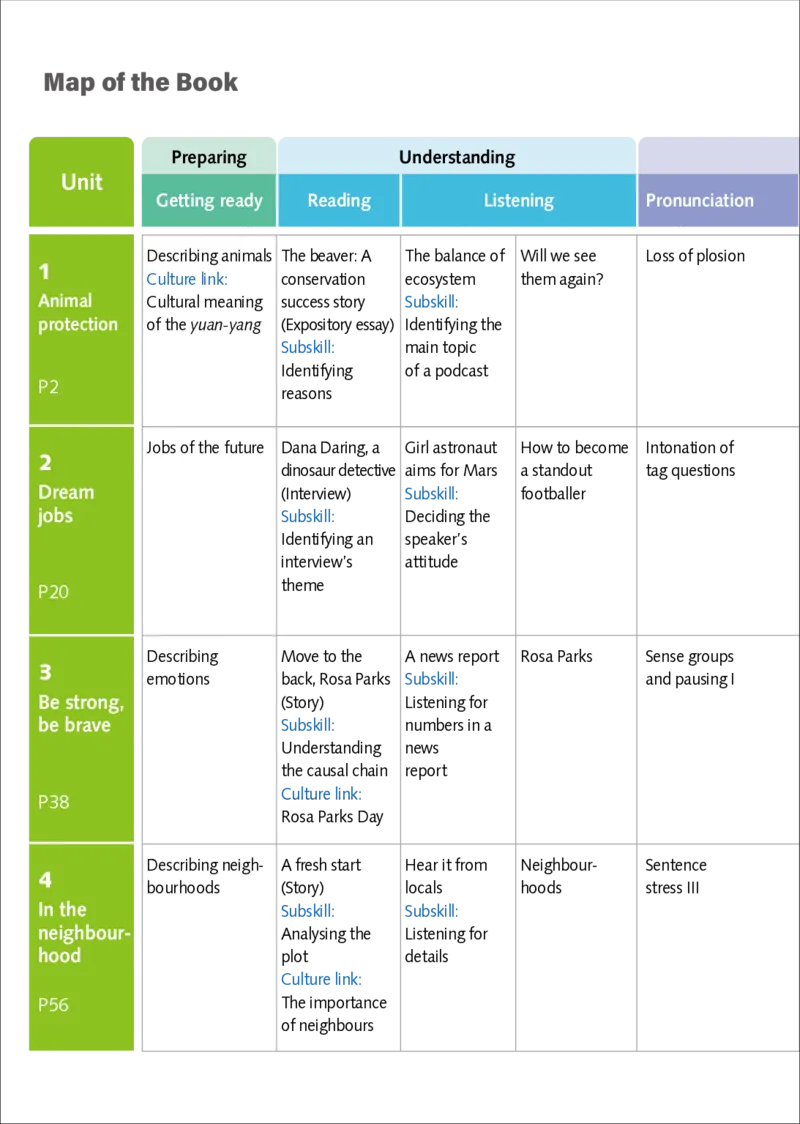
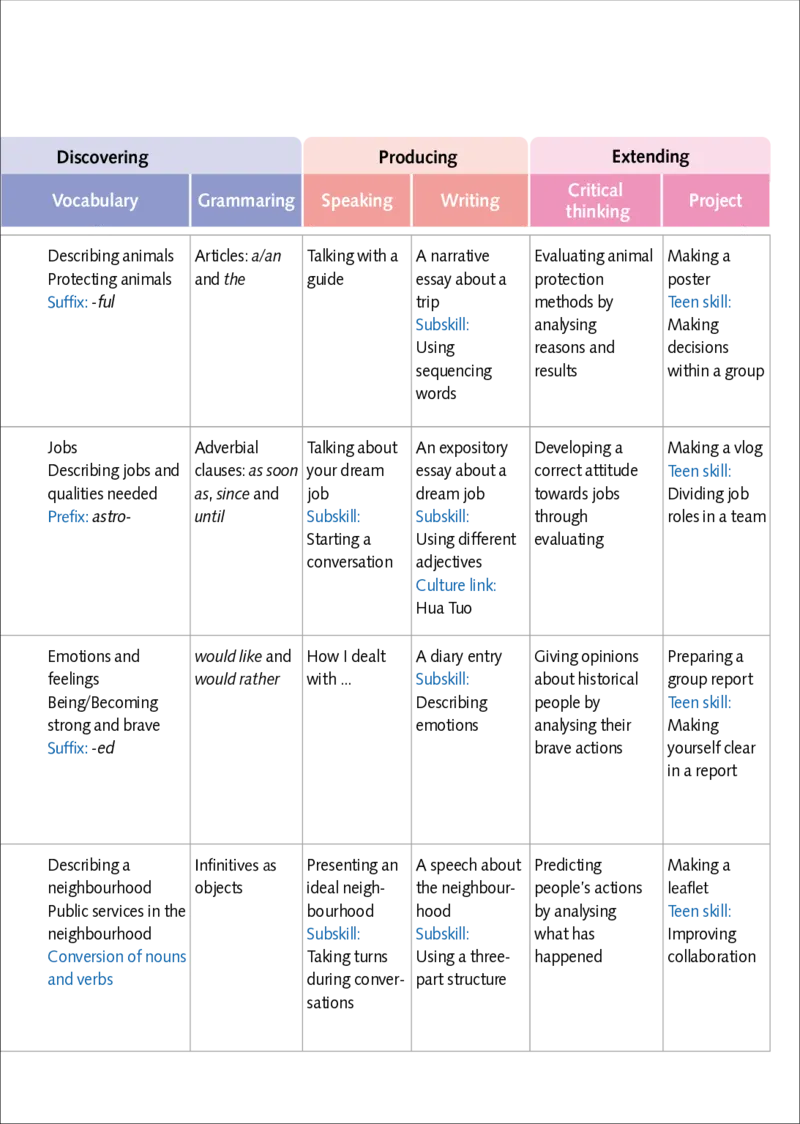
Preparing Understanding
Unit
Critical
Getting ready Reading Listening Pronunciation Vocabulary Grammaring Speaking Writing Project
thinking
S p e a k i n g
Describing animals The beaver: A The balance of Will we see Loss of plosion Describing animals Articles: a/an Talking with a A narrative Evaluating animal Making a
1
Culture link: conservation ecosystem them again? Protecting animals and the guide essay about a protection poster
Animal Cultural meaning success story Subskill: Suffix: -ful trip methods by Teen skill:
protection of the yuan-yang (Expository essay) Identifying the Subskill: analysing Making
Subskill: main topic Using reasons and decisions
Identifying of a podcast sequencing results within a group
P2
reasons words
Jobs of the future Dana Daring, a Girl astronaut How to become Intonation of Jobs Adverbial Talking about An expository Developing a Making a vlog
2
dinosaur detective aims for Mars a standout tag questions Describing jobs and clauses: as soon your dream essay about a correct attitude Teen skill:
Dream (Interview) Subskill: footballer qualities needed as, since and job dream job towards jobs Dividing job
jobs Subskill: Deciding the Prefix: astro- until Subskill: Subskill: through roles in a team
Identifying an speaker’s Starting a Using different evaluating
interview’s attitude conversation adjectives
theme Culture link:
P20
Hua Tuo
Describing Move to the A news report Rosa Parks Sense groups Emotions and would like and How I dealt A diary entry Giving opinions Preparing a
3
emotions back, Rosa Parks Subskill: and pausing I feelings would rather with ... Subskill: about historical group report
Be strong, (Story) Listening for Being/Becoming Describing people by Teen skill:
be brave Subskill: numbers in a strong and brave emotions analysing their Making
Understanding news Suffix: -ed brave actions yourself clear
the causal chain report in a report
Culture link:
P38
Rosa Parks Day
Describing neigh- A fresh start Hear it from Neighbour- Sentence Describing a Infinitives as Presenting an A speech about Predicting Making a
4
bourhoods (Story) locals hoods stress III neighbourhood objects ideal neigh- the neighbour- people’s actions leaflet
In the Subskill: Subskill: Public services in the bourhood hood by analysing Teen skill:
neighbour- Analysing the Listening for neighbourhood Subskill: Subskill: what has Improving
hood plot details Conversion of nouns Taking turns Using a three- happened collaboration
Culture link: and verbs during conver- part structure
P56 The importance sations
of neighboursDiscovering Producing Extending
Critical
Getting ready Reading Listening Pronunciation Vocabulary Grammaring Speaking Writing Project
thinking
S p e a k i n g
Describing animals The beaver: A The balance of Will we see Loss of plosion Describing animals Articles: a/an Talking with a A narrative Evaluating animal Making a
1
Culture link: conservation ecosystem them again? Protecting animals and the guide essay about a protection poster
Animal Cultural meaning success story Subskill: Suffix: -ful trip methods by Teen skill:
protection of the yuan-yang (Expository essay) Identifying the Subskill: analysing Making
Subskill: main topic Using reasons and decisions
Identifying of a podcast sequencing results within a group
P2
reasons words
Jobs of the future Dana Daring, a Girl astronaut How to become Intonation of Jobs Adverbial Talking about An expository Developing a Making a vlog
2
dinosaur detective aims for Mars a standout tag questions Describing jobs and clauses: as soon your dream essay about a correct attitude Teen skill:
Dream (Interview) Subskill: footballer qualities needed as, since and job dream job towards jobs Dividing job
jobs Subskill: Deciding the Prefix: astro- until Subskill: Subskill: through roles in a team
Identifying an speaker’s Starting a Using different evaluating
interview’s attitude conversation adjectives
theme Culture link:
P20
Hua Tuo
Describing Move to the A news report Rosa Parks Sense groups Emotions and would like and How I dealt A diary entry Giving opinions Preparing a
3
emotions back, Rosa Parks Subskill: and pausing I feelings would rather with ... Subskill: about historical group report
Be strong, (Story) Listening for Being/Becoming Describing people by Teen skill:
be brave Subskill: numbers in a strong and brave emotions analysing their Making
Understanding news Suffix: -ed brave actions yourself clear
the causal chain report in a report
Culture link:
P38
Rosa Parks Day
Describing neigh- A fresh start Hear it from Neighbour- Sentence Describing a Infinitives as Presenting an A speech about Predicting Making a
4
bourhoods (Story) locals hoods stress III neighbourhood objects ideal neigh- the neighbour- people’s actions leaflet
In the Subskill: Subskill: Public services in the bourhood hood by analysing Teen skill:
neighbour- Analysing the Listening for neighbourhood Subskill: Subskill: what has Improving
hood plot details Conversion of nouns Taking turns Using a three- happened collaboration
Culture link: and verbs during conver- part structure
P56 The importance sations
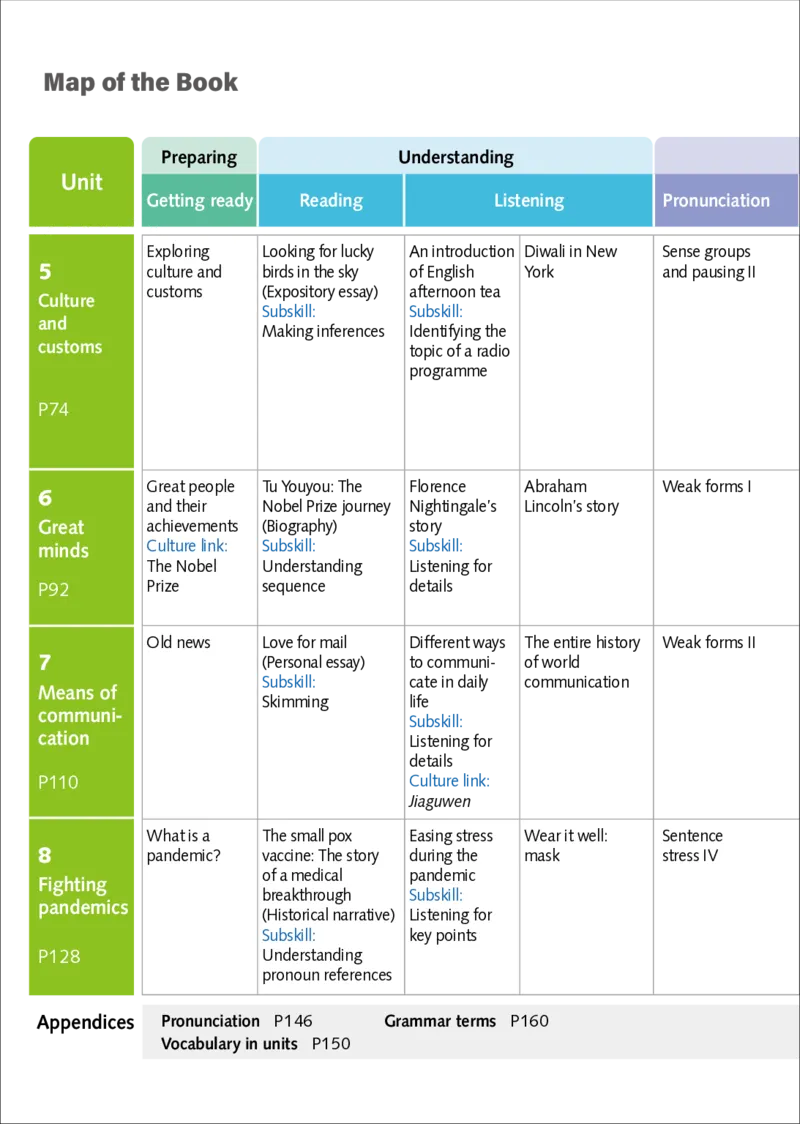
of neighboursMap of the Book
Preparing Understanding
Unit
Critical
Getting ready Reading Listening Pronunciation Vocabulary Grammaring Speaking Writing Project
thinking
S p e a k i n g
Exploring Looking for lucky An introduction Diwali in New Sense groups Culture and Object clauses Introducing An opinion essay Evaluating Giving an oral
5 culture and birds in the sky of English York and pausing II customs traditional about keeping cultural beliefs presentation
customs (Expository essay) afternoon tea Keeping Chinese the traditional by analysing Teen skill:
Culture
Subskill: Subskill: traditional culture and culture and customs the logic behind Doing a project
and
Making inferences Identifying the culture and customs alive them together
customs
topic of a radio customs alive Subskill:
programme Conversion of Expressing opinions
adjectives and by using different
P74 adverbs structures
Culture link:
Beijing Opera
Great people Tu Youyou: The Florence Abraham Weak forms I Great minds -ing as object Introducing a A summary of a Generalising Making a profile
6
and their Nobel Prize journey Nightingale’s Lincoln’s story Achievements great person given text from case Teen skill:
Great achievements (Biography) story and influence Subskill: Subskill: studies Surfing the
minds Culture link: Subskill: Subskill: Suffix: -ment Sharing Leaving out less internet
The Nobel Understanding Listening for interesting important effectively and
P92 Prize sequence details stories information safely
Old news Love for mail Different ways The entire history Weak forms II Means of Compound Introducing A personal email Explaining by Carrying out a
7 (Personal essay) to communi- of world communication indefinite your favourite about future means offering reasons questionnaire
Subskill: cate in daily communication Communica- pronouns: means of of communication and supporting survey
Means of
Skimming life tion some/any + communica- Subskill: details Teen skill:
communi-
Subskill: Prefix: com- nouns tion Writing an email in Preparing for an
cation
Listening for a proper format oral report
details together
P110 Culture link:
Jiaguwen
What is a The small pox Easing stress Wear it well: Sentence Describing Reflexive Giving health An expository essay Evaluating a Making a poster
8 pandemic? vaccine: The story during the mask stress IV pandemics pronouns: -self advice about a hero scientist by Teen skill:
of a medical pandemic Easing stress and -selves Subskill: Subskill: analysing how Researching
Fighting
breakthrough Subskill: during Supporting Explaining with he achieved information and
pandemics
(Historical narrative) Listening for pandemics ideas with specific examples something deciding what to
Subskill: key points Prefix: mis- details include
P128 Understanding Culture link:
pronoun references Xiangnang
Appendices Pronunciation P146 Grammar terms P160
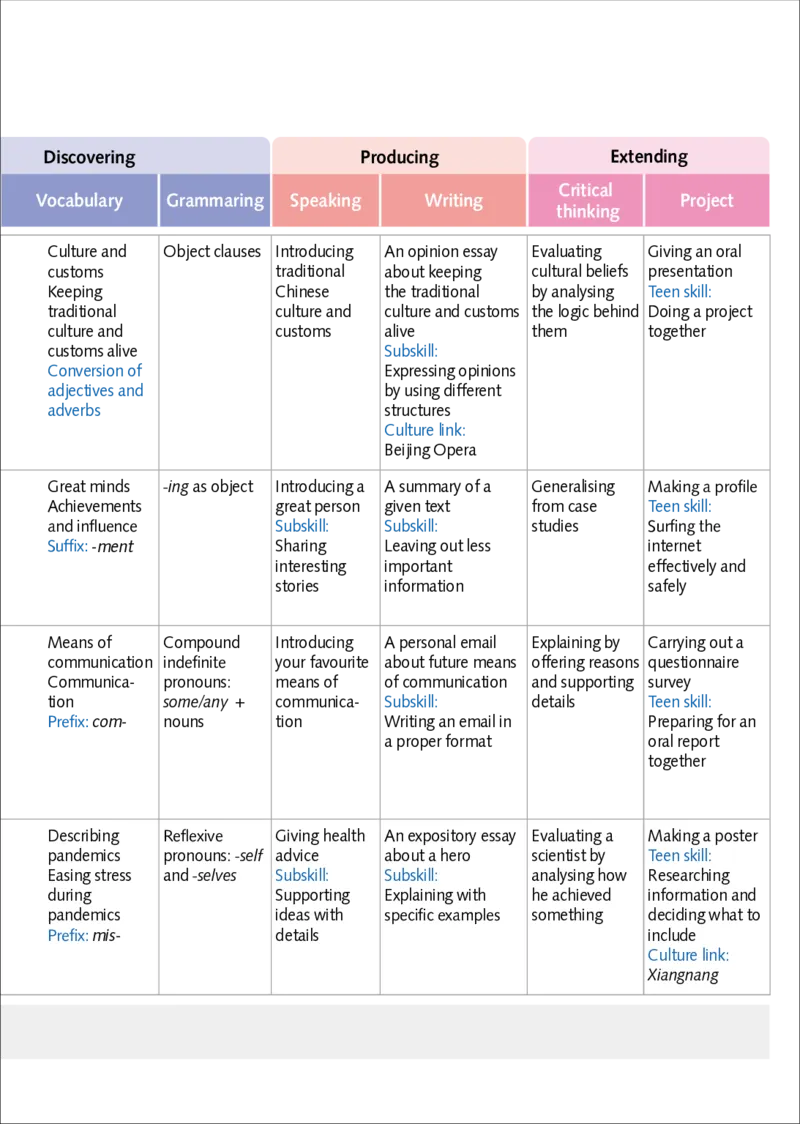
Vocabulary in units P150Discovering Producing Extending
Critical
Getting ready Reading Listening Pronunciation Vocabulary Grammaring Speaking Writing Project
thinking
Exploring Looking for lucky An introduction Diwali in New Sense groups Culture and Object clauses Introducing An opinion essay Evaluating Giving an oral
culture and birds in the sky of English York and pausing II customs traditional about keeping cultural beliefs presentation
customs (Expository essay) afternoon tea Keeping Chinese the traditional by analysing Teen skill:
Subskill: Subskill: traditional culture and culture and customs the logic behind Doing a project
Making inferences Identifying the culture and customs alive them together
topic of a radio customs alive Subskill:
programme Conversion of Expressing opinions
adjectives and by using different
adverbs structures
Culture link:
Beijing Opera
Great people Tu Youyou: The Florence Abraham Weak forms I Great minds -ing as object Introducing a A summary of a Generalising Making a profile
and their Nobel Prize journey Nightingale’s Lincoln’s story Achievements great person given text from case Teen skill:
achievements (Biography) story and influence Subskill: Subskill: studies Surfing the
Culture link: Subskill: Subskill: Suffix: -ment Sharing Leaving out less internet
The Nobel Understanding Listening for interesting important effectively and
Prize sequence details stories information safely
Old news Love for mail Different ways The entire history Weak forms II Means of Compound Introducing A personal email Explaining by Carrying out a
(Personal essay) to communi- of world communication indefinite your favourite about future means offering reasons questionnaire
Subskill: cate in daily communication Communica- pronouns: means of of communication and supporting survey
Skimming life tion some/any + communica- Subskill: details Teen skill:
Subskill: Prefix: com- nouns tion Writing an email in Preparing for an
Listening for a proper format oral report
details together
Culture link:
Jiaguwen
What is a The small pox Easing stress Wear it well: Sentence Describing Reflexive Giving health An expository essay Evaluating a Making a poster
pandemic? vaccine: The story during the mask stress IV pandemics pronouns: -self advice about a hero scientist by Teen skill:
of a medical pandemic Easing stress and -selves Subskill: Subskill: analysing how Researching
breakthrough Subskill: during Supporting Explaining with he achieved information and
(Historical narrative) Listening for pandemics ideas with specific examples something deciding what to
Subskill: key points Prefix: mis- details include
Understanding Culture link:
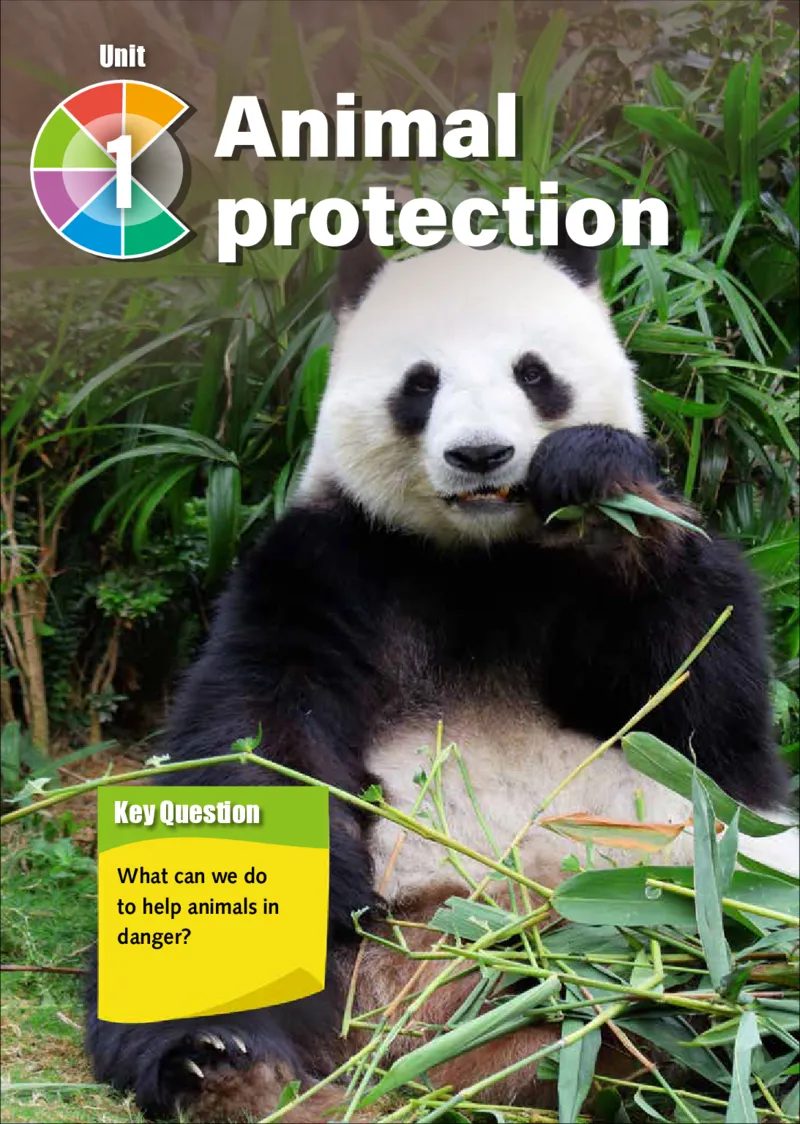
pronoun references XiangnangUnit
A n i m a l
1
p r o t e c t i o n
Key Question
What can we do
to help animals in
danger?A n i m a l
p r o t e c t i o n
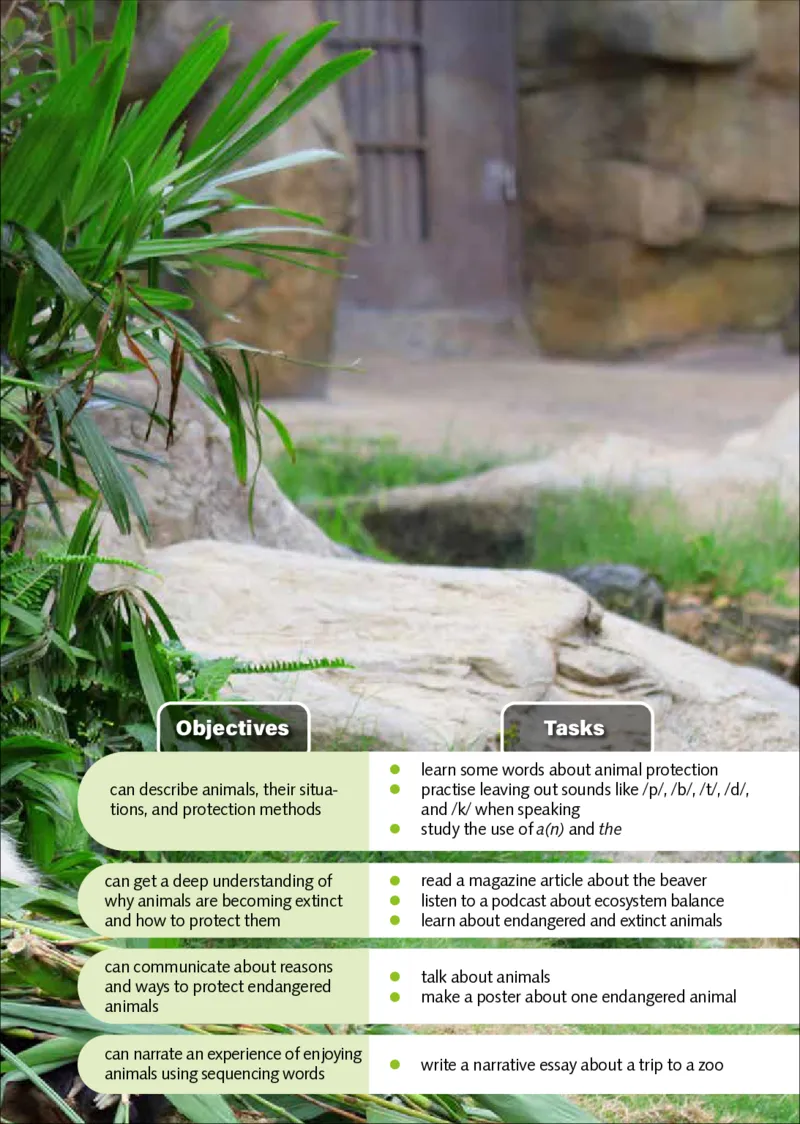
Objectives Tasks
learn some words about animal protection
can describe animals, their situa- practise leaving out sounds like /p/, /b/, /t/, /d/,
tions, and protection methods and /k/ when speaking
study the use of a(n) and the
can get a deep understanding of read a magazine article about the beaver
why animals are becoming extinct listen to a podcast about ecosystem balance
and how to protect them learn about endangered and extinct animals
can communicate about reasons
talk about animals
and ways to protect endangered
make a poster about one endangered animal
animals
can narrate an experience of enjoying
write a narrative essay about a trip to a zoo
animals using sequencing wordsAA A
GGeettttiinngg rreeaaddyy
Honeybee
Habitat: gardens and the countryside
Description: The honeybee is an insect. It has got a
wing
golden yellow body with brown bands. It has six legs
and two pairs of wings. It makes honey and is very
band
helpful to plants.
bill
Dodo
Habitat: an island
Description: This was a large, flightless bird that once
lived on one island in the Indian Ocean. Its wings were
small. It had blue-grey feathers, a large head, and a 23-cm
bill. It weighed about 23 kilogrammes.
sharp teeth feather
Beaver
paddle-like tail
Habitat: freshwater ecosystems
Description: Beavers are large animals that can
weigh up to 70 pounds. They have a thick and furry
brown coat, a big paddle-like tail, and hand-like feet
that help them swim. Their front teeth are sharp and
strong. They like to build their homes in areas with a
mix of trees and open water.
hand-like feet
Describing animals
A1 Read the mini-texts and complete the A2 Complete the sentence and answer
table with animal names. An example the question.
is given.
1 Bats are but are
Class Animal
always mistaken as .
bird
2 Can you think of any other
mammal beaver
insect animals that are very likely to be
reptile put in a wrong class?
4 Unit 1A AA
Getting ready
2 . Like most ducks, males (or
Snake boys) are more 3 than females
(or girls). Males are many colours: red,
Habitat: deserts, forests, grasslands,
brown, orange, green, etc. Females usually
and waterways
have grey and brown 4 . They
Description: Snakes are legless
have the ability to 5 eggs.
reptiles found worldwide, in different
The sea lion is a 6 that lives
environments. They have scales, and
in different coastal areas around the world.
some are dangerous. They eat insects,
It has 7 feet and a paddle-like
mice, birds, fish, etc.
8 . Both are 9 when it
swims. It has about 34 to 38 10 .
scale
Mandarin ducks Sea lion
A3 Listen to the description of an
animal and fill in the blanks.
Culture link
1 Name of the animal:
Yuan-yang is the Chinese name for the
mandarin duck, where yuan refers to the
2 Length: (metres)
beautiful male bird and yang the female
3 Weight: (tons) one. In China the pair of birds was once
the symbol of the love between a pair of
4 Habitat:
brothers, friends, and a couple.
Suffix: -ful
A5 Work in pairs. Student A, think of
We can add the suffix -ful, meaning
“full of”, to nouns to form adjectives, an animal. Student B, ask yes-no
e.g. colourful, beautiful, and helpful.
questions to guess the animal.
A4 Complete the passage with
Is it a mammal? No, it isn’t.
the words in the box.
colourful helpful feathers Is it a bird? Yes, it is.
hand-like tail (x2) teeth
Is it colourful? Yes and no.
mammal wings lay
I know—a Yes!
The yuan-yang or mandarin duck is a
mandarin duck!
beautiful water bird. It has a small head,
two strong 1 , and a short
Animal protection 5BB B
RReeaaddiinngg aanndd ccrriittiiccaall tthhiinnkkiinngg
Some scientists say that one species dies out every
seven minutes. What can we do to stop this from
happening? Let’s meet a species that was once at
risk of extinction and find it out.
TThhee bbeeaavveerr::
A conservation
success story
Beavers are large animals. They etc. This is now a well-known fact.
can weigh up to 70 pounds. Most of
In recent years, laws were made to
them live in North America and Europe.
protect beavers in many countries. For
Beavers are usually found near water
25 example, in the United States, beavers
5 in the wild. Their hand-like front feet
are protected by the Endangered
make them wonderful swimmers.
Species Act. In the early 2000s, beavers
In the past, humans hunted beavers began building homes in Alhambra
for their fur and meat, and beaver Creek in Martinez, California, and
trading was a way to make money. As 30 people were excited about their return.
10 more and more people liked beaver fur, It was a great success.
hunting them became more and more
In short, beavers are important for
widespread. Humans also destroyed
nature. Although they were hunted and
beavers’ homes for reasons like building
their habitats were destroyed in the
roads or protecting buildings.
35 past, efforts have been made to protect
15 The beaver population fell quickly as them and their habitats. These efforts
a result of these human activities. People have led to good results. It is important
were not aware of how important beavers to continue educating people on the
were for the environment. Beavers are benefits of beavers and to protect this
called “ecosystem engineers”. They help 40 species and the environment.
20 ecosystems by storing water, improving
water quality, creating wildlife habitats,
66 UUnniitt 11B BB
Reading and critical thinking
Subskill Identifying reasons
Comprehension Identifying reasons means finding out why an
action happens. The reason may come before
or after it. To identify reasons, we should pay
B1 Match headings a–e with paragraphs attention to words like because (of), for (reasons
like), as, as a result (of), verb infinitives.
1–5 in the article.
( ) a What can we do to continue our protection of beavers?
( ) b What did people do to beavers in the past?
( ) c What are beavers like and where are they found?
( ) d Why are beavers important for the environment?
( ) e How do people protect beavers in recent years?
B2 Answer the questions.
1 Where do beavers live?
2 What facts in the text show that beavers are good swimmers?
3 Why did the beaver population fall in a short time?
4 Why did Americans create the Endangered Species Act?
5 Why does the writer say that the conservation of beavers is a success story?
6 What is the purpose of writing this article?
B3 Complete the outline of the text and then retell the text based on the outline.
Appearance of beavers
Introduction • 1 ______________ animals
(Paragraph 1) • weigh up to 2 ____________
• 3 ______________ front feet
What humans did in the past What was the effect
• 4 ______________________ • 5 ___________
How the situation
• destroyed beavers’ homes _____________
of beavers changed
(Paragraphs 2–4)
What humans did in recent years What was the effect
• 6 ______________________ • beavers returned
Conclusion • It is important to 7 ____________________ and
(Paragraph 5) to protect this species and the environment.
Animal protection 7BB B
RReeaaddiinngg aanndd ccrriittiiccaall tthhiinnkkiinngg
Word work
B4 Write the words from the text. Use the meanings and the first letters to help you.
1 c avoiding loss, waste, or harm
2 h to try to catch or kill an animal for food, sport, etc.
3 p to keep someone or something safe from injury, harm, or loss
4 p all the people or animals of a kind or group who live in one
country, area, or place
5 e all the living and nonliving things in an area and their interactions
6 w animals and plants that grow independently of people, usually
in natural conditions
7 h living places or environment
B5 Complete the summary of the text with the correct forms of the words you wrote
in B4.
In the past, humans were not aware of the importance of beavers.
They were 1 a lot for their fur and meat. Their 2 were
destroyed by humans for different reasons too. So the beaver 3 fell
quickly. However, in recent years humans have realised beavers are important
to the 4 , providing benefits to humans. 5 efforts
have been made to 6 them. The efforts have been successful
and beavers have returned. We should continue educating people on the
importance of protecting 7 and their habitats.
B6 Complete the passage about endangered animals with the correct forms of the
words in the box.
in the wild die out at risk of human activity lead to
Endangered animals are those that are in danger of disappearing forever.
They are 1 for different reasons. Many of these animals live
2 , where they face many serious troubles such as 3 ,
climate change, and habitat loss. It's necessary to protect these animals as they
are 4 extinction, which would 5 bad results for the
ecosystem.
8 Unit 1B BB
Reading and critical thinking
Critical thinking
1 Understand. Find examples of human activities in the text that
led to the fall in beaver numbers.
e.g. hunting
2 Analyse. Explain the reason(s) and result(s) of each human
activity you’ve found. An example is given.
EXAMPLE
Human activity: hunting
Reason(s) for this activity: People hunted beavers for their meat
and fur. Beaver trading was a way to make money. Humans
were not aware of the importance of beavers.
Result(s) of this activity: The beaver population fell quickly.
3 Evaluate. What efforts to protect
beavers are mentioned in this text?
Do they bring good results?
What else can we do to protect
beavers and their habitats?
Animal protection 99CC
GGrraammmmaarriinngg
Articles: a/an and the
C1 Study the blue parts and answer the questions.
1 The honeybee is an insect. 2 It has got a golden yellow body.
3 It makes honey. 4 Beavers are large animals.
5 The beaver population fell quickly as a result of these human activities.
6 It is important to continue educating people on the benefits of beavers.
Q1 Which article do we use before insect, a or an?
Q2 What types of nouns can go without articles?
Grammar highlights
Indefinite article: a/an
Definite article: the
1. We use a/an before a singular noun.
1. We can use the before any type of nouns.
2. We usually use an before a/e/i/o/u.
2. We use the when it is clear which person(s)
3. We use a/an to talk about a person or
or thing(s) we mean.
thing for the first time.
C2 Complete the table with sentences from A and B.
Used the first time we introduce something or
someone.
e.g. 1
a/an+ singular noun Used as an example of a class of animals or things.
e.g. 2
Used as one.
e.g. 3
Used for a class of animals or things.
+ singular noun
e.g. 4
Used when we mention the object again, or when it
+ singular noun
the
is unique (i.e., one-of-a-kind), or when it is clear to us.
+ plural noun
e.g. 5
+ uncountable
6
noun
7
+ plural noun Used for a class of animals or things.
Ø + uncountable e.g. 8
noun 9
10 Unit 1CCC
C3 Circle the correct answer.
1 The eagle is a / an / / unusual bird. It’s at the top of the food chain.
2 The / / / An butterfly is a common insect.
3 The hen isn’t a / the / / mammal. It is a / the / / bird.
4 The / A / / emperor penguins mainly live in the / / Antarctic.
5 I saw a / an / the giraffe in the zoo. The / A / / giraffe was large. It was an / the
African giraffe.
C4 Complete the sentences with a, an, Dolphins
the, or /.
The largest dolphin can grow to
be over 30 feet long. 7
Blue Whales
smallest is just five feet long.
The blue whale is 1 largest Most dolphins live in 8
ocean. They are 9
animal in 2 world.
beautiful swimmers.
Blue whales can reach 3
They can reach speeds of more
length of 98ft (29.9m), longer
than 4 two school buses
than 18 miles 10 hour.
11 dolphins mainly eat
back to back!
fish.
They are 5 loudest animals
on Earth and are even louder than
6 big airplane.
C5 Complete the passage about a place with a, an, the, or /.
From zoos, to wildlife parks, to city farms, there are many places for
1 animal-lovers to visit in the UK.
One of 2 most exciting places is “Crocodiles of the World” near
Oxford. Here, you can see 150 crocodiles and other reptiles. It was 3
idea of Shaun Foggelt, or “The Croc Man”. Shaun had 4 collection of
crocodiles at his home, but there wasn’t space for all of them. He didn’t want to
give 5 crocodiles to other people so he decided to start 6
zoo.
Now, Shaun helps to protect 7 crocodiles and teach other people
about them. 8 visitors can look at them and help to feed them.
(You must be careful, of course!) You can also donate 9 money to
10 organisation.
Animal protection 11D
Listening and speaking
The balance of ecosystem
D1 Tick the effect(s) of the extinction of one species on humans.
no effect on us fewer animals in the zoo
broken food chain no colour in the world
no pets at home imbalance between humans and ecosystems
Identifying the main topic
D2 Listen and choose. Subskill of a podcast
The main topic of the podcast is how to . A podcast may cover several topics.
We can usually—but not always—
a keep the balance of the ecosystem
find the topics at the beginning of
b reuse plastic bottles a podcast. However, a podcast may
focus on only one topic. This is the
c give money to help endangered animals
main topic of the podcast.
D3 Listen again and read the statements. Write T (true) or F (false), and correct
the false ones.
1 Scientists are not sure what will happen if one species disappears.
2 The food chain breaks if one species disappears.
3 Kids may help raise animals in the zoo by giving money.
4 Only adults can do something for the Earth and its creatures.
5 The podcast talks about four ways to protect the ecosystem.
D4 Listen for a third time and complete the sentences.
1 We can help protect endangered species and their this way.
2 We need to for the animals to protect them.
3 We hope to make a big by taking the steps suggested in the podcast.
D5 Discuss the question in pairs.
What can we do to keep the balance of ecosystems?
Will we see them again?
D6 Answer the questions.
Do you know any endangered or
extinct animals? What are they?
D7 Listen and answer the questions.
1 What is mainly talked about?
2 Number the pictures according to the
order in which they are mentioned.
12 Unit 1D
D8 Listen again and complete the table.
Animals Cause(s) Effect(s)
The tiger has long been
Tiger numbers have by
for its nicely
Tigers about percent and some
patterned and
species are already .
also because of .
Short-faced Due to poaching and Short-faced bears about
bears ... 11 thousand years ago ...
D9 Discuss the question in pairs.
What other reasons for the extinction of dinosaurs can you think of?
Talking with a guide
D10 Role-play a conversation between a tour guide and a visitor.
You are visiting the Great National Zoo. You are
interested in many kinds of animals, so you ask
Pronunciation
Loss of plosion
the guide to show you around. ( see p146 )
Example:
Visitor: Wow! So many animals. Is it possible for you to show me around?
Guide: I’ll be glad to.
Visitor: Can I have a look at the tigers first?
Guide: Certainly, they are over there.
Visitor: Thanks! Would you please tell me something about the tigers?
Guide: ... And next to the tigers are sea turtles.
Visitor: Oh, why is there only one sea turtle in such a big area?
Guide: Because ...
Visitor: So, what can we do to protect the endangered sea animals like the sea
turtle?
...
Animal protection 13E
Writing
An amazing trip
Subskill Using sequencing words
Write a narrative essay about a trip.
We use sequencing words or phrases to
describe the order of events, e.g. first of all,
next, finally, to make it easier for the reader
to understand the timeline of actions.
11 Study a model. Complete the table with the information from the essay.
An amazing trip
We went on a school trip to an Ocean Park last week. We had a good time
there.
First of all, we came to see several sea animals and learned about their
habitats. Then we saw some sea turtles. After that, we visited the Shark Bay
to enjoy colourful fish and sharks. Next, we got to the Undersea Tunnel and
walked under the water! There were many species like sea
horses and sea stars. Finally, we visited the Deep Sea
Hall to see the angelfish.
This trip amazed us with the wonders of the
underwater world. It encouraged us to protect sea
animals.
Events mentioned Sequencing words used
coming to see several sea animals and
first of all
learning about sea animals’ habitats
then
after that
getting to the Undersea Tunnel
visiting the Deep Sea Hall
1144 UUnniitt 11E
22 Think. Choose a place that you visited. Make notes about what you did or
the things you saw in time order.
Things I did/saw Sequencing words I can use
33 Write. Write your essay. Cover the things you wrote in Step 2, using the
sequencing words. Pay attention to the articles you use.
44 Check. Read your own writing. Answer the questions.
1 Did you use a/an and the correctly?
2 Did you use sequencing words to introduce the places you visited or the
things you saw?
e.g. First of all, ... / Then ...
55 PPeeeerr rreevviieeww.. Exchange your writing with another student. Answer the
questions.
1 How many events or things does the writer include in the essay?
2 Does the writer use articles and sequencing words correctly?
AAnniimmaall pprrootteeccttiioonn 1155FF
PPrroojjeecctt
What can we do to help Task: Make a poster about one once-
animals in danger? endangered species. A model is given.
Giant Panda
Habitat: remote, mountainous
bamboo forests in central China
Appearance: black and white
Food: mainly bamboo and
sometimes other plants, fish, birds,
or small mammals as well
Population (in the wild in China)
Giant pandas were
change:
once endangered for
Year Panda population
many reasons: habitat
1988 1,114
reduction, a shortage
2003 1,596
of food, low birth
2024 near 1,900
rate, low survival rate
for baby pandas, and
hunting. But the main reason was disappearing habitat.
To help them, China has made laws to punish
hunters and smugglers, and tried hard to protect their
habitat and breed them in shelters. And the population
has grown. On 5 September 2016 giant pandas were
removed from the list of endangered species.
1166 UUnniitt 11FF
Study the poster to find out what information it includes.
1
Study the poster again to find out what makes this poster clear and
2
attractive.
Work in pairs and choose a class of animals to research. Read the
3
tips in the TEEN SKILL box and practise saying
the useful expressions with your classmate.
TEEN SKILL
Work alone. Research the class of
4 Making decisions within a group
animals you chose and make notes.
Tips
Include the information in Step 1.
• Listen to others and ask questions.
• Make decisions together.
Useful expressions
Work in pairs. Exchange your notes
5 • That’s a good idea.
and decide what information you’ll • Yes, that sounds good!
• What do you think, (Li Hua)?
include on your poster.
• Why do you think (this mammal)
is important?
• Why don’t we choose (the shark)?
Create your poster and prepare to • Do we all agree?
6
• So we’ve decided that ...
talk about it.
Orally present your poster to the class. Remember to organise your
7
presentation into clear parts, and plan a phrase to introduce each part.
e.g. Now let’s look at its population.
Peer review. Listen to the presentations of your classmates and answer the
8
questions.
1 Is the presentation clear and interesting?
2 Will the ideas lead us to success in helping the animal?
AAnniimmaall pprrootteeccttiioonn 1177SSeellff--aasssseessssmmeenntt
How well I can do these
A. identify the reasons, the main topic, and the
cause-effect relationship in different texts
B. communicate about reasons and ways about
animal protection using articles a(n) and the
correctly
C. write a narrative essay using sequencing words
D. understand the cultural meaning of one animal
in China
E. evaluate something by analysing its advantages
and disadvantages
F. gather useful information through listening to
others and researching online
1188 UUnniitt 11A o A or d r dd c d co m o o m ol o l o t r ht er h e i ! n i !W n g W gs h s h h a h a a t a t v o ve ot e ht y he yo e o r u r u u u l s el s e e a e a f r uf rn u n l e l e w d w d? o ? o r drdss
Key words to use AAdddd t htheemm t oto t hthee l ilsiststs..
Describing animals
bamboo band bat countryside
dangerous desert golden grey
habitat honey insect island
large lay eggs make honey mountainous forest
ocean pound population shark
species tooth weight whale
wild wing
Protecting animals
at risk of balance birth die out
environment hunt in danger protect
punish survive
Cool things to know
dodo The bird has disappeared from
the Earth forever.
AAnniimmaall pprrootteeccttiioonn 1199Unit
Dr e a m
2
j o b s
Key Question
What is your dream
job and what will
you do to land your
dream job?Dr e a m
j o b s
Objectives Tasks
learn some words about jobs
can describe jobs and what people
practise using intonations in tag questions
do in different jobs
learn to use as soon as, until, and since
read an article about a dinosaur detective
can get a basic understanding of
listen to a monologue about a girl’s dream job
different jobs and how to work for
learn about how a footballer works for his
one’s dream job
dream job
can communicate about dream jobs talk about dream jobs
and how to land them make a vlog that introduces a dream job
can describe one’s dream job using
write about one’s dream job
different adjectivesAA A
GGeettttiinngg rreeaaddyy
VR Experience Designer Yes! No, thanks!
a
A VR experience designer designs and develops VR
experiences for games, education, art and so on. People can
experience different realities without stepping out of their homes
by using these products. It sounds really exciting, doesn’t it?
To be a VR experience designer, you should be creative enough
to come up with different ideas and understand people’s needs,
feelings, and interests.
Bioprinting Expert Yes! No, thanks!
b
A bioprinting expert uses 3D printing technology to create
living body parts for medical and research purposes. Not only
patients but also scientists in the medical field can get a lot from
this work. This job is challenging but is really meaningful for
human beings. You need to have a lot of knowledge about the
human body and be skilled in bioprinting if you want to excel in
this job.
Jobs of the future
A1 Read the mini-texts about three jobs in the future, and tell if you want to do
them by ticking “Yes!” or “No, thanks!” above each mini-text.
A2 Complete the table and answer the questions.
Job What people do What quality/qualities is/are needed
design and develop VR
experiences
Bioprinting
Expert
Time organised, careful, and good at doing
Manager several tasks at the same time
22 Unit 2A AA
Getting ready
A4 Complete the passage with the words
in the box.
experience scientist technology
challenging art education
c
At the present time, many students have
Time Manager
dream jobs such as becoming an engineer,
Yes! No, thanks!
a game designer, or a computer 1 .
A time manager has the task to
To do these jobs, students must learn
help organisations or people focus
different subject skills, and many schools
on important things, make their
work easier, and get rid of things around the world carry out the 2
that slow them down. A time course STEAM to help them. “S” stands
manager needs to be organised,
for science; “T” means 3 ; “E”
careful, and good at doing several
is engineering; “A” refers to 4 ;
tasks at the same time. In short,
they play an important role in “M” is maths. The purpose of this kind of
improving how an organisation or a
mixed course is to provide career-focused
person uses time. Sounds amazing,
5 and hands-on 6 for
doesn’t it?
future jobs.
A5 Describe and guess. Student
A, describe a job. Student B, ask
questions to guess the job.
What is your dream job?
This job is very tiring, but it can help
What do people do in this job?
people a lot.
What quality is / qualities are needed to
do this job? Is this a teaching job?
No, these are the people who work
A3 Listen and write T (true) or F (false).
in hospitals.
1 Digital artists use paint brushes to
Is this job “doctor”?
create artwork.
2 Xiao Feng enjoys improving her work
No, they work together with doctors.
until it matches the design in her mind.
3 Xiao Feng believes that being talented Nurse!
and creative in art is important for a
Yes!
digital artist.
Dream jobs 23BB B
RReeaaddiinngg aanndd ccrriittiiccaall tthhiinnkkiinngg
Are you interested in dinosaurs? Do you know
how dinosaur bones come into being? Let’s
meet Dana Daring, a dinosaur detective!
DDaannaa DDaarriinngg,,
aa ddiinnoossaauurr ddeetteeccttiivvee
metal frame
Interviewer: Hi, could you please don’t stop until every bone is clean. As
introduce yourself and tell us what you 25 we work, we study the bones and try to
do? decide how big the dinosaur was, how
it moved, and what it ate. As soon as
Dana Daring: My name is Dana Daring,
we have a better understanding of the
5 and I work in the museum laboratory
bones, we fit them together in a complete
with bones. To be more exact, I work
30 skeleton. To support the bones, we use
with dinosaur bones.
a metal frame. If any bones are missing,
Interviewer: That sounds interesting. we make new ones with materials like
Can you tell us a little more about your plastic.
10 job?
Interviewer: I can see you really enjoy
Dana Daring: Sure! My job begins as 35 your job a lot. For you, there’s no better
soon as fossilised dinosaur bones arrive job than this, is there?
at the museum. These bones are usually
Dana Daring: There’s none. It’s
found by scientists in the field, and it's
interesting, and it gives a sense of
15 up to my team and me to work out how
achievement! In fact, studying dinosaurs
to piece the bones together.
40 has been my dream job since I was little.
Interviewer: That sounds like a lot Not only can I help people learn more
of work. Can you walk us through the about dinosaurs, but I also enjoy my own
process? favourite creatures while working!
20 Dana Daring: Of course! The first step Interviewer: Thanks so much for
is to dig the bones out of the rocks and 45 sharing with us, Dana!
clean them off. We use special tools and
Dana Daring: Thank you for having
chemicals to remove the rocks without
me!
causing any damage to the bones. We
2244 UUnniitt 22B BB
Reading and critical thinking
Subskill Identifying an interview’s theme
Comprehension
In an interview, speakers, especially
the interviewer, often change topics
B1 Answer the questions. to keep the conversation going. Each
topic discussed supports and explains
1 Arrange the topics in order
the interview’s theme. We can identify
according to the interview. the interview’s theme by analysing and
a. specific process of the work summarising what is discussed about
these topics.
b. detailed description of the job
c. conclusion of the interview by showing thanks to Dana
d. feelings towards the job
e. basic information about the interviewee and her job
1 2 3 4 5
2 What’s the theme of this interview?
B2 Complete the interview sheet for the interviewer.
Interview
Sheet Name of the interviewee:
Job:
Workplace:
Workmates:
Work process:
Work tools:
Notes about other important things:
Feelings towards the job:
B3 Complete the passage with the questions from the text.
This interview starts with a simple greeting and then a short self-
introduction of Dana Daring.
To help the interview run smoothly, the interviewer asks the following
questions to change topics:
1
2
3
At the end of the interview, the interviewer thanks Dana for taking the
interview.
Dream jobs 25BB
RReeaaddiinngg aanndd ccrriittiiccaall tthhiinnkkiinngg
Word work
B4 Complete the sentences. Use the meanings in brackets to help you.
1 Dana Daring is a . (a person whose job is to
discover information about dinosaurs)
2 Dana’s job is too big for one person, so she has a to work
with her. (a number of people working together)
3 Dana and her workmates fit the bones together to make a
skeleton. (with all the parts)
4 To the bones , Dana and her workmates use a metal frame.
(hold ... in position)
5 Dana Daring has a of achievement when studying the
dinosaurs. (feeling)
6 Dana feels happy as she can help others learn about her
creatures. (most enjoyable)
B5 Complete the paragraph about dream jobs with the correct forms of the words
in the box.
be proud of have an understanding of as soon as
sense of achievement it’s up to
Many people want to have a dream job. 1 each person
to decide what their dream job is based on their interests. You also need
to 2 the company you are going to work for and the role you
will play. 3 you start working in your dream job, you will feel
4 because you are doing something that you truly love. A
dream job gives you a purpose and a reason to wake up each day with
excitement. It's not just about making money; but it's about feeling satisfied
and happy with what you do. I hope you can find a dream job that you
5 one day!
26 Unit 2BB
Critical thinking
1 Recall. Describe what Dana does in her job.
EXAMPLE
The first step is to dig the bones out of the rocks and clean them
off ...
2 Analyse. Find the sentences in this interview that show Dana’s
love for this job.
EXAMPLE
Dana Daring: In fact, studying dinosaurs has been my dream job
since I was little. Not only can I help people learn more about
dinosaurs, but I also enjoy my own favourite creatures while
working!
3 Evaluate. What do you think of Dana’s job? Would you work as
a dinosaur detective too? Why or why not?
EXAMPLE
I think her job is rather boring, and I won't work as a dinosaur
detective in the future. I am not interested in exploring dinosaurs,
and I don't like to spend days in labs, either.
Dream jobs 2277CC
GGrraammmmaarriinngg
Adverbial clauses: as soon as, since and until
C1 Study the blue parts and underline the event that happens first.
1 I keep improving my work until it matches the design I want.
2 My job begins as soon as fossilised dinosaur bones arrive at the museum.
3 We don't stop until every bone is clean.
4 Studying dinosaurs has been my dream job since I was little.
Grammar highlights
1. We use as soon as, until, since to introduce time clauses.
as soon as = quickly after the time that
until = up to the time that
since = from the time in the past when
2. We use not ... until when the verb in the main clause talks about a short action.
For example:
I won’t give up until I become a policewoman.
3. When the time clause begins with since, we use the present perfect in the main
clause. For example:
I’ve worked hard since I started, aiming to reach my dreams one step at a time.
4. We use the present tense to talk about the future in time clauses beginning with
as soon as or until. For example:
I want to do a job that I’ve always dreamed about and really love as soon as I
graduate from college.
I’ll study hard until I’m ready to go after my dream job!
C2 Combine the sentences using the words in brackets. You may need to change
the order of the sentence halves.
1 My mum lands her dream job. We’ll celebrate her success. (as soon as)
2 They worked. All the other workmates went home. (until)
3 I have always had this dream. I was a little girl. (since)
28 Unit 2CCC
C3 Complete the speech of a boy with as soon as, since, and until.
My dream job is to become a professional basketball player
when I grow up. I know that it’s not going to be easy, but I'm
willing to work hard 1 I achieve my goal. To become a
professional basketball player, every day I practise shooting the
ball and running 2 I get up in the morning. I also watch
videos of basketball games and analyse the moves of different
players. I have watched almost a hundred games 3 last
year. I believe I can make my dream come true.
C4 Complete the conversation with as soon as, since, in no time, once, and until.
Chen Hua: Hey, have you finished your history project?
Li Lin: Not yet. I've been working on it 1 yesterday, but
there's still a lot left to do. It isn't that easy, is it?
Chen Hua: Don't worry, I can help you. 2 I finish my maths
homework, I'll come over to your place and we can work on it
together.
Li Lin: That would be great! Thanks for offering your help. How soon will
you come?
Chen Hua: Well, I have a few more problems to solve, so it might take me
around 30 minutes. But I'll be there 3 I'm done.
Li Lin: Great! I'll keep working on the research part 4 you arrive.
We need to get it done tomorrow, so we can't waste any time.
Chen Hua: Of course! We'll work on it 5 it's perfect. 6
we're done, we can take a break and have some snacks.
Li Lin: Sounds like a plan. Let's try as hard as we can and make sure it's the
best history project ever!
Chen Hua: Sure! With both of us working
together, we'll finish it 7 .
I can't wait to see the end result.
Dream jobs 29D
Listening and speaking
Prefix: astro-
Girl astronaut aims for Mars
We often add astro- to the
D1 Answer the questions. beginning of some words to
create new words related to
1 Look at the pictures. What do you think of these jobs?
the study of stars, space, or
the universe.
2 If one wants to be an astronaut, what does
one need to do?
D2 Listen and choose.
The monologue is about how a teenage girl .
a makes friends on her blog
b fights for her dream job Subskill Deciding the speaker’s attitude
c learns from her coach
The speaker’s tones can be positive,
d makes her own website negative, formal, informal, cheerful,
energetic, friendly, etc. We can
decide a speaker’s attitude by paying
D3 Listen again and answer the questions.
attention to his/her tone. For example,
1 Which word(s) CANNOT be used to a confident tone may show a sense of
confidence and certainty.
describe the speaker's attitude towards
becoming an astronaut?
a confident b excited c determined d cold
2 What words can be used to describe the speaker’s tone, which supports your
choice in question 1?
a energetic and excited b flat and calm
c doubtful and nervous d cold and tired
3 What has Abby done to land her dream job?
D4 Discuss the questions in pairs.
What kind of girl is Abby? Do you think her dream will come true one day?
How to become a standout footballer
D5 Answer the question.
Do you know any footballers and the stories behind their success?
30 Unit 2D
D6 Listen to Part 1 and answer the questions.
1 What do you think Spencer will talk about?
2 Why did Spencer make the vlog? Explain why you think so.
D7 Listen to Part 2 and complete the table.
Problem Solution Result
When Spencer was He found the His mind power
thirteen or fourteen years courage to admit and self-confidence
old, he was a very sensitive he had a problem 6 .
and 1 player. and that something He became more
He was always needed to determined as a
2 he would 4 . player to
mess up in games. He found a mentor, 7 get
His dream was to become who was a former the better of him
a great football player, 5 , to and to
but he was 3 help him master his 8 in
trouble completing a single mind. what he was doing
pass and performing a well.
quality touch.
D8 Discuss the question in pairs.
What other solutions could help Spencer solve his problems?
Subskill Starting a conversation
Talking about your dream job
Sharing an exciting or interesting fact
can be an effective way to start a
D9 Talk with your classmates about conversation. In this way, we can catch
your dream job. What problems the other person’s attention and make
them curious to learn more.
might you meet when working
towards the dream? And how will Pronunciation
you go after this dream job?
Intonation of tag questions
( see p146 )
Useful expressions
• Hey, do you know ...? It’s really cool.
• Guess what? I learned that ... Isn’t it amazing?
• You won’t believe this! ...
• I discovered something amazing: ... What do you think about that?
Dream jobs 31E
Writing
A dream job
Subskill Using different adjectives
Your school held an event to explore jobs.
When describing a dream job, use
After that, you began to think about the different adjectives to highlight
dream job you want to do in the future. its special characteristics. This will
persuade readers that it is your
Write an expository essay about your
dream job.
dream job.
11 Study a model. Complete the table with the adjectives the writer uses.
My dream job
I have always wanted to be a doctor like Hua Tuo since I was little. I think
this job is not only interesting and exciting but also rewarding and satisfying as
I can help people in need.
A doctor has different roles, responsibilities, and qualities. For example,
doctors must be caring, kind, and skilled in treating patients, performing
operations, and providing medical service and care. They also need to work
well with others, nurses, for example. Therefore, they need to be patient and
understanding.
In order to make my dream come true, I will need to study hard for many
years, but it will all be worth it because I will be able to help others. I will also
need to volunteer at hospitals to get experience.
What is the dream job? doctor
How is this job?
What qualities are needed in the job?
22 Think. Think about your dream job. Answer the questions.
1 What is your dream job?
2 Why is it your dream job?
3 What qualities are needed in this job?
4 What will you do for your dream job?
5 What adjectives can you use when answering the above questions?
3322 Unit 2E
33 Write. Write your essay. Cover your answers to the questions in Step 2. Try
to use different adjectives to highlight the special characteristics of your
dream job. Use some adverbial clauses when necessary.
44 Check. Read your own writing. Answer the questions.
1 Did you cover the basic characteristics about a dream job?
2 Did you use different adjectives when describing your dream job and the
qualities it requires?
3 Did you use any adverbial clauses?
55 PPeeeerr rreevviieeww.. Exchange your writing with another student. Answer the
questions.
1 What’s the writer’s dream job?
2 Does the writer explain clearly about his/her dream job?
3 Does the writer use different adjectives when describing his/her dream job
and the qualities it requires? What are they?
4 Does the writer use adverbial clauses correctly?
Culture link
Hua Tuo (c. 140 CE
–208 CE) was a famous
doctor in China in the
Eastern Han dynasty.
He was known for his
great medical skills and
achievements in traditional
Chinese medicine. Chinese people even use the
expression “Hua Tuo reborn” (华佗再世) to
describe a doctor who has excellent medical skills
like Hua Tuo.
Dream jobs 33FF
PPrroojjeecctt
What is your dream job Task: Make a vlog to introduce your
and what will you do to dream job. A model vlog production
land your dream job? brief is given.
Read the following production brief of a vlog.
1
to present the audience Alyssa’s dream job and what she
Purpose
has done for her job
Title Alyssa’s underwater world
Target audience teenagers
self-introduction
Content guideline interesting daily activities
dream job
Technical tools camera, worksheet, microphone
reporter/narrator, script writer, actors/actresses,
Job roles
cinematographer
3344 UUnniitt 22FF
TEEN SKILL
Dividing job roles in a team
Plan ahead. Discuss and decide
Tips
2
the vlog title, the topics to be • Understand each other’s strengths.
• Have every member decide roles together.
covered, and the audience
of your vlog. Divide roles Useful expressions
• We need a narrator, a presenter, a ...
among the group members for
• What job role would you prefer to play?
creating the vlog. • I am good at writing. I can be a script writer.
The vlog title:
Our audience: classmates
Topic(s) to be covered:
Tools we need (how to get each) (who): a camera ( borrow ) ( )
( ) ( )
( ) ( )
( ) ( )
Who writes the script: Who plays the narrator:
Who presents the dream job: Who records the presentation:
Who edits the video:
Prepare. Prepare for the filming by writing the script, practising performing, and
3
getting tools. When you write the script, you should use different adjectives to
describe the job, tell interesting and meaningful things you’ve done for the job.
Film the vlog. When recording, the actor(s)/actress(es) should use their
4
storytelling skills to connect with the audience, e.g. using proper facial
expressions and body language.
Edit the vlog. Add text and music if possible.
5
Share your vlog with others. Once you’ve filmed and edited your vlog, it’s time
6
to share it. You can share it with your classmates, friends, and family. You can
also upload it to a trustworthy video-sharing website.
DDrreeaamm jjoobbss 3355SSeellff--aasssseessssmmeenntt
How well I can do these
A. identify an interview’s theme by analysing its
topics, decide the speakers’ attitude according
to their tones, and start a conversation
B. communicate about a dream job and how to
prepare for it using adverbial clauses
C. use different adjectives when describing
D. learn about teenagers’ different attitudes
towards jobs and Hua Tuo, a well-known
Chinese doctor in history
E. form a complete understanding of the
character’s attitude and feelings through
analysing the tone and vocabulary used in
an article
F. use modern information technology, collect
and process information
333666 Unit 2A o A or d r dd c d co m o o m ol o l o t r ht er h e i ! n i !W n g W gs h s h h a h a a t a t v o ve ot e ht y he yo e o r u r u u u l s el s e e a e a f r uf rn u n l e l e w d w d? o ? o r drdss
Key words to use AAdddd t htheemm t oto t hthee l ilsiststs..
Jobs
astronaut bioprinting expert designer detective
digital artist engineer footballer research
time manager vlogger
Describing jobs and qualities needed
ability achievement amazing be good at
challenging confidence courage creative
curious enjoy excel exciting
laboratory meaningful medicine museum
patient perform pleasure professional
sense of achievement sensitive special STEAM
technology
Cool things to know
astronaut To become an astronaut, you need
a strong educational background in
STEM subjects.
DDrreeaamm jjoobbss 3377Unit
B e s t r o n g ,
3
b e b r a v e
Key Question
How can we
become strong
and brave?Objectives Tasks
can describe emotions and give learn some words about emotions
simple suggestions to others about practise pausing according to sense groups
solving emotional problems study the use of would like and would rather
read a story about Rosa Parks
can get a deep understanding of
listen to a news report about a grandmother
what is bravery and strength, and
who goes paragliding
how to become brave and strong
learn more about Rosa Parks
talk about negative emotions and how to
can talk about stories of brave deal with them
people and personal experiences prepare an oral report on brave and strong
people
can tell a story of dealing with an
write a diary entry about dealing with an
emotional problem using
emotional problem
descriptive languageAA A
GGeettttiinngg rreeaaddyy
a Tong Tong has always treated Xiao Mei as her
best friend. Tong Tong shares interesting things
with Xiao Mei, and sometimes she puts Xiao
Mei’s needs before her own. However, Xiao Mei
is sometimes unfriendly with Tong Tong, and she
even laughs at her in front of other classmates.
This has made Tong Tong deeply disappointed.
Lu Qian thinks she worked really hard Before the night of the sports meeting, Li
b c
on maths this term, but when she saw Ming could hardly get to sleep and he was
the report card, she was truly sad. She really worried about a lot of things. What
began to doubt herself, “Am I the least if he falls behind other athletes? What if
talented person in maths? Can I even something goes wrong? He kept thinking ...
graduate from junior high school?”
Describing emotions
Mei Lin’s problem Mum’s words
A1 Read the mini-texts and fill in the It’s normal to feel
blanks with words describing each
2 .
person’s negative feeling.
She 1 You can find
her English exam more help and
Tong Tong 1
and was feeling study
Lu Qian 2
down. 3 .
Li Ming 3 I am always here
for you.
Wang Lei 4
A2 Listen, complete the table, and What does Mei Lin plan to do to solve
answer the question. her problem?
40 Unit 3A AA
Getting ready
about how it would go. I was also
2 of making mistakes and
that my speech might be 3 . I
kept wondering whether my teachers
and parents would be 4 in me
if I made some mistakes. Therefore, I
practised my speech many times. After
the address, they all said that I did a
good job and they found my speech
Since she was a little kid,
d
5 .
Wang Lei has been afraid
of dogs, big or small. As
A4 Work in pairs. Student A, talk about
soon as she sees a dog, she
one of your negative feelings and why
tries to run away from it.
you have it. Student B, give advice
according to A’s description.
I am feeling down recently.
Suffix: -ed What can I do?
The adjective suffix -ed is added to nouns or
What happened?
verbs to form adjectives. These adjectives
describe the state or characteristic of a person,
thing, or situation, e.g. an interested boy. I tried hard to catch up with
others in maths, but I just can’t.
A3 Complete the passage with
I really want to give up.
the words in the box.
boring worried afraid Oh, you should never give up.
disappointed interesting I would like you to face your
problem bravely ...
Before giving the public speech
on stage, I felt really 1
Be strong, be brave 41BB B
RReeaaddiinngg aanndd ccrriittiiccaall tthhiinnkkiinngg
Can you think of any moment when you saw or
heard of something unfair? What was it? What did
you do? Let’s find out what a woman in the US did
years ago.
MMoovvee ttoo tthhee bbaacckk,,
RRoossaa PPaarrkkss
It was a cold winter’s evening on made up her mind. No! She would not
1 December 1955, when Rosa Parks give in. She would not get up and move
stood on a crowded Montgomery, to the back of the bus. Whatever might
Alabama, street corner waiting for the happen to her this day, she decided it
5 bus to take her home. 25 was time to do something.
As soon as the bus arrived, Rosa She sat quietly while the driver
walked up the steps, found an empty called the police, and then she was
seat in the first row of the “coloured arrested. This was an important moment
section”, behind the “white section”, in the civil rights movement. It changed
10 and sat down. The bus started rolling. 30 the US forever. Led by Martin Luther
At the next stop, the “whites only” King Jr, black people refused to ride
seats filled up, and a white man was left buses in Montgomery for 381 days.
standing. They showed America that it was not a
fair country. Nine years later, in 1964,
The bus driver called out, “Let me
35 segregation was not allowed in public
15 have those front seats!” Rosa sat there,
places.
but she would rather not have. She
thought about how unfair the segregation Many people call Rosa the mother
laws were. She was tired of being pushed of the civil rights movement. She led
around and giving in because of the by example, showing that a little act of
20 colour of her skin. At that moment Rosa 40 bravery can create dramatic change.
4422 UUnniitt 33B BB
Reading and critical thinking
Comprehension
B1 Put the events in the time order.
A Black people refused to ride buses.
B Unfair treatment of different races is not allowed in the US.
C Rosa Parks refused to move to the back.
D The police took Rosa Parks away and kept her.
1 2 3 4
B2 Answer the questions.
Understanding the
1 When and where did the story take place? Subskill causal chain
2 Where did Rosa Parks sit at first? The causal chain within a text
3 Why was Rosa Parks asked to move to the back? refers to the series of cause and
effect relationships, i.e. Event A
4 Why did Rosa Parks refuse to move to the back?
causes Event B, which causes
5 Why was Rosa Parks called the mother of civil Event C, ...
rights movement?
6 What kind of woman do you think Rosa Parks was?
B3 Complete the diagram to understand the causal chain within the text.
In the US, black Rosa Parks was Rosa Parks ________
people were asked to __________ to move to the back
treated unfairly. her seat to a white. of the bus.
The unfair laws Led by __________ Rosa Parks was
in the US were black people refused ________________.
__________. to take buses.
Culture link
In the US, Rosa Parks Day is celebrated on 4 February in the states of
California and Missouri, and 1 December in Ohio and Oregon. It is a day that
honours the life of Rosa Parks and her influence on the civil rights movement.
There is even a Rosa Parks Museum in Montgomery, Alabama. It stands where
Parks was arrested for refusing to give up her seat on a city bus.
Be strong, be brave 43BB
RReeaaddiinngg aanndd ccrriittiiccaall tthhiinnkkiinngg
Word work
B4 Write the words from the text. Use the meanings and the first letters to help you.
1 b a quality of spirit that enables you to face danger or pain
without showing fear
2 a to take sb to a police station and keep him/her there
3 c to become different
4 t feeling that you are bored with, having enough of
5 f treating a group of people in the same way
6 r to say no to things you don’t want to do
B5 Complete the summary of the text with the correct forms of the words you wrote
in B4.
Rosa Parks was a brave woman who 1 to give up her seat
to a white on a bus. At that time, segregation laws said that black people
had to sit in a separate area at the back of the bus. They were also treated
unfairly in other places. But Rosa was 2 of being pushed around
like this. One day she stayed in her seat instead of giving it to a white man
on a bus, and then she was 3 . Her act inspired others to fight
against segregation too. Thanks to her 4 , things slowly began to
5 . Today, we remember Rosa Parks as a hero who helped make the
world a better and 6 place.
B6 Complete the passage with the correct forms of the words in the box.
give in wait no longer for (be) tired of stand up refuse to
Do you want to have greater strength and courage? Are you 1
feeling unconfident and doubting yourself? If your answer is “yes”, it's time for you
to change. 2 against your fears and 3 let them control
you. Don’t 4 to the strong wish to get away from your difficulties.
5 the perfect moment. Instead, create it yourself. By facing difficult
situations head-on, you will unlock the hidden strength within, and become a
stronger and braver person.
44 Unit 3BB
Critical thinking
1 Recall. Introduce to people around you who Rosa Parks was,
and what she did.
Example
Rosa Parks was a ... woman ... She ... her seat ...
2 Evaluate. Some people say that Rosa Parks was “sitting down to
stand up”. How do you understand this? If you were Rosa Parks,
would you give your seat to the white man? Why / Why not?
Example
The phrase “sitting down to stand up” suggests that Parks'
remaining seated was actually a brave and powerful act against
the unfair laws. I would not give my seat to the white man,
because I think the laws were really unfair.
3 Create. Think of other people in history who have shown
bravery and strength to bring about positive changes. Choose
one person who inspires you and share with the class.
Be strong, be brave 4455CC
GGrraammmmaarriinngg
would like and would rather
C1 Study the blue parts and answer the questions.
1 I would like you to face your problem bravely.
2 And I would like to read more English graded readers.
3 Rosa sat there, but she would rather not have.
Q1 What forms of verbs do we use after would like, would rather, do, to
do, or doing?
Q2 Compare sentence 1 and sentence 2. What follows would like in each
sentence?
Grammar highlights
1. We use would like to say politely what we want, especially when we make offers
and requests. For example:
I’d like a drink which can make me strong.
Can you buy a book for Ellie? She’d like a novel about a strong-willed girl.
Mum, would you like to tell me a story about a brave PLA officer since it’s PLA Day
today?
Her mother would like her to solve the problem bravely.
2. We use would rather to express a preference for one thing over another. For
example:
I would rather care more about my own opinions than worry too much about what
others say.
I would rather not avoid difficult situations as they help me develop spiritual strength.
Would you rather solve the problem by yourself?
C2 Complete the sentences with would like or would rather.
1 After a day’s hard work, he was really tired. He stay at home
than go out.
2 I more books to help me learn more about how to get strong in
mind and body.
3 I to take a walk along the lake tonight with my friend to talk
about my worries.
4 He take actions right away than wait for others to solve the
problems.
5 The teacher them to explore the story about how a young girl
overcame challenges.
46 Unit 3CCC
C3 Complete the conversation with would like and would rather.
Teacher: Hi there, is everything okay? You seem unhappy. What
happened?
Chen Liang: I had an argument with my friend on the group
project. I 1 to make a poster for the project but she said
she 2 make a vlog than make a poster. Then we had a
fight.
Teacher: I can understand how you feel. I 3 you to talk
to your friend about what happened.
C4 Complete the passage with the correct forms of like, would like, and would
rather.
Tom is a brave boy. He 1 trying new things. This term, he
2 to join the football team at school. However his parents
3 him to focus on his study first. Tom tells his parents he
4 a chance to prepare for his future job—he wants to be a
football player when he grows up. Finally, his parents agree with him after a
heartfelt discussion.
His best friend, Jim, hopes to be as brave as Tom. Jim 5
try skating than play football. But he is afraid of getting hurt. Tom says, “Trying
new things is fun. Be brave, just have a try!” But Jim says, “I'd love to, but I
6 keep safe than take risks.”
C5 Change the five sentences into negative ones, using not.
1 I would like to face challenges with courage in difficult times.
2 Some people would rather find help when facing difficulties than solve all
problems independently.
3 His mother would like him to be true to himself in any situation.
4 He would rather risk his safety to help the child in danger.
5 I would like a strong and brave friend who can encourage me in difficult times.
BBee ssttrroonngg,, bbee bbrraavvee 4477D
Listening and speaking
A news report
D1 Answer the questions.
1 Look at the pictures. What sports are they?
2 Would you try any of these sports? Why / why not?
Listening for numbers in a
Subskill
D2 Listen and choose. news report
What can be the best title for the news report? When we listen for numbers in
a news report, we can read the
a It’s never too late to learn.
information before and after the
b Grandma tries paragliding. numbers needed before listening,
stay focused and take notes of the
c How to get ready for paragliding.
numbers while listening.
D3 Listen again and complete the sentences.
1 An old lady goes paragliding at the age of .
2 The old lady experiences paragliding at a height of metres.
3 The old lady was nervous and she stood quietly for about
seconds and practised deep breathing.
4 The whole flight lasted for more than minutes.
D4 Discuss the questions in pairs.
1 Which word(s) would you use to describe the old lady? Why?
2 Were there any moments when you felt nervous or afraid? When was that?
How did you free yourself of such feelings?
Rosa Parks
D5 Answer the question.
Why was Rosa Parks arrested by the police?
48 Unit 3D
D6 Listen and find out who says the following sentences. Put the letters a, b,
and c in the right blank.
a If you don’t give me that seat, I’m gonna have you arrested.
b The law is the law. Lady, you are under arrest.
c Why do you want to push us around?
Rosa Parks
The bus driver
The police officer
D7 Listen again and answer the questions.
1 When Rosa Parks answered “No” and “You may do that”, what do you think
she felt? Why do you think so?
2 What do “you” and “us” in the sentence “Why do you want to push us around?”
refer to?
3 In the sentence “The law is the law.”, what does “the law” refer to? Why does
the man say so?
D8 Discuss the questions in pairs.
What was Rosa Parks probably thinking about while sitting on the bus and
waiting for the police to come? What made her remain in her seat?
How I dealt with ...
Pronunciation
D9 Talk about some moments when you had some Sense groups
and pausing I
negative emotions and how you dealt with these emotions. ( see p146 )
Useful expressions
• I feel stressed/nervous/angry/disappointed/worried when ...
• I take a deep breath.
• I relax and let my anger/worry/fear/nervousness go.
• I talk to my parents/friends/teachers ...
• I think of ways to change/improve.
• I focus on my breathing / a happy experience / an interesting story when
feeling ...
• I start writing a diary entry ...
Be strong, be brave 49E
Writing
Subskill Describing emotions
We usually describe how the body feels or reacts
A diary entry to certain emotions to create a clear and detailed
experience for the reader, e.g. The score on the
Write a diary entry about how you
paper hit me like a heavy blow to the stomach.
dealt with an emotional problem. This sentence about how the writer physically felt
tells us about the writer’s disappointment in a
clear and detailed way.
11 Study a model. Complete the table with the details of the writer’s physical
feelings and reactions to find out how the writer brings the reader a deep
understanding of his/her emotional state. An example is given.
date 16 October 2023
day Monday
time 9 p.m.
opening Dear Diary,
Today was awful. I learned that I failed my physics test.
The score on the paper hit me like a heavy blow to the
stomach. I couldn’t look up to face my teacher. Tears welled
up in my eyes. But then, Xu Le passed me a note. It read:
“Failure is not the opposite of success; it's a stepping stone
to success.”
Yes. I won’t give in to this failure. I spent the evening analysing
my mistakes and thinking of ways to improve. I believe next
time I will succeed.
Until tomorrow, Diary.
writer's Chen Liang
name
The writer’s
The writer’s physical feelings and reactions
emotions
The score on the paper hit me like a blow to the stomach.
disappointed
1
2 Tears welled up in my eyes.
5500 Unit 3E
22 Think. What happened to you? What kind of emotion did you have? What
did you see, hear, and sense at that time? How did your body react to it?
33 Write. Write your diary entry. Try to make a clear and detailed description
of your emotion by describing your physical feelings and reactions.
[date]
[day]
[time]
Dear Diary,
was . I
.
Until tomorrow, Diary.
[sign your name here]
44 Check. Read your own writing. Answer the questions.
1 Did I use past tense to describe what happened?
2 Did I describe my emotion(s) by writing about my physical feelings and
reactions?
55 RReefflleecctt.. Think carefully and answer: Do I still feel the same way after
writing it down? Would I solve a similar problem in a better way next time?
Be strong, be brave 51FF
PPrroojjeecctt
How can we Task: Prepare a group report on some brave
become strong and strong people around you. A model is
and brave? given.
Form groups of four or five. Complete the table with the people’s names
1
and their problems mentioned in this unit. Find out whether they have
solved their problem(s). If the answer is Yes, check the box under Y; if
Not, check the box under N; if it is not mentioned in the unit, check the
box under NM.
Is/Are the problem(s) solved?
Name Problem(s)
Y N NM
Vote within your group for the one that you think is the bravest and
2
strongest person from the table in Step 1. Then discuss: What is bravery
and what is strength?
Tell stories about strong and brave people around you within your group.
3
Each group member should offer one person and give examples to show
why you think this person is strong and brave.
5522 UUnniitt 33FF
Listen to a model report. And then prepare for your own oral report in
4
class. Include the following in your report:
1 what is bravery and what is strength
2 how to become brave and strong
3 stories about the people your group decides to share
Entitle your report: “People around us—how they became brave and strong”.
5
Vote for one group member to present your group report to the class.
TEEN SKILL
The presenter should read
6
Making yourself clear in a report
the tip in the TEEN SKILL
box and practise saying Tip
• Use clear and short language.
the useful expressions
Useful expressions
when presenting your oral
• In my report I’ll focus on three main points.
report. The other group
• Let me start by ...
members should listen to • Next, I’d like to address the problem of ...
• Finally, I’d like to share with you the story of ...
the report and review.
• I’d just like to finish my report with the words
of a famous scientist/writer ...
Orally present your report to the whole class.
7
BBee ssttrroonngg,, bbee bbrraavvee 5533SSeellff--aasssseessssmmeenntt
How well I can do these
A. listen for numbers, analyse implied information,
and understand the causal chain in different
texts
B. talk about stories of brave and strong people
using would like and would rather
C. write a diary entry about dealing with an
emotional problem using descriptive language
D. learn about Rosa Parks and segregation in
American history
E. give opinions about what historical people did
by analysing their actions
F. organise learning materials by using a table and
summarise based on what’s learned
5544 Unit 3A o A or d r dd c d co m o o m ol o l o t r ht er h e i ! n i !W n g W gs h s h h a h a a t a t v o ve ot e ht y he yo e o r u r u u u l s el s e e a e a f r uf rn u n l e l e w d w d? o ? o r drdss
Key words to use AAdddd t htheemm t oto t hthee l ilsiststs..
Emotions and feelings
afraid anger boring certain
disappointed doubt excited fear
interesting nervous nervousness pain
positive proud relax stressed
surprise understanding wondering worried
Being/Becoming strong and brave
brave bravery challenge courage
face danger give in to practise deep breathing
run away from stand up strong try new things
Cool things to know
segregation
People were unfairly treated and
in the US kept apart because of their skin
colour.
BBee ssttrroonngg,, bbee bbrraavvee 5555Unit
I n t h e
4
n e i g h b o u r h o o d
Key Question
What can we
do to make our
neighbourhood a
better place?I n t h e
n e i g h b o u r h o o d
Objectives Tasks
learn some words about neighbourhoods
can describe neighbourhoods practise stressing words when speaking
study the use of verb infinitives as objects
read a story about a boy learning to start anew
in a new neighbourhood
can get a deep understanding of listen to a radio interview about lives in different
what ideal neighbourhoods are like New York neighbourhoods
learn about basic characteristics of neighbour-
hoods
can communicate about the present an ideal neighbourhood
ideal neighbourhood and teens’ make a leaflet about teens’ roles in neigh-
roles in neighbourhoods bourhoods
can prepare for a speech using a
write a speech about neighbourhood safety
three-part structureAA A
GGeettttiinngg rreeaaddyy
Shanghai Xintiandi
Oak Park, US
Neighbourhood, China
Ruddy: I live in Oak Park, a village
Li Le: I li ve in the Shanghai Xintiandi
near the city of Chicago. The famous
Neighbourhood. Our neighbourhood
writer Ernest Hemingway was born
is in the centre of the city and it is a
and grew up here. And the village
modern place with plenty of public
has a museum for him.
services, including restaurants, hotels,
Our neighbourhood is green and
and health clubs. We kids are never
lively. There is a network of buses, a
worried about where to go for the
train station, a neighbourhood centre,
weekend. There are great places for
and sports fields. People living
us to have fun together. We can go
here are friendly. We often have
shopping, watch movies, or do some
activities like dances and gardening
reading in a coffee shop.
competitions in the village.
Describing neighbourhoods
A1 Read the mini-texts and complete the table.
Neighbourhood Public services Activities
Shanghai Xintiandi shopping, __________,
restaurants, hotels, __________
Neighbourhood doing some reading
__________, buses, a train
Oak Park station, a neighbourhood centre, dances, ______________
sports fields
Brent Cross Brent Cross Shopping Centre, hanging out, taking the
Neighbourhood parks, the underground underground
58 Unit 4A AA
Getting ready
A3 Complete the description about a
Mexican neighourhood with the words
in the box.
friendly around club shopping centre
gas station activity like
I live in a neighbourhood called “La
Sierra”. I 1 my neighbourhood
Brent Cross Neighbourhood, UK because it is very quiet and clean, and
my neighbours are nice and 2 .
Kirk: Hi, I’m Kirk. I live in the
There’s a big 3 two blocks from
Brent Cross Neighbourhood in
my house. We can buy everything we
London. It is well known for Brent
need in our daily lives there. There’s a
Cross Shopping Centre, one of
4 close by, too.
the oldest and largest shopping
In winter, my neighbourhood is not
centres in the UK. It’s also home
very cold because there are mountains
to a number of parks. I like to
5 it. But when it is hot, my house
hang out with my friends on the
is cool and I don’t need an air conditioner.
weekend. Sometimes we take the
I like running and I take part in the
underground to the city centre and
running 6 of my neighbourhood.
other parts of London.
We have many open places. When I want
to skate, I can just do it in front of my
house. That’s my favourite 7 .
A2 Listen to the conversation. Put the A4 Work in pairs. Talk about your
four places A to D in the boxes before neighbourhood with the guiding
their names. The red spot (•) on the
questions.
map is where the speakers are.
1 What’s the name of your neighbourhood?
2 Is your neighbourhood big or small?
B
3 Is it quiet or busy?
C
4 What public services are there in your
Garden Street neighbourhood?
5 What do you like to do in your
D neighbourhood?
A
In the neighbourhood 59
May
Road
East
Road
(you are here)
the coffee shop A the library
the supermarket the basketball courtBB B
RReeaaddiinngg aanndd ccrriittiiccaall tthhiinnkkiinngg
Getting used to living in a new neighbourhood
can be a hard experience. Benjamin has just
moved into a new house. Look at the pictures on
this page and guess what has happened to him.
Then read the story to check.
AA ffrreesshh ssttaarrtt
It was the first day we moved into anyone’s fault. Besides, this is a simple
our new building on a new street. I 25 repair. Come, I’ll show you how to do
broke Grandma’s bowl, the one Mum that.”
loved best, when I was trying to get a
In their apartment, Mrs Sato made
5 clean plate from the packed boxes.
me a sandwich. Mr Sato spread the
Mum was very shocked. “Why broken pieces out like a jigsaw puzzle
couldn’t you wait for me to unpack? I 30 and began to rebuild the bowl with
can’t believe you broke this,” she cried. a special paint. I helped to find each
match. When our puzzle was complete,
“Well, I can’t believe we have to
the bowl was together again. That
10 live here now! And you didn’t even
taught me a valuable lesson of never
meet me after my first day at the new
35 giving up.
school!” I said quietly. I tried to match
the pieces, but this bowl would never “This needs to dry. Come back on
look the same again. Saturday, and we’ll finish it,” Mr Sato
smiled. “Now you can make a fresh
15 I went downstairs to throw out the
start, just like this bowl, and create
pieces as Mum told me to. At the hall, I
40 connections with your neighbours.”
met Mr Sato, our new neighbour.
“Yes, thanks for your help,” I
“Are you sure you want to throw
nodded my head.
that out?” he asked, pointing at the
20 bowl.
“It’s broken,” I looked down at the
ground. “This is all my fault.”
“Things break, Benjamin. That isn’t
6600 UUnniitt 44B BB
Reading and critical thinking
Comprehension
B1 Choose the correct answer.
What is the main idea of the story?
a Moving to a new building can be challenging, but with the right neighbours, it
can become an exciting experience.
b Benjamin’s mum was unhappy about the broken bowl, but Mr Sato helped
him repair it, teaching him the value of fresh starts.
c Benjamin broke his grandma’s bowl and was worried about his mum’s
reaction.
d Mr Sato’s special skill helped Benjamin create an unusual piece of art from the
broken bowl.
B2 Answer the questions.
1 What happened to Benjamin on his first day in the new house?
2 When and where did Benjamin meet Mr Sato?
3 What did Mrs Sato do for Benjamin?
4 How did Mr Sato and Benjamin rebuild the bowl?
5 Would Benjamin’s experience of repairing the bowl help him fit in the new
neighbourhood? Why or why not?
Subskill Analysing the plot
B3 Complete the plot diagram to see
Plot refers to a set of events within a story.
how the writer tells the story. They are organised according to cause and
effect. To analyse the plot, we analyse its five
main elements—beginning, rising action,
climax, falling action, and ending.
Climax
Setting
3 Benjamin went downstairs to
Time: The first day of moving
and met
into the new neighbourhood
Place: In the new
neighbourhood
2 n F 4
o a
a
cti llin
g g
Ri
si n a
c
t
io
n
1 Benjamin broke the bowl. 5
Beginning Ending
In the neighbourhood 61BB
RReeaaddiinngg aanndd ccrriittiiccaall tthhiinnkkiinngg
Word work Conversion of nouns and verbs
Conversion is when a word changes its type in a
B4 Write the words from the text. sentence without adding anything to it. For example,
Use the meanings and the first many English words are both nouns and verbs. Their
reason for doing it is still a puzzle to me. (puzzle n. a
letters to help you.
question that is difficult to understand or answer) Her
reply puzzled me. (puzzle v. to make sb think hard)
1 b something that has a roof and walls, like a house or school
2 n a person who lives next to you or near you
3 n a district or an area of a town; the people who live there
4 a a set of rooms for living in, usually on one floor of a building
5 b to separate into two or more parts as a result of force
6 r an act of repairing something
7 a in a new or different and usually more positive way
B5 Complete the passage with the correct forms of the words in B4.
This is a story about a boy named Benjamin who moves to a new place.
On their first day in a new 1 of a new 2 , Benjamin
accidentally 3 his mother’s favourite bowl. Feeling bad, he runs
into Mr Sato, their kind 4 , in the 5 hall. Mr Sato offers to
help 6 the bowl, and together they fix it using a special paint. This
experience allows Benjamin to start 7 in the new neighbourhood.
B6 Complete the last part of the story with the correct forms of the words in the box.
valuable lesson return to create connections with fresh start repair
On Saturday, I 1 Mr Sato’s apartment, where the bowl was waiting
for its final change. Together, we carefully put the finishing touches on the bowl.
As I held the “new” bowl in my hands, I understood what it meant to me. It
wasn’t just a 2 object—it was a reminder that mistakes happen but
can be fixed.
With the bowl as a symbol of my own 3 , I started on a journey to
accept our new neighbourhood and 4 both neighbours and classmates.
As days turned into weeks, I began to fall in love with our new neighbourhood,
finding support and kindness from those around me.
And whenever I saw that bowl, I would remember Mr Sato’s
words: “Things break, Benjamin. That isn’t anyone’s fault.” It was
5 in understanding life, one that would stay with me in
my life, reminding me to support not only others but also myself.
62 Unit 4BB
Critical thinking
1 Understand. What is the problem in this story? How is the
problem solved?
2 Analyse. When Benjamin broke the bowl, his mum and Mr Sato
behaved differently. Explain why they behaved like that and
how they influenced Benjamin.
EXAMPLE
Benjamin’s mum was shocked and unhappy when she saw the
broken bowl. She said it was his mistake.
This is understandable because the bowl was important to her,
and she was probably tired from moving and unpacking.
Mum’s reaction was understandable, but it made Benjamin even
more angry and less willing to accept the changes brought by
the move.
3 Create. At the end of the story, Benjamin started his journey
of accepting his new neighborhood. What could he do to help
his mum? Do you also have a story about your neighbours to
share? Tell it to your classmates.
Culture link
Neighbours play an important role in our lives, offering
us a sense of community and support. There are sayings in
different cultures about neighbours. For example:
A near neighbour is better than a distant relative. (China)
Better a good neighbour than a distant friend. (Spain)
A good neighbour is a found treasure. (UK)
A neighbour's joy is our joy; a neighbour's sorrow is our
sorrow. (US)
All of them stress the importance of getting along with
our neighbours, because that makes our lives better.
In the neighbourhood 6633CC
GGrraammmmaarriinngg
Infinitives as objects
C1 Study the blue parts and answer the questions.
1 I like to hang out with my friends.
2 We kids are never worried about where to go for the weekend.
3 Are you sure you want to throw that out?
4 Come, I’ll show you how to do that.
Q1 What types of words are used before infinitives?
Q2 What’s the role of the infinitive in each sentence?
Grammar highlights
1. An infinitive (e.g. to do) can be used as the object of another verb.
2. Verbs that can take an infinitive as object include:
(1) agree, decide, expect, manage, promise, refuse, wish … + to do
(2) ask, show, teach + sb + wh- + to do
For example:
She likes to organise the kids in the neighbourhood to do some chores for the
elders on Labour Day.
He showed me how to be a warm-hearted and supportive neighbour.
I find it important to keep a good relationship with my neighbours.
C2 Complete the conversation with the correct forms of the words in the box.
hear be do keep talk
Jane: Excuse me, I am your neighbour from downstairs. I just want 1
with you about the noise from your apartment.
Luke: Oh, I’m sorry 2 that. What is troubling you?
Jane: Well, it’s been very loud. Could you please keep the noise down?
Luke: I see. I will try 3 more careful in the future.
Jane: Thank you, that would be great.
Luke: By the way, how do you manage 4 quiet in your apartment?
Jane: Well, I never have parties late at night.
If I do, I choose 5 it in a club.
Luke: Thanks for your advice.
Jane: No problem, that’s what neighbours are for.
64 Unit 4CCC
C3 Complete the passage with the correct forms of the words in the box.
hold activities offer help have a good time share
grow fruits and vegetables count on each other
bring the neighbourhood together
I live in a small and special neighbourhood. Everyone knows each other’s
name and always 1 in times of need—neighbours are friends and
friends are family. We often 2 in the neighbourhood centre such as
parties because we hope to come together to 3 .
One of the most special parts of our neighbourhood is our shared garden.
We have a large piece of land and we have decided to 4 together.
When it comes to the right time, we are ready 5 the produce. Such an
activity not only improves healthy eating but also 6 .
Whenever anyone needs help, whether it’s with yard work or something else,
neighbours are always there to lend a hand. We are lucky to know that we can
7 .
C4 Complete the passage with the correct forms of the verbs in brackets.
Many schools in Zhejiang are carrying out a project called “Ten Thousand
Students into Neighbourhoods”. They ask their students 1 (take) part
in neighbourhood activities during holidays. Students help 2 (keep)
their neighbourhood clean, stop bad behaviours, and learn 3 (care) for
the old.
Wang Mei is one of these students. There was a noisy dog in her building.
None of the neighbours wanted 4 (make) the dog’s owner angry, and
they didn’t know what 5 (say). Wang Mei decided 6 (talk)
to the owner. It’s quieter now because the owner has started 7 (take)
care of her dog.
“The kids enjoy 8 (do) the work,” said Mr Liu, a worker from a
neighbourhood in Hangzhou.
In the neighbourhood 65D
Listening and speaking
Hear it from locals
D1 Answer the questions. 2 Match the two pictures with their names.
1 What is the relationship
a a basketball arena b a ferry stop
between neighborhoods
and cities, and how do
boroughs fit into this
relationship?
D2 Listen and choose.
The interview is mainly about .
a what a neighbourhood is like in New York
b how people feel about living in Brooklyn
c why people choose to live in New York Subskill Listening for details
d how many neighbourhoods Brooklyn has
D3 Listen again and complete
the diagram.
The radio interview
Benjamin Parker Isabella Grace Alexander James
Neighbourhood: Neighbourhood: Neighbourhood:
Williamsburg ______ Prospect Heights
Living place: in an old apartment Living place: in a ______ Living place: in a brownstone
Working place: in ______ apartment Working place: in ______
Great Places: rooftop bars, Working place: in an office Great places: ______, a park,
cool movie theatres, fun shops Great places: ______, a ferry stop the basketball arena
D4 Discuss the questions in pairs.
Which neighbourhood among the above three do you prefer to live in? Why?
Neighbourhoods
D5 Tick five basic characteristics you think a neighbourhood should have and
explain why.
1 a safe environment 2 an identifiable centre and edge
3 a limited size 4 convenient to get anywhere by bus
5 a network of walkable streets 6 best sites for civic services
7 outdoor markets 8 different building types and prices
66 Unit 4D
D6 Listen and write the characteristics (on the list in D5) mentioned in blanks 1
to 5 in the diagram.
to satisfy people’s
3
to walk from centre to
edge in 2 4
to know when you’ve 1 an public buildings and
identifiable
arrived at 5 gathering places
centre and
a neighbourhood edge
D7 Listen again and add more details to the diagram in D6.
D8 Discuss the question in pairs.
How many characteristics does your neighbourhood have? Pronunciation
Sentence stress III
( see p147 )
Presenting an ideal neighbourhood
D9 Work in pairs. Design an ideal neighbourhood by drawing a map of it. Use
the guiding questions to help you. Present your design to the whole class.
• Where is it?
Subskill Taking turns during conversations
• What characteristics does it have and why?
Taking turns during conversations allows
• What great places does it offer?
each person to have a chance to speak,
and actively listen to others. It’s to show
respect for others and encourage good
Useful expressions
communication.
• Let’s take turns sharing our thoughts. • Here is …
• I’d like to hear your thoughts on this. • We’d like (to) …
• I’d like to add something here: … • Our ideal neighbourhood has …
• Could you please hold that thought characteristics. First ...
for a moment? • There are some great places to go.
• In response to what you just said … • There are many cool things to do.
• We both think …
In the neighbourhood 67E
Writing
Subskill Using a three-part structure
A speech about the neighbourhood
To write a clear and persuasive
Your neighbourhood will hold a speech speech, we can use a three-
part structure, which includes:
competition on how to make your neighborhood
introduction, body, and
a safer place. Now you are writing your speech.
conclusion.
11 Study a model. Analyse the structure of the speech and complete the outline
table.
Ladies and gentlemen,
I’d like to address this problem—the streets at
night are too dark and it may cause accidents.
Here’s what we can do.
First, we can add more lights. This will help people clearly see where
they’re going.
Second, we should make sure there are no objects blocking the
sidewalks. This will make it safer for everyone to walk around.
Besides, it’s important to carry flashlights when walking at night, so
drivers can see us better.
Let’s work together to make our neighborhood safer!
Thank you.
Parts of the
Content of each part
speech
Purpose of the speech: _______________________—the streets
Introduction
at night are too dark.
First point: _________________________________
Second point: Making sure there are no objects blocking the
Body
sidewalks.
Third point: _________________________________
Conclusion Call to action: _______________________________
6688 Unit 4E
22 Think. Suppose you find one safety problem your neighbourhood is facing.
You are going to deliver a speech about it. Create an outline like the one in
Step 1.
Problems in the neighbourhood
• There are no fences or warning signs around the lake.
• People and cars are not separated.
• Dog owners walk their dogs without tying them up.
• Outdoor advertising boards are not properly fastened.
• Most of the time, the doors of the fire stairs are not shut.
• …
33 Write. Write your speech, using a three-part structure and offering details
for each of your points of view in the body part. Try to use infinitives as
objects in some sentences.
44 Check. Read your own writing. Answer the questions.
1 Did you make your speech clear and persuasive by using a three-part
structure?
2 Did you offer supporting details for each of your points?
3 Did you use infinitives correctly?
55 PPeeeerr rreevviieeww.. Exchange your writing with another student. Answer the
questions.
1 What problem does the writer address in the speech? Can he/she
persuade you if you are in the same neighbourhood?
2 Can the speech be divided into three parts? How many points of view are
there in the second part?
3 Does the writer use infinitives as objects in some sentences?
In the neighbourhood 69FF
PPrroojjeecctt
What can we Task: Make a leaflet about what teens
do to make our can do to make their neighbourhood a
neighbourhood better place. A model is given.
a better place?
Roles teens can play to make the
neighbourhood a better place
A volunteer
Actively take part in
volunteering work, such
as cleaning up public
spaces or helping in local
organisations.
A problem finder and/or
solver
Help to improve safety in the
neighbourhood by reporting
problems and following the
safety guidelines.
A friendly neighbour
Create a positive
relationship by greeting
neighbours, organising
community activities, and
showing respect to others.
7700 UUnniitt 44FF
Study the leaflet to find out what it focuses on and what makes it clear and
1
attractive.
e.g. It focuses on teens’ roles in making their neighbourhood better.
Work alone. Write down your ideas about what role you can play to make your
2
neighbourhood a better place.
Work in groups and exchange your ideas. Collect the best ideas that can be
3
included in the leaflet and think about the pictures you need to communicate
your ideas or make the leaflet attractive. Read the tips in the TEEN SKILL box
and practise saying the useful expressions with your group members.
TEEN SKILL
Create your leaflet and prepare to
4
present it as a team. Improving collaboration
Tips
• Find a common ground when
Orally present your leaflet to the necessary.
5
• Respect others’ opinions.
class. Remember to organise your
presentation into clear parts, and Useful expressions
• Let's find a middle ground ...
plan a phrase to introduce each
• Can we meet halfway on this?
part. e.g. Now let’s share our ideas • I see the value in your idea, and I
about what role teens can play to suggest ...
make our neighbourhood a better • I respect your opinion on this matter.
• Thank you for sharing your thoughts
place …
on this problem.
IInn tthhee nneeiigghhbboouurrhhoooodd 7711SSeellff--aasssseessssmmeenntt
How well I can do these
A. understand texts by analysing the plot of a
story, and get detailed information from texts
by reading questions and subtitles
B. share ideas by taking turns in conversation
C. write a three-part speech
D. understand how different cultures understand
the importance of neighbourhoods
E. predict people’s actions based on the analysis
of what has happened
F. cooperate with others by effectively
communicating ideas through finding common
ground, showing respect, and using pictures
777222 Unit 4A o A or d r dd c d co m o o m ol o l o t r ht er h e i ! n i !W n g W gs h s h h a h a a t a t v o ve ot e ht y he yo e o r u r u u u l s el s e e a e a f r uf rn u n l e l e w d w d? o ? o r drdss
Key words to use AAdddd t htheemm t oto t hthee l ilsiststs..
Describing a neighbourhood
accident activity apartment block
bridge building centre convenient
edge large lively modern
safety village
Public services in the neighbourhood
bank basketball court book store coffee shop
community ferry stop gas station go shopping
hall hang out health club hospital
hotel movie museum restaurant
shopping centre sports field theatre underground
Cool things to know
A near neighbour The Chinese saying tells about
is better than a the importance of our neighbours
when we are in need of help.
distant relative.
IInn tthhee nneeiigghhbboouurrhhoooodd 7733Unit
Cu l t u r e a n d
5
c u s t o m s
Key Question
What can we do to
learn and develop
our traditional
culture and customs?Cu l t u r e a n d
c u s t o m s
Objectives Tasks
can describe cultural practices and learn some words about culture and customs
customs in different cultures, their practise pausing according to sense groups
meanings, and purposes study the use of object clauses
read an expository essay about cultural beliefs
can get a deep understanding of
about magpies and crows
how culture and customs influence
listen to a radio programme about the English
the way people look at the world
afternoon tea party
and live their lives
learn about Diwali in New York
can communicate about reasons introduce a traditional Chinese cultural practice
and ways to learn and develop or custom
traditional Chinese culture and give an oral presentation about what to do to
customs develop traditional Chinese culture and customs
can express opinions on keeping
traditional Chinese culture and write an essay about keeping traditional
customs alive, using different Chinese culture and customs alive
structuresAA A
GGeettttiinngg rreeaaddyy
a Window paper-cut
Country: China
Description: It’s said that the Chinese window paper-cuts, or
window flowers, appeared in the 6th century. Chinese people
have created them to show beautiful things and express good
wishes. And it’s a tradition for Chinese families to use window
paper-cuts for big festivals.
b La bise c Tipping in the US
Country: France
Country: US
Description: Greeting or saying Description: In
goodbye to friends and family by many countries,
kissing on the cheek is perhaps the people don’t tip,
or only leave a
most common French gesture. La bise
small tip when
is more an air kiss; the lips do not
the food is
touch the skin, although the cheeks
especially good. But tipping
can touch. Interestingly, you can find
is rather a must at most restaurants
that several in America. In fact, customers are
cultures share expected to leave between 10–20
this custom of percent of the bill as tips. This
encourages restaurants to provide
kissing.
better service.
Exploring culture and customs
A1 Read the mini-texts and complete the table.
Country/Countries Culture/Custom Purpose/Meaning
China
La bise
to encourage restaurants to
provide better service
Kenya and Tanzania
76 Unit 5A AA
Getting ready
4 with young people in China
and other Asian countries. And it’s
believed that the 5 hot pot is
in Chongqing.
d Storytelling of the
Why do the local people in Chongqing
Maasai culture
love hot pot so much?
Country: Kenya and Tanzania
Description: The Maasai
culture of East Africa is known
for their special customs and
way of life. Maasai people have
no writing but a rich tradition
of storytelling. Through oral
A3 Complete the passage with the words in
stories of music, dance, and
the box.
life pictures, elders pass down
their history, cultural values, popular greet share (x2)
and knowledge.
special around custom
China is a tea nation. Chinese tea-
making culture includes 1 skills
in planting tea, making tea by hand, and
2 tea. There are mainly six
kinds of tea and over 2,000 tea products
3 the country. Green tea is the
most 4 , as it’s good for health.
“I don’t know if each Chinese family
does this. But it’s a 5 for my
family to 6 tea with each other
and have fun together at weekends,” a
tea lover said.
A2 Listen, complete the passage, and A4 Work in pairs. Talk about an
answer the question.
interesting culture or custom. Use the
guiding questions to help you.
Hot pot, with its rich history, dates
back over 1 years. It is both 1 Can you tell me where the culture or
a dish and a(n) 2 . People sit custom is from?
around the pot and 3 their 2 What do people usually do according
own meat, seafood, and vegetables in to the culture or custom?
the boiling soup. Hot pot is especially 3 Why do you think it’s interesting?
Culture and customs 77BB B
RReeaaddiinngg aanndd ccrriittiiccaall tthhiinnkkiinngg
A British writer once said that culture is a way of dealing
with the world by defining it in detail. Culture influences
the way people look at the world. Look at the pictures on
this page. Do you know what birds
they are? How do people usually
feel when seeing them? Read
the text and check your ideas.
LLooookkiinngg ffoorr lluucckkyy bbiirrddss
iinn tthhee sskkyy
Magpies are everywhere across However, there are still ways to shake
the world and often share the common 25 it off. By simply saluting the bird or
meaning of luck in different cultures. saying “Good morning, Mr Magpie,
In the UK, there is a poem about what how is your wife?”, you can get good
5 seeing a different number of magpies luck back again.
means.
In China, there is a saying: The
One for sorrow. 30 singing of a magpie brings good luck and
Two for joy. happiness, while that of a crow brings
Three for a girl. bad luck and misery. This saying suggests
10 Four for a boy. that magpies are signs of good luck,
Five for silver. while crows are bad luck. In the UK,
Six for gold. 35 crows are also seen as bad signs by many
Seven for a secret, never to people. In TV shows and films from
be told. these two countries, if a group of crows
are shown crying, that is to introduce an
15 Three and four are usually believed air of misery or death. A group of crows
to show the sex of a soon-to-be-born 40 is also called a “murder”, reminding us of
child or possible success in finding the cultural beliefs about the bird.
true love. Five and six suggest that
the person is likely to soon become
20 wealthy. Seven means a secret will be
successfully kept. They are all positive,
except for seeing just one bird. Seeing
one magpie is thought to be unlucky.
7788 UUnniitt 55B BB
Reading and critical thinking
Comprehension
B1 Match each paragraph with its main idea.
Subskill Making inferences
Paragraph 1 a explanation of the poem
When reading, we often
Paragraph 2 b introducing the main topic make guesses or inferences
about things that are not
of the text directly stated in the text.
We do this by thinking
Paragraph 3 c an English poem about the
about what the writer
beliefs about magpies writes, how they write it,
and what we already know
Paragraph 4 d the common beliefs about about the subject. This
helps us understand more
crows in China and the UK
about the text.
B2 Answer the questions.
1 What does seeing five and six magpies mean in the UK?
2 How can a person avoid bad luck if he or she sees only one magpie?
3 What does the Chinese saying in the last paragraph suggest?
4 Why are crying crows used in TV shows or films?
5 Why is “one magpie” or “a group of crows” often seen as a bad sign?
6 How does the writer feel about the cultural beliefs about magpies and crows?
B3 Complete the table with the information based on the text.
Rhetorical device Example Purpose
• to make the text fun to read
• to make readers better
• a poem in the UK
understand how cultures see
using quotes
magpies
• to introduce another cultural
•
belief
• beliefs about
making comparisons crows in China •
and in the UK
giving examples • •
Culture and customs 79BB
RReeaaddiinngg aanndd ccrriittiiccaall tthhiinnkkiinngg
Conversion of adjectives and adverbs
Word work
Conversion is the word formation process
B4 Write the words from the text. Use in which a word changes its part of speech
without adding any affixes. For example,
the meanings and the first letters
some words like fast, slow, can be used
to help you. both as an adjective and an adverb.
1 s a thing that shows something may happen
2 w compared with the fact that; but
3 s to state something in an indirect way
4 s in an easy way
5 m great pain of the mind or body
6 c belonging to or shared by two or more people or things
7 l probable or expected
B5 Complete the summary of the text with the correct forms of the words you
wrote in B4.
Magpies share the 1 meaning of luck in many cultures. In the
UK, a poem 2 that seeing one magpie is unlucky. But you can get
good luck back by 3 saluting it or greeting it. In China, magpies
mean luck and happiness, 4 crows bring bad luck. In the UK, crows
are also seen as bad 5 . TV shows and films often use crying crows
to show 6 or death is 7 to happen.
B6 Complete the passage about cultural beliefs with the correct forms of the
words in the box.
be likely to share common meaning be believed to
shake off bring good luck get good luck back
Certain objects or events serve as signs of cultural beliefs. They 1
bring good or bad luck to people who own, or even see them. Some 2 in
different cultures, which have similar beliefs and traditions connected with them.
For example, four-leaf clovers are thought to 3 to those who find them,
while seeing black cats means bad luck. People also believe some practices help
4 bad luck and 5 , like saluting a magpie when you see it. In
many places across the world people 6 say “touch wood” or “knock on
wood” in order to avoid bad luck or continue to have good luck.
80 Unit 5BB
Critical thinking
1 Understand. Find out cultural meanings of seeing different
numbers of magpies in the UK.
e.g. Seeing one magpie means bad luck while two means good
luck.
2 Analyse. Examine the cultural beliefs about magpies and crows
mentioned in the text. Find out why people have them. An
example is given.
EXAMPLE
Cultural beliefs about seeing one magpie: One for sorrow. To
shake it off, people should salute it or say “Good morning, Mr
Magpie, how is your wife?”
Possible reason: Magpies usually live in pairs or in groups, so
one magpie is thought to be single or lonely. By saluting it or
greeting its wife, people show respect and politeness, meaning it
is not alone but lives happily in groups or with its family.
3 Evaluate. In every culture, there are certain objects or events
that are signs of good luck or bad luck. Can you tell some and
explain how the ideas that go with them make sense? Do they
really bring people good luck or bad luck? What do you think of
them?
Culture and customs 8811CC
GGrraammmmaarriinngg
Object clauses
C1 Study the blue parts and answer the questions.
1 Interestingly, you can find that several cultures share this custom of kissing.
2 There is a poem about what seeing a different number of magpies means.
3 Five and six suggest that the person is likely to soon become wealthy.
4 Seven means a secret will be successfully kept.
Q1 Is the blue part the subject or the object of each sentence?
Q2 What words do we use to introduce object clauses in the above sentences?
What other words can we use?
Q3 What kind of words do object clauses usually follow?
Grammar highlights
Object clauses are dependent clauses that act as objects in a sentence. They are
often introduced by that, if or wh-words. They can be used after verbs as follows:
add admit agree answer believe decide explain feel hear hope
+ that
learn mention promise remember repeat say suggest tell think
ask know wonder + if/whether
ask forget remember know tell wonder + wh-
Note that an object clause is structured as a statement, not as a question.
For example, it is wrong to say: I don’t know where can I put the special object for
the traditional ceremony. ()
Instead, we should say: I don’t know where I can put the special object for the
traditional ceremony. ()
C2 Complete the conversation with if/whether, what, when, how, and why.
Alex: I do all things with my left hand.
Mary: Then you must be careful when you travel to some countries.
Alex: Can you tell me 1 (I should be careful)?
Mary: Because some people there think the left hand is dirty.
Alex: I wonder 2 they eat pancakes. We need both of our hands.
Mary: They only use the right hand to eat.
82 Unit 5CCC
Alex: Do you know 3 they can use the left hand to shake hands?
Mary: I’m afraid not. You never know 4 will happen if you use your
left hand for shaking hands.
Alex: May I ask 5 I can use my left hand there?
Mary: I really have no idea.
C3 Complete the passage with that or wh- words.
It is important to remember 1 you should never wear shoes
indoors in Japan. Do you want to know 2 ?
If you go to Japan, you will find 3 most Japanese floors are
covered with tatami. Tatami is difficult to clean. So it’s not hard to understand
4 it is impolite to enter with shoes on, isn’t it? Make sure 5
you take them off at the door and wear indoor shoes instead.
No one knows for sure 6 the Japanese
started this no-shoe-inside culture. But we all know
7 Japan is a wet country with sea around.
In the past, the road got dirty when it rained. It was
believed 8 the dirty shoes might bring
unclean things inside.
C4 Complete the notes to share what you know, don’t know, and want to know
about Japanese culture and customs.
I know
I don’t know
I want to know
Culture and customs 83D
Listening and speaking
An introduction of English afternoon tea
D1 Answer the questions.
1 How do English people usually drink tea?
Identifying the topic
Subskill
2 What snack do the English eat with of a radio programme
afternoon tea? Many hosts or hostesses of
radio or online programmes
D2 Listen and choose.
will introduce the topic(s) at
The radio programme is mainly about . the beginning. Listen closely to
what they say and take notes.
a why English people enjoy afternoon tea
b when English afternoon tea culture started
c how many kinds of tea parties there are in England
d what we need to do for an English afternoon tea party
D3 Listen again and complete the diagram.
Preparations for an English tea party
tea 1 scones
Use the best Add Make mini Add fillings It's a most
teapot and 3 ones so that like ham, traditional
2 . and sugar to it. they're easier cheese, and 5
to eat. 4 . in England.
D4 Discuss the questions in pairs.
1 What kind of things are a must if we want to prepare for English afternoon tea?
2 Why do English people love afternoon tea?
An Indian festival in New York
D5 Listen to Part 1 and predict.
What are Mickela Mallozzi and her friends doing today?
84 Unit 5D
D6 Listen to Part 2 and check your answer to the question in D5.
D7 Listen to the whole recording and complete the table.
An Indian festival in New York
Setting Queens, an area of New York
People 1 American
Places and • Restaurants and foods
objects • Shops and goods
• 2 in the street
• have a special meal: tandoori 3 , goat curry, and
Activities
4
• go to an Indian 5 shop and get some burfi
D8 Listen to the whole recording again and tick the right answers.
1 Why do some people call parts of Queens in New York “Little India”?
There are some ancient Indian buildings there.
There are many Indian Americans living there.
Pronunciation
2 Why do people celebrate the festival in New York? Sense groups
and pausing II
To share Indian culture with the city.
( see p147 )
To show respect for American culture.
Introducing traditional Chinese culture and customs
D9 Speak up. Think about one traditional Chinese culture or custom that you
believe best stands for China and share in
Useful expressions
groups. Here are some choices.
• I totally agree that …
• It’s said that the history of …
can date back …
• It is believed that …
• People believe that ...
Chinese culture
Chinese calligraphy Dragon boat race
& • It suggests …
customs
• It means …
• That’s why I think … can be
the symbol of …
Giving hongbao Eating mooncakes
Culture and customs 85E
Writing
Expressing opinions by using different
Subskill
Keeping the traditional structures
culture and customs alive When giving opinions, we can use different
structures to make the writing more lively,
You’re writing an opinion essay for
highlight important information, and therefore
a column in your school English
get the reader interested, e.g. I think/believe/
newspaper about which traditional feel (that) ..., I (don't) agree that ..., in my
Chinese cultural practice or custom opinion/view, I strongly believe, I couldn’t
agree/disagree more that/with ..., I am totally
should be taught at school and
against ..., I (completely) agree that/with ...
explain why.
11 Study a model. Find in each paragraph how the writer expresses his/her
opinions and support them with details.
Why should we learn Beijing Opera?
As a teenager, I used to dislike opera. But since my friend introduced
Beijing Opera to me, I’ve become a huge fan of it. And I totally
agree that it should be taught at school. Here are my reasons.
To begin with, Beijing Opera is an amazing art with its special
dances, costumes, and painted faces. Besides, it allows young
people to connect with traditional Chinese culture and improve
their understanding of history. Lastly, Beijing Opera, in my view,
teaches important values such as bravery and honesty.
All in all, I believe that learning Beijing Opera at school is
important for keeping our traditions alive for future generations.
Paragraph Opinion Supporting detail Structure
Beijing Opera should be I’ve become a ... I totally agree
1
taught at school. huge fan of it. that …
Beijing Opera is an
/
amazing art.
It allows young people to
2 / /
…
such as bravery
and honesty
3 /
86 Unit 5E
Culture link
Around 200 years ago, Beijing Opera began in Beijing. In Beijing Opera,
there are four main roles: sheng, dan, jing, and chou. The sheng role is for
male characters. They use special moves to show their bravery and strength.
The dan role is for female characters of all ages. They dress beautifully. The
jing role wears painted faces and makes big movements to show power.
The chou role is for funny characters. They wear special makeup and do silly
actions. Together, these roles create a lively Beijing Opera.
22 Think. Choose a traditional Chinese cultural practice or custom that you
believe needs to be kept alive and taught at school. Complete the table.
Paragraph Opinion Supporting detail Structure to be used
1
2
3
33 Write. Write your essay, using the table in Step 2 to help you. Try to use
object clauses in some of your sentences.
44 Check. Read your own writing. Answer the questions.
1 Did you use different structures to express your opinions?
e.g. I think … / In my opinion, …
2 Did you use any object clauses in your speech and did you use them
correctly?
55 PPeeeerr rreevviieeww.. Exchange your writing with another student. Answer the
questions.
1 How many reasons does the writer give when expressing his/her opinion?
2 Does the writer use different structures to express his/her opinions? What
are they?
3 Does the writer use object clauses in some sentences?
Culture and customs 87FF
PPrroojjeecctt
What can we do to Task: Give an oral presentation about
learn and develop our what we can do to develop our
traditional culture and traditional culture and customs.
customs?
TEEN SKILL
Form groups and assign roles Doing a project together
1
according to your interests Tip
and abilities. Make sure each • Assign roles and responsibilities
based on interests and abilities.
member has his/her role to do
Useful expressions
the project together. You can
• Your role will be ...
also give a name for your group.
• You will be responsible for ...
Read the tip in the TEEN SKILL • I would like you to take the lead
on ...
box and practise saying the
• Can you take on the task of ...?
useful expressions with your
• I think you would be great at ...
group members. Here is a card • Would you be willing to take on
the role of ...?
to help you set up your group.
• Your main focus will be ...
To learn and develop our traditional culture and customs
The culture/custom
Group name:
Group leader:
Group members
Surveyor(s): Data analyst(s):
Writer(s): Photographer(s):
Presenter(s): …
8888 UUnniitt 55FF
Make a survey about the methods your classmates use to learn traditional
2
culture and customs, analyse the data you collect, and then complete the table.
Method of Number of
Examples of “What is learned”
learning students
bowing as a form of greeting and
travelling
showing respect in Japan
Introduce one traditional culture or custom in your hometown you’ve learned
3
about using one of the methods in Step 2.
Research what you can do to develop this traditional culture or custom.
4
Method of developing
learning and sharing knowledge with others
Give an oral presentation about what we can do to learn and develop our
5
traditional culture and customs.
CCuullttuurree aanndd ccuussttoommss 8899Self-assessment
How well I can do these
A. make inferences, identify the topic(s), and
predict the main idea of different texts
B. communicate about reasons and ways to learn
and develop traditional culture and customs
using object clauses
C. write an essay to express opinions about
keeping traditional culture and customs alive
using different structures
D. understand Beijing Opera and cultural beliefs
about certain things or events in different
cultures
E. evaluate cultural beliefs by analysing how they
make sense
F. learn from others about ways of learning to
improve my own study competence
9900 Unit 5A o A or d r dd c d co m o o m ol o l o t r ht er h e i ! n i !W n g W gs h s h h a h a a t a t v o ve ot e ht y he yo e o r u r u u u l s el s e e a e a f r uf rn u n l e l e w d w d? o ? o r drdss
Key words to use AAdddd t htheemm t oto t hthee l ilsiststs..
Culture and customs
afternoon tea party air kiss Beijing Opera
cultural belief cultural value custom
dress beautifully English afternoon tea English breakfast tea bag
festival green tea greeting
hot pot painted face paper-cut
tipping tradition
Keeping traditional culture and customs alive
amazing art cultural understanding develop
future generation important value keep ... alive
share teach ... at school traditional Chinese culture
understand
Cool things to know
Beijing Opera It is a traditional Chinese performing
art. It began in Beijing during the
Qing dynasty around 200 years
ago.
CCuullttuurree aanndd ccuussttoommss 9911Unit
G r e a t
6
m i n d s
Key Question
How do great minds
change the world?G r e a t
m i n d s
Objectives Tasks
learn some words about great minds and their
can describe great minds, their achievements
achievements, and their qualities practise using weak forms in speech
study verbs’ -ing forms used as objects
can get a deep understanding of read a mini biography about Tu Youyou
how great minds change the world listen to a podcast about Florence Nightingale
and the qualities they have learn about Abraham Lincoln
can tell stories about great people introduce a great person
and the way they change the world make a profile about a great person
can write a summary of a text
about a great person by summaris- write a summary of a text about a great person
ing paragraphs in orderAA A
GGeettttiinngg rreeaaddyy
b
He was an ancient Chinese
Name Nationality
educator and philosopher.
Confucius Chinese He spent much of his life
travelling and meeting different
Nelson Mandela South African
people. He is remembered for
William Shakespeare English
his wise sayings. They were
Thomas Edison American written down by his students.
a c
He fought for the black people’s liberation.
He was a great English poet,
In 1993, he won the Nobel Peace Prize, and
dramatist, and actor. During his life,
in 1994, because of his hard work, white
he wrote around 39 plays as well as
and black people stood together in line to
hundreds of poems. He’s the most
vote for the first time in South Africa. When
popular writer in the English world.
he was 75, he became the country’s first
One of his most famous plays is
black president. His achievements will be a
called Romeo and Juliet.
great example to encourage future leaders.
Great people and their achievements Suffix: -ment
The suffix -ment is usually added
A1 Read and fill in the blanks (except those after to verbs to change them from
verbs to nouns, e.g. achievement,
“Quote”) with the information from the table
treatment, improvement,
and the mini-texts. agreement, excitement.
b Name: Name:
Nationality: Nationality:
Achievements: Achievements:
Quote: Quote:
Name: Name:
Nationality: Nationality:
Achievements: Achievements:
Quote: Quote:
94 Unit 6A AA
Getting ready
A4 Complete the facts about Albert Einstein
using the words from the box.
groundbreaking born theory
d
universe the Nobel Prize greatest
He was the most famous
American inventor, scientist, and Albert Einstein was a scientist. In fact
businessman in the 20th century, he is considered to be the 1
best known for his work in the scientist of the 20th century. Albert
electrical industry—to be exact, Einstein was 2 in 1879. He won
the development of the light 3 in Physics in 1921. His most
bulb. Many of his inventions famous work is the 4 Theory of
are still important, useful today
Relativity. The 5 changed the
and have a great effect on all
way people understand the 6 .
our lives. His clever thinking
He was also a person who lived a colourful
and groundbreaking theories
life. He loved playing music on his violin.
changed the world, making him
He also liked hiking and walking.
an important person in the world
of science.
Culture link
The Nobel Prize was named after Alfred
Nobel, a Swedish scientist. Nobel Prizes are
given each year in six areas: physics, chemistry,
A2 Put the correct numbers before the
physiology or medicine, literature, peace, and
following quotes in the blanks after economics. The prizes honour people anywhere
“Quote” in A1. in the world who have done outstanding work
in one of these areas.
1 Our greatest weakness lies in
giving up. The most certain way
to succeed is always to try just A5 Work in pairs. Ask each other
one more time. who was the greatest among the four
2 I will continue fighting for
mentioned in the mini-texts and why.
freedom until the end of my days.
Who do you think was the greatest one?
3 Keep what you say and carry out
what you do.
Confucius.
4 Have more than thou showest;
Speak less than thou knowest.
Why do you think so?
A3 Listen and tick the facts you hear.
His thoughts have influenced
1 Neil Armstrong was an American
astronaut. generations of Chinese people.
2 Neil Armstrong was the first man
to walk on the Moon. Was he a teacher?
3 Neil Armstrong was brave to go
Yes, he was.
to a place unknown to humans.
Great minds 95BB B
RReeaaddiinngg aanndd ccrriittiiccaall tthhiinnkkiinngg
Malaria is a serious illness spread by
mosquitoes, affecting people in hot parts of
the world. Scientists from around the world
searched for new treatments, testing over
240,000 plants, animals, and so on. None
of them succeeded, except one. Let's meet a
great Chinese scientist and find out how she
discovered a new cure for malaria.
TTuu YYoouuyyoouu::
TThhee NNoobbeell
PPrriizzee jjoouurrnneeyy
Sweet wormwood is a common treatments on animals with malaria.
plant in China. Tu Youyou, a pioneering They tried again and again, but
scientist in the field of medicine, was 25 achieved nothing. In 1971 after failing
born in Ningbo in 1930. She discovered over 190 times, Tu found qinghaosu,
5 its special power, which has since saved or artemisinin, in sweet wormwood.
millions of lives. She spent the next ten years improving
the medicine. Tu and her team even
Malaria is a serious and sometimes
30 took the risk of testing the medicine on
deadly disease that had been known to
herself and two coworkers to make sure
humans for thousands of years. In 1969
it was safe for humans. They succeeded.
10 Tu was made the head of a research In the early 2000s, the World Health
project to find a cure for malaria.
Organisation (WHO) recommended
She studied as a medical researcher
35 using artemisinin as a treatment for
in college, and traditional Chinese
malaria. Tu called it a true gift from old
medicine once helped treat her disease
Chinese medicine.
15 when she was young. This led her
to experiment with natural Chinese Tu never regretted giving her whole
treatments. She and her team talked life to the work. On 5 October 2015,
to Chinese medicine doctors and read 40 Tu was awarded the Nobel Prize in
ancient texts. In three months, they Physiology or Medicine together with
20 found 2,000 treatments and narrowed two other scientists because of her great
them down to 380 based on 200 plants. achievements. “I feel more rewarded when
I see so many patients cured,” she said.
The group started testing these
9966 UUnniitt 66B BB
Reading and critical thinking
Subskill Understanding sequence
Understanding sequence means getting the
time order or logical order of events, ideas, or
Comprehension
information within a text. Dates help to show time
sequencing. Creating a chain diagram by listing the
B1 Complete the diagram. Tell events, ideas, or information can help you get a
deeper understanding of a text.
Tu’s story in your own words.
in 1969 in the early 2000s
in 1930 in 1971 on 5 October 2015
B2 Choose what is not mentioned in the text.
a What Tu Youyou looks like.
b Tu Youyou’s early life.
c How qinghaosu was discovered.
d Why the WHO recommended using qinghaosu.
e Tu Youyou’s parents and family.
f What Tu Youyou was awarded.
g A quote from Tu Youyou.
B3 Answer the questions.
1 Why did Tu start experimenting with natural Chinese treatments?
2 What do you think of Tu when she took the risk of testing the medicine on
herself?
3 What qualities does Tu have?
4 Why did the writer write this article?
5 How does the writer organise the passage? In order of time, or using cause-effect
structure or problem-solution structure?
Great minds 97BB
RReeaaddiinngg aanndd ccrriittiiccaall tthhiinnkkiinngg
Word work
B4 Complete the sentences with the words from the text. The first letter of each
word is given.
1 The artist has her own s way of doing things.
2 It’s a c hobby among young people: reading biographies of great
people in history.
3 They are having a party to celebrate the famous writer’s a .
4 Hua Tuo, the famous traditional Chinese medicine doctor, used nature’s
treatments to t his patients.
5 We strongly r Shakespeare’s plays, because they were well written.
6 Rosie was in London to receive her a as Scientist of the Year.
B5 Complete the summary with the correct forms of the words you wrote in B4.
Tu Youyou is a scientist. She found the 1 power in a 2
plant named sweet wormwood, saving millions of lives. In the early 2000s,
the WHO 3 the use of artemisinin, or qinghaosu, as a 4
for malaria. Because of her great 5 , she was 6 the Nobel
Prize in 2015.
B6 Complete the passage about Stephen Hawking with the correct forms of the
words in the box.
achieve x2 in the field of all over the world
experiment with cure ... of
Stephen Hawking was one of the most well-known scientists in modern time.
He was born in 1942. In his twenties, he became ill. All through his life, he was
never 1 his disease. However, he strongly believed that nobody
should lose hope however bad his situation is. Hawking fearlessly 2
complex scientific ideas, answering lots of questions about the universe. He
3 great things. His 4 were 5 theoretical
physics. His work has a great influence 6 . And he won the respect
of the whole world.
98 Unit 6BB
Critical thinking
1 Recall. Retell the process of discovering qinghaosu as a
treatment for malaria.
e.g. First, Tu and her team talked to ... and read ...
2 Analyse. The writer uses numbers when introducing Tu’s work.
Find the numbers in the text and think what they tell us.
e.g. In three months, they found 2,000 treatments and narrowed
them down to 380 based on 200 plants.
3 Evaluate.
• Do you think Tu Youyou is a great person? Why or why not?
• Discuss in groups. What qualities set great people apart from
common people? What kind of achievements do they usually
make?
• What does greatness mean?
Great minds 9999CC
GGrraammmmaarriinngg
-ing as object
C1 Study the blue parts and answer the questions. Read the sentences and find
out how -ing is used.
1 Our greatest weakness lies in giving up.
2 The group started testing these treatments on animals with malaria.
3 After failing over 190 times, Tu found qinghaosu.
4 Tu and her team even took the risk of testing the medicine on herself and two
coworkers to make sure it was safe for humans.
5 In the early 2000s, the World Health Organisation (WHO) recommended
using artemisinin as a treatment for malaria.
6 Tu never regretted giving her whole life to the work.
Q1 What types of words are used before the -ing form of verbs?
Q2 What’s the role of the -ing form of verbs in each sentence?
Grammar highlights
The -ing form of a verb can be used as an object of a verb, such as like, dislike, love,
enjoy, hate, mind, find, practise, prefer, suggest.
The -ing form can also follow a preposition, such as in, after, by, of, about.
C2 Make sentences using the verbs like, dislike, love, enjoy, hate, mind, find, practise,
prefer, and suggest. An example is given.
The scientist enjoys reading old texts about traditional medicines.
C3 Complete the sentences with the correct forms of the words in the box.
read use practise live make
1 Great minds in history believe in their knowledge for the
betterment of society.
2 These scientists in history enjoyed groundbreaking discoveries
that shaped the world.
100 Unit 6CCC
3 They find wisdom by a lot of books and learning from others.
4 Studying the works and ideas of great minds in history can lead to
a more enriched and meaningful life.
5 Successful artists often suggest a lot to improve one's skills in
the field of art.
C4 Complete the sentences with the infinitives or -ing forms of the verbs given in
brackets.
1 Leonardo da Vinci loved (paint) beautiful pictures and dreamed
of (invent) amazing machines.
2 Many people enjoy (read) the works of Mao Zedong, who is the
founder of the People’s Republic of China (PRC).
3 Mahatma Gandhi showed how peaceful efforts could change the world and
encouraged others (join) him.
4 Isaac Newton wanted (understand) physics better and worked
hard to discover rules about gravity and how things move.
5 Rosa Parks became famous for not (give) up her bus seat and
believed in (make) things fair for all people.
6 Cleopatra was a smart leader who knew how (keep) Egypt
independent and powerful in ancient times.
C5 Complete the passage with the correct forms of the verbs given in brackets.
Yuan Longping was called the “Father of Hybrid Rice”. In 1960s, he
considered 1 (develop) a special type of rice. In the 1970s,
Yuan succeeded in 2 (create) the type of rice, which could
feed about 70,000,000 more people every year! In later years, Yuan and
his team kept 3 (work) on improving it. In 1996, Yuan started
4 (grow) super rice, raising the production to a higher level. Yuan’s
rice is also grown around the world. People recommend 5 (grow)
it in countries such as India, Vietnam, and the US. It has saved millions of people
from hunger.
He spent most of his time 6 (work) on farms. He didn’t mind
7 (wear) cheap clothing. He didn’t care much about 8
(make) money. Yuan appeared to many just another farmer. But he was a national
hero, whose work helped 9 (reduce) hunger and 10
(improve) lives.
GGrreeaatt mmiinnddss 110011D
Listening and speaking
Florence Nightingale’s story
D1 Look at the picture and answer the questions.
1 Who is the lady in the picture and what is she known for?
2 When is International Nurses Day celebrated each year?
D2 Listen and choose.
Which of the following is NOT included in the
story of Florence Nightingale: .
a Nightingale’s family
b Nightingale’s education
c Nightingale’s experience before 24
d Nightingale’s dream
D3 Listen again and complete the sentences. Subskill Listening for details
1 Nightingale was born into a family.
2 She went to to learn to be a nurse.
3 She had to learn by because there were no nursing schools then.
4 She made the hospitals during the war near Turkey.
5 She carried a with her at night while looking after the soldiers.
D4 Discuss the questions in pairs.
1 Why was Florence called “Lady with the Lamp”?
2 What can you learn from her?
Abraham Lincoln’s story
D5 Answer the questions.
1 Do you know something about Abraham Lincoln?
2 What did he do when he was President?
D6 Listen, tick the subheadings based on what you’ve heard, and answer
the question.
1 What was Lincoln like before he was President?
2 Abraham Lincoln
102 Unit 6D
3 What happened while Lincoln was President?
4 As a boy, Lincoln worked and didn’t have much time for school.
What’s the main idea of what you’ve heard?
D7 Listen again and complete the table.
• He loved to 1 and borrowed lots of
Before Lincoln was 2 .
President • He worked as a 3 .
• He taught himself about 4 .
While Lincoln was • He abolished (i.e., put an end to) slavery.
President • He helped the 5 win the war.
D8 Discuss the question in pairs.
How did Lincoln change the world?
Introducing a great person
D9 Work in groups. Tell your classmates a Subskill Sharing interesting stories
story of a great person who makes you want to
When we introduce a great
be better. person, we can share some
interesting stories about his/her
achievements or experiences.
Useful expressions
This can interest the audience,
add depth to the introduction,
• My favourite scientist/artist/writer/... is ... and make the great person's
character or achievements easier
• He/She was born ...
to remember.
• He/She serves as a good role model.
• I admire ... because ...
• Let me share an interesting story about ...
• You won't believe this ... story from his/her
life.
Pronunciation
Weak forms I
• This amazing/touching/little-known story ( see p147 )
showcases his/her bravery/courage/
kindness/creativity.
Great minds 103E
Writing
A summary
Subskill Leaving out less important information
Write a summary of a given text
When we write a summary of a text, we summarise
about a great person. the main points and key ideas of the paragraphs in
order. We usually keep the important information
while leaving out the rest.
11 Study a model. Read the summary of the text “Tu Youyou: The Nobel Prize
journey” in B and complete the table.
Tu Youyou, a pioneering scientist in medicine, was born in 1930 and
discovered the special life-saving power of a plant. As head of a malaria
research project, Tu experimented with natural Chinese treatments, leading
to the discovery of qinghaosu. After a great many tests, Tu and her team
successfully developed qinghaosu, which was recommended by the WHO
as a treatment for malaria. Tu was awarded the Nobel Prize in 2015 for her
achievements.
Paragraph The summary of the paragraph
Tu Youyou, a pioneering scientist in medicine, was born in
1
1930 and discovered the special life-saving power of a plant.
2
3
4
22 Read the text. Underline the main points and key ideas you need to include
in your summary.
Who is Leonardo da Vinci? You may answer without thinking: “He is the
painter of the Mona Lisa.” Da Vinci was more than just a great artist in history.
He’s also famous as a scientist and an inventor.
Leonardo da Vinci was born into a rich family in Florence, Italy, in 1452.
From childhood, Leonardo was given a good education and he showed talent at
110044 Unit 6E
painting. By the age of 26, da Vinci had already become a famous painter.
However, he showed that he had talents in many fields in 1482. He designed
many important machines, including helicopters and parachutes. He also drew
and wrote about an armored car. He never ran out of ideas. As a scientist, da
Vinci was very interested in the human body. He made more than 200 drawings
of bodies.
Amazingly, da Vinci wrote backward, so the easiest way to read his notes
was to hold them up to a mirror!
33 Think. Complete the table by summarising the main point and key ideas in
each paragraph.
Paragraph The summary of the paragraph
44 Write. Connect your summaries of the paragraphs into a summary of the
whole text.
55 Check. Read your own writing. Answer the questions.
1 Did you cover all the main points and key ideas?
2 Did you write the summary by going through the paragraphs in order?
66 Peer review. Exchange your writing with another student. Answer the
questions.
1 Does the summary include the main message and all the important
details? What information does the writer leave out in each paragraph?
2 Does the summary show the structure of the text?
Great minds 105FF
PPrroojjeecctt
How do great minds Task: Make a profile about a great
change the world? person. A model is given.
Marie Curie
“
Nothing in life is to be feared;
”
it is to be understood.
First woman to win a Nobel Prize and the only
woman to win the award in two fields of science,
physics and chemistry.
Early life
Date of Birth: 7 November 1867
Place of Birth: Warsaw, Poland
Family: the youngest of five children
Parents: father—a science professor; mother—a music teacher
Education: studied physics, chemistry, and maths at university
Marriage: Pierre Curie, a French scientist, in 1895
Discoveries and achievements
Discovered radium.
Discovered polonium.
Invented the mobile X-ray machine to help treat wounded soldiers
during World War I.
Founded the Radium Institute and developed medical science.
Awards
1903 She won the Nobel Prize
in Physics for radioactivity.
1911 She won the Nobel Prize
in Chemistry for her discovery
of radium and polonium.
110066 UUnniitt 66FF
Study the profile to find out what information it includes.
1
Form groups. Each group chooses a great person in one of the fields: politics,
2
science, and culture.
TEEN SKILL
Work alone. Research the great
3
Surfing the internet effectively
person you choose. Collect
and safely
pictures and make notes. Include
Tips
the information in Step 1. When
• Create strong passwords.
surfing online, remember to use • Never tell strangers your personal
information.
the tips in the TEEN SKILL box.
• Be aware of false information.
• No hate speech.
Work in groups. Exchange your notes and decide what information you’ll
4
include in your profile.
Create your profile and prepare to talk about it.
5
Orally present your profile to the class. Remember to organise your
6
presentation into clear parts, and plan a phrase to introduce each part.
e.g. Now let’s talk about his/her early life.
Put your profile on the wall.
7
GGrreeaatt mmiinnddss 110077SSeellff--aasssseessssmmeenntt
How well I can do these
A. understand sequence, get detailed and exact
information, and the main idea in different
texts
B. express opinions about what greatness is and
how great minds change the world using -ing
form of verbs as objects
C. write a summary by summarising paragraphs
in order
D. learn about the beginning of the Nobel Prize
and some famous people in different cultures
E. form a definition based on case studies
F. surf the internet effectively and safely for
useful information
110088 Unit 6A o A or d r dd c d co m o o m ol o l o t r ht er h e i ! n i !W n g W gs h s h h a h a a t a t v o ve ot e ht y he yo e o r u r u u u l s el s e e a e a f r uf rn u n l e l e w d w d? o ? o r drdss
Key words to use AAdddd t htheemm t oto t hthee l ilsiststs..
Great minds
actor dramatist head of a research project
inventor lawyer medical researcher
philosopher pioneering scientist poet
president
Achievements and influence
be awarded the Nobel Prize in
be famous for be popular with change the world
development encourage
give one’s whole life to the work great achievement
groundbreaking theory/discovery have an effect on
improvement live a colourful life national hero
outstanding work save lives Scientist of the Year
shape the world succeed in take the risk of
treat treatment win the respect of
Cool things to know
sweet wormwood Sweet wormwood is a one-year herb
in Asia. This herb has been used
for over 2,000 years in Traditional
Chinese Medicine (TCM).
GGrreeaatt mmiinnddss 110099Unit
Me a n s o f
7
c o m m u n i c a t i o n
Key Question
How has the means
of communication
changed over time?Me a n s o f
c o m m u n i c a t i o n
Objectives Tasks
learn some words about means of communication
can describe means of communi-
practise using weak forms in speech
cation and their meaning
study the use of indefinite pronouns
can get a deep understanding of
read a personal essay about love for mail
how the means of communication
listen to a podcast about mail, email, and social
has changed throughout history
media
and how different means influence
learn about the history of human communication
humans’ lives
can find out how the means of talk about our favourite means of communication
communication has changed along carry out a questionnaire survey to learn about
history how people communicate with others
can write a personal email in a write a personal email about future communica-
proper format tionAA A
GGeettttiinngg rreeaaddyy
b
People have always liked to
With the development of
know what’s going on. But how
written language, ancient
did they get the news before
Romans could check daily
mobile phones and TVs? events on a list called the
Daily Events. They would
write down, copy, and post
news at public squares
a throughout the city.
At the very beginning,
people got their news
by listening and talking.
They learned something
c
new from neighbours or
travellers through spoken In ancient China the government He a y r , e t c h o e m en in e g m ! ies
word, passing down sent news to government offices
information from one all over the country. This let the
generation to the next. local officials know about the
orders and news from the central
government. Local officials
posted written notices in public
spaces, such as city walls.
Old news
A1 Read and write the correct A2 Listen and choose.
headings on the lines above
Carrier pigeons could be outstanding
the mini-texts.
messengers because they could
Office news .
Roman notices a feel the magnetic field around them
Word of mouth b fly over long distances
Newspapers c fly back and forth
Telegraph d carry messages from place to place
112 Unit 7A AA
Getting ready
d
The first real newspapers appeared in
the 1600s. By the 1700s, there were oral communication. People spread
thousands. Newspapers tell about news and important information
important events. They are also a
through 1 . After writing
place to argue and exchange
systems appeared, people began
opinions.
to record and share news through
2 . People 3 the
information on turtle shells, animal
bones, and later on, in newspapers.
However, 4 people could get
these written news. For most people
throughout history, they continued to
e
5 news by speaking and by
Telegraph machines, 6 travelling between towns
invented in the 1830s, and cities.
sped up the news in a
big way. Reporters
Prefix: com-
could send news to
their papers in The prefix com- means together or
minutes instead of with. When added to words, com-
the weeks it took by usually means being together, with,
or having something in common,
mail. By telegraph,
like company, community, and
readers in New York could hear about
communication.
an earthquake in California the very
next day.
A4 Work in pairs. Student A, think
of an ancient means of communication.
Student B, ask questions to know more
about it.
A3 Complete the introduction of human
Carrier Pigeons.
communication with the words in
the box.
Oh, Carrier Pigeons, that's
w o rd of mouth written language
interesting! How were carrier
send only a small number of
pigeons used for communication?
wrote down messengers
In the earliest stages of human
history, news spread mainly through
Means of communication 113BB B
RReeaaddiinngg aanndd ccrriittiiccaall tthhiinnkkiinngg
Mail and email are two common ways to communicate
in daily life. Which one does the writer prefer and why?
Read her personal essay and find out.
LLoovvee ffoorr mmaaiill 【【
I’ve always loved mail. reason to rise from my desk. When I
lived in an apartment in New York City,
Mail gives me sweet memories. it was not unusual for me to run down
As a child, I often sorted through the many flights of stairs three times a day
mail that came every afternoon. There 25 to check if the postman had filled the
5 would sometimes be a letter either from boxes.
a faraway friend or relative, with photos
showing how fast they were growing Mail can do that magical thing:
up. It brought back my memories of the reminding you of who you are. A child
days when we were together. cannot sort through a stack of printed
30 emails, and sense the very outline of
10 Mail offers pleasures—the his or her family: this is my aunt’s
happiness to open the mail box, handwriting; this is a letter from my
the sweetness to read every single faraway cousin living in San Francisco;
handwritten word. But email can’t. this is the envelope that touched my
More often than not, I find myself 35 brother’s desktop at college; this is who
15 taking the email from the inbox, taking we are.
a quick look, and moving it directly
into the trash. This kills me just a little Mail gives us small comforts that
bit each day because, like anybody come from waiting for it, handling it,
who works at home, getting the mail and smiling whenever you read it. For
20 from the mail box seems like a possible 40 that, nothing beats the real mail.
111144 UUnniitt 77B BB
Reading and critical thinking
Comprehension
B1 Answer the questions. Subskill Skimming
1 What’s the main idea of the text?
2 And how does the writer support her main idea?
B2 Complete the outline of the text.
Paragraph 2: Mail gives me sweet memories.
Paragraph 3: .
I’ve always loved mail.
Paragraph 4: .
Paragraph 5: .
B3 Answer the questions.
1 What sweet memories might the writer get from the mail?
2 What pleasures can the mail offer to the writer?
3 What does the writer usually do when she gets the email?
4 Can you find an example to show “mail can remind you of who you are” in the
text?
5 Why does the writer repeat “this is ...” in paragraph 4?
6 What's the meaning of the sentence “Nothing beats the real mail” in the last
paragraph?
7 Why does the writer have such a strong love for mail?
Means of communication 115BB
RReeaaddiinngg aanndd ccrriittiiccaall tthhiinnkkiinngg
1 2s
Word work 3 e
B4 Complete the crossword puzzle. Use 4 h
the meanings and letters to help you.
Down
1 To help somebody remember
5
something, especially something
important that they must do.
2 To arrange things in groups.
4 To deal with a situation, a person, or a strong emotion.
Across
3 Something you remember in past experiences.
4 Written by hand using a pen or pencil.
5 A state of feeling or being happy or satisfied.
B5 Complete the passage with the correct forms of the words you wrote in B4.
The writer shows her great love for mail in this text. For her, mail
offers her a lot of 1 . It’s always fun to 2 through the
letters from her friends or relatives. It’s also enjoyable to read the familiar
3 words on the paper. Every time she reads the mail, she may
have the courage to face the difficulties and to 4 the problems.
Mail also brings back a lot of 5 from past experiences and
6 her of who she is.
B6 Complete the passage about communication with the correct forms of the
words in the box.
bring back memories remind you of sort through
more often than not seem like bring the writer and reader together
Communication is to exchange information, ideas, thoughts, or feelings. It
can take many forms. Letters 1 the best way to communicate with
friends for some people. They like to 2 the mail. The handwritten
words on the paper 3 and 4 of past
experiences. Some people like to communicate through email because it’s easier
and quicker. 5 , people just click to check or send the email in a few
seconds. They get a lot of pleasures from email since they enjoy its convenience.
Whatever the form is, good communication can 6 who you are
and make it easier to solve the problems in life.
116 Unit 7BB
Critical thinking
1 Recall. Find the reasons why the writer loves traditional mail.
e.g. The writer thinks mail can give her sweet memories.
2 Analyse. The writer loves mail better than email. Which one do you
prefer? Think of an advantage and a disadvantage for each. An
example is given in each column.
Mail Email
Advantage Disadvantage Advantage Disadvantage
I may get great It takes a long I can send Sometimes the
pleasure when time to get an email in email is too
I read familiar mail. just a few short to express
handwritten words. seconds. my true feeling.
3 Create. Which is your favourite means of communication?
Introduce one and give reasons why you love it. For each reason,
you need to offer supporting details.
My favourite means of
communication
The reasons I love it
The supporting details for
each reason
Means of communication 111177CC
GGrraammmmaarriinngg
Compound indefinite pronouns: some/any+nouns
C1 Study the blue parts and answer the questions.
1 People learned something new from neighbours or travellers.
2 Like anybody who works at home, getting the mail from the mail box seems
like a possible reason to rise from my desk.
3 For that, nothing beats the real mail.
Q1 Which of these words—something, nothing, anybody—refers to persons,
and which refers to things?
Q2 If we use an adjective to describe something, nothing, or anybody, where
should we put the adjective, before or after these words?
Grammar highlights
Here is a list of compound indefinite pronouns:
+ thing + one + body
some something someone somebody
any anything anyone anybody
no nothing no-one nobody
every everything everyone everybody
1. We usually use some- in positive sentences. For example:
You need to say something meaningful if you want to communicate with others
effectively.
2. We use some- in questions when we expect a positive answer, or when we offer
things. For example:
Are you waiting for somebody to tell you about the history of printing?
Would you like something to read?
3. We usually use any- in negative sentences and questions. For example:
Don’t tell anybody about this important information through text messages.
Do you know anything about how China communicates with other members of
the WTO (World Trade Organisation)?
4. We use any- in positive sentences to mean “almost every”. For example:
Anybody who can read would know the meaning of these two words.
5. We use adjectives after compound indefinite pronouns, e.g. something
interesting.
118 Unit 7CCC
C2 Rewrite the sentences with compound indefinite pronouns. An example is given.
1 People usually write letters to some important people in daily life.
People usually write letters to someone important in daily life.
2 The internet helps people to know some new things around the world.
3 Are there any special things in today’s newspaper?
4 In our class, all students can use the computer to search for information.
C3 Complete the passage about the internet by circling the correct words.
The internet brings convenience to our life. We can buy almost (everything/
nothing) from small candies to big houses online. You may stay connected with
(close someone/someone close) wherever you are. You may even get (something/
anything) you can imagine just by sitting in front of the screen. However, it’s not
always safe to surf the internet. Your parents may be worried about the safety
of your information. Always remember—don’t share (something/anything)
personal online with (somebody/anybody).
C4 Complete the passage about means of communication with the words in the
box.
something new anybody creative everything anyone
anything new something interesting someone something beautiful
Means of communication can take many forms. One of the most
beautiful means of communication is art. Artists can express themselves and
connect with others by drawing 1 . Similarly, 2
who is creative can use their imagination and talents to communicate in new
ways. Writers may write to tell about 3 in the world. However,
4 may turn to more modern technologies like TV, radios, and
phones to communicate. Is there 5 that happened on the other
side of the world? Or is there 6 who has invented 7
that can change the world? Modern technologies can tell you 8 in
just a few seconds.
Means of communication 119D
Listening and speaking
Different ways to communicate in
Culture link
daily life
Jiaguwen, or oracle bone
D1 Answer the question.
inscriptions, is a form of ancient
How many means of communication do you know?
writing in China. People
Tell as many as you can. Use the pictures to help you.
carved it on turtle shells and
animal bones during the Shang
dynasty, which was around
1600 to 1046 BCE. These
writings were used to ask
questions to spirits or gods and
write down their answers. They
help us learn about ancient
Chinese language, writing,
culture, and history.
D2 Listen and tick the means of modern communication mentioned.
smart phone mail radio
email social media newspaper
D3 Listen again and complete the diagram. Subskill Listening for details
To put pen to paper,
mail the words with the best handwriting,
a stamp on the envelope and put
it into a .
Three common To the receiver's email address,
means of add a subject, a few sentences,
communication and click the “send” button.
The only thing you need is .
It is a place to people closer
together.
D4 Discuss the questions in groups.
1 Which one is your first choice to communicate with others?
2 Do you prefer different means of communication with different people?
3 What technology makes these means of communication possible?
120 Unit 7D
The entire history of world communication
D5 Look at the pictures and match them with the correct means of communication.
a by shouting b by internet c by mobile phones d by video chatting
videocon
1 2 3 4
D6 Listen and write the letter in D5 under each picture in D5 in the correct blank.
2.6 million BCE 1989 1997 2020
D7 Listen again and answer the questions.
1 What did the second apeman want to say to the first one?
2 Where did the man use his phone?
3 What’s wrong with the man’s computer?
4 How did the woman feel when the moving image was frozen?
D8 Discuss the question in groups.
Is there a better way to communicate?
Introducing your favourite
Useful expressions
means of communication
• What is your favourite means of
D9 Talk with your classmate
communication?
about your favourite means of • Why do you like it?
communication. • How does it work?
• When was it invented?
Pronunciation
• What’s the technology behind it?
Weak forms II
• Who do you usually communicate
( see p147 )
with in this way?
Means of communication 121E
Writing
A personal email about future Subskill Writing an email in a proper format
means of communication
When writing an email, we usually follow
Write a personal email to a friend discussing the right structure and layout for clear
communication. Format refers to how the
the possible future of communication
email is organised, including things like
through thoughts, highlighting its where to put greetings, subject lines, and
signatures.
advantages.
11 Study a model. Read the email and answer the following questions.
email address TO: Lisaxxxx@163.com
email subject Subject: Future means of communication
greeting Dear Lisa,
How’s it going? I’ve been thinking about how communication
opening
might change in the future.
Maybe one day, people will be able to send messages just by
thinking. If you want to send a message or a picture, all you need to
do is think about what you want to do and the information will be
sent from your mind to anybody you want it for.
body
Communicating through thoughts has one big advantage. It would
save much time compared with any other communication means.
These are just my ideas. Nothing is impossible! Let me know
your opinions.
closing remarks Speak soon,
signature Mia
Questions:
1 Who writes the email and who receives the email?
2 What’s the subject of the email?
3 How might people communicate in the future in Mia’s opinion?
4 What are the advantages of communicating through thoughts?
5 How many parts does the email have? What’s written in each part?
112222 Unit 7E
22 Think. Answer the questions.
1 Who is this email for?
2 What is the future means of communication I want to talk about with
him/her? How will people send messages through it?
3 What are the advantages of this future means of communication?
33 Write. Write your email, organising your answers to the questions in Step 2.
Remember to use a correct format.
TO:
Subject:
44 Check. Read your own writing. Answer the questions.
1 Did you include all the parts of an email like the model?
2 Did you cover all the information included in your answers to the
questions in Step 2?
55 PPeeeerr rreevviieeww.. Exchange your writing with another student. Answer the
questions.
1 Does the writer use the correct format?
2 Will you use the means of communication the writer describes? Why or
why not?
Means of communication 123FF
PPrroojjeecctt
How has the Task: Carry out a questionnaire survey to find
means of out how people of different ages communicate
communication with one another in the past, at present, and in
changed over the future. A model questionnaire completed
time? by a 6o-year-old and an oral report are given.
Means of Communication Questionnaire
Name: ___F_a_ng_ _P_in_g__ Age: _____6_0____
Please answer the questions as instructed. It may be necessary for you to add a few
choices and fill in the blanks with your explanation and facts.
Thirty years ago, how did you
communicate with people? Tick Letter ✓ Email Fax ✓ Telephone ✓
every means you used back then. TV or Radio Newspapers
(If you are above forty, please Others: _________
answer this question.)
Letter ✓ Email Fax ✓ Telephone ✓
How do you communicate with
TV or Radio Newspapers
others now? Tick all the ways you
Smart phone ✓ Social media platforms
use.
Others:_________
Means Frequency of use
Letter ✓ ___o_n_c_e_ a_ _w_e_e_k___
Email _______________
Fax _______________
Tick your top three means of
Telephone ✓ _se_v_e_ra_l_ t_im_e_s_ a_ _w_e_e_k
communication and write your
TV or Radio _______________
frequency of use.
Newspapers _______________
Smart phone ✓ ____e_v_e_r_y_ d_a_y____
Social media platforms _______________
Others: ______ _______________
Letter ✓ Email Fax Telephone
TV or Radio Newspapers
Smart phone Social media platforms
Tick your favourite means of Others: _________
communication, and explain why. R e a s o n s : _ _I _lik_e_ _le_t_te_r_s _m_o_s_t_ b_e_c_a_us_e_ I_ t_h_in_k_ _h_a_n_d-_
_w_r_it_te_n_ _le_t_te_r_s _c_a_n_ b_e_s_t _sh_o_w__ m_y_ _c_ar_e_ a_n_d_ _re_s_p_e_ct_ _
_fo_r_ m__y_ f_ri_e_n_d_s _a_n_d_ t_h_ey_ _c_an_ _b_e_ le_n_g_t_h_y_ e_n_o_u_g_h_ t_o_ _
_d_is_c_u_ss_ m__a_n_y_ t_o_p_ic_s_._______________
112244 UUnniitt 77FF
Study the model questionnaire and find out what information it includes.
1
Listen to a model report to learn about what it covers.
2
Form a group of four or five. Design a questionnaire of your own.
3
1 Think over the questions you are going to ask about.
2 Think over the possible choices for each question.
3 Create a questionnaire.
Do the questionnaire. Send out the questionnaires to the people you meet.
4
Collect the questionnaires after they are completed.
TEEN SKILL
Prepare for an oral report
5
together and find a proper
Preparing for an oral report together
way to give the oral report
Useful expressions
in class. Practise using the
• Let's review the survey findings together.
useful expressions in the
• Based on the data we collected, we can
TEEN SKILL box with your conclude that ...
• We should organise our report in a clear
group members.
and logical manner.
• Who would like to present the
1 Classify the questionnaires introduction?
• We should include key statistics and
according to people’s ages.
quotes from the survey responses.
2 Analyse the results
• Does anyone have suggestions on how
according to the answers to ...?
• Let's practise our presentation and make
on the questionnaires.
sure we're comfortable with the content.
3 Practise reporting the key
information you got.
Orally present your report to the class.
6
MMeeaannss ooff ccoommmmuunniiccaattiioonn 112255SSeellff--aasssseessssmmeenntt
How well I can do these
A. identify the main idea, the supporting details,
the specific information, and the implied
meaning of different texts
B. communicate about the history of human
communication and explain the love for one
means using indefinite pronouns
C. write a personal email about future
communication in a proper format
D. understand the importance of jiaguwen and
how technology has changed the way humans
communicate with each other
E. explain an opinion by offering reasons and
supporting details
F. gather information through conversations and
a questionnaire survey
112266 Unit 7A o A or d r dd c d co m o o m ol o l o t r ht er h e i ! n i !W n g W gs h s h h a h a a t a t v o ve ot e ht y he yo e o r u r u u u l s el s e e a e a f r uf rn u n l e l e w d w d? o ? o r drdss
Key words to use AAdddd t htheemm t oto t hthee l ilsiststs..
Means of communication
handwritten words internet mail message
messenger mobile phone newspaper online
post social media spoken word technology
telegraph traditional writing system
Communication
argue chat check communicate
conversation copy discuss information
message pass down post print
remind review sort through type
Cool things to know
carrier pigeon A carrier pigeon can sense the
Earth’s magnetic field.
MMeeaannss ooff ccoommmmuunniiccaattiioonn 112277Unit
F i g h t i n g
8
p a n d e m i c s
Key Question
How do people fight
pandemics?F i g h t i n g
p a n d e m i c s
Objectives Tasks
learn some words about pandemics and stress
easing
can describe pandemics and ways
practise giving special importance to sentence
to fight them
parts through stress
study the use of reflexive pronouns
read a story of the smallpox vaccine
can get a deep understanding of listen to a podcast about ways to ease stress
how people fight pandemics during a pandemic
learn about how to wear a mask well
can communicate about methods give health advice to people
to fight pandemics make a poster about pandemic preparedness
can write an essay about a hero by write an essay about a hero who fights pan-
explaining with specific examples demicsAA A
GGeettttiinngg rreeaaddyy
What is a pandemic?
A pandemic is an outbreak of a disease that attacks a large number of people
across a wide area. Pandemics can cause illness and deaths, and can also have
serious social influences.
Here are three examples of pandemics:
a
b
Black Death (14th century)
Spanish Flu (1918–1919)
The Black Death was a very serious
The Spanish Flu was a flu that spread
disease that happened a long time
all over the world in 1918. It started
ago. It started in central Asia and
with a big outbreak in Spain. The sick
was spread by rats and fleas. People
experienced chills, fever, and muscle
who got sick would have black spots
aches. Some people misunderstood
on their skin. According to The
the importance of following public
Washington Post, about 25 million
health guidelines and misbehaved.
people died in Europe because of it.
This led to a high infection rate, and
about 50 million people in the world
are thought to have died from it.
What is a pandemic?
A1 Read, underline what the sick experienced because of each disease, and circle
the death numbers.
A2 Listen and complete the table.
Name the Swine Flu
Start
Death number
What the sick high , , muscle
experienced pains, and problems
130 Unit 8A AA
Getting ready
Cholera is a serious disease. It
can 1 quickly and cause
2 where many people
get sick. When someone gets cholera,
they can even die. But don't worry, by
c taking steps like keeping our water
clean and washing our hands, we can
Smallpox
protect ourselves against cholera.
Smallpox is a disease that causes If someone 3 and gets
a high fever and a rash all over
sick, doctors can 4 them
the body. It’s very dangerous and
with medicine and make them feel
can be deadly. People can catch
better. And there's a 5
smallpox from someone who has
to protect us from getting sick in the
it, or from things that an infected
first place. Together, we can beat this
person touched. Smallpox had
6 !
been a danger to public health
throughout history and is thought to
have killed more than 300 million A4 Work in pairs. Student A (a
people since 1900 alone. Luckily a journalist) interviews Student B (an
vaccine was found, and smallpox expert) by asking questions to get
has been gotten rid of since 1980. information and deepen understanding
about a pandemic. And then exchange
your roles.
1 When did ... happen?
Prefix: mis- 2 What happened to people if they
The prefix mis- is often added to the beginning were infected?
of a word to change its meaning, suggesting
3 How many people died because
that something is done improperly or
wrongly, e.g. misunderstand, misbehave. of it?
4 Does getting infected with it have
A3 Complete the passage
any lasting effects on people?
with the words in the box.
pandemic outbreaks treat
vaccine misbehaves spread
Fighting pandemics 131BB B
RReeaaddiinngg aanndd ccrriittiiccaall tthhiinnkkiinngg
Smallpox is the only pandemic
that humans have successfully
gotten rid of through a
worldwide vaccination
programme. Let’s read and
find out how Edward Jenner
discovered the smallpox
vaccine.
TThhee ssmmaallllppooxx vvaacccciinnee::
The story of a medical
breakthrough
In the 18th century, smallpox was used it to make a young boy get infected
a dangerous and sometimes deadly on purpose. The boy quickly got over it.
disease. It spread easily from person Jenner was surprised when he made the
to person, killing millions and leaving 20 boy touch smallpox later, but nothing
5 many with ugly, lifelong scars. It seemed bad happened—he didn’t get sick at
that there was no cure for smallpox. all. Jenner was very happy and did the
same experiment on other people. He
Edward Jenner, a country doctor
found out that it protected them from
from England, found that milkmaids
getting smallpox. He called this process
25
who had caught cowpox didn’t get sick
“vaccination”. It comes from the Latin
10 with smallpox. Cowpox is a similar but
word, vacca, meaning “cow”.
less serious disease. Jenner got curious,
and he decided to find out why. At first, some doctors didn’t believe
Jenner’s discovery. However, as time
To test his idea, Jenner did an
passed, more and more people began
30
experiment by himself. When a
to believe and accept it. Finally, the
15 milkmaid caught cowpox, he took some smallpox vaccine helped to get rid of
liquid from a blister on her hand, and
smallpox all over the world. This was
113322 UUnniitt 88B BB
Reading and critical thinking
a really important achievement in the The story of the smallpox vaccine
35 history of medicine. Smallpox is the started with a curious physician who
only disease that humans have gotten 40 never gave up and a brave young boy. It
rid of. ended with a discovery that changed the
world.
Comprehension
B1 Put the sentences in the correct time order according to the text.
a Smallpox was once a serious disease.
b Doctor Jenner did an experiment.
c Doctor Jenner noticed a strange thing.
Understanding
Subskill
pronoun references
d The vaccine for smallpox played a big role
in getting rid of the disease. Pronouns are words such as
you, we, us, he, him, it, they,
e Some doctors didn’t believe him.
them, and usually refer to a
noun appearing earlier in a
text. To understand what a
B2 Answer the questions.
pronoun refers to, we need
1 How serious was the smallpox disease in the past? to look at the sentences
before it.
2 What strange thing did Doctor Jenner notice?
3 What does the pronoun “it” in lines 24 and 26 refer to?
4 Why was the smallpox vaccine a very important achievement in the history of
medicine?
5 Why did the writer write this article?
B3 Complete the table about the problem-solution structure of the text. An
example is given.
In the 18th century, smallpox killed millions and left many with
Situation
lifelong scars.
Problem
Response
Result
Evaluation
Fighting pandemics 133BB
RReeaaddiinngg aanndd ccrriittiiccaall tthhiinnkkiinngg
Word work
B4 Write the words from the text. Use the meanings to help you.
1 bad or dangerous
2 interested in learning about people or things around you
3 to do something to find out what it is or how well it works
4 to cover or reach a wider area
5 to be free of something/somebody that you don’t want
B5 Complete the summary of the text with the correct forms of the words you wrote
in B4.
In the 18th century, smallpox was dangerous and sometimes a 1
disease. It 2 quickly and killed millions of people. Doctor Jenner
noticed that milkmaids who had caught cowpox didn’t seem to get smallpox.
He was 3 and began to do experiments to 4 his idea.
Finally, he succeeded in discovering the smallpox vaccine. It helped to get
5 of smallpox.
B6 Complete the passage about the Spanish flu with the correct forms of the words
in the box.
spread protect pandemic worldwide get infected cure
You must have heard of the Spanish Flu, right? Like other kinds of flu,
the virus itself 1 by coughing and sneezing. After people talk,
cough, or sneeze, the viruses can land on desks and other objects. People may
2 if they touch these objects.
Spanish Flu became a 3 with nearly eight million people infected
in one month in May 1918. The virus caused 50 million deaths 4 .
At that time, there were no effective 5 for this killer flu. People
were ordered to wear masks to 6 themselves. In many countries,
governments closed theatres and dance halls for more than a year.
134 Unit 8BB
Critical thinking
1 Understand. Read the story again and summarise the main idea of
the story in a few sentences.
2 Analyse. Complete the chart of the steps Edward Jenner took to
discover the vaccine for smallpox.
3 Evaluate. What characteristics do you think Edward Jenner have
based on his success in discovering the vaccine?
Fighting pandemics 113355CC
GGrraammmmaarriinngg
Reflexive pronouns: -self and -selves
C1 Underline the words ending with -self or -selves and answer the questions.
1 The virus itself spread by coughing and sneezing.
2 By taking steps like keeping our water clean and washing our hands, we can
protect ourselves against cholera.
3 To test his idea, Jenner did an experiment by himself.
4 People were ordered to wear masks to protect themselves.
Q1 How do we form reflexive pronouns?
Q2 When do we use reflexive pronouns?
Q3 What’s the difference between -self and -selves?
Grammar highlights
Reflexive pronouns are formed by adding -self to singular pronouns or possessive
adjectives like my, it, him, and -selves to plural pronouns or possessive adjectives like
our and them. They are used when the subject and the object of the sentence are
the same. They are also used to give special importance to the subject. For example:
During the pandemic, John took much care to protect himself and others.
During the pandemic, people stayed at home to keep themselves and others safe.
I repaired the broken chair myself during the lockdown, although I hurt my hand and
bled a little.
C2 Complete the table with reflexive pronouns.
you you
I he she it we they
(one person) (more than one)
C3 Complete the sentences with the words in the box.
myself yourself herself himself
ourselves yourselves themselves itself
1 George did the project about the smallpox by .
2 The little girl couldn’t dress and go to school because of H1N1.
3 You can keep healthy by wearing a mask.
4 The virus might have changed to spread more easily.
5 After the pandemic, we went travelling and enjoyed a lot.
6 How can old people look after after the breakout of this pandemic?
136 Unit 8CCC
C4 Circle the correct answer.
1 Susan made the cotton mask herself / himself / themselves.
2 Did you pay for the hand sanitiser ourselves / myself / yourself?
3 The company got herself / itself / myself into difficulties after the breakout.
4 We cleaned the classroom ourselves / themselves / yourselves to keep the
virus from spreading.
5 The students learned how to protect themselves / ourselves / itself during the
pandemic.
C5 Complete the email with reflexive pronouns.
To: Jim@xxx.com
Subject: What’s new with you?
Dear Jim,
How’s it going? Many schools are closed down because of the pandemic, so
students can’t go to school.
We do a lot of things to enjoy 1 while learning at home.
Sarah learns cooking to take care of 2 . She wants to help
with the housework. Mark teaches 3 about computer
programming. Dave and his friends often discuss online and complete
the project about the pandemic by 4 . I usually lose
5 in a good book.
What about you? What do you do? And what will you do to enjoy
6 after the lockdown ends?
Looking forward to hearing from you.
Cheers
Simon
Fighting pandemics 137D
Listening and speaking
Easing stress during the pandemic
D1 Answer the questions.
1 What are some examples of pandemics? And what did people feel during the
pandemics?
2 How do you feel during a pandemic?
3 What do you do to ease the stress? Subskill Listening for key points
D2 Listen and tick the ways that are mentioned to deal with the stress.
1 talk to someone
2 take care of your body
3 go travelling
4 learn some facts
5 take breaks from the rumors
6 make time to relax
D3 Listen again and complete the notes.
Notes of Dr Crum’s talk
• It’s normal to feel 1 and stressed.
• Take deep breaths. Eat 2 , well-balanced meals.
3 every day, and get plenty of .
• Try to 4 things in your life that are going well.
• Find activities or 5 that make you 6 .
D4 Discuss the questions in pairs.
1 How do you usually take care of your body?
2 Can you think of other ways to ease stress?
Wear it well: mask
D5 Complete these sentences in your own words.
1 I usually wear a mask when ...
2 I wear a mask because ...
3 I learned how to wear a mask from ...
138 Unit 8D
D6 Listen and number the steps of wearing a mask.
wash your hands with soap and water
put the mask over both your nose and mouth
pick up the mask by the loops
check your mask
wash or sanitise your hands again
attach your mask behind your ears
D7 Listen again and read the statements. Write T (true) or F (false).
1 You should wash your hands with soap for 20 seconds before wearing a mask.
2 You can touch the mask or your face while wearing it.
3 You should not hang your mask from one ear.
4 It is all right to pull your mask down around your chin to talk.
5 It’s not necessary to wash hands before removing the mask.
D8 Discuss in pairs.
Think of a slogan, i.e., a short and attractive
phrase, about wearing a mask. What is it? An
Subskill Supporting ideas with details
example is given.
Supporting ideas with details means
e.g. Wear a mask. Slow the spread.
providing specific information and
examples to explain and prove your
Giving health advice point when speaking.
D9 Give health advice to help your friends solve the problems.
• I have difficulty sleeping. I worry so much about the pandemic.
• I want to go out to play with my friends during the pandemic.
• I don’t know how to properly wear a mask.
Pronunciation
Sentence stress IV
Useful expressions
( see p148 )
• To address your problem of ... it’s important to ...
• There are plenty of fun and active choices to help you ...
• Consider ...
• Remember to ...
• For example ...
• This is because ...
• In my experience ...
Fighting pandemics 139E
Writing
Subskill Explaining with specific examples
A hero
When writing about a person we admire, we
Write an expository essay about
often use specific examples to support our
a hero who fights pandemics. admiration. For example, the writer writes about
Zhang Zhongjing’s expertise, actions, ethics, and
influence to show that Zhang was a real hero.
11 Study a model. Read the essay and complete the table.
A hero
Zhang Zhongjing (c. 150 CE–c. 219 CE), known as the Medical Saint
in China, lived during the late Eastern Han dynasty. He is a hero I deeply
admire.
Zhang had great expertise. Throughout his lifetime, many people,
including his family members, died because they didn’t receive proper
medical care during pandemics. This drove him to study hard and write
Shanghan Zabing Lun(《伤寒杂病论》)to help doctors understand diseases
and treatments.
Zhang showed strong medical ethics. He opened his office twice a month
to anyone in need. This is the beginning of the practice of doctors’ zuotang
(坐堂), or do clinic hours, which made it easier for common people to get
medical help.
Zhang is a true hero in my eyes.
Who’s the hero
Why the writer admires him
Examples the writer uses
114400 Unit 8E
22 Think. Think about your own hero. Complete the table.
Who’s my hero
Why I admire him/her
Examples I can use
33 Write. Write your essay, using the table in Step 2 to help you.
44 Check. Read your own writing. Answer the questions.
1 Did you explain why you admire him/her?
2 Did you give specific examples to support your admiration?
55 PPeeeerr rreevviieeww.. Exchange your writing with another student. Answer the
questions.
1 Why does the writer admire his/her hero? And What examples does the
writer use to support his/her reasons?
2 What words and phrases do you like best in the writing? Explain why.
3 After reading the essay, do you admire the writer’s hero too?
Fighting pandemics 141FF
PPrroojjeecctt
How do people fight Task: Make a poster about how to
pandemics? protect ourselves against the flu. A
model is given.
PANDEMIC PREPAREDNESS
Protect Yourself & Others
WEAR A
FACE
MASK
WASH YOUR
HANDS
GO & STAY AT
HOME
IF YOU’RE SICK
PRACTISE
SOCIAL
DISTANCING
114422 UUnniitt 88FF
Study the poster to find out what information it includes and what makes this
1
poster clear and attractive.
Work alone. Research the internet to collect pictures and
2
make notes about how people protect themselves against the flu.
TEEN SKILL
Work in pairs. Exchange your
3
notes and think of a slogan.
Researching information and deciding
Then decide what information what to include
you’ll include in your poster. Tips
Remember to read the tips in • Discuss all your ideas before you decide.
• Choose the most important points to
the TEEN SKILL box and practise
include.
saying the useful expressions
Useful expressions
with your classmate.
• What information have we got?
• What information do you think is
important?
• Let’s include ...
Create your poster and prepare
4 • I (don’t) think ... is very important.
to talk about it.
Orally present your poster to
5 Culture link
the class.
During the Dragon Boat
Festival, Chinese people use
Put your poster up on the wall. sachets, or xiangnang, as
6
decorations. They're made of silk
and filled with nice-smelling things
and herbs. Sachets are also believed
to be able to keep away bad things
and bring good health. In times of a
pandemic, people wear sachets to
protect themselves from diseases
by smelling the nice smells.
FFiigghhttiinngg ppaannddeemmiiccss 114433SSeellff--aasssseessssmmeenntt
How well I can do these
A. understand pronoun references, listen for gist,
and use pictures and sounds to double-decode
information
B. communicate about ways people fight
pandemics using reflexive pronouns
C. write an expository essay about a hero by
offering examples to support my admiration
D. get to know the work of traditional Chinese
doctors and the use of traditional Chinese
sachets to fight pandemics
E. make inferences about Jenner’s characteristics
by analysing the things that led to his success
F. decide what’s important for a project through
discussing
111444444 Unit 8A o A or d r dd c d co m o o m ol o l o t r ht er h e i ! n i !W n g W gs h s h h a h a a t a t v o ve ot e ht y he yo e o r u r u u u l s el s e e a e a f r uf rn u n l e l e w d w d? o ? o r drdss
Key words to use AAdddd t htheemm t oto t hthee l ilsiststs..
Describing pandemics
area attack beat the pandemic cause
cough cure deadly disease death
infect infected infection lasting effect
mask medical breakthrough outbreak
serious social influences spread treat
treatment virus
Easing stress during pandemics
activity break challenge control
emotion focus on hobby manage
normal relax trust well-balanced
Cool things to know
During the 17th-century
European plague, physicians
wore beaked masks to protect
themselves against the
disease.
FFiigghhttiinngg ppaannddeemmiiccss 114455Pronunciation
单元语音练习
Unit 1 Loss of plosion
1 Listen and pay attention to the loss of plosion. Circle the voiceless letter.
An example is given.
insect protect reptile described developed
wiped podcast take good care giant beavers the quiet places
Working out the rules. When one plosive sound (/p/, /b/, , ,
, /g/) is followed by another, the first plosive sound is silent, and it is
known as loss of plosion.
2 Read after the recording.
Unit 2 Intonation of tag questions
1 Listen and pay attention to the intonation in tag questions. Mark ( or ).
An example is given.
It sounds really exciting, doesn’t it? (It requires an answer.)
❶
Sounds amazing, doesn’t it? (It doesn’t require an answer.)
❷
For you, there’s no better job than this, is there? (It requires an answer.)
❸
It isn't that easy, is it? (It doesn’t require an answer.)
❹
Working out the rules. In tag questions, the (falling/rising) tone can
be used to show the speaker's certainty, while the (falling/rising)
tone can be used to show his/her uncertainty.
2 Read after the recording.
Unit 3 Sense groups and pausing I
1 Listen and pay attention to the sense groups and pausing. Mark ( ) the
pauses. An example is given.
Before the night of the sports meeting, Li Ming could hardly get to sleep | and
❶
he was really worried about a lot of things.
I would like you to face your problem bravely.
❷
As soon as the bus arrived, Rosa walked up the steps, found an empty seat in
❸
146the first row of the “coloured section”, behind the “white section”, and sat down.
She was tired of being pushed around and giving in because of the colour of
❹
her skin.
Working out the rules. Sense groups are groups of words. These words are
closely connected in meaning (and/or) grammar. Pauses may be
made between sense groups.
2 Read after the recording.
Unit 4 Sentence stress III
1 Listen and pay attention to the sentence stress. Mark (') the stressed
words. An example is given.
There are 'so 'many 'great places in Williamsburg.
❶
Dumbo is new but it’s growing fast.
❷
There are many cool things to do in Prospect Heights.
❸
I’ve made new friends and found new things to do here.
❹
Working out the rules. We usually stress words to communicate the key information.
The stressed words are usually pronounced (louder/quieter) and
(longer/shorter).
2 Read after the recording.
Unit 5 Sense groups and pausing II
1 Listen and pay attention to the sense groups. Mark ( ) the pauses in each
sentence. An example is given.
You can find that several cultures share this custom of kissing.
❶
Many people believe that the best hot pot is in Chongqing.
❷
Do you know what birds they are?
❸
People also believe some practices help shake off bad luck.
❹
Working out the rules. A pause is usually put (before/after) an
object clause. Other pauses may also be made between sense groups in the
clause.
2 Read after the recording.
147Unit 6 Weak forms I
1 Listen and pay attention to the weak forms. Circle the weak forms of the
phrases. An example is given.
has a great influence hiking and walking
in the field of medicine in the 20th century
never regret giving her whole life to the work
Working out the rules. The words such as a, and, ,
, are often pronounced
in their weak forms, which helps us to speak more fluently and smoothly.
2 Read after the recording.
Unit 7 Weak forms II
1 Listen and pay attention to the weak forms. Circle the weak forms of the
sentences. An example is given.
Why do (/dduu::/ /ddəə/) you (/jjuu::/ /jjuu/) like it (/IItt/ /tt/) ?
❶
How does (/ddzz/ /ddəəzz/) it (/IItt/ /tt/) work?
❷
When was (/wwəəzz/ /wwɒɒzz/) it (/IItt/ /tt/) invented?
❸
Who do (/dduu::/ /ddəə/) you (/jjuu::/ /jjuu/) usually communicate with in this way?
❹
Working out the rules. Words such as articles, auxiliary verbs, conjunctions,
pronouns, and (prepositions / link verb be / adjectives)
are often pronounced in their weak forms, which helps us to speak more
fluently and smoothly.
2 Read after the recording.
Unit 8 Sentence stress IV
1 Listen and pay attention to the sentence stress. Then mark (') the stressed
words. An example is given.
Smallpox was 'once a 'serious disease. (Stress the time and the seriousness)
❶
148Jenner did an experiment all by himself. (Not by anyone else)
❷
Doctor Jenner noticed a strange situation. (Not a normal one)
❸
About 25 million people died in Europe because of it. (Stress the number and
❹
the place)
Working out the rules. We usually stress certain words to . The
stressed words are usually pronounced (louder/ quieter) and
longer.
2 Read after the recording.
149Vocabulary in units
Unit 1
Getting ready 人的;印度文化的
the Indian Ocean /Di "Indiən 'əUʃn/
* habitat /'h{bIt{t/ n.(动植物的)
印度洋(印度以南的大洋)
生活环境,栖息地
countryside /'kntrisaId/ n. 乡村;
Reading
农村
* description /dI'skrIpʃn/ n. 描写(文 * species /'spi:ʃi:z/ n. 种,物种(分
字);形容;说明 类上小于属)
golden /'gəUldən/ adj. 金色的;金 * extinct /Ik'stIŋkt/ adj.(某种植物、
黄色的 动物等)不再存在的;已灭绝的;
honey /'hni/ n. 蜂蜜 绝种的
flightless /'flaItləs/ adj.(鸟或昆虫) extinction /Ik'stIŋkʃn/ n.(植物、
不能飞的 动物等的)灭绝,绝种
grey /greI/ adj. 灰色的;烟灰色的; risk /rIsk/ v. 冒……的风险(或危
灰白色的 险)
weigh /weI/ v. 有……重;重 conservation /"kɒsə'veIʃn/ n.(对
kilogramme /'kIləgr{m/ n. 千克; 自然环境的)保护
公斤 hunt /hnt/ v. 打猎;猎取;猎杀
beaver /'bi:və(r)/ n. 河狸 trade /treId/ v. 做买卖;做生意;
freshwater /'freʃwɔ:tə(r)/ adj. 淡水 从事贸易
的 widespread /'waIdspred/ adj. 分布
* ecosystem /'i:kəUsIstəm/ n. 生态系 广的;普遍的;广泛的
统 * destroy /dI'strɔI/ v. 摧毁;毁灭;
pound /paUnd/ n. 磅(重量单位, 破坏
合 0.454 千克) population /"pɒpju'leIʃn/ n.(统称)
thick /θIk/ adj. 浓密的;稠密的; 某领域的生物;族群;人口
茂密的 aware /ə'weə(r)/ adj. 知道;意识到;
* furry /'f:ri/ adj. 覆盖毛皮的 明白
mix /mIks/ n. 混合;混杂;结合 engineer /"endZI'nIə(r)/ n. 工程师;
forest /'fɒrIst/ n. 森林;林区 设计师
* reptile /'reptaIl/ n. 爬行动物 store /stɔ:(r)/ v. 贮存;贮藏;保存
environment /In'vaIrənmənt/ n. 自 recent /'ri:snt/ adj. 近来的;新近的
然环境;生态环境 law /lɔ:/ n. 法律
* scale /skeIl/ n. 鳞;鳞片 endanger /In'deIndZə(r)/ v. 使遭危
Indian /'Indiən/ adj. 印度的;印度 险;危及;危害
【注:标注*的为《义务教育英语课程标准(2022年版)》词汇表中未作要求的词汇】
150act /{kt/ n.(议会通过的)法案, California /"k{lə'fɔ:niə/ 加利福尼
法令 亚(美国太平洋沿岸的州,在所有
educate /'edZukeIt/ v. 教导;教养; 州中人口最多。最大城市洛杉矶,
训练 首府萨克拉门托)
benefit /'benIfIt/ n. 优势;益处;
成效 Listening and speaking
die out 灭绝;消失
* chain /tʃeIn/ n. 一系列,一连串(人
at risk of 有危险;冒风险
或事)
in short 总之;简而言之
imbalance /Im'b{ləns/ n. 失衡;不
North America /"nɔ:θ ə'merIkə/ 北
平衡;不公平
美洲,北美大陆(包括加拿大、美
* topic /'tɒpIk/ n. 话题;题目;标题
国、墨西哥、中美各国和格陵兰)
plastic /'pl{stIk/ adj. 塑料制的;
the United States /Də ju"naItId
塑料的
"steIts/ 美国;美利坚合众国
bottle /'bɒtl/ n.(细颈)瓶子
Alhambra Creek /{l'h{mbrə kri:k/
raise /reIz/ v. 抚养;养育;培养
阿尔罕布拉溪流
* creature /'kri:tʃə(r)/ n. 生物;动物
Martinez /mA:r'ti:nez/ 马丁内斯
* poach /pəUtʃ/ v.(在他人地界)偷
猎,偷捕
Unit 2
Getting ready purpose /'p:pəs/ n. 意图;目的;
用途;目标
develop /dI'veləp/ v. 开发;研制
meaningful /'mi:nIŋfUl/ adj. 严肃
education /"edZu'keIʃn/ n.(尤指学
的;重要的;重大的
校)教育
human being n. 人
amusement /ə'mju:zmənt/ n. 娱乐
excel /Ik'sel/ v. 擅长;善于;突出
活动;游戏;消遣活动
manager /'m{nIdZə(r)/ n.(企业、
reality /ri'{ləti/ n. 事实;实际经历;
店铺等的)经理,经营者,老板
见到的事物
organisation /"ɔ:gənaI'zeIʃn/ n. 组
creative /kri'eItIv/ adj. 有创造力
织;团体;机构
的;(尤指艺术作品)创作的;表
organise /'ɔ:gənaIz/ v. 规划;管理;
现创造力的
照料
print /prInt/ v. 在纸上印;打印
organised /'ɔ:gənaIzd/ adj. 有条理
technology /tek'nɒlədZi/ n. 科技;
的;有安排的
工艺;工程技术;技术学;工艺学
151* rid /rId/ v. 使摆脱(讨厌的人,麻 work sth out / work out sth 找……
烦的事),从……清除(讨厌的人, 的答案;解决
麻烦的事) walk sb through sth (循序渐进地)
be good at 擅长 教;逐步引导
come up with 想到;找到(答案)
get rid of 摆脱;扔掉 Listening and speaking
confident /'kɒnfIdənt/ adj. 自信的;
Reading
有自信心的
* detective /dI'tektIv/ n. 侦探;警探 confidence /'kɒnfIdəns/ n. 自信心;
interviewer /'Intəvju:ə(r)/ n. 主持 把握
面试者;采访者 * determined /dI't:mInd/ adj. 坚定
laboratory /lə'bɒrətri/ n. 实验室; 的;坚决的;坚毅的
实验大楼 * tone /təUn/ n. 语气;口气;腔调;
* fossilise /'fɒsəlaIz/ v.(使)变成化 口吻
石,石化 calm /kA:m/ adj. 镇静的;沉着的
* process /'prəUses/ n.(为达到某一 uncertain /n's:tn/ adj. 信心不足
目标的)过程;进程 的;迟疑的
special /'speʃl/ adj. 特殊的;特别的; * sensitive /'sensətIv/ adj. 易生气的;
不寻常的;不一般的 易被惹恼的;神经过敏的
tool /tu:l/ n. 工具 mess /mes/ v. 使不整洁;弄脏;弄
* remove /rI'mu:v/ v. 去除,排除(污 乱
渍、不愉快的事物等);使消失 single /'sIŋgl/ adj. 仅有一个的;单
* damage /d{mIdZ/ n.(有形的)损 一的;单个的
坏,破坏 pass /pA:s/ n.(某些运动中)传球
* metal /'metl/ n. 金属 perform /pə'fɔ:m/ v. 做;履行;执
* frame /freIm/ n.(家具、建筑物、 行
车辆等的)构架,支架,骨架 courage /'krIdZ/ n. 勇气;勇敢;
sense /sens/ n.(对重大事情的)感 无畏;胆量
觉,意识 * admit /əd'mIt/ v.(常指勉强)承认
achievement /ə'tʃi:vmənt/ n. 达到; * mentor /'mentɔ:(r)/ n.导师;顾问
完成 * former /'fɔ:mə(r)/ adj. 昔日的;前
be up to sb 是……的职责(或责 master /'mA:stə(r)/ v. 控制(情绪)
任);由……决定 * Mars /mA:z/ n. 火星
152Unit 3
Getting ready ride /raId/ v. 搭乘;乘坐
fair /feə(r)/ adj.(按法律、规定)
* emotion /I'məUʃn/ n. 情绪;情感
平等待人的,秉公办事的,公正的
disappointed /"dIsə'pɔIntId/ adj. 失
望的;沮丧的;失意的 * civil /'sIvl/ adj. 国民的;平民的
bravery /'breIvəri/ n. 勇气;勇敢;
doubt /daʊt/ v. 怀疑;不相信;不
无畏;胆量
信任
talented /'t{ləntId/ adj. 有才能的; * dramatic /drə'm{tIk/ adj. 突然的;
巨大的;令人吃惊的
天才的;有才干的
would rather 宁愿;更喜欢
graduate /'gr{dZueIt/ v. 毕业(尤
指中学) * Montgomery /mɒnt'gɒməri/ 蒙哥
马利(美国亚拉巴马州首府,位于
athlete /'{θli:t/ n. 运动员
亚拉巴马河畔)
laugh at 嘲笑;讥笑
fall behind 落后;落在……后面 * Alabama /"{lə'b{mə/ 亚拉巴马(美
国南部的州,首府蒙哥马利,最大
run away from sth 避开;躲避;回
城市伯明翰)
避
as soon as 一……就……
Listening and speaking
Reading * paraglide /'p{rəglaId/ v. 滑翔;进
行滑翔伞运动
crowded /'kraUdId/ adj. 人(太)
metre /'mi:tə(r)/ n. 米;公尺
多的;拥挤的
nervous /'n:vəs/ adj. 焦虑的;担
corner /'kɔ:nə(r)/ n. 街角;拐角
忧的;惶恐的
empty /'empti/ adj. 空的
nervousness /'n:vəsnəs/ n. 惶恐不安
seat /si:t/ n. 座位,坐处(如椅子等)
lady /'leIdi/ n. 女士,女子
row /rəU/ n. 一排;一列;一行(剧
officer /'ɒfIsə(r)/ n.(政府或大机构
院、电影院等的)一排座位
的)官员,高级职员
* section /'sekʃn/ n. 部分;部门
stressed /strest/ adj. 焦虑不安;心
roll /rəUl/ v.(使)滚动
力交瘁
* segregation /"segrI'geIʃn/ n.(对不
relax /rI'l{ks/ v. 宽慰;(使)冷静,
同种族、宗教或性别的人所采取的)
放心,镇定
隔离并区别对待,隔离政策
diary /'daIəri/ n. 日记;日记簿
* skin /skIn/ n. 皮;皮肤
* arrest /ə'rest/ v. 逮捕;拘留 * entry /'entri/ n.(词典等的)条目;
词条;账目;记录
refuse /rI'fju:z/ v. 拒绝;回绝
153Unit 4
Getting ready hall /hɔ:l/ n. 门厅;正门过道
neighbour /'neIbə(r)/ n. 邻居;邻
neighbourhood /'neIbəhUd/ n. 街
人
区;城区;(统称)某街区(或城
区)的居民 * fault /fɔ:lt/ n. 责任;过错
repair /rI'peə(r)/ n. 修理;修补;
village /'vIlIdZ/ n. 村庄;村镇
修缮
* network /'netw:k/ n. 网络;网状
apartment /ə'pA:tmənt/ n.(通常
系统
指在同一楼层的)公寓套房
station /'steIʃn/ n. 火车站
sandwich /'s{nwItʃ; 's{nwIdZ/ n.
garden /'gA:dn/ v. 做园艺工作;种
夹心面包片;三明治
植花木
modern /'mɒdn/ adj. 现代化的;先 * puzzle /'pzl/ n. 拼图;拼板玩具;
谜;智力游戏
进的;最新的
valuable /'v{ljuəbl/ adj. 很有用的;
service /'s:vIs/ n. 公共服务系统;
很重要的;宝贵的
公共事业
dry /draI/ v.(使)变干;(把
include /In'klu:d/ v. 包括;包含
……)弄干
hang /h{ŋ/ v.(使)挂在墙上;(在
spread out 摊开;散开
墙上)贴壁纸
go shopping 逛商店
Listening and speaking
hang out 闲逛;泡在一起
* Chicago /ʃI'kA:gəU/ 芝加哥(美国 local /'ləUkl/ n. 当地人;本地人
伊利诺伊州密歇根湖畔城市) * arena /ə'ri:nə/ n. 圆形运动场
* Ernest Heimingway /':nIst * ferry /'feri/ n. 渡船;摆渡;轮渡
'hemiŋweI/ 欧内斯特·海明威(美 * bar /bA:(r)/ n. 酒吧
国作家) theatre /'θIətə(r)/ n. 电影院;戏院;
London /'lndən/ 伦敦(大不列颠 剧场;露天剧场
和联合王国首都) office /'ɒfIs/ n. 办公室;办公楼
* identifiable /aI"dentI'faIəbl/ adj. 可
Reading 识别的;可辨认的
convenient /kən'vi:niənt/ adj. 便利
fresh /freʃ/ adj. 新的;不同的;新
的
鲜的;新产的;刚摘的
bowl /bəUl/ n. 碗;钵;盆 * edge /edZ/ n. 边;边缘;边线;边
沿
plate /pleIt/ n. 盘子;碟子
pack /p{k/ v. 打包;包装 * civic /'sIvIk/ adj. 市政的;城市的;
城镇的
154price /praIs/ n. 价格;价钱;物价 Williamsburg /'wiljəmzb:g/ 威廉
add /æd/ v. 补充说;继续说 斯堡(美国弗吉尼亚州东南部城市)
* response /rI'spɒns/ n.(口头的或书 Prospect Heights /'prɒspekt haIts/
面的)回答,答复 展望高地;普罗斯佩克特高地(纽
* ideal /aI'di:əl/ adj. 完美的;理想的; 约布鲁克林的住宅区)
最合适的 Dumbo /'dmbəU/ 丹波(位于纽约
市布鲁克林的街区)
Unit 5
Getting ready * Kenya /'kenjə/ n. 肯尼亚(东非国
家)
cultural /'kltʃərəl/ adj. 与文化有
关的;文化的 * Tanzania /"t{nzə'niə/ n. 坦桑尼亚
(东非国家)
greet /gri:t/ v. 和(某人)打招呼(或
问好);欢迎;迎接
Reading
* cheek /tʃi:k/ n. 面颊;脸颊
* gesture /'dZestʃə(r)/ n. 手势;姿势; luck /lk/ n. 好运;幸运;侥幸
示意动作 lucky /'lki/ adj. 幸运的
* tip /tIp/ v. 给小费;付小账 n. 小费; poem /'pəUIm/ n. 诗;韵文
小账 * magpie /'m{gpaI/ n. 鹊;喜鹊
especially /I'speʃəli/ adv. 十分;非 sorrow /'sɒrəU/ n. 悲伤;悲痛;悲
常 哀
customer /'kstəmə(r)/ n. 消费者; joy /dZɔI/ n. 高兴;愉快;喜悦
顾客;用户 * sex /seks/ n. 性别
provide /prə'vaId/ v. 提供;供应; possible /'pɒsəbl/ adj. 可能存在(或
给予 发生)的
value /'v{lju:/ n.(商品)价值 wealthy /'welθi/ adj. 富有的;富裕
* generation /"dZenə'reIʃn/ n.(家史 的;富饶的
中的)一代,一辈 except /Ik'sept/ prep.(用于所言不
France /frA:ns/ n. 法国(西欧国家) 包括的人或事物前)除……之外
French /frentʃ/ adj. 法国的;法国 shake /ʃeIk/ v. 去除;摆脱
人的;法语的 * salute /sə'lu:t/ v. 致敬;表示敬意
* Maasai /mA:'saI/ adj. 马赛的;马 * crow /krəU/ n. 乌鸦
赛族的 * misery /'mIzəri/ n. 痛苦;悲惨
155sign /saIn/ n. 迹象;征兆;预兆 * scone /skɒn; skəUn/ n. 烤饼,司康
* murder /'m:də(r)/ n. 谋杀;凶杀 饼(常抹黄油、果酱、奶油等,有
belief /bI'li:f/ n. 看法;信念 时内夹干果)
shake off 去除;摆脱 * ham /h{m/ n. 火腿;火腿肉
British /'brItIʃ/ adj.(大不列颠及 cheese /tʃi:z/ n. 干酪;奶酪
北爱尔兰)联合王国的;英国的; * curry /'kri/ n. 咖喱菜
英国人的 * burfi /b:fi/ n. 印度奶酪甜点
UK(the United Kingdom)英国, ancient /'eInʃənt/ adj. 古老的;很
联合王国(由英格兰、苏格兰、威 老的
尔士和北爱尔兰组成的政治实体) date /deIt/ v. 确定年代
symbol /'sImbl/ n. 象征
Listening and speaking England /'Iŋglənd/ 英格兰(大不
列颠和联合王国内面积最大、最南
programme /'prəUgr{m/ n. 节目
部的地区,首都伦敦位于该地区)
Unit 6
Getting ready African /'{frIkən/ adj./n. 非洲的;
非洲人(尤指黑人)
poet /'pəUIt/ n. 诗人
Confucius /kən'fju:ʃəs/ 孔子(人
* philosopher /fə'lɒsəfə(r)/ n. 哲学家
名)
wise /waIz/ adj. 充满智慧的;明智
William Shakespeare /'wiljəm
的;英明的;明察善断的
'ʃeIkspIə/ 莎士比亚,威廉(人名)
vote /vəUt/ v. 投票(赞成/反对);
Nelson Mandela /'nelsən m{n'delə/
表决(支持/不支持);选举
纳尔逊·曼德拉(人名)
president /'prezIdənt/ n. 总统;国
Thomas Edison /'tɔməs 'edIsn/ 托
家主席
马斯·爱迪生(人名)
nationality /"n{ʃə'n{ləti/ n. 国籍
development /dI'veləpmənt/ n. 开
Reading
发;研制;研制成果
* bulb /blb/ n. 电灯泡 * malaria /mə'leəriə/ n. 疟疾
* theory /'θIəri/ n. 论;理论;原理 serious /'sIəriəs/ adj. 不好的;严重
* Nobel Peace Price /nəU"bel pi:s 的;有危险的
'praIz/ 诺贝尔和平奖 * mosquito /mə'ski:təU; mɒ'ski:təU/
South Africa /"saUθ '{frIkə/ 南非 n. 蚊子
(非洲南部国家)
156search /s:tʃ/ v. 搜索;搜寻;搜查; award /ə'wɔ:d/ v. 授予;给予奖励;
查找 判给
* cure /kjUə(r)/ n./v. 药;药物;疗法; * physiology /"fIzi'ɒlədZi/ n. 生理学
治愈,治好(病人或动物) * reward /rI'wɔ:d/ v. 奖励;奖赏;
test /test/ v. 试验;检验;测试 给以报酬
* mineral /'mInərəl/ n. 矿物;矿物质 narrow sth down / narrow down
* wormwood /'w:mwUd/ n. 蒿,洋 sth (to sth) 把(可能性或选择)缩
艾(有些具苦味,可入药或用来制 小(到);缩小范围
苦艾酒等) make sure (of sth / that) 确保;设
pioneer /"paIə'nIə(r)/ v. 当开拓者; 法保证
做先锋;倡导
power /'paUə(r)/ n. 力;力量;能量 Listening and speaking
project /'prɒdZekt/ n. 生产(或研
international /"Intə'n{ʃnəl/ adj. 国
究等)项目;方案;工程
际的
college /'kɒlIdZ/ n(. 美国)大学;(美
* soldier /'səUldZə(r)/ n. 军人;(尤指)
国一些规模大的大学的)学院;(英
士兵
国大学如牛津和剑桥中独立的)学
lamp /l{mp/ n. 灯
院
* abolish /ə'bɒlIʃ/ v. 废除,废止(法
treat /tri:t/ v. 医疗;治疗
律、制度、习俗等)
treatment /'tri:tmənt/ n. 治疗;疗
* slavery /'sleIvəri/ n. 奴隶制;蓄奴
法;对待;待遇
artist /'A:tIst/ n. 艺术家;(尤指)
* experiment /Ik'sperImənt/ v. 做试 画家
验;进行实验
serve /s:v/ v. 产生……的效果(或
* remedy /'remədi/ n. 疗法;治疗; 结果)
药品
admire /əd'maIə(r)/ v. 钦佩;赞赏;
narrow /'n{rəU/ v. 使窄小;变窄;
仰慕
缩小
Nightingale /'naItIŋgeIl/ 南丁格尔
* artemisinin /"A:tI'mi:sInIn/ n. 青蒿 (人名)
素(抗疟药);青蒿提取物
regret /rI'gret/ v. 感到遗憾;惋惜;
懊悔
157Unit 7
Getting ready
* magical /'m{dZIkl/ adj. 有魔力的;
mobile /'məUbaIl/ adj. 非固定的; 用于巫术的
可移动的 * stack /st{k/ n. 大量;许多;一大堆
information /"Infə'meIʃn/ n. 信息; comfort /'kmfət/ n. 安慰;慰藉;
消息;情报;资料 宽慰
square /skweə(r)/ n.(通常为方形 * handle /'h{ndl/ v.(用手)触,拿,
的)广场 搬动;处理
government /'gvənmənt/ n. 政府; beat /bi:t/ v. 比……更好;赛过;
内阁 胜过
central /'sentrəl/ adj. 在中心的; sort through sth 翻查;规整
中央的
* official /ə'fIʃl/ n. 要员;官员;高 Listening and speaking
级职员
communication /kə"mju:nI'keIʃn/
notice /'nəUtIs/ n. 通告;布告;通
n. 表达;交流;交际;传递
知
smart phone /'smA:t fəUn/ n. 智能
* telegraph /'telIgrA:f/ n. 电报(通 手机
信方式)
social /'səUʃl/ adj. 社交的;交际的;
speed /spi:d/ v. 快速前行
联谊的
instead /In'sted/ adv. 代替;顶替;
medium /'mi:diəm/ n.(传播信息
反而;却
的)媒介,手段,方法
earthquake /':θkweIk/ n. 地震
stamp /st{mp/ n. 邮票
pass sth down / pass down sth 使世
receiver /rI'si:və(r)/ n.接收者
代相传;流传
address /ə'dres/ n.(互联网等的)
speed sth up / speed up sth(使)
地址
加速
press /pres/ v. 按,压(使启动)
* entire /In'taIə(r)/ adj. 全部的;整
Reading
个的;完全的
sort /sɔ:t/ v. 整理;把……分类 * animation /"{nI'meIʃn/ n. 动画片
relative /'relətIv/ n. 亲戚;亲属 * apeman /'eIpm{n/ n. 猿人
pleasure /'pleZə(r)/ n. 乐事;快事 * convertible /kən'v:təbl/ adj. 可改
directly /də'rektli; dI'rektli; 变的;可转换的;可兑换的
daI'rektli/ adv. 立即;立刻 freeze /fri:z/ v.(屏幕)冻结
postman /'pəUstmən/ n. 邮递员;
邮差
158Unit 8
Getting ready
* liquid /'lIkwId/ n. 液体
** pandemic /p{n'demIk/ n.(全国或 * blister /'blIstə(r)/ n.(皮肤上摩擦
全球性)流行病;大流行病 或烫等引起的)水疱,疱
* flea /fli:/ n. 蚤 * physician /fI'zIʃn/ n. 医师;(尤指)
sick /sIk/ adj(. 身体或精神)生病的, 内科医生
有病的 more often than not 通常;往往;
* spot /spɒt/ n. 斑点 一贯
* chill /tʃIl/ n. 着凉;受寒 Edward Jenner /'edwəd 'dZenə(r)/
* muscle /'msl/ n. 肌肉;肌 爱德华•詹纳(人名)
ache /eIk/ n.(身体某部位的)疼痛 * Latin /'l{tIn/ adj. (与)拉丁语(有
* infection /In'fekʃn/ n. 传染;感染 关)的
* infected /In'fektId/ adj. 带菌的;感
染病菌的 Listening and speaking
* rate /reIt/ n. 比率;率 * ease /i:z/ v.(使)宽慰;减轻;缓解
* smallpox /'smɔ:lpɒks/ n. 天花 stress /stres/ n. 精神压力;心理负
* rash /r{ʃ/ n. 皮疹;疹 担;紧张
* vaccine /'v{ksi:n/ n. 疫苗 * rumor /'ru:mə(r)/ n.谣言;传闻
* wipe /waIp/ v. 擦;拭;抹;揩;蹭 normal /'nɔ:ml/ adj. 典型的;正常
wipe out 彻底消灭;全部摧毁
的;一般的
Asia /'eIZə; 'eIʃə/ n. 亚洲(最大的
soap /səUp/ n. 肥皂
洲)
* mask /mA:sk/ n. 面具;面罩
* Spanish /'sp{nIʃ/ adj. 西班牙的 * loop /lu:p/ n. 环,圈
* Spain /speIn/ n. 西班牙(西南欧国家) * sanitise /'s{nItaIz/ v(. 用化学制剂)
消毒,使清洁
Reading
* attach /ə't{tʃ/ v. 把……固定,
* vaccination /"v{ksI'neIʃn/ n. 接种 把……附(在……上)
疫苗 necessary /'nesəsəri/ adj. 必需的;
ugly /'gli/ adj. 丑陋的;难看的 必要的
* scar /skA:(r)/ n. 伤疤;伤痕;瘢痕 * slogan /'sləUgən/ n. 标语;口号
* cowpox /'kaUpɒks/ n. 牛痘 consider /kən'sIdə(r)/ v.(尤指为作
similar /'sImələ(r)/ adj. 相像的;相 出决定而)仔细考虑,细想;体谅;
仿的;类似的 考虑到;顾及
curious /'kjUəriəs/ adj. 求知欲强
的;好奇的
159Grammar terms
Unit 1
article 冠词
definite article 定冠词
indefinite article 不定冠词
Unit 2
adverbial clause 状语从句
Unit 4
infinitive as object 不定式作宾语
Unit 5
object clause 宾语从句
Unit 6
-ing as object -ing 分词作宾语
Unit 7
compound indefinite pronoun 复合不定代词
Unit 8
reflexive pronoun 反身代词
160后 记
本套教材以《义务教育英语课程标准(2022年版)》为依据编写。为保证教材
与课程标准的契合度,便于一线教学使用,有效发挥教材培根铸魂、启智增慧的作用,
所有参与本套教材编写的人员精心设计、反复打磨。在此,特别感谢编写团队的辛勤
付出,没有他们的努力与奉献,本套教材不可能顺利问世。
本套教材编写过程中得到了教育主管部门的悉心指导和英语教育领域专家学者的
大力支持,在形成初稿后的教材试用试教过程中,许多教研员和一线教师为教材的编
写和修改提供了宝贵的意见建议,在此一并表示衷心的感谢!
本册教材供九年义务教育八年级第一学期使用。
热忱欢迎广大教师和同学在教材使用过程中指出教材的不足之处,以便我们及时
修订完善。
如发现内容质量问题,请发邮件到邮箱zhiliang@sflep.com,或拨打上海外语
教育出版社质量服务热线4008-213-263。
上海外语教育出版社