义
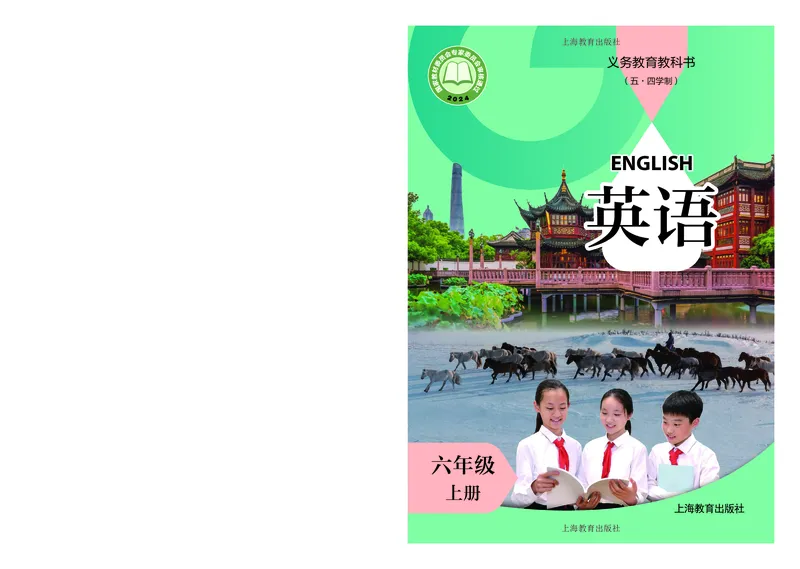
YINGYU 义务教育教科书
务
教
育
(五·四学制)
教
科
书
ENGLISH
英语
六年级
上册
(
五
·
四
学
制
)
六
年
级
英
上
册
上海教育出版社
英语
六年级 上册
语
定价:18.90元
上海教育出版社
54英语初中6A.indd 1 2024/7/25 下午1:34上海教育出版社
义务教育教科书
(五·四学制)
英语
六年级
上册
主编 束定芳
上海教育出版社上海教育出版社
主 编:束定芳
分册主编:朱 萍
本册编写人员:安 琳 施志红
包胤杰 刘宝莹 钱晶晶 柒 静 杨红燕 衣永刚
责任编辑:倪雅菁 谈潇潇 杨 怡
特约审读:吕 晔 庄夏影 姚玉莹
封面设计:朱博韡
版式设计:赵 兵 朱博韡
插图绘制:顾依青 赵 兵 朱凌皓
本册教材部分图片由图虫·创意、壹图网、视觉中国等图片网站提供
义务教育教科书(五·四学制) 英语 六年级 上册
出 版 上海教育出版社(上海市闵行区号景路 159 弄 C 座)
发 行 上海新华书店
印 刷 上海新华印刷有限公司
版 次 2024 年7月第1 版
印 次 2024年7月第1 次印刷
开 本 787 毫米×1092 毫米 1/16
印 张 10
字 数 150千字
书 号 ISBN 978-7-5720-2811-3/G·2489
定 价 18.90 元(含音频8.60元)
版权所有·未经许可不得采用任何方式擅自复制或使用本产品任何部分·违者必究
如发现内容质量问题,请拨打 021-64319241;
如发现印、装问题,请拨打 021-64373213,我社负责调换。
价格依据文件:沪价费〔2017〕15号
声明 按照《中华人民共和国著作权法》第二十五条有关规定,我们已尽量寻找著作权人支付稿酬。著
作权人如有关于支付稿酬事宜可及时与出版社联系。
上海教育出版社上海教育出版社
致同学
亲爱的同学:
欢迎与我们一起开启初中阶段的英语学习!
在接下来的四年中,我们将通过教材,帮助你运用科学有效的方法学习英语,发展英语语言
能力,培育文化意识,提升思维品质,提高学习能力。
在这套教材中,你会遇到许多小伙伴。他们是就读于新星中学(New Star Middle School)的
王一鸣(Wang Yiming)、陆遥(Lu Yao)、林东(Lin Dong)、李百灵(Li Bailing),还有插班生英国
男孩哈利·特纳(Harry Turner),以及他在英国就读的好友莉萨·格林(Lisa Green)。他们会和你一
起,在学习英语的同时,探索新世界、思考大问题(Big Question),在真实情境中“讲(文化)小故
事,悟(人生)大道理,学百科新知识,用英语做事情”。
本套教材的每个单元以主题为引领,从大问题入手,设有五个小话题,分别对应听力、口语、
阅读、写作和项目探究五大板块。每个话题下包含符合初中生学习、生活和成长特点的类型丰富
的语篇,设计层层推进的学习活动,帮助你获得丰富的学习体验,并在学习过程中了解自己的学
习成效,最终对单元大问题有更加全面、深入的认识和理解。
在你学习教材的过程中,有一位智能机器人“胡博士”(Dr Hu)会帮助你掌握语言知识、技
能和学习策略。每个单元都设有“语音”(Sound)、“词汇”(Word study)、“语法”(Grammar in
use)、“青少年技能提示”(TEEN skill)等特色小栏目,以及旨在展示多元文化、拓展视野的“探索
发现”(Discovery)板块。“学习笔记”(My learning notes)用来帮助你积累所学、拓展常用的语言
表达。每当你顺利完成“更新任务清单”(Update my to-do list)之后,就可以在单元首页的“任务
清单”(To-do list)上对应条目前打钩。单元最后的“项目探究”(Project)是你展示学习成果的好
机会。你可以和同学合作,综合运用课内外学到的跨学科知识技能,学会在真实情境中用英语思
考并解决真实问题。
本册教材除了常规单元以外,还设有一个衔接单元(Starter)、两个文化角(Culture corner)和
一个文学角(Literature corner)。衔接单元帮助你顺利从小学学习过渡到初中学习。文化角不仅带
你更深入地了解中国文化,学会用英语讲中国故事,还带你领略多样的世界文化。我们将从亚洲
启程,逐一认识世界七大洲及其代表性文化,学会文明互鉴。文学角中,我们精选了广受青少年
喜爱的优秀文学作品片段,供你赏析。
希望这套教材给你带来学习英语的新体验、新收获,为你插上一双逐梦的翅膀,飞向世界,飞
向未来!
上海教育出版社上海教育出版社
上海教育出版社上海教育出版社
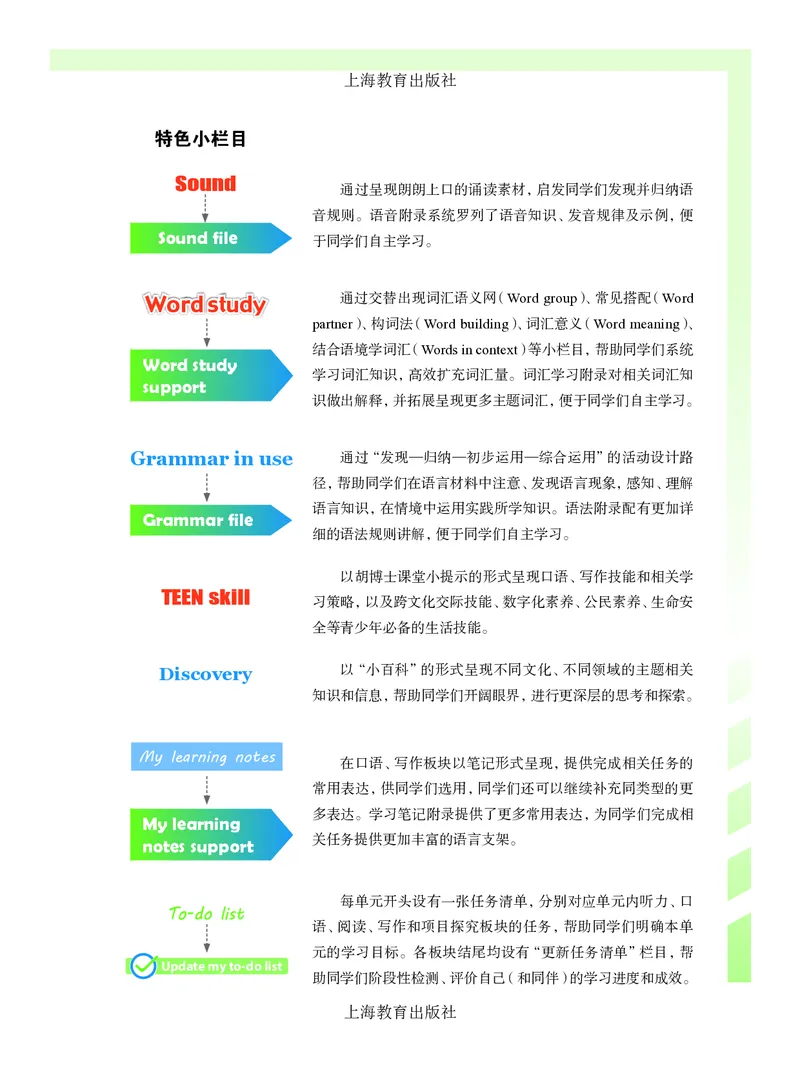
特色小栏目
Sound
通过呈现朗朗上口的诵读素材,启发同学们发现并归纳语
音规则。语音附录系统罗列了语音知识、发音规律及示例,便
Sound file
于同学们自主学习。
通过交替出现词汇语义网(Word group)、常见搭配(Word
Word study
partner)、构词法(Word building)、词汇意义(Word meaning)、
结合语境学词汇(Words in context)等小栏目,帮助同学们系统
Word study
学习词汇知识,高效扩充词汇量。词汇学习附录对相关词汇知
support
识做出解释,并拓展呈现更多主题词汇,便于同学们自主学习。
Grammar in use 通过“发现—归纳—初步运用—综合运用”的活动设计路
径,帮助同学们在语言材料中注意、发现语言现象,感知、理解
语言知识,在情境中运用实践所学知识。语法附录配有更加详
Grammar file
细的语法规则讲解,便于同学们自主学习。
以胡博士课堂小提示的形式呈现口语、写作技能和相关学
TEEN skill
习策略,以及跨文化交际技能、数字化素养、公民素养、生命安
全等青少年必备的生活技能。
以“小百科”的形式呈现不同文化、不同领域的主题相关
Discovery
知识和信息,帮助同学们开阔眼界,进行更深层的思考和探索。
My learning notes
在口语、写作板块以笔记形式呈现,提供完成相关任务的
常用表达,供同学们选用,同学们还可以继续补充同类型的更
多表达。学习笔记附录提供了更多常用表达,为同学们完成相
My learning
关任务提供更加丰富的语言支架。
notes support
每单元开头设有一张任务清单,分别对应单元内听力、口
语、阅读、写作和项目探究板块的任务,帮助同学们明确本单
元的学习目标。各板块结尾均设有“更新任务清单”栏目,帮
Update my to-do list
助同学们阶段性检测、评价自己(和同伴)的学习进度和成效。
上海教育出版社上海教育出版社
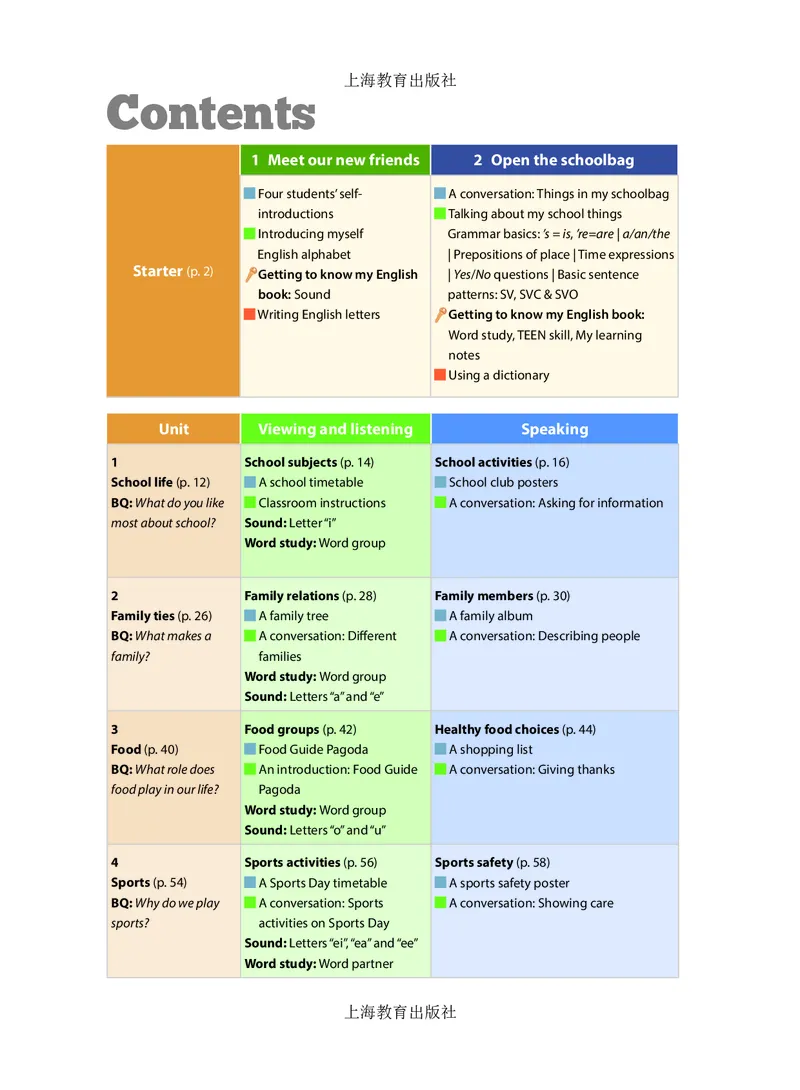
Contents
1 Meet our new friends 2 Open the schoolbag
Four students’ self- A conversation: Things in my schoolbag
introductions Talking about my school things
Introducing myself Grammar basics: ’s = is, ’re=are | a/an/the
English alphabet | Prepositions of place | Time expressions
Starter (p. 2) Getting to know my English | Yes/No questions | Basic sentence
book: Sound patterns: SV, SVC & SVO
Writing English letters Getting to know my English book:
Word study, TEEN skill, My learning
notes
Using a dictionary
Unit Viewing and listening Speaking
1 School subjects (p. 14) School activities (p. 16)
School life (p. 12) A school timetable School club posters
BQ: What do you like Classroom instructions A conversation: Asking for information
most about school? Sound: Letter “i”
Word study: Word group
2 Family relations (p. 28) Family members (p. 30)
Family ties (p. 26) A family tree A family album
BQ: What makes a A conversation: Different A conversation: Describing people
family? families
Word study: Word group
Sound: Letters “a” and “e”
3 Food groups (p. 42) Healthy food choices (p. 44)
Food (p. 40) Food Guide Pagoda A shopping list
BQ: What role does An introduction: Food Guide A conversation: Giving thanks
food play in our life? Pagoda
Word study: Word group
Sound: Letters “o” and “u”
4 Sports activities (p. 56) Sports safety (p. 58)
Sports (p. 54) A Sports Day timetable A sports safety poster
BQ: Why do we play A conversation: Sports A conversation: Showing care
sports? activities on Sports Day
Sound: Letters “ei”, “ea” and “ee”
Word study: Word partner
上海教育出版社上海教育出版社
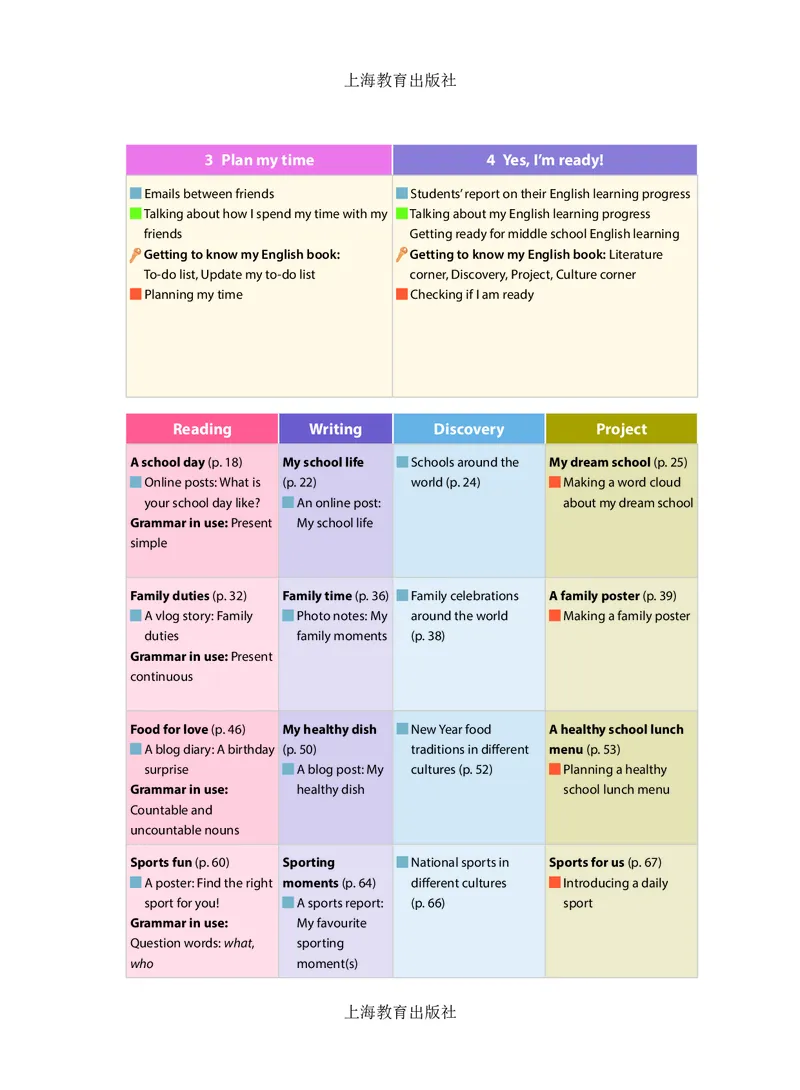
3 Plan my time 4 Yes, I’m ready!
Emails between friends Students’ report on their English learning progress
Talking about how I spend my time with my Talking about my English learning progress
friends Getting ready for middle school English learning
Getting to know my English book: Getting to know my English book: Literature
To-do list, Update my to-do list corner, Discovery, Project, Culture corner
Planning my time Checking if I am ready
Reading Writing Discovery Project
A school day (p. 18) My school life Schools around the My dream school (p. 25)
Online posts: What is (p. 22) world (p. 24) Making a word cloud
your school day like? An online post: about my dream school
Grammar in use: Present My school life
simple
Family duties (p. 32) Family time (p. 36) Family celebrations A family poster (p. 39)
A vlog story: Family Photo notes: My around the world Making a family poster
duties family moments (p. 38)
Grammar in use: Present
continuous
Food for love (p. 46) My healthy dish New Year food A healthy school lunch
A blog diary: A birthday (p. 50) traditions in different menu (p. 53)
surprise A blog post: My cultures (p. 52) Planning a healthy
Grammar in use: healthy dish school lunch menu
Countable and
uncountable nouns
Sports fun (p. 60) Sporting National sports in Sports for us (p. 67)
A poster: Find the right moments (p. 64) different cultures Introducing a daily
sport for you! A sports report: (p. 66) sport
Grammar in use: My favourite
Question words: what, sporting
who moment(s)
上海教育出版社上海教育出版社
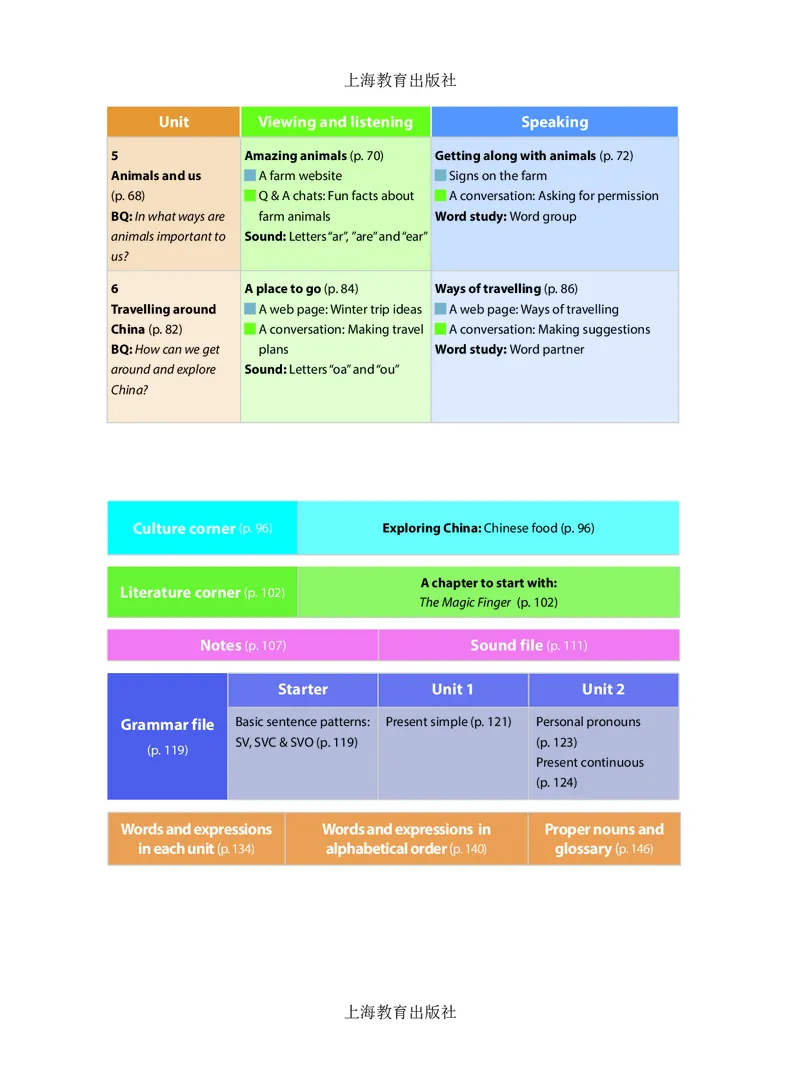
Unit Viewing and listening Speaking
5 Amazing animals (p. 70) Getting along with animals (p. 72)
Animals and us A farm website Signs on the farm
(p. 68) Q & A chats: Fun facts about A conversation: Asking for permission
BQ: In what ways are farm animals Word study: Word group
animals important to Sound: Letters “ar”, ”are” and “ear”
us?
6 A place to go (p. 84) Ways of travelling (p. 86)
Travelling around A web page: Winter trip ideas A web page: Ways of travelling
China (p. 82) A conversation: Making travel A conversation: Making suggestions
BQ: How can we get plans Word study: Word partner
around and explore Sound: Letters “oa” and “ou”
China?
Culture corner (p. 96) Exploring China: Chinese food (p. 96)
A chapter to start with:
Literature corner (p. 102)
The Magic Finger (p. 102)
Notes (p. 107) Sound file (p. 111)
Starter Unit 1 Unit 2
Grammar file Basic sentence patterns: Present simple (p. 121) Personal pronouns
SV, SVC & SVO (p. 119) (p. 123)
(p. 119)
Present continuous
(p. 124)
Words and expressions Words and expressions in Proper nouns and
in each unit (p. 134) alphabetical order (p. 140) glossary (p. 146)
上海教育出版社上海教育出版社
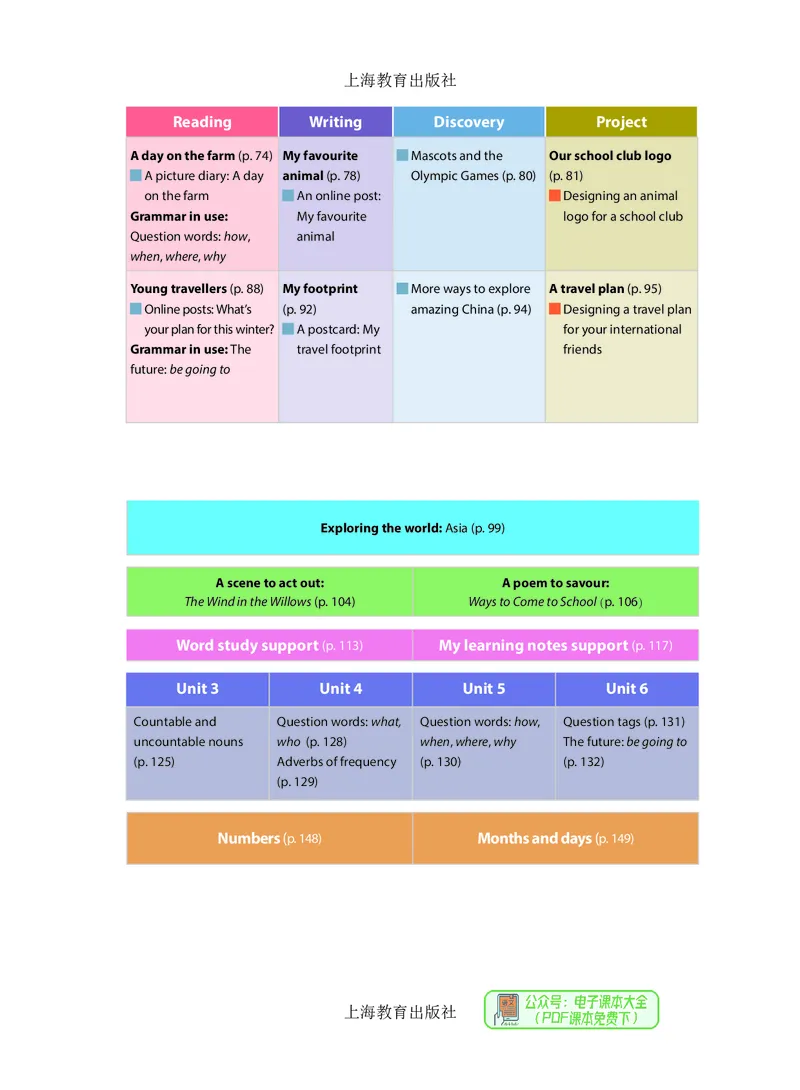
Reading Writing Discovery Project
A day on the farm (p. 74) My favourite Mascots and the Our school club logo
A picture diary: A day animal (p. 78) Olympic Games (p. 80) (p. 81)
on the farm An online post: Designing an animal
Grammar in use: My favourite logo for a school club
Question words: how, animal
when, where, why
Young travellers (p. 88) My footprint More ways to explore A travel plan (p. 95)
Online posts: What’s (p. 92) amazing China (p. 94) Designing a travel plan
your plan for this winter? A postcard: My for your international
Grammar in use: The travel footprint friends
future: be going to
Exploring the world: Asia (p. 99)
A scene to act out: A poem to savour:
The Wind in the Willows (p. 104) Ways to Come to School (p. 106)
Word study support (p. 113) My learning notes support (p. 117)
Unit 3 Unit 4 Unit 5 Unit 6
Countable and Question words: what, Question words: how, Question tags (p. 131)
uncountable nouns who (p. 128) when, where, why The future: be going to
(p. 125) Adverbs of frequency (p. 130) (p. 132)
(p. 129)
Numbers (p. 148) Months and days (p. 149)
上海教育出版社上海教育出版社
Starter 1
Meet our new friends
Today is the first day of school. New Star Middle School in Shanghai
welcomes the new Grade 6 students. In class, students are introducing
themselves.
Lu
Yao
Hi! I’m Lu Yao.
In my free time,
I like running and
playing the piano.
Hello! My name is
Wang Yiming.
I like playing
basketball and
taking photos!
Li Bailing
Wang
Yiming
Hello, I’m Li Bailing.
I love singing and
writing.
Lin Dong
Hi, everyone!
I’m Lin Dong.
I love sports and
science.
Nice to meet you all!
2 上海教育出版社上海教育出版社 Starter
1a It’s your turn. What is your name? What do you like doing in your free time?
1b A sk Dr Hu
Who am I? I am Hu —
a teaching robot. You
What is the fifth letter of the English
can call me Dr Hu.
alphabet①?
I can answer all your
E. questions. Try me.
What words begin with the letter E?
Egg, English, elephant, ...
What is the sound of letter E?
Long e and short e. Listen — Big E, little e, she sells seashells to me!
Find me in the Sound section in each unit.
I’ll tell you more about English sounds.
Work in pairs. Play the game of “Ask Dr Hu”. Take turns to ask more questions and
answer.
1c Write and say Choose a letter in the alphabet. Write the big letter, small
letter, and at least one word with this letter on lines like this:
e
① alphabet 字母表
上海教育出版社 3上海教育出版社
Starter 2
Open the schoolbag
It’s a school day. Students are getting ready for class.
It’s eight in the morning.
I’ve got my red scarf ready.
Li Bailing
The school bell’s ringing. My pens, books and
notebooks are missing①. Where is my bag?
Wang Yiming
Is this your bag, Yiming? He opens his bag,
Yes, it’s mine.
It’s on my desk. takes out everything
and puts them on
his desk.
It’s heavy. What’s in it?
Wang Yiming
Lu Yao Wang Yiming
Let me see. There are five books, three notebooks, a pencil
case, some paper, ... an English-Chinese dictionary! This is your
secret② to English learning, isn’t it?
Lin Dong Grammar file p. 119
2a It’s your turn. What’s in your schoolbag?
2b Ask Dr Hu Tick (3) your way(s) of English learning in
Dr Hu’s answers.
How do I learn English?
By using it, of course.
① missing 找不到的;丢失的 ② secret 秘密
4 上海教育出版社上海教育出版社 Starter
How can I learn English words?
You can read and listen to keep a notebook and
stories in English. write down new words.
sing English songs. keep a diary in English.
watch English films. ____________________.
You can find more ways of learning English words in the
Word study section in each unit.
How can I improve my oral① English?
You can repeat after recordings②. talk to your teachers
talk to yourself in English. and classmates.
read and recite English _________________________.
texts.
Find me in the TEEN skill section in each unit.
I’ll tell you more tips on using English and other life skills.
Add useful expressions in My learning notes .
Work in pairs. Play the game of “Ask Dr Hu”. Take turns to ask more questions and
answer.
2c Read and say Read an entry③ in an English-Chinese dictionary. What does
it tell us? What else can you find in a dictionary?
word fa vourite (BrE) (NAmE favorite) /'feIvRrIt/ sound
part of adj. liked more than others of the same kind 特别受喜 meaning
speech
爱的: It’s one of my favourite movies. 这是我特别喜欢
的电影之一。 Who is your favourite writer?谁是你特别
喜欢的作家? January is my least favourite month. examples
of use
一月是我最不喜欢的月份。
① oral 口头的 ② recording 录音 ③ entry 词条
上海教育出版社 5上海教育出版社
Starter 3
Plan my time
Wang Yiming is reading emails from his friends.
From: Lisa
To: Yiming; Harry
Subject: Hi from London
Hi, pals!
How are you?
I’m back in London now.
When will you be free? Let’s have a video chat and I’ll show
you around my new home.
Best,
Lisa
From: Harry
To: Lisa; Yiming
Subject: Re: Hi from London
Hi, Lisa!
Glad to hear from you.
Yiming and I are in the same middle school now. We’ll be
free every Friday from 3 to 5 p.m. Beijing time.
Let’s chat.
Harry
3a It’s your turn. Who do you often talk to? How often do you talk? When do
you talk with your friends?
6 上海教育出版社上海教育出版社 Starter
3b Ask Dr Hu Tick (3) your way(s) of making plans in Dr Hu’s answers.
How do I plan my time?
I cut time into months, weeks, days, hours, and
minutes. I keep a to-do list and follow it.
How often do you make plans?
I make plans every day. every other day①.
every week. every two weeks.
every month. ______________.
What does your plan look like?
My plan is a to-do list. a table. a mind map.
in pictures. ________________________.
Use the in each unit to plan your
learning. Follow the activities in the unit and complete
the tasks in the list. If you can finish the task in the
Update my to-do list , you can put a tick (3)
next to the task in the to-do list to update② it.
W ork in pairs. Play the game of “Ask Dr Hu”. Take turns to ask more questions and
answer.
① every other day 每隔一天 ② update 更新
上海教育出版社 7上海教育出版社
3c Think and write Here’s Yiming’s to-do list of the week. Discuss with your
partners. Plan your time of the week.
To-do list of the week
_d_o_ _m__o_r_n_in__g_ r_e_a__d_in__g_ e_v_e__r_y_ d_a__y_ _c_h_a_t__ w__it_h_ _f_r_ie_n__d_s_____________
_k_e_e_p_ _a_ _w_e_e_k__ly_ _jo_u__r_n_a_l_①________ _w_a__t_c_h_ _a_n_ E__n_g_l_is__h_ f_i_lm__________
Morning Afternoon Evening
read an English
Monday
newspaper
read and recite the
Tuesday texts in Starter review the lesson
lessons
Wednesday read an English story
read and recite the
Thursday texts in Starter review the lesson
lessons
read an English chat with Lisa and watch the English
Friday
newspaper Harry film Mulan
write my weekly
Saturday read aloud a poem
journal
read an English make my to-do
Sunday
magazine list of next week
① weekly journal 周记
8 上海教育出版社上海教育出版社 Starter
Starter 4
Yes, I’m ready!
Students are talking about what they can do with English.
I can read and write the 26 letters in the
English alphabet. What about you?
I can use a dictionary to look up new words.
How about you?
I can say numbers, days of the week
and school things in English. And you?
I can introduce myself in English. I know you can.
I can understand simple picture stories and
cartoons in English. What about you?
I know the English names of some countries.
How about you?
I know how to make sentences with words. Try me!
I know when to use “Hello!”, “Yes.”, “No.”, “Sorry.”, “Thank
you.”, “Please.”, “Goodbye!”, “OK.”, “Help!” and “I don’t
know.”. Wait, I mean, I know.
4a It’s your turn. What can you do with English?
上海教育出版社 9上海教育出版社
4b A nswer Dr Hu Tick (3) or write your answer in Dr Hu’s ARE YOU READY?
survey. Check your results.
Am I ready for middle school?
I am always ready for new adventures①.
Are you ready?
ARE YOU READY?
Part I
I think learning English is fun. Do you think so?
Yes. (1 point) No. (–1 point) I don’t know. (0 point)
See 2b (pages 4–5) for more tips.
Visit the Literature corner of this book, and you’ll find an
interesting book chapter to read, a scene in a play to act
out, and a poem to recite.
Enjoy your English learning!
Part II
I think English is useful. Do you think so?
Yes. If I learn English well, I can introduce China to people from
different parts of the world. (1 point)
Yes. I can speak English when I visit other countries. (1 point)
Yes. If I learn English well, I can get to know the world better. (1 point)
Yes. If I learn English well, I can ________________________________
_________________________________________________________.
(1 point)
① adventure 冒险;奇遇
10 上海教育出版社上海教育出版社 Starter
Read the Discovery page in each unit to learn about
the world better. It tells you more about different cultures
and school subjects.
Try the Project at the end of each unit. You’ll find out
what you can do with English.
Read the Culture corner of this book. You’ll learn how to
introduce Chinese culture in English and know more about
other cultures in the world.
Part III
Can you write ... in English?
the seven days of a week Yes. (1 point)
No. (0 point)
the four seasons in a year Yes. (1 point)
No. (0 point)
the twelve months of a year Yes. (1 point)
No. (0 point)
three things in the classroom Yes. (1 point)
No. (0 point)
three animals Yes. (1 point)
No. (0 point)
five colours Yes. (1 point)
No. (0 point)
three places Yes. (1 point)
No. (0 point)
Can you make sentences with the words?
brother, apples, likes, my, eating Yes. (1 point)
No. (0 point)
sister’s, the, friend, my, is, girl, tall Yes. (1 point)
No. (0 point)
the, heavy, dictionary, is, English, very Yes. (1 point)
No. (0 point)
How many points
Check the results:
do you get?
>12 points I am ready.
10–12 points I am almost ready.
I get ______.
<10 points I need some help.
上海教育出版社 11上海教育出版社
1
School life
①
② ③
12 上海教育出版社上海教育出版社
What
do
you
like
most
about
school?
4 3 s
2
W c d
1
R h
s
i r
A
f o
c
e
c
i f
L
t
h
o a
l s
e
a
e
k o
i
l d r
s
s o
e
t
s
l a
f
i a
l
n
r
e
f
o
b
o
t e
n
a r
p o
o c
o u
m
c
t
t
i
s
n
u t
i
o
t
v f
l t
i i o
s
n t
d
u a
r
c
i s
i
b
m
r
e
h
f
t
e o
f
s
o
r a
e
. s u o
u
.
t
r
t l
c
e
i o t
n
l m
n
i
i
t
v
o
e y
n a
s
s b . o
in
u t
.
5 m M y a k d e r e a a m w o s r c d h o c o lo l ud about
.
④
Getting started
Look at the pictures of different
schools and answer the questions.
1 Where are the students?
2 What are they doing there?
上海教育出版社 13上海教育出版社
A
School subjects Viewing and listening
Lisa Green goes to a middle school in London. This is her timetable.
Timetable
Monday Tuesday Wednesday Thursday Friday
1
2
Break
3
Lunchtime
4
5
A1 L ook and say
English Maths Music ICT PE
1 What are the subjects? Find the
subjects in Lisa’s timetable. Geography History Art Science
2 How is your timetable different from Lisa’s?
Lisa does French. I don’t.
Lisa has two PE lessons in
her timetable. I have more.
A2 Listen and think Time for class. What lesson is Lisa having?
Sound Letter “i”
Sing to the beat.
Music, Science, History,
English, ICT, Geography,
They bring knowledge to you and me.
14 上海教育出版社上海教育出版社
1
Word study Word group What words do we often hear in a PE
lesson? Add some words to the word web below.
head football
hand
body ball
PE
turn exercise
A3 Listen and take notes Listen to more classroom instructions. What
lessons are the students having? Write the key words.
Listening for key words
1 Key words: experiment, water
science
This is a / an lesson.
2 Key words:
This is a / an lesson.
3 Key words:
This is a / an lesson.
Update my to-do list
Listen to two more classroom instructions and guess the subjects.
上海教育出版社 15上海教育出版社
B
School activities Speaking
①
Wang Yiming and Lu Yao are reading the posters on their school
noticeboard.
Clubs @ New Star Middle School
Football Club
Calligraphy Club STEM② CLUB
Art, History,
We love SCIENCE, Come and have a go!
Every Wednesday
TECHNOLOGY,
& Friends
after school (16:30)
Every Monday ENGINEERING③ & MATHS!
15:30–16:10 We welcome everyone! Meet o O n p t e h n e t f o o G ot r b a a d l e l s fi 6 e – ld 9 !
Room 103 Every Tuesday All welcome!
Join us! 15:30–16:10
Lab 202
Join the Do you like Yes, I do.
Cooking cooking?
Club
We eat our work.
Every Thursday
Let the world h ea r
us!
after school! Welcome to the Music Club!
Room 301 Friday 15:00, Music Room
B1 L ook and say What else do you want to know about the clubs? You may ask
questions.
How long ...?
Who ...?
How many ...?
Football Club
What ...? ...
TEEN skill Greeting a teacher politely
Face-to-face: “Mr/Ms/Miss/Mrs” + Last name
e.g. Hi, Ms Chen./Morning, Mr Smith./Good afternoon, Miss Li.
Letter/Email: “Dear Mr/Ms/Miss/Mrs” + Last name
① poster 海报 ② STEM 科学、技术、工程、数学综合课程 ③ engineering 工程
16 上海教育出版社上海教育出版社
1
B2 Listen, read and think Yiming is talking to Ms Chen. What does
he want to know about the school clubs? Underline his questions.
Yiming: E xcuse me, Ms Chen. May I ask some
questions about the school clubs?
Ms Chen: Y es, of course.
Yiming: What does the STEM club do?
Ms Chen: O h, you can learn more about maths
and science. They do interesting experiments and projects.
Yiming: I see. And how many students can join the football club?
Ms Chen: Let me see. Um ... Twenty-four from Grade 6.
Yiming: T wenty-four. I got it. Thanks a lot!
Ms Chen: Y ou’re welcome!
B3 Role-play Lu Yao goes on to ask Ms Chen about the other clubs. With a
partner, act out their conversation. Use the conversation above as a model.
My learning notes
Asking for information:
Excuse me. Can/May I ask some How can I join the ... club?
questions about ...?
Update my to-do list
Work in pairs. Pick a role and start a conversation.
A B
You are a member of the ... club. You can You want to join a school
choose a club from the noticeboard on club. You are asking
page 16, or your own school club. your classmate (A) for
Your classmate (B) is asking you about information about his/
the club. her club.
上海教育出版社 17上海教育出版社
C
A school day Reading
Wang Yiming (Panda021) started a topic online. He has received a reply
from Mikko.
Understanding the text type
C1 T ext type What is an online post①?
C2 Read the post.
Group: 6th-graders TEEN-Land
Topic: What is your
school day like?
Where do you live? What is your school day like? What do you like
most about your school?
1 answer Panda021 28 June
I’m from Espoo, Finland. My school day starts
5 at 9 a.m. and ends at 2 p.m. We have classes like
Maths, Dance and English.
In my school we do a lot of projects. Now we’re
studying Mexico. We talk about the differences
between Mexico and Finland in class. We also make a game about the
10 differences and then play it. In this way we study History, ICT and Art
all at the same time. I LOVE this way of learning!
There is a fifteen-minute break after every lesson. During the break,
I go outside and play. At noon, we take a lunch break. The breaks
connect us!
15 Like Comment Mikko 30 June
Personal touch
Do you want to give it a like ( )? Why or why not?
Text type Online posts
Usually, we can find a topic, usernames②, messages, emojis③,
comments and “likes” in an online post.
① post 帖子 ② username 用户名 ③ emoji 表情符号
18 上海教育出版社上海教育出版社
1
C3 G eneral understanding What is special about Mikko’s school life?
C4 D etailed reading Read and complete the table with details from the text.
Name City School hours Subjects Way of learning Activities
Mikko Espoo,
Finland
C5 Further thinking Answer the questions.
1 What’s the meaning of the emoji ( ) at the end of Mikko’s post?
2 Compare Mikko’s school life with yours. What is different? What is similar?
Vocabulary focus Find the verbs in the box in Mikko’s post. Which
nouns do they often go together with? Write the phrases down and make new
sentences.
do make have play take
Phrases Sentences
have a class I have a maths class at 9:05 a.m. on Tuesdays.
Update my to-do list
What do you like most about Mikko’s school life? Give reasons.
上海教育出版社 19上海教育出版社
Grammar in use Present simple
1 R ead and think What does the underlined part mean?
subject
(1) I’m from Espoo, Finland.
(2) My school day starts at 9 a.m. and ends at 2 p.m.
verb
(3) We have classes like Maths, Dance and English.
(4) Lisa goes to a middle school in London.
(5) Lisa doesn’t have English on Mondays. the other
parts
2 W ork out the rules Tick (3) the one(s) you agree with.
We usually use the present simple to talk about ...
things that are true now
things that we often do
things that are always true
Grammar file p. 121
3 P ractise: I’m afraid you’re wrong! Correct the information in the
sentences.
The capital of New
I’m afraid you’re wrong! The capital of New
Zealand is Auckland.
Zealand is not Auckland. It’s Wellington.
Rabbits eat meat.
Five is an even number①.
The Earth is square②.
Students in China go to
school at the age of eight.
The Beginning of Autumn③
falls in September each year.
① even number 偶数(odd number奇数) ② square 方的(round圆的)
③ the Beginning of Autumn 立秋(二十四节气之一)
20 上海教育出版社上海教育出版社
1
4 A survey
(1) Work on your own. Add more ideas to “School life”. Mark “Facts about me”
with true (3) or false (7).
Facts about me
School life
(3or 7)
go to school at 7 a.m.
go to the science club
after school
play football every Friday
...
(2) Pair work. Take turns asking and answering: Do you ...? Add a column①
“Facts about my partner” to the table above and mark it with true (3) or
false (7).
I go to school at 7 a.m. Do you
No, I don’t. I go to school at 7:15.
go to school at 7 a.m.?
Do you go to the science
Yes, I do. I go to the science
club after school?
club every Thursday.
...
...
(3) Report to the class.
... too.
... but ...
① column(表格中的)列,栏
上海教育出版社 21上海教育出版社
D
My school life Writing
Write a reply about your school life on TEEN-Land Forum.
D1 Think Read the post. What are Anna’s answers to Panda021’s questions?
Group: 6th-graders TEEN-Land
Topic: What is your school day like? A
timetable
Where do you live? What is your school day like? What do you like most
about your school? B subjects
2 answers Panda021 28 June
C activities
I go to a middle school in Germany. Our school day starts at 7:50 a.m. and
ends at 1:45 p.m. We have five lessons every day. My favourite subjects D
teachers
are Maths, French, History, Science and Geography. There are lots of after-
school clubs. I play ping-pong on Tuesdays. On Wednesdays and Fridays, I E friends
have the football club. I love sports!
F place
Like Comment Anna 21 July
D2 Prepare What does Anna write about in her reply? Match the words on the
right (A–F) with the sentences in the post. There are two more words than
you need.
D3 Plan Choose ideas from D2 to write about. Think about them and make
notes.
My school
life
22 上海教育出版社上海教育出版社
1
D4 Write W rite your reply.
Group: 6th-graders TEEN-Land
I’m from . My school day
Like Comment (Your username and date) ________ ________
D5 Check Check your writing. Pay attention to the beginning and ending
of sentences.
TEEN skill Beginning and ending a sentence
Begin a sentence with a capital letter.
End a sentence with a full stop (.) or a question mark (?) or an
exclamation mark (!).
Posting online
Do not give out your personal information (name, school,
family details, etc.).
Do not believe everything you read or hear online. SAFETY
FIRST!
Update my to-do list
Work in groups. Share your post within your group. Give a “like” to your favourite
post(s). How many “likes” do you get?
Like (+ )
上海教育出版社 23上海教育出版社
Discovery
Schools around the world
In Bangladesh, there are
hundreds of boat schools!
During floods, the boats
are both classrooms and
school buses.
On the first day of a school term, all In French schools, students
students in Japan practise safety and learn about tastes in foods.
earthquake drills①. At lunchtime, They try different foods and
they take turns serving food in teams. learn good table manners.
Read and think Which kind of school do you like most? Why?
① drill 演习
24 上海教育出版社good teachers
interesting subjects
lunch
hours
上海教育出版社
1
E
My dream school Project
Making a word cloud about my dream school
A word cloud is an ICT tool. Make
a word cloud with your group
members to present things you
like most about school.
Step 1 Collect ideas Ask questions and note down the answers.
What do you like most about our school? projects lunch hours
What do you like most about other schools?
good teachers
interesting subjects
Step 2 Enter the results Write all the answers in the text box of an online
word cloud tool.
Step 3 M ake the word cloud Press “Go!” to get your word cloud. The bigger
words show more popular ideas.
projects
Update my to-do list
Make a class word cloud. Gather the ideas of all groups and make a large one. Post
it on the noticeboard of your classroom.
上海教育出版社 25上海教育出版社
2
Family ties
26 上海教育出版社上海教育出版社
Family ties 3 2 1 f R a D a m e L e b a s i i o d l s c y t u r e a t ib d n e u v f t a l t o m m i o e g y s il a s y t f c a o r o m r e n y l i a v ly t e a i r b o m s o n a u e s t . t m io b n e rs .
.
5 4 D c W e e s le r ig i b t n r e a a t a i b o f o n a u m p t i h ly m o t p y o o s f s . a t m er ily
.
?
y
mil
a
a
f
es
k
a
m
at
h
W
Family
A family is like a star.
Sometimes you can’t see it,
But it’s always there,
Near or far.
A family is like a garden.
It needs work, but gives us fun.
We grow up with love and care,
Under the sun.
Read the poem and think.
What is your family like?
Getting started
My family is like ...
上海教育出版社 27上海教育出版社
A
Family relations Viewing and listening
Li Bailing is introducing her family to her classmates. This is her family tree.
Bailing’s family and relatives
Tian Liling Li Yi Zhang Hua Wang Hai
1 _________ grandfather
Zhang Lei Li Mei Li Ming Wang Fang Wang Rong Zhao Gang
aunt 2 _________ mother 3 _________
Zhang Yihan Li Bailing Li Qianyang Li Wanlong Zhao Ming
4 _________ me 5 _________ _________ cousin
A1 L ook and say
1 Fill in the blanks above with the proper family relations.
2 Ask Bailing some questions about her family.
Are you the only
No, I’m not. I have two younger
child in your family?
brothers. They are twins.
Word study Word group Find pairs in family-related words.
Family relations
___________ and mother grandmother and ___________
husband and wife ___________ and sister
___________ and daughter ___________ and ___________
uncle and ___________
28 上海教育出版社上海教育出版社
2
A2 Listen and choose Listen to the conversation between Bailing and Harry.
Choose Bailing’s questions.
Listening for family relations
Are they your dad’s parents?
Are you the only child in your family?
How old is your little brother?
Do you have any other relatives in Britain?
Is your aunt your mum’s sister?
A3 Listen and take notes Listen again and help Bailing complete Harry’s
family tree.
grandmother grandfather
1 ___________ 2 ___________ 3 ___________ 4 ___________
Harry Harry’s 5 ______________, Sam Harry’s 6 ___________, Liam
Sound Letters “a” and “e”
Sing the rap.
Dad’s washing his red van. Mum’s frying eggs in a pan.
Grandma’s chatting with Uncle Stan. She’s showing him a big fan.
My two brothers are setting the table as fast as they can.
This is my family’s perfect weekend.
Update my to-do list
Listen to your partner’s introduction of his/her family. Draw a family tree to check
your understanding with your partner.
上海教育出版社 29上海教育出版社
B
Family members Speaking
Li Bailing is adding notes to photos in her family album.
1 2 3
A Grandma is teaching the
seven-year-old me how to
play the piano.
B Dad is making dinner for us.
C Mum is helping me with
4 5
my homework.
D My brothers are playing
E I am singing an English song.
football with their friends.
B1 Look and match Help Bailing match the notes (A–E) with the photos (1–5).
TEEN skill C ontinuing a conversation
Raise a question.
Make a comment.
30 上海教育出版社上海教育出版社
2
B2 Listen, read and think Yiming and Bailing are talking about his family
photo. How does Yiming describe his family members?
Bailing: Wow, you have a big family. Is that your mum, the one in the yellow
dress?
Yiming: No, that’s my aunt! My mum is drinking tea.
Bailing: Hey, you have the same big eyes. You look a lot like her.
Yiming: Well, everybody says so.
Bailing: And which one is your
dad?
Yiming: Here. He’s making tea.
Bailing: Who’s the girl playing
the guitar?
Yiming: That’s my elder sister,
Wang Yimeng.
Bailing: And where are you?
Grammar file p. 123
Yiming: I’m taking this photo!
B3 Role-play Continue the conversation between Bailing and Yiming.
Yiming’s family members in the photo (from left to right):
On the chairs and sofa: Father, Mother, Aunt, Grandfather, Cousin
In the front: Sister, Uncle, Cousin, Grandmother
My learning notes
Describing people:
• ... is sitting on the sofa.
• ... has big eyes/a round face/short dark hair.
• ... is playing chess with ...
• _______________________
Update my to-do list
Work in pairs. Bring some family photos, and ask and answer questions about
them.
上海教育出版社 31上海教育出版社
C
Family duties Reading
After Li Bailing was born, her mother stopped working. This year, she is
going back to work.
C1 Predicting Look at the pictures and predict: What is Bailing’s vlog about?
C2 R ead Bailing’s vlog story.
Now, let me show you the life of my family
at the weekend.
Today is Saturday. Mum is at work this
morning. She’s busy with her work at the
5 hospital, so we want to make things easy for
her at home.
Dad is making breakfast for us. He’s a great
cook! ... And this is my grandma. She is
watering the plants. Hi, Grandma!
10 My brothers are old enough to help now.
Look, they are making the beds. Well done,
boys!
... Now breakfast is over. Dad is washing
the dishes. Usually, I help sweep the floor.
15 It’s quicker to work together.
... Look, there’s Mum. She’s home early. She
looks tired, but I’m sure she’s happy to find
the flat so clean and tidy.
... After lunch we can go to the park. Time
20 for some fun! Bye for now!
Personal touch
Do you do the same chores as Bailing and
her brothers do?
32 上海教育出版社上海教育出版社
2
C3 G eneral understanding How do Bailing’s family members make things
easy for Bailing’s mum at home?
C4 D etailed reading Match Bailing’s family members with their family chores.
Scanning for specific information
Bailing’s dad sweep the floor
make the beds
Bailing’s grandma
wash the dishes
Bailing
make breakfast
Bailing’s younger
brothers water the plants
C5 Further thinking Answer the questions.
1 What else can Bailing do for her family?
2 Why is it important to share family chores?
Vocabulary focus Fill in the blanks with the words or phrases from the
text.
1 My father is a manager in a company. He is _____________ from 9 a.m. to 5 p.m.
2 It’s hard to work alone, but working together can __________________________.
3 My brothers are not old _____________ to take out the rubbish by themselves.
4 — Mum, do you need any help?
— Yes, please. You can _____________ prepare the food.
5 The floor doesn’t _____________ clean enough. I need to sweep it again.
Update my to-do list
Think of at least two more moments in Bailing’s vlog. Describe them in your own
words.
上海教育出版社 33上海教育出版社
Grammar in use Present continuous
1 R ead and think What does the underlined part mean?
(1) I am singing an English song.
(2) Dad is making dinner for us.
(3) My brothers are playing football with their friends.
2 Work out the rules Tick (3) the one(s) you agree with.
(1) We usually use the present continuous to talk about ...
I walk to school every day. The boy is playing chess with
his grandfather.
actions that happen every day actions that are going on at the
or most days moment of speaking
(2) The present continuous is formed by “verb be + -ing” “verb be”
“verb + -ing”.
Grammar file p. 124
3 P ractise: What are Li Bailing’s family members doing? Bailing is making
a vlog of her family. Choose phrases from the box and complete Bailing’s words.
8:05 14:45 18:30
34 上海教育出版社上海教育出版社
2
have dinner wash the dishes sweep the floor tidy up the books
(1) It’s 8:05. Dad ________________________________________.
(2) It’s 14:45. My brothers ________________________________________.
(3) It’s 18:30. My family ________________________________________.
4 M ake a phone call
(1) Look at the pictures. Act out a conversation with your partner.
Hi, ... What are you doing?
...
(2) Think of the daily activities of your family members. Act out a phone
conversation with your partner.
上海教育出版社 35上海教育出版社
D
Family time Writing
Write some notes about your family celebration photos.
D1 Think Read Li Bailing’s descriptions of her family celebration photos. What is
special about the day?
Today is Grandma’s birthday. We are preparing a
birthday party in our flat.
Dad and Uncle are decorating the living room with
balloons and flowers. My cousin is setting the table.
My brothers and I are making the birthday card.
Mum and Aunt are cooking in the kitchen.
We are singing birthday songs to Grandma and
giving her birthday gifts. Grandma is happy.
Everyone loves the family celebration.
D2 P repare
1 How does Bailing write about her family celebration? Put the questions in
the right order.
____ What are they celebrating?
____ How does everyone feel?
____ What is everyone doing?
2 Underline the verbs in Bailing’s notes. Which is/are in -ing form? Which is/
are not? Why?
TEEN skill U sing verbs to describe continuous actions
• We can use the -ing form of an action verb to describe
actions at the moment. For example, She’s cleaning the
table.
• These verbs are used less often in present continuous: hear,
see; forget, know; have; like, love, need, want; be, look.
36 上海教育出版社上海教育出版社
2
D3 Plan Bring a family celebration photo to class. Write down some key
words about it in the table.
When
Where
Who & What
How
My learning notes
Describing personal feelings:
• He is surprised. • She is super-excited.
• Everyone is happy. • They are jumping for joy.
• ________________________ • ________________________
D4 Write Write some notes about your photo.
Today is a special day.
________________________________________________________
________________________________________________________
________________________________________________________
________________________________________________________
________________________________________________________
________________________________________________________
D5 Check Check your writing. Pay attention to the use of verbs.
Update my to-do list
Read your partner’s notes. Does it present a clear picture in your mind?
上海教育出版社 37上海教育出版社
Discovery
Family celebrations
around the world
Happy 59th birthday!
In China, the number “nine” stands for a
long life. People celebrate “big” birthdays
when they are turning 59, 69 or 79 for
good luck.
“Einschulung①”: Celebrating the first day
of school
The first day of first grade is a big day for
every German child. Families get together to
celebrate it. The child gets a bag of sweets
and presents on that day.
Pongal②: A harvest③ festival
In south India, Tamil④ people celebrate the Thai
Pongal in mid-January to thank the Sun for a rich
harvest. All family members put on new clothes.
They cook and eat the traditional Pongal dish
(rice pudding).
Read and think What are the reasons for these family celebrations? How do
family members have fun together on special days?
① Einschulung(德国)开学礼 ② Pongal(泰米尔)丰收节 ③ harvest 丰收 ④ Tamil 泰米尔的
38 上海教育出版社上海教育出版社
2
E
A family poster Project
Making a family poster
Make a poster to show your understanding of the word “family”.
Step 1 Discuss List some key words about family and say why they’re
important.
I think “love” is important in a family because ...
Step 2 Plan Link the key words with the word “family” and stick some pictures
or find some photos for the key words.
help each other ___________
(picture)
Family
(picture) (picture)
___________ ___________
Step 3 Write You can write short texts to describe the pictures or photos.
• I think ... is important for a family.
• This is ... He/She is ... He/She is (doing) .../We are (doing) ...
I think it’s important for family members to spend
time together.
Look, this is my dad.
He is teaching me how to ride a bike.
I am learning quickly now.
Step 4 Design You can make a poster with the key words, the pictures or
photos and short texts.
Step 5 Present Put your poster on the wall, and then present your
understanding of the word “family” to the class.
Update my to-do list
Which poster do you like best? Give reasons.
上海教育出版社 39上海教育出版社
3
Food
ur
life?
n
o
ay i
pl
d
does
foo
at
role
h
W
40 上海教育出版社上海教育出版社
3 2 f 1 R o c T o h e F L a d a o o l d i i k o s c f t e d o a a s e r b n G s i o l n t u o u a o i v n t d t r e d e y h h e e P l a e a b s a a l u o g t r u o p n h d t e y r a a m . c b f o o o a o o u r k d t k i e n t t g . h e
4
h
W
ea
r
l
i
t
t
h
e
y
a
d
r
is
e
h
cipe .
for
my
.
5
m
P
e
la
n
n
u
a healthy
school
lunch
.
Getting started
Ask and answer in pairs. Does your partner have a healthy diet?
1 How many kinds of vegetables and fruits do you have every day?
Not many (three or four). A lot (five or more). Only a few (one or two).
2 How much water do you drink a day?
Not much. A lot. Very little.
3 How often do you skip breakfast?
Always. Sometimes. Never.
上海教育出版社 41上海教育出版社
A
Food groups Viewing and listening
Lin Dong wants to cook something healthy for his mother on her birthday. He
①
asks Wang Yiming for help. Yiming shows Lin Dong the Food Guide Pagoda .
A1 L ook and say
1 Put the number of each food item next to its picture in the Pagoda.
Oil and salt
a beef
b tofu
c peppers
Milk and bean
d cabbages
products
e onions
f carrots
1
g watermelon Meat, fish
h cucumbers and eggs
i strawberries
j pears
k yogurt
l cheese Vegetables
m corn and fruits
Grains
2 Talk about the food with a partner.
What’s your mother’s favourite food?
Her favourite food is beef. She
often has some beef for lunch.
Word study Word group Add more food items to each group in the
Pagoda above. You can write down their English names.
① pagoda 宝塔
42 上海教育出版社上海教育出版社
3
Sound Letters “o” and “u”
Sing the rap.
Why are lemons yellow,
When oranges are orange?
With yogurt, milk and oats,
Can we make rainbow porridge?
Why do onions make us cry?
What makes dumplings so yummy?
If you like funny food, just try
A cucumber with honey!
A2 Listen and think Listen to an introduction to the Food Guide Pagoda and
discuss.
1 What does it tell us? Tick (3) your answer(s).
Whose idea is it? How can different foods do good to us?
How much should we eat from different food groups?
2 What does “eat the rainbow” mean? What makes a “rainbow” according to the
speaker?
A3 View, listen and take notes Listen again and complete Lin Dong’s notes.
Listening for the amount
The Food Guide Pagoda
—How to eat a healthy and balanced diet
The Food Guide Pagoda shows us how much to eat from each food
group every day.
How many/How much
Grains
Vegetables and fruits plenty of
Food group
Meat, fish and eggs
Milk and bean products
Oil and salt
Water
Update my to-do list
Listen again. Do you have a healthy and balanced diet?
上海教育出版社 43上海教育出版社
B
Healthy food choices Speaking
Lin Dong is shopping with Yiming in the supermarket for food.
Shopping List
Grains
a bag of egg noodles
Vegetables & fruits
two carrots
a red pepper
a green pepper
a few onions
Meat, fish & eggs
Milk & bean
products
B1 Look and say Read Lin Dong’s shopping list. Guess: What dish might he
cook?
TEEN skill Shopping for food in a supermarket
When you are in a supermarket, you can go to different food sections①.
Here are some of them:
Vegetables and Fruits, Dairy Products, Meat and Seafood, Frozen Foods,
Bakery, Snacks, Drinks
B2 L isten, read and think Why doesn’t Lin Dong buy any beef in the
supermarket?
Lin Dong: Thanks for coming, Yiming.
Yiming: M y pleasure. What are we shopping for?
Lin Dong: I want to buy some ingredients for a dish — Rainbow Beef.
① section 区域
44 上海教育出版社上海教育出版社
3
Yiming: What’s that?
Lin Dong: We make it with beef and a lot of vegetables. It’s very tasty and
healthy too.
Yiming: Great! What are we going to get?
Lin Dong: Two carrots, a red pepper, a green pepper and a few onions.
Yiming: Oh, I see. Do you need any beef?
Lin Dong: No, we have some in our fridge. But I’ll also buy a bag of egg
noodles.
Yiming: Good! Now, let’s get what we need.
My learning notes
Giving thanks:
• Thank you for your help.
• It’s so kind of you.
• _________________________________
• _________________________________
B3 Role-play Work in pairs. Pick a role and act out your conversation. Use B2
as a model.
A B
• You have a shopping list. You are • You are helping your friend
shopping for the food on it. (A) shop for some food in the
• You give thanks to B for helping supermarket.
you. • You are asking what to buy.
Update my to-do list
Work in pairs. You are helping your foreign friend Lisa buy some food on a
shopping app. Make a dialogue to talk about what to buy.
上海教育出版社 45上海教育出版社
C
Food for love Reading
Lin Dong gives his mother a birthday surprise and shares the story on his
blog.
C1 Predicting Look at the title and the emojis and predict: How does Lin
Dong’s mother feel when she sees the dish?
C2 Read Lin Dong’s blog.
Group: 6th-graders Teen’s blog
TEEN-Land
15 Oct. Lin
A birthday surprise
Today is Mum’s birthday. I wanted to cook a tasty and healthy dish for
her as a birthday surprise.
I found some beef in the fridge. Then, I bought two carrots, a red
pepper, a green pepper, a few onions and a bag of egg noodles.
5 Time to cook! First, I added a little soy sauce to the beef. Then, I cut the
vegetables into small pieces. Next, I fried the beef with the vegetables.
Finally, I boiled the noodles as a side dish. I made it!
When Mum came home, I asked her to try my Rainbow Beef. She was
a little surprised to see the dish, but she tried some and asked, “Where
10 did you get the beef, Dong?”
“From the fridge.”
“But there wasn’t any beef in the fridge. We only
had mutton!”
Personal touch
What do you think of Lin Dong’s birthday surprise for his mother?
46 上海教育出版社上海教育出版社
3
C3 G eneral understanding What can we find in Lin Dong’s story? Tick (3)
the answer(s).
the name of the dish the ingredients of the dish
the cooking steps the feelings of Lin Dong and Mum
the truth
Recipe card
C4 D etailed reading Read and complete the
Dish: Rainbow Beef
recipe card for the dish.
Ingredients:
Understanding sequence
t w o c a r r o t s , a r e d p e p p e r ,
a g r e e n p e p p e r , a f e w o n i o n s ,
a b a g o f e g g n o o d l e s a n d s o m e
C5 Further thinking Answer the questions.
b e e f
1 Why did Lin Dong’s mother ask about the “beef”? Cooking steps:
2 What will Lin Dong and his mother do next?
3 What do you think of Lin Dong?
Vocabulary focus Fill in the blanks with the words from the story.
Lin Dong cooked Rainbow Beef for his mother’s birthday because it was
1 and healthy. He got the vegetables from the supermarket, but
he didn’t buy any beef there. He thought, “We have some beef in the
2 at home.”
There were four steps to cook the dish. He first 3 soy sauce to
the beef, then cut the vegetables into 4 . Next, he fried them all
together. 5 , he cooked the noodles.
His mother was 6 to see the dish. She tried some, and Lin
Dong told her the meat was from the fridge. Then Mum knew it was in fact
mutton.
Update my to-do list
Is the title a good one for the story? Why or why not?
上海教育出版社 47上海教育出版社
Grammar in use Countable and uncountable nouns
1 R ead and think Which of the underlined words are countable? Which are
uncountable? Put them in the chart below.
(1) How many glasses of water do you drink a day?
(2) Have a little milk, yogurt or cheese every day.
(3) I buy two carrots, a red pepper, a green pepper and a few onions.
Countable nouns Uncountable nouns
2 Work out the rules Tick (3) the one(s) you agree with.
(1) Countable Uncountable nouns have a singular form
for one and a plural form for more than one. We use a/an or
numbers to show how many.
(2) Countable Uncountable nouns don’t have a plural
form.
(3) We can use expressions of quantity① like many/(a) few with
countable uncountable nouns.
(4) W e can use expressions of quantity like much/(a) little with
countable uncountable nouns.
Grammar file p. 125
3 P ractise Lu Yao and Lin Dong are ordering food in a restaurant. Circle the
correct words to complete their conversation.
① quantity 数量
48 上海教育出版社上海教育出版社
3
Lin Dong: What would you like to have? A whole Russian① cabbage pie
again?
Lu Yao: No, I’ve had too many / much cabbage this week. I’d like to try
the South African dish, Bunny Chow②. There are a lot of / much
potatoes in it. I love potato / potatoes.
Lin Dong: Good choice! The South American③ tacos④ look nice to me. There
is quite a few / a lot of chicken in them. Well, what would you like
to drink?
Lu Yao: Have they got some / a few hot water?
Lin Dong: Let’s ask the waiter.
4 Discuss
(1) Look at the picture. What are Lin Dong and his father having for
today’s breakfast? They are having ...
(2) What do you usually have for breakfast? Talk with a partner. Remember to
use different expressions of quantity before nouns.
What do you usually
I usually have ... for breakfast.
have for breakfast?
How about you?
...
① Russian 俄罗斯的 ② Bunny Chow (南非的一种)夹馅面包 ③ South American 南美洲的
④ taco 墨西哥煎玉米粉卷
上海教育出版社 49上海教育出版社
D
My healthy dish Writing
Write a recipe for a healthy dish on TEEN-Land.
D1 Think Read Lu Yao’s recipe. What are the ingredients for this dish?
Group: 6th-graders Teen’s blog
TEEN-Land
16 Oct. Lu
How to cook tomato and egg soup
To make this dish, you need two eggs, two tomatoes, some water, a little oil
and salt.
First, beat the eggs with chopsticks in a bowl. Then, cut up
the tomatoes and fry them in oil. Next, add water to the
tomatoes and boil. After that, add in the eggs. Finally, add a
little salt. And you have tomato and egg soup!
D2 Prepare How many steps are there to make this dish? Circle the signal
words.
D3 Plan Choose a healthy dish to write about. Make notes in the outline.
Dish
____________________
____________________
Ingredients
____________________
____________________
____________________
Cooking steps
My healthy dish ____________________
____________________
50 上海教育出版社上海教育出版社
3
My learning notes
Showing steps with signal words:
• First, ... • Then, ... • After that, ...
• __________________________ • __________________________
TEEN skill Writing a recipe
• Write in the present simple.
• Use short sentences.
• Use signal words to show steps.
D4 Write Write your recipe.
Group: 6th-graders Teen’s blog
TEEN-Land
__________ ________
How to _____________________________
To make this dish, you need _______________________________________
______________________________________________________________
______________________________________________________________
______________________________________________________________
______________________________________________________________
______________________________________________________________
______________________________________________________________
______________________________________________________________
D5 Check Check your recipe. Pay attention to the basic elements of a recipe.
Update my to-do list
Work in groups. Share your recipes. Whose recipe is clear and easy to follow?
上海教育出版社 51上海教育出版社
Discovery
New Year food traditions
in different cultures
Tangyuan
Many families in southern
Toshikoshi soba②
China eat tangyuan for
Japanese people usually eat
breakfast on the first day of
toshikoshi soba on New Year’s Eve③.
Chinese New Year. The name
They eat the long noodles and wish
of this food shows people’s
for a long life. People try hard not to
wish for the unity① and
break them, because they are afraid
happiness of the whole family.
that they might have bad luck in the
new year.
Twelve grapes
In Spain and Latin America, people eat 12
grapes at midnight to start the year off
right. According to tradition, for every grape
they eat, they’ll have a month of luck next
year. It’s a tasty and fun way to celebrate the
new year!
Read and think Which food tradition do you find most interesting? Why?
① unity 和谐;和睦 ② toshikoshi soba (日本)跨年荞麦面 ③ eve 前夕;前夜
52 上海教育出版社上海教育出版社
A healthy school 3
E
Project
lunch menu
Planning a healthy school lunch menu
Your school is asking for the “Healthy lunch ideas” from all the students.
Work in groups of three or four and plan a lunch menu of healthy and tasty
dishes for your school canteen.
Step 1 Collect ideas Ask questions and note down the answers. Choose your
favourite food from different food groups.
What kind of meat What vegetables do you prefer?
would you like to have
for lunch?
...
Step 2 Search Use some of the food names as key words to search for recipes
in cookbooks, cooking apps or on websites. Choose dishes made in a
healthy way.
Step 3 Design List the food or dish names in your group’s one-day lunch
menu. Add pictures of the dishes to your menu.
School Lunch Menu
• Shanghai style smoked fish
• fried cabbage with garlic
• Chinese cucumber salad
• tomato and egg soup
• fried rice
• apple
• yogurt
Step 4 P resent Present your group’s lunch menu in class. Explain why you
think it is a healthy choice.
Update my to-do list
Vote for your favourite five group menus in your class and make a weekly “Healthy
lunch menu of Class ____”.
上海教育出版社 53上海教育出版社
4
Sports
we
play
sports?
Why
do
54 上海教育出版社上海教育出版社
1 L
a
i
b
st
o
e
u
n
t
t
sp
o
o
a
r t
c
s
o n ac v t e i r v s i a t t ie io s n o n
2 3 S T p R a o e lk r a t d s a b a D o u a p y t o . s s t p e o r rt o s f s s a o f m et e y f . un
4 s 5 W p a o m b r I r n o i o t t t u m s e r t . o e a d n m u t s y c ( p e s o f ) r a a t v o s o s n p u r o r e S i r p t p t o e o r r t t s t o p s o m r D t y a i n y g .
class.
Getting started
Look and think.
Which sport(s) in the pictures do you play?
I play basketball.
I skip rope.
I go running.
I do sit-ups.
I play football. I go swimming.
上海教育出版社 55上海教育出版社
A
Sports activities Viewing and listening
The school is going to have a Sports Day. This is the timetable.
Sports Day
New Star Middle School
Date: 20 Oct.
Sports ground Gym
Time
Individual① Team Individual Team
9:00–9:30 50m sprint② long jump three-player rock tug of
9:30–10:00 100m sprint high jump football climbing war⑥
10:00–10:30 200m run shot-put③
1-minute
800m run (girl) basketball kung fu Frisbee
10:30–11:00 rope
1,000m run (boy)
skipping
shuttlecock 4×50m
13:30–14:00 / / /
kicking④ relay⑤
Get
Active
Get
Strong
A1 Look and say Read the timetable and discuss.
What sport do you
want to play?
I want to play basketball.
Sound Letters “ei”, “ea” and “ee”
Sing the rap.
Five days a week we do sports.
Eight, nine, ten! We are all ready.
Meet in the field.
Balls at our feet.
The power of the dream
Makes us a great team.
① individual 个人 ② sprint 短跑 ③ shot-put 推铅球 ④ shuttlecock kicking 踢毽子
⑤ relay 接力赛 ⑥ tug of war 拔河
56 上海教育出版社上海教育出版社
4
A2 Listen and take notes What sports do Wang Yiming and Lu Yao want
to take part in on Sports Day? Write “W” next to the events for Yiming
and “L” for Lu Yao.
50m sprint long jump kung fu
100m sprint high jump three-player football
200m run shot-put W basketball
800m run (girl) 1-minute rope skipping tug of war 50m sprint _____ long jump _____ kung fu _____
1,000m run (boy) shuttlecock kicking Frisbee 100m sprint _____ high jump _____ three-player football _____
4×50m relay rock climbing 200m run _____ shot-put _____ basketball _____
800m run (girl) _____ 1-minute rope skip _____ tug of war
A3 Listen and think Listen again and answer the questions.
1,000m run (boy) _____ shuttlecock kicking _____ Frisbee _____
1 Does Lu Yao love sports? Making inferences 4×50m relay _____ rock-climbing _____
2 Who will go rock climbing this Saturday?
3 Is Bailing good at sports?
Word study Word partner What sports do the verbs go together with?
Put the sports below in different groups. Add more sports if you can.
baseball rock climbing volleyball swimming badminton
tennis running pull-ups① sit-ups②
baseball
play
go
do
Update my to-do list
Listen to the conversation between Lin Dong and Li Bailing. What sports do they
want to take part in? Help them sign up for③ the events in A2.
① pull-up 引体向上(单杠运动) ② sit-up 仰卧起坐 ③ sign up for 报名(参加)
上海教育出版社 57上海教育出版社
B
Sports safety Speaking
Lin Dong hurt his ankle in a football match. After that, he went to the school
①
clinic . There are some posters on the wall.
Play Hard
Stay Safe
Wear sports clothes
Wear running shoes
and sports clothes.
Use the right gear
Wear sports gear (for
example, helmets②).
Warm up
Do warm-up exercises
before playing.
Watch out for others
Be careful and don’t
Drink water
get hurt.
Drink enough
water. Don’t have
cold drinks after
exercise.
B1 Look and say Which safety tips do you follow?
① clinic 诊所 ② helmet 头盔;防护帽
58 上海教育出版社上海教育出版社
4
B2 Listen, read and think Lin Dong is back from the clinic. He’s talking to
Wang Yiming. What tips does Yiming give Lin Dong?
Yiming: You don’t look well. What’s the matter?
Lin Dong: I hurt my ankle in the football match.
Yiming: Oh, no! How do you feel?
Lin Dong: It kind of hurts. The nurse gave me some ice.
Yiming: That’s good. What happened during the game?
Lin Dong: I don’t know. I just fell.
Yiming: Did you warm up before the match?
Lin Dong: No. I was late and didn’t have time.
Yiming: You have to do warm-up exercises before you do sports. I always do.
Lin Dong: I guess you never get hurt.
Yiming: No. I have a cut on my knee.
Lin Dong: How come?
B3 Role-play Lin Dong goes on to ask Yiming about the cut on his knee. Work
in pairs and act out their conversation. Use the above conversation as a
model.
My learning notes
Showing care:
• What’s wrong? • What seems to be the problem?
• __________________________ • __________________________
TEEN skill R esponding positively
• Give advice.
• Share similar experiences.
Update my to-do list
Work in pairs. Pick a role and start a conversation.
A B
Your classmate (B) is hurt in sports. You are hurt in sports. Answer the
Ask about his/her health and talk questions of your classmate (A) and
about sports safety. talk about sports safety.
上海教育出版社 59上海教育出版社
C
Sports fun Reading
Wang Yiming is reading a poster about the school Sports Day.
C1 Text type Look at the pictures and discuss: Do you find the poster eye-
catching? Why or why not?
C2 Read the poster.
dd
nn
FFii
tthhee rriigghhtt ssppoorrtt
ffoorr
yyoouu!!
Sports Day is coming up Who wants to join in?
.
Everyone is welcome—you don’t need to be great at sports!
Come and try!
Three-player football
5 Kick the football and score goals. It’s a football
match with three players — no goalkeeper! Learn
to work in a team and get some exercise. We need
you!
Rock climbing
10 Climb up and down like a cat! You hold onto a
climbing wall. It’s safe. You wear sports gear. Rock
climbing makes you strong. What are you waiting for?
Frisbee
Are you good at throwing and catching? Frisbee is
15 the right sport for you. Score points for your team!
You have to run to catch it. Why don’t you join us?
Kung fu
Control your mind and body! The clean kung fu
moves are powerful. There’s tiger style, monkey
20 style and more. Which one do you want to try?
Personal touch
Which sport do you want to try most? Why?
60 上海教育出版社上海教育出版社
4
Text type P osters
A poster is a notice with pictures. It is often used to get your
attention to an event or to give you some information.
C3 General understanding What information about the sports can you get
from the poster? Tick (3) the answer(s).
What is the sport?
How do we play the sport?
What is good about the sport?
C4 Detailed reading Read and match each sport in the poster with the correct
description.
1 _______________ You catch it and win points for the team.
2 _______________ It is simple but interesting. It can do good to your mind and
body.
3 _______________ You have to work well with the other two team members if
you want to win.
4 _______________ You climb up on a wall like a cat.
C5 Further thinking Answer the questions.
1 What’s the purpose of the poster? Identifying the purpose of writing
2 What sports do you want to add to the events on your school Sports Day?
Why?
Vocabulary focus Li Bailing is talking to her brothers. Fill in the blanks
with the words in the box.
catch climb kick score throw
It’s time to learn some football rules. You can run with, pass and
1 __________ a football, but only the goalkeeper can 2 __________
and 3 __________ a football. If you want to win the game, you
have to 4 __________ more goals. Ready? Let’s practise our skills.
Update my to-do list
What is fun about each sport according to the poster?
上海教育出版社 61上海教育出版社
Grammar in use Question words: what, who
1 Read and think How are the sentences in Group A different from the
sentences in Group B?
Group A Group B
(1) What’s the matter? (1) What does Yiming usually do
(2) Who wants to join in? before sports?
(2) Who do you play basketball
with?
2 Work out the rules Tick (3) the one(s) you agree with.
Question As the sentence As the sentence
To talk about
word subject object
things ideas
what
people
use do or does use do or does
things ideas
who
people
Grammar file p. 128
3 Practise: An interview Li Bailing is talking to a student reporter about
sports activities in her family.
(1) Put the words and expressions in the correct order to make questions for
the student reporter.
A ping-pong/plays/who/often?
______________________________________________
B your mother/usually/do/what/does/at weekends?
______________________________________________
C do/you/play/what/sports?
______________________________________________
D go skating with/who/your brothers/do?
______________________________________________
62 上海教育出版社上海教育出版社
4
(2) Match the questions on page 62 with Bailing’s answers.
a I sometimes go cycling.
A ______
b My father often plays ping-pong. B ______
C ______
c My brothers always go D ______
skating with their friends.
d My mother usually does yoga at weekends.
Grammar file p. 129
4 Survey: Asking about one’s sports habits
(1) Work on your own. The school newspaper is doing a survey about students’
sports habits. Write down your answers.
How often you play What sports Who you play with
usually
often
sometimes
(2) Pair work. Take turns to ask and answer. Remember to use Wh- questions.
What sports do you play in
I usually go swimming.
your free time?
Who do you go
I go swimming with my dad.
swimming with?
...
...
(3) Report to the class.
My classmate ________ and I have
similar/different sports habits.
I usually ...
He/She sometimes ...
上海教育出版社 63上海教育出版社
D
Sporting moments Writing
Write a sports report of your favourite sporting moment(s) for the school
newspaper.
D1 Think Read Li Bailing’s sports report for the school newspaper. What does
she write about?
It’s 20 Oct. On the basketball court, our
class is playing a game against Class 4.
We are down by one goal.
This is Wang Yiming from our class. He
plays basketball well.
Look! He is jumping high into the air and
shooting the ball at the basket. He scores
two points. We tie the game. Bravo!
(Li Bailing, Class 3, Grade 6)
D2 Prepare
1 What does the sports report tell us? Tick (3) the answer(s).
time place sport(s) person(s) action
2 What action verbs does Bailing use? Underline them.
TEEN skill Using action verbs
An action verb tells what the subject of a sentence is actively doing.
For example, the boys run, shout, jump and kick like other football
players.
Action verbs help bring writing to life.
64 上海教育出版社上海教育出版社
4
D3 Plan Choose a picture of your favourite sporting moment on Sports
Day. Think about the questions and give answers.
(picture)
1 What sport is the picture about?
2 Who is in the picture?
3 What is/are the person(s) doing?
My learning notes
Describing sporting places:
• on the basketball court • on the running track
• in the swimming pool • _____________________
D4 Write Write your sports report.
It’s _____________________. ___________________________________
___________________________________________________________
___________________________________________________________
Look! ______________________________________________________
___________________________________________________________
___________________________________________________________
D5 Check Check your sports report. Pay attention to the action verbs.
Update my to-do list
Read the sports report of your partner. Does it present a clear sporting moment in
your mind?
上海教育出版社 65上海教育出版社
Discovery
National sports in
different cultures
A national sport is always part of the culture of a country or its
history. Let’s take a look at the national sports in different cultures.
Cricket①
Cricket is a fun outdoor team sport in the
UK and India. You play cricket with a bat
and a ball. Each player needs to hit the
ball so hard that the ball can fly as far as
possible.
Cross-country skiing②
Cross-country skiing is a favourite winter
sport in Norway. It is easy to take up this
sport. All you need are skis, a trail③, and
snow.
Sepaktakraw④
Sepaktakraw (kick ball) is a popular
ball game in Malaysia. It is a cross
between volleyball and football.
Players can’t use their hands. They can
kick or knock the ball over the net.
Read and think Which national sport are you interested in? Why?
① cricket 板球 ② cross-country skiing 越野滑雪 ③ trail 滑雪道 ④ Sepaktakraw 藤球
66 上海教育出版社上海教育出版社
4
E
Sports for us Project
Introducing a daily sport
Work in groups. Make a poster of a sport for daily exercise and introduce it.
You can find an interesting one or even invent a new one.
Step 1 Choose and brainstorm Discuss and decide what sport you want to
introduce. Note down the following information.
Do it any time! What is the sport?
—Walk like a duck on the ground!
• You crouch down on the
How do you play the sport?
ground and walk like a duck.
• The first to get to the
finish line wins
the game!
—Enjoy being silly! What makes the sport fun?
1. Warm up before playing.
What are the safety tips?
2. Be careful! Don’t hurt yourself
or others.
Step 2 Design You can draw or find pictures to show how to play the sport.
Step 3 Present Introduce the sport to the class.
Update my to-do list
Listen to other groups’ presentations. Vote for the sport you want to try.
上海教育出版社 67上海教育出版社
5
Animals
and us
I i n m w po h
r
a
t
t
a
w
nt
a
t
y
o
s
u
a
s
r e
?
animals
68 上海教育出版社上海教育出版社
4 3 a 2 W n a 1 R b i a r m T e l o i a o t L a a u b a n e l d i t l o k s g t u a a a a e t w b b n o p i d o f t u i a a u t c h t y r t t o m u a m o h r s n n o e o y i a m m w n d t f i a e m i h a a l t v s e r a f o . o y u l u f s n g a . r e r it f t m a e . c ts
.
5
a
D e
sc
s
h
ig
o
n
o l
a n
cl u
a
b
nimal
logo
for
.
Getting started
Work with a partner. Discuss the questions below.
1 What animals can you see in the pictures? How do they help us?
be our pets produce ... for us
work for us ...
2 What other animals can help us in our lives? Give examples.
上海教育出版社 69上海教育出版社
A
Amazing animals Viewing and listening
Wang Yiming is going to Uncle Lin’s farm with his parents this weekend.
Before they go, Yiming visits the website of the farm.
Home Our farm Work with us Shop
8:15–9:00
Lin's
Herding goats
7:00–8:00
Farm
Feeding animals
Q
1:
W
1
M
0
i
:
l
0
k
0
in
–
g
1 0
co
:4
w
5
s
hat do
we
call
a
baby
go
at?
Q
2
:
C 17:00–17:30
14
C
:0
le
0
a
–
n
1
in
5
g
:00 a n
cows
remember their
na m
e s ?
Collecting eggs
the pigsty
Q
Q 3:
Do
pigs make good
moth
e r s ? 4: Do chickens recognise fac e s ?
A1 Look and say
1 What can we do on Uncle Lin’s farm?
2 Look at the questions under the pictures. Do you know the answers?
A2 Listen and think Listen to the Q & A chats on the website and check your
answers in A1. Using background knowledge
70 上海教育出版社上海教育出版社
5
A3 Listen and take notes Complete Yiming’s notes.
Q1: What do we call a baby goat?
We call it a 1 !
Q2: Can cows remember their names?
2 . They 3 when you call them.
Q3: Do pigs make good mothers?
4 . Mother pigs take 5 care of
their babies. They “6 ” to their babies during
feeding time.
Q4: Do chickens recognise faces?
7 . They 8 their keepers’ faces.
They prefer 9 .
Sound Letters “ar”, “are” and “ear”
Sing the rap.
The forest is so large.
What do you see in it?
Do you see the hare?
Yes. It has beautiful hair.
Do you see the deer?
Yes. It’s near, and shows no fear.
Do you see the bear?
Yes. It’s eating a pear.
Update my to-do list
Listen again and discuss. What are the fun facts about farm animals?
上海教育出版社 71上海教育出版社
Getting along with
B
Speaking
animals
Wang Yiming and his parents are on the farm now. They see some signs.
B1 Look and say Read the signs and talk about dos and don’ts with animals.
Yiming, do you know
We should not feed or
the meaning of this sign?
pet the horses.
Good. Do you
know why?
...
TEEN skill Safety with animals
Do not pet an animal when it is sleeping, eating or caring for its
young.
Do not leave sweet foods or drinks outside. Bees like them.
Go to the doctor at once if a dog or a cat bites you, or a bee stings you.
72 上海教育出版社上海教育出版社
5
B2 Listen, read and think Yiming and Uncle Lin go to see the cows.
What tips does Yiming get from Uncle Lin?
Yiming: Uncle! You have so many cows!
Uncle Lin: Shh, look at the sign. Don’t shout.
Yiming: O h, OK. (Quietly) Why are they wearing
jackets? Is it OK if I take one off?
Uncle Lin: Well, why do you wear your jacket?
Yiming: It’s windy today and I’m cold.
Uncle Lin: T he young calves get cold too.
Yiming: C an I give them a snack? What do they eat?
Uncle Lin: T hey have lots of grass, but you can give them an apple as
a snack.
Yiming: May I give them more?
Uncle Lin: I t isn’t healthy! Apples are like sweets for them.
Yiming: I see.
My learning notes
B3 Role-play With a partner, choose a
Asking for permission:
sign and act out a conversation between
Yiming and Uncle Lin. • Could I ...?
• Do you think I could ...?
• _________________________
Word study Word group Write the correct name for each baby animal.
Draw another animal and its baby. Write down their names.
cow
goat hen
____
____
_c_a_lf_
Update my to-do list
Suppose you and your mum are in the zoo. Talk about dos and don’ts.
上海教育出版社 73上海教育出版社
C
A day on the farm Reading
Wang Yiming did a lot of work on the farm. He wrote about the day in his
picture diary.
C1 Text type What is a picture diary and what can we find in it?
C2 Read Yiming’s diary.
A day on the farm
Saturday, 16 Nov Sunny
.
Uncle Lin's farm is so big! So many
animals and so many chores to do here!
Work began at 7 a.m. The first job was
to feed the animals. They ate fast, and
they ate a lot. How interesting!
5
After that, we went to herd the goats.
Cookie, the farm dog helped direct the
goats from the yard to the field. Clever
dog, Cookie!
It was 10 o'clock now. Time for milking! Uncle
10
Lin milked the cows and I took some notes.
The cows came when we called them. It was
so cool!
In the afternoon, we cleaned the pigsty.
15 Pigs like to sleep in a clean place. I was
glad to be of help.
Before dinner, we went to collect eggs.
You'll never believe this: A hen flew up
and pecked me!
What an
unforgettable day!
Personal touch
Which part of Yiming’s diary interests you most? Why?
74 上海教育出版社上海教育出版社
5
C3 General understanding What do you find in Yiming’s diary? Tick (3)
your answer(s).
Day Date
Place Weather
Events 3 Feelings and thoughts
Future plans Pictures
C4 Detailed reading Read the picture diary and complete the table below.
Scanning for specific information
Time Chores Feelings/Thoughts
at 7 a.m. feeding the animals
C5 Further thinking Answer the questions.
1 Why is it an unforgettable day for Yiming?
2 Will Yiming go and work again on the farm if he has the chance? Why do you
think so?
Vocabulary focus Complete the conversation with the words from
Yiming’s diary.
Lu Yao: Do you like Uncle Lin’s farm?
Yiming: Yes. I like to 1 _________ the animals there. I also like to herd the goats.
A dog there can help 2 _________ the goats to the field.
Lu Yao: What other 3 _________ can we do on the farm?
Yiming: We can also clean the pigsty, 4 _________ eggs and 5 _________ cows
there. Can you 6 _________ it? Cows know their names! They come
when you call them. It is so 7 _________, isn’t it?
Lu Yao: Yes! Sounds interesting. I want to go there too. It must be an
8 _________ experience.
Update my to-do list
What chores would you like to do on the farm? Why?
上海教育出版社 75上海教育出版社
Grammar in use Q uestion words: how, when,
where, why
1 Read and think Underline the question words in Group A. How are the
questions in Group A different from those in Group B?
Group A Group B
How do animals help us? Do animals help us?
When does work start every day? Does work start early every day?
Where do goats live? Do goats live in the mountains?
Why are the calves wearing Are the calves wearing jackets?
jackets?
2 Work out the rules When do we use the Wh- questions?
In Wh- questions, we use
• (1) w hy to ask for reasons.
• (2) to ask about the way something happens.
• (3) to ask about places or positions.
• (4) to ask about time or dates.
Grammar file p. 130
3 Practise Wang Yiming and Lu Yao are making an animal quiz card game. Use
question words to complete their quiz cards on page 77.
... ...
76 上海教育出版社上海教育出版社
5
Yiming’s quiz card
Front Back
• (1) do we call a baby • We call it a chick.
penguin?
• (2) do butterflies taste • They taste things with their feet.
things?
• (3) do chickens eat rocks? • Rocks help them digest① food.
• (4) ? • (5) .
Lu Yao’s quiz card
Front Back
• ( 6) do bats sleep? • They sleep during the day.
• (7) do birds build their • They build their nests in trees,
nests? bushes, or on the ground.
• (8) do bees dance? • They dance to communicate with
each other.
• (9) _______________________? • (10) _________________________.
4 Pair work Play a guessing game with a partner. First, write down your
favourite animal and don’t let your partner know. Then ask a few Wh- questions
about each other’s favourite animal and guess what it is.
Where does your favourite animal live?
It lives ...
What does it usually eat?
It usually eats ...
... ...
① digest 消化
上海教育出版社 77上海教育出版社
D
My favourite animal Writing
What is your favourite animal? Write a post about it. Here is one from Uncle
Lin's farm website.
16 Oct. Claire (12 years old)
My favourite animal is the horse.
Horses are beautiful. They are tall and strong. They have smooth and long
hair on their tails and necks. They have thin but strong
legs. They run very fast.
Horses eat lots of grass. They also like to eat vegetables
and some fruits like apples and grapes, just like me!
Horses are friendly. They let me ride on their backs.
I love horses.
D1 Think Read the post. What does Claire write about her favourite animal?
Tick (3) your answer(s).
home actions/behaviour①
looks characteristics②
eating habits
TEEN skill Using modifiers
A modifier is a word or phrase that gives detailed information in the
sentence. There are different types of modifiers.
• Adjectives: smooth and long hair/thin but strong legs
• Adverbs: run very fast
① behaviour 行为 ② characteristic 特点
78 上海教育出版社上海教育出版社
5
D2 Prepare What words or phrases does Claire use to describe her
favourite animal? Circle them in the post.
D3 Plan Choose ideas from D1 to write about. Think about them and make
notes.
My favourite
animal:
____________
D4 Write Write your post.
___________ ______________________
My favourite animal is ________________________________________________________
_______________________________________________________________________________
_______________________________________________________________________________
________________________________________________________________
_______________________________________________________________
_______________________________________________________________
_______________________________________________________________
D5 Check Check your post. Pay attention to the use of modifiers.
Update my to-do list
Work in pairs. Read each other’s posts and look for modifiers. How many do you
find?
上海教育出版社 79上海教育出版社
Discovery
Mascots and
the Olympic Games
Animal mascots are very popular in the Olympic Games. They play an
important role in the communication of sports and culture.
Bing Dwen Dwen (Beijing 2022 Winter Olympics)
Bing Dwen Dwen is a giant panda, the national
animal of China. Bing Dwen Dwen looks very cute.
The heart in its hand gives a warm welcome to
friends from around the world.
Vinicius (Rio 2016 Summer Olympics)
The name of this mascot comes from a famous
Brazilian① poet. It is a mix of different animals. It
has long arms and legs. It can run very fast and
jump very high.
Sukki, Nokki, Lekki and Tsukki (Nagano 1998
Winter Olympics)
Sukki, Nokki, Lekki and Tsukki are four snowy owls.
People also call them the Snowlets. The name
means “Let’s join in the Winter Games”.
Owls are popular in Japan. They are symbols of
good luck in Japanese culture.
Read and think What adjectives can we use to describe these mascots?
① Brazilian 巴西的
80 上海教育出版社上海教育出版社
5
E
Our school club logo Project
Designing an animal logo for a school club
Clubs in your school are collecting ideas for their animal logos. Work in
groups and design an animal logo for one of the clubs.
Step 1 Choose Discuss and choose a school club.
Step 2 Discuss Pick an animal for the club logo.
• What is special about this club?
• What animal is a good choice for the club? Why?
Step 3 Design Decide on the shape and colours of your logo. Then draw the
logo by hand or on a computer.
Step 4 Present Present the logo to the class and explain your design.
Bees are
very helpful
cute
Why do we to plants.
choose it?
How does
Bees are
it look?
good at
teamwork.
yellow, black ,
blue, and pink
Update my to-do list
Discuss with a partner. Which logo do you like best? Why?
上海教育出版社 81上海教育出版社
6
Travelling
around China
①
How
can
we
get
around
and
explore
China?
②
82 上海教育出版社上海教育出版社
a
T
r
r
o
a
un
v
d
e l
C
li
h
n
in
g
a
1 2 L 3 a i T b s d t a o R i e l f u k e f n t a e a d r t d b e o i n o t f u t r f a e a t r v w c e e a o a n l n n y t d p v s e l t a c o r r n o s f a s a m v t t e o p i r o l f a a n r v p t e e l e a ll e n in n s g a . . ge
4 5 t W r D a r e v i s e t i l e g le n r a s a . p o t s r t av ca e r l d p . lan.
③
⑤
④
Getting started
Look at the pictures and answer the questions.
1 Do you know these places? Where are they?
2 What are they famous for?
上海教育出版社 83上海教育出版社
A
A place to go Viewing and listening
The winter vacation is coming. Lu Yao and her friends are looking at a
travel website for ideas for their winter trip.
TEEN-Land TourChina Home Popular tours Travel tips Forum Footprints
Come and feel the Hike on Mount Huangshan Meet lovely pandas and
history in Beijing! and get close to nature! enjoy local snacks in Sichuan!
View details View details View details
It’s the season of snow Enjoy some lazy days on the Enjoy nature on horseback in
in Harbin! beach in Hainan! Inner Mongolia!
View details View details View details
A1 Look and say Look at the pictures on the web page. Talk with your
partner about the places you would like to go to.
Look at the red walls and yellow roofs. I love
places with a long history. How about you?
I love snow. I want to try skiing in Harbin.
84 上海教育出版社上海教育出版社
6
A2 Listen and tick Listen to the conversation between Wang Yiming and
Lu Yao. What kind of information have they talked about? Tick (3) your
answer(s).
Focusing on 5W1H
□where to go
□how to travel
□when to go □why go there
“5W1H”
□who to go with
□what to do
A3 Listen and take notes Listen again and help Lu Yao finish her notes.
A place close to 1 but also with a long 2
Wish
and good 3
Reason: Its 4 is too 5
□7 Xi’an
for me.
My choice
Reason: I can go to see the 7 . My
□3 6
parents like the local 8 .
Sound Letters “oa” and “ou”
Sing the rap.
How are you going to travel around?
By plane, train, taxi and underground.
And I’m going to go on a trip in a boat.
It’s not going to rain, so I won’t need a coat.
Not a cloud in the sky, I’m going to feel proud,
Climbing a mountain and singing aloud.
Update my to-do list
Listen to the rest of the conversation. Where is Yiming going this winter vacation?
Why does he want to go there?
上海教育出版社 85上海教育出版社
B
Ways of travelling Speaking
Lu Yao and her parents are talking about different ways to get to Chengdu.
TEEN-Land TourChina Home Popular tours Travel tips Forum Footprints
To get here, you can:
go by plane Book now
go by train Book now
drive your car See the map
Chengdu
B1 Look and say Read the web page and think. How many ways are there to
get to Chengdu? What are they?
B2 Listen, read and think Listen to the conversation between Lu Yao and her
father. Which way of travelling does Lu Yao’s father prefer in the end?
Dad: Yao, could you please look at the ways of going to Chengdu?
Lu Yao: Sure. The website says we can go by plane, by train, or by car.
Dad: Shall we go by plane? It’s fast.
Lu Yao: I’m afraid it’s a little too expensive. The price of a one-way ticket is over
1,300 yuan.
Dad: And there are three of us ... Um, that’s a lot of money, isn’t it?
Lu Yao: Yes. How about going by train? A train ticket is about 700 yuan.
Dad: That’s better.
Grammar file p. 131
Word study Word partner How do we describe different ways of
travelling? Add more words into the table.
take go by get in/get out of get on/get off catch
a bus plane
86 上海教育出版社上海教育出版社
6
B3 Role-play Lu Yao finds more information and takes notes. She goes on
talking with her parents. With a partner, act out their conversation.
Ways Advantages① Disadvantages②
plane fast, convenient expensive
high-speed train comfortable, enjoy the view on the way a little slow (12h)
car feel free, carry more things too slow (20h)
... ... ...
TEEN skill S peaking politely
When you speak politely, others may be willing to listen to
you or give you a hand. Here are some tips.
• Use questions instead of giving orders.
• Use polite words like “please” and “thank you”.
My learning notes
Making suggestions:
• Shall we go by car? • What about by air?
• •
Update my to-do list
Where are you going this winter vacation? Talk with your partner and choose your
way of travelling.
① advantage 有利条件 ② disadvantage 不利条件
上海教育出版社 87上海教育出版社
C
Young travellers Reading
Lu Yao is reading travel plans on TEEN-Land TourChina.
C1 Predicting What information can you find in a post on travel plans?
Tick (3) the answer(s).
□ Where □ How □ How long □ What □ ...
C2 Read the posts about travel plans.
TEEN-Land TourChina Home Popular tours Travel tips Forum Footprints
Topic: What’s your plan
for this winter?
You know what? I’m going to visit Beijing this
winter! I learned about Beijing at school, and
now it’s time to see it with my own eyes. I’m
going to take a plane there, and get around
5 the city by bus. There are so many historical
places to visit, such as the Palace Museum
and the Great Wall. I’m also going to do a bicycle tour of the hutongs.
I want to get to know the history of the city in different ways. It’s
going to be fun! Beijing, here I come!
10 Like Comment Lingling12 20 Dec.
My plan for this winter is to go on a trip with
my family. I love being close to nature. The
beautiful Zhangjiajie National Forest Park in
Hunan is at the top of my list. We are going
15 to hike there. After that, we plan to take the
high-speed train to Kunming and then a bus to Lijiang. We plan to
climb Yulong Snow Mountain there, and then fly back home. I can’t
wait to start my trip!
Like Comment Ming 19 Dec.
Personal touch
Which travel plan would you prefer? Why?
88 上海教育出版社上海教育出版社
6
C3 General understanding Match the main ideas of the posts with the
usernames.
Skimming for main ideas
Getting in touch with nature
Lingling12
Feeling the past
Ming
C4 Detailed reading Read and complete the table with the information from
the posts.
Ways of travelling Activities Feelings
C5 Further thinking Answer the questions.
1 In what ways can Lingling12 get to know Beijing’s history?
2 What does “at the top of my list” mean in Ming’s post?
3 What fun experiences are they probably going to have during their trips?
Vocabulary focus Fill in the blanks with the words or phrases from the
posts.
1 China is a country with a long .
2 It is my wish to see China’s beauty .
3 The mountains and rivers are gifts of . We are proud of them.
4 Famous for its many historical places and tasty noodles, Shanxi is at
my travel list.
Update my to-do list
What is special about each of the travel plans in C2?
上海教育出版社 89上海教育出版社
Grammar in use The future: be going to
1 Read and think What do the underlined parts have in common?
(1) I’m going to see pandas in Chengdu.
(2) I’m not going to stay there for too long.
(3) My winter trip to Lijiang is going to be fun.
2 Work out the rules Tick (3) the one(s) you agree with.
We usually use be going to to talk about ...
future plans or arrangements①
intentions②
actions that are happening at the moment
Grammar file p. 132
3 Practise: A survey The school forum is doing a survey among students.
Complete the students’ replies with the proper forms of the verbs in the
brackets.
Plans for our partner school’s visit
A group from our partner school in London is going to visit us this
winter. We want to hear your plans about things for them to do
during their visit.
• Where are you going with them? • What are you going to do?
I am g oin g to vis it (visit) the famous landmarks in
Pudong with them.
Ma
I think I (1) (enjoy) the art with them in
the newly opened gallery③ near our school.
Lin
① arrangement 安排 ② intention 打算 ③ gallery 展览馆;画廊
90 上海教育出版社上海教育出版社
6
We (2) (take) a bus ride around our city.
It must be fun.
Luo
We (3) (have) meals in fast-food
restaurants. Instead, we (4) (try) local
food in Chenghuangmiao Area.
Wang
4 Pair and share
(1) Work on your own. You are about to host two students from the partner
school. Write down your plans for places to visit with them.
e.g. I’m going to visit the famous landmarks in Pudong with them.
(2) Work in pairs. Ask each other about your plans for visiting places with
students from the partner school.
What places are you going
I’m going to visit the
to visit with them?
famous landmarks in
Pudong with them.
How are you going
to get there?
We are going
to take the
underground and
the bus.
What are you going
to do there? We ...
(3) Share your travel plans with your classmates.
We are going to visit ...
with them. We ...
上海教育出版社 91上海教育出版社
D
My footprint Writing
Write a postcard to your friend about a trip with your family.
D1 Think Read Lu Yao’s postcard to her friend Lisa. Is Lu Yao enjoying her trip?
2 February
Dear Lisa, (stamp)
I’m having a great time here in Chengdu. I’m now
working as a volunteer and helping look after the lovely
pandas. Tomorrow I’m going to visit a teahouse and
enjoy the famous Sichuan opera.
Lisa Green
I’m going to buy some local snacks for you. I’m sure you
XXX Baker Street
will like them.
London
What a great trip it is!
NW1 XXX
Your friend,
United Kingdom
Lu Yao
D2 Prepare
1 What is Lu Yao doing? What is she going to do next in Chengdu? How does
she feel?
2 What does Lu Yao write in her postcard? Tick (3) the answer(s).
□ Date □ Message □ Greetings □ Signature □ Address
D3 Plan Follow the outline below and think about what to write in your
postcard. Make notes.
Where I am
Date:
1
What I’m
2
doing and
Message
what I’m 3
going to do
...
To:
How I feel
92 上海教育出版社上海教育出版社
6
My learning notes
Expressing personal feelings:
• I’m enjoying myself. • What a/an ... trip!
• •
TEEN skill Writing a postcard
Date
Greetings (stamp)
• Write the date and greetings
on the top-left corner.
• Write a message about your
Full name
Message trip on the left.
Address
• Write the recipient’s① name
City, State/Province/Region
Postcode and address on the right.
Country
D4 Write Write your postcard.
D5 Check Check your postcard. Make sure you have included the address of the
recipient, the date and your message.
Update my to-do list
Read your partner’s postcard and make comments on it. Revise your postcard
according to comments from your teacher and classmates.
① recipient 收件人
上海教育出版社 93上海教育出版社
Discovery
More ways to
explore amazing China
China is a very big country. There are high mountains, vast① lands, long
rivers, and deep seas. Visitors have so many ways to explore China.
Hong Kong-Zhuhai-Macao Bridge is the
longest sea-crossing② in the world. Cars and
buses can travel between Zhuhai and Hong
Kong in about 30 minutes.
China’s high-speed railway system③ is over
40,000 kilometres. Trains can run at an average
speed of 350 km/h. It takes visitors about 4
hours and 30 minutes to get to Beijing from
Shanghai.
More than 50 cities in China have their own
metro④ systems. People can get around in
cities by metro easily.
Ferries⑤ transport people and vehicles⑥ across
rivers and seas. Some are large enough to carry
hundreds of cars, passengers and even trains.
China has the largest ferry in Asia.
Read and think Which way of travelling is the most popular for travellers?
① vast 辽阔的 ② sea-crossing 跨海大桥 ③ system 系统 ④ metro 地铁 ⑤ ferry 渡船
⑥ vehicle 交通工具;车辆
94 上海教育出版社上海教育出版社
6
E
A travel plan Project
Designing a travel plan for your international
friends
A group of students from the partner school in London are coming to your
school. They are going to spend a weekend travelling around the city. Work
in groups and design a travel plan for them.
Step 1 Plan List the things to be included in the travel plan.
what activities to do what to eat
where to stay
...
how to get around
Step 2 Collect ideas Discuss with your partners and take notes.
• How about a school tour for the first day?
• Shall we help them buy the Three-day Pass?
• Where are they going to stay, in a hotel or in the school dorm?
• ...
Step 3 Design Put your ideas together and create your travel plan. Draw some
pictures.
Day 1
Explore Yu Garden
Line 10 Line 8
30 mins
Visit People's Square
walk
10 mins
Walk along Nanjing Road
walk
1 hour
Enjoy the night view
at the Bund
Step 4 Present Present your group’s travel plan to the class and explain it.
Update my to-do list
Listen to other groups’ presentations and make comments on their travel plans.
Vote for your favourite one.
上海教育出版社 95e
r
u r 上海教育出版社
u l t n e
C o r Exploring China: Chinese food
c
Food is the first need of the people.
—Sima Qian
First impressions
C
hinese
food
through international
students’
eyes
Chinese dishes are
popular in New York, but
they are different from
those popular in China.
In China, my friends and
I can share many dishes
in one meal. It’s a great
Daniel way to try new things.
from the US
I really like the special food for
different traditional Chinese
Jeanne
festivals, such as mooncakes,
from France
jiaozi and zongzi.
I’ve been to Beijing,
Chengdu, Guangzhou and
Huangshan. Each city is
famous for different dishes.
Soo-ah
from South Korea
Luan
from South Africa
96 上海教育出版社① diner (尤指餐馆的)就餐者 ② frostbite 冻疮 ③ dough 生面团
Culture
corner
上海教育出版社
Highlights Read and answer.
What does dim sum mean in Chinese?
Dim sum, the Cantonese
pronunciation of dian xin
(snacks), is a Chinese meal of
small dishes. People usually
drink tea with them. In a
restaurant, dim sum can mean
“to order as one wishes”.
Because dim sum is small,
diners① can order and try many
different dishes in one meal.
Who created jiaozi?
A legend says jiaozi (Chinese dumplings)
began with Zhang Zhongjing, a doctor
in the Eastern Han dynasty. One winter,
when he returned to his hometown, Zhang
noticed that many people had frostbite② on
their ears. He wrapped meat and herbs in
dough③ to make the shape of little ears, and
then sent them to the villagers. These tasty
dumplings warmed their bodies and helped
them recover from their frostbite.
Search for more stories about Chinese food and share them with
Explore
your classmates.
上海教育出版社 97e
r
u r 上海教育出版社
u l t n e
C r
o
c
Bridging cultures
Lu Yao visited a travel website and found some questions and answers about
Chinese food.
Asked by Ed from the US /16:42, 20 June
What are the most popular Chinese dishes?
Answered by Mr Li from China/20:32, 20 June
It’s difficult to choose, but I think Beijing roast duck, Sichuan hot
pot, and Kung Pao Chicken are the most popular with tourists.
Asked by Boswell from India/17:42, 16 July
What is a typical breakfast in Shanghai?
Answered by Fang from China/19:50,17 July
It depends, but many people like Chinese pancakes, fried
dough, soy milk and stuffed rice rolls.
Asked by Ben from the UK/16:42, 18 August
What are some table manners when eating Chinese food?
Answered by May from China/21:02, 20 August
You shouldn’t use your chopsticks to point at other people. That’s a basic one.
Search for more information on these questions and give your own
Explore
answers.
Word bank
mooncake 月饼 Sichuan hot pot 四川火锅
dim sum 点心(中国食品) Kung Pao Chicken 宫保鸡丁
Cantonese 广东话 Chinese pancake 大饼
Eastern Han dynasty 东汉 fried dough 油条
dumpling 饺子;汤团 soy milk 豆浆
Beijing roast duck 北京烤鸭 stuffed rice roll 粢饭团
98 上海教育出版社① continent 洲;大陆 ② iron 铁 ③ steel 钢
Culture
corner
上海教育出版社
Exploring the world: Asia
First impressions
1 A sia is the largest continent① and has by far the largest population.
2 There are more than 40 countries in Asia.
3 Asia produces about half of the world’s cars and two-thirds of the world’s iron②
and steel③ every year.
Land area Population
Asia other continents Asia other continents
Asia covers about 30% of Asia is home to nearly 60% of
the world’s land area. the world’s population.
Highlights Read and match.
UNESCO World Heritage Sites in Asia
A Mount Huangshan in China is famous for its
natural beauty, including fantastic rocks, pine
trees and clouds.
B Ha Long Bay in Vietnam has more than 1,600 rock
islands. The rocks are about 500,000,000 years old.
上海教育出版社 99e
r
u r 上海教育出版社
u l t n e
C r
o
c
C The Taj Mahal in India is a building made of white
marble①. An Indian ruler asked people to build it to
remember his wife.
D Petra is an old city in Jordan. Many of its buildings
are in rocks. People call it the “Rose City” because of
the colour of the rocks.
Search for more UNESCO World Heritage Sites in Asia and share
Explore
your findings with your classmates.
Bridging cultures
Lu Yao’s father is planning a business trip to Bangkok in Thailand. She helped
her father collect some information on Bangkok. Can you find some differences
between Bangkok and your hometown?
Venice of the East
Bangkok is the capital of Thailand.
There are a number of canals② in this
city. People sell fruit, vegetables and
seafood on boats in the canals.
Weather
It is hot and wet all year round in
Bangkok. April is usually the hottest
month and December is the coolest
month in a year.
① marble 大理石 ② canal 运河
100 上海教育出版社① means 方式
Culture
corner
上海教育出版社
Food
People can find delicious Thai
curry and street food in Bangkok.
Tom Yum Goong is a famous Thai
curry dish.
Transport
Buses, taxis, boats, and tuk-tuks are
important means① of transport in
Bangkok. People there drive on the left
side of the road. The tuk-tuk is a symbol
of Thailand.
Search for more differences between Bangkok and your hometown and
Explore
share them with your classmates.
Word bank
UNESCO World Heritage Sites 联合国 Jordan 约旦
教科文组织世界遗产 Bangkok 曼谷
Ha Long Bay 下龙湾 Thai curry 泰国咖喱
Vietnam 越南 Tom Yum Goong 冬阴功汤
the Taj Mahal 泰姬陵 tuk-tuk 三轮突突车
Petra 佩特拉古城
上海教育出版社 101e
r
u
a t e r 上海教育出版社
e
rn
A chapter to start with
i
to r
Lc
The Magic Finger is a 1966 children’s story written
by the British writer Roald Dahl, one of the world’s most
THE popular children’s authors①.
MAGIC The Magic Finger is told by an eight-year-old girl, who is
FINGER
growing up on a farm in the English countryside, next door
to the Gregg family who like hunting animals and birds. The
Roald Dahl
“Magic Finger” is her special ability. When she gets angry, she
puts her magic finger on you and that is something you really
don’t want to happen.
This is how the story begins ...
The farm next to ours is owned by Mr and Mrs Gregg. The Greggs have two
children, both of them boys. Their names are Philip and William. Sometimes I go over
to their farm to play with them.
I am a girl and I am eight years old.
Philip is also eight years old.
William is three years older. He is ten.
What?
Oh, all right, then.
He is eleven.
Last week, something very funny happened to the Gregg family. I am going to
tell you about it as best as I can.
Now the one thing that Mr Gregg and his two boys loved to do more than
anything else was to go hunting. Every Saturday morning they would take their guns
and go off into the woods to look for animals and birds to shoot.
Even Philip, who was only eight years old, had a gun of his own.
I can’t stand hunting. I just can’t stand it. It doesn’t seem right to me that men
and boys should kill animals just for the fun they get out of it. So I used to try to stop
Philip and William from doing it. Every time I went over to their farm I would do my
best to talk them out of it, but they only laughed at me.
I even said something about it once to Mr Gregg, but he just walked on past me
as if I hadn’t been there.
Then, one Saturday morning, I saw Philip and William coming out of the woods
with their father, and they were carrying a lovely young deer.
This made me so angry that I started shouting at them. The boys laughed and
made faces at me, and Mr Gregg told me to go home and mind my own business.
Well, that did it!
① author 作家
102 上海教育出版社① see red 大发脾气;大怒 ② time span 时间段 ③ reading log 阅读记录
Literature
corner
上海教育出版社
I saw red① .
And before I was able to stop myself, I did something I never meant to do.
I PUT THE MAGIC FINGER ON THEM ALL!
Plan my reading
If you are interested in this story, read the whole book. Make a reading plan for the
school term or your winter holidays.
• Set the time span② and your reading goal. Decide when to start and how long it
will take. Decide the number of pages you will read every day.
• Plan your reading. Mark every stopping point of the book with a pencil.
• Keep a reading log③. Keep a record of the pages you have read and how long it
has taken.
____________’s reading plan
Book The Magic Finger
Starting date 15 Sept.
Ending date 4 Oct.
Pages of the book 58
Pages per day 3
My reading log
Date Start-End page Minutes Feelings Notes
15 Sept. 1–3 15
Post-reading activities
Read the whole story. Answer the questions.
1 What do you think of Mr Gregg and his sons? Do you like them? Why or why
not?
2 What happened to the Greggs after the girl put her magic finger on them?
3 Do you want to have a magic finger? Why or why not?
上海教育出版社 103e
r
u
a t e r 上海教育出版社
e
rn
A scene to act out
i
to r
Lc
The Wind in the Willows is a children’s story by the
Scottish① writer Kenneth Grahame and published② in
THE WIND 1908.
IN THE WILLOWS
It is a story about a group of animal friends living
along the banks③ of a river in England—Mole④, Rat⑤,
Toad⑥, and Badger⑦.
“Toad’s car adventure” is one of the most loved
chapters in the book.
Toad falls in love with cars and that gets him into a
lot of trouble. He goes to jail⑧ for stealing a car. He finally
Kenneth Grahame
escapes⑨ by dressing himself as a woman. What will
happen next?
Toad is walking along the road. He sees something coming towards him. It's a car!
Toad: This is more good luck! I will make the drivers stop the car.
Perhaps I will end up driving up to Toad Hall.
He steps into the road to wave at the car, but suddenly he feels very afraid. His heart is
beating so fast that he falls down. This car is the same car that he has stolen! And the
people in the car are the same people he has met before!
The car stops in front of him. The men do not recognise him. They gently lift Toad into the
car. Toad opens his eyes and looks around him.
One man (A): There, she is awake now. The fresh air is good for her. How do
you feel now, madam?
Toad: Thank you very much, sir. I am feeling a little better.
The other man (B): Just sit still, and don’t try to talk. We’ll be at the village soon.
Toad: I won’t talk. I just had an idea. May I sit in the front seat of your
car? There is more fresh air in the front. I might feel better
then.
The man (A): What a smart woman! Of course, you can!
① Scottish 苏格兰的 ② publish 出版 ③ bank 河堤 ④ mole 鼹鼠 ⑤ rat 水鼠 ⑥ toad 蛤蟆
⑦ badger 獾 ⑧ jail 监狱 ⑨ escape 逃脱
104 上海教育出版社① annoy 使恼怒;使生气 ② grab 抓住
Literature
corner
上海教育出版社
So the man helps Toad to sit in the front seat. Toad feels the cool and fresh air. He looks at
the man who is driving. Suddenly Toad has an even better idea. He really wants to drive
that car again!
Toad: Please, sir, may I try to drive the car? I’ve been watching you,
and I think I could do it. It looks very easy. I would love to tell
my friends that I had driven a real car!
The gentlemen laugh.
The man (A): I like this idea! We’ll let her try driving. I’m sure she will be
careful!
So they stop the car and let Toad sit in the driver’s seat. Toad begins to drive the car slowly
down the road. The men are amazed.
Toad drives a little faster, and then even faster. Suddenly he is driving very fast.
The man (B): Be careful, madam!
This annoys① Toad. He feels very powerful.
Toad: I am not an old woman! I am the Toad, the strong, powerful
Toad! Sit still, and I will show you how good a driver I am!
Suddenly the men realise the truth.
The man (A): He is the toad who stole our car!
The man (B): G rab② him! Take him back to jail! He is a crazy, dangerous
animal!
上海教育出版社 105e
r
u
a t e r 上海教育出版社
e
rn
A poem to savour
i
to r
Lc
Ways to Come to School is selected from Off by Heart—Poems for You to
Remember by the British poet Roger Stevens. With creative imagination and
humour, it describes different ways students and teachers go to school. Some of
them may really make you laugh.
George comes to school in a sports car
Mel comes to school on the bus
Will comes to school on his scooter①
(So does Arthur and Sandy and Gus)
Billy comes to school on a snail②
That’s why he’s always late
Miss Moss comes to school in the Tardis③
She says Doctor Who’s her best mate④
Mr Walton arrives on a dragon
It’s his very special pet
But I’m always the first to arrive at school
In my supersonic jet⑤
(Although usually I walk ...)
① scooter 踏板车 ② snail 蜗牛 ③ Tardis(英国科幻剧中的)时空飞行器 ④ mate 朋友;伙伴
⑤ supersonic jet 超音速飞机
106 上海教育出版社上海教育出版社
Notes
Starter
1. (Page 3) I can answer all your questions. Try me.
译文:我可以回答你所有的问题。来试试看吧。
注释:当一个人对自己的某项能力或技能极具信心时,会说“Try me.”来向别
人挑战或展示自己的实力。这种情况下,“Try me.”表示他/她敢接受任何考验,
并有自信可以成功。
2. (Page 3) Big E, little e, she sells seashells to me!
译文:大写E,小写e,她把海贝壳卖给我!
注释:此处she和me中的e发字母e的长音(如he),sells和seashells中的
e发短音(如egg)。
3. (Page 4) This is your secret to English learning, isn’t it?
译文:这就是你学英语的秘诀,对吗?
注释:这句话最后的isn’t it是附加疑问句,用以向对方验证自己的陈述或
者判断。关于附加疑问句的形式、意义和用法,详见本册第六单元的语法附录
(pp.131–132)。
4. (Page 6) Hi, pals!
译文:伙伴们好啊!
注释:这通常是用于较为亲密的人(close friends, classmates or teammates)
之间的打招呼用语,也用于好友间群发邮件开头的问候。类似的表达还有“Hey
friends!”“ Hello folks!”“Dear all,”等。
Unit 1
1. (Page 16) We eat our work.
译文:我们吃掉自己的作品。
注释:work除了用作动词,表示“做体力(或脑力)工作;劳动;干活”的意
思之外,还可以用作名词,表示“工作成果;产品;作品”。此句中的work是名
词,意为“作品”。
上海教育出版社 107上海教育出版社
2. (Page 18) There is a fifteen-minute break after every lesson.
译文:每节课后都有15分钟的课间休息。
注释:句中的fifteen-minute 是一个复合修饰语,用作定语,修饰名词break,
不论前面的数字是否大于1,minute都要用单数。类似的复合修饰语还有:
10-year-old,20-page等。如:
My 10-year-old/ten-year-old sister loves science. 我 10岁的妹妹喜爱科学。
This 20-page/twenty-page book is my favourite. 这本 20页的书是我的最爱。
3. (Page 18) The breaks connect us!
译文:正是这些课间休息,把我们凝聚在了一起!
注释:break 在英文中,除了作名词,意为“课间休息;间歇;休息”外,还可
以作动词,意为“终止,断绝(关系、联系)”。作动词解释时,是connect(连接;
把……联系起来)的反义词。这句话把break和connect 放在一起,起到了对比
的修辞效果。
Unit 2
1. (Page 28) Are you the only child in your family?
译文:你在家里是独生子女吗?
注释:the only child in the family 指家中的独生子女。
2. (Page 30) Grandma is teaching the seven-year-old me how to play the piano.
译文:奶奶正在教七岁的我如何弹钢琴。
注释:句中seven-year-old 为修饰语,a seven-year-old girl=a girl of seven,此
处百灵指的是照片中七岁的自己。
3. (Page 31) You look a lot like her.
译文:你长得和她很像。
注释:look like somebody意为“长得像某人”,a lot表示程度。
4. (Page 38) In China, the number “nine” stands for a long life.
译文:在中国,数字“9”代表长寿。
108 上海教育出版社上海教育出版社
注释:stand for意为“是……意思;代表”;数字“9”的中文发音同“久”,代
表长长久久。
Unit 3
1. (Page 46) I made it!
译文:我做成了!
注释:句中的it指代the dish (Rainbow Beef)。“I made it!”意为“我做成了这
道菜!”。此句也是一句习语,意为“我成功了”,一语双关。
2. (Page 46) She was a little surprised to see the dish, ...
译文:她看到这盘菜的时候有点惊讶,……
注释:句中的to see the dish作为形容词surprised的补语,补充说明妈妈感
到惊讶的原因。
Unit 4
1. (Page 56) 4×50m relay
译文:4×50米接力
注释:读作four by fifty metres relay 或four by fifty relay。
2. (Page 59) It kind of hurts.
译文:(我觉得)有点疼。
注释:短语kind of一般在口语中使用,后面可以接名词、形容词或动词,表
示“稍微;有几分;有点儿”。hurt 在这里作动词,表示“感到疼痛”。hurt 也可以
作形容词,如get hurt(受伤)。
3. (Page 60) What are you waiting for?
译文:你还在等什么呢?
注释:常用在口语中,建议别人赶快行动起来。
4. (Page 60) The clean kung fu moves are powerful.
译文:干净利落的功夫动作很有力量。
上海教育出版社 109上海教育出版社
注释:句中的clean意为“动作熟练而准确的;干净利落的”,修饰kung fu
moves。move在句中作名词,意为“动作”。
Unit 5
1. (Page 70) Do pigs make good mothers?
译文:猪能成为好妈妈吗?
注释:这里的make意为“成为;适合”,后面可以跟somebody或something,
如:The room will make a nice office. 这个房间适合做办公室。需注意的是,该句
主语是pigs,后面跟的是good mothers,这种语言现象较为普遍,是一种简洁的
表达方式,无需刻意说明性别。
2. (Page 72) Do not pet an animal when it is sleeping, eating or caring for its
young.
译文:当动物在睡觉、进食或者照顾幼崽的时候,不要去抚摸它。
注释:这里有两点需要注意。首先,这是一则安全提示,告知我们在这三种
情况下不要随意去抚摸动物,以免激怒它们而受到攻击。其次,pet 在这里作动
词,意为“抚摸”(pet也常作名词,意为“宠物”);young在这里作名词,意为
“幼崽”(young 也常作形容词,意为“幼小的;年轻的”)。词性转换现象在本单元
中多次出现,如74页上的work,milk,clean等。
Unit 6
1. (Page 84) Come and feel the history in Beijing. View details.
译文:来北京感受历史吧。查看详情。
注释:为吸引游客,旅游网站的页面通常会用简单、直观的表达介绍景点最
具吸引力的特征。如果游客感兴趣,则可以点击“查看详情”,了解更多信息。
2. (Page 86) Yao, could you please look at the ways of going to Chengdu?
译文:遥,你能查一查去成都的(交通)方式吗?
注释:“Could you please ...?”在英语口语中通常用于表达较为委婉和礼貌的
请求,和“Would you please ...?”意思接近。
110 上海教育出版社上海教育出版社
Sound file
元音字母在单词中的读音
字母 示例 字母 示例
table wake hi life
i
as chat music history
a ask glass hello note
agree assistant o rock shop
wash watch polite together
me these unit use
e egg set u full push
sentence experiment us funny
常见字母组合在单词中发元音的情况
字母组合 示例 字母组合 示例
ai wait train break great
air hair chair ea bread ready
ball talk easy team
al animal hospital hear near
half calm ear bear wear
ar car large early learn
are care hare ee knee cheese
autumn daughter eight neighbour
au ei
aunt laugh either height
aw draw saw term her
er
ay day may teacher dancer
上海教育出版社 111上海教育出版社
(续表)
字母组合 示例 字母组合 示例
ere here sincere ore before more
ew new few loud shout
lie pie ou group soup
ie field piece cousin enough
quiet science our hour our
ir bird first know throw
ow
ire fire tired now how
oa boat road oy enjoy toy
oi oil noise ur turn nurse
word work ure nature future
or short corn
actor doctor
112 上海教育出版社上海教育出版社
Word study support
Word group 词汇语义网
以主题关键词(topic word)为中心,用词汇语义网图(word web)、思维导图
(mind map)或图文关联的形式构建词汇语义网,将相关词汇间的语义关联激活。
构建词汇语义网是一种词汇学习策略。
Unit 1
School
garden sports ground
after-school club
experiment
lab
place
activity
project
school
teacher
people subject
Geography
ICT
headmaster
History
上海教育出版社 113上海教育出版社
Unit 2
Family relations
grandmother grandfather
grandparents
daughter son
father mother
uncle aunt
husband wife sister brother
parents
children
niece nephew
cousins
me
grandchildren
114 上海教育出版社上海教育出版社
Unit 3
Food groups
Vegetables Meat, fish and Milk and bean
Grains Other foods
and fruits eggs products
bread carrots mutton cheese oil
rice grapes beef yogurt salt
noodles tomatoes chicken soy milk sweets
corn cabbages pork biscuits
hamburgers
Unit 5
Animals and their babies
cat kitten hen chick cow calf
dog puppy duck duckling panda panda cub
pig piglet goose gosling sheep lamb
上海教育出版社 115上海教育出版社
Word partner 常见搭配
大部分词语在使用中,往往与一些常见的“伙伴”一起出现,我们称之为“常
见搭配”。比如:go to bed(睡觉),play basketball(打篮球),hard work(艰苦的
工作),at night(晚上),look up the word(查词),catch a cold(感冒)。
Unit 4
Doing sports
Verb Noun/Noun phrase
basketball, tennis, volleyball, badminton, baseball, football, tug of
play
war, ...
go swimming, running, rock climbing, cycling, skating, ...
do pull-ups, sit-ups, press-ups, yoga, karate, exercise, kung fu, ...
Unit 6
Ways of travelling
Verb/Phrasal verb Noun/Noun phrase
take a bus, a taxi, a train, a plane, a ship, a helicopter, ...
go by/travel by bus, car, bike, taxi, train, plane, underground, ...
get in/get out of a car, a taxi, ...
get on/get off a bus, a train, a plane, ...
catch a bus, a boat, a plane, a train, a ferry, ...
More examples: go on foot, ride a bike, drive a car, wait for a bus, miss a bus/a flight, ...
116 上海教育出版社上海教育出版社
My learning notes
support
Unit 1 Asking for information
• When does ... open/close?
• Do you know what time ... starts/finishes?
• Could you tell me how to ...?
• Where is the library/computer lab?
Unit 2 Describing people
• ... is sitting at his/her desk reading a book/cooking dinner in the kitchen/working
on his/her computer in the study.
• ... has a bright smile/a beard and glasses.
• ... is tall and thin with curly blond hair.
• ... is wearing a blue shirt and jeans/a dress and a pair of sandals.
Unit 2 Describing personal feelings
• She is nervous about the test.
• He is relaxed on the beach.
• They are curious about the presents.
Unit 3 Giving thanks
• Thanks a lot.
• I’m grateful for your company today.
• Thank you for being so patient.
• Thanks again for your time today.
• Thanks for carrying my bags.
Unit 3 Showing steps with signal words
• After that, cook the meat.
• Following this, mix everything together.
• Before everything, turn on the oven.
• Later, place it in the oven.
• Finally, take it out and let it cool.
Unit 4 Showing care
• Are you okay?
• Did you hurt yourself?
• Where does it hurt?
(to be continued)
上海教育出版社 117上海教育出版社
(continued)
• Do you need to sit down?
• Shall I get you some water/an ice pack?
• I’ll go let the coach/teacher know.
• Is there anything I can do to help?
Unit 4 Describing sporting places
• on the football field/the volleyball court/the tennis court
• in the swimming pool/the gym/the fitness centre
• at the skate park
Unit 5 Asking for permission
• Do you think I could pet the rabbits/ride the pony?
• Would it be okay to give the dog a treat/to take a photo with the parrot?
• May I help brush the horses/feed the fish in the pond?
• Is it alright if I pick some eggs from the coop?
• Do you mind if I watch you milk the cows/walk the dog?
Unit 6 Making suggestions
• Shall we take the bus there?
• How about/What about taking the subway/going by train to see the
countryside/booking a cheap flight?
• Why don’t we ride our bikes/go by ferry across the river/rent a car for the trip?
• Let’s take the train for a change/save money and take the train.
Unit 6 Expressing personal feelings
• I’m having so much fun here!
• I miss you but I’m doing great.
• I’m homesick./I miss home.
• I can’t believe how amazing this place is.
• I wish you could be here enjoying this with me.
• I’m feeling happy but can’t wait to see you again.
118 上海教育出版社上海教育出版社
Grammar file
Starter
Basic sentence patterns: SV, SVC & SVO
基本句型:主谓、主动补①和主谓宾
Subject主语 Verb谓语 Subject主语 (Linking) Verb Complement
(系)动词 补语
The bell
Lu Yao looks/is happy.
is ringing.
Subject主语 Verb谓语 Object宾语
Lin Dong loves sports.
1 S and V in a sentence 句子中的主语和谓语
• An English sentence usually has a Subject (S) and a Verb (V).
英语句子一般含有一个主语(S)和一个谓语(V)。
• S is the main noun or pronoun in a sentence. It tells who or what the sentence is
about. It performs the action of the V.
主语是句中的主要名词或者代词,是一个句子所要描述的人或事物,是执行句
子的行为或动作的主体。
e.g. Alex, she, it, the Earth, China, my friend, ...
• V is the main verb in a sentence. Most main verbs are action verbs. They tell what
someone or something (S) does, or what happens to them.
谓语是句子中的主要动词。大多数谓语动词都是行为动词,是关于主语发出的
动作或发生在主语身上的动作。
e.g. drink, dance, think, walk, ...
• Some main verbs are linking verbs. A linking verb links the S (subject) and its state
of being or qualities.
句子中的主要动词有时也由系动词充当。系动词是联系主语和主语的状态或特
① 主动补,即主(系)表句型。
上海教育出版社 119上海教育出版社
质的一类动词。
e.g. am/is/are, look, get, feel, ...
2 SV sentence pattern 主谓结构的句型
SV sentence = S (subject) + V (verb)
“主语做什么,什么动作发生在主语身上”
e.g. S V
The bus stops.
The school gate opens.
Yiming smiles.
It rains.
3 C in a sentence 句子中的补语
C is the complement of the S (subject) in a sentence. It usually gives information
about the subject, such as qualities, state of being or identity. Most complements are
nouns, noun phrases or adjectives.
句子中主语的补语一般会告诉我们有关主语的信息,如特质、状态或身份等。补
语往往由名词、名词性短语或形容词充当。
e.g. a cute boy, my favourite song; angry, busy, careful, ...
4 SVC sentence pattern 主动补结构的句型
SVC sentence = S (subject) + V (linking verb) + C (complement)
“主语是什么,怎么样”
e.g. S V C
My favourite colour is green.
The dress looks nice!
We are middle school students.
Harry is my friend.
It ’s cold.
The water feels warm.
I am sorry.
5 O in a sentence 句子中的宾语
• Some verbs take an Object (O).
一些动词后可以接宾语。
• O is usually a noun, a pronoun or a noun phrase. It receives the action of the verb.
宾语一般由名词、代词或名词短语充当,是动作的接受者。
6 SVO sentence pattern 主谓宾结构的句型
120 上海教育出版社上海教育出版社
SVO sentence = S (subject) + V (verb) + O (object)
“主语对宾语做了什么动作”
e.g. S V O
Yiming opens the schoolbag.
Bailing asks a question.
The students are introducing themselves.
They wear red scarves.
Unit 1
Present simple 一般现在时
Affirmative 肯定
I/You/We/They like
the school garden.
He/She/It likes
Negative 否定
I/You/We/They don’t (do not) like
loud music.
He/She/It doesn’t (does not) like
Question 疑问
Yes/No question 一般疑问句 Answer 答句
Yes, I/you/we/they do.
Do I/you/we/they
No, I/you/we/they don’t.
run fast?
Yes, he/she/it does.
Does he/she/it
No, he/she/it doesn’t.
Wh- question 特殊疑问句
What time does your school start?
How do you go to school?
Where do they have class?
We use the present simple to talk about:
一般现在时的用法:
1 habits, routines, scheduled events.
上海教育出版社 121上海教育出版社
谈论习惯、日常生活、按计划进行的事。
e.g. We walk to school every day.
The school bus arrives at 8 o’clock.
2 general truths and facts.
谈论普遍真理和事实。
e.g. The sun rises in the east and sets in the west.
The school year starts in September and ends in June.
Notes:
1 To form Yes/No questions in the present simple, we put do or does before the
subject.
在主语前加助动词do或does,形成一般现在时的一般疑问句。
2 To form Wh- questions, question words like who, what, which, how, why, where
and when come at the start.
用特殊疑问词who, what, which, how, why, where, when 等引导句子,形成一般
现在时的特殊疑问句。
Spelling rules for the third person singular form
动词第三人称单数的拼写规则
Verb Present simple Example
动词 一般现在时 示例
most verbs + s
he likes
大多数动词 加s
he misses
verbs ending with s, x, sh, ch + es
she washes
以s,x,sh,ch结尾的动词 加es
it watches
verbs ending with a consonant + y \y + ies
he cries
以“辅音字母+ y”结尾的动词 去y变i,再加es
verbs ending with o + es
he goes
以o结尾的动词 加es
irregular verbs change the word
she has
不规则动词 变形
122 上海教育出版社上海教育出版社
Notes:
He she it,
the -s must fit.
e.g. to say /seI/ — he says /sez/
to do /du:/ — she does /dVz/
Unit 2
Personal pronouns 人称代词
Subject pronoun Object pronoun
主格代词 宾格代词
Singular form Plural form Singular form Plural form
单数 复数 单数 复数
first
person I we me us
第一人称
second
person you you you you
第二人称
third
person he/she/it they him/her/it them
第三人称
Pronouns are words that replace nouns (words used for naming people, animals,
things, etc.) in a sentence.
代词是在句子中代替名词的词(这些词用于指代人、动物、事物等)。
e.g. Li Bailing is 12 years old. She is a lovely girl.
She is a personal pronoun. It replaces a female person (3rd person singular). He is
used for a male person (3rd person singular). It is used for things and for animals
(unless we wish to stress the gender).
she是一个人称代词,用于指代女性(第三人称单数)。he 用于指代男性(第三人
称单数)。it用于指代事物和动物(在我们无需强调性别的时候)。
上海教育出版社 123上海教育出版社
Notes:
1 When we use pronouns as subjects, they are called subject pronouns.
当人称代词作主语时,我们称之为主格代词。
e.g. Dad is making breakfast for the children. He is good at cooking.
subject pronoun 主格代词
2 When we use pronouns as objects, they are called object pronouns.
当人称代词作宾语时,我们称之为宾格代词。
e.g. We are singing birthday songs to Grandma and giving birthday gifts to her.
object pronoun 宾格代词
subject pronoun 主格代词
Present continuous 现在进行时
Rest of the
Subject Be Main verb
sentence
主语 be动词 主要动词
其他
I am/am not
You/We/They are/are not/aren’t playing in the yard.
He/She/It is/is not/isn’t
We use the present continuous to talk about actions that are going on at the
moment of speaking:
我们用现在进行时来谈论说话时正在进行的动作:
1 the actions are going on now.
说话当下正在进行的事情。
e.g. Look! My brothers are playing football.
注:我能看到他们此刻正在踢球。
2 the actions are happening around now (but not at the moment of speaking).
当前一段时间内的活动或现阶段正在进行的动作。
e.g. My sister is studying for her exams these days.
My brother is doing an experiment these days.
注:这些动作在近段时间内断断续续发生,但不一定在说话时也在进行。
124 上海教育出版社上海教育出版社
Notes:
Verb -ing form Example
动词 -ing形式 示例
most verbs + ing
eat eating
大多数动词 加ing
verbs ending in a silent e \e + ing make making
以不发音的e结尾的动词 去e,再加ing ride riding
some verbs ending in double the final
a vowel + a consonant consonant and add “ing” sit sitting
部分以“一个元音+一 双写结尾辅音字母,再 run running
个辅音”结尾的动词 加ing
Unit 3
Countable and uncountable nouns 可数与不可数名词
Countable noun Uncountable noun
可数名词 不可数名词
Use a/an: Don’t use a/an:
Singular form 名词前加不定冠词a或an 名词前不加a或an
单数形式 buy a tomato drink milk
have an apple
Add -s to most nouns: No plural forms
Plural form
大多数结尾加s 没有复数形式
复数形式
want two cucumbers
• Use numbers: Use expressions of quantity:
使用数词 使用数量表达
need three oranges buy a bottle of orange juice
Showing
• Use expressions of quantity: don’t have much yogurt
amounts
使用数量表达 eat a lot of/lots of cheese
表示数量
buy a bag of noodles There is a little/little bread left.
have many eggs There is some beef in the
eat a lot of/lots of grapes fridge.
上海教育出版社 125上海教育出版社
(续表)
Countable noun Uncountable noun
可数名词 不可数名词
There are quite a few potatoes in There isn’t any beef at home.
Showing
the basket.
amounts
There aren’t any beans in the
表示数量
fridge.
Asking about Use how many: Use how much:
amounts 用how many提问 用how much提问
询问数量 How many carrots would you like? How much salt should I add?
1 Countable nouns are things we can count.
可数名词通常可计数。
e.g. There is an onion in the fridge.
There are many onions in the fridge.
2 Uncountable nouns are things we cannot count or that are difficult to count.
不可数名词通常不能或难以计数。
e.g. How much water do we need to drink every day?
Edward eats only a little rice for lunch today.
3 Some nouns are both countable and uncountable.
有些名词既可以作可数名词,也可以作不可数名词。
e.g. Would you like some salad?
Two salads, please.
Notes:
1 We don’t use “a little/much/many + of + noun”.
直接在a little, much或many 后加名词,不要加of。
2 We should use “a little/much/many + of + the + noun”.
如果加of,则名词前需加定冠词the。
126 上海教育出版社上海教育出版社
Spelling rules for the plural nouns
可数名词复数的拼写规则
Noun Plural form Example
名词 复数形式 示例
most nouns + s
pepper peppers
大多数名词 加s
nouns ending with ch, sh,
s, ss, x, z + es peach peaches
以ch, sh, s, ss, x, z 结尾的 加es dish dishes
名词
nouns ending with o + s/es kilo kilos
以o结尾的名词 加s或es tomato tomatoes
nouns ending with a
vowel letter + y + s
day days
以“一个元音字母+ y” 加s
结尾的名词
nouns ending with a
consonant letter + y \y + ies
strawberry strawberries
以“一个辅音字母+ y” 去y变i,再加es
结尾的名词
some nouns ending with
f/fe \f / f\e + ves
knife knives
部分以f或fe结尾的名 去f或fe变v,再加es
词
add letters at the end
child children
词尾加字母(组合)
other nouns change the vowel letter(s)
goose geese
其他名词 改变元音字母
change nothing
sheep sheep
单复数同形
上海教育出版社 127上海教育出版社
Unit 4
Question words: what, who 疑问词 what、who
Subject Verb Rest of the sentence
主语 动词 其他
What are your hobbies?
Who is really into sports?
What attracts you in the game?
Who loves sports?
Rest of the
Object Auxiliary Subject Verb
sentence
宾语 助动词 主语 动词
其他
What do you do in your free time?
Who does he play basketball with?
Who or what comes at the start of a sentence. If who or what is the subject of the
question, we don’t use any auxiliary. If who or what is the object of the question, we
put do or does before the subject of the sentence.
疑问词who 或what置于句首。当what或who在疑问句中作主语时,不需要使
用助动词(do或does)。当what或who在疑问句中作宾语时,则需要在句子主
语前添加助动词do或does。
We ask questions to get more information. We use the question words:
疑问句用于询问信息:
1 who for people.
我们用疑问词who指代人。
e.g. Who plays basketball for the school?
2 what for things or ideas.
我们用疑问词what指代事物或观点。
e.g. What do you think of the sport of rock climbing?
128 上海教育出版社上海教育出版社
Adverbs of frequency 频度副词
Subject Adverb of frequency Main verb
主语 频度副词 主要动词
I sometimes go running.
He often plays tennis.
Subject Be Adverb of frequency Rest of the sentence
主语 be动词 频度副词 其他
I am usually busy with my studies.
She is never into sports.
Adverbs of frequency are usually before the main verb, but they come after the
verb be.
频度副词通常位于主要动词之前,be动词除外。
Some adverbs of frequency can go at the beginning, in the middle or at the end of a
sentence.
有些频度副词可以放在句首、句中或句末。
e.g. Sometimes I go running.
I sometimes go running.
I go running sometimes.
We use adverbs of frequency to say:
我们用频度副词表示:
1 how often we do things.
我们做事情的频率。
e.g. I always go running.
2 how often things happen.
事情发生的频率。
e.g. It’s often cloudy.
100% 0%
always usually often sometimes seldom rarely never
上海教育出版社 129上海教育出版社
Unit 5
Question words: how, when, where, why
疑问词 how、when、where、why
Question Rest of the
Auxiliary Subject Verb
word sentence
助动词 主语 动词
疑问词 其他
How does Uncle Lin milk cows?
When do bats sleep ?
Where do ants build their homes?
Why do hens peck people?
Question Rest of the
Be Subject
word sentence
be动词 主语
疑问词 其他
How are dogs different from cats?
When is World Animal Day ?
Where is the horse ?
Why are animals important to us?
1 We use when to ask about time or dates.
when 用于询问时间或日期。
e.g. When do they feed animals every day?
2 We use where to ask about places or positions.
where用于询问地点或方位。
e.g. Where are the goats?
3 We use why to ask for reasons.
why用于询问原因。
e.g. Why do pigs roll in the mud?
4 We use how to ask about the way something happens.
how用于询问事物发生的方式。
e.g. How do pigeons find their way home?
130 上海教育出版社上海教育出版社
5 We use how + an adjective/adverb to ask for extent① or degree②.
how +形容词/副词用于询问程度。
e.g. How far is the goat yard?
How long can elephants live?
How often do you walk your dog?
How many goats does Uncle Lin have?
How much milk does a cow produce in a day?
Unit 6
Question tags 附加疑问句
Question tags are short questions at the end of declarative and imperative sentences.
We often use them to say “Is that right?” or “Do you agree?”
附加疑问句由陈述句或祈使句加简短附加问句构成,用以要求对方证实所述之事。
Question tags for declarative sentences 陈述句后的附加疑问句
Affirmative sentence Negative question tag
肯定句 否定附加疑问句
Xi’an is a good choice, isn’t it?
We can see a lot of pandas there, can’t we?
They will go by train, won’t they?
Your sister wants to visit the Island of Music, doesn’t she?
Negative sentence Affirmative question tag
否定句 肯定附加疑问句
He isn’t going to Hainan this winter, is he?
You can’t make the decision now, can you?
They won’t go by plane, will they?
The bus doesn’t stop here, does it?
① extent 程度;限度 ② degree 程度
上海教育出版社 131上海教育出版社
Question tags for imperative sentences 祈使句后的附加疑问句
Affirmative/negative sentence Affirmative question tag
肯定句或否定句 肯定附加疑问句
Let’s take the next bus, shall we?
Let’s not go out tonight, shall we?
Return to your seats, will you?
Don’t eat food on the bus, will you?
• For a declarative sentence:
对于陈述句而言:
1 if the statement is affirmative, we use a negative question tag.
如果是肯定陈述,则使用否定附加疑问句。
e.g. There is a beach near our hotel, isn’t there?
2 if the statement is negative, we use an affirmative question tag.
如果是否定陈述,则使用肯定附加疑问句。
e.g. We can’t go tomorrow, can we?
• For an imperative sentence, we use shall we or will you in the question tag.
对于祈使句而言,使用shall we或will you作附加疑问句。
e.g. Let’s go by plane, shall we?
Don’t shout here, will you?
The future: be going to be going to 表示将来时态
Affirmative 肯定
I am going to
She/He is going to travel around China.
You/We/They are going to
It is going to be an exciting trip.
Negative 否定
I am not going to
She/He isn’t going to travel around China.
You/We/They aren’t going to
It isn’t going to be an exciting trip.
132 上海教育出版社上海教育出版社
Question 疑问
Am I
travel around
Is she/he going to
China?
Are you/we/they
Is it going to be an exciting trip?
We use be going to to talk about:
我们用be going to 来表达:
1 future plans or arrangements.
将来的计划或安排。
e.g. We are going to visit the science museum this afternoon.
2 intentions.
意图、打算。
e.g. I am going to exercise more often.
3 predictions.
预测。
e.g. It is not going to rain tomorrow.
Notes:
Sometimes we say gonna (= going to) in casual, spoken English.
有时,我们在非正式的口语交际中,会用gonna 代替going to。
上海教育出版社 133上海教育出版社
Words and expressions
in each unit
注:本词表中粗体词为课标三级词汇表中收录的初中阶段基本词汇。
Unit 1 receive /rI'si:v/ v. 接到;收到 p. 18
reply /rI'plaI/ n. 回答;答复 p. 18
life /laIf/ n. (pl. lives)生活;生命 p. 12
group /Gru:p/ n. 组;群;批;类 p. 18
break /breIk/ n. 课间休息;间歇;
most /mRWst/ adv. 最 p. 18
休息 p. 14
a.m. (AmE A.M.) abbr. 上午 p. 18
ICT n. (= information and
end /end/ v. 结束 p. 18
communications technology)信息
p.m. (AmE P.M.) abbr. 下午 p. 18
通信技术(课程) p. 14
difference /9dIfrRns/ n. 差别;
geography /dZi9BGrRfi/ n. 地理 p. 14
不同之处 p. 18
history /9hIstri/ n. 历史 p. 14
same /seIm/ adj. 一样的 p. 18
French /frentS/ n. 法语
during /9djWRrIN/ prep.
adj. 法国的 p. 14
在……期间 p. 18
more /mO:(r)/ det. & pron. 更多的
outside /0aWt9saId/ adv. 在外面
p. 14
prep. 在……外面 p. 18
instruction /In9strVkSn/ n. 指示;
noon /nu:n/ n. 正午;中午 p. 18
命令 p. 15
connect /kR9nekt/ v. 连接 p. 18
experiment /Ik9sperImRnt/ n. 实验;
comment /9kBment/ n. 议论;评论;
试验 p. 15
解释
activity /æk'tIvRti/ n. 活动 p. 16
v. 表达意见 p. 18
club /klVb/ n. 社团 p. 16
calligraphy /kR9lIGrRfi/ n. 书法 p. 16
Unit 2
join /dZOIn/ v. 加入 p. 16
technology /tek9nBlRdZi/ n. 科技 p. 16 tie /taI/ n. 联系;关系;纽带 p. 26
everyone /9evriwVn/ pron. relation /rI'leISn/ n. 关系;联系 p. 28
(= everybody)每个人 p. 16 introduce /0IntrR9dju:s/ v. 介绍 p. 28
lab /læb/ n. (= laboratory)实验室 p. 16 classmate /9klA:smeIt/ n. 同班同学
field /fi:ld/ n. 场地 p. 16 p. 28
grade /GreId/ n. 年级 p. 16 relative /9relRtIv/ n. 亲戚;亲属 p. 28
excuse /Ik9skju:z/ v. 原谅;宽恕 p. 17 only /9RWnli/ adj. 仅有的;唯一的 p. 28
excuse me (因打扰别人或失礼 only child 独生子(或女) p. 28
表示歉意)对不起;劳驾 p. 17 twin /twIn/ n. 双胞胎之一 p. 28
of course 当然 p. 17 husband /9hVzbRnd/ n. 丈夫 p. 28
project /9prBdZekt/ n. 项目 p. 17 wife /waIf/ n. (pl. wives)妻子 p. 28
start /stA:t/ v. 开始(做某事) p. 18 son /sVn/ n. 儿子 p. 28
topic /9tBpIk/ n. 话题;主题 p. 18 daughter /9dO:tR(r)/ n. 女儿 p. 28
online /0Bn'laIn/ adv. 在线 other /9VðR(r)/ adj. 另外;其他
adj. 在线的;联网的 p. 18 pron. 另外的人(或物) p. 29
134 上海教育出版社上海教育出版社
member /9membR(r)/ n. 成员; living room /9lIvIN ru:m/ n.
分子 p. 30 (= sitting room)客厅;起居室 p. 36
add /æd/ v. 添加;增加 p. 30 balloon /bR9lu:n/ n. 气球 p. 36
note /nRWt/ n. 笔记;记录;音符 p. 30 set /set/ v. 放置;摆放 p. 36
album /9ælbRm/ n. 相册;影集 p. 30 surprised /sR9praIzd/ adj. 惊奇的;
teach /ti:tS/ v. 教(某人); 惊讶的;感觉意外的 p. 37
使(某人)明白或会做某事 p. 30 super-excited /0su:pR(r) Ik9saItId/
homework /9hRWmwF:k/ n. adj. 超级激动的;格外兴奋的 p. 37
(学生的)家庭作业 p. 30 joy /dZOI/ n. 高兴;愉快;喜悦 p. 37
guitar /GI9tA:(r)/ n. 吉他 p. 31 jump for joy 欢呼雀跃 p. 37
elder /9eldR(r)/ adj. 年长的;
年龄较大的 p. 31 Unit 3
sofa /9sRWfR/ n. 长沙发 p. 31
something /9sVmPIN/ pron. 某事;
round /raWnd/ adj. 圆形的 p. 31
某物 p. 42
dark /dA:k/ adj. 乌黑的;深色的;
beef /bi:f/ n. 牛肉 p. 42
黑暗的 p. 31
tofu /9tRWfu:/ n. 豆腐 p. 42
chess /tSes/ n. 国际象棋 p. 31
pepper /9pepR(r)/ n. 甜椒 p. 42
duty /9dju:ti/ n. 责任;义务;本分 p. 32
cabbage /9kæbIdZ/ n. 卷心菜 p. 42
born /bO:n/ v. (仅用于被动语态
onion /9VnjRn/ n. 洋葱 p. 42
be born)出生;出世 p. 32
carrot /9kærRt/ n. 胡萝卜 p. 42
weekend /0wi:k9end/ n. 星期六
watermelon /9wO:tRmelRn/ n. 西瓜
和星期日;周末 p. 32
p. 42
thing /PIN/ n. 事情;事件 p. 32
cucumber /9kju:kVmbR(r)/ n. 黄瓜
enough /I9nVf/ adv. 足够地;
p. 42
充分地 p. 32
strawberry /9strO:bRri/ n. 草莓 p. 42
Well done! 做得好!干得好! p. 32
pear /peR(r)/ n. 梨 p. 42
dish /dIS/ n. 碟子;盘子;一道菜;
yogurt /9jBGRt/ n. 酸奶;一份酸奶 p. 42
菜肴 p. 32
cheese /tSi:z/ n. 干酪;奶酪 p. 42
usually /9ju:ZuRli/ adv. 通常地;
corn /kO:n/ n. (小麦等)谷物;玉米
经常地 p. 32
p. 42
quick /kwIk/ adj. 快的;迅速的 p. 32
oil /OIl/ n. 食用油 p. 42
together /tR9GeðR(r)/ adv. 在一起;
salt /sO:lt/ n. 盐;食盐 p. 42
共同 p. 32
bean /bi:n/ n. 豆;豆科植物 p. 42
flat /flæt/ n. 公寓;一套房间 p. 32
product /9prBdVkt/ n. 产品;制品 p. 42
fun /fVn/ n. 乐趣;快乐 p. 32
grain /GreIn/ n. 谷物;谷粒 p. 42
celebration /0selI9breISn/ n. 庆典;
rainbow /9reInbRW/ n. 虹;彩虹 p. 43
庆祝活动 p. 36
balanced /9bælRnst/ adj. 保持(或
prepare /prI9peR(r)/ v. 使做好准备;
显示)平衡的 p. 43
把……预备好 p. 36
diet /9daIRt/ n. 日常饮食;日常食物
decorate /9dekRreIt/ v. 装饰 p. 36
p. 43
上海教育出版社 135上海教育出版社
each /i:tS/ det. & pron. (两个或以 bowl /bRWl/ n. 碗 p. 50
上的人或物中)各自,各个,每个 p. 43 menu /9menju:/ n. 菜单 p. 53
plenty /9plenti/ pron. 大量 p. 43
plenty of 大量;很多的 p. 43 Unit 4
choice /tSOIs/ n. 选择;挑选;抉择 p. 44
date /deIt/ n. 日期;日子 p. 56
list /lIst/ n. 一览表;清单 p. 44
sports ground 运动场;操场 p. 56
few /fju:/ det. & adj. 不多;很少 p. 44
gym /dZIm/ n. (= gymnasium)
a few 有些;几个(用于可数名词
健身房;体育馆 p. 56
之前) p. 44
team /ti:m/ n. (游戏或运动的)队 p. 56
pleasure /9pleZR(r)/ n. 高兴;快乐;
high /haI/ adj. 高的 p. 56
愉快 p. 44
rope /rRWp/ n. 绳 p. 56
ingredient /In9Gri:diRnt/ n. (尤指
kick /kIk/ v. 踢 p. 56
烹饪)材料;成分 p. 44
rock /rBk/ n. 岩石 p. 56
tasty /9teIsti/ adj. 美味的;可口的 p. 45
climb /klaIm/ v. 攀登;爬 p. 56
need /ni:d/ v. 需要 p. 45
rock climbing 攀岩 p. 56
fridge /frIdZ/ n. (= refrigerator)
kung fu /0kVN 9fu:/ n. 功夫
冰箱 p. 45
(中国拳术) p. 56
surprise /sR9praIz/ n. 意想不到
Frisbee /9frIzbi/ n. 弗里斯比飞盘
(或突然)的事 p. 46
(投掷游戏用的飞碟) p. 56
v. 使惊奇;使诧异;使感到意外 p. 46
active /9æktIv/ adj. 活跃的;
blog /blBG/ n. (= weblog)博客;
充满活力的;积极的 p. 56
网志 p. 46
part /pA:t/ n. 部分 p. 57
as /Cz; Rz/ prep. 作为;当作 p. 46
take part in 参加 p. 57
soy sauce /0sOI 9sO:s/ n. (= soya
baseball /9beIsbO:l/ n. 棒球运动 p. 57
sauce)酱油 p. 46
volleyball /9vBlibO:l/ n. 排球;
into /9Intu:; 9IntR/ prep. (表示状态
排球运动 p. 57
的变化);进入 p. 46
badminton /9bædmIntRn/ n. 羽毛球
piece /pi:s/ n. 碎片;碎块 p. 46
运动 p. 57
fry /fraI/ v. 油炒;油煎 p. 46
tennis /9tenIs/ n. 网球 p. 57
finally /9faInRli/ adv. 最后 p. 46
pull /pWl/ v. 拉;拔出 p. 57
boil /bOIl/ v. 煮沸;烧开 p. 46
safety /9seIfti/ n. 安全;平安 p. 58
side /saId/ n. 一边;侧面 p. 46
ankle /9æNkl/ n. 踝;踝关节 p. 58
side dish (随同主菜一起上的)配菜
match /mætS/ n. 比赛 p. 58
p. 46
gear /GIR(r)/ n. (某种活动的)
mutton /9mVtn/ n. 羊肉 p. 46
设备,用具,衣服 p. 58
recipe /9resRpi/ n. 食谱;烹饪法 p. 47
example /IG9zA:mpl/ n. 例子;
beat /bi:t/ v. (用叉等)快速搅拌;
实例 p. 58
打 p. 50
for example 例如 p. 58
chopsticks /9tSBpstIks/ n. (pl.)
warm up (体育活动等前的)适应性
筷子 p. 50
活动,准备活动;热身练习 p. 58
136 上海教育出版社上海教育出版社
warm-up /9wO:m Vp/ n. 热身;准备 against /R9Genst/ prep. 与……对阵;
活动 p. 58 与……相反;反对 p. 64
watch out 小心;留神;注意 p. 58 shoot /Su:t/ v. 射门;投篮 p. 64
matter /9mætR(r)/ n. 问题;事情 p. 59 basket /9bA:skIt/ n. (篮球运动的)
What’s the matter? 怎么了? p. 59 篮;筐 p. 64
happen /9hæpRn/ v. 发生 p. 59 tie /taI/ v. (比赛或竞争中)得分
just /dZVst/ adv. 仅仅是;只是 p. 59 相同 p. 64
fall /fO:l/ v. 突然倒下;跌倒 p. 59 bravo /0brA:9vRW/ excl. (喝彩声、
guess /Ges/ v. 猜测;估计 p. 59 叫好声)好哇 p. 64
cut /kVt/ n. 伤口 track /træk/ n. (赛跑、赛车等的)
v. 切;割 p. 59 跑道 p. 65
knee /ni:/ n. 膝盖 p. 59
How come? 怎么回事?怎么发生的? Unit 5
p. 59
amazing /R9meIzIN/ adj. 令人大为
seem /si:m/ v. 好像;似乎;看来 p. 59
惊奇的;令人惊喜或惊叹的 p. 70
problem /9prBblRm/ n. 棘手的问题;
website /9websaIt/ n. 网站 p. 70
难题;困难 p. 59
feed /fi:d/ v. 给(人或动物)
score /skO:(r)/ v. 得(分);进(球)
食物;喂养 p. 70
p. 60
herd /hF:d/ v. 牧放(牲畜、兽群) p. 70
goal /GRWl/ n. 进球得的分;球门;
goat /GRWt/ n. 山羊 p. 70
目标 p. 60
milk /mIlk/ v. 挤奶 p. 70
goalkeeper /9GRWlki:pR(r)/ n.
remember /rI9membR(r)/ v. 记得;
守门员 p. 60
记起 p. 70
hold /hRWld/ v. 使……保持在某
pigsty /9pIGstaI/ n. 猪圈 p. 70
位置;拿着;抓住 p. 60
collect /kR9lekt/ v. 收集;采集 p. 70
throw /PrRW/ v. 投;抛;掷 p. 60
recognise (AmE recognize)
point /pOInt/ n. 得分;点 p. 60
/9rekRGnaIz/ v. 识别;认出 p. 70
control /kRn9trRWl/ v. & n. 控制;
care /keR(r)/ n. 照顾;照看 p. 71
管理 p. 60
take care of 照顾;照料 p. 71
mind /maInd/ n. 头脑;心智
keeper /9ki:pR(r)/ n. 饲养员 p. 71
v. 当心;注意 p. 60
prefer /prI9fF:(r)/ v. 较喜欢;
powerful /9paWRfl/ adj. 强有力的 p. 60
喜欢……多于…… p. 71
style /staIl/ n. 风格;样式 p. 60
get along with 和睦相处;关系良好
moment /9mRWmRnt/ n. 片刻;瞬间
p. 72
p. 64
sign /saIn/ n. 标牌;指示牌 p. 72
report /rI9pO:t/ v. & n. 汇报;报告;
bite /baIt/ v. 咬
报道 p. 64
n. 咬;咬下的一口 p. 72
newspaper /9nju:zpeIpR(r)/ n. 报纸
pet /pet/ v. 抚摸;(爱抚地)摩挲 p. 72
p. 64
warning /9wO:nIN/ n. 警告;
court /kO:t/ n. 球场 p. 64
警示 p. 72
上海教育出版社 137上海教育出版社
peck /pek/ v. 啄 p. 72 popular /9pBpjRlR(r)/ adj. 大众喜爱
sweet /swi:t/ adj. 含糖的;甜的 的;广受欢迎的;当红的 p. 84
n. 糖果 p. 72 tour /tWR(r)/ n. 旅行;旅游 p. 84
calf /kA:f/ n. 小牛;牛犊 p. 72 tip /tIp/ n. 指点;实用的提示 p. 84
loud /laWd/ adj. 大声的;喧闹的 p. 72 footprint /9fWtprInt/ n. 脚印;足迹 p. 84
noise /nOIz/ n. 噪音;响声 p. 72 hike /haIk/ v. 徒步旅行 p. 84
meaning /9mi:nIN/ n. 意义;意思 p. 72 nature /9neItSR(r)/ n. 大自然 p. 84
shh /S/ excl. (用以让别人安静)嘘 p. 73 enjoy /In9dZOI/ v. 享受;欣赏 p. 84
shout /SaWt/ v. 大声说;叫 p. 73 local /9lRWkl/ adj. 当地的 p. 84
jacket /9dZækIt/ n. 夹克衫; lazy /9leIzi/ adj. 懒散的;悠闲的 p. 84
短上衣 p. 73 horseback /9hO:sbæk/ n. 马背 p. 84
if /If/ conj. 如果;假若 p. 73 roof /ru:f/ n. 屋顶;顶部 p. 84
snack /snæk/ n. 点心;小吃 p. 73 ski /ski:/ v. 滑雪 p. 84
could /kWd; kRd/ modal v. (询问 reason /9ri:zn/ n. 原因;理由 p. 85
是否可以做某事)能;可以 p. 73 book /bWk/ v. 预约;预订 p. 86
hen /hen/ n. 母鸡 p. 73 drive /draIv/ v. 驾驶;开车 p. 86
diary /9daIRri/ n. 日记;日记簿 p. 74 shall /SCl; SRl/ modal v. (同I和we
cookie /9kWki/ n. 曲奇饼 p. 74 连用,表示将来)将要;将会 p. 86
direct /dR9rekt; daI9rekt/ v. 指路; afraid /R9freId/ adj. 害怕;畏惧 p. 86
领路;指导 p. 74 expensive /Ik9spensIv/ adj. 昂贵的;
yard /jA:d/ n. (某种用途的)区域, 价格高的 p. 86
场地 p. 74 price /praIs/ n. 价格;价钱 p. 86
glad /Glæd/ adj. 高兴;愉快 p. 74 one-way /0wVn 9weI/ adj. 单程的 p. 86
believe /bI9li:v/ v. 相信 p. 74 ticket /9tIkIt/ n. 票;入场券 p. 86
unforgettable /0VnfR9GetRbl/ adj. better /9betR(r)/ adj. (good的比较级)
令人难忘的 p. 74 较好的;更好的
smooth /smu:ð/ adj. 光滑的;平坦 adv. (well的比较级)更好 p. 86
的;平整的 p. 78 convenient /kRn9vi:niRnt/ adj. 方便
neck /nek/ n. 颈;脖子 p. 78 的;便利的;省事的 p. 87
friendly /9frendli/ adj. 友爱的; speed /spi:d/ n. 速度 p. 87
友好的 p. 78 high-speed /0haI 9spi:d/ adj. 高速的
ride /raId/ v. 骑马;驾驶 p. 87
n. (乘车或骑车的)短途旅程 p. 78 comfortable /9kVmftRbl/ adj. 使人舒
服的;舒适的 p. 87
Unit 6 view /vju:/ n. 景色;(尤指)乡间美
景;视野;(个人的)看法 p. 87
around /R9raWnd/ prep. 在……周围
carry /9kæri/ v. 拿;提;运送;输送
adv. 在周围;大约 p. 82
p. 87
vacation /vR9keISn/ n. 假期 p. 84
plan /plæn/ n. & v. 计划;打算 p. 88
trip /trIp/ n. (尤指短程往返的)
own /RWn/ adj. & pron. (用于强调)
旅行;旅游;出行 p. 84
自己的,本人的 p. 88
138 上海教育出版社上海教育出版社
historical /hI9stBrIkl/ adj. (有关) mountain /9maWntRn/ n. 山;高山 p. 88
历史的 p. 88 postcard /9pRWstkA:d/ n. 明信片 p. 92
such /sVtS/ det. & pron. 这样的; volunteer /0vBlRn9tIR(r)/ n. 志愿者;
那样的;类似的 p. 88 义务工作者 p. 92
such as 例如;诸如 p. 88 teahouse /9ti:haWs/ n. 茶馆;茶室 p. 92
palace /9pælRs/ n. 宫殿 p. 88 opera /9BprR/ n. 歌剧 p. 92
museum /mju9zi:Rm/ n. 博物馆 p. 88 myself /maI9self/ pron. (用于动作
national /9næSnRl/ adj. 国家的; 影响说话人或作者时)我自己 p. 93
全国的 p. 88 enjoy oneself 过得快乐;玩得高兴 p. 93
forest /9fBrIst/ n. 森林;林区 p. 88
上海教育出版社 139上海教育出版社
Words and expressions
in alphabetical order
A bite /baIt/ v. 咬
n. 咬;咬下的一口 U5
a few 有些;几个(用于可数名词
blog /blBG/ n. (= weblog)博客;网志
之前) U3
U3
a.m. (AmE A.M.) abbr. 上午 U1
boil /bOIl/ v. 煮沸;烧开 U3
active /9æktIv/ adj. 活跃的;
book /bWk/ v. 预约;预订 U6
充满活力的;积极的 U4
born /bO:n/ v. (仅用于被动语态be
activity /æk'tIvRti/ n. 活动 U1
born)出生;出世 U2
add /æd/ v. 添加;增加 U2
bowl /bRWl/ n. 碗 U3
afraid /R9freId/ adj. 害怕;畏惧 U6
bravo /0brA:9vRW/ excl. (喝彩声、
against /R9Genst/ prep. 与……对阵;
叫好声)好哇 U4
与……相反;反对 U4
break /breIk/ n. 课间休息;间歇;
album /9ælbRm/ n. 相册;影集 U2
休息 U1
amazing /R9meIzIN/ adj. 令人大为 U5
惊奇的;令人惊喜或惊叹的
ankle /9æNkl/ n. 踝;踝关节 U4 C
around /R9raWnd/ prep. 在……周围
cabbage /9kæbIdZ/ n. 卷心菜 U3
adv. 在周围;大约 U6
calf /kA:f/ n. 小牛;牛犊 U5
as /Cz; Rz/ prep. 作为;当作 U3
calligraphy /kR9lIGrRfi/ n. 书法 U1
care /keR(r)/ n. 照顾;照看 U5
B carrot /9kærRt/ n. 胡萝卜 U3
carry /9kæri/ v. 拿;提;运送;输送 U6
badminton /9bædmIntRn/ n. 羽毛球
celebration /0selI9breISn/ n. 庆典;
运动 U4
庆祝活动 U2
balanced /9bælRnst/ adj. 保持(或显
cheese /tSi:z/ n. 干酪;奶酪 U3
示)平衡的 U3
chess /tSes/ n. 国际象棋 U2
balloon /bR9lu:n/ n. 气球 U2
choice /tSOIs/ n. 选择;挑选;抉择 U3
baseball /9beIsbO:l/ n. 棒球运动 U4
chopsticks /9tSBpstIks/ n. (pl.) 筷子 U3
basket /9bA:skIt/ n. (篮球运动的)
classmate /9klA:smeIt/ n. 同班同学 U2
篮;筐 U4
climb /klaIm/ v. 攀登;爬 U4
bean /bi:n/ n. 豆;豆科植物 U3
club /klVb/ n. 社团 U1
beat /bi:t/ v. (用叉等)快速搅拌,打
collect /kR9lekt/ v. 收集;采集 U5
U3
comfortable /9kVmftRbl/ adj. 使人舒
beef /bi:f/ n. 牛肉 U3
服的;舒适的 U6
believe /bI9li:v/ v. 相信 U5
comment /9kBment/ n. 议论;评论;
better /9betR(r)/ adj. (good的比较级)
解释
较好的;更好的
v. 表达意见 U1
adv. (well的比较级)更好 U6
connect /kR9nekt/ v. 连接 U1
140 上海教育出版社上海教育出版社
control /kRn9trRWl/ v. & n. 控制; enjoy oneself 过得快乐;玩得高兴 U6
管理 U4 enough /I9nVf/ adv. 足够地;充分地
convenient /kRn9vi:niRnt/ adj. 方便 U2
的;便利的;省事的 U6 everyone /9evriwVn/ pron.
cookie /9kWki/ n. 曲奇饼 U5 (= everybody)每个人 U1
corn /kO:n/ n. (小麦等)谷物;玉米 U3 example /IG9zA:mpl/ n. 例子;实例 U4
could /kWd; kRd/ modal v. (询问 excuse /Ik9skju:z/ v. 原谅;宽恕 U1
是否可以做某事)能;可以 U5 excuse me (因打扰别人或失礼
court /kO:t/ n. 球场 U4 表示歉意)对不起;劳驾 U1
cucumber /9kju:kVmbR(r)/ n. 黄瓜 U3 expensive /Ik9spensIv/ adj. 昂贵的;
cut /kVt/ n. 伤口 价格高的 U6
v. 切;割 U4 experiment /Ik9sperImRnt/ n. 实验;
试验 U1
D
F
dark /dA:k/ adj. 乌黑的;深色的;
黑暗的 U2 fall /fO:l/ v. 突然倒下;跌倒 U4
date /deIt/ n. 日期;日子 U4 feed /fi:d/ v. 给(人或动物)
daughter /9dO:tR(r)/ n. 女儿 U2 食物;喂养 U5
decorate /9dekRreIt/ v. 装饰 U2 few /fju:/ det. & adj. 不多;很少 U3
diary /9daIRri/ n. 日记;日记簿 U5 field /fi:ld/ n. 场地 U1
diet /9daIRt/ n. 日常饮食;日常食物 U3 finally /9faInRli/ adv. 最后 U3
difference /9dIfrRns/ n. 差别; flat /flæt/ n. 公寓;一套房间 U2
不同之处 U1 footprint /9fWtprInt/ n. 脚印;足迹 U6
direct /dR9rekt; daI9rekt/ v. 指路; for example 例如 U4
领路;指导 U5 forest /9fBrIst/ n. 森林;林区 U6
dish /dIS/ n. 碟子;盘子;一道菜; French /frentS/ n. 法语
菜肴 U2 adj. 法国的 U1
drive /draIv/ v. 驾驶;开车 U6 fridge /frIdZ/ n. (= refrigerator)冰箱
during /9djWRrIN/ prep. U3
在……期间 U1 friendly /9frendli/ adj. 友爱的;
duty /9dju:ti/ n. 责任;义务;本分 U2 友好的 U5
Frisbee /9frIzbi/ n. 弗里斯比飞盘
(投掷游戏用的飞碟) U4
E
fry /fraI/ v. 油炒;油煎 U3
each /i:tS/ det. & pron. (两个或以 fun /fVn/ n. 乐趣;快乐 U2
上的人或物中)各自,各个,每个 U3
elder /9eldR(r)/ adj. 年长的;
G
年龄较大的 U2
end /end/ v. 结束 U1 gear /GIR(r)/ n. (某种活动的)
enjoy /In9dZOI/ v. 享受;欣赏 U6 设备,用具,衣服 U4
上海教育出版社 141上海教育出版社
geography /dZi9BGrRfi/ n. 地理 U1 通信技术(课程) U1
get along with 和睦相处;关系良好 U5 if /If/ conj. 如果;假若 U5
glad /Glæd/ adj. 高兴;愉快 U5 ingredient /In9Gri:diRnt/ n. (尤指
goal /GRWl/ n. 进球得的分;球门; 烹饪)材料;成分 U3
目标 U4 instruction /In9strVkSn/ n. 指示;
goalkeeper /9GRWlki:pR(r)/ n. 命令 U1
守门员 U4 into /9Intu:; 9IntR/ prep. (表示状态
goat /GRWt/ n. 山羊 U5 的变化);进入 U3
grade /GreId/ n. 年级 U1 introduce /0IntrR9dju:s/ v. 介绍 U2
grain /GreIn/ n. 谷物;谷粒 U3
group /Gru:p/ n. 组;群;批;类 U1
J
guess /Ges/ v. 猜测;估计 U4
guitar /GI9tA:(r)/ n. 吉他 U2 jacket /9dZækIt/ n. 夹克衫;
gym /dZIm/ n. (= gymnasium) 短上衣 U5
健身房;体育馆 U4 join /dZOIn/ v. 加入 U1
joy /dZOI/ n. 高兴;愉快;喜悦 U2
jump for joy 欢呼雀跃 U2
H
just /dZVst/ adv. 仅仅是;只是 U4
happen /9hæpRn/ v. 发生 U4
hen /hen/ n. 母鸡 U5
K
herd /hF:d/ v. 牧放(牲畜、兽群) U5
high /haI/ adj. 高的 U4 keeper /9ki:pR(r)/ n. 饲养员 U5
high-speed /0haI 9spi:d/ adj. kick /kIk/ v. 踢 U4
高速的 U6 knee /ni:/ n. 膝盖 U4
hike /haIk/ v. 徒步旅行 U6 kung fu /0kVN 9fu:/ n. 功夫
historical /hI9stBrIkl/ adj. (有关) (中国拳术) U4
历史的 U6
history /9hIstri/ n. 历史 U1
L
hold /hRWld/ v. 使……保持在某位置;
拿着;抓住 U4 lab /læb/ n. (= laboratory)实验室 U1
homework /9hRWmwF:k/ n. (学生的) lazy /9leIzi/ adj. 懒散的;悠闲的 U6
家庭作业 U2 life /laIf/ n. (pl. lives)生活;生命 U1
horseback /9hO:sbæk/ n. 马背 U6 list /lIst/ n. 一览表;清单 U3
How come? 怎么回事?怎么发生的? living room /9lIvIN ru:m/ n.
U4 (= sitting room)客厅;起居室 U2
husband /9hVzbRnd/ n. 丈夫 U2 local /9lRWkl/ adj. 当地的 U6
loud /laWd/ adj. 大声的;喧闹的 U5
I
M
ICT n. (= information and
communications technology)信息 match /mætS/ n. 比赛 U4
142 上海教育出版社上海教育出版社
matter /9mætR(r)/ n. 问题;事情 U4 outside /0aWt9saId/ adv. 在外面
meaning /9mi:nIN/ n. 意义;意思 U5 prep. 在……外面 U1
member /9membR(r)/ n. 成员;分子 U2 own /RWn/ adj. & pron. (用于强调)
menu /9menju:/ n. 菜单 U3 自己的,本人的 U6
milk /mIlk/ v. 挤奶 U5
mind /maInd/ n. 头脑;心智
P
v. 当心;注意 U4
moment /9mRWmRnt/ n. 片刻;瞬间 U4 p.m. (AmE P.M.) abbr. 下午 U1
more /mO:(r)/ det. & pron. 更多的 U1 palace /9pælRs/ n. 宫殿 U6
most /mRWst/ adv. 最 U1 part /pA:t/ n. 部分 U4
mountain /9maWntRn/ n. 山;高山 U6 pear /peR(r)/ n. 梨 U3
museum /mju9zi:Rm/ n. 博物馆 U6 peck /pek/ v. 啄 U5
mutton /9mVtn/ n. 羊肉 U3 pepper /9pepR(r)/ n. 甜椒 U3
myself /maI9self/ pron. (用于动作影 pet /pet/ v. 抚摸;(爱抚地)摩挲 U5
响说话人或作者时)我自己 U6 piece /pi:s/ n. 碎片;碎块 U3
pigsty /9pIGstaI/ n. 猪圈 U5
plan /plæn/ n. & v. 计划;打算 U6
N
pleasure /9pleZR(r)/ n. 高兴;快乐;
national /9næSnRl/ adj. 国家的; 愉快 U3
全国的 U6 plenty /9plenti/ pron. 大量 U3
nature /9neItSR(r)/ n. 大自然 U6 plenty of 大量;很多的 U3
neck /nek/ n. 颈;脖子 U5 point /pOInt/ n. 得分;点 U4
need /ni:d/ v. 需要 U3 popular /9pBpjRlR(r)/ adj. 大众喜爱
newspaper /9nju:zpeIpR(r)/ n. 报纸 U4 的;广受欢迎的;当红的 U6
noise /nOIz/ n. 噪音;响声 U5 postcard /9pRWstkA:d/ n. 明信片 U6
noon /nu:n/ n. 正午;中午 U1 powerful /9paWRfl/ adj. 强有力的 U4
note /nRWt/ n. 笔记;记录;音符 U2 prefer /prI9fF:(r)/ v. 较喜欢;
喜欢……多于…… U5
prepare /prI9peR(r)/ v. 使做好准备;
O
把……预备好 U2
of course 当然 U1 price /praIs/ n. 价格;价钱 U6
oil /OIl/ n. 食用油 U3 problem /9prBblRm/ n. 棘手的问题;
one-way /0wVn 9weI/ adj. 单程的 U6 难题;困难 U4
onion /9VnjRn/ n. 洋葱 U3 product /9prBdVkt/ n. 产品;制品 U3
online /0Bn'laIn/ adv. 在线 project /9prBdZekt/ n. 项目 U1
adj. 在线的;联网的 U1 pull /pWl/ v. 拉;拔出 U4
only /9RWnli/ adj. 仅有的;唯一的 U2
only child 独生子(或女) U2
Q
opera /9BprR/ n. 歌剧 U6
other /9VðR(r)/ adj. 另外;其他 quick /kwIk/ adj. 快的;迅速的 U2
pron. 另外的人(或物) U2
上海教育出版社 143上海教育出版社
R smooth /smu:ð/ adj. 光滑的;平坦
的;平整的 U5
rainbow /9reInbRW/ n. 虹;彩虹 U3
snack /snæk/ n. 点心;小吃 U5
reason /9ri:zn/ n. 原因;理由 U6
sofa /9sRWfR/ n. 长沙发 U2
receive /rI'si:v/ v. 接到;收到 U1
something /9sVmPIN/ pron. 某事;
recipe /9resRpi/ n. 食谱;烹饪法 U3
某物 U3
recognise (AmE recognize)
son /sVn/ n. 儿子 U2
/9rekRGnaIz/ v. 识别;认出 U5
soy sauce /0sOI 9sO:s/ n. (= soya
relation /rI'leISn/ n. 关系;联系 U2
sauce)酱油 U3
relative /9relRtIv/ n. 亲戚;亲属 U2
speed /spi:d/ n. 速度 U6
remember /rI9membR(r)/ v. 记得;
sports ground 运动场;操场 U4
记起 U5
start /stA:t/ v. 开始(做某事) U1
reply /rI'plaI/ n. 回答;答复 U1
strawberry /9strO:bRri/ n. 草莓 U3
report /rI9pO:t/ v. & n. 汇报;报告;
style /staIl/ n. 风格;样式 U4
报道 U4
such /sVtS/ det. & pron. 这样的;
ride /raId/ v. 骑马;驾驶
那样的;类似的 U6
n. (乘车或骑车的)短途旅程 U5
such as 例如;诸如 U6
rock /rBk/ n. 岩石 U4
super-excited /0su:pR(r) Ik9saItId/
rock climbing 攀岩 U4
adj. 超级激动的;格外兴奋的 U2
roof /ru:f/ n. 屋顶;顶部 U6
surprise /sR9praIz/ n. 意想不到(或
rope /rRWp/ n. 绳 U4
突然)的事
round /raWnd/ adj. 圆形的 U2
v. 使惊奇;使诧异;使感到意外 U3
surprised /sR9praIzd/ adj. 惊奇的;
S 惊讶的;感觉意外的 U2
sweet /swi:t/ adj. 含糖的;甜的
safety /9seIfti/ n. 安全;平安 U4
n. 糖果 U5
salt /sO:lt/ n. 盐;食盐 U3
same /seIm/ adj. 一样的 U1
score /skO:(r)/ v. 得(分);进(球) U4 T
seem /si:m/ v. 好像;似乎;看来 U4
take care of 照顾;照料 U5
set /set/ v. 放置;摆放 U2
take part in 参加 U4
shall /SCl; SRl/ modal v. (同I和we
tasty /9teIsti/ adj. 美味的;可口的 U3
连用,表示将来)将要;将会 U6
teach /ti:tS/ v. 教(某人);
shh /S/ excl. (用以让别人安静)嘘 U5
使(某人)明白或会做某事 U2
shoot /Su:t/ v. 射门;投篮 U4
teahouse /9ti:haWs/ n. 茶馆;茶室 U6
shout /SaWt/ v. 大声说;叫 U5
team /ti:m/ n. (游戏或运动的)队 U4
side /saId/ n. 一边;侧面 U3
technology /tek9nBlRdZi/ n. 科技 U1
side dish (随同主菜一起上的)配菜 U3
tennis /9tenIs/ n. 网球 U4
sign /saIn/ n. 标牌;指示牌 U5
thing /PIN/ n. 事情;事件 U2
ski /ski:/ v. 滑雪 U6
throw /PrRW/ v. 投;抛;掷 U4
144 上海教育出版社上海教育出版社
ticket /9tIkIt/ n. 票;入场券 U6 volleyball /9vBlibO:l/ n. 排球;
tie /taI/ n. 联系;关系;纽带 U2 排球运动 U4
v. (比赛或竞争中)得分相同 U4 volunteer /0vBlRn9tIR(r)/ n. 志愿者;
tip /tIp/ n. 指点;实用的提示 U6 义务工作者 U6
tofu /9tRWfu:/ n. 豆腐 U3
together /tR9GeðR(r)/ adv. 在一起;
W
共同 U2
topic /9tBpIk/ n. 话题;主题 U1 warm up (体育活动等前的)适应性
tour /tWR(r)/ n. 旅行;旅游 U6 活动,准备活动;热身练习 U4
track /træk/ n. (赛跑、赛车等的) warm-up /9wO:m Vp/ n. 热身;准备
跑道 U4 活动 U4
trip /trIp/ n. (尤指短程往返的) warning /9wO:nIN/ n. 警告;
旅行;旅游;出行 U6 警示 U5
twin /twIn/ n. 双胞胎之一 U2 watch out 小心;留神;注意 U4
watermelon /9wO:tRmelRn/ n. 西瓜 U3
website /9websaIt/ n. 网站 U5
U
weekend /0wi:k9end/ n. 星期六
unforgettable /0VnfR9GetRbl/ adj. 和星期日;周末 U2
令人难忘的 U5 Well done! 做得好!干得好! U2
usually /9ju:ZuRli/ adv. 通常地; What’s the matter? 怎么了? U4
经常地 U2 wife /waIf/ n. (pl. wives)妻子 U2
V Y
vacation /vR9keISn/ n. 假期 U6 yard /jA:d/ n. (某种用途的)区域,
view /vju:/ n. 景色;(尤指)乡间美 场地 U5
景;视野;(个人的)看法 U6 yogurt /9jBGRt/ n. 酸奶;一份酸奶 U3
上海教育出版社 145上海教育出版社
Proper nouns and
glossary
Proper nouns
Anna 安娜(女名) p. 22 Lisa Green 莉萨·格林(女名) p. 14
Asia 亚洲 p. 94 London 伦敦(英国地名) p. 6
Asian adj. 亚洲的 Macao 澳门 p. 94
n. 亚洲人 Malaysia 马来西亚 p. 66
Auckland 奥克兰(新西兰地名) Mexico 墨西哥 p. 18
p. 20 Mikko 米科(男名) p. 18
Bangladesh 孟加拉国 p. 24 Mount Huangshan 黄山 p. 84
Britain 不列颠;英国 p. 29 Nagano 长野县(日本地名) p. 80
British adj. (大不列颠及北爱尔兰) New York 纽约(美国地名) p. 96
联合王国的;英国的;英国人的 New Zealand 新西兰 p. 20
n. 英国人 Norway 挪威 p. 66
Claire 克莱尔(女名) p. 78 Rio (Rio de Janeiro) 里约热内卢
England 英格兰(英国地名) p. 104 (巴西地名) p. 80
English adj. 英格兰的;英格 South Africa 南非 p. 96
兰人的;英语的 South African adj. 南非的;
n. 英格兰人;英语 南非人的 n. 南非人
Espoo 埃斯波(芬兰地名) p. 18 Spain 西班牙 p. 52
Finland 芬兰 p. 18 the Great Wall 长城 p. 88
France 法国 p. 96 the Palace Museum 故宫博物院 p. 88
French adj. 法国的;法国人的; US [The United States
法语的 of America (USA)] 美国;美利坚
n. 法语 合众国 p. 96
Germany 德国 p. 22 Wellington 惠灵顿(新西兰地名) p. 20
German adj. 德国的 Yulong Snow Mountain 玉龙雪山 p. 88
n. 德语;德国人 Zhangjiajie National Forest Park
Harbin 哈尔滨 p. 84 张家界国家森林公园 p. 88
Harry 哈利(男名) p. 6
Hong Kong 香港 p. 94
India 印度 p. 38
Indian adj. 印度的
n. 印度人
Inner Mongolia 内蒙古自治区 p. 84
Japan 日本 p. 24
Japanese adj. 日本的;日本人的
n. 日本人
Latin America 拉丁美洲 p. 52
146 上海教育出版社上海教育出版社
Glossary
action verb 行为动词 p. 36 present simple 一般现在时 p. 20
adjective 形容词 p. 78 pronoun 代词 p. 119
adverb 副词 p. 78 proper noun 专有名词 p. 146
adverb of frequency 频度副词 p. 129 question mark 问号 p. 23
affirmative 肯定 p. 121 question tag 附加疑问句 p. 131
affirmative sentence 肯定句 p. 131 question word 疑问词 p. 62
auxiliary 助动词 p. 128 second person 第二人称 p. 123
capital letter 大写字母 p. 23 sentence pattern 句型 p. 119
consonant 辅音 p. 122 singular form (名词)单数形式 p. 48
consonant letter 辅音字母 p. 127 subject 主语 p. 62
countable noun 可数名词 p. 48 subject pronoun 主格代词 p. 123
exclamation mark 感叹号 p. 23 SV 主谓(句型) p. 119
first person 第一人称 p. 123 SVC 主动补(句型) p. 119
full stop 句号 p. 23 SVO 主谓宾(句型) p. 119
-ing form 动词-ing形式 p. 36 text type 文本类型 p. 18
main verb 主要动词 p. 119 the future: be going to
modifier 修饰语 p. 78 be going to表示将来时态 p. 90
negative 否定 p. 121 third person 第三人称 p. 123
negative sentence 否定句 p. 131 third person singular form
noun 名词 p. 19 第三人称单数 p. 122
object 宾语 p. 62 uncountable noun 不可数名词 p. 48
object pronoun 宾格代词 p. 123 verb 动词 p. 19
part of speech 词性 p. 5 verb be be动词 p. 34
personal pronoun 人称代词 p. 123 vowel 元音 p. 125
plural form (名词)复数形式 p. 48 vowel letter 元音字母 p. 127
plural noun 复数名词 p. 127 Wh- question 特殊疑问句 p. 63
present continuous 现在进行时 p. 34 Yes/No question 一般疑问句 p. 121
上海教育出版社 147上海教育出版社
Numbers
Cardinal numbers 基数词
0 zero 16 sixteen
1 one 17 seventeen
2 two 18 eighteen
3 three 19 nineteen
4 four 20 twenty
5 five 21 twenty-one
6 six 30 thirty
7 seven 33 thirty-three
8 eight 40 forty
9 nine 50 fifty
10 ten 60 sixty
11 eleven 70 seventy
12 twelve 80 eighty
13 thirteen 90 ninety
14 fourteen 100 one hundred
15 fifteen
148 上海教育出版社上海教育出版社
Months and days
Months Days
January 一月 Monday 星期一
February 二月 Tuesday 星期二
March 三月 Wednesday 星期三
April 四月 Thursday 星期四
May 五月 Friday 星期五
June 六月 Saturday 星期六
July 七月 Sunday 星期日
August 八月
September 九月
October 十月
November 十一月
December 十二月
上海教育出版社 149上海教育出版社
上海教育出版社上海教育出版社
后 记
本套教材根据教育部颁布的《义务教育英语课程标准(2022年版)》编写。
本套教材是多方智慧和心血的结晶。编写团队汇集了我国英语教育教学领域知名专家、高
校学者、资深教研员、一线骨干教师。束定芳担任教材主编,安琳、施志红负责统筹全套教材
的编写工作。除了核心编者以外,倪良涛、唐树华、吕晶晶、张瑶等老师也参与了本册部分单
元的编写。Emily Yinchang Shi(加拿大)、Gillian Flaherty(澳大利亚)、James Bean(澳大利
亚)、Mark Edward Alexander(英国)、Nathaniel Thomas Murray(美国)等参与了教材部分文本
创作和语言润色。编写过程中,程晓堂教授、Stephanie Ashford(英国)、Ian McGrath(英国)、
Renata Geld(克罗地亚)、Marc Young(加拿大)等为提升教材质量提出了宝贵意见。
本套教材编写吸取了上海市“二期课改”的经验和成果。编写过程中,上海市课程教育教
学研究基地(中小学课程方案基地)、上海市心理教育教学研究基地、上海基础教育教材建设重
点研究基地、上海市英语教育教学研究基地等上海高校“立德树人”人文社会科学重点研究基
地给予了大力支持。
在此,我们对参与和支持本套教材编写的各方表示衷心的感谢!
欢迎广大师生来电来函指出教材中的不足,提出宝贵意见。
联系电话:021-64319241(内容) 021-64373213(印刷或装订)
电子邮箱:jcjy@seph.com.cn
地 址:上海市闵行区号景路 159 弄 C 座上海教育出版社(201101)
编者
上海教育出版社上海教育出版社
上海教育出版社义
YINGYU 义务教育教科书
务
教
育
(五·四学制)
教
科
书
ENGLISH
英语
六年级
上册
(
五
·
四
学
制
)
六
年
级
英
上
册
上海教育出版社
英语
六年级 上册
语
定价:18.90元
上海教育出版社
54英语初中6A.indd 1 2024/7/25 下午1:34