义
YINGYU 义务教育教科书
务
教
育
(五·四学制)
教
科
书
ENGLISH
英英英语语语
六年级
下册
(
五
·
四
学
制
)
六
年
级
英
下
册
上海教育出版社
英语
六年级 下册
语
定价:17.90元
上海教育出版社
5544英英语语初初中中EENNGGLLIISSHH--11221122..iinndddd 22 22002244//1122//1177 1133::1155::1100上海教育出版社
上海教育出版社上海教育出版社
义务教育教科书
(五·四学制)
英语
六年级
下册
主编 束定芳
上海教育出版社上海教育出版社
主 编:束定芳
分册主编:王蓓蕾
本册编写人员:安 琳 施志红 卢 璐
孔菊芳 盛肇靖 倪 蓉 吕 娜 衣永刚
责任编辑:倪雅菁 阎冰清
特约审读:黄 艳 李江慧 周长天
封面设计:陆 弦 朱博韡
版式设计:赵 兵 朱博韡
插图绘制:顾依青 赵 兵 朱凌皓
本册教材部分图片由图虫·创意、壹图网、视觉中国等图片网站提供
义务教育教科书(五·四学制) 英语 六年级下册
出 版 上海教育出版社(上海市闵行区号景路 159 弄 C 座)
发 行 上海新华书店
印 刷 ****印刷有限公司
版 次 2025年1月第1 版
印 次 2025 年1月第1 次印刷
开 本 787 毫米×1092 毫米 1/16
印 张 9
字 数 135千字
书 号 ISBN 978-7-5720-3250-9/G·2891
定 价 17.90 元(含音频8.60 元)
版权所有·未经许可不得采用任何方式擅自复制或使用本产品任何部分·违者必究
如发现内容质量问题,请拨打 021-64319241;
如发现印、装问题,请拨打 021-64373213,我社负责调换。
价格依据文件:沪价费〔2017〕15号
声明 按照《中华人民共和国著作权法》第二十五条有关规定,我们已尽量寻找著作权人支付稿酬。著
作权人如有关于支付稿酬事宜可及时与出版社联系。
上海教育出版社上海教育出版社
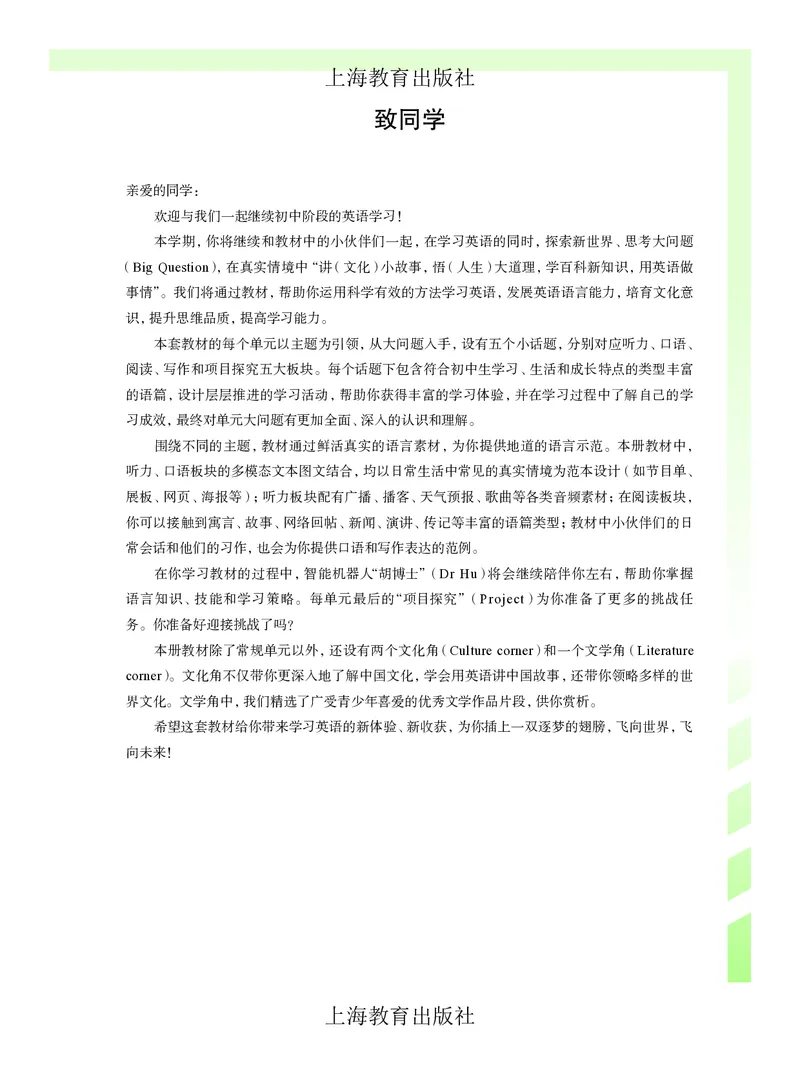
致同学
亲爱的同学:
欢迎与我们一起继续初中阶段的英语学习!
本学期,你将继续和教材中的小伙伴们一起,在学习英语的同时,探索新世界、思考大问题
(Big Question),在真实情境中“讲(文化)小故事,悟(人生)大道理,学百科新知识,用英语做
事情”。我们将通过教材,帮助你运用科学有效的方法学习英语,发展英语语言能力,培育文化意
识,提升思维品质,提高学习能力。
本套教材的每个单元以主题为引领,从大问题入手,设有五个小话题,分别对应听力、口语、
阅读、写作和项目探究五大板块。每个话题下包含符合初中生学习、生活和成长特点的类型丰富
的语篇,设计层层推进的学习活动,帮助你获得丰富的学习体验,并在学习过程中了解自己的学
习成效,最终对单元大问题有更加全面、深入的认识和理解。
围绕不同的主题,教材通过鲜活真实的语言素材,为你提供地道的语言示范。本册教材中,
听力、口语板块的多模态文本图文结合,均以日常生活中常见的真实情境为范本设计( 如节目单、
展板、网页、海报等);听力板块配有广播、播客、天气预报、歌曲等各类音频素材;在阅读板块,
你可以接触到寓言、故事、网络回帖、新闻、演讲、传记等丰富的语篇类型;教材中小伙伴们的日
常会话和他们的习作,也会为你提供口语和写作表达的范例。
在你学习教材的过程中,智能机器人“胡博士”(Dr Hu)将会继续陪伴你左右,帮助你掌握
语言知识、技能和学习策略。每单元最后的“项目探究”(Project)为你准备了更多的挑战任
务。你准备好迎接挑战了吗?
本册教材除了常规单元以外,还设有两个文化角(Culture corner)和一个文学角( Literature
corner)。文化角不仅带你更深入地了解中国文化,学会用英语讲中国故事,还带你领略多样的世
界文化。文学角中,我们精选了广受青少年喜爱的优秀文学作品片段,供你赏析。
希望这套教材给你带来学习英语的新体验、新收获,为你插上一双逐梦的翅膀,飞向世界,飞
向未来!
上海教育出版社上海教育出版社
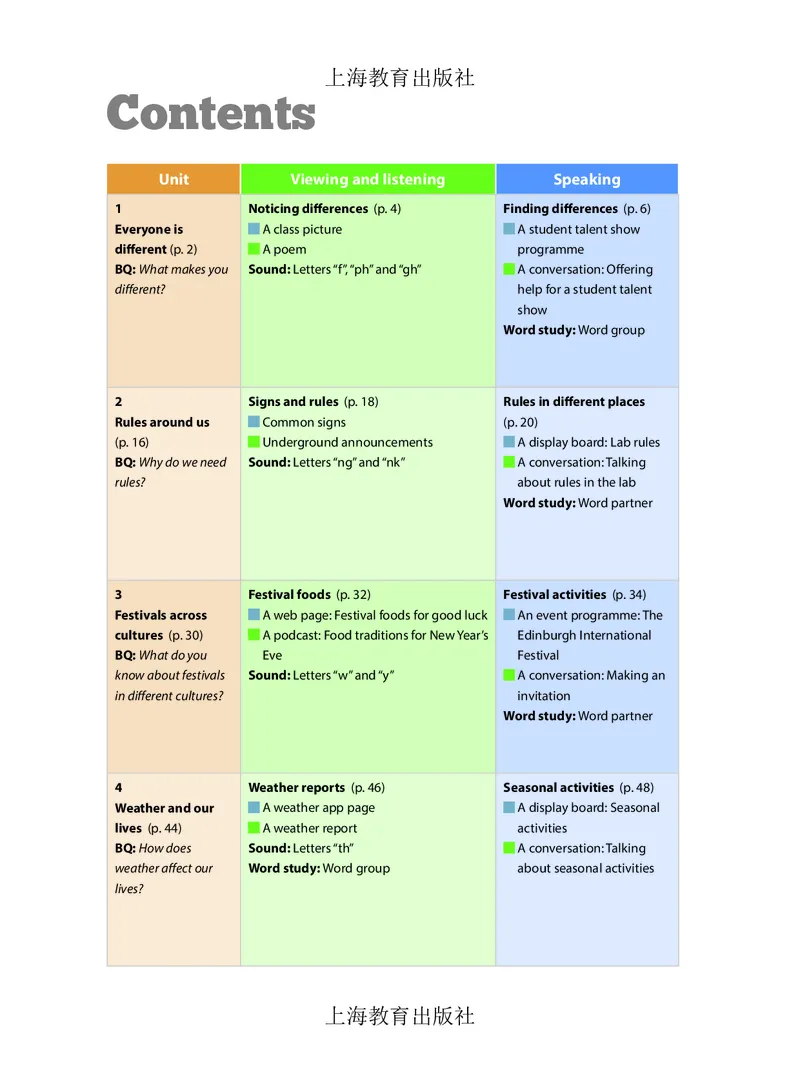
Contents
Unit Viewing and listening Speaking
1 Noticing differences (p. 4) Finding differences (p. 6)
Everyone is A class picture A student talent show
different (p. 2) A poem programme
BQ: What makes you Sound: Letters “f”, “ph” and “gh” A conversation: Offering
different? help for a student talent
show
Word study: Word group
2 Signs and rules (p. 18) Rules in different places
Rules around us Common signs (p. 20)
(p. 16) Underground announcements A display board: Lab rules
BQ: Why do we need Sound: Letters “ng” and “nk” A conversation: Talking
rules? about rules in the lab
Word study: Word partner
3 Festival foods (p. 32) Festival activities (p. 34)
Festivals across A web page: Festival foods for good luck An event programme: The
cultures (p. 30) A podcast: Food traditions for New Year’s Edinburgh International
BQ: What do you Eve Festival
know about festivals Sound: Letters “w” and “y” A conversation: Making an
in different cultures? invitation
Word study: Word partner
4 Weather reports (p. 46) Seasonal activities (p. 48)
Weather and our A weather app page A display board: Seasonal
lives (p. 44) A weather report activities
BQ: How does Sound: Letters “th” A conversation: Talking
weather affect our Word study: Word group about seasonal activities
lives?
上海教育出版社上海教育出版社
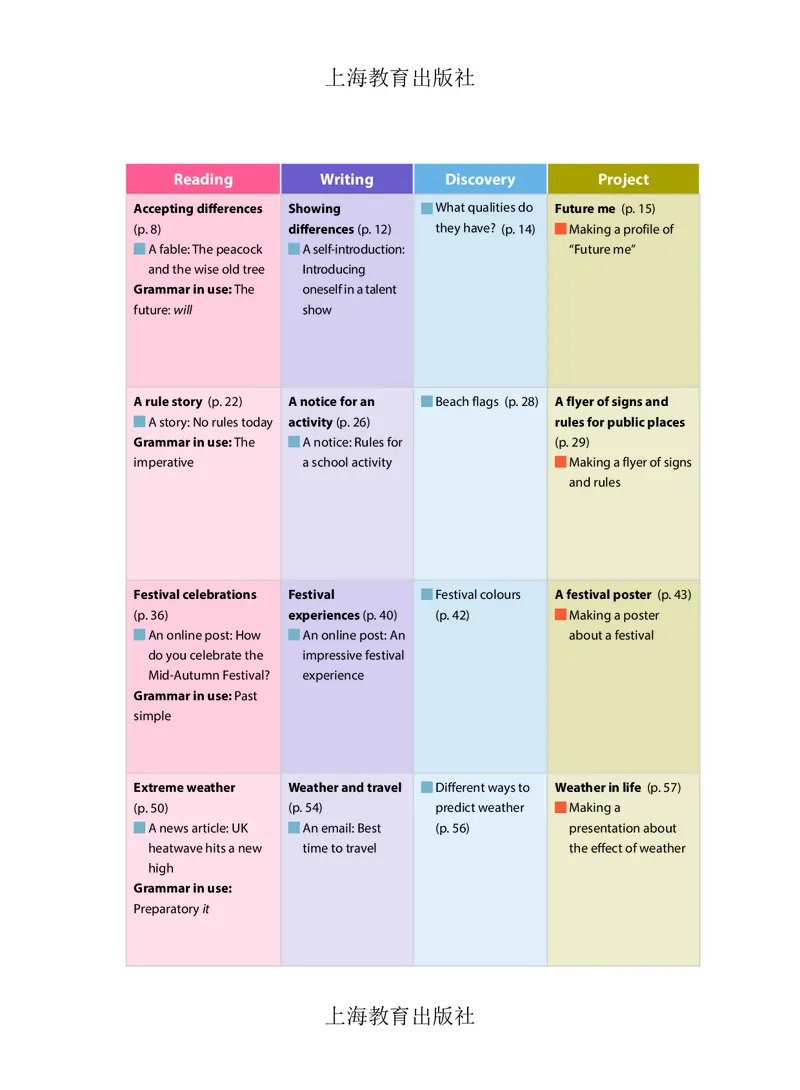
Reading Writing Discovery Project
Accepting differences Showing What qualities do Future me (p. 15)
(p. 8) differences (p. 12) they have? (p. 14) Making a profile of
A fable: The peacock A self-introduction: “Future me”
and the wise old tree Introducing
Grammar in use: The oneself in a talent
future: will show
A rule story (p. 22) A notice for an Beach flags (p. 28) A flyer of signs and
A story: No rules today activity (p. 26) rules for public places
Grammar in use: The A notice: Rules for (p. 29)
imperative a school activity Making a flyer of signs
and rules
Festival celebrations Festival Festival colours A festival poster (p. 43)
(p. 36) experiences (p. 40) (p. 42) Making a poster
An online post: How An online post: An about a festival
do you celebrate the impressive festival
Mid-Autumn Festival? experience
Grammar in use: Past
simple
Extreme weather Weather and travel Different ways to Weather in life (p. 57)
(p. 50) (p. 54) predict weather Making a
A news article: UK An email: Best (p. 56) presentation about
heatwave hits a new time to travel the effect of weather
high
Grammar in use:
Preparatory it
上海教育出版社上海教育出版社
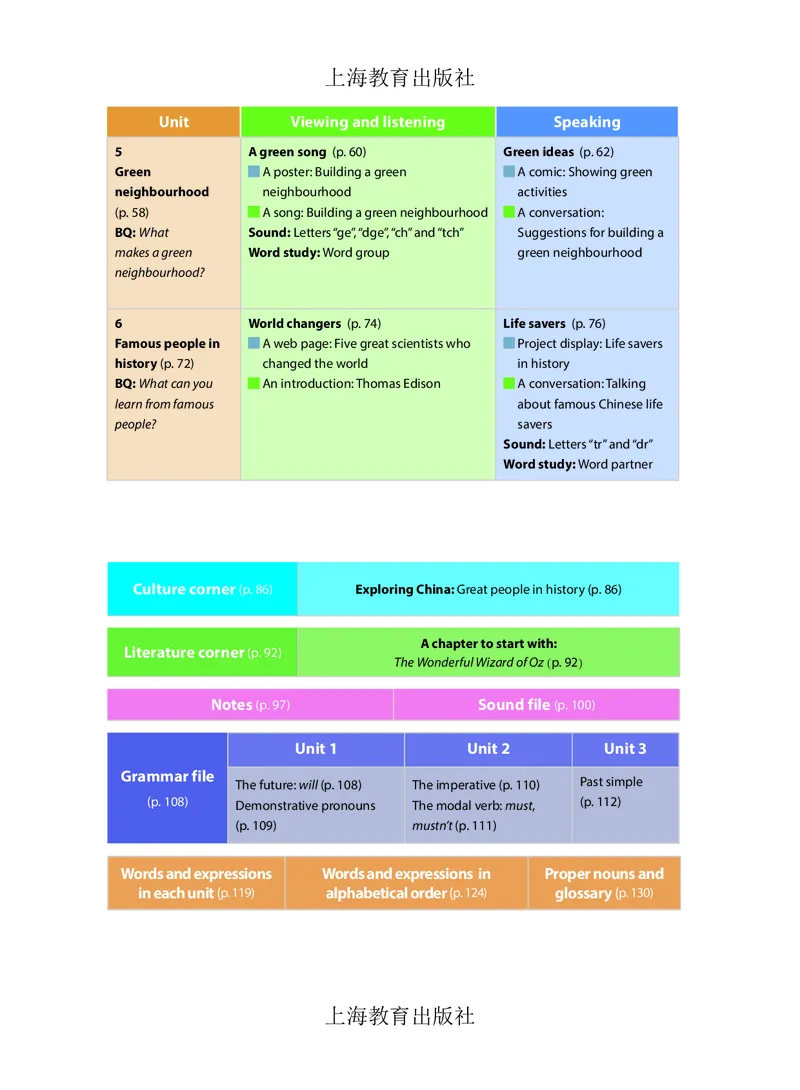
Unit Viewing and listening Speaking
5 A green song (p. 60) Green ideas (p. 62)
Green A poster: Building a green A comic: Showing green
neighbourhood neighbourhood activities
(p. 58) A song: Building a green neighbourhood A conversation:
BQ: What Sound: Letters “ge”, “dge”, “ch” and “tch” Suggestions for building a
makes a green Word study: Word group green neighbourhood
neighbourhood?
6 World changers (p. 74) Life savers (p. 76)
Famous people in A web page: Five great scientists who Project display: Life savers
history (p. 72) changed the world in history
BQ: What can you An introduction: Thomas Edison A conversation: Talking
learn from famous about famous Chinese life
people? savers
Sound: Letters “tr” and “dr”
Word study: Word partner
Culture corner (p. 86) Exploring China: Great people in history (p. 86)
A chapter to start with:
Literature corner (p. 92)
The Wonderful Wizard of Oz (p. 92)
Notes (p. 97) Sound file (p. 100)
Unit 1 Unit 2 Unit 3
Grammar file
The future: will (p. 108) The imperative (p. 110) Past simple
(p. 108) Demonstrative pronouns The modal verb: must, (p. 112)
(p. 109) mustn’t (p. 111)
Words and expressions Words and expressions in Proper nouns and
in each unit (p. 119) alphabetical order (p. 124) glossary (p. 130)
上海教育出版社上海教育出版社
Reading Writing Discovery Project
A green city (p. 64) “One-step Greener” Earth Day An ideal green
A speech: The garden experiences (p. 68) celebrations (p. 70) neighbourhood (p. 71)
city A diary: My “One- Designing a green
Grammar in use: Modal step Greener” neighbourhood
verbs: can, may and experience
should
Great storytellers (p. 78) Great minds (p. 82) Short stories of Stamps of famous
A short biography: A story: A famous famous people people (p. 85)
William Shakespeare person in history (p. 84) Designing stamps of
Grammar in use: There + famous people
be
Exploring the world: Antarctica (p. 89)
A scene to act out: A poem to savour:
The Tempest (p. 94) Night Thoughts (p. 96)
Word study support (p. 102) My learning notes support (p. 106)
Unit 4 Unit 5 Unit 6
Preparatory it (p. 114) Modal verbs: can, could, may, There + be (p. 117)
should, must (p. 115)
Numbers (p. 132) Months and days (p. 134) Irregular verbs (p. 135)
上海教育出版社上海教育出版社
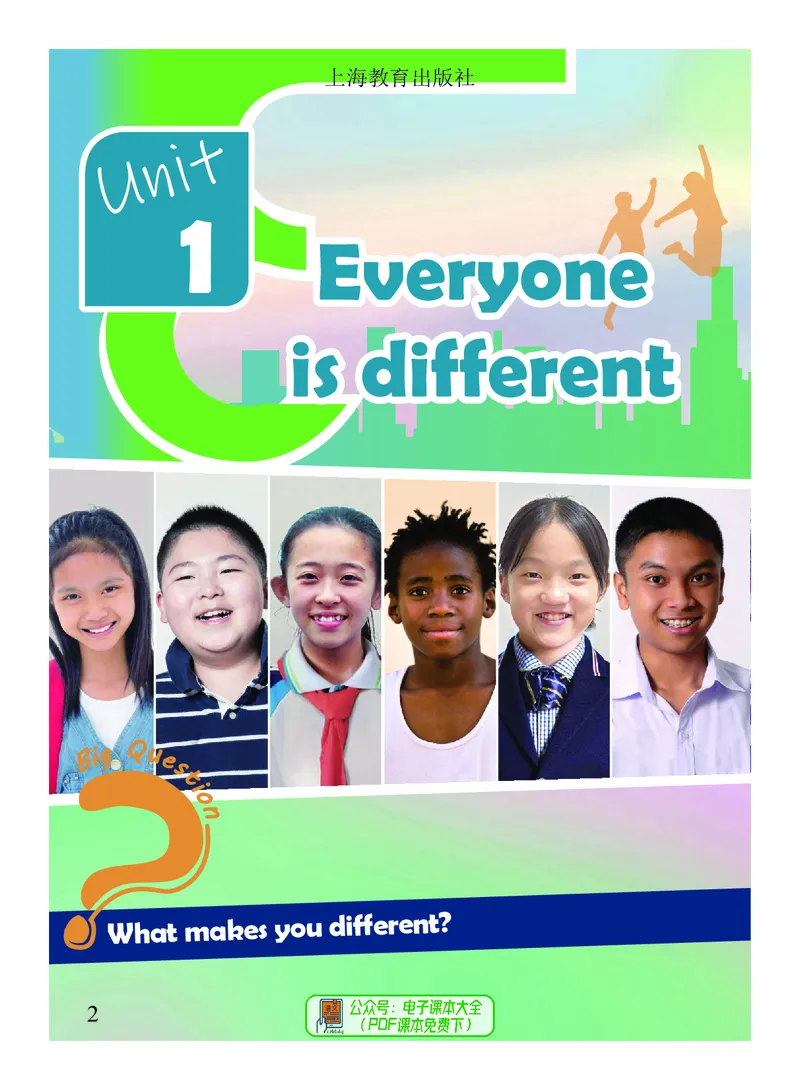
1
Everyone
is different
What makes you
different?
2 上海教育出版社上海教育出版社
1 L t i h st e e n w a t y o s a p e p o o p e le m a a r b e o ut
Everyone
2
d
T
if
a
f
lk
e r
a
e
b
n
o
t
u
.
t
my
classmates’
is different 3 4 s R t
5
m r W e s o a a M h n r k d o i g e a t w s k a e p e e o f a a a a a i n c b u s h t l p e n e s l r i f . a q o - a n u f i b n i i e m l o t e u r s a t o e o l l d f f u w u . n “ c h i t F q a i u t u o t e n u . r t e o
me”.
Getting started
What makes you
different?
Look at the pictures and list at least three different points between
any two students.
上海教育出版社 3上海教育出版社
A
Noticing differences Viewing and listening
Ms Chen is sharing with her class a picture of some visiting students from
Swan Lake Middle School, a partner school of New Star in Auckland.
A1 L ook and say Look at the picture. You may use the words or phrases from
the box to talk about the students.
• tall short big small thin slim fat
• curly/straight/short/long/dark/brown hair
• T-shirt trousers skirt jeans
They will come to our school next
week. What do they look like?
The girl in the blue skirt has
long brown hair.
She’s short and slim.
4 上海教育出版社上海教育出版社
1
A2 Listen and think Ms Chen plays a poem about the coming students.
Listen to part of the poem and tick (3) the difference(s) between them.
Listening for key words
sizes and shapes clothes
skin colours hair colours
A3 Listen and take notes Listen again and complete the table.
Name Special points Picture number
Paul small and 1 ________________ 6 ________
Paula taller than Paul with 2 ________________ 7 ________
Kim 3 ________________; fair; long brown hair 8 ________
Mika bigger; 4 ________________ than Kim; 9 ________
5 ________________ hair
Finn taller than Mika 10 ________
Sound Letters “f”, “ph” and “gh”
Read aloud.
Look at the photos on the phone.
Here are a few of my favourite ones:
Philip is fixing the music box;
Sophia is making paper cuts;
Fiona is drawing butterflies;
All of us are laughing and having fun.
Update my to-do list
Listen to the rest of the poem. Write down the special points of Shirley, Claire and
Trevor.
上海教育出版社 5上海教育出版社
B
Finding differences Speaking
New Star and Swan Lake will have a student talent show together. Paul
gives a list of shows. Lu Yao is preparing for the programme. Wang Yiming
offers to help her.
Student Talent Show Programme
6 March, School Hall
New Star Swan Lake
… Kim Tree of Last Year (story)
… Finn The Butterfly Lovers (violin)
… Paul Shooting in One Minute (basketball)
… Paula We Are the World (song)
All Tomorrow Will Be Better (song)
Hosts: Lu Yao & Paul
B1 Look and say Work in pairs and talk about the student talent show
programme.
Who will play the violin in the show?
Finn. He will play The Butterfly Lovers.
B2 L isten, read and think Listen to the conversation between Yiming and Lu
Yao. What does Yiming suggest about the programme?
Yiming: Hi, Lu Yao! What are you doing?
Lu Yao: I’m preparing for our talent show with Swan Lake Middle School!
Yiming: Wow! Sounds exciting! Is there anything I can do to help?
Lu Yao: I need someone to help me prepare the programme. Will you do that?
Yiming: I’d like to. That is what I’m good at.
Lu Yao: Wonderful! Any ideas about our programme?
6 上海教育出版社上海教育出版社
1
Yiming: W ell, how about a song by Li Bailing and drumming by Lin Dong
and Zhao Peng?
Lu Yao: G reat! Bailing has a beautiful voice. Lin Dong and Zhao Peng are good
drummers.
Yiming: Shall I ask other students about our programme?
Lu Yao: Good idea!
My learning notes
Offering help:
• What can I do for you? • May I help you?
• ____________________________
TEEN skill Expressing feelings
To express feelings in a conversation, you can use adjectives (e.g.
exciting/excited, wonderful) and intonation. Each intonation carries
a different feeling, e.g. joy, anger or worry.
B3 Role-play Yiming will talk with his classmates about the talent show.
They also want to offer help. Work out a conversation and act it out
with your partner.
Word study Word group Describing a person
Looks Hobbies Personalities Abilities
tall singing kind running fast
short dancing helpful speaking good English
fat drawing easy-going playing the piano
thin telling stories careful being good at ball games
... ... ... ...
Update my to-do list
Work in pairs. Talk about a class show or activity and offer help to your monitor.
上海教育出版社 7上海教育出版社
C
Accepting differences Reading
Lu Yao is telling a fable in the talent show.
C1 Background knowledge Do you know any fables? What can we learn
from them?
C2 R ead the fable.
The peacock and the wise old tree
In a forest live a peacock and a nightingale. They are good
friends. But one day the peacock looks sad and says to the wise
old tree, “Wise old tree, my friend the nightingale has a lovely
voice. She sings so well. Without any doubt, she will be a singer
5 in a few years. I have a loud voice. But when I sing, everyone will
laugh at me.”
The wise old tree smiles and says, “But you’re
beautiful. Your feathers are colourful.”
“What can I do in the future? Can I be a
10 singer?” the peacock worries.
The wise old tree pats him, “Not everyone will
be a singer. You can be a good dancer with
your beautiful feathers and dancing skills.
Different people are good at different things.
15 The elephant is strong. The monkey is clever.
The tiger jumps far. Everyone is unique.”
Personal touch
Why do you think Lu Yao tells this fable?
Text type Fables
A fable is a short story that teaches a lesson. The characters in fables
are often animals. They speak and act like people.
8 上海教育出版社上海教育出版社
1
C3 G eneral understanding Read the fable and choose the best answer to
the question.
Understanding the moral
What does the story try to tell us?
A The peacock is different from other animals.
B The peacock wants to be a singer in the future.
C Everyone is happy about their strong points.
D Everyone has some strong points.
C4 D etailed reading Read again and complete the table with the peacock’s
feelings and the reasons.
Feelings Reasons
Sad The peacock doesn’t have a 1 ________________ like the
nightingale.
Everyone will 2 ________________ when he sings.
3 __________ The peacock doesn’t know what he can do
4 ________________.
C5 Further thinking Answer the questions.
1 What does the wise old tree say about the other animals? Why does he say so?
2 What might the peacock feel after hearing the words of the wise old tree?
3 What will the peacock probably say and do later?
Vocabulary focus Complete the conversation between the peacock
and his grandmother with the words and phrases from the text.
Grandmother: You look so happy today!
Peacock: D o you know the 1 _______________? He thinks I’m
2 _______________.
Grandmother: O h, you have 3 _______________.
Peacock: I ’ll be a dancer. My friend the nightingale can be a good
singer. She has a lovely 4 _______________.
Grandmother: E xactly! Everyone is different. We’re all 5 _______________.
Update my to-do list
Think and share. What lesson can we learn from the fable?
上海教育出版社 9上海教育出版社
Grammar in use The future: will
1 R ead and think Read the following sentences. Underline the two different
ways of talking about the future in each example.
(1) Look! She gets another big prize for singing. She is going to be a singer in a
few years.
She has a lovely voice. Without any doubt, she will be a singer in a few years.
(2) Look at the dark clouds! It’s going to rain soon.
I think it will rain soon. We have to stop playing football.
(3) “What are you going to do tomorrow?” “I’m going to borrow some books from
the library.”
“Class is over. Will you go to the library?” “Yes, I will.”
(4) “The Peony Pavilion is a classic drama.” “Yes, I know and I’m going to watch it
this summer.”
“Will you watch The Peony Pavilion with me?” “Hmm ... No, thanks. I’ll go and
visit my grandma.”
2 W ork out the rules Tick (3) the one(s) you agree with.
We usually use will to ...
predict or guess what will happen
state a decision already made
make a decision at the moment of speaking
Grammar file p. 108
3 P ractise Your friend will be in a talent show tomorrow, but he or she is very
nervous. Complete the sentences to cheer him or her up.
(1)
I’ll forget my words! No, you won’t. I’m sure _y_o_u
_w_o_n_’t_ _fo_r_g_e_t_ y_o_u_r_ w__o_rd__s.
(2)
People won’t like my
Yes, they will. I’m sure they
singing!
will like _________________.
(3)
Everyone will laugh at me! No, they won’t. Of course
____________________.
(4)
The dance will not be a success!
Yes, it will. _________________.
10 上海教育出版社上海教育出版社
1
4 D iscuss Work in pairs. Talk about another coming activity with the help
of the mind map.
host members
at school who ...
Activity:
where ...
_________
out of school
what
...
topic timetable
tomorrow this weekend
next week/month/... in ... days/weeks/...
What will we do on Friday afternoon?
We’ll have a class meeting.
Will Lu Yao host the meeting?
No, she won’t. Lin Dong will be the host.
上海教育出版社 11上海教育出版社
D
Showing differences Writing
Chen Feifei is introducing herself to her new friends from Swan Lake Middle
School in the talent show.
D1 Think Read Feifei’s self-introduction. What makes her different from others?
Hello, everyone! I’m Chen Feifei. “Fei” in Chinese means “fly”. I’m
a happy bird, flying here and there. I like dancing, music and
drawing. I’m good at drawing pictures for our noticeboards.
This is my drawing of your class. Do you like it? Would you like
to be my friend?
Grammar file p. 109
TEEN skill Writing a self-introduction
A self-introduction usually includes one’s name, hobbies and
abilities. We should make it clear and unique by describing our
special points.
D2 Prepare Underline the answers to the questions in Feifei’s self-introduction.
Q1: How does she begin her self-introduction?
Q2: What does she like?
Q3: What is she good at?
Q4: How does she end her self-introduction?
D3 Plan Plan your writing by noting down key information in the mind map on
the next page.
12 上海教育出版社上海教育出版社
1
name hobbies
______________________ ______________________
______________________ ______________________
______________________ ______________________
Self-
introduction
abilities ...
______________________ ______________________
______________________ ______________________
______________________ ______________________
D4 Write Write your self-introduction.
Hello, everyone! ___________________________________________
_________________________________________________________
_________________________________________________________
_________________________________________________________
_________________________________________________________
D5 C heck Check your self-introduction. Pay attention to its structure and
language.
Update my to-do list
Work in groups. Listen to each other’s self-introductions and note down everyone’s
special points. Then compare your notes.
上海教育出版社 13上海教育出版社
Discovery
What qualities do they have?
Sun Bin
“Favourable① weather conditions, geographic②
advantages and the unity③ of the people all must be
in place. If not, victory will be costly.”
He could not walk after his knees got hurt, but
he wrote Sun Bin: The Art of War, one of the most
famous Chinese books about warfare④.
Helen Keller
“Keep your face to the sunshine and you cannot see
the shadow⑤.”
She was blind and deaf when she was 19 months
old. She started to learn words by touching things
and others’ lips. She became a famous writer and
speaker.
Ludwig van Beethoven
“There are and will be thousands of princes. There is
only one Beethoven!”
He wrote some of his most famous pieces after he
was completely deaf. He was one of the greatest
composers⑥ of all time.
Read and think What problem(s) did these famous people meet with in their
lives?
① favourable 有利的 ② geographic 地理的 ③ unity 统一 ④ warfare 战争 ⑤ shadow 阴影
⑥ composer 作曲家
14 上海教育出版社上海教育出版社
1
E
Future me Project
Making a profile① of “Future me”
Work in groups of four or five. Each member of the group makes a profile of
“Future me” with words and a picture, and puts it in a “time box”. About three
years later, all students will open the box and read their profiles.
Step 1 Collect ideas Ask yourself questions and note down the answers.
What ability/abilities will I have?
What will I look like?
Questions What habit(s) will I form?
Which school will I go to?
What weak point(s) will
...
I work on?
Step 2 Write Put together the answers in Step 1 and write the first draft.
Step 3 Share and revise Share your draft. Discuss the questions in Step 1
and revise your draft.
Step 4 Draw Draw a picture of yourself for your profile, or ask someone in
your group to draw the picture.
I will be over 1.75 metres tall and the best player on
our school basketball team. I’ll go to a good school in
our city. I’ll read English books every day and be able
to speak English well. I will not spend much time on
computer games but will play ball games with my
friends.
Step 5 Seal the box Put your profile of “Future me” in the “time box” and seal
the box.
Update my to-do list
Work in groups. Help each other find ways to become future selves.
① profile 简介
上海教育出版社 15上海教育出版社
2
Rules
around us
Why
do
we
need
rules?
16 上海教育出版社上海教育出版社
1
a
L
b
i
o
st
u
e
t
n
ru
to
le s
announcements
.
2 Talk
about
rules
in
different
places
.
3
a
R
t
e a
s
d
ch o
a
o
s
l
tory
about
rules
.
4 W rite
a notice
for an
activity
.
5
f
M
or
a k
p
e
u b
a
l ic
f ly
p
e
la
r
ce
a
s
bout
rules
.
Getting started
Read the list. Tick (3) the things you must do. Cross (7) the things
you mustn’t do. Explain why.
Stop and wait at a red light. Pick flowers or fruits in a city park.
Arrive at school on time. Talk loudly in the city library.
上海教育出版社 17上海教育出版社
A
Signs and rules Viewing and listening
Every day, we see signs everywhere. They are part of our lives.
Don’t turn right here.
Underground
this way.
Turn left here.
No leaning.
No
littering.
Mind the gap.
A1 L ook and say Match the meanings on the right with the signs. Then work in
pairs and discuss where else you can find the signs.
Where else can you find
the sign “No leaning.”? I can find it on the escalator
in the underground station.
18 上海教育出版社上海教育出版社
2
A2 Listen, view and circle Listen to the announcements and circle the
signs you hear.
Visualising
A3 Listen and take notes Listen again and complete the sentences.
Announcements for passengers
On the escalator
1 ________________ your eyes only on your phone.
2 Please use the lift when you have ________________.
On the platform
3 Please wait at the ________________ line and mind the ________________.
4 Don’t rush when the underground train ________________.
On the train
5 Don’t ________________, ________________, smoke or litter on trains.
6 Please give your seat to anyone ________________.
Sound Letters “ng” and “nk”
Read aloud in pairs.
A: What’s the meaning of this sign?
B: It means we mustn’t eat food or drinks here.
A: What else should we follow in the library?
B: Keep quiet. Don’t keep books for too long.
A: Thank you for telling me all these things.
Update my to-do list
Listen to an announcement, circle the signs in A2 and say where you might hear
it. Write down the rules.
上海教育出版社 19上海教育出版社
Rules in different
B
Speaking
places
Paul, an exchange student from Swan Lake Middle School, is looking at a
display board in the clubroom with Lu Yao.
Dos and don’ts
Don’t wear open-toed① Never leave rubbish
shoes in the lab. on the floor.
No food or drinks
in the lab.
Always wear safety
gloves when
working in the lab.
Always throw
broken glass into
the broken glass
container.
B1 L ook and say Work in pairs. Look at the display board and discuss the
questions below.
1 Which club are Paul and Lu Yao interested in?
A Photography. B Science. C Art.
2 What rules must students follow according to the display board?
① open-toed 露趾的
20 上海教育出版社上海教育出版社
2
B2 Listen, read and think Listen to the conversation between Paul and
Lu Yao. What rules does Lu Yao point out?
Paul: Are you ready to go to the lab and do some experiments today?
Lu Yao: Yes. Look, I am wearing close-toed shoes.
Paul: Great!
Lu Yao: Before we get started, look at the rules first to keep safe.
Paul: What rules must we follow in the lab?
Lu Yao: W e mustn’t eat or drink in the lab. We mustn’t leave rubbish on the
floor.
Paul: What else must we do or not do?
Lu Yao: Always wear safety gloves when working.
Paul: I see. Anything else?
Lu Yao: Look there, and you can find more rules.
Grammar file p. 111
Word study Word partner Linking verb (keep, stay, grow) + Adjective
Look at the expressions with “keep”, “stay” and “grow”. Try to give more examples.
You must keep quiet in the reading room.
Keep doing exercise, and you can stay healthy.
Take care of the trees to make them grow big and strong.
B3 Role-play Work with a partner. Make up a new conversation to talk about
the rules according to the display board.
My learning notes
Giving orders:
• Be quiet. • Please follow rules.
• Never litter. • _________________________
Update my to-do list
Work in pairs. Talk about rules in a public place like the library, the park or the road.
上海教育出版社 21上海教育出版社
C
A rule story Reading
Lin Dong is sharing a rule story with Lu Yao.
C1 P redicting Look at the picture and predict: Why does Bob look unhappy?
Predicting
C2 Read the story.
Ms White and her students are talking
Rules are very important.
about rules in class. Bob thinks, “I
What rules do we follow?
don’t like rules. School will be a better
place without any rules.”
5 Next day, Bob comes to school.
Take turns to do
Ms White smiles and says, “Today we things.
won’t have any rules in our school.”
“Hurrah!” Bob shouts happily.
The STEM class begins. It’s Bob’s turn to
10 show his model plane. He begins to talk, Bob
but no one pays any attention to him. He
says loudly, “Keep quiet! I’m trying to tell
Listen to others
you something.” Jim replies, “No. It’s a day
carefully in class.
without rules!!”
15 In the PE class, Bob wants to play tennis
and asks, “May I have a turn?” Emma says, “No. No rules today!”
At lunchtime, someone takes some of Bob’s food without asking. “It’s my
food,” Bob cries out, “What’s happening today? No one listens to me, no one
lets me play ... Can we have our rules back now?”
20 “Wake up, Bob. Are you having a dream? It’s time for school!” Bob hears
his mum’s voice.
Personal touch
What can you learn from Lin Dong’s story?
C3 General understanding Read the story and tick (3) the best title.
Important rules No rules today Rules at school
22 上海教育出版社上海教育出版社
2
C4 Detailed reading Read the story again and complete the table below.
Time What happens Rules
In the STEM class Bob’s classmates 1 ____________ K__e_e_p_ _q_u_i_e_t_ _a_n_d_ _li_s_t_e_n__ t_o_ _
______________________________. o__t_h_e_r_s__________________.
In the PE class Emma 2 ______________________ 4 ________________________
______________________________. ________________________.
At lunchtime Someone 3 ___________________ 5 ________________________
______________________________. ________________________.
C5 Further thinking Answer the questions.
1 Why does Bob have such a dream?
2 What other rules should we follow at school?
Vocabulary focus Help Lu Yao complete the story review with the
words and phrase from the text and the picture.
Story review
Name: Lu Yao
My opinion of the story:
I like this story. At first, Bob thinks school life will be fun 1 __________ rules.
Later, he has a dream ... On the day without rules, his classmates don’t listen
to him and don’t keep 2 __________. Emma doesn’t let Bob play the games in
3 __________. Someone takes Bob’s food without asking. It is all because there
are no rules today. In the end, Bob 4 __________. The story shows us that rules
are very 5 __________. They help us behave well, stay safe and be happy.
Rating the story: 9/10
Would you recommend this
story to others? (Y3ES/NO)
Update my to-do list
Work in groups. Each group member chooses one role from C2. Act out the story.
上海教育出版社 23上海教育出版社
Grammar in use The imperative
1 R ead and think Read the sentences below. Find more examples from
Sections A, B and C.
(1) Be careful.
(2) Keep quiet!
(3) Don’t rush.
(4) Never play with fire.
2 Work out the rules Read the sentences above again and fill in the blanks.
• We form imperative sentences with the base form of a verb.
• We usually use imperative sentences to tell people to do
something.
• We add __________ or __________ to form negative imperative
sentences.
• We use negative imperative sentences to tell people
__________ to do something.
Grammar file p. 110
3 P ractise Li Bailing is singing a song while cleaning the classroom with her
classmates. Complete the song with imperative sentences, positive or negative.
P u t
the rubbish in the bin.
(1) __________ the paper everywhere.
(2) __________ pens and pencils away.
Let’s clean the classroom today!
(3) __________ the board.
(4) __________ any pictures any more.
(5) __________ the desks and chairs away.
Let’s clean the classroom today!
Keep our classroom clean today.
(6) __________ the floor.
(7) __________ tidy up today.
(8) __________ our classroom tidy today.
A clean classroom makes us happy every day!
24 上海教育出版社上海教育出版社
2
4 Discuss and share Work out the top 10 class rules.
(1) Work in pairs. List some rules for your class.
Dos Don’ts
Keep the classroom clean.
(2) Share the rules with your classmates.
(3) Choose the top 10 rules for your class and put them down in the following
boxes.
1 2 3
4 5 6
7 8 9
10
Class rules
上海教育出版社 25上海教育出版社
A notice for an
D
Writing
activity
You are going to write a notice about rules for a school activity.
D1 Think Read the notice of Lin Dong’s school. What is the notice about?
Title Notice
Opening
We will have our spring outing on 22 March.
_______ & _______
of the activity We are going to the Science and Technology
Body Museum. We will meet at the school gate at 9 a.m.
______ of the and come back at 3 p.m.
activity
Remember:
______ of the
• Always keep safe.
activity
• Stay with the groups.
• No photos.
• No littering.
Ending Have a good time!
Organiser New Star Middle School
D2 Prepare Complete the tags on the left of the notice.
26 上海教育出版社上海教育出版社
2
D3 P lan Think of a school activity you are going to have. Make notes about it.
1 What activity are you going to have? (Sports Day/Open Day/Arts Festival/...)
________________________________________________________________
2 When and where are you going to have it?
________________________________________________________________
________________________________________________________________
3 What rules do you think students must follow?
• _______________________________________________________________
• _______________________________________________________________
• _______________________________________________________________
• _______________________________________________________________
• ...
D4 Write Write a notice for the activity.
D5 Check Check your notice. Pay attention to the basic elements of a notice
and the language about rules.
TEEN skill Writing a notice
A notice is a formal written announcement for a group of people. It
should be clear and precise. It usually includes:
• Title
• Opening (e.g. name of the activity)
• Body (e.g. plan of the activity)
• Ending
• Organiser
Keep sentences short and use simple words in the notice.
Update my to-do list
Work in groups. Select the best notice and give reasons.
上海教育出版社 27上海教育出版社
Discovery
Beach flags
Beach flags tell us information about the waves. They can keep us safe
when we are playing on the beach.
A red flag means the surf① A yellow flag means it is dangerous
is very dangerous. There are somewhere. The waves can be very
big waves, or maybe other strong, and maybe bad weather is
dangers. We mustn’t swim coming. When there is a yellow flag,
in the water when we see a parents should watch children at all
red flag. times. We shouldn’t swim or sail in
the sea alone.
A pair of black and white A red over yellow flag means it
flags means it is a surfing is a safe swimming area. Helpers
area. So, don’t swim there. are near.
We must keep surfers safe.
Read and think Which flag shows that we can go swimming? Why?
① surf 激浪
28 上海教育出版社上海教育出版社
A flyer of signs and 2
E
Project
rules for public places
Making a flyer① of signs and rules
Work in groups. Make a flyer of signs and rules for public places.
Step 1 Choose Choose one public place near your school.
museum library
restaurant Public places children’s park
cinema ...
Step 2 Collect signs and rules Find the signs and rules in this place. Take
photos or draw pictures of the signs.
Step 3 Make a flyer Write down the place and rules and stick the photos or
pictures.
Signs and rules in the children’s park
Don’t run fast.
Wait in line politely.
No smoking or littering.
Facilities for children only.
Children under 6 must be
accompanied by a parent.
Step 4 Share Share your flyer with your classmates and describe the signs
and rules.
Update my to-do list
Look at other groups’ flyers and make comments.
① flyer 小传单
上海教育出版社 29上海教育出版社
3
Festivals
across cultures
A
What
do
you
know
about
festivals
in
different
cultures?
30 上海教育出版社
C上海教育出版社
B
1
f
L
e
i
s
s
t
t
i
e
v
n
al
t
f
o
o o
a
d s
podcast
about
What do
you
know
about
festivals
D
5 4 c f o 3 M e 2 m u W s f a n t R y e T k r t i s e v e i a r t t f a a l i e i e k d e l a v s s a t i . a a o n p l i n b v n o t o a C l s i r o l u n t h a n t e e e i d n l r x i i n a f t p p e a e i o e o s o . b s r t n r p o t i i e s u o v s . n o a t s c t t a l e h b a a . e a o c r b u t o t iv u i t t ies .
in
different
cultures?
Getting started
Look at the pictures. Match each picture with a festival description.
In what places do people usually celebrate these festivals?
1 People pour water over one another for good luck.
2 People cover one another with coloured powder.
3 People make a big outdoor fire to celebrate summer.
4 People eat zongzi and row boats at this festival.
上海教育出版社 31上海教育出版社
A
Festival foods Viewing and listening
Li Bailing finds a web page about festival foods.
Festival foods for good luck
jiaozi noodles
tangyuan fish
spring rolls Laba porridge
Listen to a podcast about lucky foods. (Click here )
A1 L ook and say Look at the web page. Do you know why people believe
these foods to be lucky?
32 上海教育出版社上海教育出版社
3
A2 Listen and think Listen to Bailing’s podcast and tick (3): What is the
speaker’s main purpose?
Understanding a speaker’s purpose
To teach people how to cook food for New Year’s Eve.
To introduce food traditions for New Year’s Eve.
To talk about the history of New Year’s Eve.
A3 Listen and take notes Listen again and complete the table.
What? Where? Why?
The countries close to
Fish To bring wealth
1 ________________
Lucky Some Asian countries
To hope for a
foods 2 ________________ like China and the
3 ________________
Philippines
Cabbage Germany To pass on good luck
To make 5 ________________
4 ________________ Mexico
at midnight
Sound Letters “w” and “y”
Read aloud.
Happy New Year to you,
Happy New Year to you!
We watch fireworks.
We welcome the harvest,
We wish you a healthy and wealthy New Year.
Update my to-do list
Listen to a podcast about festival foods. Find the speaker’s purpose and make a
table similar to that in A3.
上海教育出版社 33上海教育出版社
B
Festival activities Speaking
Harry Turner and Li Bailing are talking about a programme about the
Edinburgh International Festival.
10:30 p.m., 3 August
Opening Event
At Festival Square
Edinburgh
8 p.m., 5 August
International Festival
Beethoven’s Ninth Symphony
At the Usher Hall
8 p.m., 18 August
Swan Lake
Since 1947
At the King’s Theatre
8 p.m., 22 August
Cats
At the Lyceum
5–29 August
Live Street Shows
At the Royal Mile
9:30 p.m., 27 August
Closing Fireworks Concert
At the Ross Theatre & Princes Street Gardens
Check out our website for more information:
B1 L ook and say Look at the programme. Which events would you like to
attend?
B2 L isten, read and think Listen to the conversation between Harry and
Bailing. What do people usually do at the Edinburgh International Festival?
Bailing: Hi, what are you reading?
Harry: I t’s a programme for this year’s Edinburgh International Festival.
Bailing: Wow, it looks good. What is special about the festival?
Harry: T here are a lot of plays, performances, operas and concerts. All in
one place.
34 上海教育出版社上海教育出版社
3
Bailing: Really?
Harry: I went there last year and saw a musical group perform Cats.
Bailing: I’ve never seen a musical before!
Harry: W ould you like to go on a family trip to Edinburgh during your
summer holidays with us?
Bailing: S ounds great! I need to talk to my mum and dad. May I have this
programme?
Harry: Sure! Here you are.
B3 Role-play Wang Yiming is interested in ballet and street shows. Harry invites
him to this year’s Edinburgh International Festival too. Work in pairs and act
out their conversation. Use the above conversation as a model.
TEEN skill Making invitations
We make invitations to ask someone to join us for an activity or
event. Invitations between close friends are usually informal.
Formal invitations can show greater respect and politeness.
My learning notes
Making an invitation:
• (Formal) I’d like to invite you to ... • (Formal/Informal) Would you like to ...?
• (Informal) Do you want to ...? • ______________________________
Responding to an invitation:
• (Informal) I’d love to. • (Formal) I’m really sorry, but I’ve got
• __________________________ something else on.
Word study Word partner Verb + Noun
The following verbs are often used in describing festival activities. What nouns or
noun phrases do they often go together with?
Verb Noun/Noun phrase Verb Noun/Noun phrase
watch a show/a lion dance/a concert/... play
eat visit
wear enjoy
Update my to-do list
Work in pairs. Think of a festival in your hometown and invite your partner to the
festival.
上海教育出版社 35上海教育出版社
C
Festival celebrations Reading
Li Bailing finds some interesting online posts about the Mid-Autumn
Festival.
C1 Predicting Look at the title and the pictures below, and guess: What are the
online posts about?
C2 Read the online posts.
How do you celebrate the Mid-Autumn Festival?
The Mid-Autumn Festival is on the 15th day of the
eighth month, following the Chinese lunar calendar.
With a history of thousands of years, it’s a day for family
reunions. This evening we ate mooncakes and watched
5 a full moon in a park. I thought of the story of Chang’e
flying to the moon. Is she missing her friends?
Zhang Lijia, China (posted at 8:50 p.m.,17 Sept.)
Tsukimi is different from Chinese celebrations. We
decorate our houses with special autumn grass
10 and eat Dango. We mostly celebrate it with friends.
Tonight, I had Dango and tea with my friend in a
local tea house. What a quiet night it was!
Haruto, Japan (posted at 9:10 p.m., 17 Sept.)
We started Chuseok as a harvest festival. We have
15 it on the same day as China. Songpyeon is our most
traditional food for family reunions. It’s a half-moon-
shaped rice cake with nuts and sugar. I’m studying in
China, so this evening I celebrated it with my Chinese
friends. How happy we were!
20 Seo-jun, South Korea (posted at 9:15 p.m., 17 Sept.)
Personal touch
What else do you want to know about the celebrations?
36 上海教育出版社上海教育出版社
3
C3 General understanding Read the posts and fill in the blank.
The Mid-Autumn Festivals in China, Japan and South Korea are similar in:
_____________________________________________________________________________
C4 Detailed reading Read the posts again and complete the table.
Comparing and contrasting
About the Mid-Autumn Festival
Mid-Autumn
Name Tsukimi Chuseok
Festival
Country China
Time
Festival food
Festival activity/
activities
C5 Further thinking Answer the questions.
1 What other countries also celebrate the Mid-Autumn Festival?
2 Why do people in different countries celebrate the same festival?
Vocabulary focus Here is the online post Li Bailing writes about the
Mid-Autumn Festival. Complete it with the words from the text.
The Mid-Autumn Festival, with a history of thousands of years, comes from
China. It spreads to many other countries, such as 1 __________ and South Korea.
People 2 __________ this festival on the same day — the 15th day of the eighth
month according to the Chinese lunar 3 __________. In China and South Korea,
the Mid-Autumn Festival is a big day for family 4 __________. Every country has
its own festival food, for example, 5 __________ in China, Songpyeon in South
Korea and Dango in Japan.
Li Bailing, China (posted at 8:55 p.m., 17 Sept.)
Update my to-do list
Work in pairs and talk about the food and activity that you think are special in the
online posts.
上海教育出版社 37上海教育出版社
Grammar in use Past simple
1 R ead and think What do you find from the answers of the two conversations?
Conversation A
A: How do you celebrate the Mid-
Autumn Festival?
Conversation B
B: I usually celebrate it with my
family, but this year I celebrated A: Do you like eating
it with my friends. mooncakes?
B: I like them very much, but
I didn’t like them when I
was little.
2 W ork out the rules Tick (3) the one(s) you agree with.
We usually use the past simple to talk about ...
actions that happened in the past
things we do regularly
past habits and states
Grammar file p. 112
3 Practise Work in pairs. Li Bailing and Wang Yiming are talking about how
they enjoyed the Dragon Boat Festival last year. Complete the conversation
with the proper forms of the words from the box.
watch be celebrate play learn eat
38 上海教育出版社上海教育出版社
3
Bailing: How did you celebrate the Dragon
Boat Festival last year?
Yiming: I (1) __________ games and (2) __________
zongzi. I also (3) __________ to make
zongzi. What about you?
Bailing: Well, I (4) __________ it with my family.
My grandmother made zongzi for us.
We (5) __________ the dragon boat
racing. My brothers (6) __________
excited.
Yiming: I can imagine that.
4 P air and share Work in pairs. Talk about your experiences during the last
Spring Festival.
(1) Take turns to ask each other questions. Note down your partner’s answers.
Where did you spend the Spring Festival last year?
Whom did you spend the festival with?
What did you do at the festival?
Which experience was the most unforgettable? Why?
...
(2) Compare your experiences. Tell the class what was similar/different.
e.g. Both of us spent the last Spring Festival at home.
上海教育出版社 39上海教育出版社
D
Festival experiences Writing
You want to post your festival experience on a website about teenage life.
D1 Think Read Ada’s online post. When did Ada post her experience? How did
she celebrate the new year?
Last week, we celebrated the new year! On New Year’s Eve, we had a big meal.
The beans were my favorite. In America, we eat beans because we believe
that beans will bring us a year’s good luck! After the meal, we watched a light
show and counted down the seconds in Times Square! We were very excited!
Ada, the United States (posted at 9:30 p.m., 8 Jan.)
D2 Prepare How did Ada describe the festival? Match the labels with the
descriptions. You can match more than once. There are two descriptions more
than you need.
Feeling(s)
Festival name
Festival food(s) Festival activity/activities excited
counted down
New Year just so so had a big meal the seconds
Beans will bring wealth.
The beans were my favorite.
watched a light show
Beans will bring us a year’s good luck.
TEEN skill Using capital letters for proper nouns
A proper noun is the name of a person, place, organization or thing.
Proper nouns usually begin with a capital letter. For example, “China”,
“People’s Square” and “Ada” are proper nouns.
40 上海教育出版社上海教育出版社
3
D3 Plan Plan your writing by taking notes about the following questions.
What festival did you celebrate?
___________________________________________
What festival food(s) did you eat?
___________________________________________
A festival
experience
What festival activity/activities did you take part in?
___________________________________________
How did you feel about the festival?
___________________________________________
D4 Write Write your post.
_____________________________________________________________
_____________________________________________________________
_____________________________________________________________
_____________________________________________________________
_____________________________________________________________
_____________________________________________________________
_____________________________________________________________
D5 Check Check your post. Pay attention to the capital letters for proper nouns.
Update my to-do list
Work in groups. Read each other’s posts and vote for the most interesting festival
experience.
上海教育出版社 41上海教育出版社
Discovery
Festival colours
White: Harbin International Ice
and Snow Festival, China
One of the largest ice and snow
festivals in the world is in Harbin,
China. It takes place from January
to February, and every year it has a
different theme.
Red: La Tomatina①, Spain
The last Wednesday in August is
the time for La Tomatina in Spain.
People throw tomatoes at each
other. The food fight lasts for an
hour.
Bright colours: Rio Carnival②,
Brazil
This is “the greatest show on the
Earth” with carnival walks, shows and
dances. The party usually happens
every February or March to mark the
end of the long, hot Brazilian summer.
Read and think Which festival colour(s) may show happiness?
① La Tomatina 西红柿节 ② Rio Carnival 里约狂欢节
42 上海教育出版社上海教育出版社
3
E
A festival poster Project
Making a poster about a festival
Work in groups. Make a poster about a festival in China or other countries.
Step 1 L ist and choose Make a list of festivals in your country or other
countries. Choose one festival for your group work.
Step 2 Plan Search for information about the following questions. Turn to
books or the internet for help.
• What is the name of the festival?
• When does it take place?
• What do people do during the festival?
• Is there any special food for this festival?
Step 3 Make a poster Write the text for your poster. Remember to decorate
your poster with drawings or photos.
Lantern Festival
What are the traditions?
Designed by Group 1
Beginning: about 2,000 years ago, the Han dynasty
Celebration time: the 15th day of the first lunar
month
Activities: holding lanterns, watching lantern shows
and guessing riddles
Food: tangyuan/yuanxiao, a traditional dish
Step 4 Share Display and introduce your poster to other groups.
Update my to-do list
Listen to other groups’ introductions and take notes according to the questions in
Step 2.
上海教育出版社 43上海教育出版社
Weather
4
and our lives
①
How
does
weather
affect
our
lives?
③
44 上海教育出版社上海教育出版社
2 1 a T L n a i d s l k t a e c a n t b i o t v u i o t t i e a f s a w v e o a u t r h it e e r s r e e a p s o o r n t s .
.
3
h
R
e
e
a
a
t
d
w a
a
v e
news
article
about
a
.
5 4 l t i M v b h W e e e a s s r k t i e e t f e s f a e e a a c p t n s r o e n o e s m f e t n a w o t i l e a t a t a r t i b a o h o v n e u e r t l a . b o t o n h u e o t u r
.
②
Getting started
Look at the pictures and answer the questions.
1 What is the weather like?
④ 2 What are the people doing?
上海教育出版社 45上海教育出版社
A
Weather reports Viewing and listening
Wang Yiming is using a weather app to prepare for a weather report in
class.
A1 L ook and say Look at the app page and
complete Yiming’s report with words from
the box.
wet raining cloudy hot
windy snowing foggy sunny
It’s the thirtieth of March today. The weather
in Shanghai is 1 __________ and cool. In
the north, it’s quite 2 __________ and cold
in Beijing. The temperature drops to three
degrees Celsius. It’s also very dry. It’s
3 __________ in Tianjin and 4 __________ in
Chongqing today. Urumqi is very cold and
5 __________ too. In the south, Guangzhou is
warm and it’s 6 __________ today. Kunming
is very 7 __________ because it’s rainy all day.
Sanya is still 8 __________ and you can swim
in the sea.
TEEN skill R eading temperatures
°C = degree(s) Celsius
8°C = eight degrees Celsius
–12°C = twelve degrees Celsius below zero/minus twelve degrees Celsius
Sound Letters “th”
Read aloud.
Whenever the weather is cloudy,
I don’t know whether I’m wearing the right clothes.
But Cathy thinks she’ll take her umbrella.
46 上海教育出版社上海教育出版社
4
Word study Word group
Complete the mind map with the proper forms of the weather words in A1.
cold __________
sunny
sun
cool __________
wind
nouns
adjectives
Weather cloud
fog
wet dry verbs
snow
A2 View, listen and take notes Listen to a weather report. Choose from A–E
to complete the boxes and write temperatures in the circles.
Listening for key information
Newcastle Liverpool
°C °C
London
°C
A3 Listen and say Listen again. Besides the weather, what else does the
weatherman say? Why does he say that?
Update my to-do list
Listen to part of a weather report. Take notes about the weather in Birmingham
and Edinburgh, and compare the weather in the two cities.
上海教育出版社 47上海教育出版社
B
Seasonal activities Speaking
Wang Yiming and his friends are making a display board about seasonal
activities.
2
Spring
Summer
4
1
3
Autumn
5 7
Winter
6
8
go swimming go cycling have a picnic go to the beach
make snowmen go skating plant trees fly kites
B1 L ook and say Look at the display board. Put the English stickers in the right
places. Then talk about your favourite seasonal activities.
What’s your favourite activity in spring?
I like cycling with my friends best.
48 上海教育出版社上海教育出版社
4
B2 Listen, read and think Listen to the conversation between Yiming and
Li Bailing. What are their favourite seasonal activities?
Yiming: Isn’t it a lovely day?
Bailing: Yes, quite good. I like warm and sunny weather.
Yiming: So is spring your favourite season?
Bailing: Yes. It’s nice to go hiking and enjoy the sunshine.
Yiming: Why not go on an outing this weekend?
Bailing: That sounds good! Is spring your favourite season too?
Yiming: W ell, I like winter best. I can play with snow and I enjoy making
snowmen. It’s also fun to celebrate the Spring Festival with my family.
Do you think so?
Bailing: You can say that, but I really hate cold weather.
B3 Pair and share Work in pairs. Talk about your favourite season and give
reasons. Start your conversation with a comment or question about the
weather.
TEEN skill Starting a conversation
To start a conversation, we may choose the topics like weather,
travel, food, cooking and sports. It is helpful to collect some
information and prepare some questions before a gathering.
Weather is a safe topic.
My learning notes
Responding to suggestions:
• That’s a good idea. • I’m afraid I can’t.
• Sure, I’d love to. • I’d love to, but ...
• _________________________
Update my to-do list
Work in pairs. Talk about the season you are in and the activities you like. Start your
conversation with a comment or question about the weather.
上海教育出版社 49上海教育出版社
C
Extreme weather Reading
Wang Yiming is reading a news article about the weather in the UK.
C1 P redicting Read the newspaper headline and think what happened to
the UK.
C2 Read the news article.
WORLD NEWS
A boy tries to
UK heatwave hits a new high cool down.
The 19th of July saw an extreme heatwave in the UK. Temperatures
in several places broke records. In Coningsby, England, it reached
40.3°C. Scotland also had its hottest day, with a temperature of 34.8°C.
That day, fires broke out in a few places in England. Trains had to
5 slow down in many areas. An airport closed when parts of the runway
started to break open. Some schools were closed too.
Other schools took action to keep cool. Pupils wore T-shirts and shorts,
not their school uniforms, and played indoors. Zoos also tried their
best to cool their animals down. Tree animals and sea animals ate iced
10 vegetables, leaves or fish.
In fact, the average temperature of the Earth has increased by about 1°C
since the late 1700s. Using coal, cutting down forests and driving cars
caused the problem and made it worse day by day.
Personal touch
Have you experienced very hot weather like the heatwave in the UK?
Text type N ews articles
A news article is to report important news or information to the public.
It begins with the most important thing.
Headline: a short expression or sentence, to the point and
easy to remember
Lead: the first sentence or paragraph, to introduce a story
MOST IMPORTANT
or to provide basic information
IMPORTANT
Details: facts or quotes①
① quote 引用;引述
50 上海教育出版社上海教育出版社
4
C3 G eneral understanding Match each question with a paragraph in
the news article.
Paragraph 1 _______ A What caused the rising average temperature?
Paragraph 2 _______ B How did the heatwave affect the UK?
Paragraph 3 _______ C What did people do with the heat?
Paragraph 4 _______ D What happened in the UK?
C4 Detailed reading Read again and fill in the blanks with details about the
heatwave in the UK.
Identifying key information
UK heatwave hits a new high
What?
2 in several
When? 1
MOST IMPORTANT places broke records:
Where? U K
• 40.3°C in England
IMPORTANT
• 34.8°C in 3
How did it affect the
country? How did people deal with it?
Fires, slower trains, a In schools: Pupils wore T-shirts and shorts,
closed 4 and and played 5 .
some closed schools In zoos: Some animals ate 6 food.
Why? Human activities: 7 coal, cutting down 8 and driving cars
C5 Further thinking Answer the questions.
1 What else causes changes in the weather?
2 What other extreme weather do you know about?
Vocabulary focus Complete Yiming’s reading report with the proper
forms of the words and phrases from the text.
Today I read the news on the UK heatwave. The temperature 1 __________ this
summer and it greatly affected the lives of people in the UK. Fires 2 __________; trains
slowed down; a runway at an airport began to break open; some schools did not
open. In some places, students still went to school. But they didn’t wear 3 __________
or play in the sun. Zoos also tried to keep their animals 4 __________ with cold food.
To stop the temperature from 5 __________, people should try their best to go green.
Update my to-do list
Describe the heatwave in the UK with the help of C4.
上海教育出版社 51上海教育出版社
Grammar in use Preparatory it
1 Read and think Read the following sentences to see when we use it.
(1) It’s the thirtieth of March today.
(2) It’s quite windy and cold in Beijing.
(3) It’s spring now.
(4) It’s about 300 kilometres northwest of London.
(5) It’s nice to go hiking and enjoy the sunshine.
(6) In Coningsby, England, it reached 40.3°C.
2 W ork out the rules Fill in the blanks with the numbers of the sentences
above.
Use Example
date (sentence ______)
season (sentence ______)
We use it as an empty subject. It can refer to
weather (sentence ______)
date, season, weather, temperature and distance.
temperature (sentence ______)
distance (sentence ______)
We often use it before “be + adj./n. + to-infinitive”. sentence ______
Grammar file p. 114
3 P ractise Wang Yiming is talking about a hot day with Lu Yao. Fill in each blank
with the correct sentence to complete the conversation.
A it’s Major Heat B It’s so hot C It’s a tradition to drink Fu tea D it’s 38°C
Hi, Lu Yao. (1) today. 大 暑
Yes, (2) . Did you know
(3) , the last solar term
Oh, really? What do Major Heat
in summer? 22–24 July
people usually do on
this day?
(4) . We can also go to
the beach.
52 上海教育出版社上海教育出版社
4
4 Report Wang Yiming finds more information about the weather in
different cities. He is now telling his sister his findings. Look at his findings
and report like him.
Sanya Harbin
Sydney
Sanya Harbin Sydney
Jan. Jul. Jan. Jul. Jan. Jul.
21.3 28.3 0 22 22.2 11.7
(°C)
10.3 158.5 8 150 101.6 63.5
(mm)
10.1 8.6 14 14 20.9 9.7
(km/h)
In Sanya, it’s winter in January and
summer in July. In January, it’s quite
warm and it’s dry. It’s 21.3°C. It’s not
windy. In July, ...
上海教育出版社 53上海教育出版社
D
Weather and travel Writing
Wang Yiming receives an email from Lisa. Help him write a reply.
D1 Think Read Lisa’s email. What does Lisa want to know from Yiming?
To: Yiming
From: Lisa
Subject: Best time to visit London
Greeting Hi, Yiming!
How are you doing these days?
You asked about the best time to visit London last time. For me, it’s late
Body
spring. It’s usually quite sunny, and not too hot in this season. You can
visit Big Ben and travel on a red double-decker bus①. Remember to
take your umbrella with you because it rains in London from time to
time.
I’d love to see your hometown one day.
Would the summer holidays be a good
time to visit you? Write soon!
Closing Best regards,
Signature Lisa
TEEN skill W riting an email
Greet your friend at the beginning.
Write the information you want to give or get in the body part.
Express good wishes at the end.
Don’t forget to write your name.
D2 Prepare What does Lisa write about in her email to Yiming? Find the
information in the email.
Best time: ________________________________________________________
Weather: _________________________________________________________
① double-decker bus 双层公共汽车
54 上海教育出版社上海教育出版社
4
Activities: ____________________________________________________
Tips: _________________________________________________________
D3 Plan What are you going to write about in your reply to Lisa? Take notes
in the mind map.
Best time
Best time
Weather
to visit my
hometown Activities
Tips
D4 Write Help Yiming complete his email to Lisa.
To:
From:
Subject:
__________
I’m very glad to hear from you. How are you?
It is a good idea to visit my hometown ________________ (When?). ______
________________________________________________________________
________________________________________________________________
________________________________________________________________
________________________________________________________________
All the best!
__________
D5 Check Check your email. Pay attention to its structure.
Update my to-do list
Work in groups. Help your classmates polish their emails.
上海教育出版社 55上海教育出版社
Discovery
Different ways to
predict weather
Weather stations
Over 2,000 years ago, people in Athens①
could tell time and the wind direction.
The Tower of the Winds is said to be
the world’s first weather station. Today
weather stations are on land or on the
sea to collect information about the wind
direction and wind speed.
Weather balloons
Weather balloons measure②
temperature, humidity③,
air pressure and wind speed
in the air. The first weather
balloons appeared in France
in 1892.
Weather satellites④
Weather satellites go around
the Earth, and get pictures and
information to predict weather.
China had its first weather satellite,
Fengyun 1A, in 1988.
Read and think Which way(s) are you familiar with? What other ways can help
predict weather?
① Athens 雅典 ② measure 测量 ③ humidity 湿度 ④ satellite 卫星
56 上海教育出版社上海教育出版社
4
E
Weather in life Project
Making a presentation① about the effect of weather
Work in groups. Make a presentation about the effect of weather on our lives.
Step 1 Collect ideas Think of anything interesting or meaningful about
weather in our lives. Make a mind map with your group members.
weather & places weather & idioms
Weather
“the Big Smoke” weather & ...
Step 2 Choose and search Choose a topic and search for more information
or stories. Here is one group’s work.
Weather & places
Meaning/
Place Country Information/Story
Nickname②
London UK “the Big In 1952, clouds of smoke from the burning
Smoke” of coal stayed in the air for five days ...
Step 3 Select and prepare Select your information or stories and prepare for
the presentation.
Some cities around the world got their nicknames or names because of the
weather. For example, one of London’s nicknames is “the Big Smoke”. Smoke
used to cover the sky of the city. The worst event happened in 1952. That year
clouds of smoke from the burning of coal stayed in the air for five days. A lot of
people fell ill and even died.
Step 4 Share Report your findings in class. Listen to other groups and take
notes.
Update my to-do list
Put together the information shared by every group and add it to your mind map.
① presentation 陈述 ② nickname 别名;昵称
上海教育出版社 57上海教育出版社
5
Green
neighbourhood
What
makes
a green
neighbourhood?
58 上海教育出版社上海教育出版社
1 2 3 L a T i a s a R t g l r g e e k e r n a e e d a e n b t n a o o n u n e s a t p e i g i e s w h g o e h b a c n b o y h g o u s u r o a h t r n b h o o o o o E u b o d t a u d . r i . t ld h
D
W
ay
ri
.
t e a
diary
about
green
4
5
e
D
xp
es
e
i
r
g
i
n
e n
a
c e
g
s
r
.
een
neighbourhood.
Getting started
Tick (3) the answer(s) to the questions.
1 What is your neighbourhood like?
big small beautiful
clean Other ideas: __________
2 What does a green neighbourhood usually have?
many trees many birds
clean energy a big garden
Other ideas: __________
上海教育出版社 59上海教育出版社
A
A green song Viewing and listening
Lu Yao is doing a “Building a green neighbourhood” project. She is reading
a poster.
Let's build a green
neighbourhood
together!
A1 Look and tick Put the numbers of the activities in the poster above.
Tick (3) the activities you have in your neighbourhood and add more if you
want to.
1 collect bottles and cans 2 repair old items
3 sort rubbish 4 make cloth bags
5 plant trees 6 pick up litter
7 Your ideas: _______________________________________________________
A2 Listen and think Listen to a green song and complete the sentence.
The song tells people to help build a green neighbourhood with ________.
60 上海教育出版社上海教育出版社
5
A3 Listen and take notes Listen again and put the words and phrase
from the box in the diagram below.
Classifying
paper plastic bags water boxes plastic bottles glass
1 p l a s t i c b a g s , w a t e r
2
3
Sound Letters “ge”, “dge”, “ch” and “tch”
Sing to the beat.
Look at the edge of the bridge. And some rotten cabbage.
There’s so much garbage. Let’s go and pick them up.
A few matches, It’s our turn to make a change
A large plastic lunch box, For a better environment.
An old orange toy watch
Word study Word group 3Rs
Reuse Reduce Recycle
water plastic newspapers
paper waste rubbish
cloth bags uses of electricity old clothes
... ... ...
Update my to-do list
Listen again and find out more dos and don’ts for the 3Rs.
上海教育出版社 61上海教育出版社
B
Green ideas Speaking
Ms Chen and her students are talking about ways to build a green
neighbourhood. They are reading a comic for ideas.
1 Tiantian, please turn off the 2
Tiantian, you are wasting electricity!
tap. Don’t waste water when
Please turn off the light.
brushing your teeth.
OK.
OK. Sorry for that.
3 4
Tiantian, you’re not using the
Tiantian, can you put the plastic
computer. Can I turn it off?
bottle in the recycling bin?
Uh, OK.
Sure.
B1 Look and say Look at the comic. Where are the people in each picture?
B2 Listen, read and think Listen to the conversation between Ms Chen
and her students. What ideas do they have for a green neighbourhood?
Ms Chen: C hildren, what can we do to build a green neighbourhood?
Lu Yao: W ell, we can turn off the lights when we leave
the room. This saves electricity.
Ms Chen: G reat! Any other ideas? Come on!
Yiming: I think we can tell people to put plastic bottles
in the recycling bin. Don’t mix them up with
waste foods.
62 上海教育出版社上海教育出版社
5
Bailing: I can use plastic bottles to make works
of art.
Ms Chen: V ery good. We can do so many things
with them! What else can we do?
Lu Yao: W hat about using reusable shopping
bags? I saw some very nice ones at
the store.
Ms Chen: G ood thinking! We can even make
them on our own. They may last a long
time. Do you have any more ideas?
B3 Role-play In pairs, continue the conversation. Use the ideas from the comic
on page 62 or your own ideas. Also, use your learning notes for help.
My learning notes
Giving encouragement:
• Great work! • Believe me, you’re going to
• Just do it! make a difference!
• That sounds good. • ______________________
Update my to-do list
Collect ideas on how to make your school a green one. Encourage your partners
with the expressions above.
上海教育出版社 63上海教育出版社
C
A green city Reading
Jason, a student from Singapore, is giving a speech on Earth Day.
C1 Predicting Read the greeting and the first paragraph of the speech and
answer the questions.
1 Who is Jason speaking to?
2 What do you think he will talk about?
C2 Read Jason’s speech.
Good morning, teachers and friends!
I’m Jason Lee from Singapore. Today is Earth Day. I’d like to talk
about my home country on this special day.
Singapore is a garden city and even our airport is like a huge garden.
5 Everyone is taking action to make Singapore greener. The government
encourages people to take public transport like buses and the MRT.
We usually walk or cycle to school. In all schools, we have
environmental classes.
In fact, we have a Green Plan. In about ten years’ time, all new cars
10 and taxis will be electric. And 80% of the new buildings will be low-
energy ones. We can also walk to a park in 10 minutes.
However, Singapore alone can’t make a green planet. All the countries
in the world should do their share to make the Earth greener. It’s not
only for the planet but also for the future of mankind.
Personal touch
What do you think of the Green Plan in Singapore?
Text type Speeches
A speech usually has three parts:
• Opening: to greet the audience and say what the speech is about
• Body: to describe the main points, with facts and examples for
each point
• Closing: to repeat the main idea and conclude the speech with a
take-home message
64 上海教育出版社上海教育出版社
5
C3 General understanding Read and complete the outline of Jason’s speech.
Understanding the text structure
Opening:
Body:
Closing:
C4 Detailed reading Read the speech again and fill in the blanks.
To make Singapore greener, everyone is taking action.
Transportation:
• People take 1 __________ and 2 __________.
• Students usually 3 __________ or 4 __________ to school.
Education:
• In all schools, we have environmental classes.
City plan:
• All new cars and taxis will be 5 .
Singapore
• 80% of the new buildings will be 6 ones.
Green Plan • We can walk to a park 7 .
C5 Further thinking Answer the questions.
1 What else do you think helps Singapore become a green garden city?
2 What can we do to make our environment greener?
Vocabulary focus Complete the conversation between Mum and Li
Bailing with the proper forms of the words and phrase from the text. The first
letter is given.
Mum: Is there anything new today, Bailing?
Bailing: Y es, today is Earth Day and Jason made a speech to introduce his
home country Singapore.
上海教育出版社 65上海教育出版社
Mum: What did he say in his speech?
Bailing: H e told us people in Singapore travel around by 1p__________
transport. Students usually 2c__________ or walk to school. And they
have environmental classes in all schools.
Mum: That’s good for the environment. Is that all?
Bailing: N o, he also talked about the Green Plan. In about ten years’ time,
people will take 3e__________ cars or taxis and most new buildings
will use less 4e__________. There will be more 5p__________ quite near
them.
Mum: I n China, we are also 6t__________ a__________ to go green. I hope our
7p__________ will be a beautiful garden in the future.
Update my to-do list
Which part of Jason’s speech do you like most? Why?
Grammar in use M odal verbs: can, may and
should
1 Read and think Read the sentences and think about the use of the underlined
words. Find out more sentences with can, may or should in this unit.
(1) I think we can tell people to put plastic bottles in the recycling bin.
(2) I can use plastic bottles to make works of art.
(3) Those reusable shopping bags may last a long time.
(4) All the countries in the world should do their share to make the Earth greener.
2 Work out the rules Complete the table with the proper sentences in Activity 1.
Use (can/may/should) Example
I think we can tell people to put plastic
To give advice or make
bottles in the recycling bin.
suggestions
(1) ___________________________________
To say that one has the ability
(2) ___________________________________
to do something
To say that something is
(3) ___________________________________
possible
Grammar file p. 115
66 上海教育出版社上海教育出版社
5
3 Practise Work in pairs. Look at the pictures. Use modal verbs to make
conversations.
(1) (2) (3)
(recycle the waste) (make reusable bags) (sort the rubbish)
e.g.
A: Mum, what can/should we do to build a green neighbourhood?
B: We can/should recycle the waste.
4 Play a game How “green” are you?
Number of players
two or more
Things needed to play with
some chess pieces and a dice
Rules
• The player who rolls the
biggest number goes first. Go to 21
Then all the other players
take turns to roll the dice.
• I f you land on a picture
which shows a green
activity, you must say what
it is. If you don’t know, you
miss a turn.
• The first person to get to
the FINISH sign wins the
game. Good luck!
When you land on a picture, talk about the green activity based on it.
e.g.
You can/should make useful things out of rubbish.
上海教育出版社 67上海教育出版社
“One-step Greener”
D
Writing
experiences
Write a diary to record your “One-step Greener” experience.
D1 Think Read Lu Yao’s diary. What does the diary tell us?
Saturday, 15 May Sunny
Dear diary,
I got up early this morning. I went to work in our neighbourhood
garden with other kids. Uncle Li taught us how to plant sunflowers. We
tried it after that.
I made a cloth bag out of my old green T-shirt in the afternoon. I gave
it to my mum. “Wow, it’s beautiful! I really like it!”
“Let’s go green in our daily life!” I said.
①
“Good idea!” my mum gave me a thumbs-up .
I was tired but happy today.
D2 Prepare Read again and underline the details in Lu Yao’s diary. Put them
in the table.
She did ... She said ... She saw/heard/... She felt ...
TEEN skill Writing a diary
• T hink of topics: your experiences of a day, especially the
unforgettable ones.
• R ecord the day, the date and the weather.
• D escribe your experiences and add some sensory details (touch,
sight, sound, taste and smell).
• S hare your thoughts and feelings.
① thumbs-up 竖起大拇指;赞成
68 上海教育出版社上海教育出版社
5
D3 Plan What are you going to write in your diary? Take notes in the
mind map.
What did I do?
What did I say?
My “One-
step
Greener”
What did I see/
experience
hear/...?
How did I feel?
D4 Write Write your diary.
______________ (day & date) (weather) _______
Dear diary,
____________________________________________________________
____________________________________________________________
____________________________________________________________
____________________________________________________________
____________________________________________________________
____________________________________________________________
____________________________________________________________
____________________________________________________________
D5 Check Check your diary. Pay attention to its structure.
Update my to-do list
Work in groups. Share your green experiences in the group.
上海教育出版社 69上海教育出版社
Discovery
Earth Day celebrations
The first Earth Day was on 22 April 1970. Gaylord Nelson in the United States
developed the idea for Earth Day. He wanted people to take care of the
Earth. Nowadays, Earth Day celebrations take place all over the world.
China
China’s environmental groups hold
meetings and shows on Earth Day.
Millions of kids and teenagers get the
chance to learn more about nature,
environmental protection and green
lifestyles①.
India
India encourages people to dress in green
for Earth Day activities. The country puts
on events to protect Asian elephants too.
The Philippines
Long runs are part of Earth Day
celebrations in the Philippines. They
usually include 5K, 10K, 21K and 42K
races.
Moldova②
The local group in Moldova hosts Earth Day
activities in about 30 villages — from clean-
ups to tree planting and the building of
homes for birds.
Read and think Which Earth Day celebration impressed you most? Why?
① lifestyle 生活方式 ② Moldova 摩尔多瓦(欧洲东南部国家)
70 上海教育出版社上海教育出版社
An ideal green 5
E
Project
neighbourhood
Designing a green neighbourhood
Work in groups. Design your ideal green neighbourhood.
Step 1 B rainstorm Discuss and think of the place for your green
neighbourhood and list some features of it.
Is the neighbourhood near a park
It is near a river. There are many
or river? What makes it green?
trees in it and ...
Step 2 Draw Draw a picture of the neighbourhood. Mark some green features,
the things that make your neighbourhood green.
• clean energy in the
neighbourhood
• a clothes recycling station
• green buildings (the school,
supermarket, library, hospital,
shopping centre, etc.)
• a neighbourhood garden
• ...
Step 3 Prepare Prepare a group presentation about your design of a green
neighbourhood. The plan should have a name, a place, green features
and a picture.
Name Place Green features
... solar power;
... in the city centre;
Evergreen The big windows ... make the
... near a lake with
Garden most of winter sun;
many trees
... wind energy
Step 4 Present and share Share your designs for your ideal green
neighbourhood in class.
Update my to-do list
Listen to the presentations and choose the best design.
上海教育出版社 71上海教育出版社
6
Famous people
in history
What
can
you
learn
from
famous
people?
72 上海教育出版社上海教育出版社
2 1 s T a li L v a f e l i e k s r t s o a e f b n o a u a n t f d a f m a le m o a u o r s n u s s a ci l b e if o n e u t t is t t . he
.
3
f
R
am
ea
o
d
u s
a
w
sh
ri
o
t
r
e
t
r
biography
of a
4
f
W
am
ri
o
t
u
e
s
a
p e
st
rs
o
o
r
n
y . about
a
5
p
D
e
e
o
s
p
ig
le
n stamps .
of famous
.
Getting started
What
can
you learn
from
famous
people?
Look at the pictures and answer the questions.
1 Who are they?
2 What are they famous for?
上海教育出版社 73上海教育出版社
A
World changers Viewing and listening
New Star Middle School is holding the Week of Famous People in History.
Wang Yiming is looking at a web page about famous world changers.
Home > Science > Five great scientists who changed the world
Five great scientists who changed the world
Isaac Newton Thomas Edison Marie Curie Albert Einstein Yuan Longping
published invented discovered published grew the
the theory of a safe and radium② with a paper on world’s first
gravity① in inexpensive her husband the theory hybrid④ rice
1687 light bulb in in 1898 of general plants in 1973
1879 relativity③ in
1916
Click the pictures to get more information.
A1 Look and say Work in pairs. Ask and answer questions about the people in
the pictures.
When did Thomas Edison invent a safe and inexpensive light bulb?
I’m not sure. In 1900?
No, in 1879.
① gravity 重力 ② radium 镭 ③ relativity 相对论 ④ hybrid 杂交植物
74 上海教育出版社上海教育出版社
6
A2 Listen and think Listen to an introduction to a famous world changer
and complete the sentence.
It mainly shows the 1 __________________ of a smart inventor, 2 __________________.
A3 View, listen and take notes Listen again and complete the timeline.
Sequencing events
A Edison got his first real job.
B Edison opened the first power station to make money.
C Edison died.
D Edison made the light bulb work for over 13 hours.
E Edison made his first successful invention in New York.
He was born. 4 ____________ 7 ____________
1847 1 _______ 3 _______ 1879 6 _______ 1931
2 ____________ 5 ____________ 8 ____________
TEEN skill Saying years and dates in English
Years:
• 1601: sixteen o one
• 1879: eighteen seventy-nine
• 1900: nineteen hundred
• 2008: two thousand and eight; twenty o eight
Dates:
• 21 December 1898: the twenty-first of December/December the
twenty-first, eighteen ninety-eight
Update my to-do list
Listen to a podcast about Marie Curie and draw the timeline of her life.
上海教育出版社 75上海教育出版社
B
Life savers Speaking
Wang Yiming and his classmates are looking at the project display on life
savers in history.
Li Shizhen Florence Nightingale
1518–1593, China 1820–1910, UK
wrote a famous book started the first school
on Traditional Chinese for nurses in the UK and
Medicine spent her life taking
care of sick people
Alexander Fleming Henry Norman Bethune
1881–1955, UK 1890–1939, Canada
discovered penicillin, a saved many Chinese
new kind of medicine, soldiers during World
and won the Nobel Prize War II and lost his life at
the war hospital
B1 Look and say Work in pairs. Look at the display boards and talk about the
life savers.
Look at those life savers. Who do you admire most?
Florence Nightingale.
Why?
She started the first school for nurses in the UK
and spent her life taking care of sick people.
B2 Listen, read and think Listen to the conversation between Lu Yao and
Harry, Yiming’s project partner. What are their projects about?
Harry: Lu Yao, is this your project?
Lu Yao: Yes. It’s about Li Shizhen. He wrote Bencao Gangmu.
Harry: Is it a very famous book on Traditional Chinese Medicine?
Lu Yao: Y es. There are 1,892 different herbs in it.
Harry: H ow many? I didn’t quite catch that.
76 上海教育出版社上海教育出版社
6
Lu Yao: 1,892.
Harry: Wow!
Lu Yao: What about your project?
Harry: O ur project is about Hua Tuo. He invented mafeisan.
Lu Yao: Pardon? What did he invent?
Harry: M afeisan, a kind of medicine. It was made from herbs. People wouldn’t
feel pain after taking it.
Lu Yao: That’s amazing.
B3 Pair and share Work in pairs. Talk about the life savers on page 76, the world
changers on page 74 or other famous people in history. Ask your partner to
repeat the information if necessary. Use your learning notes for help.
My learning notes
Asking for repetition:
• In a formal way:
I beg your pardon? _____________________
• In a less formal way:
Excuse me. ...? I didn’t quite catch that.
Sorry, what did you just say? _____________________
Sound Letters “tr” and “dr”
Read aloud.
Each and every one of us can be great. Try hard to trace your dreams.
Dream big dreams. And then live your dream life.
Word study Word partner
Compare the following two sentences and think: What words can we use after “be
famous”? Can you give more examples?
• Hua Tuo was famous as a doctor.
• Hua Tuo was famous for mafeisan.
Update my to-do list
Work in pairs. Introduce a life saver in history to your partner and have him or her
guess the person’s name.
上海教育出版社 77上海教育出版社
C
Great storytellers Reading
Wang Yiming is sharing a short biography about William Shakespeare, one of
his favourite writers.
C1 Background knowledge What do you know about William Shakespeare?
C2 Read the short biography.
William Shakespeare
William Shakespeare was born in 1564 in Stratford-upon-Avon,
England. Young Shakespeare loved reading plays, poems and stories,
and often watched plays in his hometown.
In 1582, he had a family. He went to London to try his luck in the late
5 1580s. There were many theatres. He took care of horses and acted in
plays. Then he tried writing plays. From 1589 to 1600, Shakespeare
wrote about 20 plays such as Romeo and Juliet. After seeing how poor
people lived, he wrote tragedies like Hamlet. People loved his plays
because he created many unique characters and brought them to life
10 on the stage.
In the early 1610s, he went back to his hometown and kept writing. He
died in 1616.
Shakespeare wrote 37 plays and over 150 poems in all. Today there
are still millions of Shakespeare fans in the world. His works make us
15 laugh, cry and think.
Personal touch
What interests you most about William Shakespeare’s life?
Text type S hort biographies
A short biography is a brief introduction to a person’s life. It usually
includes information about his or her family, education, personal
experiences, achievements①, etc. It is written in time order. It usually
begins with their birth and ends with their death.
① achievement 成就
78 上海教育出版社上海教育出版社
6
C3 General understanding Match each paragraph with its main idea.
Skimming for main ideas
A Achievements B Hometown and childhood C Later life
D Family problems E Life in London
Paragraph 1: _____ Paragraph 2: _____ Paragraph 3: _____ Paragraph 4: _____
C4 Detailed reading Complete the timeline of Shakespeare’s life with information
from the text.
He was born. 4 _________________ 8 _________________
1564 1 _________ 3 _________ 5 _________ 7 _________ 9 _________
2 _________________ 6 _________________ 10 _________________
C5 Further thinking Answer the questions.
1 What kind of person do you think Shakespeare was? Explain why.
2 Who do you think is a great writer in Chinese history like Shakespeare? Give
your reasons.
Vocabulary focus Yiming makes a fact file of Shakespeare. Help him
complete it with the words or phrase from the text.
Name William Shakespeare
Hometown Stratford-upon-Avon, England
Year of birth 1564
Year of death 1616 FACT FILE
• He showed interest in plays, stories and 1 __________ as a
young boy.
• He left his hometown for London at about 20 and tried his
2 __________ there.
Facts • He did jobs in theatres. He took care of horses,
3 __________ in plays and wrote plays.
• He wrote four famous tragedies 4 __________ Hamlet.
• The 5 __________ in his books are unique.
• ...
Update my to-do list
Do you think Shakespeare’s experiences led to his success? Explain why.
上海教育出版社 79上海教育出版社
Grammar in use There + be
1 Read and think Read and underline the same structure in the following
sentences.
(1) There are 1,892 different herbs in the book.
(2) There were many theatres in Shakespeare’s time.
(3) Today there are still millions of Shakespeare fans in the world.
(4) Look! There’s an elephant.
2 Work out the rules Circle the right answers.
• We usually use have / there + be to say that someone owns
something.
• W e usually use have / there + be to say that something exists in
space or time.
Grammar file p. 117
3 Practise Wang Yiming went on a school outing to Duolun Road yesterday. He
is writing an email about it to his friend Lisa in London. Complete his email with
there and the proper form of the verb be.
To: Lisa
From: Yiming
Subject: My visit to Duolun Road
Dear Lisa,
How’s everything going lately?
We had an outing to Duolun Road yesterday. It was snowy! (1) __________ (not)
many visitors because of the weather.
It’s just a short road (about half a kilometre), but it’s famous because
(2) __________ statues of Lu Xun, Mao Dun, Ye Shengtao, Guo Moruo, Ding Ling
and so on along the road. They were all famous writers. They brought a lot of
new ideas and thoughts, and wrote many famous articles. (3) __________ also a
Chinese-style tea house, many old book stalls, museums and shops. I bought a
painting in a small shop and had a great time.
(4) __________ any place like this in your country? Looking forward to hearing
from you soon.
Yours,
Yiming
80 上海教育出版社上海教育出版社
6
4 Pair and share Work in pairs. Read the schedule of the Week of Famous
People in History. Continue the conversation about the activities listed in
the schedule.
Time Activity Place
A lecture on Yuan Longping Hall
Monday
A cartoon about Thomas Edison Room 202
Students’ project display on famous
Tuesday Arts and Crafts Room
life savers in history
Wednesday A drama Romeo and Juliet Hall
A writing competition about stories of
Thursday Room 102
famous people
Friday An outing to Duolun Road Duolun Road
Is there a lecture on Yuan Longping in the hall on Monday?
Yes, there is.
What will the lecture be about?
It will be about Yuan’s
experiences and achievements.
What did he do?
He grew the world’s first hybrid rice
plants in 1973.
Wow! He was a real hero.
Of course. By the way, ...
上海教育出版社 81上海教育出版社
D
Great minds Writing
You want to take part in the writing competition “A story of a famous person
in history”.
D1 Think Read Wang Yiming’s story. How did Cao Chong get the elephant’s
weight?
It’s a story about a clever boy named Cao Chong. One day, his father Cao Cao
said, “Look! There’s an elephant. How heavy is it?” No one knew. But the eight-
year-old Cao Chong had an idea. He asked someone to take the elephant on
a boat, mark the level of the water on its side
and then take it off. He asked some people to
put rocks on the boat until the water reached
the mark. Finally, they weighed the rocks and
got the elephant’s weight.
D2 Prepare Circle the personal pronouns in the story. Who/What does each of
them refer to?
D3 Plan Plan your own story with the help of the mind map. Think about the
good quality we can learn from the famous person.
When
Where
A story of Quality:
Who
______________ ___________
What
How
82 上海教育出版社上海教育出版社
6
D4 Write Write your story.
_________________________________________________
_________________________________________________
_________________________________________________
_________________________________________________
_________________________________________________
_________________________________________________
_________________________________________________
D5 Check Check your story. Pay attention to the use of personal pronouns.
TEEN skill Using personal pronouns
When you write about a person or something, you can use personal
pronouns (e.g. he, she, it, they, we ...) to avoid repetition. For example,
use He to refer to Cao Chong, use it to refer to the elephant and use they
to refer to some people.
Update my to-do list
Work in groups. Share your stories with each other. Choose the story you like best
and give reasons.
上海教育出版社 83上海教育出版社
Discovery
Short stories
of famous people
Thomas Gainsborough was a famous
British painter. Once little Thomas saw a
man try to break into a house. He went
back home and drew a picture of him.
Tom’s father saw the picture and handed
it to the police. The thief was soon caught.
That was how Thomas found his talent in
painting.
Richard Feynman was a great scientist. He
liked playing with physics. Do you know
his Nobel Prize idea came from a plate?
One day, Feynman saw someone throwing
a plate in the air. There was a red university
seal① on the plate. As the plate went up, it
wobbled② and the seal went around too.
Feynman noticed that the seal moved at a
different speed from the plate. He watched
for a long time and found out the moving
rule. Later, his discovery won him the
Nobel Prize in Physics in 1965, which he
shared with two other scientists.
Read and think Which person do you admire? Why?
① seal 印章 ② wobble 摇晃
84 上海教育出版社上海教育出版社
Stamps of famous 6
E
Project
people
Designing stamps of famous people
Work in groups. Design stamps of famous people in world history for the
stamp club.
2 yuan 2 yuan 2 yuan 2 yuan
Step 1 Collect ideas Discuss and choose a field, list some names of great
people in the field and give a title to your stamps, e.g. “Great life savers”
and “Famous scientists”.
Step 2 Choose Look at the following questions. Choose the four most famous
people in the field for your stamps and give your reasons.
• What did the person achieve?
• What qualities did he or she have?
• What was the influence of his or her work?
Step 3 Make stamps Put the pictures of the four people on the stamps.
Step 4 Share Introduce your group’s stamps to the class.
Stamps: Famous scientists
2 yuan
The 2-yuan stamp: Marie Curie
Reason: She was the first woman to win a Nobel Prize
in Physics and the first person to win another
Nobel Prize in Chemistry. Her scientific work
Marie Curie
helped treat cancer.
Update my to-do list
Choose your favourite stamps and give reasons.
上海教育出版社 85e
u r r 上海教育出版社
u l t n e
C o r Exploring China: Great people
c
in history
Each age has its great men.
— Zhao Yi
First impressions
Fa
mous
Chinese
people in international
students’
eyes
I've heard of Confucius.
He taught people to
behave well and be kind
to others.
China has some
wonderful writers. Li Bai
and Du Fu were two of
the greatest poets.
Daniel from the US
There were wise people in
wartime like Jiang Ziya, Sun
Wu and Zhuge Liang.
Jeanne from France
Chinese people invented
things like the compass① and
gunpowder. I also know Cai
Lun made great contributions
Soo-ah from South Korea to paper-making.
Luan from South Africa
① compass 指南针
86 上海教育出版社Culture
corner
上海教育出版社
Highlights Read and answer: What influences do these people have on China?
Confucius (551 BCE–479 BCE) was one of
the greatest thinkers and teachers in Chinese
history. His ideas have been the guiding
philosophy of China for thousands of years.
He believed that people and society benefit
from lifelong learning and a moral outlook. His
sayings include “To learn without thinking is to
risk being blind, while to think without learning
is to risk being impractical①. ” and “Is it not a
delight to acquire② knowledge and put it into
practice?”
Zheng He (1371–1433 or 1375–1435)
was a Chinese explorer. He travelled out of
China seven times to explore the world. He
visited Southeast Asia, the Middle East and
even the east coast of Africa. He helped
build trade relations with many countries.
Wang Zhenyi (1768–1797) was a
Chinese scientist. She wrote papers on
the stars and used a simple language
to explain maths. In 1994, a crater③ on
Venus④ was named after her to mark her
contributions to astronomy.
Explore Search for more information about one of the people above.
① impractical 不切实际的 ② acquire 获得 ③ crater 陨石坑 ④ Venus 金星
上海教育出版社 87e
u r r 上海教育出版社
u l t n e
C r
o
c
Bridging cultures
Wang Yiming and Lin Dong are theatre lovers. They are looking at a flyer about
a “Shakespeare Meets Tang Xianzu” series① of activities. Help them choose one
activity to attend and get to know more about the two writers and their dramas.
Shakespeare Meets Tang Xianzu
Shakespeare and Tang Xianzu wrote plays in the same era.
How much do you know about them? Have you read their plays?
If the two writers met, what would they say to each other?
Welcome to our activities and get to know
more about these two famous writers!
Performing dramas
Reading dramas
Sharing stories
Discuss the questions in the flyer above and search for stories about
Explore
more writers in China or the UK.
Word bank
Confucius 孔子 Southeast Asia 东南亚
philosophy 哲学 the Middle East 中东
moral outlook 道德观 contribution 贡献
saying 格言
① series 系列
88 上海教育出版社Culture
corner
上海教育出版社
Exploring the world: Antarctica
First impressions
Antarctica is the driest, coldest and windiest continent on the Earth. About 98% of
the land is under snow and ice, but Antarctica is the largest desert in the world. The
lowest temperature there was –89.2°C and the wind usually blows at a speed of
17–18 metres per second.
There are two seasons in Antarctica: winter and summer. Winter begins in April and
lasts until the end of October. In winter, most of Antarctica is dark for 24 hours a day.
Highlights Read and think: Why do we explore Antarctica?
Exploring Antarctica
Roald Amundsen, a Norwegian explorer,
was the first team leader to reach the
South Pole in 1911. He learned about
living and working in cold places from
the Inuits, such as using furs, driving
dogs and building igloos.
In Antarctica, research stations spread across the continent representing①
over 30 countries from around the world. Scientists in Antarctica must
share the results of their experiments② , and visitors have to respect the
environment according to the Antarctica Treaty.
① represent 代表 ② experiment 实验
上海教育出版社 89e
u r r 上海教育出版社
u l t n e
C r
o
c
China’s first research station, Great Wall, was
opened in 1985 and now it has several more:
Zhongshan, Kunlun, Taishan and so on.
Search for more stories about Antarctic exploration and share your
Explore
findings with your classmates.
Bridging cultures
Wang Yiming and Lu Yao are having a discussion about travelling to Antarctica.
Best things to do in Antarctica
Camping under the stars S cuba-diving①
Visiting a science station Whale watching
Taking the polar plunge② Trekking③ to the South Pole
Skiing on snowy mountains Hanging out with penguins
Climbing Antarctica’s highest Sending a postcard from Port
mountain Lockroy
Every year many people visit Antarctica.
Would you like to travel there?
Yes. It’s fun to travel to Antarctica.
We can camp under the stars,
watch whales and hang out with
penguins. How about you?
① scuba-diving 戴水肺潜水 ② plunge 跳水 ③ trek 长途跋涉
90 上海教育出版社Culture
corner
上海教育出版社
The activities sound exciting. But I’m
afraid some of them may affect the
animal life there.
...
Search for pros and cons of travelling to Antarctica. Share your views
Explore
with your classmates.
Word bank
Norwegian 挪威的 research station 科考站
the South Pole 南极 Antarctica Treaty 《南极公约》
Inuit 因纽特人 Port Lockroy 洛克罗伊港
igloo 冰屋
上海教育出版社 91e
r
u 上海教育出版社
a t e r
e
rn
A chapter to start with
i
to r
Lc
①
The Wonderful Wizard of Oz is a children’s book written
by L. Frank Baum. A Kansas farm girl named Dorothy finds
herself in the magical Land of Oz after she and her pet dog are
blown away from their home by a strong wind. In the new land,
she makes several new friends. All of them wish for something.
They get along well and, after some hard times, finally get what
they want. On her journey back to Kansas, Dorothy learns true
friendship and how to face difficulties.
At nine o’clock the green man took Dorothy and her friends to the Wizard’s
room. A voice said, “I am the Wizard of Oz. Who are you, and what do you want?”
“Where are you?” asked Dorothy.
“I am everywhere, but you can’t see me. Who are you and what do you want?”
“You know us all,” said the Scarecrow②. “You said to me, ‘Help Dorothy to kill
the Witch of the West, and you can have some brains.’ Well, the Witch is dead, and
now I want my brains.”
“Is the Witch truly dead?” asked the Voice.
“Yes,” said Dorothy. “I threw a bucket of③ water over her, and she
disappeared.”
Then they saw an old man. He said, “Thank you, Dorothy. But I’m very sorry. I
don’t know any true magic, so I can’t help you.”
“What about my brains?” said the Scarecrow.
“You don’t need brains. You understand things; you can think; you learn
quickly. You’re very clever.”
“What about my heart?” asked the Tin Man④.
“You don’t need a heart,” said the old man. “You laugh, you cry, you love, you
feel sorry for people.”
“I want to be brave,” said the Cowardly Lion⑤.
“But you are brave. You do a lot of brave things!”
“What about Toto and me?” asked Dorothy.
“We can go up in my balloon,” said the Wizard. “The wind blew us here from
Kansas. Perhaps it can blow us back to Kansas again.”
The friends were not pleased. So the old man said, “All right. Please come
here tomorrow morning.”
The next morning he took a bottle with BRAINS on it in big green letters and
① wizard 男巫 ② Scarecrow 稻草人 ③ a bucket of 一桶 ④ Tin Man 铁皮人
⑤ Cowardly Lion 胆小狮
92 上海教育出版社Literature
corner
上海教育出版社
put it in the Scarecrow’s head. He said, “Now you’re the cleverest scarecrow in Oz.”
Next the Wizard gave the Tin Man a small red heart. “Wear this always,” he said.
Then the old man took a bottle with BE BRAVE on it. “Drink this,” he said to the
Cowardly Lion. All of them thanked the Wizard again and again.
The Wizard smiled at them. “You didn’t need my magic,” he said. “But you’re
all happy now, and that’s a good thing. Now, Dorothy,” he said, “come and see my
balloon. It’s all ready.”
Plan my reading
If you are interested in this story, read the whole book. Make a reading plan for the
school term or your summer holidays.
• Set the time span and your reading goal. Decide when to start and how long it will
take. Decide the number of pages you will read every day.
• Plan your reading. Mark every stopping point of the book with a pencil.
• Keep a reading log. Keep a record of the pages you have read and how long it has
taken.
____________’s reading plan
Book The Wonderful Wizard of Oz
Starting date
Ending date
Pages of the book
Pages per day
My reading log
Date Start-End page Minutes Feelings Notes
Post-reading activities
Answer the questions based on your reading.
1 Why did Dorothy and her friends go to see the Wizard of Oz?
2 How did the Wizard help them?
3 Do you think the Wizard had magical powers? Why or why not?
上海教育出版社 93e
r
u 上海教育出版社
a t e r
e
rn
A scene to act out
i
to r
Lc
The Tempest is a play written by William Shakespeare
around 1611. It starts with a big storm caused by a character
named Prospero. Prospero used to be the Duke of Milan but
he loved books and magic more than ruling. His brother,
Antonio, put him and his three-year-old daughter, Miranda,
on a boat and set them out to sea. They ended up on an
island where Prospero used his magic to free a spirit named
Ariel and other magical beings. One day, Prospero created
a storm to bring his enemies to the island. However, in the
end, he decided to forgive them.
Act 1, Scene 2
An island. A cleared① place before Prospero’s cave. Prospero and Miranda enter.
Miranda: My dearest father, did you raise the storm? If yes, stop it now. The
cries on the ship broke my heart!
Prospero: Calm down. Don’t worry. No harm, my dearest daughter. You don’t
know who you are. You don’t know where I came from.
Miranda: I never thought I should know more.
Prospero: It’s time I tell you. Help take off my magic cloak②.
She does so, and he places it on a rock.
Prospero: Wipe your eyes. Sit down. Now you must know more.
Miranda: But you always stopped and said, “No more. Not yet.”
Prospero: Now pay attention. Can you remember a time before we came to
this cave? Then you were not quite three years old.
Miranda: Certainly, I can.
Prospero: What can you remember? Some other houses or persons?
Miranda: It’s like a dream. Did I not have four or five women once to look after
me?
① clear 清空 ② cloak 斗篷
94 上海教育出版社Literature
corner
上海教育出版社
Prospero: You did, Miranda. What else can you see in the past?
Miranda: Nothing.
Prospero: Miranda, just twelve years ago, your father was the Duke of Milan.
Miranda: Oh, Father, tell me more.
Prospero: My brother was called Antonio. I trusted him and asked him to look
after my kingdom. I was focusing on learning magic. He became
powerful. Then he wanted to be the real duke! Soon he opened the
gates of Milan to Alonso, the King of Naples. They put us in a boat
and left us far in the sea.
Miranda: Why did they not kill us, then?
Prospero: A good question, my girl. Dear, they didn’t dare. My people loved
me too much, and they didn’t want their bad deed① to be marked
with blood.
Miranda: How did we reach the shore?
Prospero: Gonzalo, my friend helped. He gave us some food, fresh water, fine
clothes and books.
Miranda: I hope to see that man someday!
Prospero: We got to this island at last.
Miranda: Heaven, thank you for it! And now, please—what was your reason
for raising the tempest, this sea-storm?
Prospero: Now my enemies are near this shore. My lucky stars are shining on
me. No more questions for now.
He passes his hands across her eyes.
Prospero: You feel sleepy. It is a good feeling.
Miranda falls asleep.
① deed 行为
上海教育出版社 95e
r
u 上海教育出版社
a t e r
e
rn
A poem to savour
i
to r
Lc
Night Thoughts is a poem by Li Bai, a famous Chinese poet in the Tang
dynasty. This poem shows Li Bai’s homesickness①. He was longing to have a family
reunion on an autumn night, but he was not able to.
This poem is famous for its deep feelings with very few words and wonderful
rhymes②. The poem has about 60 English translations. The following is from the
book Chinese Poetry in English Verse (1898) by Herbert A. Giles. Giles wrote many
works on Chinese language and culture.
Night Thoughts
By Li Bai
I wake, and moonbeams③ play around my bed,
Glittering④ like hoar-frost⑤ to my wandering eyes;
Up towards the glorious moon I raise my head,
Then lay me down—and thoughts of home arise.
① homesickness 乡愁 ② rhyme 押韵; 押韵词 ③ moonbeam (一道)月光 ④ glitter 闪耀
⑤ hoar-frost 白霜
96 上海教育出版社上海教育出版社
Notes
Unit 1
1. (Page 8) In a forest live a peacock and a nightingale.
译文:森林里住着一只孔雀和一只夜莺。
注释:表示地点或方位的副词或副词短语位于句首时,句子通常采用完全倒
装。句子结构为:表示地点或方位的副词或副词短语 + 谓语 + 主语。
2. (Page 8) Without any doubt, she will be a singer in a few years.
译文:毫无疑问,几年后她会成为一名歌手。
注释:without doubt 和without any doubt都可以表示“毫无疑问”。“in +时
间段”一般用于将来时,相当于“时间段+ later”,表示“……之后”。
Unit 2
1. (Page 20) Always throw broken glass into the broken glass container.
译文:始终要把碎玻璃放进碎玻璃容器中。
注释:句中第一个broken glass作宾语,第二个broken glass作前置定语,修
饰container。
2. (Page 21) We mustn’t eat or drink in the lab.
译文:实验室中禁止饮食。
注释:句中mustn’t表示“不准;禁止”。在否定句中, or表示“也不”,即前
面所说的不会发生,后面所说的也不会发生。
3. (Page 22) “Hurrah!” Bob shouts happily.
译文:“好哇!”鲍勃高兴地大声喊道。
注释:hurrah是一个表示喜悦、庆祝或激动的感叹词,意为“万岁;好哇”。它
通常用于表达高兴或兴奋之情。
Unit 3
1. (Page 35) I went there last year and saw a musical group perform Cats.
上海教育出版社 97上海教育出版社
译文:去年我去了那里,观看了一个音乐剧团表演《猫》。
注释:there指代 the Edinburgh International Festival,即“爱丁堡国际艺术
节”。该艺术节每年八月在苏格兰首府爱丁堡举办,是世界上历史最悠久、规模最
大的国际艺术节之一。see somebody do something 表示“看到某人做了某事”。
Cats是由韦伯作曲的音乐剧,根据艾略特为儿童写的诗集改编,1981年伦敦首演
后引起热烈反响,成为英国有史以来最成功、连续公演最久的音乐剧。
2. (Page 40) After the meal, we watched a light show and counted down the
seconds in Times Square!
译文:餐后,我们看了一场灯光秀,并在时代广场倒计时。
注释:count down 是动词短语,表示“倒数”。而countdown是名词,如:
New Year countdown 新年倒计时。
Unit 4
1. (Page 46) The temperature drops to three degrees Celsius.
译文:气温下降到3摄氏度。
注释:drop to意为“下降到……”,drop by意为“下降了……”。Celsius(摄
氏)和Fahrenheit(华氏)是目前全世界最常用的两种温度测量单位,中国习惯用
Celsius。
2. (Page 50) The 19th of July saw an extreme heatwave in the UK.
译文:7月19日,英国出现了极端热浪。
注释:“表示时间的名词(短语) + see + 某事”这个结构常用于表示某个时间
发生了某件事情,如:The 1st of January saw huge celebrations around the world.
世界各地举办声势浩大的庆祝活动喜迎元旦。
3. (Page 50) In fact, the average temperature of the Earth has increased by
about 1°C since the late 1700s.
译文:事实上,自18世纪末以来,地球的平均温度已经上升了约1摄氏度。
注释:这句话用了现在完成时,since是介词,意为“自从……以来”,常与时
刻、日期、年份等具体时间点连用,表示从过去某个时间点一直持续到现在。
98 上海教育出版社上海教育出版社
Unit 5
1. (Page 62) Don’t mix them up with waste foods.
译文:不要把它们和废弃食物混在一起。
注释:waste除了作动词,表示“浪费;滥用”之外,还可以用作名词,表示
“废料;废物;弃物;垃圾”。此句中的waste作形容词,意为“废弃的;丢弃的;无
用的”。
2. (Page 64) The government encourages people to take public transport like
buses and the MRT.
译文:政府鼓励人们乘坐公共交通工具,如公共汽车和捷运。
注释:句中encourage somebody to do something 是指“鼓励某人去做某事”。
MRT指Mass Rapid Transport,是新加坡地铁,即“大众捷运系统”的简称,开通于
1987年。
Unit 6
1. (Page 76) How many? I didn’t quite catch that.
译文:多少?我刚没听清楚。
注释:catch除了表示“抓住;赶上;染上(疾病)”外,还可以表示“弄清楚;
领会;理解”的意思。当没听清或没弄懂对方刚说的话时,可以说“I didn’t quite
catch that.”,以期对方重复或解释刚才的话。
2. (Page 78) After seeing how poor people lived, he wrote tragedies like Hamlet.
译文:在见到穷人的生活后,他写下了像《哈姆雷特》这样的悲剧。
注释:句中how poor people lived 用作see的宾语;like用作介词,表示“例
如;像……这样的”。《哈姆雷特》(Hamlet)是莎士比亚创作的四大悲剧之一,其
他三部分别为《奥赛罗》(Othello)、《李尔王》(King Lear)和《麦克白》(Macbeth)。
上海教育出版社 99上海教育出版社
Sound file
辅音字母在单词中的读音
字母 示例 字母 示例
b book bulb p pear hope
cat electric r reduce rule
c city celebrate safety list
delicious ocean s busy nose
d duck build sure sugar
f few beef t ten weight
girl fog v verb wave
g
German danger w we firework
h heat hair x exercise six
j jump jeans you year
k kite book y sunny gym
l low oil by butterfly
m man room z zoo size
n near attention
常见辅音字母组合在单词中的读音
字母组合 示例 字母组合 示例
change lunch who whose
ch wh
Christmas school why what
sh show fish wr wrong write
tch match watch ph photo elephant
think month gh laugh rough
th
these with bl blue black
100 上海教育出版社上海教育出版社
(续表)
字母组合 示例 字母组合 示例
cl clean close qu question quiet
fl flag fly sing long
ng
gl glad glass English finger
pl please plant nk drink thank
sl sleep slim kn knee knowledge
br brown bring gn foreign sign
cr cry cream ck black jacket
dr dream hundred score biscuit
sc
fr free friend science scissors
gr grow angry skate sky
sk
pr price present desk mask
tr try trace spr spring spread
ge cabbage garbage str street strange
dge edge bridge
上海教育出版社 101上海教育出版社
Word study support
Unit 1
Word group 词汇语义网
tall beautiful
playing chess
dancing
handsome
looks
...
hobbies
...
playing basketball
Describing a person
...
speaking good
English
friendly
abilities
personalities
making dumplings
playing basketball
easy-going
...
confident
102 上海教育出版社上海教育出版社
Unit 2
Word partner 常见搭配
Get your books
ready before class.
Keep quiet. get
keep
Get focused
Keep the room
during the class.
clean.
Talking about rules
Stand straight.
Stay organised.
stand
stay Stand clear of
Stay neat. ... the doors.
...
...
Unit 3
Word partner 常见搭配
Ways of celebrating festivals
Verb Noun/Noun phrase
watch a film, a performance, a ballet, ...
eat desserts, fortune cookies, traditional food, ...
wear a party hat, a holiday sweater, a pretty dress, ...
play a (traditional) musical instrument, songs, hide-and-seek, ...
visit a holiday market, an amusement park, an exhibition, ...
enjoy live music, a holiday parade, a light show, ...
taste spring rolls, cookies, pumpkin pies, ...
make a gift, a New Year wish, a greeting card, ...
hold a party, a film night, a New Year’s Eve celebration, ...
take a family photo, a cooking class, a road trip, ...
上海教育出版社 103上海教育出版社
Unit 4
Word group 词汇语义网
fog rain sun wind storm cloud snow
foggy rainy sunny windy stormy cloudy snowy
Weather
freezing
wet
cold
humid
cool
dry
boiling warm
hot
104 上海教育出版社上海教育出版社
Unit 5
Word group 词汇语义网
cards plastic uses of water
water
reduce
reuse ...
...
newspapers
Building a green
neighbourhood
recycle
bottles
...
...
furniture
repair
... toys
Unit 6
Word partner 常见搭配
as a doctor/scientist/writer/...
famous/well-known
hard work/cleverness/great works/...
for
discovering .../inventing .../publishing .../
growing .../designing .../...
上海教育出版社 105上海教育出版社
My learning notes
support
Unit 1 Offering help
• Is there anything that I can help you with/do for you?
• Do you want me to give you a hand?
• Just ask me for any help, anytime.
• Can I be of any help to you?
• Would you like some assistance?
• If you need any help, feel free to ask me.
Unit 2 Giving orders
• Be quick/calm/careful.
• Never cheat/give up/swim alone.
• No littering/parking/fishing/running.
• Please wash hands before meals.
• Don’t make a noise/throw your books around.
• Always keep your room tidy/brush your teeth before bedtime.
• Listen carefully during the lecture.
• Remember to turn off your mobile phone during the performance.
Unit 3 Making and responding to an invitation
Making an invitation:
• I’d like to invite you to have lunch with us tomorrow.
• Would you like to play cards?
• Do you want to go to the cinema tonight?
• Do you feel like going for a walk?
• Would you like a cup of tea?
• What about a cup of tea?
• Would you be interested in going to the movies tonight?
• Why don’t you have lunch with me tomorrow?
• How about joining me for a walk?
Responding to an invitation:
A ccepting an invitation:
• Thank you for your kind invitation.
• I’d love to, thanks.
• I’ll be glad to do so.
• Thanks. I’d like that very much.
• That’s a great idea.
(to be continued)
106 上海教育出版社上海教育出版社
(continued)
• It’s very nice of you.
• Many thanks for your kind invitation. I’ll join you.
• Sure. Thank you.
• With pleasure!
• Thanks for inviting me to dinner.
Refusing an invitation:
• I’m sorry to refuse your invitation.
• Sorry, I can’t. I have to work.
• Thanks for your invitation, but I’m busy now.
• I’m afraid I won’t be able to come.
• I’m afraid I am busy tomorrow.
• Sorry, I’d love to, but I have an appointment.
• I really don’t think I can. Sorry!
• That’s very kind of you, but I can’t accept your invitation.
Unit 4 Responding to suggestions
• What a good idea!
• Sounds great.
• Yes, I’d like to.
• Well, I’d rather ...
• I don’t feel like it.
Unit 5 Giving encouragement
• You are doing a great job.
• It sounds like a good idea.
• Keep going and you’ll do an awesome job.
• You’re making a big change and I’m so proud of you!
Unit 6 Asking for repetition
In a formal way:
• Could you please say/repeat it one more time?
In a less formal way:
• Pardon?
• Can you say that again?
上海教育出版社 107上海教育出版社
Grammar file
Unit 1
The future: will will 表示将来时态
Affirmative 肯定
I/You/We/They/He/She/It will have a spring outing next week.
Negative 否定
I/You/We/They/He/She/It will not (won’t) sleep late tomorrow.
Question 疑问
Yes/No question 一般疑问句 Answer 答句
Yes, I/you/we/they/he/she/it will.
I/you/we/
Will have a good time?
they/he/she/it
No, I/you/we/they/he/she/it won’t.
Wh- question 特殊疑问句
What you do tomorrow?
When will the play start?
Where she go next year?
We use will to:
含有will的一般将来时用于:
1 g uess future events. We often use it with words like probably or I (don’t) think.
预测将来可能发生的事情,常与probably、I (don’t) think等连用。
e.g. I won’t be a singer.
She’ll probably be a doctor in the future.
I think Tom will win the game.
2 make a decision at the time of speaking.
表示在说话时对未来做出的决定。
e.g. “What talent show will you watch?” “I’ll watch The Butterfly Lovers.”
108 上海教育出版社上海教育出版社
Will and be going to
will与be going to的用法区别
• Predictions预测
1 We usually use be going to to make predictions based on evidence that we can see
or feel.
be going to多表示基于所见、所感做出的预测。
e.g. Look at the dark clouds! It’s going to rain soon.
2 We usually use will to predict what we think or guess will happen.
will多表示认为或猜测这个事件将会发生。
e.g. I think it will rain soon.
• Decisions决定
1 We usually use be going to when we have already decided to do something.
be going to多表示已经做出的决定。
e.g. “Your room is untidy.” “Yes, I know. I’m going to tidy it.”
2 We usually use will when we make a decision at the moment of speaking.
will多表示说话时做出的决定。
e.g. “Look at your room! It’s untidy.” “OK, I’ll tidy it.”
Demonstrative pronouns 指示代词
Near 近指 Not near 远指
Singular form
this that
单数形式
Plural form
these those
复数形式
We use this and these to talk about things near us.
this和these用于表示“近指”。
e.g. This is my book. (The book is near me.)
These books are new. (The books are near the speaker.)
We use that and those to talk about things not near us.
that和those用于表示“远指”。
e.g. That is my father. (My father isn’t near me.)
Those people are very nice. (The people aren’t near the speaker.)
上海教育出版社 109上海教育出版社
Unit 2
The imperative 祈使语气
Structure 结构 Example 示例
Starting with the base form Jump into the pool and you can learn
Affirmative
of a verb or be to swim.
肯定
用动词原形或be开头 Speak loudly!
Do not/Don’t/Never + the Do not jump into the pool. It’s cold
Negative base form of a verb or be and dangerous.
否定 用Do not/Don’t/Never 加 Don’t speak when your teacher is
动词原形或加be开头 talking.
We use imperative sentences to make a command, a warning, a suggestion, an offer
or an instruction. They can end with a full stop or an exclamation mark.
祈使句可用于命令、警告、建议、提议或指令。结尾用句号或感叹号。
Come here and look at this!
A command
命令
Be quiet, please! I’m working.
Don’t enter this room!
A warning
警告
Don’t be late again.
Let’s go out together.
A suggestion
建议
Let’s stay at home.
An offer
Let me help you.
提议
An instruction
Read the lab rules carefully.
指令
110 上海教育出版社上海教育出版社
The modal verb: must, mustn’t 情态动词 must, mustn’t
Affirmative 肯定
I/You/We/They/He/She must do the experiment carefully.
Negative 否定
I/You/We/They/He/She mustn’t go to sleep too late at night.
Question 疑问
Yes/No question 一般疑问句 Answer 答句
Yes, you must.
I
No, you needn’t.
Yes, we/you must.
finish the work
Must we
by 7 p.m.?
No, we/you needn’t.
Yes, they/he/she must.
they/he/she
No, they/he/she needn’t.
Wh- question 特殊疑问句
What we do this evening?
When must she go to school?
Where they go after school?
1 We use must and mustn’t to talk or ask about an obligation.
must和mustn’t用于谈论或询问义务或职责。
• talk about an obligation谈论义务或职责
Must is similar to have to.
must与have to意义相近。
e.g. You must be there at nine o’clock.
We must write in black ink.
Mustn’t is similar to can’t.
mustn’t与can’t意义相近。
e.g. You mustn’t run in the school.
We mustn’t bring our phones to school.
• ask about an obligation询问义务或职责
上海教育出版社 111上海教育出版社
We usually use Do I have to ...?, not Must I ...? in this case.
此时,多用“Do I have to ...?”,而很少用“Must I ...?”。
e.g. Do I have to arrive at school before 8 a.m.?
Do I have to write in black ink?
2 We use must and mustn’t to make rules and give orders.
must 和mustn’t用于制定规则和发布指令。
e.g. You must keep quiet in the reading room.
You mustn’t be late for the meeting.
Unit 3
Past simple 一般过去时
Affirmative 肯定
I/You/We/They/He/She/It attended the opening ceremony.
I/He/She/It was happy about the results.
You/We/They were on the stage.
Negative 否定
I/You/We/They/He/She/It did not (didn’t) attend the opening ceremony.
I/He/She/It was not (wasn’t) happy about the results.
You/We/They were not (weren’t) on the stage.
Question 疑问
Yes/No question 一般疑问句 Answer 答句
attend the Yes, I/you/we/they/he/she/it did.
I/you/we/
Did opening
they/he/she/it
ceremony? No, I/you/we/they/he/she/it didn’t.
Yes, I/he/she/it was.
happy about the
Was I/he/she/it
results?
No, I/he/she/it wasn’t.
Yes, you/we/they were.
Were you/we/they on the stage?
No, you/we/they weren’t.
112 上海教育出版社上海教育出版社
(续表)
Wh- question 特殊疑问句
What you do yesterday?
When did he send the email to his sister?
Where they celebrate the festival?
We use the past simple to:
一般过去时用于:
1 t alk about actions that happened in the past. We often use yesterday and
expressions with ago in the past simple sentences.
谈论过去发生的行为动作,句中常用yesterday和含有ago的短语。
e.g. I ate mooncakes yesterday.
I read the story about Chang’e a long time ago.
2 t alk about past habits and states.
描述过去的习惯和状态。
e.g. My family spent the Spring Festival in the countryside when I was young.
In the past, many people set off fireworks during the holidays.
Spelling rules for the past form of regular verbs
规则动词过去式拼写规则
Verb 动词 Form 形式 Example 示例
most verbs + ed
walk walked
大多数动词 加ed
verbs ending in e + d live lived
以e结尾的动词 加d
most verbs ending in a vowel double the consonant stop stopped
and a consonant + ed
大多数以“元音字母+辅音字 双写辅音字母再加ed
母”结尾的动词
verbs ending in a consonant + y \y + ied cry cried
以辅音字母加y结尾的动词 将y变为i,加ed
上海教育出版社 113Usage of “by” 被动语态中by的使用
上海教育出版社
Pronunciation rules for the past form of regular verbs
规则动词过去式读音规则
Verbs ending in a
Verbs ending in a Verbs ending in the
vowel sound or a
voiceless consonant: sound /t/ or /d/:
voiced consonant:
ed sounds like /t/ ed sounds like /Id/
ed sounds like /d/
以清辅音结尾:ed发 以/t/或/d/结尾:ed发
以元音或浊辅音结尾:
/t/ /Id/
ed发 /d/
played listened worked washed rested wanted
stayed changed watched stopped started needed
Unit 4
Preparatory it it 作形式主语
1 We use it for time, day & date, season, weather, temperature or distance.
it用于指代时间、星期、日期、季节、天气、温度或距离。
—What time is it?
Time
—It’s half past ten.
时间
It’s late. It’s time to listen to the weather forecast.
Day & Date —What day is it (today)? —It’s Thursday.
星期和日期 It’s 16 September. It was my birthday yesterday.
Season —What season is it now?
季节 —It’s spring now.
It’s raining./It isn’t raining./Is it snowing?
It rains a lot here./It didn’t rain here.
Weather
Does it snow very often here?
天气
It’s warm/hot/cold/fine/cloudy/windy/sunny/foggy/ ...
It’s a nice day today.
Temperature It is 28 degrees Celsius today.
温度 It reached 42 degrees Celsius in this area.
It’s three kilometres from our home to the city centre.
Distance How far is it from the weather satellite to the Earth?
距离 It’s a long walk from here to the bus stop.
We can walk home. It’s not far.
114 上海教育出版社上海教育出版社
2 W e use it in the sentence pattern It’s (It is) + adj. + to-infinitive to show our
feelings about something or doing something.
it还用于“It’s (It is) + 形容词 + 含有to的动词不定式”的结构中,表示对某物、
某事的感受。
It’s/ easy/difficult/impossible/dangerous/safe/expensive/
to do ...
It is interesting/nice/wonderful/terrible/ ...
In this pattern, the to-infinitive part is the real subject of the sentence. Since the part
is a bit too long, we usually use preparatory it instead and put the to-infinitive part
at the end of the sentence.
在这个句型中,带to的动词不定式是句子真正的主语。由于这个部分比较长,通
常被置于句末,而使用it充当形式主语。
e.g. It’s nice to do the weather experiment.
It’s impossible to travel in the weather balloon.
It wasn’t easy to predict weather in the past.
Unit 5
Modal verbs: can, could, may, should, must
情态动词:can, could, may, should, must
Modal verbs belong to auxiliary verbs and cannot be used alone. They need to form
the predicate of a sentence together with the base form of the verb.
情态动词属于助动词,不能单独使用,需要和其后的动词原形一起构成句子的谓语。
Function 功能 Example 示例
to say one has the ability to do
I can use plastic bottles to make
something
works of art.
表示能力
to give advice or make
We can tell people to put plastic
suggestions
bottles in the recycling bin.
can 提供劝告或建议
to ask someone to do something Can you help me with this box?
or give you something Can I have a bottle of water,
表达询问或请求 please?
to show that somebody is allowed The battery is full. Can I unplug the
to do something charger?
表示允许 You can’t litter here.
上海教育出版社 115上海教育出版社
(续表)
Function 功能 Example 示例
to say one had the ability to do Jane could make a cloth bag out of
something her old green T-shirt at the age of
表示过去所具备的能力 seven.
could
to ask if you can do something Could I open the window to make
表达询问或请求 the room bright?
to give advice or make
We could save paper by writing on
suggestions
both sides.
提供劝告或建议
Function 功能 Example 示例
to say that something is possible I may be late for the school
表达可能性 cleaning activity.
to ask politely if you can do
may
something May I turn off the lights?
表达礼貌的询问或请求
to say that someone is allowed to
You may go there by underground
do something
rather than by car.
表达许可
Function 功能 Example 示例
to correct people A: Mary is a good typewriter.
纠正他人 B: You should say “typist”.
should
to give advice or make
We should take a shower instead of
suggestions
a bath to save water.
提供劝告或建议
Function 功能 Example 示例
to talk or ask about an obligation We must always be careful with
谈论或询问义务 electricity.
must to make rules and give orders You must not park in front of the
制定规则和发布指令 entrance.
to say that something is logically
very likely You must be tired after a long walk.
表示“肯定”的猜测
116 上海教育出版社上海教育出版社
Unit 6
There + be 存现句
Affirmative 肯定
Full form Short form Example
完整形式 缩略形式 示例
Singular form There is/There’s a vegetable garden
there is there’s
单数形式 in my neighbourhood.
Plural form There are/There’re millions of
there are there’re
复数形式 Shakespeare fans.
Negative 否定
Full form Short form Example
完整形式 缩略形式 示例
Singular form there is There is not/There isn’t much snow in
there isn’t
单数形式 not Shanghai in winter.
Plural form there are There are not/aren’t enough tickets
there aren’t
复数形式 not for the film Madam Ye.
Question 疑问
Yes/No question 一般疑问句 Answer 答句
Yes, there is.
Is there a lecture in the hall this afternoon?
No, there isn’t.
Yes, there are.
Are there many museums in your hometown?
No, there aren’t.
• We use there + be to say that something exists in space or time.
存现句用于表示事物在时空中的存在。
e.g. There is a book about Shakespeare on the table.
There is a drama, Hamlet, this Wednesday.
• We use have to say someone owns something.
表示人对物的所有时用have。
e.g. She has many books by Lu Xun, Lao She and other great writers.
• We use there is before uncountable nouns (e.g. water, milk) or singular countable
nouns (e.g. a pencil, an apple) and we use there are before plural countable nouns
(e.g. houses, oranges).
上海教育出版社 117上海教育出版社
there is用于不可数名词(如water,milk)或单数可数名词(如a pencil,an
apple)前。复数可数名词(如houses,oranges)前用there are。
e.g. There is little information on the Nobel Prize winner this year.
There is a collection of biographies in his study.
There are several science fiction films on show tonight.
• In there + be sentences, the true subject (not there) follows the verb be.
存现句中,句子真正的主语位于be动词后,而不是there。
e.g. There is a pencil, two rulers and three books on the scientist’s desk.
There are three books, two rulers and a pencil on the scientist’s desk.
• We use there the first time we talk about something. We use it or they after that.
存现句中呈现的首次提及的事物在后续用it或they指代。
e.g. A: Is there a lecture in the hall this afternoon?
B: Yes, there is. It starts at 2 p.m.
A: Are there any museums on Sunshine Road?
B: Yes, there are many. They are open from 10 a.m. to 6 p.m.
118 上海教育出版社上海教育出版社
Words and expressions
in each unit
注:本词表中粗体词为课标三级词汇表中收录的初中阶段基本词汇。
Unit 1 令人激动的 p. 6
anything /9eniPIN/ pron. 任何东西;
different /9dIfrRnt/ adj. 不平常;
任何事物 p. 6
与众不同;不同的;有区别的 p. 2
someone /9sVmwVn/ pron.
notice /9nRWtIs/ v. 注意 p. 4
(= somebody)某人 p. 6
n. 通知;注意
drum /drVm/ v. 打鼓
swan /swBn/ n. 天鹅 p. 4
n. 鼓 p. 7
partner /9pA:tnR(r)/ n. 搭档;同伴 p. 4
voice /vOIs/ n. 嗓音;说话声;
slim /slIm/ adj. 苗条的;纤细的 p. 4
歌唱声 p. 7
fat /fæt/ adj. 肥的;胖的 p. 4
person /9pF:sn/ n. 人;个人 p. 7
curly /9kF:li/ adj. 卷曲状的 p. 4
hobby /9hBbi/ n. 业余爱好 p. 7
straight /streIt/ adj. 直的 p. 4
personality /0pF:sR9nClRti/ n.
T-shirt /9ti: SF:t/ n. T恤衫;
性格;个性 p. 7
短袖汗衫 p. 4
ability /R9bIlRti/ n. 才能;本领;
jeans /dZi:nz/ n. (pl.)牛仔裤 p. 4
能力 p. 7
size /saIz/ n. 大小;尺码 p. 5
easy-going /0i:zi 9GRWIN/ adj.
shape /SeIp/ n. 形状;外形 p. 5
随和的 p. 7
skin /skIn/ n. 皮肤 p. 5
accept /Rk9sept/ v. 接受;同意 p. 8
special /9speSl/ adj. 特殊的;
peacock /9pi:kBk/ n. 孔雀 p. 8
特别的 p. 5
wise /waIz/ adj. 充满智慧的;
number /9nVmbR(r)/ n. 编号;数字;
明智的 p. 8
数量 p. 5
nightingale /9naItINGeIl/ n. 夜莺 p. 8
than /ðCn; ðRn/ prep. 比 p. 5
without /wI9ðaWt/ prep. 没有;
fair /feR(r)/ adj. (头发或皮肤)
缺乏 p. 8
浅色的;白皙的 p. 5
doubt /daWt/ n. 疑惑;疑问 p. 8
talent /9tælRnt/ n. 天才;天赋 p. 6
laugh /lA:f/ v. 笑;发笑 p. 8
programme (AmE program)
laugh at 嘲笑 p. 8
/9prRWGræm/ n. 节目单;计划;
smile /smaIl/ v. 微笑;笑 p. 8
方案;活动安排 p. 6
feather /9feðR(r)/ n. 羽毛 p. 8
hall /hO:l/ n. 礼堂;大厅 p. 6
colourful /9kVlRfl/ adj. 颜色鲜艳的;
butterfly /9bVtRflaI/ n. 蝴蝶 p. 6
五彩缤纷的 p. 8
violin /0vaIR9lIn/ n. 小提琴 p. 6
future /9fju:tSR(r)/ n. 将来;未来 p. 8
host /hRWst/ n. 节目主持人 p. 6
pat /pæt/ v. 轻拍 p. 8
sound /saWnd/ v. 听起来
skill /skIl/ n. 技巧;技艺 p. 8
n. 声音 p. 6
u nique /ju9ni:k/ adj. 唯一的;
excite /Ik9saIt/ v. 使激动;使兴奋 p. 6
独一无二的 p. 8
exciting /Ik9saItIN/ adj. 令人兴奋的;
上海教育出版社 119上海教育出版社
mean /mi:n/ v. 意思是 p. 12 成为 p. 21
noticeboard /9nRWtIsbO:d/ n. important /Im9pO:tnt/ adj.
布告栏;布告板 p. 12 重要的;有重大影响的 p. 22
would /wWd/ modal v. (客气地 take turns 轮流;依次 p. 22
建议或邀请)将;将会 p. 12 hurrah /hR9rA:/ excl. 万岁;好哇 p. 22
model /9mBdl/ n. 模型 p. 22
Unit 2 pay /peI/ v. (与某些名词结合使
用,表示将要做或将付出某事物) p. 22
rule /ru:l/ n. 规则;规章 p. 16
attention /R9tenSn/ n. 注意;
underground /9VndRGraWnd/ n.
关注 p. 22
地铁;地下铁路系统 p. 18
pay attention to (对某人或某事)
lean /li:n/ v. 倚靠;倾斜 p. 18
注意 p. 22
litter /9lItR(r)/ v. 乱扔
dream /dri:m/ n. 梦;梦想 p. 22
n. 垃圾;废弃物 p. 18
outing /9aWtIN/ n. (集体)出外游
gap /Gæp/ n. 缺口;间隙 p. 18
玩(或学习);远足 p. 26
else /els/ adv. 其他的;别的 p. 18
gate /GeIt/ n. 大门 p. 26
escalator /9eskRleItR(r)/ n.
自动扶梯 p. 18
Unit 3
station /9steISn/ n. 车站;
(服务)台 p. 18 festival /9festIvl/ n. 节日 p. 30
a nnouncement /R9naWnsmRnt/ n. across /R9krBs/ prep. & adv.
公告;通告 p. 19 横过;穿过 p. 30
passenger /9pæsIndZR(r)/ n. 乘客; culture /9kVltSR(r)/ n. 文化 p. 30
旅客 p. 19 luck /lVk/ n. 机遇;命运;运气 p. 32
lift /lIft/ n. 电梯;升降机 p. 19 spring roll /0sprIN 9rRWl/ n. 春卷 p. 32
platform /9plætfO:m/ n. 站台 p. 19 porridge /9pBrIdZ/ n. 粥 p. 32
line /laIn/ n. 线;线条 p. 19 lucky /9lVki/ adj. 有好运的;
rush /rVS/ v. 迅速移动;急促 p. 19 运气好的;幸运的 p. 32
smoke /smRWk/ v. 吸烟;抽烟 p. 19 click /klIk/ v. (在计算机屏幕上
seat /si:t/ n. 座位 p. 19 用鼠标)点击,单击 p. 32
anyone /9eniwVn/ pron. 任何人 p. 19 eve /i:v/ n. 前夜;前夕 p. 33
leave /li:v/ v. 留下;离开 p. 20 tradition /trR9dISn/ n. 传统 p. 33
rubbish /9rVbIS/ n. 垃圾;废弃物 p. 20 country /9kVntri/ n. 国家 p. 33
glove /GlVv/ n. 手套 p. 20 wealth /welP/ n. 钱财;财富 p. 33
broken /9brRWkRn/ adj. 破损的; hope /hRWp/ v. 希望;期望(某事
伤残的 p. 20 发生) p. 33
container /kRn9teInR(r)/ n. 容器 p. 20 pass /pA:s/ v. 给;递;传递 p. 33
ready /9redi/ adj. 准备好;准备完毕 pass on 传递;转交;(用后)递给,
p. 21 传给 p. 33
follow /9fBlRW/ v. 遵循;跟随 p. 21 midnight /9mIdnaIt/ n. 午夜 p. 33
stay /steI/ v. 保持;继续是 p. 21 international /0IntR9næSnRl/ adj.
grow /GrRW/ v. 逐渐变得;逐渐 国际的 p. 34
120 上海教育出版社上海教育出版社
event /I9vent/ n. 公开活动;发生 收获季节 p. 36
的事情 p. 34 traditional /trR9dISRnl/ adj. 传统的;
square /skweR(r)/ n. 广场 p. 34 习俗的 p. 36
symphony /9sImfRni/ n. 交响乐; nut /nVt/ n. 坚果 p. 36
交响曲 p. 34 sugar /9SWGR(r)/ n. 食糖 p. 36
theatre (AmE theater) /9PIRtR(r)/ n. experience /Ik9spIRriRns/ n. 经历;
戏院;剧场;露天剧场 p. 34 经验 p. 40
firework /9faIRwF:k/ n. 烟火;烟花 meal /mi:l/ n. 早(或午、晚)餐;
p. 34 一顿饭 p. 40
concert /9kBnsRt/ n. 音乐会; count /kaWnt/ v. 数数;计算 p. 40
演奏会 p. 34
prince /prIns/ n. 王子 p. 34 Unit 4
check /tSek/ v. 查明;查看;核实;
search /sF:tS/ v. 搜索;搜寻;搜查;
弄确实 p. 34
查找 p. 46
check out 察看,观察(有趣或
airport /9eRpO:t/ n. 机场 p. 46
有吸引力的人或事物) p. 34
location /lRW9keISn/ n. 地方;地点;
information /0InfR9meISn/ n.
位置 p. 46
信息;消息;情报;资料;资讯 p. 34
capital /9kæpItl/ n. 首都;国都 p. 46
since /sIns/ prep. 自……以来;
wet /wet/ adj. 湿的;潮湿的 p. 46
自……以后 p. 34
foggy /9fBGi/ adj. 有雾的 p. 46
performance /pR9fO:mRns/ n. 表演
north /nO:P/ n. 北;北方
p. 34
adv. 向北;朝北 p. 46
really /9ri:Rli/ adv. 事实上;真正地
quite /kwaIt/ adv. 相当;非常 p. 46
p. 35
temperature /9temprRtSR(r)/ n.
musical /9mju:zIkl/ adj. 音乐的
温度;气温 p. 46
n. 音乐剧 p. 35
drop /drBp/ v. 降低;减少 p. 46
perform /pR9fO:m/ v. 表演;演出 p. 35
degree /dI9Gri:/ n. 度;度数 p. 46
invite /In9vaIt/ v. 邀请 p. 35
Celsius /9selsiRs/ adj. 摄氏的 p. 46
celebrate /9selIbreIt/ v. 庆祝;庆贺
dry /draI/ adj. 干的;干燥的 p. 46
p. 36
south /saWP/ n. 南部;南方
calendar /9kClIndR(r)/ n. 日历;
adv. 向南;朝南 p. 46
历法 p. 36
still /stIl/ adv. 还;仍然 p. 46
lunar calendar 农历 p. 36
wind /wInd/ n. 风 p. 47
reunion /0ri:9ju:niRn/ n. 重逢;
cloud /klaWd/ n. 云;云朵 p. 47
团聚 p. 36
fog /fBG/ n. 雾 p. 47
full /fWl/ adj. 满的 p. 36
skate /skeIt/ v. 滑冰;溜冰 p. 48
post /pRWst/ v. 发帖;寄;邮寄 p. 36
picnic /9pIknIk/ n. 野餐 p. 48
mostly /9mRWstli/ adv. 主要地;
sunshine /9sVnSaIn/ n. 阳光;日光 p. 49
一般地;通常 p. 36
hate /heIt/ v. 讨厌;憎恶 p. 49
tonight /tR9naIt/ adv. 今晚 p. 36
extreme /Ik9stri:m/ adj. 极度的;
harvest /9hA:vIst/ n. 收获;
极大的 p. 50
上海教育出版社 121上海教育出版社
news /nju:z/ n. 媒体对重要事情 reduce /rI9dju:s/ v. 减少;缩小 p. 60
的报道;新闻 p. 50 reuse /0ri:9ju:z/ v. 重复使用 p. 60
heat /hi:t/ n. 热;高温 p. 50 recycle /0ri:9saIkl/ v. 回收利用 p. 60
wave /weIv/ n. 海浪;波浪 p. 50 bottle /9bBtl/ n. 瓶子 p. 60
heatwave /9hi:tweIv/ n. 酷热期; repair /rI9peR(r)/ v. 修理;修补 p. 60
热浪 p. 50 item /9aItRm/ n. 一件物品 p. 60
hit /hIt/ v. 达到(某水平) p. 50 sort /sO:t/ v. 整理;把……分类 p. 60
several /9sevrRl/ det. & pron. cloth /klBP/ n. 织物;布料 p. 60
几个;数个 p. 50 pick /pIk/ v. 拿起;挑选;选择 p. 60
break /breIk/ v. 打破;破;裂;碎 p. 50 pick up 捡起;拾起 p. 60
record /9rekO:d/ n. 纪录;记录 plastic /9plæstIk/ adj. 塑料的
/rI9kO:d/ v. 记录 p. 50 n. 塑料 p. 61
reach /ri:tS/ v. 增加到;达到 p. 50 waste /weIst/ n. 废物;垃圾
break out 突然开始;爆发 p. 50 v. 浪费;滥用 p. 61
area /9eRriR/ n. (地方、城市、 electricity /I0lek9trIsRti/ n. 电;
国家、世界的)地区,地域 p. 50 电能 p. 61
runway /9rVnweI/ n. 飞机跑道 p. 50 tap /tæp/ n. 水龙头 p. 62
action /9ækSn/ n. 行动;行为过程 p. 50 brush /brVS/ v. (用刷子)刷净,
pupil /9pju:pl/ n. 学生;小学生 p. 50 刷亮,刷平顺 p. 62
uniform /9ju:nIfO:m/ n. 制服; tooth /tu:P/ n. (pl. teeth)牙;齿 p. 62
校服 p. 50 bin /bIn/ n. 垃圾箱 p. 62
indoors /0In9dO:z/ adv. 在室内 p. 50 save /seIv/ v. 节省;节约;救 p. 62
leaf /li:f/ n. (pl. leaves)叶子 p. 50 mix /mIks/ v. 混合;融合 p. 62
fact /fækt/ n. 现实;实际情况 p. 50 reusable /0ri:9ju:zRbl/ adj. 可重复
in fact 事实上 p. 50 使用的;可再次使用的 p. 63
average /9CvRrIdZ/ adj. 平均的 p. 50 store /stO:(r)/ n. 商店;店铺 p. 63
increase /In9kri:s/ v. 增长;增加 p. 50 even /9i:vn/ adv. (强调出乎意料)
coal /kRWl/ n. 煤 p. 50 甚至,连,即使 p. 63
cause /kO:z/ v. 引起;使发生 huge /hju:dZ/ adj. 巨大的;
n. 原因;事业 p. 50 极多的;程度高的 p. 64
worse /wF:s/ adj. (bad的比较级) government /9GVvRnmRnt/ n.
更差的;更糟的 p. 50 政府;内阁 p. 64
soon /su:n/ adv. 很快;马上;不久 p. 54 encourage /In9kVrIdZ/ v. 支持;
regards /rI9GA:dz/ n. (pl.)致意; 鼓励; 激励 p. 64
问候 p. 54 public /9pVblIk/ adj. 公共的;
公立的 p. 64
Unit 5 transport /9trænspO:t/ n. 交通车辆;
旅行方式 p. 64
neighbourhood (AmE neighborhood)
environmental /In0vaIrRn9mentl/
/9neIbRhWd/ n. 街区;邻近的地方
adj. 环境的 p. 64
p. 58
electric /I9lektrIk/ adj. 电的;
build /bIld/ v. 创建;建造 p. 60
电动的 p. 64
122 上海教育出版社上海教育出版社
building /9bIldIN/ n. 建筑物;房子; saver /9seIvR(r)/ n. 救助者;救星 p. 76
楼房 p. 64 medicine /9medsn/ n. 医学;药 p. 76
low /lRW/ adj. 低于平均水平的; Traditional Chinese Medicine (TCM)
低的;矮的 p. 64 中医药 p. 76
energy /9enRdZi/ n. 能源 p. 64 spend /spend/ v. 花(时间);度过 p. 76
low-energy /lRW 9enRdZi/ adj. sick /sIk/ adj. 生病的;有病的 p. 76
低能耗的 p. 64 penicillin /0penI9sIlIn/ n. 青霉素;
however /haW9evR(r)/ adv. 然而 p. 64 盘尼西林 p. 76
alone /R9lRWn/ adv. 独自 p. 64 soldier /9sRWldZR(r)/ n. 军人;士兵
planet /9plænIt/ n. 行星 p. 64 p. 76
mankind /mæn9kaInd/ n. 人类 p. 64 lose /lu:z/ v. 遗失;丢失 p. 76
daily /9deIli/ adj. 每日的;日常的 p. 68 admire /Rd9maIR(r)/ v. 钦佩;赞赏;
仰慕 p. 76
Unit 6 herb /hF:b/ n. 药草;香草 p. 76
pardon /9pA:dn/ excl. 请再说一遍 p. 77
changer /9tSeIndZR(r)/ n. 改变者;
pain /peIn/ n. 疼痛 p. 77
改进者 p. 74
beg /beG/ v. 乞讨;乞求 p. 77
scientist /9saIRntIst/ n. 科学家 p. 74
beg your pardon 请原谅;请再说
change /tSeIndZ/ v. & n. 改变;
一遍 p. 77
变化 p. 74
storyteller /9stO:ritelR(r)/ n. 讲故事
publish /9pVblIS/ v. 出版;发行 p. 74
的人 p. 78
theory /9PIRri/ n. 学说;理论 p. 74
poem /9pRWIm/ n. 诗 p. 78
invent /In9vent/ v. 发明;创造 p. 74
act /ækt/ v. 表演
inexpensive /0InIk9spensIv/ adj.
n. 行为 p. 78
廉价的;不昂贵的 p. 74
poor /pO:(r)/ adj. 贫穷的 p. 78
bulb /bVlb/ n. 电灯泡 p. 74
tragedy /9trædZRdi/ n. 悲剧;
discover /dI9skVvR(r)/ v. 发现 p. 74
悲剧作品 p. 78
general /9dZenrRl/ adj. 全体的;普遍
create /kri9eIt/ v. 创造;创作 p. 78
的;总的 p. 74
character /9kærRktR(r)/ n. 角色 p. 78
smart /smA:t/ adj. 聪明的;机敏的
stage /steIdZ/ n. 舞台 p. 78
p. 75
million /9mIljRn/ num. 一百万 p. 78
inventor /In9ventR(r)/ n. 发明者;
millions of 数以百万计的;很多 p. 78
发明家 p. 75
mark /mA:k/ v. 做记号;做标记
real /9ri:Rl/ adj. 真正的 p. 75
n. 标记;记号 p. 82
power /9paWR(r)/ n. 电;电力供应 p. 75
level /9levl/ n. 水平;标准 p. 82
power station 发电站;发电厂 p. 75
until /Rn9tIl/ conj. (= till)直到……
die /daI/ v. 死亡 p. 75
为止 p. 82
successful /sRk9sesfl/ adj. 达到
weigh /weI/ v. 称重量;权衡 p. 82
目的的;有成效的;获得成功的 p. 75
weight /weIt/ n. 重量;分量 p. 82
invention /In9venSn/ n. 发明;创造
stamp /stæmp/ n. 邮票 p. 85
p. 75
上海教育出版社 123上海教育出版社
Words and expressions
in alphabetical order
A bulb /bVlb/ n. 电灯泡 U6
butterfly /9bVtRflaI/ n. 蝴蝶 U1
ability /R9bIlRti/ n. 才能;本领;能力 U1
accept /Rk9sept/ v. 接受;同意 U1
across /R9krBs/ prep. & adv. 横过; C
穿过 U3
calendar /9kClIndR(r)/ n. 日历;
act /ækt/ v. 表演
历法 U3
n. 行为 U6
capital /9kæpItl/ n. 首都;国都 U4
action /9ækSn/ n. 行动;行为过程 U4
cause /kO:z/ v. 引起;使发生
admire /Rd9maIR(r)/ v. 钦佩;赞赏;
n. 原因;事业 U4
仰慕 U6
celebrate /9selIbreIt/ v. 庆祝;庆贺 U3
airport /9eRpO:t/ n. 机场 U4
Celsius /9selsiRs/ adj. 摄氏的 U4
alone /R9lRWn/ adv. 独自 U5
change /tSeIndZ/ v. & n. 改变;
announcement /R9naWnsmRnt/ n.
变化 U6
公告;通告 U2
changer /9tSeIndZR(r)/ n. 改变者;
anyone /9eniwVn/ pron. 任何人 U2
改进者 U6
anything /9eniPIN/ pron. 任何东西;
character /9kærRktR(r)/ n. 角色 U6
任何事物 U1
check /tSek/ v. 查明;查看;核实;
area /9eRriR/ n. (地方、城市、国家、
弄确实 U3
世界的)地区,地域 U4
check out 察看,观察(有趣或有
attention /R9tenSn/ n. 注意;关注 U2
吸引力的人或事物) U3
average /9CvRrIdZ/ adj. 平均的 U4
click /klIk/ v. (在计算机屏幕上用
鼠标)点击,单击 U3
B
cloth /klBP/ n. 织物;布料 U5
beg /beG/ v. 乞讨; 乞求 U6 cloud /klaWd/ n. 云;云朵 U4
beg your pardon 请原谅;请再说 coal /kRWl/ n. 煤 U4
一遍 U6 colourful /9kVlRfl/ adj. 颜色鲜艳的;
bin /bIn/ n. 垃圾箱 U5 五彩缤纷的 U1
bottle /9bBtl/ n. 瓶子 U5 concert /9kBnsRt/ n. 音乐会;
break /breIk/ v. 打破;破;裂;碎 U4 演奏会 U3
break out 突然开始;爆发 U4 container /kRn9teInR(r)/ n. 容器 U2
broken /9brRWkRn/ adj. 破损的; count /kaWnt/ v. 数数;计算 U3
伤残的 U2 country /9kVntri/ n. 国家 U3
brush /brVS/ v. (用刷子)刷净,刷亮, create /kri9eIt/ v. 创造;创作 U6
刷平顺 U5 culture /9kVltSR(r)/ n. 文化 U3
build /bIld/ v. 创建;建造 U5 curly /9kF:li/ adj. 卷曲状的 U1
building /9bIldIN/ n. 建筑物;房子;
楼房 U5
124 上海教育出版社上海教育出版社
D experience /Ik9spIRriRns/ n. 经历;
经验 U3
daily /9deIli/ adj. 每日的;日常的 U5
extreme /Ik9stri:m/ adj. 极度的;
degree /dI9Gri:/ n. 度;度数 U4
极大的 U4
die /daI/ v. 死亡 U6
different /9dIfrRnt/ adj. 不平常;与众
F
不同;不同的;有区别的 U1
discover /dI9skVvR(r)/ v. 发现 U6 fact /fækt/ n. 现实;实际情况 U4
doubt /daWt/ n. 疑惑;疑问 U1 fair /feR(r)/ adj. (头发或皮肤)
dream /dri:m/ n. 梦;梦想 U2 浅色的;白皙的 U1
drop /drBp/ v. 降低;减少 U4 fat /fæt/ adj. 肥的;胖的 U1
drum /drVm/ v. 打鼓 feather /9feðR(r)/ n. 羽毛 U1
n. 鼓 U1 festival /9festIvl/ n. 节日 U3
dry /draI/ adj. 干的;干燥的 U4 firework /9faIRwF:k/ n. 烟火;烟花 U3
fog /fBG/ n. 雾 U4
E foggy /9fBGi/ adj. 有雾的 U4
follow /9fBlRW/ v. 遵循;跟随 U2
easy-going /0i:zi 9GRWIN/ adj.
full /fWl/ adj. 满的 U3
随和的 U1
future /9fju:tSR(r)/ n. 将来;未来 U1
electric /I9lektrIk/ adj. 电的;
电动的 U5
G
electricity /I0lek9trIsRti/ n. 电;
电能 U5 gap /Gæp/ n. 缺口;间隙 U2
else /els/ adv. 其他的;别的 U2 gate /GeIt/ n. 大门 U2
encourage /In9kVrIdZ/ v. 支持; general /9dZenrRl/ adj. 全体的;普遍
鼓励;激励 U5 的;总的 U6
energy /9enRdZi/ n. 能源 U5 glove /GlVv/ n. 手套 U2
environmental /In0vaIrRn9mentl/ government /9GVvRnmRnt/ n. 政府;
adj. 环境的 U5 内阁 U5
escalator /9eskRleItR(r)/ n. grow /GrRW/ v. 逐渐变得;逐渐成为 U2
自动扶梯 U2
eve /i:v/ n. 前夜;前夕 U3 H
even /9i:vn/ adv. (强调出乎意料)
hall /hO:l/ n. 礼堂;大厅 U1
甚至,连,即使 U5
harvest /9hA:vIst/ n. 收获;收获季节 U3
event /I9vent/ n. 公开活动;发生的
hate /heIt/ v. 讨厌;憎恶 U4
事情 U3
heat /hi:t/ n. 热;高温 U4
excite /Ik9saIt/ v. 使激动;使兴奋 U1
heatwave /9hi:tweIv/ n. 酷热期;
exciting /Ik9saItIN/ adj. 令人兴奋的;
热浪 U4
令人激动的 U1
上海教育出版社 125上海教育出版社
herb /hF:b/ n. 药草;香草 U6 level /9levl/ n. 水平;标准 U6
hit /hIt/ v. 达到(某水平) U4 lift /lIft/ n. 电梯;升降机 U2
hobby /9hBbi/ n. 业余爱好 U1 line /laIn/ n. 线;线条 U2
hope /hRWp/ v. 希望;期望(某事发 litter /9lItR(r)/ v. 乱扔
生) U3 n. 垃圾;废弃物 U2
host /hRWst/ n. 节目主持人 U1 location /lRW9keISn/ n. 地方;地点;
however /haW9evR(r)/ adv. 然而 U5 位置 U4
huge /hju:dZ/ adj. 巨大的;极多的; lose /lu:z/ v. 遗失;丢失 U6
程度高的 U5 low /lRW/ adj. 低于平均水平的;
hurrah /hR9rA:/ excl. 万岁;好哇 U2 低的;矮的 U5
low-energy /lRW 9enRdZi/ adj.
I 低能耗的 U5
luck /lVk/ n. 机遇;命运;运气 U3
important /Im9pO:tnt/ adj. 重要的;
lucky /9lVki/ adj. 有好运的;运气
有重大影响的 U2
好的;幸运的 U3
in fact 事实上 U4
lunar calendar 农历 U3
increase /In9kri:s/ v. 增长;增加 U4
indoors /0In9dO:z/ adv. 在室内 U4
M
inexpensive /0InIk9spensIv/ adj. 廉价
的;不昂贵的 U6 mankind /mæn9kaInd/ n. 人类 U5
information /0InfR9meISn/ n. 信息; mark /mA:k/ v. 做记号;做标记
消息;情报;资料;资讯 U3 n. 标记;记号 U6
international /0IntR9næSnRl/ adj. meal /mi:l/ n. 早(或午、晚)餐;
国际的 U3 一顿饭 U3
invent /In9vent/ v. 发明;创造 U6 mean /mi:n/ v. 意思是 U1
invention /In9venSn/ n. 发明;创造 U6 medicine /9medsn/ n. 医学;药 U6
inventor /In9ventR(r)/ n. 发明者; midnight /9mIdnaIt/ n. 午夜 U3
发明家 U6 million /9mIljRn/ num. 一百万 U6
invite /In9vaIt/ v. 邀请 U3 millions of 数以百万计的;很多 U6
item /9aItRm/ n. 一件物品 U5 mix /mIks/ v. 混合;融合 U5
model /9mBdl/ n. 模型 U2
J mostly /9mRWstli/ adv. 主要地;
一般地;通常 U3
jeans /dZi:nz/ n. (pl.)牛仔裤 U1
musical /9mju:zIkl/ adj. 音乐的
n. 音乐剧 U3
L
laugh /lA:f/ v. 笑;发笑 U1 N
laugh at 嘲笑 U1
neighbourhood (AmE neighborhood)
leaf /li:f/ n. (pl. leaves)叶子 U4
/9neIbRhWd/ n. 街区;邻近的地方 U5
lean /li:n/ v. 倚靠;倾斜 U2
news /nju:z/ n. 媒体对重要事情的
leave /li:v/ v. 留下;离开 U2
报道;新闻 U4
126 上海教育出版社上海教育出版社
nightingale /9naItINGeIl/ n. 夜莺 U1 planet /9plænIt/ n. 行星 U5
north /nO:P/ n. 北;北方 plastic /9plæstIk/ adj. 塑料的
adv. 向北;朝北 U4 n. 塑料 U5
notice /9nRWtIs/ v. 注意 platform /9plætfO:m/ n. 站台 U2
n. 通知;注意 U1 poem /9pRWIm/ n. 诗 U6
noticeboard /9nRWtIsbO:d/ n. 布告栏; poor /pO:(r)/ adj. 贫穷的 U6
布告板 U1 porridge /9pBrIdZ/ n. 粥 U3
number /9nVmbR(r)/ n. 编号;数字; post /pRWst/ v. 发帖;寄;邮寄 U3
数量 U1 power /9paWR(r)/ n. 电;电力供应 U6
nut /nVt/ n. 坚果 U3 power station 发电站;发电厂 U6
prince /prIns/ n. 王子 U3
O programme (AmE program)
/9prRWGræm/ n. 节目单;计划;
outing /9aWtIN/ n. (集体)出外游玩
方案;活动安排 U1
(或学习);远足 U2
public /9pVblIk/ adj. 公共的;
公立的 U5
P
publish /9pVblIS/ v. 出版;发行 U6
pain /peIn/ n. 疼痛 U6 pupil /9pju:pl/ n. 学生;小学生 U4
pardon /9pA:dn/ excl. 请再说一遍 U6
partner /9pA:tnR(r)/ n. 搭档;同伴 U1 Q
pass /pA:s/ v. 给;递;传递 U3
quite /kwaIt/ adv. 相当;非常 U4
pass on 传递;转交;(用后)递给,
传给 U3
R
passenger /9pæsIndZR(r)/ n. 乘客;
旅客 U2 reach /ri:tS/ v. 增加到;达到 U4
pat /pæt/ v. 轻拍 U1 ready /9redi/ adj. 准备好;准备完毕 U2
pay /peI/ v. (与某些名词结合使用, real /9ri:Rl/ adj. 真正的 U6
表示将要做或将付出某事物) U2 really /9ri:Rli/ adv. 事实上;真正地 U3
pay attention to (对某人或某事) record /9rekO:d/ n. 纪录;记录
注意 U2 /rI9kO:d/ v. 记录 U4
peacock /9pi:kBk/ n. 孔雀 U1 recycle /0ri:9saIkl/ v. 回收利用 U5
penicillin /0penI9sIlIn/ n. 青霉素; reduce /rI9dju:s/ v. 减少;缩小 U5
盘尼西林 U6 regards /rI9GA:dz/ n. (pl.)致意;
perform /pR9fO:m/ v. 表演;演出 U3 问候 U4
performance /pR9fO:mRns/ n. 表演 U3 repair /rI9peR(r)/ v. 修理;修补 U5
person /9pF:sn/ n. 人;个人 U1 reunion /0ri:9ju:niRn/ n. 重逢;团聚 U3
personality /0pF:sR9nClRti/ n. reusable /0ri:9ju:zRbl/ adj. 可重复
性格;个性 U1 使用的;可再次使用的 U5
pick /pIk/ v. 拿起;挑选;选择 U5 reuse /0ri:9ju:z/ v. 重复使用 U5
pick up 捡起;拾起 U5 rubbish /9rVbIS/ n. 垃圾;废弃物 U2
picnic /9pIknIk/ n. 野餐 U4 rule /ru:l/ n. 规则;规章 U2
上海教育出版社 127上海教育出版社
runway /9rVnweI/ n. 飞机跑道 U4 stay /steI/ v. 保持;继续是 U2
rush /rVS/ v. 迅速移动;急促 U2 still /stIl/ adv. 还;仍然 U4
store /stO:(r)/ n. 商店;店铺 U5
S storyteller /9stO:ritelR(r)/ n. 讲故事
的人 U6
save /seIv/ v. 节省;节约;救 U5
straight /streIt/ adj. 直的 U1
saver /9seIvR(r)/ n. 救助者;救星 U6
successful /sRk9sesfl/ adj. 达到
scientist /9saIRntIst/ n. 科学家 U6
目的的;有成效的;获得成功的 U6
search /sF:tS/ v. 搜索;搜寻;搜查;
sugar /9SWGR(r)/ n. 食糖 U3
查找 U4
sunshine /9sVnSaIn/ n. 阳光;日光 U4
seat /si:t/ n. 座位 U2
swan /swBn/ n. 天鹅 U1
several /9sevrRl/ det. & pron. 几个;
symphony /9sImfRni/ n. 交响乐;
数个 U4
交响曲 U3
shape /SeIp/ n. 形状;外形 U1
sick /sIk/ adj. 生病的;有病的 U6
T
since /sIns/ prep. 自……以来;
自……以后 U3 take turns 轮流;依次 U2
size /saIz/ n. 大小;尺码 U1 talent /9tælRnt/ n. 天才;天赋 U1
skate /skeIt/ v. 滑冰;溜冰 U4 tap /tæp/ n. 水龙头 U5
skill /skIl/ n. 技巧;技艺 U1 temperature /9temprRtSR(r)/ n.
skin /skIn/ n. 皮肤 U1 温度;气温 U4
slim /slIm/ adj. 苗条的;纤细的 U1 than /ðCn; ðRn/ prep. 比 U1
smart /smA:t/ adj. 聪明的;机敏的 U6 theatre (AmE theater) /9PIRtR(r)/ n.
smile /smaIl/ v. 微笑;笑 U1 戏院;剧场;露天剧场 U3
smoke /smRWk/ v. 吸烟;抽烟 U2 theory /9PIRri/ n. 学说;理论 U6
soldier /9sRWldZR(r)/ n. 军人;士兵 U6 tonight /tR9naIt/ adv. 今晚 U3
someone /9sVmwVn/ pron. tooth /tu:P/ n. (pl. teeth)牙;齿 U5
(= somebody)某人 U1 tradition /trR9dISn/ n. 传统 U3
soon /su:n/ adv. 很快;马上;不久 U4 traditional /trR9dISRnl/ adj. 传统的;
sort /sO:t/ v. 整理;把……分类 U5 习俗的 U3
sound /saWnd/ v. 听起来 Traditional Chinese Medicine (TCM)
n. 声音 U1 中医药 U6
south /saWP/ n. 南部;南方 tragedy /9trædZRdi/ n. 悲剧;
adv. 向南;朝南 U4 悲剧作品 U6
special /9speSl/ adj. 特殊的;特别的 U1 transport /9trænspO:t/ n. 交通车辆;
spend /spend/ v. 花(时间);度过 U6 旅行方式 U5
spring roll /0sprIN 9rRWl/ n. 春卷 U3 T-shirt /9ti: SF:t/ n. T恤衫;短袖汗衫
square /skweR(r)/ n. 广场 U3 U1
stage /steIdZ/ n. 舞台 U6
stamp /stæmp/ n. 邮票 U6 U
station /9steISn/ n. 车站;(服务)台 U2
underground /9VndRGraWnd/ n.
128 上海教育出版社上海教育出版社
地铁;地下铁路系统 U2 wave /weIv/ n. 海浪;波浪 U4
uniform /9ju:nIfO:m/ n. 制服;校服 U4 wealth /welP/ n. 钱财;财富 U3
unique /ju9ni:k/ adj. 唯一的; weigh /weI/ v. 称重量;权衡 U6
独一无二的 U1 weight /weIt/ n. 重量;分量 U6
until /Rn9tIl/ conj. (= till)直到…… wet /wet/ adj. 湿的;潮湿的 U4
为止 U6 wind /wInd/ n. 风 U4
wise /waIz/ adj. 充满智慧的;
V 明智的 U1
without /wI9ðaWt/ prep. 没有;缺乏 U1
violin /0vaIR9lIn/ n. 小提琴 U1
worse /wF:s/ adj. (bad的比较级)
voice /vOIs/ n. 嗓音;说话声;
更差的;更糟的 U4
歌唱声 U1
would /wWd/ modal v. (客气地
建议或邀请)将;将会 U1
W
waste /weIst/ n. 废物;垃圾
v. 浪费;滥用 U5
上海教育出版社 129上海教育出版社
Proper nouns and
glossary
Proper nouns
Ada 埃达(女名) p. 40 Princes Street Gardens 王子街花园
Albert Einstein 阿尔伯特·爱因斯坦 p. 74 p. 34
Alexander Fleming 亚历山大· Richard Feynman 理查德·费曼 p. 84
弗莱明 p. 76 Romeo and Juliet 《罗密欧与朱莉叶》
Beethoven 贝多芬 p. 14 p. 78
Big Ben 大本钟 p. 54 Scotland 苏格兰(英国地名) p. 50
Canada 加拿大 p. 76 Seo-jun 徐俊(韩国人名) p. 36
Canadian n. 加拿大人 Shirley 雪莉(女名) p. 5
adj. 加拿大的 Singapore 新加坡 p. 64
Chuseok 韩国秋夕节 p. 36 Songpyeon 松片(韩国的一
Coningsby 科宁斯比(英国地名) p. 50 种糕点) p. 36
Dango 团子(日本传统点心) p. 36 South Korea 韩国 p. 36
Edinburgh 爱丁堡(英国地名) p. 34 Spring Festival 春节 p. 39
Festival Square 节日广场 p. 34 Stratford-upon-Avon 埃文河畔
Finn 芬恩(男名) p. 5 斯特拉特福(英国地名) p. 78
Florence Nightingale 弗洛伦斯· Swan Lake 《天鹅湖》 p. 34
南丁格尔 p. 76 The Butterfly Lovers 《梁祝》 p. 6
Hamlet 《哈姆雷特》 p. 78 the King’s Theatre 国王剧院 p. 34
Haruto 春门(日本人名) p. 36 the Lyceum 兰馨剧院 p. 34
Harry Turner 哈利·特纳(男名) p. 34 the Philippines 菲律宾 p. 33
Helen Keller 海伦·凯勒 p. 14 the Ross Theatre 罗斯剧院 p. 34
Henry Norman Bethune 亨利· the Royal Mile 皇家大道 p. 34
诺曼·白求恩 p. 76 the Usher Hall 阿舍礼堂 p. 34
Isaac Newton 艾萨克·牛顿 p. 74 Thomas Edison 托马斯·爱迪生 p. 74
Kim 金(通常为女名) p. 5 Thomas Gainsborough 托马斯·
Laba porridge 腊八粥 p. 32 庚斯博罗 p. 84
Liverpool 利物浦(英国地名) p. 47 Times Square 时代广场 p. 40
Marie Curie 居里夫人 p. 74 Trevor 特雷弗(男名) p. 5
Mid-Autumn Festival 中秋节 p. 36 Tsukimi 日本月见节 p. 36
Mika 米卡(人名) p. 5 UK( The United Kingdom)英国 p. 50
Newcastle 纽卡斯尔(英国地名) p. 47 William Shakespeare
Nobel Prize 诺贝尔奖 p. 76 威廉·莎士比亚 p. 78
Paul 保罗(男名) p. 5 World War II 第二次世界大战 p. 76
Paula 葆拉(女名) p. 5
130 上海教育出版社上海教育出版社
Glossary
auxiliary verb 助动词 p. 115 plural countable noun 可数名词
base form 原形 p. 24 复数 p. 117
formal 正式的 p. 27 predicate 谓语 p. 115
imperative 祈使语气 p. 24 preparatory it it作形式主语 p. 52
imperative sentence 祈使句 p. 24 proper noun 专有名词 p. 40
informal 非正式的 p. 35 regular verb 规则动词 p. 113
intonation 语调 p. 7 singular countable noun 可数
past form 过去式 p. 113 名词单数 p. 117
past simple 一般过去时 p. 38 to-infinitive 带to的动词不定式 p. 52
上海教育出版社 131上海教育出版社
Numbers
Cardinal numbers 基数词
0 zero 40 forty
1 one 50 fifty
2 two 60 sixty
3 three 70 seventy
4 four 80 eighty
5 five 90 ninety
6 six 100 one hundred
7 seven 102 one hundred and two
8 eight 110 one hundred and ten
9 nine 113 one hundred and thirteen
10 ten 120 one hundred and twenty
11 eleven 136 one hundred and thirty-six
12 twelve 200 two hundred
13 thirteen 1,000 one thousand
14 fourteen 1,001 one thousand and one
15 fifteen 1,012 one thousand and twelve
16 sixteen 1,103 one thousand one hundred and
17 seventeen three
18 eighteen 1,230 one thousand two hundred and
19 nineteen thirty
20 twenty 1,357 one thousand three hundred
21 twenty-one and fifty-seven
30 thirty 1,500 one thousand five hundred
33 thirty-three
Decimal numbers 小数
For temperatures 温度
0.8°C = zero point eight degrees Celsius
5.4°C = five point four degrees Celsius
40.3°C = forty point three degrees Celsius
89.2°C = eighty-nine point two degrees Celsius
132 上海教育出版社上海教育出版社
–12.2°C = twelve point two degrees Celsius below zero/minus twelve point two
degrees Celsius
Years and dates 年份和日期
• 25 January 1600: the twenty-fifth of January/January the twenty-fifth, sixteen
hundred
• 3 February 1735: the third of February/February the third, seventeen thirty-five
• 18 March 1830: the eighteenth of March/March the eighteenth, eighteen thirty
• 5 April 1905: the fifth of April/April the fifth, nineteen o five
• 22 May 1910: the twenty-second of May/May the twenty-second, nineteen ten
• 2 June 2000: the second of June/June the second, two thousand
• 14 July 2006: the fourteenth of July/July the fourteenth, two thousand and six/
twenty o six
• 12 August 2010: the twelfth of August/August the twelfth, two thousand and
ten/twenty ten
• 5 September 2016: the fifth of September/September the fifth, two thousand
and sixteen/twenty sixteen
• 10 October 2020: t he tenth of October/October the tenth, two thousand and
twenty/twenty twenty
• 30 November 2021: the thirtieth of November/November the thirtieth, two
thousand and twenty-one/twenty twenty-one
• 31 December 2050: the thirty-first of December/December the thirty-first, two
thousand and fifty/twenty fifty
Notes:
The last two letters of the number word are sometimes added in the dates in
written language (e.g. 1st, 2nd, 3rd, 4th).
上海教育出版社 133上海教育出版社
Months and days
Months Days
January 一月 Monday 星期一
February 二月 Tuesday 星期二
March 三月 Wednesday 星期三
April 四月 Thursday 星期四
May 五月 Friday 星期五
June 六月 Saturday 星期六
July 七月 Sunday 星期日
August 八月
September 九月
October 十月
November 十一月
December 十二月
134 上海教育出版社上海教育出版社
Irregular verbs
动词 过去式 动词 过去式
awake awoke drink drank
be (am, is, are) was, were drive drove
bear bore eat ate
beat beat fall fell
become became feed fed
begin began feel felt
bleed bled fight fought
blow blew find found
break broke fly flew
bring brought forget forgot
build built freeze froze
burn burnt/burned get got
buy bought give gave
can could go went
catch caught grow grew
choose chose hang(悬挂) hung
come came have had
cost cost hear heard
cut cut hide hid
deal dealt hit hit
dig dug hold held
do did hurt hurt
draw drew keep kept
dream dreamt/dreamed know knew
上海教育出版社 135上海教育出版社
(续表)
动词 过去式 动词 过去式
lay laid send sent
lead led set set
learn learnt/learned shake shook
leave left shall should
lend lent shine shone
let let shoot shot
lie(躺) lay show showed
light lit/lighted shut shut
lose lost sing sang
make made sit sat
may might sleep slept
mean meant smell smelt/smelled
meet met speak spoke
mistake mistook speed sped/speeded
must must spell spelt/spelled
pay paid spend spent
put put spread spread
read /ri:d/ read /red/ stand stood
ride rode steal stole
ring rang stick stuck
rise rose sweep swept
run ran swim swam
say said take took
see saw teach taught
sell sold tell told
136 上海教育出版社上海教育出版社
(续表)
动词 过去式 动词 过去式
think thought wear wore
throw threw will would
understand understood win won
wake woke write wrote
上海教育出版社 137上海教育出版社
后 记
本套教材根据教育部颁布的《义务教育英语课程标准(2022年版)》编写。
本套教材是多方智慧和心血的结晶。编写团队汇集了我国英语教育教学领域知名专家、高
校学者、资深教研员、一线骨干教师。束定芳担任教材主编,安琳、施志红负责统筹全套教材
的编写工作。除了核心编者以外,王颖婷、丁永花、吁思敏、郑琳、唐树华、吕晶晶、黄丁意等
老师也参与了本册部分单元的编写。Emily Yinchang Shi(加拿大)、Gillian Flaherty(澳大利亚)、
James Bean(澳大利亚)、Mark Edward Alexander(英国)、Nathaniel Thomas Murray(美国)等
参与了教材部分文本创作和语言润色。编写过程中,程晓堂教授、Stephanie Ashford(英国)、
Ian McGrath(英国)、Renata Geld(克罗地亚)、Marc Young(加拿大)等为提升教材质量提出
了宝贵意见。
本套教材编写吸取了上海市“二期课改”的经验和成果。编写过程中,上海市课程教育教
学研究基地(中小学课程方案基地)、上海市心理教育教学研究基地、上海基础教育教材建设重
点研究基地、上海市英语教育教学研究基地等上海高校“立德树人”人文社会科学重点研究基
地给予了大力支持。
在此,我们对参与和支持本套教材编写的各方表示衷心的感谢!
欢迎广大师生来电来函指出教材中的不足,提出宝贵意见。
联系电话:021-64319241(内容) 021-64373213(印刷或装订)
电子邮箱:jcjy@seph.com.cn
地 址:上海市闵行区号景路 159 弄 C 座上海教育出版社(201101)
编者
上海教育出版社上海教育出版社
上海教育出版社义
YINGYU 义务教育教科书
务
教
育
(五·四学制)
教
科
书
ENGLISH
英英英语语语
六年级
下册
(
五
·
四
学
制
)
六
年
级
英
下
册
上海教育出版社
英语
六年级 下册
语
定价:17.90元
上海教育出版社
5544英英语语初初中中EENNGGLLIISSHH--11221122..iinndddd 22 22002244//1122//1177 1133::1155::1100