图书在版编目(CIP)数据
义务教育教科书. 英语七年级 上册 / 赵美娟主编 ; 秦悦分册主编 ; 郭斌等编. --
上海 : 上海外语教育出版社, 2024
ISBN 978-7-5446-7927-5
Ⅰ. ①义… Ⅱ. ①赵… ②秦… ③郭… Ⅲ. ①英语课—初中—教材 Ⅳ. ①G634
中国国家版本馆CIP数据核字(2023)第228821号
策划编辑:陈 菊 韩天霖
美术编辑:董雪晴
项目负责:陈 菊 陆轶晖
封面设计:严 翔
责任编辑:赵 越
义务教育教科书 英语 七年级上册
出版 上海外语教育出版社(上海市大连西路558 号)
广东教育出版社(广州市环市东路472 号12-15 楼)
发行 上海外语教育出版社
字数 269 千字
印刷 上海新华印刷有限公司
版次 2024 年 8 月第 1 版
开本 787 毫米×1092 毫米 1/16
印次 2024 年 8 月第 1 次印刷
印张 10.5
定价 10.80 元
版权所有·未经许可不得采用任何方式擅自复制或使用本产品任何部分·违者必究
如发现内容质量问题,请拨打电话 4008-213-263。
如发现印、装质量问题,影响阅读,请与上海外语教育出版社联系。
电话:021-65609540
全国物价举报电话:12315
声明:按照《中华人民共和国著作权法》第二十五条有关规定,我们已尽量寻找著作
权人支付报酬。著作权人如有关于支付报酬事宜可及时与出版社联系。
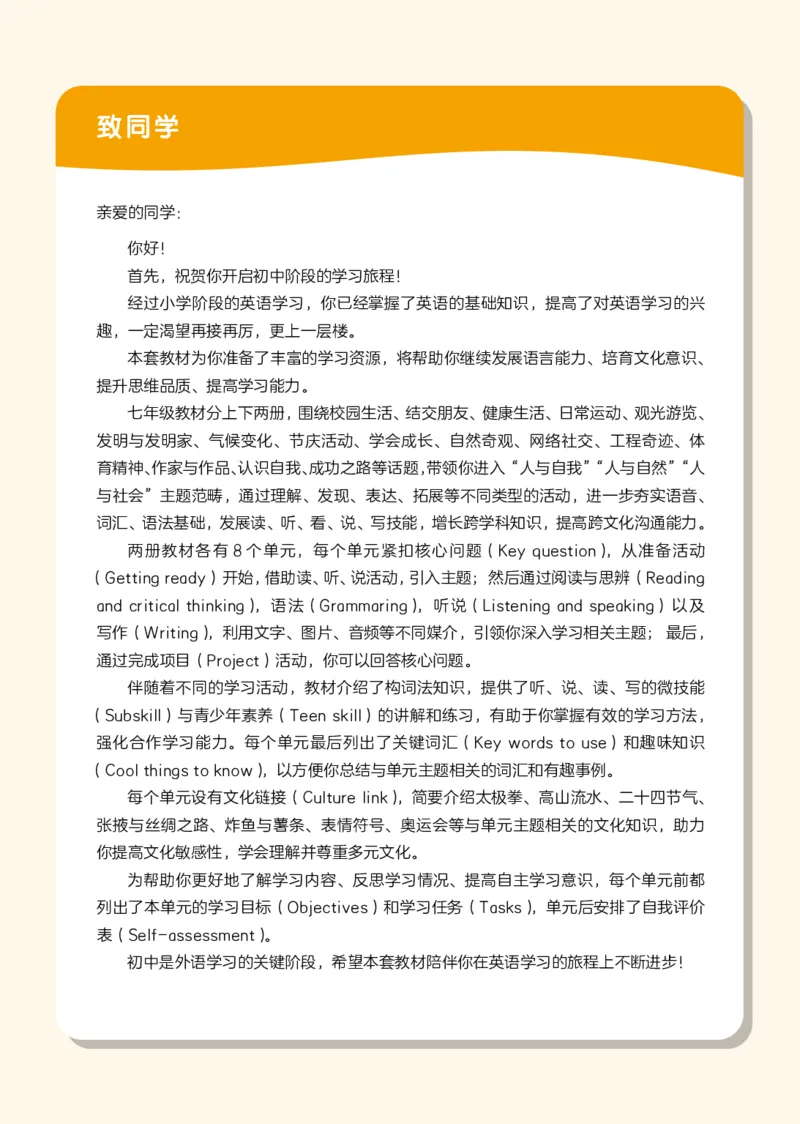
致同学
亲爱的同学:
你好!
首先,祝贺你开启初中阶段的学习旅程!
经过小学阶段的英语学习,你已经掌握了英语的基础知识,提高了对英语学习的兴
趣,一定渴望再接再厉,更上一层楼。
本套教材为你准备了丰富的学习资源,将帮助你继续发展语言能力、培育文化意识、
提升思维品质、提高学习能力。
七年级教材分上下两册,围绕校园生活、结交朋友、健康生活、日常运动、观光游览、
发明与发明家、气候变化、节庆活动、学会成长、自然奇观、网络社交、工程奇迹、体
育精神、作家与作品、认识自我、成功之路等话题,带领你进入“人与自我”“人与自然”“人
与社会”主题范畴,通过理解、发现、表达、拓展等不同类型的活动,进一步夯实语音、
词汇、语法基础,发展读、听、看、说、写技能,增长跨学科知识,提高跨文化沟通能力。
两册教材各有8 个单元,每个单元紧扣核心问题(Key question),从准备活动
(Getting ready)开始,借助读、听、说活动,引入主题; 然后通过阅读与思辨(Reading
and critical thinking),语法(Grammaring),听说(Listening and speaking)以及
写作(Writing),利用文字、图片、音频等不同媒介,引领你深入学习相关主题; 最后,
通过完成项目(Project)活动,你可以回答核心问题。
伴随着不同的学习活动,教材介绍了构词法知识,提供了听、说、读、写的微技能
(Subskill)与青少年素养(Teen skill)的讲解和练习,有助于你掌握有效的学习方法,
强化合作学习能力。每个单元最后列出了关键词汇(Key words to use)和趣味知识
(Cool things to know),以方便你总结与单元主题相关的词汇和有趣事例。
每个单元设有文化链接(Culture link),简要介绍太极拳、高山流水、二十四节气、
张掖与丝绸之路、炸鱼与薯条、表情符号、奥运会等与单元主题相关的文化知识,助力
你提高文化敏感性,学会理解并尊重多元文化。
为帮助你更好地了解学习内容、反思学习情况、提高自主学习意识,每个单元前都
列出了本单元的学习目标(Objectives)和学习任务(Tasks),单元后安排了自我评价
表(Self-assessment)。
初中是外语学习的关键阶段,希望本套教材陪伴你在英语学习的旅程上不断进步!
���������������
S
p
e
a
1
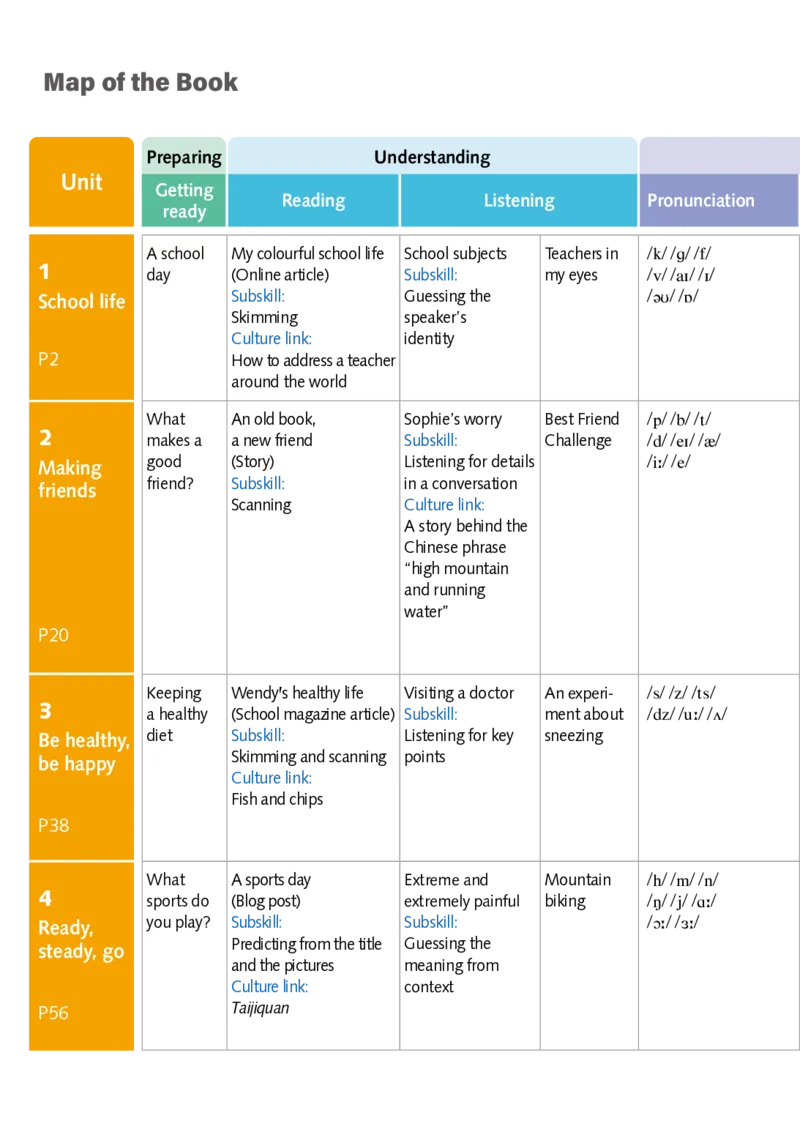
School life
P2
2
Making
friends
P20
3
Be healthy,
be happy
P38
4
Ready,
steady, go
P56
Unit
Preparing
Understanding
Getting
ready
Reading
Listening
Pronunciation
A school
day
My colourful school life
(Online article)
Subskill:
Skimming
Culture link:
How to address a teacher
around the world
School subjects
Subskill:
Guessing the
speaker’s
identity
Teachers in
my eyes
/k/ /�/ /f/
/v/ /a/ //
/əυ/ /ɒ/
What
makes a
good
friend?
An old book,
a new friend
(Story)
Subskill:
Scanning
Sophie’s worry
Subskill:
Listening for details
in a conversation
Culture link:
A story behind the
Chinese phrase
“high mountain
and running
water”
Best Friend
Challenge
/p/ /b/ /t/
/d/ /e/ /�/
/i�/ /e/
Keeping
a healthy
diet
Wendy's healthy life
(School magazine article)
Subskill:
Skimming and scanning
Culture link:
Fish and chips
Visiting a doctor
Subskill:
Listening for key
points
An experi-
ment about
sneezing
/s/ /z/ /ts/
/dz/ /u�/ /�/
What
sports do
you play?
A sports day
(Blog post)
Subskill:
Predicting from the title
and the pictures
Culture link:
Taijiquan
Extreme and
extremely painful
Subskill:
Guessing the
meaning from
context
Mountain
biking
/h/ /m/ /n/
/ŋ/ /j/ /ɑ�/
/ɔ�/ /��/
k
i
n
g
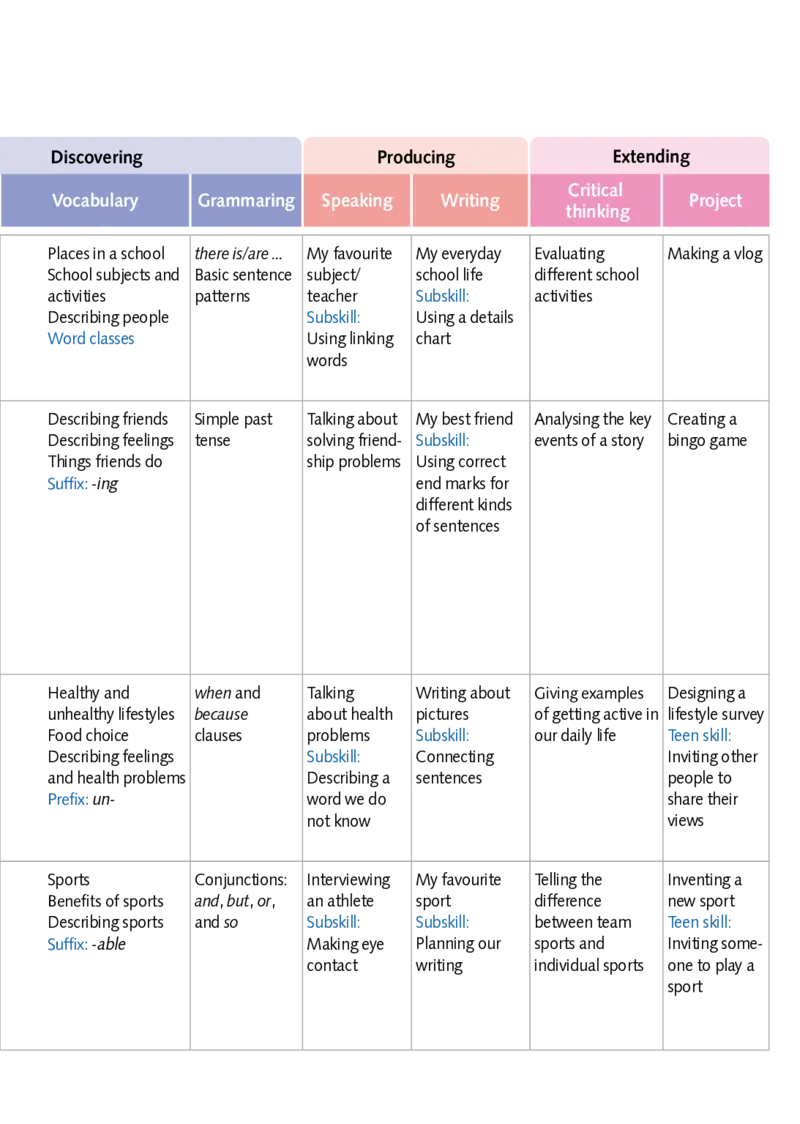
Discovering
Producing
Extending
Vocabulary
Grammaring
Speaking
Writing
Critical
thinking
Project
Places in a school
School subjects and
activities
Describing people
Word classes
there is/are ...
Basic sentence
patterns
My favourite
subject/
teacher
Subskill:
Using linking
words
My everyday
school life
Subskill:
Using a details
chart
Evaluating
different school
activities
Making a vlog
Describing friends
Describing feelings
Things friends do
Suffix: -ing
Simple past
tense
Talking about
solving friend-
ship problems
My best friend
Subskill:
Using correct
end marks for
different kinds
of sentences
Analysing the key
events of a story
Creating a
bingo game
Healthy and
unhealthy lifestyles
Food choice
Describing feelings
and health problems
Prefix: un-
when and
because
clauses
Talking
about health
problems
Subskill:
Describing a
word we do
not know
Writing about
pictures
Subskill:
Connecting
sentences
Giving examples
of getting active in
our daily life
Designing a
lifestyle survey
Teen skill:
Inviting other
people to
share their
views
Sports
Benefits of sports
Describing sports
Suffix: -able
Conjunctions:
and, but, or,
and so
Interviewing
an athlete
Subskill:
Making eye
contact
My favourite
sport
Subskill:
Planning our
writing
Telling the
difference
between team
sports and
individual sports
Inventing a
new sport
Teen skill:
Inviting some-
one to play a
sport
���������������
S p e a k i n g
5
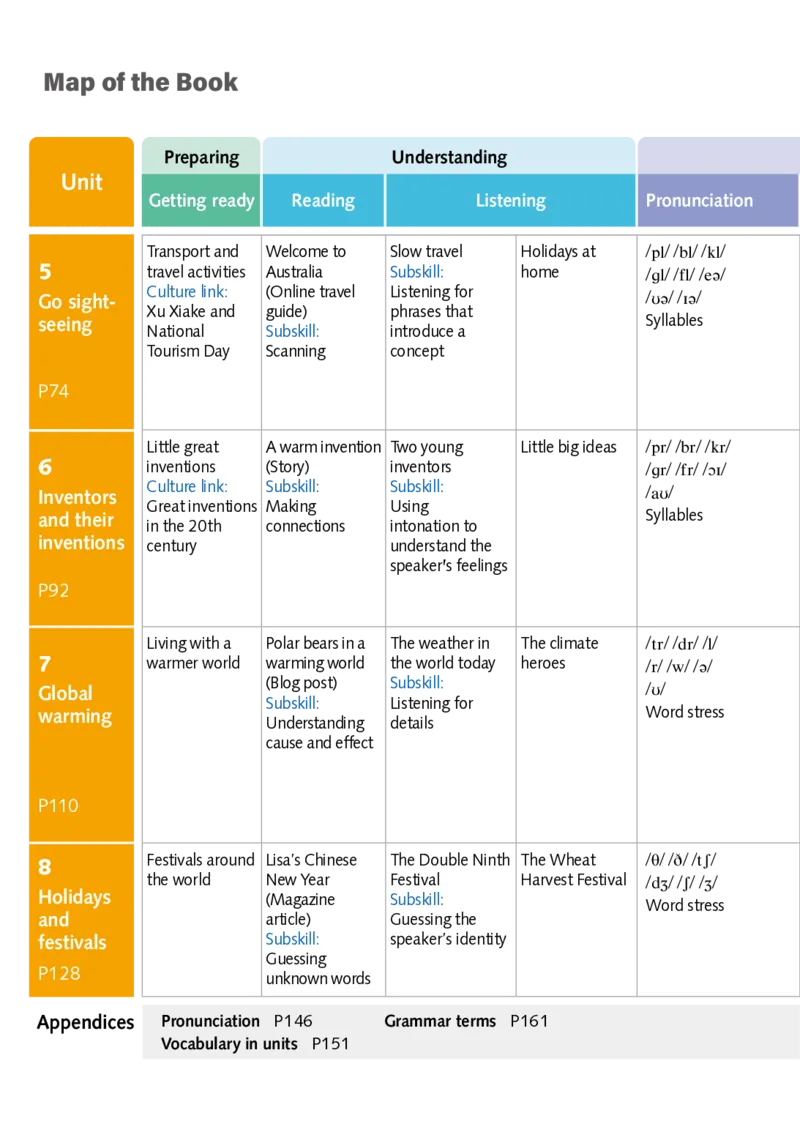
Go sight-
seeing
P74
6
Inventors
and their
inventions
P92
7
Global
warming
P110
8
Holidays
and
festivals
P128
Unit
Preparing
Understanding
Getting ready
Reading
Listening
Pronunciation
Transport and
travel activities
Culture link:
Xu Xiake and
National
Tourism Day
Welcome to
Australia
(Online travel
guide)
Subskill:
Scanning
Slow travel
Subskill:
Listening for
phrases that
introduce a
concept
Holidays at
home
/pl/ /bl/ /kl/
/�l/ /fl/ /eə/
/υə/ /ə/
Syllables
Little great
inventions
Culture link:
Great inventions
in the 20th
century
A warm invention
(Story)
Subskill:
Making
connections
Two young
inventors
Subskill:
Using
intonation to
understand the
speaker's feelings
Little big ideas
/pr/ /br/ /kr/
/�r/ /fr/ /ɔ/
/aυ/
Syllables
Living with a
warmer world
Polar bears in a
warming world
(Blog post)
Subskill:
Understanding
cause and effect
The weather in
the world today
Subskill:
Listening for
details
The climate
heroes
/tr/ /dr/ /l/
/r/ /w/ /ə/
/υ/
Word stress
Festivals around
the world
Lisa’s Chinese
New Year
(Magazine
article)
Subskill:
Guessing
unknown words
The Double Ninth
Festival
Subskill:
Guessing the
speaker’s identity
The Wheat
Harvest Festival
/θ/ /ð/ /tʃ/
/d/ /ʃ/ //
Word stress
Pronunciation P146
Vocabulary in units P151
Grammar terms P161
Appendices
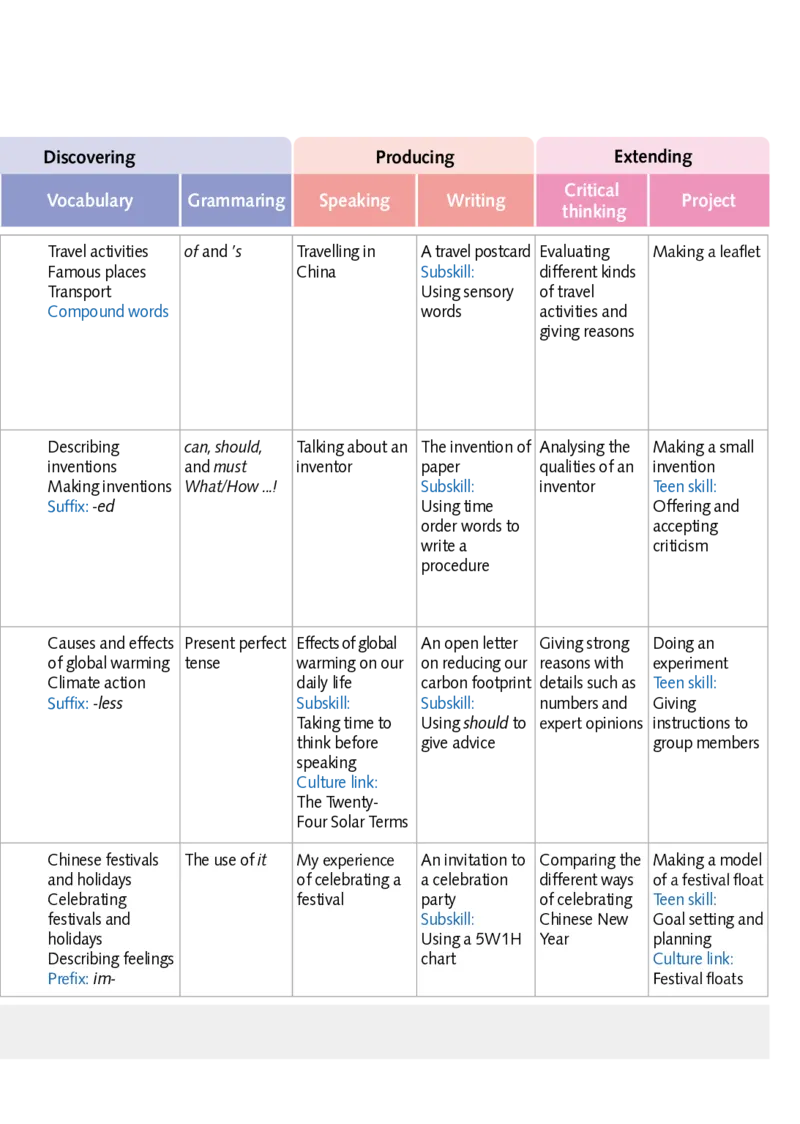
Discovering
Producing
Extending
Vocabulary
Grammaring
Speaking
Writing
Critical
thinking
Project
Travel activities
Famous places
Transport
Compound words
of and ’s
Travelling in
China
A travel postcard
Subskill:
Using sensory
words
Evaluating
different kinds
of travel
activities and
giving reasons
Making a leaflet
Describing
inventions
Making inventions
Suffix: -ed
can, should,
and must
What/How ...!
Talking about an
inventor
The invention of
paper
Subskill:
Using time
order words to
write a
procedure
Analysing the
qualities of an
inventor
Making a small
invention
Teen skill:
Offering and
accepting
criticism
Causes and effects
of global warming
Climate action
Suffix: -less
Present perfect
tense
Effects of global
warming on our
daily life
Subskill:
Taking time to
think before
speaking
Culture link:
The Twenty-
Four Solar Terms
An open letter
on reducing our
carbon footprint
Subskill:
Using should to
give advice
Giving strong
reasons with
details such as
numbers and
expert opinions
Doing an
experiment
Teen skill:
Giving
instructions to
group members
Chinese festivals
and holidays
Celebrating
festivals and
holidays
Describing feelings
Prefix: im-
The use of it
My experience
of celebrating a
festival
An invitation to
a celebration
party
Subskill:
Using a 5W1H
chart
Comparing the
different ways
of celebrating
Chinese New
Year
Making a model
of a festival float
Teen skill:
Goal setting and
planning
Culture link:
Festival floats
������
����
�
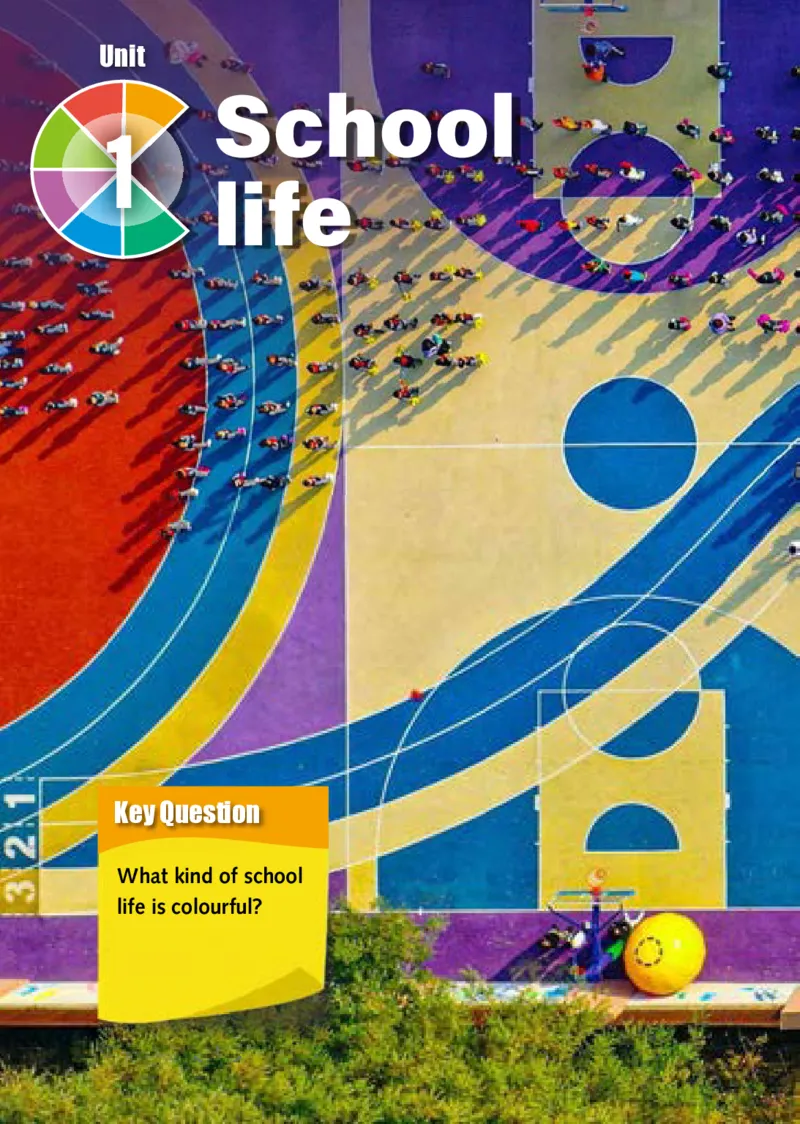
Unit
What kind of school
life is colourful?
Key Question
�����
����������
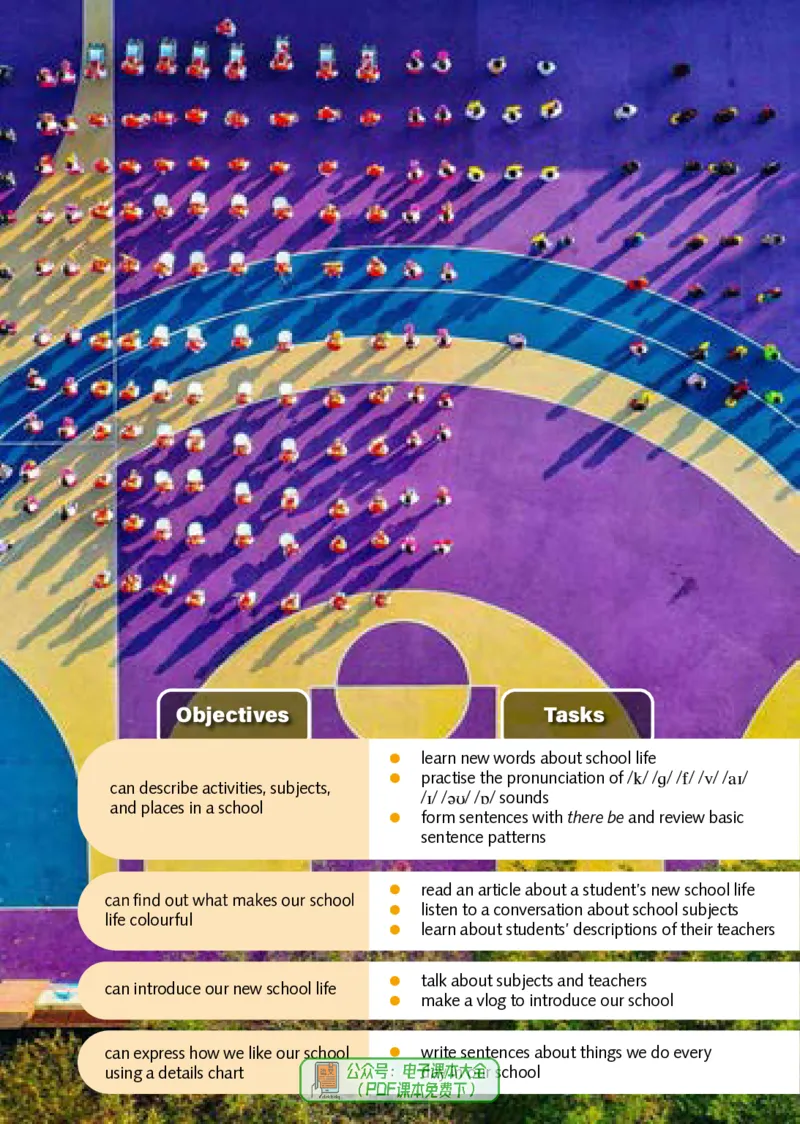
read an article about a student’s new school life
listen to a conversation about school subjects
learn about students’ descriptions of their teachers
talk about subjects and teachers
make a vlog to introduce our school
write sentences about things we do every
day in our school
learn new words about school life
practise the pronunciation of /k/ /�/ /f/ /v/ /a/
// /əυ/ /ɒ/ sounds
form sentences with there be and review basic
sentence patterns
can express how we like our school
using a details chart
can »nG oXt what maNes oXr school
life colourful
can introduce our new school life
can describe activities, subjects,
and places in a school
4
Unit 1
Getting ready
A
Monday
1 September
5.00 p.m.
go home
6.30 a.m.
get up
7.30 a.m.
arrive
at school
9.00 a.m.
school tour
11.40 a.m.
have lunch
�����������������������������
�������������
��
��������������������
�����������
�������������
������������
���������
������������
�
This is my second choice!
I'm into all sports.
It’s my favourite!
I really want to be a
cook when I grow up.
Look!
This is
my new
school.
It looks beautiful!
Chen Xinxin
Class A, Grade 7
Getting ready
A
Read Chen Xinxin’s picture diary and
complete the sentences.
A1
A school day
1 Chen Xinxin gets to school at
.
2 There are
different
clubs for Chen Xinxin to choose.
Kanta is from Bangladesh. Listen
and complete the timetable.
A2
3 Chen Xinxin is excited to go to the
Club and
Club.
4 Chen Xinxin likes Miss Yang because
she is
.
5
School life
A
Arts and Crafts Room
Science Lab
This is my new
deskmate, Molly.
She is good at English.
This is our class teacher,
Miss Yang.
She is friendly. We all like her.
I arrive at school
at eight o’clock
in the morning.
1
3
4
2
Think about your school day. Draw
the hands in the clocks and write
what you do.
A3
Work in pairs and talk about
your school day.
A4
arrive at school
do homework
finish school
go home
have dinner
have lunch
leave school
start school
A
Kanta’s School Day
1 ___________ a.m.
get on the boat
8.00 a.m.–8.40 a.m.
Bengali
8.50 a.m.–9.30 a.m.
2 ___________
9.40 a.m.–10.20 a.m.
3 ___________
10.20 a.m.–10.50 a.m.
art
11.00 a.m.
leave school
Culture link
Students in different countries call their
teachers differently. In Australia, students
call their teachers by their first name. In the
UK, students use Mr or Ms followed by the
teacher’s last name. Young school children in
Brazil put “tia” (aunt) or “tio” (uncle) before
the teacher’s »rst name to show respect.
When do you arrive at school?
What subjects do you
learn at school?
What do you do
after school?
6
Unit 1
Reading and critical thinking
B
6
Unit 1
Unit 1
5
10
20
15
25
My colourful
school life
6
Unit 1
Reading
Reading and
and critical
critical th
th
B
Do you like your new school? How is
it different from your primary school?
Read the article Jane writes for the school
website about her school life.
Reading and critical thinking
B
My school is a beautiful place with
trees and a lawn. I’m glad to be a student
of this school. The library is my favourite
place. We can read, study, and listen to
interesting lectures there. The food in our
canteen is delicious. During lunch, we can
talk about something fun.
We learn more subjects at middle
school, such as geography, science,
and history. I love the new subjects.
Sometimes they are difficult, but our
teachers are always happy to help us.
My classmates are also friendly.
We like playing games during breaks.
Helen likes tug-of-war, and I like playing
basketball.
There are a lot of clubs and activities
in our school. Every Friday afternoon, I’m
so excited to go to the paper-cutting class
with Rita. We really look forward to the
festivals of science and art, and the sports
day in October.
To me, school life is not only a
journey of learning but also a journey of
discovering. It never ends, and it’s always
exciting.
7
School life
B
Subskill
��������
Skimming is reading a text
quickly to understand what
it is about. Check the title,
pictXres� anG the »rst sentence
of each paragraph to get the
main ideas.
B
Answer the questions.
1 What new subjects do Jane and her classmates learn at middle school?
2 What does Jane do with her classmates during breaks?
3 What does school life mean to Jane?
4 What’s your favourite school activity, and why?
5 What do you think of your school life?
B3
Read the sentences and write T (true) or F (false).
1 Jane is happy to be a student of the new school.
2 Jane’s favourite place in the school is the library.
3 Geography is a new subject for Jane at middle school.
4 -ane Goesn’t liNe the new sXbMects becaXse they are Gif»cXlt.
5 Jane likes playing basketball and Helen likes tug-of-war.
6 Rita goes to the paper-cutting class every Monday afternoon.
B2
Comprehension
Match the main ideas with paragraphs 1–5.
B1
b places in a school
c school activities
a subjects and teachers
d my classmates
e the meaning of
school life
8
Unit 1
Reading and critical thinking
B
1 l
a talk that is given to a group of people to teach them
about a subject
2 b
a short period of time between lessons
3 f
a day or period of the year when people celebrate a
special event
4 j
an act of travelling from one place to another
5 d
to »nG oXt aboXt something
6 e
to »nish
7 e
causing great interest or excitement
n.
Word work
journey club discover colourful look forward to
B4
B5
B6
Write the words from the text and their
word classes. Use the meanings and the
first letters to help you.
Complete the sentences with the correct forms of the words you wrote in B4.
Reading and critical thinking
B
1 The expert gave a wonderful
on the development of AI.
2 Let’s have a(n)
and then go on with our homework.
3 We have a lot of
and colourful activities in our school.
4 My parents and I are planning a trip to visit my grandparents after the spring
term
.
5 During the Science
, we learned stories of many famous Chinese
and foreign scientists.
8
Tim’s school life is 1
. He joins the Gardening 2
,
and learns all about taking care of different plants. On his 3
to learn
more aboXt the environment� he often »nGs insects in the playgroXnG. He even
made friends with a ladybird! He really 4
the science lecture, because
he is excited to learn about the stars in the sky. With so many interesting activities
in his school, Tim can’t wait to 5
what’s coming next!
������������
The same word may be in different word
classes. For example, the word “end”
can be a noun (n.) or a verb (v.). In the
sentence “It never ends, and it’s always
exciting.”, “end” is a verb.
Complete the passage about Tim’s school life with the correct forms of the words
in the box.
ecture
9
School life
B
Critical thinking
9
1 Recall. List the colourful activities Jane and her classmates can do
in their school.
2 Evaluate. List some activities in your school. How do you like them?
3 Create. Some students are talking about interesting activities in their
middle schools. Tell them about your favourite school activity.
School life
Period of time
Activity
Opinion
spring term
planting trees
enjoyable
e.g. listening to interesting lectures in the library
Book Exchange
Our class teacher holds a book
exchange every year. During the
event, we bring books to share
and exchange with our classmates.
This year I traded my mystery
novel for an exciting comic book.
It was a great
experience!
Peer-to-Peer Program
On the first day of middle school,
each new student gets help from
an eighth- or ninth-grade student.
The helper gives us a school
tour, answers our questions, and
tells us about different clubs we
can join.
Gao Xing (China) | Grade 9
Sarah (US) | Grade 7
Grammaring
C
10
Unit 1
Grammaring
C
• There is a boat school.
• There are a lot of clubs and activities in our school.
there is/are ...
Study the blue parts and answer the question.
C1
I like my new school. 1
a big swimming pool in my school. It’s fun
to have swimming classes there! 2
also a beautiful small garden and
we can take a walk during breaks. My new teachers are nice to me and my new
classmates are friendly too. 3
42 students in my class. I’m friends with
some of them already. 4
many clubs in my school and I’m going to
join the Volleyball Club. Guess what I like the most about my new school? The
food! 5
so many delicious dishes on the menu. Tofu is my favourite.
Complete the passage about a student’s new school life
with there is or there are.
C2
Work in pairs. Ask and answer
questions about the picture.
C3
1 We use there be to introduce something new.
Grammar highlights
in my school It’s fun
in my school It’s fun
Q When do we use there is and there are?
2 We put is or are before there to form questions.
• Is there any water in the bottle? Yes, there is. / No, there isn’t.
• How many labs are there in our school? There are »ve labs.
3 there’s = there is
there is + singular noun
uncountable noun
• There is a dining room on the »rst ¼oor.
• There isn’t any milk left. Let’s go and buy some.
There are two teaching
buildings in our school.
there are + plural noun
EXAMPLE
Student A: Are there any students
waiting in line?
Student B: Yes, there are.
C
11
School life
Write sentences about your school by following each sentence pattern.
C6
C
S V
We read.
S V
S V O
We plant trees.
S V O
S V P
My classmates are friendly.
S V P
S V O O
Our teachers give us help.
S V O O
S V O C
We »nG the lecture interesting.
S V O C
Review the basic sentence patterns.
C4
1 The journey ends.
( ) ( )
2 Jane likes the new subjects.
( ) ( ) ( )
3 Helping classmates makes her happy.
( ) ( ) ( ) ( )
4 The lectures are interesting.
( ) ( ) ( )
5 Rita shows me her new works from the paper-cutting class.
( ) ( ) ( ) ( )
1 S V
2 S V O
3 S V P
4 S V O O
5 S V O C
Fill in the brackets with S, V, O, P, or C.
C5
Review of the basic sentence patterns
S – subject is the person, place, or thing that is doing or being something.
V – verb tells what the subject is doing.
O – object is the person or thing that receives the action.
P – predicative tells us more about the subject.
C – complement tells us more about the object.
Grammar highlights
Listening and speaking
D
12
Unit 1
School subjects
Look at the pictures and guess what subjects the speakers will talk about.
Listen and choose the best answers.
1 The speakers are talking about
.
a the sXbMects they »nG Gif»cXlt
b new subjects at middle school
c subjects they like the best
2 The speakers are probably
.
a primary school students b middle school students c teachers
Listen again and complete the table.
Answer the questions in pairs.
Teachers in my eyes
Four students are talking about their teachers.
Listen for the adjectives they use and circle the
words in the box.
D1
D2
D3
D4
D5
Name
Subject
Reason
Bob
1
and English
He likes 2
and languages.
Sam
3
It’s lots of 4
learning about cities and
countries.
Li Ting
PE and
5
• There’s a lot of 6
for sports.
• She can learn the programs very easily.
Subskill
���������
����������
��
����
�
Do you have similar
experiences with the
speakers? We can use our
experiences to make guesses
about their ages.
friendly funny helpful patient
fun energetic kind nice good
1 :hich sXbMect Go yoX »nG the most Gif»cXlt� anG why"
2 Which subject is the most enjoyable? What makes you love that subject?
D
13
School life
Subskill
�������������������
We can use words like “and”,
“but”, and “because” to link
ideas and make our speech clear.
Listen again and match the speakers’ names with their opinions. Then fill in
the blanks with the words from D5.
D6
Discuss the question in groups.
What would you like to share in your school
introduction?
D7
My favourite subject/teacher
Work in pairs. Talk about your
favourite subject or teacher.
D8
1 What do you like about them?
2 Why do you like them?
Useful expressions
• ... is my favourite teacher.
• ... is not just a teacher but a friend
and a role model.
• The best thing about my teacher is ...
• I feel lucky to be his/her student.
• My favourite subject is ... because ...
• , »nG ... enMoyable becaXse it’s ...
• I look forward to ... every day.
( see p146 )
Pronunciation
/k/ /�/ /f/ /v/ /a/ // /əυ/ /ɒ/
The teachers know me as a student. They bring out the best
in kids. I just think they’re really
teachers.
My teachers are 1
. They never stop smiling.
She’s a really 2
and 3
teacher. She
makes us think.
They are very 4
. If you get a question wrong,
they explain it to you and help you get the right answer.
They always want to change how they’re teaching to best »t
your learning style, which is really 5
and
6
of them.
Lily
Luke
Mia
BJI
good
Writing
E
14
Unit 1
Beginning
I can’t wait to share my busy but colourful life in the new school
with you.
Body
Idea:
There are many different
subjects.
Detail:
Idea:
Detail:
Ending
I really enjoy my new school life.
You are sharing something you do every day
in the new school.
My everyday school life
14
Subskill
����������
���������
Filling out the details chart
will help us see whether the
idea is supported.
1 Study a model. Complete the details chart.
2 Think. Think of some things you do every day in your school, and give
details to support them.
Idea 1:
Detail:
Idea 2:
Detail:
I can’t wait to share my busy but colourful life in the new
school with you. There are many different subjects I can learn
every day. Science is really interesting and it always opens my
eyes. There are many clubs I can join after class. I like the
Art Club. Not only can I make arts and crafts
by myself, but I can also make new friends
with the same interests. I really enjoy my
new school life.
E
15
School life
3 Write. Share your new school life. Use the details chart and the sentences
you wrote in Step 2 to help you.
4 Check. Read your own writing and answer the questions.
1 Did you use there is/are correctly to describe your school?
2 Did you use details to support your ideas?
3 Did you start each new sentence with a capital letter?
5 Peer review. Exchange your writing with another student. Answer the
questions.
1 Does the writer use there is/are correctly to describe his or her school?
2 Does the writer have clear ideas and proper details?
3 Does the writer start each new sentence with a capital letter?
I can’t wait to share my new school life with you.
I feel so lucky to be in my new school.
15
Project
F
16
Unit 1
Task: Make a vlog to introduce your
school life. A model script is given.
What kind of school
life is colourful?
Project
F
16
Unit 1
Vlog script
[music in]
[Jane] Hello, everyone. Welcome to my
school. Isn’t it beautiful? This is our school gate. Our teachers stand
here to greet us every morning. We have a very full timetable. There
are different kinds of classes. There are also a lot of club meetings every
Friday afternoon. This is our computer lab. I’m so excited to go to the AI
class with my classmates.
[Bob] Here is our sports field. Here we can have PE classes and hold
festivals of science and art. Let me show you our canteen. We can eat
something delicious in our canteen.
[Li Ling] The library is a quiet and beautiful place. We can read books or
listen to lectures here. Over there is our school park. It is a great place
to relax and have fun. Students can lie down and rest under the tree.
And you know, we can also have a picnic here! Look! Some students are
eating and laughing there. I’m sure you will love our school.
[music out]
y y
ool gate Our teachers stand
ool gate Our teachers stand
F
17
School life
F
17
School life
Study the model script and discuss what you will include in your vlog. Use the
mind map to help you.
Divide the recording job among group members.
Go to different places to record your vlog with your phone or camera.
Edit your vlog and add any music or sound effects.
Show your vlog to
the class to get their
advice. Post your
vlog on your school
website.
1
2
3
4
5
Name
Task
Chen Lin
check the script
places
activities
school clubs
School life
All about my school
18
Unit 1
Self-assessment
Self-assessment
18
Unit 1
A. skim texts to catch the main ideas and guess
the speaker’s identity in audio texts
B. describe my favourite subjects and teachers by
using linking words
C. write sentences about my middle school life by
using a details chart
D. understand how to address teachers in other
cultures
E. evaluate different school activities in my school
F. take part in group work to create a vlog about
colourful school life
How well I can do these
19
School life
19
Key words to use
Places in a school
canteen
computer lab
library
playground
sports »elG
gate
swimming pool
teaching building
School subjects
AI class
art
geography
English
maths
science
Physical Education (PE)
School activities
arrive at school
do homework
»nish school
have a picnic
hold festivals
join after-school clubs
listen to lectures
take a walk
Describing people
energetic
friendly
fun
funny
helpful
kind
nice
patient
Cool things to know
School life
It is simply a
blog in the form
of a video.
vlog
Add more! What other useful words
or cool things have you learned?
Add them to the lists.
�������
�������
�
Unit
How can we make
friends?
Key Question
�����
�������
��
read a story about making new friends through
sharing
listen for tips about making friends in a new place
learn about a fun challenge for friends
learn new words about making friends
practise the pronunciation of /p/ /b/ /t/ /d/ /e/
/�/ /i�/ /e/ sounds
use the simple past tense correctly
write a few sentences about our friends
can describe a friend in detail
can form an idea of starting and
keeping friendships
discuss friendship problems
create and take part in a friendship game
can ask and answer questions
about friends
can describe experiences of
making friends
22
Unit 2
Getting ready
A
Read the posts about qualities of a
good friend. Match the names with
the words.
A1
Complete Molly’s description of a good
friend with the words in the box.
A2
caring helpful helps
interesting looks after share
What makes a good friend?
Getting ready
A
My best friend is Anna. We go to the
same school. We are always together.
�����������
7KH�VXI»[�-ing can be added to verbs to form
adjectives. A sharing person often shares
something with others.
1 Aiden077
a caring
2 Binbin_
b helpful
3 Colin Han
c honest
4 Dora233
d interesting
5 ¼\LQJVRQJ�
e kind
6 Little Penguin
f sharing
I think good friends look
after each other. When
I feel sad, Mike always
tries to make me happy.
5 likes
Colin Han
For me, a good
friend makes
me laugh. He or
she likes to talk
about something
interesting and
funny.
Binbin_
Good friends show
kindness to each
other. They don’t
make each other
angry or sad.
3 likes
w
w
Little Penguin
Good friends should
help each other. When
I have problems, Molly
always helps me. She is
my best friend.
10 likes
23
Making friends
A
Listen to a song and write down
the words you hear to describe a
good friend.
A3
Work in pairs. Talk about each
other’s good friends.
A4
My best friend is …
We often read books / play games /
listen to music together.
He/She is funny/hard-working/honest.
Because he/she always makes me laugh.
A
Who is your best friend?
What do you often do together?
What do you think of him/her?
Why do you like him/her?
When we have a break at school,
we often 1
books with
each other and talk about something
2
. When I have some
problems with my homework, she
always 3
me. When I
am sick, she 4
me. Anna
is really a good friend. She is very
5
and 6
. I
never feel lonely because I have such
a good friend.
A good friend is
1
, helpful,
2
, and respectful.
A good friend is a good listener.
A good friend says nice things,
3
, and takes turns.
A good friend lets everybody play,
4
, 5
others,
and uses their manners.
Dora233
Good friends never tell
lies. My best friend Tom
always tells me the truth
and keeps secrets for me.
7 likes
flyingsong
Friends share things with each
other. Mary and I often share
our favourite music. We are best
friends forever!
5 likes
24
Unit 2
Reading and critical thinking
B
24
Unit 2
Unit 2
5
10
20
20
25
30
15
An old book,
a new friend
For some, going to a new school can
be both exciting and difficult. At first,
Chen Zihao always felt lonely at the new
school. He usually kept his head down on
the way to school.
Every morning Mrs Qin reads stories
to the class. One day Chen Zihao was
surprised when Mrs Qin read a story
about Sanmao, a boy from the comic
book series Wanderings of Sanmao.
Chen Zihao knows a lot about
Sanmao’s stories, because his father gave
him the comic books to celebrate his life
at the new school. That night he decided
to share the books with his classmates.
The next day Chen Zihao showed his
books to the class.
“These are comic book series about
Sanmao. See, this one is about Sanmao
making new friends, and that one is about
Sanmao helping the elderly,” he said
excitedly.
“Can I borrow the books from you?
Why don’t we meet after school?” Jiayi,
one of Chen Zihao’s classmates asked.
“You can share everything we want to
know, Zihao.”
Zihao? Jiayi just called him Zihao?
Like they were long-time friends? Chen
Zihao held his books and smiled.
Now he really has friends.
24
Unit 2
Reading
Reading and
and critical
critical thinkin
thinkin
B
You are at middle school now. Do you have any
new friends? How do you make friends? Let’s see
what Chen Zihao did at his new school.
Reading and critical thinking
B
25
Making friends
B
Mak
Mak
B
Answer the questions.
1 Who are the main characters in the story?
2 What did Zihao usually do on his way to the new school?
3 How did he feel when he heard Mrs Qin’s story?
4 Why did his father give him the books?
5 Who wanted to meet Zihao after school?
6 Why do you think Jiayi and Zihao could be friends?
B2
Comprehension
Tick the main idea of the story.
B1
Zihao wanted to become a comic book hero like Sanmao.
Zihao made new friends by sharing the comic books about Sanmao.
Zihao became popular because he knew a lot about Sanmao’s stories.
Subskill
��������
Scanning means reading a text quickly
WR�»QG�VSHFL»F�LQIRUPDWLRQ��5HDG�IDVW�
XQWLO�\RX�»QG�ZKDW�\RX�QHHG�
Complete the story mountain with the character’s feelings. An example is
given.
B3
decided to share the books
3
heard the story
2
talked about the books
4
made new friends
5
kept his head down
1 lonely
26
Unit 2
Reading and critical thinking
B
Word work
long-time make friends surprised share smile
B4 Write the words from the text and their word classes. Use the meanings and the
first letters to help you.
B6 Complete the passage about making friends with the words in the box.
Reading and critical thinking
B
1 l
unhappy because you have no friends or people
to talk to
2 c
a magazine or book that tells stories through
pictures
3 c
to do special things for an important event
4 d
to make a choice after thinking again and again
5 b
to get something from someone and return later
26
It is difficult to make friends, but sometimes you will be 1
to see how easy it is. You may meet a 2
friend at school, in the
playground, or in a club you both like. You may 3
with someone
who always 4
at you. You can 5
things with your
friends, like your favourite games or books. You can celebrate your birthdays
together. Having friends can make life more fun and enjoyable.
Complete the sentences with the correct forms of the words you wrote in B4.
1 I feel
when my friends are not here with me.
2 The friends
to start a book club to read together.
3 John forgot his pencil case at home this morning, so he
a pen
from his classmate.
4 Let’s
International Friendship Day with a big party.
5 The
book is a gift from my old friend Alice. It has colourful
pictures and exciting stories.
B5
27
Making friends
B
Critical thinking
27
1 Review. Put the events of the story in time order and number 1–5.
Mrs Qin read a story about Sanmao.
Chen Zihao made friends with Jiayi.
Jiayi wanted to meet Chen Zihao after school.
Chen Zihao had no friends at his new school.
Chen Zihao shared his comic book series with his classmates.
2 Analyse. If Mrs Qin didn’t read the story about Sanmao, do you
think Chen Zihao could still make friends easily?
Making friends
Did Mrs
Qin read a
story about
Sanmao?
Can Chen
Zihao still make
friends with
Jiayi?
Chen Zihao made
friends with Jiayi.
YES
YES
NO
NO
1
Grammaring
C
28
Unit 2
Grammaring
C
1 Zihao’s father often shares good books with his son. (yesterday)
2 Jiayi usually borrows comic books from Zihao. (the day before yesterday)
3 Zihao studies at a primary school near his home. (last year)
4 Jiayi watches TV every Sunday. (last night)
5 The little boy goes to the dentist with his parents. (three days ago)
1� $W�»UVW��&KHQ�=LKDR�DOZD\V�felt lonely at the new school.
2 One day he was surprised when Mrs Qin read a story about Sanmao.
3 That night he decided to share the book with his classmates.
4 The next day Chen Zihao showed his books to the class.
1 Zihao wasn’t happy at the new school.
2 He didn’t walk with anyone on the way to school.
3 Was Jiayi interested in Sanmao’s stories?
4 Did Zihao make friends at last?
Simple past tense
Study the blue parts and answer the questions.
C1
Study the blue parts and answer the question.
C3
Rewrite the sentences with the past time expressions in brackets.
C2
Q1 What time expressions are used in the sentences?
Q2 What are the simple past forms of feel, read, decide, and show?
1 � :H�XVH�WKH�VLPSOH�SDVW�WR�WDON�DERXW�»QLVKHG�DFWLRQV�RU�HYHQWV�LQ�WKH�SDVW��DQG�
actions or events that happened regularly in the past.
2 To form the simple past, we usually add -ed or -d to the end of the verb. If the
verb ends in -y, change -y to -i, then add -ed.
3 But many verbs are irregular. For example:
feel →felt go →went have →had take →took
Grammar highlights
C
29
Making friends
Complete the story with the correct forms of the verbs in brackets.
C4
Work in pairs and role-play the situation.
Your parent is asking what you did at school.
C5
C
When Lin Hua arrived at school this morning, everything 1
(go)
as usual until a new face 2
(show) up in class. The girl 3
(be) new here and the teacher 4
(ask) her to sit next to Lin Hua.
The girl 5
(not say) anything, but Lin Hua 6
(know) he
should say hello. His deskmate might be shy in a new place! During the break, he
7
(talk) to her although he 8
(feel) shy too. She
9
(keep) smiling and 10
(share) some details about her old
school. Only a simple hello 11
(open) people’s hearts.
Q How do we make negative sentences and questions in simple past tense?
1 We use did not (didn’t) + the base form of the verb (have/make/walk) in
negative sentences or questions.
2 The past of be (am/is/are) is was/were.
He had a good time
with his friends last
summer.
He didn’t have a good
time with his friends last
summer.
Did he have a good
time with his friends last
summer?
I was on holiday last
week.
I wasn’t on holiday last
week.
Were you on holiday last
week?
Grammar highlights
EXAMPLE
Parent: Did you meet your old friends at school?
You:
No, I didn’t meet any old friends, but I made a new friend.
• make a new friend
• eat anything special
• ask questions in class
• be active in ... class
• share your favourite story
• have a good time
Listening and speaking
D
30
Unit 2
Starting a friendship
School is the best place to start a friendship!
Sit with other students 1
.
Find someone to 2
together.
Join a 3
or club.
Follow a 4
on social media.
Sophie’s worry
Sophie will begin her new school life soon. She calls Amy for some advice. Tick
what the advice is possibly about.
� KRZ�WR�»QG�D�VWXG\�EXGG\��
���������
how to make friends at a new school
how to get along with classmates
Listen and choose the best answers.
1 Who is Amy?
a Sophie’s aunt.
b Sophie’s old friend.
c Sophie’s cousin.
2 Most teenagers spend
hours a day at school.
a 4–6
b 6–8
c 8–10
3 Which one is Amy’s suggestion?
a Ask questions.
b Join a club.
c Talk about food.
Listen again and complete the notes about starting a friendship.
Answer the question in pairs.
What do you think of Amy’s advice?
Best Friend Challenge
Answer the questions.
1 How many close friends do you have?
2 What questions do you want to ask
your best friend?
D1
D2
D3
D4
D5
?
Culture link
Yu Boya in ancient China played
the qin (a musical instrument) very
well. One day, while he was playing the
qin in a forest, a woodcutter named
Zhong Ziqi heard and understood the
climbing mountains and the running
water expressed in Boya’s music. The two
became close friends. When Ziqi died,
Boya was very sad. He threw his qin away
and never played again. The Chinese
phrase “high mountain and running
water” was later used to describe deep
friendship between close friends.
Subskill
��������������
������������
�������������
When we listen to a conversation,
ZH�FDQ�XVH�NH\�ZRUGV�WR�KHOS�XV�»QG�
information. For example, if we are
listening for tips, we can focus on
words such as “advice”, “tips”, and
“suggestion”. Sometimes the tips
may come after someone asks some
questions.
D
31
Making friends
Best Friend Challenge
Question
Bokang
Maxine
1
1
text messages
2
movie
2
3
loyal and funny
3
and easy to get along with
4
4
getting coffee
5
yes
5
What do we like doing together?
How do we keep in touch?
What do you like the most about me?
Can I keep a secret?
What things do we have in common?
WHAT DO YOU LIKE THE MOST
ABOUT ME?
Listen and put the questions in the order asked in the challenge.
D6
Listen again and complete the table.
D7
Discuss the questions in groups.
1 Does Maxine truly think that Bokang can keep a
secret? Why or why not?
2 Do you always agree with your friend? What
will you do if you have different opinions?
D8
Talking about solving friendship
problems
Work in pairs. Choose a friendship problem
to discuss. Describe the situation and explain how
you can fix it. Then act out the conversation.
D9
Useful expressions
• Why don’t you ...?
• Maybe we should ...
• Would you like ...?
• My suggestion is ...
• I suggest that ...
• If you ask me, ...
( see p147 )
Pronunciation
/p/ /b/ /t/ /d/ /e/ /æ/ /i�/ /e/
1
You and your friend
disagree about something.
A friend forgets something
important about you.
You feel left out by a friend.
A friend doesn’t understand you.
Friendship
problems
Writing
E
32
Unit 2
Write about your best friend. Before
writing, study a model to see what
information you can include.
My best friend
32
Subskill
���������������
� ���������
�����������
��������������
We can use a period (.) at the end of a
sentence, and an exclamation mark (!) at
the end of a sentence that shows strong
feelings.
1 Study a model. Jack is introducing his best friend, Tom. Read the introduction
and complete the mind map below.
beginning
idea 1
detail 1
idea 2
detail 2
body
ending
Tom is my best friend. Tom and
I are in the same class. Every morning
we walk to school together. Tom is
very funny. He likes telling jokes.
Once he told a joke about his pet in
class and we all laughed. Tom likes
swimming very much. He started
swimming at the age of five. How
lucky I am to have such a good
friend!
name
hobby
personality
things we do
together
My Best Friend
E
33
Making friends
2 Think. Think about your best friend and draw a mind map.
3 Write. Use the information above to write about your best friend.
is my best friend.
In this part, write about things you do together with one or two sentences.
In this part, write about your friend’s personality with one sentence in
present tense, and another sentence in simple past tense.
In this part, write about your friend’s hobby with one sentence in present
tense, and another sentence in simple past tense.
How lucky I am to have such a good friend!
4 Check. Read your own writing and answer the questions.
1 Did you tell your readers about your friend’s personality, hobby, and things
you do together?
2 Did you use the simple present tense and the simple past tense to talk
about your best friend?
3 Did you use end marks correctly?
5 Peer review. Exchange your writing with another student. Answer the
questions.
1 What does the writer tell you in his or her writing?
2 Does the writer use the simple present tense and the simple past tense
correctly?
3 Does the writer use end marks correctly?
Project
F
34
Unit 2
Task: Create a bingo game to get to know your
classmates better and make new friends. A model
bingo card is given.
How can we
make friends?
Project
F
34
Unit 2
3UHSDUH�D�VHW�RI�TXHVWLRQ�FDUGV��:RUN�LQ�»YH�JURXSV��$V�D�JURXS��WKLQN�RI�WZR�
to three questions about your chosen topic. Write each question on a card.
2
cooked this
weekend.
has a younger
brother or
sister.
can make a
funny animal
sound.
’s
favourite
colour is
purple.
has an elder
brother or
sister.
’s
favourite
colour is
orange.
has lived in
two different
places.
can sing
an English
song.
has a pet.
watched a
movie last
weekend.
loves ice
cream the
best.
goes to
school on
foot.
Free
is a good
swimmer.
enjoys
cooking.
knows a
funny joke.
is an only
child.
enjoys
cooking
after school.
read a
book last
weekend.
likes English
the most.
likes reading
books after
school.
is good at
drawing.
has more
than three
pets.
likes maths
the most.
gets up at
7 o’clock.
As a class, discuss what kind of topics you can include to know more about
your classmates. Then in groups, pick one topic.
1
Li Bin
• hobbies • family • favourites • habits • talents
F
35
Making friends
F
35
Making friends
$V�D�JURXS��ZULWH�GRZQ�»YH�SRVVLEOH�DQVZHUV�WR�WKH�TXHVWLRQV��7KHUH�VKRXOG�EH�
25 answers for the whole class.
3
Create the bingo cards. Work individually. Draw 5x5 squares on a piece of
paper. Fill in each square with an answer from Step 3. Leave the centre square
as a “free” space.
4
Play the game as a class.
5
Topic
Question
Possible answer
Group 1
Family
Do you have any
brothers or sisters?
is an only child.
has an elder brother or sister.
has a younger brother or sister.
Do you have any pets?
has a pet.
has more than three pets.
Topic
Question
Possible answer
Group 2
Favourites
What’s your favourite food?
loves ice cream the best.
What’s your favourite
subject?
likes maths the most.
likes English the most.
What do you like to do after
school?
likes reading books after
school.
enjoys cooking after school.
How to play
• Take turns to pick a question
card, read the question aloud,
and answer it.
• /LVWHQ�FDUHIXOO\�DQG�»OO�LQ�\RXU�
classmate’s name if the answer
is on your bingo card.
• 7KH�»UVW�RQH�WR�FRPSOHWH�D�URZ�
in one of the three ways on the
right shouts “Bingo!” and wins
the round.
EXAMPLES
36
Unit 2
Self-assessment
Self-assessment
36
Unit 2
A.� XVH�VFDQQLQJ�DQG�NH\�ZRUGV�WR�»QG�RXW�VSHFL»F�
information in written and audio texts
B. express and respond to friendship problems
C. write clear sentences to give a description of
my friend
D. retell the story behind a Chinese phrase about
deep friendship between close friends
E. analyse the key events of a story
F. work well together to design a game
How well I can do these
37
Making friends
37
Making friends
Key words to use
Describing friends
caring
easy to get along
friendly
funny
helpful
honest
loyal
respectful
sharing
understanding
Describing feelings
excited
feel left out
keep one’s head down
lonely
shy
surprised
Things friends do
ask sb for advice
borrow books
celebrate
give advice
keep in touch
keep secrets
laugh
look after
share
tell the truth
tell jokes
text messages
Cool things to know
deep friendship between close friends
high mountains
and running
water
Add more! What other useful words
or cool things have you learned?
Add them to the lists.
�������������
��������
�
Unit
What makes a
healthy lifestyle?
Key Question
�����
�������
��
read a magazine article about a student’s healthy life
listen to a conversation about visiting a doctor
learn about a sneezing experiment
learn new words about having a healthy lifestyle
practise the pronunciation of /s/ /z/ /ts/ /dz/ /u�/
/� / sounds
use when and because clauses
write a paragraph about someone’s healthy life
according to the pictures
can describe pictures about
someone’s lifestyle by using linking
words
FDQ »QG RXW ZKDW PDNHV D
healthy lifestyle
role-play as doctors and patients to discuss
health problems
design a lifestyle survey
can discuss some health problems
DQG »QG RXW ZD\V WR VWD\ KHDOWK\
can describe a healthy lifestyle
40
Unit 3
Getting ready
A
Read the mini-texts and match the
pictures with what Ava and Henry
eat for breakfast, lunch, and dinner.
A1
Circle the foods in the mini-texts and complete the chart.
A2
Keeping a healthy diet
Getting ready
A
�����������
7KH SUH»[ un- means “not” and is added before
an adjective to mean the opposite. An unkind
person is not kind to others. An unhappy day is a
day when someone is not happy.
Healthy Food
Unhealthy Food
egg
cola
a
b
e
d
c
f
41
Be healthy, be happy
A
Ava
I like bread, milk, and eggs for
breakfast. They give me energy and
keep me active all morning.
I always eat some meat or fish at
lunchtime. It makes me strong.
For dinner, salad is my favourite.
I like cucumbers and carrots. It’s a
good habit to eat at least five kinds
of fruit and vegetables a day.
Henry
Mum always says, “Have a good
breakfast.” But I don’t have much
time in the morning, so I only eat
an egg.
Hamburgers, chips, and cola are
unhealthy, but they taste so good.
I can’t help eating them.
Before dinner, I like to eat fried
food and cakes. Then I rarely eat
dinner.
A
Work in pairs and share your
opinions about eating habits.
A5
I usually start my day with a glass of
milk and an egg. How about you?
What do you often have for breakfast?
I like cakes and eat a lot of them.
That might not be the healthiest choice.
We don’t need much fat or sugar, but
we need lots of fruit and vegetables.
Complete the passage with the words
in the box.
Having a healthy 1
helps
us do better in sports. Before we play,
we should get some 2
from
bananas or bread. Also we should make
a(n) 3
of drinking some water
during sports. It may not 4
as good as sports drinks, but it’s usually
the best drink when we are thirsty. Water
can also keep us 5
. After the
game, we can enjoy a snack such as fruit
or chocolate milk.
active energy taste
diet habit
A3
Listen and fill in the blanks with the
correct numbers.
A4
The Chinese Food Pagoda is a guide to
keeping a healthy diet. The six levels of the
pagoda show how much we need from
different food groups in our daily diet.
oil: 25–30 g
salt: less than 5 g
meat: 3
g
grains: 1
g
water: 1,100–1,300 ml
fruit: 2
g
vegetables: 400–450 g
milk and bean
products:
4
g
42
Reading and critical thinking
B
Unit 3
Reading
Reading and
and critical
critical thinkin
thinkin
B
42
Unit 3
Unit 3
5
10
20
25
Wendy's healthy life
42
Unit 3
Look at the picture. Which food will Wendy probably choose?
What does Wendy do in her daily life? Read the school magazine
article and find out.
Reading and critical thinking
B
15
Comprehension
Look at the pictures and tick the activities Wendy does.
B1
a
b
c
Wendy studies at a middle school
near her home. She takes good care of
herself in every way.
She walks to school and eats the
healthy food in the canteen. She enjoys
chicken and fish, and vegetables and
fruit are also her favourites. Junk
food like chips or candies is rarely her
choice.
Wendy likes sports. She goes
swimming once a week and often cycles
to the country park with her friends at
weekends. “Cycling is a good exercise,”
Wendy always says. “I feel free like a
bird when I’m cycling.”
Wendy studies very hard, but she
rarely goes to bed at midnight. “I’m
not a night owl.” She tries to get eight
hours of sleep every night because she
believes getting enough sleep keeps her
active during the day.
Eating healthy food, doing sports,
and having a good sleep not only give
Wendy a healthy life but also make her
a happy girl.
43
B
Be healthy, be happy
B
Choose the best answers.
1 What is the main idea of the text?
a Wendy is a good student.
b Wendy is a happy girl.
c Wendy lives a healthy life.
2 Which food is Wendy not likely to choose in the canteen?
a Beef.
b Pears.
c Biscuits.
3 How many times a week does Wendy go swimming?
a Once.
b Twice.
c Three times.
4 Why does Wendy try to get eight hours of sleep every night?
a To make herself feel free.
b To make herself happy.
c To keep herself active.
5 An owl is a bird that hunts actively at night. What does Wendy mean when she
says “I’m not a night owl”?
a She does not like seeing an owl at night.
b She does not like being awake and active at night.
c She does not like birds that hunt at night.
B2
Complete the outline of the text.
B3
Introduction
Body
Conclusion
Topic sentence: 1
Topic sentence: 2
Topic sentence: 3
Wendy is a middle school student. She takes
good care of herself in every way.
Eating healthy food, doing sports, and having
a good sleep give Wendy a healthy life.
Wendy’s
healthy
life
d
e
f
Subskill
���������������������
44
Unit 3
Reading and critical thinking
B
junk food take care of once a week keep active at weekends
B6 Complete the passage about Tom trying to live a healthy life with the words in
the box.
Reading and critical thinking
B
44
Tom knows it’s important to 1
himself to stay healthy. He tries to
make good choices by not eating too much 2
� +H ORYHV »VK DQG FKLSV�
but he has it only 3
. To 4
, he walks to school and does
exercise in the gym. 5
, he plays football with his friends and enjoys
being outside.
Word work
B4
B5
Match the words with their meanings.
Complete the passage with the correct forms of the words in B4.
1 during
a something that you can choose to have
2 enjoy
b not often
3 rarely
c to like
4 country
d to take to be true
5 choice
e at some time while something else is happening
6 believe
f an area outside of cities and towns
Bob is a city boy, and he 1
visited the countryside when he was
a child. As he grew older, his parents made a 2
of living a different
life. They decided to move to the 3
. Now Bob 4
spending a lot of time outdoors with his classmates. 5
his walks,
he likes the beauty of nature. His parents 6
that living in the
countryside is a good way to relax and get away from the busy city.
Culture link
Fish and chips is a famous meal in the UK. People
HQMR\ IULHG »VK ZLWK WDVW\ SRWDWR FKLSV� ,W²V D IXQ WUHDW WR
eat by the seaside or with friends. But eating too much
isn’t healthy.
e
R
h
45
B
Critical thinking
45
1 Review. Find more details from the text to show that Wendy lives a
healthy life.
EXAMPLE
Detail: She spends time with her friends. They cycle to the country park
together. Good friends can make her happy. That’s good for her health.
2 Understand. Read the mind map and give some details about the ways
of keeping healthy.
3 Apply. There are a lot of easy ways for us to get active and stay healthy.
Talk about more examples of getting active in our daily life.
Ways of keeping healthy
Examples
getting fresh air
taking a walk with my family in the park
Be healthy, be happy
We can take the stairs
instead of the lift.
Be healthy be happ
Be healthy be happ
We can walk a dog if we
have one.
drinking enough
water
eating fruit and
vegetables
breaking bad habits
reading more
reducing screen time
doing exercise
getting enough sleep
getting fresh air
Ways of keeping healthy
Grammaring
C
46
Unit 3
Grammaring
C
Join the two sentences with the words in brackets.
C2
when and because clauses
Study the blue parts and answer the questions.
C1
1 I feel free like a bird when I’m cycling.
2 She tries to get eight hours of sleep every night because she believes getting
enough sleep keeps her active during the day.
Q1 What do the blue words mean?
Q2 What are the parts before and after the blue words?
1 We use because to talk about reasons and when to talk about time.
2 We can use because and when to join two sentences to make a complex sentence.
3 A complex sentence has a main clause and a dependent clause. The parts of the
sentences beginning with because and when are dependent clauses.
Grammar highlights
main clause
dependent clause
I feel free like a bird when I’m cycling.
Susan likes listening to music. She is sad. (when)
Walking is good exercise. I want to walk to school. (because)
I’m tired. I sometimes drink a little coffee. (when)
We should drink enough water. Water is important to our health. (because)
1
2
3
4
C
47
Be healthy, be happy
Work in pairs. Ask and answer questions about different feelings. Use the words
in the box to help you. An example is given.
C4
Complete the passage with when or because.
C5
C
Match the habits with the reasons.
C3
Ways to feel better
Everyone might be in the middle of a sad day. Here are some tips to make
you feel better.
Stay with others. Turn to your friends and family 1
you’re feeling
down. You don’t have to talk much 2
just spending time with others
can help you feel better.
Look for fun. Keep a list of the fun things 3
you read, watch, or
OLVWHQ WR WKHP� 6RQJV� ERRNV� »OPV®ZKDWHYHU LW PLJKW EH IRU \RX�
Go outside. Go jogging in the park. Exercise helps too 4
it makes
you happy.
Habits
1 I don’t eat much sweet food
2 I read books in my free time
3 I talk to my friends or parents
about my problems
4 I often help people in need
5 I wear enough clothes in winter
a because it helps me relax.
b because they can give me some
useful advice.
c because it is bad for my teeth.
d because I don’t want to catch a cold.
e because I want to make a difference
in the world.
Reasons
excited
laugh
lonely
cry
sad
worry
angry
When do you feel happy?
When do you feel relaxed?
I feel happy when I try new things.
I feel relaxed when I have a walk in
the park.
12:30 PM
...
Listening and speaking
D
48
Unit 3
Visiting a doctor
Match the words about illness with the pictures.
Xiao Peng is seeing a doctor. Listen and answer the questions.
1 What happened to Xiao Peng?
2 What did Xiao Peng do when he sneezed?
Listen again. Tick the advice the doctor
gave Xiao Peng.
Drink more water.
Ride a bike.
Take some pills.
Go for a walk.
Wash hands often.
Go to bed early.
Discuss the question in pairs.
+RZ FDQ ZH SURWHFW RXUVHOYHV GXULQJ FROG DQG ¼X VHDVRQ"
D1
D2
D3
D4
Subskill
���
��������������
���
�
Think about what we know about
the topic. It helps us decide what key
points to listen for. For example, if
we’re listening to a doctor speaking,
we can focus on the advice the
doctor gives to the patient.
An experiment about sneezing
Look at the pictures and answer the questions.
1 What should we do when we sneeze in these places?
2 Helen is doing an experiment on how far from a sneeze we can catch a disease.
Where is she likely to carry out the experiment?
D5
cough
fever
headache
runny nose
sneeze
sore throat
a
d
b
e
c
f
a
b
c
D
49
Be healthy, be happy
Helen’s experiment report
Question
How far from a sneeze can we catch a disease?
Materials
needed
Plates, a bottle of water, a ruler
Procedure
• Put Sneezing Sally on the 1
row in a bus.
• Place some plates 2
in front of Sneezing Sally.
• Let Sneezing Sally sneeze.
• Go back to the lab to 3
.
Finding
7KH YLUXV ZDV IRXQG IURP WKH »UVW URZ WR WKH »IWK URZ RQ 6DOO\²V
side of the bus.
Conclusion
Stay at least 4
metres away from someone who is
sneezing.
When sneezing, cover your 5
and wash your hands.
Subskill
�����������������������
��
������
It’s common for us to forget a
word or simply not know it. We
can describe the meaning we
want to express and ask for help
with the word.
Listen and complete Helen’s experiment report.
D6
Discuss the question in groups.
How else can illnesses spread from person to person?
D7
Talking about health problems
Choose one health problem from D1 and the box below. Role-play a
conversation between a doctor and a patient.
D8
EXAMPLE
Doctor: Hello. You look pale. What’s the trouble?
Patient: I’m not feeling well. I have ... What’s the
word for pain in the belly?
Doctor: Is it a stomachache?
Patient: Yes, that’s it.
Doctor: When did the pain start?
Patient: Not long after I had hot pot and ice cream last night.
Doctor: I’m afraid it’s because of the food. You’d better have some porridge—it
might make you feel better.
Patient: Thank you, doctor. Goodbye.
back pain growing pain stomachache toothache
( see p147 )
Pronunciation
/s/ /z/ /ts/ /dz/ /u�/ /�/
Writing
E
50
Unit 3
Write a passage about Billy’s healthy life according to the pictures.
Billy played
computer games
late at night.
Billy goes to bed
early and gets
enough sleep.
Writing about pictures
50
Subskill
������
�������
�����
We can use linking words such as
and, because, and so to connect
sentences. It can make our writing
easy to follow.
1 Study a model. Xiao Peng wrote two sentences for pictures 1 and 4. Study
the sentences and find out which details of the pictures Xiao Peng included in
his writing. Then help Xiao Peng write more sentences for the other pictures.
2 Think. Think about the results of
the habits and take notes. Then
make long sentences.
In the past ...
Now ...
1
4
2
5
3
6
E
51
Be healthy, be happy
3 Write. Write a passage with the sentences above.
4 Check. Read your own writing and answer the questions.
1 Did you use proper words or expressions to describe the pictures?
2 Did you use proper tenses to describe each picture?
3 Did you use linking words to connect the sentences?
5 Peer review. Exchange your writing with another student. Answer the
questions.
1 Does the writer use proper words or expressions to describe the pictures?
2 Does the writer use proper tenses to describe each picture?
3 Does the writer use proper linking words to connect the sentences?
Billy’s Healthy Life
Billy is a middle school student. In the past, he had some
unhealthy habits.
But now Billy has changed his bad habits.
Billy lives a healthier life now.
Bad habits in the past
• Billy played computer
games late at night.
Good habits now
•
Results
• He felt sleepy in class.
Results
•
Billy felt sleepy
because he played
computer games late
at night.
Project
F
52
Unit 3
Task: Design a lifestyle survey. Your questions should
include diet, rest, exercise, and things you do to make
you happy. A model is given.
What makes
a healthy
lifestyle?
Project
F
52
Unit 3
How healthy is your lifestyle?
Your name:
Answer the following questions to find out!
1 How many kinds of vegetables do you have each day?
a None.
b One or two.
c Three or more.
2 How often do you exercise or play outside each week?
a Rarely.
b Once or twice.
c Three or more times.
3 How many hours of screen time do you have each day?
a More than three. b Two to three.
c One or less.
4 What do you do most in your free time?
a I watch TV and play computer games.
b I meet friends online. c I talk with friends and family.
Answers:
If you have mostly A’s, you need to change some habits. Are you
eating the right food or doing enough exercise?
If you have mostly B’s, you’re doing OK but should try to do better.
Look at your answers to see what habits you could change.
If you have mostly C’s, you’re doing great. Keep up the good work!
Results of survey
Answer
Number of people
Suggestion
Mostly A’s
Mostly B’s
Mostly C’s
F
53
Be healthy, be happy
F
53
Be healthy, be happy
Answer the questions in the model survey.
Work in groups. Brainstorm a list of questions.
Share your ideas. Discuss
possible answers to the
questions in your survey.
Do the survey in class.
Record the answers.
5HSRUW ZKDW \RX »QG LQ
your survey. Try to provide
some explanation for the
»QGLQJV DQG JLYH VRPH
advice.
1
2
3
4
5
6
Inviting other people to share
their views
TEEN SKILL
Tips
• Show interest.
• Make eye contact.
• Share your opinion later.
Useful expressions
• Let’s share our ideas together.
• What’s your opinion of …?
• What do you think of …?
• Does anyone have better ideas?
• What else do you think of …?
• Mary, could you share your
opinion?
• That’s a good idea.
Altogether _______ people did the survey.
Among them, _______ people got mostly A’s. They
should eat the right food and exercise regularly.
________ of them got mostly B’s. They should
change some of their habits and do something to
relax. ________ of them got mostly C’s. They are
doing great. They should keep their good habits.
54
Self-assessment
Unit 3
Self-assessment
54
Unit 3
A. skim and scan an article to get its main idea
and details
B. communicate about health problems and
keeping a healthy lifestyle
C. write a simple description of someone’s
lifestyle
D. understand a popular food choice
E. show other ways to keep active in daily life
F. take an active part in group discussion by
inviting others to share their views
How well I can do these
55
Be healthy, be happy
55
Be healthy, be happy
Key words to use
Healthy and unhealthy lifestyles
cycle
drink water
eat junk food
exercise
get active
get enough sleep
get rest
go for a walk
go to bed late
play sports
ride a bike
take stairs
wash hands
Food choice
bean product
bread
cake
chicken
chocolate milk
cola
egg
»VK DQG FKLSV
fried food
fruit
grain
hamburger
healthy diet
meat
milk
porridge
salad
snack
vegetable
Health problems
catch a cold
disease
fever
have a cough
headache
pain
runny nose
sneeze
sore throat
stomachache
toothache
A sneeze can travel
»YH URZV LQ D EXV�
That’s nearly 5.5
metres.
Cool things to know
Add more! What other useful words
or cool things have you learned?
Add them to the lists.
sneeze
�������
����������
�
Unit
What do sports
bring us?
Key Question
�����
�������
��
read a blog post about a sports day
listen to a podcast about how to balance fun and
safety in sports
learn about a bike race
interview an athlete
invent a sport
write a self-introduction to apply for a
sports club
learn new words about sports
practise the pronunciation of /h/ /m/ /n/ /ŋ/ /j/
/ɑ:/ /ɔ�/ /��/ sounds
use and, but, or, and so to connect sentences
can organise our writing by using
conjunctions
FDQ�GLVFRYHU�WKH�EHQH»WV�VSRUWV�
bring us
can ask and answer simple
questions about sports
can describe common and
uncommon sports
58
Unit 4
Getting ready
A
Joan: I prefer doing sports
on my own. I do boxing at
weekends. It is quite
challenging, but it keeps
me fit. Boxing changed
me from a shy little
girl to a brave
teenager.
Mike: I started to play basketball at
primary school, and I still work hard at
improving my skills. This sport helps
me make better and quicker decisions.
b
d
Alice: I like playing ping-pong with
friends. I’m a big fan of it. It’s fun to
spend more time with friends.
Kevin: I’m really into water sports. I
go swimming every Saturday. It makes
me strong.
a
c
teenager.
Four students are answering questions
about their sports. Read the mini-texts
and match the questions on page 59
with the students’ answers.
A1
Tick the benefits the students get from
their sports.
making our body stronger
having fun with friends
sleeping better
helping us become brave
A2
What sports do you play?
Getting ready
A
improving the ability to make
decisions
making us feel happy
�� VWD\LQJ�»W�DQG�KHDOWK\
making new friends
doing well in class
59
Ready, steady, go
A
Which sport do you enjoy
playing with friends?
What’s your favourite
sport?
Do you prefer playing
sports alone or in a team?
What sports did you play
growing up?
Match the sports with the icons
above. Choose the correct verbs
from the word map to talk about
these sports.
A3
A
Work in pairs. Student A thinks
of a sport. Student B asks questions
to guess the sport.
A5
Listen to the broadcast on a school
sports day and fill in the blanks.
A4
There are 22 players.
Yes, it does.
They kick the ball.
Yes!
How many players are there?
Does the sport often go with the
verb play?
It’s football.
Do the players kick the ball or play
with hands?
badminton boxing diving
volleyball kung fu tennis
taekwondo cycling
swimming
Lakeside School Sports Day
Congratulations to
the Sunflower Team
for coming in 1
in the 2
-metre
relay
Date: 15 October
Well done!
Lakeside School Sports Day
Congratulations to
Daniel Wang
for coming in 3
in the 4
100-metre final
Date: 15 October
Well done!
EXAMPLE
I like playing volleyball because it helps me make better decisions.
play
sport
do
go
boxing
football
basketball
swimming
running
60
Reading and critical thinking
B
Unit 4
60
Unit 4
Sports play an important part in our life. Have you ever taken part in a school sports
day? Let’s take a look at Kexin’s blog.
Reading and critical thinking
B
A sports day
We have Sports Day every year, and this year it was on the third
Friday of October. The whole school was full of fun and excitement
with flags and colourful flowers here and there. Many boys and girls
took part in the event. They ran, jumped, and played football and
basketball.
I joined in a 100m race and won a silver cup. It was not a bad
performance. The 4×100m relay was very exciting. Everyone cheered
for the racers, and the sports field was full of laughter. My best friend
Mike is very good at long-distance
running. He came in first and finally
won the race. In the long jump, my
other friend, Rita, did not get a prize,
but she tried her best. On the sports
day, everyone felt excited.
The sports day ended with a
song. We and Ms Lin, our
teacher, sang together for the
good performance of the boys
and girls in our class. What an
unforgettable day!
19 October | Kexin’s blog
th a
5
10
15
20
61
B
Ready, steady, go
B
Answer the questions.
1 When was Kexin’s school sports day this year?
2 What was the school like on the sports day?
3 Who performed the best on the sports day, Kexin, Mike or Rita?
4 Why did Ms Lin and her students sing together in the end?
5 Do you think the students enjoyed themselves on the sports day? Why?
B2
1 The blog post is probably about
.
a students’ favourite sports
b a school sports meeting
c different after-school activities
2 From the blog post, we may know
and
.
a when the sports day was
b what events the students joined in
c where the students met after school
3 The students in the pictures are
.
a excited
b worried
c relaxed
Subskill
������������������������������
�����������
The title and pictures usually tell us
the main idea. We’d better look at
them before we read the whole text.
Comprehension
Look at the title and pictures of the
blog post. Choose the best answers.
B1
Find sentences Kexin wrote to describe her unforgettable sports day and fill in
the table. An example is given.
B3
Line(s)
Description
Key words
lines 2–3
The whole school was full of fun and
H[FLWHPHQW�ZLWK�¼DJV�DQG�FRORXUIXO�
¼RZHUV�KHUH�DQG�WKHUH�
fun, excitement,
colourful
62
Unit 4
Reading and critical thinking
B
Reading and critical thinking
B
62
Word work
There are different team sports, like badminton, basketball, and volleyball. All
of them 1
�IXQ��<RX�FDQ�»QG�SHRSOH�SOD\LQJ�VSRUWV�2
,
here and there are full of try your best join in
B4
B5
B6
Write the words from the text. Use the meanings and the first letters to help you.
Complete the sentences with the correct forms of the words you wrote in B4.
Complete the passage about popular sports with the words in the box.
1 w
all of something
2 r
an event between people to see who is the fastest
3 p
the way a person does (in a play, game, etc.)
4 c
to shout loudly to show support
5 p
a gift that you get for doing
something well
6 u
hard to forget
1 The event had a lot of fun activities and cool
.
2 Lucy gave a wonderful
in the volleyball game.
3 We watched an exciting swimming
at the pool.
4 Jack spent the
morning practising taijiquan.
5 We all
�ZKHQ�WKH�WHDP�ZDONHG�RQWR�WKH�VSRUWV�»HOG�
6 The basketball match was
because no one could remember the
scores.
����
�������
7KH�VXI»[�-able, meaning “able
to be”, is added to verbs to
create adjectives, e.g. enjoyable.
Culture link
Did you know that in 2020, the United Nations added taijiquan to the UNESCO
Intangible Cultural Heritage List? This list keeps important and special things from
different cultures. Now people from all over the world are starting to practise this old
form of exercise. There are bafa and wubu in taijiquan. Try this exercise—its slow and
peaceful movements help us relax and stay healthy!
Ready, steady, go
63
B
63
Critical thinking
1 Recall. List the sports events Kexin and her classmates took part in
and the results they got.
2 Understand. Kexin and her classmates joined in different sports
events. How many of them are team sports and how many are
individual ones? Write T for team sports and I for individual sports.
3 Apply. Your school is going to hold a sports day. Talk about one
of the sports events you would like to take part in and give your
reasons.
EXAMPLE
I enjoy running fast, and I want to be in the
4x100m relay race. It’s a team event where
we pass a baton and run together. I like the
feeling of running with others and trying our
best to win. It’s going to be exciting and I hope we do well!
Kexin
Mike
Rita
Sports event
100m race
Result
long jump
4x100m relay
100m race
football games
basketball games
long-distance running
d
ll
in parks, playgrounds, and sports centres. When you
3
one, always remember to 4
and have fun. Sports are not just about winning, they’re
also about making new friends, and staying healthy.
baton
Grammaring
C
64
Unit 4
Grammaring
C
Conjunctions: and, but, or, and so
Study the blue parts and answer the question.
C1
1 We have Sports Day every year, and this year it was on the third Friday of October.
2 I joined in a 100m race and won a silver cup.
3 In the long jump, my other friend, Rita, did not get a prize, but she tried her best.
4 We can go to the shop before we go to Clare’s house, or we can go to Clare’s
KRXVH�»UVW�WR�VHH�LI�VKH�QHHGV�DQ\WKLQJ��:KDW�GR�\RX�WKLQN"
5 Sports can keep us healthy, so�OHW²V�JR�WR�WKH�VSRUWV�»HOG�DQG�H[HUFLVH�WRJHWKHU�
C2 Complete the sentences with and, but, or, and so.
1 You can have fun
stay healthy by playing sports with your friends!
2 You can play football, basketball, volleyball,
you can play water
sports—there are so many sports to choose from!
3 Sports are fun,
sometimes you need to practise to get better.
4 You’ve been sitting for a long time,
let’s go outside
get some exercise!
Q What is the use of the blue word in each sentence?
Sentence A
We have Sports Day every year.
Sentence B
This year it was on the third
Friday of October.
We have Sports Day every year, and this year it was
on the third Friday of October.
Grammar highlights
We can use conjunctions and, but, or, and so to join
two sentences together. They can combine two simple
sentences into one longer sentence. This is known as a
compound sentence.
C
65
Ready, steady, go
Talk about one of your sports experiences. Use and, but, or, and so.
C4
Fang Fang wrote a passage about an unforgettable experience, but she forgot
to use compound sentences. Help her rewrite the underlined parts to make the
writing better.
C3
C
1
2
3
The 800m race was about to begin. My heart was racing when I
stood at the starting line. The teacher shouted, “Ready, steady, go!”
I took off. My classmates cheered for me. I ran as fast as I could. The
last 50 metres was challenging. I told myself not to give up. Finally, I
UHDFKHG�WKH�»QLVK�OLQH��7KRXJK�,�GLGQ²W�FRPH�LQ�»UVW��,�VWLOO�IHOW�SURXG�RI�
myself.
5 Football and soccer are the same game in the UK,
they are two
different games in the US. For the same round ball
and the same game, it is called “soccer” in the US.
American football has two pointed ends.
EXAMPLE
I enjoy the feeling of being in water and the freedom it gives me,
so swimming becomes one of my favourite sports. I once had a
swimming race with my friends, and it was exciting. I didn’t win the
race, but I felt proud.
Listening and speaking
D
66
Unit 4
Extreme and extremely painful
Extreme sports are becoming more and more popular. Answer the question.
Which pictures show extreme sports, and why?
Listen and choose the best answers.
1 The podcast wants to tell us that extreme sports are
.
a exciting b dangerous c popular
2 From the podcast, we know that
.
a there are different kinds of extreme sports
b students can try some extreme sports if they like
c people must be careful when they do extreme sports
3 What should people wear when doing extreme sports?
Listen again and complete the notes.
D1
D2
D3
Subskill
���
����������������
����������
�
It’s common to come
across a new word when
listening. We can use the
words around it to guess
its meaning. For example,
when we hear the word
“helmet” after the phrase
“wear protection”, we
know that a helmet is
something we wear to
protect ourselves.
a
b
c
d
skydiving
baseball
ice skating
rock climbing
Look at these dangers. In groups, think
of a sport for each one and explain why it is dangerous.
• getting injured
• being too hot/cold
• being in an accident
• running out of breath
D4
• 1
of the injuries
• Wear protection and get 2
.
• See a 3
if you are hurt.
Do’s
Don’ts
• Don’t go too 4
or too
fast without practice.
• Don’t 5
the extreme
sports you see on TV in real life.
• Don’t put fun before 6
.
EXAMPLE
Getting injured: Football, because you can
break your leg when another player hits you
by accident.
a
b
c
D
67
Ready, steady, go
Day
The riders were higher than before and there were new dangers.
Day
7KH�DWKOHWHV�»QLVKHG�WKH�UDFH�WRJHWKHU�
Day
The race started.
Day
They got to the highest point in the race.
Day
The temperature was 35 degrees. The athletes were tired.
Discuss the questions in pairs.
1� :K\�LV�WKH�ELNH�UDFH�WKH�PRVW�GLI»FXOW�LQ�WKH�ZRUOG"
2 What do you think of the extreme athletes like Richard Parks?
D8
Interviewing an athlete
Work in pairs and role-play an interview.
Richard Parks is going to visit your school. Brainstorm and write down four questions
you would like to ask him. Then imagine you are Richard and take turns to answer
the questions.
D9
Subskill
�����������
�������
Making eye contact
is important during
an interview. It shows
our interest in the
conversation.
Listen again and number the days.
D7
Mountain biking
Richard Parks is ready for the most difficult bike race in
the world. Answer the question.
:KDW�GLI»FXOWLHV�GR�\RX�WKLQN�WKH�UDFHUV�ZLOO�KDYH"
D5
Listen and write T (true) or F (false).
1 Richard Parks likes travelling around the world for extreme sports competitions.
2 Riding down the mountains is easier than riding up.
3 In the end, Richard Parks won the competition and he felt excited.
D6
/h/ /m/ /n/ /ŋ/ /j/ /ɑ�/ /ɔ�/ /��/
( see p148 )
Pronunciation
EXAMPLE
•� +RZ�GLG�\RX�IHHO�ZKHQ�\RX�»QLVKHG�WKH�UDFH"
•� &DQ�\RX�VKDUH�ZLWK�XV�ZK\�\RX�OLNH�PRXQWDLQ�ELNLQJ"
•� :KDW�DUH�VRPH�RI�WKH�ELJJHVW�FKDOOHQJHV�\RX�KDYH�IDFHG"
•� +RZ�GR�\RX�SUHSDUH�EHIRUH�D�UDFH"
1
Writing
E
68
Unit 4
You are signing up for a sports club in your
school. Write a self-introduction about your
favourite sport.
My favourite sport
68
Subskill
��������������������
Think about what questions we try
to answer in our writing. It can help
us plan, organise, and focus our
thoughts.
1 Study a model. Complete the questions about the information in each
paragraph.
2 Think. Ask yourself the same questions and write
down your answers. You may ask more questions.
Hello, everyone. I’m Linda.
I like many sports, but I love
volleyball best of all.
I started playing volleyball when
I was in the sixth grade. We played
volleyball in our PE classes and in our
spare time. We have trainings three
times a week in our school gym.
Volleyball teaches me to work in a
team. Volleyball makes me strong, and
gives me energy and a good mood.
I’m happy to become a member of
the Sports Club, and I hope to play
volleyball with you.
Paragraph 1
Beginning
Paragraph 2
What is my
favourite sport"
Paragraph 3
When
?
How often
?
Where
?
Paragraph 4
What
?
Paragraph 5
Ending
on in each
l
What is my favourite sport?
Answer:
1
When
?
Answer:
2
How often
?
Answer:
3
E
69
Ready, steady, go
3 Write. Put your answers together. Try to use and, but, or, and so.
Check. Read your own writing and answer the questions.
1� 'LG�\RX�LQGHQW�WKH�»UVW�OLQH�RI�HDFK�SDUDJUDSK"
2 Did you use conjunctions to connect the sentences?
3� 'LG�\RX�PHQWLRQ�DW�OHDVW�WZR�WR�WKUHH�EHQH»WV�RI�WKH�VSRUW"
4
Peer review. Exchange your writing with another student. Answer the
questions.
1 Does the writer use conjunctions to connect the sentences?
2 Does the writer describe the details of his or her favourite sports?
3��'RHV�WKH�ZULWHU�PHQWLRQ�WKH�EHQH»WV�RI�WKH�VSRUW"�'R�\RX�DJUHH"
5
I’m happy to become a member of the Sports Club, and I’m sure we
will have a great time together.
Where
?
Answer:
4
What
?
Answer:
5
?
Answer:
6
Project
F
70
Unit 4
Task: Invent a new sport. When you’re tired of
playing the same old sports, why not create your
own sport? A model is given.
What do sports
bring us?
Project
F
70
Unit 4
How to play
• Players line up in age order,
from the youngest to the
oldest.
• Each player starts with
three lives.
• The youngest player serves
the ball onto the roof.
• Players take turns to hit
the ball onto the roof.
Rules on scoring and winning
• If a player lets the ball drop
on his or her turn, he or she
loses a life.
• If a player hits the ball and
it misses the roof, the player
loses a life.
• The last person with any
lives left is the winner.
Roof ball (A new sport)
Things you need
one ball
a slanted roof
F
71
Ready, steady, go
F
71
Ready, steady, go
Study the invented sport in the model. In groups, decide what kind of
sport you want.
1
Pick a name for your sport.
2
Time to play! Explain the new
sport to your classmates and
your teacher. You can ask
them to have a try.
5
Work out the basic rules.
4
0DNH�D�GHVLJQ�RI�WKH�VSRUWV�»HOG��3ODQ�DQG�»QG�WKH�WKLQJV�\RX�QHHG��
You can use anything around you, or use just your body.
3
Ask the players’ opinions to
improve your sport. Does
it work? Is it fun? Maybe
you will be the inventor of a
world-wide popular sport.
6
•�,V�LW�SOD\HG�LQ�ZDWHU�RU�RQ�D�»HOG"�
• Is it about accuracy or about speed?
• Is it a single-player sport or a team sport?
• How many players are there in this new sport?
• How can players get points in this new sport?
•�,I�LW²V�D�WHDP�VSRUW��ZKDW�DUH�WKH�VSHFL»F�UROHV�RU�MREV�IRU�HDFK�SOD\HU�LQ�
this sport?
Inviting someone to play a sport
TEEN SKILL
Tips
• Ask them nicely to play with you.
• Tell them how much fun it will be!
• Give them time to decide.
Useful expressions
•� 'R�\RX�ZDQW�WR�JR�SOD\����"
•� :RXOG�\RX�OLNH�WR�SOD\�����ZLWK�PH"
•� +RZ²G�\RX�OLNH�WR�SOD\�����ZLWK�PH"
•� $UH�\RX�IUHH�WRPRUURZ"�/HW²V�SOD\�����
together.
72
Self-assessment
Unit 4
Self-assessment
72
A. predict from the title and the pictures, and
guess the meaning from context
B.� GLVFXVV�WKH�EHQH»WV�VSRUWV�EULQJ�XV
C. describe my favourite sport with simple
conjunction
D. get to know popular sports in different
countries
E. tell the difference between team sports and
individual sports
F. plan before taking on a task
How well I can do these
73
Ready, steady, go
73
Ready, steady, go
Key words to use
Sports
badminton
baseball
diving
relay race
skating
skiing
tennis
volleyball
Benefits of sports
ability
active
brave
freedom
improve
NHHS�»W�
proud
relax
Describing sports
accident
athlete
be full of
be into sth
best of all
big fan
challenge
cheer
congratulation
dangerous
sports »HOG��
join in
lose
performance
practice
prize
take part in
training
unforgettable
win
Cool things to know
taekwondo
Taekwondo is a traditional Korean martial
art. In Korean, “tae” means “foot” or “leg”,
¯NZRQ°�PHDQV�¯»VW°�
RU�¯»JKW°��DQG�¯GR°�
means the “way”.
Add more! What other useful words
or cool things have you learned?
Add them to the lists.
���
�����������
�
Unit
Why do we travel?
Key Question
�����
����������
read a travel guide to Australia
listen to a conversation about slow travel
learn about a sightseeing trip
recommend places of interest to visit in China
plan a one-day tour of my hometown
write a travel postcard
learn new words about ways of transport and
travel activities
practise the pronunciation of /pl/ /bl/ /kl/ /�l/
/fl/ /eə/ /υə/ /ə/ sounds and syllables
learn the use of possessive case of nouns
can describe a travel experience
with sensory words
can find out the meaning of
travelling
can introduce travel activities
in China
can talk about ways of transport
and travel activities
76
Unit 5
Getting ready
A
B
2
B
3
4
Jack is a world traveller. He has been
to many places in the world. Read the
mini-texts and complete the table.
A1
Transport and travel activities
Getting ready
A
Place
Transport
Sightseeing
Bergen, Norway
1
see the Northern Lights
Cappadocia, Turkey
2
have a bird’s eye view of the landscape
Cairo, Egypt
camel
explore the Great Pyramids
Hong Kong, China
3
enjoy the view of the city skyline
Pineapple Island,
Vietnam
cable car
4
Chongqing, China
train
5
1
The ship from Bergen, Norway,
will take you to see the Northern
Lights. It’s a great adventure!
Star Ferry is a good way to enjoy
the beautiful view of the city
skyline in Hong Kong, China.
If you go on a hot-air balloon
ride in Cappadocia, Turkey, you’ll
have a bird’s eye view of the
landscape.
You can enjoy camel riding when
you explore the Great Pyramids in
Cairo, Egypt.
Culture link
Do you know why China’s National
Tourism Day is on 19 May? It’s when Xu
Xiake started writing about his travels in his
diary. He explored China for more than 30
years and wrote everything in his diary called
Travel Notes of Xu Xiake.
77
Go sightseeing
A
6
5
A
Work in pairs. Ask and answer
questions about travel plans.
A4
My family and I are going to
Shanghai.
I’m thinking of travelling by train.
We’re going to visit some places of
interest, like the Bund and Yu Garden.
Where are you going this winter
holiday?
How are you going to travel there?
What are you going to do there?
Jack is buying tickets. Listen
and complete the conversation.
Jack: Hello. I’d like to buy tickets for
the cable car on Sunday.
Seller: Great. What time would you
like to take the 1
?
Jack: Around noon would be perfect.
Seller: OK. Single or 2
?
Jack: Two return tickets, please.
Seller: 80 yuan. Please scan to pay.
3
your ride!
A2
Complete the passage Jack wrote
about travelling with the words in the
box.
A3
adventure views trip
amazing explore
Sightseeing is a great way to learn about
different cultures and ways of life. It is such a(n)
1
! When I go on a(n) 2
,
I love to 3
different landscapes
and take fun rides to see beautiful
4
. Whether it’s mountains,
beaches, or famous landmarks, there’s
always something new to
discover. I take lots of
pictures to remember
the 5
things
I’ve seen.
You can take the world’s
longest cable car to look over
the mountains in Vietnam.
One of the amazing things to see
in Chongqing, China, is the train
passing through a building.
78
Reading and critical thinking
B
Unit 5
Reading and critical thinking
B
78
Unit 5
�����������������������������
����������������
�������������������������������������
�������
�
���
��
�������������� �
������
�������
���������������
�������������
����������
�� �
���������������������
�����������
�������
�����������������������
������
�
��������������
��������������
�������
��
���������
������
�������������
���������������������
�������
���
����������������
����
���������
������������
������
����
����
���
����
�����
������������������������������ ���
����
��
��������
����
����
�������
��������
����
��
����
�����������
������
�
AUSTRALIA
����������������������������������
78
Unit 5
What do you know about Australia? Where can you get the information?
Let’s read the travel guide to find out about this amazing country.
Reading and critical thinking
B
������������������
����
���������
������������������� ���� ����������
���������������
��������
�����
�������
��
������
���������
��������
���������
�� �
�����
�������
��
�����
�����������������������
������
�������������
1
2
3
4
�����
�������
������������������������������������
��
�����
��
�
��������������������
�����������������������
�������������
��
�
�����������
������������
�
������
�
������������
����� ���
�����������
����
�����
��������
����
������
����������
����������������
�����
�������
����
����
������������
79
B
Go sightseeing
B
Answer the questions.
1 Where can people visit the world’s largest rock in Australia?
2 How do people protect the animals only found in Australia?
3 Is Australian football the same as traditional football? How do you know?
4 What is the purpose of the text?
5 What else do you want to know about Australia?
6 What places would you visit, and what would you do in Australia?
B2
What kind of travellers would like to visit Australia according to the text? Tick
and explain.
B3
Comprehension
Match the main ideas with paragraphs 1–4. There is one idea more than you
need.
1 Paragraph 1
a Experience Australia’s natural wonders.
2 Paragraph 2
b Meet special animals in the parks and take photos.
3 Paragraph 3
c Visit the information centre for more activities.
4 Paragraph 4
d Enjoy outdoor fun in Australia’s sunny weather.
e All kinds of travellers love this country.
B1
Subskill
������
79
Go sightseeing
79
Go sightseeing
nature explorers
animal lovers
food lovers
sports fans
beach lovers
history lovers
museum-goers
culture lovers
shoppers
80
Unit 5
Reading and critical thinking
B
B5
B6
Complete the passage about Li Hua’s travel with the
words from the text. Use the meanings in brackets to
help you.
Complete the passage about national parks with the words in the box.
Reading and critical thinking
B
80
National parks are amazing places. They are full of different animals and
plants. Some of them are really 1
—ones you might have never seen
before. You can 2
with them. The trees in the park 3
the land like a coat, and they are 4
colours in autumn. You’ll
forget about everything else and just enjoy the beautiful views. Let’s
5
our national parks!
Word work
B4 Join the words from the boxes to form compound
words. Use the meanings to help you.
1
outside a building
2
everything that you see in an area of land
3
to lie in the sun to relax
4
all living things in nature
5
a thing of some kind
������
����������������
Compound words are
formed by putting two
words together, for
example, class + mate
classmate.
rich in take a photo protect cover unusual
land
some
sun
wild
out
life
bathe
door
scape
thing
Li Hua went on a 1
(of her country)
tour to explore the 2
(all over) country. During
her trip, she discovered some hidden 3
(special things) that
she never knew before. Li Hua was happy to be 4
(in the
open air) to breathe the fresh air and feel the sunshine. She was also
proud of her country’s beauty. She wants to travel more to see different
5
(views of places).
B
Critical thinking
1 Review. Make a list of things travellers can do ONLY in Australia.
e.g. seeing the largest rock in the world
2 Understand. Some travellers are looking for some activities they
would enjoy in Australia. Choose the suitable ones for them.
What activities do you suggest?
1
2
3
a taking photos with koalas
b bike riding
c hiking/walking
d feeding kangaroos
e diving
f sunbathing
g playing Australian football
I like spending time
with animals.
We love sunshine. It
brings us joy.
We love adventure.
Exploring is always
fun.
1
2
3
3 Evaluate. Rank the activities above. In pairs, compare your answers and
give your reasons.
81
Go sightseeing
★★★
Super fun!
★★
Enjoyable!
★
Not very interesting.
Grammaring
C
82
Unit 5
Write sentences about Australia with ’s or of.
C3
Grammaring
C
1 This building is the house of a famous writer / a famous writer’s house.
2 One city in Australia is named after Charles Darwin. So, Darwin is also
the name of a city / a city’s name.
3 We climbed to the top of the mountain / the mountain’s top to enjoy the
view.
4 The colour of the house / The house’s colour makes it stand out in the area.
5 The job of Mary / Mary’s job makes her travel to different places.
6 The sister of Paul / Paul’s sister works as a tour guide.
Circle the more common expression in each sentence.
C2
of and ’s
Study the blue parts and answer the questions.
C1
1 Australia’s warm, sunny climate
2 a bird’s eye view
3 the world’s longest cable car
4 the beautiful view of the city skyline
EXAMPLE
The capital city of
China is Beijing.
One of China's
natural wonders
is the Zhangjiajie
National Forest Park.
Fast facts: Australia
Capital: Canberra
Famous landmark: Sydney Opera House
Special animals: kangaroo, koala
Natural wonder: the Great Barrier Reef
Q What does ’s express? What does of express?
Grammar highlights
1 We add ’s to nouns that don’t end in -s, e.g. the girl’s bag, a children’s book.
2 We add ’ to nouns that end in -s, e.g. students’ performance.
3 We usually use ’(s) for people or animals. We use of for things or ideas.
e.g. my friend’s mother the foot of the bed
4 We can use ’(s) with time expressions.
e.g. yesterday’s newspaper three weeks’ holiday
5 We can use ’(s) or of for an organisation or a country.
e.g. the company’s decision the decision of the company
India’s population
the population of India
C
83
Go sightseeing
Play a game. Work in pairs and work out the answers. The first pair to get all
the correct answers wins.
C5
C
1 Jack looks at a photo and says, “I have no brothers or sisters, but that
man’s father is my father’s son.” Who is in the photo?
2 Nancy and Jack’s family is large. They have nine sons. If each son has a
sister, how many children does the family have?
3 Kitty says, “She is my mother’s daughter, but she is not my
sister.” Who is she?
1
2
3
4
Welcome to the Harry Potter Tour in London! On
this tour, we will visit some of the famous places in
the movies. We will start at Platform 9
3/4. The story of
Harry began here. You can take pictures with the trolley
halfway through the wall. Then, we will visit the London
Zoo. It is the first zoo of children in the world. Here,
Harry found out he could speak to snakes. Finally, we’ll
stop at Leadenhall Market. Harry and his friends bought
their school things here. You can take photos of the
shops. Along the way, I will be glad to share interesting
facts about the movies’ making, and the writer’s ideas
for the story. Get ready for the fun adventure!
Read the tour guide script. Find out the wrong or unnatural
expressions and correct them.
C4
1
2
3
4
5
y
Listening and speaking
D
84
Unit 5
Slow travel
Read the travel plans and guess which one shows the meaning of slow travel.
Listen and tick what slow travel means.
It means visiting more places in a short time.
It means spending more time exploring a
place.
It means ticking off landmarks from the list.
Listen again and complete the table.
Answer the questions in pairs.
1 Which kind of travel do you prefer, slow travel or regular travel, and why?
2 How can you get a more enjoyable travel experience?
D1
D2
D3
D4
Slow travel
Regular travel
Ways of
transport
on foot or 1
4
Places to visit
small cafes, 2
, and
parks
5
places
Purpose of
travel
to experience the local way of
3
to visit as many
6
as
possible
Plan A
Plan B
Monday
arrive in Hangzhou
Tuesday
walk around West Lake
Wednesday
visit some parks around
West Lake
Thursday
have a meal in a local
restaurant and visit a tea
house
Friday
go boating on the lake
and visit a local market
Saturday
return home
Monday
arrive in Hangzhou
Tuesday
visit West Lake
Wednesday
arrive in Wuzhen Town
Thursday
visit Wuzhen
Friday
arrive in Suzhou
Saturday
return home
Subskill
��������
������������������
�������������������
When listening for a concept,
we should pay attention to
phrases such as “what is ...”,
“what does it mean by ...?”
An explanation usually follows
these phrases.
aces
y
s
D
85
Go sightseeing
1 Ellie is a traveller and she is visiting Brighton now.
2 Brighton is a famous French seaside town.
3 Ellie takes a map and sunglasses with her.
4 Ellie enjoys a nice cup of coffee for a quick break.
5 Ellie buys some postcards at the shops.
Listen and order the places that Ellie
visits on the map. An example is given.
There is one place more than you need.
D6
Listen again and write T (true) or F
(false). Correct the false one(s).
D7
Discuss the questions in groups.
1 What do you think of Ellie’s trip?
2 Would you like to spend a holiday at
home or somewhere else?
D8
Holidays at home
Answer the question.
What places can you see on the map?
D5
Travelling in China
Ellie is coming to China. Help her make a travel plan. Use the questions to
help you. Then act out the conversation.
D9
( see p149)
Pronunciation
1 Which cities and places would you recommend?
2 What activities would Ellie enjoy?
3 Is it a slow travel or a regular travel?
EXAMPLE
You: Hey Ellie, I heard you’re coming to China! Where would you like to go?
Ellie: Hi! I’m excited. I’m going to Beijing. What activities can I do there?
You: You can start your first day in Tian’anmen Square. After that, visit the
Palace Museum. It’s a place full of beautiful treasures. You can learn a lot
about China’s history and culture there. Don’t forget to try Beijing roast
duck in a local restaurant!
Ellie: Sounds great. Thanks!
1
1
Syllables
/pl/ /bl/ /kl/ /�l/ /fl/ /eə/ /υə/ /ə/
Writing
E
86
Unit 5
86
Unit 5
Write a postcard to a friend or a family member.
A travel postcard
86
1 Study a model. Put the different parts of a postcard in the correct
places. And fill in the mind map with the information from the model.
3 January 2024
Dear Jiayi,
Greetings from Australia! We
arrived last week. We’re having a
great time. I sunbathed at the
golden beach yesterday, and
the air smelt salty. Tomorrow,
we’re going to visit the national
park to see the lovely koala! I will
share my stories with you when
I’m back.
Best wishes,
Jimmy
Jiayi Wang
550 Dalian Road
Shanghai, 200083
P. R. China
Unit 5
a Date
b Greeting
c Closing with a wish
d Receiver’s address
e Signature
f Message
1
2
4
6
5
3
Feelings
Activities
Future
plans
Message
E
87
Go sightseeing
Subskill
����
���������������
Sensory words describe what we see,
hear, smell, taste, and how we feel. These
details can bring our writing to life.
2 Think. Recall a favourite day or experience
of your trip with the above map in mind and
make a sensory list.
3 Write. Write the message on the left and
your receiver’s address on the right.
4 Check. Read your own writing and answer the questions.
1 Did you use the correct format of a postcard?
2 Did you include the details of your trip, like activities, feelings, and future
plans?
3 Did you use the correct tenses in the message?
4 Did you write the address correctly?
5 Peer review. Exchange your writing with another student. Answer the
questions.
1 Does the writer use the correct format of a postcard?
2 Does the writer include the details of the trip, like activities, feelings, and
future plans?
3 Does the writer use the correct tenses in the message?
4 Does the writer write the address correctly?
(Date)
Dear
,
(Message)
Best wishes,
(Signature)
(Full name)
(Address)
(City, Area code)
(Country)
Sensory list
See
Hear
Smell
Taste
Feel
Project
F
88
Unit 5
Task: Make a leaflet about a
one-day tour of your hometown.
A model is given.
Why do we travel?
Project
F
88
Unit 5
At 8 a.m.
Start your day early in
the Guangzhou Tower.
At 10 a.m.
Learn about Lingnan culture
at the Guangzhou Museum.
Lunchtime
Eat local food in a restaurant.
At 7 p.m.
Watch a performance at the
Guangzhou Opera House.
At 2 p.m.
Explore Shamian Island.
����������
���
� �������������
F
89
Go sightseeing
F
89
Go sightseeing
Study the leaflet of a one-day tour of a student’s hometown and find
out what information it includes and how the information is organised.
Work in groups. Discuss what the one-day tour can bring to the
travellers and decide on the activities. Think about what transport the
travellers will use and what activities they will do.
Work individually. Choose one activity and make a simple introduction.
Present your leaflet in class.
Write a short introduction to your hometown at the beginning and some
travelling suggestions at the end.
Create your leaflet and prepare to talk about it.
1
Work in groups. Make a list of tourist attractions in your hometown.
2
3
4
7
5
6
Activity
Transport
Natural treasures
Landmarks
Outdoor activities
Cultural events
90
Self-assessment
Unit 5
Self-assessment
90
Unit 5
A. identify details and key information in different
texts
B. communicate about travel experiences with
words about transport and travel activities
C. write a postcard about a place I visited
D. explain the link between Xu Xiake and China’s
National Tourism Day
E. evaluate different kinds of travel activities and
give reasons
F. search for useful information to make a travel
plan
How well I can do these
91
Go sightseeing
91
Go sightseeing
Key words to use
Travel activities
adventure
arrive
explore
discover
have a bird’s eye view of
hiking
landscape
look over the mountains
natural treasure
regular travel
return
ride
slow travel
tour
trip
visit
Famous places
the Sydney Opera House
the Bund
the Eiffel Tower
the Great Wall
the Guangzhou Tower
the Louvre Museum
the Palace Museum
West Lake
Transport
cable car
ferry
ship
train
Cool things to know
The Guangzhou Tower is about 600
metres tall. It is about 270 metres taller
than the Eiffel Tower!
Add more! What other useful words
or cool things have you learned?
Add them to the lists.
����������
����������
����������
�
Unit
What does it take
to become an
inventor?
Key Question
�����
����
�����
read a story about a “warm” invention
listen to a podcast about young inventors
learn about a competition for young inventors
talk about an inventor
make a small invention to solve a problem
in our daily life
write the key steps of the ancient Chinese
papermaking process
learn new words about inventions
practise the pronunciation of /pr/ /br/ /kr/
/�r/ /fr/ /ɔ/ /aυ/ sounds and syllables
use can, should, must and What/How ...!
sentences
can explain the invention of paper
by using time order words
can understand qualities of
inventors
can exchange ideas on how
inventions change our life
can describe what leads to
an invention
94
Unit 6
Getting ready
A
1 ________: to help people
with shaky hands
2 ________: to help people
control TVs and other
electronics
3 ________: to help drivers
see people on dark and
stormy nights
: to help drivers
3
Read the mini-texts and match the pictures with the inventions.
A1
Little great inventions
Getting ready
A
A teenage girl invented the kangaroo cup.
Listen to the story and number the sentences 1–5.
My grandpa spilled a lot of water when he was drinking.
I thought that cup legs could make the cup stable.
I read online that a kangaroo not only uses its two legs to jump but its tail.
I named my three-legged cup the “kangaroo cup”.
My dad and I made the legs of the cup and added them to Grandpa’s old cup.
A2
1
w
1
2
Band-Aid
LED umbrella
kangaroo cup
remote control
����������
7he suI»[ -ed can be added to
nouns to create adjectives, e.g.
ear-shaped circles, three-legged
cup, and a kind-hearted woman.
95
Inventors and their inventions
A
4 ________: to help stop bleeding
and keep cuts clean and dry
4
A
Work in pairs. Ask and answer
questions about small but important
inventions.
A4
Complete the passage about Band-
Aids with the words in the box.
Earle Dickson noticed that his
wife often got herself cut when
cooking, so he 1
a
bandage for her. The early bandages
were long and had to be cut to fit.
In 1924, the ready-to-use bandage
2
the old ones. Later,
A3
introduced ability process
took the place of created
bandages with cartoons and animals
were 3
. The healing
4
became relaxing for
children. Inventors have an amazing
5
to improve our lives!
People invented it to keep our
teeth clean and healthy.
I think the toothbrush is an
important invention.
Can you think of a little great
invention?
Why did people invent the
toothbrush?
Culture link
The 20th century saw the
birth of many great inventions,
such as cars and airplanes, radios
and televisions, computers and
the internet. These inventions
changed the way we travelled,
made our lives better, and
helped us learn about the world.
air conditioner
toothbrushes
camera
cotton buds
zipper
drinking straws
96
Reading and critical thinking
B
Unit 6
96
Unit 6
5
10
20
20
25
30
15
A warm invention
When our ears are cold, we can wear
earmuffs, but that wasn’t true for Chester
Greenwood in 1873.
On a winter afternoon, the 15-year-
old boy went ice skating, and his ears
became cold. He tried to cover them with
his scarf, but it was not very comfortable.
Chester had to stop skating. “I must solve
this problem,” he thought.
On his way home, Chester came
across some farm wires and had an idea.
He bent a piece of wire to match the
shape of his head. Next, he made two
ear-shaped circles out of the wire. Then,
he asked his grandmother to add fur to
each circle. That’s how the first pair of
earmuffs was born. His friends liked the
invention. What a clever idea!
Chester went on to improve the
design. He used a steel band to connect
the two circles. He also lined soft black
cloth on the inside of the circles for
comfort.
Soon, everyone in town thought they
should have a pair of earmuffs. Later,
Chester got a patent for the earmuffs and
set up a factory to make them.
Today, Chester’s hometown in
Maine celebrates their local hero every
December. Everyone wears earmuffs, of
course!
96
Unit 6
Reading and c
How do inventors come up with
creative ideas and how do they
make them come true? Let’s find the
answers in Chester’s story!
Reading and critical thinking
B
97
B
Inventors and their inventions
B
3
Complete the chart. Then use it to retell the story in your own words.
B3
Complete the post with the information from the text.
B2
Comprehension
Choose the best answers.
B1
1 What is the purpose of the text?
a To introduce the inventor of earmuffs.
b To tell readers earmuffs are useful in winter.
c To explain how earmuffs were born.
2 WheUe cDn \ou SossiEO\ »nG the te[t"
a In an earmuff advertisement.
b In a pop science magazine for teenagers.
c In D OeD¼et oI D coPSDn\ PDkinJ eDUPuIIs�
Problem
1
Solution
2
Success
4
Chester saw some
farm wires on his
way home.
Improvement
Who was Chester Greenwood?
The invention of earmuffs
Chester Greenwood was an American 1
. He is best known for creating
the earmuffs in 1873. He came up with the idea when he was just 2
years
old. He made this invention to keep his ears 3
. Like every other teen,
Greenwood looked forward to winter days and 4
with friends and family.
Greenwood loved this sport, but he couldn’t stay out on the ice for very long. The
5
didn’t work for him, so he created the very first pair of earmuffs! Now
we can all stay warm in the cold thanks to his clever invention.
Follow this question
little_explorer
Last updated: 4 December
Idea
Subskill
�������������������
We can connect what we
read to our own experiences.
For example, we can connect
the steps and materials
to what we already know
about earmuffs. It can help
us understand the process
of making earmuffs better.
98
Unit 6
Reading and critical thinking
B
Reading and critical thinking
B
98
Word work
If you like the idea of becoming a young inventor, maybe you need to:
Have a strong will.
Inventors have a strong will to solve a problem when they 1
one.
Read a lot.
People who read a lot for pleasure are more creative. The dots will connect
themselves when you need them.
Use things around you.
Inventors 2
unusual things
common
things. Sometimes they just 3
one thing
another.
If your invention is really successful, you can
even 4
a business to share it with others!
make ... out of come across set up add ... to
B4
B5
Complete the passage with the words from the text. Use the meanings in
brackets to help you.
Complete the passage about what you need to be an inventor with the words
in the box.
People create things to 1
(to find an answer) problems
and make life easier. We call those things 2
(a thing or an idea
that has been invented). Some of them can 3
(to join together
two or more things) people all over the world, like phones and computers.
Some of them can 4
(make something better) the way we
do things. For example, cars travel long distances and help us get to where
we need to go quickly. Some inventions are about a new 5
(a drawing or plan to create a thing)� 2I»ce chDiUs DUe D JooG e[DPSOe®
a change in shape can make the chairs more 6
(making you
feel relaxed) to sit on.
Inventors and their inventions
99
B
Critical thinking
99
1 Understand. What important qualities does Chester have? Choose
the top three from the mind map. You may add your own ideas.
2 Analyse. Which quality do you think is the most important, and why?
EXAMPLE
I think creativity is the most important quality. Inventors need to
think outside the box and come up with unusual solutions to solve
problems.
99
3 Evaluate. Sometimes people create things
because they don’t want to work hard. Do
you agree with the idea that laziness is one
of the qualities of an inventor? Why?
People invented the washing
machine because they didn’t like
washing clothes by hand. Is it true?
Being an
inventor
Strong
interest in
ice skating
Problem-
solving skill
Learning from
personal
experience
Creativity
Looking for
improvements
Willing to
ask for help
A good
imagination
interest in
ce skating
Problem-
olving skil
A good
imaginatio
Willing to
ask for help
Looking fo
mprovements
Learning fr
personal
rience
Creativity
Grammaring
C
100
Unit 6
Grammaring
C
can, should, and must
Study the blue parts and answer the question.
C1
1 When our ears are cold, we can wear earmuffs.
2 “I must solve this problem,” he thought.
3 Everyone in town thought they should have a pair of earmuffs.
Complete the information card about patents with can/can’t, should, and must.
C2
Q What do the blue words mean in each sentence?
Grammar highlights
1 We use can to say that something is possible or allowed, or that somebody has
the ability to do something.
• You can turn on the air conditioner to cool the room. (allowed)
• It can rain anytime in the evening. (possibility)
• She can play the piano beautifully. (ability)
2 We use should to say that something is a good thing to do or the right thing to do.
• Scientists think we should make more use of green energy.
3 We use must to say that something is necessary or very important (sometimes it
is a rule or a law).
• We must be very quiet in the library.
4 For negative forms, we use cannot (can’t), should not (shouldn’t), and must not
(mustn’t).
What is a patent?
A patent protects your creations, so others 1
copy, use, or sell them.
What inventions can get a patent?
You 2
get a patent for an invention if it is new, useful, and inventive.
The invention 3
also be: a product (e.g. a door lock), a process (e.g. a
method for making door locks) or an improvement on these. But you 4
get a patent for things such as scientific discoveries
and rules.
Chinese patent
In China, the person to apply for a patent first gets
the patent. You 5
apply as soon as possible
after completing your invention. A Chinese patent
gives you rights only in China. If you want protection
in other places, you 6
apply separately.
C
101
Inventors and their inventions
Complete the sentences.
C4
C
What/How … !
1 What a clever idea!
3 What a great discovery the scientist made!
5 How exciting the game is!
2 What beautiful weather!
4 How fast the rocket travels!
Study the sentences and answer the questions.
C3
1 Alice is a good friend. →What a good friend
!
2 She woUks YeU\ hDUG IoU the »nDO JDPe� →How
IoU the »nDO JDPe�
3 It is an interesting book. →
an interesting book it is!
4 She sings well. →
well she sings!
5 He is a clever inventor. →
a clever inventor he is!
Complete the passage about a small invention with the words on the sticky notes.
C5
Not every great invention was created according
to plan. Some, in fact, were the result of an
accident. The scientist Dr Spencer Silver was doing
research on strong glues. But he got one that “stuck lightly to surfaces.” At
first, Silver had no idea what he 1
do with his discovery. Years
later, another scientist, Art Fry, came to him with an idea. They created
a bookmark that could stick to paper without damaging it. Finally, that
bookmark became the sticky note. Now people 2
use sticky notes
to remember things they 3
do. 4
an interesting accident!
5
lucky we are to have such a small invention!
Q1 What feelings can we express by What … ! and How … ! sentences?
Q2 How do we form What … ! and How … ! sentences?
Grammar highlights
We use What … ! and How … ! sentences to show that we’re really excited, surprised,
or have strong feelings about something!
Structures:
• What a/an + (adjective) + singular countable noun!
• What a/an + (adjective) + noun + subject + verb!
• What + adjective + uncountable/plural noun!
• How + adjective/adverb + (subject + verb) !
can
should
must
what
how
Listening and speaking
D
102
Unit 6
Two young inventors
Answer the questions.
1 What problems might older people or
those with disabilities face daily?
2 How could new inventions help them?
Listen and choose the best answers.
1 How does the host sound in the podcast?
a Excited. b Surprised. c Uninterested. d Worried.
2 What is the main idea of the podcast?
a How the inventions work.
b How to be more inventive.
c How the inventions were made.
Listen again and complete the information cards.
Discuss the questions in groups.
1 What do you think of Ming Ming’s and Fang Fang’s inventions?
2 'o \ou hDYe EetteU iGeDs to heOS SeoSOe with the sDPe GiI»cuOties"
D1
D2
D3
D4
Subskill
����������������������
������
�
�����
����� ����������
Intonation is like the music of our
words. When we speak, our voices
can go up or down. It helps people
understand how the speaker feels.
When we are excited, happy, or angry,
we speak in a high voice. When we are
bored or uninterested, our voice can
go very low.
Little big ideas
Look at the picture and answer
the questions.
D5
1 What is the girl’s invention?
2 What does it do?
Smartstick
e-Helper
Inventor: Ming Ming
(12 years old)
Use: It gives blind and deaf
people 1
.
Advice: 2
it out and go step
by step.
Inventor: Fang Fang
(3
years old)
Use: It tells people with
brain problems 4
.
Advice: Try new things and do research.
D
103
Inventors and their inventions
Listen and choose the best answers.
D6
WhDt TuDOities oI Dn inYentoU Go \ou »nG in %UiGJette"
Answer the question in pairs.
D8
Talking about an inventor
Work in pairs. Describe a famous inventor you know about or a young
inventor you have met in this unit.
D9
Useful expressions
• I feel that ... makes a good inventor.
• In my opinion, a good inventor has the ability to ...
• I would say ... is the most important quality.
• In my view, the young inventor is ...
1 The Little Big Ideas Competition aims to
.
a give prizes to young inventors
b »nG out the Eest inYention
c inspire young inventors
2 What is Bridgette’s invention?
a A sticky tape dispenser. b A bandage dispenser. c A paper dispenser.
Listen again and complete the interview.
D7
Interviewer: Congratulations, Bridgette! How do you feel now?
Bridgette:
It’s amazing. I never thought I could win the prize.
Interviewer: Your invention is such a clever idea. Can you explain how it works?
Bridgette:
It works like a sticky 1
dispenser. It helps 2
the bandage quickly.
Interviewer: What inspired you to create it?
Bridgette:
I wanted to make things a little easier for my 3
. She
struggled with opening Band-Aids every time.
Interviewer: How kind of you! What’s your plan after the competition?
Bridgette:
I wiOO Ee ¼\inJ to the 8S to Peet otheU 4
.
1 What was the invention? What qualities does the inventor have?
2 Why did he/she make the invention?
3 When did he/she make the invention?
4 Where did the idea come from?
5 How did the inventor solve the problem?
( see p149)
Pronunciation
Syllables
/pr/ /br/ /kr/ /�r/ /fr/ /ɔ/ /aυ/
Writing
E
104
Unit 6
You are writing to introduce an invention that
chDnJeG ouU OiIe®SDSeU� You shouOG wUite
about how paper was made and why it was
important.
• To start with, he bent a piece of wire to match the shape of his head.
• Next, he made two ear-shaped circles out of the wire.
• Then, he asked his grandmother to add fur to each circle.
• At last, his invention was born.
• Soon, everyone in town was wearing earmuffs.
The invention of paper
104
Subskill
�������������
������
�����
��������
����
����
Time order words tell us the order
in which events happen. They can
guide the reader through each
step of the process of making
something.
1 Study a model. Circle the time order words in the sentences.
, he mixed the fibres together and soaked them.
, he boiled the mixture in water.
, he let them dry in the sun.
, the mixture formed into a thin sheet.
, he spread the softened mixture on a flat piece of cloth.
2 Think. Rita visited the Cai Lun Paper Culture Museum and learned about the
papermaking process. Study her notes on page 105 and put the sentences
below in the correct order. Then fill in the blanks with proper time order
words.
earlier
in the past
once
long time ago
»UstO\
Dt »Ust
to start with
after
as soon as
shortly
at last
»nDOO\
last of all
in the end
before
first
Time order words
next
last
E
105
Inventors and their inventions
3 Write. Complete the passage with the above information.
4 Check. Read your own writing and answer the questions.
1 Did you use the proper time order words?
2 Did you write about the importance of paper?
3 Did you use What/How ...! sentences properly?
5 Peer review. Exchange your writing with another student. Answer the questions.
1 Does the writer use the proper time order words?
2 Does the writer mention the importance of paper?
3 Does the writer use What/How ...! sentences properly?
People wrote on silk, wood, bamboo, and leather until
paper was invented in China. In the Eastern Han Dynasty,
Cai Lun tried to improve the papermaking process. He
PDGe the SDSeU IUoP soPe tUee EDUk� UDJs� DnG »shinJ
nets.
&Di /un PDGe soPethinJ DPD]inJ®SDSeU�
Paper is one of the most important inventions in history because
. What/How
!
The invention of paper
Project
F
106
Unit 6
Project
F
106
Unit 6
What does
it take to
become an
inventor?
Task: Be an inventor. Find something in our everyday life
that needs improving. Design and invent something, and
present it. Your presentation should include the name
and a picture/model of your invention, what problem it
solves, how it solves the problem, and the reason why
people should try it. Three models are given.
Tired of making a mess when you eat? Try the SOUP
PROTECTOR. This circular face mask is here to help you
eat safely. No more soup on your clothes or your hair!
1
Soup protector
Need to do a lot of exercise to get in shape? Try this
new way of getting fit. The FOOTBIKE looks like a bike,
but it doesn’t have a seat or paddles. A belt around your
stomach makes it more steady and allows you to rest.
Walk to where you need to go, faster!
2
Footbike
These are the cleanest shoes you will ever own.
This invention TOESWEEP allows you to clean
up as you walk around your home. A mini-broom
and dustpan have been added to these shoes. See
a mess, walk over, and use your feet to sweep.
3
Toesweep
F
107
Inventors and their inventions
F
107
Study the models. Find a problem in our daily life and think about
possible solutions.
1
Search for useful information. Has anyone else tried to solve it or a
similar problem? What can you learn from their ideas?
2
Talk about your ideas with others. Ask an expert if possible.
3
Make improvements. Test
again and again until it’s
perfect for you.
6
Make a plan or draw a picture
and prepare for the things
you might need.
4
Now it’s time to get other
people to try your invention!
7
Do it! Try your invention.
What works, and what
doesn’t?
5
Some problems you might have (You can make up your own):
• Your school bag keeps falling off your shoulders.
• You want to eat hot soup, but you don’t have a spoon.
• Your pet’s favourite toy rolled under the refrigerator.
Inventors and their inventions
Offering and accepting criticism
Tips
• Stay open-minded.
• Use a friendly tone.
Useful expressions
• I really like your idea about ... but ...
• I think that’s a big step. However ...
• I really like the way you ...
• Wouldn’t it be even better if ...?
• I’m wondering if we could ...
• I think it’s better to ... what do you think?
• I see your point. I will think about it.
• Thanks for your advice.
• That’s a good idea.
TEEN SKILL
108
Self-assessment
Unit 6
Self-assessment
108
A. make personal connections to a text, tell
speakers’ feelings from their intonation, and
slow down the speed of recordings to better
understand the content
B. communicate about small inventions and their
purposes
C. write a passage by using proper time order
words and What/How ...! sentences
D. talk about the ancient Chinese papermaking
process
E. analyse the qualities of an inventor
F. think like inventors to solve everyday problems
How well I can do these
109
Inventors and their inventions
109
Key words to use
Describing inventions
continue
control
inspire
introduce
ready-to-use
solve
take the place of
Making inventions
come across
cover
create
design
improve
notice
remote
research
Cool things to know
Inventors and their inventions
patent
Patents can protect our inventions.
Add more! What other useful words
or cool things have you learned?
Add them to the lists.
�
Unit
�������
�������
How does global
warming change
our world?
Key Question
�����
����
�����
read a blog post about the effect of global
warming on an animal
listen to a weather report
learn about how a group of students deals with a
climate problem
talk about the effect of global warming on our
daily life
do an experiment to model the greenhouse effect
write an open letter on reducing our carbon
footprint
learn new words about global warming
practise the pronunciation of /tr/ /dr/ /l/ /r/ /w/
/ə/ /υ/ sounds and word stress
use the present perfect tense correctly
can express our ideas on taking
climate action by using should
FDQ�»QG�RXW�WKH�HIIHFW�RI�
global warming
can communicate about how
global warming changes our world
can describe the cause and
effect of global warming
112
Unit 7
Getting ready
A
As the sea level rises,
the forest near the coast
becomes salty and dry.
a
As the climate warms, some places get less
rain. The trees dry out and wildfires burn
more often. This may cause further warming.
d
When water temperatures heat up, the
cold-loving fish have to travel and find
cooler places to live.
b
Read the pictures and match them with the headlines.
A1
Living with a warmer world
Getting ready
A
113
Global warming
A
Global warming makes snow come
late and leave early. Some rabbits
turn white before it snows, so they
can be easily seen and killed.
c
A
Work in pairs. Describe one of
the pictures about global warming.
Then talk about how animals or
plants could be affected.
A4
7KHUH�LV�D�ZLOG»UH�LQ�WKH�IRUHVW��
7KH�WUHHV�DUH�RQ�»UH��7KH�VPRNH�LV�
covering the sky, and it’s hard to
VHH�FOHDUO\��7KH�DQLPDOV�DQG�SODQWV�
in the forest are in trouble because
RI�WKLV�»UH��*OREDO�ZDUPLQJ�LV�
PDNLQJ�WKH�(DUWK�KRWWHU��
What can you see in picture d?
Complete the passage about the
effects of global warming with the
words in the box.
The Earth’s temperature has risen by
DERXW�RQH�GHJUHH�&HOVLXV�VLQFH�������
Why do some people think global
1
isn’t real? There are
many signs of a hotter 2
��
Melting ice 3
the sea level
WR�ULVH��/HVV�UDLQ�PDNHV�LW�KDUG�IRU�WUHHV�
WR�JURZ��)LVK�DUH�PRYLQJ�WR�FRROHU�SODFHV��
Snow comes late in high 4
��
Some rabbits can’t 5
their
IXU�TXLFNO\�HQRXJK�DQG�DUH�DW�ULVN�
A3
Some bees’ tongues have got
shorter over the past 40 years.
e
tongue
Why are bees’ tongues getting
shorter? Listen and fill in the blanks.
A2
Temperatures
1
�
2
kinds of
¼RZHUV�JURZ�
It’s hard for bees
with 3
WRQJXHV�WR�»QG�
IRRG�
Their tongues
are 4
SHUFHQW�VKRUWHU�
causes change climate
temperatures warming
114
Reading and critical thinking
B
Unit 7
Reading and critical thinking
B
The world is getting warmer and warmer. Have you ever thought about the effect of
global warming on animals? Let’s read a blog post about what has happened to the
polar bears in the Arctic.
114
Unit 7
Polar bears in a warming world
We use fuel for energy, but it is making the climate warmer. As a result, the
ice melts, and the sea level rises. It is bad news for polar bears!
Polar bears live in the cold Arctic. The frozen Arctic is their home and the ice
is their hunting ground. A polar bear usually stands on the sea ice to hunt for seals
when they come up for air. But the ice has started to melt earlier each year. As the
ice melts, some polar bears have lost their homes. Homeless polar bears have to
move from ice to land earlier and stay on land longer. They become very hungry
because they can’t find enough food.
These changes are a
result of global warming.
Global warming is making
life difficult for polar bears.
Their future is in our hands.
We mustn’t let them down.
Let’s save polar bears!
Green Journey Animals
5
10
15
115
B
Global warming
B
Comprehension
Choose the best answers.
1 What is the main idea of the text?
a *OREDO�ZDUPLQJ�LV�PDNLQJ�RXU�OLIH�GLI»FXOW�
b 8VLQJ�WRR�PXFK�IXHO�FDQ�FDXVH�JOREDO�ZDUPLQJ�
c 3RODU�EHDUV�DUH�LQ�GDQJHU�EHFDXVH�RI�JOREDO�ZDUPLQJ�
2 Why do you think the writer wrote this blog post?
a 7R�GHVFULEH�WKH�FOLPDWH�RI�WKH�$UFWLF�
b 7R�H[SODLQ�ZKDW�JOREDO�ZDUPLQJ�LV�
c 7R�FDOO�IRU�KHOS�WR�SURWHFW�SRODU�EHDUV�
B1
115
Complete a polar bear’s message with the information from the text.
B2
,�DP�D�SRODU�EHDU��,�OLYH�LQ�WKH�1
with my family and
IULHQGV��:H�2
WKH�LFH�WR�KXQW�IRU�IRRG��*OREDO�ZDUPLQJ�LV�
3
�IRU�XV��2XU�ZRUOG�LV�JHWWLQJ�ZDUPHU��$V�WKH�LFH�PHOWV��ZH�
have lost our 4
��:H�KDYH�WR�VWD\�RQ�ODQG�5
��7KHUH�
is not 6
�IRU�XV��VR�ZH�DUH�DOZD\V�KXQJU\��3OHDVH�KHOS�XV�
Choose the sentences to complete the cause-and-effect chain.
B3
Subskill
��������������
���������������
A cause is why something
happens, and an effect
LV�ZKDW�KDSSHQV��:H�FDQ�
look for words such as
because, as, as a result, and
so to understand cause and
HIIHFW��
How does global warming affect polar bears?
We use fuel for energy.
Global warming is making life
GLI»FXOW�IRU�SRODU�EHDUV�
a� 6RPH�SRODU�EHDUV�KDYH�ORVW�WKHLU�KRPHV���
b� 7KH�LFH�KDV�VWDUWHG�WR�PHOW�HDUOLHU�HDFK�\HDU��
c� ,W�LV�PDNLQJ�WKH�FOLPDWH�ZDUPHU���
d� 7KH�VHD�OHYHO�ULVHV���
116
Unit 7
Reading and critical thinking
B
B6 Complete the passage about seals with the correct forms of the words in
the box.
Reading and critical thinking
B
116
6HDOV�DUH�DQ�H[DPSOH�RI�ZK\�VHD�LFH�PDWWHUV��0RWKHU�VHDOV�XVXDOO\�SXW�WKHLU�
babies on ice to feed them before they can 1
�IRRG�E\�WKHPVHOYHV��
+RZHYHU��DV�WKH�LFH�PHOWV�PRUH�TXLFNO\��WKH�»UVW�VL[�ZHHNV�RI�WKH�VHDOV²�OLYHV�DUH�
not 2
�DQ\�PRUH��7KH\�KDYH�WR�JHW�LQWR�
WKH�FROG�ZDWHU�HDUOLHU��7KH\�PD\�QRW�ILQG�HQRXJK�
IRRG�WR�HDW��0RYLQJ�LFH�PDNHV�LW�KDUG�IRU�WKHP�WR�
3
�IRU�DLU��4
, seals are in great
GDQJHU��,I�ZH�GRQ²W�WDNH�DFWLRQ��ZH�ZLOO�5
�
B5 Complete the passage about the Arctic with the words you wrote in B4.
7KH�$UFWLF�LV�DW�WKH�WRS�RI�WKH�ZRUOG��,W�LV�D�KXJH�RFHDQ�ZLWK�
1
�VQRZ�DQG�LFH�DOO�\HDU�URXQG��$UFWLF�DQLPDOV�OLNH�SRODU�
bears and arctic foxes usually have thick fur to keep 2
in
WKHLU�ERG\��2QH�LQWHUHVWLQJ�IDFW�LV�WKDW�PDQ\�DUH�DV�ZKLWH�DV�VQRZ��7KDW²V�
how they 3
�WKHPVHOYHV��6DGO\��DV�WKH�(DUWK�JHWV�ZDUPHU��
more and more ice is 4
, and it has made some animals
5
�
Word work
B4 Complete the sentences with
the words from the text. Use
the first letters to help you.
let them down come up in one’s hands hunt for as a result
1 The Sun gives us light and e
�HYHU\�GD\�
2 Ice and snow m
LQ�ZDUP�WHPSHUDWXUHV�
3 If the ground is f
, it has become very hard because the
ZHDWKHU�LV�YHU\�FROG�
4 If someone has no home, we say that he is h
�
5 If you s
someone or something, you help them stay away
IURP�KDUP�RU�GDQJHU�
������������
The suffix -less, meaning “without”, is added to
QRXQV�WR�FUHDWH�DGMHFWLYHV��)RU�H[DPSOH� KRSHOHVV
PHDQV�¯KDYLQJ�QR�KRSH°��2WKHU�H[DPSOHV�DUH�
KHOSOHVV, careless, useless, and jobless�
Global warming
117
B
Critical thinking
117
1 Review.�3XW�WKH�SLFWXUHV�LQ�WKH�FRUUHFW�RUGHU�DFFRUGLQJ�WR�WKH�EORJ�SRVW��
3 Apply.�&KRRVH�RQH�VHQWHQFH�IURP�DERYH�DQG�DGG�LW�WR�WKH�EORJ�SRVW��
,W�FDQ�JLYH�UHDGHUV�RQH�PRUH�VWURQJ�UHDVRQ�WR�SURWHFW�SRODU�EHDUV�
117
2 Understand. Here are more details about the effect of global warming
RQ�SRODU�EHDUV��5HDG�WKH�VHQWHQFHV�DQG�»OO�WKHP�LQ�WKH�WDEOH�EHORZ�
Type of supporting details
Number
Expert opinion
Add more details!
• They need to swim much longer, sometimes up to 30 miles,
WR�»QG�VHDOV�
•� 2QH�EHDU�ORVW�FORVH�WR����NLORJUDPPHV�LQ�MXVW�WHQ�GD\V��
•� %\�������WZR�WKLUGV�RI�SRODU�EHDUV�ZLOO�GLVDSSHDU�
•� $�VWXG\�VKRZV�WKDW�SRODU�EHDUV�DUH�ORVLQJ�WKHLU�KRPHV�IDVWHU��
• “The effect on the bears is greater than we thought,” a polar
EHDU�VFLHQWLVW�VD\V�
Grammaring
C
118
Unit 7
Fill in the blanks with already, just, or yet.
1 The sea level has
�ULVHQ�D�ORW�EHFDXVH�RI�JOREDO�ZDUPLQJ�
2 I have
�KHDUG�WKH�QHZV�DERXW�WKH�WHUULEOH�ZLOG»UH�
3 The growing population has
�FUHDWHG�D�ORW�RI�FDUERQ�GLR[LGH���&2����
4 Scientists around the world haven’t come up with a good idea to solve the
problem
��
5� *OREDO�ZDUPLQJ�KDV�
�PDGH�VHDZDWHU�ZDUPHU�DQG�ZDUPHU�
6 Have they found the causes of climate change
?
C2
Grammaring
C
Present perfect tense
Study the picture and the blue parts, and answer the question.
C1
1 We use the present perfect tense to talk about
• something that happened in the past but is important in the present;
•� VRPHWKLQJ�WKDW�KDSSHQHG�LQ�WKH�SDVW�DQG�FRQWLQXHV�XS�WR�WKH�SUHVHQW�
�� :H�XVH�have/has+-ed�WR�IRUP�WKH�SUHVHQW�SHUIHFW�WHQVH�
•� 5HJXODU�YHUEV��»QLVK →»QLVKed; watch →watched
•� ,UUHJXODU�YHUEV��ORVH →lost, do →done, write →written
•� 1HJDWLYH�IRUP��have not+-ed =haven’t+-ed, has not+-ed = hasn’t+-ed
3 We often use already, just, yet�ZLWK�WKH�SUHVHQW�SHUIHFW�WHQVH�
4 We use already, just in positive sentences, and yet in negative sentences or
TXHVWLRQV�
Grammar highlights
Q Is there a connection with now when we use the present perfect tense?
Polar bears are homeless now and
WKH\�GRQ²W�KDYH�SODFHV�WR�OLYH�
Some polar
bears have lost
WKHLU�KRPHV�
PAST
FUTURE
1 The ice has started to
PHOW�HDUOLHU�HDFK�\HDU��
Some polar bears have
lost�WKHLU�KRPHV�
2 Some bees’ tongues
have got�VKRUWHU�
NOW
melting ice
C
119
Global warming
Complete the information cards about human causes of global warming with
the correct forms of the verbs.
C3
Read the situations and complete the sentences. Try to use already, just, or yet.
C5
C
Using energy
Cutting down trees
)DFWRULHV�1
(burn) a lot
RI�IXHOV�VXFK�DV�RLO�DQG�JDV��0RUH�DQG�
more cars 2
(produce)
D�ORW�RI�JDV�LQWR�WKH�DLU�WRR��
The greenhouse gases 3
(catch) D�ORW�RI�KHDW�IURP�WKH�VXQ�
)RUHVWV�FDQ�WDNH�LQ�D�ORW�RI�&2� —a
W\SH�RI�JUHHQKRXVH�JDV��%XW�SHRSOH�
4
(cut) down forests
IRU�ZRRG�IRU�\HDUV��0DQ\�IRUHVWV�
5
(become) farmland
RU�URDGV��
C4 Complete the passage about carbon footprints with the
correct forms of the verbs in the box.
+HOOR��HYHU\RQH��<HVWHUGD\�,�1
an article about carbon
IRRWSULQWV��+DYH�\RX�KHDUG�DERXW�WKDW"�7KH�FDUERQ�IRRWSULQW�FDQ�WHOO�XV�KRZ�
much carbon and other greenhouse gases we 2
into the air
EHFDXVH�RI�KXPDQ�DFWLYLWLHV��:H�XVHG�WR�3
or ride a bike to get
DURXQG�LQ�WKH�SDVW��,Q�UHFHQW�\HDUV��ZH�4
cars to work, and we
KDYH�WDNHQ�SODQHV�WR�WUDYHO�D�ORW��:KDW²V�PRUH��KHDWLQJ�RU�FRROLQJ�D�KRXVH�ZLWK�
electricity 5
�QRUPDO��2XU�GDLO\�DFWLRQV�6
a lot of harm
WR�RXU�SODQHW�
drive read be walk do put
b
t
b
2K��,�FDQ�WHOO�\RX�VRPHWKLQJ�DERXW�LW�EHFDXVH�,²YH����
1 <RXU�FODVVPDWHV�ZDQW�WR�NQRZ�PRUH�DERXW�JOREDO�ZDUPLQJ��<RX�ZRXOG�OLNH�WR�
VKDUH�VRPHWKLQJ�EHFDXVH�\RX�UHDG�D�ERRN�DERXW�WKLV�WRSLF�D�VKRUW�WLPH�DJR�
+DYH�\RX����"
2 Tom borrowed the book from
\RX�WZR�ZHHNV�DJR��<RX�ZRXOG�
OLNH�KLP�WR�UHWXUQ�WKH�ERRN�
7KH�(DUWK²V�WHPSHUDWXUH�KDV�����
3 Tom and you are discussing how
the world has changed because of
JOREDO�ZDUPLQJ�
Listening and speaking
D
120
Unit 7
The climate heroes
Listen and guess the climate problem.
D5
The weather in the world today
Match the symbols of extreme weather with their meanings. Then talk about
what the colours tell us.
D1
Discuss the questions in groups.
1 What kind of extreme weather have you experienced?
2 How can we stay safe during extreme weather events?
D4
Listen again and write T (true) or F (false). Correct the false one(s).
1� 7KH�DLU�TXDOLW\�LQ�7RN\R�LV�JRRG�IRU�WUDYHOOLQJ��
2� 7KH�EDG�ZHDWKHU�DFURVV�WKH�86�KDV�NLOOHG����SHRSOH��
3� 7KXQGHUVWRUPV�KDYH�FDXVHG�PRUH�GDPDJH�EHFDXVH�RI�FOLPDWH�FKDQJH��
4� 7KH�WHPSHUDWXUHV�LQ�DOO�WKH�FLWLHV�DUH�DURXQG���WR����GHJUHHV�
5�� 7KH�ZHDWKHU�LQ�7RURQWR�LV�WKH�ZDUPHVW�
D3
Listen and complete what the weather presenter says.
D2
1
2
3
5
4
6
a�ZLOG»UH����b rainstorm c drought d strong wind e cold wave f heatwave
The Weather Today
• In Shanghai, the weather is 1
�
• In Tokyo, it’s 2
�
• In Paris, there is a chance of some 3
�
• In Toronto, it’s a bit cold and 4
�
• The big story across the 5
�LV�WKH�WKXQGHUVWRUPV�
Subskill
����������
�����������
D
121
Global warming
Effects of global warming on our daily life
Work in pairs. Talk about how global warming
has changed our life. Use the questions to help you.
1 How is the weather different from what you’ve
heard about in the past?
2 Are extreme weather events happening more
often in your city?
3 Are there any changes in the seasons?
D8
Subskill
� ���������������� �
��
�������� ���
Sometimes we want to take
a little time to think before
ZH�DQVZHU�D�TXHVWLRQ��:H�
can use expressions such as
¯/HW�PH�WKLQN�DERXW�LW�°�¯:DLW�
D�PRPHQW��SOHDVH�°�WR�»OO�WKH�
VLOHQFH�ZKLOH�ZH�WKLQN�
Listen again and complete the project plan.
D6
Discuss the questions in groups.
1 What improvement would you suggest for this project?
2 How can you change this project to work in different
places or weather conditions?
D7
Useful expressions
•� ,²YH�QRWLFHG�WKDW�����
•� 7KLV�PHDQV�����
•� ,Q������ZH�XVHG�WR�����
•� 7KHUH�LV�D�ELJ�GLIIHUHQFH�
•� :H²YH�VHHQ�����
MATERIALS
PROJECT PLAN
• Cameras
• Solar panels
• Screensaver
software
• Computer
What is it?
2XU�SURMHFW�LV�FDOOHG�1
�*XDUG��,W�KHOSV�
»QG�2
�DV�HDUO\�DV�SRVVLEOH��
How does it work?
We put cameras that use solar 3
in the
IRUHVW��7KHQ�ZH�FRQQHFW�WKHP�WR�WKH�4
��
:KHQ�VRPHRQH�VHHV�D�»UH�RQ�WKHLU�VFUHHQ��WKH\�FDQ�
FDOO�WKH�»UH»JKWHUV�
Culture link
7KH�7ZHQW\�)RXU�6RODU�7HUPV�KDYH�EHHQ�D�SDUW�
RI�&KLQHVH�FXOWXUH�IRU�DURXQG�������\HDUV��7KHVH�
WHUPV�WHOO����VWDJHV�RI�VHDVRQ�FKDQJHV�LQ�D�\HDU��VXFK�
DV�WKH�:DNLQJ�RI�,QVHFWV��*UDLQ�5DLQ�DQG�*UHDWHU�
+HDW��6RODU�7HUPV�DUH�LPSRUWDQW�IRU�IDUPLQJ��%XW�
now, studies show that the timings of these Solar
7HUPV�DUH�FKDQJLQJ�EHFDXVH�RI�JOREDO�ZDUPLQJ��
( see p150)
Pronunciation
Word stress
/tr/ /dr/ /l/ /r/ /w/ /ə/ /υ/
Writing
E
122
Unit 7
Write an open letter about reducing our carbon
IRRWSULQW��,Q�WKH�OHWWHU��\RX�VKRXOG�JLYH�DGYLFH�RQ�
ZD\V�WR�WDNH�FOLPDWH�DFWLRQ��8VH�should to express
\RXU�LGHD��
Reducing our carbon footprint
122
1 Study a model. Complete the table with the advice from the letter.
An Open Letter
Dear friends,
Everyone can help reduce our carbon footprint by taking small
steps at home and school.
We should plan our meals every day to reduce food waste. We
should take good care of our clothes and buy second-hand clothes.
In addition, we can do a lot at home. For example, we should turn
down the heating by one degree in winter. We can even help in the
classroom by turning off the lights when we leave. We should also
choose a green way to get around, like walking or taking a bus.
Let’s take action now!
Best wishes,
Wang Xin
Aspect
Advice
)RRG
SODQ�RXU�PHDOV�HYHU\�GD\�WR�UHGXFH�IRRG�ZDVWH
Clothing
Home
School
Transport
Subskill
���������������������
�������
When giving advice, we can use
should to talk about the best
way to solve a problem and ask
SHRSOH�WR�WDNH�DFWLRQ�
E
123
Global warming
Here are some pieces of advice on what we should do to reduce our
carbon footprint.
Let’s work together to make a real difference!
2 Think. Brainstorm more ways to reduce our carbon footprint in our life and
write your advice in the table. You can also add one more aspect.
Aspect
Advice
)RRG
Clothing
Home
School
Transport
Write. Complete the body of the open letter with your advice from Step 2.
Use should in some of the sentences.
3
Check. Read your own writing and answer the questions.
1 Did you give useful advice to reduce carbon footprints?
2 Did you use should in the letter?
4
Peer review. Exchange your writing with another student. Answer the
questions.
1 What actions does the writer suggest we should take to reduce carbon
footprints?
2 Does the writer use should to give his or her advice?
5
Project
F
124
Unit 7
Task: Do an experiment to model the
JUHHQKRXVH�HIIHFW��3UHVHQW�WKH�VWHSV�DQG�
results of the experiment with pictures and an
H[SODQDWLRQ��
How does global
warming change
our world?
Project
F
124
Unit 7
Greenhouse effect experiment
Question
What is the greenhouse effect?
Materials
Two cups, soil, two thermometers, a glass jar
Place
Outdoor area
Procedure
1. Prepare two cups filled with soil, mark A and B on the
cups.
2. Stick the thermometers in cup A and cup B.
3. Put the two cups in the sunlight for 10 minutes and
record the temperatures in the two cups in A1 and B1.
4. Place the glass jar upside down over cup A for 10 minutes
and record the temperatures in A2 and B2.
5. Compare the temperatures in cup A and cup B.
The temperature in
Step 3
The temperature in
Step 4
Cup A
A1: 28°C
A2: 31°C
Cup B
B1: 28°C
B2: 29°C
Finding
A1 is the same as B1. A2 is two degrees higher than B2.
F
125
Global warming
F
125
6WXG\�WKH�UHSRUW�WR�»QG�RXW�KRZ�WKH�H[SHULPHQW�PRGHOV�WKH�JUHHQKRXVH�
HIIHFW�
1
Do the experiment with your
JURXS�PHPEHUV�
4
:RUN�LQ�JURXSV��&KRRVH�WKH�IROORZLQJ�PDWHULDOV�\RX�QHHG�WR�GR�WKLV�
H[SHULPHQW��:KDW�HOVH�GR�\RX�QHHG"�
2
2EVHUYH�WKH�H[SHULPHQW�DQG�
UHFRUG�WKH�UHVXOWV�
5
Write down the steps of the
experiment and discuss what
UHVXOWV�WR�UHFRUG�
3
5HSRUW�\RXU�H[SHULPHQW�WR�WKH�
FODVV�
6
thermometer
plastic film
a bottle of water
vinegar
egg shell
black plastic
bottle
tape
Global warming
glass jar
with a lid
Giving instructions to group
members when doing an experiment
TEEN SKILL
Tips
•� %UHDN�GRZQ�D�WDVN�LQWR�VPDOOHU�VWHSV�
•� 8VH�FOHDU�DFWLRQ�YHUEV�OLNH�¯»OO�����ZLWK����°�
¯SRXU�����LQWR����°�¯VWLFN�����LQ����°�
Useful expressions
•� (YHU\RQH��SD\�DWWHQWLRQ�
•� $UH�ZH�DOO�VHW�IRU�WKH�QH[W�VWHS"
• Next, you need to ...
•� &DQ�\RX�PHDVXUH�WKH�WHPSHUDWXUH��
SOHDVH"
• Be careful when ...
• Now, let’s record the observation.
H�J��:H�QHHG�D�WKHUPRPHWHU�WR�PHDVXUH�WKH�WHPSHUDWXUH�
126
Self-assessment
Unit 7
Self-assessment
126
A. identify the cause-effect relationship in
different texts
B. explain the effect of global warming on our
world
C. give a few pieces of advice on reducing our
carbon footprint
D.� XQGHUVWDQG�WKH�PHDQLQJ�RI�WKH�7ZHQW\�)RXU�
Solar Terms
E. use details such as numbers and expert
opinions to give strong reasons
F. work together with others to do an experiment
How well I can do these
127
Global warming
127
Global warming
Key words to use
Causes of global warming
burn
electricity
energy
fuel
gas
greenhouse effect
human activity
oil
Effects of global warming
at risk
dry out
extreme weather
heat up
homeless
lose lives
�PDNH�VWK�GLI»FXOW�
melt
rise
salty
sea level
temperature
Climate action
carbon footprint
clean energy
reduce
recycle
ride a bike
save
turn off/down
Cool things to know
the greenhouse
HIIHFW�H[SHULPHQW
Add more! What other useful words
or cool things have you learned?
Add them to the lists.
�������������
���������
�
Unit
Why are holidays
and festivals
amazing?
Key Question
�����
��
�������
read an article about how an overseas Chinese
family celebrates Chinese New Year
listen to a podcast about the Double Ninth Festival
learn about the Wheat Harvest Festival in Italy
learn some words about New Year and other
festivals
practise the pronunciation of /θ/ /ð/ /tʃ/ /d�/ /ʃ/
/�/ sounds and word stress
learn the use of it
write an invitation to a celebration party
can invite friends to celebrate
a festival together
can draw connections between
festivals and their traditions
share an experience of taking part in a festival
make a model of a festival float
can talk about reasons and
methods of celebrating festivals
can describe holidays and festivals
130
Unit 8
Getting ready
A
Match the pictures with the festival riddles.
A1
Festivals around the world
Getting ready
A
Tiantian ❤ The Lantern Festival
I enjoy the lantern show because I’m
always the quickest at solving the
riddles on the 1
!
Mark ❤ May Day
May Day is almost here, and spring
is in the air! I can’t wait to join my
friends in the maypole dance and
help with 2
on the pole.
Yangyang ❤ The Mid-Autumn Festival
My parents are really busy. To me, this
festival means a time for our family
to get 3
. And BTW, I
like mooncakes very much. The one
with salted egg yolk is always my
favourite!
Ronaldo ❤ The Carnival in Brazil
The 4
music makes
me want to dance all day, and the
clothes are so cool. It’s like a big
party—everyone has fun together!
Four teenagers are talking about their favourite festivals. Fill in the blanks with
the words in the box.
A2
decorations lanterns lively together
a
b
The Mid-Autumn Festival
The Lantern Festival
d
The Carnival in Brazil
c
May Day
maypole
131
Holidays and festivals
A
Work in pairs. Talk about the
celebrations of different festivals.
A5
It falls on/in ...
We celebrate this
festival by/with ...
When is ...?
How do you celebrate it?
Listen to a poem and fill in the
missing words.
We’re thinking of you this time of year,
Wishing you happiness, joy, and cheer.
May all your days be 1
and bright,
And your 2
get better by
holiday light.
3
your delicious holiday
food,
As 4
and gifts create
holiday moods.
5
people play an
important part,
While beautiful 6
warm
your heart.
A4
Why do people enjoy festivals and
holidays? Fill in the blanks with
colourful, fun, or delicious. Add
more words to the table.
A3
Festivals can be ...
1
with mooncakes,
tangyuan ...
2
with games,
parade floats ...
3
with lanterns and
decorations ...
Festival riddles
1 I am an important festival in
China. Beautiful lanterns light
up the night, and children
enjoy playing lantern riddle
games.
2 In Europe, people celebrate me
for the return of spring. There
is a tall pole with colourful
decorations like ribbons and
flowers.
3 I’m a lively party in Brazil.
People dance and move to
the music. A parade of floats
travels through the streets.
4 I arrive around harvest time.
Families have big dinners and
enjoy the bright round moon
together to celebrate me.
132
Reading and critical thinking
B
Unit 8
132
Unit 8
132
Unit 8
Reading and critical thinking
B
Chinese New Year is important to all
Chinese people. Lisa is a Chinese girl
and lives in the UK. Let’s meet her
and find out how she spent Chinese
New Year with her family.
Lisa’s Chinese New Year
5
10
15
20
25
30
It was time to celebrate Chinese New
Year!
Lisa was excited. She started the
holiday by calling her grandparents in
the morning. She bowed to them over the
video call and wished them good health.
Then Mum gave Lisa a red envelope.
Inside was a gift of money for the new
year.
At noon, her family gathered around
for dumplings. It is a traditional food
for celebrating Chinese New Year. After
lunch, the family went to the Chinatown
parade. Excited crowds stood along the
streets and watched the famous Chinese
lion dance and the fireworks. It was
almost impossible for Lisa to move.
Suddenly, the fireworks made a loud
noise—Lisa covered her ears. “The noise
can scare off the Monster Nian,” Dad told
Lisa.
In the evening, Lisa and her parents
returned home and had some cookies, her
favourite snacks. It was a family tradition
to end their New Year’s celebration with
sweet snacks. For Lisa, Chinese New Year
means both the sweet moments of family
gathering and the useful knowledge about
traditions. That’s why she always looks
forward to the coming of a new year.
133
B
Holidays and festivals
B
Comprehension
Put the events in time order.
Lisa greeted her grandparents over a video call.
The family ate dumplings together.
The family watched the Chinese lion dance.
The family had some sweet snacks.
Lisa received a red envelope from Mum.
B1
133
Go sightseeing
Fill in the chart with the details from the text to describe the celebration of
Chinese New Year. Then add your own details.
B3
Find clues to the following statements. An example
is given.
B2
Subskill
����������������������
When we come across a word
we don’t know, we can keep
reading and guess its meaning.
For example, if we don’t know
the word “envelope” in “a red
envelope”, we may recognise
it as a noun because it follows
the adjective “red”. The next
sentence tells us that there is
money in it. From this, we can
guess what envelope means!
1 Lisa and her grandparents probably live in different places.
2 Lots of people went to watch the parade in Chinatown.
3 Lisa didn’t enjoy the loud noise from the fireworks.
4 Lisa’s family has their own way of celebrating the festival.
She bowed to them over the video call ... (lines 5–6)
Sensory Details Chart
Details from the text
Details to add
See
Hear
Smell
Taste
Feel
T
134
Unit 8
1 i
not possible
2 n
a loud and usually not nice sound
3 r
to go or come back
4 t
something that has not changed for a long time
5 m
a very short period of time
Reading and critical thinking
B
B6 Complete the passage about Chinese New Year traditions with the words in the
box.
Reading and critical thinking
B
134
People celebrate Chinese New Year with great excitement. They clean the
house and decorate it with the Spring Festival couplets. In the evening, people
set off fireworks to 1
any bad luck. Families 2
to enjoy a
special dinner. They also exchange red envelopes for good luck. In the streets,
3
watch lion dances and light shows. Everyone enjoys the 4
Chinese New Year brings.
Word work
B4
B5
Write the words from the text. Use the
meanings and the first letters to help you.
Complete the story about Nian with the words
you wrote in B4.
�����������
The prefix im- means “not”. It is usu-
ally used to create adjectives that
have a negative or opposite meaning
to the base word, e.g. impossible.
gather around excited crowds sweet moments scare off
Nian was a monster, and it came out every
New Year’s Eve to eat villagers. It was 1
for
people to find very good ways to keep themselves safe. One day an old man
came and taught people how to drive away the monster. The villagers took his
advice. When Nian came to the village at night, it heard the loud 2
and saw the red colour. It was very afraid and ran away in a 3
. All
the villagers were excited when they knew this. Nian never 4
to the
village after that night. Now Chinese people still keep the 5
like
fireworks, red envelopes, and loud lion dances during the Spring Festival.
for
Holidays and festivals
135
B
Critical thinking
135
1 Recall. Tick the ways Lisa and her parents celebrated Chinese New Year.
3 Create. Chinese New Year is coming. List your own ways to make the
celebration of this coming New Year more enjoyable and unforgettable.
EXAMPLE
• setting goals for the new year and
sharing them with my family
• designing handmade Chinese New
Year greeting cards
135
2 Analyse. Compare your ways of celebrating Chinese New Year with Lisa’s
and complete the chart.
having traditional food
singing and dancing
setting off fireworks
watching the Chinatown parade
dressing up
watching light shows
buying flowers
cleaning the house
shopping
decorating the house
having a party
watching the Spring Festival gala
135
Holidays and festivals
My ways of celebrating
Chinese New Year
Lisa’s ways of celebrating
Chinese New Year
Grammaring
C
136
Unit 8
Grammaring
C
The use of it
Study the blue parts and answer the question.
C1
1 It was time to celebrate Chinese New Year!
2 Her family gathered around for dumplings. It is a traditional food for
celebrating Chinese New Year.
3 It was almost impossible for Lisa to move.
4 It was Lisa’s family tradition to end their New Year’s celebration with sweet snacks.
Read the sentences and write down the meaning of it in each sentence. An
example is given.
C2
Rewrite the blue parts of the following sentences with it.
C3
It’s 31 December today! Do you know that
there are some interesting ways to celebrate
the New Year? For example, in Spain, it is a
tradition to eat 12 grapes as the bells sound for
midnight. They believe that eating them can
bring good luck for the new year. In Italy, when it is past 12
o’clock on New Year’s Eve, people will throw old clothes out
of their windows. It’s like saying goodbye to the old year and
making room for good luck in the new year.
Q What does the pronoun it in each sentence mean?
We can use the pronoun it
• to refer to a thing, an action, or a situation that has been mentioned;
• for time, distance, or weather;
• in the position of the subject when the real subject is at the end of the sentence.
Grammar highlights
1
2
3
4
date
We will travel to Hainan this
coming New Year. Travelling to
Hainan will be fun.
I’ve left my coat at home to
celebrate the New Year. The
weather is very warm.
I bought a shirt in the store. I
gave the shirt to Dad as a New
Year gift.
The time was 6 p.m. We were
having New Year’s Eve dinner
together.
1
2
3
4
C
137
Holidays and festivals
Complete the passage about New Year’s resolutions with it sentences.
C4
C
For lots of people, the New Year is the perfect time to make New Year’s
resolutions. New Year’s resolutions are promises people make to improve
their lives. Maybe you promise to exercise more, learn a new skill, or be
kinder to others. 1
(to
make these resolutions can be interesting and meaningful).
However, 2
(to keep
up with them is sometimes hard), and remember 3
(to make changes takes lots of time). If you
stick with it, you’ll be proud of the progress you make and the changes it
brings to your life.
EXAMPLE
Next year, it will be a good idea for me to exercise more.
1
2
3
Here are some common New Year’s resolutions. Tick three resolutions you
would like to make. Then use it to make up sentences.
C5
Health:
go on a diet
eat less chocolate
give up junk food
exercise more
Hobbies:
start a new hobby
join a club
learn a new skill (how to cook, paint)
Friends:
make new friends
be kinder to friends
spend more time with friends
Studies:
do more homework
listen more carefully in class
read more
✓
Listening and speaking
D
138
Unit 8
The Double Ninth Festival
In pairs, describe the picture about the Double Ninth Festival. Use the words in
the box to help you.
D1
Discuss the questions in pairs.
1 How did you celebrate the Double Ninth Festival this year?
2 What would you like to tell Mike about this festival?
D4
Listen again and complete Mike’s notes.
D3
• spending time with the elderly
• enjoying chrysanthemum flowers
• climbing mountains
Beginning of the festival
• Nine is seen as yang energy in The Book of Changes.
• Double-Ninth Day is when two yang 1
.
Celebration
• It’s a great time to celebrate the 2
and to enjoy the
3
.
• Many people go 4
or mountain climbing.
The Double Ninth Festival in Shenzhen
• Climbing Lianhua Mountain in Futian
• The park has 5
.
• There are many 6
.
Listen and choose the best answers.
1 What is the name of the podcast?
a Shenzhen Weekend
b Talk About Shenzhen
c Shenzhen Moments
2 Who is probably Mike?
D2
Subskill
����������
���������
��������� �
a
b
c
• Chinese
• grew up in Beijing
• teaches English in
Shenzhen
• Canadian
• arrived in Shenzhen
last week
• is interested in
Chinese festivals
• American
• has lived in
Shenzhen for
two years
• loves Chinese culture
D
139
Holidays and festivals
The Wheat Harvest Festival
Look at the pictures and answer the questions.
1 What activities do you see?
2 What are the people probably going to do?
D5
Discuss the questions in groups.
1 People celebrate harvest festivals all over the
world. How do we celebrate the harvest in China?
2 Why are traditional festivals like harvest festivals
important to keep cultures alive?
D8
My experience of celebrating a festival
Talk about your experience of celebrating
a festival. Use the questions to help you.
D9
Listen and choose the best answers.
1 Why did Mickela visit Italy?
a To attend a music festival.
b To visit her grandmother’s town.
c To go sightseeing in a city.
2 Which scene shows the highlight of the festival?
D6
Listen again and complete the chart.
D7
1 What preparations did you make for the
festival?
2 What special traditions did you take part in?
3 Did anything interesting or unforgettable
happen to you?
4 How did the festival make you feel?
How do people in
town celebrate the
festival?
What is Mickela’s
experience of the
festival?
Why does Mickela
enjoy the festival?
She cooks with her grandma.
She wears 2
clothing and
joins in the traditional 3
.
They celebrate this festival with
processions and 1
.
To connect with Italian 4
.
To spend time with 5
.
The Wheat
Harvest
Festival
a
b
c
( see p150)
Pronunciation
Word stress
/θ/ /ð/ /tʃ/ /d�/ /ʃ/ /�/
Useful expressions
• I remember that ...
• I got ready for the festival by ...
• I spent time ...
• One of the fun things I did was ...
• What I like the most is ...
• During the festival, ...
• We had a good time ...
• I felt proud/happy/excited ...
Writing
E
140
Unit 8
You are planning a party to celebrate a festival.
Write an invitation to the event.
An invitation to a celebration party
140
1 Study a model. Read the invitation and complete the
5W1H chart below.
5W1H
Question
Detail
Who
Who is the invitation for?
Peter
What
What festival are they celebrating?
When
When is the party?
Where
Where will the party take place?
Why
Why are they having the celebration party?
How
How will they celebrate?
Hi Peter,
The New Year is around the corner.
We’re having a party at 7 p.m. on
28 December at my house. We’ve
got big plans to say goodbye to the
old year. There will be delicious
snacks and drinks like spring rolls
and homemade cookies. And we will
play games and dance to welcome
the new year.
You can come to my house in the
afternoon. We can put up decorations
together. It’ll be fun. Please let me
know if you can make it.
Cheers,
Jack
Subskill
��������������
���
A 5W1H chart is a tool with
Who, What, When, Where, Why,
and How. We can use it to gather
key details and plan our writing.
E
141
Holidays and festivals
2 Think. Choose a traditional festival you would like to celebrate. Form your
own 5W1H questions about the celebration party and try to answer them.
Check. Read your own invitation and answer the questions.
1 Did you give the key details of the party?
2 Did you use the pronoun it to talk about the party?
4
Peer review. Exchange your invitation with another student. Answer the
questions.
1 Does the writer give the key details of the party?
2 Does the writer use the pronoun it to talk about the party?
5
Hi
,
Would you
like to join us? It
.
Please let us know if you can come.
Cheers,
Write. Complete your invitation with the details from Step 2.
3
Project
F
142
Unit 8
Task: Make a model of a festival float.
Prepare the materials needed and follow
the steps to make it.
Why are holidays
and festivals
amazing?
Project
F
142
Unit 8
To make a model festival
float, you need:
• a rectangular cardboard
box for the base of your
model float
• some decorative paper
• paint
• glue
• scissors
• decorations like beads,
feathers, and buttons
You can think about other
things you need!
Culture link
Many festival celebrations
around the world cannot do without
parade floats. Dancers and bands
perform on the decorated floats.
Floats can be for a big event or for
a small community event. Floats
usually have a theme.
F
143
Holidays and festivals
F
143
Develop a plan for your float.
Discuss the questions with
your group members.
1
Holidays and festivals
• What festival is the float for?
• What will be the theme?
• What colours will you use?
• What things will you include?
Goal setting and planning
Tips
• Set clear goals.
• Break down tasks.
• Start with the most important task.
Useful expressions
• Our goal is to ...
• We can start by ...
• What do you think about ... ?
• Do you have any suggestions on ...?
• That sounds like a good plan because ...
• I’m not sure about that because ...
• We should finish this by ...
TEEN SKILL
Now you can have fun and
show your model float to your
classmates!
4
Use the cardboard box as the base for the
float. Decorate it and stick the parts together.
2
In class, introduce your model float to other groups.
5
Add details to your float with decorations to match
the theme of the festival. The more details you add,
the more interesting it will become.
3
EXAMPLE
Look at this beautiful festival float, everyone!
Our model float is designed to celebrate ...
The theme of this float is ...
Look, there is a ...l
at to other groups
144
Self-assessment
Unit 8
Self-assessment
144
A. guess the meaning of new words and the
speaker’s identity
B. discuss reasons and ways to celebrate festivals
by using the pronoun it
C. organise my writing clearly with the help of the
5W1H questions
D. understand the importance of traditional
festivals in keeping cultures alive
E. find out the different ways of celebrating
Chinese New Year by comparing and
contrasting
F. set a goal and make plans for a group project
How well I can do these
145
Holidays and festivals
145
Holidays and festivals
Key words to use
Chinese festivals and holidays
the Double Ninth Festival
the Lantern Festival
the Mid-Autumn Festival
the Spring Festival
Celebrating festivals and holidays
bring good luck
decoration
dress up
eat delicious food
family gathering
family tradition
hold/have a party
keep the traditions
set off fireworks
sweet moments
the Spring Festival couplets
spring roll
Describing feelings
happy
excited
interested
proud
nervous
amazed
Cool things to know
festival floats
Add more! What other useful words
or cool things have you learned?
Add them to the lists.
146
单元语音练习
Unit 1 /k/ /�/ /f/ /v/ /a/ // /əυ/ /ɒ/
1
Listen and imitate. Pay attention to the purple letters and then write down
their pronunciations.
EXAMPLE /k/ class
cutting
because
welcome
college
❶ / /
game
glad
begin
playground
geography
❷ / /
full
fun
first
floor
finish
❸ / /
have
love
event
favourite
activity
❹ / /
like
smile
library
Chinese
science
❺ / /
fit
listen
middle
history
interest
❻ / /
only
hold
also
poster
notice
❼ / /
not
top
joy
office
college
英语语音音素
英语有44 个音素:20 个元音,24 个辅音,以及4 个辅音连缀。根据发音特征,
元音和辅音又可细分为不同种类。下为英语国际音标分类简表:
元音20 个
长元音
/i�/ /��/ /ɑ�/ /ɔ�/ /u�/
短元音
// /e/ /
/ /ə/ /�/ /ɒ/ /υ/
双元音
/e/ /a/ /ɔ/ /əυ/ /aυ/ /ə/ /eə/ /υə/
辅音24 个
爆破音
/p/ /b/ /t/ /d/ /k/ /�/
鼻音
/m/ /n/ /ŋ/
摩擦音
/f/ /v/ /θ/ /ð/ /s/ /z/ /ʃ/ // /r/ /h/
破擦音
/tʃ/ /d/ (ts) (dz) (tr) (dr)
边辅音
/l/
半元音
/j/ /w/
�������������
147
2
Read after the recording and pay attention to the pronunciations of the
purple letters.
❶ We like playing games during breaks.
❷ The library is my favourite place.
❸ We hold our own festivals of science and art.
❹ To me, school life is not only a journey of learning but also a journey of
discovering.
Unit 2 /p/ /b/ /t/ /d/ /e/ /
/ /i�/ /e/
1
Listen and imitate. Pay attention to the purple letters and then write down
their pronunciations.
EXAMPLE /p/ help
tip
keep
place
picture
❶ / /
book
best
club
birthday
borrow
❷ / /
talk
take
put
start
hurt
❸ / /
end
hand
old
gold
different
❹ / /
same
age
mate
play
great
❺ / /
sad
bad
have
happy
angry
❻ / /
me
read
feel
meet
believe
❼ / /
pen
get
friend
spend
together
2
Read after the recording and pay attention to the pronunciations of the
purple letters.
❶ For me, a good friend makes me laugh.
❷ Best friends don’t make each other angry or sad.
❸ I believe a friend in need is a friend indeed.
❹ My best friend always tells me the truth and keeps secrets.
Unit 3 /s/ /z/ /ts/ /dz/ /u�/ /�/
1
Listen and imitate. Pay attention to the purple letters and then write down
their pronunciations.
EXAMPLE /s/ sick
city
less
illness
choice
❶ / /
zoo
sneeze
nose
use
because
❷ / /
chips
cakes
likes
helps
sleeps
148
❸ / /
eggs
clothes
candies
enjoys
lives
❹ / /
lots
gets
sports
fruits
habits
❺ / /
needs
birds
friends
kinds
weekends
❻ / /
do
school
fruit
blue
grew
❼ / /
but
lunch
does
enough
blood
2
Read after the recording and pay attention to the pronunciations of the
purple letters.
❶ His favourite fruits are apples and grapes.
❷ Junk food like chips or candies is rarely her choice.
❸ He puts his hands into the pockets and finds bits of cookies.
❹ She believes getting enough sleep keeps her active during the day.
Unit 4 /h/ /m/ /n/ /ŋ/ /j/ /ɑ�/ /ɔ�/ /��/
1
Listen and imitate. Pay attention to the purple letters and then write down
their pronunciations.
EXAMPLE /h/ have
hold
hope
happy
whole
❶ / /
metre
scream
swim
jump
performance
❷ / /
fun
running
never
event
distance
❸ / /
song
think
playing
exciting
during
❹ / /
you
year
young
yellow
yesterday
❺ / /
are
far
part
dark
laughter
❻ / /
sports
your
all
football
almost
❼ / /
work
her
first
earth
hamburger
2
Read after the recording and pay attention to the pronunciations of the
purple letters.
❶ I joined in a 100-metre race.
❷ The sports day ended with a song.
❸ Tom walked into his bedroom slowly.
❹ Mike wanted to join in the long jump.
149
Unit 5 /pl/ /bl/ /kl/ /�l/ /fl/ /eə/ /υə/ /ə/ and syllables
1
Listen and imitate. Pay attention to the purple letters and then write down
their pronunciations.
EXAMPLE /pl/ place
play
plan
plant
please
❶ / /
blue
black
blow
bless
block
❷ / /
class
close
clean
clear
climb
❸ / /
glass
glad
glue
glide
glove
❹ / /
fly
flag
floor
flight
flower
❺ / /
air
pair
where
their
share
❻ / /
sure
poor
tour
ensure
usual
❼ / /
hear
near
deer
area
idea
2
Read after the recording and pay attention to the syllable (•).
❶ plat• form
plea•sant
ex•plore
blan•ket
ba•rrier
❷ cli•mate
close•ly
glo•bal
gli•tter
glo•ry
❸ com•pare
in•sure
a•rea
Aus•tra•lia ad•ven•ture
Unit 6 /pr/ /br/ /kr/ /�r/ /fr/ /ɔ/ /aυ/ and syllables
1
Listen and imitate. Pay attention to the purple letters and then write down
their pronunciations.
EXAMPLE /pr/ prize
spread
problem
improvement
process
❶ / /
brother
break
brain
umbrella
celebrate
❷ / /
cream
create
across
micro
aircraft
❸ / /
grass
green
great
angry
ground
❹ / /
from
free
friend
afraid
frighten
❺ / /
joy
enjoy
oil
toilet
join
❻ / /
how
about
without
outside
hometown
2
Read after the recording and mark out the syllables of the words.
EXAMPLE im•prove•ment
❶ invention
problem
together
connect
❷ toothbrush
grandmother
comfortable
introduce
150
Unit 7 /tr/ /dr/ /l/ /r/ /w/ /ə/ /υ/ and word stress
1
Listen and imitate. Pay attention to the purple letters and then write down
their pronunciations.
EXAMPLE /tr/ try
tree
trip
true
train
❶ / /
dry
drop
dream
drive
children
❷ / /
life
lose
polar
world
fuel
❸ / /
report
rainfall
forest
result
reduce
❹ / /
water
windy
waste
weather
warming
❺ / /
about
solar
shorter
energy
homeless
❻ / /
put
full
good
cook
should
2
Listen and repeat. Pay attention and tick the correct form of the word
stress.
❶ polar
windy
warmer
weather
climate
❷ about
hello
today
become
result
Unit 8 /θ/ /ð/ /tʃ/ /d/ /ʃ/ // and word stress
1
Listen and imitate. Pay attention to the purple letters and then write down
their pronunciations.
EXAMPLE /θ/ healthy
think
thank
both
something
❶ / /
the
then
them
with
gather
❷ / /
teach
Chinese
children
watch
catch
❸ / /
job
just
jump
large
bridge
❹ / /
show
wish
brush
sure
sugar
❺ / /
unusual
usually
television
pleasure
decision
2
Read after the recording and mark () the word stress.
EXAMPLE festival
❶ activity
celebrate
excited
impossible
important
❷ information
invitation
resolution
celebration
television
151
�������������������
�������������
finish /fnʃ/ v. 结束
different /dfrənt/ adj. 分别的;不
同的
club /kl�b/ n. 俱乐部,社团
arrive /ərav/ v. 到达,抵达
tour /tυə(r)/ n. 游览,观光
really /ri�əli/ adv.(强调观点等)
确实,的确
friendly /frendli/ adj. 友爱的,友
好的
deskmate /deskmet/ n. 同桌
be into sth 对……十分感兴趣
grow up 长大,成熟,成长
�������
lawn /lɔ�n/ n. 草坪;草地
glad /�l
d/ adj. 高兴的;愉快的
lecture /lektʃə(r)/ n. 讲座,讲课,
演讲
canteen /k
nti�n/ n. 食堂;餐厅
delicious /dlʃəs/ adj. 美味的;可
口的
during /djυərŋ/ prep. 在……期间
fun /f�n/ adj. 逗乐的;有趣的 n. 乐
趣
geography /diɒ�rəfi/ n. 地理(学)
history /hstri/ n. 历史(学)
break /brek/ n. 间歇;休息
tug-of-war /t�� əv wɔ�(r)/ n. 拔河
activity /
ktvəti/ n. 活动
forward /fɔ�wəd/ adv. 向将来;往
后
*
*
*
*
*
festival /festvl/ n. (音乐、戏剧、
电影等的)会演,节
journey /d��ni/ n. (尤指长途)
旅行,行程
discover /dsk�və(r)/ v. 了解到;
认识到
end /end/ v. 结束;终止
exciting /ksatŋ/ adj. 令人激动
的;使人兴奋的
such as 例如;……等
look forward to (高兴地)盼望,
期待
����������������������
primary /praməri/ adj. 小学教育的
funny /f�ni/ adj. 滑稽的;好笑的
patient /peʃnt/ adj. 有耐心的
energetic /enədetk/ adj. 精力充
沛的;充满活力的
smile /smal/ v. 微笑;笑
explain /ksplen/ v. 解释,说明
fit /ft/ v. 使适合,使胜任 adj. 健
康的
style /stal/ n. 方式;作风
lucky /l�ki/ adj. 运气好的;幸运的
role /rəυl/ n. 职能;地位;角色
model /mɒdl/ n. 模范;典型
enjoyable /ndɔəbl/ adj. 有乐趣
的;令人愉快的
bring out 使显现;使表现出
role model 楷模;行为榜样
������
【注:标注* 的为《义务教育英语课程标准(2022 年版)》词汇表中未作要求的词汇】
152
������
�������������
laugh /lɑ�f/ v. 笑;发笑
lie /la/ n. 谎言;谎话
truth /tru�θ/ n. 真相;事实
secret /si�krət/ n. 秘密;机密
forever /fərevə(r)/ adv. 永远
problem /prɒbləm/ n. 棘手的问题;
难题;困难
honest /ɒnst/ adj. 诚实的;坦率的
look after 对……负责;照料;照
顾
each other 互相,彼此
�������
lonely /ləυnli/ adj. 孤独的;寂寞的
usually /ju�uəli/ adv. 通常地;经
常地
surprised /səprazd/ adj. 惊讶的;
感觉意外的
comic /kɒmk/ n. (尤指儿童看的)
连环画杂志
celebrate /selbret/ v. 庆祝;庆贺
decide /dsad/ v. 对……作出抉择;
决定
elderly /eldəli/ adj. 年纪较大的,
上了年纪的
borrow /bɒrəυ/ v. 借;借用
hold /həυld/ v. 抱着;拿着
make friends with 成为(某人的)
朋友
*
keep one’s head down 避免引人注
意
on the way to 在去……的路上
The Wanderings of Sanmao 《三毛
流浪记》
����������������������
buddy /b�di/ n. 搭档;伙伴
teenager /ti�nedə(r)/ n. (13 至
19 岁之间的)青少年
spend /spend/ v. 花(时间);度过
join /dɔn/ v. 成为……的一员;参
加;加入
friendship /frendʃp/ n. 友谊;朋
友关系
together /tə�eðə(r)/ adv. 在一起;
共同
challenge /tʃ
lnd/ n. & v. 挑战;
艰巨任务
common /kɒmən/ adj. 共同的;共
享的
loyal /lɔəl/ adj. 忠诚的;忠实的
truly /tru�li/ adv. (用于说法、感
觉等)真诚地,衷心地
get along (与……)和睦相处,相
处融洽
have sth in common 有共同之处
*
*
153
�������������
energy /enədi/ n. 精力;活力;干
劲
active /
ktv/ adj. 活跃的;(思
想上)充满活力的
salad /s
ləd/ n. (生吃的)蔬菜色
拉,蔬菜沙拉
cucumber /kju�k�mbə(r)/ n. 黄瓜
carrot /k
rət/ n. 胡萝卜
least /li�st/ adv. 最小;最少;微不
足道
hamburger /h
mb���ə(r)/ n. 汉堡
包;汉堡牛肉饼
chip /tʃp/ n. 油炸土豆条;炸薯条
cola /kəυlə/ n. 可乐饮料
sugar /ʃυ�ə(r)/ n. (植物、水果等
所含的)糖
fat /f
t/ n. (人体摄入的动植物)
脂肪
habit /h
bt/ n. 习惯
taste /test/ v. 有……味道
diet /daət/ n. 日常饮食
fry /fra/ v. 油炸;油煎;油炒
grain /�ren/ n. 谷物,谷粒
can’t help doing sth 不禁做某事
at least 至少,最少
�������
daily /deli/ adj. 每日的;日常的
magazine /m
�əzi�n/ n. 杂志
junk /d�ŋk/ n. 垃圾
rarely /reəli/ adv. 罕有;很少;不常
choice /tʃɔs/ n. 选择;挑选
*
*
*
*
*
weekend /wi�kend/ n. 周末
once /w�ns/ adv. 一次;以前;曾经
cycle /sakl/ v. 骑自行车
country /k�ntri/ n. 乡村
believe /bli�v/ v. 相信
owl /aυl/ n. 猫头鹰(传统上认为是
智慧的象征)
enough /n�f/ det. (用于复数或不
可数名词前)足够的,充分的
take care of 照顾;爱护
junk food 垃圾食品(制作、食用
方便却有害健康)
at weekends 在周末
country park 郊野公园
����������������������
illness /lnəs/ n. (身体或精神上的)
疾病,病
cough /kɒf/ n. & v. 咳嗽
fever /fi�və(r)/ n. 发热,发烧
headache /hedek/ n. 头痛
sneeze /sni�z/ n. & v.(打)喷嚏
sore /sɔ�(r)/ adj.(发炎)疼痛的;
酸痛的
throat /θrəυt/ n. 咽喉;喉咙
happen /h
pən/ v. (尤指偶然)
发生,出现
pill /pl/ n. 药丸
protect /prətekt/ v. 保护;防护
flu /flu�/ n. 流行性感冒;流感
experiment /kspermənt/ n. 实验;
试验
disease /dzi�z/ n. 病;疾病
lab /l
b/ n. 实验室;实验大楼
*
*
*
*
������
154
virus /varəs/ n. 病毒
stay /ste/ v. 停留;待
metre /mi�tə(r)/ n. 米;公尺
cover /k�və(r)/ v. 掩盖;覆盖
spread /spred/ v. 传播;散布;(使)
流传
health /helθ/ n. 人的身体(或精神)
状况;健康
pain /pen/ n. (身体上的)疼痛
stomachache /st�məkek/ n. 胃痛;
腹痛
toothache /tu�θek/ n. 牙痛
patient /peʃnt/ n. 接受治疗者,
病人
belly /beli/ n. 腹部;肚子
afraid /əfred/ adj. 担心(会发生
某事)的
porridge /pɒrd/ n. 麦片粥
runny nose 流鼻水
hot pot 火锅
*
������
�������������
prefer /prf��(r)/ v. 较喜欢;喜
欢……多于……
quite /kwat/ adv. 颇;相当;非常
challenging /tʃ
lndŋ/ adj. 挑战
性的;考验能力的
shy /ʃa/ adj. 羞怯的;怕生的
brave /brev/ adj. 勇敢的;无畏的
still /stl/ adv. 还;仍然
improve /mpru�v/ v. 改进;改善
skill /skl/ n. 技巧;技艺
quick /kwk/ adj. 快的,迅速的
team /ti�m/ n.(游戏或运动的)队
volleyball /vɒlibɔ�l/ n. 排球
badminton /b
dmntən/ n. 羽毛球
boxing /bɒksŋ/ n. 拳击
diving /davŋ/ n. 跳水运动;潜水
运动
kung fu /k�ŋ fu�/ n. 功夫(中国
武术)
tennis /tens/ n. 网球
*
�������
whole /həυl/ adj. 全部的;所有的
full /fυl/ adj. (有)大量的;丰富的
excitement /ksatmənt/ n. 激动;
兴奋;刺激
race /res/ n. 赛跑;速度竞赛
silver /slvə(r)/ n. 银
performance /pəfɔ�məns/ n. 表现;
性能
relay /ri�le/ n. 接力赛
cheer /tʃə(r)/ v. 欢呼;喝彩;加油
distance /dstəns/ n. 距离,间距
field /fi�ld/ n. 运动场
finally /fanəli/ adv. 终于;最终
prize /praz/ n. 奖励;奖品
unforgettable /�nfə�etəbl/ adj. 令
人难忘的
take part in 参与某事
join in 参加,加入(活动)
come in (赛跑比赛中)取得(名次)
try one’s best 尽自己最大的努力;
竭尽全力
*
*
155
����������������������
extreme /kstri�m/ adj. 极度的;极
大的
skydiving /skadavŋ/ v. 延缓张伞
跳伞运动;特技跳伞运动
baseball /besbɔ�l/ n. 棒球运动
dangerous /dendərəs/ adj. 有危
险的;不安全的
popular /pɒpjələ(r)/ adj. 大众喜爱
的;广受欢迎的;当红的
injury /ndəri/ n. 受伤
without /wðaυt/ prep. 没有;缺乏
practice /pr
kts/ n. 训练;练习
(时间)
danger /dendə(r)/ n. (坏事或不
快之事发生的)可能性,危险
*
*
*
accident /
ksdənt/ n. 意外遭遇;
不测事件
breath /breθ/ n. 呼吸的空气
another /ən�ðə(r)/ det. 另一;不同
的(人或事物)
hit /ht/ v. 碰撞;撞击(造成损伤)
around /əraυnd/ prep. 到处;向各处
competition /kɒmpətʃn/ n. 比赛;
竞赛
athlete /
θli�t/ n. 运动员
point /pɔnt/ n. 某地方;地点
prepare /prpeə(r)/ v. 使(自己)
有准备;防范
out of breath 喘不过气
*
�������������
transport /tr
nspɔ�t/ n. 交通车辆;
运输工具;旅行方式
adventure /ədventʃə(r)/ n. 冒险;
冒险经历;奇遇
view /vju�/ n. (从某处看到的)景
色;看法
landscape /l
ndskep/ n. (陆上,
尤指乡村的)风景,景色
camel /k
ml/ n. 骆驼
explore /ksplɔ�(r)/ v. 探索;考察
skyline /skalan/ n. (建筑物、树、
山等在天空映衬下的)轮廓线;天
际线
cable /kebl/ n. 缆绳;钢索
*
*
*
*
*
amazing /əmezŋ/ adj. (尤指)
令人惊喜(或惊羡、惊叹)的
building /bldŋ/ n. 建筑物;房子;
楼房
ticket /tkt/ n. 票;券;车票;戏
票
a bird’s eye view (of sth) 鸟瞰;俯视
pass through 穿过
Bergen /b���ən/ 卑尔根(挪威城
市)
Norway /nɔ�we/ 挪威(北欧国家)
the Northern Lights /nɔ�ðən lats/
北极光
the Great Pyramids /�ret
prəmdz/ 大金字塔
Cairo /karəυ/ 开罗(埃及首都)
������
156
Egypt /i�dpt/ 埃及(非洲国家)
Cappadocia /k
pədəuʃi�ə/ 卡帕
多西亚(土耳其东南部地区)
Turkey /t��ki/ 土耳其(亦称Türkiye)
Star Ferry 天星小轮
Hong Kong /hɒŋkɒŋ/ 香港
Vietnam /vi�etnɑ�m/ 越南
�������
guide /�ad/ n. 指南;向导
continent /kɒntnənt/ n. 大陆;陆
地;洲
rich /rtʃ/ adj. 大量含有(或提供)的
natural /n
tʃrəl/ n. 自然的;天然
的
treasure /treə(r)/ n. 极贵重的物
品;珍宝
nature /netʃə(r)/ n. 自然界;大自
然
dive /dav/ v. (戴呼吸装备)潜水
adventurer /ədventʃərə(r)/ n. 冒险
者;冒险家
large /lɑ�d/ adj. 大的;大规模的
rock /rɒk/ n. 岩石
area /eəriə/ n. (地方、城市、国家、
世界的)地区,地域
unusual /�nju�uəl/ adj. 特别的;
罕见的
wildlife /waldlaf/ n. 野生动物
national /n
ʃnəl/ adj. 国家的;民
族的;全国的
kangaroo /k
ŋ�əru�/ n. 袋鼠(产
于澳大利亚)
forget /fə�et/ v. 忘记;遗忘
koala /kəυɑ�lə/ n. 考拉
*
*
*
*
*
outdoor /aυtdɔ�(r)/ adj. 户外的;
室外的
outdoors /aυtdɔ�z/ n. 野外,郊外
sunbathe /s�nbeð/ v. 沐日光浴;
晒太阳
Australia /ɒstreliə/ 澳大利亚
Australian /ɒstreliən/ adj. 澳大利
亚的 n. 澳大利亚人
the Great Barrier Reef
/b
riə(r) ri�f/ 大堡礁(位于澳大
利亚东岸)
the Red Centre 红土中心(位于澳
大利亚中部,沙漠平原景观)
����������������������
town /taυn/ n. 镇;市镇;集镇
return /rt��n/ v. 回来;返回
meal /mi�l/ n. 早(或午、晚)餐;
一顿饭
local /ləυkl/ adj. 地方的;当地的
restaurant /restrɒnt/ n. 餐馆;餐
厅
market /mɑ�kt/ n. 集市;市场;
商场
mean /mi�n/ v. 表示……的意思;
意味着
landmark /l
ndmɑ�k/ n. 陆标,地
标(有助于识别所处地点的大建筑
物等)
list /lst/ n. 一览表;名单;清单
regular /re�jələ(r)/ adj. 普通的;
平凡的
cafe /k
fe/ n. 咖啡馆,小餐馆(供
应饮料和便餐,在英美国家通常不
供应酒类)
*
*
*
*
157
�������������
invention /nvenʃn/ n. 发明,创造
introduce /ntrədju�s/ v. 推行;实
施;采用
ability /əblti/ n. 能力
process /prəυses/ n. 过程;做事方
法;工序
create /kriet/ v. 创造,创作
take the place of 代替;替换
�������
inventor /nventə(r)/ n. 发明者;
发明家;创造者
earmuffs /əm�fs/ n. (尤指御寒
用的)耳罩,护耳
scarf /skɑ�f/ n. 围巾;披巾;头巾
comfortable /k�mftəbl/ adj. 舒服
的;舒适的
solve /sɒlv/ v. 解决,处理
bend /bend/ v. 把……弄弯,折起
shape /ʃep/ n. 形状;样子
fur /f��(r)/ n. (动物浓厚的)软毛
design /dzan/ n. 设计方案 v. 设
计,制造
band /b
nd/ n. 带;箍
*
*
*
*
experience /kspəriəns/ n. (一次)
经历,体验
postcard /pəυstkɑ�d/ n. 明信片
trip /trp/ n. (尤指短程往返的)
旅行,旅游,出行
recommend /rekəmend/ v. 推荐;
举荐;介绍
connect /kənekt/ v. (使)连接;
联结
line /lan/ v. (用……)做衬里
patent /p
tnt/ n. 专利;专利证书
factory /f
ktri/ n. 工厂;制造厂
hero /hərəυ/ n. 英雄,豪杰
come across (偶然)遇见,碰见,
发现
make sth out of 由……制造
add sth to 把……加入……
set up 建起;设立;设置
����������������������
disability /dsəbləti/ n. (某种)
缺陷,障碍
host /həυst/ n. (电视或广播的)
节目主持人
uninterested /�nntrəstd/ adj. 不
感兴趣的;冷淡的
inventive /nventv/ adj. 善于创新
的;有创意的
blind /bland/ adj. 瞎的;失明的
deaf /def/ adj. 聋的
brain /bren/ n. 脑
research /rs��tʃ/ n. 研究;调查;
探索
*
*
West Lake /west lek/ 西湖
Tian’anmen Square /skweə(r)/ 天
安门
the Palace Museum
/p
ləs mjuzi�əm/ 故宫博物院
������
158
�������������
level /levl/ n. (与地面或过去位置
相对的)高度
rise /raz/ v. 上升
coast /kəυst/ n. 海岸;海滨
temperature /temprtʃə(r)/ n. 温
度;气温
less /les/ det. (与不可数名词连用)
较少的,更少的
climate /klamt/ n. 气候
wildfire /waldfaə(r)/ n. 野火
burn /b��n/ v. 燃烧;烧
cause /kɔ�z/ v. 使发生 n. 起因
warming /wɔ�mŋ/ n. 暖和;变暖
global /�ləυbl/ adj. 全球的;全世
界的
kill /kl/ v. 杀死;导致死亡
tongue /t�ŋ/ n. 舌头
heat up 变热;变暖
dry out (使)变干,干透
�������
effect /fekt/ n. 影响;效应
*
*
*
aim /em/ v. 力求达到
inspire /nspaə(r)/ v. 激励;鼓舞
sticky /stki/ adj. 黏(性)的
bandage /b
ndd/ n. 绷带
dispenser /dspensə(r)/ n. 自动取
物器
struggle /str��l/ v. 艰难地行进;
吃力地进行
*
*
*
*
polar /pəυlə(r)/ adj. 极地的;近地
极的;南极(或北极)的
fuel /fju�əl/ n. 燃料
result /rz�lt/ n. 后果;结果
melt /melt/ v. (使)熔化,融化
frozen /frəυzn/ adj. 封冻的;结冰
的
ground /�raυnd/ n. (特定用途的)
场地
seal /si�l/ n. 海豹
homeless /həυmləs/ adj. 无家的
land /l
nd/ n. 陆地;大地
future /fju�tʃə(r)/ n. 将来;未来
save /sev/ v. 救助;挽救
hunt for 打猎;猎杀
as a result 结果,因此
let sb down 不能支持(某人),使
失望
the Arctic /ɑ�ktk/ 北极;北极地区
����������������������
rainstorm /renstɔ�m/ n. 暴风雨
drought /draυt/ n. 久旱;旱灾
wind /wnd/ n. 风;气流
*
*
*
*
*
quality /kwɒləti/ n. (尤指好的)
人品,素质,品德
opinion /əpnjən/ n. 意见;想法
invent /nvent/ v. 发明;创造
important /mpɔ�tnt/ adj. 重要的;
有重大影响的
������
159
�������������
lantern /l
ntən/ n. 灯笼;提灯
carnival /kɑ�nvl/ n. 狂欢节;嘉年
华
riddle /rdl/ n. 谜;谜语
pole /pəυl/ n. 竿;杆子;杖;篙
decoration /dekəreʃn/ n. 装饰品
lively /lavli/ adj. 生气勃勃的;活
跃热情的
parade /pəred/ n.(庆祝活动)游
行
float /fləυt/ n. 彩车
harvest /hɑ�vst/ n. 收获;收割
bright /brat/ adj. 明亮的;光线充
足的
round /raυnd/ adj. 圆形的;环形的
the Mid-Autumn Festival
/md ɔ�təm festvl/ 中秋节
May Day /me de/ 五朔节;(某
些国家的)五一劳动节
the Lantern Festival /l
ntən
festvl/ 元宵节
the Carnival in Brazil
/kɑ�nvl n brəzl/ 巴西狂欢节
*
*
*
*
*
*
*
heatwave /hi�twev/ n. 酷热期;热
浪
thunderstorm /θ�ndəstɔ�m/ n. 雷
雨;雷暴
degree /d�ri�/ n. 度,度数(温度
单位)
solar /səυlə(r)/ adj. 太阳的
panel /p
nl/ n. 方格板块;金属板
*
*
*
*
Europe /jυərəp/ 欧洲
Brazil /brəzl/ 巴西
�������
bow /baυ/ v. 鞠躬;点头
envelope /envələυp/ n. 信封
noon /nu�n/ n. 正午;中午
gather /�
ðə(r)/ v. 聚集;集合
traditional /trədʃənl/ adj. 传统的;
习俗的;惯例的
crowd /kraυd/ n. 人群;观众
firework /faəw��k/ n. 烟火;烟花
almost /ɔ�lməυst/ adv. 几乎;差不
多
impossible /mpɒsəbl/ adj. 不可能
存在(或做到)的;不可能的
suddenly /s�dənli/ adv. 突然;猛
地
loud /laυd/ adj. 大声的;响亮的
noise /nɔz/ n. 响声;噪音;吵闹声
scare /skeə(r)/ v. 惊吓;使恐惧
monster /mɒnstə(r)/ n. (传说中的)
怪物,怪兽
cookie /kυki/ n. 曲奇饼
*
*
*
*
*
firefighter /faəfatə(r)/ n. 消防队
员
Tokyo /təυkiəυ/ 东京
Paris /p
rs/ 巴黎
Toronto /tərɒntəυ/ 多伦多
the US (=United States) /junatd
stets/ 美国
*
������
160
snack /sn
k/ n. 点心;小吃
sweet /swi�t/ adj. 甜的;美妙的
moment /məυmənt/ n. 片刻;瞬间
tradition /trədʃn/ n. 传统,风俗
scare off (尤指无意中)把人吓倒,
使人害怕,使恐惧
the UK (=United Kingdom) 英国
Chinatown /tʃanətaυn/ 唐人街;
中国城
����������������������
chrysanthemum /krs
nθəməm/
n. 菊花
double /d�bl/ adj. 成双的;成对的
*
procession /prəseʃn/ n. (人或车
辆的)队列,行列;列队行进
remember /rmembə(r)/ v. 回想起;
记得
proud /praυd/ adj. 骄傲的;自豪的
the Double Ninth Festival 重阳节
Canadian /kənediən/ adj. 加拿大的
n. 加拿大人
American /əmerkən/ adj. 美洲的;
(尤指)美国的 n. 美洲人;(尤指)
美国人
Italy /təli/ 意大利
Italian /t
liən/ adj. 意大利的
n. 意大利人
*
161
�������������
������
singular noun 单数名词
uncountable noun 不可数名词
plural noun 复数名词
subject 主语
verb 动词
object 宾语
predicative 表语
complement 补语
������
simple past tense 一般过去时
irregular verb 不规则动词
������
adverbial clause of time 时间状语
从句
adverbial clause of reason 原因状
语从句
complex sentence 主从复合句
main clause 主句
dependent clause 从属分句
������
conjunction 连词
compound sentence 并列复合句
������
possessive case of nouns 名词所有
格
������
modal verb 情态动词
������
present perfect tense 现在完成时
������
pronoun 代词
it as formal subject it 作形式主语
后 记
本套教材以《义务教育英语课程标准(2022 年版)》为依据编写。为保证教材
与课程标准的契合度,便于一线教学使用,有效发挥教材培根铸魂、启智增慧的作用,
所有参与本套教材编写的人员精心设计、反复打磨。在此,特别感谢编写团队的辛勤
付出,没有他们的努力与奉献,本套教材不可能顺利问世。
本套教材编写过程中得到了教育主管部门的悉心指导和英语教育领域专家学者的
大力支持,在形成初稿后的教材试用试教过程中,许多教研员和一线教师为教材的编
写和修改提供了宝贵的意见建议,在此一并表示衷心的感谢!
朱海燕老师全程参与了本册教材内容的撰写和修改,向其致以诚挚的谢意。
本册教材供九年义务教育七年级第一学期使用。
热忱欢迎广大教师和同学在教材使用过程中指出教材的不足之处,以便我们及时
修订完善。
如发现内容质量问题,请发邮件到邮箱zhiliang@sflep.com,或拨打上海外语
教育出版社质量服务热线4008-213-263。
上海外语教育出版社