义
务
教
育
教
义务教育教科书
科
书
English
英语
英
语
( 衔接三年级起点 )
(
衔
接
三
年
级
起
七年级上册
点
)
七
年
级
上
册
n!
u
It’s
f
asy!
It’s
e
绿绿色色印印刷刷产产品品
定价:9.55元
全国价格举报电话:12315义务教育教科书
English
英语
( 衔接三年级起点 )
七年级上册
[中 国] 河 北 教 育 出 版 社
合作编写
[加拿大] DC加拿大国际交流中心致 同 学
亲爱的同学们,欢迎大家使用这套英语教材!
这是我们根据《英语课程标准》编写的从小学到高中的一套完整的英
语教材。这套教材的最大特点是内容丰富,信息量大,题材贴近学生的学
习和生活,学习活动丰富有趣。教材强调语言的多输入、多接触,并提供
多样的语言实践活动,鼓励学生多参与、敢冒险。通过多种生动有趣的活
动,使英语学习变得“容易又有趣”。
初中《英语》共五册,供义务教育阶段七年级到九年级使用。
本册教材共有8个单元,每单元包括6课。翻开任意一课,你就会发现
每课由两部分组成,左面是内容丰富的课文,右面是形式多样的活动。课
文部分围绕单元话题、以主要人物的活动为主线展开,内容新颖、引人入
胜。活动部分则为同学们的课堂学习提供了多种资源,供教学选择使用。
有些课里还设计了一些小板块,如:Culture Tip, Dig In, Learning Tip,它
们对课文中所涉及的文化背景、语言知识、学习方法等给予拓展、说明或
指点,可以帮助同学们理解课文和开阔视野哦!每单元安排有复习课,便
于大家对单元知识进行复习、巩固、归纳和反思。
同学们,丹尼、詹妮、李明从小学陪伴我们一路走来,在初中阶段,
他们又有哪些成长故事和学习体验呢?让我们打开课本和他们共同体验英
语学习的快乐吧!Contents
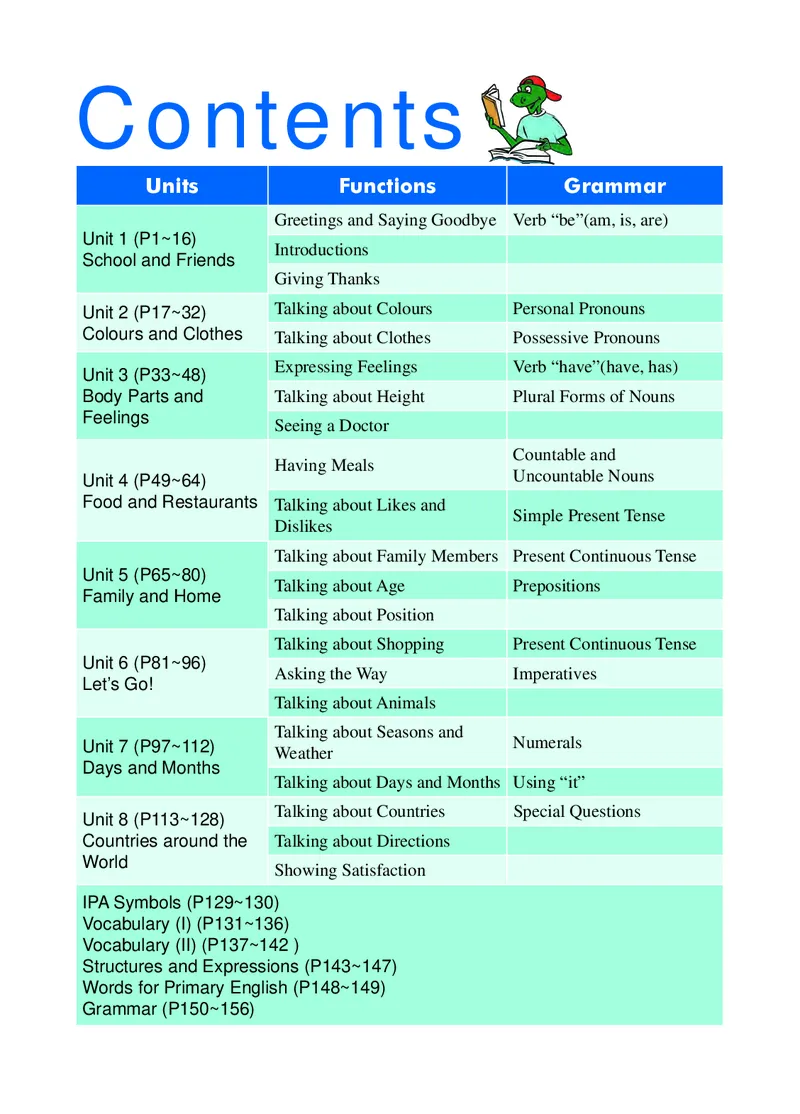
Units Functions Grammar
Greetings and Saying Goodbye Verb “be”(am, is, are)
Unit 1 (P1~16)
Introductions
School and Friends
Giving Thanks
Talking about Colours Personal Pronouns
Unit 2 (P17~32)
Colours and Clothes Talking about Clothes Possessive Pronouns
Expressing Feelings Verb “have”(have, has)
Unit 3 (P33~48)
Body Parts and Talking about Height Plural Forms of Nouns
Feelings
Seeing a Doctor
Countable and
Having Meals
Uncountable Nouns
Unit 4 (P49~64)
Food and Restaurants Talking about Likes and
Simple Present Tense
Dislikes
Talking about Family Members Present Continuous Tense
Unit 5 (P65~80)
Talking about Age Prepositions
Family and Home
Talking about Position
Talking about Shopping Present Continuous Tense
Unit 6 (P81~96)
Asking the Way Imperatives
Let’s Go!
Talking about Animals
Talking about Seasons and
Numerals
Unit 7 (P97~112)
Weather
Days and Months
Talking about Days and Months Using “it”
Talking about Countries Special Questions
Unit 8 (P113~128)
Countries around the Talking about Directions
World
Showing Satisfaction
IPA Symbols (P129~130)
Vocabulary (I) (P131~136)
Vocabulary (II) (P137~142 )
Structures and Expressions (P143~147)
Words for Primary English (P148~149)
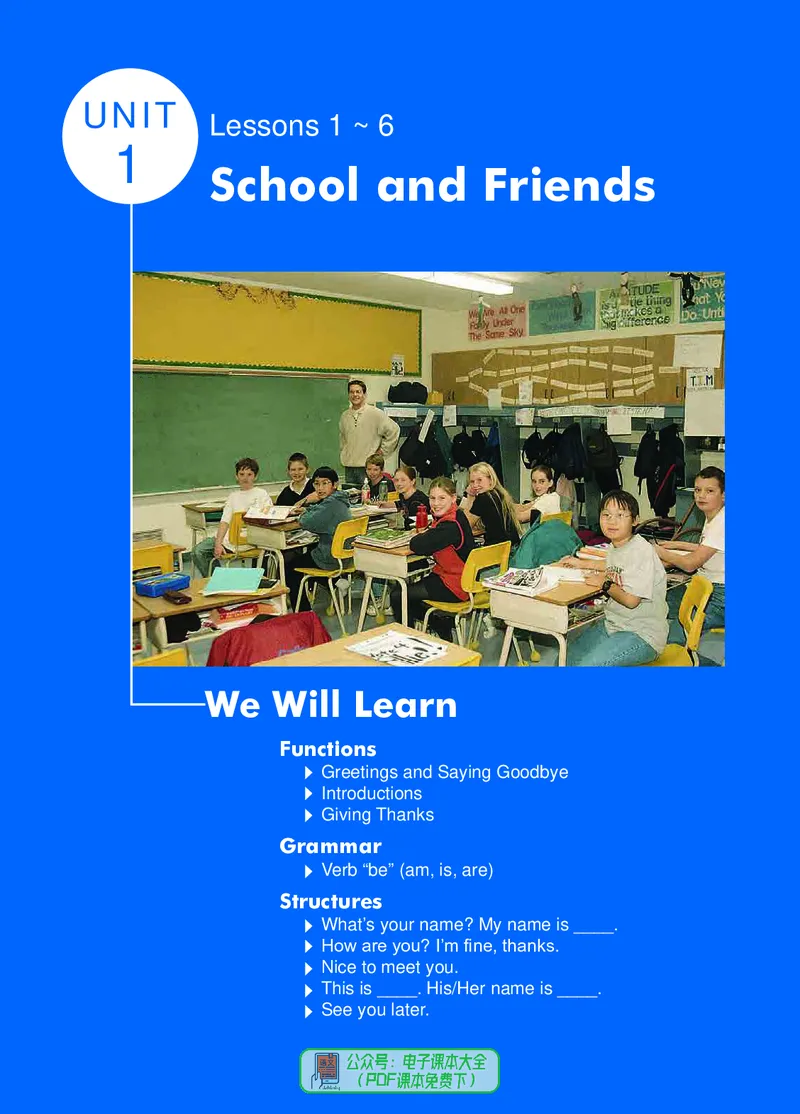
Grammar (P150~156)UNIT
Lessons 1 ~ 6
1
School and Friends
We Will Learn
Functions
Greetings and Saying Goodbye
Introductions
Giving Thanks
Grammar
Verb “be” (am, is, are)
Structures
What’s your name? My name is ____.
How are you? I’m fine, thanks.
Nice to meet you.
This is ____. His/Her name is ____.
See you later.
1Lesson 1: Hello!
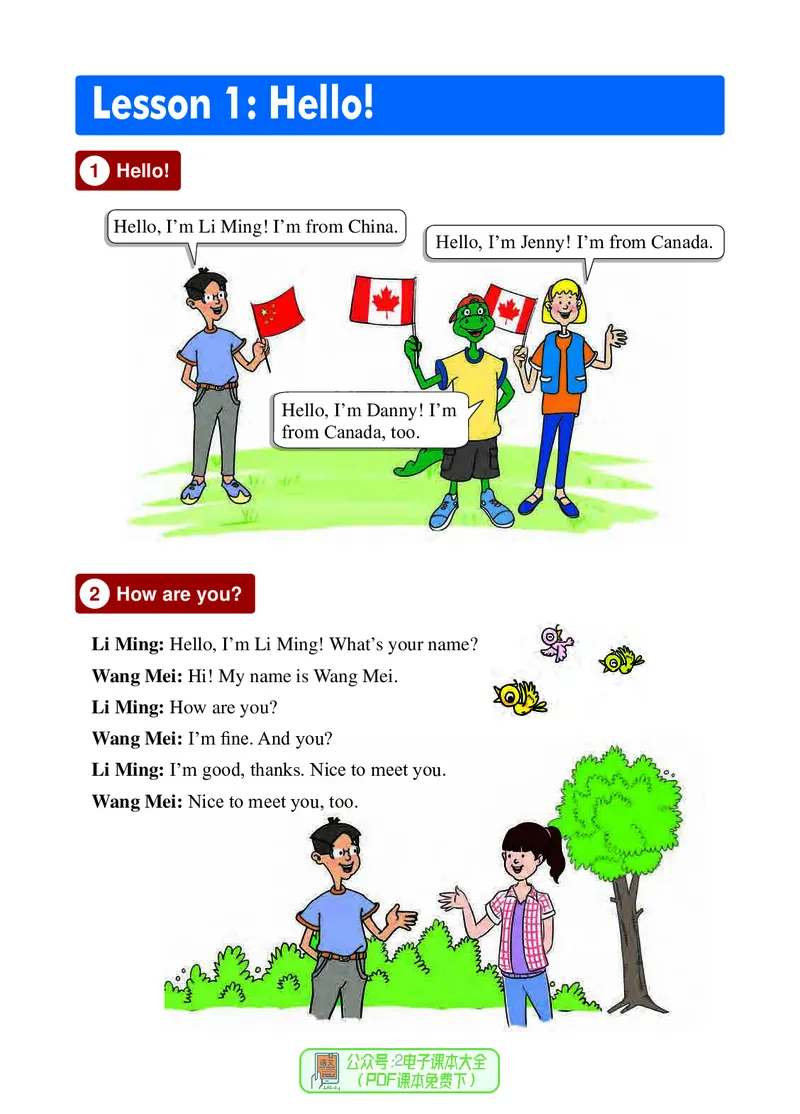
1 Hello!
Hello, I’m Li Ming! I’m from China.
Hello, I’m Jenny! I’m from Canada.
Hello, I’m Danny! I’m
from Canada, too.
2 How are you?
Li Ming: Hello, I’m Li Ming! What’s your name?
Wang Mei: Hi! My name is Wang Mei.
Li Ming: How are you?
Wang Mei: I’m fine. And you?
Li Ming: I’m good, thanks. Nice to meet you.
Wang Mei: Nice to meet you, too.
2Let’s Do It!
1 Listen and sing along.
Hello, hello, how are you?
Hello, hello, how are you?
What’s your name?
Fine. Nice to meet you.
My name is Joe.
Hello, hello, how are you?
What’s your name?
My name is Sue.
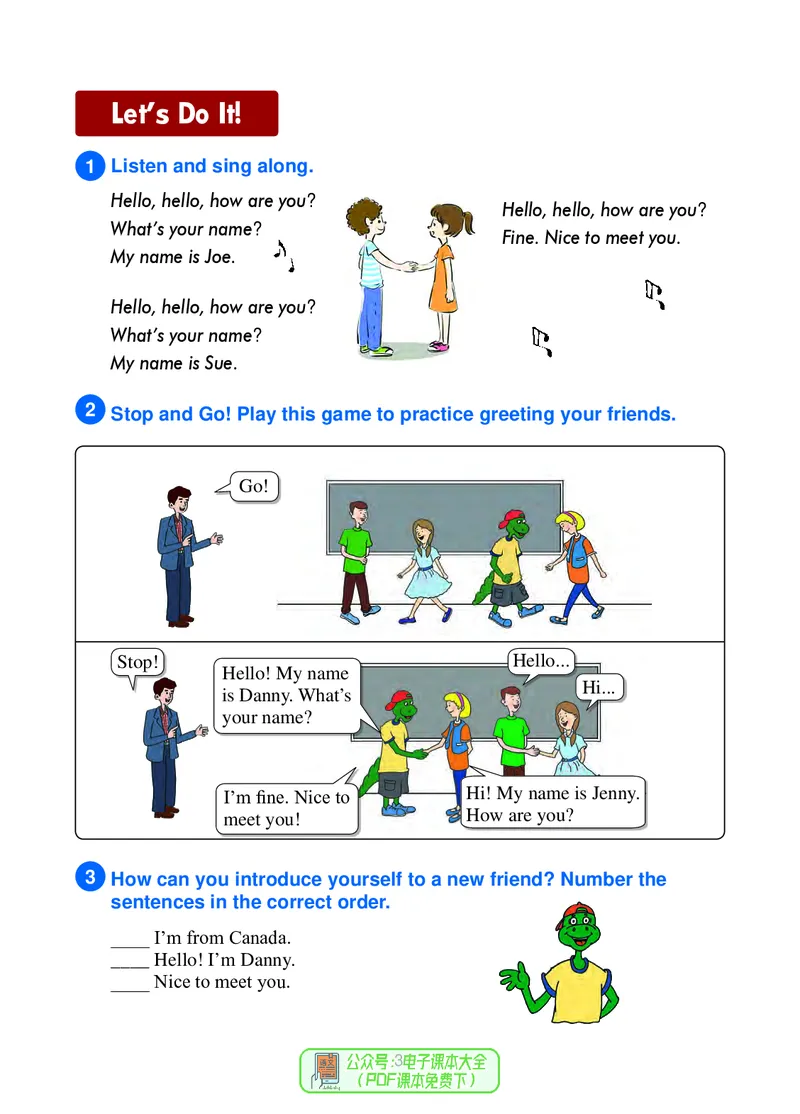
2 Stop and Go! Play this game to practice greeting your friends.
Go!
Stop! Hello...
Hello! My name
Hi...
is Danny. What’s
your name?
I’m fine. Nice to Hi! My name is Jenny.
meet you! How are you?
3 How can you introduce yourself to a new friend? Number the
sentences in the correct order.
____ I’m from Canada.
____ Hello! I’m Danny.
____ Nice to meet you.
3Lesson 2: Teacher and Students
1 This is my friend.
Li Ming: Good morning, Wang Mei.
Wang Mei: Good morning, Li Ming.
Li Ming: Wang Mei, this is my friend. His
name is Yang Hao. He’s in Class Four.
Wang Mei: Nice to meet you, Yang Hao.
Yang Hao: Nice to meet you, too.
Wang Mei: This is my friend, Li Lin.
She’s in Class Five.
Yang Hao: Nice to meet you, Li Lin.
Li Lin: Nice to meet you, too.
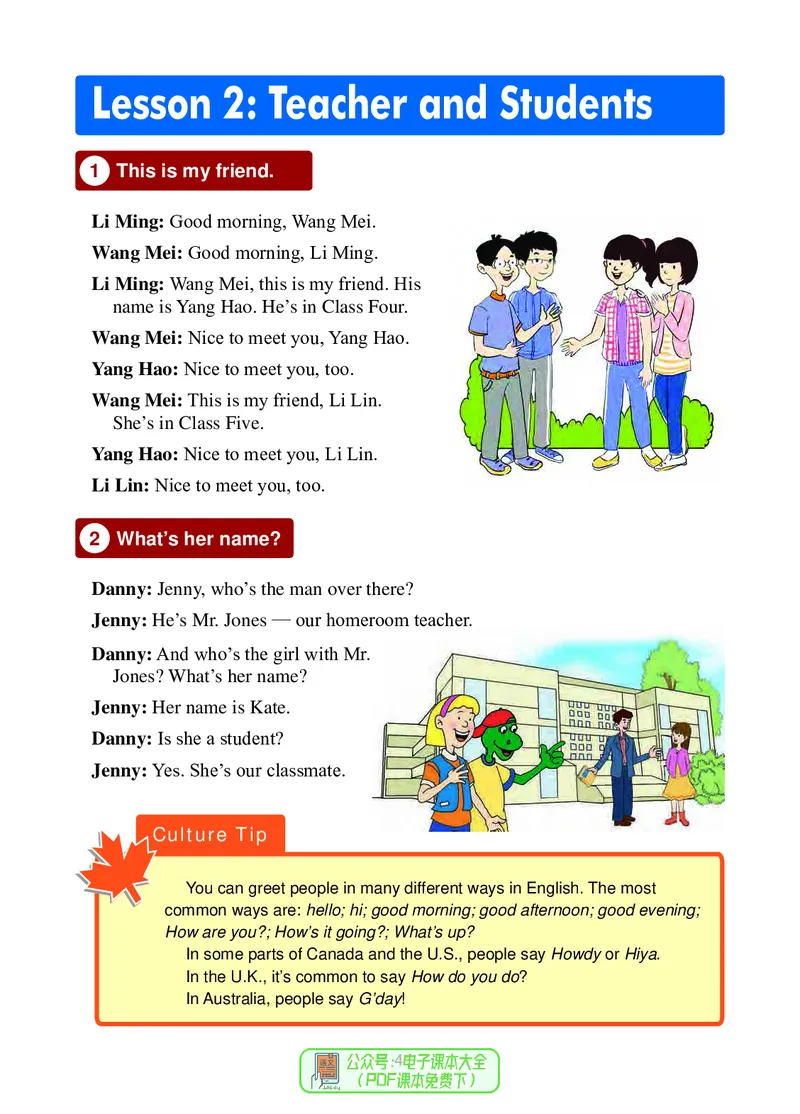
2 What’s her name?
Danny: Jenny, who’s the man over there?
Jenny: He’s Mr. Jones — our homeroom teacher.
Danny: And who’s the girl with Mr.
Jones? What’s her name?
Jenny: Her name is Kate.
Danny: Is she a student?
Jenny: Yes. She’s our classmate.
Culture Tip
You can greet people in many different ways in English. The most
common ways are: hello; hi; good morning; good afternoon; good evening;
How are you?; How’s it going?; What’s up?
In some parts of Canada and the U.S., people say Howdy or Hiya.
In the U.K., it’s common to say How do you do?
In Australia, people say G’day!
4Lesson 2: Teacher and Students
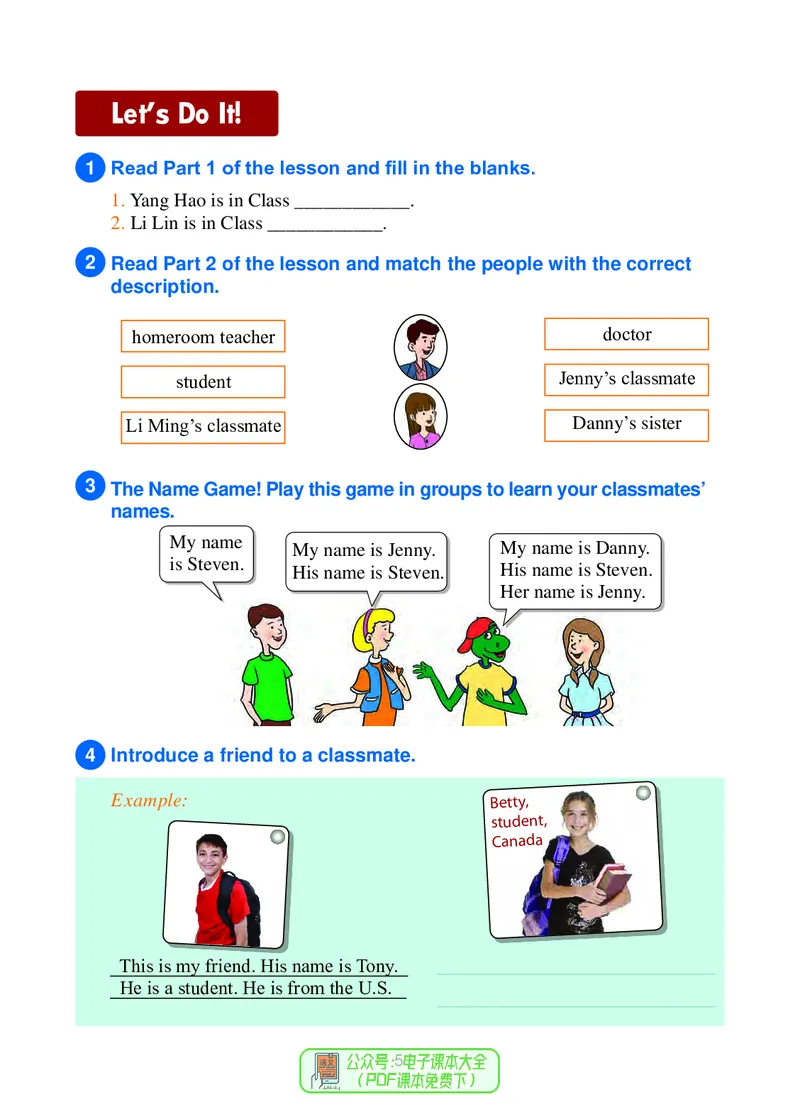
Let’s Do It!
1 Read Part 1 of the lesson and fill in the blanks.
1. Yang Hao is in Class ____________.
2. Li Lin is in Class ____________.
2 Read Part 2 of the lesson and match the people with the correct
description.
homeroom teacher doctor
student Jenny’s classmate
Li Ming’s classmate Danny’s sister
3 The Name Game! Play this game in groups to learn your classmates’
names.
My name
My name is Jenny. My name is Danny.
is Steven.
His name is Steven. His name is Steven.
Her name is Jenny.
4 Introduce a friend to a classmate.
Example: Betty,
student,
Canada
This is my friend. His name is Tony. _____________________________
He is a student. He is from the U.S.
_____________________________
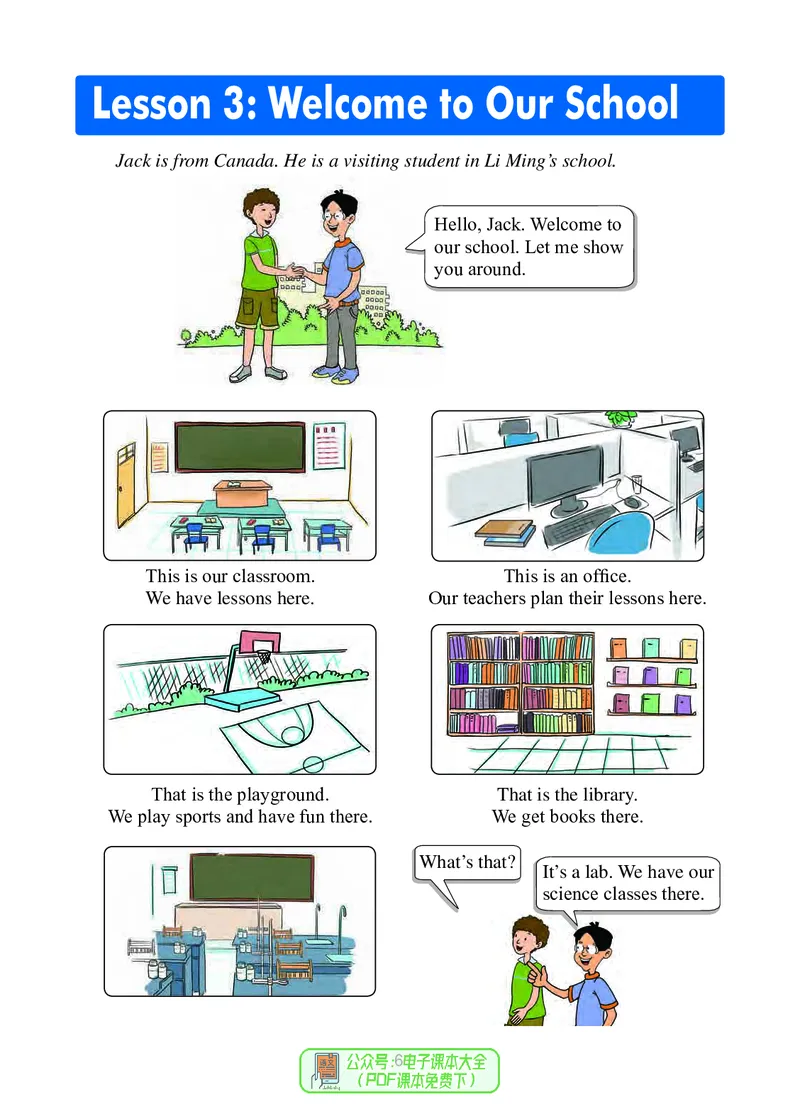
5Lesson 3: Welcome to Our School
Jack is from Canada. He is a visiting student in Li Ming’s school.
Hello, Jack. Welcome to
our school. Let me show
you around.
This is our classroom. This is an office.
We have lessons here. Our teachers plan their lessons here.
That is the playground. That is the library.
We play sports and have fun there. We get books there.
What’s that?
It’s a lab. We have our
science classes there.
6Lesson 3: Welcome to Our School
Let’s Do It!
1 Listen to the statements and number the pictures.
2 Fill in the blanks with the phrases in the box.
have lessons get books have science classes
plan their lessons play sports
1. Our teachers ______________ in the office.
2. The students ______________ and have fun on the playground.
3. Jenny and her classmates ______________ in the lab.
4. We ______________ in our classroom.
5. They ______________ from the library.
3 Fill in the blanks and help Jack find his way around the school.
1. Where can Jack get some books?
→ Jack can get some books from the ________.
2. Where can Jack go for his science classes?
→ Jack can go to the ________.
3. Jack wants to play sports and have fun. Where can he go?
→ Jack can play sports and have fun on the ________.
4. Where does Jack have lessons?
→ Jack has lessons in the ________.
4 Draw a place in your school. Then write some sentences about it.
Example:
This/That is an office. Our teachers plan their lessons here/there.
_______________________________
_______________________________
_______________________________
_______________________________
7Lesson 4: What Is It?
pen pencil pencil box ruler blackboard eraser
Class, let’s play a guessing game.
Li Ming, you go first.
Li Ming: It’s long and thin. What is it?
Can you guess?
Wang Mei: Is it a ruler?
Li Ming: No, it isn’t. You can write
with it.
Wang Mei: A pencil?
Li Ming: Yes, you are right! Now it’s
your turn.
Wang Mei: It’s big and black. It’s on
the wall. What is it?
Li Ming: It’s a blackboard!
Wang Mei: Very good!
Dig In
Look at the things in your classroom. Do you know the English words
for these things? If you don’t know the words, try to find them.
8Let’s Do It!
1 Listen to the statements and number the pictures.
2 Make your own vocabulary cards. Draw and write the names of
classroom objects on cards. Then use your cards to play the
Guessing Game in groups.
What is it?
Is it a pen?
No!
Is it a pencil?
Yes!
3 Look at the pictures and fill in the blanks.
1. You can write with a ________ .
2. The ________ is on the wall. It’s big and black.
3. I can see a ________ in the pencil box.
4. A: What is it?
B: It’s a ________ .
5. A: Is it an ________ ?
B: Yes, it is.
4 Work in pairs. Put some of your classroom objects on your desk.
Ask your partner to close his or her eyes. Then take one object
away. Can your partner guess what’s missing?
9Lesson 5: May I Have a Book?
Danny: Excuse me. May I have
a book, Jenny?
Jenny: OK! Here you are.
Danny: Thank you.
Jenny: You’re welcome!
Danny: May I borrow two pencils, Jenny?
Jenny: Yes, you may. Here you are.
Danny: Thanks. May I have three crayons,
Jenny?
Jenny: Sorry, Danny. I don’t have any crayons.
Danny: That’s OK. I can go and buy some at the
store. I can get some for you, too. Goodbye!
Jenny: Thank you, Danny. See you later.
Learning Tip
After someone says thanks or thank you, you can say you’re welcome.
What else can you say? You can say: no problem, no worries, not at all, my
pleasure, don’t mention it, forget it or it’s nothing.
10Let’s Do It!
1 What does Danny want? Listen and circle the pictures.
2 Complete the mind map with classroom objects you can put in
your schoolbag.
pencil
3 The Chain Game. Work in groups to practice “May I…”.
May I have Sure. Here you are.
________ May I have ________
________, ________, Li Ming?
Wang Mei?
Sorry, I don’t have any
Sure. Here
________. May I have
you are.
________ ________, Jack?
4 Listen and do the actions.
Stand up, Look up, Reach up,
Sit down and Look down and Reach down and
Show us one. Show us two. Show us three.
Jump up, Point up,
Jump down and Point down and
Show us four. Show us five.
11Lesson 6: Things for School
To: liming@net.cn
From: danny@compmail.ca
Date: 23/09 9:08 p.m.
Subject: My Shopping List
Dear Li Ming,
How are you? I am fine. School is great! I have some new friends this year.
They are very nice. What about your new school? I need to buy some things
for my classes. Here is my list. Can I buy all of these things at the store?
My Shopping List
● five erasers
● ten classrooms
● two pencil boxes
● six pens
● seven pencils
● one library
● nine crayons
● three rulers
● eight playgrounds
● four labs
Your friend,
Danny
Can Danny buy all the things
on his list? Learning Tip
People make lists for many
different reasons. There are many
different types of lists:
shopping list
to-do list
gift list
word list
12Let’s Do It!
1 Listen and fill in the blanks.
Danny wants to buy five erasers, ________ classrooms, two pencil boxes,
________ pens, ________ pencils, one library, ________ crayons, three rulers,
________ playgrounds and four labs.
2 Read the lesson and answer the questions.
1. Does Danny like school?
2. Are his new friends nice?
3. Can he buy all the things on his list at a store? Why or why not?
3 Look at the pictures and complete the crossword puzzle.
b
p
f
c y n f
l b y
l e
r l
d
4 What things do you need for
school? Make a shopping list. Item Amount
pencil 5
13Unit Review
Building Your Vocabulary
I. Search for words from this unit and write them down.
p c l a s s r o o m
q l a m t w m o f p
s a b z o y i e f l
t s q c r b b i i a
u s b m e u y z c n
d m n o e r a s e r
__w__a_ll___ ________ ________
e a w a l l x w t v
n t o t h i n g s r ________ ________ ________
t e l c d s f k j l
________ ________ ________
s t u d n t u e m n
II. Say the phone number below each picture. What is each number for?
Do you know
how to say “0”?
110 122 120 119
Grammar in Use
Fill in the blanks with the proper form of “be”.
1. A: How ________ you?
B: I ________ fine. Thanks.
2. A: How ________ your father and mother?
B: They ________ fine. Thanks.
3. A: Who ________ the girl over there? ________ she your friend?
B: Yes, she ________ my friend.
4. A: Hello. I ________ Joe. What ________ your name?
B: My name ________ Sue. And this ________ Jack. That ________ Mary.
They ________ my friends.
A: Nice to meet you, Jack and Mary.
C & D: Nice to meet you, too.
145. A: ________ this a classroom?
B: No. This ________ a lab.
6. A: What ________ that?
B: It ________ a blackboard.
Listening and Speaking
I. Listen to the dialogues and number the pictures.
II. Listen and repeat.
Aa name eraser cake
Ee she he we
Ii I fine nice
Oo hello no go
Uu unit excuse student
III. Work in groups. Play the Telephone Number Game.
Example:
Student A tells Student B a telephone number. Then Student B tells it to Student
C... The last student writes it down and shares it with the group. Did he or she get
it right?
Putting It All Together
Make your own student card.
My Photo Name __________________________
Boy Girl
Class __________________
Phone number ____________________
Country ___________________
15Self-Evaluation
Find more examples from this unit. Then mark your stars.
I. Greetings and Saying Goodbye III. Giving Thanks
Hello! Thanks.
I can greet and say goodbye to my I can give thanks in English.
classmates in English.
IV. Verb “be” (am, is, are)
II. Introductions I’m Li Ming.
This is my friend, Li Lin.
I can use “am, is, are” properly.
I can introduce my friends in
English.
Can You Count from One to Ten?
One little, two little, three little boys,
Playing with four little, five little toys.
Six little, seven little, eight little friends,
Nine little, ten little… let’s start again!
First there is one, then there is two,
Three, four and five… do I know you?
Six before seven and eight before nine,
Ten little numbers all in a line!
16UNIT
Lessons 7 ~ 12
2
Colours and Clothes
We Will Learn
Functions
Talking about Colours
Talking about Clothes
Grammar
Personal Pronouns
Possessive Pronouns
Structures
What’s your favourite colour?
Whose ____ is this?
Let’s go shopping!
17Lesson 7: Jenny’s New Skirt
1 Can I get a new skirt?
Jenny: Mum, my skirt is very old. Can I get a new
one?
Mrs. Smith: Sure, dear. What colour do you want?
Jenny: I want a blue skirt, Mum.
Mrs. Smith: OK. What can you wear with it?
Jenny: I can wear my favourite blouse with it. I like
its colour. It’s light blue!
Mrs. Smith: Blue again! Jenny, you really like blue.
2 I like your blue skirt.
Kim: Good afternoon, Jenny. I like your blue
skirt.
Jenny: Thanks!
Kim: Is it new?
Jenny: Yes, it is. And blue is my favourite
colour. Do you like blue?
Kim: Yes, I do. But my favourite colour is pink.
Culture Tip
Sometimes American spelling is different from British spelling.
Here are some examples:
British American
mum mom
favourite favorite
colour color
Can you find more examples?
18Let’s Do It!
1 What clothes do they like to wear? Listen and match the people with
the clothes.
a blue shirt a pink skirt a red sweater a blue blouse a white blouse
2 Read the lesson and fill in the blanks with the words in the box.
pink light blouse new really blue
I’m Jenny. My skirt is very old. I want a ________ one. My favourite
colour is ________. I can wear the blue skirt with my favourite ________. The
blouse is ________ blue. I ________ like blue! Kim likes my skirt. But Kim’s
favourite colour is ________.
3 Look at Kim’s closet and help her match some clothes.
1. I like my new sweater. I can wear it with
my ________.
2. I like my pink skirt. It’s my favourite skirt.
I can wear it with my ________.
3. I like my green coat. I am wearing it with
my ________.
4 Interview some classmates and fill in the table. Then work in
groups and talk about the results.
Example:
A: What are your favourite clothes?
B: My favourite clothes are blouses and skirts.
A: What’s your favourite colour?
B: My favourite colour is blue.
Name Favourite Clothes Favourite Colour
Jenny blouses and skirts blue
19Lesson 8: Danny’s Favourite Colour
1 What’s Danny’s favourite colour?
Jenny: Hi, Danny. Do you want to paint with me?
Danny: Sure!
Jenny: Here is some red paint.
Danny: No, I don’t like red.
Jenny: OK. How about blue?
Danny: Blue is good. But do you have yellow?
Jenny: Yes. Is yellow your favourite colour?
Danny: No, but I can mix blue and yellow to make green.
Jenny: That’s right! Is green your favourite colour?
Danny: Yes, it is.
2 I am a rainbow.
I am a rainbow. Look at me.
How many colours do you see?
I am red, orange and blue.
I am green, yellow and purple, too.
I come out after the rain. High in the sky.
I am a rainbow. I want to say “Hi!”
Dig In
You can mix two different colours together to make a new colour! Blue
and yellow make green. Red and blue make purple. Red and yellow make
orange. You can mix white with another colour to make it a light colour. Try
it! What colours can you make?
20Let’s Do It!
1 What’s Danny’s favourite colour? Listen and tick the correct answer.
blue red green yellow
2 Fill in the missing letters. Then colour the rainbow in the same
order of the words.
I know the colours of the
rainbow. They are r__d,
or__ __ge, y__ ll __ __,
gr __ __n, bl __ __,
indigo and p__ __ple.
3 Colour the paint cans and write the colours.
+ = + =
red + yellow = orange red +________= pink
+ = + =
blue + yellow = ________ ________ + blue = light blue
+ = + =
red + blue = ________ ________ + white = light green
4 Look at the list of colours in the table below. Can you name some
things that are those colours?
Red Blue Yellow Green White Brown
apple flower cloud
sky grass chocolate
21Lesson 9: Whose Coat Is This?
Jenny: Whose coat is this? Is it your
coat, Danny?
Danny: No. It’s too big for me. It’s
Bob’s coat.
Mr. Jones: Whose scarf is this? Is it
your scarf, Jenny?
Jenny: No, it’s not my scarf. It’s Kim’s
scarf.
Danny: Whose gloves are these?
Jenny: They’re too small for me. Maybe
they’re Lynn’s gloves.
Mr. Jones: Whose shorts are these? Are
they your shorts, Danny?
Danny: Yes, they are. See? They’re just
right for me!
22Let’s Do It!
1 Listen and match the people with their clothes.
Danny Bob Kim Lynn
2 Read the lesson and circle the correct words.
1. The coat is (too big/too small/just right) for Danny.
2. The gloves are (too big/too small/just right) for Jenny.
3. The shorts are (too big/too small/just right) for Danny.
3 Fill in the blanks with words from this lesson.
1. A: Is this ________ coat, Bob?
B: Yes. It is my coat.
2. A: ________ gloves are these?
B: They are Lynn’s gloves.
3. A: Do you like these shorts?
B: Yes. They are just ________ for me.
4. A: Is this Mike’s shirt?
B: No. It is too ________ for him. It’s Bob’s shirt.
4 Work in pairs. Look at the items in the “Lost and Found”. Whose
items are they? Make up a dialogue.
Example:
A: Is this your pencil box?
B: No, it isn’t.
A: Whose pencil box is it?
B: Maybe it’s Yang Huimin’s
Lost and
pencil box.
Found
23Lesson 10: Clothes for a Cold Day
1 You may catch a cold.
Danny is ready for school. He says
goodbye to his mum.
Mrs. Dinosaur: Wait, Danny! It’s cold
today. You can’t wear a T-shirt and shorts.
Danny: Mum, I look nice in this green
T-shirt. And I like shorts.
Mrs. Dinosaur: Look! It’s raining. You may
catch a cold.
Danny: OK, Mum.
(Danny goes back and puts on a jacket.)
Mrs. Dinosaur: Danny! Your jacket doesn’t
go well with your shorts.
Danny: Well, I don’t like to wear pants.
Mrs. Dinosaur: OK. Don’t forget your
umbrella.
Danny: It’s in my schoolbag. Bye, Mum.
2 Colourful clothes
Skirt, sweater, dress and hat.
These, those, this and that!
Pants, shoes, shirts and socks.
Take them all out of the box!
Red, yellow, blue and white.
Colourful clothes are so bright!
Learning Tip
You can catch a cold, but you can also catch a ball, catch a fish, catch a
train or catch a bus.
24Let’s Do It!
1 What does Danny like to wear? Listen and circle the correct
pictures.
2 Read the lesson and answer the questions.
1. How is the weather?
2. Does Danny like to wear shorts or pants?
3. What does Danny finally wear to school?
4. Where is Danny’s umbrella?
3 Fill in the blanks with the correct forms of the words or phrases in
the box.
forget be ready for go well with catch a cold put on
1. It’s 7:00 a.m. now. We ____________ breakfast.
2. I don’t want to ____________ your phone number. Can you write it down?
3. Don’t go outside without a jacket. You may ____________.
4. Her new dress doesn’t ____________ her old shoes.
5. ____________ your coat. It’s cold outside.
4 What clothes does your mum tell you to wear for different weather?
Match the right clothes with the right weather. Then write Mum
says…
Mum says:
It’s raining today. Put on your boots.
And don’t forget your umbrella.
Mum says:
______________________________
______________________________
Mum says:
______________________________
______________________________
25Lesson 11: Clothes around the World
Li Ming writes a report about clothes around the world.
These people are wearing traditional clothes.
Wow! Their clothes are so colourful.
In some places, men wear skirts.
How do they look?
This woman looks beautiful in her Sari.
A Sari is a traditional dress from India.
Some people wear uniforms for work.
These women look so pretty in black and white.
Many students wear school uniforms.
Their uniforms look nice.
Our school uniforms are blue and white. Do you
have uniforms? What colours are they?
26Let’s Do It!
1 Discuss the questions.
1. Do all people wear uniforms for work?
2. Can men wear skirts?
3. Do people wear traditional clothes in your hometown?
4. Do you wear a uniform for school?
2 Listen to the statements and number the pictures.
3 Read the passage and fill in the blanks.
Lisa and her family are ready for the Square Dance Party.
The Square Dance is a ________ (traditional/colourful)
American dance. People wear cowboy boots and hats. Lisa is
wearing a beautiful pink skirt. She looks ________ (funny/
pretty). Lisa’s mother looks nice, too. Her skirt goes well
cowboy boots
with her colourful blouse. Lisa’s father looks good in his
pants and shirt. They all look nice, but they are all wearing
________ (different/purple) clothes. Lisa’s dog is ready for
the party, too. He is wearing a cowboy hat. He looks cute.
cowboy hat
4 People wear different traditional clothes all around the world. What
are some traditional clothes people wear in China? Collect some
pictures and write about them.
Example:
This lady is from Tibet. She is wearing traditional
Tibetan clothes. She looks good in her hat and
colourful clothes.
27Lesson 12: Let’s Go Shopping!
To: jenny@compmail.ca; danny@compmail.ca; kate12@supermail.com;
steven@supermail.com
From: kim15@compmail.ca
Date: 12/10 10:15 a.m.
Subject: A Shopping Date!
Hi friends,
Let’s go shopping!
Let’s meet at the shopping centre at 1:00 p.m. this Saturday.
You can come with your mum!
You can wear your favourite clothes.
I will wear my favourite dress.
I want to buy a pair of shoes and a pink blouse for school!
What do you want to buy?
Can you come?
We can have FUN, FUN, FUN!!!
Kim
28Let’s Do It!
1 Listen and circle the correct words.
1. Kim and her friends will meet at the (shopping centre/school/library)
this Saturday.
2. Kim’s friends can come with their (mothers/fathers/grandparents).
3. Kim wants to buy a pair of (pants/shoes/gloves) and a (yellow/white/pink)
blouse for school.
2 Read the lesson and answer the questions.
1. Who does Kim want to go shopping with?
2. When will they meet?
3. What will Kim wear?
3 Fill in the blanks with the words or phrases in the box.
the shopping centre go shopping have fun buy meet
1. A: Where is ____________?
B: It’s near the park.
2. A: Let’s go to the zoo.
B: OK. We can ____________ there.
3. A: I’m so glad to ____________ you.
B: Me too.
4. A: What do you want to ____________?
B: A pink skirt.
5. A: Let’s ____________.
B: Good idea.
4 Work in pairs. Make a shopping list. Then talk about it.
Example:
Item Colour For whom
A: What clothes do you want to buy?
B: I want to buy a T-shirt for my father.
A: What colours does your father like?
B: He likes…
29Unit Review
Building Your Vocabulary
I. Red, orange and yellow are warm colours. Blue, green and purple are cool
colours. Colour all the warm clothes in red, orange or yellow. Colour all the
cool clothes in blue, green or purple.
II. Pick a colour word. Then use each letter in the word to start a sentence.
Example:
W……….. (White is a colour.)
H…………(He has a white sweater.)
I…………..(It is new.)
T………….(Tom likes his white sweater.)
E………….(Every boy has a sweater.)
Grammar in Use
Complete the chart. Then use it to fill in the blanks.
Personal pronouns I he it you
Possessive pronouns my your her our their
1. ________ name is Tom. ________ am 12 years old.
2. Jane and I go to the same school. ________ are classmates. We like ________
school.
3. Mary is a girl. ________ likes to wear dresses. This is ________ favourite dress.
4. The kids want to go shopping. ________ want to buy new clothes. ________
clothes are too old.
5. I like ________ hat. It looks good on ________.
30Listening and Speaking
I. What do Jenny and her family members want to buy? Listen to the passage
and match the people with the clothes.
Jenny’s mum sports shoes
Jenny’s dad a green hat
Jenny’s brother a new sweater
Jenny a pink dress
II. Listen and repeat.
/ i: / he she teacher meet
/ / it is this list
/ ə / again about forget after
/ / skirt shirt world purple
III. Work in groups. Bring some of your favourite clothes to school and have
a fashion show. Take turns being the fashion show host and describe your
classmates’ clothes.
Example:
Host: This is Wang Xia. She is wearing a red sweater and blue jeans. Her sweater
goes well with her jeans. She looks great!
Putting It All Together
Work in groups. Find out more about traditional clothing around the world.
Search the Internet and choose one piece of clothing to write about. Follow the
example and answer the questions.
Example:
1. What is it?
It’s a poncho.
2. Where is it from?
It’s from Mexico.
3. Who wears it?
Men, women and children from Mexico wear ponchos.
4. What colour(s) is it?
It is red, blue, green, pink, yellow, orange and brown.
5. What weather can you wear it in?
You can wear it in cold and rainy weather.
6. Do you like it?
Yes, I like the Mexican Poncho. It is colourful and warm.
31Self-Evaluation
Find more examples from this unit. Then mark your stars.
I. Talking about Colours III. Personal Pronouns:
Blue is my favourite colour. I you he she it we they
Possessive Pronouns:
my your his her its our their
I can wear my favourite blouse.
I can use colours to describe clothes
and other things in English.
I can use these pronouns properly.
II. Talking about Clothes
I like your blue skirt.
I can talk about clothes in English.
Who Is Wearing Red?
Who is wearing red?
Oh, who is wearing red?
Please tell me if you can.
Oh, who is wearing red?
Who is wearing green?
Jenny is wearing red.
Oh, who is wearing green?
Oh, Jenny is wearing red.
Please show me if you can.
That’s the colour of her skirt.
Oh, who is wearing green?
She is wearing red.
Danny is wearing green.
Oh, Danny is wearing green.
That’s the colour of his shirt.
He is wearing green.
32UNIT
Lessons 13 ~ 18
3
Body Parts and Feelings
We Will Learn
Functions
Expressing Feelings
Talking about Height
Seeing a Doctor
Grammar
Verb “have” (have, has)
Plural Forms of Nouns
Structures
How tall are you? I’m ____ metres tall.
How do you feel? I’m/I feel ____.
What’s the matter?
I have a headache/stomachache.
33Lesson 13: Body Parts
Hello! My name is Robin. I am a robot.
I have two big eyes. I can see with them.
They are also my cameras.
I have one nose and one mouth. I can smell
with my nose. And I can talk with my mouth.
I can speak English and Chinese!
I don’t have ears but I can hear you.
I can make noodles with my long arms and
small hands. I have ten fingers — just like you!
I can write with them.
I have two long legs and two big feet. I’m a
good football player.
I like to play and have fun! Do you want to
play with me? We can be friends!
Can you do my Sorry, I can’t do your
homework for me, homework, but I can
Robin? make noodles for you.
34Let’s Do It!
1 Listen and fill in the blanks.
1. I have two big ________. I can ________ with them.
2. I have one nose and one ________.
3. I don’t have ________ but I can ________ you.
4. I can make noodles with my long arms and ________ hands.
5. I have two long legs and two big feet. I’m a good football ________.
2 Label Robin’s body parts.
________ ________
________
________
________
________
________
________
3 Read the clues and guess the body parts.
1. You have only one. You can smell with it. It’s a ________.
2. You have only one. You can talk with it. It’s a ________.
3. You have two. You can walk with them. They are ________.
4. You have two. You can see with them. They are ________.
5. You have two. You can hear with them. They are ________.
4 Listen and do the actions.
Put your right hand in.
Take your right hand out.
Put your right hand in,
And shake it all about.
Do the Hokey Pokey,
And turn around.
That’s what it’s all about.
Repeat this with ear, nose, mouth, arm, leg and foot.
35Lesson 14: Colours and Feelings
1 I feel blue.
Li Ming:
Hi, Jenny! I am listening to an English song. In the song, the
singer says “I feel blue”. How can you feel a colour?
Jenny:
That’s a good question. In English, we use many colours for
our feelings. Blue can mean “sad”. Green can mean “sick”.
Yellow can mean “scared”. And red can mean “angry”.
Li Ming:
Wow! Thank you, Jenny. In China, red is a happy colour.
2 The colours of our feelings
Are you blue? Are you sad?
Smile big. Don’t feel bad.
Don’t be scared. Don’t be yellow.
Wave your hand and say hello.
Don’t see red. Don’t be angry.
Jump and play and feel happy.
Don’t feel sick. Don’t feel green.
The doctor can help. He’s not mean.
Culture Tip
Colours have many different meanings in many different cultures. In
Chinese culture, white is a symbol of death. But in Western culture, white
is a symbol of peace and black is a symbol of death.
36Let’s Do It!
1 What meaning does each colour have in English? Listen and
match the colours with the feelings.
blue sick
green angry
yellow sad
red scared
2 Tick the correct meaning for each statement or question.
1. I am sick. I don’t feel well. I am not happy.
2. Everyone has feelings. Everyone feels. Everyone cries.
3. What does this word mean?
Can you say this word? What is the meaning of this word?
4. She smiles every day.
She laughs every day. She looks happy every day.
3 Four words in this passage are NOT right. Circle them and write
the correct words on the blanks below.
It’s my birthday today. I am so angry! All
of my friends will come to my house. But
my friend, Jenny, doesn’t feel well. She is
happy and she can’t come. That makes me
feel tired. I really want her to be here. But
it’s OK. I know she wants me to have a sad
birthday.
1. __h_a_p_p_y__ 2. ________
3. ________ 4. ________
4 Work in pairs. What do you like or not like to do? What makes you
feel happy, sad, angry, scared or sick? Talk about it, write it down
and draw a picture.
Example: Picture
I like to play with my friends. It makes
me feel happy.
I don’t like to watch scary movies. It
makes me feel scared.
37Lesson 15: Tall or Short
1 How tall is he/she?
This is Bob. He’s 1.85 This is Jack. He is 1.6 This is Li Lin. She is
metres tall. He’s a tall man. metres tall. 1.5 metres tall. She’s
a bit short.
How tall are you?
I’m 1.65
metres tall.
This is Danny. How
tall is he? Is he 3.1
metres tall?
2 How tall are you?
Short, short, tall, tall.
Standing up against the wall.
Head up. Tail down.
Standing flat upon the ground!
Dig In
Can you read these measurements?
1.85 m — one point eight five metres
1.6 m — one point six metres
0.95 m — zero point nine five metres
38Let’s Do It!
1 How tall are they? Listen and match the people with their heights.
1.65 metres 1.5 metres 1.85 metres 1.6 metres
2 Write the opposite of each word.
sad — happy
Can you think of other pairs of words like these?
tall — ________
______________________________________________
up — ________ ______________________________________________
big — ________
3 Read the sentences in the box and number the pictures.
1. These shoes are a bit big. 2. That tree is very tall.
3. This ruler is one metre long. 4. Put your hands upon your head.
5. Please sit down against the wall.
4 Work in pairs. Interview your classmates and fill in the table. Then
use the information to write some sentences.
Example:
Name Height
My friend… is… metres tall.
He/She is tall/a bit short.
39Lesson 16: Happy or Sad
1 How do you feel?
Jenny: Hi, Danny! I feel happy!
How do you feel today?
Danny: I’m NOT happy.
Jenny: Oh! What’s wrong?
Are you hurt?
Danny: No, I’m not.
Jenny: Are you tired?
Danny: No, I’m not. I feel sad. My mum
wants me to eat just one donut a day.
Jenny: Oh, Danny. Don’t be sad. Your
mum is right. One donut a day is enough.
2 We all have feelings.
We all have feelings. Yes, we do!
We all feel happy and sad, too.
Sometimes we laugh. Sometimes we cry.
Sometimes we’re down. Sometimes we’re high.
Culture Tip
In English, you can use the words down and high to describe direction
and height, like go down the street and the kite is high in the sky. But you
can also use these words to describe feelings. To feel down means to feel
sad. To feel high means to feel happy.
40Let’s Do It!
1 Read the lesson and answer the questions.
1. How does Jenny feel?
2. Is Danny hurt?
3. Is Danny tired?
4. How many donuts does Danny’s mother want him to eat?
5. Is Danny’s mother right?
2 Listen to the conversations and number the pictures.
3 Complete the mind map with feeling words.
happy
feelings
4 Fill in the blanks with the words in the box.
enough laugh feel hurt
1. He is very sad. I can’t make him __________.
2. Why are you crying? Are you __________?
3. I can’t buy that shirt. I don’t have __________ money.
4. I want to sleep. I __________ tired.
5 Work in pairs. How do you feel today? Make up a dialogue.
Example:
A: How do you feel today?
B: I’m not happy.
A: What’s wrong? Are you hurt/tired?
B: Yes, I am./No, I’m not. I’m…
41Lesson 17: Seeing a Doctor
1 Are you OK?
Jenny: How do you feel, Jim? Are
you OK?
Jim: See my arm? It hurts!
Jenny: It looks bad! Let’s go and see
a doctor.
Li Ming: Are you OK, Wang Mei?
Wang Mei: Aaah, I feel sick. I have a
stomachache.
Li Ming: You’d better go and see a
doctor, Wang Mei.
2 You have a cold.
Dr. Green: Hi, Danny. What’s the
matter?
Danny: I feel sick. I have a headache.
Dr. Green: Do you feel cold?
Danny: Yes! I feel very cold.
Aachoo!!
Dr. Green: Well, let me see... You
have a cold. Take this medicine.
Stay home and have a good rest.
Danny: OK. Thank you, Doctor
Green.
42Let’s Do It!
1 Listen and write true (T) or false (F).
1. Jim’s leg hurts. ( )
2. Wang Mei has a headache. ( )
3. Li Ming tells Wang Mei to go and see a doctor. ( )
2 Look at the pictures and fill in the blanks.
My ________ hurts!
I ________ a stomachache.
You ________ a cold, Danny. You’d better
________ this medicine and stay home.
3 Complete the dialogue with the sentences in the box.
Doctor: Hi, Sam. ___________________
1. Do you have a headache?
Sam: I don’t feel well.
2. Hmm… I think you have a cold.
Doctor: ___________________
3. What’s the matter?
Sam: No, I don’t have a headache.
4. Yes, I feel very cold.
Doctor: Do you feel cold?
Sam: _____________________
Doctor: ______________________ Take this medicine.
Stay home and have a good rest.
Sam: OK. Thank you, Doctor.
4 Work in pairs. What’s the matter? Make up a dialogue.
The doctor may ask:
What’s wrong?
You may tell the doctor:
What’s the matter?
I hurt my…
Are you OK?
I have a headache/ The doctor may say:
stomachache. Take this medicine.
I feel sick/cold. Have a good rest.
Stay home.
43Lesson 18: We All Look Different!
1 What does he/she look like?
She is beautiful. He is good-looking. He looks cool! She looks cute!
2 We all look different.
Jenny is from Canada. She is twelve years old.
She has short blond hair. Her eyes are blue. She is a
pretty girl.
Danny is from Canada. He is thirteen years old.
He has three black hairs. He is big and tall. He looks
funny.
I’m Li Ming. I am almost twelve years old. I’m
from China. I have short black hair. I wear glasses.
We all look different.
44Let’s Do It!
1 Listen and fill in the blanks.
1. Jenny is ________ years old. She is ________.
2. Danny is ________ years old. He looks ________.
3. Li Ming is from China. He wears ________.
2 Match the people with the descriptions.
Lily has short blond Nancy has long Peter is tall. He Paul is short. He
hair. She likes to black hair. She likes likes to wear shorts. wears glasses.
wear skirts. to wear dresses. He looks cool. He is cute.
3 Fill in the blanks with “have” or “has”.
1. I ________ a stomachache. It hurts!
2. She ________ blue eyes.
3. This is our classroom. We ________ lessons here.
4. Everyone likes him. He ________ many friends.
5. All dogs ________ four legs.
6. You are sick. You’d better stay home and ________ a good rest.
4 Work in pairs. Student A describes someone
and Student B draws a picture according to the
description. Take turns describing and drawing.
Do the descriptions match the drawings?
Example:
He has short brown hair. He has
green eyes. He wears a hat. He is
tall. He looks funny.
45Unit Review
Building Your Vocabulary
I. Search for body part words and write them down.
h e a d f a c e m
a y r n i s e l f
n e m o u t h b i
d u e s n o a o n ___h_e_a_d___ _________
f k n e e m e w g _________ _________
o v b l c a d h e _________ _________
o t o e k c e a r
_________ _________
t e w g q h j i o
_________ _________
s h o u l d e r h
II. Fill in the blanks with the words in the box.
homework smell smile matter medicine stay blond
1. I hear with my ears. I ________ with my nose.
2. It’s raining. You’d better ________ home.
3. “Take this ________ and have a good rest,” the doctor says.
4. Jenny has short ________ hair. She is a pretty girl.
5. I want to take a picture of you. ________ and say cheese.
6. A: What’s the ________?
B: I hurt my nose.
7. A: Can you do my ________ for me?
B: Sorry, I can’t do it for you.
Grammar in Use
I. Fill in the blanks with “have” or “has”.
1. May I ________ a pencil, Jenny?
2. Danny ________ many yellow shirts.
3. You ________ a cold. You’d better go and see a doctor.
4. She feels sick. She ________ a stomachache.
5. A: How many arms does a robot ________?
B: I don’t know.
46II. Fill in the blanks with the correct forms of the given words.
1. I have ten ________ (finger).
2. I walk with my ________ (foot).
3. He has two long ________ (leg). He is a good football player.
4. Li Ming, Danny and Jenny are good ________ (friend).
5. A: Whose ________ (scarf) are these?
B: They are the students’.
Listening and Speaking
I. Listen to the descriptions. Then match the names with the people.
Linda Bob Jeff Kelly Li Hua
II. Listen and repeat.
/ e / red help smell twelve
/ æ / can sad have stand
/ u: / blue cool noodle
/ / good look football
III. Play Simon Says.
Choose four students to stand in front of the class. These four students are the
leaders. One at a time, the leaders tell the class to touch different body parts. But
you should only touch the body part if the leaders say “Simon Says” first.
Example:
Putting It All Together
Name: Maria
Bring a photo of yourself to
Age: 18
class. Trade your photo with a
Height: 1.6 metres
partner and use the character
Hair Colour: Brown
profile to describe each other.
You can use some of these Eye Colour: Brown
words in your description:
beautiful, good-looking, cool,
cute, funny, kind, happy, sad, Her name is Maria.
tired and angry. She is 18 years old. She is 1.6 metres tall.
She has brown hair and brown eyes.
She looks kind. She is happy.
47Self-Evaluation
Find more examples from this unit. Then mark your stars.
I. Expressing Feelings III. Talking about Height
I feel happy! How do you feel today? How tall is he/she?
______________________________ ______________________________
______________________________ ______________________________
I can talk about feelings in English. I can talk about people’s height in
English.
II. Seeing a Doctor
What’s the matter? IV. Plural Forms of Nouns
______________________________ eyes, arms, hands, feet
______________________________ ______________________________
I can talk to a doctor in English. ______________________________
I can use plural forms properly.
Left Hand, Right Hand
Left hand, right hand,
Clap, clap, clap.
Left foot, right foot,
Tap, tap, tap.
Left arm, right arm,
Wave up and down.
Turn to the left,
Now sit down.
48UNIT
Lessons 19 ~ 24
4
Food and Restaurants
We Will Learn
Functions
Having Meals
Talking about Likes and Dislikes
Grammar
Countable and Uncountable Nouns
Simple Present Tense
Structures
What would you like? I’d like ____.
Do you like ____? Yes, I do./No, I don’t.
Are you ready to order?
How much is/are/for ____?
49Lesson 19: Time for Breakfast!
Mr. Smith: It’s seven fifteen. Time for
breakfast!
Lynn: What’s for breakfast, Dad?
Mr. Smith: We have cereal, bread, fruit
and juice. What would you like?
Lynn: Hmm. Can I have a salad?
Mr. Smith: No, I didn’t make a salad.
But you can have one for lunch.
Lynn: OK. Then I would like some bread and a glass of juice for breakfast.
Jenny: Can I have some cereal and sugar, please? I want to put sugar on my
cereal. It’s delicious.
Mr. Smith: Sure. How about you, Mary?
Mrs. Smith: I’m not very hungry. I just want a cup of tea.
Culture Tip
A common Western breakfast usually has: eggs, bacon, toast, jam,
butter, cereal, milk, orange juice, coffee and tea. What do you usually
have for breakfast?
50Let’s Do It!
1 Listen and fill in the blanks.
It’s seven ________. Time for breakfast!
I want to put sugar on my cereal. It’s ________.
I just want a ________ of tea.
2 What would they like for breakfast? Read the lesson and fill in the table.
Names Breakfast
Lynn
Jenny
Mrs. Smith
3 Look at the pictures and fill in the blanks.
1. A: What’s for breakfast?
B: We have cereal, ________, fruit and juice.
2. A: Danny, would you like some ________?
B: Yes, please.
3. A: What would you like for lunch?
B: I’d like a ________.
4. A: Are you hungry?
B: No, I’m not. I just want some milk with ________.
4 Work in pairs. What would you like for breakfast, lunch or supper?
Make up a dialogue.
Example:
A: What would you like for…?
B: I’d like… How about you?
A: I’m not very hungry. I just want…
51Lesson 20: I Like the Supermarket!
Mrs. Dinosaur: Danny, I have to go to the
supermarket. Do you want to come with me?
Danny: Sure, Mum. I like the supermarket! It’s
full of delicious food. What would you like
to buy?
Mrs. Dinosaur: I have a list. It’s on the table.
Can you get it for me?
Danny: OK.
(Danny looks at the list.)
eggs
milk Danny: Hmm. This list doesn’t have
bread donuts. I can write it down. Oh… and
chicken cookies and chocolate!
fish
Mrs. Dinosaur: Danny, do you have the
meat
list?
apples
bananas
Danny: Yes, I have it. Let’s go to the
donuts supermarket, Mum.
cookies
chocolate
(Mrs. Dinosaur and Danny shop at
the supermarket.)
Mrs. Dinosaur: OK, Danny. Do we
have everything on this list? Let
me see. We have eggs, milk, bread,
chicken, fish, meat, apples, and
bananas… (Mrs. Dinosaur looks at
Danny and smiles.) And we have
the donuts, cookies and chocolate.
Danny: Good job, Mum. You have
everything on your list.
Mrs. Dinosaur: No, Danny. We have
everything on our list.
52Let’s Do It!
1 Read the lesson and write true (T) or false (F).
1. Danny doesn’t want to go to the supermarket. ( )
2. Danny writes donuts, cookies and chocolate on the list. ( )
3. Danny and his mum have everything on their list. ( )
2 Look at the pictures and fill in the blanks.
1. A: What would you like for breakfast?
B: Eggs, cereal and some ________.
2. A: What’s for lunch, Mum?
B: We have some ________ and ________.
3. A: Would you like some ________?
B: No, thanks.
3 Rewrite the sentences into questions.
1. I like apples. → Do you like apples?
2. We have chicken. →
3. Li Ming eats bananas. →
4. I buy vegetables. →
5. He has a list. →
6. Danny and Jenny like chocolate. →
4 Fill in the blanks with the words in the box.
1. A: Do you want to go to the ________ with me?
everything
B: Sure. It’s full of ________ food.
delicious
2. A: Do you have ________ on the list?
job
B: Let me see… Yes!
supermarket
A: Good ________!
5 Work in pairs. What would you like to buy at the supermarket?
Make a shopping list, then make up a dialogue.
Example:
Shopping List
A: I have to go to the supermarket.
Do you want to come with me?
B: Sure. What would you like to buy?
A: I’d like to buy… Here is my list.
53Lesson 21: At the Market
Li Ming takes Jack to the morning
market.
Li Ming: This is the morning market,
Jack. Many people buy fruit and
vegetables here. Do you like fruit
and vegetables?
Jack: Yes, I like vegetables very
much. Potatoes are my favourite.
Li Ming: I like fruit. Grapes are my
favourite.
Jack: Wow! Look at the carrots. They are big! They are not so big in Canada.
Li Ming: Do you like cabbage, Jack? I like to eat cabbage in soup. It’s delicious!
Jack: Yes, I like cabbage. In Canada, we eat cabbage in salads.
Li Ming: I like watermelons. They are
sweet. Let’s buy a watermelon.
Jack: OK. How about the pears? Pears
are sweet, too.
Li Ming: The pears don’t look good, but
the apples look good.
Jack: OK. Let’s buy some apples.
Culture Tip
These phrases have special meanings:
Small potatoes means something or someone that is not important.
Apple of my eye means something or someone that you love.
Some like carrots, others like cabbage means people like different things.
54Let’s Do It!
1 Listen and fill in the blanks.
Li Ming takes Jack to the morning ________.
I like ________ very much. Potatoes are my favourite.
I like watermelons. They are ________.
2 Read the lesson and write true (T) or false (F).
1. Li Ming likes fruit. Grapes are his favourite. ( )
2. In Canada, people like to eat cabbage in salads. ( )
3. The apples don’t look good, but the pears look good. ( )
3 Look at the pictures and fill in the blanks.
1. ________ are my favourite. They are sweet.
2. Let’s buy a ________ at the market.
3. I like to eat ________ in soup.
4 Work in groups. Do you like fruit and vegetables? Interview your
classmates and fill in the table.
Do you like…?
Jim
Carrots
Pears
Grapes
Watermelons
Example:
A: Do you like carrots?
B: Yes, I do./Yes, I like them very much.
A: Do you like pears?
B: No, I don’t.
55Lesson 22: In the Restaurant
It’s lunch time. Li Ming and Jack are hungry. They go to a restaurant.
Waitress: Are you ready to order?
Li Ming: Yes, please. How much are
the noodles?
Waitress: Fourteen yuan for beef or
chicken noodles. Eleven yuan for
tomato and egg noodles.
Li Ming: OK. I’ll have the chicken
noodles. What would you like, Jack?
Jack: Hmm...
Waitress: We also have dumplings and rice. Rice with fish or chicken is twelve
yuan.
Jack: How much for the dumplings?
Waitress: Fifteen yuan for dumplings with meat and cabbage, and thirteen yuan
for dumplings with carrot and egg.
Jack: Carrot and egg dumplings? I’ll try that, please.
Waitress: OK. Would you like something to drink?
Li Ming: Yes, please. I would like some water. What would you like, Jack?
Jack: Some apple juice, please.
Waitress: No problem.
MENU
Food Drinks
Dumplings with meat and cabbage 15 yuan A can of coke 3 yuan
Dumplings with carrot and egg 13 yuan A glass of juice 4 yuan
Beef/Chicken noodles 14 yuan A cup of tea 3 yuan
Tomato and egg noodles 11 yuan A bottle of water 2 yuan
Rice with fish/chicken 12 yuan A glass of milk 5 yuan
56Let’s Do It!
1 What do Jack and Li Ming order? Read and match each person with
the food and drinks.
water
carrot and egg dumplings
chicken noodles
juice
2 Circle the words that DO NOT belong.
1. A. orange B. grape C. juice D. banana
2. A. coke B. beef C. chicken D. fish
3. A. noodles B. rice C. dumplings D. ice cream
4. A. potato B. cabbage C. egg D. tomato
5. A. tea B. milk C. water D. salad
3 Read the descriptions and guess the words. The first letter is given.
1. It lives in the water. It can swim. It’s a f______.
2. You can go there to eat. Waiters will bring the
food to you. It’s a r______.
3. It’s white. You drink it and it comes from cows.
It’s m______.
4. It’s a list of food. We use it to order at a
restaurant. It is a m______.
5. You can drink it or you can wash your hands
with it. It’s w______.
4 Work in pairs. What would you like to order? Look at the menu in
this lesson and make up a dialogue.
Example:
A: What would you like?
B: I’d like… How much…?
A: … yuan.
57Lesson 23: The Corner Store
1 What would you like?
Mrs. Dinosaur: Danny, please go to the corner store for me. I need some milk.
Here is some money.
Danny: OK, Mum.
(At the store)
Clerk: Can I help you? What would you like?
Danny: Hmm. What would I like? Let me
see… I’d like some juice… some coke…
and some tea, please.
A Corner Store
Clerk: OK. Juice and coke are in the fridges. And the tea is over there.
Danny: Great! I see them. Thank you.
(At home)
Danny: Here you are, Mum. I have many bottles
of coke, some juice and some tea, too.
Mrs. Dinosaur: But Danny! Where is the milk?
Danny: Sorry, Mum! The clerk asked, “What
would you like?” He didn’t ask, “What would
your mum like?”
2 Twenty Bottles
20 bottles of water on the wall, 20 bottles of water.
Take one down. Pass it around. 19 bottles of water on the wall!
19 bottles of water on the wall, 19 bottles of water.
Take one down. Pass it around. 18 bottles of water on the wall!
18 bottles of water on the wall, 18 bottles of water.
Take one down. Pass it around. 17 bottles of water on the wall!
17 bottles of water on the wall, 17 bottles of water.
Take one down. Pass it around. 16 bottles of water on the wall!
58Let’s Do It!
1 Listen and tick the correct answers.
1. What does Mrs. Dinosaur ask Danny to buy from the corner store?
2. What does Danny buy from the corner store?
2 Complete the dialogue with the words or phrases in the box.
would like how much twenty over there money
Danny: Mum, may I have some __________ to buy some snacks?
Mrs. Dinosaur: Sure. Here’s __________ dollars.
(At the store)
Clerk: Hello. How can I help you?
Danny: I __________ a can of coke and some cookies, please.
Clerk: OK. The drinks are in the fridge. And the cookies are __________.
Danny: Thank you. __________ are the cookies?
Clerk: They’re five dollars.
3 Work in pairs. Match the questions with the correct answers. Then
role-play the dialogue.
Questions Answers
Are you ready to order? Yes, I’d like a cup of tea.
How many dumplings do you want? Yes, please. I’d like some dumplings.
Would you like something to drink? Fifteen.
4 Sing the rest of the Twenty Bottles song.
16 bottles of water on the wall, 16 bottles of water.
Take one down. Pass it around. 15 bottles of water on the wall!
…
1 bottle of water on the wall, 1 bottle of water.
Take one down. Pass it around. 0 bottles of water on the wall!
59Lesson 24: Eat Good Food!
Dear Danny,
Your dad and I are away for three days. I put your
new jacket and your favourite shorts on your bed. Eat
good food and get enough rest. Don’t watch too much
TV! You can find vegetables, fruit, bread and meat in
the fridge. You can make a sandwich or you can order
takeout. Here are some tips for you:
★ eat 2~3 vegetables a day
★ eat 2~3 fruits a day
★ have some meat every day
★ have a glass of milk every day
★ eat only one donut a day
★ drink only one bottle of coke a day
Mum
P.S. We love you.
Dig In
Some English words are too long, so they have short forms. For example,
TV is short for television.
Fridge is short for refrigerator.
P.S. is short for postscript.
Do you know the short forms for these words?
doctor → _______ minute → _______
metre → _______ electronic mail → _______
60Let’s Do It!
1 Listen and write true (T) or false (F).
1. Danny’s parents are away for a week. ( )
2. Danny can find bread in the fridge. ( )
3. Danny can eat two donuts a day. ( )
4. Danny can drink one bottle of coke a day. ( )
2 Search for food and drink words, and write them down.
t e a t h a d f m e a t g h g i b
___t_e_a___ ________
f d g w h m b r e a d w n k p a a
________ ________
r o r a n g e m n c p e a r t r n
i f g h j l i c a k e u o p l h a ________ ________
c h u y t i i a j h b c v b m l n
________ ________
e m i l k k k w a t e r p l n m a
________ ________
n w a p p l e l p c o l r e t p j
3 Tick the correct word for each description.
1. something to keep food cold
market fridge supermarket
2. two pieces of bread with meat and vegetables in the middle
dumplings cookies sandwich
3. in or at another place
away together here
4. just; at most
much only enough
4 Work in groups. How many/much ____ do you eat or drink every
day? Interview your classmates, then write some tips for good
health.
Example: Tips for Good Health
A: How many vegetables
☆
do you eat every day?
☆
B: …
A: How much water do you ☆
drink every day? ☆
C: …
☆
61Unit Review
Building Your Vocabulary
I. Fill in the blanks with the words in the box.
bottles fourteen problem something pass corner leave
1. I’m very hungry. I want ________ to eat.
2. I want to go to the ________ store. Do you want to come with me?
3. Can you ________ me the sugar? I want to put it in my milk.
4. Please take your books home. You can’t ________ them here.
5. A: How much is this?
B: ________ yuan.
6. A: How many ________ of juice do you want?
B: Three, please.
A: No ________.
II. Work out these math problems. Then write out the numbers.
11 + 9 = __ __ __ __ ty 14 + 5 = __ __ __ __ teen
7 + 10 = __ __ __ __ __ teen 25 – 10 = __ __ __ teen
17 – 4 = __ __ __ __ teen 27 – 13 = __ __ __ __ teen
Grammar in Use
I. Work in groups. Write the words in the correct row and column in the table.
egg pear watermelon foot noodle dress
apple water eye hair rice hat
tea milk head shirt dumpling coat
bread sugar finger ice cream skirt shoe
banana fish ear meat sandwich sock
orange leg arm chicken hand
Nouns Body Parts Clothes Food Drinks Fruit
Countable
Nouns
Uncountable
Nouns
62II. Fill in the blanks with the correct forms of the given words.
1. I ________ (drink) five glasses of water every day.
2. Danny has three hairs. He ________ (look) funny.
3. Many people ________ (buy) fruit and vegetables at the market every day.
4. Do you ________ (eat) dumplings at the restaurant?
5. Jenny looks nice today. Her sweater ________ (go) well with her skirt.
Listening and Speaking
I. Listen and tick the foods and drinks you hear.
□meat □beef □chicken □fish □noodles □dumplings □rice
□vegetables □egg □milk □coke □juice □soup □tea
II. Listen and repeat.
/ / for store order corner
/ / on want job bottle
/ / ask glass market
/ / cup some love
III. Complete the table.
You will go shopping. What would your family members like? Ask them and
fill in the table.
Family Member Food Drinks Vegetables Fruit
Father
Mother
Me
Putting It All Together
Example:
Pretend you are opening your own
restaurant. Give your restaurant a Jane’s Place
name and create a menu for your
Food
restaurant.
Hamburger 15 yuan
Task tips: The menu should include
Drinks
some different foods, drinks and A glass of orange juice 4 yuan
desserts. Put prices and draw
pictures to go with the items on your Dessert
A piece of cake 10 yuan
menu. Make the food look delicious!
63Self-Evaluation
Find more examples from this unit. Then mark your stars.
I. Talking about Likes and Dislikes III. Countable and Uncountable Nouns
I like vegetables very much. Countable Nouns
vegetable → Eat 2~3 vegetables a day.
I can talk about food and order food
in English. Uncountable Nouns
water → I would like some water.
II. Simple Present Tense
Many people buy fruit and vegetables I can use countable and uncountable
here. Do you like fruit and vegetables? nouns correctly.
I can use the simple present tense
properly.
Eleven Hungry Boys
Eleven hungry boys, sitting down to eat.
Some want dumplings, some want meat.
Noodles and rice, soup and fish.
Red strawberries, sitting in a dish.
Twelve hungry girls, coming home to eat.
Sandwiches and cookies, they all want meat.
Thirteen grapes, we want to eat them all.
Fourteen melons, round as a ball.
64UNIT
Lessons 25 ~ 30
5
Family and Home
We Will Learn
Functions
Talking about Family Members
Talking about Age
Talking about Position
Grammar
Present Continuous Tense
Prepositions
Structures
What is he doing? He is ____.
What does he/she do? He/She is a ____.
How old are you? I am ____.
How old is he/she? He/She is ____.
65Lesson 25: Jenny’s Family
1 Jenny’s family members
This is Jenny’s family. Jenny
is my friend. She lives in Canada.
Mr. Smith is Jenny’s father. Mrs.
Smith is her mother. She has a
Mr. Smith Mrs. Smith brother — Bob, and a sister —
Lynn.
Bob Jenny Lynn
(son) (daughter) (daughter)
2 We are the Smith family.
We are the Smith family.
We live in Canada.
My mother’s name is Mary Smith. What does she do? She is a bus
driver. Look! She is driving a bus.
My father is a worker. His name is Jim Smith. Look at this photo.
He is working.
My brother is a policeman. His name is Bob. What is he doing?
He is talking on the police radio.
My sister is a student. Her name is Lynn. Look at this photo.
Where is she going? She is walking to school.
I am a student, too. I love my family.
66Let’s Do It!
1 Listen and match the people with the job descriptions.
He is a policeman.
She is a student.
He is a worker.
She is a bus driver.
2 Read Part 2 of the lesson and answer the questions.
1. What is Mary Smith doing?
2. What is Jim Smith doing?
3. What is Bob doing?
4. What is Lynn doing?
3 Work in groups. Play Guess and Do. One student performs an
action and the others guess what he or she is doing. Take turns
acting and guessing.
Example:
A: What is he/she doing?
Group: He/She is...
4 Work in groups. Bring some photos of your family. Talk about
them. Then write about one photo and present it to the class.
Family Photo
L__o_o_k_ a_t_ t_h_is_ p_h_o_t_o_. _T_h_is_ _is_._.._________
_______________________________
_______________________________
_______________________________
_______________________________
_______________________________
67Lesson 26: Li Ming’s Family
1 Li Ming’s family tree
grandfather grandmother grandfather grandmother
Aunt Uncle father mother
Meiping Dachao
Cousin Jing Li Ming
This is my family tree. We live in China. I have two grandmothers
and two grandfathers. I have no brothers or sisters. My parents have
one son, me! My uncle and aunt have one daughter, Li Jing. She is
very young. I love my family.
2 Father and Mother, I love you.
I have a great dad. He is tall and strong. He has
many friends. What does my father do? He is a
businessman. I can talk to him about everything. On
weekends, we play football together.
I love my mum. I am close to her. She is a doctor
and she is very kind. She is always ready to help others.
I am a student. I work hard at school. I love my
family. We always have fun together.
Family Father and Mother, I love you.
68Let’s Do It!
1 Search for family words and write them down.
g r a n d m o t h e r d
r c f e a y e a r l o a __b_r_o_t_h_e_r_ _________
a o l g s i s t e r a u
_________ _________
s u a u n t u d e n u g
_________ _________
o s t b r o t h e r n h
n i h h m o t h e r c t _________ _________
c n e e o t h g r a l e
_________ _________
l g r a n d f a t h e r
2 Read Part 1 of the lesson and answer the questions.
1. Does Li Ming’s mother have any brothers or sisters?
2. Does Li Ming’s father have any brothers or sisters?
3. How many aunts and uncles does Li Ming have?
4. How many cousins does Li Ming have?
3 Read Part 2 of the lesson and fill in the blanks.
Li Ming’s father is ________ and ________. He is a ________. Li Ming can
talk to his father about everything. On ________, they play football ________.
Li Ming is ________ to his mother. She is a ________. She is very ________.
She is always ready to help ________.
4 Work in groups. Draw and label your own family tree. Then talk
about it.
Task tips: Who is the family member? What is his/her name? Is he/she young or
old, tall or short? What colour is his/her hair or eyes? What does he/she do?
My Family Tree
_______________________________
_______________________________
_______________________________
_______________________________
_______________________________
69Lesson 27: Danny at Home
1 Danny’s bedroom
This is my bedroom. The desk is beside the bed. The
dictionary is on the desk. The chair is in front of the desk. The
ball is under the chair. The picture is above the bed. It is on
the wall. Where is my cat? It is sleeping behind the door.
2 How old is he?
Jim: This is a nice picture. Who is that man beside you?
Danny: That’s my uncle.
Jim: How old is he?
Danny: He is thirty.
Jim: How old are you?
Danny: I’m thirteen years old. How about you?
Jim: I’m twelve.
Dig In
Can you count from twenty to thirty? Let’s begin:
twenty-one, twenty-two, ... twenty-nine, thirty!
70Let’s Do It!
1 Where is the teddy bear? Look at the pictures and fill in the missing
letters to complete the position words.
on a__o__e b__s__de in f__ __nt of u__d__r __e__ind
2 Listen and fill in the blanks.
1. The desk is ________ the bed.
2. The chair is ________ the desk.
3. The ball is ________ the chair.
4. The picture is ________ the bed.
5. The cat is sleeping ________ the door.
3 Read Part 2 of the lesson and answer the questions.
1. How old is Danny’s uncle?
2. How old is Danny?
3. How old is Jim?
4 Work in pairs. Where is ____? Make up a dialogue.
Example:
A: Where is your pen?
B: It’s in my pencil box. Where is your English book?
A: It’s…
5 Draw your bedroom. Write a short passage about it. Then present
it to the class.
____________________
My Bedroom
____________________
____________________
____________________
____________________
____________________
71Lesson 28: A Family Picnic
1
It is sunny today. My
family and I are going
on a picnic near the lake.
Bob is carrying a big
basket of food. My dog
Rover is with us, too.
2 3
What is my mum doing? She
is making a salad.
I’m putting the food and drinks on a
4 tablecloth. There are lots of fruits and
vegetables for us. I have some cookies for
Rover, too.
5
My dad is making sandwiches.
Look out, Dad! Rover is eating What are Bob and Lynn doing? They are
the meat. painting. They are quiet.
72Let’s Do It!
1 Listen and number the pictures.
________ ________ ________ ________ ________
2 Read the lesson and match the people with the actions.
making a salad.
is painting.
eating meat.
are
making sandwiches.
putting things on a tablecloth.
Can you think of other verbs with -ing?
_____________________________________________________________
_____________________________________________________________
3 Work in pairs. Look at the pictures in this lesson. What are Jenny
and her family doing? Talk about it.
Example:
A: What is Jenny’s mother doing?
B: She is…
A: What is Jenny doing?
B: She is…
4 What do you and your family like to do together? Draw or bring
a picture of your family. Talk about it in groups and write a short
passage.
73Lesson 29: A Birthday Card
Jenny’s grandma is having a birthday party at her house. Jenny is making a
birthday card for her. She is using paper and crayons to make the card. She is
putting a picture of her family on the front. And inside the card her family will
write something for Grandma.
I am writing a
Roses are red and the sky is blue. poem for Grandma.
You are a great grandma
and I love you.
Happy Birthday!
Love, I am writing a riddle for
— Bob Grandma.
Happy
Birthday Mum!
H y It o a ’s u v s e l m i k a a e w l y l o o a n u n d r d e b r s i f o r u f t l t h . b d I i a t r y s th a p d y r a s e , y s “ ! e n W D t o o ? o f,
Woof!” What is it?
— Mary
I am drawing a picture
of Grandma and me.
Culture Tip
When your age and the date of your birthday match, it’s called a lucky
birthday. For example, Jack’s birthday is on the 15th and he is turning 15
this year. It’s his lucky birthday!
74Let’s Do It!
1 Listen and write true (T) or false (F).
1. Jenny is having a birthday party at her house. ( )
2. Jenny is using paper and crayons to make a card. ( )
3. Jenny is putting a picture of her family on the front. ( )
4. Jenny’s sister is writing something inside the card. ( )
2 Read the lesson and answer the questions.
1. What is Jenny’s grandma doing?
2. Who is the birthday card for?
3. What is inside the card?
4. What is Mrs. Smith’s gift?
3 What are they doing? Fill in the blanks using the present
continuous tense.
1. It’s 7:00 a.m. Mum ________ (make) breakfast.
2. Look! The children ________ (have) fun together.
3. I can’t go shopping with you now. I ________ (write) a story.
4. Lily ________ (put) the books into her schoolbag.
4 Work in groups. Whose birthday is coming up soon? Make a
birthday card for him or her. Draw or write something on the card.
75Lesson 30: Grandma’s Birthday Party
Jenny's
Micro Blog
Today is my grandma’s birthday. My family is having a party. It’s at my
grandma and grandpa’s house.
My mother and Aunt Jane are cooking.
My brother Bob is setting the table. My
grandpa, my father and Uncle Fred are talking
and laughing.
My sister Lynn is playing with my cousin,
Heidi.
My grandma gets many presents. She loves
the present from my mum — a little dog! His
name is Teacup!
My grandma is old, but she likes to have fun.
She is dancing with my cousins. We are all
happy. I love my grandma. Happy Birthday
Grandma!
76Lesson 30: Grandma’s Birthday Party
Let’s Do It!
1 Listen and match the people with the actions.
setting the table.
is dancing.
playing games.
are
talking and laughing.
cooking.
2 Read the lesson and answer the questions.
1. What is Jenny’s family doing?
2. Where is the party?
3. Who is Jenny’s grandmother dancing with?
3 Fill in the blanks with the correct forms of the given verbs.
1. I usually ________ (set) the table before supper. But now my sister
________ (set) the table.
2. My parents often ________ (sit) in a chair. But now they ________ (sit) on
the sofa.
3. Look! Tiantian _________ (sing) and Lingling _________ (dance). They
look so happy!
4. Charlie usually _________ (talk) with his friends on the phone. But now he
_________ (write) a letter to them.
5. Li Hua often ________ (walk) to school. But now he _________ (ride) his
bicycle.
4 Work in groups. Imagine you are at a birthday party. Who are you
with? What are you doing? Are you having fun? Talk about it. Then
write a short passage and present it to the class.
77Unit Review
Building Your Vocabulary
I. Unjumble the words and discover the answer to the riddle.
__ __ __ __ __ __ __ __
p l m o a c e i n
a e t h c e r __ __ __ __ __ __
Riddle:
k r e w r o __ __ __ __ __ How do picnic
o t c r d o __ __ __ __ __ baskets go to work?
r v d i e r __ __ __ __ __
Answer:
__ __ __ __ __ __ __ __ __ __
b s i u s n a s n m e
Someone ________
t e n d t u s __ __ __ __ __ __ them.
II. Look at the family photo. Complete the passage.
This is my f________. He is a doctor. This is my
m________. She is a teacher. My parents have one
daughter and one son — my b________ and me. My
father has a b________. He is my uncle. He is a driver.
We are a happy f________.
Grammar in Use
I. Look at the picture and fill in the blanks with the correct position words.
This is a living room. Jenny and Danny are
watching TV. Jenny is sitting on the sofa and
Danny is sitting ________ her. The TV set is
________ the books. Mr. Smith is sitting on
the couch. A picture is ________ the couch.
It is ________ the wall. Rover is sitting
________ ________ ________ Danny.
II. Rewrite the sentences in the present continuous tense.
1. They work together. → They are working together.
2. We make dumplings. →
3. We sing and dance together. →
4. I write an e-mail. →
5. I sit on a chair. →
6. My mum sets the table. →
78Listening and Speaking
I. Listen to the passage and tick the correct answers.
1. Where is Kate from?
She is from China. She is from America. She is from Canada.
2. What does her mother do?
She is a doctor. She is a teacher. She is a worker.
3. How old is Tom?
He is twelve. He is three. He is seven.
4. How many people are in her family?
There are three. There are four. There are five.
II. Listen and repeat.
/ / name lake play great
/ / nice kind drive write
/ / old rose close radio
/ / about house how now
III. Interview a classmate about his or her family.
How many family members does he/she have?
Does he/she have any uncles or aunts?
How many cousins does he/she have?
Putting It All Together
Work in pairs. Talk about your family members and complete the table.
Family Member Name Age Job Favourite Colour Favourite Food
my brother Jack 10 student yellow hamburgers
Example:
Jack is my brother. He is 10 years old. He is a student. His favourite colour is
yellow. His favourite food is hamburgers.
79Self-Evaluation
Find more examples from this unit. Then mark your stars.
I. Talking about Family Members III. Talking about Position
We are the Smith family. The desk is beside the bed.
I can introduce my family members I can describe positions of people
in English. and objects properly.
II. Talking about Age IV. Present Continuous Tense
How old are you? We are having a picnic near the lake.
I can talk to my family and friends I can use the present continuous
about their age. tense properly.
Family Time
My father has a brother.
He’s my uncle, don’t you see?
And my mother has a sister.
She’s my aunt, and looks like me!
Our family is like a tree.
It grows bigger and stronger.
Each and every day they love me.
They teach me and guide me on my way.
80UNIT
Lessons 31 ~ 36
6
Let’s Go!
We Will Learn
Functions
Talking about Shopping
Asking the Way
Talking about Animals
Grammar
Present Continuous Tense
Imperatives
Structures
Excuse me. Where is ____?
Let’s go to the ____.
Is the elephant sleeping?
The panda looks cute.
81Lesson 31: Let’s Go to the Bookstore!
Jenny: Danny, let’s go to the bookstore!
Danny: How can we get there?
Jenny: Hmm... We can ride our bikes!
Danny: I can’t ride my bike. It’s
broken.
Jenny: Oh, I see. We can take Bus 42!
Danny: Great! Let’s take the bus!
(Danny and Jenny get off the bus. But they get lost on the way to the
bookstore. They see a lady. They ask her the way.)
Danny: Excuse me. Can you help us? We are looking for the bookstore.
Where is it?
Lady: Do you have a map?
Jenny: Yes. Here it is.
Lady: OK. Good! See, you are here. Go down this street. Turn left at the
traffic lights. Then go straight and you can see the bookstore. Good
luck!
Danny & Jenny: Thank you very much!
Lady: You’re welcome.
82Lesson 31: Let’s Go to the Bookstore!
Let’s Do It!
1 Listen to the dialogues and circle the correct pictures.
1. 2.
3. 4.
2 Read the lesson and tick the correct answers.
1. Where are Jenny and Danny going?
To the post office. To the bookstore. To the library.
2. How do they go there?
By bus. By bike. On foot.
3. Who do they ask for directions?
A lady. A man. Mr. Jones.
3 Fill in the blanks with the words in the box.
excuse luck straight traffic
1. A: ________ me. Can you tell me the way to the library?
B: Go ________ and turn right at the first ________ lights.
2. A: What’s the matter?
B: I had bad ________ today. I lost my book.
4 Work in pairs. Imagine you are lost. Use the map below and take
turns asking for and giving directions to each location.
Example:
A: Excuse me. Where is the
Hotel
supermarket?
B: Go down this street and Clothes Store
turn left at the library. Then
Supermarket
go straight and you can see
the supermarket on your School
left. Library
83Lesson 32: At the Supermarket
Li Ming and his mum are shopping at the supermarket. Mrs. Li wants to buy
some fresh vegetables. Li Ming wants to buy a T-shirt.
Clerk: Hello, may I help you?
Mrs. Li: Yes, please. I am looking for the
potatoes. I can’t find them.
Clerk: They are next to the carrots. I’ll
show you!
Mrs. Li: Oh, I see the potatoes! Thank you.
Clerk: No problem.
Li Ming: Excuse me.
Clerk: Yes? What can I do for you?
Li Ming: I’d like to buy a T-shirt. But I don’t like green. Do you have any red
T-shirts?
Clerk: Yes! They are over there. Please follow me.
Li Ming: Oh, I see them! How
much is this T-shirt?
Clerk: 65 yuan.
Li Ming: OK, I will take it. Thank
you very much.
Clerk: You’re welcome.
Count with me!
40 forty 80 eighty
50 fifty 90 ninety
60 sixty 100 one hundred
70 seventy
84Let’s Do It!
1 What do Li Ming and his mother want to buy? Listen and match the
pictures.
2 Read the lesson and answer the questions.
1. Where are Li Ming and his mum?
2. Where are the potatoes?
3. How much is the red T-shirt?
3 Fill in the blanks with the correct forms of the words or phrases in
the box.
A: Excuse me.
fresh follow
B: Yes? Can I help you?
next to look for
A: I am ________ the apples. But I can’t find them.
B: They are ________ the bananas. I will show you. Please ________ me.
A: Oh, I see them. These apples look so ________. Thank you.
B: You’re welcome.
4 Work in pairs. Look at the pictures below and make up a dialogue
about buying things at the supermarket.
Example:
A: May I help you?
B: Yes. I’d like to buy some... But I can’t find them.
A: I’ll show you! Please follow me.
B: Thank you.
A: How much is it/are they?
B: It’s/They are...
A: OK. I will take it/them.
¥35
¥8 ¥3 ¥5
¥85 ¥15 ¥10
¥70 ¥50 ¥95
85Lesson 33: Let’s Go to the Zoo!
Danny: Look, Jenny! Monkeys! Are they eating donuts?
Jenny: No, they aren’t. They are eating bananas.
Danny: Wow! Can you see the panda, Jenny?
Jenny: Oh, I see him. He looks cute.
Danny: Look over there! The tiger is eating meat. He is hungry.
Jenny: Yes, he is! Do you see the elephant?
Danny: I see him! Is he sleeping?
Jenny: Yes. He is dreaming.
Jenny: See those birds?
Danny: Yes. I see them. They are
making noises.
Jenny: They are singing, Danny.
They are happy!
Danny: Look at the lion! Is he
sad? He looks lonely!
Jenny: Maybe he is missing the
forest.
Do animals have
feelings, Jenny? Of course!
86Let’s Do It!
1 Listen to the statements and circle the correct pictures.
1. 2.
3. 4.
2 Read the lesson and circle the correct words.
1. The tiger is (hungry/tired/sad). Is the zoo a happy
2. The lion is (lonely/sick/hungry). place for animals?
3. The panda is (lonely/happy/cute).
4. The birds are (quiet/happy/hungry).
5. The elephant is (eating/dreaming/singing).
3 Read the passage. Circle the animal words and underline the
present continuous tense.
There is a lion at the zoo. He is not feeling happy. He is lonely. He wants to
play with the other animals. He goes to visit the elephant. But she is tired. She
is sleeping. So the lion goes to see the pandas. But they are hungry. They are
eating. Then the lion goes to talk with the tigers. But they are not there. Finally,
the lion visits the monkeys. They are playing! They are having fun! The lion is
happy. He has some friends to play with.
4 Work in groups. Interview your classmates about their favourite
animals and fill in the table.
Name Favourite Animal What does it eat? Where does it live?
Li Ling monkey bananas in a tree
87Lesson 34: On the Farm
Li Ming is visiting his uncle’s farm. His friend Jack is with him.
Jack: Wow, Li Ming! This farm is beautiful!
And it’s so far from the city.
Li Ming: I love the farm! The countryside is
so nice and quiet.
Jack: What do you like to do here?
Li Ming: I like to feed the animals and pick
vegetables and fruit. Come on! Let’s feed
the animals!
Jack: I’m afraid. Are the animals friendly?
Li Ming: Don’t worry! The animals are very nice. Come on! We can feed the
cows.
Jack: OK!
(Li Ming and Jack are feeding the cows.)
Li Ming: You are doing a good job, Jack! The
cows like you.
Jack: Thanks! They are eating very quickly.
Li Ming: This is my favourite cow. Her name
is Niuniu.
Jack: Hello, Niuniu. Are you hungry?
Niuniu: Moo…
Jack: She is answering me. This is fun!
Dig In
In English, a cow says, “Moo, Moo”.
A chicken says, “Buck, Buck, Buck”.
A rooster says, “Cock-a-doodle-doo”.
A duck says, “Quack, Quack”.
A pig says, “Oink, Oink”.
A dog says, “Woof, Woof”.
A cat says, “Meow, Meow”.
What sounds do these animals make in Chinese?
88Let’s Do It!
1 Listen to the passage and match the people with the actions.
feeding the chicken.
is playing with the dog.
picking apples.
2 What animals does Li Ming see on his uncle’s farm? Complete the
words.
ch__ck__n d__g sh__ __p
d__c__ co__ __ig
3 Read the lesson and fill in the blanks.
Li Ming is visiting his uncle’s farm with Jack. This farm is beautiful and it’s
so ________ from the city. Li Ming _______ the farm. The _______ is so nice
and quiet. He likes to ________ the animals and ________ vegetables and fruit.
The animals are very ________. His favourite cow is Niuniu.
4 Work in pairs. Talk about your favourite animals. Draw a picture
and write about your favourite animal.
Task tips: What does it eat? What colour is it? Is it big or small? Is it cute?
Can you feed it?
______________________________________________________________
______________________________________________________________
______________________________________________________________
______________________________________________________________
89Lesson 35: Let’s Go to the Museum!
Danny and Jenny are at the museum.
Danny: Jenny, where are we going first?
Jenny: Hmm... Oh, I know! Let’s go to the Art Hall. This museum has many
famous paintings.
Danny: That’s boring, Jenny! Let’s go to the War Hall. We can learn about the
history of war.
Jenny: OK. We can go to the War Hall first. But where is it?
Danny: Let’s ask that man. Maybe he knows the way.
Jenny: Excuse me. We are looking for the War Hall. Can you help us?
Museum clerk: Yes. Go straight down the Rest Area and turn left at the Gift
Shop. Then turn right at the Help Desk. Pass the 3D Hall, you will see the War
Hall on your left.
Jenny: Thank you.
Museum clerk: You’re welcome.
Jenny: Danny, you see? The Art Hall is just over there.
Danny: OK. OK. We are going to the Art Hall first. But I want to buy a donut at
the Rest Area.
Jenny: You’re a great friend, Danny!
Danny: I know.
Art Hall 3D Hall War Hall
Gift Shop Help Desk Science Hall
Rest Area
90Let’s Do It!
1 Where are Jenny and Danny going? Listen and tick the correct answers.
to the Gift Shop to the War Hall to the Rest Area to the Art Hall
2 Read the lesson and answer the questions.
1. Where are Danny and Jenny?
2. What can Danny learn about at the War Hall?
3. What can Jenny see at the Art Hall?
4. After asking the way, where will they go first?
3 Complete the clues and do the crossword.
Across
2
1. Some of my classmates have lunch
4
at the school dining _________.
1
3. The museum is very old. It has a
long _________.
5. This party isn’t fun. It is _________.
3
Down
2. She made a beautiful _________ in
art class.
4. I had a good teacher last year. I
5
_________ a lot from her.
4 Work in pairs. Each of you draws a map of your own neighbourhood.
Then practice giving each other directions to different locations on
your maps.
Your maps may include:
My Map
Your home
Your friend’s home
A supermarket
A restaurant
A park
A clothes store
91Lesson 36: Let’s Go to the Movie Theatre!
Kung
F
u
Where: Fun Time Theatre, 28 Dream Street
When: 13:00 15:00 17:00 19:00 21:00
Price: 25 yuan
This movie is about a hero dinosaur. He lives in
Canada. His name is Kung Fu Dinosaur.
A bad man wants to hurt Panpan the Panda! Kung Fu
Dinosaur wants to save Panpan. So Kung Fu Dinosaur
travels to Beijing.
He gets to the airport, but where can he find Panpan?
He takes a taxi to Wangfujing Street. He looks for
Panpan, but Panpan isn’t there. Then he goes to a hotel
by bike. At the hotel, an old man gives him a magic
map. On the map, he finds Panpan at a zoo. So he takes
the train to the zoo.
At the zoo, Kung Fu Dinosaur fights
the bad man. He gets help from the
elephants, lions and tigers. But can he
save Panpan? Watch the movie and
find out!
92Lesson 36: Let’s Go to the Movie Theatre!
Let’s Do It!
1 How does Kung Fu Dinosaur travel? Listen to the passage and
circle the correct pictures.
2 Read the lesson and put the sentences in the correct order.
1. He gets to the airport.
2. Kung Fu Dinosaur wants to save Panpan.
3. A bad man wants to hurt Panpan!
4. Kung Fu Dinosaur travels to Beijing.
5. He takes a taxi to Wangfujing Street.
6. Then he goes to a hotel by bike.
7. At the zoo, Kung Fu Dinosaur fights the bad man.
8. He takes the train to the zoo.
The correct order is: ___________________________________
3 Fill in the blanks with the correct forms of the words in the box.
movie airport fight hero price
1. A: I often watch ________ with my friends on Sundays.
B: But sometimes the ________ of the ticket is high.
2. A: Is he your ________?
B: Yes, he is. He always ________ the bad men.
3. A: Excuse me. Can you tell me the way to the ________? I’m flying to
Dalian today.
B: Yes. Walk down the street and you can find a bus stop there. The airport
bus will take you to the airport.
4 Work in groups. Talk about your favourite movie and make a poster
for it.
Task tips: What’s the name of the
movie? Where can you see the movie? My Poster
How much is a ticket? Who is the
movie about? What does he or she do?
What is interesting about him or her? Is
the movie funny, sad, happy or scary?
93Unit Review
Building Your Vocabulary
I. Read the descriptions and guess the animals. The first letter is given.
1. It lives in the forest. It eats meat. It looks like a big cat. It’s a t .
2. It lives on the farm. It eats grass. It makes milk. It says moo. It’s a c .
3. It lives in a tree. It eats bananas. It has a long tail. It’s a m .
4. It’s a big animal. It eats meat. It’s the king of the jungle. It’s a l .
II. Look at the pictures and add the numbers. Then write out the words.
12 +11 = twenty-three cats
28 +9 =
32 +13 =
47 +11 =
87 +13 =
Grammar in Use
I. Read the sentences and use the underlined words to make questions. Then
answer the questions.
Example:
Li Ming is watching TV at home. in the classroom Is Li Ming watching TV in
the classroom? No, he isn’t.
The lion is eating meat at the zoo. at the zoo Is the lion eating meat at the
zoo? Yes, it is.
1. They are singing a song for Jenny. for Danny
2. We are sitting in the lab. in the library
3. Tom is writing with a pen. with a pen
II. Circle the correct words to complete the sentences.
1. You can (walking/walk) along the street and turn right at the traffic lights.
2. Please (follow/following) me to the bookstore.
3. (Let/Let’s) go to the War Hall!
4. Don’t (worry/worries)! The animals are very friendly.
94Listening and Speaking
I. Listen to the passage and fill in the blanks.
This is my farm. Many________ live here. I like ________. They give me
milk. I like ________. They give me eggs. Look! The ________ are sleeping. The
________ are swimming in the river. Oh, I want to have ________ and ________,
too. They are all my friends. Come to my farm. Let’s have a good time!
II. Listen and repeat.
/ / area here museum
/ / area there where
/ / noise toy boy
/ p / map help paint potato
/ b / bus bike job baby
III. Work in pairs. Suppose you are a visitor in a new city. Take turns asking
for and giving directions to different locations on the map.
Example:
A: Excuse me. Where is Sunny Hotel?
B: It’s near Youyi Park.
A: Is that far from here?
B: No. It’s not far.
A: Can I walk there?
B: Sure. Just go down Huaizhong Road.
Then turn left onto Yucai Street. Go straight
and you will see Sunny Hotel on the left.
A: Thanks.
B: You’re welcome.
Putting It All Together
lonely
Work in pairs. Ask and answer
meat
the questions below. Complete
the mind map. Then write a lion
passage about the zoo.
What animals can you see at the zoo?
Zoo
What do they eat? Animals
How do the animals at the zoo feel?
95Self-Evaluation
Find more examples from this unit. Then mark your stars.
I. Talking about Shopping III. Asking the Way
May I help you? Excuse me. Can you help me? Where
is the bookstore?
I can ask about prices and buy things
in English. I can ask the way and give directions
in English.
II. Talking about Animals
The panda looks cute. IV. Present Continuous Tense
Bob is carrying a big basket of food.
I can talk about animals in English.
I can use the present continuous
tense properly.
Let’s Go to the Zoo!
Let’s see the animals at the zoo,
The lion, the tiger, and zebra too.
The monkeys are jumping way up in the tree.
A panda and a kangaroo. Come on, let’s see!
So many animals at the zoo,
The elephant, the donkey, and the wild goat too.
The colourful birds are singing high and low.
It’s a wonderful world. Come on, let’s go!
96UNIT
Lessons 37 ~ 42
7
Days and Months
We Will Learn
Functions
Talking about Seasons and Weather
Talking about Days and Months
Grammar
Numerals
Using “it”
Structures
What day is it today? It’s ____.
How is the weather? It’s ____.
What’s the date today? It’s ____.
What do you like to do? I like ____.
We have ____ on ____.
97Lesson 37: Seasons and Weather
1 What season do you like?
Spring Summer Autumn Winter
Ms. Liu: Good morning, Class. What day is it today? How is the weather?
Wang Mei: It’s Monday today. It’s snowing! I like winter weather.
Ms. Liu: That’s great, Wang Mei. How about you, Class?
What season do you like?
Li Ming: I like spring. I love green grass and rainy days.
Yang Hao: I like autumn. It is nice and cool.
Li Lin: I love summer. I like to go swimming in summer.
2 How is the weather?
Monday What day is it today? How is the weather?
It’s Monday today. It’s cold and cloudy.
We can stay inside and drink some tea.
Tuesday What day is it today? How is the weather?
It’s Tuesday today. It’s sunny and fine.
Let’s play outside and have a good time.
Wednesday What day is it today? How is the weather?
It’s Wednesday today. It’s windy and cool.
We can go and fly a kite after school.
Thursday What day is it today? How is the weather?
It’s Thursday today. It’s cold and snowy.
Let’s go skating, just you and me.
98Let’s Do It!
1 What day is it? How is the weather? Listen to the dialogues and match
the day of the week with the weather.
Tuesday Thursday Monday Wednesday
2 Read Part 1 of the lesson and write true (T) or false (F).
1. Wang Mei likes winter. ( )
2. Li Ming likes snowy days. ( )
3. Yang Hao likes cool weather. ( )
4. Li Lin doesn’t like to go swimming. ( )
3 Read the clues and answer the questions using “it”.
What season is it? How is the weather?
1. This season is hot and sunny. 1. I want to fly a kite.
→ _It_ i_s_ s_u_m_m__e_r.____________ → ______________________
2. This season is warm and windy. 2. Let’s go skating!
→ ______________________ → ______________________
4 List some of your favourite things to do in each season. Then talk
about them with your partner.
Season Favourite Things
summer go swimming, eat ice cream
Example:
A: What do you like to do in summer?
B: I like to go swimming and eat ice cream. What about you?
A: I like to…
99Lesson 38: Nick’s Busy Month
DECEMBER
SUNDAY MONDAY TUESDAY WEDNESDAY THURSDAY FRIDAY SATURDAY
y’ s y 1 2 3
T o n h d a M y d a y
4 5 6
birt
7 8 9 t
h
10
bir
11 12 13 14 15 16 17
s
a
m
18 19 20 21 22 23 24 hri
st
v e
C E
s
25 m a 26 n g 27 28 29 30 31 ar’ s
C hri s t D a y B o x D i a y e w Y E e v e
N
I am marking my calendar and I can see… December is a very busy month for
me. My best friend Tony’s birthday is on Tuesday, December 6. And my birthday
is on Friday, December 9. I have two birthday parties in one week!
Christmas is in December. On Christmas Eve, I have a big dinner with my
family and eat lots of good food. Christmas Day is on Sunday, December 25. I get
many presents on that day. I love Christmas!
Boxing Day is on Monday, December 26. My parents like to go shopping on
that day. Many stores have big sales!
Saturday, December 31 is New Year’s Eve. It’s the night of a new year. It’s
so much fun. My family and I have a big party with all of our friends. And just
before midnight, all of us count down — three, two, one. Then we all say —
Happy New Year!
Culture Tip
Boxing Day is a public holiday in Canada, the U.K., Australia and New
Zealand. Traditionally, Boxing Day was a day for people to put money and gifts
into boxes and then give them to those in need. But today, it has become a great
day to go shopping. Most stores have big sales and everyone goes shopping.
100Let’s Do It!
1 Listen and match the events with the dates.
December December
Nick’s birthday
26 9
Boxing Day
Tony’s birthday
December December
6 New Year’s Eve 31
2 Read the lesson and answer the questions.
1. Which month is a very busy month for Nick?
2. How many birthday parties does Nick have in one week?
3. What do Nick and his family do on Christmas Eve?
4. What do Nick’s parents like to do on Boxing Day?
5. What do Nick’s family and friends do on New Year’s Eve?
3 Fill in the blanks with the correct words. The first letter is given.
1. Children usually get many presents on C______ Day.
2. The day after Thursday is F______.
3. Danny has l______ of friends at his school.
4. Many stores have big s______ on Boxing Day.
5. S______ comes before Sunday.
6. Don’t forget Mum’s birthday this year. Please m______ it on your calendar.
4 Work in pairs. Mark your calendar for this month. Is it a busy
month? Talk about it and write a short passage.
___________________________
SUNDAY
___________________________
___________________________
___________________________
___________________________
101Lesson 39: A Class Calendar
1 What’s the date?
Tuesday Friday
January March
17 24
It’s January 17. On this day, we On March 24, we have Sports
have a class party. Day at our school.
Wednesday Thursday
April June
12 15
We have a basketball game against
Yi Han’s birthday is on June 15.
Class 6 on April 12.
2 Months of the year
Ms. Liu: What’s the date today, Li Ming?
Li Ming: Today is December 19.
Ms. Liu: That’s right. What month comes
after December?
Wang Mei: January! January is the first month of a new year.
On Tuesday, January 17, we will have a class party.
Ms. Liu: Yes, Wang Mei. Let’s look at our class calendar for next year.
What dates can we mark on our calendar?
Cardinal Ordinal Months
Jack: We can mark our school’s Sports
one first January
Day. It’s on March 24.
two second February
Li Ming: In April, we have our second
three third March
basketball game against Class 6.
four fourth April
Yang Hao: Yi Han’s birthday is in June.
five fifth May
It’s on June 15.
six sixth June
102Let’s Do It!
1 Search for month and ordinal number words. Then write them down.
F E B R U A R Y
_J_a_n__u_a_r_y_ _________
I J A N U A R Y
R J U N E Y P O _________ _________
S U F O U R T H
_________ _________
T M I R D Q O S
_________ _________
S E C O N D V T
I T D M A R C H _________ _________
X A P R I L M I
_________ _________
T S B O A R A R
H F I F T H Y D
2 Listen to the statement and match the dates with the events.
June January March April
16 26 11 13
3 Fill in the blanks with the correct forms of the given words.
1. January is the ________ (one) month of the year.
2. Who is the ________ (four) boy on your team?
3. A: What is the ________ (three) month of the year?
B: It’s March.
4. I like spring. Summer is my ________ (two) favourite season.
5. My birthday is in the ________ (five) month of the year.
4 Work in groups. Mark your class calendar for the coming months.
Then talk about it.
103Lesson 40: When Is Your Birthday?
1 A birthday present
Jack: Hi, Li Ming. What are you doing?
Li Ming: I’m making a birthday present
for my grandfather.
Jack: When is his birthday?
Li Ming: His birthday is on Wednesday,
December 28.
Jack: What are you making?
Li Ming: It’s a calendar! My grandfather forgets his birthday every year.
Jack: Ha ha! A calendar is a good present for him.
Li Ming: When is your birthday, Jack?
Jack: My birthday? It’s on August 11. Oh, no, that’s my mum’s birthday.
My birthday is on August 23.
Li Ming: OK, Jack. Maybe I need to make a calendar for you, too.
2 How many days are in a month?
Thirty days have September,
April, June and November.
All the rest have thirty-one.
But February is a different one.
It has twenty-eight; that’s fine.
A leap year makes it twenty-nine!
Cardinal Ordinal Months Cardinal Ordinal Months
seven seventh July ten tenth October
eight eighth August eleven eleventh November
nine ninth September twelve twelfth December
104Let’s Do It!
1 Listen and tick the correct answers.
1. Li Ming is making a ________.
book calendar cake
2. ________ birthday is on December 28.
Li Ming’s Jack’s mum’s Li Ming’s grandfather’s
3. Jack’s birthday is on ________.
December 28 August 11 August 23
2 Read Part 2 of the lesson and write true (T) or false (F).
1. May has thirty days. ( )
2. June has thirty-one days. ( )
3. February has twenty-nine days in a leap year. ( )
4. November has thirty days. ( )
5. September has twenty-eight days. ( )
3 Fill in the blanks with the correct forms of the given words.
1. Today is February 1. It’s the _______ (one) day of February.
2. A: What is the ________ (eight) month of the year?
B: It’s August.
3. We will have a birthday party on the ________ (nine) day of this month.
4. Today is the ________ (twelve) of July.
5. I drink eight glasses of water every day. This is my ________ (seven) glass.
Usually, when you change a cardinal to an ordinal, you can simply add
“th”. But sometimes “th” doesn’t work.
When does the “th” rule NOT work? Make a list of these words.
4 Work in pairs. Suppose your mother’s birthday is coming. What
would you like to give her? Why? Talk about it and use the pictures
below for some ideas.
Example:
A: Tomorrow is my mother’s birthday.
B: Really? Do you have a birthday present
for her?
A: Sure. I want to give her a book. My
mother enjoys reading very much.
B: That’s a good present for her.
105Lesson 41: Holidays
1 Happy New Year!
Li Ming is presenting his report about holidays.
Good afternoon. Today is Tuesday, December 20. The weather is cold
and cloudy.
I would like to talk about holidays in China. Holidays are fun.
We can play with our friends and get together with our families
during holidays. We have many holidays in China. International
Workers’ Day is in May. We have Children’s Day on June 1.
Teachers’ Day is on September 10. National Day is on October 1.
And the Spring Festival is usually in January or February.
New Year’s Day is on January 1. It’s only eleven days from
today. Happy New Year to you, everyone!
2 What do you like to do on holidays?
My family likes to watch a movie My mum and I like to go shopping
on New Year’s Day. during the Spring Festival.
My little brother and sister like to I like to go mountain climbing on
go to the zoo on Children’s Day. National Day with my cousin.
106Let’s Do It!
1 Match the Chinese holidays with the dates or months.
Children’s Day June 1
International Workers’ Day January or February
Teachers’ Day October 1
National Day September 10
the Spring Festival May 1
2 Listen and fill in the blanks with the phrases in the box.
go shopping watch a movie go mountain climbing go to the zoo
My family likes to __________ on New Year’s Day.
I like to __________ on Children’s Day.
My mum and I like to __________ during the Spring Festival.
My cousin and I like to __________ on National Day.
3 Read the passage. Circle the dates and underline the activities.
Then write the holidays in order of their dates (starting with
January).
Today is June 1. It’s Children’s Day. My friends and I like to play sports on
Children’s Day. We have International Workers’ Day on May 1. My mum and
dad like to stay at home on that day. National Day is on October 1. We go to the
park on National Day. The Spring Festival is in January or February. My family
and I eat dumplings during that holiday. September 10 is Teachers’ Day. My
classmates and I like to make cards for our teachers on that day.
1. the Spring Festival 2. ________________ 3. ________________
4. ________________ 5. ________________
4 Work in pairs. What do you like to do during the holidays? Make up
a dialogue.
Example:
A: What do you like to do during the Spring Festival?
B: I like to visit my grandparents and play with my cousins.
107Lesson 42: Happy Holidays!
To:
wangmei@net.cn
From:
jenny@compmail.ca
Date: 23/12 9:08 p.m.
Subject: Happy Holidays!
Dear Wang Mei,
I i s w t s n ’ s i o s n o w D t e y e f r u c s i n e . n m , J u N b b n u e o e t r v , i 2 e J t m u 3 i l s b y a n e v a r d e n , r d C D y A h e c r c u o i e s g l m t d u m s b n a t e o s a r w , r i e s . J a c T s n u o h u m m e a m i r w n y e g e r a ! a n m t I h d a o e m F r n e t i h n s b s o r u C i e n a a x r n C c y a i . a t d e W n a d a e . d i s C a h . c h a o v ri l e s d t l m a o n n a d s g
I don’t like cold weather very much. I like summer. I like to go
swimming in summer. I also like to go to the beach.
D A A o u u s s y t t o r r a a u l l i i s a a e . . e I D t h h e o e c p e g e m i t r o b l e i g n r o , t t J h o a e n A p u u i a c s r t t y u ra r e a li ? n a d S a h n F e d e b i s s e r u e m a A y ry n f n r a i e e r e n n d e s x u A t m n C n m h e r e . i s r S tm m he a o s i n s . t h fr s o m in
How’s the weather in China? Do you have any plans for your holidays?
Happy Holidays and Happy New Year!
Yours,
Jenny
108Let’s Do It!
1 What are the summer months in Canada and Australia? Listen and fill
in the table.
Canada Australia
2 Read the lesson and write true (T) or false (F).
1. Jenny likes cold weather. ( )
2. Jenny likes to go swimming in summer. ( )
3. Anne is a girl from Australia. ( )
4. Jenny wants to go to Australia in July. ( )
3 Read the sentences and circle what “it” means in each sentence.
1. He knows today’s date. It’s January 31.
2. Look at the time. It’s 7:30.
3. The dog is hungry. It’s eating my sandwich.
4. The weather is nice today. It’s warm and sunny.
5. I know your birthday. It’s on August 8.
4 Imagine you are Wang Mei. Write an e-mail back to Jenny. In your
e-mail, try to answer all of Jenny’s questions.
From: wangmei@net.cn To: jenny@compmail.ca
Subject: Date:
Dear Jenny,
____________________________________________________________
____________________________________________________________
____________________________________________________________
____________________________________________________________
____________________________________________________________
Merry Christmas and Happy New Year!
Yours,
Wang Mei
109Unit Review
Building Your Vocabulary
Unjumble the words and discover the answer to the riddle.
__ __ __ __ __ __ __
c m e b e r d e
p l i r a __ __ __ __
t o b c r e o __ __ __ __ __ __
__ __ __ __ __ __ __ Riddle:
y s a d u r t a
On a calendar, Sunday
__ __ __ __ __
i f d r y a
comes before Monday.
o n a d y m __ __ __ __ __ Where can you find
e j n u __ __ __ Monday before
__ __ Sunday?
a m y
__ __ __ __ __ __ __
r b u f e r y a
Answer:
__ __ __
u l j y In a ______________.
Grammar in Use
I. Fill in the blanks with the correct forms of the given words. Then complete
the chart.
1. Mr. Liu loves summer. But his ________ (two) favourite season is winter.
2. The ________ (one) month of the year is January.
3. Saturday is the ________ (seven) day of the week.
4. March the ________ (eight) is Women’s Day.
1 one first January
2 second
3 March
4 four April
5 fifth
6 six June
7 seventh
8 eight
9 September
10
11 eleventh
12 twelve
110II. Fill in the blanks. Then circle what “it” means in each dialogue.
1. A: What’s this ? 4. A: Look at my new jacket!
B: ________ is a hotel. B: ________ is very beautiful!
2. A: What’s that? 5. A: How’s the ________ today?
B: ________ is a calendar. B: It is nice and cool.
3. A: What’s the ________ today? 6. A: Is May your favourite month?
B: It is January 15. B: Yes, ________ is.
Listening and Speaking
I. Listen and repeat.
/ / February usually
/ t / hot let skate right
/ d / do day down cold
/ k / like look Christmas calendar
/ / green grass forget against
II. Look at the calendar and answer the questions.
1. What is the date of the first Wednesday
January
in the month?
SUN MON TUES WED THUR FRI SAT 2. What day of the week is January 23?
1 2 3 4 5 6 7 3. How many Saturdays are in this month?
8 9 10 11 12 13 14 4. What is the date of the fourth Tuesday?
15 16 17 18 19 20 21 5. What is the date two days after the third
22 23 24 25 26 27 28 Monday?
29 30 31
Putting It All Together
Work in groups. Interview your classmates and fill in the table. Then use the
results to write a report.
Name Favourite Season Favourite Month Favourite Holiday
Zhang Li summer June Children’s Day
Linda winter December Christmas
Example:
My classmates like different seasons and holidays. Zhang Li likes summer. He
likes to go to the park on Children’s Day. Children’s Day is on June 1. Linda likes
December. She likes to look at the beautiful Christmas lights.
111Self-Evaluation
Find more examples from this unit. Then mark your stars.
I. Talking about Seasons and Weather III. Numerals
How is the weather today? o n e — fi r s t t w o — s e c o n d
I can talk about seasons and I can use ordinal and cardinal
weather in English. numbers properly.
II. Talking about Days and Months IV. Using “it”
What day is it? It is warm and rainy.
I can talk about dates in English. I can use “it” properly.
Month by Month
January, January, ice and cold.
Brrrr brrr brrrr! Wear your coat.
February, February, snow, snow, snow.
Let’s make a snowman! A man of snow!
March, March, March, the sun is high. September and October,
I love March, but I don’t know why. The leaves will fall.
April, April, grass starts to grow. It’s back to school with our soccer ball.
Hurray! Hurray! No more snow! November and December,
And the weather is clear.
May, May, May, get your garden in.
That’s 12 whole months,
June, June, June, let’s go for a swim.
And it makes one year.
July is summer, August is too.
Sit in the shade and stay real cool.
112UNIT
Lessons 43 ~ 48
8
Countries around the World
We Will Learn
Functions
Talking about Countries
Talking about Directions
Showing Satisfaction
Grammar
Special Questions
Structures
What direction is ____ from ____?
____ is north/south/east/west of ____.
What do they speak in ____?
They speak ____ in ____.
113Lesson 43: Directions
1 North, south, east and west
This is north. North This is east. East
points up on a map. points right.
This is west. This is south. South
West points left. points down.
2 A map of the world
Li Ming: Look at the map, Wang Mei.
We can see all the countries around
the world.
Wang Mei: Yes. I can see China. It’s
red on the map. But where is New
Zealand? My grandparents will go
there during the Spring Festival.
Li Ming: Well, can you see Australia?
It’s southeast of China. And New
Zealand is southeast of Australia.
Wang Mei: Yes, I see it. And where is
Canada?
Li Ming: It is north of the U.S.
Wang Mei: Oh, yes! It is green on the
map! Danny is green, too.
114Lesson 43: Directions
Let’s Do It!
1 Listen and fill in the blanks.
1. This is ________. ________ points up.
2. This is east. East points ________.
3. This is ________. ________ points left.
4. This is south. South points ________.
2 Read Part 2 of the lesson and write true (T) or false (F).
1. Li Ming and Wang Mei are looking at a map of the world. ( )
2. Wang Mei’s grandparents will go to Australia for the Spring Festival. ( )
3. The U.S. is north of Canada. ( )
3 Can you help Piggy find the apple? Follow the directions below
and draw arrows (→) on the map.
N
Piggy, please go this way:
West → west → south → south →
east → south → south → east →
north → east → east → north →
north → east → south → east → W E
south → south → south → west.
There’s the apple!
S
4 Read the passage and look at the compasses below. What directions
are the arrows pointing in?
The time on a clock always moves in a clockwise direction. So do the
directions on a map. The directions on a map go from north to east to south
to west. Can you remember “Never Eat Silly Wheat”? That can help you
remember the order of the directions.
____n_o_r_th____ ___________ ___________ ___________
115Lesson 44: Jack’s Goodbye Party
Jack is going back to Canada soon. He has a big goodbye party
and he invites all of his friends.
Jack: Hi, Li Ming! I’m so happy to see you.
Li Ming: Thank you for inviting me!
Jack: You’re welcome. Come and meet everyone.
Li Ming: Great!
Jack: Jane, this is Li Ming. He is my good friend.
Jane: Hey, Li Ming. I’m Jane. It’s nice to meet you.
Li Ming: Nice to meet you, Jane. Where are you from?
Jane: I come from Sydney, Australia.
John: Hi! I’m John. I’m from London.
Li Ming: London is the capital of the U.K., right?
John: Yes, that’s right.
Mike: Hi, there. My name is Mike and I’m from the U.S. I live in
Washington, D.C.
Greg: Hello, Li Ming. I’m Greg. I’m from Vancouver, Canada.
Li Ming: Hi, Mike! Hi, Greg! I’m very happy to meet you!
Jack and all of his friends have a lot of fun at the party.
116Let’s Do It!
1 Where are Jack’s friends from? Listen to the statements and label the
countries. Then fill in the bubbles with the correct letters.
a
CANADA
a. Greg b. Jane c. Mike d. John
2 Look at the map above and answer the questions using full
sentences.
1. What direction is the U.K. from China? → The U.K. is northwest of China.
2. What direction is Canada from Australia? →
3. Is Canada north of the U.S.? →
4. What direction is Australia from the U.S.? →
5. Is China northwest of the U.K.? →
3 Complete the passage with the words in the box.
Canada everyone London U.S. Australia
Look at this photo from my goodbye party. I am so happy all of my friends
were there. Let me tell you about ________ in the photo. This pretty girl is
Jane. She is from Sydney, ________. John is to her left. He is from ________,
the U.K. See the boy with blond hair? He is Mike, and he comes from
Washington, D.C. in the ________. The tall boy, to Mike’s right, is Greg. He
is from Vancouver, ________. And the boy in front of him is Li Ming, my best
friend in China.
4 Work in groups of six. Role-play the dialogue in this lesson.
117Lesson 45: China
1 A map of China
Mr. Jones: This is a map of China.
What do you know about China, Jenny?
Jenny: I know a lot about China.
My friends Li Ming and Wang Mei live
in China.
Mr. Jones: What language do people speak
in China?
Jenny: They speak Chinese.
Mr. Jones: Good! What is the capital city
of China, Jenny?
Jenny: Beijing.
Mr. Jones: Yes! Beijing is the capital of
China. What countries are east of China?
Do you know, Jenny?
Jenny: Yes, I know. Canada and the U.S.
are east of China.
2 What else do you know about China?
China’s flag is red. It has five yellow stars.
This is the Palace Museum. It is famous
around the world.
This is the Great Wall of China. It has
a long history.
This is a lovely panda. Pandas live in China.
118Let’s Do It!
1 Read the sentences and match them with the correct pictures.
It is a lovely animal. It lives in China.
CANADA
It is a wall. It is long and great.
It is east of China. Jenny and Danny
are from that country.
It is a museum. It has a long history.
It is famous around the world.
2 Complete the dialogue with the words in the box.
famous history country lovely language Chinese
Lisa: Look! This is a map of China. What do you know about China, Tom?
Tom: It is a very big ________. The capital is Beijing.
Lisa: What ________ do they speak?
Tom: They speak ________.
Lisa: What else do you know?
Tom: The Great Wall and the Palace Museum are in China.
Lisa: Are they ________?
Tom: Yes. They have a long ________. And China also has pandas.
They are so ________.
3 Rewrite the sentences into questions.
1. It’s January 15th. → What’s the date today?
2. My name is Wang Mei. →
3. It’s a map of China. →
4. Beijing is the capital city of China. →
5. Canada and the U.S. are east of China. →
4 Work in groups. What else do you know about our country? Draw or
bring pictures and write about them. Then make a poster about China.
This is Tian’anmen Square. It’s
a very big square. People come
from all over the world to see it.
119Lesson 46: Canada and the U.S.
1 What do you know about Canada?
This country is Canada. My friends
Jenny and Danny live in Canada. People
speak English and French in Canada. It is
east of China. The capital is Ottawa. Ottawa
Canada’s flag is red and white.
It has a red leaf on it!
This is a beaver. It is Canada’s
national animal.
This is Niagara Falls. It is a waterfall and it’s
famous all over the world.
2 How much do you know about the U.S.?
Here is a map of the United States. It
is south of Canada. In the U.S., people
speak English. The capital city of the
Washington,
U.S. is Washington, D.C. D.C.
The flag of the U.S. has stars and
stripes on it. It is red, white and blue.
This is an eagle. The eagle is the
national animal of the U.S.
This is the Statue of Liberty. It’s in
New York. It’s a famous statue.
120Let’s Do It!
1 Read the lesson and complete the chart.
country U.S.
languages capital flag
Ottawa red and English
white,
red leaf
2 Circle the word that DOES NOT belong in each group of words.
1. Canada China New York U.S.
2. southeast west right north
3. beaver horse panda eagle
4. French Chinese Western English
5. Vancouver Beijing Ottawa Washington, D.C.
3 Read the statements. Which are about Canada? Which are about
the U.S.? Write “C” for Canada and “U” for the U.S.
1. The capital is Ottawa. ( C )
2. The eagle is the national animal. ( )
3. The Statue of Liberty is in this country. ( )
4. The national animal is the beaver. ( )
5. Washington, D.C. is the capital. ( )
4 Work in pairs. What else do you know about the U.S. and Canada?
Talk about these countries. You can use the pictures below.
the White House Rocky Mountains CN Tower Hollywood
121Lesson 47: The U.K. and Australia
1 What do you know about the U.K.?
This is a map of the U.K. People
speak English there. It is west of
China. The capital is London.
London
Here’s the U.K.’s flag. It is red, white and blue. It has the
same colours as the flag of the U.S.
This is a lion. It’s the U.K.’s
national animal.
This is Big Ben. It is a famous clock
tower in London!
2 How much do you know about Australia?
Look at this map. This is Australia.
It’s southeast of China. And its capital
is Canberra. People speak English in
Australia.
Canberra
This is Australia’s flag. It’s blue and the stars are
white. The little flag in the corner is the U.K.’s flag.
The kangaroo is one of
the national animals of
Australia.
The Sydney Opera House is a
building in Sydney. It’s famous!
122Let’s Do It!
1 Read the lesson and match the questions with the correct answers.
What’s the capital city of Australia? It’s the kangaroo.
What colour is U.K.’s flag? It’s southeast of China.
Where is Australia? It’s a famous clock tower.
What is Big Ben? It’s white, red and blue.
What’s the famous animal from Australia? It’s Canberra.
2 Fill in the blanks. The first letter is given.
A: Look at the m________ of the U.K. What is the c________ city of the U.K.,
do you know?
B: Yes, I know. It’s L________.
A: What d________ is the U.K. from China?
B: It’s w________ of China.
A: What is the U.K.’s n________ animal?
B: It’s the l________.
3 Look at the pictures and answer the questions.
What country’s flag is this?
What country’s little flag is in the corner?
What city is this building in?
What is the name of this building?
What animal is this?
Where does this animal live?
4 Listen and enjoy a song.
London Bridge is falling down, Build it up with wood and clay,
Falling down, falling down. My fair lady.
London Bridge is falling down, Wood and clay will wash away,
My fair lady. Wash away, wash away.
Build it up with wood and clay, Wood and clay will wash away,
Wood and clay, wood and clay. My fair lady.
123Lesson 48: English-Speaking Countries
ENGLISH-SPEAKING COUNTRIES AROUND THE WORLD
People speak English as their first language in many countries.
These English-speaking countries are all over the world.
Some of these countries are south of China.
Some are west of China. Some are east of China.
Here is a list of eight of these countries.
What else do you know
Australia Canada about these countries?
India New Zealand
Singapore South Africa
the U. K. the U. S.
Can you mark these countries on the map of the
world? What direction are they from China?
Dig In
What other countries have English as an official language? — Ireland,
Philippines, Malta, Ghana, Pakistan, Nigeria, Fiji, Jamaica and many more.
Try to find these countries on a world map. Which countries are close to
China and which ones are far away?
124Let’s Do It!
1 Listen and write true (T) or false (F).
1. People speak English as their first language in eight countries. ( )
2. English-speaking countries are all over the world. ( )
3. Some English-speaking countries are north of China. ( )
4. Australia is an English-speaking country. ( )
2 Read the lesson and write the correct countries in the blanks.
1. It is south of China. People there speak Chinese and English.
→ S________
2. It has many beautiful beaches. Kangaroos are from this country.
→ A________
3. It is southeast of Australia. People there speak English.
→ N________
4. It is north of the U.S. and its capital is Ottawa.
→ C________
3 Match the countries with their national symbols and flags.
the U.S. Canada Australia China the U.K.
4 Complete the table.
Country Language Capital City National Flag National Symbol
China Chinese Beijing It’s red. It has five yellow stars. the Great Wall
125Unit Review
Building Your Vocabulary
I. Complete the clues and do the crossword.
Across
1
2. Pandas live in ______.
3 2 6. North, south, east and west are all
4 ______ on a map.
7. Washington, D.C., Ottawa, London
5
and Canberra are all ______ cities.
8. Canada’s national animal is the
______.
6
Down
1. New York is a city. The U.S. is a
______.
7 3. ______ is a country north of the U.S.
4. The Sydney Opera House is in
______.
8
5. The national animal of the U.K. is
the ______.
II. Tick the meaning that best describes each word.
capital a big city an important city of a country
glad interested happy
everyone many people all the people
London a city in the U.K. a city in the U.S.
Vancouver a city in Canada a city in Australia
introduce to see someone for the first time
to present a person to another person
Grammar in Use
Match the questions with the correct answers.
1. What language do they speak in the U.K.? A. They speak English.
2. When is the Spring Festival? B. It’s south of Canada.
3. Where is the United States? C. They’re Danny’s.
4. How is the weather today? D. It’s in January or February.
5. Whose shorts are these? E. It’s a fine day, but a little
windy.
126Listening and Speaking
I. Where are these students from? Listen to the dialogues and write the countries.
1. Mark is from __________.
2. Vivian is from __________.
3. Tom and Jim are from __________.
4. May is from __________.
II. Listen and repeat.
/ f / from five leaf
/ v / live lovely beaver
/ θ / north south thank
/ ð / this they there
III. Work in pairs. Talk about the positions
of the cities marked on the map.
Example:
A: Where is Guangzhou?
B: It’s in the south of China. Beijing is north
of Guangzhou.
Putting It All Together
Choose one country you learned about in this unit. Then follow the example
below and write a national profile for that country. You can search the Internet
to find information. Include some pictures.
National Profile of India
Weather Holidays
Spring
February to April Festival of Lights
Country
Very hot Date: Oct. or Nov.
India
Summer Special Dish
Capital City
May to August Republic Day Butter Chicken
New Delhi
Very hot and rainy Date: January 26
Language(s)
Autumn
Hindi and English
September to October Independence Day
National Animal
Very warm Date: August 15
Tiger
Winter
National Symbol
November to January
Taj Mahal
Warm to cool Special Clothing
Direction from China
Sari
Southwest
127Self-Evaluation
Find more examples from this unit. Then mark your stars.
I. Talking about Countries III. Showing Satisfaction
They speak English in Australia. Very good!
I can talk about different features I can understand and show
of different countries in English. satisfaction in English.
II. Talking about Directions IV. Special Questions
It is southeast of China. What language do they speak in the
U.K.?
I can use directions to describe
locations on a map in English. I can use special questions properly.
Who Discovered America?
TEACHER: Maria, go to the map and TEACHER: Correct. Now Class, who
find America. discovered America?
Here it is!
Maria!
128IPA Symbols
元 音
Vowels
辅 音
Consonants
129元音字母和元音字母组合读音规则表
Rules of Reading
130Vocabulary
( I )
Vocabulary
牗Ⅰ牘
【注】 本词汇表中的黑体词为要求掌握的词汇; 其余单词为接触 三 ( )
词汇。 three /ri∶/ num. 商 店 ( 5 )
store /st∶/ n.
后来;以后 (
5
)
UUnniitt 11 later /let/ adv.东 西;事情 ( 5 )
詹妮(人名) ( )
thing // n. 需要 ( 6 )
Jenny /denI/ 加拿大(地名) ( 1 )
need /ni∶d/ v.&
列表
n.
; 名单;目录 (
6
)
Canada /knd丹/ 尼(人名) ( 1 )
list /lst/ n. 十 ( 6 )
Danny /dnI/ 谢谢 ( 1 )
ten /ten/ num. 六 ( 6 )
thanks /ks/ n. 学生 ( 1 )
six /sIks/ num. 七 ( 6 )
student /stju∶dnt/ n
四
.
(
2
)
seven /sevn/ num.一 ( 6 )
four /f∶/ num.
五 (
2
)
one /wn/ num. 九 ( 6 )
five /faIv/ num. 在那边;在另一处 ( 2 )
nine /naIn/ num. 八 ( 6 )
over /v/ adv.琼 斯(姓) ( 2 )
eight /eIt/ num. 6
Jones /dnz/ 年级教室 2
hom (学 ero 生 om 定期 /h 接受 m 导 ru∶师 m 指 / 导 n. 的 教室) ( )
UUnnitit2 2
史密斯(姓) ( )
凯特(人名) ( 2 ) Smith /smI/ 当然 ( 7 )
Kate /keIt/ 同班同学 ( 2 ) sure // adv. 女衬衫;短上衣 ( 7 )
classmate /kl∶杰 sm
克
e( t/
人
n
名
.
) (
2
) blouse /blaz/ n. 真正地;确实地; 7
Jack /dk/ 访问的;参观的 ( 3 ) really(表/示r惊l讶/ 、a怀dv.疑 等)真的吗 ( )
visiting /vIzItI/ 指a示dj.; 带路 ( 3 ) 金(人名) ( 7 )
show // v. 到处;在附近3 Kim /kIm/ 粉色(的) ( 7 )
around /rand/ adv.& prep. ( ) pink /pIk / adj.&画n;.绘 画;涂 7
教室 ( 3 ) paint /peInt/ v. 涂料;油漆 ( )
classroom /kl∶sr办 m 公 / 室 n. ; 职务 ( 3 ) n. 混合;调配 ( 8 )
office /?fIs/ n. 计划 ( 3 ) mix /mIks/ v. 虹;彩虹 ( 8 )
plan /pln/ n.有&趣v. 的事;玩笑 ( 3 ) rainbow /reInb/ n. 紫色(的) ( 8 )
fun /fn/ n. 实验室 ( 3 ) purple /p∶pl/ adj.& n. 在 外面;在……外面 8
lab /lb/ n. 橡皮擦 ( 3 ) out /at/ adv.& prep. ( )
eraser /IreIz/ n猜. 测 ( 4 ) 天空 ( 8 )
guess /es/ v. 第一;首先 ( 4 ) sky /ska/ n.鲍 勃(人名) ( 8 )
first /f∶st/ adv.& 墙 num. ( 4 ) Bob /b?b/ ( )围巾;头巾9
wall /w∶l/ n. 可以;可能 ( 4 ) scarf /sk∶f/ n. pl.scarfs/scarves ( )
may /me/ v.aux. 原谅 ( 5 ) 手套 ( 9 )
excuse /Ikskj ( u∶z/ v. ) 5 glove /lv/ n. 也许;大概 ( 9 )
OK (/口语k)e好/ ;对=;ok不ay错;a可dj以.& adv.& int. ( ) maybe /meb 琳 i∶( / 人 ad 名 v. ) ( 9 )
借 ( 5 ) Lynn /ln/ 恰恰;差不多;刚刚 ( 9 )
borrow /b?r/ v二. ( 5 ) just /dst/ adv. 染上(疾病);接住;抓住 9
two /tu∶/ num. 5 catch /kt/ v.
1 31
131抓球(游戏) ( ) 恐惧的 ( )
n. 准备好的 ( 10 ) scared /sked/ adj. 微笑 ( 14 )
ready /redI/ adj. 恐龙 ( 10 ) smile /smal/ v.&挥n手. ;招手 ( 14 )
dinosaur /dans∶/ n. 短 袖汗衫 ( 10 ) wave /wev/ v. 不善良的;刻薄的 14
Tshirt /ti∶∶t/ n. 夹克;上衣 ( 10 ) mean /mi∶n/ adj. 意思是 ( )
jacket /dkt/ n. 忘记 ( 10 ) v. 米 ( 14 )
forget /fet/ v帽. 子(多指有边的帽子) ( 10 ) metre /mi∶t/ 小 n 量 . ;少量 ( 15 )
hat /ht/ n. 裤子 ( 10 ) bit /bt/ n. 倚着,靠着; 15
pants /pnts/ n. 丰富多彩的 ( 10 ) again反st对/,违反enst/ prep. ( )
colourful /klf非l/ 常ad;j那. 么;很 ( 10 ) 尾部;尾巴 ( 15 )
so /s/ adv. 明亮的;耀眼的 ( 10 ) tail /tel/ n. 水平地 ( 15 )
bright /brat/ adj. 世界 ( 10 ) flat /flt/ adv. 在……上面 ( 15 )
world /w∶ld/ n. 报告 ( 11 ) upon /p?n/ prep. 地面 ( 15 )
report /rp∶t/ n.& v. 传统的; 11 ground /rand哦/ n. ( 15 )
tradi惯tio例na的l /trdnl/ adj. ( ) oh // int. 痛的;受伤的 16
呀;哇(惊叹声) ( 11 ) hurt /h∶t/ adj. 伤害;疼痛 ( )
wow /wa/ int. 莎丽(印度女子裹在身上 11 v. 面包圈 ( 16 )
sari 的 /s 棉∶布 r/ 或 n 绸 . 布,作主要外衣) ( ) donut /dnt/ n. 足够的(地) (16 )
印度(地名) ( 11 ) enough /nf/ ad笑j.& adv. ( 16)
India /IndI/ 制服 ( 11 ) laugh /l∶f/ v. 吉 姆(人名) ( 16 )
uniform /ju∶nf∶m/ n 漂 . 亮的;可爱的 ( 11 ) Jim /dm/ 肚子痛; 17
pretty /prItI/ adj. 中心;中央 ( 11 ) stoma胃ch痛ache /stmkek/ n. ( )
centre /sent/ n. 星期六 ( 12 ) ( 的 17
Saturday /std/ 将n.要 ( 12 ) bette比r 较/级bet)更/ 好ad的j.&(地ad)v. good/well ( )
will /wl/ v.aux.双 ;对 ( 12 ) ( ) 医生 ( 17 )
pair /pe/ n. 12 Dr. =doctor n. 问题 ( 17 )
UUnniitt 33 matter /mt/ n. 头痛 ( 17 )
部分 ( )
part /p∶t/ n.
感觉;情感(常用作
13 headache /hedeIk/ n. 阿嚏(象声) ( 17 )
feelin
复
g
数
/ )fi∶lI/ n.
( )
aachoo /∶tu∶ / onom.
药 (
17
)
medicine /meds停n/留n.; 留下;待一段时间 ( 17 )
罗宾(人名) ( 13 )
stay /steI/ v. 休息 ( 17 )
Robin /r?bn/ 机器人 ( 13 )
rest /rest/ n.& v. 不同的 ( 17 )
robot /rb?t/ n. 照相机 ( 13 )
camera /kmr/嗅n;.闻 起来 ( 13 ) different /dIfrnt/ 逗adj人. 喜爱的;漂亮的 ( 18 )
smell /smel/ v. 手指(大拇指除外) ( 13 )
cute /kju∶t/ adj.
十二 (
18
)
finger /fI/ n. 运动员;比赛者;选手 13 twelve /twelv/ num. 金色(的); 18
player /ple/ n. ( ) blond浅/黄bl?色nd(的/ a)dj.& n. ( )
家庭作业 ( 13 ) 十三 ( 18 )
homework /hmw 歌∶手 k/ n. ( 13 )
thirteen /∶ti∶n/ n
有
um
趣
.
的;可笑的 (
18
)
singer /s/ n. 问题 ( 14 ) funny /fn/ adj. 几乎;差不多 ( 18 )
question /kwest病n的/ ;n生. 病的 ( 14 ) almost /∶lmst/ 眼 ad 镜 v. ( ); 18
sick /sIk/ adj. 14 glass /l∶s/ n. glasses
1 32
132玻璃,玻璃杯 ( ) 角;角落 ( )
18 corner /k∶n/ n.
钱 (
23
)
UUnniitt 44 money /mn/ n.店 员;办事员 ( 23 )
餐馆 ( )
restaurant /restr?nt/ n. 十五 ( 19 )
clerk /kl∶k/ n
(
. 2
)
3
fifteen /fIfti∶n/ num
谷
.
类食物(如麦片等);
19 fridge /f冰rId箱/ =refrigerator/rIfrIdreIt(/ )
cerea麦l /片s粥IrIl/ n. ( ) n. 二十 ( 23 )
将;愿意(用以提出 19 twenty /twentI/ n传um递.; 经过;路过 ( 23 )
woul建d 议/w或d邀/ 请v.)aux. ( )
pass /p∶s/ v.
离开(某处);在(某
23
色拉(凉拌生菜) ( 19 ) away距离/)w处e/ adv. ( )
salad /sld/ n. 糖 ( 19 ) 三明治 ( 24 )
sugar // n. 美味的;可口的( 19 ) sandwich /snwIt/ n.外 卖食品 ( 24 )
delicious /dIlIs玛/ 丽ad(j.人 名) ( 19 ) takeout /teIka指t/点n;.提 示 ( 24 )
Mary /mer/ 杯子 ( 19 ) tip /tIp/ n. 仅仅;只 ( 24 )
cup /kp/ n. 满的;充足的 ( 19 )
only /nl/ (adv. )24
full /fl/ adj. 饼干 ( 20 )
P S /p
(
i∶信es
末
/
署
=
名
po
后
sts
的
cri
)
p
附
t
言
/p ;又s
及
tskrIpt/
( )
cookie /kk/ n. 巧克力 ( 20 ) n. 24
chocolate /t?klt/ n. 一切事物 ( 20 ) UUnniitt 55
成员 ( )
everything /evrIθ肉I/ pron. ( 20 ) member /memb儿子/ n. ( 25 )
meat /mi∶t/ n. 工作 ( 20 ) son /sn/ n. 女儿 ( 25 )
job /d?b/ n. 市场 ( 20 ) daughter /d∶t/ 驾 n. 驶 ;用车送…… 25
market /m∶kIt/ n. 葡 萄 ( 21 ) drive /draIv/ v. 驱车旅行 ( )
grape /rep/ n. 胡萝卜 ( 21 ) n. (男)警察 ( 25 )
carrot /krt/ n. 洋白菜,卷心菜 ( 21 ) policeman /pli∶smn 无 / 线 n. 电 ;收音机 ( 25 )
cabbage /kbd/ n. 西瓜 ( 21 ) radio /reIdI/ n. 商人 ( 25 )
watermelon /w∶tm 甜 el 的n/ n. ( 21 ) businessman /bIznsmn/ 周n.末 ( 26 )
sweet /swi∶t/ adj 梨 . ( 21 ) weekend /wi∶knd/ n. 一起 ( 26 )
pear /pe/ n. 女侍者;女服务员 ( 21 ) together /te/ adv.其 他人 ( 26 )
waitress /weItrIs/ n.订 购;点(菜) 22 others /z/ pron. 努力;艰难 ( 26 )
order /∶d/ v. 顺序 ( ) hard /h∶d/ adv.& adj. 卧室 ( 26 )
n. 十四 ( 22 ) bedroom /bedrm/ n. 字典;词典 ( 27 )
fourteen /f∶ti∶n 牛 / 肉 num. ( 22 ) dictionary /dIkn前rI面/ n;.正 面 ( 27 )
beef /bi∶f/ n. 十一 ( 22 ) front /frnt/ n. 在……之上 ( 27 )
eleven /Ilevn/ num. 饺子(常用复数 22 above /bv/ prep. 三十 ( 27 )
dump形lin式g)/dmplI/ n. ( ) thirty /θ∶tI/ num. 野餐 ( 27 )
某事;某物 ( 22 ) picnic /pknk/ n.携 带;搬运 ( 28 )
something /sm/ pron问. 题;难题 ( 22 ) carry /krI/ v. 篮;筐 ( 28 )
problem /pr?blm/ 菜n.单 ( 22 ) basket /b∶skt/ 罗 n. 孚 (此处为宠物名) ( 28 )
menu /menju∶/ ( n 盛 . 食品或饮料的)金属罐 ( 22 ) Rover /rv/ 桌布;台布 ( 28 )
can /kn/ n. 可乐 ( 22 ) tablecloth /teIblkl许?多/ n. ( 28 )
coke /kk/ n. 瓶 ( 22 ) lot /l?t/ pron. 安静的;平静的 ( 28 )
bottle /b?tl/ n. 22 quiet /kwat/ adj. 28
1 33
133纸纸;;试试卷卷 (( )) 想想念念;;错错过过 (( ))
ppaappeerr //ppeepp// nn.. 在在…………的的里里面2面299;; mmiissss //mmIIss// vv.. 森森林林 ((3333))
iinnssiidde在e在里里//面面nnssaadd// pprreepp&&aaddvv (( )) ffoorreesstt //ff??rrIIsstt// nn.. 过过程程;;经经过过 ((3333))
诗诗;;诗诗歌歌 ((2299)) ccoouurrssee //kk∶∶ss// nn.. 郊郊外外;;乡乡村村(( 3333 ))
ppooeemm //ppIImm//玫n玫n.瑰.瑰 ((2299)) ccoouunnttrryyssiiddee //kkn喂n喂ttrr;;s喂sa喂ad养d养// nn.. ((3344))
rroossee//rrzz// nn.. 谜谜语语 ((2299)) ffeeeedd //ffii∶∶dd// vv.. 采采摘摘;;选选择择 (( 3344 ))
rriiddddllee //rrIIddll// nn.. 礼礼物物 ((2299)) ppiicckk //ppkk// vv.. 友友好好的的;;友友爱爱的的((3344))
pprreesseenntt //pprreezznntt//软n软n..的 的 ;;柔柔软软 的的 ((2299)) ffrriieennddllyy //ffrreennddll// aaddj.j. 快快;;迅迅速速 ((3344))
ssoofftt //ss??fftt// aaddj.j. 汪汪汪汪((狗狗叫叫声声)) ((2299)) qquuiicckkllyy //kkwwkkll// aaddv哞v哞.. ( (牛牛叫叫声声)) ((3344))
wwooooff //wwff// oonnoom简m简..( ( 人人名名)) ((2299)) mmoooo //mmuu∶∶// oonnoomm.. 博博物物馆馆 (( 3344 ))
JJaannee //ddeeIInn// 摆摆放放((餐餐具具));;放放置置;;落落下下 ((3300)) mmuusseeuumm //mmjjuu∶∶zz会会mm 堂堂 // ;; n 大 n 大 .. 厅 厅;;走走廊廊 (( 3355 ))
sseett //sseett// vv.. 弗弗雷雷德德((人人名名)) ((3300)) hhaallll //hh∶∶ll// nn..
著著名名的的 ((
3355
))
FFrreedd //ffrreedd// 海海蒂蒂((人人名名)) ((3300)) ffaammoouuss //ffeeIImmss// aaddj.j. 绘绘画画;;绘绘画画作作品品 ((3355))
HHeeiiddii //hhaadd// 茶茶杯杯 ((3300)) ppaaiinnttiinngg //ppeeIInnttII// nn.. 无无聊聊的的 ((3355))
tteeaaccuupp //ttii∶∶kkpp// nn.. 3300
bboorriinngg //bb∶∶rrII//
战战
aa
争
d
争
dj.j.
((
3355
))
UUUnnniititt 666 wwaarr //ww∶∶// nn.. 学学;;学学习习 (( 3355 ))
书书店店 (( )) lleeaarrnn //ll∶∶nn// vv..
历历史史;;历历史史课课程程 ((
3355
))
bbooookkssttoorree //bbkksstt
骑
骑∶∶/
;
/
;乘
n
乘
n..
坐 坐 ((
3311
)) hhiissttoorryy //hhssttrr// nn.区.区 域域;;面面积积 ((3355))
rriiddee //rraaIIdd// vv.. 坏坏的的;;破破碎碎的的 ((3311)) aarreeaa //eerr// nn..礼 礼 物物 ((3355))
bbrrookkeenn //bbrrkknn离离//开开aadd;j;.j关.关 上上 ((3311)) ggiifftt //fftt// nn.. 电电影影 ((3355))
ooffff //∶∶ff// aaddvv.. 迷迷路路的的 (( 3311 )) mmoovviiee //mmuu∶∶vvII// nn.. 电电影影院院;;戏戏院院 (( 3366 ))
lloosstt //ll??sstt// aaddj.j. 女女士士;;夫夫人人;;小小姐姐 ((3311)) tthheeaattrree //tt// nn.. 中中国国功功夫夫 ((3366))
llaaddyy //lleeIIddII// nn.. 交交通通;;车车辆辆 ((3311)) kkuunnggffuu //kkffuu∶∶// 价 n 价 n.. 格 格 ;;价价值值 (( 3366 ))
ttrraaffffiicc //ttrrffkk// nn.. 直直((的的)) ((3311)) pprriiccee //pprraass// nn.. 英英雄雄 ((3366))
ssttrraaiigghhtt //ssttrreett//幸幸aad运d运vv..;&;&运运aa气d气dj.j. ((3311)) hheerroo //hhIIrr// nn解.解. 救救;;储储蓄蓄;;节节省省 ((3366))
lluucckk //llkk// nn.. 新新鲜鲜的的 ((3311)) ssaavvee //sseeIIvv// vv.. 飞飞机机场场 ((3366))
ffrreesshh //ffrree// aaddj.j. 跟跟随随;;明明白白 ((3322)) aaiirrppoorrtt //eepp∶∶tt// nn..
旅 旅馆馆 ((
3366
))
ffoollllooww //ff??ll// vv.. 数数 ((3322)) hhootteell //hhtteell// nn.. 神神奇奇的的;;魔魔术术的的 3366
ccoouunntt //kkaanntt// vv.. 四四十十 ((3322)) mmaaggiicc //mmddkk// aaddj.j. 魔魔法法 (( ))
ffoorrttyy //ff∶∶ttII// nnuumm.. 五五十十 (( 3322 )) nn.. 与与…………搏搏斗斗;;打打架架 ((3366))
ffiiffttyy //ffIIffttII// nnuumm.. 六六十十 ((3322)) ffiigghhtt //ffaaIItt// vv..&&nn.. 3366
ssiixxttyy //ssIIkkssttII// nnuumm.. 七七十十 ((3322))
UUUnnniiittt 777
sseevveennttyy //sseevvnnttII// nnuumm.八.八 十十 ((3322)) 星星期期一一 (( ))
eeiigghhttyy //eeIIttII// nnuumm.. 九九十十 ((3322)) MMoonnddaayy //mmnnddII// nn..多 多 雨雨的的 ((3377))
nniinneettyy //nnaaIInnttII// nnuumm.. 百百 ((3322)) rraaiinnyy //rreeIInnII// aaddj.j. 游游泳泳((运运动动)) ((3377))
hhuunnddrreedd //hhnnddrrdd//做做nnu梦u梦mm.. 3322 sswwiimmmmiinngg //sswwIImmII// nn..星 星 期期二二 ((3377))
ddrreeaamm //ddrrii∶∶mm// vv..
梦梦;;梦梦想想 (( ))
TTuueessddaayy //ttjjuu∶∶zzddII// nn..
在在外外面面((
3377
))
nn..响 响 声声;;噪噪音音 ((3333)) oouuttssiiddee //aattssaaIIdd// aaddvv..&&ppr星r星eepp期.期. 三三 ((3377))
nnooiissee //nnIIzz// nn.. 狮狮子子 ((3333)) WWeeddnneessddaayy //wweennzzddII// nn.. 星 星期期四四 ((3377))
lliioonn //llaaIInn// nn.. 孤孤独独的的 ((3333)) TThhuurrssddaayy //∶∶zzddII// nn.. 下 下 雪雪的的;;多多雪雪的的 (( 3377 ))
lloonneellyy //llnnllII// aaddj.j. 3333 ssnnoowwyy //ssnnII// aaddj.j. 3377
1 1 3344
134滑冰 ( ) 国际的( )
skate /sket/ 尼v.克 (人名) ( 37 ) international /Intnnl/ 国ad家j.的 ; 民族的 41
Nick /nk/ 标记 ( 38 ) national /nnl / adj. ( )
mark /m∶k/ v. 日历;日程表 ( 38 ) 节日 ( 41)
calendar /klInd/ n. 十二月 ( 38 ) festival /festvl/ n. 通常地; 惯常地41
December /dIsemb/ n. ( 的最 38 usually /ju∶lI/ adv. ( )
best 高/b级es)t最/ a好dj的.&(地ad)v. good/well ( ) 在……期间 ( 41 )
托尼(人名) ( 38 ) during /djrI/ prep. 山; 山脉 ( 41 )
Tony /t?n/ 星期五 ( 38 ) mountain /mantn/爬n;. 攀 登 ( 41 )
Friday /fraIdI/ n. 圣诞节;圣诞节 38 climb /klam/ v. 兴奋的; 高兴的41
Chris期tm间as /krsms/ n. ( ) excited /ksatd/ adj. ( )
前夕;傍晚 ( 38 ) 沙滩 ( 42 )
eve /i∶v/ n.
星期日 (
38
)
beach /bi∶t/
安
n
(
人名) (
42
)
Sunday /sndI/出n售. ;卖;减价出售 ( 38 ) Anne /n/ 澳大利亚(地名) ( 42 )
sale /sel/ n. 午夜;子夜 ( 38 ) Australia /?streIlI/ 希望 ( 42 )
midnight /mdna日t/期n.; 约会 ( 38 ) hope /hp/ v & n 你的; 你们的 ( 42 )
date /deIt/ n. 一月 ( 39 ) yours /j∶z/ pron 42
January /dnjrI/三n月. ( 39 )
March /m∶t/ n.
四月 (
39
)
UUnniitt 88
April /eIprl/ n. 六月 ( 39 ) 方向 ( )
June /du∶n/ n. 第二 ( 39 ) direction /dIrekn/ n. 北方 ( 43 )
second /seknd/ num. 二月 ( 39 ) north /n∶/ n. & adv. 南方 ( 43 )
February /febrrI/ 第n.三 ( 39 ) south /sa/ n. & adv. 东 方 ( 43 )
third /∶d/ num. 第四 ( 39 ) east /i∶st/ n. & adv. 西方 ( 43 )
fourth /f∶/ num 第 . 五 ( 39 ) west /west/ n. & ad指v.; 指向 ( 43 )
fifth /fIf/ num. 五月 ( 39 ) point /pInt/ v. 国家 ( 43 )
May /meI/ n. 第六 ( 39 ) country /kntrI/ n. 新西兰(地名) ( 43 )
sixth /sIks/ num. 八月 ( 39 ) New Zealand /nju∶zi∶lnd/ (外)祖父 43 ;
August /∶st/ n. 九月 ( 40 ) gran(dp外a)re祖nt母/rndpernt/ n. ( )
September /septemb/ n. 十一月 ( 40 ) 东南 ( 43 )
November /nvemb跳/;跳n.跃 ( 40 ) southea ( st /sai∶st/ n& adv. ) 43
leap /li∶p/ n.& v. 第七 ( 40 ) U S 美国 = ( U 地 ni 名 ted ) States /ju∶naItId steIts/ ( )
seventh /sevn/ num七.月 ( 40 ) 不久 ( 43 )
July /dlaI/ n. 第八 ( 40 ) soon /su∶n/ adv 邀请 ( 44 )
eighth /eIt/ num. 第九 ( 40 ) invite /nvat / v. 每个人; 44
ninth /naIn/ num. 第十 ( 40 ) every所on有e的/人evrwn / pron. ( )
tenth /ten/ num. 十月 ( 40 ) 嘿; 喂 ( 44 )
October /?ktb/ n. 第十一 ( 40 ) hey /heI/ int. 悉尼(地名) ( 44 )
eleventh /Ilevn/ num. 第十二 ( 40 ) Sydney /sIdnI/约翰(人名) ( 44 )
twelfth /twelf/ num. 介绍; 呈现 ( 40 ) John /d?n/ 伦敦(地名) ( 44 )
present /prIzent/ v. 41 London /lndn/ 44
1 35
135首都 ( ) 条 ( )
capital(/kpItl/ n. 44) stripe /straIp/ n. 鹰 ( 46 )
U K英国=(U地ni名ted)Kingdom /junaItId kId(m/ ) eagle /i∶l/ n. 雕像; 塑像 ( 46 )
麦克(人名) ( 44 ) statue /sttu∶/ n. 自由 ( 46 )
Mike /maIk/ 华盛顿特区44 liberty /lIbtI/ n.自 由女神像 ( 46 )
Washington /w?Itn/ D C. ( ) Statue of Liberty 纽约 (地名) ( 46 )
格雷格(人名) ( 44 ) New York /nju∶j∶k/
一样(的);
46
Greg /re/ 温哥华(地名) ( 44 ) same相/同seI(m的/)adj. & pron. ( )
Vancouver /vnku∶v/
语言 (
44
) 和……一样 47
language /lwI除d…/ n….以 外; 其他 ( 45 ) as /z/ conj. 作为 ( )
else /els/ adv. 旗帜 ( 45 ) p大rep本. 钟 ( 47 )
flag /fl/ n. 宫殿 ( 45 ) Big Ben 塔 ( 47 )
palace /pls/ n. 故 宫 ( 45 ) tower /ta/ n. 堪培拉(地名) ( 47 )
the Palace Museum 可爱的; 美丽的 ( 45 ) Canberra /knbr/ 袋鼠 ( 47 )
lovely /lvlI/ adj. 法语 ( 45 ) kangaroo /kru∶/
歌
n
剧
.
院 ; 歌剧 (
47
)
French /frent/ n渥 太华(地名) ( 46 ) opera /?pr/ n. 悉尼歌剧院 ( 47 )
Ottawa /?tw/ ( ) 叶子 ( 46 ) Sydney Opera House 新加坡(地名) ( 47 )
leaf /li∶f/ n. pl.
海
lea
狸
ves
(
46
) Singapore /sIp∶/
非 洲(地名) (
48
)
beaver /bi∶v/ n.
尼亚加拉大瀑布 (
46
) Africa /frIk南/ 非 (地名) ( 48 )
Niagara /naIr/ Falls 瀑布 ( 46) South Africa 48
waterfall /w∶tf∶l/ n. 46
1 36
136Vocabulary
( II )
Vocabulary
牗Ⅱ牘
【注】 本词汇表中的黑体词为要求掌握的词汇; 其余单词为接 鲍勃 (人名) ( )
触词汇。 Bob /b?b/ 书店 ( 9 )
bookstore /bkst∶/ n.
无聊的 (
31
)
AA
阿嚏 (象声) ( ) boring /b∶rI/ adj. 借 ( 35 )
aachoo /∶tu∶ / onom. 在 ……之上 ( 17 ) borrow /b?r/ v.瓶 ( 5 )
above /bv/ prep非. 洲 (地名) ( 27 ) bottle /b?tl/ n. 明亮的; 耀眼的 ( 22 )
Africa /frIk/ 倚着, 靠着; 48 bright /brat/ adj. 坏的; 破碎的( 10 )
again反st对/,违e反nst/ prep. ( ) broken /brkn/ adj. 商人 ( 31 )
飞机场 ( 15 ) businessman /bIznsmn/ n. 26
airport /ep∶t/ n. 几乎; 差不多( 36 ) CC
洋白菜, 卷心菜( )
almost /∶lm
安
(
st
人
/ a
名
dv
)
.
(
18
) cabbage /kbd/ n. 日历; 日程表( 21 )
Anne /n/ 四月 ( 42 ) calendar /klInd/ n. 照相机 ( 38 )
April /eIprl/ n. 区域; 面积 ( 39 ) camera /kmr(盛/ n食.品 或饮料的)金属罐(13 )
area /er/ n. 到处; 35 can /kn/ n. 加拿大 (地名) ( 22)
aroun在d附/近rand/ adv& prep. ( ) Canada /knd/ 堪培拉 (地名) ( 1 )
和……一样 3 Canberra /knbr/ 首都 ( 47 )
as /z/ conj. 作为 ( ) capital /kpItl/ n. 胡萝卜 ( 44 )
prep. 八月 ( 47 ) carrot /krt/ n. 携带; 搬运 ( 21 )
August /∶st/ n.
澳大利亚 (地名) (
40
) carry /krI/ v. 染上(疾病); 接住; 抓2住8
Australia /?streIlI/ 离开 (某处); 42 catch /kt/ v. 抓球 (游戏) ( )
away 在/w(e某/距ad离v.) 处 ( ) n. 中心; 中央 ( 10 )
24
centre /sent/ n. 谷类食物 (如麦片等1)2;
BB 篮; 筐 ( ) cerea麦l /片s粥IrIl/ n. ( )
basket /b∶skt/ n
沙
.
滩 (
28
)
巧克力 ( 19 )
beach /bi∶t/ n
海狸 (
42
)
chocolate /t?klt/ n. 圣诞节; 圣诞节20
beaver /bi∶v/ n.
卧室 (
46
)
Chris期tm间as /krsms/ n. ( )
同班同学 ( 38 )
bedroom /bedrm牛/ 肉n. ( 27 )
beef /bi∶f/ n.
( 的最
22
classmate /kl∶smet/ n.
教室 (
2
)
best 高/b级es)t/最ad好j.的&(a地dv). good/well ( )
classroom /kl∶srm
店
/
员
n
;
.
办 事员 (
3
)
( 的38
clerk /kl∶k/ n.
爬; 攀登 (
23
)
bette比r 较/级bet)/更a好dj.的&(a地dv). good/well( ) climb /klam/ v. 可乐 ( 41 )
大本钟 ( 17 ) coke /kk/ n. 丰富多彩的 ( 22 )
Big Ben 小量; 少量 ( 47 ) colourful /klfl/ ad饼j.干 ( 10 )
bit /bt/ n. 金色 (的); 15 cookie /kk/ n. 角; 角落 ( 20 )
blond浅/黄bl?色nd(/ 的ad)j & n. ( ) corner /k∶n/ n. 数 ( 23 )
女衬衫; 短上衣 ( 18 ) count /kant/ v. 国家 ( 32 )
blouse /blaz/ n. 7 country /kntrI/ n. 43
1 37
137郊外; 乡村 一切事物 ( )
countryside /kntrsad/ n. ( ) everything /evrIθI/ pro兴n.奋 的; 高兴的 ( 20 )
过程; 经过 ( 34 ) excited /IksaItId/ adj. 原谅 ( 42 )
course /k∶s/ n.
杯 子 (
33
)
excuse /Ikskju∶z/ v. 5
cup /kp/ n. 逗人喜爱的; 漂亮的 19 F F 著名的 ( )
cute /kju∶t/ adj. ( ) famous /feIms/ adj. 二月 ( 35 )
18 February /febr喂rI;/ 喂n.养 ( 39 )
D D feed /fi∶d/ v. 感觉; 情感 (常用作34
丹尼 (人名) ( )
Danny /dnI/ 日期; 约会 ( 1 )
feelin
复
g
数
/ )fi∶lI/ n.
( )
date /deIt/ n. 女儿 ( 39 ) 节日 ( 13 )
daughter /d∶t/ n.
十二月 (
25
)
festival /festvl/ n. 十五 ( 41 )
December /dIsemb/ n. 美 味的; 可口的(38 )
fifteen /fIfti∶n/ num
第
.
五 (
19
)
delicious /dIlIs/ adj. 字典; 词典 ( 19)
fifth /fIf/ num. 五十 ( 39 )
fifty /fIftI/ num. 与……搏斗; 打架(32 )
dictionary /dIknrI/ n. 不同的 ( 27 )
fight /faIt/ v& n. 手 指 (大拇指除外) ( 36)
different /dIfrnt/ adj. 恐龙 ( 18 )
finger /fI/ n. 第一; 首先 ( 13 )
dinosaur /dans∶/ n.
方向 (
10
)
first /f∶st/ adv & n
五
um.
(
4
)
direction /dIrekn/ n面. 包 圈 ( 43 )
five /faIv/ num. 旗 帜 ( 2 )
donut (/dnt/) n. 医生 ( 16 )
flag /fl/ n. 水平地 ( 45 )
Dr. =doctor n做. 梦 17
flat /flt/ adv. 跟随; 明白 ( 15 )
dream /dri∶m/ v
梦; 梦想 ( )
follow /f?l/ v. 森林 ( 32 )
n 驾驶; 用车送…… 33
forest /f?rIst/ n. 忘记 ( 33 )
drive /draIv/ v. 驱车旅行 ( )
forget /fet/ v. 四十 ( 10 )
n. 饺子 (常用复数25
forty /f∶tI/ num. 四 ( 32 )
dump形lin式g)/dmplI/ n. ( )
four /f∶/ num. 十四 ( 2 )
在……期间 ( 22 )
fourteen /f∶ti∶n/ num第. 四 ( 22 )
during /djrI/ prep. 41
fourth /f∶/
弗
nu
雷
m.
德 (人名) (
39
)
EE
鹰 ( ) Fred /fred/ 法语 ( 30 )
eagle /i∶l/ n.
东方 (
46
) French /frent/ n 新鲜的 ( 46 )
east /i∶st/ n & adv. 八 ( 43 ) fresh /fre/ adj. 星期五 ( 32 )
eight /eIt/ num. 第八 ( 6 ) Friday /fraIdI(/ n. 3)8
eighth /eIt/ num. 八十 ( 40 ) fridge /frId冰/ 箱=refrigerator/rIfrIdreIt(/ )
eighty /eItI/ num. 十一 ( 32 ) n. 友好的; 友爱的 ( 23 )
eleven /Ilevn/ num. 第十一 ( 22 ) friendly /frendl/ ad前j. 面 ; 正面 ( 34 )
eleventh /Ilevn/ 除nu…m.… 以外; 其他 ( 40 ) front /frnt/ n. 满的; 充足的 ( 27 )
else /els/ adv. 足够的(地) (45 ) full /fl/ adj. 有趣的事; 玩笑 ( 20 )
enough /nf/ adj& a橡dv.皮擦 ( 16) fun /fn/ n. 有趣的; 可笑的 ( 3 )
eraser /IreIz/前n.夕 ; 傍晚 ( 4 ) funny /fn/ adj. 18
eve /i∶v/ n. 每个人; 38 礼物 GG ( )
every所on有e的/人evrIwn/ pron. ( ) gift /ft/ n. 眼镜 ( ); 35
44 glass /l∶s/ n. glasses
1 38
138玻璃, 玻璃杯 ( ) 约翰 (人名) ( )
手套 ( 18 ) John /d?n/ 琼斯 (姓) ( 44 )
glove /lv/ n. (外)祖父9; Jones /dns/ 七月 ( 2 )
grand(p外ar)e祖nt母/rndpernt/ n. ( ) July /dlaI/ n. 六月 ( 40 )
葡萄 ( 43 ) June /du∶n/ n. 恰恰; 差不多; 刚刚 ( 39 )
grape /rep/格n雷. 格 (人名) ( 21 ) just /dst/ adv. 9
Greg /re/ 地面 ( 44 ) KK
袋鼠 ( )
ground /rand/ n猜. 测 ( 15 )
kangaroo /k凯特 ru∶/
(人
n.
名 ) (
47
)
guess /es/ v. 4
Kate /keIt/ 金 (人名) ( 2 )
HH
会堂; 大厅; 走廊 ( ) Kim /kIm/ 中国功夫 ( 7 )
hall /h∶l/ n. 努力; 艰难 ( 35 ) kung fu /k fu∶/ n. 36
hard /h∶d/ adv 帽 & 子 a ( dj 多 . 指 有边的帽子) ( 26 ) LL
实验室 ( )
hat /ht/ n. 头痛 ( 10 ) lab /lb/ n. 女士; 夫人; 小姐 ( 3 )
headache /hedeIk海/ 蒂n. ( 人名) ( 17 ) lady /leIdI/ n. 语言 ( 31 )
Heidi /had/ 英雄 ( 30 ) language /lwId/后n.来 ; 以后 ( 45 )
hero /hIr/ n.嘿 ; 喂 ( 36 ) later /let/ adv. 笑 ( 5 )
hey /heI/ int. 历史; 历史课程 ( 44 ) laugh /l∶f/ v.
( ) 叶子 (
16
)
history /hstr/ n. 年级教室 35 leaf /li∶f/ n. pl.
跳
lea
;
ve
跳
s
跃 (
46
)
hom
(
er
学
oo
生
m
定
/
期
h
接
m
受
ru 导∶m
师
/
指
n
导
.
的 教室) ( ) leap /li∶p/ n & v.
学 ; 学习 (
40
)
家庭作业 ( 2 )
learn /l∶n/ v.
自由 (
35
)
homework /hmw∶k
希
/
望
n.
(
13
)
liberty /lIbtI/ n. 狮子 ( 46 )
hope /hp/ v & n 旅馆 ( 42 )
lion /laIn/ n. 列 表; 名单; 目录 ( 33 )
hotel /htel/ n. 百 ( 36 )
list /lst/ n. 伦敦 (地名) ( 6 )
hundred /hndrd/痛n的um;. 受 伤的 32 London /lndn/ 孤独的 ( 44 )
hurt /h∶t/ adj.
伤害; 疼痛 ( ) lonely /lnlI/ ad迷j. 路 的 ( 33 )
v. 16
lost /l?st/ adj. 许多 ( 31 )
印度 ( II 地名) ( ) lot /l?t/ pron. 可爱的; 美丽的 ( 28 )
India /IndI/ 在……的里面11; lovely /lvlI/ adj幸. 运 ; 运气 ( 45 )
inside在里/面nsad/ prep & adv ( ) luck /lk/ n.琳 (人名) ( 31 )
国际的( 29 ) Lynn /ln/ 9
international /Intnn邀l请/ adj. ( 41 ) MM 神奇的; 魔术的
invite /nvat / v. 44 magic /mdk/ adj. 魔法 ( )
杰克 ( J 人 J 名) ( ) n. 三月 ( 36 )
Jack /dk/ 夹克; 上衣 ( 3 ) March /m∶t/ n. 标记 ( 39 )
jacket /dkt简/ n(.人 名) ( 10 ) mark /m∶k/ v. 市场 ( 38 )
Jane /deIn/ 一月 ( 30 ) market /m∶kIt/ 玛 n 丽 . (人名) ( 21 )
January /dnj詹r妮I/ (n人. 名 ) ( 39 ) Mary /mer/ 问题 ( 19 )
Jenny /denI/吉 姆 (人名) ( 1 ) matter /mt/ n. 可以; 可能 ( 17 )
Jim /dm/ 工作 ( 17 ) may /me/ v aux.五 月 ( 5 )
job /d?b/ n. 20 May /meI/ n. 39
1 39
139也也许许;;大大概概 (( )) ((口口语语)) 好好;;对对;;不不错错;;可可以以 (( ))
mmaayybbee //mmeebbii∶∶// aaddvv.. 不不 善善良良的的;;刻刻薄薄的的 99 一一 ((55))
mmeeaann //mmii∶∶nn//aaddj.j. 意意 思思是是 (( )) oonnee //wwnn// nnuumm.. 仅仅仅仅;;只只 ((66))
vv 肉肉 ((1144)) oonnlyly //nnll// aaddvv.. 歌歌剧剧院院;;歌歌剧剧 ((2244))
mmeeaatt //mmii∶∶tt// nn..
药药 ((
2200
))
ooppeerraa //??pprr// nn.. 订订购购;;点点((菜菜)) 4477
mmeeddicicininee //mmeeddssnn//nn.. 成成员员 ((1177))
oorrddeerr //∶∶dd// vv..
顺顺序序 (( ))
mmeemmbbeerr //mmeemmbb//nn..菜菜 单单 ((2255)) nn.. 其其他他人人 ((2222))
mmeennuu //mmeennjuju∶∶//nn..
米米 ((
2222
))
ootthheerrss //zz// pprro渥o渥nn.太.太 华 华((地地名名)) ((2266))
mmeettrree //mmii∶∶tt// nn..
午午夜夜;;子子夜夜 ((
1155
))
OOtttatawwaa //??ttww// 在在外外面面;;在在…………外外446面6面
oouutt //aatt// aaddvv&&pprreepp.. (( ))
mmididnnigighhtt //mmddn麦n麦aa克t克t//n(n(.人.人 名 名)) ((3388))
MMikikee //mmaaIIkk// 想想念念;;错错过过 ((4444)) 在在外外面面 88
mmisisss //mmIIss// vv.. 混混合合;;调调配配 ((3333))
oouuttssididee //aattssaaIIdd// aaddvv&&pprreepp.. (( ))
mmixix //mmIIkkss//vv.. 星星期期一一 ((88))
在在那那边边;;在在另另一一处处((3377))
oovveerr //vv// aaddvv.. 22
MMoonnddaayy //mmnnddII// nn..钱 钱 ((3377))
PPP
mmoonneeyy //mmnn// nn.. 哞哞((牛牛叫叫声声)) ((2233)) 画画;;绘绘画画;;涂涂
mmoooo //mmuu∶∶// oonnoomm.. 山山;;山山脉脉 (( 3344 )) ppaainintt //ppeeIInntt// vv 涂涂料料;;油油漆漆 (( ))
mmoouunnttaainin //mmaannttnn// 电n电n..影影 ((4411)) nn 绘绘画画;;绘绘画画作作品品((88))
mmoovvieie //mmuu∶∶vvII// nn.. 博博物物馆馆 (( 3366 )) ppaainintitningg //ppeeIInnttII/双/双nn;.;. 对 对 ((3355))
mmuusseeuumm //mmjuju∶∶zzmm// nn.. 3355 ppaairir //ppee// nn.. 宫宫殿殿 ((1122))
NNN ppaalalaccee //ppllss// nn.. 裤裤子子 ((4455))
国国家家的的;;
ppaanntsts //ppnntsts// nn.. 纸纸;;试试卷卷 ((1100))
nnaattioio民n民naa族l族l 的的//nnnnll// aaddj.j. (( ))
ppaappeerr //ppeepp//部部nn.分.分 ((2299))
需需要要 ((4411))
ppaarrtt //pp∶∶tt//nn..
传传递递;;经经过过;;路路过过 ((
1133
))
nneeeedd //nnii∶∶dd// vv&&nn..
纽纽约约((地地名名)) ((
66
))
ppaassss //pp∶∶ss// vv..
梨梨 ((
2233
))
NNeewwYYoorrkk //nnjuju∶∶jj∶∶kk//
新新西西兰兰((地地名名)) ((
4466
))
ppeeaarr //ppee// nn.. 采采摘摘;;选选择择 ((2211))
NNeewwZZeeaalalanndd //nnjuju∶∶zzi∶il∶lnndd//
尼尼亚亚加加拉拉大大瀑瀑布布
4433
ppicickk //ppkk// vv.. 野野餐餐 ((3344))
NNiaiaggrraa //nnaaIIrr// FFaalllsls (( )) ppicicnnicic //ppkknnkk// nn.. 粉粉色色((的的)) ((2288))
尼尼克克((人人名名)) ((4466)) ppininkk //ppIIkk// aaddjj&&nn..计 计 划划 ((77))
NNicickk //nnkk// 九九 ((3388)) pplalann //ppllnn// nn&&vv.. 运 运动动员员;;比比赛赛者者;;选选手3手3
nnininee //nnaaIInn// nnuumm.. 九九十十 ((66)) pplalayyeerr //pplele// nn.. (( ))
nninineettyy //nnaaIInnttII// nnuumm.. 第 第九九 ((3322)) 诗诗;;诗诗歌歌 ((1133))
nninintthh //nnaaIInn// nnuumm.响.响 声 声;;噪噪音音 ((4400))
ppooeemm //ppIImm// nn..指 指 ;;指指向向 ((2299))
nnooisisee //nnIIzz// nn.. 北北方方 ((3333))
ppooinintt //ppIInntt// vv.. ((男男))警警察察 ((4433))
nnoorrtthh //nn∶∶// nn&&aaddvv..
十十一一月月 ((
4433
)) ppoolilciceemmaann //pplili∶∶ssmmnn//
礼
n
礼
n.
物
.
物 ((
2255
))
NNoovveemmbbeerr //nnvveemmbb// nn.. 4400
pprreesseenntt //pprreezznntt//nn.. 介介绍绍 ;;呈呈现现 ((2299))
OOO
十十月月 (( )) //pprrIIzzeenntt// vv.. 漂漂亮亮的的;;可可爱爱 的的 ((4411))
OOccttoobbeerr //??kkttbb离离//开开nn;.;. 关 关 上上 ((4400)) pprreettttyy //pprrIIttII// aaddj.j. 价 价 格格;;价价值值 ((1111))
ooffff //∶∶ff//aaddvv.. 办办公公室室;;职职务务 (( 3311 )) pprricicee //pprraass// nn.. 问问题题;;难难题题 ((3366))
oofffficicee //??ffIIss//nn..哦哦 ((33)) pprroobblelemm //pprr??bb(l(lmm// nn.. )2)222
oohh //// inintt.. (( )) 1166 PPSS //ppii∶∶e( e ( s 信 s 信 // 末末署 = 署 =p 名 po 名 oss 后 t 后 stscc 的 r 的 ripip ) t ) t 附附 //p言 p 言;; sst 又 st 又 skkr 及 r 及IIppt ( t ( // ))
OOKK //kkee// ==ookkaayy aaddjj&&aaddvv&&inintt.. nn.. 2244
1 1 4400
140紫色 (的) ( ) 第七 ( )
purple /p∶pl/ adj & n. 8 seventh /sevn/ num. 七十 ( 40 )
QQ seventy /sevntI/ n指um示. ; 带路 ( 32 )
问题 ( )
show // v. 病的; 生病的 ( 3 )
question /kwestn/ n. 快; 迅速 ( 14 )
sick /sIk/ adj. 新加坡 (地名) ( 14 )
quickly /kwkl/ adv. 安静的; 平静的 ( 34 )
Singapore /sIp∶/
歌手 (
48
)
quiet /kwat/ adj. 28
singer /s/ n. 六 ( 14 )
RR
six /sIks/ num. 第六 ( 6 )
无线电; 收音机 ( )
radio /reIdI/ n. 虹; 彩虹 ( 25 ) sixth /sIks/ num. 六十 ( 39 )
rainbow /reInb/ n. 多 雨的 ( 8 ) sixty /sIkstI/ num.滑 冰 ( 32 )
rainy /reInI/ adj. 准备好的 ( 37 ) skate /sket/ v. 天空 ( 37 )
ready /redI/ adj. 真正地; 确实地; 10 sky /ska/ n. 嗅; 闻起来 ( 8 )
really(表/示r惊l讶/ 、ad怀v.疑 等) 真的吗 ( ) smell /smel/ v. 微笑 ( 13 )
报告 ( 7 ) smile /smal/ v史&密n斯. (姓) ( 14 )
Smith /smI/ 下雪的; 多雪的 ( 7 )
report /rp∶t/ n &
休
v.
息 (
11
)
snowy /snI/ ad非j.常 ; 那么; 很 ( 37 )
rest /rest/ n & v. 餐馆 ( 17 )
so /s/ adv. 软的; 柔软的 ( 10 )
restaurant /restr?nt谜/ n语. ( 19 )
soft /s?ft/ adj. 某事; 某物 ( 29 )
riddle /rIdl/ n. 骑; 乘坐 ( 29 )
something /sm儿/子pron. ( 22 )
ride /raId/ v. 罗宾 (人名) ( 31 )
son /sn/ n. 不久 ( 25 )
Robin /r?bn/ 机器人 ( 13 )
robot /rb?t/ n玫. 瑰 ( 13 )
soon /su∶n/ adv
南方 (
44
)
rose /rz/ n. 罗孚 (此处为宠物名) ( 29 ) south /sa/ 南n非& a(dv地. 名 ) ( 43 )
Rover /rv/ 28 South Africa 东南 ( 48 )
southeast /sai∶st/ n.
雕
&
像
a
;
dv
塑
.
像 (
43
)
SS
色拉 (凉拌生菜) ( )
statue /sttu∶/ n
自
.
由 女神像 (
46
)
salad /sld/ n.出 售; 卖; 减价出售 ( 19 ) Statue of Liberty 停留; 留下; 待一段时间46
sale /sel/ n. 一样 (的); 38 stay /steI/ v. ( )
same相/同seIm(的/ a)dj & pron. ( ) 肚子痛; 17
三明治 ( 47 ) stoma胃ch痛ache /stmkek/ n. ( )
sandwich /snwIt莎/ n丽. ( 印度女子裹在身上24 商店 ( 17 )
sari 的 /s 棉∶布 r/ 或 n 绸 . 布 , 作主要外衣) ( ) store /st∶/ n. 直 (的) ( 5 )
星期六 ( 11 ) straight /stret/ adv&条adj. ( 31 )
Saturday /std解/ 救n.; 储蓄; 节省 ( 12 ) stripe /straIp/ n. 学生 ( 46 )
save /seIv/ v. 恐惧的 ( 36 ) student /stju∶dnt/ n. 糖 ( 2 )
scared /sked/ adj. ( ) 围1巾4; sugar // n. 星期日 ( 19 )
scarf 头 / 巾 sk∶f/ n. pl. scarfs/scarves ( ) Sunday /sndI/ n.当 然 ( 38 )
第二 ( 9 ) sure // adv. 甜的 ( 7 )
second /seknd/ num. 九月 ( 39 ) sweet /swi∶t/ adj. 游泳 (运动) 21
September /se摆p放tem(b餐/具n.); 放置; 落下( 40 ) swimming /swImI/ n. ( )
set /set/v. 七 ( 30 ) 悉尼 (地名) ( 37 )
seven /sevn/ num. 6 Sydney /sIdnI/ 44
1 41
141悉尼歌剧院 ( ) 英国(地名) ( )
Sydney Opera House 47 制服 ( 44 )
TT uniform /ju∶nf∶m/ n. 在 ……上面 ( 11 )
桌布; 台布 ( )
tablecloth /teIblk尾l?部/;n尾. 巴 ( 28 ) upon(/p?n/ prep. ) 15
tail /tel/ n. 外卖食品 ( 15 )
U S
美国
=U
(
ni
地
ted
名
S
)
tates /ju∶naItId steIts/
( )
takeout /tekat/ n. 茶杯 ( 24 ) 通常地; 惯常地43
teacup /ti∶kp/ n. 十 ( 30 ) usually /ju∶lI/ adv. ( )
ten /ten/ num. 第十 ( 6 ) 41
V
tenth /ten/ num. 谢谢 ( 40 ) V 温哥华 (地名) ( )
thanks /ks/ n. 故 宫 ( 1 ) Vancouver /vnku∶v/
访问的; 参观的
44
the Palace Museum 电影院; 戏院 ( 45 ) visiting /vIzItI/ adj. ( )
theatre /t/ n.东 西; 事情 ( 36 ) 3
thing // n. 第三 ( 6 ) WW
女侍者; 女服务员 ( )
third /∶d/ num.
十三 (
39
)
waitress /weItrIs/ n.墙 ( 22 )
thirteen /∶ti∶n/ num
三
.
十 (
18
)
wall /w∶l/ n.
战争 (
4
)
thirty /θ∶tI/ num.
三 (
27
)
war /w∶/ n.
华盛顿特区
35
three /ri∶/ num.
星期四 (
5
)
Washington /w?Itn/ D C. ( )
Thursday /∶指 zdI点 /
;
n.
提 示 (
37
)
瀑布 ( 44 )
tip /tIp/ n. 一起 ( 24 )
waterfall /w∶tf∶l/ n.
西瓜 (
46
)
together /te托尼/ ad(v人. 名 ) ( 26 )
watermelon /w∶t挥 m
手
el; n/
招
n
手
.
(
21
)
Tony /t?n/ 塔 ( 38 )
wave /wev/ v. 星期三 ( 14 )
tower /ta/ n. 传统的; 47
Wednesday /wenzdI/ n. 周末 ( 37 )
tradi惯tio例na的l /trdnl/ adj. ( )
weekend /wi∶knd/ n.
西方 (
26
)
交通; 车辆 ( 11 )
west /west/ n & adv.将 要 ( 43 )
traffic /trfk/ n. 短袖汗衫 ( 31 )
will /wl/ v aux. 汪汪 (狗叫声) ( 12 )
Tshirt /ti∶∶t/ n.
星期二 (
10
)
woof /wf/ onom. 世界 ( 29 )
Tuesday /tju∶zdI/ n.
第十二 (
37
)
world /w∶ld/ n.
将; 愿意 (用以
11
twelfth /twelf/ num. 十二 ( 40 )
woul提d 出/w建d议/ 或v邀au请x.) ( )
twelve /twelv/ num. 二十 ( 18 )
呀; 哇 (惊叹声) ( 19 )
twenty /twentI/ num二. ( 23 )
wow /wa/ int. 11
two /tu∶/ num. 5
YY
你的; 你们的 ( )
UU
( )
yours /j∶z/ pron 42
U K =United Kingdom /junaItId kIdm/
1 42
142Structures and Expressions
Structures and Expressions
UUnniitt 11
来自…… ( )
be from爥 1
? 你叫什么名字? ( )
Whats your name 1
我叫…… (名字)。 ( )
My name is爥/Im爥 1
? 你好吗? ( )
How are you 1
? 我很好。 你呢? ( )
Im fine. And you 1
, 见到你也很高兴。 ( )
Nice to meet you too. 1
早上好。 ( )
Good morning. 2
在那里 ( )
over there 2
指导教师 ( )
homeroom teacher 2
访问生 ( )
visiting student 3
带领……参观 ( )
show爥around 3
上课 ( )
have lessons 3
进行体育运动 ( )
play sports 3
玩得愉快 ( )
have fun 3
猜谜游戏 ( )
guessing game 4
? 抱歉 打扰。 我可以借……吗? ( )
Excuse me. May I have爥 / 5
给你。 ( )
Here you are. 5
! 不客气! ( )
Youre welcome 5
再见。 ( )
See you later. 5
? ……怎么样? ( )
What about爥 6
购物单 ( )
shopping list 6
UUnniitt 22
浅蓝 ( )
light blue 7
下午好。 ( )
Good afternoon. 7
? ……怎么样? ( )
How about爥 8
看…… ( )
look at爥 8
? 你能看到多少种颜色? ( )
How many colours do you see 8
出现 ( )
come out 8
1 43
143在天空中 ( )
in the sky 8
刚刚好, 正好 ( )
just right 9
(患) 感冒 ( )
catch a cold 10
( ) 准备去…… ( )
be ready for爥 10
回去 ( )
go back 10
穿上 ( )
put on 10
和……很相配; 协调 ( )
go well with 10
把所有的……取出 ( )
take爥all out of 10
看上去很漂亮 ( )
look so pretty 11
身穿黑白相间的衣服 ( )
in black and white 11
去购物 ( )
go shopping 12
在购物中心 ( )
at the shopping centre 12
一双; 一对 ( )
a pair of 12
UUnniitt 33
和……一起玩 ( )
play with 13
听…… ( )
listen to 14
挥手 ( )
wave ones hand 14
火冒三丈 ( )
see red 14
? 他 她多高? 他 她身高……米。 ( )
How tall is he/she He/She is爥metres tall. / / 15
有点儿; 稍微 ( )
a bit 15
? 你多高? 我身高……米。 ( )
How tall are you Im爥metres tall. 15
靠着……站 ( )
stand against/upon 15
? 你感觉怎么样? 我感觉…… ( )
How do you feel Im/I feel爥 16
? 怎么了? ( )
Whats wrong 16
看医生 ( )
see a doctor 17
? 你还好吗? ( )
Are you OK 17
我肚子 (胃) 痛 头痛。 ( )
I have a stomachache/headache. / 17
你最好…… ( )
Youd/You had better爥 17
? 出什么事了? ( )
Whats the matter 17
感冒 ( )
have a cold 17
待在家里 ( )
stay home 17
休息一下 ( )
have a rest 17
? 他 她长什么样? ( )
What does he/she look like / 18
看起来很酷 很可爱 很滑稽 不同 ( )
look cool/cute/funny/different / / / 18
1 44
144UUnniitt4 4
是……的时间了。 ( )
Time for爥 19
? 早饭有什么? ( )
Whats for breakfast 19
? 你想要什么? 我想要…… ( )
What would you like Id/I would like爥 19
一玻璃杯 杯…… ( )
a glass/cup of爥 / 19
不得不 ( )
have to 20
? 你想跟我一起去吗? ( )
Do you want to come with me 20
充满…… ( )
be full of爥 20
? 你想买什么? ( )
What would you like to buy 20
写下来 ( )
write down 20
! 做得好! ( )
Good job 20
? 准备好点餐了吗? ( )
Are you ready to order 22
? ……多少钱? ( )
How much is/are/for爥 22
? 你想要……吗? ( )
Would you like爥 22
没问题 别客气。 ( )
No problem. / 22
一听 瓶…… ( )
a can/bottle of爥 / 22
便利店 ( )
corner store 23
? 你想要点什么 需要帮忙吗? ( )
Can I help you / 23
让我想想。 ( )
Let me see. 23
拿下; 取下 ( )
take down 23
分发; 传送 ( )
pass around 23
不在; 离开 ( )
be away 24
得到充足的休息 ( )
get enough rest 24
看电视 ( )
watch TV 24
每天 ( )
every day 24
UUnnitit5 5
史密斯一家 ( )
the Smith family 25
? 她是什么职业? 她是一个…… ( )
What does she do She is a爥 25
用警用对讲机交谈 ( )
talk on the police radio 25
走着去上学 ( )
walk to school 25
在周末 ( )
on weekends 26
踢足球 ( )
play football 26
1 45
145与……亲近 ( )
be close to爥 26
准备好做…… ( )
be ready to爥 26
努力学习 ( )
work hard at school 26
在……前面 ( )
in front of爥 27
? ( ) 他 她多大了? 他 她……岁。 ( )
How old is he/she He/She is爥 years old . / / 27
? ( ) 你多大了? 我……岁。 ( )
How old are you Im爥 years old . 27
去野餐 ( )
go on a picnic 28
一篮子…… ( )
a basket of爥 28
许多…… ( )
lots of爥 28
小心; 注意 ( )
look out 28
举行生日聚会 ( )
have a birthday party 29
制做生日卡片 ( )
make a birthday card 29
( ) 在 (……的) 正面 ( )
on the front of爥 29
! 生日快乐! ( )
Happy Birthday 29
摆放餐具 ( )
set the table 30
UUnniitt 66
? 我们怎样才能到那里? ( )
How can we get there 31
乘坐 路公共汽车 ( )
take Bus42 42 31
下车; 从……下来 ( )
get off 31
迷路 ( )
get lost 31
在去……的路上 ( )
on the way to 31
寻找 ( )
look for 31
沿着这条路往前走, 在交通信号灯处左拐。 ( )
Go down this street. Turn left at the traffic lights. 31
! 祝你好运! ( )
Good luck 31
? 请问买什么 要我帮忙吗? ( )
May I help you / 32
紧邻; 挨着 ( )
next to 32
? ? 有什么事? 我能帮你做什么吗? ( )
Yes What can I do for you 32
我买 (这件) 了。 ( )
I will take it. 32
去动物园 ( )
go to the zoo 33
吵闹 ( )
make noises 33
当然 ( )
of course 33
在农场 ( )
on the farm 34
! 来吧! ( )
Come on 34
得知; 获悉 ( )
learn about 35
1 46
146骑自行车 ( )
by bike 36
找出; 发现 ( )
find out 36
UUnniitt 77
? 天气怎么样? 天气…… ( )
How is the weather It is爥 37
游泳 ( )
go swimming 37
玩得高兴 ( )
have a good time 37
去溜冰 ( )
go skating 37
节礼日 (圣诞节后的第一日) ( )
Boxing Day 38
大优惠; 大减价 ( )
big sales 38
倒计时; 倒读数 ( )
count down 38
! 新年快乐! ( )
Happy New Year 38
? 今天几号? ( )
Whats the date 39
运动会 ( )
Sports Day 39
闰年 ( )
leap year 40
国际劳动节 ( )
International Workers Day 41
儿童节 ( )
Childrens Day 41
教师节 ( )
Teachers Day 41
国庆节 ( )
National Day 41
春节 ( )
the Spring Festival 41
元旦 ( )
New Years Day 41
? 你假期喜欢做什么? ( )
What do you like to do on holidays 41
看电影 ( )
watch a movie 41
去爬山 ( )
go mountain climbing 41
UUnniitt 88
谢谢你邀请我。 ( )
Thank you for inviting me. 44
来自…… ( )
come from 44
许多; 大量 ( )
a lot of 44
长城 ( )
the Great Wall 45
和……一样 ( )
the same爥 as爥 47
在角落 ( )
in the corner 47
说英语的国家 ( )
Englishspeaking countries 48
全世界 ( )
all over the world 48
……的清单 ( )
a list of爥 48
1 47
147Words for Primary English
A book D fish hospital
a (an) box dad floor hot
about boy dance flower hour
afraid bread day fly house
after breakfast dear food how
afternoon bring desk foot (pl. feet) hungry
again brother difficult football
all brown dinner for I
also bus dirty friend I
always busy do from ice-cream
and but doctor fruit idea
angry buy dog ill
animal by door G in
answer down game interesting
any C draw get it
apple cake dress girl its
arm call drink give
art can driver go J
ask candy duck good juice
at cap goodbye (bye) jump
aunt car E grandfather (grandpa)
autumn card ear grandmother K
cat early (grandma) kid
B chair easy grass kind
baby chicken eat great kitchen
back child (pl. children) egg green kite
bad China elephant know
bag Chinese email H
ball cinema English hair L
banana city evening half lake
basketball class every hand late
be (am, is, are) clean exercise happy left
bear clever eye have (has) leg
beautiful clock he lesson
bed close F head let
before clothes face healthy library
begin cloudy family hear light
behind coat fan heavy like
beside cold far hello listen
between colour (AmE color) farm help little
big come farmer her live
bike (=bicycle) computer fast here long
bird cook father hi look
birthday cool favourite high love
black cousin (AmE favorite) him lunch
blackboard cow feel his
blue crayon film holiday M
boat cry find home make
body fine horse man (pl. men)
148many party skirt those white
map PE (= physical sleep tiger who
maths (AmE math) education) slow time whose
me pen small tired why
meet pencil snow to window
milk people sock today windy
minute photo some toilet winter
Miss picture sometimes tomato with
monkey pig song tomorrow woman (pl. women)
month place sorry too wonderful
moon plane soup toy word
morning plant speak train work
mother play sport travel worker
mouth playground spring tree worry
Mr please stand trousers write
Mrs police star try wrong
Ms potato stop turn
much pupil story TV Y
mum (AmE mom) put street year
music strong U yellow
my R study umbrella yes
rain subject uncle yesterday
N read summer under you
name red sun up young
near rice sunny us your
new right supermarket use
next river sweater Z
nice room swim V zoo
night ruler vegetable
no run T very
noodle table visit
nose S take
not sad talk W
now say tall wait
nurse school taxi walk
schoolbag tea want
O science teacher warm
of season tell wash
often see thank watch
old she that water
on sheep the way
open ship their we
or shirt them wear
orange shoe then weather
our shop there week
short these welcome
P shorts they well
panda sing thin what
parent sister think when
park sit this where
注: 以上为小学阶段要求掌握的二级词汇。
149Grammar
动词( )
be Verb "be"
I am from China. She/He is our classmate.
It is long and thin. Her name is Kate.
You are my best friend. We are students.
They are very nice.
人称代词和物主代词( )
Personal Pronouns and Possessive Pronouns
Is she a student? We have lessons here.
150Is it your coat, Danny? Our uniforms are blue and white.
动词 ( )
have Verb "have"
I have a pen. We have a new car.
They have a big house. Danny has three donuts.
She has long, black hair.
Do you have a dictionary? Does he have big eyes?
Do they have blond hair? He doesn’t have any coffee.
I don’t have an eraser.
可数名词与不可数名词( )
Countable and Uncountable Nouns
151There is some bread on the table. We have a lot of homework today.
There is much water in the bottle. He does little housework at home.
I have a piece of bread. There are three glasses of orange juice on the desk.
Two bottles of water are in the box.
一般现在时( )
Simple Present Tense
I often play soccer on Sundays. Mike usually goes to school by bike.
She likes apples. They speak English.
I am a student.(肯定句) He isn’t a teacher.(否定句)
Are you Danny?(疑问句)
152I get up at 7:00 in the morning.(肯定句) She doesn’t like meat.(否定句)
Do you like pears?(疑问句)
I don’t like donuts. She doesn’t like meat.
Does he walk to school? Yes, he does./No, he doesn’t.
现在进行时( )
Present Continuous Tense
They are playing basketball. My mother is reading a book. I am doing my homework.
I am not talking. The child is not crying. They are not making dumplings.
Is he singing? Are you watching TV? Am I laughing?
What is your father doing? What is Danny doing?
We are speaking English now. His mother is watching TV at the moment.
She is making a new coat for me this week. They are preparing for the Christmas party these days.
They are coming back in June. My father is leaving for Beijing tomorrow.
153介词( )
Prepositions
数词( )
Numerals
154Ten of them are boys. Five plus four is nine. He is thirteen years old.
Lesson One is very easy. Please open your books and turn to Page 5.
He was born in July, 1998. His telephone number is 88940530.
I get up at seven every morning. She is 13 years old.
February is the second month of the year. Li Ming is the first student to come to school.
祈使句( )
Imperatives
Watch the movie and find out! Be quiet, please. Let’s go to the museum!
Let’s do it. Let’s go to the bookstore!
的用法( )
it Using "it"
155陈述句和疑问句( )
Statement and Question
His name is Li Ming. I feel happy. Linda has long, red hair.
Is this your ruler? Are you okay?
May I have your books? How are you?
What’s your favourite colour? Is it new or old?
特殊疑问句( )
Special Questions
What is he doing over there? When do you go to school? Where is your school?
How many pencils do you have? Who is he?
What does your father do?(询问职业) What’s the date today?(询问日期)
What’s three plus four? (询问数量) What colour is your new sweater?(询问颜色)
How do you feel?(询问感受) How do you go to school?(询问方式)
How is the weather?(询问天气) How old is he?(询问年龄)
How many books do you have?(询问数量) How much is the dress?(询问价钱)
How about you?(询问情况) How far is it from here?(询问距离)
Where are you going?(询问去向) Where is your teacher?(询问地点)
Why do you go to the grocery store?(询问原因)
Whose coat is this?(询问物主)
Which way is South?(询问方位) Which is the first month of the year?(询问月份)
156