义 务 教 育 教 科 书
E n g l i s h
英 语
七年级上册图书在版编目(CIP)数据
义务教育教科书. 英语七年级 上册 / 田贵森主编.
石家庄 : 河北教育出版社, 2024. 8. -- ISBN 978-7
-5545-8767-6
Ⅰ. G634
中国国家版本馆CIP数据核字第2024TT5794号
主 编 田贵森
副 主 编 杨永军
编 者 郭洋生 刘东明 王凌凌 王淑霞 李志江 张敬彩 杨慧敏 孟 艳
责任编辑 王骥腾 孙中华 董 芳
美术编辑 张尧杰
责任校对 苑 超
责任印制 崔 丽
书 名 义务教育教科书 英语 七年级上册
出 版 http://www.hbep.com
(石家庄市联盟路705号,050061)
发 行 河北省新华书店
印 刷 保定华升印刷有限公司
开 本 787×1092 1/16
印 张 11
字 数 275千字
版 次 2024年8月第1版
印 次 2024年8月第1次印刷
印 数 1-359,700
书 号 ISBN 978-7-5545-8767-6
审 图 号 GS(2024)0660号
定 价 10.45元
冀发改价调 [2022]1365号
冀发改价审 [2024]102070
本书著作权由河北教育出版社独占使用
版权所有·请勿擅用本书制作各类出版物·违者必究
如有印刷质量问题,请与本社出版部联系调换,电话:18603114066
购书电话:(0311)88643600致 同 学
亲爱的同学:
欢迎使用这套英语教材,开启初中阶段的英语学习之旅!
本套教材是根据《义务教育英语课程标准(2022年版)》编写的。教材围
绕人与自我、人与社会、人与自然三大主题范畴,设置了42个与初中学生的学习
和生活息息相关的单元话题。各个单元以主题为引领,精选内涵丰富、语言地道
的语篇,并在此基础上,设计了喜闻乐见的语言实践活动。
本册教材共八个单元。每个单元由六个部分组成,包括四个新授课、一个
项目课(Project)和一个拓展阅读课。每个单元以对话引出单元话题,再通过不
同的语篇和形式多样的活动,帮助你们发展语言能力、培养文化意识,同时提升
思维水平和学习能力。此外,单元最后附有自我评价板块,有助于你们对自己的
学习情况进行阶段性的评估和反思。
本套教材有机融入了中华优秀传统文化,有利于你们通过中外文化对比,
增强跨文化理解和跨文化沟通的能力,培养健康向上的审美情趣,形成正确的世
界观、人生观和价值观。
同学们,只要主动参与,注意观察,勤于思考,多探究,多合作,就一定
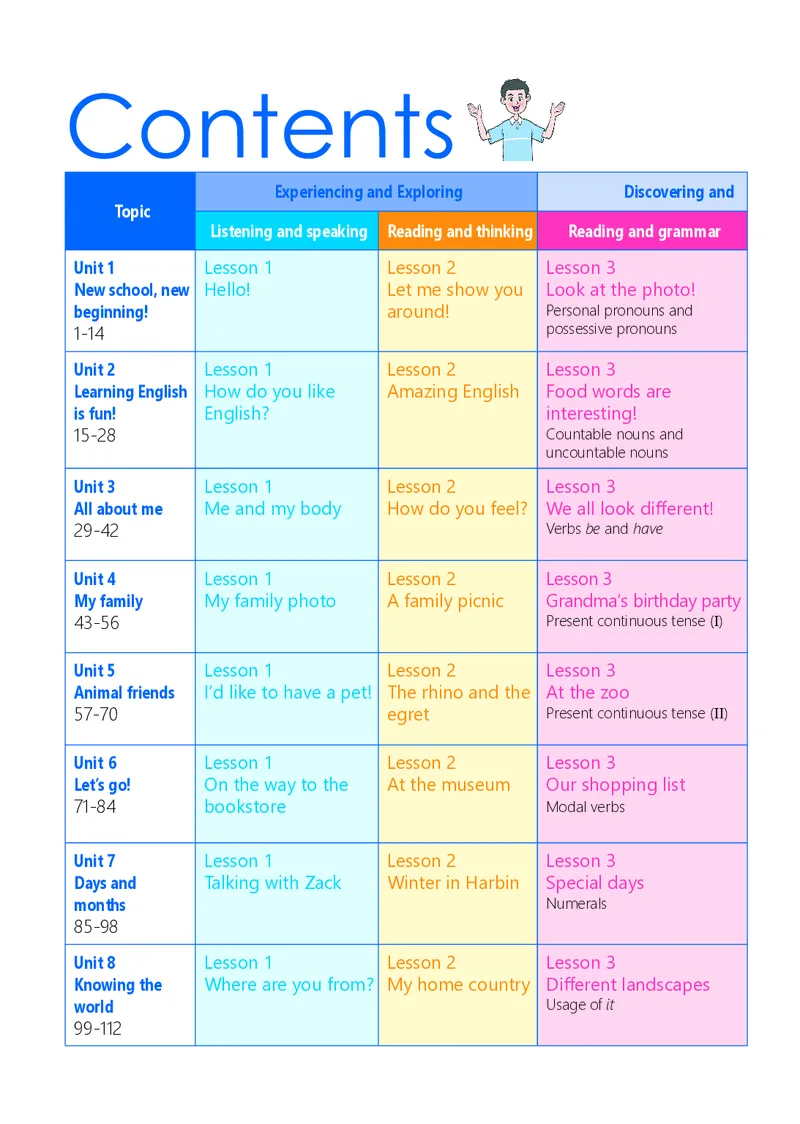
能够轻松愉悦地学好英语!Contents
Experiencing and Exploring Discovering and
Topic
Listening and speaking Reading and thinking Reading and grammar
Unit 1 Lesson 1 Lesson 2 Lesson 3
New school, new Hello! Let me show you Look at the photo!
beginning! around! Personal pronouns and
1-14 possessive pronouns
Unit 2 Lesson 1 Lesson 2 Lesson 3
Learning English How do you like Amazing English Food words are
is fun! English? interesting!
15-28 Countable nouns and
uncountable nouns
Unit 3 Lesson 1 Lesson 2 Lesson 3
All about me Me and my body How do you feel? We all look different!
29-42 Verbs be and have
Unit 4 Lesson 1 Lesson 2 Lesson 3
My family My family photo A family picnic Grandma’s birthday party
43-56 Present continuous tense (Ⅰ)
Unit 5 Lesson 1 Lesson 2 Lesson 3
Animal friends I’d like to have a pet! The rhino and the At the zoo
57-70 egret Present continuous tense (Ⅱ)
Unit 6 Lesson 1 Lesson 2 Lesson 3
Let’s go! On the way to the At the museum Our shopping list
71-84 bookstore Modal verbs
Unit 7 Lesson 1 Lesson 2 Lesson 3
Days and Talking with Zack Winter in Harbin Special days
months Numerals
85-98
Unit 8 Lesson 1 Lesson 2 Lesson 3
Knowing the Where are you from? My home country Different landscapes
world Usage of it
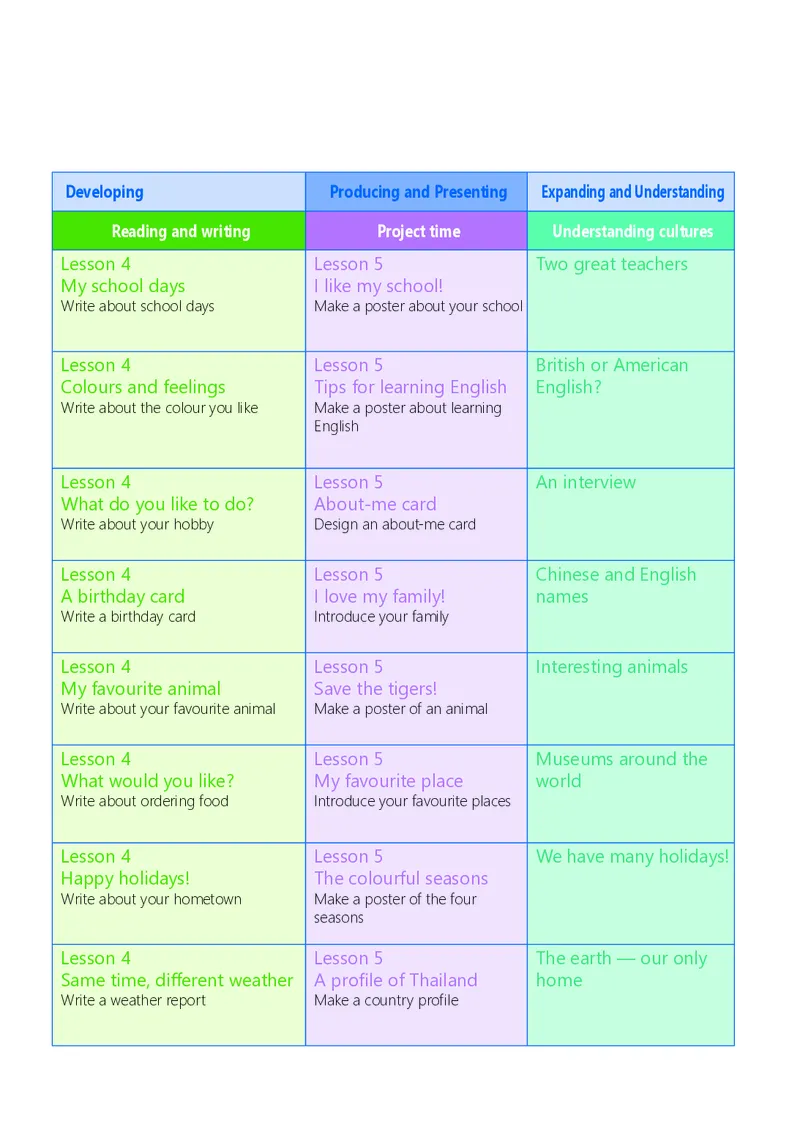
99-112Developing Producing and Presenting Expanding and Understanding
Reading and writing Project time Understanding cultures
Lesson 4 Lesson 5 Two great teachers
My school days I like my school!
Write about school days Make a poster about your school
Lesson 4 Lesson 5 British or American
Colours and feelings Tips for learning English English?
Write about the colour you like Make a poster about learning
English
Lesson 4 Lesson 5 An interview
What do you like to do? About-me card
Write about your hobby Design an about-me card
Lesson 4 Lesson 5 Chinese and English
A birthday card I love my family! names
Write a birthday card Introduce your family
Lesson 4 Lesson 5 Interesting animals
My favourite animal Save the tigers!
Write about your favourite animal Make a poster of an animal
Lesson 4 Lesson 5 Museums around the
What would you like? My favourite place world
Write about ordering food Introduce your favourite places
Lesson 4 Lesson 5 We have many holidays!
Happy holidays! The colourful seasons
Write about your hometown Make a poster of the four
seasons
Lesson 4 Lesson 5 The earth — our only
Same time, different weather A profile of Thailand home
Write a weather report Make a country profileAppendices
Wrap it up! 113-128
Pronunciation 129-130
Vocabulary (I) 131-136
Vocabulary (II) 137-143
List of proper names 144-146
Structures and expressions 147-150
Irregular verbs 151-153
Words for primary English 154-160
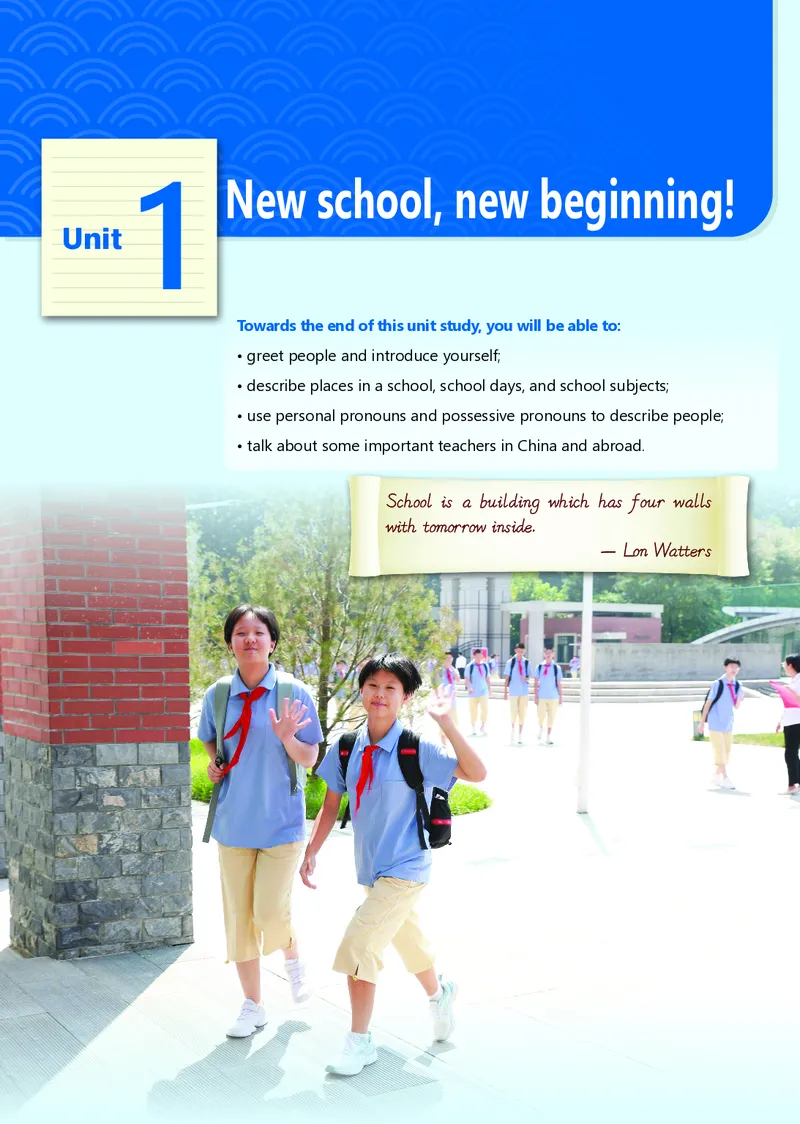
Grammar 161-169New school, new beginning!
1
Unit
Towards the end of this unit study, you will be able to:
• greet people and introduce yourself;
• describe places in a school, school days, and school subjects;
• use personal pronouns and possessive pronouns to describe people;
• talk about some important teachers in China and abroad.
School is a building which has four walls
with tomorrow inside.
— Lon Watters1 Hello!
1 Look at the pictures. Find more ways to greet each other.
Hello! My name Ni Hao! I am
Hi! I’m Jenny.
is Danny. Li Ming.
2 Listen, read, and role-play the conversations.
A B
Hello! I’m Li Ming.
Good to see you again, Li Ming!
What’s your name?
Class 3
Wow! We are in
My name is Wang Mei.
the same class!
Nice to meet you!
C
Good morning, boys and
girls! My name is Liu Ling.
Good morning,
I’m your English teacher.
Ms Liu!
2UNIT 1
3 Listen to the conversations and number the pictures.
4 Play the Stop and Go game to greet your classmates.
Go! Stop!
Stop and Go!
A: Hello! I’m... What’s your name?
B: Hi! My name is... Nice to meet you.
A: ...
Listen and repeat. Write more words in each group.
/eɪ/ name same _____________________________________________
/aɪ/ hi nice _________________________________________________
Culture
Greetings around the world
Tips
Annyong haseyo Hola Bonjour Sawadee
32 Let me show you around!
1 Match the words with the pictures. Talk with your partner about what you do in
these places.
library playground lab classroom
2 Read the passage and write the names of the places in the picture.
Hello, everyone! Welcome to our beautiful school. Now, let me show you around.
This is the playground. We play sports here. In front of us is the classroom building.
We have classes in it. Look at that building! It looks like a book. That is the school
library. We read and borrow books there. Now, please turn around. This is our lab
building. We have our science lessons here.
__________
__________
__________
__________
4UNIT 1
3 Complete the mind map and make a conversation with your partner.
play ____________ read and
____________
books
playground library
My school
____________ ____________
building building
have science
have classes
lessons
A: Where do you have classes?
B: I have classes in the classroom building.
...
4 Jack is a new student in your school. Draw a map of the school and introduce
it to him.
Hello, Jack! My name is... Useful expressions
Let me show you around the school. • This is... • Look at...
... • That is... • In front of us is...
53 Look at the photo!
1 Read the questions and give your answers.
A Who is your best friend?
B What does he/she like to do?
2 Read the passage and write the names of the people in the photo.
This is our English teacher. Her name is Liu
Mum, look at our
Ling. We call her Ms Liu. She is very kind. She
class photo!
often gives us lots of help. She likes to sing.
Look! This is my friend Li Feng. He likes to
read. We often go to the library together.
See the boy in a cap? That’s Lin Nan. Beside
him is Song Hua. They are good friends.
They like to play ping-pong. Sometimes I join
them. We have a lot of fun.
6UNIT 1
3 Replace the parts in yellow with proper pronouns. Then complete the table.
● We call her Ms Liu. Ms Liu is very kind. She
A Li Feng is my friend. I like to read books with Li Feng. ( )
B Lin Nan and Song Hua like sports. Lin Nan and Song Hua often play ping-pong
together. ( )
C That building is the library. You can read books in the library. ( )
I you he she it we you they
him her us
my your his her our their
4 Complete the passage with the words from the table above.
I am Cara. I like my new school. ____________ is beautiful and I have many new
classmates here.
Look, this is a photo from my computer
class. Our teacher is Ms Morin.
____________ helps us a lot. In front of
____________ is Monica. She likes to sing.
Beside Ms Morin is Amy. She is my
good friend. ____________ often play sports
together. To her right is Tom. ____________
likes to read books.
Which one is ____________? Can you guess?
5 Introduce one of your new friends or teachers to your partner.
74 My school days
1 Match the pictures with the school subjects. Add more to the list.
Chinese music science PE English maths
Other: __________________________________________________________________________
2 Read the email and complete the passage.
To: class@163.com
From: jenny@compmail.ca
Date: 15/09 8:00 p.m.
Subject: My school days
Hi friends,
How are you doing?
I am in Grade 7 now. I have maths, music, PE, Chinese, and some other
subjects. My favourite subject is PE. I like running. I like Chinese, too. I enjoy
learning the Chinese language and culture. In my last Chinese class, I learned
about Confucius. Today is Monday. It’s the best day of the week for me. I have
both PE and Chinese!
Best wishes,
Jenny
8UNIT 1
This email is from ____________. It is about her ____________. Her favourite
subject is ____________. She likes ____________, too. She learned about
Confucius in her last Chinese class.
3 Complete the timetable and talk with your partner.
No. Monday Tuesday Wednesday Thursday Friday
Which school day do
1
you like best? Why?
2
3
4
Lunch Time
5
6
7
4 Complete the email to Jenny about your school days.
To: jenny@compmail.ca
From: _______________________
Date: 16/09 11:00 a.m.
Subject: My school days
Hi Jenny,
Good to hear from you!
We have similar subjects! We also study ___________ in school. ___________ favourite
subject is ___________. We have ___________ classes a week. Of the five school
days, I like ___________ best. We are busy at school, but we have lots of fun!
Yours truly,
___________
95
I like my school!
1 Read the passage and complete the mind map for Wang Xuyao.
Hello, my name is Wang Xuyao. I’m in Grade 7.
I like the gym at my school. I like to play basketball there.
Li Peng and Wu Lei are my best friends. We often have fun together.
I like Ms Zhang. She is our maths teacher. She is very nice.
My favourite school subject is Chinese. I like to read stories.
I like my new school.
place friend
My favourites
teacher subject
2 Think about your favourites at school. Complete the table.
Who/What Why
Place
Teacher
Friend
Subject
…
10UNIT 1
3 Talk about your school with your partner.
Useful expressions
What is your favourite place?
• Who is your favourite teacher?
• Who is your best friend?
I like the library. It’s big and nice.
• What subject do you like best?
I like to read books there.
• Why do you like it?
4 Make a poster about your favourite place, friend, teacher, or subject, and
put it on the wall.
We like our school!
My name is Wang Xuyao and my favourite subject is
Chinese. I like to read stories about the old days.
5 Talk about the posters. Hello everyone. Wang Xuyao’s
favourite subject is Chinese,
because he…
11Two great teachers
1 Look at the pictures and read the conversation. Then answer the questions.
A person can understand
and discover truth only
by questioning.
Confucius Socrates
(551–479 BCE) (469–399 BCE)
Review the old and learn A person can understand and
the new. discover truth only by questioning.
Li Ming: There are so many famous teachers in the world.
Jack: That’s true! One of my favourite teachers is Socrates.
Li Ming: Why do you like him?
Jack: He was wise. He was the teacher of teachers in the West. Who is your
favourite teacher?
Li Ming: My favourite is Confucius. People call him Kongfuzi. Do you know
anything about him?
Jack: Sure. He is also famous in Canada.
Li Ming: He was a great teacher. He studied music, maths, literature, and some
other things. He taught three thousand students.
Jack: They are both so great.
A What do you know about the two teachers?
B What do you like about them?
12UNIT 1
2 Match the sentences on the left with those on the right. Can you list more
sayings?
闻之不若见之,见之不
Isn’t it a joy to have friends from afar?
若知之,知之不若行之。
I hear and I forget. I see and I remember.
智慧始于好奇。
I do and I understand.
有朋自远方来,
Wisdom begins in wonder.
不亦乐乎?
3 Do you know the famous teachers below? Search the internet for their
information and introduce them to your partner.
Zhu Xi Plato
Cai Yuanpei John Dewey
13Self-check
● I can greet people and introduce myself:
• Hello! • How are you doing?
• My name is... • Nice to meet you.
● I can use the following structures to talk about:
• school places: I like the playground/classroom building/
library/lab...
• school days: Today is Monday/Tuesday...
• school subjects: I have maths/music/PE/Chinese...
● I can use proper pronouns to describe people around me:
• This is our teacher. Her name is... She is...
• This is my friend. He likes... We often...
● I can talk about some important teachers in China and
abroad.
● Improvement needed:
Fun
Hello!
Time
Hello!
Every day I go to school.
I meet my friends.
And we all say
Hello! Hello!
How are you?
I am good! I am great!
How about you?
14Learning English is fun!
2
Unit
Towards the end of this unit study, you will be able to:
• talk about the English language;
• understand and use English idioms and expressions;
• find useful ways to learn English.
The limits of my language mean the limits
of my world.
— Ludwig Wittgenstein1 How do you like English?
1 What do you think of English? Tick the words and add more.
easy difficult helpful
interesting boring useful
Other: __________________________________________________________________________
2 Listen to the conversation and answer the questions.
Li Ming meets up with his cousin Li Jing.
Li Ming: It’s good to see you again, Li Jing.
Li Jing: Same here. Long time no see, Li Ming!
Li Ming: Wow! You are amazing. Your English is
very good now. How do you like English?
Li Jing: I like it very much. But some English
words are long and difficult.
Li Ming: That’s true. Here is a tip. We can look for
short words in a long word.
Li Jing: Can you give me an example?
Li Ming: Sure. You know the meaning of class and
room. What does classroom mean?
Li Jing: I got it! Two short words make a long one.
That’s helpful and fun!
Li Ming: Good for you! Let’s look for more examples.
A What’s Li Jing’s problem in learning English?
B What tip does Li Ming give?
16UNIT 2
3 Listen to the sentences and tick the proper responses.
A B
Yes, good to see you again. Thank you.
I am great. Thank you! Some words are difficult.
C D
Yes. Classroom. I like it very much.
That’s helpful and fun!
Two short words make a long one.
4 Join two words to make a new one.
some noon
Can you find more
foot bye
words like these?
after town
home ball
good ground
play times
5 Work in pairs. Make up a conversation about learning English.
Useful expressions
• How do you like English? • Here is a tip.
• English is difficult/easy/boring/fun for me.
• Listen to English songs./Keep a diary in English./Practice English with your partner…
Listen and repeat. Write more words in each group.
/ɪ/ big tip ____________ /i:/ see me ____________
/ʊ/ good look ____________ /u:/ classroom zoo ____________
171 Answer the riddles by circling the letters.
A What do you call a bear without an ear?
B What letter is your eye?
C What letter is a body of water?
D What letter is a question?
2 Read the passage and complete the mind map.
There are only 26 letters in English, but
the 26 letters can make more than one
million words.
Look at this word: level. You can read
it left to right or right to left — it’s the
same word!
The word therein has ten words in it.
You don’t even need to move any
letter
Amazing facts
about English
phrase
_ _ _ _ _ _ _ _ _ _ _ _
_ _ _ _ _ _ _ _ _ _ _ _
2 Amazing English
letters around. How many words can
you find?
Do you know the meaning of the
phrase a piece of cake? It means easy.
This sentence uses all 26 letters: The
quick brown fox jumps over the lazy dog.
There are many more amazing facts
about English. Have fun with English!
It’s the ____________
____________ to read level left to
letters can make
right or right to left.
____________ words.
____________________
____________________
____________________ ____________________
____________________
____________________
A piece of cake
means ____________.
18UNIT 2
3 Read the passage again and answer the questions.
A How many words can you find in the word therein? What are they?
B Can you find a word that reads the same left to right or right to left? What is it?
C Read these two sentences: I cannot dance. I have two left feet. What does
have two left feet mean?
4 Read the conversations and guess the meanings of the phrases in yellow.
a. listening carefully b. good luck c. my favourite thing d. a heavy rain
A — Oh! It is raining cats and dogs. C — You have a test tomorrow? Break a leg!
— Where are the cats and dogs? — Break a leg?
— Haha, it means ____________. — Yes. It means ____________.
B — Basketball isn’t my cup of tea. D — She is all ears in class.
I like volleyball. — What is the meaning of all ears?
— A cup of tea? — It means ____________.
— Well, it means ____________.
5 Work in groups. Find more interesting facts about English on the internet and
share them with your group members.
Interesting facts about English
☆One letter, like “a”, can be an English word. And just one word, like “Go”,
can be a sentence.
☆The phrase “small potatoes” means something or someone that is not
important.
193 Food words are interesting!
1 Listen to the conversation and tick the food words you hear.
dumplings noodles milk chicken
potatoes rice juice fish
2 Read the conversation and underline the interesting food words.
Li Ming and Jack are at a supermarket.
Li Ming: What would you like for hot
pot, Jack?
Jack: I would like some vegetables
and meat. Look! Here are cabbages,
eggplants, and mushrooms.
Li Ming: Let’s take some, but I don’t
think we need eggplants. Hmm... Jack,
why does eggplant have egg in it?
Jack: Haha! I don’t know. Maybe it looks like a big egg?
Li Ming: But mushrooms don’t look like rooms, and vegetables don’t look like tables.
Jack: You got me, Li Ming. But I know a hot pot is hot.
Li Ming: True. Do you know its name is from Chinese?
Jack: Interesting! I know tofu is from Chinese, too.
Li Ming: That’s correct, and we need some tofu for our hot pot.
Learning
Look at the pictures.
Tips
These words are all from
Chinese. Can you find
ketchup dim sum wonton
more interesting words?
20UNIT 2
3 Read the conversation again and complete the passage.
Li Ming and Jack are at a supermarket. Jack would like some ____________ and
____________ for hot pot. They talk about food words. Does an ____________
look like a big egg? Do mushrooms look like ____________? Do vegetables
look like ____________? The food words are interesting. At last, they get some
____________. Then they go home and enjoy their hot pot.
4 Read the words in the box. Brainstorm more food words and list them in the
correct places.
a/an/one... two/three.../some some
apple apples meat rice
cabbage cabbages
egg eggs
eggplant eggplants
potato potatoes
5 What would you like for hot pot? Have a conversation with your partner.
What would you like?
I’d like...
214 Colours and feelings
1 What colours can you find in the picture? Write them in the box.
indigo
purple
2 Read the conversation and answer the questions.
Hi, Jenny! I am listening to an English song. In the song, there is a line. It
says, “I feel blue”. How can you feel a colour?
That’s a good question, Li Ming. In English, some colour words can show
people’s feelings. Blue can mean “sad”, green “sick”, yellow “scared”, and
red “angry”.
Wow! Thank you, Jenny. In China, red is a happy colour. I like to wear red
clothes. It makes me feel good.
My favourite colour is blue. Blue doesn’t make me feel sad. I like to swim
in the blue ocean and it makes me feel cool.
A What does the colour yellow mean in English?
B How is the meaning of the colour red different in English and Chinese?
Culture
Colours have many different meanings in different cultures. In Chinese
Tips
culture, white is a symbol of death. But in Western cultures, white is a
symbol of peace and black is a symbol of death.
22UNIT 2
3 Listen to the chant. Complete it and sing along.
Are you ____________? Are you sad?
Smile big. Don’t feel bad.
Don’t be scared. Don’t be ____________.
Wave your hand and say hello.
Don’t see ____________. Don’t be angry.
Jump and play and feel happy.
Don’t feel sick. Don’t feel ____________.
The doctor can help. He’s not mean.
4 Read and complete the passage with the sentences.
A. She is sick. B. We have a good time.
C. But I feel blue. D. She wishes me a happy birthday.
It’s my birthday today! ____________ My good friend, Jenny, can’t come. ____________
I really want her to be here. Jenny gives me a call. ____________ Many friends come
to my birthday. ____________ I will go see Jenny when she is better and show her my
birthday photos.
5 What colour do you like? Talk and write about it.
I like green. It makes me feel calm. I like to play in the forest...
235 Tips for learning English
1 What tips does Ms Liu give for learning English? Read and tick the correct
answers.
My name is Li Hong. I’m in Grade 7.
I am from Shijiazhuang. I like learning
English. I hope to become a good
English learner. But I am afraid of
speaking English in public. That makes
me nervous. My English teacher, Ms
Liu, gives me some tips.
A speaking partner is good for your learning! Practice
your spoken English with your partner. Don’t be afraid
to make mistakes! Sometimes you may make silly
mistakes. That’s OK.
English songs can also help! Listen to English songs and
write down the words. You can enjoy singing along with
the music. It can make you confident!
Read a lot. Talk to a native speaker.
Listen to English songs. Watch TV shows.
Don’t be afraid to make mistakes.
24UNIT 2
2 What’s your biggest challenge when learning English? Discuss in a group and
write the top five problems.
The challenges may come from spelling, listening, pronunciation, grammar and
so on.
Challenges
●
●
●
●
●
3 Work in groups to give advice on how to deal with the challenges listed in
Activity 2. Some of the advice is given. Add more to the list.
● Find interesting facts about English.
● Watch English TV shows and movies.
● Read English storybooks.
● Keep a diary in English.
4 Make a poster about learning English.
The following items may be included:
● common problems
● learning tips
● interesting facts about English
You can draw pictures and write encouraging words to make it nice.
25British or American English?
1 Look at each picture and write a word with the same meaning.
autumn soccer
film mom
2 Read the passage and tick the main idea.
Many people are learning English. However,
British English and American English are
different in some ways. Let’s take a look.
Americans use “-er” instead of “-re”, such
as meter and center. They do not have “u”
in “-our”, like color instead of colour.
The British and Americans use different words for food, clothing, and other things.
For example, the British take a cab, but Americans take a taxi.
There are differences between British English and American English, but people can
understand both.
26UNIT 2
There is British English and American English in the world.
British English is different from American English in some ways.
British English and American English are widely used.
3 Read the passage again and complete the table.
British English American English
metre
center
favourite
color
cab
4 Work in groups. Find more differences between British English and American
English.
Differences between British English and American English
27Self-check
● I can better understand English:
• There are only 26 letters in English, but the 26 letters can
make more than one million words.
● I can understand and use some English idioms and
expressions:
• a piece of cake
• I feel blue.
● I can use different ways to learn English:
• Two short words make a long one.
• Practice your spoken English with your partner.
● Improvement needed:
Fun
Say the word
Time
Say the word: DICTIONARY
Slowly at first: DIC-TION-A-RY
Try one more time: DICTIONARY
Now you have it!
Say the word: UNDERSTAND
Slowly at first: UN-DER-STAND
Try one more time: UNDERSTAND
Now you have it!
Say the word: EXCELLENT
Slowly at first: EX-CEL-LENT
Try one more time: EXCELLENT
Now you have it!
28All about me
3
Unit
Towards the end of this unit study, you will be able to:
• describe appearances and hobbies;
• understand yourself better;
• feel good about yourself;
• talk about you and your friend using verbs be or have/has.
It needs observation to know others,
but reflection to know oneself.
— Lao Tzu1 Me and my body
1 Read the clues and guess the body parts.
A You can talk with it. It’s the ____________.
B You can smell with it. It’s the ____________.
C You can walk with them. They are the ____________.
D You can see with them. They are the ____________.
E You can hear with them. They are the ____________.
2 Listen to the passage and answer the questions.
Hello! My name is Robin. I am a robot. short, slim neck. I do housework with
I’m 1.65 metres tall. my long arms and small hands. I have
ten fingers. I write with them. I have
I have two big eyes. I see with them.
two long legs and two big feet. I’m a
They are also my cameras. I have one
good football player.
nose and one mouth. I smell with my
nose. And I talk with my mouth. I can I like to play and have fun! Do you
speak English and Chinese! I don’t want to play with me? We can be
have ears but I can hear you. I have a friends!
Sorry, I can’t do your
Can you do my homework
homework, but I can help
for me, Robin?
you with your housework.
A What languages can Robin speak?
B What can Robin do to help Danny?
30UNIT 3
3 Robin meets another robot, Alice. Complete their conversation and role-play.
A. How tall are you? B. Because we don’t fall sick.
C. But I’d like to take a break to talk to you sometimes.
D. What’s special about them? E. Playing basketball?
Robin: Hi, you look cool. What’s your name? Robin: Why do humans need us
robots?
Alice: My name is Alice.
Alice: ___________ We don’t need a
Robin: ___________
break to eat or sleep.
Alice: I’m 1.6 metres tall. Your eyes are so
Robin: And we don’t go on vacation
big. ___________
or get tired.
Robin: They are also my cameras. What
Alice: Yes. ___________
are you good at? ___________ You have big
hands. Robin: Me too. Let’s be friends!
Alice: No, I am good at cleaning the house.
4 Do you like robots? Draw a picture of a robot and then introduce it to your
classmates.
5 Listen to the song and do the actions.
Put your right hand in.
Take your right hand out. Listen and repeat. Write more
words in each group.
Put your right hand in,
/e/ smell ten ____________
And shake it all about.
/æ/ am can ____________
/aʊ/ about mouth ____________
Do the Hokey Pokey,
/əʊ/ nose also ____________
And turn around.
/ɪə/ ear hear ____________
And that’s what it’s all about.
Repeat this with ear, nose, mouth, arm, leg, and foot.
312 How do you feel?
1 Look at the pictures and label them with the feeling words.
tired happy hot sad cold angry
tired
2 Read the conversation and tick the correct answers.
Dr Lin: Hi, Danny. What’s the matter?
Danny: I am coughing a lot and I have a
headache. I feel sick.
Dr Lin: Do you feel cold?
Danny: Yes! I feel very cold. Achoo!
Dr Lin: Well, let me see... You have a fever.
Danny: I feel sad. I can’t play basketball today.
Dr Lin: Don’t worry, Danny. Take this medicine
and get some rest. You’ll be okay.
Danny: Thank you, Doctor Lin.
Learning
Headache means a pain in the head. There are two small words in
Tips
headache: head (the body part) and ache (pain). What do you think
toothache and stomachache mean?
32UNIT 3
A How does Danny feel?
Happy. Sad. Tired.
B Why can’t Danny play basketball today?
He has a stomachache. He has a fever. His leg hurts.
C What does Dr Lin advise Danny to do?
Take some medicine and rest. Drink some water.
Eat some vegetables.
3 Read and complete the conversation.
A. Do you feel cold or have a fever? B. You’ll be okay.
C. What’s the matter? D. Let me check...
Dr Li: Hi, Sam. ____________
Sam: I feel sick. I have a stomachache.
Dr Li: ____________
Sam: I don’t know. But I feel tired.
Dr Li: ____________ You do have a fever.
Sam: Is it serious?
Dr Li: Don’t worry. Take this medicine and get some rest. ____________
Sam: Thank you, Doctor Li.
4 Suppose you are at the doctor’s office. Make a dialogue with your partner and role-play.
Useful expressions
The doctor may ask: You may tell the doctor: The doctor may say:
• What’s wrong? • I feel sick/cold. • Take this medicine.
• What’s the matter? • I have a headache/stomachache/fever. • Have a good rest.
• Are you okay? • I hurt my... /My... hurts. • You’ll be okay.
333 We all look different!
1 What does he/she look like in the picture? Talk with your partner.
He/She is tall/short...
He/She is cool/cute/pretty...
He/She has long/short hair.
He/She has black/grey/white hair.
2 Read the passage and complete the table.
I’m Li Ming. I am twelve years old. I’m from China.
I’m average in height. I have short black hair.
This is Jenny. She is from Canada. She is twelve
years old. She has blond hair. Her eyes are blue.
That is Danny. He is thirteen years old. He has
black hair. He is big and tall. He has a cap on
his head.
We all look different, but we are good friends.
Where is he/ What does he/
How old is he/she?
she from? she look like?
Li Ming 12
She has blond hair.
Jenny
Her eyes are blue.
?
Danny
34UNIT 3
3 Choose the correct words to complete the sentences.
am is are have has
A — What does Lily look like? — She ____________ short and has green eyes.
B — Where ____________ you from, Li Ming? — I ____________ from China.
C Mr Zhang is very kind. He ____________ many friends.
D Our teachers ____________ a lot of work to do every day. They ____________ busy.
4 Listen, complete the conversation, and then tick the right person.
Mum: Jenny, I ____________ a little busy. Could you help me by meeting Maria at the
bus stop?
Jenny: Sure, but I don’t know her. What does she look like?
Mum: Well, let me see… Maria ____________
tall and she wears glasses.
Jenny: Does she ____________ long hair?
Mum: No, she doesn’t. She ____________
short brown hair. Oh, I ____________ a
picture in my phone.
Jenny: Wow, this must be Maria.
Mum: You are right.
5 Work in pairs. Play the Say and Draw game.
Useful expressions
Student A describes someone and Student B
• He has short brown hair.
draws a picture according to the description.
• He has green eyes.
Take turns doing this. Do the drawings match
• He wears a hat.
the descriptions?
• He is tall.
354 What do you like to do?
1 What do you like to do? Tick and share your answers with your partner.
read books listen to music dance play sports
watch movies play chess write take photos
2 Read the passage and answer the questions.
There is an old saying: A happy child I often play chess in a club. I make
has a hobby. And it is true. many friends there. On the weekend,
I like to watch Chinese chess matches
Different people have different hobbies.
with my grandfather. We often discuss
Some people like to play sports.
chess skills.
Others like to listen to music. As for
me, I like to play Chinese chess. It A life without a hobby is just like food
makes me creative and happy. without salt.
A hobby is fun and useful. After school,
A What’s the passage about?
B Why does the author like to play chess?
C How do you understand the last sentence? Can you say it in Chinese?
36UNIT 3
3 What’s your hobby? What good does it do to you? Choose words/phrases
from the lists and make sentences.
I like to... It makes/helps me...
read books take photos happy active creative
sing songs dance strong healthy excited
collect cards cook relaxed smart
play basketball play chess have a healthy body know the world
draw pictures listen to music make many friends learn skills
swim run ...
...
I like to play basketball. It makes me strong and healthy.
4 Do you know the Chinese for these sayings? Discuss with your partner.
• All work and no play makes Jack a dull boy.
• No man is really happy or safe without a hobby.
• Life is a hobby.
• Play is the work of the child.
• Play is the beginning of knowledge.
5 Write about your hobby and share it in your group. You can use one of the
sayings in Activity 4.
Hello! I like to...
375 About-me card
1 Read Jenny’s card and talk about it with your partner.
Name: Jenny Smith
Age: 12
Country: Canada
Looks: blond hair and blue eyes
Favourite subject: PE
Best friend: Li Ming
Hobbies: reading, playing sports
Dream: to be a writer
Comments from friends: smart and kind
Useful expressions
What’s her name?
Her name is Jenny.
• Where is she from?
• What’s her favourite subject?
• Who is her best friend?
• What are her hobbies?
• What does she want to be?
2 Complete the introduction of Jenny.
Hello, everyone! My name is ____________. I am from ____________. I have blond hair
and blue eyes. I am ____________ years old. My favourite subject is ____________. I like
making new friends. My best friend, ____________, is from China. I like reading and
____________ sports. They make me happy. My dream is to be a ____________ one day.
38UNIT 3
3 What do you want to include in an about-me card? Tick your answers and
add more.
a photo name and age dreams
likes and dislikes looks hobbies
Other: ________________________________________________________________________
4 Design an about-me card. Add more information about yourself.
Photo
● Stick your photo on the card or draw a picture of yourself.
● Exchange cards with your partner and write a comment about each other.
5 Work in groups. Introduce yourself to the group.
Hello, everyone! My name is…
6 Play the guessing game.
Put all cards in a box. Pick one of the cards
and say something about that person.
Others guess the name of the person.
She has short black hair.
She likes reading…
39An interview
1 Complete the questionnaire and share it with your partner.
Now, you are in Grade 7. What do you think about yourself?
A I have many friends at school. a. True b. False
B I like to talk to my parents about my school life. a. True b. False
C I have difficulties in my studies. a. True b. False
2 Read the interview and answer the questions.
Host: Today, we have two young people with us. Welcome, Tom and Steven! Let’s
talk a little about your school life. Here’s the first question. “I have many friends at
school.” Is this true for you?
Steven: No, it’s not true for me. I don’t know how to make new friends. I’m on my
phone all the time. I can’t do anything without my phone.
Tom: Yes, I have many friends. We have the same hobbies.
Host: “I like to talk to my parents about my school life.” Is this true, in your case?
Tom: Yes, we talk a lot about my
school life at dinner time.
Steven: Also true for me. I am happy
to tell them about my classmates.
Host: Good. “I have difficulties in
my studies.” Is this true for you?
Tom: Yes, I feel stressed sometimes.
Steven: There are many exams. But
I still enjoy my school life.
40UNIT 3
A When do Tom and Steven often talk to their parents about school life?
B Who do you like to talk to about your school life? Why?
3 Read the interview again and complete the passage.
The host interviews two students from a middle school. She asks _______________
questions. The first one is about _______________. Steven doesn’t know how to
make new friends and spends a lot of time on _______________. Both of them
like to talk to their parents about their _______________. As for their studies, Tom
sometimes feels _______________ while Steven feels all right.
4 Listen to the passages and match the people with the statements.
I am very active at school, so I make many friends. We
often study and play together.
Jing Guangze
Sometimes I feel shy speaking in front of the class. But I
enjoy playing with my friends. My favourite sport is football.
Bob
I like listening to music because it helps me calm down and
feel good.
Lucy
5 Work in pairs. Talk about yourself.
Useful expressions
• I am... • I have... • I like to... • Sometimes I feel...
41Self-check
● I can describe my appearance properly:
• I’m 1.65 metres tall.
• I am twelve years old. I’m average in height. I have short
black hair.
● I can describe my hobbies:
• I like to play Chinese chess. It makes me creative and happy.
● I can understand that everyone is different:
• We all look different, but we are good friends.
• Different people have different hobbies.
● I can make an about-me card and introduce myself.
● Improvement needed:
Fun
Left hand, right hand
Time
Left hand, right hand,
Clap, clap, clap.
Left foot, right foot,
Tap, tap, tap.
Left arm, right arm,
Wave up and down.
Turn to the left,
Now sit down.
42My family
4
Unit
Towards the end of this unit study, you will be able to:
• describe family members;
• express love and thanks to family members;
• talk about family activities using the present continuous tense.
Harmony in a family makes everything
successful.
— Chinese saying1 My family photo
1 Talk with your partner.
A How many people are there in your family? Who are they?
B What do they like to do?
2 Listen to the conversation and answer the questions.
Li Ming: Look. This is my family
photo. These are my family members.
Wang Mei: Your father is handsome.
What does he do?
Li Ming: He is a teacher. I talk to him
about everything.
Wang Mei: Is the lady in a qipao your
mother?
Li Ming: That’s right! She is a doctor. She is always ready to help people in need.
Wang Mei: Are these your grandparents?
Li Ming: Yes. My grandpa likes to cook and my grandma likes to plant flowers.
Wang Mei: Who is that little girl beside you?
Li Ming: She is my sister. Her name is Li Meng.
Wang Mei: How old is she?
Li Ming: She is eight years old. She likes to sing and dance.
Wang Mei: She is a lovely girl. You have a happy family.
A What do Li Ming’s parents do?
B What do Li Ming’s grandparents like to do?
C How old is Li Ming’s sister?
44UNIT 4
3 Listen to the conversation again and fill in the blanks.
This is Li Ming’s family photo. Li Ming’s father
is ____________. He is a teacher. Li Ming talks to
him about ____________. This ____________ is Li
Ming’s mother. She is a ____________. She is always
____________ to help people in need. Li Ming’s
grandpa likes to ____________ and his grandma
likes to ____________ flowers. Li Ming’s sister is eight
years old. She likes to sing and ____________.
4 Listen to the dialogue and write true (T) or false (F).
Jenny and Danny are talking about a photo.
A Jenny’s uncle is a businessman. ( )
B Jenny’s uncle is twenty-two years old. ( )
C Jenny’s uncle likes to travel. ( )
5 Work in pairs. Bring a photo of your family. Talk about it.
Useful expressions
• Who is he/she? • How old is he/she?
• What does he/she do? • What does he/she like to do?
Listen and repeat. Write more words in each group.
/ʌ/ mother love ____________ /ɑ:/ father grandpa ____________
/ə/ brother teacher ____________ /t/ tall eight ____________
/d/ dance old ____________
452 A family picnic
1 What do you like to bring for a picnic? Tick and add more words to the list.
fruits vegetables cookies
drinks meat cake
Other: ____________________________________________________________________________
2 Read the passage and write true (T) or false (F).
I’m Jenny. There are six members in my family: my mum, my dad, my brother
Bob, my sister Lynn, Rover, and me. Who is Rover? He is a dog. On weekends,
we like to go outdoors.
It is sunny today. We are going on a picnic. Rover is with us, too. We bring lots
of fruits and vegetables. I also have some cookies for Rover.
Now we are by the lake. My mum is
making a salad. I’m putting the food and
drinks on a tablecloth. My dad is making
sandwiches. What is Rover doing? Look
out! He is watching the meat. He wants
to steal it.
What are Bob and Lynn doing over
there? They are quietly painting pictures.
We are having a good time together.
A Rover is one of Jenny’s family members. ( )
B Jenny’s family is having a picnic on a hill. ( )
C Jenny’s parents are busy making food. ( )
D Rover isn’t interested in the meat at all. ( )
46UNIT 4
3 Read the passage again and complete the mind map. Then talk about what
they are doing.
making sandwiches
Mum
Dad Bob
A picnic
Jenny Lynn
Rover
He is making
What is Jenny’s dad
sandwiches.
doing?
4 Read and complete the conversation.
A. He is sleeping by my feet. B. But I have a match next Saturday.
C. I would like to visit the nature park. D. Do you have any suggestions?
Jenny’s family is on the way home from Lynn: Good idea. I’d like to see the
the picnic. ducks in the wild. That’s exciting.
Lynn: Dad, what’s our plan for next Bob: ____________
weekend?
Mum: We can go to cheer for you and
Dad: ____________ then drive to the nature park together.
Lynn: Hmm... Maybe we can go cycling Lynn: Great! Oh, where’s Rover?
along the river.
Jenny: ____________ He is too tired.
Jenny: ____________
5 What does your family like to do together? Talk about it in groups.
473 Grandma’s birthday party
1 Read the questions and give your answers.
A What do you want for your birthday?
B When are your parents’ birthdays? What do you want to do for them?
2 Read the passage and write the names of the family members.
Today is my grandma’s birthday. My look at me and say, “Please tell us!” But I
mother got her a special gift. Only I point to Grandma and say, “It’s a secret!”
know what it is.
At the end of the evening, my grandma
My mother and Aunt Jane are cooking in opens many gifts. Finally, my mother
the kitchen. My aunt asks me, “What is the brings her a big box. The box is moving!
gift for Grandma?” But I don’t tell her. When she opens it, a little dog jumps
out.
My grandpa, my uncle, and my father
are talking and laughing. When I Grandma says, “She’s so tiny. Hey, I’ll
walk by, they ask, “What is Grandma’s name her Tiny!”
present?” But I just smile and walk away.
Tiny runs around the room. Everyone
My brother is setting the table. My sister thinks she’s so cute! And Grandma is
and my cousin are playing games. They very happy.
sister
aunt father
48UNIT 4
3 Read the sentences, paying special attention to the verbs in -ing form. Then
fill in the blanks.
● My mother and Aunt Jane are cooking in the kitchen.
● My brother is setting the table.
● The box is moving!
We use “be + v-ing” to talk about what is happening now. The “be” changes
with the subject. We usually add -ing to a verb. Some verbs require changes
at the end, e.g. have — having, hit — hitting.
play — ____________ look — ____________ make — ____________
write — ____________ run — ____________ swim — ____________
4 Complete the conversation according to the information in Activity 2.
Li Ming: Hi, Jenny. What are you doing?
Jenny: Hi, Li Ming. My family ________________________ for my grandma.
Li Ming: Wow, happy birthday, Grandma!
Grandma: Thank you, Li Ming!
Jenny: We ____________ with my grandma. She likes to have fun.
Li Ming: What is your sister doing?
Jenny: She ____________ with my cousin.
Li Ming: A dog is barking. Is that Rover?
Jenny: No, it’s Tiny. She is ____________ from my mother.
Li Ming: Tiny is so lovely!
Jenny: Yes, she is.
5 Suppose you are at a birthday party. Who are you with? What are you doing?
Are you having fun? Talk about it in groups.
494 A birthday card
1 What can you write on a birthday card? Read the sentences and tick your answers.
Hope your birthday is like you — special. Happy Birthday!
Merry Christmas and Happy New Year!
May all your wishes come true. Have a wonderful day.
Good luck, good health, and good cheer. Happy Birthday!
We wish you good health. Happy New Year!
I give all my love to you.
2 Read the passage and answer the questions.
Li Ming is making a birthday card for his grandpa. He uses paper and crayons
to make the card. He has a picture of his family on the front cover. The family
members are writing something for Grandpa in the card.
I am writing a poem
Roses are red and the sky is blue. You are
for Grandpa.
a great grandpa and I love you.
Happy Birthday! Love,
— Li Ming
I am writing a riddle
Happy Birthday, Grandpa! Have a wonderful
for Grandpa.
birthday! Do you like your birthday present?
It’s small and soft. It says, “Meow, Meow!”
What is it?
— Li Meng
A Who is the birthday card for?
B How does Li Ming show his love to his grandpa?
C What is Li Meng’s gift?
50UNIT 4
3 Match the people with the cards.
Friend Teacher Mother
Happy Birthday! We You cook for us. Happy Birthday! You
enjoy your lessons You take care of us. are the best and
very much. They are Thank you for all you always have
so interesting. Thank your hard work. We my back. May you
you and have a love you. always be happy
wonderful day! Happy Birthday! and healthy.
4 Here is a poem on a birthday card. Put the sentences in the correct order.
A I wish you health and happiness.
B All day and all year through.
C Today is your special birthday.
D I have a small wish for you.
5 Whose birthday is coming? Make a birthday card for your family member, your
teacher, or your friend. Express your love and thanks to him/her!
Useful expressions
• Have a wonderful birthday.
• Happy birthday to...
• I wish you...
• Thank you for...
• May you have/be...
515 I love my family!
1 Read the passage about Wang Mei’s family and answer the questions.
Hello! I’m Wang Mei. I have a big, happy family.
This is my mother. Her name is Guo Yan. She is a saleswoman at a supermarket. She
works hard. My father is a writer. His name is Wang Hui. He writes good stories.
This is Wang Hao. He is my brother. He is a policeman. He is always busy.
We all love to spend time together. We usually visit my grandparents on
weekends. I can meet my aunts, uncles, and cousins there. Look at this photo!
We are making dumplings. We have a lot of fun together!
We care about one another in my family. I love my family.
A Who is a policeman in Wang Mei’s family?
B What are Wang Mei and her family doing in the photo?
C Do you think this is a loving family? Why?
52UNIT 4
2 Work in pairs. Talk about your family with your partner. You can show one of
your family photos.
A: Who is this? A: What does he/she do?
B: This is my... B: He/She is a...
A: What’s his/her name? A: What does he/she like to do?
B: His/Her name is... B: He/She likes to...
3 What would you like to share about your family? Make a poster of your family.
• You can stick one of your favourite family photos on the poster. Or you can
stick a photo of each family member on the poster. You can also draw your
family members.
• Write one sentence for each family member.
II lloovvee mmyy ffaammiillyy
Grandpa Li Bin Grandma Lan Ying
He likes to read newspapers. She likes to do handicrafts.
There are 10
people in my
extended family...
Guo Mei Li Zhi Li Chao Shao Yu
Mother Father Uncle Aunt
Li Yue Momo Li Hang Li Ze Li Jia
I My dog Brother Cousin Cousin
4 Present your poster to the class and introduce your family.
53Chinese and English names
1 Read the passage and complete the table.
A Chinese name includes a family name and a given name. Most family names
date back to ancient times. They are usually from the names of a village, a state,
or an official position. For example, Qi( 齐 )comes from the state name Qi, and
Ouyang(欧阳)is the name of a township.
English names also have two parts: given names and family names. Different from
Chinese names, the order is “given name(s) + family name”. Sometimes, people have
second or third given names to honour a family member or for other purposes.
English family names are usually from where the family lived, the way they looked,
or the kind of work they did. For example, a family living with many trees and
plants might take the name Green. If they had dark hair, they were called the Blacks
or the Browns. And a person who had a good voice was named Singer.
A given name, either in Chinese or in English, carries the hope of a family for a
baby. For example, “Yong” in Chinese and “Andy” in English both mean “brave”;
“Li” in Chinese and “Lily” in English “beautiful”.
54UNIT 4
Chinese name English name
Order family name + given name
Origin of family where they lived, what they
names looked like, what work they did
Meanings the hope of a family for a baby the hope of a family for a baby
Examples
2 Given or family names? Write G for given and F for family.
刘________ 司马________ 昊宇________ 欧阳________ 菲菲________
Jack ________ Smith ________ Shakespeare ________ Emma ________
Wood ________ John ________ Green ________ Jones ________ Alice ________
3 Male or female names? Write M for male and F for female.
Iris ________ Oliver ________ Jim ________ Sherry ________ Laura ________
Richard ________ Diana ________ Charles ________ Bill ________ Mindy ________
4 Names have meanings. For
example, Jenny means white
wave, and Danny means
defender of man. Search the
internet for the meanings of
the names listed above.
55Self-check
● I can describe my family members:
• This is... • He/She is a... • He/She likes to...
● I can express love and thanks to family members:
• You are a great grandpa.
• I love you/my family...
● I can talk about family activities using the present
continuous tense:
• My grandpa, my uncle and my father are talking and
laughing.
• The family members are writing something for Grandpa
in the card.
● Improvement needed:
Fun
Time
Family time
My father has a brother.
He’s my uncle, don’t you see?
And my mother has a sister.
She’s my aunt, and looks like me!
Our family is like a tree.
It grows bigger and stronger.
Each and every day they love me.
They teach me and guide me on my way.
56Animal friends
5
Unit
Towards the end of this unit study, you will be able to:
• describe different animals;
• understand why animals are important to the world;
• explore ways to help care for and save animals.
An animal’s eyes have the power to
speak a great language.
— Martin Buber1 I’d like to have a pet!
1 What pets would you like to have? Tick your answers.
cat dog fish bird rabbit
Other: ________________________________________________________________________
2 Listen to the conversation and answer the questions.
Danny is at Jenny’s home.
Danny: Look, Jenny! A little tiger is
jumping off the sofa!
Jenny: That’s my new friend, Zoe.
She is my aunt’s cat. My aunt is on a
business trip. I’m looking after Zoe
for a week.
Danny: Hello, Zoe. Come here! I have
some donuts for you.
Jenny: Danny! Zoe likes cat food. She
doesn’t like donuts.
Danny: What a pity! She’s lovely and
quiet. I’d like to have a pet, too.
Jenny: What pet would you like to have?
Danny: I’d like to have a dog. Dogs are
friendly and loyal.
Jenny: Yeah. They even help people
sometimes.
A Who is Zoe?
B What does Danny think of dogs?
C What’s your opinion about keeping a pet?
58UNIT 5
3 Listen to the conversation again and fill in the blanks.
Danny is at Jenny’s home. He sees a cat, Zoe. Jenny’s aunt is on a ____________
trip and Jenny is ____________ after her cat. Zoe is lovely and ____________.
Danny would like to have a pet dog. Dogs are ____________, loyal and even
helpful.
4 Listen to the dialogue and write true (T) or false (F).
Li Ming and Wang Mei are talking about pets.
A Wang Mei would like to have a cat. ( )
B Li Ming doesn’t like cats. ( )
C Li Ming likes to play with his cousin’s dog. ( )
5 Work in groups. Interview your classmates and complete the table.
A: What pet would you like to have?
B: I’d like to have...
A: Why do you want one?
B: Because they’re lovely/cute/helpful/friendly/loyal...
Name Pet Reason(s)
What’s the most popular
pet in your group?
Listen and repeat. Write more words in each group.
/f/ friend sofa ____________ /v/ have lovely ____________
/m/ my home ____________ /n/ name new ____________
592 The rhino and the egret
1 Can different animals live together? Talk with your partner.
2 Read the passage and write true (T) or false (F).
Do you think different animals can live together? Some can! Here is a good
example.
The rhino and the egret are a good team. One is big and the other is small. The
rhino lets the egret sit on its back. Are they having fun? Maybe, but they are also
helping each other.
The egret cleans the rhino’s
skin to help it stay healthy. It
also makes sounds to tell the
rhino about dangerous things
nearby. The rhino helps the
egret get food. How? It scares
small insects in the grass, and
the egret eats them.
A Sometimes different animals can live together. ( )
B The rhino and the egret help each other. ( )
C The egret helps the rhino get food. ( )
60UNIT 5
3 Read the passage again and write how the rhino and the egret help each other.
The rhino __________________________________.
the rhino the egret
The egret __________________________________.
4 Complete the conversation with the correct forms of the phrases.
help each other live together have fun stay healthy
Li Ming: I am watching a video about Li Ming: Maybe. They are ____________.
rhinos and egrets. It’s interesting.
Wang Hong: How?
Wang Hong: Oh! What happens?
Li Ming: The egret cleans the rhino’s
Li Ming: The two different animals skin to help it ____________. The rhino
____________. Look! The egret is sitting helps the egret get food.
on the rhino’s back.
Wang Hong: Wow, they are a good
Wang Hong: Are they ____________? team.
5 Look at the picture. What do you think the animals are saying to each other?
Make up a dialogue and act it out.
613 At the zoo
1 Do you know how to behave at a zoo? Tick the proper behaviours.
Feed a monkey. Make loud noises to scare the tiger.
Take photos of the baby panda. Follow the rules for visiting a zoo.
Care about the animals. Keep the zoo clean.
2 Read the conversation and write true (T) or false (F).
It’s Saturday. Jenny and Danny are at the zoo.
Danny: Look! What’s the bear doing now? Is it sleeping?
Jenny: Yes, it is.
Danny: Wake up, Mr Bear! I have some cheese and butter for you!
Jenny: Danny, stop! You can’t feed a bear! Look at the sign.
Danny: Sorry about that! But why can’t we take photos?
Jenny: Cameras scare the animals. Let’s go and see the
DO NOT FEED
giraffe.
THE ANIMALS
Danny: I’d love to see the pandas first. They’re cute.
Jenny: We don’t have any pandas here, Danny.
Danny: Why not?
Jenny: I don’t know. Maybe because we don’t have any
NO PHOTOS
bamboo here.
Danny: See those elephants over there? Are they eating grass?
Jenny: I guess so.
Danny: We have a lot of grass here. Can pandas eat grass instead of bamboo?
Jenny: Can you eat carrots instead of donuts? Haha...
Danny: You’re funny, Jenny. I’m a dinosaur, not a rabbit.
A The bear is sleeping now. ( )
B Visitors can take photos of elephants. ( )
C Danny hopes to see pandas at the zoo. ( )
62UNIT 5
3 Read the sentences, paying special attention to the verbs in -ing form. Then
fill in the blanks.
● — Is it sleeping? — Yes, it is.
● — Are they having fun? We put am, is, or are in
— Maybe, but they are also helping each other. front of the subject to
● — What are Bob and Lynn doing over there? make questions.
— They are quietly painting pictures.
A — ____________ (be) it snowing? — Yes, it is. It’s cold outside.
B — ____________ (be) you watching TV? — No, ____________. You can turn it off.
C — What ____________ David ____________? — He is feeding the rabbit there.
4 Read and complete the conversation.
A. Is it dancing? B. It is singing, Danny.
C. What are they eating? D. What is it doing?
Danny: Look, monkeys! ____________ Danny: It’s so cute! I like it.
Jenny: They are eating bananas. Jenny: See that bird? ____________
Danny: Wow! Do you see that little Danny: It’s making noises.
monkey over there? ____________
Jenny: ____________ It looks very
Jenny: No, it isn’t. It’s just jumping up happy.
and down.
5 Play the Charades (Do and Guess) game.
Is the horse Yes, it is.
running?
634 My favourite animal
1 Look at the pictures. Write the names of the animals.
2 Read the passage and fill in the blanks.
The class is talking about animals. Here are reports from Li Ming and Jack
about their favourite animals.
My favourite
animal is ________. They are fat and hairy. They look like bears, but they
are black and white. Most of them live in China. They
can be up to 1.9 metres tall. They like to climb trees
and they love bamboo. People all over the world
love them.
I like
________ best.
They are big and strong. They can be 2 to 4 metres
tall. Many of them are grey. They have long noses,
big ears, and short tails. Most of them live in Asia and
Africa. They like to live in groups. They eat leaves and
fruits. They are usually very friendly.
64UNIT 5
3 Read the passage again and complete the cards.
___________ ___________
Colour: Colour:
Home: Home:
Size: Size:
Character: Character:
Food: Food:
4 What’s your favourite animal? Complete the information card and discuss with
your partner.
Name
Colour
Place to live
Food
Ability
Why do you like it?
A: What’s your favourite animal? A: Why do you like them?
B: I like rabbits. B: Because they are very cute.
...
5 Write a passage to introduce your favourite animal with the information in Activity 4.
Useful expressions
• They are very cute. • They run very fast.
• They are always friendly and helpful. • They are lovely and smart.
• They have short tails and short legs.
655 Save the tigers!
1 Read the passage and match each paragraph to its main idea.
The tiger is a popular animal in the We have to do something about it or they
world. It is a symbol of strength. may disappear forever.
Tigers usually have orange fur
“Save the Tigers” is a group of volunteers.
and black stripes. They live in the
The group hopes to save the tigers of the
forests of Asia. They are important
world. We need to stop keeping tigers in
to nature. They keep the number of
the zoo. We should build more national
other wild animals in balance.
parks. To save nature, we need to save
Today some people hunt and kill the tigers.
tigers for money. Some people cut
down trees in the mountains. Tigers
lose their homes. The number of
tigers in the wild is dropping quickly.
Paragraph 1 We should save the tigers.
Paragraph 2 Tigers are important to nature.
Paragraph 3 Tigers are in danger of going extinct.
66UNIT 5
2 Read the passage again and write some sentences to support the main idea of
each paragraph.
Paragraph 1
Save the tigers
Paragraph 2 Paragraph 3
3 Discuss in groups. Think of a kind of animal that you hope to protect and talk
about it.
● What do they look like?
● Where can you usually see them?
● Why do you think they need our help?
4 Work in groups. Make a poster of the animal in Activity 3. Discuss some ways
we can protect them. Write down your main ideas.
5 Present your work to the class. Vote for the best poster.
67Interesting animals
1 Read the passage and match each picture to its introduction. Then fill in the
blanks.
A
The Pallas cat is about the size of a house cat. It lives in western China. It has a
thick coat. The coat keeps it warm in the cold and its colour turns grey in winter.
B
Kiwis are birds, but they can’t fly. Kiwis can be as big as chickens. Like all birds, they
lay eggs — big eggs. People call them kiwis because they make the sound keee-
weee. Kiwis live in New Zealand. They are the national animal of the country. Do
you like them?
C
Long-nosed monkeys live in Southeast Asia. Their noses are as big as eggplants!
When the monkeys are happy or excited, they shake their noses. That’s funny!
D
Can fish fly? Look at this fish. It looks like a bird. It can jump out of the water
and flap its wings. It flies out of the water to avoid enemies. You can see flying
fish all over the world.
68UNIT 5
There are many interesting animals in the world. Have you heard of the
Pallas cat? It has thick ____________ to keep it warm and its colour turns
____________ in winter. Kiwis are birds, but they can’t ____________. They can
lay ____________. They are the national ____________ of New Zealand. What do
long-nosed monkeys look like? Their noses are as big as ____________! They
shake their noses when they are ____________ or ____________. Can fish fly? A
flying fish can ____________ out of the water to avoid enemies. What do you
know about other interesting animals?
2 Read the passage again and answer the questions.
A How do Kiwis get their name?
_______________________________________________________________________________
B How do long-nosed monkeys get their name?
_______________________________________________________________________________
C Do flying fish have wings?
_______________________________________________________________________________
3 There are many amazing animals in the world. Read the following information.
Can you guess what animals they are? Talk in groups.
• live in the desert • live in the sea
• can carry things • are friendly with people
• run as fast as horses • are very cute
• can walk for a long time • love to stay in groups
without food or water • have two stomachs
69Self-check
● I can describe pets and other animals:
• Zoe likes cat food. • Dogs are friendly and loyal.
• Pandas eat bamboo. • They are black and white.
● I understand that animals are important to the world:
• They are important to nature.
● I learn to explore ways to help animals:
• We need to stop keeping tigers in the zoo.
• We should build more national parks.
● Improvement needed:
Fun
What do the animals say in English?
Time
In English, a cow says, “Moo, Moo”.
A chicken says, “Buck, Buck, Buck”.
A rooster says, “Cock-a-doodle-doo”.
A duck says, “Quack, Quack”.
A pig says, “Oink, Oink”.
A dog says, “Woof, Woof”.
A cat says, “Meow, Meow”.
70Let’s go!
6
Unit
Towards the end of this unit study, you will be able to:
• describe the places you like;
• ask for and give directions;
• talk about shopping and ordering food;
• ask for permission using can and may.
A journey of a thousand miles begins
with a single step.
— Lao Tzu1 On the way to the bookstore
1 Look at the pictures and write the names of the places.
2 Listen to the conversation and tick the correct map.
It’s Saturday afternoon. Woman: Oh, go down Zhongshan
East Road. Turn right at the traffic
Wang Mei: I’d like to go to the bookstore
lights. The museum will be on your
tomorrow. Would you like to go with
right. Then go straight and turn
me?
right to Fanxi Road. You will see the
Li Ming: I’d love to, but I am going to visit
bookstore on your left, next to the
my grandparents tomorrow morning.
library.
Wang Mei: How about in the afternoon?
Li Ming & Wang Mei: Thanks for
your help!
Li Ming: That works for me.
Woman: You’re welcome.
Wang Mei: It’s a little far. We can go by
underground, and then walk about 10
minutes.
It’s Sunday afternoon. They come out
of the station, and ask a passer-by for
directions.
Li Ming: Excuse me, madam. We are
looking for Chengming Bookstore. Can
you show us the way?
72A B C
3 Listen to the conversation again and write the names of the places on the map.
Zhongshan East Road
Subway
Science and
Supermarket
Technology Centre
Hotel Hospital
Fanxi Road
4 Work in pairs. Look at the map in Activity 3 and talk about the way to the places.
A: Excuse me. Where is the supermarket?
Useful expressions
B: Go down Zhongshan East Road and turn right
• go down/straight
at the second traffic lights. Then go straight and
• turn left/right
you will see the supermarket on your right.
• on your left/right
Listen and repeat. Write more words in each group.
/aɪ/ right light ____________ /ɔ:/ morning sport ____________
/s/ see subway ____________
West
Street
East
Street
Yucai
Street
UNIT 6
Library
732 At the museum
1 What kinds of museums are they? Talk with your partner.
2 Read the conversation and answer the questions.
Li Ming and Jack are at the museum. Museum clerk: Yes. Go down the
stairs and pass the gift shop. Then
Li Ming: Jack, where are we going first?
turn left. You can’t miss it.
Jack: Hmm... I don’t know. Do you have any
Jack: Thank you.
ideas?
Museum clerk: You’re welcome.
Li Ming: How about the Ancient China Hall?
It shows some ancient Chinese history. Li Ming: Let’s go. I want to see the
Jade Dragon from Hongshan Culture.
Jack: Good idea. But where is it?
It’s famous.
Li Ming: Let’s ask that gentleman. Maybe he
Jack: I can’t wait! Then I want to buy
knows the way.
some gifts at the gift shop.
Jack: Excuse me. We are looking for the
Ancient China Hall. Can you help us?
A What can they learn in the Ancient China Hall?
B What does Li Ming want to see?
C After asking the way, where will they go first?
74UNIT 6
3 Complete the conversation with the sentences, and then role-play it.
Song Hua: Excuse me. I’m looking
for the Natural History Museum.
____________
Lady: Sorry, I’m new here. You can ask
the police officer over there. A. You will see it on the right.
B. Can you help me?
Song Hua: Thank you.
C. It’s only about ten minutes’ walk.
Song Hua: Excuse me. ____________
D. Where is the Natural History
Police officer: Go along the street and
Museum?
turn right at the bakery. Then turn left at
the bookstore. ____________
Song Hua: Is it far from here?
Police officer: No. ____________
4 Match the name of the museum with its picture. Then talk with your partner.
A. Forbidden City
A Which museum would you like to visit?
B. the Sanxingdui Museum
B Where is it?
C. the Hebei Museum
C What can you learn in that museum?
753 Our shopping list
1 Listen to the conversation and circle the place.
2 Read the conversation and write true (T) or false (F).
(At home) Clerk: Go straight and turn left. You
will find them there.
Mum: Li Meng! Li Ming! Are you ready to go?
Li Ming: Thank you so much!
Li Ming: One second!
(At the checkout)
Li Meng: I can’t wait to go!
Mum: Okay, kids. Have we got
Li Ming: I have a shopping list. It’s on the
everything we need?
desk in my room. Can you get it for me, Li
Meng? Li Ming: Let me see. We have the
lamp for Grandma. We have pears,
Li Meng: Sure. (Li Meng finds the list. She
strawberries, watermelon... (He looks
reads it and writes something on the list.)
at Li Meng and smiles.) And we
Here you are!
have the storybooks, cookies, and
chocolates.
a lamp for Grandma
Mum: Great!
pears strawberries watermelon
eggs milk bread chicken
storybooks cookies chocolates
(At the supermarket)
Clerk: Hi there! May I help you?
Li Ming: Yes, please. We are looking for
lamps. Where would they be?
76UNIT 6
A Li Meng doesn’t want to go to the supermarket. ( )
B Li Meng adds something to the list. ( )
C They have everything they want. ( )
3 Read the sentences and complete the conversation.
● — Can you get it for me, Li Meng? — Sure.
● — May I help you? — Yes, please. We are looking for lamps.
We use can/may to ask for permission to do something. May is more formal
and polite. We also use can to talk about the ability to do something.
Jenny: What are you doing, Lynn? Jenny: I want a cup and two new pens.
Lynn: I’m writing a shopping list. Lynn: Let’s go to the corner store.
Jenny: _______________ have a look?
Lynn: Yes, here you are.
Jenny: There are already many things
on the list. But may I write some more?
Lynn: Yes, _______________. What do you
want?
4 Here are some friendly reminders for supermarket shopping. Fill in the blanks
with can or can’t.
● You ____________ make a shopping list.
● You ____________ open packages or eat food before paying.
● You ____________ ask for help if you can’t find something.
● You ____________ bring your own reusable bags.
Happy shopping!
774 What would you like?
1 Look at the menu. What would you like to have in this restaurant? Talk with
your partner.
Price
Food Drinks Price
Small Large
dumplings with meat and cabbage ¥ 17 ¥ 20 a can of coke ¥ 3
dumplings with carrot and egg ¥ 12 ¥ 15 a glass of milk ¥ 3
beef/chicken noodles ¥ 12 ¥ 15 a bottle of water ¥ 2
tomato and egg noodles ¥ 10 ¥ 12 a cup of tea ¥ 4
rice with fish/chicken ¥ 11 ¥ 14 a glass of juice ¥ 5
Today’s special: Rice with meat and vegetables ¥ 10
2 Read the conversation and answer the questions.
It’s lunchtime. Wang Mei and Li Lin Waitress: We have different kinds of
are at a restaurant. dumplings, noodles, and rice. You can
also order on your cell phone. Here is
Waitress: Hello! May I help you?
the code.
Wang Mei: Yes, please. What do you
Wang Mei: Sorry, we don’t have a
have for lunch?
phone with us. Would you help us?
Waitress: My pleasure. Here is the
menu. What would you like to have?
Wang Mei: I would like a big bowl of
beef noodles. What about you, Li Lin?
Li Lin: Hmm... I usually have noodles
for lunch. But today I would like to try
something different. How much are the
dumplings with carrot and egg?
Waitress: 15 yuan for 25 dumplings, and
12 yuan for 18 dumplings.
78UNIT 6
Li Lin: The 15, please.
Waitress: Okay. Would you like something to drink?
Wang Mei: Yes, please. I would like some water. What would you like, Li Lin?
Li Lin: A glass of apple juice, please.
Waitress: No problem. You can have some snacks at the front desk. They are free.
Wang Mei & Li Lin: Thank you!
A How do they order the food?
B What do they order?
C What can they have for free in the restaurant?
D How much do they pay according to the menu inA ctivity 1?
3 Do you know the expressions used at the restaurant? Match the questions
with the answers.
May I help you? We have large and small bowls.
What would you like? Five yuan for one glass.
How much is the juice? I would like rice with fish.
What sizes do you have? Yes, please.
4 Look at the menu in Activity 1 and complete the conversation.
A: _________________________?
B: I would like some chicken noodles.
A: _________________________?
B: I want a big bowl. I’m so hungry. What about you?
A: I would like to try today’s special.
B: _________________________? That sounds good.
A: Would you like something to drink?
B: _________________________.
795 My favourite place
1 Read the passage and match the people with their words.
The park is a nice place. It is not far from my home. It has
many different trees and colourful flowers. I often go there by
bike. I like to play games and go for a walk there. Sometimes,
Han Li I bring a ball and play catch with my friends.
I like the library. It is about twenty minutes’ walk from my
home. There I can find interesting books. I love to read comic
books. I can also learn things like science, history, or art.
Liu Tianyu Sometimes, I do my homework in the library.
The zoo is an amazing place. On weekends, I go there
by subway. I get to see many different animals like lions,
elephants, giraffes, and monkeys. I like pandas best. Pandas are
fat and very cute. At the zoo, I can also learn many interesting
Yang Lin
facts about animals. It is fun!
Han Li I can get to know animals’ living habits in this place.
Liu Tianyu I can see many different plants in this place.
Yang Lin I can read books and study in this place.
80UNIT 6
2 Read the passage again and complete the table.
Name Favourite place How to get there Activities
Han Li
Liu Tianyu
Yang Lin
3 Work in groups. Talk about your favourite place with your group members.
● Where do you like to go on weekends?
● How do you get there?
● What can you see there?
● What can you do there?
4 Write about your favourite places on cards and make a poster in your group.
Our favourite places
My name is Liu Lu.
My favourite place is the cinema.
I like...
5 Present your poster to the class. Vote for the most popular place.
81Museums around the world
1 Read the passage and tick the museums mentioned.
Hello, everyone! Get ready for an collection of great works such as the
exciting tour to three world-famous Mona Lisa. You’ll be amazed by its
museums. Let’s go! sculptures, paintings, and historical
exhibits.
Let’s start with the Forbidden City
in Beijing, China. It was the home of Lastly, we will travel to the British
Chinese emperors for centuries, but it Museum in London, the UK. We can see
is now a national museum. You can see many wonderful artifacts which provide
many beautiful buildings, gardens, and a global picture of cultures from around
treasures. The design of the Forbidden the world.
City mirrors the ancient Chinese idea
Each museum is a centre of culture,
of harmony.
history, and art. I’m sure you will like
Now, let’s head to the Louvre Museum them!
in Paris, France. It is famous for its
82UNIT 6
2 Read the passage again and complete the table.
Museum Location Feature
3 Discuss the following questions in groups.
A What museums have you visited before?
B What impresses you most about them?
4 Read the passage and give it a title. Then answer the questions.
______________________
Collecting things is a popular hobby. People may collect many different things
like coins, stamps, or shoes. Mr Lee collects something unusual. He collects taxi
parts, taxi clothes, taxi bags and more. He placed his collection in a museum
and called it the Taxi Museum. It is the first taxi-themed museum in the world.
You can learn a lot in the museum. There are many old taxis. His collection
includes a broken taxi. It is all smashed.
Why did Mr Lee buy a smashed taxi? In
February of 2015, this taxi was hit by an
airplane on the highway! No one can
drive that taxi anymore, but you can
see it at the Taxi Museum.
A What’s the meaning of “taxi-themed”?
B Do you like to visit such museums? Why?
C What other interesting museums do you know?
83Self-check
● I can describe my favourite place:
• The park is a nice place. It is not far from my home.
• It has many different trees and colourful flowers.
● I can ask the way and give directions:
• Excuse me. • We are looking for... • Where is...?
• Go down... • Turn right at the... • Go straight.
• Thank you. • You’re welcome.
● I can talk about shopping and ordering food:
• I have a shopping list.
• — What would you like? — I would like...
● I can ask for permission using can and may:
• Can you help us? • Can you get it for me?
• May I help you?
● Improvement needed:
Fun
Let’s go to the zoo!
Time
Let’s see the animals at the zoo,
The lion, the tiger, and zebra too.
The monkeys are jumping way up in the tree.
A panda and a kangaroo. Come on, let’s see!
So many animals at the zoo,
The elephant, the donkey, and the wild goat too.
The colourful birds are singing high and low.
It’s a wonderful world. Come on, let’s go!
84Days and months
7
Unit
Towards the end of this unit study, you will be able to:
• talk about days and months;
• describe the four seasons;
• understand the beauty of nature.
Nature gives to every time and season
some beauties of its own.
— Charles Dickens1 Talking with Zack
1 Read the questions and give your answers.
A How is the weather today?
B What season do you like best?
2 Listen to the conversation and underline the questions from Li Meng.
Li Ming’s family is at a robot show. His
sister, Li Meng, is talking with a robot.
Li Meng: Hello! My name is Li Meng.
What’s your name?
Robot: My name is Zack. I’m smart. I can
talk with you about any topic.
Li Meng: Really? Let me ask you some
questions. What day is it today?
Robot: It’s Sunday today.
Li Meng: How is the weather today?
Robot: It’s foggy, but the fog will clear by noon. Do you like winter?
Li Meng: No. I like summer. I love going camping and sleeping in a tent.
Robot: That’s nice.
Li Meng: What’s the date today?
Robot: Today is December 19. The New Year is coming. Yay!
Li Meng: Yes. What is the first day of the first month in the Chinese lunar
calendar, Zack?
Robot: That’s the Spring Festival.
Li Meng: Let me ask you one last question: why is November 23 a special day?
Robot: I have no idea.
Li Meng: Haha, that’s my birthday.
86UNIT 7
3 Listen to the dialogues and tick the correct answers.
A It’s Sunday. It’s Monday. It’s Friday.
B It’s raining. It’s snowing. It’s windy.
C I like spring. I like summer. I like autumn.
D It’s July 30. It’s June 30. It’s June 13.
E My birthday. The New Year. The Spring Festival.
4 Make up a conversation with the questions in Activity 2.
A: What day is it today?
B: It’s...
5 Read and complete the conversation.
A. He had no idea for the fifth question. B. It was about the date of my birthday!
C. What did you talk about? D. Guess what!
Li Meng: Grandma, I had a talk with a Li Meng: Four! ____________
robot today. He was smart!
Grandma: Why? Wasn’t he smart?
Grandma: Really? ____________
Li Meng: That’s because the question
Li Meng: We talked about days, the was a private one. ____________
weather, and seasons. I asked him five
Grandma: Hmm... What was it?
questions.
Li Meng: ____________
Grandma: That’s a lot! Did he answer all
Grandma: No wonder.
your questions correctly?
Listen and repeat. Write more words in each group.
/θ/ month birthday ____________ /ð/ that weather ____________
/l/ love lunar ____________
872 Winter in Harbin
1 Do you know the special names of these cities? Match each city with its name.
Kunming Chongqing Harbin Guangzhou
Ice City Mountain City Flower City Spring City
2 Read the passage and write true (T) or false (F).
Hello, I’m Zihan. I’m 12 years old. I live in Harbin, the Ice City of China.
Winter in Harbin is long and cold. It usually lasts from November to late March.
January is the coldest month. How cold is the winter in Harbin? The temperature
can drop to thirty degrees below zero.
When winter comes, Harbin turns
into a world of ice and snow. We
make snowmen and have snowball
fights. On the weekend, many
people go skating or skiing. We
always have fun.
At the Harbin Ice and Snow Festival, you can see ice and snow castles and cartoon
sculptures. You can also try many winter sports and activities. The festival offers a
wonderful experience to everyone.
A The winter in Harbin lasts from November to January. ( )
B You can enjoy many winter sports and activities in Harbin. ( )
88UNIT 7
3 Read the passage again and complete the mind map.
Winter in Harbin is
Harbin is the Ice City of China.
________________________.
Paragraph 1 Paragraph 2
Winter
in Harbin
Paragraph 3 Paragraph 4
We always _______________________ ________________________
in the winter of Harbin. offers a wonderful experience.
4 Read and complete the conversation.
A. In winter, Harbin turns into a world of ice and snow.
B. There is a lot of fun in winter.
C. The temperature can drop to thirty degrees below zero.
Wang Mei: What are you doing, Li Wang Mei: That’s cold! Winter is
Ming? probably not the best season for
tourists.
Li Ming: I’m watching a video about
Harbin. ____________ It’s beautiful. Li Ming: On the contrary! ____________
You can see ice and snow sculptures
Wang Mei: But it’s very cold in winter,
and try many winter sports.
right?
Wang Mei: Sounds interesting! I hope
Li Ming: Yeah. ____________
to go to Harbin one day.
5 What’s special about your city? Discuss in groups and then introduce it to the class.
893 Special days
1 Look at the calendar. What
information can you get
from it?
2 Read the conversation and match the people with their birthdays.
Jack: Hi, Li Ming. What are you doing? Jack: Wow! It can be a present for his
birthday and also for the New Year.
Li Ming: I’m making a present for my
grandpa. Li Ming: True. I also need to mark the
second day of March on this calendar.
Jack: Good for you. Is it a notebook?
It’s my grandma’s birthday.
Li Ming: No, it’s a calendar! My grandpa
Jack: Ha! That’s important. Hey, when is
forgets his birthday every year.
your birthday?
Jack: When is his birthday?
Li Ming: It’s on the fourth day of
Li Ming: His birthday is on December 28.
October. What about you, Jack?
Jack: My birthday? It’s on August 11.
Oh no, that’s my mum’s birthday. My
birthday is on August 23.
Li Ming: Okay, Jack. Maybe I need to
make a calendar for you, too!
Li Ming’s grandpa March 2
Li Ming’s grandma August 11
Li Ming October 4
Jack’s mother December 28
90UNIT 7
3 Read the sentences and fill in the table.
● His birthday is on December 28 (December the twenty-eighth).
● I also need to mark the second day of March on this calendar.
● It’s on the fourth day of October.
A cardinal number says how many of something. An ordinal number tells
us the order of something in a list. Usually, when we change a cardinal to
an ordinal, we can simply add -th. But sometimes -th doesn’t work. For
example, one — first, two — second, three — third.
Cardinal Ordinal Months Cardinal Ordinal Months
one January seventh July
two second eight eighth August
three third March nine September
four fourth April ten tenth
five May eleventh November
six sixth twelve twelfth
4 Complete the passage. You can refer to the information in Activity 2.
Li Ming’s grandpa often forgets his birthday. Li Ming wants to make a calendar
for him. He will give it to Grandpa as a present. ____________ is an important day
to mark. Grandpa’s birthday falls on that day. ____________ is Grandma’s birthday.
There is a holiday in this month. That’s Women’s Day — the ____________ day
of March. Is Jack forgetful, too? He mistakes his mother’s birthday for his. Both
of their birthdays are in ____________. December, March, and August all have
____________ days.
914 Happy holidays!
1 What do you want to do for the coming holiday? Talk with your partner.
2 Read the email and write true (T) or false (F).
To: wangmei@163.com
From: jenny@compmail.ca
Date: 23/12 9:08 p.m.
Subject: Happy holidays!
Dear Wang Mei,
It’s December 23 and Christmas is coming! I am so excited. Christmas is such
fun, but it’s very cold now. The weather in Edmonton is cold and snowy from
November to April. We have long winters.
I don’t like cold weather very much. I like summer, because I like to go
swimming. I also like to go to the beach.
My cousin Elsa is from Sydney. Sometimes my family visits hers during the
Christmas season. You probably know that December, January, and February
are summer months in Australia. We can play volleyball on the beach there. We
draw pictures in the sand and watch the tide come and take the pictures away.
It’s so much fun. I hope to see Elsa next year.
How’s the weather in your city? Do you have any plans for your holidays?
Merry Christmas and Happy New Year!
Yours,
Jenny
A Winter in Edmonton is long and cold. ( )
B Jenny likes winter because she loves Christmas. ( )
C Summer lasts three months in Elsa’s home city. ( )
92UNIT 7
3 Read the email again and choose the correct answers. You can tick more than one.
A How’s the weather in Edmonton?
Sunny. Cold. Rainy. Snowy.
B Why does Jenny like summer?
Because she likes to go swimming. Because she likes to eat ice cream.
Because she likes to stay at home. Because she likes to go to the beach.
C What does Jenny’s family do in Sydney?
They play volleyball on the beach.
They go to the theatre.
They draw pictures in the sand.
They watch the tide come and take the pictures away.
4 What do you like to do during the holidays? Complete the table and discuss
with your partner.
Where to go When to go With whom to go What to do
during the Christmas play volleyball
Jenny Sydney her family
season ...
Me
I like to go to Australia with my family
during Christmas time. I like to play
volleyball on the beach.
5 Imagine you are Wang Mei. Write an email back to Jenny.
The following questions may help you:
A How’s the weather in your city/hometown?
B What season do you like? Why?
C What do you want to do during the holidays?
935 The colourful seasons
1 Do you think seasons have colours? Read the passage and complete the mind map.
Spring is green. The weather warms up and
the grass grows. The trees turn green and
the flowers are in bloom. I like to go hiking
and fly kites with my friends. We enjoy the
spring wind and the green world.
Summer is blue. It is hot and sunny. I like
swimming and playing on the beach. There I
can enjoy the blue sky. I like the Dragon Boat
Festival. It is on the fifth day of the fifth month
in the Chinese lunar calendar. I like to watch the
dragon boat race on the blue river!
Autumn is golden. In autumn, the leaves
turn yellow and the world becomes a
golden place. Autumn is the harvest
season. I like pears, oranges, apples, and
sweet golden corn.
Winter is white. The world is wearing a
white coat. We like to make snowmen
and play games in the snow. The Spring
Festival is in the first month in the Chinese
lunar calendar.
94UNIT 7
The weather warms up
Spring Summer
and grass grows.
...
Seasons
Autumn Winter
2 Talk with your partner and then complete the table.
A What is your favourite season?
B What do you usually do during this season?
C Is there a special day in this season?
Season Weather Activity Special day
Spring warm and dry plant flowers, go camping... Labour Day
3 Make a poster of the four seasons in your group. You can paint each season in
your favourite colour. Then present your poster to the class.
SSpprriinngg SSuummmmeerr
Spring is coming. The My favourite season is
weather is sunny and warm. summer. I can go swimming
Birds come back from the with my friends every day!
south of China.
AAuuttuummnn
WWiinntteerr
Autumn is cool and
The weather in winter becomes
windy. The farmers
colder and colder. I can wear
are busy. We help pick
my gloves and play in the snow.
vegetables on the
farm.
95We have many holidays!
1 Read the passage and answer the questions.
Holidays are fun. We can play with our friends and get
together with our families during holidays. We have many
holidays in China. Labour Day is on May 1. We have
Children’s Day on June 1. Teachers’ Day is on September 10.
National Day is on October 1. And the Spring Festival is usually in January
or February. That’s my favourite. New Year’s Day is on January 1. It’s coming
soon. Happy New Year, everyone!
We have many holidays in
December. Christmas Day
is on December 25. I get
many presents on that day.
I love Christmas!
December 31 is New Year’s Eve. It’s the night before a new year. My family
and I have a big party with all of our friends. And just before midnight, all of
us count down — three, two, one. Then we all say, Happy New Year!
96UNIT 7
A Why does Li Ming think holidays are fun?
B What month is it now? How do you know?
C Why does Jack like Christmas?
2 What do you usually do on different holidays? Choose your favourite one and
talk in pairs.
A: What do you like to do during the Spring Festival?
B: I like to visit my grandparents and play with my cousins.
Useful expressions
• get together • have a big dinner
• visit relatives and friends • go shopping
3 There is always a story behind a holiday, especially traditional Chinese holidays.
Can you tell one of the stories to the class?
Do you know the stories
about the pictures?
97Self-check
● I can talk about days and months:
• — What day is it today? — It’s Monday/Tuesday...
• — What’s the date today? — It’s December 19...
• — When is your birthday? — It’s...
● I can talk about special days:
• The Spring Festival is...
• I get many presents...
● I can describe the four seasons and understand the
beauty of nature:
• The trees turn green and the flowers are in bloom.
• The world becomes a golden place.
• Harbin turns into a world of ice and snow.
● Improvement needed:
Winter, spring, summer, fall
Fun
Time
Winter, spring, summer, fall;
There are seasons, four in all.
Weather changes, sun and rain and snow,
Leaves fall down and flowers grow.
Winter, spring, summer, fall;
There are seasons, four in all.
Look outside and you will see;
Just what season it will be!
98Knowing the world
8
Unit
Towards the end of this unit study, you will be able to:
• talk about some countries in the world;
• know some famous landscapes around the world;
• talk about the weather in different countries.
Read ten thousand books and travel
ten thousand li.
— Dong Qichang1 Where are you from?
1 Talk with your partner.
A Can you name the foods in the pictures in Activity 2?
B Do you know of any famous foods in other countries?
2 Listen to the conversation and tick the answers.
Jack invites his friends to have dinner John: That sounds great! Jack and I are
together. Each friend is supposed to both from Canada, and we made this
bring a food from their country. tasty meat pie for you.
Jack: Hey everyone! This is Zhang Bo, Anne: What’s a meat pie?
and he has dumplings for us.
Jack: It’s not sweet like normal pie. You
Anne: Yay! I love Chinese dumplings. eat it as a meal, not for dessert.
Which city are you from?
Mike: Everything sounds so good! I
Zhang Bo: I’m from Xi’an! Where are can’t wait to eat. I’m from the UK. This
you from? is called fish and chips. It’s my favourite
meal.
Anne: Well, I’m from Paris, France, and
we’re known for a kind of bread called Jack: They all look great! I also have
baguette. Here it is. some vegetables and fruits. Let’s eat!
Jack: Yummy! What about you, Peter? The friends enjoy a wonderful meal from
all over the world.
Peter: This is beet soup. It’s popular in
Russia. I hope you like it!
A _____ come from the same country.
Mike and John Anne and Peter Jack and John
B Jack invites _____ friends to have dinner together.
five six seven
100UNIT 8
3 Listen to the conversation again and match the people with their countries.
Anne John Mike Peter Jack
France Canada the UK Russia
4 Read the passage and write their names in the picture.
Look at this photo. Let me tell you about everyone. The girl in red is Anne.
She is from France. Mike is to her right. He is from the UK. See the boy with
blond hair? He is Peter, and he comes from Russia. The tall boy, to Peter’s
right, is John. He is from Canada. And the boy next to him is my friend Zhang
Bo from China.
Jack
Zhang Bo
5 Point to the picture in Activity 4 and discuss with your partner.
A: Where does Anne come from?
B: She comes from...
Listen and repeat. Write more words in each group.
/h/ hello he ____________ /w/ world welcome ____________
1012 My home country
1 Look at the three famous places in the world and answer the questions.
the Palace Museum Red Square the Golden Gate Bridge
A Do you know these places? Which countries are they in?
B What do you know about these countries?
2 Read the website and write true (T) or false (F).
The students are talking about their home countries.
I’m Wang Lin. Today I’d like to tell you about my home country, China.
It is in East Asia. It has a long history and rich culture. The capital city is
Beijing. We speak Chinese. China is home to the panda.
I’m Anna. I come from Russia. Russia goes across Europe and Asia. It is
the largest country in area. The capital city is Moscow. Most people speak
Russian. You can see brown bears walking around in national parks.
I’m Tom. I’m from South Africa. And it really is in southern Africa. Do
you know my country has three capital cities? We speak different
languages. African lions are famous.
I’m Lucy. I come from the US. It’s in North America. Washington D.C.
is the capital city of my country. We speak English. We love American
buffaloes.
102UNIT 8
A China is an old country with a rich culture. ( )
B Russia is the largest country in population. ( )
C New York is the capital city of the US. ( )
D South Africa gets its name from its location. ( )
Culture South Africa has three capital cities: Pretoria, Cape Town and
Tips
Bloemfontein.
3 Complete the sentences with the words in the box.
to
A Sichuan is home ____________ the golden monkey.
across
B Potatoes came ____________ South America.
from
C Take care when you go ____________ the street.
in
D I like to walk ____________ the city.
around
E The living room is the largest ____________ area.
4 Read and complete the conversation.
A. It is Brasilia. B. You can find many animals in Brazil.
C. Where is Brazil? D. No, we speak Portuguese.
Lula: I’m from Brazil. It’s a beautiful country. Lula: ________________
Jack: Can you tell me something about it? Jack: Do you speak English there?
Lula: Sure. What would you like to know? Lula: ________________
Jack: ________________ Jack: What animals are there in
Brazil?
Lula: It’s in South America.
Lula: ________________ The most
Jack: What’s the capital city?
famous one is the jaguar.
5 How much do you know about other countries? Choose one and discuss it
with your partner.
1033 Different landscapes
1 Match the names of the places with the pictures.
Niagara Falls the Sahara Desert the Amazon River the Great Wall
2 Read the passage and tick the correct answers.
There are many different landscapes I want to go to the Sahara Desert
around the world: rivers, mountains, in Africa. It’s hot and dry there with
forests, waterfalls, deserts... I want to travel little or no rainfall. I could ride a
the world one day. camel. You know, the “ship of the
desert”.
I’d love to visit the Great Wall in China.
It’s about 6,000 kilometres long. It has I like to see the Amazon River in
a long history. It would be amazing to South America. It runs through the
climb the Great Wall. north of the rainforest. There are
many different plants, birds, and
I’d like to tour Niagara Falls in Canada. It’s
fishes... Wow! It is cool!
beautiful and very famous. It would be
exciting to stand right next to the waterfalls.
A Which of the landscapes will I visit?
River. Desert. Waterfall. Mountain.
B How’s the weather in the Sahara Desert?
Cool and windy. Hot and rainy. Hot and dry.
104UNIT 8
3 Read the passage again and fill in the blanks.
I want to travel around the world one day. I’d love to visit the Great Wall. It is
about 6,000 ____________ long. I’d like to ____________ the beautiful Niagara
Falls in Canada. I want to go to the Sahara Desert in Africa. It is hot and
____________ there with little or no rainfall. I can ____________ a camel — the “ship
of the ____________”. I also want to see the Amazon River!
4 Read the sample sentences, find the rules and rewrite the sentences.
● I’d love to visit the Great Wall in China. It is about 6,000 kilometres long.
We can use it to refer to something mentioned before. We can also use it to
talk about time, dates, and the weather.
A It has a long history. The Great Wall has a long history.
B It is hot and dry there with little or no rainfall.
___________________________________________________________________________
C It is the “ship of the desert”.
___________________________________________________________________________
D It runs through the north of the rainforest.
___________________________________________________________________________
5 Read and circle what “it” means in each sentence.
A He knows today’s date. It’s January 31.
B Look at the time. It’s 7:30 p.m.
C The weather is nice today. It’s warm and sunny.
D — Who is that baby? — It’s my little brother.
1054 Same time, different weather
1 Look at the pictures and write the words.
foggy
2 Read the conversation and answer the questions.
Today is Saturday. Li Leo: The weather in China and
Australia is so different.
Ming and his foreign
friend Leo are on a Li Ming: That’s true! The temperature
video call. is -10 °C. I’m wearing a scarf, gloves,
and boots.
Li Ming: Hi, Leo! How
Leo: Come to Australia, and you can
are you?
take off your heavy clothes and enjoy
Leo: Hey, Li Ming! I’m
the cool sea water.
doing great. Guess
Li Ming: That sounds exciting! But a
where I am now. Yes, on the beach! I will
snowman and a snowball fight are
swim in the sea.
also fun. Don’t you think so?
Li Ming: Wow, you are just wearing shorts
Leo: Indeed! Different seasons bring
and a T-shirt! You see, here in my city, it’s
different fun.
snowing heavily.
A What season is it in Li Ming’s city?
B How’s the weather in Leo’s city?
Learning How do you pronounce “-10°C”? That’s “minus ten degrees Celsius” or
Tips
“ten degrees below zero”.
106UNIT 8
3 Read the conversation again. Complete Li Ming’s weather report.
Hello everyone. Here is the weather report. Today is _____________. It is
_____________ heavily. The _____________ is -10°C during the day. It’s quite
_____________. Please remember to wear a scarf, _____________, and boots.
4 Match the sentences and circle the feeling words.
The Sahara Desert is hot. The ground is always wet.
It is very cold in winter in Moscow, Russia. It hardly rains.
Lima, the capital of Peru, is very dry. The temperature there can be 58°C.
It rains over 200 days a year in Ya’an, China. There is lots of snow.
5 Choose one city and write a short weather report for it.
Beijing New York Moscow Sydney
10°C 6°C -2°C 19°C
Useful expressions
• It’s time for the weather report. • Today is… • The temperature is…
• The weather/It is… • Please remember to take/wear…
1075 A profile of Thailand
1 Read the passage and answer the questions.
Thailand is a beautiful country. It’s in Southeast Asia. The capital of Thailand is
Bangkok. People in Thailand speak Thai, Chinese and Malay. Thai is the national
language. “Thai” means people.
How’s the weather in Thailand? It is usually hot and dry, but it rains a lot in July
and August.
People call Thailand the “Land of Elephants”. Elephants are good helpers in Thai
life. They can clear land, cut trees, carry heavy things, and even look after babies!
The Water Festival is an important festival in Thailand. If you want to visit Thailand
in April, remember to take a raincoat with you!
A Where is Thailand?
B What languages do people speak in Thailand?
C When is the rainy season in Thailand?
D What can elephants do in Thai life?
E What is Thailand’s important festival?
108UNIT 8
2 Read the passage again and complete the card.
Name of the country: Thailand
Capital:
Language(s):
Weather:
Famous animal:
Festival:
3 Play a guessing game in class. One group tries to find out the name of the
country by asking the other group questions.
Useful expressions
• Where is...? It is located in...
• What languages do people speak there? They speak...
• How’s the weather in...? It is...
…
4 Choose a country and make a country profile to introduce it.
Name of the country:
Capital:
Language(s):
Weather:
Famous animal:
Festival:
...
109The earth — our only home
1 Read the passage and answer the questions.
The earth is a special planet. It is our Only about one third of our planet is
home now, and it will be our home in land. There are seven continents: Asia,
the future. Africa, Oceania, Antarctica, Europe,
North America, and South America.
But people can’t live everywhere
Some land is rich with green forests,
on the earth. We can’t live in water.
fresh water, and good soil. But some
Oceans cover two thirds of the earth’s
places are difficult for humans to live
surface. The earth has only one big
because of the snow and ice, the
ocean, but we use these names for its
deserts, or the high mountains.
different parts: the Pacific Ocean, the
Indian Ocean, the Atlantic Ocean, and The earth is our only home. We must
the Arctic Ocean. treat it well for our children and for
our children’s children, too!
A Do you agree that there is only one ocean on the earth?
B How many continents are there in the world? What are they?
C Which continent is full of snow and ice all year round?
110UNIT 8
2 Read the passage again and mark the oceans and continents on the map.
A. the Pacific Ocean B. the Indian Ocean C. the Atlantic Ocean
D. the Arctic Ocean E. Asia F. Africa G. Oceania H. Antarctica
I. Europe J. North America K. South America
3 Each continent has its features. Write the names of the continents.
China is on this continent.
Many elephants, giraffes, zebras, and lions live on this continent.
Canada, Mexico, and the US are three of the countries on this
continent.
What other
interesting facts do
The South Pole is on this continent.
you know?
You can find koalas and kangaroos there.
You can see the Amazon River on this continent.
Big Ben and Eiffel Tower are on this continent.
111Self-check
● I can talk about major countries in the world:
• China has a long history and rich culture.
• Russia goes across Europe and Asia.
• African lions are famous.
• Washington D.C. is the capital city of the US.
● I know some famous landscapes and the weather around
the world:
• There are many different landscapes around the world:
rivers, mountains, forests, waterfalls, deserts...
• The temperature is -10°C.
● I can make a country profile with my group and
introduce it to the class:
• ... is a beautiful country. • It’s in...
• Its capital city is... • People speak...
● Improvement needed:
Fun
East we go
Time
Ocean east to America’s west.
Start at home.
Cross that country,
East we go.
To Atlantic’s coast.
Cross the ocean,
To Japan.
Europe to Russia,
Then we are back home again.
112Wrap it up!
UNIT 1 New school, new beginning!
Listening and speaking
1 Listen to the conversation and write true (T) or false (F).
1 Bob is talking to his teacher. ( )
2 Bob is a student. ( )
3 Leo may go to the library. ( )
4 Science is Leo’s favourite subject. ( )
Building your vocabulary
2 Look at the map and complete the passage.
Welcome to our school! Let me
图书馆 教学楼
s you around. It is small
but b . The red building
实 办 操 场
验 公
is the c building. In front
楼 楼
of it is the p . That’s
my favourite place. I often play
football there with my f after school. Next to the office building is the lab
building. We have s lessons there. See the l over there? You can
find many books there. I love my school. What about you?
Grammar in use
3 Read the conversation and complete it with proper pronouns.
Mary: Hi, Jim. Do have a new friend in your class?
113Jim: Sure. name is David. We have the same hobby.
Mary: Does also like to play ping-pong?
Jim: Yes. often play together after school. We call “Monkey Pair”.
Mary: That’s wonderful. I also have a new friend, Etta.
Jim: Is an English girl?
Mary: Yes. favourite subject is Chinese. She likes to learn about Chinese
culture.
Jim: Oh, are the same. I’m interested in Chinese too.
Putting it all together
4 Read the passage and follow the instructions.
School life can be exciting, fun, and meaningful.
At school, we learn many subjects, such as Chinese, maths, science,
history, English, PE, and art. We meet new teachers and students, and make
new friends. We listen to the teachers and ask questions in the classroom.
We join the student union, sports teams, and clubs. We learn to be kind
and polite to each other, and get along well with others in a team. We also
learn to manage time well. Every day, we exercise to be healthy and strong.
We have fun together on the playground.
School life is colourful and educative. We enjoy it very much!
1 Choose a title for the passage.
A. Colourful school life B. Make new friends
C. Make yourselves better
2 Choose and write three words that describe school life in the passage.
3 Choose the correct statement.
A. The author likes sports best. B. The author doesn’t like school life.
C. The author feels happy about school life.
114UNIT 2 Learning English is fun!
Listening and speaking
1 Listen to the conversation and write true (T) or false (F).
1 Rob is good at English. ( )
2 Rob is Susie’s teacher. ( )
3 Susie will try to study harder. ( )
2 Listen to the conversation again and answer the questions.
1 Is Rob’s English good or bad?
2 How does Rob study English?
3 If Rob doesn’t know a word, what will he do?
Building your vocabulary
3 Read and write down how you can improve your English.
How do you learn English well? Here are some tips.
Read a lot and use a dictionary! When I don’t know a in English
certain word, I in a dictionary. I look it up
English songs. I love music and I can sing along with it. make mistakes
Try to speak. Don’t be afraid to . Keep a listen to
diary every evening. It helps a lot. With the
help of the internet, I make progress in learning English.
Grammar in use
4 Read the conversation and complete it with the proper forms of the nouns.
Sarah: Hi, Julian. Is everything ready for our picnic?
115Julian: Not really! We have lots of potato crisps, but we don’t have enough
(fruit).
Sarah: How many (apple) do we have?
Julian: We have six (apple), but we don’t have many
(vegetable).
Sarah: I have four (tomato). How many people are coming?
Julian: All the classmates are coming!
Sarah: Oh, do we have enough (juice)?
Julian: Yes, we have lots of juice, but we don’t have enough (glass).
Sarah: Oh dear! That’s not good! I’ll go and get some.
Putting it all together
5 Read the passage and follow the instructions.
People don’t always talk in complete words or sentences. Sometimes, they
use shorter forms in place of the complete ones. One good example is TTYL.
TTYL means “talk to you later”. It’s another way to say “goodbye” or “see
you later”. People use it when they’re leaving a conversation but will be back
again soon.
TTYL often comes at the end of text messages, but some people even
use it in real conversations. TTYL is really popular, and you can find it in the
Oxford English Dictionary.
1 Why does the author talk about TTYL?
A. Because the author uses it as a good example.
B. Because people use it a lot.
C. Because some people use it in real conversations.
2 What does TTYL mean according to the passage?
3 Can you give some shorter forms in English? What do they mean?
116UNIT 3 All about me
Listening and speaking
1 Listen to the descriptions. Then match the names with the people.
Linda Bob Jeff Kelly Li Hua
2 Listen to the conversation and answer the questions.
1 Where is Kelly Smith from?
2 What colour is Kelly’s hair?
3 How tall is Kelly?
4 Can the boy understand her English? Why or why not?
Building your vocabulary
3 Fill in the blanks with the words in the box.
housework smell matter medicine hobby chess creative
1 I hear with my ears. I with my nose.
2 My is drawing pictures. I like to draw different people and things.
3 You have a fever. Take this and get some rest. You’ll be all right
soon.
4 Zhao Hui is . He can think of many ways to do this job.
5 My grandpa likes to play . He often plays with his friends.
6 — What’s the , Alice? — I just feel a little tired. Thank you.
1177 Lucy is a helpful girl. She helps her parents do every day.
Grammar in use
4 Fill in the blanks with the correct forms of be or have.
Wang Kun twelve years old. He from China. He
short black hair. His friend Amy from Canada. She twelve,
too. She blond hair. Her eyes blue. Wang Kun says to Amy, “I
Chinese. I can teach you Chinese.” Amy can speak a little Chinese now.
Putting it all together
5 Read the email and answer the questions.
Dear Wang Qiang,
My name is Jessica. I want to be your e-friend. I’m from Canada. I’m tall. I have
brown hair.
My school is not very big. It’s near my house, so I walk to school with my
brothers. I’m busy every day. Our teachers are all nice. I like school. My
favourite sport is basketball. I like swimming too. I also like listening to music
and reading books.
Can you tell me something about you?
Best wishes,
Jessica
1 Why does Jessica write this email to Wang Qiang?
2 What does Jessica look like?
3 What are Jessica’s teachers like?
4 How many hobbies does Jessica have? What are they?
118UNIT 4 My family
Listening and speaking
1 Listen to the conversation and answer the questions.
1 What is Tom’s mother doing on the beach?
2 Who is buying bananas?
3 What is the family doing?
2 Work in pairs. Talk about your family members.
Example: Zhang Hao is my brother. He is 13 years old. He is a student. His
favourite colour is yellow. Noodles are his favourite food.
Building your vocabulary
3 Look at the family photo and complete the passage.
This is my grandpa and this is my grandma. They like
to plant flowers. This is my f . He is a doctor. This
is my m . She is a teacher. My parents have one
son and one daughter — my b and me. We are
a happy f .
Grammar in use
4 Fill in the blanks with the correct forms of the words.
1 Listen! That girl (sing) a beautiful song.
2 Some students (play) sports over there. Let’s join them.
3 It’s 3:00 p.m. We (have) science class in the classroom. We
(listen) to the teacher carefully.
1194 Where is Bob? Oh, he (talk) to his classmate, Tom. They
(wait) for the bus.
5 Look! Betty’s family (have) fun at the beach. Betty
(swim) in the sea. Her father (sit) on a chair. He (read)
a book. Her mother and her brother (make) a sand panda.
Putting it all together
5 Read the passage and complete the table.
I’m Zhang Xinyue. I have a big family. I have two little sisters.
My mum and dad love us very much. My grandparents
live with us. We like to go for a walk after dinner. I have no
uncles or aunts.
I’m Phillip. I have a small family. I don’t have any sisters or
brothers. My parents are very busy every day. They like to
take me to the park on weekends. We always have a picnic
with some friends.
I’m Vincent. I have a brother and two sisters. My brother
is a doctor. I think he is cool. My sisters and I are students.
We live a little far from school, so my dad drives us to
school. We often visit our grandparents on weekends. I
love my big family.
Zhang Xinyue Phillip Vincent
Family size big
Family members
Family activities
6 Interview a classmate about his/her family. Then write a passage.
120UNIT 5 Animal friends
Listening and speaking
1 Listen to the sentences and number the pictures.
2 Listen to the conversation and write true (T) or false (F).
1 Bob and Jack will go to the zoo on Sunday. ( )
2 Bob likes tigers very much. ( )
3 The new elephant can play basketball. ( )
Building your vocabulary
3 Read and complete the passage.
I’m Wang Hai. I love animals. And I keep two (pet) at home — a dog and
a . The dog’s name is Xiaohuang. Why? B he is a small dog and he is
yellow. Xiaohuang is very strong and h . He likes running and playing
balls. Niuniu is the name of my cat. She has white and black hair. She is lovely and
q . She doesn’t love sports. She only loves sleeping and eating. Look! She
is (eat) fish! Xiaohuang and Niuniu are good friends, but sometimes they
fight. It’s fun to have them.
Grammar in use
4 Look at the pictures and complete the passage.
Now we are at the zoo. Look! There are two cute pandas. People love them very
121much. One bamboo. What
about the other panda? He the
tree. There are two big tigers at the zoo.
They now. Look at the strong
elephant. It water. What’s that
over there? Oh, it’s a bear. It
in the sun. What’s the giraffe doing? It
the leaves. What a nice zoo!
Putting it all together
5 Read the passage and follow the instructions.
Animals are important to us and they are our friends. But some of them
are in great danger now. What can we do to help save them?
Don’t eat wild animals’ meat. Some of us like to eat meat. But did you
know some meat comes from endangered animals? To save those animals,
don’t eat their meat.
Don’t wear clothes made of fur. Sometimes people kill animals for fur. If we
don’t buy clothes made of fur, people will not kill animals.
Tell people that it’s important to save animals. Not all people know animals
are our friends. So let’s tell them about it.
1 Tick a title for the passage.
Animals are our friends How to save animals
Some endangered animals
2 Write down three ways of saving animals mentioned in the passage.
3 Do you have any other good ways to help save animals? Write down your
ideas.
122UNIT 6 Let’s go!
Listening and speaking
1 Listen to the conversation and write true (T) or false (F).
1 Lingling wants to go to the bookstore. ( )
2 Lingling asks for directions. ( )
3 Lingling will go there on foot. ( )
4 The library is next to the museum. ( )
2 Listen to the conversation and fill in the blanks.
dumplings salad soup
Building your vocabulary
3 Look at the picture and fill in the blanks with the correct forms of the words or phrases.
turn right turn left walk down pass show
Welcome to our museum! Let’s go
through the gate. and
turn right. You can see the Ancient
China Hall. It ancient
Chinese history. You will see jade birds
and tools from Liangzhu Culture. Turn
left, and you will see the Stone Age Hall.
Walk down the hallway and . There is a gift shop.
and you can see a theatre. the gift shop and the theatre. There is
something for everyone to enjoy in our museum. We look forward to welcoming
you soon!
123Grammar in use
4 Peter wants to go on a trip to the zoo. He asks his mum for permission. Can you
help him put the words in order?
Mum may say, “Sure/Of course.” or “Sorry, you can’t.”
Mum, I, go, can, to, zoo, the
Peter: ? Mum:
go, can, there, I, with, Tony
Peter: ? Mum:
cell phone, may, take, I, my
Peter: ? Mum:
Putting it all together
5 Read the passage and complete the sentences.
There is a small park near my home. It’s my favourite place. There are
many beautiful flowers and tall trees. Many people sing and dance under
the trees every day. It is really lively. I love to play games and talk with my
friends at the park. I often do exercise there, too. The air is really fresh.
To get to the park, I just go down Lianmeng Street and turn right. It’s next
to the theatre.
1 In the park, the author can see .
2 In the park, the author can (do) .
3 The author likes the park because .
4 To get there, the author .
5 Do you like the park?
I the park, because .
6 What is your favourite place near your school? Write about it.
124UNIT 7 Days and months
Listening and speaking
1 Listen to the conversation and write true (T) or false (F).
1 Wang Mei likes spring. ( )
2 Li Ming doesn’t like rainy days. ( )
3 Yang Hao likes cool weather. ( )
4 Li Lin likes swimming in summer. ( )
2 Listen to the conversation again and answer the questions.
1 Where does this conversation probably take place?
2 What day is it today?
3 How is the weather today?
Building your vocabulary
3 Fill in the blanks with the correct words. The first letter is given.
Hello! I’m Nick. I come from Canada. Today
is D 23. It is very c outside. My
hometown turns into a world of i and snow.
I like to s on the snow. It’s a very p
sport in Canada. Christmas is coming. On that day,
everyone in our family will get a p . We will also have a big party.
Grammar in use
4 Fill in the blanks with the correct forms of the given words.
1 Mr Liu loves summer best. And his (two) favourite season is winter.
1252 The (one) month of the year is January.
3 We live on the (five) floor.
4 March the (eight) is Women’s Day.
Putting it all together
5 Read the passage and follow the instructions.
The traditional Chinese Longtaitou Festival, or the Dragon-Head-Raising
Festival, falls on the second day of the second month in the Chinese lunar
calendar every year. The raising of the dragon’s head symbolizes the waking
of life from winter. Insects and animals appear more often. They are ready to
begin their life for another year.
People like to get a haircut. It’s a famous tradition. People believe it can
get rid of bad luck.
Eating chengyao cakes during the
festival is a tradition in Suzhou. It
also has a famous saying, “If you eat
chengyao on Longtaitou, your waist
won’t hurt all year.” People eat tofu balls
in Fujian during the festival, and often
make tofu and vegetable balls for good luck.
1 Choose a title for the passage.
A. Hair cutting B. Traditional food C. Dragon-Head-Raising Festival
2 Write down the time of the Dragon-Head-Raising Festival.
3 Choose the correct statement.
A. The Dragon-Head-Raising Festival comes before the Lantern Festival.
B. People in Suzhou eat tofu balls during the Dragon-Head-Raising Festival.
C. Chengyao cakes are a kind of traditional food for the Dragon-Head-Raising Festival.
126UNIT 8 Knowing the world
Listening and speaking
1 Listen to the conversation and write true (T) or false (F).
1 Wang Mei is going on a trip to Canada. ( )
2 It’s very cold in Australia now. ( )
3 Li Ming can wear T-shirts and shorts when he visits Australia. ( )
4 Li Ming will take some pictures of kangaroos. ( )
2 Listen to the conversation again and answer the questions.
1 What landscape does Wang Mei plan to visit in Canada?
2 What’s the temperature now in Australia?
3 What can Li Ming do in Australia?
Building your vocabulary
3 Read Li Ming’s report about Australia and complete the passage.
I am going on a trip to Australia, so I search for and collect some facts about
Australia on the internet.
Australia is southeast of China. It is the largest c in area in Oceania.
Its c city is Canberra. There are over 26 million people. People speak
English in Australia. How’s the weather in Australia? In the n , it’s usually
hot and d , but in the south, it is much cooler. Australia is h to
many unique animals. The kangaroo is one of the national a of Australia.
The Sydney Opera House is a famous building in Australia. Australia is also
127famous f its beautiful beaches.
In a word, Australia is a great place to t . How e the trip will be!
I can’t wait.
Grammar in use
4 Read the sentence and circle what it means in each sentence.
1 This is hard work, but I enjoy it.
2 — What’s the date today? — It’s December 21.
3 — How’s the weather today? — It’s nice and cool.
4 The dog is hungry. It’s eating my sandwich.
5 I know your birthday. It’s on August 8.
Putting it all together
5 Read the passage and look at the compasses below. What directions are the
arrows pointing in?
The time on a clock always moves in a clockwise direction. So do the
directions on a map. The directions on a map go from north to east to south
to west. Can you remember “Never Eat Silly Wheat”? That can help you
remember the order of the directions.
north
128Pronunciation
IPA symbols show you how to pronounce words. Here are the IPA symbols you
need to know.
Vowels 元音
/iː/ see /ɪ/ rich
/e/ bed /æ/ hat
/ə/ along /ɜː/ girl
/ʌ/ sun /ɑː/ party
/ɒ/ lot /ɔː/ store
/ʊ/ put /uː/ food
/aɪ/ try /eɪ/ date
/ɔɪ/ noise /aʊ/ how
/əʊ/ no /ɪə/ ear
/eə/ hair /ʊə/ poor
Consonants 辅音
/p/ paint /b/ build
/t/ teach /d/ door
/k/ kite /ɡ/ get
/f/ future /v/ very
/s/ student /z/ zero
/ʃ/ shall /ʒ/ measure
/θ/ thing /ð/ that
/r/ ruler /h/ have
/l/ lady /m/ meaning
/n/ nice /ŋ/ along
/w/ wear /j/ yes
/tʃ/ chair /dʒ/ join
/tr/ tree /dr/ dress
/ts/ cats /dz/ friends
129Rules of reading 元音字母和元音字母组合读音规则表
/eɪ/ name eraser cake
ai /eɪ/ chain waiter waitress
/æ/ am and cat
Stressed
/ɑː/ glass banana father
Syllable
a /ɒ/ what want watch
ay /eɪ/ day may okay
/e/ many any
Unstressed /ə/ breakfast Canada China /iː/ eat meat tea
ea
Syllable /ɪ/ orange cabbage /e/ bread head breakfast
/iː/ she he we
Stressed
/e/ pen desk yes ee /iː/ meet see three
Syllable
e /ɪ/ English pretty
Unstressed /ə/ children open different
ei /eɪ/ eight eighteen eighty
Syllable /ɪ/ eleven eraser
/aɪ/ I like hi
Stressed /uː/ boot food zoo
/ɪ/ sit is it oo
Syllable /ʊ/ book look good
i /iː/ machine policeman
Unstressed
/ɪ/ English difficult ou /aʊ/ house mouth our
Syllable
/əʊ/ no go close
/aʊ/ brown down now
ow
/ɒ/ on box not /əʊ/ borrow show yellow
Stressed
/ʌ/ some stomach Monday
Syllable
o /uː/ do to whose
ar /ɑː/ hard car farm
/ʊ/ woman
Unstressed /ɜː/ her hers certainly
/ə/ today o’clock welcome er
Syllable /ə/ finger letter later
/juː/ unit Tuesday excuse ir /ɜː/ girl skirt shirt
Stressed /ʌ/ us up uncle
u or /ɔː/ for or short
Syllable /uː/ blue ruler
/ʊ/ put full ur /ɜː/ hurt purple turn
Stressed
/aɪ/ my bye fly air /eə/ chair hair pair
Syllable
y
Unstressed
/i/ very many twenty ing /ɪŋ/ evening feeling sing
Syllable
130Vocabulary ( Ⅰ )
【注】本词表中的黑体词为要求掌握的词汇。 meaning/'mi:nɪŋ/n. 意义;含义 (16)
mean/mi:n/v. 意思是;意味着 (16)
Unit1 more/mɔ:(r)/det.&pron. 更多的
adv. 更;更多 (16)
same/seɪm/adj. 相同的;同一的 (2) only/'əʊnli/adv. 只有;仅仅
everyone/'evriwʌn/pron. 每人;人人 (4) adj. 唯一的;仅有的 (18)
around/ə'raʊnd/adv. 四周;大约 than/ðən/prep.&conj. 比 (18)
prep. 围绕;到处 (4) million/'mɪljən/num. 一百万 (18)
building/'bɪldɪŋ/n. 楼房;建筑物 (4) level/'levl/n. 水平;标准;级别 (18)
borrow/'bɒrəʊ/v. 借;借用 (4) therein/ˌðeər'ɪn/adv. 在那里,在其中 (18)
lab/læb/n. (=laboratory)实验室 (4) even/'i:vn/adv. 甚至 (18)
together/tə'ɡeðə(r)/adv. 一起;共同 (6) need/ni:d/v.&n. 需要;必需 (18)
join/dʒɔɪn/v. 加入;参加;连接 (6) phrase/freɪz/n. 短语;词组 (18)
fun/fʌn/n. 乐趣;玩笑 piece/pi:s/n. 片;碎片;一件 (18)
adj. 有趣的 (6) sentence/'sentəns/n. 句子 (18)
date/deɪt/n. 日期;约会 (8) quick/kwɪk/adj. 快的;迅速的 (18)
p.m./ˌpi:'em/abbr. 下午;午后 (8) fox/fɒks/n. 狐狸 (18)
grade/ɡreɪd/n. 年级;等级;程度 (8) lazy/'leɪzi/adj. 懒惰的 (18)
other/'ʌðə(r)/adj.&pron. 另外;其他 (8) fact/fækt/n. 事实;现实 (18)
enjoy/ɪn'dʒɔɪ/v. 喜爱;欣赏;享受 (8) would/wʊd/aux. 愿意 (20)
language/'læŋɡwɪdʒ/n. 语言 (8) pot/pɒt/n. 锅 (20)
culture/'kʌltʃə(r)/n. 文化,文明 (8) cabbage/'kæbɪdʒ/n. 卷心菜;洋白菜 (20)
both/bəʊθ/det.&pron. ……和……都;两个都 eggplant/'eɡplɑ:nt/n. 茄子 (20)
(8) mushroom/'mʌʃrʊm/n. 蘑菇 (20)
maybe/'meɪbi/adv. 大概,也许,可能 (20)
Unit2 tofu/'təʊfu:/n. 豆腐 (20)
correct/kə'rekt/adj. 正确的;合适的 (20)
amazing/ə'meɪzɪŋ/adj. 令人惊奇的 (16) line/laɪn/n. 歌词;字行;线;路线 (22)
true/tru:/adj. 确实的;真正的 (16) feeling/'fi:lɪŋ/n. 感觉;想法;态度 (22)
tip/tɪp/n. 提示;指点;端;小费 (16) sick/sɪk/adj. 生病的;厌恶的 (22)
example/ɪɡ'zɑ:mpl/n. 例子;典型 (16) scared/skeəd/adj. 害怕;担心 (22)
131ocean/'əʊʃn/n. 海洋;大海 (22) match/mætʃ/n. 比赛;火柴
v. 相配;匹敌 (36)
Unit3 discuss/dɪ'skʌs/v. 讨论;谈论 (36)
skill/skɪl/n. 技巧;技艺;技能 (36)
metre/'mi:tə(r)/n. 米 (30) life/laɪf/n. (pl.lives)生活;生命 (36)
camera/'kæmrə/n. 照相机;摄像机 (30) without/wɪ'ðaʊt/prep. 没有 (36)
smell/smel/v. 嗅,闻(气味) (30) just/dʒʌst/adv. 正好;仅仅是 (36)
slim/slɪm/adj. 纤细的;苗条的 (30) salt/sɔ:lt/n. 盐;食盐 (36)
neck/nek/n. 脖子;颈 (30)
housework/'haʊswɜ:k/n. 家务劳动 (30) Unit4
finger/'fɪŋɡə(r)/n. 手指 (30)
player/'pleɪə(r)/n. 运动员;参赛选手 (30) member/'membə(r)/n. 成员 (44)
homework/'həʊmwɜ:k/n. 家庭作业 (30) handsome/'hænsəm/adj. 英俊的 (44)
matter/'mætə(r)/n. 事情;问题;物质 (32) everything/'evriθɪŋ/pron. 一切 (44)
cough/kɒf/v. 咳嗽 (32) lady/'leɪdi/n. 女士 (44)
headache/'hedeɪk/n. 头痛 (32) ready/'redi/adj. 准备好 (44)
fever/'fi:və(r)/n. 发烧;发热;狂热 (32) grandparent/'ɡrænpeərənt/n. 祖父;祖母;
medicine/'medsn/n. 药;医学 (32) 外祖父;外祖母 (44)
rest/rest/n. 休息时间;剩余部分 outdoors/ˌaʊt'dɔ:z/adv. 在户外;在野外
v. 休息;放松 (32) n. 野外;郊外 (46)
average/'ævərɪdʒ/adj. 平均的;普通的(34) picnic/'pɪknɪk/n. 野餐 (46)
height/haɪt/n. (人或物的)身高;高度 cookie/'kʊki/n. 曲奇饼 (46)
(34) salad/'sæləd/n. 沙拉 (46)
blond/blɒnd/adj. 金黄色的 (34) tablecloth/'teɪblklɒθ/n. 桌布 (46)
different/'dɪfrənt/adj. 不同的 (34) sandwich/'sænwɪtʃ/n. 三明治 (46)
saying/'seɪɪŋ/n. 格言;警句 (36) steal/sti:l/v. 偷;窃取 (46)
hobby/'hɒbi/n. 业余爱好 (36) paint/peɪnt/v. 用颜料画
as/æz/prep. 像;如同;作为 (36) n. 油漆;绘画颜料 (46)
chess/tʃes/n. 国际象棋 (36) special/'speʃl/adj. 特别的;特殊的 (48)
creative/kri'eɪtɪv/adj. 创造性的 (36) laugh/lɑ:f/v. 笑;大笑
useful/'ju:sfl/adj. 有用的 (36) n. 笑声 (48)
club/klʌb/n. 俱乐部;社团 (36) present/'preznt/n. 礼物;礼品 (48)
weekend/ˌwi:k'end/n. 周末 (36) smile/smaɪl/v.&n. 微笑;笑 (48)
132away/ə'weɪ/adv. 去别处;离开 (48) sound/saʊnd/n. 声音;响声
set/set/v. 放置;设置 (48) v. 听起来好像 (60)
point/pɔɪnt/v. 指向;瞄准 dangerous/'deɪndʒərəs/adj. 有危险的 (60)
n. 要点;观点 (48) thing/θɪŋ/n. 事情;东西 (60)
secret/'si:krət/n. 秘密;诀窍;奥妙 (48) nearby/ˌnɪə'baɪ/adv. 在附近;不远
end/end/n.&v. 结束;末端 (48) adj. 附近的;邻近的 (60)
finally/'faɪnəli/adv. 终于;最终 (48) scare/skeə(r)/v. 惊吓;使害怕 (60)
tiny/'taɪni/adj. 微小的;极小的 (48) insect/'ɪnsekt/n. 昆虫 (60)
crayon/'kreɪən/n. 蜡笔 (50) cheese/tʃi:z/n. 奶酪 (62)
cover/'kʌvə(r)/n. 封皮;覆盖物 butter/'bʌtə(r)/n. 黄油;奶油 (62)
v. 遮盖;覆盖 (50) feed/fi:d/v. 喂养;饲养 (62)
something/'sʌmθɪŋ/pron. 某物;某事 (50) sign/saɪn/n. 标牌;标志;迹象
rose/rəʊz/n. 玫瑰花;蔷薇花 (50) v. 署名;签字;打手势 (62)
sky/skaɪ/n. 天;天空 (50) giraffe/dʒə'rɑ:f/n. 长颈鹿 (62)
poem/'pəʊɪm/n. 诗 (50) bamboo/ˌbæm'bu:/n. 竹;竹子 (62)
riddle/'rɪdl/n. 谜;谜语 (50) instead/ɪn'sted/adv. 代替;反而 (62)
soft/sɒft/adj. 软的;细滑的;柔和的 (50) carrot/'kærət/n. 胡萝卜 (62)
funny/'fʌni/adj. 滑稽的;好笑的 (62)
Unit5 dinosaur/'daɪnəsɔ:(r)/n. 恐龙 (62)
report/rɪ'pɔ:t/n.&v. 报告;报道 (64)
sofa/'səʊfə/n. 长沙发 (58) fat/fæt/adj. 肥的;肥胖的 (64)
business/'bɪznəs/n. 商务;商业 (58) hairy/'heəri/adj. 多毛的 (64)
donut/'dəʊnʌt/n. 甜甜圈 (58) most/məʊst/pron.&det. 大多数;最多
pity/'pɪti/n. 可惜;遗憾;同情 (58) adv. 最;最多;非常 (64)
friendly/'frendli/adj. 友好的 (58) climb/klaɪm/v. 爬;攀登 (64)
loyal/'lɔɪəl/adj. 忠诚的;忠实的 (58) grey/ɡreɪ/adj.&n. 灰色(的) (64)
rhino/'raɪnəʊ/n. 犀牛 (60) group/ɡru:p/n. 群;组 (64)
egret/'i:ɡrət/n. 鹭 (60) leaf/li:f/n. (pl.leaves)叶子 (64)
team/ti:m/n. 队;组 (60) usually/'ju:ʒuəli/adv. 通常地 (64)
each/i:tʃ/pron.&det. 各自;每个 (60)
skin/skɪn/n. 毛皮;皮肤;皮 (60) Unit6
stay/steɪ/v. 保持;待;暂住 (60)
bookstore/'bʊkstɔ:(r)/n. 书店 (72)
133underground/'ʌndəɡraʊnd/n. 地铁 (72) chocolate/'tʃɒklət/n. 巧克力 (76)
station/'steɪʃn/n. 站;车站 (72) checkout/'tʃekaʊt/n. (超市的)付款台(76)
direction/də'rekʃn/n. 方位;指导 (72) lunchtime/'lʌntʃtaɪm/n. 午餐时间 (78)
excuse/ɪk'skju:z/v. 原谅;宽恕 restaurant/'restrɒnt/n. 餐馆 (78)
/ɪk'skju:s/n. 借口;理由 (72) waitress/'weɪtrəs/n. 女服务员 (78)
madam/'mædəm/n. 女士;夫人 (72) dumpling/'dʌmplɪŋ/n. 饺子 (78)
east/i:st/adj. 东方的;向东的 order/'ɔ:də(r)/v. 点餐;命令;订购
n. 东;东方;东边 (72) n. 顺序;秩序;命令 (78)
road/rəʊd/n. 路;方法 (72) cell/sel/n. 小隔室;细胞 (78)
traffic/'træfɪk/n. 交通;运输 (72) code/kəʊd/n. 密码;行为规范 (78)
museum/mju'zi:əm/n. 博物馆 (72) pleasure/'pleʒə(r)/n. 乐事;快乐 (78)
straight/streɪt/adv. 径直;直接;坦率地 menu/'menju:/n. 菜单 (78)
adj. 直的;准的 (72) bowl/bəʊl/n. 碗 (78)
ancient/'eɪnʃənt/adj. 古代的;古老的 (74) beef/bi:f/n. 牛肉 (78)
hall/hɔ:l/n. 大厅;礼堂;门厅 (74) problem/'prɒbləm/n. 难题;困难 (79)
history/'hɪstri/n. 历史;历史课 (74) snack/snæk/n. 点心;小吃;快餐 (79)
gentleman/'dʒentlmən/n. (称呼或指男
子,尤其是不认识的)先生 (74) Unit7
clerk/klɑ:k/n. 接待员;职员;售货员 (74)
stair/steə(r)/n. 楼梯;梯级 (74) smart/smɑ:t/adj. 智能的;聪明的 (86)
pass/pɑ:s/v. 走过;沿某方向前进 (74) topic/'tɒpɪk/n. 话题;题目 (86)
miss/mɪs/v. 错过;思念 (74) really/'ri:əli/adv. 真正地;确实 (86)
jade/dʒeɪd/n. 玉;玉制品 (74) foggy/'fɒɡi/adj. 有雾的 (86)
dragon/'dræɡən/n. 龙 (74) fog/fɒɡ/n. 雾 (86)
second/'sekənd/n. 秒(时间单位) (76) clear/klɪə(r)/v. 放晴;变明朗
shopping/'ʃɒpɪŋ/n. 购物 (76) adj. 无云(或雾)的 (86)
list/lɪst/n. 清单;名单 noon/nu:n/n. 中午;正午 (86)
v. 列举;列清单 (76) camp/kæmp/v. 野营 (86)
lamp/læmp/n. 灯 (76) tent/tent/n. 帐篷;帐棚 (86)
pear/peə(r)/n. 梨 (76) lunar/'lu:nə(r)/adj. 农历的;月亮的 (86)
strawberry/'strɔ:bəri/n. 草莓 (76) calendar/'kælɪndə(r)/n. 日历;挂历 (86)
watermelon/'wɔ:təmelən/n. 西瓜 (76) festival/'festɪvl/n. 节日 (86)
storybook/'stɔ:ribʊk/n. 儿童故事书 (76) temperature/'temprətʃə(r)/n. 温度 (88)
134drop/drɒp/v. 降低;(使)落下 sand/sænd/n. 沙滩;沙子 (92)
n. 水滴;下降 (88) tide/taɪd/n. 潮汐;潮;趋势 (92)
degree/dɪ'ɡri:/n. 度;程度;学位 (88) hope/həʊp/v.&n. 希望,期望 (92)
below/bɪ'ləʊ/prep. 低于;在……下面 (88) plan/plæn/n. 计划;方案
into/'ɪntu(:)/prep. 到……里 (88) v. 计划;打算;安排 (92)
snowman/'snəʊmæn/n.(pl.snowmen)雪人 merry/'meri/adj. 愉快的;高兴的 (92)
(88) yours/jɔ:z/pron. 你的;你们的 (92)
snowball/'snəʊbɔ:l/n. 雪球 (88)
fight/faɪt/n. 打斗;斗争 Unit8
v. 打仗;极力反对 (88)
skate/skeɪt/v. 滑冰 (88) invite/ɪn'vaɪt/v. 邀请;请求 (100)
ski/ski:/v. 滑雪 (88) suppose/sə'pəʊz/v. 认为;假定;设想(100)
castle/'kɑ:sl/n. 城堡 (88) country/'kʌntri/n. 国;国家 (100)
cartoon/kɑ:'tu:n/n. 动画片;漫画 (88) known/nəʊn/adj. 知名的;已知的 (100)
sculpture/'skʌlptʃə(r)/n. 雕像;雕塑品 (88) baguette/bæ'ɡet/n. (法国)脆皮白面包棒
activity/æk'tɪvəti/n. 活动;活跃 (88) (100)
offer/'ɒfə(r)/v. 提供;提出 (88) yummy/'jʌmi/adj. 很好吃的 (100)
experience/ɪk'spɪəriəns/n.&v. 经历;体验 beet/bi:t/n. 甜菜;糖萝卜 (100)
(88) popular/'pɒpjələ(r)/adj. 流行的;
notebook/'nəʊtbʊk/n. 笔记本;笔记本电脑 广受欢迎的;大众的 (100)
(90) tasty/'teɪsti/adj. 美味的;可口的 (100)
forget/fə'ɡet/v. 忘记;遗忘 (90) pie/paɪ/n. 馅饼;派 (100)
mark/mɑ:k/v. 做记号;做标记 sweet/swi:t/adj. 甜的;可爱的
n. 污点;记号;分数 (90) n. 甜食;糖果 (100)
important/ɪm'pɔ:tnt/adj. 重要的 (90) normal/'nɔ:ml/adj. 正常的;典型的 (100)
Christmas/'krɪsməs/n. 圣诞节 (92) meal/mi:l/n. 一顿饭 (100)
such/sʌtʃ/det.&pron. 如此(的);(指 dessert/dɪ'zɜ:t/n. (饭后)甜点,甜食(100)
上文)这样(的) (92) chip/tʃɪp/n. 炸薯条 (100)
snowy/'snəʊi/adj. 下雪多的 (92) rich/rɪtʃ/adj. 丰富多彩的;富有的 (102)
hers/hɜ:z/pron. 她的;属于她的 (92) capital/'kæpɪtl/n. 首都;资金 (102)
during/'djʊərɪŋ/prep. 在……的期间 (92) across/ə'krɒs/prep. 横过;遍及
probably/'prɒbəbli/adv. 或许;大概 (92) adv. 横过 (102)
volleyball/'vɒlibɔ:l/n. 排球 (92) large/lɑ:dʒ/adj. 大的;众多的 (102)
135area/'eəriə/n. 面积;地区;领域 (102) fall/fɔ:l/n. 瀑布;下落;失败
Russian/'rʌʃn/n. 俄语;俄罗斯人 v. 下落;跌倒;被打败 (104)
adj. 俄罗斯的 (102) exciting/ɪk'saɪtɪŋ/adj. 使人激动的;令人
national/'næʃnəl/adj. 国家的 (102) 兴奋的 (104)
south/saʊθ/n. 南;南方 dry/draɪ/adj. 干的;干燥的;口渴的
adj. 南方的;向南的 (102) v. (使)变干 (104)
southern/'sʌðən/adj. 南方的 (102) rainfall/'reɪnfɔ:l/n. 降雨量;下雨 (104)
African/'æfrɪkən/adj. 非洲的 ride/raɪd/v. 骑;乘坐 (104)
n. 非洲人 (102) camel/'kæml/n. 骆驼 (104)
north/nɔ:θ/adj. 北方的;向北的 through/θru:/prep. 穿过;直至;凭借
n. 北;北方 (102) adv. 通过 (104)
American/ə'merɪkən/adj. 美洲的;美国的 rainforest/'reɪnfɒrɪst/n.(热带)雨林 (104)
n. 美洲人;美国人(102) foreign/'fɒrən/adj. 外国的 (106)
buffalo/'bʌfələʊ/n. 水牛 (102) video/'vɪdiəʊ/n. 视频;录像 (106)
landscape/'lændskeɪp/n. 风景;景色 (104) guess/ɡes/v. 猜测;估计
mountain/'maʊntən/n. 山;山脉 (104) n. 猜测;猜想 (106)
forest/'fɒrɪst/n. 森林 (104) T-shirt/'ti:ʃɜ:t/n.T恤衫 (106)
waterfall/'wɔ:təfɔ:l/n. 瀑布 (104) heavily/'hevɪli/adv. 大量地;沉重地 (106)
desert/'dezət/n. 沙漠;荒原 (104) scarf/skɑ:f/n. 围巾 (106)
kilometre/'kɪləmi:tə(r)/n. 千米;公里(104) glove/ɡlʌv/n. (分手指的)手套 (106)
tour/tʊə(r)/v. 旅行 boot/bu:t/n. 靴子 (106)
n. 旅游;观光 (104) indeed/ɪn'di:d/adv. 的确;真正地 (106)
136Vocabulary ( ⅠⅠ )
【注】本词表中的黑体词为要求掌握的词汇。 borrow/'bɒrəʊ/v. 借;借用 (4)
both/bəʊθ/det.&pron. ……和……都;两个都
A (8)
bowl/bəʊl/n. 碗 (78)
across/ə'krɒs/prep. 横过;遍及 buffalo/'bʌfələʊ/n. 水牛 (102)
adv. 横过 (102) building/'bɪldɪŋ/n. 楼房;建筑物 (4)
activity/æk'tɪvəti/n. 活动;活跃 (88) business/'bɪznəs/n. 商务;商业 (58)
African/'æfrɪkən/adj. 非洲的 butter/'bʌtə(r)/n. 黄油;奶油 (62)
n. 非洲人 (102)
amazing/ə'meɪzɪŋ/adj. 令人惊奇的 (16) C
American/ə'merɪkən/adj. 美洲的;美国的
n. 美洲人;美国人(102) cabbage/'kæbɪdʒ/n. 卷心菜;洋白菜 (20)
ancient/'eɪnʃənt/adj. 古代的;古老的 (74) calendar/'kælɪndə(r)/n. 日历;挂历 (86)
area/'eəriə/n. 面积;地区;领域 (102) camel/'kæml/n. 骆驼 (104)
around/ə'raʊnd/adv. 四周;大约 camera/'kæmrə/n. 照相机;摄像机 (30)
prep. 围绕;到处 (4) camp/kæmp/v. 野营 (86)
as/æz/prep. 像;如同;作为 (36) capital/'kæpɪtl/n. 首都;资金 (102)
average/'ævərɪdʒ/adj. 平均的;普通的(34) carrot/'kærət/n. 胡萝卜 (62)
away/ə'weɪ/adv. 去别处;离开 (48) cartoon/kɑ:'tu:n/n. 动画片;漫画 (88)
castle/'kɑ:sl/n. 城堡 (88)
B cell/sel/n. 小隔室;细胞 (78)
checkout/'tʃekaʊt/n. (超市的)付款台(76)
baguette/bæ'ɡet/n. (法国)脆皮白面包棒 cheese/tʃi:z/n. 奶酪 (62)
(100) chess/tʃes/n. 国际象棋 (36)
bamboo/ˌbæm'bu:/n. 竹;竹子 (62) chip/tʃɪp/n. 炸薯条 (100)
beef/bi:f/n. 牛肉 (78) chocolate/'tʃɒklət/n. 巧克力 (76)
beet/bi:t/n. 甜菜;糖萝卜 (100) Christmas/'krɪsməs/n. 圣诞节 (92)
below/bɪ'ləʊ/prep. 低于;在……下面 (88) clear/klɪə(r)/v. 放晴;变明朗
blond/blɒnd/adj. 金黄色的 (34) adj. 无云(或雾)的 (86)
bookstore/'bʊkstɔ:(r)/n. 书店 (72) clerk/klɑ:k/n. 接待员;职员;售货员 (74)
boot/bu:t/n. 靴子 (106) climb/klaɪm/v. 爬;攀登 (64)
137club/klʌb/n. 俱乐部;社团 (36) E
code/kəʊd/n. 密码;行为规范 (78)
cookie/'kʊki/n. 曲奇饼 (46) each/i:tʃ/pron.&det. 各自;每个 (60)
correct/kə'rekt/adj. 正确的;合适的 (20) east/i:st/adj. 东方的;向东的
cough/kɒf/v. 咳嗽 (32) n. 东;东方;东边 (72)
country/'kʌntri/n. 国;国家 (100) eggplant/'eɡplɑ:nt/n. 茄子 (20)
cover/'kʌvə(r)/n. 封皮;覆盖物 egret/'i:ɡrət/n. 鹭 (60)
v. 遮盖;覆盖 (50) end/end/n.&v. 结束;末端 (48)
crayon/'kreɪən/n. 蜡笔 (50) enjoy/ɪn'dʒɔɪ/v. 喜爱;欣赏;享受 (8)
creative/kri'eɪtɪv/adj. 创造性的 (36) even/'i:vn/adv. 甚至 (18)
culture/'kʌltʃə(r)/n. 文化,文明 (8) everyone/'evriwʌn/pron. 每人;人人 (4)
everything/'evriθɪŋ/pron. 一切 (44)
D example/ɪɡ'zɑ:mpl/n. 例子;典型 (16)
exciting/ɪk'saɪtɪŋ/adj. 使人激动的;令人
dangerous/'deɪndʒərəs/adj. 有危险的 (60) 兴奋的 (104)
date/deɪt/n. 日期;约会 (8) excuse/ɪk'skju:z/v. 原谅;宽恕
degree/dɪ'ɡri:/n. 度;程度;学位 (88) /ɪk'skju:s/n. 借口;理由 (72)
desert/'dezət/n. 沙漠;荒原 (104) experience/ɪk'spɪəriəns/n.&v. 经历;体验
dessert/dɪ'zɜ:t/n. (饭后)甜点,甜食(100) (88)
different/'dɪfrənt/adj. 不同的 (34)
dinosaur/'daɪnəsɔ:(r)/n. 恐龙 (62) F
direction/də'rekʃn/n. 方位;指导 (72)
discuss/dɪ'skʌs/v. 讨论;谈论 (36) fact/fækt/n. 事实;现实 (18)
donut/'dəʊnʌt/n. 甜甜圈 (58) fall/fɔ:l/n. 瀑布;下落;失败
dragon/'dræɡən/n. 龙 (74) v. 下落;跌倒;被打败 (104)
drop/drɒp/v. 降低;(使)落下 fat/fæt/adj. 肥的;肥胖的 (64)
n. 水滴;下降 (88) feed/fi:d/v. 喂养;饲养 (62)
dry/draɪ/adj. 干的;干燥的;口渴的 feeling/'fi:lɪŋ/n. 感觉;想法;态度 (22)
v. (使)变干 (104) festival/'festɪvl/n. 节日 (86)
dumpling/'dʌmplɪŋ/n. 饺子 (78) fever/'fi:və(r)/n. 发烧;发热;狂热 (32)
during/'djʊərɪŋ/prep. 在……的期间 (92) fight/faɪt/n. 打斗;斗争
v. 打仗;极力反对 (88)
finally/'faɪnəli/adv. 终于;最终 (48)
138finger/'fɪŋɡə(r)/n. 手指 (30) height/haɪt/n. (人或物的)身高;高度
fog/fɒɡ/n. 雾 (86) (34)
foggy/'fɒɡi/adj. 有雾的 (86) hers/hɜ:z/pron. 她的;属于她的 (92)
foreign/'fɒrən/adj. 外国的 (106) history/'hɪstri/n. 历史;历史课 (74)
forest/'fɒrɪst/n. 森林 (104) hobby/'hɒbi/n. 业余爱好 (36)
forget/fə'ɡet/v. 忘记;遗忘 (90) homework/'həʊmwɜ:k/n. 家庭作业 (30)
fox/fɒks/n. 狐狸 (18) hope/həʊp/v.&n. 希望,期望 (92)
friendly/'frendli/adj. 友好的 (58) housework/'haʊswɜ:k/n. 家务劳动 (30)
fun/fʌn/n. 乐趣;玩笑
adj. 有趣的 (6) I
funny/'fʌni/adj. 滑稽的;好笑的 (62)
important/ɪm'pɔ:tnt/adj. 重要的 (90)
G indeed/ɪn'di:d/adv. 的确;真正地 (106)
insect/'ɪnsekt/n. 昆虫 (60)
gentleman/'dʒentlmən/n. (称呼或指男 instead/ɪn'sted/adv. 代替;反而 (62)
子,尤其是不认识的)先生 (74) into/'ɪntu(:)/prep. 到……里 (88)
giraffe/dʒə'rɑ:f/n. 长颈鹿 (62) invite/ɪn'vaɪt/v. 邀请;请求 (100)
glove/ɡlʌv/n. (分手指的)手套 (106)
grade/ɡreɪd/n. 年级;等级;程度 (8) J
grandparent/'ɡrænpeərənt/n. 祖父;祖母;
外祖父;外祖母 (44) jade/dʒeɪd/n. 玉;玉制品 (74)
grey/ɡreɪ/adj.&n. 灰色(的) (64) join/dʒɔɪn/v. 加入;参加;连接 (6)
group/ɡru:p/n. 群;组 (64) just/dʒʌst/adv. 正好;仅仅是 (36)
guess/ɡes/v. 猜测;估计
n. 猜测;猜想 (106) K
H kilometre/'kɪləmi:tə(r)/n. 千米;公里(104)
known/nəʊn/adj. 知名的;已知的 (100)
hairy/'heəri/adj. 多毛的 (64)
hall/hɔ:l/n. 大厅;礼堂;门厅 (74) L
handsome/'hænsəm/adj. 英俊的 (44)
headache/'hedeɪk/n. 头痛 (32) lab/læb/n. (=laboratory)实验室 (4)
heavily/'hevɪli/adv. 大量地;沉重地 (106) lady/'leɪdi/n. 女士 (44)
139lamp/læmp/n. 灯 (76) metre/'mi:tə(r)/n. 米 (30)
landscape/'lændskeɪp/n. 风景;景色 (104) million/'mɪljən/num. 一百万 (18)
language/'læŋɡwɪdʒ/n. 语言 (8) miss/mɪs/v. 错过;思念 (74)
large/lɑ:dʒ/adj. 大的;众多的 (102) more/mɔ:(r)/det.&pron. 更多的
laugh/lɑ:f/v. 笑;大笑 adv. 更;更多 (16)
n. 笑声 (48) most/məʊst/pron.&det. 大多数;最多
lazy/'leɪzi/adj. 懒惰的 (18) adv. 最;最多;非常 (64)
leaf/li:f/n. (pl.leaves)叶子 (64) mountain/'maʊntən/n. 山;山脉 (104)
level/'levl/n. 水平;标准;级别 (18) museum/mju'zi:əm/n. 博物馆 (72)
life/laɪf/n. (pl.lives)生活;生命 (36) mushroom/'mʌʃrʊm/n. 蘑菇 (20)
line/laɪn/n. 歌词;字行;线;路线 (22)
list/lɪst/n. 清单;名单 N
v. 列举;列清单 (76)
loyal/'lɔɪəl/adj. 忠诚的;忠实的 (58) national/'næʃnəl/adj. 国家的 (102)
lunar/'lu:nə(r)/adj. 农历的;月亮的 (86) nearby/ˌnɪə'baɪ/adv. 在附近;不远
lunchtime/'lʌntʃtaɪm/n. 午餐时间 (78) adj. 附近的;邻近的 (60)
neck/nek/n. 脖子;颈 (30)
M need/ni:d/v.&n. 需要;必需 (18)
noon/nu:n/n. 中午;正午 (86)
madam/'mædəm/n. 女士;夫人 (72) normal/'nɔ:ml/adj. 正常的;典型的 (100)
mark/mɑ:k/v. 做记号;做标记 north/nɔ:θ/adj. 北方的;向北的
n. 污点;记号;分数 (90) n. 北;北方 (102)
match/mætʃ/n. 比赛;火柴 notebook/'nəʊtbʊk/n. 笔记本;笔记本电脑
v. 相配;匹敌 (36) (90)
matter/'mætə(r)/n. 事情;问题;物质 (32)
maybe/'meɪbi/adv. 大概,也许,可能 (20) O
meal/mi:l/n. 一顿饭 (100)
mean/mi:n/v. 意思是;意味着 (16) ocean/'əʊʃn/n. 海洋;大海 (22)
meaning/'mi:nɪŋ/n. 意义;含义 (16) offer/'ɒfə(r)/v. 提供;提出 (88)
medicine/'medsn/n. 药;医学 (32) only/'əʊnli/adv. 只有;仅仅
member/'membə(r)/n. 成员 (44) adj. 唯一的;仅有的 (18)
menu/'menju:/n. 菜单 (78) order/'ɔːdə(r)/v. 点餐;命令;订购
merry/'meri/adj. 愉快的;高兴的 (92) n. 顺序;秩序;命令 (78)
140other/'ʌðə(r)/adj.&pron. 另外;其他 (8) R
outdoors/ˌaʊt'dɔ:z/adv. 在户外;在野外
n. 野外;郊外 (46) rainfall/'reɪnfɔ:l/n. 降雨量;下雨 (104)
rainforest/'reɪnfɒrɪst/n.(热带)雨林 (104)
P ready/'redi/adj. 准备好 (44)
really/'ri:əli/adv. 真正地;确实 (86)
paint/peɪnt/v. 用颜料画 report/rɪ'pɔ:t/n.&v. 报告;报道 (64)
n. 油漆;绘画颜料 (46) rest/rest/n. 休息时间;剩余部分
pass/pɑ:s/v. 走过;沿某方向前进 (74) v. 休息;放松 (32)
pear/peə(r)/n. 梨 (76) restaurant/'restrɒnt/n. 餐馆 (78)
phrase/freɪz/n. 短语;词组 (18) rhino/'raɪnəʊ/n. 犀牛 (60)
picnic/'pɪknɪk/n. 野餐 (46) rich/rɪtʃ/adj. 丰富多彩的;富有的 (102)
pie/paɪ/n. 馅饼;派 (100) riddle/'rɪdl/n. 谜;谜语 (50)
piece/pi:s/n. 片;碎片;一件 (18) ride/raɪd/v. 骑;乘坐 (104)
pity/'pɪti/n. 可惜;遗憾;同情 (58) road/rəʊd/n. 路;方法 (72)
plan/plæn/n. 计划;方案 rose/rəʊz/n. 玫瑰花;蔷薇花 (50)
v. 计划;打算;安排 (92) Russian/'rʌʃn/n. 俄语;俄罗斯人
player/'pleɪə(r)/n. 运动员;参赛选手 (30) adj. 俄罗斯的 (102)
pleasure/'pleʒə(r)/n. 乐事;快乐 (78)
p.m./ˌpi:'em/abbr. 下午;午后 (8) S
poem/'pəʊɪm/n. 诗 (50)
point/pɔɪnt/v. 指向;瞄准 salad/'sæləd/n. 沙拉 (46)
n. 要点;观点 (48) salt/sɔ:lt/n. 盐;食盐 (36)
popular/'pɒpjələ(r)/adj. 流行的; same/seɪm/adj. 相同的;同一的 (2)
广受欢迎的;大众的 (100) sand/sænd/n. 沙滩;沙子 (92)
pot/pɒt/n. 锅 (20) sandwich/'sænwɪtʃ/n. 三明治 (46)
present/'preznt/n. 礼物;礼品 (48) saying/'seɪɪŋ/n. 格言;警句 (36)
probably/'prɒbəbli/adv. 或许;大概 (92) scare/skeə(r)/v. 惊吓;使害怕 (60)
problem/'prɒbləm/n. 难题;困难 (79) scared/skeəd/adj. 害怕;担心 (22)
scarf/skɑ:f/n. 围巾 (106)
Q sculpture/'skʌlptʃə(r)/n. 雕像;雕塑品 (88)
second/'sekənd/n. 秒(时间单位) (76)
quick/kwɪk/adj. 快的;迅速的 (18) secret/'si:krət/n. 秘密;诀窍;奥妙 (48)
141sentence/'sentəns/n. 句子 (18) storybook/'stɔ:ribʊk/n. 儿童故事书 (76)
set/set/v. 放置;设置 (48) straight/streɪt/adv. 径直;直接;坦率地
shopping/'ʃɒpɪŋ/n. 购物 (76) adj. 直的;准的 (72)
sick/sɪk/adj. 生病的;厌恶的 (22) strawberry/'strɔ:bəri/n. 草莓 (76)
sign/saɪn/n. 标牌;标志;迹象 such/sʌtʃ/det.&pron. 如此(的);(指
v. 署名;签字;打手势 (62) 上文)这样(的) (92)
skate/skeɪt/v. 滑冰 (88) suppose/sə'pəʊz/v. 认为;假定;设想(100)
ski/ski:/v. 滑雪 (88) sweet/swi:t/adj. 甜的;可爱的
skill/skɪl/n. 技巧;技艺;技能 (36) n. 甜食;糖果 (100)
skin/skɪn/n. 毛皮;皮肤;皮 (60)
sky/skaɪ/n. 天;天空 (50) T
slim/slɪm/adj. 纤细的;苗条的 (30)
smart/smɑ:t/adj. 聪明的;智能的 (86) tablecloth/'teɪblklɒθ/n. 桌布 (46)
smell/smel/v. 嗅,闻(气味) (30) tasty/'teɪsti/adj. 美味的;可口的 (100)
smile/smaɪl/v.&n. 微笑;笑 (48) team/ti:m/n. 队;组 (60)
snack/snæk/n. 点心;小吃;快餐 (79) temperature/'temprətʃə(r)/n. 温度 (88)
snowball/'snəʊbɔ:l/n. 雪球 (88) tent/tent/n. 帐篷;帐棚 (86)
snowman/'snəʊmæn/n.(pl.snowmen)雪人 than/ðən/prep.&conj. 比 (18)
(88) therein/ˌðeər'ɪn/adv. 在那里,在其中 (18)
snowy/'snəʊi/adj. 下雪多的 (92) thing/θɪŋ/n. 事情;东西 (60)
sofa/'səʊfə/n. 长沙发 (58) through/θru:/prep. 穿过;直至;凭借
soft/sɒft/adj. 软的;细滑的;柔和的 (50) adv. 通过 (104)
something/'sʌmθɪŋ/pron. 某物;某事 (50) tide/taɪd/n. 潮汐;潮;趋势 (92)
sound/saʊnd/n. 声音;响声 tiny/'taɪni/adj. 微小的;极小的 (48)
v. 听起来好像 (60) tip/tɪp/n. 提示;指点;端;小费 (16)
south/saʊθ/n. 南;南方 tofu/'təʊfu:/n. 豆腐 (20)
adj. 南方的;向南的 (102) together/tə'ɡeðə(r)/adv. 一起;共同 (6)
southern/'sʌðən/adj. 南方的 (102) topic/'tɒpɪk/n. 话题;题目 (86)
special/'speʃl/adj. 特别的;特殊的 (48) tour/tʊə(r)/v. 旅行
stair/steə(r)/n. 楼梯;梯级 (74) n. 旅游;观光 (104)
station/'steɪʃn/n. 站;车站 (72) traffic/'træfɪk/n. 交通;运输 (72)
stay/steɪ/v. 保持;待;暂住 (60) true/tru:/adj. 确实的;真正的 (16)
steal/sti:l/v. 偷;窃取 (46) T-shirt/'ti:ʃɜ:t/n.T恤衫 (106)
142U W
underground/'ʌndəɡraʊnd/n. 地铁 (72) waitress/'weɪtrəs/n. 女服务员 (78)
useful/'ju:sfl/adj. 有用的 (36) waterfall/'wɔ:təfɔ:l/n. 瀑布 (104)
usually/'ju:ʒuəli/adv. 通常地 (64) watermelon/'wɔ:təmelən/n. 西瓜 (76)
weekend/ˌwi:k'end/n. 周末 (36)
V without/wɪ'ðaʊt/prep. 没有 (36)
would/wʊd/aux. 愿意 (20)
video/'vɪdiəʊ/n. 视频;录像 (106)
volleyball/'vɒlibɔ:l/n. 排球 (92) Y
yours/jɔ:z/pron. 你的;你们的 (92)
yummy/'jʌmi/adj. 很好吃的 (100)
143List of proper names
Unit 1 China 中国 (34)
Canada 加拿大 (34)
Lon Watters 朗·沃特斯 (1) Lily 莉莉 (35)
Jack 杰克 (5) Maria 玛丽亚 (35)
Jenny 詹妮 (8) Tom 汤姆 (40)
Confucius 孔子(551-479 BCE,中国 Steven 史蒂文 (40)
古代思想家、哲学家、教育家、政治 Bob 鲍勃 (41)
家,儒家学派创始人) (8) Lucy 露西 (41)
Socrates 苏格拉底(469-399 BCE,古
希腊哲学家) (12) Unit 4
Plato 柏拉图(427-347 BCE,古希腊
哲学家,西方客观唯心主义哲学的创 Rover 罗弗 (46)
始人) (13) Lynn 琳恩 (46)
John Dewey 约翰·杜威(1859-1952, Jane 简 (48)
美国哲学家、教育学家、心理学家、 Tiny 蒂尼 (48)
政治家,实用主义的主要代表) (13) Green 格林 (54)
Black 布莱克 (54)
Unit 2 Brown 布朗 (54)
Singer 辛格 (54)
Ludwig Wittgenstein 路德维希·维特根 Andy 安迪 (54)
斯坦(1889-1951,英籍哲学家、数
理逻辑学家,分析哲学的创始人之 Unit 5
一) (15)
Martin Buber 马丁·布伯(1878-1965,
Unit 3 哲学家、翻译家、教育家) (57)
Zoe 佐伊 (58)
Lao Tzu 老子(中国春秋时期思想家, David 大卫 (63)
道家学派创始人) (29) Asia 亚洲 (64)
Robin 罗宾 (30) Africa 非洲 (64)
Danny 丹尼 (30) New Zealand 新西兰 (68)
Alice 艾丽斯 (31) Southeast Asia 东南亚 (68)
Sam 萨姆 (33)
144List of proper names
Unit 6 Teachers’ Day 教师节(9月10日) (96)
National Day 国庆节(10月1日) (96)
Ancient China Hall 古代中国展厅 (74) New Year’s Day 元旦(1月1日) (96)
Natural History Museum 自然历史博物馆
(75) Unit 8
Forbidden City 紫禁城;故宫 (75)
Hebei Museum 河北博物院 (75) Anne 安妮 (100)
Louvre Museum 卢浮宫(法国) (82) Peter 彼得 (100)
Paris 巴黎(法国) (82) Russia 俄罗斯 (100)
France 法国 (82) John 约翰 (100)
Mona Lisa 《蒙娜丽莎》(达·芬奇作 Mike 迈克 (100)
品) (82) the Palace Museum 故宫博物院 (102)
British Museum 大英博物馆(英国) (82) Red Square 红场(俄罗斯) (102)
London 伦敦(英国) (82) Golden Gate Bridge 金门桥(美国) (102)
the UK 英国 (82) Europe 欧洲 (102)
Lee 李 (83) Moscow 莫斯科(俄罗斯) (102)
South Africa 南非 (102)
Unit 7 the US 美国 (102)
Washington D.C. 华盛顿(美国) (102)
Charles Dickens 查尔斯·狄更斯 Pretoria 比勒陀利亚(南非) (103)
(1812-1870,英国小说家) (85) Cape Town 开普敦(南非) (103)
Zack 扎克 (86) Bloemfontein 布隆方丹(南非) (103)
Spring Festival 春节(农历正月初一) South America 南美洲 (103)
(86) Lula 卢拉 (103)
Harbin Ice and Snow Festival 哈尔滨冰雪 Brazil 巴西 (103)
节(1月5日) (88) Brasilia 巴西利亚(巴西) (103)
Women’s Day 妇女节(3月8日) (91) Portuguese 葡萄牙语 (103)
Edmonton 埃德蒙顿(加拿大) (92) Niagara Falls 尼亚加拉大瀑布(加拿大)
Elsa 艾尔莎 (92) (104)
Sydney 悉尼(澳大利亚) (92) Sahara Desert 撒哈拉沙漠(非洲) (104)
Australia 澳大利亚 (92) Amazon River 亚马孙河(南美洲) (104)
Dragon Boat Festival 端午节(农历五月 the Great Wall 长城 (104)
初五) (94) Leo 利欧 (106)
Labour Day 劳动节(5月1日) (95) Australia 澳大利亚 (106)
Children’s Day 儿童节(6月1日) (96) Lima 利马(秘鲁) (107)
145Peru 秘鲁 (107) the Atlantic Ocean 大西洋 (110)
New York 纽约(美国) (107) the Arctic Ocean 北冰洋 (110)
Thailand 泰国 (108) Oceania 大洋洲 (110)
Bangkok 曼谷(泰国) (108) Antarctica 南极洲 (110)
Thai 泰语 (108) North America 北美洲 (110)
Malay 马来语 (108) Mexico 墨西哥 (111)
Water Festival 泼水节(4月13-15日) the South Pole 南极 (111)
(108) Big Ben 大本钟(英国) (111)
the Pacific Ocean 太平洋 (110) Eiffel Tower 埃菲尔铁塔(法国) (111)
the Indian Ocean 印度洋 (110)
146Structures and expressions
Unit 1
What’s your name? 你叫什么名字? (2)
My name is... /I’m... 我叫……(名字)。 (2)
Nice to meet you! 很高兴见到你! (2)
Good to see you again. 再次见到你很高兴。 (2)
Welcome to... 欢迎来到……(地方)。 (4)
show... around 带……四处逛逛 (4)
play sports 做运动 (4)
in front of 在……前面 (4)
look at 看…… (4)
look like 看起来像 (4)
turn around 转身 (4)
play ping-pong 打乒乓球 (6)
have fun 玩得开心 (6)
a lot of 很多 (6)
How are you doing? 你最近怎么样? (8)
learn about 了解 (8)
It’s the best day for... 对……来说是最好的一天。 (8)
best wishes 祝好 (8)
Unit 2
meet up with... 与……见面,会面 (16)
Same here. 我也一样。 (16)
long time no see 好久不见 (16)
How do you like...? 你认为……怎么样? (16)
look for 寻找 (16)
give an example 举个例子 (16)
I got it! 我明白了! (16)
Good for you. 你真了不起。 (16)
more than 多于 (18)
147move around 四处移动 (18)
a piece of cake 小菜一碟 (18)
jump over 跳过 (18)
hot pot 火锅 (20)
You got me. 你难住我了。 (20)
feel blue 感到忧郁 (22)
Unit 3
speak Chinese 说中文 (30)
do housework 做家务 (30)
help... with... 帮助……做…… (30)
What’s the matter? 怎么了? (32)
have a headache 头疼 (32)
feel sick 感觉不舒服 (32)
have a fever 发烧 (32)
Don’t worry. 别担心。 (32)
take medicine 吃药 (32)
get some rest 休息一下 (32)
old saying 古老的谚语 (36)
as for me 对我来说 (36)
make friends 交朋友 (36)
Unit 4
be ready to... 愿意做……;准备做…… (44)
plant flowers 种花 (44)
go outdoors 去户外 (46)
go on a picnic 去野餐 (46)
by the lake 在湖边 (46)
put... on... 把……放在……上 (46)
look out 注意 (46)
over there 在那边 (46)
have a good time 玩得开心 (46)
walk by 走过;路过 (48)
148walk away 转身离开 (48)
set the table 摆餐具 (48)
point to... 指向…… (48)
at the end of... 在……最后 (48)
jump out 跳出来 (48)
Unit 5
jump off 跳下来,跳离 (58)
on a business trip 在出差 (58)
look after 照顾 (58)
help each other 互相帮助 (60)
stay healthy 保持健康 (60)
wake up 醒来 (62)
take photos 拍照 (62)
instead of 而不是 (62)
black and white 黑白相间的 (64)
be up to 高达 (64)
all over the world 全世界 (64)
live in groups 群居生活 (64)
Unit 6
go by underground 乘地铁 (72)
come out of... 从……出来 (72)
ask for 请求;要求 (72)
go down 沿着……走 (72)
at the traffic lights 在交通灯处 (72)
on your right 在你右边 (72)
go straight 直走 (72)
next to 紧邻;在……近旁 (72)
You’re welcome. 别客气。 (72)
at the museum 在博物馆 (74)
shopping list 购物清单 (76)
Here you are. 给你。 (76)
149My pleasure. 我的荣幸。 (78)
Unit 7
robot show 机器人展 (86)
What day is it today? 今天星期几? (86)
How is the weather? 天气怎么样? (86)
by noon 在中午之前 (86)
What’s the date today? 今天是几月几日? (86)
the first month in the Chinese lunar calendar 正月 (86)
have no idea 不知道 (86)
drop to 降至 (88)
turn into 变成 (88)
make snowmen 堆雪人 (88)
offer... to... 向……提供…… (88)
make a present for 给……制作礼物 (90)
take away 带走 (92)
Merry Christmas! 圣诞节快乐! (92)
Happy New Year! 新年快乐! (92)
Unit 8
invite... to... 邀请……做…… (100)
be supposed to... 应该做…… (100)
can’t wait to... 迫不及待做…… (100)
go across 横穿 (102)
ship of the desert 沙漠之舟 (104)
run through 穿过 (104)
be on a video call 打视频电话 (106)
take off 脱下 (106)
150Irregular verbs
awake awoke awoken
be was/were been
bear bore born/borne
beat beat beaten
become became become
begin began begun
bleed bled bled
blow blew blown
break broke broken
bring brought brought
build built built
burn burnt/burned burnt/burned
buy bought bought
can could —
catch caught caught
choose chose chosen
come came come
cost cost cost
cut cut cut
deal dealt dealt
dig dug dug
do did done
draw drew drawn
dream dreamt/dreamed dreamt/dreamed
drink drank drunk
drive drove driven
eat ate eaten
fall fell fallen
feed fed fed
feel felt felt
fight fought fought
find found found
fly flew flown
forget forgot forgotten
151freeze froze frozen
get got got/gotten
give gave given
go went gone
grow grew grown
hang hung hung
have had had
hear heard heard
hide hid hidden
hit hit hit
hold held held
hurt hurt hurt
keep kept kept
know knew known
lay laid laid
lead led led
learn learnt/learned learnt/learned
leave left left
lend lent lent
let let let
lie lay lain
light lit/lighted lit/lighted
lose lost lost
make made made
may might —
mean meant meant
meet met met
mistake mistook mistaken
must must —
pay paid paid
put put put
read read read
ride rode ridden
ring rang rung
rise rose risen
run ran run
152say said said
see saw seen
sell sold sold
send sent sent
set set set
shake shook shaken
shall should —
shine shone shone
shoot shot shot
show showed shown
shut shut shut
sing sang sung
sit sat sat
sleep slept slept
smell smelt/smelled smelt/smelled
speak spoke spoken
speed sped/speeded sped/speeded
spell spelt/spelled spelt/spelled
spend spent spent
spread spread spread
stand stood stood
steal stole stolen
stick stuck stuck
sweep swept swept
swim swam swum
take took taken
teach taught taught
tell told told
think thought thought
throw threw thrown
understand understood understood
wake woke woken
wear wore worn
will would —
win won won
write wrote written
153Words for primary English
二级词汇表
A back book
a/an bad box
about bag boy
after ball bread
afternoon banana breakfast
again basketball bring
age be(amisare) brother
ago beach brown
air bear bus
all beautiful busy
also because but
always bed buy
and bee by
angry before
animal begin C
answer behind cake
any beside call
apple best can
arm between candle
art big candy
ask bike(=bicycle) cap
astronaut bird car
at birthday card
aunt black careful
autumn blackboard cat
blue catch
B boat chair
baby body chicken
1
154二级词汇表
child(pl.children) D email
China dance English
Chinese day evening
chore dear every
cinema desk excited
city difficult exercise
class dinner eye
classroom dirty
clean do F
clever doctor face
clock dog family
close doll famous
clothes door fan
cloudy down far
coat draw farm
cold dress farmer
colour(AmEcolor) drink fast
come driver father(dad)
computer duck favourite(AmEfavorite)
cook feel
cool E film
cousin ear find
cow early fine
cry earth fire
cup easy fish
cut eat floor
cute egg flower
elephant fly
2
155二级词汇表
food H house
foot(pl.feet) hair how
football half hungry
for hand hurry
free happy hurt
friend hard
from have(has) I
front he I
fruit head ice
healthy icecream
G hear idea
game heavy ill
garden hello in
get help interesting
gift helpful internet
girl her it
give here its
glass hi
go hill J
good him job
goodbye(bye) his juice
grandfather(grandpa) holiday jump
grandmother(grandma) home
grape hometown K
grass horse keep
great hospital kid
green hot kind
hour kitchen
3
156二级词汇表
kite M music
know make must
man(pl.men) my
L many
lake map N
last maths(=mathematics,AmE name
late math) near
learn may never
left me new
leg meat next
lesson meet nice
let middle night
letter milk no
library minute noodle
light Miss nose
like money not
lion monkey now
listen month nurse
little moon
live morning O
long mother(mumAmEmom) o’clock
look mouse(pl.mice) of
lot mouth off
love move often
lovely Mr(AmEMr.) OK
lunch Mrs(AmEMrs.) old
Ms(AmEMs.) on
much open
4
157二级词汇表
or play school
orange playground schoolbag
our please science
out police sea
over potato season
put see
P sell
pair Q share
panda question she
paper quiet sheep(pl.sheep)
parent ship
park R shirt
party rabbit shoe
PE(=physicaleducation) rain shop
pen read short
pencil red shorts
people rice should
pet right show
phone river sing
photo(=photograph) robot sister
piano room sit
picture ruler skirt
pig run sleep
ping-pong slow
pink S small
place sad snow
plane safe so
plant say sock
5
158二级词汇表
some T today
sometimes table toilet
song tail tomato
sorry take tomorrow
soup talk too
space tall top
speak taxi toy
sport tea train
spring teacher travel
stand tell tree
star thank trousers
stop that try
story the turn
street their TV(=television)
strong them
student then U
study there umbrella
subject these uncle
summer they under
sun thin up
sunny think us
supermarket this use
sure those
sweater tidy V
sweep tiger vegetable
swim time very
tired visit
to
6
159二级词汇表
W windy
wait winter
wake wish
walk with
wall woman(pl.women)
want wonderful
warm word
wash work
watch worker
water world
way worry
we write
wear wrong
weather
week Y
welcome year
well yellow
what yes
when yesterday
where you
which young
white your
who
whose Z
why zoo
will
win
window
7
160Grammar
人称代词和物主代词
(Personal pronouns and possessive pronouns)
表示“你(们)”“我(们)”“他(们)/她(们)/它(们)”的代词叫作人称代
词。人称代词有人称、数和格的变化。表示所有关系的代词叫作物主代词,它分为形容词性物
主代词和名词性物主代词。
人称代词和物主代词
主格 宾格 形容词性物主代词 名词性物主代词
第一 单数 I我 me我 my我的 mine 我的
人称 复数 we 我们 us我们 our 我们的 ours 我们的
第二 单数 you 你 you 你 your 你的 yours 你的
人称 复数 you 你们 you 你们 your 你们的 yours你们的
he 他 him 他 his 他的 his 他的
单数 she 她 her 她 her 她的 hers 她的
第三
it 它 it 它 its 它的 its 它的
人称
they他们、 them他们、 their他们的、她们 theirs他们的、她
复数
她们、它们 她们、它们 的、它们的 们的、它们的
1.人称代词主格在句子中作主语。例如:
I am in Grade 7 now.
It looks like a book.
We often go to the library together.
2.形容词性物主代词相当于形容词,在句子中主要作定语,修饰后面的名词。例如:
His favourite subject is art.
My new school looks beautiful.
161可数名词与不可数名词
(Countable and uncountable nouns)
名词是表示人、事物、地点或抽象概念名称的词。名词按其是否可以计数分为可数名词和
不可数名词。
1.可数名词
可数名词指可以计数,即其前面可以用不定冠词a (an) 和数词的名词,以及其他可有复数
形式的名词,一般不可以单独使用。例如:a desk、an egg。
名词复数形式的变化规则
构成方法 例词
一般情况下,在单数形式后面加-s。-s
storybook—storybooks, letter—letters,
在清辅音后读/s/;在浊辅音和元音后读
dog—dogs, word—words, cat—cats
/z/
以s、x、ch、sh结尾的名词,加-es。-es class—classes, box—boxes,
读/ɪz/ watch—watches, wish—wishes
以元音字母加y结尾的名词,直接在词
boy—boys, monkey—monkeys
尾加-s。-s读/z/
以辅音字母加y结尾的名词,将-y改为 library—libraries, country—countries,
-i,然后加-es。-es读/ɪz/ city—cities
radio—radios, photo—photos, kilo—kilos,
以o结尾的,有的加-s,有的加-es。-s
piano—pianos, zoo—zoos, tomato—tomatoes,
和-es读/z/
potato—potatoes, hero—heroes
以f、fe结尾的名词,去掉-f或-fe,加 thief—thieves, wife—wives,
-ves。-ves读/vz/ life—lives, knife—knives
不规则变化:man—men, woman—women, child—children, tooth—teeth, foot—feet
有些名词的单数与复数同形:sheep—sheep, Chinese—Chinese, Japanese—Japanese
2.不可数名词
不可数名词指不可以计数,即其前面不能用不定冠词a (an)和数词的名词,以及没有复数
形式的名词,它们可以用much、a lot of、some、little、a little等修饰。不可数名词作主语时,
谓语动词用第三人称单数形式。例如:
162There is some bread on the table.
We have a lot of homework today.
There is much water in the bottle.
He does little housework at home.
I’d like some milk for breakfast.
Wisdom begins in wonder.
不可数名词的数量可以用适当的量词来表示,常用的量词有:a piece of(一片;一张)、
a cup of(一茶杯)、a glass of(一玻璃杯)、a bottle of(一瓶)等。其结构为“数词+量词
(普通名词)+ of +不可数名词”,其单复数变化就体现在量词上。例如:
I have a piece of bread.
Would you like a cup of tea?
There are three glasses of orange juice on the desk.
Two bottles of water are in the box.
注意:
有些不可数名词作可数名词时,表示不同的意义。例如:
iron 铁—an iron 熨斗 tea 茶—a tea一杯茶/茶点
water 水—waters 邻海/近海 food 食物—foods(几种)食物
glass 玻璃—a glass 玻璃杯—glasses 眼镜
动词 be(Verb be)
be作系动词时一般表示“是”。在句子中,根据主语的人称与数的不同,be 有不同的形
式。在人称代词I的后面用am;人称代词第三人称单数(he、she、it)或可数名词单数、不可
数名词后面用is;其他情况用are。例如:
I’m from China.
He is tall and thin.
She’s twelve years old.
It is a table.
The water is hot.
The shirt is too small.
Where are you from?
163Where are they?
Many people are on holiday in August.
Li Ming and Jack are at the supermarket.
注意:
am、is、are均有缩略形式。例如:
I am = I’m he is = he’s she is = she’s it is = it’s they are = they’re
含有am、is和are的句子变为否定句时,要在它们后面加not(可简写为isn’t、aren’t)。
例如:
I am not a teacher. He is not in the classroom. They are not markers.
动词 have(Verb have)
have作实义动词时一般表示“有”,它的第三人称单数是has。例如:
I have many friends at school. We have two young people with us.
She has black and short hair. Different people have different hobbies.
have用于此义作谓语的句子变为一般疑问句、否定句时,通常借助助动词do或does。例如:
Do you have a dictionary? Does he have big eyes?
Do they have blond hair? He doesn’t have any coffee.
I don’t have an eraser.
也可直接用have,但比较正式。例如:
Have you any money? I’m sorry. I haven’t any idea.
现在进行时(Present continuous tense)
现在进行时的基本用法是表示现在或现阶段正在进行的动作。
1.现在进行时的构成
现在进行时的构成为:be (am、is、are) + v-ing(动词原形加-ing)。
2.现在进行时的句式
肯定句:主语+ am/is/are + v-ing +其他。例如:
We are going on a picnic. My mum is making a salad.
I’m putting the food and drinks on a tablecloth.
164否定句:主语+ am/is/are + not + v-ing +其他。例如:
I am not talking. The child is not crying.
They are not making dumplings.
一般疑问句:Am/Is/Are +主语+ v-ing +其他。例如:
Are they having fun? Is it sleeping?
Am I laughing?
特殊疑问句:特殊疑问词+一般疑问句。例如:
What are you doing? What is Rover doing?
3.现在分词的变化规则
构成方法 例词
一般情况下在原形词尾加-ing go—going, eat—eating
以不发音的e结尾的词,去掉-e,再加-ing make—making, have—having
以重读闭音节结尾,词尾只有一个辅音字母(x begin—beginning, swim—swimming,
除外)的动词原形,先双写这个辅音字母,再 run—running, sit—sitting
加-ing
以ie结尾的词,变-ie为-y,再加-ing die—dying, lie—lying
4.现在进行时的一般用法
(1)表示此时此刻正在进行或发生的动作,通常与now、at the moment等时间状语连用,
也可以不用时间状语。例如:
The bear is sleeping now. What’s the bear doing now?
Is it raining heavily?
(2)表示现阶段正在进行的动作(说话当时不一定在进行),可以与this week、these
days等时间状语连用,也可以不用时间状语。例如:
She is making a new coat for me this week.
I’m looking after Zoe these days.
They are preparing for the Christmas party these days.
Is Danny doing well at school?
(3)可以表示即将发生的动作,常有“意图”“安排”“打算”的含义,多用于go、
come、leave、start、begin等转移动词,也可以用于buy、do、have、meet、read等非转移动词。
例如:
165He’s going. They are coming back in June.
My father is leaving for Beijing tomorrow. When are you beginning?
I’m buying a new bike soon. We are having a party for her.
She’s reading the letter tonight.
注意:
有些表示感觉、情感等的动词不能用进行时,如 know、understand、love、like、hate、
feel、wish、want、hear、see、remember、forget等,通常用一般现在时表示说话时发生的动
作。例如:
I hear him playing the piano in the next room.
He sees the baby crying.
I forget opening the door.
情态动词(Modal verbs)
情态动词表示说话人对所说话语的观点和态度,或表示主观设想及其他情态意义,如需
要、猜测、意愿或怀疑等。
情态动词的语法特征:
1.有实际意义,但在句中不能单独充当谓语。
2.后面跟动词原形。表示否定时,在其后面加not;表示疑问时,将它提到句首。
3.无人称和数的变化。
常见的情态动词有:can、could、may、might、must、need、shall、should、will、would等。
1. can/could 能,可能,可以(can多用于指现在或将来,could多用于指过去)
(1)表示能力,相当于be able to。例如:
Can you get it for me? You can order food on your cell phone.
I can make noodles myself. Sorry, I can’t follow you. Please say that again.
The girl could speak English when she was a child.
The street was icy — the car couldn’t stop in time.
How could the man pull a train with his teeth!
(2)表示可能。例如:
There I can find interesting books.
You can see many beautiful buildings, gardens, and treasures.
166Smoking can cause diseases of the lungs.
Some of the disadvantages can become real problems if we don’t take care.
This could be a class project!
can/could用在否定句和疑问句中多表示猜测。例如:
The boy can’t be so careless. There is someone outside. Who can it be?
It couldn’t be true. Could it be Brian?
Where could Danny be at that time?
(3)表示请求或允许。例如:
Can you help us? Can you send me a photo of yourself?
You can go.
could代替can,语气显得更加委婉。例如:
Could you open the door for me, please? Could you speak more loudly?
Could I help you?
2. may/might都可表示现在说话人许可、请求对方许可;都可表示现在或将来的可能性。
might是may的过去式。
(1)might表示许可,语气更加委婉、客气,一般用于疑问句或间接疑问句,不可以用于
肯定句或否定句。例如:
Might I have your email address?
I want to know whether I might have your email address.
(2)might表示比may稍小的可能性。例如:
He may be at home.(可能)
He might be at home.(可能性稍小)
数词(Numerals)
数词是表示数目多少和顺序先后的词,分为基数词(cardinal numeral)和序数词(ordinal
numeral)。基数词表示数目,序数词表示顺序。
基数词:
1.基数词的构成
(1)1 ~ 12为:one, two, three, four, five, six, seven, eight, nine, ten, eleven, twelve
(2)13 ~19为:thirteen, fourteen, fifteen, sixteen, seventeen, eighteen, nineteen
167(3)20 ~100为:twenty, twenty-one, twenty-two, twenty-three... thirty, forty, fifty, sixty,
seventy, eighty, ninety, one hundred
注意:
基数词13 ~ 19的构成一般为个位基数词后面直接加-teen,但13和15的拼写发生变化,18
省去eight中的字母t再加-teen。
2.基数词的用法
(1)基数词在句中可以用作主语、宾语、表语和定语。例如:
Ten of them are boys.(ten作主语) Five plus four is nine.(four作介词宾语)
I’m 12.(twelve作表语) He has twenty books.(twenty作定语)
(2)用于名词之后表示顺序。例如:
Lesson One is very easy. Please open your books and turn to Page 5.
(3)基数词可以表示年份、时间(钟点)、电话号码、年龄等。例如:
He was born in July, 2010. His telephone number is 88940530.
I get up at seven every morning. She is 13 years old.
序数词:
1.序数词的构成
序数词一般以与之相应的基数词词尾加-th构成,例如:sixth。但是下面这些基数词在变为
序数词时,有特殊变化。
基数词 序数词
one first
two second
three third
five fifth
eight eighth
nine ninth
twelve twelfth
2.序数词的用法
(1)序数词常用作定语,前面通常加定冠词。例如:
It is part of the tomb of Qinshihuang, the first emperor of China.
168What is the first day of the first month in the Chinese lunar calendar, Zack?
February is the second month of the year.
Li Ming is the first student to come to school.
也可以用作主语、表语或宾语。例如:
The second is mine. (the second作主语)
Who was the first in the race? (the first作表语)
Please give me the fifth. (the fifth作宾语)
(2)用于表示日期。例如:
It’s on the fourth day of October.
Labour Day is on May 1.
it 的用法(Usage of it)
代词it在句中可以指人、物、时间、天气、距离等。例如:
— ls this your pen? — Yes, it is. (it指物pen)
— What is it? — It’s a baby. (it指婴儿)
— Who is it? — It’s me. (it指人)
It is 7:00 now. (it指时间)
It is April 10 today. (it指日期)
It is three dollars. (it指价格)
It’s snowing heavily. (it指天气)
It is 5 kilometres from my home to school. (it指距离)
169后 记
本套教材凝聚了英语教育专家、教研人员以及一线教师的集体智慧,他们
的专业素养和辛勤努力,确保了教材内容符合《义务教育英语课程标准(2022年
版)》要求,并便于一线教学使用。在此特别感谢何让琴、李婧、叶海萍、曾
韬、屠毓露、任晓霞、魏勇军、杨秀敏、王骥腾、田洁、吕彦金等对本套教材的
编写工作所作出的贡献。
在本套教材编写过程中,我们通过多种渠道与教材选用作品(包括照片、
画作等)的作者进行联系,并得到了他们的大力支持。对此,我们表示衷心的
感谢!
我们诚挚地希望广大教师、学生及家长在使用本套教材过程中提出宝贵意
见和建议。让我们携起手来,为推动基础外语教育和人才培养作出积极贡献!
联系电话:0311-88643531
电子邮箱:learningenglish@hbep.com
河北教育出版社