普
通
高
普通高中教科书
中
教
科
书
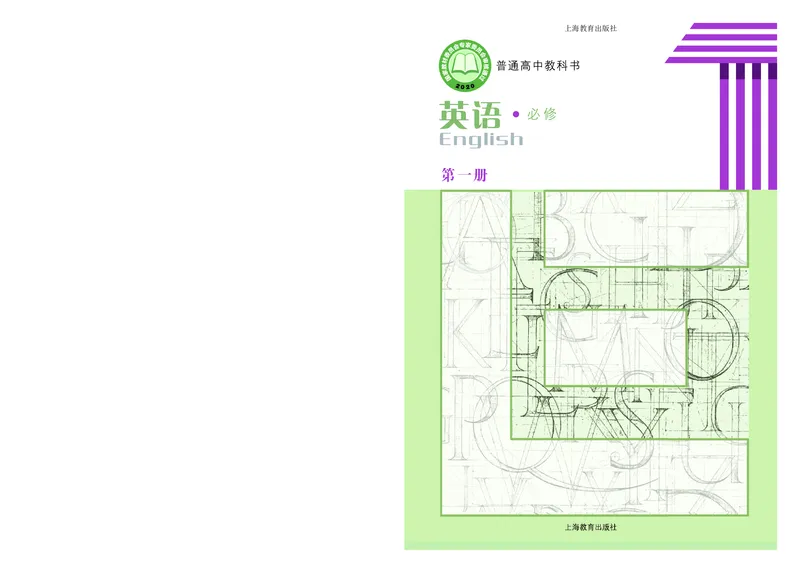
英 语
必修
第一册
英
语
必
修
第
一
册
定价:9.95元普通高中教科书
英 语
必修
第一册
[中 国] 河 北 教 育 出 版 社
合作编写
[加拿大] DC加拿大国际交流中心出版者的话
亲爱的同学们:
欢迎使用冀教版高中英语教科书。这套教材由国内外富有英语教育经验的学者、科研人员
及一线教师根据2017版《普通高中英语课程标准》编写。
本套教材必修阶段共3册,满足高中毕业基本要求;选择性必修阶段有4册,满足高考升
学要求;提高类阶段有3册,满足有意继续提高英语能力的发展需求。
让我们了解一下教材的结构。每册教材有5个单元,每个单元包括4个板块。第1板块
(Reading for Meaning)为同学们提供了地道、优美的语篇,文章体裁丰富多样、内容有趣且
富有时代特色;第2板块(Learning through Practice)提供了有意义的语言探究和语言实践活动,
同学们通过完成任务可以体验语言并归纳知识,提高语言运用能力;第3板块(Using English
in Context)设计有专题调查、访问纪实、讨论汇总、活动设计等多种形式的项目活动,帮助同
学们发展听、说、读、看、写等语言技能,为真实语言交际打下基础。第4板块(Expanding
Our Horizons)为同学们提供了更多与单元主题相关的经典、有趣的文章。
另外,教材中的评价部分(Evaluate yourself)可以帮助同学们积极反思学习过程,及时调
整学习策略,提高学习效率;单元反思(Unit Reflection)帮助同学们对整个单元进行回顾;链
接部分(More Connection)便于同学们拓展相关主题知识。
本套教材内容涉及人文、社会、自然、科学等多个领域,注重中外文化的介绍与比较。通
过学习本套教材,同学们会在提高语言能力的同时,增强对中华优秀传统文化和社会主义先进
文化的认识,成长为新时代有文明素养和社会责任感的人。
同学们,中学时代是人生美好的一段时光,相信在使用这套教材的过程中,你们通过自
己不懈的努力和老师的正确引导,能够顺利完成教科书中的学习任务,为终身学习打下良好
基础。
愿同学们在英语学海中徜徉,感受英语学习带给你们的新奇、充实与快乐。Contents
UNIT SECTION 1 READING FOR MEANING
1
First Day of High School 2
BEING A
TEENAGER
SECTION 2 LEARNING THROUGH PRACTICE
Task One Designing an “About Me Card” 6
Task Two Describing Your Expectations of
High School 8
(Grammar: noun, adjective, phrase, clause, sentence)
SECTION 3 USING ENGLISH IN CONTEXT
Project Making a Speech on How Teenagers
Face Their Challenges 10
SECTION 4 EXPANDING OUR HORIZONS
If the Dream Is Big Enough 14
Cultural Differences of Teenagers 15
How to Get along Well with Your Parents 17
UNIT SECTION 1 READING FOR MEANING
2
I’ve Got New Friends! 20
FRIENDSHIP
SECTION 2 LEARNING THROUGH PRACTICE
Task One Telling Stories of Friendship 24
Task Two Writing an Email to a Junior High School
Friend 26
(Grammar: the past future tense)
SECTION 3 USING ENGLISH IN CONTEXT
Project Exploring What Friendship Means 28
SECTION 4 EXPANDING OUR HORIZONS
Three Types of Friendship 32
Friendship in Different Cultures 33
The Power of Friendship 34UNIT SECTION 1 READING FOR MEANING
3
DANCING Snowstorms and Sundogs 38
WITH
SECTION 2 LEARNING THROUGH PRACTICE
WORDS
Task One Describing the Cold Winter 42
Task Two Expressing Opinions on Saving
Dialects 44
(Grammar: the present continuous passive voice)
SECTION 3 USING ENGLISH IN CONTEXT
Project Exploring Loanwords in Chinese and
English 46
SECTION 4 EXPANDING OUR HORIZONS
“Rooting” for Words 50
Language Learning beyond Words 52
UNIT SECTION 1 READING FOR MEANING
CULTURE
4
AND What Does Cultural Diversity Mean to You? 56
CULTURAL
SECTION 2 LEARNING THROUGH PRACTICE
DIVERSITY
Task One Introducing a Minority in China 60
Task Two Relating Chinese Calligraphy
to Your Chinese Handwriting 62
(Grammar: the present perfect passive voice)
SECTION 3 USING ENGLISH IN CONTEXT
Project Making a Poster for the Comparison
between Chinese and Western Festivals 64
SECTION 4 EXPANDING OUR HORIZONS
Cultural Diversity 68
Attitude towards Cultural Diversity 69
What’s Wrong? 71UNIT SECTION 1 READING FOR MEANING
5
Earthquakes 74
NATURAL
DISASTERS
SECTION 2 LEARNING THROUGH PRACTICE
Task One Designing a Bug-out Bag 78
Task Two Listing Some Tips for Pre-disaster
Preparedness 80
(Grammar: attributive clauses)
SECTION 3 USING ENGLISH IN CONTEXT
Project Creating a Brochure of Survival Tips 82
SECTION 4 EXPANDING OUR HORIZONS
Zhang Heng and the Seismograph 86
Typhoon Season in Japan 87
Cultural Influences on Disaster Management 88
WRAP IT UP! 93
APPENDICES
PRONUNCIATION 103
VOCABULARY (I) 105
VOCABULARY (II) 111
LIST OF PROPER NAMES 118
GRAMMAR 120
IRREGULAR VERBS 123UNIT
1
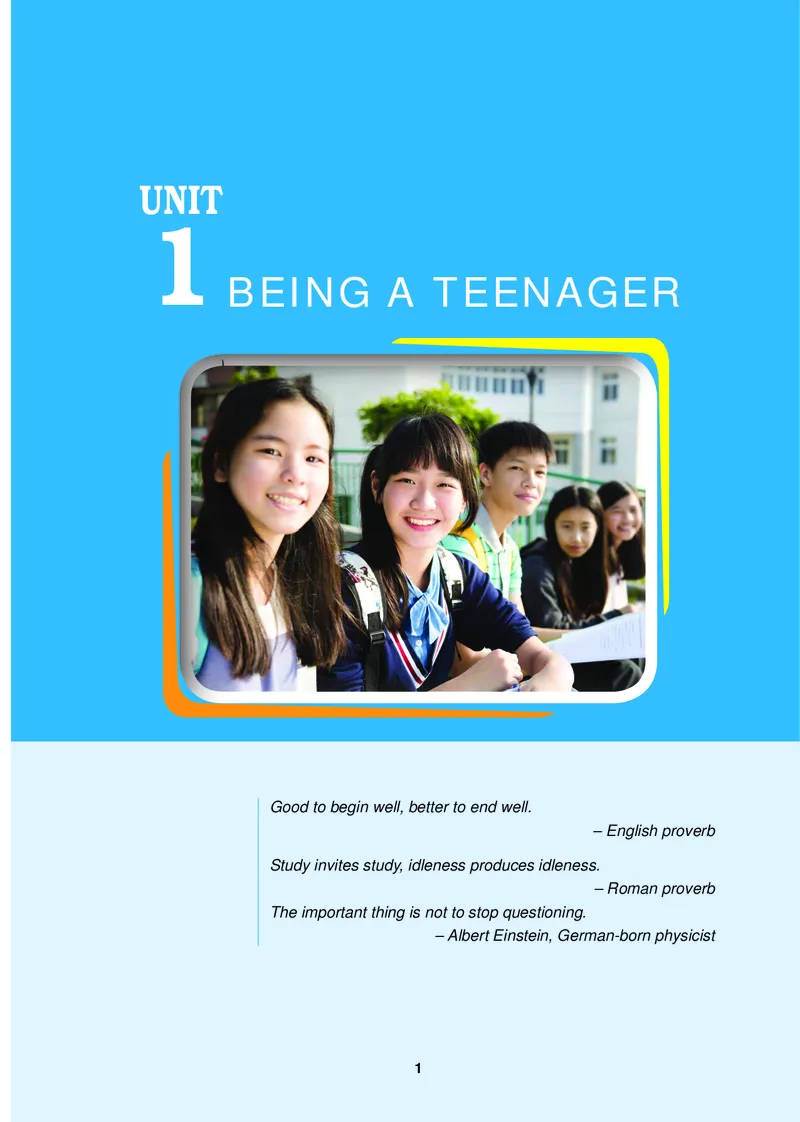
BEING A TEENAGER
Good to begin well, better to end well.
– English proverb
Study invites study, idleness produces idleness.
– Roman proverb
The important thing is not to stop questioning.
– Albert Einstein, German-born physicist
11
READING FOR MEANING
First Day of High School
BEFORE YOU READ
1 How did you feel on your first day of high school?
2 What do you expect of your high school life?
3 What do you expect to read when you see the title “First Day of High School”?
September 2 Monday Sunny
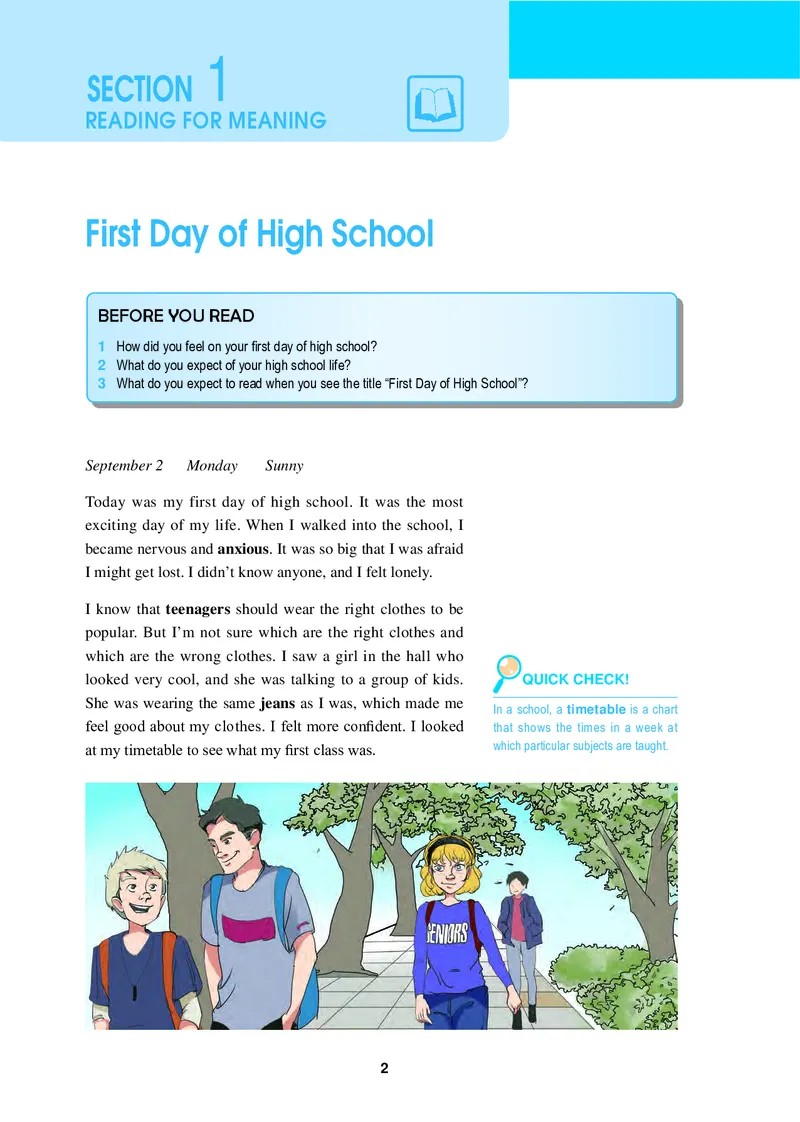
Today was my first day of high school. It was the most
exciting day of my life. When I walked into the school, I
became nervous and anxious. It was so big that I was afraid
I might get lost. I didn’t know anyone, and I felt lonely.
I know that teenagers should wear the right clothes to be
popular. But I’m not sure which are the right clothes and
which are the wrong clothes. I saw a girl in the hall who
looked very cool, and she was talking to a group of kids. QUICK CHECK!
She was wearing the same jeans as I was, which made me
In a school, a timetable is a chart
feel good about my clothes. I felt more confident. I looked that shows the times in a week at
at my timetable to see what my first class was. which particular subjects are taught.
2UNIT 1 BEING A TEENAGER
My first class was math. I really like math. I went into the
classroom and sat down at a desk in the second row right
near the door. The girl named Pat, who was sitting behind
me, left a deep impression on me. She was very friendly. DO YOU KNOW?
She was also very forgetful. She forgot her pen, so she Repetition is a strong way to express
borrowed mine. She forgot her paper, so I gave her a sheet feelings. How many “forget”s does the
writer use in the third paragraph?
of paper. The one thing she didn’t forget was my name. We
felt like friends already!
I left math class and began looking for the science
classroom, Room 211. I looked and looked, but I couldn’t
find the stairs. I was worried that I would be late for class.
It would be terrible to be late for my first science class.
I hurried down the hall and finally saw the stairs. I ran
quickly up the stairs.
QUICK CHECK!
Suddenly, I tripped and my binder fell from my hands and If you trip when you are walking, you
all of my papers went flying. I was so embarrassed. Just knock your foot against something,
and fall or nearly fall.
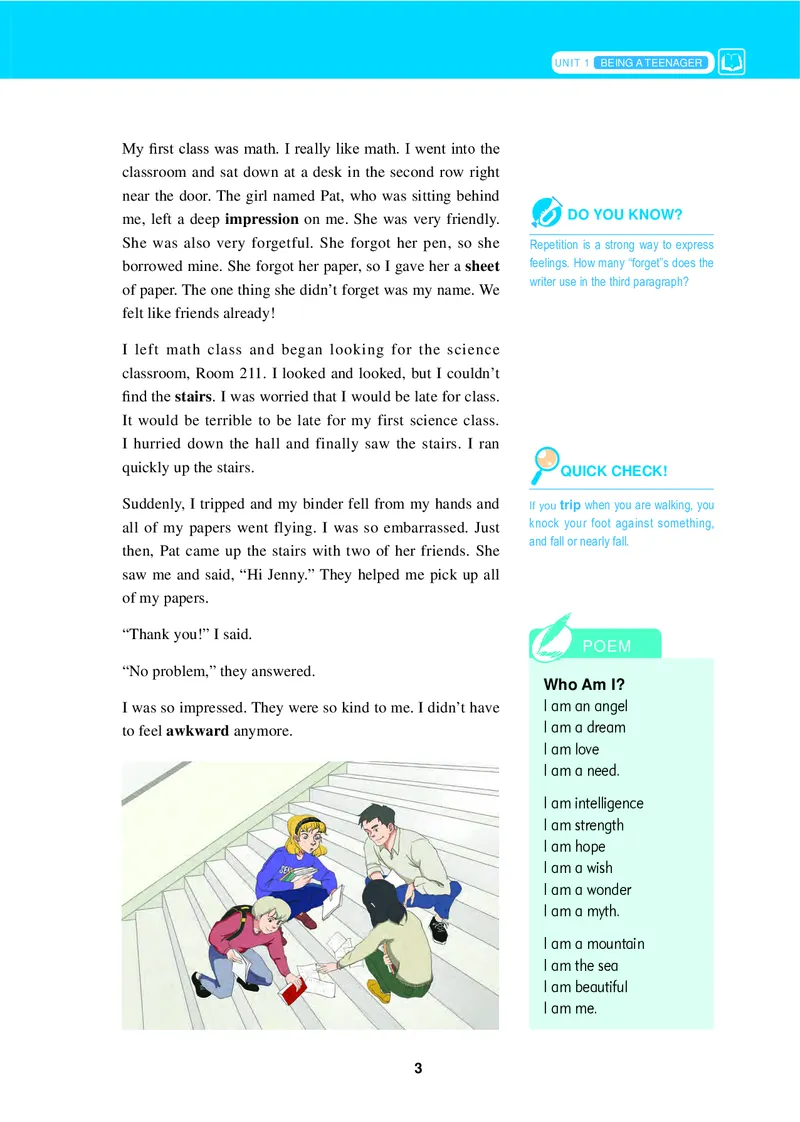
then, Pat came up the stairs with two of her friends. She
saw me and said, “Hi Jenny.” They helped me pick up all
of my papers.
“Thank you!” I said.
POEM
“No problem,” they answered.
Who Am I?
I was so impressed. They were so kind to me. I didn’t have I am an angel
I am a dream
to feel awkward anymore.
I am love
I am a need.
I am intelligence
I am strength
I am hope
I am a wish
I am a wonder
I am a myth.
I am a mountain
I am the sea
I am beautiful
I am me.
3UNIT 1 BEING A TEENAGER
You know, it can be hard to be a teenager. When I was a child, life was easier. I just played
and had fun with my friends. I didn’t have to worry about anything. But now I am a teenager,
and I have more things to think about. I must study hard and get good marks. I must get
used to my new school, new teachers, and new classmates. I want to make new friends. I
want to figure out what I want to do when I become an adult. It’s a hard decision to make.
I have such a broad range of interests, maybe I will be a professional engineer or a chief
information officer, but I will try to make the best decision.
It’s time for bed now, and I feel happy. I like my school. I know where the stairs are now, and
I made a new friend named Pat. I wonder what tomorrow will bring.
Jenny
AFTER YOU READ
Reading Comprehension
1 Who is Pat? How did Jenny meet Pat?
2 What happened when Jenny went to the science classroom?
3 What does Jenny mean when she writes “I was so impressed” in the last paragraph on Page 3?
4 How did Jenny feel on her first day of high school?
5 What does a teenager have to think about according to Jenny’s diary?
6 Jenny writes, “… it can be hard to be a teenager.” What do you think of “being a teenager”?
Post-reading Activities
1 Discuss with your classmates the major differences between life in senior high school and life in
junior high school. How do you think you will adapt to these changes?
2 Does Jenny’s first day of high school remind you of something you have read before? Something in
your life? Something you have seen in movies or TV series? What is it? Work in groups and share
whatever this text has brought to you.
3 How can you make your high school life fruitful and fun? Share your ideas with your group members.
4UNIT 1 BEING A TEENAGER
4 Develop the mind map on the topic of “high school”.
s
ct
e
bj
u
s
high
places
playground
school
excited
feelings
SONG
A Time to Think
Verse 1
Life is a lot of decisions
Life is a lot of choices.
Accepting other people’s visions
Listening to your inner voices.
Chorus
I will be a person who makes a plan
I will be a person who understands.
It’s better to swim than to sink
Being a teenager is a time to think.
Verse 2
Nothing goes like you plan
A boy is a long way from a man.
A teenaged girl has plans to make
For her future and her sake.
Repeat Chorus
52
LEARNING THROUGH PRACTICE
Task One Designing an “About Me Card”
You are going to make a card about yourself. This card will help you and your classmates
learn more about each other.
Step 1 Pre-task Resources
Use the sample below as a guide to help you design your own “About Me Card”.
Name: Sara Age: 16 Sex: female
Hometown: London, U.K.
Personality: quiet, kind-hearted
Junior High school: Harrow School
Friends: Cindy, Wendy, Chuck
Hobbies: playing Rubik’s cube, playing tennis
Favourite subjects: science, math, PE
High school: Downe House School
Types of friends: outgoing, sharing the same interests with me
Clubs/Activities: tennis club, chess club
Dreams: to be a professional tennis player, a scientist
Step 2 Task Cycle
■ Add more items that interest you besides the ones above.
■ Complete your card with some nouns and adjectives.
■ Decorate your card to make it beautiful.
■ Use your “About Me Card” to introduce yourself to your group.
■ Put your card up on the wall after class.
6UNIT 1 BEING A TEENAGER
Name: _______ Age: _______ Sex: ____________
Hometown: _____________ Personality: ______________
____________: _______________________________
____________: _______________________________
____________: _______________________________
____________: _______________________________
____________: ___________________
____________: ___________________
____________: ___________________
____________: ___________________
Step 3 Language Focus
We can put English words into basic types called “parts of speech” or “word classes”.
It’s quite important to recognize parts of speech. This helps to analyze sentences and
understand them. It also helps to construct correct sentences.
Nouns and adjectives are two important parts of speech. They usually name or
describe a person or thing. They tell us who/what somebody/something is or is
like. In Sara’s “About Me Card”, she uses London, U.K. to tell her hometown and
quiet, kind-hearted to show her personality.
Here are some examples from the text in Section 1. Look and learn. Search your “About Me
Card” and write down more words of the same type.
Nouns Adjectives
timetable teenager classroom lonely nervous confident
7UNIT 1 BEING A TEENAGER
Task Two Describing Your Expectations of High School
In this task, you and your classmates will discuss your expectations of high school life and
then present your thoughts to the class.
Step 1 Pre-task Resources
Here are two passages written by high school students. They describe their expectations
and dreams as well as their challenges and problems in high school.
Passage 1
Going to a new school can be a new start for kids. Some students
might enjoy the change and find it to be a good thing, but I was a
little frightened. I didn’t like the idea of having to start over. That
was absolutely challenging to me, but when I stood in front of my
new classmates, I was comforted by their smiles. It wasn’t what I
had expected it to be. I started to feel like I could get used to this
new school life and make lots of new friends.
Passage 2
Being a student with tasks, events, projects, laboratory exercises,
paperwork and some friend issues is truly difficult, but if you have
goals in life and you really want to achieve them, you’ll do all the
things you can even if there are difficulties. Each of us wants to
become academically successful.
People say that there’s a part of our life in which we learn things
and at the same time we have fun. That is the high school life.
In this stage, we’re learning about friendships and relationships,
building up our own personalities and discovering who we really
are. We’re preparing ourselves to go out to discover more things in
the real world.
8UNIT 1 BEING A TEENAGER
Step 2 Exploring the Language
Here are two types of expressions from Learning tips
the passages in Step 1. Can you find
anything in common? ● A noun phrase may be constructed
in various ways, such as with
● a good thing
modifiers before or after the noun.
friend issues
● An adjective phrase is a phrase
● absolutely challenging
whose head word is an adjective.
academically successful
“A good thing” and “friend issues” are noun phrases and “absolutely challenging” and
“academically successful” are adjective phrases.
A phrase refers to a group of words in a sentence used as a noun, verb, adjective, etc.
We can use a phrase to give more specific information. Phrases have different structures.
They may combine to form clauses and clauses can make sentences. Can you analyze
the following sentence?
● People say that there’s a part of our life in which we learn things and at the same time
we have fun.
Find more phrases in the text of Section 1 and then share your analysis
in groups.
noun phrases ______________________________________
adjective phrases ___________________________________
Step 3 Task Cycle
Now it’s your turn to talk about your expectations. When talking, you will use phrases of
different kinds to form clauses. Take a pause at the end of each phrase or clause.
93
USING ENGLISH IN CONTEXT
Project Making a Speech on How Teenagers Face Their Challenges
Teenagers face a lot of challenges these days. It’s important and helpful to discuss how one
might face these challenges. In this project, you will learn how to successfully develop a
speech on this topic.
Step 1 Read, Summarize and Learn
Below is a collection of messages taken from an online forum posted by some teenagers
about their challenges in life. Read the messages and complete the table.
Chen Mei
Being a teenager is a strange and yet exciting part of life. We are faced
with tough decisions each and every day – decisions that will affect our
futures. Life is an adventure that is full of challenges, and I will work
hard to go through each new challenge with joy.
Ashley
Me? I feel excited! Being the only child in my family, my parents say
that my future is the future of the family! Neither of my parents had the
chance to go to university, and they have worked hard to give me that
opportunity. I really don’t want to let my parents down, and I’ll study
hard and try my best to get into university, and make my parents proud.
Zhang Yuesi
What we learn in high school is not easy! We are studying different
subjects all at the same time. There are many assignments and tests to
worry about. If I don’t do well, I don’t know how I’ll face my teachers
and parents.
10UNIT 1 BEING A TEENAGER
Julia
When I was in junior high, I was such a cheerful kid with lots of good
friends. I got good marks, and my family was happy with me. But since
I became a teenager, things have changed. In fact, my whole life has
changed. My relationship with my family and friends isn’t the same and
my grades are not as good. I even started worrying more about the way
I look.
Name Challenge Attitude
Chen Mei tough decisions work hard to go through
Ashley
Zhang Yuesi
Julia
Step 2 Listen, Fill in Blanks and Match
1 Listen to four pieces of advice from Miss Knowing and fill in the blanks.
● If I were you, I would __________ __________ my parents about
Advice this problem.
(I) ● __________ a suitable goal for yourself.
● Show your __________ to your future.
● It’s best to __________ __________ your parents about your worries.
Advice
● __________ your confidence to the changes you are facing.
(II)
● __________ __________ the solutions to the problems.
11UNIT 1 BEING A TEENAGER
● Don’t be afraid to __________ __________.
Advice
● Why don’t you __________ your parents or teachers __________
(III)
__________?
● Don’t be afraid to __________ __________ __________.
Advice ● You’d better __________ good learning habits and methods.
(IV) ● The best way is to __________ by doing tasks and __________ a good
preparation for tests.
2 Match the four pieces of advice with the four students in Step 1.
Advice Advice Advice Advice
(I) (II) (III) (IV)
Julia Ashley Zhang Yuesi Chen Mei
Step 3 Reflect, Discuss and Write
Reflect on what you have learned and your challenges, and share with your group members.
List your common challenges and discuss how you would face them. Based on your
reflection and group discussion, write down the major points for your speech.
Giving advice
The common challenges
Attitudes ● Don’t be afraid to…
● We’d better…
● Why don’t you…
● If I were you, I would…
● Don’t hesitate to…
● It’s best to…
● Let’s…
● Show your kindness/
confidence to…
12UNIT 1 BEING A TEENAGER
Step 4 Prepare, Practice and Present
Prepare your speech early, practice it beforehand and present it with confidence.
Remember that an excellent speech requires:
● confident and enthusiastic greeting
● a catchy title
● an interesting opening (a statement or a challenging question)
● a clear body part
● a short and powerful ending
My fellow students,
The title of my speech is…
Teenage life is a difficult but colourful period of time. Teenagers are young
and active but…
Based on the survey I did just now, some of the students in our class
are facing…
With the challenges, I hope…
Thank you for…
Evaluate yourself!
Can you get the key points when listening to people giving advice?
Can you make a speech on “students’ challenges” in a logical way?
How well have you done with the following? Tick the circles that best reflect your performance.
Excellent Very Good Good Needs Improvement
Retelling Jenny’s first day of high school
Creating my own mind map about school life
Having a positive attitude to group cooperation
134
EXPANDING OUR HORIZONS
If the Dream Is Big Enough
I used to watch her from my kitchen window;
she seemed so small as she muscled her way
through the crowd of boys on the playground.
The school was across the street from my
house and I would often watch the kids as they
played after class. A sea of children, and yet to
me, she stood out from them all.
I remember the first time I saw her playing
basketball. I watched in wonder as she ran
circles around the other kids. She managed
to shoot jump shots just over their heads and
into the net. The boys always tried to stop
her but none of them could. I began to notice
her at other times, basketball in hand, playing alone. She
would practice shooting over and over again, sometimes
until dark.
One day I asked her why she practiced so much. She
looked directly in my eyes and without a moment of
hesitation she said, “I want to go to college. The only way
I can go is to get a scholarship. I like basketball. I decided
that if I were good enough, I would get a scholarship. I am
going to play college basketball. I want to be the best! My
daddy told me, ‘If the dream is big enough, the facts don’t
count.’”
Then she smiled and ran towards the court to continue her
practice that I had seen over and over again. Well, I had to QUICK CHECK!
give it to her – she was determined. I watched her through
If you are determined to do
those junior high years and into high school. Every week, something, you have made a firm
she led her team to victory. decision to do it and will not let
anything stop you.
14UNIT 1 BEING A TEENAGER
One day in her senior year, I saw her sitting on the grass with her head in her arms. I walked
across the street and sat down on the cool grass beside her. Quietly I asked what was wrong.
“Oh, nothing,” came a soft reply. “I am just too short.” The coach told her that at 5’5” she
would probably never get to play for a top ranked team – much less offered a scholarship
– so she should stop dreaming about college. She was heartbroken. I asked her if she had
talked to her dad about it yet.
She lifted her head from her hands and told me that her father said those coaches were wrong.
They just did not understand the power of a dream. He told her that if she really wanted to play
for a good college, if she truly wanted a scholarship, nothing could stop her except one thing –
her own attitude. He told her again, “If the dream is big enough, the facts don’t count.”
The next year, she and her team went to the Northern California Championship game. People
were so impressed with her skills and she was offered a full ride scholarship. She was going
to get the college education that she had dreamed of and worked towards for all those years.
It’s true: If the dream is big enough, the facts don’t count!
POST-READING QUESTIONS
1 What is the girl’s dream?
2 What challenge stands in the way of the girl achieving her dream?
3 What’s the meaning of the sentence “If the dream is big enough, the facts don’t count”?
Cultural Differences of Teenagers
Knowing the cultural differences between yourself and others of your age can help you
understand friends who are of a different race or culture. With this understanding, you
won’t run the risk of being disrespectful. You’ll also know if you are misunderstanding your
friend’s behaviour when it seems like he/she is being rude. The major differences between
Asian and American teenagers lie in the following aspects:
Family
Family comes first in the Asian culture. Teenagers stay close to home and have a stronger
commitment to their parents than many American teens do. While Asian families have a
greater dependence on each other, American families encourage their children and teenagers
to be independent.
15UNIT 1 BEING A TEENAGER
Friendship
Some Asian teens generally prefer having a small group of life-long friends. They are
committed and loyal to their friends. Americans often prefer a larger group of friends.
There might be less commitment to keeping friends for life because of their bigger pool of
possible friendships.
Working Relationships
If you are working on a group project with teens from China or other Asian countries, they
might focus on developing a good relationship with you. However, American teens tend to
first focus on the task and getting the work done. Developing relationships with their group
members might come second.
Body Language
In China and many other Asian countries, making direct eye contact is considered rude
and disrespectful. However, in America and some European countries, it is not only seen
as appropriate but also necessary because it means the person is paying attention. In Asian
culture people are usually more comfortable with less personal space than Americans are. A
touch on the shoulder or an arm is common for Asians even if you don’t know one another.
It’s important to keep in mind that when learning about cultural differences, you should not
generalize those differences. The key to understanding cultural differences with your friends
is to ask them for advice. All cultures value kindness and respect.
POST-READING QUESTIONS
1 What are the benefits of knowing about the cultural differences among teenagers?
2 What different attitudes do Asian and American teens have towards family?
3 What does eye contact mean in American culture?
16UNIT 1 BEING A TEENAGER
How to Get along Well with Your Parents
Being a teenager is a challenge. You frequently disobey
the rules that your parents set for you. So parents often
do not know what to expect. Many of them often find
it difficult to understand what you need while you are
growing. They don’t know whether what you are doing is
QUICK CHECK!
an act of independence or rebellion. Some adults would
describe adolescence as a period of disagreement, change, Adolescence is the period of your
and problems. For you it’s a time of school pressures and life in which you develop from being a
child into being an adult.
planning for your future. It’s easy to understand why so
many people find this to be a difficult time. But once it’s
over, you will realize that most of your parents’ troubling
behaviour is motivated by feelings of love and concern.
However, if you communicate with your parents, and try
to understand each other, this period will be less trying and
more fun for all of you.
Below are a few tips for improving communication between you and your parents:
● Be honest with your feelings. Your parents
want to help you, but they won’t know what’s
going on in your life if you don’t tell them.
● If your parents drive you crazy, don’t
immediately take defensive actions. Make
sure you talk to your parents when you calm
down. If you start shouting or crying, you
won’t be able to express your feelings clearly.
● Listen to what your parents have to say. If
your parents give you a chance to say what’s
on your mind, it’s only fair to give them the
same opportunity. If you listen to what they
have to say, then you may learn that you’ve
been misunderstanding their feelings.
17UNIT 1 BEING A TEENAGER
● If your parents say something that you disagree with, don’t immediately
overreact. Give them a chance to express their feelings and then, with a calm
attitude, explain why you may disagree with them. Try to identify what you need
from them and tell them if they may not know.
Following the advice above will make your time as a teenager a lot easier and more enjoyable.
POST-READING QUESTIONS
1 How would some adults describe the period of adolescence?
2 What are the tips about improving communication with your parents?
3 According to the author, why should you listen to your parents?
Unit Reflection
Review the whole unit and reflect on what you have learned.
1 What have you learned in this unit about forming or developing learning/living habits?
What are your plans about making friends, doing well in your studies, getting involved in
the school community, etc.?
2 What is your attitude towards your teenage challenges?
3 What have you learned about the structure and function of phrases and clauses in an
English sentence?
More Connections
● If you want to learn more about the preparation of high school, try to surf the Internet.
Here are some key words for your reference: teenagers, first day, high school, and plan.
● The following two books are recommended for tips on facing new challenges. You may
refer to dictionaries when reading the two books.
The Art of Being a Brilliant Teenager by Andy Cope
It’s Not Easy Being a Teenager by Patricia Wayant
18UNIT
2
FRIENDSHIP
A friend is a gift you give yourself.
– Robert Louis Stevenson, Scottish novelist
Friends come in all different shapes and sizes.
– Cecelia Ahern, Irish writer
As one fence needs three stakes, a good guy needs three
fellows.
– Chinese proverb
191
READING FOR MEANING
I’ve Got New Friends!
BEFORE YOU READ
1 Who is your best friend? How long have you known each other?
2 Have you made new friends in your high school? Who are they?
3 How do you choose friends? With what kind of person would you like to make friends?
Hello Jenny,
How are things? I’d like to apologize for not writing to you for so long. I have
been so busy. I can’t believe it’s been almost a month since school started. I
really like being in high school. It’s exciting, isn’t it? There are so many new
things to do and so many new people to meet.
I have a great new group of friends. Among us, there is very little gap on
everything. We’re in the same class. We all like to study together after school
because we can help each other. I’m pretty good at English, so many guys ask
me for help in English class. After school we usually go to play sports for a
little while or listen to the songs of our favourite bands. Sometimes we take
a walk by the river or visit some bookstores. We have to be back for evening
class at 7:00 p.m.
Among this group, I like Dazhi most. I met him on the sports ground one
afternoon when he was sitting alone, deep in thought. I went up to him and
introduced myself. I learned from our talk that he is from the countryside about
two hundred kilometres away from Shijiazhuang. Dazhi has had an interesting
life – a very different life from mine. As time goes on and I get to know him
better, I’m finding that we both have a broad range of interests. Many are
similar. We even have the same hobby of cooking. I think I can learn a lot from
20UNIT 2 FRIENDSHIP
him. Being friends means learning from each
DO YOU KNOW?
other. Don’t you think so?
friendship=friend+ship
I have invited Dazhi to come to my home for
bookstore=book+store
dinner this Sunday. We will cook together. I think kilometre=kilo+metre
we will have a good time. We always have lots
of things to talk about. I am quite happy with this
growing friendship. It has opened a door to many
new experiences.
I’ve got to go back to class now.
Talk soon.
Your friend,
Li Ming
Hi Li Ming,
Thank you for your email. Like you, I really enjoy being in high school.
You’re right! There are so many new people to meet and so many new things
to do and learn.
Pat is my best friend at school, but we don’t have
all of our classes together. We have gym class
together every day. I like the fact that Pat is very
active in all of our school activities. She doesn’t
like the students who are passive and just do what
they are told to do. We eat lunch together in the
dining room every day and we talk and laugh a lot.
21UNIT 2 FRIENDSHIP
Pat and I want to try out for the basketball team
this year. Playing sports is a lot of fun and a
great way to make new friends. Last year, my
friend Kara and I played on the same team. It
was hard at the beginning. Fortunately I had
Kara, who was always there to encourage me
every time I had a bad game. She would always
find a way to help me stop feeling bad about
myself and remind me that playing basketball
was supposed to be fun. She’s really funny too, and she’s so good at making
people laugh. It’s really great having her as a friend. It’s important to have friends
that can share the good times with you as well as the bad times.
This Friday, Pat is having a birthday party at her house. I can hardly wait! We will
listen to our favourite bands, watch our favourite movies and have a comfortable
chat. We will talk and talk all night long. I think the most important thing for
me is to have good friends to talk to. I like to talk to them about everything –
everyday things, funny things, difficult things, and important things. We even tell
each other secrets. Friends are special, aren’t they?
With best wishes.
Your friend,
Jenny
AFTER YOU READ
Reading Comprehension
1 In what ways is Li Ming’s high school life exciting?
2 What does Li Ming do together with his friends?
3 Why does Li Ming consider Dazhi his best friend?
4 Why do you think Li Ming finds Dazhi’s life interesting?
5 What kind of friend is Kara to Jenny?
6 What are the differences between Li Ming’s and Jenny’s understanding of friendship in high school?
22UNIT 2 FRIENDSHIP
Post-reading Activities
1 Jenny writes, “Playing sports is a lot of fun and a great way to make new friends.” In groups,
brainstorm and discuss other possible ways of making new friends.
2 In language, we sometimes try to understand something better by comparing it to something else.
When we do this we are using a simile or a metaphor. Read and try writing your own simile or
metaphor about friends and friendship.
A simile compares two different A metaphor compares two different
things using the word “like” or “as”. things by using “be”.
For example, “Friends are like stars. For example, “Friends are flowers in
You can’t always see them, but you the garden of life.”
know they are there.”
● A friend is like _______________. ● Friendship is ___________________.
(Use “like” or “as”.) (Use “be”, not “like” or “as”.)
3 Going to school every day also means that you get to see your school friends every day. Do you
think it is necessary for school friends to chat on social media like QQ and WeChat after school?
Share your opinion in your group and give reasons to support your view.
4 In groups, discuss what you will do or what advice you will give to a friend when...
he/she did something he/she is he/she argued
wrong or got into trouble, feeling sad with his/her friend
and is too afraid to tell or bad about because of a
his/her teacher or parents something. misunderstanding.
about it.
232
LEARNING THROUGH PRACTICE
Task One Telling Stories of Friendship
In this task, you will read three passages about friendship, and then tell your story of
friendship in groups.
Step 1 Pre-task Resources
Read and learn how to describe the events for developing friendship.
I grew up in a family that didn’t show affection. I knew I was loved,
but it was rarely expressed, either in words or with a hug. Then, at the
age of 40, I met Judy. I quickly noticed how often she told her kids she
1 loved them and how she hugged everyone hello and goodbye. As with
most habits, I picked it up, and the more I did so, the easier it became
for me. Now I never fail to hug friends or family members, and it has
completely changed how I relate to them. It’s an awesome feeling! Oh,
I love you, Judy!
Taking care of two young children, one of whom required medical
attention, meant that I was always tired and behind on my housework.
One day, we came home from yet another doctor’s visit to find the
front door slightly open. I went into the house, only to find the floor
cleaned, the dishes dried, and the
dirty clothes washed. The beds were
2
made, and there were even flowers
beside my bed. It turned out that my
friend Joy was driving by my home
and noticed my car was gone, so
she took the opportunity to help me
out. I learned an important lesson
that day about friendship. And this
friendship was sealed for life!
24UNIT 2 FRIENDSHIP
Because we are spread all over the country, my three closest friends
(Miranda, Rachel, and Joanna) and I keep in touch by group texting. We
3 share daily struggles, successes, and, most of all, laughs. These special
ladies love me for who I am. They never judge me or take advantage of
my weaknesses. I am lucky to have them in my life when times are good
and when times are tough. Having such kind of friends has taught me
that life is more fun and meaningful when I share myself with others.
Step 2 Exploring the Language
Complete the chart and understand the friendship between the author and her friends.
I learned from Judy how to
Joy helped me when I was
show affection. She often
so busy and tired. I found
told her kids _____________ Joy & I
the floor ___________,
and hugged _____________.
Judy & I the dishes ___________
I picked this up and it changed
and the dirty clothes
me a lot.
___________.
friendship
We four are close friends. We keep in
three closest
touch by _______________ and I find
friends & I
life _______________.
Step 3 Task Cycle
■ Decide on a story about friendship that you would like to share with your group. It can be a
story about you and your friends, a story about people you know or one that you might have
read somewhere.
■ Write down some keywords or an outline of your story.
■ Work in groups and take turns telling your stories. What do you find interesting or
inspirational about other people’s stories? Share, discuss and take notes.
■ Review your notes and think about how much better you understand friendship.
25UNIT 2 FRIENDSHIP
Task Two Writing an Email to a Junior High School Friend
In this task, you’re going to write an email to your best friend in junior high school. Think
about what you used to do together and what plans and promises you made. Set a date to
meet each other again.
Step 1 Pre-task Resources
Read an email from Tom to his friend Mathew. Focus on how to describe a plan in the past.
Dear Mathew,
How is everything going? Life in high school is exciting. There are so many new
things to explore and I have already made a few new friends. However, I still can’t
help thinking about the good times we had in junior high school.
You often said we were sure to be best friends. Upon graduation, you told me you
would miss me because we were going to different high schools and that meant we
wouldn’t see each other every day anymore. We made a promise that we would meet
regularly in senior high school and we would always make time to catch up with
each other.
Next weekend I am having a party with some old friends in the café bar near my
home. It will be a lot of fun, and I hope you can come.
Looking forward to seeing you again!
Your friend,
Tom
Step 2 Task Cycle
1 To make new friends and to keep old ones are equally important. If you look back on your
junior high school days, you’re sure to miss the good times you had with your friends.
Brainstorm the plans and promises you made with your friend.
what when
a plan or a
promise
who where
26UNIT 2 FRIENDSHIP
2 Write an email to your friend to recall the unforgettable past and introduce your present life.
Greetings in English emails Saying goodbye in English emails
● Hello/Hi Jenny, ● Talk soon.
● Dear Mathew, ● Talk to you soon.
● Thank you for your email. ● With best wishes.
● How is everything going? ● Looking forward to seeing you again.
● I am writing about...
Step 3 Language Focus
Compare the two sentences used in Tom’s email. Pay attention to the expressions in orange.
● Upon graduation, you told me you would miss me because we were going to different
high schools and that meant we wouldn’t see each other every day anymore.
● Next weekend I am having a party with some old friends in the café bar near my
home. It will be a lot of fun, and I hope you can come.
In the first sentence, the past future tense is used while in the second sentence the simple
future tense is used. The past future tense is used to express the idea that in the past we
thought something would happen in the future. The past future tense follows the same basic
rules as the simple future tense.
Jane has borrowed many books, so she will stay at home to read them this summer.
future from now
Jane borrowed many books and decided that she would stay at home this summer.
future from a past point
Learning tips
“Would” is usually used when volunteering or promising, and “was/were going
to”, “was/were to” or “was/were v-ing” is usually used to express a plan.
273
USING ENGLISH IN CONTEXT
Project Exploring What Friendship Means
Many people will walk in and out of our life, but only true friends will leave footprints in
our hearts. Friends come in all colours, shapes and sizes, and make our life meaningful
and colourful. In this project you will first explore what friendship means, and then write
an essay about your view of friendship.
Step 1 Read, Recognize and Match
Read the passage below and choose a title for each kind of friends from the “Heading List”.
Heading List
A. The Fun One B. The “Mom” C. The Intellectual
D. The “Younger Sister” E. The “Dad”
We all have friends. Oftentimes, we have friends that join us at different times in
our lives. We have best friends that stick with us, but more often than not they
all serve different purposes. Friends give us meaning in our lives – no matter
what role they play.
1
He or she presses you to think about the world around you. He or she helps you
think about work, life, children, education, love, and how all of those things work
together. He or she motivates you to study, read and be original.
2
This kind of friend brings out the little kid in you and never fails to make you
smile. He or she wants you to relax, have a good time and forget about the
stress in your life.
3
This friend is your role model. She is overprotective, but it’s only because she really
cares about you. She is the one you text when you’re having a bad day. She can tell
28UNIT 2 FRIENDSHIP
you need a hug without you saying a word. She forces you to think through all your
decisions. She knows you best and is generous with her time. She never fails to offer
her congratulations on your achievements, small or big.
4
This friend is protective, hard-working and supportive. He may not always
understand you or seem like he’s on your side, but he supports you more than
anyone else.
5
You love this friend more than anything. She’s one of your closest friends, and you
tend to protect her. She asks for your advice, but at the end of the day you tend to
think that you learn more about yourself from her than she does from you.
Step 2 Listen, Fill in Blanks and Discuss
Here is a story about how two girls helped their friend after she failed a test. Listen carefully,
fill in the blanks and have a discussion with your group members.
A teenage girl walked into school one day. She was dressed as usual in her blue
jeans and ___________ ___________ shirt. However, it was her face that gave her
away. It was normally full of ___________, but that day she looked ___________.
Her friends noticed it and asked her, “Are you all right? What’s wrong?” She tried to
make them believe that there was nothing wrong. But her friends knew her too well.
Finally she told her friends that she ___________ ___________ her English test
and that her parents would be ___________ at her. Her friends understood and
calmed her down. They eventually made her realize that she should tell her parents
___________ ___________. So she did. Her parents were not as angry as she had
originally thought they would be. She felt grateful that her friends were there for her.
She was ___________ that her friends knew her so well.
1 What will you do when you find a friend is in low spirits?
2 How can you comfort a friend who is sad about poor examination results?
29UNIT 2 FRIENDSHIP
Step 3 Brainstorm and Share
Make a list of some adjectives that can be used to describe a true friend. Share your list with
your group. Then complete the mind map below.
honest
friend
Step 4 Discuss, Take Notes and Learn
In groups, discuss how friends might share their good times and bad times. Take notes and
keep separate lists for “good times” and “bad times”. Learn about the qualities of friendship
from your discussion.
Good Times Bad Times
● ●
● ●
● ●
● ●
● ●
● ●
● ●
● ●
● ●
● ●
● ●
30UNIT 2 FRIENDSHIP
Step 5 Reflect and Write Your First Draft
Based on your discussion, reflect on the major qualities of friendship and then write an essay
entitled “Friendship” to express your opinions on what friendship means.
Learning tips
When writing this essay, you should state your general point of view
first and then present your ideas on the subject from several different
aspects with evidence and analyses. In the last paragraph of your essay,
you sum up your ideas and come to your conclusion.
Evaluate yourself!
Can you guess the meaning of some new words based on the context?
Can you make a list of words and expressions about friendship?
How well have you done with the following? Tick the circles that best reflect your performance.
Excellent Very Good Good Needs Improvement
Using what I know about the future tense
when learning about the past future tense
Understanding the major meaning of
friendship when reading the text
Taking an active part in classroom activities
314
EXPANDING OUR HORIZONS
Three Types of Friendship
Aristotle makes reference to three types of friendship
in one of his books.
The first is friendship based on usefulness, where both
people get some benefit from each other. Therefore, in a
friendship of usefulness, “the friend is not loved for his
own sake, but for the sake of some benefit received by
the other”. Aristotle notes that these friendships don’t last
long, because if the benefit ends, so will the friendship.
He states, “Hence when the motive of the friendship has
passed away, the friendship itself is dissolved, having
existed merely as a means to that end.”
DO YOU KNOW?
The second is friendship based on pleasure, where both
people are drawn to the other’s wit, good looks, or other Aristotle was an ancient Greek
philosopher and scientist. Along with
pleasant qualities. In the friendship of pleasure people love
Plato, Aristotle is considered the
their friend not for the sake of the friend, but for the sake
“Father of Western Philosophy”.
of the pleasure received. As with usefulness, friendships of
pleasure are weak as they can change or end as quickly as
the pleasure received can change or end.
QUICK CHECK!
These two types of friendship are only accidental, When something is accidental, it
because in these cases friends are motivated by their happens by chance, not planned.
own benefit and pleasure, not by anything important to
the nature of the friend. Both of these types of friendship
are short-lived because one’s needs and pleasures are
likely to change over time.
The third is friendship based on goodness, where both
people admire the other’s goodness and help one another
go for goodness. Friendships based on goodness tend to
be long lasting. This friendship includes the other two,
as good friends are useful to one another and please one
32UNIT 2 FRIENDSHIP
another. Such friendship is rare and takes time to develop, but it is the best. Bad people can
be friends for reasons of pleasure or benefit, but only good people can be friends for each
other’s sake.
POST-READING QUESTIONS
1 According to Aristotle, what is the best friendship? Please explain it in your own words.
2 Why did Aristotle conclude that the first two types of friendship are short-lived? Do you agree with him?
3 Think of all your friends and friendship you have developed. What types of friendship do you have
according to Aristotle’s point of view?
Friendship in Different Cultures
Friendship is universal. That’s why all cultures in the world value it in very similar ways.
One common belief in ancient China concerning friendship is that friends see the world in
the same or similar way. They have the same goal, or follow a similar path and true friends
understand each other in a way others cannot. Closely related is the idea that “If you do not
know a man, look at his friends”.
There is also an old saying in Russia, “Instead of having 100 rubles, better have 100 friends”,
which means friendship can’t be measured by cash. At the same time, American literature
is also full of stories about friendship. Readers can feel what friendship means while reading,
for example, Hemingway’s memories of Paris in A Moveable Feast, “When you cannot
make friends anymore in your head is the worst.” In China, there is a popular saying that
goes, “Life is a bosom friend.”
33UNIT 2 FRIENDSHIP
Cultures also have similar ideas when it comes to the importance of telling true friends from
false ones. The Chinese would say, “Hard times test friendship.” The Western saying “A
friend in need is a friend indeed” is similar to the Russian proverb “A friend is known in a
trouble” and the words of Kazakh writer Abai, “You can tell a good friend from a bad one.
Bad friends are like a shadow. On a sunny day you cannot get rid of them. When it is cloudy
you cannot find them, no matter how much effort you make.”
A strong friendship has a positive effect on our health. So good friendships make people both
healthier and happier. If you are studying, working or travelling to another country, you will
find that friendship exists everywhere.
POST-READING QUESTIONS
1 According to the text, how can people tell true friends from false ones?
2 Why do you think the Russians say it is better to have 100 friends than 100 rubles?
3 Why does the writer Abai say that bad friends are like a shadow? Is Abai using a metaphor or a simile?
The Power of Friendship
Dogs and elephants, just like lions and tigers, or cats and mice, traditionally have been
“natural enemies”. Dogs bark at elephants because they are afraid of the large animals.
Elephants get angry at the barking dogs and chase them. Read to see what happened in the
following story.
Once upon a time, there was a well-fed male elephant, which belonged to the king. Living
nearby was a poorly-fed dog. The dog was attracted by the smell of the rich sweet rice
being fed to the elephant. He began to eat the rice that fell from the elephant’s mouth. While
enjoying his food, the mighty elephant didn’t notice the tiny, shy dog.
The dog grew bigger and stronger, and became very handsome. The elephant began to enjoy
the dog’s company. The dog got used to being around the elephant. When they played, the
dog would hold on the elephant’s heavy trunk with his tail moving happily and the elephant
would rock him back and forth, from side to side, up and down, and even in circles! They
became “best friends”, and never wanted to be separated.
Then one day, a man from a far-away village passed by the elephant. He saw the beautiful dog
34UNIT 2 FRIENDSHIP
and bought him from the mahout. He took the dog back to
QUICK CHECK!
his home village. Nobody knew where the village was.
A mahout is an elephant-driver.
Soon, the elephant became very sad. He missed his best
Mahouts take care of elephants.
friend, the dog. He didn’t want to do anything, not even eat
or drink. So the mahout had to report this to the king, but
he said nothing about selling the friendly dog.
It just so happened that the king had an intelligent minister
who was known for his understanding of animals. The
king ordered the minister to go and find the reason for the
elephant’s condition.
The wise minister saw at once that the elephant was sad.
Then he said to the guards, “I have found no physical
sickness. He seems to be heartbroken due to the loss of a
friend. Do you know if this elephant had a close friendship
with anyone?”
They told him about the friendship between the elephant
and the dog. The minister returned to the king and said,
“Your Majesty, I am happy to say your elephant is not
sick. As strange as it may sound, he became best friend
with a dog! Since the dog has been taken away, the
elephant is heartbroken and does not feel like eating or
drinking or bathing.”
35UNIT 2 FRIENDSHIP
The king said, “Friendship is one of life’s most wonderful things, isn’t it? But how can we
bring back my elephant’s friend and make him happy again?”
“Quite true,” replied the minister. “I suggest you make an official notice. Whoever has the
dog will be fined.”
This was done. When the villager heard of it, he set free the dog from his house. The dog ran
as fast as he could straight back to his best friend, the elephant.
POST-READING QUESTIONS
1 How did the dog and the elephant become friends? Why did the elephant become heartbroken?
2 What was the king’s decision? How did the dog return to the elephant?
3 What is the moral of this story? What does the writer want to tell us through this story?
Unit Reflection
Review the whole unit and reflect on what you have learned.
1 Does this unit broaden your understanding of friendship? What have you learned about
friendship and friends? Do you agree that friends come in all different shapes and sizes?
2 What are the three types of friendship according to Aristotle? What types of friendship do
you have? How can we develop and keep a good friendship?
3 What is the past future tense? What does it mean? Can you use it to talk about your past
plans, or the future in the past?
More Connections
● In your opinion, what is the best song to celebrate friendship? In English-speaking
countries, it is Auld Lang Syne. It’s a Scots poem written by Robert Burns in 1788 and set
to the tune of a traditional folk song. It is well known in many countries, especially in the
English-speaking world.
● Do you want to have a better understanding of friendship? You can look at what great
people think about it by searching the Internet for their ideas. The key words “quotes of
friendship” are recommended to help you.
36UNIT
3
DANCING WITH WORDS
Words are like eggs: when they are hatched, they have wings.
– Madagascan proverb
He who knows the tongues is at home everywhere.
– Dutch proverb
Without grammar very little can be conveyed; without vocabulary
nothing can be conveyed.
– D.A. Wilkins, British linguist
371
READING FOR MEANING
Snowstorms and Sundogs
BEFORE YOU READ
1 How do you understand the title of this unit “Dancing with Words”? What would you expect to read in
the text?
2 There are many ways to form words in a language. Each word has one or more meanings and the
combination of different words can form new ones. Tell how the following English words are formed.
hometown dislike actor
3 Look through the text below and see if you can find the words with similar structures.
Sophie’s dad is an international pilot. When he is away, he
sends postcards to his family. These little postcards with
pictures of London, New York and Toronto bring the world
right into Sophie’s home.
Sophie’s dad collects new words like some people collect
stamps, china or pictures of basketball players. Whenever he
hears a word for the first time, he’ll act like a child with a new QUICK CHECK!
toy. When he has a stopover on a long flight, the first place he A stopover is a short stay in a
goes to is the airport bookstore for books, journals, puzzles particular place between parts of a
long journey.
and newspapers.
During most of this year, Sophie’s dad was a pilot on an
airplane that flew over the Polar Cap. “What an interesting
expression,” he wrote on a postcard to Sophie. “It sounds as
if the North Pole had a cap on its head because the weather
is so cold. Imagine the North Pole saying, ‘I’d better put on
my cap so I don’t freeze my ears.’”
38UNIT 3 DANCING WITH WORDS
At school, Sophie’s class had started to study northern
environments. Her task was to write a report on how people
DO YOU KNOW?
describe the weather in cold places. “I could look in the
encyclopedia,” she said to herself, “but my dad has visited An encyclopedia (also spelled
these places. He is a flying encyclopedia.” encyclopaedia) is a book or CD, or
a set of these, containing facts about
Sophie had three weeks to finish her project. “That’s easy,” many different subjects, or containing
detailed facts about one subject.
her dad said. He was about to leave for two weeks. One
of his flights would take him from Moscow to Montreal.
“I’ll buy some postcards in Moscow and a book about the
weather in Montreal. I’ll send you weather descriptions
from Canada. I’ll mail the postcards at the same time.”
When the postcards began to arrive, Sophie could not help
but laugh. On one side, the postcards showed pictures of
Russian palaces and gardens, art treasures from famous
Russian museums and beautiful ports on the Black Sea.
On the other side, her dad described the snowstorms of the
world’s far northern countries.
POSTCARD
The coldest temperature ever recorded in North America
was in the Canadian Arctic. Snag, Yukon, Feb. 3, 1947.
Minus 63 degrees centigrade! Only three other places
in the world have recorded such low temperatures. The
coldest was minus 89.2 degrees centigrade! Your flesh
could freeze in less than a minute! When the weather gets
to be so cold, keeping yourself warm is very important!
In the last postcard he sent, Sophie’s father described an
interesting scene. He wrote, “Here, in the most northern
parts of the world, the extreme cold temperatures can
cause some interesting things to happen. For example,
when sunlight hits ice crystals in the air in a certain way,
39UNIT 3 DANCING WITH WORDS
you can see strange shapes on both sides of the sun. The
people who live here call this shape a sundog. I love that. I
think that’s my new favourite word.”
Laughing at the odd word, Sophie wondered whether
sundogs chased mooncats. “I’m learning to speak a whole
new language,” she told her teacher excitedly. “The
language of snow. Different words about snow are being
used in my report.”
sundog — a northern scene
“That’s good. The more words you know, the better you
can express yourself and your experiences,” her teacher
commented. “Language helps us understand the world
we live in and communicate and share our understanding
with others. A greater knowledge of any subject, from
space travel to music, will come with new words and new
understandings. Words are doors. When you learn new
words, it’s like opening a door to a new place.”
AFTER YOU READ
Reading Comprehension
1 Why does Sophie’s dad like sending postcards to his family?
2 What is Sophie’s task and why does she turn to her dad for help?
3 What is a sundog? Can you explain its meaning in English? What does Sophie think about this word?
4 What does the statement “When you learn new words, it’s like opening a door to a new place” mean
to you?
5 What is the main idea of this text? What is the relationship between language and life experiences?
6 The text has nine paragraphs, which can be grouped into three parts according to their content.
Write a sentence to summarize the main idea of each part.
Part Paragraph Main idea
I Paragraph(s) __________
II Paragraph(s) __________
III Paragraph(s) __________
40UNIT 3 DANCING WITH WORDS
Post-reading Activities
1 Observe and examine the use of compound words in the text: postcard, basketball, stopover and
newspaper. What other English words can you see within these words? Search the text for more
compound words, choose THREE of them and make as many new compound words as you can.
Example
snowball
snowbird snowman basketball baseball
2 A dialect is a form of a language spoken by a particular group of people, especially those living
in one area. It has different pronunciation, words, and even grammar rules from other forms of
the language. Make a list of words, expressions and sayings that are not present in standard
Putonghua and share your list with your classmates.
3 In recent years, it has become popular to use the transliteration (sound translation) of English words
instead of the actual Chinese word equivalents. For example, it is more common for people to use
katong vs. donghua for cartoon, and leishe vs. jiguang for laser. Think about other words like this
that you know and make a list. Share and discuss your list with your classmates.
4 Most languages are made up of words. Discuss with your classmates what “knowing a word” means.
How do you learn new words? Share your tips and strategies with your classmates.
SONG
Language
Language is a tricky thing, A word is like a new friend.
So study it with pride. You’re nervous that first day,
With each new word we master But as you get to know him,
A door is opened wide. Your fears will go away.
So first learn how to say each word
And how to spell it too.
Then study where it came from.
You’ll be surprised what this will do!
412
LEARNING THROUGH PRACTICE
Task One Describing the Cold Winter
In this task, you will learn some new words that describe cold weather and build a word bank
related to the winter season. You will then practice using the new words that you learn from
the passages below to describe a picture.
Step 1 Pre-task Resources
Read the following passages and guess the meanings of the words in blue.
Cold Weather
In my hometown, the chilly days of autumn soon change to the cold days of winter. The first
frosts(1) arrive and the roads become icy. Rain becomes sleet(2) and then snow, which at first
turns to slush(3) in the streets, but soon settles. With severe blizzards(4) and snowdrifts(5),
freezing weather often continues in the far north until May or even June, until the ground
starts to thaw(6) and the ice melts(7) again.
Winter in Canada
My first experience of real winter weather was when I went to northern Canada. I was used to
the snow that falls in my hometown, which quickly turns into brown slush when all the people
walk on it. In fact, I would say that we never experienced real snow in my hometown. It was
mostly sleet. What’s more, winters in my hometown meant a bit of white frost on our garden
and having to drive very carefully on icy roads early in the morning. I had never experienced the
blizzards and snowdrifts that can make a city unable to function in less than an hour and
close roads completely. However, when the earth finally thaws and all the snow melts away in
spring, everything comes to life again and looks more beautiful than ever.
Learning tips
Many words can be learned in context. You
can guess the meanings of new words by
understanding the context.
42UNIT 3 DANCING WITH WORDS
Step 2 Exploring the Language
1 Match the words with their explanations.
(1) frost a. rain and snow mixed
(2) sleet b. snow blown by high winds
(3) slush c. thin white coat of ice on everything
(4) blizzard d. deep banks of snow against walls, etc.
(5) snowdrift e. dirty, brownish, half-snow, half-water
(6) thaw f. change from solid to liquid under heat
(7) melt g. change from hard, frozen state to normal
2 Build a word bank about cold winter.
weather
festivals
cold winter
activities feelings
Step 3 Task Cycle
Using some of the words you learned about winter and cold weather, write five sentences to
describe the picture below.
43UNIT 3 DANCING WITH WORDS
Task Two Expressing Opinions on Saving Dialects
We all love our dialects for different reasons. We learned them when we were young, and we
use them often later on. However, some languages and dialects are endangered. In this task,
read some passages about this problem and share your opinions on saving dialects.
Step 1 Pre-task Resources
Read the following three passages about languages and dialects.
1
The world’s almost 7,000 known languages are disappearing fast, with a different tongue dying
about every two weeks. Methods are now being used by researchers to find the primary threat to
language diversity. The study shows that it is a global phenomenon – economic development.
Many people know about the threatened polar bear, but few people know that there are
endangered languages and even some have disappeared. For example, the last speaker of the
Eyak language in Alaska died in 2008, and the last speaker of the Ubykh language in Turkey
died in 1992. It’s becoming more widely understood that some languages are being wiped out by
economic growth.
2 3
It’s impossible to “save” a language unless Dialects have their place in our culture.
it has a community of speakers. Professor A dialect gives a taste of home, identity
Austin started recording Kamilaroi, a and variety. Though it is important for
language spoken in northern New South every child in China to learn to speak
Wales, in 1972. He prepared a dictionary in Putonghua, it does not have to come at
1992 and co-wrote a Web dictionary in 1996. the cost of losing Chinese dialects. The
“The language is being taught in schools in dialect can give us more understanding
northern NSW now and is being relearned of local cultures that exist within China
by a whole new generation of Kamilaroi and around the world.
people,” says Professor Austin.
44UNIT 3 DANCING WITH WORDS
Step 2 Task Cycle
1 Discuss with your classmates:
● What point or argument is the author making in Passage 1?
● How would you feel if your mother tongue were endangered?
● Do you have a local dialect? When and with whom do you speak your local dialect?
2 According to the information in Passage 2, how can we save a language that is endangered?
3 In groups, discuss whether we should work to save and protect our dialects when we are
encouraged to use Putonghua. Make sure you use examples to support your argument.
Step 3 Language Focus
Look at the sentences that use the present continuous passive voice.
● Different words about snow are being used in my report.
● It’s becoming more widely understood that some languages are being wiped out by
economic growth.
● The language is being taught in schools in northern NSW now and is being
relearned by a whole new generation of Kamilaroi people.
When we describe things happening right now, we use the present continuous tense.
● Some workers are painting the wall.
● He is repairing the broken car engines.
If the object of the verb in an active sentence becomes the subject, we use the
present continuous passive voice.
● The wall is being painted by some workers.
● The broken car engines are being repaired by him.
The structure of the present continuous passive voice is as follows:
subject + be + being + done ( + by... )
453
USING ENGLISH IN CONTEXT
Project Exploring Loanwords in Chinese and English
Loanwords refer to words borrowed into one language from another. In this project, you will
read the passage introducing loanwords in English and then explore loanwords in Chinese.
Report your findings in your presentation.
Step 1 Read, View and Search
Read this passage about loanwords in English.
Loanwords in English
English is an open language and has been borrowing words from other languages since
its birth.
The major sources of loanwords in English are Latin and Greek. For example, some
English words that were borrowed from Latin include agriculture, museum and
society. Some examples of words borrowed from Greek are: astronaut, chemistry, and
electricity. Much of the English vocabulary also comes from French, for example,
cartoon, cinema, coach and affair. Italian is another language that has influenced the
growth of the English vocabulary, for example, ballet, concert, piano and opera.
Do you know that there are many loanwords in English that come from the Chinese
language? For example, in the Oxford English Dictionary, you can find words like
yin and yang, feng shui, kung fu, lychee, pinyin and many others. China has been
interacting with the European countries since the Silk Road time. With the development
of China’s economy and technology around the 21st century, more and more Chinese
words have made their way into the English language. Interestingly, the word taikonaut
shows a blend of Chinese tai kong (outer space) and English astronaut.
ballet
lychee
46UNIT 3 DANCING WITH WORDS
1 From which languages are the English loanwords mentioned in this passage borrowed? Give
examples to each language.
Languages Examples from each language
Latin
2 Make a list of some other English loanwords you know that do not appear in this passage.
Step 2 Listen and Make Choices
Listen to an introduction to loanwords in Chinese and choose the correct answers.
● Standard Chinese is by far the world’s ____________ speech
community.
A youngest B largest
C oldest D smallest
● Loanwords from English have entered ____________ Chinese in
different forms.
A listening and reading B written and spoken
C listening and spoken D reading and written
● How many major types of English loanwords are there in Chinese?
A One. B Two.
C Three. D Four.
● Which of the following is an example of loan blends?
A 拷贝for copy B IC卡
C IT (information technology) D bye-bye
● Which of the following is an example of loan translations?
A 沙拉for salad B E时代
C AA制 D GDP
47UNIT 3 DANCING WITH WORDS
Step 3 Collect, Classify and Investigate
1 Look through books, newspapers, signs, advertisements, instructions and posters to collect
and make a list of English loanwords in Chinese.
Loanword Loan blend Loan translation
WTO G20 峰会 卡通 (cartoon)
2 Select some commonly used loanwords from your list and show them to your friends, family
members or neighbours. Ask five people if they know the meaning of these loanwords,
whether they use these words, and how they like them.
3 In groups, share your loanwords and your findings of people’s attitudes towards using
loanwords. Then, discuss why you think loanwords are used. Examine the advantages and
disadvantages of using loanwords.
Step 4 Put Things Together, Prepare and Present
With the development of globalization, there are more and more English loanwords borrowed
into the Chinese language. However, some people enjoy using these loanwords while some
people think these foreign words “damage” the purity of the Chinese language. Based on
your investigation, prepare a five-minute presentation and report your findings on people’s
attitudes towards using loanwords.
Learning tips
Giving a presentation is an opportunity for
you to share knowledge, information and
opinions with your classmates.
48UNIT 3 DANCING WITH WORDS
In your presentation, consider:
● what kinds of loanwords people are using (include examples);
● the reasons why people use loanwords;
● people’s attitudes towards using loanwords.
Introduction Body Conclusion
● Let me give you
● Hello, everyone, I some examples... ● To sum up, ...
am glad to... ● What impressed ● Thank you for your
● Our topic today is... me most is that... attention!
● My first reason is...
Evaluate yourself!
Are you able to scan for specific information while reading the passage?
Can you learn and memorize new words using word classification method?
How well have you done with the following? Tick the circles that best reflect your performance.
Excellent Very Good Good Needs Improvement
Being aware of accumulating loanwords in
Chinese and English
Using loanwords in a specific context
Reviewing and summarizing regularly what I
have learned from English classes
494
EXPANDING OUR HORIZONS
“Rooting” for Words
A tree has roots. So does a flower. People have roots too. If you get to the root of a problem,
you get to its source. You understand where it came from. It’s the same thing with words. Dig
deeply into a big, unfamiliar word and you will often arrive at its source. Know its root, and
you will understand its origin.
As readers, especially those reading in a second language, we need to approach the text as
if we were detectives seeking clues to unlock the unknown. It’s like using a word flashlight
to shine light where no light has shone before! As with any good detective arriving on the
crime scene, the first thing to do when
meeting a new and difficult word is to judge
the situation, to look at everything that is
known and see if it helps us to understand
what it represents.
As you know, prefixes and suffixes can be
added to the beginning or end of words
to change the meaning. Know the basic
prefixes and suffixes and you will be well
on the way to word building power. But
root words are the key. One of the best
ways to help us to detect meaning is to
find the root word contained in the larger,
difficult word. Take time to learn a few of
these, file them in your memory, and you
will become a master word detective, an
expert in your field.
Let’s take a look at two common root words used in English.
Alter from the Latin word means “other”. When you meet this root word, you
know that the bigger word has something to do with “other”. Examine the word
“alternate”. Can you find the Latin root in it? If you and your friend like to go
50UNIT 3 DANCING WITH WORDS
out for lunch and you take turns paying for
the meal, you are alternating paying. First one
person pays, then the other person pays. If you
go to the movies on alternate Saturdays, you
go on one Saturday and then pass over the next
Saturday. You go to the movies one week, but
not the other week. If you have no alternative,
you have no other choice.
Sen from the Latin word means “old”. Think
of words like “senior” and “senate”. Can you
see the Latin root in there? Can you detect the
meaning using this knowledge? A senior is
an old person. You usually find old and wise
people sitting in the Senate.
To learn a language well, you need to use many strategies
along the way. Learn as many of the root words as you can QUICK CHECK!
in the language you are studying. Then apply your “rooting If you apply something such as a
for words” skills. When you recognize a root word in a new rule, system, or skill, you use it in a
situation or activity.
vocabulary word, don’t be afraid to guess its meaning based
on your understanding of the root. As with any new skill,
practice and hard work are always paid back.
POST-READING QUESTIONS
1 Why does the author compare readers to detectives?
2 What strategies have you learned to build your word power?
3 Explore the following words and give more examples.
Prefix/Suffix Meaning Example More words
inter- between international
pre- before preview
-er/or one who... teacher
-ful full of handful
51UNIT 3 DANCING WITH WORDS
Language Learning beyond Words
Traditionally, language is viewed as a code. It’s made up of words and a series of rules that
connect words together. However, language is not a thing to be studied but a way of seeing,
understanding and communicating about the world.
Story of Panic
When we speak of ancestors, we are talking about all the people in our family who came
before us – our parents, grandparents, great grandparents, and so on. Most words have
ancestors too. Here is a story that may be of interest to you.
The word “panic” is a word that comes from the Greek
language. Pan was a Greek god who liked to hunt and
play music. He went through the woods playing his special
kind of flute. He often frightened people because of his odd
appearance – half-man, half-beast. When people met him,
they were so filled with fear that they did not know what to
do. They were in a panic. This is the origin of the word “panic”.
A person in a panic is frightened and at a loss about what to
do. Often people in a panic do foolish things.
Meanings of Chinese Characters
Each Chinese character usually has one or more meanings
and the combinations of different Chinese characters can
form Chinese words with their own meanings. A great
number of the Chinese characters formed the basis of the
fascinating Chinese world and the Chinese culture.
DO YOU KNOW?
The Chinese characters used today were developed from the
Oracle bone script is the set
oracle bone script with a history of over 3,000 years. The of incised (or, rarely, brush-written)
ancient Chinese characters found
Chinese characters are known as logograms or symbols. The
on oracle bones, which were animal
basic building blocks for the Chinese characters are called
bones or turtle shells used in divination
Chinese radicals. in Bronze Age China.
52UNIT 3 DANCING WITH WORDS
Man combined the sun and the moon to produce an ideograph for the meaning of
being bright, brilliant or enlightened. This is called “ming”. Do you know how “mei”
is formed and what it means?
Pants and Trousers
Understanding the nature of the relationship between language and culture is central to the
process of learning another language. In actual language use, it is not the forms of language
that convey meaning but the language in its cultural context that creates meaning. So, it’s
important to understand a language deeper beyond words.
Sometimes, even in the same language, certain words have different meanings in different
countries. See how these differences lead to misunderstanding or sometimes embarrassment.
When I was little, we moved to the Solomon
Islands. On the eighteen-hour flight, I coloured
and read joke books to keep myself busy.
After we arrived and moved into our new home, I
started school. I wanted to impress the other children
and to make friends, so I offered to tell the class a
joke. The teacher invited me to stand in the front of
the classroom. I asked, “Why did the man throw his
pants out the window?”
QUICK CHECK!
The class looked on in silence. No one responded. I The punchline of a joke or funny
story is its last sentence or phrase,
waited to give my punchline and then finished the
which gives it its humour.
53UNIT 3 DANCING WITH WORDS
joke, “Because he heard the newsboy shouting ‘Free Press’.”
No one laughed, or even smiled. I explained, “‘Free Press’, get it? He was talking about
the newspaper, and the man thought he meant he could get his pants pressed.”
The students looked at me silently. Finally, the teacher stepped in and asked, “Pants? Do
you mean trousers?”
“Yeah, sure, I guess.” It wasn’t a word that I had ever used.
“Because we usually mean ‘underpants’ when we say ‘pants’.”
POST-READING QUESTIONS
1 Why do people use the word “panic” to express the feeling of fear?
2 Why didn’t the class laugh when the author told the “Pants” joke?
3 How do you understand “learn a language beyond words”?
Unit Reflection
Review the whole unit and reflect on what you have learned.
1 What are the major methods people use to develop and create new words?
2 What can we gain when we have a deeper insight into the language and culture of a
foreign country?
3 How do you understand the present continuous passive voice? What is its structure? Can
you use it properly?
More Connections
● International Mother Language Day is a worldwide annual observance held on February
21. On that day, the UN agencies participate in events that promote linguistic and cultural
diversity. Search the Web for “International Mother Language Day” to learn more about it.
● As one of the oldest surviving systems of writing, Chinese characters are recognized
throughout East Asia despite the numerous variations in spoken language. More than
simply written symbols, each Chinese character is an expression of philosophy and
art. Want to explore Chinese written language in English? Refer to the book Chinese
Characters: Their Art and Wisdom.
● View the video about preserving endangered languages, in which Barry Mosses
tells a story about language, culture, and people.
54UNIT
4
CULTURE AND CULTURAL
DIVERSITY
A single flower does not make a spring.
– Chinese proverb
We are all different, which is great because we are all unique.
Without diversity, life would be very boring.
– Catherine Pulsifer, English teacher
Difference is of the essence of humanity. The answer to
difference is to respect it.
– John Hume, Irish politician
551
READING FOR MEANING
What Does Cultural Diversity Mean to You?
BEFORE YOU READ
1 What is cultural diversity to you? What would you expect to read in the text?
2 How do you like cultural diversity? What do you think of going to study abroad?
3 What is it like to communicate with people from a different culture?
Cultural diversity is being practiced by people and
organizations all over the world. What does cultural
diversity mean to you? Let’s read these different opinions
from people around the world.
Li Hua, a Chinese high school student
China has its own unique cultural diversity. In our
country, we have 56 different nationalities, so there
is plenty of variety and diversity. However, many
QUICK CHECK!
traditions and attitudes towards life are shared by all the
balance: a situation in which
nationalities. We are all more similar than we are different.
different things exist in equal, correct
Under all the differences, there is an understanding that or good amounts
balance is very important in life. In
other countries around the world, this is
not the case. There are often dramatic
differences among cultures because
the cultures come from every corner
of the Earth. I think this is exciting.
I would like to travel abroad and see
other cultures so that I can learn more
about what makes us the same and
what makes us unique. I would love to
attend an international conference to
interact with people of many different
nationalities at once.
56UNIT 4 CULTURE AND CULTURAL DIVERSITY
Ms. Peters, a school librarian in the U.S.
I enjoy working in my high school. We have at least
ten international students coming to study here every
year, and of course we have students of many different
nationalities who were born or have moved here. I have
really appreciated learning about other cultures and their
traditions. Even our teachers are multicultural. One of
our math teachers is from India. When his daughter got
married, he invited all of us to the wedding. It was a
fantastic experience to toast the bride and bridegroom!
It was the first time that I had been invited to a foreign
wedding ceremony. I think it is good when we can
learn about other customs and attitudes. That way, we
understand and appreciate other cultures better.
Dong Qian, a Chinese student studying in
Canada
I was very surprised when I arrived in Canada to study. On
campus, I saw so many Chinese students. It seemed that
there were as many Asians as there were Canadians. I also
noticed many other races and nationalities all studying at
this university. It was amazing. I felt the world was very
small! This situation caused a little bit of a problem for
me, though. Even though I was new to this university and QUICK CHECK!
nervous about my English, many people assumed I was assume: to think or accept that sth.
Chinese-Canadian. I did not seem unusual to them. Once is true but without having proof of it
57UNIT 4 CULTURE AND CULTURAL DIVERSITY
my classmates found out that I was a foreign
student, they were very friendly and helpful.
Much to my relief, now I am treated like
just another international student. A merry
expression returned to my face.
With the increase in business, cultural
differences between nations can complicate
international interactions. Cultural diversity
is a driving force of development, not only
with respect to economic growth, but also
when it comes to leading a more fulfilling
and spiritual life.
AFTER YOU READ
Reading Comprehension
1 According to Li Hua, what makes the Chinese people the same behind cultural diversity?
2 How did Ms. Peters feel when she attended the wedding?
3 What problem did Dong Qian face in Canada?
4 What attitudes do Li Hua, Ms. Peters and Dong Qian have in common?
5 Why is the text organized by different people’s experiences and ideas?
6 What have you learned from the text about adapting to a different culture?
Post-reading Activities
1 Culture shock is the difficulty people have adjusting to a new culture that differs greatly from their
own. Anyone who has lived, studied, or even travelled in another country or place has lived through
some level of culture shock. Talk about your experiences or feelings.
58UNIT 4 CULTURE AND CULTURAL DIVERSITY
2 With the benefits of cultural diversity also come some challenges. Discuss and list the possible
challenges of meeting people from a different culture.
challenges
language food
custom
3 How do you understand the sentence “We are all more similar than we are different”? Surf the
Internet for more information to enrich your ideas.
4 “In order to learn about and appreciate other cultures, we should start by becoming more aware of
our own culture.” How do you understand this viewpoint? Share your ideas with your classmates.
SONG
Culture and Cultural Diversity
Verse
You may see things from a different angle,
If you feel different deep inside
And I appreciate your point of view.
Let that feeling grow.
And sometimes you learn from me,
You are a star shining in the sky
As much as I can learn from you.
So let everybody know.
Repeat Chorus
When I see the colour of your skin,
I see it is different than mine.
It comes from a different place,
But our cultures get along just fine.
Chorus
You are part of a rainbow
Part of the magic that is us.
You are part of the same glow
That shines inside of us.
592
LEARNING THROUGH PRACTICE
Task One Introducing a Minority in China
In this task, you will prepare a class presentation to introduce a minority in China. You will
practice surfing the Internet and use words and expressions related to cultural diversity.
Step 1 Pre-task Resources
1 View the video of an introduction to the Water-Splashing Festival and learn about Dai
Minority.
2 Read the following passage and find more information about the culture of Dai Minority.
Dai Minority
The Dai, also sometimes spelled Tai, are among the 55 officially listed Chinese ethnic
minorities. They live primarily in the southwestern part of China and have their own
customs and languages.
As with most people in southern China, the Dai prefer rice. They eat many meats,
including fish, chicken, duck, pork and beef, but they avoid lamb. Dai food favours
spicy and sour flavours.
Traditional Dai houses are square or rectangular and have two floors. The top floor acts
as a family living space while the bottom floor is for livestock and food storage.
The Dai calendar starts with the Water-Splashing Festival, which occurs during the
New Year of the Dai. This is the first Buddhist festival of the year as well as the most
important Dai festival. Several tours allow tourists to see this interesting event, which
lasts for three days.
60UNIT 4 CULTURE AND CULTURAL DIVERSITY
Step 2 Task Cycle
1 Read the passage above and summarize the main idea of each paragraph.
Paragraph Main idea
1
2
3
4
2 Select a Chinese ethnic minority that interests you. Search for more detailed information
about this minority by reading books or journals, or by surfing the Internet.
3 Organize your information in four or more slides and practice in English.
4 Share your presentation with your group or class.
Step 3 Language Focus
A lexical chunk is a group of words that are commonly found together. These groups of
words operate as single units and have a different meaning than the words themselves. It’s
believed that native speakers usually master hundreds of thousands of chunks to produce
fluent and accurate speech.
● at home and abroad
● cultural diversity feel good
● It was amazing.
● grow up find out
● I would like to… It is the first time that…
The examples listed above are taken from the text in Section 1. Now try to collect more
lexical chunks from the passage in Step 1.
61UNIT 4 CULTURE AND CULTURAL DIVERSITY
Task Two Relating Chinese Calligraphy to Your Chinese Handwriting
In this task, you will read a passage introducing Chinese calligraphy. You will discuss the
charm of Chinese calligraphy and ways to improve your Chinese handwriting in your group.
Step 1 Pre-task Resources
Read a passage about a unique art form, Chinese calligraphy.
About Chinese Calligraphy
Over thousands of years, the writing of
Chinese characters has developed into a
highly regarded art form, which is often called
Chinese calligraphy. Chinese calligraphy has
been widely practiced in China and generally
highly appreciated in the Chinese culture.
It is a means of expressing a person’s inner
world. Calligraphy conveys the feelings and
character of the calligrapher. Appreciators of
calligraphy can even tell the personality, temper or the change of the calligrapher’s
social situation by appreciating his/her work.
To practice calligraphy requires the basic tools of “Four Treasures of Study”
(writing brush, ink stick, paper, and ink slab), which have been used by artists
throughout China’s history, from ancient to modern times. Today, although
various changes have been made in Chinese calligraphy, people still love the
ancient form and practice it as a hobby. Believe it or not, its unique charm has
long been admired by people all over the world.
Step 2 Exploring the Language
Here are some examples from the passage we have read.
● Chinese calligraphy has been widely practiced in China.
● … various changes have been made in Chinese calligraphy,…
62UNIT 4 CULTURE AND CULTURAL DIVERSITY
Similar to the present perfect in the active voice, the present perfect passive
voice expresses and emphasizes a previous action or event that began in the past
and continued up to the present and whose consequences have implications for
the present. By using the passive voice, a speaker can emphasize an object from
an active sentence.
● The children have eaten all the cookies.
All the cookies have been eaten by the children.
Find more sentences using the present perfect passive voice.
______________________________________________________________
______________________________________________________________
Step 3 Task Cycle
Reread the passage in Step 1 and make sure you understand every word in it.
1
You can look up new words in your dictionary and write them down.
Discuss the following statements with your partner. Do you agree or not?
Explain why.
2 ● Calligraphy conveys the feelings and character of the calligrapher.
● Appreciators of calligraphy can even tell the personality, temper or the
change of the calligrapher’s social situation by appreciating his/her work.
Appreciate the charm of Chinese calligraphy and relate it to your own Chinese
handwriting. Are you satisfied with your Chinese handwriting? Examine your
3
writing of Chinese characters and ask yourself “Is my handwriting good?” “What
does it say about me?”.
4 Discuss and share your thoughts about ways to improve your handwriting.
633
USING ENGLISH IN CONTEXT
Project Making a Poster for the Comparison between Chinese
and Western Festivals
In this project, you will investigate cultural diversity by comparing Western and Chinese
festivals. Present your posters in class to share what you have learned.
Step 1 Read and Discuss
Read the passage and answer the following questions.
Thanksgiving Day
Thanksgiving is a national holiday widely celebrated in North America. In the United
States, it is celebrated every year on the fourth Thursday in the month of November.
Thanksgiving has a very interesting history. Its origin can be traced back to the 17th
century. In 1620, the Pilgrims arrived in the New World from England; they were
faced with terrible weather and difficult living conditions. Luckily, they received
huge help from the native Americans and were able to have a good harvest the
following year. In the autumn of 1621, they held a big celebration to which 90
people, including the Natives, were invited. This dinner is popularly known as “The
First Thanksgiving Feast”.
These days in the U.S., Thanksgiving is a time for family reunion. And family members
usually gather on Thanksgiving Eve. Thanksgiving emphasizes family and harvests.
Usually people have a four-day weekend so it is a popular time for trips to visit family
and friends.
Since Thanksgiving started as a harvest celebration, it’s no wonder that food plays an
important part. It’s said that more food is eaten during Thanksgiving than Christmas.
Dinner typically includes a turkey. Sweet potatoes, pudding, yoghurt, wine and
6644UNIT 4 CULTURE AND CULTURAL DIVERSITY
cornbread often go with the meal. Desserts – primarily apple, pumpkin and sweet
potato pies – follow the dinner. Thanksgiving Day is a time for many people to give
thanks for what they have.
While families dine privately, Thanksgiving
contains public ceremonies and traditions,
too. The Macy’s Thanksgiving Day Parade, for
example, takes place every year in New York City.
Additionally, the president of the United States
traditionally “pardons” one lucky turkey each
year just before the Thanksgiving holiday. The
chosen one is spared from the oven and is free
to enjoy the rest of its life in the wild.
1 Do you think Thanksgiving Day is a family holiday? Why?
2 How do people celebrate Thanksgiving Day in the U.S.?
Step 2 Listen and Fill in Blanks
Listen and fill in the chart below.
history
(years)
date of
activities of
celebration
celebration
(lunar
calendar)
the Mid-Autumn
Festival
significance
65UNIT 4 CULTURE AND CULTURAL DIVERSITY
Step 3 Read and Discuss
In groups, examine the cultural diversity of festivals by comparing Thanksgiving Day and the
Mid-Autumn Festival.
1
When is Thanksgiving Day? When is
the Mid-Autumn Festival? Compare
and contrast how the time of festivals
2 is selected.
3
What food is associated with
Thanksgiving Day? What food is
How do people celebrate the Mid-
associated with the Mid-Autumn
Autumn Festival in China? How do
Festival? Are there any similarities
people celebrate Thanksgiving Day in
or differences in the significance
the U.S.? Do you see any similarities
of the food?
or differences?
Step 4 Search and Compare
Look in the library and surf the Internet for one more Western festival and one more Chinese
festival. Design a chart to compare when and how these festivals are celebrated as well as
what food is served.
Step 5 Make a Poster and Present
Compare the two festivals. Make a poster with your group members and then present it.
66UNIT 4 CULTURE AND CULTURAL DIVERSITY
Learning tips
Posters are a great way to present information in a visual format to attract
attention and get an idea across quickly. Here are some tips for making a
good poster.
• Simplicity is the key: simple words, simple message, and simple design.
• The topic should be clear at a quick glance and appealing.
• Include pictures or charts to help explain the project work.
• Check the spelling to avoid misspelled words.
Evaluate yourself!
Can you search and find more information about cultural diversity on the Internet?
Can you briefly introduce Chinese calligraphy in English?
How well have you done with the following? Tick the circles that best reflect your performance.
Excellent Very Good Good Needs Improvement
Making critical judgment when reading the
text about cultural diversity
Comparing festivals from different cultures
using diagrams or tables
Having confidence in communicating with
people from a different culture
674
EXPANDING OUR HORIZONS
Cultural Diversity
Cultural diversity is important because
it affects everyone. Cultural diversity
includes age, sex, race, socio-economic
class, national origin, region and
appearance. These factors influence the
cultural experiences and backgrounds of
both individuals and groups.
Cultural influences shape people’s view
of the world. Culture is an important
guiding force in people’s lives, shaping
not only their opinions, but also their
relationships with others and the
world around them. Cultural groups
share behavioural patterns, symbols, values and other
characteristics that separate them from other groups. It
is important to note that individuals can be members of
different groups at the same time.
Understanding cultural diversity helps people gain a better
understanding of the ways that cultural background influences
one’s values, thinking habits and relationships. The process
of learning about cultural diversity includes moving from a QUICK CHECK!
monocultural point of view to a multicultural one. multicultural: for or including
people of several different races,
Every culture has basic standards for social interaction, such religions, languages and traditions
as personal space, eye contact, amount of body language
shown in public and communication style. In America,
people stand about 18 inches away from each other when
having a normal conversation; they prefer very direct eye
contact; they use strong body language; and they talk very
directly, always asking the other party for their “bottom
68UNIT 4 CULTURE AND CULTURAL DIVERSITY
line”. In other cultures people may prefer to stand closer or farther away, and they may view
direct eye contact as rude. They may be more or less open to using body language and they
communicate more indirectly.
Cultural diversity makes the world a much more interesting place for all of us. If we all
thought alike, imagine how boring the world would be!
POST-READING QUESTIONS
1 Why is cultural diversity important?
2 What are the characteristics of cultural groups?
3 In your opinion, what effects does cultural diversity have on Chinese society and your own life?
Attitude towards Cultural Diversity
Is cultural diversity a good thing?
Cultural diversity is important because our country, workplaces and schools consist of
various cultural groups. We can learn from one another, which helps us understand different
perspectives within the world in which we live.
Cultural
69UNIT 4 CULTURE AND CULTURAL DIVERSITY
In addition, cultural diversity
helps us better understand that
people from different cultures
have different ways of doing
things.
Furthermore, this diversity
makes the world a more
interesting place to live in, as
people from different cultures
contribute more language
skills, new ways of thinking,
new knowledge and different
experiences.
How can we support cultural diversity?
● Increase our understanding of other cultures by
interacting with people outside of our own culture –
meaningful relationships may never develop simply due
to misunderstanding.
● Avoid forcing other people to accept your cultural
values.
● Be active in listening, accepting, and welcoming people
and ideas that are different from our own.
Cultural diversity supports the idea that every person can QUICK CHECK!
make a unique and positive contribution to the larger contribution: an action or a service
society because of, rather than in spite of, their differences. that helps to cause or increase sth.
Imagine a place where diversity is recognized and
respected; various cultural ideas are valued; contributions
from all groups are encouraged; people are empowered to
achieve their full potential; and differences are celebrated.
POST-READING QUESTIONS
1 How do you understand “cultural diversity”?
2 Do you agree with the opinion that “cultural diversity is a good thing”? Why?
3 As a student, what can you do to support cultural diversity?
70UNIT 4 CULTURE AND CULTURAL DIVERSITY
What’s Wrong?
Many corporations want to establish themselves in
an international market. However, even those big
transnational corporations made errors and run into
trouble because of language and cultural differences. Here
are some examples.
When Coca-Cola was first introduced in China,
the name in Chinese was very strange. One of
these translations of names for “Coca-Cola”
sounded like “bite the wax tadpole”.
Unfortunately, the company did not discover this
until after thousands of signs had been printed.
It then researched 40,000 Chinese characters and
found a close phonetic equivalent, ke-kou-ke-
le, which can be loosely translated as “tasty and
enjoyable”.
Also, in Chinese, the Kentucky Fried Chicken
slogan “finger-lickin’ good” came out as “eat
your fingers off”.
The cake is finger-licking good!
When General Motors introduced the Chevy Nova in
South America, it did not know that no va means “it won’t
QUICK CHECK!
go”. After the company figured out why it wasn’t selling
any cars, it renamed the vehicle in its Spanish markets to vehicle: a thing that is used for
the Caribe. transporting people or goods from
one place to another, such as a car or
When Parker Pen Company marketed a ballpoint pen in lorry/truck
Mexico, its ads were supposed to say “It won’t leak in
your pocket and embarrass you”. However, the company
mistakenly thought the Spanish word embarazar meant
embarrass. Instead, the ads said that “It won’t leak in your
pocket and make you pregnant”.
71UNIT 4 CULTURE AND CULTURAL DIVERSITY
POST-READING QUESTIONS
1 What does “finger-lickin’ good” mean?
2 What attitude does the author convey by using the word “Unfortunately” at the very beginning in the
first sentence of the second paragraph?
3 Have you seen any errors and mistakes in English translations of Chinese names, titles, signs,
ads, etc.? How can we improve?
Unit Reflection
Review the whole unit and reflect on what you have learned.
1 What did you learn about culture and cultural diversity?
2 What is a lexical chunk? How do lexical chunks help in learning and using English?
3 With the development of globalization, what are the values of cultural diversity?
More Connections
● For more knowledge about cultural diversity, you can read Cultural Diversity Fieldbook,
by George F. Simons, Bob Abramms, L. Ann Horkins & Diane J. Johnson.
● The film Gandhi (1982) won eight Academy Awards,
including Best Picture, Best Actor, and Best Director.
It begins in the early part of the 20th century, when
Mohandas K. Gandhi, a British-trained lawyer,
forsakes all worldly possessions to take up the cause
of Indian independence. Faced with armed resistance
from the British government, Gandhi adopts a policy
of “passive resistance”, endeavoring to win freedom
for his people without resorting to bloodshed.
72UNIT
5
NATURAL DISASTERS
Assist men in their extremities and bring relief to men when in
danger.
– Chinese proverb
Better safe than sorry.
– English proverb
After great droughts come great rains.
– Dutch proverb
731
READING FOR MEANING
Earthquakes
BEFORE YOU READ
1 Do you know any of the natural disasters below? Match the pictures with the words and then describe
one of them to your class.
A B C
D E F
flood ( ) earthquake ( ) typhoon ( )
tsunami ( ) drought ( ) volcanic eruption ( )
2 View the video of the earthquake in Indonesia and write down the key words.
3 Skim the whole text, looking closely at the heading and sub-headings.
Predict what the main points are going to be.
You hear a low loud sound. The ground begins to shake.
It’s an earthquake!
Earthquakes can be extremely deadly and horrible. Many
last a minute or less, but that is more than enough time to
create damage and scare anyone. In those few seconds, an
entire region can be destroyed. Buildings and bridges break
down. People are caught, unable to move. Millions die in
earthquakes. Even after an earthquake ends, the damage
continues. Fires break out, creating even more damage than
the earthquake itself. QUICK CHECK!
plate: (1) a flat, usually round, dish
Why do earthquakes happen? The top layer of our planet
that you put food on (2) one of the
seems solid to us. In fact it’s made up of huge pieces.
very large pieces of rock that form the
These pieces are called plates, which are always moving Earth’s surface
74UNIT 5 NATURAL DISASTERS
very slowly. Sometimes plates slide past each other. Sometimes they push against each other.
In some places, plates pull away from each other. All these movements create pressure
underground. The pressure builds up, causing large rocks to break. A huge amount of energy
is given off, some of which travels through the ground and reaches the surface. This can
cause terrible damage. Sometimes, the movements underground can also create a volcano.
If a volcano were to erupt in a downtown area of any city, you can imagine the horrible
damage it could cause.
Big earthquakes can lift large stones off the ground. The ground can shake so much that
buildings fall down like a house of cards. Highways break. Cars may be buried. It’s
impossible to stand or run during a bad earthquake. People become helpless. Earthquakes are
one of the deadliest natural disasters that the world has ever experienced.
Earthquake Records in China
The Chinese had a written language long before most others and recorded many things,
including earthquakes. Many of these records were lost, while some survived. The
earliest recorded earthquake happened in China in 1831 BCE. That’s almost 4,000 years
ago! It was written in Sima Qian’s Records of the Grand Historian that in 780 BCE,
an earthquake was powerful enough to change the courses of three rivers. In 1976, an
earthquake hit near Tangshan, causing 242,769 deaths. In 2008, a big earthquake broke
out at Wenchuan, Sichuan Province. It was the most serious earthquake in China after
the 1976 Tangshan earthquake.
75UNIT 5 NATURAL DISASTERS
Preventing Disaster
We can’t stop earthquakes. But we can sometimes foretell
them. Scientists know several warning signs that an
earthquake is about to happen. One of these is a change in
underground water levels. Sometimes rocks move around
just before an earthquake. This causes water underground
to move, too.
In early February 1975, a radio program warned the
people of Haicheng to leave immediately. Scientists had
noticed that water levels in wells were changing, followed
by small shaking movements of the Earth. On February 4, DO YOU KNOW?
there was a powerful earthquake that measured 7.5 on the The Richter scale is a scale of
Richter scale. Thousands of buildings broke down. Some numbers used to measure the size
of earthquakes. Charles Richter
people died. But it could have been much deadlier without
developed the Richter scale in 1935.
the warning.
Disaster Prevention & Reduction Day in China
China is one of the countries in the world that suffer the
most natural disasters. Along with global climate changes
as well as its own economic takeoff and progress, China
is experiencing increasing pressure on resources and
environment. The prevention of and response to natural
disasters have become more serious.
In the wake of the Wenchuan earthquake,
the Chinese government decided to
make May 12 “Disaster Prevention &
Reduction Day”, starting in 2009. An
official document has been written
to mark the first anniversary of the
Wenchuan earthquake and China’s
first “Disaster Prevention & Reduction
Day”. Educational brochures and
posters were given to millions of
homes to help people learn what to do On May 12, the national Disaster Prevention & Reduction
when an earthquake happens. Day, various disaster emergency drills are carried out in
different places in China.
76UNIT 5 NATURAL DISASTERS
AFTER YOU READ
Reading Comprehension
1 Why does the author begin the text with the second personal pronoun “you”?
2 What is the topic sentence in Paragraph 2?
3 In Paragraph 3, how is the word “seems” in the second sentence related to the expression “In fact”
in the third sentence?
4 How many people lost their lives in the Tangshan earthquake?
5 Sometimes earthquakes can be foretold. Against which earthquake were people warned in
advance? How were they warned?
6 Complete the outline of the text, using the proper word in the box.
earthquake example deadly records 1976 reaction results
1831 BCE reasons 2008
__________ earthquakes
introduction __________ why earthquakes happen
severe __________ caused by earthquakes
in __________, the earliest record
earthquake __________ in __________, the Tangshan earthquake
in __________, the Wenchuan earthquake
signs of an __________
prevention an __________ of earthquake prevention
China’s __________ to natural disasters
Post-reading Activities
1 Do you know any story in which someone survived an earthquake? Share the story in your group.
2 Use the Internet and/or the library to find an article, podcast or video clip about the Tangshan
earthquake. Discuss in groups and record the main points using an appropriate graphic organizer.
3 Severe earthquakes are horrible natural disasters. Make a list of the ten most destructive
earthquakes in human history. You may visit some trustworthy websites to get the right information.
4 In a group discussion with your classmates, share your thoughts about how to protect ourselves in
an earthquake.
772
LEARNING THROUGH PRACTICE
Task One Designing a Bug-out Bag
We cannot stop a natural disaster, but we can do something to reduce the damage caused
by it. In this task, you will design a bug-out bag and explain how to use it.
Step 1 Pre-task Resources
Read the passage and get an idea about a bug-out bag.
Build a Bug-out Bag
The bug-out bag is simply a way
to carry the things you will need
to survive while on the move. To
some, the bug-out bag is designed
to see you through the first three
days of a disaster, until you can
reach a safe place. To others, it
is designed to get you through
extreme disasters. They have to
survive long term with the tools
and supplies. You can prepare
the contents of your own bug-out
bag. The bug-out bag is the central
place to put all your tools – a package that you can quickly catch and easily move
with. You should have one bag for every member of your family that is old enough or
able to carry at least some of their own tools.
Your bug-out bag may include the following items:
● the bag itself and the clothing you will be wearing
● additional clothing
● shelter-making tools and sleeping system
● fire-making tools and materials
● water supply
● food supply
● first aid box
● means of self-defense and family protection
78UNIT 5 NATURAL DISASTERS
Step 2 Task Cycle
1 Discuss with your partner.
● What is a bug-out bag?
● What should be put into a bug-out bag?
2 View the pictures in the box. Design your own bug-out bag and fill in the blanks.
glove
knife
axe
biscuit
hat
water bottle
compass
pot and pan
flashlight
blanket
boot
jacket
tent
first aid box
My Bug-out Bag
Category Items Function
water bottle Water is the most important thing
to ensure our survival because it is
Water
basic daily supply. We can use the
bottle for water drinking.
Food
Clothing
Light
First aid
Tools
…
79UNIT 5 NATURAL DISASTERS
Step 3 Language Focus
When you know about vocabulary learning strategies, your vocabulary will be surely enlarged.
Can you use the following two strategies to learn new words in Section 1? Explain your way
with some examples.
New words can be learned by studying them with the pictures of their
meaning instead of definition, for example, volcano, brochure and poster.
Pictures
I have learned some words with the help of their pictures, such as
_____________________________________________.
Words belonging to each meaning category are organized into groups
naturally, which is an important way to aid recall, for example,
Grouping earthquake, volcano and hurricane.
I have learned some words by grouping them, such as
_____________________________________________.
Task Two Listing Some Tips for Pre-disaster Preparedness
The need to get well-prepared before natural disasters cannot be ignored. In this task, you will
understand the significance of pre-disaster preparedness and list some tips for it.
Step 1 Pre-task Resources
Read the passage and pay attention to the attributive clauses.
All of us prepare in many ways, for many reasons, and for different needs. Even
though preparing for tough times that natural disasters bring isn’t common, it still
makes a great deal of sense. As we all know, tough times happen. There isn’t a place
on the Earth that’s free from Mother Nature’s worst. You can’t stop a disaster, but
you can do your best to lower the harm it brings.
Preparedness is a way of life that recognizes bad things do happen. For example,
your car may run out of gas 25 miles away from the nearest town at midnight.
Being prepared calls for you to pay attention to the smaller things that contribute to
the larger potential problems after a disaster.
To some, survival planning is done by people who worry too much. Actually,
preparedness isn’t about the end of the world. It’s about every day. It’s about the
80UNIT 5 NATURAL DISASTERS
neighbourhood that’s regrouping
after the storm and the small town
after the tornado. Those who are
best prepared continually develop
knowledge and new techniques that
allow them to make the best use of
what’s at hand.
Step 2 Exploring the Language
Here are some attributive clauses from the passage above:
● ... tough times that natural disasters bring...
● ... the neighbourhood that’s regrouping...
Can you see the rules now? Here they are:
● We usually put an attributive clause after the modified noun or pronoun.
● “That” and “which” are relative pronouns, which introduce attributive clauses.
● They replace either the subjects or the objects of these clauses.
Find more attributive clauses from the texts in Section 1 & 2:
_______________________________________________________________
_______________________________________________________________
Step 3 Task Cycle
Make a good plan and your family will be prepared in the event of an emergency or disaster.
Brainstorm some disaster preparedness tips with your partner and later share them in
groups. Remember to use attributive clauses to convey more specific information.
● Know what kind of disaster we’ll face.
● Know how we’ll reconnect with people who matter.
● Have a box…
● Keep in mind people…
● Learn emergency skills…
● …
813
USING ENGLISH IN CONTEXT
Project Creating a Brochure of Survival Tips
Suppose in a couple of days, you and your classmates will take part in a public event to
let more people know how to survive during a disaster. You need to make a brochure to
publicize some survival tips. Your brochure may focus on one disaster or many disasters.
Step 1 View, Read and Discuss
Below is a brochure aimed at warning people of the wildfire in California. View the material
carefully and answer the following questions.
REMEMBER THE SIX “Ps”
KEEP THESE SIX “Ps” READY IN CASE
IMMEDIATE EVACUATION IS REQUIRED:
● People and pets
● Papers, phone numbers & important documents
● Prescriptions and eyeglasses
● Pictures and irreplaceable objects
● Personal computer hard drive and disks
● “Plastic” (credit cards, ATM cards) and cash
1 Why is the background of the document red? What does the red colour mean here?
2 Why are the six “Ps” repeated in the second line?
3 You already know the word “place”. Can you find any rules about the word “irreplaceable”
based on your word building knowledge?
4 Discuss with your partner. Is there anything interesting about the first item “People and
pets”? Will it make a difference if we change it to “People and animals”?
Step 2 View and Summarize
Below is a brochure about extreme heat. Read this material carefully and summarize the
specific content with your partner.
82UNIT 5 NATURAL DISASTERS
Heat-related deaths are preventable
WHO:
WHAT:
More males
Extreme heat or heat waves occur Children Older adults
than females
when the temperature reaches
are affected
extremely high levels or when the
combination of heat and humidity
causes the air to become
oppressive. Outside workers People with
disabilities
WHERE: HOW to AVOID:
Stay hydrated with Stay cool in an air
Houses with little Construction
water, avoid sugary conditioned area
to no AC sites
beverages
Wear lightweight, light-coloured,
loose-fitting clothes
Cars
Outside Temperature 27
oC
During extreme heat
the temperature in
your car could be
deadly!
Time Elapsed: Time Elapsed: Time Elapsed:
20 minutes 40 minutes 60 minutes
83UNIT 5 NATURAL DISASTERS
Step 3 Listen, Fill in Blanks and Match
Here are two short passages about how to keep safe.
Listen to them carefully and complete the tasks as
required.
1 Sometimes people are fortunate to move out before a
disaster occurs. Sometimes not. Below are some survival
tips for when people are caught in a flash flood. Listen to
the first passage and fill in the blanks.
Situations Instructions
● Don’t __________. Remain calm.
● Don’t try to __________ __________ of it. You will get extremely tired.
In fast-moving
● Float on the water on your __________.
water
● Keep your __________ up to watch for objects.
● Look for eddies that can give you enough __________.
● Roll onto your __________.
In slower-
● Swim upstream at a __________ -degree angle towards your target.
moving water
● __________ and swim early.
2 When you are safe and sound, you may want to offer help to those who badly need it. Listen
to the second passage and match what you should do to different situations.
(1) If you have rescued the
person from the water, a. call 120 for help.
you should
b. help him lie down on a
(2) If the person is fully
coat with his head lower
conscious, you can
than the rest of the body.
(3) Even if the person
appears to recover fully, c. give him a warm drink.
you should
84UNIT 5 NATURAL DISASTERS
Step 4 Work Together and Make Your Group Brochure
Choose a topic for the brochure with your group members. And then design and make the
brochure together, including the important information and words and expressions you have
learned from the previous tasks.
Useful expressions
Life is precious;
A flood can cause many deaths;
Put the safety of people first;
Put people before property;
Don’t walk or drive through floodwater;
Don’t walk on riverbanks;
Bear in mind that bridges may be dangerous;
Wash hands thoroughly;
Remember to remain calm;
Don’t panic;
Gather essential items;
Turn off gas, electricity and water;
Call 120 for help.
Evaluate yourself!
Can you predict the main idea of the text according to its title?
Can you briefly introduce a disaster by using some connectives?
How well have you done with the following? Tick the circles that best reflect your performance.
Excellent Very Good Good Needs Improvement
Using attributive clauses to create my brochure
of survival tips
Understanding the meaning of the titles and
illustrations of the text
Finding more information about preventing
disasters by referring to relevant books
854
EXPANDING OUR HORIZONS
Zhang Heng and the Seismograph
It was not known over 2,000 years ago that earthquakes
were caused by the movement of plates. However, did you DO YOU KNOW?
know that the exhibition hall of National Museum of China National Museum of China is
in Beijing contains a model of the first seismograph? The located on the eastern side of Tian’anmen
Square in Beijing, China. The museum’s
inventor was said to be Zhang Heng, a famous scientist in
mission is to educate about the arts
the Eastern Han Dynasty (25 – 220 AD).
and history of China. It is one of
the largest museums in the world.
Zhang Heng (78 – 139 AD) was from Nanyang in Henan
Province. He worked very hard and was especially fond of
calendars and mathematics.
In 132 AD, in the then national capital of Luoyang, Zhang
Heng made the ancient seismograph to determine the
direction of an earthquake. It was made of fine copper and
looked like a big cup. The instrument had eight dragons
on the surface (whose heads pointed in eight directions –
east, south, west, north, southeast, northeast, southwest,
and northwest), and each dragon had a copper ball in
its mouth. On the ground below the dragons, there were
eight copper toads raising their heads and opening their
mouths opposite the dragons’ mouths. The inner side of
the seismograph was creatively constructed: when an
earthquake occurred, the dragon facing that direction
would open its mouth, and the ball would fall into the
toad’s mouth, showing the direction of the earthquake. One
day in 138 AD, the dragon in the west expelled its ball.
As expected, an earthquake occurred that day in Longxi
(present-day western Gansu Province) 1,000 kilometres
away. It is believed by many that was the first time for
humans to use an instrument to detect an earthquake. It
was over 1,700 years later that a similar instrument was
invented in Europe.
86UNIT 5 NATURAL DISASTERS
People think highly of Zhang Heng, a great scientist who lived more than 1,800 years ago,
and they often hold activities to show respect for him. A ring of hills on the moon was
named after him.
POST-READING QUESTIONS
1 What do you know about Zhang Heng and his contributions?
2 What does the word “expel” in Paragraph 3 mean?
3 What do people do to honour Zhang Heng according to the last paragraph of the text?
Typhoon Season in Japan
The Japanese islands are often strongly affected by the Pacific Typhoon Season from May
to October each year. August and September are the typhoon season in Japan. “Typhoon” is
the standard international term to describe hurricanes that occur in the northern Pacific. On
average, the Pacific experiences 25 tropical cyclones, with 11 of these occurring close to
Japan and 3 directly hitting the country. In recent years, typhoon seasons have become much
87UNIT 5 NATURAL DISASTERS
stronger, with 30 or more storms. Some have even become
“super typhoons” with winds greater than 240 km/h.
In Japan, heavy rain from typhoons can cause landslides that
take out entire communities. Sometimes the government
QUICK CHECK!
issues warnings against a heavy rain. Typhoon waves
aren’t fit for surfing. It’s a bad idea to go anywhere near surf: (1) to take part in the sport of riding
on waves on a surfboard (2) to use the
a shoreline during a big typhoon. Deaths often result
Internet
from curious people heading to the beach to take a look
at the waves. At these times, it’s best to stay indoors.
Immediately after a typhoon, broken glass and other
dangerous items may be lying around.
Once the typhoon ends, good weather comes. The air often
seems very fresh and the sky unusually clear. The storm
seems to clear away the dirty things in the air. If you’re a
surfer, you will feel happy about it, as waves are often large
after a typhoon.
POST-READING QUESTIONS
1 How long does the Pacific Typhoon Season usually last?
2 What are the most common dangers of typhoons?
3 Why is Japan often stricken by typhoons?
Cultural Influences on Disaster Management
Probably now more than ever, there is an
increasing need for international cooperation
in disaster management. What problems arise
if people of different cultures interact in a
disaster situation? Here is a story from the
Mt. Pinatubo eruption management in the
Philippines.
88UNIT 5 NATURAL DISASTERS
The Mt. Pinatubo eruption in 1991 is one of the largest and
most damaging natural disasters in Philippine history. About
550 people lost their lives. There were serious damages to
houses, farmland, fishponds and bridges. The Mt. Pinatubo
eruption was the true test of disaster management in the
Philippines. Experts from the Philippines with their American
counterparts, people of totally different cultures, had to work
together in solving problems.
One day, an American and a team of scientists were marching
to an air base. It would take ten minutes if they could cross a
river before reaching the base, or two hours if they had to take
the long way around. The bridge was blocked by the police,
DO YOU KNOW?
headed by a military official from the Philippines, a country
with values of high power distance. The American asked the Power distance refers to
Philippine military official if he and his team could cross the the amount of respect between
a person of higher rank and that
bridge. He argued that there was an emergency. Unfortunately,
of lower rank.
his request was turned down. When the American continued
arguing, the Philippine military official turned and walked away.
With his American values of low power distance, the American
thought that problems should be solved in a direct way. But, this
was not a good way to negotiate in the Philippines, especially
with a person of authority. If the American had treated the
official with more respect, explained his task in more detail,
and referred to names of higher authority, the negotiation would
have followed a different direction.
This miscommunication shows that cross-culture understanding
becomes an important factor in successful disaster management.
The ability to realize and bear cultural differences can lead to
a more successful and satisfying interaction in coping with
disasters in the future – not only in the Philippines.
89UNIT 5 NATURAL DISASTERS
POST-READING QUESTIONS
1 How is the U.S. different from the Philippines in power distance?
2 Where did the story take place?
3 Why didn’t the Philippine military official permit the American to cross the river?
Unit Reflection
Review the whole unit and reflect on what you have learned.
1 Some people believe that disasters make us stronger. What have you learned in this unit
about protecting yourself and other people in the event of a natural disaster?
2 Do you think there is a link between human activities and natural disasters over the past
few years? If yes, then what should we do to reduce the risk of disasters of this kind?
3 What is an attributive clause? What have you learned about the structure and use of
attributive clauses in this unit?
More Connections
● Losing a loved one in a natural disaster is a traumatic experience for anyone. It is
especially true for children. If you want to learn more about the pains that children
suffer from natural disasters, try to find useful information online. Here are some
key words for your reference: child trauma, trauma types, frightening event, young
children, sense of safety.
● The year 2016 is the 40th anniversary of the Tangshan earthquake. What happened at that
time? If you want to know more about it, try to read China Daily online. First, find the
official website of China Daily and type the phrase “Tangshan earthquake” in the search
box. Many relevant results will show up and you will learn more tales of survival in the
Tangshan earthquake.
90APPENDICES
91My Notes
92WRAP IT UP!
UNIT 1 BEING A TEENAGER
Build Your Vocabulary
A Describe each emoji with a proper word.
1 2 3 4
c_ _ _ _ _ _ _t fr_ _ _ _ _ _ _d c_ _m a_ _ _ _ _s
B Replace the blue part in each sentence with a proper word.
1 Have you changed the thin cloth on your bed? ( )
2 The child ran down the steps between two floors. ( )
3 A plane moved quickly in one direction across the sky. ( )
4 I don’t have much communication with my uncle. ( )
5 The book aims to cover all parts or features of city life. ( )
6 He is the director of the finance department. ( )
7 The most important problem we face now is pollution. ( )
C Fill in the blanks with the proper words. The first letter is given.
The winter holiday is coming. Next week, all the junior and (1)s_ _ _ _ _
high school students will have an exam. Li Ming feels (2)c_ _ _ _ _ _ _ _ and
has no pressure because he is well prepared. However, his classmate and
best friend Wang Fei feels (3)a_ _ _ _ _ _. Wang Fei doesn’t dare to face the
(4)c_ _ _ _ _ _ _ _ because his attitude towards his studies is not right. As a
matter of fact, he (5)p_ _ _ _ _s to play basketball and he wants to become a
(6)p_ _ _ _ _ _ _ _ _ _ _ basketball player. It’s really hard to (7)d_ _ _ _ _ _ _ how
he is feeling now.
93WRAP IT UP!
Grammar Grammar Makes Sense
A Read the following answers and then provide their questions.
1 His uniform made him handsome to me.
___________________________________________________________________
2 The gardener looked after his garden with great care.
___________________________________________________________________
3 The little girl was very proud of her new school.
___________________________________________________________________
4 Living a colourful life is a great dream of my life.
___________________________________________________________________
5 You need to be very kind to make friends easily.
___________________________________________________________________
B Complete the sentences with the proper phrases in the box.
a teenager a group of kids near the door at all quite upset about
1 The kid was not shy ____________ with adults around.
2 Just now, ____________ with their teacher walked by me.
3 For ____________, friends play a big part in daily life.
4 He says he understands many people are ____________ losing their jobs and businesses.
5 She could see her grandmother standing ____________ of the farm house.
C Complete the passage with the proper phrases in the box.
listening to her every day a gentle hand a little old on the first day of school
such a YOUNG age a couple of kids
(1)________________, our teacher introduced himself and asked us to get to know someone.
I stood up to look around when (2)________________ touched my shoulder. I turned around
to find (3)________________ lady with a warm smile. She said, “Hi, handsome. My name
is Rose. I’m eighty-seven years old.” “Why are you in school at (4)________________?”
I asked. She answered, “I’m here to meet a rich husband, get married, have
(5)________________, and then retire and travel.” I knew she was joking. “I always dreamed
of having a university education and now I’m getting one!” she told me. We became friends.
(6)________________ we talked nonstop after class. I always enjoyed (7)________________
as she shared her wisdom and experience with me. And Rose easily made friends wherever
she went.
94WRAP IT UP!
UNIT 2 FRIENDSHIP
Build Your Vocabulary
A Match the words with their explanations.
1 press a. money in the form of bills or coins
2 original b. to cause something to approach or prevent it from moving away
3 congratulation c. to apply pressure or force to or upon
4 cash d. not far away
5 effort e. an expression of pleasure at the success or good fortune of another
6 nearby f. being as first made or performed
7 attract g. something that is lost
8 loss h. use of physical or mental energy
B Complete the sentences with the proper words. The first letter is given.
1 Leave a g_ _ between your car and the next.
2 The three friends formed a rock b_ _ _, which turned out to be a great success.
3 Learning should be a process of active exploration instead of p_ _ _ _ _ _ acceptance.
4 If he refuses to a_ _ _ _ _ _ _ _ for what he did, I will not forgive him.
5 Please r_ _ _ _ _ me of the meeting, in case I forget.
6 I find it quite boring to c_ _ _ with those who are lacking in humour.
7 H_ _ your kids and tell them you love them.
8 The twins look s_ _ _ _ _ _ _ different or almost the same.
C Fill in the blanks with the correct forms of the words in the box.
stress fortunate positive struggle gym intelligent effect
memory explore generous
When I was nine, I had a friend named Joy. We first met at the school (1)__________. We
became friends because she was always (2)__________ about my abilities which others
doubted. I didn’t like reading. It made me feel (3)__________. However hard I (4)__________,
I was just unable to make any difference. (5)__________ I had Joy, who would hold my hand
down a sandy dirt road in southeastern New Mexico, talking to me about the latest Nancy
95WRAP IT UP!
Drew book. Gradually, her story-telling took (6)__________ on me. I became interested in
what she was reading and she was so (7)__________ that she lent me some Nancy Drew books.
Today as a student in an Ivy League university, I am often referred to as an (8)__________
student. However, I am well aware that it was my dear childhood friend, Joy, who gave me
the joy of reading and opened the door to learning and (9)__________ the world for me in the
first place. Those childhood times will always be the most valuable (10)__________ to me.
Grammar Grammar Makes Sense
A Complete the sentences according to the clues given in brackets using correct tenses.
1 Mr. Zhang didn’t want to buy the house because he ______________________________.
(start a business with the money)
2 I don’t think Joseph told me the truth so I ______________________. (find it out myself)
3 The football match was put off until the next day when ___________________________.
(the weather be fine)
4 As Lynn has put a lot of effort into the project, her teacher is sure she _______________.
(make it)
5 Jane decided that she ____________________________ for the weekend. (stay at home)
6 Susan ____________________ her friend who she had not seen for years. (pay a visit to)
B Read the passage and decide whether the simple future tense and the past future
tense are used correctly. Tick (√) the right ones and correct the wrong ones.
One day, three years ago, a friend of mine came to say goodbye to me as he (1)will move to
Shanghai the next week. We chatted for the whole afternoon about the good times we had and
our plans for the future. He said he (2)was going to settle down in Pudong where his girlfriend
worked and they (3)would get married soon. I offered my congratulations and promised that I
(4)will attend his wedding.
Half a year passed, I still didn’t get any news from him. So I texted him asking about his
marriage. He called back saying he (5)is not going to get married because his girlfriend had
gone abroad for her postgraduate education.
Last week, I got an email from my friend inviting me to attend his wedding ceremony. It (6)was
going to be held in New York. Of course, I will be there as I have promised.
96WRAP IT UP!
UNIT 3 DANCING WITH WORDS
Build Your Vocabulary
A Look at the pictures and then complete the words according to the given letters.
1 2 3 4
c_ _ _ _ f_ _ _ _ _ _ _ r_ _ _ _ _ e_
5 6 7 8
_ _ _ _ o el_ _ _ _ _ _ i _ _ a_ _ _ _ _ _ t _ _ _ _ _ _ e
B Complete the sentences with the correct forms of the words in brackets.
1 Mr. Smith made some __________ (comment) about Judy’s vocabulary test.
2 Language __________ (contain) so many things besides vocabulary learning.
3 We have learned a __________ (vary) of loanwords in English.
4 With the deadline __________ (approach), I have to work hard on my project.
5 This is a general introduction to what the book is all about – it is not just a __________
(describe) of the contents of each section.
C Fill in the blanks with the correct forms of the words in the box. There are two
words you do not need.
base master context process represent strategy apply
Many students complain that it’s difficult to (1)__________ a foreign language. In the
(2)__________ of learning, various methods may be used to complete learning tasks. These
methods are called learning (3)__________, which can be divided into two categories – some
are (4)__________ on one’s own thinking while others are more determined by the specific
nature of the task and the resources. Students who reflect on their learning are able to acquire
and (5)__________ new information and skills.
97WRAP IT UP!
Grammar Grammar Makes Sense
A Tick the correct choice for each sentence.
1 Chinese (is learning/is being learned) in many countries.
2 My sister (gave/was given) an electronic dictionary as a birthday gift.
3 Our school (is building/is being built) a new library. We hope it can be finished soon.
4 – Have you moved into the new house?
– Not yet, the rooms (are being painted/have been painted).
B Match the three parts of the sentences. Then write the sentences with the present
continuous passive voice.
Dialects kill in the library
Antelopes do in our country
The files show in the cinema now
Good things keep to save the local environment
The film protect for the wool beneath their stomachs
1 Dialects are being protected in our country.
2 __________________________________________________________________
3 __________________________________________________________________
4 __________________________________________________________________
5 __________________________________________________________________
C Fill in the blanks with the correct forms of the given words in brackets.
Chinese (1) is being learned (learn) by over 40 million foreigners all over the world and
there’s a huge jump in recent years.
In Japan, the most popular foreign language after English is Chinese. One million students
(2)_______________ (teach) Chinese in schools in Korea. France has more people studying
Chinese than anywhere else in Europe. How do you feel when you hear fluent Chinese
spoken by foreigners? Some tests for Chinese are being taken in 35 countries and 330,000
foreigners have taken the tests. Thus, millions of Chinese teachers (3)_______________ (send)
abroad as volunteers every year.
Why is Chinese so popular nowadays? First, rapid progress (4)_______________ (make) in
China and more businessmen are being attracted to this eastern country. Second, the rich
culture and long history have long been drawing the attention of people in other countries.
At last, China is playing an increasingly important role on the world stage and more miracles
(5)_______________ (perform) by Chinese people.
98WRAP IT UP!
UNIT 4 CULTURE AND CULTURAL DIVERSITY
Build Your Vocabulary
A Match the words with their explanations.
1 opinion a. cars, buses or trucks
2 conference b. to like… better
3 unique c. to happen
4 merry d. feelings or thoughts about sb./sth.
5 assume e. formal meeting
6 occur f. unusual and special
7 prefer g. happy
8 vehicle h. to guess and think
B Fill in the blanks with the correct forms of the words in the box. There is one word
you don’t need.
addition individual contribution living acquire highly
China is a large country. About 1.4 billion people live in China, including 56 ethnic groups.
In (1)__________ to Han people, there are the Tibetans, the Mongols, the Manchus and
so on. Like people in different countries, cultures in China are (2)__________ influenced
by geography and history. (3)__________ within communities have created their own
cultures, which (4)__________ to the cultural diversity in China. Some customs have been
(5)__________ more than one thousand years and still observed by the Chinese, but some of
them are slightly different from the north to the south.
C Read the passage and complete the missing word with one letter on each line. The
first letter is given.
The Lantern Festival in China is a u_ _ _ _ _ event, which is on the 15th of the first lunar
month. Celebrations and t_ _ _ _ _ _ _ _s on this day date back to the Western Han Dynasty.
Hanging and looking at lanterns, guessing lantern riddles and eating sweet dumplings are
the three main activities to observe the festival. While people admire the lanterns and guess
lantern riddles, they can get mini lanterns as presents and even a small a_ _ _ _ _ of money.
In my o_ _ _ _ _ _, making sweet dumplings with various fillings is a merry experience for a
family reunion.
99WRAP IT UP!
Grammar Grammar Makes Sense
A Xinxin and Jackie wrote down some sentences with the present perfect tense and
the present perfect passive voice. Which sentences are correct? Tick or cross.
Xinxin 1 The bridge has been built to Jackie 1 In some parts of the world, traditional
support very heavy loads. festivals and celebrations have been
2 Global warming has been disappeared.
happened at various times in 2 Some new books have been delivered
the past two million years. to the school.
3 Has the patient’s temperature 3 The seat near the window has taken
been taken? already.
4 Nearly one third of the Great 4 This baby has been given a lot of love
Wall has disappeared without and care by its mother.
trace.
Now help them correct the mistakes and sort out the verbs into the boxes below. Add some if
you can think of more.
Transitive verbs Intransitive verbs
build happen
B Complete the passage with the correct forms of the words in brackets.
Peking Opera is a form of Chinese opera which combines music, vocal performance, mime,
dance and acrobatics. It (1)____________ (perform) for almost 200 years. Over time, Peking
Opera (2)____________ (experience) periods of full bloom, diminishing popularity and
near extinction. But in the end, it has still been passed down from generation to generation.
In recent years, numerous reforms (3)____________ (attempt) in response to audience’s
reaction. These reforms, which include improving performance quality, adapting new
performance elements and performing new and original plays, (4)____________ (meet) with
mixed success. The form (5)____________ (regard) as one of the cultural treasures of China.
It (6)____________ (spread) to many other countries.
100WRAP IT UP!
UNIT 5 NATURAL DISASTERS
Build Your Vocabulary
A Circle the correct answers.
1 Some __________ crimes were committed by teenagers.
A bad B original C horrible D political
2 It __________ him to realize how close he had come to losing his life.
A scared B worried C excited D interested
3 If there is no way out, __________ action may be one choice.
A professional B quick C military D civil
4 The guest of the hotel had __________ that the door to her room be left open.
A ordered B requested C said D complained
5 They have different opinions. They are __________ over foreign policy.
A talking B arguing C speaking D telling
6 Then, without warning, she __________ into laughter.
A falls B erupts C goes D moves
B Complete the news report with the correct forms of the words or phrases in the box.
strike break out collapse flood downtown death authority survive
A strong earthquake struck Christchurch, New Zealand, on Tuesday, according to
the United States Geological Survey. Buildings (1)__________ and buried vehicles.
(2)__________ said the earthquake caused many (3)__________. Most people were lucky
and (4)__________.
Damage was extensive and people were trapped inside buildings, the Associated Press
reported. Video from the scene showed damage to the (5)__________ area as well as
people running through the streets to safety. One person called it “the most frightening
thing of my entire life”.
The earthquake hit Christchurch, on the country’s South Island, just before 1 p.m. It was
the latest in a series of large earthquakes to (6)__________ the area in recent months. The
New Zealand Herald reported that phone lines were down, that broken water mains had
(7)__________ city streets and that fires had (8)__________.
101WRAP IT UP!
Grammar Grammar Makes Sense
A Put brackets around the italicized relative pronoun if it can be omitted.
1 We talked about the earthquake which claimed many people’s lives.
2 The paintings which Mr. Wang had lost in the flood were worth around 100,000 yuan.
3 Let’s go through the main points that Professor Zhao made in her lecture about natural disasters.
4 He received a low mark for his essay which had been finished in a hurry and had many
spelling mistakes.
5 David is a friend whom we would like to turn to if we meet some troubles in India.
6 The couple who live next to us have a pet dog and they love it very much.
7 Kate is unwilling to make any specific plan for the holiday that she longs for.
8 The villagers offered a lot of help to the foreigners who were caught in a flash flood.
B Tick (√) the right sentences and correct the wrong ones.
1 There is something that I should tell you. ( )
2 I will never forget the days when we spent together. ( )
3 Air, without that man can’t live, is really important. ( )
4 It may be the most important decision that you will ever make. ( )
5 I heard many different accents what I could not identify. ( )
6 There isn’t much can go wrong with the machine. ( )
C Your friend is writing a formal letter to his teacher to express thanks. Help him find
the grammatical mistakes in the italicized part and correct them.
…
You teach me how to think in a careful way. You are like a scientist (1)whom is
concerned with many problems. Besides, you are so knowledgeable. You opened my
eyes and made me see the world (2)that I had never imagined.
I still remember one lesson (3)in that you told us about your hopes for your future
when you were our age. I was greatly moved at that time and I made up my mind to
work harder and become a top student (4)when you really wanted me to be.
You taught me the importance of hard work in life (5)what I’ll carry throughout my
life with me. I will never forget it.
…
102PRONUNCIATION
元音字母和元音字母组合读音规则 (reading rules of vowels and vowel combinations)
different
i
103PRONUNCIATION
(cid:31)(cid:30)(cid:29)(cid:28)(cid:27)(cid:28)(cid:26)(cid:25)(cid:24)(cid:23)(cid:25)(cid:29)(cid:28)
辅音和辅音字母组合读音规则表
(cid:22)辅(cid:27)音(cid:21)(cid:20)字(cid:19)母(cid:29)(cid:18)和(cid:22)辅(cid:20)(cid:24)音(cid:17)字(cid:25)(cid:28)母(cid:16)(cid:31)组合读音规则 (reading rules of consonants and consonant combinations)
不(cid:30)发(cid:31)音(cid:30) (cid:31)(cid:29)(cid:28) (cid:31)(cid:23)(cid:22) (cid:31)(cid:25)(cid:20) (cid:30)(cid:18)(cid:31)(cid:30) (cid:18)(cid:29)(cid:21)(cid:30)(cid:26)(cid:29)(cid:14) (cid:26)(cid:19)(cid:15)(cid:30)(cid:26) (cid:30)(cid:26)(cid:25)(cid:26)(cid:28)
(cid:31)
(cid:27)(cid:26)(cid:25)(cid:24)(cid:31) (cid:26)(cid:21)(cid:24)(cid:31) (cid:28)(cid:23)(cid:19)(cid:31)(cid:18) (cid:27)(cid:9) (cid:30)(cid:16)(cid:30) (cid:30)(cid:26)(cid:29)(cid:24)(cid:25)(cid:17)(cid:18)(cid:14)(cid:22)(cid:9)(cid:29)(cid:21)(cid:28)(cid:21)(cid:30)(cid:26)(cid:29)(cid:17)(cid:30)(cid:26)(cid:23)(cid:23)(cid:26)
(cid:30)(cid:31)(cid:30) (cid:24)(cid:21)(cid:30)(cid:26)(cid:25)(cid:15)(cid:29) (cid:31) (cid:31)
(cid:30)(cid:17)(cid:30) (cid:30)(cid:29)(cid:15)(cid:18)(cid:14)(cid:29) (cid:30)(cid:25)(cid:18)(cid:22) (cid:28)(cid:29)(cid:30)(cid:25)(cid:28)(cid:29)
(cid:27) (cid:30)(cid:31)(cid:30) (cid:17)(cid:23)(cid:30)(cid:25)(cid:21)(cid:26) (cid:17)(cid:13)(cid:29)(cid:30)(cid:25)(cid:21)(cid:26) (cid:31) (cid:27)(cid:16) (cid:30)(cid:16)(cid:30) (cid:31)(cid:21)(cid:30)(cid:24) (cid:31)(cid:26)(cid:21)(cid:30)(cid:24) (cid:26)(cid:19)(cid:30)(cid:24)
(cid:30)(cid:16)(cid:30) (cid:30)(cid:26)(cid:21)(cid:17)(cid:17) (cid:30)(cid:21)(cid:13)(cid:25)(cid:18)(cid:21)(cid:26) (cid:24)(cid:21)(cid:20)(cid:25)(cid:30)
(cid:28)(cid:14) (cid:30)(cid:28)(cid:14)(cid:30) (cid:29)(cid:19)(cid:25)(cid:15)(cid:16) (cid:29)(cid:19)(cid:21)(cid:10)
(cid:28) (cid:30)(cid:28)(cid:30) (cid:29)(cid:21)(cid:18)(cid:29) (cid:27)(cid:23)(cid:26)(cid:29) (cid:14)(cid:29)(cid:21)(cid:29)(cid:22)
(cid:28)(cid:17) (cid:30)(cid:28)(cid:7)(cid:30) (cid:31)(cid:25)(cid:14)(cid:29)(cid:18) (cid:12)(cid:14)(cid:25)(cid:29)(cid:15)(cid:29)(cid:18) (cid:16)(cid:25)(cid:29)(cid:18)
(cid:30)(cid:12)(cid:30) (cid:28)(cid:25)(cid:11)(cid:29) (cid:28)(cid:26)(cid:23)(cid:10)(cid:29)(cid:14) (cid:28)(cid:14)(cid:29)(cid:29)
(cid:12) 不发(cid:30)(cid:12)音(cid:30) (cid:26)(cid:21)(cid:19)(cid:27)(cid:26) (cid:31) (cid:31)
(cid:30)(cid:11)(cid:30) (cid:23)(cid:28) (cid:31) (cid:31) (cid:20)(cid:9)
(cid:29)(cid:25)(cid:27)(cid:26)(cid:18) (cid:28)(cid:21)(cid:19)(cid:27)(cid:26)(cid:18)(cid:29)(cid:14) (cid:14)(cid:25)(cid:27)(cid:26)(cid:18)
(cid:30)(cid:30)(cid:30) (cid:27)(cid:25)(cid:14)(cid:26) (cid:12)(cid:25)(cid:15)(cid:27)(cid:29)(cid:14) (cid:31)(cid:21)(cid:27)
(cid:20) (cid:20)(cid:15) (cid:30)(cid:15)(cid:30) (cid:17)(cid:25)(cid:27)(cid:21) (cid:12)(cid:23)(cid:14)(cid:29)(cid:25)(cid:27)(cid:21)
(cid:30)(cid:28)(cid:29)(cid:30) (cid:26)(cid:21)(cid:14)(cid:27)(cid:29) (cid:27)(cid:22)(cid:24) (cid:23)(cid:14)(cid:21)(cid:15)(cid:27)(cid:29)
不(cid:30)发(cid:9)音(cid:30) (cid:26)(cid:21)(cid:14)(cid:28) (cid:26)(cid:23)(cid:18)(cid:29)(cid:26) (cid:26)(cid:19)(cid:14)(cid:18)
(cid:20)(cid:19) (cid:30)(cid:30)(cid:30) (cid:27)(cid:11)(cid:29)(cid:17)(cid:17)
(cid:9)
(cid:26)(cid:23)(cid:15)(cid:29)(cid:17)(cid:18) (cid:26)(cid:23)(cid:19)(cid:14) (cid:31) (cid:16)(cid:15) (cid:30)(cid:15)(cid:30) (cid:24)(cid:21)(cid:23)(cid:10) (cid:24)(cid:21)(cid:25)(cid:12)(cid:29)
(cid:8) (cid:30)(cid:28)(cid:29)(cid:30) (cid:25)(cid:23)(cid:16)(cid:29) (cid:29)(cid:15)(cid:25)(cid:23)(cid:22) (cid:25)(cid:23)(cid:25)(cid:15)
(cid:24)(cid:15) (cid:30)(cid:24)(cid:30) (cid:21)(cid:19)(cid:18)(cid:19)(cid:22)(cid:21)
(cid:16) (cid:30)(cid:16)(cid:30) (cid:24)(cid:25)(cid:18)(cid:29) (cid:24)(cid:29)(cid:22) (cid:26)(cid:23)(cid:23)(cid:24)
(cid:30)(cid:28)(cid:30) (cid:17)(cid:25)(cid:21)(cid:27) (cid:16)(cid:25)(cid:21)(cid:27) (cid:31)(cid:14)(cid:25)(cid:21)(cid:27)
不发(cid:30)(cid:26)音(cid:30) (cid:23)(cid:21)(cid:17)(cid:18) (cid:23)(cid:25)(cid:18)(cid:18)(cid:26)(cid:29) (cid:13)(cid:23)(cid:23)(cid:23) (cid:15)(cid:20)
(cid:26) (cid:30)(cid:28)(cid:30)(cid:30) (cid:9)(cid:19)(cid:21)(cid:27)(cid:14)(cid:22) (cid:5)(cid:21)(cid:27)(cid:26)(cid:25)(cid:17)(cid:9) (cid:31)
(cid:9)(cid:21)(cid:23)(cid:12) (cid:18)(cid:21)(cid:23)(cid:16) (cid:31)
(cid:15)(cid:16) (cid:30)(cid:28)(cid:16)(cid:30) (cid:18)(cid:9)(cid:21)(cid:21)(cid:24) (cid:18)(cid:9)(cid:25)(cid:21)(cid:24)
(cid:24) (cid:30)(cid:24)(cid:30) (cid:22)(cid:21)(cid:22) (cid:22)(cid:29)(cid:24)(cid:31)(cid:29)(cid:14) (cid:22)(cid:25)(cid:28)(cid:28)(cid:26)(cid:29)
(cid:13)(cid:9) (cid:30)(cid:12)(cid:30) (cid:29)(cid:26)(cid:29)(cid:20)(cid:26)(cid:21)(cid:15)(cid:18) (cid:20)(cid:26)(cid:23)(cid:18)(cid:23)
(cid:30)(cid:15)(cid:30) (cid:21)(cid:21)(cid:24)(cid:29) (cid:21)(cid:25)(cid:21)(cid:29) (cid:14)(cid:21)(cid:25)(cid:21)
(cid:15)
(cid:4)(cid:19) (cid:30)(cid:16)(cid:10)(cid:30) (cid:10)(cid:11)(cid:29)(cid:17)(cid:18)(cid:25)(cid:23)(cid:15) (cid:10)(cid:11)(cid:25)(cid:27)(cid:16)
(cid:30)(cid:28)(cid:30) (cid:19)(cid:21)(cid:27)(cid:26)(cid:29) (cid:18)(cid:9)(cid:21)(cid:21)(cid:16) (cid:12)(cid:25)(cid:21)(cid:20)(cid:29)(cid:14)
(cid:17)(cid:9) (cid:30)(cid:31)(cid:30) (cid:18)(cid:26)(cid:29) (cid:18)(cid:26)(cid:25)(cid:14)(cid:18) (cid:12)(cid:25)(cid:18)(cid:26)
(cid:13) (cid:30)(cid:13)(cid:30) (cid:20)(cid:21)(cid:25)(cid:15)(cid:18) (cid:20)(cid:25)(cid:15)(cid:16) (cid:20)(cid:26)(cid:21)(cid:15)
(cid:17)(cid:25)(cid:23)(cid:15) (cid:30)(cid:29)(cid:15)(cid:30) (cid:28)(cid:29)(cid:27)(cid:25)(cid:18)(cid:9)(cid:8)(cid:21) (cid:18)(cid:29)(cid:26)(cid:29)(cid:11)(cid:25)(cid:18)(cid:9)(cid:8)(cid:21)
(cid:14) (cid:30)(cid:14)(cid:30) (cid:19)(cid:29)(cid:28) (cid:27)(cid:21)(cid:24)(cid:29)(cid:19)(cid:21) (cid:19)(cid:21)(cid:31)(cid:31)(cid:25)(cid:18)
(cid:17)(cid:17)(cid:25)(cid:23)(cid:15) (cid:30)(cid:31)(cid:15)(cid:30) (cid:29)(cid:6)(cid:13)(cid:14)(cid:29)(cid:18)(cid:18)(cid:9)(cid:8)(cid:21)
(cid:30)(cid:17)(cid:30) (cid:18)(cid:19)(cid:15)(cid:15)(cid:22) (cid:28)(cid:29)(cid:26)(cid:25)(cid:27)(cid:25)(cid:23)(cid:19)(cid:18) (cid:18)(cid:29)(cid:21)
(cid:30)(cid:7)(cid:30) (cid:14)(cid:29)(cid:21)(cid:18)(cid:23)(cid:15) (cid:21)(cid:26)(cid:10)(cid:21)(cid:22)(cid:18) (cid:31) (cid:18)(cid:27)(cid:9) (cid:30)(cid:18)(cid:31)(cid:30) (cid:10)(cid:21)(cid:17)(cid:30)(cid:26) (cid:27)(cid:21)(cid:17)(cid:30)(cid:26)
(cid:17)
(cid:30)(cid:31)(cid:30) (cid:18)(cid:19)(cid:14)(cid:29) (cid:18)(cid:19)(cid:20)(cid:21)(cid:14) (cid:31) (cid:30)(cid:31)(cid:30) (cid:15)(cid:23)(cid:14)(cid:17)(cid:26) (cid:17)(cid:26)(cid:25)(cid:15)(cid:20) (cid:17)(cid:26)(cid:21)(cid:15)(cid:16)
(cid:18)(cid:9)
(cid:30)(cid:29)(cid:30) (cid:19)(cid:18)(cid:19)(cid:21)(cid:26) (cid:13)(cid:26)(cid:29)(cid:21)(cid:18)(cid:19)(cid:14)(cid:29) (cid:18)(cid:14)(cid:29)(cid:21)(cid:18)(cid:19)(cid:14)(cid:29) (cid:30)(cid:27)(cid:30) (cid:17)(cid:26)(cid:21)(cid:18) (cid:23)(cid:17)(cid:26)(cid:29)(cid:14) (cid:10)(cid:25)(cid:17)(cid:26)
(cid:18) (cid:30)(cid:18)(cid:30) (cid:17)(cid:29)(cid:21)(cid:17) (cid:17)(cid:29)(cid:21) (cid:14)(cid:29)(cid:17)(cid:19)(cid:14)(cid:15) (cid:18)(cid:26)(cid:29) (cid:30)(cid:18)(cid:26)(cid:30) (cid:20)(cid:29)(cid:15)(cid:17)(cid:23)(cid:7)
(cid:11) (cid:30)(cid:11)(cid:30) (cid:16)(cid:25)(cid:17)(cid:25)(cid:18) (cid:26)(cid:23)(cid:16)(cid:29) (cid:18)(cid:14) (cid:30)(cid:18)(cid:14)(cid:30) (cid:17)(cid:19)(cid:25)(cid:13) (cid:17)(cid:19)(cid:22)
(cid:10) (cid:30)(cid:10)(cid:30) (cid:15)(cid:21)(cid:25)(cid:18) (cid:15)(cid:25)(cid:15)(cid:18)(cid:29)(cid:14) (cid:15)(cid:29)(cid:29)(cid:16)
(cid:18)(cid:25)(cid:23)(cid:15) (cid:30)(cid:31)(cid:15)(cid:30) (cid:15)(cid:21)(cid:17)(cid:9)(cid:8)(cid:21) (cid:25)(cid:15)(cid:12)(cid:23)(cid:14)(cid:24)(cid:21)(cid:17)(cid:9)(cid:8)(cid:21)
(cid:18)(cid:17) (cid:30)(cid:18)(cid:17)(cid:30) (cid:25)(cid:17)(cid:18) (cid:17)(cid:9)(cid:23)(cid:14)(cid:17)(cid:18) (cid:9)(cid:21)(cid:17)(cid:18)
(cid:30)(cid:16)(cid:17)(cid:30) (cid:17)(cid:25)(cid:14) (cid:29)(cid:14)(cid:27)(cid:19)(cid:17)(cid:29)
(cid:6)
(cid:30)(cid:30)(cid:7)(cid:30) (cid:29)(cid:14)(cid:21)(cid:24) (cid:29)(cid:14)(cid:21)(cid:24)(cid:13)(cid:26)(cid:29) (cid:31) (cid:18)(cid:19)(cid:14)(cid:29) (cid:30)(cid:18)(cid:31)(cid:26)(cid:30)(cid:12)(cid:19)(cid:17)(cid:11)(cid:19)(cid:7) (cid:13)(cid:25)(cid:27)(cid:17)(cid:11)(cid:19)(cid:7)
(cid:30)(cid:10)(cid:30) (cid:15)(cid:26)(cid:21)(cid:18) (cid:15)(cid:26)(cid:22) (cid:15)(cid:26)(cid:29)(cid:15)
(cid:22) (cid:30)(cid:8)(cid:30) (cid:13)(cid:29)(cid:17) (cid:13)(cid:29)(cid:17)(cid:18)(cid:29)(cid:14)(cid:28)(cid:21)(cid:22)(cid:13)(cid:23)(cid:19)(cid:14)
(cid:10)(cid:9)
(cid:30)(cid:9)(cid:30) (cid:15)(cid:26)(cid:23) (cid:15)(cid:26)(cid:23)(cid:24) (cid:15)(cid:26)(cid:23)(cid:17)(cid:29)
(cid:7) (cid:30)(cid:7)(cid:30) (cid:12)(cid:23)(cid:23) (cid:17)(cid:25)(cid:12)(cid:29) (cid:12)(cid:29)(cid:14)(cid:23)
(cid:10)(cid:14) (cid:30)(cid:14)(cid:30) (cid:15)(cid:19)(cid:25)(cid:18)(cid:29) (cid:15)(cid:19)(cid:23)(cid:15)(cid:20)
(cid:29)(cid:30)(cid:31)
104
书书书VOCABULARY
Unit 1
105VOCABULARY
Unit 2
106VOCABULARY
Unit 3
107VOCABULARY
Unit 4
108VOCABULARY
Unit 5
109VOCABULARY
110VOCABULARY
111VOCABULARY
112VOCABULARY
113VOCABULARY
114VOCABULARY
115VOCABULARY
116VOCABULARY
117LIST OF PROPER NAMES
118LIST OF PROPER NAMES
119GRAMMAR
过去将来时
the past future tense
一、概念
过去将来时表示“从过去某一时间点看,将要发生的动作或存在的状态”。
二、构成
would do
was/were going to do
过去将来时
was/were to do
was/were doing
三、用法
1 表示从过去某一时间点看,将要发生的动作或存在的状态。例如:
She hoped that they would meet again someday.
They said it would be fine the next day.
2 表示过去的打算和意图或过去“势必”要发生某种事态。例如:
He was going to start work the following week.
Dark clouds were gathering; it was going to rain.
3 表示过去的计划、安排或注定要发生的事情。例如:
He said he was to meet his friend at the station at 4 p.m.
At that time he did not know that quitting the job was to become the turning point in his life.
4 go、come、leave、start、have、take等动词一般用过去进行时表示过去将来时。例如:
I didn’t know you were coming.
He hurried into the carriage. The train was leaving in a few minutes.
现在进行时的被动语态
the present continuous passive voice
一、概念
现在进行时表示“说话时,正在进行的动作或正在发生的事情”。当其中的主要动词是
被动结构时,即为现在进行时的被动语态,表示“说话时正在进行的被动动作”。
120GRAMMAR
二、构成
I am
He/She/It is being done
You/We/They are
三、用法
1 表示此刻正在进行的被动动作。例如:
My car is being repaired now.
The project is being discussed at the meeting.
2 表示现阶段正在进行的被动动作,但此动作不一定在此时此刻发生。例如:
A new library is being built in our school.
That plan is being carried out these days.
3 表示经常的被动行为,常与always、often、constantly等词连用,表示某种感情色
彩。例如:
He is always being praised by his grandpa.
现在完成时的被动语态
the present perfect passive voice
一、概念
现在完成时的主要动词为被动结构时,即为现在完成时的被动语态。它通常表示过去发
生的一个被动动作对现在产生了影响。
二、构成
I have
He/She/It has been done
You/We/They have
三、用法
1 表示被动的动作发生在说话之前,强调对现在造成的影响和结果。例如:
The door has been locked.
Two windows have been broken.
2 表示一个被动的动作或状态开始于过去,持续到现在,并可能持续下去,常与for或
since引导的时间状语连用。例如:
How long has the machine been used?
These English songs have been taught many times on the radio.
3 相当于及物动词的动词短语,也可以用于现在完成时的被动语态。例如:
Has the doctor been sent for?
Such a case has never been heard of before.
121GRAMMAR
定语从句
attributive clauses
一、概念
英语中,用作定语修饰名词(或代词)的从句称为定语从句,被修饰的词称为先行词。
定语从句一般放在先行词的后面。
引导定语从句的关系词分为关系代词和关系副词。常见的关系代词包括that、which、who
(宾格whom,所有格whose)等,关系副词包括where、when、why等。关系代词和关系副词
在先行词及定语从句之间起连接作用,同时又在定语从句中担任重要成分。
二、用法
1 that可以指“人”或者“物”,在从句中作主语或宾语,作主语时不可省略,作宾语时
可以省略。例如:
The man that lives next door is a teacher.(作主语)
The letter (that) I received yesterday was from my sister.(作宾语)
2 which用于指“物”,在从句中作主语或宾语,作主语时不可省略,作宾语时可以省
略。例如:
The book which has a red cover belongs to Mary.(作主语)
The film (which) we saw last night was wonderful.(作宾语)
注意
定语从句常用that不用which引导的情况:
1 当先行词是all、little、few、much、something、everything、anything、
nothing、none 等不定代词时。例如:
Everything that happened then was like a nightmare.
2 当先行词被only、any、few、little、no、all、just、very等词修饰时。例如:
The only thing that we could do was to wait.
3 当先行词是序数词、形容词最高级或先行词被序数词或形容词最高级修饰时。
例如:
This is the best novel that I have ever read.
4 先行词中同时包括人和物时。例如:
We talked about the people and the villages that we remembered.
122IRREGULAR VERBS
Irregular verbs 不规则动词
Infinitive Past tense Past participle
arise arose arisen
awake awoke awoken
be (am/is/are) was/were been
beat beat beaten
become became become
begin began begun
bend bent bent
bet bet bet
bite bit bitten
blow blew blown
break broke broken
bring brought brought
build built built
burn burnt/burned burnt/burned
buy bought bought
can could
cast cast cast
catch caught caught
choose chose chosen
come came come
cost cost cost
cut cut cut
deal dealt dealt
dig dug dug
do did done
draw drew drawn
123IRREGULAR VERBS
Infinitive Past tense Past participle
dream dreamt/dreamed dreamt/dreamed
drink drank drunk
drive drove driven
eat ate eaten
fall fell fallen
feed fed fed
feel felt felt
fight fought fought
find found found
fly flew flown
forbid forbade forbidden
foresee foresaw foreseen
forget forgot forgotten
forgive forgave forgiven
freeze froze frozen
get got got
give gave given
go went gone
grow grew grown
hang hung/hanged hung/hanged
have/has had had
hear heard heard
hide hid hidden
hit hit hit
hold held held
hurt hurt hurt
keep kept kept
know knew known
lay laid laid
lead led led
124IRREGULAR VERBS
Infinitive Past tense Past participle
learn learnt/learned learnt/learned
leave left left
lend lent lent
let let let
lie lay lain
light lit/lighted lit/lighted
lose lost lost
make made made
may might
mean meant meant
meet met met
mistake mistook mistaken
misunderstand misunderstood misunderstood
pay paid paid
prove proved proved/proven
put put put
quit quit/quitted quit/quitted
read read read
rebuild rebuilt rebuilt
retell retold retold
rid rid rid
ride rode ridden
rise rose risen
run ran run
say said said
see saw seen
seek sought sought
sell sold sold
send sent sent
set set set
sew sewed sewn/sewed
125IRREGULAR VERBS
Infinitive Past tense Past participle
shake shook shaken
shall should
shine shone/shined shone/shined
shoot shot shot
show showed shown
shut shut shut
sing sang sung
sink sank sunk
sit sat sat
sleep slept slept
slide slid slid
smell smelt/smelled smelt/smelled
sow sowed sown/sowed
speak spoke spoken
spell spelt/spelled spelt/spelled
spend spent spent
spin spun spun
spit spat/spit spat/spit
spread spread spread
stand stood stood
steal stole stolen
stick stuck stuck
strike struck struck/stricken
sweep swept swept
swell swelled swollen
swim swam swum
swing swung swung
take took taken
teach taught taught
tear tore torn
126IRREGULAR VERBS
Infinitive Past tense Past participle
tell told told
think thought thought
throw threw thrown
understand understood understood
wake woke woken
wear wore worn
weave wove woven
will would
win won won
write wrote written
127