普
通
高
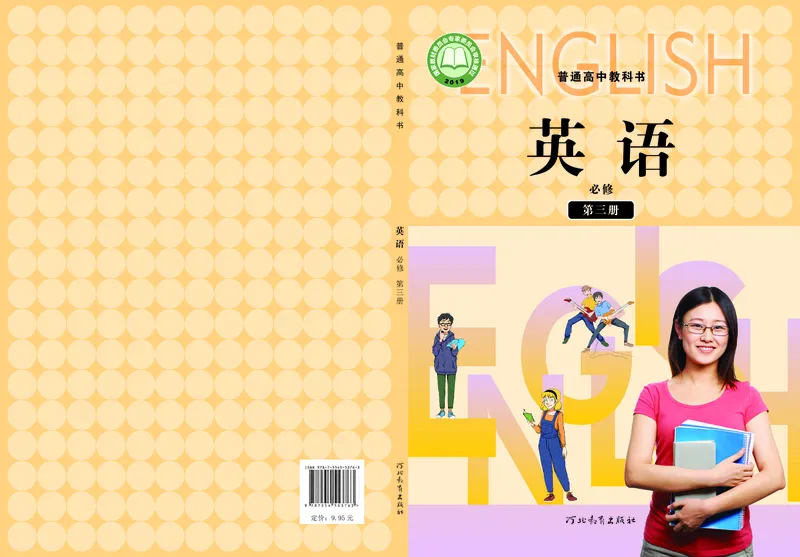
普通高中教科书
中
教
科
书 英 语
选择性必修
第三册
英
语
选
择
性
必
修
第
三
册
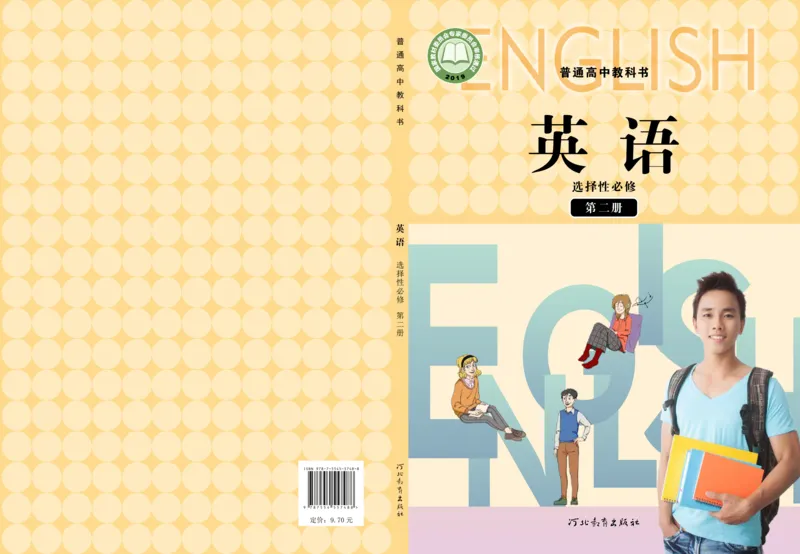
定价:9.70元普通高中教科书
英 语
选择性必修
第三册
[中 国] 河 北 教 育 出 版 社
合作编写
[加拿大] DC加拿大国际交流中心出版者的话
亲爱的同学们:
欢迎使用冀教版高中英语教科书。这套教材由国内外富有英语教育经验的学者、科研人员
及一线教师根据2017版《普通高中英语课程标准》编写。
本套教材必修阶段共3册,满足高中毕业基本要求;选择性必修阶段有4册,满足高考升
学要求;提高类阶段有3册,满足有意继续提高英语能力的发展需求。
让我们了解一下教材的结构。每册教材有5个单元,每个单元包括4个板块。第1板块
(Reading for Meaning)为同学们提供了地道、优美的语篇,文章体裁丰富多样、内容有趣且
富有时代特色;第2板块(Learning through Practice)提供了有意义的语言探究和语言实践活动,
同学们通过完成任务可以体验语言并归纳知识,提高语言运用能力;第3板块(Using English
in Context)设计有专题调查、访问纪实、讨论汇总、活动设计等多种形式的项目活动,帮助同
学们发展听、说、读、看、写等语言技能,为真实语言交际打下基础。第4板块(Expanding
Our Horizons)为同学们提供了更多与单元主题相关的经典、有趣的文章。
另外,教材中的评价部分(Evaluate yourself)可以帮助同学们积极反思学习过程,及时调
整学习策略,提高学习效率;单元反思(Unit Reflection)帮助同学们对整个单元进行回顾;链
接部分(More Connections)便于同学们拓展相关主题知识。
本套教材内容涉及人文、社会、自然、科学等多个领域,注重中外文化的介绍与比较。通
过学习本套教材,同学们会在提高语言能力的同时,增强对中华优秀传统文化和社会主义先进
文化的认识,成长为新时代有文明素养和社会责任感的人。
同学们,中学时代是人生美好的一段时光,相信在使用这套教材的过程中,你们通过自
己不懈的努力和老师的正确引导,能够顺利完成教科书中的学习任务,为终身学习打下良好
基础。
愿同学们在英语学海中徜徉,感受英语学习带给你们的新奇、充实与快乐。Contents
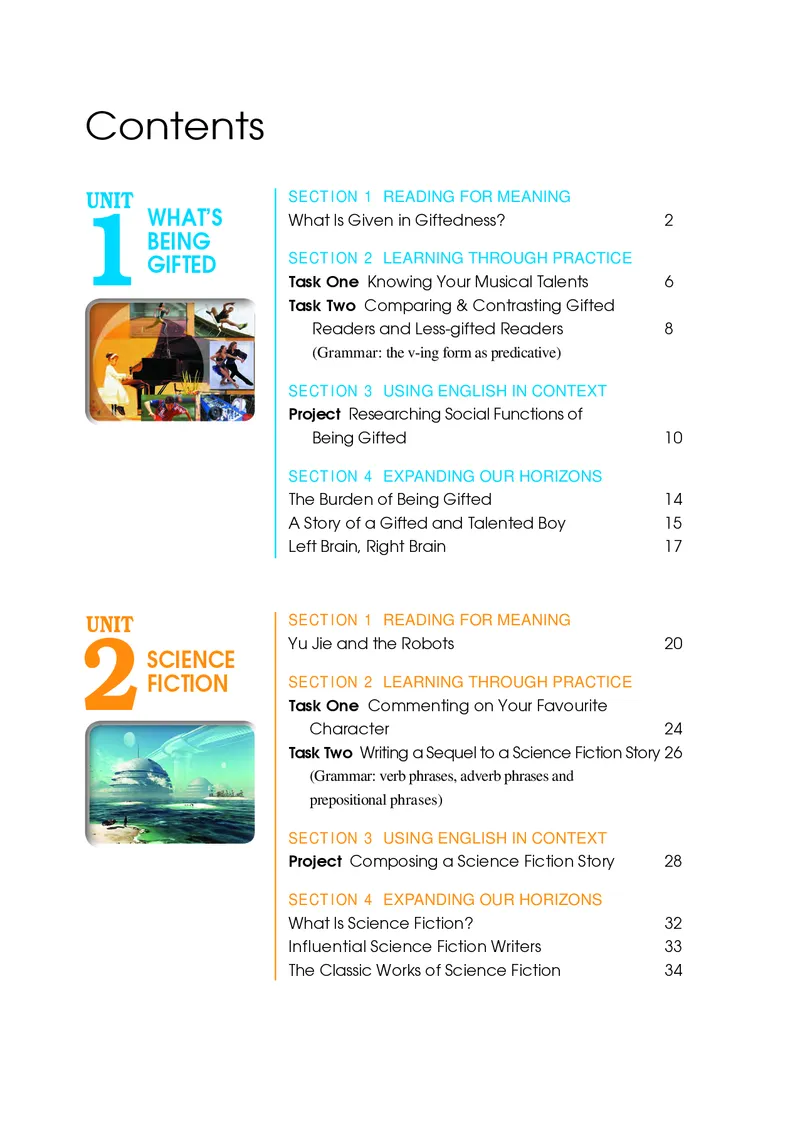
UNIT SECTION 1 READING FOR MEANING
1 WHAT’S What Is Given in Giftedness? 2
BEING
GIFTED SECTION 2 LEARNING THROUGH PRACTICE
Task One Knowing Your Musical Talents 6
Task Two Comparing & Contrasting Gifted
Readers and Less-gifted Readers 8
(Grammar: the v-ing form as predicative)
SECTION 3 USING ENGLISH IN CONTEXT
Project Researching Social Functions of
Being Gifted 10
SECTION 4 EXPANDING OUR HORIZONS
The Burden of Being Gifted 14
A Story of a Gifted and Talented Boy 15
Left Brain, Right Brain 17
UNIT SECTION 1 READING FOR MEANING
2 Yu Jie and the Robots 20
SCIENCE
FICTION SECTION 2 LEARNING THROUGH PRACTICE
Task One Commenting on Your Favourite
Character 24
Task Two Writing a Sequel to a Science Fiction Story 26
(Grammar: verb phrases, adverb phrases and
prepositional phrases)
SECTION 3 USING ENGLISH IN CONTEXT
Project Composing a Science Fiction Story 28
SECTION 4 EXPANDING OUR HORIZONS
What Is Science Fiction? 32
Influential Science Fiction Writers 33
The Classic Works of Science Fiction 34UNIT SECTION 1 READING FOR MEANING
CONFUCIUS
3 Confucius: A Great Teacher and Philosopher
AND
in Chinese History 38
TODAY’S
SOCIETY
SECTION 2 LEARNING THROUGH PRACTICE
Task One Talking about Confucius’ Philosophy
on Learning 42
Task Two Talking about Philosophy in Stories 44
(Grammar: the past perfect tense)
SECTION 3 USING ENGLISH IN CONTEXT
Project Exploring the Major Contributions and
Social Influence of Confucius 46
SECTION 4 EXPANDING OUR HORIZONS
How Confucius Changed My World 50
Are You a Philosopher? 51
The Paradox of Buridan’s Ass 53
UNIT SECTION 1 READING FOR MEANING
4 What Makes Us Human 56
THE RISE OF
BIOENGINEERING
SECTION 2 LEARNING THROUGH PRACTICE
Task One Discovering Reasons for Choosing
Bioengineering 60
Task Two Describing What Biochemists
and Biophysicists Do 62
(Grammar: non-restrictive attributive clauses)
SECTION 3 USING ENGLISH IN CONTEXT
Project Reporting New Developments
in Bioengineering 64
SECTION 4 EXPANDING OUR HORIZONS
The Biotech Century 68
Genetically Modified Plants 69
Chinese Scientists to Develop High-yield
Sea Rice 71UNIT SECTION 1 READING FOR MEANING
5 Smartphone Addiction 74
SELF-
CONTROL
SECTION 2 LEARNING THROUGH PRACTICE
Task One Giving Advice on Fighting Webaholism
78
Task Two Telling a Story about Anger Control 79
(Grammar: the past perfect passive voice)
SECTION 3 USING ENGLISH IN CONTEXT
Project Writing an Advice Column for the
Common Problem(s) of Your Class 82
SECTION 4 EXPANDING OUR HORIZONS
How to Develop and Strengthen Your Self-control:
the Six Secrets 86
Self-control Regained: Tony Russell’s Victory 87
The Fruits of Labour 89
APPENDICES WRAP IT UP! 91
VOCABULARY (I) 106
VOCABULARY (II) 113
LIST OF PROPER NAMES 120
GRAMMAR 122UNIT
1
WHAT’S BEING
GIFTED
Genius is one percent inspiration and ninety-nine percent
perspiration.
– Thomas A. Edison, American inventor
We must have perseverance and above all, confidence in
ourselves. We must believe that we are gifted for something
and that this thing must be attained.
– Marie Curie, Polish physicist and chemist
Genius can be recognized by its childish simplicity.
– Chinese proverb
11
READING FOR MEANING
What Is Given in Giftedness?
BEFORE YOU READ
1 What does “being gifted” mean? What do you expect to read in “What Is Given in Giftedness”?
2 Do you know or have you heard of any gifted children? What are their special gifts?
3 What are the characteristics of gifted children?
Recently Jenny’s school was offering a lecture on “What Is Being Gifted” to students
and parents. David Field, an expert in gifted education, was invited as a guest
speaker. This is an excerpt from his lecture and his discussion with the audience.
David Field:
Good afternoon, everyone. We’re here today to talk about the concept of being gifted and
what it means to high school students. People understand the word “giftedness” differently
and have, over the years, attempted to define the term and its criteria. While there is no
reliable, single, agreed-upon definition in the study of gifted education, at minimum, it
is apparent that some children have abilities that distinguish them from their peers. These
children demonstrate advanced abilities and express interest in one or more areas of
learning. When these abilities are developed, there may be no limits to a child’s potential.
Would anyone like to share their experiences with gifted children?
Mrs. Smith (Jenny’s mother):
I have a friend whose youngest daughter, Maya, is a child gifted at the violin. At age 10, she
won a full scholarship to the Curtis Institute to study with the world’s finest teachers, who are
all amazed by her superb talent. No amount of extra work or practice could have contributed to
this child’s gift. Professor, could you explain whether this genius is born or made?
David Field:
Thank you, Mrs. Smith. This is a common question without a definite answer. Only recently has
science begun to do a thorough exploration of the cultural and biological roots of child geniuses.
Studies show that raw intelligence, as measured through IQ tests, is inheritable, but the connection
between brilliance and behaviour is far from absolute. Geniuses tend to master very specific skills.
My favourite example is Tathagat Avatar Tulsi, an Indian physicist. At age six, he could take any
2UNIT 1 WHAT’S BEING GIFTED
date in history and instantly figure out which day of the week it was. The newspapers named
him the “computer brain”. This type of intelligence cannot be inherited.
However, more and more experts agree that a child’s upbringing has a big impact on his
or her possible giftedness. According to an educator, “Geniuses are half born, half made.”
Parents provide stimulating environments: a home full of books, for example. These parents
read to children at an early age and take them to cultural events. They allow their kids a
higher degree of independence.
Mr. Harmer (Jeremy’s father):
Professor, I’m sorry to interrupt. It seems that the giftedness mainly concerns a select few.
What does it mean to students who are not gifted?
David Field:
Great question, thank you! Each child is born with his or her own unique potential,
capabilities and limitations. Therefore, we should discover, nurture, and help them develop
their gifts. It’s important to remember to treat giftedness as an “ordinary difference”, just
as some children are taller or shorter than their classmates, or have varied interests and
personalities. All children must be equally valued and appreciated for their unique natures
and talents. Although gifted children are still children, their superior skill requires different
tools and a broader understanding in order to ensure their positive development and
satisfying educational outcomes. Let’s hear from some students now.
Jenny:
Professor, do gifted children have specific characteristics?
David Field:
Gifted children are not all the same. Research suggests that even though some characteristics
indicate giftedness, not all children will demonstrate all gifted behaviours, in all contexts,
3UNIT 1 WHAT’S BEING GIFTED
at all times. There’s a range of types and degrees of giftedness. It affirms a child’s potential
for growth and achievement, and parents and teachers should provide them with the tools
they need. However, giftedness is a developmental concept that doesn’t guarantee superior
success or otherwise.
Danny:
Professor, my name is Danny. Is being gifted good or bad?
David Field:
Hi, Danny. Giftedness is a delicate mixture of blessing and burden – these children learn
quickly and more easily, but if their gifts aren’t valued or they aren’t challenged and stimulated
in the classroom, they may lose interest. Other students might also dislike these exceptional
students. Gifted kids may enjoy their capacity for creativity, insight, and understanding that
both enrich their experience and astonish others, but there are certainly some challenges in
terms of keeping up with their learning and finding appropriate environments where they
can grow and be happy. The main purpose of this lecture is to help students, teachers, and
parents realize that gifted students need support in order to succeed, but also that all students
have something to contribute. It’s important for us to take the time to listen and guide this next
generation. I’m optimistic that our kids will accomplish great things.
AFTER YOU READ
Reading Comprehension
1 What is the major purpose of David Field’s lecture? How does David Field define “giftedness”?
2 How does David Field begin his lecture? And how does he end the lecture? What are the benefits
of doing it like this?
3 Does “this type of intelligence” refer to raw intelligence or behaviour of geniuses according to
Paragraph 3? Can it be inherited?
4 What does David Field want to show by mentioning the Indian gifted child, Tathagat Avatar Tulsi?
5 What is David’s attitude towards giftedness by saying “ordinary difference” in Paragraph 5?
6 According to David Field, why is giftedness a delicate mixture of blessing and burden for children?
Post-reading Activities
1 Suppose you are also attending David Field’s lecture. Now it is your turn to ask David Field some
questions. Write down three questions about the issue of “being gifted” on a piece of paper and be
4UNIT 1 WHAT’S BEING GIFTED
ready to ask your group these questions. In groups of three or four, each group member will act as
a student attending the lecture and David Field in turn.
2 Some people suggest that “we stop trying to fit in when we were born to stand out”, but others think
successful people are not gifted; they just work hard, and then succeed on purpose. What do you think of
these two different views? Discuss in groups and share your opinions with some supporting examples.
3 Discuss in groups. What should we do in our growth once we have found we are gifted in certain
areas? How should we do things in areas where we are not gifted?
4 View the pictures and discuss. Do you think you have some inborn talent different from your peers?
What would you do to develop it?
NATURALIST INTERPERSONAL LOGICAL-MATHEMATICAL VISUAL-SPATIAL
Nature Smart People Smart Number Smart Picture Smart
INTRAPERSONAL BODILY-KINESTHETIC MUSICAL LINGUISTIC
Self Smart Body Smart Music Smart Word Smart
SONG
Gifted
I knew a girl who could solve any problem
to her, numbers were a joy.
I knew another child who played Mozart
even though he was a little boy. Perhaps all of us have a special gift
something special that we do.
I saw a man who could run faster
Just giving people’s spirits a really nice lift
than anyone else in the land.
is a talent that makes you gifted too.
One day he decided to try to race.
There are now many medals in his hand. Whatever your gift you have inside you
however it develops over time
What is it like to see a little further?
you owe it to the world to show it
How does it feel to reach a little higher?
or else it’s just gold in the mine.
What does it mean to be so very gifted?
It means you have a great responsibility.
52
LEARNING THROUGH PRACTICE
Task One Knowing Your Musical Talents
Are you musically talented? A gifted musician would be able to play a song on the guitar even
when hearing it only once. In this task, you will get a better understanding of your musical
talents. First, you will read a list of musical talents and check whether you have them. Then,
you will discuss the results in your group and share your opinions.
Step 1 Pre-task Resources
Here is a list of ten characteristics of musically talented people. Check it with your own
situation and decide whether you are more or less musically talented.
CHARACTERISTICS OF MUSICALLY TALENTED PEOPLE
1 Natural response to rhythm and music
2 Love for singing familiar and made-up songs
3 Good sense of tone colour
4 Memory for music heard
5 Appreciation for the structure of music
6 Highly developed ear
7 Ability to relate tune to visual symbols
8 Use of music to express feelings
9 Focus on music
10 Desire to take music lessons or play an instrument
6UNIT 1 WHAT’S BEING GIFTED
Step 2 Exploring the Language
1 Examine the first seven items (1–7) in the list of Step 1. Fill in the table based on the
information provided in the list.
Adjective Preposition Noun/V-ing/
Noun Other element
(phrase) /Infinitive marker Infinitive
rhythm and
1 natural response to /
music
familiar and
2 / singing
made-up songs
3 good of /
4 / memory
5 / appreciation
highly
6 / / /
developed
7 / ability
2 Change the remaining three items (8–10) in the list into complete sentences. The first
one is already done:
Use of music to express feelings
If a person usually uses music to express his/her feelings, (we tend to believe/
think that) he/she has musical talent.
Now, it is your turn to change the last two items into complete sentences:
Focus on music
______________________________________________________________
Desire to take music lessons or play an instrument
______________________________________________________________
Step 3 Task Cycle
1 Read the list in Step 1 again and make sure you fully understand what it means.
2 Work in groups and share how you judge yourself – musically talented or not. Remember to
use the new words and collocations you have learned in Step 1.
3 Choose one student as the representative of your group and report your cases in front of the class.
7UNIT 1 WHAT’S BEING GIFTED
Task Two Comparing & Contrasting Gifted Readers and Less-gifted Readers
In this task, you will get a deeper understanding of gifted readers by comparing and
contrasting gifted readers with less-gifted ones.
Step 1 Pre-task Resources
Read the passage carefully and pay attention to the sentences in blue.
According to some scientific research, children who
have unusual ability in reading and working with text
information are considered gifted readers. Their reading
abilities develop naturally without formal instruction.
They usually have advanced language abilities when
compared with their peers. They use words easily,
accurately, and creatively in new contexts and speak in
complex sentences.
Gifted readers, also called talented readers, have
characteristics and learning needs that differ from their
peers. These students use more varied reading strategies
in context than their less-gifted peers do. These
strategies are rereading, analyzing structure, predicting,
evaluating, asking questions, and remembering the main idea and details.
Gifted readers are those who are reading with ease. Gifted readers’ great enjoyment
is reading. They read more than their peers do. Gifted readers take reading first as
a pleasurable activity and second as a way to get information. In contrast, many
less-gifted readers take obtaining information as the primary reason for reading, with
leisure being secondary. Gifted readers read various text types and spend more time
reading than less-gifted readers do. Gifted readers are also better able to self-manage
their behaviour to read, which is a strategy that allows them to focus on the text
when they are reading.
Step 2 Task Cycle
1 Read the passage in Step 1 again and make sure you fully understand it.
8UNIT 1 WHAT’S BEING GIFTED
2 Complete the table to find the differences between gifted readers and less-gifted readers.
Gifted readers Less-gifted readers
Reading strategies adopted
Motivation of reading
Time spent
Self-regulating
3 Write a short paragraph of 5 – 8 sentences to report the major differences between gifted
readers and less-gifted ones. Remember to use the key expressions you have learned so far.
Step 3 Language Focus
The v-ing form can be used as predicative. Here are two examples in Step 1:
● Gifted readers’ great enjoyment is reading.
● These strategies are rereading, analyzing structure, predicting, evaluating,
asking questions, and remembering the main idea and details.
The structure of using the v-ing form as predicative is as follows:
subject + link verb + the v-ing form
● What annoyed me most was his accepting everything.
The v-ing form combines nominal and verbal features. Here are more examples:
● The main thing is getting there in time.
● My hobby is dancing.
● Seeing is believing.
How can we tell the v-ing form as predicative? Generally speaking, the answer is that the
subject and the predicative can be interchangeable.
● My hobby is dancing. → Dancing is my hobby.
93
USING ENGLISH IN CONTEXT
Project Researching Social Functions of Being Gifted
In this project, you will first read a passage and discuss the meaning of being gifted. Then,
you will listen to a story and share what you have learned. You will explore and discover the
social functions of being gifted and understand how you can better nurture or develop your
giftedness. Finally, based on your research, you will write a paper about the topic.
Step 1 Read and Discuss
Read the passage, and then discuss the following questions in groups.
The Meaning of Being Gifted
Discovering your gift means finding
what makes you different and
unique. It’s about realizing what
makes you, you – and me, me. But
this is not something you can simply
determine by yourselves; it depends
on the opinion and appreciation of
others, without which your gift may
never bear fruit, and you may never
“find yourself”.
A well-developed gift which shines
through our ordinary routines helps
us understand that all the good
things can be achieved, but that we
cannot accomplish them by ourselves. When others realize their own gift, we see
the potential we each carry. This explains why we feel so inspired after witnessing
a fantastic performance or success. Others’ talents encourage us to study harder, or
simply question our own unique purpose in life. Others’ gifts help us understand
our own gifts better. A gift realizes itself, then, not just in self-realization but to the
extent that others are drawn into a consideration of its broader, deeper, and inner
meaning.
10UNIT 1 WHAT’S BEING GIFTED
Can we “discover our gift” on
What do we see, or learn from
our own? How does it relate to
a well-developed gift that shines
other people?
through our ordinary routines?
Why do we feel inspired when we Being gifted is inherited. But it
see an amazing performance
of
is also developed by external
g
ve
if
r
te
y
d
g
n
if
e
t
s
e
s
d
m
pe
e
o
a
p
n
l e
to
?
u
W
s
h
?
at does their
e
in
x
f
t
l
e
u
r
e
n
n
a
c
l
e
in
s.
f lu
W
e
h
n
a
c
t
e
a
s?
re
H
t
o
h
w
e m
ca
a
n
jo r
we develop
our gift?
Step 2 Listen, Fill in Blanks and Discuss
Listen to a short story and fill in the blanks. After you finish, think about the meaning of the
story. What do you learn from the story? Why did the grandpa in the story ask the writer to
think of himself as the stone? How does an individual’s attitude affect others? Discuss and
share what you have learned from the story with your classmates.
The Splashes of Life
My grandfather took me to the fish pond on a farm when I was about seven years old.
He had me ____________ a stone into the water and told me to watch the small waves
____________ by the stone. Then, he asked me to think of myself as that stone.
11UNIT 1 WHAT’S BEING GIFTED
“You may create a lot of splashes in your life, but the waves that come from those
splashes will break up the ___________ of all your fellow creatures,” he said.
“Remember that you are responsible for what you put in your circle and that the
circle will also ___________ many other people.” I nodded along, hoping to
understand. My grandfather knelt down to look into my eyes.
“You will need to live in a way that ___________ the goodness from your circle
to spread to others. A splash that comes from anger or envy will send those
___________ to other circles. You are responsible for both.”
That was the first time I ___________ that each person creates a part of the inner
peace or disharmony that flows out into the world. We cannot achieve world peace if
we are burdened with inner conflict, hate, doubt, or anger.
We share the feelings and ___________ that we hold inside, whether we speak them
aloud or not. Whatever is splashing around inside of us is spilling out into the world,
creating beauty or pain ___________ all the other circles of life.
Step 3 Explore, Contrast and Discuss
Surf the Internet, or read library books to try to
1 find some information about a few gifted people
and see how their talents have contributed to
the life of others or of the general public. Make
a list of their positive contributions.
2 3
Try to find some information about a few Discuss in groups of four or five. In your
gifted people, who were too selfish to discussion, make sure you cover the following
selflessly share their talents. Eventually topics:
they probably lost their talents or were ● Positive contributions of the gifted to
ruined by their talents. Take notes of what society
you have found or read. ● Problems and challenges of the gifted in
their growth
● Major external influences on developing
the giftedness
12UNIT 1 WHAT’S BEING GIFTED
Step 4 Analyze and Write
Based on your research and discussion, your group will work together and analyze what you
have found, and then write your group research paper about major social functions of being
gifted and how we can better nurture our gift. It is suggested that your paper include:
● your understanding of being gifted;
● positive contributions of the gifted;
● problems and challenges of the gifted in growth;
● suggestions for developing our giftedness.
Evaluate yourself!
Can you comment and give your opinion in English about your gift?
Which matters more, your gift or your effort? Can you tell from your past experiences of success?
How well have you done with the following? Tick the circles that best reflect your performance.
Excellent Very Good Good Needs Improvement
Finding both the advantages and
disadvantages of being gifted
Making necessary repetition and explanation
when talking or giving a speech in English
Surfing the Internet to find more information
about the meaning of being gifted
134
EXPANDING OUR HORIZONS
The Burden of Being Gifted
Little Mark may have only just turned six, but he has the
DO YOU KNOW?
intelligence of someone four times his age. He has an IQ of
200 and is a genius among geniuses. IQ is short for intelligence quotient,
which is a total score designed to
Mark has been fascinated with the way the world works assess human intelligence. It was
since he was a baby. His mother, Rachel, says that by the coined by the psychologist William
Stern.
time he was three, Mark was reading fluently, and he was
mostly self-taught. She and her husband haven’t been able
to keep him away from books since.
“I tried many times to stop him from reading. We worry
about this addiction because he constantly wants to read
everything, whether it’s a comic book or the newspaper.
He’ll read all day and it’s very hard to get him outside to
throw a ball or run around.”
A psychologist at the Gerric Centre for gifted
children at the University of New South Wales
tested Mark and determined after several trials,
that his IQ is 200, which is in the “highly gifted”
range. The average child of Mark’s age has an
IQ of 100. Gifted children are around the 130
level. At 200, Mark is a genius – even compared
to other child geniuses.
“With children like Mark, you can tell they’re
bright as soon as they walk in. They just have
this sort of intensity, and often they’re not so
good at relating to people,” the psychologist
said. “He will never fit perfectly into a class
where he’s with children of his age.”
But Mark’s mother worries about the social
isolation that accompanies the IQ score. “Nobody
14UNIT 1 WHAT’S BEING GIFTED
wants their child to grow up with that image. I want him to be able to communicate with other
people, but not to be frustrated academically, so it’s really hard to find a balance,” she says.
Helen Dudeney, speaking on behalf of the Talented and Gifted Children Association, says
Mark is one in a million with such a high IQ. She mostly deals with kids who are two in
every hundred – still rare and still difficult for the public education system to handle. “The
teachers aren’t trained in teaching gifted children,” says Dudeney, “which makes it hard for
both students and teachers to deal with.”
Dudeney also believes it’s vital for those children to be recognized and supported because
of their talents, in the same way that gifted athletes are given extra attention. “Initially,
they may not realize they’re in the very high range. Very often, parents find their kids
different from the other kids in the preschool or playgroup. While the other kids are playing
with sand, and clay, Mark is thinking about something as complicated as how a missile
is launched, what causes a typhoon or how a bomb is exploded. However, what parents
notice first is always that their children don’t mix with other children, but they may not
think it’s because they’re gifted,” she says.
Mark’s parents are trying to figure out how to best help their son. At the moment, there
are few options. Mark finds first year work painfully boring and simple, but he must learn
to complete the work. His mother says, “We just want him to be happy. To have a happy
childhood, to be content, and to want to go to school every day.”
POST-READING QUESTIONS
1 Is Mark in the story a gifted child? What does this mean to his parents? To his school?
2 What is Mark’s problem in his growth? Why do Mark’s parents worry about him?
3 What do you think should be done to help Mark?
A Story of a Gifted and Talented Boy
When he was nearly three years old, Nguyen Ngoc Truong Son, a sensitive child, watched his
mother and father playing chess in the family’s poor home in the Mekong Delta, and like any
young child, bothered them until they let him play, too. To their astonishment, not only did
Son know how to set up the board, he had also learned many of the complex rules of the game.
Within a month, he was defeating his parents with ease. By the age of four, Son was competing
15UNIT 1 WHAT’S BEING GIFTED
in national tournaments against opponents many years
older. By age seven, he was winning them. Now, at age
twelve, he is Vietnam’s youngest champion and a future
grand master.
Son’s parents – teachers with a weekly pay of less than
$30 – are at a loss to explain their otherwise ordinary
child’s talents. “It’s a natural gift,” says his father. “You
couldn’t train an ordinary three-year-old to play like that.”
QUICK CHECK!
The young genius, for his part, doesn’t think the question
is worth chewing over. To him, the strategies and logic of To chew something over means
that you think about something over a
chess play comes as naturally as chewing gum. “I just see
period of time.
things on the board and know what to do,” he says. “It has
always made sense to me.”
How a child genius like Son comes by his talent has
never made much sense to scientists. Throughout history,
geniuses have been celebrated as objects of envy and
admiration. Rarely, however, have they been understood.
Often made fun of by their peers, hunted by the press, and
tied to expectations of greatness, they are treated as both
a riddle and a fantastic treasure. In the words of Maria
McCann, a specialist in the education of gifted children,
“They’re our beautiful freaks.”
POST-READING QUESTIONS
1 What happened to Son in the story? Is it amazing?
2 What do Son’s parents think of his talents? What does it mean to Son?
3 What problems and challenges do child geniuses have?
16UNIT 1 WHAT’S BEING GIFTED
Left Brain, Right Brain
Are you good at mathematics? How about writing poems or painting beautiful pictures? Do
you love to sing, or would you rather sit down and work out a complicated puzzle? It all
depends on whether you are a “right-brain” or a “left-brain” person.
The human brain is truly an amazing organ. It’s not easy to study the brain, but science
is slowly beginning to understand how it works. The brain is divided into two equal but
separate parts: the left side and the right side. Some people use one side of the brain more
than the other.
We can understand a lot about our learning skills based on which side of the brain we use
most. It’s still a theory, but many brain specialists are convinced that most of us have a
tendency to be either left-brain or right-brain people.
Although everyone uses the left and right sides of the brain equally at birth, we gradually
begin to use one side of the brain more than the other. Only a small minority of people
continues to use them equally later in life.
Left-brain people stand out in math, science, and reading. They do well in school. They
concentrate easily, and can focus on specific tasks. They like to work independently, and
often enjoy studying alone.
Right-brain people are good at arts. They love the symphony and singing. They like to be
around lots of people, and they learn best in groups. They are more active. It isn’t surprising
17UNIT 1 WHAT’S BEING GIFTED
if they become photographers, painters or novelists.
The fact that you use one side of your brain more often doesn’t mean that you don’t use the
other side. It just means that you prefer one side to the other. One way is not better than the
other. The division only indicates the way you learn best.
Think about your friends. What are they good at in school? How do they study? If your best
friend loves painting, she is probably a right-brain person. If she really shines when working out a
complicated math problem or submitting a lab report, chances are that she is a left-brain person.
What about you? Which side of the brain do you think you use most often?
POST-READING QUESTIONS
1 What is the main idea about our left brain and right brain? What do you think of the idea?
2 What are the major differences between left-brain people and right-brain people?
3 Are you a right-brain person or a left-brain person? What are you good at?
Unit Reflection
Review the whole unit and reflect on what you have learned.
1 Do you think that we are all gifted in something? Do you think you are gifted? What is
your gift? What have you learned about “being gifted” in this unit? Its definition and
social function? Its benefits and problems?
2 What have you learned about ways of developing our gift from this unit? What are the
major differences between gifted people and successful people? How do you value the
role of “being gifted” and “being diligent” in our growth?
3 Do you use the v-ing form as predicative in writing or speech in English? What have
you learned about the structure and use of the v-ing form as predicative from this unit?
More Connections
● Would you like to know more about the topic of this unit? If so, you can read the book The
Talent Code written by Daniel Coyle. This work uncovers the secret of talent, and tells
us how we can unlock it and provides us with tools we can use to maximize potential in
ourselves and others.
● If you want to discover more stories about talent, watch the 2017 American drama
film Gifted directed by Marc Webb. A 7-year-old girl named Mary shows remarkable
mathematical talent on her first day of first grade. Mary is offered a scholarship to a private
school for gifted children. However, her uncle, Frank, turns it down.
18UNIT
2
SCIENCE FICTION
Science fiction writers foresee the inevitable, and although
problems and catastrophes may be inevitable, solutions are not.
– Isaac Asimov, Russian-born writer
Science fiction encourages us to explore... all the futures, good
and bad, that the human mind can envision.
– Marion Zimmer Bradley, American author
With science fiction there’s endless possibilities.
– Anna Torv, Australian actress
191
READING FOR MEANING
Yu Jie and the Robots
BEFORE YOU READ
1 How much do you know about science fiction? Have you read any?
2 Did you have any experiences with using robots? What can they do? How do we use robots in our life
and work?
3 What kind of robots do you expect to see in this story? Nice and friendly to humans? Or very rude and
out of control?
Yu Jie wandered aimlessly in her
dreams. This peaceful sleep was
broken by the soft voice of her
personal robot: “It is 7 o’clock on
March 27, 2172. You must now
wake up.”
Yu Jie opened her eyes at the sound.
She could feel her heart racing in her
breast as she thought ahead. Today,
she would take her entrance exams
to prove her qualification for the
2172 directory of Best Colleges in
the galaxy: Intergalactic Academy 100. The Academy was built as part of a large satellite
that orbited the Earth. Yu Jie threw open the window. She fell to the floor, clutching her
chest, unable to tolerate the extreme heat. Her robot immediately rushed to her side.
“Yu Jie, you must not forget to wear your breathing device,” the robot said, closing the
window. “I can’t believe humans used to walk around in the air without breathing devices
or space suits to protect them from the threat of intense heat on every street corner,” Yu Jie
sneezed and rubbed her nose. “The radiation is too strong now.”
Yu Jie arrived at her high school, a little nervous but confident. The guard robot that stood at
the gate scanned her fingerprints and her eyes. Yu Jie took a garlic capsule to give herself
extra energy. The usually crowded building was strangely quiet.
“Right this way,” the guard robot said. She inspected him closely. His uniform was made of
20UNIT 2 SCIENCE FICTION
a wool fabric. The robot took Yu Jie to a room filled with other kids. When she entered, they
stared at her and whispered. The robot forcefully shut the door.
“No more talking!” it yelled. Yu Jie was astonished. She had never heard a robot yell. As she
stepped backward, confused, she felt a sudden rush of heat as her space suit was torn off her
left arm. An intense cold followed. It started at her waist and went all the way to her wrists.
After that, everything was black.
After an unknown duration of time, Yu Jie awoke and found herself chained to a boy, whom
she later came to know as Li Ming. She did not have a clue about what was happening.
“Where am I?” Yu Jie asked.
“The outer reaches of the universe, where the robots conduct their experiments,” Li Ming
replied.
“What experiments?” Yu Jie asked fearfully.
“Experiments on us. Every day, the robots take us out and search for weaknesses. They want
to know how to best use their weapons against us. And worst of all, they want to clone us to
conquer the rest of humanity!”
“What have they done?” Yu Jie asked.
“First,” Li Ming whispered, “they polluted the air. They hoped we would be greatly
weakened or even choke to death because of the pollution. Today, they are testing the effects
of exposure to extreme heat followed by extreme cold.”
The next morning, the two awoke to the sound of shouting. The robots were driving people
into testing areas. Yu Jie was taken by the arm and led into a room with steel bars. A robot
pushed her into a metal chair and her arms and legs were attached to the chair. Another robot
lowered a giant microscope to her level and focused it on her face.
Yu Jie sat for a couple of minutes in complete
fear. Suddenly, her left side was hit with a blast
of cold. Then came the heat, and soon she went
completely numb. Sweat poured down her
body and she begged for water. She passed out
as the robots released her from the chair.
When Yu Jie regained consciousness, she
found Li Ming placing a cool, damp towel on
her forehead.
“We have to get out of here – we have to
escape,” mouthed Yu Jie. Li Ming looked
away.
21UNIT 2 SCIENCE FICTION
“If only it were that easy,” he replied sadly. He was
pessimistic regarding their chances of survival.
QUICK CHECK!
“This is an emergency!” she cried. “Do the robots ever get
together and leave us? What about their backup source of If you have a second piece of
power? I know that my robot at home is solar powered and equipment or a plan as backup, you
have arranged for it to be available
refuels while it’s plugged in until the sun has risen.”
for use in case the first one is
“Well, I have heard that they have a hydrogen power source
unsuccessful.
very far from the place where we’re being held, but it’s
dangerous there,” Li Ming answered. They whispered and
planned all night.
When the guards entered the room the next morning, Li
Ming pretended to be very sick in bed. When the robots
approached him, he jumped up and unplugged their vision
cord. They were temporarily blinded. Li Ming and Yu Jie
were able to escape.
They started on their journey. The air was hot and foggy
and the land was rocky, full of mountains and caves. They
had been walking for hours when they reached a massive
mountain. Li Ming convinced Yu Jie that going around
would take too long.
“We have to do this not just for ourselves, but for all people,
and especially for all of the children trapped by the robots.
We must make our maximum effort and achieve this
urgent goal,” Yu Jie shouted. Li Ming steeled himself and
started to climb.
The two climbed the mountain and found the power
source, which wasn’t guarded. The children used rocks
to disconnect it. Every robot fell to the ground and the
prisoners went free. Yu Jie and Li Ming were heroes.
“It’s already 7:15. Time for you to wake up.” Yu Jie opened
her eyes, and saw her mother standing a millimetre from
her face. “Wake up! You have a test today.”
“What year is it?” Yu Jie asked.
“2019! Oh, my dear, if your memory is that bad, you’ll
have a difficult time with the test.”
22UNIT 2 SCIENCE FICTION
AFTER YOU READ
Reading Comprehension
1 Does the story have a theme? What is it? What does the author want to express about the
relationship between humans and robots?
2 In the story, Yu Jie’s dream followed the time and space sequence. Can you identify the time and
space markers for the setting of the dream?
3 What happened to Yu Jie in her dream? What did robots want to do to Yu Jie and Li Ming?
4 What difficulties did Yu Jie and Li Ming meet on their way to the power station?
5 What would happen if Yu Jie and Li Ming failed to disconnect the robots’ power source?
6 How did Yu Jie and Li Ming become heroes in the story? What does it mean to us?
Post-reading Activities
1 Interviewing characters. One of you will play the role of Yu Jie, and the other, Li Ming. The third
interviews and asks questions that draw on the characters’ personality and events in the story.
2 Understanding the plot structure. The following terms are components of the plot structure in science
fiction: orientation, complication, climax, resolution. Work in pairs and fill in the table below about the
story, Yu Jie and the Robots.
Elements of plot structure Contents in Yu Jie and the Robots
Orientation
(beginning of the story, characters, time, place)
Complication
(events, problems, conflicts)
Climax
(most exciting part, turning point)
Resolution
(problem solved, ending of the story)
3 Compare the story of Yu Jie and the Robots with the story of The Little Match Girl. In groups, compare
and contrast the similarities and differences between the stories, including characters, setting (both
time and place), plots, etc.
4 As robots become more humanized, some people hold that the future robots will bring more
threats to human beings. Others, however, believe they will bring more services. Discuss and give
your opinion.
232
LEARNING THROUGH PRACTICE
Task One Commenting on Your Favourite Character
In this task, you will read two excerpts of character descriptions and comments on them.
Then you will find a similar excerpt of a character description from one of your favourite
fiction stories, and write your comments on the character.
Step 1 Pre-task Resources
Imagination is used in fantasy magic fiction and science fiction. Read two excerpts from
fantasy magic fiction and their comments. Focus on the descriptive language.
From Lord of the Rings: The Fellowship of the Ring,
by J.R.R. Tolkien (page 274)
The face of Elrond was ageless, neither old nor young,
though in it was written the memory of many things
both glad and sorrowful. His hair was dark as the
shadows of twilight, and upon it was set a circlet of
silver; his eyes were grey as a clear evening, and in
them was a light like the light of stars.
Comments: I could almost feel night falling as I read that passage. I first pictured the
grey of evening, but by the end of the passage, I imagined the night sky. Despite the
claim of agelessness, I got the impression that Elrond is of great age.
From Harry Potter and the Philosopher’s Stone,
by J.K. Rowling (page 8)
If the motorcycle was huge, it was nothing to the man
sitting astride it. He was twice as tall as a normal man
and at least five times as wide. He looked simply too
big to be allowed, and so wild – long tangles of bushy
black hair and beard hid most of his face. He had
hands the size of trash can lids, and his feet in their
leather boots were like baby dolphins.
24UNIT 2 SCIENCE FICTION
Comments: The idea that Hagrid is “simply too big to be allowed” is fantastic – it’s
the Dursleys’ viewpoint flowing through, but also emphasizes how big and unruly he
seems. Rowling’s comparisons to baby dolphins and trash can lids are comical and
lodge themselves in my brain.
Step 2 Exploring the Language
In fiction stories, literary devices are often used to describe characters’ appearance and
character. They help the reader to create images in the mind. Please read some examples
from the two excerpts in Step 1. Then read the table about literary devices.
● His hair was dark as the shadows of twilight,…; his eyes were grey as a clear evening,
and in them was a light like the light of stars.
● … his feet in their leather boots were like baby dolphins.
Literary devices Meaning and examples
A comparison between two things using like or as
Simile
e.g. His feet in their leather boots were like baby dolphins.
A direct comparison between two things
Metaphor
e.g. The storm was a raging beast.
Attributing human characteristics to objects, ideas, animals or nature
Personification
e.g. She could feel her heart racing in her breast as she thought ahead.
An understanding of these literary devices is not only helpful in creating pleasurable reading
experiences, but also useful when we write stories of our own. In addition to recognizing
literary devices in a story, it is important to understand how the author uses the devices to
create a particular effect.
Step 3 Task Cycle
1 Recall a fictional character who impressed you most from a fiction story in English.
2 Go back to the story and find the excerpt that describes your favourite character. Read the
excerpt again and see how the author tried to create an image, and examine what literary
devices this author used.
3 Copy or type this excerpt and write a brief comment (4 – 5 sentences) on the literary devices
used and their effect.
25UNIT 2 SCIENCE FICTION
Task Two Writing a Sequel to a Science Fiction Story
In this task, you will read a short science fiction story. Then you are invited to write a sequel
to it. While doing the task, please pay attention to the sentence structures and writing style of
the story and make your writing coherent in content and style with the original story.
Step 1 Pre-task Resources
Read the following part of a science fiction story and pay attention to the words in blue.
Last night, in his dreams, Eric became a monstrous ant, and had been digging himself
a passage in the fresh, soft earth. The dream was incredibly realistic. When he awoke,
he felt tired as if he had actually been digging. His arms ached, and he was astonished,
upon examining his hands, to find them raw. He had dirt under his nails.
Dressing hastily, Eric rushed to the backyard. Sure enough, near the fence, was
a large hole about two feet wide and three feet deep. Hurriedly, he filled it in and
returned to the house.
“I must rest for a few days. I think I’m suffering from the intense excitement caused
by my investigations,” he said to himself. “At this time, I feel that I should make a
brief summary of my findings with respect to the ants, so that Barclay may go over
these notes upon his return from his vacation.”
Step 2 Task Cycle
Group discussion.
● What did Eric do in the dreams?
● How did Eric feel when he woke up?
● What is the probable relationship between
Eric and Barclay?
Individual work. Make up a short sequel to this
story with those five words in blue.
Group work. Tell your story to
your group members.
26UNIT 2 SCIENCE FICTION
Learning tips
Any prediction about the future must be based on whatever science or
technology we already have or have conceived to make the prediction
as “real” as possible.
Step 3 Language Focus
A sentence is composed of words grouped into phrases and clauses. Analyzing a sentence
and its components helps you understand it better, and enables you to write better
sentences. In the fiction story of Step 1, we can find verb phrases (VP), adverb phrases (AP)
and prepositional phrases (PP). They act as different components.
● A verb phrase (VP) can be used as a predicate indicating an action or as an adverbial
indicating an action which happens “before or while” the predicate in the sentence.
● An adverb phrase (AP) can be used as an adverbial.
● A prepositional phrase (PP) can be used as an adverbial indicating time or a place,
or as a post modifier to modify a noun.
Then we can analyze two sentences as follows.
● Last night, in his dreams, Eric became a monstrous ant, and had been digging
PP (adverbial) VP (predicate)
himself a passage in the fresh, soft earth.
P P (adverbial)
● Dressing hastily, Eric rushed to the backyard. Sure enough, near the fence,
VP (adverbial) AP (adverbial) PP (adverbial)
was a large hole about two feet wide and three feet deep.
PP (post modifier)
273
USING ENGLISH IN CONTEXT
Project Composing a Science Fiction Story
Science fiction is a genre of fiction in which the stories often tell about science and
technology of the future. In this project, you will use your imagination and knowledge of
science to write a science fiction story in groups.
Step 1 Read, Compare and Discuss
Read the following passage and then compare and contrast the major differences between
short stories and science fiction stories. Discuss the major features of science fiction stories.
Writing a Science Fiction Story
Science fiction refers to writings that describe a future shaped by the effects of
science or technology that has not yet come to pass. Science fiction stories usually
centre on a scientific advance or a major change in the environment. They aim to
change our perception of what could be real and normal by taking us into other,
imagined future worlds. Common subjects include the future, travel through space
or time, life on other planets, and crisis created by sentient technology or alien
creatures and environments.
“Imagination is one of the core elements for writing science fiction,” said Chinese
writer Liu Cixin as he recounted the writing process of his award-winning novel, The
Three-body Problem. He explained that being open to any possibility, reading science
fiction stories, and writing down all your ideas for later writing will help you create
your own science fiction story. Developing your knowledge of science and technology
will help you write stories that are not wild fantasy, but plausible futures or real-world
events. To make our science fiction stories attractive, it is important that we include
crises, puzzles, unexpected endings, and cliffhangers in our writing. These are some
essential elements which will make a science fiction writer successful.
2288UNIT 2 SCIENCE FICTION
Step 2 View, Read and Discuss
View the following pictures and then read the passage. When you finish, fill in the table. Try
to see if the house in the future is comfortable and smart, and how it is different from the
house we have now.
The House of the Future
How will we live in the future? We can expect to see devices that are not only more
efficient but also provide global connectivity between people and machines, allowing
them to “talk” seamlessly to one another. New technology will offer the possibility
of a life of knowledge and entertainment.
Great changes may take place in living rooms. Dreams of interacting with the
television would come true. Rather than hunting around for the remote control, users
could simply say “pause”. Maybe they will wave their arms to browse through a list
of programs. Maybe televisions will be accompanied by retractable, high-definition
cameras which could show you what your friends and family are watching and ask if
you’d like to simulate the experience of all gathering around the same set.
The bathroom of the future will combine energy-efficient and water-conserving
technology with tasteful, space-saving design. We’re likely to see an increasing
number of houses with smart water metres that will monitor how much water is
used and when. We’ll install showers with more efficient heads. Bathroom scales
will allow you to keep track of your weight online and help you adjust your diet and
quantity and quality of exercise accordingly.
Kitchen products will hopefully be more durable so there is less waste and less
garbage in landfills. Dishes and spoons will be cleaned and polished in an
automatic process. Fridges and freezers will “communicate” with other devices such
as mobile phones, so homeowners can see what’s inside. Via a screen on the door,
appliances could suggest meals to cook with food that you have in the house. Life
could become so much easier!
2299UNIT 2 SCIENCE FICTION
The House of the Future
Changes Advantages
Living room
Bathroom
Kitchen
Step 3 Listen, Answer and Imagine
Listen to an email message sent from Waynoka in the future. Answer the following questions
and learn how Waynoka’s life is different from ours.
■ When and where does Waynoka live?
■ How is Waynoka’s food different from ours?
■ How does Waynoka attend school?
■ Why does Waynoka love her school?
■ What’s Waynoka’s purpose of writing this email?
Imagine that you are a scientist now and get ready to describe how you can make our life
easy and smart in the near future in a science fiction story.
Step 4 Explore and Design
1
Surf the Internet, or read in the library. Try
to find some science fiction stories about
the future. While reading, please pay attention to how
characters, settings and events are presented. Try to see
how life in these stories different from our life.
2
After you finish surfing and reading, discuss in your group. You may then begin
to design your science fiction story. For instance: you may brainstorm and have
some images as the character for your story such as Waynoka. You may work together and
choose a particular setting for your story, i.e. time and place. Try to include the imagined
effect that new discoveries, happenings and scientific developments will have on us in our
future life. Determine the specifics of certain aspects of your society, such as clothes and
food, school, transport, and health.
30UNIT 2 SCIENCE FICTION
Step 5 Write and Present
When you start writing your science fiction story, it is suggested that your writing process include:
1 Pre-writing/Planning
First choose a topic. Your topic could focus on future transport, health service or
equipment, classrooms or schools, housing and employment, food and clothes, etc.
Then you can plan and organize what you are going to write according to your topic.
You may use a mind map or graphic organizer to help you plan and organize your ideas.
2 Drafting
You may make an outline together and then write a rough draft. Do not worry too
much about making mistakes. You can correct them later. Just write!
3 Revising
You sit together and read what you have written. Write down how you feel while you
are reading. Make revisions based on your notes to improve your draft. Think about
what to add, what to cut and what to change. You may use pictures or diagrams if
necessary to make your story fun and easy to read.
4 Proofreading/Editing
Read your revised draft carefully and look for mistakes in grammar, spelling,
capitalization and punctuation. Correct any mistakes that you find.
5 Presenting your story to the class
Evaluate yourself!
Can you give your opinions about the meaning of science fiction in English?
Can you create and improve your own science fiction story by planning, drafting, revising and editing?
How well have you done with the following? Tick the circles that best reflect your performance.
Excellent Very Good Good Needs Improvement
Identifying time and space markers to achieve
its coherence while reading science fiction
Describing a character from a science fiction
with the aid of similes
Talking about future life logically with others
using key science fiction elements
314
EXPANDING OUR HORIZONS
What Is Science Fiction?
Science fiction is the branch of literature that deals with
the effects of change on people in the real world as it can
be projected into the past, the future, or to distant places.
It often concerns itself with scientific or technological
change, and it usually involves matters whose importance
is greater than the individual or the community; often
civilization or the race itself is in danger.
– James Edwin Gunn
The future depicted in a good science fiction story ought to
be possible, or at least plausible. It must not be contrary to
reality. That means that writers should be able to convince
their readers that the wonders they have described really
could come true... and that gets tricky when you take a
DO YOU KNOW?
good, hard look at the world around you.
James Edwin Gunn (1923 – ) is an
Does the story tell me something worth knowing that I had American science fiction writer, editor,
scholar, and anthologist. His work as
not known before, about the relationship between man and
an editor of anthologies includes the
technology, for instance? Does it enlighten me on some area
six-volume Road to Science Fiction
of science where I had previously been in the dark? Does it series.
propose a new perspective that I would never have considered?
Does it evoke possible alternative courses for the future?
Does it highlight today’s events and trends by showing me
where they may lead tomorrow? Does it give me a fresh and
objective point of view on my own world and culture, perhaps
by letting me see it through the eyes of a different kind of
creature entirely, from a planet light-years away?
These qualities are not only among those that make science
fiction good, they are what make it unique, as Frederik
George Pohl Jr. said. Be it ever so beautifully written,
a story is not a good science fiction story unless it rates
highly in these aspects.
32UNIT 2 SCIENCE FICTION
POST-READING QUESTIONS
1 What is science fiction? How is a science fiction story different from an ordinary story?
2 What is science fiction most concerned about according to James Edwin Gunn?
3 What makes a science fiction story good according to Frederik George Pohl Jr.?
Influential Science Fiction Writers
A few authors have had a great and lasting influence on the science
fiction genre.
H. G. Wells might be both the best and the most significant science
fiction writer ever. His classic books are still read and loved today.
One of the books entitled The Time Machine (1895) is considered
by many to be the best science fiction novel ever written, and The
War of the Worlds (1898) and The Invisible Man (1897) are held
in high esteem as well. Over a century after they were written,
these books are still fresh and substantial enough to be made into
Hollywood films. Wells set the bar for everyone else and ensured
that science fiction would be alive and widespread well into the
H. G. Wells
20th century and beyond. (1866 – 1946)
Jules Verne’s writings made him the pioneer of science fiction.
Journey to the Center of the Earth (1864), 20,000 Leagues
Under the Sea (1870), and Around the World in 80 Days (1872)
are remarkable classics that changed fictional literature. Their
innovation and dynamic style gave birth to what would become the
science fiction genre. Verne wrote incredibly detailed stories about
space travel and submarines prior to any such practical travel on
a large scale, and he laid the foundation for arguably the greatest
Jules Verne
science fiction writer ever. (1828 – 1905)
Isaac Asimov is a Russian-born American writer, once suspected
of being a spy. He is generally considered one of the most prolific
writers in science fiction of all time, having written or edited more
than 500 books and an estimated 90,000 letters. The Foundation
33UNIT 2 SCIENCE FICTION
Series and The Robot Series are Asimov’s most famous works,
which laid the groundwork for most modern science fiction and are
still widely read today. Besides, he penned numerous short stories,
among them Nightfall, which in 1964 was voted by the Science
Fiction Writers of America the best short science fiction story of
all time, a title many still honour.
Considered one of the big three of science fiction, Arthur C. Clarke Isaac Asimov
(1920 – 1992)
is known for his Space Odyssey Series (1968 – 1997), particularly
the novel 2001: A Space Odyssey, which has become one of the
most influential science fiction novels ever written, and was also
transformed into a wildly popular movie. It helped bring the genre
into the mainstream. Clarke is also known for his short stories and
his work in encouraging emerging science fiction writers. He was
also a long-time member of the H. G. Wells Society.
Apart from artistic values, science fiction has many effects
on society. Science fiction promotes an interest in science. Arthur C. Clarke
(1917 – 2008)
It enhances our understanding of the respective processes of
sociology and history, and also forces us to think about the
future. Science fiction allows us to examine the consequences
of our actions today.
POST-READING QUESTIONS
1 Who are mentioned as influential science fiction writers in the text?
2 Who is the most productive writer? Why?
3 What are the values of science fiction?
The Classic Works of Science Fiction
Nightfall is a 1941 science fiction short story by Isaac Asimov. It is about the arrival of
darkness to a planet ordinarily illuminated by sunlight at all times. The fictional planet Lagash
is located in a stellar system containing six suns, which keep the whole planet continuously
illuminated; total darkness is unknown, and as a result, so are all the stars outside the planet’s
34UNIT 2 SCIENCE FICTION
stellar system. A group of scientists believe the world would
be destroyed in darkness: the appearance of stars would
bring fire upon them. They conclude that the darkness
would hurt the people and that they need to prepare for it.
The short story concludes with the arrival of the night and
a dark red glow, implying that social collapse has occurred
once again.
The War of the Worlds is a science fiction novel by English
author H. G. Wells first published in 1897. In this novel,
the Martians invade England, threaten the countryside and
ruin the heart of London. The Martians are much more
highly developed than humans, arriving in huge, spider-
like engines. They are worm-like monsters who intend
to feed on humans. Despite their best efforts, the humans
are unable to defend against the Martians and their deadly
attack. The Martians aren’t prepared for the Earth’s bacteria,
though. Nevertheless, in the end, their nervous systems are
destroyed, and they die not from a human attack, but from
human illnesses.
The Three-body Problem, whose author is Liu Cixin, is
the first chance for English-speaking readers to experience
this multiple award-winning phenomenon from China’s
most beloved science fiction author. It is the first, and
then The Dark Forest and Death’s End. The series centres
THE THREE-BODY PROBLEM
35UNIT 2 SCIENCE FICTION
on governments and scientists on the Earth
as they react to the invasion of an alien
species. It was published in China from 2006
to 2010, and the English version of the novels
was published in 2014. Acclaimed as the best
Chinese science fiction novel, The Three- DO YOU KNOW?
body Problem received the Chinese Science The Chinese Science Fiction Galaxy Award
Fiction Galaxy Award in 2006 and 2010 and is China’s most prestigious science fiction award, which
was started in 1986. The structure of the prize has
was nominated for the 2014 Nebula Award for
evolved over time, becoming an annual prize in 1991
Best Novel. It was the first Asian novel ever to
and has recognized different categories over time.
win a Hugo Award for Best Novel, in 2015.
POST-READING QUESTIONS
1 What would be the possible results if the darkness fell on Lagash?
2 Why do the Martians invade the Earth?
3 What influence do you think Liu Cixin’s works will have on the development of China’s science fiction?
Unit Reflection
Review the whole unit and reflect on what you have learned.
1 How much do you know about science fiction after completing this unit? What have you
learned about major content and influence of science fiction?
2 With the development of science and technology, robots are becoming more intelligent.
Do you believe robots will develop feelings and emotions just like humans? Do you think
robots will take the place of humans in the future? What might life be like in one thousand
years’ time?
3 What new information did you get about the verb phrases, adverb phrases and
prepositional phrases in this unit? What have you learned about the structures and
functions of the phrases in English?
More Connections
● Star Wars is a film series created by George Lucas. It depicts the adventures of characters a
long time ago in a galaxy far, far away. It has become a worldwide pop culture phenomenon.
● Frankenstein is a novel written by English author Mary Shelley, which tells the story of
Victor Frankenstein, a young scientist who creates a monster in a scientific experiment.
Shelley published the first edition of her novel anonymously in 1818.
36UNIT
3
CONFUCIUS AND
TODAY’S SOCIETY
Learning without thought is pointless. Thought without learning is
dangerous.
– Confucius, Chinese philosopher
No man is truly great who is great only in his lifetime. The test of
greatness is the page of history.
– William Hazlitt, English writer
The mediocre teacher tells. The good teacher explains. The
superior teacher demonstrates. The great teacher inspires.
– William Arthur Ward, American writer
371
READING FOR MEANING
Confucius:
A Great Teacher and Philosopher in Chinese History
BEFORE YOU READ
1 Who is Confucius? What can we learn from him? Can you think of one of his famous sayings?
2 Do you know that Confucius is a great philosopher and a great teacher? What do you know about his
philosophical views? His views in learning? Are they still influential today?
3 What are the major contributions Confucius has made to education? To philosophy?
Among ancient peoples the Hebrews were unique having prophets, and Romans honoured
their statesmen. In China and Greece philosophers were people who made great
contributions to their cultures. Today we will read Confucius, the most influential philosopher
in Chinese history. Though he lived more than 2,000 years ago, we can see that many of his
ideas are still helpful in today’s society.
The most influential philosopher in Chinese history is
Confucius, who lived during the Spring and Autumn
Period. He was born in the State of Lu, in present-day
Shandong Province, in 551 BCE.
Young Confucius showed a great interest in studying.
Later, while recalling his youth as an emerging philosopher,
Confucius said, “At fifteen I set my mind on learning; by
thirty I had found my footing.” Confucius studied all the
classics and formed his own conclusions regarding the
most important problems of history, society, and mankind.
His main goal was to practice and spread his views, and in
doing so, to help people find a better way of life.
The method he adopted was education. Confucius was the
first person in Chinese history to bring education to all
people, and in particular to those of ordinary birth. From
the age of about 30 to his death at 73, he never stopped
38UNIT 3 CONFUCIUS AND TODAY'S SOCIETY
teaching. It was said that altogether he taught about 3,000
students, 72 of whom had outstanding achievements in the
academic or political fields.
The Analects of Confucius is a book of Confucius’ views
and theories. It is a collection of about 500 sayings of
Confucius and his major disciples, and their comments and
answers to various philosophical questions. The sayings
deal with a wide range of topics: humanity and rights,
government and law, education and knowledge, music
and poetry, the qualities of gentlemen and the weaknesses
of petty men. In addition, the book contains a few brief
descriptions of Confucius’ manner, lifestyle, and personality.
Discussions of Confucius’ philosophy are generally based
on this priceless volume.
Confucius spent all his life studying, spreading, and
promoting the Way, which was a series of theories about
man, life, society, and government. To him, the Way was
life or what he lived for. Confucius once said, “Hear the
Way in the morning, and it won’t matter if you die that
evening.” This saying expresses his love for the truth and
eagerness to seek the truth.
QUICK CHECK!
As we know, the ruling class of his day was greedy, If you describe someone as greedy,
ambitious, and cruel. The common people, on the other hand, you mean that they want to have more
of something such as food or money
lived in tragic conditions. Confucius was determined to
than is necessary or fair.
save mankind by means of reason. He wanted to awaken all
people to a proper comprehension of the nature of man and
consequently stressed the importance of man’s moral nature.
39UNIT 3 CONFUCIUS AND TODAY'S SOCIETY
Confucius believed that humaneness is among the fundamental
qualities of man, and that it is this particular quality that makes
QUICK CHECK!
a man true; without it, man is not real. Confucius mentioned
many other virtues, such as wisdom, trustworthiness, loyalty, Loyalty is the quality of staying
firm in your friendship or support
and brotherly love. A man with these virtues was a gentle man
for someone or something.
and a man without, a mean man. Gentlemen were always open
and sincere, ready to help others, free from worries and fears,
and at peace with themselves and the world.
As to the way to govern a state, Confucius urged those in power
to rule by virtue and to act as a humane government. He was
against the use of cruel laws and severe punishments, which
were common in those days. Confucius clarified his idea of
“humane government” during a conversation with his student.
Confucius was in the State of Wei, and Ran You was driving
him. Confucius said, “A sizable population!” to which Ran You
responded, “Once you have a sizable population, what should
you do next?” Confucius answered, “Make them rich.” When
Ran You asked what should be done after they became rich,
Confucius said to instruct them.
This principle should still be applied today, for it covers both
material and spiritual civilization. Both have to be developed
at the same time to ensure the stability of the state and the
happiness of the people. What great wisdom is shown in this
political view!
Since Emperor Wu of the Han Dynasty decided to make
Confucianism the state thought in 140 BCE, Confucianism has
been the mainstream of Chinese philosophy. Later, it gradually
became mixed with other social or moral guidelines. Many
customs, manners or rules in China are based on Confucianism,
which influenced Chinese people for more than 2,000 years and
is still influential today in China and some East Asian countries.
4400UNIT 3 CONFUCIUS AND TODAY'S SOCIETY
AFTER YOU READ
Reading Comprehension
1 What are the main ideas expressed in the text?
2 What was Confucius’ goal of studying when he was young? What did he study? What was the
method he chose to realize his goal?
3 What are the major topics covered in The Analects of Confucius according to the text?
4 What does the word “Way” mean according to the text? Is it a good translation?
5 What did Confucius say to awaken people to a correct understanding of the nature of man and the
right way to be a man?
6 What does “mean man” mean? What are the virtues Confucius mentioned according to the text? Do
you think they are still useful and appropriate for people in today’s society?
Post-reading Activities
1 Imagine Confucius is visiting your school and you have the opportunity to interview him. Work in
pairs. One person is the student interviewer and the other is Confucius. Ask the philosopher about
his life and his ideas. Don’t worry if you are not sure about the answers. Just try to imagine what he
might answer. When you finish, change roles. Be creative in your interview!
2 In the book, The Analects of Confucius, there are many very intelligent and smart sayings. How do
you get and benefit from this kind of wise sayings? Surf the Internet and get your favourite saying
from Confucius, bring it to class, and show it to your group. Then, explain how you understand it, why
you like it and how you benefit from it.
3 Some people say that we now live in a world that is very different from the world Confucius lived
in, and many of his teachings have already become outdated in today’s society. Do you agree or
disagree with this point of view? Discuss and share your opinions in groups.
4 Confucius and Socrates were two great thinkers and philosophers who shaped the Eastern and
Western ways of thinking. In some way, they were similar. However, there were many differences
as well. In small groups, discuss some of their similarities and differences.
44112
LEARNING THROUGH PRACTICE
Task One Talking about Confucius’ Philosophy on Learning
Suppose you are taking part in an international students’ camp. In this task, you will first
read a passage about Confucius’ beliefs in education and some of his quotes about learning.
Then, you will select one or two of Confucius’ quotes on learning, explain their meaning in
English, and make comments on how they captivate and enlighten you, especially on the
topic of learning. Explain these aspects to your new foreign friends in the camp.
Step 1 Pre-task Resources
Read the following passage with some famous quotes from Confucius on education and
learning, and then be ready to search for and select your favourite quotes.
Teacher of Great Wisdom
Confucius was a great teacher and thinker in ancient China.
He believed in understanding and learning, and in people’s
ability to improve themselves. During Confucius’ time in
China, parents sometimes hired special tutors to teach their
children. Only the wealthy could afford tutors, and poor
children had fewer chances for education. Confucius wanted
to make education available to all because he believed
everyone needed to acquire knowledge and build character.
He believed that education was the best way to understand
oneself and improve the world.
Confucius spent his whole life learning and teaching so that he could change society
for the better. Many of his wise sayings were collected in a work called The Analects
of Confucius.
● To have a friend come from a long way off – that’s a pleasure, isn’t it?
● Studying, and from time to time going over what you’ve learned – that’s enjoyable,
isn’t it?
● When you see a worthy person, think about how you can equal him. When you see
an unworthy person, reflect on your own conduct.
● In matters of instruction, there should be no class distinctions.
42UNIT 3 CONFUCIUS AND TODAY'S SOCIETY
Step 2 Task Cycle
Read the quotes on education and learning in the passage again. You may either
1 select your favourite from the quotes in the passage, or surf the Internet for more
quotes you like.
Discuss with a partner your favourites among Confucius’ quotes. Tell your classmate
2
the reasons why you chose these quotes and how you benefit from them.
Now you are taking part in cultural exchange activities at a camp with international
3 students. Be ready to show and discuss your quotes on learning from Confucius in
English. Don’t forget to tell them about Confucius’ philosophy contained in the quotes.
Step 3 Language Focus
The word “you” is a commonly-seen pronoun in English, usually referring to the person or
people addressed, but not including the speaker, as in the following sentences.
● It is you who are to blame.
● This package came for you.
However, in the following sentences, the word “you” refers to an unspecified person or
people in general instead of referring to a specified person or people.
● When you see a worthy person, think about how you can equal him.
● You can lead a horse to water, but you can’t make it drink.
Just as “you”, some other pronouns like “I” “we” “he” “she” also can be used similarly to “one/
a (an) +noun”.
● When I walk with two others, I’m bound to find my teacher there.
● It is not possible for one to teach others who cannot teach his own family.
● God helps he who helps himself.
As you can see, when “you” and these other pronouns are used to refer to an unspecified
person or people in general, they often appear in quotes or sayings to express a philosophy
or an idea.
43UNIT 3 CONFUCIUS AND TODAY'S SOCIETY
Task Two Talking about Philosophy in Stories
Philosophy is a way of thinking about the world, the universe, and society. It works by asking
very basic questions about the nature of human thought, the nature of the universe, and the
connections between them. In this task, you will read a story of philosophy first, and then try
to discover the “wisdom” behind the story. Each of you is invited to tell a story of philosophy
in groups, and the audience will work together to discover the “wisdom” of the story.
Step 1 Pre-task Resources
Read the following story and think about what leads to the differences in opinions on what
the elephant looks like.
Six Blind Men and the Elephant
Once upon a time, in a village
far away, there lived six blind
men. One day, they heard that an
elephant was coming to the village
with a travelling circus.
They had no idea what an elephant
was like and had a discussion.
“Even though we will not be able
to see it, we can feel it. Let’s go,”
one of them said. So, they all went
to visit the elephant, and each of them touched it.
“Hey, the elephant is a pillar,” said the first man, who was touching its leg. “Oh, no!
It’s like a rope,” said the second man, who was touching its tail. “Not really! It’s more
like the branch of a tree,” said the third man, who was touching the elephant’s tusk.
“It’s like a big hand fan,” said the fourth man, who was touching its ear. “No! It’s like
a huge wall,” said the fifth man, who was touching the elephant’s side. “You’re all
wrong! It’s a pipe,” said the sixth man, who was touching the elephant’s trunk.
They began to argue about what the elephant was like, each man insisting he was
right. They were getting angry. Fists were about to fly when a wise man, who had
come to see the elephant, asked what the debate was about.
They replied, “We cannot agree what this elephant looks like,” and each of them told
the wise man what he had thought the elephant was like.
44UNIT 3 CONFUCIUS AND TODAY'S SOCIETY
The wise man smiled and said, “You are all correct. Each of you distinguished it
differently because you had touched a different part of the elephant. Actually, the
elephant has all these features. Its legs are like pillars, its tail is like a rope, its
tusks are like tree branches, its ears are like fans, and it has a trunk, which is just
like a pipe.”
The fighting stopped. The blind men were happy that they had all been right.
Step 2 Exploring the Language
The past perfect tense describes something that happened before another event in the past.
The event in the past perfect tense happened earlier than that in the past tense. Read the
following sentences from the passage to figure out which event in these sentences happened
earlier and then discover how the past perfect tense is formed.
● Fists were about to fly when a wise man, who had come to see the elephant,
asked what the debate was about.
● … and each of them told the wise man what he had thought the elephant was like.
As you can see, to use the past perfect tense, we need the auxiliary “had” before the main
verb to show that we “had done” something. Then, we need to add the main verb in its form
of past participle.
Step 3 Task Cycle
In groups of three or four, examine and discuss the wisdom, or lessons you can
1
learn from the story, “Six Blind Men and the Elephant”.
Prepare philosophical story and tell your story in
groups. You may recall a story of philosophy you
have read before or surf the Internet for one story
2 with wisdom. After the story is told in the group,
please take time and work together to discover
the wisdom. Pay attention to how the wisdom is
presented and what you can learn from it.
453
USING ENGLISH IN CONTEXT
Project Exploring the Major Contributions and Social Influence
of Confucius
Confucius is considered one of the most important and influential individuals in Chinese
history. His teachings have had a great impact upon our life for more than 2,000 years. What
was his life like? What were his main contributions? And how is his thought still influential in
today’s society? In this group project, you will make a booklet in English. In your booklet, you
will briefly describe the life of Confucius, his beliefs and contributions, and his influence upon
people in today’s society.
Step 1 View and Discuss
View the video about Confucius and discuss the following questions in groups.
■ Was Confucius born into a wealthy family?
■ What should rulers do for the people according to Confucianism?
■ What did Confucius do to promote his thinking?
■ Why is Confucius’ philosophy regarded as the symbol of the oriental culture?
Step 2 Read and Choose
Read the passage below, choose a heading for each part from the Heading List and learn
more about Confucius.
As an ancient Chinese philosopher, Confucius is one of the few individuals who
has shaped Chinese education and Chinese philosophy. For over 2,000 years, his
teachings have had great influence on the society and culture. There is so much
to know about Confucius’ teachings, their impact, and his major contributions.
1
Confucius was a great scholar and a teacher throughout his life. In the Zhou
Dynasty, education was only for the nobility. Schooling took place within
government offices and was controlled by public officials. Confucius was not in
favour of this one-sided system and was among the few who set up private
46UNIT 3 CONFUCIUS AND TODAY'S SOCIETY
academies for the rich and the poor alike. He famously said, “My teachings are for
everyone, without distinction.”
2
Confucius laid a lot of emphasis on social harmony, which forms the basis of
Chinese society. Confucian thought says that all individuals have a place in the social
order and they need to be respected for it, whether they are politicians or civilians.
This respect has to be mutual, so while the wife has to respect her husband, the
husband needs to be caring towards her. The young must show respect for their
elders; and the elders in turn must be kind to them and guide them. The ruler must
be responsible and show mercy to his people in exchange for obedience.
3
Confucius also had a great impact on Chinese political history. In Confucian thought,
the state is seen as a tool to bring out the best in people. Great emphasis is given
to people’s faith in their rulers. The rulers must keep working to maintain the faith
people have in them. The three things for the government are stated as thus in
decreasing order of priority:
● Confidence of the people in their ruler
● Plenty of food
● Plenty of military power
Confucius also stresses how people should govern themselves and how society
should work towards being harmonious and virtuous.
4
Confucius advocated that too much is as bad as too little, and this thought justified
itself in Chinese eating habits. Confucius had many sayings relating to food, such as
“eat less more often”, “do not speak while eating or falling asleep”, and “eat only rice
of finest quality”, etc. Confucius also promoted thrift. Nowadays, Chinese people are
encouraged to practice thrift in their daily lives.
Heading List
Diet Culture Social Harmony
Education System Political Philosophy
47UNIT 3 CONFUCIUS AND TODAY'S SOCIETY
Step 3 Discuss, Plan and Design
It is time for you to explore and learn more about Confucius, make a booklet in English,
and then present it to international readers in cross-cultural communication. Here are some
suggested steps for your group to make a booklet on Confucius.
Form your group first. Each group Make a group plan, and then assign a
should have 5 – 6 students. task for each group member.
1 2
3
In your plan, you may choose a particular field of Confucius’ contributions, for
instance, education and learning, social harmony, cultivation of gentleman, traditional
virtues, or theory of the Way, etc. You will decide how many pages for your booklet,
and major contents for each page. It is suggested that you have a front cover, a page
for table of contents, 1 – 2 pages for his life, 2 – 3 pages for his beliefs and major
contributions, and 2 – 3 pages for his influence in today’s society. You may collect and
use some pictures and quotes to make your booklet attractive.
Step 4 Explore, Read and Write
Each member of the group will surf the Internet, or do some research in the library. Try to
collect information, pictures or Confucius’ quotes relating to your task in the booklet project.
Then, each member will write the first draft according to the group plan.
Here are some Confucius’ quotes. You may use them as reference in the process of
preparing the first draft.
● To know it is not as good as to approve it. To approve it is not as good as to find
joy in it.
● Don’t worry about whether other people understand you. Worry about whether you
understand other people.
48UNIT 3 CONFUCIUS AND TODAY'S SOCIETY
● When I walk with two others, I’m bound to find my
teacher there. I single out their good points and
pursue them, note their bad points and make my
corrections.
● What you do not want others to do to you, do not do
to others.
● To make a mistake and not correct it is to make a
mistake indeed.
● Be thoroughly versed in the old, and understand the
new – then you can be a teacher.
● Each day I examine myself on three matters.
Step 5 Revise, Edit and Print
When the first drafts are finished, the group members should put them together, read and
decide if anything should be added, deleted, replaced or revised. Then you will edit the
language, select pictures and quotes for the final edition before you print.
Evaluate yourself!
Can you quote and explain some Confucius’ sayings on learning and self-cultivation in English?
Can you comment and give your opinion of Confucius’ Golden Rule “What you do not want others to do
to you, do not do to others”?
How well have you done with the following? Tick the circles that best reflect your performance.
Excellent Very Good Good Needs Improvement
Reflecting on how to improve my study after learning
Confucius’ philosophy on education and learning
Discovering the meaning and the implied theme
from stories of philosophy
Having after-school activities of reading, listening
to or viewing videos in English every week
494
EXPANDING OUR HORIZONS
How Confucius Changed My World
I never expected a Chinese man who lived 2,500 years ago
to crash my wedding.
In the spring of 2009, I married my girlfriend, Eunice,
a Korean-American journalist. Although we planned a
standard western wedding, she also wanted to add a Korean DO YOU KNOW?
ceremony, paebaek, which demanded a forehead-to-the- Paebaek (pyebaek) is a Korean
floor kind of bow. wedding custom with only family
members present. The ceremony
When Eunice informed me about the paebaek I felt sick. begins with the older couple seated
on cushions behind a table in front of
I was extremely uncomfortable with bowing. Growing
a painted screen, with the newlyweds
up Jewish, I was taught that people should not bow down
opposite them. The newlyweds
before anyone. But in East Asia, bowing is a regular feature perform a deep bow which begins
standing and ends with the newlyweds
of everyday life. A friend who spent many years working in
pressing their foreheads to their hands
Tokyo once joked that “you know you’ve been in Japan too
while kneeling on the floor.
long when you start bowing while talking on the phone”.
I could thank Confucius for my difficult situation. The
famous Chinese philosopher considered filial duty the
foundation of a harmonious society. But I guess I’m not
a very good Confucian. I decided to take a chance and
express to Eunice my discomfort. Maybe I’d catch a break.
I should have known better. Although
Eunice is far from being a traditional
Korean girl – she was born and raised
in the mid-western United States – she
can suddenly become very Confucian,
especially when it comes to her parents.
When I told her of my discomfort about
the paebaek, her Confucian heritage
came bubbling to the surface. “Get over
it,” she shot back.
50UNIT 3 CONFUCIUS AND TODAY'S SOCIETY
So, with difficulty, I set aside my reservations. The morning of the wedding, I asked her
brother James for bowing lessons. As the paebaek began, my heart was racing. It was the
most nervous moment of my wedding. But I got through the ceremony, and it pleased
Eunice’s father very much.
I took a deep breath of relief – until events took an unexpected turn. Eunice’s parents insisted
that we repeat the paebaek to my own mother. Although my mother was well aware of my
discomfort with the ceremony, she readily accepted and enjoyed watching her son bow
before her. I guess we’re all Confucians at heart.
POST-READING QUESTIONS
1 Why did the author dislike the paebaek?
2 What does “Confucian heritage” in Paragraph 5 mean? Why did the author believe Eunice has such a heritage?
3 What happened to the author at the end of the story? Why does he conclude that “we’re all Confucians
at heart”?
Are You a Philosopher?
Confucius was a philosopher in ancient China. Socrates was a philosopher in ancient Greece.
You and your friends are students in contemporary society. Ask yourself a question. Are you
also philosophers?
You may think philosophers look a little abnormal and are only concerned with abstract
questions. Philosophers ask questions about life. Why are we here? What is our purpose?
How should we live? What is a good or bad society? What does it mean to be a good person?
Philosophers try to find the answers to these questions by using logic. They examine
everything, from their own thoughts to the distant planets. Socrates and Confucius gave the
same advice. If you hope to learn about the world, you must first learn about yourself.
Socrates and Confucius also took pleasure and displeasure in everyday things. Confucius
loved music. He was also a picky eater. If ginger was used in his food, if his rice was
imperfect, or if his meat wasn’t cut properly, he refused to eat it. He did not spend all his
time thinking and drawing conclusions. In fact, he spent a lot of time complaining.
51UNIT 3 CONFUCIUS AND TODAY'S SOCIETY
Socrates liked to drink wine. He liked to
argue. He liked food. He was interested in
everything about life. If he lived today, he
would be amazed by the technology we now
have; he and Confucius would surely watch
television. They would see it as a wonderful
source of information about the world, but
they would also examine it closely. How does
TV affect people? What do they watch? Why?
Is it good for their minds? Could it be better?
That is what philosophers do. They never
cease asking questions.
Great philosophers also realized that they did
not know everything. They were not “know-it-
alls”. In fact, to cite Socrates, “The only thing
I know is that I know nothing.”
Socrates’ way of learning was to ask questions of everyone. DO YOU KNOW?
It was also his way of teaching. By asking “why” about
If you say that someone is a know-
everything, he often forced people to examine their ideas in it-all or a know-all, you are critical
new ways. of them because they think that they
know a lot more than other people.
Do you want to be a philosopher? A good way to start is
by asking “why”. Many philosophy students make a game
of it. Take a simple statement like, “I want to go costume
shopping today.” Ask yourself why. You will learn a great
deal about yourself if you question your own desires.
Confucius and Socrates believed that people will be better,
and have better lives, if they seek what is true, and act
according to the truth. “He who knows what good is will
do good,” thought Socrates.
What do you think “good” is? Why? What do you think
“truth” is? Why? Ask yourself these questions and by doing
so, you will be reformed and be on your way to becoming
a decent man. You will cast off self-doubts, realize your
own nature and enjoy your freedom.
52UNIT 3 CONFUCIUS AND TODAY'S SOCIETY
POST-READING QUESTIONS
1 What does philosophy mean to you?
2 We live in a world that is very different from the world Confucius and Socrates lived in. Do you think we
still need to think about the basic questions they were asking? Why or why not?
3 Can the modern world produce such great philosophers as Confucius and Socrates? Why or why not?
The Paradox of Buridan’s Ass
Jean Buridan (1300 – 1358) was an influential
14th century French philosopher. He spent his
entire career teaching in the Faculty of Arts
at the University of Paris, focusing on logic
and on the works of Aristotle. His name is
most familiar due to an experiment known as
Buridan’s donkey.
Buridan’s donkey illustrates a paradox in
philosophy regarding the conception of free
will. It refers to a hypothetical contradictory
situation wherein a donkey that is equally
hungry and thirsty is placed precisely midway
between a pile of hay and a pail of water. Since the
paradox assumes the donkey will always go to whichever
is closer, it dies of both hunger and thirst since it cannot
make any rational decision between the hay and water. If
two identical piles of hay replace the hay and water, the
animal, unable to choose between the two, dies of hunger.
It happens that there is a similar story in one of the Chinese
literary classics, The Strange Tales of Liaozhai. The story
goes like this:
A wolf had his two cubs taken away by two boys while it
was away. The two boys climbed up two trees with the cubs
and stayed in them. When the wolf came back and began to
look for the missing cubs, the boys made the cubs bark and
53UNIT 3 CONFUCIUS AND TODAY'S SOCIETY
howl in turn. The wolf kept running between the two trees until it was died of exhaustion.
The donkey paradox and the wolf story might sound silly, but they actually bring up some
interesting points and challenge some of our assumptions. So what happens when two
alternatives are judged equally good? Buridan himself outlined that no rational choice could
be made and that we should suspend action or judgment until circumstances change. That is
to say, we should only act based on the greater good, and any situation without a clear “right”
action should result in inaction. However, inaction may force us to miss an opportunity, or in
some cases, lead to serious consequences.
POST-READING QUESTIONS
1 What does the paradox of Buridan’s ass and of the Chinese story of the wolf have in common?
2 What is the moral of Buridan’s ass?
3 In what ways can human beings be like Buridan’s ass?
Unit Reflection
Review the whole unit and reflect on what you have learned.
1 Have you discovered anything new about Confucius? What do you think of the role and
influence of Confucius as a teacher? A thinker? A philosopher? What do you think of
Confucius’ contributions in comparison with scientists, or western philosophers?
2 What do you think of Confucius’ teachings and their influence on today’s society? Have
you learned anything from this unit about this issue? What did you learn?
3 What is the past perfect tense? What have you learned about the meaning and use of the
past perfect tense?
More Connections
● Wang Yangming was a distinguished philosopher in the Ming Dynasty. You are strongly
recommended to watch Zhejiang University Open Course “Wang Yangming’s Mind” by
Dong Ping, which covers his major philosophical ideas.
● Do you want to know more about the western philosophers and their philosophy? Yale
University Open Course “Philosophy and the Science of Human Nature” by Tamar Szabó
Gendler, introduces works by Plato, by Aristotle, by Epictetus, by Boethius, by Hobbes, by
Hume, and by Mill, who are all major philosophers in the West.
54UNIT
4
THE RISE OF
BIOENGINEERING
Genetic engineers don’t make new genes, they rearrange
existing ones.
– Thomas E. Lovejoy, American biologist
Biology is the study of complicated things that have the appearance
of having been designed with a purpose.
– Richard Dawkins, English ethologist
551
READING FOR MEANING
What Makes Us Human
BEFORE YOU READ
1 What do you think makes us human?
2 Is it possible for family members to avoid or be completely cured of a family inherited disease?
3 Have you ever heard of “gene and gene-editing”? How much do you know about it?
What makes us human? Is it our thoughts? Our emotions?
Our behaviours? All of these things make us who we DO YOU KNOW?
are, but at the centre lies the genes, which determine Gene is a part of a cell in a living
everything from our hair colour to our intelligence. But if thing that controls what it looks like,
how it grows, and how it develops.
we could change our genes, what would we gain? Would
we still be human?
“Recently, a group of scientists from the United States
QUICK CHECK!
and South Korea worked together to successfully ‘edit’ a
human embryo and delete a genetic mutation that would embryo: an animal or human that
have led to heart disease,” reported The Guardian. has not yet been born, and has just
begun to develop
This was achieved with the help of CRISPR, a gene-editing
tool that allows scientists to edit the gene by cutting,
changing or adding to parts of it.
56UNIT 4 THE RISE OF BIOENGINEERING
Scientists involved in DNA editing are convinced of the
good of their work, and hope that in the future, diseases
or birth defects could simply be “edited out” and no one
will be disabled anymore.
However, others do not dismiss the dangers with this
technology. People are worried that this branch of
science, bioengineering, could be used not only to
remove life-threatening conditions, but also to make a
“perfect” baby whose DNA has been chosen to improve
its intelligence or other qualities. It could even allow
parents to pick the gender of their baby or its racial
characteristics! It might make having a baby similar to
choosing a new house or car. Critics say that this is a
shallow way of thinking about raising children and will
lead to discrimination.
“It makes you think about who we are as people, and it
makes you ask if humans should be using the kind of
power... to disturb and change human evolution,” Jennifer
Doudna, professor of the University of California, Berkeley
campus, told MIT Technology Review.
Still, others worry that DNA editing could be turned into
an expensive service that would only be available to the
people who could afford it. This system would benefit the
57UNIT 4 THE RISE OF BIOENGINEERING
rich in a world where this select few already has plenty of
advantages.
“You could find wealthy parents buying the latest ‘upgrades’ QUICK CHECK!
for their children, leading to even greater inequality than
inequality: the unfair difference
we already live with,” said Marcy Darnovsky, director of between groups of people in society,
when some have more wealth, status
the San Francisco Center for Genetics.
or opportunities than others
AFTER YOU READ
Reading Comprehension
1 What is the main topic of the text?
2 What is the function of Paragraph 1?
3 According to the text, what makes us human?
4 How did the scientists from the United States and South Korea successfully prevent a potential
heart disease?
5 What is CRISPR?
6 What do you think the author’s attitude towards the application of gene-editing is?
Post-reading Activities
1 The word bioengineering is composed of the prefix bio and the noun engineering. The prefix bio is
used at the beginning of nouns that refer to life or to the study of living things.
biochemist biochemistry biography biophysics
Work in groups and add more to this list.
58UNIT 4 THE RISE OF BIOENGINEERING
2 Work in pairs and fill in the table using the information from the text.
Advantages of gene-editing Problems or dangers of gene-editing
3 Bioengineering can have both constructive and destructive effects on our life. Work in groups and
list all the positive and negative sides of bioengineering you can think of.
4 What’s your attitude towards GM (Genetically Modified) foods? What do you think of the idea of
gene-editing for babies? Exchange your ideas with your partners.
POEM
What Makes Us Human
I believe ability makes us intelligent, it distinguishes us from animals
I believe all have the ability to learn, to create art, to love
I believe we can let our ability go to waste, or we can let it flourish
I believe our ability that makes us human is our intelligence and good judgement
I believe many choose to ignore this ability and rely on animalistic instinct
I believe some humans treat animals better than humans
I believe to make this world peaceful we need to let our abilities flourish
592
LEARNING THROUGH PRACTICE
Task One Discovering Reasons for Choosing Bioengineering
In this task, you will first listen to three college students (A, B and C) responding to the
question “Why did you choose bioengineering as your major in college?” You will discuss the
students’ choices and make an oral report to the class.
Step 1 Pre-task Resources
Listen to the three mini-texts carefully. Fill in the blanks and pay close attention to the words
and expressions in green.
Student A:
Well, when I first began applying to colleges, I wasn’t exactly sure which major I wanted
to pursue. I liked both math and (1)__________ and found it hard to make a choice. I did
not know how to cope with it. It was really difficult, you know, until one day my mom
told me about an emerging field (2)__________ biomedical engineering. Perfect! This
blend of two subjects I was interested in ended up being my major in college.
Student B:
Stating
When I was about 15 years old, I happened to read a book
a decision
on biomedical engineering. From the book, I learned the
main (3)__________ of a biomedical engineering program ● I've decided to/decided
on…
is the clinical relevance. Great fun! Another thing: I
● I've made a decision
also learned this field cuts across many disciplines
to…
such as medicine, health, biology, and (4)__________
● I've taken the first
engineering, which sounds amazing. I would like to step towards…
take the challenge. So you see I chose it. ● I've made up my mind
to…
Student C:
Well, when I was a 11th grader, one day a famous
professor came to our school and gave us a lecture
on bioengineering. The professor was like a powerful
presenter. He used many vivid examples in his lectures
to make us (5)__________ what bioengineering was
for. From then on, you know, I became quite interested
in the bioengineering field. I think bioengineering
60UNIT 4 THE RISE OF BIOENGINEERING
is just the right (6)__________ for me. Why is that? The professor told us that
bioengineering students tend to be more research-oriented, compared with other
engineering majors. Doing research is the most attractive part for me, I mean.
Step 2 Exploring the Language
Let’s explore the use of conversational English.
Did you notice the use of “Perfect!” by Student A?
Unlike written English, many casual talks do not display the typical subject –
predicate structure. For example:
Waiter: What would you like?
Customer: A glass of beer.
Clearly, the customer’s reply is not a grammatically complete sentence.
Please find more examples of incomplete sentences from Student B’s and Student
C’s responses:
________________________________________________________________
________________________________________________________________
Did you notice that both Student A and Student C begin their talk with “Well”?
“Well” here is not used as an adverb, but a discourse marker instead, which is
commonly used in casual talk to signal a change of topic or to introduce a new
point. Here is an example:
● Well, it annoys me...
Other discourse particles commonly used in conversation include you know, sort
of, and like.
Please find more examples of discourse markers in Step 1.
________________________________________________________________
________________________________________________________________
________________________________________________________________
61UNIT 4 THE RISE OF BIOENGINEERING
Step 3 Task Cycle
■ Read the passage in Step 1 again. Make sure you understand the conversational English.
Work in group of three students. Role play Student A, Student B and Student C respectively.
■ Discuss in a larger group of 4 – 5 students. Share your views about the three students’
choices. Remember to use informal English expressions appropriately.
■ Make an oral report to your class about each student’s reasons for choosing bioengineering as
his/her major.
Task Two Describing What Biochemists and Biophysicists Do
You are curious about what the bioengineers do. A professor working in this field introduces
some materials to you. In this task, you will read the passage and describe what biochemists
and biophysicists do.
Step 1 Pre-task Resources
Read the passage carefully. Pay attention to the clauses in blue.
Biochemists and biophysicists study the chemical and physical principles of living
things and of biological processes, such as cell development, growth, and disease.
These engineers use advanced technologies to conduct scientific experiments and
analyses. They use X-rays and computer modelling software to determine the three-
dimensional structures of proteins.
Biochemists and biophysicists work in basic and applied research. Basic research,
which aims to expand human knowledge, is conducted without any immediately
known application.
Applied research, however, attempts to develop products and processes that improve
people’s lives. For example, in medicine, biochemists and biophysicists develop tests
to detect viral infections, genetic disorders, and other diseases.
Applied research in biochemistry and biophysics has many uses outside of medicine.
In agriculture, biochemists and biophysicists research ways to genetically engineer
genes of crops. They also investigate bio-fuels. They even establish methods to
protect the environment and clean up pollution, which is undoubtedly beneficial to
us all.
62UNIT 4 THE RISE OF BIOENGINEERING
Step 2 Task Cycle
1 Talk with your partner about what biochemists and biophysicists do. Get some clues by filling
in the following table.
What biochemists and biophysicists do
study the chemical and physical principles of living things and of biological processes
conduct
develop
detect
investigate
2 Discuss in groups what else bioengineers do as far as you know and share your opinions.
3 Report the result of your group discussion to the class before making it into a short passage.
Step 3 Language Focus
Here are two sentences from Step 1. Pay close attention to the sentence structure of the two
clauses in blue and how the meaning of the clause relates to the whole sentence.
● Basic research, which aims to expand human knowledge, is conducted without
any immediately known application.
● They even establish methods to protect the environment and clean up
pollution, which is undoubtedly beneficial to us all.
It is clear that these two non-restrictive attributive clauses are separated by commas
from the main part of the sentence. You will find that these two clauses add extra
information to express a feeling or value judgment, but their meaning is not essential to
the meaning of the sentence.
Now let’s compare the following restrictive attributive clause with non-restrictive
attributive clause. What is the difference?
● Our doctor, who we all liked very much, retired last week.
● The information children get from TV is not always good for them.
633
USING ENGLISH IN CONTEXT
Project Reporting New Developments in Bioengineering
Bioengineering is growing rapidly in the 21st century. There are new experiments, new
discoveries, and new advancements in bioengineering daily. In this project, you will explore,
read, select and report the new trends in bioengineering.
Step 1 Read, Analyze and Learn
Read the following passage and answer the questions. Then analyze the main idea of the
passage. Learn about the major features of a news report.
Crops That Kill Pests by Shutting Off Their Genes
Can a botanical solution be found to stop the damage caused by crop-killing
pests? Plants “turn off” one or several genes with RNA interference to block protein
translation. Researchers engineer specific RNA fragments to shut down a target gene
to kill the insects.
“RNA interference-based pest control provides protection at no cost, replacing
additional applications of insecticide,” says director Ralph Bock, from the German
Max Planck Institute of Molecular Plant Physiology.
“An RNA interference strategy could also apparently address environmental and
human toxicity questions regarding chemical pesticides,” says director Heckel, from
the Max Planck Institute of Chemical Ecology.
However, scientists still can’t produce enough RNA fragments to remove pests at high
rates. Certain pests can degrade the fragments and slow the shutdown of the target gene.
Both Bock and Heckel expect to see integration of RNA interference technology
into agriculture and hope its advantages come before the opposition to genetically
modified crops.
1 What do the researchers do to kill the insects according to the report?
2 Who thinks RNA interference-based pest control provides protection at no cost?
3 Why can’t scientists produce enough RNA fragments to remove pests at high rates?
64UNIT 4 THE RISE OF BIOENGINEERING
Step 2 View, Read, and Discuss
View the following pictures and then read the passage. Discuss with your classmates and learn
about what the new developments in bioengineering are and how we can benefit from them.
More Bioengineering Experiments to Save the World
The prospect of industrial production doesn’t depend on oil drills and mines, but on biology.
Scientists are transforming microbes into specialized factories that turn waste water into fuel,
and even fight cancer.
Transforming Waste Water
The demand for clean drinking water
continuously increases. Although 71%
of the Earth is water, making waste or
salt water drinkable is costly. However,
water filtration systems partially
powered by “exoelectrogenic biofilms”
or Geobacteraceae – specially-prepared,
electrically conductive bacteria – also
produce fuel.
Using modified fuel cells, Penn State environmental engineer Bruce Logan and
his team removed 90% of the salt from waste water from a California wine maker,
leaving the liquid slightly salty, during an experiment. Researchers at Sam Houston
University created a biofilm that separates waste components from water in
thousands of litres per day.
Fighting Cancer
Clostridium can target and replicate
inside tumours. Harmless versions of
the bacteria could be engineered to
carry cancer therapy agents directly to
tumours. Bacteria affects cancers; even
19th century reports described regressing
cancer activity in patients suffering from
Erysipelas, a bacterial infection.
65UNIT 4 THE RISE OF BIOENGINEERING
Step 3 Listen, Fill in Blanks and Learn
Listen and fill in the blanks. Then learn about the structure and major content of the news
report.
Headline: Genetically Boosting the Nutritional Value of ____________ Could
Benefit Millions
Lead: Rutgers scientists have found an efficient way to enhance the nutritional value
of corn by inserting a bacterial ____________.
Body: Methionine is needed for ____________ and tissue repair, improves the tone
and flexibility of ____________ and ____________, and strengthens nails.
Methionine is added because animals won’t ____________ without it. In many
____________ ____________ where corn is a staple, methionine is also important
for people, especially ____________. It’s vital nutrition, like a vitamin.
Conclusion: One important outcome was that ______________________________.
Step 4 Explore, Search and Select
Surf the Internet, read in the library, and search for the recent news
in bioengineering. Write one sentence containing the information as
a lead sentence for each news report you have collected.
1
2 3
When you finish, put all these lead
Select the top
sentences in a list. Give a copy to
three most recent
each group member. Check if these
and significant
new developments are related to
developments in
bioengineering; if they are recent
bioengineering.
developments; and if they will bring
more benefits to human beings.
66UNIT 4 THE RISE OF BIOENGINEERING
Step 5 Write and Report
1 Write your report. It is suggested that your report should include:
● A brief introduction of bioengineering, purpose of your report and results of your research
● Description of the three recent research findings in bioengineering
● A brief conclusion explaining the significance of this research (benefit)
2 Please make sure that your report will give a clear description about who, what, when,
where, why, and how for each research finding. Revise and edit wherever necessary. You may
use pictures or diagrams to make your report easy to understand and full of fun.
3 Present your report to the class and share it with others.
Evaluate yourself!
Can you list and give your opinions on some GM foods in English?
Can you explain in English what gene-editing might bring us and its potential impacts?
How well have you done with the following? Tick the circles that best reflect your performance.
Excellent Very Good Good Needs Improvement
Giving an oral report on bioengineering
using correct terms
Describing what biochemists and
biophysicists do with the help of gestures
Writing a news report about
bioengineering with a logical structure
674
EXPANDING OUR HORIZONS
The Biotech Century
Bioengineering combines engineering and scientific
discovery to offer us healthier lives. Bioengineers study,
research, and employ advanced resources to create
artificial body parts.
The Rise of Bioengineering
Since the 1950s, biology has expanded, catching up to physics
and chemistry. On March 10, 1997, an issue of Business
Week applauded the arrival of “The Biotech Century” as the
defining “scientific progress of the 21st century”.
Although some date the rise of biological sciences to
1953’s discovery of DNA, significant advances earlier
on laid the foundation for developments that appeared
in recent years. The ability to grow living, biological
cells in the research laboratory was, in a sense, a cultural
revolution.
Now, the human gene project intends to map our entire
genetic structure. However, identifying the genetic design
of biological systems is far from enough. The greater
challenge is to relate cell, tissue, and organ functions to
genetic programming.
Bioengineering is becoming a new discipline altogether,
focusing on the application of engineering principles to
biology and requiring a complex integration of its fields,
just as physics and chemistry mixed with engineering.
Biologists have uncovered possibilities too important to be
left to biology alone. The engineering profession must now
consider how to address the biological revolution and make
the necessary engineering contributions for the “biotech
century” to achieve its full potential.
68UNIT 4 THE RISE OF BIOENGINEERING
Bioengineers
There is high demand for bioengineers
to solve problems in unique ways,
identify new applications of biology
in both engineering and commercial
development, and put forward new
approaches to solving problems in
biology and medicine.
In bioengineering and engineering alike, measurements and integrated knowledge are
vital. Several bioengineering fields favour the application of mathematical approaches and
computational biology to resolve various problems.
Today, biomedical engineering has its priority solving medical problems and designing new
healthcare devices and diagnostic procedures.
POST-READING QUESTIONS
1 What is bioengineering? Please briefly summarize the development of bioengineering.
2 What is a major application of bioengineering today?
3 What should a bioengineer be able to do?
Genetically Modified Plants
Can you think of some possible risks of growing plants
that contain genes from other organisms? We’ve already
covered the potential advantages of these plants, but
what are the concerns?
A primary concern is the effort needed to prevent
genetically modified versions from mixing with the
naturally existing populations of plants from which they’re
QUICK CHECK!
derived. Plants rely on the transfer of pollen, via insects or
the air, to breed, and it’s difficult to control how they cross- breed: to keep animals or plants
breed in the wild. in order to produce young ones in a
controlled way
In most cases, it’s not yet clear how the introduction of
69UNIT 4 THE RISE OF BIOENGINEERING
the non-native gene would affect wild
populations. Critics of genetically modified
plant technology affirm the need to learn
more about the potential long-term impacts
of genetically modified plants on the
environment before mass-producing them.
Many people suffer from allergies to
various food items, including nuts, wheat,
eggs, or dairy products such as cheese
and milk. There is concern that the protein
products of the new GM foods may be allergic to certain
individuals.
When farmers start growing genetically modified crops,
they typically stop growing the old varieties. The latter
are a crucial source of diverse genes that give plants other
desirable characteristics.
It has been estimated that 70% of all processed foods in
the United States contain at least one genetically modified
QUICK CHECK!
ingredient – usually a product of soy plants such as bean
curd. Certain initiatives demand that food manufacturers initiative: a new plan for dealing
with a particular problem or for
be forced to provide clear labelling on processed food
achieving a particular purpose
products that contain genetically modified ingredients. This
would make it easier for people with allergies to avoid
foods that might pose a danger to them and allow those
who oppose genetically modified foods not to choose them.
Unlike countries such as Australia and Japan, the United
States currently has no laws requiring companies to label
products containing genetically modified ingredients.
Despite the debate surrounding them, one cannot deny
that genetically modified organisms have taken root in our
world. As with any new technology, members of society are
responsible for being informed about genetically modified
plants in order to make decisions about their sensible use
and regulation.
70UNIT 4 THE RISE OF BIOENGINEERING
POST-READING QUESTIONS
1 How are genes transferred between two organisms?
2 What are the advantages and possible risks of genetically modified plants?
3 How can you tell whether a product contains genetically modified ingredients or not? Will you choose
genetically modified food? Why or why not?
Chinese Scientists to Develop
High-yield Sea Rice
SANYA, December 20, 2016 (Xinhua) – Yuan Longping,
China’s famous rice scientist and “father of hybrid rice”, is
leading a research project to cultivate a new type of high-
yield “sea rice”.
“The research team plans to spend three years developing
a breed that can survive water with a salinity of up to 0.8
percent, with a yield over 300 kilograms per mu,” said
Yuan during a conference in Sanya City in southern Hainan
Province.
“Over half of the world’s population relies on rice as their
staple food, while it is over 60 percent in China,” stated
Yuan. He also revealed that the change of China’s over
one billion mu of saline-alkaline soil into arable land by
developing sea rice will greatly impact the region.
Using 100 million mu of land to grow sea rice, the country
could produce an extra 30 billion kilograms of rice and
feed an extra 80 million people.
Sea rice is sometimes found in saline-alkaline soil at
the place where rivers join the sea. Currently, the most
advanced sea-rice breed in China has a yield of 400
kilograms per mu, but can only be grown in water with
salinity measuring less than 0.3 percent.
71UNIT 4 THE RISE OF BIOENGINEERING
A sea-rice research centre, with Yuan as the chief scientist, was established in October in
Qingdao, Shandong Province. With dozens of breeds of sea rice brought in from across the
world, researchers will use gene technology to cultivate new types of sea rice.
Over the past decades, Chinese scientists, led by Yuan, have worked on new approaches to
significantly increase rice yields.
POST-READING QUESTIONS
1 Why did Yuan Longping decide to develop high-yield sea rice?
2 What are the advantages of sea rice?
3 What stage of development was sea rice in at the time of the news? What is the goal of the research
team?
Unit Reflection
Review the whole unit and reflect on what you have learned.
1 What is “bioengineering”? What have you learned about “bioengineering” from this unit?
How is it different from engineering?
2 What are the major benefits and risks of bioengineering? What moral and ethical problems
will bioengineering bring us? What do you think of these problems?
3 What does “non-restrictive” mean? What is a non-restrictive attributive clause? What have
you learned about the function and use of non-restrictive attributive clauses from this unit?
More Connections
● Bioengineering: Discover How Nature Inspires Human Designs with 25 Projects (Build
It Yourself), is written by Christine Burillo-Kirch, and illustrated by Alexis Cornell.
It is a hands-on book for kids and teens, which explores different fields, including
communication, transportation, and construction, making reading this book an engaging
and illuminating experience.
● Bioengineering is a subject that employs engineering principles of design and analysis to
biological systems and biomedical technologies. In higher education, the average length
of bioengineering study is about 4 years, with a degree of a bachelor of engineering. Surf
the Internet for its key courses and sub-disciplines.
72UNIT
5
SELF-CONTROL
True liberty is to have power over oneself in all things.
– Michel de Montaigne, French philosopher
The greatest hero is the one who has control over his desires.
– Sanskirt proverb
By constant self-discipline and self-control, you can develop
greatness of character.
– Grenville Kleiser, American writer
731
READING FOR MEANING
Smartphone Addiction
BEFORE YOU READ
1 What functions does a smartphone have? What do you often do with your smartphone?
2 Are there many people playing on smartphones around you?
3 What does “self-control” mean to you? What do you expect to read in “Smartphone Addiction”?
Smartphone: An All-around Gadget or an
“Extended Limb”?
Today’s smartphone is regarded as a very
useful tool. It has revolutionized our lives in
so many ways. Thanks to thousands of new
apps available, we are now able to do almost
anything when we are out and about with this
all-around gadget. In addition to the traditional
functions of a phone such as making phone
calls and texting, a smartphone works its magic
in web surfing, social networking, online
shopping, game playing, and watching our
favourite TV episode. It has become a day-to-day necessity
for most users and helps people accomplish daily tasks with
a whole new level of efficiency. Smartphones and tablets are
also used in the workplace to track information, reach clients
and help them subscribe to a service!
Smartphones have become such an essential part of daily
life that they have begun to acquire the position of an
“extended limb” especially among young people. In the
earlier days of the “Smartphone Era”, the negative effects
of its overuse were neglected, but now have become an
increasing concern in particular with younger users. While
smartphones are hugely productive tools, people’s daily
lives, work, and relationships have already been seriously
74UNIT 5 SELF-CONTROL
impacted by compulsive use even before they are aware of
it. When people spend more time on their devices browsing
social media or playing games than they do having real
interactions with real people, or when checking texts or
emails or newsfeeds becomes a compulsive behaviour, it
can have real negative consequences that can’t be easily
ignored. Current research would suggest that it may be
time to reassess our technology use.
A Study on Smartphone Addiction among
Young People
A study titled “The World without Electric Instruments
Project” asked more than 1,000 students from 10 countries
around the world to go without any media for 24 hours and
closely monitored their feelings and reactions. Many young
people reported mental and physical symptoms of distress
when describing their experience of going without their
smartphones for a full day.
“Students talked about how scary it was, how addicted
they were, and how unaware they were of their dependency
on their gadgets before participating in the study,” said
the professor, who led the project. “They expected the
QUICK CHECK!
frustration. But they didn’t expect the psychological effects,
the feelings of loneliness, the panic or the anxiousness that panic: a sudden feeling of great
accompanied.” The professor said that more than 50 percent fear that cannot be controlled and
prevents you from thinking clearly
of the students failed to go the full 24 hours and everyone
claimed to suffer some kind of withdrawal symptoms.
75UNIT 5 SELF-CONTROL
Withdrawal Symptoms from Smartphone Addiction
A common warning sign of smartphone or Internet addiction is that you
are experiencing withdrawal symptoms when you try to cut back on your
smartphone use. These may include:
● Restlessness
● Anger or bad temper
● Difficulty concentrating
● Sleep problems
● Craving access to your smartphone or other devices
One of the students who participated in this project
compared the experience of going without a smartphone to
missing a limb. He said, “I felt like my messages had been
received by my smartphone even though I didn’t have it on
me.” Another student said, “My smartphone is my drug.
Without it I was lost. I am an addict.”
The findings show the growing dependence that the
younger generation has on smartphones and how it
has become such a central part of their lives. They all
used almost the same words to describe their reactions,
including: confused, anxious, bad-tempered, insecure,
nervous, restless, crazy, addicted, panicked, jealous, angry,
lonely, dependent, and depressed.
There are a number of steps you can take to get your
smartphone use under control. However, none of these
steps will work if the significance of exercising self-control
is not recognized and fully appreciated. Awareness of its
importance is the most fundamental step to exercise self-
control effectively.
7766UNIT 5 SELF-CONTROL
AFTER YOU READ
Reading Comprehension
1 What is the major theme of the text?
2 In what ways does the author comment on the influence or function of smartphones in our lives?
3 How was the study on smartphone addiction among young people conducted?
4 What are the findings of the study?
5 What is the main content and structure of the text based on the title “Smartphone Addiction”?
6 What is the author’s purpose in writing the text?
Post-reading Activities
1 Based on “withdrawal symptoms from smartphone addiction” listed in the text, talk with your
partners about the experience of being away from smartphones, computer games or TV. Try to work
out some solutions to the problems.
2 While people have benefited from modern communication with smartphones, it can’t be denied that
there are some negative aspects of using smartphones too much. What are they?
3 Is there anything the smartphone designers can do to help the phone addicts? If yes, what can they
do? If not, why?
4 How can you modify your smartphone use? Here are some suggestions. Try to add more.
● Set goals when you can use your smartphone.
● Turn off your smartphone at certain times of the day.
● _________________________________________________________
● _________________________________________________________
● _________________________________________________________
● _________________________________________________________
● _________________________________________________________
77772
LEARNING THROUGH PRACTICE
Task One Giving Advice on Fighting Webaholism
The word “addiction” usually makes you think of alcohol or drugs, but in modern society,
there are some new kinds of addictions, such as webaholism. In this task, you will make a
poster and give some suggestions on how to kick this bad habit.
Step 1 Pre-task Resources
Read a passage about webaholism and focus on the descriptive expressions.
Webaholism: A New Addiction
A “new generation” addiction is
quickly spreading all over the world.
Webaholism, like a disease, affects
people of different ages. People who
suffer from “webaholism” compulsively
feel the need to surf the Internet, check
their emails, and browse social media
content. They spend many hours in front
of a screen to the point that it takes over
their lives.
High school and college students may
spend long hours browsing the Internet for their studies, but without their noticing,
all this time spent on the Internet may gradually turn into an addiction that is not
beneficial to their well-being or their studies.
Moreover, an addiction to web browsing can have seriously negative impacts on their
social life. They spend more time in front of their computer screens than they do
with their friends. The virtual life becomes more important than their real life. And
although they may feel more confident in the virtual world, this confidence does not
translate to the real world in their real life with real people.
The solution to kicking this habit is not an easy one to define. This addiction to our
devices and the Internet is no longer a problem merely among younger users, but rather
is beginning to become a concerning problem for users at large all around the world.
78UNIT 5 SELF-CONTROL
Step 2 Exploring the Language
1 Use suffixes (word endings) to make nouns.
You can use the endings -oholic or -aholic to say a person is an addict, such as alcoholic,
workaholic, shopaholic, webaholic, chocoholic, etc. You can use the ending -ism to
name some addictions, like alcoholism, workaholism, shopaholism, webaholism, etc.
2 Build a word bank related to webaholism.
Adjectives Verbs
webaholism
virtual become hooked on
real concentrate on
addictive kick this habit
Nouns
computer
website
Step 3 Task Cycle
■ Discuss in groups about how a webaholic behaves in real life.
■ Talk about some possible suggestions for how to kick webaholism.
■ Collect your group suggestions and make a poster.
■ Present your group’s ideas about fighting against webaholism to the class.
Asking about the cause
Offering sympathy
of a problem
● How long has this been going on/happening? ● l can imagine what you are going through.
● When/How did this start/happen? ● I know exactly how you feel/what
● How did this all come about? you mean.
● What’s the story? ● I’m sorry to hear that.
● What/Who caused the problem? ● What a pity/shame!
● That’s too bad.
Task Two Telling a Story about Anger Control
Sometimes self-control is a much better way of dealing with problems caused by anger. In
this task, tell one of your stories about anger control or one you read in books or online, and
then share it in your group. If possible, attempt to use the past perfect passive voice.
79UNIT 5 SELF-CONTROL
Step 1 Pre-task Resources
Read a story about how Sparky Hooves won his freedom and pay attention to the words in blue.
Sparky Hooves
Sparky Hooves was a fighting bull. He was
preparing for the big day – the day of his first
fight. The day soon came and Sparky entered
the bullring. The crowd cheered loudly and
Sparky felt nervous. He walked to the centre
of the ring and tried to remain perfectly still.
Before he could get his feet firmly planted
on the ground, he had suddenly been pushed
from the back. The bullfighter was beating him – trying to annoy him and make him
crazy. Sparky swallowed his anger. The crowd continued to cheer and the bullfighter
kept abusing him, but Sparky never reacted.
After some time, the crowd started whistling. Sparky had been regarded as the most
courageous fighting bull, but now the crowd saw him as only a very boring bull. The
fight was soon over, and Sparky had managed to remain calm throughout. He was
returned to the country to spend the rest of his days lying in the field in peace.
Sparky Hooves refused to give into what the world tried to force him to be. He
remained true to himself and won his freedom. Had he given in to those people,
Sparky would have gone down a very different path – one that would have gone
against his true nature and true wishes.
We can all learn something from Sparky. The world may try to force you in different
directions, but as long as you remain true to yourself, you will always find yourself
exactly where you wish to be.
Step 2 Task Cycle
1 Have a discussion with your group members.
What did you learn
How did Sparky
What happened when from Sparky Hooves?
Hooves win his
Sparky Hooves tried
freedom?
to remain still?
80UNIT 5 SELF-CONTROL
2 Tell one of your stories or one you read in books or online about anger control.
How did you/
What had been
he/she behave What was the
done to cause the
to control the result?
anger?
anger?
3 Share the story with your group members, using the past perfect passive voice as much as
possible.
Step 3 Language Focus
Observe the sentences from the story in Step 1, which use the past perfect passive voice.
● Before he could get his feet firmly planted on the ground, he had suddenly been
pushed from the back.
● Sparky had been regarded as the most courageous fighting bull,…
The past perfect refers to a time in the past, not the present. We can use the past perfect
tense for something that started in the past and continued up to a given time in the past.
Passive voice is used when the focus is on the action. Sometimes, it’s not important or not
known who or what is performing the action.
● Because a room had not been booked in advance, we were unable to find a
hotel.
● Had the new plan been discussed before the meeting?
We form the past perfect passive voice:
● In statements by using had (not) been + past participle
The boy was reminded that his homework had not been handed in.
● In questions by inverting the subject and had
Had the meeting been cancelled before telling us?
● In short answers by using had (not)
Yes, he had./No, he had not/hadn’t.
813
USING ENGLISH IN CONTEXT
Project Writing an Advice Column for the Common Problem(s) of
Your Class
Self-control is the ability to manage one’s emotions. It is useful and helpful for you to develop
some self-control strategies. In this project, you will investigate and learn about your major
discipline and habit problems first. Then you will work together in groups to write an advice
column and to find proper ways to solve these problems.
Step 1 Listen and Discuss
Listen to a short passage about an advice column and complete the table. When you
finish, discuss with your classmates, and learn about the major structure and contents of
an advice column.
____________ or ____________;
Where to find
other news media: Internet and news broadcast media
Aim to give ____________ to readers’ problems
Who gives advice knowledgeable female with a pen name
Parts advice-seeking letter advice-giving letter
(1) a salutation (1) a salutation
(2) ____________ of writing (2) restating the problem
Contents (3) details of the ____________ (3) your point of view
(4) request for advice (4) giving suggested ____________
(5) signature (5) ____________ and wishes
82UNIT 5 SELF-CONTROL
Step 2 Read, Answer and Discuss
Read the following passage first and answer the questions that follow. Then discuss and
learn how the problem is presented and how the advice is offered.
How to Stop Procrastinating
If you’ve been a procrastinator for a long time, you’re familiar with the pain and
stress that goes along with putting things off. Even if you want to finish a task, you’re
likely having trouble getting started in the first place! There are several strategies
that can help you stop procrastinating right now.
First, stop punishing yourself for procrastinating. The more stressed out you are, the
harder it’ll be to get your work done. Don’t be mad at yourself. Move on and focus
on what you’ve got to do instead.
Second, tackle your most important task for 15 minutes. Tell yourself you’ve only
got to do it for 15 minutes. This will deal with the threatening factor, and you’ll
likely spend much longer than 15 minutes on your task.
Third, break tasks down into small parts. Instead of thinking about everything you
have to do as one big problem, break it all down into really tiny pieces. You’ll be
able to get started on the smallest part and go forward from there.
Fourth, start your day with the hardest tasks. Make yourself a plan in the morning,
pick and tackle the hardest task first. You’ll feel better once it’s done, and then you
can move on to a few easier tasks for the rest of the day.
Fifth, aim for done over perfect. Imagining the perfect essay, assignment, or project
could be what’s holding you back. It’s nothing at all if it’s not finished, so abandon
your vision of the perfect product. You also can’t fix what doesn’t exist yet.
Sixth, promise yourself
you’ll get a reward when
it’s done. Just tell yourself
that when it’s over, you
get to celebrate with one
of your favourite things.
Use that anticipation to
push yourself through the
pain.
83UNIT 5 SELF-CONTROL
1 According to the passage, what is procrastination?
2 Among the listed strategies to stop procrastinating in the passage, which
one do you think works best for you?
Step 3 Explore, Investigate and Act Out
1 In a group of six, you will make a plan to surf the Internet, or read in the library, and try to
find some advice columns in English. Then, you share and read the columns you could find
and learn how problems and advice are presented and given in English. Pay attention to
language features in the letters seeking advice and in those giving advice from Step 1. Be
ready to write your advice-seeking or advice-giving letters.
2 Your group will prepare and complete the questionnaire below and determine the top three
common problems.
Questionnaire
● Do you usually hand in your homework on time? Yes. No.
● Do you usually participate in group discussion actively? Yes. No.
● Are you usually involved in class activities? Yes. No.
● Are you often late for school or class? Yes. No.
● Do you often feel sleepy in class? Yes. No.
● Do you often postpone doing things? Yes. No.
● Do you highly value your time? Yes. No.
● Do you often talk to your parents about your school life? Yes. No.
● Do you often do physical exercise? Yes. No.
84UNIT 5 SELF-CONTROL
3 Act out the situation. Three of you will be the students seeking advice for the top three
problems. The other three will provide advice and solutions.
Step 4 Write and Present
1 Write the first draft of your letters of seeking or giving advice. The expressions below may be
helpful to you.
Seeking advice Giving advice
● I have a serious problem. ● I understand your feeling but…
● I have been suffering… ● Have you tried to…?
● I have tried to… but… ● How about…?
● I don’t want to refuse him/her but… ● Why don’t you…?
● What should I do? ● Perhaps you should…
● Please help me. ● If I were you, I would…
2 After you finish the draft, you sit together and read what you have written. Match your
advice-seeking letter and advice-giving letter in content, tone and language. Make revision
and edit wherever necessary. You may use pictures or diagrams if necessary to make your
advice column attractive and encouraging.
3 Present your advice column to the class and share it with others.
Evaluate yourself!
Can you describe in English some common addictions?
Can you give suggestions in English on how to get rid of a certain addiction?
How well have you done with the following? Tick the circles that best reflect your performance.
Excellent Very Good Good Needs Improvement
Developing a critical understanding of
smartphone addiction
Finding out reasons and giving practical advice
by analyzing the common problems of my class
Willing to adopt effective ways to further
develop my self-control
854
EXPANDING OUR HORIZONS
How to Develop and Strengthen Your
Self-control: the Six Secrets
Self-control is the ability to control impulses
and reactions, and is another name for self-
discipline. Self-control is vital for overcoming
fears, addictions, and any kind of undesirable
behaviour. It puts you in control of your
life, your behaviour, and your reactions.
It improves your relationships, develops
patience and tolerance, and is an important
tool for attaining success and happiness.
Six Self-control Secrets
Self-control Secret 1 – Meditate
Meditation actually trains your brain to become a
DO YOU KNOW?
self-control machine and it improves your emotional
intelligence. Even simple techniques like mindfulness, Mindfulness suggests that the
which involves taking as little as five minutes a day to mind is fully attending to what’s
happening, to what you’re doing, to
focus on nothing more than your breathing and your senses,
the space you’re moving through.
improve your self-awareness and your brain’s ability to
resist destructive impulses.
Self-control Secret 2 – Eat
If your blood sugar is low, you are far more likely to give in to destructive impulses. An
input of sugary foods increases your sugar levels quickly. Eating something that provides
a slow burn for your body, such as whole grain rice or meat, will give you a longer window
of self-control. So, if you’re having trouble keeping yourself out of the company candy bin
when you’re hungry, make sure you eat something if you want to have a fighting chance.
Self-control Secret 3 – Exercise
Physical recreation of all types is good for you. Getting your body moving for as little as
10 minutes releases GABA, which makes your brain feel at ease and keeps you in control
of your impulses. If you’re having trouble resisting the impulse to walk over to the office
next door to let somebody have it, just keep on walking. You should have the impulse under
86UNIT 5 SELF-CONTROL
control by the time you get back.
Self-control Secret 4 – Sleep
When you are tired, your brain cells’ ability to absorb sugar falls quickly. What’s worse,
without enough sleep you are more likely to desire sweet snacks to make up for low blood
sugar levels. So, if you’re trying to use self-control over your eating, getting a good night’s
sleep – every night – is one of the best moves you can make.
Self-control Secret 5 – Ride the Wave
When the impulse you need to control is strong, waiting out this wave is usually enough to
keep yourself in control. The rule here is to wait at least 10 minutes. You’ll often find that the
great wave turns so small now that you have the power to step right over it.
Self-control Secret 6 – Forgive Yourself
Don’t be too hard on yourself. When you slip up, it is important that you forgive yourself and
move on. Don’t ignore how the mistake makes you feel; just don’t trap yourself in it. Instead,
shift your attention to what you’re going to do to improve yourself in the future.
Putting These Strategies to Work
The important thing to remember is that you have to give these strategies the opportunity to work.
This means recognizing the moments where you are struggling with self-control and, rather than
giving in to impulse, taking a look at the Six Self-control Secrets and giving them a go before you
give in. It takes time to develop mindfulness, but the new habits you form can last a lifetime.
POST-READING QUESTIONS
1 What is self-control?
2 How does meditation help us with self-control?
3 How do you understand the last paragraph?
Self-control Regained: Tony Russell’s Victory
A Manchester teenager has survived a severe accident and obtained a personal victory over
his smartphone addiction.
Dad Bans Smartphone after a Severe Accident
Tony Russell has had his new smartphone for only three months, but now his father, Lionel,
has taken it away. “He had been asking me for a mobile for years because all his friends had
87UNIT 5 SELF-CONTROL
got one,” explained Lionel. “I finally bought
one for his birthday because he’s a good
outgoing boy and he’s been doing so well at
school, but he and his mates are ‘smartphone-
crazy’. They use the smartphones to amuse
themselves all the time.”
This craze stopped for Tony after he had the
car accident. He had almost gotten himself
killed when he was crossing the street with his
eyes glued to his screen.
His father banned Tony from using a smartphone after that.
“Thank God Tony was okay. Even though he is kept apart
from the smartphone, his addiction remains in his mind,
which keeps annoying him all the time.”
QUICK CHECK!
The Family Turned the Clock Back for Tony Turn the clock back means to
Tony Russell’s personal victory over his smartphone return to a situation that existed in the
past.
addiction is a direct result of an experiment his father
designed and conducted.
To help Tony recover from his addiction to his smartphone,
Lionel decided to take things a step further and asked his
family to turn the clock back fifty years and switch off all
their electronic entertainment for three days. The family
members were enthusiastic and agreed to give it a try.
And so the three days got under way! The electronics were
put away and old-fashioned entertainment was planned
instead. After eating together at the kitchen table, they sat
playing cards. At first it was difficult to get used to it, but
soon they enjoyed the slower, more relaxed pace of living.
This lack of technology, particularly the smartphone, had a
dramatic effect on Tony. His family enjoyed having his full
attention again, and he was enjoying their company.
“All sorts of things that we had put off were now getting
done,” said Lionel. “Bikes got repaired, rooms tidied,
bookshelves sorted and pet cages cleaned. The children
started to play games together and even read stories.”
88UNIT 5 SELF-CONTROL
What Tony liked most was the peace. “For the first time I noticed the birds singing, and made
time to talk to my family. The whole experience was positive in the end. This was the first
step towards recovery from my smartphone addiction.”
Free from the Control of the Smartphone
After regaining self-control over his smartphone use, Tony began to see the whole world in a
new light.
“I realized that my addiction was not merely a phase in my life. The main thing to focus on
when faced with an addiction is your awareness of its destructive effects while maintaining
your confidence to overcome them. As long as you are aware of the damage being caused
and take positives steps towards fixing it, you’re on your way to liberation and a brand new
world!” Tony said.
POST-READING QUESTIONS
1 How did the severe car accident happen to Tony?
2 Why did the Russell household turn back the clock?
3 What can we learn from Tony’s experience?
The Fruits of Labour
Zhang Wei is a fifth grade student. He struggles to focus in class and his grades are suffering.
After receiving poor grades on his last report card, his mother, a high school teacher, decided
her boy was not reaching his full potential, and she set three rules for him to follow.
No. 1 He would be allowed to watch only two pre-selected TV shows per week.
No. 2 He had to finish his homework before he could watch any TV or play outside.
No. 3 He had to read two books from the library each week and write a book
report on each of them.
Zhang Wei’s jaw dropped when he heard the news. He was disappointed at the new rules
and did his best to talk his mother out of it, but his mother stood firm. He knew that no matter
how much he didn’t like the new rules, he could not disobey his mother. It wasn’t long before
he began to see the fruits of his labour. He was more engaged in class discussions and more
involved with his schoolwork. Sometimes he would find that he was the only student in the
class who could answer the teacher’s question. That was a great feeling!
89UNIT 5 SELF-CONTROL
All his classmates and teachers were surprised that
Zhang Wei, a kid who used to struggle with his
studies, was now making great progress. Zhang Wei
had even surprised himself and realized that his
newfound knowledge and focus came from the books
he read. He was highly motivated and he continued
on this path of growth and became an academic leader
at his school. He had learned to love reading and
realized that he could channel his love for reading into a love of learning.
Some years later Zhang Wei’s love of reading and learning led him to attend Qinghua
University and eventually to become a famous architect.
POST-READING QUESTIONS
1 Why did the boy perform poorly in 5th grade?
2 How did the boy become a smart student?
3 What did the boy do after seeing the fruits of his labour?
Unit Reflection
Review the whole unit and reflect on what you have learned.
1 What is “self-control”? What have you learned about “self-control” from this unit? What
do you think of the statement, “Freedom grows with one’s strict self-control”?
2 What have you learned about strategies for developing our ability for self-control
in this unit? If you are invited to give suggestions for self-improvement to those
young people who broke the law, what would you include about self-control?
3 What have you learned about the meaning and use of the past perfect passive voice from this
unit? Do you think you understand what it means and you can use it in your speech or writing?
MLinorke I tC Uonpnections
● Do you want to know more about self-control? A world-famous book, How to Stop
Worrying and Start Living, may help you. Its author is Dale Carnegie and it deals with
fundamental emotions and ideas. It tries to lead the reader to a more enjoyable life,
helping them to become more aware of, not only themselves, but also others.
● If you want to discover more quotes about self-control, try to surf the Internet. Here are
some key words for your reference: quote, self-control, and emotion.
90APPENDICES
WRAP IT UP!
UNIT 1 WHAT’S BEING GIFTED
Build Your Vocabulary
A Do the word puzzle.
8 p
1 o e 9
2 c i t
6
10
3 u n
7
4 o t
5 e
Across
1 She was satisfied with the ____________ of her efforts.
2 She found herself in ____________ with her parents over her future career.
3 If you send the application form right away, I can ____________ you an interview.
4 The stores have to ____________ for customers in the Christmas season.
5 Be certain to eat slowly and ____________ your food extremely well.
91WRAP IT UP!
Down
6 There is an obvious ____________ between the cultures of East and West.
7 Would it ____________ you if I put on some music?
8 No matter how carefully you make the plan, no one can ____________ when the
unexpected will happen.
9 I’m sorry to ____________, but there’s something important I have to tell you.
10 He is the ____________ to the killing.
B Fill in the blanks with the correct forms of the words in the box.
appropriate blessing definition evaluate fellow
raw stimulate vital insight
It is widely accepted that some students who have abilities
different from their (1)____________ are gifted. They get
great (2)____________ and do things easily and quickly. In
fact, all of us are willing to be gifted. The question is how
we students can develop (3)____________. Scientists say
giftedness is hard to (4)____________: half born, half made;
it has something to do with what is called (5)____________
intelligence. Such kind of intelligence can be a (6)____________, but it can be a burden
if not valued properly or not (7)____________ in a certain environment. Therefore, it is
(8)____________ for all students to be equally (9)____________ and appreciated for their
unique natures and talents.
Grammar Makes Sense
Grammar
A Fill in the blanks using v-ing forms or v-ed forms according to the situation below.
1 He likes playing football with students, which makes him delighted.
His hobby is ____________.
He feels ____________ at it.
2 That he passed the exam surprised everyone.
It was ____________ that he passed the exam.
Everyone felt ____________ at it.
92WRAP IT UP!
3 She does the same job again and she doesn’t enjoy it anymore.
She is ____________ with her job.
Her job is ____________.
4 I had thought the movie was good, but in fact it wasn’t.
I was ____________ at the movie.
The movie was ____________.
B Tick the correct words.
1 The task of this class is practicing/practiced the idioms.
2 It has been raining all day. This weather is really depressing/depressed.
3 The speech he delivered at the meeting was inspired/inspiring.
4 His job is promoted/promoting new products for the company.
5 Frank is good at telling jokes. He is amusing/amused.
6 One of his bad habits is smoking/smoked.
7 Mary remained stood/standing beside the table.
8 As is known to us all, travelling is tiring/tired but worthwhile.
9 Why do you always look so puzzling/puzzled?
10 At the end of a day’s work, she is often exhausted/exhausting.
C Fill in the blanks with the correct forms of the given words.
Henry and the Lion
Henry was walking through the forest one day when he heard a lion’s roar, which
was (1)__________ (fill) with pain. What he saw made him (2)__________ (surprise).
The lion was groaning. There was a thorn in its paw. Henry, filled with compassion,
carefully removed it.
A few weeks later, when Henry was walking through the forest, he saw many lions
running towards him, which was (3)__________ (shock). He felt (4)__________
(frighten) so he turned and ran as
fast as he could. Suddenly, a familiar
roar stopped the lions from chasing
Henry. What Henry saw next was
(5)__________ (encourage), the lion
that he had saved before came to
his rescue. He stood there, feeling
(6)__________ (relieve).
93WRAP IT UP!
UNIT 2 SCIENCE FICTION
Build Your Vocabulary
A Fill in the blanks with the words you’ve learned in this unit. The first letter is given.
1 They decided to build a new and higher f_ _ _ _ to prevent the sheep from jumping over it.
2 Out of that discussion grew an i_ _ _ _ _ _ desire to find out the truth of the case.
3 I used the underlines to h_ _ _ _ _ _ _ _ the structure of the sentence.
4 After you wash your hair, dry it with a dry t_ _ _ _, especially in winter.
5 Almost everything you can do on your d_ _ _ _ _ requires an Internet connection.
6 The mother put her hand on the f_ _ _ _ _ _ _ of the kid to see whether he had a fever.
7 Can you knock this n_ _ _ into the wall for me to hang clothes?
8 Many s_ _ _ _ _ _ of animals are in danger of dying out.
9 The statement was carefully p_ _ _ _ _ _ _ and checked before release.
10 His voice struggled to come out from deep inside of his painful c_ _ _ _.
B Complete the passage with the correct forms of the words in the box.
collapse comparison consequence convince influential practical
phenomenon quantity scientific shadow
The Finnish economic crisis of the 1990s was much more severe than ever expected.
The (1)__________ of the GDP in 1991 – 1993 was about 12 percent. It was four
times bigger (2)__________ with that in Finland during the Great Depression of the
1930s. The unemployment rate rose from 3.5 percent in 1990 to 18.4 percent in 1994.
The motivation to do economic and social science research on these (3)__________ is
certainly very strong.
The Board of the Academy of Finland decided to organize a research program on
the economic crisis of the 1990s in Finland. The main aim of the program was to
boost research on the economic crisis on a broad basis. The events, causes, and
(4)__________ of the crisis were to be taken into consideration. It was hoped that the
94WRAP IT UP!
research work could indicate if the crisis has left some permanent negative traces in
the society or if the (5)__________ of the crisis has already disappeared. Especially
valuable and (6)__________ would be results showing us what lessons could be
learned from the crisis. The findings of the research program could be (7)__________,
especially in the economic and social decision making of the society.
The research work done under the program has been successful so far. Research
teams have published (8)__________ of publications on different forums. Many
(9)__________ conferences have been arranged. We are (10)__________ that this
investment into the research work has been productive.
Grammar Makes Sense
Grammar
A Underline the verb phrases in the following sentences.
1 If heated, water will transform from the state of liquid to the state of gas.
2 He would like to hunt online for some books on cooking when he is free on Sundays.
3 It might take me around five to seven days to adjust to living in such extreme temperatures.
4 They would pretend to be concerned about freedom, but the only “free” they care about
was “free of charge”.
5 It’s like a leaky pot. You pour in water ten times over but it will never fill.
B Complete the sentences with the proper adverb phrases or preposition
phrases in the box.
only occasionally much earlier than usual in the most painful way
as quickly as possible during the Christmas break across the field
surprisingly enough on my new bike dearly and tenderly
with the neighbours
1 Snow fell ______________________ this year.
2 I can get there more quickly ______________________.
3 Their marriage broke up ______________________.
4 After the game, I had to run quickly ______________________.
5 ______________________, I visited my old school behind our house.
6 ______________________ is there a rainbow in the sky after a rain.
7 Bernie watched Jim’s face for a reaction. ______________________, he grinned.
95WRAP IT UP!
8 The best way to preserve the flavour of fresh vegetables is to cook them
______________________.
9 We ended our game ______________________ when we heard our parents calling.
10 Laura is now a better, gentler and more beautiful Laura, who everybody
loves ______________________.
C Choose proper verb phrases, adverb phrases or prepositional phrases to complete
the letter.
Dear Teachers,
I’ve grown up with you, you have often been the first person I see (1)__________, and
on some days I’ve spent more time with you in your classrooms than (2)__________
in my own home. Thank you (3)__________ you’ve made to teach me to the best
of your ability. Each one of you has had an impact on the way that I see life, and
(4)__________ the person I am today.
I thank you for being so consistent in the classroom, even on days when you weren’t
(5)__________ but still spent the effort and time to teach the class. Thank you for
taking the time to review our work, and for the times that you gave real and honest
feedback to us.
I thank you for being so motivated, (6)__________ we have shown little or no interest
in lectures by sleeping, texting, or talking, or even speaking slanderous words behind
your back. It takes guts to do that, and I’m sure we don’t realize or acknowledge
(7)__________ you have to sacrifice of yourself in order to teach us.
I appreciate you for all that you’ve sacrificed and who you are, and my interactions
with you in the classroom (8)__________ the inspiration for my dream (9)__________
and empower you to connect and teach your students on a whole new level. You’ve
instilled in me a great value for education, and a real heart (10)__________ younger
generations and inspire them to truly become themselves.
A. how much B. even when C. have been D. to believe in
E. contributed to F. in the morning G. to come around H. with my family
I. for the sacrifices J. in high spirits
96WRAP IT UP!
UNIT 3 CONFUCIUS AND TODAY’S SOCIETY
Build Your Vocabulary
A Replace the words in blue with a synonym from this unit.
1 There are 50 guests in the hall in all. ( )
2 Don’t throw away these old papers; they might be useful. ( )
3 What ideas do you have if we employ you? ( )
4 An example will help to make clear what I mean. ( )
5 The twins are so alike that no one can tell one from the other. ( )
6 The storm continued until midnight, then stopped. ( )
B Fill in the blanks with the correct forms of the given words in brackets.
1 The children enjoyed the ____________ (free) of the school holidays.
2 Don’t be so ____________ (greed) – leave some of the food for the rest of us.
3 The birthrate in the city has been ____________ (decrease).
4 That’s ____________ (precise) what I want you to do.
5 He always gives ____________ (prior) to others rather than to himself.
6 The government has taken a measure to maintain the ____________ (stable) of prices.
7 The problem is beyond my ____________ (comprehend).
8 This ____________ (assume) will be justified by the work of the builder.
9 People found this sort of ____________ (contradict) reality hard to accept.
C Fill in each blank with a proper word in the box. There are two extra words.
abstract decent fundamental identical worthy harmonious
precise abnormal contemporary
In (1)__________ society, many people who earn much are not truly happy. The (2)__________
problem lies in their dissatisfaction with the fast-paced modern lifestyle.
My friend Derek is such an example. He works for a big company and earns a (3)__________
salary but he always spends his spare time in the rural areas, living a simple life and working
97WRAP IT UP!
on the farms. When asked why he takes the trouble to travel a long way to the countryside
and work hard in the fields, he says, “It is quite (4)__________ of trouble, for it is where I can
live a (5)__________ life with nature and get rid of the trifles in daily life. I just want to be as
simple as possible.”
That is one philosophy of life: being as simple as possible. Many people have (6)__________
thoughts but they just don’t have the wit or to be (7)__________, the courage to face the
reality.
Grammar Makes Sense
Grammar
A Complete the sentences with the given words referring to the example.
Example: when, the train, got to, I, had already left, the station
The train had already left when I got to the station.
1 she, by the end of last month, 2,000 English words, had learned
_______________________________________________________________________
2 had lost, I, the book, which, I, found
_______________________________________________________________________
3 it, I, but, rained, had meant to come
_______________________________________________________________________
4 the window, the teacher, who, asked, had broken
_______________________________________________________________________
5 she, the novel, he had read, thought
_______________________________________________________________________
6 up to that time, had, everything, gone well
_______________________________________________________________________
B Fill in the blanks with the correct forms of the given verbs in brackets.
On a day in 399 BCE, the philosopher Socrates (1)_______________ (stand) before a jury of
500 of his fellow Athenians, accused of “refusing to recognize the gods recognized by the
state”. The trial (2)_______________ (take) place in the heart of the city. Socrates’ accusers
(3)_______________ (give) three hours to present their case, after which the philosopher
would have three hours to defend himself. Socrates was 70 years old and familiar to most
Athenians. His views (4)_______________ (turn) many in the city against him.
After hearing the arguments of both Socrates and his accusers, the jury was asked to vote
98WRAP IT UP!
on his guilt. Socrates (5)_______________ (find) guilty by a vote of 280 to 220 and then
(6)_______________ (offer) the opportunity to suggest his own punishment. Faced with two
choices, Socrates (7)_______________ (select) death.
The philosopher (8)_______________ (take) to the nearby prison where his sentence would
be carried out. After Socrates (9)_______________ (drink) the poison, numbness slowly
reached his heart. Before he died, Socrates (10)_______________ (describe) his death as a
release of the soul from the body.
C Use a dice and play a game in a group of four.
STOP FOR
What had you What had you What had Had you studied START
What had you A ROUND
wanted for your eaten before you prepared English before
done before you
birthday last you had dinner before you went you entered
went to bed last
year but you yesterday? to travel last junior high
night?
didn’t get? summer? school?
Where had you
TELL US ABOUT
gone before you
came to class
today?
Describe the last As soon as What did you do
FREE END Had you ever
time you had you had gotten the last time you
QUESTION gone swimming
done something off the bus, it had forgotten
before you
silly that you began to rain. the birthday of
came to the
wished you Where did you someone close
beach?
hadn’t done. go for cover? to you?
If you had ever Let's
FREE
met a celebrity,
QUESTION
which one do P L A Y
you wish you
had met and
why?
Had you TWO STEPS What had you What had RETURN When was the Describe the
handed in your FORWARD looked like happened TO THE last time you last time you
last assignment before you before you BEGINNING had gone to bed had slept past
before it was changed your decided to without brushing your alarm
due? What is it? hair style? exercise more? your teeth? clock.
99WRAP IT UP!
UNIT 4 THE RISE OF BIOENGINEERING
Build Your Vocabulary
A Complete the sentences with the help of the explanations in brackets. Remember
to use their proper forms.
1 The theatre has good access for the ____________. (unable physically)
2 Your name has been ____________ from the list. (remove)
3 ____________ her fears, she climbed higher. (neglect)
4 The ____________ for peace in the country after the civil war is becoming brighter.
(something likely to happen)
5 He gave a ____________ account of his life as a fighter pilot. (clear)
6 He ____________ attempting to murder his wife. (to say something is not true)
B Fill in each blank with a proper word in the box.
initiative emotion detect native analyses
1 The resource conservation ____________ demands that we all strive to save every drop
of water.
2 Our ____________ can be effectively conveyed with the use of colours, fonts and icons.
3 ____________ species disappeared at a rate of roughly two per year, while more than
one newcomer arrived.
4 After three different scientists completed ____________ of the data, the results of the
study were ready to be published.
5 A new machine called “The Revealer” has been invented and used to ____________
gold buried in the ground.
C Complete the passage with the correct forms of the words in the box.
employ threatening crop decade pose chemical crucial
Climate change is one of the biggest problems (1)____________ our earth. Especially
100WRAP IT UP!
in the last (2)____________, the scientific community attributes global climate change
to the emissions of greenhouse gases into the atmosphere which (3)____________
global warming. In this context, it is particularly (4)____________ to focus attention
on environmental technology and related materials. Thus, bioengineering materials
and combined techniques are (5)____________ to reduce the human impact on the
environment. Exploring how the use of bioengineering materials in environmental
engineering can help us is an important issue. As an example, (6)____________ and
plant materials can be used for erosion control and slope protection; using vegetation
for green roofs and walls is also an important bioengineering measure to protect
buildings and for adsorbing rainwater, containing (7)____________ and greenhouse
gas emissions, and extending roof life.
Grammar Makes Sense
Grammar
A Fill in the blanks using relative pronouns or adverbials in each non-restrictive
attributive clause.
1 Bioengineering, __________ includes biological systems engineering, is the application
of concepts and methods of biology to solve real world problems.
2 Biochemical engineers are analytical, creative and innovative thinkers, __________ have
a natural love and talent for mathematics, biology and chemistry, and so on.
3 Bioengineers conduct research in many areas, __________ government researchers often
work in product testing and safety and establish safety standards for medical devices.
4 Bioengineering involves a great deal of interaction with other professionals, __________
requires communicating effectively.
B Fill the blanks with the correct forms of the words in the box.
that which where who whose as
Bioengineers are experts or specialists in bioengineering, (1)____________ can be
employed by the following specialty areas in bioengineering.
Biomaterial. It involves living tissue and artificial materials (2)____________ are
implanted in individuals. This is an area (3)____________ a deep understanding of
living material is required.
101WRAP IT UP!
Classical mechanics. They can be applied to solve medical problems through
biomechanics. (4)____________ is known to us, developments in this area have led to
the artificial heart and valves, artificial joint replacements and so on.
Clinical engineering. It involves the development and maintenance of computer
databases of medical instrumentation and equipment records, (5)____________ can
be applied to a specific healthcare system.
Rehabilitation engineering. It is a growing specialty, (6)____________ function
is to enhance the capabilities and improve the quality of life.
C Read the passage and rewrite the underlined sentences with non-restrictive
attributive clauses.
Georgia Institute of Technology is a
public institution. It was founded in
1885. It is one of the top undergraduate
schools where the highest engineering
degree offered is a doctorate. Georgia
Institute of Technology’s ranking in
the 2018 edition of Best Colleges is
National Universities, 34. Georgia
Tech, located in the heart of Atlanta,
offers a wide range of student activities.
In addition to its campuses in Atlanta and Savannah, Georgia Tech has campuses in France,
Ireland, Costa Rica, Singapore and China. Georgia Tech has six colleges. Its highly ranked
graduate schools include the College of Engineering and Scheller College of Business. Georgia
Tech is very active in research. The school’s efforts are key to the Georgia Research Alliance.
The Georgia Research Alliance plays a role in the state’s economic development strategy.
1 _________________________________________________________________
2 _________________________________________________________________
3 _________________________________________________________________
102WRAP IT UP!
UNIT 5 SELF-CONTROL
Build Your Vocabulary
A Do the word puzzle.
7
1 b 8 n
2 i 9
y 3 g
10
5 t e 4 h
i l
6 a e d
Across
1 Snow forced many drivers to __________ their vehicles.
2 Teaching children with special needs requires __________ and understanding.
3 Even in prison, he continued to __________ in criminal activities.
4 Do you think she’ll notice if I __________ my glass with hers?
5 The doctor asked me to take three __________ with water before meals.
6 Guests __________ and screamed when the bomb exploded.
Down
1 His constant joking was beginning to __________ her.
7 There is to be a total __________ on smoking in the office.
8 She’s been very __________ and upset about this whole situation.
9 The singer got an __________ reception.
10 Jacques Delors wants a system set up to __________ funds to the poor countries.
103WRAP IT UP!
B Replace the blue part in each sentence with a proper word.
1 As an art historian and collector, he was also a practising person who designs building. ( )
2 Most of the students succeeded in getting five “A” grades in their exams. ( )
3 He does not smoke or take illegal substances for the physical or mental effects. ( )
4 I’d never stop feeling angry with myself if she heard the truth from someone else. ( )
5 The price will include the physical work and materials. ( )
C Complete the passage with the correct forms of the given words.
attain forgive engage annoy abandon
It is said that the game will have to (1)____________ due to the bad weather,
which makes all the audience (2)____________. For this, the Organizing Committee
apologized for upsetting the audience and begged for (3)____________. As an
apology, they are (4)____________ in organizing an amazing party in an effort to
(5)____________ the public’s belief again.
Grammar Makes Sense
Grammar
A Complete the passage with the correct forms of the given verbs.
I still remember last winter, when I woke up in the morning, it (1)____________ (stop)
snowing. Looking outside, I saw that my father had (2)____________ (clean) the
shiny white snow from our sidewalk. I closed the book that I (3)____________ (borrow)
from the local library and went downstairs for breakfast, which (4)____________
(prepare) well on the kitchen table. Then my little brother came to tell me that he
(5)____________ (finish) all his homework. During breakfast, one of my best friends
came to visit my family. She told us about her unforgettable experience abroad.
She went to Australia last year. Before that, she (6)____________ (prepare) for the
examination of University of Sydney for half a year, and (7)____________ (learn) the
culture of Australia.
104WRAP IT UP!
B Christmas Day is coming. Little Tom wants to get his Christmas gift by sharing his
successful self-control story in a correct way. Please do him a favour by circling
the right verbs.
1 A cell phone (has been given/had been given) to me before I was ten years old.
2 As a result, I (was addicted/had been addicted) to it before I decided to get rid of it.
3 Then, I turned to my parents for help. Last Monday, it (was handed over/had been
handed over) to them by the time I went to school.
4 Finally, it (had been forgotten/had forgotten) by me when my parents praised me
for my self-control.
My Christmas gift
C Here is a list of the events in Einstein’s life. Read it and complete the questions or answers.
1879 born in Germany
1900 received his academic diploma from the Swiss
Federal Polytechnic School
1905 was awarded a PhD by the University of Zurich
1915 published a paper entitled “General Relativity”
1916 applied the general theory of relativity to model the structure of the universe
1940 settled in the United States and became an American citizen
1955 affiliated with the Institute for Advanced Study in Princeton, New Jersey
1 Q: What did he receive from the Swiss Federal Polytechnic School in 1900?
A: __________________________________________________________________
2 Q: __________________________________________________________________
A: A PhD had been awarded before he published the “General Relativity”.
3 Q: __________________________________________________________________
A: A paper entitled “General Relativity” was published that year.
4 Q: What had been applied to model the structure of the universe before he settled in
the United States?
A: __________________________________________________________________
105VOCABULARY
Unit 1
106VOCABULARY
Unit 2
107VOCABULARY
108VOCABULARY
Unit 3
109VOCABULARY
Unit 4
110VOCABULARY
Unit 5
111VOCABULARY
112VOCABULARY
113VOCABULARY
114VOCABULARY
115VOCABULARY
116VOCABULARY
117VOCABULARY
118VOCABULARY
119LIST OF PROPER NAMES
120LIST OF PROPER NAMES
121GRAMMAR
动词的-ing形式作表语
the v-ing form as predicative
一、概念
动词的-ing形式作表语时相当于形容词和名词,放在系动词之后,用来说明主语的内容、
特征和性质等。
二、用法
1 说明主语的内容
The task of this class is practicing the idioms.
Our job is playing all kinds of music.
2 说明主语的性质和特征
The speech he delivered at the meeting was inspiring.
As is known to us all, travelling is tiring but worthwhile.
动词短语
the verb phrase
一、概念
广义上讲,除主语外,以谓语动词为中心的整个谓语部分,均称为动词短语;传统意义
上讲,以一个动词为中心,由该动词与其辅助词构成的一组词,称为动词短语。
二、构成
主要动词+辅助词(助动词、情态动词、系动词、否定词等)
三、用法
一般来说,与单个动词一样,动词短语在句子中充当谓语。例如:
Do you think she will join us?
We have gotten a lot of rainfall lately.
Ethan should take his watch to get repaired.
Selena is always disobeying the speed limit.
Selena should have been driving with more care, for then she would not have gotten her third
ticket this year.
副词短语
the adverb phrase
一、概念
以副词为中心,与其他若干个单词组合在一起,相当于一个副词,在句子中起副词作用
的一组词,称为副词短语。
122GRAMMAR
二、构成
主要副词+修饰词(其他副词等)
三、用法
一般来说,与单个副词一样,副词短语在句子中充当状语,修饰动词、形容词、其他副
词或句子等。例如:
1 修饰动词
The air was warm, stirred only occasionally by a breeze.
2 修饰形容词
He knew now that he was much too tired and weak to walk on.
3 修饰其他副词
They walked much too far.
4 修饰句子
My daughter’s choice of driving music is, surprisingly enough, classic rock.
介词短语
the prepositional phrase
一、概念
介词与其宾语构成的一组词,称为介词短语。
二、构成
介词+宾语(名词、代词、名词短语等)
三、用法
一般来说,介词短语有两个性质,相当于形容词,在句子中作定语;相当于副词,在句
子中作状语。例如:
1 相当于形容词,位于被修饰名词之后,作定语。回答Which? How many? How much?等问题。
例如:
The cat on the shed is black.
I would like to buy some flowers in a glass vase.
People from many different countries have visited here.
2 相当于副词,修饰动词、形容词或其他副词,作状语。回答When? Where? How? Why?等问
题。例如:
She will leave after a short run.
I ran a mile down the road.
I was delighted with the results.
I can get there more quickly on my new bike.
Because of my operation, I had to cancel my flight.
While I was home for the summer after my first semester of college, I decided to work in a
store to earn some extra cash.
123GRAMMAR
过去完成时
the past perfect tense
一、概念
过去完成时表示过去某一时间或动作前已经发生或完成了的动作。它表示动作发生的时
间是“过去的过去”,侧重事情的结果。
二、构成
had (not) + 过去分词
三、用法
1 表示在过去某一时刻或动作以前完成了的动作,即“过去的过去”,常与by、before等时间状语
连用。例如:
By nine o’clock last night, we had got 200 pictures from the spaceship.
2 表示由过去的某一时刻开始,一直延续到过去另一时间的动作或状态,常和for、since构成的时
间状语连用。例如:
He said he had worked in that firm since 2010.
3 过去完成时常常用在told、said、knew、heard、thought等动词后的宾语从句(或间接引语)
中,这时从句中的动作发生在主句表示的过去动作之前。例如:
He said that he had known her well.
4 在过去不同时间发生的两个动作中,发生在前,用过去完成时;发生在后,用一般过去时。例如:
When I woke up, it had already stopped raining.
5 动词think、want、hope、mean、plan、intend等用过去完成时来表示过去未曾实现的想法、希
望、打算或意图等。例如:
They had wanted to help but could not get there in time.
6 用在“hardly… when…”和“no sooner… than…”等固定句型中。例如:
Hardly had he begun to speak when the audience interrupted him.
No sooner had he arrived than he went away again.
非限制性定语从句
non-restrictive attributive clauses
一、概念
定语从句有限制性和非限制性两种。非限制性定语从句在句子中起补充说明作用,但是
不充当成分,对所修饰的词没有限制词义作用。如省去,主句仍意义完整。
二、用法
在非限制性定语从句的前面往往用逗号与先行词隔开,若将非限制性定语从句放在句子
中间,其前后都需要用逗号隔开。引导非限制性定语从句的关系代词有which、who、whom、
whose、as等;关系副词有when、where等。例如:
Richard, who worked for a business company, was eager to work for himself.
124GRAMMAR
The school shop, whose customers are mainly students, is closed for the holidays.
She said she had finished her work, which I doubted very much.
As we all know, there are no short cuts to learning English.
Many people, some of whom are not overweight, are going on diets.
Yesterday Jimmy left for Canada, where he had stayed two years.
We will put off the picnic in the park until next week, when the weather may be better.
注意
限制性定语从句和非限制性定语从句的区别:
限制性定语从句与主句的语意关系紧凑,两者之间不用逗号隔开,定语从句不能
删除;非限制性定语从句与主句的语意关系松散,两者之间用逗号隔开,定语从句可
以删除。限制性定语从句修饰先行词,从句可以用that引导;非限制性定语从句修饰先
行词或整个句子,从句不可以用that引导。
关系代词as和which引导非限制性定语从句时的区别:
as和which都可以在定语从句中做主语或宾语,代表整个主句。which常意为
“这……”,as常有“正如……”之义。as引导的非限制性定语从句,既可以在主句
前,又可以在主句后,有时还可插入主句中,而which引导的非限制性定语从句只能置
于主句之后。例如:
I advise you to learn the history of the Tang Dynasty in advance, which can help you
better understand the poems to be learned.
The number of smokers, as is reported, has dropped by 17 percent in just one year.
As our coach often says, everything is possible.
过去完成时的被动语态
the past perfect passive voice
一、概念
过去完成时的被动语态通常表示过去某个时刻之前已经发生的动作(即过去的过去), 且
这个动作与发出这一动作的主语存在被动关系。
二、构成
had (not) + been + 过去分词
三、用法
表示一个被动的动作发生在另一个过去的动作之前,时间由上下文体现。例如:
The rice didn’t taste good. It had been cooked for too long.
The car was three years old but hadn’t been used much.
125GRAMMAR
I found that the bike had been repaired.
As the meeting had been put off, he changed his plan.
注意
过去完成时的被动语态是相对于过去某时或某动作的表达。如果单纯说过去,只
用过去时的被动语态。例如:
The fish was kept in the refrigerator for a month.
When she cleaned the refrigerator, she found that the fish had been kept in the
refrigerator for a month.
过去完成时的被动语态可以看作是“现在完成时的被动语态的过去时”。例如:
He has just come.
She said that he had just come.
在含有时间状语从句的复合句中,先发生的被动动作通常用过去完成时的被动语
态表达。句中常用by、before、after、until、when等词引导时间状语。例如:
By the time she got home, the room had been cleaned.
When I arrived, the ticket had been sold out.
Before the flood ended, more than 1,000 houses had been destroyed.
Jane didn’t go to bed until her work had been finished.
The machine ran better after it had been oiled.
常与现在完成时被动语态连用的副词already、just、ever、never、before等,也常
与过去完成时的被动语态连用。例如:
He said that such things had never been seen before.
When the police arrived, the thief had already been caught by the guards in the shop.
126