普
通
高
普通高中教科书
中
教
科
书 英 语
选择性必修
第一册
英
语
选
择
性
必
修
第
一
册
定价:9.70元普通高中教科书
英 语
选择性必修
第一册
[中 国] 河 北 教 育 出 版 社
合作编写
[加拿大] DC加拿大国际交流中心出版者的话
亲爱的同学们:
欢迎使用冀教版高中英语教科书。这套教材由国内外富有英语教育经验的学者、科研人员
及一线教师根据2017版《普通高中英语课程标准》编写。
本套教材必修阶段共3册,满足高中毕业基本要求;选择性必修阶段有4册,满足高考升
学要求;提高类阶段有3册,满足有意继续提高英语能力的发展需求。
让我们了解一下教材的结构。每册教材有5个单元,每个单元包括4个板块。第1板块
(Reading for Meaning)为同学们提供了地道、优美的语篇,文章体裁丰富多样、内容有趣且
富有时代特色;第2板块(Learning through Practice)提供了有意义的语言探究和语言实践活动,
同学们通过完成任务可以体验语言并归纳知识,提高语言运用能力;第3板块(Using English
in Context)设计有专题调查、访问纪实、讨论汇总、活动设计等多种形式的项目活动,帮助同
学们发展听、说、读、看、写等语言技能,为真实语言交际打下基础。第4板块(Expanding
Our Horizons)为同学们提供了更多与单元主题相关的经典、有趣的文章。
另外,教材中的评价部分(Evaluate yourself)可以帮助同学们积极反思学习过程,及时调
整学习策略,提高学习效率;单元反思(Unit Reflection)帮助同学们对整个单元进行回顾;链
接部分(More Connections)便于同学们拓展相关主题知识。
本套教材内容涉及人文、社会、自然、科学等多个领域,注重中外文化的介绍与比较。通
过学习本套教材,同学们会在提高语言能力的同时,增强对中华优秀传统文化和社会主义先进
文化的认识,成长为新时代有文明素养和社会责任感的人。
同学们,中学时代是人生美好的一段时光,相信在使用这套教材的过程中,你们通过自
己不懈的努力和老师的正确引导,能够顺利完成教科书中的学习任务,为终身学习打下良好
基础。
愿同学们在英语学海中徜徉,感受英语学习带给你们的新奇、充实与快乐。Contents
UNIT SECTION 1 READING FOR MEANING
WHAT
1
Different Ways of Learning 2
KIND OF
LEARNER
SECTION 2 LEARNING THROUGH PRACTICE
AM I?
Task One Making a Poster about How to Study Smart 6
Task Two Sharing How to Learn English Effectively 8
(Grammar: the present perfect continuous tense)
SECTION 3 USING ENGLISH IN CONTEXT
Project Investigating Learning Styles and
Preferences 10
SECTION 4 EXPANDING OUR HORIZONS
Know Your Learning Style 14
We Learn by Doing 16
The Confucian View of Learning 17
UNIT SECTION 1 READING FOR MEANING
2
MOVIE, Li Ming’s New Pen Pal Talking about
MIRROR OF Chinese Movies 20
LIFE
SECTION 2 LEARNING THROUGH PRACTICE
Task One Classifying Movies 24
Task Two Writing a Movie Review 26
(Grammar: predicative clauses)
SECTION 3 USING ENGLISH IN CONTEXT
Project Making a Microfilm of Mrs. Thompson 28
SECTION 4 EXPANDING OUR HORIZONS
Hollywood 32
Chinese Culture in Movie Posters 33
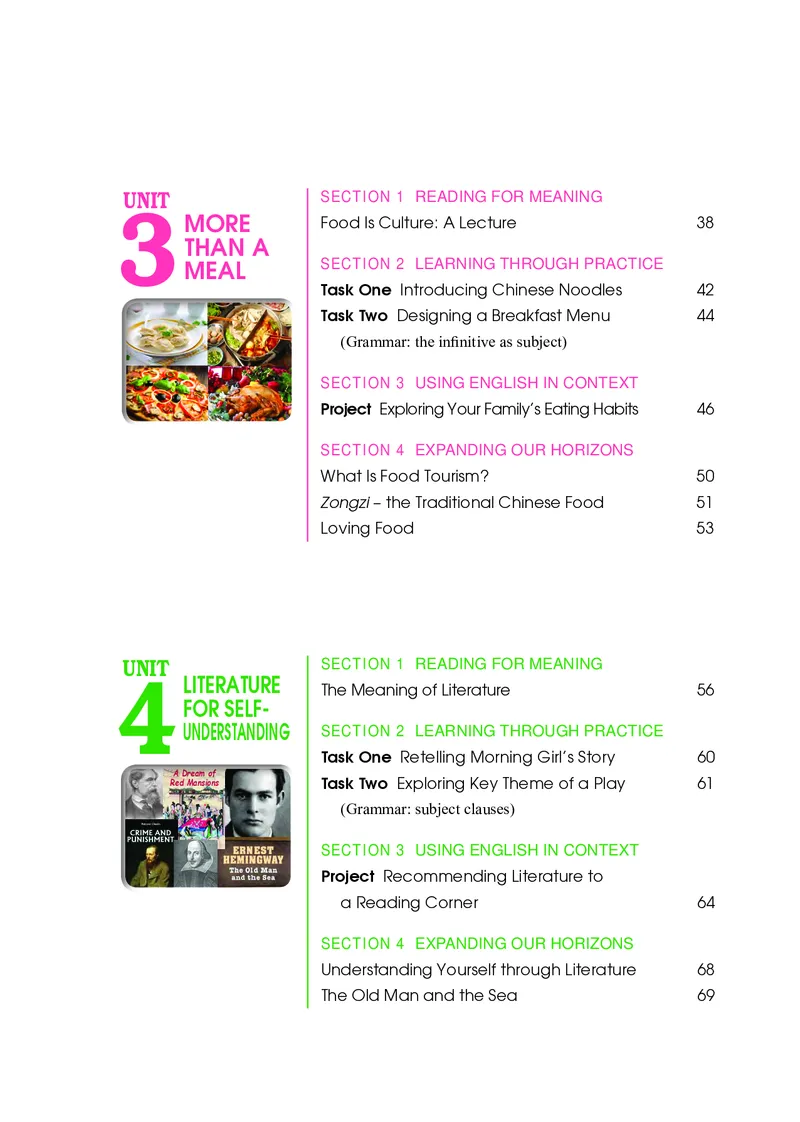
Movie with a Message 35UNIT SECTION 1 READING FOR MEANING
3
MORE Food Is Culture: A Lecture 38
THAN A
SECTION 2 LEARNING THROUGH PRACTICE
MEAL
Task One Introducing Chinese Noodles 42
Task Two Designing a Breakfast Menu 44
(Grammar: the infinitive as subject)
SECTION 3 USING ENGLISH IN CONTEXT
Project Exploring Your Family’s Eating Habits 46
SECTION 4 EXPANDING OUR HORIZONS
What Is Food Tourism? 50
Zongzi – the Traditional Chinese Food 51
Loving Food 53
UNIT SECTION 1 READING FOR MEANING
4 LITERATURE
The Meaning of Literature 56
FOR SELF-
UNDERSTANDING SECTION 2 LEARNING THROUGH PRACTICE
Task One Retelling Morning Girl’s Story 60
A Dream of
Red Mansions Task Two Exploring Key Theme of a Play 61
(Grammar: subject clauses)
SECTION 3 USING ENGLISH IN CONTEXT
Project Recommending Literature to
a Reading Corner 64
SECTION 4 EXPANDING OUR HORIZONS
Understanding Yourself through Literature 68
The Old Man and the Sea 69UNIT SECTION 1 READING FOR MEANING
5 LEARNING
Travel Experiences 74
THROUGH
TRAVEL SECTION 2 LEARNING THROUGH PRACTICE
Task One Describing Your Favourite Travel
Destination 78
Task Two Giving Tips about Travel Etiquette
in China 80
(Grammar: the v-ing form as subject)
SECTION 3 USING ENGLISH IN CONTEXT
Project Writing a Travel Brochure 82
SECTION 4 EXPANDING OUR HORIZONS
Travel with Eric, Brian and Li Ming 86
Why Is Travelling Such a Valuable Learning
Experience? 89
APPENDICES WRAP IT UP! 91
VOCABULARY (I) 106
VOCABULARY (II) 112
LIST OF PROPER NAMES 119
GRAMMAR 122UNIT
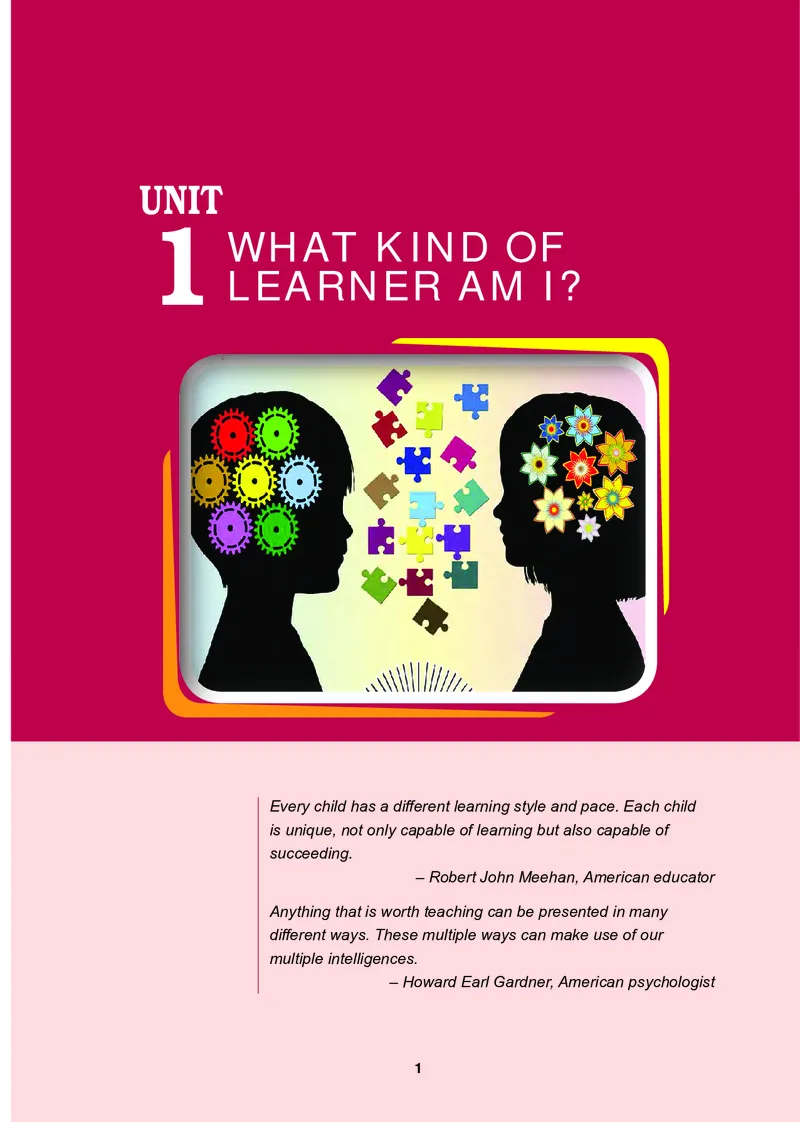
1
WHAT KIND OF
LEARNER AM I?
Every child has a different learning style and pace. Each child
is unique, not only capable of learning but also capable of
succeeding.
– Robert John Meehan, American educator
Anything that is worth teaching can be presented in many
different ways. These multiple ways can make use of our
multiple intelligences.
– Howard Earl Gardner, American psychologist
11
READING FOR MEANING
Different Ways of Learning
BEFORE YOU READ
1 Do you know that there are different ways of learning? What are they?
2 Have you heard about “Multiple Intelligences”? What does this term mean?
3 Do you know why different students are good at different subjects?
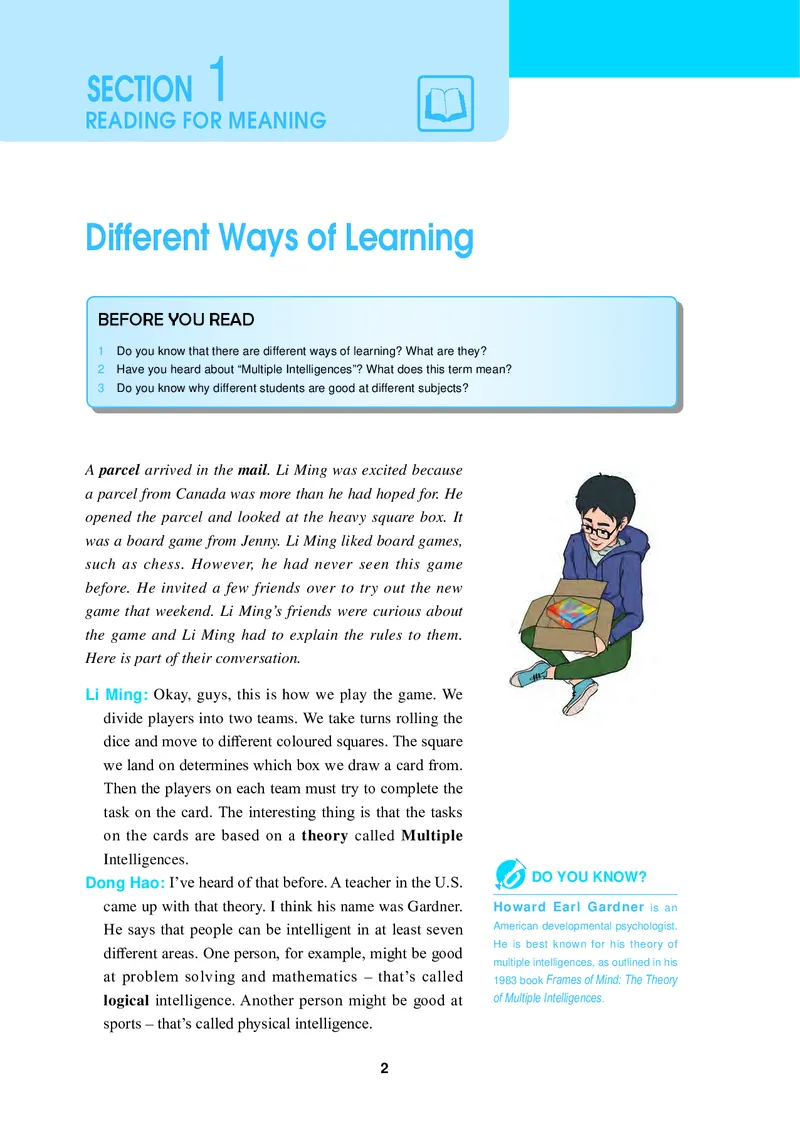
A parcel arrived in the mail. Li Ming was excited because
a parcel from Canada was more than he had hoped for. He
opened the parcel and looked at the heavy square box. It
was a board game from Jenny. Li Ming liked board games,
such as chess. However, he had never seen this game
before. He invited a few friends over to try out the new
game that weekend. Li Ming’s friends were curious about
the game and Li Ming had to explain the rules to them.
Here is part of their conversation.
Li Ming: Okay, guys, this is how we play the game. We
divide players into two teams. We take turns rolling the
dice and move to different coloured squares. The square
we land on determines which box we draw a card from.
Then the players on each team must try to complete the
task on the card. The interesting thing is that the tasks
on the cards are based on a theory called Multiple
Intelligences.
DO YOU KNOW?
Dong Hao: I’ve heard of that before. A teacher in the U.S.
came up with that theory. I think his name was Gardner. Howard Earl Gardner is an
He says that people can be intelligent in at least seven American developmental psychologist.
He is best known for his theory of
different areas. One person, for example, might be good
multiple intelligences, as outlined in his
at problem solving and mathematics – that’s called
1983 book Frames of Mind: The Theory
logical intelligence. Another person might be good at of Multiple Intelligences.
sports – that’s called physical intelligence.
2UNIT 1 WHAT KIND OF LEARNER AM I?
Chen Hai: What other types are there?
Li Ming: Well, there’s verbal intelligence, meaning you are good at language.
Chen Hai: I don’t have verbal intelligence because I think English class is horribly boring. I
got a terrible mark on that last test we had.
Lan Yuan: It’s not just about a foreign language. Having verbal intelligence also means that
you like reading, writing poems, doing word puzzles and things like that.
Xiong Jian: And maybe it also refers to people who talk a lot – just like you!
Lan Yuan: Ha ha, Xiong Jian! Very funny! To tell you the truth, I am a person with musical
intelligence. Musical learners like the sounds of human voice, sounds from nature and
sounds made by instruments, like drums or guitars. They also like singing and music.
Chen Hai: What about artists? What kind of intelligence do they have?
Li Ming: They’re called visual learners. They are good at things like creating models or
drawings.
Xiong Jian: Hey, you guys, enough about theory. What
about our game?
Li Ming: Yeah, let’s begin. But remember that the tasks we
have to complete in this game require us to use skills from
all seven areas of intelligence. All the tasks in the red box
use visual or musical intelligence. The green box focuses
on physical learners. The pink box contains questions
that test mathematical intelligence. The yellow box is full
of cards with spelling questions and word puzzles, so of
course here we will be using our language skills.
Lan Yuan: Yes, our verbal intelligence and much more!
This game is in English. That means if we can complete
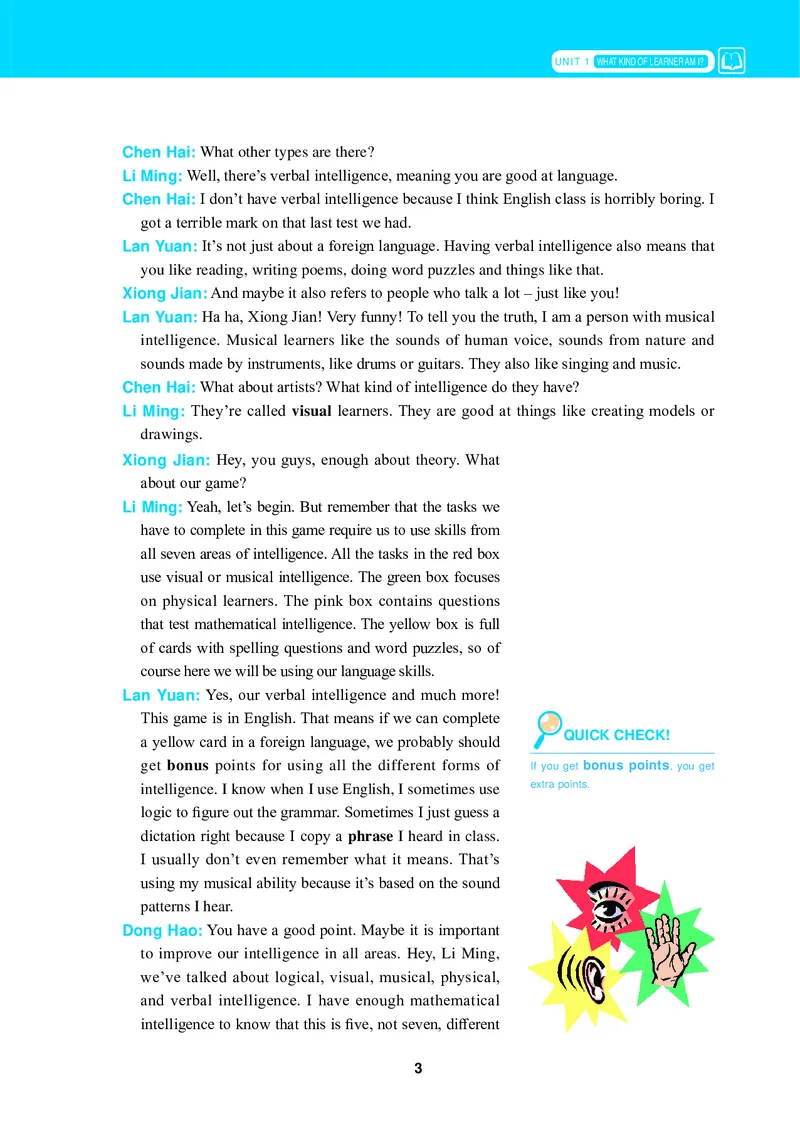
QUICK CHECK!
a yellow card in a foreign language, we probably should
get bonus points for using all the different forms of If you get bonus points, you get
extra points.
intelligence. I know when I use English, I sometimes use
logic to figure out the grammar. Sometimes I just guess a
dictation right because I copy a phrase I heard in class.
I usually don’t even remember what it means. That’s
using my musical ability because it’s based on the sound
patterns I hear.
Dong Hao: You have a good point. Maybe it is important
to improve our intelligence in all areas. Hey, Li Ming,
we’ve talked about logical, visual, musical, physical,
and verbal intelligence. I have enough mathematical
intelligence to know that this is five, not seven, different
3UNIT 1 WHAT KIND OF LEARNER AM I?
kinds of intelligence. What are the other two?
Li Ming: Those are called interpersonal intelligence and
intrapersonal intelligence. Interpersonal intelligence is
when you are very good at building relationships with
other people. Intrapersonal intelligence is when you
know yourself very well, understand and accept your
own personality, and often like to work independently.
Xiong Jian: Come on, Einstein, let’s play.
Dong Hao: Yeah, let’s go. I want to be on Li Ming’s team.
...
AFTER YOU READ
Reading Comprehension
1 What is the “Theory of Multiple Intelligences”?
2 What are the major learning techniques mentioned in the text? How are they matched with each
type of learner?
3 Who is Einstein? Why does Xiong Jian call Li Ming by this name?
4 In what way does the game use interpersonal or intrapersonal intelligence?
5 Some people group interpersonal and intrapersonal skills together and call it emotional intelligence.
Do you agree? Compare and contrast interpersonal intelligence and intrapersonal intelligence.
6 What kind of learner do you think you are? Why do you think so?
Post-reading Activities
1 The prefix inter- means “between”. It can be added to adjectives and nouns to form other adjectives
and nouns that refer to something existing or happening between similar things or groups of people.
Can you guess what the following words mean? Do you know other words that begin with inter-?
inter
interchangeable interactive international interrelated interview internet
4UNIT 1 WHAT KIND OF LEARNER AM I?
2 According to the text, what are the seven ways of learning? What are some learning techniques
that might work best for each type of learner? In groups, discuss and share your answers with your
classmates.
3 Work in groups of seven. Based on the information from the text and other sources, each group
member chooses and writes about one of the seven ways of learning. Share your descriptions in
your group.
4 When you look back on your life in school or your education in general, what difficulties have you
had to overcome in order to learn well? Is there one person, such as your teacher, relative or
friend who has helped you to learn something really well? Share your experiences in your group.
SONG
What Kind of Learner Am I?
Some of us learn quickly and some a little slow
Some of us use our hands to pick up what we know
Everyone is different in how they handle tests
Everyone is learning at the speed that suits them best.
Some of us like maths and do it all day long
Some of us like art and can sing any song
Some of us like structure in our play and school
Some of us like freedom and not so many rules.
Chorus
I’m learning the best that I can
I’m helping the teacher know me
I’m learning the best that I can
I’m helping the teacher show me.
So I won’t be discouraged if I’m not at the top
I’m just finding out the qualities I’ve got
There is something that I’ve realized:
The smartest may not get the prize.
Repeat Chorus
52
LEARNING THROUGH PRACTICE
Task One Making a Poster about How to Study Smart
In this task, you will read a passage about study habits. Do a survey in your group to make a
poster about how to study smart with the help of good study habits.
Step 1 Pre-task Resources
Read the following passage about study habits and reflect on your own study habits.
Study Habits Really Matter
If you want better grades, you need more effective study habits. The key to effective
studying isn’t studying longer, but studying smarter. You can begin studying smarter
with these effective study habits.
Study in a quiet place.
A place with a lot of distractions makes for a poor study area. If you try and study in
your dorm room, for instance, you may find the computer, TV more interesting than
the reading material you’re trying to digest. The library is a good place to check out.
Bring everything you need, nothing you don’t.
Unfortunately, when you find an ideal place to study, sometimes you bring things you
don’t need. For instance, while it may seem ideal to type notes into your laptop to
refer back to later, computers are a powerful distraction for many people because of
their convenience. Keep your phone in your purse or bag to keep distraction at bay as
much as possible. Your phone is a potential time-sink and one of the worst enemies of
concentration.
Don’t forget the things you need to study for the class, exam, or paper you’re focusing
on for the study session. Nothing is more time-consuming and wasteful than having
to run back and forth regularly because you forget an important book, paper, or some
other resource you need.
Outline and write your notes.
It may be helpful to use as many senses as possible when studying. That’s why
writing notes works in the first place – it puts information into words and terms you
understand. Mouthing the words out loud while you copy the notes before an important
exam can be one method for involving another sense.
6UNIT 1 WHAT KIND OF LEARNER AM I?
Practice with friends.
Some people enjoy reviewing their materials
with a group of classmates. Such groups
work best when they’re kept small. Some
groups like to work through chapters together,
quizzing one another as they go through it.
Others like to compare class notes and review
materials that way, ensuring they haven’t
missed any critical points. Such study groups
can be helpful for many students, but not all.
Step 2 Task Cycle
1 In pairs, talk about the study habits mentioned in Step 1. Which do you think are good and
which are bad? Why?
2 In groups of four, do a survey about your study habits. Sort these habits out as good ones
and bad ones.
3 Discuss your study habits and choose top five good study habits and top five bad study habits
to make a poster as follows:
Study Habits Matter
We need to employ good study habits and avoid bad ones. Let’s
take action!
Top Five Good Study Habits Top Five Bad Study Habits
Step 3 Language Focus
An imperative sentence is used to give advice, instructions or invitations. It can also
express a request or command. An imperative sentence tells people what to do or what not
to do.
7UNIT 1 WHAT KIND OF LEARNER AM I?
● Study in a quiet place. ● Bring everything you need, nothing you don’t.
An imperative sentence typically begins with the base form of a verb and ends with a period
or an exclamation point. However, it can also end with a question mark in some instances.
● Please be quiet. ● Go away! ● Please open the door, would you?
An imperative sentence may seem to be missing a subject. Sometimes, the subject is given
to make it much clearer who is spoken to, by adding a person’s name to the beginning or
ending of some imperative sentences.
● Sally, please don’t give the dog popcorn. ● Please sit down, Sam!
Imperative sentences can take several forms in everyday speech and writing. A few of the
most common uses include:
Pack enough clothing for the cruise.
A request or wish
Have fun at the fair tonight!
An invitation Come by at 8 a.m., please.
A command Raise your hands and turn around.
An instruction Turn left at the crossroads.
Task Two Sharing How to Learn English Effectively
In this task, you will read a short passage about an English-language learning experience.
Then you will recall and reflect on your own experience. Tell your classmates how you study
English effectively.
Step 1 Pre-task Resources
Read the passage and pay attention to the function of the words in blue.
Keep a Diary in English
I have an English teacher from Canada. Her name is Laura and she has been teaching
me English for almost two years. From the very beginning, she has been asking us to
keep a diary in English. Laura tells us that we can write anything we like and that it
8UNIT 1 WHAT KIND OF LEARNER AM I?
doesn’t have to be personal. She says
that we can write about weather, what we
have for dinner or what we plan for the
day. She insists that we write something
in English every day. I have been keeping
an English diary since then. Writing in
English every day really helps. It helps
me to work on English word spelling, sentence structure and grammar. And I’m very
lucky that Laura has been reading my work, checking it over and correcting my errors.
This helps me to avoid making the same mistakes over and over again.
Step 2 Exploring the Language
Here are some sentences from the passage in Step 1. Examine the sentence structure. Do
you find anything in common?
● … she has been teaching me English for almost two years.
● From the very beginning, she has been asking us to keep a diary in English.
● I have been keeping an English diary since then.
● And I’m very lucky that Laura has been reading my work, checking it over and
correcting my errors.
The present perfect continuous is made up of two elements: the present perfect of the verb
“be” (have/has been), and the present participle of the main verb (v-ing).
The present perfect continuous is used to refer to an act that has started sometime recently,
is still going on and especially may go on in the future. The speaker is more interested in
the process than the result. However, some verbs, such as know, hate, hear, understand,
are seldom used in the present perfect continuous tense.
Step 3 Task Cycle
■ Discuss with your classmates your way of learning English. Share with them how you learn
vocabulary, grammar and pronunciation, or how you develop language skills like listening,
speaking, reading and writing.
■ Write briefly about your own best way of learning English. Practice using the present perfect
continuous in your writing.
■ Present your passage in your group and learn how your classmates effectively learn
English.
93
USING ENGLISH IN CONTEXT
Project Investigating Learning Styles and Preferences
In this project, you will read a passage, do a quiz and listen to the learning preferences of
several students. Then interview your classmates about their learning styles and report your
investigation afterwards.
Step 1 Read and Discuss
Read the following passage. Then with your classmates discuss what kind of learner you are.
Learning styles refer to an individual’s preferred
or most effective way of learning. Each student
has his or her own method. Some students are
comfortable with one particular learning style
while others tend to use multiple styles. But
they all learn things more easily and quickly
with their preferred styles.
Teachers often use their own preferred learning
style as their main mode of teaching. If students
do not share those same preferred styles,
learning can be very difficult. Sometimes,
students struggle with a concept or an idea not because they aren’t intelligent, but
because the information has not been presented to them in a learning style with
which they are comfortable.
Learning would be relatively easy and efficient for students if teachers could
consider multiple learning styles when designing their lessons. So knowing their
students’ preferred learning styles is perhaps one of the most important tasks for
teachers. Identifying learning preferences would surely improve both learning and
teaching in schools.
Each of us learns differently. We all have our own study methods based on
our experience, practice and born preferences for what works. There are three
methods we can use to discover how we learn. We determine our learning styles
by observing our study habits, answering questions, or connecting them to our
learning strategies.
10UNIT 1 WHAT KIND OF LEARNER AM I?
Step 2 Read and Measure
Complete the following Learning Style Quiz and identify your learning style.
Learning Style Quiz
Which Learning Style Do You Have?
Complete the following sentences with one answer that best describes you. Remember, there is no
right or wrong answer.
1 When learning something new, I need to 7 I enjoy
a. read the information and see diagrams. a. reading and writing exercises.
b. listen to a lecture or discuss the information. b. listening exercises.
c. try it out, build a model or touch the c. activities in which I take part (e.g. role-play).
materials.
8 When I think of a movie I have seen, I
2 When giving or receiving directions to a remember best
new address, I usually a. what the people and places in the movie
a. draw a map and write out the directions. looked like.
b. have someone explain the directions to me. b. what the characters said and how the music
c. just start walking and find my way. sounded.
c. what the characters did and how they felt.
3 I prefer to
a. write things down and take notes to learn 9 When I am trying to memorize something,
well. I prefer to
b. hear discussions or recordings of critical a. write it down repeatedly.
information to learn well. b. say it aloud repeatedly.
c. participate in an experiment or c. use it repeatedly.
demonstration to learn well.
10 I prefer homework that requires me to
4 After meeting someone, I usually a. hand in an essay or written assignment.
remember b. give an oral presentation.
a. how he/she looked. c. lead a demonstration or activity.
b. what he/she said.
11 I really like
c. what he/she did.
a. reading books and magazines.
5 When learning vocabulary, I prefer to b. listening to music.
a. write out the words alone or in sentences. c. going on field trips, etc.
b. repeat the words aloud or say them aloud in
12 In a class or seminar, I usually
sentences.
a. take lots of notes about what the teacher is
c. walk around, move around and do something
saying.
while learning the words.
b. listen carefully but don’t take many notes.
6 When spelling a word, I usually c. draw pictures while listening.
a. write out the word.
b. spell the word out loud.
c. write the word in the air.
11UNIT 1 WHAT KIND OF LEARNER AM I?
Learning Style Quiz Results
After you have completed the Learning Style Quiz, add up the total number of each
letter(a, b or c) you have circled. It should be pretty clear which answers correspond
to each learning style – a corresponds to a visual learning style, b to auditory,
and c to tactile-kinesthetic. Based on this information, you will be able to fill in the
following profile for yourself.
My main learning style is ___________.
My secondary learning style is ___________.
My tertiary learning style is ___________.
Step 3 Listen and Summarize
Listen to a list of students’ learning preferences and fill in the blanks. Then make your own
list of 6 – 8 learning preferences. You may choose from this list or add your own.
assign us in groups. allow us to ask questions
and to discuss details.
let us do work hands-
on and with more
teach us language
show us something visually
discussion.
skills ________
________ ________ just
________.
talking to us.
We will learn BEST when
our teachers...
show us ________
take us on field trips to
________ ________ on
________ real life
how to do things and
situations. explain things first, then
clarify misunderstanding.
show them to us, and
ask us to demonstrate.
Step 4 Investigate and Collect
Investigate your classmates’ learning styles and learning preferences. Before you get started,
read and discuss the instructions below.
● Work in groups of four. Prepare 10 copies of the Learning Style Quiz and 10 sheets
of paper with learning preferences from Step 3.
12UNIT 1 WHAT KIND OF LEARNER AM I?
● Invite 10 students to do the Learning Style Quiz and then ask them to write 6 – 8 learning
preferences. Tell them that they may choose from the given list, or write their own.
● Collect and mark the results of the Learning Style Quiz. Then, classify the learning
styles into four types: visual, auditory, kinesthetic, and mixed.
● Collect and rank the learning preferences. If many students list the same or similar
learning preferences, count how many and check what learning styles they are from.
Step 5 Analyze and Write
Now you may analyze your findings of investigation, and write your report. Your report should
include:
● a short introduction of three to five sentences, explaining the purpose and contents of
your investigation;
● your findings of students’ learning styles (how many of each type and scores);
● your findings of students’ learning preferences (list them based on rankings);
● your comments on the implications of your findings and your reflection upon the
investigation.
Evaluate yourself!
Can you improve your learning after you figure out what kind of learner you are?
Can you use verbal or non-verbal means to start or end a conversation?
How well have you done with the following? Tick the circles that best reflect your performance.
Excellent Very Good Good Needs Improvement
Using conversation fillers and other means to
communicate naturally in English
Adjusting my own learning strategies according
to different learning goals and contents
Analyzing reasons when meeting with learning
difficulties and overcoming them
134
EXPANDING OUR HORIZONS
Know Your Learning Style
Knowing your learning style can help you find the best way to learn a new skill. The four
most common learning styles are: visual, auditory, kinesthetic and reading/writing. Your
learning style determines how you access information.
Read ahead to see which description sounds like you and learn how you can use your
strengths to apply to academic learning and your everyday life!
1. Visual Learners
Visual learners best understand information by using their eyes. They absorb and remember
information when it is presented in pictures, diagrams, maps, or charts. Watching videos,
and looking at illustrations are also great tools for a visual learner. They may speak quickly
and prefer to work alone rather than in groups.
You may be a visual learner if…
● your notes are covered with drawings.
● you are good at remembering faces but not names.
● you can spell well.
● you’d rather read a story than listen to it.
● you’re good with maps and directions.
2. Auditory Learners
People who belong to this category prefer to listen to information rather than read it or
see it visually displayed. They work well in a classroom setting and learn quickly through
guidance and stories. They also learn quickly by listening to lectures and participating in
group discussions.
You may be an auditory learner if…
● you are easily distracted by noises.
● you have difficulty working quietly for long periods of time.
● you are a good listener.
● you easily remember what others say.
14UNIT 1 WHAT KIND OF LEARNER AM I?
3. Kinesthetic Learners
Kinesthetic learners are the most hands-on learning type. They use their senses to work on
new skills and rely heavily on muscle memory. Kinesthetic learners learn best by doing and
tend to have good coordination and best remember what they do.
You may be a kinesthetic learner if…
● you shine at sports, art or drama.
● you enjoy building, making or creating.
● you have trouble sitting still.
● you play with objects while thinking.
4. Reading/Writing Learners
Reading/Writing learners are extremely comfortable with the written word. They prefer to
consume information by reading texts. The traditional lecture and note-taking environment
works well for the reading/writing learning style.
You may be a reading/writing learner if…
● you love making lists.
● you enjoy reading and writing.
● you prefer to have written directions.
Everyone learns best if they are able to experience a lesson in a way that makes sense to
them. Knowing which type of learner you are can help your teacher develop a lesson plan
that works best for you.
POST-READING QUESTIONS
1 What kind of learner are you? Are you a mixed type of learner or not?
2 How do you find the four types of learners? Are they making our understanding of learning clear, or
confused?
3 Discuss with your classmates and see if they are the same or different in learning styles. Share your
opinions about learning styles.
15UNIT 1 WHAT KIND OF LEARNER AM I?
We Learn by Doing
Not many years ago, John Holt began to play the cello. He told us his story of learning by
doing. “Most people would say that what I am doing is learning to play the cello. But these
words suggest that there are two very different processes: (1) learning to play the cello and (2)
playing the cello. They imply that I will do the first until I have completed it, at which point
I will stop the first process and begin the second. In short, I will go on learning to play until
I have learned to play and then I will begin to play. Of course, this is nonsense. There aren’t
two processes, but one. We learn to do something by doing it. There is no other way.”
Learning anything new requires a lot of doing. It is also essential for students to practice
frequently when learning English as a foreign language. Some students do not like to
practice things they have learned because they think they know it already. Yet, as an English
saying goes, “Knowing without doing is not knowing at all.” In language learning, a word
repeatedly practiced is a word learned; a sentence repeatedly used is a sentence learned. We
should ensure that we will have lots of DOING after we know lots of English.
Now in the following “The Cone of Learning”, Edgar Dale shows us how we can learn by doing.
The Cone of Learning
After 2 weeks,
we tend to remember...
Reading 10% of what we READ
P
a
Hearing Words 20% of what we HEAR
s
s
Seeing 30% of what we SEE
i
Watching a Movie v
Looking at an Exhibit e
50% of what we SEE & HEAR
Watching a Demonstration
Seeing It Done on Location
Participating in a Discussion A
70% of what we SAY c
Giving a Talk
t
i
Doing a Dramatic Presentation 90% of what
v
Simulating the Real Experience
Doing the Real Thing we SAY & DO e
Source: Edgar Dale (1969)
16UNIT 1 WHAT KIND OF LEARNER AM I?
POST-READING QUESTIONS
1 Do you agree that we learn things by doing them? What is the process of learning according to the
writer?
2 Did you learn anything from Edgar Dale? What is it? Which piece of advice mentioned in the text do you
find useful or helpful?
3 What inspiration can you get from Edgar Dale’s “Cone of Learning”?
The Confucian View of Learning
Born in 551 BCE, Confucius was one of the great teachers and thinkers of all time. He is
known to us as Kongzi. He believed in people’s ability to understand, learn and improve
themselves. His ideas about learning have been important for thousands of years and can still
be applied to our learning today, as well as to philosophies across the globe.
Here are some quotes from Confucius. Read and discuss what they mean and compare them
with Western ideas about learning.
Quote 1
Studying, and from time to time going over what you’ve learned – that’s enjoyable,
isn’t it?
This quote from Confucius stresses the importance of REVIEW in learning.
Quote 2
When I walk with two others, I’m bound to find my teacher there. I single out their
good points and pursue them, note their bad points and make my corrections.
This quote from Confucius expresses the Chinese view about relationships in learning. In
Chinese culture, individual students prefer not to be singled out from the rest of a group.
The value of education and learning is in cooperation and students are taught to learn from
each other.
We have two more quotes. Quote 3 expresses the Confucian view about the attitude towards
learning. Quote 4 expresses the Confucian view about methods of learning.
17UNIT 1 WHAT KIND OF LEARNER AM I?
Quote 3
To know it is not as good as to approve it. To approve it is not as good as to find joy
in it.
Quote 4
Learning without thought is pointless. Thought without learning is dangerous.
POST-READING QUESTIONS
1 How do you like these four quotes from Confucius? What did you learn from them? Do you know other
quotes from Confucius in English?
2 What do you think about the Confucian idea of cooperation in learning? How can we benefit by learning
from each other?
3 Is there a quote that helps shape your way of learning? What is it?
Unit Reflection
Review the whole unit and reflect on what you have learned.
1 What are the seven types of intelligence? What kind of learner are you? Are you a
mixed type of learner or not? Do you agree with the results of the test in this unit?
2 What have you discovered about learning from this unit? What are the major factors
that contribute to effective learning? Can a teacher open a door to your creativity
“from the outside” or do you have to open yourself from within – under your teacher’s
guidance – in order to really learn something?
3 What is the present perfect continuous tense? What have you learned about the meaning
and use of the present perfect continuous tense?
More Connections
● A popular book named How to Study written by Rob Fry gives information on how to
create an effective study environment. It also shows students the essential skills that can
be applied outside the classroom and later in life.
● Learn more about current information of learners, learning styles and multiple
intelligences. Here are some key words for your reference: study skills, learning styles,
learning strategies, and multiple intelligences.
18UNIT
2
MOVIE, MIRROR OF
LIFE
Film is one of three universal languages, the other two:
mathematics and music.
– Frank Capra, American director
Film is hard to explain, because it is so easy to understand.
– Christian Metz, French film theorist
Movies can and do have tremendous influence in shaping
young lives in the realm of entertainment towards the ideals and
objectives of normal adulthood.
– Walt Disney, American entrepreneur
191
READING FOR MEANING
Li Ming’s New Pen Pal Talking about
Chinese Movies
BEFORE YOU READ
1 What are your movie-watching experiences like today?
2 What type of movie do you like best? List your reasons.
3 Who is your favourite movie star? Why do you like his/her acting style?
Dear Li Ming,
I’m happy to be your pen pal, too! I like your
ideas about Hollywood movies. Guess what I
did last weekend! I watched a Chinese movie
with Jenny! I saw a Jackie Chan movie and
I really enjoyed it. I was a little surprised,
though, because it was different from a
typical Western movie. Jackie Chan’s movie
has a lot of action in it. I couldn’t believe
how quickly the action took place. It was full
of kung fu! I actually got dizzy watching the
actors jump around so rapidly.
The reason I liked the movie was that it was so funny!
I laughed my head off the whole time. I think it is good
to watch a movie to relax and forget the real world for a
while. Western movies are often so serious and realistic.
When you watch them, you think a lot about the problems
in the world and sometimes you feel depressed. Sometimes
the endings are very sad. I think Jackie Chan’s movies
always have happy endings. People who like Jackie Chan
don’t care if the ending is realistic. They just care that
everything turns out well.
20UNIT 2 MOVIE, MIRROR OF LIFE
The other thing I noticed about the movie was the fantastic
special effects; it was very high-tech. Maybe Chinese
moviemakers think that special effects and action are the
two most important aspects of a movie. Different things are
important to Western moviemakers. For example, Western
movies are filled with scenic shots and beautiful landscapes
like mountain ranges, natural bodies of water, or colourful
skies. In the Jackie Chan’s movie, the camera was moving
so fast that I had no time to notice the scenery!
When I discussed the Chinese movies with Jenny, she had
a different point of view. Later she surfed the Internet and
sent me some comments in English on Chinese movies.
I agree on the idea in the comments that movies have the
capacity to mirror and to influence society. However,
the society, its trends, and people’s reactions to those
trends influence the movies, too. Now I have become more
curious about Chinese movies.
Please find the comments in the attached files, and see how
you feel. Have you ever seen the movies mentioned in the
comments? I love romantic movies, simply because a loose
end is rare in the plot. Actually, they are my favourite
genre. Can you recommend one to me? What is your
favourite genre, Li Ming?
DO YOU KNOW?
Well, it’s time for me to go now. I have an assignment to
finish for class tomorrow. I have to do a movie review. A movie review is a report in
which someone gives their opinion
Last week in class, we watched a movie called Pay It
of a movie. A decent movie review
Forward. It had such a touching plot! Now, I have to write
should entertain, persuade and
out my impressions of the movie. I don’t mind doing this inform readers by creating an original
homework because I enjoyed the movie so much! thesis based on reasonable analysis,
giving a brief summary of the plot,
Yours, discussing interesting elements of
the movie to support the thesis, and
Mary
ending with a conclusion.
21UNIT 2 MOVIE, MIRROR OF LIFE
Comments on Chinese Movies
Some Chinese movies portray historical events.
For instance, My 1919 (wo de 1919) and The
Founding of a Republic (jian guo da ye) provide
good opportunity for the younger generation
to learn about what their elder generation did
for the country. Among these historical movies,
Little Soldier Zhang Ga (xiao bing zhang ga)
is remarkable for it is based on the real life of
a boy and depicts actual events of the War of
Resistance against Japanese Invasion. The movie
gives an accurate description of young people’s
participation during the war.
Apart from these historical movies, there are many
movies that mirror the everyday life of Chinese
people. For example, Not One Less (yi ge dou
bu neng shao) centres on a young girl teacher
who spares no effort to do her job well and never
gives up. The movie has a slow plot that leads to
a small climax and a quick ending, which is quite
different from Western movies. Besides, there are
many Chinese movies telling romance stories. The
film Forever Young (wu wen xi dong) tells stories
of four generations of students from Tsinghua
University – about how they pursue their love,
interests and dreams, conveying how traditional
virtues were passed down.
Through these movies, we can better understand
the society and the world. They tell stories about
the past and the present, which reflect the values
of a society.
22UNIT 2 MOVIE, MIRROR OF LIFE
AFTER YOU READ
Reading Comprehension
1 What impressed Mary most when she saw Jackie Chan’s movie?
2 How does Mary judge a movie? Do you agree with her? What’s your opinion?
3 How does Mary see the differences between Western movies and Chinese movies? What are your
thoughts about the differences between the two types of movies?
4 How did Jenny help Mary know more of Chinese movies? What do you think of the comments?
5 What type of movie do you like? Why?
6 What is the relationship between movies and life?
Post-reading Activities
1 Look at the category words and examples given, and then add as many words related to the
categories in the movies as you can in groups.
actor camera
people movie equipment
2 Do you think movies mirror real life? Do you have any experience with movies influencing or
shaping some of your behaviours? Share this experience with others in groups.
3 Movies and music are a natural combination. Talk about your favourite songs written for movies and
discuss how they help the audience better understand the movie’s theme.
4 Make a list of movies you and your classmates have seen. Share your views on these movies in
groups. Then, vote and rank top 5 movies in your group. Give a brief comment (2 – 3 sentences) on
each movie.
232
LEARNING THROUGH PRACTICE
Task One Classifying Movies
In this task, you’ll learn a variety of words related to movie genres. With some knowledge
of movie genres, you will have a better appreciation of the theme and plot when you watch
a movie.
Step 1 Pre-task Resources
Read the passage and guess the meanings of the words and phrases in blue.
Major Types of Movies
In movie-making, each genre has its own set of rules and characteristics. If you
want to make people laugh and feel good, obviously a comedy is the way to go.
If you just want to excite your audience, then produce an action picture that gives
viewers a roller coaster of emotions. Steven Spielberg scared people out of the
water for years with Jaws. Horror movies use the element of shock to surprise the
audience. Romance stories focus on love. Science fiction often tells the stories
about science and technology of the future and typically includes worlds with
aliens, robots or monsters, and plays on the idea that we may not be alone in the
universe. The fantasy genre combines fantasy worlds and magical elements that
could never exist in today’s world (This is what separates this genre from science
fiction). War movies have always been popular. It’s the good team versus the bad
team with lots of gunfire. Suspense movies keep you on the edge of your seat.
They give you a feeling of excitement mixed with fear, tension and anxiety. A
musical is like a real stage show combined with the magic of movie-making.
24UNIT 2 MOVIE, MIRROR OF LIFE
Step 2 Task Cycle
1 View the following movie posters and match them with the proper movie genres.
Musical Romance War Action Sci-Fi Cartoon
2 Pair work. Describe each movie above and explain why it belongs to such a movie genre.
Learning tips
Classifying information can help you remember things more effectively.
When encountering new words, you can remember them better if you
organize them in a logical way instead of just memorizing them.
Step 3 Language Focus
If you’ve just seen a great movie, you might want to tell your friends about it. Here are some
words and expressions for introducing its genre.
a love dark, scary,
not a true story, story bloody scenes
based on make- horror/thriller/
believe situations, suspense/mystery
usually set in some
romance
future time
computer-animated,
hand-drawn characters
science fiction/
cartoon
fantasy
story told with
music, singing
action fighting, chases,
and dancing
explosions,
musical
fast scenes
movie genre
25UNIT 2 MOVIE, MIRROR OF LIFE
Task Two Writing a Movie Review
Just like “there are a thousand Hamlets in a thousand people’s eyes”, the audience often has
different impressions of a movie. Movie reviews tend to summarize the plot of the movie as
well as the writer’s thoughts about it. In this task, you’ll first read a movie review, and then
reflect on your favourite movie and write your own review.
Step 1 Pre-task Resources
Read the following movie review about Zootopia and underline the subordinate clauses.
Zootopia is a computer-animated movie
made in 2016 and produced by an American
company. It was directed by Byron Howard
and Rich Moore.
Animated movies have always been what
interests me most. This movie details the
unlikely partnership between a rabbit police
officer and a red fox cheat when they
investigate a missing-person case. The
moral of the movie is that people should
never give up on their dreams despite the
prejudice that holds them back.
In this movie, a rabbit named Judy Hopps becomes what she always wanted to be:
the first rabbit police officer. During Judy’s first day on the job, she meets Nick
Wilde. Nick laughs at her work and says she will never be successful. He suggests
that Judy should return to her hometown to plant carrots instead of working in
Zootopia. Judy is angry at his hurtful words. This is why she dislikes Nick at first.
However, when Judy follows up on a case about 14 missing animals, she finds that
Nick is no longer what she thought he was. What impresses Judy is that Nick’s
wisdom always works best when they are in trouble. It seems as if Nick could be
a good partner. As the two work together, Nick slowly becomes Judy’s friend and
adviser.
The genius of Zootopia is that it works on two levels: it’s a timely and clever
examination of the prejudices common in society, and it is also an entertaining and
funny adventure about hairy creatures engaged in solving a mystery.
26UNIT 2 MOVIE, MIRROR OF LIFE
Step 2 Exploring the Language
1 Examine some subordinate clauses from Step 1 and pay attention to their structures.
● Animated movies have always been what interests me most.
● The moral of the movie is that people should never give up on their dreams…
● This is why she dislikes Nick at first.
● It seems as if Nick could be a good partner.
2 Whatever follows a linking verb, it is a predicative. If a subordinate clause acts as a
predicative, this clause is called a predicative clause. Here are the different types of
predicative clauses.
Learning tips
that-clause Besides “be”, there are some
whether-clause other linking verbs that may be
Linking verb +
wh-clause followed by a predicative clause:
as if/though and because clauses appear, feel, lie, look, remain,
seem, smell, sound, etc.
Step 3 Task Cycle
In general, a movie review consists of several elements: title, director, theme, opinions about
the main characters, music, conclusion, and recommendation. What do you think of the movie
review in Step 1? If you were the author, how would you make it better?
Choose a movie you like and write a review about it. Before you start to write, think about
the elements of a movie review, and ask yourself the following questions.
■ What is the message of this movie? Do you agree or disagree with it?
■ Did anything that happened in this movie remind you of something that has occurred in your
own life or in someone else’s?
■ What part of the story was the most powerful? Why?
■ What feelings did you share with any of the characters in the movie?
■ Analyze the use of music in the movie. Did it enhance the story that the moviemakers were
trying to tell?
■ Would you recommend this movie to a friend? Explain your reasons.
Try to use predicative clauses to express your ideas and suggestions when you write your
review.
273
USING ENGLISH IN CONTEXT
Project Making a Microfilm of Mrs. Thompson
Microfilms are short, low-budget films made by amateur filmmakers. The Chinese term for
microfilms – Weidianying – makes reference to Weibo where many of these films make their
debut. In this project, you will learn how to make a microfilm.
Step 1 View, Fill in Blanks and Discuss
View the report about the Fourth China International Microfilm Festival in Hangzhou,
complete the following table and discuss the recent development of microfilms.
Definition of microfilms
Length of microfilms
Charm of microfilms
Winner of the year
Future trends of microfilm production
Function of the blue book
Step 2 Read, Learn and Write
1 Read the story of Mrs. Thompson. Divide the story into four scenes: Knowing about Teddy,
Christmas Present, Self-reflecting and Wedding.
Mrs. Thompson
There was a story many years ago of a school teacher – Mrs. Thompson. She told the
students on the first day that she loved them equally. But that was a lie. There in the
front row was a little boy named Teddy Stoddard. He didn’t play well with the other
children and he always needed a bath. She did not like him as much.
Then Mrs. Thompson learned that Teddy used to be a very good boy before the
death of his mother. Mrs. Thompson was ashamed of herself.
One winter, Teddy brought Mrs. Thompson a Christmas present. It was his mother’s
28UNIT 2 MOVIE, MIRROR OF LIFE
perfume. Mrs. Thompson put some on her wrists. After school, Teddy said, “Mrs.
Thompson, today you smell just like my mom used to.” After the children left, she
cried for at least an hour. On that day, she stopped teaching reading, writing and
geometry. Instead, she began to actually teach children.
From then on, Mrs. Thompson paid particular attention to Teddy. The boy’s mind
seemed to come alive. The more she encouraged him, the faster he improved. By the
end of the sixth grade, Teddy had become one of the smartest children in the class.
Six years went by. Mrs. Thompson
received a note from Teddy. He wrote
that he had finished high school,
third in his class, and she was still the
best teacher he ever had in his whole
life. Over the years, Mrs. Thompson
got two more letters from him with
the last one signed, Theodore F.
Stoddard, M. D.
The story does not end there. On his wedding day, Teddy asked his former teacher
to be his partner for the mother-son dance. The bridegroom whispered to Mrs.
Thompson, “Thank you, Mrs. Thompson, for believing in me. You made me feel
important and showed me that I could make a difference.” Mrs. Thompson, with
tears in her eyes, whispered back, “Teddy, you have it all wrong. You were the one
who taught me that I could make a difference. I didn’t know how to teach until I
met you.”
2 First, learn about the elements a screenplay features. Then look at the sample from the first
scene of Mrs. Thompson and see how you can write a screenplay.
a Fade in The very first item on the first page should be these words
b Scene Heading A one-line description of the location and time of day of a scene
c Character’s First Appearance A description of the character
d Character A character’s name always appears before his/her dialogues
e Action The narrative description of the events of a scene
f Transition Film editing instructions
g Dialogue Lines of speech for each character
29UNIT 2 MOVIE, MIRROR OF LIFE
a FADE IN:
b INT. THE DOOR OF THE CLASSROOM — DAY
Noise from the classroom. Some students chat and laugh in pairs. A Little
boy, in an untidy uniform, is seated in the corner.
e
In comes a young lady, Mrs. Thompson. She looks around the class and
stands herself on the platform.
c MRS. THOMPSON, a new teacher in the school, 25 years old
d MRS. THOMPSON: Good morning, boys and girls!
KIDS, some feel curious and some excited…
KIDS: Morning!
MRS. THOMPSON: I am your new teacher Whitney Thompson. You can just call
me Mrs. Thompson. This is my first day here. To me, all of you are my children and
my friends. Emm… Will you tell me something about yourself?
TOM, an energetic and active student stands up
TOM: My name is Tom. I like playing football. I want to be a player like Peyton
g Manning!
MRS. THOMPSON: That’s great! Work hard and try your best! You can make it!
Other students introduce themselves one by one, and then it’s Teddy’s turn.
TEDDY, a short thin boy, timid
TEDDY: Emm… my name is Teddy emm… That’s all.
Mrs. Thompson looks at Teddy’s clothes and frowns and seats him.
f DISSOLVE TO:
EXT. ON THE SPORTSGROUND. SEVERAL WEEKS LATER
Mrs. Thompson comes across the P.E. teacher, Ramond Radington.
RAMOND, a tall and strong football coach
RAMOND: Hi, Mrs. Thompson. How is everything getting along?
MRS. THOMPSON: Hi. Pretty good, except Teddy… He was always slow, always
in the same dirty uniform and always reticent…
RAMOND: He used to be very good before his mom died…
MRS. THOMPSON, shocked and ashamed.
MRS. THOMPSON: Emm…
3 Choose one of the other scenes of Mrs. Thompson and write your own screenplay.
30UNIT 2 MOVIE, MIRROR OF LIFE
Step 3 Read, Plan and Shoot
1 Before you get started, complete the production plan.
Items Actions
Find locations to We will ask permission from the headteacher to shoot the film in our
match the script classroom after school.
Get actors/actresses
for the film
Recruit a crew
Find filming
equipment
Rehearse the scene
Dress the actors in
their costumes
2 Shoot the scenes one by one. After you’ve finished, upload the film to a film-editing software.
Do a rough cut of the scenes and put the shots in chronological order. Add the audio tracks of
the dialogue and match them up with the video. You can also take this time to add any music or
sound effects to the film. Review the film and create a final cut. Once all of the people producing
the film agree on the final product, you can start showing your short film to audiences.
Evaluate yourself!
Can you tell the major functions of movies in English? Education, entertainment, or something else?
Can you name and discuss your favourite film in English? Why do you like it?
How well have you done with the following? Tick the circles that best reflect your performance.
Excellent Very Good Good Needs Improvement
Understanding elements of a movie review and
its structure
Knowing how to write a screenplay and make a
microfilm with my teammates
Taking an active part in class by communicating
effectively with my classmates and seizing every
chance to practice English
314
EXPANDING OUR HORIZONS
Hollywood
Hollywood suggests glamour – it’s a place where the young star-struck teenagers can, with
a bit of luck, fulfill their dreams. Hollywood implies luxurious houses with vast swimming
pools, cocktail bars, beautiful vases and statues, as well as top-end furniture fit for a
millionaire. Big movie stars are millionaires. Many spend their fortunes on Rolls Royces and
diamonds. But a few of them lose their glamour quite suddenly and are left with nothing but
emptiness. Some even owe extremely large debts.
Movies were first made in Hollywood before World War I. The constant sunshine and
mild climate of southern California made it an ideal site for shooting motion pictures.
Hollywood’s fame and fortune reached its peak in the 1930s and 1940s, which were the
golden days of black-and-white movies. In those days, Hollywood was like a magnet,
drawing ambitious young men and women from all over the world. Most of them had only
their good looks going for them – no acting experience or ability whatsoever. Occasionally
they got temporary jobs, if they were lucky enough to be noticed. Gary Cooper was one of
the few who were noticed. He rose to be one of the great stars of the early Westerns from an
initial stunt rider. Many girls got jobs in cafes or gas stations, hoping to attract the attention
of some important person connected with the movies. Most of their efforts were in vain.
As for the movie stars themselves, they were held on a tight leash by the studio chiefs who
could make or break anyone except the stars with really big appeal. The stars were “persuaded”
to sign seven-year contracts, during which time the studios built up their images. Under their
contracts, the stars did not have the right to choose their parts. Their studios decided everything.
32UNIT 2 MOVIE, MIRROR OF LIFE
Hollywood is no longer the heart of the world’s motion
picture industry. Most movies today are filmed on location.
Hollywood studios are still standing, but most of them
have been leased to television networks. About 80% of all
American TV entertainment comes from Hollywood.
Yet Hollywood has not lost all its glamour. Movie stars
still live there, or in neighbouring Beverley Hills, and so
do many celebrities and wealthy people who have made
southern California their homes. There is also the attractive
DO YOU KNOW?
Hollywood Bowl, the huge outdoor theatre where, every
summer since 1922, “Symphonies under the Stars”
Symphonies under the Stars
brings together America’s best orchestras to play various is a Hollywood Bowl concert. It’s also
entitled “Under the Stars”.
symphonies in front of packed audiences.
Hollywood is a name that will always be associated with
moviemaking, and for many years to come, old Hollywood
movies will be shown again and again in theatres and on
television screens all over the world.
POST-READING QUESTIONS
1 What made Hollywood ideal for moviemaking?
2 How do you understand “the movie stars were held on a tight leash by the studio chiefs”?
3 What changes have occurred to Hollywood?
Chinese Culture in Movie Posters
An increasing number of Hollywood producers have, in recent years, released movie posters
for Chinese audiences. The movie posters are typically drawn in a traditional Chinese style
and highlight Chinese cultural features.
Classic Chinese Novels
Romance of the Three Kingdoms, Water Margin, Journey to the West, and A Dream of
Red Mansions are four novels that form the core of Chinese classical literature and still
influence modern culture. These books are never-ending resources for Chinese movie and
33UNIT 2 MOVIE, MIRROR OF LIFE
TV adaptations. Kung fu masters appear regularly in these
novels, which have inspired a number of western superhero
movies and their posters.
Chinese Paper Cutting
The poster for Kung Fu Panda gives us a great example
of Chinese paper cutting, right in time for the Spring
Festival. Chinese paper cutting, or jianzhi, is a kind of folk
art that uses scissors or knives to cut paper for decorations
and other folk activities. Paper-cutting artwork is always
made with red paper, as red means luck and happiness
according to Chinese culture. This colour is often featured
at events like the Spring Festival, weddings, and childbirth
celebrations.
Chinese Landscape Painting
Landscape painting is considered the highest form of
Chinese art. Chinese landscape painting, or shanshui,
literally refers to a style of traditional Chinese painting
that, using brushes and ink, typically depicts natural
scenery. Mountains, rivers, and waterfalls feature regularly
in this art style. Shanshui is the most popular form used
to expose the West to Chinese culture. Many western
moviemakers choose Chinese landscape paintings as
backgrounds for their movies’ posters.
Chinese Landmarks
Every country has its landmark tourist attractions, and
China is no exception. China’s historic scenic spots see
more and more visitors every year. These landmarks
recall Chinese history and culture while also making them
accessible to Western audiences. You can see fantastic
photos of Chinese landmarks in the poster for James
Cameron’s Avatar, one of the best-selling movies.
Aside from these promotional posters, many of the world’s
biggest movies incorporate many Chinese elements
including symbols, languages, and clothing. Hollywood is
looking East.
34UNIT 2 MOVIE, MIRROR OF LIFE
POST-READING QUESTIONS
1 How many Chinese cultural features are mentioned in the text? What are they?
2 Why do Hollywood producers use Chinese elements in their movie poster designs?
3 How do you understand the sentence “Hollywood is looking East”?
Movie with a Message
AUGUST 20, 2017
An impressive action movie; a military adventure that advocates
patriotism; an enormous commercial success – all these labels
can be attached to Wolf Warrior II, whose box office was over
5 billion yuan (about $750 million) less than a month after its
release, making it the world’s second highest-grossing movie in
a single market. But most importantly, it tells a story, with which
audiences can identify.
Wolf Warrior II is set in an African country. When a civil war
plunges the country into violence and chaos, Leng Feng, a
former member of the Chinese special forces, finds himself on a
mission to rescue trapped Chinese citizens and locals. At first
sight, Leng reminds people of the Hollywood superhero who
defeats bad guys and saves the world. Indeed, many virtues that
the main character represents, such as courage, sacrifice and
commitment, are highly prized worldwide.
Nevertheless, Wolf Warrior II has proven to be a great hit in
China. One reason is that the movie, inspired by the evacuation of
QUICK CHECK!
Chinese nationals from the war zone in Libya in 2011, resonates
with a larger message. A total of 35,860 Chinese were evacuated Evacuate people from
somewhere means to move
from Libya in a well-coordinated campaign. China also helped
people from a place of danger
2,100 foreign citizens from 12 nations leave the war-torn country.
to a safer place.
Notably, it was the first time China had sent military transport
aircrafts overseas to take part in such an operation. Against this
background, Leng is both a champion of heroism and the typical
example of China’s enhanced capacity to protect its citizens
abroad and growing role in international affairs.
35UNIT 2 MOVIE, MIRROR OF LIFE
China’s movie industry has developed rapidly in recent years. Encouragingly, cinemas appear
across the nation. Up to now, China has more movie screens than any other country – over
45,000 – a sign of the enthusiasm of the nation’s movie-goers.
The key lies in how moviemakers will cash in on this huge market. Although the success
of Wolf Warrior II may not be easily copied, it at least can be a case study for domestic
moviemakers. In the face of severe competition from Hollywood, they still stand a chance
given their unique advantage in understanding audiences in China.
POST-READING QUESTIONS
1 What message can you get by studying the case of Wolf Warrior II?
2 What virtues does a superhero possess in a war movie? Can you list more?
3 What is the author’s view about the further development of China’s movie industry?
Unit Reflection
Review the whole unit and reflect on what you have learned.
1 What have you learned about reviewing a film? What have you learned about analyzing
the plot and theme of a film? What did you learn from Wolf Warrior II? What are the
character’s personal qualities that you have seen in your own experience?
2 What’s the process of making a microfilm? Do you use music? How do filmmakers use
music in movies? How does the music enhance the story that filmmakers are trying to tell?
3 How does a predicative clause function in a sentence? What have you learned about the
structure and use of predicative clauses in English?
More Connections
● Basically, filmmaking is the telling of a story with the use of motion pictures. How do
you interpret a film? You can refer to The Language of Film, a book written by Robert
Edgar-Hunt, John Marland and Steven Rawle. It will encourage you to watch as many
films as you can and get through as many genres, movements, historical periods, countries
and cultures as possible. Each chapter contains exercises, tips, further reading and case
studies, which help you to branch into the specific areas of filmmaking.
● An effective filmmaker knows how the screen communicates with people, how meaning
is gradually built up of tiny elements, and how to control the audiences’ thoughts and
feelings. If you want to try a microfilm, it is important for you to learn how to write a
screenplay. Surf the Internet to get some tips.
36UNIT
3
MORE THAN A MEAL
When eating bamboo sprouts, remember the man who planted them.
– Chinese proverb
It’s difficult to think anything but pleasant thoughts while eating a
homegrown tomato.
– Lewis Grizzard, American writer
One cannot think well, love well, sleep well, if one has not dined well.
– Virginia Woolf, English writer
371
READING FOR MEANING
Food Is Culture: A Lecture
BEFORE YOU READ
1 What is your favourite food? Why?
2 Describe a happy or sad time in your life that was related to food in some way.
3 What do you think this text is about based on the title “Food Is Culture: A Lecture”?
Dr. Hanson, an expert in food and cooking habits across
DO YOU KNOW?
cultures, was invited as a guest speaker to a class. This is
an excerpt from one of his lectures. This is an interactive lecture.
The goal of it is to engage students to
Dr. Hanson: Good afternoon, everyone. We’re here today to interact with the content, the instructor,
and their classmates. Accordingly,
talk about cooking and culture. In different cultures, food has
interactive lectures include segments
different meanings, uses, and rules. What we eat and how
of lecture combined with segments
we eat is influenced by many things, such as climate, social where students interact.
and economic factors. To begin with, I’d like to hear about
your experiences. I see this is a multicultural school. Is there
anyone who would like to say something about his or her
experience with food in another culture?
Student A: Last year my dad had a business trip to India, and
my whole family went along. We ate at McDonald’s every
day because I was too scared to try Indian food. It looked so
different and I didn’t know what to order. I wished that I had
taken a barbecue with me. That way, I could have eaten
steak with mushrooms every day! It would have been
easier if I had had someone with me who could explain the
dishes to me.
Dr. Hanson: You’ve raised a good point. Large companies
are changing the eating habits of people all around the
world. In many countries, you can find McDonald’s, Pizza
Hut and Kentucky Fried Chicken.
38UNIT 3 MORE THAN A MEAL
Student B: I went on a student exchange to France. I saw
all those familiar restaurants but I didn’t go. I tried many new
foods and I enjoyed them very much. The thing that surprised
me was that they ate dinner very late and they had wine with
every meal. Also, in my host family, we sat around the dinner
table for a long time talking and laughing.
Dr. Hanson: Yes, in many cultures people share food around
the dinner table and mealtime is a time for communicating,
sharing the stories of the day, laughing and discussing. Eating
is an important social activity for people from all cultures.
Think about a memory you have involving food. What were
the sights and smells? Who was there? Who would like to
share your story?
Student C: We live in Canada now, but I come from Germany.
I will never forget the smell of gingerbread when we made
gingerbread houses at Christmas time. All my relatives were
around, and it was a very happy memory for me.
Dr. Hanson: Some foods are found in almost every culture.
Take rice, for example. Rice can be found in the diet of almost
QUICK CHECK!
all cultures of the world, yet eating a bowl of steamed rice in
China is nothing like the taste sensation of a Spanish pilaf. Pilaf is rice boiled in a seasoned
liquid, usually with meat or fish.
Food is an essential part of cultural celebrations. What we eat,
how it is prepared, how and when it is served – all these are an
important part of our cultures. What is a Chinese Mid-Autumn
39UNIT 3 MORE THAN A MEAL
Festival without mooncakes? What is a Canadian Thanksgiving
without turkey and dressing, a girl’s 15th birthday celebration
in Columbia without flat corn bread, or a Ukrainian Christmas
Eve without 13 meatless dishes? These foods help make
strong connections between people and their shared culture
and history. You can learn a lot about the values of a culture by
sharing food.
One example of this is considering who eats first. In many
African cultures, the eldest person at the table would be
served first and people would generally follow according to
age. In many Eastern European cultures, the men are served
first, and the children and women follow in that order. In many
modern North American families, the children’s food is often
prepared and served first.
QUICK CHECK!
There are also taboos that differ from culture to culture. Taboo is something forbidden in a
Has anyone in the class ever been confused by a different culture.
culture’s habits?
Student D: I’m originally from Poland. I was at my Canadian
friend’s house one day and he asked me if I wanted a Coke.
I said yes and he said, “Okay, there’s one in the fridge. Help
yourself.” In my culture, it is very rude to go into someone
else’s fridge. I felt very uncomfortable doing it, but I understood
that my friend and I just had different ways of doing things.
When he comes to my house, he can try my way.
Dr. Hanson: Yes, we can see that some cultures are more
formal around food and some are less formal. There are also
some things that are considered rude in one culture and quite
polite in another. In Japan, for example, eating your soup loudly
is a sign that you are enjoying your soup. In North America,
on the other hand, one should be as quiet as possible when
eating. In many African and Indian cultures, people believe that
food tastes better when eaten with hands.
In a word, it is difficult to know what to do, in any culture,
without watching, listening, and asking a lot of questions.
40UNIT 3 MORE THAN A MEAL
AFTER YOU READ
Reading Comprehension
1 What is the topic sentence of the first paragraph? What is the main idea of the lecture?
2 What mood does Student A convey by saying “It would have been easier if I had had someone with
me who could explain the dishes to me”?
3 Where did Student B go on a student exchange? Did he/she enjoy the trip?
4 What memories does Student C have of gingerbread?
5 How do you understand the rhetorical question “What is a Chinese Mid-Autumn Festival without
mooncakes?” in Paragraph 8?
6 Why do you think food is such an important part of different cultures based on the lecture as well as
your own experiences?
Post-reading Activities
1 What were the feelings and reactions of Student A and Student B towards the new foods? Do you
think they had a positive or negative attitude towards the differences in food and culture?
2 What are some food-related taboos in China? Do some research online and share your findings
with a partner.
3 Different cultures have different table manners. Discuss some of the differences you know about
with a partner.
4 Interview your group members to learn about how often they eat at a fast-food restaurant and what
they usually have. Junk foods usually contain high amounts of sugar and fat, which are harmful to
your health in the long run. Discuss in groups how you can keep a balanced diet in everyday life.
412
LEARNING THROUGH PRACTICE
Task One Introducing Chinese Noodles
Preparing and eating noodles is a big part of Chinese culture. In this task, you’ll read a passage
about the significance of noodles in Chinese culture, and then introduce it to a foreign friend.
Step 1 Pre-task Resources
1 View the video about Chinese noodles. Note the concluding remark at the end of it.
2 Read the passage and pay attention to the types of Chinese noodles mentioned and the role
they play in Chinese culture and our daily life.
Noodles were first invented in China
nearly 4,000 years ago. Noodles have been
an important part of Chinese cuisine and
culture ever since. All over China, you
can find many different ways of preparing,
cooking and eating noodles. Noodles can
be made from wheat flour, rice flour and
many other types of grains. Whether
noodles are machine-made or hand-made,
they are delicious. Noodles are used in many different dishes and can be served in
many different ways. They can be served hot with soup or cold like a salad. They can
be boiled, fried or braised. What’s more, noodles come in all different shapes and
sizes from long and thin to short and fat.
Noodles play an important role in traditional Chinese dishes. They are enjoyed for
breakfast, lunch and dinner and remain a standard in Chinese cuisine. They are also
a significant part of Chinese customs. Noodles are important for many celebrations
from birthdays and baby showers to weddings and other major occasions. For
instance, when celebrating an elderly person’s birthday, it is a custom to eat
“longevity noodles”, which are very long noodles typically made of wheat flour and
represent a long life. This tradition was first established during the Tang Dynasty.
Another custom is to eat “festive noodles” at a wedding. These noodles imply a
long and happy marriage. Chinese cuisine is rich with tradition and is essential to
understanding in the culture.
42UNIT 3 MORE THAN A MEAL
Step 2 Exploring the Language
1 Complete the mind map about all the different noodle dishes. How are they prepared and
what are the shapes and sizes of different noodles?
ur
o
e fl
wi
d
h
e
at
w
al
eri
at
shape and size m
Chinese
noodles
boiled
way of
cooking
way of making machine-made
2 Write a few sentences to explain the cultural significance of noodles for different occasions.
On an elder’s
birthday
At a wedding
Step 3 Task Cycle
Your foreign friend Peter is preparing a school project on Chinese food. Write an email to
introduce him to Chinese noodles and their significance in Chinese culture.
Dear Peter,
43UNIT 3 MORE THAN A MEAL
Task Two Designing a Breakfast Menu
In this task, you’ll learn about the differences between a typical American breakfast and
Chinese breakfast. Then, you’ll design a breakfast menu for your family and present it to your
group, using the infinitive as the subject of your sentences.
Step 1 Pre-task Resources
Below is a typical breakfast menu from an American restaurant. Examine it and see how it
differs from a typical Chinese breakfast menu.
BREAKFAST AT JUNIOR’S
7:00 a.m. Until 11:45 a.m.
Eggs
Beverages
Two Eggs (Any Style)
With Bacon
Coffee
With Sausage
Hot Tea
With Corned Beef
Hot Chocolate with Cream
Iced Coffee
Pancakes and French Toast Grade A Milk
Fresh Orange Juice
Pancakes Soda
With Bacon
With Sausage
With Virginia Ham
French Toast
With Bacon
With Sausage
With Virginia Ham
Step 2 Task Cycle
1 Discuss in pairs. What foods does an American breakfast consist of? What about a Chinese
breakfast? What’s the difference between them?
44UNIT 3 MORE THAN A MEAL
2 Design a breakfast menu, combining Western and Chinese foods. Make a poster and present
it in your group. When you’re introducing your menu, try to use the infinitive as the subject of
your sentences, for example, To eat healthy is to feel good.
Useful expressions
● huajuan: steamed twisted rolls
● roujiamo: Chinese hamburger
● niangao: rice cake
● doujiang: soybean milk
● youtiao: fried bread stick
● shaobing: clay oven rolls
● xifan: rice porridge
● baifan: plain white rice
Step 3 Language Focus
In English, the subject of a sentence is usually a noun or a pronoun. But sometimes, the
infinitive is used as the subject shown in the examples below.
● To travel is exciting for us.
● For me to speak five languages well would be ideal.
● For him to admit his mistakes is not easy.
● For Edward to commute to New York takes three hours.
However, it is more common in modern English to use the infinitive subject at the end of a
sentence. In these cases, the pronoun “it” is the placeholder for the displaced clause.
● It is exciting for us to travel.
● It would be ideal for me to speak five languages well.
● It’s not easy for him to admit his mistakes.
● It takes Edward three hours to commute to New York.
453
USING ENGLISH IN CONTEXT
Project Exploring Your Family’s Eating Habits
Your foreign friend Peter is quite curious about Chinese cuisine and Chinese eating habits.
In this project, you will write an email to tell him about Chinese food and your family’s
eating tradition. You can describe these things on the basis of observation, interviews and
reflection.
Step 1 Read, Compare and Discuss
Here is a passage about Chinese eating habits from a foreign perspective. Read it carefully
and compare what the author says about general Chinese food culture with your own family’s
eating tradition. Discuss the questions with your partners:
■ Is food a central theme in your family?
■ Do you eat noodles when celebrating your birthday?
■ Does your family regularly eat meals together?
■ What foods or dishes does your family often prepare?
The Role of Food in China
The West is just catching on to the role that
food plays in our well-being, something
that has been well known to the Chinese
for thousands of years. Food in China is
a central theme. When someone wants
to politely greet you, they say, “Have
you eaten?” When someone is feeling
unwell, they are instructed to balance their
body by eating “hot” or “cold” foods. All
festivals, family gatherings, business deals,
celebrations and significant events are
marked by eating.
4466UNIT 3 MORE THAN A MEAL
There is even a variety of specific foods that are enjoyed on certain special occasions.
For example, mooncakes are given as gifts during the Mid-Autumn Festival, while
noodles are often eaten at birthdays.
The Chinese are typically punctual with meal times. At noon, restaurants are
crowded and noisy. Tea is a constant throughout the day. You can find a steaming
cup of tea on most office desks, or just about anywhere else at almost any time of
day. The afternoon is for snacks or sweets depending upon the person. At 6:00 p.m.
sharp, a going-out begins towards home or a restaurant in pursuit of dinner.
Step 2 Listen, Fill in Blanks and Judge
Going out to eat at a restaurant can be a fun experience. Listen to an introduction to eating
at a fancy restaurant and complete the tasks required. While listening, pay close attention to
the use of “It is... to...” structure.
1 Fill in the blanks according to what you hear.
Eating at a Fancy Restaurant
A Chinese meal typically starts with small (1)______________________. A glass disk
(or a Lazy Susan) is often placed (2)______________________ of the table if there
is a large group. It is turned constantly so that all the dishes are easily accessible to
people (3)______________________ the table.
A good Chinese meal is usually a marathon of food. In the West, there may be
(4)_____________________ different courses, while in China, dishes can keep coming
one by one, for hours. A signal that you may be near the end of a meal is if soup is
being served, but the meal isn’t typically over until (5)______________________.
2 Tell the following statements True or False.
( ) You can find a Lazy Susan on every table in a Chinese restaurant.
( ) When putting a dish on the table, it is common for the waiters to turn the glass disk.
( ) Sometimes the dish is divided into individual servings.
( ) When eating Chinese food, it is a custom to take one or two bites of food at a time.
( ) When the soup is served on the table, it means the meal is over.
47UNIT 3 MORE THAN A MEAL
Step 3 View and Analyze
If your family is made up of multiple generations, you might have noticed some of the
differences between the eating habits and diets of the elder people in your family versus the
younger people. The circle graphs below show the changes in diet structures over fifty years.
Analyze the data in the graphs. What similarities/differences do you notice?
China – 1961 China – 2011
Dairy Dairy
& E 1 g % gs M 2% eat
8
O
%
ther & E 6 g % gs
1
M
7
e
%
at
Sugar &
Fat Produce
Produce 6% 15%
26% Other
4%
Sugar &
Fat
11%
Grain Grain
57% 47%
Step 4 Read and Interview
You may have noticed that your own eating habits are different from your parents’ or
grandparents’ eating habits. Interview your parents or grandparents about the foods they eat
and their eating habits. Here are some questions to help you get started:
■ What does your family typically eat for breakfast? For lunch? For dinner?
■ How often does your family go out to eat at a restaurant or fast-food chain?
■ What was your favourite food when you were a child?
48UNIT 3 MORE THAN A MEAL
Learning tips
In an interview, the interviewer might offer the following verbal responses:
Summarizing. This is a way of noting that you have been hearing what the
participant has been saying, and the summary will invite either acknowledgment,
correction or further detail.
Mirroring. This involves reflection of feeling. This response expressively focuses
on the feelings communicated in the account and invites
elaboration on the emotional level. It has the form of “So
you were feeling ________ when that happened.”
Step 5 Summarize and Write
Write Peter an email to share your findings. In this email, you will summarize
what you find about Chinese food and your family’s eating habits and
traditions. Be sure to include some of the similarities and differences between
the generations in your family when it comes to diet and eating habits.
Evaluate yourself!
Can you explain the meaning of the saying “You are what you eat” in English?
Can you comment on the idiom “One man’s meat is another man’s poison”?
How well have you done with the following? Tick the circles that best reflect your performance.
Excellent Very Good Good Needs Improvement
Understanding how the discourse varies in style
and structure, and how authors choose genres
according to their purpose
Explaining the link between a certain Chinese
dish and Chinese tradition and culture
Analyzing the data in graphs and getting the
information organized in forms in a presentation
494
EXPANDING OUR HORIZONS
What Is Food Tourism?
It used to be that people travelled
to distant lands in order to see
historic memorials or to have an
adventure. Now, however, some
people are heading to distant lands in
order to eat historic food or have an
adventure related to cooking. Food
tourism is sweeping the world and
is becoming something that people
should know and understand. But
what, exactly, is food tourism?
Food Tourism
We’ve all seen the little tourist centres at the popular vacation
destinations. They are a great help to someone who is
unfamiliar with the area and just wants to enjoy the sights.
But what about people who travelled to the area specifically
to try its cuisine?
DO YOU KNOW?
Cooking shows have become all the rage in most parts of
the world. Shows like Ramsay’s Kitchen Nightmares and Ramsay’s Kitchen Nightmares is
a television program featuring
Top Chef are helping ordinary people to understand the ins
British celebrity chef Gordon
and outs of all types of cuisines. Cookbook sales have gone
Ramsay, first broadcast in 2004.
through the roof, all because people want to attempt to
recreate the dishes that they see on these television shows.
Reason to Visit
Some people believe that instead of trying to recreate a
dish, they should go to the country that is famous for it.
Take, for instance, John. John enjoyed eating Chinese
takeout from the local fast-food Chinese restaurant. One
day, John decided that he wanted to see what traditional
Chinese food was like, so he hopped on a flight to China
50UNIT 3 MORE THAN A MEAL
and spent a week travelling the country, trying different foods. It might sound a bit incredible,
but this type of situation is occurring more and more regularly.
Planning a Trip
Food tourism is something that is becoming more commonly understood. But how would
someone decide where to go, and what to see? It’s fairly simple, actually. Tourists should
first decide which type of cuisine they would like to try. Then, after arriving in the city, they
should seek the advice of others. Ask the local cab driver or the hotel clerk where the best
places are to eat.
POST-READING QUESTIONS
1 What is “an adventure related to cooking”?
2 The author asked the question, “But what, exactly, is food tourism?” Why do you think the author used
the word “exactly”? Would it make a difference if the author didn’t use any commas in that sentence
and wrote, “But what exactly is food tourism?”
3 What did John do to satisfy his curiosity about Chinese food?
Zongzi – the Traditional Chinese Food
Many traditional Chinese foods are intended to honour
either the gods or godlike figures in history. Zongzi – a
sticky rice dumpling wrapped in bamboo or reed leaves –
is no exception. It is meant to honour Qu Yuan (340 BCE –
278 BCE), the pioneer poet of ancient China.
Qu Yuan was a famous poet who was also concerned about
the fate of his government. Unfortunately, he aroused the
jealousy of the king, who banished him to a remote area.
The poet lost heart in the government and its policies.
He committed suicide by drowning himself in the Miluo
River (on May 5 according to the Chinese lunar calendar).
The Chinese people felt this loss deeply, as he was a
much beloved poet. Local folk searched for him in the
51UNIT 3 MORE THAN A MEAL
river, meanwhile dropping zongzi into the river in order to keep the fishes from attacking
Qu Yuan’s body. Since that time, it has been conventional on this day to enjoy zongzi as a
memorial to the patriotic poet.
I still remember making and enjoying zongzi as a child. Along with my brothers and sisters, I
was unable to wait until they were cooked. We were very eager since the food was made only
once a year on May 5. But now it is quite different. The Chinese zongzi is not only made for
the Duan Wu Festival. It is available at any time of the year. And local areas have developed
their own styles and varieties of dumplings.
The main material of zongzi is the sticky rice. The next most important is the bamboo or
reed leaves which form the wrapping and make zongzi distinct from other types of Chinese
dumplings. The filling often contains either dates or red bean paste. These are the ones I once
had in my family. I like them much more than the ones with meat but my brother doesn’t. He
says the meat ones are wonderful.
If the materials are available to you, it is quite possible for you to make Chinese zongzi at
home, just for pleasure or maybe even to honour the great poet, Qu Yuan.
POST-READING QUESTIONS
1 What makes zongzi special for the Chinese people?
2 Why did the local folk drop zongzi into the Miluo River when they searched for Qu Yuan?
3 What does the filling of zongzi usually contain? What kind of filling do you like most?
52UNIT 3 MORE THAN A MEAL
Loving Food
This text is an excerpt from the book In a French Kitchen:
Tales and Traditions of Everyday Home Cooking in France,
by Susan Herrmann Loomis, published in 2015.
The French love food. Their love for food is
universal – it spreads throughout the air, the life,
the lifestyle, and the habits of all in this country.
This love of food started from the day I set
foot in France and smelled butter in the air. It
was a cold day in March, and I had just arrived
on an early flight. Nothing was open in Paris
that morning. When one finally opened its
doors, I stepped inside and bought my first
French croissant. It shattered all over me when
I bit into it, and I’ve never been the same
since. The croissant was like a perfect first kiss
at the start of a lifelong romance.
Since then, I’ve discovered just how much the French love
food. Take Edith, my friend, for example. She has been a
stay-at-home mom for nearly thirty years. Her four kids,
they were born, they were fed, they were schooled, and
now they’re out of the house.
What does Edith do with her time? She has many other
passions, and one of her most notable passions is her love
of eating. I’ve never encountered anyone who approaches
meals with so much enjoyment. When she sits down in
front of something she loves, you’d better be sure to serve
yourself quickly because otherwise she is likely to eat
it all, with big, appreciative mouthfuls, down to the last
small piece.
53UNIT 3 MORE THAN A MEAL
What I find amazing about Edith, aside from her colourful nature, is the time she spends
cooking. Edith loves good bread and while she might not take time to go to the market for
vegetables, she’ll drive miles for a great loaf. She loves dessert and whips up honey cake in
five minutes, or a thick chocolate sauce, which she’ll pour over homemade ice cream.
Most of Edith’s dishes are based on memories from her grandmother’s farm, where she
spent many a summer and school holiday. When she bites into a butter cookie, it reminds
her of those the housekeeper made with fresh top cream when she was a girl. Edith wasn’t
surrounded by a lot of warmth and affection when she was growing up, so food became the
vehicle for emotion. Food, for her, is memory and warmth all wrapped up together.
POST-READING QUESTIONS
1 In what month and what time of day did the author first arrive in Paris? What first struck her about the city?
2 How does the author describe Edith? Find one sentence in the text that vividly describes Edith’s love of eating.
3 What does the author mean when she says “food became the vehicle for emotion” for Edith? Provide an
example from the text to support your answer.
Unit Reflection
Review the whole unit and reflect on what you have learned.
1 Imagine a friend presents you with a new food to try, something that you’ve never
thought you’d eat. What would you do? How would you approach the situation?
2 Do you have a special dish or food that is part of your family’s own culture? If yes, what
is its significance? With a good knowledge of your family’s eating habits, what changes
would you make to your family members’ diets to improve their health?
3 Do you use the infinitive as subject in a sentence? What have you learned about the
meaning and use of the infinitive from this unit?
More Connections
● Ever wonder how the ancient Romans fed their armies? Who invented the potato chip...
and why? Most foods are not invented; they evolve. If you want to know more about food
history, you can surf the Internet and find more resources online. You may even compare
British food history and the history of American food. Here are some key words for your
reference: food timeline; American food timeline; history of British food.
● Have you ever heard about the term “food travel”? If you are interested in it, you can surf the
Internet and find more relevant resources. You may find an e-magazine titled Food and Travel
Magazine. You may find a leading organization named World Food Travel Association and
explore it. Enjoy reading the texts and share the funny articles with your partner!
54UNIT
4
LITERATURE FOR
SELF-UNDERSTANDING
A Dream of
Red Mansions
No tears in the writer, no tears in the reader.
– Robert Lee Frost, American poet
Great literature is simply language charged with meaning to the
utmost possible degree.
– Ezra Pound, American poet and critic
The answers you get from literature depend on the questions
you pose.
– Margaret Atwood, Canadian novelist
551
READING FOR MEANING
The Meaning of Literature
BEFORE YOU READ
1 What is literature? What do you like to read? Stories, novels, or poems?
2 Who is your favourite writer? What do you like about his or her work?
3 What do you think this text is about based on the title “The Meaning of Literature”?
Allan, a writer in Edmonton, Canada, stopped at a library
on his way home to pick up a book he wanted to reread. He
was 55 years old, an age when people like to go back to the
books that shaped them when they were young.
It was dinnertime, so the library was not crowded. A
librarian looked up from her computer and nodded hello.
Another librarian was carefully folding newspapers and
putting them back on the shelves. In the corner, a man
in worn clothes dozed in a comfortable chair. “For some
people, a library is a refuge,” Allan thought.
DO YOU KNOW?
Allan intended to find a novel called Crime and Punishment,
written in the 19th century by Fyodor Dostoevsky, a Fyodor Dostoevsky (1821 – 1881),
Russian writer. Its story of a student called Raskolnikov has was a Russian novelist, short story
writer, essayist, journalist, and
affected thousands of readers, including Allan.
philosopher.
“It’s time to read the book again,” he thought. “Will it
impress me as it did decades ago?”
He walked along the fiction aisles and looked for the
“Dostoevsky” collection, running his fingers over the
books. He must have passed by the book, for he was in the
“Doyle” section now, looking at a row of books called The
Collected Adventures of Sherlock Holmes by Arthur Conan
Doyle.
56UNIT 4 LITERATURE FOR SELF-UNDERSTANDING
Allan’s heart trembled as a memory came back to him! He
had seen Conan Doyle’s books many times. But these old
copies with worn edges reminded him of the first time he
discovered The Adventures of Sherlock Holmes.
All of a sudden, he was flooded with memories of an
afternoon when he was 12 years old in a quiet library in his
home village. It was a brilliant autumn day, with the yellow
light coming to the Canadian grassland in September. The
green of summer was fading to a gentle brown. Leaves
were turning yellow. The wind blew gently with the smell
of drying wheat in the fields surrounding the village. Low in
the sky, birds were gathering as they prepared for the long
migration south, with their cries filling the air.
That was a Friday afternoon. Allan did his work quickly
and finished it ahead of time. He was listening to a baseball
game with a tiny radio at a very low volume.
“Allan,” said the teacher, “what’s the score?” Allan clicked
off the radio, rather embarrassed. “Two to one for New
York,” he answered in a low voice.
Smiling, the teacher turned to the class. “Get ready,
everyone,” he said. “We’re going to the library.”
The library! Was he kidding? Allan’s village was so small
that it didn’t even have a library! Children hardly read any
books except for the few handed out at school. Nobody else
in the village seemed to need books.
The teacher led the students down the street to an old
village office. When they stepped inside, the children were
shocked.
QUICK CHECK!
There were at least eight rows of books stretching to the stretch: to spread over an area of
ceiling! The village secretary stood proudly in the doorway. land
“Come in,” she said. “Two books for one week each. When
you return them, you can take another two.”
The children pushed their way forward. Young Allan soon
found himself staring at more books than he had ever seen
57UNIT 4 LITERATURE FOR SELF-UNDERSTANDING
in his life. He reached up and took two books from the shelf,
The Adventures of Sherlock Holmes, Volumes One and Two.
“That was 44 years ago!” Allan thought. He suddenly
realized that he was not in a library in his little village in
northern Saskatchewan, but in Edmonton!
He looked around. The young librarian was wheeling a
cart of books to the next aisle. A mother was helping her
little son read at a table. The little boy’s eyes were carefully
following his mother’s moving finger. Allan was overcome
with a feeling of wonder.
“Where would I be without the village library of my
childhood?” he asked himself. He did not get an answer.
Instead, a flood of images of books came up to him. They
were the books he had read all through those years when
he was growing up, falling in love, finding work, and
raising a family. At every stage of his life, he was always
accompanied by books!
“They aren’t simply books,” Allan said to himself, “but the
story of my life.”
He went back to the Dostoevsky section and found Crime
and Punishment. The man who had been sleeping in the
comfortable chair was gone.
“Libraries have been a refuge for me too,” Allan thought,
“and also a passport.”
5588UNIT 4 LITERATURE FOR SELF-UNDERSTANDING
AFTER YOU READ
Reading Comprehension
1 In your own words, what does “literature” mean?
2 What book was Allan looking for at the beginning of the story and why?
3 What made Allan think back to the time when he was 12 years old?
4 Why were the children surprised when they entered the library?
5 What does Allan think of libraries? What do the words “refuge” and “passport” actually mean in the
text? How do you know that?
Post-reading Activities
1 Have you ever had a strong connection to a book like Allan? Which book?
2 Do you have a favourite literary work? How has this work influenced you? Share in groups.
3 Some people prefer reading physical printed books and others prefer reading online. What’s your
preference and why? Discuss in groups.
4 Many people think highly of literature and the benefits they can gain from reading great books. What
role do you think literature plays in our lives? Share and discuss in groups.
SONG
A Song for the Poet
What’s in a poem? Does anybody care?
Poems and poets are everywhere.
Rhyming lines and words with flair
Inner thoughts and hearts laid bare.
I met a poet some time ago,
We talked for hours till she had to go.
We played with words, making them grow
Into a poem with lines that flow.
It’s not that hard, let your mind run free.
Think of a topic, tell what you see.
Write from your heart, describe that tree.
There’s a poem in you, and also in me.
592
LEARNING THROUGH PRACTICE
Task One Retelling Morning Girl’s Story
In this task, you will learn the meaning and use of narrating techniques: the first person
narration, second person and third person narration. You will retell the Morning Girl’s story
using the third person narration.
Step 1 Pre-task Resources
Here is an excerpt from Morning Girl, a novel published in 1992, written by Michael Dorris. Read
it carefully, pay attention to the use of “I”, “my”, and “you” as well as the expressions in blue.
The name my family calls me is Morning Girl because I wake up early, always
with something on my mind. In my dreams I’m always doing things: swimming or
searching on the beach for unbroken shells or figuring out a good place to fish. I
open my eyes as soon as the light calls through the smoke hole in the roof; sort the
ideas that have come to me in the night and decide which one to follow first.
I don’t tell this to anyone because they might misunderstand, but I like the aloneness
of the early morning. I try to step gently on the path. Father taught me how to swim
on land, careful as a turtle. “You’ll see more if you’re quiet,” he told me. “Things
don’t hide or wait for you to pass. And, it’s more polite.”
Another thing: if the day starts before you do, you never catch up. You spend all your
time running after what you should have already done, and no matter how much you
hurry, you never finish the race in a tie. The day wins.
Step 2 Exploring the Language
Point of view is an important technique in narrative writings. Writing in the first person (I)
focuses attention on the author; writing in the second person (you) draws attention of the
audience. By using the third person narration, the author directs the reader’s attention to
what he/she has to say.
A first-person narrative is a mode of storytelling in which a narrator relays events
from their own point of view using the first person “I” or “we”.
Read the passage in Step 1 again. Find the first person uses in the first paragraph.
60UNIT 4 LITERATURE FOR SELF-UNDERSTANDING
In addition to “I” use, “you” use is worthy of our attention. In most cases, “you”
refers to the person or people you are talking to.
● “You’ll see more if you’re quiet,” he told me.
“You” here refers to the Morning Girl herself.
“You” is sometimes used to make statements about people in general, or about a
person in a situation that you are imagining.
● Things don’t hide or wait for you to pass.
“You” is used by the Morning Girl to refer to people in general. Here “you” means
“anyone”.
Can you tell to whom “you” refers in the third paragraph?
Step 3 Task Cycle
Read the passage in Step 1 again and discuss the importance of the words and
1
phrases in blue. Why are they important here?
Retell the passage in your group by speaking in third-person. Here are two examples:
● The name my family calls me is Morning Girl. The name her family calls her is
2 Morning Girl.
● “You’ll see more if you’re quiet,” he told me. She will see more if she is quiet, he
told her.
Task Two Exploring Key Theme of a Play
Themes are expressed through a play’s plot and characters. In this task, you will explore one
of the key themes of Death of a Salesman.
Step 1 Pre-task Resources
1 Here is the opening scene of Death of a Salesman. Willy Loman, an old salesman, returns
early from a business trip and his wife Linda talks to him. Read it carefully and underline the
words and expressions that convey negative sense.
61UNIT 4 LITERATURE FOR SELF-UNDERSTANDING
LINDA (hearing Willy outside the bedroom, calls): Willy!
WILLY: It’s all right. I came back.
LINDA: Why? What happened? Did something happen, Willy?
WILLY: No, nothing happened.
LINDA: You didn’t smash the car, did you?
WILLY (a bit irritated ): I said nothing happened. Didn’t you hear me?
LINDA: Don’t you feel well?
WILLY: I’m tired to death. I couldn’t make
Expressing frustration
it. I just couldn’t make it, Linda.
LINDA : Where were you all day? You look
●This is driving me crazy/up the
terrible.
wall/around the bend.
WILLY: I got as far as a little above
●I don’t have a clue what to do.
Yonkers. I stopped for a cup of coffee. ●I just can’t get a handle on this.
Maybe it was the coffee. ●I’m fed up/sick and tired.
LINDA: What?
WILLY: I suddenly couldn’t drive anymore.
LINDA: Maybe it’s your glasses. You never went for your new glasses.
WILLY: No, I see everything. I came back ten miles an hour. It took me nearly four
hours from Yonkers.
LINDA: Well, you’ll just have to take a rest, Willy. You can’t continue this way.
WILLY: I just got back from Florida.
LINDA: But you didn’t rest your mind. Your mind is overactive, and the mind is
what counts, dear.
WILLY: I’ll start out in the morning. Maybe I’ll feel better in the morning.
2 Here is a short commentary of Death of a Salesman. Read it carefully and pay attention to the
expressions in blue.
Death of a Salesman presents an ordinary American
family – the Lomans. It’s apparent that this play is a social
commentary, for it touches on all the problems brought on
by wealth and success in American culture. It’s obvious that
the hero Willy Loman’s desire for money consumes him.
Additionally, that Death of a Salesman is performed all over
the world proves its popularity: the play’s themes appear
not to be uniquely American.
62UNIT 4 LITERATURE FOR SELF-UNDERSTANDING
Step 2 Task Cycle
■ Read the dialogue in Step 1 again. Try to understand how Willy and Linda feel.
■ Identify the key theme of the dialogue. Circle the letter before the word which you think is correct.
A War B Frustration C Friendship D Justice
■ Role-play the opening scene with your partner in class. Use proper intonation and stress to
fully reveal the key theme.
Learning tips
Sentence stress is one golden key for speaking and understanding English.
With sentence stress, some words in a sentence are STRESSED (loud) and
other words are weak (quiet). Speakers can use stress and intonation to
show their attitude to what they are saying. Here is a mini-talk:
– Michael bought a bicycle for his daughter.
– No, Peter bought a bicycle for his daughter.
Step 3 Language Focus
When a clause functions as the subject of a sentence, it is called a subject clause.
Subject clauses are often introduced by conjunctions such as that, whether, what, who,
when, where, why, etc.
● ... that Death of a Salesman is performed all over the world proves its popularity...
● What we do know is that he was born in Stratford-upon-Avon, England, in 1564.
● Why Shakespeare’s plays remain popular is that he was able to capture the
reality and truth of human emotion in his characters.
“It” is usually used as a formal subject at the beginning of the sentence to replace the subject
clause (the real subject) while the subject clause is located at the end of the sentence. Here
are two examples from Step 1:
● It’s apparent that this play is a social commentary, ...
● It’s obvious that the hero Willy Loman’s desire for money consumes him.
633
USING ENGLISH IN CONTEXT
Project Recommending Literature to a Reading Corner
You’ll be setting up a literature reading corner in your classroom. Every student is to
recommend at least one book. Discuss in groups and make a list of books.
Step 1 Listen and Fill in Blanks
Listen to an interview about “What Makes a Book Worth Reading”. Complete the sentences
and take notes while you listen.
What Makes a Book Worth Reading
For me, if it grabs my interest, Darian
makes me (1)__________ or helps me
Carrie
(2)__________ something, then it is a A good book is a treasure of humanity
good book. so that no matter how often you open
a page and start (3)__________, there
is still something new (4)__________.
A good book is great literature.
A good book is one that makes the
reader (5)__________… It takes the
Katie
Amy reader on an exciting journey. A great
story with many struggles and final The author needs to be able to write
success can be good even when the the story in a way that (7)__________ a
writing is average. If a book is written reader and keeps the reader’s
well and tells a great story, it has more attention. That doesn’t necessarily
of a chance of making a (6)__________ mean that he or she is a great
in people’s lives. (8)__________ by literary standards,
but rather that he or she can tell a
good story.
64UNIT 4 LITERATURE FOR SELF-UNDERSTANDING
Learning tips
Taking notes is an effective way to keep a record of what you hear and prevent
the important information from slipping. But what should you take down? Here
are some tips for you:
● You needn’t write down every word you hear.
● Pay special attention to the main facts and opinions.
● Take down the basic facts about who, what, when, where, how, etc.
● Take down verbs, nouns, adjectives and adverbs.
● You needn’t write the whole sentence.
● Take down the subject, the verb and the object of a sentence.
Step 2 Read, Examine and Learn
Read the passage below to get a general idea of what a recommended reading list could
look like. Notice that the recommendation for each book is accompanied by a short
description of the book.
Classic Works by Famous Authors (selected)
Hamlet by William Shakespeare is considered one
of Shakespeare’s four “core tragedies”. Probably the
most famous play ever written, Hamlet tells the story
of a Danish prince, attempting to kill his uncle, who
murdered his father in a cruel manner, married his
mother and took power in the kingdom. Hamlet cannot
tolerate it and he reflects deeply on the problems of
existence. Unfortunately, his reflections delay his
action and cause the loss of innocent lives. When he
finally acts with firmness, Hamlet takes with him every
remaining major character with increasing violence.
Great Expectations by Charles Dickens takes a turn to
an ancient storyline – a child of royal birth raised in
humble surroundings. Looking back on his life, Pip,
describes his poor youth in rural England – his chance
encounters with a cruel criminal, his experiences with
65UNIT 4 LITERATURE FOR SELF-UNDERSTANDING
the strange Miss Havisham, who always wears a
wedding dress, and his love for her beautiful, adopted
daughter, Estella. As he approaches adulthood, Pip
learns that he has a secret supporter who has been
arranging opportunities for him in London, wherein
lies the tale, and the turn.
A Dream of Red Mansions by Cao Xueqin, written in
A Dream of
the mid-18th century during the Qing Dynasty is the
Red Mansions
great novel of manners. It is a semi-autobiographical
work which focuses on the financial and moral decline
of author Cao Xueqin’s family as well as the Qing
Dynasty. The novel provides a detailed record of life
in the two branches of the wealthy, noble Jia clan – the
Rongguo House and the Ningguo House. The novel
describes not only the Jias’ wealth and influence but
also the Jias’ fall, following some thirty main characters
and over four hundred minor ones.
Don Quixote by Miguel de Cervantes, perhaps the most
influential work of Spanish literature, tells the story of
Don Quixote
an innocent man who takes the name “Don Quixote
de la Mancha” and sets off over romantic novels about
chivalry to bring back the custom and become a hero
himself. The character of Don Quixote has become
an idol influencing many major works of art, music,
and literature since the novel’s publication. The text
has been so significant that a word, quixotic, based on
the Don Quixote character, was created to describe
someone who is, “foolishly impractical especially in
the pursuit of ideals”.
66UNIT 4 LITERATURE FOR SELF-UNDERSTANDING
Step 3 Reflect and Write
Think about what a recommended reading list consists of. Write your own list of
recommended reading for literature. Make sure that your list includes the following:
● A picture of the book
● The author profile
● The story in brief
● Comments or opinions
Step 4 Work Together and Make the List
Complete the following tasks in groups.
■ Share and discuss your recommended reading list.
■ Select the top 10 books recommended by most
students.
■ Write a new recommended reading list using the top
10 books you selected as a group.
Evaluate yourself!
Can you explain in English why some believe that reading changes a person for the better?
Can you identify the speaker’s intention of satire or humour by his tone, intonation or pause in a conversation?
How well have you done with the following? Tick the circles that best reflect your performance.
Excellent Very Good Good Needs Improvement
Sharing my favourite literary work and its
influence on me with my classmates
Making a recommended reading list for
classmates
Predicting the content of the discourse based on
the contextual clues or information from charts
674
EXPANDING OUR HORIZONS
Understanding Yourself through Literature
What Is Literature?
Literature, as a form of art, can be grouped into various
types: short story, novel, poetry, drama, essay, and so
on. Each has sub-categories of its own: science fiction,
detective, romance, fantasy, etc. Although drama is QUICK CHECK!
a mixed media form, it uses the common medium of medium: something that is used for
language in unique ways. a particular purpose
Literature, as was claimed by Horace, the Roman poet,
more than two thousand years ago, is “sweet” and “useful”.
It has been traditionally understood as having the purposes
of both entertaining and educating its audience.
Literary texts are constructed as objects of beauty, sources
of pleasure, and conveyors of messages and information.
Understanding the ideas or values which a text advances
is not always a simple task. Part of the problem is the fact
that the ideas of a literary text are almost always presented
in an indirect or “symbolic” form.
Literature does more than tell a story. It also teaches.
Lessons are often taught behind and beyond the words
and stories. Therefore, the stories are not only to be taken
literally, but also as symbols that build up human character.
68UNIT 4 LITERATURE FOR SELF-UNDERSTANDING
An important guide in literary study is the idea that one must always try to go beyond the
words and think more deeply while enjoying the story itself.
Approaching Literature Step by Step
Since a work of literature is a human expression of some aspect of life, literature qualifies as
an art form that may be approached on at least three levels.
Level A – basic facts
This is the most obvious level of what we can all agree to (characters, events,
physical setting, style, elements, etc.). All understanding at this level arises from the
grasping of the specific information actually contained in the work.
Level B – motivation or psychology
This is a less obvious level that involves perceiving why elements occur as they do
(why characters act in certain ways, why the author made certain choices). At this
level, motives may be stated either directly or indirectly in the work, and the reader
often need interpret from the context as a whole.
Level C – meaning or philosophy
It is this level that gets at the artistic vision first, then the significance of it all to the
reader. This is the level that addresses the question of so what.
POST-READING QUESTIONS
1 What are the types of literature?
2 What is literature aside from telling a story?
3 In literary study, it is important to “go beyond the words” of the story. What do you think that means?
The Old Man and the Sea
The Old Man and the Sea is a short novel written by the American author Ernest Hemingway
in 1951 and published in 1952. It was his last major work of fiction published during his
lifetime.
In 1953, The Old Man and the Sea was awarded the Pulitzer Prize for Fiction and the Nobel
Prize in Literature in 1954.
69UNIT 4 LITERATURE FOR SELF-UNDERSTANDING
Santiago, an aging, experienced fisherman, has gone 84
days without catching a fish. He is so unlucky that his
young apprentice, Manolin, has been forbidden by his
parents to sail with him and has been told to fish with other
successful fishermen instead. The boy visits Santiago each
night, hauling his fishing gear, preparing food, and talking
about American baseball and his favourite player, Joe
DiMaggio. Santiago tells Manolin that on the next day, he
QUICK CHECK!
will head far out into the Gulf Stream, north of Cuba in the
Straits of Florida to fish, confident that this adventure will strait: a narrow passage of water
that connects two seas or large areas
bring his bad luck to its end.
of water
On the eighty-fifth day of his bad luck, Santiago takes
his boat into the Gulf Stream, sets his lines and, by noon,
has his bait taken by a big fish that he is sure is a marlin.
Unable to haul in the great marlin, Santiago is pulled by
the marlin, and two days and nights pass with Santiago
holding onto the line. Though wounded by the struggle and
in pain, Santiago expresses appreciation for his adversary,
often referring to him as a brother.
On the third day, the fish begins to circle the boat. Santiago,
worn out, uses all his remaining strength to pull the fish
onto its side and stab the marlin with a harpoon. Santiago
ties the marlin to the side of his boat and heads home,
thinking about the high price the fish will bring him at the
market and how many people he will feed.
On his way to shore, sharks
are attracted to the marlin’s
blood. Santiago kills a great
shark with his harpoon, but
he loses the weapon. He
makes a new harpoon by
tying his knife to the end
of an oar to help ward off
the next line of sharks; five
sharks are killed and many
others are driven away. But
70UNIT 4 LITERATURE FOR SELF-UNDERSTANDING
the sharks keep coming, and by nightfall the sharks have
almost eaten up the whole marlin, leaving a skeleton
consisting mostly of its backbone, its tail, and its head.
Santiago knows that he is defeated and tells the sharks
how they have killed his dreams.
Upon reaching the shore before dawn on the next day,
Santiago carries the heavy mast on his shoulder, leaving
the fish head and the bones on the shore. Once home, he
drops onto his bed and falls into a deep sleep.
The next day, a group of fishermen gather around the
boat where the fish’s skeleton is still attached. One of the
fishermen measures it to be 18 feet (5.5 m) from nose to
tail. Pedrico is given the head of the fish, and the other
fishermen tell Manolin to tell the old man how sorry they
are for doubting him. Tourists at the nearby café mistakenly
take it for a shark. Manolin, worried about the old man,
cries upon finding him safely asleep. He cries at his injured
hands and brings Santiago newspapers and coffee. When
the old man wakes up, they promise to fish together once
again. Upon his return to sleep, Santiago dreams of his
youth, and of lions on an African beach.
71UNIT 4 LITERATURE FOR SELF-UNDERSTANDING
POST-READING QUESTIONS
1 Why is Santiago, the old fisherman, considered to be unlucky?
2 What does the struggle between the old fisherman and a giant marlin represent?
3 What can you learn from the story of Santiago and his struggle?
Unit Reflection
Review the whole unit and reflect on what you have learned.
1 How can people understand themselves by reading literature? Do you agree with the idea
that literature is based on the authors’ knowledge of the world and self?
2 What have you learned about the function and significance of classic literary works in this
unit? What classic Chinese literary works do you choose to read after class? What literary
works in English have you read after class?
3 Can subject clauses be used often in people’s daily oral communication? What have you
learned about the function and use of subject clauses from this unit?
More Connections
● Do you want to know about the 100 best novels written in English? Surf the Internet for
more information about the following books: The Way of All Flesh, To the Lighthouse,
An American Tragedy, The Heart Is a Lonely Hunter, Henderson the Rain King,
Appointment in Samarra.
● William Shakespeare (1564 – 1616) is widely regarded as the greatest English writer
and playwright while Tang Xianzu (1550 – 1616) is considered to be the greatest ancient
Chinese playwright during the same historical period. To know more about the two great
playwrights, surf the Internet by using such key words as William Shakespeare, Tang
Xianzu, Chinese ancient playwright, etc.
72UNIT
5
LEARNING THROUGH
TRAVEL
Travel, in the younger sort, is a part of education; in the elder, a
part of experience.
– Francis Bacon, English philosopher
No one realizes how beautiful it is to travel until he comes home and
rests his head on his old, familiar pillow.
– Lin Yutang, Chinese writer
The world is a book, and those who do not travel read only a
page.
– Saint Augustine, Roman philosopher
731
READING FOR MEANING
Travel Experiences
BEFORE YOU READ
1 What places have you travelled to? What have you learned from your trips?
2 What impressed you most during your trips? Share it with your group members.
3 Why do you think people enjoy travelling?
Li Ming and Jenny are chatting online. They are talking about different travel experiences
they have had.
Yesterday, I made a presentation in class about my student exchange experience
in Canada. It was so nice to think back and remember all the good times we had
Li Ming together. I learned so much while I was out there. Do you remember when we
went ice-skating on the lake behind your house? It was bitter that day, but we
were having so much fun that we barely noticed the cold. Then, later that day
we made a campfire. That was so great. But then we ran out of wood, so we
had to walk in the thick snow to get more. Remember? My classmates thought
that it was nice that your parents came and spent the whole day with us. I think
families in Canada have more free time than those in China.
Yes, I noticed that when I visited China. I really loved that visit, not just
because of the delicious food! I enjoyed learning about Chinese history. China
Jenny has a much longer history than Canada. I loved hearing all the stories about
ancient buildings and temples that really made all of those places come alive.
When we visited a part of the Great Wall that was surrounded by countryside,
I not only felt a connection to nature, but also a connection to the past. I could
understand why Chinese culture values its ancestors so greatly. We don’t
have such a deep history like that in Canada.
QUICK CHECK!
An ancestor is a person in your family who lived a long time ago.
74UNIT 5 LEARNING THROUGH TRAVEL
Yes, between your culture and my culture, many things are different, and yet
in some ways, people are still very similar all over the world. That’s why we
Li Ming can be friends! Travelling around the world is a wonderful way to explore the
differences and similarities.
I agree! I think we can learn so much from each other. That’s one of the things
that make travelling so great. Travelling has really changed my view of the
Jenny
world. Besides the difference in language, I also realized that people from
different places have different ways of understanding the world. When I went
to Mexico, I noticed that Mexican people have fewer “things” than we do in
Canada, and they don’t seem to think “things” are important in life. Mexican
people tend to use things and share things, rather than collect things. They seem
to enjoy a simpler lifestyle.
Yeah, I know what you mean. When I came to Canada, I was surprised to see
how much stuff people had, how big the houses were, and how much space
Li Ming there was all around.
Do you realize what else you learned when you came here? You learned the
word stuff! You sound very Canadian now. Wow!
Jenny
Thanks, Jenny. Spending time in Canada with an English-speaking family has
helped me improve my English speaking a lot. But I still want to learn more. I
Li Ming am applying to attend a summer camp in Australia next year. We will do some
touring and some camping. There will be young people from all over the world
going to this camp. I’m really looking forward to it. Why don’t you come along
with us?
That sounds great! I would love to come, but I already have a plan for next
summer. I’m going on a school trip to Brazil with a bunch of my classmates.
Jenny
DO YOU KNOW?
As the largest country in both South America and Latin America, Brazil is the world’s fifth largest
country by area and the sixth most populous. Portuguese is its official language. The capital is Brasília,
and the most populated city is São Paulo. Its Amazon River basin includes a vast tropical forest, home
to diverse wildlife.
75UNIT 5 LEARNING THROUGH TRAVEL
We will be there for three weeks to help people in a community. We plan to
help the local people build a small medical centre, and some of us will be
teaching English to the local children. I am happy that I can help. I am very
excited, but a little nervous too. I don’t speak Portuguese very well, but this
will be a good opportunity to improve. Travel is the best way to learn about
different cultures. And I think more understanding among people can help us
live in a more peaceful world.
That sounds like a wonderful plan, Jenny. Good luck! I think both of us will
have many valuable experiences next summer.
Li Ming
AFTER YOU READ
Reading Comprehension
1 Have you ever done a student exchange to another country? If so, what did you like most about it?
If not, where would you like to go on a student exchange?
2 Li Ming thinks that families in Canada have more free time than those in China. Do you agree? Why
or why not?
3 What was Jenny’s impression of China after her visit?
4 What does Jenny think she can learn from travelling? What else do you think you could add?
5 What do you think Jenny means when she says, “Mexican people have fewer ‘things’ than we do in
Canada... They seem to enjoy a simpler lifestyle”?
6 What are Li Ming’s and Jenny’s plans for next year? What are their goals? Do you have travel plans
for next holiday? If so, what are they?
Post-reading Activities
1 What can you learn from travelling? Brainstorm and fill in the table with some key words.
Categories Things I can learn
Geography weather
History events
Culture festivals
Customs lifestyles
76UNIT 5 LEARNING THROUGH TRAVEL
2 It is a common saying that travel broadens the mind. However, it is also true that not everyone who
travels becomes wiser and more open-minded. In groups, discuss what you think are some of the
benefits and some of the costs of travel.
3 Travel etiquette counts when you’re away from home. When you travel, you are an ambassador
for your country or hometown, and it’s important to convey a good impression of the place that you
come from. Using your best travel etiquette is the best way to do it. Work in pairs and develop a list
of 5 do’s and 5 don’ts of travelling.
4 Tourists can make a valuable contribution to a country’s economy. This includes the money that
tourists spend and the jobs that tourism creates. Many countries, therefore, do their best to attract
as many tourists as possible. In groups, discuss what steps can be taken to attract tourists.
SONG
Travelling
They used to think the world was flat. Part of you comes home,
They used to say that it was so. But part of you remains.
They thought that if you went too far
Off the edge you would go. I never thought the world was flat.
I knew it wasn’t so.
But once their ship went past But I didn’t realize till I travelled
The point they thought was too far. How much I didn’t know.
They realized the world had changed
And we circle round a star. Just like Marco Polo
Trying to find the east,
Chorus
I travelled all around this world
Oh to see a brand new place
For my heart it was a feast.
When you travel and see a smiling face,
Once you’ve done it Repeat Chorus
You’ll never be the same.
772
LEARNING THROUGH PRACTICE
Task One Describing Your Favourite Travel Destination
We all have our favourite travel destinations. Perhaps you have more than one. In this task,
you’ll read a passage about a travel destination. You’ll then write about your favourite travel
destination and prepare a presentation for the class.
Step 1 Pre-task Resources
1 View the video that introduces Hawaii. Try to write down its top 5 spots and describe
the scenery that impresses you most.
2 Read the passage and take a note of how the writer describes her feelings and memories
about her favourite travel destination.
Hawaii: My Favourite Vacation Destination
If you ask me, my best vacation destination is Hawaii. I visited there last year with my
family, and we had a wonderful time. There was so much to see and do on the island.
One day, we went diving and saw a ton of ocean life, like sea turtles, fish in all sorts of
sizes and colours, and even a huge sea lion and a shark! The island was truly beautiful
with a very diverse landscape, from large valleys and waterfalls to thick rainforests
and beautiful beaches. I also probably saw close to 100 rainbows during my stay there,
which was awesome.
The weather in Hawaii was always warm and sunny. All of the restaurants we went to
were out in the open, which meant we could enjoy the beautiful weather day and night.
And everywhere we went we could enjoy amazing views of the Pacific Ocean.
The water there was just perfect. It was warm and so clear that we could see right
down to the bottom. Looking down into the ocean we could see colourful fish and huge
rocks. I got to swim and even surf all day long.
My family and I had such a great time in Hawaii! It’s surely at the top of my list for
vacation destinations.
7788UNIT 5 LEARNING THROUGH TRAVEL
Step 2 Task Cycle
1 Discuss how the writer shares her impressions and memories of her travel destination.
● What details does she describe about her travel destination?
● What do you think makes her experience unique?
● What did you notice about the language she was using? Is it factual, descriptive, and
creative? Why?
● What does the writer want the reader to know and feel about the destination?
2 Describe your favourite travel destination. Use the passage above as a model to help you
write, and consider the following questions:
● When and where did you go?
● What did you enjoy about it?
● What did you see and do there?
● What makes it an interesting place to visit?
3 Present your work to the class.
Step 3 Language Focus
Travel writing is a form of descriptive writing. Descriptive writing uses words to paint a picture
so that the reader can “see” exactly what is described. If we examine the passage from Step 1,
we will see that it has the following characteristics:
1 Using sensory details
When describing a particular place, we can make our travel experience vivid by paying
attention to details that appeal to the five senses – sight, sound, smell, taste, and touch.
(saw a ton of ocean life)
2 Focusing on specific aspects
In your descriptions, it’s always best to focus on one to three specific aspects in a
paragraph. This makes it easier for the reader to follow along and helps create a clearer
image of what you’re describing. For instance, in Step 1, the writer focused on her diving
experience and the landscape in the first paragraph.
3 Sharing feelings and emotions
Using emotive language to express how you felt throughout your travel experience will help to
add a personal touch to your writing and make it more interesting for the reader.
(enjoy the beautiful weather, enjoy amazing views)
7799UNIT 5 LEARNING THROUGH TRAVEL
Task Two Giving Tips about Travel Etiquette in China
Travel etiquette means showing good manners and an appreciation for how things work
when you are abroad. In this task, you will read about some travel etiquette tips for places
around the world, and then you will write your own travel etiquette tips about China to send
to your pen pal George.
Step 1 Pre-task Resources
Let’s get started with some common differences that you’ll likely come upon while travelling.
Read the passage below and highlight the verbs with -ing forms.
No tipping. Tipping your servers in Japan will confuse them. Escalators
have one side for standing and one side for passing. In some cities,
you’ll notice that people stand on the left, and in other cities people
Japan
stand on the right. Make sure you’re on the correct side. Don’t walk
around while eating.
The French have a strong dislike for discussing financial matters
openly. You’ll make people uncomfortable if you talk about how much
they make or spend on something. Don’t rush while you eat. The French
France
take great pride in their cuisine, and they like to take the time to enjoy
their food.
If you’re invited to a friend’s house for dinner, you’ll want to keep
these tips in mind. Shaking hands across the doorstep is considered
unlucky. Wait until you’re fully inside. Remove your shoes and coat
Russia
upon entering a house. Always bring a gift. If you bring flowers, make
sure there’s an odd number. Don’t be afraid to ask if you don’t know
something. If a situation arises and you’re not sure what is going on, ask
someone.
80UNIT 5 LEARNING THROUGH TRAVEL
In India, using your left hand during a meal is a giant no-no. Your right
hand is reserved for eating, while the left hand is for other daily tasks.
Many Indians do not wear shoes inside a home. Follow what your host India
is doing. Make sure your socks are clean and do not have holes.
Step 2 Exploring the Language
Observe the v-ing forms from the passage in Step 1.
● Tipping your servers in Japan will confuse them.
● In India, using your left hand during a meal is a giant no-no.
Verbs ending with -ing can function as nouns. V-ing accompanied by an object, a
complement, and/or a modifier is called a v-ing phrase or simply a noun phrase. Like nouns,
v-ing and v-ing phrases can function as the subject in a sentence. Unlike nouns, however,
verbs ending with -ing don’t have distinct plural forms.
● Swimming is very good for her health.
● Learning is the eye of the mind.
Find more v-ing forms serving as subjects in Section 1 and Section 2.
● v-ing forms in Section 1 _________________________________________________
____________________________________________________________________
● v-ing forms in Section 2 _________________________________________________
____________________________________________________________________
Step 3 Task Cycle
1 Suppose George, your pen pal, will travel to China. Write
him an email to give him some travel etiquette tips in China,
such as proper visiting time, gifts, and table manners.
2 Try to use at least three v-ing forms as subjects to convey
your ideas.
3 Share your work in your group and collect v-ing forms in your
presentation.
813
USING ENGLISH IN CONTEXT
Project Writing a Travel Brochure
Travelling is not only about getting to enjoy the unique scenery and food, but also a great
opportunity to learn more about different cultures and history. A travel brochure can be a very
useful tool in helping you plan your travels and can act as a guide during your travels. In this
project, you will first look at what a travel brochure is and then make one of your own.
Step 1 Read, View and Learn
Read an introduction to a travel brochure and view a sample for Stratford-upon-Avon,
Shakespeare’s hometown in the U.K. Pay attention to its content, language and structure.
What Is a Travel Brochure?
A travel brochure is a document that contains information about a country, city, or
place of interest. It is usually made in the form of a booklet or a single sheet of paper
commonly folded into two (bi-fold) or three (tri-fold) parts. The major purpose of
a travel brochure is to inform readers about a particular venue or a subject, and
sometimes it also has the aim of influencing readers’ actions or choices.
A well-written travel brochure always gives the reader accurate, relevant, and up-
to-date information. It is written in clear language. Headings and sub-headings are
used to organize the information into sections so that it can be easily understood.
Photographs and pictures are used to help readers’ understanding and will leave a
deeper impression on them.
82UNIT 5 LEARNING THROUGH TRAVEL
Take a journey into the life, work and times of the greatest writer the world has ever
known and discover something magical.
Shakespeare’s Houses & Gardens
Visit Shakespeare’s houses and gardens in Stratford-upon-Avon and enjoy
unique, entertaining, and dramatic days out. These fascinating houses have
been attracting visitors from around the world for centuries. Now, with a visit
to Shakespeare’s grave at Holy Trinity Church, you can discover the complete
Shakespeare story from birth to death.
Shakespeare’s Birthplace
This is where it all began. William Shakespeare was born and grew up
in this house.
● Explore the Shakespeare family home and glove-making business
● Stand where the genius was born
● Enjoy live theatre every day with costumed actors performing
Shakespeare’s plays
Nash’s House & New Place
Visit Nash’s House and the site of Shakespeare’s last home at New
Place where he died in 1616.
● See a well-preserved Tudor house and traditional garden
● Get involved in hands-on activities and Tudor games in the
gardens
Hall’s Croft
Join us at Hall’s Croft as we celebrate the 400th anniversary of
Shakespeare’s daughter’s home.
● Explore the elegant home of Shakespeare’s daughter Susanna and
her husband Dr. John Hall
● Discover stories of the famous people who lived there
● Join us this summer for a festival of outdoor music
Anne Hathaway’s Cottage
Discover the family home of Shakespeare’s wife with its beautiful
cottage gardens.
● Fall in love with this charming Tudor cottage
● Explore nine acres of gardens, grounds, and woodland walks
● See where young William courted his future wife
83UNIT 5 LEARNING THROUGH TRAVEL
Step 2 Listen and Discuss
Listen to the instructions, fill in the blanks and discuss in groups how to design a travel
brochure.
1 Choose one destination ● ________ writing exactly
what you want to say
● pick out an exotic and
● check spelling, ________
________ location
and punctuation
● ________ the location
you choose 2 Create an outline
3 Write an attractive title
● use a few __________
to explain each distinct
● use __________ adjectives
aspect of the travel
● put the location right
__________ the adjective
4 Write each of your sections
5 Choose eye-catching photos
and designs
● __________ a final copy
proof
● add some designs such as
stars, __________, etc.
6 Organize the brochure
Step 3 Design and Write
Work in groups to design and create your travel brochure. Follow these steps:
1 Share your travel stories and include details like places of interest, weather, history, culture,
and cuisine.
2 Decide on a place for your travel brochure. You may choose a place you have been to or a
place you would like to visit.
84UNIT 5 LEARNING THROUGH TRAVEL
3 Do your research before you start creating your brochure. You may look for information
about the place at the library or online. You may also want to collect travel brochures from
travel agents. Be sure to collect photos that you might like to use in your brochure. You can
find photos online or in magazines.
4 Start designing the layout of your brochure. Decide on the size of the brochure, number of
folds and number of panels.
5 Write an outline for your brochure. Decide on what sections you’d like to cover in your
brochure. Then, assign a section to each member of your group and write the first
draft.
Step 4 Revise and Present
Look over all of the sections of your
brochure as a group and make any Presenting your brochure
necessary changes or revisions to your
first draft. Once you and your group are ● We’d love to introduce… because…
happy with the revisions you have made, ● Here are some attractions…
● You must want to know what
you can start to create the final copy of
activities…
your brochure. Make sure to add images to
● Are you eager to…?
your brochure and make it nice, colourful,
● Which part do you like best…?
and attractive to tourists. Share the final
product with the class.
Evaluate yourself!
Can you explain in English why you would choose “leisure travel” or “adventurous travel”?
Can you comment in English on the view, “Travel does not help if you do not learn to change your
perspective”?
How well have you done with the following? Tick the circles that best reflect your performance.
Excellent Very Good Good Needs Improvement
Comparing advantages and disadvantages of tourism
Designing and creating a travel brochure with my
teammates
Monitoring the process of my learning according to
the goal and result, and making adjustment when
necessary
854
EXPANDING OUR HORIZONS
Travel with Eric, Brian and Li Ming
During the holidays, Li Ming and his pen pals, Eric and Brian, travelled to experience
different cultures. They wrote emails to each other to share their experiences.
Eric: London, the U.K.
Dear Li Ming and Brian,
Wow! I was so lucky to take this
trip to Britain! I just arrived in
London a few days ago, and I’m
having a great time. The city is huge
and the most crowded in England.
I have already seen lots of the major sights – the Houses of Parliament, Big Ben,
Westminster Abbey and, of course, Buckingham Palace. Buckingham Palace is
the home of the royal family. I also went to the Piccadilly Circus and took a walk
around Trafalgar Square.
Being a tourist here can be a big expense, but my friends and I have found a few
ways to save money. Most restaurants, for example, are expensive, but the East
Indian curry houses are quite reasonable. Not only that, but the food is delicious!
Then, of course, there’s the traditional English favourite: fish and chips. My
friends and I have been eating lots of this as well.
For accommodation, I’m staying at a nice B&B on the west side of London.
Travellers on a really tight budget stay in hostels, since they are the cheapest
places to stay. Hostels usually have larger rooms with many beds inside, and
travellers simply rent a bed for the night. There are hostels all over the world,
DO YOU KNOW?
B&B means “Bed and Breakfast”. It is used in British English, especially in newspaper ads and on signs outside houses. As
the name suggests, it provides you with a bed and offers you free breakfast. B&Bs are usually cheaper than hotels.
86UNIT 5 LEARNING THROUGH TRAVEL
including China, Li Ming! I met a girl here. She stayed at a youth hostel while she
was visiting Xi’an, and she had a wonderful time there!
Well, Brian and Li Ming, that’s about it for now! Tomorrow I’m going to see
St. Paul’s Cathedral, which is supposed to be just splendid. I’ll be in London for
another week! Wish me luck!
Your friend,
Eric
Brian: Cape Town, South Africa
Hi Li Ming and Eric,
Well, I’ve made it safely to my destination: Cape
Town, South Africa. It’s so different than London!
First of all, it is so hot here! We’re in the southern
hemisphere, so while it’s winter in China right
now, it’s summer here in South Africa.
The coolest thing about Cape Town is that there’s a mountain right in the middle of
it! It’s called Table Mountain because it looks just like a table. You may have seen
pictures of it before. A few days ago, I hiked to the very top of Table Mountain. The
view from there was amazing! You could look way out over the city to the Atlantic
Ocean. It was just beautiful!
Yesterday, I went on a tour to see great oceanic white sharks in the ocean. It was so
exciting! A group of six of us met the tour guide at a harbour in the morning, and he
took us out on the boat. When we got far enough from the shore, the guide stopped
the boat and put some meat in the ocean to attract the sharks. After a few minutes, one
came close to our boat. One by one, we got in the small cage at the end of the boat,
which the guide lowered under the water so that we could see the shark. It was so big!
I can’t believe I was brave enough to get into that cage.
I can’t wait to tell you more stories when I get back home.
Cheers,
Brian
87UNIT 5 LEARNING THROUGH TRAVEL
Li Ming: Fujian Province, China
Hi Eric and Brian,
Have you heard about Fujian, a province in southeastern China? During the holidays, I
went there with my friends and enjoyed the great views as well as its fascinating tea culture.
First, we went to Wuyi Mountains, where Dahongpao, a type of oolong tea, grows
everywhere. Oolong tea is known for its sweet smell of the flowers and dark fruit
flavours. We went to a tea tasting and got to try some. The tea had a nice mellow and
sweet flavour. After the tasting, we walked along some paths in the mountains and
crossed a few creeks before we arrived at the spot where the original Dahongpao plant
grows. The Wuyi Mountain range is incredible. It’s said that the 36 peaks and 99
famous rocks all produce good oolong.
Then, we travelled to Anxi, the home of Tieguanyin, another famous oolong tea in
southern Fujian. Tieguanyin has a pure, refreshing smell and a dark green colour like
iron. Anxi’s tea-farming history dates back to the Tang Dynasty. It produces 15,000
tons of oolong across 16,700 acres of tea gardens. Most of the population is involved
in tea cultivation. It’s an amazing place! We spent time at various tea farms, getting
to know how tea was picked and made through a complicated process of shaping,
roasting, and drying. I bought 500 grammes of oolong tea for my parents.
Good mountains and good waters produce good teas. Touring these beautiful places in
China and learning about the tea culture has really broadened my understanding of the
local people’s life and culture.
Looking forward to reading more of your travel stories!
Talk to you soon,
Li Ming
POST-READING QUESTIONS
1 What are some of the major sights to see in London?
2 What did Brian experience during his tour in Cape Town?
3 How is Li Ming broadening his understanding of Chinese tea culture? Find evidence from the text.
88UNIT 5 LEARNING THROUGH TRAVEL
Why Is Travelling Such a Valuable
Learning Experience?
School is probably the best place to expand
your academic knowledge, but when it
comes to learning about life, there is nothing
more enriching than travelling. Whether
it’s the people you meet or the things you
see, travelling provides more valuable life
lessons than school, mainly because instead
of being told something, you experience it.
Here are four reasons why travelling is such
a valuable learning experience:
1 Travelling forces you out of your comfort zone.
School is a place where you usually feel safe. You feel comfortable with all the people in the
school: friends, classmates, teachers, and other staff members. They all usually live in the
same city, speak the same language and eat the same kind of food as you. Hence, you share
a very similar culture. Meanwhile, travelling means new foods, cultures, languages, people,
and places to explore. It pushes you out of your comfort zone. And it is a good thing, because
it will help you grow as a person.
2 Travelling allows you to see and experience new ways of life.
Nothing is more eye-opening than surrounding yourself with another culture that chooses to
live a life in a completely different way. Travelling gives you a new view on how you live.
You might be able to read about different ways of life in a textbook, but experiencing it for
yourself offers a whole dimension of learning and understanding that can only really be
achieved through travelling.
3 Travelling helps you build confidence.
You’ve moved to a new place far away from home. After some time, you learn the language
or the dialect, and you learn the geography of your new home along with the customs and
cultures of the people. You have learned how to become independent and how to fit into this
new life. You’ve really surprised yourself and accomplished things you never thought you
could do. With travel come challenges, and the more challenges you take on and overcome,
the greater your confidence will grow.
89UNIT 5 LEARNING THROUGH TRAVEL
4 You will learn how to be comfortable with uncertainty and the unexpected.
If there’s only one thing you can be sure of while travelling, it’s that trips don’t always go
according to plans. There are plenty of things that can go wrong and that can force you to
change your plans. Travel teaches you that the unexpected is rarely as bad as you think.
Learning to go with the flow and be flexible in life is probably one of the best lessons you
can learn because life doesn’t go as planned. Eventually, you become used to the uncertainty
and the unexpected challenges that come your way. In fact, you might find that you’ll start
welcoming the challenges because they help you grow and expand.
POST-READING QUESTIONS
1 Why do people travel?
2 What’s the difference between learning in school and learning while travelling?
3 What do you think is one of the most important things you can learn from travelling?
Unit Reflection
Review the whole unit and reflect on what you have learned.
1 What have you learned about the meanings and benefits of travel? What did you learn
about London, Cape Town, and Fujian Province? Have you travelled much? Does this unit
broaden your view of travel? How? Did you see any drawbacks of travel?
2 What did you learn about making a travel brochure? What is the purpose of a travel
brochure? What are some of the major components? What did you learn about travelling
from creating your own travel brochure?
3 Do you use the v-ing form as subject in writing or speech in English? What have you
learned about the structure and use of the v-ing form as subject from this unit?
More Connections
● Do you like to explore various places of interest and discover new cultures? If so, search
the key words, such as travel blogs, to learn more about what’s out there.
● Gulliver’s Travels is Jonathan Swift’s best known full-length work, and a classic of
English literature, in which Gulliver encounters strange groups, like the Lilliputians and
Brobdingnagians. Upon his return to England, he no longer wishes to associate with
people, whom he links with the repulsive Yahoos. Find this book and follow Gulliver’s
fabulous journeys.
90APPENDICES
WRAP IT UP!
UNIT 1 WHAT KIND OF LEARNER AM I?
Build Your Vocabulary
A Look at the pictures and then complete the words according to the given letters.
1 2 3 4 5
p_ _ _ _l _ _ _k c_ _ _t g_ _b_ m_ _ _l_
B Fill in the blanks with the words you’ve learned in this unit. The first letter is given.
1 It’s important to put the t_ _ _ _ _ _s you learned from books into practice.
2 In addition to his salary, he has a b_ _ _ _ of 500 yuan per month.
3 Each of us needs to c_ _ _ _ _ _ at least 5 liters of water per day.
4 The advertisement of your product should be aimed at p_ _ _ _ _ _ _ _ users of it.
5 In the newspaper I read about some c_ _ _ _ _ _ _ comments on the heavy burden of pupils.
6 Many people now r_ _ _ on the Internet for news.
7 London was used by Dickens as the s_ _ _ _ _ _ for Oliver Twist.
8 The weather and soil conditions in this area are i_ _ _ _ for growing rice.
9 The teacher’s smile i_ _ _ _ed that she had forgiven me.
10 Hardening the ground reduces its ability to a_ _ _ _ _ rain water.
91WRAP IT UP!
C Complete the following passage with the correct forms of the words in the box.
email visual laptop session insist efficient guidance essential
philosophy participate access
During the summer holiday, many of my friends (1)____________ in summer camps
in England, where they had easy (2)____________ to native speakers. They believe it
is an (3)____________ way to improve their oral English. But I chose to work in an
old men’s home as a volunteer. I enjoyed being with the elderly. Talking with them
was like reading (4)____________ books, through which I learned a lot about their
wisdom of life. However, from time to time, I would imagine how much progress
my friends were making in their oral English. So I wrote an (5)____________ to my
English teacher. She recommended some English learning websites on which there are
abundant audio and (6)____________ materials. I learned very (7)____________. When
I talked about this with my senior friends and they got interested and (8)____________
on learning with me. Each time I brought my (9)____________ there, they would gather
around it and have their English (10)____________ with my (11)____________. You
know what? At the end of the summer, they were able to speak some English to me and
to each other!
Grammar Makes Sense
Grammar
A Make sentences using the present perfect continuous tense and put them in the
boxes on the right to describe the situation stated in the boxes on the left.
The young man has been trying
The young man stopped running just now.
1 to catch his breath since he
He is trying to catch his breath.
stopped running.
You started watching TV two hours ago.
2
Now you are still watching it.
3 It is still raining now. The city is flooded.
Li Hong started preparing the dishes at 9:00
4
a.m. Now she is still working on them.
92WRAP IT UP!
B Describe the following pictures using the given information.
Jack; Michael; the boys; the family;
lately for two hours since 4:00 p.m. the whole morning
1 Jack has been learning driving lately.
2 _______________________________________________________________________
3 _______________________________________________________________________
4 _______________________________________________________________________
C Complete the following passage with the correct forms of the words or phrases in
brackets.
A group of high school students from Xinghua School (1)____________ (start) a
project last year on protecting water resources of the local area. They (2)____________
(spend) a whole year testing the water quality of each river in the area and identifying
causes of pollution.
Early this year, they (3)____________ (enter) the second stage of the project. Since then
they (4)____________ (work) separately. Zhang Zixuan (5)____________ (interview)
people about their attitudes towards water pollution as well as how their lives are
affected. Lin Chaoran (6)____________ (visit) government departments asking them
about the measures they are taking, the effects and what they (7)____________
(plan) to do. Hao Zhigang and Xu Xiaoxuan (8)____________ (work) with research
institutes studying their discoveries in the field of water protection. Gao Zhihua
(9)____________ (do) research in libraries and on the Internet reading related
papers and documents. Their goal is to get their report published in the local paper.
Hopefully, the work (10)____________ (contribute) to raising people’s awareness of
water protection.
93WRAP IT UP!
UNIT 2 MOVIE, MIRROR OF LIFE
Build Your Vocabulary
A Replace the blue part in each sentence with a proper word.
1 The state police are trying to find out the truth about the incident. ( )
2 The new equipment will improve energy saving and promote comfort in offices. ( )
3 The band’s latest album will be made available for people in July. ( )
4 She felt very sorry and embarrassed to admit that she had never seen any of his movies.
( )
5 The film partially reflects the present situation of health care in the country. ( )
6 He bent down and addressed her in a low voice. ( )
B Complete the passage with the correct forms of the words in the box.
advocate continuous mission commercial combine domestic
The Shanghai International Film Festival (SIFF) is
one of the biggest film festivals in Asia and one of
the fastest growing international film festivals in the
world. The first SIFF took place in 1993, and since
then, it has (1)__________ been held 21 times. It works
to break prejudice and (2)__________ communication
in the world. The films from more than 100 countries
(3)__________ a rich culture and life wisdom, which have
achieved outstanding (4)__________ and critical success
both at home and abroad. In the meantime SIFF invites a group of distinguished
filmmakers to discuss the specific strategies of promoting (5)__________ films at an
international level and is on a (6)__________ to expand diversity – Chinese Opera
will communicate from stage to screen to the world.
94WRAP IT UP!
C Complete the passage with the proper words. The first letter is given.
Jurassic Park is a series of science fiction
films, which has a_ _ _ _ _ed to millions of
people around the world. Jurassic World:
“Fallen Kingdom” is set three years after
the chaos of Jurassic Park. The film follows
Owen and Claire as they r_ _ _ _ _ the
dinosaurs t_ _ _ped on the island before a
volcanic s_ _ _ _ _s. At last, the authority is
p_ _ _ _ _ _ _d that a new Jurassic park is built. There humans and dinosaurs learn to coexist.
The dinosaurs in this film look more r_ _ _ _ _ _ _ _ than any other prehistoric film. To make
the film scientifically accurate, the filmmakers spent more than eight months at studios
e_ _ _ _ _d in the creatures before filming. The box office has peaked across the $1
billion mark worldwide.
Grammar Makes Sense
Grammar
A Analyze the function of each clause in blue and tick (√) the sentence with
predicative clause.
After helping the clownfish Marlin finds his son Nemo, the forgetful Dory remembers
that he has a family of his own.
In the animated film Zootopia, animals that act like humans live in a giant animal city.
However, the film’s great trick is that it slowly tightens the noose around these two
characters.
The strange beauty of the original six Star Trek movies is that the characters’ aging is a
key part of the narrative.
Secret Superstar, an Indian movie which was released in China during January 2018,
grossed $29.2 million in its opening weekend there.
B Choose the suitable clauses to complete the following passage.
Coco is a 2017 American 3D computer-animated fantasy film produced by Pixar
Animation Studios and released by Walt Disney Pictures. In the movie, family and
legacy are expressed through storytelling and song. And this is (1)____________. One of
95WRAP IT UP!
the most fascinating things about the movie is (2)____________. The film’s hero, twelve-
year-old Miguel Riviera, lives in the small town of Santa Cecilia. He’s a goodhearted
child who loves to play guitar and idolizes the greatest popular singer-songwriter of the
1920s and 30s. However, it seems (3)____________. The story is (4)____________. This
movie has a lot of heart. For that alone it’s Oscar-worthy. (5)____________ is its animation,
voice acting, music, emotional story, and respect for Mexican culture.
a. What made the film popular
b. why I like the movie Coco
c. that it builds its plot around members of Miguel’s family, living and dead
d. how Miguel seeks the help of his descent family and returns to his family among the living
e. that his family has banned its members from performing music since Miguel’s great-great-
grandfather left
C After enjoying the movie “clip”, finish the sentences according to the pictures and
the introduction. Try using the predicative clause. The key words are given.
Wonder is a great film for all ages, especially for kids, as it teaches them important
lessons on life and about people who look “different”. Auggie is a 10-year-old boy
with a rare medical facial deformity. He wears a special mask on his face when he
goes to school. At first, Auggie is ostracized by nearly the entire student body, but
with the help of his family and friends as well as his own bravery, kindness and
smartness, he is accepted by others and gains friendship, respect and love in the end.
1 2 3
1 Family love and friendship is ____________________________ (what, impress) about
the movie Wonder.
2 The private school is ____________________________ (where, ostracize).
3 It seems ____________________________ (that, Auggie, accept) by the end of the year.
96WRAP IT UP!
UNIT 3 MORE THAN A MEAL
Build Your Vocabulary
A Look at the pictures and then write the words (ways of cooking).
1 2 3 4
B Match the words with their explanations.
1 cuisine a able to be used
2 emotion b not polite
3 available c far from towns or other places where people live
4 dessert d a particular style of cooking
5 encounter e a professional cook
6 remote f a strong human feeling
7 chef g sweet food eaten at the end of a meal
8 rude h to experience something
97WRAP IT UP!
C Fill in the blanks with the correct forms of the words in the box.
passion lunar flavour poet pour differ wrap
China’s Dragon Boat Festival, which falls on the fifth day of the fifth (1)____________
month, is in memory of famous Chinese scholar and (2)____________ Qu Yuan, who
was a loyal minister of the King of Chu in the third century BCE. He had a strong
(3)____________ for his homeland.
In 278 BCE at the age of 61, following the capture of the Chu capital by Qin, Qu Yuan
drowned himself in the Miluo River. The people of Chu (4)____________ in from
all over the country. They searched desperately in their boats for Qu Yuan but were
unable to save him. The Chu people threw zongzi –
sticky rice dumplings (5)____________ in bamboo
leaves, into the river to feed fish, to ensure that the
fish wouldn’t instead eat Qu Yuan’s body.
Zongzi is a popular food nationwide all over China,
but the (6)____________, shapes, fillings and
cooking methods (7)____________ widely among
different regions.
Grammar Makes Sense
Grammar
A Write the sentences in another way, beginning with “It”.
1 To respect the elderly at the table is really an admirable custom.
It is ___________________________________________________________________
2 To use chopsticks as tableware is a tradition in China.
_______________________________________________________________________
3 The questions in the exam are quite difficult to answer.
_______________________________________________________________________
4 Some words in the book are impossible to translate.
_______________________________________________________________________
5 To have a balanced diet in our daily life pays.
_______________________________________________________________________
98WRAP IT UP!
B Choose proper parts to make sentences using the infinitive.
dangerous take an umbrella
unhealthy do a lot of reading
rewarding swim in the river
illegal eat too much fried food
necessary drive without a license
1 When a policeman stops a driver without a license, he will say:
_______________________________________________________________________
2 When you find your friend eating a lot of fried meat, you will tell him:
_______________________________________________________________________
3 When you meet your friend who is to travel to Britain, you will advise him:
_______________________________________________________________________
4 When you see a boy in a swimming suit by the river bank, you will warn him:
_______________________________________________________________________
5 When you are asked to give some advice on learning English, you will suggest:
_______________________________________________________________________
C Here is a passage about Chinese table manners. Use your own ideas to complete
the passage. Use the “to do” phrase.
Some etiquette considerations
occur when dining in China.
To begin with, as a guest,
never begin to eat or drink
before your host does. It’s
good manners to help yourself
after the host. If there are
elderly people at the table, it’s
polite ___________________.
However, it’s maybe impolite ________________________. While dining, it’s
advisable ________________________. As for the use of chopsticks, it’s improper
________________________.
99WRAP IT UP!
UNIT 4 LITERATURE FOR SELF-UNDERSTANDING
Build Your Vocabulary
A Circle the proper word for each blank and complete the sentences.
a c c o m p a n y
f l a v o u r j v
f a c e i l i n g
e i o r c u s o r
c m i c o r e v a
t a v o l u m e b
b t q m p i h l k
i n t e r p r e t
Across
1 Wherever her husband went, she would _ _ _ _ _ _ _ _ _ him.
2 The beef is tender and full of _ _ _ _ _ _ _. No wonder the kids like it so much!
3 New homes need fitting out from floor to _ _ _ _ _ _ _, a job that only professionals can do.
4 He has the ability to get straight to the _ _ _ _ of a problem.
5 She usually turns down the _ _ _ _ _ _ of the radio when she listens to music at night to
avoid disturbing others.
6 They spoke good Spanish and promised to _ _ _ _ _ _ _ _ _ for me when I was in Spain.
Down
7 Experts believe that the trade war between the two countries is sure to _ _ _ _ _ _ the
economy and life all over the world.
8 You can _ _ _ _ _ your lost property at the Lost & Found Office between 10 a.m. and 4
p.m.
9 They always try their best to _ _ _ _ _ _ _ _ all kinds of difficulties and never give it up.
10 After such a heavy flood, such problems as the lack of food, fresh water and shelter often
_ _ _ _ _.
100WRAP IT UP!
11 Her newly-published _ _ _ _ _ soon became a best seller.
12 The man tried to _ _ _ _ my bag and run away, but in vain.
B Fill in the blanks with the correct forms of the words in the box.
decade impress shelf surrounding stare murder beauty
essay detective noble
I like reading literary works, whether they are
masterpieces, (1)__________ or novels, just to appreciate
the (2)__________ of the language or the plot and
characters, who are either humble or (3)__________.
Some stories may not be literally of great value but
they are very attractive and (4)__________.
It was Sunday and my reading time. I took a book
from the (5)__________ in my study and began to read
it. It tells about a (6)__________ who feels embarrassed
whenever he fails to find the murderer. A salesman is (7)__________ cruelly in
an old house built (8)__________ ago in the rural area. Having observed all the
(9)__________, the detective begins to (10)__________ at a unique symbol on the wall.
It seems that he has grasped the core of the problem eventually.
So absorbed was I in the story that I didn’t even realize it was time for dinner.
Grammar Makes Sense
Grammar
A Complete the sentences using that, what, why, where, whether or who.
1 ____________ is beautiful is not always good.
2 ____________ she was behaving so strangely was not clear to us.
3 ____________ he is interested in the offer is still unknown to us.
4 It is certain ____________ we will have to admit defeat.
5 It remains a question ____________ will deliver a speech at the conference.
6 ____________ she lives is not clear to me. But she must live nearby, for she often walks
to work.
101WRAP IT UP!
B Fill in the blanks with the proper words in the box. You may need only some of them.
that what when why where whether who how
Shakespeare is considered to be the greatest playwright in the English language in
the world. Not much is known about Shakespeare’s life. (1)__________ we do know
is that he was born in Stratford-upon-Avon, England, in 1564, but (2)__________
exactly he was born, his actual date of birth, remains unknown. In his late 20s,
Shakespeare went to London and began to write and act in plays.
Over the next 20 years, Shakespeare wrote 37 plays and many poems. It’s clear
(3)__________ he knew a lot about human feelings, as well as city and country life. His
characters and the way that he told their stories attracted crowds of people to the theatre.
(4)__________ Shakespeare’s plays remain popular is that his characters show
realistic human emotions. His plots always hold the attention of the audience. And
his language is powerful and poetic. It is said (5)__________ his plays have been
translated into every major living language, and are performed more often than those
of any other playwright.
C Find and correct the mistake in each of the sentences below.
1 What he is not interested in the offer is known to us. ( )
2 What we were late to class really upset the teacher. ( )
3 Whoever broke the window is still unknown to us. ( )
4 Why the project will be finished is not clear. ( )
5 That we need is more time and money. ( )
6 Who breaks the law will be punished. ( )
7 It is clear what she hasn’t made up her mind yet. ( )
8 When it will rain or not doesn’t matter too much. ( )
9 It happened why the man was on the spot when the murder took place. ( )
10 Where we do must agree with the laws and rules. ( )
11 It is obvious to the students which they should get well prepared for the future.
( )
12 It makes no difference what we’ll share the bedroom with. ( )
102WRAP IT UP!
UNIT 5 LEARNING THROUGH TRAVEL
Build Your Vocabulary
A Look at the pictures and then complete the words according to the given letters.
1 2 3
r_ _ _b_ _ _ _t_ _ _ _ c_ _ _
4 5
the T_ _ _ _ _ of Heaven a b_ _ _ _ of flowers
B Fill in the blanks with the words in the box.
complicated relevant awesome pure
financial elegant incredible
1 I got the ____________ support after I entered the university.
2 The novel is too ____________ for your age. It’s difficult to read.
3 Jenny was already showing her gifted and ____________ talent.
4 It seemed ____________ that people would still want to play football during the war.
5 I like my clothes to be simple but ____________.
6 The look in her eyes is still so ____________, like an unblemished crystal.
7 A paper ____________ to this research has been published by him.
103WRAP IT UP!
C Complete the passage with proper words. The first letter is given.
Travel is often considered a luxury, but it’s very possible to see the world without
breaking the bank. (1)H _ _ _ _, planning your (2)b _ _ _ _ _ is a must before you
travel. Assess how much money you have available for the vacation. Keep in
mind your ongoing expenses that you’ll need to take care of when you travel,
like (3)a _ _ _ _ _ _ _ _ _ _ _ _ and food costs. You don’t want to stress yourself out
during your vacation by having no money to spend. If your money allows, (4)r _ _ _ a
car, which enables you to enjoy more (5)c _ _ _ _ _ _ while travelling. Meanwhile, a
car provides more flexibility, avoiding the crowds in public transportation. Looking
for some natural sceneries that require no admission fee can always (6)l _ _ _ _
your cost. What’s more, remember, you can (7)b _ _ _ _ _ survive your travel without
food. Get these ready and enjoy your travel.
Grammar Makes Sense
Grammar
A Circle the correct answers.
1 In some parts of London, __________ a bus means waiting for another hour.
A missing B to miss C miss D missed
2 __________ to sunlight for too much time will do harm to one’s skin.
A Exposed B Having exposed C Being exposed D Exposing
3 He sent me an email, __________ to get further information.
A hoped B hoping C to hope D hope
4 Mr. Smith made up his mind to devote all he had to __________ some schools for poor
children.
A set up B setting up C have set up D having set up
5 __________ late in the morning, Bob turned off the alarm.
A To sleep B Sleeping C Sleep D Having slept
6 __________ without an aim is like __________ without a compass.
A Living; sailing B Live; sail C To live; sailing D Living; to sail
7 The park was full of people, __________ themselves in the sunshine.
A enjoyed B enjoying C to enjoy D having enjoyed
104WRAP IT UP!
8 __________ more about Chinese culture, Eric has decided to take Chinese folk music as
an elective course.
A Learn B Learned C To learn D Learning
9 __________ in painting, John didn’t notice evening approaching.
A To absorb B To be absorbed C Absorbed D Absorbing
10 __________ a trip abroad is certainly good for the old couple, but it remains to be seen
whether they will enjoy it.
A Have B Had C Having D Having had
B Complete the sentences referring to the example.
Example Driving a car during the rush hour is tiring.
1 _____________ is no use. 2 _____________ is necessary.
3 _____________ is a good habit. 4 _____________ will do you good.
5 _____________ is really interesting. 6 _____________ will make you exhausted.
C Fill in the blanks with the correct forms of the given verbs in brackets.
In today’s ever more interconnected and globalized world, (1)____________ (be)
able to speak multiple languages is an extremely valuable skill. The best way to
learn a language is (2)____________ (go) to the country where it’s spoken. What
might take you years of study (3)____________ (learn) in your home country, you
can learn in one semester in the country where it’s the native tongue. Even more
importantly, while you can learn a lot from books, you can never really learn the
way people authentically speak until you (4)____________ (immerse) in the language
environment. Finally, the key to
(5)____________ (learn) a language
is practice – speaking it all the
time, and in lots of different
contexts. This is impossible to do in
your home country, but it’s almost
impossible (6)____________ (avoid)
when you’re abroad.
105VOCABULARY
Unit 1
106VOCABULARY
Unit 2
107VOCABULARY
Unit 3
108VOCABULARY
Unit 4
109VOCABULARY
Unit 5
110VOCABULARY
111VOCABULARY
112VOCABULARY
113VOCABULARY
114VOCABULARY
115VOCABULARY
116VOCABULARY
117VOCABULARY
118LIST OF PROPER NAMES
119LIST OF PROPER NAMES
120LIST OF PROPER NAMES
121GRAMMAR
现在完成进行时
the present perfect continuous tense
一、概念
现在完成进行时表示“从过去某个时间开始到现在一直在进行的动作,这一动作很可能
在这个时间段内未完成”。
二、构成
has been doing
主语+
have been doing
三、用法
1 表示从过去某个时间开始一直持续到现在而且尚未完成的动作。例如:
I have been working on this report since eight o’clock this morning. Hopefully, I will be
able to finish it by noon.
I’ve been waiting for an hour but he still hasn’t come.
2 表示动作的延续性。例如:
It has been snowing constantly for the last three hours. I hope it stops soon!
Laura has been teaching me English for almost two years.
3 表示最近一段时间反复发生的事情。例如:
I have been cycling to work for the last three weeks.
I have been talking to everyone about the problem, but I don’t have a solution. Do you have
any ideas?
注意
非延续性动词和表示状态的动词不用于进行时,所以也不用于现在完成进行时。
例如:
I have wanted to visit China for years.(√)
I have been wanting to visit China for years.(×)
We have understood everything.(√)
We have been understanding everything.(×)
122GRAMMAR
表语从句
predicative clauses
一、概念
位于系动词之后充当表语的句子叫作表语从句。表语从句用来说明主语的身份、特征、
属性或状态。从句用陈述语序,从句的时态要根据主句时态和句意确定。引导表语从句的有
从属连词that、whether、because等,连接代词what、which、who、whose等,以及连接副词
when、where、why、how等。
二、用法
1 从属连词that、whether、as if(as though)、because等引导的表语从句:
My suggestion is that we (should) start early tomorrow.
What I want to know is whether the enemy is marching towards us.
It sounds as if/though somebody is knocking at the door.
He did not see the film last night. That is because he had to help his little sister with her
homework.
2 连接代词what、which、who、whom、whose等引导的表语从句:
That is what I want to tell you.
The problem is who will take charge of the project.
3 连接副词when、where、why、how等引导的表语从句:
Next Monday is when we shall meet.
The book is where you left it.
That is why she failed to pass the exam.
The problem is how we can get the things we need.
注意
系动词与其后的表语一起才能表达一个完整的意义。表示状态的系动词有be、
seem、look、 appear、smell、sound、taste、feel、remain、keep、stay、prove、stand、
sit、lie等。例如:
It appears that there has been a mistake.
Her head felt as if it would burst.
表示变化的系动词有become、go、grow、get、run、fall、turn等。例如:
He has become what he wanted to be ten years ago.
The troops were ordered to remain where they were.
123GRAMMAR
不定式作主语
the infinitive as subject
一、概念
不定式或不定式短语可以在句子中作主语,相当于一个名词,谓语动词用单数形式。
二、构成
动词不定式一般由“to + 动词原形”构成。
三、用法
1 不定式或不定式短语作主语时,表语如果是非谓语动词一般也采用不定式形式。例如:
To see is to believe.
To work is to struggle.
2 在很多情况下,为了保持句子平衡,避免头重脚轻,我们常常用代词it代替不定式作主
语,而把不定式移到句子的后面。例如:
It took me half an hour to walk there.
It’s expensive to maintain a car.
It’s difficult to open the window.
3 不定式可以用介词for引出其逻辑主语,常用的这类形容词有hard、easy、necessary、
difficult、safe、expensive、impossible、interesting、exciting等。但是如果形容词既表示
不定式的特征又表示人的特征时则一般用介词of引出。常用的这类形容词有kind、nice、
clever、silly、wise、rude、selfish等。例如:
It’s impossible for so few workers to do so much work in a single day.
It was nice of you to take me to the station.
It’s silly of Mary to give up the job when she needs the money.
主语从句
subject clauses
一、概念
在复合句中充当主语的句子被称为主语从句。引导主语从句的有从属连词that、whether
等,连接代词what、which、who、whom、whose、whatever、whichever、whoever等,以及连
接副词when、where、why、how等。
二、用法
1 that引导主语从句,说明一个基本事实,that没有具体含义。这类从句在大多数情况下
124GRAMMAR
都放到句子的后面,而用代词it作形式上的主语。例如:
That she won the race did not surprise us. It did not surprise us that she won the race.
It was clear that all of them made a mistake.
2 whether引导主语从句,说明一个“不定”的事实,意为“是否”,从句的末尾可以和
or (not) 搭配。例如:
Whether we will go there tomorrow depends on the weather.
To this day, it’s still unclear whether he shot himself or was murdered.
3 连接代词和连接副词引导主语从句,表示一个以该词为核心的事实,连接词本身有意
义,在从句中充当句子成分。例如:
When he will come to visit China again will be discussed later.
Why the student was absent from class was the teacher’s first concern.
Whoever fails to see this will make a big mistake.
Where the bridge will be built is what they are talking about.
What they need most in the flooded area is the supply of food, fresh water and power.
注意
1 主语从句一般按单数处理,因此,谓语动词常用单数。
2 that和whether引导主语从句,在从句中不作句子成分,一般不能省略。
3 为保持句子平衡,常用it作形式主语,代替真正的主语从句,而将真正的主语
从句置于主句之后。
动词的-ing形式作主语
the v-ing form as subject
一、概念
动词的-ing形式是动词的一种非限定形式,在句中可以起名词作用,可单独或以短语形式
作主语。
二、构成
动词的-ing形式由“动词原形+ing”构成,其被动形式为“being+过去分词”;完成形式
为“having+过去分词”;否定形式为“not +v-ing”。
三、用法
1 直接位于句首作主语。例如:
125GRAMMAR
Reading is an art.
Climbing mountains is really fun.
2 用it作形式主语,把动词的-ing形式(真实主语)置于句尾作后置主语。例如:
It is fun playing with children.
It is no use/no good crying over spilt milk.
3 用于“there be”结构中。例如:
There is no joking about such matters.
There is no saying when he’ll come.
4 用于布告形式的省略结构中。例如:
No smoking. = No smoking is allowed (here).
No parking.
5 可在动词的-ing形式前面加上一个名词或代词的所有格充当其逻辑主语,构成动词-ing
形式的复合结构。动词-ing形式的复合结构也可以在句中作主语。例如:
The sound of desks being opened and closed could be heard out in the street.
Their coming to help was a great encouragement to us.
注意
1 动词的-ing形式作主语时,通常被看作单数不可数名词,谓语动词要用第三人
称单数形式。
2 动词的-ing形式和不定式都可以作主语。一般来说,在表示比较抽象的一般
行为时多用动词的-ing形式;在表示具体某次动作,特别是将来的动作时,多用不定
式。例如:
Reading without thorough comprehension is no good.
It is quite necessary to read it many times.
126