英
语
(cid:1)(cid:1)
上海教育出版社
普
通 普通高中教科书
高
中
教
科
书
英语
必 修
必
修 E n g lish
第
一
册
第一册
定价:20.75 元
绿色印刷产品 (含音频和视频)
(cid:709)(cid:709)(cid:3674)(cid:3674)教教(cid:5178)(cid:5178)(cid:1131)(cid:1131)(cid:4008)(cid:4008)(cid:4595)(cid:4595)
(cid:4231)(cid:4308) (cid:1089)(cid:4009)(cid:1467)(cid:4162)(cid:1192).(cid:74)(cid:79)(cid:69)(cid:69) (cid:18) (cid:19)(cid:17)(cid:19)(cid:17)(cid:16)(cid:24)(cid:16)(cid:18)(cid:23) (cid:3336)(cid:3830)(cid:18)(cid:18)(cid:27)(cid:18)(cid:25)上海教育出版社
普 通 高 中 教 科 书
英语
必 修
E n g lish
第一册
(cid:709)(cid:3674)教(cid:5178)(cid:1131)(cid:4008)(cid:4595)上海教育出版社
主 编:邹为诚
副 主 编:李伟英
编写人员:吴文涛 范 景
本套教材项目编辑团队
总 编 辑:程 林
责任编辑:黄 艳 周长天
特约编辑:戴思泉 陈峤琦 Johan Uusitalo
装帧设计:赵志文 张淇萌
美术编辑:朱博
普通高中教科书 英语 必修 第一册
上海市中小学(幼儿园)课程改革委员会组织编写
出 版 发 行 上海教育出版社有限公司
地 址 上海永福路123号
邮 编 200031
印 刷 上海中华印刷有限公司
开 本 890毫米×1240毫米 1/16
印 张 6
字 数 216千字
版 次 2020年8月第1版
印 次 2021年8月第2次印刷
书 号 ISBN 978-7-5720-0077-5/G·0060
电子出版物号 ISBN 978-7-900841-67-4(音频和视频)
定 价 20.70元(含音频和视频)
版权所有·未经许可不得采用任何方式擅自复制或使用本产品任何部分·违者必究
如发现内容质量问题,请拨打电话021-64319241,或发送邮件至 jcjy@seph.com.cn
如发现印、装质量问题,影响阅读,请与上海教育出版社联系。电话:021-64377165
全国物价举报电话:12315
声明 按照《中华人民共和国著作权法》第二十五条有关规定,我们已尽量寻找著作
权人支付报酬。著作权人如有关于支付报酬事宜可及时与出版社联系。上海教育出版社
致(cid:8986)(cid:10868)(cid:7673)
(cid:7615)(cid:16703)的(cid:8986)学们(cid:28544)
(cid:14896)(cid:24284)(cid:7790)们(cid:12641)(cid:11790)这本教材,进(cid:8307)高中英语学(cid:7533)的(cid:13502)(cid:25924)(cid:15043)。在这(cid:7479)(cid:25924)(cid:15043)中,(cid:8986)学们(cid:11028)通过语言能力、文
(cid:8740)意(cid:23252)、(cid:12075)(cid:19970)(cid:9167)(cid:23606)和学(cid:7533)能力(cid:9705)(cid:7479)方面的(cid:19978)(cid:8982)(cid:23227)(cid:19921),全面提(cid:8789)英语学科核心素(cid:8329)。
本套教材(cid:8319)分(cid:7440)(cid:8346),(cid:11987)修第一(cid:20737)第三(cid:8346)为(cid:11987)修课程内容,通过这一(cid:25924)(cid:15043)的学(cid:7533),(cid:8986)学们(cid:8957)(cid:7666)(cid:24268)(cid:8510)
《普通高中英语课程标准(2017年版)》((cid:7666)(cid:7448)(cid:19086)(cid:18686)《课程标准》)所要(cid:15184)的学业(cid:23606)(cid:24797)水平一,(cid:8833)高中(cid:15075)业
基本要(cid:15184);(cid:24343)(cid:12791)(cid:12085)(cid:11987)修第一(cid:20737)第(cid:9705)(cid:8346)为(cid:24343)(cid:12791)(cid:12085)(cid:11987)修课程内容,学(cid:10906)这(cid:9705)(cid:8346)教材后,(cid:8986)学们(cid:8957)(cid:24268)(cid:8510)《课程
标准》所要(cid:15184)的学业(cid:23606)(cid:24797)水平二(cid:13) (cid:8833)(cid:24268)(cid:8510)(cid:13880)(cid:13939)(cid:12979)(cid:8933)高等教育的基本要(cid:15184)。
本(cid:8346)为(cid:11987)修第一(cid:8346),(cid:8319)有(cid:9705)(cid:7479)核心主(cid:26534)((cid:48)ur (cid:88)orld、Places、Choices、(cid:46)y space)。(cid:8986)学们在这(cid:9705)(cid:7479)
主(cid:26534)语(cid:10129)的引(cid:26516)(cid:7448)(cid:11790)展(cid:9018)(cid:23298)(cid:23305)写(cid:17945)的(cid:15433)(cid:8630)。
本(cid:8346)教材(cid:8319)(cid:17471)(cid:9705)(cid:7479)单(cid:8273)组成,(cid:15069)(cid:7479)单(cid:8273)有(cid:7585)(cid:7479)(cid:13965)(cid:9829),(cid:8978)(cid:13965)(cid:9829)的(cid:8325)(cid:7777)内容和学(cid:7533)方(cid:11805)(cid:10384)(cid:7448)(cid:28544)
(cid:51)(cid:70)(cid:66)(cid:69)(cid:74)(cid:79)(cid:72) (cid:66)(cid:79)(cid:69) (cid:74)(cid:79)(cid:85)(cid:70)(cid:83)(cid:66)(cid:68)(cid:85)(cid:74)(cid:80)(cid:79)是单(cid:8273)的核心内容,(cid:8324)中的主课文(cid:13115)建了一(cid:7479)(cid:15433)(cid:8630)(cid:7485)(cid:10970)的学(cid:7533)平(cid:8958),供(cid:8986)学
们研(cid:23305)文(cid:18926)的(cid:12075)(cid:12289)内容和语言(cid:16775)点。(cid:8986)学们(cid:8957)(cid:7666)据此(cid:20322)(cid:19465)生(cid:15433)(cid:10924)际,(cid:11790)展(cid:9018)(cid:23298)(cid:23305)写的(cid:19978)(cid:8982)(cid:12085)交际(cid:15433)
(cid:8630),全面提高语言能力、(cid:12075)(cid:19970)(cid:9167)(cid:23606),(cid:12696)(cid:13039)文(cid:8740)内(cid:15555),提(cid:8789)文(cid:8740)意(cid:23252)和学(cid:7533)能力。
(cid:40)(cid:83)(cid:66)(cid:78)(cid:78)(cid:66)(cid:83) (cid:66)(cid:68)(cid:85)(cid:74)(cid:87)(cid:74)(cid:85)(cid:90)是《课程标准》所(cid:22738)定的(cid:17926)(cid:8321)语(cid:15331)学(cid:7533)内容,(cid:8324)中的语(cid:15331)范(cid:7833)展示了语(cid:15331)(cid:18163)(cid:23252)的(cid:16775)
点,(cid:26013)后的语(cid:15331)(cid:8982)作学(cid:7533)(cid:15433)(cid:8630)(cid:11028)帮助(cid:7790)们建立(cid:22738)范和(cid:11941)(cid:7777)的语(cid:15331)(cid:18163)(cid:23252)(cid:7777)(cid:19465),发展有(cid:13398)的语(cid:15331)(cid:11682)用能力。
(cid:45)(cid:74)(cid:84)(cid:85)(cid:70)(cid:79)(cid:74)(cid:79)(cid:72) (cid:66)(cid:79)(cid:69) (cid:84)(cid:81)(cid:70)(cid:66)(cid:76)(cid:74)(cid:79)(cid:72)分为(cid:9018)力(cid:15433)(cid:8630)和(cid:8945)语(cid:15433)(cid:8630)。(cid:9018)力(cid:15433)(cid:8630)(cid:7512)(cid:8539)有(cid:7485)(cid:10970)的(cid:9018)(cid:8539)准(cid:10261)(cid:15433)(cid:8630),(cid:8986)学们准
(cid:10261)(cid:11941)(cid:23704)(cid:8275)分,(cid:9018)力学(cid:7533)的成(cid:13398)(cid:11071)(cid:23704)大(cid:28) (cid:8945)语(cid:15433)(cid:8630)和(cid:9018)力(cid:15433)(cid:8630)(cid:19509)(cid:10964)(cid:17926)依,为(cid:8986)学们(cid:8489)(cid:24366)了(cid:9018)(cid:23298)(cid:17926)(cid:19937)(cid:8982)的
(cid:23227)(cid:19921)机会。
(cid:56)(cid:83)(cid:74)(cid:85)(cid:74)(cid:79)(cid:72)为(cid:8986)学们提供了发展写作能力的机会。在教师的(cid:12821)(cid:11018)(cid:7448),(cid:8986)学们(cid:8957)(cid:7666)(cid:26788)(cid:8278)根据(cid:25852)(cid:26534)提示研究
范文在内容、语言和文本编(cid:24223)方面的(cid:16775)点,(cid:16452)后(cid:11790)展(cid:16890)立的写作(cid:23227)(cid:19921)。
(cid:36)(cid:86)(cid:77)(cid:85)(cid:86)(cid:83)(cid:66)(cid:77) (cid:71)(cid:80)(cid:68)(cid:86)(cid:84)提供了(cid:7485)(cid:10970)的优秀中华文(cid:8740)和(cid:7459)(cid:17498)(cid:8324)(cid:7651)国家及地(cid:8776)的文(cid:8740)内容。(cid:8986)学们通过学(cid:7533)这些
内容,理(cid:22769)(cid:7485)(cid:10970)(cid:10280)(cid:11895)的文(cid:8740)(cid:17086)(cid:23407)和文(cid:8740)(cid:16775)点,提(cid:8789)文(cid:8740)意(cid:23252)和文(cid:8740)(cid:15074)较能力,(cid:8622)(cid:11848)对中国文(cid:8740)的自
(cid:7919),树立家国(cid:12243)(cid:12046),(cid:9991)(cid:8329)人(cid:19337)(cid:9099)(cid:24286)(cid:8319)(cid:8986)(cid:7777)的理(cid:12035),(cid:11028)价值(cid:10079)(cid:24366)、(cid:18163)(cid:23252)传(cid:12950)和能力(cid:9991)(cid:8329)三者(cid:22171)为一(cid:7777)。
本(cid:13965)(cid:9829)(cid:24294)有一(cid:7479)视频学(cid:7533)(cid:26503)(cid:17916),(cid:21634)含(cid:7485)(cid:10970)的语言和文(cid:8740)内容,(cid:8986)学们通过视(cid:9018)学(cid:7533),能(cid:10285)有(cid:13398)地提(cid:8789)
“(cid:17945)英语”的能力。
本套教材(cid:24294)有(cid:7666)(cid:7448)(cid:16775)点(cid:28544)
(cid:7485)(cid:10970)(cid:17810)(cid:10868)(cid:7533)(cid:15433)(cid:8630)(cid:8631)(cid:7790)(cid:13383)(cid:24297)(cid:10868)(cid:7533)(cid:13511)(cid:11805)
《课程标准》提(cid:7983)通过(cid:15433)(cid:8630)(cid:13939)提高语言学(cid:7533)(cid:13398)能。为此,本套教材含有大(cid:24797)的(cid:19978)(cid:8982)(cid:12085)语言交际(cid:15433)(cid:8630),
有助于(cid:8986)学们(cid:7450)(cid:13499)改进学(cid:7533)方(cid:11805),主(cid:8630)、积(cid:13967)地参(cid:7451)(cid:8510)(cid:8982)作(cid:12976)究的学(cid:7533)(cid:15433)(cid:8630)中(cid:8905)。
(cid:260) (cid:10868)(cid:7533)(cid:17916)(cid:14101)(cid:261)(cid:9114)(cid:260)(cid:20728)(cid:12575)(cid:23250)(cid:7684)(cid:261)(cid:12633)(cid:15043)(cid:13847)(cid:8631)(cid:7579)(cid:13022)(cid:27110)(cid:260)(cid:13415)(cid:10868)(cid:23250)(cid:261)(cid:7437)(cid:7777)(cid:8740)(cid:18713)(cid:11700)
(cid:13596)(cid:18300)的学(cid:7533)(cid:17916)标和准(cid:18300)的自我(cid:23250)价是(cid:7915)(cid:23247)“教学(cid:23250)”一(cid:7777)(cid:8740)的重要(cid:13935)(cid:7683)。本套教材为(cid:8986)学们提供了两
(cid:7479)助学工(cid:8325)(cid:28544)(cid:9)1(cid:10)单(cid:8273)(cid:11790)始(cid:13572)的“学(cid:7533)(cid:17916)标”提出了(cid:8978)(cid:7479)(cid:13965)(cid:9829)的学(cid:7533)内容和期(cid:13865)(cid:24268)成的学(cid:7533)(cid:19937)果;(cid:9)2(cid:10)单(cid:8273)
(cid:19937)(cid:13933)(cid:13572)的自我(cid:23250)价(cid:15433)(cid:8630)(cid:8957)(cid:7666)帮助(cid:8986)学们准(cid:18300)地(cid:23250)价自(cid:11519)的学(cid:7533)成果,并据此(cid:22738)(cid:8480)(cid:7448)一(cid:14963)的学(cid:7533)(cid:17916)标。
成(cid:8621)的英语学(cid:7533)(cid:26126)要建立在(cid:11848)有力的(cid:8630)机、(cid:8982)理的学(cid:7533)方(cid:11805)和持(cid:7512)(cid:7666)(cid:12128)的(cid:8632)力(cid:7512)上。(cid:11546)(cid:13865)(cid:8986)学们
在(cid:13502)的学(cid:7533)(cid:25924)(cid:15043)中,积(cid:13967)参(cid:8622)(cid:8978)(cid:18651)交际(cid:15433)(cid:8630),用(cid:20254)心和(cid:12128)心(cid:25608)(cid:11071)成(cid:8621)(cid:7512)(cid:24417)。(cid:26514)(cid:18539)(cid:8986)学们学(cid:7533)成(cid:8621)!
华东师范大学高中《英语》编写组
2020年6月上海教育出版社
1 2
Our world Places
A Reading and interaction (p. 6) A Reading and interaction (p. 24)
Reading: Life in a day Reading: Where history comes alive
Mini-project: Making a digital time capsule Mini-project: Introducing a city to foreign
friends
Focus on language: Nouns for everyday
objects; adjective + preposition for Focus on language: One of + plural noun;
expressing feelings; ways to express proper nouns
similarities and differences
B Grammar activity (p. 12) B Grammar activity (p. 30)
Present continuous passive Future in the past
C Listening and speaking (p. 14) C Listening and speaking (p. 32)
Listening: Two students’ volunteering Listening: A happy ending
experiences
Speaking: Talking about acts of kindness
Speaking: Talking about your plan for a
volunteer project
D Writing (p. 16) D Writing (p. 34)
Writing an informal letter about your new Writing a travel blog
school life
E Cultural focus (p. 18) E Cultural focus (p. 36)
Reading: How to study culture Reading: What’s in a name?
Video: From Ireland to the USA Video: Nanning: a city in southern China
Self-assessment (p. 22) Self-assessment (p. 40)上海教育出版社
3 4
Choices My space Appendices
Phonetic symbols
(p. 77)
A Reading and interaction (p. 42) A Reading and interaction (p. 60)
Vocabulary (p. 78)
Reading: The good, the bad and the really Reading: The 1940s house Proper nouns (p. 86)
ugly
Mini-project: Travelling back in time Glossary (p. 87)
Mini-project: Checking food in my fridge
Focus on language: Hyphenated compound Grammar reference
Focus on language: Compound nouns and adjectives; adverbs of manner, degree and (p. 88)
adjectives comment
B Grammar activity (p. 48) B Grammar activity (p. 66)
Relative clauses with who, whom, which, that Relative clauses with when, where and why
and whose
C Listening and speaking (p. 50) C Listening and speaking (p. 68)
Listening: Vending machines Listening: Whose house is it anyway?
Speaking: Talking about having a vending Speaking: Making house rules
machine in a public location
D Writing (p. 52) D Writing (p. 70)
Writing short messages such as invitations Writing an article to describe a room
and notes
E Cultural focus (p. 54) E Cultural focus (p. 72)
Reading: A new way of eating: online food Reading: A house with a history
delivery services
Video: Pastimes in the past
Video: Food in the UK
Self-assessment (p. 58) Self-assessment (p. 76)上海教育出版社上海教育出版社
1
Our world
Objectives
A Reading and interaction C Listening and speaking E Cultural focus
Discover the meaning of life Talk about your plan for a Analyse cultural phenomena
as in the reading passage volunteer project from different perspectives
Explain the cultural
B Grammar activity D Writing
significance of the Irish
Use the present continuous Write an informal letter to a
Potato Famine in the 19th
passive correctly in the magazine using appropriate
century
given context language and format(cid:3)上海教育出版社
AA RReeaaddiinngg aanndd iinntteerraaccttiioonn
Lifffeee inn aa daaayy
Pre-reading activity
1 Before you read, take one thing out of
your pocket or school bag and then What do you love? What do you fear?
answer the questions. What’s in your pocket? These are the
Is it about your family? questions from the film Life in a Day.
Is it about your education? Director Kevin Macdonald asked
Is it about your free time? people around the world to answer
5
Is it about your health? the questions and send in a video clip
Is it about your friends? from a typical day. He was interested in
Or is it about ?
creating a picture of the world, a digital
Is this thing important to you? Why?
time capsule for the future. On 24
July 2010, people from Africa, Europe,
10
America, Antarctica and Asia recorded
events on their mobile phones and
2 Read the first paragraph of the passage
digital cameras and uploadeda them
and then answer the questions.
onto the Internet. In all there were
(1) What is the general idea?
81,000 video clips. It took Macdonald
15
and a team of researchers seven weeks
to make them into a film.
(2) What do you think the two expressions The film starts at midnight. The
video clip and digital time capsule mean?
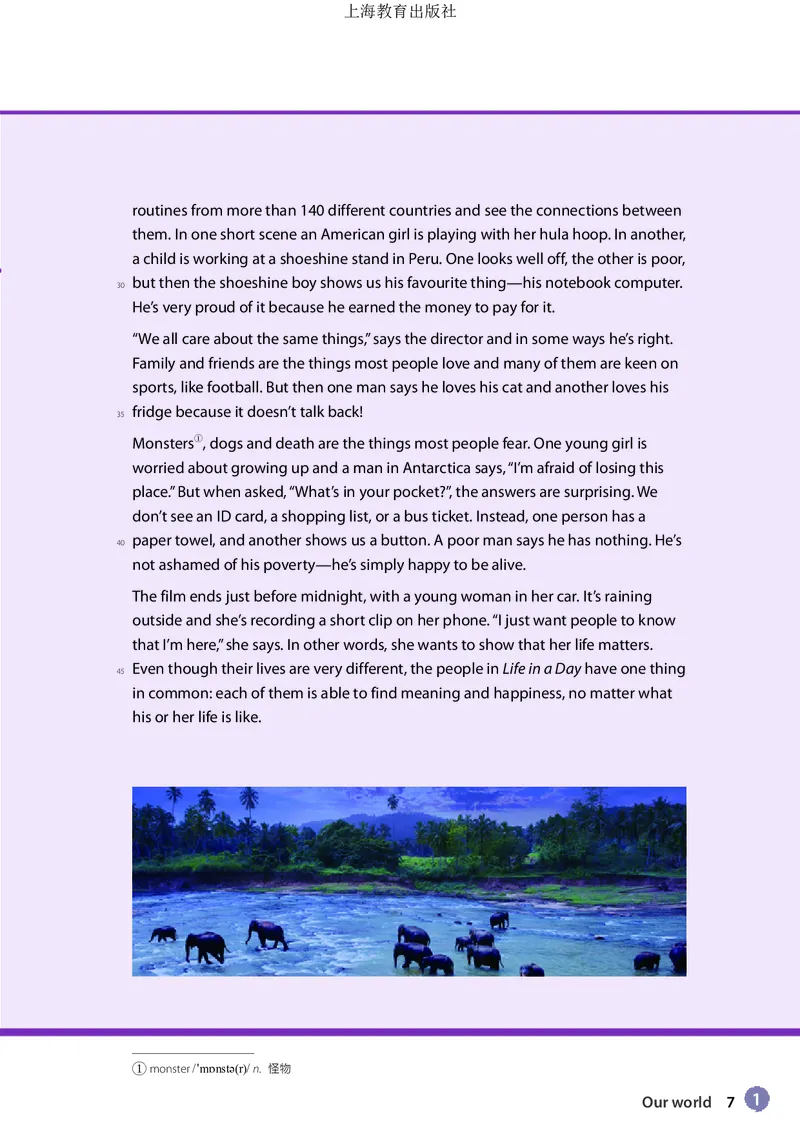
moon is high in the sky, elephants
Look up their definitions in a dictionary
are washing themselves in a river in
to see if your understanding is correct. 20
Africa and a baby is sleeping. At the
A video clip:
same time, in other parts of the world,
people are getting up, brushing their
A digital time capsule:
teeth and making breakfast. In the
next minutes of the one-and-a-half-
25
hour-long film, we watch everyday
a upload /0Vp9lRWd/ v. 上传
1
6 Our world上海教育出版社
routines from more than 140 different countries and see the connections between
them. In one short scene an American girl is playing with her hula hoop. In another,
a child is working at a shoeshine stand in Peru. One looks well off, the other is poor,
but then the shoeshine boy shows us his favourite thing—his notebook computer.
30
He’s very proud of it because he earned the money to pay for it.
“We all care about the same things,” says the director and in some ways he’s right.
Family and friends are the things most people love and many of them are keen on
sports, like football. But then one man says he loves his cat and another loves his
fridge because it doesn’t talk back!
35
Monstersa, dogs and death are the things most people fear. One young girl is
worried about growing up and a man in Antarctica says, “I’m afraid of losing this
place.” But when asked, “What’s in your pocket?”, the answers are surprising. We
don’t see an ID card, a shopping list, or a bus ticket. Instead, one person has a
paper towel, and another shows us a button. A poor man says he has nothing. He’s
40
not ashamed of his poverty —he’s simply happy to be alive.
The film ends just before midnight, with a young woman in her car. It’s raining
outside and she’s recording a short clip on her phone. “I just want people to know
that I’m here,” she says. In other words, she wants to show that her life matters.
Even though their lives are very different, the people in Life in a Day have one thing
45
in common: each of them is able to find meaning and happiness, no matter what
his or her life is like.
a monster /'mBnstR(r)/ n . (cid:12088)(cid:16759)
Our world 7 1上海教育出版社
AA RReeaaddiinngg aanndd iinntteerraaccttiioonn
Comprehension work
1 Read the passage and answer the questions.
(1) What did Kevin ask people around the world to do?
(2) What is Kevin’s film like according to the information in the first paragraph?
(3) What type of thing do people have in common about what they love?
(4) What are the things that most people fear?
(5) What do people want according to the final scene of the film?
2 Read the summary below and fill in each blank with a suitable word based on the
language of the passage. You may change the form if necessary.
Life in a Day is a film about the everyday lives of people in different countries.
The director Kevin Macdonald is interested in 1 a picture
of the world as a 2 time capsule for the future. He asked
people around the world to film a short 3 of their daily
routines on a 4 day. He also asked them to answer three
questions about what they love, what they fear, and what they have in their
pockets. He received 81,000 video 5 in all, which were
recorded on mobile phones or 6 cameras. Then, he and his
team turned them into a film. The scenes are well 7 and deal
with topics, such as people’s cares and worries, their fears and their feelings
about some seemingly 8 and unimportant things in life. The
film expresses a clear message: people around the world are living different
lives, and each of them is unique. But they have one thing in common: they
all try to find meanings in those everyday 9 —this is what
really 10 .
1
8 Our world上海教育出版社
Deep reading
1 Study the different scenes in the film. What do you think these scenes mean? Discuss
them in pairs and complete the table. You may use the example below to help you.
Elephants are washing themselves in a river in Africa.
You may ask and respond like this:
A: What does the film-maker want to tell us with this scene?
B: He may want to show that it’s the start of a new day.
Scenes shown in the film My understanding
(1) People are getting up, brushing their
teeth and making breakfast.
(2) An American girl is playing with her
hula hoop.
(3) A child is working at a shoeshine stand in
Peru. He shows his favourite thing—his
notebook computer.
(4) One man says he loves his fridge
because it doesn’t talk back.
(5) A man in Antarctica says, “I’m afraid of
losing this place.”
(6) A poor man says that he has nothing,
but he feels no shame in being poor.
(7) It’s raining outside and a young woman
says that she just wants people to
know she’s there.
Our world 9 1上海教育出版社
AA RReeaaddiinngg aanndd iinntteerraaccttiioonn
2 Work in pairs and discuss the questions.
(1) Why did Kevin make this film? What did he want to tell us?
(2) How would you answer the three questions at the beginning of the passage?
Mini-project
Making a digital time capsule
Imagine that you are going to make a digital time capsule for people living 100 years from now.
Each of you should suggest one object or one scene from everyday life for filming.
D iscuss the questions in groups.
What object / scene would you choose? Why would you choose it?
Share ideas within your group.
Select one person to report on behalf of your group.
My choice My choice
I would film one of our English
lessons for the time capsule.
Reasons Reasons
I think that the people living 100
years from now would find it
surprising that there is a human
teacher standing in the front
and talking to so many students
at the same time. By then, there
might not be schools like ours
any more. Children would probably
learn from robots.
1
10 Our world上海教育出版社
Focus on language
1 Read the passage again. Find some language points in the passage and list them in the
blanks.
(1) A word or an expression for everyday objects, made of two nouns (e.g. paper towel).
(2) An adjective followed by a preposition for expressing feelings (e.g. (be) interested in).
(3) Ways to express similarities and differences (e.g. At the same time, in other parts of the world,
people are ...).
2 Complete the sentences below with the correct form of the words in brackets.
(1) recorded music is easy to spread and share. (digital)
(2) Many doctors believed that there was a of knowledge about this kind of
illness. (poor)
(3) More than 20 people in the earthquake according to the news report.
(death)
(4) His yearly have increased a lot since he got a job in the city. (earn)
(5) He’s not the to enjoy an easy life. He’s always working hard to meet
challenges. (typical)
(6) Dear Sir, I’m writing in to your letter dated 19 July. (respond)
(7) His mother is very about what rice is used for making the Spring Festival
food. (select)
(8) His sense of humour is his own. This is why his books are much more
popular than others’. (unique)
Our world 11 1上海教育出版社
BB GGrraammmmaarr aaccttiivviittyy
Present continuous passive
The present continuous passive is am / is / are + being + past participle.
The plan is being reviewed now.
Grammar reference 1 (p. 88)
1 Read the interview. Pay attention to sentences 1–11 and answer questions a and b on
page 13.
My work at UNICEF China
Li Zhen from UNICEF (United Nations Children’s Fund) China was
interviewed by our reporter last week. Here is what he shared with us.
Reporter: What does UNICEF do?
Li Zhen: U NICEF is an international organization. Its goal is to protect the rights of children and
to make sure that every child receives health care and education.
1A lot of important work is being done by UNICEF and its partners. 2We are always
doing our best to improve the lives of children around the world. The organization
has offices in most countries. 3I’m mainly working in the UNICEF China office in
Beijing, but I do travel a lot.
4A large number of activities are being organized by different UNICEF offices and
partner organizations. Because of this, I’m always in touch with other offices to find
out about new projects.
Reporter: 5What kind of programme is currently being implementeda?
Li Zhen: U NICEF has an Early Childhood Development programme to help children between
the ages of three and six. Kids that age are too young to start school, but they’re not too
young to start learning. 6Through our community programmes, children are playing
and learning at the same time. Parents love these programmes.
Reporter: What are your plans for today at the office?
Li Zhen: W ell, there are several things on my schedule. A big conference will be held in Beijing
next week. 7My team is preparing to talk about our projects. 8I’m also writing a report
for the UNICEF office in New York. 9Several plans are being developed to improve
school quality in small towns far from any big cities. 10My report explains some of our
goals and what we’re doing to achieve them.
And later this afternoon, I’ll take part in a meeting about UNICEF’s e-learning
project for parents. 11That programme supports Chinese parents who are living and
working far away from their children.
a implement / 9ImplIment/ v . (cid:10924)(cid:13515);(cid:12661)行
1
12 Our world上海教育出版社
a Which sentences talk about actions that are happening
now or over a period of time?
b Which sentences talk about something being done?
2 Complete the passage. Use the present continuous or the present continuous passive
form of the verbs in brackets.
The UNICEF e-learning project
In parts of China many children are living with grandparents or relatives. Where are
these children’s parents? They 1 (work) far from their homes and
families. Many of these parents are only back home for a few days each year to see
their children. This kind of life is hard for the children and hard for the parents as well.
Luckily, programmes 2 (set up) to help them. UNICEF
3 (work) together with local organizations to provide support for
families with left-behind children. Today, mobile technology 4 (use)
to deliver useful information to parents.
The UNICEF e-learning project is one such programme. Every day, thousands
of parents watch short videos, take quizzesa, or read informative cartoons that
inspire and educate them about parenting through online appsb. Some apps
5 (develop), and some are already in use. And they provide useful
tips for many families.
3 Work in groups. Think of three things that are being done in your local area currently.
Write them down. You may use the example below to help you.
A new bridge is being built.
(1)
(2)
(3)
Now ask the other group members about their findings. Select the most meaningful
example and report to the class.
You may ask and respond like this:
A: What is being done in our school currently?
B: A new sports meeting is being planned in our school.
You may report like this: I think Lili’s example was very meaningful. She said, “In our city, the
household waste is being sorted out and put into different garbage bags.”
a quiz /kwIz/ n. 小(cid:15449)验 b app /Cp/ n. ((cid:23215)(cid:19109)机(cid:16)(cid:12633)机的)(cid:11682)用程(cid:11677)
Our world 13 1上海教育出版社
CC LLiisstteenniinngg aanndd ssppeeaakkiinngg
1 Think of possible volunteer work. Discuss the advantages you could get from it and the
challenges you may face.
Possible advantages Possible challenges
You may get useful work experience. You don’t have enough knowledge or
You may learn new skills and acquire new skills to do the work.
knowledge. You may be asked to do things that you’re
You may deepen your understanding of not interested in.
society. The working conditions are poor.
You may learn useful skills to deal with The work can be difficult.
real-life problems. It costs you too much money or time.
You may improve your interpersonal Others:
skills through working with your team
members.
Others:
2 Listen to two students, Zhang Min and Liu Wei, talking about their volunteering
experiences. Take notes and answer the question.
What are the two volunteers’ stories about?
3 Listen again for details. Complete the table about their projects.
Zhang Min Liu Wei
Name of project SMILE
Location Sri Lanka
Number of people four
Length of project three weeks
Working hours 2:00 p.m. – 5:00 p.m.
Difficulties sometimes no electricity
Advantages working with children
Current activity making learning materials
1
14 Our world上海教育出版社
4 Work in pairs. Look at the three advertisements. Select one and discuss your plan.
Volunteers wanted!
• Children support: • Water management: • Health first:
Support the children Protect our rivers. Improve public
a b
of migrant families toilet hygiene .
in your city or town.
Student A
Imagine that you are a volunteer on one of the projects above. Talk to your friends and ask them
to join you.
Student B
Your friend is on a volunteer project and wants you to join. You need to know more about the
project before you decide if you want to take part in it. If you don’t, suggest your own plan. Use
the ideas in exercise 3 on page 14 to help you.
Language guide
You may talk about these topics like this:
Project name: My project is called ...; (SMILE) stands for ...
Number of people: My project has ... / There are ... people working on
this project.
Length of project: The project will start in ..., and will be completed in ...
Working hours: We work from ... to ...
Difficulties: The challenges include ... / One big problem is ...
Advantages: One of the advantages is that ...
Current activity: Right now, I’m working on ...
a migrant /9maIGrRnt/ n . ( 为工作)(cid:18697)(cid:11091)者 b hygiene /9haIdZi:n/ n. (cid:8825)生
Our world 15 1上海教育出版社
DD WWrriittiinngg
Teens Magazine:
What’s new?
Every year, many young people enter senior high school just
like you. You may have something to say about your new
school life, so send us a letter about it. We want to know
what’s different, what’s similar and what’s new.
1 Read the advertisement in Teens Magazine. Imagine that you are writing to the
magazine. You may prepare your writing by thinking about the questions.
(1) What type of writing do you have to do?
an informal letter a formal letter
(2) What do you need to include? Select one or more topics from the list below.
school buildings teachers classmates schoolwork
school activities other things like
2 Read the sample letter. Which topics in exercise 1 question (2) does it include? Then
complete the table on page 17 before you write.
18XX Renmin Road
Shanghai 200040
People's Republic of China
12 September 20XX
Dear Teens,
I’ve been at senior high for about two weeks and I love it.
Many things here are different from those in my junior high school. The school is larger. It has
so many buildings that I still lose my way sometimes. We have more classes and the subjects
are much more difficult than before. Unlike the teachers in junior high, teachers here don’t set a
lot of rules, so we have more freedom. There are more school clubs and activities. I have joined
the basketball club and the guitar club. The biggest difference is that my senior high school is
a boarding school. I live in the school dorm during the week. I miss my family sometimes, but I
get on well with my roommates, and I’m learning how to live away from home.
Other things are the same. Students here are as friendly as those in the junior high school. I’ve
made some friends here and we play basketball after school together—just like before.
Next week, we’re going to have the School Art Festival. I’m playing the guitar for my class and I’m
excited about that!
I like life here. So much is new, challenging and fun. I know I’ll enjoy the next three years here.
Yours,
Li Ming
11
16 Our world上海教育出版社
Aspects of writing Guiding questions My exploration
What is the purpose of this letter?
What is the central idea in each
Content
paragraph?
How many ideas are there in each
paragraph?
How does the writer address the
magazine?
How does the writer express
Language
similarities and differences?
How does the writer finish and
sign off the letter?
What is the format of each
paragraph?
Where does the writer put the
Editing address and date?
How are punctuation marks used
differently from the Chinese way
in letter writing?
3 Now write your letter to the magazine.
Our world 17 11上海教育出版社
E Cultural focus
P eople who live in a particular area may share a similar lifestyle. This is what we call
culture. W e need to learn how to understand other cultures, and get to know their history
and societies.
In this section, you will first read a passage about how to study culture. You will then
watch a video about Irish immigration to the US A .
1 Read the passage to learn how to study culture.
How to study culture
Culture means a way of life for a particular group of people. It can be studied in terms of four
cultural elements—cultural objects, cultural festivals or celebrations, cultural behaviours and
cultural ideas.
A cultural object usually refers to a thing
that is closely related to a particular culture.
Chinese knots, lanterns and dragon boats are
examples of Chinese culture.
A cultural festival / celebration usually refers to an
event where the traditions of a particular people or
place are celebrated. Some Chinese examples include
the Spring Festival, the National Day (1 October) and
the Mid-Autumn Festival.
A cultural behaviour usually refers to a way of
doing a particular thing that is shared by other
members of that group or community. For example,
the way you introduce yourself to new people, eat
your meal, or even the way you speak in public.
1
18 Our world上海教育出版社
A cultural idea refers to an understanding of the world
that typically reflects the way of thinking in a particular
culture. For example, there are ideas about wealth, family,
and attitudes towards one’s elders in almost every culture
in the world. Yet, people from different cultures view these
things from different perspectivesa. In China, for example,
respect for older people is of much greater importance
than in some other countries.
2 Work in groups. Come up with two examples for each type of cultural element below.
Cultural objects:
Cultural festivals / celebrations:
Cultural behaviours:
Cultural ideas:
Now ask the other group members about their examples. Then select the most
interesting one and report it to the class.
The most interesting example we have found is:
3 Work in groups. Look at the pictures on page 20, discuss what cultural elements you can
see and match them to the cultures listed below. Then complete the table. You may use
the examples below to help you.
Chinese culture American culture
Cultures
British culture African culture
Indian culture Latin American culture
Japanese culture
Description Culture Cultural element
A Chinese musician Chinese culture cultural object(s)
is playing music. (her clothes and her
musical instrument)
a perspective /pR9spektIv/ n. (cid:22736)点;(cid:12075)考方(cid:15331)
Our world 19 1上海教育出版社
E Cultural focus
Descriptions Cultures Cultural elements
1
2
3
4
5
6
7
1
20 Our world上海教育出版社
Video From Ireland to the USA
Start thinking
1 Answer the questions.
(1) Where is Ireland?
(2) What do you know about Ireland?
Comprehension check
2 Watch the video. Correct the factual errors in the sentences.
(1) The monument to the Irish Potato Famine is in Liverpool.
(2) In the mid-19th century, 16% of Ireland’s food came from potatoes.
(3) The ships from Ireland to America first stopped in Canada.
(4) Many people died from hunger on the ships.
(5) More than half of the immigrants to the USA between 1820 and 1860 were Irish.
(6) One American president had Irish ancestors.
Vocabulary
3 Choose the correct answers.
(1) I didn’t have time for breakfast, so I’m hunger / hungry.
(2) The area is very danger / dangerous because many criminals live there.
(3) You should not feel any shame / ashamed just because you are an immigrant.
(4) Her parents felt very pride / proud of her when she won the prize.
(5) We slept well because our beds were very comfort / comfortable.
(6) Some families live in poor / poverty because the parents have no work.
Extension
4 Work in groups. Make a poster about a natural disaster and present it to the class.
(1) Make a list of the natural disasters you know. Which are the most destructive?
(2) Research one natural disaster each. When you have finished, take turns to ask questions
about each disaster in your group.
(3) Choose one of the disasters that you discussed in your group. Make a poster about it.
(4) Present your poster to the class.
Our world 21 1上海教育出版社
Self-assessment
Use the checklist and reflective questions below to evaluate your study in this unit.
1 2 3
Checklist* Me My teacher / Action
classmate
A Reading and interaction
I can explain why and how Kevin made the film.
I can interpret two or more scenes clearly.
I can use simple words to present my proposal for
the project Making a digital time capsule.
B Grammar activity
I can recognize the present continuous passive
structure in the passage.
I can use the present continuous passive structure
if the context is clear.
C Listening and speaking
I can understand the two volunteers’ experiences.
I can talk about my own project plan with suitable
words and phrases.
D Writing
I can analyse the content and the features of
language in the sample letter.
I can write about my new school life in an informal
letter with enough details in the correct format.
E Cultural focus
I can identify the cultural elements in the pictures.
I can explain the cultural significance of the Irish
Potato Famine in the 19th century.
Reflective questions
Which task / activity / exercise / passage in this unit is the biggest challenge to you? How did you
overcome the difficulties? What lesson(s) can you draw from this experience?
* Ask your teacher or your classmate to assess what you can do. Use the four symbols (33, 3 and !, !!). In column 1 or 2, 33=I’m
confident about this; 3=I’m OK, but not quite sure. In column 3, ! = I must review this part; !! = I must seek help about this. The
symbols can be applied to other Self-assessment sections in the book.
1
22 Our world上海教育出版社
2
Places
Objectives
A Reading and interaction C Listening and speaking E Cultural focus
Describe a city using Tell a story about acts of Explain the cultural
appropriate information and kindness meanings of place names
language Describe the natural
D Writing
resources in Nanning
B Grammar activity Write a travel blog using
Use the future in the past appropriate language and
correctly in the given format
context上海教育出版社
AA RReeaaddiinngg aanndd iinntteerraaccttiioonn
Where history comes alive
Pre-reading activity
1 Before you read, think about the
following questions.
Xi’an, China
(1) What are some must-see places around
Xi’an is no doubt one of the most popular
the world? Why do you think so?
tourist destinations in China. Every year,
millions of travellers visit the Terracotta
Army of Emperor Qin Shihuang about 42
(2) What can you see there? 5
kilometres from the city centre, which is
one of the most amazing historic sites in
the world.
(3) Were they important in history? Why?
As one of China’s great former capitals,
Xi’an grew to be the largest city in the
10
world during the Tang Dynasty, a golden
2 Look at the photos on pages 24 and 25.
age of art and poetry. Chang’an, as it was
What do you know about these places?
known at the time, was the starting point
of the Silk Road, which connected China to
the world. It was here that Xuan Zang set
15
out on his famous travels, which became
the basis of Journey to the West. Historic
2
24 Places上海教育出版社
sites from that time include the two Wild Goose Pagodas and the remains of the Daming
Palace, which was the centre of the Tang court.
Today, Xi’an is a modern city, at the heart of China’s Belt and Road Initiative, but its long
20
history can be seen everywhere: it is one of the few cities in the world that still have city
walls. The wall, almost 14 kilometres in length, was originally built for the purpose of
defence, but nowadays, it’s a great way to experience Xi’an: from here, you can get an
amazing view of the city.
25 Florence, Italy
Florence, one of the famous historic cities in Italy, is the birthplace of many amazing
ideas and discoveries!
Florence’s history is alive with the memory of a time when art, culture and science were
being “reborn”. In the late 13th century, the Renaissance began here before spreading to
the rest of Europe. At that time, Michelangelo, Leonardo da Vinci and Galileo were some
30
of the people living, working and studying in Florence. During this period, they, along
with other great minds, contributed valuable artworks and made important scientific
discoveries.
Florence is filled with art, science and history museums and ancient buildings, as well
as historic universities. You can visit many of these places to experience and admire
35
the amazing work and discoveries that happened during the Renaissance period. An
example is Michelangelo’s famous statue David, which he completed between 1501 and
1504. Another must-see is the University of Florence. It was started in 1321 and many
famous people studied there in the Renaissance period, including Leonardo da Vinci.
In Florence today you can experience the old and the new. Historic sites are neighbours
40
with fancy restaurants and high-end shops. While you are trying the delicious local food,
you can decide which interesting places to visit next.
Places 25 2上海教育出版社
AA RReeaaddiinngg aanndd iinntteerraaccttiioonn
Comprehension work
1 Read the passage and complete the information cards.
Xi’an, China Main Features
• The Terracotta Army of Emperor Qin Shihuang
Importance
• One of China’s great former capitals •
• •
•
Florence, Italy Main Features
•
IImmppoorrttaannccee
•
•
•
•
•
2 Read the summary below and fill in each blank with a suitable word based on the
language of the passage. You may change the form if necessary.
The passage introduces two important cities in the world, Xi’an in China and Florence
in Italy.
Xi’an, an ancient 1 capital of China, is now one of the most popular
tourist 2 in China, and a modern city at the heart of China’s Belt and
Road Initiative. The 3 Terracotta Army of Qin Shihuang is the most
famous 4 in Xi’an. The old city wall used for 5 can still
be seen today.
Florence, Italy, is a city of particular 6 importance: it is alive with
the 7 of the Renaissance. Many famous people who worked and
studied there 8 to the development of art and made important
scientific discoveries. The city is proud of its world-famous position in art and science,
and its old universities, as well as many other historic sites. Today, 9
restaurants and high-end shops add colour to the city. If you travel to Italy, Florence is a
10 !
2
26 Places上海教育出版社
Deep reading
1 Study the quotes and discuss in pairs how the use of the expressions in bold helps the
writer describe the place better. Then complete the table. You may use the example
below to help you.
Xi’an grew to be the largest city in the world during the Tang Dynasty, a golden age of art and
poetry.
You may ask and respond like this:
A: Do you know the meaning of this expression?
B: Which one?
A: “A golden age of art and poetry”.
B: It’s easy. “Golden age” means the period of time when something is at its best. So this
phrase means art and poetry were at their best during the Tang Dynasty.
Sentences in the passage My understanding
(1) Today, Xi’an is a modern city, at the heart
of China’s Belt and Road Initiative.
(2) Florence, one of the famous historic cities
in Italy, is the birthplace of many amazing
ideas and discoveries!
(3) Florence’s history is alive with the memory
of a time when art, culture and science were
being “reborn”.
(4) In Florence today you can experience the
old and the new.
Places 27 2上海教育出版社
AA RReeaaddiinngg aanndd iinntteerraaccttiioonn
2 Work in pairs and discuss the questions.
(1) What possible learning opportunities would the two places offer to visitors like you and
your classmates?
(2) What would you consider when you choose to visit a place? Why?
Mini-project
Introducing a city to foreign friends
Imagine that you are invited to be a local guide for a China-US exchange project. You are
required to introduce some places to American students while arranging a tour for them.
Discuss the questions in groups.
What places will you introduce?
What elements do you want to focus on (e.g. history, buildings, transport, food, etc.) in your
description? Why?
Create and practise your introduction within your group.
Select one person to report on behalf of your group.
Hi, my friends.
Let me introduce Beijing to you.
Beijing is our capital city. We can
see the Palace Museum there. It
was the place where the rulers
of several dynasties lived. There
are many ancient buildings and
gardens. Also, the Summer Palace
is a must-see. In Beijing, we can also
enjoy the famous Beijing opera and
Xiangsheng, which are popular among
the local people. What’s more, the
food there won’t disappoint you.
...
2
28 Places上海教育出版社
Focus on language
1 Read the passage again. Find some language points in the passage and list them in the
blanks.
(1) One of + plural noun structure for expressing that something or someone belongs to a
certain group (e.g. one of the most popular tourist destinations).
(2) Proper nouns referring to people, places and other things (e.g. the Tang Dynasty).
1) people:
2) places:
3) other things:
2 Complete the passage with the correct form of the words below.
amazing basis connect remains originally
experience history defence contribute admire
The Terracotta Army
The 29th of March 1974 would go down in 1 : on this day, a farmer named
Yang Zhifa made one of the most 2 discoveries of the 20th century. He was
digging a well in the countryside outside Xi’an when he suddenly found something hard in the
ground. It was a soldier from the Terracotta Army, and there would be many more.
There is now a museum where the sculptures were discovered. Visiting the site is a unique
3 : the many thousand mysterious soldiers stand there silently, looking at us.
Are they guarding something?
The Terracotta soldiers attract millions of visitors every year, but they were 4
created as a part of Qin Shihuang’s final resting place. Nearby are the 5 of the
Emperor’s tomb, which scientists will begin to explore sometime in the future.
Leonardo da Vinci
Leonardo da Vinci was born in 1452. When he was 15, his father sent him to study with an artist
in Florence. He was a very talented student, and quickly found work as a painter.
During his lifetime, Leonardo da Vinci 6 in many ways to art, science and
engineering. Leonardo explored the mathematical 7 of art and wrote a book
about how artists should use size and perspectivea. He also made sculptures and drawings, and
he even designed weapons for the 8 of the city.
Leonardo remains one of the most 9 people who have ever lived. Today, you
can visit many places 10 to Leonardo’s life and work in Florence, where you can
learn more about this Renaissance master.
a perspective /pR9spektIv/ n. (cid:24349)视(cid:15331)
Places 29 2上海教育出版社
BB GGrraammmmaarr aaccttiivviittyy
Future in the past
One way to talk about the future in the past is to use would / should (instead of will / shall) + verb.
The boy thought that he would never see the girl again.
Grammar reference 2 (p. 88)
1 When we travel around, we meet different people with different stories. Here is one
such story. Read and find examples of future in the past. Then complete the grammar
rules.
The kindness of strangers
It was Saturday, and Gina was excited. She usually met her friends at the weekend.
However, today she would visit her aunt in Toronto. She was about to go to the bus
station. This wasn’t her first bus trip on her own, but she still felt a bit nervous. The bus
ride wouldn’t be short: it was going to take almost five hours. Gina put some fruit and a
sandwich in her bag, in case she got hungry.
It was nine o’clock when she arrived and the station was crowded. Long lines of people
were waiting there. It took 45 minutes to buy a ticket. When she got on her bus, there
was one seat left, next to a boy in a basketball shirt. He was talking on his mobile phone.
The boy looked up when she sat down beside him. Gina smiled and she wanted to talk
to him. However, the boy didn’t smile back. She was still watching him when he turned
away and looked out of the dirty window. He didn’t want to talk. “What did I do? Was
I impolite?” she wondered. Gina closed her eyes. She thought about her trip. She was
going to spend a week at her aunt’s place. She couldn’t wait to arrive in Toronto! The bus
started moving, and Gina quickly fell asleep.
When we are talking about future events, as seen from the past, we can use the structures
1 , and .
2 indicates that the action happened soon afterwards.
2
30 Places上海教育出版社
2 Complete the passage with the correct forms of the verbs in brackets.
A few hours later, Gina 1 (wake up). Outside there were empty
streets and ugly houses, grey skies and rain. The bus 2 (stop). “We
must be in Toronto now,” Gina thought. She 3 (meet) her aunt at 5:00
p.m. That meant she had time to check out some stores downtown.
The boy beside her 4 (get up) to leave. “Where are we?” asked Gina,
to make sure she 5 (not get off) too early. “Hamilton,” said the boy.
Gina was surprised. “6 we (not ... go)
through Toronto?” she asked.
“Yes, we did,” he replied. “We 7 (leave) Toronto an hour ago and ...”
Gina didn’t wait to hear more. She quickly 8 (get off) the bus before
it left and called her aunt. No reply. She tried again, but her phone stopped working. Things
got worse by the minute. Gina reached for her bag, but it was still on the bus. She looked
down the road. The bus 9 (drive) away in the distance. She felt as if
she would never find her way back. Gina almost started crying when she suddenly heard a
voice behind her.
“Does this belong to you?” It was the boy in the basketball shirt and he had her bag. Gina
10 (remember) this moment for the rest of her life.
3 Work in groups. Think about the question: When you were a child, what did you think
you would do in the future? Write your ideas in the blanks below. You may use the
example below to help you.
When I was a child, I dreamt that I would become an envelope so that I could travel around the world.
(1) When I was a child, I thought I when I grew up.
(2) When I was a child, I thought I .
(3) When I was a child, .
Now ask the other group members about their childhood dreams. Find out if anyone still
has the same dream and report your findings to the class.
You may ask questions like this: When you were a child, what job did you think you would
do as an adult? Do you still think so?
You may respond like this: I thought I would become a policeman when I grew up, but
now I want to become a teacher instead.
You may report like this: Xiaoming has kept his childhood dream alive. As a child, he
thought he would become a teacher, and he still wants to be one now.
Places 31 2上海教育出版社
C Listening and speaking
1 Before you listen to the last part of Gina’s story, study the picture and identify the city
names (Hamilton, Ottawa and Toronto) for the locations A, B, and C. Then give your
reasons.
Park A
Lake
B
Lake
C
2 Listen to the last part of the story. Place the events below in the order that they occurred.
a Peter and Gina introduced themselves.
b Peter returned something that Gina had left on the bus.
c Peter and Gina got married.
d Peter and Gina went to a café.
e Gina’s aunt came to pick her up at the bus station.
f Peter lent his phone to Gina to make a call.
g To thank him, Gina invited Peter to watch a basketball match with her.
3 Listen again for details. Complete the table about the last part of Gina’s story.
The starting point:
(1) The bag: Peter gave Gina her bag .
Peter and Gina started a conversation.
(2) The mobile phone: .
(3) The destination: .
The development: (4) About Toronto: .
Peter and Gina got to know each other better (5) About sports: .
and became friends. (6) About a match: .
The happy ending: (7) Location: .
They lived happily together ever after. (8) Situation: .
2
32 Places上海教育出版社
4 Work in groups. Tell a story about “lending somebody a hand”. It could be a time when
you helped others or received help from them. You may follow the steps below.
Plan your story below based on the following questions:
When did it happen?
What were you doing?
What was happening in the background (the weather, people, etc.)?
Why did you offer to help, or why did they help you?
How did you feel?
Other questions:
Plan
your
story here!
Tell your stories to each other and ask questions if anything is not clear.
Vote for the most touching story in your group and share it with the whole class.
Language guide
You may set the scene like this: You may describe the weather /
Well, it’s a beautiful / interesting / ... story. environment like this:
It was on a ... day. / It happened on ... It was terribly hot / cold.
As I walked to ... It was raining heavily.
I was chatting with ...
What happened next? Well, ...
... was smiling back at ...
You may talk about your feelings
I was walking / thinking / working / ... like this:
... was / were nowhere to be seen. I felt surprised / embarrassed to ...
It shocked / surprised / ... me ...
It was surprising / ... to ...
Places 33 2上海教育出版社
DD WWrriittiinngg
Imagine that you have spent your summer vacation travelling around. You would like to
write a travel blog to share your experiences on a website with your classmates.
1 You may prepare your writing by thinking about the questions.
(1) Which place(s) did you visit?
(2) What was special about it / them?
(3) What is your opinion about it / them?
2 Read the sample travel blog. Then complete the table on page 35 before you write.
Home Profile Photos Search
My album
Sarah’s travel blog
25 June
Last week I went to Queenstown in New Zealand. I travelled
there by bus, through the mountains and past peaceful lakes.
It was a long, tiring trip, but while I was travelling, I met a girl
called Kate. We had a nice chat. She was from Queenstown
and she was very helpful. She told me all about the place.
Queenstown is in a beautiful location. It’s next to Lake
Wakatipu and it was originally a Maori settlement. Then in
the 1860s there was a gold rush. That’s when the Europeans
came and settled there.
While I was staying in Queenstown, I didn’t see any gold, but
II ddiidd sseeee aa lloott ooff aaddvveennttuurree ssppoorrttss.. QQuueeeennssttoowwnn iiss ffaammoouuss ffoorr
tthheemm.. TThhee wweeaatthheerr wwaass ccoolldd,, bbuutt ssuunnnnyy aanndd bbrriigghhtt,, ssoo II ttrriieedd
ssnnoowwbbooaarrddiinngg.. II aallssoo wweenntt ttoo aa mmuussiicc ffeessttiivvaall.. IItt wwaass vveerryy
bbuussyy,, bbuutt II mmeett aa lloott ooff ffrriieennddllyy ppeeooppllee..
AAss wweellll aass ffeessttiivvaallss aanndd ssppoorrttss,, II vviissiitteedd ssoommee lliivveellyy mmaarrkkeettss
aanndd aattee aatt ssoommee ppooppuullaarr rreessttaauurraannttss.. QQuueeeennssttoowwnn wwaass aa
ffaannttaassttiicc aanndd eenneerrggeettiicc ppllaaccee!!
2
34 Places上海教育出版社
Aspects of writing Guiding questions My exploration
When and where did the
writer take this trip?
Content What did the writer see there?
What did the writer do there?
What language does the
writer use to describe what
she saw there and how she
felt?
Language
What tense does the
writer use to describe her
experience?
Where does the writer put
Editing
the date?
3 Now write your own travel blog.
Home Profile Photos Search
My album
Places 35 2上海教育出版社
E Cultural focus
W hen we read about a famous city, we are often drawn to its uniq ue history and culture,
and want to travel there to experience a different way of life.
In this section, you will first read a passage about place names in A ustralia. You will then
watch a video about the natural resources in N anning, the capital of G uangxi Z huang
A utonomous R egion.
1 Read the short passage below and discuss the question.
How do you understand the sentence “For in naming we speak, don’t we?”
Naming is important in almost any culture. People name their children for a variety
of reasons. They may want to express their hopes, dreams and what they believe in.
Sometimes, this is done simply for the purpose of giving it a name. As Shakespeare wrote
in Romeo and Juliet, “... that which we call a rose / By any other name would smell as sweet.”
Like people, places or buildings are also named for many different reasons. In the words of
Plato, “For in naming we speak, don’t we?”
2 Read the passage on pages 37 and 38 and complete the table below. Choose at least
three places to illustrate the meanings behind or the origins of their names. Then
present your ideas to the class.
Names of places Meanings / Origins
Murwillumbah good campsite
Nambucca
Bondi Beach
Uluru
Bougainville
Arnhem Land
Melbourne
Waterloo
2
36 Places上海教育出版社
What’s in a name?
Last year, as I was travelling through Australia,
I often stopped at places with strange names:
names like Murwillumbah and Waterloo. I
often asked myself, “Where do all these names
come from, and what can we learn from them?”
5
Local people sometimes knew the answer and
sometimes they didn’t, so I decided to look at
these place names more closely and found out
some interesting facts.
“Where are we?” That’s the question we all ask
10
when we arrive in a new place. Think about it.
How can we tell another person where we are?
Many place names give us an idea because they
describe physical features, like “big hill”, “dry
desert”, or “tall tree”. Thousands of years ago, this
15
is how the first Australians—the Aboriginesa—
named places. Today, in Australia, there are
thousands of places with Aboriginal names,
towns like Murwillumbah (good campsite),
Nambucca (entrance to the sea), Bondi Beach
20
(from the word “Boondi”, the sound of water
falling over rocks) and Uluru (big rock).
The Europeans had different ideas. When they
first arrived in 1606, they wanted to make this
strange new land feel like home. How did they
25
do it? Well, they borrowed names from the
country they came from—it showed that these
a Aborigine /0CbR9rIdZRni/ n. (cid:16065)大(cid:8503)(cid:7591)(cid:9773)(cid:21349)
Places 37 2上海教育出版社
E Cultural focus
places belonged to them. French and Dutch place names like Bougainville and Arnhem
Land started to appear along the Australian coast. Then, in 1770, the English explorer
Captain James Cook arrived in Botany Bay. Soon, there was Melbourne, a town named
30
after a British Prime Minister, and Waterloo, named after a famous battle between
England and France.
Altogether there are over 250,000 names in Australia: names of rivers, mountains,
deserts, towns, cities and many more. These names can tell us what we can find there,
they can tell us about history, they can warn us about danger or they can welcome us.
35
Next time you travel to a new place, think about its name. What is it telling you?
3 Read the passages in exercises 1 and 2 again and choose the correct answers.
(1) According to Shakespeare, .
a a rose should not be called any other name because it would not sound so sweet
b a rose should be called a rose because the name sounds as sweet as a real rose
c a rose can be called anything; the name itself is not important
d a rose can be called anything as long as the name sounds as sweet as a rose
(2) According to Plato, .
a naming is a part of communication in a strange place
b we need names to communicate in speech, but not in writing
c naming perhaps is one of the important features of human language
d naming perhaps is one of the important cultural features in human lives
(3) People name places for many reasons. Which of the following is not mentioned in the
passage in exercise 2?
a A famous event.
b Famous people.
c Features of land.
d Trading between settlers.
4 Work in groups and discuss the question.
What place names do you know that have special meanings in them?
2
38 Places上海教育出版社
Video Nanning: a city in southern China
Start thinking
1 Answer the questions.
(1) Which cities have been centres of trade in southern China? Name some.
(2) Which city would you like to travel to? Why?
Comprehension check
2 Watch the video. Correct the factual errors in the sentences.
(1) Nanning played host to the China-ASEAN Expo before 2004.
(2) Nanning is regarded as the greenest city in China.
(3) The villages are reinventing themselves as hotbeds of urban tourism.
(4) Efforts are being made to explore the virgin forest which is filled with wildlife.
(5) Despite their enormous scale and the difficulty of access, many of the vast underground
networks have been mapped.
Vocabulary
3 Complete the sentences with the words.
lie host celebrate contain explore remain
(1) It is important that organizations encourage their staff to try new ideas and
new methods.
(2) The secret of the village’s success may in the fact that they are willing to
experiment.
(3) Since 2018, Shanghai has played to the annual China International Import
Expo.
(4) He returns home each year to the Spring Festival with his parents.
(5) Let me just say that we optimistic that we can solve this problem.
(6) Her essay is quite good, except that it one or two errors.
Extension
4 Imagine you are choosing a city to host the next World Expo. Work in groups. Decide on
the city and give your reasons.
(1) Make a list of three to five cities that you think could host the next World Expo.
(2) Discuss the advantages and disadvantages of each city and make a decision.
(3) Draw a picture of the city. Write some captions to introduce it.
(4) Present your choice to the class.
Places 39 2上海教育出版社
Self-assessment
Use the checklist and reflective questions below to evaluate your study in this unit.
1 2 3
Checklist Me My teacher / Action
classmate
A Reading and interaction
I can identify the main features of Xi’an and Florence.
I can identify the meaning of common expressions
used in the passage.
I can introduce a city in China to foreign friends
using appropriate language.
B Grammar activity
I can recognize different structures for talking about
the future in the past in the passage.
I can use the structures correctly if the context is
clear.
C Listening and speaking
I can understand the story between Peter and Gina.
I can tell a story about acts of kindness in life with
suitable words and expressions.
D Writing
I can analyse the content and the features of
language in the sample blog.
I can write about a place using appropriate language
and format.
E Cultural focus
I can explain the cultural meanings of at least three
place names in the reading passage.
I can introduce the features of the natural resources
in Nanning.
Reflective questions
How did you engage in the group work? Is there anything that you can improve next time you
take part in such activities?
2
40 Places上海教育出版社
3
Choices
Objectives
A Reading and interaction C Listening and speaking E Cultural focus
Explain the environmental Describe personal Explain the advantages and
impact of food transport, experiences of using a disadvantages of online
packaging and production vending machine food delivery services
Understand the variety of
B Grammar activity D Writing
domestic and international
Use the structure of relative Write a short message using
food in the UK
clauses with suitable relative appropriate language and
pronouns in the given format
context上海教育出版社
AA RReeaaddiinngg aanndd iinntteerraaccttiioonn
Pre-reading activity Food for thought(cid:27)
1 When you make food choices, what do
you take into consideration? The good, the bad
taste price
h ealth c onvenience and the really ugly
Others:
2 Have you ever heard of the term carbon by Jane Brown
footprint? Study the dictionary entry
below. Is a big carbon footprint good or
bad for the environment? Why?
Today, in my fridge, there are a few
grapes, some bananas and some fruit
carbon footprint
juice—things that are not expensive
a measure of the amount
of carbon dioxide that and that are good for me. There is also a
is produced by the daily pizzaa, and some burgersb—which are
5
activities of a person or
not so good. I know what this food does
company: Companies are
to my body, but what does it do to the
looking at ways to reduce their
world around me? It’s time to look at my
carbon footprints.
carbon footprint and think about the
difference between the good, the bad
10
and the really ugly.
a pizza / 9pi:tsR/ n. (cid:15074)(cid:21302)(cid:26762) b burger /9bF:GR(r)/ n. (cid:15191)(cid:10031)(cid:8723)
3
42 Choices上海教育出版社
Food miles
My first stop is the label. Labels give us lots of information: how long we can keep our food,
how healthy it is and where it comes from. A few hundred years ago, most of our food came
from places we could walk to, but today, food travels thousands of miles. We refrigerate
15
it, and then transport it in planes and ships all over the world. This creates pollution and
causes global warming. I look at the pizza and feel bad at once—not because it’s unhealthy,
but because the seafood on it comes all the way from Thailand. I know seafood is also
produced in the UK, but the local seafood is more expensive. I take out a banana—it’s from
Brazil, but that’s not too bad. It came here by boat, so the carbon footprint of this healthy
20
snack is small.
Packaging
The next stop is the packaging. In the UK, we don’t recycle all our packaging; we throw away
more than 30% of it. This waste goes to the rubbish dump and not to the recycling facility.
Luckily, we don’t need to package food like bananas, but food like grapes needs protection. I
25
look at the grapes in my fridge—they’re in a plastic container and they’re from Spain.
Production
So my grapes are from Spain, but at least they grew in natural sunlight. In the UK, people
grow grapes in heated greenhouses, which means our grapes are less energy-efficient. But
there is one other thing in my fridge, and if pizza and grapes are “bad”, then this food is “really
30
ugly”. It’s the burgers. They have the biggest carbon footprint because they come from
cows. In the USA, cows create the same amount of greenhouse gases as 20 million cars!
As I close the fridge door, I make a checklist for my next trip to the supermarket: 1) Read
the label; 2) Look at the packaging; 3) Don’t buy a lot of meat. Maybe I could grow my
own vegetables too. It’s eco-friendly. I’d save some money and I wouldn’t feel bad about
35
eating burgers!
Choices 43 3上海教育出版社
AA RReeaaddiinngg aanndd iinntteerraaccttiioonn
Comprehension work
1 Read the passage and answer the questions.
(1) What does the writer want to find out about the food in her fridge?
(2) What can we learn from food labels?
(3) Why does the writer feel bad about the pizza?
(4) Why does the writer think bananas are better than grapes?
(5) What is “the really ugly” according to the writer? Why?
(6) What will the writer take into consideration when making food choices?
2 Read the summary below and fill in each blank with a suitable word based on the
language of the passage. You may change the form if necessary.
The passage is about the great impact of food transport, 1
and production on the environment. The writer divides food into three
types based on their carbon 2 and shows us three ways to
determine the environmental impact of different kinds of food.
The first method is to check food miles by reading food 3 .
Long transport distances are bad for the environment because they waste
energy and cause 4 . Next is to check the food packaging.
Much of the packaging doesn’t get 5 , but ends up in the
rubbish 6 . In other words, food with less packaging is more
environmentally friendly. The last way is to look at how the food is produced.
Compared with vegetables grown in natural 7 ,
vegetables grown in greenhouses are less 8 . Burgers cause
huge environmental stress because they come from cows. In the USA, cattle
produce the same amount of 9 gases as 20 million cars. The
writer of the passage suggests that we should choose more eco-friendly
food to 10 our environment.
3
44 Choices上海教育出版社
Deep reading
1 Read the sentences and discuss in pairs why the writer gives us these facts and figures.
Then complete the table. You may use the example below to help you.
We refrigerate it, and then transport it in planes and ships all over the world. This creates pollution
and causes global warming.
You may ask and respond like this:
A: What does the writer tell us about food transport?
B: According to the writer, many foods travel a long way before they reach us. They are often
frozen on the way.
A: Why does the writer mention these things?
B: I think the writer wants us to buy more local food. Local food is more eco-friendly.
Sentences in the passage My understanding
(1) In the UK, we don’t recycle all our
packaging; we throw away more than
30% of it.
(2) Luckily, we don’t need to package
food like bananas, but food like grapes
needs protection.
(3) So my grapes are from Spain, but at
least they grew in natural sunlight. In
the UK, people grow grapes in heated
greenhouses, which means our grapes
are less energy-efficient.
(4) In the USA, cows create the same
amount of greenhouse gases as 20
million cars!
Choices 45 3上海教育出版社
AA RReeaaddiinngg aanndd iinntteerraaccttiioonn
2 Work in pairs and discuss the questions.
(1) What is the writer’s purpose of writing the passage?
(2) Do you think it is necessary to care about the carbon footprint of food? Why or why not?
Mini-project
Checking food in my fridge
1 Think of the food in your fridge. Put them into three groups (the good, the bad and the
ugly) and explain the reasons. You may use the ideas below to help you.
in / out of season where it comes from how it is made / produced / grown
the distance it travels its packaging
2 Share your findings in class and suggest some changes you can make to reduce the impact
of food on the environment.
My findings My findings
In my fridge, there are local vegetables,
apples packaged in plastic and
some beef. I think the vegetables are
“good” because they don’t have to
be transported a long way. That is,
transporting vegetables locally can
save energy. However, the apples are
“bad” because the plastic packaging
they use cannot be recycled easily. And
the beef is “really ugly” because it has
the biggest carbon footprint.
Changes I can make Changes I can make
When I shop next time, I will buy more
local food. And I will choose fruits
without plastic packaging. Last but not
least, I can eat less beef and more local
fish.
3
46 Choices上海教育出版社
Focus on language
1 Read the passage again. Find words in the passage to match the items below to make
compound nouns and adjectives. Then match the compound words to definitions 1–5.
eco- food greenhouse recycling rubbish
(1) a piece of land where waste materials are dumped
(2) not harmful to the environment
(3) the distance food travels to get to our homes
(4) gases like carbon dioxide that are bad for the environment
(5) a place where old objects and materials are treated so that
they can be used again
2 Complete the passage with the correct form of the words below.
global packaging efficient stress convenience
recycle container determine dump impact
It is often hard to 1 whether the food we eat is eco-friendly or not. However,
it is clear that some types of food have a bigger environmental 2 than others.
What can we do in our everyday lives to make a difference?
Firstly, we should avoid food that has travelled a long way. Food transport is a big source of
CO , which causes global warming. In other words, it is best to eat food that is produced locally.
2
Secondly, we should eat less fast food. Due to its 3 , fast food has become
very popular, but it is unfortunately very bad for the environment. The industry produces a
lot of waste: unnecessary 4 , along with other single-use plastics, is one big
part of the problem. Most takeaway 5 will probably end up in the rubbish
6 . However, we can encourage restaurants to use 7 materials
to pack their meals. Thirdly, we should avoid those types of food that cause huge environmental
8 . For example, rainforests around the world are being burned down to make
room for cattle farms and palma oil plantationsb. To protect the rainforest, we should eat less
beef and avoid food that contains palm oil.
Pollution and climate change are 9 problems, so we all need to work
together. The good news is that every little bit counts. By using our resources in a more
10 way, we can save a lot of money at the same time as we save the
environment.
a palm /pA:m/ n. (cid:14307)(cid:14486)树 b plantation (cid:16)plA:n9teISn(cid:16) n(cid:15) (cid:18651)(cid:14363)园,(cid:18651)(cid:14363)(cid:9800)
Choices 47 3上海教育出版社
BB GGrraammmmaarr aaccttiivviittyy
Relative clauses with who, whom, which, that and whose
We can add information to a noun phrase by using a relative clause. We can link them with a
relative pronoun such as who, whom, which, that or whose.
The boy liked the breakfast that his mother prepared for him.
Grammar reference 3 (p. 89)
1 Read the passage. Match sentences 1–6 to grammar rules a–d on page 49. Then write the
noun phrase referred to by the relative pronoun.
A recent study shows that more and more teenagers are not eating a healthy diet. 1We
asked a student who is in senior high school to keep a food diary. Her name is Tina Fisher.
2In her diary, she recorded details of her meals which provided us with lots of information.
It is an example of what a typical teenager eats and drinks. Does she eat any fruit and
vegetables? Is there a lot of fast food in her diet? Read on and find out!
Day 1 Day 2
Breakfast: 3Most teenagers whose parents Breakfast: I had some bread and
work long hours have to prepare breakfast drank a lot of water. I was still
themselves. I woke up late for school, so hungry, but I don’t know how to
I didn’t eat anything. My mum left me cook, so I didn’t eat any more.
some yoghurt, but I put it aside. 4 The
Lunch: I drank a few glasses of
yoghurt which she leaves for me is always
orange juice. Then I had a banana
the healthy kind. I don’t like it at all. I had
and some chocolate. I sometimes
some orange juice instead.
eat fruit, but I don’t eat many
Lunch: My dad gives me money every vegetables. I hate salad.
week for my lunches, but I use it to buy
Dinner: 6 The family dinner that
magazines, so there’s not much money left
we had tonight was really nice.
for food. Today, I had some biscuits instead
We had soup, chicken, baked
of lunch.
potatoes and carrots, but I didn’t
Dinner: 5By 5:00 p.m. I was hungry, so I eat any soup or potatoes. I had
had a snack that I made myself. I had a some apple juice before I went to
little peanut butter on bread, but I didn’t bed.
eat any vegetables. For dinner, I had a
small egg sandwich. I don’t have many big
meals because I want to stay slim.
3
48 Choices上海教育出版社
The noun phrase referred to by
Grammar rules Sentence(s) in the passage
the relative pronoun
a who or whom to refer to
people
b which to refer to things
c that to refer to people or
things
d whose to express a
possessive meaning
2 Complete the passage with the correct relative pronouns.
Teenagers worry a lot about how they look and their body image is something 1
can be a huge source of stress. As a food and health expert, I meet many young people
2 ask me about weight loss tips. Many of them have read health advice on the
Internet 3 may seem like a good idea, but is actually harmful.
In fact, teenagers 4 want to stay slim often pick up unhealthy habits. They also tend
to eat things 5 aren’t good for them. For instance, snacks 6 contain a
lot of sugar might give you some quick energy, but will make you feel tired later on. Moreover,
teens 7 haven’t had enough to eat during the day will simply buy lots of junk food
on the way home from school instead.
From what I can see, teenagers 8 parents have good eating habits tend to have
fewer problems themselves. My advice to Tina: eat three healthy meals a day and do lots of
exercise—that’s the best way to stay slim.
3 Complete the sentences below with true information about three people, objects or
places. You may use the example below to help you.
The fruits (that / which) l like most are grapes, oranges and apples.
(1) The fruits (that / which) I like / hate most .
(2) The people (who / whom / that) I admire most .
(3) The most beautiful places (that) I have been to .
(4) Your own topic: .
Now ask your classmates about their information. Find out who is the most similar to
you and report to the class.
You may ask questions like this: What topic did you write about?
You may respond like this: I wrote about the fruits that I like most: grapes, oranges and
apples.
You may report like this: I discovered that Lili and I are very similar. The fruits that we both
like most are grapes, oranges and apples.
Choices 49 3上海教育出版社
CC LLiisstteenniinngg aanndd ssppeeaakkiinngg
1 Read the description of a device and guess what it is.
The first one was used in Egypt in the first century CE.
Ancient Egyptiansa bought holy water from it.
People started to use it a lot in the 19th century.
If you put in one thing that is valuable, it will also give you something of equal value.
What is it?
2 Listen to the radio programme, check your guesses in exercise 1 and tick the items listed
below that are sold by the device.
bubblegumb stamps fizzy drinksc
T-shirts sports shoes cameras
vegetables and fruits postcards seafood
books chocolate umbrellas
3 Listen again for details and complete the table.
Jack Guy Sally Daniel
Things they can
buy
Location of the
vending machine
Comments from
the host
a Egyptian /i9dZIpSn/ n. (cid:9937)及人 b bubblegum /9bVblGVm/ n. (cid:15343)(cid:15343)(cid:19428) c fizzy drinks /9fIzi drINks/ (cid:18369)(cid:24710)(cid:26748)料;(cid:15243)水
3
50 Choices上海教育出版社
4 Work in groups. Interview the members of your group about their experiences of using
vending machines and their opinions on having a vending machine in a public location.
Complete the table and report the results to the rest of the class.
Experiences of using vending Opinions on having a vending
Student names
machines machine in a public location
Language guide
You may interview the other group members like this:
What things do you buy from vending machines?
Where do you often find / see vending machines?
How do you pay?
Do you think it necessary to have a vending machine in
a public location? Why or why not?
What problems would we have if ...?
You may make comments like this:
You mean ..., right?
So, perhaps ...
That’s interesting / a shame / ...
You are joking!
Wow! That’s impressive.
Don’t you think it might be a good idea to ...?
I can’t agree more.
I’m afraid it wouldn’t work.
Choices 51 3上海教育出版社
DD WWrriittiinngg
1 Imagine that you are going to write a short message. Read tasks 1–2 and choose one
task. You may prepare your writing by thinking about the questions.
1 2
You are planning to spend the weekend You have spent a week abroad with a host
camping with your classmates. Write to family. Today is the last day of your trip
some new friends to invite them to join and you have to get up very early to catch
you. your plane. Write a short message to thank
a Say where you are going. them.
b Give the time and place to meet. a Apologize for not saying goodbye to
them in person.
c Ask them to tell you whether they can
come as soon as possible. b Thank them for letting you stay in their
house.
d Remind them to wear good walking
shoes: this is very important. c Tell them you enjoyed your visit,
especially the trip to the mountains.
d Express your hope that they will visit
you soon.
(1) What is the purpose of your writing?
(2) Who is your short message for?
2 Read sample short messages A–C. Then complete the table on page 53 before you write.
A
Tina
Don’t forget your lunch box.
Working late tonight so can’t cook dinner, but there’s
pizza in the fridge and some fruits, e.g. bananas and
apples. There’s also some pudding.
a
NB Go to bed earlier tonight.
Mum
C
Dan
Zhang Jia’s birthday on Sat. Lili planning surprise
B
party.
Fang Want to come?
Just wanted to say thanks for the Party at 7:30 p.m., Red Fish Restaurant, No. 123,
flowers! Wuyang Rd.
Lovely surprise to find them on my I’ll be there from 7—helping with decorations,
desk . lights, etc.
They’re beautiful, esp
.
the yellow RSVP b to Lili if you can make it.
roses . Fang
Lili
a NB ((cid:12759)(cid:7438)语(cid:20023)(cid:17523)语)(cid:15350)意,(cid:17511)心 b RSVP ((cid:15331)语(cid:20023)(cid:17523)语)(cid:23301)(cid:9708)(cid:10267)
3
52 Choices上海教育出版社
Aspects of writing Guiding questions My exploration
Who is each short message for? Is
it for a friend, a classmate, a family
member, etc.?
Content
What is the main purpose of each
short message?
To save space and time, what is
usually left out in sentences?
Language
What short forms are used in these
messages? What do they mean?
What is put at the top of these
messages? Is there a punctuation
mark after it?
How are the short forms of words
Editing
capitalized?
Which short forms must be written
with full stops?
3 Now write your short message.
Choices 53 3上海教育出版社
E Cultural focus
O ur food choices can have an impact on our health, as well as the environment. E ven
though certain types of food may be convenient, we need to consider the conseq uences
our eating habits might have.
In this section, you will first read a passage about online food delivery services. You will
then watch a video about different types of food in Britain.
1 Work in pairs. Discuss the questions.
(1) Do you use online food delivery apps?
(2) What do you think the advantages and disadvantages of such apps are?
A new way of eating: online food delivery services
Few people knew about online food delivery apps ten years ago, but
today, many would find it hard to live without them. In China alone,
over 400 million people use such apps. For better or for worse, online
food delivery services have changed the way we eat, and they are also
5 having a huge impact on our society.
These services have no doubt brought us many benefits. They provide
jobs for millions of people and help restaurants find more customers.
Since the apps are very convenient, they also benefit consumers: we
can now have meals delivered at any time of day, despite bad weather
10 or busy schedules. This is especially important for people who work
long hours, since they might not have time to cook. Not only do these
apps save time, they also provide us with a wide variety of restaurants
to choose from. They have proved to be useful for retired people as
well: seniors who live far away from restaurants and supermarkets can
15 now get hold of meals and groceries more easily.
However, we must not forget the drawbacksa of online food delivery
services. For one thing, they make it even easier to order unhealthy
food, high in sugar, fat and salt. Food safety is another problem: it can
a drawback /9drO:bCk/ n. (cid:20040)点;(cid:7450)(cid:8503)(cid:13935)(cid:7683)
3
54 Choices上海教育出版社
be hard to establish where the food actually comes from, and whether
the owner is legally permitted to run a restaurant. As couriersa need
20
to deliver the orders as quickly as possible, some pay little regard to
traffic rules. In recent years, there have been a number of terrible traffic
accidents because of this. Moreover, the industry is creating unbelievable
amounts of packaging waste: over a million tonnes of online food delivery
boxes are thrown away every year. Experts assume that this number will
25
continue to grow in the future, and this will have a negative impact on the
environment.
There are many advantages of these services, but we need to make sure
that we make the right choices in the long run. We should do our best
to limit waste, especially when it comes to packaging. We also need to
30
think about what we eat and the impact on our health. Next time you are
thinking about ordering in, you should ask yourself whether you really
need to. In most cases, it’s better to walk over to the supermarket, buy the
ingredientsb you need, and then cook them yourself.
a courier /9kWriR(r)/ n. (cid:12025)(cid:24352)员 b ingredient /In9Gri:diRnt/ n. ((cid:11058)(cid:12821)(cid:16391)(cid:26744))材料
Choices 55 3上海教育出版社
E Cultural focus
2 Read the passage and identify the topic sentence of each paragraph. Then find out the
supporting details.
Paragraph Topic sentence Supporting details
• Over 400 million people use such apps.
1 •
•
•
2 •
•
•
3 •
•
•
4 •
•
3 Read the passage again and decide whether the following statements are true (T) or
false (F). Correct the false ones.
(1) Online food delivery apps are convenient and useful, but it is hard for retired people
to use them.
(2) Online food delivery apps are useful for people with a busy lifestyle.
(3) The biggest disadvantage of online food delivery services is that the food you order
may be high in sugar, fat and salt.
(4) The writer thinks that it is better to order in than to cook at home.
4 Work in groups and discuss the questions.
(1) Do you prefer eating home-cooked meals to ordering in? Why or why not?
(2) How can we make the online food delivery industry more environmentally friendly?
3
56 Choices上海教育出版社
Video Food in the UK
Start thinking
1 Answer the questions.
(1) What traditional foods do people eat in your city?
(2) What international restaurants are popular in your city?
(3) Do you like cooking? What dishes can you cook?
Comprehension check
2 Watch the video and complete the sentences.
(1) Many people think of as a traditional food in
the UK.
(2) A Cornish pasty is a pastry with , and baked
inside it.
(3) In the UK, you can try foods from different countries at restaurants, and
.
(4) There are many international restaurants and on Cowley Road.
(5) At most Indian restaurants you can eat food from India, and .
(6) Bangladeshi food is made with meat or fish, and spices.
(7) One of the most popular dishes in the UK is . It is usually served with
and a kind of called naan. Most restaurants cook their own
naan in a special tandoor .
Vocabulary
3 Match the words 1–8 to the definitions a–h.
(1) chef a one of the items of food that you need to cook something
(2) dish b a special oven used in an Indian restaurant
(3) ingredient c the instructions for cooking something
(4) pastry d a professional cook
(5) recipe e a powder used to give flavour to food, e.g. black pepper
(6) spice f a type of food prepared in a particular way
(7) takeaway food g a mixture of flour, fat and water that is used to make pies
(8) tandoor h food sold in a restaurant that you can eat somewhere else
Extension
4 Work in groups. Describe a foreign dish you have tried.
(1) Make a list of foreign dishes you have eaten. What are the main ingredients?
(2) Tell your group about your list. Then choose three dishes in your group: a starter, a main
course and a dessert.
(3) Research them and describe them to the class.
Choices 57 3上海教育出版社
Self-assessment
Use the checklist and reflective questions below to evaluate your study in this unit.
1 2 3
Checklist Me My teacher / Action
classmate
A Reading and interaction
I can explain the impact of food transport, packaging and
production on the environment.
I can identify the writer’s purpose of writing by studying
the writing techniques used in the passage.
I can illustrate the environmental impact of three types of
food by giving suitable examples.
B Grammar activity
I can recognize relative clauses with who, whom, which, that
and whose in the passage.
I can form relative clauses correctly if the context is clear.
C Listening and speaking
I can list the things sold in vending machines as mentioned
by the four speakers.
I can talk about my experiences of using vending machines
and express my opinions.
D Writing
I can analyse the content and the features of language in
the sample short messages.
I can write short messages such as notes and invitations,
using short sentences, imperatives and abbreviations
where possible.
E Cultural focus
I can state clearly my opinion about online food delivery
services.
I can describe domestic and international food available in
the UK.
Reflective questions
Of the three topics in this unit: carbon footprint, the vending machine, and online food ordering
and delivery, which one interests you most? What did you learn from it?
3
58 Choices上海教育出版社
4
My space
Objectives
A Reading and interaction C Listening and speaking E Cultural focus
Explain the differences in life Make a list of house rules Understand the historic
between past and present and provide reasons for value of Highclere Castle
as in the reading passage these rules Explain the changes of
pastimes in the UK
B Grammar activity D Writing
Use the structure of relative Write a description of a
clauses with when, where room using appropriate
and why correctly in the language and format
given context上海教育出版社
AA RReeaaddiinngg aanndd iinntteerraaccttiioonn
Pre-reading activity
1 Look at the photo of a kitchen in a
1940s house in the UK and tick the
things you think the average family
might have owned at that time.
Imagine how their lives were different The 1940s
from ours today.
house
central heating a DVD player
“There were many times when I thought, ‘I
a fridge a microwave
can’t do this. I am a 21st century woman. I
a radio an ovena
don’t work eighteen-hour days.’ But then I’d
a computer a washing machine
stop and say, ‘Hang on. In the 1940s, women
a dishwasher a phone
5 didn’t say they couldn’t do it. They just got on
a television
with it.’ ” These are the words of 50-year-old
Lyn Hymers, who took part in an experiment
2 Look at the things in exercise 1 again.
called The 1940s House. The purpose of the
Rank them according to how much they
contribute to an easy or a comfortable experiment was to see if a modern-day family
life. Explain your reasons. 10would be capable of surviving in the 1940s.
In March, Lyn, her husband Michael, her
daughter and two grandsons arrived at a
three-bedroomed house in south London.
Unfortunately, when they opened the
15door, all 21st century labour-saving devices
immediately disappeared. There was no
central heating or fridge in the house, but
luckily they had a coal fire to keep them warm.
But food and warmth were not as important
a oven /9Vvn/ n. (cid:16370)(cid:19135)
4
60 My space上海教育出版社
as safety—their first task was to quickly dig a hole in the garden. The family needed to have a
20
place to take cover: World War II started in 1939, and German planes were regularly dropping
bombs over London. Although the war wasn’t real for the Hymers, they spent a lot of time
down in the hole. They wanted the experiment to seem as real as possible.
The 1940s
The war wasn’t real, but the difficulties of everyday life were. In the 1940s, there was
rationinga of goods such as food and petrol. There wasn’t much meat or milk, or many
25
eggs, and the food was really boring. As a result, the family were often hungry, especially
house
the children. Before the experiment, the children often had snacks, but now they ate dry
sandwiches for lunch.
Domestic chores were a challenge too. In the 1940s, these chores were like a full-time job.
While Michael went out to work, Lyn and her daughter spent most of their time preparing
30
meals, doing the dishes and cleaning the floor. Things that Lyn did easily before, now
became terribly difficult. She missed her washing machine most of all. “We had to boil the
clothes and when the weather wasn’t good, it was impossible to dry anything,” said Lyn.
Today, Lyn is back in her modern, open-plan home, but surprisingly, she misses the 1940s
house. The family grew closer, she feels, because they helpfully shared the hard work. In the
35
evenings they played board games with the children, read books or just talked. Life in the
1940s wasn’t easy, but an easier and more comfortable life doesn’t necessarily mean a better
life. “I would happily go back there,” she says. “I loved that house where we all laughed and
cried together as a family.”
a rationing /9rCSRnIN/ n. 定(cid:24797)(cid:24667)给(cid:13389)(cid:19044)
My space 61 4上海教育出版社
AA RReeaaddiinngg aanndd iinntteerraaccttiioonn
Comprehension work
1 Read the passage and answer the questions.
(1) Why did the Hymers take part in the experiment?
(2) What did the 1940s house look like?
(3) What was the most important thing for a 1940s family? Why?
(4) Why didn’t the family have much to eat?
(5) How were men’s and women’s lives different in the 1940s?
(6) Why does Lyn miss the 1940s house?
2 Read the summary below and fill in each blank with a suitable word based on the
language of the passage. You may change the form if necessary.
The passage describes an experiment called The 1940s House in the UK.
The aim was to see if a modern-day family could 1 in the
1940s. The Hymers took part in the experiment. The family moved into a
2 house in south London, where there were not any modern
3 devices. As a result, domestic 4 which they
could easily do before, now became terribly difficult.
In the 1940s, personal 5 was a big problem because of the
war. To make their experiment as 6 as possible, the whole
family stayed in a narrow 7 much of the time. They also
followed a wartime diet and often suffered from 8 because
of food rationing during the war. Despite all these difficulties, Lyn feels that her
family grew closer because they 9 shared the hard work and
spent more time together. According to her, an easier and more comfortable
life does not 10 mean a better life. What matters more is that
the family spend quality time together and are emotionally connected.
4
62 My space上海教育出版社
Deep reading
1 Compare life in different times and complete the table in pairs. For any information not
mentioned in the passage, please infer it from the context. You may use the example
below to help you.
Food
You may ask and respond like this:
A: What were people’s eating habits like in the UK during the 1940s?
B: Back then, people didn’t have enough food. They were often hungry.
A: Why?
B: They had a rationing system. It was hard to get hold of meat and other types of goods, so
people often had to eat really boring food.
A: Yes, but what about nowadays?
B: ...
Lyn’s time-travel experiment
In the 1940s In modern times
Housing
Personal safety
Daily routine
Family life
My space 63 4上海教育出版社
AA RReeaaddiinngg aanndd iinntteerraaccttiioonn
2 Work in pairs and discuss the questions.
(1) What do you think of the life in the 1940s? Why do you think so?
(2) Do you think an easier and more comfortable life means a better life? Argue your point
of view.
Mini-project
Travelling back in time
Imagine that you are going to take part in a similar experiment. You are each allowed to
take a modern device with you.
Discuss the questions in groups.
(cid:3) Which device would you take? Why?
a mobile phone a computer a microwave a fridge
a washing machine a television others:
Share ideas within your group.
Select one person to report on behalf of your group.
My choice My choice
I would take a mobile phone that
can connect to the Internet
with me. As a convenient
modern communication tool,
the mobile phone makes it
possible to stay in touch with
friends and keeps me informed
of what is happening around the
world. I can also watch films,
play games and listen to music
on my mobile phone.
4
64 My space上海教育出版社
Focus on language
1 Read the passage again. Find some language points in the passage and list them in the
blanks.
(1) Words grouped together using hyphens to form a compound adjective (e.g. a modern-
day family).
(2) Adverbs used to modify verbs, suggesting how something is done (e.g. to quickly dig a
hole).
(3) Adverbs used to modify adjectives to increase or decrease their degree (e.g. ..., and the
food was really boring).
(4) Adverbs used to make comments on situations (e.g. Unfortunately, when they opened
the door, ...).
2 Complete the sentences with the correct form of the phrases below.
a narrow view argue for or against make somebody’s blood boil
suffer from aim at the survival of the fittest
not necessarily be capable of
(1) What is good for you is good for others.
(2) Ability is what you doing, while attitude determines how
well you do it.
(3) I believe that if young people nothing, they are going to
achieve nothing.
(4) It when he saw a large amount of food being wasted.
(5) is the basic law of the market economy.
(6) She has of the world and never wants to try new things.
(7) It is important for students to learn how to think on their own and how to
ideas.
(8) Many companies are a shortage of skilled workers.
My space 65 4上海教育出版社
BB GGrraammmmaarr aaccttiivviittyy
Relative clauses with when, where and why
We can link a relative clause to a noun phrase of time, place or reason with when, where
or why.
This is the room where I did my experiment.
Grammar reference 3 (p. 89)
1 Read the passage. Complete grammar rules a–c on page 67 with when, where or why and
then match sentences 1–4 in the passage to the rules.
My favourite room
Zhao Ping and Wang Wei are students from the same school. They are talking
about their favourite rooms.
Zhao Ping
My favourite room? Well, it isn’t my brother’s bedroom. That’s the worst room
in our apartment and definitely the messiest. 1My brother simply treats it as a
place where he can throw his stuff all over the floor: his dirty football clothes
and bits of pizza. To his credit, he helps keep the rest of the house tidy. I think
my favourite room is the downstairs living room. It’s a lot tidier than the other
rooms and much more comfortable—there’s a big sofa and it’s right in front of
the TV. 2However, the piano is the main reason why I love this room: if nobody
else is around, I can sit there and practise for hours.
Wang Wei
The kitchen, because it’s the busiest and most interesting room, I think.
3My dad is always cooking there—that’s the reason why it’s warmer and
friendlier than the other rooms. It’s open-plan, which means there’s lots of
space, and it’s got big windows that look out onto the garden, so it’s lovely
and bright. That’s really nice in the summer; 4it is the time when I’m free to
read my science fiction books.
4
66 My space上海教育出版社
Grammar rules Sentence(s) in the passage
a We use after the noun phrase of time.
b We use after the noun phrase of place.
c We use after reason.
2 Complete the passage with when, where or why.
My name is Li Hua, and I guess I have a special talent for building things. It all started when I saw
a TV programme about home-made robots: that was the moment 1 I fell in love with
technology. I have built some simple smart home devices myself.
It’s easier to wake up if it’s bright, and this is the reason 2 I built a special device. It can
open the curtains at the time 3 I wake up. I’ve also set up a special light control device
that will turn off the lights at times 4 I’m not in the room. There is a simple reason
5 I created this device: to save electricity.
I often read blogs 6 people discuss smart home devices. Thanks to them, I’ve learnt
about ways of gathering data with my devices. I’ve also downloaded lots of useful software
that helps me control the things in my room. When I grow up, I want to work for a company
7 I can develop new technology. That means I need to study hard!
3 Complete the sentences below with your true information, using relative clauses with
when or where. You may use the example below to help you.
The last time I laughed a lot was last Monday morning when my cat danced with its tail in front of
my family.
(1) The last time I laughed a lot was .
(2) The last time I cried so hard was .
(3) I dream of a school where .
(4) Your own topic: .
Now ask your classmates about their information. Find the most interesting / touching
one and report to the class.
You may ask questions like this: What is your topic?
You may respond like this: The last time I laughed a lot was last Monday morning when
my cat danced with its tail in front of my family. We laughed and laughed until we almost
brought down the house.
You may report like this: I think the funniest idea was Lili’s story. She said, “My dream school is
the one where I could learn animal languages besides Chinese and English. I hope that I could
talk to birds in the future.”
My space 67 4上海教育出版社
CC LLiisstteenniinngg aanndd ssppeeaakkiinngg
1 Match (1)–(6) to a–f to make sentences. What are these sentences about?
(1) After I get up, I usually a clean it up.
(2) Before meals, I always help b lay the table.
(3) After dinner, I can help c make my bed.
(4) After I collect dirty clothes, I will d put them away.
(5) When my room is in a mess, I will e load the washing machine.
(6) After the clothes are dried, I often f do the dishes.
These sentences are about .
2 Listen to the first part of a talk about household chores and complete the fact file.
e
F
act
fil T
w
h
e
e
r
r
e
e
:
was recently a survey of children aged 11 to 16. The results
Whose
Percentage of children who never 1 : 35%.
house
Percentage of children who don’t 2 : 63%.
is it Percentage of children who never 3 or
anyway?
4 : 75%.
Many children don’t 5 before going to school.
3 Listen to the second part of the talk and complete the table.
Excuses for not doing chores
Advantages of doing chores
Ways to get children to do chores
4
68 My space上海教育出版社
4 Work in groups. Talk about how you can help around the house. Make four rules for your
house based on your discussion and explain the reasons. Then complete the table and
report the results to the rest of the class.
My house rules
(1)
(2)
(3)
(4)
Reasons:
Language guide
You may talk about your ideas and reasons like this:
The house rules I made include ...
The rules I’d like to recommend include ...
I want to make it a rule to ...
I’m more than happy to ...
I’d prefer to ...
It is my responsibility to ...
It’s also a good way to ...
The long-term benefits include ...
The best way to deal with this is ...
My space 69 4上海教育出版社
DD WWrriittiinngg
My space, my world
This week we want to know all about your personal space. What things do you have in your room? Email
us a description of your room, including three expressions which best describe it. The most interesting
description will appear in next month’s magazine.
Email:
1 Read the advertisement from a student magazine. Imagine that you decide to enter the
competition. You may prepare your writing by thinking about the questions.
(1) What do you have in your room?
(2) What is your favourite thing that you own?
(3) How are the things in your room arranged?
2 Read the article that the magazine published. Then complete the table
on page 71 before you write.
It’s a small room, but …
by Meimei
“It’s unbelievably small,” said my best friend when she first saw my bedroom. She’s right: it’s
tiny and a bit dark, but it’s also very special.
When you walk through the door, the first things you see are a rather small bed and a really big
poster on the wall. The poster is of Yao Ming, my favourite sports star. There isn’t much space
in my room, so it’s not very tidy. Right next to my bed is the old bookcase where I keep my
textbooks and music magazines. On top of the bookcase, I’ve got some family photos and my
pink Bluetooth speaker. It’s my favourite thing that I own.
Opposite the bookcase is a small red desk. It’s the messiest part of my bedroom because
there’s homework everywhere. Then, at the side of my desk, there’s a small sofa which is
extremely comfortable. On the days when I have time to relax, I often sit there and listen to
music. My friends love that sofa too!
The three expressions that best describe my room are: relaxing, slightly messy and quite
original. It’s my own private space: that’s the reason why I love spending time in it.
4
70 My space上海教育出版社
Aspects of writing Guiding questions My exploration
What is the writer’s purpose of writing
the article?
What things in her room does the
Content
writer describe?
How does the writer start her
description? What technique does the
writer use to grab readers’ attention?
What adjectives / adverbs does the
writer use to make her description
interesting?
What prepositional phrases does the
Language writer use to describe the locations of
the objects?
Where are the prepositional phrases
put in sentences?
Which words are capitalized?
Editing
Where does the writer use a colon(:)?
What is the purpose of using it?
3 Now write a description of your room to the magazine.
My space 71 4上海教育出版社
E Cultural focus
In the past 100 years, many aspects of people’s lifestyles, such as our clothes, the buildings we
live in and our free time, have changed dramatically. There are many amazing stories about
these changes.
In this section, you will first read a passage about Highclere Castle, a famous historic building.
You will then watch a video where the members of a British family go back in time and explore
how lifestyles in the UK have changed over four decades.
1 Before you read the passage, look at the layout, the title and the photos on pages 72 and
73. Then complete the statements below.
(1) The passage is probably taken from .
a a brochure b a newspaper c a blog
(2) The passage mainly contains .
a funny stories b facts c opinions
(3) The intended readers may be .
a tourists b historians c reporters
A
house
with a history
Size matters
Imagine living in a huge house, a house so big that you don’t know how
many rooms it has! Lady Carnarvon, owner of Highclere Castle, is not sure
about the number of rooms, but she does know that Highclere is one
5 of the biggest houses in England. From the outside, the castle looks like
the Houses of Parliament in London. In fact, the same person, Sir Charles
Barry, built both places. When Barry finished building Highclere in 1842,
the castle had more than 50 rooms, including one room with a 15-metre-
high ceiling! But this room was only used on special occasions. Today,
10 Highclere is one of the most expensive houses in Britain, worth more
than 150 million pounds.
4
72 My space上海教育出版社
Treasure
Do you want to learn about ancient Egypt? Visit Highclere and find out
about its famous Egyptian connection. In 1922, Lord Carnarvon opened the
tomba of an ancient pharaohb in Egypt. However, Lord Carnarvon suddenly
15
died just a few weeks later. Many people thought that the pharaoh’s angry
spirit brought about his death. Today, you can find out more about his
discovery in the castle’s Egyptian room and make up your own mind!
The small screen
20 Nowadays, Highclere is one of the most well-known homes in Britain, but
it’s not because of its interesting past or its Egyptian treasures. It is because
Highclere is the star of a British TV show called Downton Abbey. The show is
all about the life of an upper-class family in the 1910s, and most of the story
takes place inside Highclere. More than ten million viewers enjoy watching
it every week. Fans love coming to Highclere and many hope to see their
25
favourite actors too!
Planning your visit
Open from May to September, 7 days a week, from 10:30 a.m. to 6:00 p.m.
Tickets: £9.50 child, £16.50 adult
a tomb /tu:m/ n. (cid:9837)(cid:10145) b pharaoh (cid:16)9feRrRW(cid:16) n. (cid:15331)(cid:20239)((cid:8946)(cid:9937)及国(cid:17049))
My space 73 4上海教育出版社
E Cultural focus
2 Read the passage again. Match the words in the list to their meanings on the right.
(1) ceiling a a special event, ceremonya or celebration
(2) occasion b a ruler of ancient Egypt
(3) treasure c having the highest position in society
(4) pharaoh d a building with thick high walls and towers built to
defend against attack
(5) castle e the top inside surface of a room
(6) spirit f the soul believed to live on after the body has died
(7) upper-class g something that is very valuable
3 A historic house must meet some standards before being listed officially as “historic”.
Work in pairs and discuss how Highclere Castle meets the standards below.
Standards Information from the passage
(1) The house is time-honoured. It was built in 1842 by Sir Charles Barry, who also built
the Houses of Parliament in London.
(2) The house is built in a unique style.
(3) The house is historically important.
(4) The house is attractive to people
nowadays.
4 Work in groups. Choose one of the buildings of historic value in your town or city and
explain why it is worth visiting.
a ceremony /9serRmRni/ n. (cid:8326)(cid:18506);(cid:7671)(cid:11805)
4
74 My space上海教育出版社
Video Pastimes in the past
Start thinking
1 Answer the questions.
(1) What do you usually do in your spare time?
(2) Can you live without a mobile phone or the Internet? Why or why not?
Comprehension check
2 Watch the video and answer the questions.
(1) What changes do the Hawkinses experience when they go back in time?
(2) What’s the biggest change for both Seth and Daisy?
(3) What do Seth and Daisy do in their spare time in the 1950s?
(4) How do the Hawkinses entertain themselves in the 1960s?
(5) What do the Hawkinses enjoy most about the 1970s?
(6) What do people do in their spare time in the 1980s?
(7) According to Daisy, what time period was the best for her family? Why?
Vocabulary
3 Complete the sentences with the words.
mobile pastimes dread present entertain
(1) Without the Internet, Seth and Daisy don’t know how to themselves.
(2) The thought of not being able to message her friends is Daisy’s biggest .
(3) Telephone communication was less in the 1960s than it is today.
(4) There are a lot of for people to choose from, such as going camping, doing
jigsaw puzzles and playing arcade games.
(5) After returning to the , the family still keep one habit from the past—
spending more time together as a family.
Extension
4 Work in groups. Survey pastimes in the past.
(1) Choose a period of history you want to learn more about (e.g. the 1970s, 1980s, 1990s or
2000s).
(2) Ask people who grew up during that period about their favourite pastimes.
(3) Compare pastimes in the past with those in the present and report to the class.
My space 75 4上海教育出版社
Self-assessment
Use the checklist and reflective questions below to evaluate your study in this unit.
1 2 3
Checklist Me My teacher / Action
classmate
A Reading and interaction
I can retell the story about the experiment The
1940s House.
I can explain how life in the past is different from
life today.
I can illustrate the benefits of modern devices in
everyday life by giving examples.
B Grammar activity
I can recognize relative clauses with when, where
and why in the passage.
I can form relative clauses with when, where and
why correctly if the context is clear.
C Listening and speaking
I can list the results of a survey and grasp the
speaker’s main point.
I can talk about my house rules and give enough
reasons in groups.
D Writing
I can analyse the content and the features of
language in the sample article.
I can describe my room with suitable adjectives,
adverbs and prepositional phrases.
E Cultural focus
I can explain why Highclere Castle is a historic
house by using the standards for historic buildings.
I can describe how pastimes have changed in the
UK.
Reflective questions
Can you explain the difference between relative clauses with when, where, why and those with
who, whom, which, that and whose? Try to write down your explanations briefly on the line below.
4
76 My space上海教育出版社
Appendices
Appendices
Phonetic symbols
说明:
本书(cid:23259)(cid:15189)表主要(cid:7666)英(cid:11805)英语的发(cid:26369)为标准。表(cid:26369)(cid:18996)(cid:8965)(cid:10384)(cid:7448)(cid:28544)
Consonants Vowels and diphthongs
(cid:24211)(cid:26369) (cid:8273)(cid:26369)(cid:9114)(cid:8922)(cid:8273)(cid:26369)
p pen /pen/ i: see /si:/
b bad /bCd/ i happy /9hCpi/
t tea /ti:/ I sit /sIt/
d did /dId/ e ten /ten/
k cat /kCt/ C fat /fCt/
G get /Get/ A: father /9fA:QR(r)/
tS chain /tSeIn/ B got /GBt/
dZ jam /dZCm/ O: saw /sO:/
f fall /fO:l/ W put /pWt/
v van /vCn/ u actual /9CktSuRl/
P thin /PIn/ u: too /tu:/
Q this /QIs/ V cup /kVp/
s see /si:/ F: fur /fF:(r)/
z zoo /zu:/ R about /R9baWt/
S shoe /Su:/ eI say /seI/
Z vision /9vIZn/ RW go /GRW/
h hat /hCt/ aI my /maI/
m man /mCn/ OI boy /bOI/
n now /naW/ aW now /naW/
N sing /sIN/ IR near /nIR(r)/
l leg /leG/ eR hair /heR(r)/
r red /red/ WR pure /pjWR(r)/
j yes /jes/
w wet /wet/
77上海教育出版社
Vocabulary
词汇等级说明:
1(cid:15) (cid:7450)标(cid:13613)的(cid:23259)(cid:15189)为高中英语(cid:11987)修课程要(cid:15184)。
2(cid:15) 标一(cid:26533)(cid:13613)的(cid:23259)(cid:15189)为高中英语(cid:24343)(cid:12791)(cid:12085)(cid:11987)修课程要(cid:15184)。
Words and phrases by unit
Unit 1
digital /9dIdZItl/ adj. using a system of electronic signals to send or receive information (cid:13438)(cid:10853)(cid:7919)(cid:12157)(cid:19465)(cid:19949)(cid:17810)(cid:28545)(cid:13438)(cid:18191)(cid:17810)(cid:28545)
(cid:13438)(cid:10853)(cid:11805)(cid:17810)
typical /9tIpIkl/ adj. having the usual qualities or features of a particular type of person or group (cid:8326)(cid:9881)(cid:17810)(cid:28545)(cid:13847)(cid:7664)(cid:22390)
(cid:12085)(cid:17810)
(of somebody / something) behaving in the way that you expect (cid:7450)(cid:8456)(cid:12622)(cid:13479)(cid:17810)(cid:28545)(cid:16775)(cid:13847)(cid:17810)
event /I9vent/ n. a thing that happens, especially something important (cid:8927)(cid:17453)(cid:17810)(cid:7576)(cid:12243)(cid:28545)(cid:28526)(cid:11058)(cid:12821)(cid:28527)(cid:24795)(cid:22671)(cid:17810)(cid:7576)(cid:12243)(cid:28530)(cid:10293)(cid:7576)
onto /9BntR/ prep. used with a verb to express movement on or to a particular place (cid:9)(cid:7451)(cid:8630)(cid:23259)(cid:24300)(cid:17462)(cid:28530)(cid:22390)(cid:18504)(cid:13867)(cid:14046)(cid:10258)(cid:12580)
(cid:14046)(cid:7771)(cid:20092)(cid:24286)(cid:8630)(cid:10)(cid:8991)(cid:28530)(cid:13867)
midnight /9mIdnaIt/ n. 12 o’clock at night (cid:10846)(cid:10282)(cid:28545)(cid:8790)(cid:10282)
*routine /ru:9ti:n/ n. the normal order in which you regularly do things (cid:11590)(cid:22738)(cid:28545)(cid:14961)(cid:11590)(cid:26504)(cid:11677)
scene /si:n/ n. a part of a film, play or book in which the action happens in one place or is of one particular
type (cid:9800)(cid:26224)(cid:28545)(cid:16725)(cid:15043)(cid:28545)(cid:25706)(cid:10306)
the place where something happens, especially something unpleasant(cid:28526) (cid:11058)(cid:12821)(cid:7450)(cid:12311)(cid:12025)(cid:7576)(cid:12243)(cid:8927)(cid:17453)(cid:17810)(cid:28527)(cid:9790)(cid:16327)(cid:28530)(cid:17086)(cid:9800)
earn /F:n/ v. to get money in return for labour or services (cid:12849)(cid:11941)(cid:28545)(cid:23656)(cid:11941)(cid:28545)(cid:12849)(cid:25535)
death /deP/ n. the end of life (cid:14985)(cid:7598)(cid:28545)(cid:14985)
button /9bVtn/ n. a small round piece of metal, plastic, etc. sewn onto a piece of clothing (cid:12657)(cid:10846)(cid:28545)(cid:19915)(cid:12657)
type /taIp/ n. a kind of thing or person (cid:19337)(cid:9881)(cid:28545)(cid:18651)(cid:19337)
unique /ju'ni:k/ adj. being the only one of its kind (cid:16890)(cid:16775)(cid:17810)(cid:28545)(cid:9277)(cid:7437)(cid:17810)
respond /rI9spBnd/ v. to say or do something in reply (cid:8923)(cid:11682)
select /sI9lekt/ v. to choose from a group (cid:24343)(cid:12791)(cid:28545)(cid:12831)(cid:24343)
organization /0O:GRnaI9zeISn/ n. an organized group of people with a particular purpose (cid:13896)(cid:13970)(cid:28545)(cid:9712)(cid:7777)(cid:28545)(cid:19922)(cid:19925)
goal /GRWl/ n. an aim (cid:17916)(cid:14101)(cid:28545)(cid:17916)(cid:17810)
partner /9pA:tnR(r)/ n. a person that one is doing an activity with (cid:13115)(cid:14193)(cid:28545)(cid:8986)(cid:7746)
a person that one is married to (cid:24667)(cid:8068)
v. to work with (cid:19937)(cid:12574)(cid:7719)(cid:7746)
improve /Im9pru:v/ v. to (make something / somebody) become better than before(cid:28526) (cid:7821)(cid:28527)(cid:13383)(cid:24297)(cid:28545)(cid:28526)(cid:7821)(cid:28527)(cid:13383)(cid:9362)
currently /'kVrRntli/ adv. at the present time (cid:11873)(cid:8539)(cid:28545)(cid:17086)(cid:9782)
schedule /9Sedju:l/ n. a plan that lists all the work you have to do (cid:11507)(cid:7786)(cid:23215)(cid:8480)(cid:28545)(cid:13555)(cid:18713)(cid:10903)(cid:12960)
conference /'kBnfRrRns/ n. a formal meeting (cid:7720)(cid:23228)
quality /9kwBlRti/ n. the standard of something as measured against other things of a similar kind (cid:23606)(cid:24797)(cid:28545)(cid:9167)(cid:23606)
deliver /dI'lIvR(r)/ v. to bring or hand over something to somebody (cid:19943)(cid:7573)(cid:28545)(cid:24352)(cid:24335)
inspire /In9spaIR(r)/ v. to give somebody the desire, confidence or enthusiasm to do something well (cid:16078)(cid:8639)(cid:28545)(cid:28193)(cid:20780)
tip /tIp/ n. a small piece of advice about something practical (cid:12821)(cid:16327)(cid:28545)(cid:10924)(cid:17462)(cid:17810)(cid:13022)(cid:18504)
78上海教育出版社
Appendices
acquire /R9kwaIR(r)/ v. to gain something by your own efforts (cid:21189)(cid:11941)(cid:28545)(cid:7533)(cid:11941)
challenge /9tSClIndZ/ n. difficulty in a way that tests your ability (cid:12831)(cid:12582)
volunteer /0vBlRn9tIR(r)/ n. a person who does a job without being paid for it (cid:7510)(cid:8623)(cid:11507)(cid:7786)(cid:20243)(cid:28545)(cid:12005)(cid:12365)(cid:20243)
v. to offer to do something without being forced or being paid for it (cid:20728)(cid:12365)(cid:8040)(cid:28545)(cid:7510)(cid:8623)(cid:8040)
location /lRW9keISn/ n. a place where something happens or exists (cid:9790)(cid:13511)(cid:28545)(cid:9790)(cid:16327)(cid:28545)(cid:7771)(cid:20092)
length /leNP/ n. the amount of time that something lasts (cid:28526)(cid:12815)(cid:19963)(cid:28527)(cid:13572)(cid:25858)(cid:17810)(cid:25741)(cid:18171)
electricity /I0lek'trIsRti/ n. a form of energy for heating, lighting or powering a machine (cid:17475)
material /mR9tIRriRl/ n. things that are needed for an activity such as learning and teaching (cid:28526)(cid:14046)(cid:7437)(cid:15433)(cid:8630)(cid:12622)(cid:26126)(cid:17810)(cid:28527)(cid:1)
(cid:13918)(cid:13479)
senior /9si:niR(r)/ adj. having a higher level in a school (cid:27110)(cid:19893)(cid:17810)
n. older person (cid:24209)(cid:11650)(cid:25741)(cid:17810)(cid:7623)
junior /9dZu:niR(r)/ adj. having a lower level in a school (cid:8491)(cid:19893)(cid:17810)
*freedom /9fri:dRm/ n. the power or right to act, speak, or think as one wants (cid:28526)(cid:13905)(cid:8503)(cid:12580)(cid:16836)(cid:12047)(cid:28527)(cid:20728)(cid:17471)
*dorm /dO:m/ n. (also dormitory) a room for several people to sleep in, especially in a school or institution (cid:26068)(cid:7777)(cid:10957)
(cid:20763)(cid:28545)(cid:10868)(cid:17453)(cid:10957)(cid:20763)
aspect /9Cspekt/ n. a particular part of a situation, a thing, an idea, or a problem (cid:13511)(cid:26224)(cid:28545)(cid:11088)(cid:26224)
exploration /0eksplR9reISn/ n. an examination of something in order to find out about it (cid:12976)(cid:18820)(cid:28545)(cid:18210)(cid:18820)(cid:28545)(cid:12976)(cid:15449)
edit /9edIt/ v. to prepare a piece of writing, a book, etc. to be published by correcting the mistakes (cid:20004)(cid:24223)(cid:28530)(cid:14127)(cid:23216)(cid:28526)(cid:13461)
(cid:18926)(cid:544)(cid:7539)(cid:19291)(cid:19031)(cid:28527)
particular /pR9tIkjRlR(r)/ adj. specific (member of a group or class) (cid:7456)(cid:12821)(cid:17810)(cid:28545)(cid:16775)(cid:12821)(cid:17810)
element /'elImRnt/ n. essential part of something (cid:8273)(cid:19502)(cid:28545)(cid:22671)(cid:19502)
behaviour /bI9heIvjR(r)/ n. the way that somebody behaves (cid:22362)(cid:7495)(cid:28545)(cid:7499)(cid:14960)
*related /rI9leItId/ adj. connected with something / somebody in some way (cid:17926)(cid:8321)(cid:17810)(cid:28545)(cid:13847)(cid:20322)(cid:19465)(cid:17810)
lantern /'lCntRn/ n. a lamp which may be carried or hung, often used in Chinese culture (cid:16253)(cid:19018)
tradition /trR9dISn/ n. a belief, custom or way of doing something that has existed for a long time among a
particular group of people (cid:7726)(cid:19949)
reflect /rI9flekt/ v. to show one’s attitude or feeling (cid:13644)(cid:18504)(cid:28530)(cid:22390)(cid:13596)(cid:28530)(cid:22390)(cid:24268)
attitude /9CtItju:d/ n. the way that you think and feel about somebody / something (cid:12047)(cid:11700)(cid:28545)(cid:17945)(cid:15331)
respect /rI'spekt/ n. a feeling of deep admiration for somebody / something (cid:11032)(cid:24795)
description /dI9skrIpSn/ n. a spoken or written explanation of a person, object or event (cid:13021)(cid:24318)
Phrases
video clip a short film or recording of an event, made using digital technology and viewed on a screen 视频片
段;视频剪辑
time capsule a container storing a selection of objects chosen as being typical of the present time, buried for
discovery in the future 时代文物贮藏器(收藏具有时代特征的物品);时间胶囊
in all as a total 总共
hula hoop a large plastic ring that you spin around your waist by moving your hips 呼啦圈
well off having a lot of money 富有的;富裕的
be keen on to like somebody / something very much; be very interested in (cid:9386)(cid:16703)(cid:28545)(cid:11015)(cid:263)(cid:263)(cid:17998)(cid:24325)(cid:28)(cid:1)(cid:13847)(cid:8322)(cid:23729)
paper towel a thick sheet of paper 厚纸巾
be ashamed of to feel shame or embarrassment about (cid:7495)(cid:263)(cid:263)(cid:12333)(cid:8510)(cid:20140)(cid:12341)
on behalf of as the representative of 代表(cid:263)(cid:263)
refer to to describe or be connected to somebody / something (cid:13021)(cid:24318)(cid:28545)(cid:15511)(cid:8920)(cid:28545)(cid:7451)(cid:263)(cid:263)(cid:17926)(cid:8321)
79上海教育出版社
Chinese knot a decorative handicraft that began as a form of Chinese folk art in the Tang and Song Dynasties (cid:1)
中国结
dragon boat a long narrow boat of traditional Chinese design that is decorated to look like a dragon and used
for racing (cid:28327)(cid:20781)(cid:28545)(cid:28327)(cid:20807)
Unit 2
destination /0destI9neISn/ n. a place to which somebody is going (cid:17916)(cid:17810)(cid:9790)
*million /9mIljRn/ number 1,000,000 (cid:7437)(cid:17804)(cid:7444)
amazing /R9meIzIN/ adj. very surprising (cid:7665)(cid:7623)(cid:10293)(cid:7495)(cid:12248)(cid:10325)(cid:17810)
*historic /hI9stBrIk/ adj. important in history (cid:8852)(cid:8960)(cid:7447)(cid:24795)(cid:22671)(cid:17810)
site /saIt/ n. a place where a building, town, etc. is located (cid:9790)(cid:16327)
former /9fO:mR(r)/ adj. that used to exist (cid:7666)(cid:8539)(cid:17810)
poetry /9pRWRtri/ n. poems in general (cid:23269)(cid:14938)(cid:28545)(cid:23269)(cid:7786)
basis /9beIsIs/ n. the important facts that support something (cid:9992)(cid:18254)(cid:28545)(cid:22671)(cid:19502)
court /kO:t/ n. the place where kings and queens live (cid:10937)(cid:15053)
originally /R9rIdZRnRli/ adv. in the beginning, before other things happened (cid:8877)(cid:8278)(cid:28545)(cid:23685)(cid:8491)
defence /dI9fens/ n. protection against attack (cid:25920)(cid:11951)
nowadays /'naWRdeIz/ adv. at the present time (cid:11873)(cid:8539)(cid:28545)(cid:17916)(cid:8539)
view /vju:/ n. what you can see from a place (cid:13693)(cid:20864)(cid:28530)(cid:26588)(cid:13693)
memory /9memRri/ n. a thought of something that you remember from the past (cid:9708)(cid:11988)(cid:28545)记(cid:11988)
contribute /kRn9trIbju:t/ v. to give something to help somebody (cid:12894)(cid:16956)
to increase or improve something (cid:10156)(cid:24297)
*scientific /0saIRn9tIfIk/ adj. connected with science (cid:18655)(cid:10868)(cid:28526)(cid:7447)(cid:28527)(cid:17810)
admire /Rd9maIR(r)/ v. to respect somebody / something for some reason (cid:25524)(cid:7799)
*statue /9stCtSu:/ n. a figure of a person or an animal in stone, metal, etc. (cid:26083)(cid:10079)(cid:28530)(cid:26083)(cid:8157)
fancy /9fCnsi/ adj. expensive (cid:13584)(cid:23619)(cid:17810)(cid:28545)(cid:10352)(cid:8796)(cid:17810)
feature /9fi:tSR(r)/ n. something important, interesting or typical of a place or thing (cid:16775)(cid:20864)(cid:28545)(cid:16775)(cid:11919)(cid:28545)(cid:16775)(cid:16327)
position /pR9zISn/ n. level of importance (cid:9790)(cid:7771)
the place where somebody / something is located (cid:7771)(cid:20092)(cid:28545)(cid:9790)(cid:13511)
opportunity /0BpR9tju:nRti/ n. a time when a particular situation makes it possible to do or achieve something (cid:13896)
(cid:7720)(cid:28545)(cid:13572)(cid:13896)
transport /9trCnspO:t/ n. a system for carrying people or goods from one place to another using vehicles, roads,
etc. (cid:7601)(cid:24360)(cid:24286)(cid:24225)(cid:19465)(cid:19949)
*disappoint /0dIsR9pOInt/ v. to make somebody sad because something that they hope for does not happen (cid:7821)(cid:10303)(cid:13865)
*structure /9strVktSR(r)/ n. the way in which the parts of something are connected together (cid:19937)(cid:13970)(cid:28545)(cid:13970)(cid:24366)
*sculpture /9skVlptSR(r)/ n. a work of art that is a solid figure or object made by carving or shaping wood, stone,
clay, metal, etc. (cid:26083)(cid:8157)(cid:28545)(cid:26083)(cid:10079)(cid:9167)
*weapon /9wepRn/ n. an object used for fighting or attacking somebody (cid:14964)(cid:9590)(cid:28545)(cid:8323)(cid:9590)
crowded /9kraWdId/ adj. having a lot of people (cid:7623)(cid:10280)(cid:17810)(cid:28545)(cid:12787)(cid:12850)(cid:17810)
indicate /9IndIkeIt/ v. to show that something is true or exists (cid:22390)(cid:13596)(cid:28545)(cid:13644)(cid:18504)
*afterwards /9A:ftRwRdz/ adv. at a later time; after an event that has already been mentioned (cid:7666)后(cid:28545)后(cid:13939)
downtown /0daWn9taWn/ adv. in or towards the centre of a city, especially its main business area (cid:9782)(cid:11536)(cid:7482)(cid:11985)(cid:28530)(cid:11918)(cid:11536)
(cid:7482)(cid:11985)
moment /9mRWmRnt/ n. a particular point of time (cid:14046)(cid:7437)(cid:13572)(cid:8521)
80上海教育出版社
Appendices
envelope /9envRlRWp/ n. a flat paper container used for sending letters in (cid:7919)(cid:11023)
café /9kCfeI/ n. a place where you can buy drinks and simple meals (cid:9124)(cid:9327)(cid:26772)(cid:28530)(cid:11037)(cid:26654)(cid:26772)
*vote /vRWt/ v. to show formally which plan or idea you are for or against (cid:12707)(cid:18550)
chat /tSCt/ v. to talk in a friendly informal way to somebody (cid:25856)(cid:20312)(cid:28545)(cid:20312)(cid:10295)
n. a friendly informal conversation (cid:25856)(cid:20312)(cid:28545)(cid:20312)(cid:10295)
nowhere /9nRWweR(r)/ adv. not in or to any place (cid:13550)(cid:10258)(cid:28545)(cid:9208)(cid:24794)(cid:24587)(cid:7450)
*embarrassed /Im9bCrRst/ adj. shy or ashamed, especially in a social situation (cid:18854)(cid:24313)(cid:17810)(cid:28530)(cid:11074)(cid:11066)(cid:17810)
shocked /SBkt/ adj. feeling greatly surprised (cid:26133)(cid:12248)(cid:17810)
opinion /R9pInjRn/ n. your feelings or thoughts about somebody / something, rather than a fact (cid:12317)(cid:22735)(cid:28545)(cid:12289)(cid:15331)(cid:28545)(cid:17945)(cid:15331)
blog /blBG/ n. a personal record that somebody puts on their website (cid:8808)(cid:10928)
settle /9setl/ v. to make a place your home (cid:10920)(cid:11091)
adventure /Rd9ventSR(r)/ n. an unusual or dangerous experience (cid:8352)(cid:25975)(cid:28545)(cid:8352)(cid:25975)(cid:17810)(cid:19933)(cid:8852)
energetic /0enR9dZetIk/ adj. having a lot of energy (cid:19404)(cid:8617)(cid:8275)(cid:15273)(cid:17810)
*origin /9BrIdZIn/ n. the point from which something starts (cid:23685)(cid:15774)(cid:28545)(cid:15774)(cid:10306)
desert /9dezRt/ n. a large area of dry land covered by sand (cid:15271)(cid:15918)
entrance /9entrRns/ n. a door, gate, etc. used for entering a place (cid:8307)(cid:8945)
battle /9bCtl/ n. a fight between armies (cid:12582)(cid:11911)(cid:28545)(cid:12582)(cid:13477)
*altogether /0O:ltR9GeQR(r)/ adv. used to give a total number or amount (cid:12105)(cid:8319)(cid:28530)(cid:7437)(cid:8319)
Phrases
belong to be owned by somebody (cid:11116)(cid:7579)(cid:14046)(cid:7623)(cid:28545)(cid:11872)(cid:14046)(cid:7623)(cid:12622)(cid:13847)
in case because of the possibility of something happening (cid:7666)(cid:25920)(cid:28545)(cid:7666)(cid:25920)(cid:7444)(cid:7437)
in the distance far away but still able to be seen (cid:9782)(cid:24298)(cid:13511)
a variety of different kinds of (cid:8978)(cid:18651)(cid:8978)(cid:14149)(cid:17810)
prime minister the most important minister and leader of the government in some countries (cid:26788)(cid:17926)(cid:28545)(cid:12105)(cid:17172)
Unit 3
convenience /kRn9vi:niRns/ n. the quality of being useful, easy or suitable for somebody (cid:13511)(cid:7885)(cid:28545)(cid:7885)(cid:8503)
*label /9leIbl/ n. a piece of paper, etc. that is attached to something and that gives information about it (cid:14101)(cid:19084)
global /9GlRWbl/ adj. covering the whole world (cid:8310)(cid:17169)(cid:17810)(cid:28545)(cid:8310)(cid:7459)(cid:17498)(cid:17810)
snack /snCk/ n. a small meal or amount of food, usually eaten in a hurry (cid:16327)(cid:11985)(cid:28545)(cid:11037)(cid:8977)(cid:28545)(cid:12025)(cid:26654)
packaging /9pCkIdZIN/ n. materials used to wrap or protect goods that are sold in shops (cid:8723)(cid:22483)(cid:13918)(cid:13479)
*recycle /0ri:9saIkl/ v. to treat things that have already been used so that they can be used again (cid:9708)(cid:13380)(cid:8503)(cid:17462)
facility /fR9sIlRti/ n. a place, usually including buildings, used for a particular purpose or activity(cid:28526) (cid:7849)(cid:16775)(cid:10920)(cid:17462)(cid:24354)(cid:17810)(cid:28527)
(cid:9800)(cid:12622)
(pl.) buildings, services, equipment, etc. that are provided for a particular purpose (cid:23244)(cid:13515)(cid:28545)(cid:23244)(cid:10261)
*plastic /9plCstIk/ n. a light strong material that is produced by chemical processes and can be formed into shapes
when heated (cid:10079)(cid:13479)
adj. made of plastic (cid:10079)(cid:13479)(cid:8516)(cid:17810)(cid:28545)(cid:10079)(cid:13479)(cid:17810)
container /kRn9teInR(r)/ n. a box, bottle, etc. in which something can be stored or transported (cid:10951)(cid:9590)
greenhouse /9Gri:nhaWs/ n. a building with glass sides and a glass roof for growing plants (cid:15671)(cid:10930)
*energy-efficient /9enRdZi I9fISnt/ adj. that does not use much energy (cid:20880)(cid:20491)(cid:17810)
amount /R9maWnt/ n. ~(of sth) (used especially with uncountable nouns) a quantity of something (cid:13438)(cid:24797)(cid:28545)(cid:13438)(cid:26539)
gas /GCs/ n. any substance like air that is neither a solid nor a liquid (cid:15138)(cid:7777)
81上海教育出版社
impact /9ImpCkt/ n. the powerful effect that something has on somebody / something (cid:11510)(cid:10293)(cid:11903)(cid:9179)(cid:28545)(cid:11848)(cid:10293)(cid:7786)(cid:17462)
determine /dI9tF:mIn/ v. to discover the facts about something; to calculate something exactly (cid:14067)(cid:13596)(cid:28545)(cid:15449)(cid:10920)(cid:28545)(cid:8404)(cid:18300)
(cid:19109)(cid:8456)
stress /stres/ n. pressure put on something that can damage it (cid:8857)(cid:8617)
pressure or worry caused by the problems in somebody’s life (cid:19404)(cid:18540)(cid:8857)(cid:8617)(cid:28545)(cid:11985)(cid:17172)(cid:23597)(cid:12755)(cid:28545)(cid:19509)(cid:11822)
cattle /9kCtl/ n. cows and bulls that are kept as farm animals for their milk or meat (cid:16745)
*frozen /9frRWzn/ adj. (of food) kept at a very low temperature in order to preserve it (cid:8389)(cid:8393)(cid:17810)(cid:28545)(cid:8389)(cid:21725)(cid:17810)
*link /lINk/ v. to make a connection between one and another (cid:24300)(cid:12979)
teenager /9ti:neIdZR(r)/ n. a person who is between 13 and 19 years old (cid:28526)(cid:18)(cid:20)(cid:20737)(cid:18)(cid:26)(cid:1)(cid:11151)(cid:7512)(cid:25858)(cid:17810)(cid:28527)(cid:26208)(cid:11039)(cid:11650)
diet /9daIRt/ n. the food that you eat and drink regularly (cid:13555)(cid:11590)(cid:26748)(cid:26605)(cid:28545)(cid:13555)(cid:11590)(cid:26605)(cid:16759)
details /9di:teIlz/ n. (pl.) information about something (cid:8325)(cid:7777)(cid:12243)(cid:8387)
yoghurt /9jBGRt/ n. a thick white liquid food, made by adding bacteria to milk (cid:24710)(cid:10372)
slim /slIm/ adj. (of a person) thin, in an attractive way (cid:20965)(cid:13935)(cid:17810)(cid:28545)(cid:19890)(cid:19924)(cid:17810)
image /9ImIdZ/ n. the impression that somebody / something gives to the public (cid:11888)(cid:23407)(cid:28545)(cid:8830)(cid:23407)
source /sO:s/ n. a person or thing that causes something, especially a problem (cid:23685)(cid:15774)(cid:28545)(cid:14151)(cid:15774)(cid:28545)(cid:8877)(cid:9710)
expert /9ekspF:t/ n. a person with special knowledge, skill or training in something (cid:7456)(cid:10948)(cid:28545)(cid:22362)(cid:10948)(cid:28545)(cid:20491)(cid:12633)
loss /lBs/ n. the state of no longer having something or as much of something (cid:7476)(cid:10303)(cid:28545)(cid:12909)(cid:10303)(cid:28545)(cid:7471)(cid:10303)
actually /9CktSuRli/ adv. used in speaking to emphasize a fact or a comment, or that something is really true(cid:28526) (cid:9782)
(cid:8945)(cid:23291)(cid:7482)(cid:17462)(cid:7579)(cid:11848)(cid:23313)(cid:7576)(cid:10924)(cid:28527)(cid:17810)(cid:18300)(cid:28530)(cid:17965)(cid:10924)(cid:9790)(cid:28530)(cid:7576)(cid:10924)(cid:7447)
tend /tend/ v. to be likely to do something or to happen in a particular way because this is what often or usually
happens (cid:11918)(cid:11918)(cid:7720)(cid:28545)(cid:11590)(cid:11590)(cid:11071)
moreover /mO:r9RWvR(r)/ adv. used to introduce some new information that adds to or supports what you have
said previously (cid:14962)(cid:10276)(cid:28545)(cid:20250)(cid:7457)
equal /9i:kwRl/ adj. the same in size, quantity, value, etc. as something else (cid:28526)(cid:10293)(cid:11037)(cid:544)(cid:13438)(cid:24797)(cid:544)(cid:7684)(cid:8010)(cid:19031)(cid:28527)(cid:17926)(cid:8986)(cid:17810)(cid:28530)(cid:8986)(cid:14149)
(cid:17810)(cid:28545)(cid:17926)(cid:19031)(cid:17810)
comment /9kBment/ n. something that you say or write which gives an opinion on or explains somebody /
something (cid:23250)(cid:23240)(cid:28545)(cid:22769)(cid:24792)
host /hRWst/ n. a person who introduces a television or radio show, and talks to guests (cid:9)(cid:17475)(cid:22740)(cid:12580)(cid:11661)(cid:13243)(cid:17810)(cid:10)(cid:20880)(cid:17916)(cid:7496)(cid:12815)(cid:7623)
a person who invites guests to a meal, a party, etc. or who has people staying at their house (cid:7496)(cid:7623)
remind /rI9maInd/ v. to help somebody remember something, especially something important (cid:13022)(cid:24736)(cid:28545)(cid:7821)(cid:12289)(cid:23685)
apologize /R9pBlRdZaIz/ v. to say that you are sorry for doing something wrong or causing a problem (cid:24417)(cid:14935)(cid:28545)(cid:23344)(cid:20088)
pudding /9pWdIN/ n. a sweet dish eaten at the end of a meal (cid:28526)(cid:26654)(cid:13881)(cid:17810)(cid:28527)(cid:17450)(cid:26605)(cid:28530)(cid:17450)(cid:16327)
decoration /0dekR9reISn/ n. a thing that makes something look more attractive on special occasions (cid:22483)(cid:26750)(cid:9167)
*consumer /kRn9sju:mR(r)/ n. a person who buys goods or uses services (cid:15510)(cid:23623)(cid:20243)(cid:28545)(cid:26508)(cid:10928)(cid:28545)(cid:17462)(cid:12613)
despite /dI9spaIt/ prep. used to show that something happened or is true although something else might have
happened to prevent it (cid:8833)(cid:7821)(cid:28545)(cid:11083)(cid:19119)(cid:1)
prove /pru:v/ v. to use facts, evidence, etc. to show that something is true (cid:23247)(cid:13596)(cid:28545)(cid:23247)(cid:10924)
retired /rI9taIRd/ adj. having retired from work (cid:11520)(cid:24334)(cid:7710)(cid:17810)(cid:28545)(cid:11520)(cid:24334)(cid:20314)(cid:17810)
*groceries /9GrRWsRriz/ n. (pl.) food and other goods sold by a grocer or at a supermarket (cid:26605)(cid:9167)(cid:13904)(cid:23605)
establish /I9stCblIS/ v. to discover or prove the facts of a situation (cid:14067)(cid:10924)(cid:28545)(cid:18300)(cid:10920)(cid:28545)(cid:23247)(cid:10924)
to start or create an organization, a system, etc. that is meant to last for a long time (cid:11784)(cid:18905)(cid:28545)(cid:8489)(cid:18905)(cid:28545)(cid:23244)(cid:18905)
*legally /9li:GRli/ adv. in a legal manner (cid:8982)(cid:15331)(cid:9790)
permit /pR9mIt/ v. to allow somebody to do something or to allow something to happen (cid:8271)(cid:23238)(cid:28545)(cid:8404)(cid:23238)
82上海教育出版社
Appendices
assume /R9sju:m/ v. to think or accept that something is true but without having proof of it (cid:8021)(cid:10920)(cid:28545)(cid:8021)(cid:23244)(cid:28545)(cid:23218)(cid:7495)
Phrases
carbon footprint a measure of the amount of carbon dioxide that is produced by the daily activities of a person
or company (cid:18369)(cid:23745)(cid:24327)(cid:28526)(cid:13555)(cid:11590)(cid:15433)(cid:8630)(cid:12622)(cid:7604)(cid:17453)(cid:17810)(cid:18369)(cid:12960)(cid:13388)(cid:24797)(cid:17810)(cid:24797)(cid:11700)(cid:13511)(cid:11805)(cid:28527)
rubbish dump a place where waste or rubbish / garbage is taken and left (cid:9873)(cid:9804)(cid:9800)(cid:28545)(cid:11693)(cid:16759)(cid:10004)
carbon dioxide a gas breathed out by people and animals from the lungs or produced by burning carbon (cid:7577)(cid:15157)
(cid:8740)(cid:18369)
put ... aside to ignore or forget something (cid:12043)(cid:22740)(cid:28545)(cid:7450)(cid:17172)(cid:18042)(cid:28545)(cid:12006)记
peanut butter a thick soft substance made from very finely chopped peanuts (cid:20927)(cid:17453)(cid:24703)
baked potato a potato cooked in its skin in an oven (cid:28526)(cid:11572)(cid:17852)(cid:28527)(cid:16370)(cid:9773)(cid:23380)
junk food food that is quick and easy to prepare and eat but that is thought to be bad for your health (cid:9873)(cid:9804)(cid:26605)(cid:9167)
vending machine a machine from which you can buy drinks, etc. by putting money in(cid:28526) (cid:8456)(cid:9276)(cid:26748)(cid:13479)(cid:19031)(cid:17810)(cid:28527)(cid:20728)(cid:8630)(cid:9276)
(cid:23605)(cid:13896)
pay regard to pay attention to or care for somebody / something (cid:15350)(cid:12317)(cid:28545)(cid:8321)(cid:15350)(cid:28545)(cid:8321)(cid:11985)
traffic accident an event in which a car, train, plane, etc. is damaged and often someone is hurt (cid:7601)(cid:24360)(cid:7576)(cid:13395)
Unit 4
experiment /Ik9sperImRnt/ n. a scientific test that is done in order to study what happens and to gain new
knowledge (cid:10924)(cid:27034)(cid:28545)(cid:23267)(cid:27034)
capable /9keIpRbl/ adj. having the ability or qualities necessary for doing something (cid:13847)(cid:20491)(cid:8617)(cid:17810)
survive /sR9vaIv/ v. to continue to live or exist (cid:17453)(cid:10854)(cid:28545)(cid:10854)(cid:15433)(cid:28545)(cid:19957)(cid:19963)(cid:10854)(cid:9782)
to continue to live or exist despite a dangerous event or time (cid:11654)(cid:10854)(cid:28545)(cid:11654)(cid:8283)(cid:7579)(cid:26060)(cid:28545)(cid:20862)(cid:26060)(cid:11700)(cid:24277)
unfortunately /Vn9fO:tSRnRtli/ adv. sadly (cid:7450)(cid:11654)(cid:9790)(cid:28545)(cid:24421)(cid:12492)(cid:9790)(cid:28545)(cid:8957)(cid:12266)(cid:9790)(cid:28545)(cid:8957)(cid:12224)(cid:9790)
*labour-saving /9leIbR(r) seIvIN/ adj. using less work or effort (cid:17935)(cid:8617)(cid:17810)(cid:28545)(cid:20880)(cid:17935)(cid:8641)(cid:8617)(cid:17810)(cid:28545)(cid:25947)(cid:7772)(cid:8641)(cid:8630)(cid:11848)(cid:11700)(cid:17810)
*device /dI9vaIs/ n. an object or a piece of equipment (cid:22483)(cid:20092)(cid:28545)(cid:7671)(cid:9590)(cid:28545)(cid:9590)(cid:8325)(cid:28545)(cid:23244)(cid:10261)
immediately /I9mi:diRtli/ adv. without delay (cid:18905)(cid:8833)(cid:28545)(cid:27002)(cid:7447)(cid:28545)(cid:8833)(cid:8521)
disappear /0dIsR9pIR(r)/ v. to become impossible to see (cid:15510)(cid:10303)(cid:28545)(cid:7450)(cid:22735)
regularly /9reGjRlRli/ adv. at regular intervals or times (cid:13847)(cid:22738)(cid:11929)(cid:9790)
often (cid:19933)(cid:11590)
*bomb /bBm/ n. a weapon designed to explode at a particular time or when it is dropped or thrown (cid:16326)(cid:11847)
goods /GWdz/ n. (pl.) things that are produced to be sold (cid:9300)(cid:9167)(cid:28545)(cid:23605)(cid:9167)
petrol /9petrRl/ n. gas for running vehicles like cars (cid:15243)(cid:15303)
*boil /bOIl/ v. to heat something to the point where it forms bubbles and turns to steam or vapour(cid:28526) (cid:7821)(cid:28527)(cid:15302)(cid:20620)(cid:28545)(cid:16508)
(cid:15302)(cid:28545)(cid:16373)(cid:11790)
aim /eIm/ n. the purpose of doing something; what somebody is trying to achieve (cid:17916)(cid:17810)(cid:28545)(cid:17916)(cid:14101)
narrow /9nCrRW/ adj. measuring a short distance from one side to the other (cid:16891)(cid:18834)(cid:17810)(cid:28545)(cid:18834)(cid:11037)(cid:17810)
suffer /9sVfR(r)/ v. to be badly affected by a disease, pain, sadness, a lack of something, etc.(cid:28526) (cid:9710)(cid:17612)(cid:17619)(cid:544)(cid:17641)(cid:20980)(cid:544)(cid:12224)(cid:7730)
(cid:19031)(cid:28527)(cid:8933)(cid:20980)(cid:28530)(cid:8933)(cid:26060)(cid:28530)(cid:8933)(cid:12710)(cid:18422)
argue /9A:Gju:/ v. to give reasons why you think that something is right / wrong, true / not true, etc., especially to
persuade people that you are right (cid:23240)(cid:23247)(cid:28545)(cid:23298)(cid:17172)(cid:28545)(cid:7574)(cid:24247)
*decrease /dI9kri:s/ v. to become or make something become smaller in size, number, etc.(cid:28526) (cid:7821)(cid:10293)(cid:11037)(cid:544)(cid:13438)(cid:24797)(cid:19031)(cid:28527)(cid:8413)
(cid:11039)(cid:28530)(cid:8413)(cid:11037)(cid:28530)(cid:25947)(cid:7772)
83上海教育出版社
apartment /R9pA:tmRnt/ n. (American English) a set of rooms for living in, usually on one floor of a building;
flat (cid:28526)(cid:24360)(cid:11590)(cid:12821)(cid:9782)(cid:8986)(cid:7437)(cid:14474)(cid:11088)(cid:17810)(cid:28527)(cid:8314)(cid:10977)(cid:10341)(cid:12621)
definitely /9defInRtli/ adv. certainly (cid:20413)(cid:10920)(cid:28545)(cid:11873)(cid:16452)(cid:28545)(cid:18300)(cid:10924)
stuff /stVf/ n. a group of things (cid:7465)(cid:22669)(cid:28530)(cid:16759)(cid:9167)
downstairs /0daWn9steRz/ adj. on a floor of a house or building lower than the one you are on (cid:14474)(cid:7448)(cid:17810)
piano /pi9CnRW/ n. a large musical instrument played by pressing the black and white keys on the keyboard (cid:25520)(cid:17218)
talent /9tClRnt/ n. a natural ability to do something well (cid:10295)(cid:12635)(cid:28545)(cid:10295)(cid:23634)(cid:28545)(cid:10295)(cid:23641)
*curtain /9kF:tn/ n. a piece of cloth that is hung to cover a window (cid:18853)(cid:11558)
gather /9GCQR(r)/ v. to collect information from different sources (cid:13098)(cid:26068)(cid:28530)(cid:13380)(cid:26068)(cid:28526)(cid:12243)(cid:12723)(cid:28527)
to come together, or bring people together, in one place to form a group (cid:20328)(cid:26068)(cid:28545)(cid:26068)(cid:8982)(cid:28545)(cid:8954)(cid:26068)
data /9deItR/ n. facts or information (cid:13438)(cid:12924)(cid:28545)(cid:23634)(cid:13479)(cid:28545)(cid:13918)(cid:13479)
download /0daWn9lRWd/ v. to get data from another computer, usually using the Internet (cid:7448)(cid:24203)
software /9sBftweR(r)/ n. the programs, etc. used to operate a computer (cid:24189)(cid:7683)
company /9kVmpRni/ n. a business organization that makes money by producing or selling goods or services (cid:8314)(cid:8966)(cid:28545)
(cid:9300)(cid:8965)(cid:28545)(cid:9300)(cid:22362)
*load /lRWd/ v. to put a large quantity of things or people onto or into something(cid:28526) (cid:12696)(cid:10293)(cid:24797)(cid:263)(cid:263)(cid:28527)(cid:22483)(cid:7447)(cid:28530)(cid:22483)(cid:8307)
file /faIl/ n. a collection of information stored together under a particular name (cid:13461)(cid:7683)
percentage /pR9sentIdZ/ n. the number, amount, rate of something, expressed as if it is part of a total which is 100 (cid:1)
(cid:17804)(cid:8468)(cid:17045)(cid:28545)(cid:17804)(cid:8468)(cid:15074)
recommend /0rekR9mend/ v. to tell somebody that something is good or useful (cid:12982)(cid:21086)
prefer /prI9fF:(r)/ v. to like one thing or person better than another; to choose one thing rather than something
else because you like it better (cid:24209)(cid:9386)(cid:14896)(cid:28545)(cid:9386)(cid:14896)(cid:263)(cid:263)(cid:10280)(cid:7579)(cid:263)(cid:263)
*responsibility /rI0spBnsR9bIlRti/ n. a duty to help or take care of somebody because of your job, position, etc. (cid:20314)(cid:23601)(cid:28545)
(cid:7510)(cid:8623)(cid:28545)(cid:7688)(cid:8623)
arrange /R9reIndZ/ v. to put something in a particular order (cid:13442)(cid:17172)(cid:28545)(cid:12960)(cid:8485)(cid:28545)(cid:11537)(cid:20092)
poster /9pRWstR(r)/ n. a large printed notice, picture or photograph, used to advertise something or as a
decoration (cid:15493)(cid:12723)
extremely /Ik9stri:mli/ adv. (usually with adjectives and adverbs) to a very high degree (cid:13967)(cid:8324)(cid:28545)(cid:13967)(cid:18941)(cid:28545)(cid:26220)(cid:11590)
slightly /9slaItli/ adv. a little (cid:17523)(cid:11964)(cid:28545)(cid:18715)(cid:11964)
technique /tek9ni:k/ n. the skill with which somebody is able to do something special (cid:12686)(cid:13885)(cid:28545)(cid:12686)(cid:20491)
*grab /GrCb/ v. to get somebody’s attention (cid:11811)(cid:7623)(cid:15350)(cid:12317)(cid:28545)(cid:9030)(cid:11811)
to take or hold somebody / something with your hand suddenly, firmly or roughly (cid:12705)(cid:7773)(cid:28545)(cid:13369)(cid:8932)
brochure /9brRWSR(r)/ n. a small magazine, book or information leaflet (cid:23634)(cid:13479)(cid:28526)(cid:12580)(cid:11661)(cid:9048)(cid:28527)(cid:12633)(cid:8346)
intended /In9tendId/ adj. (only before noun) that you are trying to achieve or reach (cid:12317)(cid:14912)(cid:24268)(cid:8510)(cid:17810)(cid:28545)(cid:12641)(cid:19109)(cid:17810)(cid:28545)(cid:23215)(cid:8480)(cid:17810)
*ceiling /9si:lIN/ n. the top inside surface of a room (cid:10295)(cid:20927)(cid:13965)(cid:28545)(cid:26500)(cid:14312)
occasion /R9keIZn/ n. a special event, ceremony or celebration (cid:16775)(cid:8505)(cid:17810)(cid:7576)(cid:12243)(cid:28526)(cid:12580)(cid:7671)(cid:11805)(cid:544)(cid:11668)(cid:8326)(cid:28527)
a particular time when something happens (cid:14046)(cid:14895)(cid:28545)(cid:263)(cid:263)(cid:17810)(cid:13572)(cid:7975)
upper-class /0VpR(r) 'klA:s/ adj. having the highest social status (cid:7447)(cid:15439)(cid:18508)(cid:7720)(cid:17810)
adult /9CdVlt/ n. a fully grown person (cid:12574)(cid:11650)(cid:7623)
*soul /sRWl/ n. the spiritual part of a person (cid:16259)(cid:27216)
time-honoured /9taIm BnRd/ adj. respected because it has been used or done for a long time (cid:8946)(cid:20239)(cid:20250)(cid:8933)(cid:8510)(cid:11032)(cid:24795)(cid:17810)(cid:28545)
(cid:8852)(cid:8960)(cid:12206)(cid:7506)(cid:17810)(cid:28545)(cid:17471)(cid:13939)(cid:11520)(cid:7506)(cid:17810)
style /staIl/ n. the features of a book, painting, building, etc. that make it typical of a particular author, artist,
84上海教育出版社
Appendices
historical period, etc. (cid:26588)(cid:14154)(cid:28545)(cid:7777)
Phrases
hang on (informal) used when you have just noticed that something is wrong or interesting (cid:19031)(cid:19031)(cid:28526)(cid:10379)(cid:8157)(cid:13847)(cid:7629)(cid:7509)
(cid:7450)(cid:11015)(cid:12580)(cid:13502)(cid:17810)(cid:12243)(cid:8387)(cid:8456)(cid:17086)(cid:28527)
take cover to find a cover that provides shelter from bad weather or protection from an attack (cid:24000)(cid:24461)(cid:28545)(cid:26014)(cid:21579)
domestic chore a regular task connected with the home or family (cid:10948)(cid:8623)(cid:17182)(cid:7576)
to somebody’s credit making somebody deserve praise or respect (cid:7821)(cid:8010)(cid:11941)(cid:23660)(cid:12666)(cid:28545)(cid:7821)(cid:8933)(cid:11032)(cid:24795)
science fiction a type of book, film, etc. that is based on imagined scientific discoveries (cid:18655)(cid:11657)(cid:11037)(cid:23298)(cid:28526)(cid:12580)(cid:11903)(cid:16725)(cid:19031)(cid:28527)
be attractive to have features or qualities that make somebody want to accept something (cid:11015)(cid:263)(cid:263)(cid:13847)(cid:9030)(cid:11811)(cid:8617)(cid:17810)
85上海教育出版社
Proper nouns
说明:
专有(cid:8987)(cid:23259)表(cid:8723)(cid:12794)人(cid:8987)、地(cid:8987)、机(cid:13970)(cid:8987)、作(cid:9167)(cid:8987)和专有(cid:14480)(cid:12035)(cid:8987)。
Unit 1 Lake Wakatipu (cid:17396)(cid:8815)(cid:21392)(cid:13692)(cid:15716)
Kevin Macdonald (cid:8445)(cid:13461)(cid:101)(cid:28084)(cid:8281)(cid:9246)(cid:19905) Maori (cid:9)(cid:13502)(cid:22669)(cid:8318)(cid:10)(cid:15081)(cid:8503)(cid:7623)
Antarctica (cid:8805)(cid:13967)(cid:15424) Romeo and Juliet (cid:552)(cid:20069)(cid:10964)(cid:14901)(cid:7451)(cid:13887)(cid:7498)(cid:8964)(cid:553)
Peru (cid:18662)(cid:27535) Plato (cid:14045)(cid:12759)(cid:9740)
UNICEF (cid:20322)(cid:8982)(cid:9739)(cid:8269)(cid:18931)(cid:9992)(cid:24799)(cid:7720)(cid:9)United Nations Children’s Murwillumbah (cid:28134)(cid:10511)(cid:7732)(cid:11522)
Fund(cid:10) Nambucca (cid:8805)(cid:11522)(cid:8815)
New York (cid:19915)(cid:19892)(cid:1) Bondi Beach (cid:24500)(cid:24312)(cid:15493)(cid:15863)
Sri Lanka (cid:13501)(cid:24794)(cid:8318)(cid:8815) Uluru (cid:7513)(cid:8816)(cid:27535)(cid:11510)(cid:18177)
People’s Republic of China (cid:7482)(cid:8796)(cid:7623)(cid:15135)(cid:8319)(cid:9114)(cid:9739) Bougainville (cid:11537)(cid:11648)(cid:19970)(cid:11042)(cid:11177)
Latin America (cid:12759)(cid:7438)(cid:20124)(cid:15424) Arnhem Land (cid:25933)(cid:19905)(cid:10452)(cid:9790)
Melbourne (cid:10166)(cid:11042)(cid:13882)
Unit 2
Waterloo (cid:15249)(cid:16775)(cid:8816)
the Terracotta Army (cid:8323)(cid:27002)(cid:7903)
Captain James Cook (cid:22919)(cid:10452)(cid:13501)(cid:101)(cid:11681)(cid:8281)(cid:20807)(cid:25741)
Emperor Qin Shihuang (cid:18676)(cid:10457)(cid:17813)
Botany Bay (cid:14363)(cid:16759)(cid:10868)(cid:15756)
the Tang Dynasty (cid:9246)(cid:13867)
the Silk Road (cid:7466)(cid:19974)(cid:7512)(cid:23805) Unit 3
Journey to the West(cid:552) (cid:22669)(cid:15686)记(cid:553) Jane Brown (cid:19086)(cid:101)(cid:11537)(cid:13861)
the Wild Goose Pagoda (cid:28526)(cid:10293)(cid:544)(cid:11037)(cid:28527)(cid:26063)(cid:10082) Thailand (cid:15358)(cid:9739)
the Daming Palace (cid:10293)(cid:13596)(cid:10937) Brazil (cid:11522)(cid:22669)
the Belt and Road Initiative (cid:260)(cid:7437)(cid:11572)(cid:7437)(cid:23805)(cid:261)(cid:7983)(cid:23228) Spain (cid:22669)(cid:17147)(cid:16743)
Florence (cid:7785)(cid:20069)(cid:7732)(cid:21302) Tina Fisher (cid:21392)(cid:10538)(cid:101)(cid:23623)(cid:26104)
Italy (cid:12317)(cid:10293)(cid:8503) Egypt (cid:9937)(cid:8920)
the Renaissance (cid:13461)(cid:20872)(cid:10267)(cid:8322) Jack (cid:13950)(cid:8281)
Michelangelo (cid:19329)(cid:11790)(cid:13861)(cid:9992)(cid:20069) Guy (cid:17892)(cid:7703)
Leonardo da Vinci (cid:8485)(cid:10355)(cid:19905)(cid:10280)(cid:101)(cid:24268)(cid:101)(cid:20922)(cid:10325) Sally (cid:21302)(cid:21143)
Galileo (cid:7755)(cid:8503)(cid:17523) Daniel (cid:7494)(cid:11082)(cid:11042)
David (cid:10293)(cid:8825)(cid:8157) Dan (cid:7494)
the Palace Museum (cid:13395)(cid:10937)(cid:8808)(cid:16759)(cid:25968)
Unit 4
the Summer Palace (cid:26526)(cid:9114)(cid:9723)
Lyn Hymers (cid:13989)(cid:12151)(cid:101)(cid:15493)(cid:28134)(cid:13501)
Gina (cid:8983)(cid:10538)(cid:1)
Michael (cid:24278)(cid:8281)(cid:11042)
Toronto (cid:10280)(cid:7732)(cid:10280)
Lady Carnarvon (cid:8815)(cid:24497)(cid:11023)(cid:10297)(cid:7623)
Hamilton (cid:9174)(cid:10964)(cid:11042)(cid:26509)(cid:1)
Highclere Castle (cid:15493)(cid:8281)(cid:8503)(cid:11042)(cid:9948)(cid:10031)
Peter (cid:11914)(cid:11941)
the Houses of Parliament (cid:23228)(cid:7720)(cid:10293)(cid:8884)
Sarah (cid:21302)(cid:12759)(cid:1)
Sir Charles Barry (cid:14067)(cid:11042)(cid:13501)(cid:101)(cid:11522)(cid:24794)(cid:16707)(cid:10233)
Queenstown (cid:17813)后(cid:25685)
Lord Carnarvon (cid:8815)(cid:24497)(cid:11023)(cid:8665)(cid:16707)
New Zealand (cid:13502)(cid:22669)(cid:8318)
Downton Abbey (cid:552)(cid:9246)(cid:26509)(cid:11666)(cid:9723)(cid:553)
Kate (cid:8445)(cid:16775)
86上海教育出版社
Appendices
Glossary
说明:
专业(cid:13885)语表(cid:12823)书中出(cid:17086)(cid:26504)(cid:11677)(cid:12960)(cid:8485),(cid:7450)分单(cid:8273)。
topic (cid:23275)(cid:26534)(cid:28545)(cid:26534)(cid:17916)(cid:28545)(cid:14101)(cid:26534) compound noun (cid:10267)(cid:8982)(cid:8987)(cid:23259)
expression (cid:23259)(cid:23291)(cid:28545)(cid:12984)(cid:24236)(cid:28545)(cid:22390)(cid:24268)(cid:13511)(cid:11805) compound adjective (cid:10267)(cid:8982)(cid:11888)(cid:10951)(cid:23259)
noun (cid:8987)(cid:23259) relative clause (cid:10920)(cid:23291)(cid:7643)(cid:8947)
adjective (cid:11888)(cid:10951)(cid:23259) noun phrase (cid:8987)(cid:23259)(cid:18171)(cid:23291)
preposition (cid:7640)(cid:23259) relative pronoun (cid:8321)(cid:19465)(cid:7664)(cid:23259)
present continuous passive (cid:17086)(cid:9782)(cid:24297)(cid:22362)(cid:22457)(cid:8630)(cid:28526)(cid:19937)(cid:13970)(cid:28527) possessive (cid:12622)(cid:13847)(cid:14154)(cid:17810)
past participle (cid:24277)(cid:8905)(cid:8468)(cid:23259) capitalized (cid:10293)(cid:8359)(cid:17810)(cid:1)(cid:1)
content (cid:8339)(cid:10951) hyphen (cid:24300)(cid:10853)(cid:18996)
paragraph (cid:15043)(cid:28545)(cid:15043)(cid:21323) adverb (cid:8573)(cid:23259)
format (cid:28526)(cid:8456)(cid:16726)(cid:16759)(cid:17810)(cid:28527)(cid:16726)(cid:11805)(cid:28530)(cid:11790)(cid:13882)(cid:28545)(cid:14154)(cid:11805) modify (cid:7932)(cid:26750)
punctuation mark (cid:14101)(cid:16327)(cid:18996)(cid:8965) colon (cid:8352)(cid:8965)
plural (cid:10267)(cid:13438)(cid:17810) past continuous (cid:24277)(cid:8905)(cid:24297)(cid:22362)(cid:28526)(cid:19937)(cid:13970)(cid:28527)
proper noun (cid:7456)(cid:13847)(cid:8987)(cid:23259) defining relative clause (cid:25950)(cid:8516)(cid:12085)(cid:10920)(cid:23291)(cid:7643)(cid:8947)
future in the past (cid:24277)(cid:8905)(cid:11028)(cid:13939)(cid:28526)(cid:19937)(cid:13970)(cid:28527) subject (cid:7496)(cid:23291)
verb (cid:8630)(cid:23259) object (cid:10956)(cid:23291)
tense (cid:13572)(cid:12047) superlative (cid:28526)(cid:11888)(cid:10951)(cid:23259)(cid:12580)(cid:8573)(cid:23259)(cid:17810)(cid:28527)(cid:13838)(cid:27110)(cid:19893)
87上海教育出版社
Grammar reference
1 Present continuous passive
Present continuous passive shows that the action is being done on the object.
Active Passive
Present continuous am / is / are + present participle am / is / are + being + past participle
I am painting the house. The house is being painted.
The police are questioning the thief. The thief is being questioned (by the police).
2 Future in the past
There are different ways to talk about an event or activity that at a certain point in the past you thought it would
or was going to happen in the future. To express this idea, we can use the past tense of the verb forms we would
commonly use to refer to the future (will do—would do, is going to do—was going to do, is doing—was doing, is to do—
was to do, is about to do—was about to do, is due—was due, etc.).
Future from now Future in the past
• It’s her ninth birthday. She will have her birthday party • It was her ninth birthday and she would have a birthday
tomorrow. party.
• We are going to visit Shanghai Museum this Sunday. • We were going to visit Shanghai Museum last Sunday,
but it rained.
• He is meeting his friend at the airport this evening. • He left the office early because he was meeting his friend
at the airport that evening.
• There is to be an election on 1 June. • I was told there was to be an election on 1 June, so I
registered to vote.
• What do you want me to do? I am about to leave. • I was about to leave when he asked me to help him, so I
missed my train.
• The writing assignment is due on Friday morning. • The writing assignment was due this morning, but the
teacher was sick.
1 The past continuous is used when we talk about activities planned or arranged in the past, especially with verbs
such as come and go.
The Smiths were coming for lunch this Saturday.
His son was going to a summer camp next week.
2 When these forms are used, we often know from the context whether the activity or event did or did not happen.
But in some cases, we may not know whether it happened or not.
I was seeing Bill that afternoon, but I had to cancel because of an important meeting. (I did not see Bill.)
I did not tell him the news on the phone because we were seeing each other later that day. (We saw each other.)
He was sure that the blood test would show that he was alright. (We don’t know whether he was alright or not.)
88上海教育出版社
Appendices
3 Defining relative clauses
A defining relative clause gives essential information about the noun phrase or pronoun it modifies. Its purpose is to
clearly define who or what we are talking about. Without this information, it would be difficult to know who or what is
being referred to.
The woman who treated my child is an outstanding doctor.
The policeman found the car that he was looking for.
Anyone who breaks the rule will be punished.
Notice that commas are not used between the noun phrase or pronoun and the defining relative clause.
(1) Defining relative clauses with who, whom, which and that
The following relative pronouns are used in defining relative clauses.
Person Thing
Subject who / that which / that
Object who / whom / that which / that
The relative pronoun can be the subject or the object in a defining relative clause. In the following sentences the
relative pronoun is the subject.
They’re the people who / that bought our house.
I have a friend who / that dances well.
In the following sentences the relative pronoun is the object in the defining relative clause. In this case, we can omit
the relative pronoun wh-word / that and use a zero relative pronoun.
I didn’t see the film (which / that) you recommended to me.
That’s the girl (who / whom / that) I saw yesterday.
Whom can be used as an object relative pronoun. However, whom is very formal and is only used in written language.
The man whom you talked to at the party was my brother.
That should be used after superlatives and words like something, anything, nothing, everything, all, little, much, none,
etc. We can also use a zero relative pronoun as the object after these words.
She is the most beautiful girl (that) I know.
Do you have anything (that) I can have for lunch?
(2) Defining relative clauses with whose
A relative clause beginning with whose + noun is used to talk about something belonging to or associated with a
person. Whose can also be used after noun phrases for towns, countries and organizations, etc.
Bei Yuming is an architect whose designs have won international praise.
It is a company whose products are found everywhere.
(3) Defining relative clauses with where, when and why
We can use where and when after noun phrases referring to places and time. We can use why after the noun reason. In
formal English, a phrase with preposition + which can be used instead.
89上海教育出版社
Meaning Use Example
when in / on / ... which refers to a time the day when we met him
where in / at / ... which refers to a place the place where we met him
why for which refers to a reason the reason why we met him
There is a box where / in which I keep my keys.
Do you remember the date when / on which we first met?
This is the reason why / for which you cannot do it.
(4) Prepositions in defining relative clauses
There are often prepositions in defining relative clauses, and a relative pronoun is the object of that preposition. In
formal styles, a preposition is often put before the relative pronouns which and whom.
This is the room in which I work.
The professor with whom you had worked called you this morning.
Notice that after a preposition, who or that cannot be used.
A lot will be expected from people to whom a lot is given. (NOT: ... people to who ...)
It is an organization to which both my parents belong. (NOT: ... an organization to that ...)
Notice that in informal English, the preposition is normally placed at the end of the relative clause and the pronoun
may be included or omitted. In formal English, the preposition is placed before the relative pronoun, and in this
case the pronoun cannot be omitted.
Does he know the girl (that) Gary is talking to? (informal)
Does he know the girl to whom Gary is talking? (formal)
90上海教育出版社
后 记
本教材根据教育部颁布的《普通高中英语课程标准(2017 年版)》编写并
经国家教材委员会专家委员会审核通过。
1997年底,上海市教委和课改委决定在“二期课改”中引进牛津英语教材
进行改编并试验用。2005年原教材编写组依据课标对教材作成套修订,送审通
过后于 2006 年始在全市范围内试用。该套教材对上海市英语教育教学水平、
教师专业发展、学生英语语言能力和交际能力的提高作出了较大贡献,在这些
方面所积累的宝贵经验是此次修订的主要基础和重要参考。本次修订也是对上
海市“二期课改”重要成果的传承和发展。
本次教材修订使用了牛津大学出版社语料库中的部分优秀素材,在修订过
程中牛津大学出版社的外籍专家帮助修改语篇、润色语言,在此表示衷心感谢。
修订过程中,上海市中小学(幼儿园)课程改革委员会专家工作委员会,上
海市教育委员会教学研究室,上海市课程方案教育教学研究基地、上海市心理教
育教学研究基地、上海市基础教育教材建设研究基地、上海市英语教育教学研究
基地(上海高校“立德树人”人文社会科学重点研究基地)及基地所在单位上海外
国语大学,编写组所在单位华东师范大学等单位给予了大力支持。此外,全市数
十位高中英语教师、教研员和专家给我们提供了良好的教学试验机会和有价值的
意见。在此表示衷心的感谢!
华东师范大学高中《英语》编写组
上海教育出版社
2020年5月上海教育出版社上海教育出版社
致 谢
本书含有改编自牛津大学出版社2013年出版的Insight: Pre-Intermediate Student’s Book 的
内容,在此谨向原作者Jayne Wildman、Fiona Beddall表示真挚的感谢!
另外,向为本书提供图片和视频的单位致谢!
壹图网(第 5 页一张图,第 6 页一张图,第 12 页一张图,第 18 页一张图, 第 19 页一
张图,第 20 页三张图,第 25 页一张图,第 34 页一张图,第 35 页两张图,第 41 页一张图,
第 48 页一张图,第 59 页一张图,第 61 页一张图,第 70 页两张图,第 72 页一张图,第 73
页一张图);
图虫网(第 7 页一张图,第 18 页两张图,第 20 页三张图,第 24 页一张图,第 54 页一
张图,第55页一张图,第70 页一张图);
123RF(第 19 页一张图,第 23 页一张图,第 37 页一张图,第 60 页两张图,第 70 页
两张图);
Pixabay(第34 页一张图);
Wikipedia(第20页一张图);
中国国际电视总公司(第 39页视频 Nanning: a city in southern China);
ITNEdu( 第75页视频Pastimes in the past)。上海教育出版社上海教育出版社上海教育出版社