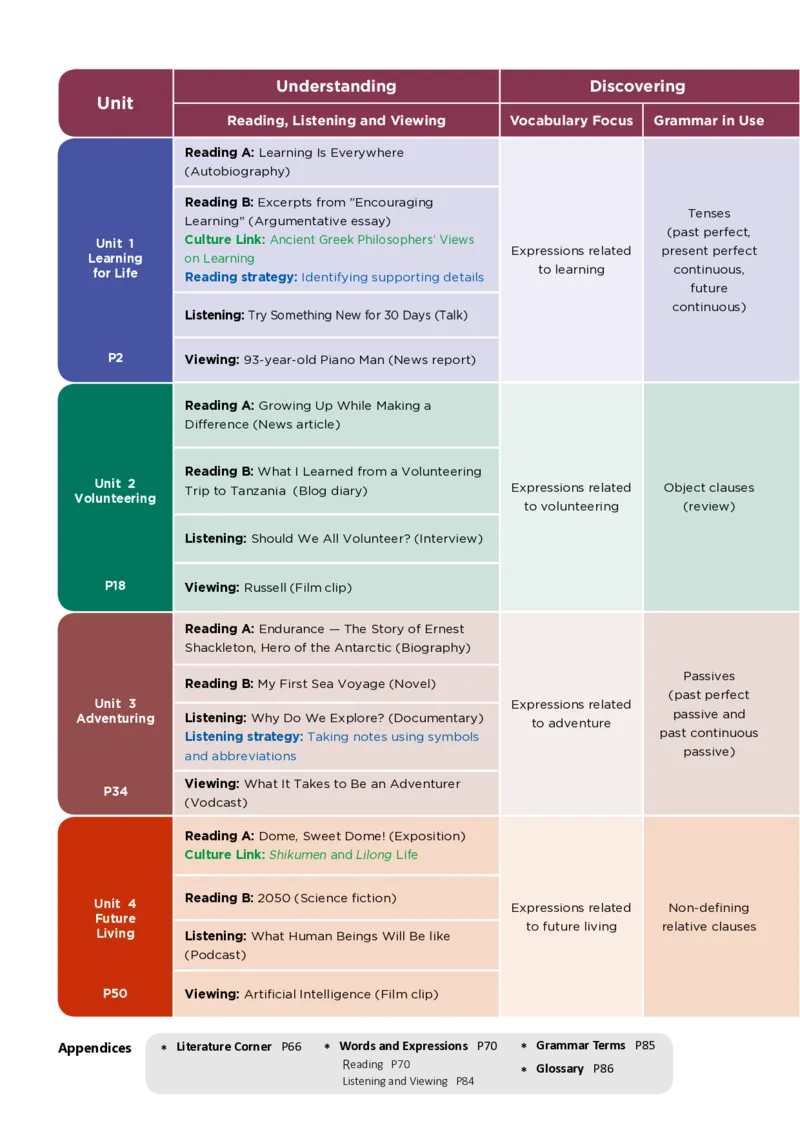
第一册Understanding Discovering Producing Extending
Unit
Reading, Listening and Viewing Vocabulary Focus Grammar in Use Speaking Writing Critical Thinking Further Exploration
Reading A: Learning Is Everywhere
(Autobiography)
Writing a short website
Reading B: Excerpts from "Encouraging article about
Tenses
Learning" (Argumentative essay) “learning by doing”
(past perfect, Conducting an
Unit 1 Culture Link: Ancient Greek Philosophers’ Views Ranking factors
Expressions related present perfect interview about learning Making
Learning on Learning Writing strategy: in order of
to learning continuous, experiences outside the learning plans
for Life Reading strategy: Identifying supporting details Using personal importance
future classroom
experiences as
continuous)
Listening: Try Something New for 30 Days (Talk) supporting details
P2 Viewing: 93-year-old Piano Man (News report)
Reading A: Growing Up While Making a
Difference (News article)
Writing an essay for a
Reporting Identifying priorities in
special column “Voices
Reading B: What I Learned from a Volunteering a mini-survey order to make a decision
of Volunteers” Designing
Unit 2 Trip to Tanzania (Blog diary) Expressions related Object clauses about volunteering
Volunteering a “volunteers needed”
to volunteering (review) Culture Link:
Writing strategy: advertisement
Speaking strategy: International
Listening: Should We All Volunteer? (Interview) Using quotes as
Emphasising key points Volunteer Day
supporting details
P18 Viewing: Russell (Film clip)
Reading A: Endurance — The Story of Ernest
Shackleton, Hero of the Antarctic (Biography)
Writing a brief report on
Comparing and
Passives people’s beliefs about
Reading B: My First Sea Voyage (Novel) contrasting
(past perfect Performing a class live adventure
Unit 3 Expressions related Planning an imaginary
passive and show: How adventurous
Adventuring Listening: Why Do We Explore? (Documentary)
to adventure Culture Link: “space adventure”
past continuous are you? Writing strategy:
Listening strategy: Taking notes using symbols
How Do Different Cultures
passive) Using statistics as
and abbreviations
Deal with Failure
supporting details
Viewing: What It Takes to Be an Adventurer
P34
(Vodcast)
Reading A: Dome, Sweet Dome! (Exposition)
Culture Link: Shikumen and Lilong Life
Debating how AI impacts Writing a letter to your
on human intelligence future self
Reading B: 2050 (Science fiction)
Unit 4 Expressions related Non-defining Commenting on ideas and Creating a daily routine
Future
to future living relative clauses Speaking strategy: Writing strategy: proposing new ideas in 2050
Living Listening: What Human Beings Will Be like
Expressing agreement or Using examples as
(Podcast)
disagreement supporting details
P50 Viewing: Artificial Intelligence (Film clip)
P50
Appendices * Literature Corner P66 * Words and Expressions P70 * Grammar Terms P85
Reading P70
* Glossary P86
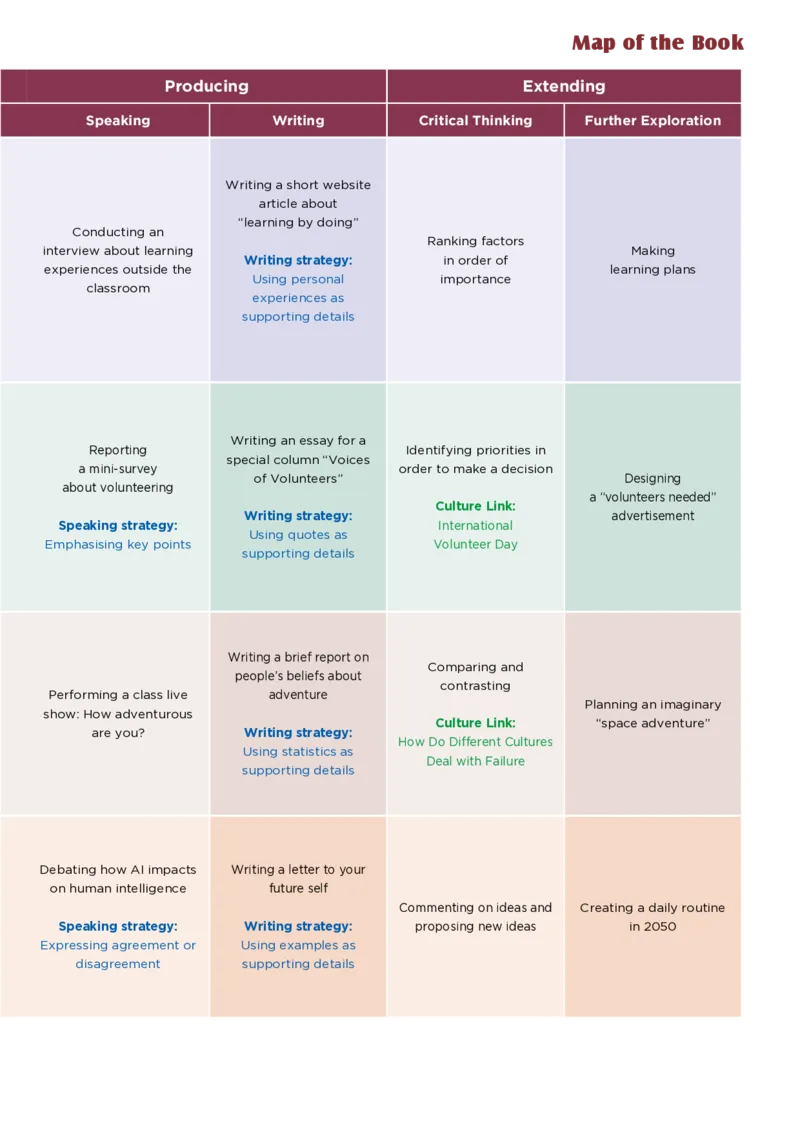
Listening and Viewing P84Map of the Book
Understanding Discovering Producing Extending
Reading, Listening and Viewing Vocabulary Focus Grammar in Use Speaking Writing Critical Thinking Further Exploration
Reading A: Learning Is Everywhere
(Autobiography)
Writing a short website
Reading B: Excerpts from "Encouraging article about
Tenses
Learning" (Argumentative essay) “learning by doing”
(past perfect, Conducting an
Culture Link: Ancient Greek Philosophers’ Views Ranking factors
Expressions related present perfect interview about learning Making
on Learning Writing strategy: in order of
to learning continuous, experiences outside the learning plans
Reading strategy: Identifying supporting details Using personal importance
future classroom
experiences as
continuous)
Listening: Try Something New for 30 Days (Talk) supporting details
Viewing: 93-year-old Piano Man (News report)
Reading A: Growing Up While Making a
Difference (News article)
Writing an essay for a
Reporting Identifying priorities in
special column “Voices
Reading B: What I Learned from a Volunteering a mini-survey order to make a decision
of Volunteers” Designing
Trip to Tanzania (Blog diary) Expressions related Object clauses about volunteering
a “volunteers needed”
to volunteering (review) Culture Link:
Writing strategy: advertisement
Speaking strategy: International
Listening: Should We All Volunteer? (Interview) Using quotes as
Emphasising key points Volunteer Day
supporting details
Viewing: Russell (Film clip)
Reading A: Endurance — The Story of Ernest
Shackleton, Hero of the Antarctic (Biography)
Writing a brief report on
Comparing and
Passives people’s beliefs about
Reading B: My First Sea Voyage (Novel) contrasting
(past perfect Performing a class live adventure
Expressions related Planning an imaginary
passive and show: How adventurous
Listening: Why Do We Explore? (Documentary)
to adventure Culture Link: “space adventure”
past continuous are you? Writing strategy:
Listening strategy: Taking notes using symbols
How Do Different Cultures
passive) Using statistics as
and abbreviations
Deal with Failure
supporting details
Viewing: What It Takes to Be an Adventurer
(Vodcast)
Reading A: Dome, Sweet Dome! (Exposition)
Culture Link: Shikumen and Lilong Life
Debating how AI impacts Writing a letter to your
on human intelligence future self
Reading B: 2050 (Science fiction)
Expressions related Non-defining Commenting on ideas and Creating a daily routine
to future living relative clauses Speaking strategy: Writing strategy: proposing new ideas in 2050
Listening: What Human Beings Will Be like
Expressing agreement or Using examples as
(Podcast)
disagreement supporting details
Viewing: Artificial Intelligence (Film clip)致同学们
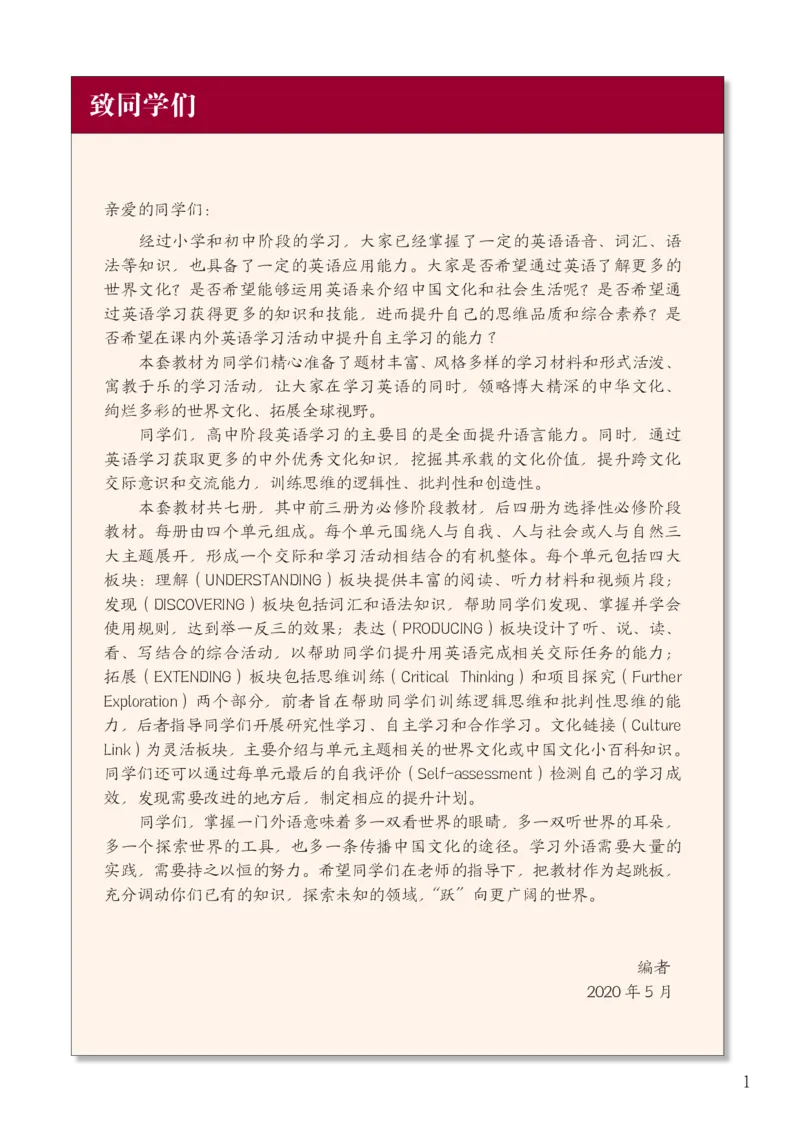
亲爱的同学们:
经过小学和初中阶段的学习,大家已经掌握了一定的英语语音、词汇、语
法等知识,也具备了一定的英语应用能力。大家是否希望通过英语了解更多的
世界文化?是否希望能够运用英语来介绍中国文化和社会生活呢?是否希望通
过英语学习获得更多的知识和技能,进而提升自己的思维品质和综合素养?是
否希望在课内外英语学习活动中提升自主学习的能力 ?
本套教材为同学们精心准备了题材丰富、风格多样的学习材料和形式活泼、
寓教于乐的学习活动,让大家在学习英语的同时,领略博大精深的中华文化、
绚烂多彩的世界文化、拓展全球视野。
同学们,高中阶段英语学习的主要目的是全面提升语言能力。同时,通过
英语学习获取更多的中外优秀文化知识,挖掘其承载的文化价值,提升跨文化
交际意识和交流能力,训练思维的逻辑性、批判性和创造性。
本套教材共七册,其中前三册为必修阶段教材,后四册为选择性必修阶段
教材。每册由四个单元组成。每个单元围绕人与自我、人与社会或人与自然三
大主题展开,形成一个交际和学习活动相结合的有机整体。每个单元包括四大
板块:理解(UNDERSTANDING)板块提供丰富的阅读、听力材料和视频片段;
发现(DISCOVERING)板块包括词汇和语法知识,帮助同学们发现、掌握并学会
使用规则,达到举一反三的效果;表达(PRODUCING)板块设计了听、说、读、
看、写结合的综合活动,以帮助同学们提升用英语完成相关交际任务的能力;
拓展(EXTENDING)板块包括思维训练(Critical Thinking)和项目探究(Further
Exploration)两个部分,前者旨在帮助同学们训练逻辑思维和批判性思维的能
力,后者指导同学们开展研究性学习、自主学习和合作学习。文化链接(Culture
Link)为灵活板块,主要介绍与单元主题相关的世界文化或中国文化小百科知识。
同学们还可以通过每单元最后的自我评价(Self-assessment)检测自己的学习成
效,发现需要改进的地方后,制定相应的提升计划。
同学们,掌握一门外语意味着多一双看世界的眼睛,多一双听世界的耳朵,
多一个探索世界的工具,也多一条传播中国文化的途径。学习外语需要大量的
实践,需要持之以恒的努力。希望同学们在老师的指导下,把教材作为起跳板,
充分调动你们已有的知识,探索未知的领域,“跃”向更广阔的世界。
编者
2020 年 5 月
121
Unit
Learning for Life
Real knowledge is to know the extent of
one’s ignorance.
— Confucius
Getting Started
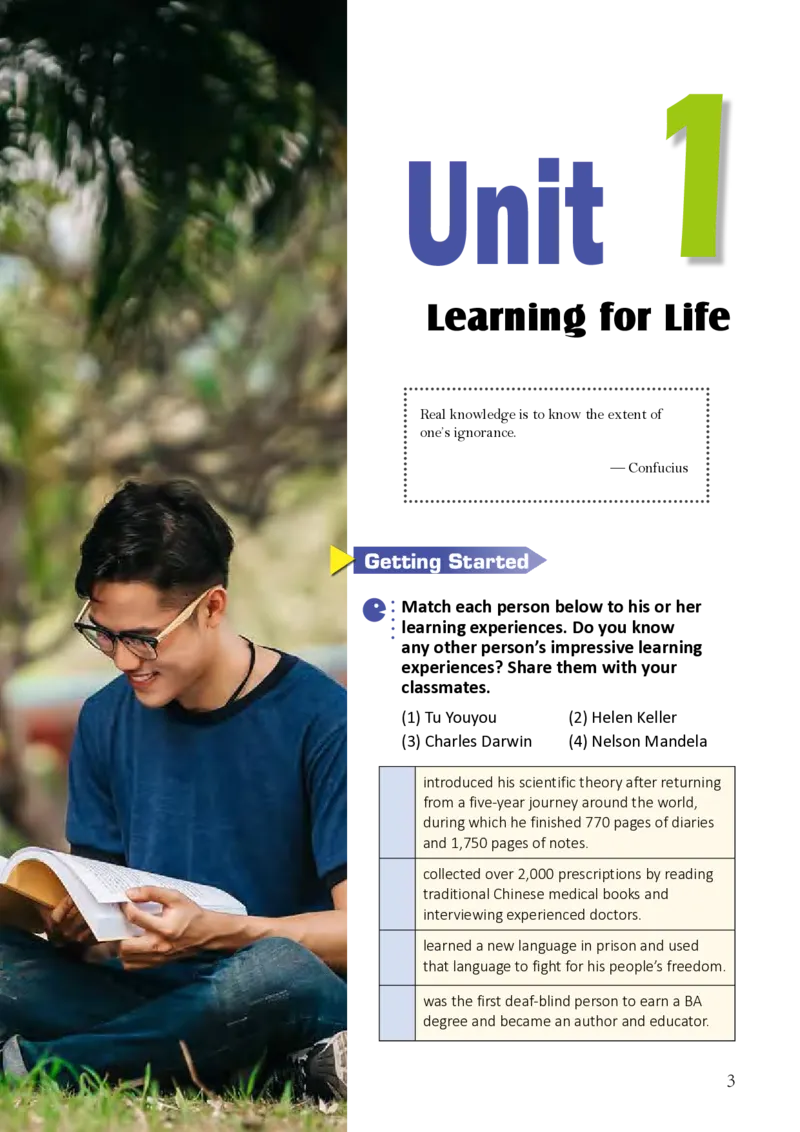
Match each person below to his or her
learning experiences. Do you know
any other person’s impressive learning
experiences? Share them with your
classmates.
(1) Tu Youyou (2) Helen Keller
(3) Charles Darwin (4) Nelson Mandela
introduced his scientific theory after returning
from a five-year journey around the world,
during which he finished 770 pages of diaries
and 1,750 pages of notes.
collected over 2,000 prescriptions by reading
traditional Chinese medical books and
interviewing experienced doctors.
learned a new language in prison and used
that language to fight for his people’s freedom.
was the first deaf-blind person to earn a BA
degree and became an author and educator.
3READING A
? Learning is never limited to classrooms. Instead, it may occur at home,
in the laboratory or in nature, which is well illustrated in the following
excerpts from three biographies.
30
LEARNING IS EVERYWHERE
visitors. This was a great trial to me,
because of my timidity; I wanted to run
Marie Curie
away and hide. My father, an excellent
10 educator, was interested in our work and
knew how to help. He was very familiar
with Polish and foreign poetry; he even
composed poetry himself. His little
poems on family events were our delight.
15 On Saturday evenings, he used to recite
or read to us the masterpieces of Polish
prose and poetry. These evenings were
Like my sisters and brothers, I started for us a great pleasure and a source of
my study when I was only six years old. patriotic feelings. Gradually I acquired
Because I was the youngest and smallest 20 a strong taste for poetry, and I willingly
5 in the class, I was frequently brought learned by heart long passages from our
forward to recite when there were great poets and recited to others.
4 UNIT 1Charles Darwin
out of the sky with a slingshot, to gather
45
wild honey and fruits, to drink warm,
sweet milk straight from a cow, to swim
in the clear, cold streams, and to catch
fish with twine and sharpened bits of
50 wire. One day I learned my lesson from
an unruly donkey. My friends and I had
been taking turns climbing up and down
its back and when my chance came I
jumped on and the donkey rushed into
55 a nearby bush. It bent its head, trying to
Towards the close of my school life,
unseat me, which it did, embarrassing
25 my brother worked hard at chemistry,
me in front of my friends. Like the
and made a fair laboratory in the tool-
people of the East, Africans have a
house in the garden, and I was allowed
highly developed sense of dignity. I had
to aid him in most of his experiments.
60 lost face among my friends. Even though
He made all the gases and many
it was a donkey that unseated me, I
30 compounds, and I read with great care
learned that to shame another person
several books on chemistry. The subject
is to make him suffer an unnecessarily
interested me greatly, and we used to
cruel fate. Later even as a boy, I defeated
go on working till rather late at night.
my opponents without dishonouring
65
This episode was the best part of my
them.
LEARNING IS EVERYWHERE 35 education at school, for it showed me
practically the meaning of experimental
science. The fact that we worked on
chemistry somehow got known at
school, and I was nicknamed “Gas.”
40 Nelson Mandela
I was no more than five when I
became a herd-boy, looking after sheep
and calves in the fields. It was in the
fields that I learned how to knock birds
Personal Touch
Do you have any learning experience similar to what is mentioned in the
text? If yes, share it with your classmates.
Learning for Life 5Digging In
Comprehension
I. What do the three learning experiences have in common? List them from three
aspects. An example is given.
• All of the three learning experiences took place outside the classroom.
______________________________________________________________________
______________________________________________________________________
______________________________________________________________________
II. Complete the table with information from the text.
Reading Strategy Identifying supporting details
Where In the laboratory.
did learning
occur?
Who Her father.
did he/she
learn from?
What It’s unnecessarily cruel
did he/she to shame a person.
learn?
How On Saturday evenings,
did he/she her father used to recite
learn? or read the masterpieces
of Polish prose and
poetry to the family.
III. Answer the questions.
1. Which of the learning experiences in the text is the most impressive to you? Why?
2. Can you list some experiences outside the classroom which have been helpful to your
learning?
3. Can you recommend an autobiography that includes inspiring learning experiences?
6 UNIT 1Vocabulary Focus
I. Key Vocabulary
Fill in the blanks with the appropriate forms of the given words and expressions to
complete the passage. Note that there are two more options than you need.
bend defeat trial cruel educator lose face
masterpiece unnecessarily practically recite dignity by heart
Today I read about the early learning experiences of three famous people: Marie
Curie, Charles Darwin and Nelson Mandela. Young Curie was frequently asked to
1 _________ in front of visitors. In the beginning, she considered it a(n) 2 _________
because she was a timid little girl. Fortunately, her father kept reading Polish
3 _________ to the family on Saturday evenings. With the help of this great 4 _________,
Curie gradually developed a taste for poetry and became willing to learn 5 _________
and recite poems. Young Darwin acquired a nickname of “Gas” because he used to help
his brother with his experiments in making gases and compounds in their laboratory.
By doing this, he learned, in a(n) 6 _________ way, the real meaning of experimental
science. In a manner different from that of the other two, young Mandela learned a
lesson from a(n) 7 _________ incident with a donkey. It managed to unseat him while
he was riding it. He 8 _________ and felt embarrassed. He learned that he would not
9 _________ his opponents by hurting their 10 _________.
II. Topic-Related Expressions
Fill in the blanks with the appropriate forms of the given expressions to complete
the passage. Note that there are two more options than you need.
pioneering work pursue further studies struggle with work on
major breakthrough win a scholarship in an attempt to stand out
undergraduate study be interested in
John Goodenough, born 1922, was awarded the Nobel Prize in Chemistry 2019 for
his work on developing lithium-ion batteries.
As a child, Goodenough 1 _________ dyslexia, a learning disorder marked by
difficulty in reading and spelling. However, he taught himself to write and eventually
2 _________ to a boarding school. The rigorous and highly structured education there
paved the way for his 3 _________ at Yale University, where he graduated with honours in
mathematics. Shortly after World War II, Goodenough went to the University of Chicago
to 4 _________. He studied physics, a complete new subject for him. But he earned a
Ph.D. in 1952 and then went to work at MIT’s Lincoln Laboratory. In 1976, he was invited to
manage the Inorganic Chemistry Laboratory at Oxford University, where he researched the
properties of materials 5 _________ produce rechargeable batteries with higher energy
density. His 6 _________ led to the invention of safer, faster-charging and longer-lasting
rechargeable batteries for mobile devices, electric vehicles and energy storage systems.
Learning for Life 7Receiving the honour at the age of 97, he 7 _________ among his fellow Nobel laureates.
Goodenough had been told many times in his career that he was too old to succeed,
but he had not taken it to heart. Now, at 97, he 8 _________ the next breakthrough. He
still goes to his laboratory every day, researching new types of batteries. He says, “I’m
only 97. I still have time to go.”
Grammar in Use
Tenses (past perfect, present perfect continuous, future continuous)
I. Read the passage and think about why these tenses are used.
One day in August 1950, a steamship was sailing on the Pacific Ocean towards
China. On the ship, a young man was looking in the direction of his homeland. “I will be
working for my country soon,” he murmured. This man was Deng Jiaxian.
Since his childhood, Deng Jiaxian had been under the influence of his father, a well-
known philosopher and educator. When Beijing was occupied by Japanese forces in
1937, the father told his son: “Our motherland
has been suffering from the Japanese attack for
so long. For the country’s dignity and future,
you will be studying science when you grow
up.” Later, after graduating from the National
Southwest Associated University, Deng Jiaxian
furthered his education at Purdue University.
Just nine days after he had gained his degree,
the Chinese nuclear physicist stepped on the
ship back to his country.
Grammar Highlights
Uses Examples
• Since his childhood, Deng Jiaxian had
We use the past perfect to describe been under the influence of his father.
something that happened before • Just nine days after he had gained his
another thing in the past. degree, the Chinese nuclear physicist
stepped on the ship back to his country.
We use the present perfect to
talk about things where there is a
connection between the past and the • Our motherland has been suffering from
present. We use the present perfect the Japanese attack for so long.
continuous when the focus is on an
activity that is unfinished.
We use the future continuous to • I will be working for my country soon.
talk about something that will be in • For the country’s dignity and future, you
progress at or around a time in the will be studying science when you grow
future. up.
8 UNIT 1II. Look at the pictures and describe the actions at different times.
6.15 a.m. 6.30 a.m. 9 a.m. 9 a.m.
past past now tomorrow
1. When I got up at 06:30 this morning, my mother __________ (prepare) toast and jam.
2. It is 9 a.m. now. I __________ (study) in my English class for 30 minutes.
3. My twin sister will have a chemistry lesson tomorrow morning. This time tomorrow
she __________ (do) an experiment at the lab.
III. Liu Xin meets Wu Xuan at the campus. Fill in the blanks with the appropriate forms
of the given words to complete their conversation.
Liu Xin: Hi, Wu Xuan. I 1 ____________ (not hear) from you lately. How’s everything
going?
Wu Xuan: I 2 ____________ (work) on my English recently because I 3 ____________
(take) an important test this time next week. I 4 ____________ (do) a lot of
exercises. I think I 5 ____________ (make) great progress.
Liu Xin: Great! What have you 6 ____________ (learn) so far?
Wu Xuan: Well, I 7 ____________ (improve) my listening skills greatly by listening to
English radio programmes every day. I 8 ____________ (begin) to do reading
exercises under the guidance of my English teacher three months ago. I was
told that he 9 ____________ (win) first place in the test many years ago. His
tips 10 ____________ (turn out) to be quite effective.
Liu Xin: Lucky you! So you don’t need to worry about the test.
Learning for Life 9Listening, Viewing and Speaking
Try Something New for 30 Days (Talk)
I. Tick the daily habit(s) that you would like to develop. You may add a habit to
the list if you want to.
eating a balanced diet playing a musical instrument
reading for at least 15 minutes every day reflecting on what I have done every night
doing sports on a regular basis going to bed before 11 p.m.
taking a nap after lunch _________________________
II. Listen and answer.
According to the speaker, what can you achieve if you try something new for 30 days?
III. Listen again and complete the notes.
Try Something New for 30 Days
Challenges:
(1) ________________
Hiking up Mt Kilimanjaro
Writing a (2) ________________
Benefits:
Becoming (3) ________________ and adventurous
Advice:
To make small and sustainable (4) ________________
IV. Complete the diagram with your plan to develop a new habit.
What is the habit? How to develop What are the challenges
the habit? of forming the habit?
• Jogging every day. • Make a plan, find a partner • Bad weather may prevent
• to go jogging with. me from jogging.
• •
93-year-old Piano Man (News report)
I. Look at the title of the video and predict what the video is about.
II. Watch the video and complete the sentences.
1. Jack Prince joined the army during (1) ___________.
2. Just now he had a piano lesson and is going to go home and (2) ___________ soon.
3. His (3) ___________ is coming. Now he is preparing for his birthday party. He goes
to the Wisconsin Conservatory of Music, practising with his teacher for 45 minutes
every two weeks. He is considered a hard-working and (4) ___________ student.
10 UNIT 1III. Watch the video again. Choose the quote(s) that is/are related to it and explain
why. You may think of another quote.
• All learning has an emotional base. — Plato
• Education consists mainly in what we have unlearned. — Mark Twain
• Learning never exhausts the mind. — Leonardo da Vinci
• One more quote: ______________________________________________
Conducting an interview about learning experiences outside the classroom
The school newspaper is conducting an interview about “What I’ve learned outside
the classroom.” Role-play the interview, asking for and sharing opinions.
Step Work in groups. List some activities in your school that have helped you learn.
1
e.g. working in the Go Green Club
Step
2 Talk about your learning experiences. Use the appropriate tenses.
EXAMPLE
I’ve been working in the Go Green Club since last October. Thanks to
this club, I’ve learned a lot about environmental protection and how to
cooperate with my teammates. Last month, we organised an event to reduce
food waste in the school canteen. Next Friday, we’ll be showing kindergarten
kids how to reuse and recycle glass bottles …
Step
3 Role-play the interview based on what you have discussed.
EXAMPLE
Interviewer: Which school club impresses you the most?
Interviewee: It’s definitely the Go Green Club. I’ve been a member for over
one year. During this time, I’ve participated in many activities
that help to raise public awareness of environmental protection.
Interviewer: Sounds lovely. What have you learned from those activities?
Interviewee: Well, I’ve acquired some practical knowledge about
environmental protection. My sense of responsibility and team
spirit have also developed.
Useful Expressions
Asking for opinions Giving opinions
Could you please share your thoughts on ...? As far as I’m concerned, ...
How does ... sound to you? It seems to me that ...
What’s your view on ...? Well, from my perspective ...
How do you feel about ...? I believe/feel/imagine that ...
Learning for Life 11READING B
EXCERPTS FROM
“ENCOURAGING LEARNING”
The gentleman says: Learning standing on tiptoe and gazing into the
should never cease. distance, but I found I could see much
farther by climbing to a high place. If
Blue comes from the indigo plant
25 you climb to a high place and wave to
but is bluer than the plant itself. Ice is
someone, it is not as though your arm
5 made of water but is colder than water
were any longer than usual, and yet
ever is. A piece of wood as straight as a
people can see you from much farther
plumb line may be bent into a circle as
away. If you shout down the wind, it
true as any drawn with a compass and,
30 is not as though your voice were any
even after the wood has dried, it will
stronger than usual, and yet people can
10 not straighten out again. The bending
hear you much more clearly. Those who
process has made it that way. Thus, if
make use of carriages or horses may
wood is pressed against a straightening
not be any faster walkers than anyone
board, it can be made straight; if metal
35 else, and yet they are able to travel a
is put to the grindstone, it can be
thousand li. Those who make use of
15 sharpened. If the gentleman studies
boats may not know how to swim, and
widely and each day examines himself,
yet they manage to get across rivers.
his wisdom will become clear and his
The gentleman is by birth no different
conduct be without fault.
40 from any other man; it is just that he is
good at making use of things.
I once tried spending the whole day
20 in thought, but I found it of less value
Pile up earth to make a mountain
than a moment of study. I once tried
and wind and rain will rise up from
it. Pile up water to make a deep pool
45 and dragons will appear. Pile up good
deeds to create virtue and profound
understanding will come of itself;
there the mind of the sage will find
completion. But unless you pile up little
50 steps, you can never journey a thousand
li; unless you pile up tiny streams, you
can never make a river or a sea. The
finest thoroughbred cannot travel ten
paces in one leap, but the sorriest nag
12 UNIT 155 can go a ten days’ journey. Achievement consists
Culture Link
in never giving up. If you start carving and then
give up, you cannot even cut through a piece of
Ancient Greek Philosophers’
rotten wood; but if you persist without stopping,
Views on Learning
you can carve and inlay metal or stone.
Ancient Greek philosophers expressed
pearls of wisdom that stand up today. For
Note
example, Socrates maintained that the
“Encouraging Learning” is a chapter in Xunzi, a Chinese more we come to know ourselves, the
classic written by Xunzi (313–238 BCE), literally “Master greater will be our ability to reason and
Xun,” who was a Confucian philosopher during the make choices that lead to true happiness.
Warring States period. This text was translated into He stated, “The only true wisdom is
English by Burton Watson (1925–2017), an American in knowing you know nothing.” Plato,
translator. who was a student of Socrates’ and the
founder of the Academy of Athens, the
first institute of higher learning in the
Western world, said, “Ignorance is the
root and stem of all evil.”
Comprehension Plus
I. Answer the questions.
1. Which sentence in the text shows the main idea of “Encouraging Learning”?
2. Does Xunzi aim to persuade, inform, or entertain? How can you tell?
3. Why does Xunzi mention plant, water, wood and metal in paragraph 2? What
function do a grindstone and a straightening board have in common?
4. What makes people see farther, see more clearly, hear more clearly, travel
faster and get across rivers without having to know how to swim according to
paragraph 3? Why does Xunzi make such comparisons?
5. What is the point of describing how to make a mountain and a deep pool in
paragraph 4?
6. What do you think of the way Xunzi encourages learning? Can you suggest other
ways to encourage learning?
II. Below are three pairs of sentences selected from different translated versions of
“Encouraging Learning.” Decide which one you prefer, and explain why.
1-A Learning should never cease.
1-B Learning must never be concluded.
2-A Blue comes from the indigo plant but is bluer than the plant itself.
2-B Although blue dye comes from the indigo plant, it is bluer than indigo.
3-A Pile up earth to make a mountain and wind and rain will rise up from it. Pile up
water to make a deep pool and dragons will appear.
3-B If you accumulate enough earth to build up a high hill, rain and wind will
flourish because of it. If you accumulate enough water to fill a chasm, dragons
and scaly dragons will be born within it.
Learning for Life 13Critical Thinking
Ranking factors in order
of importance
I. Reflect on the learning experiences referred to in this unit. Which one impresses you
the most? What factors have promoted learning in this case? An example is given.
People Learning experiences Factors
Marie Curie learning poetry under her father’s guidance • parental influence
and becoming a confident student • a strong taste for
poetry
II. Work in groups. Think about your own learning experiences. Which factors listed
in the above table have promoted or may promote your learning? Discuss and rank
the factors in order of importance. Give your reasons.
Factor 1
________________
Factor 2
________________
Factor 3
________________
Explanation(s):
14 UNIT 1Writing
Writing a short website article about
“learning by doing”
Li Jun, who works for the Students’ Union, is organising
an event themed “Learning by Doing” for students in his
school and a sister school in Singapore. Below is a short
article he is going to post on the event website. Li Jun is
calling for more articles to be published on the website.
The Art of Learning by Doing
The idea of “learning by doing” proved effective in one of the most
unforgettable courses I took in the Art Club at school. To my surprise,
the course named “Introduction to Three Dimensional Design” was not
computer-based at all, but focused on materials and their properties
instead. One of the tasks was seeing what structure we could create
simply by folding pieces of paper. We were
encouraged to use our hands and cool tools
to make as many things as possible, such as
cranes, lanterns and frogs. Another task
was to see how many materials could be
removed from a wooden structure without
it collapsing. This course has given us useful
exposure to design principles because it
actively engaged us in the learning process.
Learning for Life 15Guided Writing
Step 1 Read Li Jun’s website article and underline the sentences used as supporting
details.
Step 2 Which sentence below is more convincing? Why?
A. We were encouraged to use our hands and cool tools to make as many
things as possible, such as cranes, lanterns and frogs.
B. We were encouraged to make many things.
Writing Strategy Using personal experiences as supporting details
Personal experiences and observations are often used to support
a writer’s statements. They can be the writer’s own or someone
else’s experiences. Personal experiences can help to convince
readers if they are interesting, reliable, and are likely to remind
readers of their own experiences.
Step 3 Write a general statement about “learning by doing.”
e.g. The idea of “learning by doing” is becoming increasingly appealing to high
school students.
Step 4 Think of your or other people’s experiences involving “learning by doing.”
List some details and indicate how the experiences are supportive of your
statement.
Step 5 Organise your personal experiences to support the general statement by
referring to the sample writing. Complete the article in 90–110 words.
___________________________
(Statement) ____________________________________________________
______________________________________________________________
(Personal experiences as supporting details) ___________________________
______________________________________________________________
______________________________________________________________
______________________________________________________________
______________________________________________________________
(Concluding sentence) ___________________________________________
______________________________________________________________
16 UNIT 1Further Exploration
Making learning plans
Successful learning requires good planning. Work in groups to make learning plans.
Step
1 Fill in the table with information about your learning plan. An example is given.
What to learn Where to learn Who to learn from How to learn
playing the piano music club the 93-year-old piano • taking online piano courses
man • practising about an hour every day
Step
2 Find classmate(s) with similar interests and form a study group, e.g. the piano
group, the drama group, etc. Share your ideas with group members and see how
you can learn from your role models.
Step
3
Sort out your ideas and make a clear, detailed, and practical weekly plan for
each member of your group.
Self-assessment
Look at the expected learning outcomes of this unit. Tick the items you think you
have done well.
A. Recognising the value of out-of-class learning experiences and the
significance of lifelong learning
B. Talking about learning experiences with effective use of tenses
C. Grasping ancient Greek philosophers’ views on learning
D. Ranking factors in order of importance
E. Identifying supporting details in descriptive writing
F. Using personal experiences to support an observation
Write a reflective note on what you think you need to improve. You may include
some or all of the following points:
What you still find difficult Possible cause(s) of the problem(s)
Your plan to solve the problem(s) Learning resources that you could use
Learning for Life 17182
Unit
Volunteering
You make a living by what you get, but you
make a life by what you give.
— Winston Churchill
Getting Started
Look at the pictures and answer the
question.
Which of the following volunteer activities
have you ever done or heard about?
nursing home volunteer school volunteer
environmental volunteer nature reserve volunteer
19READING A
? Read the text to find out how volunteering can make a
difference to others and yourself.
GROWING UP
WHILE
MAKING A DIFFERENCE
There is an old saying about a garage sale. Joris donated all that he
volunteer work that goes like this: “No had raised to a wildlife conservation
one can do everything, but everyone organisation in Namibia where he and
can do something.” Today, young people 20 his mother have volunteered for the
5 around the world have volunteered to past three summers. “I’ve learned that
help others in various ways. The future everyone can make a difference, even
is looking pretty bright with these if you’re just a kid!” Joris said. “You just
young people leading the way. have to start somewhere.”
Joris, 10 years old and from Seattle, 25 Jake and Max, who are 14-year-
10 has worked hard all year to save old twins, launched the Kids That Do
cheetahs from the very real threat of Good database to allow young people
extinction. He raised more than $14,000 to search for volunteer opportunities
to purchase GPS collars that track and based on age, interest, or location. It all
protect the animals, earning money by 30 started when the boys began cooking
15 selling lemonade, flowers and T-shirts, meals to serve the homeless with a
and by organising skating parties and family friend in his home kitchen. “We
20 UNIT 2asked him to take us with him to serve Xiao Meng, a 20-year-old student in
the meals, but when he looked into it, 55 Beijing, is one of around 300 volunteer
35 someone told him, ‘No, they are simply tour guides in the Forbidden City. She
too young,’” said Max. That’s when they hangs around the palace like other
decided to start the website, which visitors, but with a red “volunteer”
receives an average of 100 visitors card. It took her about three months
every day and has a growing number of 60 to remember every detail of the 176
40 organisations, such as animal shelters clocks in the clock gallery of the Palace
and urban farming groups, requesting Museum. Xiao Meng said she loves
to be listed. spending time in the buildings where
25 emperors spent their whole lives.
Jackson, aged 17, has always 65 “Every brick has a story to tell,” she
been aware of the issue of plastic said.
45 pollution. He serves as president of
an environmental club. This year he Sometimes you may worry about
organised a march in Orange County to grades or get annoyed because
raise awareness of water rights. Jackson you don’t have the most expensive
is also leading a campaign in his town 70 sneakers or the latest computer games.
50 to promote the usage of reusable Volunteering gives you a chance to
water bottles. “Our team is urging local value what you have and focus on the
restaurants to join our movement by truly important things in your life.
selling more paper water bottles.”
Personal Touch
List the different types of volunteer work mentioned in the text. Which would
you most like to do? Explain why.
Volunteering 21Digging In
Comprehension
I. Choose the best answer.
1. This text is most probably from _______.
A. a letter B. a poster
C. a newspaper D. an advertisement
2. The writer is trying to _______.
A. persuade readers to do volunteer work
B. inform readers of volunteer opportunities
C. entertain readers with fun facts about volunteering
D. provide information about exceptional volunteers
3. According to the text, young people do volunteer work most probably
because they _______.
A. want to tell stories about volunteer work
B. find volunteering experiences rewarding
C. are eager to use their skills and knowledge
D. need to find out the truly important things in life
II. Complete the table with information from the text.
Who? How old? Why? How?
Joris 10 He is aware that He raised money to buy GPS
cheetahs are under collars that can track and
threat of extinction. protect cheetahs.
Jake and Max
Jackson
Xiao Meng
III. Answer the questions.
1. How do you understand the title “Growing Up While Making a Difference”?
2. Find an example in the text that illustrates “making a difference.”
3. At the end of the text, the author says, “Volunteering gives you a chance to
value what you have and focus on the truly important things in your life.”
What do you think are “the truly important things” in life?
22 UNIT 2Vocabulary Focus
I. Key Vocabulary
Fill in each blank with the appropriate form of a word from the text. The first letter is
given.
Young people in different places of the world have volunteered to help others using
their time, energy, knowledge and skills. For example, Joris, a 10-year-old boy in Seattle, has
helped to protect cheetahs from the t_________ of extinction by raising more than $14,000
to p_________ GPS collars for the animals. He has also volunteered to help in a wildlife
c_________ organisation. Jake and Max, who are 14 years old, have l_________ a database
to connect children with volunteer opportunities such as working for animal s_________
and urban farming groups. Another boy, Jackson, is determined to fight plastic pollution. He
led a c_________ in his town to p_________ the usage of reusable water bottles. He also
u_________ the local restaurants to sell more paper water bottles. Xiao Meng is a volunteer
tour guide in the Palace Museum. She worked hard to remember almost every detail of
the 176 clocks in the clock g_________ in order to offer tourists in-depth explanations. By
doing meaningful volunteering, young people can avoid getting a_________ at small things
in life and focus on what is truly important.
II. Topic-Related Expressions
Fill in the blanks with the appropriate forms of the given expressions to complete
the sentences. Note that there are two more options than you need.
search for wildlife conservation raise awareness
be aware of lead a campaign rewarding experience
make a difference volunteer tour guide raise funds
1. The best ______________ brings a destination to life with their knowledge,
storytelling skills, and passion.
2. Volunteering gives you an opportunity to switch your focus, connect you to others,
and involve yourself in activities that can ______________.
3. Volunteering can raise your confidence by offering you the chance to try something
awesome. You may discover talents that you ______________ previously.
4. The wildlife conservation centre relies on volunteers to spread the word about
cheetah extinction, ______________, and promote initiatives to protect the animals.
Volunteering 235. The city has taken steps to reduce plastic pollution by ______________ of the
environmental impact of plastic waste and by imposing bans on single-use plastics.
6. The local government ______________ in the city to promote waste sorting.
7. Perhaps the key to a(n) ______________ is volunteering in areas of one’s interest.
Grammar in Use
Object clauses (review)
I. Read the text below. Underline the object clauses, label the clauses with numbers
and put the numbers in the corresponding places in the table. The first one has
been done for you.
Over 5,000 volunteers worked at the first China International Import Expo in
①
November 2018. The expo is part of China’s efforts to demonstrate that it is willing to
open its markets further to global trade. Jiang, a 29-year-old Communist Party member
and Metro worker in Shanghai, said she was proud to be part of another grand event in
her hometown after the World Expo. Jiang was one of the first 25 volunteers selected
by the Shanghai Youth League. After the interview, she was told where she would work,
what she was responsible for, whether her attendance would be recorded, and whom
she should report to. An experienced volunteer showed her how she could guarantee
food safety for the expo. Her task was to make sure that all food could be traced back
to its source and waste oil was properly recycled. “Every detail matters. Every task is an
opportunity to learn something new,” Jiang said. She was delighted to do whatever she
could for her city.
Connectives Examples
that / (/) ①
if, whether
what, which, who, whom, whose, where, when, how
whatever, whichever, whoever, whomever, wherever, whenever
Grammar Highlights
A sentence containing an object clause
usually has the following structure:
subject + verb + object clause
She observed that volunteering gave her
a sense of purpose.
The object clause should be in normal word
order with necessary tense changes.
24 UNIT 2II. Fill in the blanks with proper connectives.
Some people probably assume (1) _________ volunteer work is “hard work
with no pay,” but in fact it can make an unbelievable difference in your life.
There are several things you can learn while volunteering. For instance, you
can find out (2) _________ type of work fits you and have a clearer career
goal. Volunteer work is also a great way to know (3) _________ you are
capable of being a real team player and (4) _________ you can work with.
Finally, volunteering is a brilliant way to find out (5) _________ your true
strengths and skills are.
III. Xu Yuan went to an interview for a volunteer position
yesterday. Read the questions in the box and complete the
dialogue between Xu Yuan and her classmate James using
object clauses.
A. What is your greatest strength?
B. How will this strength enable you to be
a volunteer?
C. When would you like to serve as a
volunteer?
D. How does your work experience relate
to the volunteer position?
E. What are your expectations of the
volunteer position?
James: Hi, Xu Yuan! How did your interview go?
Xu Yuan: Pretty well. The interviewer said she would get back to me soon.
James: Fantastic! What did she ask?
Xu Yuan: At first she asked me 1 _______________________. Then she wondered
2 _______________________.
James: What came next?
Xu Yuan: After that the interviewer wanted to know 3 _______________________.
Then I was supposed to tell her 4 _______________________.
James: Sounds like just the right question for you.
Xu Yuan: Probably. Finally, I talked about 5 _______________________.
James: Well, you must have answered very well!
Xu Yuan: You might be right. She seemed quite happy with my answers.
Volunteering 25Listening, Viewing and Speaking
Should We All Volunteer? (Interview)
I. List some of the benefits and challenges of volunteering and discuss them with
your partners.
Benefits Challenges
• developing a positive attitude • lack of time
towards life
II. Listen and answer.
What are the two main health benefits of volunteering?
III. Listen again and fill in each blank with no more than two words.
According to Sue, ...
• It won’t help if the work is a(n)
• It is important to do volunteer work (2) _____________ to you.
that is something (1) _____________ • Very low levels of volunteering or
and means something to you. (3) _____________ volunteering probably
won’t benefit your health.
Russell (Film clip)
I. Watch the first video clip and guess the relationship between the old man and the boy.
II. Watch the second video clip. Check your guesses and complete the volunteer
profile of Russell.
Volunteer Profile
Name Russell
Volunteer type A Wilderness (1) _________
The volunteer work He offers to help Carl to (2) ______________________
he offers _____________________________________________.
Why he offers help to Carl Carl is an elderly man and probably needs some help.
What badge he needs (3) __________________________________________.
He wants to (4) ________________________________
Why he needs the badge and attend a ceremony so that his dad will pin on his
badge.
26 UNIT 2III. Answer the questions.
1. If you were Carl, how would you respond to Russell?
2. What do you think we can learn from Russell as a volunteer?
Reporting a mini-survey about volunteering
Conduct a mini-survey about volunteering in class and then report your findings.
Step 1 Work in a group of three or four. Each member asks a classmate outside their group
the following questions about volunteer work. Take notes by using the table.
Question 1: Do you know anyone who has done volunteer work? If yes, where
and why did they volunteer?
Question 2: Would you like to work as a volunteer in the same way? Why or why not?
Question 3: Can you think of some other ways to help people in need? What are
they?
Name
Answer to question 1
Answer to question 2
Answer to question 3
Step 2 Share your notes in the group and work together to find out why and how people
volunteer.
Step 3 Select a group member to report your findings in class. Emphasise key points when
presenting.
Speaking Strategy Emphasising key points
Here are a few tips for emphasising a point during presentation:
1. Say “It’s important to note that ...”, “I should stress that ...”, etc., before you
raise the point.
2. Use repetition to get the point across.
3. Speak more slowly and emphasise key words.
4. Make eye contact with your audience.
Useful Expressions
Giving reasons Giving examples
Owing to ..., people volunteer ... That reminds me of ...
The reason for volunteering is that ... Take ... for instance, ...
That is why people volunteer ... What’s more, ...
Most people volunteer on account of ... Take the case of ...
Volunteering 27READING B
What I Learned from
+ Subscribe to this blog
a Volunteering Trip to Tanzania
Pippa Biddle post on May 11
I was in Tanzania a few years ago as had worn a hair band on my wrist for as
part of a trip organized by the private all- 35 long as I could remember, so the idea
girls boarding school that I attended. Our of collecting them for others seemed
group consisted of 15 students, most of logical. I always needed one, so why
5 whom were white, and a few teachers. wouldn’t a girl in Africa need one too?
About $3,000 got us a week at an Also, they were cute and fashionable.
orphanage, a few pickup soccer games,
and a week-long safari. 40 It wasn’t until we arrived at the
orphans’ school and saw the beautiful
Our mission at the orphanage was girls in their crisp uniforms that we
10 to build a library. But it turned out that realized how off the track we had been.
we, a group of highly educated high I hadn’t known that one of the regular
school students, couldn’t deliver on this 45 parts of the Tanzanian schoolgirl uniform
mission. We were so bad at the most is a closely cropped head. The girl’s hair
basic construction work that, I found out is highly regulated by school officials.
15 later, the local men who were helping us We were later told that the haircut
had to secretly come back each night to is believed to increase productivity,
undo our work and rebuild the structure. 50 encourage focus on studies, and promote
Our costs were covering not just one personal cleanliness.
library but two — the one we attempted
20 to construct and the one built in secret If I, with all my resources, had
each night to replace it. Basically, we taken just 20 minutes to research what
failed at the only purpose of our being Tanzanian schoolgirls wear, I would have
there. It would have been better for the 55 been able to come up with a better idea.
orphanage to have taken our money to
This kind of volunteering trip I was
25 hire locals to do the work.
on has been criticized quite a bit recently
Perhaps even more awkward was my and with reason. The lesson I learned: if
failure at the simple act of gift giving. you are going to travel with the intention
60 of supporting and bettering a community,
In the months leading up to our trip do your research first. Don’t assume
to Tanzania, we collected hundreds of that the things that you value and enjoy
30 items to bring with us as gifts for the girls are the same things people in another
at the orphanage. Most of them were country value and enjoy.
related to school and health, but we also
collected many hair styling products. I
like repost
28 UNIT 2Comprehension Plus
I. Fill in the diagram with information from the text.
What I Learned from a Volunteering Trip to Tanzania
Setting: an orphans’ school in Tanzania
Volunteer work: Gift giving:
(1) ______________________. Giving gifts like (2) __________
_________________________.
Expectation: Expectation:
We would construct it African girls would like these
successfully. cute and fashionable products.
Reality: Local men had to Reality: Local girls had a
(3) _______________ at night. (5) ______________________.
Result: (4) ________________ Result: No use.
_________________________.
Lesson: If you plan to take a volunteering trip, make sure to
(6) ________________________________________________.
II. Answer the questions.
1. If you were one of the Tanzanian girls, what would you think of the hair band
given as a gift?
2. Do you think it would be better for volunteers to do volunteer work in their local
community? Give your reasons.
Volunteering 29Critical Thinking
Identifying priorities in
order to make a decision
I. Complete the table with information about two of the volunteer projects mentioned in
this unit. An example is given.
Analysing Volunteer Projects
Example Project Project 1 Project 2
Factors
Protecting Cheetahs
Venue
Seattle.
Where am I going to work?
Target group (=whom to help)
Cheetahs.
Who do I help?
Objective
What is the project for? To save cheetahs from
What goals do the volunteers extinction.
want to achieve?
Raising money to purchase GPS
collars
Task(s) by selling lemonade, flowers,
What do I do to help? and T-shirts;
by organising skating parties
and a garage sale.
Required skills Require
What skills should the volunteers selling skills;
be equipped with? planning and organising skills.
Required time
How much time will the project Not specified.
cost the volunteers?
II. If you were to choose one volunteer project initiated by your school, which of the
factors above would you consider first? What other factors may also influence your
decision?
Culture Link
International Volunteer Day
The act of volunteering is found in all cultures. Each year,
hundreds of millions of people volunteer their time and skills to
help make the world a better place. When they volunteer, they
help to improve the lives of others. And when they volunteer,
they also gain a greater sense of belonging to their communities. On 5 December,
people around the world celebrate International Volunteer Day with parades,
volunteer fairs, group clean-ups, blood donations, conferences, and exhibitions.
30 UNIT 2Writing
Writing an essay for a special column
“Voices of Volunteers”
The student editors working for the school WeChat official
account are planning a special column called “Voices of
Volunteers” to celebrate International Volunteer Day.
Below is a short essay they will publish in the column. You
are invited to contribute to the column.
Helping Others Helps You
Volunteering has a
positive effect on your
community — and it’s good
for you too. Ben, a college
student who did volunteer
work, called it “a win-win
situation.” He said, “You
feel good because you’re
helping others, and the others feel good
because they’re getting help.” Giving back
to your community is valuable in itself,
and helping others also brings you many
benefits. As an old saying goes: “The
fragrance of the rose lingers on the hand
that casts it.” The happiest people are
those who give and give generously.
Volunteering 31Guided Writing
Step 1 Read the text “Helping Others Helps You” and underline the sentences used as
supporting details.
Step 2 Read the example below and pay attention to the sentences in different colours.
Note how quotes are used to support the writer’s argument.
As an old saying goes: “The fragrance of the rose lingers on the hand that casts it.”
The happiest people are those who give and give generously.
Introducing your quote
The quote sandwich Using your quote
Explaining your quote
Writing Strategy Using quotes as supporting details
The quote sandwich format encourages writers to introduce quotes and discuss them
afterwards. Using a quote sandwich will help the reader to connect someone else’s
ideas to the writer’s and to understand why the quote supports the writer’s statement.
Keep in mind that quotes should be the supporter, not the supplier, of information in
an essay.
Step 3 Write a general statement about volunteering.
e.g. Volunteering is an efficient and effective way to broaden our horizons.
Step 4 Interview volunteers around you or search the Internet to collect quotes in
support of your statement.
Step 5 Organise the quotes to support the general statement by referring to the sample
writing. Complete your essay in 90–110 words.
__________________________
(Statement) ____________________________________________________________
______________________________________________________________________
(Quotes as supporting details) ______________________________________________
______________________________________________________________________
______________________________________________________________________
(Concluding sentence) ____________________________________________________
______________________________________________________________________
32 UNIT 2Further Exploration
VOLUNTEERS
Designing a “volunteers needed”
advertisement We Need You. Yes, YOU!
Position: Summer Camp Volunteer
Work in groups. Plan a volunteer project
for your community on International Responsibilities
Volunteer Day. • Providing 1–6 graders with a safe and comfortable
learning environment
Step • Helping programme directors organise activities
1 Decide on the type of volunteer • Informing programme directors of all incidents and
work suitable for your community. injuries as they occur
Qualifications
Step
2 Discuss the work, the number
• Experience working with youth preferred
of volunteers needed, volunteer • Ability to work cooperatively with others
• Flexible and able to deal with unexpected situations
positions, responsibilities,
• Creative, responsible, and energetic
qualifications and the time of
Time of work
work.
• At least 2 days per week during the summer camp
Step
3 programme
Design a “volunteers needed”
• 09:00 – 16:00, 8 July – 19 August.
advertisement and post it on
Interested? Then contact Daniel at:
the school bulletin board to find
daniel@xxx.com
volunteers to join your project.
A sample poster is given on the
right.
Self-assessment
Look at the expected learning outcomes of this unit. Tick the items you think you
have done well.
A. Understanding the benefits and challenges of volunteering
B. Reporting a mini-survey about volunteering in class
C. Designing a “volunteers needed” advertisement with specific requirements
D. Getting priorities right in order to make a decision
E. Giving a presentation with key points properly emphasised
F. Writing an essay with quotes used as supporting details
Write a reflective note on what you think you need to improve. You may include
some or all of the following points:
What you still find difficult Possible cause(s) of the problem(s)
Your plan to solve the problem(s) Learning resources that you could use
Volunteering 33343
Unit
Adventuring
Adventure is not outside man; it is within.
— George Eliot
Getting Started
Match the following mottos to the
corresponding adventure activities. What
sort of people are attracted to these
activities?
A. Nothing else matters but the step ahead of you!
B. Dive into an unexplored environment!
C. Stay sharp. Don’t look down!
____
(1) rock climbing
____ (2) high ropes
____ (3) diving
35READING A
? What are some of the essential qualities of adventurers and
explorers? Read the text describing one of the greatest explorers
of nature and his adventures to find out the answer.
ENDURANCE
THE STORY OF ERNEST SHACKLETON,
HERO OF THE ANTARCTIC
The story began in 1914, with an Shackleton’s ship, the Endurance,
advertisement in a British newspaper: left England on 8 August 1914 and it
“Men wanted for a hazardous journey. reached the Weddell Sea in December,
Small wages. Bitter cold. Long months the Antarctic summer. But the weather
5 of complete darkness. Constant 20 was exceptionally bad and on 17
danger. Safe return doubtful.” January 1915, the Endurance got stuck
in ice. Unable to move, Shackleton and
The man who had placed the his men had to wait for eight months
advertisement was the explorer, in complete darkness and freezing
Ernest Shackleton. He planned to 25 cold.
10 cross Antarctica from the Weddell Sea
to the Ross Sea via the South Pole, Finally spring came, but it brought
something no one had ever done disaster. As the ice melted, the ship
before. More than 5,000 men applied broke in half. The crew had to abandon
to join the expedition. Only twenty- ship and camp on the ice for two
15 eight were chosen. 30 months. When the Endurance finally
36 UNIT 3sank on 21 November 1915, Shackleton whaling station was sixty kilometres
and his men tried to survive by away on the other side of the
floating on the ice. Eventually the ice 60 mountainous island. No one had ever
melted and Shackleton put his men crossed South Georgia on foot before.
35 into three small lifeboats and headed
for the nearest land. The men marched continuously
for 36 hours. They had no tent and
After five days at sea, they reached could not stop to rest for more than a
Elephant Island. The men were cold, 65 few minutes — if they fell asleep they
exhausted, and weak from the journey would die of the cold. Starved and
40 and the lack of food. There was no frozen, they finally reached the station.
chance of rescue in this remote place,
so Shackleton decided to continue On 30 August 1916, two years
to South Georgia. He knew there after the expedition began, they
was a Norwegian whaling station 70 returned to Elephant Island in a
45 there, where he could get help, but small boat provided by the Chilean
it was a journey of 1,300 kilometres. government. The other twenty-three
Leaving the others on Elephant men were still waiting. Miraculously,
Island, Shackleton chose five men to not one person had died.
accompany him to South Georgia in a
50 tiny, seven-metre-long lifeboat. 75 Shackleton even returned to
Antarctica. In 1921, he set out again
After fifteen exhausting days with to sail round the continent, but
winds of sixty kilometres an hour and died during the journey in 1922.
waves of up to fifteen metres high, He was buried in South Georgia,
they arrived in South Georgia. The 80 remembered by history as a man who
55 weather was so bad that they couldn’t showed exceptional leadership and
land for two days. Even when they unbelievable endurance.
landed, their journey wasn’t over. The
Personal Touch
If you had the opportunity, would you try an expedition like the one led by
Ernest Shackleton? Why or why not?
Adventuring 37Digging In
Comprehension
I. Answer the questions.
1. Who was Ernest Shackleton?
2. Why did Shackleton and his men have to wait for eight months in 1915?
3. How long did it take Shackleton and his men to finish the expedition?
4. How many people died during the expedition?
II. Fill in the blanks in the table.
Qualities of Ernest
Facts
Shackleton
• It took Shackleton and his men about four months to reach
the Weddell Sea.
• They got stuck in ice and waited for about (1) ________
months.
• They abandoned ship and camped (2) ________ for two
A persistent explorer
months.
• It took them five days to reach Elephant Island.
• It took them (3) ________ to reach South Georgia.
• They marched continuously for (4) ________ to reach the
whaling station.
• Shackleton found no chance of (6) ________ and decided to
continue to South Georgia.
A(n) (5) ________
• He knew it was a journey of (7) ________.
leader
• He chose five men to (8) ________ him and left the others
on Elephant Island.
• When Shackleton returned with his men in a boat provided
A trustworthy man by the Chilean government, the other twenty-three men
were still waiting on Elephant Island.
III. Answer the questions.
1. Why is Shackleton looked up to as a hero despite his failure to reach the South Pole?
2. Which proverb(s) below can be used to describe Shackleton’s adventures? Why?
A. Nothing ventured, nothing gained.
B. Better safe than sorry.
C. The early bird catches the worm.
D. Don’t cry over spilled milk.
E. No pain, no gain.
F. Actions speak louder than words.
38 UNIT 3Vocabulary Focus
I. Key Vocabulary
Fill in the blanks with the appropriate forms of the given words and expressions to
complete the passage. Note that there are two more options than you need.
sail exceptional set out crew starve freezing
rescue remote accompany sink wave abandon
Shackleton’s 1914 adventure, called the Endurance Expedition, was designed to cross
Antarctica. His ship, the Endurance, was unfortunately stuck in ice and the 1 _________
had to spend their days in complete darkness and 2 _________ cold for eight months.
When spring finally came, the ship, to their great disappointment, broke in the melting
ice. They had no choice but to 3 _________ ship. With three open lifeboats saved from
the broken ship, Shackleton and his men eventually made it to Elephant Island. However,
since the island was 4 _________ from any shipping routes, it was unlikely that the men
would be 5 _________. In order to save themselves, Shackleton, 6 _________ by five
most trusted men, left most of his men on Elephant Island and 7 _________ for South
Georgia, 810 miles away. The 8 _________ in this part of the world can often reach 50
feet. Can you imagine that? They 9 _________ in an open 23-foot boat! Almost three
weeks later, Shackleton and his men, extremely tired and 10 _________, reached a
whaling station after marching over the mountains of South Georgia. With help provided
by the Chilean government, the captain finally made his way back to Elephant Island to
save his men. Nobody died. Nobody!
Adventuring 39II. Topic-Related Expressions
Fill in the blanks with the appropriate forms of the given expressions to complete the
passage. Note that there are two more options than you need.
constant danger chance of rescue exceptional leadership
human endurance remote place head for
bitter cold march continuously a tough time
NARRATOR: The year was 1915 and the outside world had no idea of the hazards they
faced as Shackleton and his men drifted helplessly through unexplored waters. With the
1 _________ of the Antarctic winter and the 2 _________ on the journey, they were about to
be pushed to the limits of 3 _________.
PETER WORDIE (Son of James Wordie, head of the Endurance scientific staff): My father
never — to any of us, his children — ever discussed the Endurance expedition … He never let
us read his log when he was alive. It was locked up.
MARY CREAN O’BRIEN (Daughter of the Endurance seaman Tom Crean): My father didn’t
speak too much about the Antarctic. I often wondered, was it too hard? Did he want to forget
it? But he did say they had 4 _________ …
NARRATOR: One man above all bore responsibility for their survival: Sir Ernest Shackleton. A
polar explorer with 5 _________, he knew that anyone that 6 _________ in this 7 _________
where there was no chance of rescue would starve to death. He knew it was up to him to get
his men out alive.
Grammar in Use
Passives (past perfect passive and past continuous passive)
I. Read the sentences and explain why the passive voice is used.
1. A total of 28 men had been selected out of the applicants before Ernest Shackleton
set out for Antarctica.
2. It is said that South Georgia had never been crossed by explorers on foot before
Shackleton and his men’s expedition.
3. On 17 January 1915, the Endurance got stuck in ice. A lot of efforts were being made
to solve the problem when the ice melted and the ship suddenly broke in half.
40 UNIT 3Grammar Highlights
We employ the passive voice to retain objectivity or to focus on the person or thing
affected by an action.
Past perfect passive
Subject + had been + -ed (+ by AGENT)
The expedition ship that had been delayed by the accident began to move forward
once again.
Past continuous passive
Subject + was / were being + -ed (+ by AGENT)
During our brief visit to the village, preparations were being made for an
Indian wedding.
II. Complete the review with the appropriate forms of the words in brackets.
Yang Liwei was selected as an astronaut candidate in
1998 and 1 _________ (train) for spaceflight by the time of
the Shenzhou V launch. Before this launch, almost nothing
2 _________ (make) public about the Chinese astronaut
candidates; his selection for the Shenzhou V human spaceflight
3 _________ (leak) to the media only one day before the
launch.
It was 09:00, 15 October 2003. Yang Liwei 4 _________
(launch) into space aboard his Shenzhou spacecraft on the top
of a Long March 2F rocket at Jiuquan Satellite Launch Centre.
Yang’s journey 5 _________ (monitor) to receive
regular updates about his condition until experts at the
control centre confirmed that everything was going well. At 19:58, when the Shenzhou
V started its eighth circuit around the Earth, Yang 6 _________ (speak) to his wife.
He said, “I feel very good. Don’t worry.” In the middle of the journey, Yang 7 _________
(wave) a small flag of the People’s Republic of China and that of the United Nations
inside his capsule. This 8 _________ (broadcast) by CCTV before it 9 _________ (meet) with
praise from around the world.
Yang’s craft landed at around 06:30 on 16 October 2003. The Shenzhou V was the first
human spaceflight mission of the Chinese space programme. It 10 _________ (describe) by
NASA as an “important achievement in human exploration.”
Adventuring 41Listening, Viewing and Speaking
Why Do We Explore? (Documentary)
I. Work in pairs and discuss the question.
If you were given a chance, what would you want to explore? Explain why.
II. Listen to the documentary and tick the items you hear about what explorers have done.
building in outer space climbing mountains
crossing oceans diving in oceans
exploring new areas on lands flying in skies
walking in outer space
III. Listen again and find out the reasons for exploration. Take notes using symbols and
abbreviations.
Listening Strategy Taking notes using symbols and abbreviations
Periods of time Reasons
• we wonderd wh was on othr side of sky
In the past
(we wondered what was on the other side of the sky.)
Now
What It Takes to Be an Adventurer (Vodcast)
I. Watch the first video clip and guess: What is the man’s job?
II. Watch the second video clip and complete the chart with no more than two words
for each blank.
What the man did What the man overcame
The man dreamed of becoming a(n)
There were very few (2) __________.
(1) __________.
The man gathered stories from his time
He couldn’t (3) __________ anywhere.
on the road.
The man started a radio show in his closet He has been doing the same thing for
and went on to (4) __________. (5) __________.
42 UNIT 3III. Answer the questions.
1. How many stories did the speaker collect for the magazine?
2. According to the speaker, what makes the adventurers’ ideas a reality?
Performing a class live show: How adventurous are you?
Step
1 Look at the pictures. Tick the activities you would love to try and cross those you
would be too nervous or scared to do.
crossing a desert snow boarding bungee jumping mountain biking
Step
2 Work in groups. Compare your answers with those of your group members. Who
has ticked the most activities in your group? Who is the most adventurous?
Step
3 The most adventurous student will be the group representative to go to the front
to take questions. The audience can select any questions from the question cards
below or create new questions to ask the speaker. If a group representative cannot
answer a question within 15 seconds, he or she will be replaced by another group
representative. The one who can answer the most questions wins.
Do you think of yourself What is the most exciting
Do you like taking risks?
as adventurous? Why or thing you’ve ever done?
Give an example.
why not? Tell us.
What adventurous jobs do
If you were offered a What’s your favourite
you know? Would you like
space trip, would you adventure story, film,
to do any of them? Why or
go? Why or why not? or book? Talk about it.
why not?
More questions:
Useful Expressions
Describing personal experiences Expressing possibility
Back when I was … There’s a chance ...
I remember when … It’s possible that ...
What happened was … Perhaps ...
One time (when) … Possibly, ...
Adventuring 43READING B
MY FIRST SEA VOYAGE
All this time the storm increased 40 the weather cleared up, the wind died
and the waves rose very high. away and a charming, fine evening
Although it was nothing like what followed: the sun set in a perfectly
I have seen many times since, nor clear evening sky and rose in the same
5 even what I saw a few days later, it way the next morning. Having little or
was enough to make a big impression 45 no wind and a smooth sea with the
on me, as I was only a young sailor sun shining upon it, the sight was, as I
and knew nothing about the sea. I thought, the most delightful that I had
expected every wave to eat us up and, ever seen.
10 every time the ship dived down into
the depths of the waves, I thought we I had slept well in the night and
would never come up again. 50 was no longer sea-sick, but very
cheerful, looking with wonder upon
In this anxious state of mind, the sea that had been so rough and
I made many promises and good terrible the day before and could be
15 resolutions that if my life would be so calm and so pleasant such a little
spared on this one voyage, I would 55 time later. And now, my friend, who
go directly home to my father if I had persuaded me to go away to sea,
ever set foot upon dry land again and came up to me so as to make sure
would never set sail in a ship again that my good resolutions about going
20 as long as I lived. I resolved that I back to my father’s house no longer
would listen to his advice and never 60 existed.
place myself into such a desperate
situation as this again. Now I saw “Well, Bob,” said he, clapping me
quite plainly the soundness of his upon the shoulder. “How are you feeling
25 observations about the middle station after it? I guess you were frightened
of life and I recognised how easily, last night, weren’t you, when the storm
how comfortably he had lived all his 65 blew just a tiny bit of wind?”
days and had never been exposed to
storms at sea or troubles on shore. I “Do you call that ‘a tiny bit’?” said
30 thus resolved that I would go home to I. “It was a terrible storm.”
my father.
“A storm, you fool,” replied he.
These thoughts continued all the “Do you call that a storm? Why, it was
while the storm lasted, and indeed for 70 nothing at all. Give us a good ship and
some time afterwards; but the next we think nothing of such a bit of wind
35 day the wind had died down and the as that! But you’re only a freshwater
sea had become calmer and I began sailor, Bob. Come, let us forget all that.
to get used to it. However, I was very Don’t you see what charming weather
serious throughout that day, being 75 it is now?”
also a little sea-sick still; but later on
44 UNIT 3Note
This is an excerpt from Robinson Crusoe, a
novel written by Daniel Defoe (1660–1731).
First published in 1719, the novel tells the
story of a man who spent 28 years abandoned
on a desert island. This excerpt has been
adapted from Chapter 1 of the original text
and describes Robinson’s first sea voyage.
Comprehension Plus
I. Answer the questions.
1. What resolutions did Robinson Crusoe make during the storm? Why did he make
them?
2. What was the most delightful scene Robinson Crusoe thought he had ever seen?
3. What did Robinson Crusoe’s companion think of the storm?
4. Do you think Robinson Crusoe would continue the journey or go back home? Can
you find any clues to support your prediction?
II. Robinson Crusoe’s mood changed at different times of the sailing. Come up with
as many adjectives as possible to describe his mood. Some examples are given.
Parts of the trip Mood
1. The storm increased and the waves rose frightened; regretful; eager to go
very high. back home
2. The wind had died down and the sea had
become calmer.
3. The weather cleared up, the wind died away,
and a charming, fine evening followed.
Adventuring 45Critical Thinking
Comparing and contrasting
I. In the table below, note details that show the similarities and differences between
Ernest Shackleton and Yang Liwei. An example is given for one of the aspects. You
may add one more aspect that you consider relevant.
Aspects Ernest Shackleton Yang Liwei Similarities / Differences
Extremity of conditions
A. extreme weather
B. harsh environmental condition
A, B, C, D, E B, C B, C / A, D, E
C. constant danger
D. food shortage
E. unfixed schedule
Personal qualities
F. grit/endurance
G. creativity
H. passion
I. leadership
Drive
J. to push the boundaries
K. to explore the unknown
Team
L. solo expedition with an effective
support team
M. group expedition as a leader
Result
N. success (survival)
O. success (making history)
P. failure (death)
Q. failure (mission not completed)
II. In your view, which of the aspects is most likely to make an explorer remarkable?
Give examples to support your view.
Culture Link
How Do Different Cultures Deal with Failure
Dealing with failure, and learning from it, is in many cases the key to success. Different
cultures may have completely opposing attitudes to failure. In the USA, failure is seen as a
mere bump in the road to success. It is common in job interviews to invite candidates to
talk about their experiences with failure and how they overcame it. Yet in Japan, failing in
a business venture can be fatal to a person’s professional reputation. It would therefore be
unwise to share stories of your business failures with Japanese colleagues.
46 UNIT 3Writing
Writing a brief report on people’s
beliefs
about
adventure
People who come from different cultural backgrounds
may hold different beliefs about adventure. The text
below is selected from a survey of Australians’ attitudes
towards adventure. Read and think: To what extent
are Chinese people’s beliefs different from those of
Australians? Prepare to conduct a mini-survey in class and
write an essay to report on your classmates’ beliefs about
adventure.
What Does Adventure Mean to Australians?
Travelling on a budget, 6.4%
Other, 1.1%
Highly risky
activities, 22.5%
Getting off the
beaten track, 43.4%
Seeing and doing
something new,
26.6%
Figure 1 Australians’ definition of adventure
Over the past 29 years, there has been a shift in Australians’ beliefs about adventure.
To survey how Australians describe adventure, we interviewed 1,000 people. As Figure 1
shows, 43.4% of the interviewees said adventure was “getting off the beaten track and
going to places less visited by ordinary tourists.” A total of 26.6% of them described it as
“seeing and doing something new.” Those who believed adventure was
“highly risky activities” accounted for 22.5%. Also, 6.4% of the people we
interviewed thought it was “travelling on a budget.” It can thus be seen
that in Australia what is adventurous to one person is not necessarily
adventurous to another.
Adventuring 47Guided Writing
Step 1 Read the sample text and underline the sentences used as supporting details.
Step 2 Which sentence below is more convincing? Why?
A. A small percentage of the people we interviewed thought adventure was
“travelling on a budget.”
B. Also, 6.4% of the people we interviewed thought adventure was “travelling
on a budget.”
Writing Strategy Using statistics as supporting details
Statistics are facts expressed in numbers, which allow writers
to support their statements with convincing evidence. They
also enable writers to draw clear conclusions. Statistics used as
supporting details should be specific, relevant, and clear.
Step 3 Design and conduct your mini-survey in class. Analyse your data and write a
general statement about your findings.
e.g. The majority of my classmates hold a positive attitude towards adventure,
while a small percentage tend to relate adventure to dangerous situations.
Step 4 Describe and interpret the data you have analysed. Present the statistics in a
specific, relevant, and clear way to support your statement. For example, “68.2%”
sounds more convincing than “more than half.”
Step 5 Organise your statistical evidence to support the general statement by referring
to the sample writing. Complete the essay in 90–110 words.
My Classmates’ Beliefs about Adventure
(Statement) ____________________________________________________
______________________________________________________________
(Statistics as supporting details) _____________________________________
______________________________________________________________
______________________________________________________________
______________________________________________________________
______________________________________________________________
(Concluding sentence) ___________________________________________
______________________________________________________________
48 UNIT 3Further Exploration
Planning an imaginary “space adventure”
Step
1 Read the following news report.
China has put the finishing touches to FAST, the world’s biggest radio
telescope, whose 1,650-foot-wide dish will, among other tasks, scan the
universe for signs of intelligent alien life. “Located at an extremely radio-quiet
site, its scientific impact will be extraordinary,” said the FAST Project’s chief
scientist.
Step
2 Discuss the questions with a partner.
1. Do you think FAST will find life on other planets? Why?
2. Do you think FAST will find other habitable planets for human beings? Why?
Step
3 Imagine that FAST has detected signs of life on other planets. Three items will
be sent in a parcel as symbols of life on Earth. Brainstorm suitable items (e.g. a
family photograph, a bottle of seeds, a volunteer’s badge) with your partner.
Explain your group’s choices to the class.
Items Reasons
Self-assessment
Look at the expected learning outcomes of this unit. Tick the items you think you
have done well.
A. Appreciating explorers of nature and their expeditions
B. Retelling and commenting on stories about adventure
C. Identifying different attitudes towards failure across cultures
D. Comparing and contrasting explorers and their experiences
E. Using symbols and abbreviations while taking notes
F. Writing a brief report with statistics used as evidence
Write a reflective note on what you think you need to improve. You may include
some or all of the following points:
What you still find difficult Possible cause(s) of the problem(s)
Your plan to solve the problem(s) Learning resources that you could use
Adventuring 49504
Unit
Future Living
We are made wise not by the recollection of
our past, but by the responsibility for our
future.
— George Bernard Shaw
Getting Started
The following are some predictions about
what life will be like in 50 years. Do you
think they will come true? Why or why
not?
Predictions Yes/No
1. Robots will do most of the
housework.
2. Few people will read printed
books.
3. Most buildings will be
solar-powered.
4. Many people will take food pills
instead of eating meals.
51READING A
? Can you imagine what our future homes will be like? In what
ways do you think future homes might be different from the
homes of today?
DOME, SWEET DOME!
Weather-proof, solar-powered, and controlled warmth.
no housework to speak of!
The garden will be in the loft. Roofs
Just imagine a house which cleans will be made of glass. This will allow
itself, where robots prepare the meals, 20 flower borders, shrubs, and lawns to
5 where dusting, ironing, and DIY are grow well in that wasted space we
things of the past. Imagine a house normally use for rubbish.
heated and powered by the energy
equivalent to just one gas ring, a house The house itself will be any style
in which you could actually go skiing … or size you fancy. Being indoors, it will
10 Science fiction? Science fact! 25 need only a tiny amount of energy to
heat. Most of the power will come from
The home of the future will be built solar panels in the dome — the round
indoors, for a start. Small groups of roof.
houses will nestle under gigantic glass
domes surrounded by lush trees and Forget front door keys. Your door
15 shrubs. Tropical birds may flit across the 30 will be opened as soon as it hears
roof-tops in the constant, computer- a voice it recognises. Your space-
52 UNIT 4age butler — the ultimate home Gone, too, will be the good old-
computer — will oversee security. 55 fashioned duster — the air will be
This discreet electronic servant will filtered and then scented with your
control everything, from temperature, favourite perfume.
35
humidity, and lighting to household
There will be plenty of room for
gadgets and cleaning chores. It’ll
fun! The sitting-room door will be the
pay the bills and order food, which is
60 entrance to a world full of endless
delivered to your door. It’ll book your
adventures. When you get bored,
40 holidays, order library books and even
simulators will provide any experience
help you with the crossword!
you like from boating to surfing to
Having a party? Make the living skiing.
room larger by moving the walls. After
65 Love them or loathe them, such
your guests leave, make it smaller
homes of the future are on their way.
45 again. Push a button and the walls will
move backwards or forwards.
And the washing? Simply place it
in the integrated laundry until it comes
out ready to wear, thanks to the new,
50 easy-care fabrics. What? No electric
sockets? Instead, each room will have
a power wall where you will be able to
attach electrical appliances.
Culture Link
Shikumen and Lilong Life
Homes have changed over time. Today, most of us live in high-rise, self-contained flats,
while decades ago, connected residential blocks with an intimate neighbourhood were
more common. Lilong, a neighbourhood of lanes with shikumen houses, is a historical type
of housing that was commonly found in Shanghai. At the height of their popularity in the
1930s, shikumen-style buildings housed as much as 80% of Shanghai’s total population.
Today, this proportion is much lower, as many Shanghainese families have been eager to
move to newer and more spacious homes, especially in the 1990s. The elderly residents,
who are used to the intimacy and conveniences of their neighbourhoods, have a more
difficult time leaving lilong life behind.
Personal Touch
Which advance(s) in technology mentioned in the text would you like to have
in your future home? Why?
Future Living 53Digging In
Comprehension
I. What does the text tell us about the future home? Tick the predictions that are
mentioned in the text.
A. The home is a smart home.
B. The home can clean itself.
C. The home does not need any energy.
D. There is a butler for each home.
E. The future homes have a huge glass dome over them.
II. Find the details the author uses to support the following statements.
EXAMPLE
Statement: Less energy will be needed in the future home.
Details: Being indoors, it will need only a tiny amount of energy to heat.
Most of the power will come from solar panels in the dome — the
round roof.
1. Statement: People will be close to nature inside and outside the future home.
Details:
2. Statement: The future home will be any size you fancy.
Details:
3. Statement: There will not be much housework to do in the future home.
Details:
4. Statement: It will be fun to live in the future home.
Details:
III. Answer the questions.
1. Does the author sound positive or negative about the future home? Give your
reasons.
2. Do you want an electronic servant to manage everything in your future home?
Why or why not?
54 UNIT 4Vocabulary Focus
I. Key Vocabulary
Fill in the blanks with words or expressions from the text to complete the passage.
Refer to the explanations in the box if necessary.
When you are not home, some little doubts can start
to crowd your mind. Did I turn the lights off? Did I set the 1. the activities involved
in protecting an
1 ________ alarm? Is the temperature indoors too low for my pet?
building
With a smart home, you could quiet all these worries
2. connected with
with a quick look at your smartphone or tablet. You could
electricity
connect the 2 ________ devices in your home so they can
3. the final and the most
communicate with each other and with you. Of course, you will
important
have the 3 ________ control of all the smart devices at home.
Almost any device in your home that uses electricity 4. combined to form a
single thing
can be 4 ________ into your home network and under your
control. Most applications relate to lighting, temperature 5. relating to a house or
family
control, home security, 5 ________ chores, and entertainment.
Living in a smart home, you will definitely enjoy more leisure 6. a person working in
service of another
time. Also, as an electronic 6 ________ takes over almost all
the housework, the old-fashioned tools such as 7 ________ 7. a cloth for removing
and steam irons will be gone. Much of this is due to the jaw- dust
dropping success of smartphones and tablet computers. 8. that does not change
These ultra-portable computers are everywhere, and
9. top inner surface of a
their 8 _________ Internet connections mean they can be room
designed to control numerous online devices from basement
10. stories about events
to 9 ________. The idea of a smart home may sound like
in the future which
something in 10 ________. However, the technology is real are affected by
and is becoming increasingly smart. It is especially useful imaginary scientific
developments
for the elderly and people with disabilities who wish to live
independently.
II. Topic-Related Expressions
Fill in the blanks with the appropriate forms of the given expressions to complete
the sentences. Note that there are two more options than you need.
foldable screen energy-efficient future potential augmented reality
future trends science fiction artificial intelligence solid database
3D printing technology
1. As technology is rapidly changing the world around us, many people worry that
_________ will replace human intelligence.
2. Some people believe that computers will soon take care of every statistical analysis,
describing data and predicting _________. Therefore, the human interpretation of
these data will become a much more important part of the future curricula.
3. What does the phrase “home of the future” mean? Does it mean a home with more
technology? Or very _________? It really depends on who you ask.
Future Living 554. It’s likely that windows will disappear from airplanes altogether so that planes are
stronger and better equipped to handle faster speeds. _________ will make it possible to
entirely replace windows.
5. We might be currently daydreaming of _________ but the future might well be
screenless. There are already plenty of devices that can beam usable screens onto your
skin, clothing, or other surfaces.
6. We’re not quite in a world where we can magic up anything we want out of thin air.
But _________ is coming along quickly and companies are already experimenting with
printing food.
7. Analysing data on which show, series, and movie you watch, when you pause and repeat,
company creates a(n) _________ on each customer and provides an individualised
entertainment service.
Grammar in Use
Non-defining relative clauses
I. Read the passage and think about why the relative clauses are used.
A famous science fiction writer in China, Liu Cixin, who is a winner of the 2015 Hugo
Award, wrote the short story “The Wandering Earth” more than 20 years ago. The story
is set in the early 22nd century, when the Sun has aged and is about to destroy the solar
system. In order to survive, the human race builds 10,000 huge engines which slowly
push the Earth out of the solar system. As the planet moves away from the Sun, much of
its surface is frozen in abnormal weather conditions, forcing human beings to live in vast
underground cities that are built next to the engines. It takes 20 years to reach Jupiter,
which should assist in the escape of the frozen Earth with its massive gravity. Yet things
go very wrong on the day when the Earth is passing Jupiter …
Grammar Highlights
As the name suggests, non-defining relative clauses tell us more about someone or
something, but the information in these clauses does not help us to define what we
are talking about.
• The time is in the early 22nd
The non-defining relative clause tells
century, when the Sun has aged
us something more about the early
and is about to destroy the solar
22nd century.
system.
• In order to survive, the human race
The defining relative clause
builds 10,000 huge engines which
tells us what the huge
slowly push the Earth out of the
engines are.
solar system.
Note: Commas are always used to separate a non-defining relative
clause from the rest of the sentence.
56 UNIT 4II. Combine each pair of sentences into one sentence with a non-defining relative
clause.
EXAMPLE
a. I had to fix my smartphone.
b. I bought this smartphone a year ago.
I had to fix my smartphone, which I bought a year ago.
1. a. Stephen gave a talk about how humans will live on another planet within the
next generation.
b. Stephen’s talk has been viewed by 1.5 million people.
________________________________________________________________
________________________________________________________________
2. a. Dr Johnson says 10 million self-driving cars will be on the road within the next
five years.
b. Dr Johnson works for a large car company.
________________________________________________________________
________________________________________________________________
III. Below is a story with some information missing. Use sentences a–d to fill in the
blanks, changing them into proper non-defining relative clauses.
a. It seemed funny to Margie and Tommy that the words didn’t move.
b. Grandpa kept all the old stuff in the attic.
c. The mechanical teacher had given her geography test after geography test.
d. The pages in the book were yellow and wrinkled.
That night, Margie took out her diary. On the page headed 17 May 2157, she wrote,
“Today, Tommy found a real book!”
It was a very old book, 1 ______________________________________. The words
didn’t move the way they did on a screen, 2 __________________________________.
It was even funnier when the words stayed on the page even after they read them.
Margie wondered where Tommy found the book. Tommy told her it was found in the
attic of his house, 3 ____________________________________. He also told her the book
was about school.
“School? What’s there to write about school?”
Margie always hated school. She disliked her mechanical teacher, 4 ________________
__________________. She asked Tommy, “Why would anyone write about school?”
“Because it’s not our kind of school, stupid. This was hundreds of years ago.” He added
proudly, pronouncing the word carefully, “More than a century ago.”
Future Living 57Listening, Viewing and Speaking
What Human Beings Will Be Like (Podcast)
I. Read the predictions about future human beings. Tick the predictions you agree
with and give your reasons.
1. Humans will be taller. 2. Humans will be smarter.
3. Humans will be healthier. 4. Humans will be busier.
II. Listen to the podcast and answer the questions.
1. What reliable predictions are made for what human beings will be like in 5,000
years?
2. Will future humans be very good-looking? Why or why not?
III. Listen again and fill in each blank with no more than three words.
Predictions about future human beings
Height Human beings will (1) __________ to grow taller.
They will have to use their brains more often, and (2) __________
Brain
human brains will become more and more substantial.
Head The forehead will grow (3) __________.
Over a very long (4) __________, human eyes will certainly grow
Eyes
stronger.
Arms and legs They are likely to grow less and less (5) __________.
Human fingers will grow more (6) __________ because they are used
Fingers
a great deal in modern life.
Hair may disappear from the body altogether over the course of time
Hair
because it does not serve (7) __________ any longer.
IV. Discuss the question.
Do you think the predictions in the podcast will come true? Why or why not?
Artificial Intelligence (Film clip)
I. Watch the film clip and answer the questions.
1. What is the colour of the room when the boy is making the first wish? What is his
first wish? Can it be realised?
2. What is the colour of the background light when the little bear appears? What is the
boy’s second wish? Can it be realised?
3. What do different colours indicate in the two situations?
58 UNIT 4II. Watch the film clip again and choose the best answer.
1. The boy’s name is __________.
A. Dan B. David C. Davis D. Damian
2. The woman says that the boy is __________.
A. a real boy B. unique in the world
C. an adorable child D. deeply loved by his mother
3. We can predict from the conversation that __________.
A. the boy will become a real boy
B. the boy will be taken to a new house
C. the boy’s mother will be brought back to life
D. the boy will be given some presents
Debating how AI impacts on human intelligence
Step 1 How did technologies change our life in the past? How will AI
change our life in the future? Brainstorm ideas of changes and
complete the table with as much information as possible.
Past Present Future with AI
wrote letters send emails, send WeChat messages, etc.
travelled in carriages travel in high-speed trains
Step 2 Imagine you have a robot to help you at home and school. Which job would you like
your robot to do, and what might you do instead? List the top three possibilities.
The robot’s job What will you do?
To walk my dog on rainy days. To stay at home reading a novel.
(1)
(2)
(3)
Step 3 Do you think robots will make humans more or less intelligent? Have a debate in
class. You can use the following expressions.
Speaking Strategy Expressing agreement or disagreement
It is a good idea to express your opinions. However, it is not enough to just say
“I agree/disagree.” Give reasons to support your view.
Useful Expressions
Agree Partly Agree Disagree
That’s right. I agree up to a point, but ... I’m afraid that is not the case.
Exactly. I see your point, but ... That’s not the way I see it.
I couldn’t agree more. That’s partly true, but ... I’m not sure about that.
I see exactly what you mean. I’m not so sure about that. It’s not necessarily the case.
Future Living 59READING B
2050
My lights turn on automatically. be a surgeon before they found that
It’s 6.50 a.m. and the house is waking “zoids” could do surgery better than
me up. Still sleepy, I find my uniform humans. Less room for error, I guess.
in the wardrobe and put it on. It had
5 been washed, ironed, and hung up the I walk to the window and look
night before by Lina X15 –– my family’s 40 out over the landscape. All I see are
housekeeper. When I was younger, she buildings and interconnecting tunnels.
was my nanny. She’s been with me all Grey skyscrapers, all identical. I can
my life. My parents didn’t have time spot my school — it is just over to the
10 for children then and Lina, advertised right, but it looks the same as every
as a reliable helper, looked after me. 45 other building. Today we are having
That’s why my parents bought her. a lecturer from Los Angeles speak to
Almost everyone has an X15 today. us about the extinction of different
species of animals, like the polar bear
I enter the kitchen. My breakfast and the elephant. I find it strange
15 sits there, waiting for me. Always 50 that even with all our technology, we
the same. Planned, with a controlled couldn’t save them.
quantity. The government says our
planet can’t deal with overpopulation. I feel a tap on my shoulder. I turn
Food is grown in laboratories, and around.
20 every house receives just enough food
“It’s time for school,” Lina says,
–– no more, no less. Mum always talks
about the old days when people had 55 her metallic voice echoing around the
room, “Don’t be late.”
vegetable gardens and could go to the
market to buy food. Animals actually
“On my way,” I reply. “I’ll be back
25 lived in the wild and not in carefully
by 6 p.m.”
controlled zoos. It’s all I’ve ever
known.
I rush out the door and go down
60 60 floors to join the other children
Robots are everywhere now; they
in my building. We’ve always walked
are usually referred to as “zoids.”
through the tunnels to get to school.
30 When they first came on the market
We’ve always breathed recycled air.
in 2030, everyone wanted one. Now,
We are children who have never
twenty years later, they’ve taken over.
65 been outside. I wonder what it’s like.
They do almost everything. They work
Perhaps Lina can explain it to me.
in labs and factories, fix teeth and
35 perform surgeries. My dad used to
60 UNIT 4Comprehension Plus
I. Complete the table with information from the text.
Predictions about the future
Aspects of future life Predictions
Future housework Robots will do most of the housework.
Future food
Future jobs
Future buildings
Future environment
II. Answer the questions.
1. Would you like to have an X15 at home? Why or why not?
2. Do you think the overpopulation problem mentioned in the text might arise in
the future? Why or why not?
3. Do you think the animal extinctions mentioned in the text are likely to happen
in the future? In your view, how likely is it that endangered animals will be saved
with advances in technology?
4. The children breathe recycled air in the story. Do you think that will happen in
the future? Why or why not?
5. What is the author’s attitude towards the future? How did you know that?
Future Living 61Critical Thinking
Commenting on ideas and
proposing new ideas
I. Reflect on the predictions about future life in this unit and note in the form of
keywords what they have in common. Some examples are given below.
[A keyword is a word or a phrase that represents the main feature or idea of something.]
efficient
Predictions about
future life
computer-assisted
robot-supported
II. Say which prediction you think is the most likely and which is the most desirable.
Explain why. Make some predictions about the future that you think are both likely
and desirable.
62 UNIT 4Writing
Writing a letter
to
your future self
Nowadays, writing letters to FutureMe is quite popular among
high school students. Xu Wen, a first-year college student in
Shanghai, posted on her blog:
“I love this. I've sent myself five letters so far and every year it's
a surprise. Because I forget so easily, it turns into such a deep
reflective process that I usually weep and laugh while I write.”
Below is a letter she wrote to herself three years ago. Could you
also write a letter to your future self?
YOUR FUTURE LETTER
Dear FutureMe,
I hope this letter finds you well.
My life is messed up now. I’ve failed my English exam twice. I’m sick and
tired of things around me.
I’m writing this because I’m trying to sort out my life right now. Hopefully,
by the time you read this, things will be better. For instance, you’ll get
into college, and I hope you’ll be majoring in what you love. Please also
tell me you’re going out with your friends more. Oh, I think you’ll be done
with your English classes by now, so congratulations! Now please start
learning French, then German (maybe Spanish, too).
You’re so amazing. I know you don’t think you are, but you’re so smart
and you’ll end up living a brilliant life.
Best wishes,
Me
DELIVER IN
1 Year 3 Years 5 Years Choose a Specific Date
MAKE THIS LETTER
Private Public
YOUR EMAIL ADDRESS
SEND TO THE FUTURE!
Future Living 63Guided Writing
Step 1 Read Xu Wen’s letter and underline the sentences used as supporting details.
Step 2 Which sentence below is more effective? Why?
A My life is messed up now. I’ve failed my English exam twice. I’m sick and tired of
things around me.
B My life is messed up now. It’s the beginning of a new semester here. Everyone is
super busy.
Writing Strategy Using examples as supporting details
Examples are specific instances that explain or illustrate a point. Examples make
statements clearer, give readers more information, and reduce the chances of
confusion or misunderstanding. Effective examples should be relevant and specific.
Step 3 Write a general statement about your current situation.
e.g. I lack confidence in public speaking.
Step 4 Think of some examples relating to your current situation, e.g., you feel very
nervous when asked to give presentations in class.
Step 5 Organise your examples to support the general statement by referring to the
sample writing. Complete the letter in 90–110 words.
A letter to FutureMe
Dear FutureMe,
______________________________________________________________
______________________________________________________________
______________________________________________________________
______________________________________________________________
______________________________________________________________
______________________________________________________________
__________________,
Me
64 UNIT 4meals prepared by a
Further Exploration
robot housekeeper
Creating a daily routine in 2050
Step
1 Work in groups. Imagine you self-driving cars
travel to the Year 2050 in a time
machine. What would your
typical day be like? Brainstorm
ideas and develop a mind map.
home
Step
2 Prepare a presentation describing
transport
your daily routine in 2050.
a daily routine
Step
3 Select a group representative to give in 2050
the presentation to the class.
school
VR-based lessons
Self-assessment
Look at the expected learning outcomes of this unit. Tick the items you think you
have done well.
A. Absorbing information about an imaginary future life
B. Describing what human beings, homes and societies will be like in the future
C. Reflecting on the impacts of scientific developments on society
D. Giving comments and proposing new ideas
E. Expressing agreement or disagreement in discussion
F. Using relevant and specific examples to clarify a statement
Write a reflective note on what you think you need to improve. You may include
some or all of the following points:
What you still find difficult Possible cause(s) of the problem(s)
Your plan to solve the problem(s) Learning resources that you could use
Future Living 65L
iterature Corner
1
The Road Not Taken
Robert Frost2
Two roads diverged in a yellow wood,
And sorry I could not travel both
And be one traveler, long I stood
And looked down one as far as I could
To where it bent in the undergrowth;
Then took the other, as just as fair,
And having perhaps the better claim,
Because it was grassy and wanted3 wear;
Though as for that the passing there
Had worn them really about the same,
66And both that morning equally lay
In leaves no step had trodden black.
Oh, I kept the first for another day!
Yet knowing how way leads on to way4,
I doubted if I should ever come back.
I shall be telling this with a sigh
Somewhere ages and ages hence5:
Two roads diverged in a wood, and I —
I took the one less traveled by,
And that has made all the difference.
Notes:
1. This poem was published in 1916 as the first and recited, Frost received four Pulitzer Prizes
poem in Robert Frost’s Mountain Interval. It is and became the nation’s unofficial Poet
one of Frost’s most popular works mainly due Laureate.
to the simplicity of its symbolism. 3. wanted: lacked
2. Robert Frost (1874–1963) was one of the 4. way leads on to way: one road leads to another,
most celebrated poets in the United States. and then another, until you end up very far from
His verse, which frequently celebrates New where you start
England rural life, employs everyday symbols to
5. ages and ages hence: far in the future
explore complicated social themes and express
profound ideas. His works widely appreciated
67L
iterature Corner
Excerpt from “Of Studies
1
”
Francis Bacon2
Studies serve for delight, for ornament, and for ability. Their chief use for delight is in
privateness and retiring3; for ornament, is in discourse; and for ability, is in the judgment
and disposition of business4. For expert men5 can execute, and perhaps judge of
particulars, one by one; but the general counsels6, and the plots and marshalling7 of
affairs, come best from those that are learned. To spend too much time in studies is sloth;
to use them too much for ornament, is affectation; to make judgment wholly by their
Notes:
1. This essay, published in 1597, is often regarded philosophy, law, and science. Of his many
as Francis Bacon’s masterpiece. In this essay, published works, he is best remembered for his
Bacon uses simile and analogy to discuss the finest literary product, The Essays.
value of reading, writing, and learning. His 3. retire: to leave a place, especially to go
skillful use of parallel sentence structure lends somewhere quieter or more private
clarity and confidence to the writing.
4. in the judgement and disposition of business:
2. Francis Bacon (1561–1626) was a British when one forms a judgement and makes
philosopher, statesman, essayist as well as one definite arrangements about the affairs of the
of the pioneers of modern scientific thought. world
His writings cover a range of subjects including
68rules, is the humour8 of a scholar. They perfect nature, and are perfected by experience:
for natural abilities are like natural plants, that need pruning by study; and studies
themselves do give forth directions too much at large9, except they be bounded in by
experience. Crafty10 men contemn studies, simple men admire them, and wise men use
them; for they teach not their own use; but that is a wisdom without them, and above
them, won by observation. Read not to contradict and confute; nor to believe and
take for granted; nor to find talk and discourse; but to weigh and consider. Some books
are to be tasted, others to be swallowed, and some few to be chewed and digested;
that is, some books are to be read only in parts; others to be read, but not curiously11;
and some few to be read wholly, and with diligence and attention. Some books also
may be read by deputy12, and extracts made of them by others; but that would be only
in the less important arguments, and the meaner sort of books; else distilled books are
like common distilled waters, flashy13 things. Reading maketh14 a full man; conference
a ready man; and writing an exact man. And therefore, if a man write little, he had
need have15 a great memory; if he confer little, he had need have a present wit: and
if he read little, he had need have much cunning, to seem to know that he doth16 not.
Histories make men wise; poets witty; the mathematics subtile17; natural philosophy
deep; moral grave; logic and rhetoric able to contend.
5. expert men: people with practical experience 11. curiously: with thoroughness and care
but not necessarily a formal education in 12. read by deputy: read with the assistance of
abstract reasoning others
6. general counsels: the giving of advice on 13. flashy: tasteless
general topics
14. maketh: an old-fashioned third person singular
7. the plots and marshalling: the planning and form of the verb “make”
organising
15. had need have: would need to have
8. humour: character
16. doth: an old-fashioned third person singular
9. at large: in general form of the verb “do”
10. crafty: skillful; having some special skill 17. subtile: a rare spelling of “subtle”
69Words and Expressions
Reading
Unit 1
△ willingly /'wIlIŋlI/ adv. readily and
enthusiastically 愿意;乐意
frequently /'fri:kw@ntlI/ adv. often 频 poet /'p@UIt/ n. a person who writes
繁地;经常 poems 诗人
recite /rI'saIt/ v. to say a poem, piece aid /eId/ v. (formal) to help sb/sth to do
of literature, etc. that you have learned, sth, especially by making it easier 帮
especially to an audienc(e 尤指对听众) 助;援助
背诵
n. money, food, etc. that is sent to help
trial /'traI@l/ n. an experience or a countries in difficult situations 援助;
person that causes difficulties for sb 令 救援物资;援助款项
人伤脑筋的事;惹麻烦的人;考验
experiment /Ik'sperIm@nt/ n. a
a formal examination of evidence in scientific test that is done in order to
court by a judge and often a jury, to study what happens and to gain new
decide if sb accused of a crime is guilty knowledge 实验;试验
or not(法院的)审讯,审理,审判 gas /gs/ n. any substance like air
educator /'edjUkeIt@/ n. (formal) a that is neither a solid nor a liquid, for
person whose job is to teach or educate example hydrogen and oxygen are both
people 教育工作者;教师 gases 气体
△ Polish /pɒlIʃ/ adj. belonging to or a particular type of gas or mixture
relating to Poland, its people, or its of gases used as fuel for heating and
language 波兰的;波兰人的;波兰语 cooking 气体燃料;煤气;天然气
的
△ compound /'kɒmpaUnd/ n. a substance
poetry /'p@UItrI/ n. a collection of formed by a chemical reaction of two
poems; poems in general 诗集;诗歌; or more elements in fixed amounts
诗作 relative to each other 化合物
compose /k@m'p@Uz/ v. to write a a thing consisting of two or more
letter, speech, poem, etc. usually with a separate things combined together 复合
lot of care and thought 撰写(信函、 物;混合物
讲稿、诗歌等)
△ practically /'prktIklI/ adv. in a
(formal) to combine together to form a realistic or sensible way; in real
whole 组成,构成(一个整体) situations 实事求是地;实际地
△ prose /pr@Uz/ n. writing that is not almost; very nearly 几乎;差不多;很
poetry 散文 接近
△ patriotic /"ptrI'ɒtIk/ adj. having or experimental /Ik"sperI'mentl/ adj.
expressing a great love of your country connected with scientific experiments
爱国的 科学实验的;科学试验的
acquire /@'kwaI@/ v. to gain sth by based on new ideas, forms or methods
your own efforts, ability or behaviour that are used to find out what effect
(通过努力、能力、行为表现)获得, they have 以实验(或试验)为基础的;
得到 实验性的;试验性的
【注:标注△的为《普通高中英语课程标准(2017年版2020年修订)》词汇表中未作要求的词汇】
70somehow /'smhaU/ adv. for a reason △ bush /bUʃ/ n. a plant that grows thickly
that you do not know or understand 由 with several hard stems coming up
于某种未知的原因;不知为什么; from the root 灌木
不知怎么地
△ unseat /n'si:t/ v. to make sb fall off a
△ nickname /'nIkneIm/ v. to give sb/ horse or bicycle 使掉下马(或自行车)
sth an informal, often humorous, name to remove sb from a position of power
for a person that is connected with 罢免;解除职务;赶下台
their real name, their personality or
embarrass /Im'br@s/ v. to make
appearance, or with sth they have done
sb feel shy, awkward or ashamed,
给……起绰号
especially in a social situation(尤指
n. an informal, often humorous, name 在社交场合)使窘迫,使尴尬
for a person that is connected with
dignity /'dIgnItI/ n. a sense of your
their real name, their personality or
own importance and value 自尊
appearance, or with sth they have done
a calm and serious manner that deserves
绰号;诨名;外号
respect 庄重;庄严;尊严
△ herd-boy /h:d-bOI/ n. a boy who
suffer /'sf@/ v. to experience sth
takes care of a group of animals such as
unpleasant, such as injury, defeat or
sheep and cows in the countryside 牧童
loss 遭受;蒙受
△ calf /kA:f/ n. a young cow 小牛;牛犊
△ fate /feIt/ n. the things, especially
the back part of the leg between the
bad things, that will happen or have
ankle and the knee 腓;小腿肚
happened to sb/sth 命中注定的事(尤
△ slingshot /'slIŋʃɒt/ n. (NAmE) a stick 指坏事);命运的安排
shaped like a Y with a rubber band
defeat /dI'fi:t/ v. to win against sb in a
attached to it, used by children for
war, competition, sports game, etc. 击
shooting stones 弹弓
败;战胜
gather /'gð@/ v. to collect plants,
n. failure to win or to be successful 失
fruit, etc. from a wide area 采集(植物、
败;战败
水果等)
opponent /@'p@Un@nt/ n. a person that
honey /'hnI/ n. a sweet sticky yellow
you are playing or fighting against in a
substance made by bees 蜂蜜
game, competition, argument, etc. 对
stream /stri:m/ n. a small narrow river 手;竞争者
小河;溪
△ dishonour /dIs'ɒn@(r)/ v. (formal) to
△ twine /twaIn/ n. strong string that make sb/sth lose the respect of other
has two or more strands (= single thin people 使丧失名誉;使蒙受耻辱;使
pieces of thread or string) twisted 丢脸
together(两股或多股的)线,绳;
n. (formal) a loss of honour or respect
合股线;麻绳
because you have done sth immoral or
wire /waI@/ n. metal in the form of thin unacceptable 不名誉;耻辱;丢脸
thread; a piece of this 金属丝;金属线;
一段金属丝(或线)
run away 突然离开,逃离
△ unruly /n'ru:lI/ adj. difficult to
by heart 单凭记忆,能背诵
control or manage 难以控制(或管理)
take turns / take it in turns 依次;轮
的 ;难以驾驭的
流
△ donkey /'dɒŋkI/ n. an animal of the
lose face 丢脸;失面子
horse family, with short legs and long
ears. People ride donkeys or use them
to carry heavy loads. 驴 Marie Curie /m@'rI 'kjU@rI/ 玛丽·居
里(1867-1934,生于波兰的法国物
71理学家、化学家,由于发现放射性, thus /ðs/ adv. (formal) in this way;
与其夫皮埃尔·居里和贝克勒尔共 like this 以此方式; 如此; 这样
获1903 年诺贝尔物理学奖,又因发
(formal) as a result of sth just
现镭和钋[1898],获 1911 年诺贝尔 mentioned 因此,从而
化学奖)
press /pres/ v. to push sth closely and
Charles Darwin /'tʃA:lz 'dA:wIn/ 查 firmly against sth; to be pushed in this
尔斯·达尔文(1809-1882,英国博 way (被)压,挤,推,施加压力
物学家、进化论的创始者、进化生
n. (often the Press) newspapers and
物学的奠基人,提出以自然选择为
magazines 报章杂志;报刊;印刷媒体
基础的进化论学说和人类起源于类
metal /'metl/ n. a type of solid mineral
人猿的假设,著有《物种起源》《人
substance that is usually hard and shiny
类的起源及性的选择》等)
and that heat and electricity can travel
Nelson Mandela /'nelsn mn'del@/ 纳
through, for example tin, iron and gold
尔逊·曼德拉(1918-2013,南非政
金属
治家,南非第一位民选总统[1994-
△ grindstone /'graIndst@Un/ n. a round
1999],与 F. W. de Klerk 共获 1993
stone that is turned like a wheel and
年诺贝尔和平奖)
is used to make knives and other tools
sharp 磨石;砂轮
wisdom /'wIzd@m/ n. the ability to
make sensible decisions and give good
advice because of the experience and
cease /si:s/ v. (formal) to stop
knowledge that you have 智慧;才智
happening or existing; to stop sth from
happening or existing(使)停止,终 conduct /'kOndkt/ n. (formal) a
止 person’s behaviour in a particular place
or in a particular situation(人在某地
△ indigo /'IndIg@U/ n. a plant which was
或某种情况下的)行为,举止
formerly widely cultivated as a source
of dark blue dye 蓝草(可制取靛青的 /k@n'dkt/ v. (formal) to organise and/
植物) or do a particular activity 组织;安排;
the dark blue dye obtained from the 实施;执行
indigo plant 靛青 distance /'dIst@ns/ n. a point that is a
△ plumb line a piece of thick string with particular amount of space away from
a weight attached to one end, used sth else 远方;远处
to find the depth of water or to test the amount of space between two
whether a wall, etc. is straight(测水深 places or things 距离;间距
或垂直面用的)重锤线,铅垂线
wave /weIv/ v. to move your hand or
△ compass /'kmp@s/ n. (also arm from side to side in the air in order
compasses) an instrument with two to attract attention, say hello, etc. 挥手;
long thin parts joined together at the 招手;摆手;挥臂
top, used for drawing circles and
n. a raised line of water that moves
measuring distances on a map 圆规
across the surface of the sea, ocean, etc.
an instrument for finding direction, 海浪;波浪;波涛
with a needle that always points to the
△ carriage /'krIdZ/ n. a road vehicle,
north 指南针
usually with four wheels, that is pulled
process /'pr@Uses/ n. a method of by one or more horses and was used in
doing or making sth, especially one that the past to carry people(旧时载客的)
is used in industry 做事方法;工艺流 四轮马车
程;工序
(BrE) (NAmE Car) a separate section of
72a train for carrying passengers (火车 the speed at which sb/sth walks, runs or
的)客车厢 moves(移动的)速度;步速
△ pile /paIl/ v. to put things one on top of △ leap /li:p/ n. a long or high jump 跳跃;
another; to form a pile 堆放;摞起; 跳高
叠放
△ nag /ng/ n. a horse, especially one
dragon /'drg@n/ n. (in Chinese that is too old to be useful(老)马;
mythology) a large snake-like animal 驽马
with claws, which can control water achievement /@'tʃi:vm@nt/ n. a thing
and is seen as a symbol of power, that sb has done successfully, especially
strength, and good luck(中国传说中 using their own effort and skill 成就;
的)龙 成绩;功绩
△ deed /di:d/ n. (formal, literary) a thing carve /kA:v/ v. to make objects,
that sb does that is usually very good or patterns, etc. by cutting away material
very bad 行为;行动 from wood or stone 雕刻
virtue /'v:tʃu:/ n. (formal) behaviour △ rotten /'rɒtn/ adj. (of food, wood,
or attitudes that show high moral etc.) that has decayed and cannot be
standards 高尚的道德;正直的品性; eaten or used(食物、树木等)腐烂的;
德行 腐朽的
△ profound /pr@'faUnd/ adj. showing △ persist /p@'sIst/ v. to continue to do sth
great knowledge or understanding 知识 despite difficulties or opposition, in a
渊博的;理解深刻的;深邃的 way that can seem unreasonable 顽强
very great; felt or experienced very 地坚持;执著地做
strongly 巨大的;深切的;深远的 △ inlay /'InleI/ v. to decorate the surface
△ sage /seIdZ/ n. (formal) a very wise of sth by putting pieces of wood or
person 智者;圣人 metal into it in such a way that the
△ thoroughbred /'Tr@bred/ n. an surface remains smooth 镶嵌;把(图
案等)嵌入
animal, especially a horse, of high
quality, that has parents that are both of
the same breed 纯种动物,良种动物 on tiptoe 踮着脚
(尤指马) in/into the distance 在远处;在远方
pace /peIs/ n. an act of stepping once make use of 使用;利用
when walking or running; the distance
come of/from 是……的结果
travelled when doing this(走或跑时)
consist in 存在于;在于
迈出的一步;步幅
Unit 2
△ cheetah /'tʃi:t@/ n. a wild animal of the
cat family, with black spots, that runs
very fast 猎豹
volunteer /"vɒl@n'tI@/ n. a person who
does a job without being paid for it 义 threat /Tret/ n. the possibility of
务工作者;志愿者 trouble, danger or disaster 坏事发生的
可能
v. to offer to do sth without being
forced to do it or without getting paid purchase /'p:tʃIs/ v. (formal) to buy
for it 自愿做;义务做 sth 买;购买;采购
73n. (formal) the act or process of buying request /rI'kwest/ v. (formal) to ask
sth 购买;采购 for sth or ask sb to do sth in a polite or
collar /'kɒl@/ n. a band of leather formal way(礼貌或正式地)请求,
要求
or plastic put around the neck of an
animal, especially a dog(动物,尤指 n. the action of asking for sth formally
狗的)颈圈 and politely(正式或礼貌的)要求,
请求
the part around the neck of a shirt,
jacket or coat that usually folds down plastic /'plstIk/ n. a light strong
衣领;领子 material that is produced by chemical
earn /:n/ v. to get money for work that processes and can be formed into
you do 挣得;赚得;挣钱 shapes when heated. There are many
different types of plastic, used to make
△ lemonade /"lem@'neId/ n. a drink made
different objects and fabrics.塑料
from lemon juice, sugar and water 柠檬
饮料 march /mA:tʃ/ n. an organised walk by
many people from one place to another,
donate /d@U'neIt/ v. to give money, food,
in order to protest about sth, or to
clothes, etc. to sb/sth, especially a charity
express their opinions 示威游行;抗
(尤指向慈善机构)捐赠,赠送
议游行
△ wildlife /'waIldlaIf/ n. animals, birds,
county /'kaUntI/ n. an area of Britain,
insects, etc. that are wild and live in a
Ireland or the US that has its own
natural environment野生动物;野生
government(英国、爱尔兰的)郡;
生物
(美国的)县
organisation /"O:g@naI'zeIʃ@n/ n. a
campaign /km'peIn/ n. a series of
group of people who form a business,
planned activities that are intended to
club, etc. together in order to achieve a
achieve a particular social, commercial
particular aim 组织;团体;机构
or political aim 运动(为社会、商业
twin /twIn/ n. one of two children born
或政治目的而进行的一系列有计划
at the same time to the same mother 孪
的活动)
生儿之一;双胞胎之一
promote /pr@'m@Ut/ v. to help sth to
launch /lO:ntʃ/ v. to begin sth such as
happen or develop 促进;推动
a plan or introduce sth new such as a
△ reusable /"ri:'ju:z@bl/ adj. that can be
product 启动;推出;发起
used again 可重复使用的;可再次使
database /'deIt@"beIs/ n. an organised
用的
set of data that is stored in a computer
urge /:dZ/ v. to advise or try hard to
and can be looked at and used in
persuade sb to do sth 敦促;催促;力
various ways(贮存在计算机中的)
劝
数据库,资料库
movement /'mu:vm@nt/ n. a group
shelter /'ʃelt@/ n. a building, usually
of people who share the same ideas or
owned by a charity, that provides a
aims(具有共同思想或目标的)运动
place to stay for people without a home,
or protection for people or animals who gallery /'gl@rI/ n. a room or building
have been badly treated (无家可归者 for showing works of art, especially to
或受虐待者的)收容所,庇护所 the public(艺术作品的)陈列室,展
览馆;画廊
the fact of having a place to live or stay,
considered as a basic human need 居 emperor /'emp@r@/ n. the ruler of an
所;住处 empire 皇帝
urban /':b@n/ adj. connected with a brick /brIk/ n. baked clay used for
town or city 城市的;都市的;城镇的 building walls, houses and other
buildings; an individual block of this
74砖;砖块 educated /'edjUkeItId/ adj. having had
△ latest /'leItIst/ adj. the most recent or a high standard of education; showing a
newest 最近的;最新的 high standard of education 受过良好教
育(或训练)的;有教养的
make a difference 有作用,关系, deliver /dI'lIv@/ v. to do what you
影响 promised to do or what you are
expected to do; to produce or provide
base on/upon 以……为基础(或根据)
what people expect you to 履行诺言;
hang around (在某处附近)等待,
不负所望;兑现
逗留,闲荡
construction /k@n'strkʃ@n/ n. the
process or method of building or
Seattle /sI'tl/ 西雅图 [美国华盛顿
making sth, especially roads, buildings,
州西部港市]
bridges, etc. 建筑;建造;施工
Namibia /n@'mi:bI@/ 纳米比亚[非洲
△ undo /n'du:/ v. to cancel the effect of
西南部国家]
sth 消除;取消;废止(某事的影响)
Orange County /'ɒrIndZ 'kaUntI/ 奥兰
to open sth that is fastened, tied or
治县[美国加利福尼亚州南部城市]
wrapped 打开;解开;拆开
the Forbidden City /ð@ f@'bIdn 'sItI/ structure /'strktʃ@/ n. a thing that
紫禁城(指北京市旧内城中央故宫
is made of several parts, especially a
城区,城内为明清两代帝王的宫殿)
building 结构体;(尤指)建筑物
the Palace Museum /ð@ 'pl@s the way in which the parts of sth
mju'zi:@m/ 故宫博物院(位于紫禁
are connected together, arranged or
城内)
organised; a particular arrangement of
parts 结构;构造
hire /haI@/ v. to employ sb for a short
time to do a particular job 临时雇用
(especially NAmE) to give sb a job 聘
△ boarding school a school where
用;雇用
children can live during the school year
寄宿学校 awkward /'O:kw@d/ adj. making you
feel embarrassed 令人尴尬的;使人
△ orphanage /'O:f@nIdZ/ n. a home for
难堪的
children whose parents are dead 孤儿
院 failure /'feIlj@/ n. lack of success in
doing or achieving sth 失败
△ pickup /'pIkp/ adj. (NAmE) (of a
sports game) often not planned in △ styling /'staIlIŋ/ n. the act of cutting
advance and that anyone who wants to and/or shaping hair in a particular style
can join in 临时拼凑的;临时组织的 (发型的)修剪,造型
soccer /'sɒk@r/ n. (BrE also football) band /bnd/ n. a thin flat strip or circle
a game played by two teams of 11 of any material that is put around things,
players, using a round ball which for example to hold them together or to
players kick up and down the playing make them stronger 带;箍
field. Teams try to kick the ball into the logical /'lɒdZIk@l/ adj. (of an action,
other team’s goal. 足球运动 event, etc.) seeming natural, reasonable
mission /'mIʃ@n/ n. an important or sensible 必然的;合乎情理的;合
official job that a person or group of 乎常理的
people is given to do, especially when fashionable /'fʃ@n@b@l/ adj.
they are sent to another country 官方使 following a style that is popular at a
命;使团的使命 particular time 流行的;时兴的;时
髦的
75△ crisp /krIsp/ adj. (of paper or cloth ) or a country produces goods, and the
fresh and clean; new and slightly stiff amount produced, compared with how
without any folds in it 洁净的;挺括 much time, work and money is needed
的 to produce them 生产率;生产效率
(of food) (also crispy) pleasantly hard resource /rI'sO:s/ n. sth that can be
and dry 脆的;酥脆的 used to help achieve an aim, especially
△ Tanzanian /"tnz@'ni:@n/ adj. a book, equipment, etc. that provides
belonging to or relating to Tanzania or information for teachers and students
its people 坦桑尼亚的;坦桑尼亚人 有助于实现目标的东西;资料
的 a supply of sth that a country, an
uniform /'ju:nIfO:m/ n. the special set organisation or a person has and can
of clothes worn by all members of an use, especially to increase their wealth
资源;财力
organisation or a group at work, or by
children at school 制服;校服 criticize /'krItIsaIz/ v. (BrE also -ise)
regular /'regj@l@(r)/ adj. usual 通常 to say that you disapprove of sb/sth;
的;平常的;惯常的 to say what you do not like or think is
wrong about sb/sth 批评;批判;挑剔;
crop /krɒp/ v. to cut sb’s hair very short
指责
剪短
intention /In'tenʃ@n/ n. what you
n. a plant that is grown in large
intend or plan to do; your aim 打算;
quantities, especially as food 庄稼;作
计划;意图;目的
物
assume /@'sju:m/ v. to think or accept
△ regulate /'regjUleIt/ v. to control sth
that sth is true but without having proof
by means of rules( 用规则条例)约束,
of it 假定;假设;认为
控制,管理
official /@'fIʃ@l/ n. a person who is
in a position of authority in a large consist of 由……组成(或构成)
organisation 要员;官员;高级职员 lead up to 是……的先导;是导致……
的原因
adj. connected with the job of sb who is
in a position of authority 公务的;公 off the track 偏离正道,离题,偏离
职的;公事的 目标;出错
△ haircut /'he@kt/ n. the style in which
sb’s hair is cut 发型;发式 Tanzania /"tnz@'ni:@/ 坦桑尼亚(东
△ productivity /"prɒdk'tIvItI/ n. the 非国家)
rate at which a worker, a company
Unit 3
people about a product, job or service
广告;启事
△ hazardous /'hz@d@s/ adj. involving
△ endurance /In'djU@r@ns/ n. the ability
risk or danger, especially to sb’s health
to continue doing sth painful or difficult
or safety 危险的;有害的
for a long period of time without
complaining 忍耐力;耐久力 wage /weIdZ/ n. a regular amount of
money that you earn, usually every
advertisement /@d'v:tIsm@nt/ n. a
week, for work or services(通常指按
notice, picture or film/movie telling
76周领的)工资,工钱 沉没
explorer /Ik'splO:r@/ n. a person who survive /s@'vaIv/ v. to continue to live
travels to unknown places in order to or exist 生存;存活;继续存在
find out more about them 探险者;勘 to continue to live or exist despite a
探者 dangerous event or time 幸存;幸免于
△ via /'vaI@/ prep. through a place 经由, 难;渡过难关
经过(某一地方)
△ float /fl@Ut/ v. to stay on or near the
pole /p@Ul/ n. either of the two points at surface of a liquid and not sink
the opposite ends of the line on which 浮;漂浮
the earth or any other planet turns to move slowly on water or in the air
(行星的)极;地极 浮动;漂流;飘动;飘移
△ expedition /"ekspI'dIʃ@n/ n. an △ lifeboat /'laIfb@Ut/ n. a small boat
organised journey with a particular carried on a ship in order to save the
purpose, especially to find out about a people on board if the ship sinks(船
place that is not well known 远征;探 上备用的)救生艇
险;考察
a special boat that is sent out to rescue
exceptionally /Ik'sepʃ@n@lI/ adv. people who are in danger at sea(派往
used before an adjective or adverb to 海上救助的)救生艇,救生船
emphasise how strong or unusual the
△ exhausted /Ig'zO:stId/ adj. very tired
quality is(用于形容词和副词之前表
筋疲力尽的;疲惫不堪的
示强调)罕见,特别,非常
completely used or finished 用完的;
△ stuck /stk/ adj. unable to move or to
耗尽的;枯竭的
be moved 动不了;无法移动;卡住;
rescue /'reskju:/ n. the act of saving
陷住
sb/sth from a dangerous or difficult
freezing /'fri:zIŋ/ adj. extremely cold
situation; the fact of being saved 救援;
极冷的
营救;抢救;获救
disaster /dI'zA:st@/ n. an unexpected v. to save sb/sth from a dangerous or
event, such as a very bad accident, a harmful situation 营救;援救;抢救
flood or a fire, that kills a lot of people
△ Norwegian /nO:'wi:dZ@n/ adj.
or causes a lot of damage 灾难;灾祸;
belonging to or relating to Norway, its
灾害
people, or its language 挪威的;挪威
△ melt /melt/ v. to become or make sth 人的;挪威语的
become liquid as a result of heating
whaling /'weIlIŋ/ n. the activity or
(使)熔化,融化
business of hunting and killing whales
crew /kru:/ n. all the people working 捕鲸(业);鲸加工(业)
on a ship, plane, etc.(轮船、飞机等
△ exhausting /Ig'zO:stIŋ/ adj. making
上面的)全体工作人员
you feel very tired 使人疲惫不堪的;
abandon /@'bnd@n/ v. to leave a 令人筋疲力尽的
thing or place, especially because it is
march /mA:tʃ/ v. to walk somewhere
impossible or dangerous to stay(不得
quickly in a determined way(坚定地
已而)舍弃,丢弃,离开
向某地)前进,进发
to leave sb, especially sb you are
△ continuously /k@n'tInju@slI/ adv. in a
responsible for, with no intention of
way that happens or exists for a period
returning(不顾责任、义务等)离弃,
of time without interruption 不断地;
遗弃,抛弃
持续地;连续地
sink /sIŋk/ v. to go down below the
△ tent /tent/ n. a shelter made of a large
surface or towards the bottom of a
sheet of canvas, nylon, etc. that is
liquid or soft substance 下沉;下陷;
77supported by poles and ropes fixed to 险[1907-1909;1914-1917;1921-
the ground, and is used especially for 1922],到达南磁极区 [1909])
camping 帐篷;帐棚 the Endurance /ð@ In'djU@r@ns/ 坚忍
starve /stA:v/ v. to suffer or die 号(船名)
because you do not have enough food Antarctica /n'tA:ktIk@/ 南极洲
to eat; to make sb suffer or die in this
the Weddell Sea /ð@ 'wed@l 'si:/ 威德
way(使)捱饿,饿死
尔海(南极洲的边缘海,在南极半
frozen /'fr@Uzn/ adj. (of people or 岛同科茨地之间)
parts of the body) extremely cold (人
the Ross Sea /ð@ 'rɒs 'si:/ 罗斯海(在
或身体部位)冻僵;极冷
南极洲的阿德尔角和科耳贝克角之
△ Chilean /'tʃIlI@n/ adj. belonging to or 间,全年覆有冰层,多冰山)
relating to Chile or its people 智利的;
the South Pole /ð@ 'saUT 'p@Ul/ 南极;
智利人的
(地球的)南磁极
sail /seIl/ v. (of a boat or ship or the
Elephant Island /'elIf@nt 'aIl@nd/ 象
people on it) to travel on water using
岛[南极洲南极半岛东北部]
sails or an engine(船)航行;(人)
South Georgia /'saUT 'dZO:dZ@/ 南乔
乘船航行
治亚岛 [南大西洋南部](在南极洲
n. a sheet of strong cloth which the
附近,是捕鲸业基地)
wind blows against to make a boat or
ship travel through the water 帆
continent /'kɒntIn@nt/ n. one of the
large land masses of the earth such as
Europe, Asia or Africa 大陆;陆地;
△ voyage /'vOIIdZ/ n. a long journey,
洲
especially by sea or in space 航行;(尤
bury /'berI/ v. to place a dead body in
指)航海,航天
a grave 埋葬;安葬
impression /Im'preʃ@n/ n. the effect
exceptional /Ik'sepʃ@n@l/ adj.
that an experience or a person has on
unusually good 杰出的;优秀的;卓
sb/sth 影响;效果
越的
an idea, a feeling or an opinion that you
leadership /'li:d@ʃIp/ n. the ability
get about sb/sth, or that sb/sth gives
to be a leader or the qualities a good
you 印象;感想
leader should have 领导才能;领导应
sailor /'seIl@/ n. a person who works
有的品质
on a ship as a member of the crew
the state or position of being a leader
水手;海员
领导;领导地位
dive /daIv/ v. to go to a deeper level
△ unbelievable /"nbI'li:v@b@l/ adj.
underwater 下潜;潜到更深的水下
(informal) used to emphasise how good,
to jump into water with your head and
bad or extreme sth is 非常好(或坏、
arms going in first 跳水(头和双臂先
极端)的;难以置信的;惊人的
入水)
very difficult to believe and unlikely to
be true 难以相信的;不真实的
depth /depT/ n. the distance from the
top or surface to the bottom of sth 向下
的距离;深(度);纵深
set out 出发;动身;启程
resolution /"rez@'lu:ʃ@n/ n. a firm
decision to do or not to do sth 决心;
Ernest Shackleton /':nIst 'ʃklt@n/ 决定
欧内斯特·沙克尔顿(1874-1922,
resolve /rI'zɒlv/ v. to make a firm
英国探险家,率队3 次到南极探
decision to do sth 决心;决定
78to find an acceptable solution to a calm /kA:m/ adj. (of the sea) without
problem or difficulty 解决(问题或困 large waves(海洋)风平浪静的
难)
△ sea-sick /si:-sIk/ adj. feeling ill/sick
desperate /'desp@rIt/ adj. (of a or wanting to vomit when you are
situation) extremely serious or travelling on a boat or ship 晕船
dangerous 极严重的;极危险的;很 △ charming /'tʃA:mIŋ/ adj. very pleasant
危急的 or attractive 令人着迷的;迷人的;
feeling or showing that you have little 吸引人的
hope and ready to do anything without △ perfectly /'p:fIktlI/ adv. completely
worrying about danger to yourself or 完全地;非常;十分
others(因绝望而)不惜冒险的,不
△ rough /rf/ adj. (of sea) having large
顾一切的,拼命的
and dangerous waves 汹涌的;风浪很
plainly /'pleInlI/ adv. in a way that is 大的
easy to see, hear, understand or believe
having a surface that is not even or
清晰地;明显地;清楚地
regular 粗糙的;不平滑的;高低不
△ soundness /saUndnIs/ adj. the 平的
quality of being sensible; the fact that
persuade /p@'sweId/ v. to make sb do
something can be relied on and will
sth by giving them good reasons for
probably give good results 明智;可靠
doing it 劝说;说服
observation /"ɒbz@'veIʃ@n/ n. a
clap /klp/ v. to lightly hit sb with your
comment, especially based on sth you
open hand, usually in a friendly way
have seen, heard or read( 尤指据所见、
(常指友好地)轻拍某人的背(或肩)
所闻、所读而作的)评论
to hit your open hands together several
expose /Ik'sp@Uz/ v. to put sb/sth in
times to show that you approve of or
a place or situation where they are
have enjoyed sth 鼓掌,拍手(表示
not protected from sth harmful or
赞许或欣赏)
unpleasant 使面临,使遭受(危险或
frightened /'fraItnd/ adj. afraid;
不快)
feeling fear 惊吓的;受惊的;害怕的
to show sth that is usually hidden 暴露;
△ freshwater /'freʃwO:t@/ adj.
显露;露出
(especially of a sailor who has
shore /ʃO:/ n. the land along the edge of
not sailed on the sea) unskilled or
the sea or ocean, a lake or another large
inexperienced(尤指还没有航海经验
area of water( 海洋、湖泊等大水域的)
的水手)不熟练的;缺乏经验的
岸,滨
last /lA:st/ v. to continue for a particular
clear up 转晴;放晴;变晴朗
period of time 持续;继续;延续
die away 逐渐减弱;逐渐模糊;逐
indeed /In'di:d/ adv. (formal, especially
渐消失
BrE) used to add information to a
statement 其实;实际上 come up (to sb) (为攀谈而)走到跟
前,走近
△ afterwards /'A:ft@w@dz/ adv.
(especially BrE) at a later time 后来;
然后
79Unit 4
place 依偎;舒适地坐(或卧)
△ gigantic /dZaI'gntIk/ adj. extremely
△ dome /d@Um/ n. a round roof 穹顶; large 巨大的;庞大的
圆屋顶
surround /s@'raUnd/ v. to be all around
proof /pru:f/ adj. (in compounds) that sth/sb 围绕;环绕
can resist or protect against the thing △ lush /lʃ/ adj. (of plants, gardens, etc.)
mentioned(构成复合词)防……的;
growing thickly and strongly in a way
抗……的
that is attractive; covered in healthy
n. information, documents, etc. that grass and plants(植物、花园等)茂
show that sth is true 证据;证明 盛的;茂密的
△ solar-powered /'s@Ul@-'paU@d/ adj. △ shrub /ʃrb/ n. a large plant that is
powered by energy from sunlight 以太 smaller than a tree and that has several
阳能为动力的 stems of wood coming from the ground
灌木
dust /dst/ v. to clean furniture, a
room, etc. by removing dust from △ flit /flIt/ v. to move lightly and quickly
surfaces with a cloth 擦去……的灰尘; from one place or thing to another 轻快
擦灰 地从一处到另一处;掠过
n. a fine powder that consists of very △ roof-top /ru:f-tɒp/ n. the outside part
small pieces of sand, earth, etc 沙土; of the roof of a building 外屋顶
尘土
constant /'kɒnst@nt/ adj. that does not
iron /'aI@n/ v. to make clothes, etc. change 不变的;固定的;恒定的
smooth by using an iron(用熨斗)熨, △ loft /lɒft/ n. (especially BrE) a space
烫平
just below the roof of a house, often
n. a tool with a flat metal base that can used for storing things and sometimes
be heated and used to make clothes made into a room 阁楼,顶楼(常用
smooth 熨斗 以贮物,间或作房间)
energy /'en@dZI/ n. a source of power, roof /ru:f/ n. the structure that covers
such as fuel, used for driving machines, or forms the top of a building or vehicle
providing heat, etc. 能源 顶部;屋顶
△ equivalent /I'kwIv@l@nt/ adj. equal in border /'bO:d@/ n. (in a garden) a strip
value, amount, meaning, importance, of soil which is planted with flowers,
etc.(价值、数量、意义、重要性等) along the edge of the grass(花园)(草
相等的,相同的 坪边等的)狭长花坛
△ ring /rIŋ/ n. (especially BrE) a small the line that divides two countries or
flat place on a cooker/stove that is areas; the land near this line 国界;边
heated by gas or electricity and is used 界;边疆;边界地区
for cooking on 炉口;灶盘 △ lawn /lO:n/ n. an area of ground
ski /ski:/ v. to move over snow on skis, covered in short grass in a garden/yard
especially as a sport 滑雪(运动) or park, or used for playing a game on
草坪;草地
△ nestle /'nes@l/ v. to be located in a
position that is protected, sheltered or normally /'nO:m@lI/ adv. usually; in
partly hidden 坐落(于安全、隐蔽之 normal circumstances 通常;正常情
处) 况下
to sit or lie down in a warm or soft in the usual or ordinary way 正常地;
80平常地 a small round piece of metal, plastic,
fancy /'fnsI/ v. (BrE, informal) to etc. that is sewn onto a piece of
want sth or want to do sth 想要;想做 clothing and used for fastening two
parts together 钮扣;扣子
solar panel a piece of equipment on
a roof that uses light and heat energy forwards /'fO:w@dz/ adv. (=forward,
from the sun to produce hot water and especially in BrE) towards a place or
electricity 太阳能电池板 position that is in front 向前
△ space-age /speIs-eIdZ/ adj. (especially integrated /'IntIgreItId/ adj. in
of design or technology) very modern which many different parts are closely
and advanced(尤指样式或技术)太 connected and work successfully
空时代的;非常先进的 together 各部分密切协调的;综合的;
完整统一的
△ butler /'btl@/ n. the main male servant
in a large house 男管家 △ laundry /'lO:ndrI/ n. a room in a house,
hotel, etc. where your sheets, clothes,
△ oversee /"@Uv@'si:/ v. to watch sb/sth
etc. are washed(家庭、旅馆等的)
and make sure that a job or an activity
洗衣房
is done correctly 监督;监视
clothes, sheets, etc. that need washing,
security /sI'kjU@rItI/ n. the activities
that are being washed, or that have
involved in protecting a country,
been washed recently 要(或正在)洗
building or person against attack,
的衣物;刚洗好的衣物
danger, etc. 保护措施;安全工作
△ easy-care /'i:zI-ke@/ adj. (of clothes
△ discreet /dI'skri:t/ adj. careful
or cloth) not needing to be ironed after
in what you say or do, in order to
washing(衣服或布料)免熨烫的
keep sth secret or to avoid causing
embarrassment or difficulty for sb(言 fabric /'fbrIk/ n. material made by
行)谨慎的,考虑周到的 weaving wool, cotton, silk, etc., used
for making clothes, curtains, etc. and
servant /'s:v@nt/ n. a person who
for covering furniture 织物;布料
works in another person's house, and
cooks, cleans, etc. for them 仆人 △ socket /'sɒkIt/ n. a device in a wall that
you put a plug into in order to connect
△ humidity /hju:'mIdItI/ n. the amount
electrical equipment to the power
of water in the air(空气中的)湿度
supply of a building(电源)插座
△ lighting /'laItIŋ/ n. the arrangement or
attach /@'ttʃ/ v. to fasten or join one
type of light in a place 照明;灯光;
thing to another 把……固定,把……
布光
附(在……上)
△ gadget /'gdZIt/ n. a small tool or
electrical /I'lektrIk@l/ adj. connected
device that does sth useful 小器具;小
with electricity; using or producing
装置
electricity 电的;用电的;电动的;
△ chore /tʃO:/ n. a task that you do
发电的
regularly 日常事务;例行工作
△ appliance /@'plaI@ns/ n. a machine
△ crossword /'krɒsw:d/ n. a game in
that is designed to do a particular thing
which you have to fit words across and
in the home, such as preparing food,
downwards into spaces with numbers
heating or cleaning(家用)电器,器
in a square diagram. You find the words
具
by solving clues. 纵横字谜;纵横填
△ old-fashioned /@Uld-'fʃ@nd/ adj. not
字游戏
modern; no longer fashionable 陈旧的;
button /'btn/ n. a small part of a
过时的;不时髦的
machine that you press to make it work
duster /'dst@/ n. a cloth for removing
(机器的)按钮
dust from furniture 抹布;擦布;掸子
81△ filter /'fIlt@/ v. to pass liquid, light, etc. British English) built into the wall 衣
through a special device, especially to 柜;衣橱;(英国)放置衣物的壁橱
remove sth that is not wanted 过滤 △ housekeeper /'haUs"ki:p@/ n. a
n. a device containing paper, sand, person, usually a woman, whose job
chemicals, etc. that a liquid or gas is is to manage the shopping, cooking,
passed through in order to remove any cleaning, etc. in a house or an
materials that are not wanted 滤器;过 institution 管家,杂务主管(通常为
滤器 女性)
△ scent /sent/ v. to give sth a particular, △ nanny /'nnI/ n. a woman whose job
pleasant smell 使具有香味 is to take care of young children in the
n. the pleasant smell that sth has 香味 children's own home(儿童家中的)
保姆
△ perfume /'p:fju:m/ n. a pleasant,
often sweet, smell 芳香;香味;馨香 advertise /'dv@taIz/ v. to tell the
public about a product or a service in
entrance /'entr@ns/ n. a door, gate,
order to encourage people to buy or to
passage, etc. used for entering a room,
use it 做广告;登广告;宣传
building or place 大门(口);入口
(处);通道 reliable /rI'laI@b@l/ adj. that can be
trusted to do sth well; that you can rely
adventure /@d'ventʃ@/ n. an unusual,
on 可信赖的;可依靠的
exciting or dangerous experience,
journey or series of events 冒险;冒险 quantity /'kwɒnt@tI/ n. an amount or a
经历;奇遇 number of sth 数量;数额;数目
△ simulator /'sImjUleIt@/ n. a piece of △ overpopulation /"@Uv@pɒpjU'leIʃ@n/
equipment that artificially creates a n. the fact of a country or city, etc.
particular set of conditions in order to having too many people for the amount
train sb to deal with a situation that of food, materials, and space available
they may experience in reality 模拟装 there 人口过剩问题
置 room /ru:m/ n. the possibility of
surfing /'s:fIŋ/ n. the sport of riding something existing or happening; the
on waves while standing on a narrow opportunity to do something 可能性;
board called a surfboard 冲浪运动 机会
△ loathe /l@Uð/ v. to dislike sb/sth very error /'er@/ n. a mistake, especially
much 极不喜欢;厌恶 one that causes problems or affects the
result of sth 错误;差错;谬误
for a start(强调一系列理由、意见 △ interconnect /"Int@k@'nekt/ v. to
等的第一条)首先 connect similar things; to be connected
to or with similar things(使类似的事
on your/the/its way 即将去(或来);
物)相联系,相互联系
就要去(或来)
△ tunnel /'tnl/ n. a passage built
underground, for example to allow a
road or railway/railroad to go through a
hill, under a river, etc. 地道;隧道
automatically /"O:t@'mtIklI/ adv. △ skyscraper /'skaI"skreIp@/ n. a very
independently, without human control tall building in a city 摩天大楼
自动地 identical /aI'dentIk@l/ adj. similar in
△ wardrobe /'wO:dr@Ub/ n. a large every detail 完全同样的;相同的
cupboard for hanging clothes in which spot /spɒt/ v. to see or notice a person
is either a piece of furniture or (in or thing, especially suddenly or when it
82is not easy to do so 看见;注意到 is reflected off a wall, the side of a
△ lecturer /'lektʃ@r@/ n. a person who mountain, etc. so that you can hear it
gives a lecture 讲课者;讲授者;讲 again 回响;回荡
演者 recycle /"ri:'saIk@l/ v. to treat things
polar bear a white bear that lives near that have already been used so that they
the North Pole 北极熊;白熊 can be used again 回收利用;再利用
△ tap /tp/ n. a light hit with your hand
or fingers 轻击;轻拍;轻敲;轻扣 take over (from) 占上风;取而代之
△ metallic /mI'tlIk/ adj. that looks,
tastes or sounds like metal 金属般的; Los Angeles /lO:s 'ndZ@l@s/ 洛杉矶
有金属味(或声音) [美国加利福尼亚州西南部港市]
△ echo /'ek@U/ v. if a sound echoes, it
83Listening and Viewing
Unit 1 rank, etc. 徽章;奖章
△ pin /pIn/ v. to attach sth onto another
△ nap /np/ n. a short sleep, especially thing or fasten things together with a
during the day(日间的)小睡,打盹 pin, etc.(用大头钉等)固定,别上,
钉住
hike /haIk/ v. to go for a long walk
in the country, especially for pleasure
去……远足;做徒步旅行
Unit 3
benefit /'benIfIt/ n. an advantage that
sth gives you; a helpful and useful explore /Ik'splO:/ v. to travel into or
effect that sth has 优势;益处;成效 through (a place, esp a country) in order
adventurous /@d'ventʃ@r@s/ adj. to learn about it 踏勘; 勘探; 探测
(NAmE also adventuresome) (of a ocean /'@Uʃ@n/ n. the mass of salt water
person) willing to take risks and try that covers most of the earth’s surface
new ideas; enjoying being in new, 大海;海洋
exciting situations 有冒险精神的;大
adventurer /@d'ventʃ@r@/ n. a person
胆开拓的
who enjoys exciting new experiences,
sustainable /s@'steIn@b@l/ adj. that especially going to unusual places 冒险
can continue or be continued for a long 者;冒险家
time 可持续的
△ closet /'klɒzIt/ n. a small room or a
involving the use of natural products
space in a wall with a door that reaches
and energy in a way that does not harm
the floor, used for storing things 贮藏
the environment (对自然资源和能源
室;壁橱
的利用)不破坏生态平衡的,合理
利用的
on the road 在途中;(尤指)在长
base /beIs/ n. an idea, a fact, a
途旅行中
situation, etc. from which sth is
developed 根据;出发点 go on to 进而转入另一件事;接着开
始另一个项目
△ exhaust /Ig'zO:st/ v. to use all of sth so
that there is none left 用完;花光;耗
尽 Unit 4
Unit 2
substantial /s@b'stnʃ@l/ adj. large
and solid; strongly built 大而坚固的;
结实的;牢固的
△ wilderness /'wIld@nIs/ n. a large area
of land that has never been developed
forehead /'fɒrId, 'fO:hed/ n. part of
the face above the eyes and below the
or used for growing crops because it is
difficult to live there 未开发的地区; hair 额;前额
荒无人烟的地区;荒野 altogether /"O:lt@'geð@/ adv. (used to
emphasise sth) completely; in every
△ badge /bdZ/ n. a small piece of metal
way(用以强调)完全,全部
or plastic, with a design or words on it,
that a person wears to show that they
belong to an organisation, support sth, in/over the course of 在……期间;
have achieved sth, have a particular 在……的时候
84Grammar Terms
Unit 1
past perfect tense 过去完成时
present perfect continuous tense 现在完成进行时
future continuous tense 将来进行时
Unit 2
object clause 宾语从句
Unit 3
past continuous passive 过去进行时的被动语态
past perfect passive 过去完成时的被动语态
Unit 4
non-defining relative clause 非限制性定语从句
85Glossary
A
abandon /@'bnd@n/ v.①(不得已而)舍弃,丢弃,离开 ②(不顾责任、义务等)离弃,
遗弃,抛弃 3
achievement /@'tʃi:vm@nt/ n. 成就;成绩;功绩 1
acquire /@'kwaI@/ v.(通过努力、能力、行为表现)获得,得到 1
adventure /@d'ventʃ@/ n. 冒险;冒险经历;奇遇 4
adventurer /@d'ventʃ@r@/ n. 冒险者;冒险家 3
adventurous /@d'ventʃ@r@s/ adj. 有冒险精神的;大胆开拓的 1
advertise /'dv@taIz/ v. 做广告;登广告;宣传 4
advertisement /@d'v:tIsm@nt/ n. 广告;启事 3
afterwards /'A:ft@w@dz/ adv. 后来;然后 3
aid /eId/ v. 帮助;援助 n. 援助;救援物资;援助款项 1
altogether /"O:lt@'geð@/ adv.(用以强调)完全,全部 4
appliance /@'plaI@ns/ n.(家用)电器,器具 4
assume /@'sju:m/ v. 假定;假设;认为 2
attach /@'ttʃ/ v. 把……固定,把……附(在……上) 4
automatically /"O:t@'mtIklI/ adv. 自动地 4
awkward /'O:kw@d/ adj. 令人尴尬的;使人难堪的 2
B
badge /bdZ/ n. 徽章;奖章 2
band /bnd/ n. 带;箍 2
base /beIs/ n. 根据;出发点 1
benefit /'benIfIt/ n. 优势;益处;成效 1
boarding school 寄宿学校 2
border /'bO:d@/ n.①(花园)(草坪边等的)狭长花坛 ②国界;边界;边疆;边界地
区 4
brick /brIk/ n. 砖;砖块 2
bury /'berI/ v. 埋葬;安葬 3
bush /bUʃ/ n. 灌木 1
butler /'btl@/ n. 男管家 4
button /'btn/ n. ①(机器的)按钮 ②钮扣;扣子 4
C
calf /kA:f/ n. ①小牛;牛犊 ②腓;小腿肚 1
calm /kA:m/ adj.(海洋)风平浪静的 3
campaign /km'peIn/ n. 运动(为社会、商业或政治目的而进行的一系列有计划的活动) 2
86carriage /'krIdZ/ n. ①(旧时载客的)四轮马车 ②(火车的)客车厢 1
carve /kA:v/ v. 雕刻 1
cease /si:s/ v.(使)停止,终止 1
charming /'tʃA:mIŋ/ adj. 令人着迷的;迷人的;吸引人的 3
cheetah /'tʃi:t@/ n. 猎豹 2
Chilean /'tʃIlI@n/ adj. 智利的;智利人的 3
chore /tʃO:/ n. 日常事务;例行工作 4
clap /klp/ v.①(常指友好地)轻拍某人的背(或肩) ②鼓掌,拍手(表示赞许或欣赏) 3
closet /'klɒzIt/ n. 贮藏室;壁橱 3
collar /'kɒl@/ n.①(动物,尤指狗的)颈圈 ②衣领;领子 2
compass /'kmp@s/ n. ①圆规 ②指南针 1
compose /k@m'p@Uz/ v. ①撰写(信函、讲稿、诗歌等)②组成,构成(一个整体) 1
compound /'kɒmpaUnd/ n. ①化合物 ②复合物;混合物 1
conduct /'kOndkt/ n.(人在某地或某种情况下的)行为,举止 1
/k@n'dkt/ v. 组织;安排;实施;执行
constant /'kɒnst@nt/ adj. 不变的;固定的;恒定的 4
construction /k@n'strkʃ@n/ n. 建筑;建造;施工 2
continent /'kɒntIn@nt/ n. 大陆;陆地;洲 3
continuously /k@n'tInju@slI/ adv. 不断地;持续地;连续地 3
county /'kaUntI/ n.(英国、爱尔兰的)郡;(美国的)县 2
crew /kru:/ n.(轮船、飞机等上面的)全体工作人员 3
crisp /krIsp/ adj. ①洁净的;挺括的 ②脆的;酥脆的 2
criticize /'krItIsaIz/ v. 批评;批判;挑剔;指责 2
crop /krɒp/ v. 剪短 n. 庄稼;作物 2
crossword /'krɒsw:d/ n. 纵横字谜;纵横填字游戏 4
D
database /'deIt@"beIs/ n.(贮存在计算机中的)数据库,资料库 2
deed /di:d/ n. 行为;行动 1
defeat /dI'fi:t/ v. 击败;战胜 n. 失败;战败 1
deliver /dI'lIv@/ v. 履行诺言;不负所望;兑现 2
depth /depT/ n. 向下的距离;深(度);纵深 3
desperate /'desp@rIt/ adj. ①极严重的;极危险的;很危急的 ②(因绝望而)不惜冒险的,
不顾一切的,拼命的 3
dignity /'dIgnItI/ n. ①自尊 ②庄重;庄严;尊严 1
disaster /dI'zA:st@/ n. 灾难;灾祸;灾害 3
discreet /dI'skri:t/ adj.(言行)谨慎的,考虑周到的 4
dishonour /dIs'ɒn@(r)/ v. 使丧失名誉;使蒙受耻辱;使丢脸 n. 不名誉;耻辱;丢脸 1
distance /'dIst@ns/ n. 距离;间距 1
dive /daIv/ v. ①下潜;潜到更深的水下 ②跳水(头和双臂先入水) 3
dome /d@Um/ n. 穹顶;圆屋顶 4
donate /d@U'neIt/ v.(尤指向慈善机构)捐赠,赠送 2
87donkey /'dɒŋkI/ n. 驴 1
dragon /'drg@n/ n.(中国传说中的)龙 1
dust /dst/ v. 擦去……的灰尘;擦灰 n. 沙土;尘土 4
duster /'dst@/ n.抹布;擦布;掸子 4
E
earn /:n/ v. 挣得;赚得;挣钱 2
easy-care /'i:zI-ke@/ adj.(衣服或布料)免熨烫的 4
echo /'ek@U/ v. 回响;回荡 4
educated /'edjUkeItId/ adj. 受过良好教育(或训练)的;有教养的 2
educator /'edjUkeIt@/ n. 教育工作者;教师 1
electrical /I'lektrIk@l/ adj. 电的;用电的;电动的;发电的 4
embarrass /Im'br@s/ v.(尤指在社交场合)使窘迫,使尴尬 1
emperor /'emp@r@/ n. 皇帝 2
endurance /In'djU@r@ns/ n. 忍耐力;耐久力 3
energy /'en@dZI/ n. 能源 4
entrance /'entr@ns/ n. 大门(口);入口(处);通道 4
equivalent /I'kwIv@l@nt/ adj.(价值、数量、意义、重要性等)相等的,相同的 4
error /'er@/ n. 错误;差错;谬误 4
exceptional /Ik'sepʃ@n@l/ adj. 杰出的;优秀的;卓越的 3
exceptionally /Ik'sepʃ@n@lI/ adv.(用于形容词和副词之前表示强调)罕见,特别,非常 3
exhaust /Ig'zO:st/ v. 用完;花光;耗尽 1
exhausted /Ig'zO:stId/ adj. ①筋疲力尽的;疲惫不堪的 ②用完的;耗尽的;枯竭的 3
exhausting /Ig'zO:stIŋ/ adj. 使人疲惫不堪的;令人筋疲力尽的 3
expedition /"ekspI'dIʃ@n/ n. 远征;探险;考察 3
experiment /Ik'sperIm@nt/ n. 实验;试验 1
experimental /Ik"sperI'mentl/ adj. ①科学实验的;科学试验的 ②以实验(或试验)为
基础的;实验性的;试验性的 1
explore /Ik'splO:/ v. 踏勘; 勘探; 探测 3
explorer /Ik'splO:r@/ n. 探险者;勘探者 3
expose /Ik'sp@Uz/ v. ①使面临,使遭受(危险或不快) ②暴露;显露;露出 3
F
fabric /'fbrIk/ n. 织物;布料 4
failure /'feIlj@/ n. 失败 2
fancy /'fnsI/ v. 想要;想做 4
fashionable /'fʃ@n@b@l/ adj. 流行的;时兴的;时髦的 2
fate /feIt/ n.命中注定的事(尤指坏事);命运的安排 1
filter /'fIlt@/ v. 过滤 n. 滤器;过滤器 4
flit /flIt/ v. 轻快地从一处到另一处;掠过 4
float /fl@Ut/ v. ①浮;漂浮 ②浮动;漂流;飘动;飘移 3
88forehead /'fɒrId, 'fO:hed/ n. 额;前额 4
forwards /'fO:w@dz/ adv. 向前 4
freezing /'fri:zIŋ/ adj. 极冷的 3
frequently /'fri:kw@ntlI/ adv. 频繁地;经常 1
freshwater /'freʃwO:t@/ adj.(尤指还没有航海经验的水手)不熟练的;缺乏经验的 3
frightened /'fraItnd/ adj. 惊吓的;受惊的;害怕的 3
frozen /'fr@Uzn/ adj.(人或身体部位)冻僵;极冷 3
G
gadget /'gdZIt/ n. 小器具;小装置 4
gallery /'gl@rI/ n.(艺术作品的)陈列室,展览馆;画廊 2
gas /gs/ n. ①气体 ②气体燃料;煤气;天然气 1
gather /'gð@/ v. 采集(植物、水果等) 1
gigantic /dZaI'gntIk/ adj. 巨大的;庞大的 4
grindstone /'graIndst@Un/ n. 磨石;砂轮 1
H
haircut /'he@kt/ n. 发型;发式 2
hazardous /'hz@d@s/ adj. 危险的;有害的 3
herd-boy /h:d-bOI/ n. 牧童 1
hike /haIk/ v. 去……远足;做徒步旅行 1
hire /haI@/ v. ①临时雇用 ②聘用;雇用 2
honey /'hnI/ n. 蜂蜜 1
housekeeper /'haUs"ki:p@/ n. 管家,杂务主管(通常为女性) 4
humidity /hju:'mIdItI/ n.(空气中的)湿度 4
I
identical /aI'dentIk@l/ adj. 完全同样的;相同的 4
impression /Im'preʃ@n/ n. ①影响;效果 ②印象;感想 3
indeed /In'di:d/ adv. 其实;实际上 3
indigo /'IndIg@U/ n. ①蓝草(可制取靛青的植物) ②靛青 1
inlay /'InleI/ v. 镶嵌;把(图案等)嵌入 1
integrated /'IntIgreItId/ adj. 各部分密切协调的;综合的;完整统一的 4
intention /In'tenʃ@n/ n. 打算;计划;意图;目的 2
interconnect /"Int@k@'nekt/ v.(使类似的事物)相联系,相互联系 4
iron /'aI@n/ v.(用熨斗)熨,烫平 n. 熨斗 4
L
last /lA:st/ v. 持续;继续;延续 3
latest /'leItIst/ adj. 最近的;最新的 2
89launch /lO:ntʃ/ v. 启动;推出;发起 2
laundry /'lO:ndrI/ n. ①(家庭、旅馆等的)洗衣房 ②要(或正在)洗的衣物;刚洗好
的衣物 4
lawn /lO:n/ n. 草坪;草地 4
leadership /'li:d@ʃIp/ n. ①领导才能;领导应有的品质 ②领导;领导地位 3
leap /li:p/ n. 跳跃;跳高 1
lecturer /'lektʃ@r@/ n. 讲课者;讲授者;讲演者 4
lemonade /"lem@'neId/ n. 柠檬饮料 2
lifeboat /'laIfb@Ut/ n.①(船上备用的)救生艇 ②(派往海上救助的)救生艇,救生船 3
lighting /'laItIŋ/ n. 照明;灯光;布光 4
loathe /l@Uð/ v. 极不喜欢;厌恶 4
loft /lɒft/ n. 阁楼,顶楼(常用以贮物,间或作房间) 4
logical /'lɒdZIk@l/ adj. 必然的;合乎情理的;合乎常理的 2
lush /lʃ/ adj.(植物、花园等)茂盛的;茂密的 4
M
march /mA:tʃ/ n. 示威游行;抗议游行 2
v.(坚定地向某地)前进,进发 3
melt /melt/ v.(使)熔化,融化 3
metal /'metl/ n. 金属 1
metallic /mI'tlIk/ adj. 金属般的;有金属味(或声音) 4
mission /'mIʃ@n/ n. 官方使命;使团的使命 2
movement /'mu:vm@nt/ n.(具有共同思想或目标的)运动 2
N
nag /ng/ n.(老)马;驽马 1
nanny /'nnI/ n.(儿童家中的)保姆 4
nap /np/ n.(日间的)小睡,打盹 1
nestle /'nes@l/ v. ①坐落(于安全、隐蔽之处)②依偎;舒适地坐(或卧) 4
nickname /'nIkneIm/ v. 给……起绰号 n. 绰号;诨名;外号 1
normally /'nO:m@lI/ adv. ①通常;正常情况下 ②正常地;平常地 4
Norwegian /nO:'wi:dZ@n/ adj. 挪威的;挪威人的;挪威语的 3
O
observation /"ɒbz@'veIʃ@n/ n.(尤指据所见、所闻、所读而作的)评论 3
ocean /'@Uʃ@n/ n. 大海;海洋 3
official /@'fIʃ@l/ n. 要员;官员;高级职员 adj. 公务的;公职的;公事的 2
old-fashioned /@Uld-'fʃ@nd/ adj. 陈旧的;过时的;不时髦的 4
opponent /@'p@Un@nt/ n. 对手;竞争者 1
organisation /"O:g@naI'zeIʃ@n/ n. 组织;团体;机构 2
orphanage /'O:f@nIdZ/ n. 孤儿院 2
90overpopulation /"@Uv@pɒpjU'leIʃ@n/ n. 人口过剩问题 4
oversee /"@Uv@'si:/ v. 监督;监视 4
P
pace /peIs/ n.①(走或跑时)迈出的一步;步幅 ②(移动的)速度;步速 1
patriotic /"ptrI'ɒtIk/ adj. 爱国的 1
perfectly /'p:fIktlI/ adv. 完全地;非常;十分 3
perfume /'p:fju:m/ n. 芳香;香味;馨香 4
persist /p@'sIst/ v. 顽强地坚持;执著地做 1
persuade /p@'sweId/ v. 劝说;说服 3
pickup /'pIkp/ adj. 临时拼凑的;临时组织的 2
pile /paIl/ v. 堆放;摞起;叠放 1
pin /pIn/ v.(用大头钉等)固定,别上,钉住 2
plainly /'pleInlI/ adv. 清晰地;明显地;清楚地 3
plastic /'plstIk/ n. 塑料 2
plumb line (测水深或垂直面用的)重锤线,铅垂线 1
poet /'p@UIt/ n. 诗人 1
poetry /'p@UItrI/ n. 诗集;诗歌;诗作 1
polar bear 北极熊;白熊 4
pole /p@Ul/ n. (行星的)极;地极 3
Polish /pɒlIʃ/ adj. 波兰的;波兰人的;波兰语的 1
practically /'prktIklI/ adv.①实事求是地;实际地 ②几乎;差不多;很接近 1
press /pres/ v.(被)压,挤,推,施加压力 n. 报章杂志;报刊;印刷媒体 1
process /'pr@Uses/ n. 做事方法;工艺流程;工序 1
productivity /"prɒdk'tIvItI/ n. 生产率;生产效率 2
profound /pr@'faUnd/ adj. ①知识渊博的;理解深刻的;深邃的 ②巨大的;深切的;深
远的 1
promote /pr@'m@Ut/ v. 促进;推动 2
proof /pru:f/ adj.(构成复合词)防……的;抗……的 n. 证据;证明 4
prose /pr@Uz/ n. 散文 1
purchase /'p:tʃIs/ v. 买;购买;采购 n. 购买;采购 2
Q
quantity /'kwɒnt@tI/ n. 数量;数额;数目 4
R
recite /rI'saIt/ v. (尤指对听众)背诵 1
recycle /"ri:'saIk@l/ v. 回收利用;再利用 4
regular /'regj@l@(r)/ adj. 通常的;平常的;惯常的 2
regulate /'regjUleIt/ v.(用规则条例)约束,控制,管理 2
reliable /rI'laI@b@l/ adj. 可信赖的;可依靠的 4
91request /rI'kwest/ v.(礼貌或正式地)请求,要求 n.(正式或礼貌的)要求,请求 2
rescue /'reskju:/ n. 救援;营救;抢救;获救 v. 营救;援救;抢救 3
resolution /"rez@'lu:ʃ@n/ n. 决心;决定 3
resolve /rI'zɒlv/ v. ①决心;决定 ②解决(问题或困难) 3
resource /rI'sO:s/ n. ①有助于实现目标的东西;资料 ②资源;财力 2
reusable /"ri:'ju:z@bl/ adj. 可重复使用的;可再次使用的 2
ring /rIŋ/ n. 炉口;灶盘 4
roof /ru:f/ n. 顶部;屋顶 4
roof-top /ru:f-tɒp/ n. 外屋顶 4
room /ru:m/ n. 可能性;机会 4
rotten /'rɒtn/ adj.(食物、树木等)腐烂的;腐朽的 1
rough /rf/ adj. ①汹涌的;风浪很大的 ②粗糙的;不平滑的;高低不平的 3
S
sage /seIdZ/ n. 智者;圣人 1
sail /seIl/ v.(船)航行;(人)乘船航行 n. 帆 3
sailor /'seIl@/ n. 水手;海员 3
scent /sent/ v. 使具有香味 n. 香味 4
sea-sick /si:-sIk/ adj. 晕船 3
security /sI'kjU@rItI/ n. 保护措施;安全工作 4
servant /'s:v@nt/ n. 仆人 4
shelter /'ʃelt@/ n.①(无家可归者或受虐待者的)收容所,庇护所 ②居所;住处 2
shore /ʃO:/ n.(海洋、湖泊等大水域的)岸,滨 3
shrub /ʃrb/ n. 灌木 4
simulator /'sImjUleIt@/ n. 模拟装置 4
sink /sIŋk/ v. 下沉;下陷;沉没 3
ski /ski:/ v. 滑雪(运动) 4
skyscraper /'skaI"skreIp@/ n. 摩天大楼 4
slingshot /'slIŋʃɒt/ n. 弹弓 1
soccer /'sɒk@r/ n. 足球运动 2
socket /'sɒkIt/ n.(电源)插座 4
solar panel 太阳能电池板 4
solar-powered /'s@Ul@-'paU@d/ adj.以太阳能为动力的 4
somehow /'smhaU/ adv. 由于某种未知的原因;不知为什么;不知怎么地 1
soundness /saUndnIs/ adj. 明智;可靠 3
space-age /speIs-eIdZ/ adj.(尤指样式或技术)太空时代的;非常先进的 4
spot /spɒt/ v. 看见;注意到 4
starve /stA:v/ v.(使)捱饿,饿死 3
stream /stri:m/ n. 小河;溪 1
structure /'strktʃ@/ n. ①结构体;(尤指)建筑物 ②结构;构造 2
stuck /stk/ adj. 动不了;无法移动;卡住;陷住 3
92styling /'staIlIŋ/ n.(发型的)修剪,造型 2
substantial /s@b'stnʃ@l/ adj. 大而坚固的;结实的;牢固的 4
suffer /'sf@/ v. 遭受;蒙受 1
surfing /'s:fIŋ/ n. 冲浪运动 4
surround /s@'raUnd/ v. 围绕;环绕 4
survive /s@'vaIv/ v. ①生存;存活;继续存在 ②幸存;幸免于难;渡过难关 3
sustainable /s@'steIn@b@l/ adj. ①可持续的 ②(对自然资源和能源的利用)不破坏生态
平衡的,合理利用的 1
T
Tanzanian /"tnz@'ni:@n/ adj. 坦桑尼亚的;坦桑尼亚人的 2
tap /tp/ n. 轻击;轻拍;轻敲;轻扣 4
tent /tent/ n. 帐篷;帐棚 3
thoroughbred /'Tr@bred/ n. 纯种动物,良种动物(尤指马) 1
threat /Tret/ n. 坏事发生的可能 2
thus /ðs/ adv. ①以此方式; 如此; 这样 ②因此,从而 1
trial /'traI@l/ n. ①令人伤脑筋的事;惹麻烦的人;考验 ②(法院的)审讯,审理,审
判 1
tunnel /'tnl/ n. 地道;隧道 4
twin /twIn/ n. 孪生儿之一;双胞胎之一 2
twine /twaIn/ n.(两股或多股的)线,绳;合股线;麻绳 1
U
unbelievable /"nbI'li:v@b@l/ adj. ①非常好(或坏、极端)的;难以置信的;惊人的 ②难
以相信的;不真实的 3
undo /n'du:/ v. ①消除;取消;废止(某事的影响) ②打开;解开;拆开 2
uniform /'ju:nIfO:m/ n. 制服;校服 2
unruly /n'ru:lI/ adj. 难以控制(或管理)的 ;难以驾驭的 1
unseat /n'si:t/ v. 罢免;解除职务;赶下台 1
urban /':b@n/ adj. 城市的;都市的;城镇的 2
urge /:dZ/ v. 敦促;催促;力劝 2
V
via /'vaI@/ prep. 经由,经过(某一地方) 3
virtue /'v:tʃu:/ n. 高尚的道德;正直的品性;德行 1
volunteer /"vɒl@n'tI@/ n. 义务工作者;志愿者 v. 自愿做;义务做 2
voyage /'vOIIdZ/ n. 航行;(尤指)航海,航天 3
W
wage /weIdZ/ n.(通常指按周领的)工资,工钱 3
wardrobe /'wO:dr@Ub/ n. 衣柜;衣橱;(英国)放置衣物的壁橱 4
93wave /weIv/ v. 挥手;招手;摆手;挥臂 n. 海浪;波浪;波涛 1
whaling /'weIlIŋ/ n. 捕鲸(业);鲸加工(业) 3
wilderness /'wIld@nIs/ n. 未开发的地区;荒无人烟的地区;荒野 2
wildlife /'waIldlaIf/ n. 野生动物;野生生物 2
willingly /'wIlIŋlI/ adv. 愿意;乐意 1
wire /waI@/ n. 金属丝;金属线;一段金属丝(或线) 1
wisdom /'wIzd@m/ n. 智慧;才智 1
94后记
本套教材根据教育部颁布的《普通高中英语课程标准(2017 年版
2020 年修订)》编写,后经国家教材委员会专家委员会审核通过。
本套教材编写过程中,我们得到了多方面的指导与支持。国内外多位
语言教学专家,如梅德明、刘正光、程晓堂、Rod Ellis、Brian Tomlinson
等,对我们的教材编制方案、教材初稿和教材修订工作提出了宝贵的意见
和建议。
上海市英语特级教师何亚男、吴小英、汤青、陆跃勤等对我们的编
制方案、选材、活动设计、编写体例等提出了富有建设性的意见。教材编
写过程中,我们还多次听取了上海市各区高中教研员和优秀骨干教师的意
见和建议。
此外,来自加拿大、德国、英国、美国等国家的多位外籍专家,如
Marc Young,Stephanie Ashford,Catherine Watts 等,对本套教材进行了
审校,提出了许多有价值的修改意见。
上海市中小学(幼儿园)课程改革委员会、上海市教育委员会教学
研究室、上海市英语教育教学研究基地(上海市高校 “立德树人” 人文社
科重点研究基地)、基地所在单位上海外国语大学以及上海外语教育出版
社对教材的编写提供了有力的支持。各册责任编辑全程参与了教材的编写
工作,付出了辛勤的劳动。
我们在此一并表示衷心的感谢。
热忱欢迎广大专家、教师和同学们在使用过程中指出教材的不足之
处或问题,以便我们尽快修订改正。
编者
2020年5 月