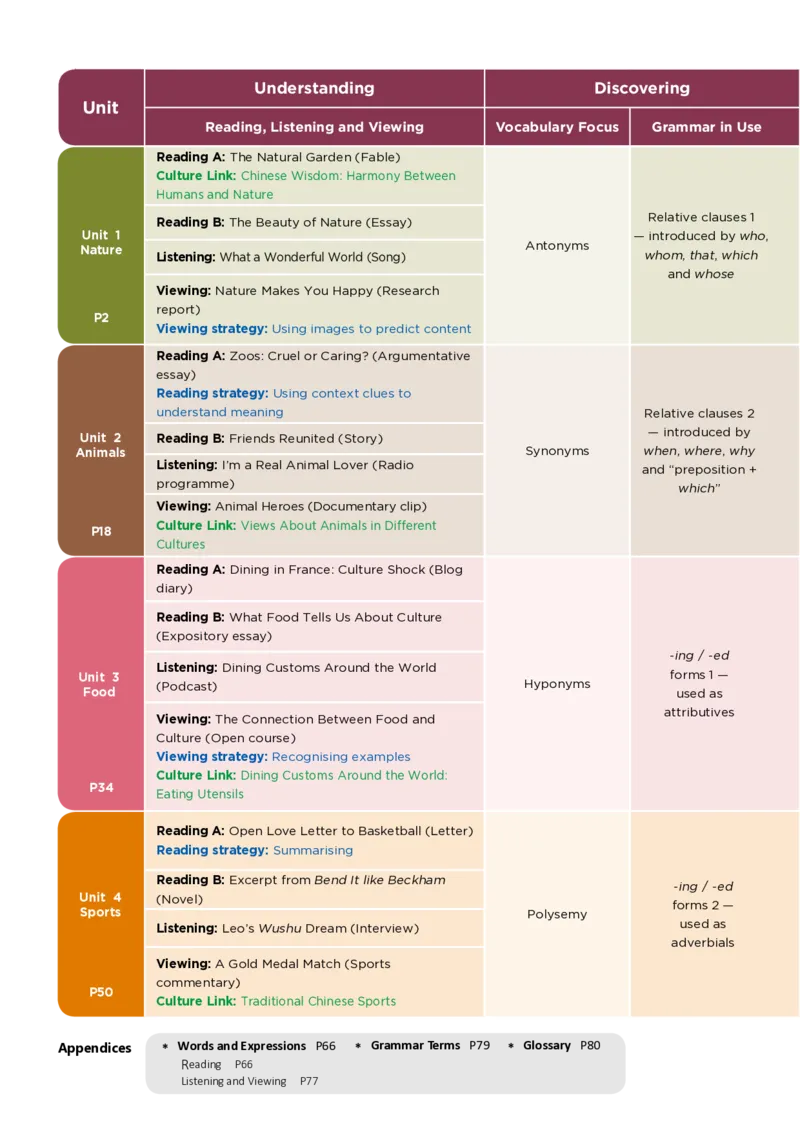
Unit 1
Nature
Unit 2
Animals
Unit 3
Food
Unit 4
Sports
Understanding
Discovering
Reading, Listening and Viewing
Vocabulary Focus
Grammar in Use
Reading A: The Natural Garden (Fable)
Culture Link: Chinese Wisdom: Harmony Between
Humans and Nature
Antonyms
Relative clauses 1
— introduced by who,
whom, that, which
and whose
Reading B: The Beauty of Nature (Essay)
Listening: What a Wonderful World (Song)
Viewing: Nature Makes You Happy (Research
report)
Viewing strategy: Using images to predict content
Reading A: Zoos: Cruel or Caring? (Argumentative
essay)
Reading strategy: Using context clues to
understand meaning
Synonyms
Relative clauses 2
— introduced by
when, where, why
and “preposition +
which”
Reading B: Friends Reunited (Story)
Listening: I’m a Real Animal Lover (Radio
programme)
Viewing: Animal Heroes (Documentary clip)
Culture Link: Views About Animals in Different
Cultures
Reading A: Dining in France: Culture Shock (Blog
diary)
Hyponyms
-ing / -ed
forms 1 —
used as
attributives
Reading B: What Food Tells Us About Culture
(Expository essay)
Listening: Dining Customs Around the World
(Podcast)
Viewing: The Connection Between Food and
Culture (Open course)
Viewing strategy: Recognising examples
Culture Link: Dining Customs Around the World:
Eating Utensils
Reading A: Open Love Letter to Basketball (Letter)
Reading strategy: Summarising
Polysemy
-ing / -ed
forms 2 —
used as
adverbials
Reading B: Excerpt from Bend It like Beckham
(Novel)
Listening: Leo’s Wushu Dream (Interview)
Viewing: A Gold Medal Match (Sports
commentary)
Culture Link: Traditional Chinese Sports
Unit
P2
P18
P34
P50
P50
Appendices
* Words and Expressions P66
Reading P66
Listening and Viewing P77
* Grammar Terms P79
* Glossary P80
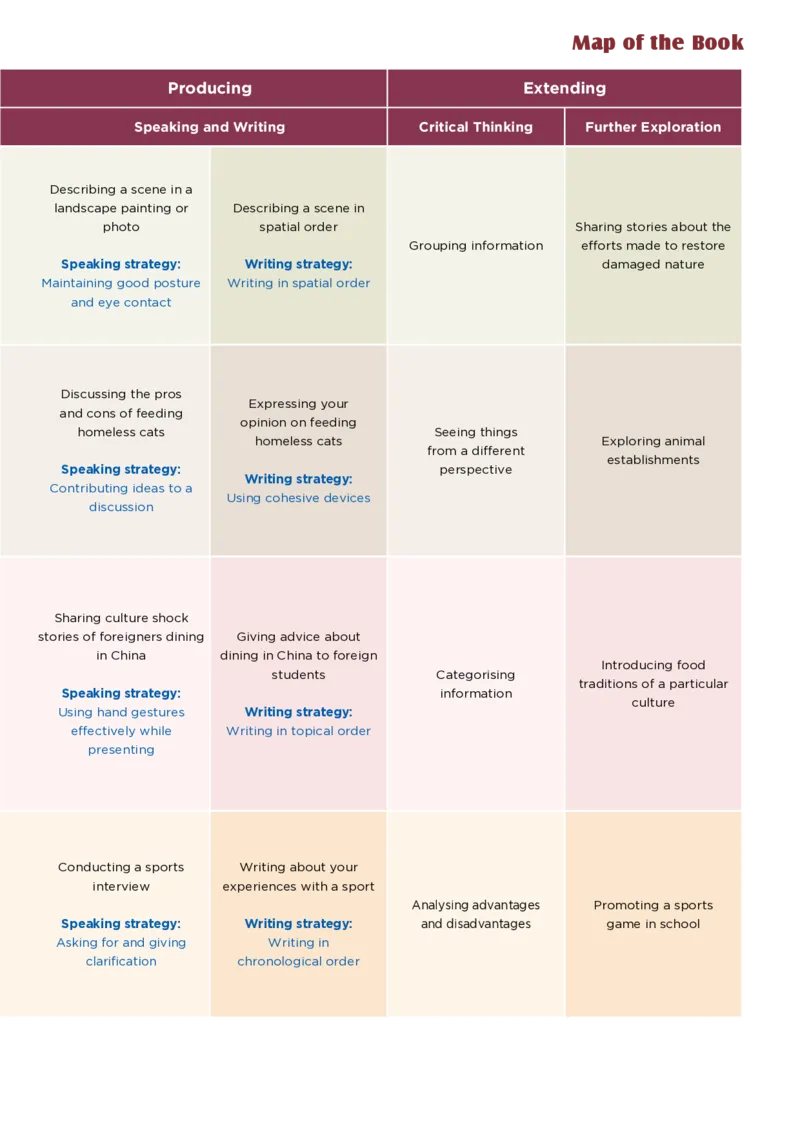
Producing
Extending
Speaking and Writing
Critical Thinking
Further Exploration
Describing a scene in a
landscape painting or
photo
Speaking strategy:
Maintaining good posture
and eye contact
Describing a scene in
spatial order
Writing strategy:
Writing in spatial order
Grouping information
Sharing stories about the
efforts made to restore
damaged nature
Discussing the pros
and cons of feeding
homeless cats
Speaking strategy:
Contributing ideas to a
discussion
Expressing your
opinion on feeding
homeless cats
Writing strategy:
Using cohesive devices
Seeing things
from a different
perspective
Exploring animal
establishments
Sharing culture shock
stories of foreigners dining
in China
Speaking strategy:
Using hand gestures
effectively while
presenting
Giving advice about
dining in China to foreign
students
Writing strategy:
Writing in topical order
Categorising
information
Introducing food
traditions of a particular
culture
Conducting a sports
interview
Speaking strategy:
Asking for and giving
clarification
Writing about your
experiences with a sport
Writing strategy:
Writing in
chronological order
Analysing advantages
and disadvantages
Promoting a sports
game in school
Map of the Book
1
致同学们
亲爱的同学们:
经过小学和初中阶段的学习,大家已经掌握了一定的英语语音、词汇、语
法等知识,也具备了一定的英语应用能力。大家是否希望通过英语了解更多的
世界文化?是否希望能够运用英语来介绍中国文化和社会生活呢?是否希望通
过英语学习获得更多的知识和技能,进而提升自己的思维品质和综合素养?是
否希望在课内外英语学习活动中提升自主学习的能力?
本套教材为同学们精心准备了题材丰富、风格多样的学习材料和形式活泼、
寓教于乐的学习活动,让大家在学习英语的同时,领略博大精深的中华文化、
绚烂多彩的世界文化、拓展全球视野。
同学们,高中阶段英语学习的主要目的是全面提升语言能力。同时,通过
英语学习获取更多的中外优秀文化知识,挖掘其承载的文化价值,提升跨文化
交际意识和交流能力,训练思维的逻辑性、批判性和创造性。
本套教材共七册,其中前三册为必修阶段教材,后四册为选择性必修阶段
教材。每册由四个单元组成。每个单元围绕人与自我、人与社会或人与自然三
大主题展开,形成一个交际和学习活动相结合的有机整体。每个单元包括四大
板块:理解(UNDERSTANDING)板块提供丰富的阅读、听力材料和视频片段;
发现(DISCOVERING)板块包括词汇和语法知识,帮助同学们发现、掌握并学会
使用规则,达到举一反三的效果;表达(PRODUCING)板块设计了听、说、读、
看、写结合的综合活动,以帮助同学们提升用英语完成相关交际任务的能力;
拓展(EXTENDING)板块包括思维训练(Critical Thinking)和项目探究(Further
Exploration)两个部分,前者旨在帮助同学们训练逻辑思维和批判性思维的能
力,后者指导同学们开展研究性学习、自主学习和合作学习。文化链接(Culture
Link)为灵活板块,主要介绍与单元主题相关的世界文化或中国文化小百科知识。
同学们还可以通过每单元最后的自我评价(Self-assessment)检测自己的学习成
效,发现需要改进的地方后,制定相应的提升计划。
同学们,掌握一门外语意味着多一双看世界的眼睛,多一双听世界的耳朵,
多一个探索世界的工具,也多一条传播中国文化的途径。学习外语需要大量的
实践,需要持之以恒的努力。希望同学们在老师的指导下,把教材作为起跳板,
充分调动你们已有的知识,探索未知的领域,“跃”向更广阔的世界。
编者
2020 年5 月
Nothing in Nature is unbeautiful.
— Alfred Tennyson
2
Unit
Nature1
3
Reading A
There once lived a king who had a
palace with beautiful gardens. In those
gardens lived thousands of creatures
representing hundreds of different species.
It was a paradise.
There was only one thing that the
king disliked — the remains of a huge tree
standing in the middle of the gardens. It was
withered and dry. So, he had it cut down
and replaced with elaborate fountains.
Some time later, a wise nobleman
visited the king. “Your Majesty, people have
been singing the praises of the beauty of
these gardens and the many creatures that
live in them. But I’ve hardly seen a thing
move — not one animal. I feel tricked!”
whispered the nobleman. The king realised
that the wise man was right! The animals
had left and the gardens were empty. The
king sent for his advisers. He offered a
reward to anyone with a solution. He was
presented with many theories and ideas. He
tried them all, but nothing could restore the
royal gardens to their former splendour.
Years later, long after many of the
grounds’ plants and flowers had also
disappeared or withered, a young man
showed up. He had an explanation. “There
Do you know that things in nature are
connected? Read the text and find
out how.
10
15
20
25
5
THE NATURAL GARDEN
Getting Started
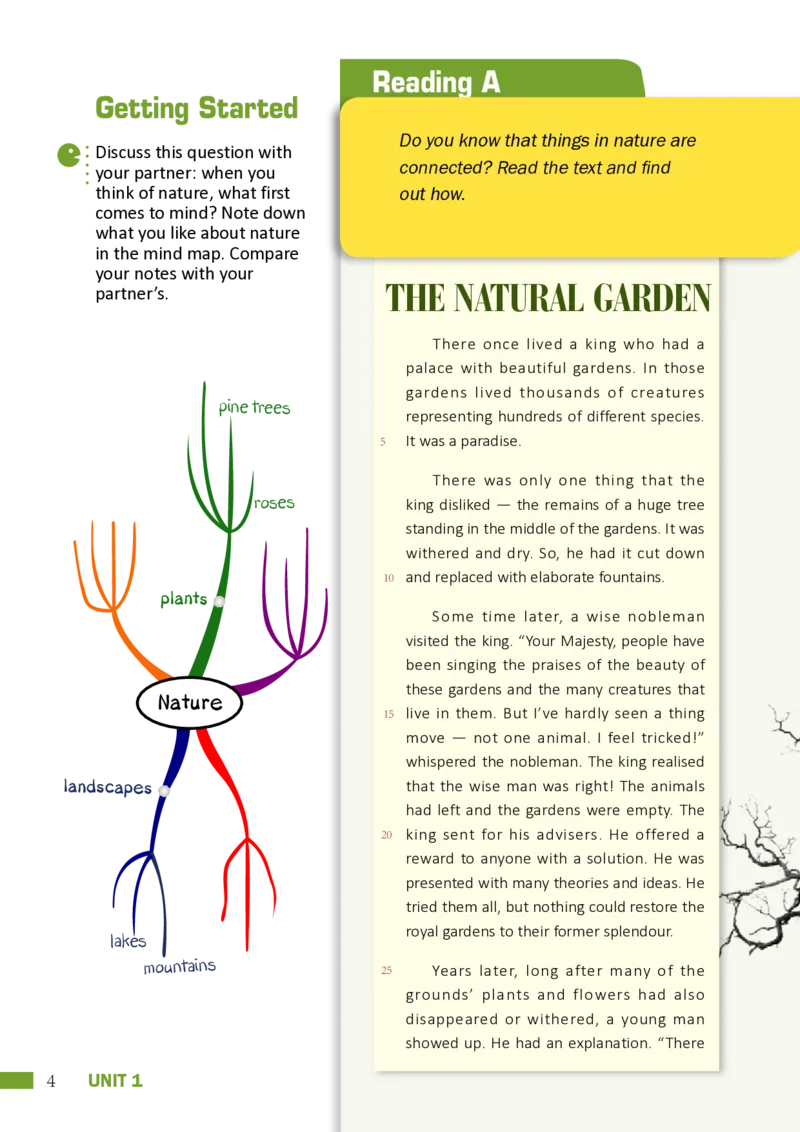
Discuss this question with
your partner: when you
think of nature, what first
comes to mind? Note down
what you like about nature
in the mind map. Compare
your notes with your
partner’s.
Nature
plants
landscapes
roses
mountains
lakes
pine trees
4
UNIT 1
30
55
60
65
35
40
45
just wasn’t enough poo, Your Majesty.
Particularly, moth poo.”
Everyone broke into laughter.
The man was a fool. The guards were
ready to throw him out, but the king
stopped them. “I want to hear what
you have to say.”
The man carefully explained how
everything in a garden is connected.
The bigger animals fed mainly on the
brightly coloured birds, which ate
colourful worms, which in turn fed on
the various plants and flowers native
to that part of the world. These rare
plants and flowers flourished amongst
insects and other organisms as long
as there was enough moth poo. But
how could a young man know so
much about the royal gardens?
It turned out that before
he was born, his father
had collected the old tree that the
king ordered to be taken out. He re-
planted it on their land. Every spring,
thousands of moths came out of
the tree and the beauty of the royal
gardens recreated itself there.
Now that the king knew what
was wrong and how it could be
fixed, he wanted his gardens back.
But recreating the gardens, he later
found out, would take many years.
Nature couldn’t be rushed. It would
take time for balance to be restored
and the king would not live to see it.
The king was full of regrets. He had
so carelessly destroyed the delicate
balance of nature.
Culture Link
Chinese Wisdom: Harmony
Between Humans and Nature
The core of Chinese culture is the pursuit
of humans’ harmonious unity with nature.
Such values are expressed in our lifestyles by
the word du (literally “degree” or “limit”). It
represents the wisdom of the Chinese in life
and in human interaction with the environment.
In many Chinese landscape paintings, waterfalls
and mountain peaks make up much of the
painting while humans often have a place. They
are participants in the natural scene, but they
do not dominate it.
Personal Touch
Who do you think is the wisest man in the story? Why?
The Natural Garden
50
5
Nature
Comprehension
II. Answer the questions.
III. Make your own dialogue.
The king was full of regrets. He wanted to restore the beauty of his gardens, but
it would take many years.
The king had the tree — the only thing that he disliked in the gardens —
cut down.
The king realised that there were no more living creatures in his gardens.
A young man came with an explanation and a solution.
The king sent for advisers, but none of them was able to explain the mystery.
The king had gardens as beautiful as paradise.
I. Put the sentences in the right order according to the story.
1. Why did the king order his men to cut down the huge tree in his gardens?
2. What was soon missing from the king’s gardens? What had caused the problem?
3. How long did it probably take for the beauty of the gardens to be recreated on the
young man’s property?
4. What does the sentence “Nature couldn’t be rushed” (line 61) mean? Explain it in
your own words.
5. What lesson have you learned from the story?
The king is now about to ask his men to cut down the old tree in his gardens. Suppose
you are one of the advisers to the king and you know how everything in the gardens is
connected. You want to persuade the king to give up his plan. Work with a partner and
make your own dialogue, and then act it out. You can start like this:
Digging In
The king:
The old tree is withered and dry. What’s the point of leaving it
in my royal gardens? It’s completely out of place!
The adviser:
Your Majesty! Allow me to ...
The king:
6
UNIT 1
Vocabulary Focus
I. Key Vocabulary
Fill in the blanks with the appropriate forms of the given words and expressions to
complete the passage.
I am the tree who used to live in the king’s gardens. Every spring thousands of
moths came out of me. The moths attracted birds, which 1 _________ provided
food for bigger animals. Gradually, the gardens were filled with life and colour. The
king was very proud of his gardens, in which thousands of creatures 2 _________
hundreds of species now lived. They turned the gardens into a paradise that
everyone enjoyed. I was old, withered and dry, and it turned out that I was the only
thing in the gardens that the king disliked. Then one day the king 3 _________ and
decided he could stand me no more. He had me cut down and 4 _________ with
elaborate fountains. But to his surprise, all the animals living in the gardens were
gone in time. The king 5 _________ advisers, but none of them came up with a
solution.
Many years passed before a young man presented himself
to the king. Though everyone else 6 _________ laughter
when he pointed out that it was the “moth poo” that
played a key role in keeping life balanced and healthy in
the gardens, the king took his 7 __________ seriously.
The king wanted to recreate the 8 __________
beauty of his gardens. However, it would take many
years to restore the 9 __________ of nature, for I was
delicate — easy to 10 _________ and so was the balance
of nature!
II. Word Meaning: Antonyms
1. What does the word in bold
mean? Guess its meaning with
the help of the underlined word.
An antonym is a word that is opposite
in meaning to another word. For
example, active is an antonym of
passive. Here are more examples.
• Danny’s father said the map was
simple, but when Danny looked at it,
he saw it was actually quite complex.
• Although this plant is familiar to
people in Europe, it is unknown to
the rest of the world.
People have different views
about how we treat natural
resources. Some people believe
that wild forests should be
preserved. Others think that
wild forests are there to be used
as much as possible to keep the
economy running.
show up
break into
former
explanation
send for
represent
balance
destroy
replace
in turn
7
Nature
Grammar in Use
Relative clauses 1 — introduced by who, whom, that, which and whose
I. Study the sentences and find out how they are combined.
1. There once lived a king who had a palace with beautiful gardens. (=There once lived
a king. The king had a palace with beautiful gardens.)
2. People sang the praises of the beauty of these gardens and the many creatures that
lived in them. (=People sang the praises of the beauty of these gardens and the
many creatures there. Those creatures all lived in the gardens.)
3. The old tree which the king ordered to be cut down had actually been collected by
the young man’s father. (=The king ordered that the old tree be cut down. The old
tree had actually been collected by the young man’s father.)
3. Read the passage and fill in each blank with an antonym of a word from the box.
An environment works (1) _________ with a wide variety of species. Here’s an
example: green sea turtles (2) _________ eating sea grass — but they can’t hang
out in one spot for too long because tiger sharks in the area hunt for sea turtles.
(3) _________ tiger sharks, sea turtles would eat all the best sea grass, (4) _________
the home for all the other animals that depend on it. If one species — turtles, sharks, or
sea grass — (5) _________, other plants and animals that are connected to that species
could become extinct too. Losing just one species can (6) _________ many others.
There are possibly billions of (7) _________ species of plants, animals, bacteria and
other living things throughout the world — but we’ve only
documented about two million of them. Many of these
known and unknown species have (8) _________ futures
however.
We can help keep the Earth safe and the whole
ecosystem healthy by working to preserve all of its
components.
well
2. Complete the sentences with the antonyms of the underlined words.
(1) The king liked his beautiful gardens, but _________ the remains of an old tree
standing in the middle.
(2) After many attempts, the king still failed to restore his gardens to their former
splendour. It seemed that only the young man could _________ in doing so.
(3) These trees flourish particularly well in a warm and wet climate, but _________
in dry conditions.
(4) Nature is fair. She _________ those who break her laws but rewards those who
observe them.
create with similar poorly benefit hate certain appear
8
UNIT 1
II. Connect the sentences using a relative pronoun, as in the example. Use “-” to
indicate where a relative pronoun is not necessary.
III. Complete the passage with appropriate relative clauses from
the options given on the right.
A. that live there
B. that arrive each day
C. who come to the island
D. whose life is easy and
relaxed
E. who planned to come
back and cook them
F. who has visited the tiny
island of Big Major Cay
1. He took me to see the old garden bridge. (He is rebuilding it.)
___________________________________________________________________
2. Sea lions are intelligent animals. (They can be trained to monitor and report on
underwater conditions.)
___________________________________________________________________
3. People have to pay for their actions or clean up. (They create air, water and waste pollution.)
___________________________________________________________________
4. We are going to interview people. (Their job is to study humans’ impact on our planet.)
___________________________________________________________________
A relative clause gives more information about someone or something referred to in a
main clause. Some relative clauses (defining relative clauses) are used to specify which
person or thing we mean, or which type of person or thing we mean. Relative clauses
begin with a relative pronoun, such as who, whom, that, which or whose. For example:
• Several athletes whom the reporter spoke to complained about the smog
hanging over the city.
• The king offered a reward to anyone whose solution would be effective.
When we use a defining relative clause, the relative pronoun can be the subject or the
object of the clause. For example:
• Rockall is a small island which/that lies west of Scotland.
• He showed me the rocks (which/that) he had brought back from Australia.
When the relative word is the object of the clause, it can be omitted. For example:
• We went to a garden (which/that) Jane had recommended to us.
G rammar Highlights
EXAMPLE
Most of the forests have now been destroyed. (They once covered this area.)
Most of the forests that/which once covered this area have now been destroyed.
Do pigs swim? Anyone 1 _________ can answer this
question. The island has attracted international media
attention because of the swimming pigs 2 _________. No
one knows for sure how these pigs first got to the island.
Some say they were left by a group of sailors 3 _________.
Pig Beach has become a popular tourist attraction.
Those who want to take a break from their busy lives can
swim with pigs 4 _________. Because the pigs have got
used to being fed by tourists, they swim out to meet the
boats 5 _________.
People 6 _________ can not only get a selfie with the
swimming pigs, but also enjoy a boat trip along the attractive
coastlines, and discover its endless natural beauty.
9
Nature
What a Wonderful World (Song)
I see trees of green, red roses too
I see them bloom, for 1 _________
And I think to myself
What a wonderful world
I see skies of blue (and) 2 _________
(The) bright blessed days, (the) dark sacred 3 _________
And I think to myself
What a wonderful world
The colours of the 4 _________
So pretty in the sky
Are also 5 _________
Of people going by
I see friends 6 _________, saying how do you do
They’re really saying, 7 _________
I hear babies cry, I watch them 8 _________
They’ll learn much more
Than I’ll ever know
And I think to myself
What a wonderful world
(Quite simply wonderful)
(Yes, I think to myself
What a wonderful world)
What message does this song convey?
I. Make a list of things in nature that are favourite subjects of singers. Sing a few lines
that contain one or more of the things in your list to your partner.
II. Listen to the song “What a Wonderful World” and answer the question.
Listening and Viewing
III. Listen to David Attenborough reading the lyrics of this song. While you listen,
complete the lyrics using no more than three words for each blank.
10
UNIT 1
Nature Makes You Happy (Research report)
I. Watch the video in silent mode for 20
seconds and predict its main message.
This video is about _________.
A. environmental protection B. Antarctic exploration
C. the natural world D. rainforest exploration
1. According to the video, how do we feel when spending time in nature?
2. What does Prof Keltner’s study of human happiness reveal?
When do you feel awe, wonder or amazement in nature?
IV. Apart from the images in the song,
what other things make you think
this is a wonderful world?
II. The report shows that watching video footage of the natural world may have several
effects on people. Watch the complete video clip and tick () the effects that are
mentioned. Look up the new words in the dictionary after you watch.
III. Watch again and answer the questions.
IV. Reflect on your own experiences and answer the question.
□
reductions in tiredness and low
energy
□
hope and courage
□
pride and satisfaction
□
amazement, wonder and awe
□
worry, tiredness and fear
□
reductions in stress
□
joy, contentment and curiosity
□
respect and love
□
real human happiness
□
peace and freedom
Using images to predict content
Viewing Strategy
11
Nature
Moving Forward
I. Speaking: Describing a scene in a landscape painting or photo
A
collection of landscape paintings
and photos will be shown at the
International Art Festival of your school.
You are one of the volunteers and will
introduce and describe pieces of artwork
to the visitors: your schoolmates and some
exchange students from other countries.
Landscape Painting: What’s in the Picture?
Below is one of the paintings on display. Prepare your description by following the steps.
Step 1 Work with a partner and talk about what
you see in the painting. Try to find as
many details as possible. Make a list of
the details that you want to include in
your description. Rank them from the
most impressive to the least.
Step 2 Talk with your partner about what you
see from different angles, e.g. from left
to right and from top to bottom. Decide
on the order in which the details will be
presented.
Step 3 Practise your description with your partner. While you describe the painting,
use some of the prepositions of place.
Step 4 Suppose your classmates are the visitors. Describe the painting in class.
Maintain good posture and eye contact with your classmates while presenting.
During a presentation, you can maintain good posture by standing upright and facing the audience.
Make sure you look people in the eye and break eye contact with each person every 2 – 5 seconds.
Maintaining good posture and eye contact
Speaking Strategy
Prepositions of Place
above
next to
near
in front of
below
behind
here
in the foreground/background
across
on the top of
opposite
in the distance
through
to the side of
against
on a lower level
beside
far to (the left side)
between
on the left/right
12
UNIT 1
II. Writing: Describing a scene in spatial order
Find a landscape painting or photo that you are very fond of. Write a paragraph to
describe it in spatial order.
Step 1 Reflect on the scene in the painting or photo, and write down the most
important details that you are going to describe.
Step 2 Decide on the angle from which you want the viewer to observe this
scene. Take the following description as an example.
Step 3 Write your description in spatial order in 70 – 90 words.
A stream is flowing from the left to the far right in front of us through the grassland. In the
water are the reflections of the clouds and the sky. At our feet, wild flowers grow on the bank.
On the other side of the bank on the far right, some trees grow tall and strong. Further in the
distance on our left stands a beautiful palace. The sun is setting beside the palace and casting
a magnificent glow on the masses of clouds above in the sky. All these elements combine to
present a lovely view of nature at dusk.
Spatial order is a method of organisation in
which details are presented as they are (or
were) located in space — e.g. from left to
right or from top to bottom. Spatial order
provides the angle from which readers
observe the details.
Writing in spatial order
Writing Strategy
EXAMPLE
13
Nature
THE BEAUTY OF NATURE
I sometimes stare at the sky and
wonder why we have made such a mess of
things. I wonder why we tear up the seas
and use up the trees all in the name of
progress. It is such a tragedy that we are
damaging things so fast and they will soon
be way beyond repair.
It is sad to think future generations
will not have the natural things to enjoy as
we have had, and that they will be paupers
when it comes to the offerings of the
natural world.
But preserving nature is one thing,
appreciating it is quite another. There is so
much beauty all around us to see, touch
and hear. Nature is miraculous because it
is always changing. No matter how many
times you look at something, you can
always find something different.
Nature can set a sky aflame at sunset
or magically transform a familiar landscape
into a snow-white wonderland. It can
paint a rainbow in the sky, paint beautiful
autumn colours on trees, or paint a clump
of daffodils in the grass with a glow of soft
sunlight.
Nature brings beauty into our lives.
Nature has a way of affecting our moods
and it can force us to change our plans.
Nature is responsible for the sun, clouds,
rain and snow. When it is sunny and bright
outside, we feel cheerful inside. When it
is cloudy and rainy, we often feel gloomy.
When there is a beautiful starry night, the
moonlight makes us feel romantic.
When we see the leaves budding on a
tree or when a timid flower pushes through
the frozen ground, or when we smell the
freshness of spring, new hope will always
come to us. Nature is truly an intrinsic part
of our lives.
When we wake and see a sunrise,
when we walk and feel a breeze, when we
gaze at the mountains and the splendour
of the seas, when we see the earth renew
its beauty at each season of the year and
when the stars shine at night, we should
be thankful to nature for giving us all these
wonderful and miraculous things. Learning
to become more aware of nature can truly
have a positive effect on our lives in the
way we look at things and in the way we
feel about ourselves.
Reading B
5
30
35
40
45
50
10
15
20
25
14
UNIT 1
I. Use the table to group the things we have learned about nature in this unit. Reflect
on how things in nature usually make us feel. Then add words we can use to
describe our feelings in the third column. Some examples have been given.
II. Think of some poems or songs about nature. What feelings do you think they express?
Put your ideas in a table, as in the example below.
Critical Thinking
I. Form pictures in your mind while you read the text, and then describe them
in your own words.
II. The author uses details to describe the beauty of nature. For example, “a sky
aflame at sunset” (line 20). Identify more examples in the text.
Things in nature
How they may make us feel
Plants
leaves budding on a tree
hope / hopeful
Animals and other
creatures
Natural landscapes
Natural phenomena
Things in nature
Poem/Song
Feeling(s) expressed
birds; storm;
blossoms
A Spring Morning
I awake light-hearted this morning of spring,
Everywhere round me the singing of birds —
But now I remember the night, the storm,
And I wonder how many blossoms were broken.
regret for spring’s departure
Grouping information
III. Answer the questions.
1. What might be the reasons why future generations “will be paupers when it
comes to the offerings of the natural world” (lines 10 – 12)?
2. Do you think the author is calling on us to preserve nature or to appreciate nature?
Why?
Comprehension Plus
15
Nature
Further Exploration
Sharing stories about the efforts made
to restore damaged nature
Like the king in “The Natural Garden,” people often destroy
the environment before they realise it is too late. What can be
done to restore nature to its original state? Work in groups and
find an example of where this has been done, and tell the story
to your classmates using pictures to show the contrast.
Find a natural place/spot that was once damaged but
is now restored or being restored. Search for pictures
of its past and present.
Find out what efforts have been made to restore the
damaged natural place/spot. Write a story about it.
Present your story to your classmates and use
pictures to assist your presentation. An example slide
is given.
Step 1
Step 2
Step 3
Bringing Back a Clean Suzhou Creek
— 1993 – 2008: Three major
projects to clean up the
creek
— Today: Fish and shrimp
back in the creek; improved
quality of life for residents
— 1980s: Disappearance of
fish and shrimp due to
heavy pollution
16
UNIT 1
Which of the above have you done well? Why and how?
Which of the above do you still find difficult? Why?
What do you plan to do if you find something difficult?
Look at the expected learning outcomes of this unit and answer
the questions.
A. Understanding and explaining the connections between things in nature
and the importance of the balance of nature
B. Describing a scene in a landscape painting or a photo
C. Understanding and describing the feelings expressed in a song or a poem
D. Comparing people’s attitudes towards nature
E. Using a table to group information
F. Predicting content based on images acquired while watching a video
silently
G. Maintaining good posture and eye contact with my audience in a
presentation
H. Writing a descriptive paragraph in spatial order
Self-assessment
17
Nature
Besides love and sympathy, animals
exhibit other qualities connected with
the social instincts which in us would be
called moral.
— Charles Darwin
18
Unit
Animals2
19
Last weekend I visited a zoo with a friend.
When we were there, we debated whether
or not zoos were a good thing. When I was
little, I loved going to zoos. Now, at the age
of 20, I still enjoy visiting them. However, I
am aware that there are lots of people who
don’t support these establishments.
Animal welfare is a growing concern
in today’s society. There are many people
who believe that zoos are cruel. They argue
that it is cruel to remove animals from their
natural habitats and keep them in cages. An
animal kept in a zoo will lead a life different
from an animal that lives in the wild. For
example, animals in zoos don’t have to hunt
for food. Additionally, some animals become
unhappy in zoos because there isn’t enough
space. Zoos exhibit animals from places all
over the world and animals must therefore
adjust to different climates and seasons,
depending on the location of the zoo in
relation to where they come from.
For human visitors, however, a trip to
the zoo can be an educational experience.
Reading A
10
15
20
5
Getting Started
Look at the pictures. Where
do these animals live? How
do they probably feel?
Zoos are found in almost every big
city in the world. Do you think they are
suitable homes for animals? Read the
text and decide whether you agree or
disagree with the author.
ZOOS: CRUEL OR
CARING?
20
UNIT 2
25
30
35
40
45
50
When students learn about endangered
species and are able to see them in a
zoo, they are more likely to support
projects designed to save these animals
from extinction. Zoos are involved in
many conservation projects: supporting
zoos provides essential funding for these
projects. Due to threats such as illegal
hunting, there are many species which
would be extinct if they weren’t kept in
zoos. Moreover, many zoos attempt to
replicate an animal’s natural habitat: a
range of materials is used to create a
space that is similar to what would be
found in the wild. Lots of toys are usually
put in exhibitions to prevent animals from
getting bored. Animals that live in tropical
countries are typically housed indoors
in heated tanks which are kept at a
temperature similar to that of their
natural habitat.
Every zoo has a slightly different
approach to animal care and welfare,
but overall I think zoos are a good
thing. Seeing animals in their natural
habitat isn’t always possible and I think
zoos offer a good alternative. A trip to
the zoo is both educational and fun —
I’ll definitely continue to visit zoos!
Personal Touch
Do you like visiting zoos? Why or why not?
Zoos: Cruel or Caring?
21
Animals
Comprehension
II. Read the sentences. Guess the meaning
of each underlined word by circling the
context clues, and then put it in the blank.
III. Complete the table by making inferences about the author’s opinions towards
zoos based on the given details. Then answer the questions that follow.
I. Answer the questions.
1. Why do many people think that zoos are cruel?
2. Why can a trip to the zoo be an educational experience?
3. What is the author’s attitude towards zoos?
Digging In
Detail
Opinion
Animals in zoos don’t have to hunt for food.
An animal kept in a zoo will lead a life different
from an animal that lives in the wild.
There isn’t enough space.
Students are more likely to support animal
protection projects.
Tropical animals typically live in heated tanks.
1. When students learn about endangered species and are able to see them in a zoo,
they are more likely to support projects designed to save these animals from extinction.
Meaning of “extinction”:
2. Moreover, many zoos attempt to replicate an animal’s natural habitat: a range of
materials is used to create a space that is similar to what would be found in the wild.
Meaning of “replicate”:
3. Animals that live in tropical countries are typically housed indoors in heated tanks
which are kept at a temperature similar to that of their natural habitat.
Meaning of “tropical”:
Questions:
What is your attitude towards zoos? Apart from what the author has mentioned, what
other information can be used to support your opinion?
Using context clues to understand meaning
Reading Strategy
Negative
Positive
EXAMPLE
When I was little, I loved going to zoos. Now, at the age of 20, I still enjoy visiting them.
However, I am aware that there are lots of people who don’t support these
establishments.
Meaning of “establishment”: a place or type of organisation
22
UNIT 2
Vocabulary Focus
I. Key Vocabulary
Rewrite the sentences by using the words or phrases given in the brackets. Parts of the
sentences are given.
A synonym is a word or phrase that has a similar
meaning to another word or phrase. We use
synonyms to make our writing more interesting.
Words from any part of speech (e.g. nouns,
verbs, adjectives, adverbs or prepositions) can
have synonyms. For example:
• amazing, surprising, unbelievable, wonderful
(adjectives)
• car, auto, automobile, motorcar (nouns)
• participate, take part, join (verbs)
• quickly, fast, rapidly (adverbs)
• on, upon (prepositions)
When replacing a word with its synonym,
make sure the meaning of the sentence
in the specific context is maintained.
II. Word Meaning: Synonyms
1. Do the underlined words in
sentences A and B have similar or
opposite meanings?
Group 1
A. When I was little, I loved going to
zoos.
B. Now, at the age of 20, I still enjoy
visiting them.
Group 2
A. Additionally, some animals
become unhappy in zoos because
there isn’t enough space.
B. Moreover, many zoos attempt
to replicate an animal’s natural
habitat.
EXAMPLE
Some scientists believe that dinosaurs became extinct millions of years ago due to
climate change. (extinction)
Some scientists believe that the extinction of dinosaurs millions of years ago
occurred due to climate change.
1. The World Wildlife Fund produces public service ads to raise awareness of animals in
danger. (aware)
The World Wildlife Fund produces public service ads to help people _____________
_____________________________________________________________________.
2. The work of the group of volunteers includes finding homes for homeless animals and
the prevention of cruelty to animals. (prevent)
The group of volunteers work to find homes for homeless animals and __________
_____________________________________________________________________.
3. The palace was first built as a mulberry garden by the king in an attempt to grow
silkworms. (attempt, v.)
The king ____________________________________________________________.
4. Scientists studied wild dog groups in Africa. They noticed that if the dogs sneezed
more, the likelihood of the group going hunting would increase. (be likely to)
Scientists studied wild dog groups in Africa. They noticed that if the dogs sneezed
more, the group _______________________________________________________.
5. The World Wildlife Fund is especially concerned with climate and landscape changes
and the effect on wildlife. (concern, n.)
Climate and landscape changes and the effect on wildlife is ___________________
_____________________________________________________________________.
23
Animals
Grammar in Use
Relative clauses 2 — introduced by when, where, why and “preposition + which”
2. Match each word with the sentence containing its synonym.
3. Read the passage and replace the underlined words with
their synonyms. Make sure the meanings of the sentences
are maintained to the greatest extent. Note that there
might be slight differences between some synonyms.
(1) attempt
A. Because of its difficult financial situation, it is likely that the
zoo will need to close for a period of time.
(2) possible
B. White-beaked dolphins are social animals, most commonly
found in groups of fewer than ten.
(3) typically
C. A few zoo animals tried to escape.
I. Study the sentences and find out how they are combined.
1. Last weekend I visited a zoo where (in which) I had a discussion with one of my
friends about whether or not zoos are a good thing. (=Last weekend I visited a zoo.
In the zoo, I had a discussion with one of my friends about whether or not zoos are
a good thing.)
2. The best time to go on safari in South Africa is the dry season when (in / during
which) animals gather around rivers. (=The best time to go on safari in South Africa
is the dry season. In / During the dry season, animals gather around rivers.)
3. Having the chance to see all kinds of animals from different parts of the world
is the reason why (for which) I think zoos are educational and fun. (=Having the
chance to see all kinds of animals from different parts of the world is the reason.
For this reason I think zoos are educational and fun.)
Cats (1) leap (jump) through hoops of fire. Horses dance in a circle. Trained monkeys
perform alongside clowns. To the audience, it’s a wonder; to others, a disturbing scene.
To the trainer, it’s the end result of a hard “education” that (2) began ( ) when
the animals were young.
It starts with one small, simple lesson. A young tiger, (3) for instance ( ),
is taught to make a very short leap. A meat treat and words of praise follow. These are
known as positive rewards — good things that happen when an animal does what it
is (4) asked ( ) to do. The next time the tiger is encouraged to make a longer
leap. Gradually the leaps become even longer and higher. (5) Soon ( ) the
trainer is demanding that the tiger jump through a hoop.
Of course, there are always problems along the way. The tiger may refuse to move
or decide to jump around the hoop (6) instead of ( ) through it. When
this happens, the animal receives (7) a few ( ) sharp taps with a stick as
punishment. Training can take years. But sooner or later most tigers do what they are
told. Their performance only looks easy and natural on the circus stage.
24
UNIT 2
II. Complete the conversations about animals with the help of the hints in brackets.
The relative adverbs when, where and why can also be used to
introduce a relative clause. They act as an adverb in the relative
clause to refer to a time, place or reason, and are often used
instead of the more formal structure of “preposition + which.” For
example:
• Summer is the season when (in / during which) the common
seal gives birth to its babies along the Irish coastline.
• We'll visit an animal rescue centre where (in which) homeless
or injured animals can be taken care of before suitable homes
are found for them.
• Scientists have finally figured out the reason why (for which)
penguins lost the ability to fly.
G rammar Highlights
A: Is that a koala in the photo?
B: Yes. It was taken in a wildlife park last summer ____________
(visit, Australia).
A: I’ve heard that koalas are only found in Australia. Do you know
why?
B: As far as I know, they only feed on the leaves of certain trees and
Australia is the only place _________________________ (these
trees, grow).
A: I see. No wonder I’ve never seen a koala in our city zoo.
A: Do animals sleep like humans?
B: Yes, they do. We humans may need up to eight hours of sleep a
night to keep our brains functioning, while animals require more
or less rest. Bats, for example, sleep 20 hours a day while giraffes
sleep less than two. But keeping their brains in order is not the
only reason ____________________________ (animals, sleep).
Some animals such as bears and turtles go into hibernation for
several months in order to survive difficult seasons. Different
species have their own sleeping patterns.
A: What is hibernation?
Conversation 1
Conversation 2
B: It is an extremely deep sleep. Before hibernation, animals feed heavily during the
few months ______________________________________ (food, plentiful) and build
up fat, and then go to sleep and live off their fat reserves throughout the cold season
_____________________________________ (weather, freezing, food, limited).
B: You know, the chance to come face to face with Australian wildlife, such as koalas and
kangaroos, is a powerful reason ____________________ (many tourists, travel in
Australia).
25
Animals
I’m a Real Animal Lover (Radio programme)
1. What are the speaker’s concerns about animals?
The speaker is worried about ________________________________. Some of his
favourite animals ______________________________________________.
2. According to the speaker, what should we do to solve the problem?
We really need to __________________ so that ________________________.
II. Listen to the radio programme. While you listen, match the speaker’s activities
with his particular period of life. Note that there is one extra choice.
I. What do typical animal lovers do? Brainstorm their activities.
III. Listen again and complete the answers to the questions.
Activity
Life period
1 when he was a child
2 when he was older
3 now
Listening and Viewing
A. raising a pet
B. observing wild animals
C. reading books on animals
D. watching animal documentaries
E. visiting the zoo
F. going to the museum
G. going on a safari
H. watching zoo animals
IV. What do you think we can do to solve the problem mentioned by the speaker?
Discuss with your partner(s).
26
UNIT 2
Animal Heroes (Documentary clip)
II. Watch the video clips and complete the table with the information about two
animal heroes.
I. Make a list of reasons why an animal might be called a hero. Compare your list with
your partner’s.
III. Work in pairs. Each student retells one of the stories based on their notes.
IV. Work in groups. Share with your classmates stories you
know about animal heroes.
Who
1 named Salty
What does
the hero
look like
2
When
11 Sept. 2001
Where
3
What
happened
As Tower One of the World Trade Centre began collapsing around them, Salty
4 and a friend down 70 flights of stairs to safety. Later, Salty
and her owner received 5 and she was also given
6 .
Who
a cat named 7
What does
the hero
look like
8
Where
her owner’s home
What
happened
The cat was 9 when her owner’s house began filling up with
carbon monoxide (CO). She started meowing loudly and scratching objects to get
her owner to 10 . Finally, her actions saved her owner’s life.
Culture Link
Views About Animals in Different Cultures
In some countries, like the US and the UK, dogs are loved and considered a great
pet to have at home and with the family. In some other cultures, such as in Saudi
Arabia and Iran, dogs may be viewed as dirty or dangerous.
In India, cows are greatly respected and honoured, while in some other countries,
cows are treated as a source of meat.
27
Animals
Students at Lan Shan School have recently found some homeless cats
hanging around the campus. Some students feed the cats every day while
others have begun to show their concerns.
Feeding Homeless Cats: Helping or Hurting?
I. Speaking: Discussing the pros and cons of feeding homeless cats
Moving Forward
Sally, look at the cat. How
cute! It’s really sad to see it
out there with nowhere else
to go. I’ll bring some food for
it this afternoon.
Contributing ideas to a discussion
Speaking Strategy
Useful tips:
1. Try your best to be original, i.e., don’t repeat what others have said
without adding something new.
2. When your thought builds on another person’s idea, quickly
summarise their point before you begin yours.
3. Ask questions when necessary.
4. Try to put forward your idea in a clear way.
5. Always keep your opinions focused on the subject of your discussion.
Poor little kitty! I love animals, Jenny,
but I’m concerned that it will bring a
lot of problems.
Step 1 Read the conversation below and decide whose opinion is closer to your own.
Step 2 Discuss in groups. Listen to each other’s opinions and make brief notes.
Before you begin, read the tips below about contributing ideas.
28
UNIT 2
II. Writing: Expressing your opinion on feeding homeless cats
Step 1 Review your discussion by looking at the notes you’ve taken on the pros
and cons of feeding homeless cats on campus.
Step 2 Group your notes into two categories that are either for or against
feeding homeless cats on campus. List both the statements and the
supporting details.
Step 3 Read a model essay, like “Zoos: Cruel or Caring?” Study how ideas are
linked and how the different parts of it fit together.
Step 4 Write an opinion paragraph on feeding homeless cats on campus in
70-90 words. Use cohesive devices when necessary.
Using cohesive devices
Writing Strategy
Cohesive devices are words and expressions that hold a text together and connect ideas.
They help to guide the reader through your writing. They signal to the reader what the
relationships are between different clauses, sentences or paragraphs.
Some commonly used types of cohesive devices are:
• Determiners and pronouns. For example:
this, that, he, she, they, him, her, them, these, those …
• Linking words.
Function
Example
Adding similar ideas
additionally; another reason is; moreover; furthermore; …
Contrasting ideas
in contrast; on the other hand; on the contrary; although; whereas; yet; …
Giving examples
for example; for instance; to illustrate this; …
Explaining results
as a result; therefore; consequently; …
Sequencing
to begin with; next; firstly; secondly; …
Providing explanations
owing to; because of; due to; …
Drawing conclusions
in conclusion; to sum up; …
Contrasting ideas
Giving examples
Providing
explanations
Adding similar ideas
Determiners or
pronouns
25
30
35
For human visitors, however, a trip to
the zoo can be an educational experience.
When students learn about endangered
species and are able to see them in a
zoo, they are more likely to support
projects designed to save these animals
from extinction. Zoos are involved in
many conservation projects: supporting
zoos provides essential funding for these
projects. Due to threats such as illegal
hunting, there are many species which
would be extinct if they weren’t kept in
zoos. Moreover, many zoos attempt to
replicate an animal’s natural habitat ...
29
Animals
In 2011, retired bricklayer Joao, 71,
found a South American penguin lying on
the rocks and close to death on his local
beach, just outside Rio de Janeiro, Brazil.
Joao cleaned the oil off the penguin’s
feathers, fed him a daily diet of fish to get
his strength up and named him Dindim.
A week later, Joao tried to release
the penguin back into the sea, but he just
wouldn’t leave. Joao took him out in his
boat, went to a nearby island and released
him. Later that day, the penguin was back in
Joao’s backyard. In the end, Dindim stayed
with Joao for 11 months and then, “just
after he changed his coat for new feathers,
he disappeared,” Joao explains.
In fact, Dindim returns to Joao’s little
beach in the summer every year — it’s
believed that the penguin prefers to visit
the elderly man rather than migrate to the
feeding areas of his species.
Joao recalls how the penguin contin-
ued to follow him home. “Everyone said he
wouldn’t return, but he has been coming
back to visit me for the past four years,”
he says. “He arrives in June and leaves to
go home in February and every year he
becomes more affectionate as he appears
even happier to see me.” Now new pictures
have emerged of Dindim visiting Joao in his
village earlier this month.
When Dindim is staying with Joao, the
two friends sometimes like to take a walk
together down the beach — or sometimes
Joao walks and Dindim swims alongside
him. “I love the penguin like my own child
and I believe the penguin loves me,” Joao
says. “No one else is allowed to touch him.
He pecks them if they do. He lies on my lap,
lets me give him showers and allows me to
feed him sardines and to pick him up.”
Who said there wasn’t still some good
news left in the world?
Reading B
5
25
30
35
40
10
15
20
FRIENDS REUNITED
30
UNIT 2
Critical Thinking
e.g. We should set up more national parks.
I. Reflect on what you have learned in this unit and make a list of different ways
animals are treated. If you were an animal living with humans, how would you like
to be treated? Some examples are given below.
II. Compare an animal’s needs with the way humans treat it. Try to find possible ways
to develop a harmonious relationship between humans and animals.
How animals are treated
How animals might want to be treated
• kept in a zoo
• trained for entertainment
I want to live with my own kind / species.
Seeing things from
a different perspective
I. Read the questions. Complete each answer by using a relative clause.
1. What did Joao do for Dindim when he found the penguin was close to death? What
did he do after Dindim recovered?
2. What did Dindim do after he was released on an island? How often does he visit the
elderly man?
3. What do Joao and Dindim like to do when they are together? How can we describe
their attachment to each other?
1. Who is Dindim? Where and how was he when he was found?
Dindim is a penguin ___________________________________________________.
2. Who is Joao? Where and how did he take good care of Dindim?
Joao is a retired bricklayer ______________________________________________
___________________________________________________________________.
Comprehension Plus
II. Work in pairs and discuss how Joao and Dindim became friends. Use the question cues.
31
Animals
Further Exploration
Exploring animal establishments
Work in groups. Do some research on zoos, animal parks,
aquariums, wildlife reserves or animal protection zones around
the world and make a poster to introduce your favourite animal
establishment to your classmates.
Step 2 Follow the example given below and complete the
table with basic information about the three animal
establishments.
Step 1 Search online for information about different kinds of
animal establishments around the world and choose
three that you are most interested in.
Step 3 Which one of the three is your favourite? Make a poster
to introduce it. An example is given.
Name
Changfeng Ocean World
WHERE it is
Putuo District, Shanghai,
China
WHAT animal species
can be found
more than 15,000 sea
animals of over 300 different
varieties
HOW the animals are
treated
These sea animals are kept in
clean, well-maintained tanks
or housed indoors.
Changfeng Ocean World
China’s first large-scale themed aquarium
Shanghai's youth science education base
WHERE it is:
Putuo District,
Shanghai, China
WHAT animal
species can be found:
more than 15,000
sea animals of over
300 different varieties
HOW the animals are treated:
These sea animals are kept in clean, well-maintained tanks or housed
indoors.
There are themed tours for visitors to interact with animals like star fish,
otters, and penguins!
32
UNIT 2
Which of the above have you done well? Why and how?
Which of the above do you still find difficult? Why?
What do you plan to do if you find something difficult?
Look at the expected learning outcomes of this unit and answer
the questions.
Self-assessment
A. Understanding the writer’s attitudes in an argumentative essay
B. Talking about the pros and cons of feeding homeless cats
C. Understanding different views about animals in different cultures
D. Reflecting on the relationship between humans and animals from
an animal’s perspective
E. Using context clues to work out a word’s meaning
F. Contributing ideas to a discussion
G. Using cohesive devices in writing an opinion paragraph
33
Animals
Food is the first necessity of the people.
— from Records of the Grand
Historian of China
34
Unit
Food3
35
Reading A
5
Getting Started
Identify the culture
associated with each dish.
Say which of the dishes you
would order in a restaurant,
and why.
1 soup dumplings
3 pizza
4 curry
• IN FRANCE (35)
Dining in France: ...
Hannah's World
Categories
Jan. 20 Mon.
Search here ...
3,800
Followers
What French foods or French
dining customs do you know? Read
Hannah’s blog diary to discover more.
2 fish and chips
36
UNIT 3
On my first weekend abroad, I attended a dinner party with my host family to celebrate
the New Year. It was everything I had imagined a French dinner party would be — multiple
courses, a variety of cheeses, bottles of champagne, and slices of fresh bread. Then, at the
end of the meal, the host called out, “Okay, everyone, get under the table!”
What? I watched as the children came running into the dining room and hid under the
table. As it turns out, in the days after the New Year, the French celebrate with the galette
des rois, or the “kings’ cake,” a special cake with its own set of traditions. There is a small
toy hidden inside the cake, and whoever finds it in their serving is the winner. Before it is
sliced, all the children hide under the table so that they cannot see who will get the slice
with the toy.
I’ve learned that many French traditions focus on food, and often they’ve taken me
by surprise! From time to time, I’ve experienced a sense of culture shock, the feeling of
confusion in a new country when you’re adjusting to things that may be unfamiliar to you.
Thankfully, I haven’t run into anything too difficult to manage. Before leaving for France,
I learned strategies from the International Programs Office, a facility which helps prepare
students to deal with these kinds of ups and downs.
They explained the phenomenon with a line graph to illustrate the highs and lows of
the experience. You may experience a “honeymoon” phase, where you find everything
new and exciting or even better than your home country. You may also experience low
points, where all these little differences may seem frustrating and overwhelming.
I encountered a few fun, food-related cultural differences while in France. For example,
the French eat with both wrists resting on the table, while many Americans tend to keep
their left hands in their laps. I hadn’t even noticed the difference until my five-year-old host
brother pointed it out! It is also common to use bread as a utensil, holding it in your hand
like a knife, or using it to clean up the plate at the end of the meal. Finally, I love hearing “Bon
appétit!” (“Good appetite!”) before eating, whether I’m seated at the table with my host
family, or just grabbing a coffee at a nearby café!
Personal Touch
Which food or dining custom mentioned in the diary sounds new or
strange to you?
DINING IN FRANCE:
CULTURE SHOCK
HOME > ALL POSTS > DINING IN FRANCE: CULTURE SHOCK
5
10
15
20
25
37
Food
Comprehension
II. Use information from the text to complete the diagram on culture shock.
III. Make a list of the cultural differences regarding food and dining between France
and the author’s home country according to the text.
Digging In
In France
In the author’s home country
1
There are the “kings’ cake” traditions.
There are no such traditions.
2
3
4
Where? 1 ______________________________________________
When? My first weekend abroad
With whom? My 2 _______________________________________
On what occasion? 3 _____________________________________
What happened? I was shocked by the 4 “___________” traditions.
My
Experiences
Dealing
with It
Strategies from the International Programs Office:
to understand culture shock and its different phases
— 8 “_____________” phase: feeling excited
— low points: feeling 9 __________ and overwhelmed
What is it? The feeling of 5 __________ in a new country
when you’re 6 _______________ things that may be
7 __________ to you.
Culture Shock
I. Answer the questions.
1. What did the author expect a French dinner party to include?
2. What do “ups and downs” (line 16) and “highs and lows”
(line 17) refer to?
3. Where does the author most probably come from? Explain
your answer with reference to the text.
38
UNIT 3
Vocabulary Focus
I. Key Vocabulary
Fill in the blanks with the appropriate forms of the given words and expressions to
complete the passage.
II. Word Meaning: Hyponyms
1. What is the relationship between “utensils” and “knives”?
When I studied in Shanghai, I lived with a Chinese host family. Before leaving
for China, I had learned 1 _____________ from the International Programs Office, a
2 ________ which helps prepare students to deal with various kinds of 3 _________ in a
foreign culture. However, I still experienced culture shock during my stay. I had learned that
many Chinese traditions 4 _________ food but my first meal with the family completely
5 _________ me _________. In the middle of the table were dishes of 6 _________
foods and small bowls of rice for each member of the family. My 7 _________ mother
took charge and placed food into my bowl, and I happily ate whatever was served. I was
taught that finishing your plate was to show your host how much you enjoyed the meal,
but my host mother 8 _________ refill my bowl every time it was empty. It seemed a bit
odd to me. I later learned that finishing your bowl in China is a signal to the host that
you would like more food. So leaving some food in the bowl to
show you are quite full is also acceptable. My experience may
9 _________ the type of problem many exchange students are
likely to 10 _________ when they first experience a foreign
culture. My advice would be: keep an open mind, show
respect and try to understand; you’ll gain valuable experience.
In English, some words have broader meanings
than other words. For example, utensils are tools
used to help with cooking, serving or eating food.
It is an umbrella term that covers many words such
as knives, forks, spoons, toothpicks, drinking straws,
chopsticks, frying pans, etc. And these words are
the hyponyms of the word “utensils.” The prefix
“hypo-” means “under” or “lower.” The suffix
“-onym” means “name” or “word.”
utensils
knives
spoons
pots
pans
facility
focus on
a variety of
illustrate
ups and downs
host
tend to
run into
strategy
take ... by surprise
39
Food
Grammar in Use
-ing/-ed forms 1 — used as attributives
3. Complete each of the sentences with a hyponym or an umbrella word.
I. Read the passage and pay attention to the
underlined -ing and -ed forms in it. What
functions do they serve?
2. Read the passage. Find the hyponyms of “food” and group them under an umbrella.
The Chinese New Year celebration is
called the “Spring Festival” and is deeply
connected to China’s ancient farming
culture and to the moon.
The New Year’s Eve dinner is a feast
of traditional foods that are supposed to bring good luck and success in the coming
year. Each region has its own typical dishes. Near the sea, these might be prawns, dried
(1) The Indians cook with lots of _________, including ginger, chilli pepper, black
pepper, etc.
(2) The British have a weakness for sweet food. They love _________, chocolates
and sweets. Can you imagine a pudding made mostly with bread and
butter? It exists in British cooking — “Bread and Butter Pudding.” It’s great!
(3) A Chinese dinner is a marathon of food. Usually it starts out with some cold
dishes, and then moves into a wide variety of main courses. Of course,
there are always some staple foods around — rice, dumplings, or _________.
The Song dynasty was a time of plenty in
China. There were “Seven Necessities” that
people had to have every day: firewood, rice,
oil, salt, soybean sauce, vinegar and tea. As
trade increased, the food explosion was evident
in large cities like Kaifeng and Hangzhou. This
was apparent in the separate markets for
different food products in different parts of the
city: markets for grain, for vegetables and for
fruits. There were markets for seventeen kinds
of beans, as well as fresh fish and preserved
fish. Additionally, there were two markets for
pork, and others for meats besides pork like
beef, horse meat, poultry and rabbit. In the
butcher shops, five butchers at a time were
lined up at tables: cutting, slicing and pounding
cuts of meat to order.
food
40
UNIT 3
II. Read the passage and fill in each blank with the appropriate form of the verb given
in brackets. Then circle the -ing/-ed forms used as attributives.
The -ing and -ed forms of a verb can be used as attributives (=word(s) used before a noun to
describe it).
• Some -ing and -ed forms used as attributives have been established as common adjectives.
For example:
Example
Meaning
Function
boiling
water
=water that is boiling
the -ing form is a participle with an active
meaning indicating a progressive action
frozen
food
=food that has been frozen
the -ed form is a participle with a passive
meaning indicating an earlier event
spoken
English
=English that you speak (or that is
spoken rather than written)
the -ed form is a participle with a passive
meaning
dining
room
=room for eating and dining
the -ing form is a gerund and is used
rather like a noun
• The -ing/-ed phrase after a noun is similar to a relative clause.
For example:
The man carrying a suitcase handed me an envelope. (=The man who carried a suitcase
handed me an envelope.)
There is a small toy hidden inside the cake. (=There is a small toy which is hidden inside
the cake.)
As the New Year begins, many people across the globe
celebrate the calendar change with a sweet cake 1 ________
(know) as the “kings’ cake.” It is indeed a tradition to eat pies
and cakes 2 ________ (contain) little “prizes.”
If you are in France, you have probably noticed this
delicious-looking cake, usually 3 ________ (top) with a golden
paper crown, in your local bakery or supermarket since mid-December. It’s sweet
and best 4 ________ (serve) when warm, straight out of the oven.
But the pleasure 5 ________ (bring) by a “kings’ cake” isn’t merely due to its good
taste; it’s also the excitement of 6 ________ (wonder) whether you will be the lucky
one to discover la fève, a tiny charm 7 ________ (bury) inside one of the slices. If you
are, you’re “king for a day” and take your place in a 700-year-old French tradition.
The cake goes by different names around the world, and comes in 8 _________
(vary) shapes and styles. But people who eat it have a 9 ________ (share) hope to find
the little prize 10 ________ (hide) inside, wear the crown, and be king or queen of the
party.
G rammar Highlights
oysters, fish salad and seaweed. In the south, they might include rice cakes, while in the
north dumplings boiled in water and steamed dumplings made of wheat are favourite
foods. Don’t cut your noodles — long noodles mean long life.
41
Food
Dining Customs Around the World (Podcast)
II. Listen and find out: how many countries are mentioned? What are they?
I. List some dining customs that you and your family follow.
III. Listen again and complete the table with the information you hear.
IV. Why are these customs observed in these places? Listen again and find out.
V. Go through the dining
customs you have listed
in Activity I. Discuss the
reasons why you follow
them.
Listening and Viewing
No.
Place
Dining custom
1
(1) ______________
Don’t (2) ________________________ fish.
2
(3) ______________
No (4) ________________________ for waiters.
3
China and Japan
Don’t (5) _______ your chopsticks (6) _______________ in your
rice bowl.
4
(7) ______________
Use your (8) ________________________ hand to touch food.
5
(9) ______________
Cappuccinos are usually served (10) ________________________.
No.
Reason
1
It is considered to bring bad luck.
2
3
4
5
42
UNIT 3
The Connection Between Food and Culture (Open course)
I. Look at the words in the bubbles. Do you know the meanings of the words? Read
the sentences and analyse how some of the words are used.
II. Watch the video. It conveys several key messages about food (A-C).
Put them in the order as they are presented.
III. Watch again and write down the examples the speaker
uses to illustrate her points. Add examples from your
experiences to illustrate these points.
Culture Link
Dining Customs Around the World: Eating Utensils
There are three methods of eating in the world: with forks, with fingers and
with chopsticks. Most people in Europe, Australia and North America eat
with a knife and fork. Chopsticks are widely used in East Asia. Fingers are
the most widespread eating tool, commonly practised in India, Sri Lanka,
Indonesia, the Middle East and much of Africa. Globally, there are fewer fork-
feeders than the other two groups of eaters.
Point 1: Food may carry childhood memories
Example 1:
Example 2: ____________________________________________________________
Your example: __________________________________________________________
Point 2: Food provides an important link to our cultural heritage.
Example: ______________________________________________________________
Your example: __________________________________________________________
A. Food may carry childhood memories.
B. Food reminds us of our cultural roots.
C. Food is important and meaningful to humans
in terms of nutrition.
Order: ____________________________
grandmother’s strawberry shortcake at the end of each holiday meal
Recognising examples
Viewing Strategy
1. You probably associate some of your favourite foods with family memories.
2. Food can provide important connections to our family or our nation.
3. Food can be a bridge that helps immigrants find their place in a new society.
4. Food provides an important link to our cultural heritage.
5. Cooking a typical national meal is an important experience in maintaining connections
to one’s cultural heritage.
connect v.
link n. & v.
connection n.
bridge n. & v.
associate v.
association n.
43
Food
Moving Forward
I. Speaking: Sharing culture shock stories of foreigners dining in China
A group of foreign students from a partner school of yours are invited to visit your school
next semester. The Students’ Union is preparing a brochure to help them deal with
possible culture shock in China. You have received this email from the Students’ Union.
Discuss in groups: what cultural differences might foreign students notice about
eating and drinking in China? Then present your ideas to the class.
Using hand gestures effectively while presenting
Speaking Strategy
Hand gestures can act as a second language
in your presentation. Use open hands and
palms up for a positive effect. Hand gestures
can be used to communicate numbers (1
– 10). Make sure your gestures are natural
and avoid pointing directly at someone.
Dining in China: My Advice to Foreign Students
From: Students’ Union < su@school.edu.cn >
To:
All students in Class X
Date: 30 Nov
Subject: Call for Articles
Attachment: Table of Contents in the brochure
Dear all,
We are updating our HOW TO DEAL WITH CULTURE SHOCK IN CHINA brochure for
students from our international partner schools. This brochure gives advice to foreign
students who are new in China. Your class is invited to contribute to Section 2 of the
brochure: “Foods and Dining Customs.”
Choose one topic from the Table of Contents, write an article in 90 words or less,
and submit it by 25 Dec. Your article should include: (1) general information about
the topic; (2) examples of possible culture shock foreigners may experience; (3) cross-
cultural comparison and possible explanations of the cultural differences. The selected
entries will appear in our new brochure, which is to be released next April.
Looking forward to your submissions.
Students’ Union
44
UNIT 3
II. Writing: Giving advice about dining in
China to foreign students
Write your article according to the
requirements listed in the email.
Step 1 Choose a topic from the Table of Contents in the brochure.
Step 2 Organise your ideas in topical order. Divide the topic (e.g. staple
foods) into several sub-topics (e.g. rice, wheat, other grains, etc) and
give brief descriptions of them one by one. Pick one (e.g. noodles)
which might cause culture shock to people from certain areas and
make a cross-cultural comparison to provide possible explanations.
Step 3 Use ideas and examples from the Speaking Activity to support your
writing.
Step 4 Revise your article and make sure you use proper cohesive devices.
By writing in topical order, the writer
arranges information according to
different sub-topics within a larger
topic, or the “types” of things that
fall within a larger category. In this
pattern, each “type” represents a
main section of information.
Writing in topical order
Writing Strategy
Attachment:
Table of Contents in the brochure
Dining customs in China
Seating
Eating utensils
Table manners
Section 2: Foods and
Dining Customs
Typical foods in China
Cold dishes
Meat and vegetables
Staple foods
Desserts and snacks
Soups
Table of Contents
45
Food
Have you ever wondered why people
from different parts of the world eat
different types of food or why certain foods
and culinary traditions are so important
to one’s culture? There is more of a
connection between food and culture than
you may think.
On an individual level, we grow up
eating the food of our culture, and we
learn to closely identify with it. Sometimes
foods help us remember things in the past
–– memories that have special meanings to
us. Family dishes often become the comfort
food we seek as adults at lower points of
our lives. When I was sick as a child, my
mother used to cook soup and bring it
to me in bed because I was too weak to
get up. The smell and taste of the soup
became something very familiar to me.
Now, whenever I feel tired or stressed, I
remember the soup my mum used to make
for me.
On a larger scale, food is an expression
of cultural identity. Traditional cuisine
is passed down from one generation to
the next by maintaining precious family
recipes. Immigrants cook traditional food
as a way of preserving their culture in their
new homes and as a means of coping with
homesickness.
Each country or community’s unique
cuisine reflects its history, lifestyle,
values and beliefs. In China, harmony is
a vital trait. This is reflected in Chinese
cuisine, where almost every flavour (salty,
spicy, sour, sweet and bitter) is used in a
balanced way to create delicious dishes.
Also, Chinese people have a historically
elaborate style, which can be seen in their
architecture and costumes as well as in
their food. They believe that food not only
needs to be nutritious but also needs to
look appealing and colourful.
The cuisine of the United States
reflects its history of immigration, which
introduced many different ingredients
and cooking styles. Over the years, the US
therefore has developed a rich diversity in
food preparation throughout the country.
As the world becomes more globalised,
it is easier to access cuisines from different
cultures. We should embrace our heritage
through our culture’s food, but we should
also become more informed about other
cultures by trying dishes from around the
world. Food is a portal into culture, and it
should be treated as such.
Reading B
5
30
35
40
45
50
55
10
15
20
25
WHAT FOOD TELLS US ABOUT CULTURE
46
UNIT 3
Answer the questions.
I. Reflect on what you have learned about food and culture in this unit, and put the
information into different categories in the diagram. Some examples are given.
II. Do you find any difference(s) between the information in the diagram and your
existing knowledge or experience of Chinese food and culture? Refer to some reliable
resources and try to explain the differences if there are any.
Critical Thinking
1. What does the author say about Chinese cuisine and Chinese culture? Do you agree with
him? Why?
2. According to the author, what can food tell us about culture? Complete the table.
3. The author illustrates the connection between food and culture with examples. Can you
give more examples to explain the connection? What is your personal connection to
food?
France
China
...
...
Typical dishes
French “kings’
cake”, cheeses ...
chopsticks
Eating utensils
Table manners
Categorising information
Food-culture connection
Example
On an individual level
On a larger scale
On the national level
Comprehension Plus
47
Food
Further Exploration
Introducing food traditions
of a particular culture
Work in groups. Do some research on typical food traditions
of a particular culture, and give a presentation in class to share
your findings. Use PPT slides as aids when necessary.
Step 1
Find a country or culture whose food traditions you are
interested in and search for relevant information from
reliable sources (such as books, magazines, official
websites, etc).
Step 2
Categorise the information and work out possible
explanations for each food tradition. You may refer
to the Table of Contents in the brochure in Moving
Forward or the diagram in Critical Thinking to organise
your information. An example PPT outline is given.
Step 3
Give your presentation in class.
48
UNIT 3
Which of the above have you done well? Why and how?
Which of the above do you still find difficult? Why?
What do you plan to do if you find something difficult?
Look at the expected learning outcomes of this unit and answer
the questions.
A. Understanding culture shock by reading about such experiences
B. Talking about cultural differences foreigners might notice when eating
and drinking in China
C. Recognising cultural differences in food and dining customs
D. Categorising information on food and culture
E. Recognising examples while viewing an open course
F. Using hand gestures effectively while giving a presentation
G. Introducing Chinese food and dining customs by writing an article in
topical order
Self-assessment
49
Food
Sports teaches you character, it teaches
you to play by the rules, it teaches you
to know what it feels like to win and
lose — it teaches you about life.
— Billie Jean King
50
Unit
Sports4
51
Dear Basketball,
It’s been almost 28 years since the first
day we met. 28 years since I saw you in
the back of our garage. 28 years since my
parents introduced us.
If someone had told me then what would
become of us, I’m not sure I would have
believed them. I barely remembered your name.
Then I started seeing you around the
neighborhood and watching you on
television. I used to see you with guys
down on the playground. But when my
older brother started paying more attention
to you, I started to wonder. Maybe you
were different.
We hung out a few times. The more I got
to know you, the more I liked you. And as
life would have it, when I finally got really
interested in you, when I was finally ready
to get serious, you left me off the varsity.
You told me I wasn’t good enough.
I was crushed. I was hurt. I think I even
cried.
Then I wanted you more than ever. So I
practiced. I hustled. I worked on my game.
Passing. Dribbling. Shooting. Thinking.
I ran. I did sit-ups. I did push-ups. I
Reading A
10
15
20
25
5
OPEN LOVE LETTER
TO BASKETBALL
Getting Started
Complete the survey
questions on sports
participation. Compare your
answers with a partner’s.
1. What sport(s) do you usually
participate in?
2. What might you experience
while doing sports? (You can
choose more than one option.)
A. Anxiety
B. Boredom
C. Challenge
D. Fun
E. Nervousness
F. Complete engagement
G. Learning
H. Concentration
I. A loss of time
J. Other(s) (Please specify.):
______________________
3. How important are sports in
your life?
(1 stands for “Not important
at all” and 5 stands for “Very
important.”) Circle the correct
number for yourself, and give
reasons for your choice.
1
2
3
4
5
My reasons:
__________________________
__________________________
__________________________
Have you heard of Michael Jordan?
Read his letter to basketball and find
out how much he loved it.
52
UNIT 4
Open Love Letter to Basketball
30
35
40
45
50
did pull-ups. I lifted weights. I studied you. I began to fall in love and you
noticed. At least that’s what Coach Smith said.
At the time, I wasn’t sure exactly what was going on. But now I know.
Coach Smith was teaching me how to love you, how to listen to you, how
to understand you, how to respect you and how to appreciate you. Then it
happened. That night, at the Louisiana Superdome in the final seconds of the
championship game against Georgetown, you found me in the corner and we
danced
1.
Personal Touch
Is there anything or anyone so important to you as basketball is to
Michael Jordan? What/Who is it?
Since then, you’ve become much more than just a
ball to me. You’ve become more than just a court.
More than just a hoop. More than just a pair of
sneakers. More than just a game.
You’re my biggest fan and my severest critic.
You’re my dearest friend and my strongest ally.
You’re my most challenging teacher and my most
endearing student. You’re my ultimate teammate
and my toughest competitor. You’re my passport
around the world and my visa into the hearts of
millions.
As our relationship changes yet again, as all
relationships do, one thing is for sure. I love
you, Basketball. I love everything about you and
I always will. My playing days in the NBA are
definitely over, but our relationship will never end.
Much love and respect,
Michael Jordan
1. At the Louisiana Superdome in 1982, when North Carolina
were facing Georgetown in the NCAA (National Collegiate Athletic
Association) Men’s Basketball Championship game, the then 19-year-
old North Carolina freshman Michael Jordan hit one of his most iconic
shots, a jump shot from the left wing with 15 seconds left to go,
giving North Carolina a 63-62 lead over Georgetown for the national
championship.
Note
53
Sports
Digging In
Comprehension
II. Put the stages of the development of Jordan’s relationship with
basketball into the timeline. Then find phrases or sentences
from the text that indicate Jordan’s feelings towards basketball
at each stage.
I. Answer the questions.
Stages of development of Jordan’s relationship with basketball:
A. Jordan tried hard and finally won Basketball’s heart.
B. Basketball started to attract Jordan’s attention.
C. Basketball was new to Jordan.
D. Jordan treasured his relationship with Basketball and his love for her will never end.
E. Jordan failed to win Basketball’s heart and they broke up temporarily.
1. What is the overall feeling Jordan expresses in this letter?
2. What made Jordan think that he “wasn’t good enough” (line 21) to play basketball?
3. What did Coach Smith do to improve Jordan’s basketball skills?
4. What does Jordan mean by saying “we danced” (lines 34 – 35)?
5. Jordan uses a lot of repetition in his letter. What effect does this have?
6. Why do you think Jordan wrote this letter?
Summarising
Reading Strategy
III. What sporting spirit(s) do you think Jordan demonstrates in his letter? Give your
reasons.
A. Never give up.
B. Win or lose, do it fairly.
C. It’s not the winning that matters but
the taking part.
D. Collaboration makes us better.
E. Failure is the mother of success.
F. Compete to excel.
G. Good, better, best. Never let it rest.
H. Believe in yourself.
I. Winning isn’t everything, but wanting it is.
J. _____________________
THEN
NOW
C
I barely remembered
your name.
54
UNIT 4
II. Word Meaning: Polysemy
1. What does “serious” mean in the sentence?
• When I was finally ready to get serious, you left me off the varsity.
Polysemy refers to one word having two
or more distinct but related meanings.
We sometimes have to use context
clues to understand its meaning in use.
serious /ˈsɪərɪəs/ adj.
1. severe in effect; bad 严重的,糟糕的There were no
reports of serious injuries.
2. not joking or intended to be funny 严肃的,认真的Please
don’t laugh — I’m being serious.
3. determined to follow a particular plan of action 坚决的;
认真的Is she serious about going to live abroad?
The word “serious”
has more than one
meaning. In the
dictionary, you may
find its entry like the
one on the right.
My Eng
lish-Ch
inese
Dictio
nary
ser
s
Vocabulary Focus
I. Key Vocabulary
Complete the sentences with words or expressions from the text with the help of the
explanations given in the brackets.
1. Jessica started playing tennis at the age of 8 when her mum dragged her to practice.
At first, she hated it, but she ______ ______ ______ ______ (to start to have very
strong feelings about someone) the game when her best friend joined her on the
______ (an area made for playing games). Her teammates and competitors ______
(to have a high opinion of or admire) her for her positive attitude, hard work and
competitive spirit.
2. Peter loves to do things like playing sports, ______ ______ (spending a lot of time in
a particular place or with particular people) with friends, and going on adventures, so
he enjoys the fun, excitement and challenges of all kinds of extreme team sports.
3. Jordan nearly quit basketball when he didn’t make the varsity team during his
sophomore year. This rejection drove Jordan to work harder. He made up his mind
never to be ______ ______ (not included) the team again.
4. Jordan’s competitive spirit is well-known in all aspects of his life. Whatever the
game—basketball, ping-pong or golf—Jordan felt a need to win. He ______ ______ (to
try very hard to improve or achieve something) every aspect of the game.
55
Sports
Grammar in Use
-ing/-ed forms 2 — used as adverbials
I. Read the passage and pay attention to the underlined -ing and -ed forms in it. What
functions do they serve?
Athletes have been fictional characters in movies but rarely have they been
filmmakers themselves. But Kobe Bryant, the great US basketball star, did just
that.
In 2017, he made a short film called Dear Basketball. The film features a
script based on a poem written by Bryant in 2015, a year before he retired.
When asked to come onto the stage and accept an Oscar for the movie at the
2017 Academy Awards, Bryant commented, “As basketball players, we’re really
supposed to shut up and dribble ... I’m glad we do a little bit more than that.”
2. Which of the underlined words in A, B and C has the same meaning as the word in
bold in each sentence?
3. Complete each pair of sentences with the same word. The word has different
meanings in the sentences. Change forms if necessary.
(1) You’ve become much more than just a ball to me. You’ve become more than just
a court.
A. At this rate, they could find themselves in divorce court.
B. The things I really liked about the apartment hotel are its out-door tennis
courts, the pool and the high-speed Wi-Fi.
C. She came to visit England, where she was presented at the court of the King.
(2) I worked on my game. Passing. Dribbling. Shooting. Thinking.
A. The police came around the corner and started shooting at them.
B. I’d love to shoot a video about sports.
C. The striker is preparing to shoot at the goal defended by the goalkeeper on
the football field.
(3) Coach Smith was teaching me how to love you, how to listen to you, how to
respect you and how to appreciate you.
A. In time you’ll appreciate the beauty of this language.
B. Peter stood by me when I most needed help. I’ll always appreciate that.
C. I begin to appreciate the difficulties my father has faced.
(1) If you train hard, you will _________ a good footballer.
He works for a company that _________ boxing equipment.
(2) This is the second international _________ they’ve played in a week.
The curtains look great — they’re a perfect _________ for the sofa.
(3) When a runner is “off base” in a baseball game, he is in a weak _________.
What is your _________ on the new rules of the game?
56
UNIT 4
II. Read the passage and fill in each blank with the appropriate form of the verb given
in brackets. Then circle the -ing/-ed forms used as adverbials.
II. Which of these words are used as adverbials? How can you tell?
The movies that people grow to love are the ones that connect with their lives. The
world loves sports, 1 _________ (make) sportspeople great subjects for cinema stories.
Football is one of the most popular sports in the world, and, if 2 _________ (ask) about
who is the most famous football player, people would probably choose the former
England player David Beckham. That’s why 3 _________ (put) Beckham’s name in the
title of their movie was a clever move by the makers of Bend It like Beckham (2002).
The main character of the film is a British Indian girl 4 _________ (call) Jesminder “Jess”
Bharma. 5 _________ (live) in London, Jess loves football. However, Jess’s family
members are very traditional. In her family, it’s fine for a girl 6 _________ (watch)
football on TV, but it’s unacceptable for her 7 _________ (play) the game herself.
8 _________ (know) it would upset her parents, Jess decides to play football with the
boys in the local park. And when Jess 9 _________ (join) a local young women’s football
team, her parents’ disappointment turns to anger. Yet, 10 _________ (face) with this
opposition, Jess does well in the team and leads them to victory.
During the animation, we’re shown images from Bryant’s past. We see an
animated Bryant when he was still a boy. He was playing basketball games, using a
rolled-up sock as a ball. And we see him for real on the court, shooting a basketball
into the basket. This short movie is all about Bryant looking back over his life and
career, and remembering it all with great fondness.
The love for basketball Bryant shows in the film will be recognised by players
and fans everywhere. They will see it as not only a movie about a beloved player, but
also a love story about the game they enjoy so much as well.
The -ing and -ed forms of a verb can be used as adverbials to indicate time, cause,
condition, concession, means, result, purpose, or attendant circumstances.
Notes:
(1) The -ing form can be used after conjunctions and prepositions, such as
when, while, before, after, on, without and instead of. For example:
I hurt my ankle while playing tennis in my navy-blue jeans.
(2) The -ed form can be used after conjunctions such as when, if, unless and although.
For example:
Although disappointed, the coach sees benefits to playing tough competition.
(3) The implied subject of an -ing or -ed clause is usually the subject of the main clause.
G rammar Highlights
57
Sports
Leo’s Wushu Dream (Interview)
Question 1: _______________________________________________________________________
Question 2: _______________________________________________________________________
Question 3: _______________________________________________________________________
Question 4: _______________________________________________________________________
II. Listen to the interview and write down the questions the interviewer raises.
I. How much do you know about wushu? How do you view it as a sport? Share what
you know and your views with your partner(s).
IV. If you were the interviewer, what other
questions would you like to ask? Make a list.
III. Listen again. While you listen, take notes and summarise Leo’s answers to the questions.
Listening and Viewing
Question
Answer
1
• Generally, (1) ______________________ or kung fu
• Competitive wushu: athletes (2) ______________________, judges giving
points
2
• I’ve been training for about (3) ______________________ now.
• I first got into the sport by watching Chinese kung fu movies, admiring the
(4) ______________________ like Bruce Lee.
3
• I have won (5) ______________________ at various different international
championships for the Finnish team.
• I won (6) ______________________ from last year’s European
Championships.
4
• I want to go as far as I can with wushu competitions (European
Championships, World Championships and the
(7) ______________________ — if wushu is
(8) ______________________).
• I have to be realistic:
— The top-level competitors from China and the other
(9) __________________ are all professionals training
(10) ______________________ a day.
— We need the funding in Finland.
58
UNIT 4
Culture Link
Traditional Chinese Sports
China has developed many different types of sports. Cuju, a game
played by the ancient Chinese since the Spring and Autumn period
(771 – 476BCE), is considered the earliest form of football;
Archery, which dates back to over 3,000 years ago, was a
gentleman’s sport; Wrestling, the game of strength and
technique, emerged as a sport among ancient tribes
and was popularised by Emperor Qin Shi Huang
over 2,200 years ago. Other sports such
as martial arts or wushu, Taijiquan and
acrobatics are famed as “Chinese national
treasures” and enjoy a reputation worldwide. There are also popular games and contests such
as tug-of-war and dragon boat racing, making Chinese sports a treasure house worthy of
exploration.
A Gold Medal Match (Sports commentary)
I. What do you know about the Chinese Women’s volleyball team? Watch the video
in silent mode for 15 seconds. Guess what the video is about and what the result
might be.
1. How many Olympic volleyball medals had the Serbian women’s team won before this
match?
2. A player hit the winning shot for the gold medal point. Which number does she wear?
3. When was the last time the Chinese women’s volleyball team won an Olympic volleyball
title?
4. When this match had concluded, which teams had won which medals?
5. How do you think the players might feel on the court? How about the spectators? And
the commentator?
6. What types of sporting spirit did the players demonstrate in the match?
II. Watch the complete video and
check if your guess was correct.
Then summarise what you
have seen.
III. Watch again and answer the questions.
IV. What kinds of sports do you like watching live? Why? How do you usually feel as
you watch?
59
Sports
Moving Forward
A “Letter to a Sport”
Step 1 Ask your partner why he/she wants to join the club.
Step 2 Ask questions about his/her favourite sports to play or watch.
Step 3 Use more questions to find out about his/her experience with a
particular sport.
Step 4 Find out your partner’s attitudes towards sports.
CUE CARD
Interviewer: _______________
Interviewee: _______________
• Favourite sport(s): _________________________________________________
• One in particular: __________________________________________________
• Purpose in participating in the sport: __________________________________
• Years of practising/playing/getting involved in the sport: __________________
• Who first introduced you to the sport: _________________________________
• Experiences at different stages: ______________________________________
________________________________________________________________
________________________________________________________________
• Gains from the sport: ______________________________________________
• Losses from the sport: ______________________________________________
• Attitudes towards sports: ____________________________________________
I. Speaking: Conducting a sports interview
The school sports club is looking for new members, and new candidates will be
interviewed. Practise the interviews with a partner, where one of you plays the role of the
candidate. Follow the steps and take turns being the interviewer and the interviewee. Use
the cue card to raise questions and complete it with your partner’s answers.
Asking for and giving clarification
Speaking Strategy
If you are not sure you have understood something, seek clarification from the speaker. The
following expressions are polite ways to ask for clarification.
• I'm not quite sure I understand what you said.
• Could you repeat ...?
• When you said ..., what did you mean?
• Could you give me an example?
To clarify, the speaker can summarise or give examples to help the listener understand. The following
expressions are often used in giving clarification.
• Let me put it in another way ...
• Sorry, let me explain ...
• To put it differently ...
• In other words ...
60
UNIT 4
Step 1 Study the cue card your partner has helped you complete in the interview.
Step 2 Reflect on your experiences with the sport you like.
Step 3 Use a timeline to organise your thoughts. Mark the timeline with time
indicators (e.g. X years ago; in 2016) and fill in the major events or
significant feelings. (You can refer to Reading A.)
Step 4 Organise your thoughts about how your relationship with the sport has
developed over the years while referring to your timeline.
Step 5 Refine your ideas and write a letter in 70 – 90 words.
II. Writing: Writing about your
experiences with a sport
Write a “letter to a sport.” It can be a
sport you like or dislike. Explain your
feelings towards it by recalling your
experiences with the sport.
Chronological order, or time order, is a method of
organisation in which actions or events are presented
as they occur or occurred in time.
By simply telling a story as it happened, chronological
order differs from other organisational styles in
that it is fixed according to the timeline of events.
Stories can also be written backwards, i.e., in reverse
chronological order.
Writing in chronological order
Writing Strategy
THEN
8 years ago
NOW
My PE teacher
introduced
you to me by
taking me to
the field.
61
Sports
The match was nearly over and I was al-
most on my last legs, when I saw a chance. I
picked the ball up from Sally and headed for
the German penalty area.
“Jess!” I could hear Jules shouting as
she ran alongside me. “Pass!”
I glanced up and hit the ball forward
into space. Jules ran on to it, picked it up
and hit the ball into the net. It was just as
good as Beckham’s last-minute goal against
Greece. I almost collapsed with relief.
Jules ran into me and I jumped on her,
followed by the rest of the team. We were
all screaming with joy. The referee had to
break it up and hurry us back to the centre
circle, but two minutes after we kicked off,
he blew the whistle for full-time. A draw.
“Penalties,” Jules said, with a wide smile
on her face.
Although it wasn’t usual to finish a
friendly with penalties, both sides had
decided that it would be a nice idea. Now,
with my legs shaking dangerously, I wasn’t
so sure. Joe came on to the pitch to give
us a quick pep talk. Maybe he wouldn’t
choose me.
“OK, Jules, you go first,” Joe said. “Then
Mel, Tina, Hannah and —” he turned to me
“— Jess.” I tried not to look relieved that I
was last. With any luck I wouldn’t have to
take my turn, if the match was decided be-
fore that.
The Germans went first and scored. So
did Jules, with a cracking shot that nearly
broke through the net. The Germans scored
again. So did Mel. After a third German goal,
Tina was looking nervous, but she was lucky
because her shot went in off the post
2.
My stomach was turning over and over
as Hannah stepped up to take our fourth
penalty. The Germans hadn’t missed one
yet. If Hannah scored, it would be all down
to the last German penalty-taker — and me.
Hannah sent the goalkeeper the wrong
way and rolled the ball smoothly into the
left-hand corner of the net. I tried to take
deep breaths to calm myself down. If the
next German player scored, I’d have to take
my turn. I closed my eyes, willing her to fail.
A loud roar around the stadium told me
that she’d scored. The referee signalled me
to come over and with heavy steps I walked
over to place the ball on the spot. I was in-
credibly tired and my legs felt like they were
made of lead. Behind me I could hear the
girls yelling encouragement.
“Come on, Jess!” That was Jules. “You
can do this.” I made a superhuman effort
and ran towards the ball, but even as I hit it,
I knew it wasn’t right. I groaned as the ball
hit the crossbar and bounced away into the
crowd. Now I knew exactly how those play-
ers who’d missed penalties felt. Like some-
one had grabbed hold of my insides and
ripped them out. Gutted, in other words.
Reading B
5
40
45
50
55
60
65
10
15
20
25
30
35
1. Bend It like Beckham is a novel based on a
popular film. It tells the story of an 18-year-old
British Indian girl, Jess, who loves football and
dreams of becoming a professional footballer.
In this section, Jess’s team is playing a game
against a team from Germany.
2. In football, “off the post” is when the ball
hits the post before entering the goal, or it hits
the post and rebounds.
Excerpt from BEND IT LIKE BECKHAM
1
Notes
62
UNIT 4
I. Answer the questions.
I. What do the experiences of Michael Jordan (in Reading A), Leo (in Listening), Jess
(in Reading B) and the women volleyball players (in Viewing) tell us? What have they
gained from doing sports? What have sports cost them? Analyse the advantages
and disadvantages of doing a sport by using a T-chart (see below). Explain your
analysis to a partner.
II. Based on the above analysis, what do you think about sports in your life? Does
your letter to your sport carry such messages?
Critical Thinking
Advantage
Disadvantage
challenge
stress
Analysing advantages and
disadvantages
1. Which team won the match in the end? How?
2. What does “friendly” (line 21) mean in this story?
3. Who is Joe? How do you know?
Comprehension Plus
Stage
Feeling indicator
Feeling
1. when the match was nearly over
I was almost on my last legs.
exhausted
2. after Jess assisted Jules to score
the goal
I almost collapsed with __________.
We were all __________________.
3. before the penalties
I _____________.
4. when she was picked to take the
last penalty
I ____________________ that I was last.
5. when Hannah stepped up to
take “our” fourth penalty
________________________________.
6. when Hannah scored the fourth
penalty
I _______________________________.
7. before the last penalty taker on
the German side kicked the ball
I ________________ , willing her to fail.
8. when Jess was about to take her
penalty
… with ___________ I walked over to place
the ball on the spot. I was ____________,
and ______________________________.
9. when Jess missed the goal and
her team lost the game
I _______. Like someone had grabbed
hold of my insides and ripped them out.
________, in other words.
II. Complete the table with words and phrases from the text that indicate Jess’s
feelings at each stage of the game. Use some adjectives to describe her feelings.
63
Sports
Further Exploration
Promoting a sports game in school
Work in groups and design a poster to promote a sports game
in your school.
Step 1 Do some research on a sports game. It could be a
popular game, such as basketball. Or it could be a new
kind of game, such as Muggle Quidditch adapted from
the Harry Potter series. Study the rules and matches of
the sport you choose.
Step 2 Read reports and comments on this game and analyse
its advantages to players.
Step 3 Find a way to encourage people to take part in the
game in a poster presentation to the class. Your poster
should include the name of the game, its basic rules
and its advantages. An example poster is given.
Step 4 Share your posters
in class and then
decide which game is
the most suitable for
your school.
To sign up, email MQuidditch@school.edu.cn by noon 25 Dec!
School Muggle Quidditch Club
sex
64
UNIT 4
Which of the above have you done well? Why and how?
Which of the above do you still find difficult? Why?
What do you plan to do if you find something difficult?
Look at the expected learning outcomes of this unit and answer
the questions.
A. Understanding feelings about and attitudes towards certain sports
B. Conducting a sports interview, raising questions to gather
information and answering appropriately
C. Appreciating the sporting spirit beyond cultural boundaries
D. Thinking critically about the advantages and disadvantages of doing
sports
E. Summarising the events and development of feelings by following
the timeline
F. Asking for and giving clarifications in a conversation
G. Writing about your experiences with a sport in chronological order
Self-assessment
65
Sports
66
trick /trIk/ v. to make sb believe sth
which is not true, especially in order to
cheat them 欺骗;欺诈
whisper /'wIsp@/ v. to speak very
quietly to sb so that other people cannot
hear what you are saying 耳语;低语;
私语;小声说
reward /rI'wO:d/ n. a thing that you
are given because you have done sth
good, worked hard, etc 奖励;回报;
报酬
v. to give sth to sb because they have
done sth good, worked hard, etc 奖励;
奖赏;给以报酬
solution /s@'lu:S@n/ n. a way of solving
a problem or dealing with a difficult
situation 解决办法;处理手段
theory /'TI@rI/ n. a formal set of ideas
that is intended to explain why sth
happens or exists 学说;论;说
the principles on which a particular
subject is based 理论;原理;原则
restore /rI'stO:/ v. to bring sb/sth back
to a former condition, place or position
使复原;使复位;使复职
to bring back a situation or feeling that
existed before 恢复(某种情况或感受)
royal /'rOI@l/ adj. connected with or
belonging to the king or queen of a
country 国王的;女王的;皇家的;
王室的
former /'fO:m@/ adj. that used to exist
in earlier times 以前的
splendour /'splend@/ n. grand and
impressive beauty 壮丽;雄伟;豪华;
华丽
disappear /"dIs@'pI@(r)/ v. to stop
existing 不复存在;灭绝;消亡
△ poo /pu:/ n. a child’s word for the solid
creature /'kri:tS@/ n. a living thing,
real or imaginary, that can move
around, such as an animal 生物;动物
species /'spi:Si:z/ n. a group into
which animals, plants, etc that are able
to breed with each other and produce
healthy young are divided, smaller than
a genus and identified by a Latin name
种,物种(分类上小于属)
△ paradise /'p{r@daIs/ n. a place that
is extremely beautiful and that seems
perfect, like heaven 天堂,乐土,乐
园(指美好的环境)
△ wither /'wIð@/ v. if a plant withers or
sth withers it, it dries up and dies
(使)枯萎,凋谢
replace /rI'pleIs/ v. to remove sb/sth
and put another person or thing in their
place (用……)替换;(以……)
接替
to be used instead of sth/sb else 代替;
取代
△ elaborate /I'l{b@rIt/ adj. very
complicated and detailed; carefully
prepared and organised 复杂的;详尽
的;精心制作的
fountain /'faUntIn/ n. a structure from
which water is sent up into the air by
a pump, used to decorate parks and
gardens/yards 人工喷泉;喷水池
△ nobleman /'n@Ub@lm@n/ n. a person
from a family of high social rank; a
member of the nobility 贵族
△ majesty /'m{dZIstI/ n. a title of
respect used when speaking about or to
a king or queen (对国王或女王的尊
称)陛下
the impressive and attractive quality
that sth has 雄伟壮观;庄严;威严
Unit 1
Reading
Words and Expressions
【注:标注△的为《普通高中英语课程标准(2017 年版2020 年修订)》词汇表中未作要求的词汇】
67
waste that is passed through the bowels
(儿童用语)屎,
particularly /p@'tIkjUl@lI/ adv.
especially; more than usual or more
than others 特别;尤其
△ moth /mɒT/ n. a flying insect with a
long thin body and four large wings,
like a butterfly, but less brightly
coloured 蛾;飞蛾
△ fool /fu:l/ n. a person who acts
unwisely; a person lacking in good
sense or judgement 蠢人;傻瓜;白痴
△ worm /w:m/ n. a long thin creature
with no bones or legs, that lives in soil
蠕虫
native /'neItIv/ adj. (of animals and
plants) existing naturally in a place
(动植物)原产于某地的;土产的;
当地的
connected with the place where you
were born and lived for the first years
of your life 出生地的;儿时居住地的
rare /re@/ adj. existing only in small
numbers and therefore valuable or
interesting 稀罕的;珍贵的
not done, seen, happening, etc very
often 稀少的
△ flourish /'flrIS/ v. to grow well; to be
healthy and happy 茁壮成长;健康幸
福
to develop quickly and be successful or
common 繁荣;昌盛;兴旺
△ amongst /ə'mŋst/ prep. surrounded
by sb/sth; in the middle of sb/sth
在……中;周围是
insect /'Insekt/ n. any small creature
with six legs and a body divided into
three parts (and usually with wings) 昆
虫
△ organism /'O:g@nIz@m/ n. (biology or
formal) a living thing, especially one
that is extremely small 有机体;生物;
(尤指)微生物
balance /'b{l@ns/ n. a situation in
which different things exist in equal,
correct or good amounts 均衡;平衡;
均势
destroy /dI'strOI/ v. to damage sth so
badly that it no longer exists, works, etc
摧毁;毁灭;破坏
delicate /'delIk@t/ adj. easily damaged
or broken 易损的;易碎的;脆弱的
send for 请某人来(帮忙等)
break into 突然开始(笑、唱等)
△ tragedy /'tr{dZ@dI/ n. a very sad
event or situation, especially one that
involves death 悲惨的事;不幸;灾难;
惨案
damage /'d{mIdZ/ v. to harm or spoil
sth/sb 损害;伤害;毁坏;破坏
n. physical harm caused to sth which
makes it less attractive, useful or valuable
(有形的)损坏,破坏,损失
beyond /bI'jɒnd/ prep. used to say that
sth is not possible 表示不可能
on or to the further side of sth 在(或
向)……较远的一边
generation /"dZen@'reIS@n/ n. all the
people who were born at about the
same time[统称]一代人,同代人,
同辈人
△ pauper /'pO:p@/ n. a very poor person
穷人;贫民;乞丐
preserve /prI'z:v/ v. to keep a
particular quality, feature, etc; to make
sure that sth is kept 保护;维护;保留
to keep sth in its original state in good
condition 保存,保养
appreciate /@'pri:SIeIt/ v. to recognise
the good qualities of sb/sth 欣赏;赏识;
重视
△ miraculous /mI'r{kjUl@s/ adj. like a
miracle; completely unexpected and
very lucky 奇迹般的;不可思议的;
不平凡的
△ aflame /@'fleIm/ adj. full of bright
colours and lights 五彩缤纷
burning; on fire 在燃烧
△ sunset /'sn"set/ n. the time when the
sun goes down and night begins 日落;
傍晚
68
transform /tr{ns'fO:m/ v. to change
the form of sth 使改变形态
familiar /f@'mIlI@/ adj. well known (to
sb); often seen or heard 为(某人)所
熟知的;经常见到或听到的
knowing sth very well 通晓;熟悉
landscape /'l{nd"skeIp/ n. everything
you can see when you look across a large
area of land, especially in the country(陆
上,尤指乡村的)风景,景色
a painting of a view of the countryside
乡村风景画
△ wonderland /'wnd@"l{nd/ n. an
imaginary place in children’s stories
(童话中的)仙境,奇境
△ clump /klmp/ n. a small group of
things or people very close together,
especially trees or plants; a bunch of
sth such as grass or hair (尤指树或植
物的)丛,簇,束,串;(人的)群,
组;(草的)堆;(毛发的)缕
△ daffodil /'d{f@dIl/ n. a tall yellow
spring flower shaped like a trumpet
黄水仙
△ glow /gl@U/ n. a dull steady light,
especially from a fire that has stopped
producing flames 微弱稳定的光;暗
淡的光
affect /@'fekt/ v. to produce a change
in sb/sth 影响
mood /mu:d/ n. the way you are
feeling at a particular time 情绪;心情
responsible /rI'spɒns@bl/ adj. being
the cause of sth 作为原因;成为起因
having the job or duty of doing sth or
taking care of sb/sth, so that you may
be blamed if sth goes wrong 有责任;
负责;承担义务
△ gloomy /'glu:mI/ adj. sad and without
hope 忧郁的;沮丧的;无望的
nearly dark, or badly lit in a way that
makes you feel sad 黑暗的;阴暗的;
幽暗的
romantic /r@U'm{ntIk/ adj. beautiful
in a way that makes you think of love
or feel strong emotions 浪漫的;富有
情调的;美妙的
△ bud /bd/ v. to produce buds 发芽
△ timid /'tImId/ adj. shy and nervous;
not brave 羞怯的;胆怯的;缺乏勇
气的
frozen /'fr@Uz@n/ adj. (especially of
ground) so cold that it has become very
hard 冻硬的
(of food) kept at a very low temperature
in order to preserve it 冷冻的;冷藏的
△ intrinsic /In'trInsIk/ adj. belonging to
or being part of the real nature of sth/sb
固有的;内在的;本身的
△ sunrise /'sn"raIz/ n. the time when
the sun first appears in the sky in the
morning 日出
△ breeze /bri:z/ n. a light wind 微风;
和风
△ gaze /geIz/ v. to look steadily at sb/sth
for a long time, either because you are
very interested or surprised, or because
you are thinking of sth else 凝视;注
视;盯着
△ renew /rI'nju:/ v. to change sth that is
old or damaged and replace it with sth
new of the same kind 更新;更换
to begin sth again after a pause or an
interruption 重新开始;中止后继续
aware /ə'weə/ adj. knowing or
realising sth 知道;意识到;明白
positive /'pɒz@tIv/ adj. thinking about
what is good in a situation; feeling
confident and sure that sth good will
happen 积极乐观的;自信的
tear up 撕毁;撕碎
69
cruel /'kru:@l/ adj. causing pain or
suffering 引起痛苦的
having a desire to cause pain and
suffering 残酷的;冷酷的;残忍的;
残暴的
debate /dI'beIt/ v. to discuss sth,
especially formally, before making a
decision or finding a solution(尤指正
式)讨论,辩论
n. an argument or discussion expressing
different opinions(各自发表不同意
见的)争论,辩论,讨论
establishment /I'st{blISm@nt/ n. an
organisation, a large institution or a
hotel 机构;大型机关;企业;旅馆
welfare /'welfe@/ n. the general health,
happiness and safety of a person, an
animal or a group(个体或群体的)
幸福,福祉,安康
concern /k@n's:n/ n. a feeling of
worry, especially one that is shared by
many people(尤指许多人共同的)
担心,忧虑
argue /'A:gju:/ v. to give reasons why
you think that sth is right/wrong, true/
not true, etc, especially to persuade
people that you are right 论证;说理;
争辩
to speak angrily to sb because you
disagree with them 争论;争吵
remove /rI'mu:v/ v. to take sth/sb
away from a place 移开;拿开;去掉;
从……机构开除
to get rid of sth unpleasant, dirty, etc; to
make sth disappear 排除(污渍、不愉
快的事物等);使消失
habitat /'h{bIt{t/ n. the place where
a particular type of animal or plant is
normally found(动植物的) 生活环
境,栖息地
cage /keIdZ/ n. a structure made of
metal bars or wire in which animals or
birds are kept 笼子
hunt /hnt/ v. to chase wild animals or
birds in order to catch or kill them for
food, sport or to make money 打猎;
猎取;猎杀
additionally /@'dIS@n@lI/ adv. in
addition; also 另外;此外
exhibit /Ig'zIbIt/ v. to show sth in a
public place for people to enjoy or to
give them information 展览;展出
adjust /@'dZst/ v. to get used to a
new situation by changing the way you
behave and/or think 适应;习惯
to change sth slightly to make it more
suitable for a new set of conditions or
to make it work better 调整;调节
climate /'klaImIt/ n. the regular pattern
of weather conditions of a particular
place 气候
location /l@U'keIS@n/ n. a place where
sth happens or exists; the position of
sth 地方;地点;位置
design /dI'zaIn/ v. to make, plan or
intend sth for a particular purpose or
use 制造;设计;意欲
to decide how sth will look, work, etc,
especially by drawing plans or making
models 设计;制图;构思
extinction /Ik'stIŋkS@n/ n. a situation
in which a plant, an animal, a way of
life, etc stops existing(植物、动物、
生活方式等的)灭绝,绝种,消亡
conservation /"kɒns@'veIS@n/ n. the
protection of the natural environment
(对自然环境的)保护
essential /I'senS@l/ adj. completely
necessary; extremely important in a
particular situation or for a particular
activity 完全必要的;必不可少的;
极其重要的
threat /Tret/ n. a person or thing that is
likely to cause trouble, danger, etc 构成
威胁的人;形成威胁的事物
a statement in which you tell sb
that you will punish or harm them,
especially if they do not do what you
want 威胁;恐吓
Unit 2
70
illegal /I'li:g@l/ adj. against the law;
not legal 不合法的;违法的
extinct /Ik'stIŋkt/ adj. (esp of a type
of animal, etc) no longer in existence
(尤指某种动物等)不再存在的;
绝种的;灭绝的
moreover /mO:r'@Uv@(r)/ adv. (formal)
used to introduce some new information
that adds to or supports what you have
said previously 此外;而且
attempt /@'tempt/ v. to make an effort
or try to do sth, especially sth difficult
努力;尝试;试图
n. an act of trying to do sth, especially
sth difficult, often with no success 企
图;试图;尝试
△ replicate /'replIkeIt/ v. to copy sth
exactly 复制;(精确地)仿制
material /m@'tI@rI@l/ n. things that
are needed in order to do a particular
activity(某一活动所需的)材料
a substance that things can be made
from 材料;原料
exhibition /"eksI'bISn/ n. a collection
of things, for example works of art, that
are shown to the public(一批)展览
品
△ tropical /'trɒpIk@l/ adj. coming from,
found in or typical of the tropics 热带
的;来自热带的;产于热带的
typically /'tIpIklI/ adv. used to say that
sth usually happens in the way that you
are stating 通常;一般
△ indoors /In'dO:z/ adv. in or into a
building 在室内;往室内
tank /t{ŋk/ n. a large container for
holding liquid or gas(贮放液体或气
体的)箱,槽,罐
slightly /'slaItlI/ adv. a little 略微;
稍微
approach /@'pr@UtS/ n. a way of
dealing with sb/sth; a way of doing or
thinking about sth such as a problem or
a task (待人接物或思考问题的)方
式,方法,态度
overall /"@Uv@r'O:l/ adv. generally;
when you consider everything 一般来
说;大致上;总体上
definitely /'defIn@tlI/ adv. a way of
emphasising that sth is true and that
there is no doubt about it 肯定;没问
题;当然;确实
△ reunite /"ri:ju:'naIt/ v. to bring two or
more people together again after they
have been separated for a long time; to
come together again(使)重逢,再
次相聚
retire /rI'taI@/ v. to stop doing your
job, especially because you have
reached a particular age or because you
are ill/sick; to tell sb they must stop
doing their job(令)退职;(使)
退休
△ bricklayer /'brIk"leI@/ n. a person
whose job is to build walls, etc with
bricks 砌砖工;瓦工
△ penguin /'peŋgwIn/ n. a black and
white bird living almost exclusively in
the Southern Hemisphere, with webbed
feet and wings like flippers that are
used for swimming 企鹅
death /deT/ n. the end of life; the state
of being dead 生命的终止;死亡状态
the fact of sb dying or being killed 死;
死亡
△ feather /'feð@/ n. one of the many soft
light parts covering a bird’s body
羽毛;翎毛
diet /'daI@t/ n. the food that you eat
and drink regularly 日常饮食;日常
食物
strength /streŋT/ n. the quality of
being physically strong 体力;力气;
力量
release /rI'li:s/ v. to let sb/sth come out
of a place where they have been kept or
trapped 释放;放出;放走
nearby /'nI@baI/ adj. near in position;
not far away 附近的;邻近的
elderly /'eld@lI/ adj. used as a polite
word for “old’’ 年纪较大的,上了年
纪的(婉辞,与 old 同义)
△ migrate /maI'greIt/ v. to move
71
shock /Sɒk/ n. a strong feeling of
surprise as a result of sth happening,
especially sth unpleasant; the event that
causes this feeling 震惊;惊愕;令人
震惊的事
a violent shaking movement that is
caused by an explosion, earthquake, etc
(由爆炸、地震等引起的)剧烈震动,
剧烈震荡
culture shock /'kltS@(r) Sɒk/ n. a
feeling of confusion and anxiety that
somebody may feel when they live in or
visit another country 文化冲击,文化
休克(指在异国生活或访问时的一
种困惑不安的感觉)
host /h@Ust/ n. a person who receives
and entertains one or more other people
as guests(待客的)主人
multiple /'mltIp@l/ adj. many in
number; involving many different
people or things 数量多的;多种多
样的
variety /v@'raI@tI/ n. several different
sorts of the same thing (同一事物的)
不同种类,多种式样
△ champagne /S{m'peIn/ n. a French
sparkling white wine that is drunk on
special occasions 香槟酒
slice /slaIs/ n. a thin flat piece of food
that has been cut off a larger piece(切
下的食物)薄片,片
v. cut sth into slices 将某物切成薄片
serving /'s:vIŋ/ n. an amount of food
for one person(供一个人吃的)一份
食物
focus /'f@Uk@s/ v. to concentrate (on
sth) 集中(于某事物)
facility /f@'sIlItI/ n. a place, usually
including buildings, used for a
particular purpose or activity(供特定
用途的)场所
strategy /'str{t@dZI/ n. a plan that is
intended to achieve a particular purpose
策略;计策;行动计划
phenomenon /fI'nɒmIn@n/ n. a fact or
an event in nature or society, especially
one that is not fully understood 现象
△ graph /grA:f/ n. a planned drawing,
consisting of a line or lines, showing
how two or more sets of numbers are
related to each other 图;图表;曲线图
△ honeymoon /'hnI"mu:n/ n. the period
of time at the start of a new activity
when nobody is criticised and people
feel enthusiastic (新活动之初的)和
Unit 3
from one part of the world to another
according to the season (随季节变化)
迁徙
recall /rI'kO:l/ v. to remember sth
记起;回忆起;回想起
△ affectionate /@'fekS@n@t/ adj. showing
caring feelings and love for sb 表示关
爱的
emerge /I'm:dZ/ v. (of facts, ideas,
etc) to become known (事实、意见等)
暴露;露出真相;被知晓
△ peck /pek/ v. to move the beak forward
quickly and hit or bite sth 啄
lap /l{p/ n. the top part of your legs
that forms a flat surface when you are
sitting down(坐着时的)大腿部
△ sardine /sA:'di:n/ n. a small young sea
fish (for example, a young pilchard)
that is either eaten fresh or preserved in
tins/cans 沙丁鱼
Joao /ZU'aU/ 若奥,热奥(葡萄牙语,
人名)
Rio de Janeiro /'ri:əU də dZə'nIərəU/
里约热内卢[ 巴西东南部港口城市]
Brazil /brə'zIl/ 巴西[ 南美洲国家]
Dindim /'dIndIm/ 丁丁(人名)
72
谐时期
a holiday/vacation taken by a couple
who have just got married 蜜月
phase /feIz/ n. a stage in a process of
change or development 阶段;时期
△ frustrating /fr'streItIŋ/ adj. causing
you to feel annoyed and impatient
because you cannot do or achieve what
you want 令人懊恼的;令人沮丧的
△ overwhelming /"@Uv@'welmIŋ/ adj.
very great or very strong; so powerful
that you cannot resist it or decide how
to react 巨大的;压倒性的;无法抗
拒的
encounter /In'kaUnt@/ v. to meet sb, or
discover or experience sth, especially
sb/sth new, unusual or unexpected 偶然
碰到;意外地遇见;与……邂逅
tend /tend/ v. to be likely to behave
in a certain way or to have a certain
characteristic or influence 倾向;趋向;
趋于
to be likely to do sth or to happen in
a particular way because this is what
often or usually happens 往往会;常
常就
△ utensil /ju:'tens@l/ n. a tool that is
used in the house(家庭)用具,器皿;
家什
appetite /'{pItaIt/ n. physical desire,
esp for food or pleasure 肉体的欲望
(尤指对食物或享乐);食欲;胃口
a strong desire for sth 强烈欲望
grab /gr{b/ v. to have or take sth
quickly, especially because you are in a
hurry(尤指匆忙地)取,拿,吃,喝
to take or hold sb/sth with your hand
suddenly, firmly or roughly 抓住;攫取
run into 遇到(困难等)
galette des rois /'g{lIt deI rwa/ (法
国)国王饼(食物名)
International Programs (BrE
Programmes) Office 留学项目办公室;
外事办公室(机构名)
type /taIp/ n. a class or group of people
or things that share particular qualities
or features and are part of a larger
group; a kind or sort 类型;种类
△ culinary /'klIn@rI/ adj. connected
with cooking or food 烹饪的;食物的
identify /aI'dentIfaI/ v. to find or
discover sb/sth 找到;发现
to recognise sb/sth and be able to say who
or what they are 确认;认出;鉴定
seek /si:k/ v. to look for sth/sb 寻找
stressed /strest/ adj. too anxious and
tired to be able to relax 焦虑不安的;
心力交瘁的
identity /aI'dentItI/ n. the
characteristics, feelings or beliefs that
distinguish people from others 特征;
特有的感觉(或信仰)
who or what sb/sth is 身份;本身;本体
cuisine /kwI'zi:n/ n. a style of cooking
烹饪;风味
precious /'preS@s/ adj. loved or valued
very much 受珍爱的;被珍惜的
rare and worth a lot of money 珍奇的;
珍稀的
recipe /'resIpI/ n. a set of instructions
that tells you how to cook sth and the
ingredients you need for it 烹饪法;
食谱
a method or an idea that seems likely to
have a particular result 方法;秘诀;
诀窍
means /mi:nz/ n. an action, an object
or a system by which a result is
achieved; a way of achieving or doing
sth 方式;方法;途径
△ cope /kəUp/ v. to manage successfully;
to be able to deal with sth difficult 对
付;(善于)处理(棘手之事)
△ homesickness /'h@Um"sIknIs/ n. a state
of feeling sad because you are away
from home and you miss your family
and friends 思乡;想家;患怀乡病
unique /ju:'ni:k/ adj. belonging to or
connected with one particular person,
place or thing(某人、地或事物)独
73
具的,特有的
being the only one of its kind 唯一的;
独一无二的
belief /bI'li:f/ n. a thing accepted as
true or real; what one believes 认为正
确或确实的事物;信念;相信
harmony /'hA:m@nI/ n. a state of
peaceful existence and agreement
融洽;和睦
vital /'vaItl/ adj. necessary or essential
in order for sth to succeed or exist 必不
可少的;对……极重要的
△ trait /treIt/ n. a particular quality in
your personality(人的个性的)特征,
特性,特点
flavour /'fleIv@/ n. a particular type of
taste(某种)味道
△ spicy /'spaIsI/ adj. having a strong
taste because spices have been used to
flavour it 加有香料的;用香料调味的
sour /'saU@/ adj. having a taste like that
of a lemon or of fruit that is not ready
to eat 酸的;有酸味的
bitter /'bIt@/ adj. having a strong,
unpleasant taste; not sweet 味苦的
(of weather conditions) extremely cold
and unpleasant(天气)严寒的
style /staIl/ n. the features of a book,
painting, building, etc that make it
typical of a particular author, artist,
historical period, etc 风格;体
the particular way in which sth is done
方式;作风
△ architecture /'A:kItektS@/ n. the
design or style of a building or
buildings 建筑设计;建筑风格
costume /'kɒstjUm/ n. the clothes
worn by people from a particular place
or during a particular historical period
(某地或某历史时期的)服装,装束
nutritious /nju:'trIS@s/ adj. very
good for you; containing many of the
substances which help the body to grow
有营养的;营养丰富的
appealing /@'pi:lIŋ/ adj. attractive or
interesting 有吸引力的;有感染力的;
令人感兴趣的
△ immigration /"ImI'greIS@n/ n. the
process of coming to live permanently
in a country that is not your own; the
number of people who do this 迁居;
移民
△ ingredient /In'gri:dI@nt/ n. one of
the things from which sth is made,
especially one of the foods that are used
together to make a particular dish
成分;(尤指烹饪)材料
△ diversity /daI'v:sItI/ n. the quality
or fact of including a range of many
people or things 多样性;多样化
△ globalise /'gl@Ub@laIz/ v. if sth, for
example a business company, globalises
or is globalised, it operates all around
the world(使)全球化,全世界化
access /'{kses/ v. to reach, enter or use
sth 到达;进入;使用
n. a way of entering or reaching a place
通道;通路;入径
△ embrace /Im'breIs/ v. to accept
an idea, a proposal, a set of beliefs,
etc, especially when it is done with
enthusiasm 欣然接受,乐意采纳(思
想、建议等);信奉(宗教、信仰等)
to put your arms around sb as a sign of
love or friendship 抱;拥抱
inform /In'fO:m/ v. to find out
information about sth 了解;熟悉
to tell sb about sth, especially in an
official way 知会;通知;通告
△ portal /'pO:tl/ n. (formal or literary) a
large, impressive gate or entrance to a
building 壮观的大门;豪华的入口
identify with 与某人认同;与……有
关联
pass down 使世代相传;流传
74
△ garage /'g{rA:Z/ n. a building for
keeping one or more cars or other
vehicles in 停车房;车库
barely /'be@lI/ adv. in a way that
almost does not happen or exist 几乎
不;几乎没有
in a way that is just possible but only
with difficulty 仅仅;刚刚
neighborhood /'neIb@"hUd/ n. (NAmE)
(BrE neighbourhood) a district or an
area of a town 街区;城区
the people who live there(统称)某
街区(或城区)的居民
guy /gaI/ n. a man 男人;家伙;小伙
子
△ varsity /'vA:s@tI/ n. the main team that
represents a college or high school,
especially in sports competitions(尤
指体育比赛中大中学校的)代表队,
校队
△ crush /krS/ v. to destroy sb’s
confidence or happiness 破坏,毁坏
(某人的信心或幸福)
to press or squeeze sth so hard that it is
damaged or injured, or loses its shape
压坏;压伤;挤压变形
△ hustle /'hs@l/ v. (informal) to act in an
aggressive way or with a lot of energy
强行;强迫;硬干
to make sb move quickly by pushing
them in a rough aggressive way 推搡;
猛推
△ dribble /'drIb@l/ v. (in football and
some other sports) to move the ball
along with several short kicks, hits or
bounces ( 足球及其他某些体育运动)
运球;带球;盘球
to let saliva or another liquid come out
of your mouth and run down your chin
流口水;垂涎
shoot /Su:t/ v. (in football, hockey, etc)
to try to kick, hit or throw the ball into
a goal or to score a point ( 足球、曲棍
球等) 射门;投篮
to fire a gun or other weapon; to fire sth
from a weapon 开(枪或其他武器);
射击;发射
△ sit-up /'sIt"p/ n. an exercise for
making your stomach muscles strong,
in which you lie on your back on the
floor and raise the top part of your body
to a sitting position 仰卧起坐
△ push-up /'pUʃ"p/ n. an exercise in
which you lie on your stomach and
raise your body off the ground by
pressing down on your hands until your
arms are straight 俯卧撑;伏地挺身;
掌上压
△ pull-up /'pUl"p/ n. an exercise in
which you hold onto a high bar above
your head and pull yourself up towards
it 引体向上(单杠运动)
△ hoop /hu:p/ n. the ring that the players
throw the ball through in the game of
basketball in order to score points (篮
球)篮圈;篮筐
a large ring of plastic, wood or iron 箍;
环;圈
△ sneaker /'sni:k@/ n. a shoe that you
wear for sports or as informal clothing
运动鞋;便鞋
severe /sI'vI@/ adj. not kind or
sympathetic and showing disapproval
of sb/sth 严厉的;苛刻的
extremely bad or serious 极为恶劣的;
十分严重的
△ critic /'krItIk/ n. a person who
expresses opinions about the good and
bad qualities of books, music, etc 批评
家;评论家;评论员
△ ally /'{laI/ n. a person who helps
and supports sb who is in a difficult
situation, especially a politician(尤指
从政者的)盟友,支持者
challenging /'tS{lIndZIŋ/ adj.
difficult in an interesting way that tests
your ability 挑战性的;考验能力的
△ endearing /In'dI@rIŋ/ adj. causing
people to feel affection 令人爱慕的;
Unit 4
75
惹人喜爱的;讨人喜欢的
ultimate /'ltIm@t/ adj. most extreme;
best, worst, greatest, most important,
etc 极端的;最好(或坏、伟大、重
要等)的
happening at the end of a long process
最后的;最终的;终极的
tough /tf/ adj. having or causing
problems or difficulties 艰苦的;艰难
的;棘手的
strong enough to deal successfully with
difficult conditions or situations 坚强
的;健壮的;能吃苦耐劳的;坚韧
不拔的
competitor /k@m'petIt@/ n. a person
who competes 竞争者;比赛者;对手;
敌手
△ visa /'vi:z@/ n. a stamp or mark put in
your passport by officials of a foreign
country that gives you permission
to enter, pass through or leave their
country(护照的)签证
million /'mIlj@n/ n. 1 000 000 一百万
hang out 常去某处;泡在某处
leave (…) off (…) 不把……列入;不
包括;不含
work on 努力改善(或完成)
Jordan /'dZɔ:dən/ 乔丹,美国篮球选
手
Louisiana /lu:"i:zI'{nə/ 路易斯安那
州[ 美国州名]
Georgetown /'dZɔ:dZtaUn/ 乔治敦区
[ 美国首都华盛顿市内西部一住宅区]
NBA National Basketball Association
(美国)全国篮球协会(机构名)
bend /bend/ v. to force something that
was straight into an angle or a curve 使
弯曲
(especially of somebody’s body or
head) to lean, or make something lean,
in a particular direction (尤指人的
身体或头部)(使)倾斜,偏向
German /'dZ:mən/ adj. from or
connected with Germany 德国的
△ penalty area /'pen@ltI 'e@rI@/ n. (in
football/soccer) the area in front of the
goal; if the defending team breaks the
rules within this area, the other team is
given a penalty 罚球区;禁区
net /net/ n. (in sports) the frame
covered in net that forms the goal (体
育运动)球门网
a type of material that is made of string,
thread or wire twisted or tied together,
with small spaces in between 网;网
状物
goal /g@Ul/ n. the act of kicking or
hitting the ball into the goal; a point
that is scored for this 射门;进球得分
relief /rI'li:f/ n. the feeling of happiness
that you have when sth unpleasant
stops or does not happen (不快过后的)
宽慰;轻松;解脱
scream /skri:m/ v. to give a loud, high
cry, because you are hurt, frightened,
excited, etc(因伤痛、害怕、激动等)
尖叫
△ referee /"ref@'ri:/ n. the official who
controls the game in some sports(某
些体育比赛的)裁判,裁判员
△ whistle /'wIs@l/ n. a small metal or
plastic tube that you blow to make
a loud high sound, used to attract
attention or as a signal 哨子
△ full-time /'fUl'taIm/ n. the end of a
sports game(体育运动的)全场比赛
结束时间,终场
draw /drO:/ n. a game in which both
teams or players finish with the same
number of points 平局;和局;不分
胜负
the act of choosing sth, for example the
winner of a prize or the teams who play
each other in a competition, usually
by taking pieces of paper, etc out of
a container without being able to see
what is written on them 抽彩;抽奖;
抽签
friendly /'frendlI/ n. a game of
football (soccer) etc that is not part of
an important competition(足球等的)
友谊赛
76
△ pitch /pItS/ n. an area of ground
specially prepared and marked for
playing a sports game(体育比赛的)
场地;球场
△ pep talk /pep tO:k/ n. a short speech
intended to encourage somebody to
work harder, try to win, have more
confidence, etc 激励的话;鼓舞士气
的话
△ relieve /rI'li:v/ v. to remove or reduce
an unpleasant feeling or pain 解除;减
轻;缓和(不快或痛苦)
△ crack /kr{k/ v. to break without
dividing into separate parts; to break
sth in this way 破裂;裂开;断裂
△ goalkeeper /'g@Ul"ki:p@/ n. (in football
or soccer, hockey, etc) a player whose
job is to stop the ball from going into
his or her own team's goal(足球、曲
棍球等)守门员
roll /r@Ul/ v. to turn over and over and
move in a particular direction; to make
a round object do this(使)翻滚,
滚动
breath /breT/ n. an amount of air that
enters the lungs at one time 一次吸入
的空气
the air that you take into your lungs and
send out again 呼吸的空气
calm /kɑ:m/ v. (cause sb to) become
calm(使某人)平静,镇静,安静
adj. not excited, nervous or upset 镇静
的;沉着的
roar /rO:/ n. a loud deep sound made
by an animal, especially a lion, or by
sb’s voice 咆哮;吼叫
stadium /'steIdI@m/ n. a large sports
ground surrounded by rows of seats and
usually other buildings 体育场;运动场
spot /spɒt/ n. a particular area or place
地点;场所;处所
incredibly /In'kred@blI/ adv.
extremely 极端地;极其
△ yell /jel/ v. to shout loudly, for example
because you are angry, excited,
frightened or in pain 叫喊;大喊;
吼叫
△ groan /gr@Un/ v. to make a long deep
sound because you are annoyed, upset
or in pain, or with pleasure
呻吟;叹息;哼哼
△ crossbar /'krɒsbA:/ n. the bar joining
the two vertical posts of a goal(足球
球门的)横梁
bounce /baUns/ v. if sth bounces or you
bounce it, it moves quickly away from
a surface it has just hit or you make it
do this(使)弹起,弹跳
crowd /kraUd/ n. a large number of
people gathered together in a public
place, for example in the streets or at a
sports game 人群;观众
△ gutted /'gtId/ adj. (informal)
extremely sad or disappointed 十分伤
心的;极度失望的;非常沮丧的
kick off (足球比赛等)开球,开始
break through 冲破;突破
turn over ( 因害怕、激动等) ( 胃)
翻动
step up 走上前去
calm (…) down(使)平静,镇静,安
静
Beckham /'bekh{m/ 贝克汉姆,英
国足球运动员
Sally /'s{lI/ 赛莉(Sarah 的昵称,亦
作Sallie,人名)
Jules /dZu:lz/ 朱尔斯(Julius 的异体,
人名)
Mel /mel/ 梅尔(Melanie 或Melvin
的缩写,人名)
Hannah /'h{nə/ 汉娜 (亦作
Hanna,人名)
Jess /dZes/ 杰斯(Jesse 的昵称,人名)
77
Listening and Viewing
Dacher Keltner /'d{k@ 'keltn@/ 达契
尔·克特纳(人名)
Unit 2
observe /əb'z:v/ v. to watch sb/sth
carefully, especially to learn more about
them 观察;注视;监视
to see or notice sb/sth 看到;注意到;
观察到
△ safari /sə'fɑ:rI/ n. a trip to see or hunt
wild animals, especially in east or
southern Africa (尤指在非洲东部或
南部的)观赏(或捕猎)野兽的旅行;
游猎
flight /flaIt/ n. a series of steps between
two floors or levels 一段楼梯;一段阶
梯
stair /steə/ n. a set of steps built
between two floors inside a buiding
楼梯
△ carbon monoxide /'kɑ:bən
mə'nɒksaId/ a poisonous gas formed
when carbon burns partly but not
completely, or produced when petrol/
gas is burnt in car engines 一氧化碳
△ meow /mI'aυ/ v. (of a cat) to make a
crying sound 喵(猫叫声)
△ scratch /skrtʃ/ v. to cut or damage
your skin slightly with sth sharp 划破,
抓破,划伤,抓伤(皮肤)
to rub your skin with your nails, usually
because it is itching 挠,搔(痒处)
Salty /'sO:ltI/ 索尔提(人名)
World Trade Center (BrE Centre) 世
界贸易中心(机构名)
Winnie /'wInI/ 温尼(Winston 的昵
称,亦作Winny);威妮(Winfred
的昵称,亦作Winny)
Unit 3
custom /'kstəm/ n. an accepted way
Unit 1
△ bloom /blu:m/ v. to produce flowers
开花
△ Antarctic /{n'tA:ktIk/ adj. connected
with the regions of the world around
the South Pole 南极的;南极附近(或
周围)的;南极地区的
exploration /"eksplə'reIʃən/ n. the act
of travelling through a place in order to
find out about it or look for sth in it 勘
探;勘查;探索
△ rainforest /'reIn"fɒrIst/ n. a thick
forest in tropical parts of the world that
have a lot of rain (热带)雨林
reduction /rI'dkʃən/ n. an act of
making sth less or smaller; the state of
being made less or smaller 减少;缩
小;降低
energy /'enədI/ n. the ability to put
effort and enthusiam into an activity,
work, etc 精力;活力;干劲
amazement /ə'meIzmənt/ n. a feeling
of great surprise 惊奇;惊愕;惊诧
awe /ɔ:/ n. feelings of respect and slight
fear; feelings of being very impressed
by sth/sb 敬畏;惊叹
v. (formal) to fill sb with awe 使惊叹;
使敬畏
stress /stres/ n. pressure or worry
caused by the problems in sb’s life 精
神压力;心理负担;紧张
contentment /kən'tentmənt/ n. a
feeling of happiness or satisfaction 满
意;满足
curiosity /"kjυərI'ɒsItI/ n. a strong
desire to know about sth 好奇心;求
知欲
reveal /rI'vi:l/ v. to make sth known to
sb 揭示;显示;透露
David Attenborough /'deIvId
'{t@nbər@U/ 大卫·阿滕伯勒(人名)
78
of behaving or of doing things in a
society or a community 风俗;习俗
△ cappuccino /"k{pU'tSi:n@U/ n. a type
of coffee made with hot frothy milk
and sometimes with chocolate powder
on the top 卡布其诺咖啡(加牛奶或
奶油用蒸汽加热煮出的浓咖啡)
△ associate /ə'səUsIeIt/ v. to make a
connection between people or things in
your mind(使)发生联系
△ association /ə"səUsI'eIʃn/ n. a
connection or relationship between
people or organizations 联合,结合
link /lIŋk/ n. a connection between two
or more people or things 联系;连接
v. to make a physical or electronic
connection between one object,
machine, place, etc and another 把(物
体、机器、地方等)连接起来
△ immigrant /'ImIgrənt/ n. a person
who has come to live permanently in a
country that is not their own 移民
△ heritage /'herItIdZ/ n. the history,
traditions and qualities that a country or
society has had for many years and that
are considered an important part of its
character 遗产;传统
△ nutrition /njU'trIʃn/ n. the process by
which living things receive the food
necessary for them to grow and be
healthy 营养
△ shortcake /'ʃɔ:t"keIk/ n. a cake with a
pastry base and cream and fruit on top;
a rich crisp biscuit/cookie made with
flour, sugar and a lot of butter 水果奶
油酥饼;黄油甜酥饼干
Unit 4
△ kung fu /"kŋ 'fu:/ n. a Chinese
system of fighting without weapons,
similar to karate 功夫,中国拳术
△ athlete /'θli:t/ n. a person who
competes in sports 运动员
judge /dd/ n. a person who decides
who has won a competition 裁判员;
评判员
a person in a court who has the
authority to decide how criminals
should be punished or to make legal
decisions 法官;审判员
admire /əd'maIə/ v. to respect sb for
what they have done or to respect their
qualities 钦佩;赞赏;仰慕
realistic /rIə'lIstIk/ adj. accepting in a
sensible way what it is actually possible
to do or achieve in a particular situation
现实的;实际的;实事求是的
professional /prə'feʃənəl/ n. a person
who does a sport or other activity as a
paid job rather than as a hobby 职业运
动员
a person who does a job that needs
special training and a high level of
education 专门人员;专业人士;专家
Olympic /əU'lImpIk/ adj. connected
with the Olympic Games 与奥林匹克
运动会比赛项目有关的
△ Serbian /'s:bIən/ adj. from or
connected with Serbia 塞尔维亚的
title /'taItl/ n. the position of being the
winner of a competition, especially a
sports competition(竞赛、体育比赛
的)冠军
the name of a book, poem, painting,
piece of music, etc(书、诗歌、图画、
乐曲等的)名称,标题,题目
△ spectator /spek'teItə/ n. a person who
is watching an event, especially a sports
event (尤指体育比赛的)观看者,
观众
△ commentator /'kɒmənteItə/ n. a
person who describes an event while it
is happening, especially on television
or radio (尤指电视台或电台的)现
场解说员,实况播音员
a person who is an expert on a
particular subject and talks or writes
about it on television or radio, or in a
newspaper(电视台、电台或报章的)
评论员
Bruce Lee 李小龙(华人武打电影演
员,中国功夫首位全球推广者)
European Championships 欧洲冠军
联赛
World Championships 世界冠军联赛
Finland /'fInl@nd/ 芬兰[北欧国家]
79
Unit 1
relative clause 定语从句
relative pronoun 关系代词
Unit 2
relative adverb 关系副词
Unit 3
-ing form ing 形式
-ed form ed 形式
attributive 定语
Unit 4
adverbial 状语
adverbial of time 时间状语
adverbial of cause 原因状语
adverbial of condition 条件状语
adverbial of concession 让步状语
adverbial of means 方式状语
adverbial of result 结果状语
adverbial of purpose 目的状语
adverbial of attendant circumstances 伴随状态状语
Grammar Terms
80
A
access /'{kses/ v. 到达;进入;使用 n. 通道;通路;入径 3
additionally /@'dIS@n@lI/ adv. 另外;此外 2
adjust /@'dZst/ v. ①适应;习惯 ②调整;调节 2
admire /əd'maIə/ v. 钦佩;赞赏;仰慕 4
affect /@'fekt/ v. 影响 1
affectionate /@'fekS@n@t/ adj. 表示关爱的 2
aflame /@'fleIm/ adj. ①五彩缤纷 ②在燃烧 1
ally /'{laI/ n.(尤指从政者的)盟友,支持者 4
amazement /ə'meIzmənt/ n. 惊奇;惊愕;惊诧 1
amongst /ə'mŋst/ prep. 在……中;周围是 1
Antarctic /{n'tA:ktIk/ adj. 南极的;南极附近(或周围)的;南极地区的 1
appealing /@'pi:lIŋ/ adj. 有吸引力的;有感染力的;令人感兴趣的 3
appetite /'{pItaIt/ n. ①肉体的欲望(尤指对食物或享乐);食欲;胃口 ②强烈欲望 3
appreciate /@'pri:SIeIt/ v. 欣赏;赏识;重视 1
approach /@'pr@UtS/ n.(待人接物或思考问题的)方式,方法,态度 2
architecture /'A:kItektS@/ n. 建筑设计;建筑风格 3
argue /'A:gju:/ v. ①论证;说理;争辩 ②争论;争吵 2
associate /ə'səUsIeIt/ v.(使)发生联系 3
association /ə"səUsI'eIʃn/ n. 联合,结合 3
athlete /'θli:t/ n. 运动员 4
attempt /@'tempt/ v. 努力;尝试;试图 n. 企图;试图;尝试 2
aware /ə'weə/ adj. 知道;意识到;明白 1
awe /ɔ:/ n. 敬畏;惊叹v. 使惊叹;使敬畏 1
B
balance /'b{l@ns/ n. 均衡;平衡;均势 1
barely /'be@lI/ adv. ①几乎不;几乎没有 ②仅仅;刚刚 4
belief /bI'li:f/ n. 认为正确或确实的事物;信念;相信 3
bend /bend/ v. ①使弯曲 ②(尤指人的身体或头部)(使)倾斜,偏向 4
beyond /bI'jɒnd/ prep. ①表示不可能 ②在(或向)……较远的一边 1
bitter /'bIt@/ adj. ①味苦的 ②(天气)严寒的 3
bloom /blu:m/ v. 开花 1
bounce /baUns/ v.(使)弹起,弹跳 4
breath /breT/ n. ①一次吸入的空气 ②呼吸的空气 4
breeze /bri:z/ n. 微风;和风 1
bricklayer /'brIk"leI@/ n. 砌砖工;瓦工 2
bud /bd/ v. 发芽 1
Glossary
81
C
cage /keIdZ/ n. 笼子 2
calm /kɑ:m/ v.(使某人)平静,镇静,安静 adj. 镇静的;沉着的 4
cappuccino /"k{pU'tSi:n@U/ n. 卡布其诺咖啡(加牛奶或奶油用蒸汽加热煮出的浓咖啡)3
carbon monoxide /'kɑ:bən mə'nɒksaId/ 一氧化碳 2
challenging /'tS{lIndZIŋ/ adj. 挑战性的;考验能力的 4
champagne /S{m'peIn/ n. 香槟酒 3
climate /'klaImIt/ n. 气候 2
clump /klmp/ n.(尤指树或植物的)丛,簇,束,串;(人的)群,组;(草的)堆;
(毛发的)缕 1
commentator /'kɒmənteItə/ n. ①(尤指电视台或电台的)现场解说员,实况播音员 ②(电
视台、电台或报章的)评论员 4
competitor /k@m'petIt@/ n. 竞争者;比赛者;对手;敌手 4
concern /k@n's:n/ n.(尤指许多人共同的)担心,忧虑 2
conservation /"kɒns@'veIS@n/ n.(对自然环境的)保护 2
contentment /kən'tentmənt/ n. 满意;满足 1
cope /kəUp/ v. 对付;(善于)处理(棘手之事) 3
costume /'kɒstjUm/ n.(某地或某历史时期的)服装,装束 3
crack /kr{k/ v. 破裂;裂开;断裂 4
creature /'kri:tS@/ n. 生物;动物 1
critic /'krItIk/ n. 批评家;评论家;评论员 4
crossbar /'krɒsbA:/ n.(足球球门的)横梁 4
crowd /kraUd/ n. 人群;观众 4
cruel /'kru:@l/ adj. ①引起痛苦的 ②残酷的;冷酷的;残忍的;残暴的 2
crush /krS/ v. ①破坏,毁坏(某人的信心或幸福) ②压坏;压伤;挤压变形 4
cuisine /kwI'zi:n/ n. 烹饪;风味 3
culinary /'klIn@rI/ adj. 烹饪的;食物的 3
culture shock /'kltS@(r) Sɒk/ n. 文化冲击,文化休克(指在异国生活或访问时的一种困
惑不安的感觉) 3
curiosity /"kjυərI'ɒsItI/ n. 好奇 心;求知欲 1
custom /'kstəm/ n. 风俗;习俗
D
daffodil /'d{f@dIl/ n. 黄水仙 1
damage /'d{mIdZ/ v. 损害;伤害;毁坏;破坏 n.(有形的)损坏,破坏,损失 1
death /deT/ n. ①生命的终止;死亡状态 ②死;死亡 2
debate /dI'beIt/ v.(尤指正式)讨论,辩论 n.(各自发表不同意见的)争论,辩论,讨
论 2
definitely /'defIn@tlI/ adv. 肯定;没问题;当然;确实 2
delicate /'delIk@t/ adj. 易损的;易碎的;脆弱的 1
design /dI'zaIn/ v. ①制造;设计;意欲 ②设计;制图;构思 2
destroy /dI'strOI/ v. 摧毁;毁灭;破坏 1
diet /'daI@t/ n. 日常饮食;日常食物 2
82
disappear /"dIs@'pI@(r)/ v. 不复存在;灭绝;消亡 1
distinguish /dI'stIŋgwIʃ/ v. ①成为……的特征;使具有……的特色;使有别于 ②区分;
辨别;分清 3
diversity /daI'v:sItI/ n. 多样性;多样化 3
draw /drO:/ n. ①平局;和局;不分胜负 ②抽彩;抽奖;抽签 4
dribble /'drIb@l/ v. ① ( 足球及其他某些体育运动) 运球;带球;盘球 ②流口水;垂涎 4
E
elaborate /I'l{b@rIt/ adj. 复杂的;详尽的;精心制作的 1
elderly /'eld@lI/ adj. 年纪较大的,上了年纪的(婉辞,与 old 同义) 2
embrace /Im'breIs/ v. ①欣然接受,乐意采纳(思想、建议等);信奉(宗教、信仰等)
②抱;拥抱 3
emerge /I'm:dZ/ v.(事实、意见等)暴露;露出真相;被知晓 2
encounter /In'kaUnt@/ v. 偶然碰到;意外地遇见;与……邂逅 3
endearing /In'dI@rIŋ/ adj. 令人爱慕的;惹人喜爱的;讨人喜欢的 4
energy /'enədI/ n. 精力;活力;干劲 1
essential /I'senS@l/ adj. 完全必要的;必不可少的;极其重要的 2
establishment /I'st{blISm@nt/ n. 机构;大型机关;企业;旅馆 2
exhibit /Ig'zIbIt/ v. 展览;展出 2
exhibition /"eksI'bISn/ n.(一批)展览品 2
exploration /"eksplə'reIʃən/ n. 勘探;勘查;探索 1
extinct /Ik'stIŋkt/ adj.(尤指某种动物等)不再存在的;绝种的;灭绝的 2
extinction /Ik'stIŋkS@n/ n.(植物、动物、生活方式等的)灭绝,绝种,消亡 2
F
facility /f@'sIlItI/ n.(供特定用途的)场所 3
familiar /f@'mIlI@/ adj. ①为(某人)所熟知的;经常见到或听到的 ②通晓;熟悉 1
feather /'feð@/ n. 羽毛;翎毛 2
flavour /'fleIv@/ n.(某种)味道 3
flight /flaIt/ n. 一段楼梯;一段阶梯 2
flourish /'flrIS/ v. ①茁壮成长;健康幸福 ②繁荣;昌盛;兴旺 1
focus /'f@Uk@s/ v. 集中(于某事物) 3
fool /fu:l/ n. 蠢人;傻瓜;白痴 1
former /'fO:m@/ adj. 以前的 1
fountain /'faUntIn/ n. 人工喷泉;喷水池 1
friendly /'frendlI/ n.(足球等的)友谊赛 4
frozen /'fr@Uz@n/ adj. ①冻硬的 ②冷冻的;冷藏的 1
frustrating /fr'streItIŋ/ adj. 令人懊恼的;令人沮丧的 3
full-time /'fUl'taIm/ n.(体育运动的)全场比赛结束时间,终场 4
G
garage /'g{rA:Z/ n. 停车房;车库 4
83
gaze /geIz/ v. 凝视;注视;盯着 1
generation /"dZen@'reIS@n/ n.[统称]一代人,同代人,同辈人 1
German /'dZ:mən/ adj. 德国的 4
globalise /'gl@Ub@laIz/ v.(使)全球化,全世界化 3
gloomy /'glu:mI/ adj. ①忧郁的;沮丧的;无望的 ②黑暗的;阴暗的;幽暗的 1
glow /gl@U/ n. 微弱稳定的光;暗淡的光 1
goal /g@Ul/ n. 射门;进球得分 4
goalkeeper /'g@Ul"ki:p@/ n.(足球、曲棍球等)守门员 4
grab /gr{b/ v. ①(尤指匆忙地)取,拿,吃,喝 ②抓住;攫取 3
graph /grA:f/ n. 图;图表;曲线图 3
groan /gr@Un/ v. 呻吟;叹息;哼哼 4
gutted /'gtId/ adj. 十分伤心的;极度失望的;非常沮丧的 4
guy /gaI/ n. 男人;家伙;小伙子 4
H
habitat /'h{bIt{t/ n.(动植物的) 生活环境,栖息地 2
harmony /'hA:m@nI/ n. 融洽;和睦 3
heritage /'herItIdZ/ n. 遗产;传统 3
homesickness /'h@Um"sIknIs/ n. 思乡;想家;患怀乡病 3
honeymoon /'hnI"mu:n/ n. ①(新活动之初的)和谐时期 ②蜜月 3
hoop /hu:p/ n. ①(篮球)篮圈;篮筐 ②箍;环;圈 4
host /h@Ust/ n.(待客的)主人 3
hunt /hnt/ v. 打猎;猎取;猎杀 2
hustle /'hs@l/ v. ①强行;强迫;硬干 ②推搡;猛推 4
I
identify /aI'dentIfaI/ v. ①找到;发现 ②确认;认出;鉴定 3
identity /aI'dentItI/ n. ①特征;特有的感觉(或信仰) ②身份;本身;本体 3
illegal /I'li:g@l/ adj. 不合法的;违法的 2
immigrant /'ImIgrənt/ n. 移民 3
immigration /"ImI'greIS@n/ n. 迁居;移民 3
incredibly /In'kred@blI/ adv. 极端地;极其 4
indoors /In'dO:z/ adv. 在室内;往室内 2
inform /In'fO:m/ v. ①了解;熟悉 ②知会;通知;通告 3
ingredient /In'gri:dI@nt/ n. 成分;(尤指烹饪)材料 3
insect /'Insekt/ n. 昆虫 1
intrinsic /In'trInsIk/ adj. 固有的;内在的;本身的 1
J
judge /dd/ n. ①裁判员;评判员 ②法官;审判员 4
84
K
kung fu /"kŋ 'fu:/ n. 功夫,中国拳术 4
L
landscape /'l{nd"skeIp/ n. ①(陆上,尤指乡村的)风景,景色 ②乡村风景画 1
lap /l{p/ n.(坐着时的)大腿部 2
link /lIŋk/ n. 联系;连接v. 把(物体、机器、地方等)连接起来 3
location /l@U'keIS@n/ n. 地方;地点;位置 2
M
majesty /'m{dZIstI/ n. ①(对国王或女王的尊称)陛下 ②雄伟壮观;庄严;威严 1
mammal /'mməl/ n. 哺乳动物 3
material /m@'tI@rI@l/ n. ①(某一活动所需的)材料 ②材料;原料 2
means /mi:nz/ n. 方式;方法;途径 3
meow /mI'aυ/ v. 喵(猫叫声) 2
migrate /maI'greIt/ v.(随季节变化)迁徙 2
million /'mIlj@n/ n. 1 000 000 一百万 4
miraculous /mI'r{kjUl@s/ adj. 奇迹般的;不可思议的;不平凡的 1
mood /mu:d/ n. 情绪;心情 1
moreover /mO:r'@Uv@(r)/ adv. 此外;而且 2
moth /mɒT/ n. 蛾;飞蛾 1
multiple /'mltIp@l/ adj. 数量多的;多种多样的 3
N
native /'neItIv/ adj. ①(动植物)原产于某地的;土产的;当地的 ②出生地的;儿时居
住地的 1
nearby /'nI@baI/ adj. 附近的;邻近的 2
neighborhood /'neIb@"hUd/ n. ①街区;城区 ②(统称)某街区(或城区)的居民 4
net /net/ n. ①(体育运动)球门网 ②网;网状物 4
nobleman /'n@Ub@lm@n/ n. 贵族 1
nutrition /njU'trIʃn/ n. 营养 3
nutritious /nju:'trIS@s/ adj. 有营养的;营养丰富的 3
O
observe /əb'z:v/ v. ①观察;注视;监视②看到;注意到;观察到 2
Olympic /əU'lImpIk/ adj. 与奥林匹克运动会比赛项目有关的 4
organism /'O:g@nIz@m/ n. 有机体;生物;(尤指)微生物 1
overall /"@Uv@r'O:l/ adv. 一般来说;大致上;总体上 2
overwhelming /"@Uv@'welmIŋ/ adj. 巨大的;压倒性的;无法抗拒的 3
85
P
paradise /'p{r@daIs/ n. 天堂,乐土,乐园(指美好的环境) 1
particularly /p@'tIkjUl@lI/ adv. 特别;尤其 1
pauper /'pO:p@/ n. 穷人;贫民;乞丐 1
peck /pek/ v. 啄 2
penalty area /'pen@ltI 'e@rI@/ n. 罚球区;禁区 4
penguin /'peŋgwIn/ n. 企鹅 2
pep talk /pep tO:k/ n. 激励的话;鼓舞士气的话 4
phase /feIz/ n. 阶段;时期 3
phenomenon /fI'nɒmIn@n/ n. 现象 3
pitch /pItS/ n.(体育比赛的)场地;球场 4
poo /pu:/ n.(儿童用语)屎,
1
portal /'pO:tl/ n. 壮观的大门;豪华的入口 3
positive /'pɒz@tIv/ adj. 积极乐观的;自信的 1
precious /'preS@s/ adj. ①受珍爱的;被珍惜的 ②珍奇的;珍稀的 3
preserve /prI'z:v/ v. ①保护;维护;保留 ②保存,保养 1
professional /prə'feʃənəl/ n. ①职业运动员 ②专门人员;专业人士;专家 4
pull-up /'pUl"p/ n. 引体向上(单杠运动) 4
push-up /'pUʃ"p/ n. 俯卧撑;伏地挺身;掌上压 4
R
rainforest /'reIn"fɒrIst/ n.(热带)雨林 1
rare /re@/ adj. ①稀罕的;珍贵的 ②稀少的 1
realistic /rIə'lIstIk/ adj. 现实的;实际的;实事求是的 4
recall /rI'kO:l/ v. 记起;回忆起;回想起 2
recipe /'resIpI/ n. ①烹饪法;食谱 ②方法;秘诀;诀窍 3
reduction /rI'dkʃən/ n. 减少;缩小;降低 1
referee /"ref@'ri:/ n.(某些体育比赛的)裁判,裁判员 4
release /rI'li:s/ v. 释放;放出;放走 2
relief /rI'li:f/ n. (不快过后的)宽慰;轻松;解脱 4
relieve /rI'li:v/ v. 解除;减轻;缓和(不快或痛苦) 4
remove /rI'mu:v/ v. ①移开;拿开;去掉;从……机构开除 ②排除(污渍、不愉快的事
物等);使消失 2
renew /rI'nju:/ v. ①更新;更换 ②重新开始;中止后继续 1
replace /rI'pleIs/ v. ①(用……)替换;(以……)接替 ②代替;取代 1
replicate /'replIkeIt/ v. 复制;(精确地)仿制 2
responsible /rI'spɒns@bl/ adj. ①作为原因;成为起因 ②有责任;负责;承担义务 1
restore /rI'stO:/ v. ①使复原;使复位;使复职 ②恢复(某种情况或感受) 1
retire /rI'taI@/ v.(令)退职;(使)退休 2
reunite /"ri:ju:'naIt/ v.(使)重逢,再次相聚 2
reveal /rI'vi:l/ v. 揭示;显示;透露 1
reward /rI'wO:d/ n. 奖励;回报;报酬 v. 奖励;奖赏;给以报酬 1
86
roar /rO:/ n. 咆哮;吼叫 4
roll /r@Ul/ v.(使)翻滚,滚动 4
romantic /r@U'm{ntIk/ adj. 浪漫的;富有情调的;美妙的 1
royal /'rOI@l/ adj. 国王的;女王的;皇家的;王室的 1
S
safari /sə'fɑ:rI/ n.(尤指在非洲东部或南部的)观赏(或捕猎)野兽的旅行;游猎 2
sardine /sA:'di:n/ n. 沙丁鱼 2
scratch /skrtʃ/ v. ①划破,抓破,划伤,抓伤(皮肤)②挠,搔(痒处) 2
scream /skri:m/ v. (因伤痛、害怕、激动等)尖叫 4
seek /si:k/ v. 寻找 3
Serbian /'s:bIən/ adj. 塞尔维亚的 4
serving /'s:vIŋ/ n.(供一个人吃的)一份食物 3
severe /sI'vI@/ adj. ①严厉的;苛刻的 ②极为恶劣的;十分严重的 4
shock /Sɒk/ n. ①震惊;惊愕;令人震惊的事 ②(由爆炸、地震等引起的)剧烈震动,
剧烈震荡 3
shoot /Su:t/ v. ①( 足球、曲棍球等) 射门;投篮 ②开(枪或其他武器);射击;发射 4
shortcake /'ʃɔ:t"keIk/ n. 水果奶油酥饼;黄油甜酥饼干 3
sit-up /'sIt"p/ n. 仰卧起坐 4
slice /slaIs/ n.(切下的食物)薄片,片 v. 将某物切成薄片 3
slightly /'slaItlI/ adv. 略微;稍微 2
sneaker /'sni:k@/ n. 运动鞋;便鞋 4
solution /s@'lu:S@n/ n. 解决办法;处理手段 1
sour /'saU@/ adj. 酸的;有酸味的 3
species /'spi:Si:z/ n. 种,物种(分类上小于属) 1
spectator /spek'teItə/ n.(尤指体育比赛的)观看者,观众 4
spicy /'spaIsI/ adj. 加有香料的;用香料调味的 3
splendour /'splend@/ n. 壮丽;雄伟;华丽 1
spot /spɒt/ n. 地点;场所;处所 4
stadium /'steIdI@m/ n. 体育场;运动场 4
stair /steə/ n. 楼梯 2
strategy /'str{t@dZI/ n. 策略;计策;行动计划 3
strength /streŋT/ n. 体力;力气;力量 2
stress /stres/ n. 精神压力;心理负担;紧张 1
stressed /strest/ adj. 焦虑不安的;心力交瘁的 3
style /staIl/ n. ①风格;体 ②方式;作风 3
sunrise /'sn"raIz/ n. 日出 1
sunset /'sn"set/ n. 日落;傍晚 1
T
tank /t{ŋk/ n.(贮放液体或气体的)箱,槽,罐 2
tend /tend/ v. ①倾向;趋向;趋于 ②往往会;常常就 3
87
theory /'TI@rI/ n. ①学说;论;说 ②理论;原理;原则 1
threat /Tret/ n. ①构成威胁的人;形成威胁的事物 ②威胁;恐吓 2
timid /'tImId/ adj. 羞怯的;胆怯的;缺乏勇气的 1
title /'taItl/ n. ①(竞赛、体育比赛的)冠军 ②(书、诗歌、图画、乐曲等的)名称,标题,
题目 4
tough /tf/ adj. ①艰苦的;艰难的;棘手的 ②坚强的;健壮的;能吃苦耐劳的;坚韧
不拔的 4
tragedy /'tr{dZ@dI/ n. 悲惨的事;不幸;灾难;惨案 1
trait /treIt/ n.(人的个性的)特征,特性,特点 3
transform /tr{ns'fO:m/ v. 使改变形态 1
trick /trIk/ v. 欺骗;欺诈 1
tropical /'trɒpIk@l/ adj. 热带的;来自热带的;产于热带的 2
type /taIp/ n. 类型;种类 3
typically /'tIpIklI/ adv. 通常;一般 2
U
ultimate /'ltIm@t/ adj. ①极端的;最好(或坏、伟大、重要等)的 ②最后的;最终的;
终极的 4
unique /ju:'ni:k/ adj. ①(某人、地或事物)独具的,特有的 ②唯一的;独一无二的 3
utensil /ju:'tens@l/ n.(家庭)用具,器皿;家什 3
V
variety /v@'raI@tI/ n.(同一事物的)不同种类,多种式样 3
varsity /'vA:s@tI/ n.(尤指体育比赛中大中学校的)代表队,校队 4
visa /'vi:z@/ n.(护照的)签证 4
vital /'vaItl/ adj. 必不可少的;对……极重要的 3
W
welfare /'welfe@/ n.(个体或群体的)幸福,福祉,安康 2
whisper /'wIsp@/ v. 耳语;低语;私语;小声说 1
whistle /'wIs@l/ n. 哨子 4
wither /'wIð@/ v.(使)枯萎,凋谢 1
wonderland /'wnd@"l{nd/ n.(童话中的)仙境,奇境 1
worm /w:m/ n. 蠕虫 1
Y
yell /jel/ v. 叫喊;大喊;吼叫 4
后记
本套教材根据教育部颁布的《普通高中英语课程标准(2017 年版
2020 年修订)》编写,后经国家教材委员会专家委员会审核通过。
本套教材编写过程中,我们得到了多方面的指导与支持。国内外多位
语言教学专家,如梅德明、刘正光、程晓堂、Rod Ellis、Brian Tomlinson
等,对我们的教材编制方案、教材初稿和教材修订工作提出了宝贵的意见
和建议。
上海市英语特级教师何亚男、吴小英、汤青、陆跃勤等对我们的编
制方案、选材、活动设计、编写体例等提出了富有建设性的意见。教材编
写过程中,我们还多次听取了上海市各区高中教研员和优秀骨干教师的意
见和建议。
此外,来自加拿大、德国、英国、美国等国家的多位外籍专家,如
Marc Young,Stephanie Ashford,Catherine Watts 等,对本套教材进行了
审校,提出了许多有价值的修改意见。
上海市中小学(幼儿园)课程改革委员会、上海市教育委员会教学
研究室、上海市英语教育教学研究基地(上海市高校 “立德树人” 人文社
科重点研究基地)、基地所在单位上海外国语大学以及上海外语教育出版
社对教材的编写提供了有力的支持。各册责任编辑全程参与了教材的编写
工作,付出了辛勤的劳动。
我们在此一并表示衷心的感谢。
热忱欢迎广大专家、教师和同学们在使用过程中指出教材的不足之
处或问题,以便我们尽快修订改正。
编者
2020 年5 月