Unit 1
Road to
Success
Unit 2
Art
and Artists
Unit 3
Healthy
Lifestyle
Unit 4
Life and
Technology
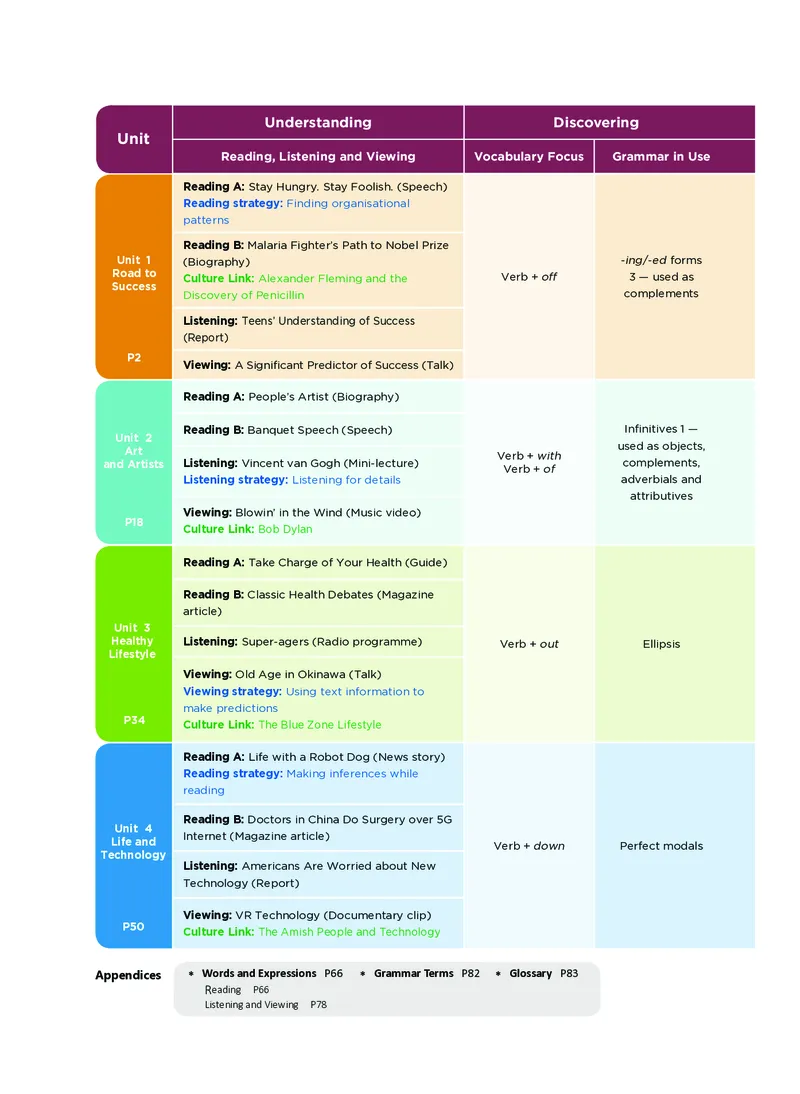
Understanding
Discovering
Reading, Listening and Viewing
Vocabulary Focus
Grammar in Use
Reading A: Stay Hungry. Stay Foolish. (Speech)
Reading strategy: Finding organisational
patterns
Verb + off
-ing/-ed forms
3 — used as
complements
Reading B: Malaria Fighter’s Path to Nobel Prize
(Biography)
Culture Link: Alexander Fleming and the
Discovery of Penicillin
Listening: Teens’ Understanding of Success
(Report)
Viewing: A Significant Predictor of Success (Talk)
Reading A: People’s Artist (Biography)
Verb + with
Verb + of
Infinitives 1 —
used as objects,
complements,
adverbials and
attributives
Reading B: Banquet Speech (Speech)
Listening: Vincent van Gogh (Mini-lecture)
Listening strategy: Listening for details
Viewing: Blowin’ in the Wind (Music video)
Culture Link: Bob Dylan
Reading A: Take Charge of Your Health (Guide)
Verb + out
Ellipsis
Reading B: Classic Health Debates (Magazine
article)
Listening: Super-agers (Radio programme)
Viewing: Old Age in Okinawa (Talk)
Viewing strategy: Using text information to
make predictions
Culture Link: The Blue Zone Lifestyle
Reading A: Life with a Robot Dog (News story)
Reading strategy: Making inferences while
reading
Verb + down
Perfect modals
Reading B: Doctors in China Do Surgery over 5G
Internet (Magazine article)
Listening: Americans Are Worried about New
Technology (Report)
Viewing: VR Technology (Documentary clip)
Culture Link: The Amish People and Technology
Unit
P2
P18
P34
P50
P50
Appendices
* Words and Expressions P66
Reading P66
Listening and Viewing P78
* Grammar Terms P82
* Glossary P83
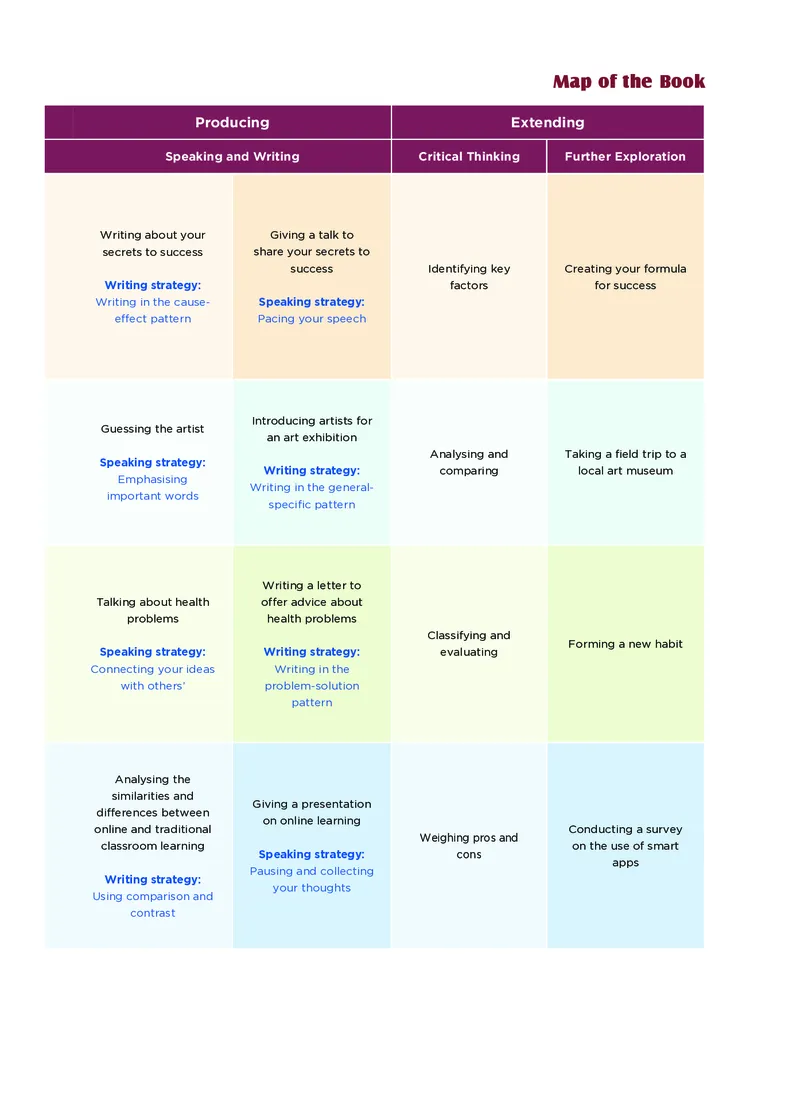
Producing
Extending
Speaking and Writing
Critical Thinking
Further Exploration
Writing about your
secrets to success
Writing strategy:
Writing in the cause-
effect pattern
Giving a talk to
share your secrets to
success
Speaking strategy:
Pacing your speech
Identifying key
factors
Creating your formula
for success
Guessing the artist
Speaking strategy:
Emphasising
important words
Introducing artists for
an art exhibition
Writing strategy:
Writing in the general-
specific pattern
Analysing and
comparing
Taking a field trip to a
local art museum
Talking about health
problems
Speaking strategy:
Connecting your ideas
with others’
Writing a letter to
offer advice about
health problems
Writing strategy:
Writing in the
problem-solution
pattern
Classifying and
evaluating
Forming a new habit
Analysing the
similarities and
differences between
online and traditional
classroom learning
Writing strategy:
Using comparison and
contrast
Giving a presentation
on online learning
Speaking strategy:
Pausing and collecting
your thoughts
Weighing pros and
cons
Conducting a survey
on the use of smart
apps
Map of the Book
致同学们
亲爱的同学们:
经过小学和初中阶段的学习,大家已经掌握了一定的英语语音、词汇、语
法等知识,也具备了一定的英语应用能力。大家是否希望通过英语了解更多的
世界文化?是否希望能够运用英语来介绍中国文化和社会生活呢?是否希望通
过英语学习获得更多的知识和技能,进而提升自己的思维品质和综合素养?是
否希望在课内外英语学习活动中提升自主学习的能力?
本套教材为同学们精心准备了题材丰富、风格多样的学习材料和形式活泼、
寓教于乐的学习活动,让大家在学习英语的同时,领略博大精深的中华文化、
绚烂多彩的世界文化、拓展全球视野。
同学们,高中阶段英语学习的主要目的是全面提升语言能力。同时,通过
英语学习获取更多的中外优秀文化知识,挖掘其承载的文化价值,提升跨文化
交际意识和交流能力,训练思维的逻辑性、批判性和创造性。
本套教材共七册,其中前三册为必修阶段教材,后四册为选择性必修阶段
教材。每册由四个单元组成。每个单元围绕人与自我、人与社会或人与自然三
大主题展开,形成一个交际和学习活动相结合的有机整体。每个单元包括四大
板块:理解(UNDERSTANDING)板块提供丰富的阅读、听力材料和视频片段;
发现(DISCOVERING)板块包括词汇和语法知识,帮助同学们发现、掌握并学会
使用规则,达到举一反三的效果;表达(PRODUCING)板块设计了听、说、读、
看、写结合的综合活动,以帮助同学们提升用英语完成相关交际任务的能力;
拓展(EXTENDING)板块包括思维训练(Critical Thinking)和项目探究(Further
Exploration)两个部分,前者旨在帮助同学们训练逻辑思维和批判性思维的能
力,后者指导同学们开展研究性学习、自主学习和合作学习。文化链接(Culture
Link)为灵活板块,主要介绍与单元主题相关的世界文化或中国文化小百科知识。
同学们还可以通过每单元最后的自我评价(Self-assessment)检测自己的学习成
效,发现需要改进的地方后,制定相应的提升计划。
同学们,掌握一门外语意味着多一双看世界的眼睛,多一双听世界的耳朵,
多一个探索世界的工具,也多一条传播中国文化的途径。学习外语需要大量的
实践,需要持之以恒的努力。希望同学们在老师的指导下,把教材作为起跳板,
充分调动你们已有的知识,探索未知的领域,“跃”向更广阔的世界。
编者
2020 年5 月
1
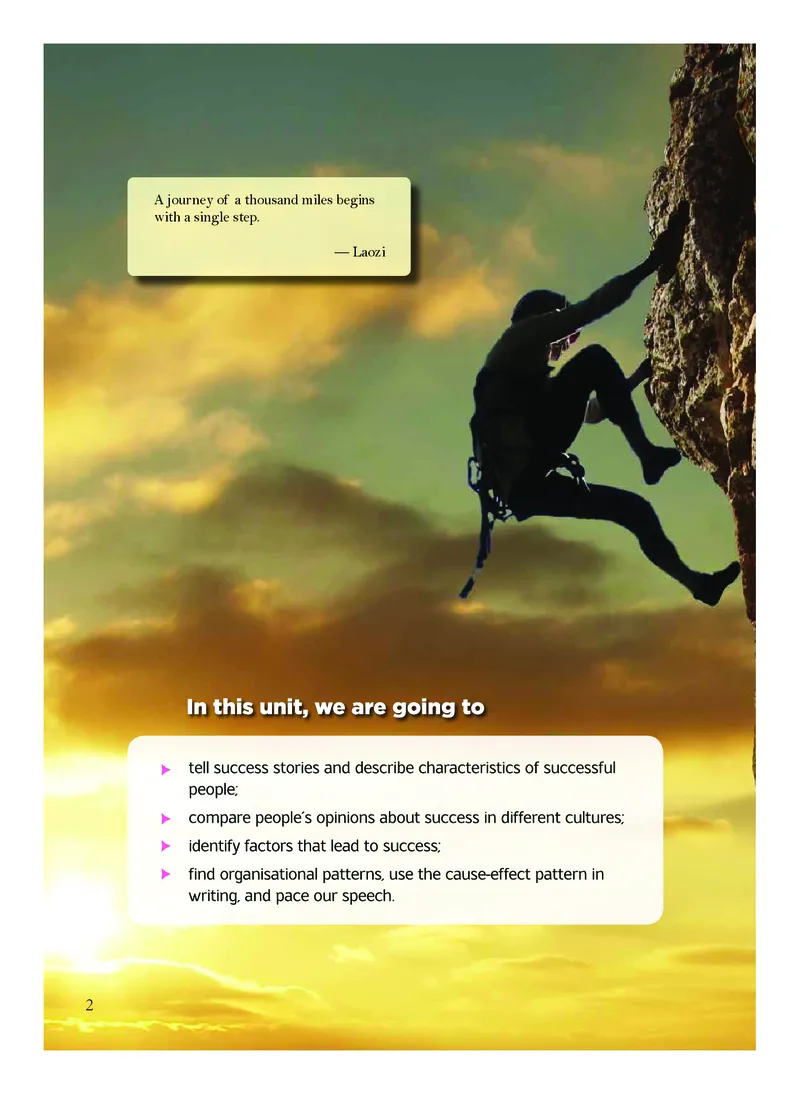
A journey of a thousand miles begins
with a single step.
— Laozi
2
Unit
Road to Success1
3
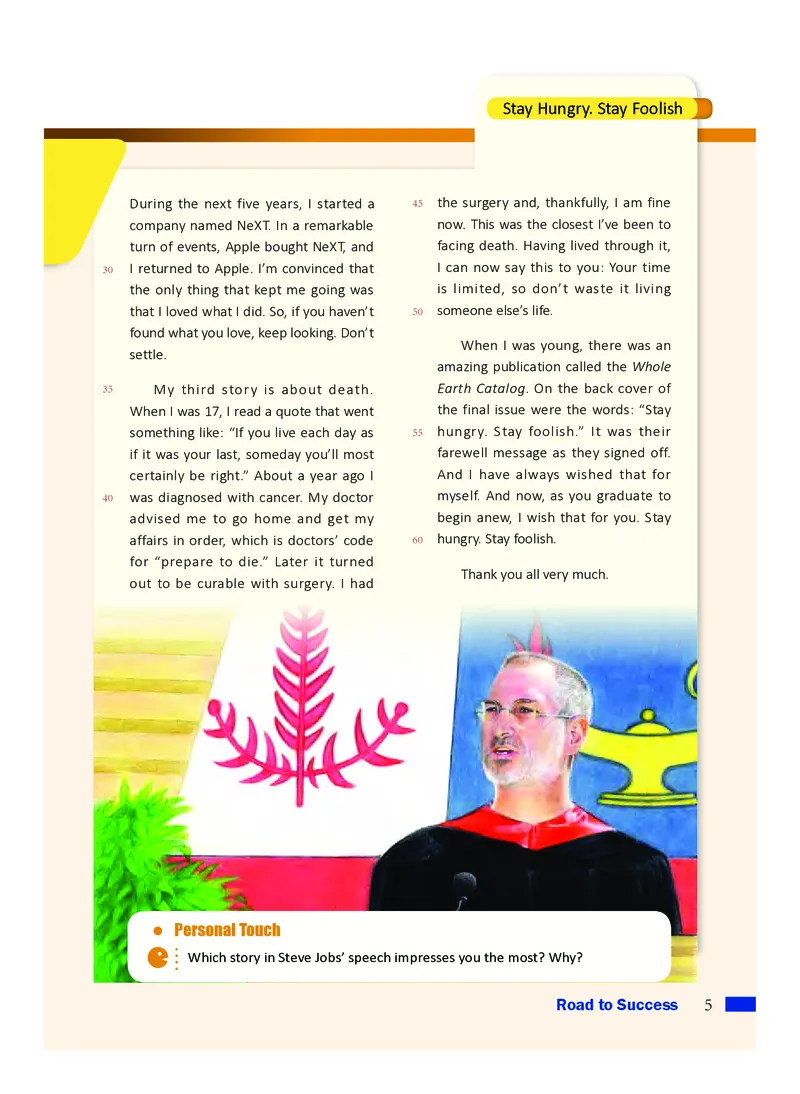
I’m honored to be with you today for
your commencement. I want to tell you
three stories from my life.
The first story is about connecting the
dots. When I was at Reed College, it offered
perhaps the best calligraphy instruction in
the country. I decided to take a calligraphy
class. At that time none of what I learned
about calligraphy seemed to have even a
hope of any practical application in my life.
But ten years later when we were designing
the first Macintosh computer, it all came
back to me. And we designed it all into the
Mac. It was the first computer with beautiful
typography. Of course it was impossible to
connect the dots looking forward. You can
only connect them looking backwards. So
you have to trust that the dots will somehow
connect in your future.
My second story is about love and loss.
I was lucky — I found what I loved to do
early in life. Woz and I started Apple in my
parents’ garage when I was twenty. And
then at thirty, I got fired. But something
slowly began to dawn on me — I still loved
what I did. And so I decided to start over.
What do you think a guest speaker
normally talks about in a commencement
speech? Read the text and find out what
Steve Jobs said in his speech.
Reading A
10
15
20
25
5
STAY HUNGRY
STAY FOOLISH.
Getting Started
Share with a partner your
understanding of the
following quotes. Explain
which one makes the most
sense to you.
Success is not the key to
happiness. Happiness is the key
to success. If you love what you
are doing, you will be successful.
— Albert Schweitzer
Without continual growth
and progress, such words as
improvement, achievement, and
success have no meaning.
— Benjamin Franklin
Success usually comes to those
who are too busy to be looking
for it.
— Henry David Thoreau
4
UNIT 1
Stay Hungry. Stay Foolish
55
60
the surgery and, thankfully, I am fine
now. This was the closest I’ve been to
facing death. Having lived through it,
I can now say this to you: Your time
is limited, so don’t waste it living
someone else’s life.
When I was young, there was an
amazing publication called the Whole
Earth Catalog. On the back cover of
the final issue were the words: “Stay
hungry. Stay foolish.” It was their
farewell message as they signed off.
And I have always wished that for
myself. And now, as you graduate to
begin anew, I wish that for you. Stay
hungry. Stay foolish.
Thank you all very much.
30
35
40
45
50
During the next five years, I started a
company named NeXT. In a remarkable
turn of events, Apple bought NeXT, and
I returned to Apple. I’m convinced that
the only thing that kept me going was
that I loved what I did. So, if you haven’t
found what you love, keep looking. Don’t
settle.
My third story is about death.
When I was 17, I read a quote that went
something like: “If you live each day as
if it was your last, someday you’ll most
certainly be right.” About a year ago I
was diagnosed with cancer. My doctor
advised me to go home and get my
affairs in order, which is doctors’ code
for “prepare to die.” Later it turned
out to be curable with surgery. I had
Personal Touch
Which story in Steve Jobs’ speech impresses you the most? Why?
5
Road to Success
Comprehension
I. Complete the outline according to Steve
Jobs’ speech.
Digging In
Finding organisational patterns
Reading Strategy
Opening sentence
Overview: ____________________________________
Story 1: ______________________________________
Story 2: ______________________________________
Story 3: ______________________________________
Message: _____________________________________
Closing sentence
II. Complete the life events of Jobs according to his speech and match them with the
time.
III. Answer the questions.
a. Jobs started a company named
1 __________.
b. Jobs and his colleagues designed Macintosh,
the first computer 2 _________.
c. Jobs was diagnosed with 3 _________.
d. Jobs took a(n) 4 _________.
e. Jobs started 5 _________ together with
Woz.
f. Jobs 6 _________ by Apple.
1. When he was at Reed college,
2. When he was 20 years old,
3. Ten years after he left Reed
College,
4. At the age of 30,
5. During the five years after he
was fired by Apple,
6. One year before he made this
speech,
1. Which factor(s) played a key role in making Jobs start over after being fired by Apple?
2. How do you understand the quote “If you live each day as if it was your last, someday
you’ll most certainly be right”?
3. What do you think Jobs means by saying “Stay hungry. Stay foolish”?
Time
Life events
Introduction
Body
Conclusion
6
UNIT 1
Vocabulary Focus
I. Key Vocabulary
Fill in the blanks with the appropriate forms of the given words and expressions to
complete the passage.
Steve Jobs gave a commencement speech to the graduating students at Stanford
University in 2005. During his speech, Jobs told three stories. His first story was
called “1 _________ the dots.” In the story, Jobs admitted that calligraphy had no
practical 2 _________ in his college years, but that it later became important to
the success of Apple as it was the first company that 3 _________ computers with
beautiful typography. His second story was about love and 4 _________. He shared
his experience of getting fired by Apple. He did not give up. Instead, he decided to
5 _________. He started a new company and years later he returned to Apple.
He learned from this experience that it was important to keep looking and not to
6 ________. In the final story, Jobs talked about 7 ________. He was diagnosed with
cancer. Luckily, his surgery was successful and he survived. Having 8 ________ cancer, he
realised that time was 9 ________ and shouldn’t be wasted. Jobs concluded his speech
with words he once read in a(n) 10 ________ magazine: “Stay hungry. Stay foolish.”
II. Word Partners: Verb + off
1. Underline phrasal verbs with off
in the sentences and explain the
meaning of off in each phrase.
e.g. Charles works really hard
at football. His father drops him
off at football practice at 5 p.m.
every afternoon.
off: away from a certain place
The word off can be used after verbs to form
phrasal verbs. In phrasal verbs, off has a variety
of meanings. For example:
1) away from a certain place
The chairman is setting off for New York
tomorrow to attend a business meeting.
2) in such a way as to be separated
After the play ended, the director took off his
hat and greeted everybody in the theatre.
3) in such a way as to bring something to an end
The speaker rounded off the speech with
some quotes from Mark Twain.
4) in such a way as to get rid of something
He is such a tough person. He is always
able to laugh off difficulties.
5) out of operation
The writer turned off her mobile phone
and got down to work.
(1) On the back cover of the
final issue were the words:
“Stay hungry. Stay foolish.”
It was their farewell
message as they signed off.
(2) After finishing the report,
Shelly shut off the
application
live through
loss
death
amazing
limited
start over
connect
settle
design
7
Road to Success
I. Read the sentences and pay attention to the underlined -ing and -ed forms. What
functions do they serve?
1. I’m convinced that the only thing that keeps me going is that I love what I do.
2. After working non-stop for twenty hours, the physician went to bed tired and hungry.
3. Jane was somewhat disappointed to find her suggestions turned down.
4. The child was found writing on the ground with a stick.
2. Fill in the blanks with the appropriate forms of the phrasal verbs given in the box.
Grammar in Use
-ing/-ed forms 3 — used as complements
(1) The doctor __________ his jacket and put on the white coat as soon as he
arrived at the office.
(2) After giving a thank-you speech on behalf of the whole team, the chorus leader
__________ the microphone and shook hands with the audience.
(3) Hearing that she was going to get the scholarship, Tammy __________ to her
best friend’s house to celebrate.
(4) The soldiers were brave enough to __________ their pain.
G rammar Highlights
The -ing and -ed forms of a verb can be used as complements to modify
subjects or objects of sentences. For example:
● The lecturer was heard practising his speech in the next room. (Subject
complement)
● The athlete went away quite satisfied with the result of the match.
(Subject complement)
● He found the story of the innocent prisoner very exciting. (Object
complement)
● They looked for an expert and finally had the problem solved. (Object
complement)
● All afternoon Amy worked in the study with the door locked. (Object
complement)
computer and took a short rest.
(3) After the debate, she went home to sleep off her headache.
laugh off drive off take off turn off
8
UNIT 1
II. Fill in the blanks with the -ing or -ed forms of the verbs in brackets.
1. The writer wants his new novel _____________ (display) at the book fair.
2. The comic star could feel his heart _____________ (beat) fast during the interview.
3. It was friendship that kept me _____________ (go) during my hardest time.
4. After a long day’s work, the lawyer lay in bed with eyes _____________ (close).
5. The professor was seen _____________ (do) an experiment in the lab after midnight.
III. Fill in the blanks with the -ing or -ed forms of the verbs given in the box. Then circle the
ones that are used as complements.
Phillis Wheatley was one of the best-known poets in pre-19th century America. She
was born in Africa. Around the age of seven, she was 1 _________ as a slave to John and
Susannah Wheatley in Boston. One day, Phillis was found 2 ________ on the wall with
chalk, but she was not punished. Instead, she was taught to read and write. She read a
lot of books about ancient history and stories, and found them quite 3 _________ for
writing.
Phillis started writing poems when she was only thirteen. Her first poem was
published in 1767 in a newspaper. A few years later, she managed to get a collection of
39 poems 4 _________. It was known as the first book written by an African American
poet. With her talent 5 __________ by more and more people, Phillis became honoured
and 6 _________.
When the Wheatleys passed away, Phillis became a free woman. In 1778, she got
7 _________ to John Peters, a free black, and moved away from Boston. Life became
very difficult for Phillis and her husband. Due to racial discrimination, it was very hard for
them to find jobs. With things 8 _________ worse, she made the decision to move back
to Boston. She became very ill and passed away there. After her death, people continued
to publish her poems and letters. Today people still study and read her writings.
publish
get
recognise
marry
inspire
sell
respect
write
9
Road to Success
Teens’ Understanding of Success (Report)
Do you think people who are famous and wealthy are successful? Why or why not?
I. Discuss the questions.
II. Listen to the report and choose the best answer.
III. Listen again and complete the summary of the survey.
IV. Answer the questions.
Listening and Viewing
1. Which words or expressions in the box below do you think best describe the
characteristics of successful people?
2. What other characteristics do you think successful people usually have?
What is the study mainly about?
A. Teenagers’ definition of a successful life.
B. Teenagers’ relationship with their families.
C. What kind of teenagers can achieve success.
D. How teenagers can find a good job and make money.
Respondents: 1 __________ teenagers aged 13 to 2 __________
Question: What makes someone successful in life?
Findings:
1. Elements of a successful life:
• enjoying happiness and 3 __________ (15 percent of teens)
• fulfilling one’s 4 __________ ( 5 __________ percent of teens)
• having a good 6 __________ ( 7 __________ percent of teens)
• having a 8 __________ and making money ( 9 __________ percent of teens)
2. Relationship among the elements:
The elements of a successful life are 10 __________ to one another.
wealthy
famous
having a good job
well-educated
hard-working
happy
satisfied
strong-minded
having loved ones
influential
10
UNIT 1
A Significant Predictor of Success (Talk)
I. Match the words to the definitions.
II. Watch the video and choose the best answer.
III. Watch again and fill in the blanks.
IV. Discuss and answer the question.
1. The speaker is a ___________.
A. school teacher
B. psychologist
C. medical expert
D. reporter
2. The speaker and her team mainly studied ____________.
A. children in military schools
B. people in challenging situations
C. participants in national competitions
D. people who work in tough neighbourhoods
1. In her study, the speaker asked the following questions:
• Which teachers are still in teaching 1 ___________ the school year?
• Who’ll be the most effective at 2 ___________ learning outcomes for their students?
• Which of the salespeople is going to 3 ___________?
• Who’s going to 4 ___________ the most money?
2. The speaker and her team found that a significant predictor of success is grit.
According to her, a person with grit is someone who
• has 1 _________ and perseverance for very long-term goals.
• has stamina.
• 2 ___________ his or her future for years and works really hard to make that future
3 ___________.
• lives life like it’s a marathon.
1. significant
a. difficult
2. predictor
b. result
3. outcome
c. an area with features that make it different from other areas
4. military
d. a running race of slightly over 26 miles
5. tough
e. of or relating to soldiers, arms or war
6. neighbourhood
f. important
7. marathon
g. something that can show what will happen in the future
How do you understand the sentence “Grit is living life like it’s a marathon”?
11
Road to Success
Moving Forward
Writing in the cause-effect pattern
Writing Strategy
EXAMPLE
I. Writing: Writing about your secrets to success
Step 1 Reflect on your achievements. Pick the one you are most willing
to share and then list at least three factors that contribute to this
achievement. You may use a cause-effect diagram to organise your
thoughts.
Read the notice above. Reflect on a successful experience
and write down your own secrets to success.
Causes (How I made the achievement):
1. I wrote my main points on cue cards.
2. I practised again and again before giving the speech.
3. I breathed deeply several times before I began the speech.
Effect (What I have achieved):
I have overcome my fear of public speaking.
NOTICE
Date: 10 March
Time: 3 p.m. – 4 p.m.
Place: Room 306, Building 6
We’ll hold a class meeting on “My Secrets to Success” this week. You are expected to
share your own secrets to success in a certain field. Looking forward to your participation.
The Class Committee
Sh
ari
ng
Yo
ur
Ow
n Se
crets t
o Suc
cess
12
UNIT 1
II. Speaking: Giving a talk to share your secrets to success
Give a talk on “My Secrets to Success” to your classmates
based on the paragraph you have written above.
While giving a talk, don’t forget to pause
for commas, question marks, full stops
or other punctuation marks. In addition,
remember to speak using a combination
of slow, fast and medium speeds to
make your talk more effective.
Pacing your speech
Speaking Strategy
Step 2 Write a paragraph of 80–100 words using the cause-effect
pattern. You may first introduce the achievement that you
have made and then explain the reasons behind it.
My Secrets to Success
____________________________________________________________
____________________________________________________________
____________________________________________________________
____________________________________________________________
____________________________________________________________
____________________________________________________________
____________________________________________________________
Useful Expressions
There are several reasons/factors/causes for …
One possible factor is …
Several factors lead to …
Another possible factor is …
The first is …
Due to these reasons …
The second is …
As a result …
A few tips for your talk:
1. Start your talk with simple words. You may greet
your audience briefly or start with anything related
to the topic.
2. Briefly introduce the achievement you have made.
3. Explain how you made the achievement.
4. End your talk with a summary or anything that helps to leave an impression on the
audience. If time permits, you may also invite questions from the audience.
5. Note that your spoken language should be a bit different from your written language.
Spoken language is generally less formal and more communicative than written
language.
13
Road to Success
MALARIA FIGHTER’S PATH TO NOBEL PRIZE
In 2015, Tu Youyou, an 84-year-old
woman, became the first Chinese scientist
to win the Nobel Prize in Physiology or
Medicine.
Born in Ningbo in 1930, Youyou1
was named after a verse in the Book of
Songs2. When she left Ningbo and headed
to China’s capital to further her studies in
1951, Tu chose medicine. After graduating
from the School of Medicine at Peking
University four years later, Tu started to
work at China Academy of Traditional
Chinese Medicine (now China Academy of
Chinese Medical Sciences). Then she got
married and settled down in Beijing.
In 1969, everything changed when
Tu was tasked with searching for a new
malaria treatment in nature. She went to
Hainan, where the disease was widespread.
In the hot and wet rainforests of southern
China, Tu studied the disease.
It was in ancient Chinese medicine that
Tu found the key to beating the disease.
Back in Beijing, Tu and her team examined
hundreds of books about traditional
Chinese medicine and interviewed many
experienced Chinese medical doctors
to gather the necessary information.
She collected over 2,000 prescriptions,
summarising 640 of them in a single
collection of anti-malarial prescriptions.
After long hard research Tu’s team found
the answer in an ancient medical book,
written by Ge Hong (284–364) of the
East Jin dynasty, which stated that sweet
wormwood (Qinghao) was a treatment for
malaria.
Tu’s team started running tests on
the plant. At first, the results were mixed.
But after much persistence, they found
something in the plant that could treat
malaria — artemisinin. They tested it on
animals, but were not satisfied as the
results were not conclusive. In order to
speed up the process, Tu decided to test
artemisinin on herself. “As head of this
research group, it was my duty,” she said.
The treatment worked and was safe for
humans. Artemisinin became an important
tool in the fight against malaria in Africa
and Asia. Thanks to this discovery, millions
of lives were saved.
“Of course, the discovery was a
really happy moment in my career as a
researcher,” Tu said. A modest person, Tu
speaks of her training in Chinese medicine
and the help of her team as the reasons for
her success. However, it was her passionate
commitment to finding a cure that made
the struggle worthwhile.
Reading B
5
40
45
50
55
60
10
15
20
25
30
35
NOTES
1. “Youyou” refers to the sound that a
deer makes to call other deer.
2. Book of Songs, also Classic of Poetry, is
a collection of ancient Chinese poetry.
14
UNIT 1
Critical Thinking
I. Identify the main success factors mentioned in this unit and fill in your answers in
the table.
II. Which factor do you think is the most important for achieving success? Why?
Texts
Success Factors
Stay Hungry. Stay Foolish.
A Significant Predictor of Success
Malaria Fighter’s Path to Nobel
Prize
Identifying key factors
I. Complete the table with events from the text.
Comprehension Plus
Culture Link
Alexander Fleming and the
Discovery of Penicillin
Sir Alexander Fleming (1881–1955) was one
of the most influential scientists of his time.
He is best known for discovering the antibiotic
substance penicillin in 1928. He shared a Nobel
Prize in Physiology or Medicine in 1945 for this
discovery with Howard Walter Florey and Ernst
Boris Chain. Penicillin has saved millions of
people’s lives since its discovery.
Time
Events
1930
1951
1969
2015
II. Answer the questions.
1. Why did Tu Youyou go to Hainan to
study malaria?
2. Where did Tu’s team find the key to
beating malaria?
3. Why did Tu decide to test
artemisinin on herself?
4. The author uses numbers when
introducing Tu’s work. What do
these numbers tell us?
5. According to the author, it was Tu’s
“passionate commitment to finding
a cure that made the struggle
worthwhile.” What evidence does
the author use to support this view?
15
Road to Success
Further Exploration
Creating your formula for success
Albert Einstein’s formula for success:
A = X + Y + Z
A is success.
X is work.
Y is play.
Z is keeping your mouth shut.
Thomas Edison’s formula for success:
X = 1% Y + 99% Z
X is success.
Y is inspiration.
Z is perspiration.
Reflect on your personal experiences and create your
own formula for success.
Write a formula for success.
Define the symbols in the formula. Here are
two examples:
Share your formula for success with the class
and explain the reasons behind the formula.
Step 1
Step 3
Step 2
16
UNIT 1
Which of the above have you done well? Why and how?
Which of the above do you still find difficult? Why?
What do you plan to do if you find something difficult?
Look at the expected learning outcomes of this unit and answer
the questions.
A. Identifying the characteristics of people who achieve success in
challenging situations
B. Writing about my secrets to success
C. Creating my own formula for success
D. Identifying key factors for success
E. Finding organisational patterns in reading
F. Pacing my speech
G. Using the cause-effect pattern in writing
Self-assessment
17
Road to Success
Art washes away from the soul the dust
of everyday life.
— Pablo Picasso
18
Unit2
Art and Artists
19
Match each artwork with its art
form and name. Share what you
know about them.
From carpenter to great artist —
this was the course of Qi Baishi’s life. He
achieved success by coupling talent with
hard work. In 1953, he was honoured with
the title “People’s Artist” by the Chinese
government.
Qi Baishi’s works of shrimps, crabs
and fish have often been on display. For
most of the general public, however, his
masterpieces are his paintings of shrimps.
At the beginning, he painted these small
animals by following ancient models. Later,
he developed a personal style by using
shades of black ink to show a shrimp’s body,
giving it an almost real-life feel.
Qi’s works go beyond aquatic life. Some
of his paintings are flowers, symbolic of
prosperity, and vegetables, indicating rich
harvests. People love these nature-based
paintings because the works remind them
of the countryside and of their hometowns.
The dove is another common subject in Qi’s
art during his later years, showing his wish
for world peace.
In his painting Qingping Fulai (Happiness
in Peace), an old man holds a vase, with
a fruit bat over him. In Chinese culture,
the vase symbolises peace and the bat
A. The Thinker B. Bamboo and Rocks
C. Swan Lake D. Mona Lisa
a. Painting (oil painting)
b. Painting (ink wash painting)
c. Dance (ballet)
d. Sculpture
Reading A
10
15
20
25
5
PEOPLE’S ARTIST
Getting Started
1
2
3
4
Who was Qi Baishi? What is he
famous for? What honour did he
receive? Read the text and learn
more about his life.
20
UNIT 2
happiness, following the putonghua pronunciations
of these words. This painting reveals his hope for a
stable and harmonious life, a wish common to people
everywhere.
Be it landscapes, birds, flowers or figures, Qi’s
paintings are rich in expression and detail. Using
heavy ink, bright colours and energetic strokes, he
created works in a fresh and lively manner, expressing
his love of nature and life. His art reflects an
international trend in modern art at the time, yet he
expressed it in a typical Chinese way.
Although the world recognises him first as a
painter, Qi is also known for his seal carvings and
poems. The large number of his works reflects a
variety of interests and experiences.
The man was hardworking even in his 70s. In a
group of his paintings, Qi drew insects in the corners,
leaving some parts blank. He did so because he
wanted to focus on the finer details when his eyesight
was still good enough for the task, and planned to fill
these spaces with flowers later on.
Qi kept looking for higher goals, especially as
he got older. While many other Chinese artists retire
from public life at an old age, Qi actively took on more
social responsibilities. He said: “I love my hometown,
my country and all the lives there. In recent years, I
have realised that what I pursue is world peace.”
In 1956, he was awarded the International Peace
Prize by the World Peace Council.
30
35
40
45
50
55
People’s Artist
Personal Touch
If you were a painter, what would you like to paint? What message
would you like to convey? Why?
21
Art and Artists
Comprehension
II. Complete the outline according to the text.
Qi’s artworks
Art forms
• paintings
• 3 ____________________________
• 4 ____________________________
Common
2 ________
• 5 _____________________________
• flowers and vegetables
• doves
Artistic style
• rich in 6 _______________________
• fresh and 7 ____________________
• reflecting a trend of modern art in a
typical Chinese way
Qi’s social
1 ________
• expressing ordinary Chinese people’s wishes
• taking on more 8 ____________________________
• being awarded the International Peace Prize
III. Answer the questions.
1. In what ways did Qi express symbolic meanings in his paintings?
2. What do you think made Qi Baishi a “People’s Artist”?
I. What does the text tell us about Qi Baishi? Tick (ü) the items that are mentioned in
the text.
□ his works of art
□ his areas of interest
□ his family
□ his artistic expressions □ his artistic style
□ his friendships
□ his social influences
□ his life in old age
□ his educational background
Digging In
Peop
le’s
Arti
st
22
UNIT 2
Vocabulary Focus
I. Key Vocabulary
Fill in each blank with the appropriate form of a word from the text. The first letter is
given.
Qi Baishi is one of the most famous painters in China. He achieved success by
coupling t__________ with hard work. He was h__________ with the title “People’s
Artist” in 1953. Qi’s paintings touch on various subjects. The general public are most
impressed by his creations of aquatic life like shrimps, crabs and fish. People also love
his paintings of flowers and vegetables, which i__________ wishes for prosperity
and harvests. These works also r__________ them of the countryside and of their
hometowns. Another common subject in Qi’s art is the dove, showing his wish for world
peace. His works are fresh and lively, r__________ in expression and detail. Though
expressed in a t__________ Chinese way, Qi’s works reflect an international trend in
modern art. Qi is r__________ first as a painter, but is also famous for seal carvings and
poems. The older he got, the higher the g__________ he set for himself. Unlike other
elderly artists who r__________ from public life, Qi played a more active social role as
he aged. The International Peace Prize was a__________ to him in 1956.
II. Word Partners: Verb + with, verb + of
1. Underline the “verb + with” and “verb + of” collocations in the sentences and explain
the meaning of with or of in each collocation.
(1) Qi Baishi was honoured with the title
“People’s Artist.”
(2) He achieved success by coupling talent
with hard work.
(3) The artistic creations remind them of
their hometowns.
(4) The artist’s wife donated most of his
artworks to the local museum after he
died of cancer.
(5) After much practice, the jazz dancer
found himself cured of stage fright
when dancing alone on this important
occasion.
(6) Even masterpieces of landscape painting
cannot compete with the beauty of
nature.
A preposition can often be used
together with a variety of verbs
to express different meanings.
For example:
The word with can be used after
verbs to mean:
(a) using, having, carrying
(b) along with
(c) in opposition to ...
The word of can be used after
verbs to mean:
(a) concerning
(b) expressing a cause
(c) from ...
23
Art and Artists
Grammar in Use
Infinitives 1 — used as objects, complements, adverbials and attributives
I. Underline the infinitives in the paragraph and say whether they are used in the
same way.
Infinitives (to do) can function as the object, the
complement, the adverbial, the attributive, etc.
Bare infinitives are infinitives without to. They are
often used as the object complement of action verbs
like make, let, have, as well as verbs of senses like hear,
watch, feel.
2. Fill in the blanks with the appropriate forms of the “verb + of/with” collocations given
in the box.
01
Loving Vincent is the world’s first fully oil painted feature film. It 1 _________
people _________ Vincent van Gogh’s life and works. Throughout his life, Van Gogh
2 __________ painful mental illness. His paintings, however, use very bright
colours and sometimes seem joyful. Night, a common subject in Van Gogh’s
works, was for him a time of creativity, often 3 __________ a feeling of safety
and comfort. In his Starry Night, a quiet town sits under the night sky, which
4 __________ shining stars. There is also a tree in the painting. The tree
5 __________ the earth __________ the sky, reflecting the artist’s thought about death
— the destination of life’s journey. The painting failed to 6 __________ the painter
__________ his mental disease; however, it has become a great source of inspiration
for artistic creations ever since, including the famous song “Starry, Starry Night.”
02
It requires a certain amount of knowledge to appreciate a work of art. We should be able
to explain why we like or dislike the artwork. The easiest way to begin our appreciation is to
place the work in its time and place, because we need to know how it is related to the context
in which it is created.
G rammar Highlights
cure ... of
remind ... of
connect ... with
fill ... with
struggle with
associate ... with
24
UNIT 2
II. Complete the dialogue with the -ing forms or infinitives of the verbs in brackets.
Form
Example
Function
verb + to do
(hope, decide, want,
would like ...)
He did so because he wanted to focus on the finer
details when his eyesight was still good enough for
the task.
object
verb + wh- word + to do
(know, understand,
wonder ...)
Have you ever wondered how to dress for a symphony
performance?
object
(in order / so as) to do
Painters use a variety of brushes and other tools
in order to create different effects.
adverbial
verb + sb./sth. + to do
(ask, expect, advise ...)
My teacher advised me to go to the opera this
weekend.
object
complement
verb + sb./sth. + do
(make, let, have, hear,
watch, feel ...)
Yesterday I heard John sing “Blowin’ in the Wind.”
object
complement
noun + to do
Bob Dylan became the first songwriter to win the
Nobel Prize for Literature.
attributive
Xiaosong: How was the play The Merchant of Venice, Sam?
Sam:
Brilliant, but I really couldn’t stand the two men behind me 1 _________
(chat) and 2 _________ (laugh) from time to time.
Xiaosong: Did you ask them 3 _________ (stop)?
Sam:
Yes, but it didn’t help.
Xiaosong: At the theatre, the audience are required 4 _________ (keep) quiet.
Sam:
To be frank, I expected other people 5 _________ (tell) them to stop, but it
didn’t happen.
III. Rewrite the passage, replacing the underlined parts with infinitives.
How do you “read” a painting? Do you have the skills with which you can appreciate
it? When setting out to understand a painting, you will want to search for signs of those
emotions the artist wanted to express. Not every work of art will attract your attention at
first sight. You need to spend some time figuring out the clues so that you can understand
the specific emotions communicated in the painting. One important thing you should
remember is that, in art appreciation, “right and wrong” is often not so clear. You may
discover things about a painting that no one else has thought about!
25
Art and Artists
Vincent van Gogh (Mini-lecture)
Listening and Viewing
1. What kind of person was Vincent van Gogh?
A. A talented, poor and unhappy artist.
B. A troublesome, poor and outgoing artist.
C. A creative, unique and wealthy artist.
D. A happy, gentle and popular artist.
III. Listen again and fill in the blanks.
II. Listen to the mini-lecture and choose the best answer.
2. Based on the mini-lecture, which of the following pictures was most probably painted by
Vincent van Gogh?
A
B
C
D
Vincent van Gogh’s works:
• His works are described as 5 __________.
• His painting style is 6 __________.
• His works use very 7 __________ colours.
• The shapes of his paintings are
8 __________ and 9 __________.
• After his death, his paintings became some
of the most 10 __________ in the world.
Vincent van Gogh’s personal life:
• His nationality was 1 __________.
• He was never able to 2 __________
himself.
• People often described him as a
3 __________ person to get along with
who was rarely 4 __________.
Listening for details
Listening Strategy
IV. Answer the questions.
Do you think popular artworks are always good artworks? Why or why not?
I. Work in groups and discuss the questions.
Who was Vincent van Gogh? What is he famous for?
26
UNIT 2
Blowin’ in the Wind (Music video)
II. Watch the video and answer the question.
What message does the songwriter want to convey?
I. Read the title of the song and guess what is
blowing in the wind.
IV. Watch again and discuss the questions.
Which lines of the song are your favourite? Why?
How many roads must a man walk down
Before you call him a man
How many seas must a white 1 _______ sail
Before she sleeps in the sand
Yes, and how many times must the cannonballs 2 _________
Before they’re forever 3 _________
The answer, my friend, is blowin’ in the wind
The answer is blowin’ in the wind
Yes, and how many years can a mountain 4 _________
Before it is washed to the sea
Yes, and how many years can some people exist
Before they’re 5 _________ to be free
Yes, and how many times can a man turn his head
And 6 _________ that he just doesn’t see
The answer, my friend, is blowin’ in the wind
The answer is blowin’ in the wind
Yes, and how many times must a man look up
Before he can see the sky
Yes, and how many ears must one man have
Before he can hear people 7 _________
Yes, and how many deaths will it take
Till he knows that too many people have 8 _________
The answer, my friend, is blowin’ in the wind
The answer is blowin’ in the wind
III. Watch again and fill in the blanks.
Culture Link
Bob Dylan
Bob Dylan (24 May 1941–) is
an American singer, songwriter,
author and artist. His songs touch
on a wide range of political,
social, philosophical and literary
topics. In 2016, he was awarded
the Nobel Prize for Literature
“for having created new poetic
expressions within the great
American song tradition.”
27
Art and Artists
Moving Forward
I. Speaking: Guessing the artist
The School Art Festival is coming. Your class
is organising a guessing game about artists.
When introducing a person, make
sure you attract the audience’s
attention by emphasising
important words. You should
neither stress every single word
nor speak without any stress.
Emphasising important words
Speaking Strategy
ART
FESTIVAL
1. Work in groups. Each group prepares five clues
about a certain artist.
2. Groups take turns to introduce an artist by giving
the clues without mentioning his/her name.
3. Other groups can only start to guess when all the
five clues are given.
4. The first group that gets the artist’s name is the
winner of that round.
Rules
Time:
4 p.m. – 5 p.m.
25 March
Place:
Room 123,
Building 6
28
UNIT 2
Step 1 Write a general
statement about the artist.
Step 2
e.g. He is one of the best-
known Chinese painters in
the 20th century.
General statement: _________________________________________
_________________________________________________________
Supporting detail 1:
_________________________________________________________
_________________________________________________________
_________________________________________________________
Supporting detail 2 :
_________________________________________________________
_________________________________________________________
_________________________________________________________
II. Writing: Introducing artists for an art exhibition
Give supporting details about his/her
artworks and social influences.
• Artworks: art forms, subjects,
messages / symbolic meanings,
styles, etc.
• Social influences: honours, titles,
influences on other people, etc.
Step 3 Follow the outline and write a paragraph of 80–100 words.
The general-specific pattern begins with a general statement and then leads into details that
support and explain the general statement. The pattern can be used to develop a paragraph,
essay or speech.
Writing in the general-specific pattern
Writing Strategy
Discuss the clues given by all the groups and decide which clues provide general
information and which provide detailed information. Each group is to write an
introduction to a certain artist for an art exhibition in the School Art Festival.
29
Art and Artists
Good evening, everyone.
I extend my warmest greetings to the
members of the Swedish Academy and
to all of the other distinguished guests in
attendance tonight.
I’m sorry I can’t be with you in person,
but I am most definitely with you in
spirit and honored to be receiving such a
prize. Being awarded the Nobel Prize for
Literature is something I never could have
imagined. From an early age, I’ve been
familiar with the works of those giants of
literature, whose works are taught in the
schoolroom and spoken of in respectful
tones. That I now join the names on such a
list is truly beyond words.
If someone had ever told me that I had
the slightest chance of winning the Nobel
Prize, I would have to think that I’d have
about the same possibility as standing on
the moon. I was out on the road when
I received this surprising news. I began
to think about William Shakespeare, the
great literary figure. When he was writing
Hamlet, I’m sure he was thinking about a
lot of different things: “Who’re the right
actors for these roles?” “How should this
be staged?” But there were also more
ordinary matters to consider and deal with.
“Is the money in place?” I would bet that
the farthest thing from Shakespeare’s mind
was the question “Is this literature?”
5
35
40
45
50
55
60
10
15
20
25
30
When I started writing songs as a
teenager, I thought they could be heard in
coffee houses or bars, maybe later in places
like Carnegie Hall. If I was really dreaming
big, maybe I could imagine getting to make
a record and then hearing my songs on the
radio. Making records and hearing your
songs on the radio meant that you were
reaching a big audience. Well, I’ve been
doing what I set out to do for a long time.
I’ve made dozens of records and played
thousands of concerts all around the world.
But it’s my songs that are at the vital center
of almost everything I do. They seemed
to have found a place in the lives of many
people throughout many different cultures
and I’m grateful for that.
But, like Shakespeare, I, too, am often
occupied with both my creations and
other ordinary matters. “Who are the
best musicians for these songs?” “Am I
recording in the right studio?” Some things
never change, even in 400 years.
Not once have I ever had the time to
ask myself, “Are my songs literature?”
So, I do thank the Swedish Academy,
both for taking the time to consider that
very question and, ultimately, for providing
such a wonderful answer.
My best wishes to you all.
Bob Dylan
Reading B
BANQUET SPEECH
30
UNIT 2
I. Complete the table according to what you have learned in this unit.
II. Choose two artists from the table above to compare. What do they have in
common? Support your opinions with detailed information.
Qi Baishi
• paintings
• seal carvings
• poems
• love of nature
• wish for peace and
happiness
Vincent van
Gogh
Post-Impressionism:
• very personal
• using very bright
colours
• the shapes being
strange and
dreamlike
Not mentioned.
Bob Dylan
Not mentioned.
Analysing and comparing
Critical Thinking
1. What feelings does Bob Dylan show in his
speech?
2. Why does Dylan mention Shakespeare? In
his opinion, what do he and Shakespeare
have in common?
3. Do you think Dylan’s songs are literature?
Why or why not?
Answer the questions.
Comprehension Plus
Artist Art forms Artistic style Messages
31
Art and Artists
Further Exploration
Taking a field trip to a local art museum
Visit a local art museum, write a field trip report and present it in class.
Step 1 Plan the trip. Take a few minutes to check the websites of local art museums
and discover what artworks will be on display. Decide where to go, when to
go and whom to go with.
Step 2 Visit the art museum and take some notes or pictures if possible.
Step 3 Write a report (see the example below) and present it in class.
FIELD TRIP REPORT
Where I went: _______________________________________
When I went: ________________________________________
_______________________________________________________
Who I went with: ____________________________________
_______________________________________________________
What I discovered: __________________________________
_______________________________________________________
My favourite artwork: ______________________________
_______________________________________________________
• Important facts about it:_________________________
_______________________________________________________
• Reasons why I liked it: ___________________________
_______________________________________________________
What I brought home: _______________________________
32
UNIT 2
Which of the above have you done well? Why and how?
Which of the above do you still find difficult? Why?
What do you plan to do if you find something difficult?
Look at the expected learning outcomes of this unit and answer
the questions.
A. Identifying the symbolic meanings of artworks
B. Introducing an artist
C. Discovering the cultural messages of songs and other musical works
D. Writing a report on a field trip to an art museum
E. Analysing and comparing styles and social influences of artists
F. Listening for details
G. Emphasising important words in speaking
H. Using the general-specific pattern in writing
Self-assessment
33
Art and Artists
Early to bed and early to rise makes a man
healthy, wealthy and wise.
— Benjamin Franklin
34
Unit3
Healthy Lifestyle
35
1. What are the people doing in
these pictures? Do you do these
kinds of exercise in your spare
time?
2. What are the possible benefits of
doing exercise?
As you get older, you’re able to start
making your own decisions about a lot of
things that matter most to you. You may
choose your own clothes, music and friends.
You may also be ready to make decisions
about your body and health.
Healthy eating involves taking control
of how much and what types of food you
eat, as well as the beverages you drink.
Try to replace foods high in sugar, salt and
unhealthy fats with fruits, vegetables, whole
grains and low-fat protein foods. Make half
of your plate fruits and vegetables. Dark
green, red and orange vegetables have high
levels of the nutrients you need. When
you can, choose fresh or frozen fruits and
veggies over processed foods. Drink fat-
free or low-fat milk and avoid sugary drinks.
Soda, energy drinks, sweet tea and some
juices have added sugars, a source of extra
calories.
Physical activity should be part of your
daily life, whether you play sports, take
physical education (PE) classes in school, or
get around by biking or walking. You should
be physically active for at least 60 minutes a
day, 3 days a week. Routine activities, such
What is your understanding of a
healthy lifestyle? Read the text and
find out how to live a healthy life.
Reading A
10
15
20
25
5
TAKE CHARGE OF
YOUR HEALTH
Getting Started
3
2
1
4
Look at the pictures and answer
the questions.
36
UNIT 3
as cleaning your room or taking out the
trash, may not get your heart rate up
the way biking or jogging does, but they
are also good ways to keep you active
on a regular basis. Fitness apps that
you can download onto your computer,
smartphone, or other mobile device can
help you keep track of how active you
are each day.
Being active can be more fun with
other people, like friends or family
members. You may also find that you
make friends when you get active by
joining a sports team or dance club.
Try different kinds of group activities.
Involve your friends and challenge them
30
50
45
55
35
Personal Touch
What advice given by the author would you like to take? Why?
40
to be healthy with you. Sign up for
active events together, like charity walks
or fun runs.
Getting enough sleep is important
for staying healthy. You need enough
sleep to do well at school and work
and to fight off infection. Not getting
enough sleep may make you moody and
irritable. If you’re between 13 and 18
years old, you should get 8 to 10 hours
of sleep each night.
Changing your habits can be hard
and developing new habits takes time,
but so long as you stay motivated, you
will meet your goal.
Take Charge of Your Health
37
Healthy Lifestyle
Comprehension
III. Answer the questions.
1. Why do we need to avoid sugary drinks?
2. What kind of activities can increase heart rate?
3. Why does the author suggest trying different kinds of activities?
4. What are the possible results if one does not get enough sleep?
5. Do you agree that we should involve our friends and encourage them to develop
healthy habits with us? Why or why not?
Digging In
II. Choose appropriate sub-headings for paragraphs 2 to 5 of the text.
A. Get Moving
B. Plan Healthy Meals
C. Have Fun with Your Friends
D. Get Enough Sleep
E. Take Your Time
F. Control Your Weight
G. Choose Healthy Foods and Drinks
I. Complete the outline of the text.
Topic sentence 1: _______________________________________
Topic sentence 2: _______________________________________
Topic sentence 3: _______________________________________
Topic sentence 4: _______________________________________
_____________________________________________
_____________________________________________
Introduction
Conclusion
Body
paragraph 2: _____ paragraph 3: _______
paragraph 4: _____ paragraph 5: _______
38
UNIT 3
The word out can be used after verbs to form phrasal verbs. In phrasal verbs,
out has a variety of meanings. For example:
1) away from the inside of a certain place
He opened the box and took out a bottle of mineral water.
2) so as to be revealed or known
Scientists have been working hard to find out the secret to long life.
3) to a point where something disappears or is removed
The snowstorm ruled out their weekly outdoor training.
Vocabulary Focus
I. Key Vocabulary
Fill in the blanks with the appropriate forms of the given words and expressions to
complete the passage.
II. Word Partners: Verb + out
Guidelines for a Healthy Lifestyle
What are healthy habits? How to take 1 ____________ of your body and
health? Here are some tips to follow:
Eat and drink healthily.
• Take control of how much and what 2 ____________ of food you eat.
3 ____________ processed foods ____________ fruits and vegetables.
Make half of your 4 ____________ fruits and vegetables.
• Avoid sweet-tasting drinks such as soda, 5 ____________ drinks,
sweet tea and some juices. Sugars added in these drinks mean
6 ____________ calories.
• Drink low-fat or fat-free milk. Like sugar, fat is also an important
7 ____________ of calories.
Be physically active.
• Play sports, go jogging or ride a bike.
• Exercise 8 ____________.
Make friends in group activities.
• Join sports teams or dance clubs.
• 9 ____________ for active events with friends.
Get sufficient sleep.
• Get a minimum of 8 hours of sleep each night if you are between
13 and 18 years old. Getting enough sleep helps to 10 ____________
infection.
replace ... with
extra
charge
fight off
source
on a regular basis
type
sign up
plate
energy
39
Healthy Lifestyle
Grammar in Use
Ellipsis
2. Fill in the blanks with the appropriate forms of the phrasal verbs given in the box.
(1) This study attempts to __________ how diet affects sleep.
(2) It __________ that the medicine had unexpected side effects on her.
(3) The badminton team uses high standards to __________ applicants with the
least ability.
(4) I must have a break. My strength is __________.
(5) You should always wear suitable boots when you __________ on a long walk.
(6) – What are you going to do this evening?
– I’m going to __________ for dinner and buy a pair of running shoes.
1. a. Dark green vegetables, red vegetables and orange vegetables have high levels
of nutrients.
b. Dark green, red and orange vegetables have high levels of nutrients.
2. a. Emma's niece doesn't dance a lot now, but she used to.
b. Emma's niece doesn't dance a lot now, but she used to dance a lot.
3. a. He looks a lot healthier than his nephew does.
b. He looks a lot healthier than his nephew.
4. a. – How do you like your potatoes?
– Boiled, please.
b. – How do you like your potatoes?
– Boiled potatoes, please.
I. Compare the sentences in each pair and say which sentence reads more naturally
and why.
1. Underline phrasal verbs with out in the sentences and explain the meaning of out in
each phrase.
(1) Routine activities, such as cleaning your room or taking out the trash, may not get
your heart rate up the way biking or jogging does.
(2) Reduce or leave out salt if you prefer a lightly flavoured meal.
(3) The news report about the healthcare company turned out to be false.
(4) Let’s eat out tonight — I don’t feel like cooking.
run out go out weed out set out
find out turn out
40
UNIT 3
II. Rewrite the sentences to avoid any unnecessary repetition.
1. I’ll go for a walk with you if you want me to go for a walk with you.
2. Mike runs faster than John runs.
3. – When did you go to the dentist?
– I went to the dentist yesterday morning.
4. – What did they have for lunch?
– Alice had a bottle of yoghurt and some nuts, and Alan had a piece of mushroom pizza.
Ellipsis is a situation in which one or more words are left out of a
sentence but the sentence can still be understood. Ellipsis can be used
in different contexts:
• in conditional sentences
I will stop drinking beer if you want me to stop drinking beer.
• in sentences with comparative forms
He eats more than anybody else in the class eats.
• when answering a question
– Would you like more cabbage soup?
– Yes, I would like more cabbage soup, please.
• when expressions are joined by linking words such as and, but and or
Too much sugar is harmful to physical health and mental health.
III. Some students are chatting about health, diet and spare time. Improve the
sentences by using ellipsis.
Xiaohan is going on a diet,
but I don’t think Xiaosong
will go on a diet.
You’d better drink
fat-free milk or drink
low-fat milk and
avoid sugary drinks.
Although he was still
weak and tired, Yutong
went jogging for 30
minutes in the afternoon.
Some of my
friends try to keep
slim by eating very
little, by skipping
meals, or by
fasting.
If you want me to go hiking with
you, I will go hiking with you.
G rammar Highlights
My friends have
different hobbies.
Yihui likes reading,
Lingyun likes playing
football and Shanshan
likes gardening.
I don’t want to sit
up late, but I have
to sit up late. If it
is possible, I’d like
to have ten hours
of sleep every
day.
1
2
3
4
5
6
7
41
Healthy Lifestyle
Super-agers (Radio programme)
Listening and Viewing
1. Who are super-agers?
2. What do you think is the secret to long life?
What do super-agers have in common according to scientists?
A. They travel and play sports.
B. They are farmers.
C. They read a lot.
D. They have babies at an old age.
E. They spend time with friends.
F. They have good eyesight at an old age.
G. They hold a positive attitude towards life.
II. Listen to the radio programme and choose the answers (there might be more than
one answer).
I. Answer the questions.
III. Listen again and fill in each blank with what you have heard.
IV. Answer the questions.
Do you think you can become a super-ager? Why or why not?
In Hunza:
• Many people over one hundred years
of age are still in 1 ____________.
• Men of ninety are 2 ____________and
women of fifty still have babies.
In the Caucasus Mountains:
• People live a long life.
• They are almost never 3 ____________.
• When they die, they have not only their 4 ____________,
but also a full head of hair and good eyesight.
People in these two regions have something in common: they live in mountains
5 ____________ from cities. They get a lot of exercise and have quiet and
6 ____________ lives.
42
UNIT 3
Old Age in Okinawa (Talk)
1. Which items from Activity I are mentioned in the video?
2. What major facts does the video tell us about people in Okinawa?
II. Watch the video and answer the questions.
Who has the healthiest lifestyle in your family? What living habits does he or she have?
IV. Answer the questions.
I. The box on the right shows some text information from
the video you are going to watch. Read this information
and predict which items from the list below will be
mentioned in the video. Tick ( ü ) your choice(s).
Viewing Strategy
Using text information to
make predictions
□ The history of Okinawa
□ Life expectancy in Okinawa
□ Social values in Okinawa
□ Life expectancy in the US
□ Healthcare in Okinawa
□ People’s living habits in Okinawa
□ Interpersonal relationship in Okinawa
□ People’s living habits in the US
III. Watch again and complete the table.
Culture Link
The Blue Zone Lifestyle
Blue Zones are areas in the world where
people live longer and more healthily
than anywhere else, e.g., Okinawa
(Japan), Sardinia (Italy), Nicoya (Costa
Rica) and Icaria (Greece). People in Blue
Zones generally maintain a lifestyle that
includes a healthy diet, daily exercise
and a low-stress life that incorporates
family, purpose and meaning.
Blue Zone
Family
Regular
exercise
Healthy
eating
Social
life
Life
purpose
Low
stress
Eating
habits in
Okinawa
What they eat
A plant-based diet:
• 2 _______________ with lots of colour in them
• eating about 3 ____________ as much tofu as
Americans
1 _________
they eat it
Little strategies to keep from 4 ____________:
• using smaller 5 _____________
• serving at the counter and putting the food away
• using a little saying to remind them to stop eating
when their stomach is 6 _______________
Social
relations in
Okinawa
Having half a dozen 7 ___________ to travel through life with:
• sharing the bounty when you have good luck
• having somebody who 8 _____________ when things go bad
43
Healthy Lifestyle
Step 1 List possible causes of the problem.
Discuss with a partner: What bad habits have caused Liz’s problem?
Step 2 Work out possible solutions to the problem.
Discuss possible solutions to the problem with your partner and complete
the problem-solution diagram.
I. Speaking: Talking about health problems
Moving Forward
Problem:
Solution 1:
Solution 2:
Solution 3:
Leading a Healthy Life
As a member of your school newspaper, you write an advice column called “Ask Amy.”
A student reader wrote a letter to the column, asking for advice on a health problem.
You are supposed to offer some advice on how to deal with the problem.
Dear Amy,
I’m anxious about my weight. Recently, I’ve
been studying so much that I haven’t been
eating right. I get hungry late at night and will
eat pizza, potato chips and hamburgers just
because they are easy to fix. I also have soft
drinks while I do my homework. They help
me stay awake! Now I’ve put on weight. I’m
worried. Can you help me? What should I do?
Liz
44
UNIT 3
A problem-solution essay is one that describes a problem
and discusses possible solutions to the problem.
Writing in the problem-solution pattern
Writing Strategy
Expressions for connecting your ideas to other people’s ideas:
• As you pointed out …
• You mentioned …, and I’d like to add that …
• What do you think?
• How do you feel about …?
• I see what you’re saying, but …
Connecting your ideas with others’
Speaking Strategy
Write a letter of 80–100 words to offer advice on how to solve the health
problem mentioned by Liz. You may follow the steps listed below.
Describe the health
problem.
Problem
Causes
Solutions
Describe the bad
habits that may have
caused the problem.
II. Writing: Writing a letter to offer advice about health problems
You mentioned …
You are worried about …
There are several possible causes of …
The most likely cause of … is …
Another possible cause is …
… may cause …
… can lead to …
… can result in …
A useful suggestion would be …
If I were you, I would …
It would be a good idea to …
It would help if you …
By doing this …
In this way …
Another way to … is / would be to …
Another suggestion is …
Useful Expressions
Give suggestions
on how to solve the
problem.
45
Healthy Lifestyle
CLASSIC HEALTH DEBATES
Experts have looked into some of the
most common disagreements about making
the best choices for your health. Here are
some of the latest findings.
Which is better when
you’re tired — exercise or
an extra hour of sleep?
Winner: Exercise.
Both sleep and exercise are important
to your health, but getting an extra hour in
addition to a full night’s sleep is not going
to be as beneficial as a morning workout.
Studies have found that a single
workout can make you feel happy. It can
help a person deal with depression, anxiety
and stress. It can also lower your blood
pressure, improve your heart health and
reduce your risk of disease. What’s more,
workouts can increase your energy levels. A
2006 review of studies by scientists at the
University of Georgia found a link between
exercise and fatigue — extreme tiredness.
Exercise even helped people who suffered
from fatigue; it made them feel more
energetic. Working out doesn’t use up
energy — it builds it. At the end of the day,
you feel better after a workout.
Which is better at fighting germs —
soap or hand sanitiser? Winner: Soap.
Soap doesn’t kill germs that
cause diseases, as the alcohol in
some sanitisers can.
But if you want cleaner hands,
experts say that hand washing with soap
and water is the way to go. A hand sanitiser
with at least 60 percent alcohol should be
only a second option.
5
40
45
50
55
60
10
15
20
25
35
Many studies have found that running
your hands under water, soaping them,
then rubbing them together for 20 seconds
removes the most germs. Hand washing
significantly reduces your chances of falling
sick. There’s no need to use warm or hot
water — cool water clears just as many
germs.
Which toothbrush works better —
electric or manual? Winner: Electric.
In 2014, a Cochrane review of 56
studies confirmed that certain types of
powered brushes remove 11 to 21 percent
more plaque than manual ones. They also
reduce symptoms of gum disease.
Another helpful feature of many
electric brushes? The timer. “Patients often
don’t realise how little time they spend
cleaning their teeth,” says Ricardo Vidal
Gonzalez, DDS, of the Mayo Clinic. “Proper
brushing takes at least two minutes, but
many people brush for less than a minute.”
Good brushing twice a day by hand or
by electric toothbrush is one of the most
important ways to encourage not only good
oral health but also your overall health.
According to Dr Gonzalez, an infection in
the mouth is also bad for your
heart and blood circulation.
Reading B
46
UNIT 3
1. Which health debate mentioned in the text interests you most? Why?
2. What other health debates do you know about?
Critical Thinking
I. Complete the table according to the text.
II. Work with a partner. Discuss the questions.
I. Fill in the table with health tips mentioned in this unit.
Among the tips listed in the table above, which ones do you think are the most practical
for high school students? Why?
II. Discuss the questions.
Comprehension Plus
Debate
Winner
Reasons
Classifying and evaluating
Dos Don’ts
Diet
Physical activities
Interpersonal relationship
Others
47
Healthy Lifestyle
Further Exploration
Step 1 Choose a new habit you want to develop. The following are
some examples of daily habits:
getting 8 hours of sleep; drinking 8 bottles of water; taking
a nap; walking for 30 minutes; avoiding sweet drinks; eating
enough vegetables.
Step 2 Create a habit tracker. Here is one example:
Step 3 Track your habit and measure your progress.
Forming a new habit
Work on your own to build a new habit for a healthier lifestyle. You may
follow the steps below.
48
UNIT 3
Which of the above have you done well? Why and how?
Which of the above do you still find difficult? Why?
What do you plan to do if you find something difficult?
Look at the expected learning outcomes of this unit and answer
the questions.
A. Identifying ways of living healthy lives
B. Giving advice about health problems
C. Discovering lifestyles in Blue Zones
D. Building a new habit for a healthier lifestyle
E. Classifying and evaluating health tips
F. Using text information to make predictions in viewing
G. Connecting my ideas with others’ in speaking
H. Using the problem-solution pattern in writing
Self-assessment
49
Healthy Lifestyle
The human spirit must prevail over
technology.
— Albert Einstein
50
Unit
Life and Technology4
51
When I first took the robot dog out
of the box, I broke into a huge smile. This
robot immediately became a “him,” not an
“it.” I wanted to play with him. He certainly
was a handsome-looking robot dog. He
was sleek and polished and the size of a
large puppy. His movements were also very
dog-like. I watched him stretch, dance,
jump around the room and chase a ball. It
was fascinating how flexible and natural his
movements were.
To start with, the robot dog was hugely
satisfying. He not only attracted me at first
sight, but possessed some pretty impressive
features as well. I could programme him
to respond to a given name. By connecting
his built-in camera to my computer screen,
I could view the world through his eyes. I
also had the option of deciding his stage of
development — by programming him to be
a demanding puppy or a mature adult dog.
The best part of the experience was that the
robot dog didn’t require the same care as a
real dog. I didn’t have to clean up after him,
feed him or walk him. I didn’t even have to
play with him. He wouldn’t complain!
Can robot pets replace real pets? Read the
story about a news reporter's experience
with a robot dog and find it out.
Reading A
10
15
20
25
5
LIFE WITH
A ROBOT DOG
Getting Started
I. Match the pictures with
the names of technologies
or inventions.
a. robotics
b. autonomous car
c. 3D printing
d. high-speed train
II. Discuss the most
important inventions in
the last 20 years in China
that have changed our
daily life.
1
2
3
4
52
UNIT 4
30
55
60
65
35
Personal Touch
Would you buy that robot dog if you could afford it? Why or why not?
When I looked at him, I saw a real
dog and treated him like one. Without
any hesitation, I played with him and
stroked him affectionately. When he did
something good, like dancing for me, I
would pet him. I enjoyed watching his
enthusiastic response to my attention.
It felt perfectly natural. I showered him
with love and he always responded
happily. He evoked a strong emotional
response in me.
However, a true emotional
connection is powerful and important —
something that never really happened
between me and my robot dog. The
more I spent time with him, the more
I realised that our relationship was
limited. My enthusiasm started to die
down. I grew increasingly frustrated
with my inability to develop a mutual
relationship with him. I stopped
delighting in his simple
movements. I couldn’t train
him to respond to my
commands, even though
he was programmed to
learn new tasks. I was constantly losing my
patience and getting annoyed with him. He
was supposed to be a robot, not a thick-
headed terrier. I didn’t enjoy the challenge
of training and disciplining a robot dog as if
it were a living, breathing pup.
I had tried to develop a relationship with
a robot but had failed miserably. I eventually
stopped referring to him as a “he,” and
started calling him “the robot.” This robot
dog may have been a huge success as a
technological work of art — it was interactive,
fun and impressive to watch — but as a pet
dog, it let me down.
40
45
50
Life with a Robot Dog
53
Life and Technology
Comprehension
I. Answer the questions.
III. List the similarities and differences between the robot dog and a real dog
mentioned in the text.
IV. Discuss the question.
If you could own a robot in your home, what functions would you like it to have?
Similarities:
II. Complete the table with information from the text.
1. What did the robot dog look like?
2. Why was the author attracted by the robot dog at the very beginning?
3. Did the author successfully develop a relationship with the robot dog? Why or why not?
4. What can we infer about the author’s feelings from the sentence “I eventually stopped
referring to him as a ‘he,’ and started calling him ‘the robot’” in the last paragraph?
The author’s feelings towards
the robot dog
Descriptions from the text
At first
The author liked the robot dog
very much.
Verbs and Verb phrases: broke into a huge smile, played
with, stroked, enjoyed, pet, showered him with love, evoked
a strong emotional response …
Adjectives and adverbs:
Other expressions:
Later
Verbs and verb phrases:
Adjectives and adverbs:
Other expressions:
Digging In
Making inferences while reading
Reading Strategy
Differences:
54
UNIT 4
Vocabulary Focus
I. Key Vocabulary
Fill in the blanks with words or expressions from the text to complete the passage.
Refer to the explanations in the box if necessary.
The author tells of his experience with a robot dog.
When he first saw the robot dog, he was 1 _________
attracted. The dog was good-looking and his 2 _________
were very dog-like. When he moved around, he looked very
3 _________ and natural. He could stretch, dance and jump like a
real dog.
At first, the author’s experience with the robot dog was
4 _________. Besides his good looks, the robot pet also had
some impressive 5 _________. He could be programmed to
6 _________ to a given name. He could also be programmed to
be a demanding puppy or a mature adult dog. In addition to that,
the built-in camera enabled people to view the world through
the dog’s eyes. The best part of the experience was that the
robot dog didn’t need to be taken care of like a real dog and he
wouldn’t 7 _________!
The author treated the robot dog like a real dog. He enjoyed
petting the dog and seeing his enthusiastic response. The best
part of the experience with the robot dog was that there was no
need to look after him.
Later, however, the author became increasingly disappointed
with the robot dog. He realised that the relationship between him
and his robot pet was 8 _________. He couldn’t train the robot
dog to respond to his commands and gradually lost patience and
got annoyed. 9 _________, he stopped 10 _________ the robot
dog as a “he,” and started calling him “the robot.”
II. Word Partners: Verb + down
The word down can be used after verbs to form phrasal verbs. In phrasal verbs, down has
a variety of meanings. For example:
1) downward
The robot dog’s movements were quite flexible. He could stretch, dance, jump around
and lie down on the ground.
2) to a lower level or a smaller amount
My enthusiasm started to die down.
3) upset or unhappy
As a pet dog, it let me down.
4) out of operation
You may shut down the machine by pressing the power button on the controller.
1. without delay
2. acts of moving
3. able to bend
easily
4. giving pleasure
5. characteristics
6. react
7. express
dissatisfaction
8. not much
9. in the end
10. speaking about
55
Life and Technology
I. Read the sentences and pay attention to the underlined parts. Do the underlined parts
in each pair have similar or different meanings?
Grammar in Use
Perfect modals
1. Underline phrasal verbs with down in the sentences and explain the meaning of down
in each phrase.
2. Use verbs from the box together with off, with, of, out or down to complete the
sentences.
(1) – I’m spending too much time on my smartphone these days.
– Yeah. You really need to find ways to cut down on smartphone usage.
(2) Many factories are experiencing huge losses over the changes of setup of the
machines and skills. Some factories will even close down.
(3) The little girl broke down and cried when her parents refused to buy her a robot pet.
(4) The room cooled down soon after she turned on the air conditioner.
e.g. I can’t hear you. Could you please turn down the radio?
(1) Putting too many files on the desktop can _____________ your computer.
(2) He _____________ the machine when he left the lab.
(3) This report_____________ technology in education today.
(4) – We were just _____________ the new robot cleaner. What do you think of it?
– Well, I like it very much. Some of its functions are quite impressive.
(5) It is predicted that robots will be able to _____________ fires in the future.
e.g. (a) Lucas can’t find his e-reader. He might have left it in the library.
(b) Lucas can’t find his e-reader. He must have left it in the library.
The underlined parts have different meanings. In (a), the speaker thinks it was possible
that Lucas left the e-reader in the library; in (b), the speaker feels sure that Lucas left
the e-reader in the library.
1. (a) Sophia was late this morning. She might have got stuck in traffic.
(b) Sophia took the subway this morning. She couldn’t have got stuck in traffic.
2. (a) George could have finished the report on smart homes of the future, but his
computer was out of order.
(b) George couldn’t have finished the report on smart homes of the future. His
computer was out of order.
3. (a) I should have signed up for the online course. It is free of charge.
(b) I shouldn’t have signed up for the online course. It is too difficult for me.
speak deal slow put turn
56
UNIT 4
II. Complete the conversation with the perfect modals of the given verbs. You may
need to use the negative.
A: I wonder what I’ve done with my e-reader. I can’t find it.
B: Isn’t it in your schoolbag?
A: I 1 _____________ (put) it in my schoolbag, because it wasn’t there when I got
home.
B: Where could it be?
A: I was reading it on the subway. I 2 _____________ (leave) it there! It’s the only
explanation I can think of.
B: Did you check your bag when you got off the subway?
A: No, I didn’t. I 3 _____________ (be) so careless.
B: I suppose some kind person 4 _____________ (find) it and handed it to the lost and
found office.
A: I hope so. Let’s go there and check it out.
III. Rewrite each sentence using a perfect modal. You may need to use the negative.
e.g. It’s possible that he took your smartphone by mistake.
He may/might have taken your smartphone by mistake.
1. I didn’t bring my laptop, and I can’t work now.
_______________________________. I can’t work now.
2. It is impossible that he forgot to shut down the engine last night.
___________________________________________________.
3. Olivia was wrong to read the e-mail Max sent me.
___________________________________________________.
Perfect modals (modal + have done) are usually used to express an
opinion or judgement about what has happened. For example:
• I may/might have left my e-reader in the classroom, but I’m not
sure. (The speaker thinks that something was possible in the past.)
• She must have passed the online course — she looks so happy. (The
speaker feels sure that something was true in the past.)
• I trust her. She couldn’t have stolen the smartphone. (The speaker
thinks that something was not possible in the past.)
• The accident could have been prevented, but the traffic cameras
weren’t working! (The speaker thinks that something was possible
in the past, even though it did not happen.)
• I should have bought the dishwasher. (The speaker expresses
regret about not having done something.)
• I shouldn’t have bought the dishwasher. (The speaker expresses
regret about having done something.)
G rammar Highlights
57
Life and Technology
Americans Are Worried about New Technology (Report)
II. Listen to the news report and choose the best answer.
I. Discuss the questions.
III. Listen again and fill in the blanks.
IV. Discuss the questions.
Listening and Viewing
Americans are worried about new technology because they are afraid _________.
A. machines, including robots, are dangerous to people
B. new inventions will make them lose their jobs
C. human beings will be controlled by robots
D. human beings will be destroyed by robots
What jobs do you think will probably disappear in the next 50 years? Why?
The following are some possible negative effects of modern technology. Which one(s)
do you agree with? Why?
1. People may become fatter because they will have to do little physical work.
2. People may become less intelligent because computers will solve most problems.
3. Some people may lose their jobs because robots will do most of the work.
4. People may gradually lose social skills because there will be fewer opportunities for
face-to-face communication.
Concerns
• 75 percent of Americans: Automation will increase 1 _________
inequality.
• 2 _________ percent of Americans: People will face difficulty
finding things to do with their lives.
• Machines will not always make 3 _________ .
4 _________ percent of Americans: They would not apply
for a job that uses a computer program to choose the most
qualified person.
56 percent of Americans: They would not ride in a
5 _________ .
• 6 _________ percent of Americans: They believe their jobs are
threatened by automation.
Demands
• 7 _________ percent of Americans: Require all self-driving cars
to have a human in the driver’s seat who can 8 _________ when
needed.
• 9 _________ percent of Americans: Limit machines to mostly
doing jobs that are 10 _________ for humans.
58
UNIT 4
VR Technology (Documentary clip)
II. Watch the video and answer the question.
What are the elderly couple’s attitudes toward virtual reality?
I. Look at the picture on the right and answer
the questions.
1. What technology is shown in the picture?
2. What are the children probably doing?
III. Watch again and choose the best answers.
1. The elderly couple have not yet been to ____________.
A. Japan B. Thailand C. France D. South Korea
2. Which of the following statements is not true according to the video?
A. The young man works in New York City.
B. It upsets the elderly couple that they can’t easily go out.
C. The elderly couple enjoy the VR experience a lot.
D. VR takes the elderly couple back to some islands in Thailand.
3. According to the video, VR technology ____________.
A. brings the elderly couple back to the places they visited a long time ago
B. helps the elderly couple visit places they have never visited before
C. helps to treat the elderly couple’s mental illnesses
D. shows the elderly couple pictures of their workplaces in New York
Culture Link
The Amish People and Technology
The Amish people in America are known for
simple living. They are highly selective in the
way they use technology: television, personal
computers and smartphones are generally not
permitted in many Amish homes. However, more
technology usage has been permitted in Amish
society in recent years.
IV. Discuss the question.
What other things can people do with VR technology?
59
Life and Technology
In 80–100 words, write two paragraphs to discuss the similarities and
differences between online and traditional classroom learning.
Your class is organising a discussion about online and traditional classroom
learning. Every student is expected to share views on the topic.
I. Writing: Analysing the similarities and differences between online and
traditional classroom learning
Sharing Views on Online and
Traditional Classroom Learning
Moving Forward
Step 1
Work in groups. Discuss the similarities and differences between the two
types of learning. Note down the similarities and differences in a diagram.
Online and traditional classroom learning share several common features.
Step 2
Write a paragraph about the similarities.
_____________________________________________________________
_____________________________________________________________
_____________________________________________________________
There are also some differences between the two.
Step 3
Write a paragraph about the differences.
_____________________________________________________________
_____________________________________________________________
_____________________________________________________________
Comparison and contrast is a text structure where the similarities and differences of
two or more things are explored. Making a diagram can help you quickly and efficiently
compare and contrast two or more items. For example:
Using comparison and contrast
Writing Strategy
• Little care needed
• Limited relationship
with people
• A lot of care
needed
• Close relationship
with people
• Flexible
movements
• Interaction with
people
The robot dog
A real dog
60
UNIT 4
Work in groups. Each group is going to present opinions on the advantages and
disadvantages of online learning.
Comparison (similarities)
… is similar to …
… also …
Both …
Likewise, …
… share some common
features.
One similarity is …
Another similarity / shared
feature is …
Contrast (differences)
In contrast to …
Unlike …
However, …
While …
… is different from … in
that …
One difference is …
Another difference is …
Pausing is an important strategy in speaking. Here are a few tips for effective pauses:
1. Pause before you start a speech. When you are introduced as a speaker, you may take
a few seconds to smile, make eye contact, and pause before you start.
2. Pause to break up the sections of your speech. Pause longer between the main
sections, such as the introduction, the body, and the conclusion of your speech.
3. Pause to emphasise a word or phrase. To gain the attention of your audience, pause
intentionally before you say something important.
4. Use filler words when you need time to collect thoughts. Some of the common filler
words in English are um, uh, er, like, okay, right, and you know.
Pausing and collecting your thoughts
Speaking Strategy
Step 1
Discuss in groups the main advantages
and disadvantages of online learning.
Step 2
Come up with some good examples,
statistics or personal experiences to
support your main ideas.
Step 3
Practise your presentation.
Step 4
Give your group presentation in class.
II. Speaking: Giving a presentation on online learning
Useful Expressions
61
Life and Technology
DOCTORS IN CHINA DO SURGERY OVER 5G INTERNET
The future of surgery is looking
“remote.” Doctors in China have directed
the heart surgery of a patient hundreds of
kilometres away, using a 5G mobile Internet
connection. This follows on from a surgeon
who recently used the same technology
to remotely control a surgical robot for an
operation.
What makes long-distance surgery
attractive is that leading specialists can help
with operations without being present in
the operating room. All they need is a fast
Internet connection that can be trusted. Up
till now, this was what they lacked.
On April 3, heart specialist Dr Guo
directed surgery on a 41-year-old woman.
She had a hole in her heart since birth. Guo
and his expert team were in a hospital in
Guangzhou, while the woman was almost
400 kilometres away in a hospital in Gaozhou.
To prepare for the operation, Guo
and his team studied a 3D model of the
patient’s heart, put together by artificial
intelligence using medical images. Then
they worked out a surgical plan.
Guo and his team used a live video
conference link to instruct the operating
team on where to make cuts and where
to sew up. They could see the operation
clearly. They also observed the operation
from a camera placed inside the woman’s
chest.
“Advanced Internet technology can
save our doctors a lot of time because they
don’t have to travel as much. They can use
that time to save more lives,” said Dr Zhang
from a hospital in Guangzhou.
Following its success, this technique
has been repeated several times all over
China. Doctors far apart have had the
chance to work together.
The 5G network used in these
operations is many times faster than the
4G mobile Internet that we currently use.
It can provide a more stable connection
by greatly reducing signal delay. With
4G, delays can be between 20 and 80
milliseconds. With 5G, they drop to about 1
millisecond.
This reduction isn’t too important
when there are human doctors at both
ends of a connection. But it makes a huge
difference during telesurgery when a doctor
operates remotely with a robot. Recently,
neurosurgeon Dr Ling used a surgical robot
to insert a medical device into the brain of
someone with Parkinson’s disease. At the
time, the surgeon was located in Hainan
while the patient was in Beijing. Ling could
not fly to Beijing immediately when his
patient needed surgery. However, he was
there “remotely,” directing the robot to be
his hands.
This is what the future of healthcare
will look like.
Reading B
5
35
40
45
50
55
60
65
10
15
20
25
30
62
UNIT 4
Comprehension Plus
I. Answer the questions.
II. Complete the table with information from the text.
Remote surgeries using 5G
I. Analyse the pros and cons of the new technologies and inventions introduced in this
unit and complete the table.
II. Work with a partner. List two things that you wish had never been invented and
explain why.
Critical Thinking
Time
Places
Expert(s)
Patient
Procedure
• A 3D model was put together by
_________.
• The expert team studied the 3D
model and then _________.
• The expert team used a _________
to instruct the operating team.
• They also observed the operation
from _________ placed inside the
patient’s chest.
Ling used ______________ to insert
a medical device into the brain of
____________.
Pros
Cons
Robot dogs
Self-driving cars
VR technology
Not mentioned.
5G Internet
Not mentioned.
1. What does the author mean by “The future of surgery is looking ‘remote’”?
2. What types of technology did Guo and his team use to direct the surgery hundreds of
kilometres away?
3. What is the advantage of 5G network over 4G network?
4. In what type of surgery is 5G network particularly important?
Weighing pros and cons
63
Life and Technology
Further Exploration
Conducting a survey
on the use of smart apps
Work in groups to conduct a survey on the use of smart apps
in your class.
Each group chooses a general type of app that is
frequently used such as:
travelling; restaurants; online communication; music;
videos; language learning; online shopping; reading.
Step 1
Design and conduct a survey to collect data (see the
example below).
Step 2
Analyse the results (see the example below) and
report your findings to the class.
Step 3
App for language learning
Name: ________________ Gender: ________________ Age: ________________
Name of the app
Time spent on it
per week
Reasons why you like
it
1 hour or less
1–3 hours
3–6 hours
6+ hours
64
UNIT 4
Which of the above have you done well? Why and how?
Which of the above do you still find difficult? Why?
What do you plan to do if you find something difficult?
Look at the expected learning outcomes of this unit and answer
the questions.
A. Identifying the impacts of new technology on daily life
B. Sharing views on online and traditional classroom learning
C. Discovering people’s attitudes towards modern technology
D. Conducting a survey on the use of smart apps
E. Weighing the pros and cons of new technology
F. Making inferences while reading
G. Pausing and collecting thoughts in speaking
H. Using comparison and contrast in writing
Self-assessment
65
Life and Technology
66
somehow /'smhaU/ adv. in a way that
is not known or certain 以某种方式(或
方法)
loss /lɒs/ n. the state of no longer
having sth or as much of sth; the
process that leads to this 丧失;损失;
丢失
△ dawn /dO:n/ v. to become obvious or
easy to understand 变得明朗,开始清
楚
(of a day or a period of time) to begin
(一天或一个时期)开始
company /'kmp@nI/ n. (often in
names) a business organisation that
makes money by producing or selling
goods or services (常用于名称)公司;
商号;商行
remarkable /rI'mA:k@bl/ adj. unusual
or surprising in a way that causes
people to take notice 非凡的;奇异的;
显著的;引人注目的
convince /k@n'vIns/ v. to make sb/
yourself believe that sth is true 使确信;
使相信;使信服
△ settle /'setl/ v. to accept something that
is not exactly what you want but is the
best that is available 将就
to decide or arrange sth finally (最终)
决定,确定,安排好
quote /kw@Ut/ n. (informal 非正式)
(= quotation) a group of words or a
short piece of writing taken from a
book, play, speech, etc. and repeated
because it is interesting or useful 引语;
引文;语录
△ someday /'smdeI/ adv. at some time
in the future 总有一天;有朝一日;
将来
△ diagnose /'daI@gn@Uz/ v. to say
△ foolish /'fu:lIS/ adj. (of actions or
behaviour) not showing good sense or
judgement(作为或行为)愚蠢的;
傻的
honor /'ɒn@/ v. (AmE) (BrE honour) to
make sb feel proud and happy 使感到
荣幸
to give public praise, an award or a title
to sb for sth they have done 给予表扬
(或奖励、头衔、称号)
△ commencement /k@'mensm@nt/ n.
a ceremony at which students receive
their academic degrees or diplomas 学
位授予典礼;毕业典礼
connect /k@'nekt/ v. to join together
two or more things; to be joined
together(使)连接;联结
△ dot /dɒt/ n. a small round mark,
especially one that is printed 点;小点;
小圆点
calligraphy /k@'lIgr@fI/ n. beautiful
handwriting that you do with a special
pen or brush; the art of producing this
书法;书法艺术
practical /'prktIk@l/ adj. connected
with real situations rather than with
ideas or theories 实际的;真实的;客
观存在的
application /"plI'keIS@n/ n. the
practical use of sth, especially a theory,
discovery, etc.(尤指理论、发现等的)
应用,运用
△ typography /taI'pɒgr@fI/ n. the art
or work of preparing books, etc. for
printing, especially of designing how
text will appear when it is printed 印刷
术;排印;版面设计
backwards /'bkw@dz/ adv. towards a
place or position that is behind 向后
Unit 1
Reading
Words and Expressions
【注:标注△的为《普通高中英语课程标准(2017 年版2020 年修订)》词汇表中未作要求的词汇】
67
exactly what an illness or the cause of a
problem is 诊断(疾病);判断(问
题的原因)
cancer /'kns@/ n. a serious disease
in which growths of cells form in the
body and kill normal body cells, often
causing death 癌;癌症
△ code /k@Ud/ n. (often in compounds)
a system of words, letters, numbers
or symbols that represent a message
or record information secretly or in a
shorter form(常构成复合词)密码;
暗码;电码;代码
curable /'kjU@r@bl/ adj. (of an illness)
that can be cured(疾病)可医治的;
可治愈的
surgery /'s:dZ@rI/ n. medical
treatment of injuries or diseases that
involves cutting open a person’s body
and often removing or replacing some
parts; the branch of medicine connected
with this treatment 外科手术;外科学
△ thankfully /'Tŋkf@lI/ adv. used to
show that you are pleased that sth good
has happened or that sth bad has been
avoided(用以表示高兴)幸亏
limited /'lImItId/ adj. not very great in
amount or extent 有限的
amazing /@'meIzIŋ/ adj. very
surprising, especially in a way that
makes you feel pleasure or admiration
令人大为惊奇的;(尤指)令人惊
喜(或惊羡、惊叹)的
△ publication /"pblI'keIS@n/ n. a book,
a magazine, etc. that has been published
出版物
the act of printing a book, a magazine,
etc. and making it available to the
public(书刊等的)出版,发行
△ catalog /'k{təlɒg/ n. (AmE) (BrE also
catalogue) a complete list of items, for
example of things that people can look
at or buy 目录;目录簿
issue /'ISu:/ n. one of a regular series of
magazines or newspapers(杂志或报
纸的)一期;期号
an important topic that people are
discussing or arguing about 重要议题;
争论的问题
△ farewell /"fe@'wel/ n. the act of saying
goodbye to sb 告别;辞行
△ anew /@'nju:/ adv. (formal 正式) again
from the beginning or in a different
way 重新;再
dawn on 使开始明白;使渐渐领悟;
使开始理解
start over 重新开始
be diagnosed with 被诊断出
live through 经历(灾难或其他困境)
而幸存
Reed College /'ri:d 'kɒlIdZ/ 里德学院
(美国)
Macintosh /'m{kIntɒʃ/ 麦金塔电脑
(苹果公司生产的一种个人电脑)
Woz /wɒz/ 沃兹(Wozniak 的昵称,
人名)
Apple /'{pl/ 苹果电脑公司
NeXT /nekst/ NeXT 电脑公司
Whole Earth Catalog /'həUl ':θ
'k{təlɒg/ 《全球目录》(杂志名)
△ malaria /m@'le@rI@/ n. a disease that
causes fever and shivering (= shaking
of the body) caused by the bite of some
types of mosquito 疟疾
path /pA:T/ n. a way of achieving sth 成
功的途径
a way or track that is built or is made
by the action of people walking 小路;
小径
△ physiology /"fIzI'ɒl@dZI/ n. the scientific
study of the normal functions of living
things 生理学
△ verse /v:s/ n. writing that is arranged
in lines, often with a regular rhythm or
pattern of rhyme 诗;韵文
further /'f:ð@/ v. to help sth to develop
or be successful 促进;增进
△ academy /@'kd@mI/ n. a type of
official organisation which aims to
encourage and develop art, literature,
science, etc.(艺术、文学、科学等的)
68
研究院,学会
treatment /'tri:tm@nt/ n. something that
is done to cure an illness or injury, or to
make sb look and feel good 治疗;疗
法;诊治;护理
disease /dI'zi:z/ n. an illness affecting
humans, animals or plants, often caused
by infection 病;疾病
widespread /'waIdspred/ adj. existing
or happening over a large area or
among many people 分布广的;普遍
的;广泛的
examine /Ig'z{mIn/ v. to consider
or study an idea, a subject, etc. very
carefully 审查;调查;考查;考察
to look at sb/sth closely, to see if there is
anything wrong or to find the cause of a
problem(仔细地)检查,检验
gather /'g{ð@/ v. to bring things
together that have been spread around
收拢,归拢(分散的东西)
to come together, or bring people
together, in one place to form a group
聚集;集合;召集
△ prescription /prI'skrIpS@n/ n. an official
piece of paper on which a doctor writes
the type of medicine you should have,
and which enables you to get it from a
chemist’s shop / drugstore 处方;药方
summarise /'sm@raIz/ v. to give a
summary of sth (= a statement of the
main points) 总结;概括;概述
collection /k@'lekS@n/ n. a book
containing various texts 文集
a group of objects, often of the same
sort, that have been collected(常指同
类的)收集物,收藏品
anti-malarial /"{ntIm@'le@rI@l/ adj.
used to prevent malaria 抗疟疾的
dynasty /'dIn@stI; 'daIn@stI/ n. a series
of rulers of a country who all belong to
the same family 王朝;朝代
△ wormwood /'w:mwUd/ n. a plant
with a bitter flavour, used in making
alcoholic drinks and medicines 蒿,洋
艾(有些具苦味,可入药或用来制
苦艾酒等)
△ persistence /p@'sIst@ns/ n. the fact
of continuing to try to do sth despite
difficulties, especially when other
people are against you and think that
you are being annoying or unreasonable
坚持;锲而不舍
△ artemisinin /"ɑ:tI'mi:sInIn/ n.
antimalarial drug derived from the
sweet wormwood plant, Artemisia annua
青蒿素(抗疟药);青蒿提取物
conclusive /k@n'klu:sIv/ adj. proving
sth, and allowing no doubt or confusion
结论性的;不容置疑的;确凿的
moment /'m@Um@nt/ n. a particular
occasion; a time for doing sth 时机;
机遇;时光;做某事的时刻
a very short period of time 片刻;瞬间
career /k@'rI@/ n. the series of jobs that a
person has in a particular area of work,
usually involving more responsibility
as time passes 职业生涯;职业
△ researcher /rI's:tS@/ n. one who studies
sth carefully and tries to discover new
facts about it 研究者
△ modest /'mɒdIst/ adj. not talking much
about your own abilities or possessions
谦虚的;谦逊的
passionate /'pS@n@t/ adj. having or
showing strong feelings of enthusiasm
for sth or belief in sth 热诚的;热情的
commitment /k@'mItm@nt/ n. the
willingness to work hard and give your
energy and time to a job or an activity
(对工作或活动的)献身,奉献,
投入
cure /kjU@/ n. a medicine or medical
treatment that cures an illness 药;药物;
疗法
struggle /'strgl/ n. a determined effort
under difficulties 奋斗;努力
worthwhile /"w:T'waIl/ adj. important,
enjoyable, interesting, etc; worth
spending time, money or effort on 重要
的;令人愉快的;有趣的;值得花
时间(或花钱、努力等)
settle down(在某地)定居下来,过
安定的生活
thanks to 幸亏;由于;因为
69
Tu Youyou 屠呦呦(中国药学家)
Nobel Prize in Physiology or Medicine
/nəU'bel 'praIz In "fIzI'ɒlədZI ɔ:
'medIsn/ 诺贝尔生理学或医学奖
Book of Songs /'bUk əv 'sɒŋz/ 《诗经》
Peking University /'pi:'kIŋ "ju:nI'v:sItI/
北京大学
China Academy of Traditional
Chinese Medicine /'tʃaInə ə'k{dəmI
əv trə'dIʃənəl "tʃaI'ni:z 'medIsn/ 中国
中医科学院
Ge Hong 葛洪(东晋医药学家)
East Jin /'i:st 'dZIn/ 东晋(中国朝代
名)
Africa /'{frIk@/ 非洲
Asia /'eIʃə/ 亚洲
△ carpenter /'kA:p@nt@/ n. a person whose
job is making and repairing wooden
objects and structures 木工;木匠
talent /'t{l@nt/ n. a natural ability to do
sth well 天才;天资;天赋
title /'taItl/ n. a word in front of a
person’s name to show their rank or
profession, whether or not they are
married, etc.(人名前表示地位、职
业、婚否等的)称号,头衔,职称,
称谓
△ shrimp /SrImp/ n. a small shellfish with
long tails and many legs 虾
△ crab /kr{b/ n. a creature with a hard
shell, eight legs and two curved and
pointed arms for catching and holding
things 蟹;螃蟹
display /dI'spleI/ n. an arrangement of
things in a public place to inform or
entertain people or advertise sth for sale
陈列;展览
shade /SeId/ n. a particular form of a
colour, that is, how dark or light it is 浓
淡深浅;色度
an area that is dark and cool under
or behind sth, for example a tree or
building, because the sun’s light does
not get to it 阴凉处;背阴;(树)荫
△ ink /Iŋk/ n. liquid for writing, drawing
and printing 墨水;墨汁;油墨
beyond /bI'jɒnd/ prep. more than sth 超
出;在……之外
△ aquatic /@'kw{tIk/ adj. growing or
living in, on or near water 水生的;水
栖的
symbolic /sIm'bɒlIk/ adj. containing
symbols, or being used as a symbol 使
用象征的;作为象征的;象征性的
△ prosperity /prɒ'sper@tI/ n. the state of
being successful, especially in making
money 兴旺;繁荣;成功;昌盛
harvest /'hA:vIst/ n. the crops, or the
amount of crops, cut and gathered
收成;收获量
base /beIs/ v. to use an idea, a fact, a
situation, etc. as the point from which
sth can be developed 以某物作为……
的基础(或根据)
△ dove /dv/ n. a bird of the pigeon
family. The white dove is often used as
a symbol of peace. 鸽子(白鸽常作为
和平的象征)
vase /vA:z/ n. a container made of glass,
etc., used for holding cut flowers or as
a decorative object 花瓶;装饰瓶
bat /b{t/ n. a small flying animal,
active at night, that looks like a mouse
with wings made of skin 蝙蝠
a piece of wood with a handle, made
in various shapes and sizes, and used
for hitting the ball in games such as
baseball, cricket and table tennis 球棒;
Unit 2
70
球拍;球板
△ putonghua /pu:'tUŋhwA:/ n. the standard
spoken form of modern Chinese, based on
the form spoken in Beijing 普通话(以
北京话为基础的标准现代汉语口语)
△ stable /'steIbl/ adj. firmly fixed; not
likely to move, change or fail 稳定的;
稳固的;牢固的
harmonious /hA:'m@UnI@s/ adj. (of
relationships, etc.) friendly, peaceful
and without any disagreement(关系等)
友好和睦的;和谐的
figure /'fIg@/ n. a person or an animal in
a drawing, painting, etc., or in a story
(绘画或故事中的)人,动物
a person of the type mentioned 人物;
人士
△ expression /Ik'spreS@n/ n. things that
people say, write or do in order to show
their feelings, opinions or ideas 表示;
表达;表露
detail /'di:teIl/ n. a small individual fact
or item; a less important fact or item 细
微之处;枝节
energetic /"en@'dZetIk/ adj. having or
needing a lot of energy and enthusiasm
精力充沛的;充满活力的;需要能
量的;积极的
△ stroke /str@Uk/ n. a mark made by
moving a pen, brush, etc. once across a
surface 笔触
v. to move your hand gently over a
surface, sb’s hair, an animal’s fur or
hair, etc. 轻抚,抚摩(物体表面、头
发或动物的毛皮等)
manner /'mn@/ n. (formal 正式) the
way that sth is done or happens 方式;
方法
trend /trend/ n. a general direction
in which a situation is changing or
developing 趋势;趋向;倾向;动态;
动向
typical /'tIpIk@l/ adj. having the usual
qualities or features of a particular type
of person, thing or group 典型的;有
代表性的
recognise /'rek@gnaIz/ v. to think of as
very good or important 赞赏;认可;
看重
to know who sb is or what sth is when
you see or hear them, because you have
seen or heard them before 认识;认出;
辨别出
to admit or to be aware that sth exists
or is true 承认;意识到
△ seal /si:l/ n. an official design or mark,
stamped on a document to show that it
is genuine and carries the authority of a
particular person or organisation 印章;
图章;玺;印记
△ carving /'kA:vIŋ/ n. an object or a
pattern made by cutting away material
from wood or stone 雕刻品;雕刻图
案;雕像
△ hardworking /"hɑ:d'w:kIŋ/ adj.
putting a lot of effort into a job and
doing it well 工作努力的;辛勤的
△ eyesight /'aIsaIt/ n. the ability to see 视
力;目力
pursue /p@'sju:/ v. to do sth or try to
achieve sth over a period of time 追求;
致力于;执行;贯彻
award /@'wO:d/ v. to make an official
decision to give sth to sb as a payment,
prize, etc. 授予
council /'kaUns@l/ n. a group of people
chosen to give advice, make rules, do
research, provide money, etc.(顾问、
立法、研究、基金等)委员会
couple … with 把……与……连接起来
honour ... with 给予表扬(或奖励、
头衔、称号)
on display 陈列;展出
rich in 大量含有(或提供)……的
fill … with(使)充满,装满,注满,
填满
International Peace Prize
/"Intə'n{ʃənəl 'pi:s "praIz/ 国际和平奖
World Peace Council /'w:ld 'pi:s
"kaUnsəl/ 世界和平理事会
71
△ banquet /'b{ŋkwIt/ n. a formal meal
for a large number of people, usually
for a special occasion, at which
speeches are often made 宴会;盛宴
extend /Ik'stend/ v. to offer or give sth
to sb 提供;给予
greeting /'gri:tIŋ/ n. something that
you say or do to greet sb 问候;招呼;
迎接;致意
distinguished /dI'stIŋgwISt/ adj. very
successful and admired by other people
卓越的;杰出的;著名的
△ attendance /@'tend@ns/ n. the act of
being present at a place, for example at
school 出席;参加;上学;到场
literature /'lIt@r@tS@/ n. pieces of
writing that are valued as works of art,
especially novels, plays and poems 文
学;文学作品
△ giant /'dZaI@nt/ n. a person who is very
good at sth 伟人;卓越人物
△ respectful /rI'spektf@l/ adj. showing or
feeling respect 表示敬意的;尊敬的
tone /t@Un/ n. the quality of sb’s voice,
especially expressing a particular
emotion 语气;口气;腔调;口吻
slight /slaIt/ adj. very small in degree
轻微的;略微的
literary /'lIt@r@rI/ adj. connected with
literature 文学的;文学上的
stage /steIdZ/ v. to organise and present
a play or an event for people to see 上
演;举办;举行
n. a period or state that sth/sb passes
through while developing or making
progress(发展或进展的)时期,阶段,
状态
ordinary /'O:d@n@rI/ adj. not unusual
or different in any way 普通的;平常
的;一般的;平凡的
bet /bet/ v. (informal 非正式) used to
say that you are almost certain that sth is
true or that sth will happen(表达确定
性)敢说
bar /bA:/ n. a place where you can buy
and drink alcoholic and other drinks 酒吧
audience /'O:dI@ns/ n. the group of
people who have gathered to watch
or listen to sth (a play, concert, sb
speaking, etc.) (戏剧、音乐会或演
讲等的)观众,听众
dozen /'dz@n/ n. a lot of people or
things 许多;很多
a group of twelve of the same thing (一)
打;十二个
grateful /'greItf@l/ adj. feeling or
showing thanks because sb has done sth
kind for you or has done as you asked
感激的;表示感谢的
occupy /'ɒkjUpaI/ v. to fill your time or
keep you busy doing sth 使忙于(做某
事);忙着(做某事)
to fill or use a space, an area or an
amount of time 使用,占用(空间、
面积、时间等)
studio /'stju:dI@U/ n. a room where
music is recorded, or where radio or
television programmes are recorded
and broadcast from (音乐)录音棚;
(广播、电视的)录音室,录像室,
演播室,制作室
ultimately /'ltIm@tlI/ adv. in the end;
finally 最终;最后;终归
in person 亲自;亲身
in place 准备妥当;在正确位置
(be) grateful for 感激;感谢
Swedish Academy /'swi:dIʃ ə'k{dəmI/
瑞典学院
Nobel Prize for Literature /nəU'bel
'praIz fɔ: 'lItərətʃə/ 诺贝尔文学奖
William Shakespeare /'wIljəm
'ʃeIkspIə/ 威廉·莎士比亚(英国戏
剧家)
Hamlet /'h{mlIt/ 《哈姆雷特》(剧
作名)
Carnegie Hall /'kɑ:nəgI 'hɔ:l/ 卡耐基
音乐厅(美国)
72
charge /tSA:dZ/ n. a position of having
control over sb/sth; responsibility for sb/
sth 主管;掌管;照管;职责;责任
△ beverage /'bev@rIdZ/ n. any type of
drink except water(除水以外的)饮料
grain /greIn/ n. the small hard seeds of
food plants such as wheat, rice, etc; a
single seed of such a plant 谷物;谷粒
protein /'pr@Uti:n/ n. a natural
substance found in meat, eggs, fish,
some vegetables, etc. There are many
different proteins and they are an
essential part of what humans and
animals eat to help them grow and stay
healthy. 蛋白质
△ nutrient /'nju:trI@nt/ n. a substance
that is needed to keep a living thing
alive and to help it to grow 营养素;
营养物
△ fat-free /"f{t 'fri:/ adj. not containing
any fat 不含脂肪的
△ soda /'s@Ud@/ n. a sweet drink with
bubbles made with soda water, fruit
flavour and sometimes ice cream 苏打
汽水(加果味,有时加入冰淇淋)
source /sO:s/ n. a place, person or thing
that you get sth from 来源;出处
extra /'ekstr@/ adj. more than is usual,
expected, or than exists already 额外
的;分外的;外加的;附加的
calorie /'k{l@rI/ n. a unit for measuring
how much energy food will produce 大
卡,卡路里(测量食物含多少热量
的单位)
routine /ru:'ti:n/ adj. not unusual or
different in any way 日常的;平常的;
正常的;毫不特别的
done or happening as a normal part of a
particular job, situation or process 常规
的;例行公事的
△ trash /tr{S/ n. things that you throw
away because you no longer want or
need them 垃圾;废物
rate /reIt/ n. a measurement of the
number of times sth happens or exists
during a particular period 比率;率
jog /dZɒg/ v. to run slowly and steadily
for a long time, especially for exercise
慢跑(尤指锻炼)
basis /'beIsIs/ n. the way things are
organised or arranged 基准;准则;方
式
the reason why people take a particular
action 原因;缘由
△ fitness /'fItnIs/ n. the state of being
physically healthy and strong 健壮;
健康
app /{p/ n. a program designed to do a
particular job; a piece of software 应用
程序;应用软件
download /'daUn"l@Ud/ v. (computing
计算机) to move data to a smaller
computer system from a larger one
下载
△ smartphone /'smA:tf@Un/ n. a mobile
phone that also has some of the
functions of a computer(兼有某些计
算机功能的)智能手机
device /dI'vaIs/ n. an object or a piece
of equipment that has been designed to
do a particular job 装置;仪器;器具;
设备
track /tr{k/ n. the path or direction
that sb/sth is moving in(移动的)路径,
路线,方向
v. to find sb/sth by following the marks,
signs, information, etc., that they have
left behind them 跟踪;追踪
challenge /'tS{lIndZ/ v. to invite sb
to enter a competition, fight, etc; to
suggest strongly that sb should do sth
(especially when you think that they
might be unwilling to do it) 向(某人)
挑战;(尤指在对方不情愿时)强
烈建议(某人做某事)
n. a new or difficult task that tests sb’s
ability and skill 挑战;艰巨任务
charity /'tS{rItI/ n. the aim of giving
Unit 3
73
money, food, help, etc. to people who
are in need 慈善;赈济;施舍
infection /In'fekS@n/ n. the act or
process of causing or getting a disease
传染;感染
moody /'mu:dI/ adj. bad-tempered or
upset, often for no particular reason 脾
气坏的;郁郁寡欢的
having moods that change quickly and
often 情绪多变的;喜怒无常的
△ irritable /'IrIt@bl/ adj. getting annoyed
easily; showing your anger 易怒的;
暴躁的
motivate /'m@UtIveIt/ v. to make
sb want to do sth, especially sth that
involves hard work and effort 推动……
甘愿苦干;激励;激发
on a regular basis 定期;有规律地
keep track of 了解……的动态
sign up 报名(参加)
fight off 抵抗;击退
classic /'klsIk/ adj. with all the
features you would expect to find; very
typical 有特点的;有代表性的;典型
的
beneficial /"benI'fIʃəl/ adj. improving
a situation; having a helpful or useful
effect 有利的;有帮助的;有用的
△ workout /'w:kaυt/ n. a period of
physical exercise that you do to keep fit
锻炼
depression /dI'preʃən/ n. a medical
condition in which a person feels very
sad and anxious and often has physical
symptoms such as being unable to
sleep, etc. 抑郁症;精神忧郁
anxiety /ŋ'zaIətI/ n. the state of
feeling nervous or worried that sth bad
is going to happen 焦虑;忧虑
lower /'ləυə/ v. to let or make sth/sb go
down 把……放低;使……降下
pressure /'preʃə/ n. the force produced
by a particular amount of gas or liquid
in a confined space or container; the
force or weight with which sth presses
against sth else 压力;压强;挤压
improve /Im'pru:v/ v. to become better
than before; to make sth/sb better than
before 改进;改善
reduce /rI'dju:s/ v. to make sth less or
smaller in size, quantity, price, etc. 减
少,缩小(尺寸、数量、价格等)
△ fatigue /fə'ti:g/ n. a feeling of being
extremely tired, usually because of hard
work or exercise 疲劳;劳累
extreme /Ik'stri:m/ adj. very great in
degree 极度的;极大的
suffer /'sfə/ v. to be badly affected by
a disease, pain, sadness, a lack of sth,
etc.(因疾病、痛苦、悲伤等)受苦,
受难,受折磨
to experience sth unpleasant, such as
injury, defeat or loss 遭受;蒙受
△ germ /d:m/ n. a very small living
thing that can cause infection and
disease 微生物;细菌;病菌
△ soap /səυp/ n. a substance that you use
with water for washing your body 肥皂
△ sanitiser /'s{nItaIz@/ n. a liquid
containing chemicals used to remove
infectious agents such as bacteria 消毒液
alcohol /'lkəhɒl/ n. the clear liquid
that is found in drinks such as beer,
wine, etc. and is used in medicines,
cleaning products, etc. 酒精
drinks such as beer, wine, etc. that can
make people drunk 含酒精饮料;酒
option /'ɒpʃən / n. something that you
can choose to have or do 可选择的事
物;选择;选择权
the freedom to choose what you do 选
择的自由
rub /rb/ v. to move your hand, or
sth such as a cloth, backwards and
forwards over a surface while pressing
firmly 擦;磨;搓
△ toothbrush /'tu:θbrʃ/ n. a small brush
for cleaning your teeth 牙刷
△ electric /I'lektrIk/ adj. using, produced
by or producing electricity 用电的;电
动的;发电的
74
connected with electricity 电的
△ manual /'mnjuəl/ adj. (of work, etc.)
involving using the hands or physical
strength(工作等)用手的;手工的;
体力的
confirm /kən'f:m/ v. to state or show
that sth is definitely true or correct,
especially by providing evidence(尤
指提供证据来)证实,证明,确认
power /'paυə/ v. to supply a machine
or vehicle with the energy that makes it
work 驱动,推动(机器或车辆)
n. the ability to control people or things
控制力;影响力;操纵力
△ plaque /plɑ:k/ n. a soft substance that
forms on teeth and encourages the
growth of harmful bacteria 牙斑;牙
菌斑
△ symptom /'sImptəm/ n. a change in
your body or mind that shows that you
are not healthy 症状
△ gum /gm/ n. either of the firm areas
of flesh in the mouth to which the teeth
are attached 牙龈;齿龈;牙床
△ DDS /'di:'di:'es/ n. Doctor of Dental
Surgery 牙外科博士
clinic /'klInIk/ n. (AmE) a building
where visiting patients can get medical
treatment; a building shared by a group
of doctors who work together 门诊治
疗部;医疗中心
a building or part of a hospital where
people can go for special medical
treatment or advice 诊所;(医院的)
门诊部
△ oral /'ɔ:rəl/ adj. connected with the
mouth 用口的;口腔的;口服的
overall /"@υvər'ɔ:l/ adj. including all the
things or people that are involved in a
particular situation; general 全面的;
综合的;总体的
△ circulation /"s:kjυ'leIʃən/ n. the
movement of blood around the body 血
液循环
look into 调查;审查
deal with 解决;处理;应付
blood pressure 血压
at least 至少;不少于
University of Georgia /"ju:nI'v:sItI əv
'dɔ:də/ 佐治亚大学(美国)
Cochrane /'kɒkrən/ 科克伦(医疗信
息服务机构名称)
Ricardo Vidal Gonzalez /rI'kɑ:dəυ
vaI'dl gɒn'zɑləz/ 里卡多·比达尔·冈
萨雷斯(人名)
Mayo Clinic /'meIəυ 'klInIk/ 梅奥医疗
中心(美国一家医院)
immediately /I'mi:dI@tlI/ adv. without
delay 立即;马上;即刻
△ sleek /sli:k/ adj. having an elegant
smooth shape 线条流畅的;造型优
美的
smooth and shiny 光滑的;光亮的
polished /'pɒlISt/ adj. shiny as a result
of being rubbed 抛光的;磨光的;擦
亮的
△ puppy /'ppI/ n. a young dog 小狗;
幼犬
movement /'mu:vm@nt/ n. an act of
moving the body or part of the body (身
体部位的)运动,转动,活动
an act of moving from one place to
another or of moving sth from one
place to another 移动;迁移;转移;
活动
stretch /stretS/ v. to make sth longer,
wider or looser; to become longer, etc.
拉长;拽宽;撑大;抻松
Unit 4
75
△ chase /tSeIs/ v. to run, drive, etc. after
sb/sth in order to catch them 追赶;追
逐;追捕
flexible /'fleksIbl/ adj. able to bend
easily without breaking 柔韧的;可弯
曲的;有弹性的
able to change to suit new conditions or
situations 能适应新情况的;灵活的;
可变动的
attract /@'tr{kt/ v. to cause (sb) to
have a liking for or interest in (sth or
sb) 吸引;使喜爱;引起……的好感
(或爱慕)
sight /saIt/ n. the act of seeing sb/sth
看见
the ability to see 视力;视觉
possess /p@'zes/ v. to have a particular
quality or feature 具有(特质)
to have or own sth 有;拥有
impressive /Im'presIv/ adj. (of things
or people) making you feel admiration,
because they are very large, good,
skilful, etc.(事物或人)令人赞叹的;
令人敬佩的
respond /rI'spɒnd/ v. to do sth as a
reaction to sth that sb has said or done
作出反应;响应
to give a spoken or written answer to
sb/sth (口头或书面)回答,回应
view /vju:/ v. to look at sth, especially
when you look carefully 看;观看;(尤
指)仔细察看
to think about sb/sth in a particular way
把……视为
demanding /dI'mA:ndIŋ/ adj. (of
a person) expecting a lot of work or
attention from others; not easily satisfied
(人)要求极严的;苛求的;难满足
的
(of a piece of work) needing a lot of
skill, patience, effort, etc.(工作)要
求高的;需要高技能(或耐性等)的;
费力的
mature /m@'tSU@/ adj. (of a person, a
tree, a bird or an animal) fully grown
and developed(人、树木、鸟或兽)
成熟的;发育完全的
(of a child or young person) behaving
in a sensible way, like an adult(儿童
或年轻人)明白事理的;成熟的;
像成人似的
adult /@'dlt/ adj. behaving in an
intelligent and responsible way, typical
of what is expected of an adult (智力、
思想、行为)成熟的,成人的
fully grown or developed 成年的;发
育成熟的
complain /k@m'pleIn/ v. to say that
you are annoyed, unhappy or not
satisfied about sb/sth 抱怨;埋怨;投
诉;发牢骚
hesitation /"hezI'teIS@n/ n. being
slow to speak or act because you feel
uncertain or nervous(对某事)犹豫,
迟疑不决
enthusiastic /In"Tju:zi'{stIk/ adj.
feeling or showing a lot of excitement
and interest about sb/sth 热情的;热心
的;热烈的;满腔热忱的
response /rI'spɒns/ n. a reaction to sth
that has happened or been said 反应;
响应
spoken or written answer(口头的或
书面的)回答,答复
△ evoke /I'v@Uk/ v. to bring a feeling, a
memory or an image into your mind 引
起,唤起(感情、记忆或形象)
emotional /I'm@US@n@l/ adj. showing
strong emotions, sometimes in a way
that other people think is unnecessary
情绪激动的;感情冲动的
connected with people’s feelings 感情
的;情感的;情绪的
powerful /'paU@f@l/ adj. having a
strong effect on your mind or body (对
身心)有强烈作用的,效力大的
(of people) being able to control and
influence people and events(人)有
权势的;有影响力的
enthusiasm /In'Tju:zI{z@m/ n.
a strong feeling of excitement and
interest in sth and a desire to become
involved in it 热情;热心;热忱
△ frustrated /fr'streItId/ adj. feeling
annoyed and impatient because you
cannot do or achieve what you want 懊
丧;懊恼;沮丧
76
△ mutual /'mju:tSu@l/ adj. used to
describe feelings that two or more
people have for each other equally, or
actions that affect two or more people
equally 相互的;彼此的
△ delight /dI'laIt/ v. to enjoy sth / doing
sth very much 感觉愉快
to give sb a lot of pleasure and
enjoyment 使愉快
n. a feeling of great pleasure 高兴;愉
快;快乐
△ command /k@'mA:nd/ n. an order
given to a person or an animal(给人
或动物的)命令
constantly /'kɒnst@ntlI/ adv. all the
time; repeatedly 始终;一直;重复不
断地
patience /'peIS@ns/ n. the ability to stay
calm and accept a delay or sth annoying
without complaining 耐心;忍耐力
annoy /@'nOI/ v. to make sb slightly
angry 使恼怒;使生气
△ terrier /'terI@/ n. a small active dog
(一种活泼的小狗)
discipline /'dIsIplIn/ v. to train sb,
especially a child, to obey particular
rules and control the way they behave
训练;训导;管教
breathe /bri:ð/ v. to take air into your
lungs and send it out again through
your nose or mouth 呼吸
△ miserably /'mIz@r@blI/ adv. very
unhappily or uncomfortably 痛苦地;
非常难受地;可怜地
eventually /I'ventSu@lI/ adv. at the end
of a period of time or a series of events
最后;终于
interactive /"Int@r'{ktIv/ adj.
(computing 计算机) that allows
information to be passed continuously
and in both directions between a
computer and the person who uses it
交互式的;人机对话的;互动的
that involves people working together
and having an influence on each other
合作的;相互影响的;互相配合的
to start with 首先,第一
shower … with 大量地给
die down 逐渐变弱;逐渐平息;逐
渐暗淡
delight in 以……为乐
refer to 提到;谈及;说起
remote /rI'məυt/ adj. far away in time
遥远的;久远的
that you can connect to from far away,
using an electronic link 远程的;远程
连接的
far away from places where other
people live 偏远的;偏僻的
surgeon /'s:dən/ n. a doctor who is
trained to perform surgery 外科医生
surgical /'s:dIkəl/ adj. used in or
connected with surgery 外科的;外科
手术的
operation /"ɒpə'reIʃən/ n. the process of
cutting open a part of a person’s body
in order to remove or repair a damaged
part 手术
attractive /ə'trktIv/ adj. having
features or qualities that make sth seem
interesting and worth having(事物)
有吸引力的;诱人的
specialist /'speʃəlIst/ n. a person who is
an expert in a particular area of work or
study 专家
operate /'ɒpəreIt/ v. to cut open sb’s
body in order to remove a part that
has a disease or to repair a part that is
damaged 动手术
lack /lk/ v. to have none or not enough
of sth 没有;缺乏
n. the state of not having sth or not
having enough of sth 缺乏;匮乏;短
缺
artificial /"ɑ:tI'fIʃəl/ adj. made or
produced to copy sth natural; not real
人工的;人造的;假的
intelligence /In'telIdəns/ n. the ability
to learn, understand and think in a
logical way about things; the ability to
do this well 智力;才智;智慧
image /'ImId/ n. a picture of sb/sth
seen in a mirror, through a camera, or
77
on a television or computer 镜像;影
像;映像;图像
conference /'kɒnfərəns/ n. a meeting at
which people have formal discussions
(正式)讨论会,商讨会
△ instruct /In'strkt/ v. (formal 正式) to
tell sb to do sth, especially in a formal
or official way 指示;命令;吩咐
sew /səυ/ v. to make, repair or attach sth
using a needle and thread 缝制;缝补;
缝上
chest /tʃest/ n. the top part of the front
of the body, between the neck and the
stomach 胸部;胸膛
advanced /əd'vɑ:nst/ adj. having the
most modern and recently developed
ideas, methods, etc. 先进的
technique /tek'ni:k/ n. a particular way
of doing sth, especially one in which
you have to learn special skills 技巧;
技艺;工艺
apart /ə'pɑ:t/ adv. separated by a
distance, of space or time(指空间或
时间)相隔,相距
network /'netw:k/ n. a complicated
system of roads, lines, tubes, nerves, etc.
that cross each other and are connected
to each other 网络;网状系统
currently /'krəntlI/ adv. at the present
time 现时;目前;当前;时下
signal /'sIgnəl/ n. a series of electrical
waves that carry sounds, pictures or
messages, for example to a radio,
television or mobile phone(传输声音、
图像或其他信息的电波)信号
delay /dI'leI/ n. a period of time when
sb/sth has to wait because of a problem
that makes sth slow or late 延迟(或耽
搁、拖延)的时间
△ millisecond /'mIlI"sekənd/ n. a 1 000th
of a second 毫秒;千分之一秒
△ telesurgery /'telI"s:dərI/ n. surgery
performed while the surgeon and the
patient are in different locations 遥控
手术
△ neurosurgeon /'njυərəυ"s:dən/ n.
a surgeon who performs medical
operations on the nervous system,
especially the brain 神经外科医生
△ insert /In's:t/ v. to put sth into sth else
or between two things 插入;嵌入
locate /ləυ'keIt/ v. to put or build sth in
a particular place 把……安置在(或
建造于)
artificial intelligence 人工智能
work out 计划;思考
Parkinson’s disease /'pa:kInsnz dI"zi:z/
帕金森氏病;震颤性麻痹
78
Listening and Viewing
important, interesting or typical of a
place or thing 特色;特征;特点
relate /rI'leIt/ v. show or make a
connection between two or more things
联系;使有联系;把……联系起来
soldier /'s@UldZ@/ n. a member of an
army, especially one who is not an
officer 军人,(尤指)士兵
psychologist /saI'kɒl@dZIst/ n. a
scientist who studies and is trained in
psychology 心理学家;心理学研究者
expert /'eksp:t/ n. a person with
special knowledge, skill or training in
sth 专家;行家;能手
effective /I'fektIv/ adj. producing
the result that is wanted or intended;
producing a successful result 产生预期
结果的;有效的
△ salesperson /'seIlz"p:s@n/ n. a person
whose job is to sell goods, for example,
in a shop/store 售货员;推销员
△ grit /grIt/ n. the courage and
determination that makes it possible
for sb to continue doing sth difficult or
unpleasant 勇气;毅力
very small pieces of stone or sand 沙
粒;沙砾
△ perseverance /"p:sI'vI@r@ns/ n. the
quality of continuing to try to achieve a
particular aim despite difficulties 毅力;
韧性;不屈不挠的精神
△ stamina /'st{mIn@/ n. the physical or
mental strength that enables you to do
sth difficult for long periods of time 耐
力;耐性;持久力
Unit 2
talented /'t{l@ntId/ adj. having a
natural ability to do sth well 有才能的;
天才的;有才干的
△ troublesome /'trbls@m/ adj. causing
trouble, pain, etc. over a long period of
Unit 1
characteristic /"k{rIkt@'rIstIk/ n. a
typical feature or quality that sth/sb has
特征;特点;品质
influential /"Influ'enS@l/ adj. having a
lot of influence on sb/sth 有很大影响
的;有支配力的
definition /"defI'nIS@n/ n. an
explanation of the meaning of a word
or phrase, especially in a dictionary; the
act of stating the meanings of words
and phrases(尤指词典里的词或短语
的)释义,解释
△ respondent /rI'spɒnd@nt/ n. a person
who answers questions, especially in a
survey 回答问题的人;(尤指)调查
对象
finding /'faIndIŋ/ n. information that is
discovered as the result of research into
sth 调查发现;调研结果
element /'elIm@nt/ n. a necessary or
typical part of sth 要素;基本部分;
典型部分
percent /p@'sent/ n. one part in every
hundred 百分之……
△ fulfil /fUl'fIl/ v. to do or achieve what
was hoped for or expected 实现
significant /sIg'nIfIk@nt/ adj. large or
important enough to have an effect or
to be noticed 有重大意义的;显著的
predictor /prI'dIkt@/ n. something that
can show what will happen in the future
有预测作用的事物;预示物
outcome /'aUtkm/ n. the result or
effect of an action or event 结果;效果
military /'mIlIt@rI/ adj. connected with
soldiers or the armed forces 军事的;
军队的;武装的
marathon /'m{r@T@n/ n. a long
running race of 42.195 kilometres 马拉
松赛跑(距离为42.195 公里)
feature /'fi:tS@/ n. something
79
time 令人烦恼的;讨厌的;令人痛
苦的
outgoing /'aUt"g@UIŋ/ adj. liking to
meet other people and enjoying
spending time with them 外向的;开
朗的
creative /krI'eItIv/ adj. having the
skill and ability to produce sth new,
especially a work of art; showing this
ability 有创造力的(尤指艺术方面);
表现创造力的
involving the use of skill and the
imagination to produce sth new or a
work of art 创造(性)的;创作的
gentle /'dZentl/ adj. calm and kind 温
和的
△ based /beIst/ adj. if one thing is based
on another, it uses it or is developed
from it(以某事)为基础(或根据)
nationality /"n{S@'n{lItI/ n. the legal
right of belonging to a particular nation
国籍
△ convey /k@n'veI/ v. to make ideas,
feelings, etc. known to sb 表达,传递
(思想、感情等)
sail /seIl/ v. travel by ship on or across
(a sea) 在……上面航行
△ cannonball /'k{n@nbO:l/ n. a large
metal or stone ball that is fired from a
cannon(用旧式大炮发射的)铁弹,
石弹
forever /f@r'ev@/ adv. used to say that a
particular situation or state will always
exist 永远
exist /Ig'zIst/ v. to be real; to be present
in a place or situation 存在;实际上有
get along with (与某人)和睦相处,
关系良好
Vincent van Gogh /'vInsənt v{n
'gɒf/ 文森特·梵高(荷兰后印象派
画家)
Bob Dylan /'bɒb 'dIlən/ 鲍勃·迪伦
(美国歌手、词曲作家)
Unit 3
△ longevity /lɒn'dZevItI/ n. long life; the
fact of lasting a long time 长寿;长命;
持久
profile /'pr@UfaIl/ n. a description of
sb/sth that gives useful information 概
述;简介;传略
the outline of a person’s face when you
look from the side, not the front 面部的
侧影;侧面轮廓
disability /"dIs@'bIlItI/ n. a physical or
mental condition that means you cannot
use a part of your body completely or
easily, or that you cannot learn easily
(某种)缺陷,障碍
△ expectancy /Ik'spekt@nsI/ n. the
state of expecting or hoping that sth,
especially sth good or exciting, will
happen 预料;预期;期待;盼望
average /'{v@rIdZ/ adj. calculated
by adding several amounts together,
finding a total, and dividing the total by
the number of amounts 平均的
n. the result of adding several amounts
together, finding a total, and dividing
the total 平均数
△ centenarian /"sentI'ne@rI@n/ n. a
person who is 100 years old or more 人
瑞;百岁人瑞
breast /brest/ n. either of the two
round soft parts lying on top of the
chest muscles of humans and some
animals 乳房
△ colon /'k@Ul@n/ n. (anatomy 解剖) the
main part of the large intestine (= part
of the bowels) 结肠
the mark ( : ) used to introduce a list, a
summary, an explanation, etc. or before
reporting what sb has said 冒号
△ cardiovascular /"kɑ:dIəU'v{skjələ/
adj. (medical 医学) connected with the
heart and the blood vessels (= the tubes
that carry blood around the body) 心血
管的
△ healthcare /'helθkeə/ n. the service of
providing medical care 医疗(服务)
△ interpersonal /"Int@'p:s@n@l/ adj.
80
connected with relationships between
people 人际的;人际关系的
living /'lIvIŋ/ n. a way or style of life
生活方式
money to buy the things that you need
in life 生计;谋生;收入
adj. alive now 活着的;活的
major /'meIdZ@/ adj. very large or
important 主要的;重要的;大的
tofu /'t@Ufu:/ n. a soft white substance
that is made from soya and used in
cooking, often instead of meat 豆腐
△ counter /'kaUnt@/ n. a flat surface in a
kitchen for preparing food on(厨房
的)操作台
a long flat surface over which goods are
sold or business is done in a shop/store,
bank, etc.(商店、银行等的)柜台
saying /'seIIŋ/ n. a well-known phrase
or statement that expresses sth about
life that most people believe is wise
and true 谚语;格言;警句
△ bounty /'baUntI/ n. sth provided in
large quantities; generous actions 大量
给予之物;慷慨之举
in common(兴趣、想法等方面)相同
life expectancy 预期寿命;预计存在
(或持续)的期限
Hunza /'hnz@/ 罕萨( 巴基斯坦地名)
Caucasus Mountains /'kɔ:kəsəs
'maUntIns/ 高加索山脉
Okinawa /"ɔ:kI'nɑ:wɑ:/ 冲绳(日本
地名)
Unit 4
negative /'neg@tIv/ adj. bad or harmful
坏的;有害的
considering only the bad side of sth/sb
消极的;负面的
effect /I'fekt/ n. a change that sb/sth
causes in sb/sth else; a result 效应;影
响;结果
intelligent /In'telIdZ@nt/ adj. good at
learning, understanding and thinking
in a logical way about things; showing
this ability 有才智的;悟性强的;聪
明的
(computing 计算机) (of a computer,
program, etc.) able to store information
and use it in new situations(计算机、
程序等)智能的
gradually /'gr{dZu@lI/ adv. slowly,
over a long period of time 逐渐地;逐
步地;渐进地
△ face-to-face /'feIs tə 'feIs/ adj.
involving people who are close together
and looking at each other 面对面的
demand /dI'mA:nd/ n. a very firm
request for sth; sth that sb needs(坚决
的)要求;所需之物
automation /"O:t@'meIS@n/ n. the
use of machines to do work that was
previously done by people 自动化
inequality /"InI'kwɒlItI/ n. the unfair
difference between groups of people in
society, when some have more wealth,
status or opportunities than others 不平
等;不平衡;不平均
apply /@'plaI/ v. to make a formal
request, usually in writing, for sth such
as a job, a place at college, university,
etc.(通常以书面形式)申请,请求
qualified /'kwɒlIfaId/ adj. having
passed the exams or completed the
training that are necessary in order to do
a particular job; having the experience
to do a particular job 具备……的学历
(或资历)
threaten /'Tretn/ v. to be a danger to sth
危及;对……构成危胁
to say that you will cause trouble, hurt sb,
etc. if you do not get what you want 扬言
要;威胁;恐吓
limit /'lImIt/ v. to stop sth from
increasing beyond a particular amount
or level 限制,限定
△ statement /'steItm@nt/ n. something
that you say or write that gives
information or an opinion 说明;说法;
表白;表态
upset /p'set/ v. to make sb/yourself
81
feel unhappy, anxious or annoyed 使烦
恼;使心烦意乱;使生气
mental /'mentl/ adj. connected with or
happening in the mind; involving the
process of thinking 思想的;精神的;
思考的;智力的
VR (virtual reality) 虚拟现实
Thailand /'taIl{nd/ 泰国
South Korea /'saUT kə'rIə/ 韩国
New York City /'nju: 'jɔ:k 'sItI/ 纽约
市(美国)
82
Unit 1
complement 补语
subject 主语
object 宾语
subject complement 主语补语
object complement 宾语补语
Unit 2
infinitive 动词不定式
adverbial 状语
attributive 定语
bare infinitive 不带to 的动词不定式
Unit 3
ellipsis 省略
linking word 连接词
comparative form 比较级形式
Unit 4
perfect modal 情态动词完成式
Grammar Terms
83
A
academy /@'kd@mI/ n.(艺术、文学、科学等的)研究院,学会 1
adult /@'dlt/ adj. ①(智力、思想、行为)成熟的,成人的 ②成年的;发育成熟的 4
advanced /əd'vɑ:nst/ adj. 先进的 4
alcohol /'lkəhɒl/ n. ①酒精 ②含酒精饮料;酒 3
amazing /@'meIzIŋ/ adj. 令人大为惊奇的;(尤指)令人惊喜(或惊羡、惊叹)的 1
anew /@'nju:/ adv. 重新;再 1
annoy /@'nOI/ v. 使恼怒;使生气 4
anti-malarial /"{ntIm@'le@rI@l/ adj. 抗疟疾的 1
anxiety /ŋ'zaIətI/ n. 焦虑;忧虑 3
apart /ə'pɑ:t/ adv.(指空间或时间)相隔,相距 4
app /{p/ n. 应用程序;应用软件 3
application /"plI'keIS@n/ n.(尤指理论、发现等的)应用,运用 1
apply /@'plaI/ v.(通常以书面形式)申请,请求 4
aquatic /@'kw{tIk/ adj. 水生的;水栖的 2
artemisinin /"ɑ:tI'mi:sInIn/ n. 青蒿素(抗疟药);青蒿提取物 1
artificial /"ɑ:tI'fIʃəl/ adj. 人工的;人造的;假的 4
attendance /@'tend@ns/ n. 出席;参加;上学;到场 2
attract /@'tr{kt/ v. 吸引;使喜爱;引起……的好感(或爱慕) 4
attractive /ə'trktIv/ adj.(事物)有吸引力的;诱人的 4
audience /'O:dI@ns/ n.(戏剧、音乐会或演讲等的)观众,听众 2
automation /"O:t@'meIS@n/ n. 自动化 4
average /'{v@rIdZ/ adj. 平均的 n. 平均数 3
award /@'wO:d/ v. 授予 2
B
backwards /'bkw@dz/ adv. 向后 1
banquet /'b{ŋkwIt/ n. 宴会;盛宴 2
bar /bA:/ n. 酒吧 2
base /beIs/ v. 以某物作为……的基础(或根据) 2
based /beIst/ adj.(以某事)为基础(或根据) 2
basis /'beIsIs/ n. ①基准;准则;方式 ②原因;缘由 3
bat /b{t/ n. ①蝙蝠 ②球棒;球拍;球板 2
beneficial /"benI'fIʃəl/ adj. 有利的;有帮助的;有用的 3
bet /bet/ v.(表达确定性)敢说 2
beverage /'bev@rIdZ/ n.(除水以外的)饮料 3
beyond /bI'jɒnd/ prep. 超出;在……之外 2
bounty /'baUntI/ n. 大量给予之物;慷慨之举 3
Glossary
84
breast /brest/ n. 乳房 3
breathe /bri:ð/ v. 呼吸 4
C
calligraphy /k@'lIgr@fI/ n. 书法;书法艺术 1
calorie /'k{l@rI/ n. 大卡,卡路里(测量食物含多少热量的单位) 3
cancer /'kns@/ n. 癌;癌症 1
cannonball /'k{n@nbO:l/ n.(用旧式大炮发射的)铁弹,石弹 2
cardiovascular /"kɑ:dIəU'v{skjələ/ adj. 心血管的 3
career /k@'rI@/ n. 职业生涯;职业 1
carpenter /'kA:p@nt@/ n. 木工;木匠 2
carving /'kA:vIŋ/ n. 雕刻品;雕刻图案;雕像 2
catalog /'k{təlɒg/ n. 目录;目录簿 1
centenarian /"sentI'ne@rI@n/ n. 人瑞;百岁人瑞 3
challenge /'tS{lIndZ/ v. 向(某人)挑战;(尤指在对方不情愿时)强烈建议(某人做某事)
n. 挑战;艰巨任务 3
characteristic /"k{rIkt@'rIstIk/ n. 特征;特点;品质 1
charge /tSA:dZ/ n. 主管;掌管;照管;职责;责任 3
charity /'tS{rItI/ n. 慈善;赈济;施舍 3
chase /tSeIs/ v. 追赶;追逐;追捕 4
chest /tʃest/ n. 胸部;胸膛 4
circulation /"s:kjυ'leIʃən/ n. 血液循环 3
classic /'klsIk/ adj. 有特点的;有代表性的;典型的 3
clinic /'klInIk/ n. ①门诊治疗部;医疗中心 ②诊所;(医院的)门诊部 3
code /k@Ud/ n.(常构成复合词)密码;暗码;电码;代码 1
collection /k@'lekS@n/ n. ①文集 ②(常指同类的)收集物,收藏品 1
colon /'k@Ul@n/ n. ①结肠 ②冒号 3
command /k@'mA:nd/ n.(给人或动物的)命令 4
commencement /k@'mensm@nt/ n. 学位授予典礼;毕业典礼 1
commitment /k@'mItm@nt/ n. 承诺;许诺;允诺承担;保证 1
company /'kmp@nI/ n.(常用于名称)公司;商号;商行 1
complain /k@m'pleIn/ v. 抱怨;埋怨;投诉;发牢骚 4
conclusive /k@n'klu:sIv/ adj. 结论性的;不容置疑的;确凿的 1
conference /'kɒnfərəns/ n.(正式)讨论会,商讨会 4
confirm /kən'f:m/ v.(尤指提供证据来)证实,证明,确认 3
connect /k@'nekt/ v.(使)连接;联结 1
constantly /'kɒnst@ntlI/ adv. 始终;一直;重复不断地 4
convey /k@n'veI/ v. 表达,传递(思想、感情等) 2
convince /k@n'vIns/ v. 使确信;使相信;使信服 1
council /'kaUns@l/ n.(顾问、立法、研究、基金等)委员会 2
counter /'kaUnt@/ n. ①(厨房的)操作台 ②(商店、银行等的)柜台 3
crab /kr{b/ n. 蟹;螃蟹 2
creative /krI'eItIv/ adj. ①有创造力的(尤指艺术方面);表现创造力的 ②创造(性)的;
85
创作的 2
curable /'kjU@r@bl/ adj.(疾病)可医治的;可治愈的 1
cure /kjU@/ n. 药;药物;疗法 1
currently /'krəntlI/ adv. 现时;目前;当前;时下 4
D
dawn /dO:n/ v. ①变得明朗,开始清楚 ②(一天或一个时期)开始 1
DDS /'di:'di:'es/ n. 牙外科博士 3
definition /"defI'nIS@n/ n.(尤指词典里的词或短语的)释义,解释 1
delay /dI'leI/ n. 延迟(或耽搁、拖延)的时间 4
delight /dI'laIt/ v. ①感觉愉快 ②使愉快 n. 高兴;愉快;快乐 4
demand /dI'mA:nd/ n.(坚决的)要求;所需之物 4
demanding /dI'mA:ndIŋ/ adj. ①(人)要求极严的;苛求的;难满足的 ②(工作)要求
高的;需要高技能(或耐性等)的;费力的 4
depression /dI'preʃən/ n. 抑郁症;精神忧郁 3
detail /'di:teIl/ n. 细微之处;枝节 2
device /dI'vaIs/ n. 装置;仪器;器具;设备 3
diagnose /'daI@gn@Uz/ v. 诊断(疾病);判断(问题的原因) 1
disability /"dIs@'bIlItI/ n.(某种)缺陷,障碍 3
discipline /'dIsIplIn/ v. 训练;训导;管教 4
disease /dI'zi:z/ n. 病;疾病 1
display /dI'spleI/ n. 陈列;展览 2
distinguished /dI'stIŋgwISt/ adj. 卓越的;杰出的;著名的 2
dot /dɒt/ n. 点;小点;小圆点 1
dove /dv/ n. 鸽子(白鸽常作为和平的象征) 2
download /'daUn"l@Ud/ v. 下载 3
dozen /'dz@n/ n. ①许多;很多 ②(一)打;十二个 2
dynasty /'dIn@stI; 'daIn@stI/ n. 王朝;朝代 1
E
effect /I'fekt/ n. 效应;影响;结果 4
effective /I'fektIv/ adj. 产生预期结果的;有效的 1
electric /I'lektrIk/ adj. ①用电的;电动的;发电的 ②电的 3
element /'elIm@nt/ n. 要素;基本部分;典型部分 1
emotional /I'm@US@n@l/ adj. ①情绪激动的;感情冲动的 ②感情的;情感的;情绪的 4
energetic /"en@'dZetIk/ adj. 精力充沛的;充满活力的;需要能量的;积极的 2
enthusiasm /In'Tju:zI{z@m/ n. 热情;热心;热忱 4
enthusiastic /In"Tju:zi'{stIk/ adj. 热情的;热心的;热烈的;满腔热忱的 4
eventually /I'ventSu@lI/ adv. 最后;终于 4
evoke /I'v@Uk/ v. 引起,唤起(感情、记忆或形象) 4
examine /Ig'z{mIn/ v. ①审查;调查;考查;考察 ②(仔细地)检查,检验 1
exist /Ig'zIst/ v. 存在;实际上有 2
86
expectancy /Ik'spekt@nsI/ n. 预料;预期;期待;盼望 3
expert /'eksp:t/ n. 专家;行家;能手 1
expression /Ik'spreS@n/ n. 表示;表达;表露 2
extend /Ik'stend/ v. 提供;给予 2
extra /'ekstr@/ adj. 额外的;分外的;外加的;附加的 3
extreme /Ik'stri:m/ adj. 极度的;极大的 3
eyesight /'aIsaIt/ n. 视力;目力 2
F
face-to-face /'feIs tə 'feIs/ adj. 面对面的 4
farewell /"fe@'wel/ n. 告别;辞行 1
fat-free /"f{t 'fri:/ adj. 不含脂肪的 3
fatigue /fə'ti:g/ n. 疲劳;劳累 3
feature /'fi:tS@/ n. 特色;特征;特点 1
figure /'fIg@/ n. ①(绘画或故事中的)人,动物 ②人物;人士 2
finding /'faIndIŋ/ n. 调查发现;调研结果 1
fitness /'fItnIs/ n. 健壮;健康 3
flexible /'fleksIbl/ adj. ①柔韧的;可弯曲的;有弹性的 ②能适应新情况的;灵活的;可
变动的 4
foolish /'fu:lIS/ adj.(作为或行为)愚蠢的;傻的 1
forever /f@r'ev@/ adv. 永远 2
frustrated /fr'streItId/ adj. 懊丧;懊恼;沮丧 4
fulfil /fUl'fIl/ v. 实现 1
further /'f:ð@/ v. 促进;增进 1
G
gather /'g{ð@/ v. ①收拢,归拢(分散的东西) ②聚集;集合;召集 1
gentle /'dZentl/ adj. 温和的 2
germ /d:m/ n. 微生物;细菌;病菌 3
giant /'dZaI@nt/ n. 伟人;卓越人物 2
gradually /'gr{dZu@lI/ adv. 逐渐地;逐步地;渐进地 4
grain /greIn/ n. 谷物;谷粒 3
grateful /'greItf@l/ adj. 感激的;表示感谢的 2
greeting /'gri:tIŋ/ n. 问候;招呼;迎接;致意 2
grit /grIt/ n. ①勇气;毅力 ②沙粒;沙砾 1
gum /gm/ n. 牙龈;齿龈;牙床 3
H
hardworking /"hɑ:d'w:kIŋ/ adj. 工作努力的;辛勤的 2
harmonious /hA:'m@UnI@s/ adj.(关系等)友好和睦的;和谐的 2
harvest /'hA:vIst/ n. 收成;收获量 2
healthcare /'helθkeə/ n. 医疗(服务) 3
87
hesitation /"hezI'teIS@n/ n.(对某事)犹豫,迟疑不决 4
honor /'ɒn@/ v. ①使感到荣幸 ②给予表扬(或奖励、头衔、称号) 1
I
image /'ImId/ n. 镜像;影像;映像;图像 4
immediately /I'mi:dI@tlI/ adv. 立即;马上;即刻 4
impressive /Im'presIv/ adj.(事物或人)令人赞叹的;令人敬佩的 4
improve /Im'pru:v/ v. 改进;改善 3
inequality /"InI'kwɒlItI/ n. 不平等;不平衡;不平均 4
infection /In'fekS@n/ n. 传染;感染 3
influential /"Influ'enS@l/ adj. 有很大影响的;有支配力的 1
ink /Iŋk/ n. 墨水;墨汁;油墨 2
insert /In's:t/ v. 插入;嵌入 4
instruct /In'strkt/ v. 指示;命令;吩咐 4
intelligence /In'telIdəns/ n. 智力;才智;智慧 4
intelligent /In'telIdZ@nt/ adj. ①有才智的;悟性强的;聪明的 ②(计算机、程序等)智
能的 4
interactive /"Int@r'{ktIv/ adj. ①交互式的;人机对话的;互动的 ②合作的;相互影响的;
互相配合的 4
interpersonal /"Int@'p:s@n@l/ adj. 人际的;人际关系的 3
irritable /'IrIt@bl/ adj. 易怒的;暴躁的 3
issue /'ISu:/ n. ①(杂志或报纸的)一期;期号 ②重要议题;争论的问题 1
J
jog /dZɒg/ v. 慢跑(尤指锻炼) 3
L
lack /lk/ v. 没有;缺乏 n. 缺乏;匮乏;短缺 4
limit /'lImIt/ v. 限制,限定 4
limited /'lImItId/ adj. 有限的 1
literary /'lIt@r@rI/ adj. 文学的;文学上的 2
literature /'lIt@r@tS@/ n. 文学;文学作品 2
living /'lIvIŋ/ n. ①生活方式 ②生计;谋生;收入 3
adj. 活着的;活的 4
locate /ləυ'keIt/ v. 把……安置在(或建造于) 4
longevity /lɒn'dZevItI/ n. 长寿;长命;持久 3
loss /lɒs/ n. 丧失;损失;丢失 1
lower /'ləυə/ v. 把……放低;使……降下 3
M
major /'meIdZ@/ adj. 主要的;重要的;大的 3
malaria /m@'le@rI@/ n. 疟疾 1
88
manner /'mn@/ n. 方式;方法 2
manual /'mnjuəl/ adj.(工作等)用手的;手工的;体力的 3
marathon /'m{r@T@n/ n. 马拉松赛跑(距离为42.195 公里) 1
mature /m@'tSU@/ adj. ①(人、树木、鸟或兽)成熟的;发育完全的 ②(儿童或年轻人)
明白事理的;成熟的;像成人似的 4
mental /'mentl/ adj. 思想的;精神的;思考的;智力的 4
military /'mIlIt@rI/ adj. 军事的;军队的;武装的 1
millisecond /'mIlI"sekənd/ n. 毫秒;千分之一秒 4
miserably /'mIz@r@blI/ adv. 痛苦地;非常难受地;可怜地 4
modest /'mɒdIst/ adj. 谦虚的;谦逊的 1
moment /'m@Um@nt/ n. ①时机;机遇;时光;做某事的时刻 ②片刻;瞬间 1
moody /'mu:dI/ adj. ①脾气坏的;郁郁寡欢的 ②情绪多变的;喜怒无常的 3
motivate /'m@UtIveIt/ v. 推动……甘愿苦干;激励;激发 3
movement /'mu:vm@nt/ n. ①(身体部位的)运动,转动,活动 ②移动;迁移;转移;
活动 4
mutual /'mju:tSu@l/ adj. 相互的;彼此的 4
N
nationality /"n{S@'n{lItI/ n. 国籍 2
negative /'neg@tIv/ adj. ①坏的;有害的 ②消极的;负面的 4
network /'netw:k/ n. 网络;网状系统 4
neurosurgeon /'njυərəυ"s:dən/ n. 神经外科医生 4
nutrient /'nju:trI@nt/ n. 营养素;营养物 3
O
occupy /'ɒkjUpaI/ v. ①使忙于(做某事);忙着(做某事) ②使用,占用(空间、面积、
时间等) 2
operate /'ɒpəreIt/ v. 动手术 4
operation /"ɒpə'reIʃən/ n. 手术 4
option /'ɒpʃən / n. ①可选择的事物;选择;选择权 ②选择的自由 3
oral /'ɔ:rəl/ adj. 用口的;口腔的;口服的 3
ordinary /'O:d@n@rI/ adj. 普通的;平常的;一般的;平凡的 2
outcome /'aUtkm/ n. 结果;效果 1
outgoing /'aUt"g@UIŋ/ adj. 外向的;开朗的 2
overall /"@υvər'ɔ:l/ adj. 全面的;综合的;总体的 3
P
passionate /'pS@n@t/ adj. 热诚的;热情的 1
path /pA:T/ n. ①成功的途径 ②小路;小径 1
patience /'peIS@ns/ n. 耐心;忍耐力 4
percent /p@'sent/ n. 百分之…… 1
89
perseverance /"p:sI'vI@r@ns/ n. 毅力;韧性;不屈不挠的精神 1
persistence /p@'sIst@ns/ n. 坚持;锲而不舍 1
physiology /"fIzI'ɒl@dZI/ n. 生理学 1
plaque /plɑ:k/ n. 牙斑;牙菌斑 3
polished /'pɒlISt/ adj. 抛光的;磨光的;擦亮的 4
possess /p@'zes/ v. ①具有(特质) ②有;拥有 4
power /'paυə/ v. 驱动,推动(机器或车辆) n. 控制力;影响力;操纵力 3
powerful /'paU@f@l/ adj. ①(对身心)有强烈作用的,效力大的 ②(人)有权势的;有
影响力的 4
practical /'prktIk@l/ adj. 实际的;真实的;客观存在的 1
predictor /prI'dIkt@/ n. 有预测作用的事物;预示物 1
prescription /prI'skrIpS@n/ n. 处方;药方 1
pressure /'preʃə/ n. 压力;压强;挤压 3
profile /'pr@UfaIl/ n. ①概述;简介;传略 ②面部的侧影;侧面轮廓 3
prosperity /prɒ'sper@tI/ n. 兴旺;繁荣;成功;昌盛 2
protein /'pr@Uti:n/ n. 蛋白质 3
psychologist /saI'kɒl@dZIst/ n. 心理学家;心理学研究者 1
publication /"pblI'keIS@n/ n. ①出版物 ②(书刊等的)出版,发行 1
puppy /'ppI/ n. 小狗;幼犬 4
pursue /p@'sju:/ v. 追求;致力于;执行;贯彻 2
putonghua /pu:'tUŋhwA:/ n. 普通话 2
Q
qualified /'kwɒlIfaId/ adj. 具备……的学历(或资历) 4
quote /kw@Ut/ n. 引语;引文;语录 1
R
rate /reIt/ n. 比率;率 3
recognise /'rek@gnaIz/ v. ①赞赏;认可;看重 ②认识;认出;辨别出 ③承认;意识到 2
reduce /rI'dju:s/ v. 减少,缩小(尺寸、数量、价格等) 3
relate /rI'leIt/ v. 联系;使有联系;把……联系起来 1
remarkable /rI'mA:k@bl/ adj. 非凡的;奇异的;显著的;引人注目的 1
remote /rI'məυt/ adj. ①遥远的;久远的 ②远程的;远程连接的 ③偏远的;偏僻的 4
researcher /rI's:tS@/ n. 研究者 1
respectful /rI'spektf@l/ adj. 表示敬意的;尊敬的 2
respond /rI'spɒnd/ v. ①作出反应;响应 ②(口头或书面)回答,回应 4
respondent /rI'spɒnd@nt/ n. 回答问题的人;(尤指)调查对象 1
response /rI'spɒns/ n. ①反应;响应 ②(口头的或书面的)回答,答复 4
routine /ru:'ti:n/ adj. ①日常的;平常的;正常的;毫不特别的 ②常规的;例行公事的 3
rub /rb/ v. 擦;磨;搓 3
90
S
sail /seIl/ v. 在……上面航行 2
salesperson /'seIlz"p:s@n/ n. 售货员;推销员 1
sanitiser /'s{nItaIz@/ n. 消毒液 3
saying /'seIIŋ/ n. 谚语;格言;警句 3
seal /si:l/ n. 印章;图章;玺;印记 2
settle /'setl/ v. ①将就 ②(最终)决定,确定,安排好 1
sew /səυ/ v. 缝制;缝补;缝上 4
shade /SeId/ n. ①浓淡深浅;色度 ②阴凉处;背阴;(树)荫 2
shrimp /SrImp/ n. 虾 2
sight /saIt/ n. ①看见 ②视力;视觉 4
signal /'sIgnəl/ n.(传输声音、图像或其他信息的电波)信号 4
significant /sIg'nIfIk@nt/ adj. 有重大意义的;显著的 1
sleek /sli:k/ adj. ①线条流畅的;造型优美的 ②光滑的;光亮的 4
slight /slaIt/ adj. 轻微的;略微的 2
smartphone /'smA:tf@Un/ n.(兼有某些计算机功能的)智能手机 3
soap /səυp/ n. 肥皂 3
soda /'s@Ud@/ n. 苏打汽水(加果味,有时加入冰淇淋) 3
soldier /'s@UldZ@/ n. 军人,(尤指)士兵 1
someday /'smdeI/ adv. 总有一天;有朝一日;将来 1
somehow /'smhaU/ adv. 以某种方式(或方法) 1
source /sO:s/ n. 来源;出处 3
specialist /'speʃəlIst/ n. 专家 4
stable /'steIbl/ adj. 稳定的;稳固的;牢固的 2
stage /steIdZ/ v. 上演;举办;举行 2
n.(发展或进展的)时期,阶段,状态 4
stamina /'st{mIn@/ n. 耐力;耐性;持久力 1
statement /'steItm@nt/ n. 说明;说法;表白;表态 4
stretch /stretS/ v. 拉长;拽宽;撑大;抻松 4
stroke /str@Uk/ n. 笔触 2
v. 轻抚,抚摩(物体表面、头发或动物的毛皮等) 4
struggle /'strgl/ n. 奋斗;努力 1
studio /'stju:dI@U/ n.(音乐)录音棚;(广播、电视的)录音室,录像室,演播室,制
作室 2
suffer /'sfə/ v. ①(因疾病、痛苦、悲伤等)受苦,受难,受折磨 ②遭受;蒙受 3
summarise /'sm@raIz/ v. 总结;概括;概述 1
surgeon /'s:dən/ n. 外科医生 4
surgery /'s:dZərI/ n. 外科手术;外科学 1
surgical /'s:dIkəl/ adj. 外科的;外科手术的 4
symbolic /sIm'bɒlIk/ adj. 使用象征的;作为象征的;象征性的 2
symptom /'sImptəm/ n. 症状 3
91
T
talent /'t{l@nt/ n. 天才;天资;天赋 2
talented /'t{l@ntId/ adj. 有才能的;天才的;有才干的 2
technique /tek'ni:k/ n. 技巧;技艺;工艺 4
telesurgery /'telI's:dərI/ n. 遥控手术 4
terrier /'terI@/ n.
(一种活泼的小狗) 4
thankfully /'Tŋkf@lI/ adv.(用以表示高兴)幸亏 1
threaten /'Tretn/ v. ①危及;对……构成危胁 ②扬言要;威胁;恐吓 4
title /'taItl/ n.(人名前表示地位、职业、婚否等的)称号,头衔,职称,称谓 2
tofu /'t@Ufu:/ n. 豆腐 3
tone /t@Un/ n. 语气;口气;腔调;口吻 2
toothbrush /'tu:θbrʃ/ n. 牙刷 3
track /tr{k/ n.(移动的)路径,路线,方向 v. 跟踪;追踪 3
trash /tr{S/ n. 垃圾;废物 3
treatment /'tri:tm@nt/ n. 治疗;疗法;诊治;护理 1
trend /trend/ n. 趋势;趋向;倾向;动态;动向 2
troublesome /'trbls@m/ adj. 令人烦恼的;讨厌的;令人痛苦的 2
typical /'tIpIk@l/ adj. 典型的;有代表性的 2
typography /taI'pɒgr@fI/ n. 印刷术;排印;版面设计 1
U
ultimately /'ltIm@tlI/ adv. 最终;最后;终归 2
upset /"p'set/ v. 使烦恼;使心烦意乱;使生气 4
V
vase /vA:z/ n. 花瓶;装饰瓶 2
verse /v:s/ n. 诗;韵文 1
view /vju:/ v. ①看;观看;(尤指)仔细察看 ②把……视为 4
W
widespread /'waIdspred/ adj. 分布广的;普遍的;广泛的 1
workout /'w:kaυt/ n. 锻炼 3
wormwood /'w:mwUd/ n. 蒿,洋艾(有些具苦味,可入药或用来制苦艾酒等) 1
worthwhile /"w:T'waIl/ adj. 重要的;令人愉快的;有趣的;值得花时间(或花钱、努
力等) 1
后记
本套教材根据教育部颁布的《普通高中英语课程标准(2017 年版
2020 年修订)》编写,后经国家教材委员会专家委员会审核通过。
本套教材编写过程中,我们得到了多方面的指导与支持。国内外多位
语言教学专家,如梅德明、刘正光、程晓堂、Rod Ellis、Brian Tomlinson
等,对我们的教材编制方案、教材初稿和教材修订工作提出了宝贵的意见
和建议。
上海市英语特级教师何亚男、吴小英、汤青、陆跃勤等对我们的编
制方案、选材、活动设计、编写体例等提出了富有建设性的意见。教材编
写过程中,我们还多次听取了上海市各区高中教研员和优秀骨干教师的意
见和建议。
此外,来自加拿大、德国、英国、美国等国家的多位外籍专家,如
Marc Young,Stephanie Ashford,Catherine Watts 等,对本套教材进行了
审校,提出了许多有价值的修改意见。
上海市中小学(幼儿园)课程改革委员会、上海市教育委员会教学
研究室、上海市英语教育教学研究基地(上海市高校 “立德树人” 人文社
科重点研究基地)、基地所在单位上海外国语大学以及上海外语教育出版
社对教材的编写提供了有力的支持。各册责任编辑全程参与了教材的编写
工作,付出了辛勤的劳动。
我们在此一并表示衷心的感谢。
热忱欢迎广大专家、教师和同学们在使用过程中指出教材的不足之
处或问题,以便我们尽快修订改正。
编者
2020 年5 月