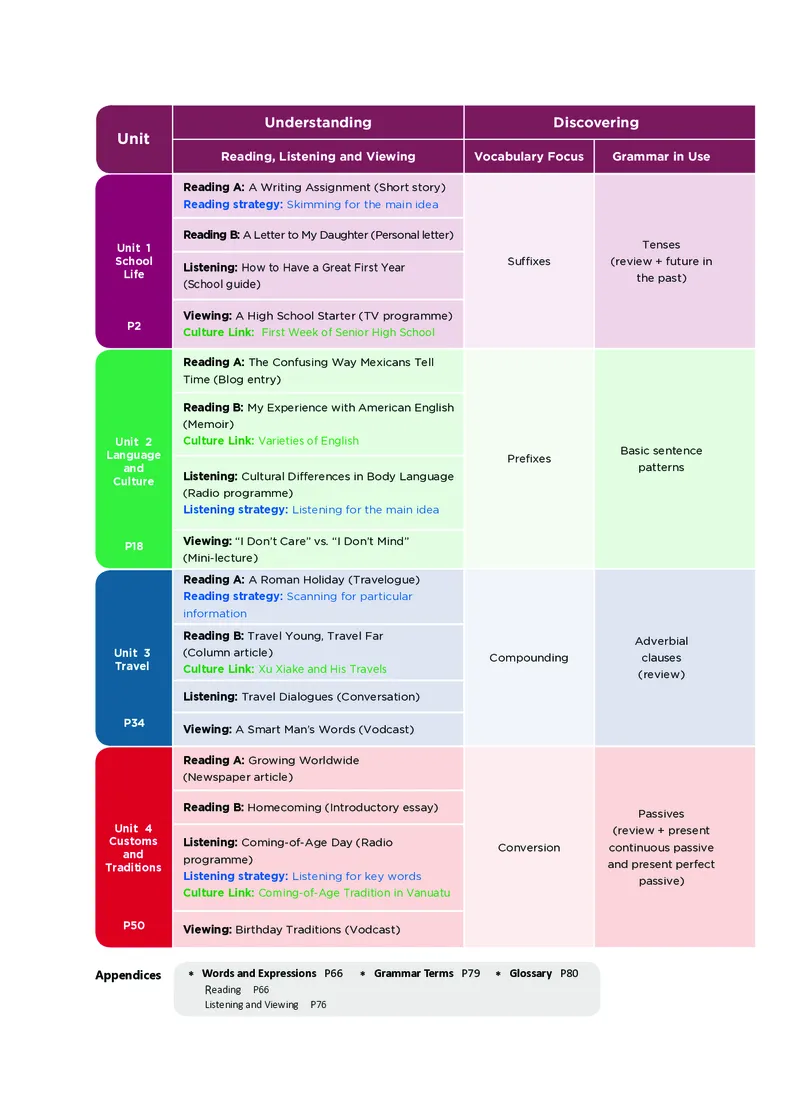
Unit 1
School
Life
P2
Unit 2
Language
and
Culture
Unit 3
Travel
Unit 4
Customs
and
Traditions
Understanding
Discovering
Reading, Listening and Viewing
Vocabulary Focus
Grammar in Use
Reading A: A Writing Assignment (Short story)
Reading strategy: Skimming for the main idea
Suffixes
Tenses
(review + future in
the past)
Reading B: A Letter to My Daughter (Personal letter)
Listening: How to Have a Great First Year
(School guide)
Viewing: A High School Starter (TV programme)
Culture Link: First Week of Senior High School
Reading A: The Confusing Way Mexicans Tell
Time (Blog entry)
Prefixes
Basic sentence
patterns
Reading B: My Experience with American English
(Memoir)
Culture Link: Varieties of English
Listening: Cultural Differences in Body Language
(Radio programme)
Listening strategy: Listening for the main idea
Viewing: “I Don’t Care” vs. “I Don’t Mind”
(Mini-lecture)
Reading A: A Roman Holiday (Travelogue)
Reading strategy: Scanning for particular
information
Compounding
Adverbial
clauses
(review)
Reading B: Travel Young, Travel Far
(Column article)
Culture Link: Xu Xiake and His Travels
Listening: Travel Dialogues (Conversation)
Viewing: A Smart Man’s Words (Vodcast)
Reading A: Growing Worldwide
(Newspaper article)
Conversion
Passives
(review + present
continuous passive
and present perfect
passive)
Reading B: Homecoming (Introductory essay)
Listening: Coming-of-Age Day (Radio
programme)
Listening strategy: Listening for key words
Culture Link: Coming-of-Age Tradition in Vanuatu
Viewing: Birthday Traditions (Vodcast)
Unit
P18
P34
P50
P50
Appendices
* Words and Expressions P66
Reading P66
Listening and Viewing P76
* Grammar Terms P79
* Glossary P80
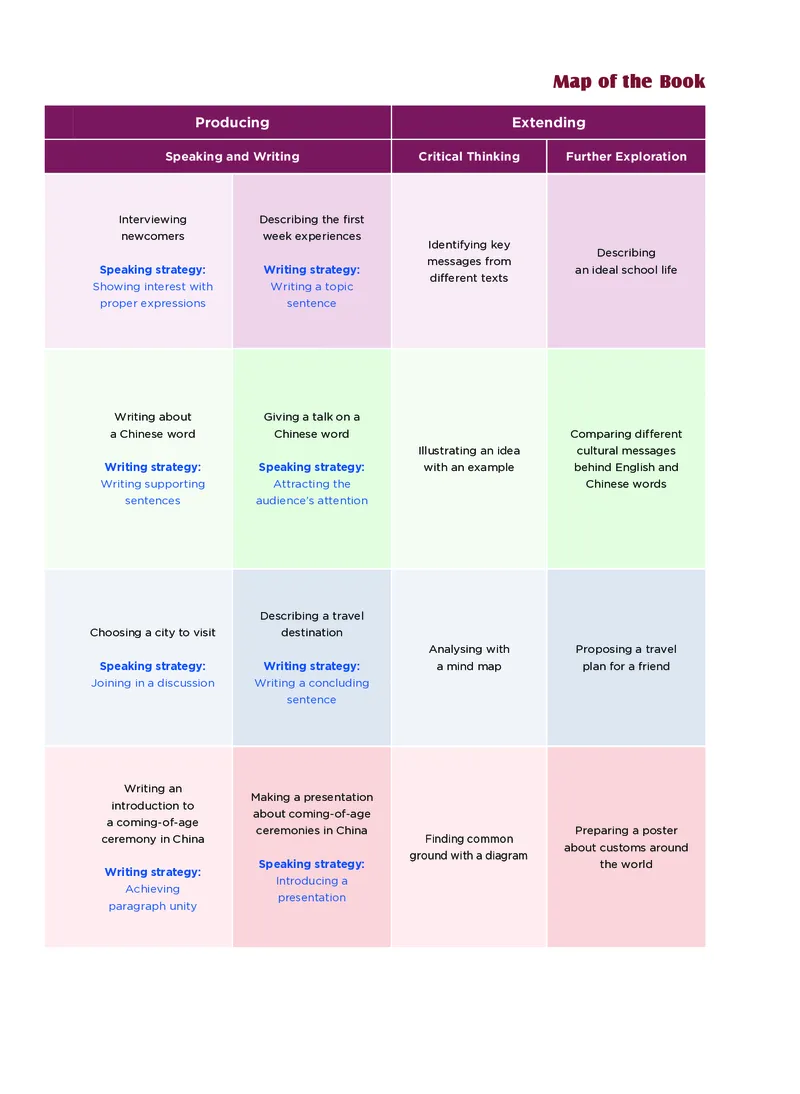
Producing
Extending
Speaking and Writing
Critical Thinking
Further Exploration
Interviewing
newcomers
Speaking strategy:
Showing interest with
proper expressions
Describing the first
week experiences
Writing strategy:
Writing a topic
sentence
Identifying key
messages from
different texts
Describing
an ideal school life
Writing about
a Chinese word
Writing strategy:
Writing supporting
sentences
Giving a talk on a
Chinese word
Speaking strategy:
Attracting the
audience’s attention
Illustrating an idea
with an example
Comparing different
cultural messages
behind English and
Chinese words
Choosing a city to visit
Speaking strategy:
Joining in a discussion
Describing a travel
destination
Writing strategy:
Writing a concluding
sentence
Analysing with
a mind map
Proposing a travel
plan for a friend
Writing an
introduction to
a coming-of-age
ceremony in China
Writing strategy:
Achieving
paragraph unity
Making a presentation
about coming-of-age
ceremonies in China
Speaking strategy:
Introducing a
presentation
Finding common
ground with a diagram
Preparing a poster
about customs around
the world
Map of the Book
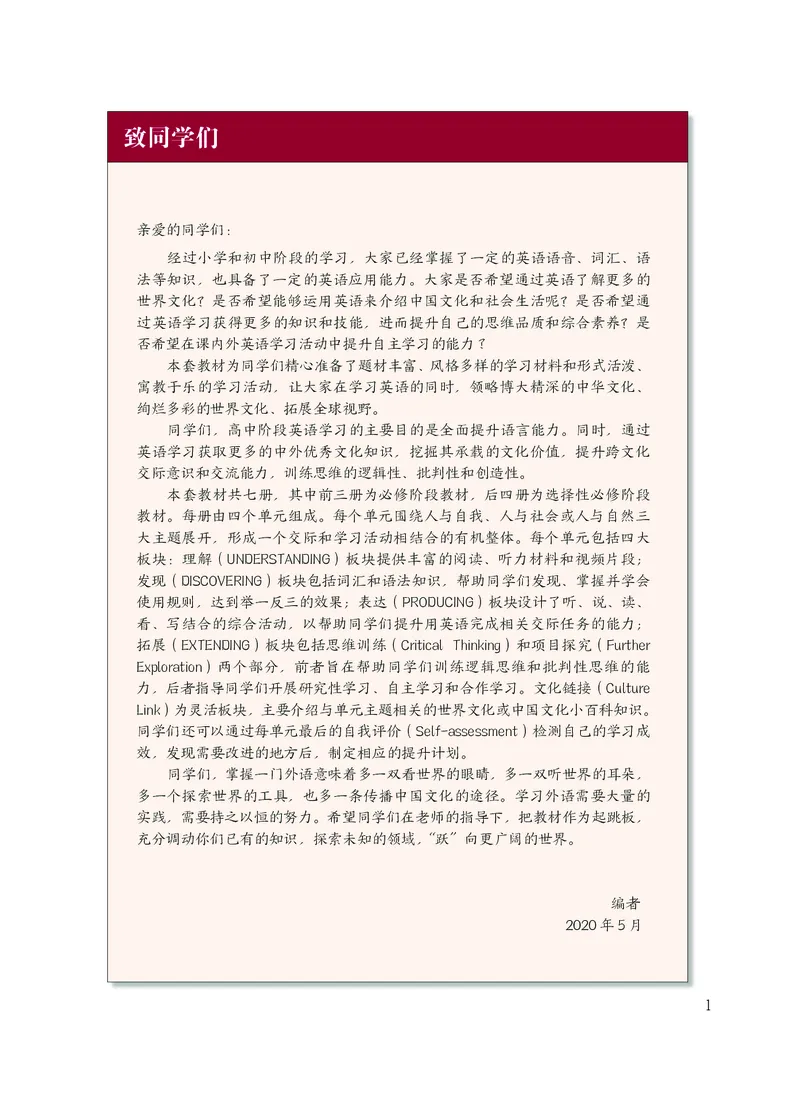
致同学们
亲爱的同学们:
经过小学和初中阶段的学习,大家已经掌握了一定的英语语音、词汇、语
法等知识,也具备了一定的英语应用能力。大家是否希望通过英语了解更多的
世界文化?是否希望能够运用英语来介绍中国文化和社会生活呢?是否希望通
过英语学习获得更多的知识和技能,进而提升自己的思维品质和综合素养?是
否希望在课内外英语学习活动中提升自主学习的能力?
本套教材为同学们精心准备了题材丰富、风格多样的学习材料和形式活泼、
寓教于乐的学习活动,让大家在学习英语的同时,领略博大精深的中华文化、
绚烂多彩的世界文化、拓展全球视野。
同学们,高中阶段英语学习的主要目的是全面提升语言能力。同时,通过
英语学习获取更多的中外优秀文化知识,挖掘其承载的文化价值,提升跨文化
交际意识和交流能力,训练思维的逻辑性、批判性和创造性。
本套教材共七册,其中前三册为必修阶段教材,后四册为选择性必修阶段
教材。每册由四个单元组成。每个单元围绕人与自我、人与社会或人与自然三
大主题展开,形成一个交际和学习活动相结合的有机整体。每个单元包括四大
板块:理解(UNDERSTANDING)板块提供丰富的阅读、听力材料和视频片段;
发现(DISCOVERING)板块包括词汇和语法知识,帮助同学们发现、掌握并学会
使用规则,达到举一反三的效果;表达(PRODUCING)板块设计了听、说、读、
看、写结合的综合活动,以帮助同学们提升用英语完成相关交际任务的能力;
拓展(EXTENDING)板块包括思维训练(Critical Thinking)和项目探究(Further
Exploration)两个部分,前者旨在帮助同学们训练逻辑思维和批判性思维的能
力,后者指导同学们开展研究性学习、自主学习和合作学习。文化链接(Culture
Link)为灵活板块,主要介绍与单元主题相关的世界文化或中国文化小百科知识。
同学们还可以通过每单元最后的自我评价(Self-assessment)检测自己的学习成
效,发现需要改进的地方后,制定相应的提升计划。
同学们,掌握一门外语意味着多一双看世界的眼睛,多一双听世界的耳朵,
多一个探索世界的工具,也多一条传播中国文化的途径。学习外语需要大量的
实践,需要持之以恒的努力。希望同学们在老师的指导下,把教材作为起跳板,
充分调动你们已有的知识,探索未知的领域,“跃”向更广阔的世界。
编者
2020 年5 月
1
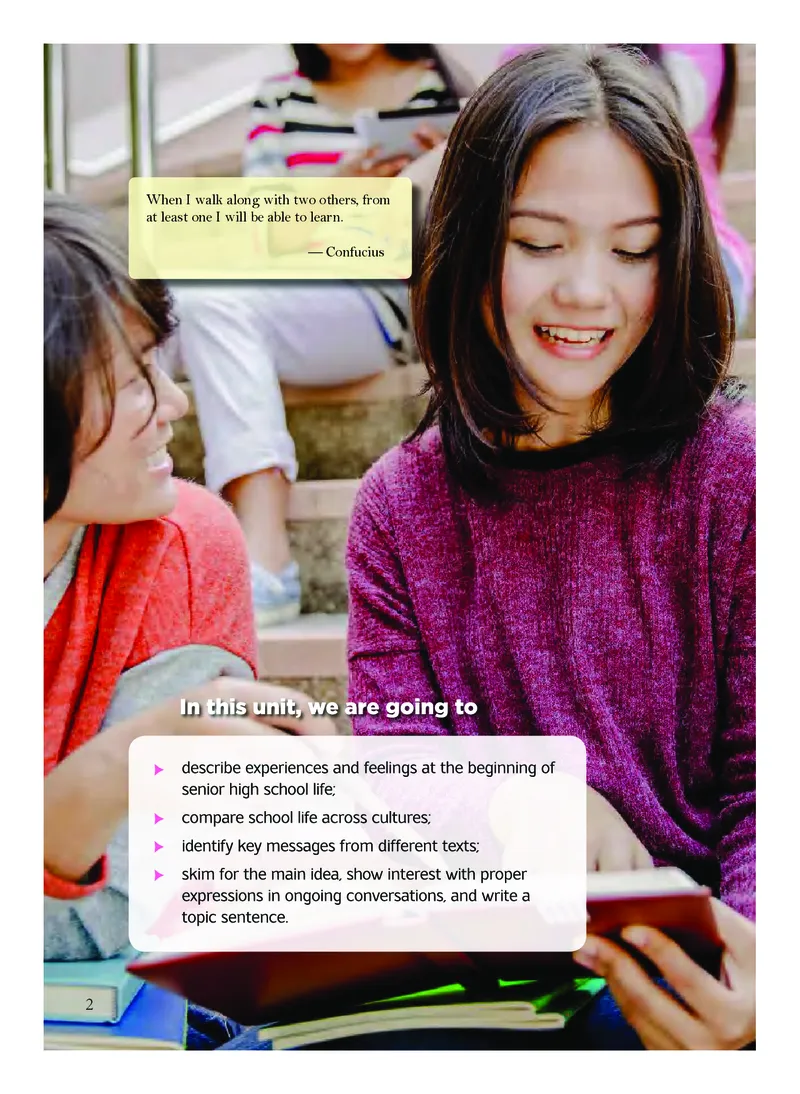
When I walk along with two others, from
at least one I will be able to learn.
— Confucius
2
Unit
School Life1
3
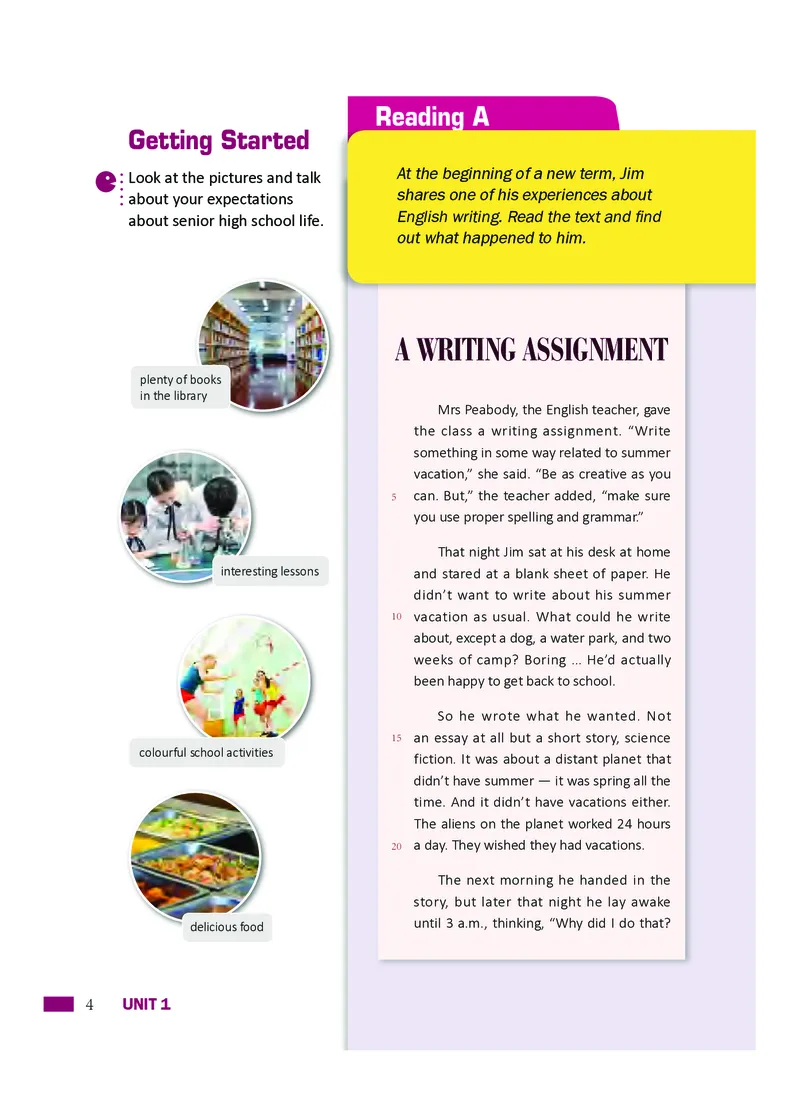
Getting Started
Look at the pictures and talk
about your expectations
about senior high school life.
Reading A
Mrs Peabody, the English teacher, gave
the class a writing assignment. “Write
something in some way related to summer
vacation,” she said. “Be as creative as you
can. But,” the teacher added, “make sure
you use proper spelling and grammar.”
That night Jim sat at his desk at home
and stared at a blank sheet of paper. He
didn’t want to write about his summer
vacation as usual. What could he write
about, except a dog, a water park, and two
weeks of camp? Boring … He’d actually
been happy to get back to school.
So he wrote what he wanted. Not
an essay at all but a short story, science
fiction. It was about a distant planet that
didn’t have summer — it was spring all the
time. And it didn’t have vacations either.
The aliens on the planet worked 24 hours
a day. They wished they had vacations.
The next morning he handed in the
story, but later that night he lay awake
until 3 a.m., thinking, “Why did I do that?
5
10
15
20
A WRITING ASSIGNMENT
At the beginning of a new term, Jim
shares one of his experiences about
English writing. Read the text and find
out what happened to him.
delicious food
interesting lessons
plenty of books
in the library
colourful school activities
4
UNIT 1
30
35
40
45
25
A Writing Assignment
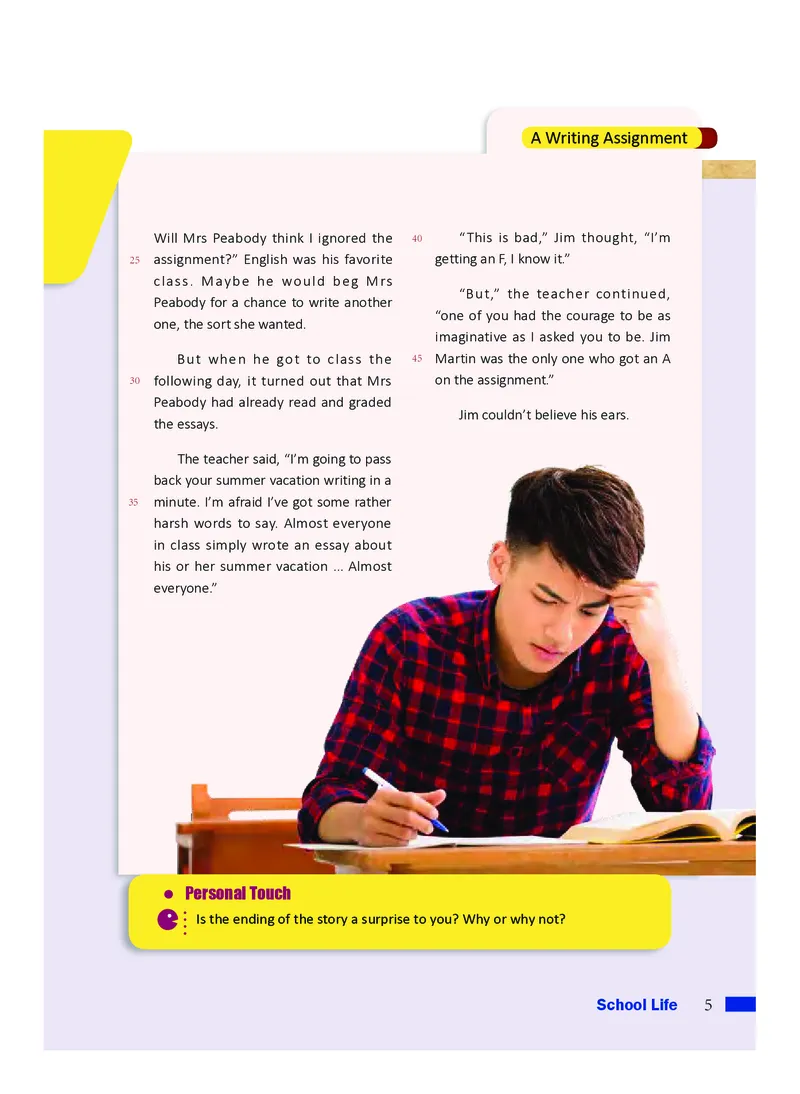
“This is bad,” Jim thought, “I’m
getting an F, I know it.”
“But,” the teacher continued,
“one of you had the courage to be as
imaginative as I asked you to be. Jim
Martin was the only one who got an A
on the assignment.”
Jim couldn’t believe his ears.
Will Mrs Peabody think I ignored the
assignment?” English was his favorite
class. Maybe he would beg Mrs
Peabody for a chance to write another
one, the sort she wanted.
But when he got to class the
following day, it turned out that Mrs
Peabody had already read and graded
the essays.
The teacher said, “I’m going to pass
back your summer vacation writing in a
minute. I’m afraid I’ve got some rather
harsh words to say. Almost everyone
in class simply wrote an essay about
his or her summer vacation … Almost
everyone.”
25
40
45
30
35
Personal Touch
Is the ending of the story a surprise to you? Why or why not?
5
School Life
Comprehension
II. Complete the table with Jim’s feelings based on information from the text. An
example is given.
Time
Jim’s feeling(s)
Evidence from the text
after Mrs Peabody gave the
class a writing assignment on
summer vacation
bored, unhappy
Jim stared at a blank sheet of
paper because he didn’t want
to write about his summer
vacation.
after Jim handed in his
writing
when Mrs Peabody started
to comment on the graded
essays
when Mrs Peabody praised
Jim for his courage and
imagination
III. Answer the questions.
I. Choose the correct answers.
1. Who are the main characters in the text?
A. Jim and the aliens.
B. Jim and Mrs Peabody.
C. Mrs Peabody and the aliens.
D. Jim, Mrs Peabody and the aliens.
2. What is the text mainly about?
A. Jim’s summer vacation in his English writing.
B. A different writing assignment Jim was given.
C. A writing assignment Jim did based on his own imagination.
D. Jim’s decision to write science fiction about his summer vacation.
1. Why didn’t Jim write an essay about his summer vacation?
2. Do you think it was fair that Mrs Peabody gave Jim an A for his assignment?
Why or why not?
Digging In
Skimming for the main idea
Reading Strategy
6
UNIT 1
Vocabulary Focus
A suffix is a letter or a group of
letters added at the end of a
word to make a new word.
I. Key Vocabulary
Fill in each blank with the appropriate form of a word from the text. The first letter is
given.
As the new school year began, Jim was quite happy. But the writing assignment
troubled him because the English teacher, Mrs Peabody, asked the students to write
something r_______ to summer vacation. That night he s________ at a blank sheet of
paper for quite a long time. He didn’t think his summer vacation was fun. So, he made
up a science fiction story about life on a d________ planet. He also made s________
that he used proper spelling and grammar as Mrs Peabody required. Next day after
handing in the story, Jim stayed awake that night. He feared that he had i________ Mrs
Peabody’s requirements. He was worried that his writing would disappoint Mrs Peabody
as most students might write e________ about their summer vacation. However, it
t________ out that Jim was the only student who got an A. Mrs Peabody thought he
had been c________. What a great surprise!
II. Word Formation: Suffixes
2. Read the passage and identify the verb or noun
form of each underlined word.
Noun suffixes: -age, -er/-or,
-ance/-ence, -ation/-ion,
-ment, -ness,-ship, -ty, etc.
Adjective suffixes: -al, -ful,
-able/-ible, -ant/-ent, -ous,
-ive/-ative, -less, -ly, -y, etc.
Adverb suffixes: -ly,
-ward(s), -wise, etc.
Verb suffixes: -en, -ise/-ize,
-ify, etc.
For Confucius, China’s greatest teacher,
learning was a powerful joint effort between
teacher and student. He had a lot of interesting
and meaningful discussions with his students.
Once Zilu asked, “When learning something,
should I put it right into practice?” The Master
replied, “Your father and elder brothers are still
alive; how would you dare to act immediately
after learning something?” Ran You then asked
the same question. The Master replied, “Yes.
Upon learning something, put it right into action.”
In fact, the two students had different
characters. Ran You was shy and slow, so
Confucius encouraged him to go forward; Zilu was
active and courageous, so he kept Zilu back.
1. Read the text and find at least five words with
suffixes.
7
School Life
Grammar in Use
Tenses (review + future in the past)
I. Read the passage and tell what tenses are used and why.
3. Fill in the blanks with the appropriate forms of the words in brackets.
I am now going to start my new life in a senior high school.
I remember at the beginning of my junior high school life, I wanted everyone to
like me and be 1 ________ (friend) to me. I had a lot of 2 ________ (difficult) catching
up with my classmates. The following year was 3 ________ (definite) a problem year.
I tried hard to build 4 ________ (friend) but didn’t always succeed. Some subjects
were 5 ________ (real) hard for me, especially physics. Every time I did experiments,
I felt worried and 6 ________ (nerve). Both internal and external factors influenced
my feelings.
The third year was fruitful for me. I became more 7 ________ (confidence) as I
made great progress in physics. I got on well with my classmates. Many of them have
now become my good friends.
Nothing is ever as bad as it seemed. The most 8 ________ (value) thing I have
learned is that life will go on and efforts will pay off.
On the first day of September, Anne came home in high spirits. “I think I’m going to
like school here,” she announced. “I don’t think much of the master, though. He’s curling
his moustache all the time ...” “Anne Shirley, don’t let me hear you talking about your
teacher in that way again,” said Marilla sharply. “That is something I won’t tolerate. I’m
sure he can teach YOU something, and it’s your business to learn.”
Tense
Form
Use
Example
Simple present
am/is/are
do
For actions that happen regularly, or
for permanent situations.
There are a lot of neatly-
dressed nice girls in school.
Simple past
was/were
did
For an action that happened in a
definite time in the past.
Ruby gave me an apple
and Sophia lent me a
lovely pink pen.
Simple future
am/is/are going
to do
will/shall do
For an intention or a plan, a prediction,
or an action in the future.
But I like Diana best and
always will.
Present
continuous
am/is/are doing
For something that is happening at the
moment of speaking or for a limited
time in the present.
I am writing this letter
because at the moment
I am too excited to fall
asleep.
Past
continuous
was/were doing
For an action that was happening at a
particular time in the past.
I was thinking of my new
school life at this time
yesterday evening.
Present
perfect
have/has done
For an action that happened in the
recent indefinite past, an action
or state that began in the past and
continued to the present time, or for a
past event with results in the present
time.
It is the first time I have
shared a dorm with three
other girls.
G rammar Highlights
8
UNIT 1
II. Work in pairs. Talk about your expectations about senior high school life when you
were a junior high school student.
III. Send an email to your friend Jim about your school life based on the above
discussion. The following three questions can be used as your guide.
Tense
Form
Use
Example
Future
in the past
would/should
do
For talking about hopes, expectations
and intentions we had in the past.
Maybe he would beg Mrs
Peabody for a chance to
write another one, the
sort she wanted.
was/were going
to do
For talking about a past intention,
and it works well as an example of an
excuse.
I was going to send you
a message, but the smart
phone ran out of power.
EXAMPLE
A: What did you expect about senior high
school when you were in junior high
school?
B: I hoped that I would be able to join a
school drama club and perform on the
stage.
A. What did you expect about the senior high school?
B. Is your life now the same as you expected?
C. What are you going to do in the days to come?
Hi Jim,
How’s your life in the new school? I hope you have adapted well and enjoy the life
there.
Up till now, I have been here for _____________ days. I still remember in junior
high school, I hoped that ________________________. Now _________________________
_________________________________________________________________________________.
All the best
Yours,
_____________
From:
To:
Subject:
9
School Life
How to Have a Great First Year (School guide)
Which tips are given to the first-year students?
A. To meet new friends.
B. To take part in social activities.
C. To make a learning plan.
D. To try something new.
III. Listen again and fill in the blanks.
IV. How do you like the above tips? Why?
I. Look at the pictures and say what they are about.
II. Some senior students are giving suggestions to first-year students. Listen and
choose the answers to the question.
Listening and Viewing
Ways to follow tips
Examples/Reasons
Tip 1
To 1 ________.
I first met my best friend at Year 7 camp.
Tip 2
To use a 2 ________.
To start a regular study plan.
You are expected to be more
3 ________________.
To set up 4 ________ at home.
You can concentrate on work.
To 5 ________ for homework and tick
them off as you finish each task.
Know when you need to hand in your
assignments and plan what you have to get
done.
To ask teachers for help with
6 ________ if you need it.
1
3
2
4
10
UNIT 1
A High School Starter (TV programme)
I. Do a survey in class with the following questions. You may add more questions.
1. What experiences did Lizzie’s father have in
his first week in senior high school?
A. He was punished by his teacher.
B. He had no locker to himself.
C. He made fun of Lizzie’s mother.
D. He was thrown into the dustbin.
2. Which of the following was Lizzie’s experience
before she entered senior high school?
A. Being class president.
B. Doing well in gymnastics.
C. Protecting the environment.
D. Getting praise in her first job.
3. Lizzie's father advised that she should
________ if she meets difficulties or failures
in senior high school.
A. try again
B. learn to grow up
C. turn to her friends
D. ask him for help
II. Look at the picture on the right and guess Lizzie’s feelings
about her senior high school life. Watch the video and
check your guess.
III. Watch the video again and choose the best answer.
IV. Do you think the conversation between Lizzie
and her father would help her in senior high
school? Why or why not?
What is your biggest concern about senior high school life?
¨ School rules
¨ School facilities
¨ School activities
¨ Others: _______
How did you feel on the first day of senior high school?
¨ Happy
¨ Surprised
¨ Puzzled
¨ Others: _______
Culture Link
First Week of Senior High School
First week of high school varies greatly
from culture to culture. For instance,
it’s a custom in South Korea and Japan
to welcome new students with a school
entrance ceremony, emphasising students’
duties and responsibilities. Some skilled
painters in Japan draw welcome pictures
on the blackboard. In the US, most high
schools offer a training course before
school actually starts. New students
learn their way around the building and
meet some of their teachers and fellow
students.
11
School Life
Moving Forward
I. Speaking: Interviewing newcomers
The school English newspaper No. 1 Senior High School Weekly is conducting an
interview about students’ experiences and feelings during their first week in No. 1 Senior
High School.
Describing Your First Week
Work in groups of four. Brainstorm the interview topic. The topic can be
school activities, school facilities, people you meet at school or school
subjects and so on. Each group chooses one topic.
Conduct the interview. One student is the reporter, one is the note-taker,
and the other two are the interviewees. Try to show interest while listening
and talking.
Step
1
Step
2
Take turns to act out the interview in class.
Step
3
Li Mei: Hi, I’m Li Mei from No. 1 Senior
High School Weekly. Anything exciting
about your new school life?
Zhang Yan: The school library is great!
Zhao Shan: Yes. I loved the place when I
visited it for the first time.
Li Mei: Wow! What makes it so
attractive?
Zhang Yan: The environment is quiet and
comfortable.
Zhao Shan: There’s a large collection of
magazines and books. It also has modern
facilities.
Li Mei: Amazing! Could you tell me more
about your experiences at the library?
Zhao Shan: Sure. It only took me five
minutes to borrow Selected Stories of
O. Henry. The computer helped me to
quickly find the book because the self-service
borrowing system was very convenient.
Zhang Yan: The library is decorated with
plants, lovely desks and chairs, so I felt totally
relaxed while studying or reading there.
Li Mei: Yeah, a good place to go.
EXAMPLE
12
UNIT 1
Sort out the notes you have taken in the interview.
Come up with a topic sentence for your selected notes.
Combine the topic sentence and the selected notes into a paragraph. Add
your paragraph to the sample paragraph below.
Zhang: The school library is great.
Zhao: I loved the place when I visited it for the first time.
Zhang: The environment is quiet and comfortable.
…
Which statement might be the proper topic sentence of
the interview notes?
a. The school library is a great place to visit.
b. Zhang Yan and Zhao Shan loved the school library for
several reasons.
c. The environment of the school library is attractive to
Zhang Yan and Zhao Shan.
New Friends, New Voices
This year our school has 300 new students. They felt happy to share their
experiences and feelings about their first week at school.
_____________________________________________________________.
Zhang Yan said the library is decorated with plants, lovely desks and chairs
and she felt totally relaxed while studying or reading there. Zhao Shan
remembered he was able to borrow Selected Stories of O. Henry within five
minutes. The computer helped him quickly find the book because the self-
service borrowing system was very convenient.
_____________________________________________________________.
______________________________________________________________
______________________________________________________________
II. Writing: Describing the first experiences
Write a paragraph in 60-80 words based on the interview conducted by the school
English newspaper.
Step
1
Step
2
Step
3
When we are interested in what other people say, we use actions and expressions to participate actively.
Actions include smiling, nodding and the like. Expressions are as follows:
Response: Uh-huh./Oh, I see./Yeah, that’s true./ You are right.
Stronger response: Really?/Hmm, that’s an excellent point!/Wow! That’s amazing!/That’s wonderful!/
You must be joking!
Showing interest with proper expressions
Speaking Strategy
EXAMPLE
EXAMPLE
A topic sentence gives
readers an overview of
what they are about to
read. It usually appears
at the beginning or the
end of a paragraph.
Writing a topic sentence
Writing Strategy
Details
Topic sentence
Details
Topic sentence
13
School Life
Dear Daughter,
I know perhaps you will be surprised to read this: I remember well what
it was like to be a teenager. As I watch you prepare for your first day of
senior high school, there are a few things I want you to know.
You may be putting yourself under pressure to make sure that everything
is perfect for that first day, but I want you to know that there’s no such thing
as perfect. I’ve said it before, but it bears repeating. There is nothing perfect.
There is only good enough, but what is most important is believing you’re
good enough — just as you are.
Also, remember that you’re not in this boat alone. You’re not the only
one facing a new school, new classmates, new teachers, new expectations
and new pressures. At some point, everyone else is — or was — where you
are right now. I hope you find comfort in that.
There might be some people who will not always be so friendly to you.
You will find such people not only in senior high school, but throughout your
adult life. When you are reflecting on a nasty comment someone made on
you or an unfriendly glance that came your way, I hope you’ll remember that
these behaviours always say more about the giver than the receiver and that
there will never be a shortage of kind people and genuine smiles in your life.
As you go forward into this new chapter in your life, I hope you’ll realise
early that we are most often held back by the limitations we put on
ourselves — by the stories we tell ourselves about who and what we are.
Whenever you’re tempted to say, “I can’t ...” or “I’m not ...” about something
you really want to achieve, I hope you’ll change that story — because
you can and you are.
Love,
Mum
Reading B
5
10
15
20
25
A LETTER TO MY DAUGHTER
14
UNIT 1
I. Complete the table based on the letter.
II. Answer the questions.
1. What qualities does the mother wish her daughter to have?
2. How might the daughter feel after reading the letter?
I. What suggestions for senior high school students have you learned from this unit?
Identify the key messages and put them in the corresponding boxes.
II. What other suggestions for school life have you been given before? Write them
in the blanks above. How do you feel about these suggestions? What suggestions
would you like to give high school starters based on your experiences?
Comprehension Plus
Critical Thinking
Daughter’s possible problems
Mother’s advice
Trying to make everything perfect for the
first day at school.
Believe you are good enough.
Teacher’s advice
Senior’s tips
Mother’s advice
Father’s advice
Other suggestions
Suggestions for senior high school students
Other suggestions
Identifying key messages
from different texts
15
School Life
Further Exploration
Describing an ideal school life
Work in groups. Share what you know about school life and
describe your ideal school life.
Share something interesting, meaningful or unique
about your school life in the past or at present. Search for
information related to school life in different countries. Put the
information you have shared and collected in the table.
Decide whether to present it as a report, a short
play, a talk show or an interview. Prepare two questions for
the audience to answer.
Take turns to give presentations and raise questions.
The audience should take notes while listening and be
prepared to answer the questions.
Sort out the information you have collected. Hold a
discussion and select the part of school life you like. Work out
an ideal school life by putting together your favourite parts.
School 1
School 2
Name
Country
School life 1: Courses
School life 2: Activities
…
Step 1
Step 2
Step 3
Step 4
16
UNIT 1
Look at the expected learning outcomes of this unit and answer
the questions.
A. Figuring out feelings of senior high school starters
B. Talking about experiences and feelings about senior high
school life
C. Describing ideal school life in a certain culture
D. Identifying tips about school life from different sources
E. Reading a text quickly to get the main idea
F. Using proper expressions to show interest in a discussion
G. Writing a topic sentence for a paragraph
Which of the above have you done well? Why and how?
Which of the above do you still find difficult? Why?
What do you plan to do if you find something difficult?
Self-assessment
17
School Life
Absolutely nothing is so important for a
nation’s culture as its language.
— Wilhelm von Humboldt
18
Unit
Language and Culture2
19
Getting Started
Look at the picture and
answer the questions.
Many Chinese used to greet
each other by asking if they
had eaten. Are there people
around you still doing that?
Who might misunderstand it
as an invitation or something
else?
When I first set foot on Mexican soil, I
spoke Spanish well. So when I asked a local
ice-cream seller for an ice-cream, and he
said “ahorita,” which directly translates to
“right now,” I took him at his word, believing
that its arrival was immediate.
I sat near his shop and waited. Half an
hour passed and still no ice-cream arrived,
so I asked again about it. “Ahorita,” he told
Reading A
5
THE CONFUSING WAY
MEXICANS TELL TIME
Have you had any confusing moments
in another culture? Read the story and
find out what might be the cause(s).
Have you
eaten?
20
UNIT 2
15
20
25
30
35
40
45
me again. His face was a mix of confusion
and maybe even embarrassment.
I was torn. Waiting longer wasn’t
pleasant, but I felt it was impolite to
walk away, especially if the ice-cream
was now being delivered just for me.
But finally, after waiting too long, I made
a rush for the nearest bus to take me
home. As I left, I signalled at my wrist
and shrugged to the ice-cream seller.
Obviously I couldn’t wait any longer and
it really wasn’t my fault. His face was,
once again, one of total confusion.
This experience faded from my
memory until years later when I came
back to live in Mexico. I discovered
that understanding “ahorita” took not
a fluency in the language, but rather a
fluency in the culture. When someone
from Mexico says “ahorita,” it should
almost never be taken literally; its
meaning changes greatly with context.
As a linguist told me, “Ahorita could
Personal Touch
What word in your mother tongue is confusing like “ahorita” in Mexico?
Could you share any story or experience related to the word?
10
mean tomorrow, in an hour, within five
years or never.” It is even used as a polite
way of saying “no, thanks” when refusing
an offer.
Difficulty in explaining what I have
come to call “Ahorita Time” is a reflection
of different cultural understandings
of time. Since I moved to Mexico, my
attitude towards time has changed
dramatically. I don’t worry so much
about being late; I am generally still on
time for appointments, but when I’m
not, I don’t panic. Ironically, it would
seem that “Ahorita Time” has actually
allowed me to live far more in the “right
now” than I ever did before.
The Confusing Way Mexicans Tell Time
21
Language and Culture
Comprehension
I. Below is an outline of the passage you have just read. Complete the diagram with
information from the text.
II. Answer the questions.
1. What did “ahorita” mean to the author? What might the ice-cream seller mean by saying
“ahorita”?
2. What did the author suggest by saying “I was torn” (line 12)?
3. Why didn’t the author worry so much about being late after moving to Mexico years
later?
4. Do you think Spanish people would mean the same as Mexicans when they say “ahorita”?
Why or why not?
Digging In
Climax
Setting
Development
Beginning
Message
Ending
The author was torn
and _____________
________________.
Time: __________
Place: __________ in Mexico
Character(s): ___________
The author then waited because
______________________________.
However, half an hour later, when she
asked again, the ice-cream seller felt
______________________________.
The author left the shop after
a long time. The seller looked
_______.
Understanding “ahorita” took not a fluency in
the language, but rather ________________.
The author asked a local ice-
cream seller for an ice-cream,
and the seller answered
________.
22
UNIT 2
Vocabulary Focus
A prefix is a letter or a group of letters added to the beginning of a word to
indicate or modify its meaning.
I. Key Vocabulary
Fill in the blanks with the appropriate forms of the given words and expressions to
complete the passage.
This is a story about how a foreigner got confused about a Mexican word even though
she could speak fluent Spanish. It happened when she 1 _________ Mexican soil for
the first time. She asked an ice-cream seller for an ice-cream, and he said “ahorita.” She
thought it would 2 _________ immediately because the word can be directly translated
to “right now.” But she waited for half an hour and still no ice-cream came. When she
asked the seller about it, he said “ahorita” again, with his face showing 3 _________.
She felt 4 _________ between waiting and walking away. Finally, she had to go home,
so she 5 _________ to the seller that she could not wait any longer. Years later back
in Mexico, she came to realise that the meaning of “ahorita” changes according to its
6 _________. It could mean “tomorrow,” “within five years,” “never,” or even “no,
thanks” when one wants to 7 _________. “Ahorita Time” is a 8 _________ of different
cultural understandings of time. That is, understanding “ahorita” takes not a fluency in
the language, but a fluency in the culture.
II. Word Formation: Prefixes
1. Read the sentence and rewrite it with the opposites of the underlined words
without changing the meaning.
Prefix
Word
Word with a prefix
im-
polite
impolite
in-
expensive
inexpensive
un-
fortunate
unfortunate
fold
unfold
dis-
appear
disappear
advantage
disadvantage
mis-
understanding
misunderstanding
cross-
cultural
cross-cultural
en-
rich
enrich
pre-
view
preview
co-
operation
cooperation
Waiting longer wasn’t pleasant, but I felt it was impolite to walk away.
Waiting longer was ________, but I felt it wasn’t ________ to walk away.
confusion
deliver
reflection
refuse an offer
context
set foot on
signal
torn
23
Language and Culture
Grammar in Use
Basic sentence patterns
I. Read the passage and tell how many sentence patterns there are.
2. Add a prefix in the left box to a word in the right box to make a new word. Fill in the
blanks with the new words.
S+V:
Subject+ Verb (vi.)
The meaning of the idiom changes greatly.
S
V
S+V+C:
Subject + Linking Verb + Complement
I was torn.
S V
C
S+V+O:
Subject + Verb (vt.) + Object
I spoke Spanish well.
S V
O
S+V+O+C:
Subject + Verb + Object + Complement
She found the word “ahorita” confusing.
S
V
O
C
S+V+Oi+Od: Subject + Verb + Indirect Object + Direct Object
She gave him a signal.
S
V
Oi
Od
The origin of the English word hello is the French holà. It roughly means “whoa
there!” (ho, là). But the French people do not make holà a greeting word. The Italian
word Ciào finds its origin in the Venetian phrase s-ciao vostro or s-ciao su. The literal
translation is “I am your slave.” In fact, the meaning is “at your service.”
G rammar Highlights
Prefix: cross- en- mis-
inter- un- co- tele-
Word: cultural understanding phone
able certainty operation national
Culture shock refers to a sense of confusion or 1 _________ with feelings of anxiety
when people are introduced to a foreign environment.
If you are a(n) 2 _________ student experiencing culture shock, here are some tips
that might help:
• Research the host country’s culture and build up 3 _________ awareness.
• Look for activities that 4 _________ you to interact with other students who
share your interests.
• Stay calm when some 5 _________ occurs and reach out for help if necessary.
• Keep in touch with your family and friends via email, video chat or 6 ________.
• Value 7 _________ and prepare to work with other students.
24
UNIT 2
II. Identify the sentence pattern of each sentence in the paragraph. An example is
given.
III. Complete the story according to the pictures and the clue words. Try to use as
many different sentence patterns as possible.
A couple were travelling in Spain. One day they went into a small
restaurant for lunch. They did not speak the local language and the waiter
did not speak their language ...
Today my friend told me a funny story. One day, an American was meeting
① (S + V+ Oi + Od) ② ( )
a Chinese man. As the visitor saw the host’s wife, he said, “Your wife is very beautiful.”
③ ( ) ④ ( )
The host smiled and said, “Where? Where?” This surprised the American very much,
⑤ ( ) ⑥ ( )
but still he answered, “Eyes, hair, nose.” Of course the host found the answer
⑦ ( )
a bit puzzling. We know that cultural differences in languages caused the confusion.
⑧ ( )
“Where? Where?” in Chinese is a kind of humble expression, but the American
⑨ ( )
understood it as “Which parts of the body?”
1
(restaurant)
3
(cow)
4
(bullfight)
2
(milk)
25
Language and Culture
Cultural Differences in Body Language (Radio programme)
A. Gestures differ from country to country in expressing similar ideas.
B. Similar gestures may have different meanings in different countries.
C. People often use their hands or heads to express their feelings.
D. People in different countries use different gestures to show disagreement.
II. Listen and choose the main idea of the programme.
I. If you were a traveller in Spain, how would you use your body language to ask the
waiter for milk?
III. Fill in each blank with no more than two words. Then listen again and check.
IV. Some gestures may convey different messages in different cultures. Give an
example.
Listening and Viewing
Listening for the main idea
Listening Strategy
Using gestures to express
what you are feeling is common
in some countries but not in
others. Shaking heads mostly
means ‘no,’ but in some
countries it can mean the
1 ____________. For example,
in Greece, shaking heads means
2 ____________; in Bulgaria,
it means 3 ______________;
and in India, it means lots of
4 _________. Besides, in some
areas of southeastern Europe,
5 _________ means ‘no.’
26
UNIT 2
“I Don’t Care” vs. “I Don’t Mind” (Mini-lecture)
II. Watch Part I of the video and choose the best answer.
The video is about the difference __________.
A. between tea and coffee
B. in making decisions in the US and the UK
C. between American and British English
D. in showing disagreement in the US and the UK
1. What other differences between American and British English are mentioned in the video?
2. Can you give more examples to show differences between American and British English?
1. — Do you mind giving a free ride to a stranger?
— ________________________________________________.
2. — Would you like to have tea or coffee?
— ________________________________________________.
I’m happy with either alternative.
1 _______________
But in British English, it means
you are not interested.
But in American English, it makes
3 ____________.
2 _______________
III. Watch Part II of the video and complete the diagram.
IV. Answer the questions.
I. Before watching, complete the dialogues with “I don’t care” or “I don’t mind”.
American English
British English
27
Language and Culture
Step 1
Work in groups. Brainstorm about words in Chinese and their different
usages in different contexts. The words can be confusing, interesting or
funny, such as “ahorita” in Mexican Spanish or “chi” in Chinese.
Step 2
Choose one word and list its different usages or stories. Find out the peculiar
cultural message behind the word.
Step 3
Write a topic sentence based
on the information. Find
relevant details and put them
in the supporting sentences.
I. Writing: Writing about a Chinese word
Introducing a Chinese Word
Moving Forward
All the supporting sentences should be related to
the topic sentence. Good supporting sentences have
different goals. Writers use them to explain, describe,
give reasons, give facts, give examples or define.
Writing supporting sentences
Writing Strategy
Suppose some students from your sister school abroad are visiting
your school. You are asked to give a talk about “Chinese words and
their stories.”
Step 4 Put all the sentences into a paragraph.
Tick (✓) the sentences that are related to the given topic sentence.
Topic sentence:
A simple Chinese word “chi” (to eat) has a lot of extended meanings.
Supporting sentences:
As the saying goes, “People can’t do without food.”
Chinese people’s love or concern for food has lent many colourful expressions to their
mother tongue.
The word sometimes goes beyond its literal meaning. For example, “chi moshui” means “to
receive education” instead of “to eat ink,” and “chi cu” means “to be jealous” rather than “to
eat vinegar.”
It can be referred to as “to depend on.” For instance, “chi laobao” means “to live on labour
security funds” and “kaoshan chishan” means “those living in a mountainous area depend
on the mountains for a living.”
28
UNIT 2
II. Speaking: Giving a talk on a Chinese word
Step 1 Work in groups. Find a way to attract the audience’s attention with the
help of the speaking strategy.
Step 2 Put what you have written in a speaking outline. Practise the group
presentation with other members. Prepare some questions for listeners
to answer after the presentation.
Step 3 Give your presentation in class. Ask some questions after the
presentation.
Introduction
Greeting
Asking a question
e.g. Do you know how to say “eat” in Chinese?
Body
Topic sentence
e.g. A simple word “chi” has a lot of extended meanings.
Supporting sentences
e.g. meaning 1
meaning 2
Conclusion
A good speaker begins a presentation with a quick and friendly
greeting. This makes the audience feel welcome.
A speaker can also attract the audience’s attention by asking a
question.
• How many of you have ever studied Chinese?
• Have you got a Chinese expression similar to “ahorita”?
Attracting the audience’s attention
Speaking Strategy
29
Language and Culture
MY EXPERIENCE WITH AMERICAN ENGLISH
When I was ten years old, I went to
the US to visit some family friends. We
travelled all the way from California to Las
Vegas. I noticed something funny about the
way everyone spoke English. I was thinking,
“This is the way they speak in films!”
At the beginning of the holiday, one of
my friends asked me if I wanted to order
“French fries.” I couldn’t imagine what
French fries were. What was fried and
French?! Snails? Cheese? She was amazed
that I had never tried them and she ordered
a portion for us to share. When the waiter
brought us some chips, I asked her where
the French fries were. She pointed to the
plate of chips! Later that week she said she
was going to buy some “chips” from the
supermarket. She came out with a packet
of crisps!
During that holiday we were also
offered “biscuits and gravy” with our lunch.
This was a very strange idea to me, because
in England biscuits are sweet. Gravy is a
salty, meat-based sauce. I later realised that
“biscuits” in America are savoury snacks.
What we call “biscuits,” they call “cookies.”
I was also embarrassed when a
stranger told me she liked my “pants.” I
remember thinking, “How can she see my
underwear!?” My mum then told me that
they call “pants” what we call “trousers,”
the outer clothing that you wear on your
legs!
I was disgusted when I saw an “egg-
plant” pizza on the menu in a restaurant.
Eggs do not grow on plants, I thought.
What on earth could an “eggplant” be?
Something eggy and leafy? My dad ordered
this pizza and it was covered in aubergines.
I asked him where the “eggplant” was. He
laughed and pointed to the aubergines.
He told me, “They call this ‘eggplant’ in
America!”
Although the same “language” may
be spoken in different countries, there
are likely to be many differences, not
just in vocabulary but also in spelling,
grammar and pronunciation! I think part
of the excitement of learning a language
is discovering the differences in how it is
spoken in different places.
Reading B
5
35
40
45
50
10
15
20
25
30
Culture Link
Varieties of English
There are many varieties of English throughout
the world, such as British English, American
English, Australian English, Indian English,
Canadian English, Malaysian English and
Singapore English. Take Singlish (Singapore
English) as an example. The New York Times
calls Singlish a “patchwork” because Singapore’s
population consists of migrants from a variety of
countries, including China, India and Malaysia,
all of whom have made their own special
contributions to the country’s unique version
of English. In Singlish you can easily recognise
influences from Chinese like “mee sian” (rice
noodle) in terms of the accent.
30
UNIT 2
I. Answer the questions.
II. Fill in the blanks with information from the text.
II. Do you agree that learning about cultural
differences can help you better communicate
with others? Give an example to support your
opinion.
Critical Thinking
Where does the author most probably come from? Why?
I. Cultural factors may influence meanings of
languages and cause misunderstandings in
cross-cultural communication. Fill in the blanks
with information from the unit.
her friend ordered French fries for her.
she felt curious.
French fries Chips
_________ _________
_________ _________
_________ _________
(1) _______ (1) ______
(2) _______ (2) ______
she saw
she felt
When she was in a
restaurant,
At the beginning of
the holiday,
her friend
she felt
Later that week,
they were
she felt
During that holiday,
the stranger said
she felt
When she met a
stranger,
Illustrating an idea with
an example
Cross-cultural
misunderstandings
food
traditions
e.g. _________
_________
time
concept
e.g. ________
regional
differences
e.g. ____________
_____________
...
ahorita
Comprehension Plus
American
English
British
English
31
Language and Culture
Further Exploration
Comparing different cultural messages
behind English and Chinese words
English
Chinese
Word
Cultural
message
Example
Cultural
message
Example
white
purity
wedding dress
(bride)
death
funeral
black
red
…
Work in groups. Each group searches for a certain
type of words in both languages, such as words for
numbers, colours, animals, plants or foods.
Find out the different cultural messages of these
words in each language. Take their respective
cultural traditions into consideration as cultural
messages may have changed over time. Sort out
the collected information and put it in the table.
An example is given.
Practise your presentation within groups.
Give your presentation to the class. Other groups
listen carefully, raising questions or making
comments afterwards.
Group 1: Comparing Colour Words in Traditional Cultures
Step 1
Step 2
Step 3
Step 4
32
UNIT 2
Which of the above have you done well? Why and how?
Which of the above do you still find difficult? Why?
What do you plan to do if you find something difficult?
Look at the expected learning outcomes of this unit and answer
the questions.
A. Understanding one’s feelings when he or she is experiencing a
different culture
B. Introducing a Chinese word or expression with different meanings in
different contexts
C. Exploring different cultural messages behind English and Chinese words
D. Illustrating factors leading to cross-cultural misunderstandings with
examples
E. Listening for the main idea about cross-cultural communication
F. Writing supporting sentences for a paragraph
G. Attracting the audience’s attention at the beginning of a presentation
Self-assessment
33
Language and Culture
Travel makes one modest. You see what
a tiny place you occupy in the world.
— Gustave Flaubert
34
Unit
Travel3
35
Getting Started
Look at the pictures. Discuss
the questions in pairs.
If you have an opportunity to
travel to any of the following
places, where would you like
to go? Why?
Last week I visited Rome for the first
time. I spent three busy days in the Italian
capital, seeing lots of tourist attractions
and walking down streets lit with Christmas
decorations. Here are the things that I loved
about the city.
Rome is one of the most ancient cities in
the world and is full of wonderful relics from
its distant past. These include the Roman
Forum, which was once the centre of public
and political life in Ancient Rome, as well
as the vast Coliseum,
Reading A
10
5
Cairo, Egypt
Maldives
Paris, France
Beijing, China
Eleanor went to Rome last week.
What did she do there? Did she enjoy
her visit? Read the text and learn
about her travel experiences in Rome.
A ROMAN HOLIDAY
A ROMAN HOLIDAY
36
UNIT 3
1. The Renaissance started from the 14th century
and lasted until the late 16th century. It is
considered to be the bridge between the Middle
Ages and the modern era.
Note
Personal Touch
Have you ever visited a historic place like Rome? Did you like it?
Why or why not?
the largest outdoor theatre ever built
and one of the greatest wonders in
the world. The ruins of buildings and
temples are fascinating: you can’t quite
believe how old they are.
I studied the masterpieces of the
Renaissance1 period at school and was
excited to see them in real life. When I
walked around the museum in Vatican
City, I saw plenty of famous sculptures.
The best part of the visit was, without
doubt, the Sistine Chapel ceiling, painted
in the early 16th century by the great
Michelangelo. It was so breathtaking
that I couldn’t tear my eyes away from
it.
In Rome, there is a large offering
of food for tourists, but some of it isn’t
very good in quality. I made an effort
to find some restaurants to taste the
popular meals of the region, like pasta
with tomatoes, onions and bacon. I also
loved eating ice cream and drinking hot
chocolate under the Christmas lights.
Rome has not only lots of luxury
stores, but also plenty of shops that
are in my price range. It was a perfect
opportunity to buy presents for my
family and friends. There was also a
Christmas market, where I bought a
sparkly decoration for the tree.
I love visiting new places, especially
capital cities. I have been very lucky this
year because I also visited Amsterdam
in the summer. Hopefully I’ll travel even
more in the future.
A Roman Holiday
20
15
25
30
35
40
45
37
Travel
Comprehension
III. Answer the questions.
II. Read the text again and tick () the
things Eleanor did in Rome. Explain
why she liked them.
I. List the things Eleanor loved about Rome.
1. Why does Eleanor love visiting capital cities?
2. Where do you think Eleanor would go next? Why?
Digging In
Scanning for particular information
Reading Strategy
A. walking along the
banks of the River Tiber
B. visiting the Roman Forum
and the Coliseum
E. going shopping in a
Christmas market
C. visiting Vatican City
F. popping her hands into
the Mouth of Truth
G. tasting some popular
meals
H. throwing a coin into
the Trevi Fountain
D. visiting the Spanish Steps
Eleanor
loved
Rome.
Rome is an ancient city full of relics.
38
UNIT 3
Vocabulary Focus
Compound words are
formed by putting two or
more words together. The
new word can be a noun,
such as masterpiece,
an adjective, such as
breathtaking, or a verb
like spoonfeed.
I. Key Vocabulary
Describe Eleanor’s experiences according to the travel plan, using the words and
expressions given below. The beginning sentences are given.
II. Word Formation: Compounding
1. Read the sentences below and see how
the underlined words are formed.
(1) I studied the masterpieces of the
Renaissance period at school and was
excited to see them in real life.
(2) It was so breathtaking that I couldn’t
tear my eyes away from it.
Day 1
Visit the Coliseum …
Day 2
See the masterpieces of the Renaissance …
Go to some restaurants …
Day 3
Buy presents …
tourist attraction decoration wonder opportunity
breathtaking tear away make an effort quality
Eleanor visited Rome last week. She visited many tourist attractions and walked
down streets lit with decorations. She stayed in Rome for three days. On the first day, …
Time
Activities
Eleanor’s travel plan
39
Travel
Grammar in Use
Adverbial clauses (review)
2. Make compound words by matching a word from Box A with one from Box B. Then
complete the sentences with the appropriate compound words.
(1) Travel can be a scary thing, but most of the
things we may fear about travel can easily
be __________.
(2) I’ve been looking to change the
__________ images on my computer.
That’s why I was happy to find a wonderful
photo taken in New Zealand last summer.
(3) We know that __________ brings great
sadness and emotional suffering but travel
is a good way to help us forget.
(4) If you walk in the __________ of Britain,
you’ll spot piles of stones along the road
from time to time.
(5) Famous __________ in Shanghai include
the Bund, the Oriental Pearl TV Tower and
the Huangpu River.
(6) Edinburgh is famous as the home of many
________ writers such as Robert Louis
Stevenson, Arthur Ignatius Conan Doyle
and Joanne Kathleen Rowling.
come side ground
break mark known
heart back over
country land well
On a winter afternoon, we walked along the Huangpu River though a cold wind
was blowing. Clouds moved across the sky and at times hid the tip of the Oriental Pearl
Tower. We talked as we walked. We tried to let go of our thoughts about study yet they
kept creeping into our conversations. We walked for about an hour before we headed
back to school.
I. Read the paragraph and underline the adverbial clauses. Tell which type each
adverbial clause belongs to.
A
B
40
UNIT 3
II. Read the passage and complete the sentences with appropriate conjunctions.
Type of
adverbial clauses
Meaning
Example
Conjunction
Time
To show when
something happens
She has stayed in the hotel
since she arrived in Rome.
before, after, as, as
soon as, while, when,
since, until
Condition
To express a condition,
real or imagined
We will not postpone the sports
meeting unless it rains.
if, unless,
as long as
Result
To indicate the result(s)
of an act or event
The book was so interesting
that I couldn’t tear my eyes
away from it.
so … that,
such … that
Reason
To give a reason
Since she is a tourist, she
would like to have a guide.
because, since, as,
now that
Concession
To show contrast
between two
statements
He is used to the package
tour even though he dislikes
the tight schedule.
although, though,
even though
Purpose
To express an aim or
goal of an act
She has downloaded a travel
planning app so that she can
make an agenda for the
summer vacation.
so that,
in order that
III. Describe one of your travel experiences with the help of the following questions.
Use different types of adverbial clauses. You may add details if needed.
1. What place comes to your mind?
2. When did you go there?
3. Why did you go there?
4. How did you like the trip?
We passed by sculptures and art works along the road 1 _________ we
counted our steps and watched the time. In the distance, sea lions on the
docks were begging for fish. But we could not get closer to them 2 _________
we didn't have enough time, which was a pity. We decided to take another walk
the next day 3 _________ we could appreciate more works of art.
An adverbial clause is a clause used as an adverb within
a sentence to indicate time, condition, result, reason,
purpose or concession.
G rammar Highlights
41
Travel
Travel Dialogues (Conversation)
A. Conversation 1
1. Buying souvenirs
2. Booking airline tickets
B. Conversation 2
3. Making vacation plans
4. Checking in at a hotel
C. Conversation 3
5. Enquiring about luggage regulations
1. ____________________
2. ____________________
3. ____________________
I. Look at the pictures. Discuss what we usually do before and while travelling.
II. Listen to three conversations. Match them to the corresponding situations.
III. Listen to the three conversations again and fill in the blanks with no more than
three words.
IV. Discuss and make a list of things we need to prepare before travel.
Listening and Viewing
Situation 1
Tina is planning to go on 1 ___________ but she has not decided where
she is going. She would like to go somewhere with a nice 2 ___________. The whole
travel cost is 3 ___________ pounds.
Situation 2
Tina is 4 ___________ for her holiday now. She needs some information
about the luggage regulations. The 5 __________ allows only one carry-on item for free and
charges a fee for 6 ___________. Therefore, she shouldn’t take anything that she doesn’t
really need.
Situation 3
Tina is at the souvenir stand looking for some gifts for 7 ___________. Her
friend thinks things are a bit 8 ___________ here and suggests that they walk to other
places to see what the prices are like there.
42
UNIT 3
A Smart Man’s Words (Vodcast)
II. Watch the video clip in silent mode and answer the questions.
1. Where did the girl go?
2. Did she enjoy travelling? Why do you think so?
III. Watch again and complete the passage.
IV. Complete the mind map based on what you have watched.
A smart man once told me that you should experience life to the fullest when you
are young, so you have 1 _________ to tell when you are old. Is there a better way
to create 2 _________ than by travelling, or by seeing the 3 _________ this world
has to offer, or by witnessing what human beings have been able to 4 _________
over the centuries? Never was I able to see life’s beauty as clearly as when I travelled.
Being away from home just 5 _________. It also opens your heart, and makes you
6 _________ how blessed, how endlessly blessed you are for being born into this life.
I. Work in pairs and ask each other the questions in the boxes. You may ask other
questions about travelling.
Student B
Student A
1 Do you like travelling? Why or why not?
2 What is the best place you have
visited? Why?
3 ____________________________?
1 Which do you prefer to visit, natural
or man-made wonders? Why?
2 Could you describe your experience
of visiting one of your favorite natural
or man-made wonders?
3 ____________________________?
making new
friends
getting lost in
a new place
what travel
means to me
finding a new way of
seeing things
43
Travel
Work in groups of four. Each group chooses one city out of the five above and
makes a list of tourist attractions, foods or other interesting things to do in
the city. Xi’an is given as an example.
Hold a discussion about the city. One of the members asks for advice, and
the other members try to give advice. Use adverbial clauses if possible. An
example is given on page 45.
I. Speaking: Choosing a city to visit
Emily Chen, a German student, has an opportunity to visit Xi’an, Hangzhou,
Beijing, Nanjing or Shanghai this winter. She needs some advice from her friends
on which city to choose.
Describing a Travel Destination
Moving Forward
Take turns to do role plays in class. Other groups listen and note down the
cities and their attractions.
Xi’an
• Qinshihuang Mausoleum and
Terracotta Warriors
• Dayan (Giant Wild Goose)
Pagoda
• Bell Tower and Drum Tower
• Huaqing Hot Springs
• Yang Rou Pao Mo (pita bread
soaked in lamb soup)
Step
1
Step
2
Step
3
44
UNIT 3
James, you know I’ve got an opportunity
to visit a Chinese city this winter. Which
city do you think is the best choice?
I’d recommend
Xi’an too. I just
want to add …
Surely Xi’an. I still remember the breathtaking Terracotta Warriors
though I went there over ten years ago. You can also visit Bell
Tower and Drum Tower, two other must-sees for visitors. Besides,
local food like Yang Rou Pao Mo is delicious ... You can’t imagine
how nice the city is unless you are there.
II. Writing: Describing a travel destination
EXAMPLE
Emily needs more information about a city. Write about the city in 60-80 words
based on your travel experiences and your group discussion results.
We strongly recommend Xi’an, an amazing historic city in Northwest China. Xi’an
enjoys a long history as it was the starting point of the Silk Road and the capital city of
13 dynasties in ancient China. James visited the city when he was very young. But he
can still remember the breathtaking Terracotta Warriors, which was built in the Qin
Dynasty. Besides, Xi’an is also famous for its delicious local food like Yang Rou Pao Mo.
a. It is easy to understand why so many tourists visit Xi’an every year.
b. You can’t know how nice the city is until you are there.
c. The biggest Bell Tower and Drum Tower built in the Ming Dynasty are another two
must-sees for visitors.
Step 1 Work in groups. Sort out your notes about the city.
Read the paragraph. Choose a proper statement as the concluding sentence of the
paragraph and give your reason.
Step 2 Write a paragraph based on the notes.
Step 3 Make sure the paragraph has a concluding sentence.
The ability to join in a conversation
naturally is a key social skill.
Below are some useful expressions:
• Can I add something to that?
• Can I say something here?
• You guys look like you’re talking about
something exciting — do you mind if I
join you?
Speaking Strategy
Joining in a discussion
The concluding sentence is the last sentence of a paragraph. It indicates that you are bringing
an end to your talk or writing. A concluding sentence often has one of these three important
purposes: to restate the main idea, to offer a suggestion and to make a prediction.
Writing Strategy
Writing a concluding sentence
45
Travel
Reading B
TRAVEL YOUNG, TRAVEL FAR
Culture Link
Xu Xiake and His Travels
Xu Xiake (1587–1641) was an
outstanding explorer and travelogue
writer in the Ming Dynasty. For over
30 years, Xu visited a wide range of
mountains, valleys, rivers and
caves in China in spite of
difficulties and dangers.
His travel experiences were
vividly recorded in
The Travels of Xu Xiake,
which was recognised
as an extensive collection
of field study reports
in Chinese geography,
geology and botany.
Dear Young Dreamer,
You wrote to me about your problem.
You dream of travelling, and you wonder
how, as a teenager, you can make it
happen.
I understand that you are not very
happy about taking the subjects that
don’t interest you. You don't think you will
ever need much of what you are studying
right now. While some of your lessons
may not seem directly relevant to your
needs at the moment, you are learning
valuable study skills. You do need these
skills to analyse the world around you,
to process information, and above all, to
think for yourself. These exact skills will
help you overcome obstacles that stand
between you and your travel dreams.
I say dream big but stay practical.
However, it’s the practical part that most
people miss. Even the most pleasant life
has its obstacles, but a setback won’t
prevent you from reaching your dreams
if you stay rooted in the practical, in the
action you can take to bring yourself
closer to your dreams. Work hard, chart
a course ahead and then actually stick
to it. Travel was a goal that I believed
would finally signal that I had made it
through to the other side of my troubled
background. I made it there. You can, too.
As a teen, you have some limitations
when making your travel plans. Your
5
10
15
20
parents have a say in where and how
you travel. The amount of money they
can spend on your travel is also a factor.
Cost will determine your experience ––
whether you visit Europe, participate in
a student exchange programme, or stay
and work to help with family finances.
Given the limitations that have
shaped your life until now, I hope you
will maintain your travel dreams. A plan
for travel acts like a silent ship running
alongside your life as you take your first
solo steps into the world. It is there
waiting for you, always inviting you to
step on board.
Sincerely yours,
Shannon
35
40
45
25
30
46
UNIT 3
I. Work in groups. List factors that should be considered for a travel plan based on
information in this unit. You can use a mind map to organise the ideas.
II. Analyse these factors and consider which factor(s) may be a problem for you. How
would you solve the problem?
Critical Thinking
learning about
the destination
booking tickets
a good travel plan
Analysing with a mind map
I. Complete the table with information from the text.
Comprehension Plus
Young dreamer’s problems
Shannon’s suggestions
• He/She dreams of travelling but does
not know how to make it happen.
•
•
• He/She should dream big but stay practical.
•
•
II. Answer the questions.
1. Do you think Shannon’s suggestions can help the young dreamer solve problems?
Why or why not?
2. Have you met with similar problems? How did you solve them?
47
Travel
Further Exploration
Proposing a travel plan for a friend
Your friend Chris, a Canadian, is planning a trip to China in
December. Recommend a city and make a three-day travel plan
for him.
A Three-Day Trip
Time
Place
Arrangement
Day 1
Arrive at _____ airport
Register at the _____ hotel
Visit __________________
Tourist attractions:
Foods:
Shopping:
Other:
Day 2
Visit __________________
Have dinner in __________
Day 3
Visit __________________
Check out of the hotel
Depart from the airport
Work in groups. Each group chooses a city. List
its tourist attractions, typical foods or shopping
places in downtown and suburban areas.
Make a travel plan for Chris.
Write an email to Chris about the travel plan you
have made for him.
Hi Chris,
Nice to hear from you. As you prefer a city with a history
(beautiful scenery ...), I strongly recommend …
Yours,
XXX
Step 1
Step 2
Step 3
48
UNIT 3
Which of the above have you done well? Why and how?
Which of the above do you still find difficult? Why?
What do you plan to do if you find something difficult?
Look at the expected learning outcomes of this unit and answer
the questions.
Self-assessment
A. Understanding conversations and experiences about travel
B. Identifying and reflecting on the meaning of travel
C. Talking about travel experiences and travel destinations
D. Comparing different cities and making a travel plan for a friend
E. Organising ideas about travel using a mind map
F. Locating specific information in a text
G. Joining in a discussion politely and naturally
H. Writing a concluding sentence for a paragraph
49
Travel
It takes an endless amount of history to
make even a little tradition.
— Henry James
50
Unit
Customs and Traditions4
51
Getting Started
Look at the pictures and find
out how people celebrate
New Year in different places.
Which celebration is the most
interesting to you? Are you
familiar with other New Year
traditions?
2. Burmans splash water to start the
New Year with a purified soul.
1. Chinese New Year usually closes
off with the Lantern Festival.
3. In the hope of having a travel-
filled year, Colombians carry
a suitcase around on 31
December.
Entering adulthood is an important
step in everyone’s life. It means that a
young person must soon leave childishness
behind and start to shoulder grown-up
responsibilities.
In Germany, there’s a ceremony called
“Jugendfeier,” or “youth celebration,” a
coming-of-age ceremony for 14-year-
olds. They go to school to prepare for the
occasion, studying topics thought to be
important for young citizens of the future.
The things these young people learn about
include multiculturalism and general
responsibilities in society.
“Jugendfeier” began in the 19th century,
when awareness of civic practices was on
the rise. At the ceremony, a teacher makes a
speech about values, such as having respect
for other people and having a sense of duty.
The idea is that the young people taking
part in the ceremony will take on these
values for themselves. Perhaps it’s fair to say
that “Jugendfeier” is treated differently from
other coming-of-age events in the world —
it’s more serious than it is fun.
In Latin America, there is a coming-of-
age tradition called “quinceanera.” It is a
celebration for girls on their 15th birthday,
marking a girl’s entry into womanhood. In
the past, “quinceanera” was connected with
10
15
20
25
30
5
GROWING WORLDWIDE
Reading A
Why are there coming-of-age ceremonies
in different cultures? How are they
celebrated? Read the text and learn about
coming-of-age ceremonies.
52
UNIT 4
Growing Worldwide
35
40
45
50
55
marriage. Girls were taught cooking,
sewing, and other general household
skills before the special day to get
prepared for their upcoming marriage.
Traditional ceremonies began when the
teenager arrived, with her father. He
would dance with her, and then “give
her away” to dance with other males
from among their family and circle of
friends.
Today, the ceremony has become
more like an individual celebration of
the young person’s coming-of-age —
similar to how one’s 18th birthday is
considered an important day in other
cultures.
In some Indian families, the sacred
thread ceremony is performed when
a boy is grown-up. He is given three
strands of the sacred thread which
represent three promises he makes: to
respect knowledge, to respect his
parents and to respect society.
It is said that the sacred
thread ceremony marks
a new life. The child, traditionally,
leaves his family to go and live with
the Guru (teacher). At this point the
boy becomes “twice-born.” In Indian
traditions, a human being has at least
two births — the first one is his physical
birth and the second one his intellectual
birth through a teacher’s care. At this
ceremony, a Guru accepts a child and
draws him towards knowledge.
Coming-of-age traditions vary
significantly from culture to culture.
Nearly every society has specific rituals,
ceremonies, and traditions to symbolise
or celebrate one’s transition from
childhood to adulthood.
60
65
70
53
Customs and Traditions
Personal Touch
Do you know any coming-of-age ceremony in your local area or in other
places of China? What are the activities at this ceremony?
Comprehension
I. Answer the questions.
III. Look at the apps and choose the ones that might appeal to the young people who
are entering adulthood from Germany, Latin America or India. Note that one app
might appeal to young people from different cultures.
From: Latin America
Reason: “girls were taught
cooking, sewing, and other
general household skills …”
From: ________________
Reason: _______________
______________________
______________________
From: ________________
Reason: _______________
______________________
______________________
From: ________________
Reason: _______________
______________________
______________________
Germany: “having respect for other people”
(lines 18-19)
India: “to respect knowledge, to respect his
parents and to respect society” (lines 51-53)
1. How many coming-of-age ceremonies are described in the text?
2. What do young people need to do to prepare for the “youth celebration” in Germany?
3. How has “quinceanera” changed over time in Latin America? Why?
4. What do the three strands of the sacred thread symbolise in India?
5. What are the two births that a human being experiences in Indian traditions?
II. Tick (ü) the expectations related to coming-of-age ceremonies in different cultures.
Support your choices with the sentence(s) from the text. An example is given.
Expectations
Germany Latin
India
Evidence from the text
America
1. having respect for
other people
2. developing a sense
of responsibility
3. acquiring a multicultural
perspective
4. being ready for
household tasks
5. showing great respect
for knowledge
Digging In
ü
ü
54
UNIT 4
Vocabulary Focus
I. Key Vocabulary
Fill in the blanks with the appropriate forms of the given words to complete the passage.
The experience of “coming-of-age,” the transition from child-
hood to 1 _________, is a significant stepping stone in the lives
of most people.
In Germany, the coming-of-age ceremony is called “Jugend-
feier,” which means 2 _________ celebration. It is an import-
ant 3 _________ for 14-year-olds to think about various topics
related to their future as citizens. At the ceremony, teachers
deliver speeches about certain values such as having a sense of
4 _________. This makes the ceremony more serious.
In Latin America, “quinceanera” is a celebration for girls tran-
sitioning into woman-hood. In the past, girls were taught house-
hold skills in order to be prepared for 5 _________. Now the
ceremony is 6 _________ as an individual event like one’s birthday.
At an Indian coming-of-age ceremony, a boy is given three
strands of the sacred thread, which 7 _________ three promises.
The start of adulthood is celebrated in different cultures with
their own 8 _________ rituals, ceremonies, and traditions.
II. Word Formation: Conversion
1. Read the two sentences
and pay attention to the
underlined words. Do they
belong to the same word
class?
(1) “Jugendfeier” began in
the 19th century, when
awareness of civic practices
was on the rise.
(2) Their voices rose when they
talked about the coming
homecoming celebration.
Conversion is a word formation process whereby
a word of one class is shifted into a word of
another class without adding an affix. Here are
some of the major types.
(1) Noun to verb conversion (e.g. view, voice,
target, stage, mail, flash)
The foreign student values his exchange
experience in the Chinese high school.
(2) Verb to noun conversion (e.g. desire, compare,
match, like, decline, protest)
On the cover page is the New Year celebration
in the China town.
(3) Adjective to verb conversion (e.g. pale, sour,
calm, slow, narrow, yellow)
The host cleared his throat before giving a
speech at the ceremony.
(4) Adjective to noun conversion (e.g. chief,
Chinese, professional, chemical)
A native of Britain tends to talk about the
weather in English.
duty
adulthood
marriage
occasion
perform
represent
specific
youth
55
Customs and Traditions
Grammar in Use
Passives (review + present continuous passive and present perfect passive)
I. Read the sentences. Underline the passive verbs and discuss why the passive voice is used.
1. In some Indian families, the sacred thread ceremony is performed when a boy is grown-up.
2. It is said that the sacred thread ceremony marks a new life.
2. Fill in the blanks in Column B by converting a word in Column A. Change forms where
necessary.
3. Study the underlined converted words in the passage. Try to explain the original
sentence or make another sentence with another form of the word. An example is given.
(1) The photographs of the coming-of-
age ceremony from 20 years ago have
become yellow with age.
(2) At “Jugendfeier” yesterday, Mr
Kaufmann expressed the hope that
young students would take more
responsibilities from then on.
(3) The students are asked to match the
traditions with the festivals.
I can still recognise my mother although
the photographs _________ with age.
Young students started to shoulder
their responsibilities as Mr Kaufmann
_________.
Some of the traditions are not the right
_________ for the festivals.
In ancient China, when a girl was aged 15, a hair-pinning ceremony (Ji Li) would be
held to mark the occasion on the third day of the third month according to the Chinese
lunar calendar. Girls would wash and comb their hair and a ceremony master would put
a pin in it.
The coming-of-age ceremony for boys used to take place when they were 20.
Respected seniors were invited to perform the capping ceremony (Guan Li) for the boys.
Becoming an adult is an important stage in one’s life. It means that you need to
shoulder grown-up responsibilities while also enjoying a bigger say in your own affairs.
EXAMPLE
age
v. In ancient China, when a girl was aged 15, a hair-pinning ceremony would be held …
n. In ancient China, at the age of 15, a girl would attend a hair-pinning ceremony which
was held ...
n. Inuit boys go out to the wilderness with their fathers between the ages of 11 and 12 to
test their hunting skills.
We use the passive voice to focus on the person or thing affected by an
action. Sometimes, we use the passive voice because we do not know or do
not want to mention the one who performs the action.
G rammar Highlights
A
B
56
UNIT 4
II. Read the birth traditions in different countries. Fill in the blanks with the appropriate
forms of the verbs in brackets.
1. When a baby turns one month old in China, a Full
Moon ceremony 1 _________ (hold) to celebrate
the first full month of life.
2. In Finland, babies come with a box! For the past 75
years, Finland’s mothers-to-be 2 _________ (give) a
box by the government. It’s a starter kit of nappies,
clothes, sheets and toys.
3. In a hospital in Brazil, different kinds of gifts
3 _________ (choose) by a soon-to-be mother as
she asks her husband for advice. The gifts
4 _________ (give) to each person who comes to
the hospital when the baby is born.
4. In Jamaica, a mother who gave birth to a baby girl
yesterday is now busy in the garden. The afterbirth
and the cord 5 _________ already _________ (bury)
by her in person in a specially chosen location and
a tree 6 _________ now _________ (plant) on
that spot. The tree 7 _________ (provide) by her
parents before the birth of the baby. This tradition
comes from a Jamaican expression that says, “Home
is where your navel string is buried.”
Basic structure of the passive
subject + auxiliary verb (be) + main verb (-ed form)
National flags are often designed with many kinds of shapes on them, such as the sun,
stars, the moon, animals and bars.
Present continuous passive
subject + am/is/are being + main verb (-ed form)
When the national flag is being raised, students should stand at attention and salute
according to the constitution.
Present perfect passive
subject + has/have been + main verb (-ed form)
Laws have been made to govern the use of the national flag.
57
Customs and Traditions
Coming-of-Age Day (Radio programme)
A haircut
Traditional clothes
A bow to parents
Traditional food
A speech of encouragement
II. Listen and tick () the celebrations of Coming-of-Age Day in South Korea.
I. Answer the questions before listening to the radio programme.
IV. List some elements or activities that are necessary to describe a coming-of-age
ceremony.
III. Listen again and complete the passage. One word
for each blank.
Listening and Viewing
1. In your opinion, at what age does one enter adulthood?
2. What does “becoming an adult” mean to you?
The third Monday of May is the day to celebrate the occasion for those who turn
1 _________ years old that year. More than 2 _________ young people are to come of age
this year. This means they will be able to enjoy the rights that come with adulthood, such
as being able to 3 _________ _________ _________. It also reminds them to take on real
4 _________ as adults.
Young participants dressed up in traditional South Korean clothes attended the
Coming-of-Age Day 5 _________ in Seoul. The event ended with the young adults offering
a graceful bow to their parents so as to 6 _________ _________ _________. The gesture
also symbolised the beginnings of their journeys in the real world 7 _________ _________
them.
Listening Strategy
Listening for key words
Culture Link
Coming-of-Age Tradition in Vanuatu
In Vanuatu, a small island nation in the middle of the South Pacific, young boys
come of age by jumping off a 98-foot-tall tower with a bungee-like vine tied to
their ankles, just barely preventing them from hitting the ground. Boys there
begin jumping at around 7 or 8. In their first dives their mother will hold an item
representing their childhood, and after the jump the item will be thrown away,
representing the end of childhood. As boys grow older they will jump from taller
towers, showing their manliness.
58
UNIT 4
Birthday Traditions (Vodcast)
II. Watch again and complete the table with the information about birthday traditions.
I. Watch the video in silent mode and count how many birthday traditions have been
mentioned.
III. Answer the questions.
1. Which of the above celebrations is(are) shared by your family or friends on their
birthdays?
2. What other birthday traditions have you experienced or heard about?
People
Age
Celebration
Meaning
Germans
(1)
A man’s friends will hang a
“sockencranz,” or sock wreath,
outside of his house.
(2) are
a symbol of his old age.
Jews
12 / 13
Girls have a bat mitzvah and
boys have a bar mitzvah.
The ceremonies mean
(3) .
South Africans
(4) Parents give their child a
(5) .
It stands for responsibility
and the future.
Chinese
1
The baby is placed in front
of books, flowers, stationery,
coins, toys, etc. and asked to get
something.
The items the baby
reaches for indicate its
(6) .
59
Customs and Traditions
Introducing a Coming-of-Age Ceremony
in China
Moving Forward
A school in China is holding a coming-of-age ceremony when
students from a US high school come to pay a visit. Chinese
participants are asked to write an introduction to a certain
Chinese coming-of-age ceremony to explain its history and
celebrations to the American students.
I. Writing: Writing an introduction to a coming-of-age ceremony
in China
Step 1 Work in groups. Each group collects information about a
coming-of-age ceremony in a certain place or of a certain
ethnic group such as the Miao or the Yi people. The
information can include time, celebration, meaning, etc.
Step 2 Sort out the collected information and put the
sentences in the right order.
Step 3 Write a paragraph in 60–80 words with a topic
sentence, supporting sentences and a concluding
sentence to achieve paragraph unity.
Paragraph unity is the quality of sticking
to one idea from start to finish, with every
supporting sentence contributing to the
topic sentence of that paragraph and the
concluding sentence echoing the topic
sentence.
Achieving paragraph unity
Writing Strategy
60
UNIT 4
II. Speaking: Making a presentation about coming-of-age ceremonies in China
Give a presentation on the Chinese coming-of-age ceremony based on the written
paragraph.
A good introduction in a formal presentation is meant to achieve three goals:
• to catch the audience’s attention;
• to identify the topic and the purpose or core message of the presentation;
• to provide a brief overview of what you will cover in the presentation.
Here are some useful opening techniques to catch the audience’s attention:
• quoting someone else, e.g. “Tradition is a guide and not a jailer.” by W. Somerset
Maugham;
• asking a question, e.g. “Have you ever smashed a cake on a birthday? Do you
know where the tradition is from?”;
• telling a joke or sharing a story, e.g. “One of the most famous April Fools’ pranks
occurred in 1957, when BBC news programme Panorama reported on
Switzerland’s spaghetti harvest.”;
• making a bold statement, e.g. “In fifty years, there will be no schools.”
Introducing a presentation
Speaking Strategy
Step 1 Work out a draft or an outline of the presentation based on the
passage from the writing activity.
Step 2 Make a list of key words and summarise the main points in different
parts of the presentation.
Step 3 Use the speaking strategy to make your introduction interesting.
Step 4 Take turns to give your presentations in class.
Coming-of-age ceremonies are rituals held all over the world
to celebrate a young person’s transition from childhood to
adulthood. For example, Inuit boys go out to the wilderness
with their fathers to test their hunting skills; Senufo girls receive
training in a ceremonial dance called the Ngoron to prepare
for their entry into womanhood. The age varies from culture to
culture. The rituals are also diverse and likely to change as time
goes by. But one thing that all coming-of-age ceremonies have
in common is that they prepare a young person to take on rights
and responsibilities as an adult.
A Topic sentence
Supporting
sentences
A Concluding
sentence
61
Customs and Traditions
HOMECOMING
Homecoming refers to a tradition
at many universities, colleges, and high
schools in the United States. It is a time to
celebrate the school you are attending. And
after you have graduated, it is a time to go
back to your town and the campus, see old
friends, and reminisce about your school
days.
There are many activities that centre
around homecoming, and they vary from
school to school. The celebrations generally
start at the school with current students on
Monday and last all the way through the
weekend when the alumni show up.
Many schools start their homecoming
celebrations with Spirit Week. Starting on
Monday, each day of the week is themed,
and students are encouraged to participate.
For example, Monday could be “crazy
hair day,” Tuesday could be “rent a senior
day,” Wednesday could be “wear your
pajamas to school day.” Some schools have
competitions among the classes to see who
has the most school spirit.
Some schools hold elections for
Homecoming King and Queen with an
accompanying Homecoming Court of
Princes and Princesses. Homecoming Court
elections are different from school to
school,
but are
generally held
like this: the king and queen are selected
from among the upper-level students while
the court are first-year students. Since
homecoming is all about school spirit, the
students elected to the court are usually
quite involved in school activities.
Some towns stage a homecoming
parade with the school’s marching band,
sports teams, and classic cars. It is a
time for the whole town to get together,
socialise, cheer on the football team and
celebrate their town and high school.
A homecoming dance is just for the
students of the school, and it usually takes
place on the Friday or Saturday night after
Spirit Week. It is usually open to every
student no matter what grade they are in.
Some schools keep it casual, while others
make it a semi-formal affair. There is always
a DJ or a band, but the place is up to the
school—sometimes it is in the gymnasium
or cafeteria, and other times it is at an
outside place. Either way, a homecoming
dance is a time for the entire school to
come together and party.
Reading B
5
30
35
40
45
50
55
10
15
20
25
62
UNIT 4
I. Summarise the traditions of the coming-of-age ceremonies, birthday and homecoming
celebrations mentioned in this unit in the diagram. An example is given.
Critical Thinking
II. Look at the diagram you have completed. Explain the shared values between
traditions in different cultures.
purposes of
keeping traditions
to show respect
Jugendfeier in Germany
coming-of-age ceremony
in South Korea
to develop a sense of
responsibility
...
Finding common ground
with a diagram
I. Answer the questions.
II. Fill in the blanks with the activities that centre around homecoming.
1. What is homecoming?
2. What do homecoming celebrations usually start with?
Homecoming
Activities
(1) ______________
Tradition: Each day of the week
has a theme, e.g., “crazy hair
day,” “rent a senior day.”
Homecoming parade
Tradition: The whole town
celebrates it with
(3) ______________.
(4) ______________
Tradition: There is a DJ or a band at the
party, open to every student on Friday or
Saturday night.
(2) ______________ for Homecoming King
and Queen and Homecoming Court of Princes
and Princesses
Tradition: The king and queen are upper-level
students; the court are first-year students.
Comprehension Plus
63
Customs and Traditions
Preparing a poster about customs
around the world
Customs in Different Cultures
Work in groups. Make a poster about customs in different
cultures.
Choose one type of the customs and three countries
from the table. You can add more customs or countries to the
table.
CUSTOMS
COUNTRIES
Greeting
China
Greece
Brazil
Visiting
Japan
Egypt
South Africa
Dining
France
Spain
Indonesia
Dressing
Mexico
the US
the UK
Step 1
Search for information about the chosen custom in
these three countries and put it in your poster. An example is
given.
Step 2
Present the poster in class.
Step 3
Further Exploration
64
UNIT 4
Which of the above have you done well? Why and how?
Which of the above do you still find difficult? Why?
What do you plan to do if you find something difficult?
Look at the expected learning outcomes of this unit and answer
the questions.
A. Following coming-of-age customs, birthday traditions and
homecoming traditions
B. Describing coming-of-age customs in a certain place in China
C. Making and presenting a poster about customs around the world
D. Figuring out similarities between traditions in different countries
E. Listening for key words in a report
F. Writing a unified paragraph on a coming-of-age ceremony in China
G. Using proper strategies to begin a presentation
Self-assessment
65
Customs and Traditions
66
way 种类;类别
rather /'rA:ð@/ adv. used to mean
'fairly' or 'to some degree', often when
you are expressing slight criticism,
disappointment or surprise 相当,在某
种程度上
used to correct sth you have said, or to
give more accurate information 更确切
地讲
△ harsh /hA:S/ adj. cruel, severe and
unkind 残酷的;严厉的
(be) related to 相关的;有联系的
make sure 确保;设法保证
science fiction 科幻小说(或影片等)
hand in 提交,上交(尤指书面材料
或失物)
turn out 结果是;证明是;原来是
Peabody /'pi:bOdI/ 皮博迪(人名)
teenager /'ti:neIdZ@/ n. a person who
is between 13 and 19 years old(13 至
19 岁之间的)青少年
pressure /'preS@/ n. difficulties and
feelings of anxiety that are caused by
the need to achieve or to behave in a
particular way 心理压力;紧张
v. to persuade sb to do sth, especially
by making them feel that they have to
or should do it 逼迫;使迫不得已
expectation /"ekspek'teIS@n/ n. a hope
that sth good will happen 希望;盼望
comfort /'kmf@t/ n. a feeling of
not suffering or worrying so much; a
feeling of being less unhappy 安慰;
慰藉
v. to make sb who is worried or
assignment /@'saInm@nt/ n. a task or
piece of work that sb is given to do,
usually as part of their job or studies
(分派的)任务
related /rI'leItId/ adj. connected with
sth/sb in some way 相关的;有联系的
creative /krI'eItIv/ adj. involving
the use of skill and the imagination to
produce sth new or a work of art 创造
(性)的;创作的
stare /ste@/ v. to look at sb/sth for a
long time 盯着看;凝视
blank /bl{ŋk/ adj. empty, with nothing
written, printed or recorded on it 空白
的
sheet /Si:t/ n. a piece of paper for
writing or printing on, etc. usually in a
standard size 一张
essay /'eseI/ n. a short piece of writing
by a student as part of a course of study
文章,短文
actually /'{ktSu@lI/ adv. used in
speaking to emphasize a fact or a
comment, or that sth is really true 事实
上,的确
fiction /'fIkʃ@n/ n. a type of literature
that describes imaginary people and
events, not real ones 小说
distant /'dIst@nt/ adj. far away in
space or time 遥远的;久远的
△ alien /'eIlI@n/ n. a creature from
another world 外星人;外星生物
ignore /Ig'nO:/ v. to pay no attention to
sth 忽视;对……不予理会
△ beg /beg/ v. to ask sb for sth especially
in an anxious way because you want or
need it very much 恳求;哀求
sort /sO:t/ n. a group or type of people
or things that are similar in a particular
Unit 1
Reading
Words and Expressions
【注:标注△的为《普通高中英语课程标准(2017 年版2020 年修订)》词汇表中未作要求的词汇】
67
unhappy feel better by being kind and
sympathetic towards them 安慰;抚慰
throughout /Tru:'aUt/ prep. during the
whole period of time of sth 自始至终
in or into every part of sth 各处;遍及
adult /'{dlt/ adj. fully grown or
developed 成年人的
n. a fully grown person who is legally
responsible for their actions(法律上
指能为自己的行为负责的)成年人
reflect /rI'flekt/ v. to think carefully
and deeply about sth 认真思考;沉思
to show or be a sign of the nature of sth
or of sb’s attitude or feeling 显示,表
明,表达(事物的自然属性或人们
的态度、情感等)
△ nasty /'nA:stI/ adj. unkind; unpleasant
不友好的;令人不愉快的
comment /'kɒment/ n. something that
you say or write which gives an opinion
on or explains sb/sth 议论;评论
△ glance /glA:ns/ n. a quick look 匆匆一
看;一瞥
behaviour /bI'heIvj@/ n. the way that
sb behaves, especially towards other
people 行为;举止
shortage /'SO:tIdZ/ n. a situation when
there is not enough of the people or
things that are needed 不足;缺少
genuine /'dZenjUIn/ adj. sincere and
honest; that can be trusted 真诚的;真
心的;可信赖的
forward /'fO:w@d/ adv. towards a place
or position that is in front 向前
chapter /'tS{pt@/ n. a period of time in
a person's life or in history (人生或历
史的)时期,篇章
limitation /"lImI'teIS@n/ n. a rule, fact
or condition that limits sth 起限制作
用的规则(或事实、条件);不足
之处
under pressure 承受着(急于完成某
事的)压力
hold back 妨碍进展
confusing /k@n'fju:zIŋ/ adj. difficult
to understand; not clear 难以理解的
Mexican /'meksIk@n/ n. a person from
Mexico 墨西哥人
soil /sOIl/ n. a country; an area of land
国土;领土
the top layer of the earth in which
plants, trees, etc. grow 土壤
Spanish /'sp{nIS/ n. the language of
Spain, Mexico and most countries in
Central and South America 西班牙语
(通用于西班牙、墨西哥以及中、
南美洲多数国家)
immediate /I'mi:di@t/ adj. happening
or done without delay 立即的,立刻的
confusion /k@n'fju:Z@n/ n. a state
of not being certain about what is
happening, what you should do, what
sth means, etc. 困惑;不确定
embarrassment /Im'b{r@sm@nt/
n. shy, awkward or guilty feelings; a
feeling of being embarrassed 窘迫;
难堪
torn /tO:n/ adj. to be unable to decide
or choose between two people, things
or feelings (在两者之间)难以选择,
左右为难
pleasant /'plez@nt/ adj. enjoyable,
pleasing 令人愉快的;可喜的
deliver /dI'lIv@/ v. to take goods,
letters, etc. to the person or people they
have been sent to 递送;传送
Unit 2
68
signal /'sIgn@l/ v. to make a movement
or sound to give sb a message, an order
发信号;示意
to be a sign that sth exists or is likely to
happen 标志;表明
wrist /rIst/ n. the joint between the
hand and the arm 手腕
△ shrug /Srg/ v. to raise your shoulders
and then drop them to show that you do
not know or care about sth 耸肩(表示
不知道或不在乎)
obviously /'ɒbvI@slI/ adv. used when
giving information that you expect
other people to know already or agree
with 显然,明显地
fault /fO:lt/ n. the responsibility for sth
wrong that has happened or been done
责任;过失
△ fade /feId/ v. to disappear gradually 逐
渐消失;逐渐消逝
memory /'mem@rI/ n. a thought of sth
that you remember from the past 回忆;
记忆
fluency /'flu:@nsI/ n. the quality of
being able to speak or write a language,
especially a foreign language, easily
and well 流利,流畅
literally /'lIt@r@lI/ adv. in a way that
uses the most basic meaning of a word
or phrase rather than an extended or
poetic meaning 按字面;字面上
context /'kɒntekst/ n. the words that
come just before and after a word,
phrase or statement and help you to
understand its meaning 上下文,语境
△ linguist /'lIŋgwIst/ n. a person who
studies languages or linguistics 语言学
家
within /wIð'In/ prep. before a
particular period of time has passed;
during a particular period of time
不出(某段时间);在(某段时间)
之内
attitude /'{tItju:d/ n. the way that you
think and feel about sb/sth 看法;态度
dramatically /drə'm{tIklI/ adv. very
suddenly and to a very great and often
surprising degree 显著地;剧烈地
appointment /@'pOIntm@nt/ n. a
formal arrangement to meet or visit sb
at a particular time 约会;预约
panic /'p{nIk/ v. to suddenly feel
frightened so that you cannot think
clearly and you say or do sth stupid,
dangerous, etc.(使)惊慌,惊慌失
措
△ ironically /aI'rɒnIklI/ adv. in a way
that is strange or amusing because it
is very different from what you expect
(因出乎意料)奇怪地
set foot on 进入,访问,参观(某地)
Mexico /'meksIk@U/ 墨西哥[ 拉丁美
洲国家]( 全称墨西哥合众国)
fry /fraI/ n. a long thin piece of potato
that has been cooked in fat 炸薯条
△ snail /sneIl/ n. a small soft creature
with a hard round shell on its back,
that moves very slowly and often eats
garden plants 蜗牛
cheese /tSi:z/ n. a type of food made
from milk that can be either soft or hard
and is usually white or yellow in colour
奶酪
amazed /@'meIzd/ adj. very surprised
大为惊奇的
△ portion /'pO:S@n/ n. an amount of food
that is large enough for one person (食
物的)一份
△ chip /tSIp/ n. (BrE) a long thin piece of
potato fried in oil or fat 炸薯条
plate /pleIt/ n. a flat, usually round,
dish that you put food on 盘子;碟子
△ packet /'p{kIt/ n. a small paper or
cardboard container in which goods are
packed for selling 小包装纸袋,小硬
纸板盒
△ crisp /krIsp/ n. (BrE) a thin round slice
of potato that is fried until hard then
dried and eaten cold 炸土豆片,炸薯
片
△ gravy /'greIvI/ n. a brown sauce made
by adding flour to the juices that come
69
out of meat while it is cooking (调味)
肉汁
salty /'sO:ltI/ adj. containing or tasting
of salt 含盐的;咸的
-based /beIst/ adj. (in compounds)
containing sth as an important part or
feature (构成复合词)以……为重
要部分(或特征)
△ sauce /sɔ:s/ n. a thick liquid that is
eaten with food to add flavour to it 调
味汁;酱
△ savoury /'seIv@rI/ adj. having a taste
that is salty, not sweet 咸味的
snack /sn{k/ n. (informal) a small
meal or amount of food, usually eaten
in a hurry 点心;小吃
embarrassed /Im'b{r@st/ adj. (of
a person or their behaviour) shy,
awkward or ashamed, especially in a
social situation (人或行为)(尤指
在社交场合)窘迫的,尴尬的
△ pants /p{nts/ n. (BrE) underpants or
knickers 内裤;短裤
(especially NAmE) trousers 裤子
△ underwear /'nd@we@/ n. (also formal
underclothes, underclothing) clothes
that you wear under other clothes and
next to the skin 内衣
△ disgusted /dIs'gstId/ adj. feeling or
showing disgust 厌恶的;憎恶的;反
感的
△ eggplant /'egplA:nt/ n. (NAmE) a
vegetable with shiny dark purple skin
and soft white flesh 茄子
△ pizza /'pi:ts@/ n. an Italian dish
consisting of a flat round bread base
with cheese, tomatoes, vegetables,
meat, etc. on top 比萨饼;意大利饼
△ aubergine /'@Ub@Zi:n/ n. (BrE) a
vegetable with shiny dark purple skin
and soft white flesh 茄子
likely /'laIklI/ adj. probable or expected
可能的;预料的
vocabulary /və'k{bjələrI/ n. all the
words in a particular language (某一
语言的)词汇,词汇量
all the way 一路上;自始至终
on earth(加强疑问句的语气)到底,
究竟
California /"k{lI'fO:nj@/ 加利福尼亚
州[ 美国州名]
Las Vegas /l{s'veIg@s/ 拉斯韦加斯
[ 美国内华达州东南部城市]
attraction /@'tr{kS@n/ n. an interesting
or enjoyable place to go or thing to do
向往的地方;有吸引力的事
decoration /"dek@'reIS@n/ n. a thing
that makes sth look more attractive on
special occasions 装饰品
△ relic /'relIk/ n. an object, a tradition, a
system, etc. that has survived from the
past 遗迹;遗物
political /p@'lItIk@l/ adj. connected
with the state, government or public
affairs 政治的;政府的
vast /vA:st/ adj. extremely large in
area, size, amount, etc. 巨大的;辽阔
的
△ outdoor /"aUt'dO:/ adj. used, happening
or located outside rather than in a
building 户外的;室外的
ruin /'ru:In/ n. the parts of a building
that remain after it has been destroyed
or severely damaged 残垣断壁;废墟
temple /'temp@l/ n. a building used for
the worship 庙宇,神殿
△ fascinating /'f{sIneItIŋ/ adj.
extremely interesting and attractive 极
有吸引力的;迷人的
△ masterpiece /'mA:st@pi:s/ n. a work
of art such as a painting, film/movie,
Unit 3
70
book, etc. that is an excellent, or the
best, example of the artist's work 代表
作;杰作
sculpture /'sklptS@/ n. a work of art
that is a solid figure or object made by
carving or shaping wood, stone, clay,
metal, etc. 雕像;雕刻品
ceiling /'si:lIŋ/ n. the top inside surface
of a room 天花板;顶棚
△ breathtaking /'breT"teIkIŋ/ adj. very
exciting or impressive (usually in a
pleasant way) 激动人心的;令人赞
叹的
tear /te@/ v. to pull yourself/sb away by
force from sb/sth that is holding you or
them; to become damaged in this way
挣开;拽开
to damage sth by pulling it apart or into
pieces or by cutting it on sth sharp; to
become damaged in this way 撕裂;撕
碎;扯破;戳破
quality /'kwɒlItI/ n. the standard of sth
when it is compared to other things like
it; how good or bad sth is 质量;品质
effort /'ef@t/ n. an attempt to do sth
especially when it is difficult to do 尽
力;艰难的尝试
the physical or mental energy that you
need to do sth 力气,努力
region /'ri:dZ@n/ n. a large area of land,
usually without exact limits or borders
(通常界限不明的)地区,区域
△ pasta /'p{st@/ n. an Italian food
made from flour, water and sometimes
eggs, formed into different shapes and
usually served with a sauce 意大利面
食
onion /'nj@n/ n. a round vegetable
with many layers inside each other and
a brown, red or white skin 洋葱
bacon /'beIk@n/ n. meat from the back
or sides of a pig that has been cured,
usually served in thin slices 咸猪肉;
熏猪肉
luxury /'lkS@rI/ n. a thing that is
expensive and enjoyable but not
essential 奢侈品
range /reIndZ/ n. the limits between
which sth varies (变动或浮动的)范
围,区间
a variety of things of a particular type
一系列
opportunity /"ɒp@'tju:nItI/ n. a time
when a particular situation makes it
possible to do or achieve sth 机会;
时机
△ sparkly /'spɑ:klI/ adj. shining and
flashing with light 闪烁的;闪耀的
tourist attraction 旅游景点;旅游胜
地
tear … away (from) 依依不舍地离
开;把……拿走
make an effort 作出努力
Eleanor /'el@n@/ 埃莉诺( 人名,亦作
Elinor)
Rome /r@Um/ 罗马[ 意大利首都]
Roman Forum /r@Um@n 'fO:r@m/ 古
罗马广场( 遗址)
Coliseum /"kɒlI'sI@m/ 古罗马圆型剧
场( 建成于公元80 年)
Renaissance /rI'neIsns/ 文艺复兴(欧
洲14–16 世纪时,人们以古希腊罗马
的思想文化来繁荣文学艺术)
Vatican City /'v{tIk@n 'sItI/ 梵蒂冈城
Sistine Chapel /'sIstaIn 'tS{pl/ (罗
马梵蒂冈的)西斯廷教堂(以意大
利文艺复兴时期的雕塑家和画家米
开朗琪罗及其他艺术家的天顶画和
壁画著称)
Michelangelo /"mi:kel'A:ndZelO:/ 米
开朗琪罗(1475-1564, 意大利文艺复
兴盛期雕刻家、画家、建筑师和诗人,
主要作品有雕像《大卫》、《摩西》、
壁画《最后的审判》及罗马圣彼得
大教堂圆顶等建筑设计)
Amsterdam /'{mst@'d{m/ 阿姆斯特
丹[ 荷兰首都]
relevant /'rel@v@nt/ adj. closely
connected with the subject you are
discussing or the situation you are
thinking about 紧密相关的;切题的
71
analyse /'{n@laIz/ v. to examine the
nature or structure of sth, especially by
separating it into its parts, in order to
understand or explain it 分析
process /pr@U'ses/ v. to treat raw
material, food, etc. in order to change
it, preserve it, etc. 处理;加工
n. a series of things that are done in
order to achieve a particular result(为
达到某一目标的)过程;进程
overcome /"@Uv@'km/ v. to succeed in
dealing with or controlling a problem
that has been preventing you from
achieving sth 克服;解决
△ obstacle /'ɒbst@k@l/ n. a situation, an
event, etc. that makes it difficult for you
to do or achieve sth 障碍;阻碍
practical /'pr{ktIk@l/ adj. (of an idea,
a method or a course of action) right or
sensible; likely to be successful 切实可
行的
connected with real situations rather
than with ideas or theories 实际的;真
实的
△ setback /'setb{k/ n. a difficulty or
problem that delays or prevents sth, or
makes a situation worse 挫折;阻碍
prevent /prI'vent/ v. to stop sb from
doing sth; to stop sth from happening
阻止;阻碍
rooted /'ru:tId/ adj. fixed in one place;
not moving or changing 固定在某地
的;稳固的
chart /tSA:t/ v. to plan a course of
action 制定计划
n. a page or sheet of information in the
form of diagrams, lists of figures, etc.
图表
ahead /@'hed/ adv. earlier 提前;提早
goal /g@Ul/ n. sth that you hope to
achieve 目标;目的
teen /ti:n/ n. (informal, especially in
NAmE) a person who is between 13 and
19 years old 【非正式用法,美式英
语使用较多】(13 至19 岁之间的)
青少年,少男,少女
amount /@'maUnt/ n. (used especially
with uncountable nouns) a quantity of
sth(尤与不可数名词连用)数量;
数额
factor /'f{kt@/ n. one of several things
that cause or influence sth 因素;要素
determine /dI't:mIn/ v. to make sth
happen in a particular way or be of a
particular type 决定;影响
participate /pA:'tIsIpeIt/ v. (rather
formal) to take part in or become
involved in an activity 参加;参与
exchange /Iks'tSeIndZ/ n. an
arrangement when two people or
groups from different countries visit
each other's homes or do each other's
jobs for a short time(不同国家人或
团体之间的)交流,互访
an act of giving sth to sb or doing sth
for sb and receiving sth in return 交换;
互换;交流;掉换
finance /'faIn{ns/ n. (especially BrE)
money used to run a business, an
activity or a project 资金
maintain /meIn'teIn/ v. to make sth
continue at the same level, standard,
etc. 维持;保持
v. to keep a building, a machine, etc. in
good condition by checking or repairing
it regularly 维修;保养
alongside /@"lɒŋ'saId/ prep. together
with or at the same time as sth/sb
与……一起;与……同时
next to or at the side of sth 在……旁
边;沿着……的边
△ solo /'s@Ul@U/ adj. done by one person
alone, without anyone helping them 独
自的;单独的
sincerely /sIn'sI@lI/ adv. (NAmE )
(formal) used at the end of a formal
letter before you sign your name, when
you have addressed sb by their name
敬启,谨上
(be) relevant to 与……相关的
(be) rooted in 固定在某地的;稳固的;
根深蒂固的
participate in 参加;参与
on board 在船上(或飞机上、火车上)
Shannon /'S{n@n/ 香农(人名)
72
△ worldwide /"w:ld'waId/ adv. to or in
all parts of the world 在全世界;在世
界各地
adulthood /'{dlthUd/ n. the state of
being an adult 成年
△ childishness /'tʃaIldIʃnIs/ n. a
property connected with or typical of a
child 孩子气;稚嫩
responsibility /rI"spɒnsI'bIlItI/ n. a
duty to help or take care of sb because
of your job, position, etc. 职责;义务
△ ceremony /'serIm@nI/ n. a public or
religious occasion that includes a series
of formal or traditional actions 典礼;
仪式
youth /ju:T/ n. young people
considered as a group(统称)青年,
年轻人
the time of life when a person is young,
especially the time before a child
becomes an adult 青年时期(尤指成
年以前)
coming-of-age /'kmIŋ'əv'eIdZ/ n. the
time when a person reaches the age at
which they have an adult’s legal rights
and responsibilities 成年;成人年龄
occasion /@'keIZ@n/ n. a special event,
ceremony or celebration 特别的事情
(或仪式、庆典)
a particular time when sth happens 某
次;……的时候
topic /'tɒpIk/ n. a subject that you talk,
write or learn about 话题;标题
citizen /'sItIz@n/ n. a person who has
the legal right to belong to a particular
country 公民
△ multiculturalism /"mltI'kltS@r@lIz@m/
n. the practise of giving importance to
all cultures in a society 多元文化主义
(重视社会中各种文化)
△ civic /'sIvIk/ adj. connected with the
people who live in a town or city 市民
的;城镇居民的
respect /rI'spekt/ n. polite behaviour
towards or care for sb/sth that you think
is important 尊重;重视
v. to have a very good opinion of sb/sth;
to admine sb/sth 尊敬;尊重
duty /'dju:tI/ n. sth that you feel you
have to do because it is your moral or
legal responsibility 责任;义务
event /I'vent/ n. a planned public or
social occasion 公开活动;社交场合
a thing that happens, especially sth
important 发生的事情;(尤指)重
要事情,大事
tradition /tr@'dIS@n/ n. a belief, custom
or way of doing sth that has existed for
a long time among a particular group of
people; a set of these beliefs or customs
传统,传统的信仰(或风俗)
entry /'entrI/ n. an act of going into or
getting into a place 进入(指行动)
n. the right or opportunity to take part
in sth or become a member of a group
参与,加入(指权利、机会)
△ womanhood /'wUm@nhUd/ n. (formal)
the state of being a woman, rather than
a girl 成年女子的状态
marriage /'m{rIdZ/ n. the legal
relationship between a husband and
wife 婚姻;结婚
sewing /'s@UIŋ/ n. the activity of
making, repairing or decorating things
made of cloth using a needle and thread
缝纫
household /'haUsh@Uld/ adj. connected
with looking after a house and the
people living in it 家庭的;家用的
n. all the people living together in a
house or flat/apartment 家庭;一家人;
同住一所(或一套)房子的人
△ upcoming /'p"kmIŋ/ adj. going to
happen soon 即将发生(或来临)的
male /meIl/ n. a male person, animal or
plant 男性;雄性
adj. belonging to the sex that does not
give birth to babies 男性的
individual /"IndI'vIdZu@l/ adj.
connected with one person; designed
Unit 4
73
for one person 一个人的
n. a person considered separately rather
than as part of a group 个人
△ sacred /'seIkrId/ adj. considered to be
holy 神圣的
△ thread /Tred/ n. a thin string of cotton,
wool, silk, etc. used for sewing or
making cloth (棉、毛、丝等的)线
perform /p@'fO:m/ v. to do sth, such as
a piece of work, task or duty 履行;执
行
△ strand /str{nd/ n. a single thin piece
of thread, wire, hair, etc. (线、绳、
毛发等的)股,缕
represent /"reprI'zent/ v. to be a
symbol of sth 作为……的象征;代表
to be a member of a group of people
and act or speak on their behalf at an
event, a meeting, etc. 代表
△ intellectual /"IntI'lektSu@l/ adj.
connected with or using a person’s
ability to think in a logical way and
understand things 智力的;理智的
vary /'ve@rI/ v. to change or be
different according to the situation (根
据情况)变化,改变
significantly /sIg'nIfIk@ntlI/ adv. in a
way that is large or important enough
to have an effect on sth or to be noticed
有重大意义地;显著地;明显地
specific /spI'sIfIk/ adj. (formal)
existing only in one place or limited to
one thing 特有的;独特的
detailed and exact 明确的;具体的
△ ritual /'rItSu@l/ n. a series of actions
that are always performed in the same
way, especially as part of a religious
ceremony 仪式;程序;礼节
symbolise /'sImb@laIz/ v. to be a
symbol of sth 是……的象征;代表
△ transition /tr{n'zIS@n/ n. the process
or a period of changing from one state
or condition to another 过渡;转变
△ childhood /'tSaIldhUd/ n. the period of
sb's life when he/she is a child 童年;
孩童时期
leave … behind 脱离(某状态);离
开(某人或某地)
shoulder responsibilities 对某事承担
责任
on the rise 在上涨,在上升
a sense of ……感,……意识
take on 接受;承担(责任)
give … away(在婚礼上)将新娘交
给新郎
Jugendfeier /ju:gend'faI@/ (德国)
青年礼
Latin America /'l{tIn @'merIk@/ 拉丁
美洲( 美国以南所有美洲的通称, 包
括墨西哥、中美洲、西印度群岛和
南美洲)
quinceanera /"kInsI@'nj@r@/ (拉美女
孩十五岁生日时要举行的)成人礼
Guru /'gUru:/ 古鲁(指印度教、锡
克教的领袖)
△ homecoming /'h@Um"kmIŋ/ n.
(NAmE) a social event that takes place
every year at a high school, college or
university for people who used to be
students there(一年一度的)校友返
校活动
refer /rI'f:/ v. to describe or be
connected to sb/sth 描述;与……相关
to mention or speak about sb/sth 提到;
谈及;说起
graduate /'gr{dZueIt/ v. to get a
degree, especially your first degree,
from a university or college 获得学位
(尤指学士);大学毕业
campus /'k{mp@s/ n. the buildings
of a university or college and the land
around them (大学、学院的)校园,
校区
△ reminisce /"remI'nIs/ v. to think, talk
or write about a happy time in your past
回忆,追忆
current /'kr@nt/ adj. happening now;
of the present time 当前的;现在的
△ alumni /@'lmnaI/ n. the former male
and female students of a school, college
or university (统称)校友,毕业生
74
themed /Ti:md/ adj. designed to reflect
a particular subject or period of history
特定主题的
rent /rent/ v. to pay money to sb so
that you can use sth for a short period
of time (短期)租用,租借
senior /'si:nIə/ n. an older child in a
school 高年级学生
△ pajamas /p@'dZA:m@z/ n. a loose
jacket and pants/trousers worn in bed
(一套)睡衣裤
election /I'lekS@n/ n. the process of
choosing a person or a group of people
for a position 选举,推选(尤指从政)
accompany /@'kmp@nI/ v. to happen
or appear with sth else 伴随;与……
同时发生
to travel or go somewhere with sb 陪
同;陪伴
court /kO:t/ n. the official place where
kings and queens live 王宫;宫殿;宫
廷
the place where legal trials take place
and where crimes, etc. are judged 法
院;法庭;审判庭
△ prince /prIns/ n. a male member of a
royal family who is not king, especially
the son or grandson of the king or
queen 王子;亲王
△ princess /"prIn'ses/ n. a female
member of a royal family who is not
a queen, especially the daughter or
granddaughter of the king or queen
(除女王或王后外的)王室女成员;
(尤指)公主
select /sI'lekt/ v. to choose sb/sth from
a group of people or things, usually
according to a system 选择;挑选;选
拔
elect /I'lekt/ v. to choose sb to do a
particular job by voting for them 选举,
推选
involve /In'vɒlv/ v. to make sb take
part in sth (使)参加,加入
if a situation, an event or an activity
involves sb/sth, they take part in it or
are affected by it 牵涉;牵连;影响
stage /steIdZ/ v. to organise and present
a play or an event for people to see 上演
n. a period or state that sth/sb passes
through while developing or making
progress (发展或进展的)时期,阶段,
状态
△ parade /p@'reId/ n. a public celebration
of a special day or event, usually with
bands in the streets and decorated
vehicles 游行
march /mA:tS/ v. to walk with stiff
regular steps like a soldier 齐步走;行
进
band /b{nd/ n. a group of musicians
who play brass and percussion
instruments 鼓号乐队
a small group of musicians who play
popular music together, often with a
singer or singers 流行音乐乐队
classic /'kl{sIk/ adj. elegant, but
simple and traditional in style or design;
not affected by changes in fashion (风
格或设计)典雅的,古朴的
socialise /'s@US@laIz/ v. to meet and
spend time with people in a friendly
way, in order to enjoy yourself (和他
人)交往,交际
△ casual /'k{Zu@l/ adj. not formal 非正
式的
△ semi- /'semI/ prefix. (in adjectives and
nouns) half; partly (构成形容词和名
词)半;部分
formal /'fO:m@l/ adj. (of a style of
dress, speech, writing, behaviour, etc.)
very correct and suitable for official or
important occasions 正式的;庄重的
affair /@'fe@/ n. an event that people
are talking about or describing in a
particular way 事件;事情
[pl.] matters connected with a person’s
private business and financial situation
私人事务
△ DJ /"di: 'dZeI/ n. the abbreviation for
disc jockey (电台、电视台、夜总会)
唱片节目主持人
gymnasium /dZIm'neIzI@m/ n. a
room or hall with equipment for doing
physical exercise, for example in a
school 健身房;体育馆
cafeteria /"k{fI'tI@rI@/ n. a restaurant
where you choose and pay for your
75
meal at a counter and carry it to a table.
Cafeterias are often found in factories,
colleges, hospitals, etc. 自助餐厅;自
助食堂
entire /In'taI@/ adj. including
everything, everyone or every part 全
部的;完全的
centre around 围绕
show up 如约赶到;出现
(be) involved in 参与……;与……有
关联
76
Listening and Viewing
Unit 2
△ gesture /'destʃə/ n. a movement
that you make with your hands, your
head or your face to show a particular
meaning 手势;姿势;示意动作
differ /'dIfə/ v. to be different from sb/
sth 相异;有区别;不同于
mostly /'məυstlI/ adv. mainly;
generally 主要地;一般地;通常
△ besides /bI'saIdz/ adv. used for making
an extra comment that adds to what you
have just said 而且;再说
prep. in addition to sb/sth; apart from
sb/sth 除……之外(还)
hug /hg/ v. to put your arms around
sb and hold them tightly, especially to
show that you like or love them 拥抱;
搂抱
alternative /ɔ:l't:nətIv/ n. a thing
that you can choose to do or have out
of two or more possibilities 可供选择
的事物
differ from 区别于;不同于
Greece /gri:s/ 希腊[ 欧洲巴尔干半岛
南部国家]
Bulgaria /bl'ge@rI@/ 保加利亚[ 欧
洲巴尔干半岛东南部国家]
Unit 3
△ souvenir /"su:və'nIə/ n. a thing that
you buy and/or keep to remind yourself
of a place, an occasion or a holiday/
vacation; something that you bring
back for other people when you have
been on holiday/vacation 纪念物;纪
念品;(度假或外游买回来送人的)
礼物
airline /'eəlaIn/ n. a company that
provides regular flights to take
Unit 1
tip /tIp/ n. a small piece of advice
about sth practical 指点;实用的提示
regular /'regjυlə/ adj. following a
pattern, especially with the same time
and space in between each thing and
the next 有规律的;定时的
concentrate /'kɒnsəntreIt/ v. to give
all your attention to sth and not think
about anything else 集中(注意力);
聚精会神
concern /kən's:n/ n. something that is
important to a person, an organization,
etc. (对人、组织等)重要的事情
facility /fə'sIlItI/ n. buildings, services,
equipment, etc. that are provided for a
particular purpose 设施;设备
puzzled /'pzld/ adj. unable to
understand sth or the reason for sth 困
惑的,迷惑不解的
△ locker /'lɒkə/ n. a small cupboard that
can be locked, where you can leave
your clothes, bags, etc. while you play
a sport or go somewhere (体育馆等的)
有锁存物柜,寄物柜
△ dustbin /'dstbIn/ n. a large container
with a lid, used for putting rubbish/
garbage in, usually kept outside the
house (常置于房外的)垃圾桶,垃
圾箱
gymnastics /dIm'nstIks/ n. physical
exercises that develop and show the
body's strength and ability to move and
bend easily, often done as a sport in
competitions 体操;体操训练
take part in 参与某事
concentrate on 集中(注意力);聚
精会神
Lizzie /'lIzI/ 莉齐 ( 人名,Elizabeth
的昵称; 亦作Lizzy)
77
passengers and goods to different
places 航空公司
enquire /In'kwaIə/ v. (especially
BrE) (also inquire) to ask sb for some
information 询问;打听
△ luggage /'lgId/ n. (especially BrE)
bags, cases, etc. that contain sb's clothes
and things when they are travelling
行李
△ regulation /"regju'leIʃən/ n. an official
rule made by a government or some
other authority 章程;规章制度;
规则
charge /tʃɑ:d/ v. to ask an amount of
money for goods or a service 收费,
要价
fee /fi:/ n. the amount of money that
you pay for professional advice or
services 专业服务费;咨询费
therefore /'ðeəfɔ:/ adv. used to
introduce the logical result of sth that
has just been mentioned 因此;所以;
因而
△ vodcast /vɒdkA:st/ n. a videocast
(a podcast with video content) 视频播
客
prefer /prI'f:/ v. to like one thing or
person better than another; to choose
one thing rather than something else
because you like it better 较喜欢;喜
欢……多于……
witness /'wItnIs/ v. to see sth happen
(typically a crime or an accident) 当场
看到,目击(尤指罪行或事故)
being /'bi:Iŋ/ n. a living creature 生物
beauty /'bju:tI/ n. the quality of being
pleasing to the senses or to the mind 美;
美丽
blessed /'blesId/ adj. enjoyable in a
way that gives you a sense of peace or
a feeling of freedom from anxiety or
pain 愉快安宁的;无忧无虑的
to the fullest 充分;达到最大程度
Unit 4
opinion /@'pInj@n/ n. your feelings or
thoughts about sb/sth, rahter than a fact
意见;想法;看法
partner /'pɑ:tnə/ n. a person that you
are doing an activity with, such as
dancing or playing a game 搭档;同伴
bow /baυ/ n. the act of bending
your head or the upper part of your
body forward in order to say hello or
goodbye to sb or to show respect 鞠躬;
弯腰行礼
remind /rI'maInd/ v. to help sb
remember sth, especially sth important
that they must do 提醒;使想起
participant /pɑ:'tIsIpənt/ n. a person
who is taking part in an activity or
event 参与者;参加者
△ graceful /'greIsfəl/ adj. moving in a
controlled, attractive way or having a
smooth, attractive form 优美的;优雅
的;雅致的
nation /'neIʃən/ n. a country
considered as a group of people with
the same language, culture and history,
who live in a particular area under one
government 国家;民族
wreath /ri:θ/ n. an arrangement of
flowers and/or leaves in the shape of a
circle, traditionally hung on doors as a
decoration at Christmas 花环(传统上
圣诞节时挂在门上)
symbol /'sImbəl/ n. a person, an
object, an event, etc. that represents a
more general quality or situation 象征
△ Jew /du:/ n. a member of the people
and cultural community whose
traditional religion is Judaism and who
come from the ancient Hebrew people
of Israel 犹太人
△ stationery /'steIʃənərI/ n. materials
for writing and for using in an office,
for example paper, pens and envelopes
文具
item /'aItəm/ n. a single object or
article 一件物品(或商品)
one thing on a list of things to buy, do,
talk about, etc. 项目
indicate /'IndIkeIt/ v. to be a sign of
sth; to show that sth is possible or likely
象征;暗示
78
dress up 穿上盛装;穿上正装
stand for 象征;是……意思
Seoul /s@Ul/ 首尔( 旧称汉城)[ 韩国
首都]
sockencranz /'sOk@n"kr{nts/ 德国未
婚男性25 岁生日时用做装饰的袜子
串成的环
bat mitzvah /bA:t'mitsv@/ 犹太教成
人礼(女性)
bar mitzvah /bA:'mitsv@/ 犹太教成人
礼(男性)
South African /saUT '{frIk@n/ 南非
人( 尤指南非共和国人或生于南非的
欧洲人); 南非居民
79
Unit 1
tense 时态
simple present 一般现在时
simple past 一般过去时
simple future 一般将来时
present continuous 现在进行时
past continuous 过去进行时
present perfect 现在完成时
future in the past 过去将来时
Unit 2
sentence pattern 句型
subject 主语
verb 谓词
complement 补语
object 宾语
direct object 直接宾语
indirect object 间接宾语
Unit 3
adverbial clause 状语从句
conjunction 连词
adverbial clause of time 时间状语从句
adverbial clause of condition 条件状语从句
adverbial clause of result 结果状语从句
adverbial clause of reason 原因状语从句
adverbial clause of concession 让步状语从句
adverbial clause of purpose 目的状语从句
Unit 4
passive (voice) 被动语态
auxiliary verb 助动词
present continuous passive 现在进行时的被动语态
present perfect passive 现在完成时的被动语态
Grammar Terms
80
A
accompany /@'kmp@nI/ v. ①伴随;与……同时发生 ②陪同;陪伴 4
actually /'{ktSu@lI/ adv. 事实上,的确 1
adult /'{dlt/ adj. 成年人的 n.(法律上指能为自己的行为负责的)成年人 1
adulthood /'{dlthUd/ n. 成年 4
affair /@'fe@/ n. ①事件;事情 ②私人事务 4
ahead /@'hed/ adv. 提前;提早 3
airline /'eəlaIn/ n. 航空公司 3
alien /'eIlI@n/ n. 外星人;外星生物 1
alongside /@"lɒŋ'saId/ prep. ①与……一起;与……同时 ②在……旁边;沿着……的边 3
alternative /ɔ:l't:nətIv/ n. 可供选择的事物 2
alumni /@'lmnaI/ n.(统称)校友,毕业生 4
amazed /@'meIzd/ adj. 大为惊奇的 2
amount /@'maUnt/ n.(尤与不可数名词连用)数量;数额 3
analyse /'{n@laIz/ v. 分析 3
anxious /'ŋkʃəs/ adj. 焦虑;忧虑;担心 1
appointment /@'pOIntm@nt/ n. 约会;预约 2
assignment /@'saInm@nt/ n.(分派的)任务 1
attitude /'{tItju:d/ n. 看法;态度 2
attraction /@'tr{kS@n/ n. 向往的地方;有吸引力的事 3
aubergine /'@Ub@Zi:n/ n. 茄子 2
B
bacon /'beIk@n/ n. 咸猪肉;熏猪肉 3
band /b{nd/ n. ①鼓号乐队 ②流行音乐乐队 4
-based /beIst/ adj.(构成复合词)以……为重要部分(或特征)2
beauty /'bju:tI/ n. 美;美丽 3
beg /beg/ v. 恳求;哀求 1
behaviour /bI'heIvj@/ n. 行为;举止 1
being /'bi:Iŋ/ n. 生物 3
besides /bI'saIdz/ adv. 而且;再说 prep. 除……之外(还)2
blank /bl{ŋk/ adj. 空白的 1
blessed /'blesId/ adj. 愉快安宁的;无忧无虑的 3
bow /baυ/ n. 鞠躬;弯腰行礼 4
breathtaking /'breT"teIkIŋ/ adj. 激动人心的;令人赞叹的 3
Glossary
81
C
cafeteria /"k{fI'tI@rI@/ n. 自助餐厅;自助食堂 4
campus /'k{mp@s/ n.(大学、学院的)校园,校区 4
casual /'k{Zu@l/ adj. 非正式的 4
ceiling /'si:lIŋ/ n. 天花板;顶棚 3
ceremony /'serIm@nI/ n. 典礼;仪式 4
chapter /'tS{pt@/ n.(人生或历史的)时期,篇章 1
charge /tʃɑ:d/ v. 收费,要价 3
chart /tSA:t/ v. 制定计划 n. 图表 3
cheese /tSi:z/ n. 奶酪 2
childhood /'tSaIldhUd/ n. 童年;孩童时期 4
childishness /'tʃaIldIʃnIs/ n. 孩子气;稚嫩 4
chip /tSIp/ n. 炸薯条 2
citizen /'sItIz@n/ n. 公民 4
civic /'sIvIk/ adj. 市民的;城镇居民的 4
classic /'kl{sIk/ adj.(风格或设计)典雅的,古朴的 4
comfort /'kmf@t/ n. 安慰;慰藉 v. 安慰;抚慰 1
coming-of-age /'kmIŋ'əv'eIdZ/ n. 成年;成人年龄 4
comment /'kɒment/ n. 议论;评论 1
concentrate /'kɒnsəntreIt/ v. 集中(注意力);聚精会神 1
concern /kən's:n/ n.(对人、组织等)重要的事情 1
confusing /k@n'fju:zIŋ/ adj. 难以理解的 2
confusion /k@n'fju:Z@n/ n. 困惑;不确定 2
context /'kɒntekst/ n. 上下文,语境 2
court /kO:t/ n. ①王宫;宫殿;宫廷 ②法院;法庭;审判庭 4
creative /krI'eItIv/ adj. 创造(性)的;创作的 1
crisp /krIsp/ n. 炸土豆片,炸薯片 2
current /'kr@nt/ adj. 当前的;现在的 4
D
decoration /"dek@'reIS@n/ n. 装饰品 3
deliver /dI'lIv@/ v. 递送;传送 2
determine /dI't:mIn/ v. 决定;影响 3
differ /'dIfə/ v. 相异;有区别;不同于 2
disgusted /dIs'gstId/ adj. 厌恶的;憎恶的;反感的 2
distant /'dIst@nt/ adj. 遥远的;久远的 1
DJ /"di: 'dZeI/ n.(电台、电视台、夜总会)唱片节目主持人 4
dramatically /drə'm{tIklI/ adv. 显著地;剧烈地 2
dustbin /'dstbIn/ n. (常置于房外的)垃圾桶,垃圾箱 1
duty /'dju:tI/ n. 责任;义务 4
82
E
effort /'ef@t/ n. ①尽力;艰难的尝试 ②力气,努力 3
eggplant /'egplA:nt/ n. 茄子 2
elect /I'lekt/ v. 选举,推选 4
election /I'lekS@n/ n. 选举,推选(尤指从政)4
embarrassed /Im'b{r@st/ adj. (人或行为)(尤指在社交场合)窘迫的,尴尬的 2
embarrassment /Im'b{r@sm@nt/ n. 窘迫;难堪 2
enquire /In'kwaIə/ v. 询问;打听 3
entire /In'taI@/ adj. 全部的;完全的 4
entry /'entrI/ n. ①进入(指行动) ②参与,加入(指权利、机会)4
essay /'eseI/ n. 文章,短文 1
event /I'vent/ n. ①公开活动;社交场合 ②发生的事情;(尤指)重要事情,大事 4
exchange /Iks'tSeIndZ/ n. ①(不同国家人或团体之间的)交流,互访 ②交换;互换;
交流;掉换 3
expectation /"ekspek'teIS@n/ n. 希望;盼望 1
F
facility /fə'sIlItI/ n. 设施;设备 1
factor /'f{kt@/ n. 因素;要素 3
fade /feId/ v. 逐渐消失;逐渐消逝 2
fascinating /'f{sIneItIŋ/ adj. 极有吸引力的;迷人的 3
fault /fO:lt/ n. 责任;过失 2
fiction /'fIkʃ@n/ n. 小说 1
finance /'faIn{ns/ n. 资金 3
fluency /'flu:@nsI/ n. 流利,流畅 2
formal /'fO:m@l/ adj. 正式的;庄重的 4
forward /'fO:w@d/ adv. 向前 1
fry /fraI/ n. 炸薯条 2
G
genuine /'dZenjUIn/ adj. 真诚的;真心的;可信赖的 1
gesture /'destʃə/ n. 手势;姿势;示意动作 2
glance /glA:ns/ n. 匆匆一看;一瞥 1
goal /g@Ul/ n. 目标;目的 3
graceful /'greIsfəl/ adj. 优美的;优雅的;雅致的 4
graduate /'gr{dZueIt/ v. 获得学位(尤指学士);大学毕业 4
gravy /'greIvI/ n. ( 调味)肉汁 2
gymnasium /dZIm'neIzI@m/ n. 健身房;体育馆 4
gymnastics /dIm'nstIks/ n. 体操;体操训练 1
H
harsh /hA:S/ adj. 残酷的;严厉的 1
83
homecoming /'h@Um"kmIŋ/ n.(一年一度的)校友返校活动 4
household /'haUsh@Uld/ adj. 家庭的;家用的 n. 家庭;一家人;同住一所(或一套)房
子的人 4
I
ignore /Ig'nO:/ v. 忽视;对……不予理会 1
immediate /I'mi:di@t/ adj. 立即的,立刻的 2
indicate /'IndIkeIt/ v. 象征;暗示 4
individual /"IndI'vIdZu@l/ adj. 一个人的 n. 个人 4
intellectual /"IntI'lektSu@l/ adj. 智力的;理智的 4
involve /In'vɒlv/ v. ①(使)参加,加入 ②牵涉;牵连;影响 4
ironically /aI'rɒnIklI/ adv. (因出乎意料)奇怪地 2
item /'aItəm/ n. ①一件物品(或商品) ②项目 4
J
Jew /du:/ n. 犹太人 4
L
likely /'laIklI/ adj. 可能的;预料的 2
limitation /"lImI'teIS@n/ n. 起限制作用的规则(或事实、条件);不足之处 1
linguist /'lIŋgwIst/ n. 语言学家 2
literally /'lIt@r@lI/ adv. 按字面;字面上 2
locker /'lɒkə/ n. (体育馆等的)有锁存物柜,寄物柜 1
luggage /'lgId/ n. 行李 3
luxury /'lkS@rI/ n. 奢侈品 3
M
maintain /meIn'teIn/ v. ①维持;保持 ②维修;保养 3
male /meIl/ n. 男性;雄性 adj. 男性的 4
march /mA:tS/ v. 齐步走;行进 4
marriage /'m{rIdZ/ n. 婚姻;结婚 4
masterpiece /'mA:st@pi:s/ n. 代表作;杰作 3
memory /'mem@rI/ n. 回忆;记忆 2
Mexican /'meksIk@n/ n. 墨西哥人 2
mostly /'məυstlI/ adv. 主要地;一般地;通常 2
multiculturalism /"mltI'kltS@r@lIz@m/ n. 多元文化主义(重视社会中各种文化)4
N
nasty /'nA:stI/ adj. 不友好的;令人不愉快的 1
nation /'neIʃən/ n. 国家;民族 4
84
O
obstacle /'ɒbst@k@l/ n. 障碍;阻碍 3
obviously /'ɒbvI@slI/ adv. 显然,明显地 2
occasion /@'keIZ@n/ n. ①特别的事情(或仪式、庆典) ②某次;……的时候 4
onion /'nj@n/ n. 洋葱 3
opportunity /"ɒp@'tju:nItI/ n. 机会;时机 3
outdoor /"aUt'dO:/ adj. 户外的;室外的 3
overcome /"@Uv@'km/ v. 克服;解决 3
P
packet /'p{kIt/ n. 小包装纸袋,小硬纸板盒 2
pajamas /p@'dZA:m@z/ n.(一套)睡衣裤 4
panic /'p{nIk/ v. (使)惊慌,惊慌失措 2
pants /p{nts/ n. ①内裤;短裤 ②裤子 2
parade /p@'reId/ n. 游行 4
participant /pɑ:'tIsIpənt/ n. 参与者;参加者 4
participate /pA:'tIsIpeIt/ v. 参加;参与 3
partner /'pɑ:tnə/ n. 搭档;同伴 4
pasta /'p{st@/ n. 意大利面食 3
perform /p@'fO:m/ v. 履行;执行 4
pizza /'pi:ts@/ n. 比萨饼;意大利饼 2
plate /pleIt/ n. 盘子;碟子 2
pleasant /'plez@nt/ adj. 令人愉快的;可喜的 2
political /p@'lItIk@l/ adj. 政治的;政府的 3
portion /'pO:S@n/ n.(食物的)一份 2
practical /'pr{ktIk@l/ adj. ①切实可行的 ②实际的;真实的 3
prefer /prI'f:/ v. 较喜欢;喜欢……多于…… 3
pressure /'preS@/ n. 心理压力;紧张 v. 逼迫;使迫不得已 1
prevent /prI'vent/ v. 阻止;阻碍 3
prince /prIns/ n. 王子;亲王 4
princess /"prIn'ses/ n.(除女王或王后外的)王室女成员;(尤指)公主 4
process /pr@U'ses/ v. 处理;加工 n.(为达到某一目标的)过程;进程 3
Q
quality /'kwɒlItI/ n. 质量;品质 3
R
range /reIndZ/ n. ①(变动或浮动的)范围,区间 ②一系列 3
rather /'rA:ð@/ adv. ①相当,在某种程度上 ②更确切地讲 1
refer /rI'f:/ v. ①描述;与……相关 ②提到;谈及;说起 4
reflect /rI'flekt/ v. ①认真思考;沉思 ②显示,表明,表达(事物的自然属性或人们的态度、
85
情感等)1
region /'ri:dZ@n/ n.(通常界限不明的)地区,区域 3
regular /'regjυlə/ adj. 有规律的;定时的 1
regulation /"regju'leIʃən/ n. 章程;规章制度;规则 3
related /rI'leItId/ adj. 相关的;有联系的 1
relevant /'rel@v@nt/ adj. 紧密相关的;切题的 3
relic /'relIk/ n. 遗迹;遗物 3
remind /rI'maInd/ v. 提醒;使想起 4
reminisce /"remI'nIs/ v. 回忆,追忆 4
rent /rent/ v.(短期)租用,租借 4
represent /"reprI'zent/ v. ①作为……的象征;代表 ②代表 4
respect /rI'spekt/ n. 尊重;重视 v. 尊敬;尊重 4
responsibility /rI"spɒnsI'bIlItI/ n. 职责;义务 4
ritual /'rItSu@l/ n. 仪式;程序;礼节 4
rooted /'ru:tId/ adj. 固定在某地的;稳固的 3
ruin /'ru:In/ n. 残垣断壁;废墟 3
S
sacred /'seIkrId/ adj. 神圣的 4
salty /'sO:ltI/ adj. 含盐的;咸的 2
sauce /sɔ:s/ n. 调味汁;酱 2
savoury /'seIv@rI/ adj. 咸味的 2
sculpture /'sklptS@/ n. 雕像;雕刻品 3
select /sI'lekt/ v. 选择;挑选;选拔 4
semi- /'semI/ prefix.(构成形容词和名词)半;部分 4
senior /'si:nIə/ n. 高年级学生 4
setback /'setb{k/ n. 挫折;阻碍 3
sewing /'s@UIŋ/ n. 缝纫 4
sheet /Si:t/ n. 一张 1
shortage /'SO:tIdZ/ n. 不足;缺少 1
shrug /Srg/ v. 耸肩(表示不知道或不在乎) 2
signal /'sIgn@l/ v. ①发信号;示意 ②标志;表明 2
significantly /sIg'nIfIk@ntlI/ adv. 有重大意义地;显著地;明显地 4
sincerely /sIn'sI@lI/ adv. 敬启,谨上 3
snack /sn{k/ n. 点心;小吃 2
snail /sneIl/ n. 蜗牛 2
socialise /'s@US@laIz/ v.(和他人)交往,交际 4
soil /sOIl/ n. ①国土;领土 ②土壤 2
solo /'s@Ul@U/ adj. 独自的;单独的 3
sort /sO:t/ n. 种类;类别 1
souvenir /"su:və'nIə/ n. 纪念物;纪念品;(度假或外游买回来送人的)礼物 3
Spanish /'sp{nIS/ n. 西班牙语(通用于西班牙、墨西哥以及中、南美洲多数国家)2
86
sparkly /'spɑ:klI/ adj. 闪烁的;闪耀的 3
specific /spI'sIfIk/ adj. ①特有的;独特的 ②明确的;具体的 4
stage /steIdZ/ v. 上演 n. (发展或进展的)时期,阶段,状态 4
stare /ste@/ v. 盯着看;凝视 1
stationery /'steIʃənərI/ n. 文具 4
strand /str{nd/ n.(线、绳、毛发等的)股,缕 4
symbol /'sImbəl/ n. 象征 4
symbolise /'sImb@laIz/ v. 是……的象征;代表 4
T
tear /te@/ v. ①挣开;拽开 ②撕裂;撕碎;扯破;戳破 3
teen /ti:n/ n.【非正式用法,美式英语使用较多】(13 至19 岁之间的)青少年,少男,
少女 3
teenager /'ti:neIdZ@/ n. (13 至19 岁之间的)青少年 1
temple /'temp@l/ n. 庙宇,神殿 3
themed /Ti:md/ adj. 特定主题的 4
therefore /'ðeəfɔ:/ adv. 因此;所以;因而 3
thread /Tred/ n.(棉、毛、丝等的)线 4
throughout /Tru:'aUt/ prep. ①自始至终 ②各处;遍及 1
tip /tIp/ n. 指点;实用的提示 1
topic /'tɒpIk/ n. 话题;标题 4
torn /tO:n/ adj.(在两者之间)难以选择,左右为难 2
tradition /tr@'dIS@n/ n. 传统,传统的信仰(或风俗)4
transition /tr{n'zIS@n/ n. 过渡;转变 4
U
underwear /'nd@we@/ n. 内衣 2
upcoming /'p"kmIŋ/ adj. 即将发生(或来临)的 4
V
vary /'ve@rI/ v.(根据情况)变化,改变 4
vast /vA:st/ adj. 巨大的;辽阔的 3
vocabulary /və'k{bjələrI/ n.(某一语言的)词汇,词汇量 2
vodcast /vɒdkA:st/ n. 视频播客 3
W
within /wIð'In/ prep. 不出(某段时间);在(某段时间)之内 2
witness /'wItnIs/ v. 当场看到,目击(尤指罪行或事故)3
womanhood /'wUm@nhUd/ n. 成年女子的状态 4
worldwide /"w:ld'waId/ adv. 在全世界;在世界各地 4
87
wreath /ri:θ/ n. 花环(传统上圣诞节时挂在门上)4
wrist /rIst/ n. 手腕 2
Y
youth /ju:T/ n. ①(统称)青年,年轻人 ②青年时期(尤指成年以前)4
后记
本套教材根据教育部颁布的《普通高中英语课程标准(2017 年版
2020 年修订)》编写,后经国家教材委员会专家委员会审核通过。
本套教材编写过程中,我们得到了多方面的指导与支持。国内外多位
语言教学专家,如梅德明、刘正光、程晓堂、Rod Ellis、Brian Tomlinson
等,对我们的教材编制方案、教材初稿和教材修订工作提出了宝贵的意见
和建议。
上海市英语特级教师何亚男、吴小英、汤青、陆跃勤等对我们的编
制方案、选材、活动设计、编写体例等提出了富有建设性的意见。教材编
写过程中,我们还多次听取了上海市各区高中教研员和优秀骨干教师的意
见和建议。
此外,来自加拿大、德国、英国、美国等国家的多位外籍专家,如
Marc Young,Stephanie Ashford,Catherine Watts 等,对本套教材进行了
审校,提出了许多有价值的修改意见。
上海市中小学(幼儿园)课程改革委员会、上海市教育委员会教学
研究室、上海市英语教育教学研究基地(上海市高校 “立德树人” 人文社
科重点研究基地)、基地所在单位上海外国语大学以及上海外语教育出版
社对教材的编写提供了有力的支持。各册责任编辑全程参与了教材的编写
工作,付出了辛勤的劳动。
我们在此一并表示衷心的感谢。
热忱欢迎广大专家、教师和同学们在使用过程中指出教材的不足之
处或问题,以便我们尽快修订改正。
编者
2020 年5 月